
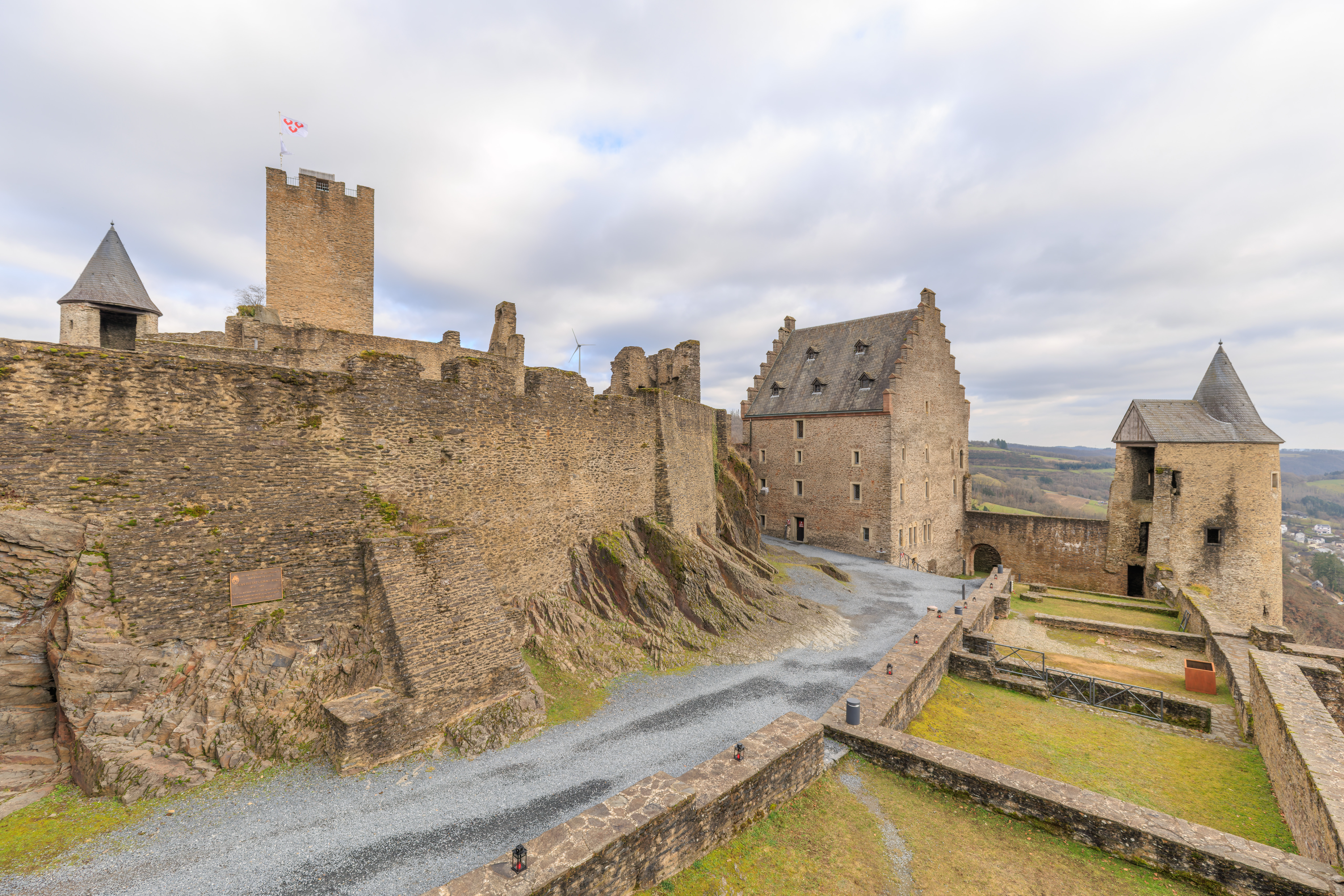
After a big breakfast at the Luxembourg Marriott Hotel Alfa, we took the tram to the north side of the city to walk over the Pont Grande-Duchesse Charlotte again as the weather today was much better than two days ago. We then took a train and bus to visit the Château de Bourscheid. Unlike Vianden, this castle was outside of town and was in a ruined state. We returned to Luxembourg for a very late lunch and then visited the city’s fortifications on the east side of the Alzette atop the Plateau du Rham before returning to the Marriott after sunset.
Morning
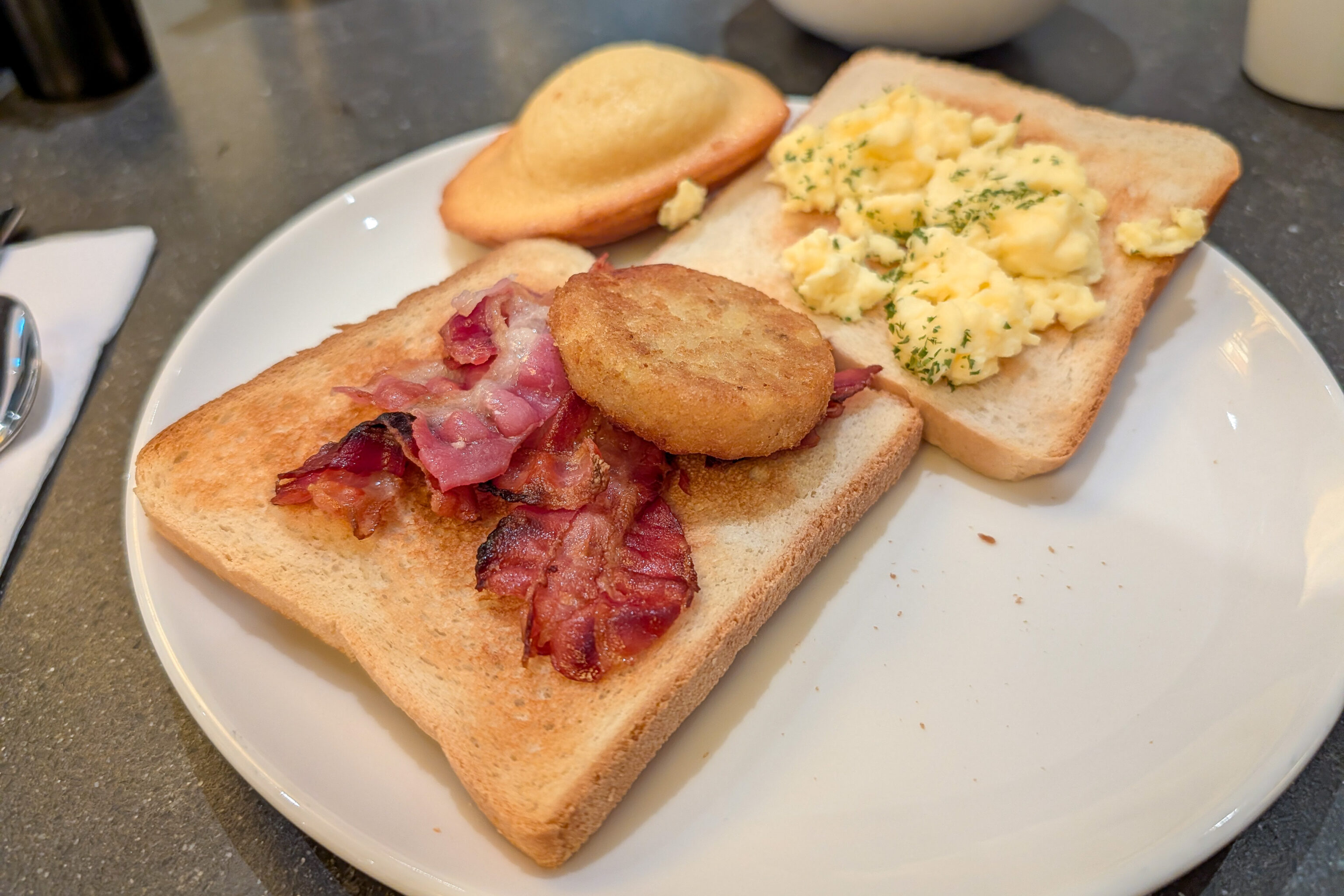

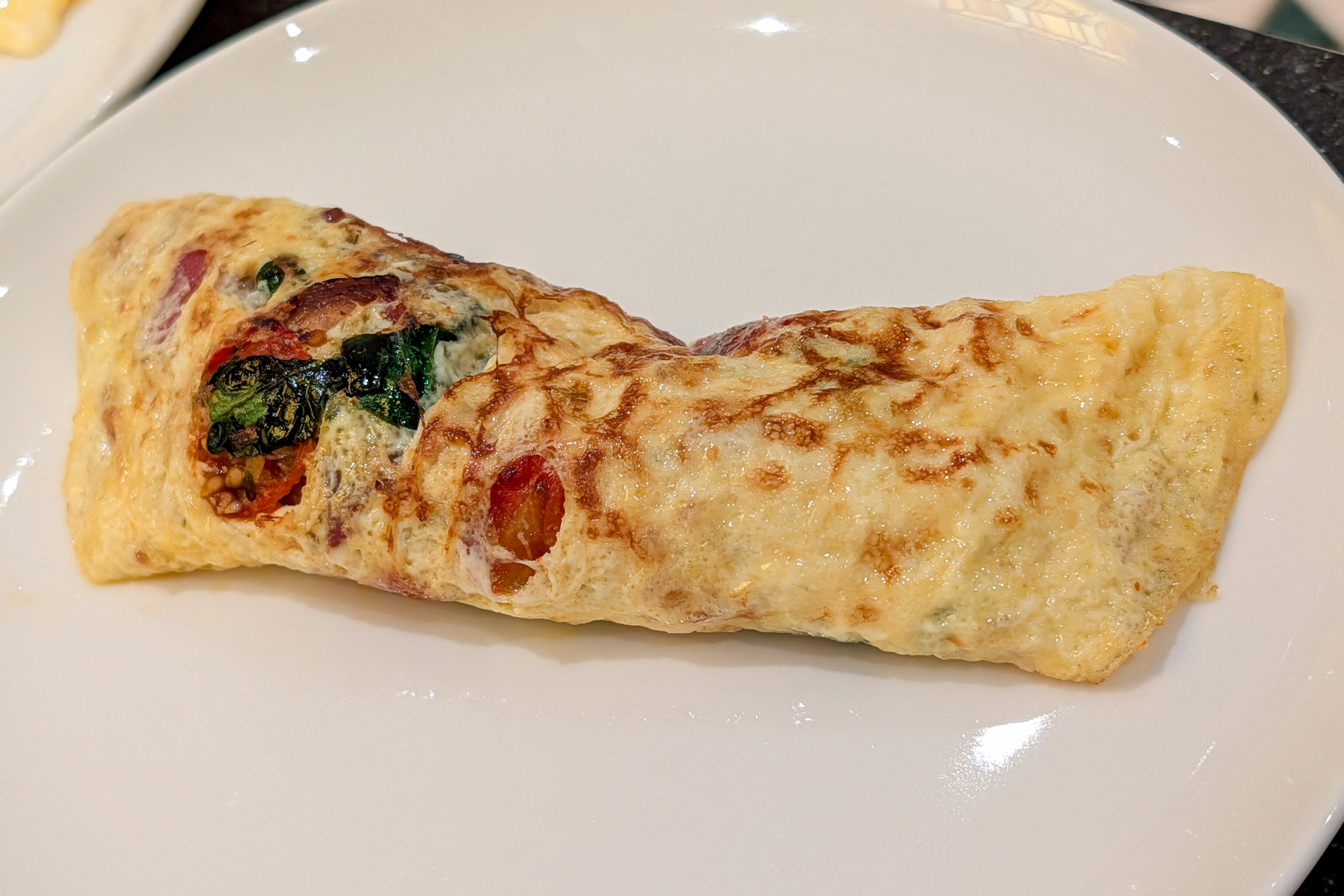
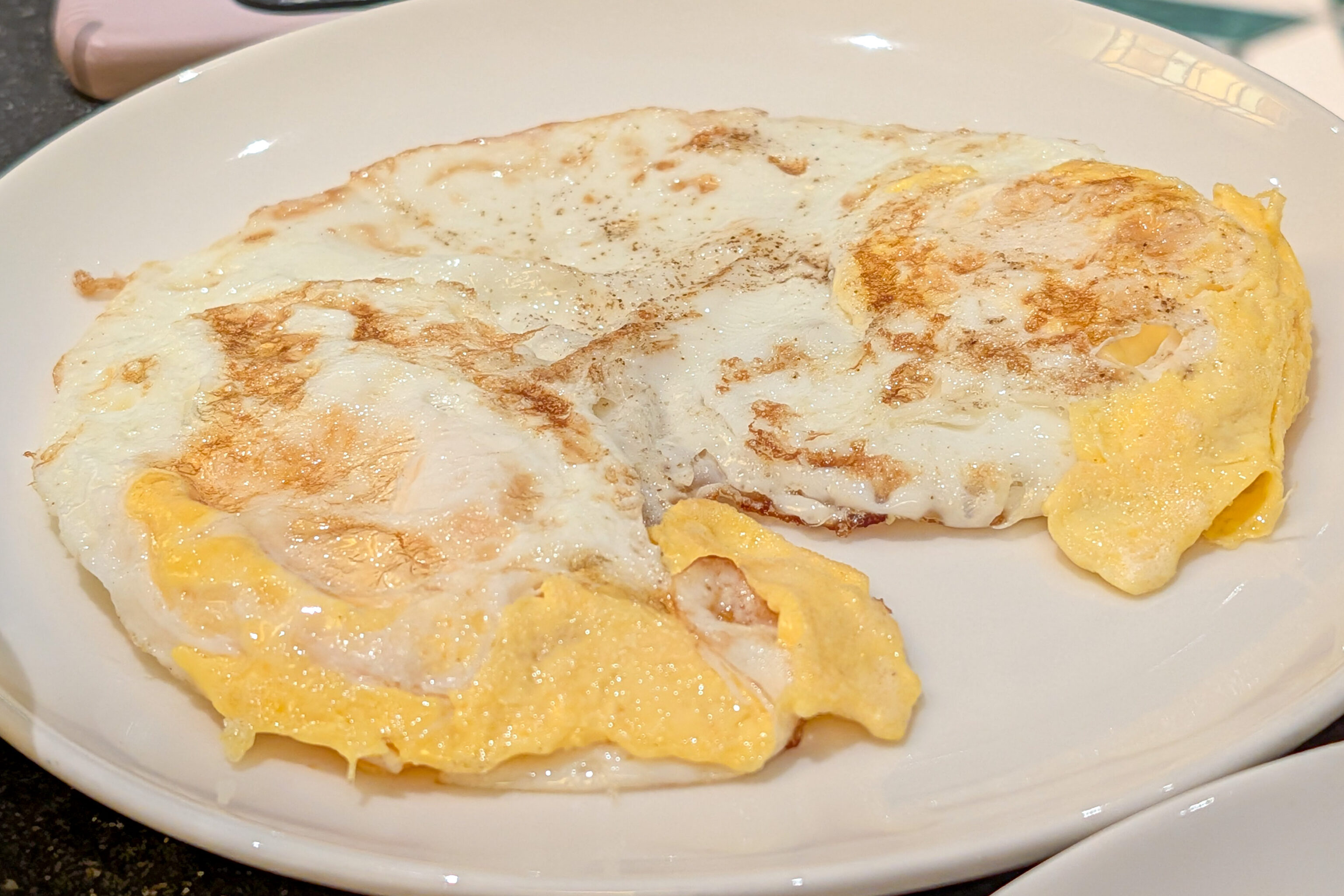
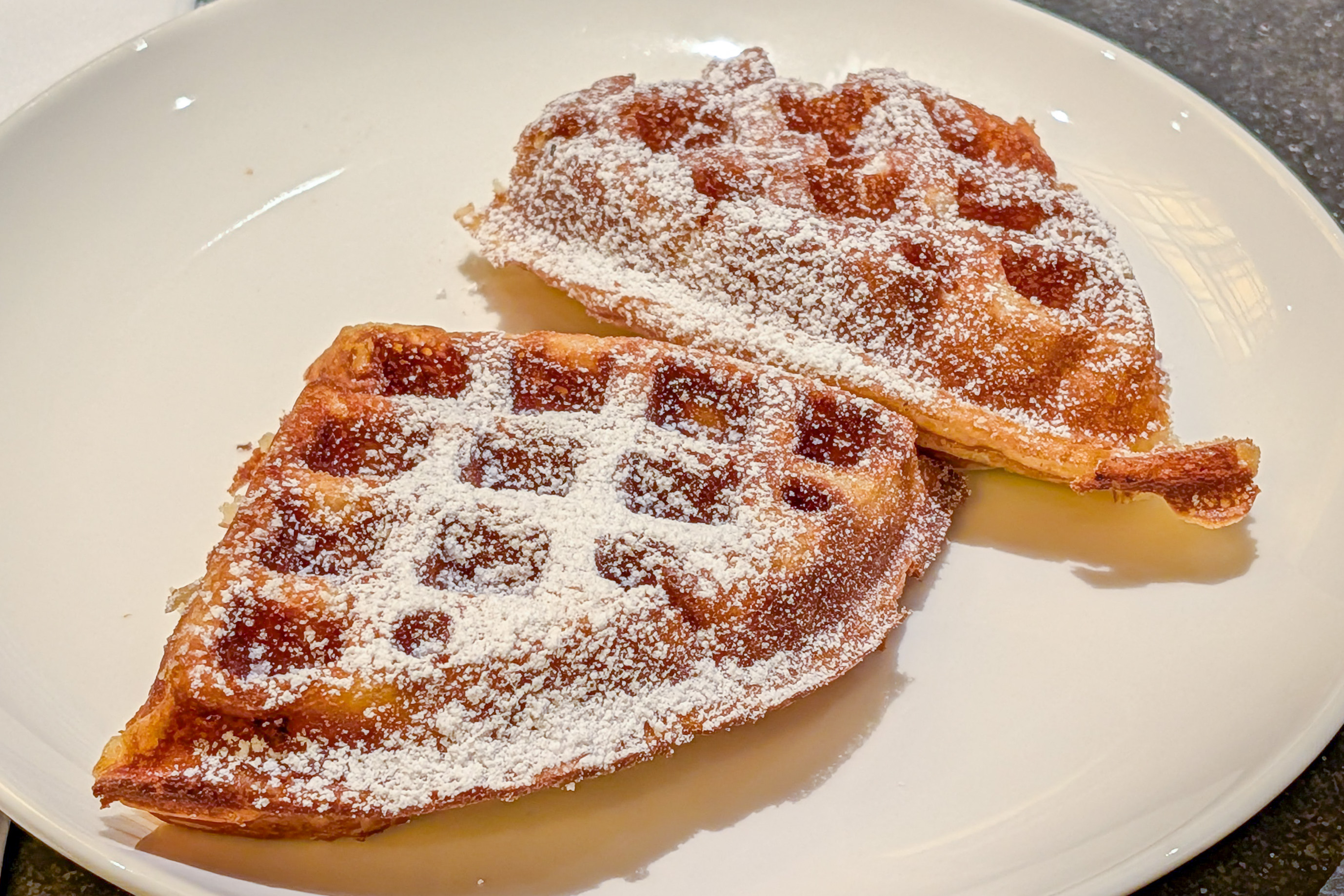
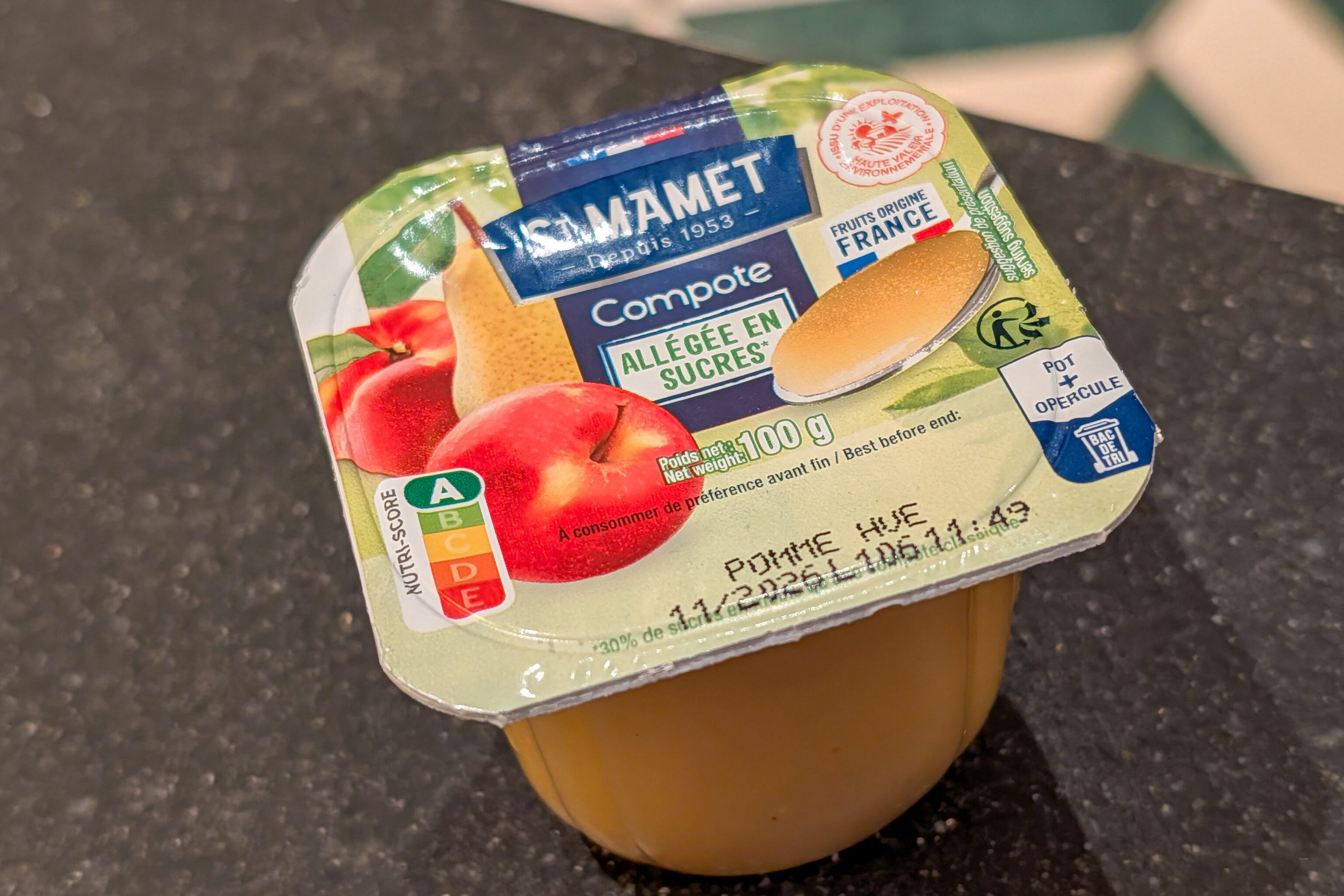
After waking up at the Luxembourg Marriott Hotel Alfa, we headed downstairs for breakfast at around 7am. We had more time for breakfast today! There wasn’t anything new to us here, although we did try that apple sauce. It was like apple sauce…
Later in the morning, we took the tram over to Rout Bréck – Pafendall, just like we did in the evening two days ago. And once again, we crossed the street to walk across the south side of the Pont Grande-Duchesse Charlotte from east to west.
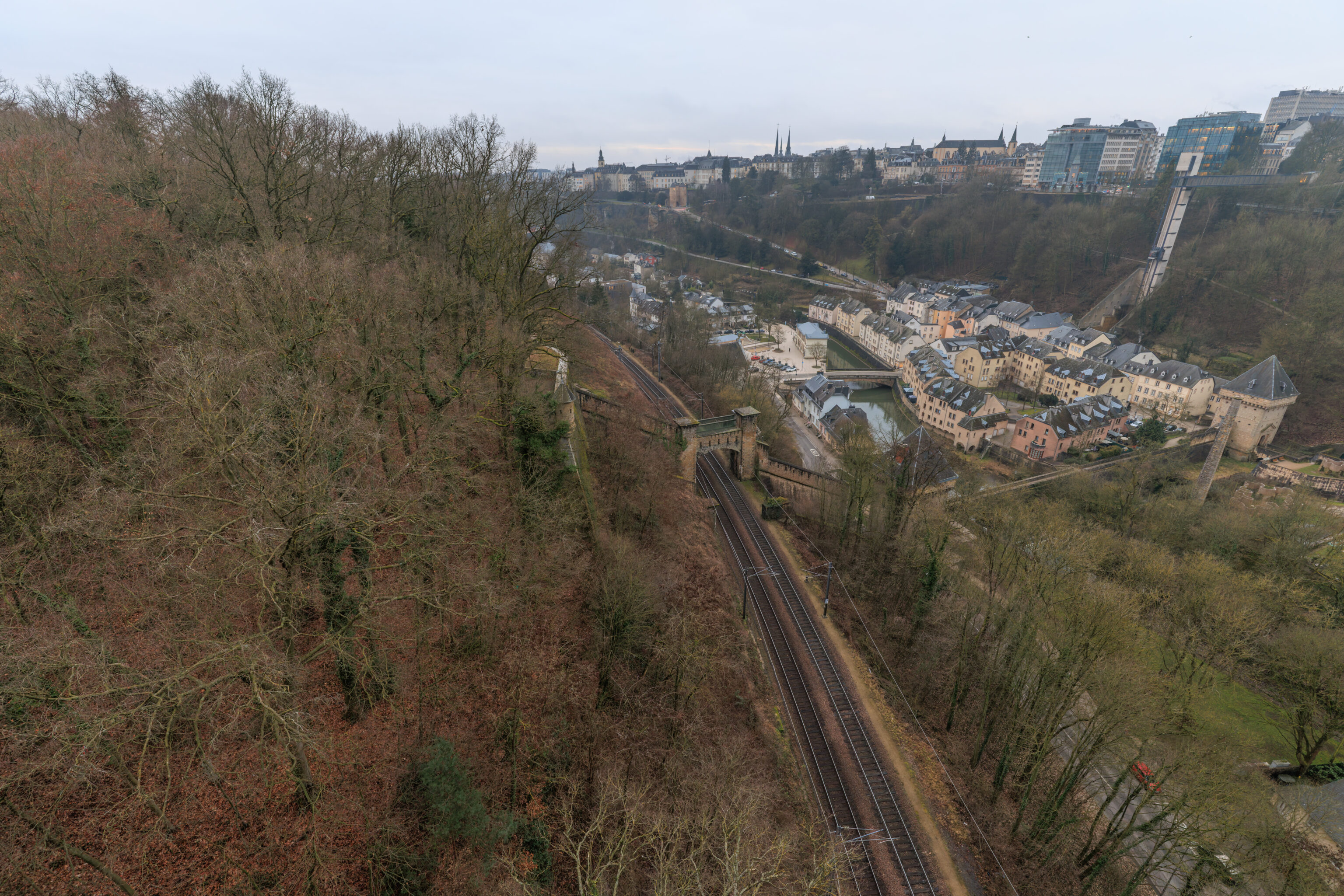
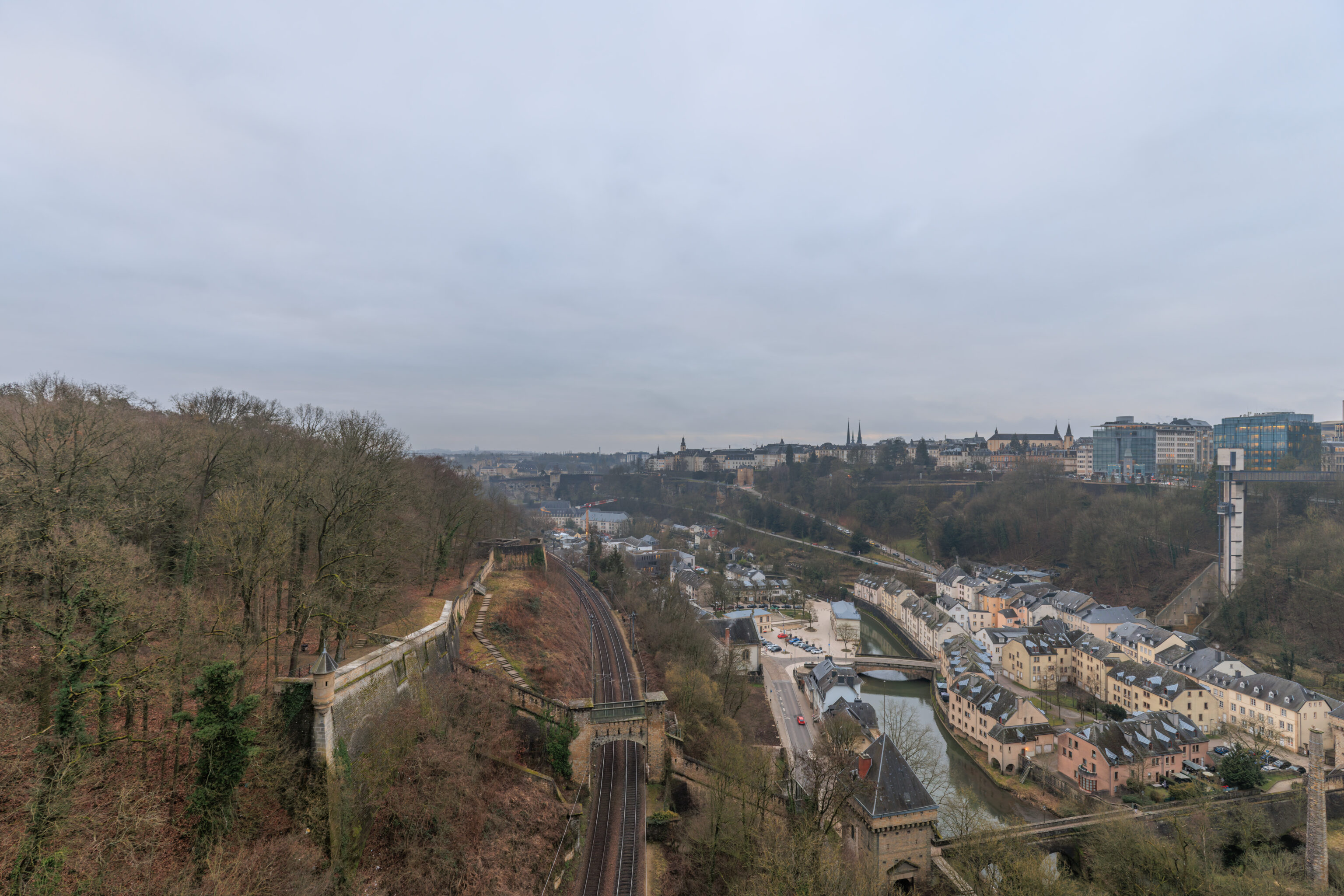
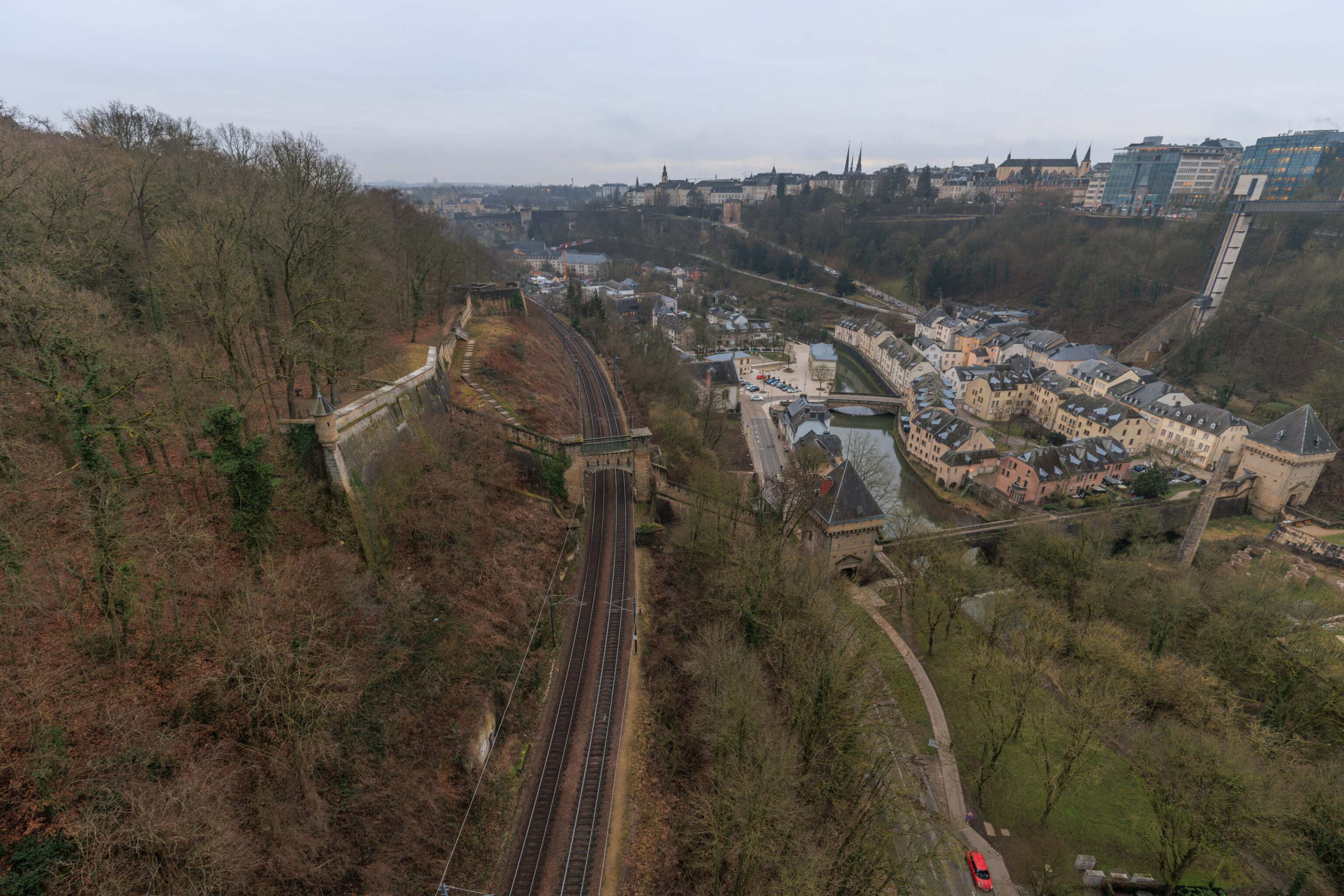
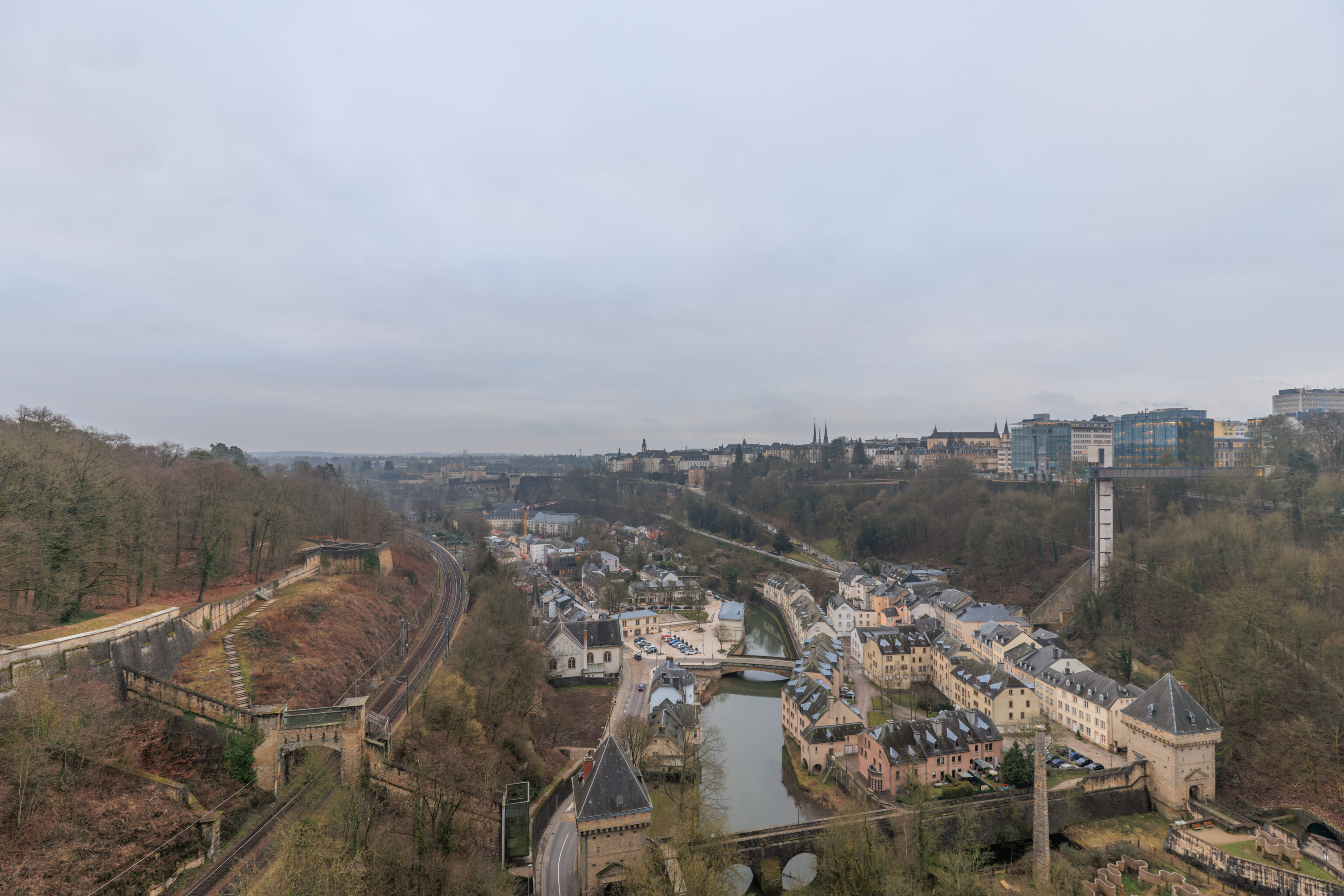
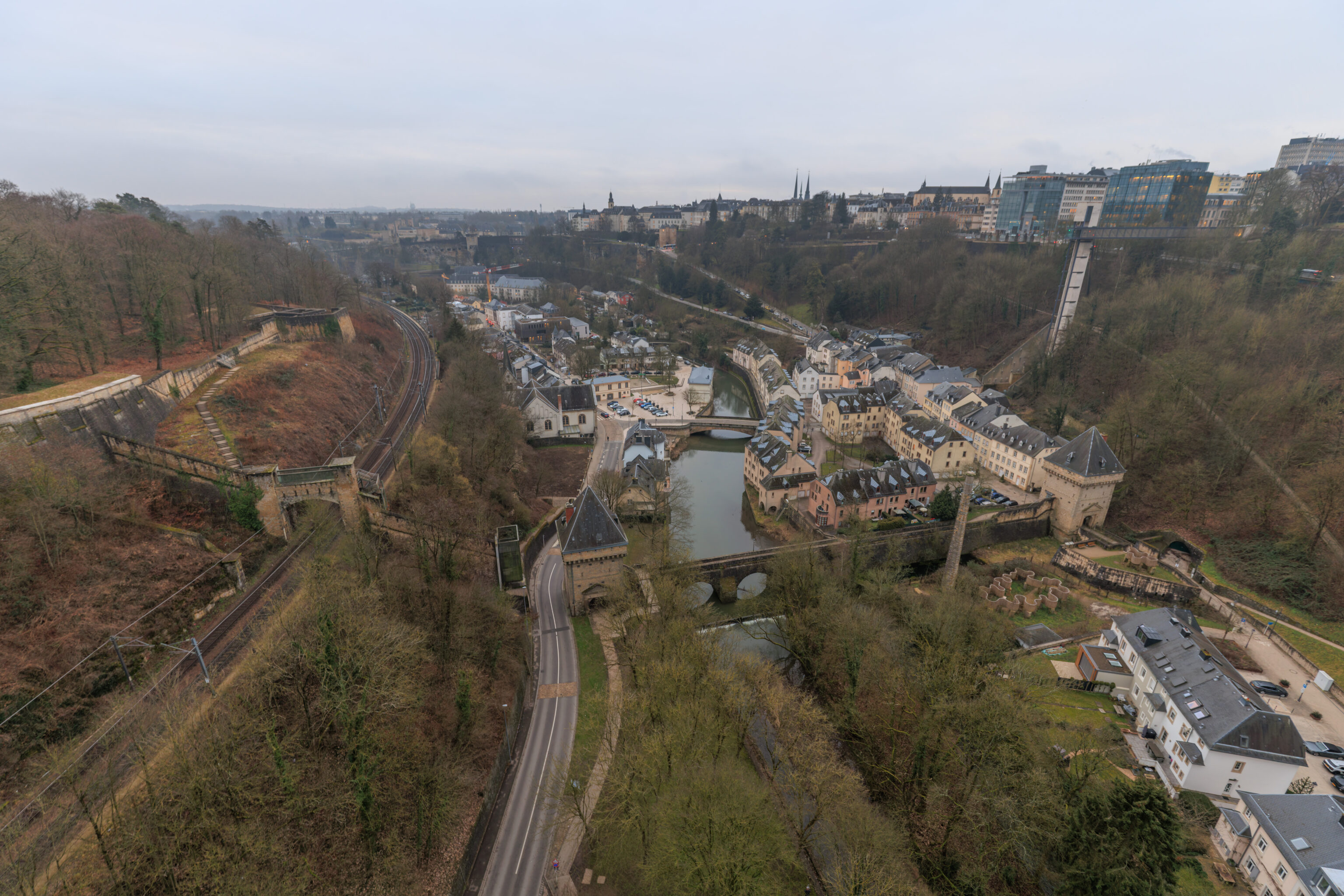
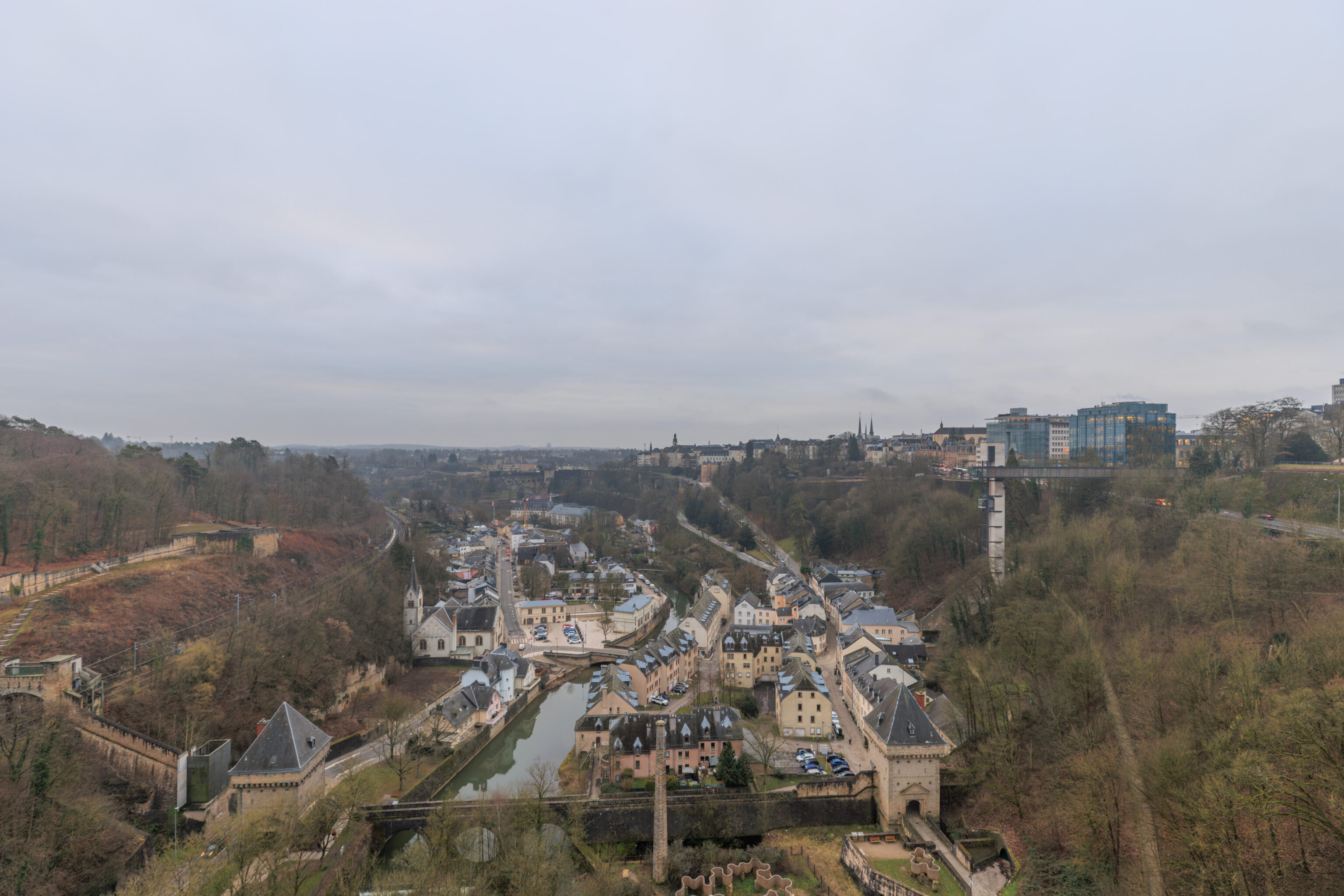
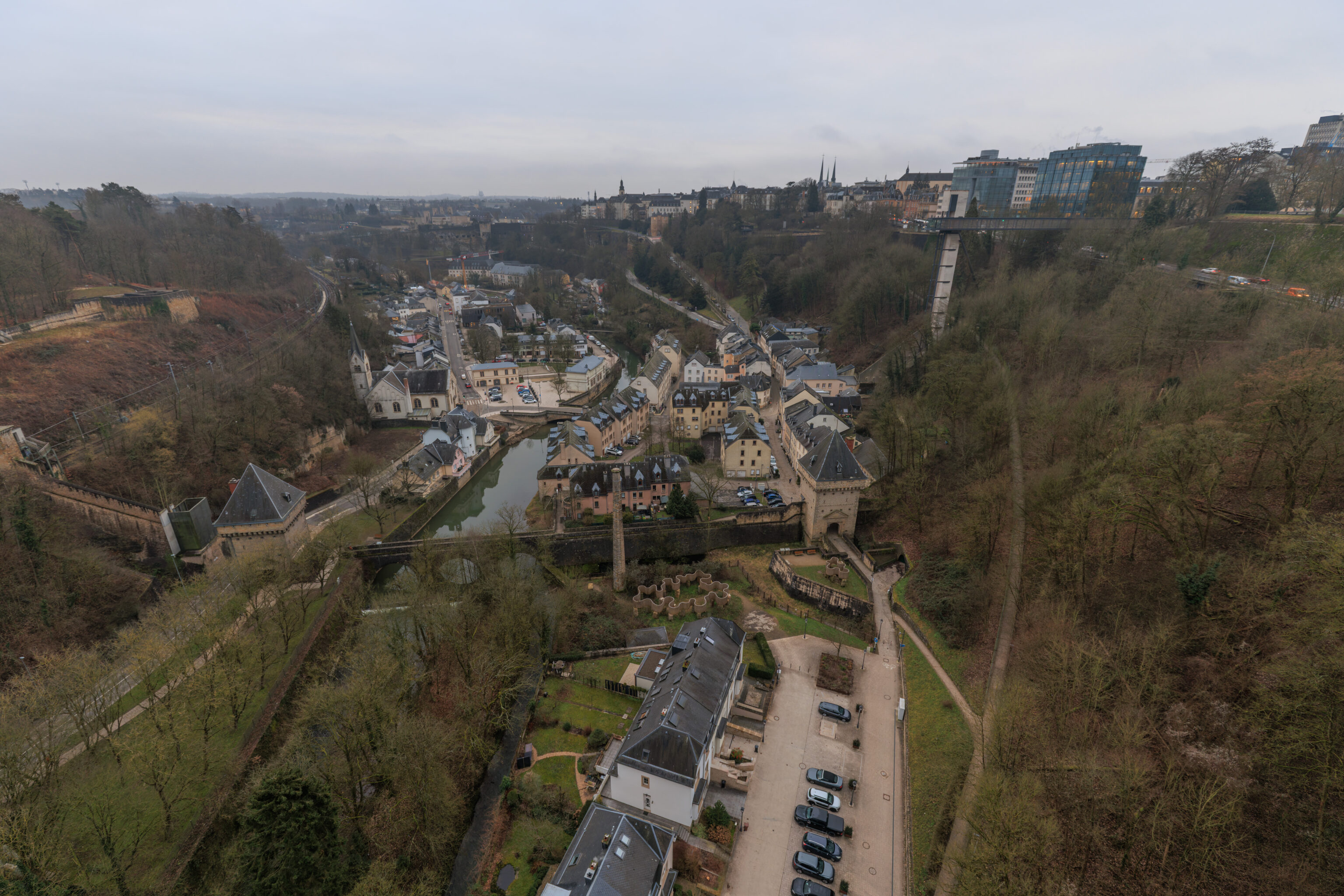
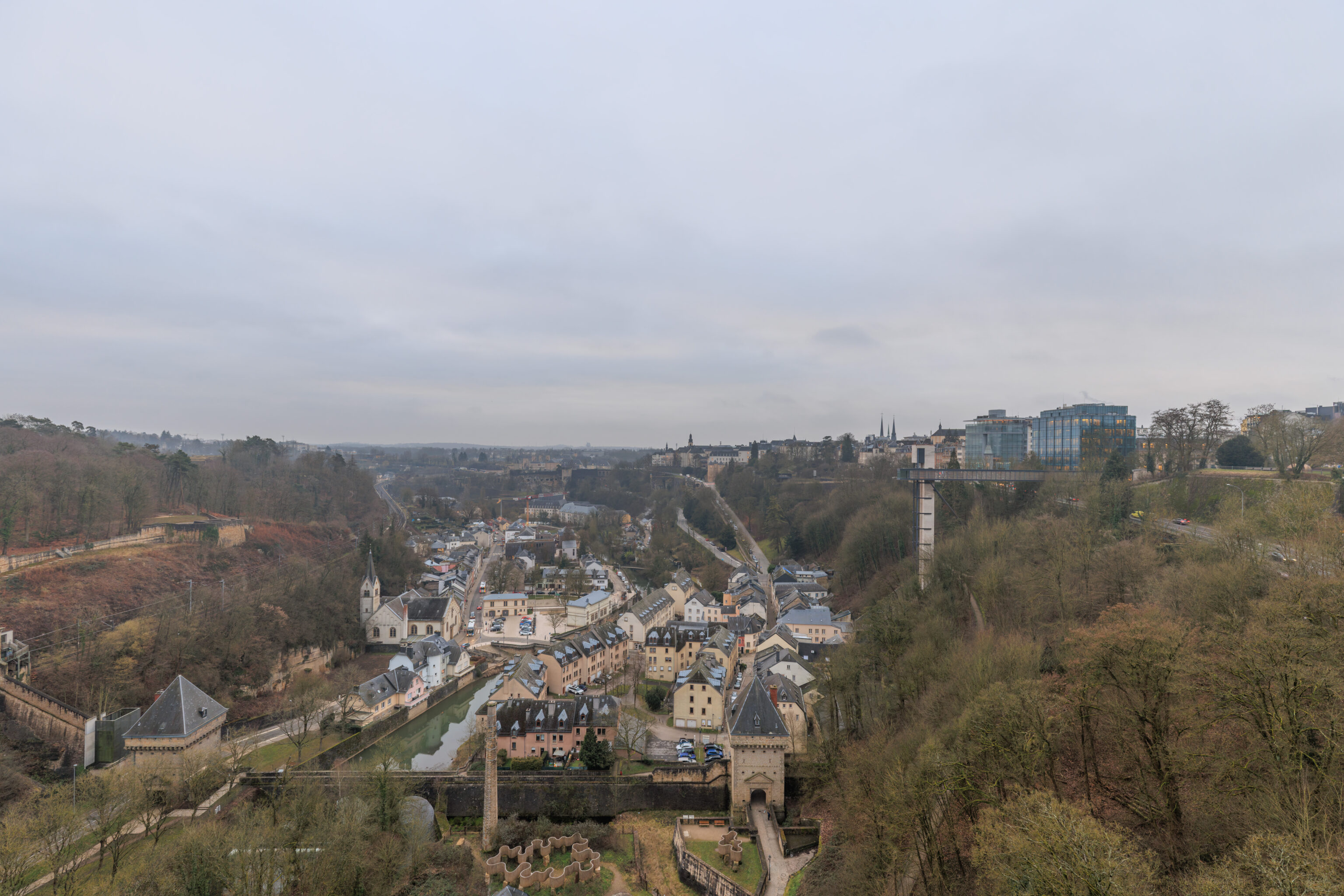
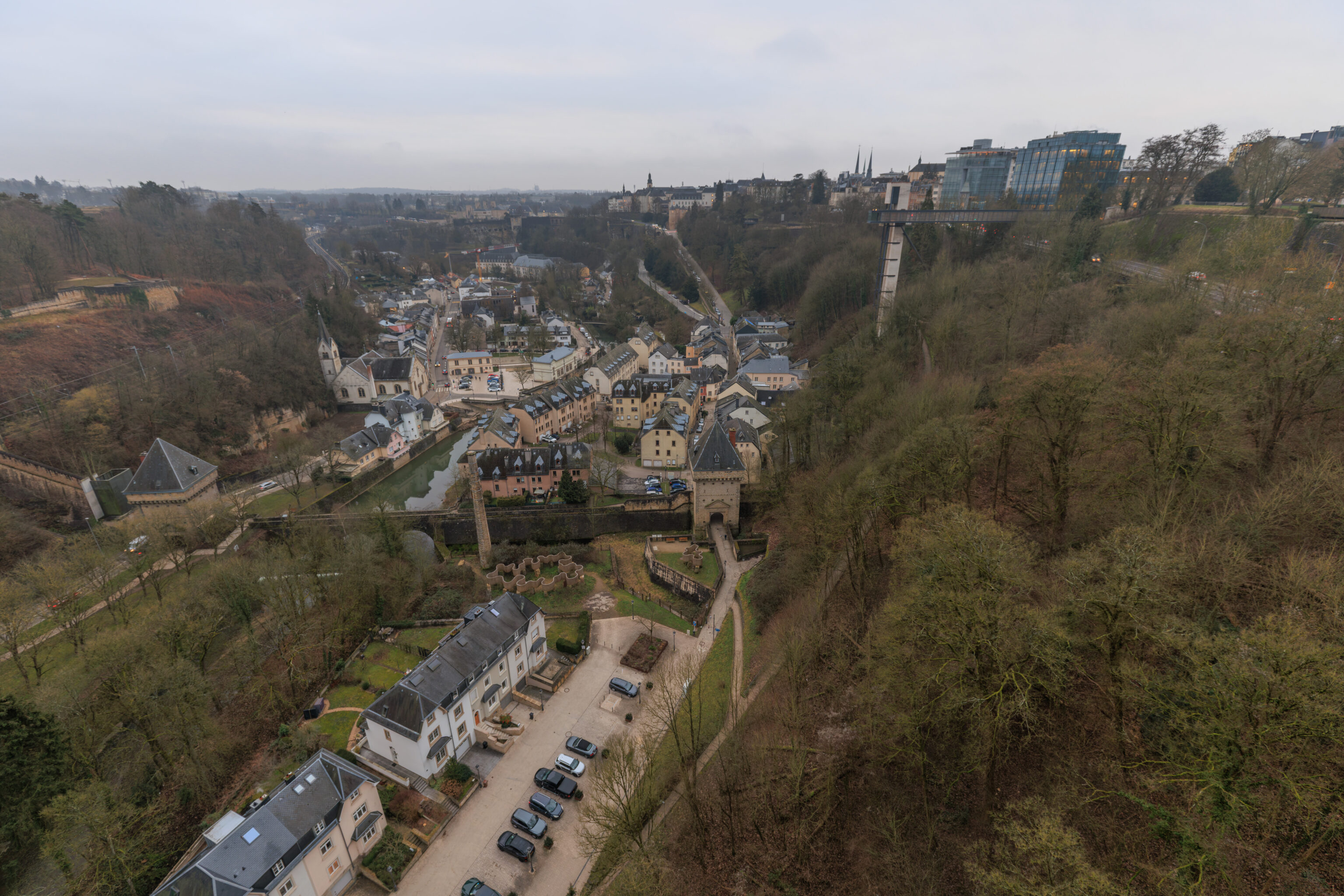
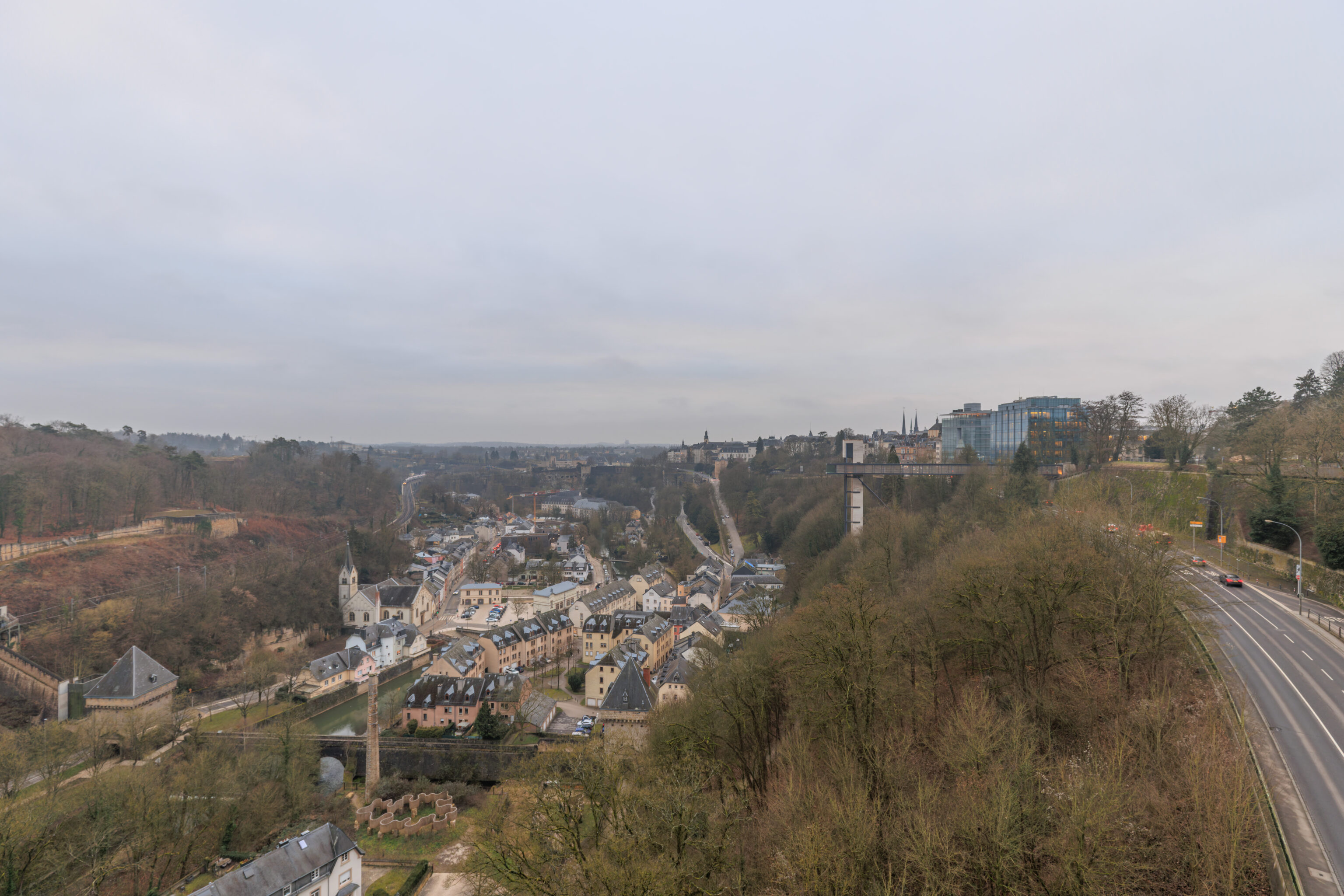
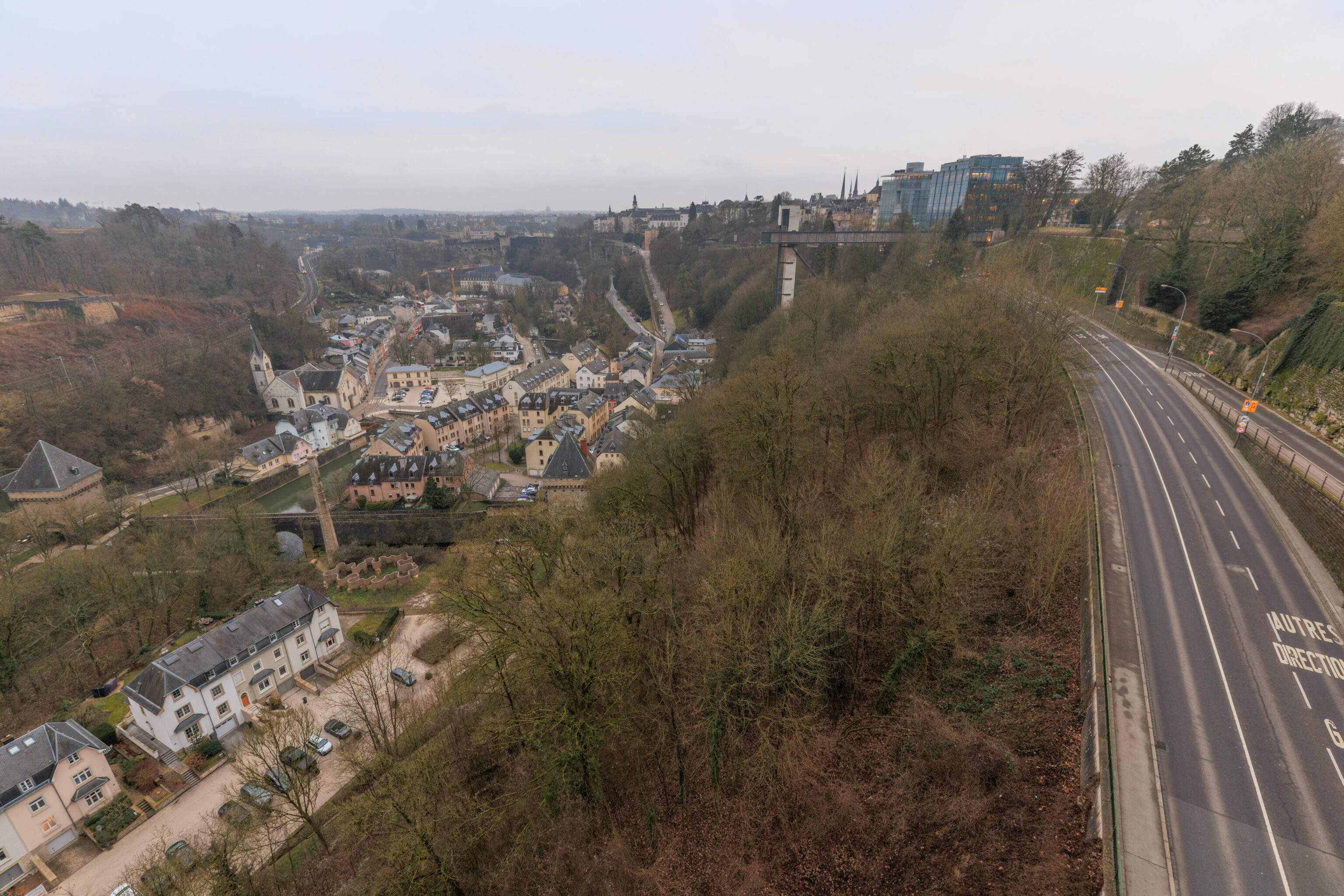
The weather was much better today! Although the sky was overcast and it was still a bit dark given the time, we at least had excellent visibility.
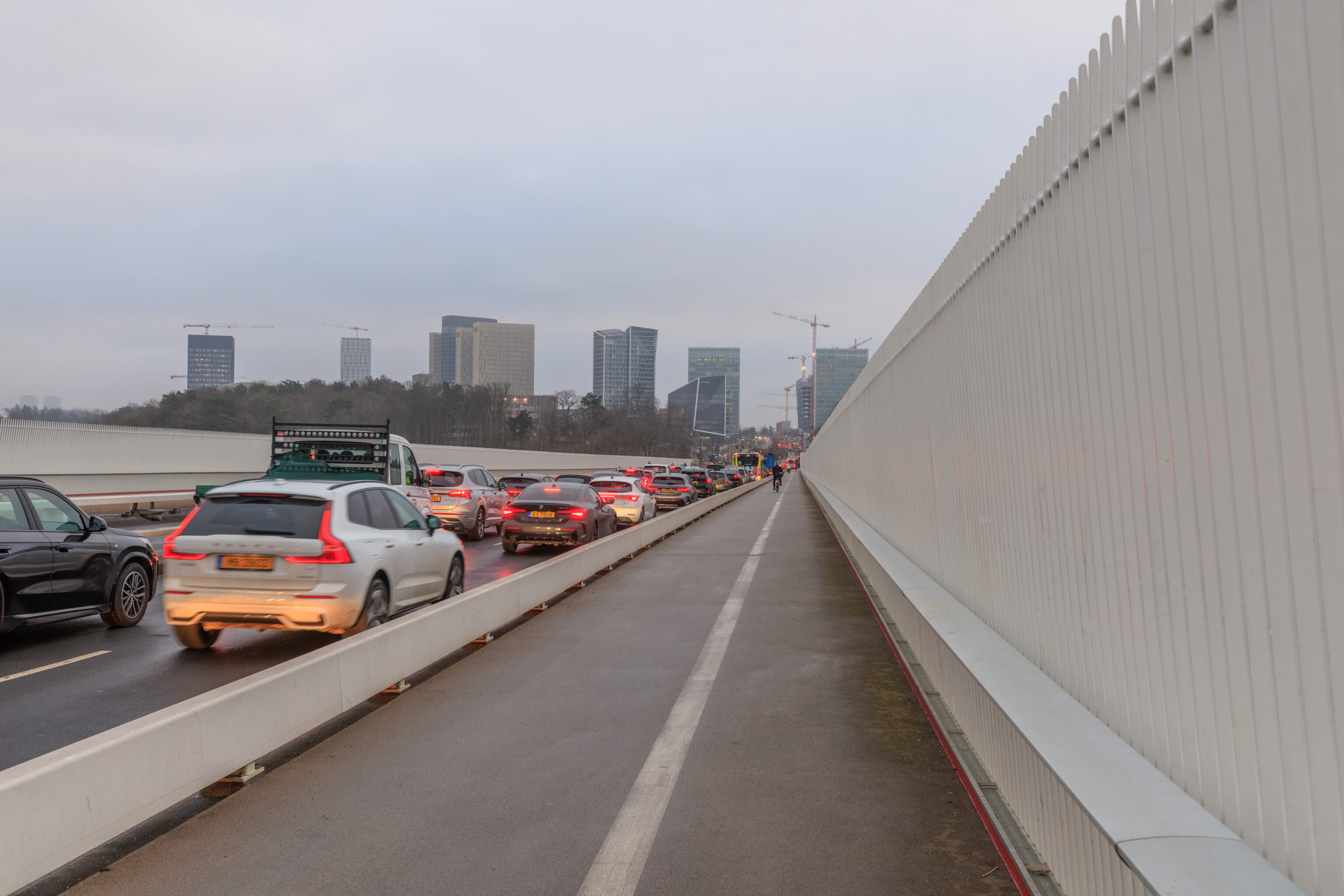
There was quite a bit of traffic on the bridge going to the east though.
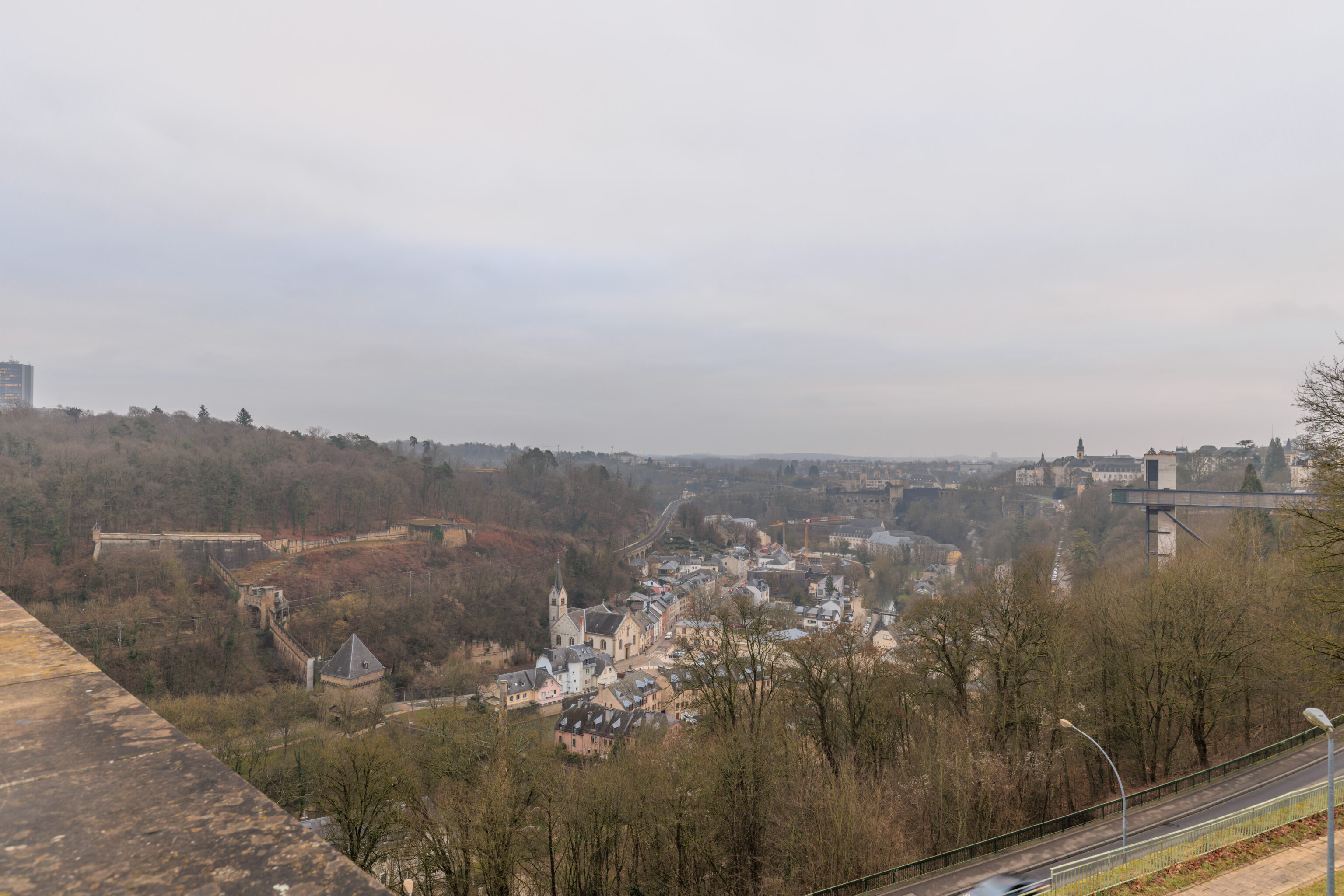
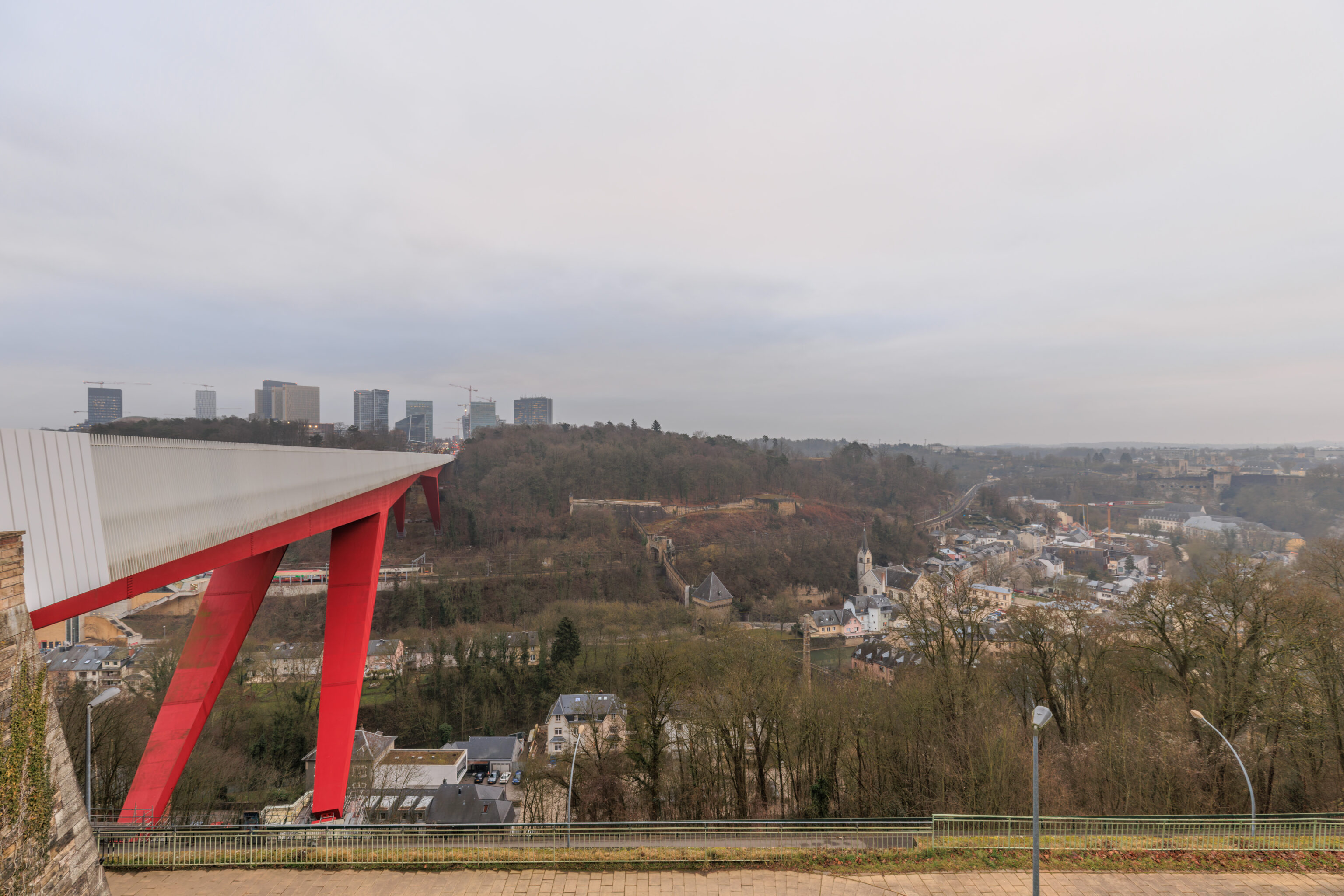
The view from the Robert-Schuman Monument on the west end of the bridge.
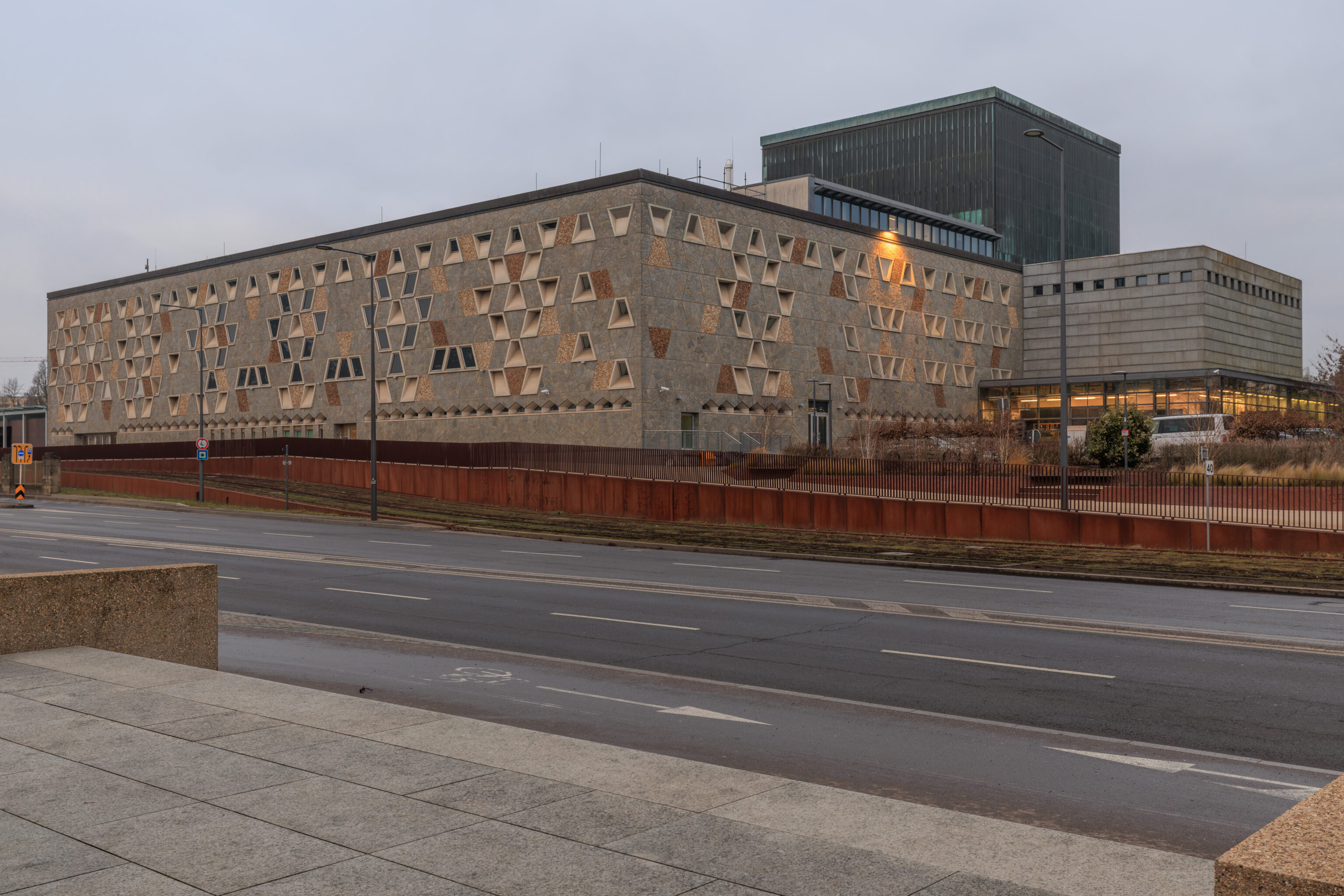
We finally got a much better view of the Grand Théâtre! Its still not a particularly attractive building, although its exterior does have some details and color that weren’t apparent when we were here two days ago.
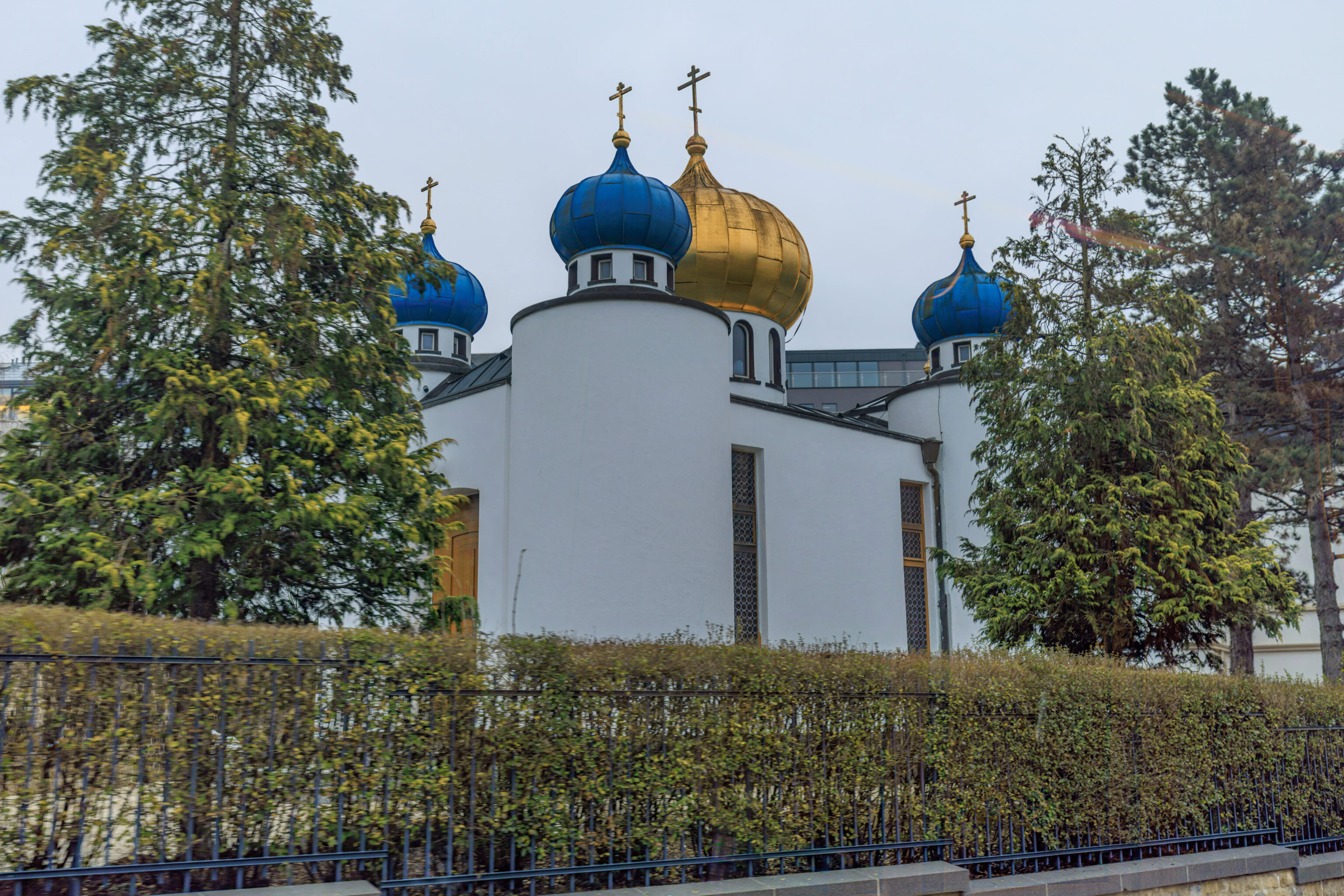
We took the tram from the Theater stop to return to Luxembourg Station. We noticed this church, the Église des Saints Apôtres Pierre et Paul (Church of Saints Apostles Peter and Paul), on the way. It is a Russian Orthodox church.
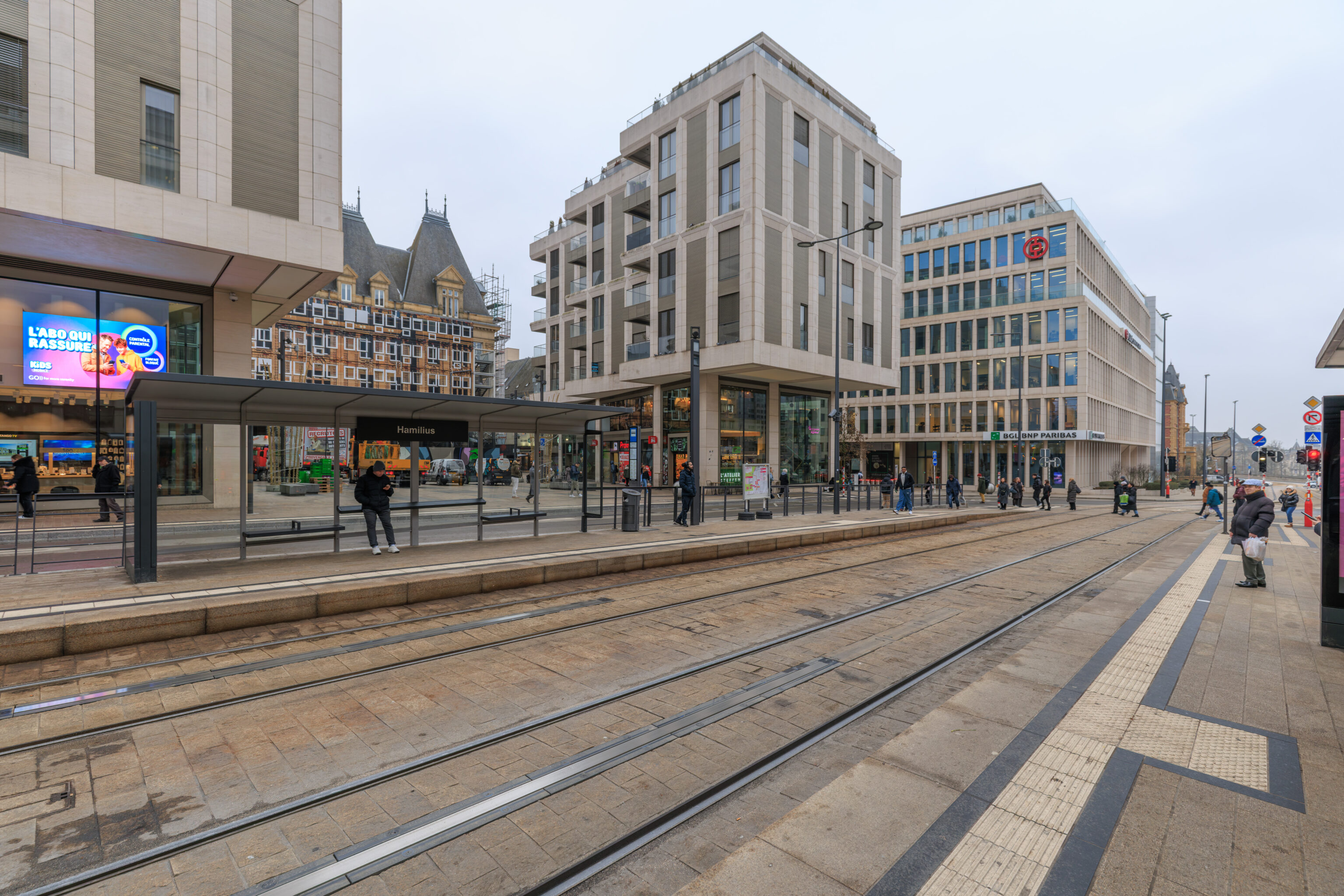
We briefly stopped here at Hamilius before getting back on a tram to continue the trip to the station.
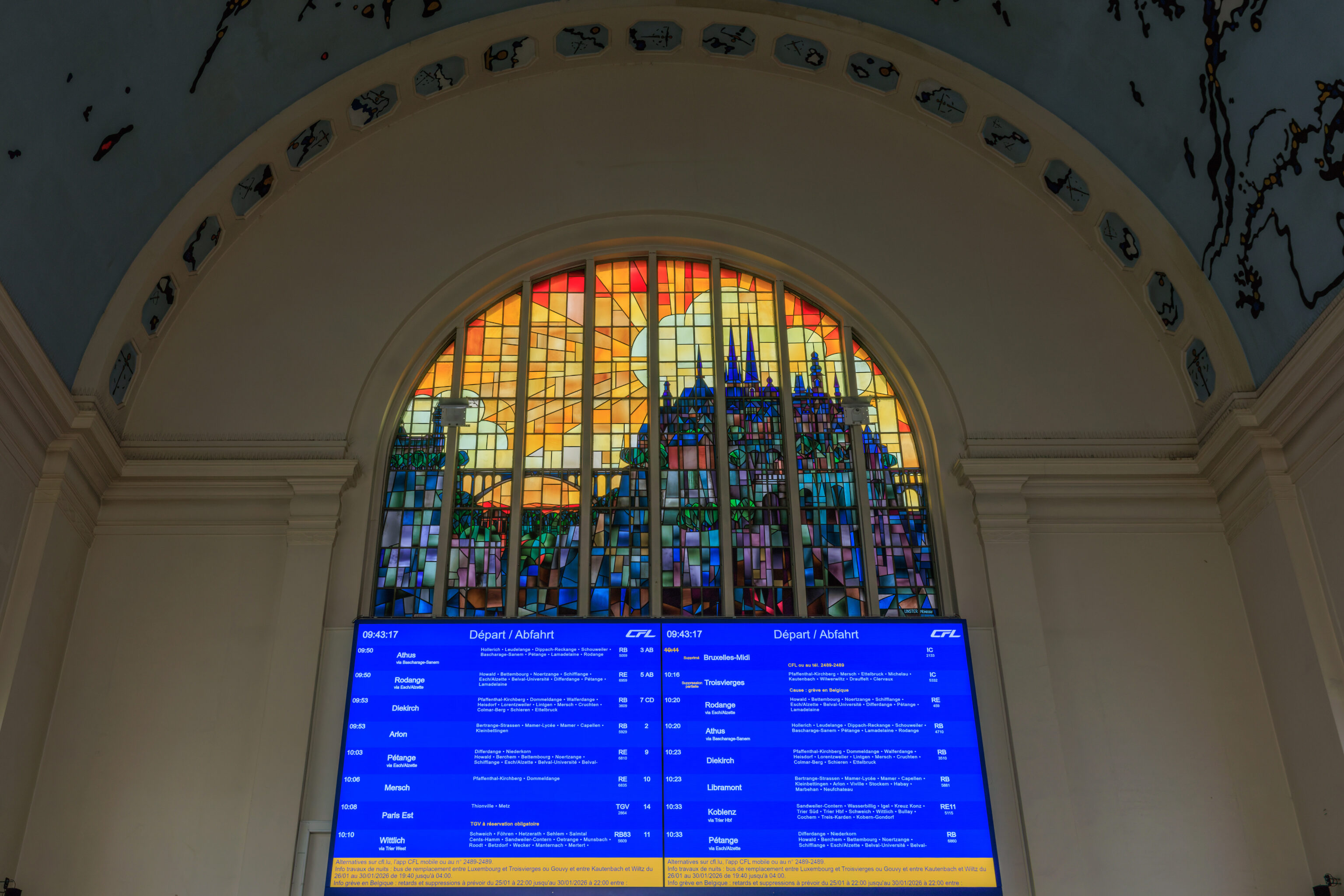
The train station’s main hall has a beautiful stained glass window depicting Luxembourg. We took the next train to Ettelbruck, the same place we took the train to yesterday, departing at 9:53am.
Château de Bourscheid
We caught a bus from Ettelbruck to Bourscheid, Beim Schlass, which takes about 25 minutes. The trip is mostly through a rural area and passes through the small town of Bourscheid before arriving by the castle.
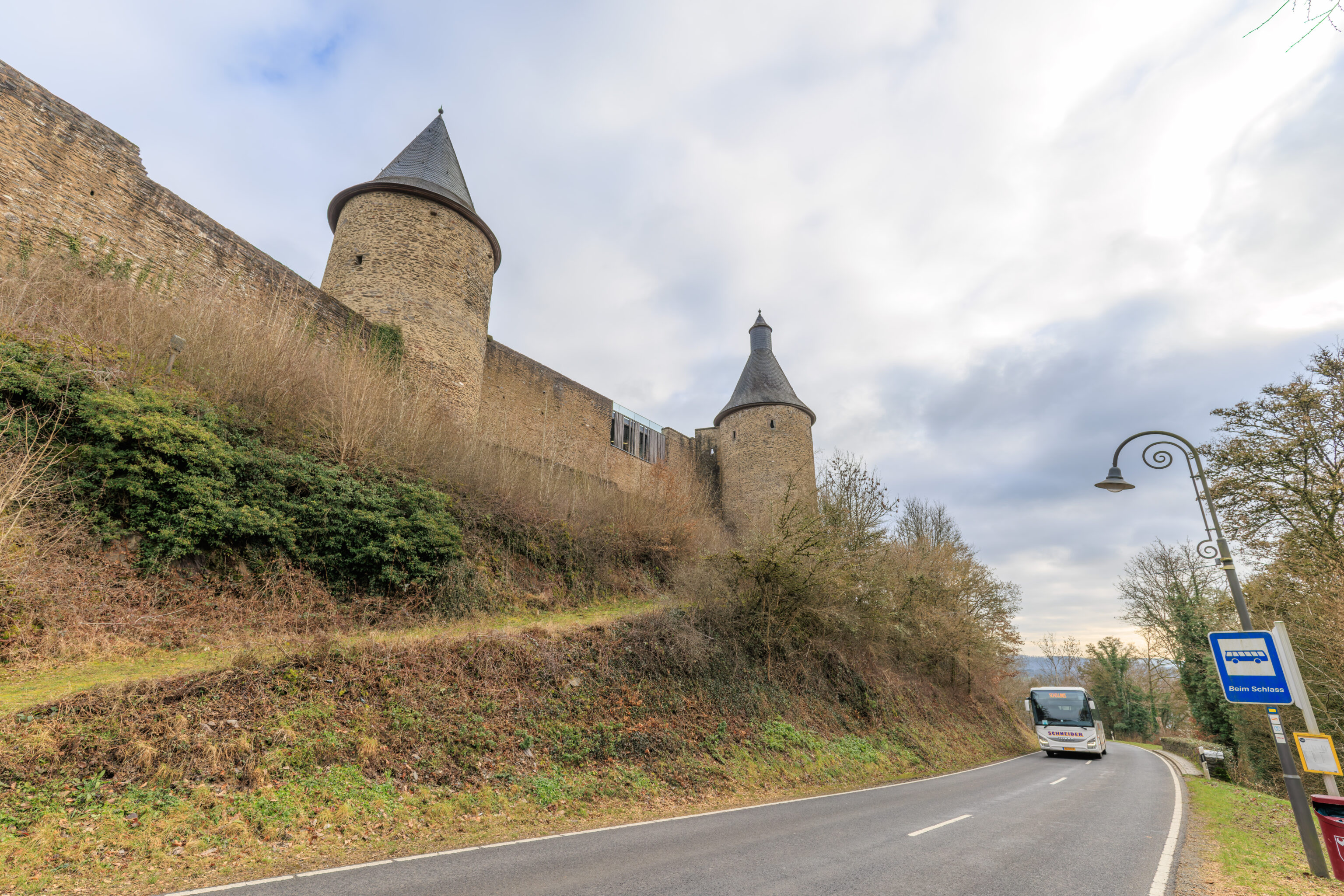
The bus stop is on the west side of the Château de Bourscheid.
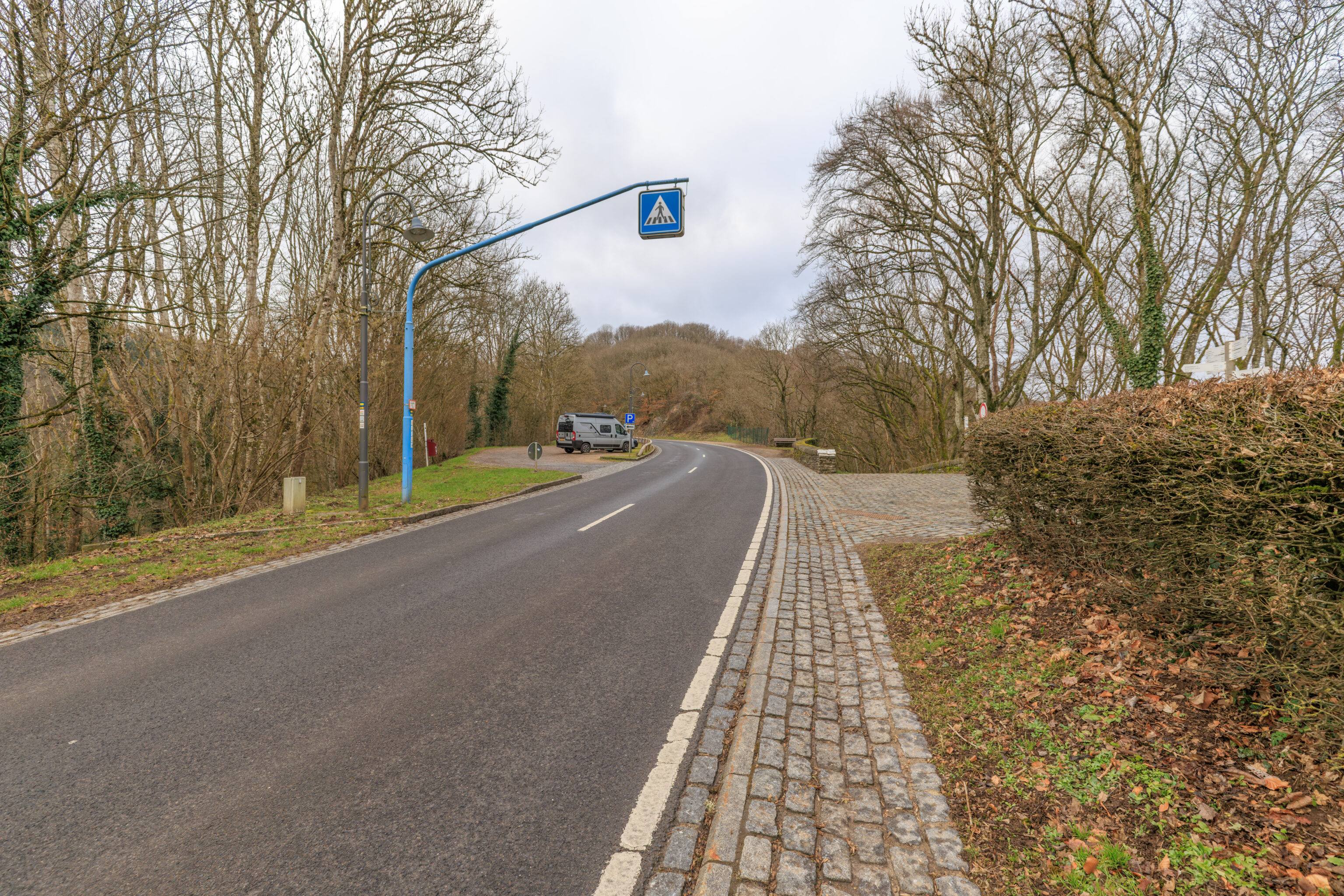
To get to the castle’s entrance, we had to walk to the west a bit to reach its driveway. Note that the bus stop for busses going in the opposite direction is a bit further to the west past the driveway.
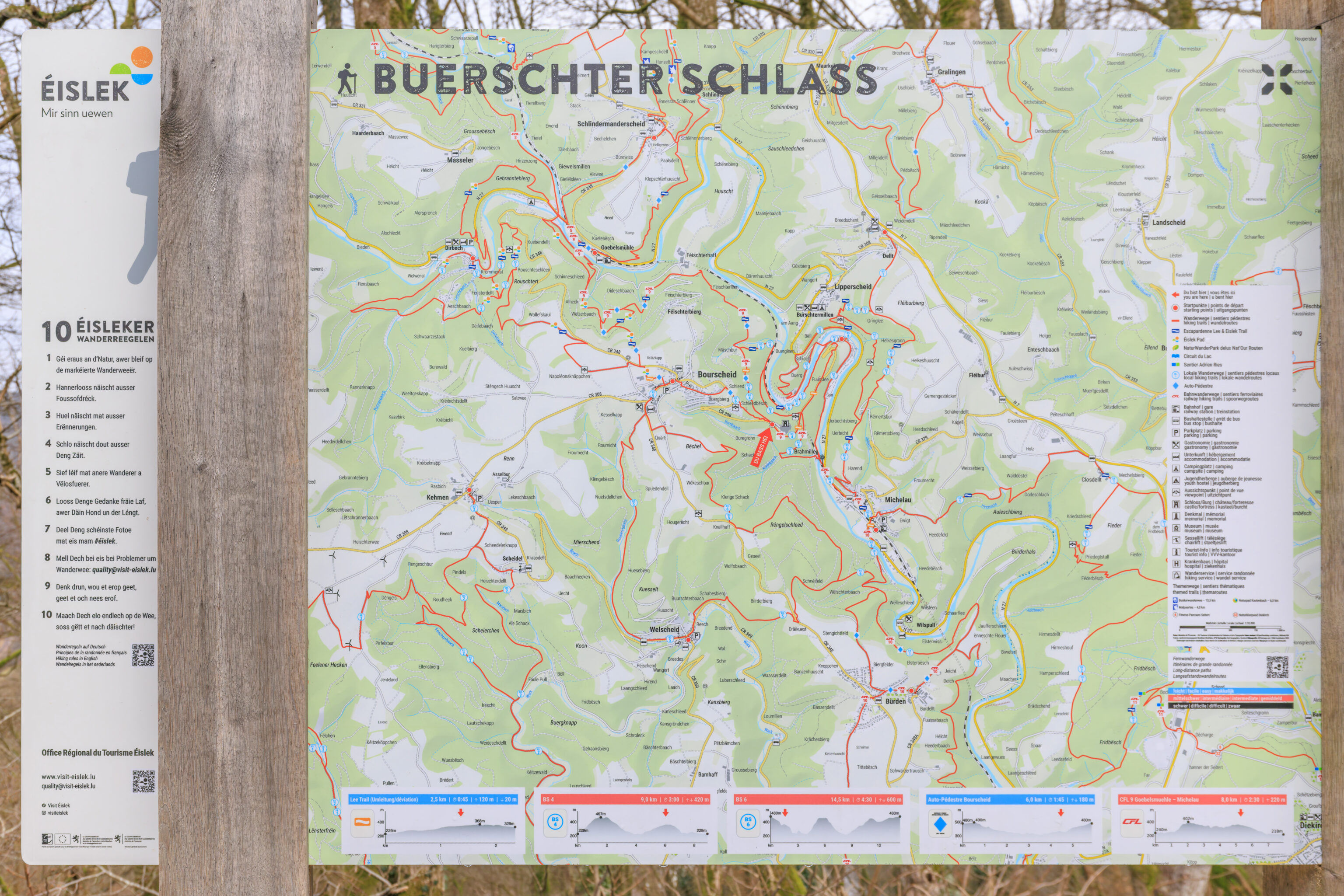
There was a map showing the various walking trails in the area. There is actually a train station nearby in the town of Michelau that receives what seems to be hourly service. Walking down to the town to take the train back to Luxembourg may actually be a reasonable alternative taking the bus from here after looking at this map.
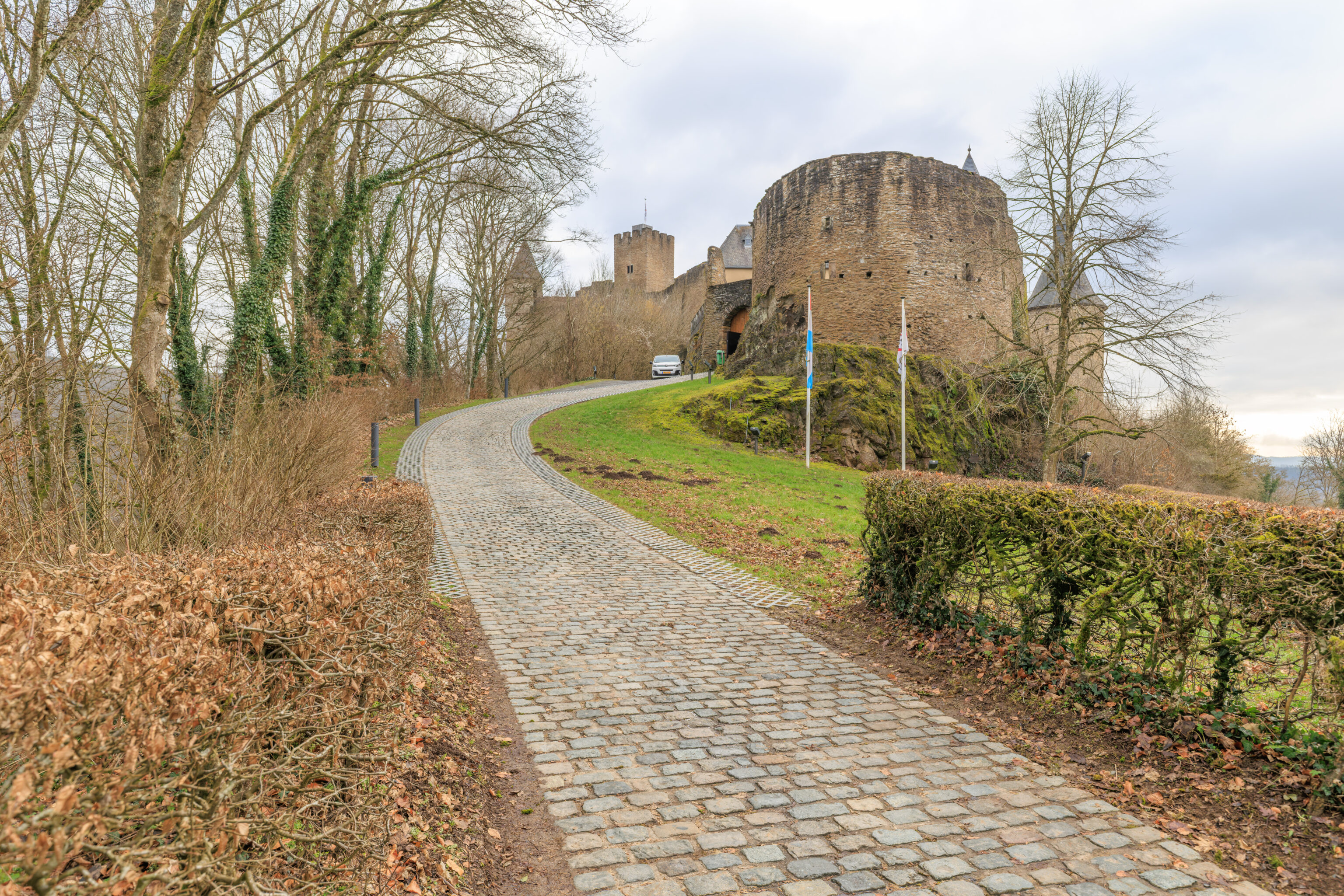
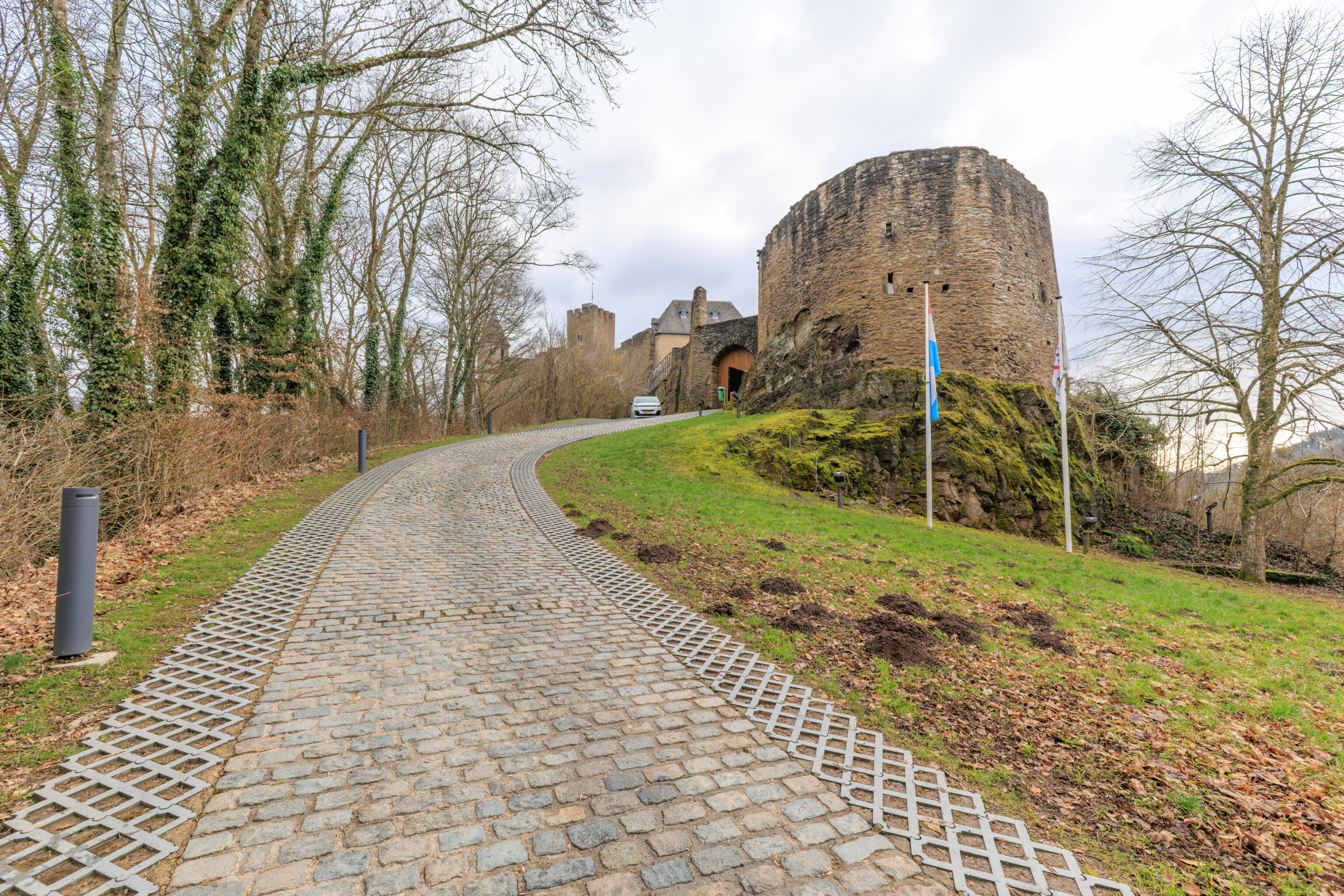
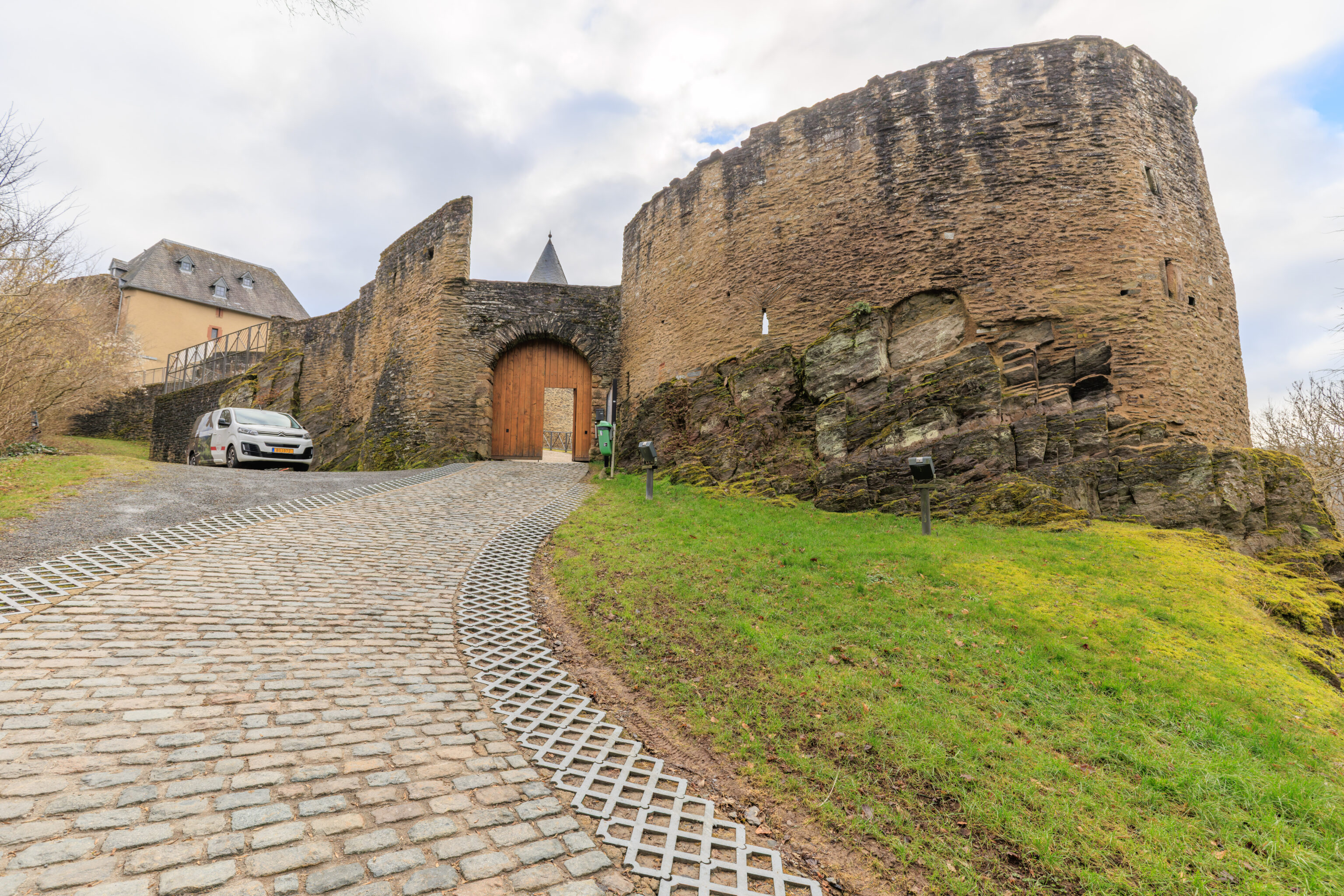
We walked up to the castle’s entrance via its driveway.
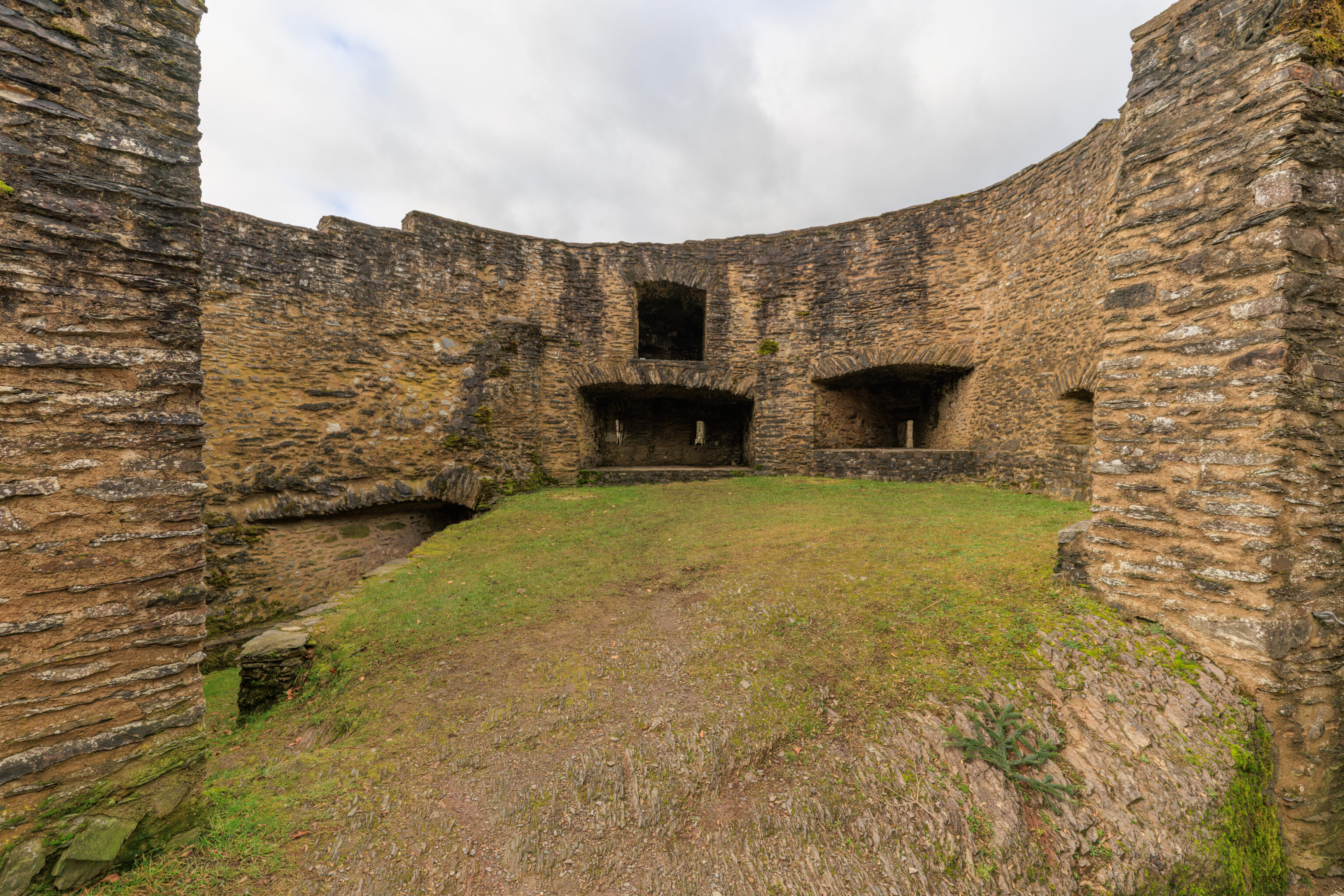
This area here is a bastion at the western tip of the castle and is the newest section, dating back to the 1430s.
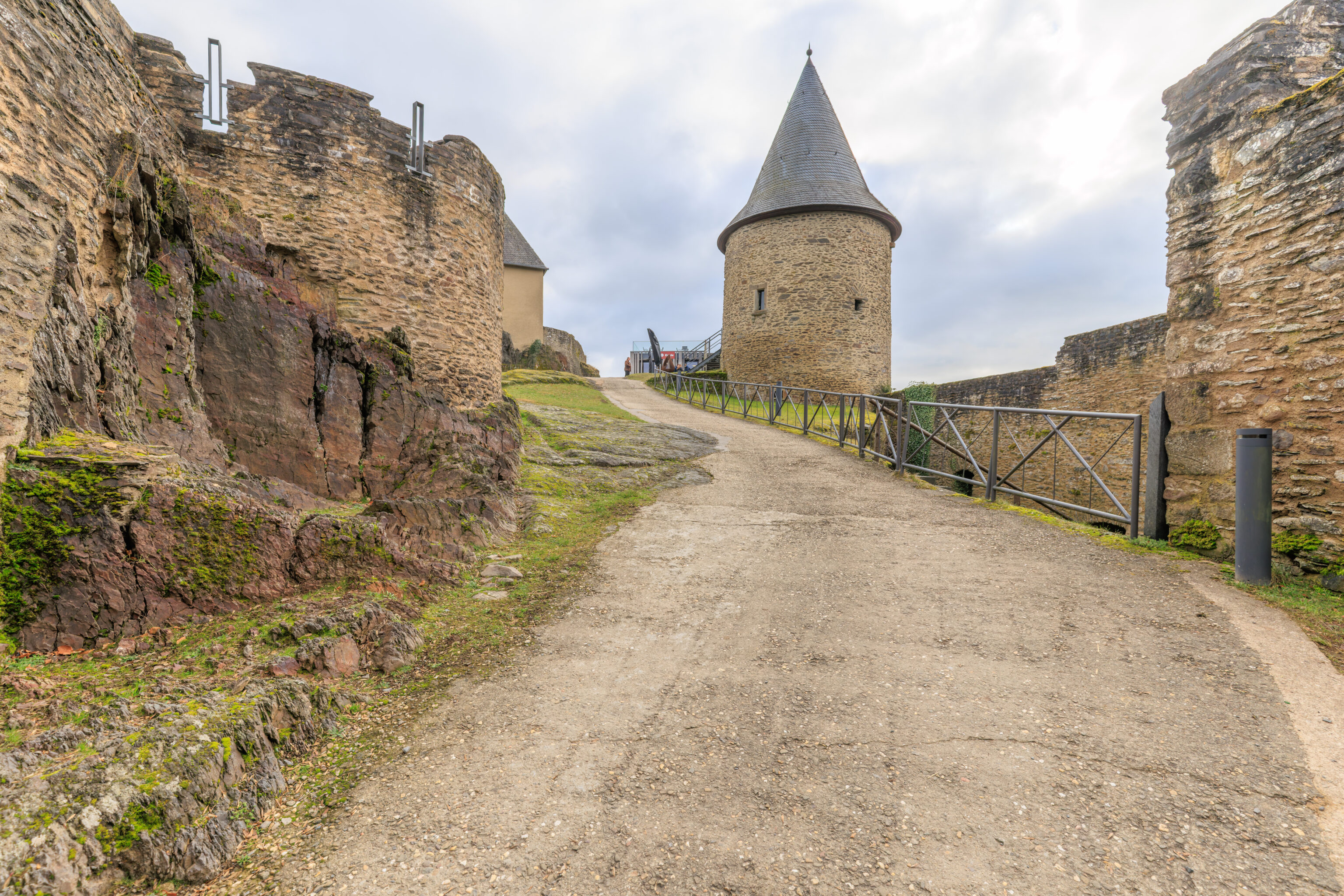
We proceeded up a sloped path, passing by two watchtowers.
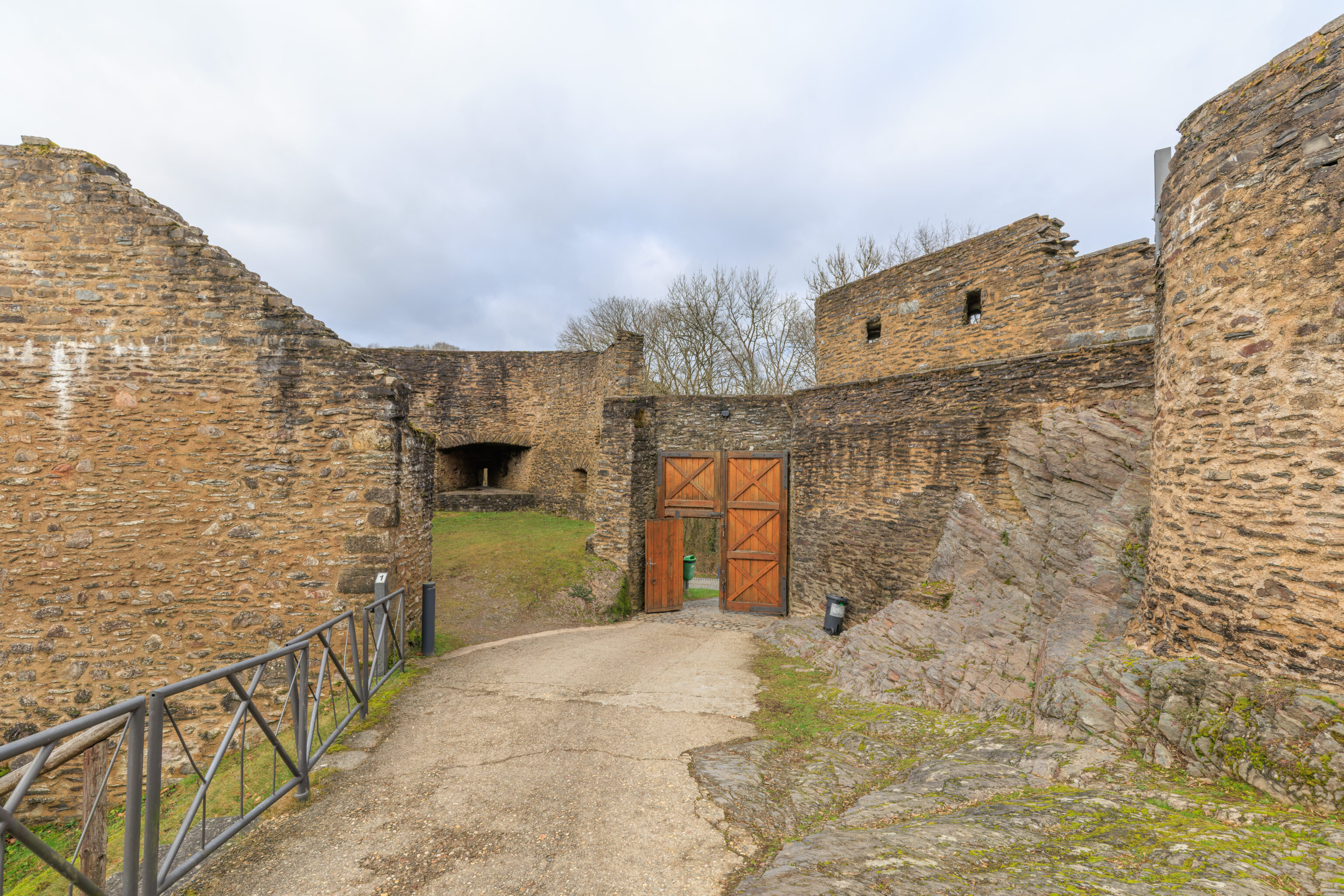
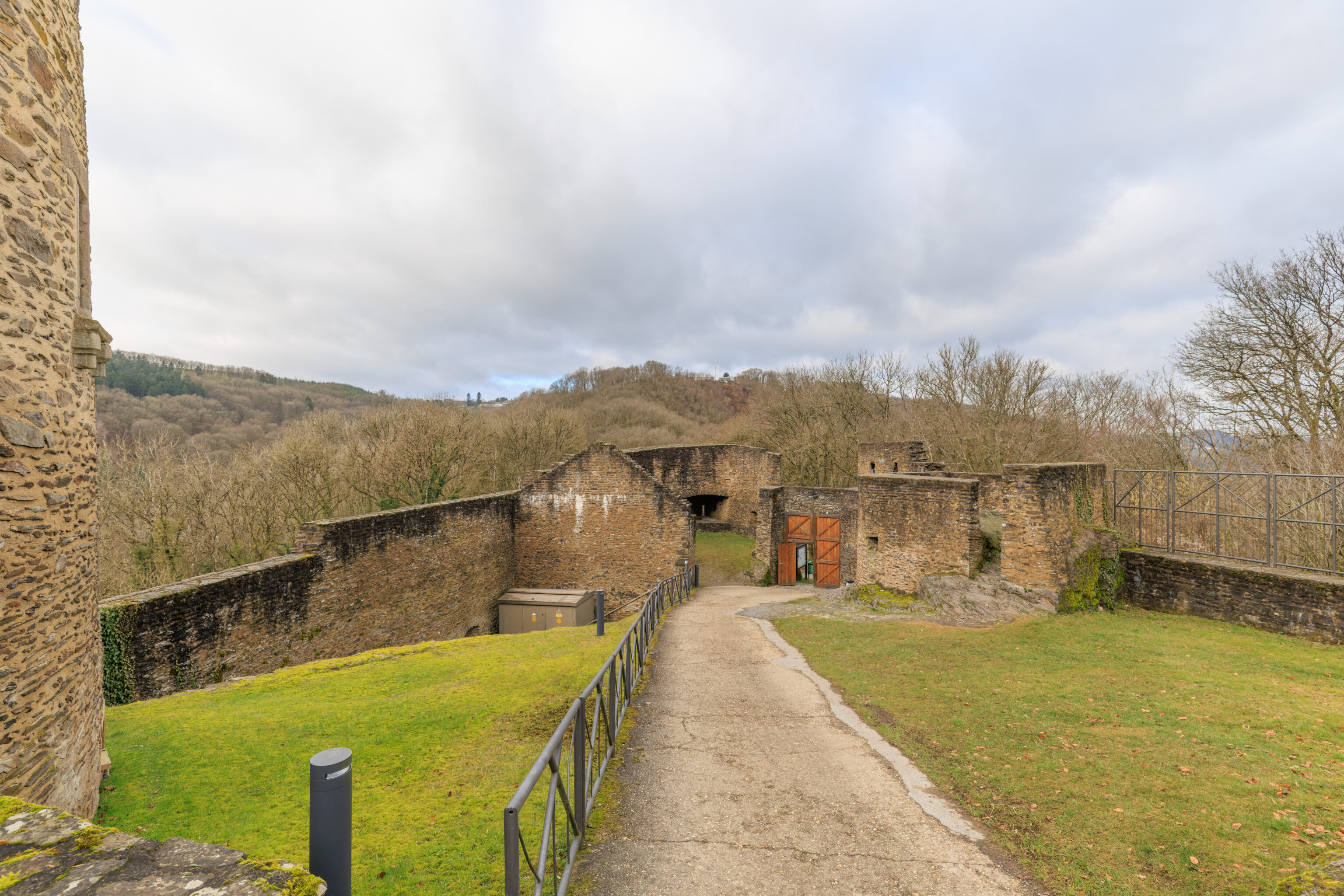
The view looking back downhill.
We bought tickets from a small combination ticket office, gift shop, and cafe that was just past the two watchtowers.
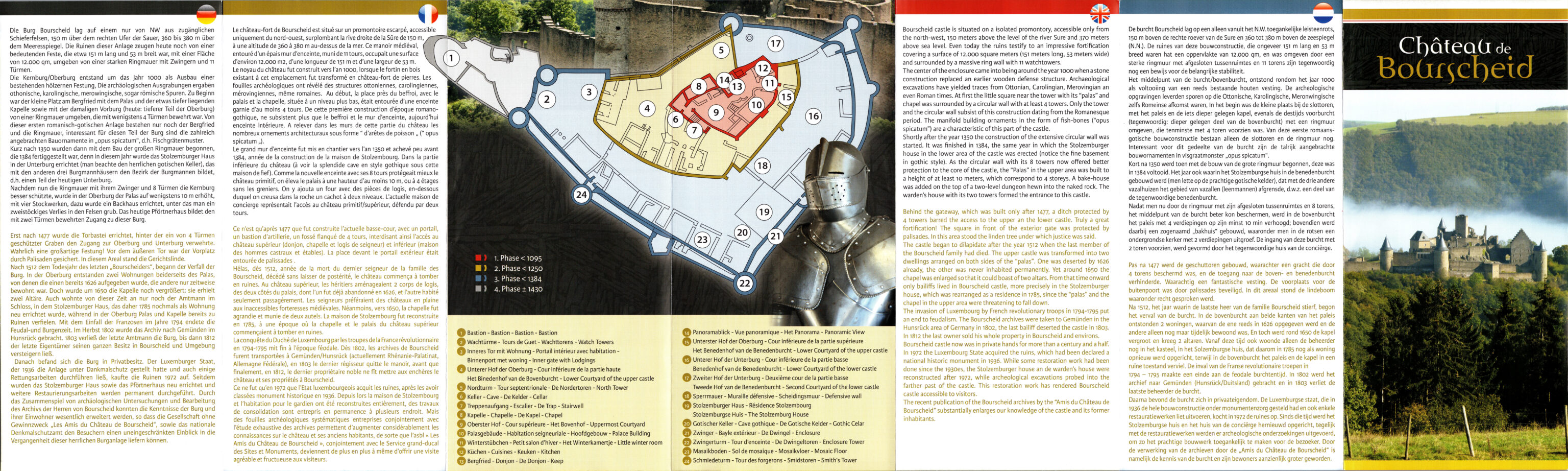
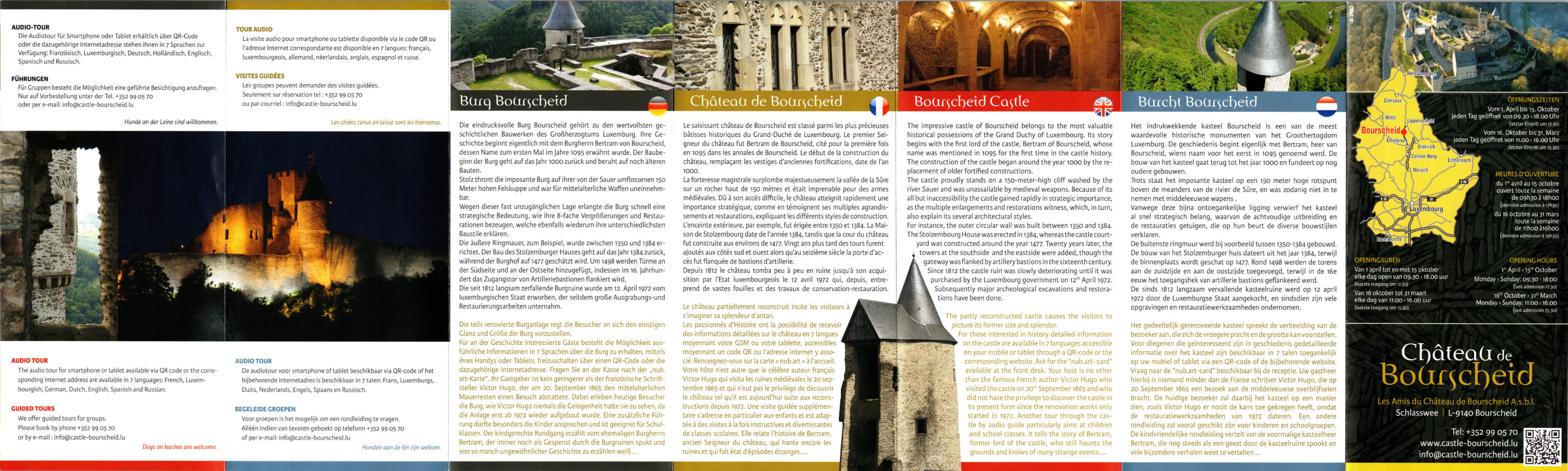
A pamphlet with map was provided.
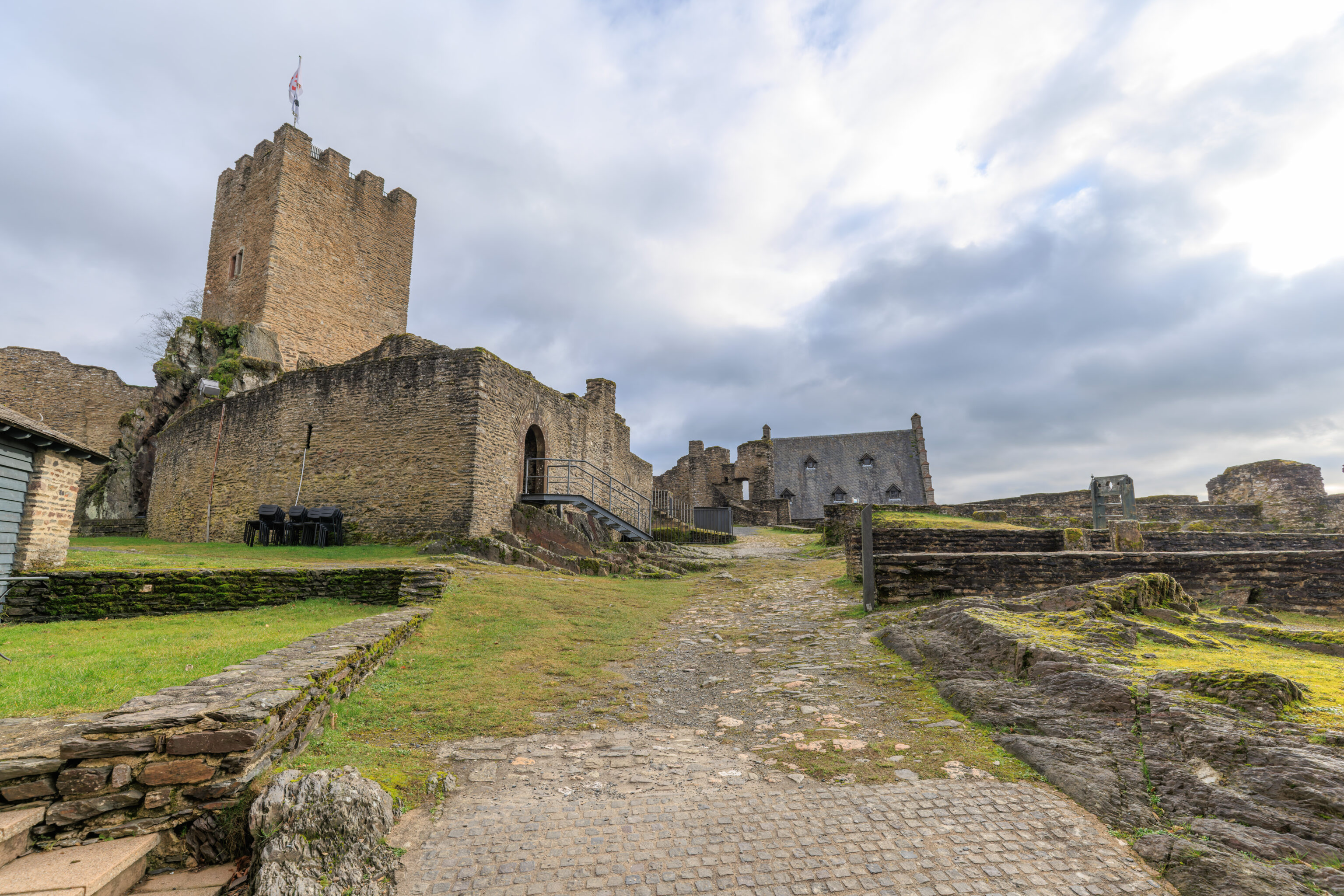
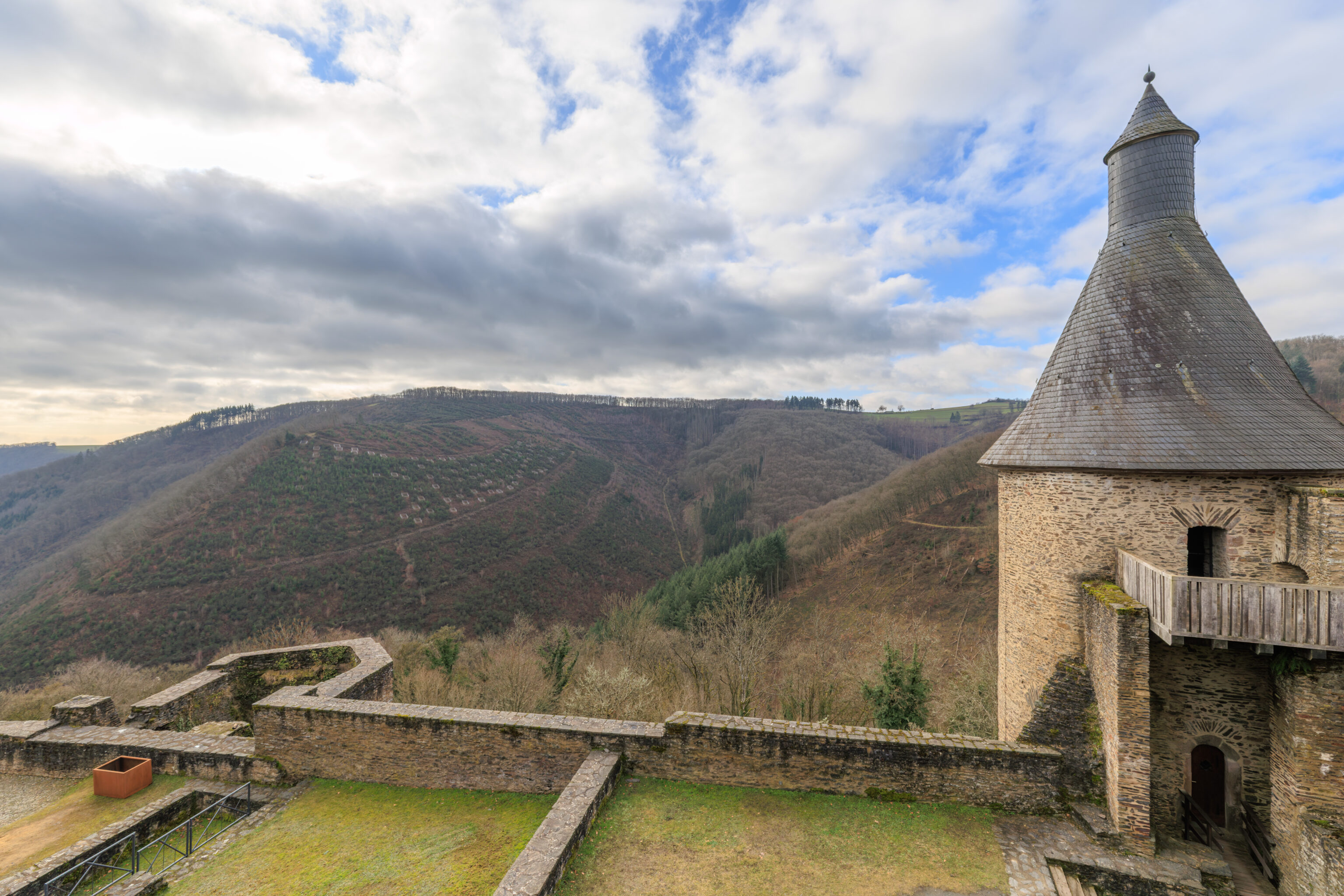
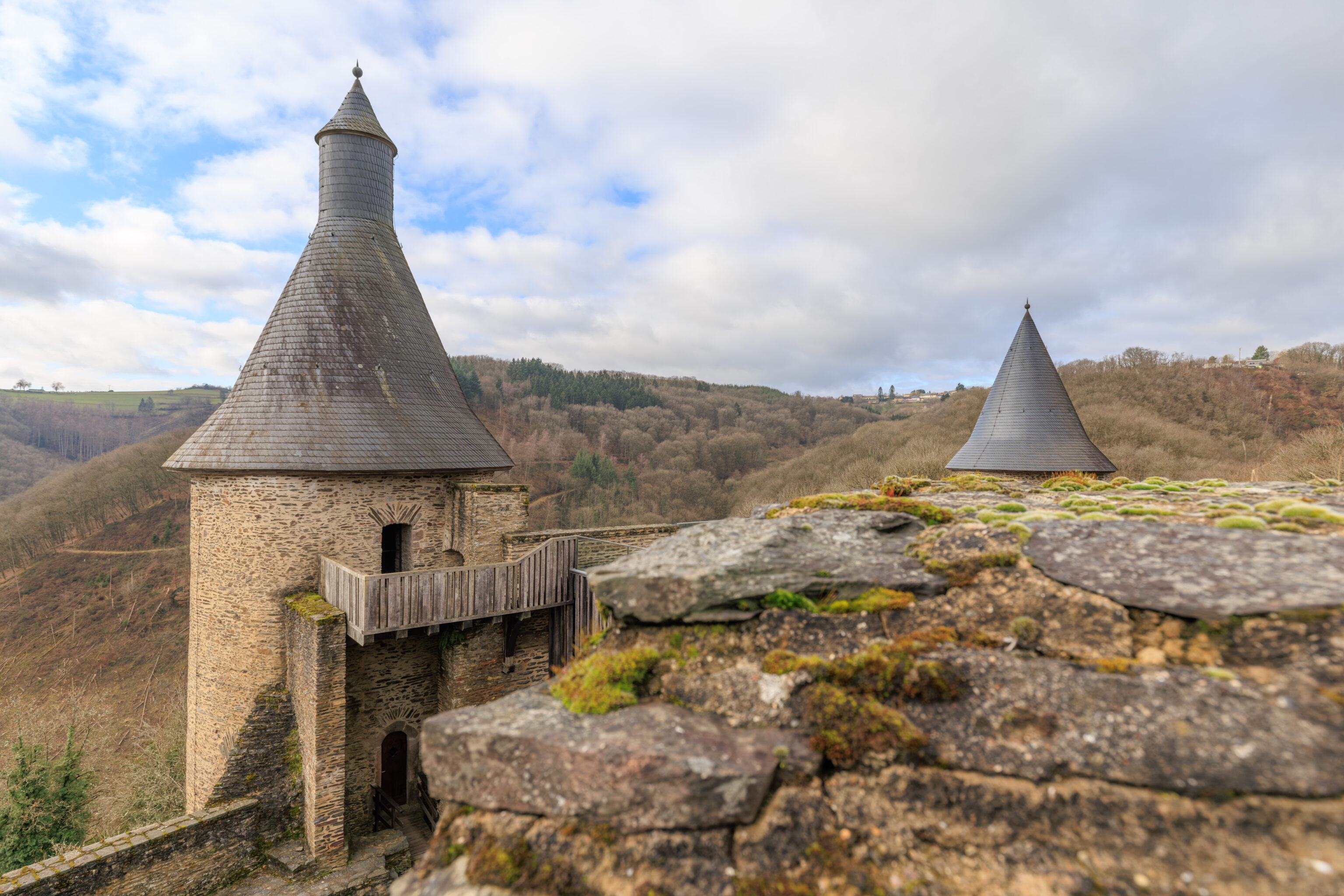
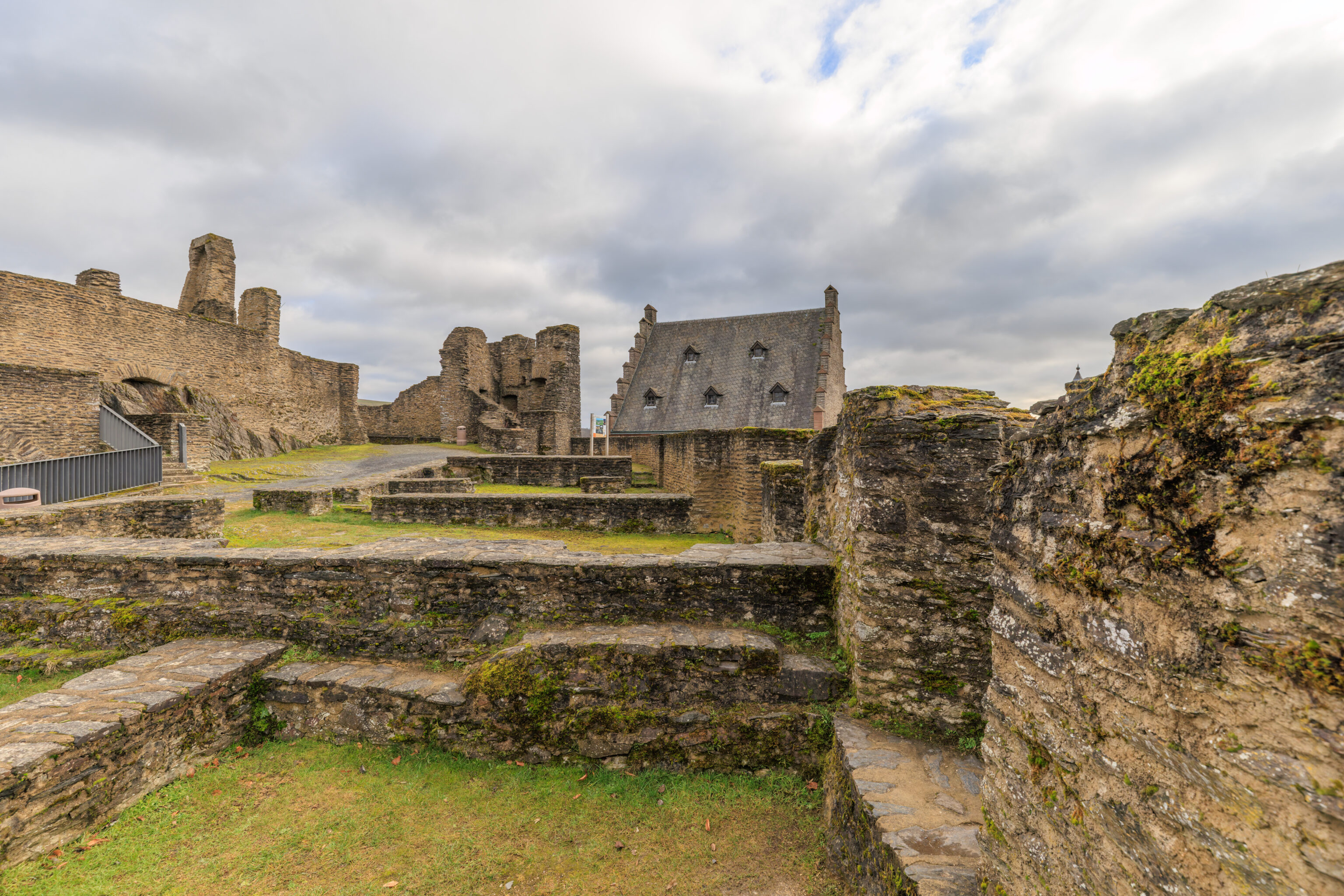
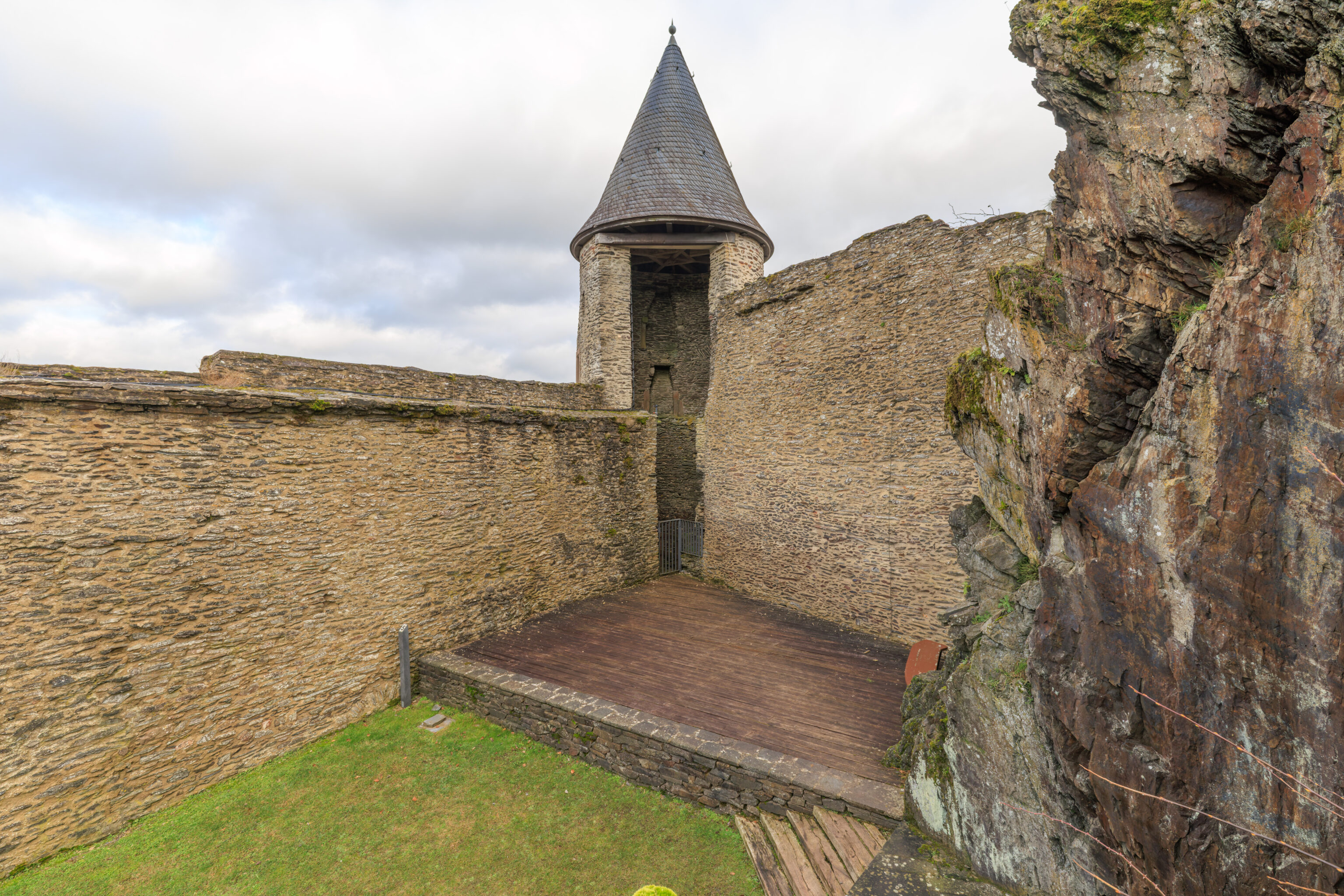
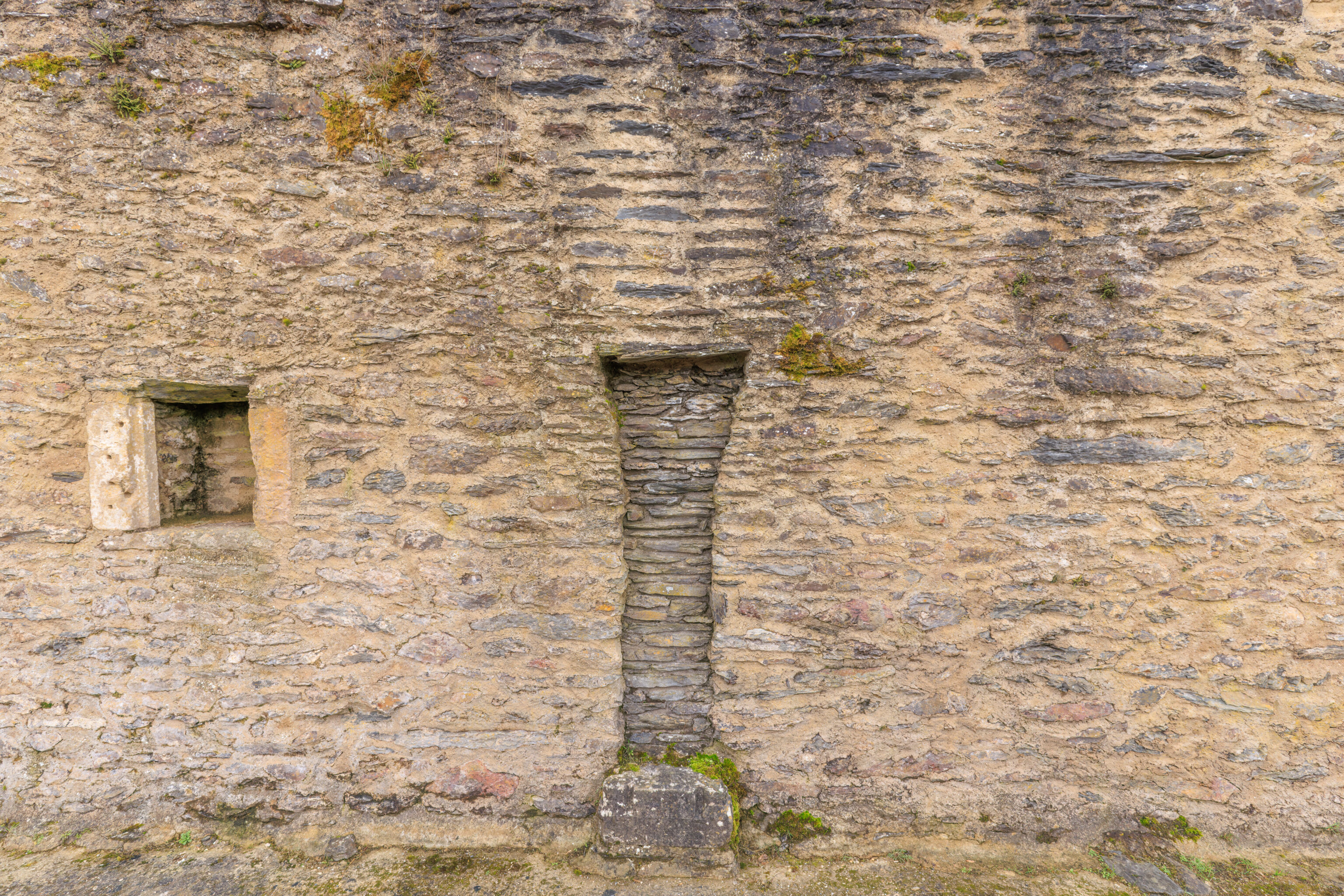
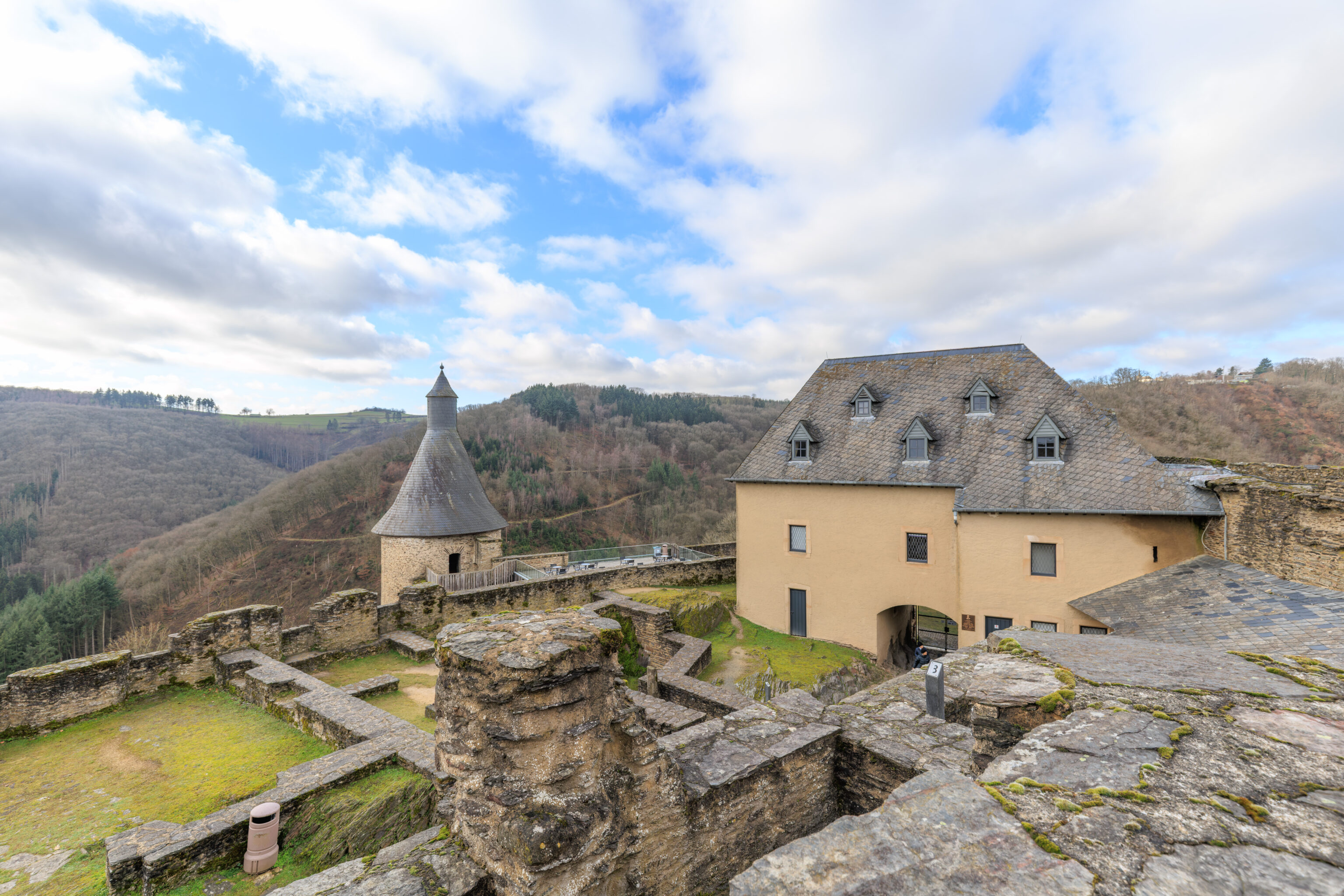
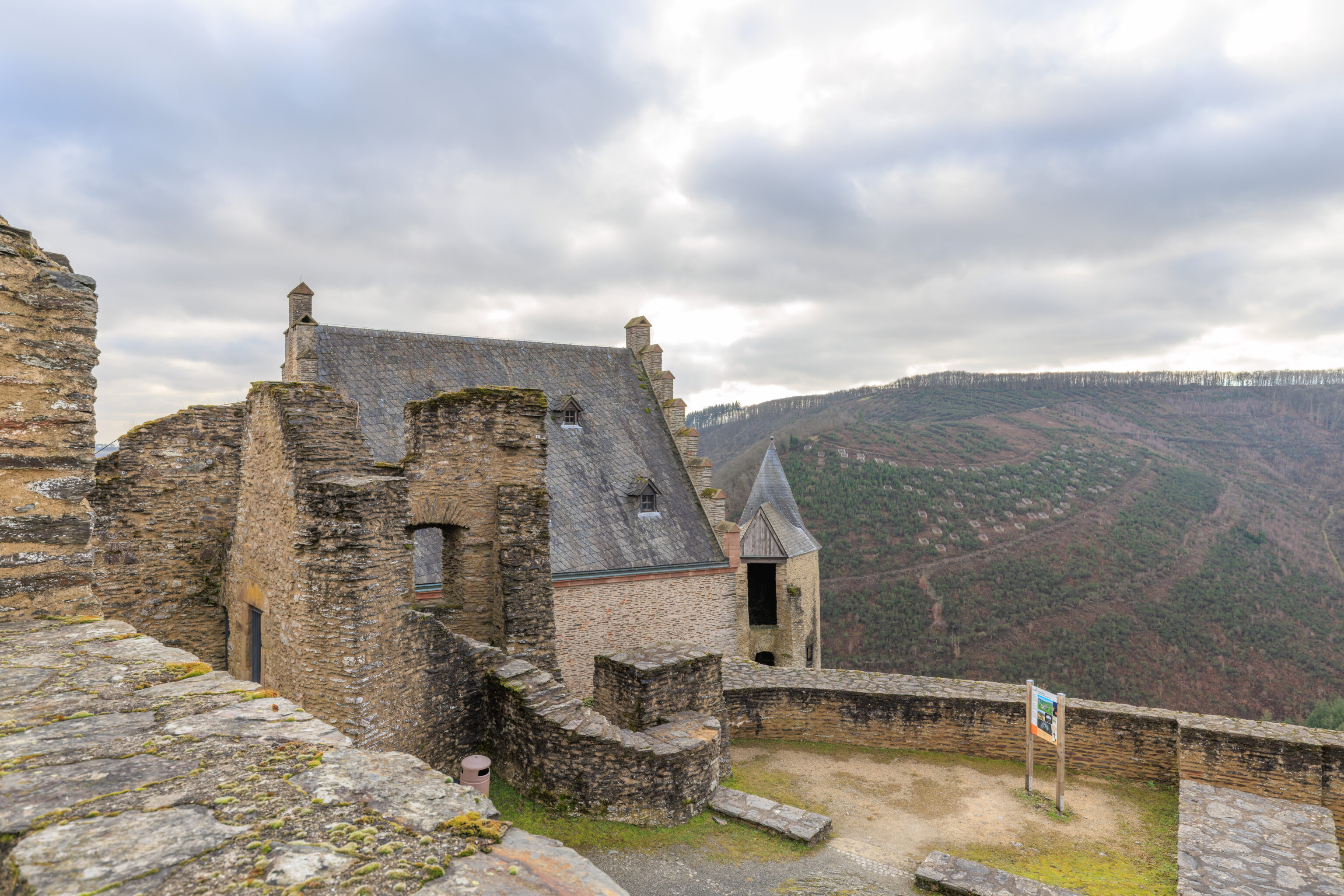
We walked around a courtyard, possibly a bailey, identified as the (4) Lower Courtyard of the Upper Castle on the map. While there are some structure that remain, the majority of the castle is in a ruined state.
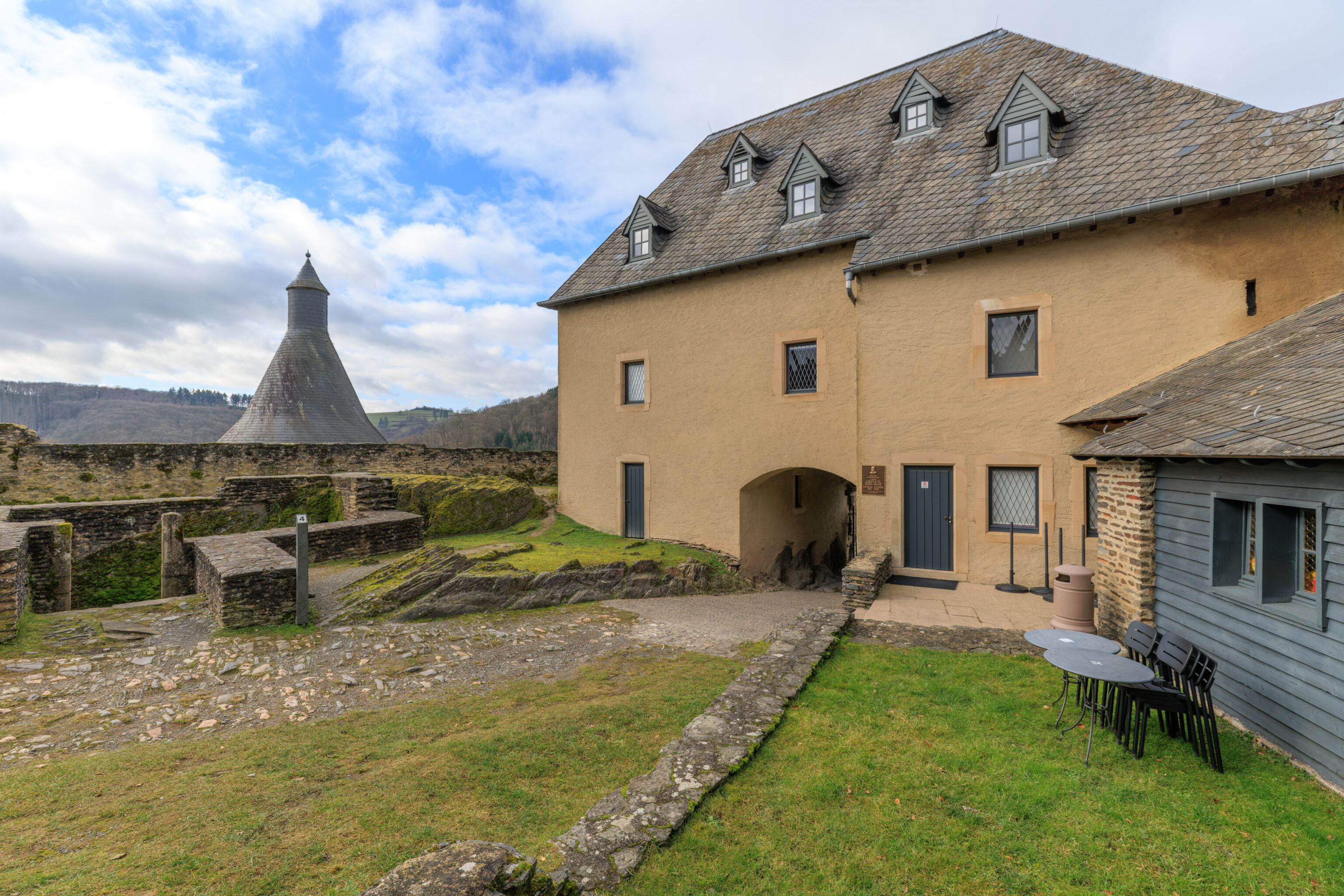
This building, which looks much newer than everything else here, seems to be identified as the (3) Inner Gate with Lodgings. The ticket office was next to this building, although it is hidden from view here.
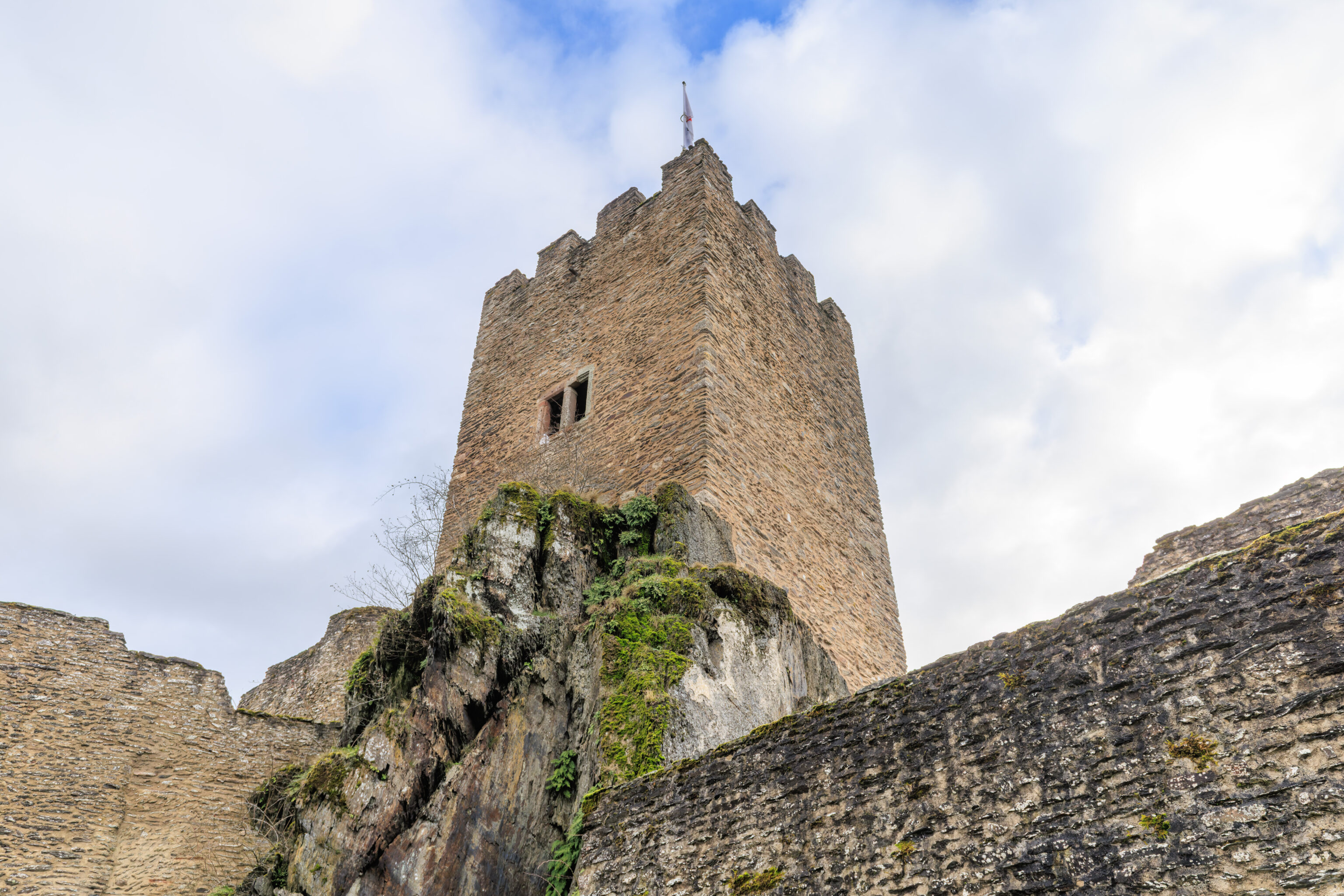
The most intact tall structure seems to be this tower.
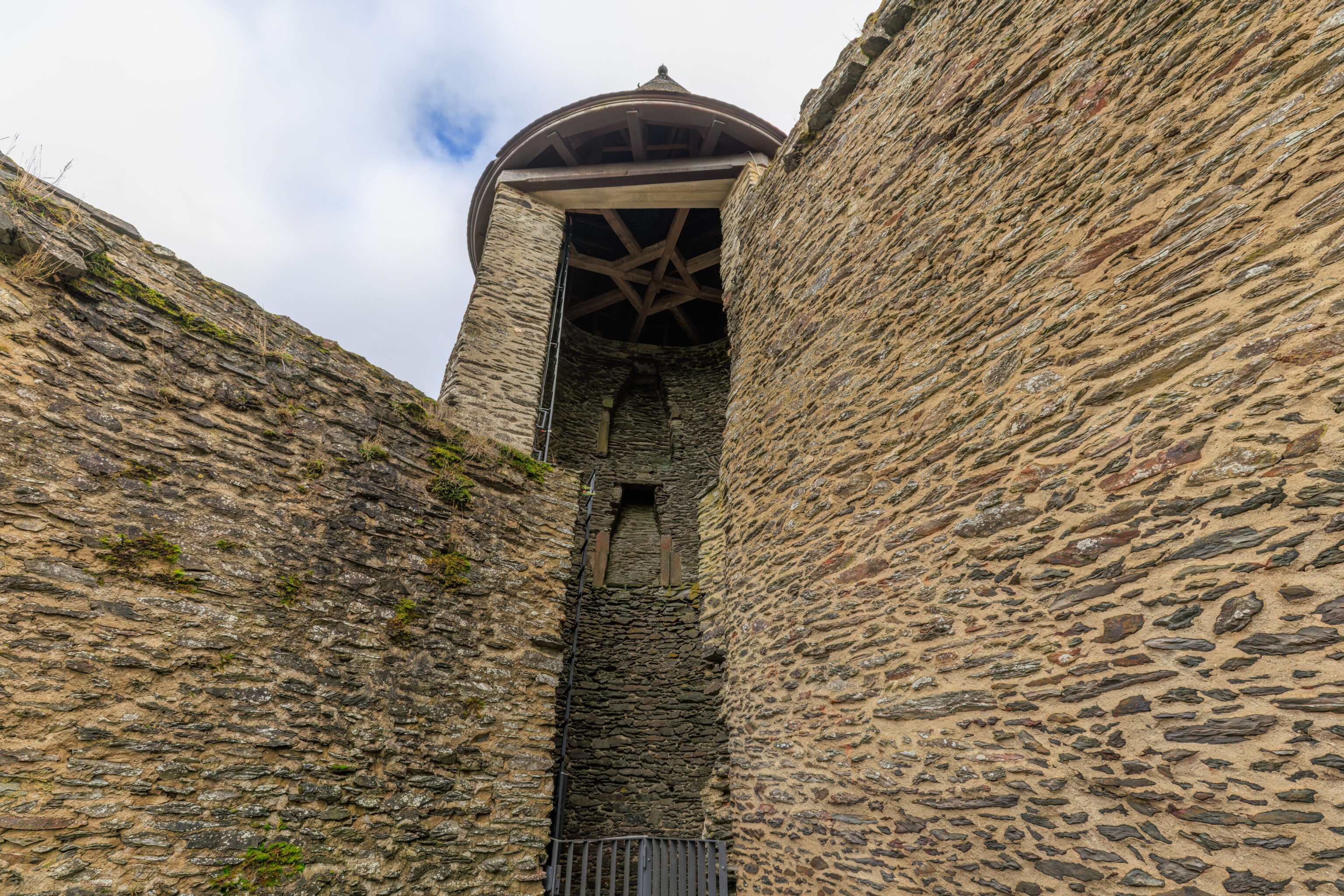
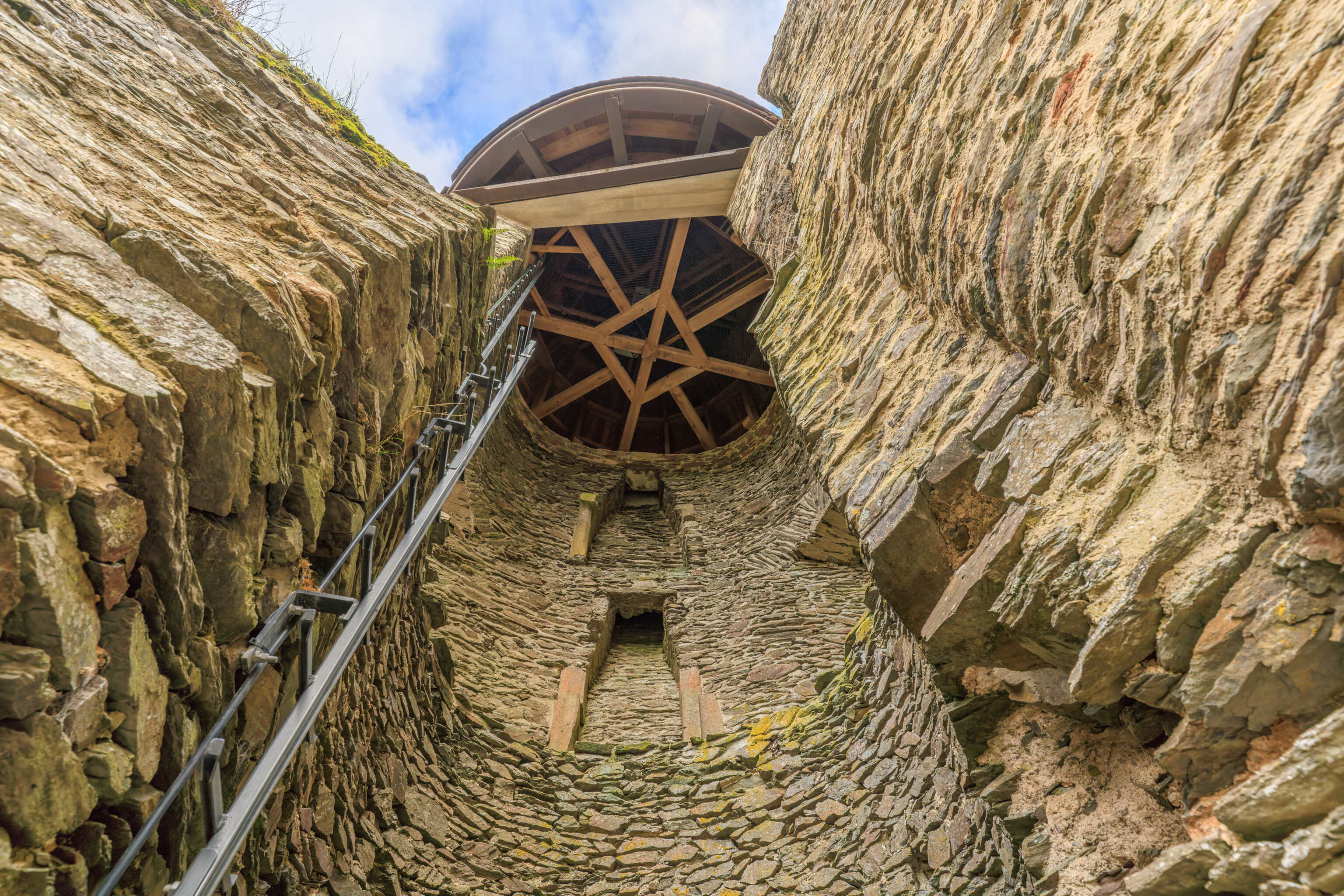
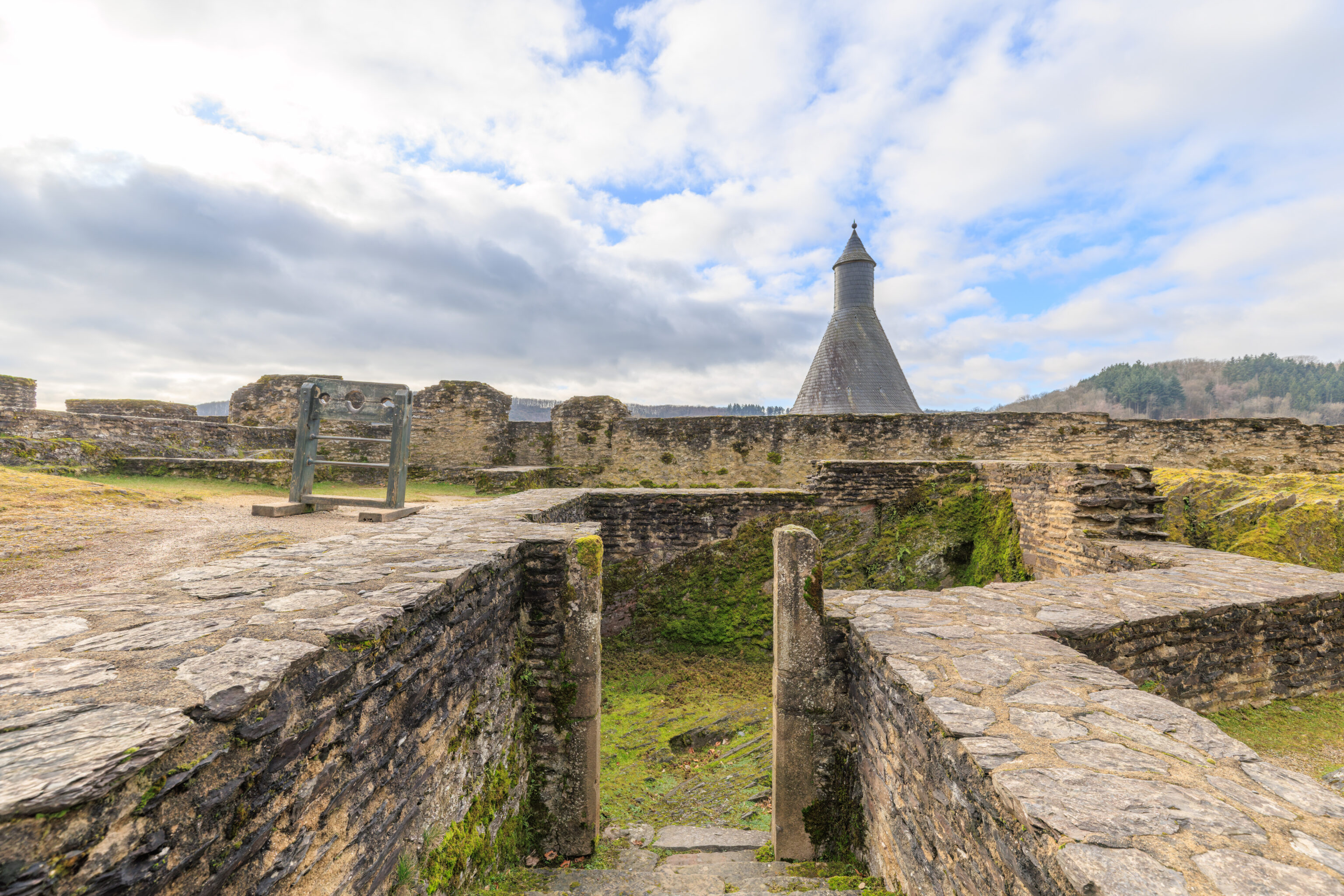
This half open tower is the (5) North Tower.
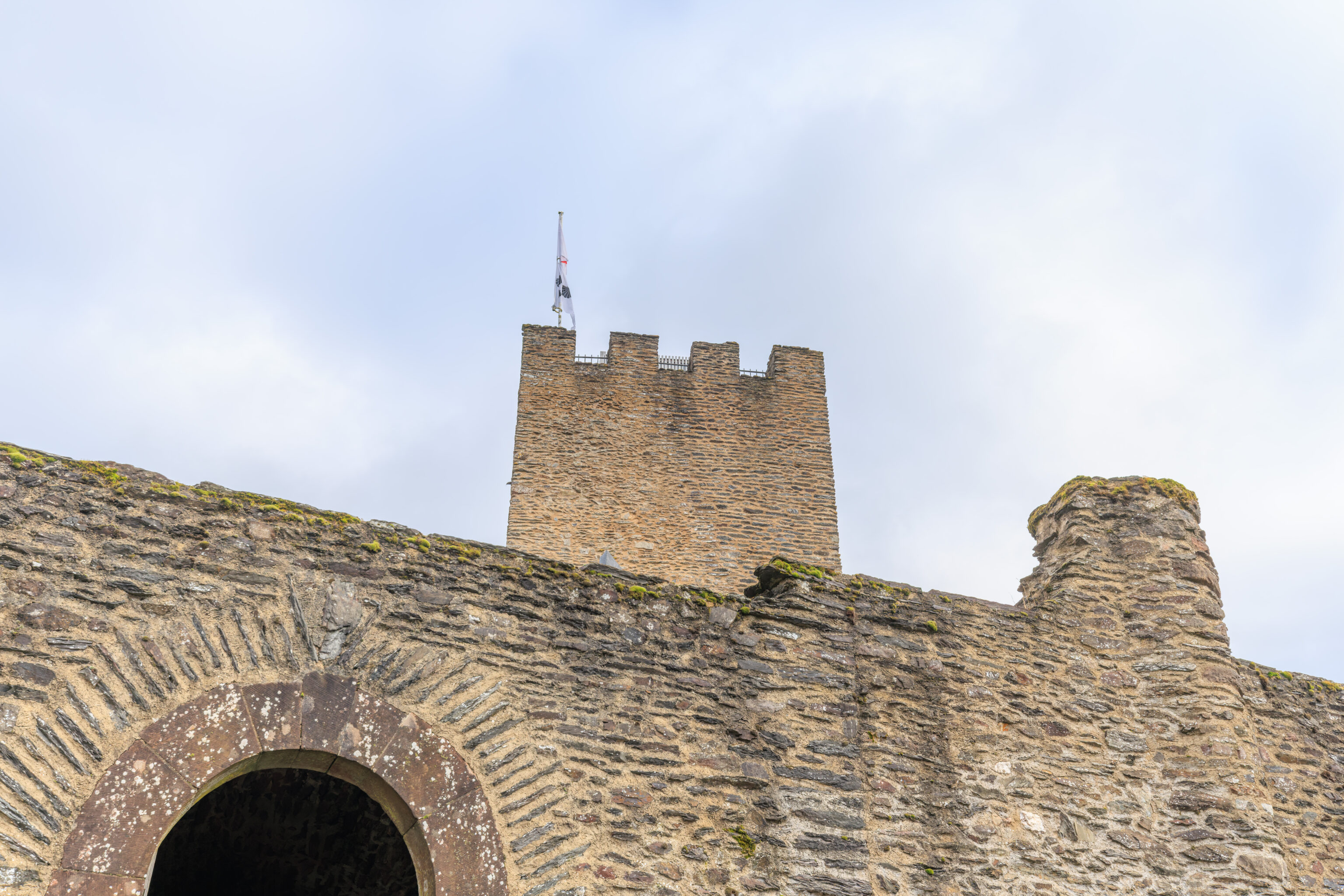
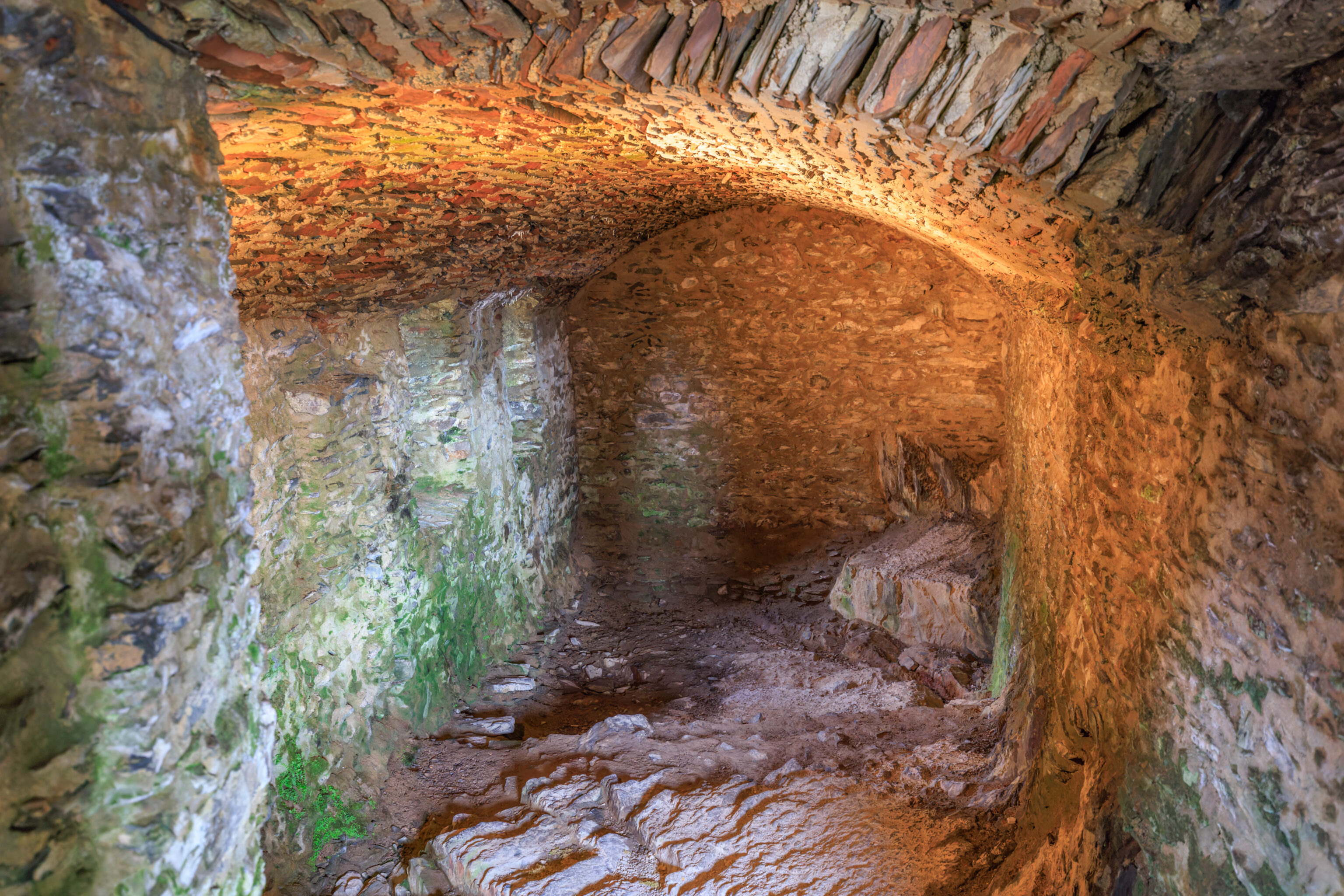
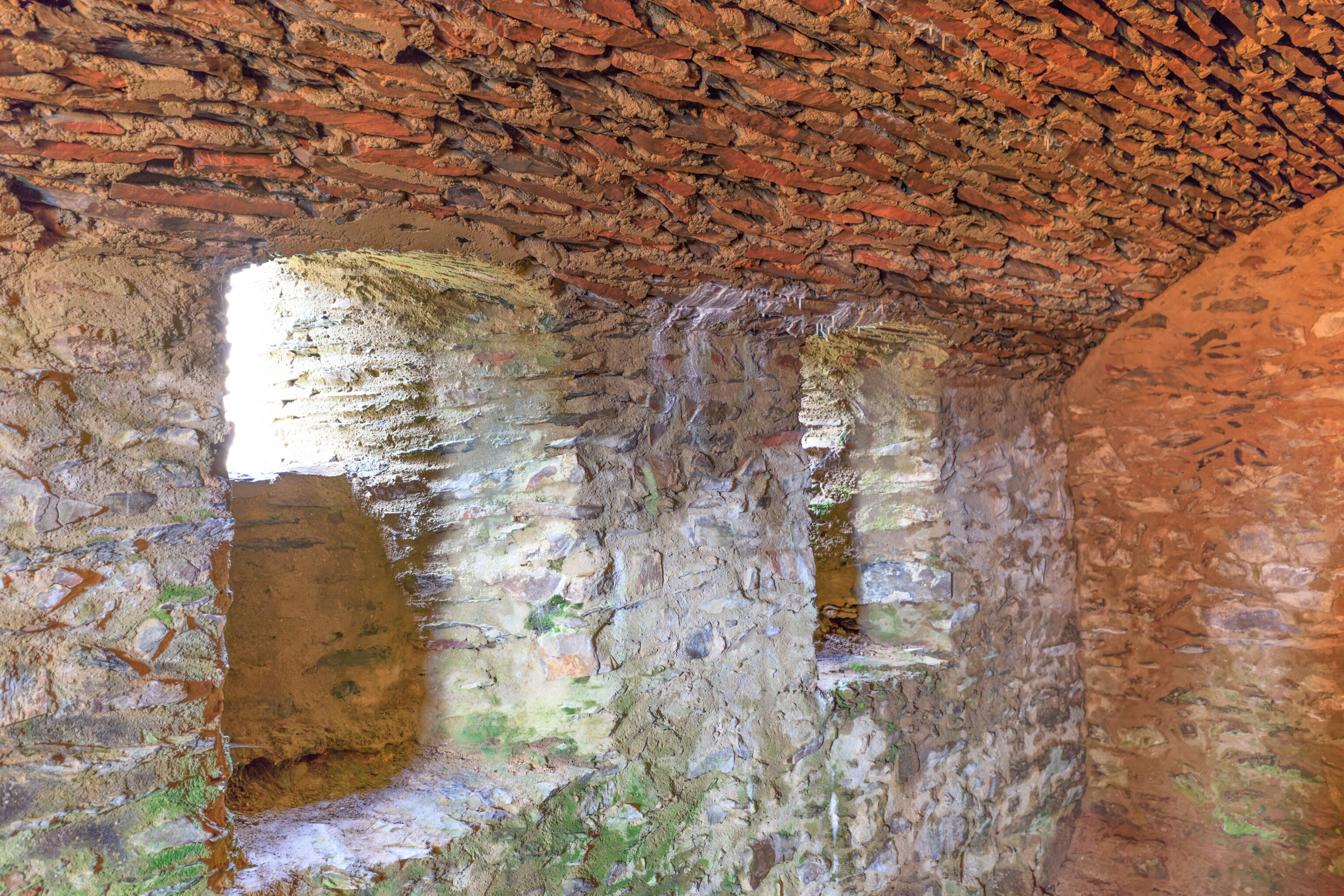
We continued walking around, eventually passing thorough an area that was below the castle’s keep.
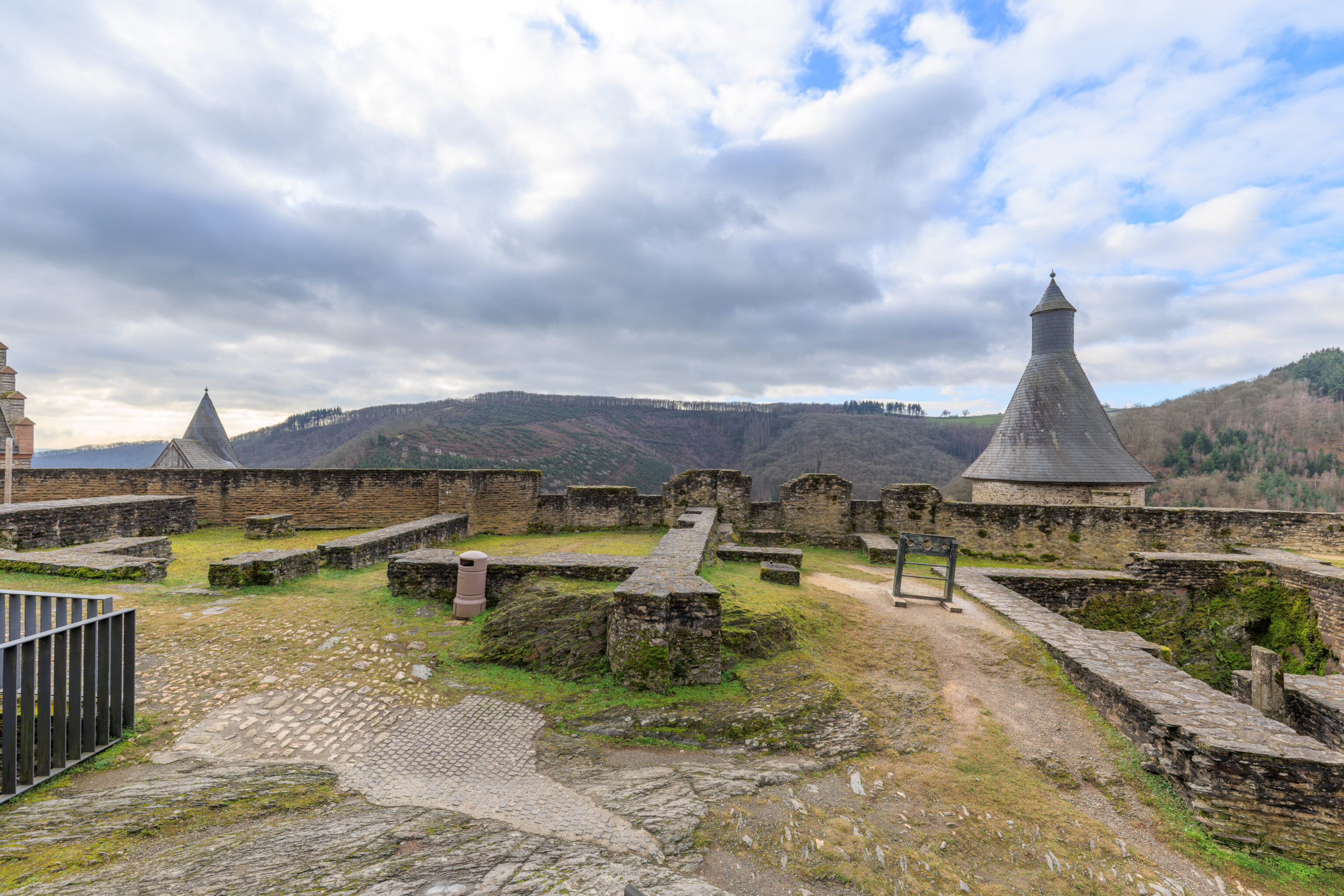
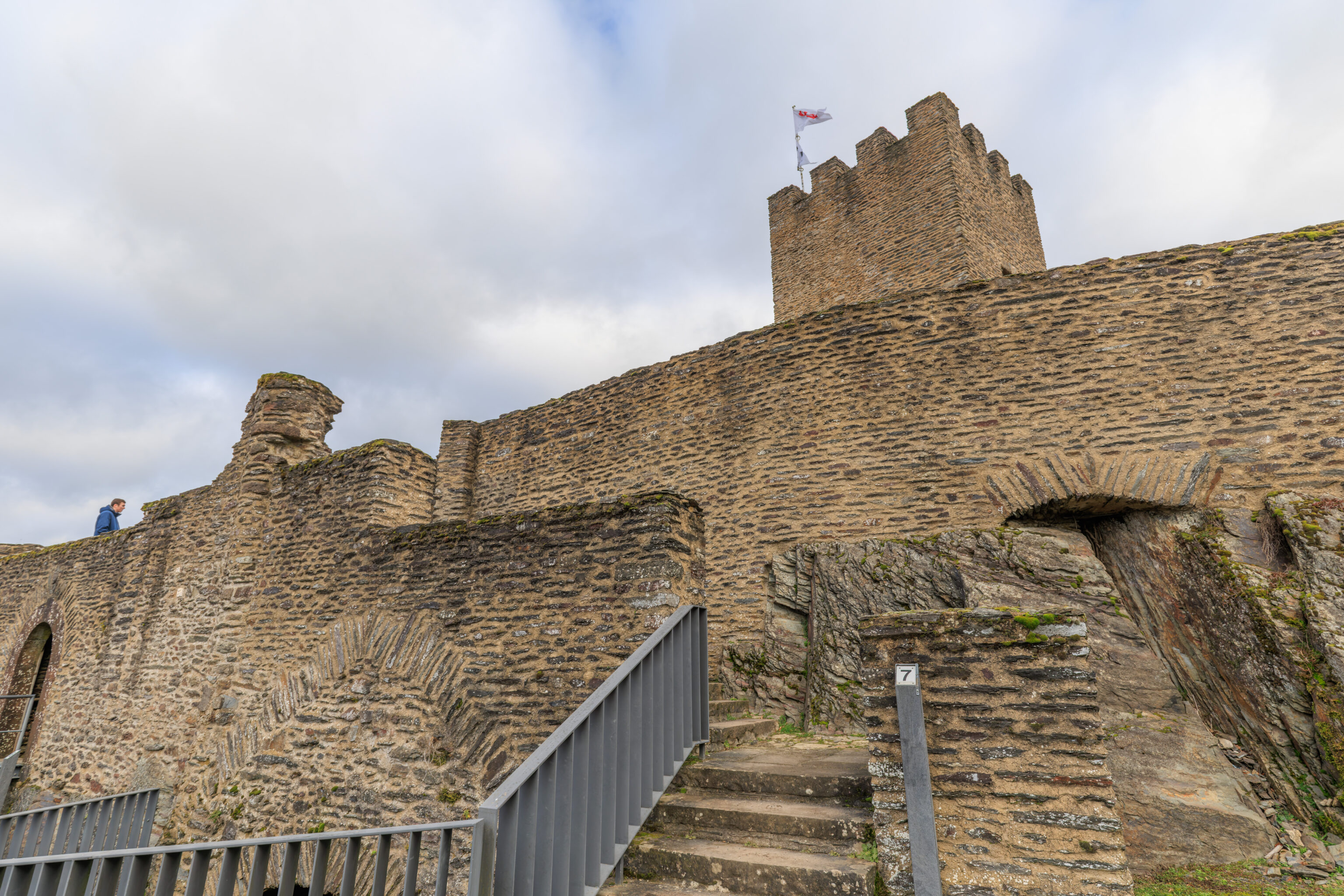
…
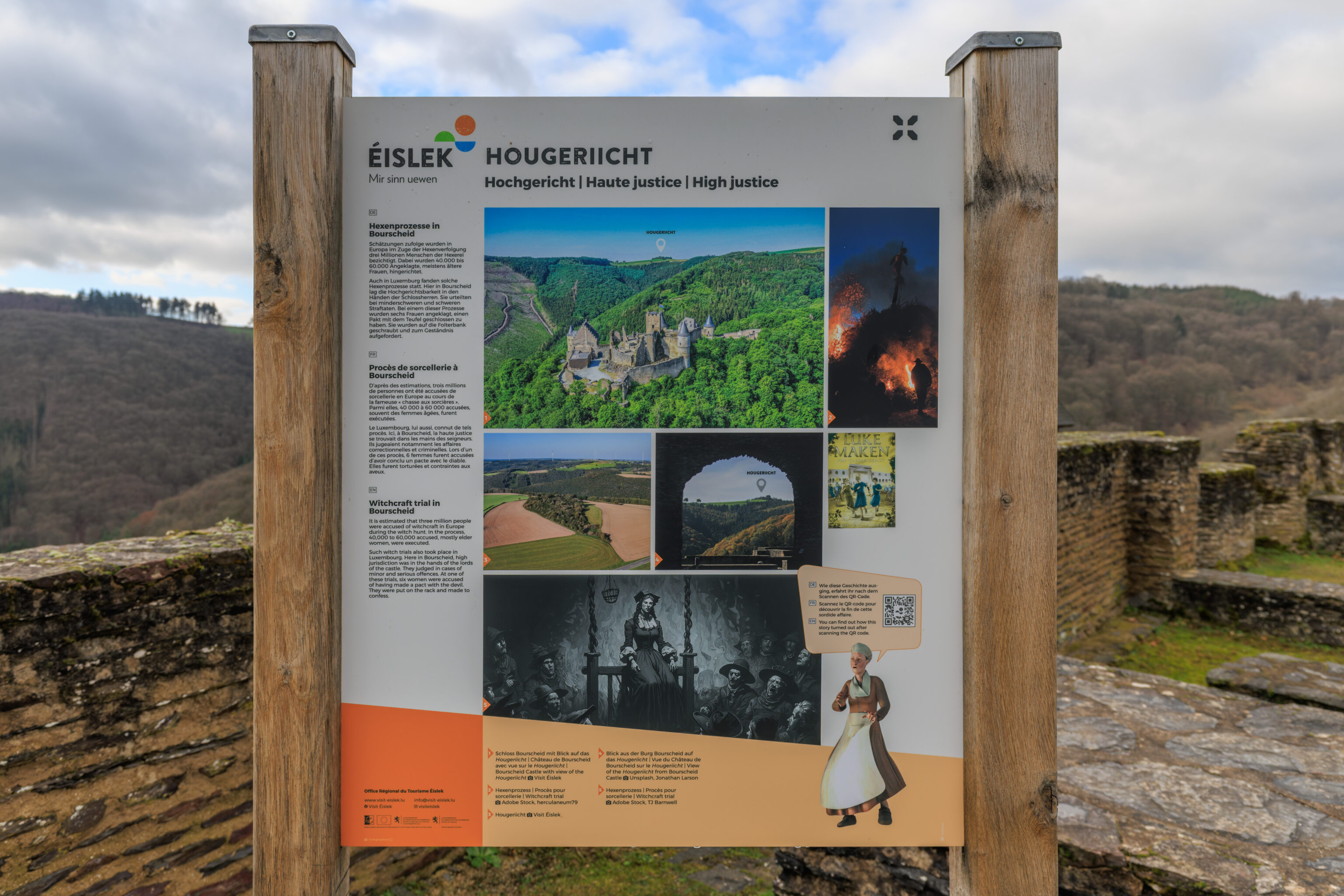
This sign explains that there were witchcraft trials held here in Bourscheid.
Witchcraft trial in Bourscheid
It is estimated that three million people were accused of witchcraft in Europe during the witch hunt. In the process, 40,000 to 60,000 accused, mostly elder women, were executed.

Such witch trials also took place in Luxembourg. Here in Bourscheid, high jurisdiction was in the hands of the lords of the castle. They judged in cases of minor and serious offences. At one of these trials, six women were accused of having made a pact with the devil. They were put on the rack and made to confess.
– Text from the sign in the photograph above.
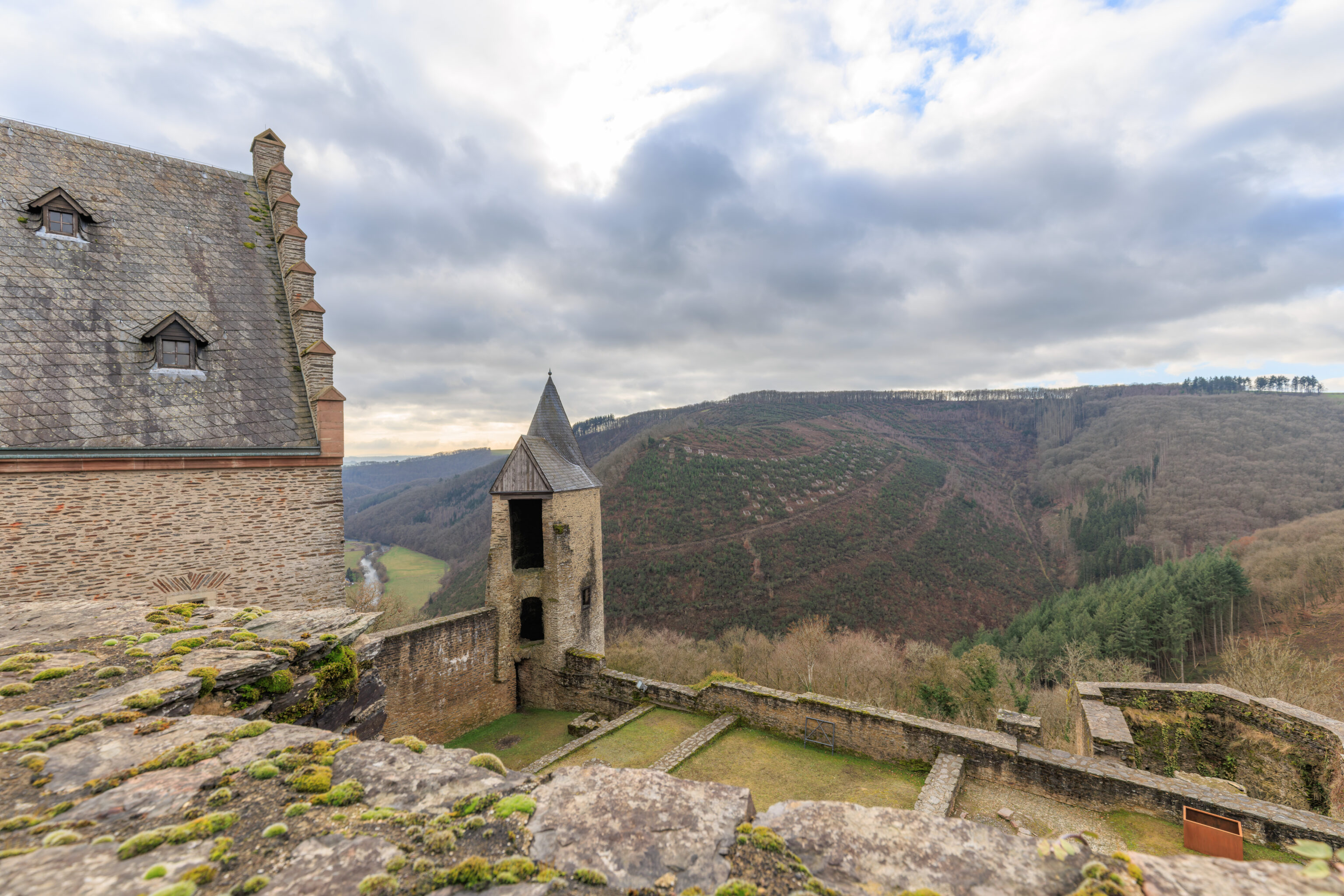
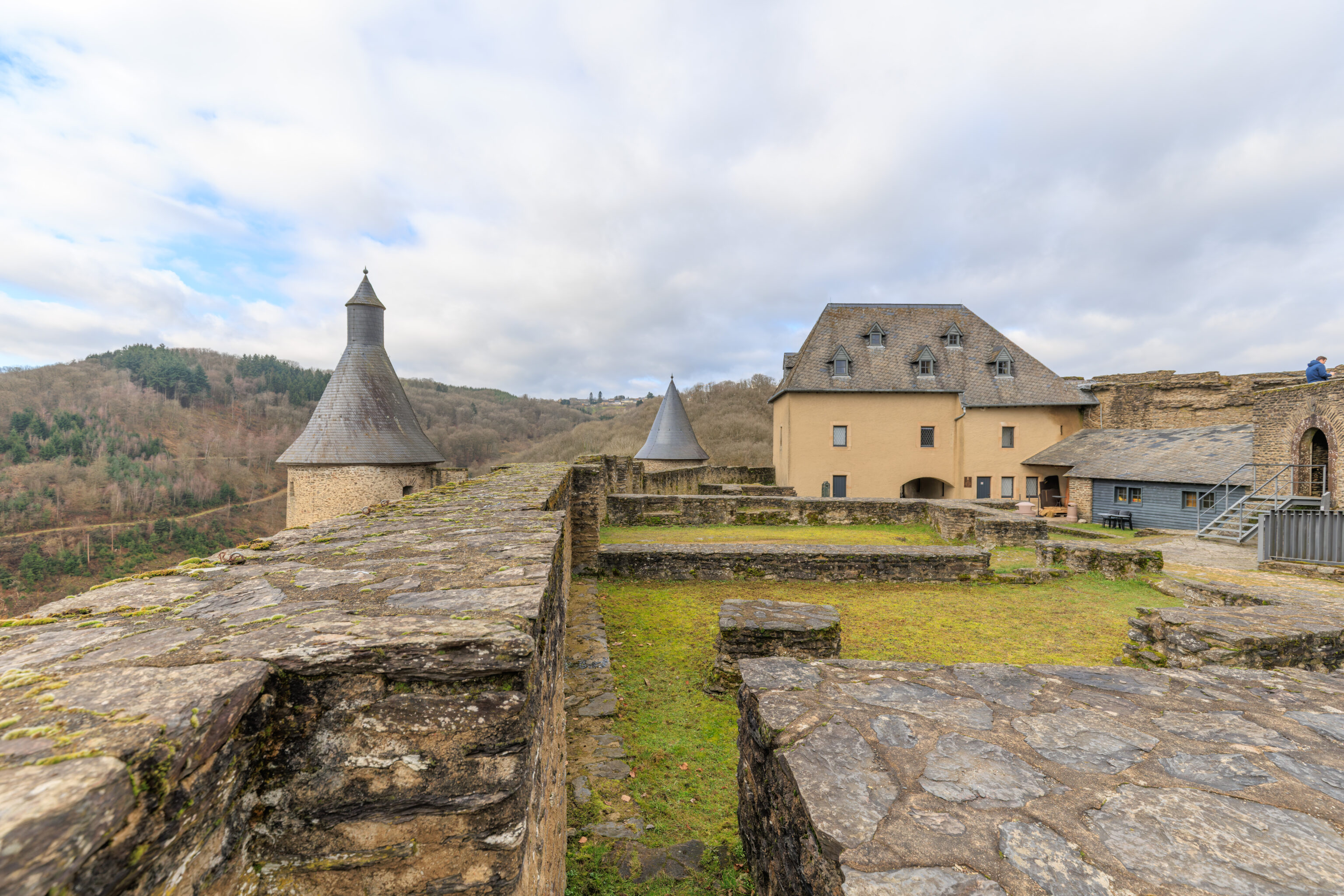
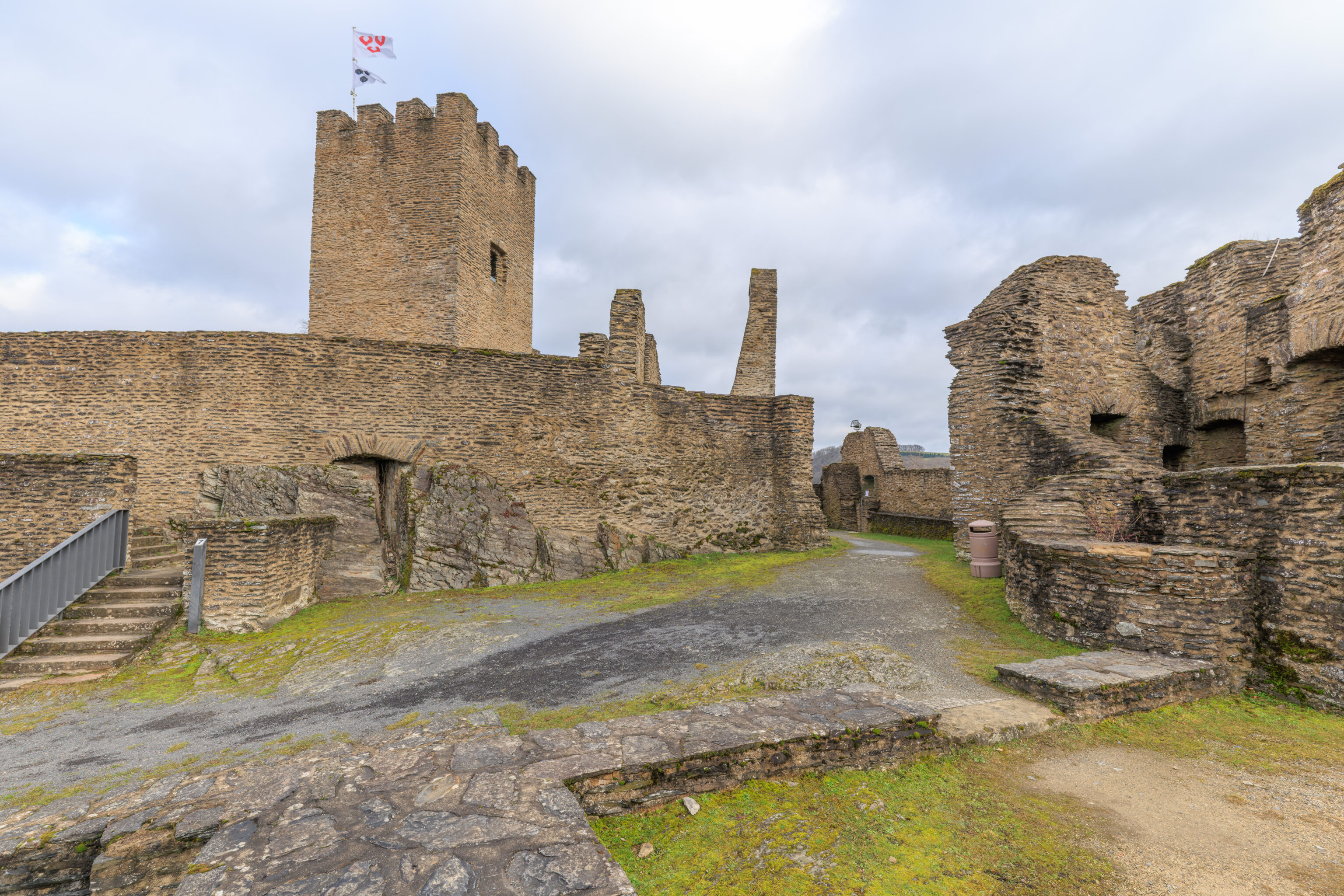
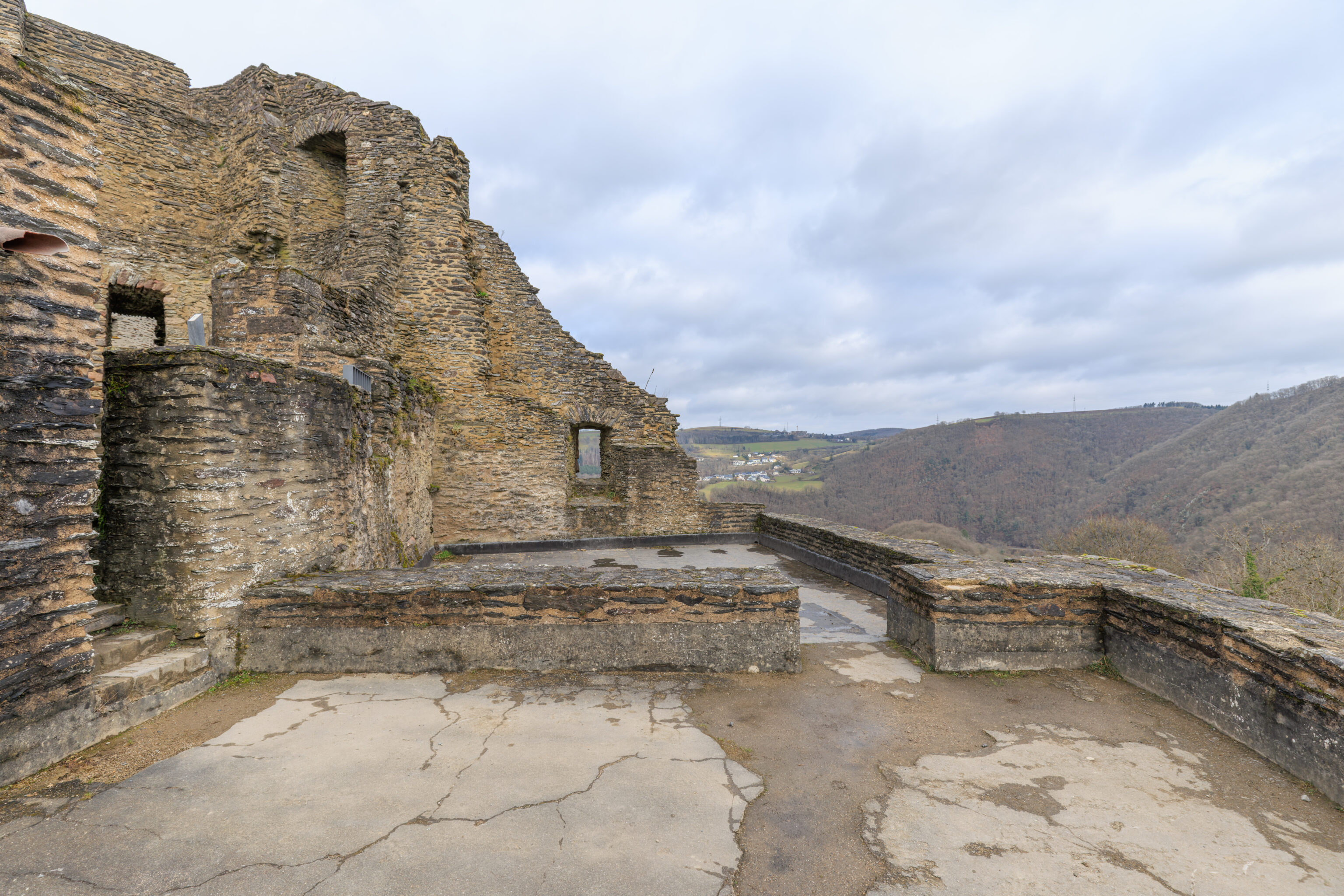
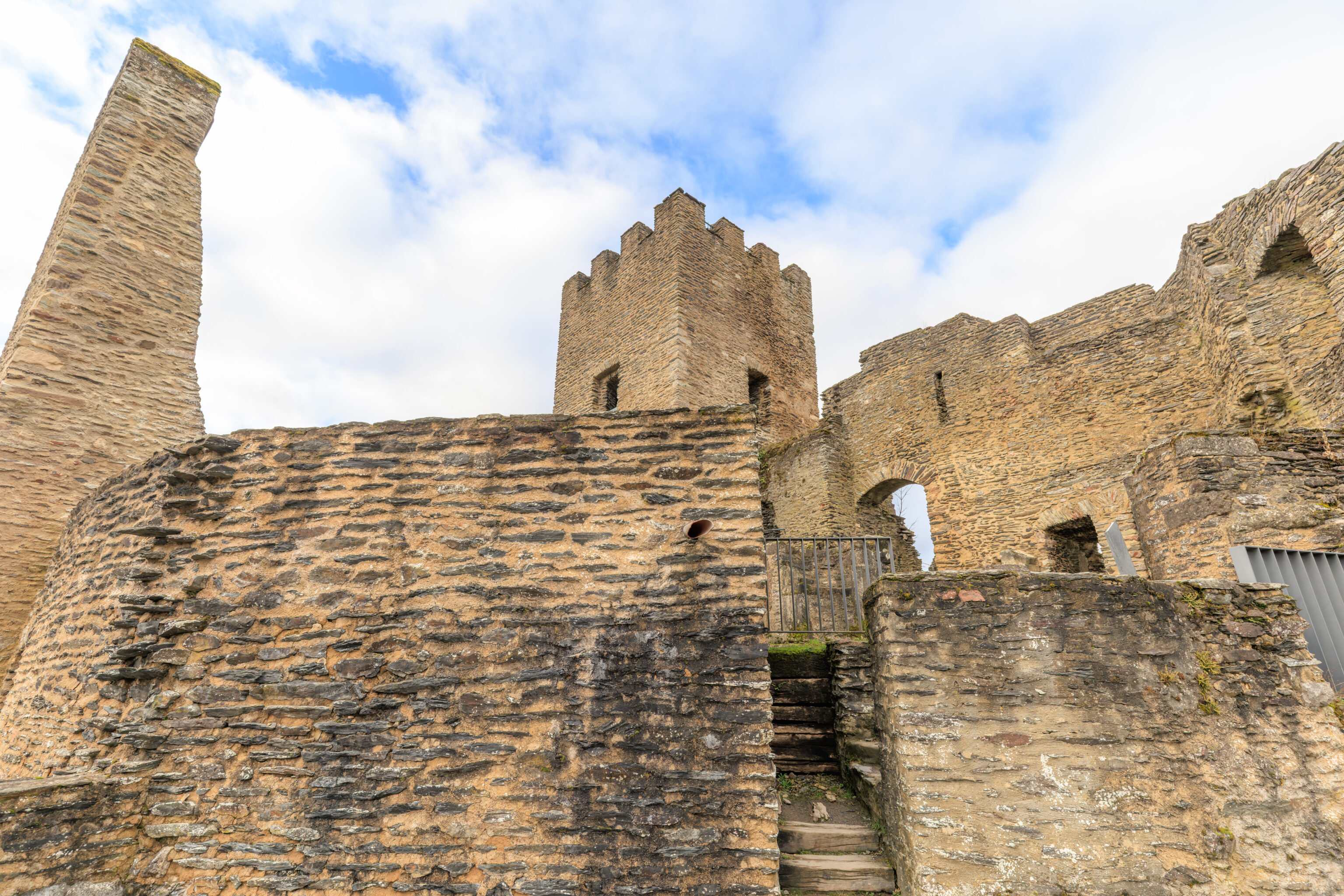
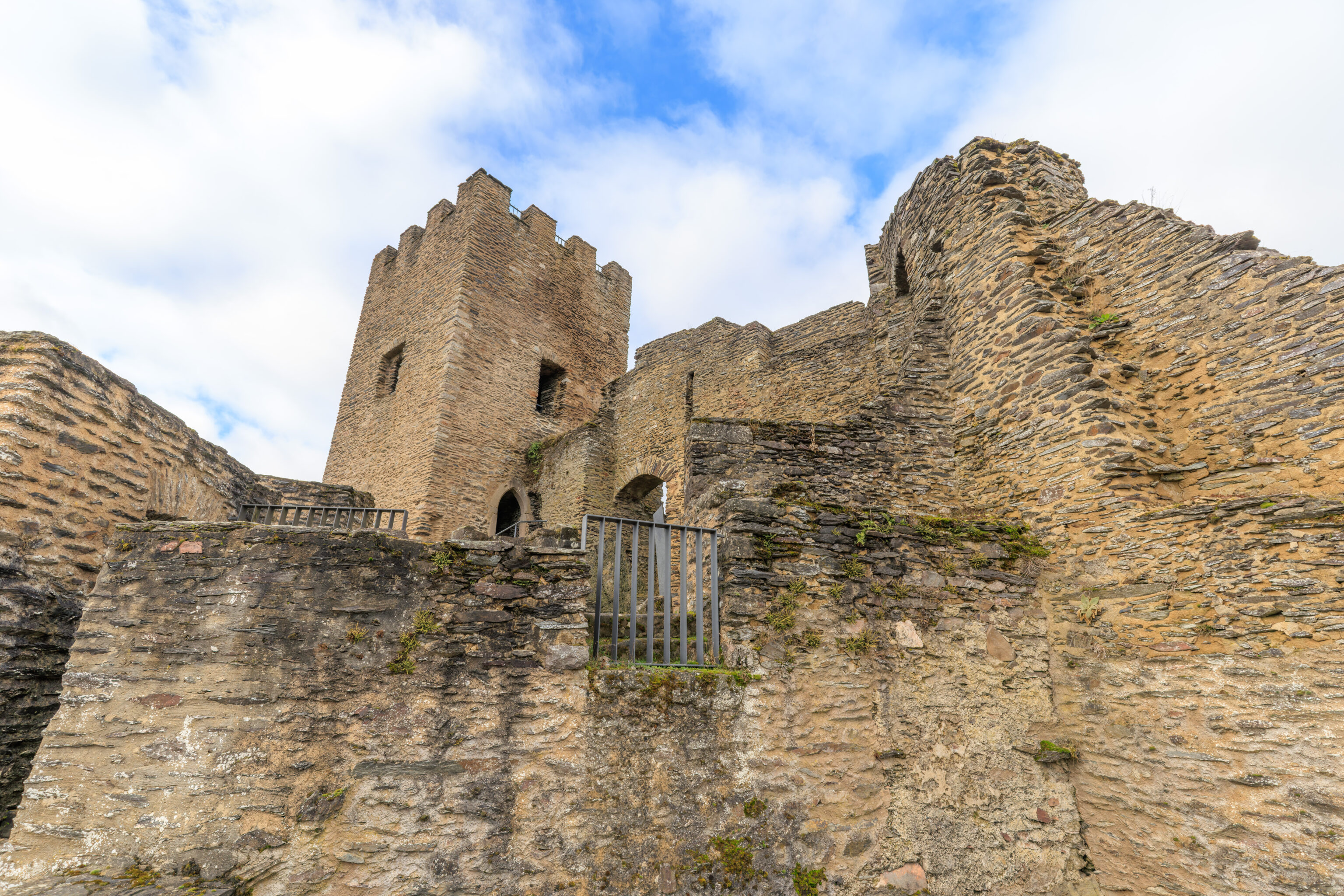
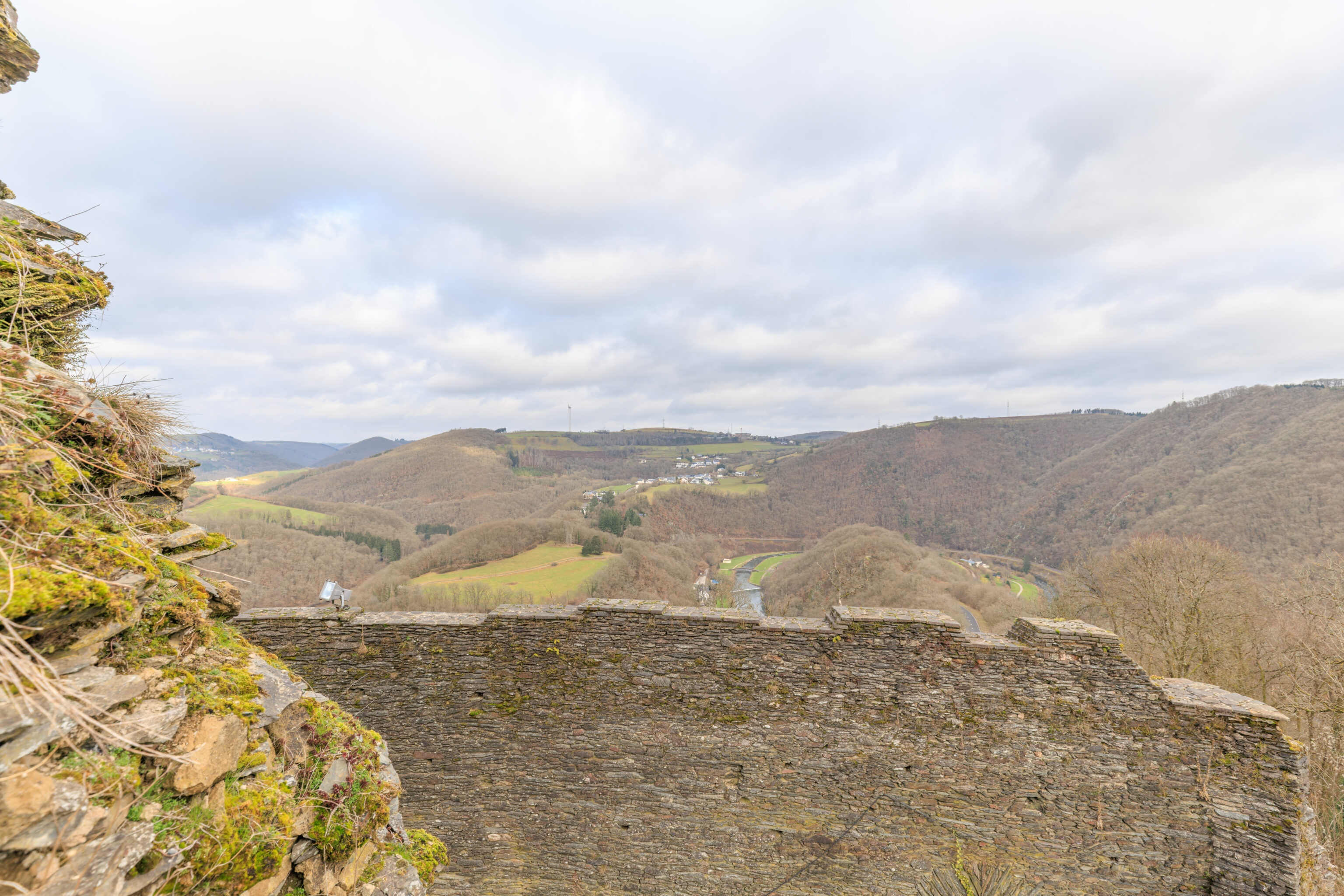
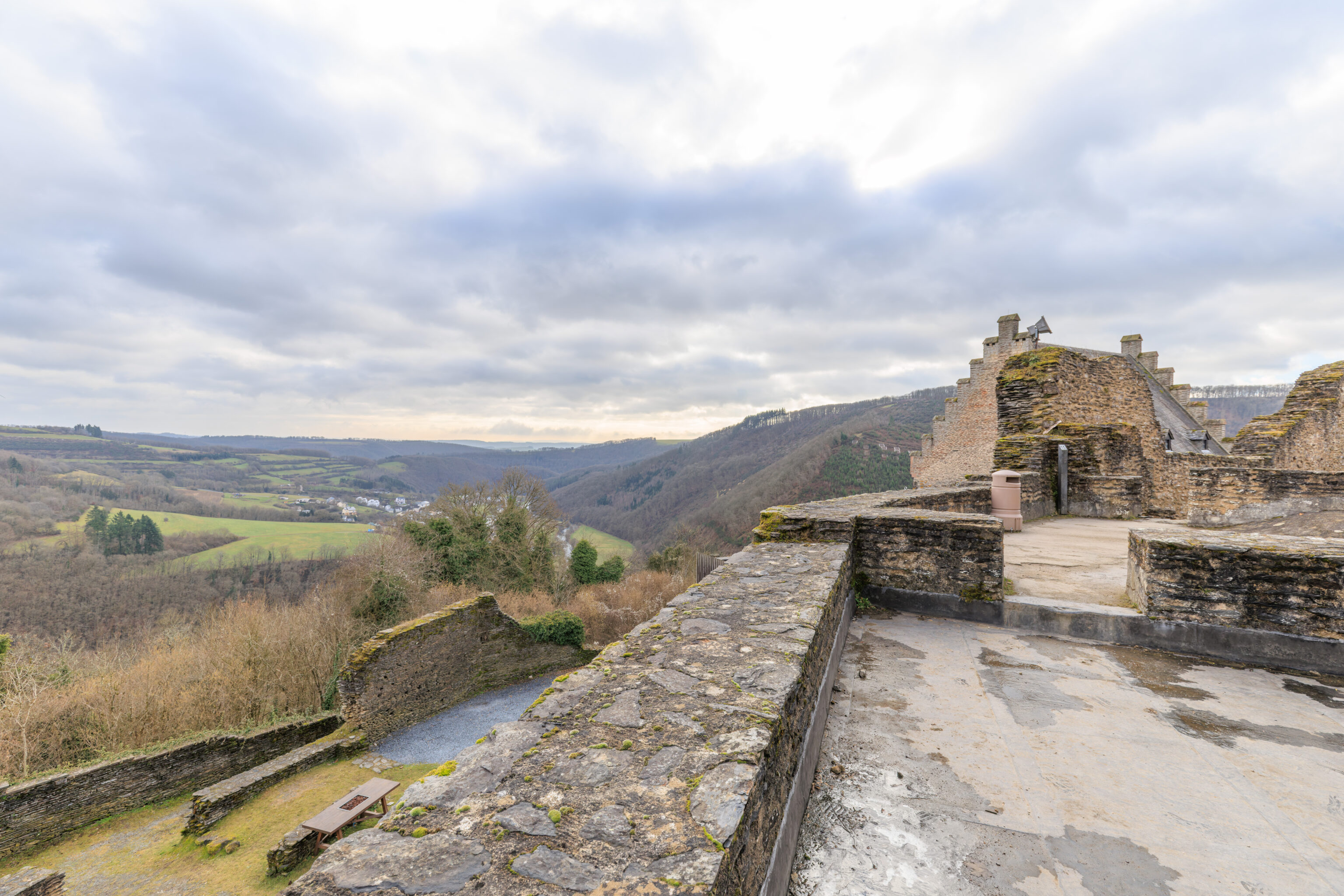
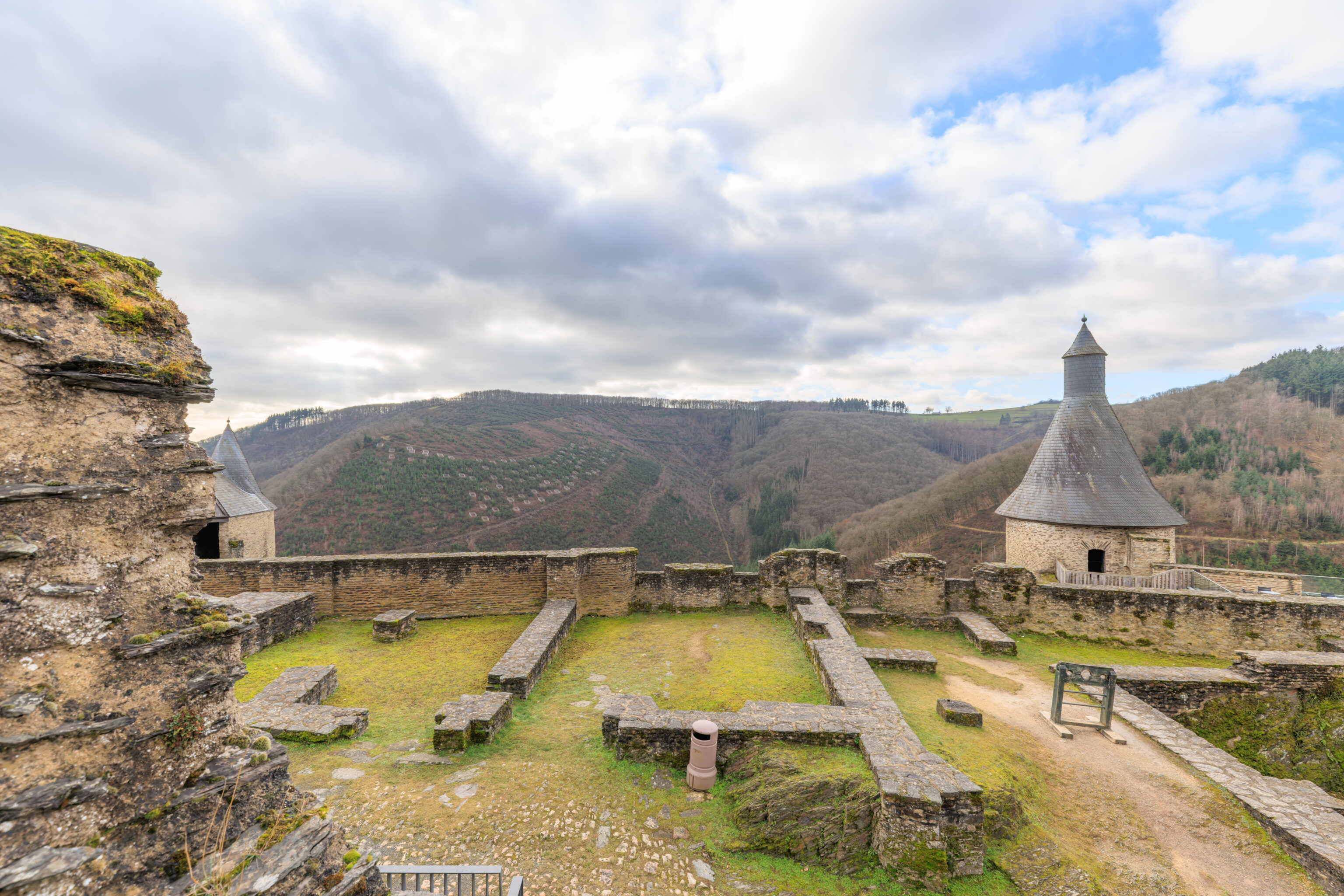
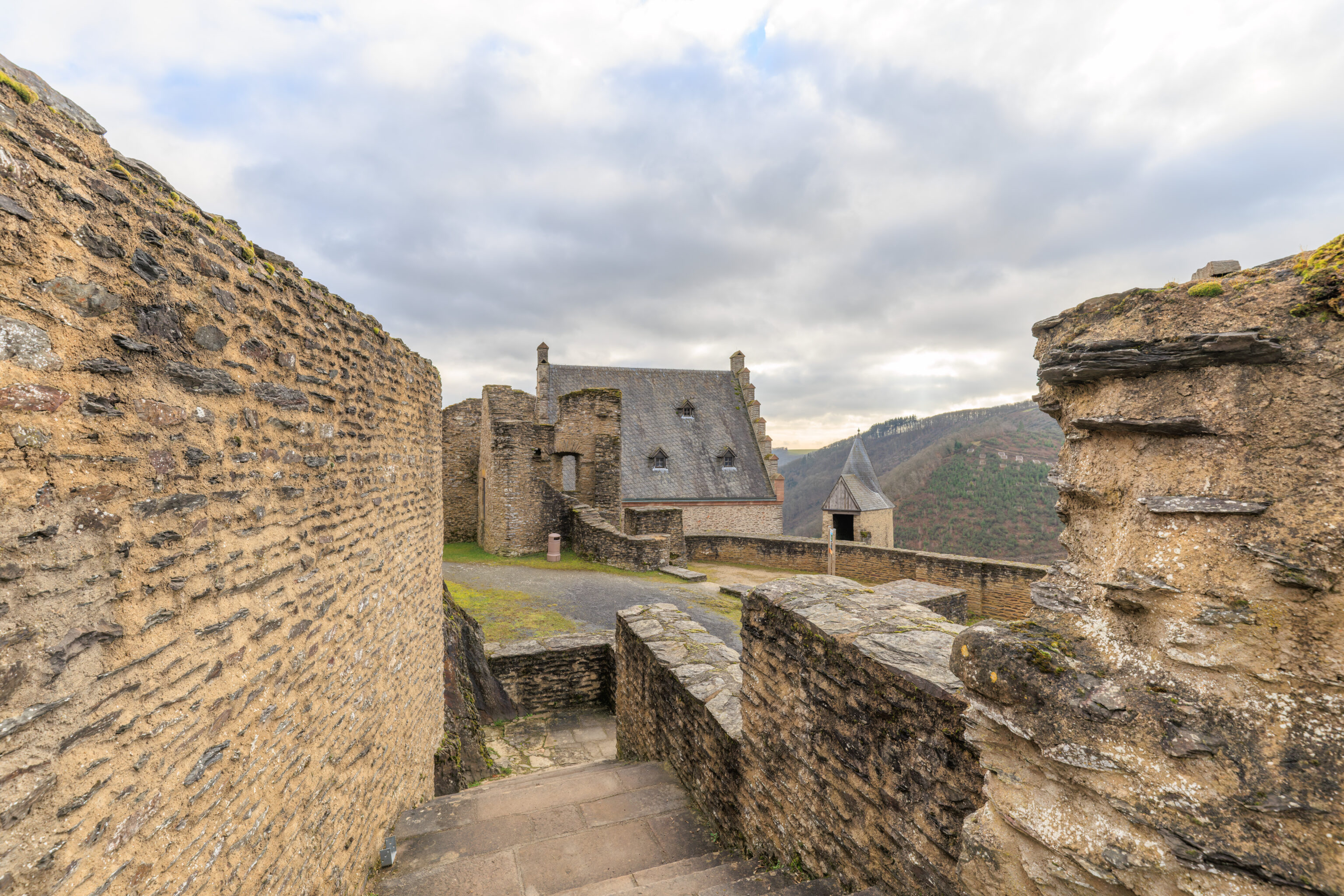
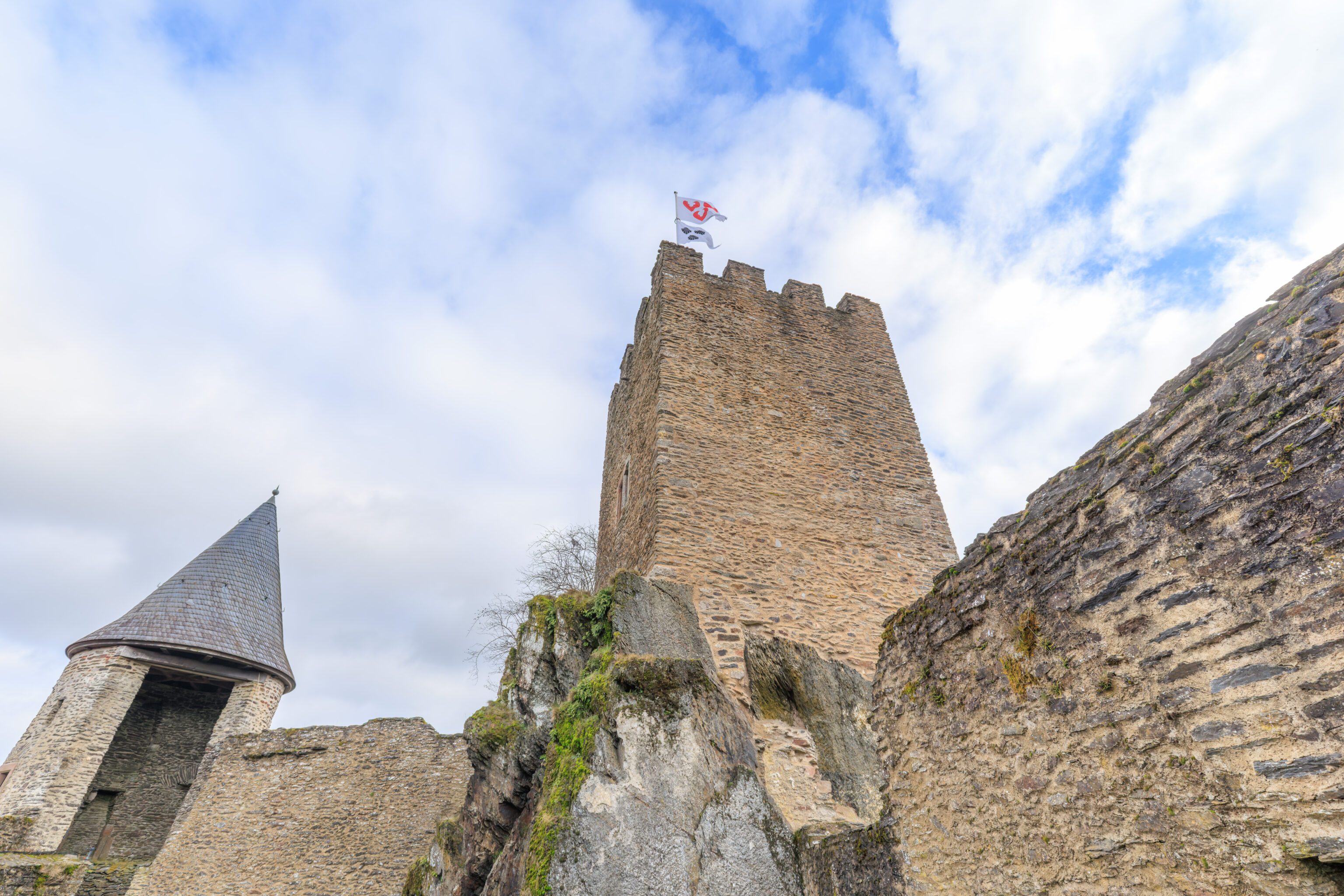
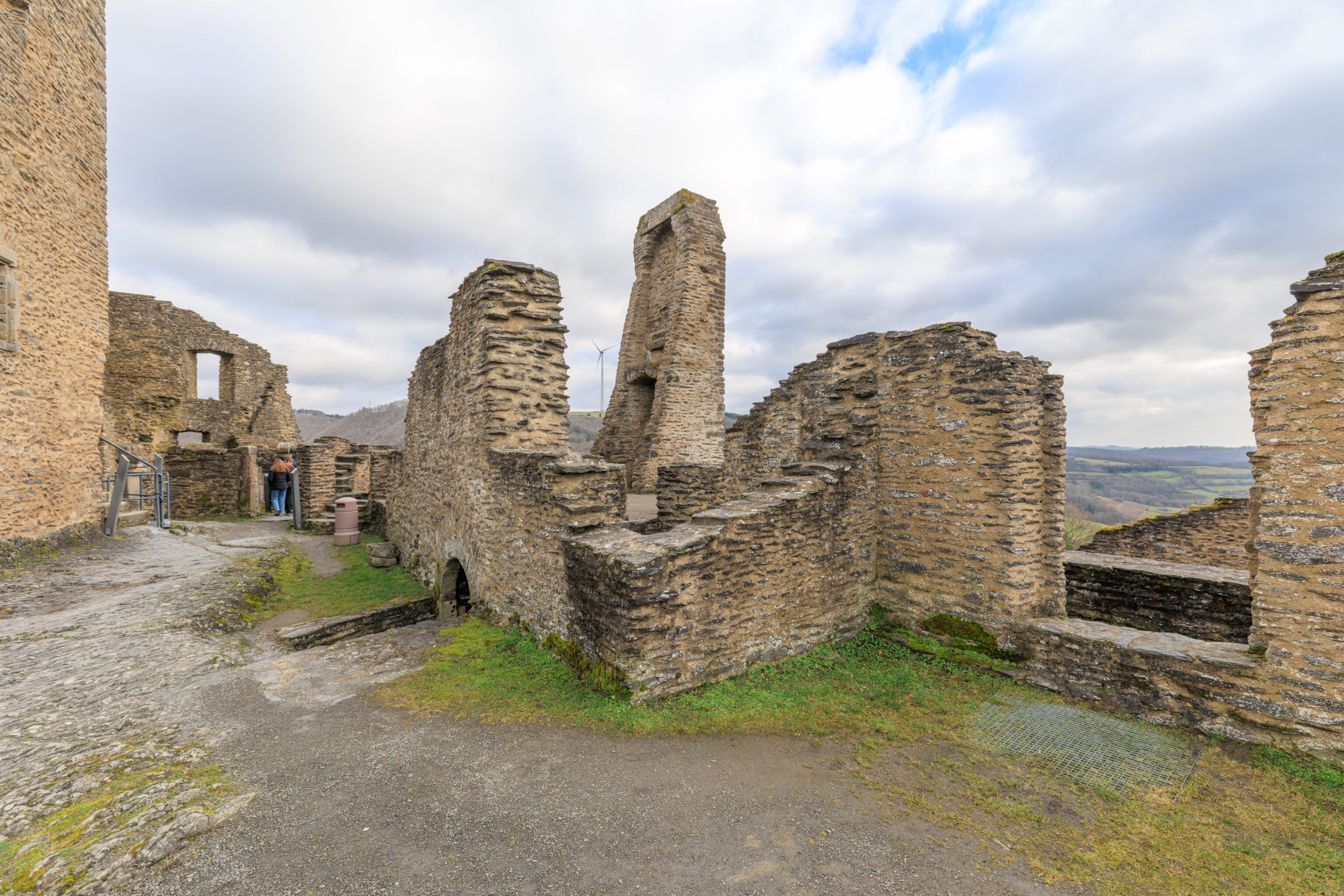
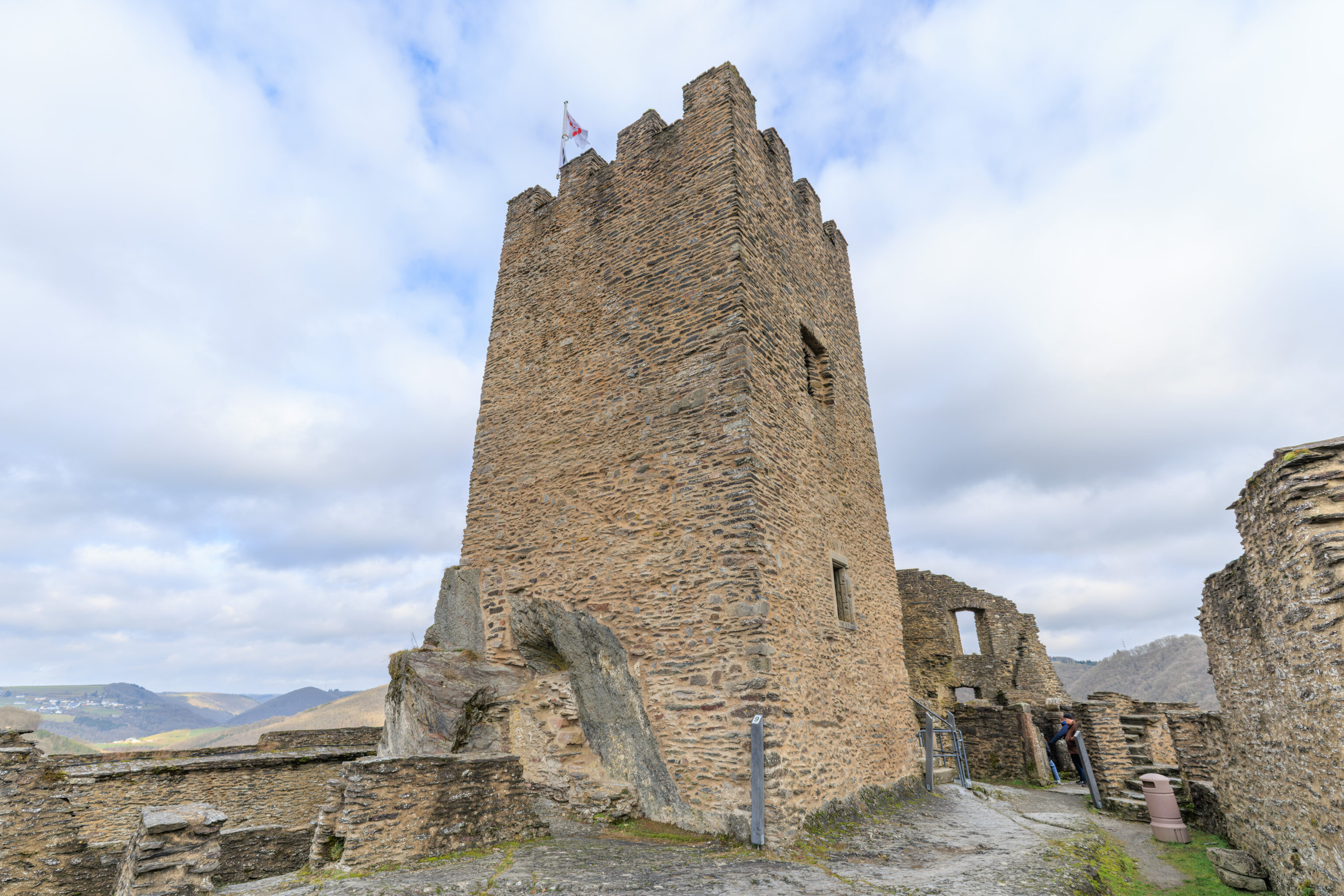
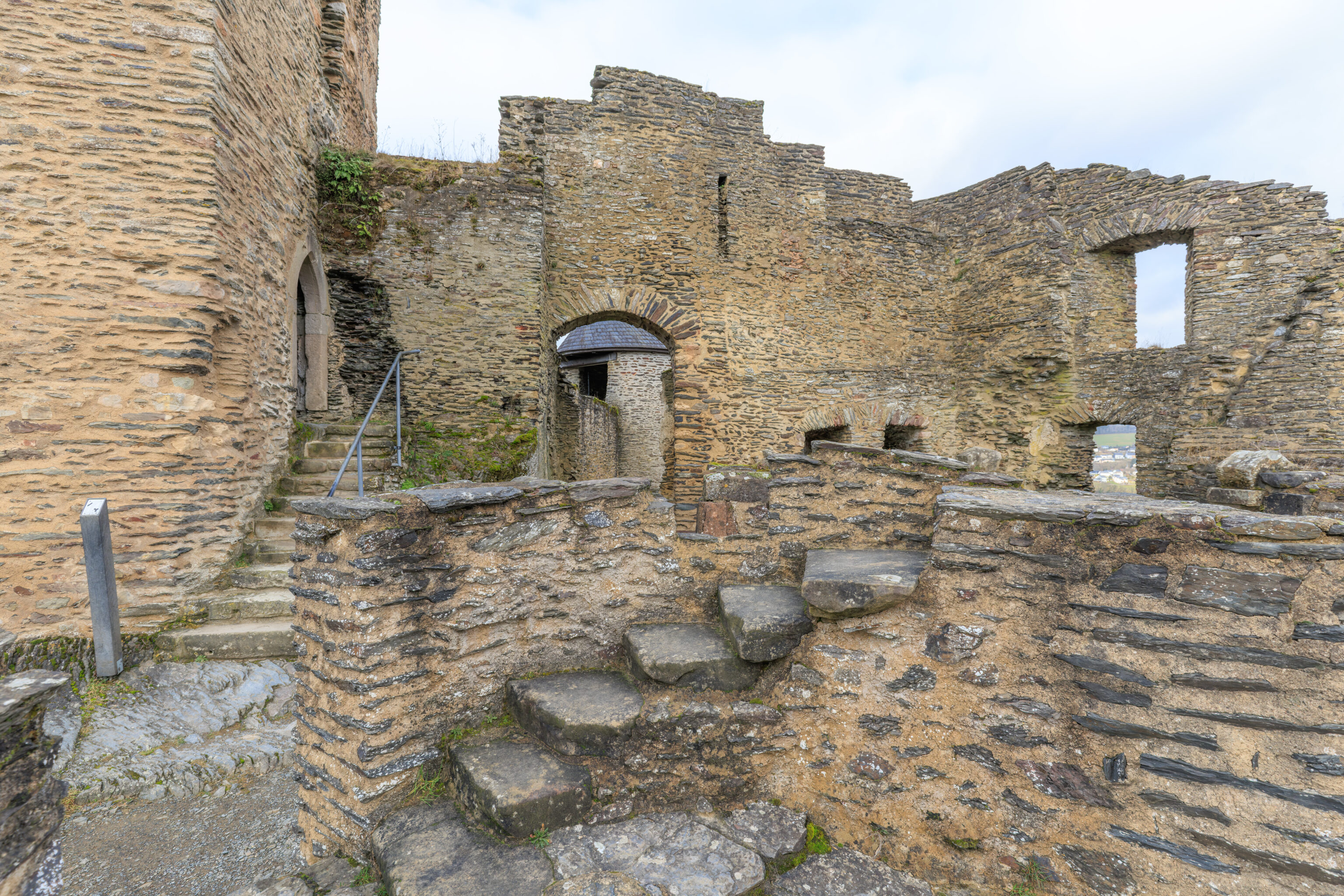
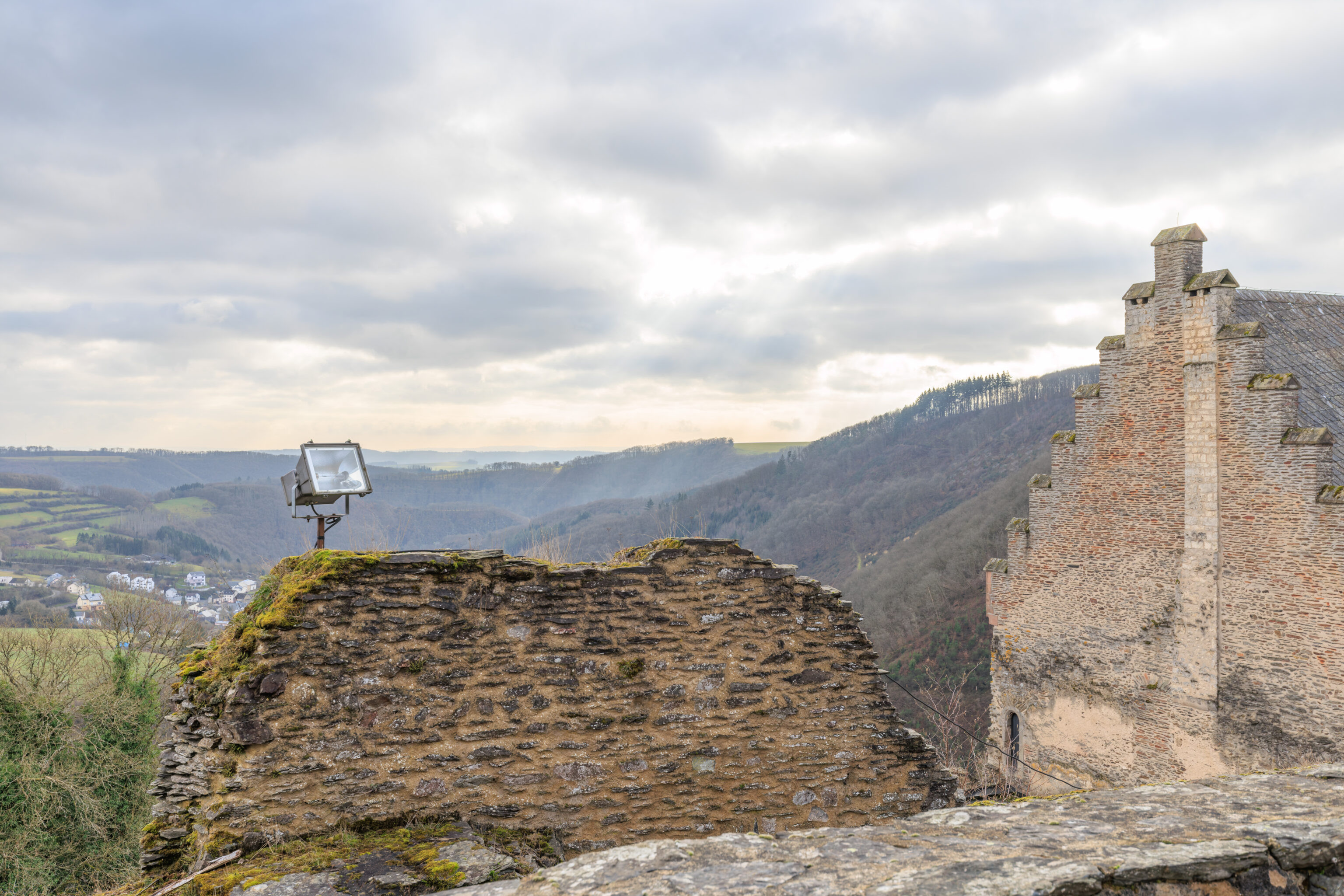
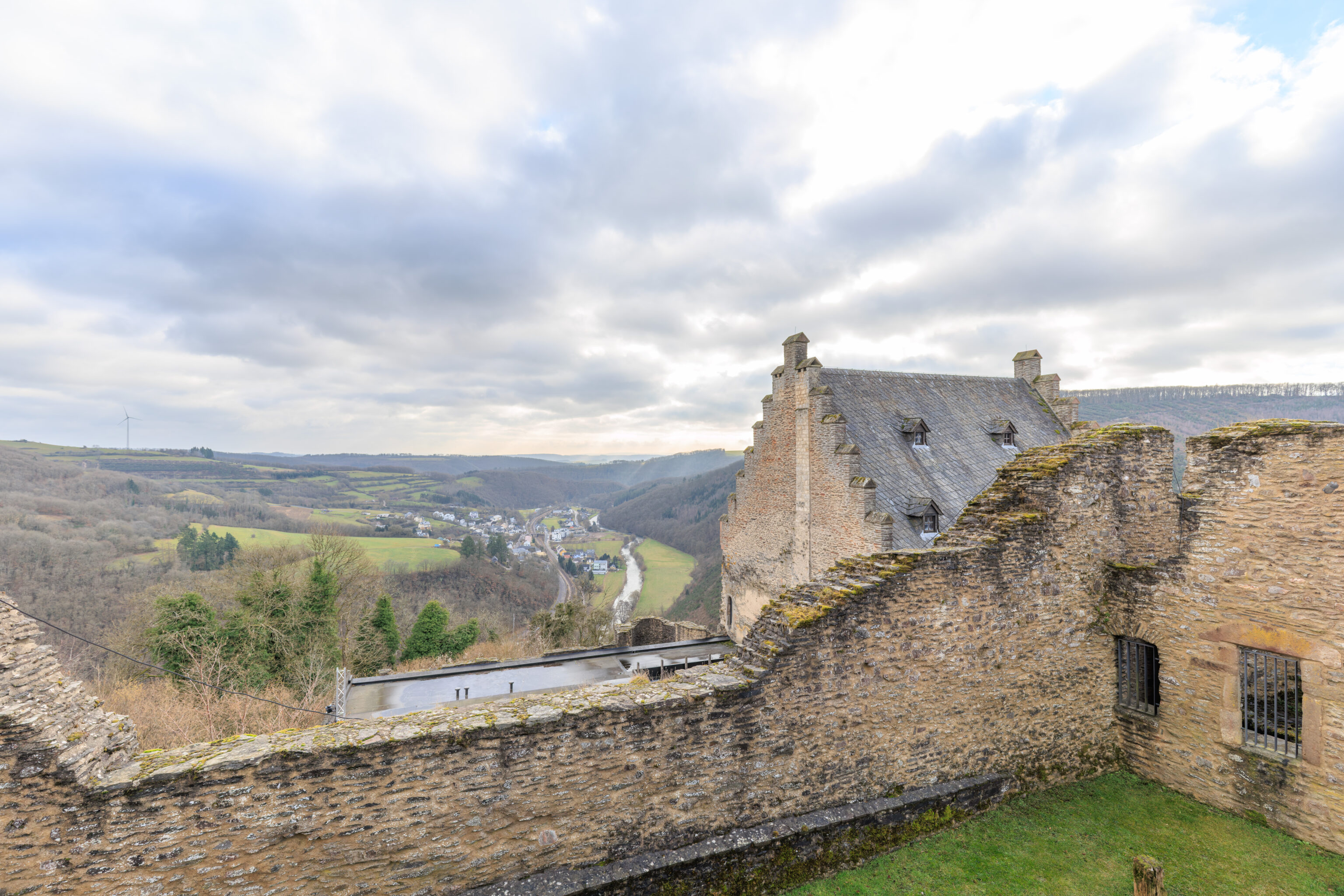
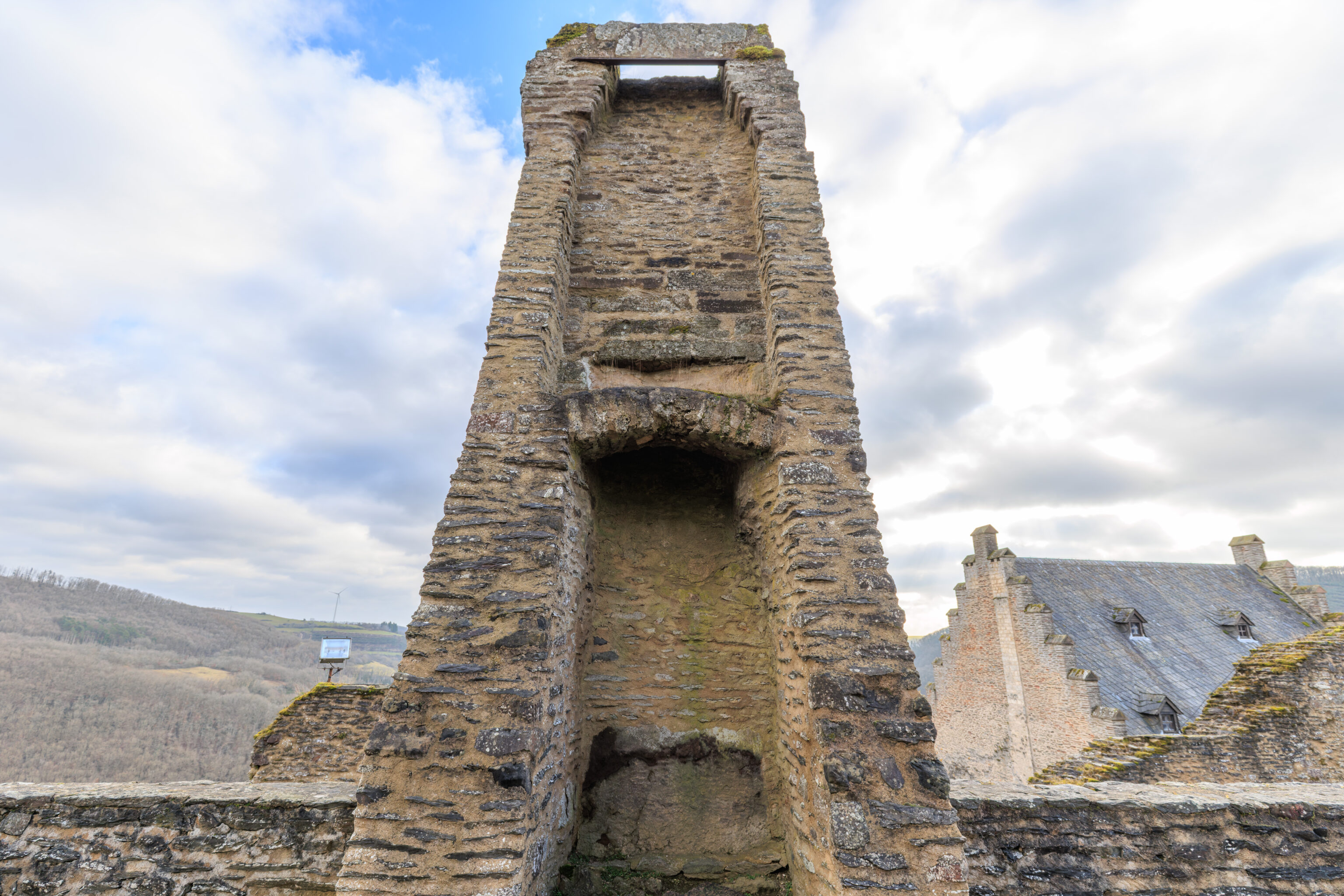
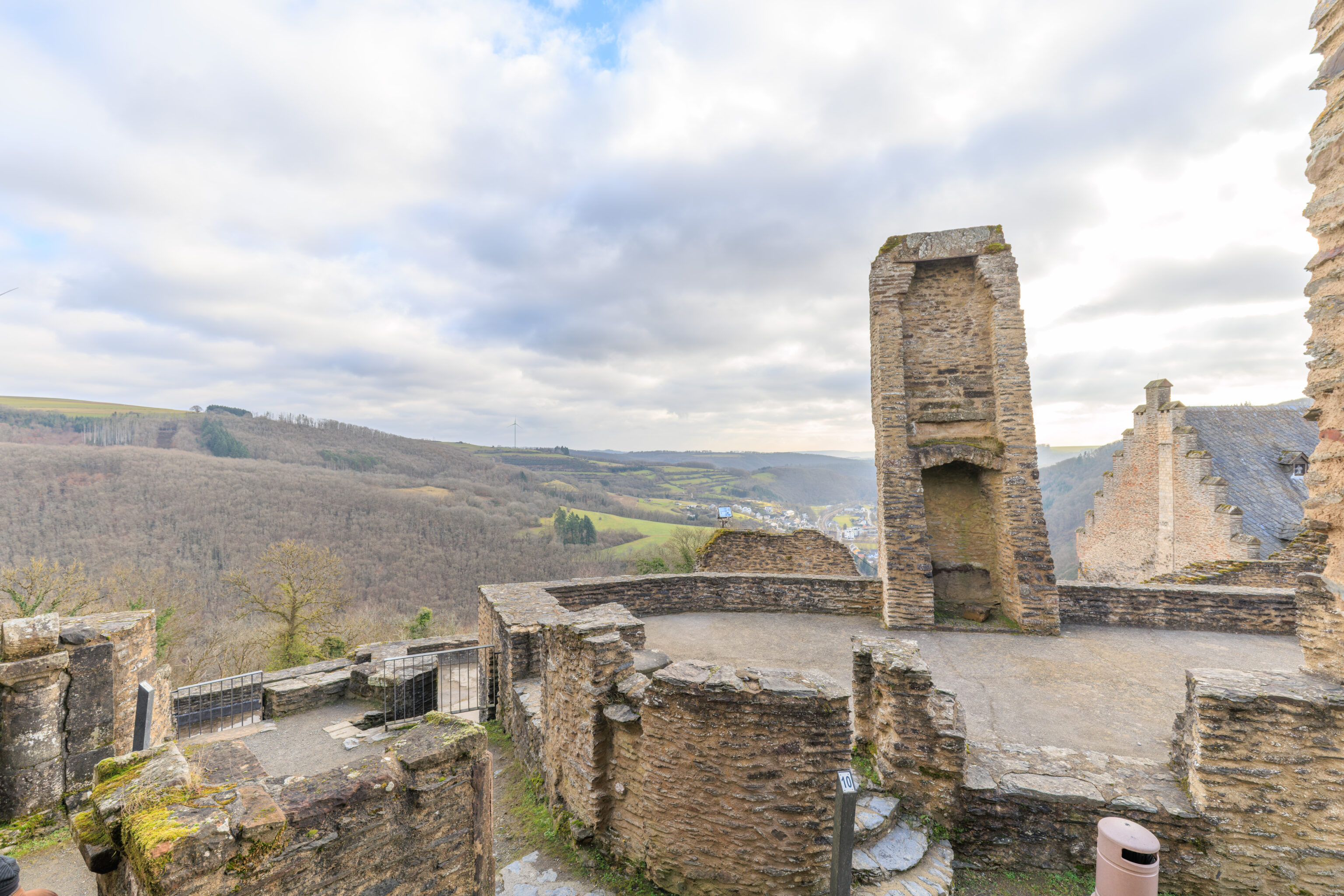
We ended up at an elevated area of the castle next to the large square tower.
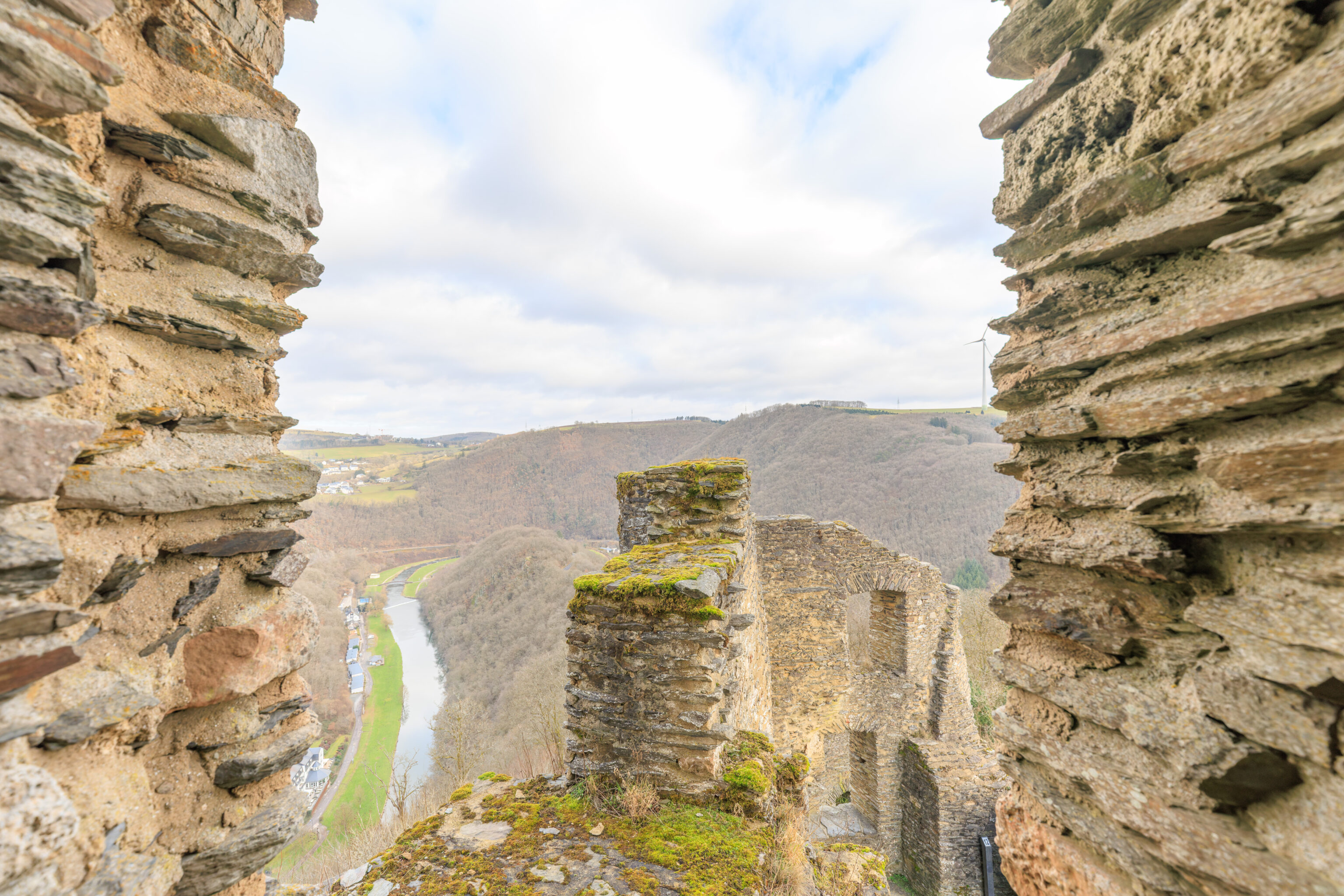
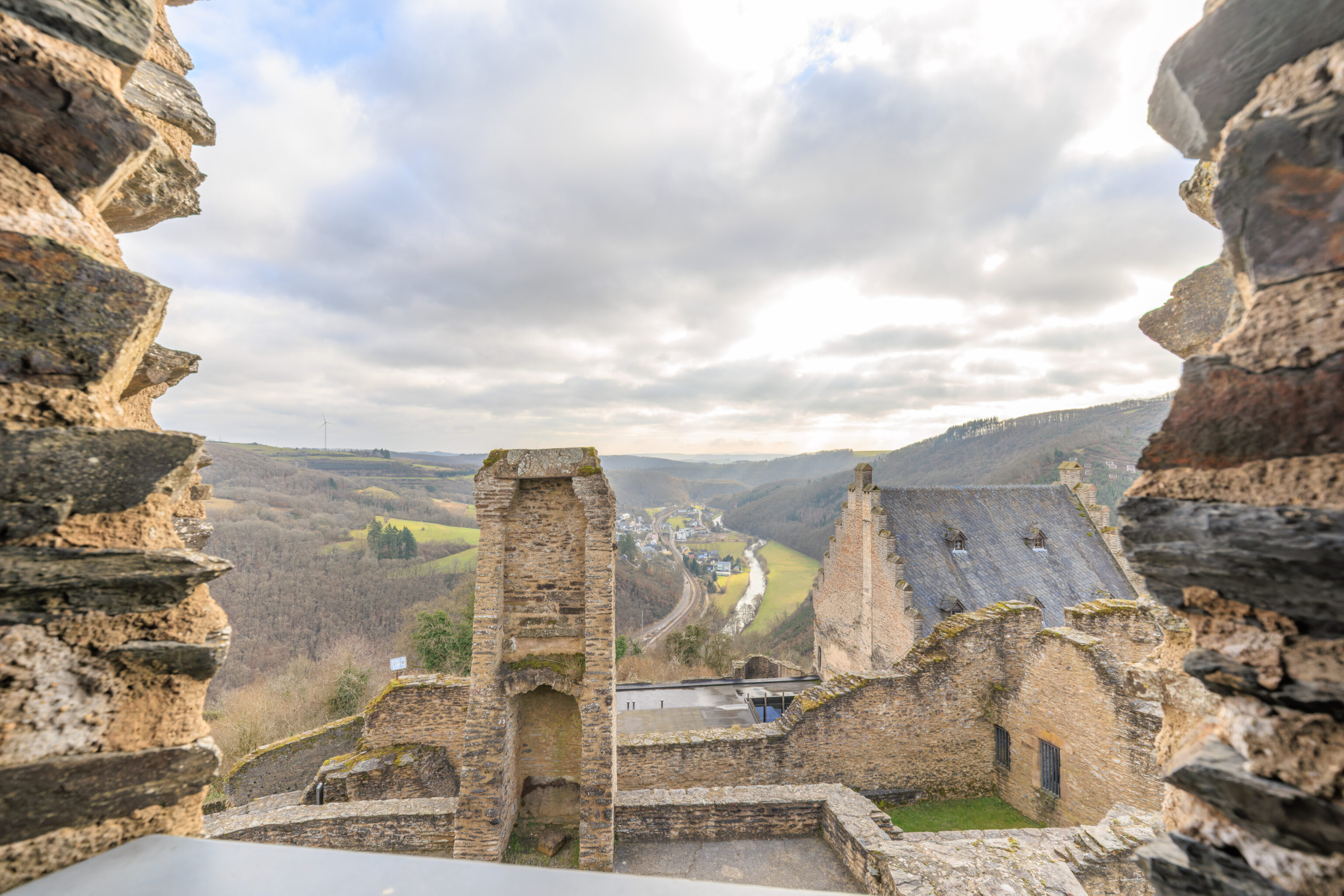
We then walked up the stairs within the tower.
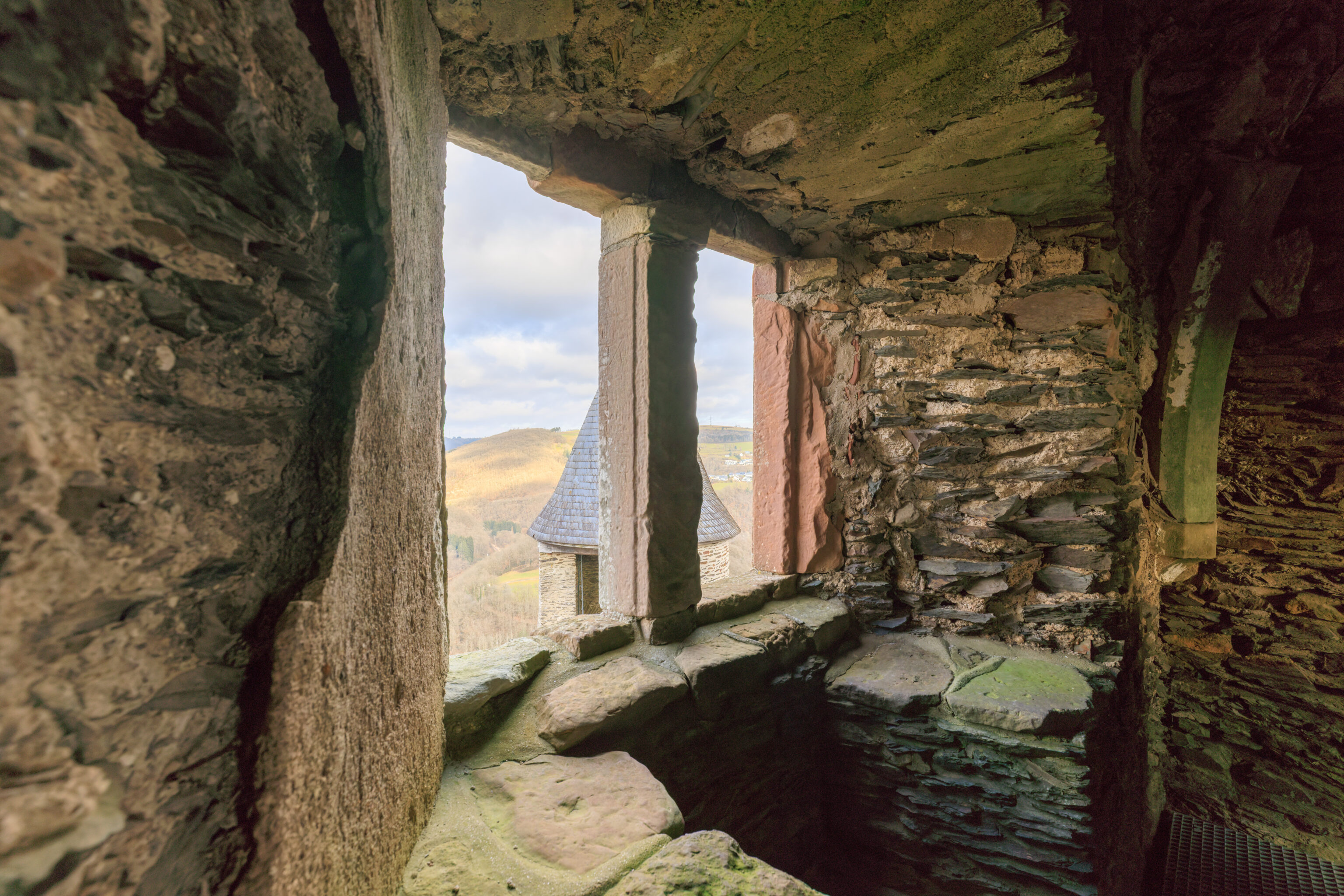
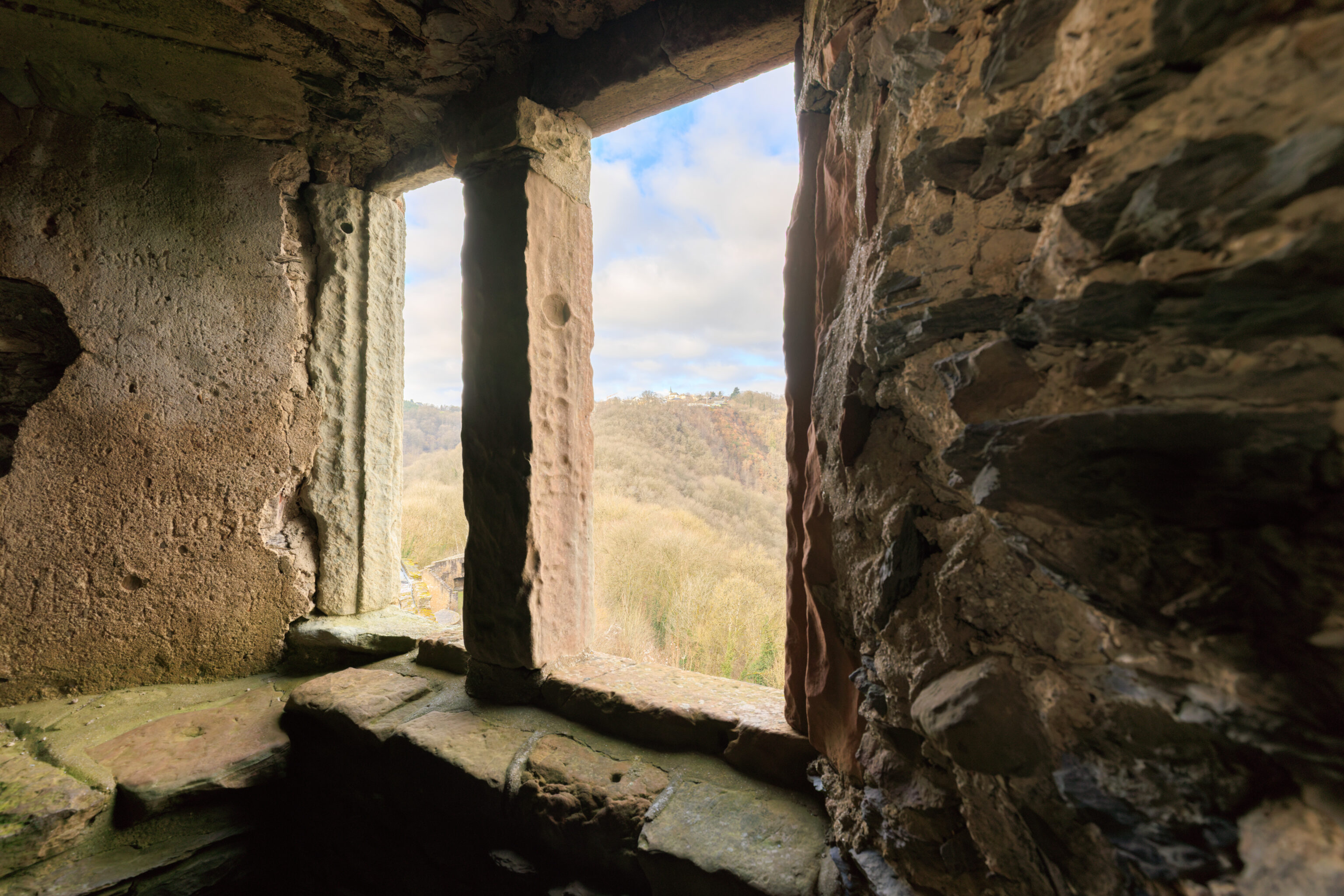
There were some windows within the tower that we could look out of on the way up.
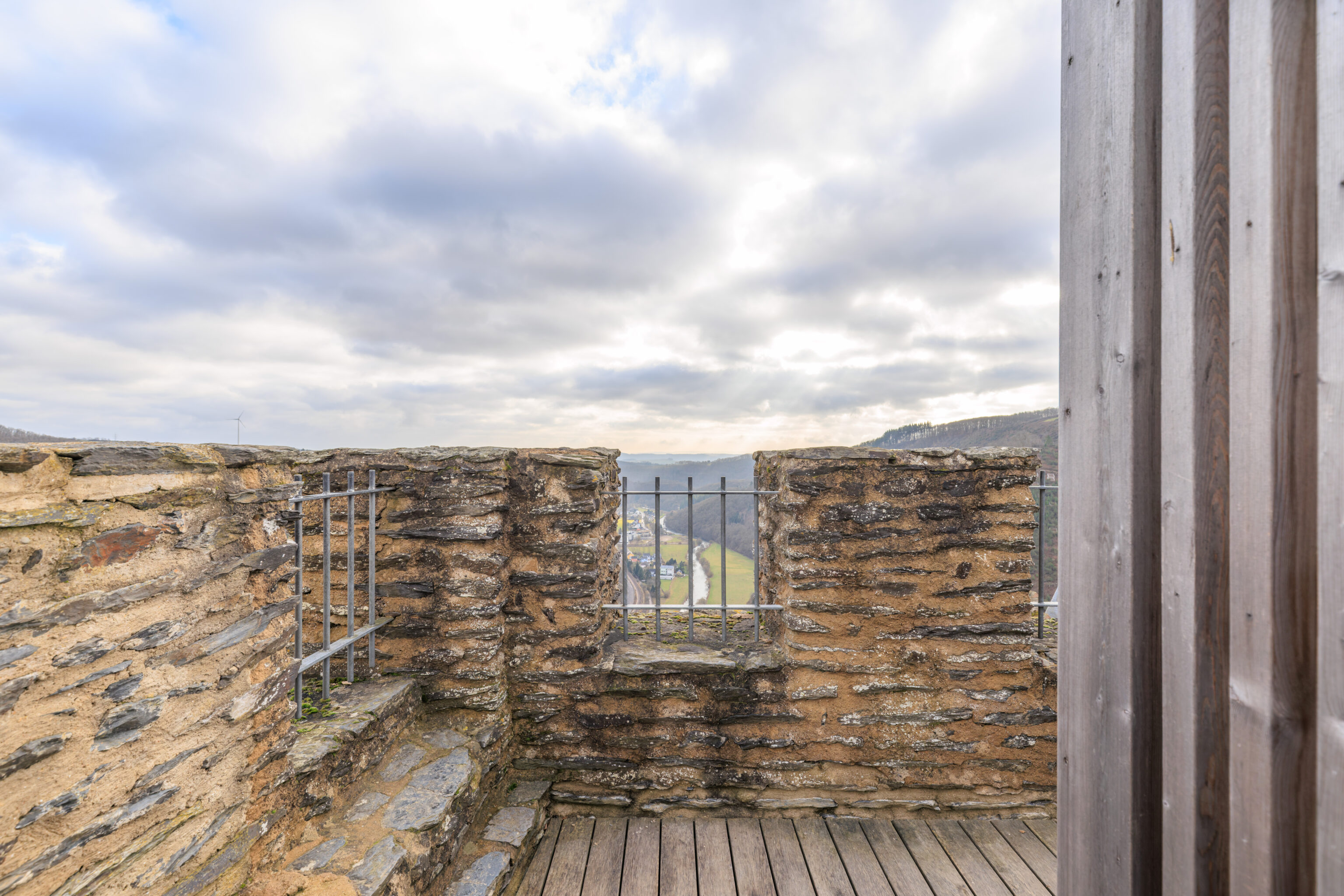
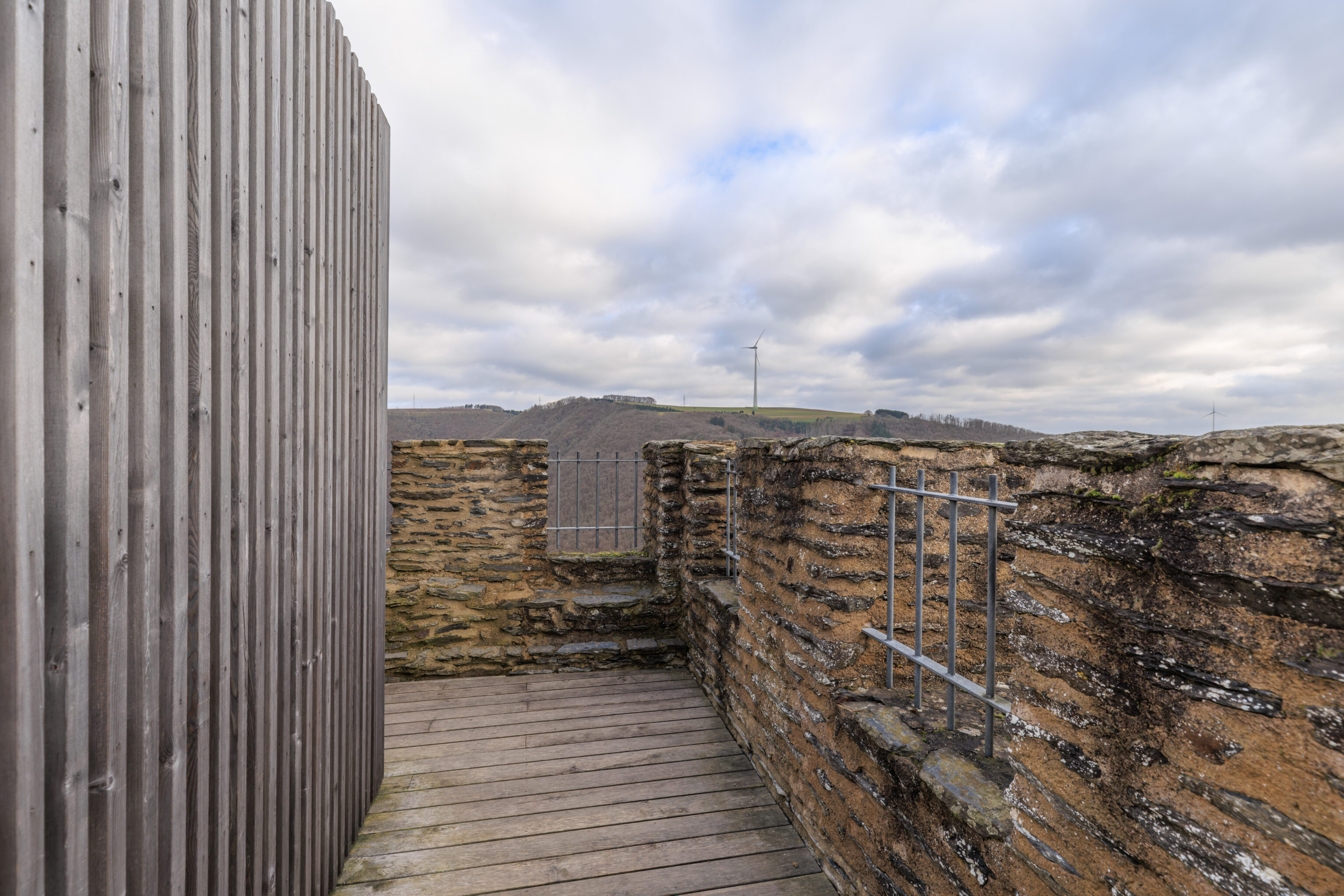
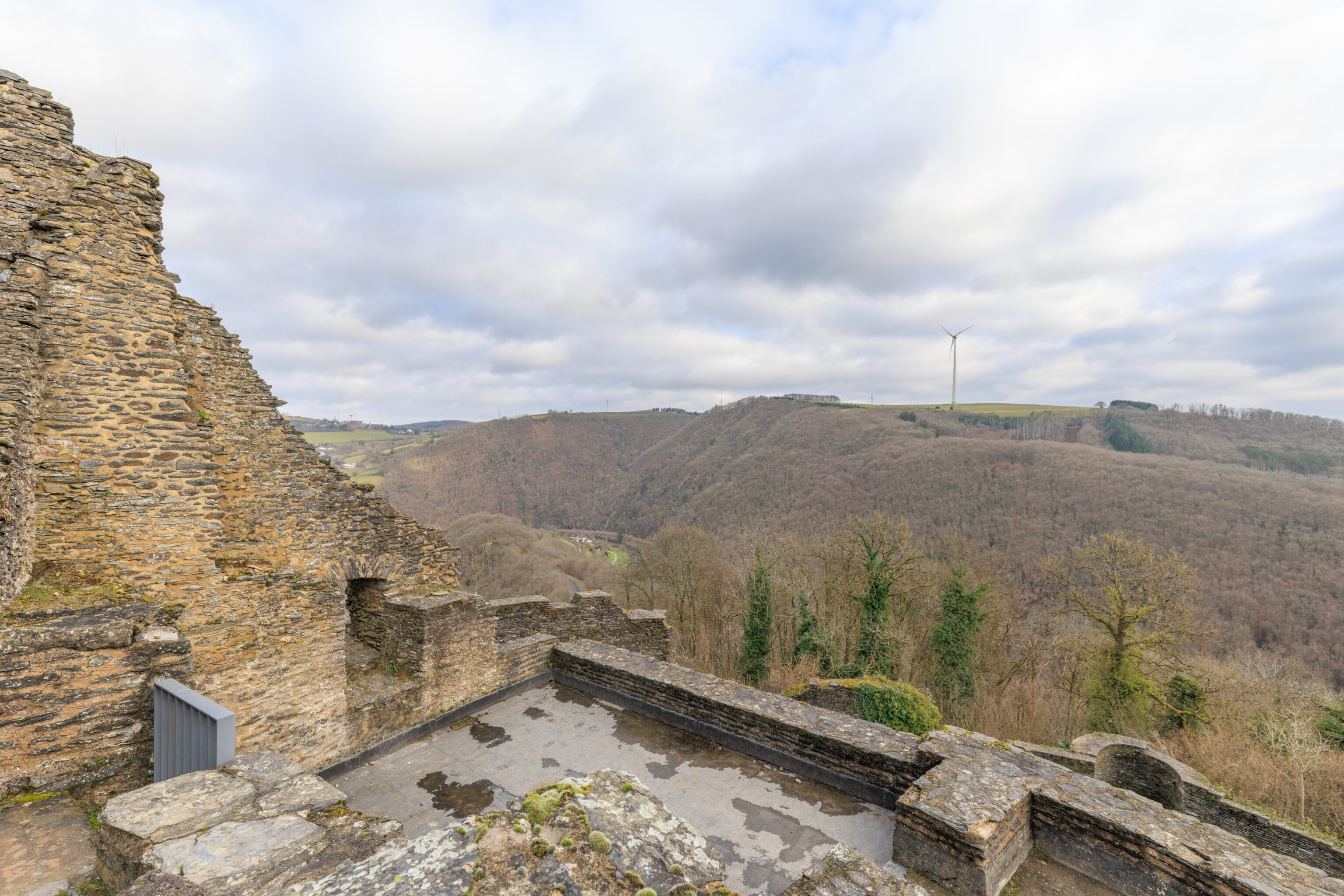
The top of the tower has a small observation deck that is open to the elements.
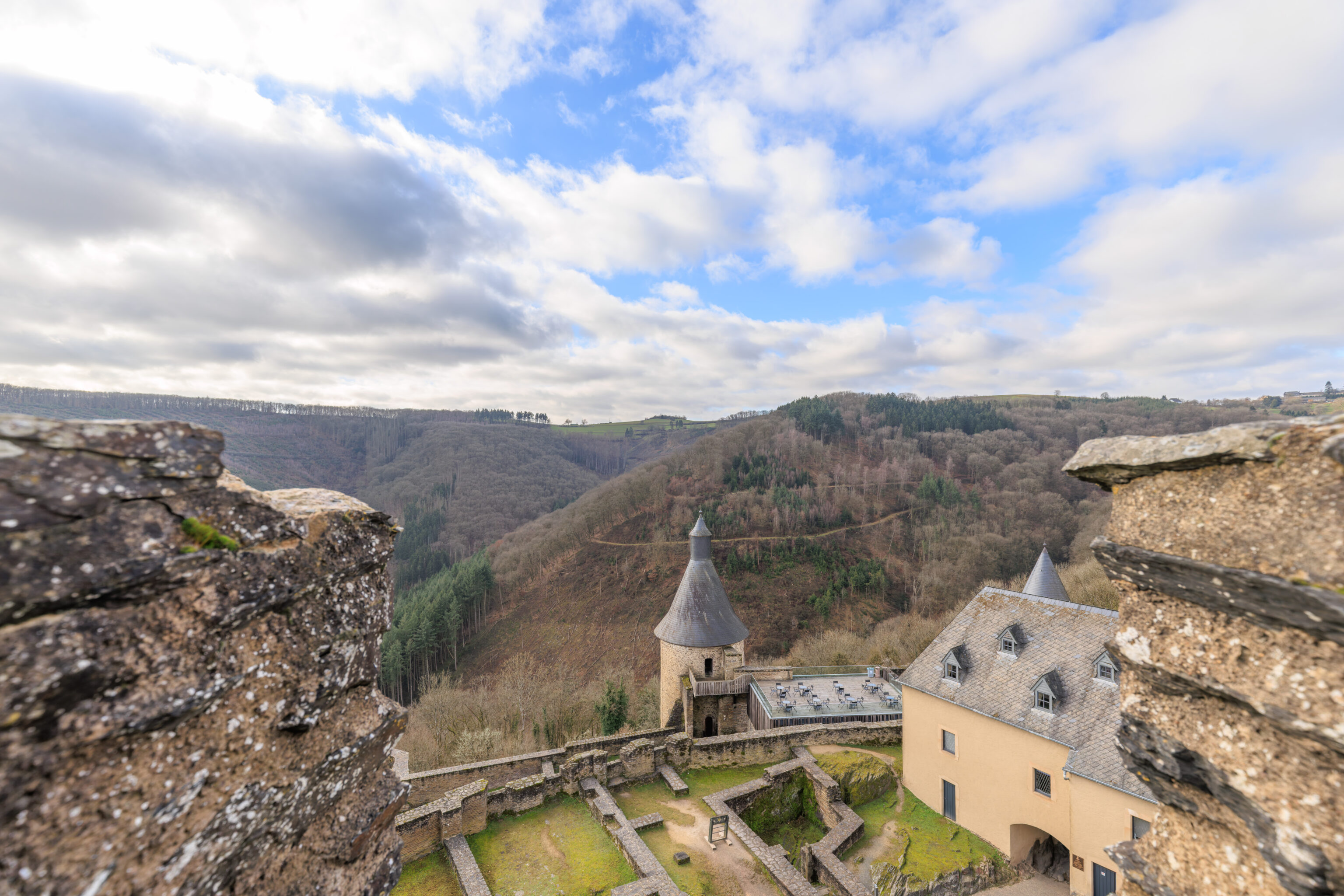
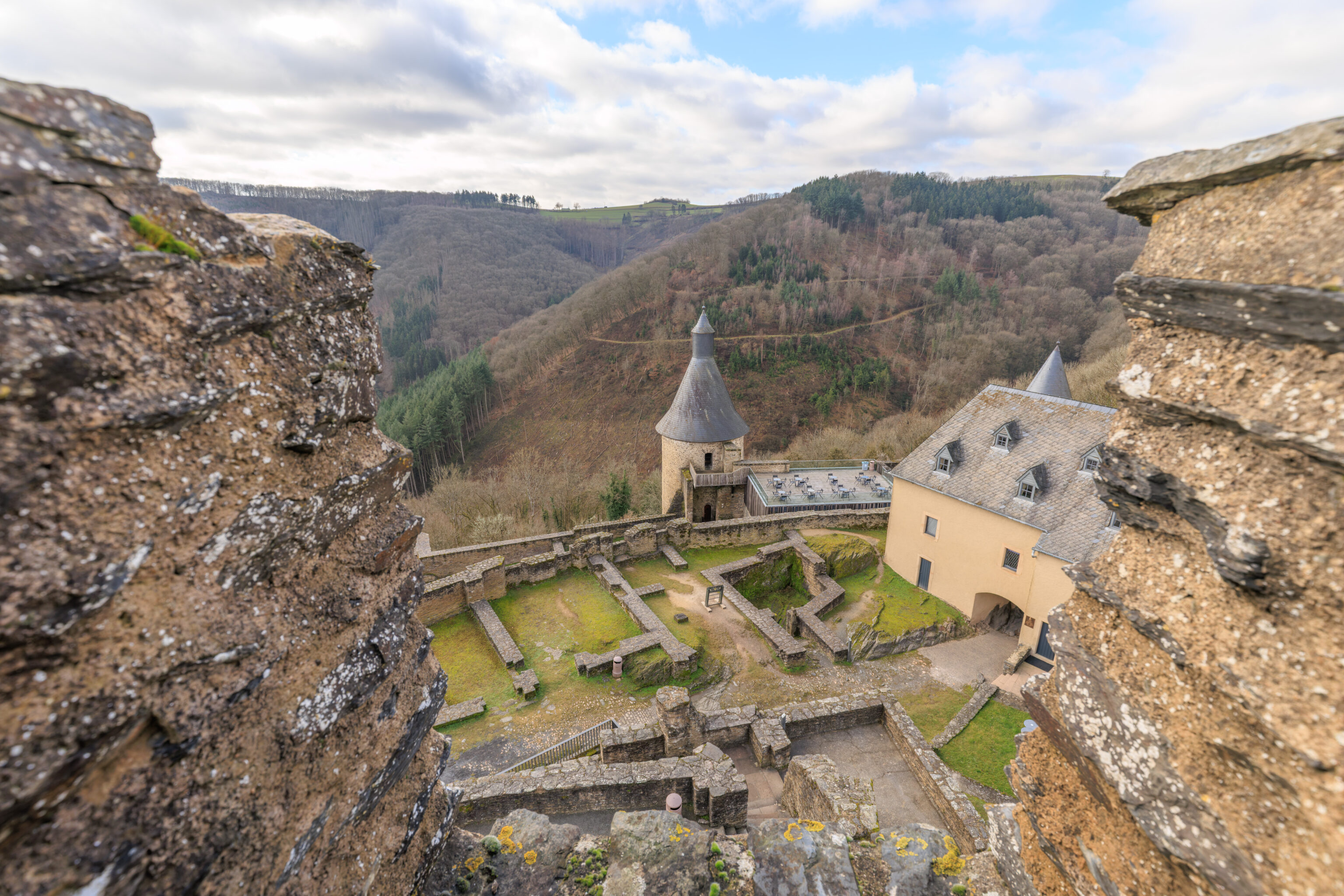
The view was fantastic, particularly as we could see a bit of blue sky here and there.
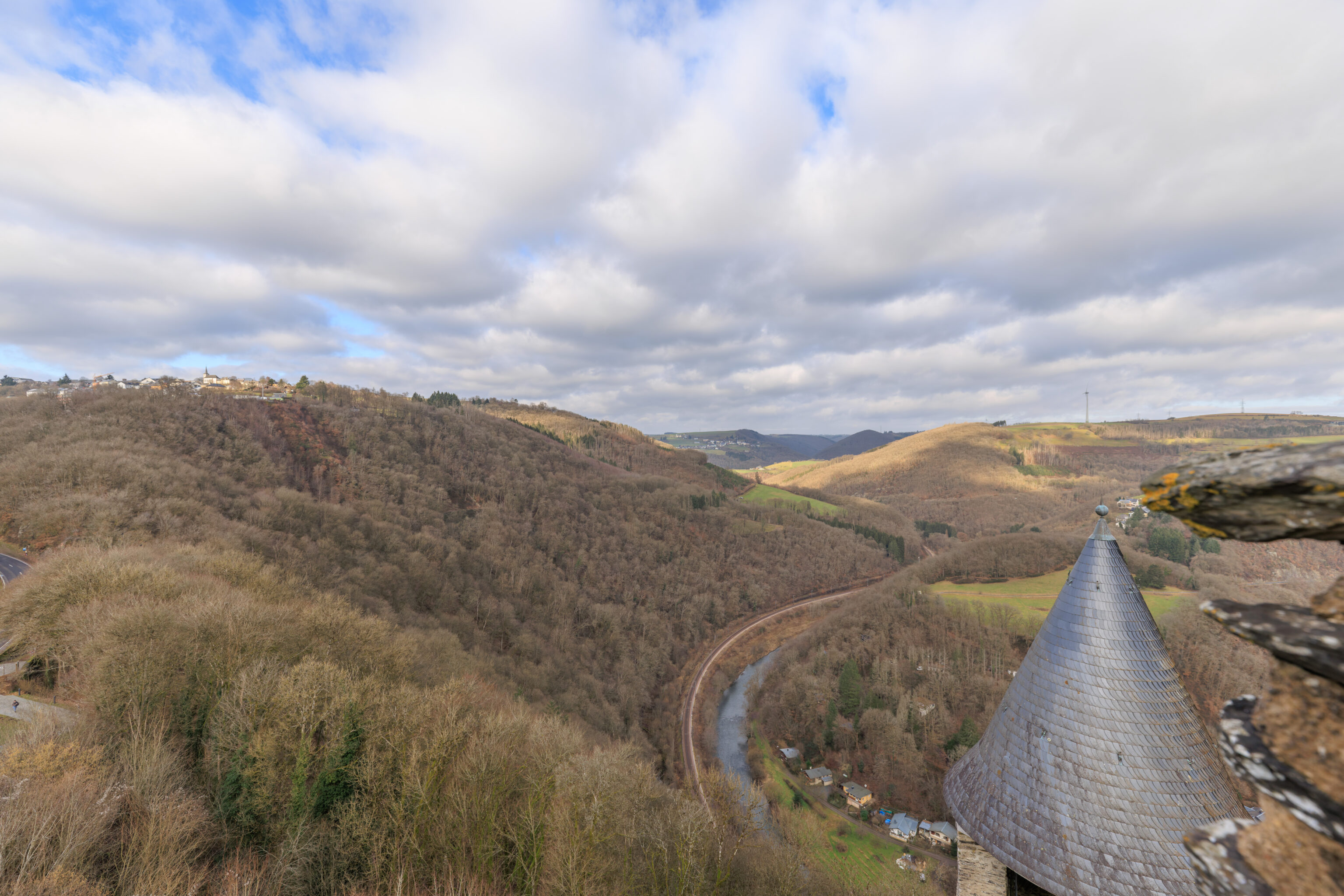
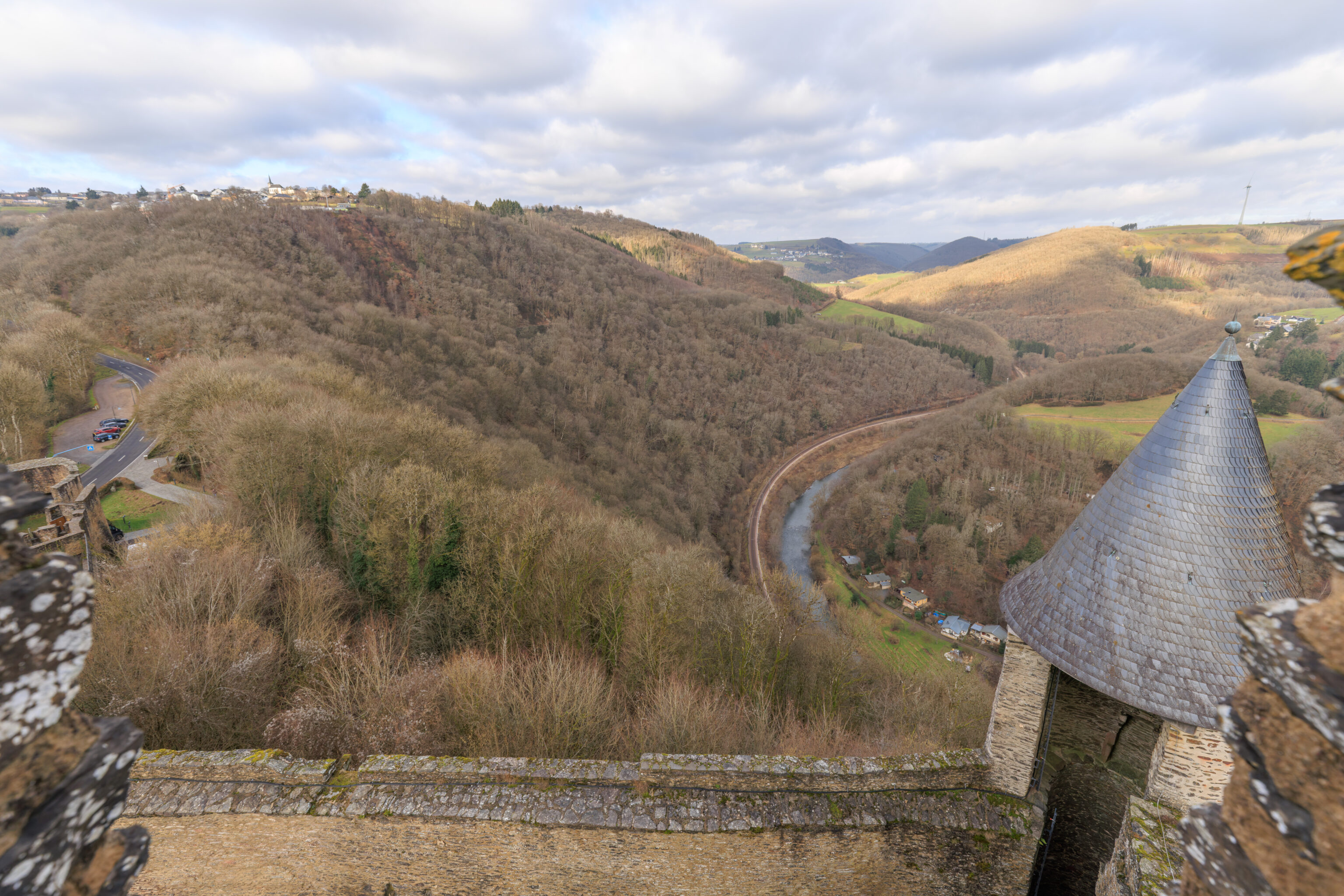
Looking to the northwest, we could see the river Sûre below. Bourscheid is atop the hill on the left side of the photograph
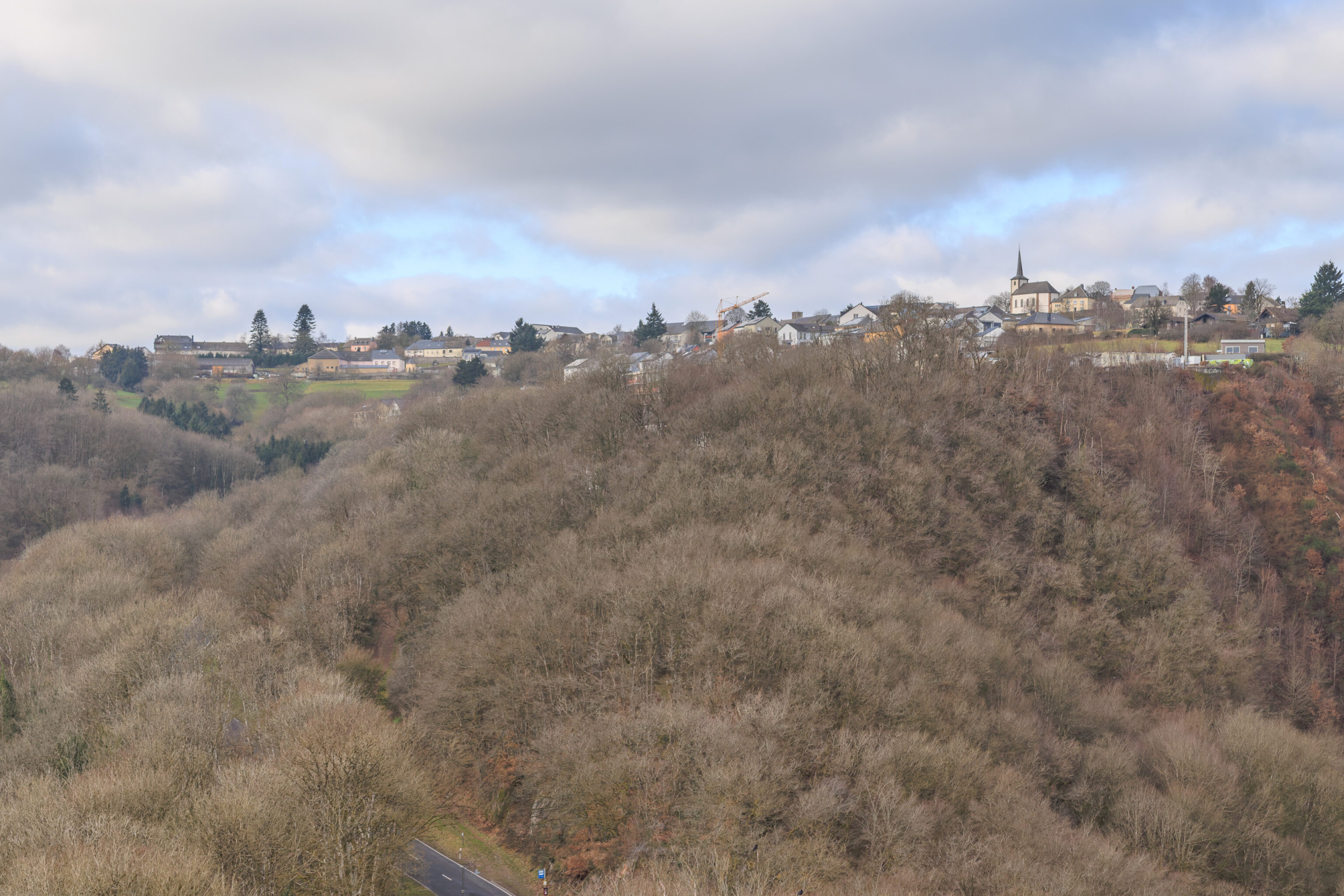
A closer look at Bourscheid.
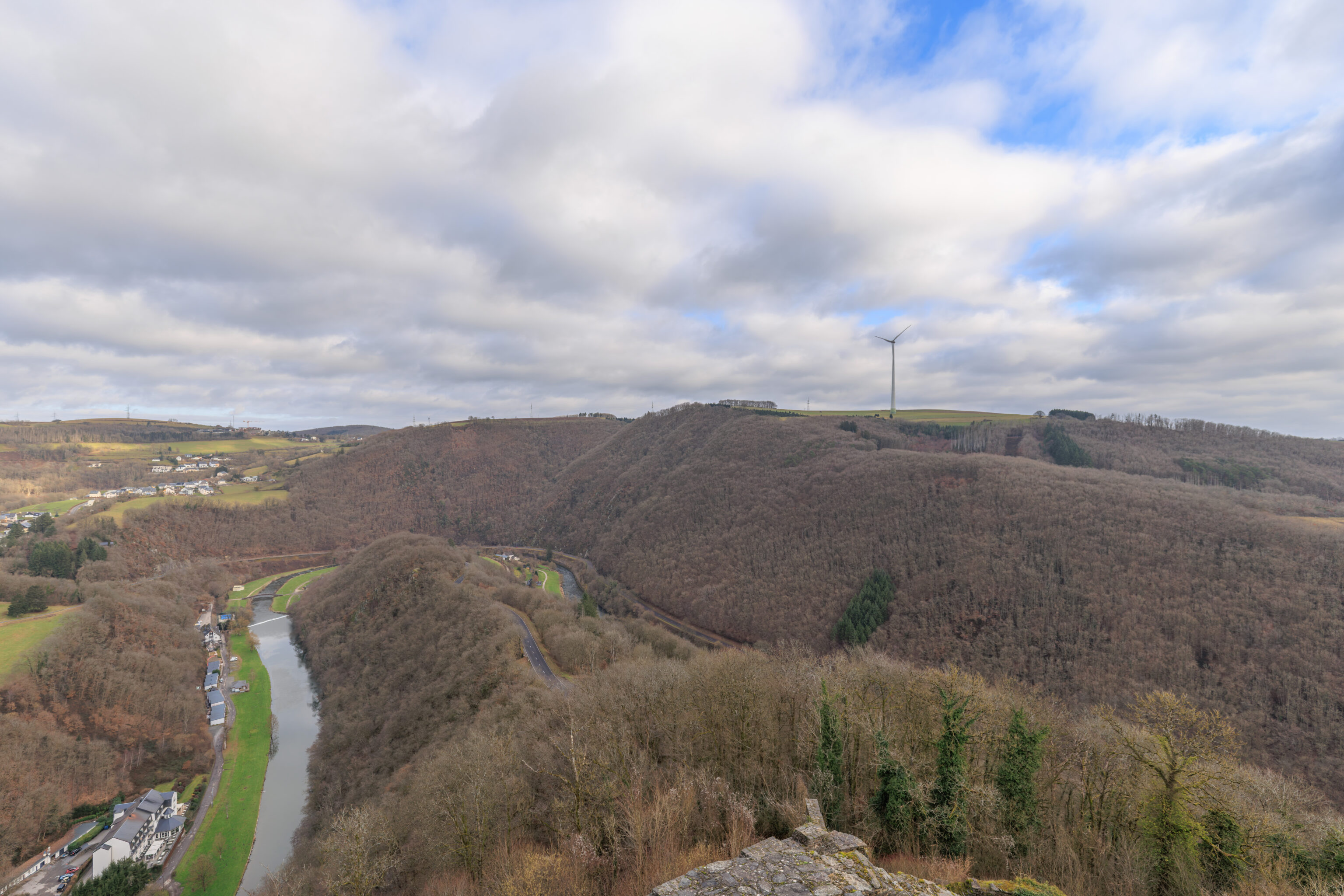
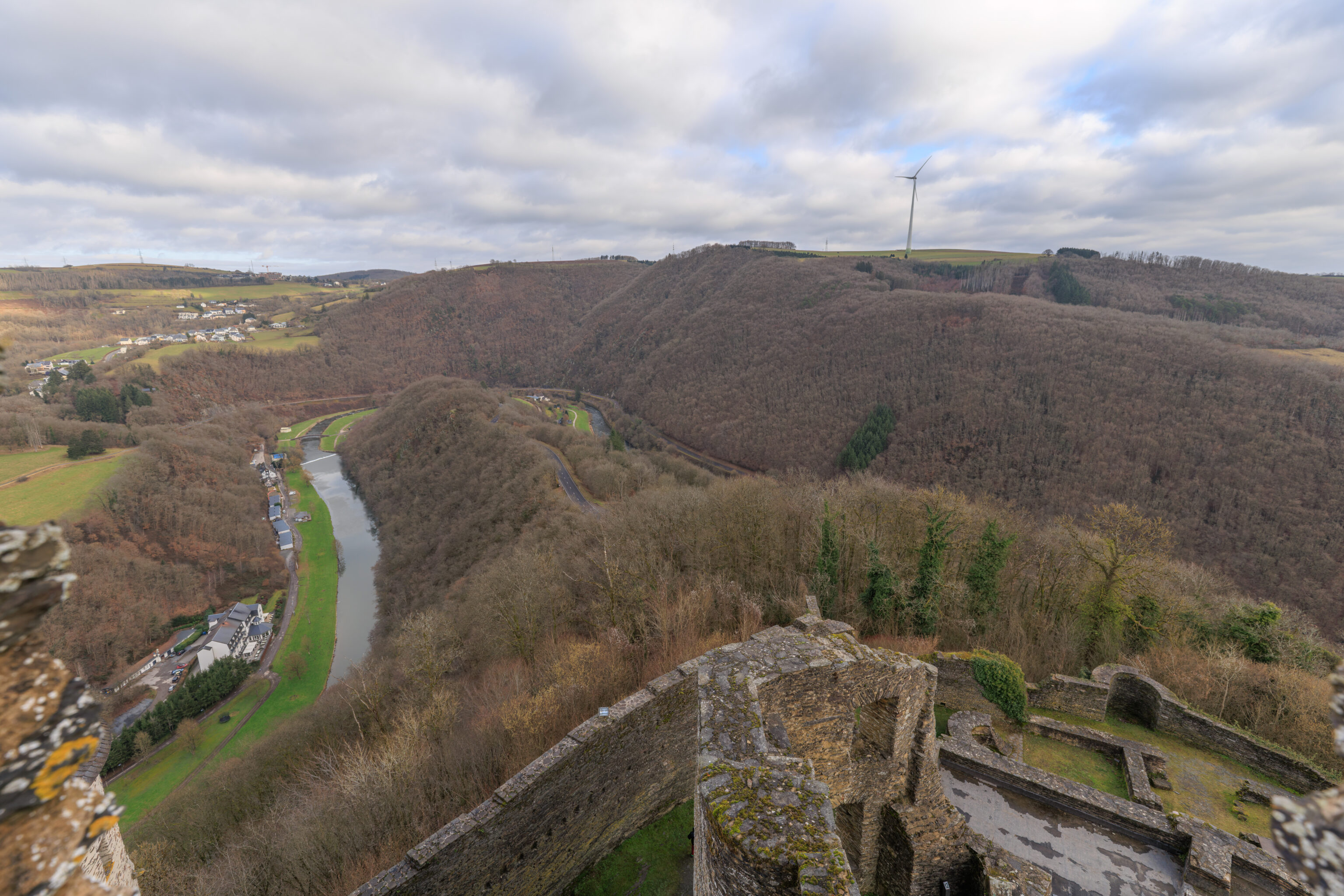
The view to the northeast shows one of many curves on the Sûre.
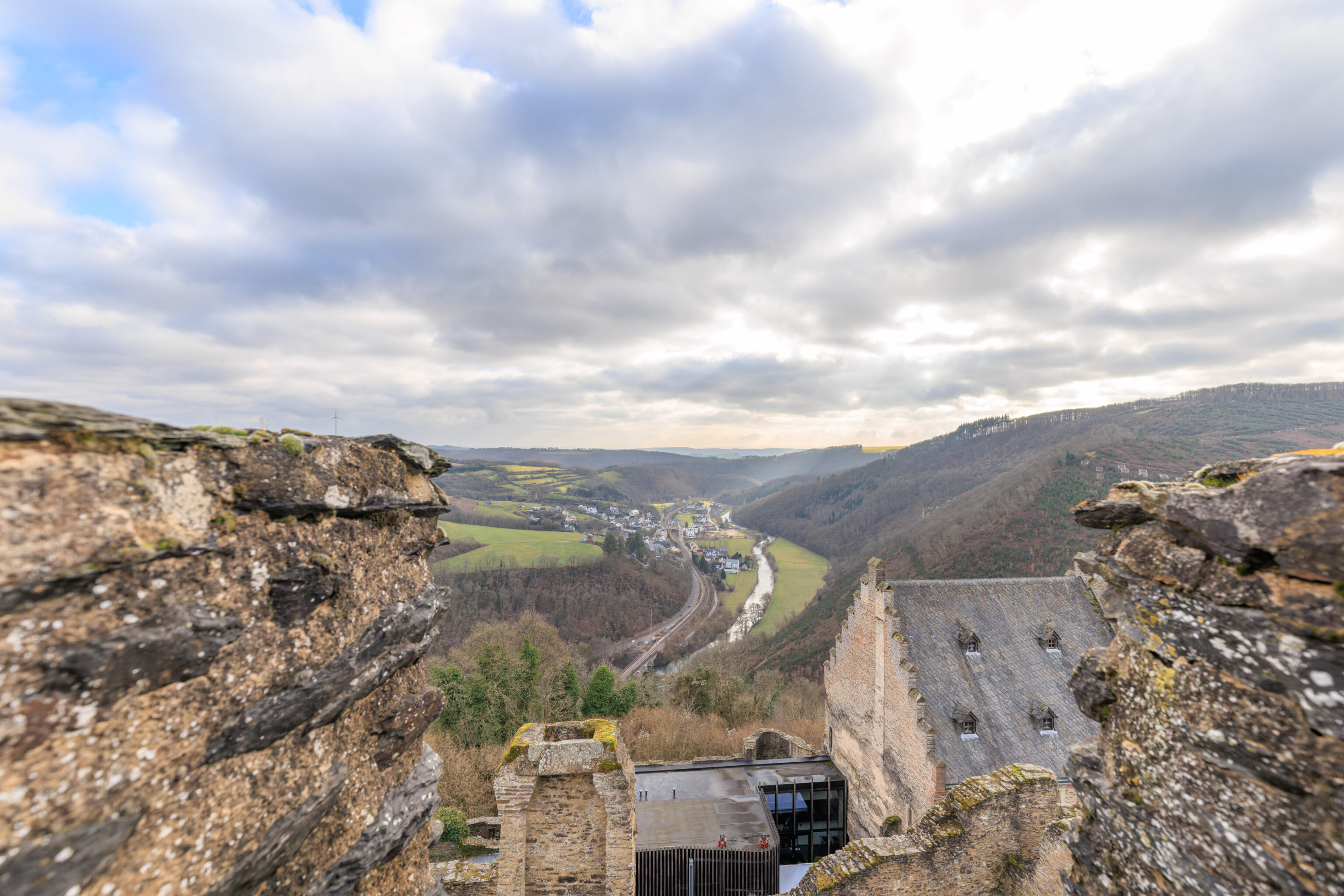
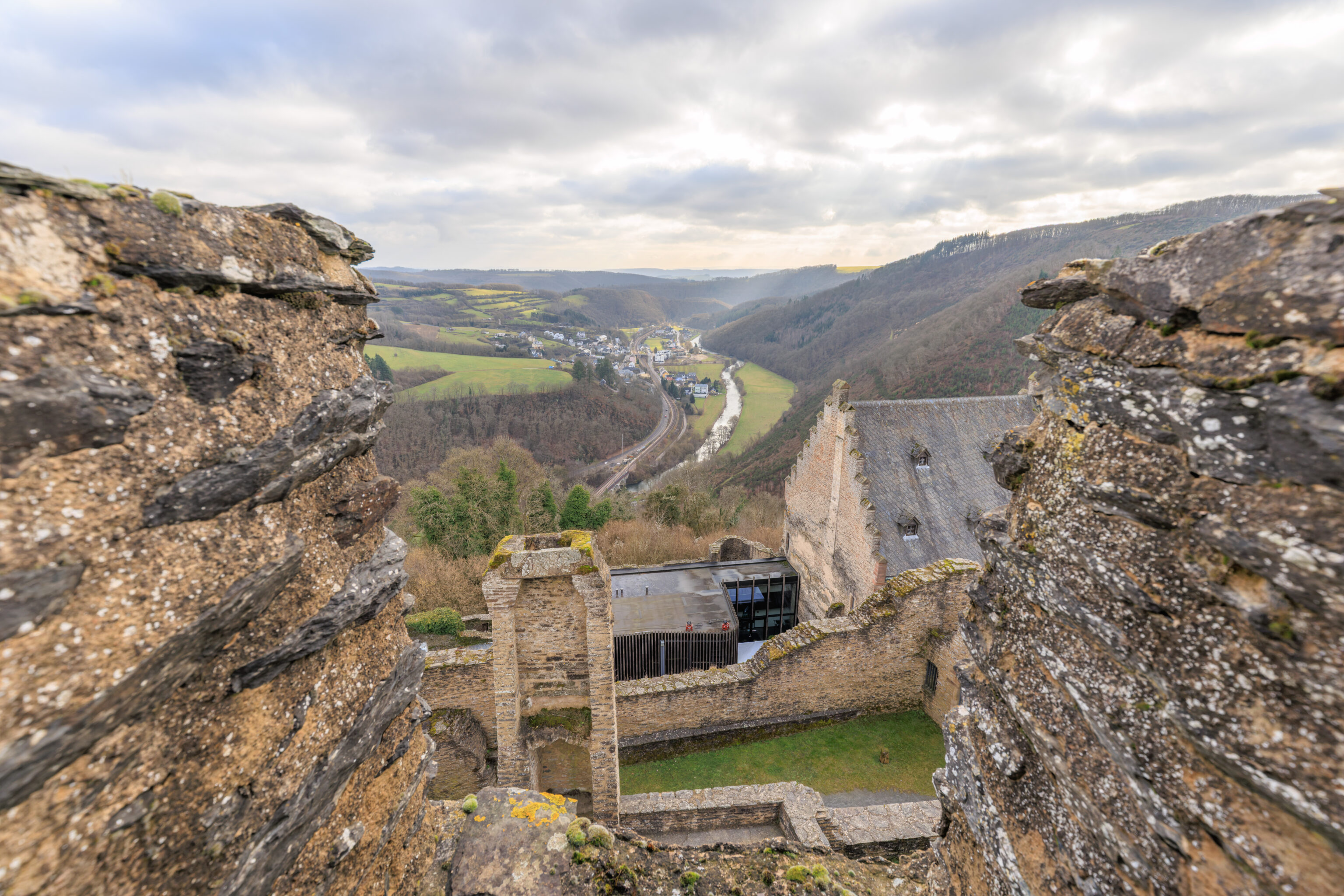
Finally, the view to the southeast shows Michelau next to the Sûre.
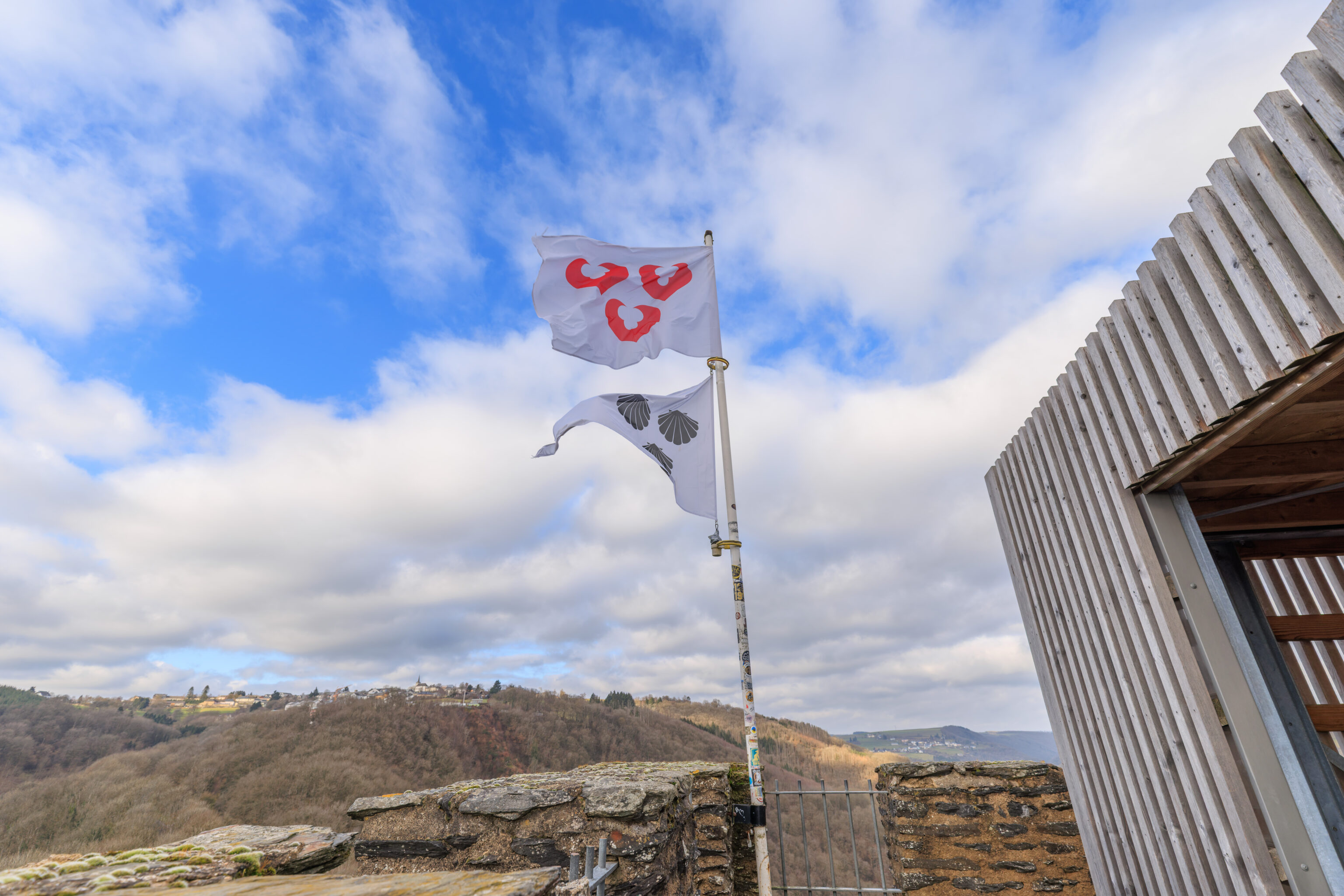
There were two flags that were flying. One depicted three seashells! Do you know how to use the three seashells? Have you seen Demolition Man?
The three seashells are actually part of the coat of arms of the House of Metternich. A branch of the family controlled Bourscheid starting in 1494.
The flag above it depicts the symbol from the coat of arms of the Soger family, who were former lords of Bourscheid. This does not seem to be extensively documented online, or at least, not easily searchable in English.
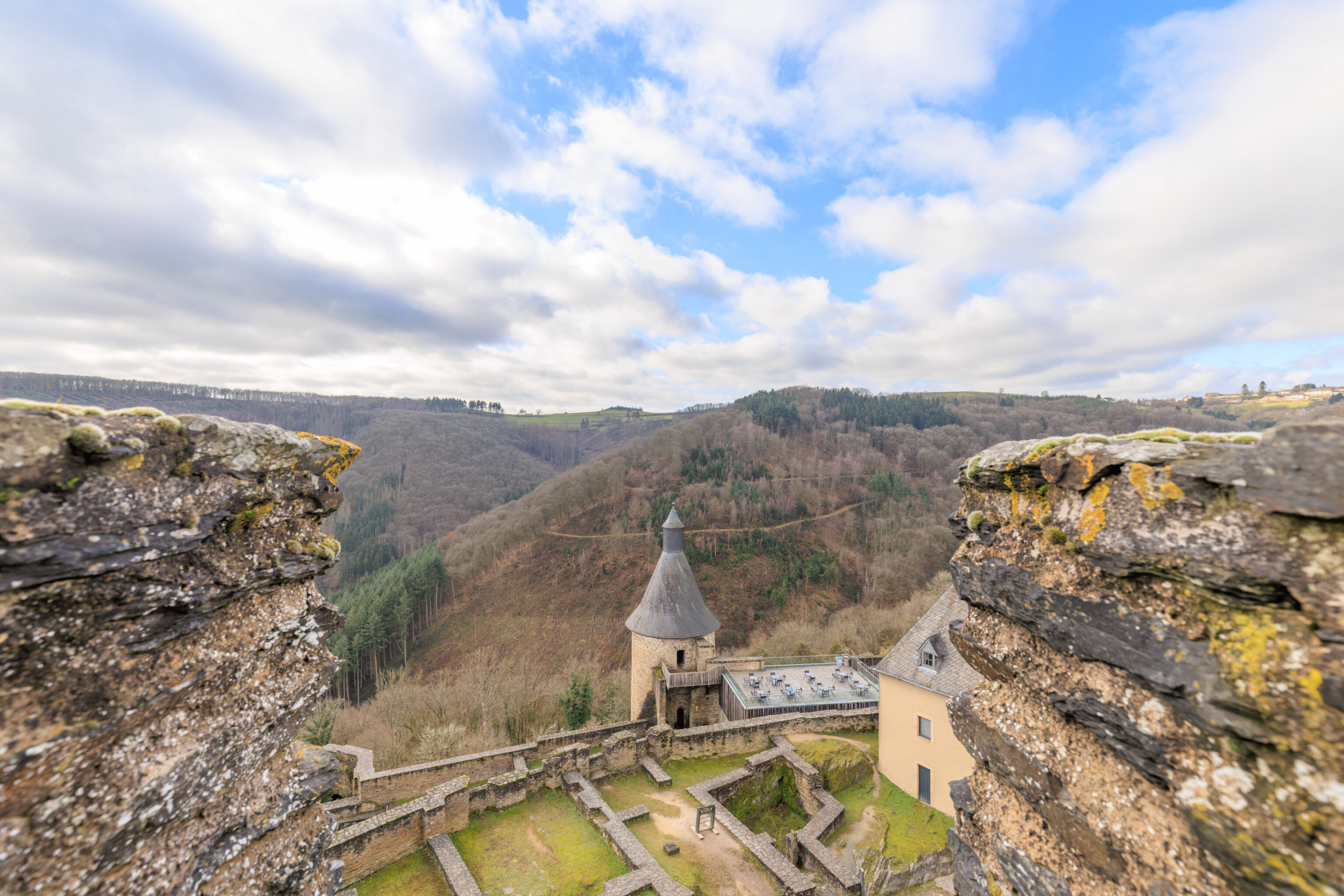
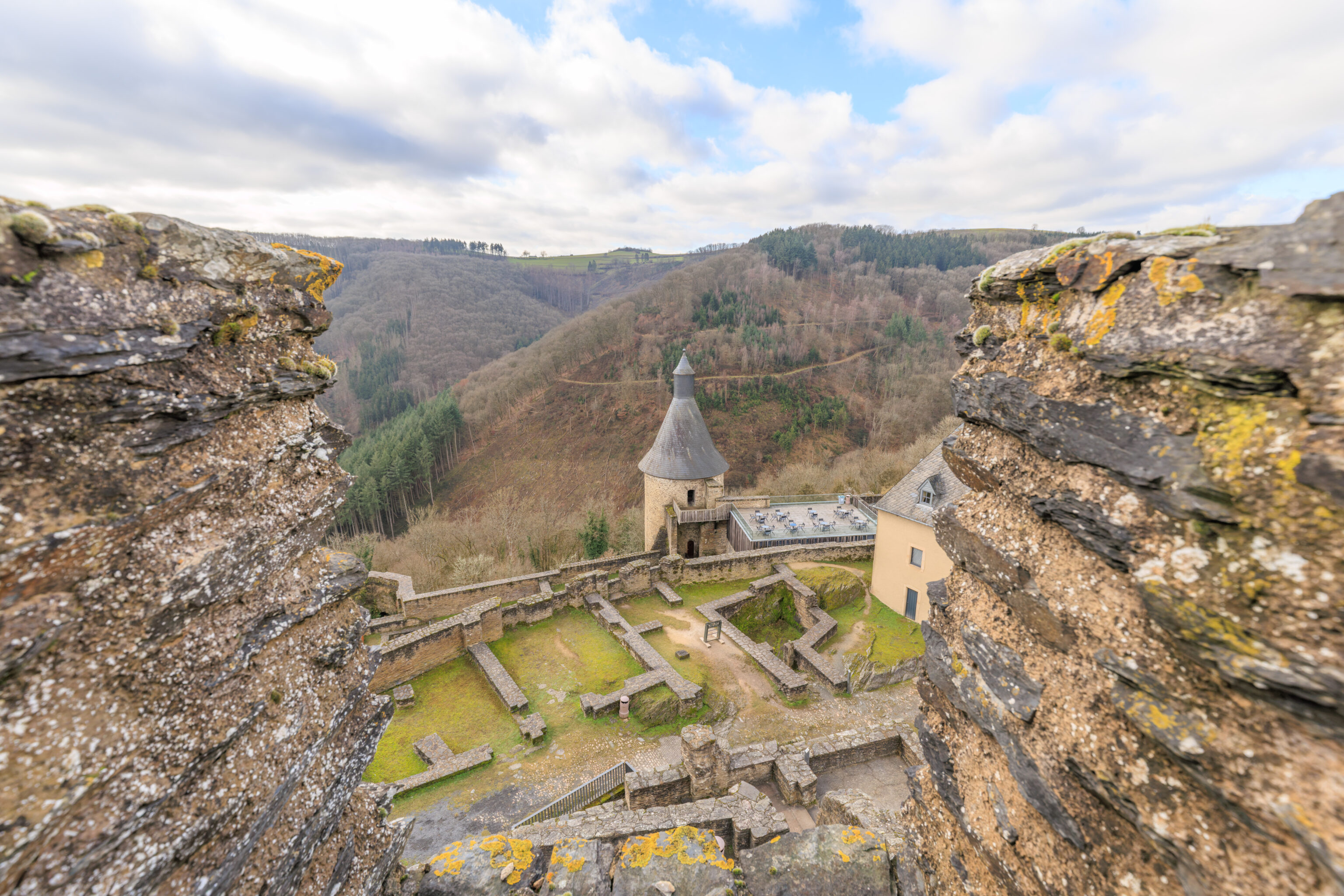
The view to the southwest again, because we forgot we had photographed it already?
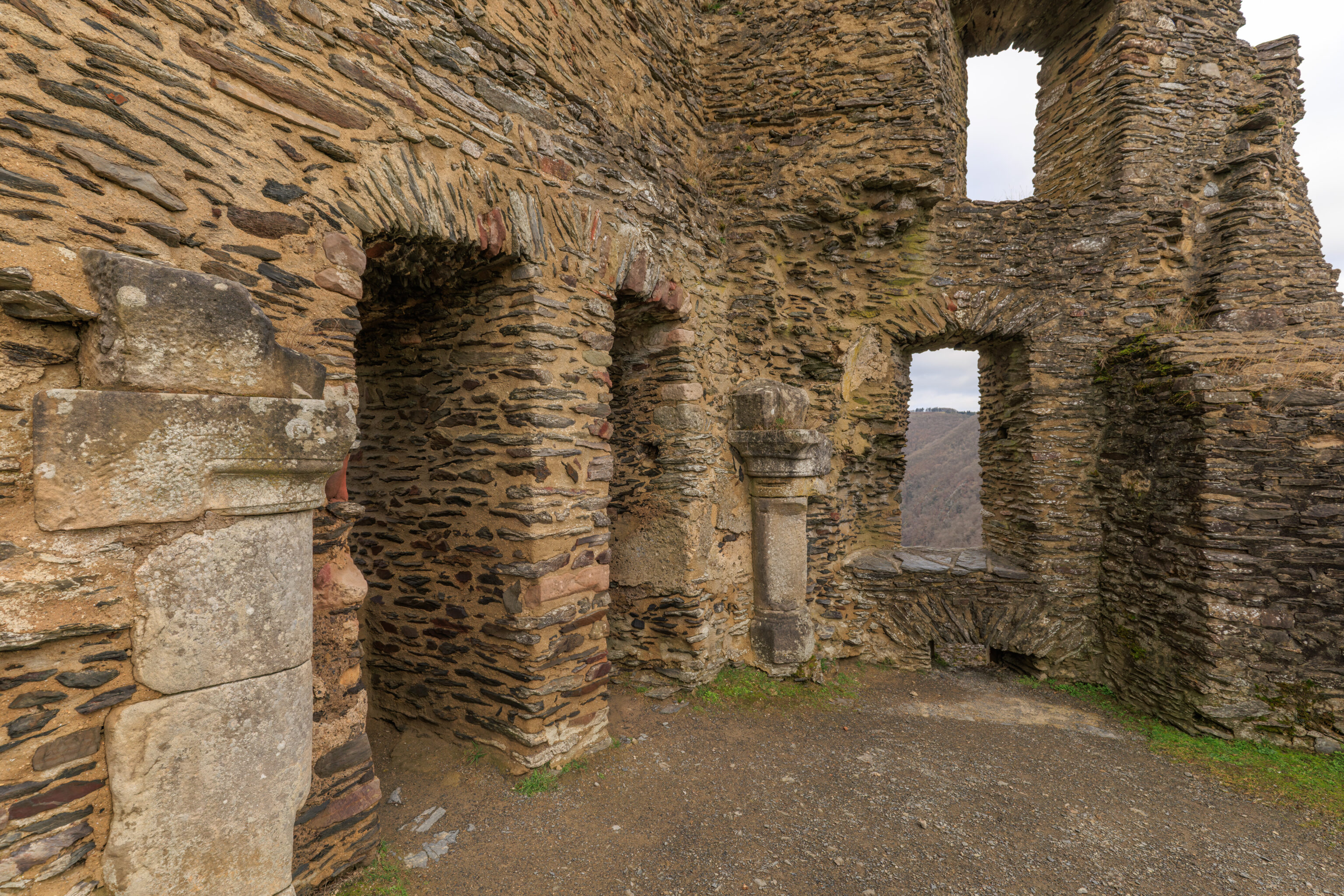
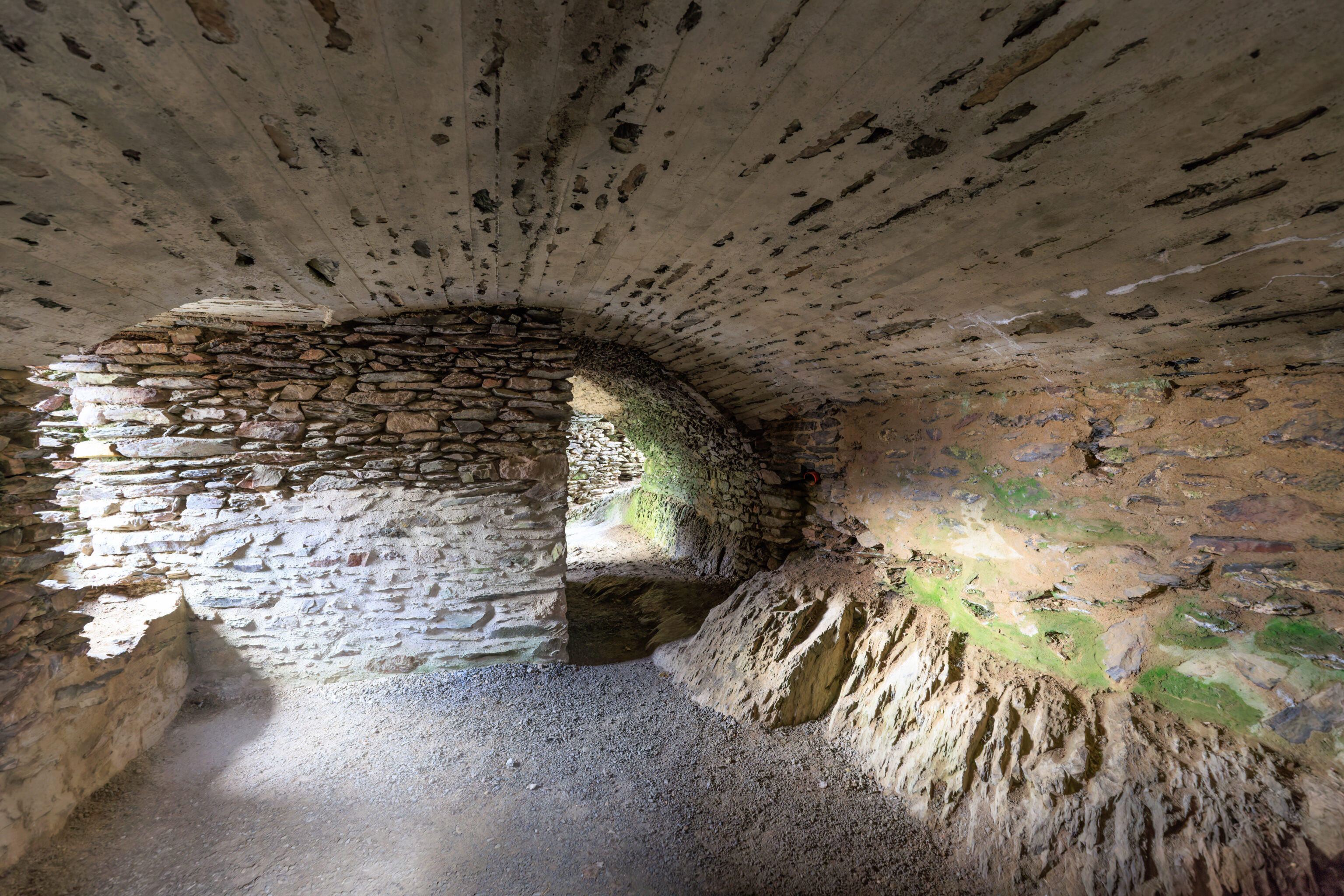
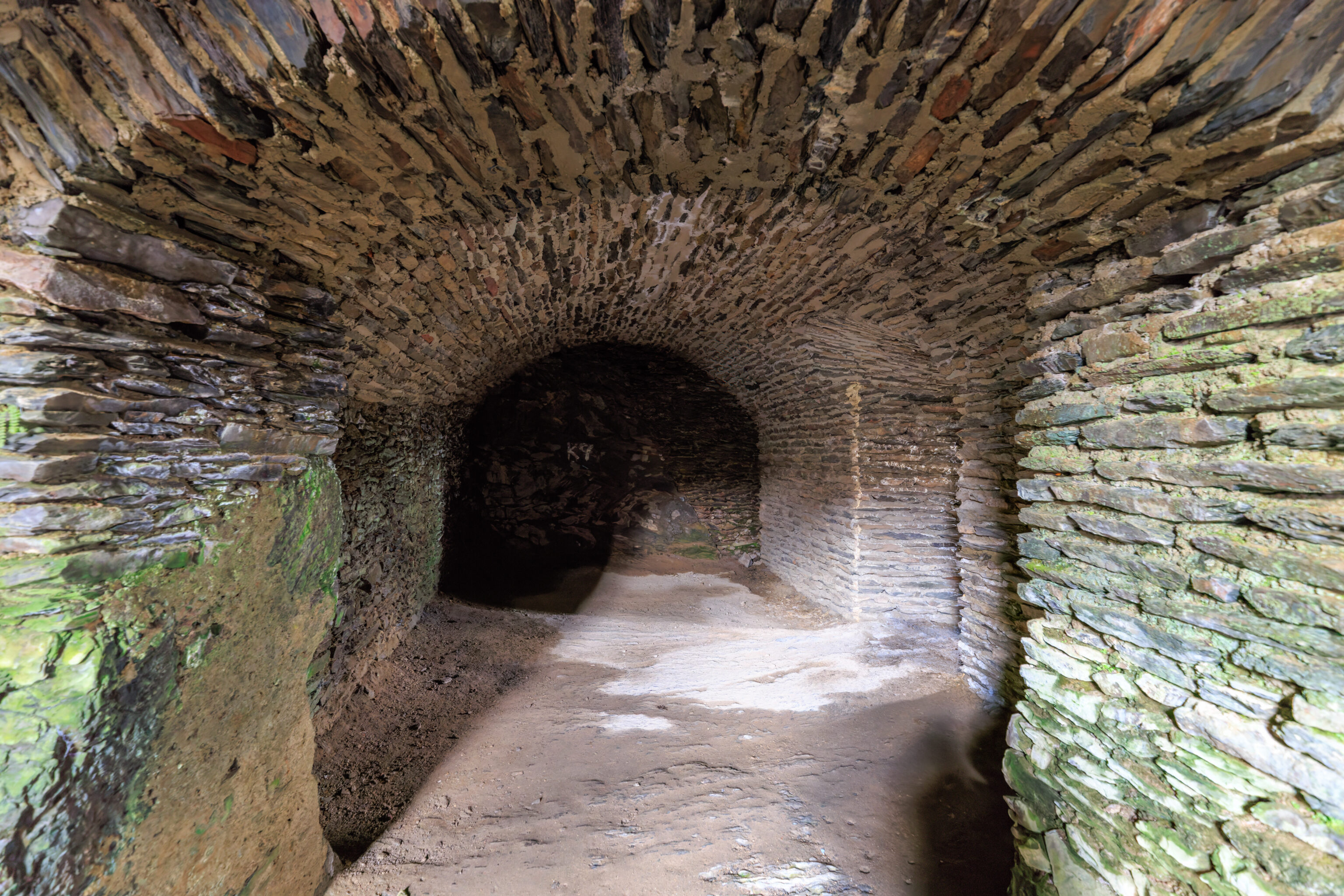
We headed back down and again ended up briefly walking through an underground area.
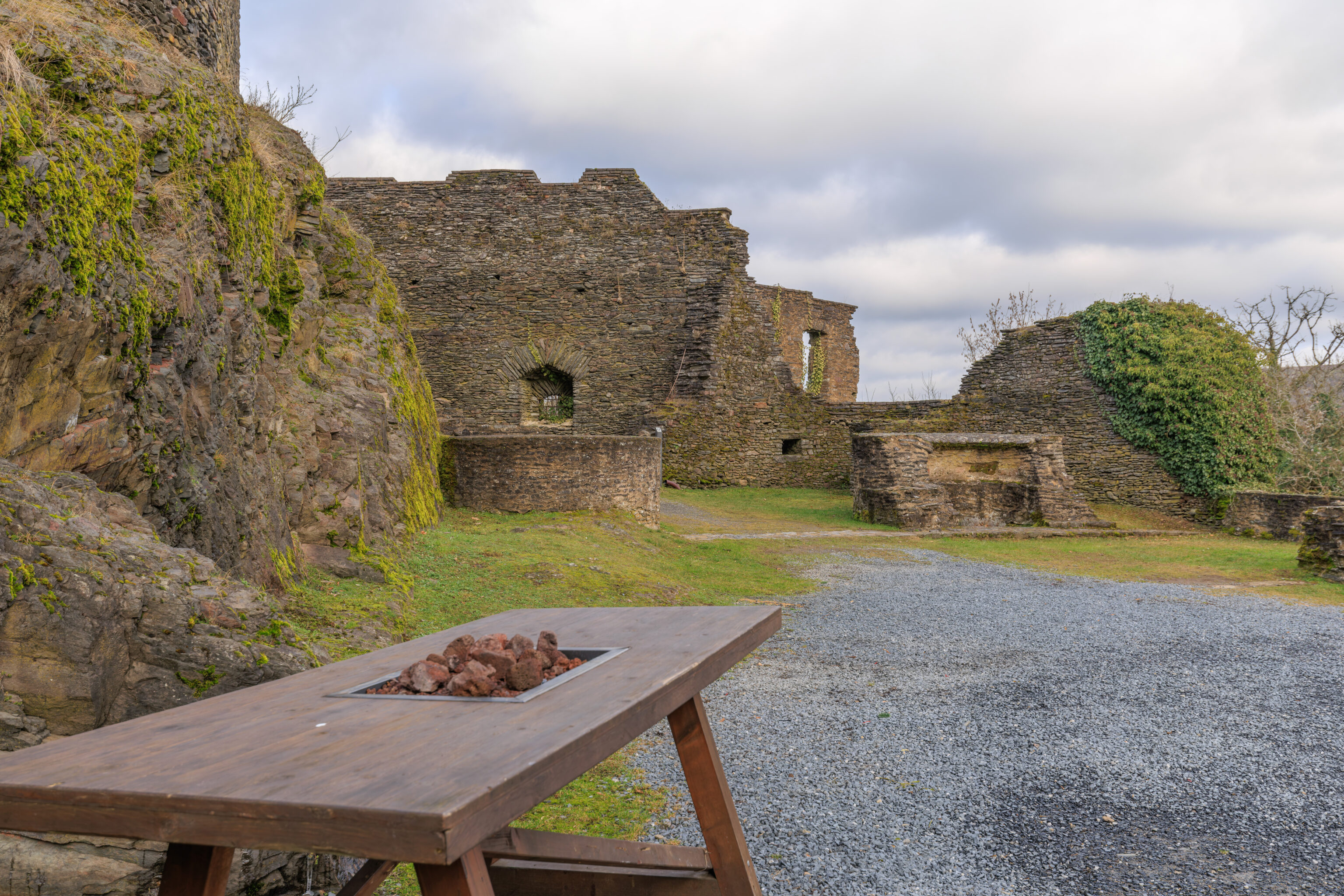
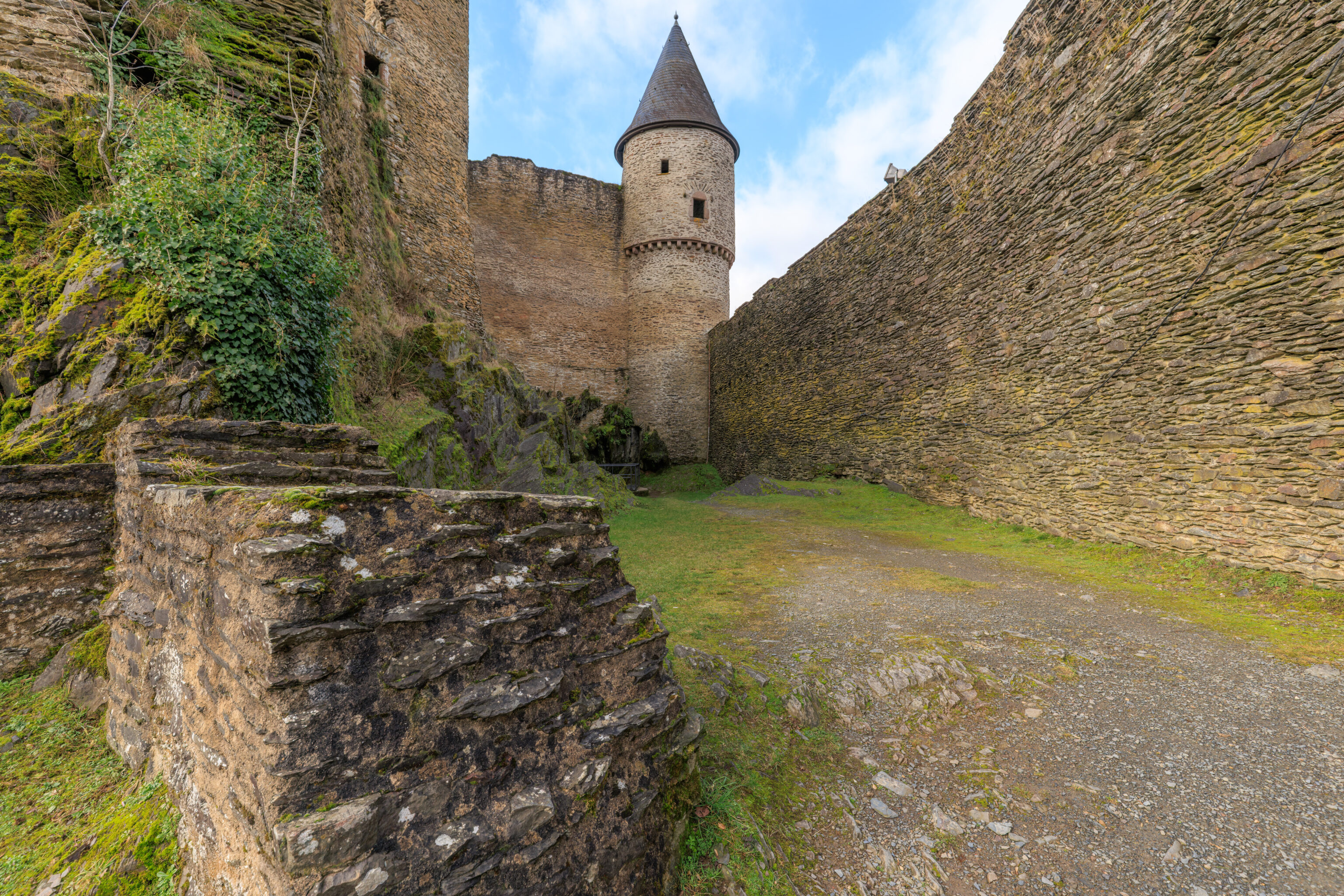
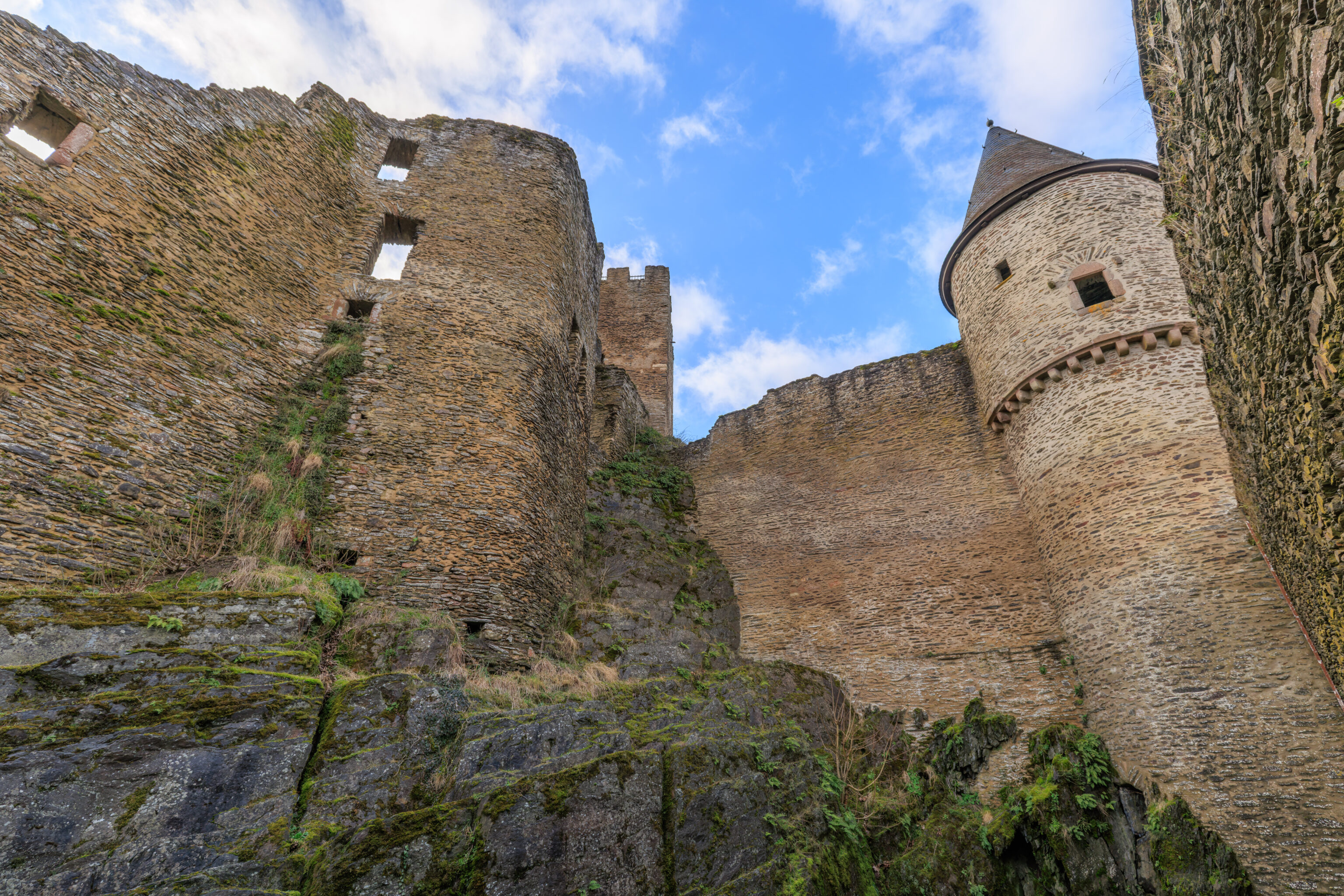
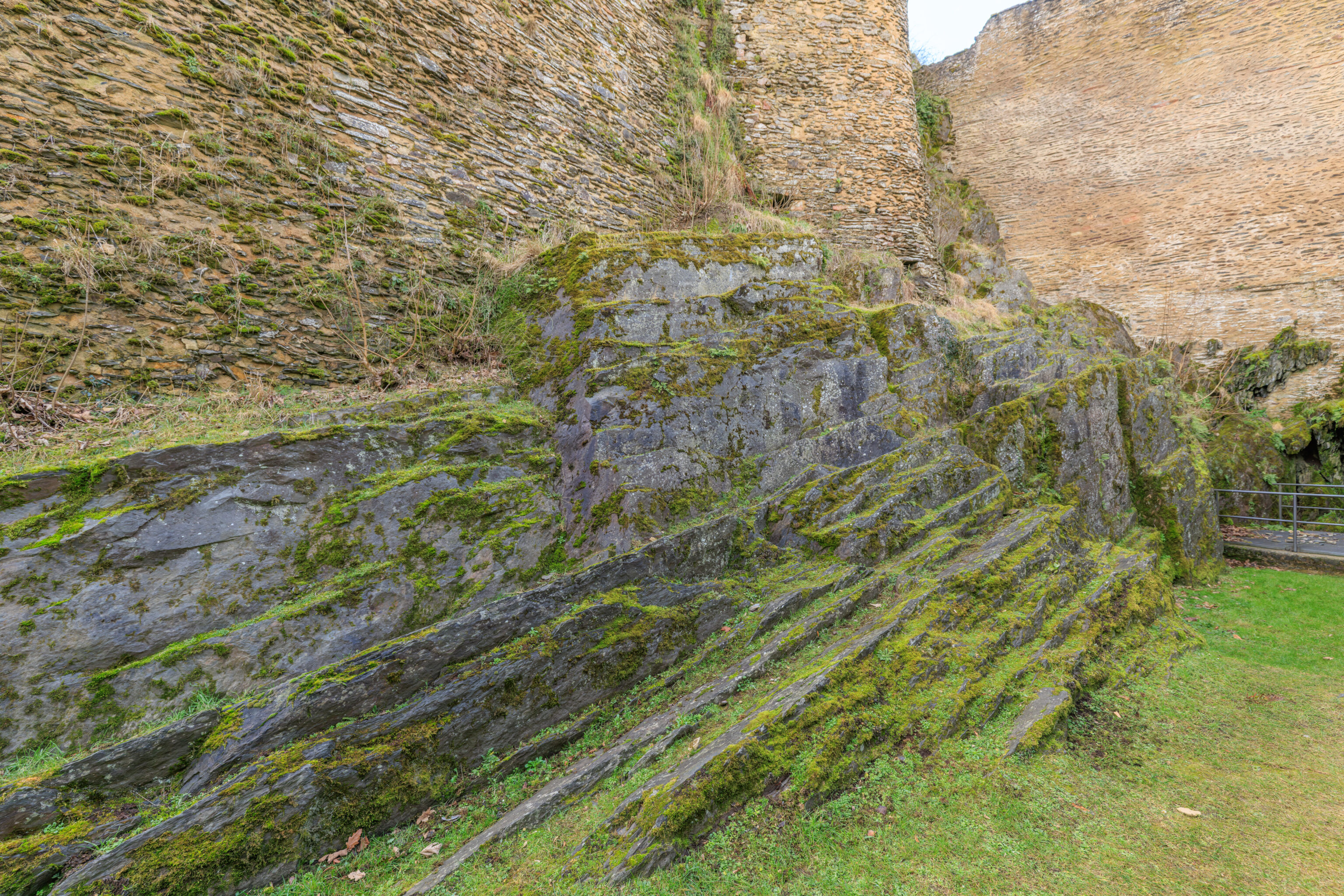
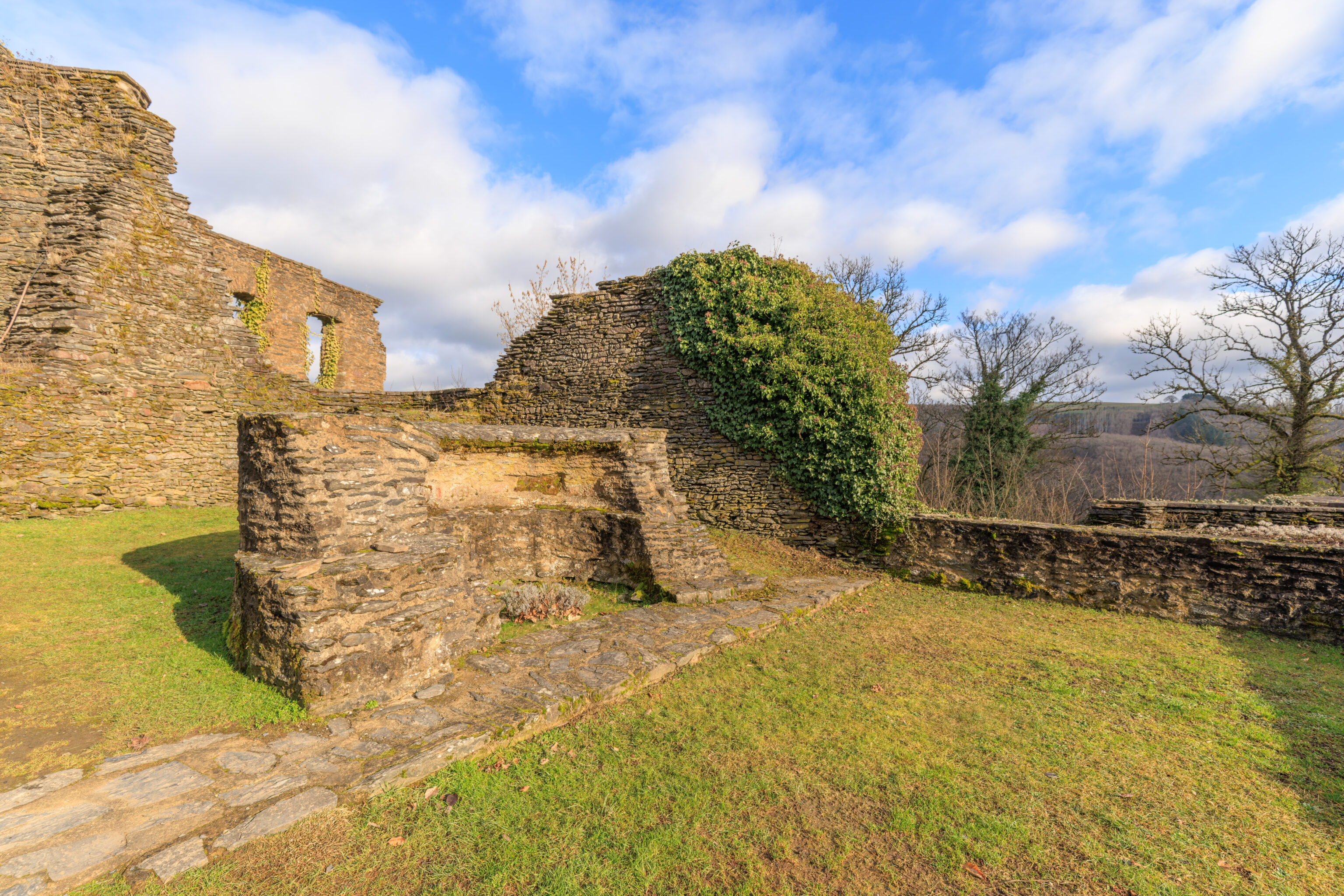
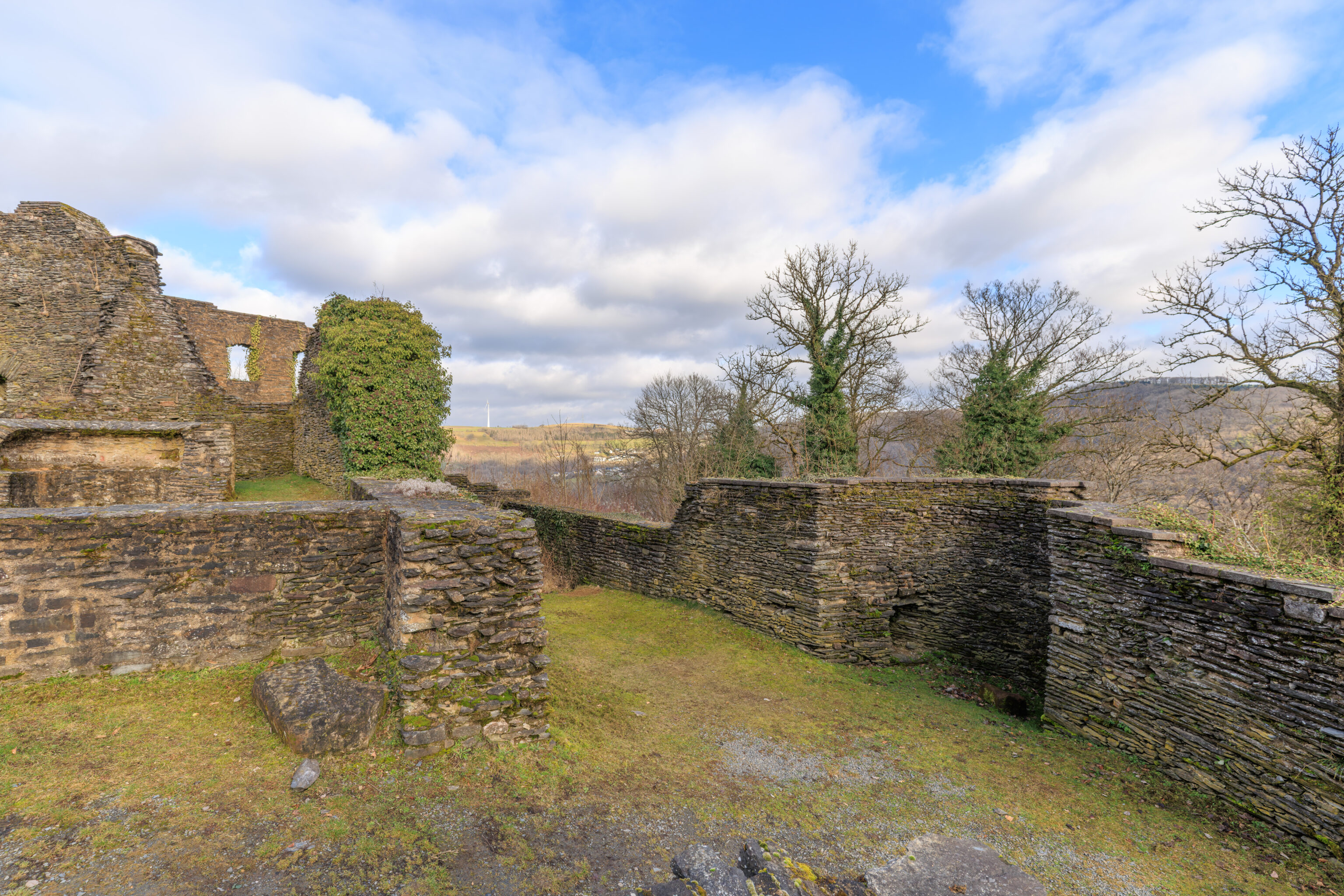
We continued on into the Lower Courtyard of the Lower Castle.
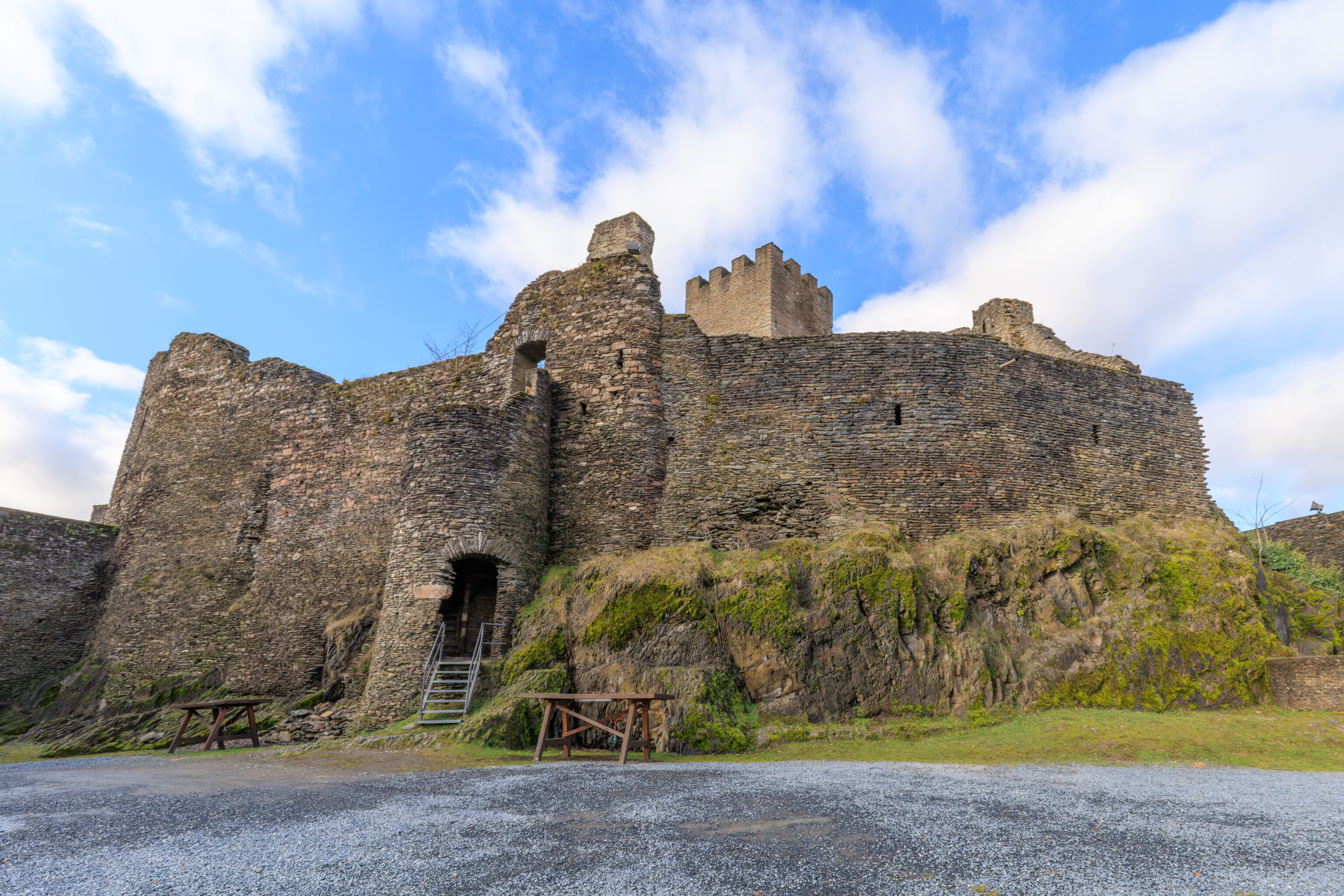
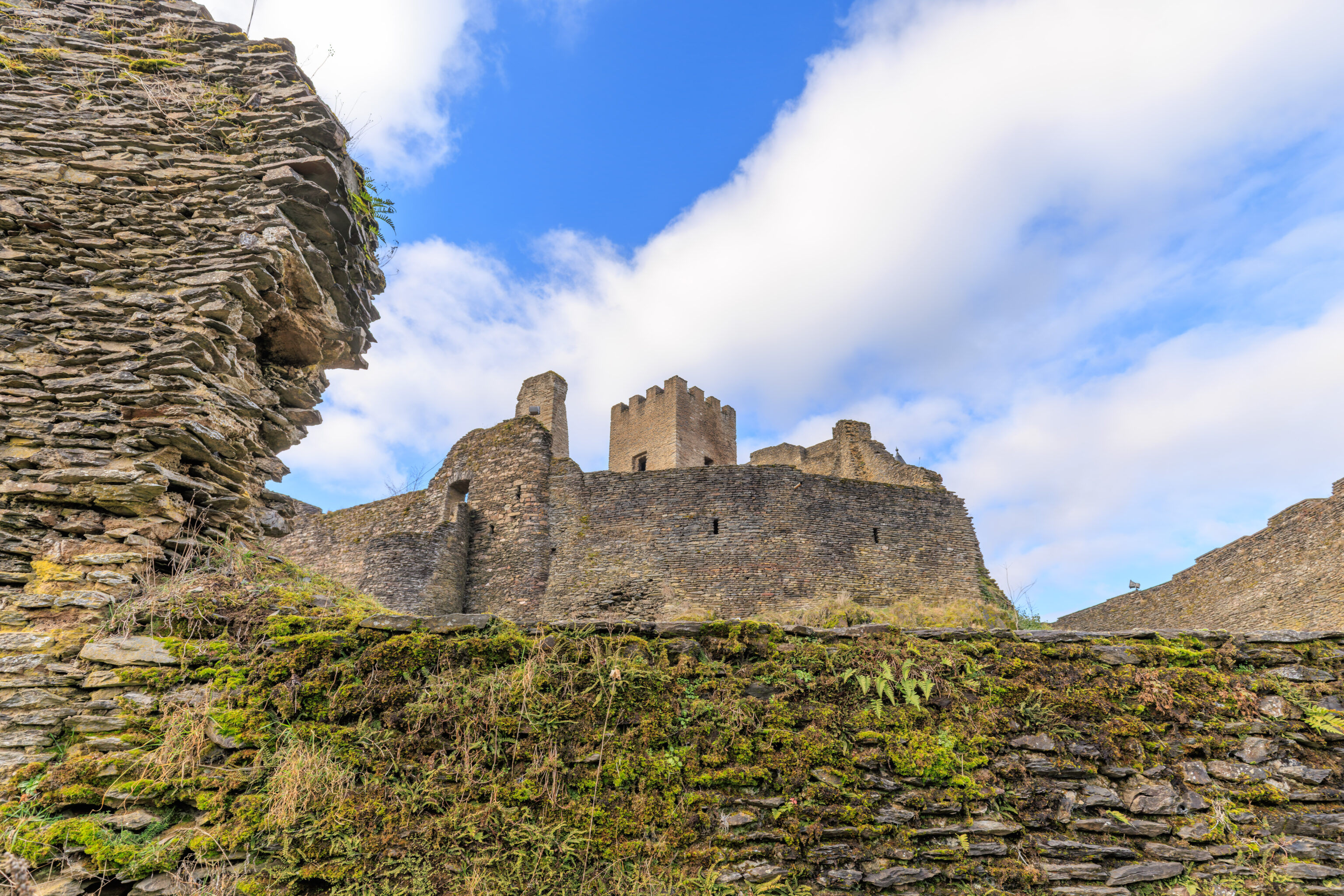
We walked far enough away to get a good view of the central portion of the castle from the east.
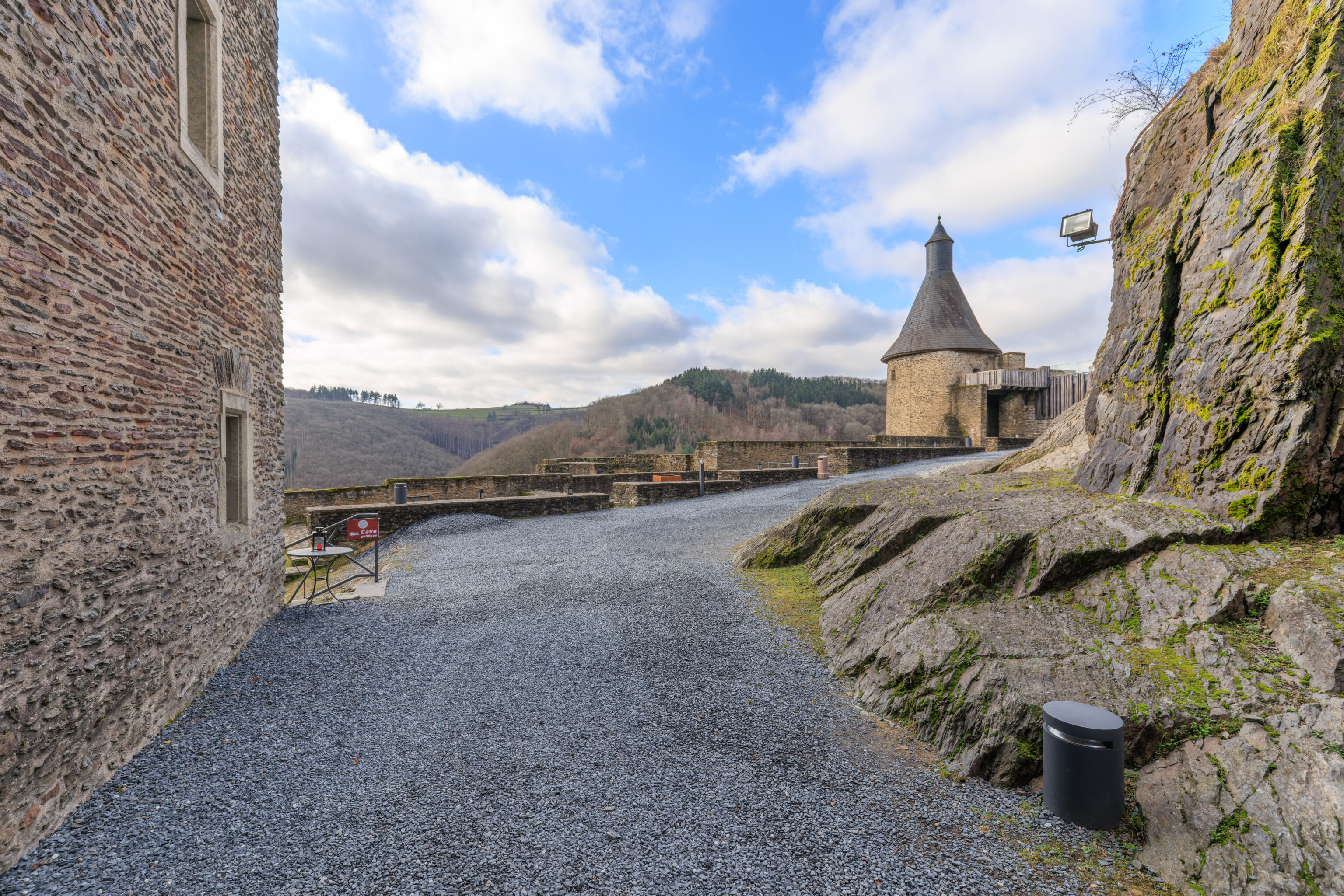
We continued on to the south where there was an entrance into a building on the castle’s southeastern edge.
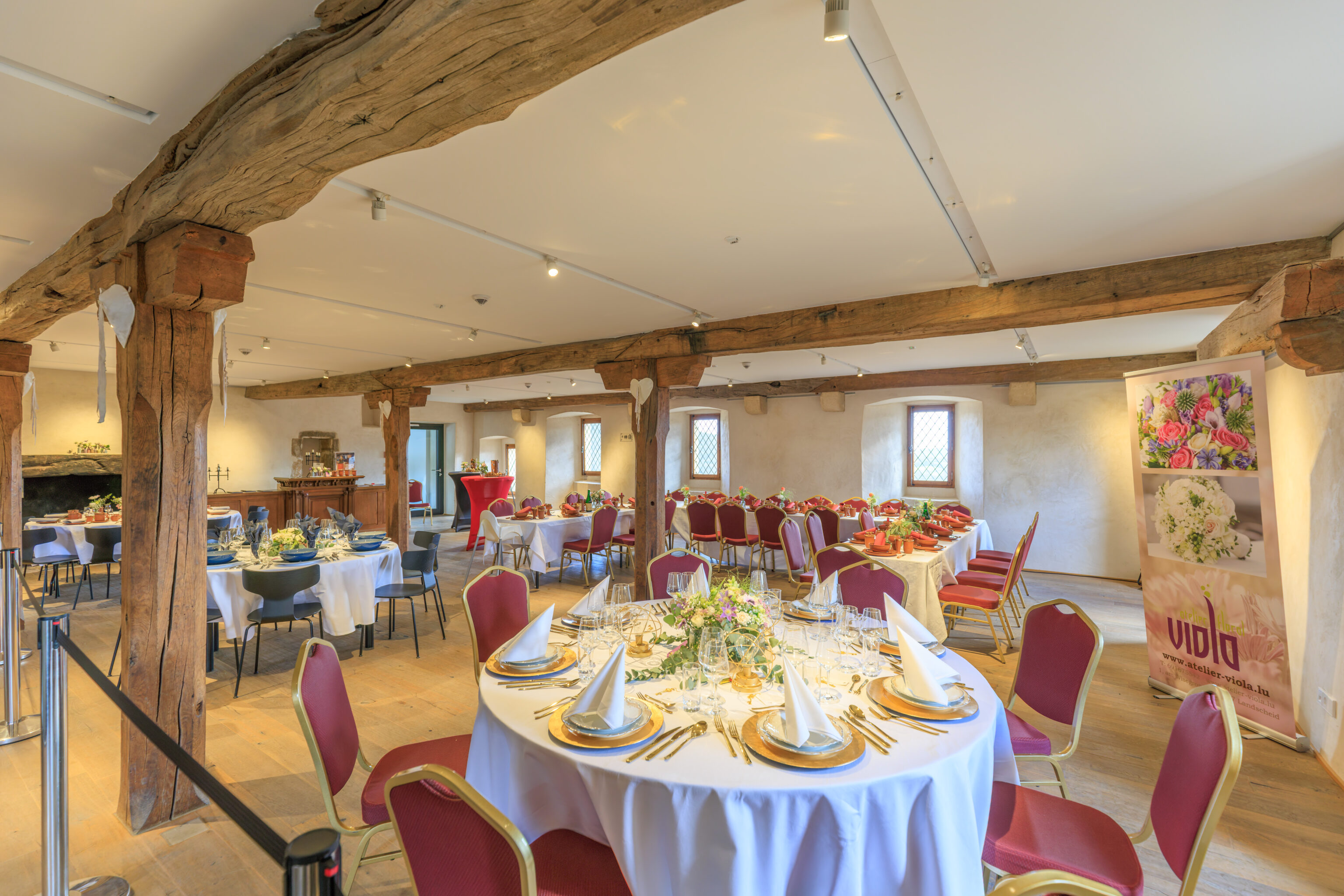
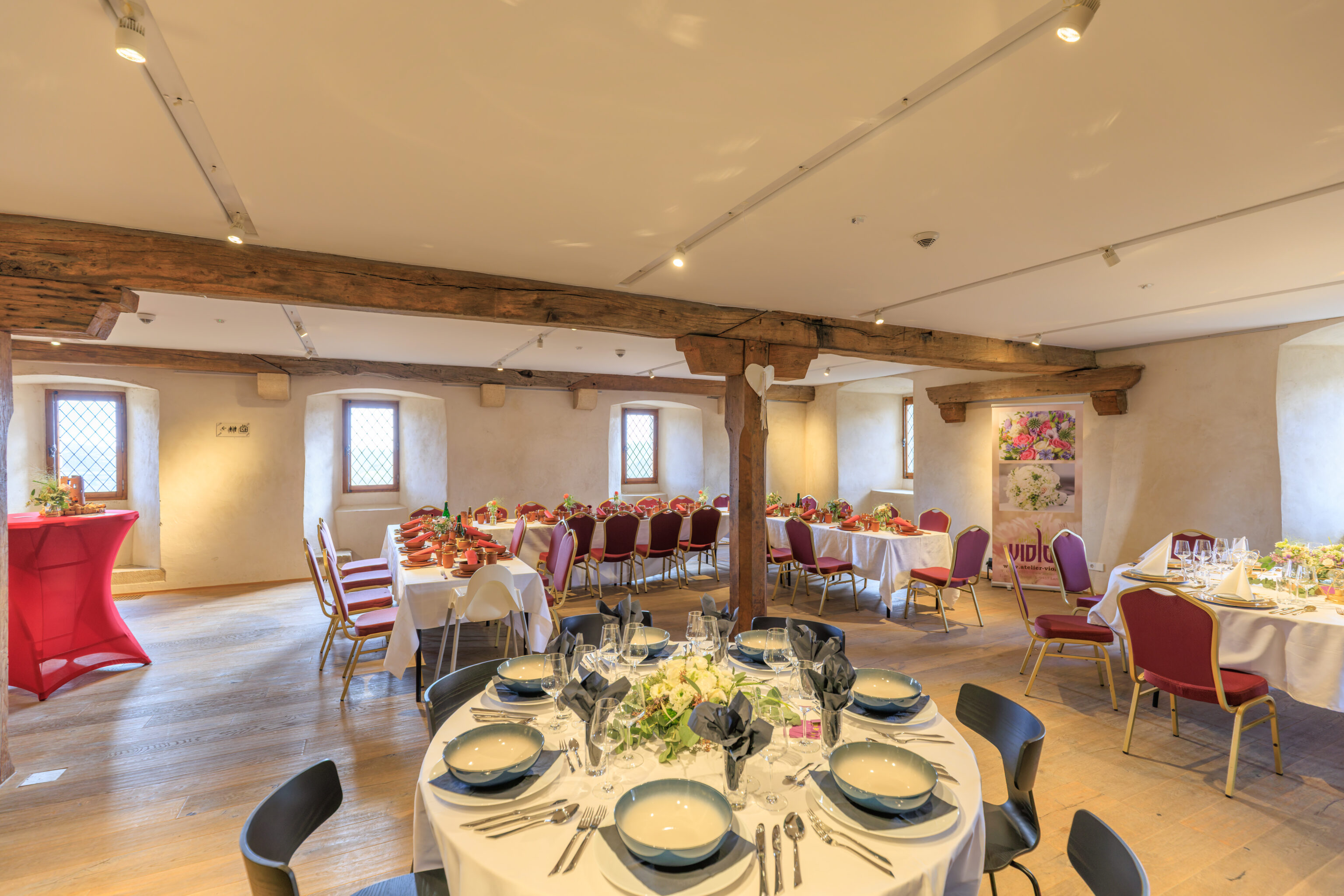
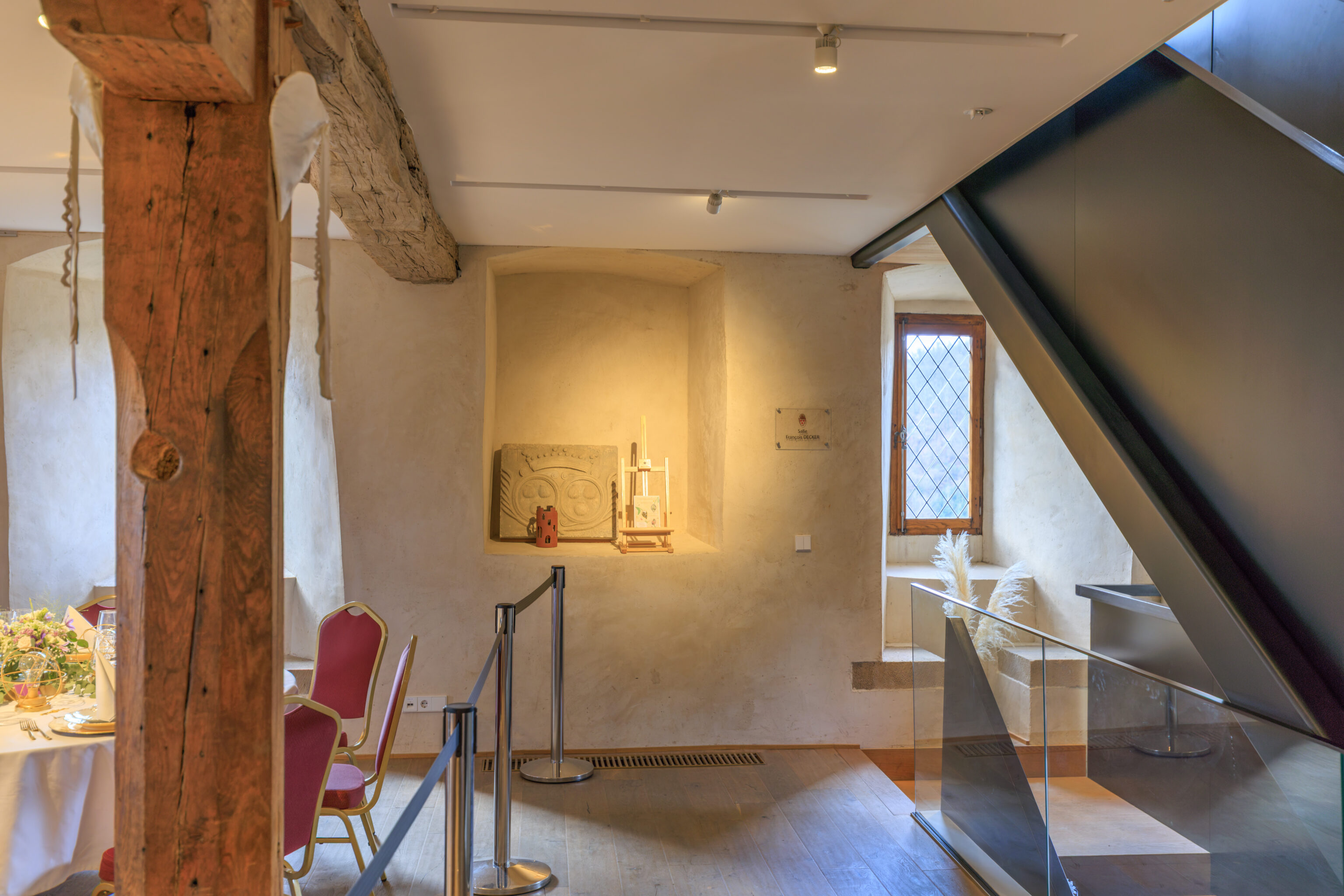
The room, the Salle Francois Decker, was configured for some sort of event, possibly a wedding? We weren’t sure if this was staged for if an actual event was about to take place soon.
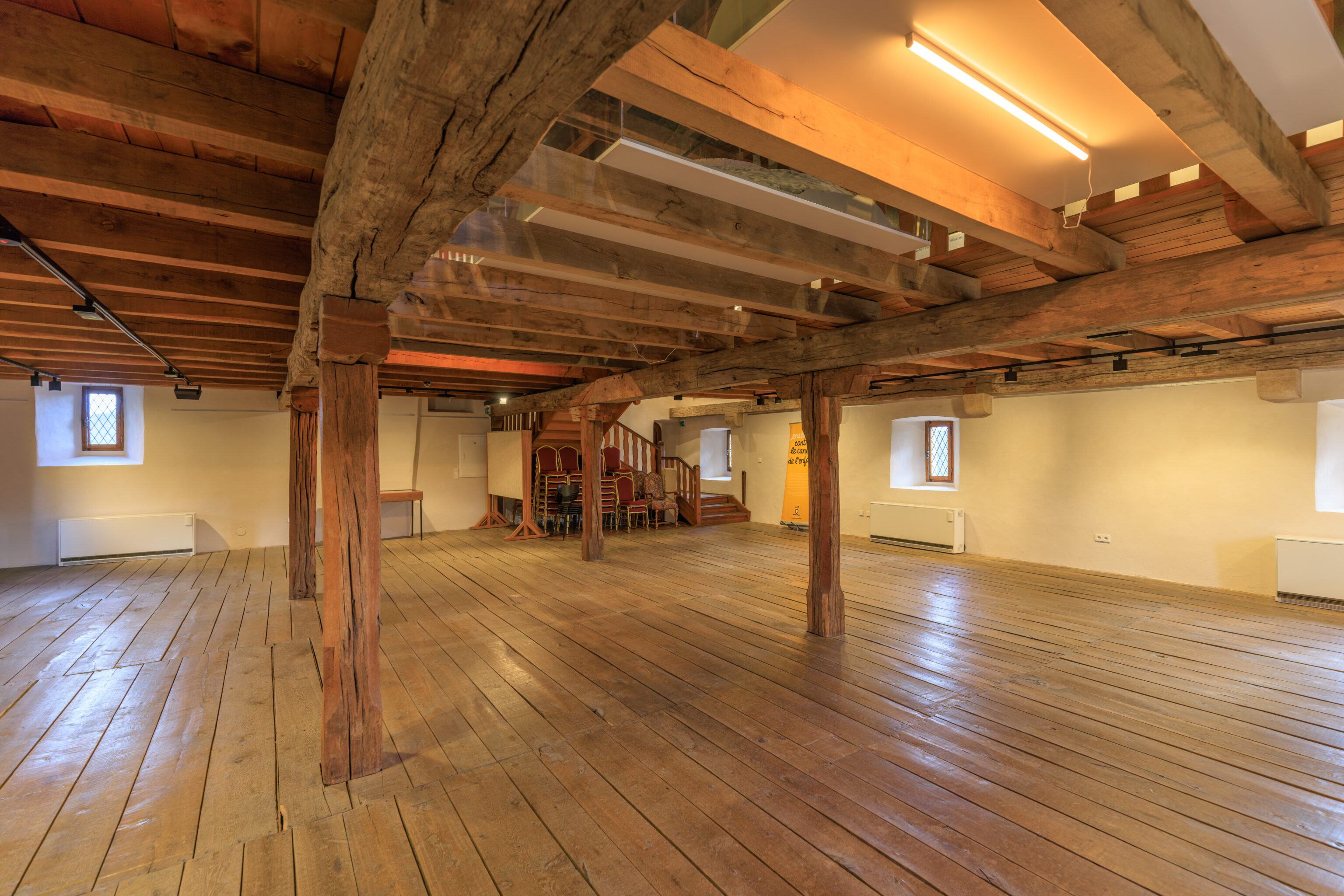
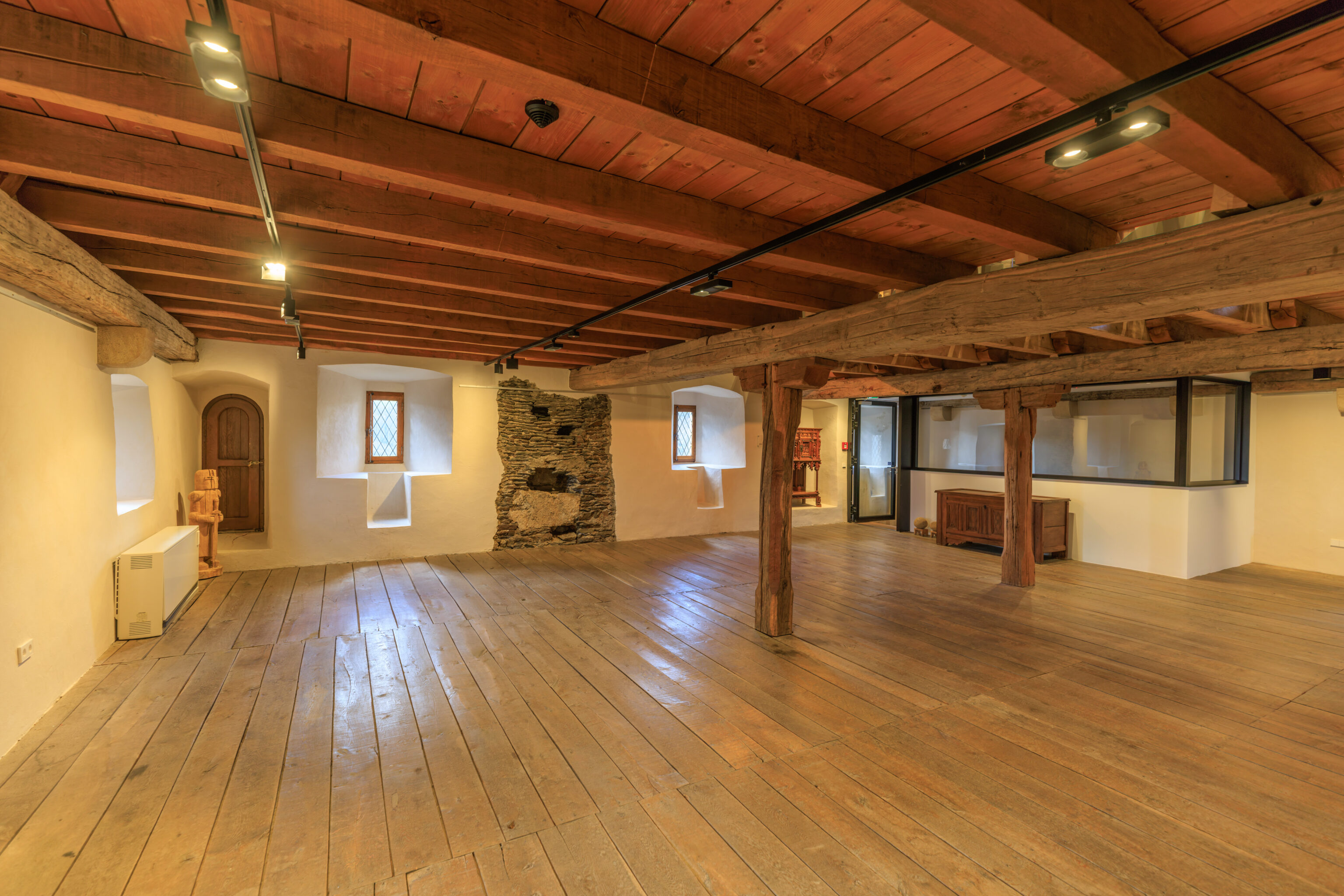
The next floor up was basically an empty room.
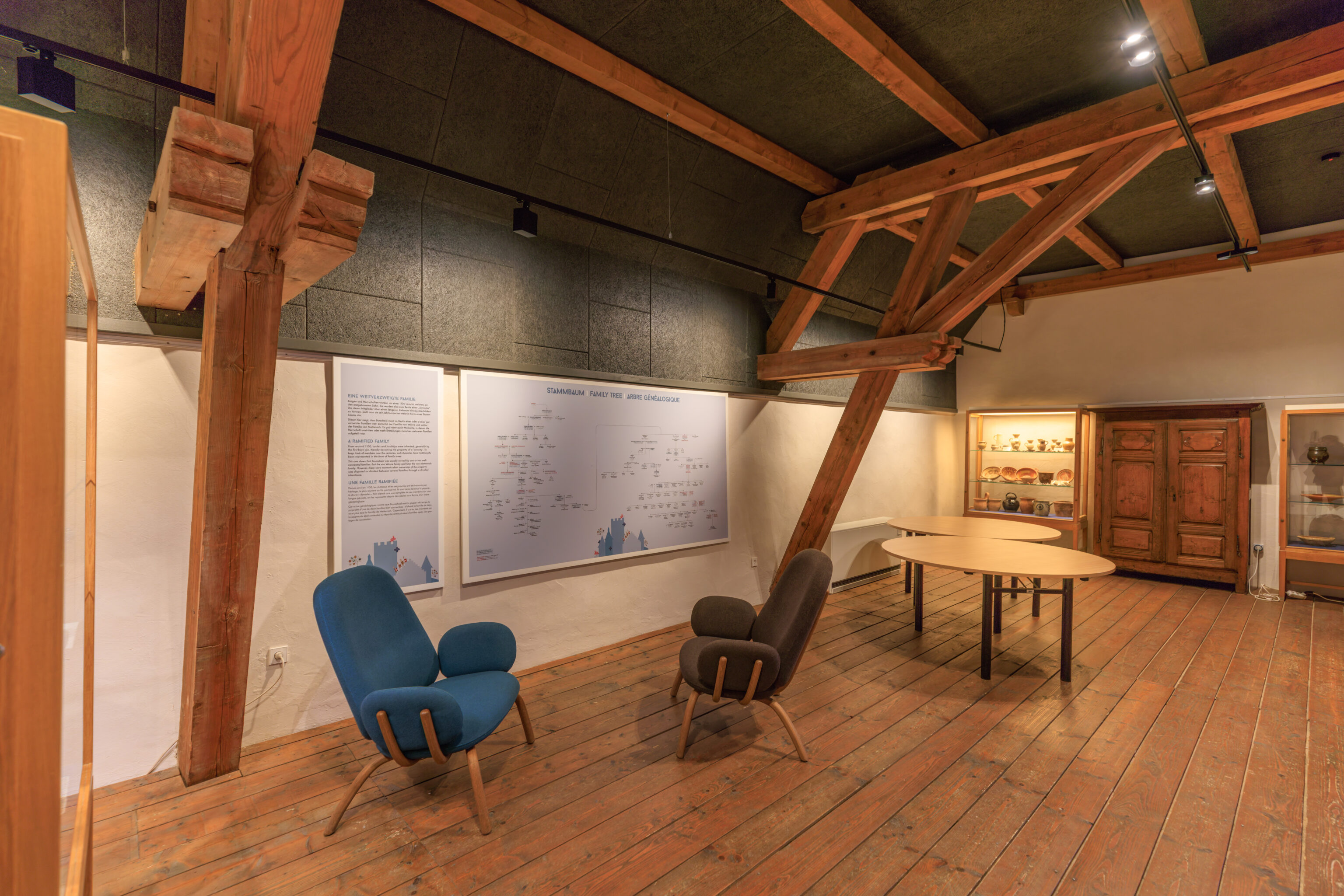
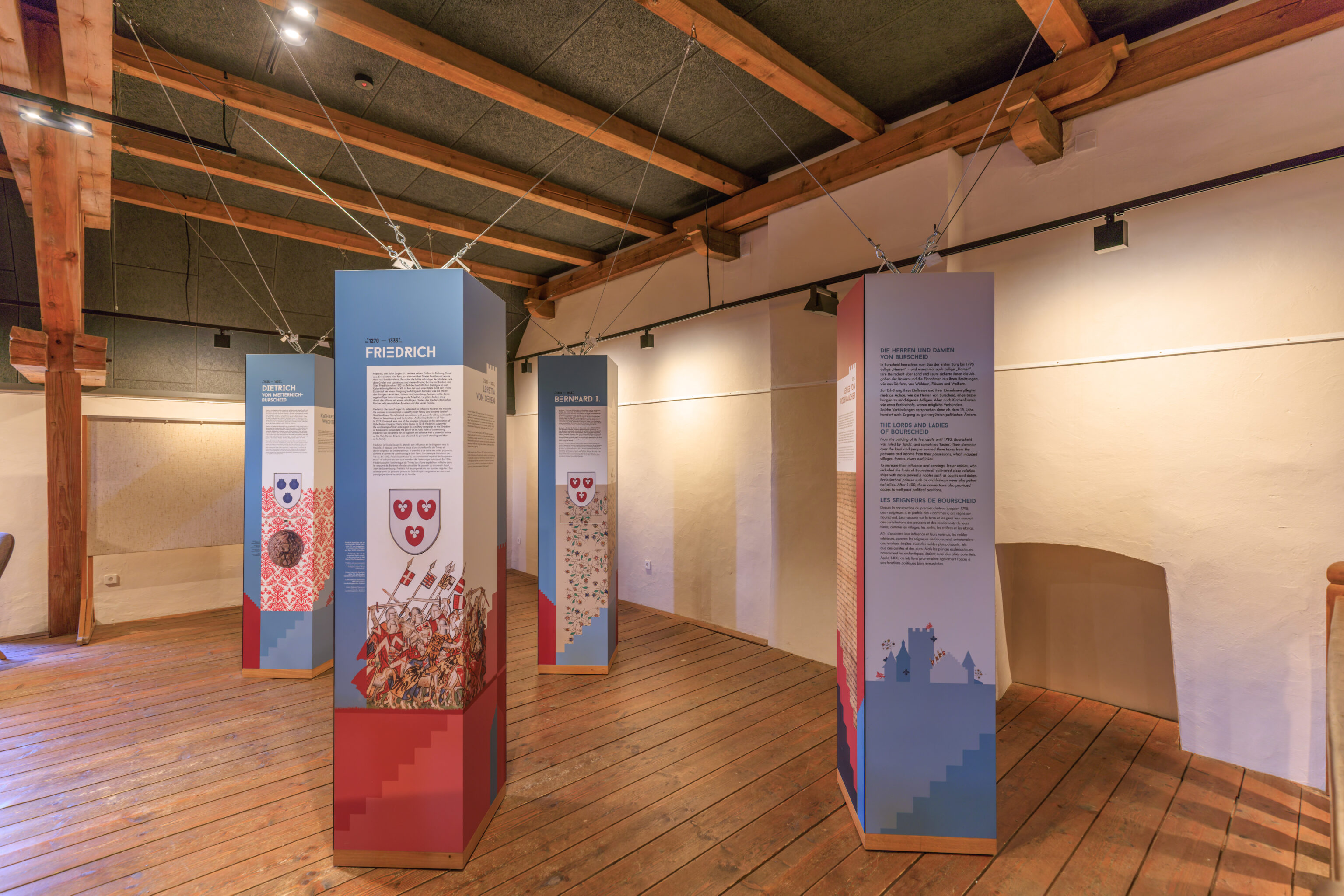
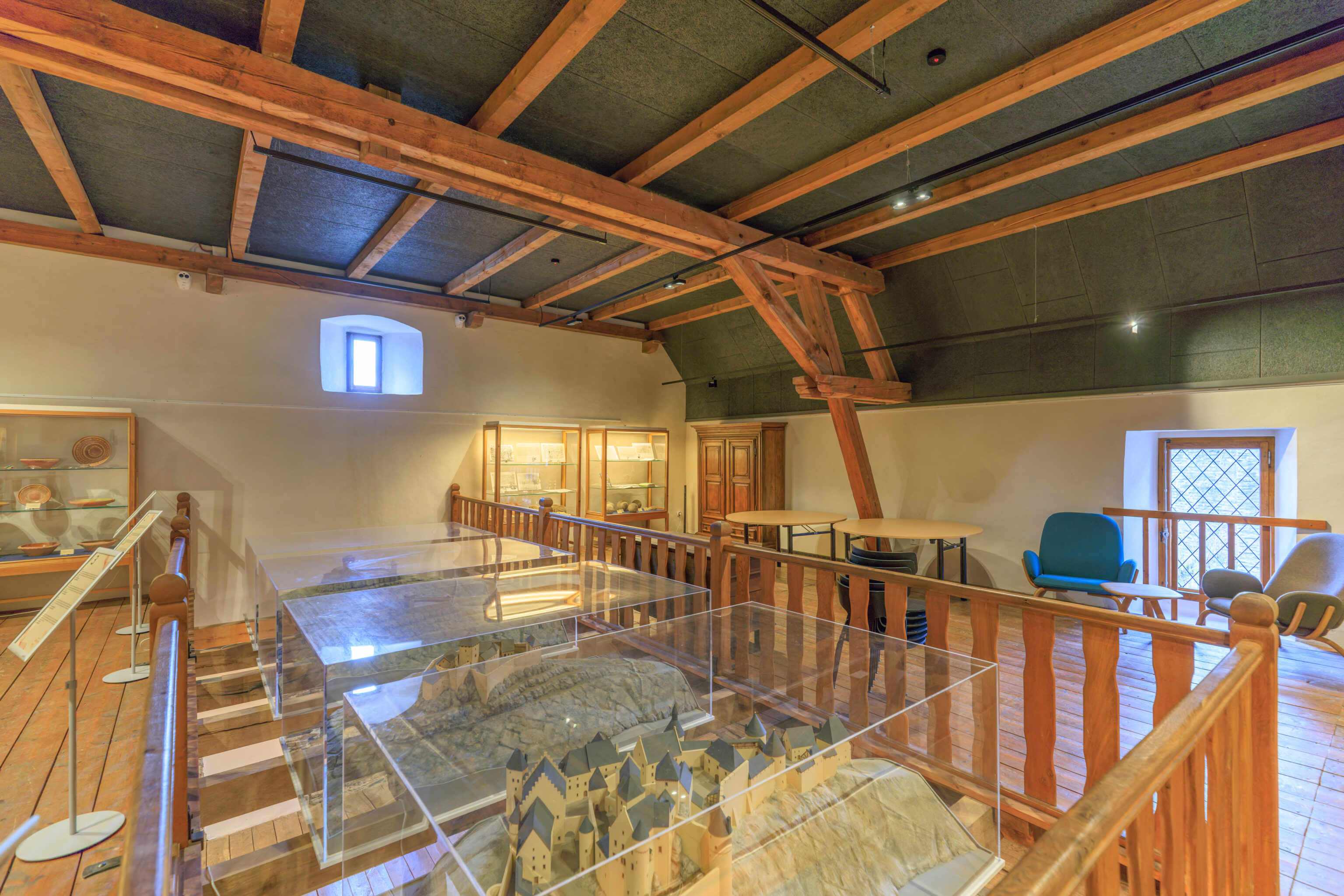
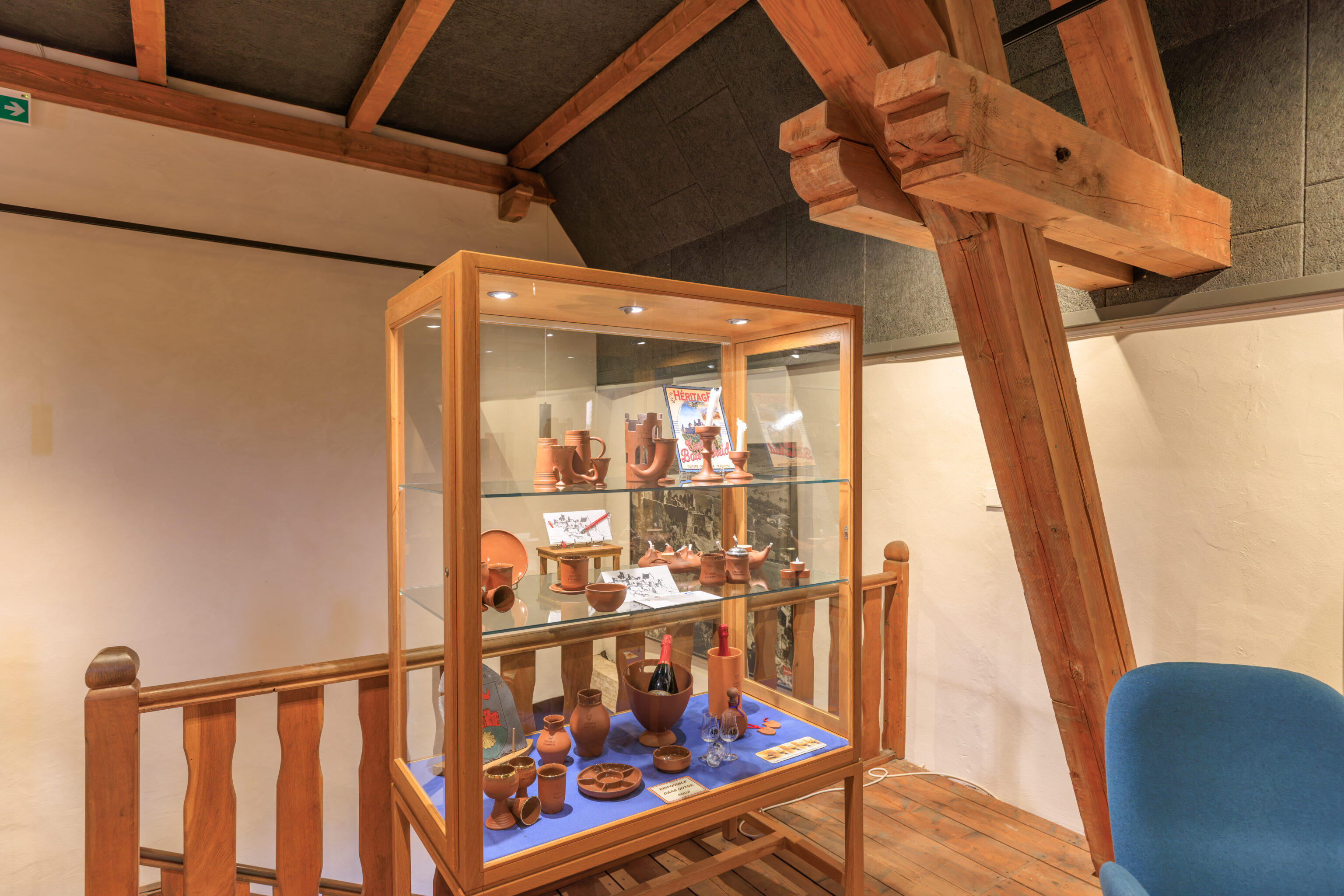
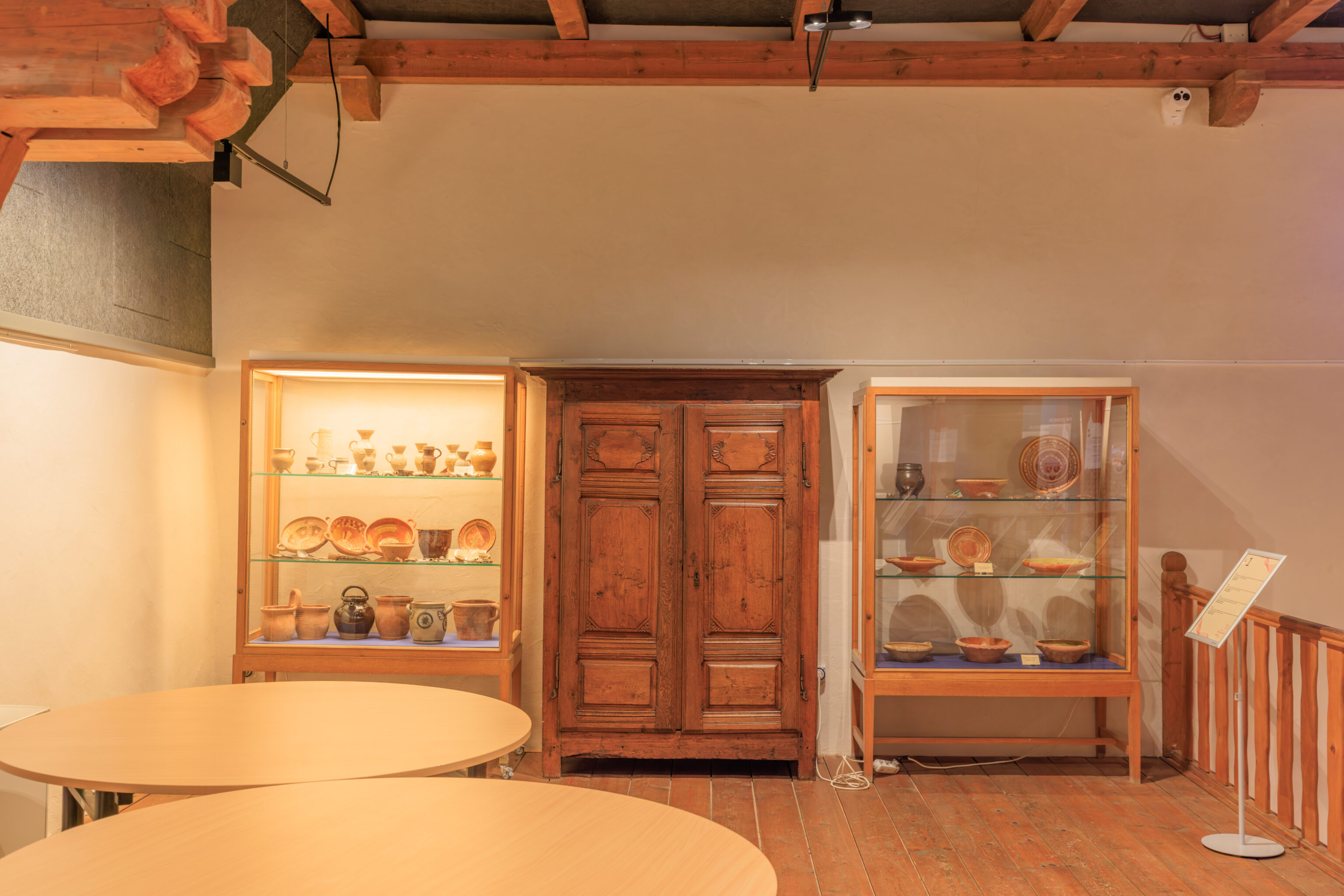
Finally, the third floor had some comfortable seating and some displays and informational panels.
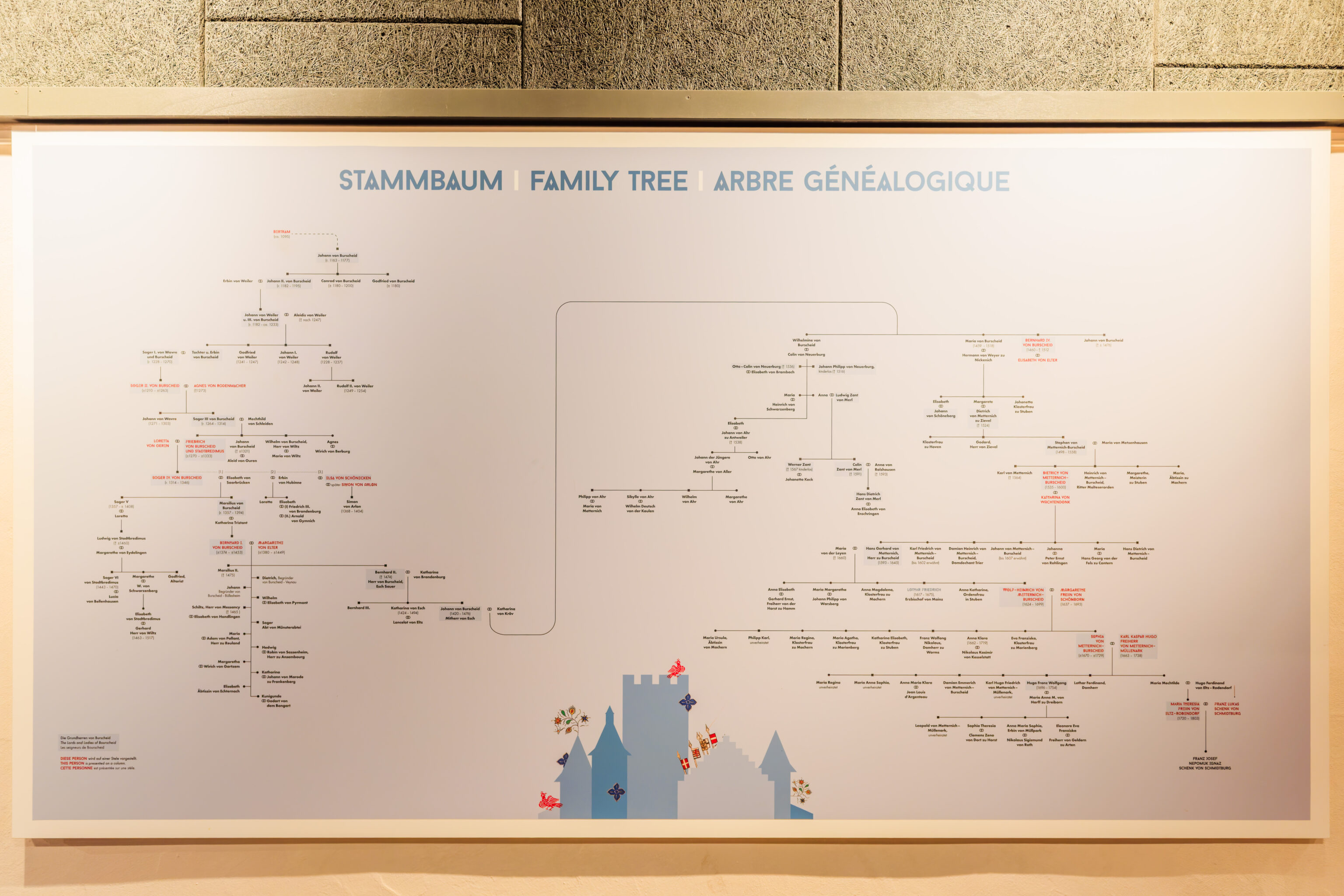
This sign depicts the family tree of the lords of Bourscheid. The font is unfortuntely much smaller than it needs to be! The tree starts in 1095 with Bertram at the upper left and ends at bottom right in 1795 with Maria-Theresia von Schmidtburg.
A RAMIFIED FAMILY
From around 1100, castles and lordships were inherited, generally by the first-born son, thereby becoming the property of a 'dynasty'. To keep track of members over the centuries, such dynasties have traditionally been represented in the form of family trees.

This one shows that Bourscheid was usually owned by one or two well- connected families: first the von Wavre family and later the von Metternich family. However, there were moments when ownership of the property was disputed or divided between several families through a divided inheritance.
– Text from a sign.
The people colored in red on the tree are described on the informational panels in this room, which are presented below:
THE LORDS AND LADIES OF BOURSCHEID
From the building of its first castle until 1795, Bourscheid was ruled by 'lords', and sometimes 'ladies'. Their dominion over the land and people earned them taxes from the peasants and income from their possessions, which included villages, forests, rivers and lakes.

To increase their influence and earnings, lesser nobles, who included the lords of Bourscheid, cultivated close relationships with more powerful nobles such as counts and dukes. Ecclesiastical princes such as archbishops were also potential allies. After 1400, these connections also provided access to well-paid political positions.

CA 1095
BERTRAM
'Bourscheid Castle is a strongly fortified building,' wrote Abbot Thiofrid of Echternach (d. 1100) in his Life of Saint Willibord. This is the first written mention of the castle. According to Thiofrid, it belonged to a certain Bertram. Bertram was an ambitious nobleman who stopped at nothing: according to the monk, he even tried to appropriate monastic property. For this, the Count of Luxembourg supposedly confiscated his castle and property.

Due to the lack of documents from this time, it is not known whether Bertram had descendants and whether they inherited his castle.

1210* CA - 1263† CA
SOGER II
Shortly after 1200, Soger, Lord of Wavre, married an heiress of Bourscheid, whose name is unknown. Wavre was located in the wealthy Duchy of Brabant, not far from Brussels. The couple's son, Soger II, inherited the castle and lordship of Bourscheid after the death of his mother around 1250, while his father retired to Wavre to run his affairs there. A branch of the Lords of Wavre ruled over Bourscheid from then on. To emphasise that they belonged to the Wavre dynasty, several generations bore the name Soger. Soger II was an ally of both the Counts of Luxembourg and Counts of Vianden, the most powerful nobles in the area.


1273† CA
AGNES VON RODENMACHER
Soger Il married Agnes of Rodemacher around 1240. She came from the
dynasty of the Counts of Vianden and was probably a sister or cousin
of Yolanda of Vianden, now famous in Luxembourg. Soger himself had
ancestors from Vianden, so the couple needed papal dispensation to
marry. The couple had at least two children, including their heir, Soger III.

1270* CA - 1333† CA
FRIEDRICH
Frederick, the son of Soger III, extended his influence towards the Moselle. He married a woman from a wealthy Trier family and became lord of Stadtbredimus. He cultivated connections with powerful allies, such as the Count of Luxembourg and his brother, Archbishop Baldwin of Trier. In 1312, Frederick was one of the bishop's retainers at the coronation of Holy Roman Emperor Henry VII in Rome. In 1316, Frederick supported the Archbishop of Trier once again in a military campaign to the Kingdom of Bohemia to consolidate the power of its ruler, John of Luxembourg. Frederick was rewarded for his support. His alliance with a powerful prince of the Holy Roman Empire also elevated his personal standing and that of his family.

1280* CA - 1336† CA
LORETTA VON OEREN
Frederick married Loretta of Oeren in 1298. This union was somewhat unusual, as she did not come from one of the noble families of the county of Luxembourg. Instead, she came from a wealthy family of nobles from the episcopal city of Trier. Her ancestors once served the archbishop, then became part of the city's ruling class as aldermen. Loretta gave birth to Frederick's heir, Soger IV.

ELSAS HUSBANDS
Elsa Bonifacius first married Soger IV of Bourscheid (in 1343). Since it was often easier for women to assert themselves politically with the help of a powerful man, she remarried after his death, in around 1350. Her second husband was the prosperous citizen Simon of Arlon. Simon was not a nobleman, but through this marriage he came into possession of a noble residence, a castle.

1398† CA
ELSA BONIFACIUS VON SCHÖNECKEN
Elsa became the ruler of Bourscheid as a young widow. As the daughter of a nobleman, she had married into an influential family when she became the wife of Soger IV in 1343. After his death, she married a wealthy citizen, with whose help she extended the castle. She also tried to bequeath the lordship to her children from this marriage. However, Marsilius, the first-born son of Soger IV, objected. The dispute continued until 1378, when it was settled by Wenceslas, Duke of Luxembourg, in favour of Marsilius.

Noble marriages served the purpose of extending a family's wealth and standing, as well as producing heirs. After the death of a husband, therefore, women often remarried. If there were descendants from more than one marriage, inheritance claims could become complicated.

1374* CA - 1453† CA
BERNHARD I
Bernhard I, the heir of Marsilius of Bourscheid, was a skilled politician who managed to extend his power despite the many struggles of the time. Bernhard was initially a close ally of the Dukes of Luxembourg and Dukes of Jülich, who in turn supported the Duke of Lorraine against the Duke of Burgundy. However, after 1441, the powerful Dukes of Burgundy assumed power over Luxembourg. Bernhard changed sides and began to support them as rightful rulers. In return, he was appointed to the ducal council. His new allies would also grant him additional positions and towns along the Moselle.

1380* CA - 1449† CA
MARGARETHE VON ELTER
Bernhard I married Margaret of Autel. She came from an ambitious family that owned a castle near Arlon. Several of her relatives were governors of the Dukes of Luxembourg. However, they clashed with the Dukes of Burgundy and lost their influence after 1453. Bernhard and Margaret had 13 children together.

1460* CA - 1512† CA
BERNHARD IV
Bernhard IV became lord of Bourscheid after the death of his older brother. He was a belligerent nobleman who embarked regularly on military campaigns. These cost him a lot of money, however. As a result, Bernhard had to pawn and sell several of his estates. In 1498, he was appointed one of the few noble-judges of the Duchy of Luxembourg, which brought him prestige and a regular income. As his marriage remained childless, the castle and lordship fell, after the death of his widow, to the descendants of his two sisters Maria and Wilhelmina. Bernhard IV was thus the last lord of Bourscheid from the line of Wavre.

1521† CA
ELISABETH VON ELTER
Bernard IV married Elisabeth of Autel in 1478. Elisabeth brought several estates into the marriage, as well as a large dowry of 4000 florins. Bernard used these to finance his military campaigns. On Elisabeth's seal you can see her two coats of arms: on the left the coat of arms of her husband from Bourscheid, on the right that of her ancestors, the House of Autel.

1535* CA - 1600† CA
DIETRICH VON METTERNICH-BURSCHEID
Dietrich of Metternich-Bourscheid was a member of a new noble family in Bourscheid: the Metternichs. After 1512, the property of Bourscheid was divided among several families, including Dietrich's ancestors. He was originally destined for a clerical career in the diocese of Trier. But when his older brothers died, he wanted to ensure the continuity of the family in Bourscheid and took over his part of the castle and lordship. With skill and a little luck, Dietrich and his successor were able to buy up the other parts of Bourscheid, thereby reuniting the property under one name.

KATHARINA VON WACHTENDONK
Dietrich married Catherine von Wachtendonk in 1578, whose family also came from the area around Bonn and owned estates in Guelders and the Ahr valley. Catherine brought half of this property into the marriage. Dietrich and Catherine had seven children.

1624* CA - 1699† CA
WOLFGANG HEINRICH VON METTERNICH-BURSCHEID
When King Louis XIV visited the country after his conquest of Luxembourg in 1687, Wolf-Henry of Metternich-Bourscheid was presented to him as first among the nobles. Wolf-Henry was regarded as such after a career that extended far beyond Bourscheid. Like his ancestors, he used good relations with the archbishops of Trier to obtain lucrative positions. For example, he was a member of the council of Trier as well as bailiff, and later lord chamberlain, in Bruch and Wittlich. These positions brought him money that he was able to invest further: in 1663, Wolf-Henry bought the castle and manor of Dodenburg, which became his chief residence. All this also allowed him to acquire positions in the Duchy of Luxembourg that were associated with income or prestige, such as the lordship of Bitburg (1672) and hereditary marshalship of the duchy (1674).

1637* CA - 1693† CA
ANNA MARGARETA VON SCHONBORN
In 1654, Wolf-Henry married Anna Margaret of Schönborn. This alliance united his family with an up-and-coming family in the west of the empire who were as ambitious as the Metternichs. Anna Margaret's uncle, for example, was Archbishop of Mainz and one of the leading figures at the Peace Congress of Münster, which had ended the Thirty Years' War. Wolf-Henry and Anna Margaret had 13 children.

1624* CA - 1699† CA
SOPHIA VON METTERNICH-BURSCHEID
After the death of her brother, Maria Anna Sophia Theresia inherited the lands of Bourscheid and Densborn, which had been significantly extended by her father Wolf-Henry. Although she had nine other siblings at the time, most of them were nuns or in some other service of the church. Sophia married a distant relative, Karl Kaspar Hugo, from the Metternich-Müllenark line, who ruled in her name.

1663* CA - 1738† CA
KARL KASPER HUGO VON METTERNICH-MÜLLENARK
Sophia married Karl Kasper Hugo of Metternich-Müllenark in 1691. He not only took over the Bourscheid lordship in his wife's name, but also held important offices in the duchy, as did his predecessors. Through his marriage, for example, he was able to become hereditary marshal, a prestigious office that made him chairman of the Estates Assembly. However, as he was required to reside in Luxembourg as hereditary marshal, he moved from his ancestral seat to Bourscheid. The couple had eight children.

1711* CA - 1762† CA
FRANZ LUDWIG SCHENK VON SCHMIDTBURG
Maria-Theresia of Schmidtburg was descended from the Eltz-Rodendorf family. In 1747 she married Francis Louis, Baron Schenk of Schmidtburg, who came from a family in the Hunsrück hills with its seat at Gemünden Castle. Franz Ludwig died in 1762, shortly before his wife came into possession of Bourscheid.

1720* CA - 1803† CA
MARIA-THERESIA VON SCHMIDTBURG
Maria-Theresia of Schmidtburg came into possession of Bourscheid rather by accident. She was a descendant of the Metternich-Bourscheids. After the death of the last direct descendant of this family, Hugo Francis Wolfgang, she inherited most of Bourscheid. She bought up the part that had been sold and reunited the lordship under one name. Although Bourscheid brought her some income, she otherwise had no connections with Luxembourg and lived in Heidelberg.

Following the conquest of the Duchy of Luxembourg in 1795 by French Revolutionary troops, all the old ruling structures were abolished. Maria-Theresia was thus the last Lady of Bourscheid. Her son inherited Bourscheid, but without her old privileges and feudal claims. He sold the castle and surrounding forests.
– Text from various informational panels.
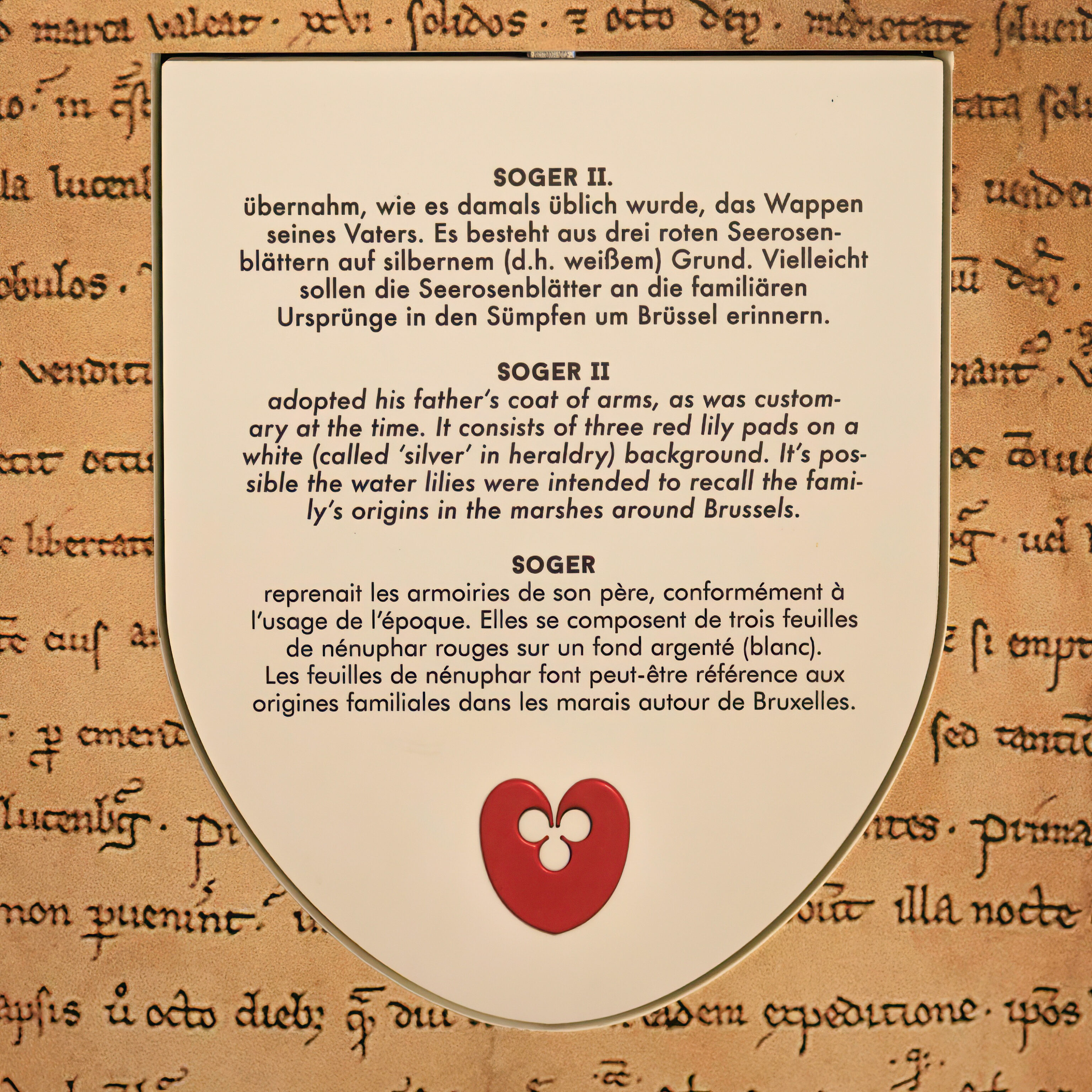
This panel describes the symbol that we saw earlier on the flag that was flying at the top of the castle’s tallest tower.
SOGER II adopted his father's coat of arms, as was customary at the time. It consists of three red lily pads on a white (called 'silver' in heraldry) background. It's possible the water lilies were intended to recall the family's origins in the marshes around Brussels.
– Text from the panel above.
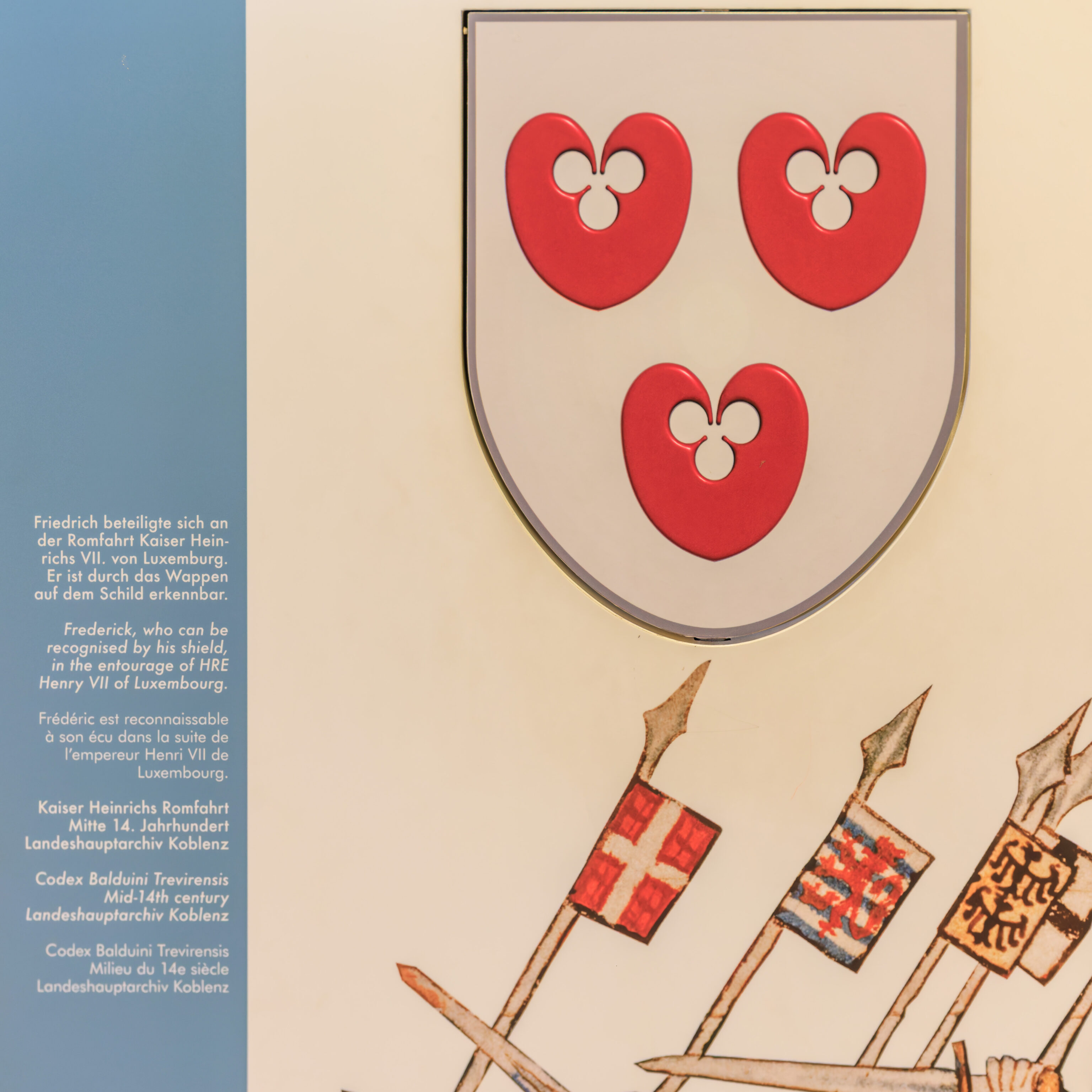
This panel again displays the symbol of the Sogers.
Frederick, who can be recognised by his shield, in the entourage of HRE Henry VII of Luxembourg.

Codex Balduini Trevirensis
Mid-14th century
Landeshauptarchiv Koblenz
– Text from the panel above.
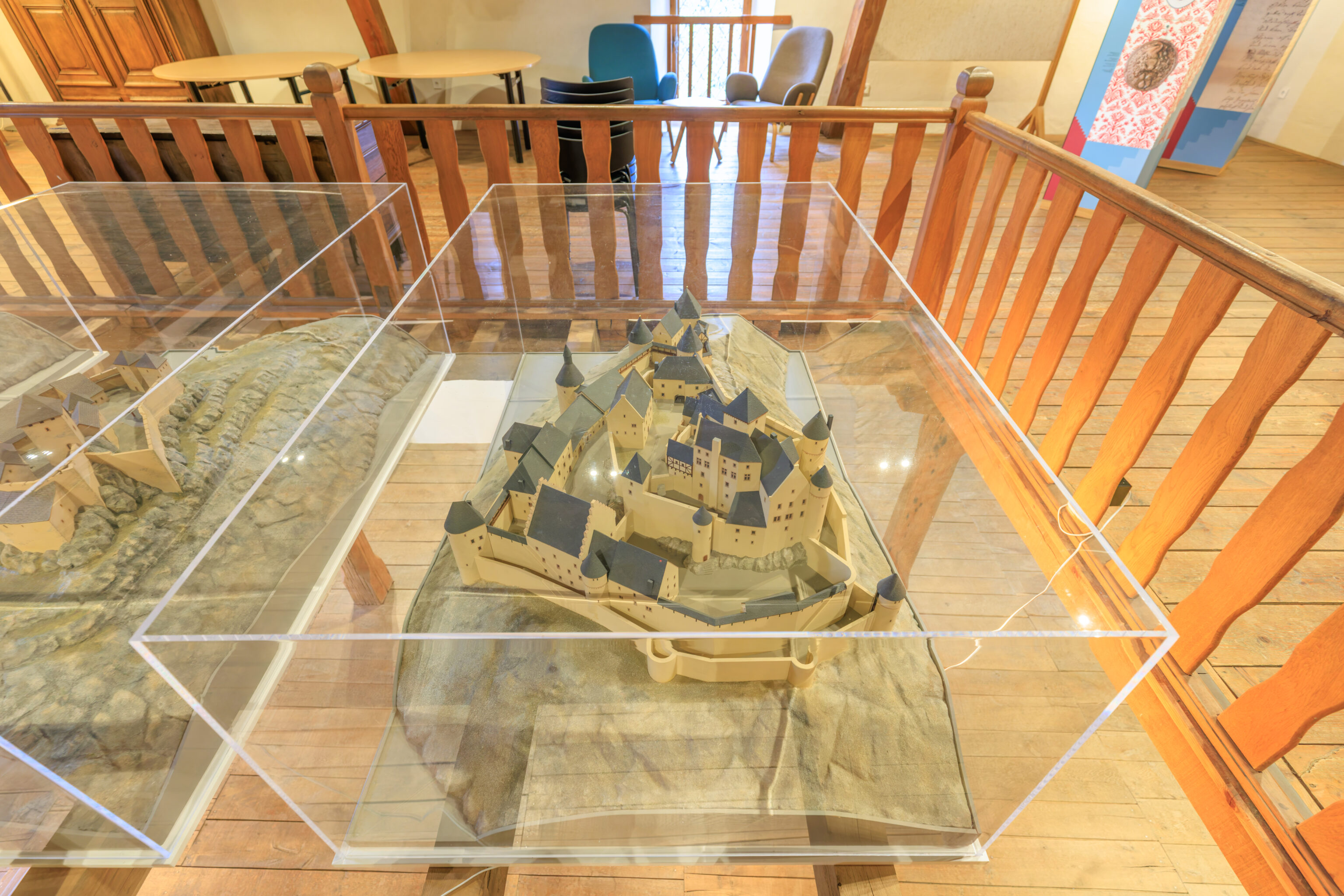
There were four models in the room that depicted the castle at various stages during its lifetime. This was the final appearance of the castle before it fell into ruin.
1
Based on pottery findings, the construction period of the first medieval wooden fortification can be attributed to the first half of the 11th century.

Inner bailey 680 m2
Outer bailey 750 m2

2
The wooden fortification was transformed into a massive stone castle at the end of the 11th century and in the first half of the 12th century with only a part of the wooden palisade retained on the north-eastern side. The high medieval residential castle included a palast, a tower and a chapel.

Inner bailey 700 m2
Outer bailey 900 m2

3
The construction of the third castle complex took place close to the middle of the 13th century. The keep was given a pyramid roof and the palace building was enlarged. A chapel was added to the outside of the keep. The outer bailey was significantly extended with a curtain wall and a battlement.

Inner bailey 800 m2
Outer bailey 1500 m2

4
Impressive residential and fortification complex of Bourscheid at the  end of the 17th century. The last significant expansion of the castle occurred in several phases. A document from 1384, which granted permission to construct the "Stolzemburger Haus" also mentioned the ongoing construction of the lower castle's defensive wall. Residential and farming buildings were built at the end of the 14th century and major renovations were made to the farm buildings in the upper castle area. The palace building was reconstructed in the Gothic style and a four-storey residential building was added. There was also a need to build modern living quarters with associated outbuildings. The triangular artillery platform was built in the first half of the 16th century. In the further process of the reconstruction, a ward-like fortification of the south-east side was added. In the context of the turmoil of the 30 Years' War (1618-1648), a new artillery bastion was built at the entrance as the last major modification of the castle.

Inner bailey 2000 m2
Outer bailey 3900 m2
– Text from a sign, translated using Google.
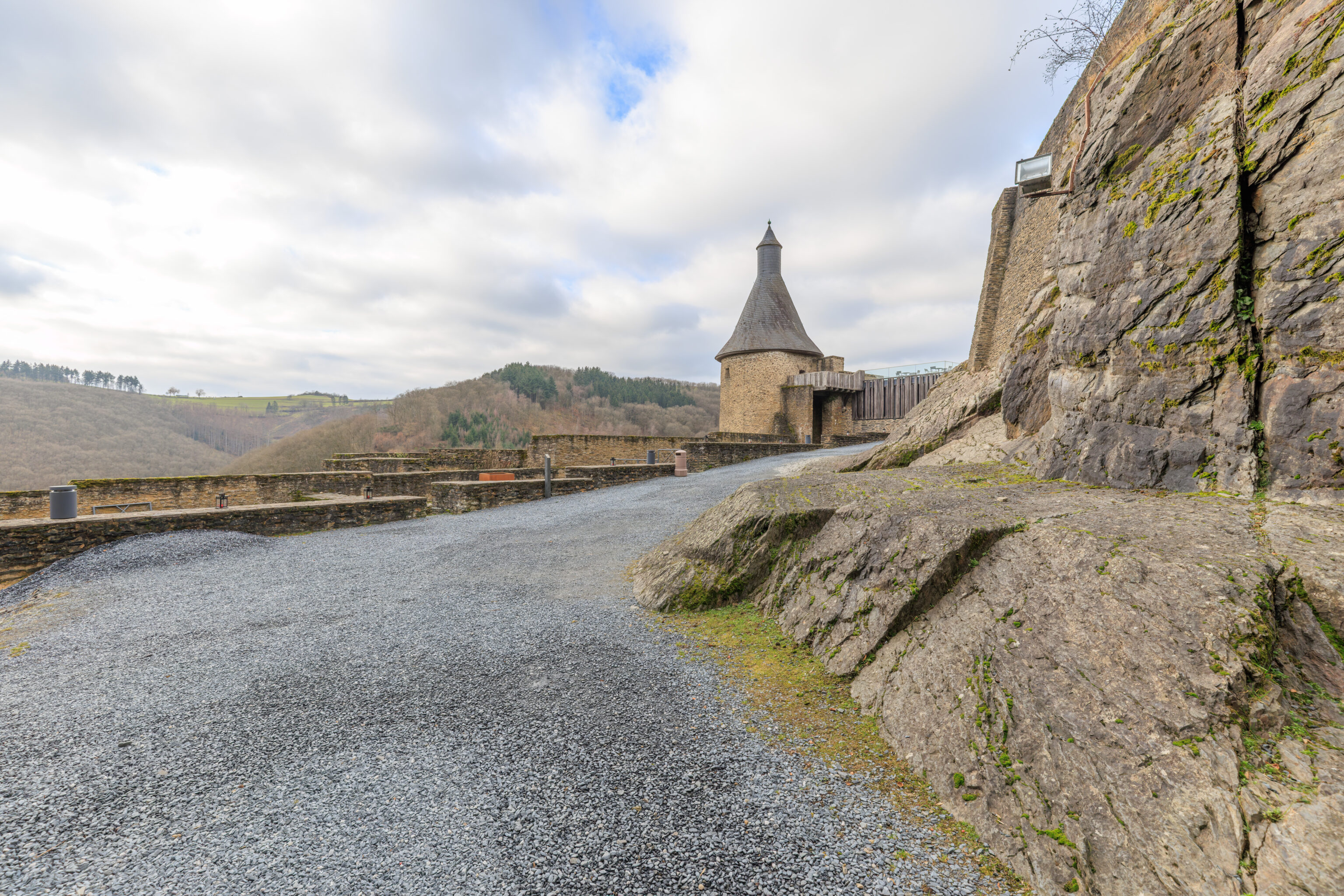
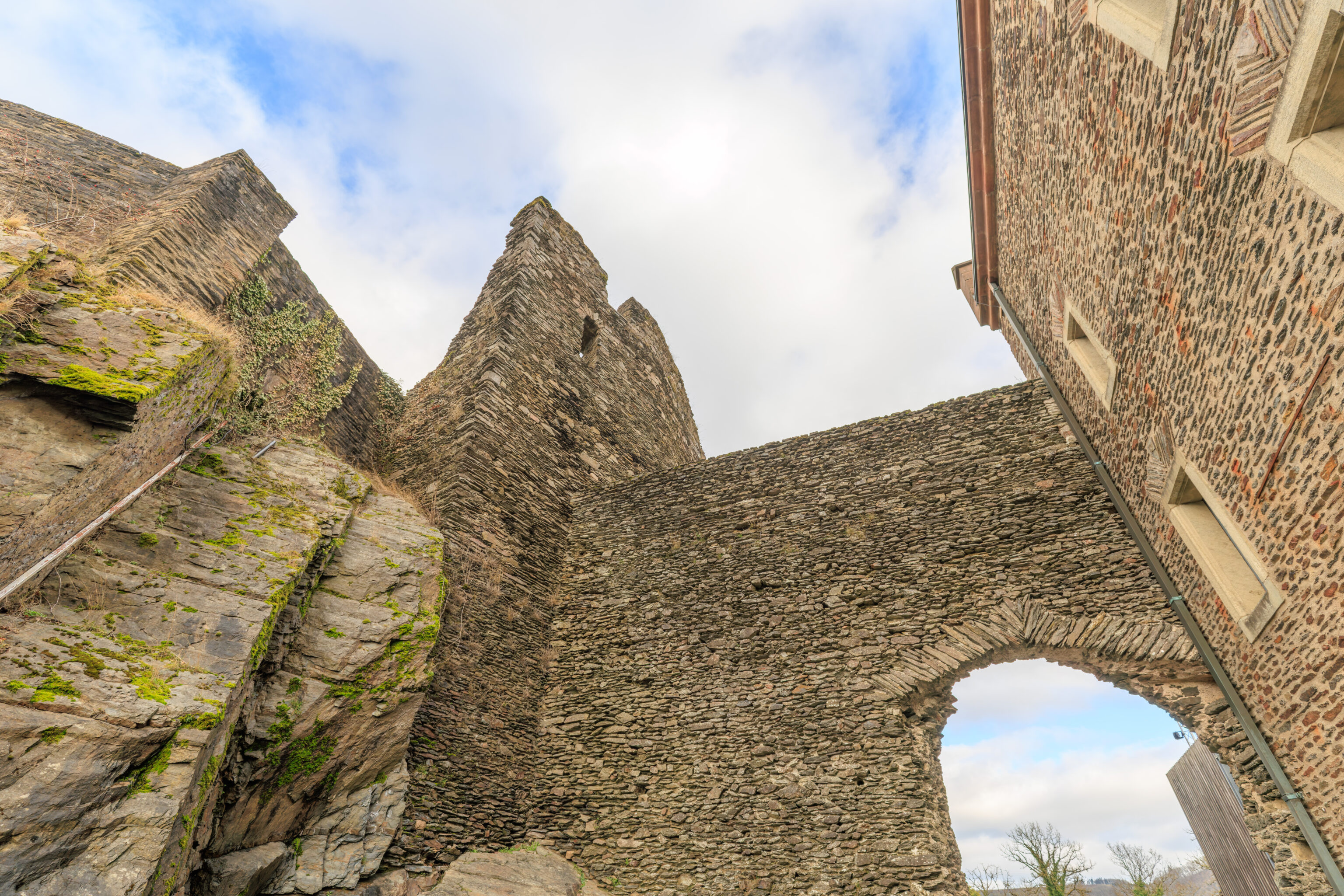
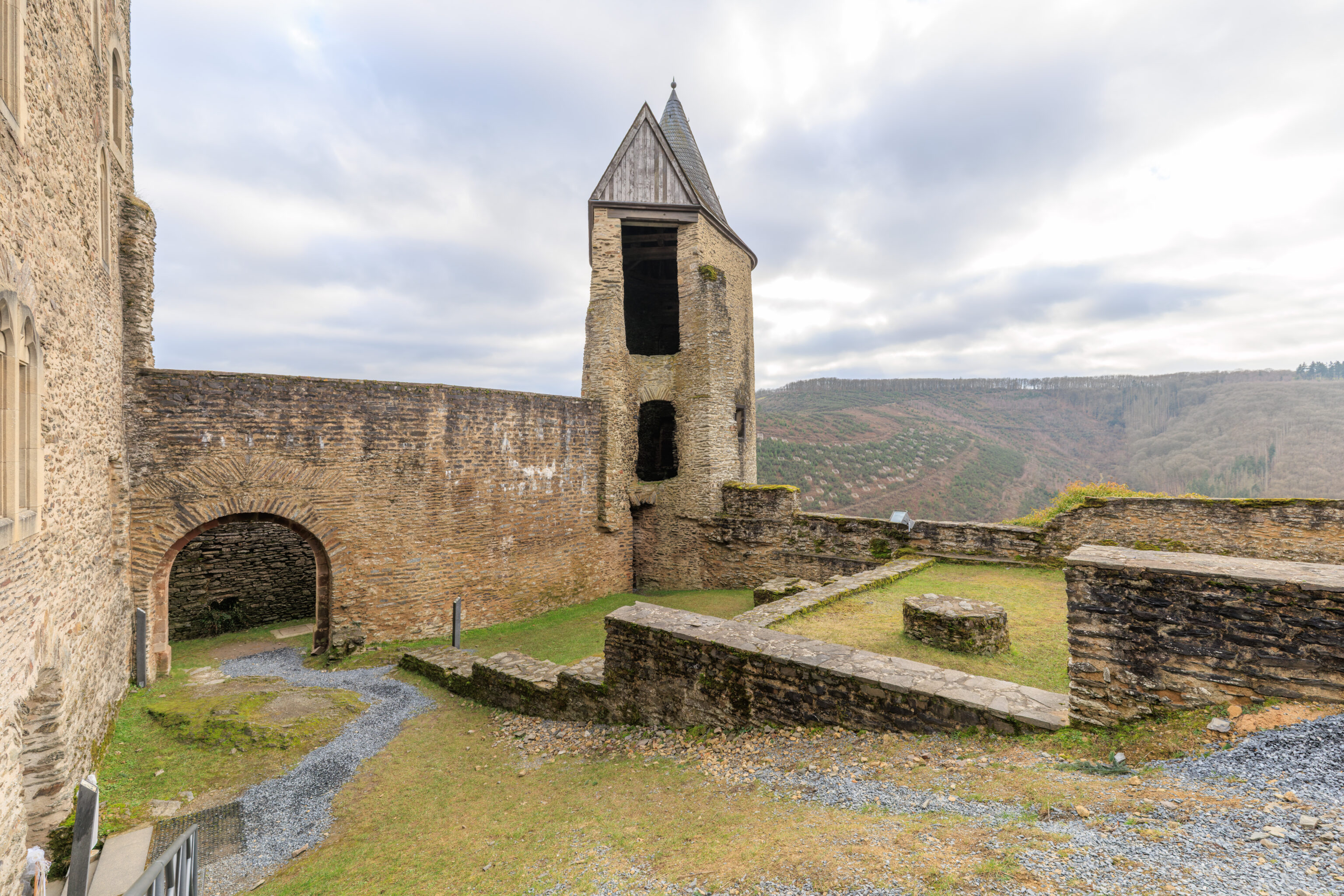
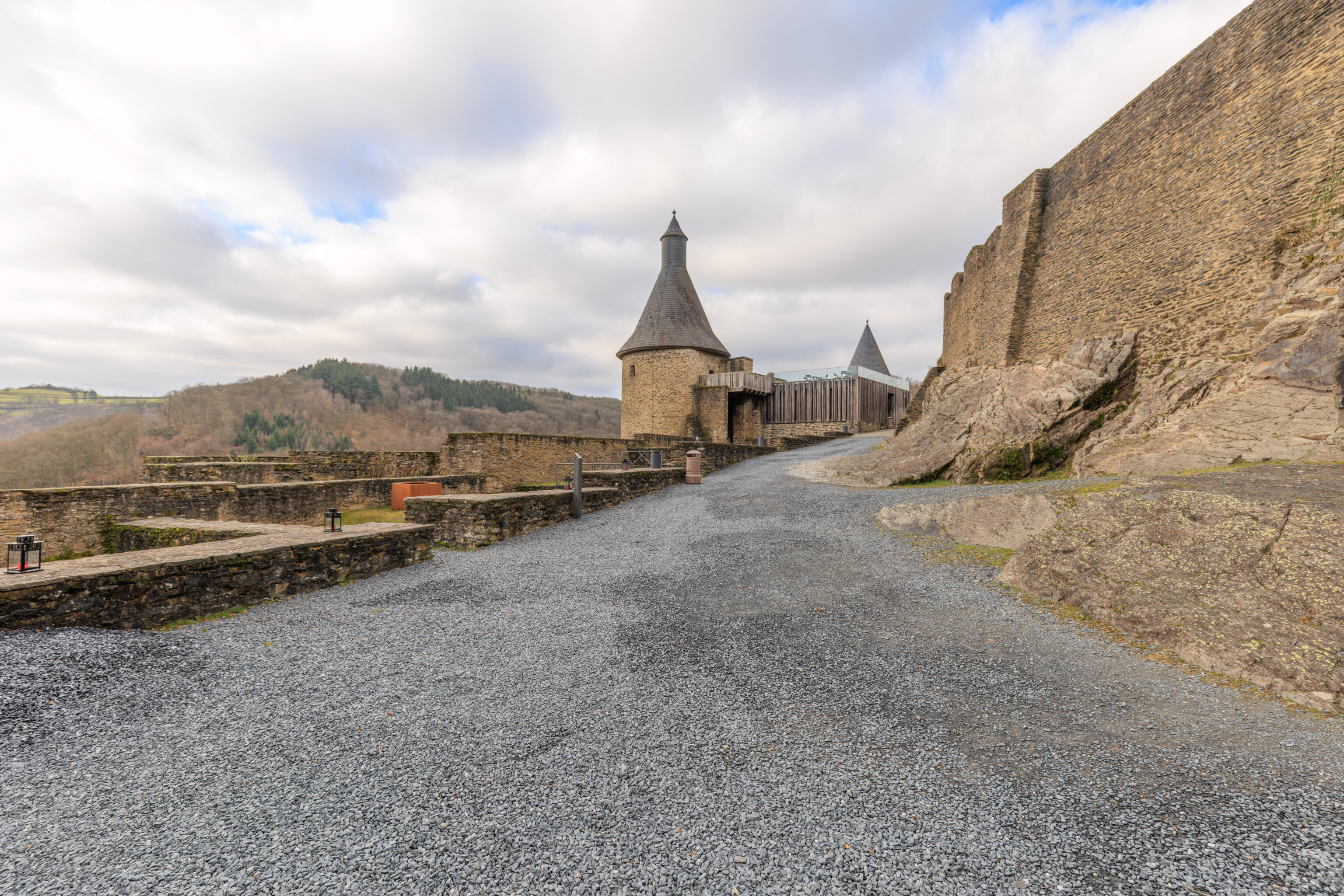
We continued on, following the path as it went uphill to the west in the direction of the castle’s entrance. We noticed small modern lights at the edge of the path again suggesting that an event was going to take place here soon.
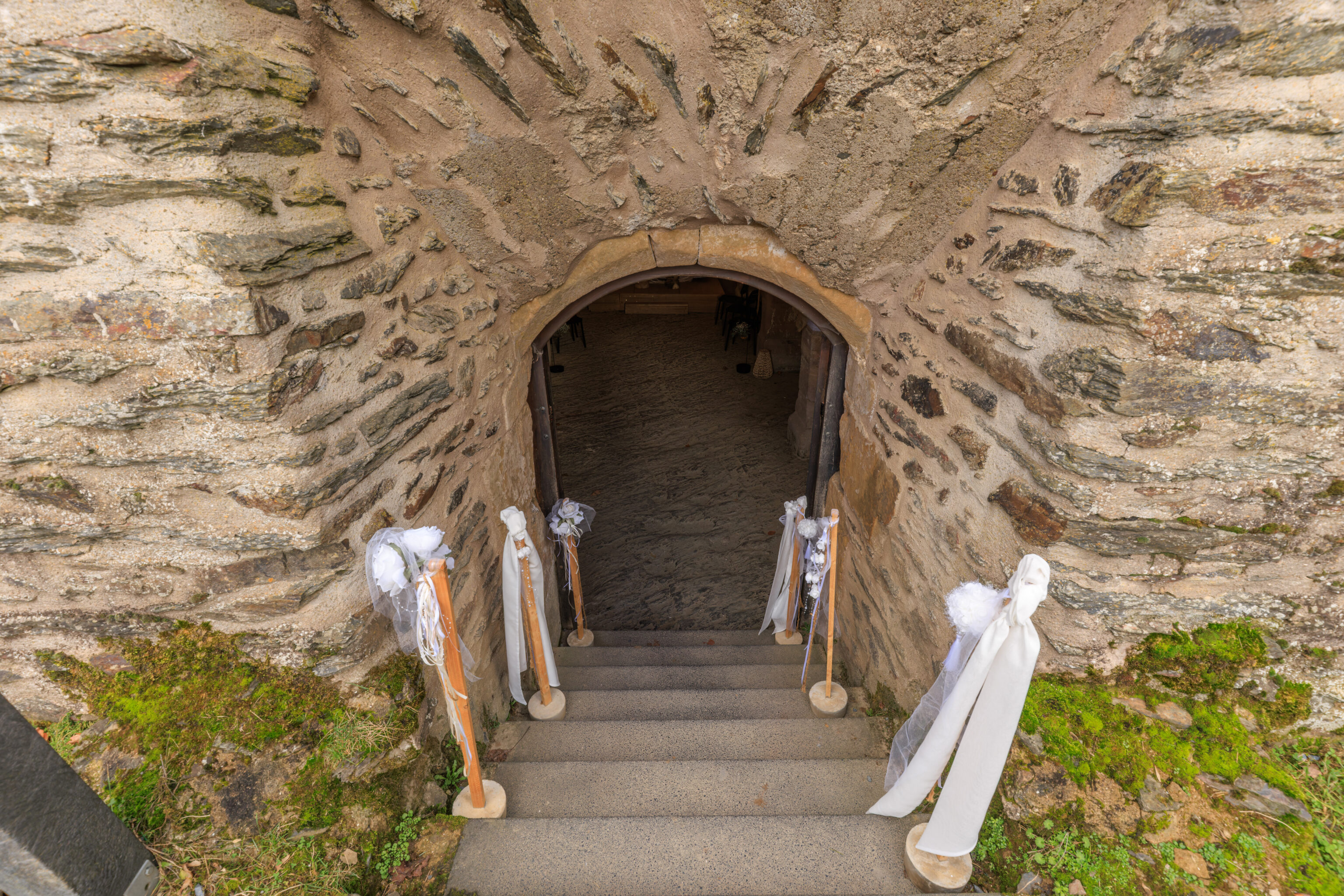
Even more signs of an event!
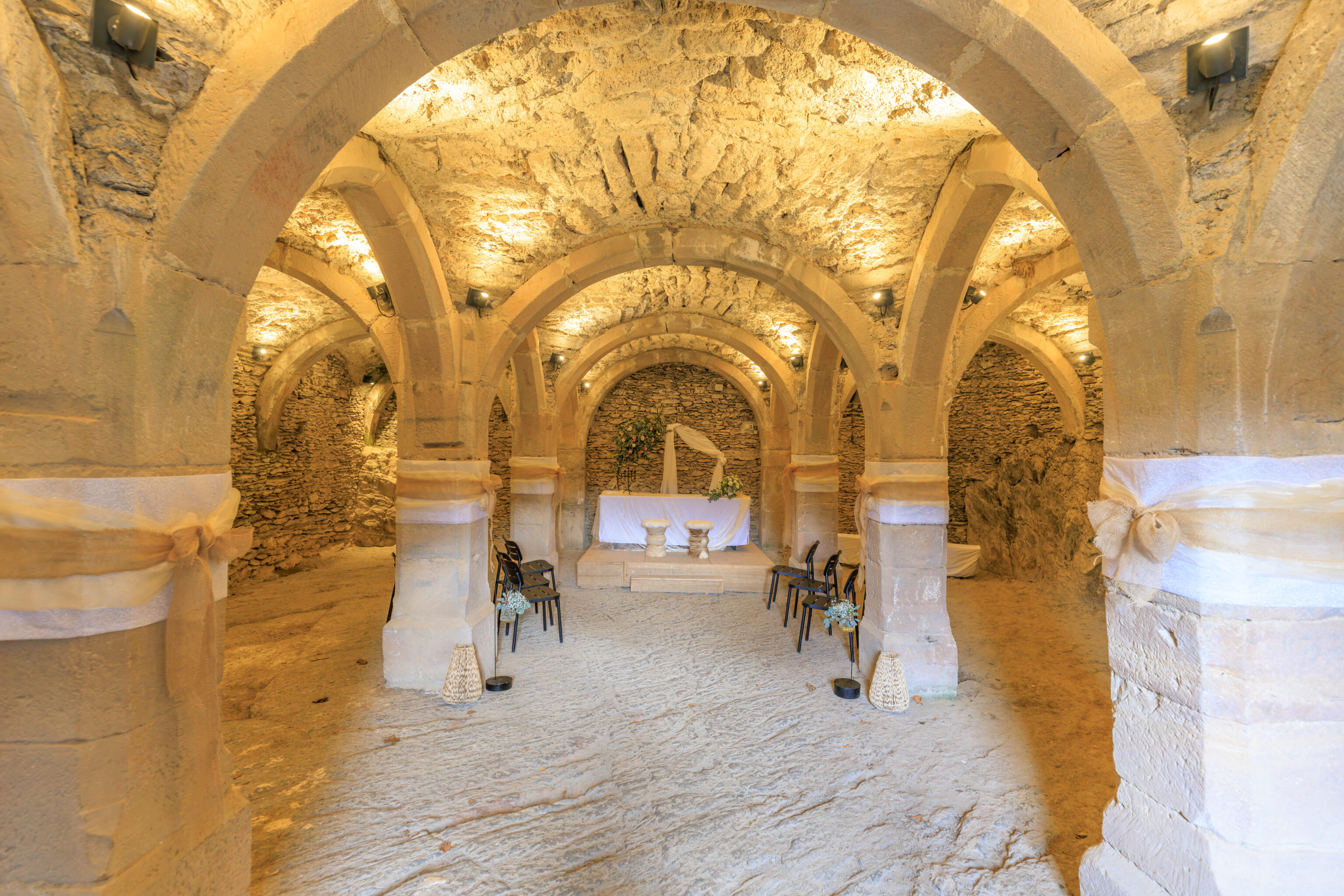
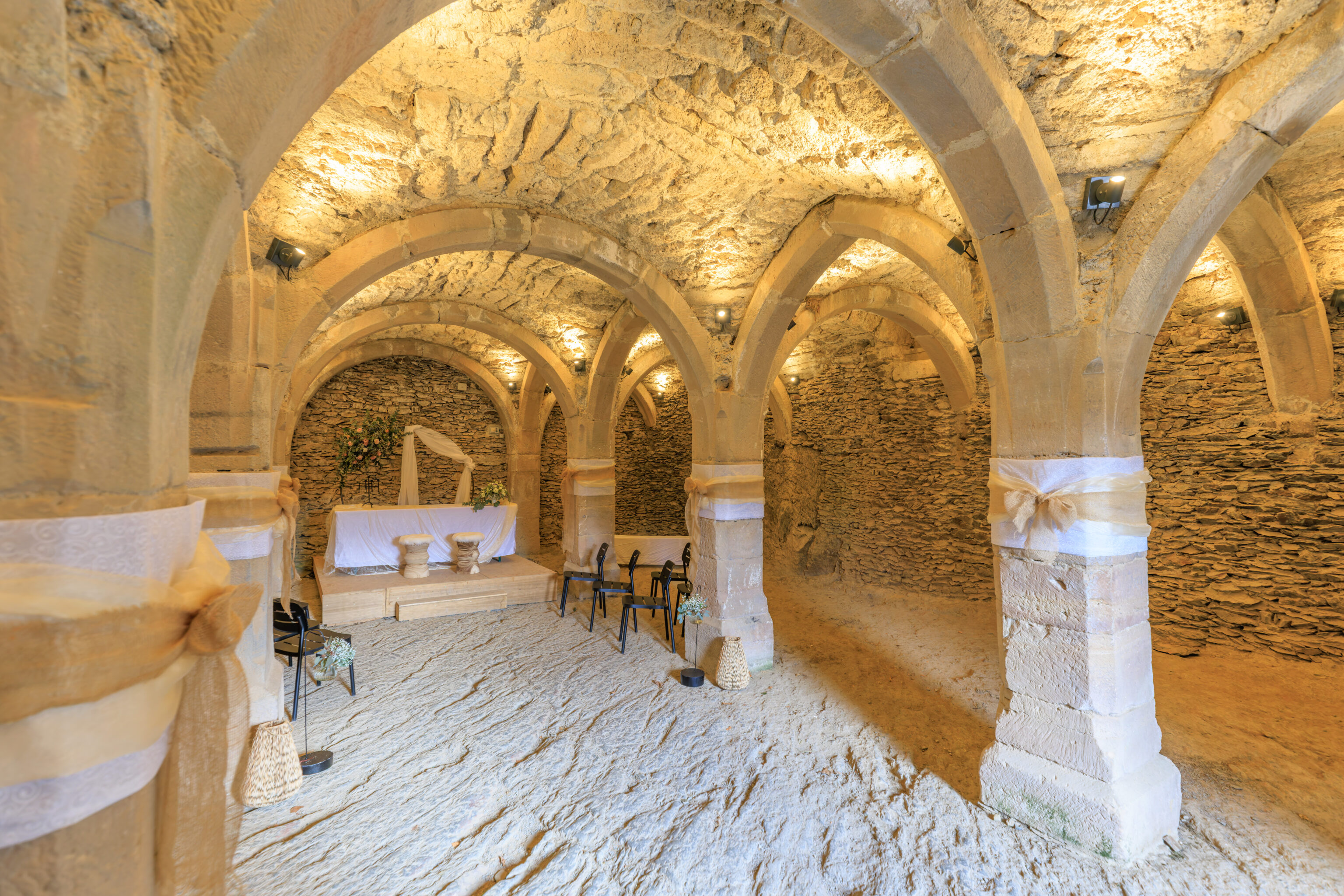
This underground room seems to be configured for a wedding with the reception to be held in the building we were just in.
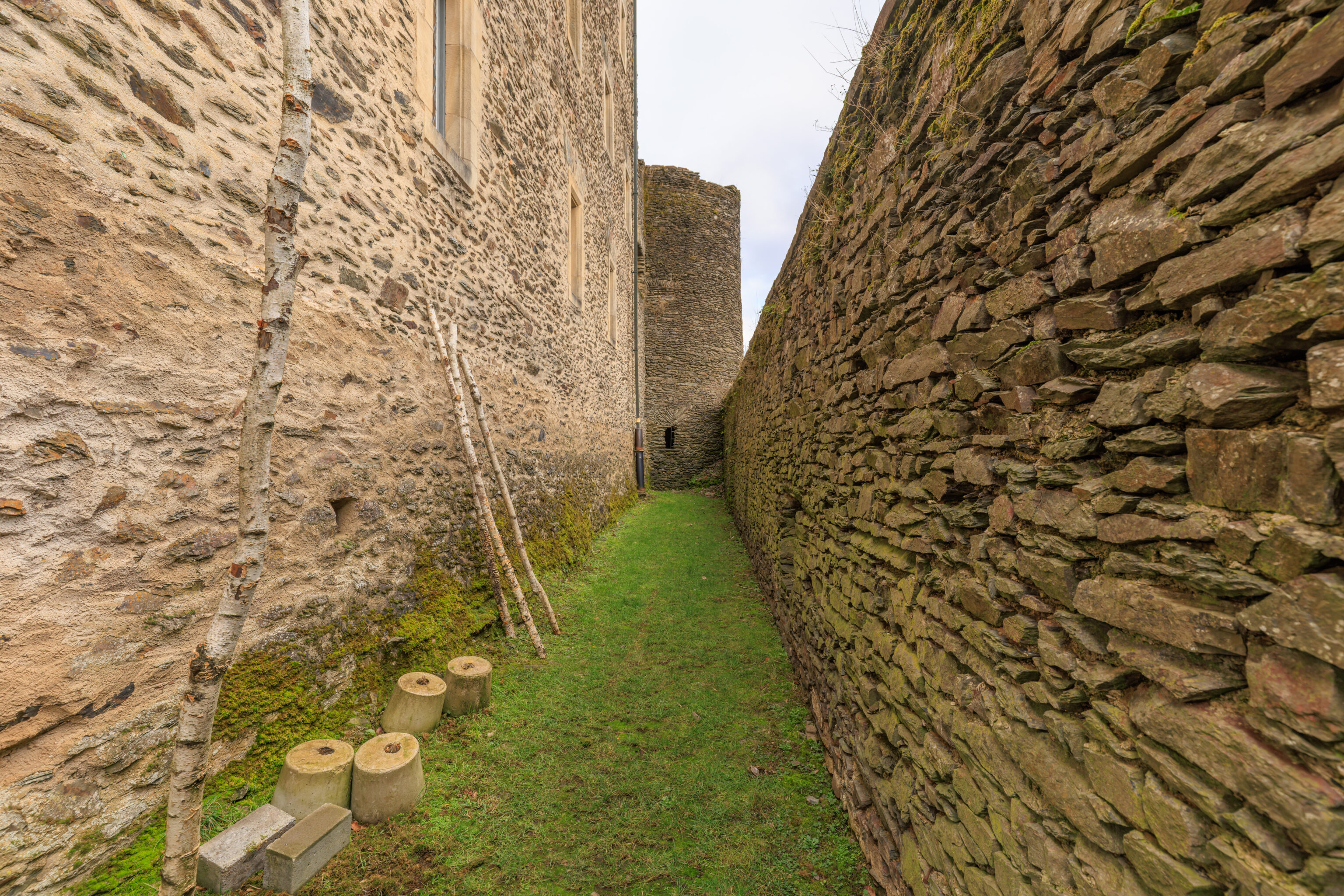
This little path went nowhere.
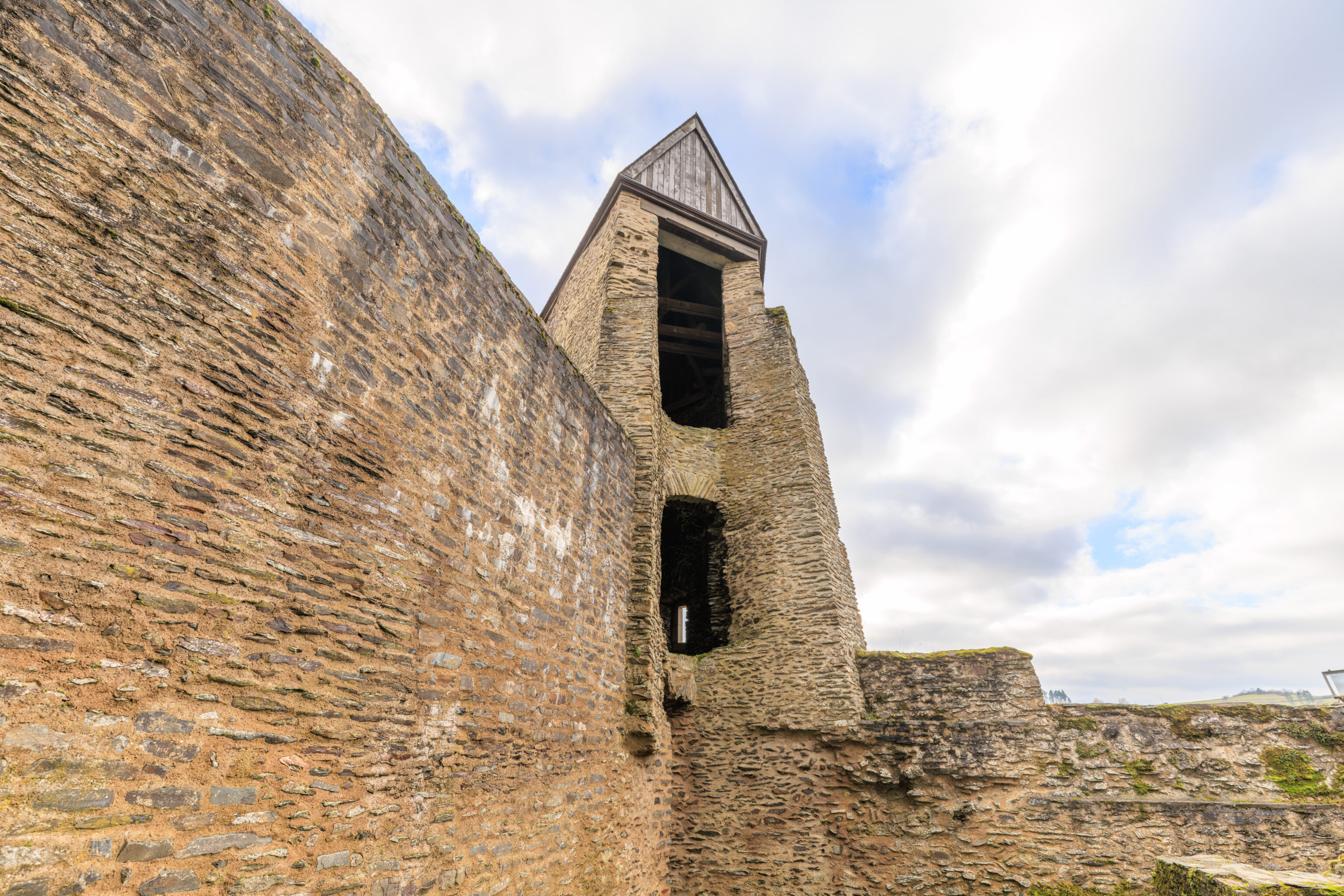
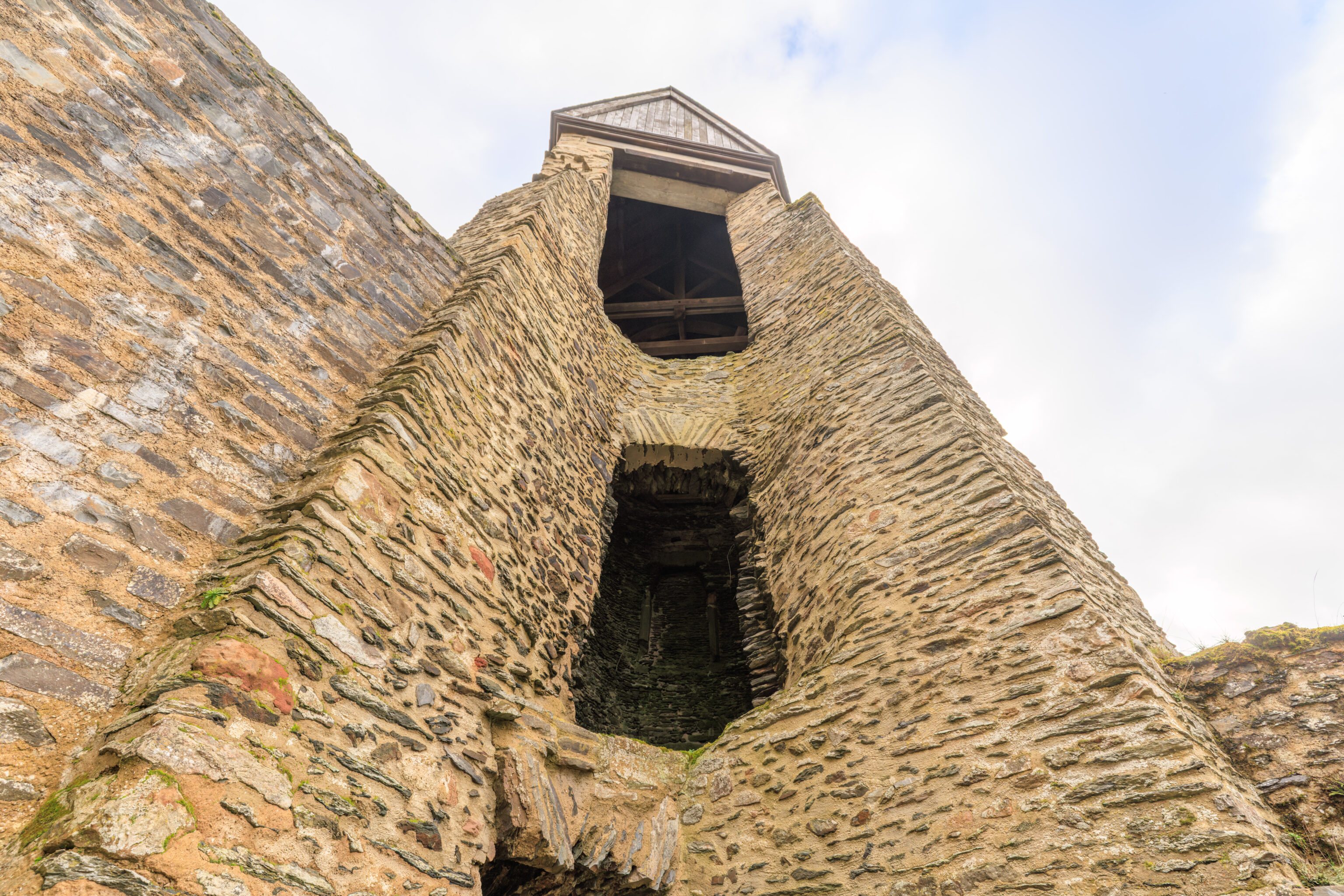
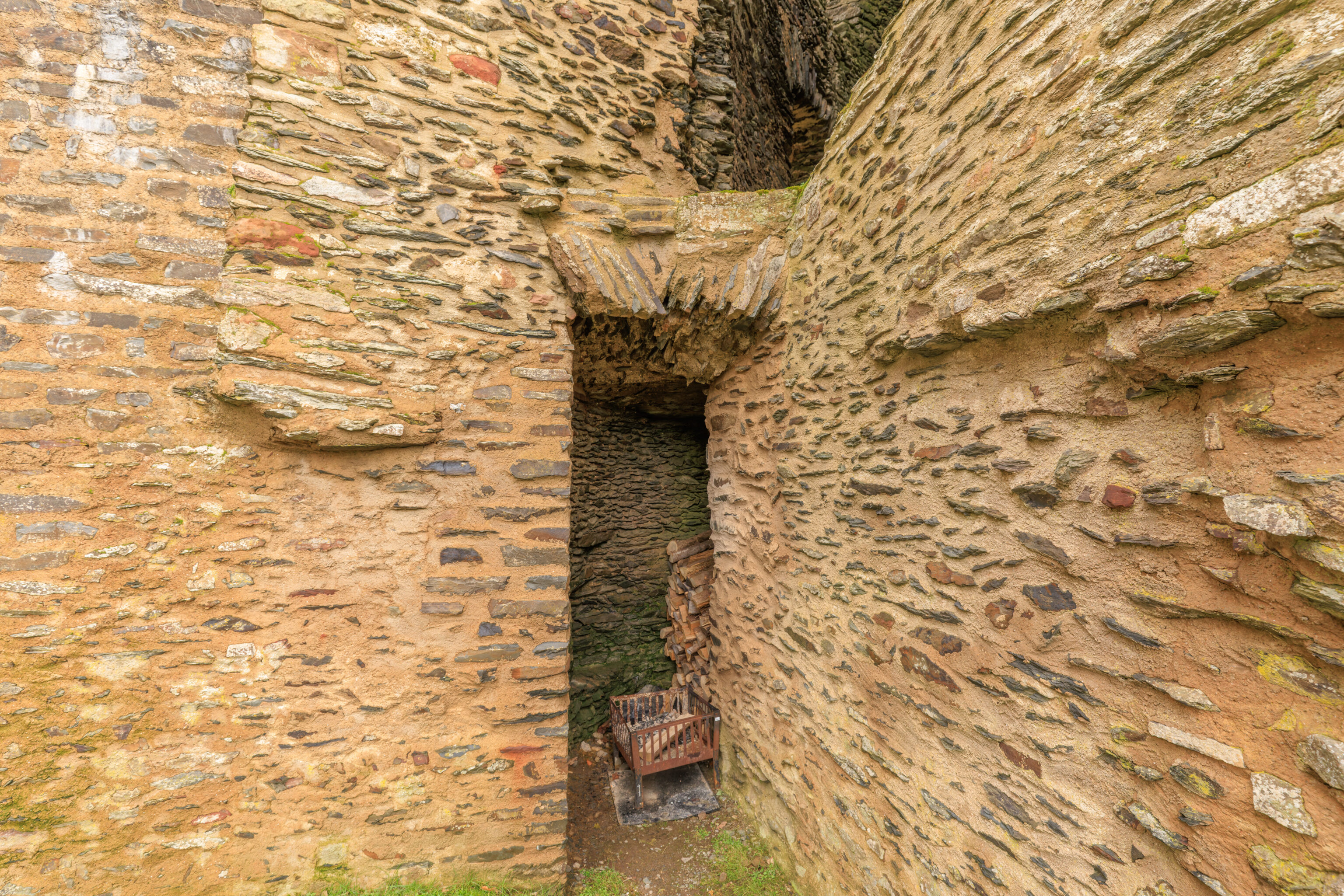
This tower seems to be used for storage. Either that or they’re going to have a bonfire here…
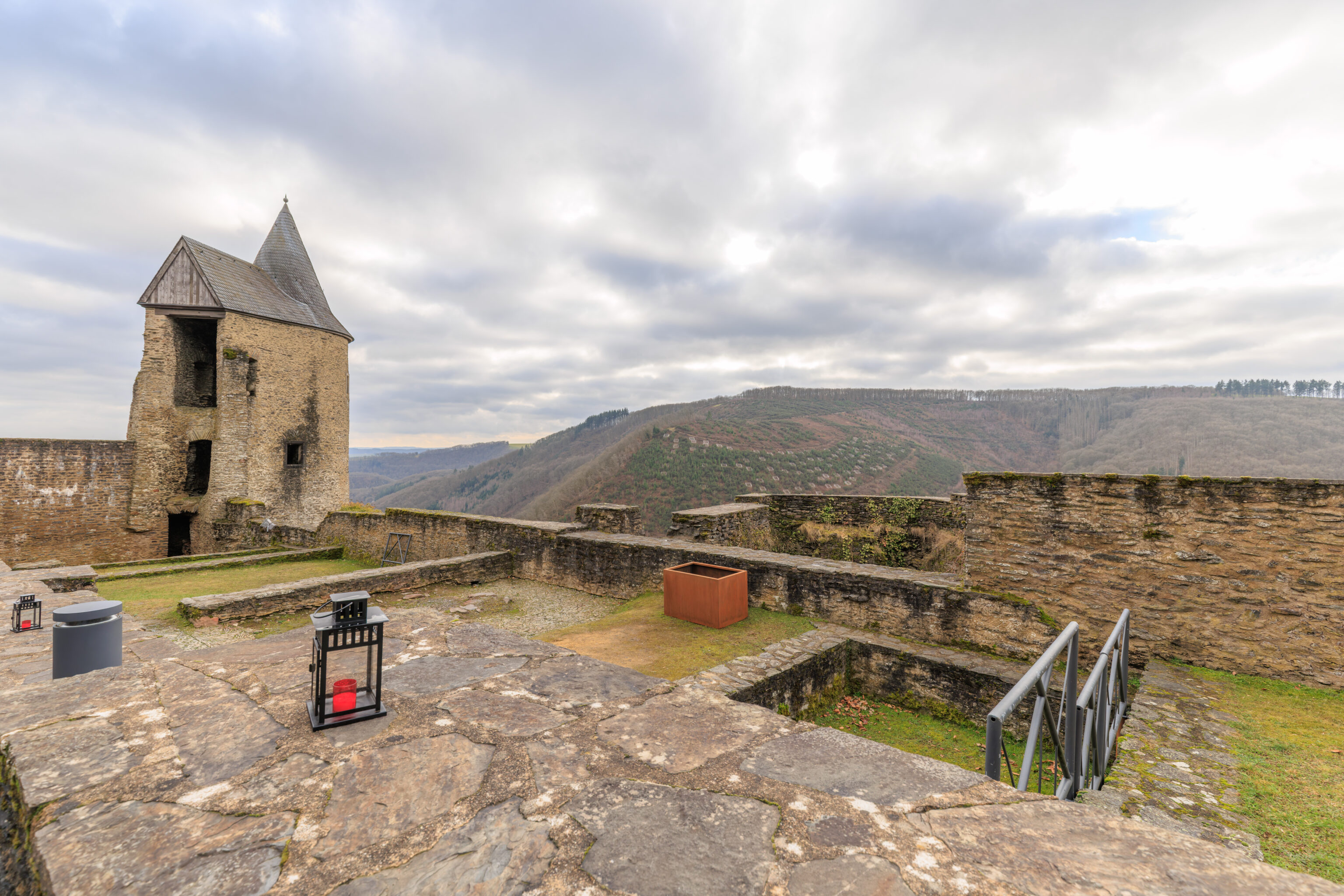
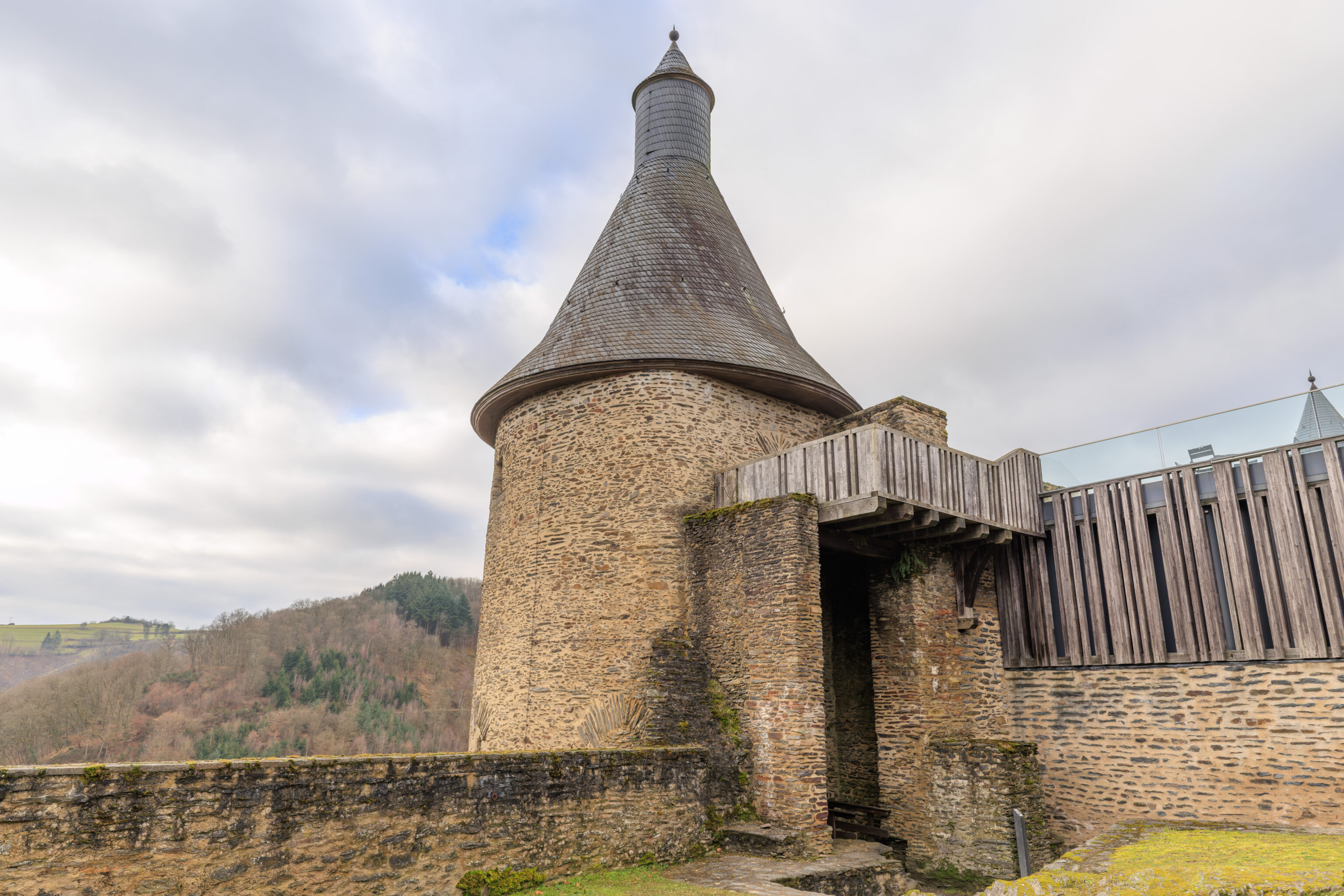
We continued on…
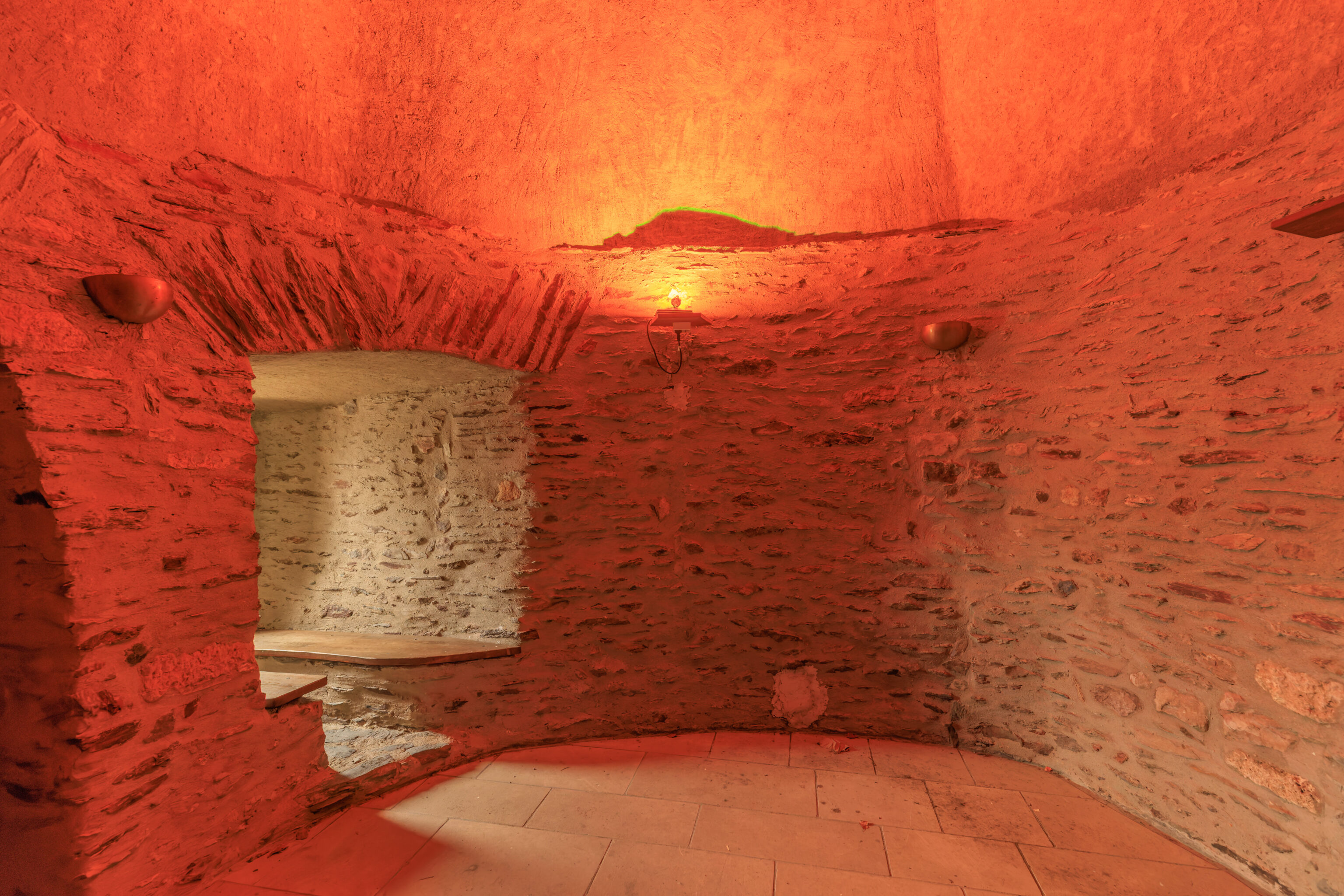
This small room within a tower was completely illuminated with red light.
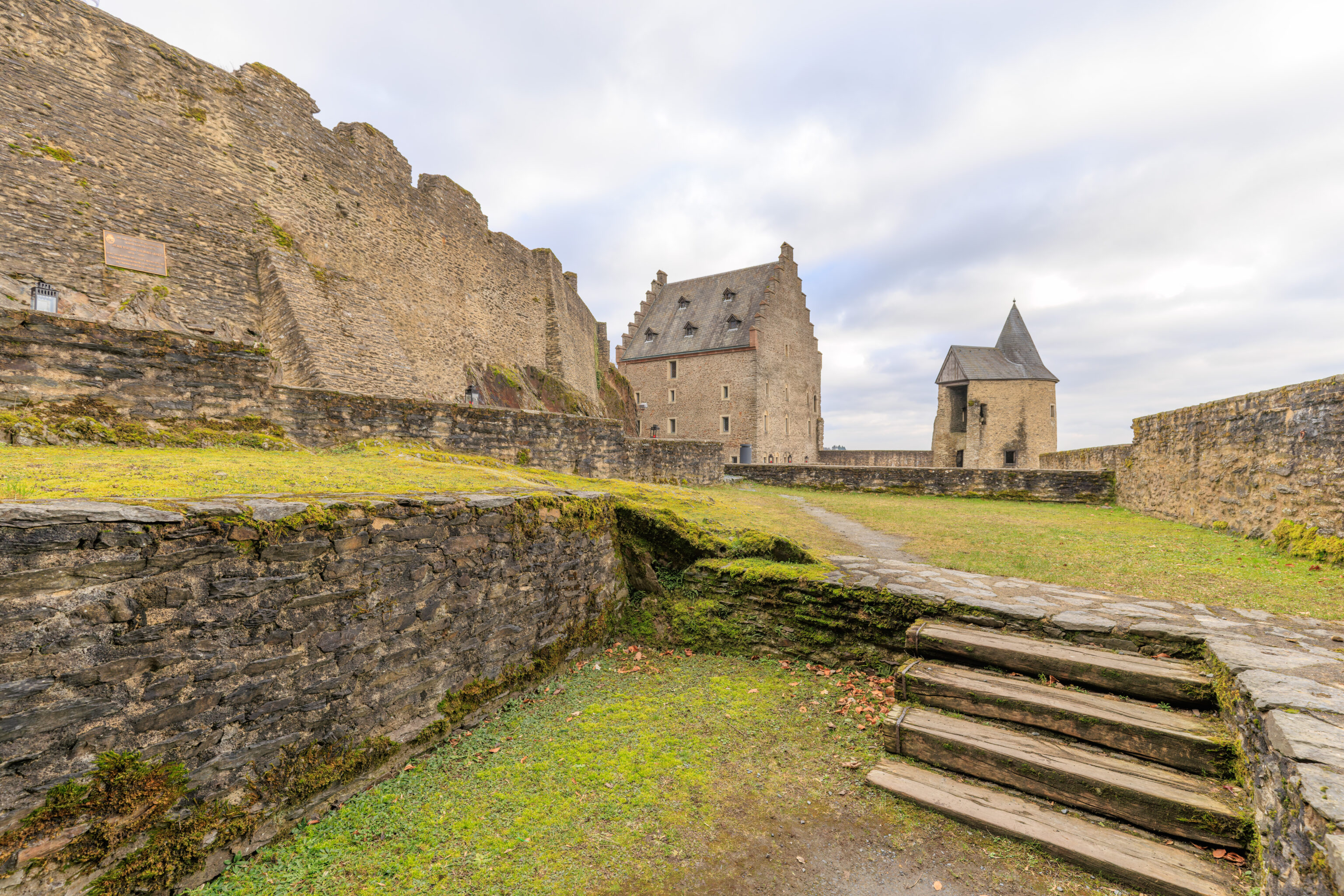
The view from the little tower’s entrance.
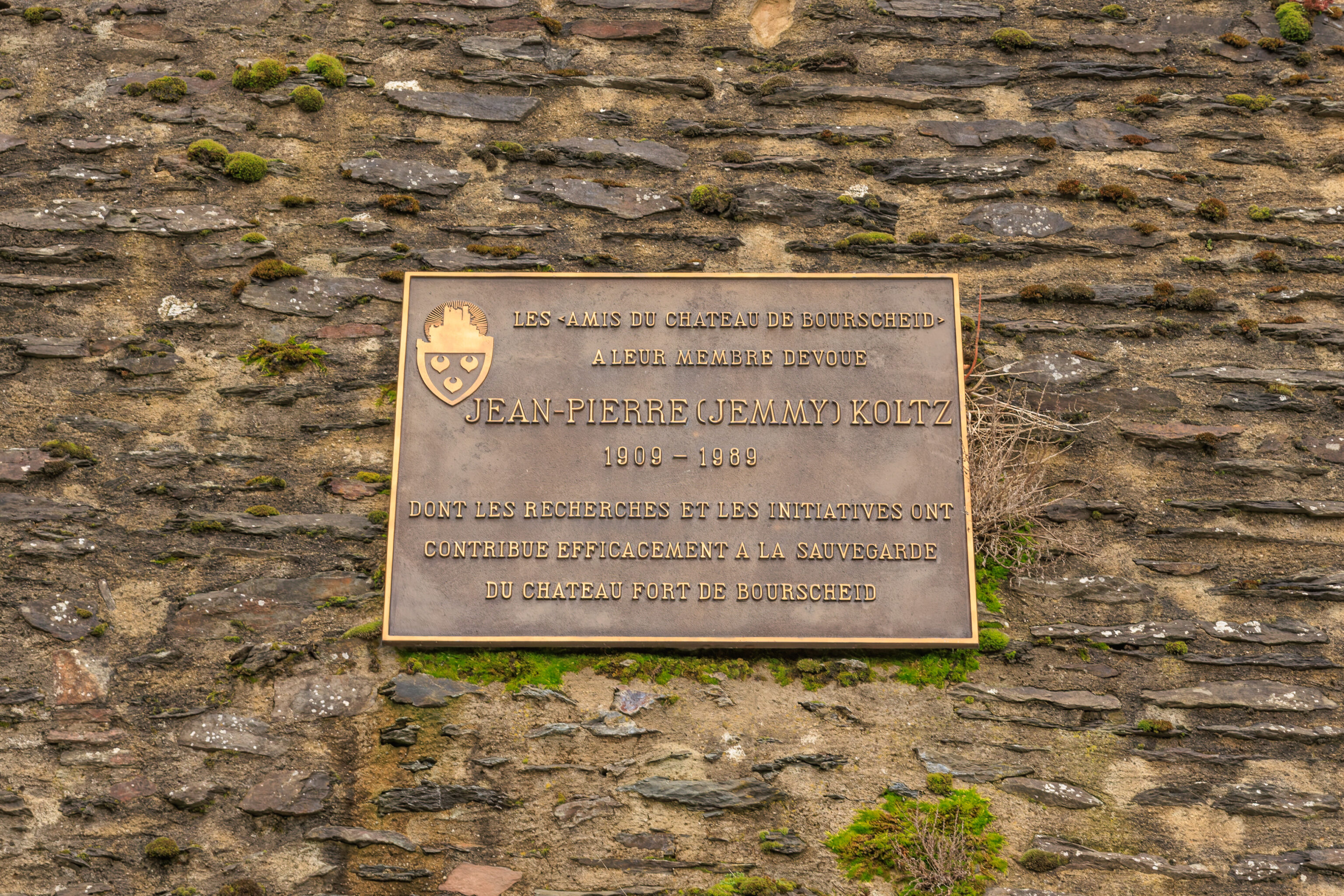
We noticed this plaque dedicated to Jemmy Koltz. We encounted this name yesterday at Vianden Castle when we walked through the Jemmy Koltz Hall. There was a biography of him in the room.
THE <FRIENDS OF CHATEAU DE BOURSCHEID> TO THEIR DEVOTED MEMBER

JEAN-PIERRE (JEMMY) KOLTZ
1909-1989

WHOSE RESEARCH AND INITIATIVES HAVE CONTRIBUTES EFFECTIVELY TO SAFEGUARDING OF BOURSCHEID FORTIFIED CASTLE
– Text from the plaque above, translated using Google Translate.
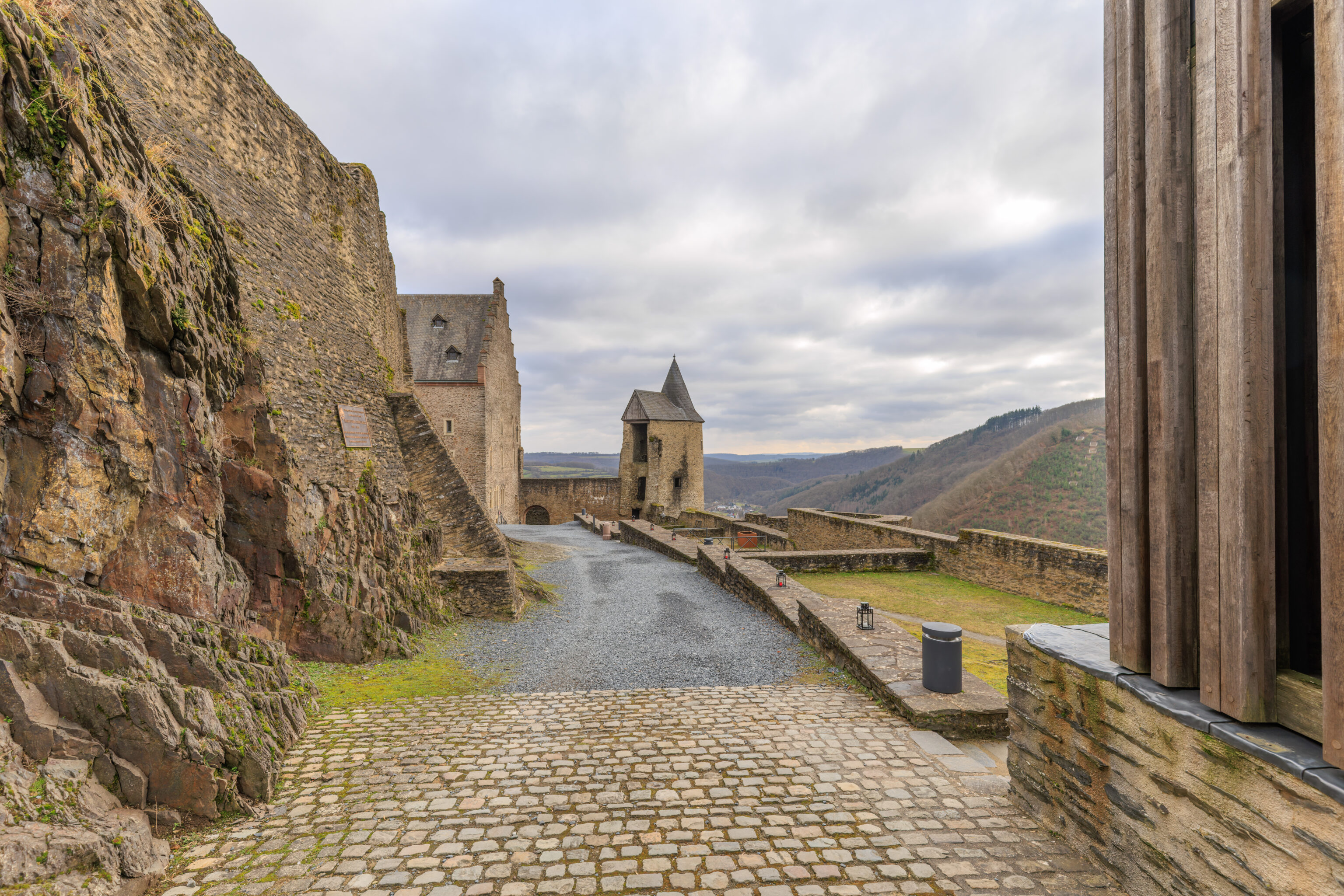
The plaque can be seen here on the left.
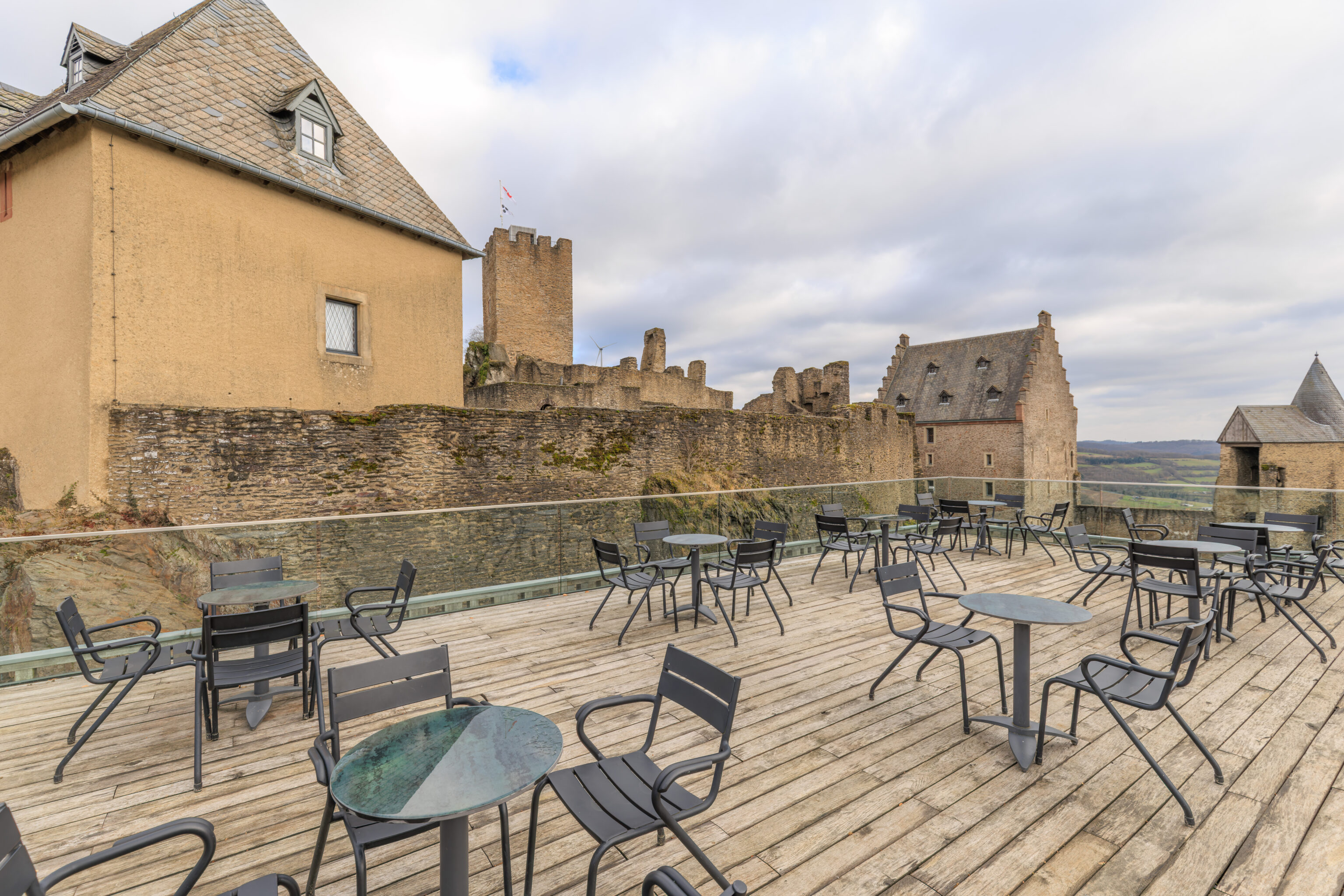
We then went back into the ticket office, gift shop, and cafe building to see if there was anything worth buying. There are also bathrooms inside. We ended up going out onto the rooftop deck to take a look around.
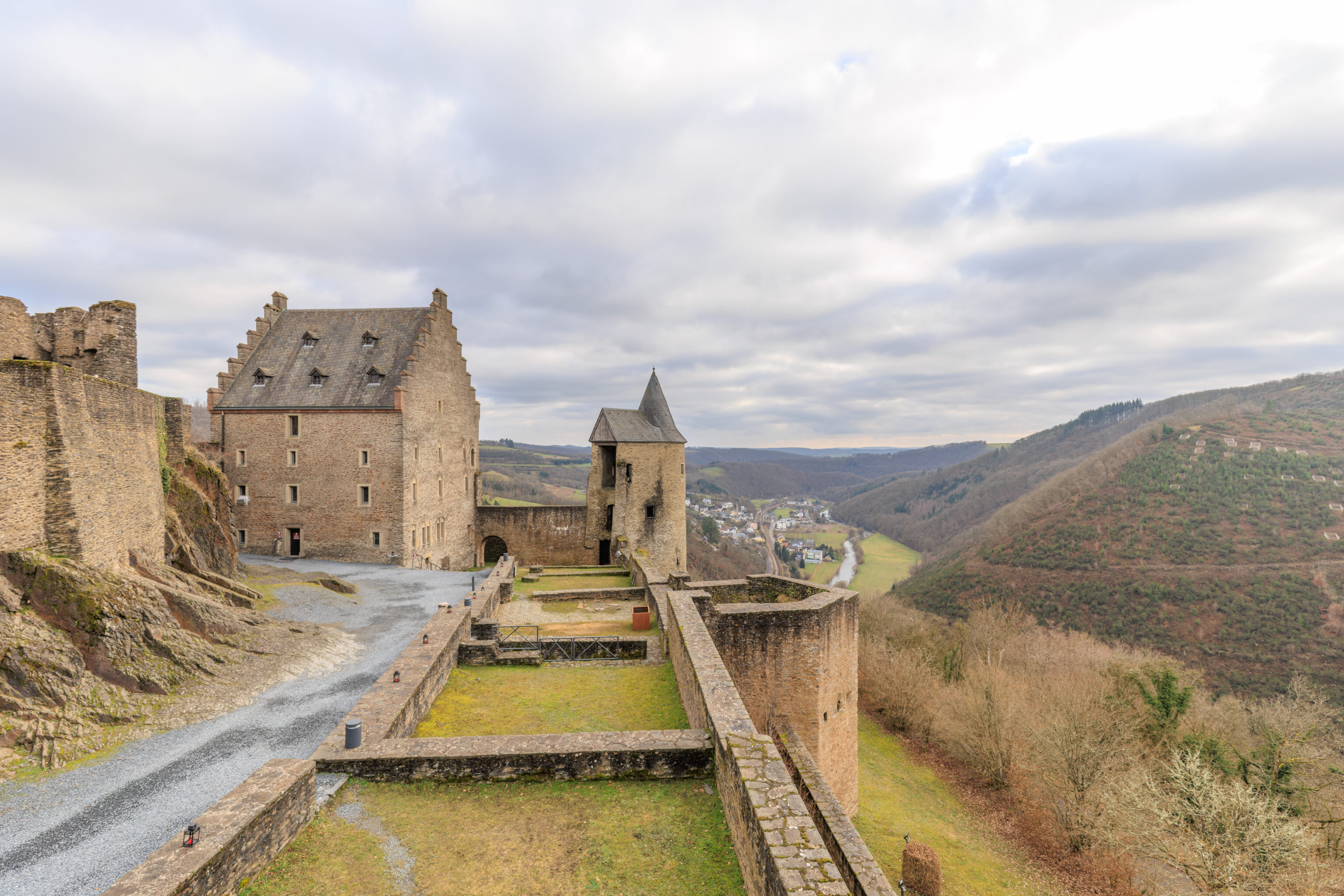
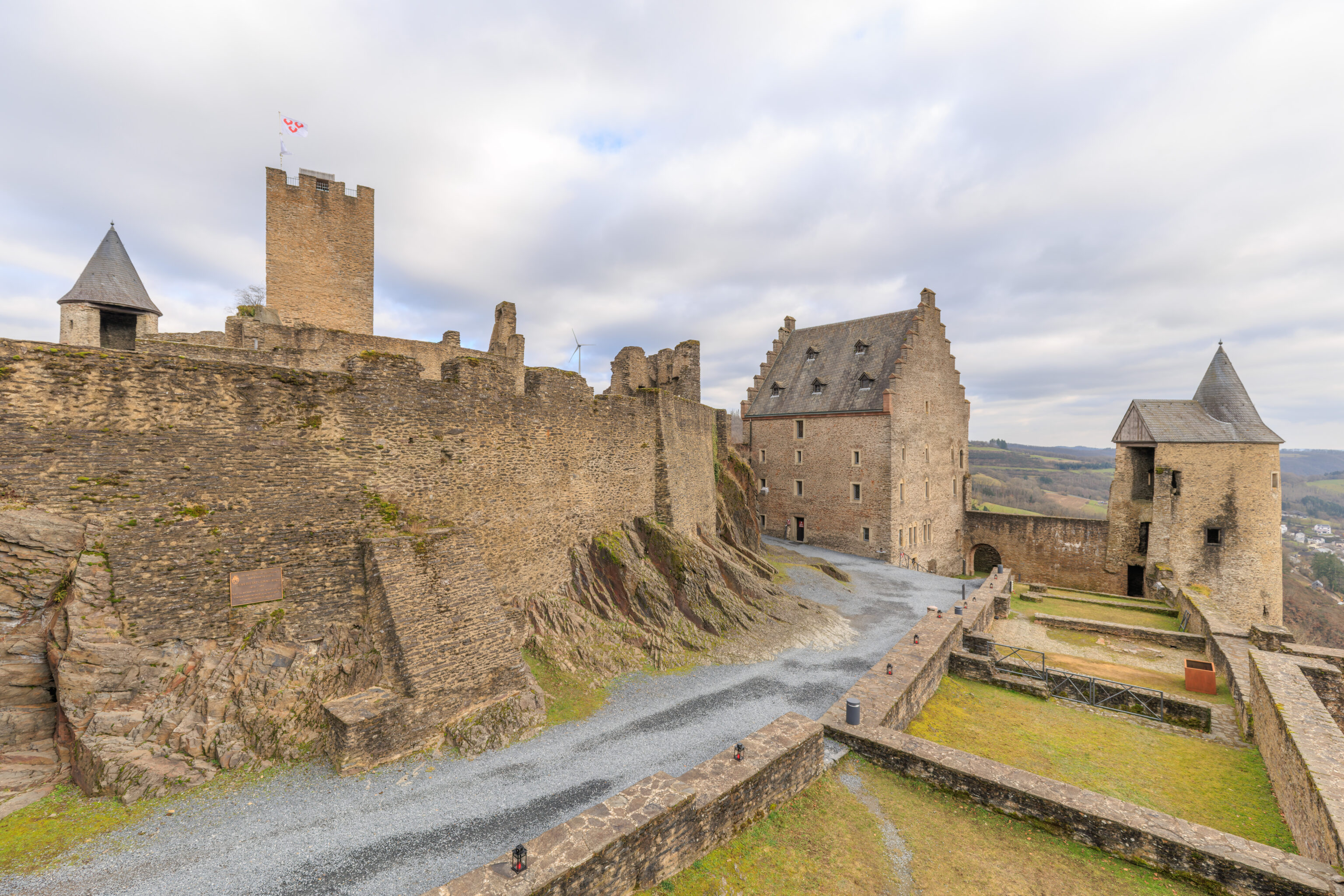
The view from here is pretty good!
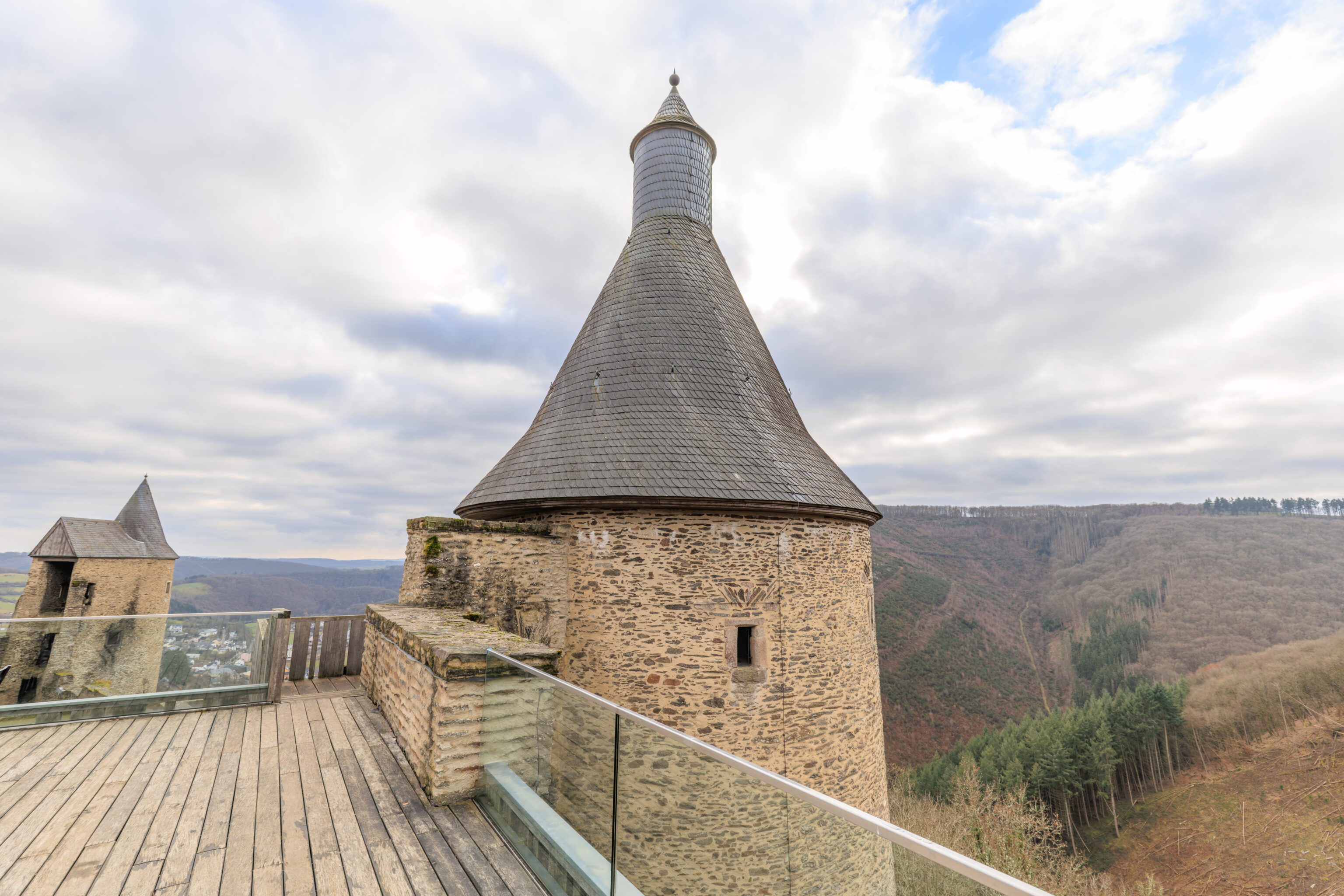
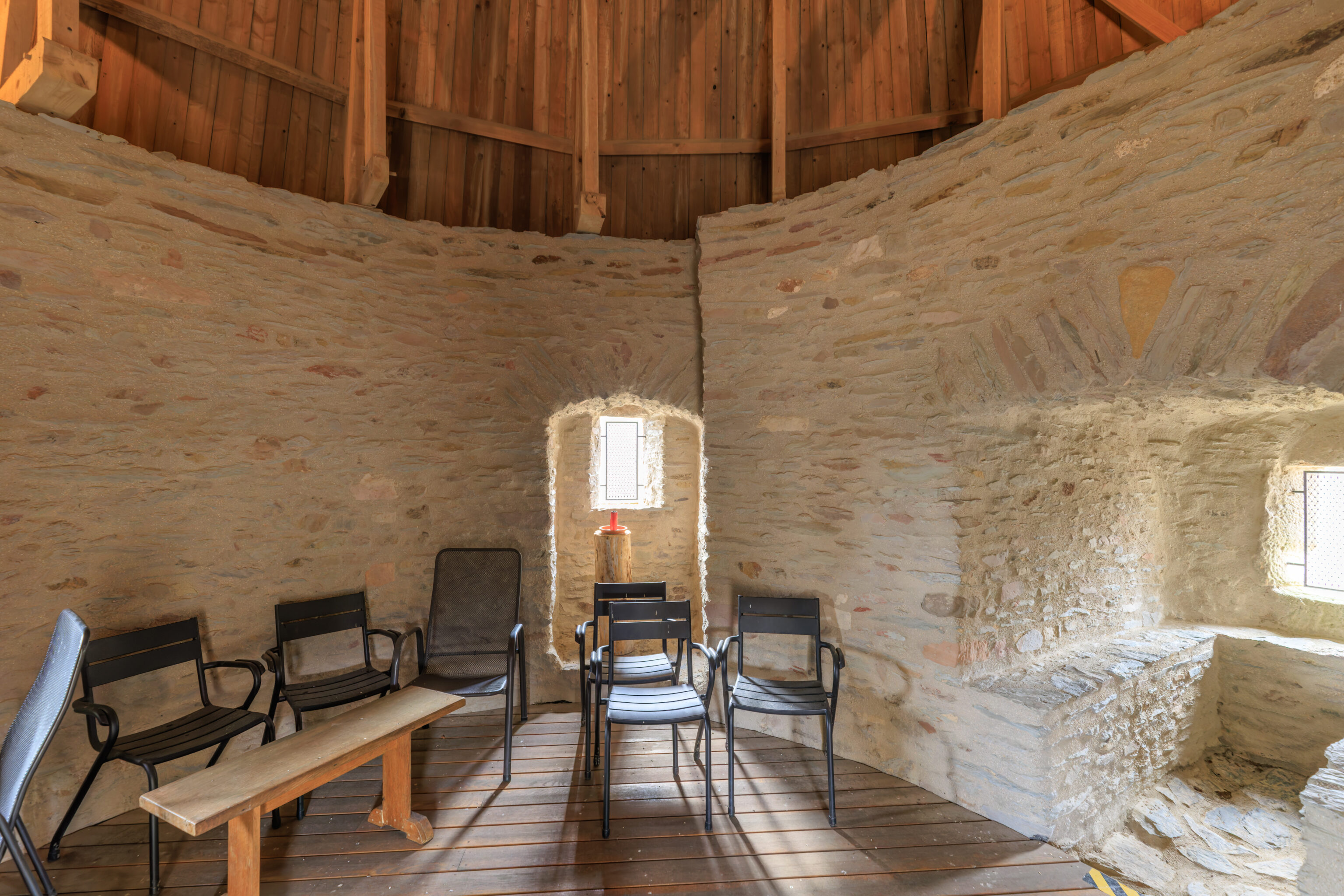
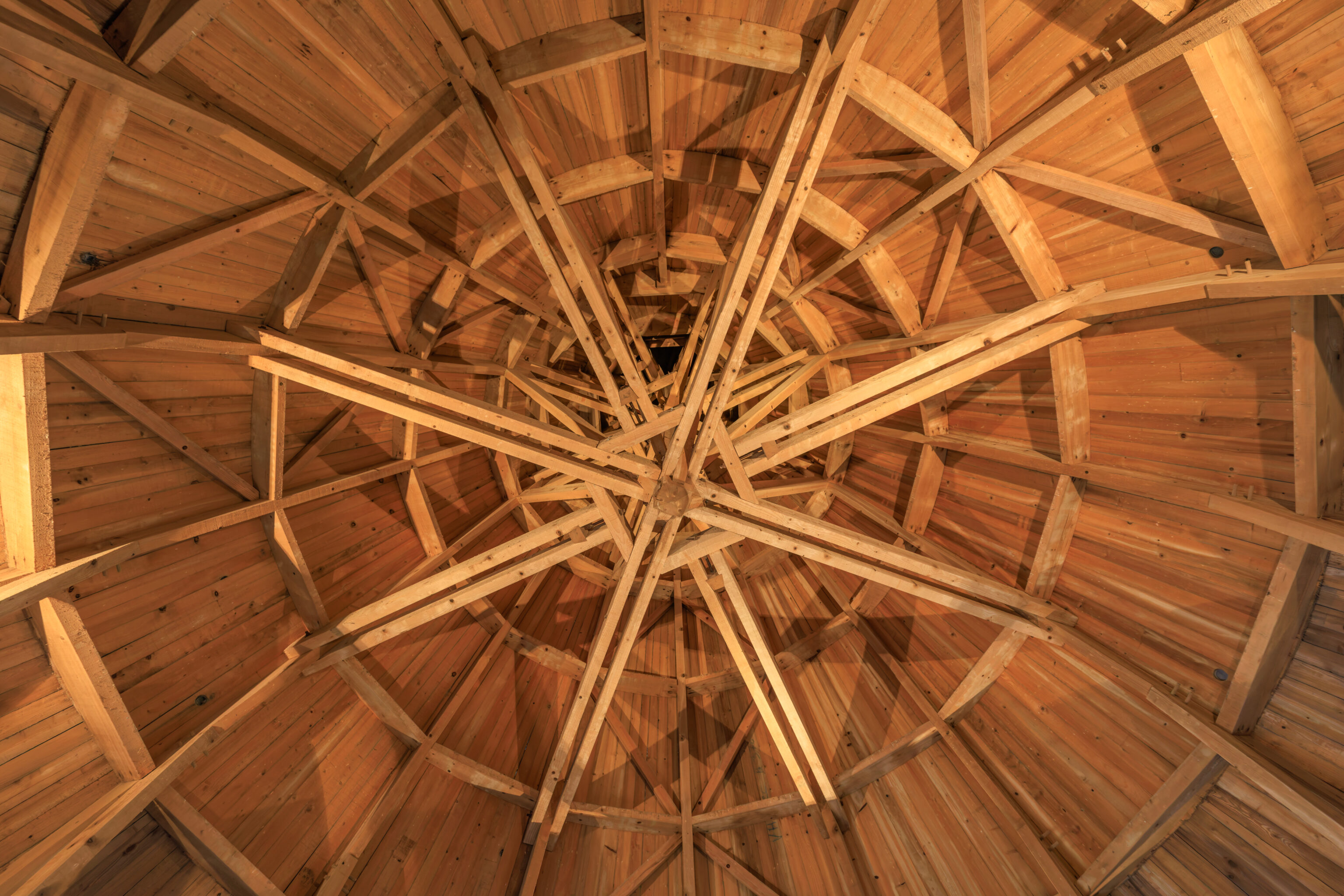
We were able to go into a small tower that is accessible from the rooftop deck.
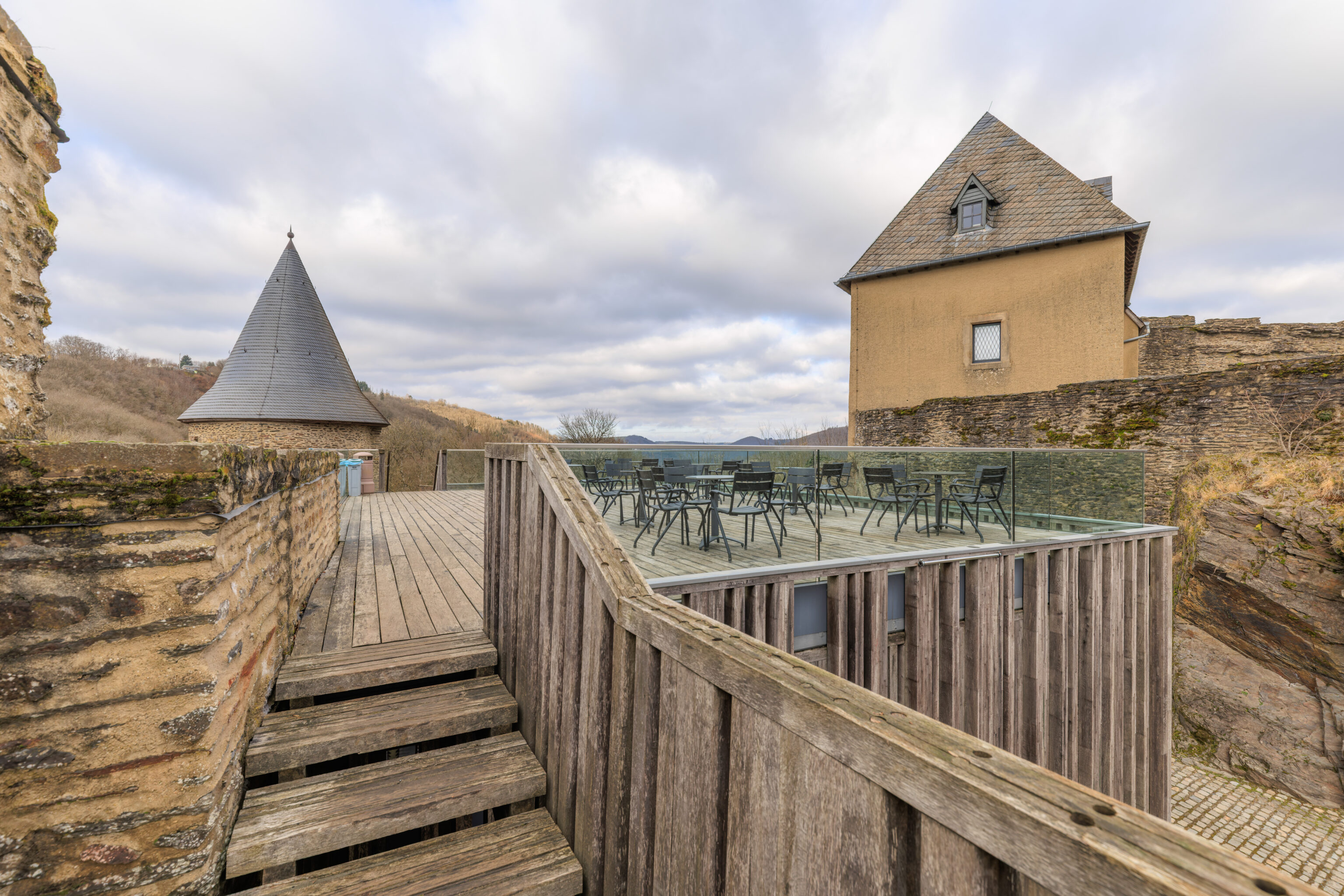
The view from the tower looking at the deck.
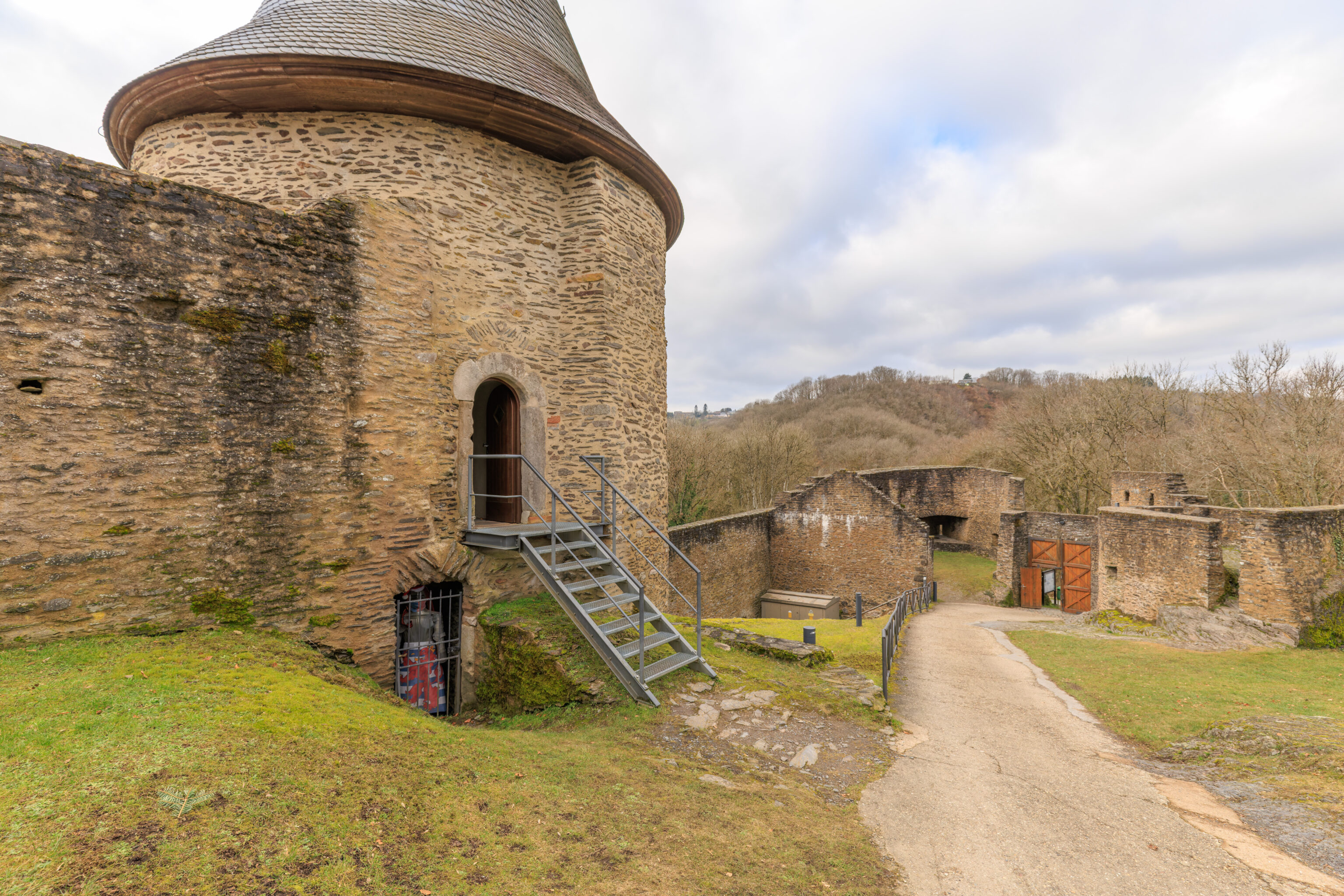
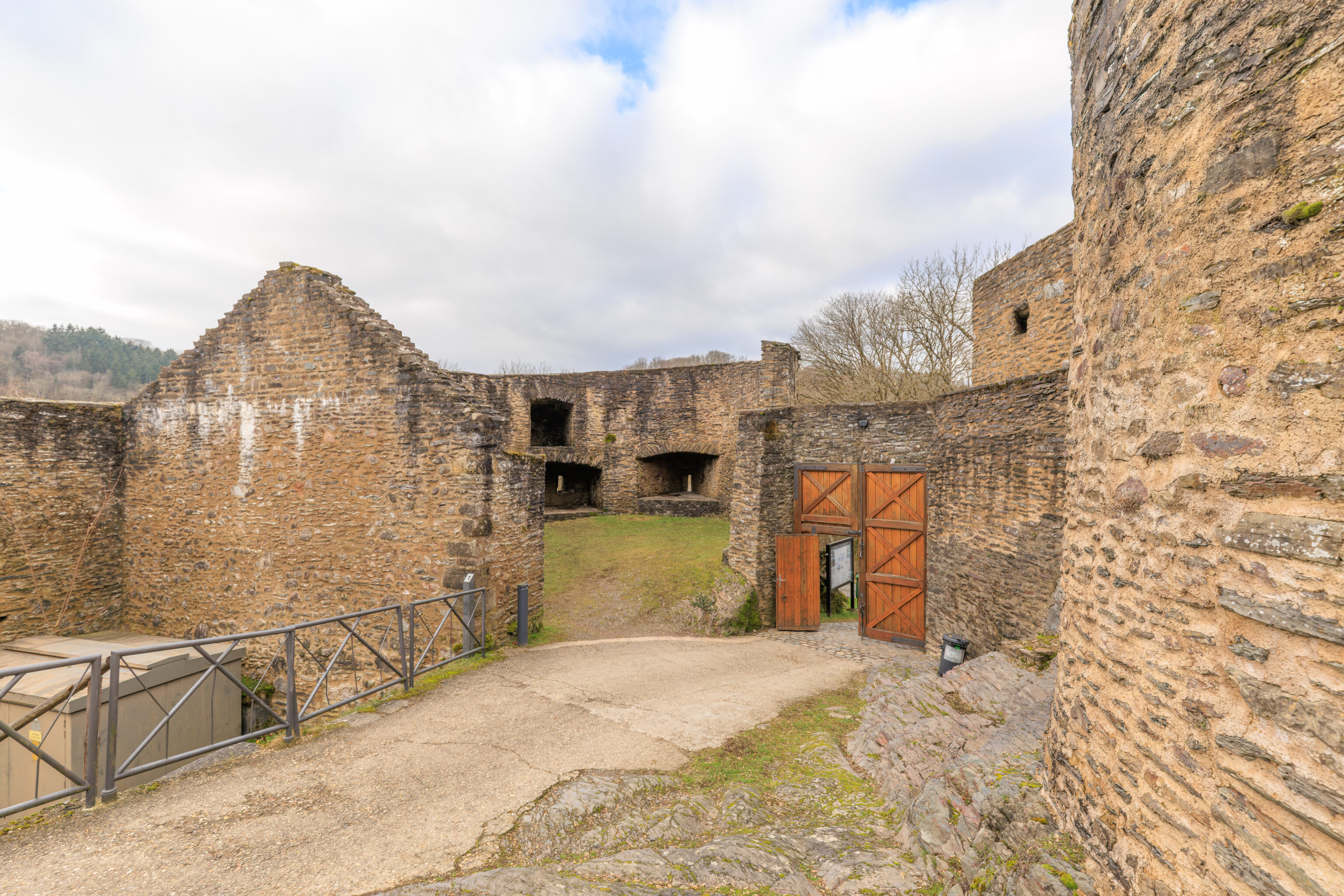
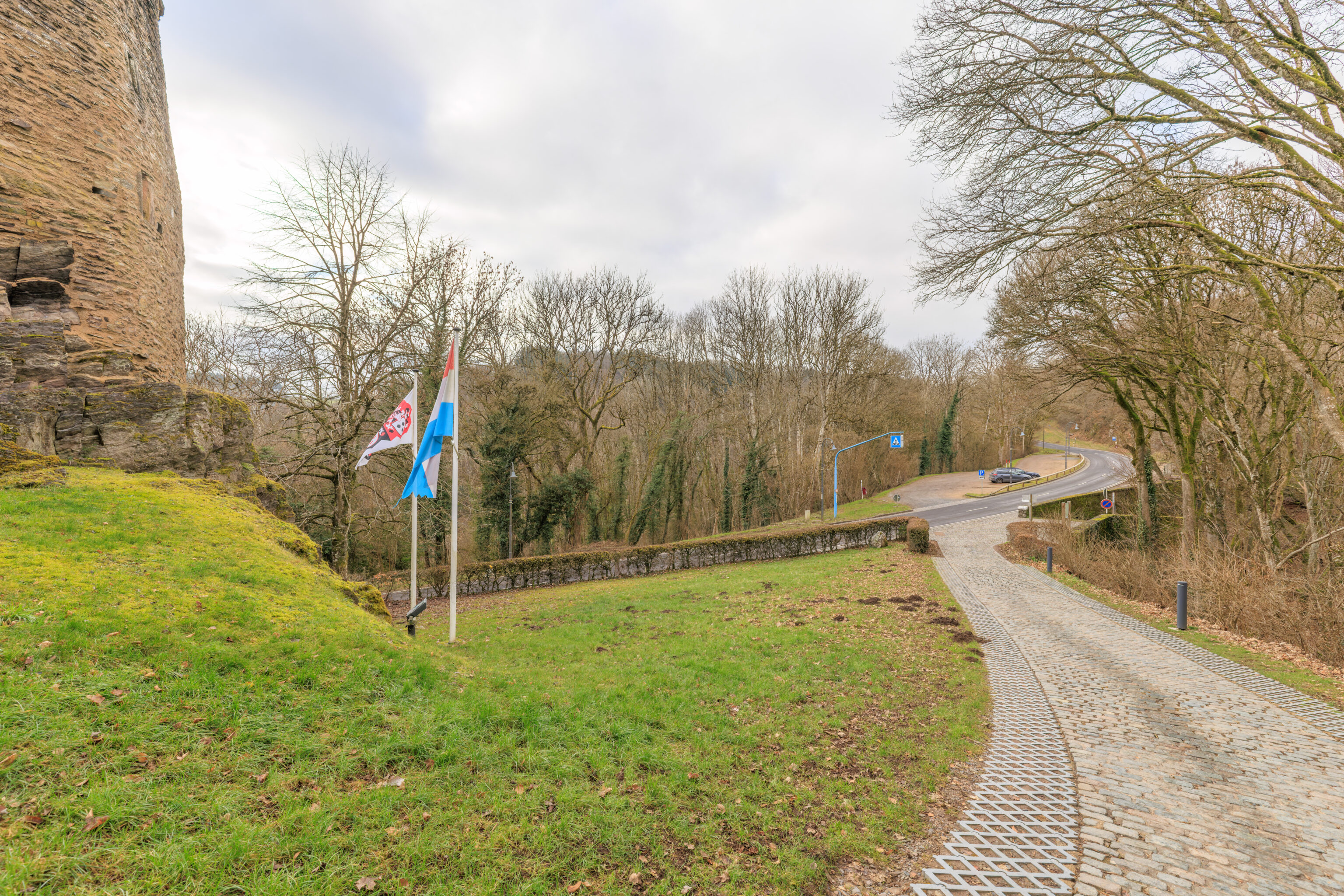
We ended our visit shortly after 1pm and started to walk down to the bus stop. There was, unfortunately, almost 30 minutes until the next bus. We ended up sitting on the low wall by the driveway entrance to pass the time.
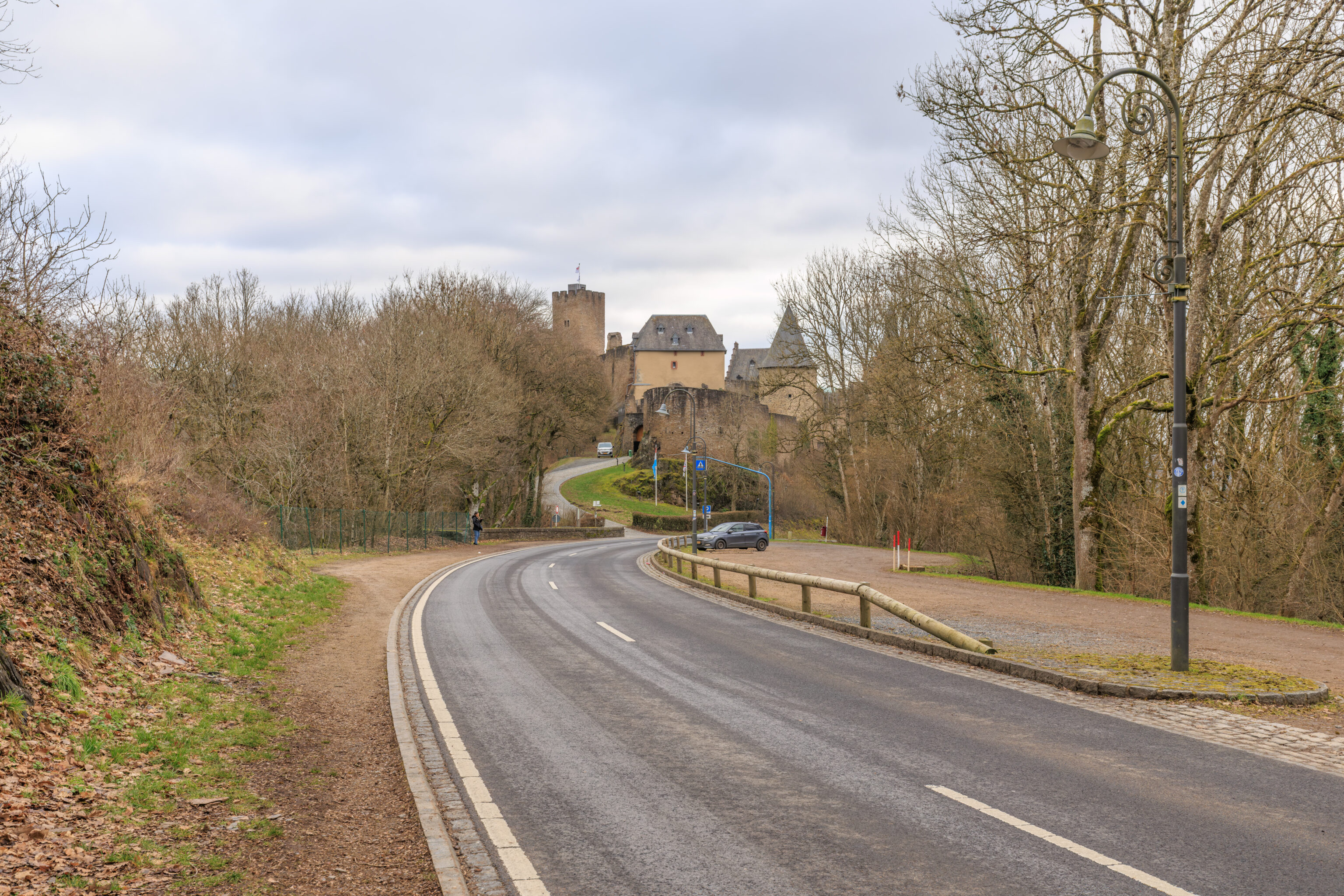
The actual bus stop is here at the far end of a small parking lot.
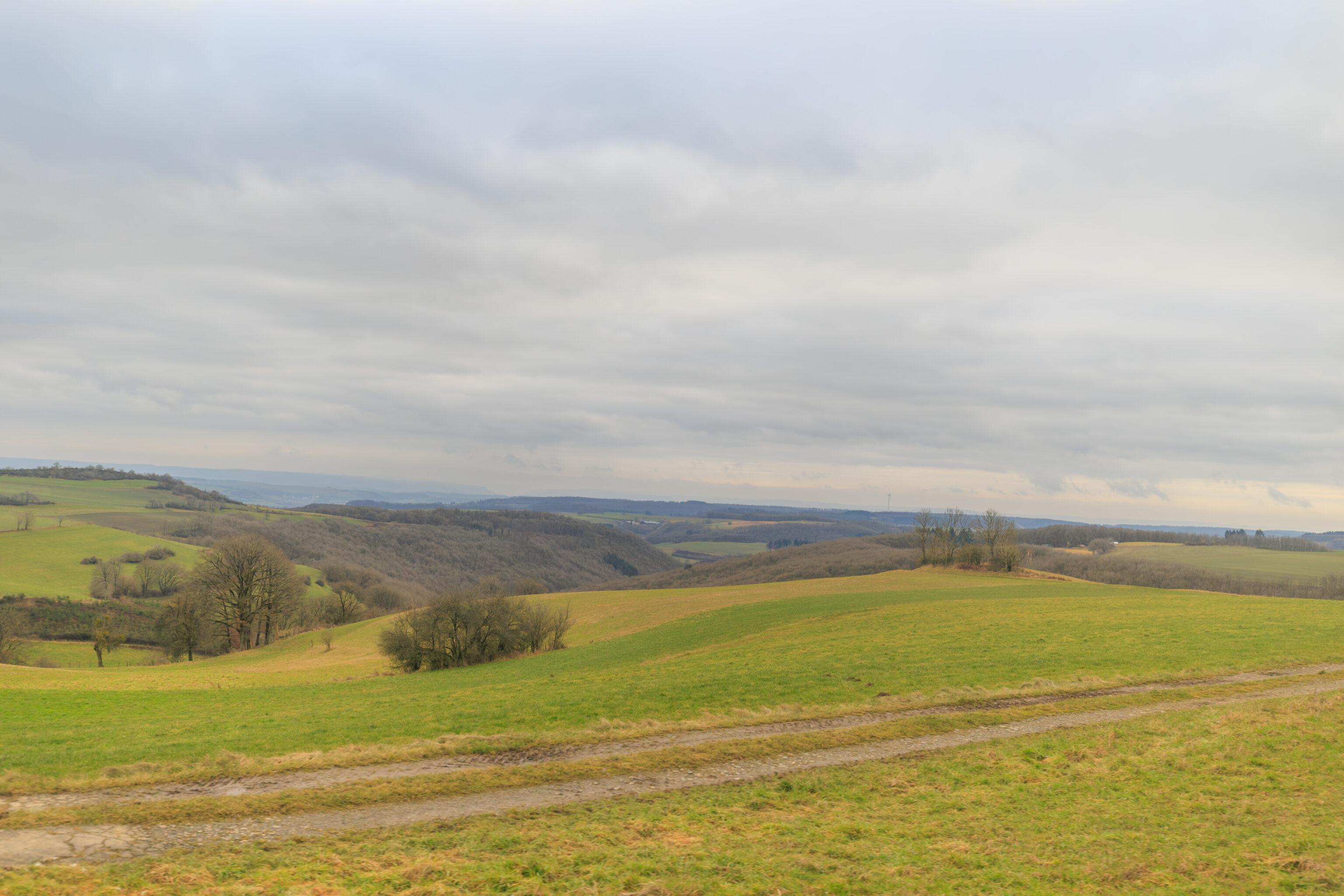
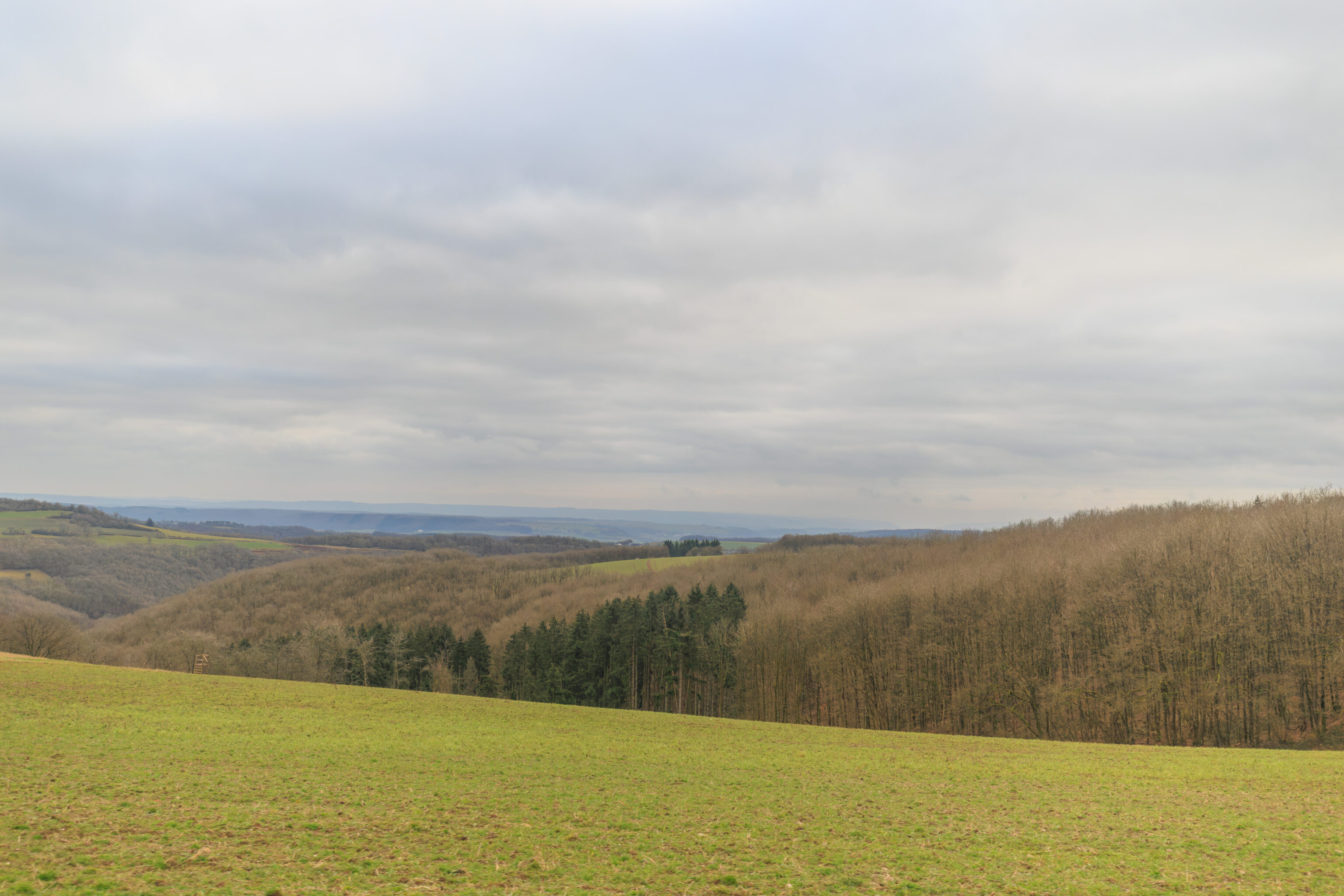
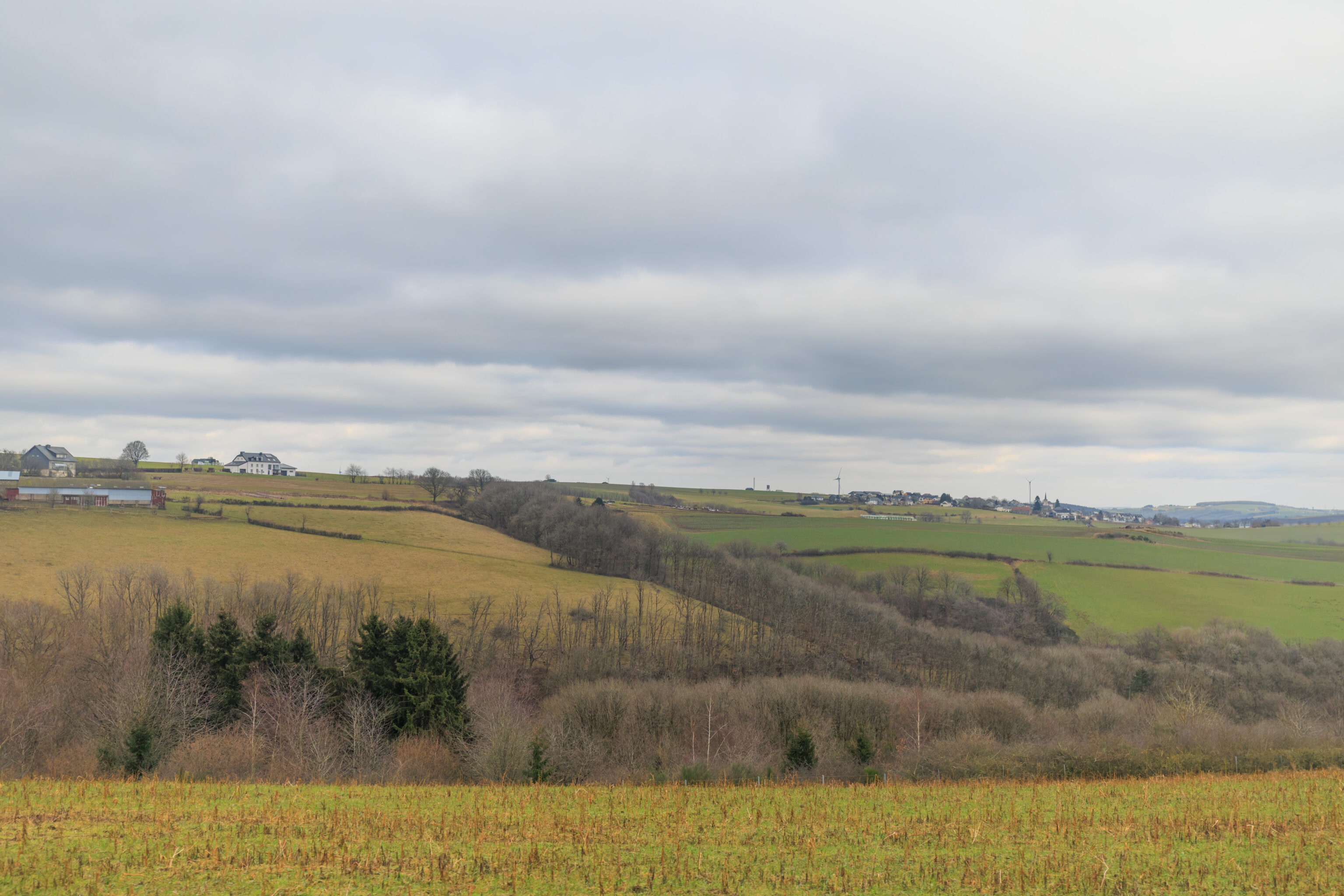
We took the bus through the countryside back to Ettelbruck. And then, we took the next train back to Luxembourg.
Ville Haute
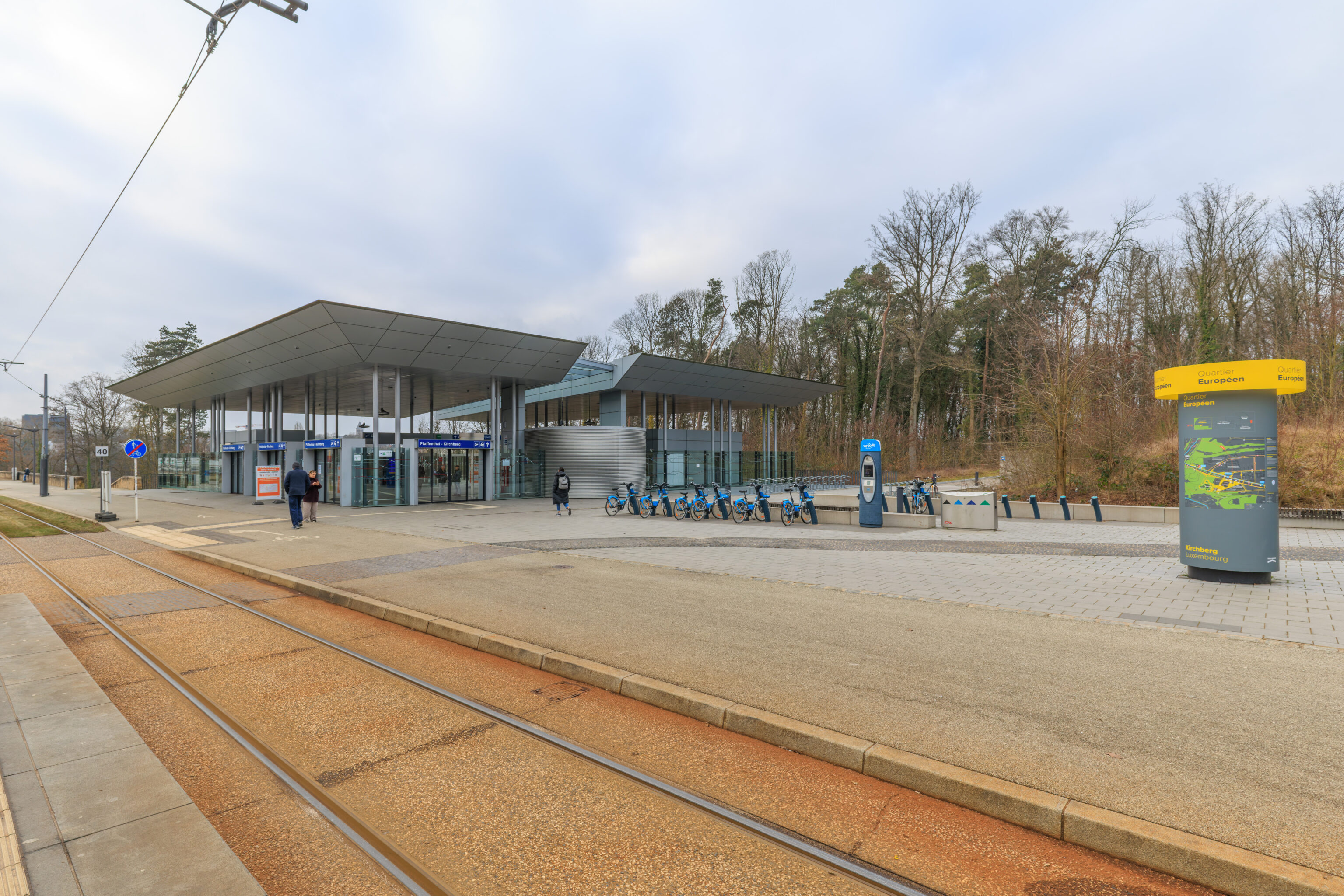
Rather than return to Luxembourg’s main train station, we got off at Pfaffenthal-Kirchberg, one stop before. This train station is basically underneath the eastern end of the Pont Grande-Duchesse Charlotte. From here, we took the Funiculaire Pfaffenthal-Kirchberg up to the eastern end of the bridge. The upper funicular station, in the photograph above, is right by the Kirchberg, Rout Bréck tram and bus stops.
We then took a tram across the bridge to return to the Ville Haute.
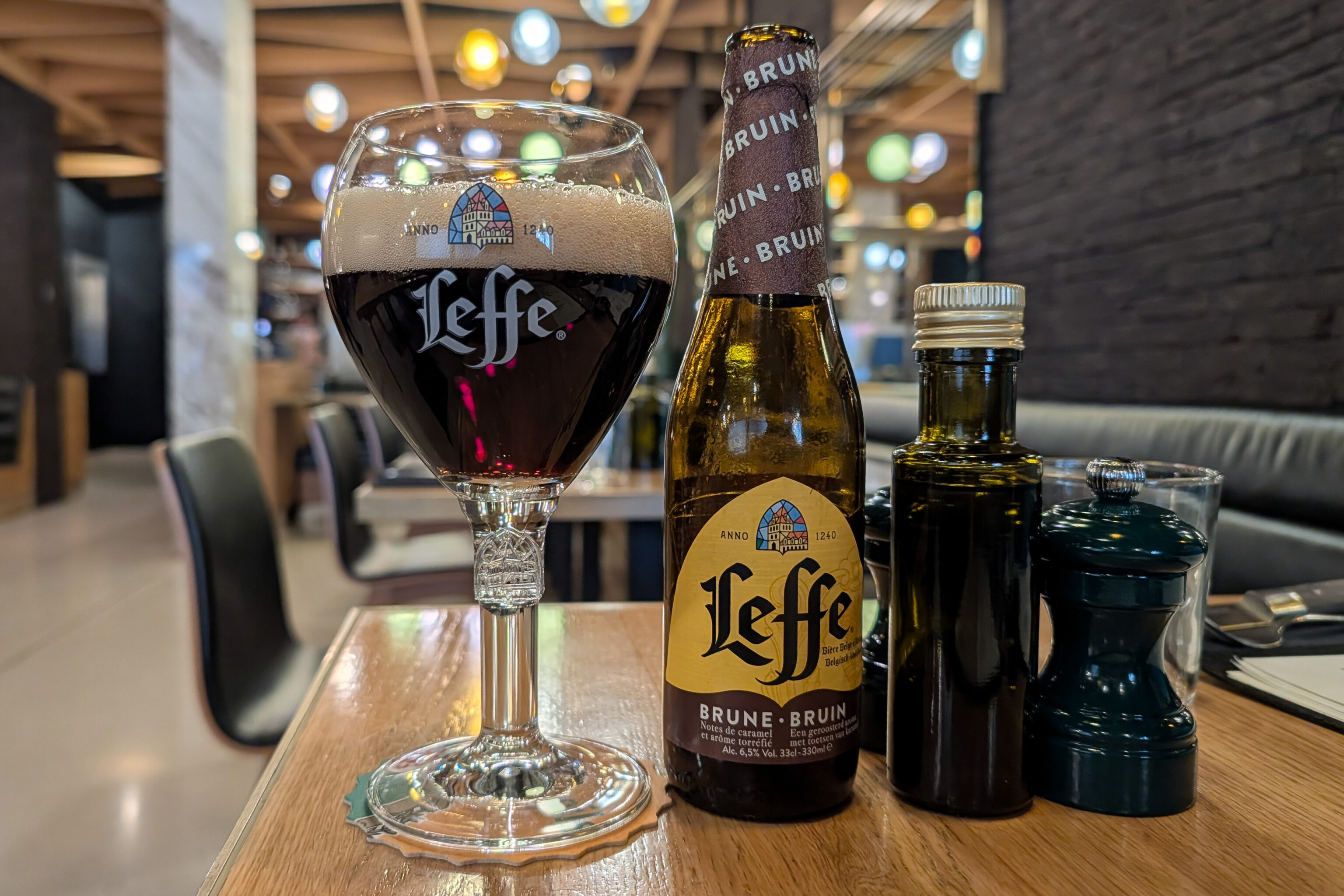
We had a late lunch at the Grand Café on the southern side of the Place d’Armes. Like lunch yesterday, this restaurant has many grilled dishes.
We had beer from Dinant, Belgium, which is near Namur, the city we visited on the first day of this trip.
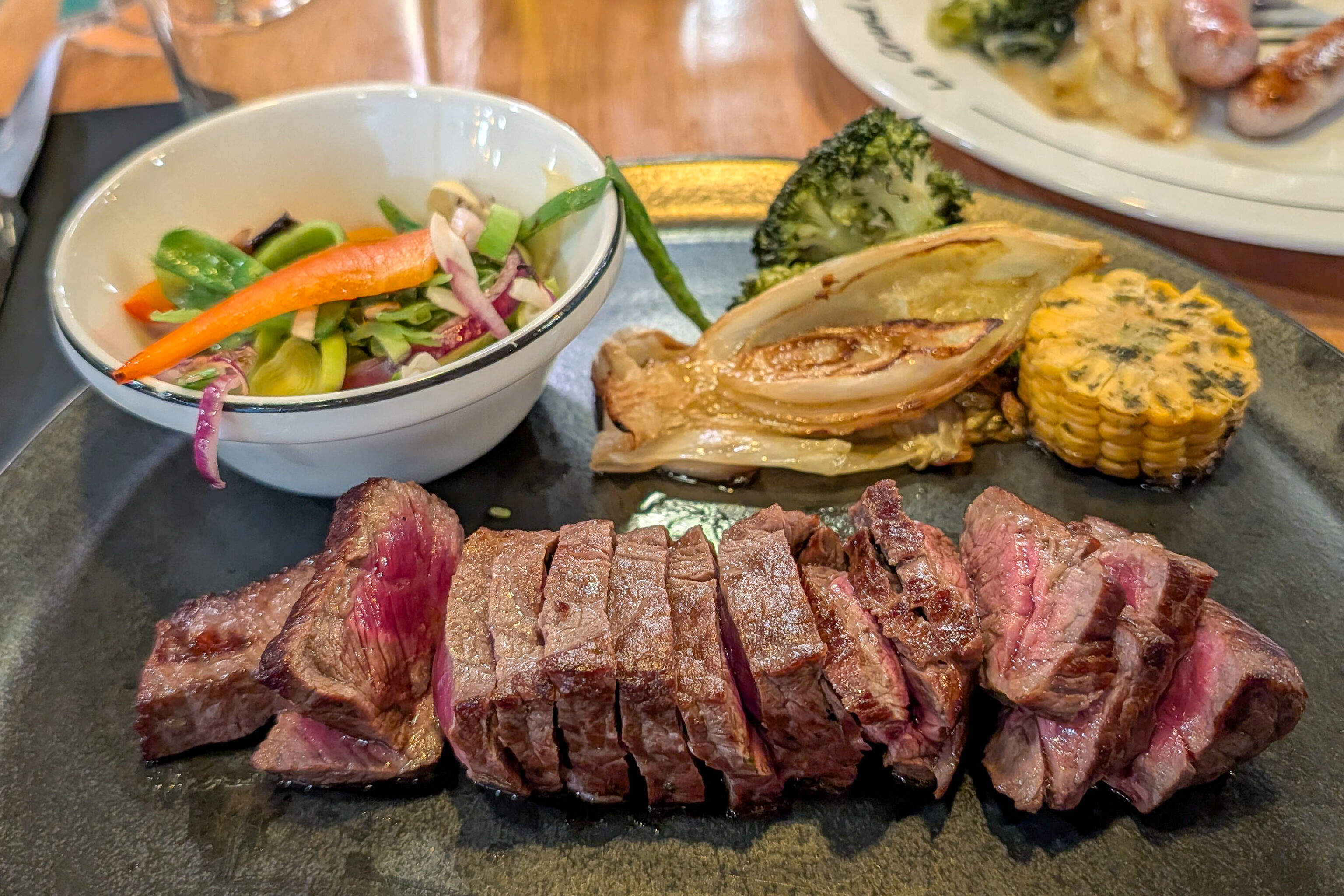
We ordered the Lingot de Boeuf, which was aged some for three weeks. It wasn’t as nice as the prime rib yesterday with its nicely charred crust. Again, it came with sauce, although it was better without it.
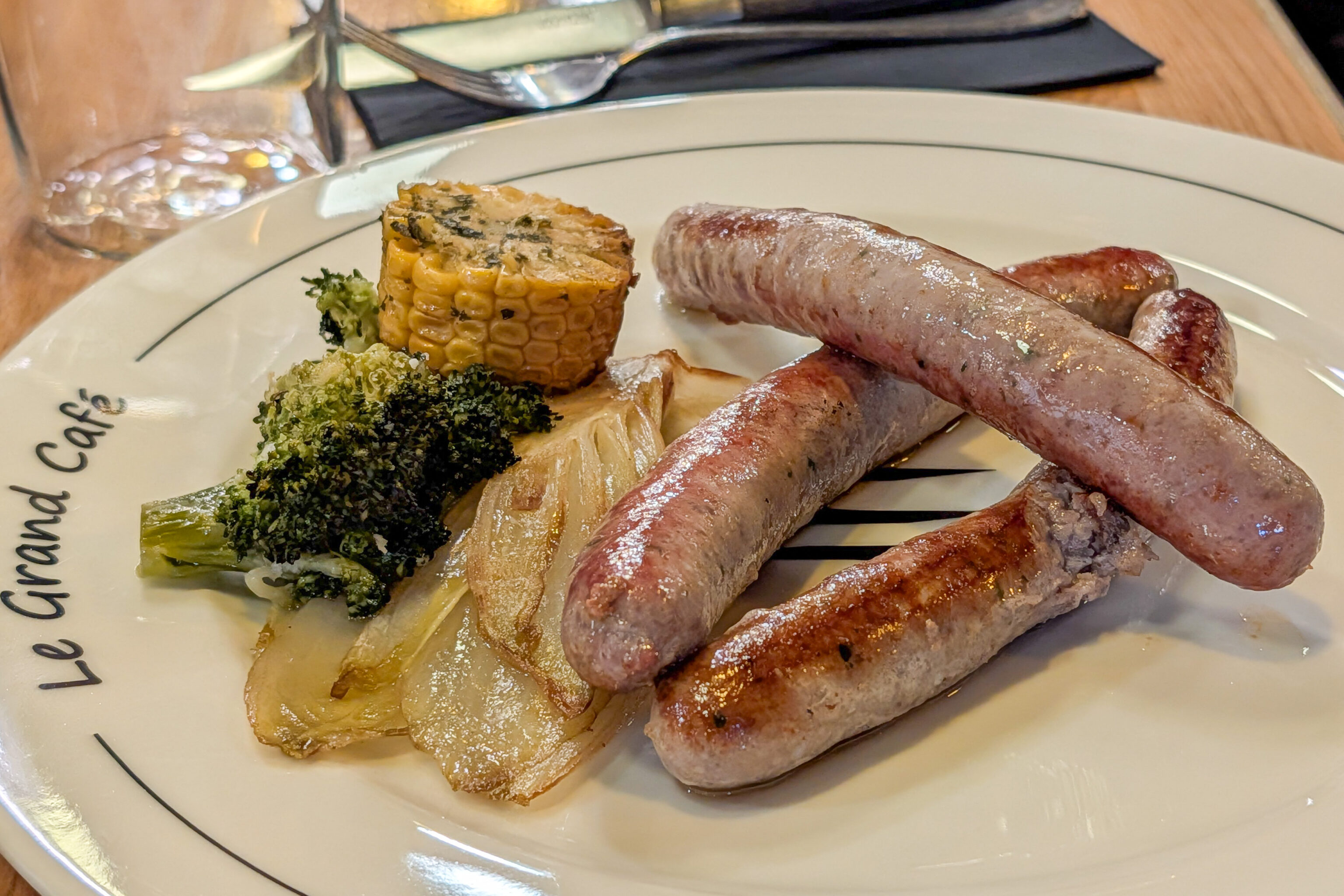
Recette exclusivement créée pour vous, 100% naturelle, sans conservateur, porc et veau, sauce hollandaise moutardée, écrasé de pommes de terre, salade verte.
WAINZOSSISS GRAND CAFÉ
A recipe created exclusively for you: 100% natural, preservative-free; pork and veal sausage, mustard-infused hollandaise sauce, crushed potatoes, green salad.
We also ordered the Wainzossiss (Wine Sausage), a type of sausage from Luxembourg. It was excellent!
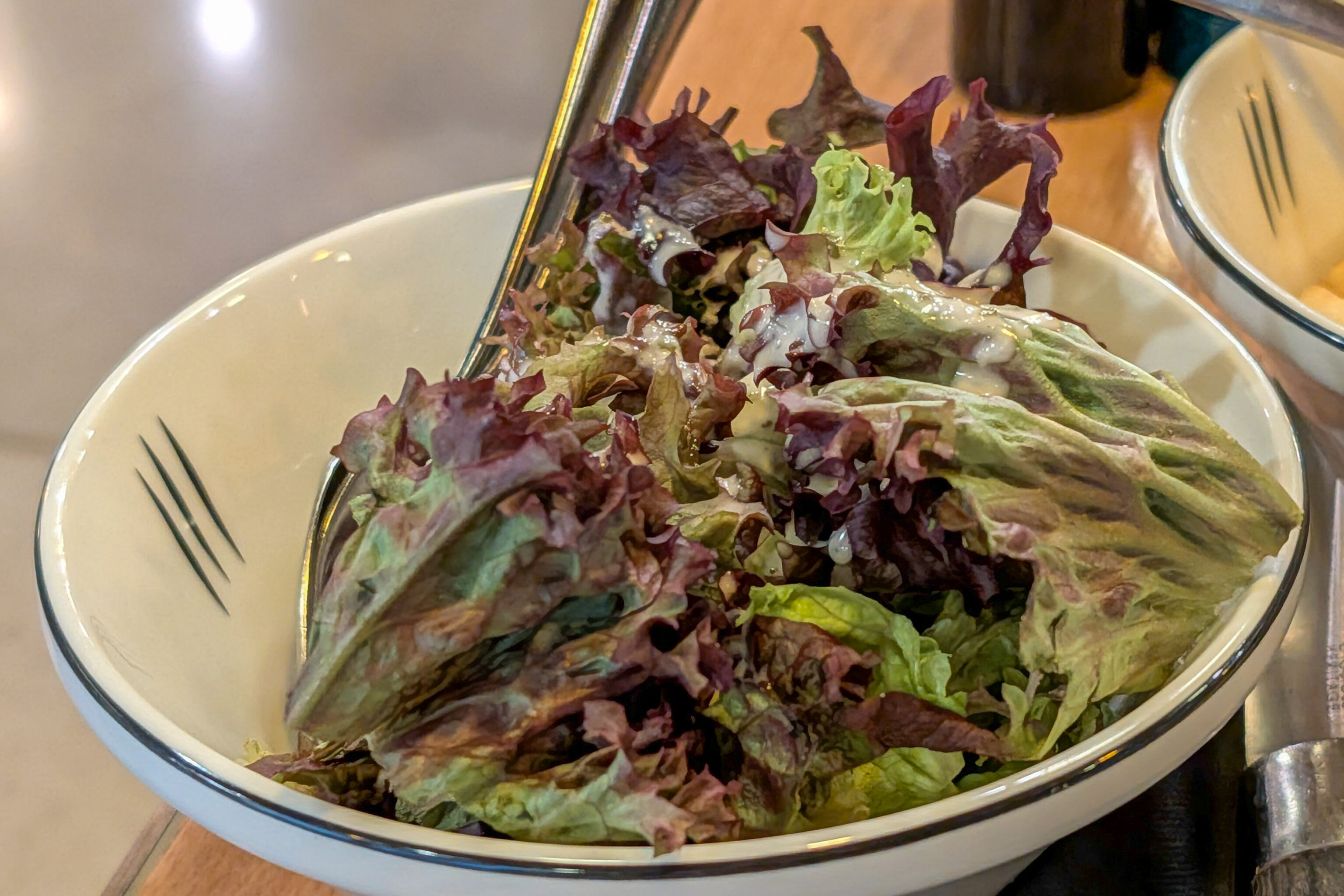
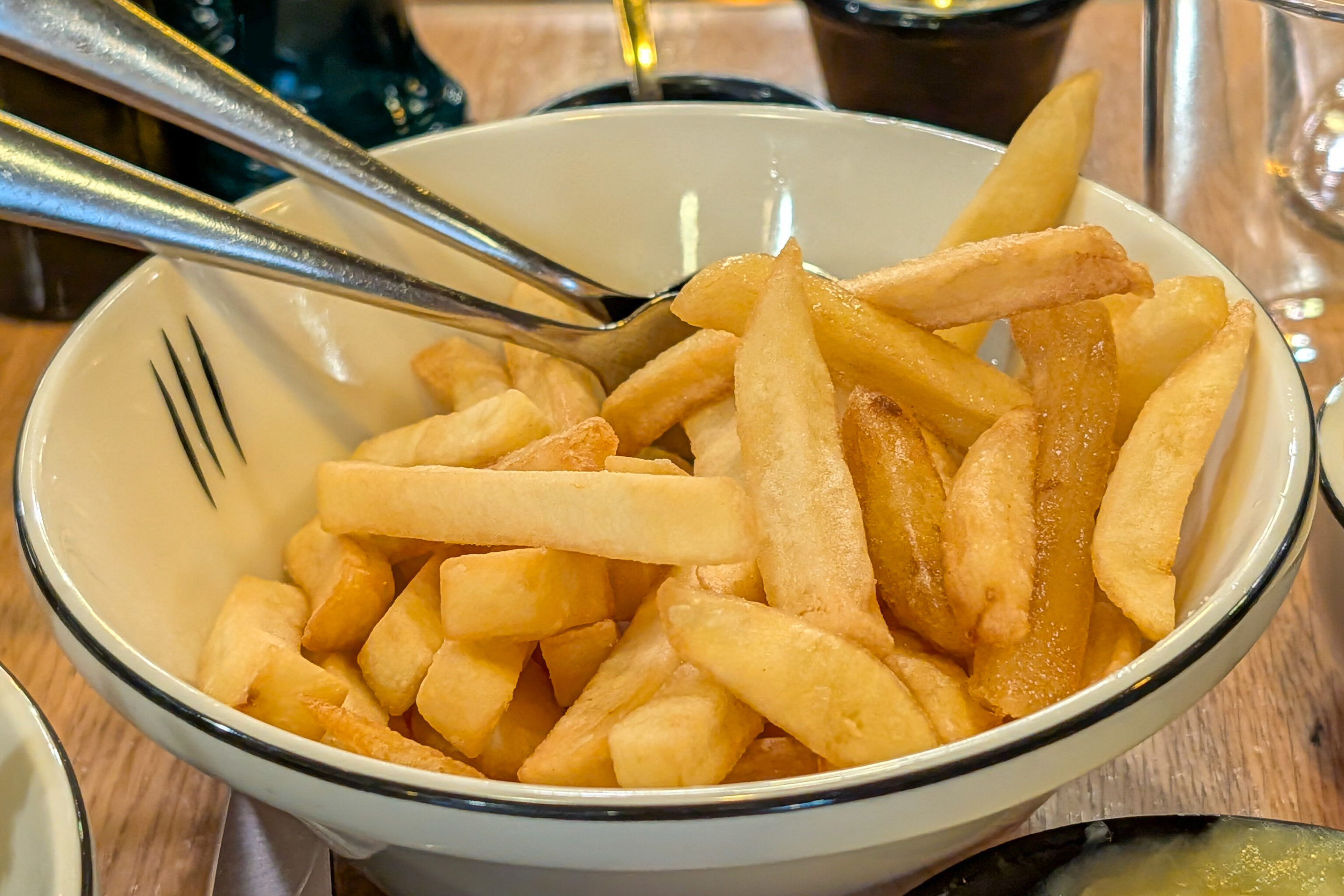
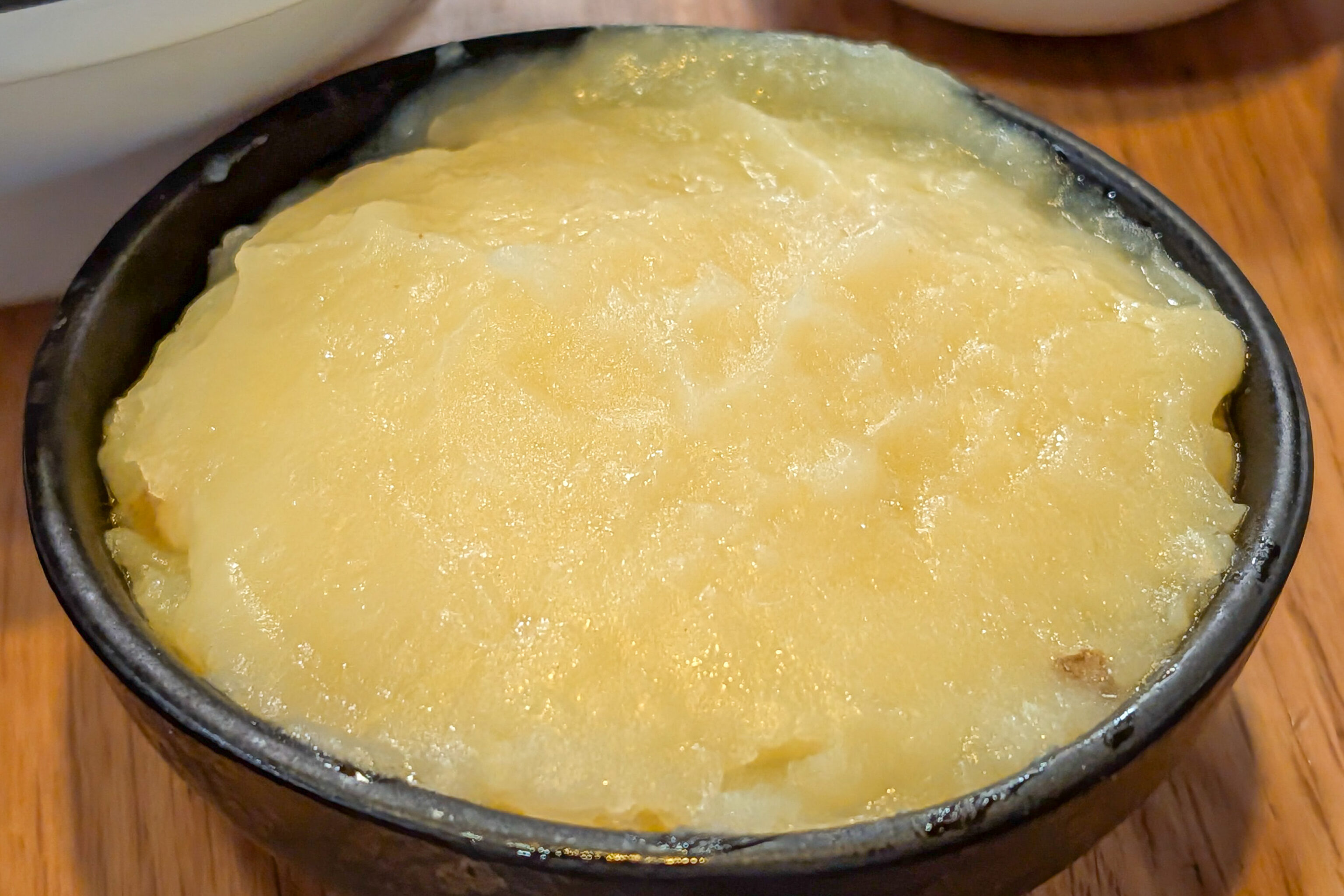
The dishes came with salad, which was decent, as well as fries, which were also decent. The mashed potatoes unfortunately weren’t very good when cold. It was cold by the time we got to them! There were also 3 small pieces of baguette bread, which were good, but we didn’t photograph them.
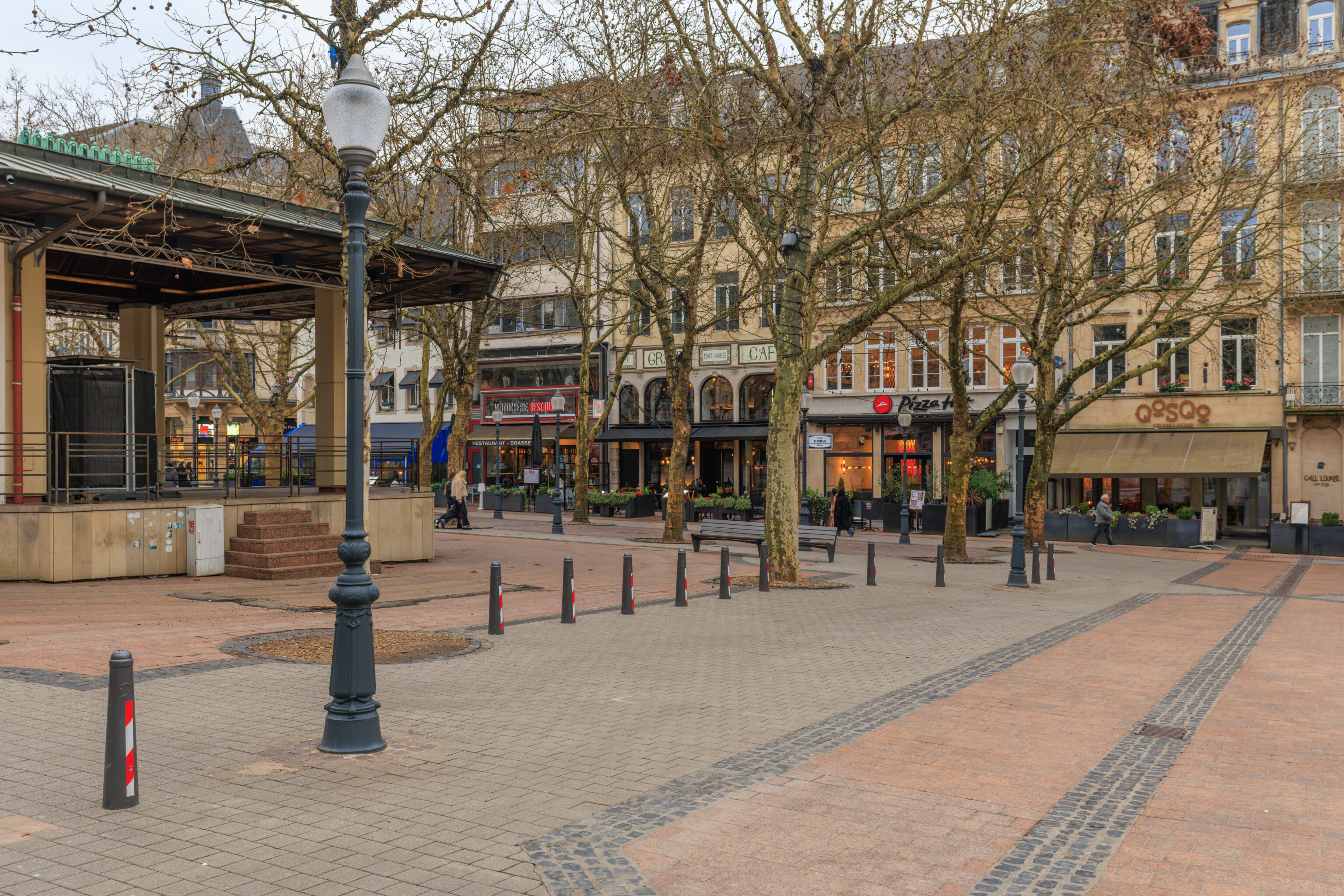
The Grand Café, as seen from the north side of the Place d’Armes.
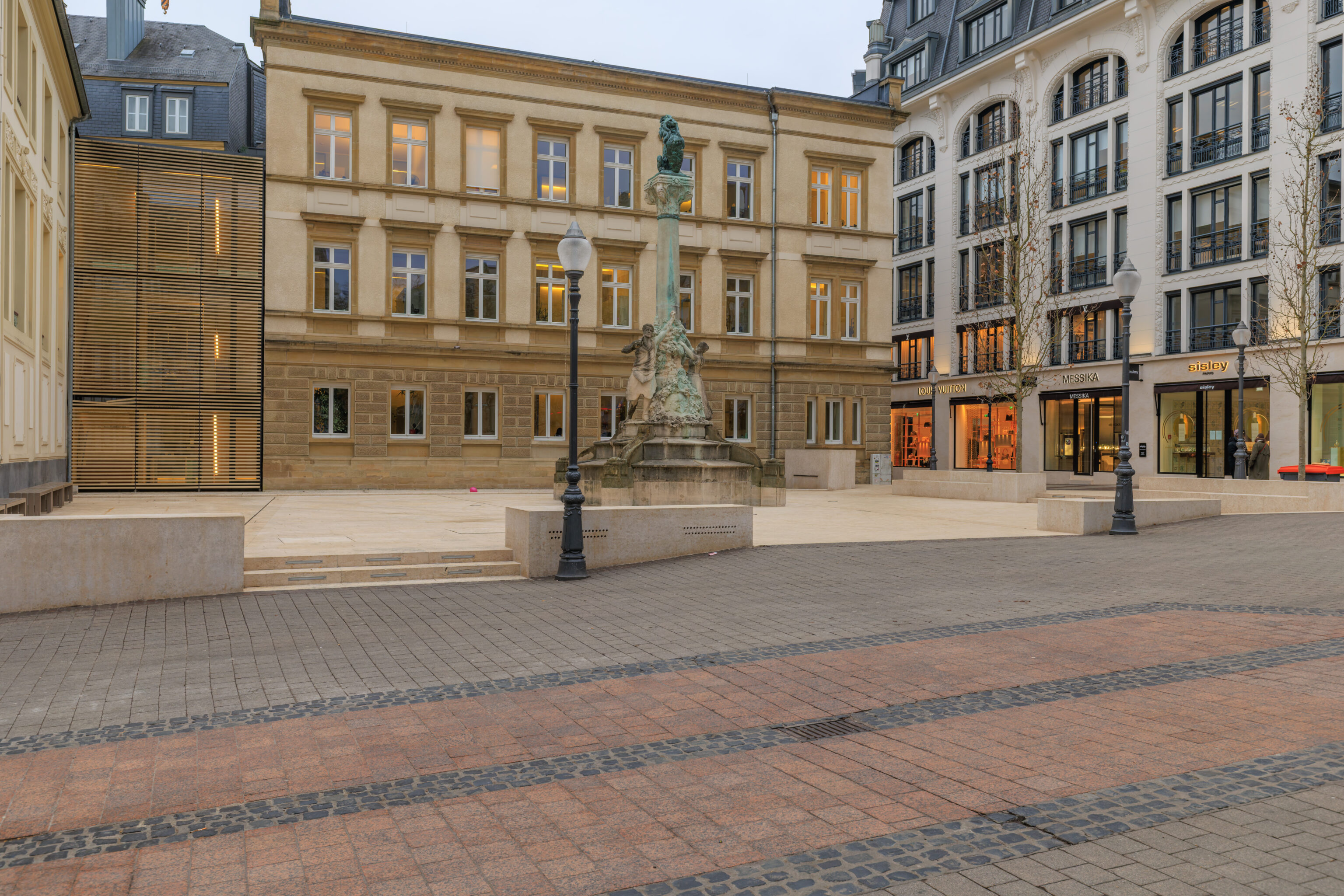
The Monument to Dicks and Lentz, which we also saw two days ago when we were here.
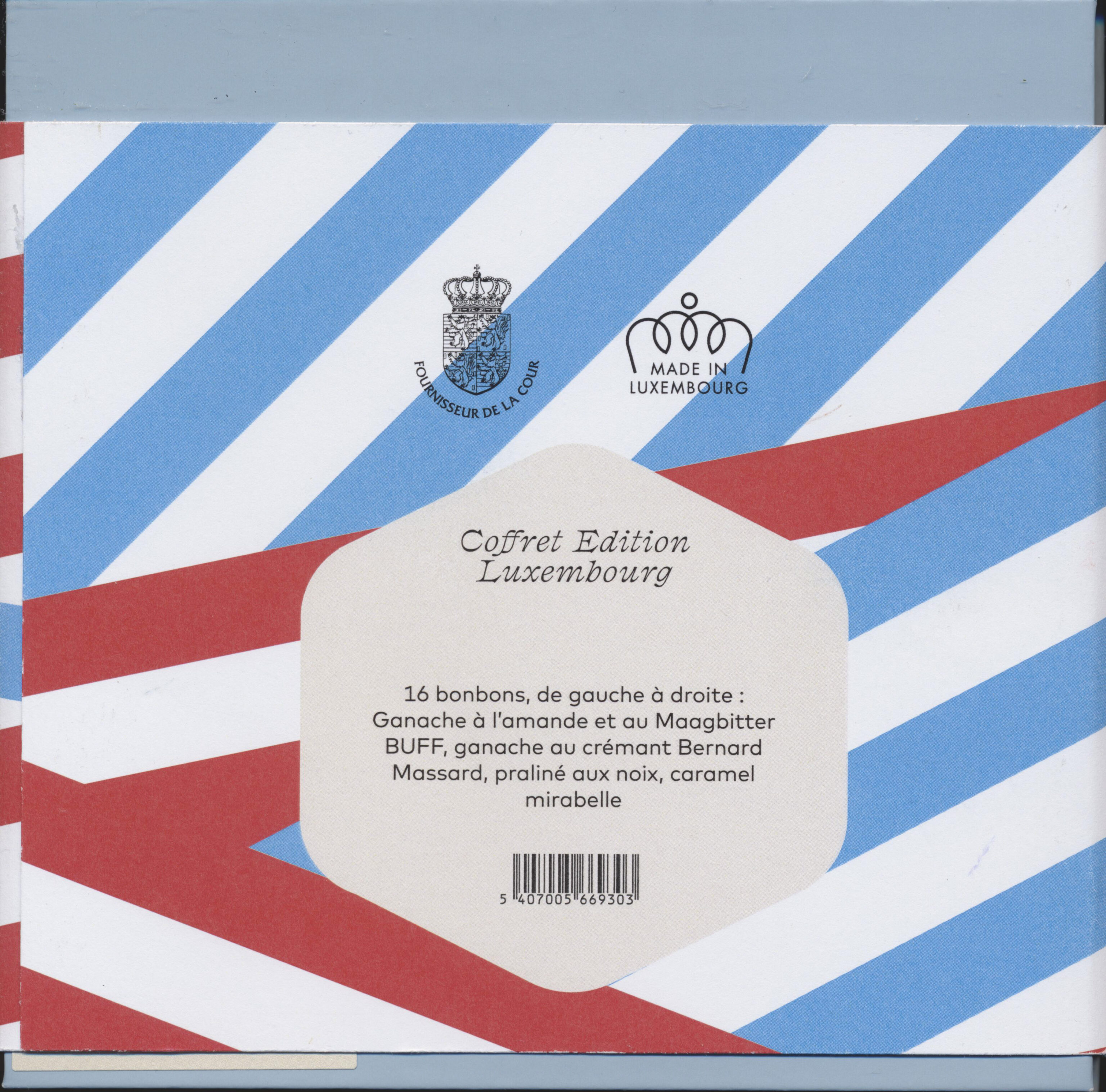


We returned to Genaveh, the local chocolatier that we visited two days ago, to buy more chocolates for ourselves and as gifts.
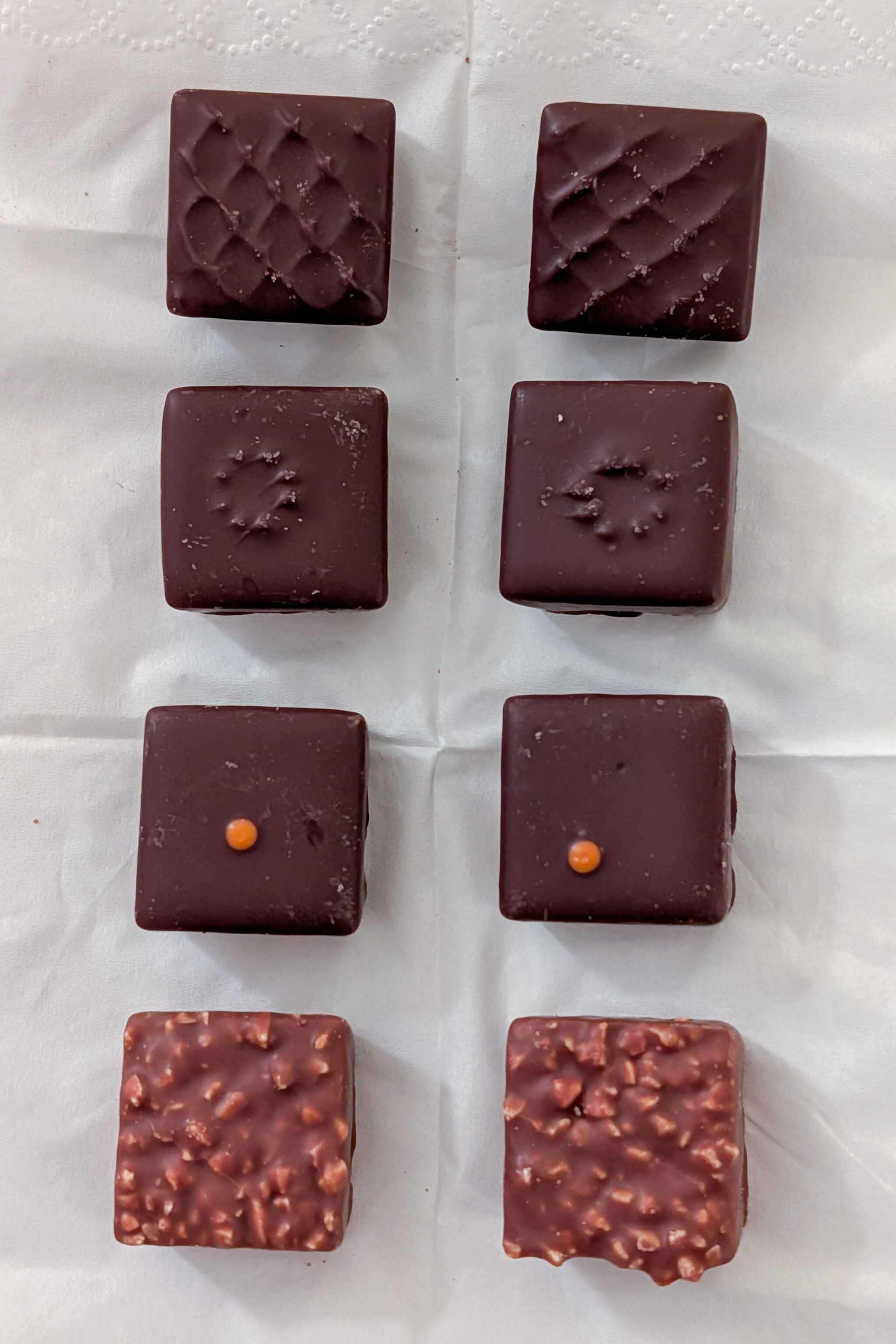
We ate these later in the day…
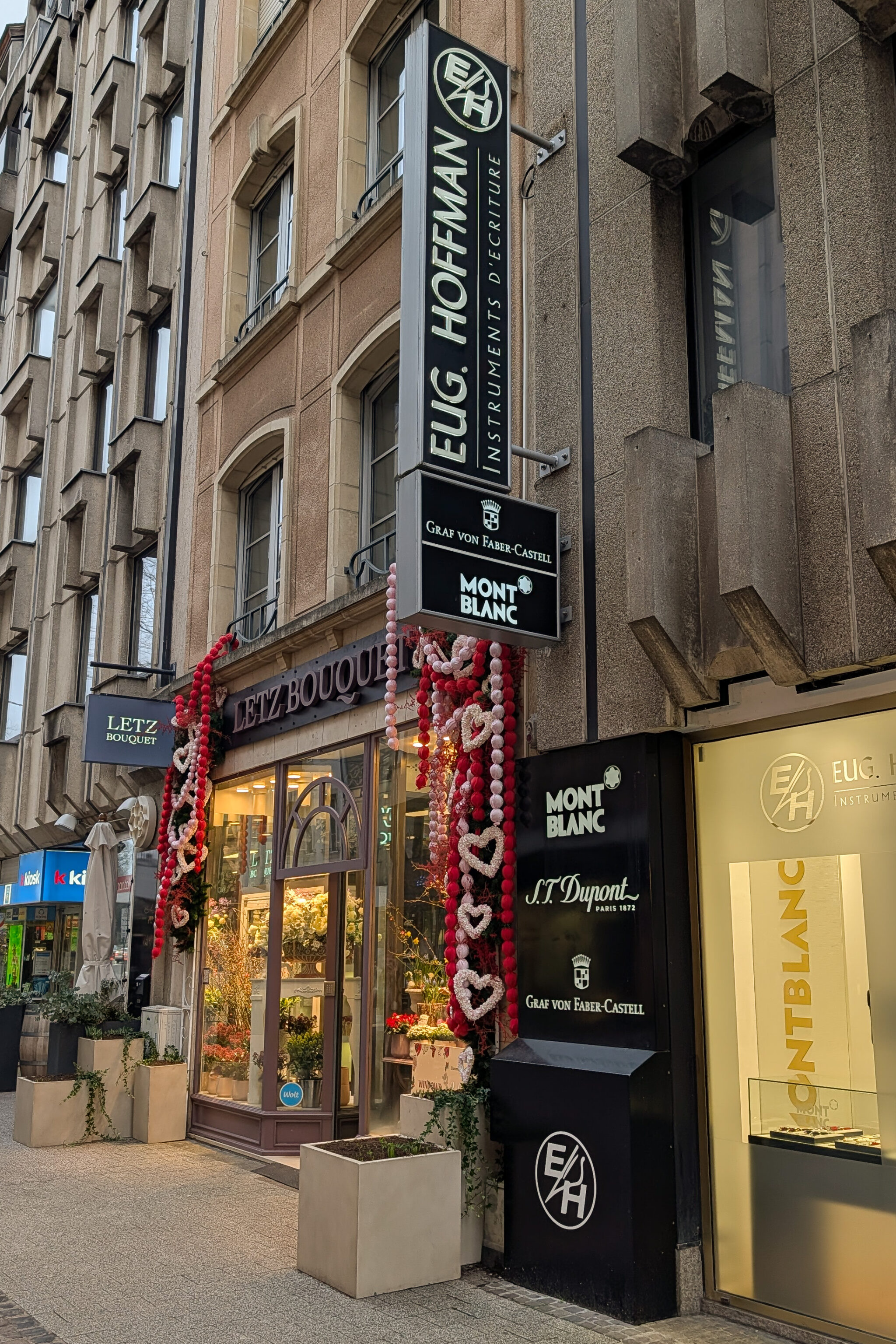
I remember Faber-Castell pencils from when I was little. It never really occurred to me that Faber-Castell was a German noble family! They are from the town of Stein near Nürnberg.
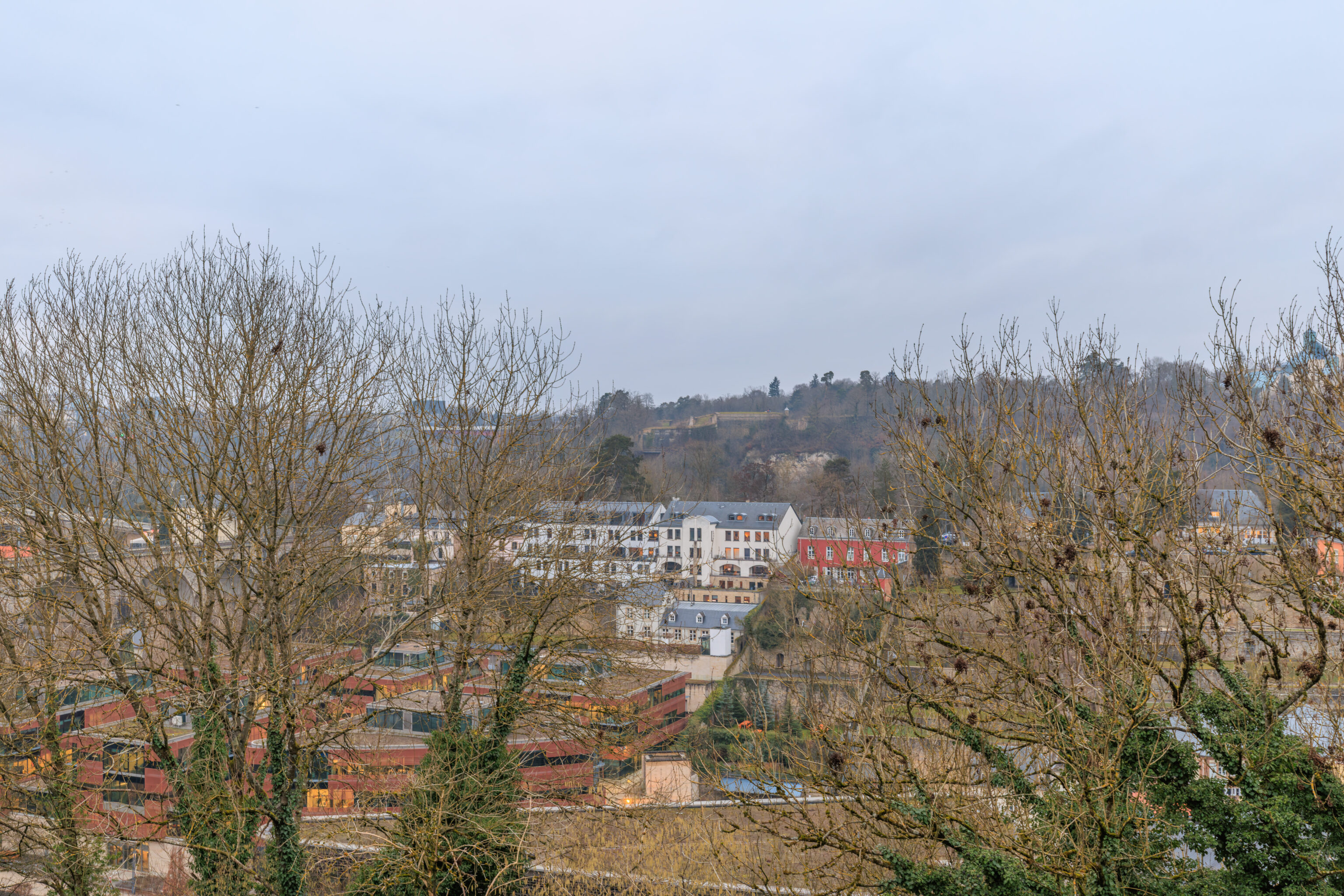
We took a bus from the Badanstalt bus stop to the Kéibierg-INS bus stop. This bus stop is on a promontory that juts out to the west from the high ground east of the Alzette and was formed by a curve of the Alzette. It is just to the south of the Bock, which juts out from the high ground to the west side of the Alzette.
There was an overlook just to the east of the bus stop. Unfortunately, the trees here blocked the view.
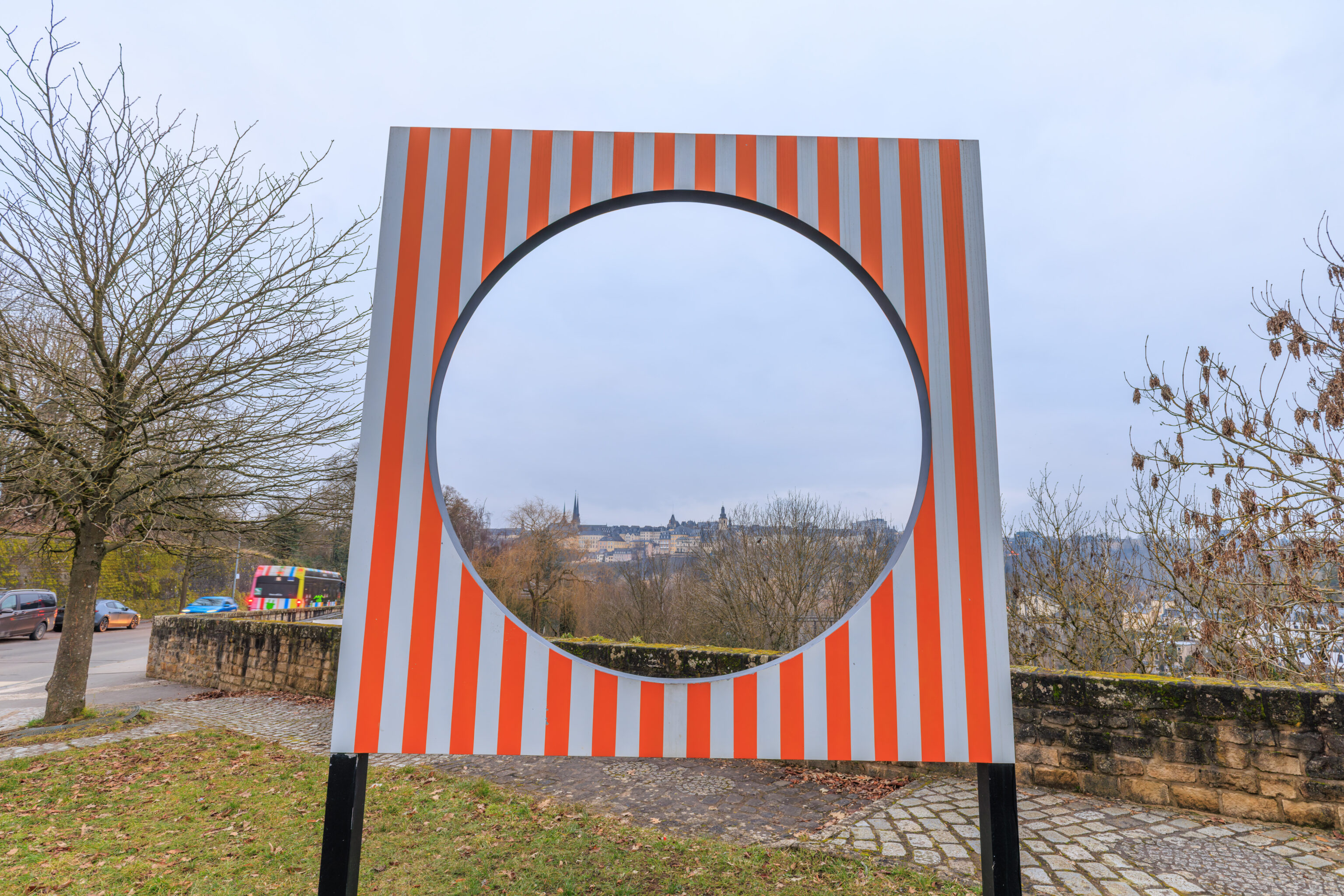
We noticed this… artwork… We saw a similar one two days ago in the area below Fort Obergrünewald.
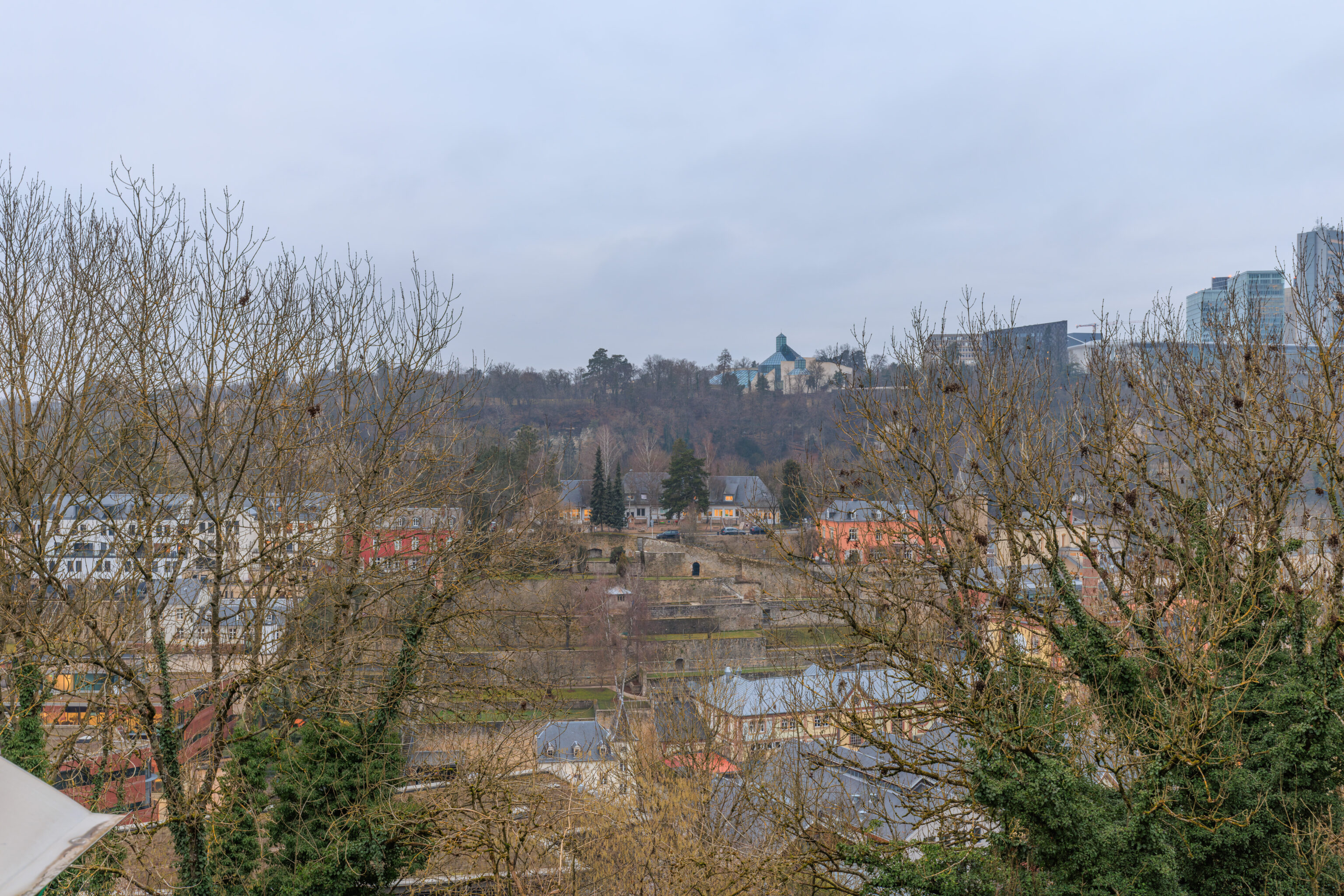
The view from the overlook was unfortunately consistently blocked by trees. Here, we can clearly see the MUDAM, the Musée d’Art Moderne Grand-Duc Jean.
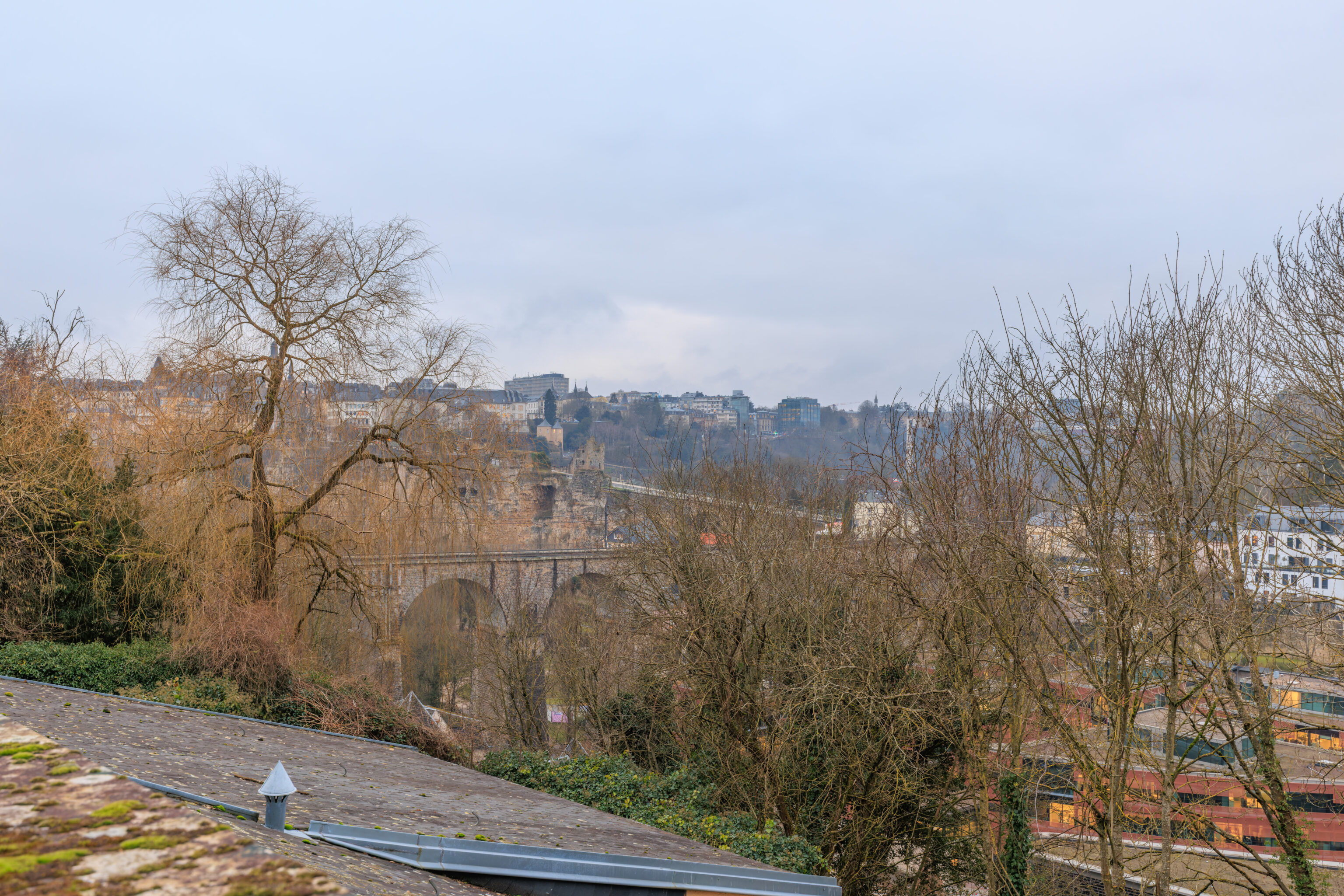
Peeking through the trees to the northwest, we could see the Bock.
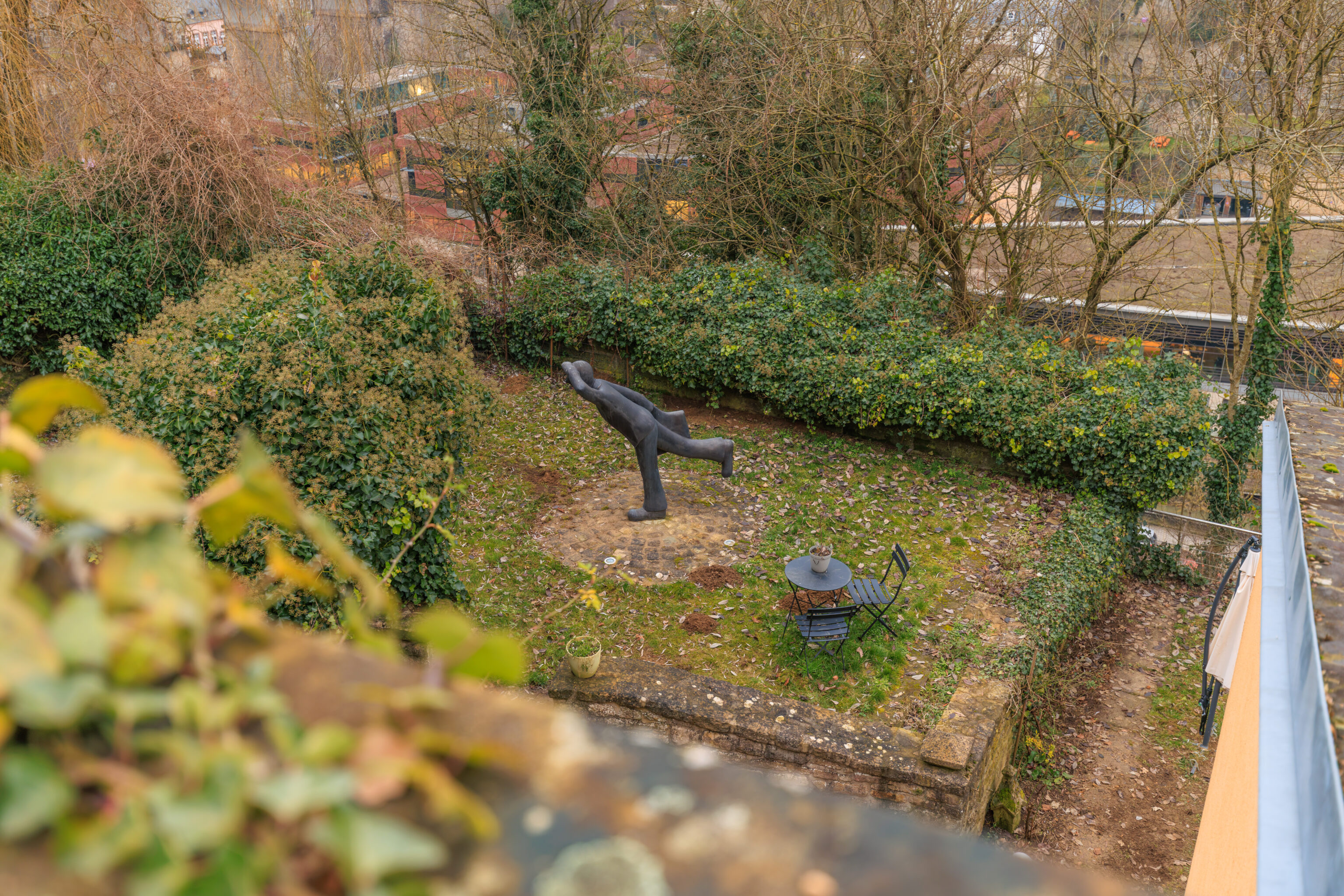
Looking down, there was a sculpture in a small yard.
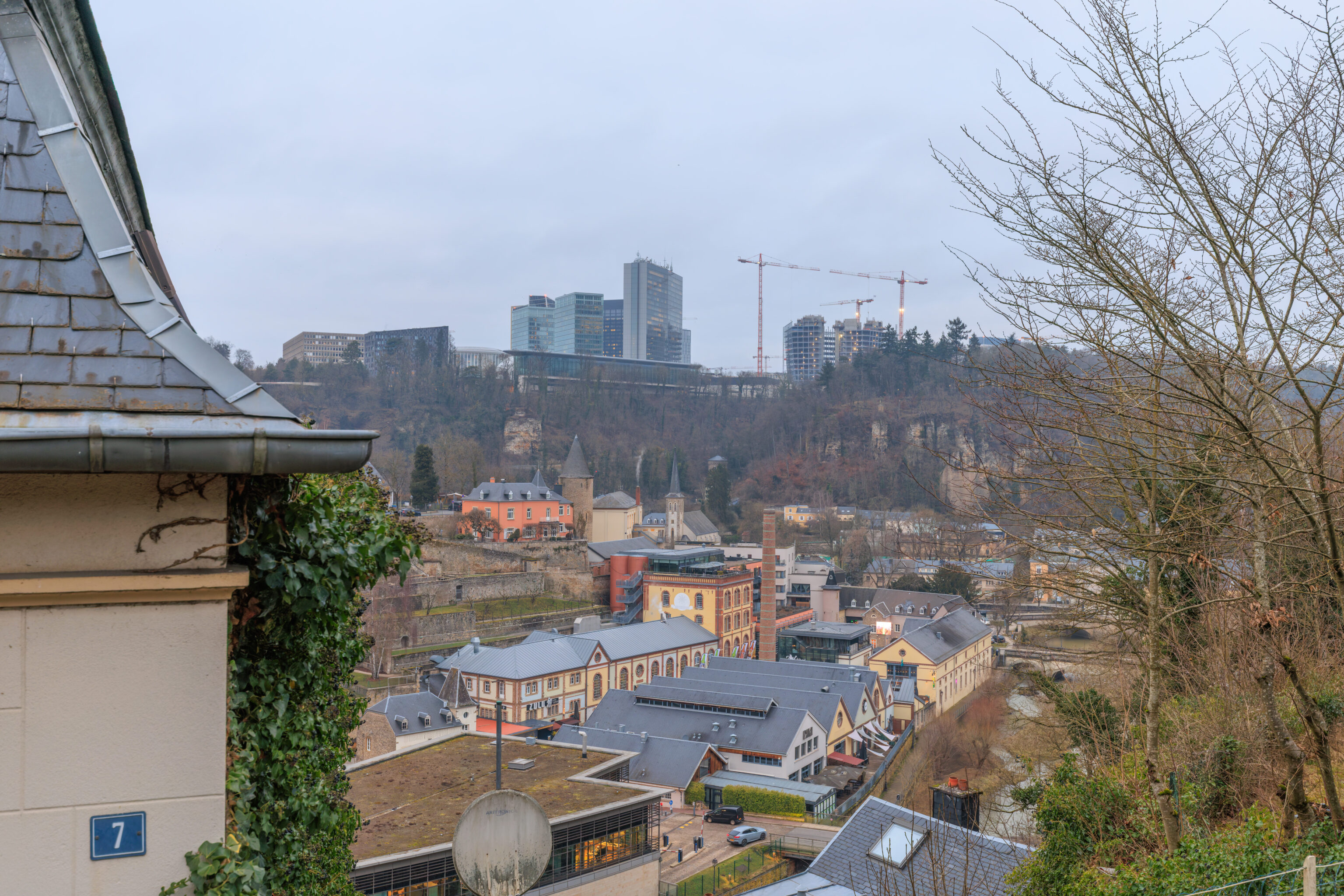
We started to walk downhill to the west with the road on one side and a cliff on the other. The tall buildings here are in the Kirchberg district, the area just to the east of the Pont Grande-Duchesse Charlotte.
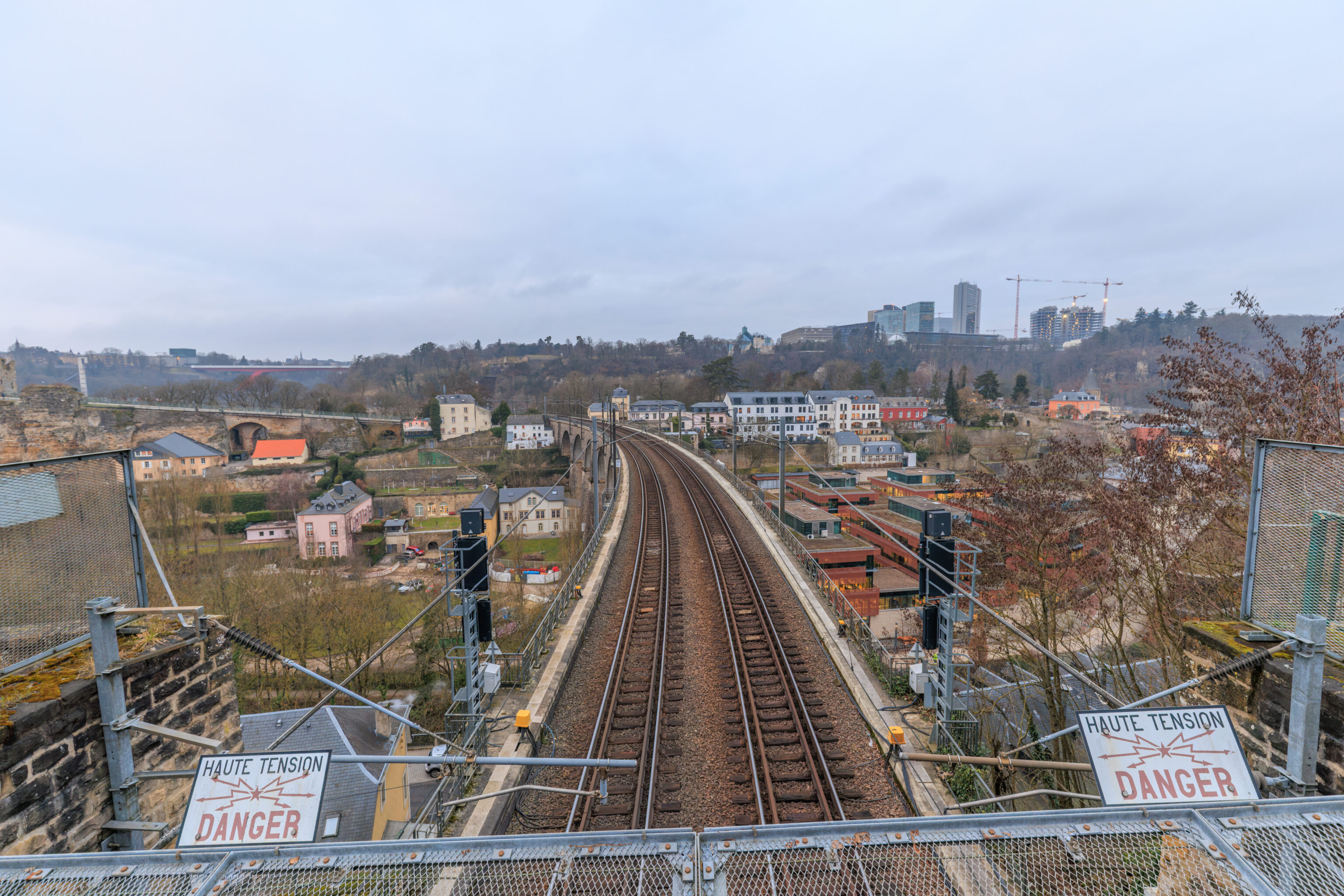
The road crossed over the rail viaduct below. If we had stayed on the train to Luxembourg Station, we would have passed under here on our way back from Ettelbruck.
We did have to backtrack a bit on the way to this point due to the path on the side of the road, which was slightly below grade, being blocked by construction.
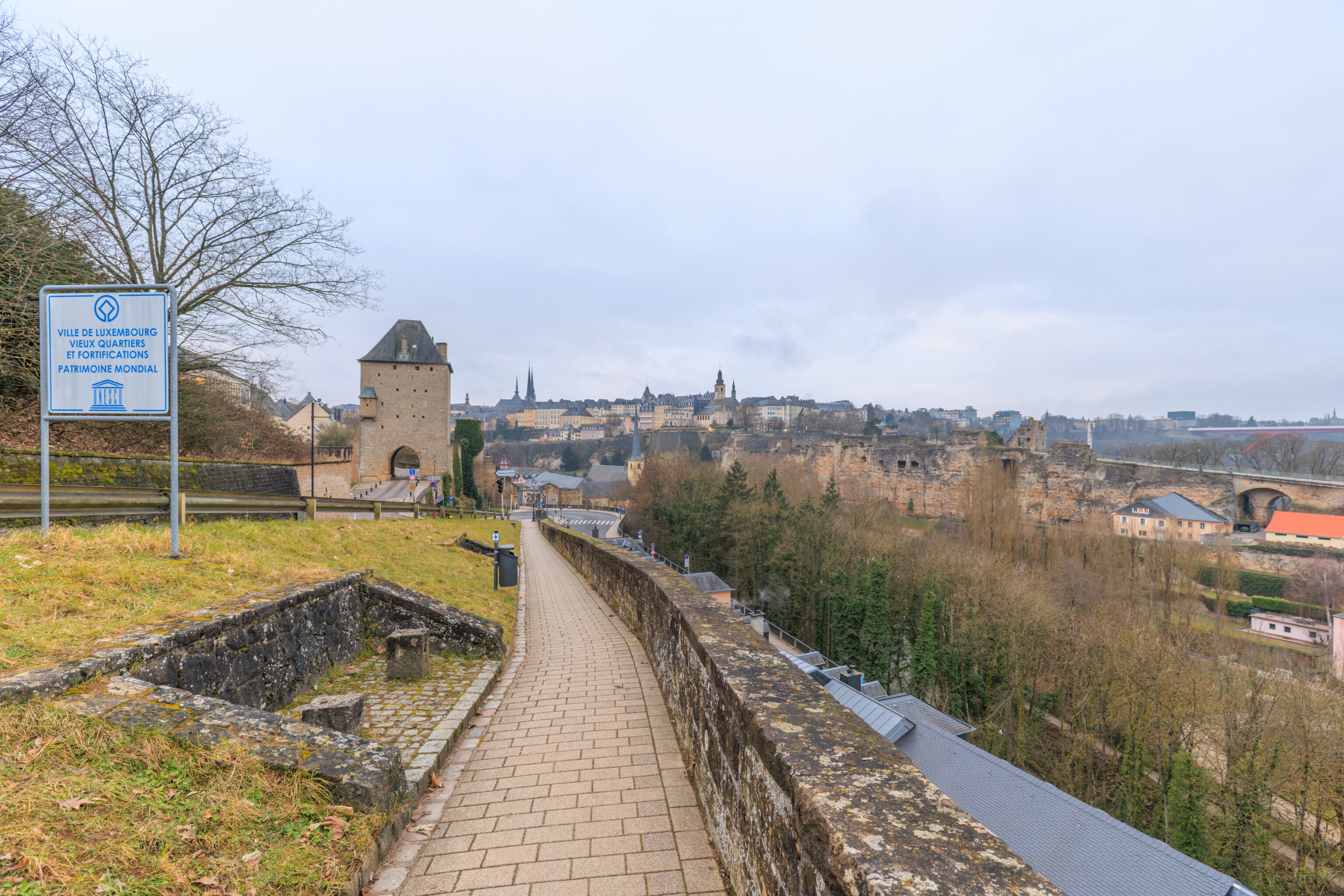
We continued walking downhill to the west. On the right, we can see the Bock. The Ville Haute is in the background ahead.
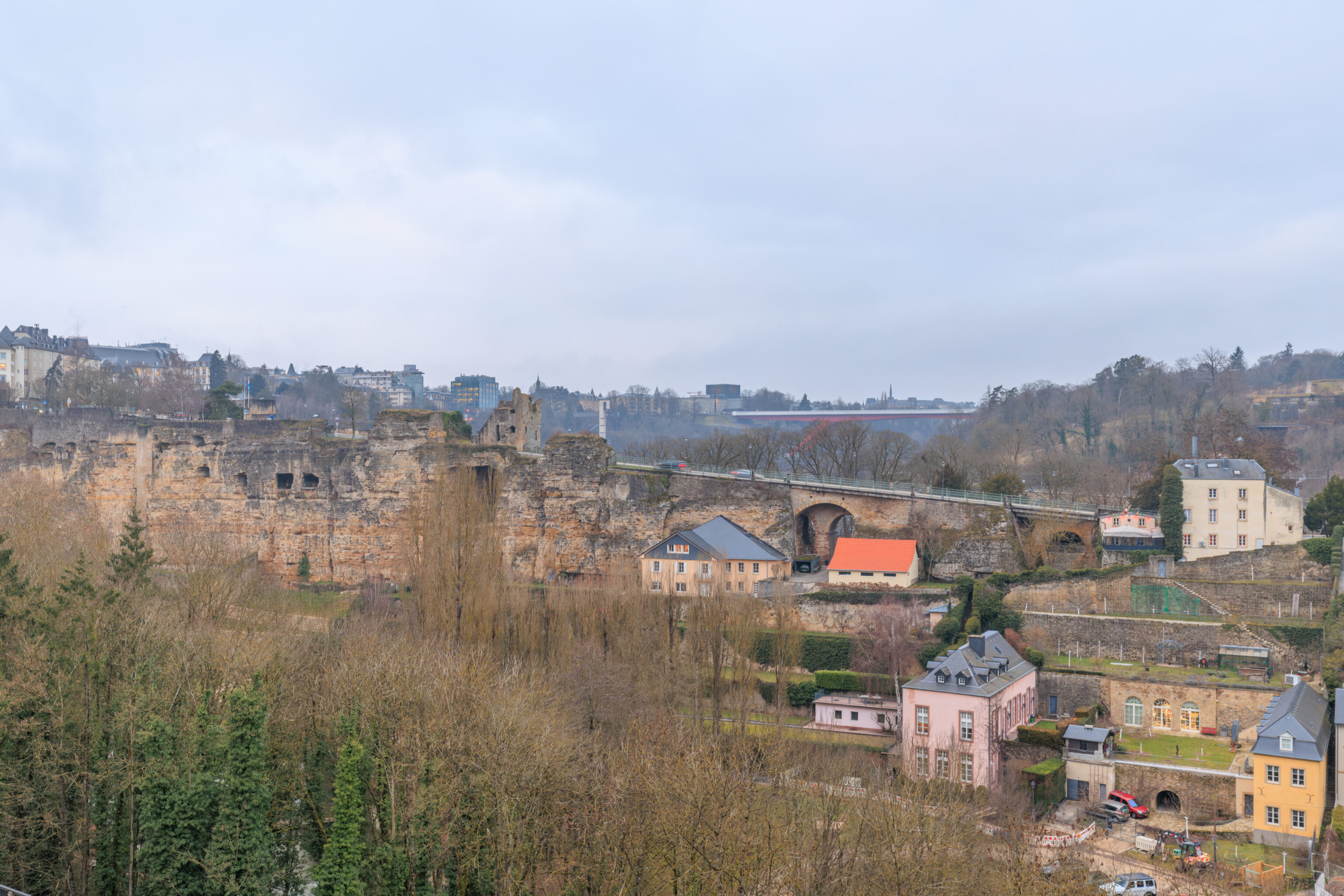
A closer look at the Bock.
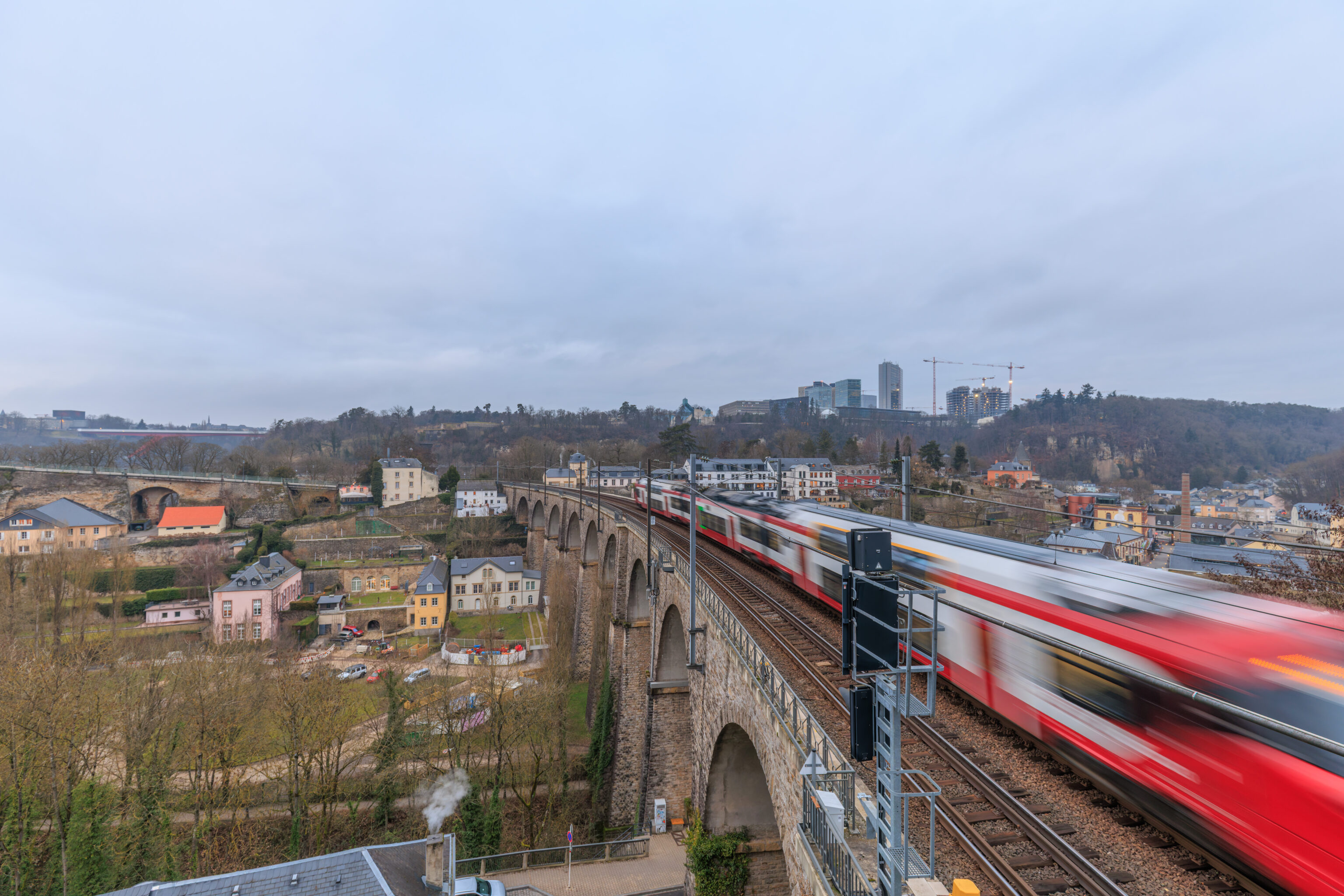
A train passed by the rail viaduct when we were just past it.
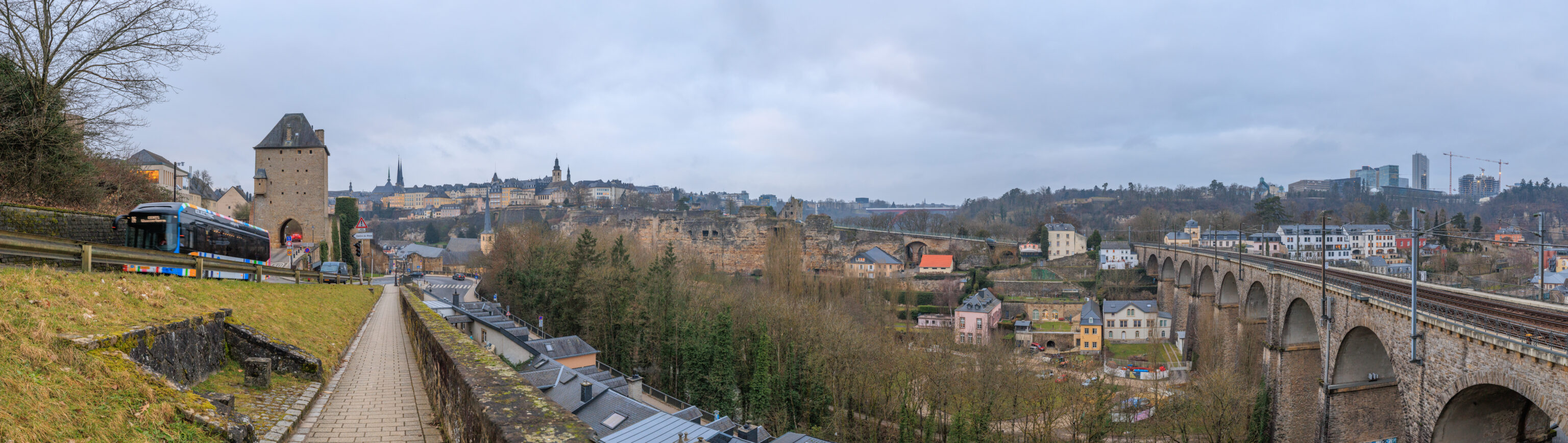
A good place for a panorama!
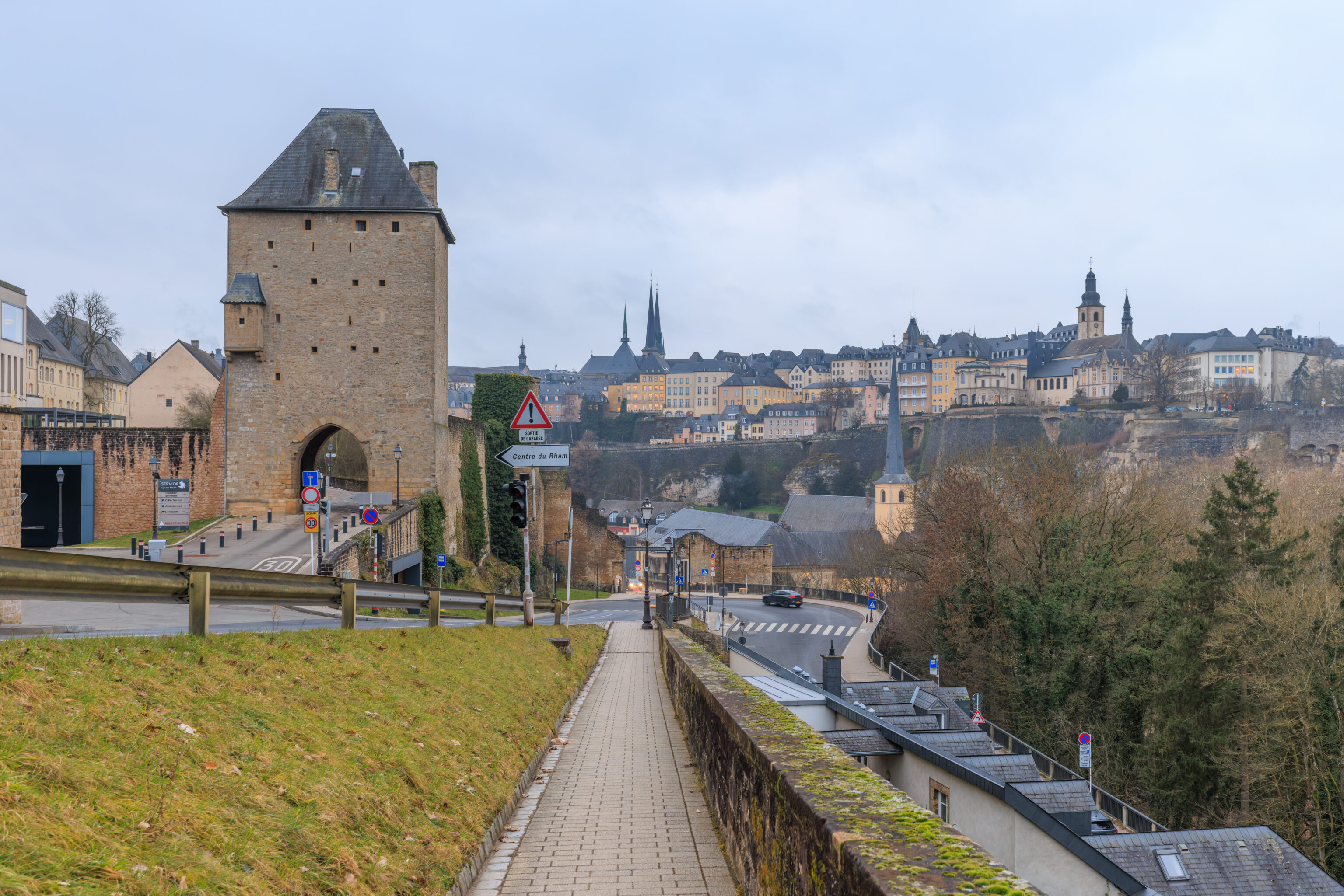
We continued on…
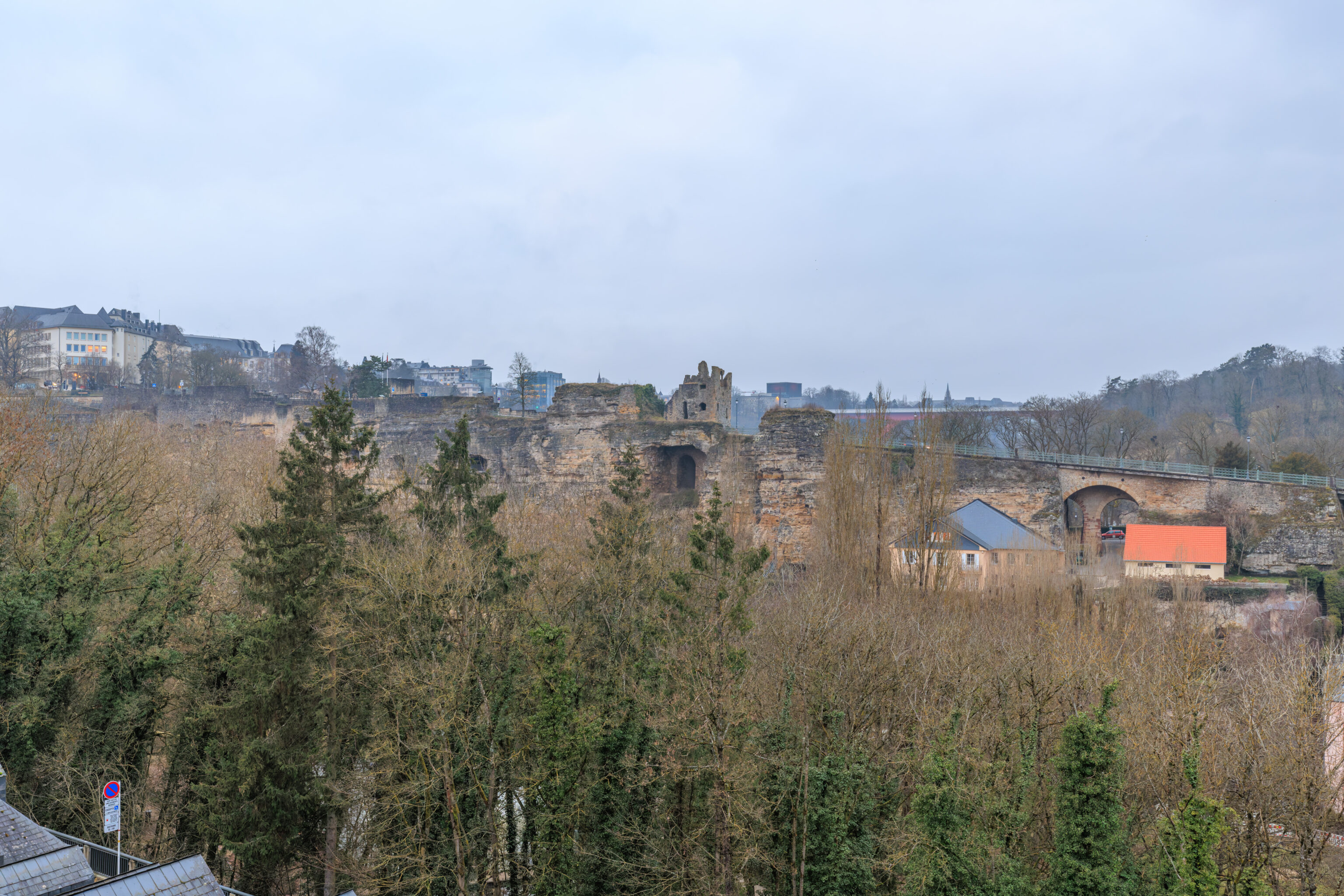
Again, the Bock off to our right.
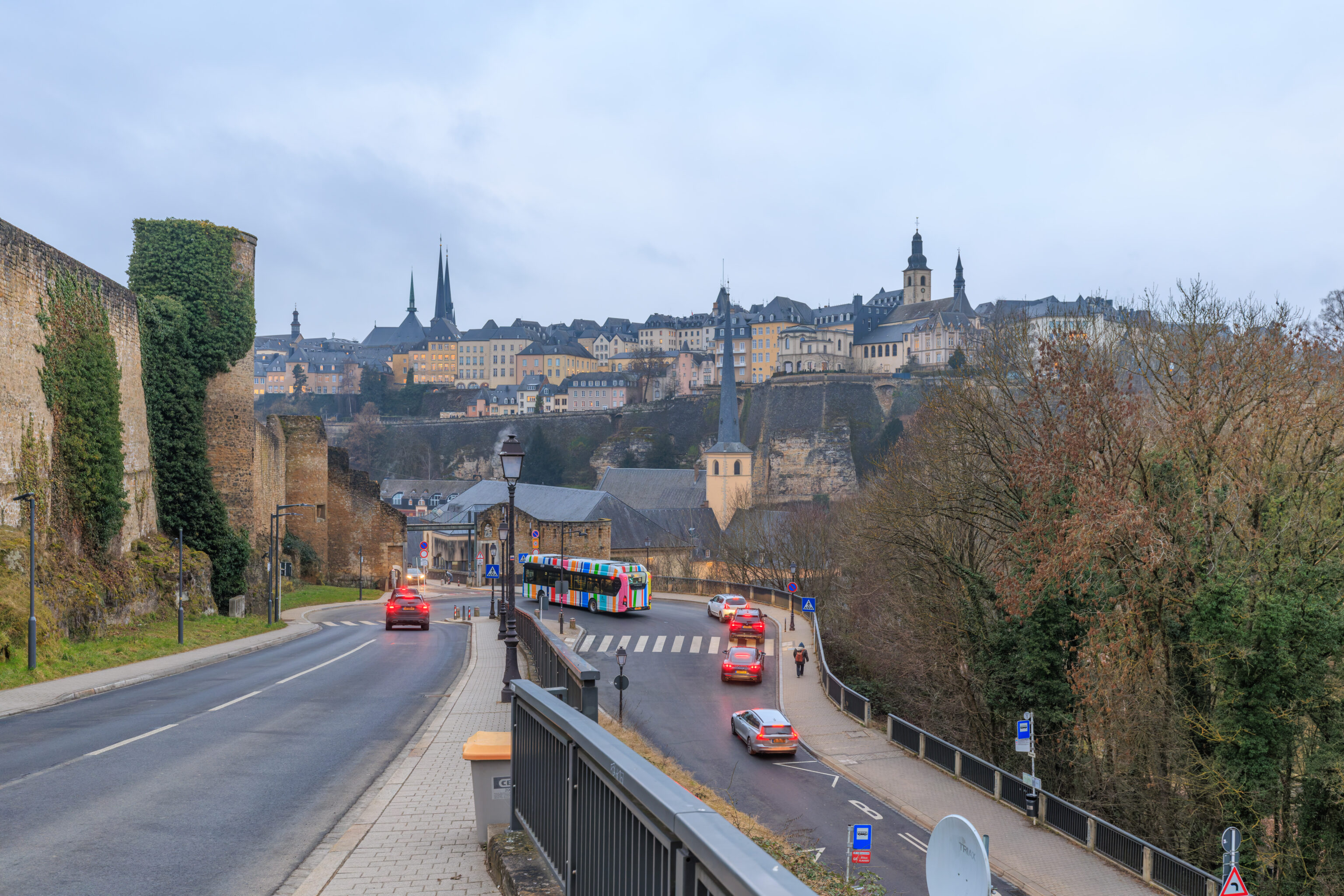
We considered continuing downhill.
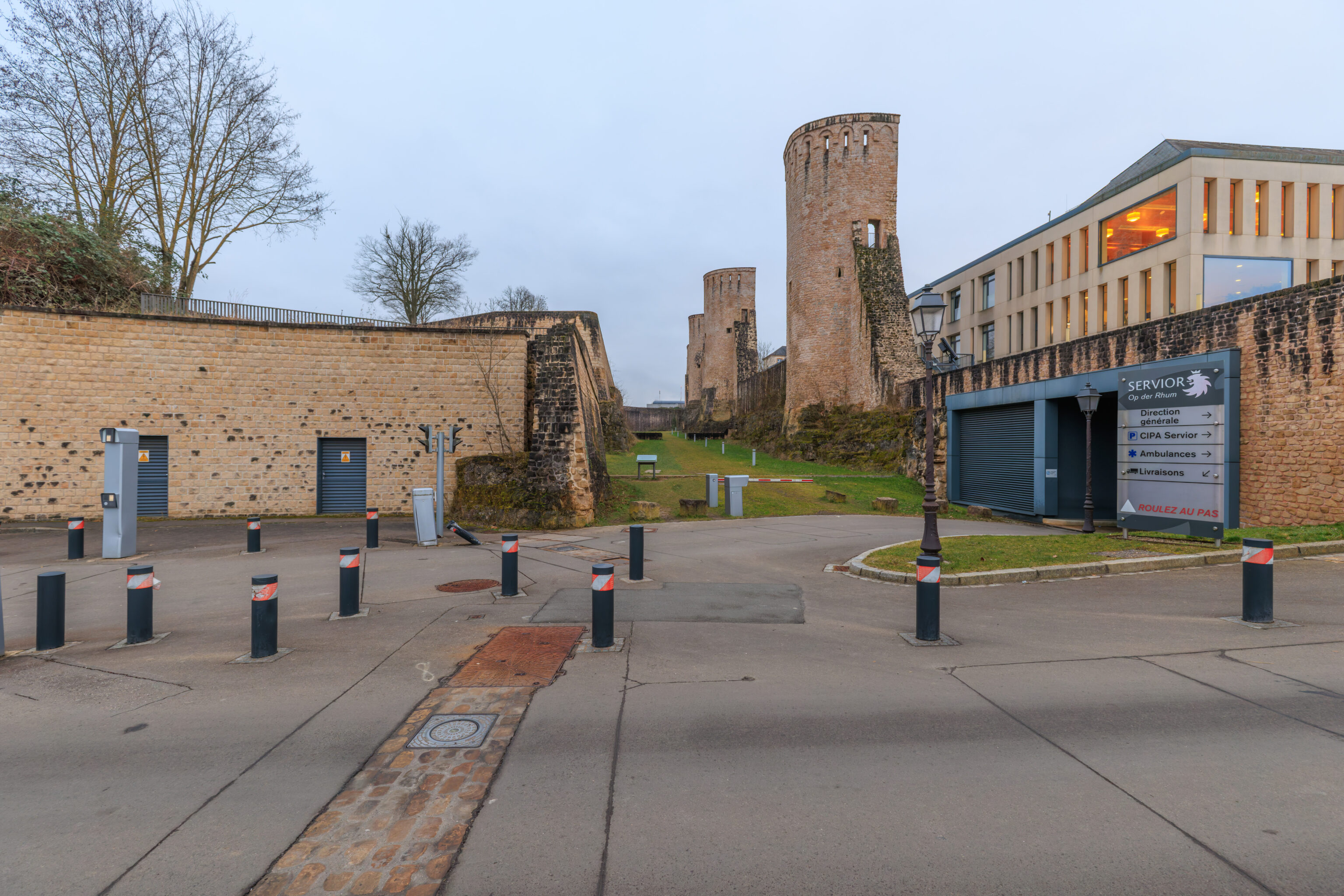
But, we turned to the left. This area is the Plateau du Rham. This high ground contains various remnants of the city’s fortifications as well as a number of buildings. We thought the building to the right was part of a hospital but it is actually part of Luxembourg’s public senior support and living facilities organization, Servior.
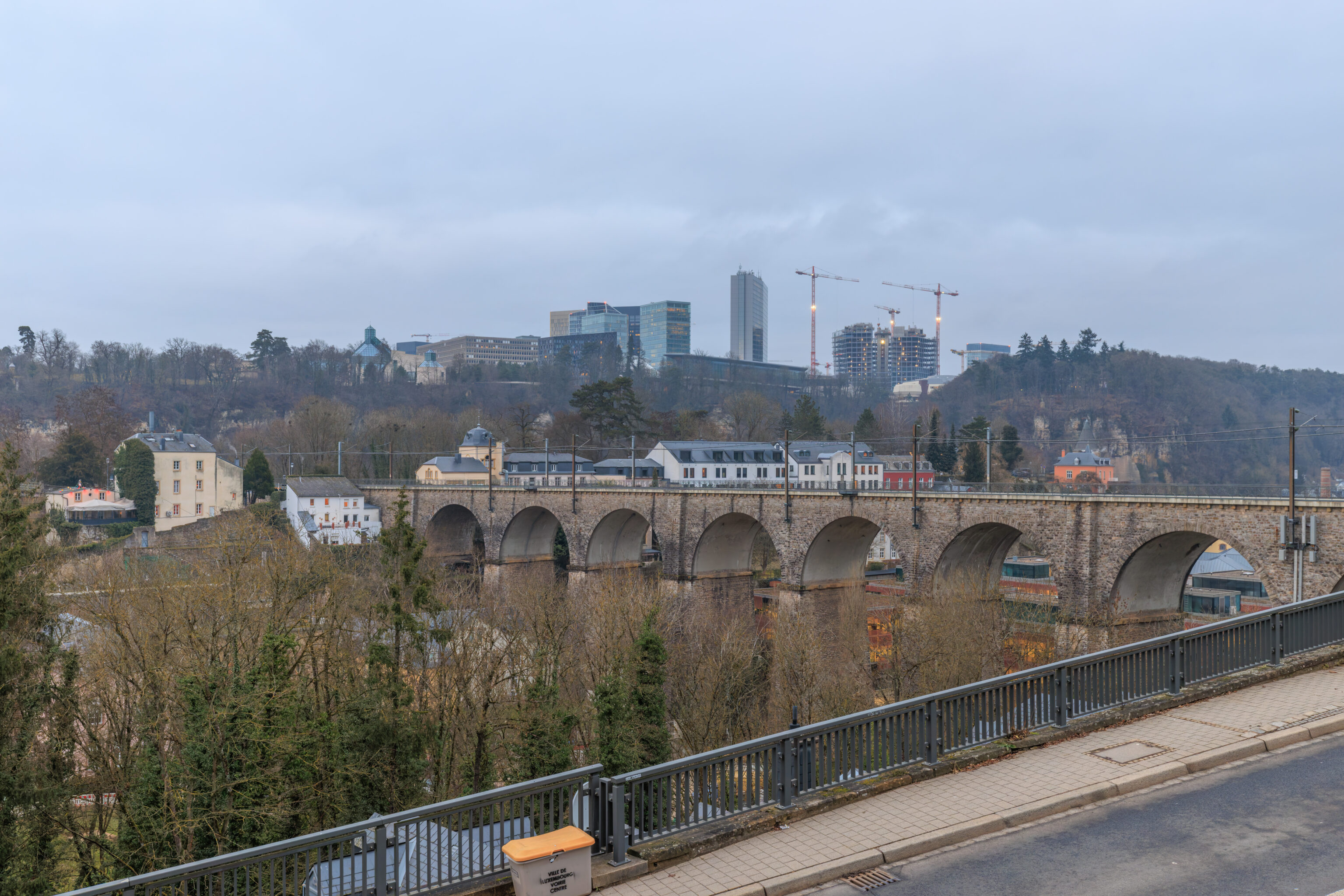
The view looking back at the rail viaduct and Kirchberg.
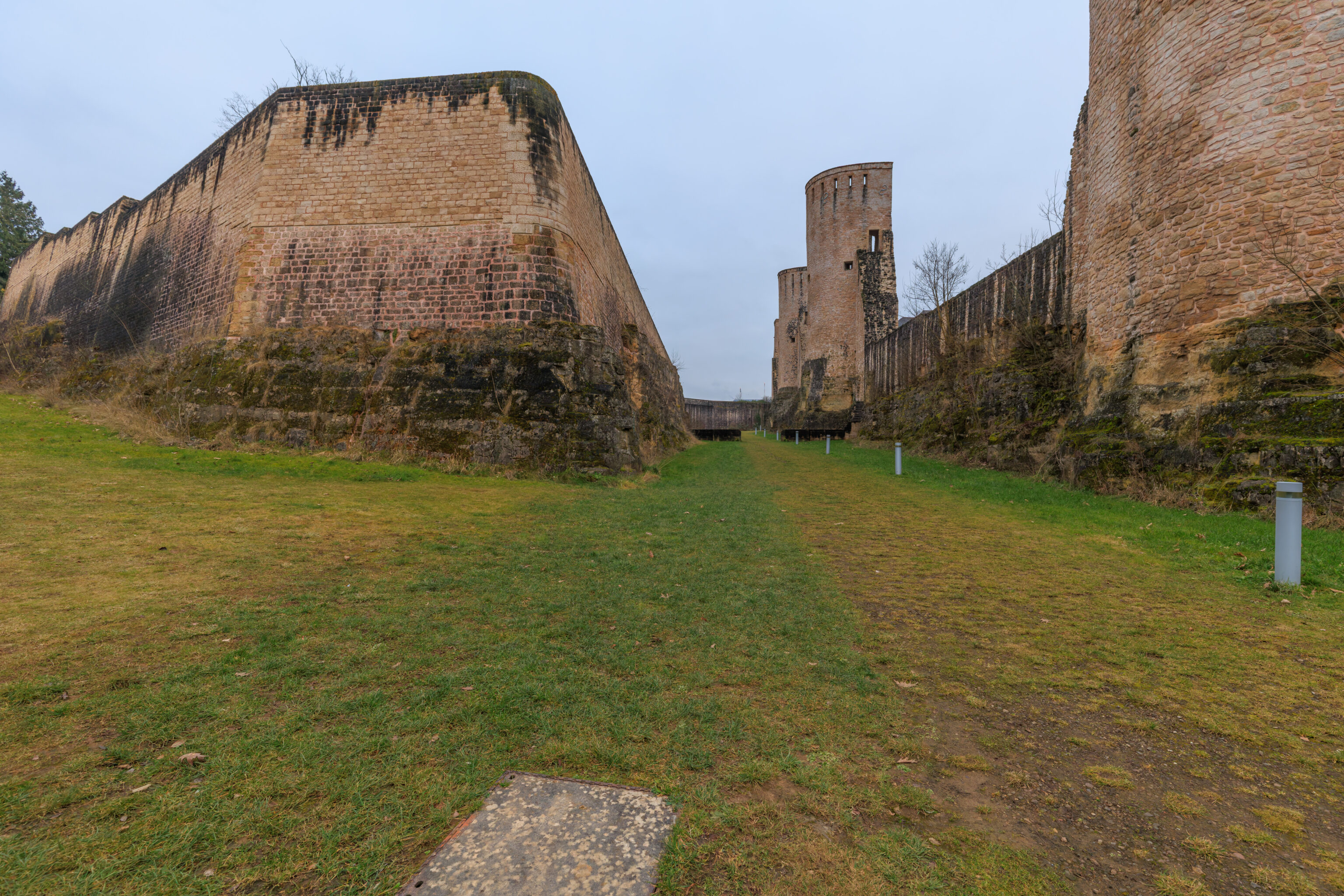
We walked south into the wet grass to take a look at the fortifications.
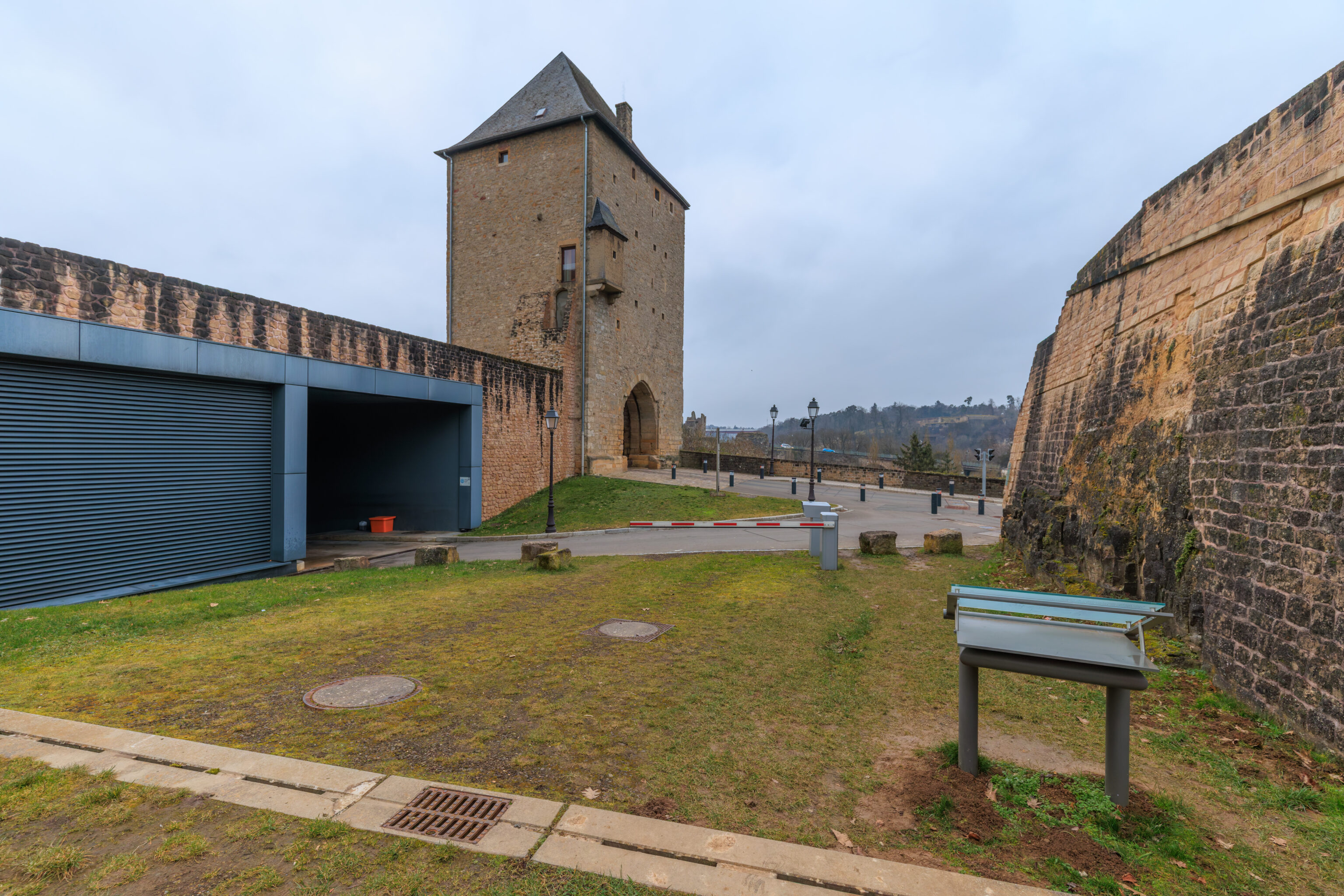
If the weather was better, maybe this would have been a nice place to walk around. But, it was wet and a bit muddy so we didn’t go any further.
The tower here is the Tour Jacob / Jakobsturm / Jacob’s Tower, also known as the Dinselpuert / Dinselpforte / Dinsel Gate for the gate through the tower.
Jacob's Tower (Dinsel Gate)
The Dinsel Gate built in the late Middle Ages (14th and 15th centuries), was one of the main entrances in the east of the city. With the construction of the new Trier Gate, at the end of the 16th century, she lost it this function. Furthermore, they defended the city from attacks eastern direction.

This massive tower gate burned down in 1443, when the city was conquered by the Burgundians. In 1684, the gate was built considerably destroyed by the attack of the French troops and rebuilt immediately afterwards.
– Text from a sign near the tower, translated from German using Google Translate.
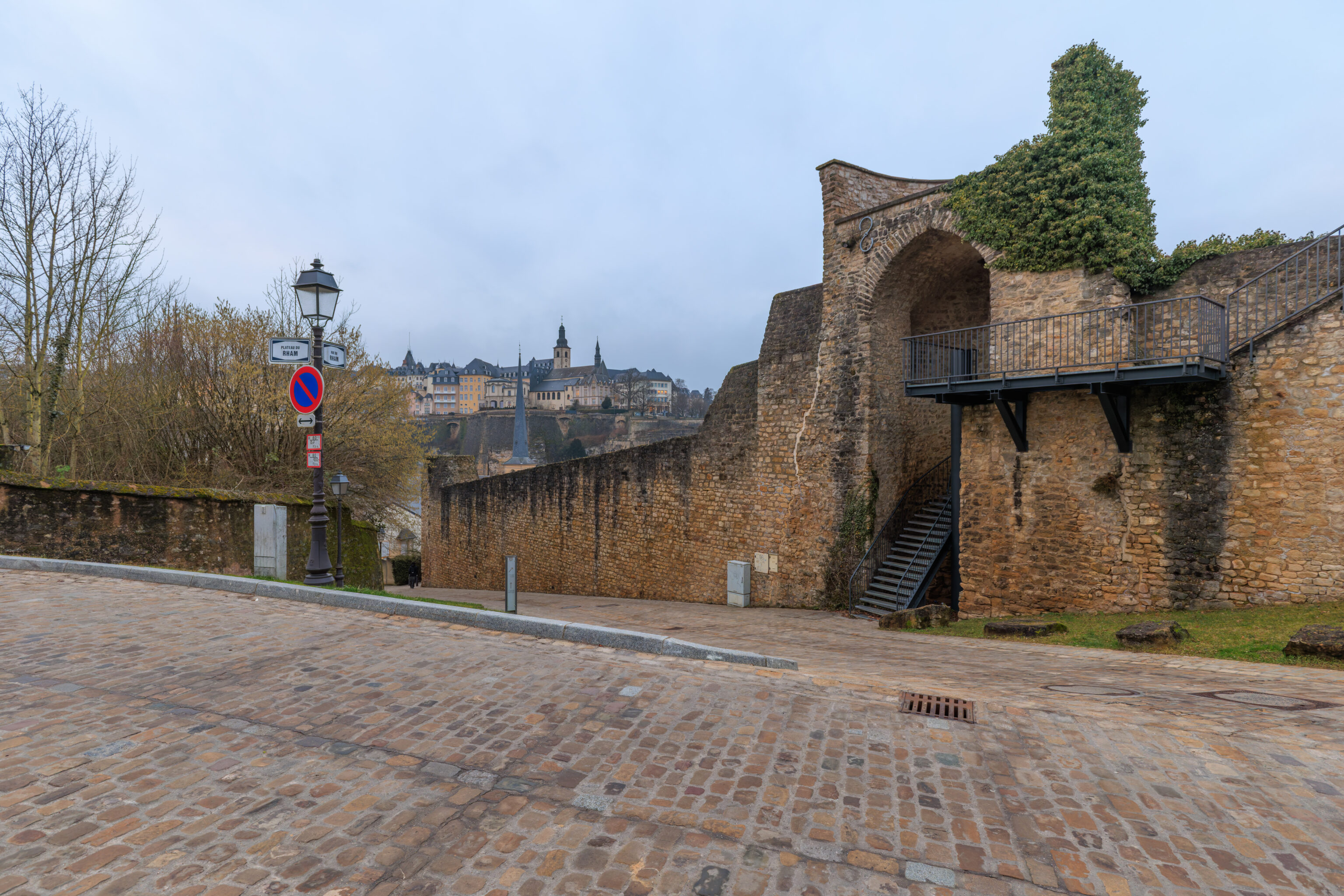
We noticed that just to the west of the Tour Jacob, there was another tower in a more ruined state. We saw that there were stairs going up to a walkway that seemed to lead to the Tour Jacob.
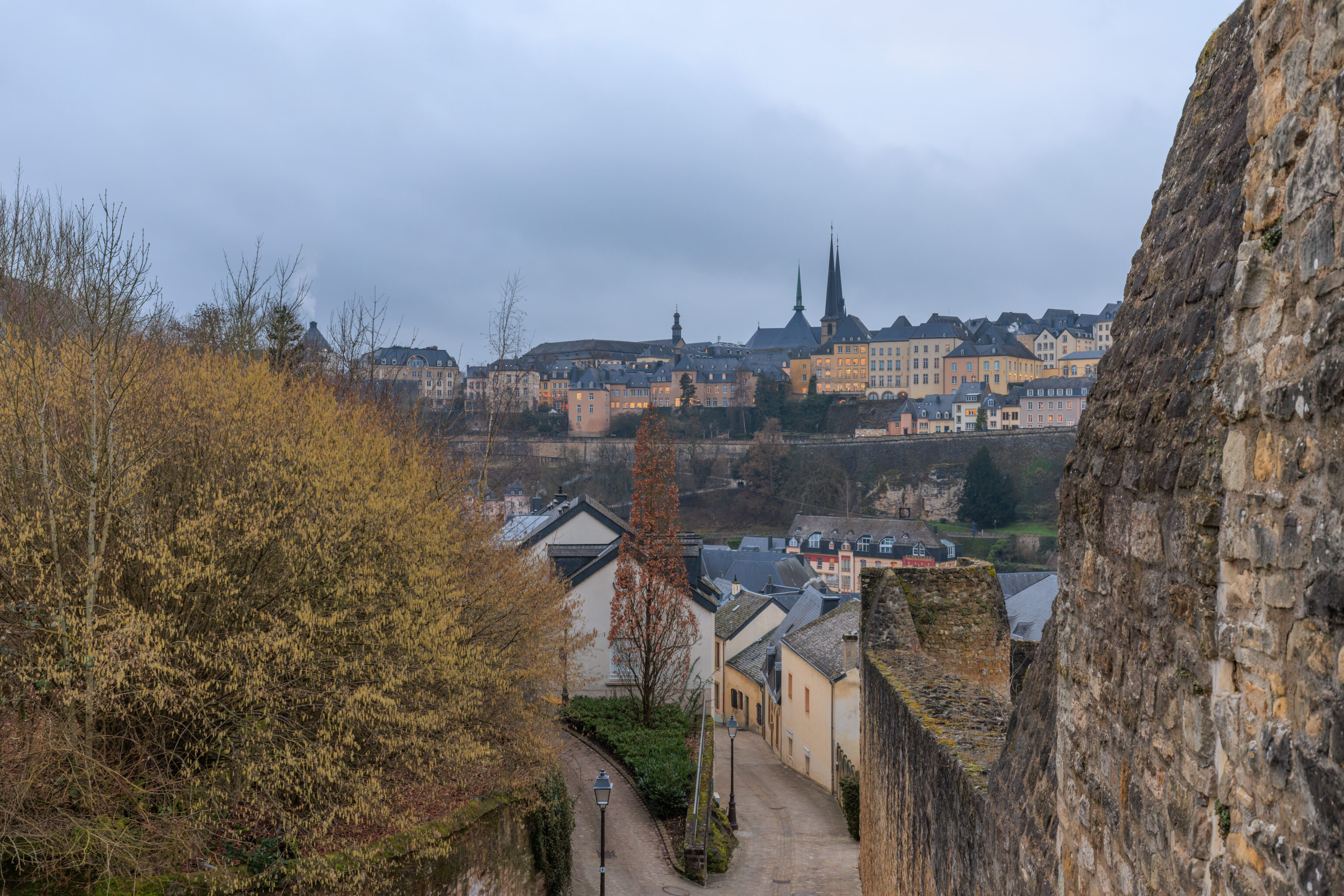
We went up those stairs to take a look. We were able to get an elevated view to the west from where the walkway juts out from the tower.
In this view, there is another one of those circles with stripes. It is on a path that descends from the Ville Haute and is pretty small but noticeable.
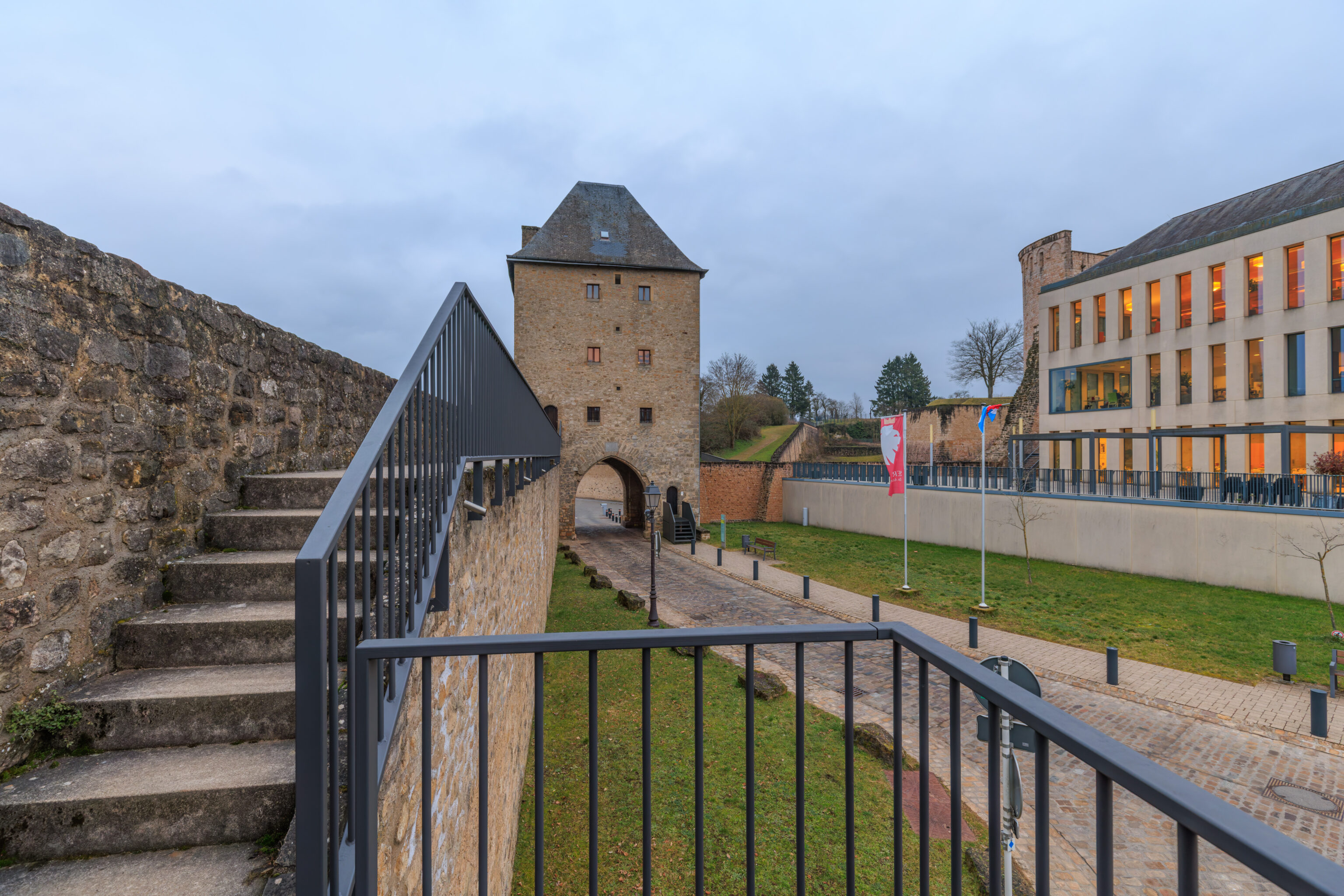
There was indeed a path on top of the wall that led to the tower. Based on the description on the city’s website, it is possible to enter the tower to watch a video from April to October.
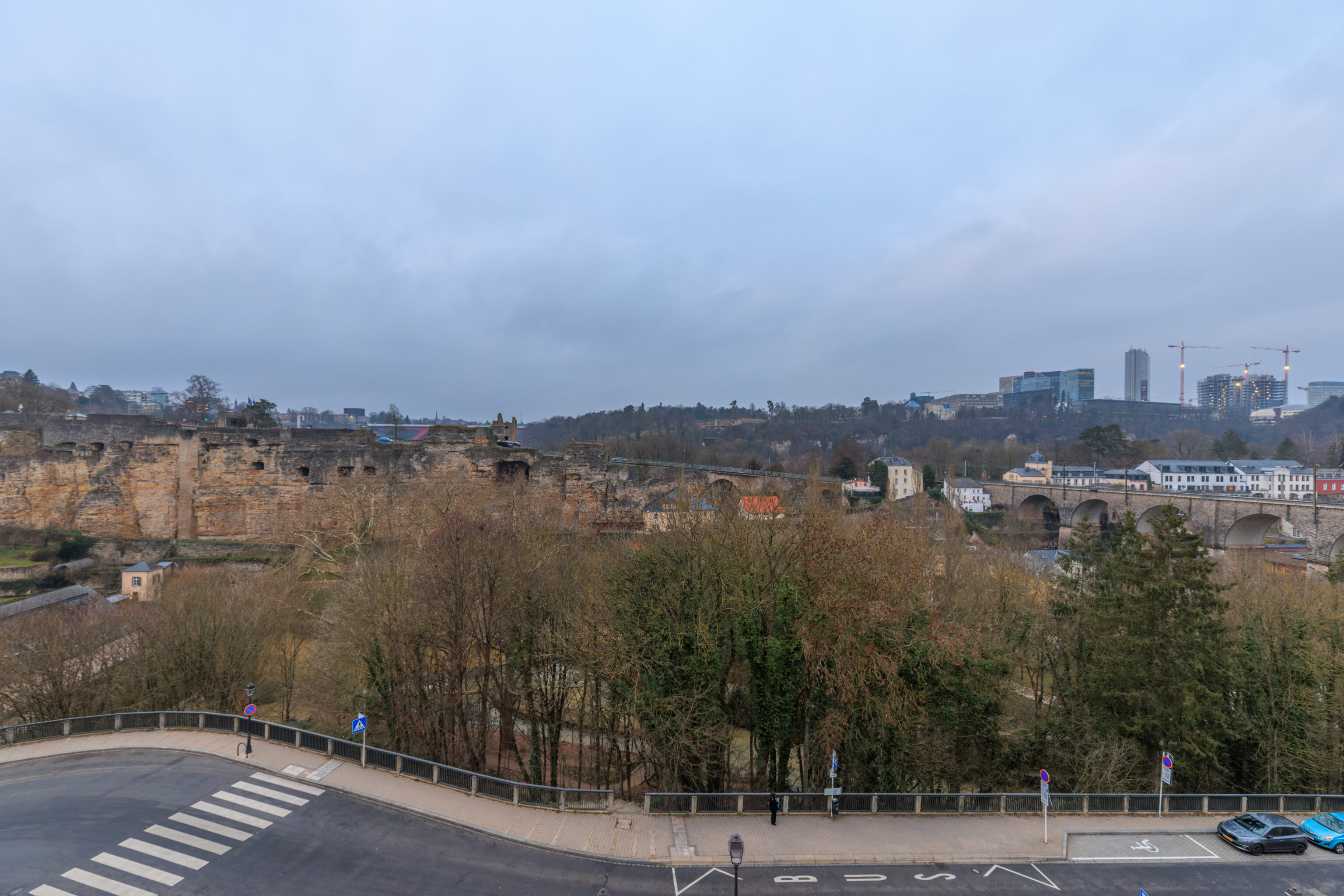
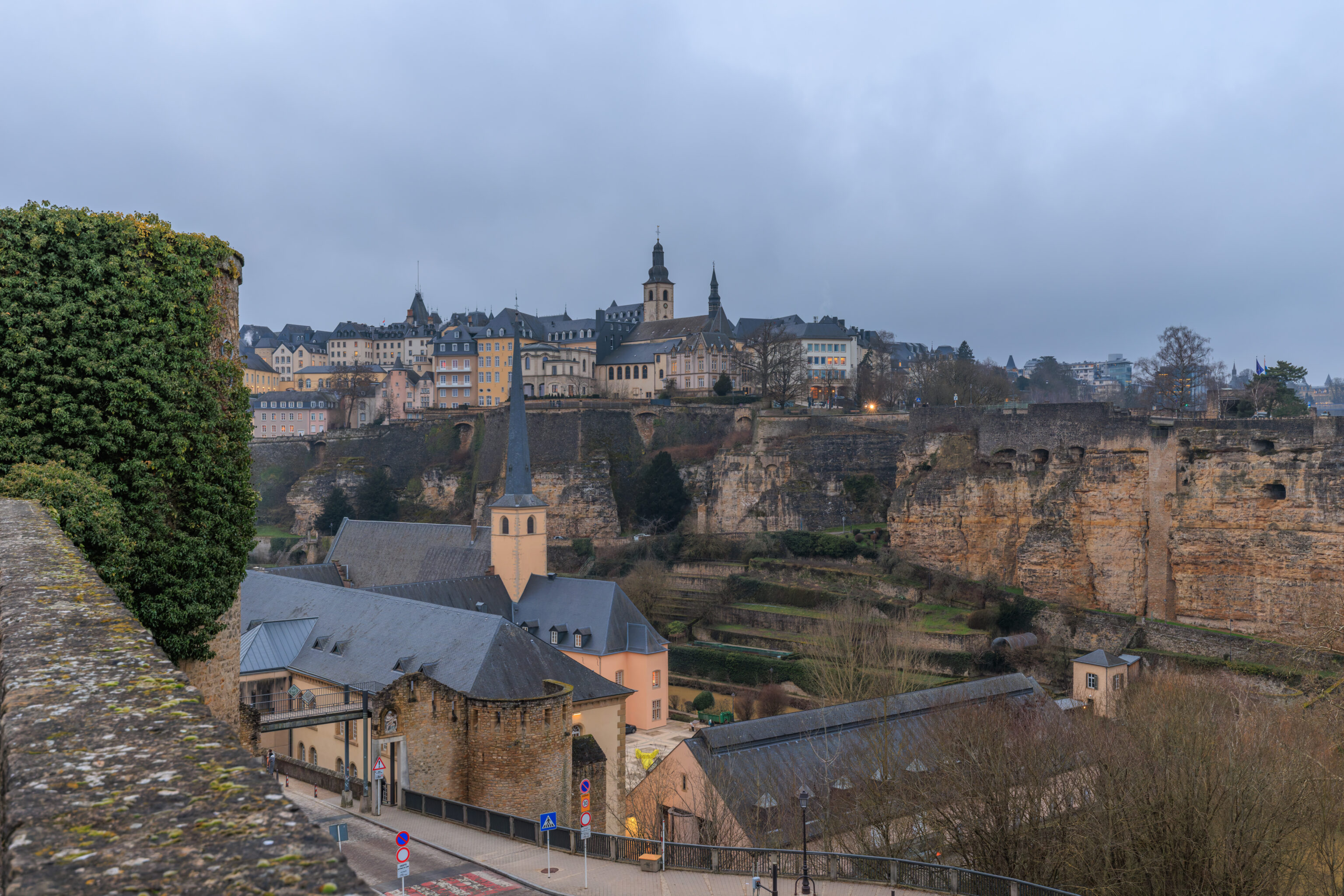
This wall top path gave us an excellent view of the area to the north!
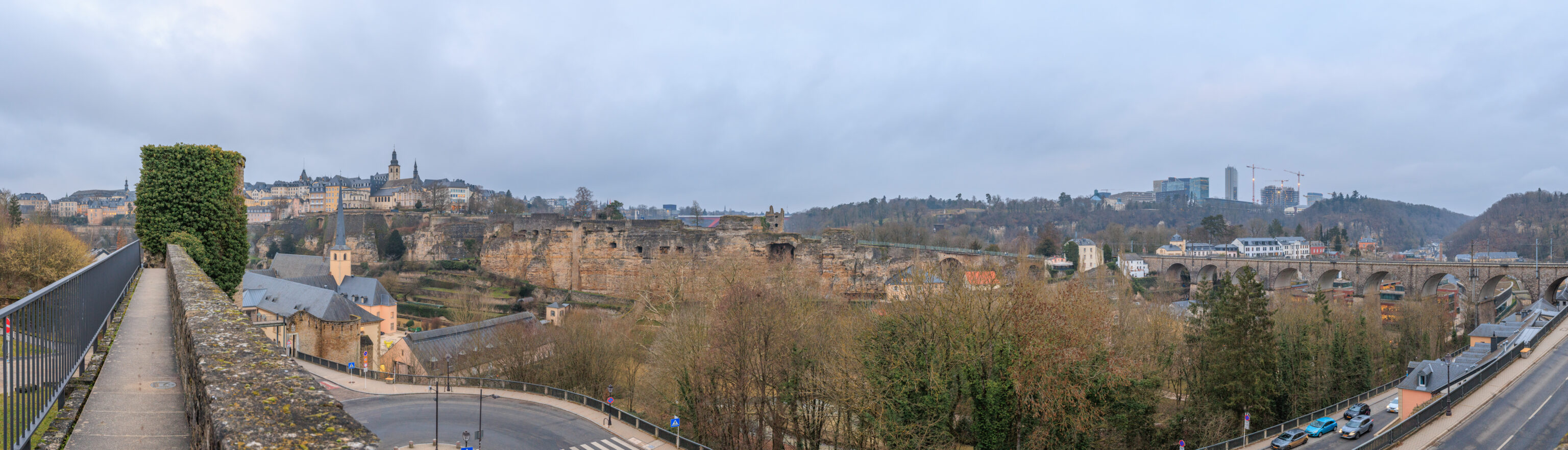
Perfect for another panorama!
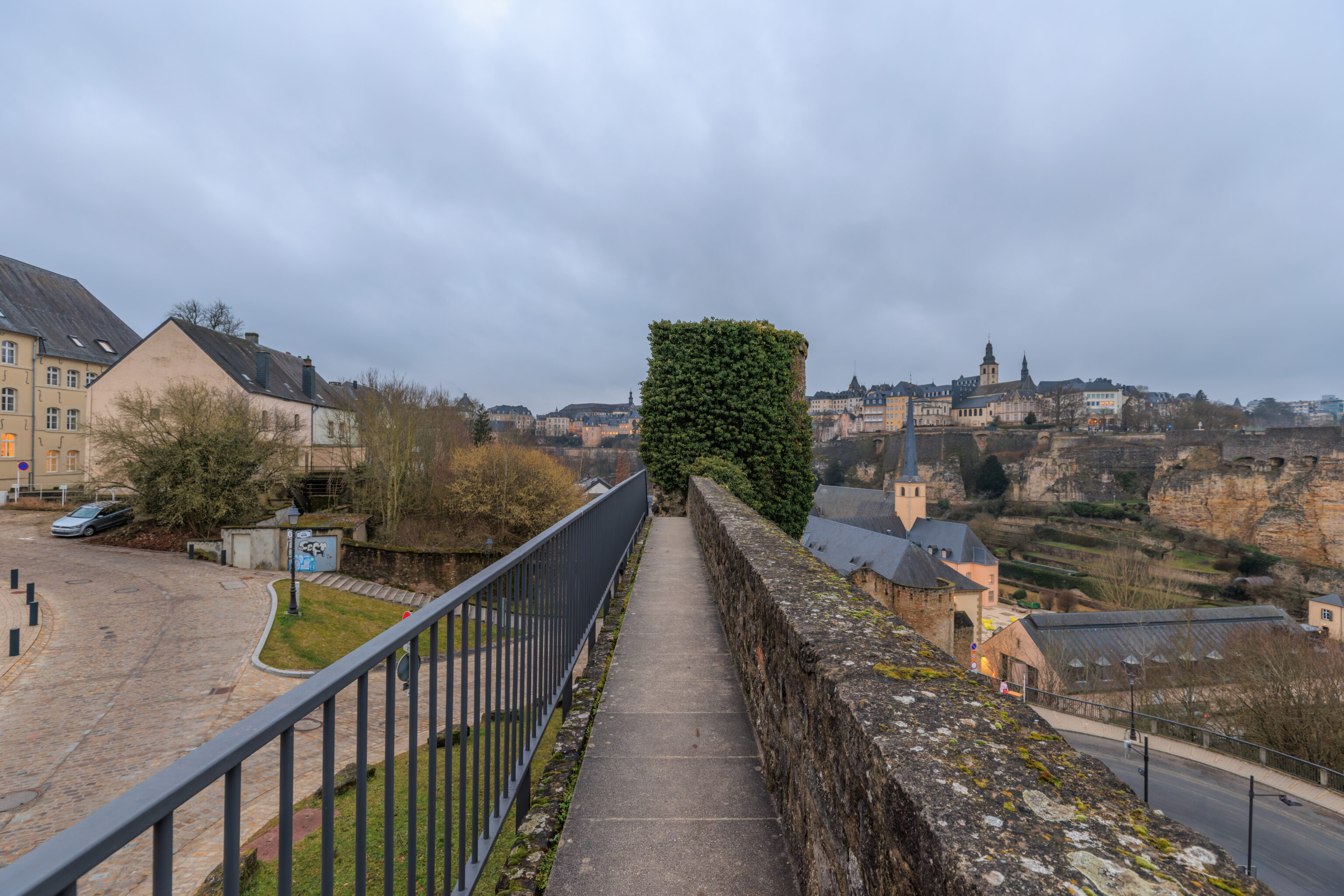
It was getting dark so we only took a quick look before heading back down.
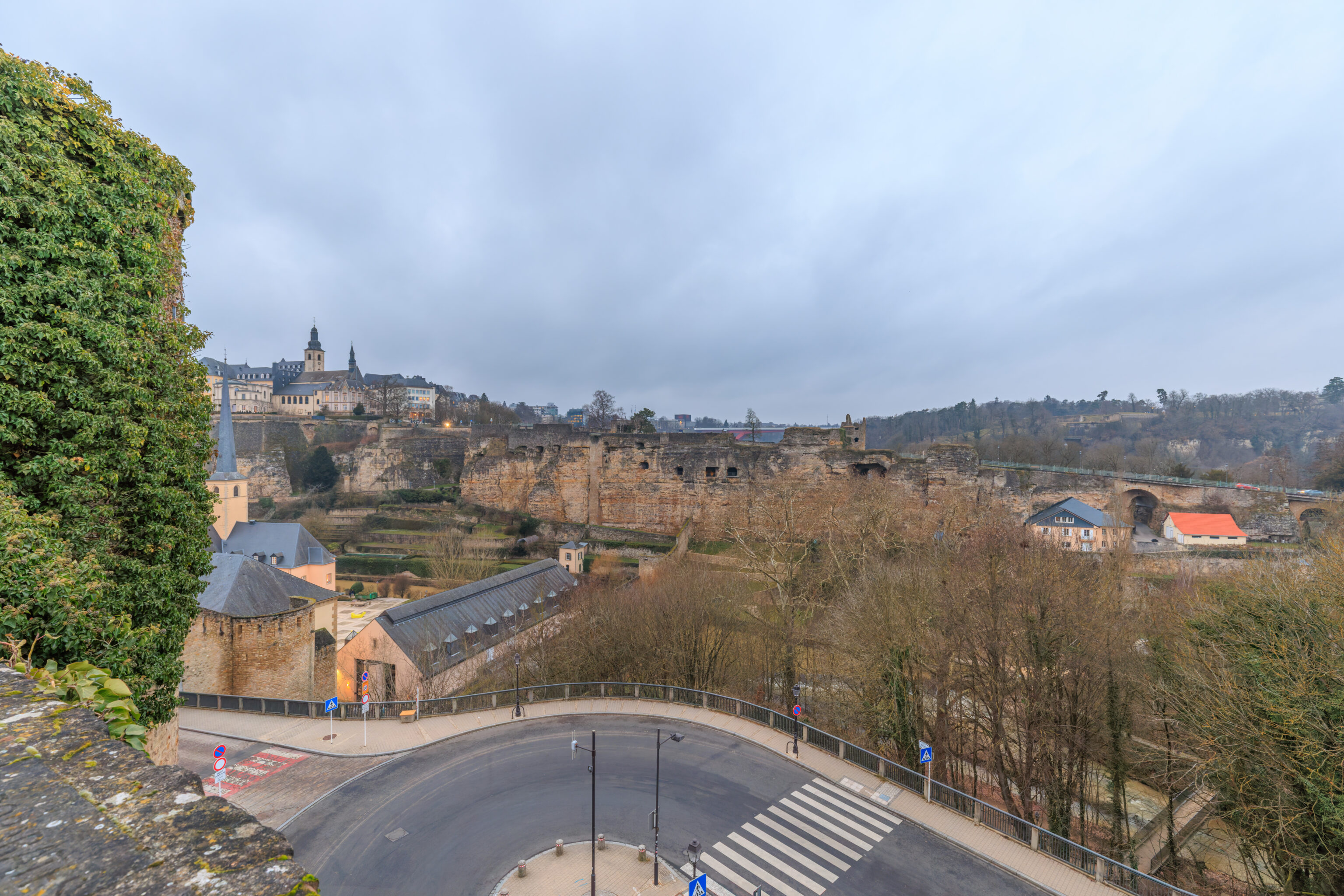
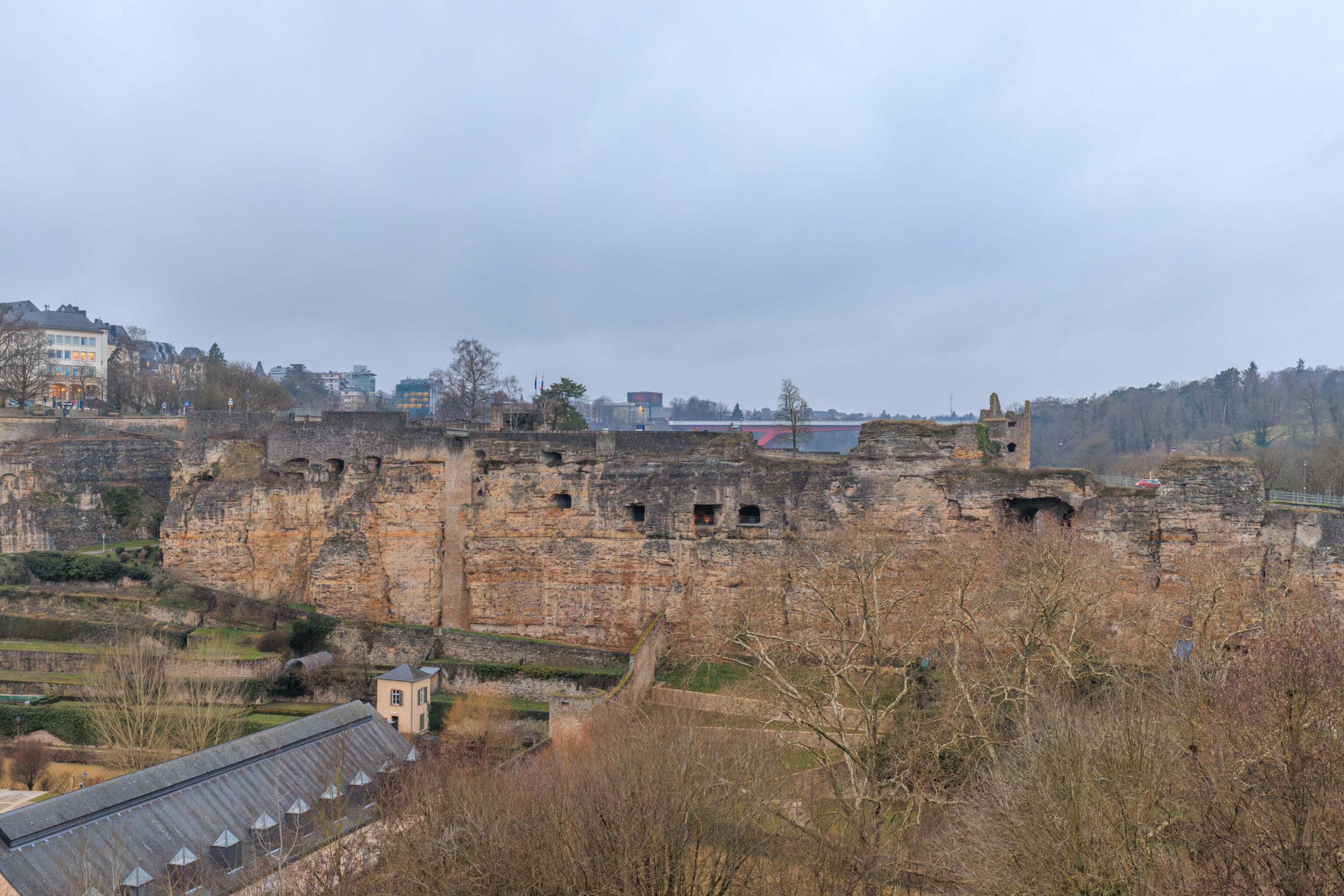
A view of the Bock before we headed back down to ground level. It is possible to see the Grand Théâtre from here, which probably shouldn’t be too surprising given its location and size.
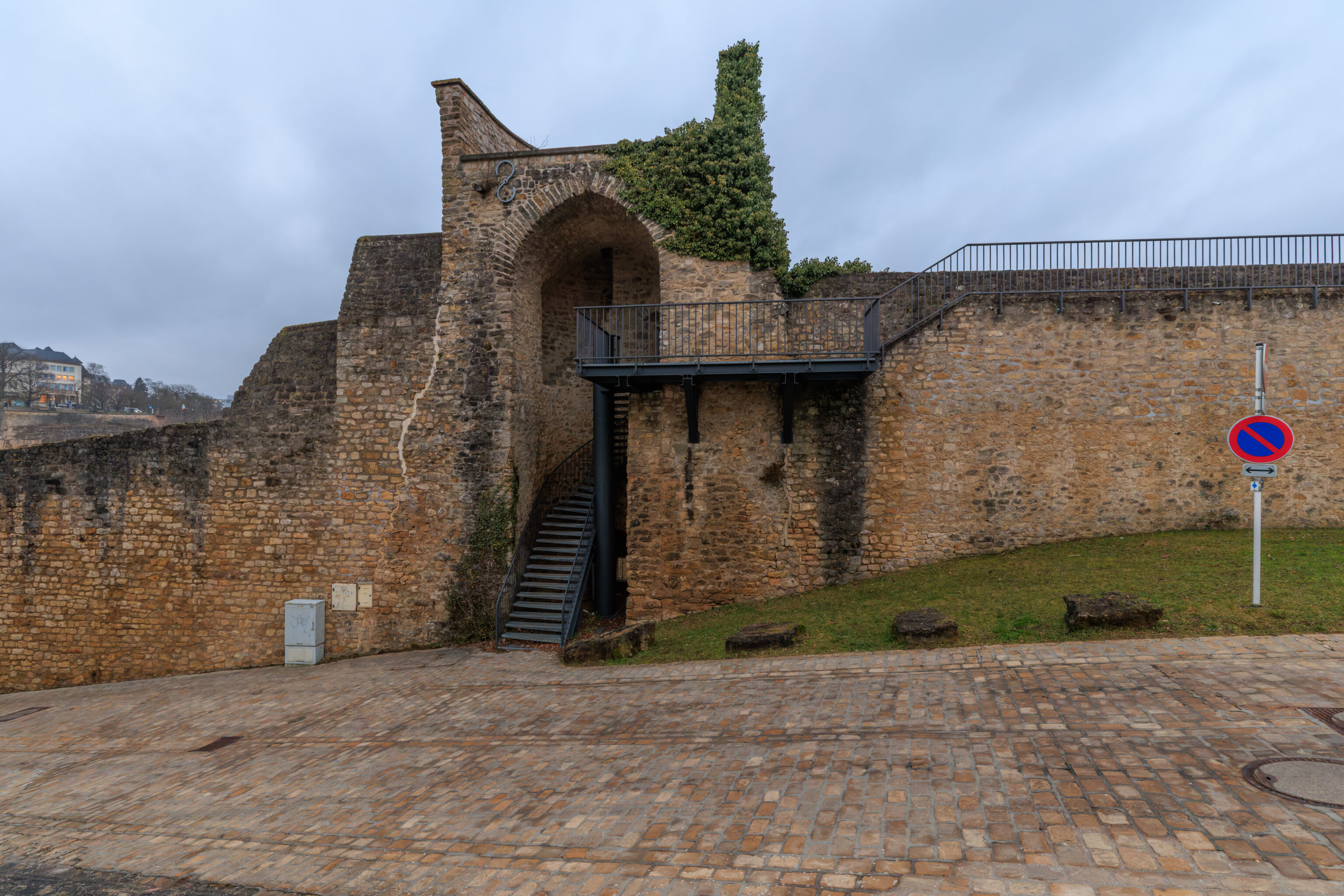
After we returned to ground level, we took a path that would keep us atop the Plateau du Rham. The path to the left of the tower with the stairs goes downhill.
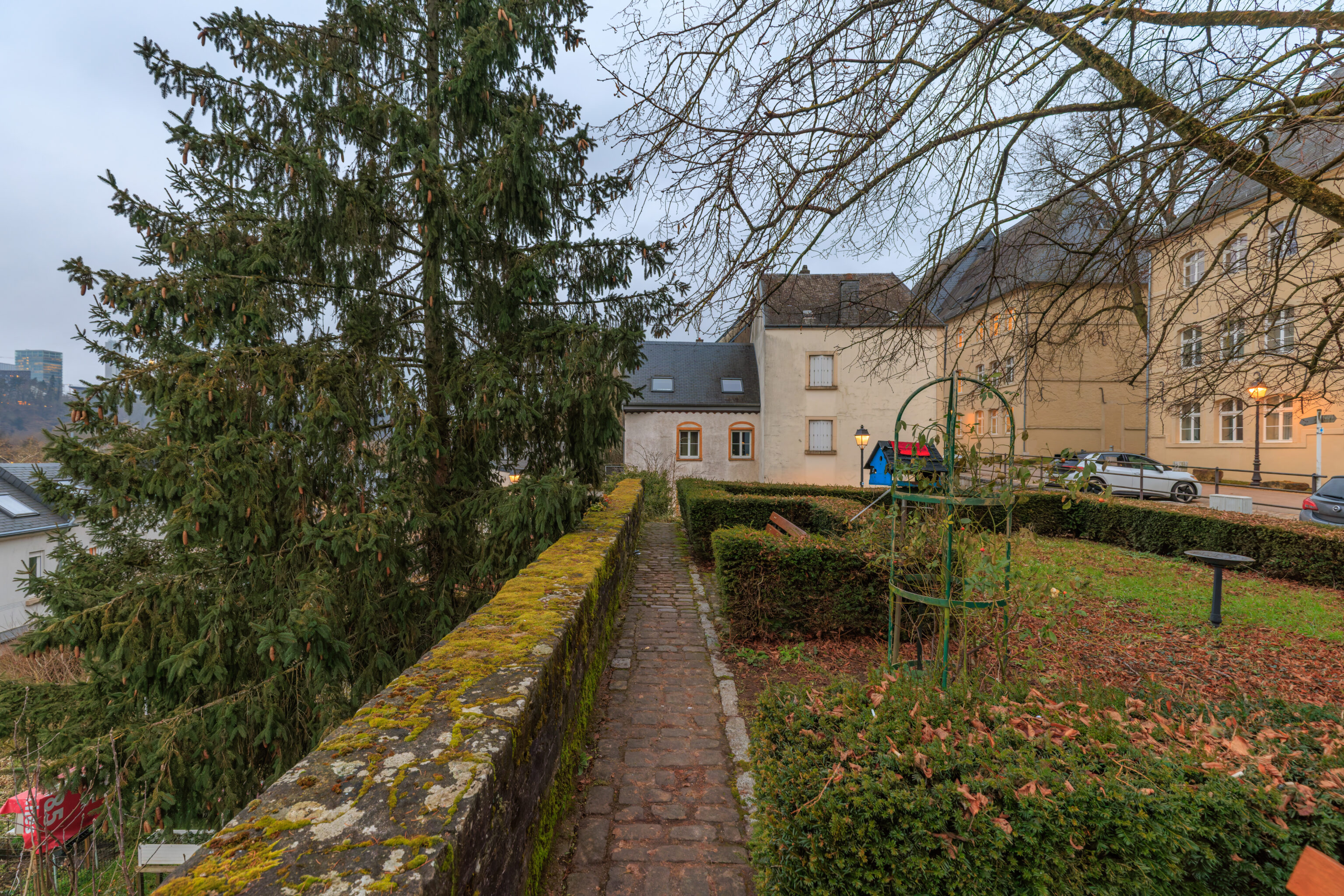
There was a little park, or maybe garden, not too far away to the west, perhaps halfway to the western end of the Plateau du Rham.
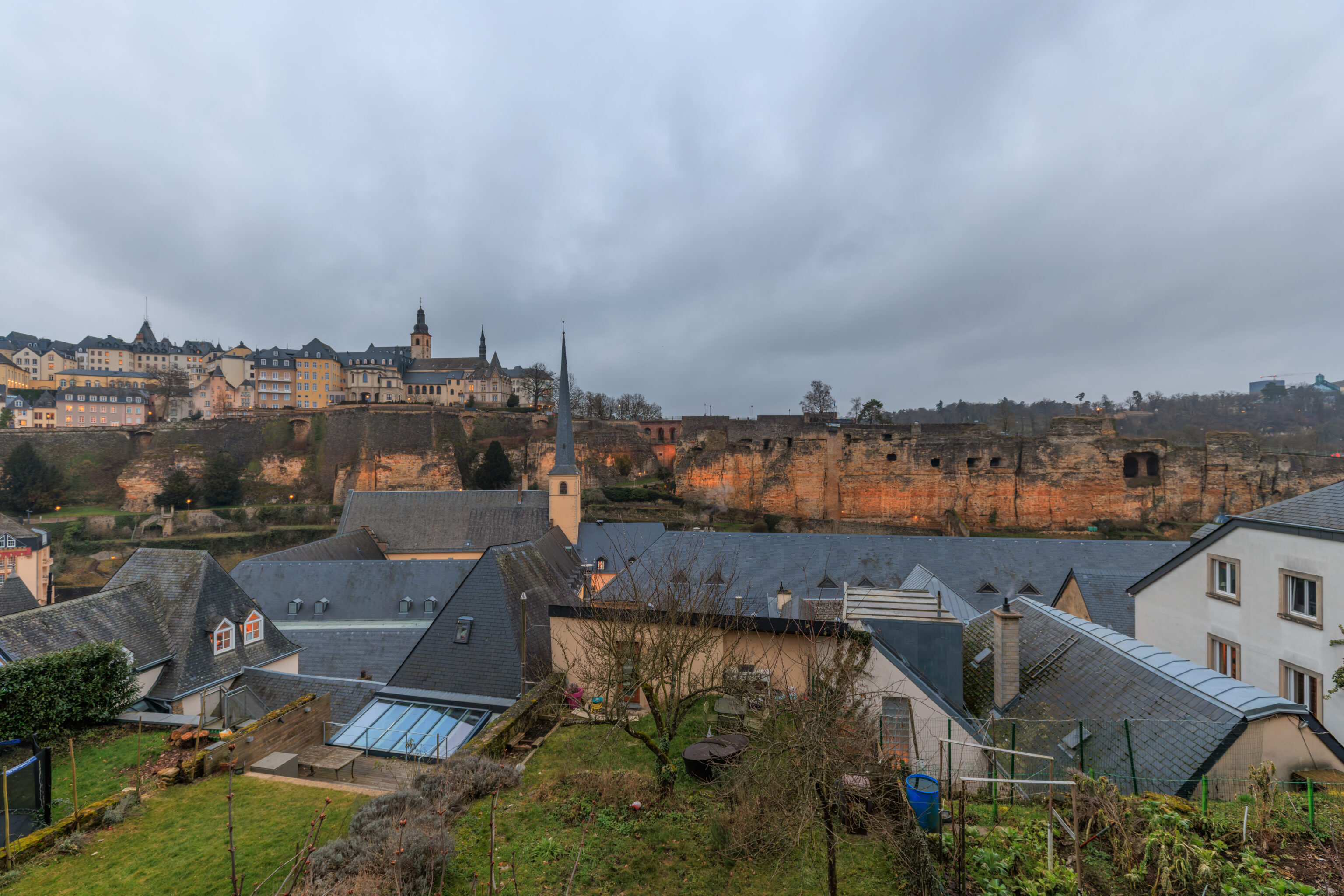
The view from here was excellent as well. It was quickly getting darker and we could see various lights illuminating the fortifications around the Ville Haute.
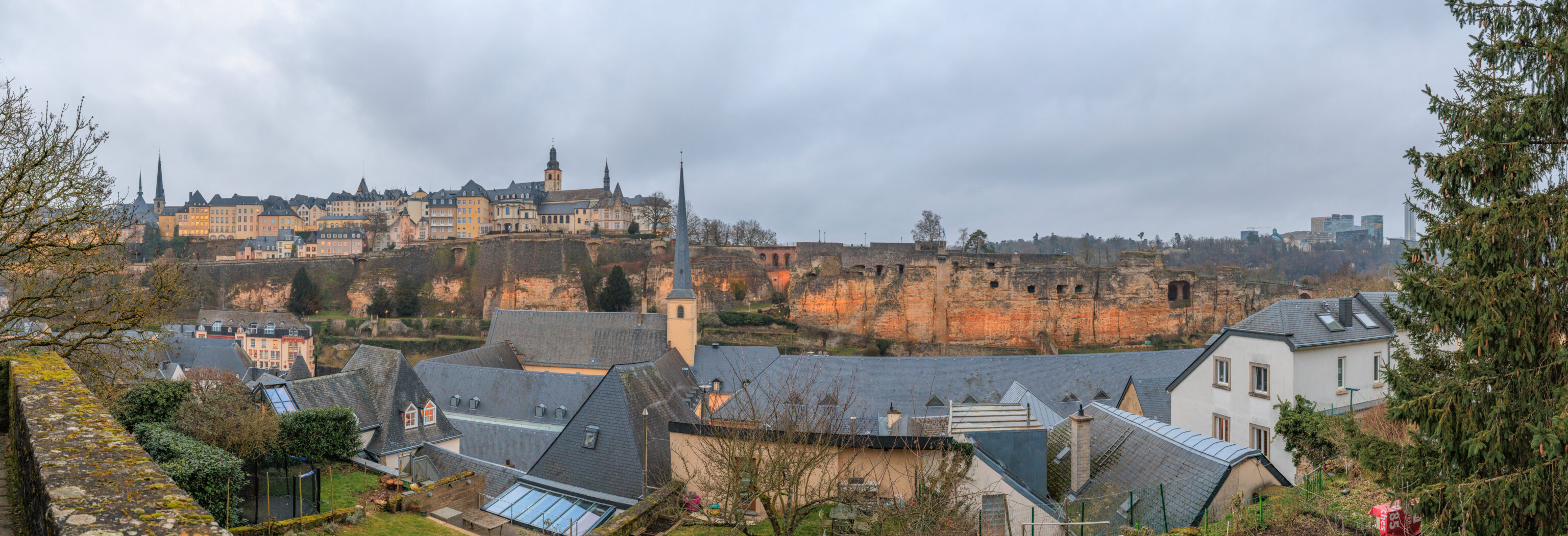
Again, a perfect place for a panorama!
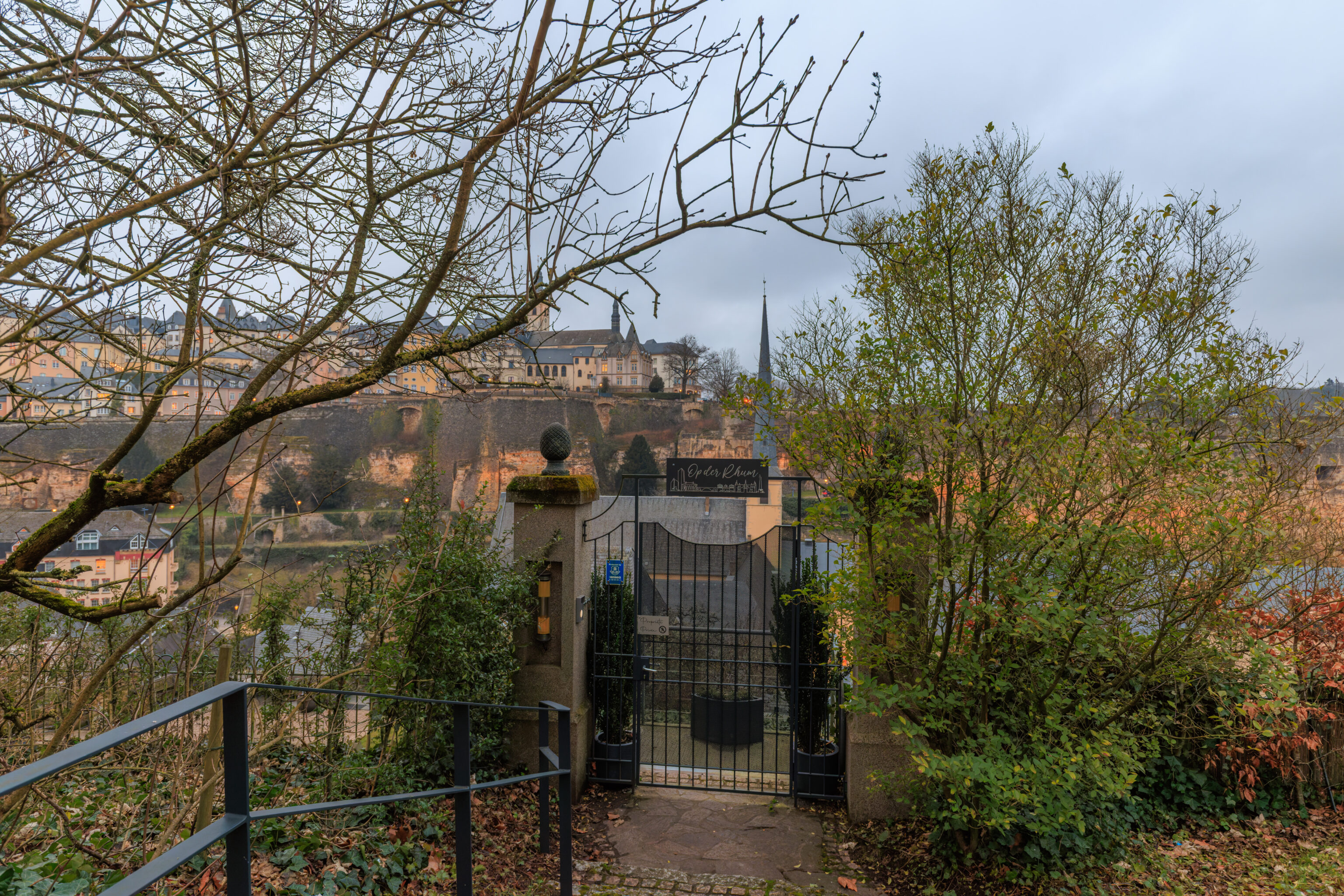
This gate led to some private property.
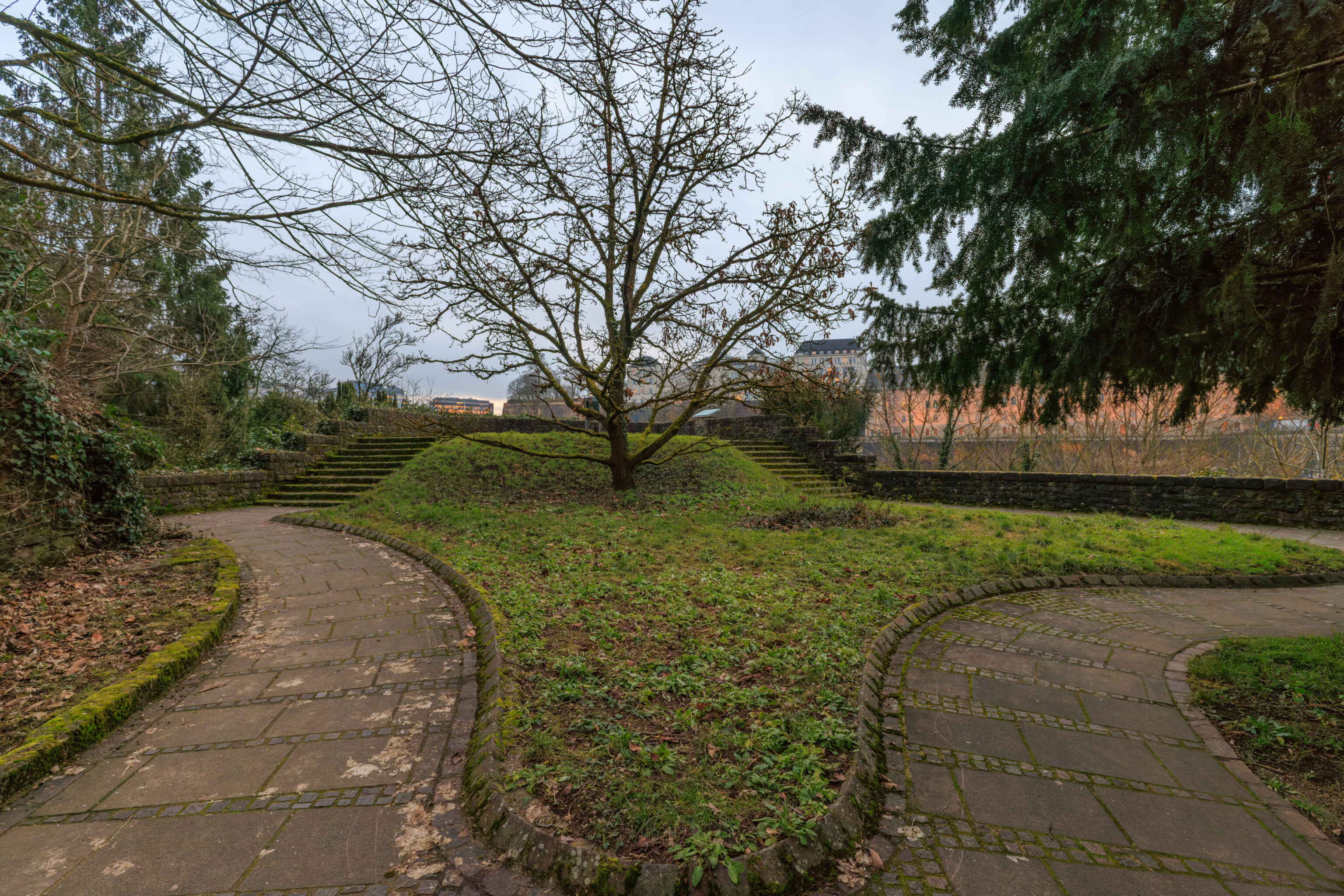
We continued walking until we could see the western end of the Plateau du Rham.
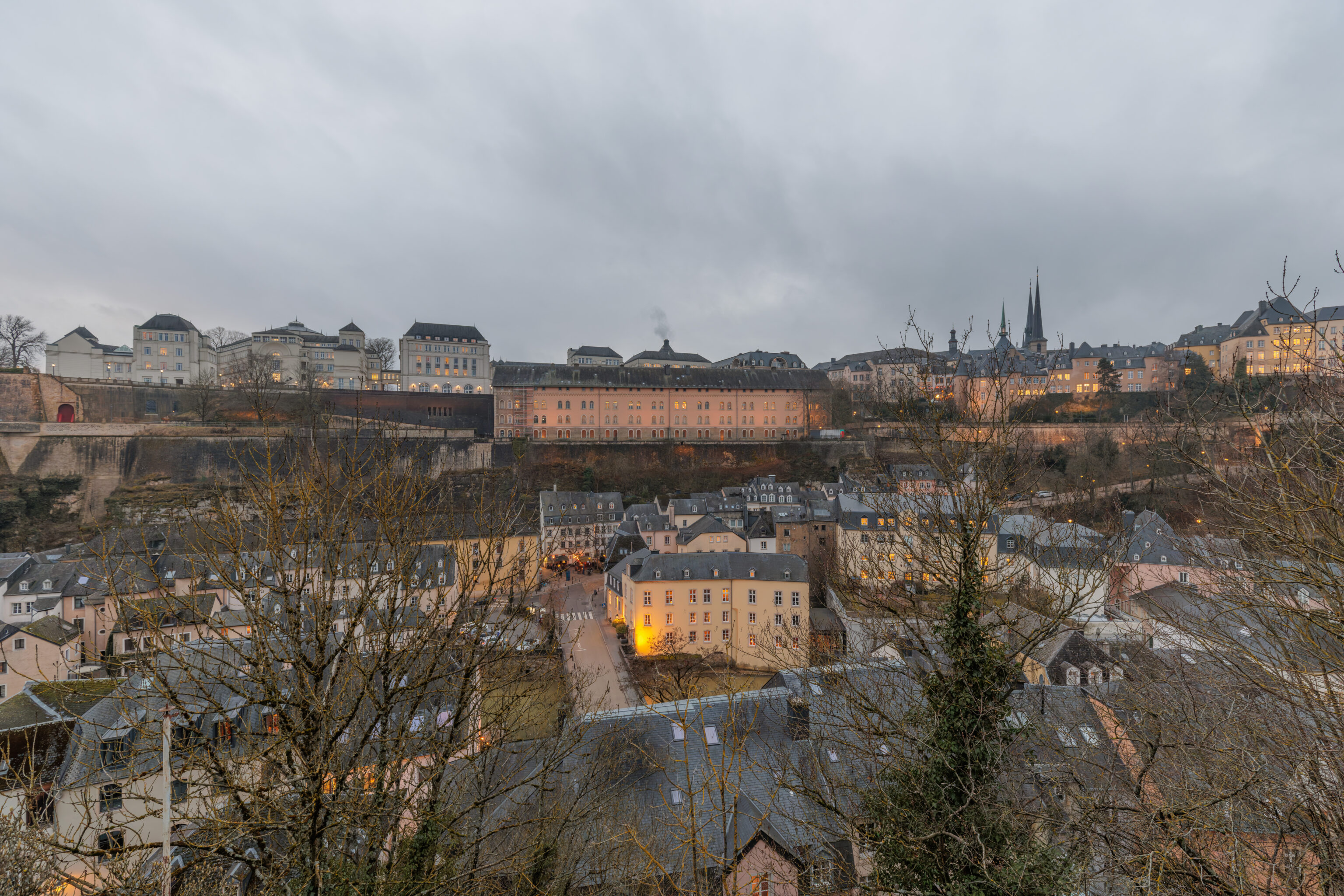
This was the view looking to the west.
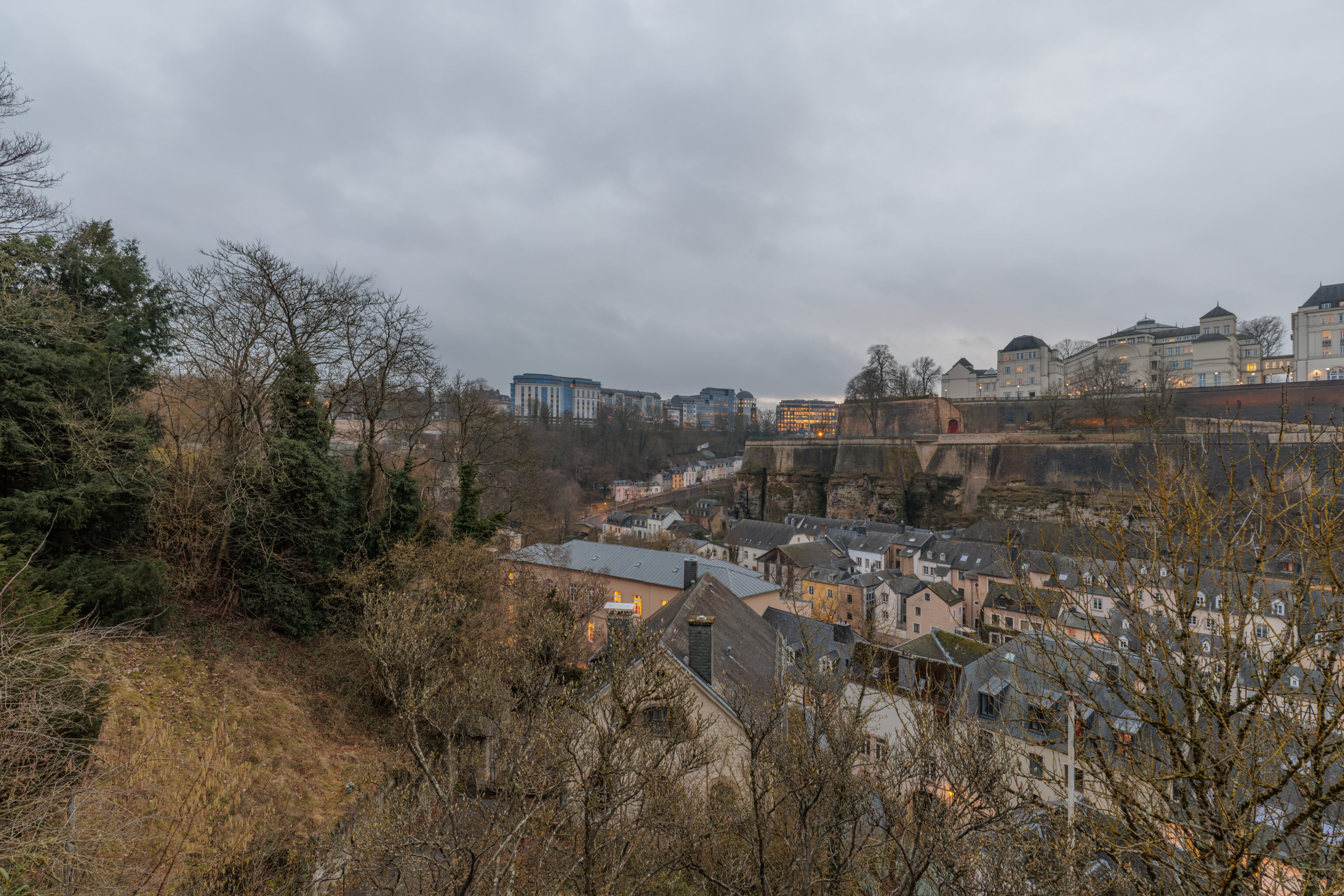
And the view looking a bit to the left towards the southwest.
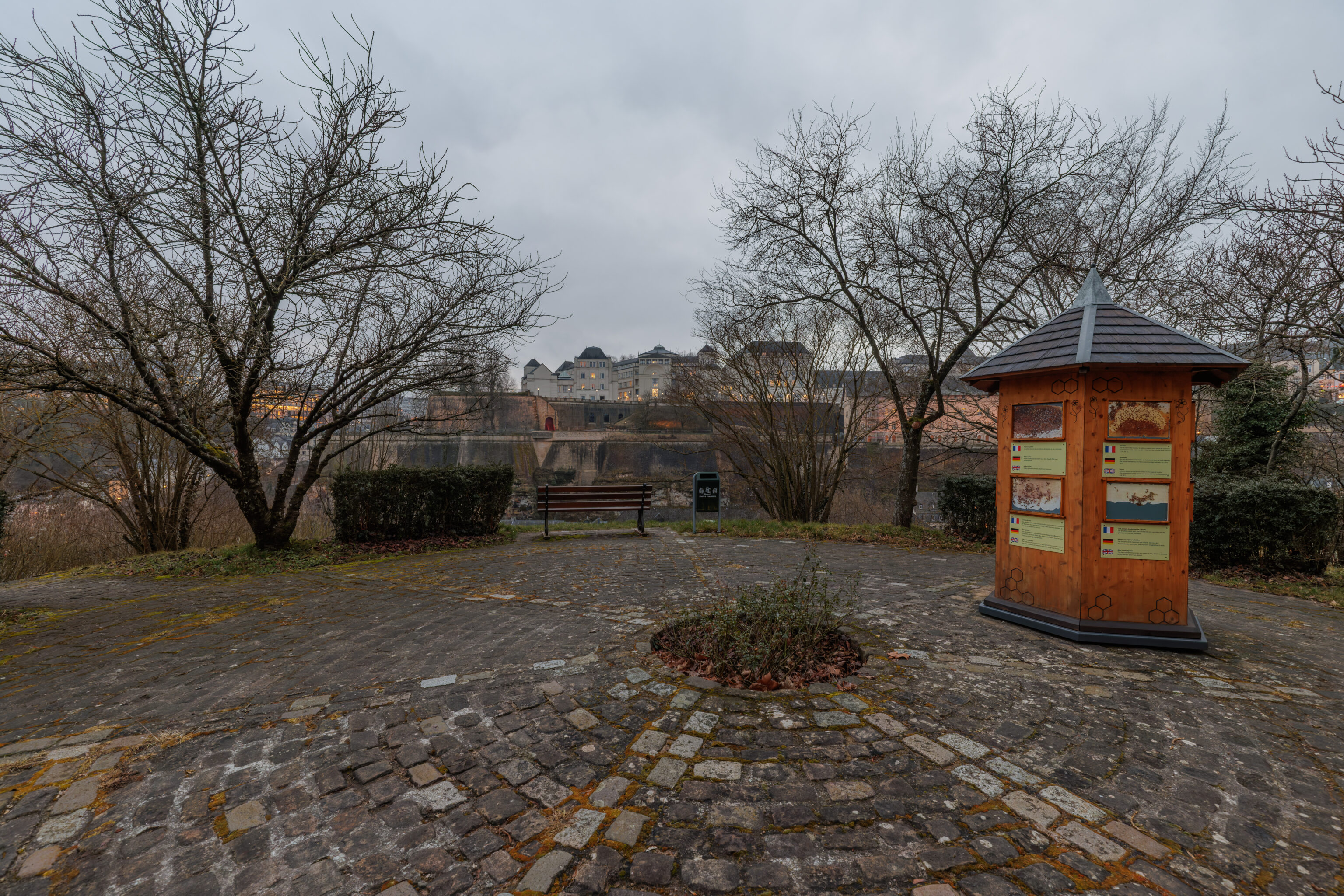
We followed the path to the south where we came to a small square.
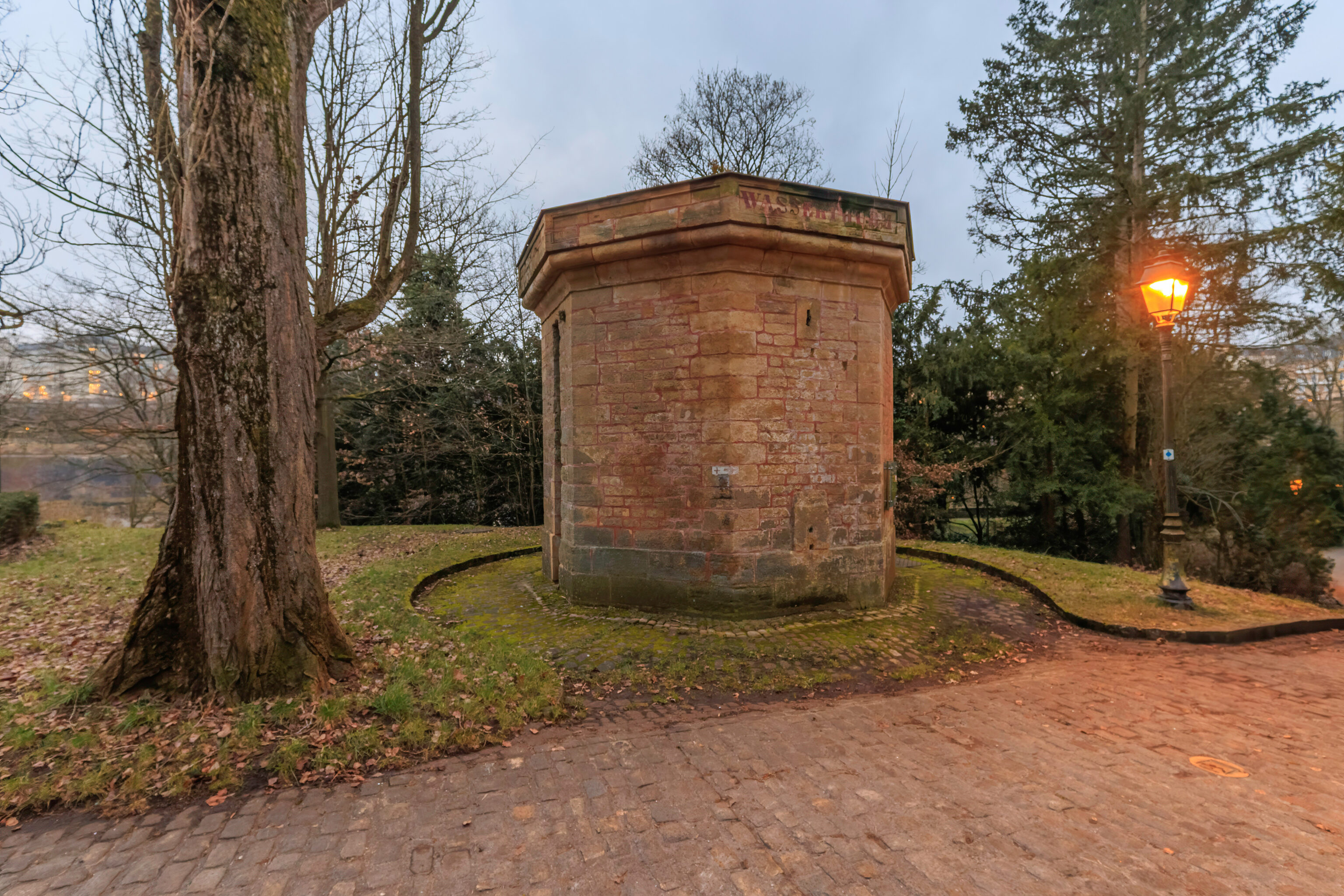
This nearby small octagonal structure was a water reservoir from the 19th century.
The Rham Plateau Water Reservoir
To ensure a reliable water supply for the troops, the Austrians began constructing a well at the rocky edge of the Rham Plateau. Work was interrupted in 1795 when French forces captured the fortress, and was only completed in 1814 under the direction of the Prussian garrison. In 1843, the well was enclosed within a vaulted well house.

At the same time, an octagonal water reservoir was built to store the water pumped from the well. This system ensured a continuous water supply for the barracks and the military kitchen (built opposite the reservoir in 1828 and converted into a chapel in 1893).
– Text from a sign, translated from German using Google Translate.
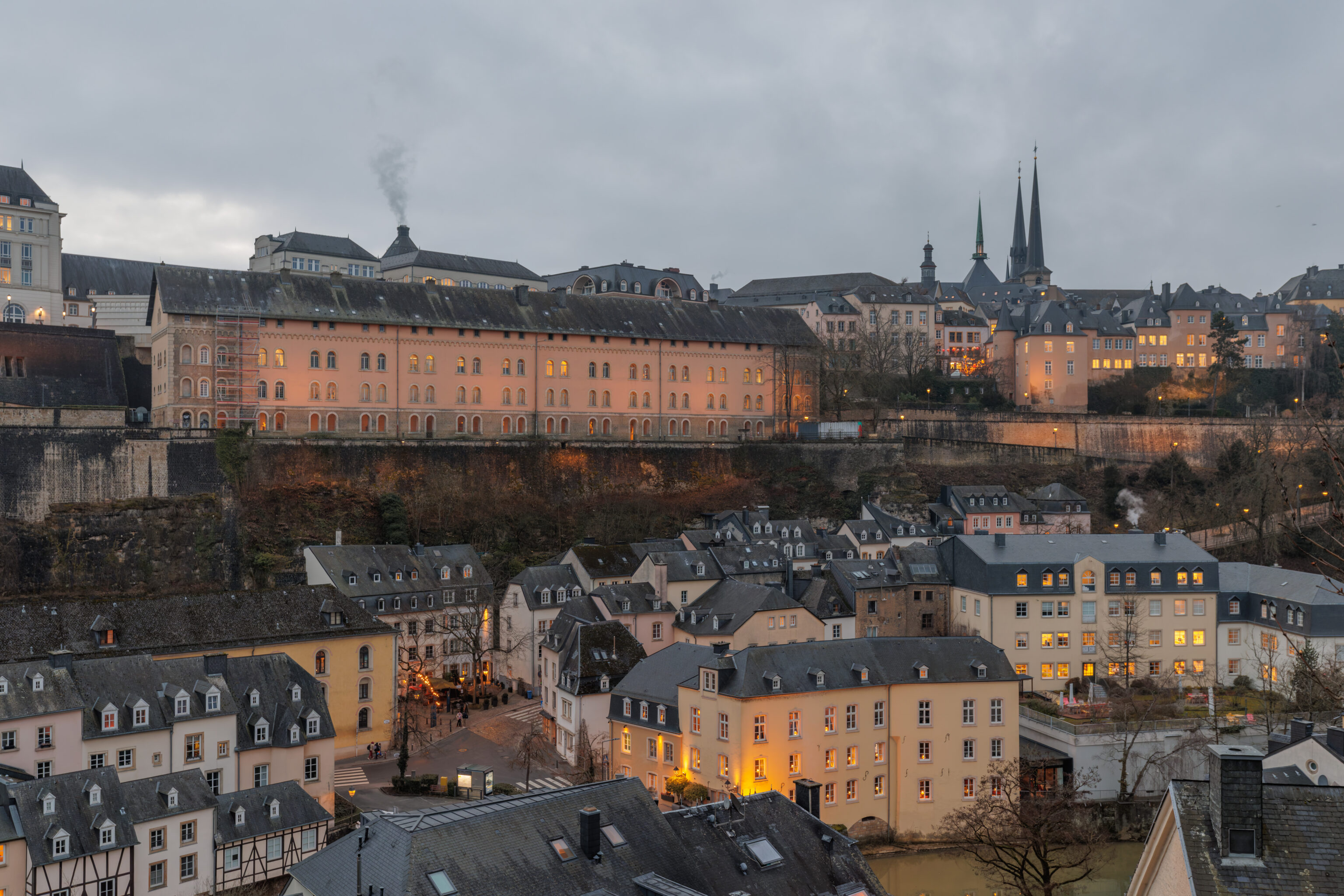
The view from here was also excellent! The elevator that goes up to the Cité Judiciaire from the Grund is by the slightly open area at bottom left.
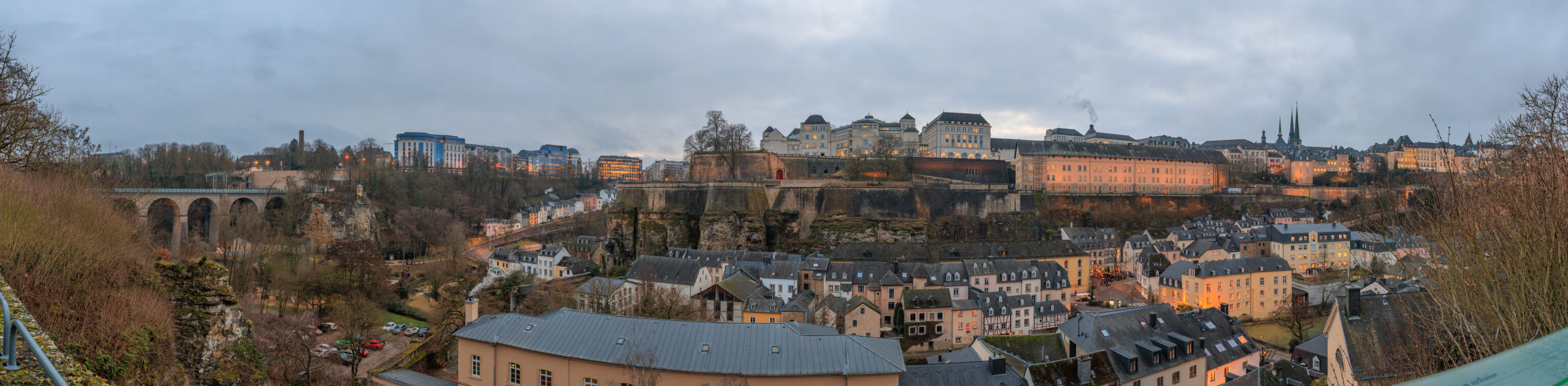
Again, a great wide open view for a panorama!
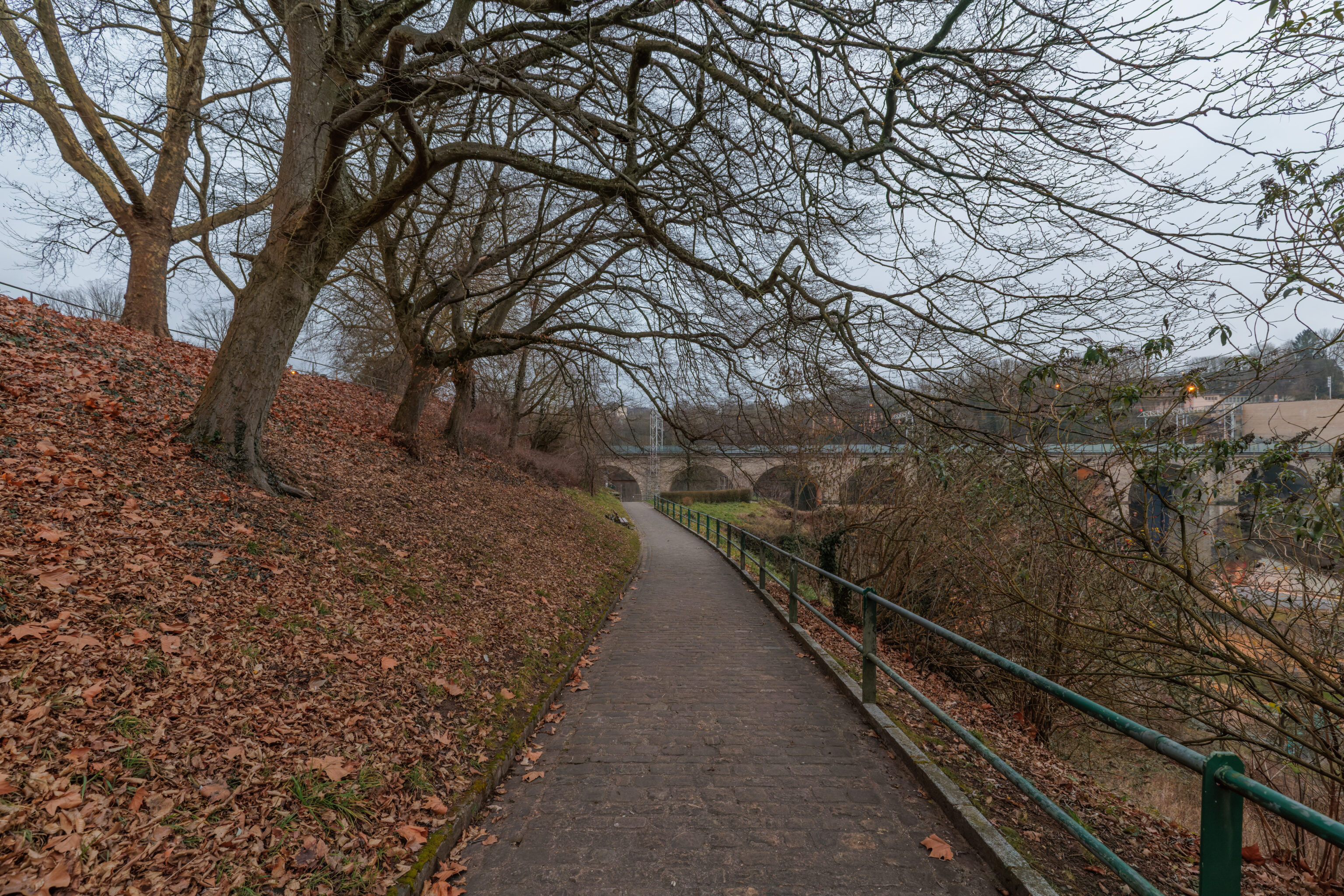
We continued following the path as it went to the southeast. There should be a way down from here.
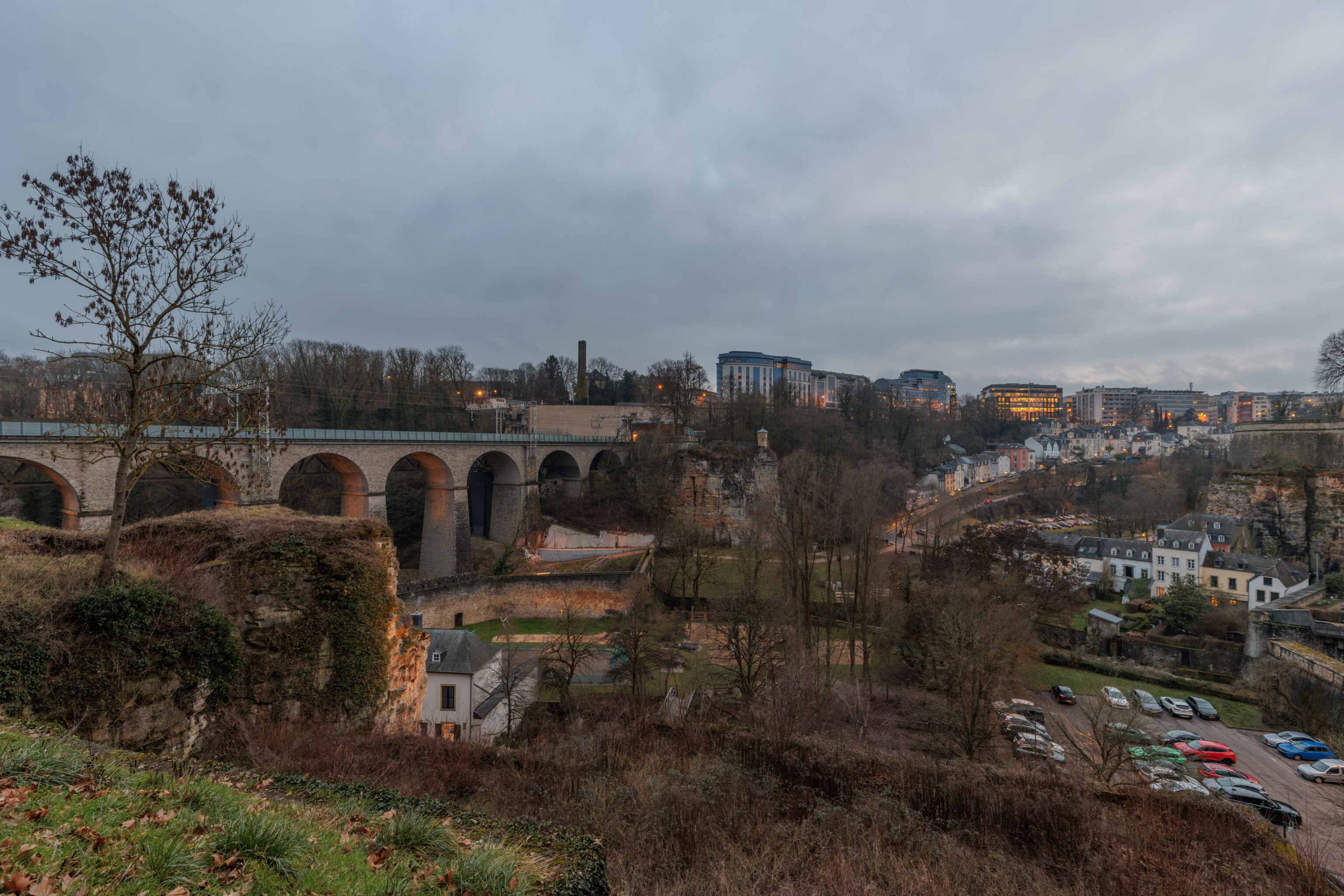
Now looking to the south, we could see the rail viaduct that goes to Luxembourg’s main train station. This section of viaduct is not contiguous with the section that we passed over earlier as they are separated by tracks that are at ground level on the Plateau du Rham.
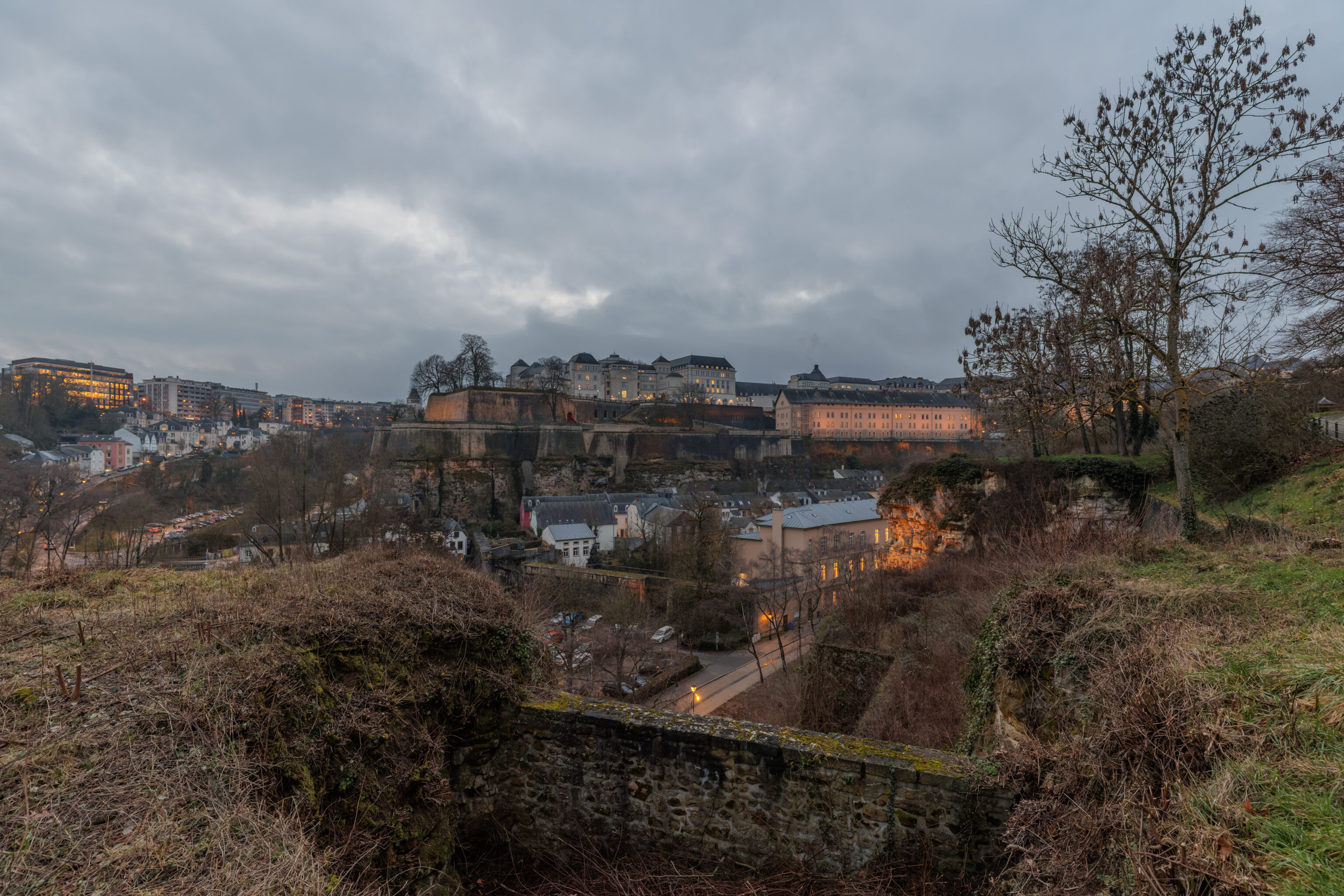
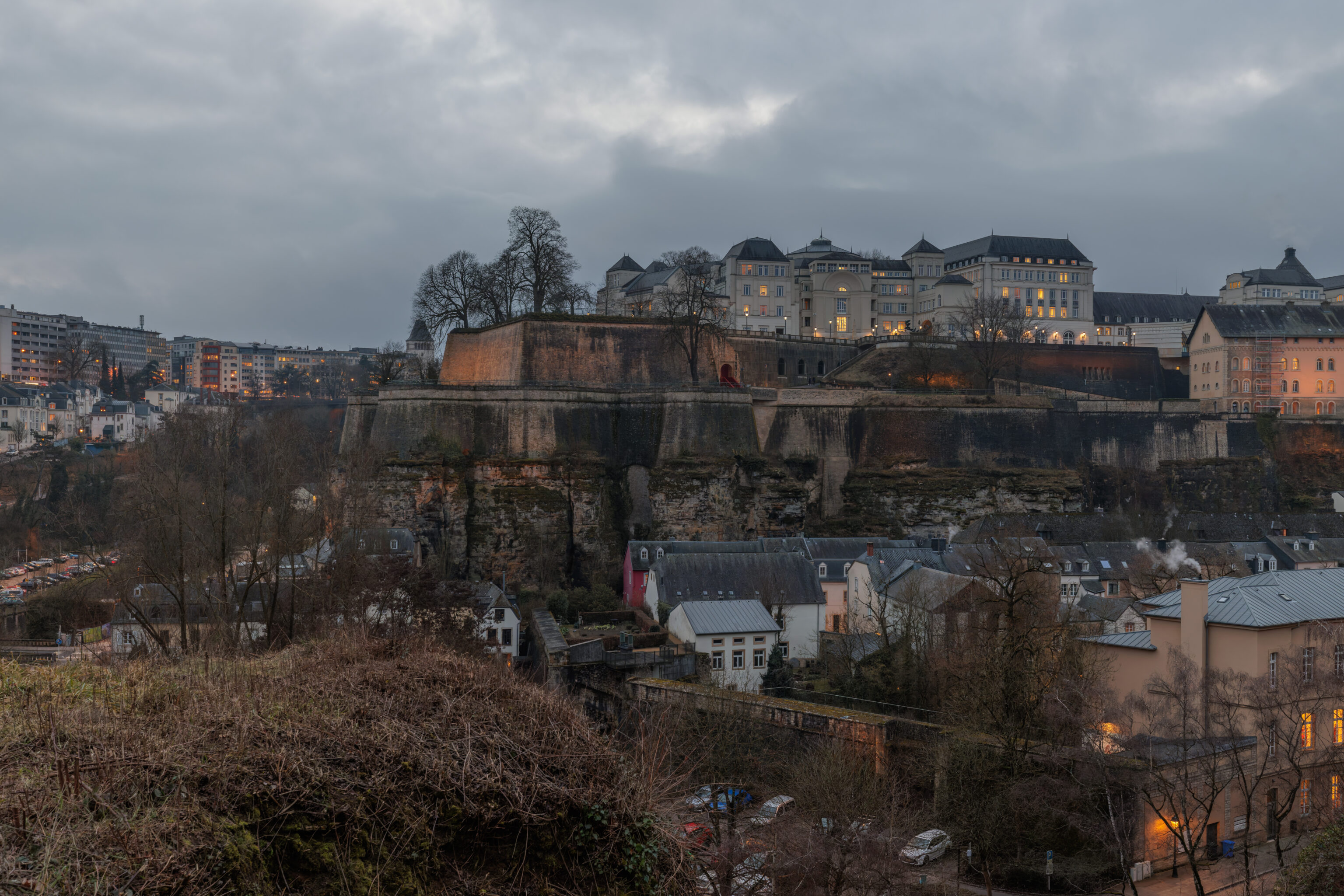
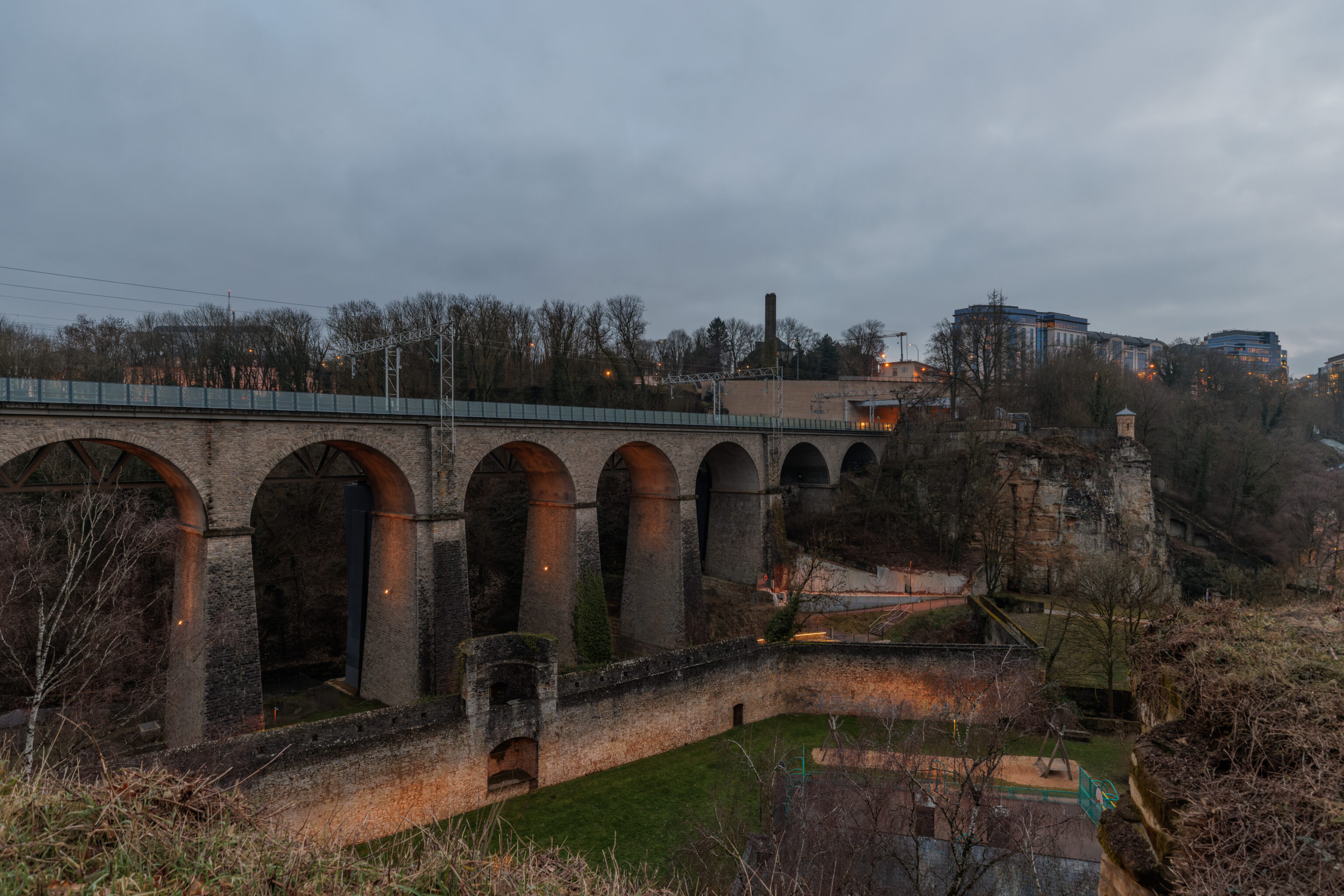
It was getting darker as we continued to walk.
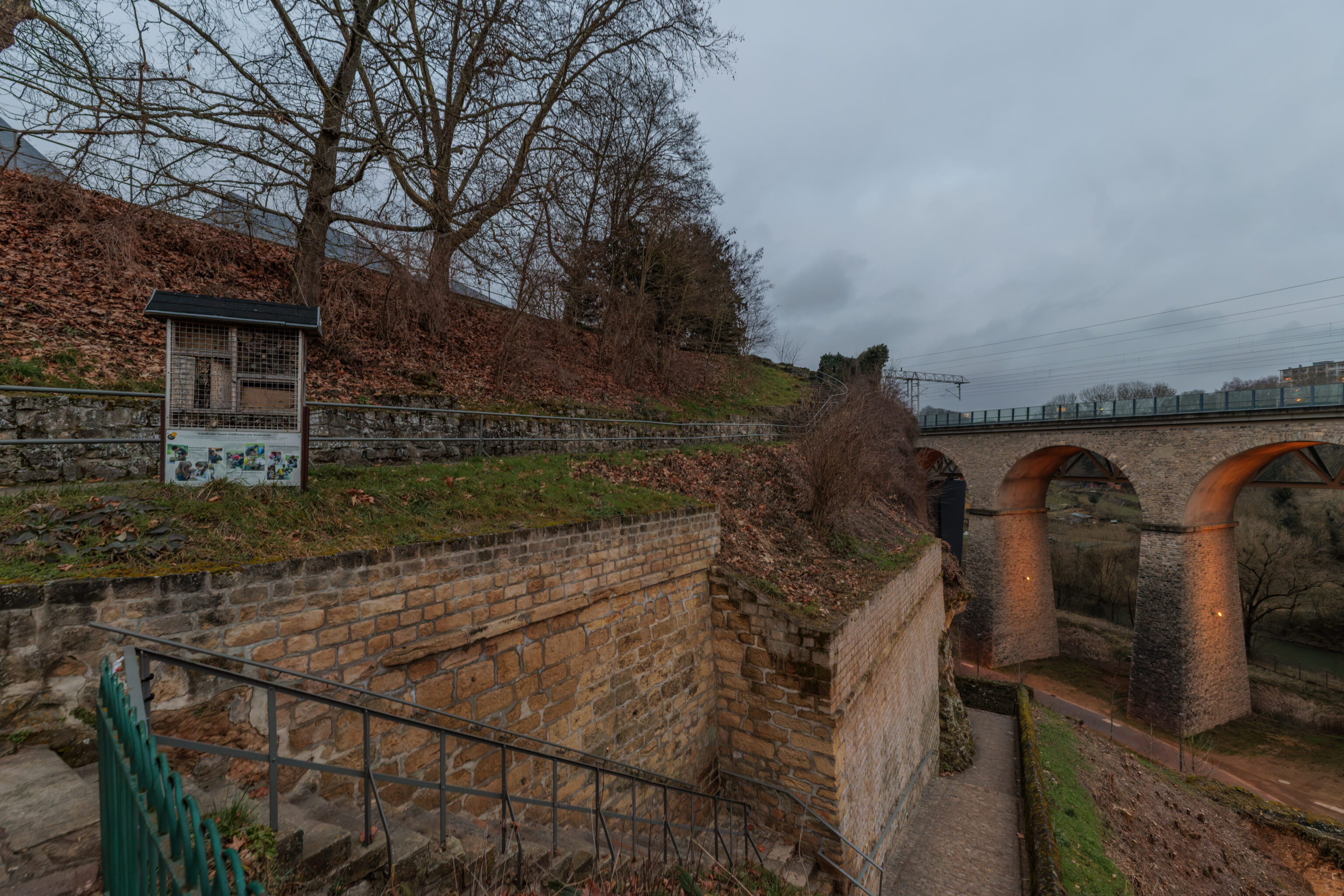
There were indeed stairs that led down off of the Plateau du Rham.
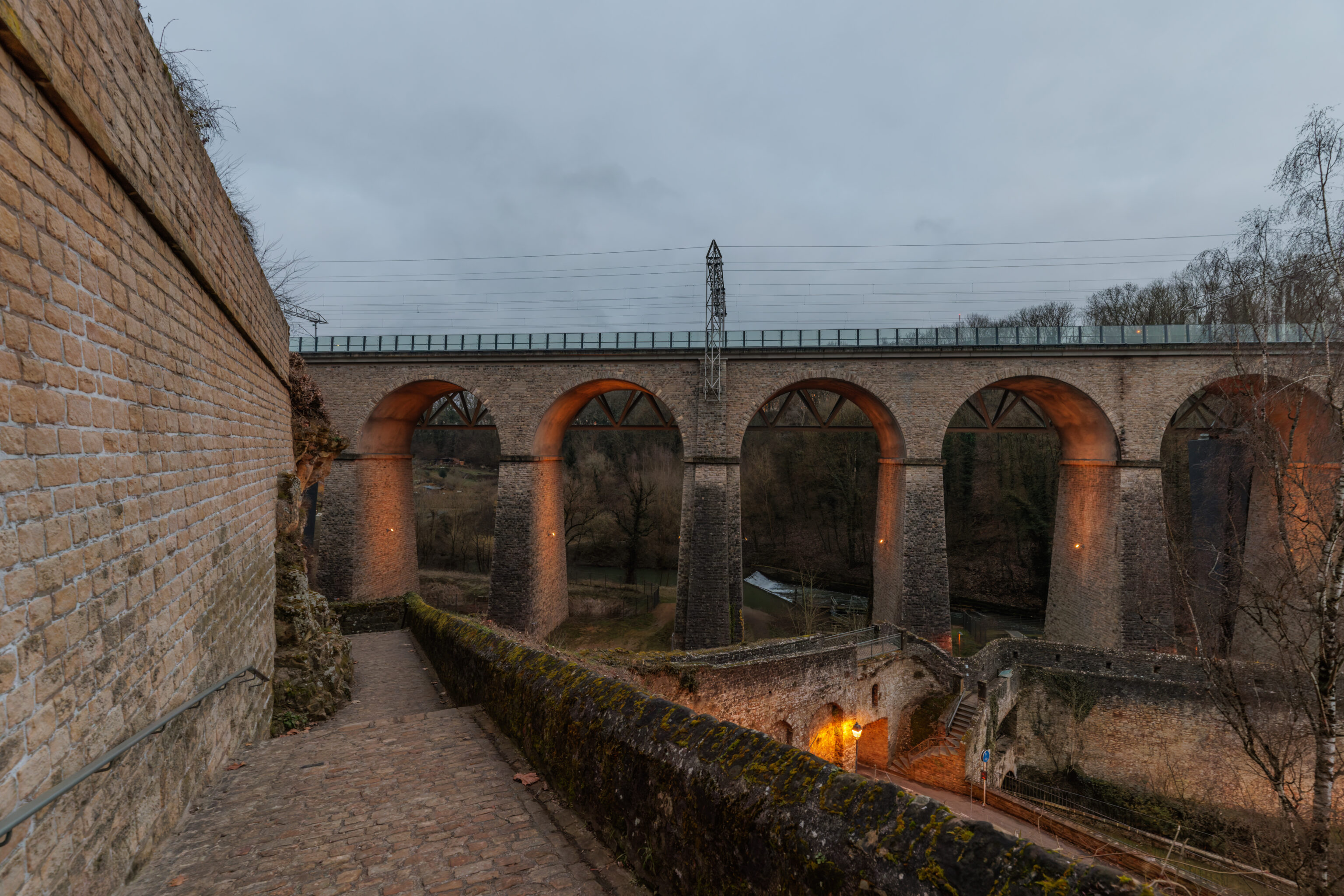
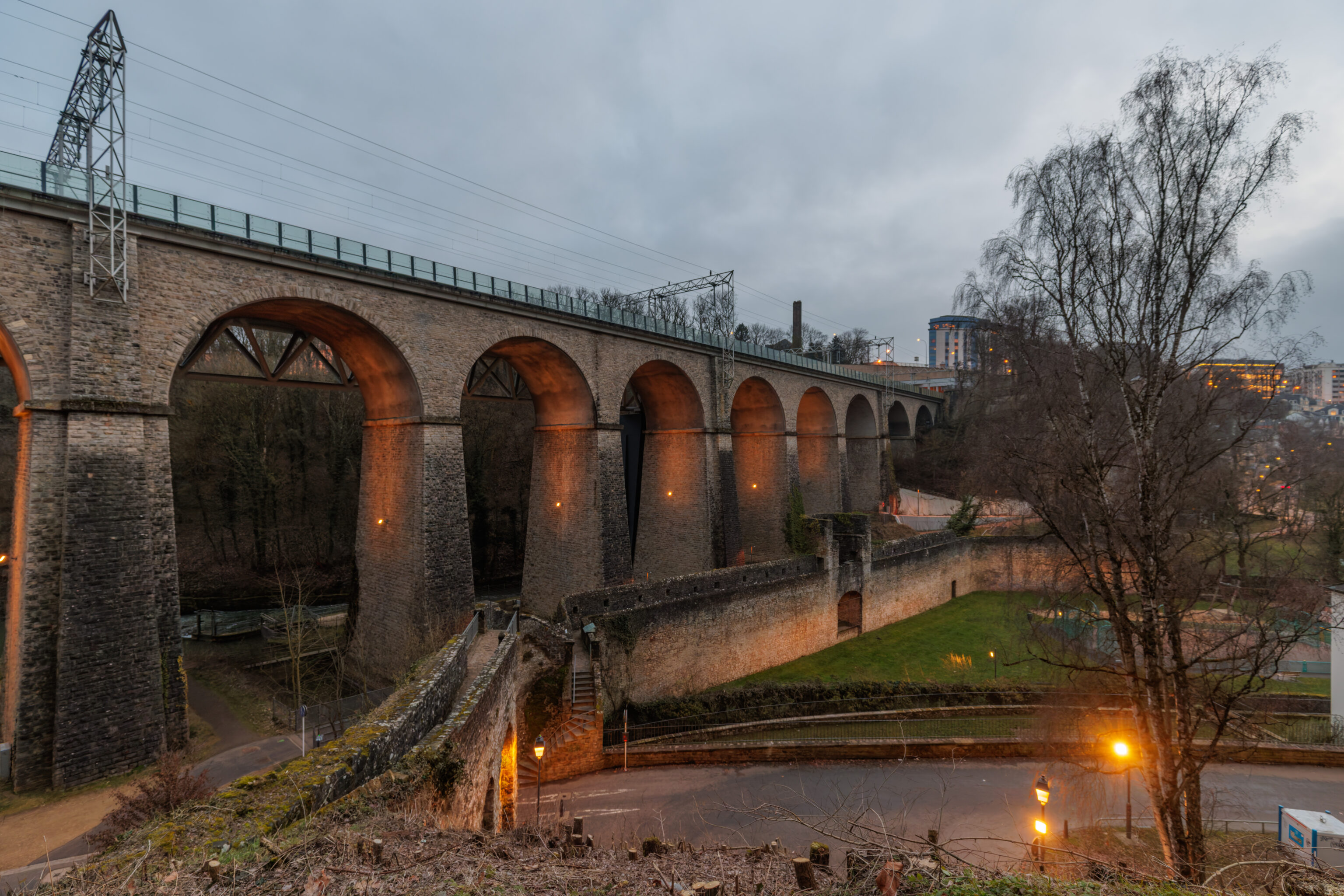
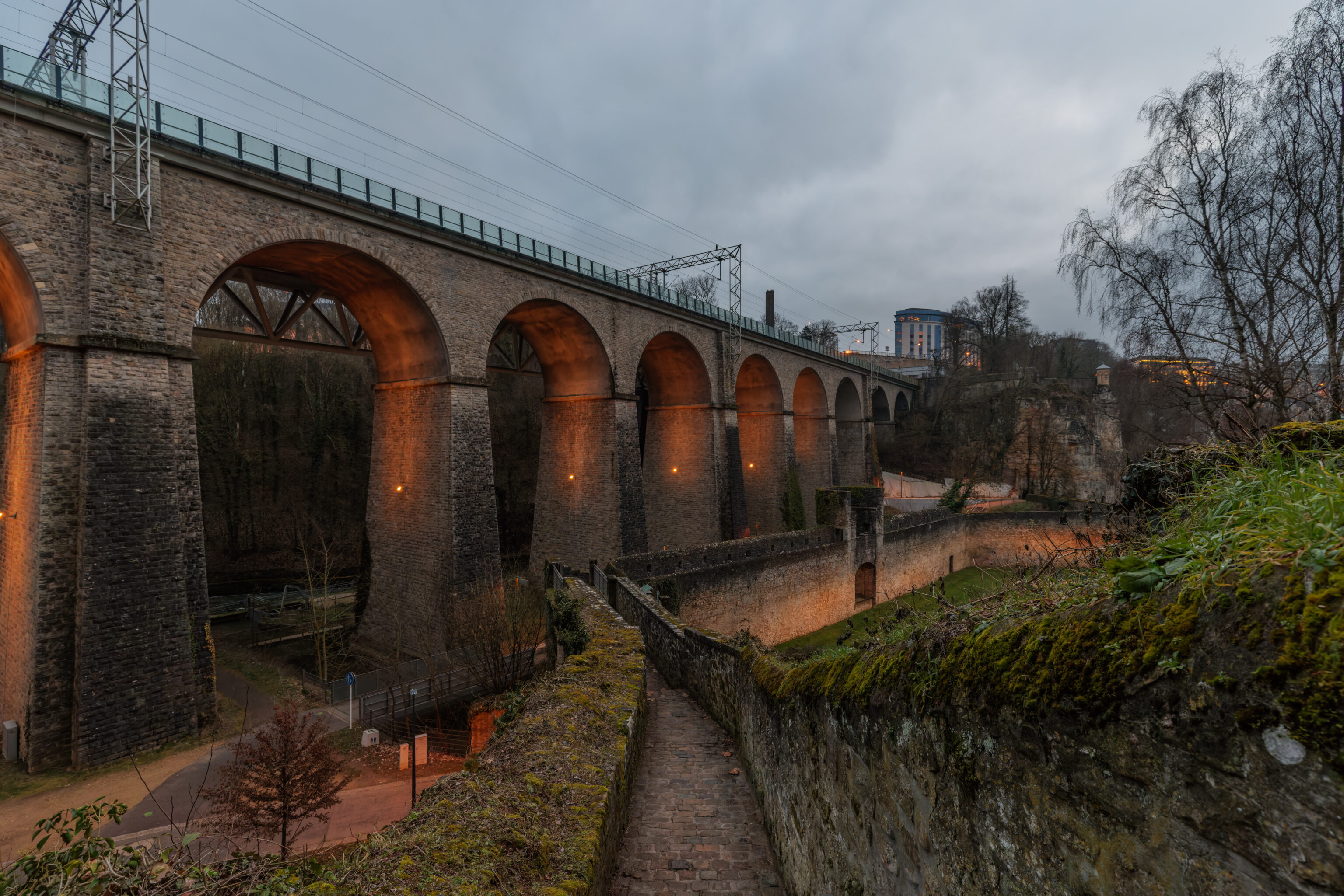
We ended up at a section of wall below the rail viaduct.
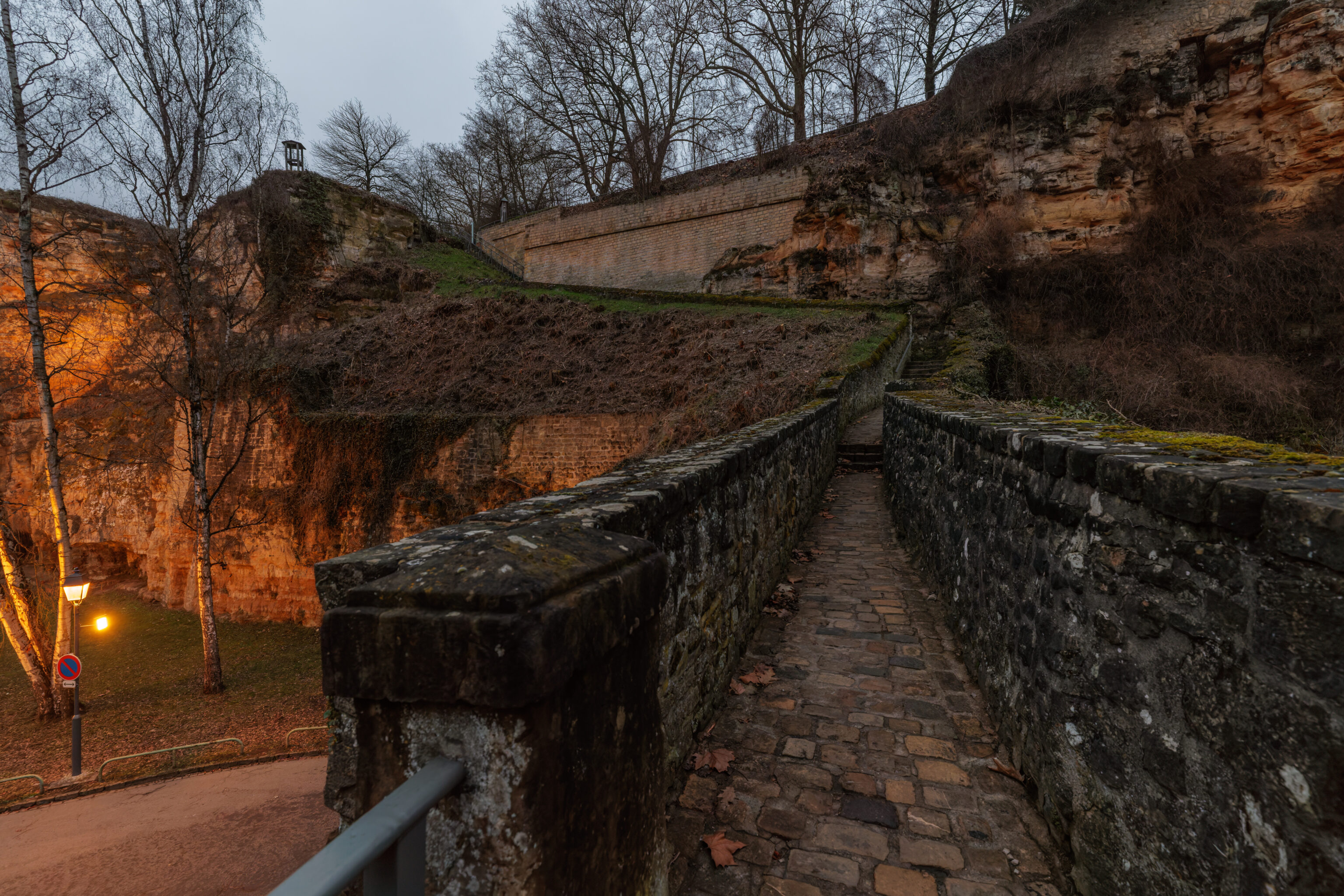
The view looking back at where we descended from.
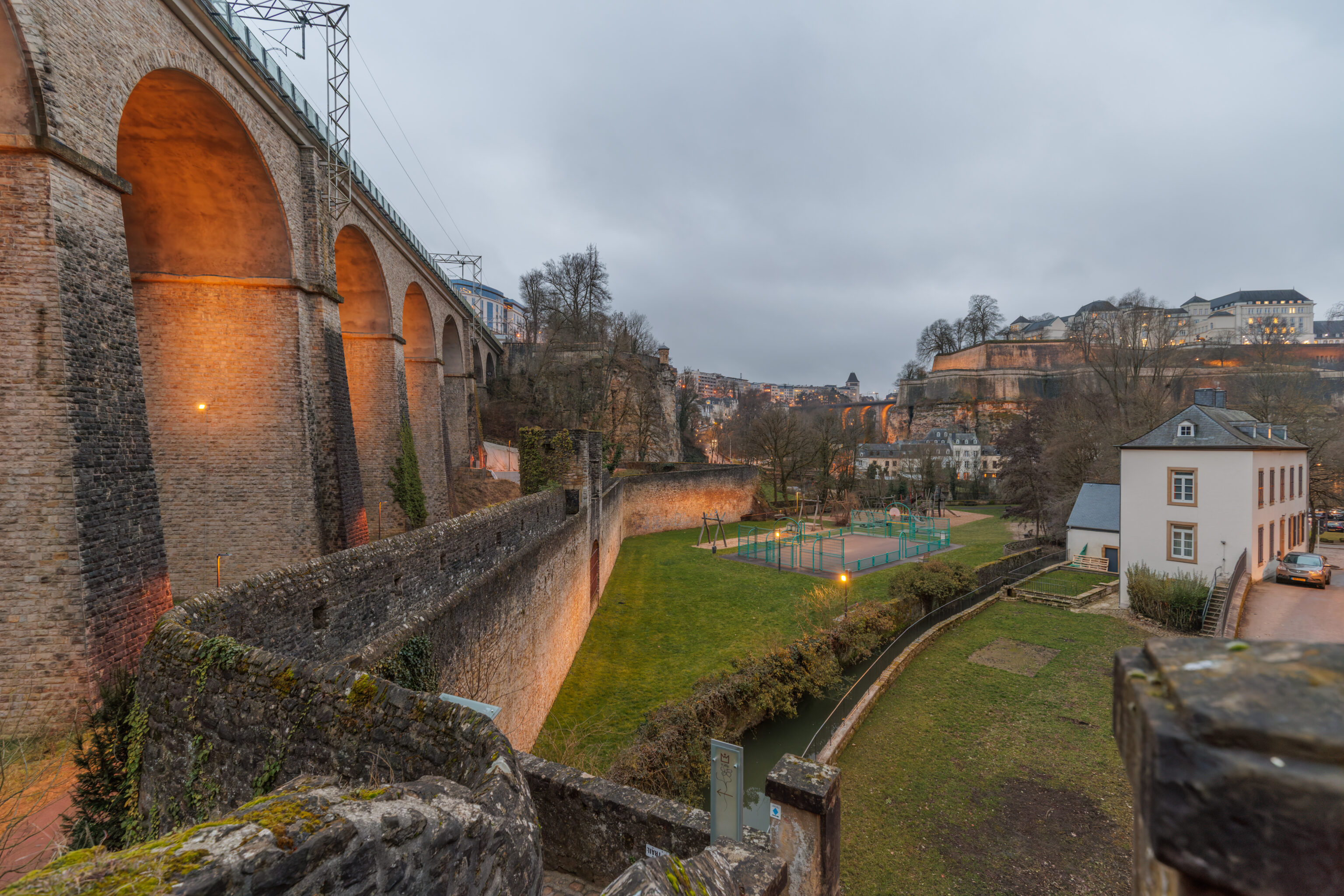
We continued to the southwest top the wall.
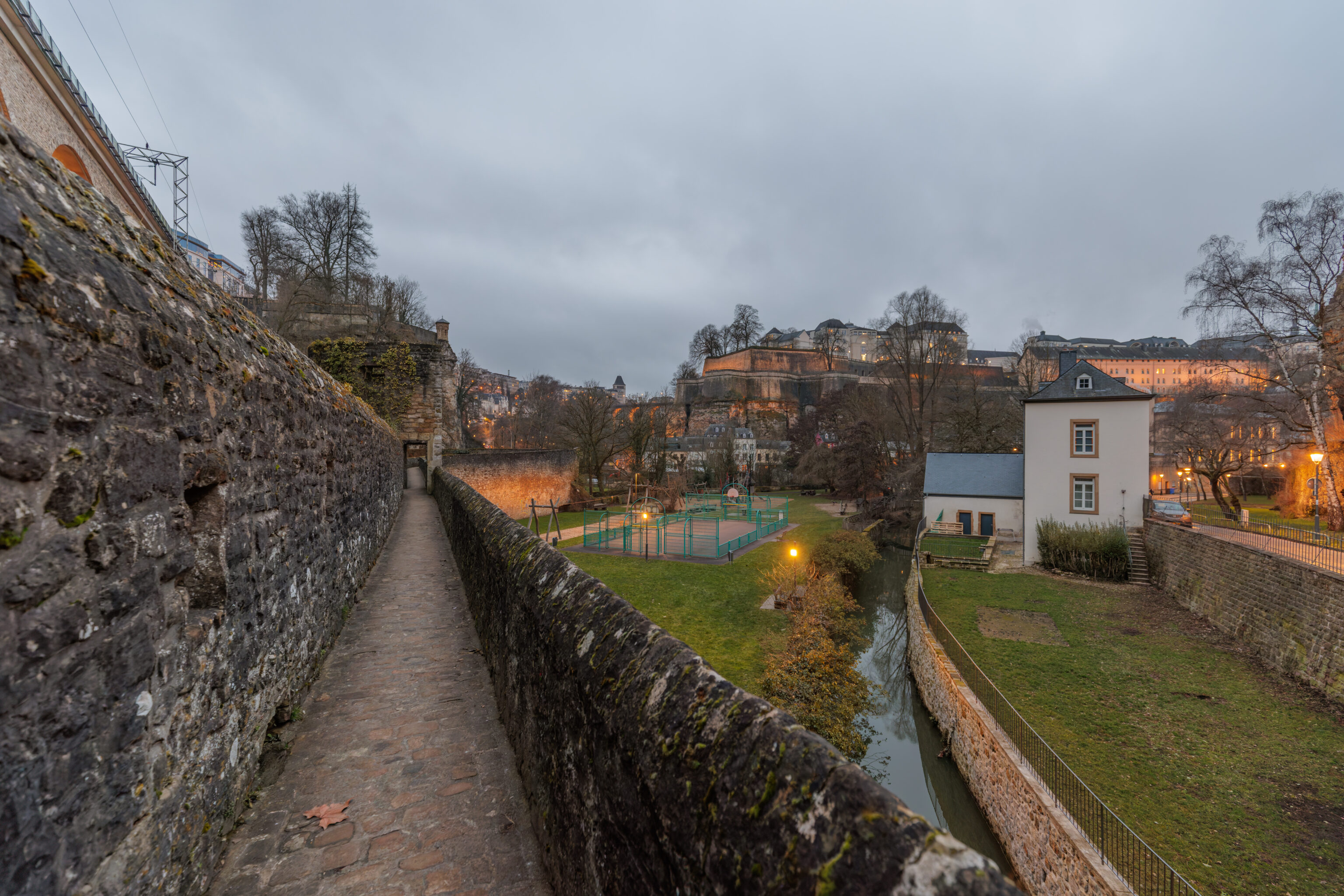
According to a sign, there were orchards here. That isn’t really apparent to us from looking around though.
Traditional Orchards
Traditional orchards, characterized by tall-growing fruit trees, are used for both grazing and fruit production. The apples, pears, plums, mirabelle plums, cherries, and quinces harvested there are highly versatile. These orchards also serve other functions: shaping the landscape and providing a habitat for endangered species, such as the little owl. Prior to 1950, traditional orchards played a significant economic role—even within urban areas like this one. However, due to structural changes in agriculture and the expansion of settlements, many of these orchards have since disappeared. Planting new fruit trees is therefore crucial for preserving this cultural heritage.
– Text from a sign, translated from German using Google Translate.
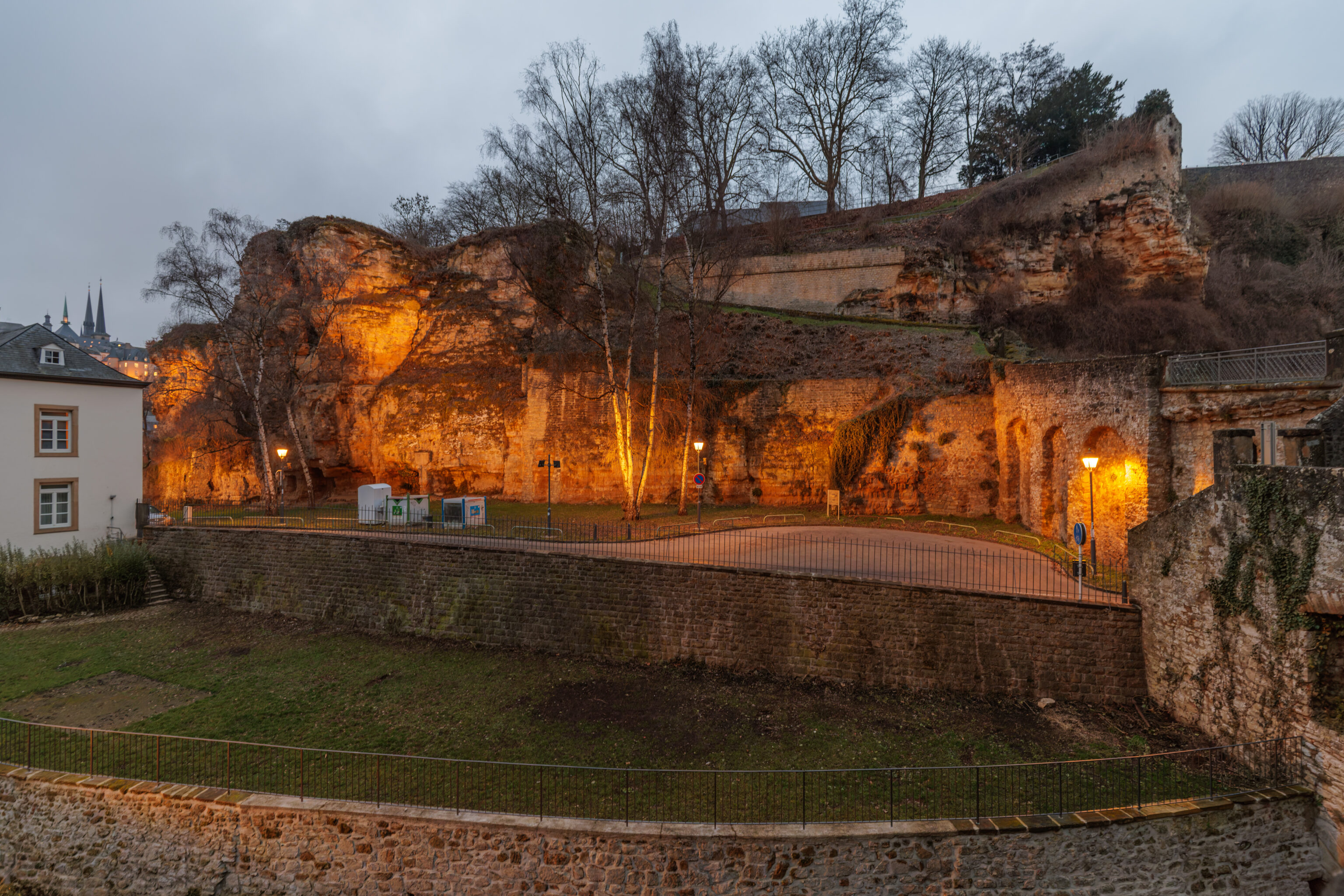
The view looking back at the Plateau du Rham.
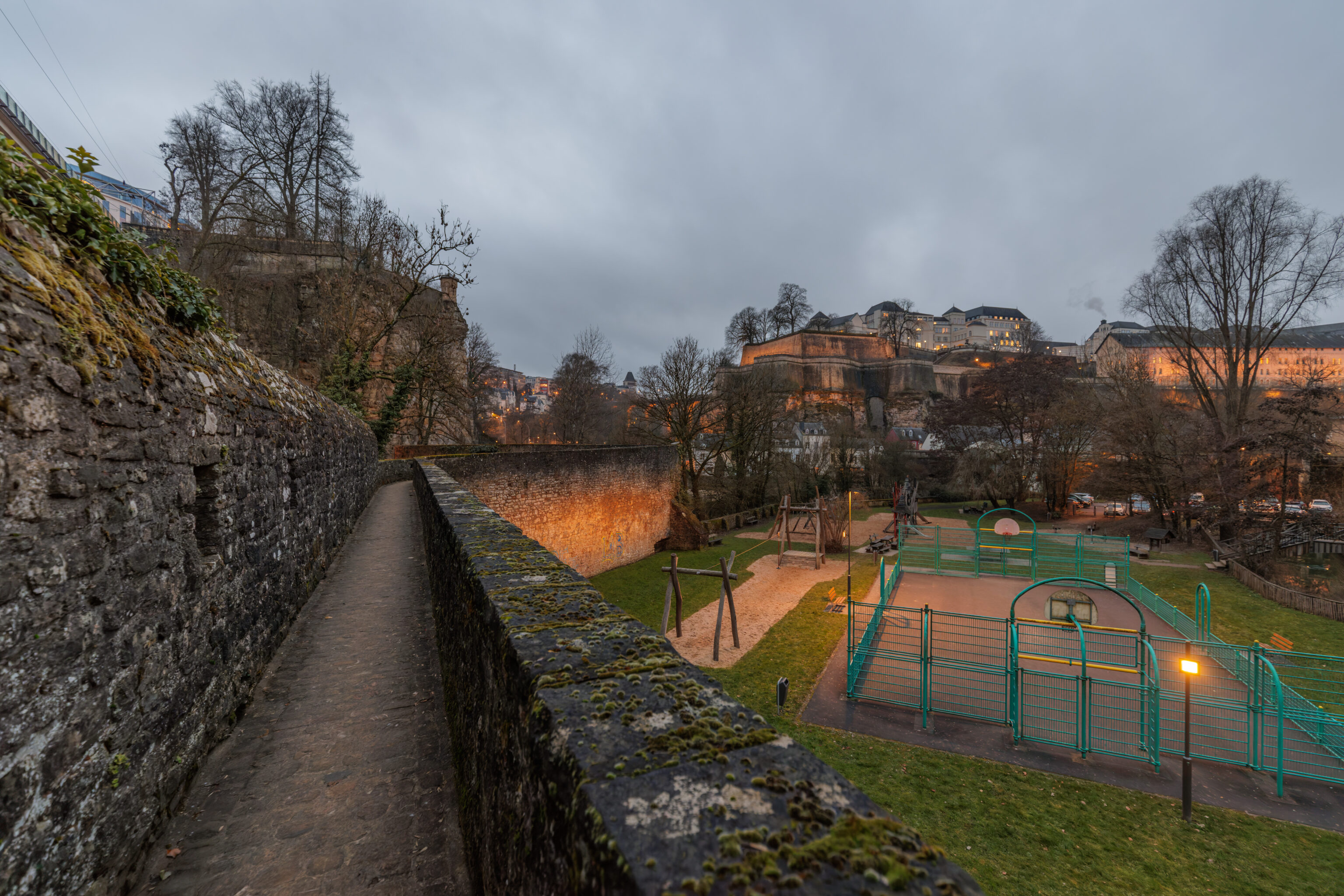
There was a sluice around here, basically a lock that controlled the flow of water through a dam.
The Grund Sluice
The Grund sluice was built in 1737 during the Austrian period and was dismantled between 1876 and 1878. The structure consisted of a masonry dam featuring five arched openings. A wall extended the dam on both sides of the sluice as far as the rock faces.

This fortification spanned the entire width of the valley. When closed, the sluice could cause the flooding of part of the Alzette and Pétrusse valleys. The complex also housed an artillery-proof gallery connecting the fortifications of the Saint-Esprit Plateau to those of the Rham.
– Text from a sign, translated from French using Google Translate.
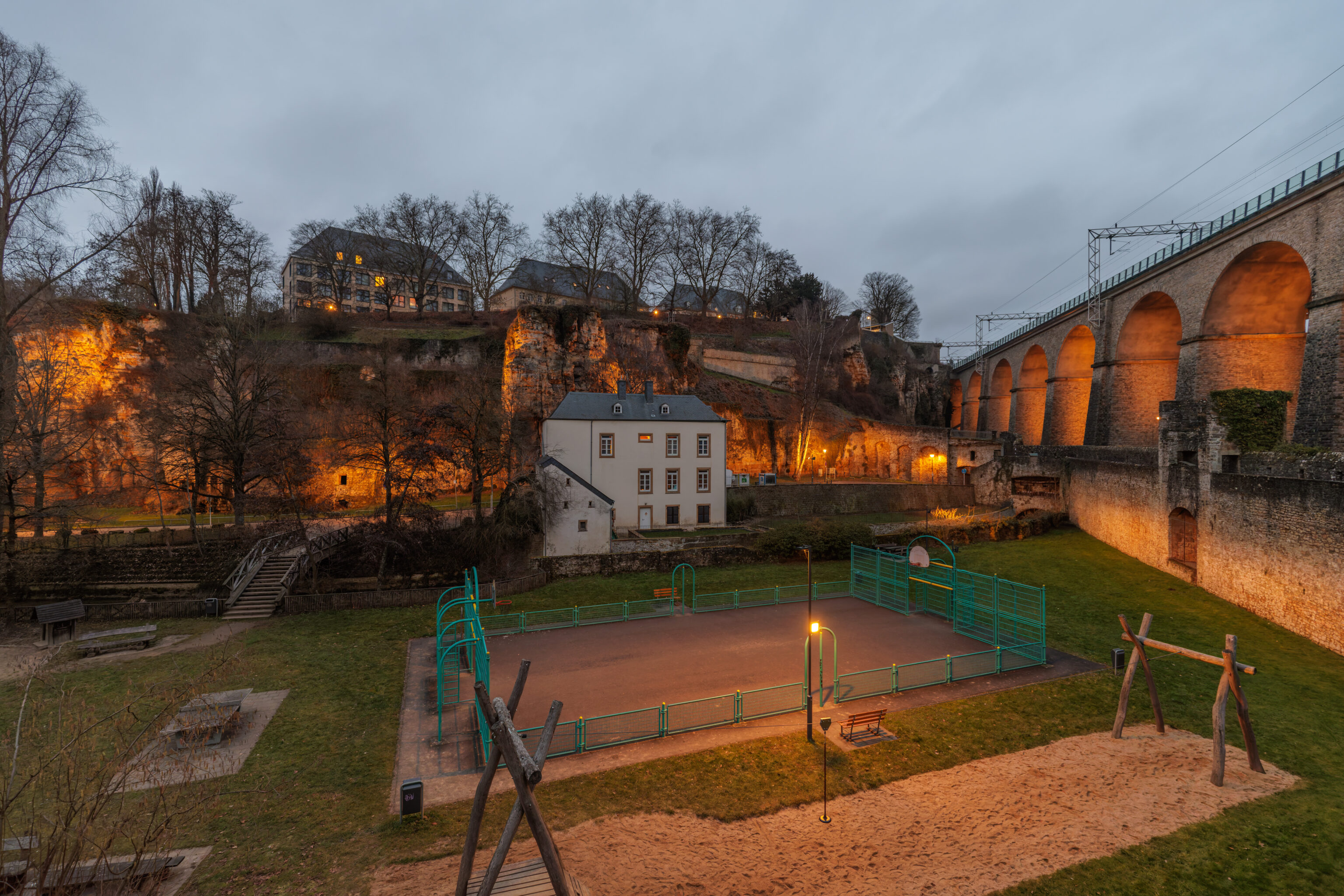
A sign here describes the usage of sandstone throughout Luxembourg. It has an illustration that shows various buildings that were built using it.
Construction stone
Luxembourg sandstone characterizes the urban landscape through its natural occurrence in the rock faces and its use as a construction stone.
– Text from a sign, translated from French using Google Translate.
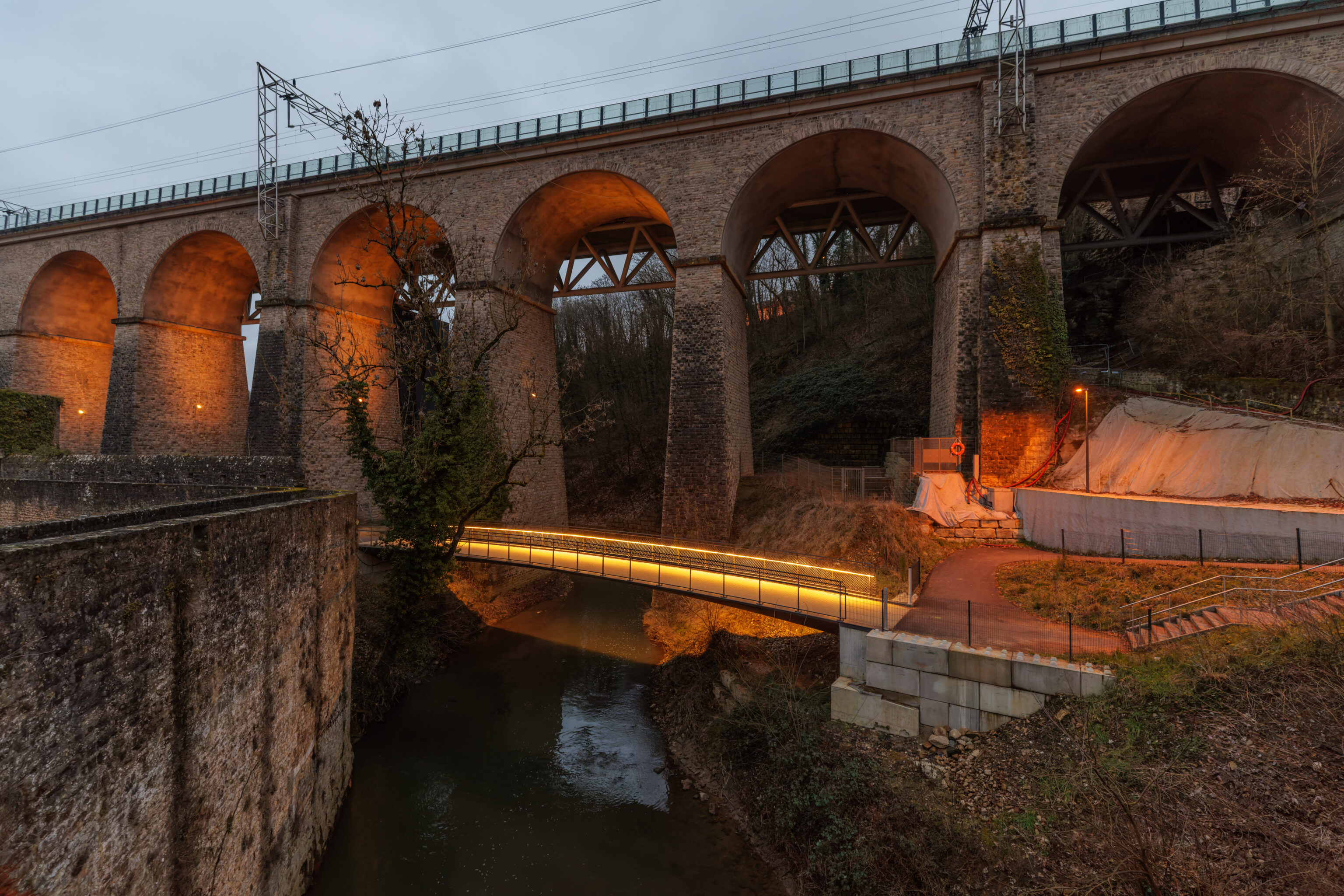
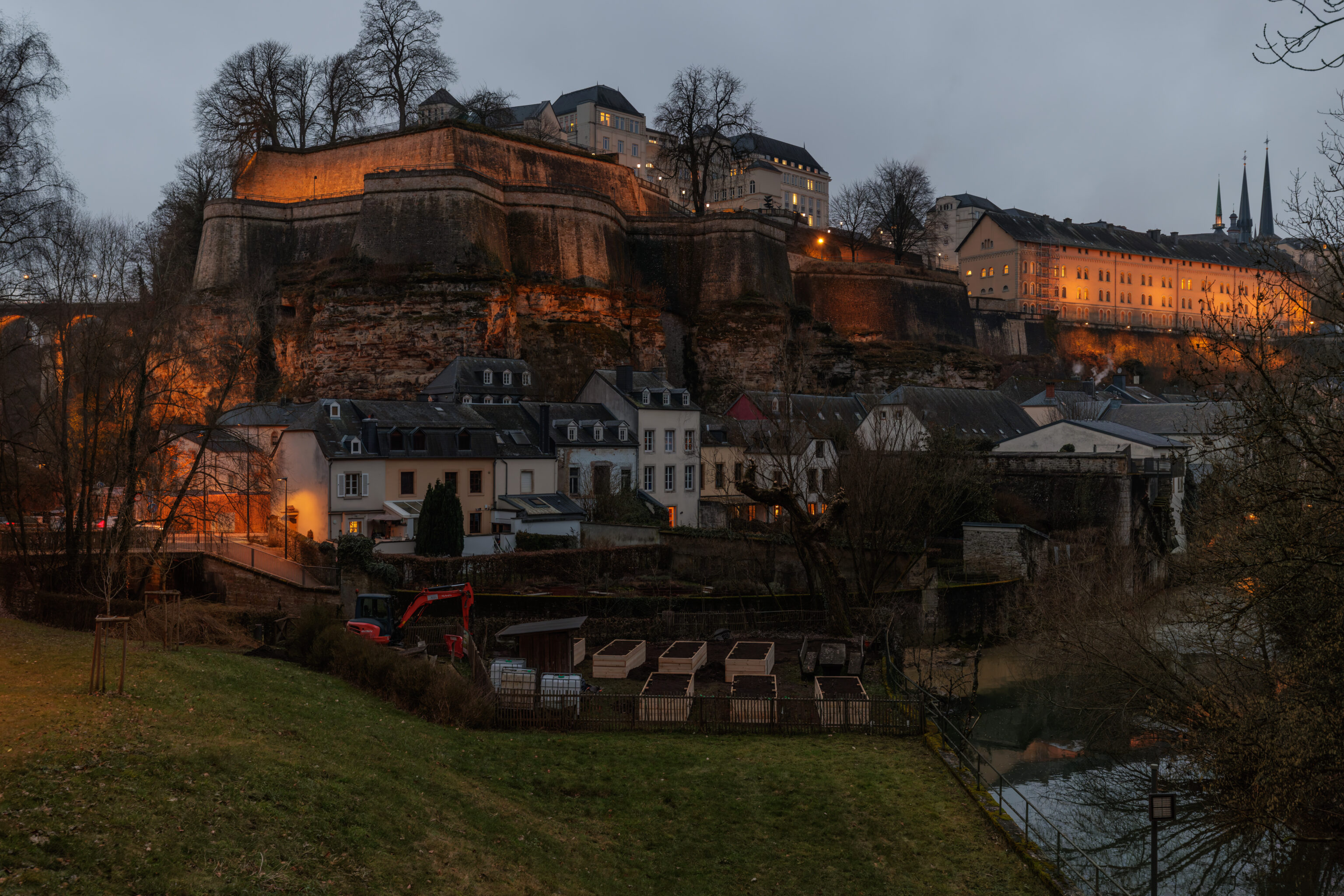
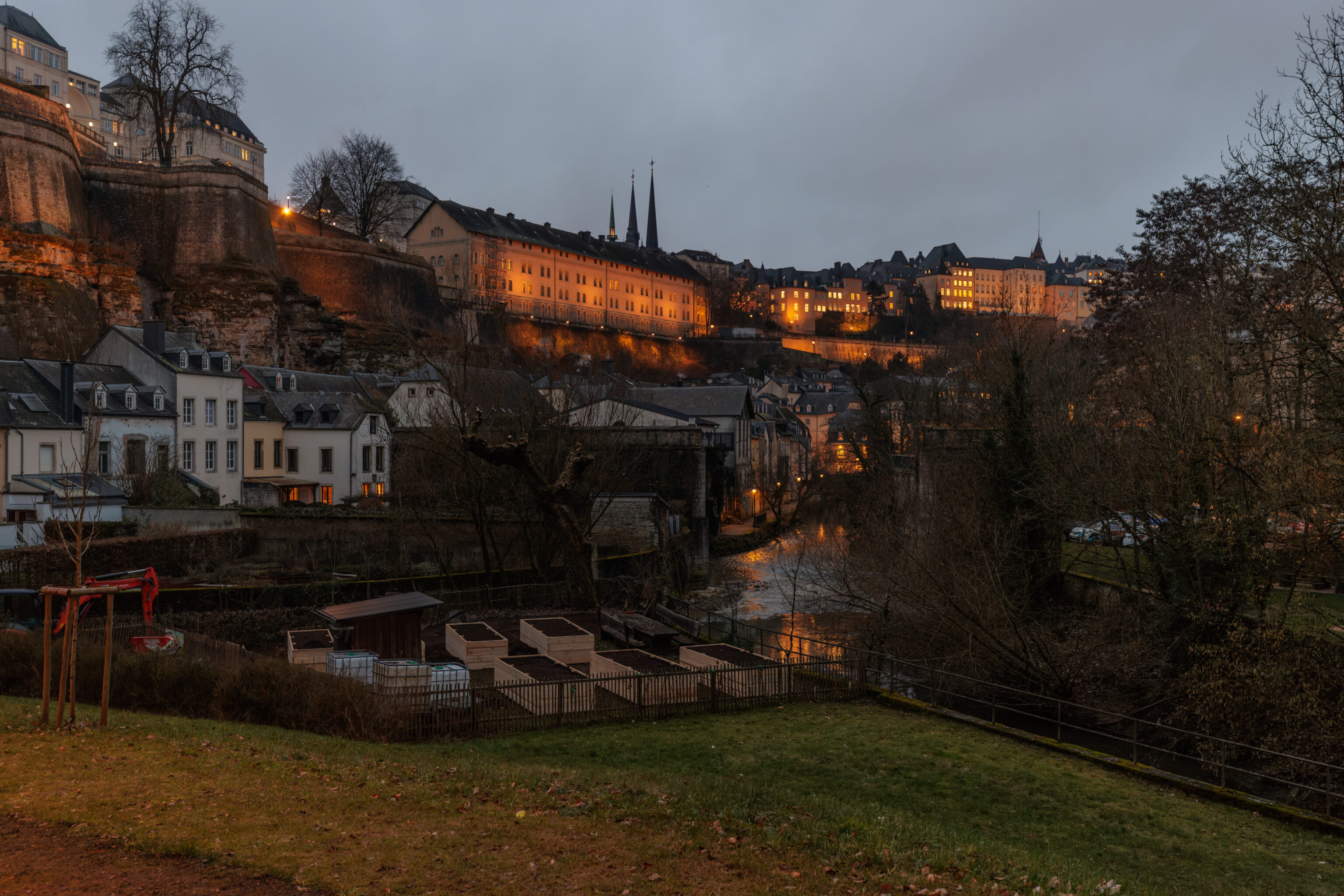
We continued following the wall until it ended when we crossed the Alzette. We were now at the bottom of the valley.
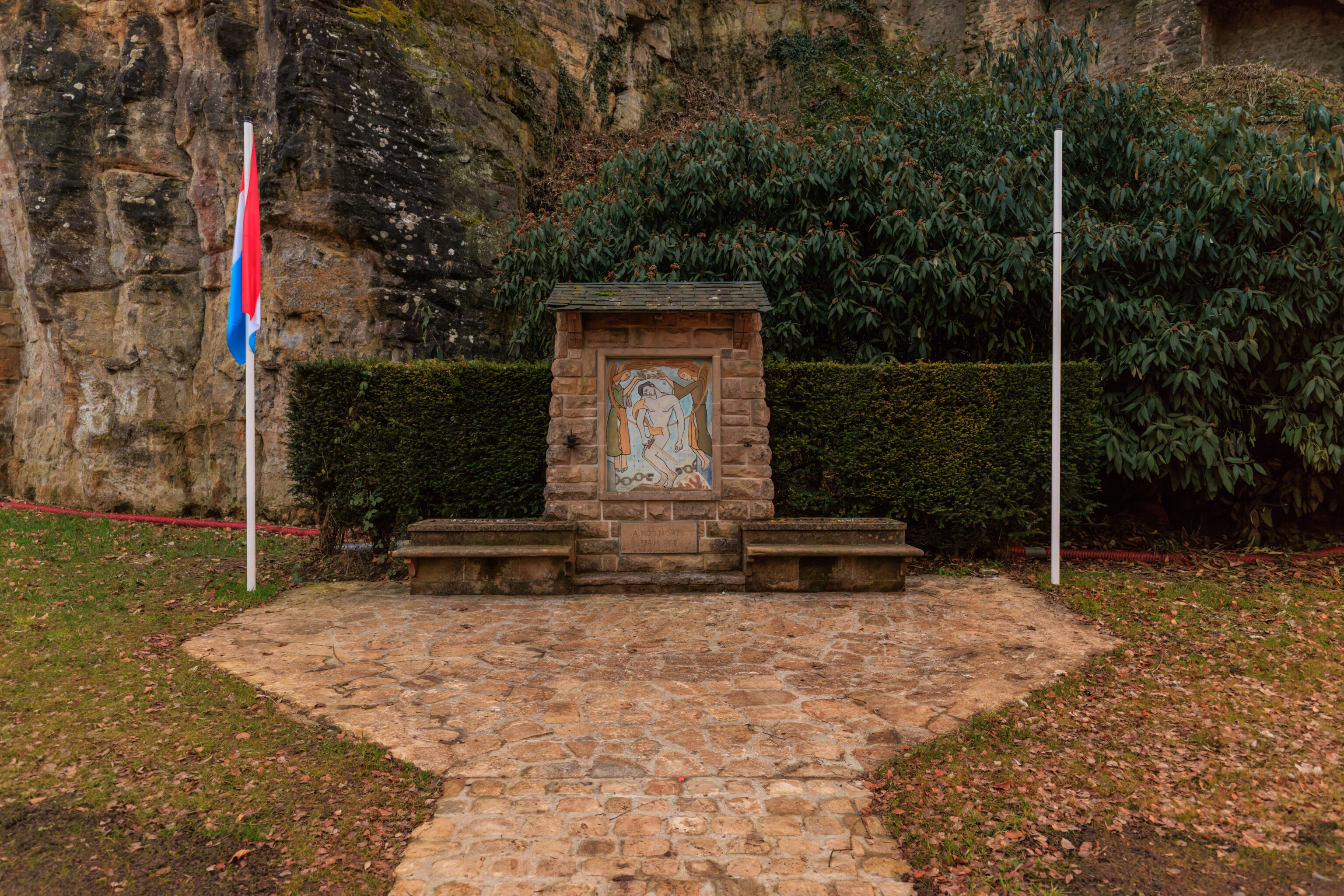
We walked by a small war memorial on our left.
TO OUR DEAD
1940 - 1945
– Text from the memorial, translated from French using Google Translate.
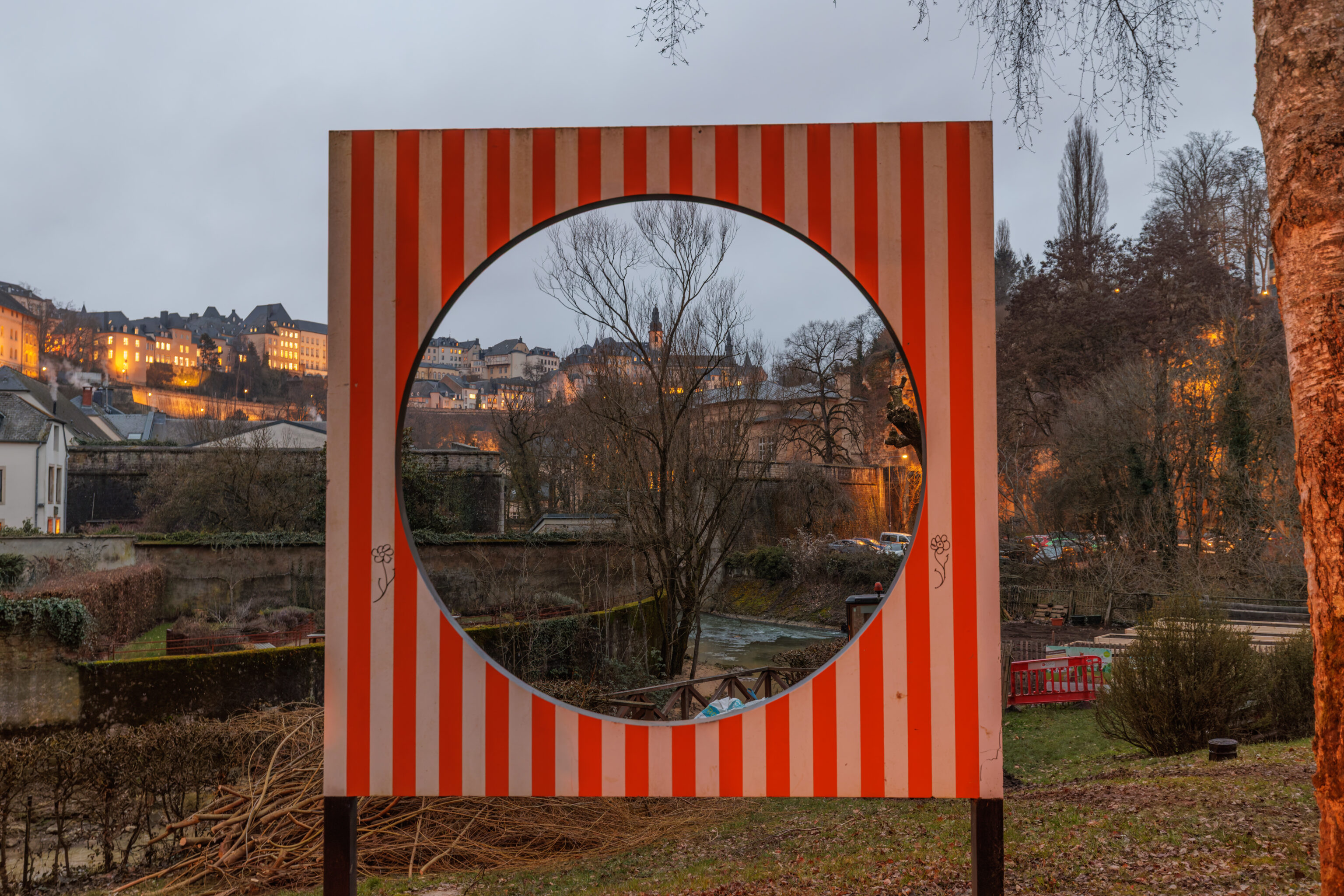
Another one of these circles! We ended up walking northwest to the elevator up from the Grund to the Cité Judiciaire. And then, we caught a bus from the F. D. Roosevelt bus stop at the northwest corner of the Cité Judiciaire to return to Luxembourg Station.
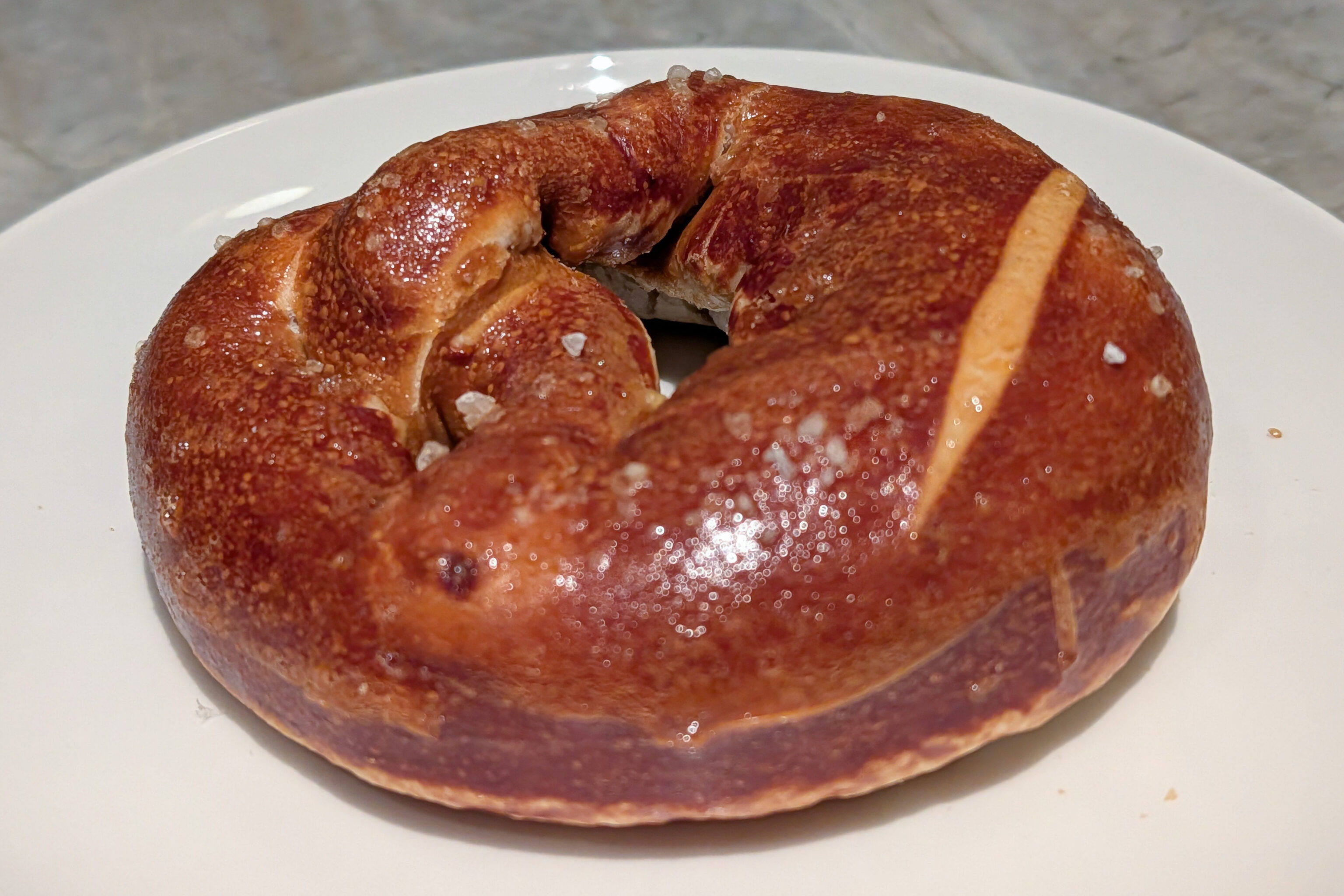
We visited the lounge again at the Marriott. We mostly just drank some juice but also decided to try the pretzels. They were surprisingly good! Better than any pretzels we’ve had in Germany, although maybe we’ve just never been to the right place.
This is our last night in Luxembourg. Tomorrow morning, it’ll be time to check out.