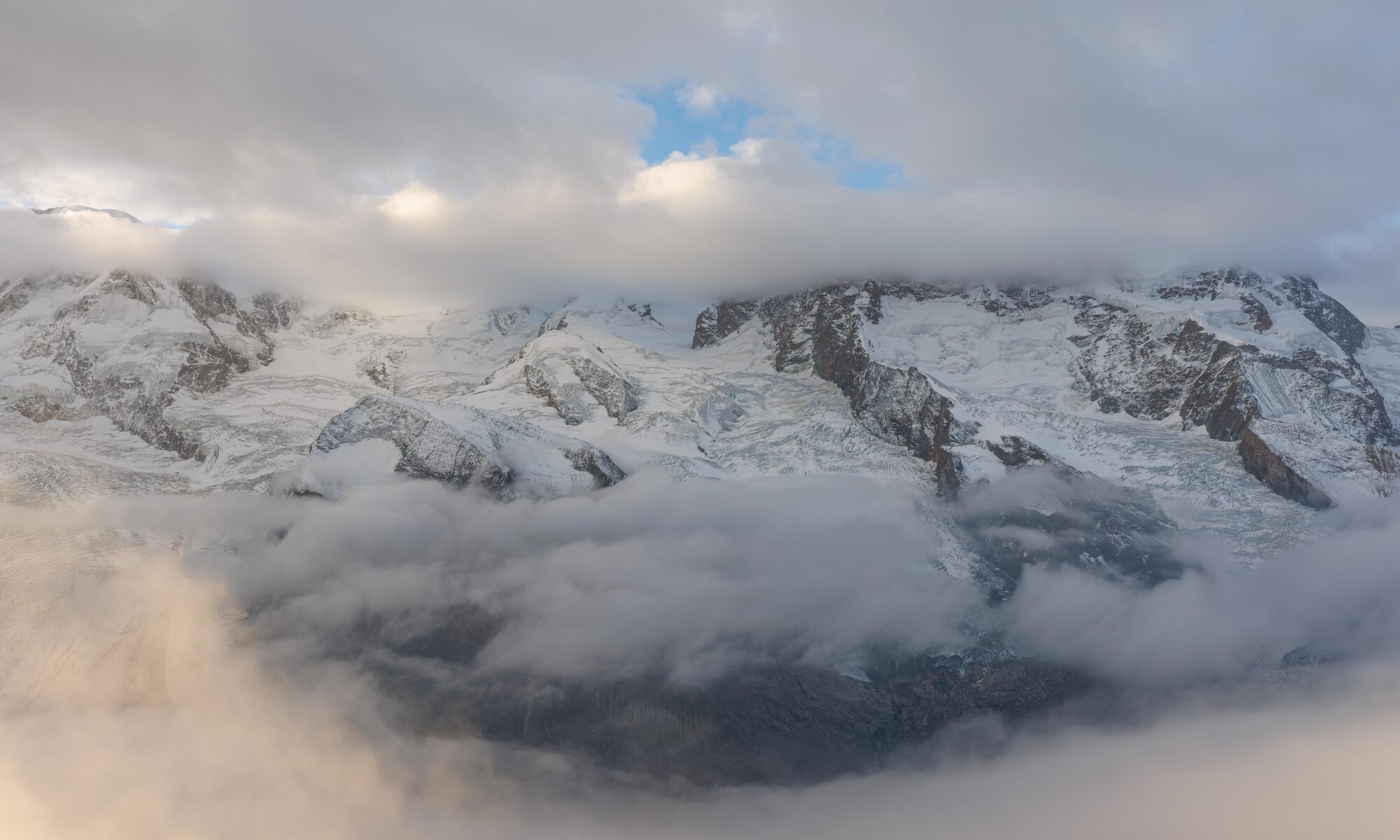
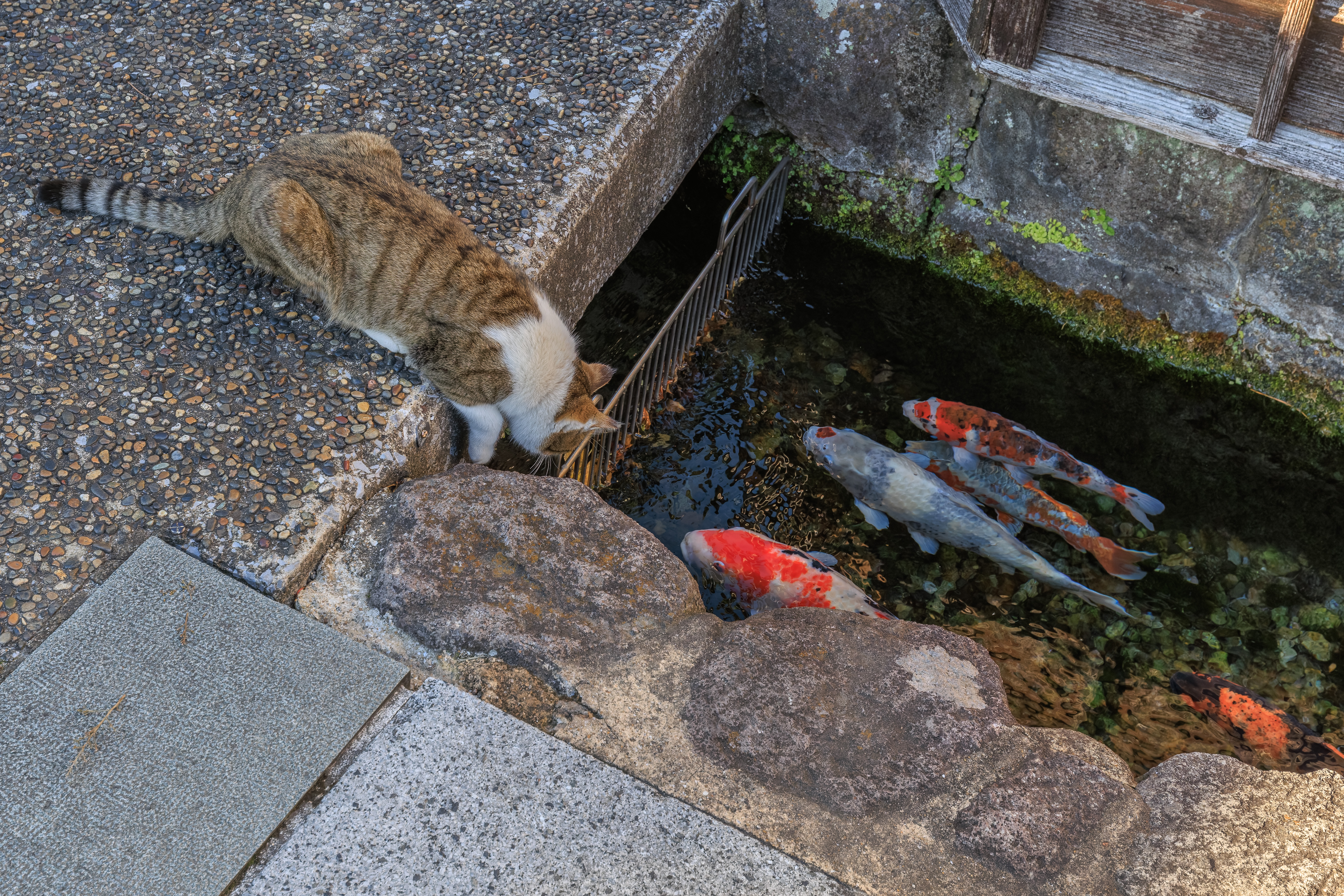
Our last full day in Kyushu! After breakfast at the 長崎マリオット Nagasaki Marriott, we took the train over to 島原 Shimabara and visited 島原城 Shimabara Castle. After lunch, we visited the town’s historic 武家屋敷 samurai residences and its streets lined with natural spring water canals, which is a bit of an odd description! After a snack at the over 100 year old 銀水 Ginsui, we returned to Nagasaki for dinner.
Morning
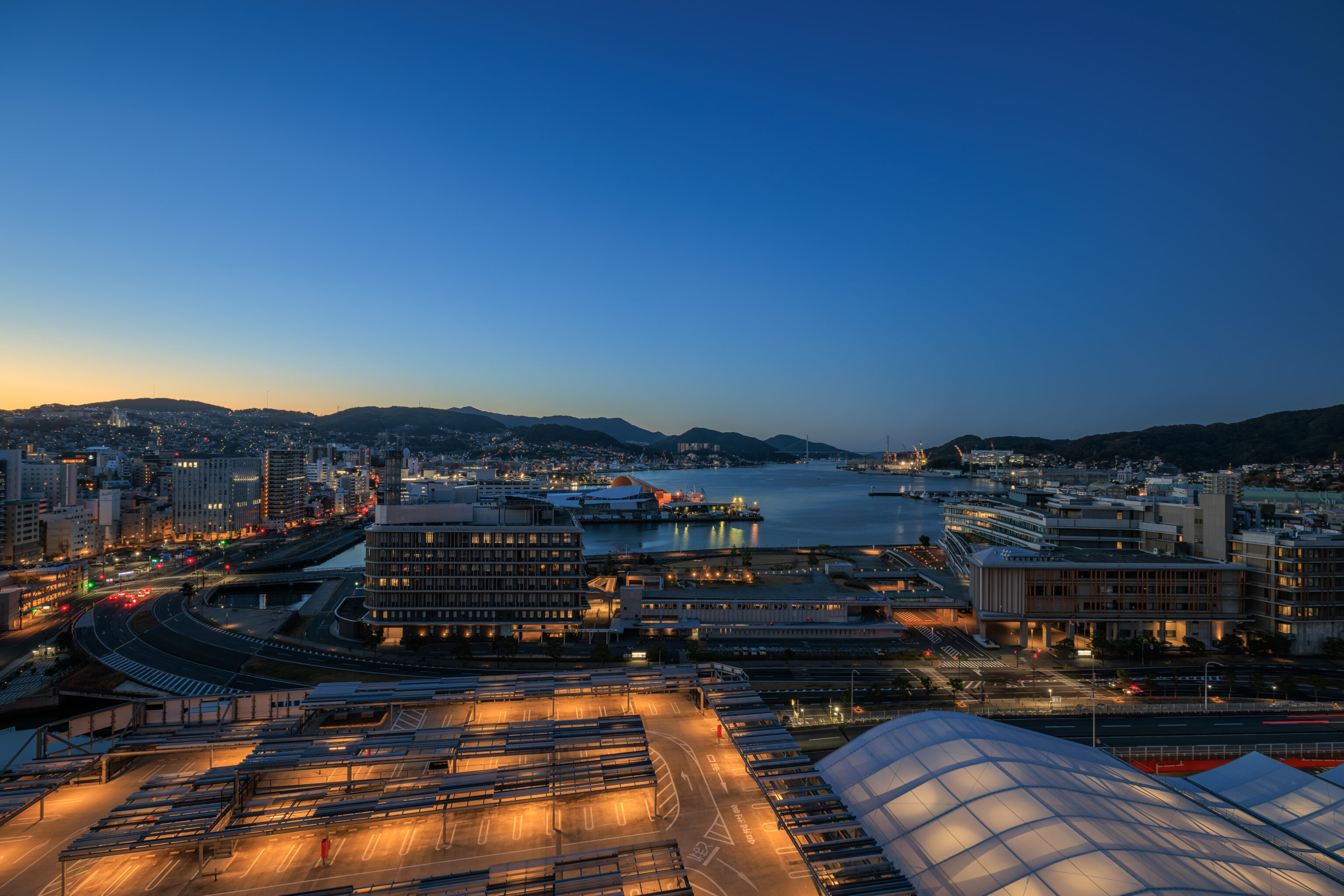
We woke up at the 長崎マリオット Nagasaki Marriott to a clear sky and just a little bit of color before sunrise.
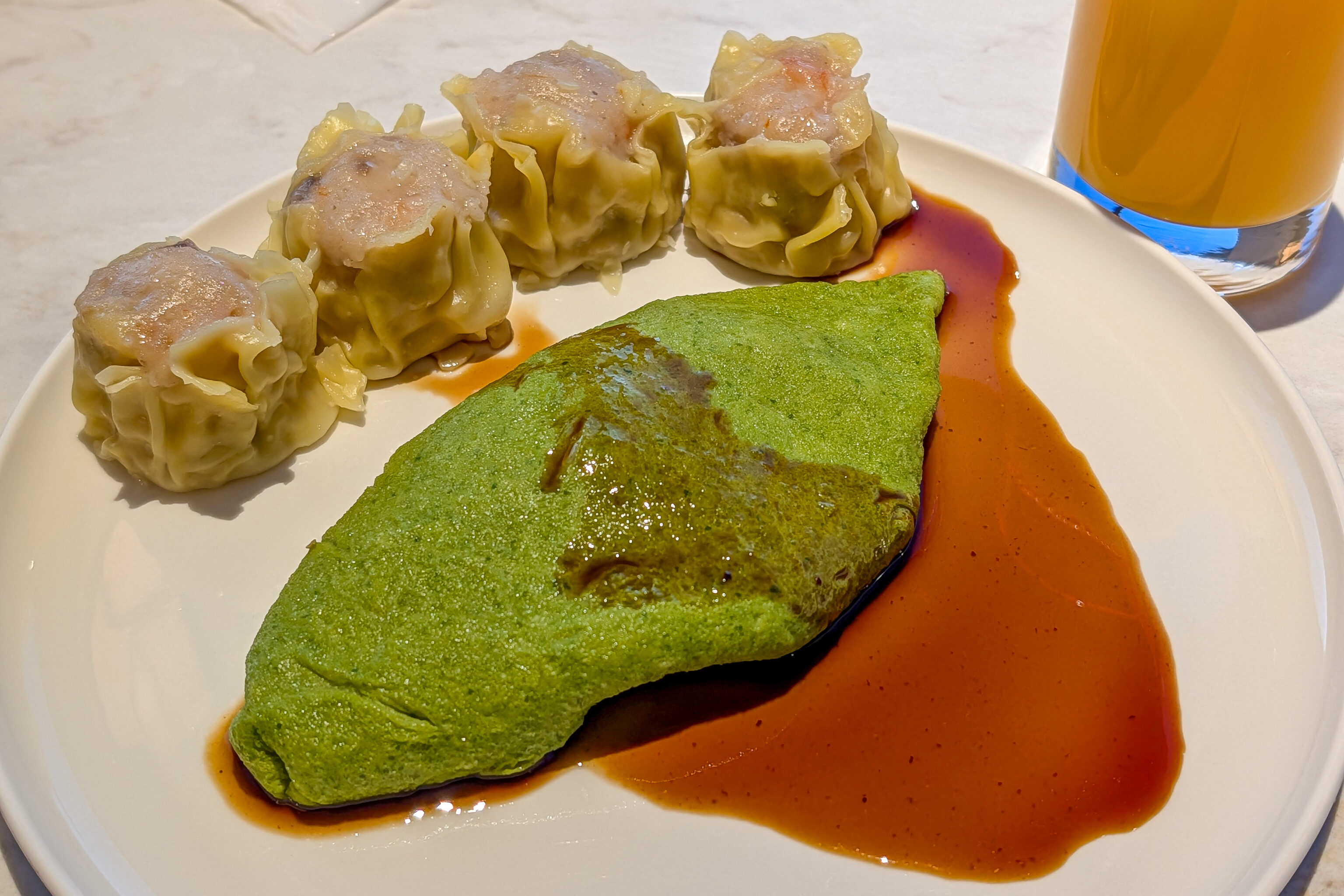
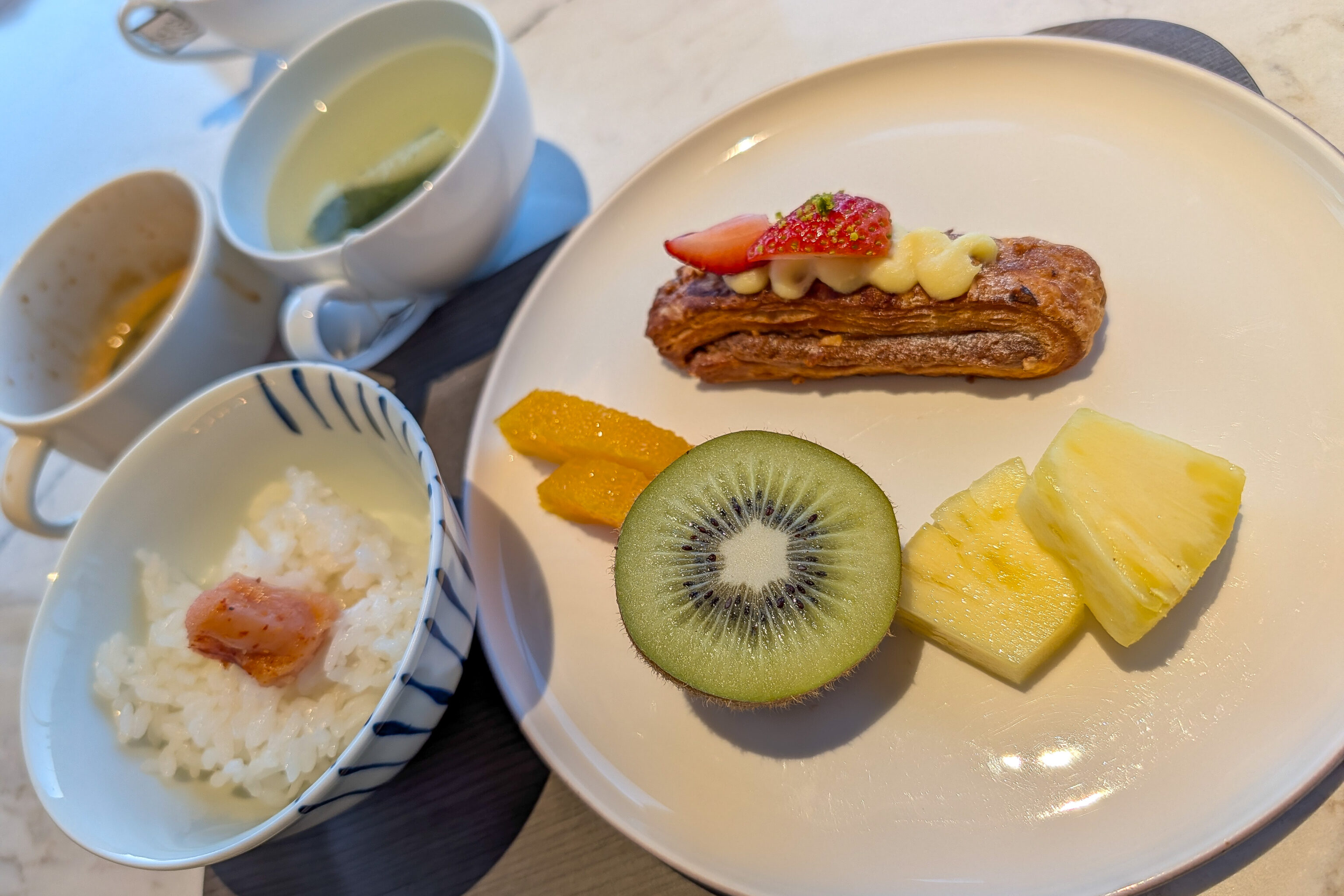
We headed downstairs for breakfast. We only ate a little bit as we weren’t too hungry. Sadly, again no mikan!
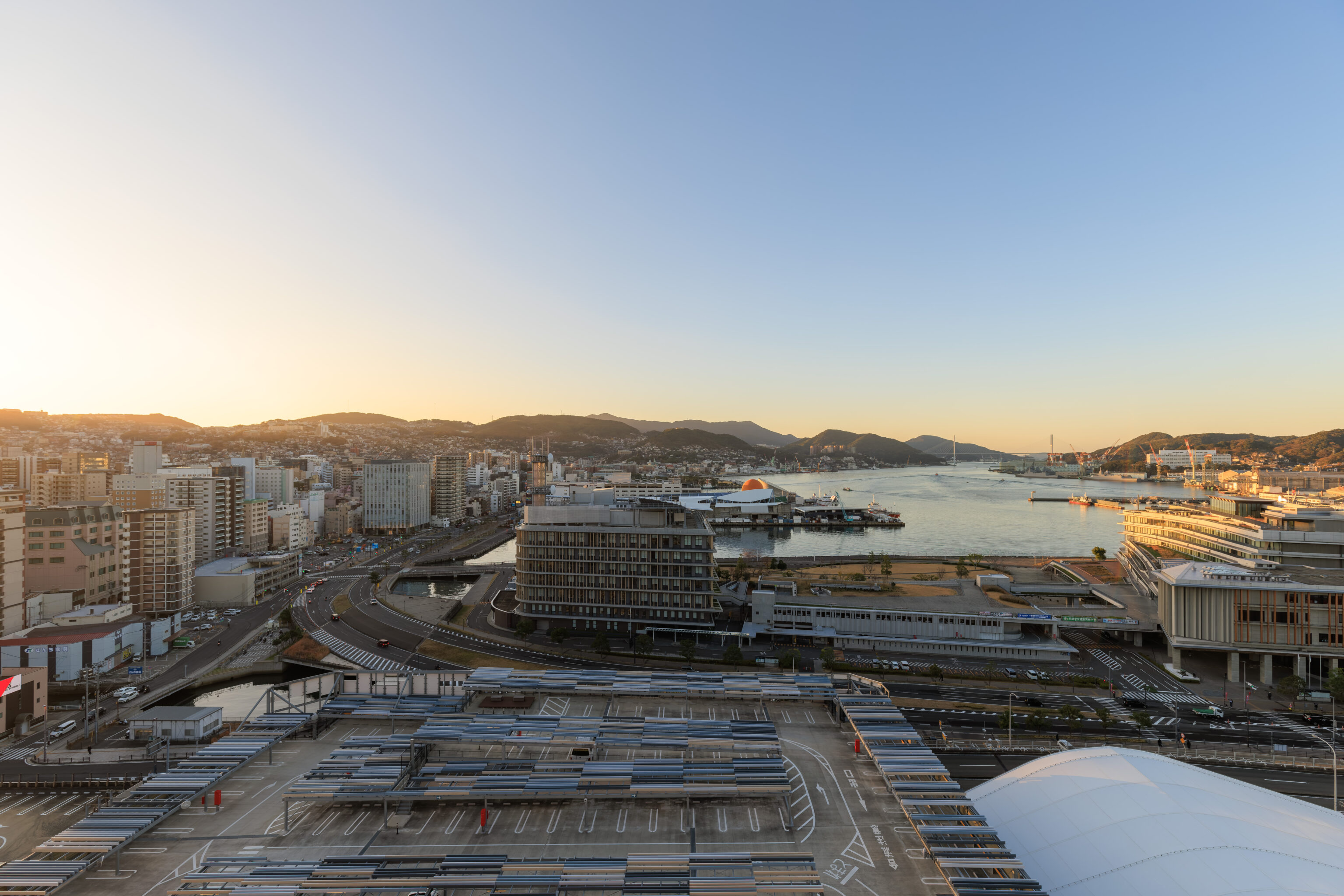
The sky was still clear when we headed out to walk over to Nagasaki Station.
Nagasaki to Shimabara
Getting to our destination, Shimabara, requires changing trains at 諫早駅 Isahaya Station. To get there, there are two conventional rail routes as well as the Nishi Kyushu Shinkansen.
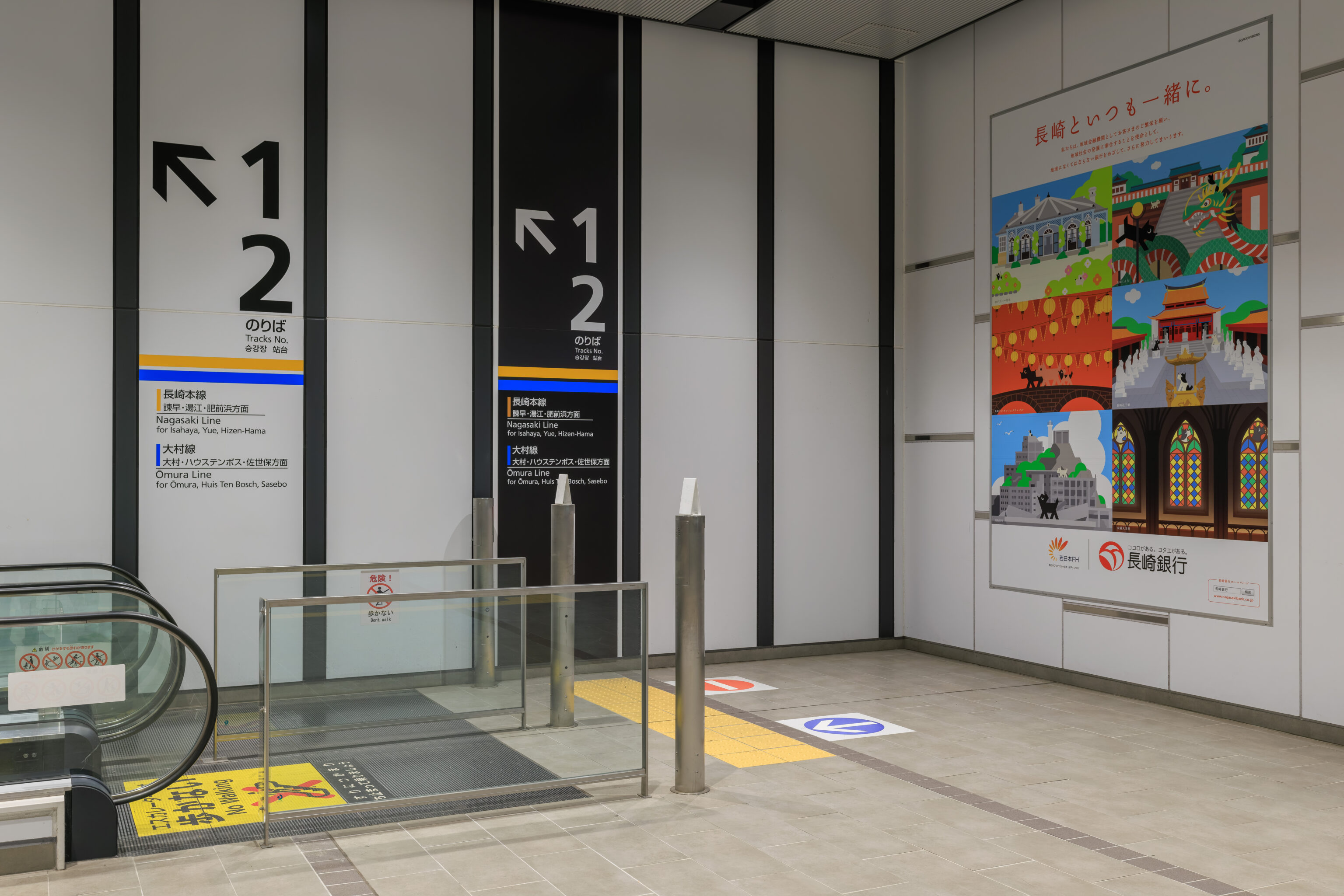
Both conventional rail routes are actually part of the Nagasaki Line. The line basically splits and then merges back together just before Isahaya.
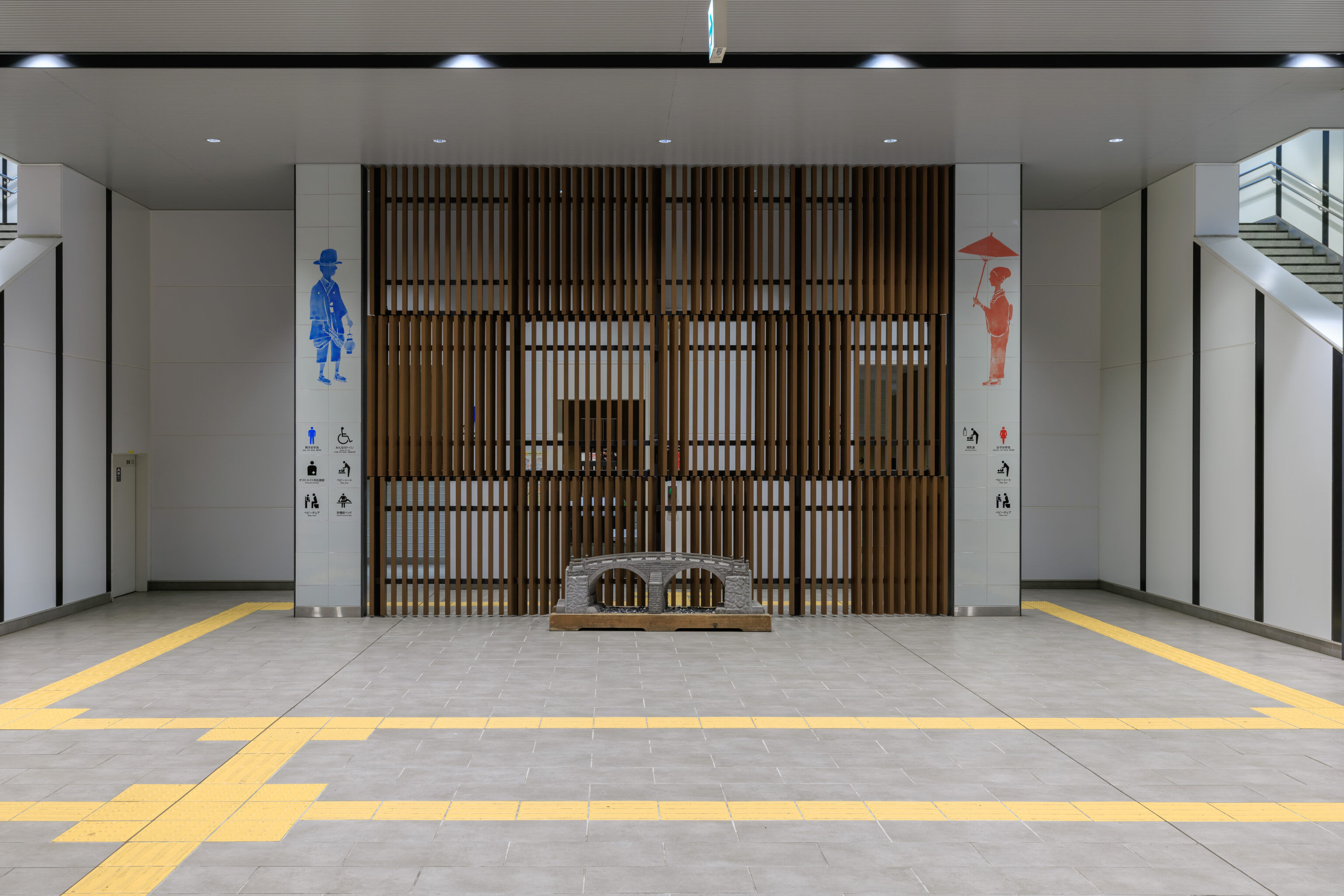
This was a nice looking bathroom entrance and featured a model of the 眼鏡橋 Megane-bashi (Spectacles Bridge).
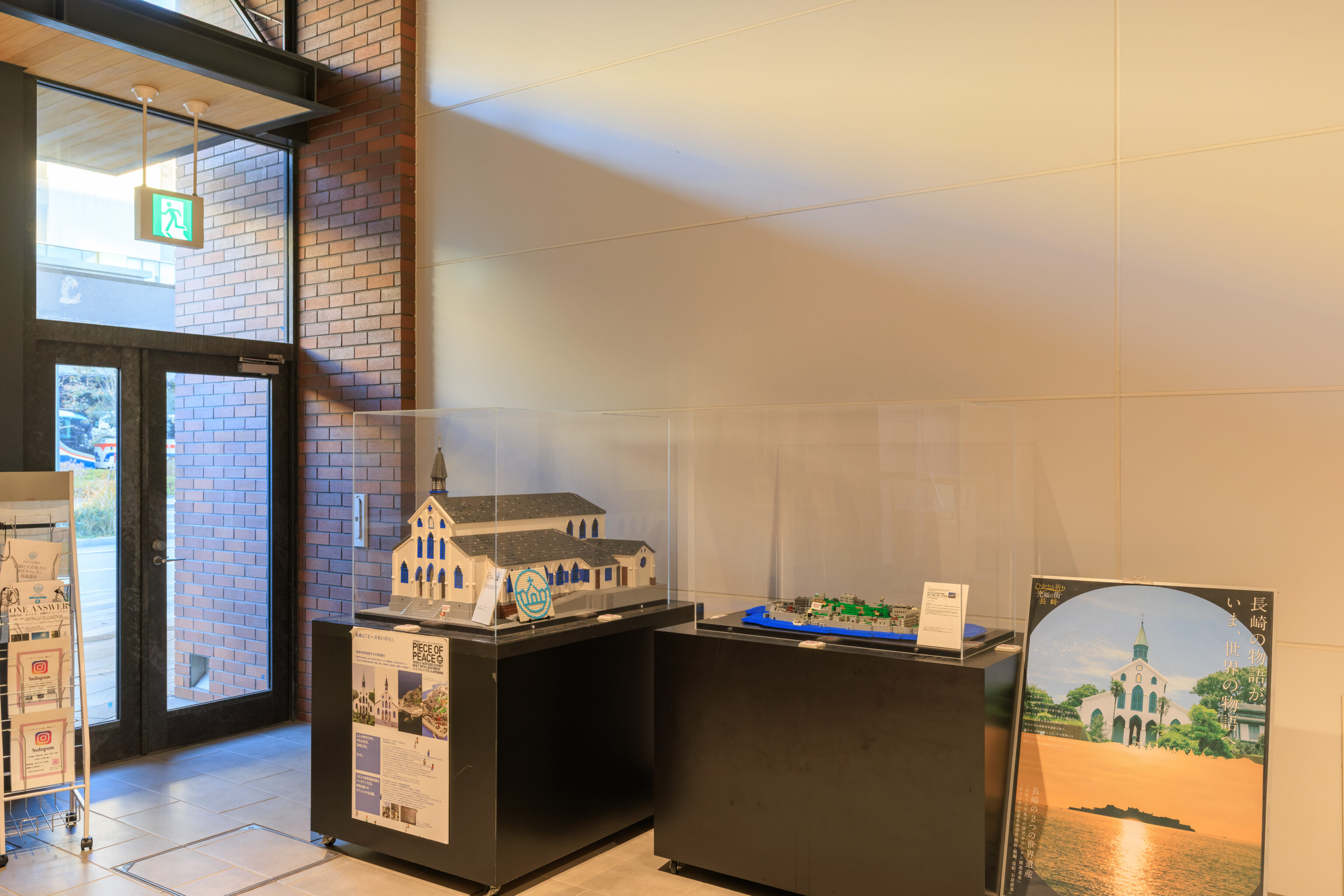
Also in the station, there was a model of the Oura Church as well as Gunkanjima. Although we didn’t visit either, we at least saw the Oura Church.
Unfortunately, the trip to Isahaya wasn’t really great for photography, even though we passed by Omura Bay, which is a bit like a big lake to the north of Nagasaki.
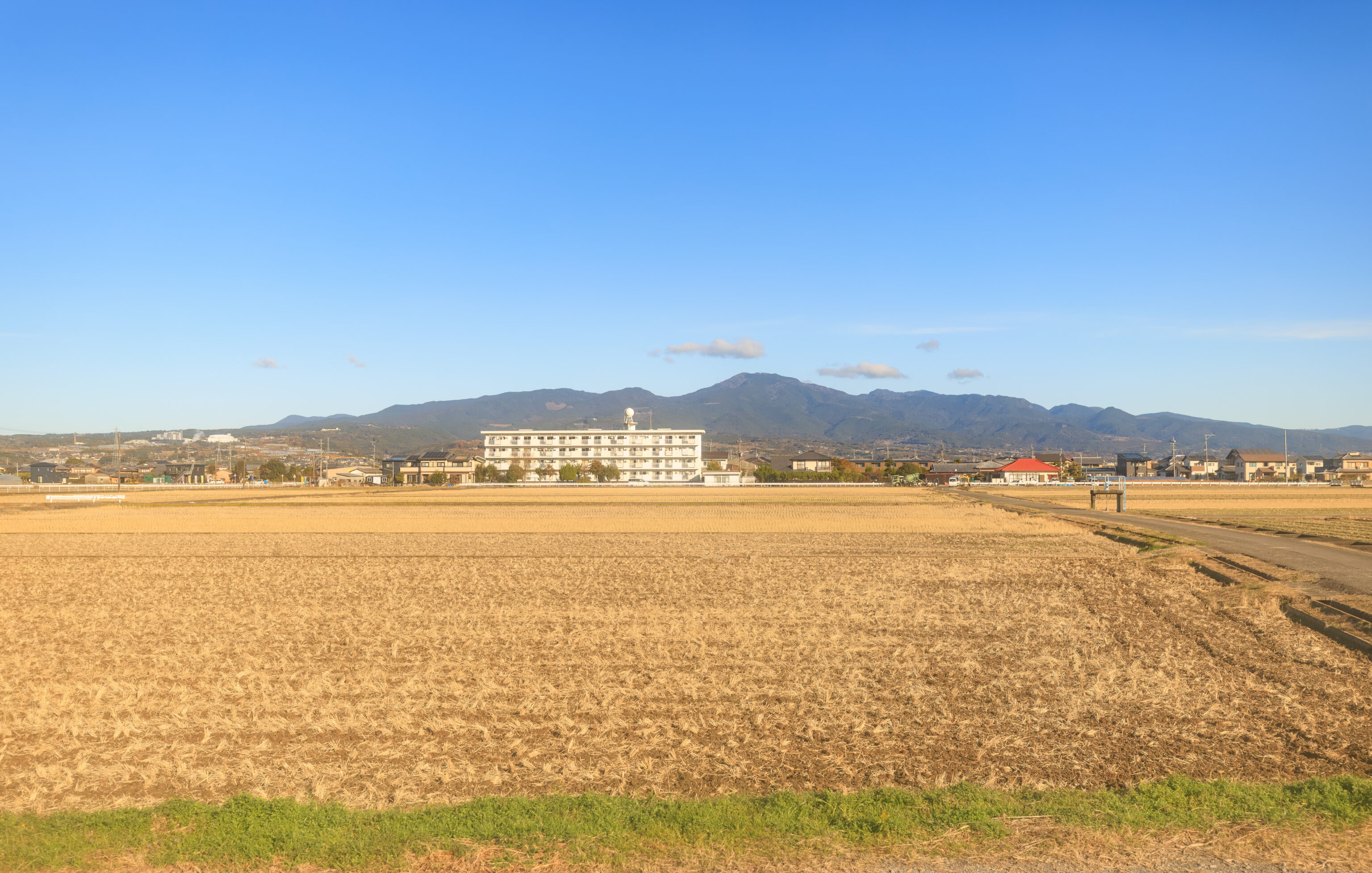
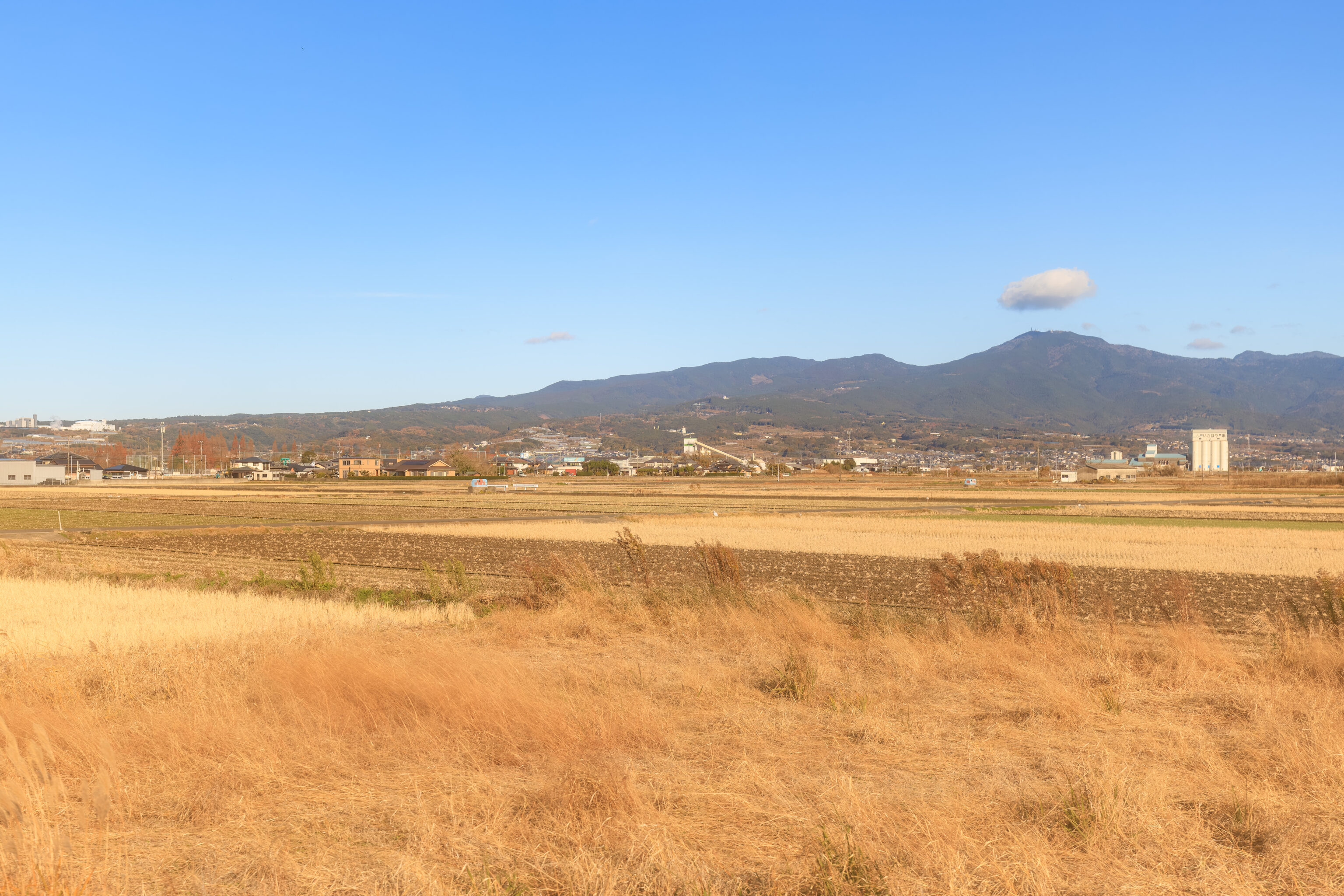
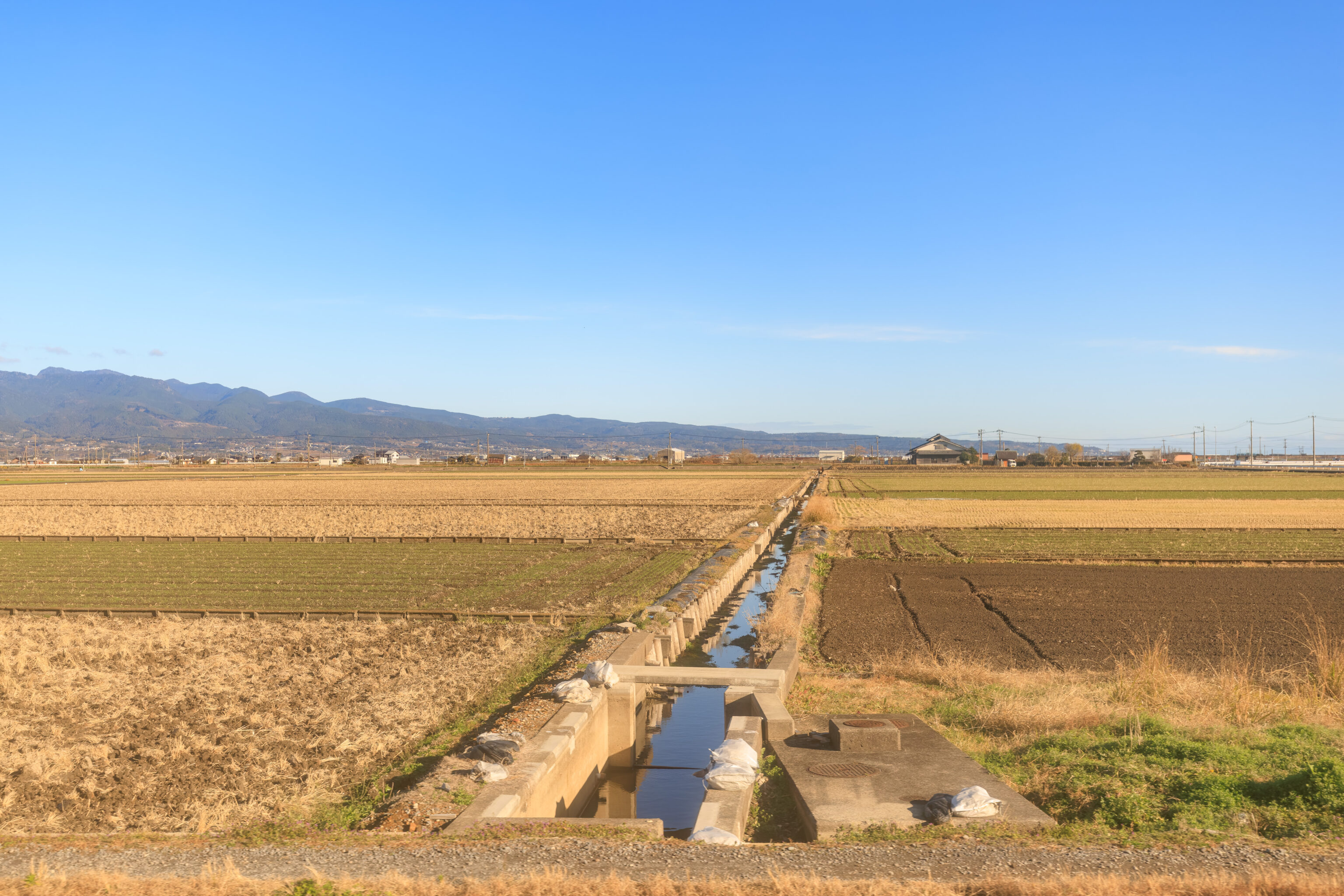
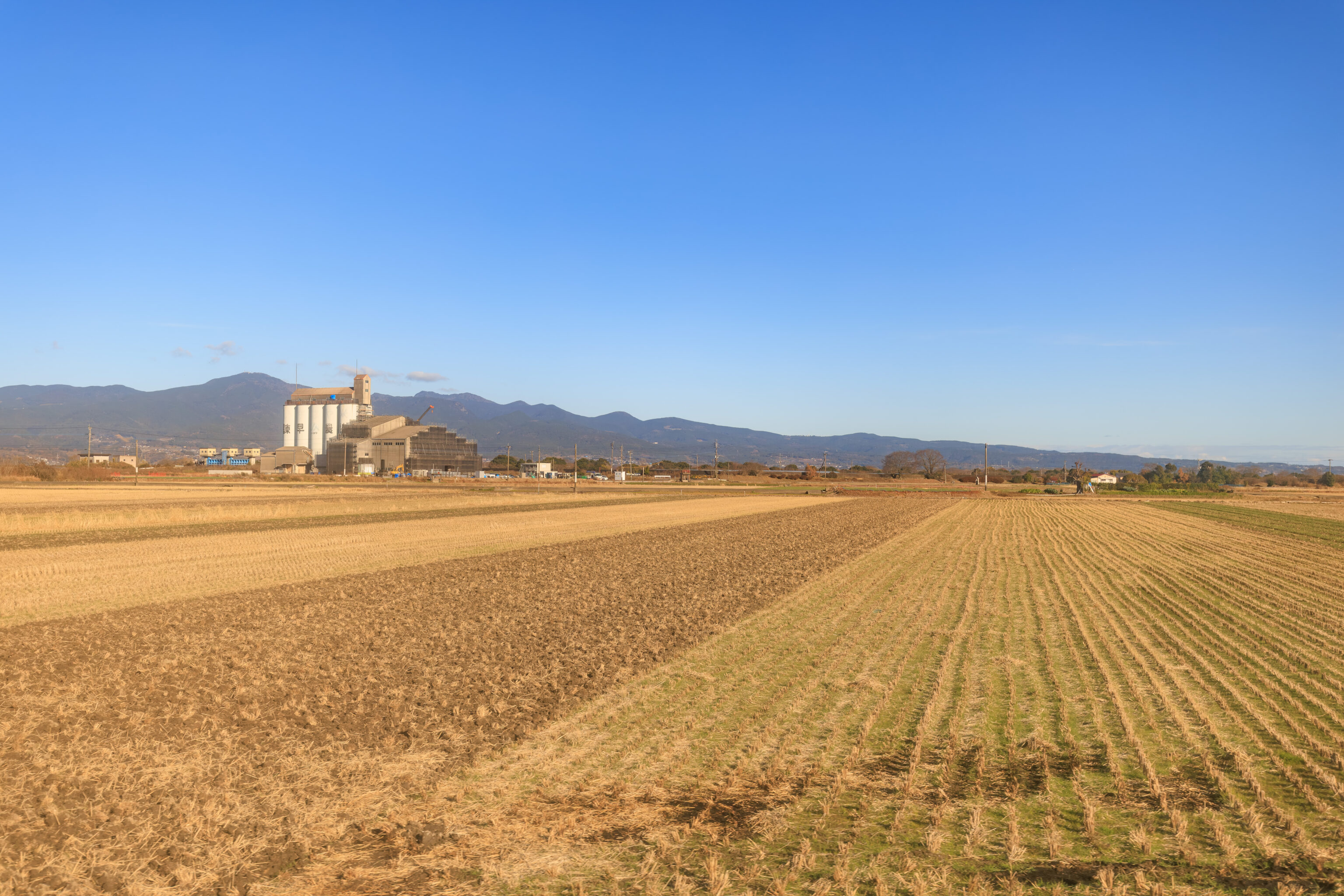
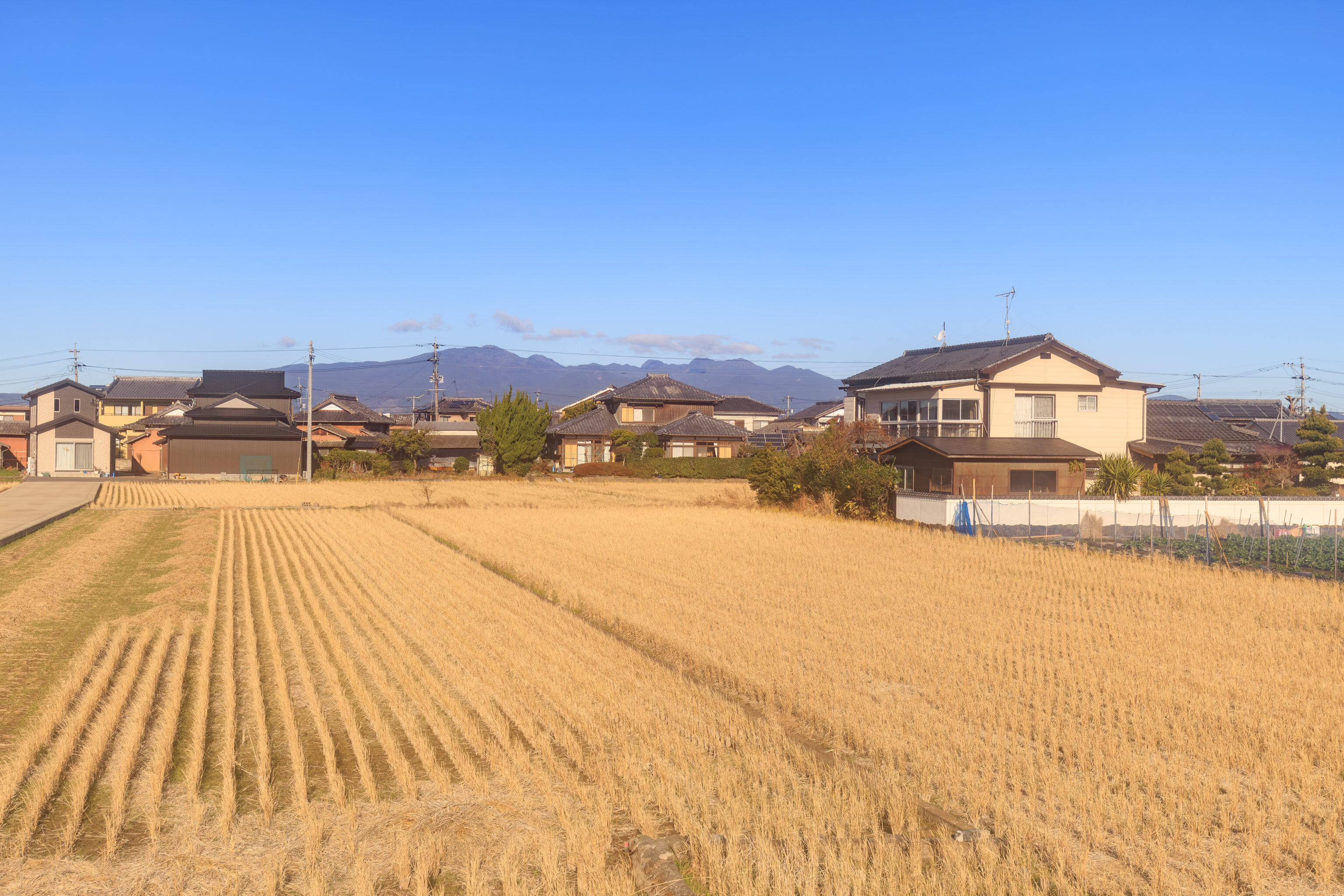
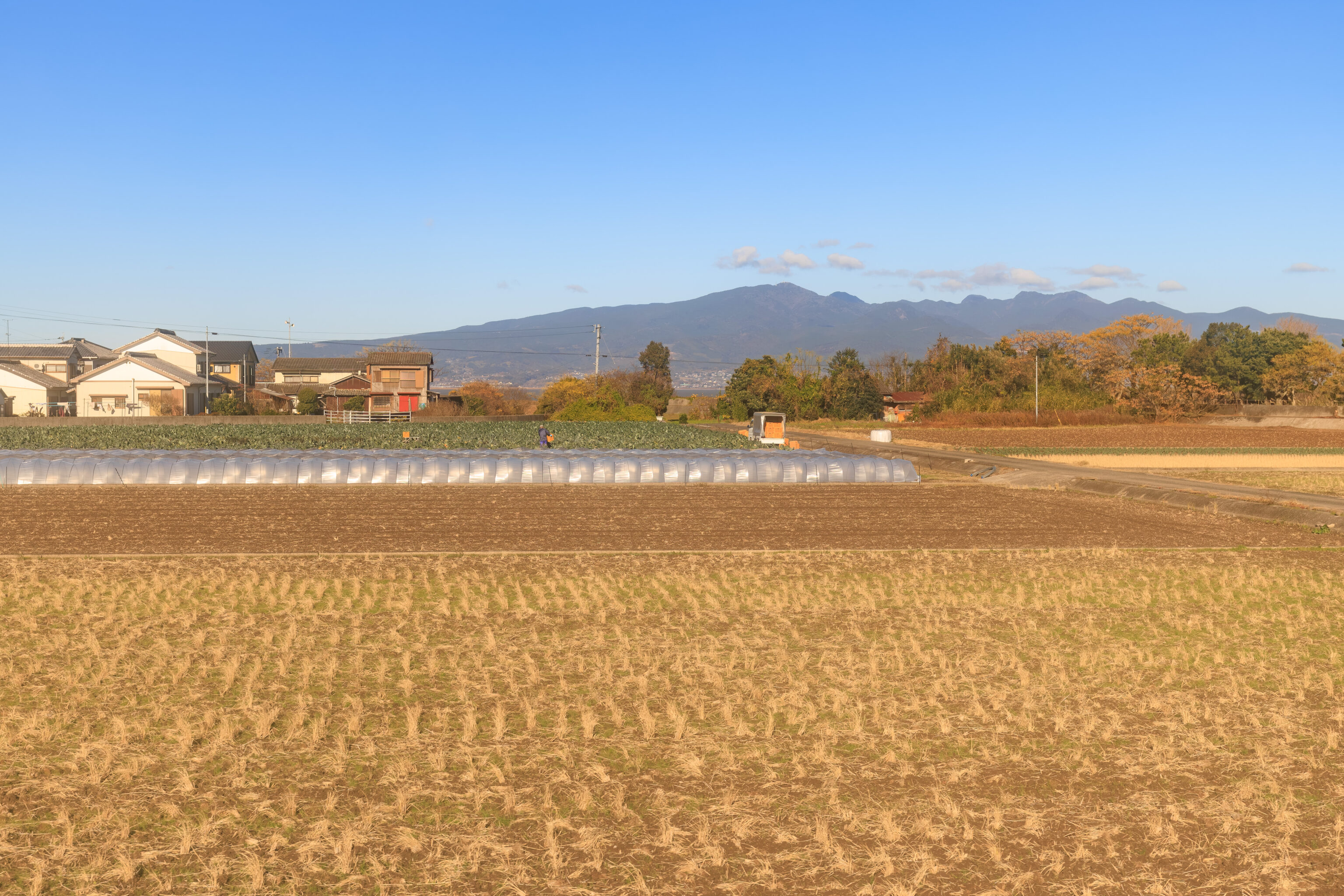
We did take some photographs on the train from Isahaya though. This line is the 島原鉄道線 Shimabara Tetsudo-sen, which ends at the 島原港駅 Shimabarako Station on the south end of Shimabara.
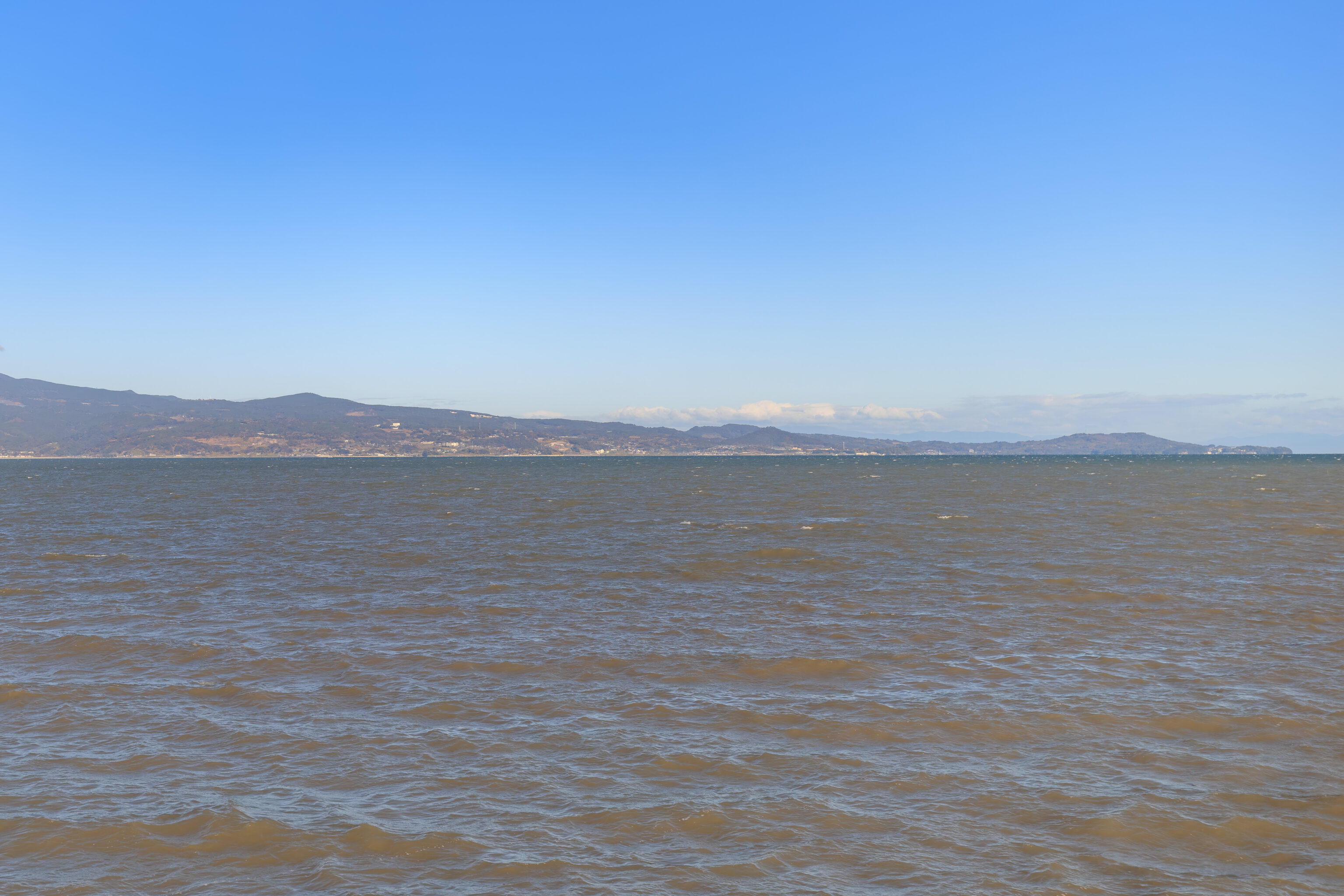
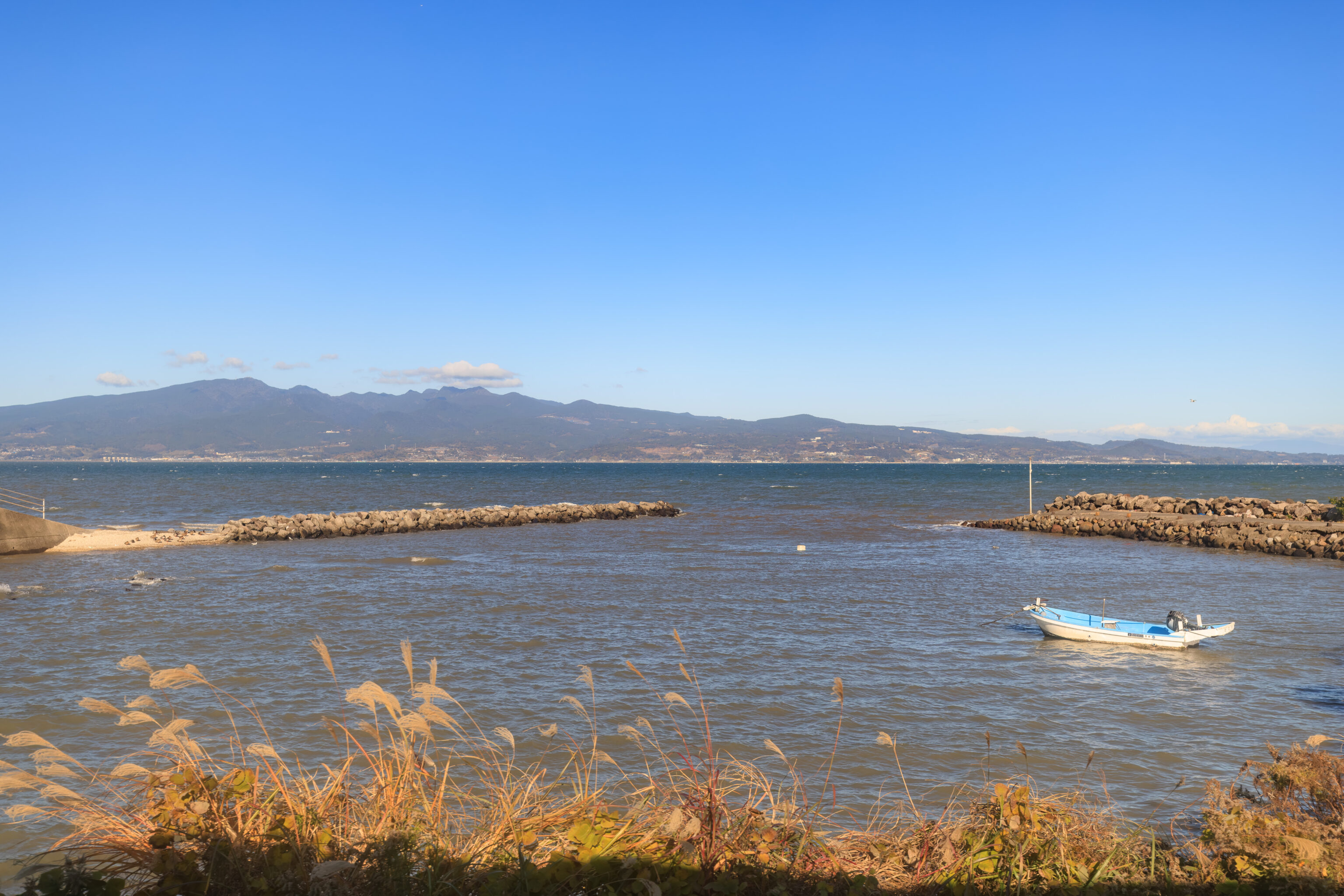
After running inland for awhile, it runs next to the 有明海 Ariake Sea for the remainder of the journey to Shimabara. This mostly inland sea separates Nagasaki Prefecture from Kumamoto Prefecture. Other than going around, the only way to cross this sea is by air or ferry.
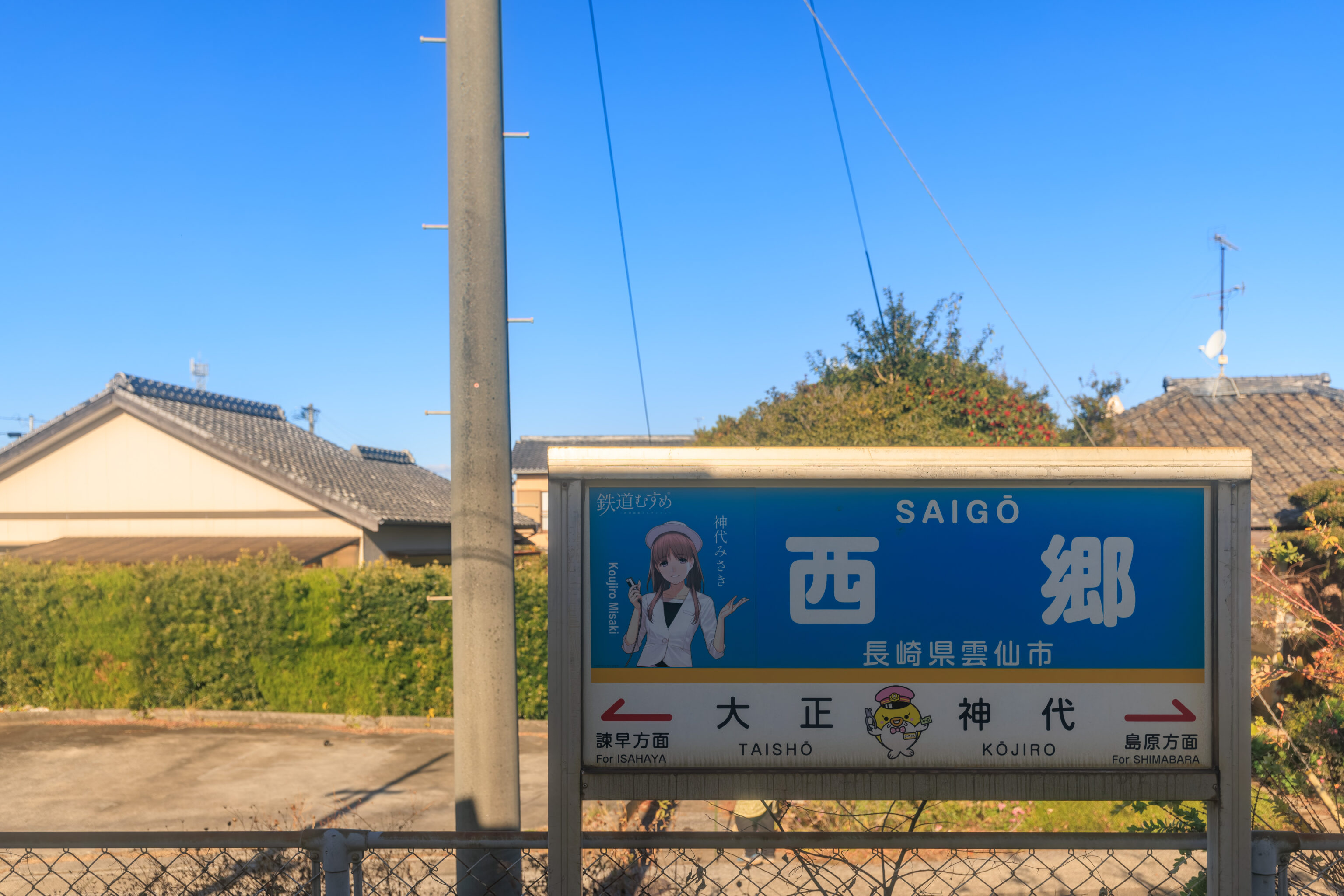
We noticed two characters on this station sign at Saigo Station. Koujiro Misaki is at the left. She is part of the 鉄道むすめ Railway Musume. This is apparently a collection of over one hundred characters on various train lines throughout Japan.
The character at the bottom, さっちゃん Sacchan, is apparently the koi conductor mascot for the Shimabara Railway. Of course, she has her own webpage as well.
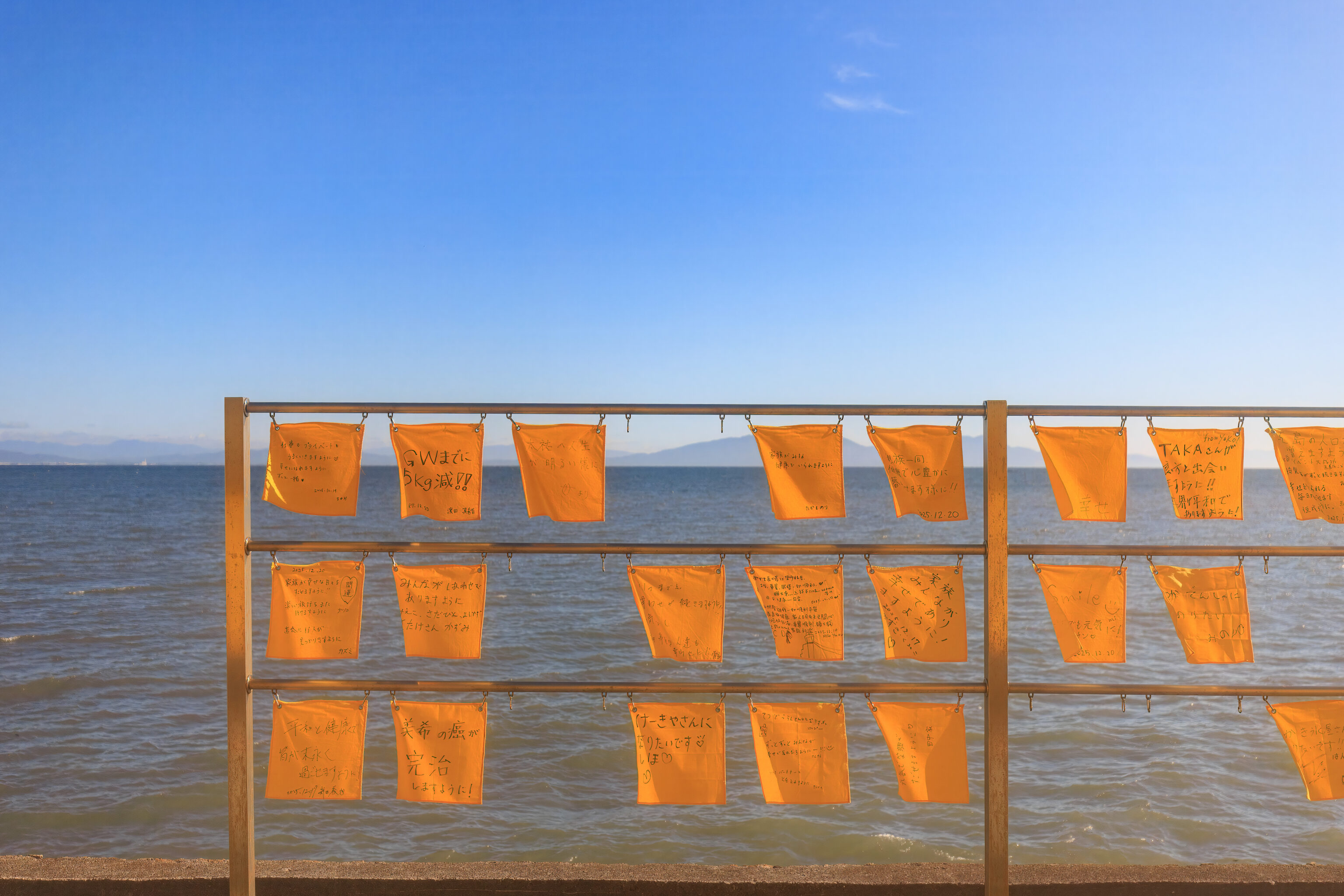
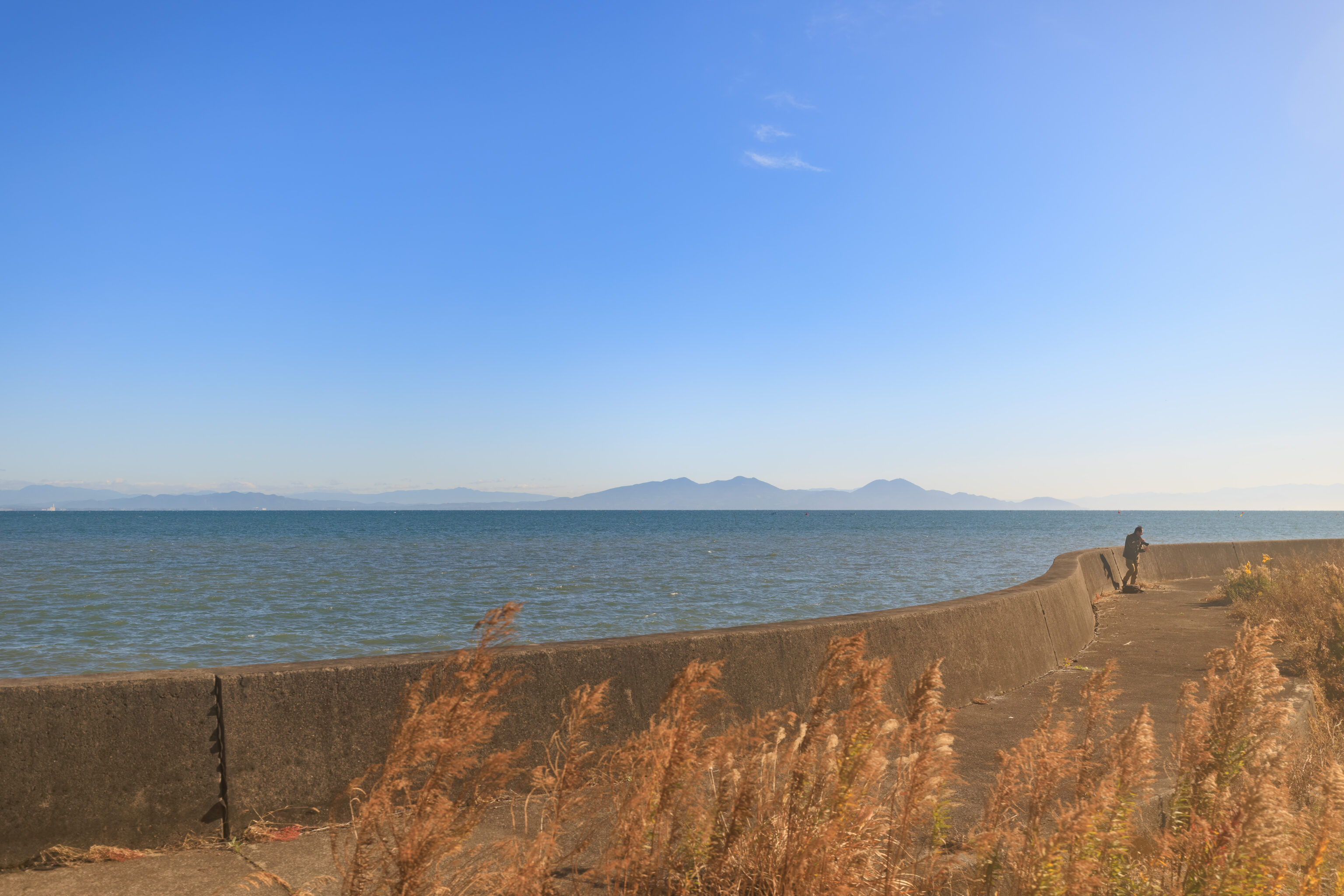
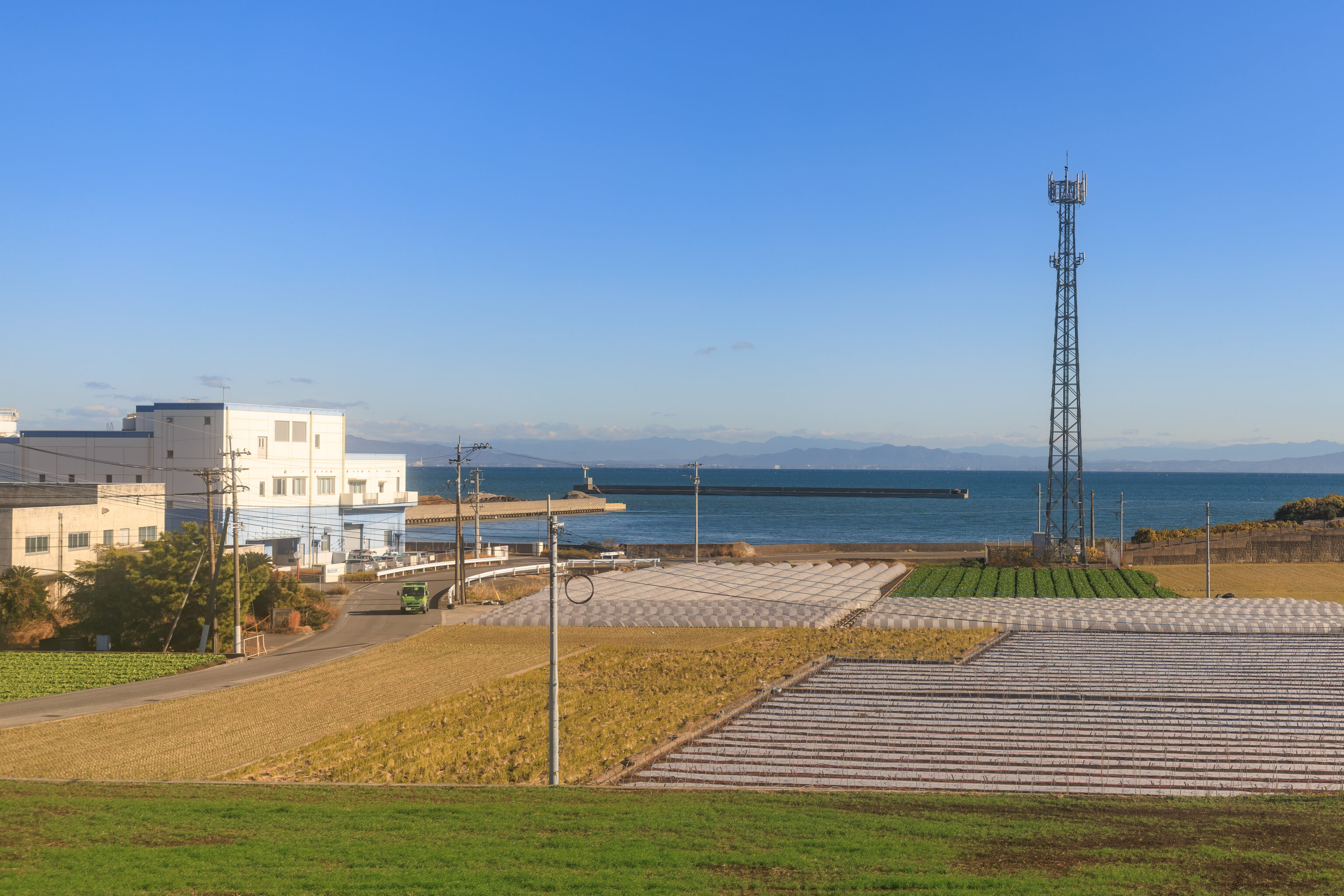
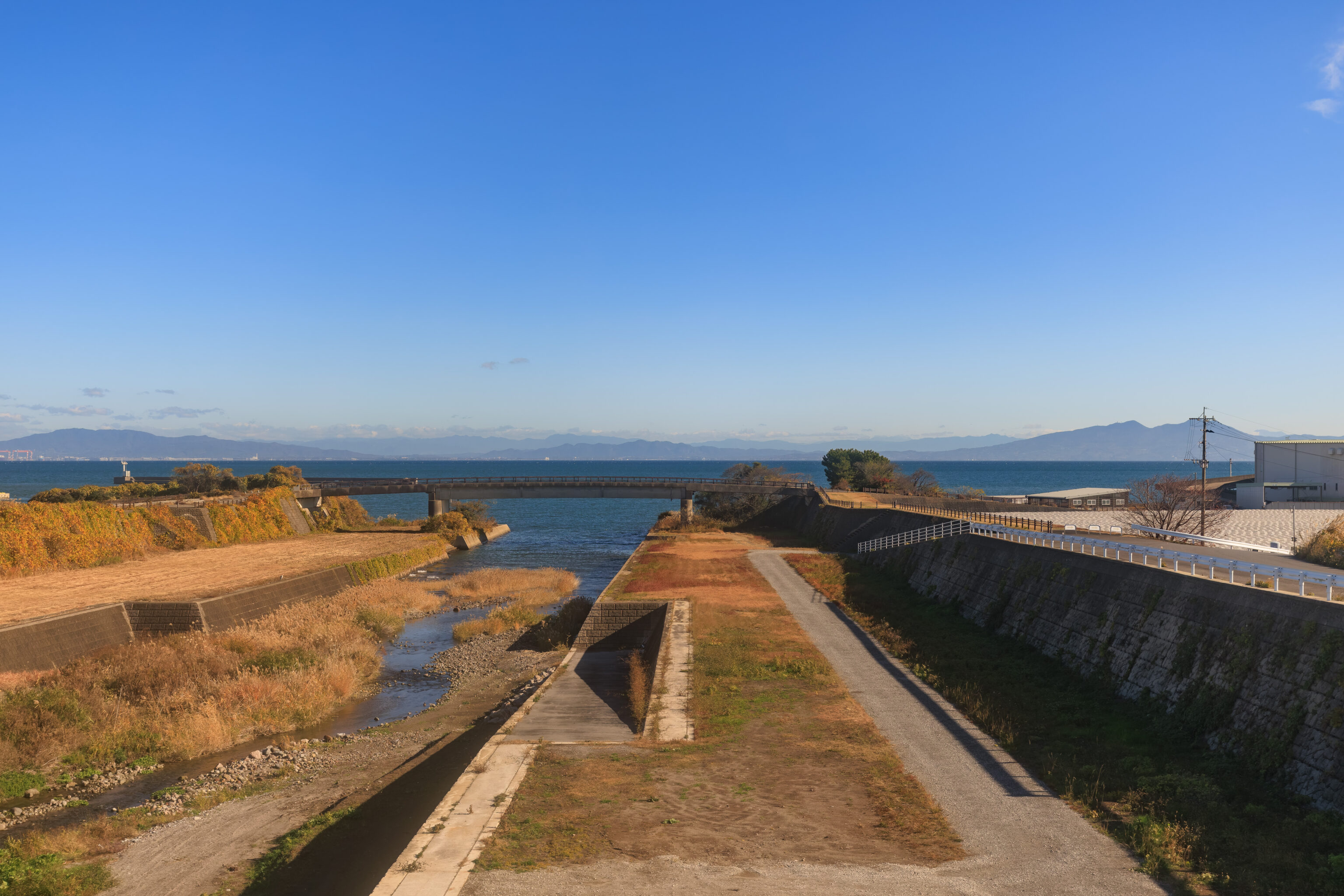
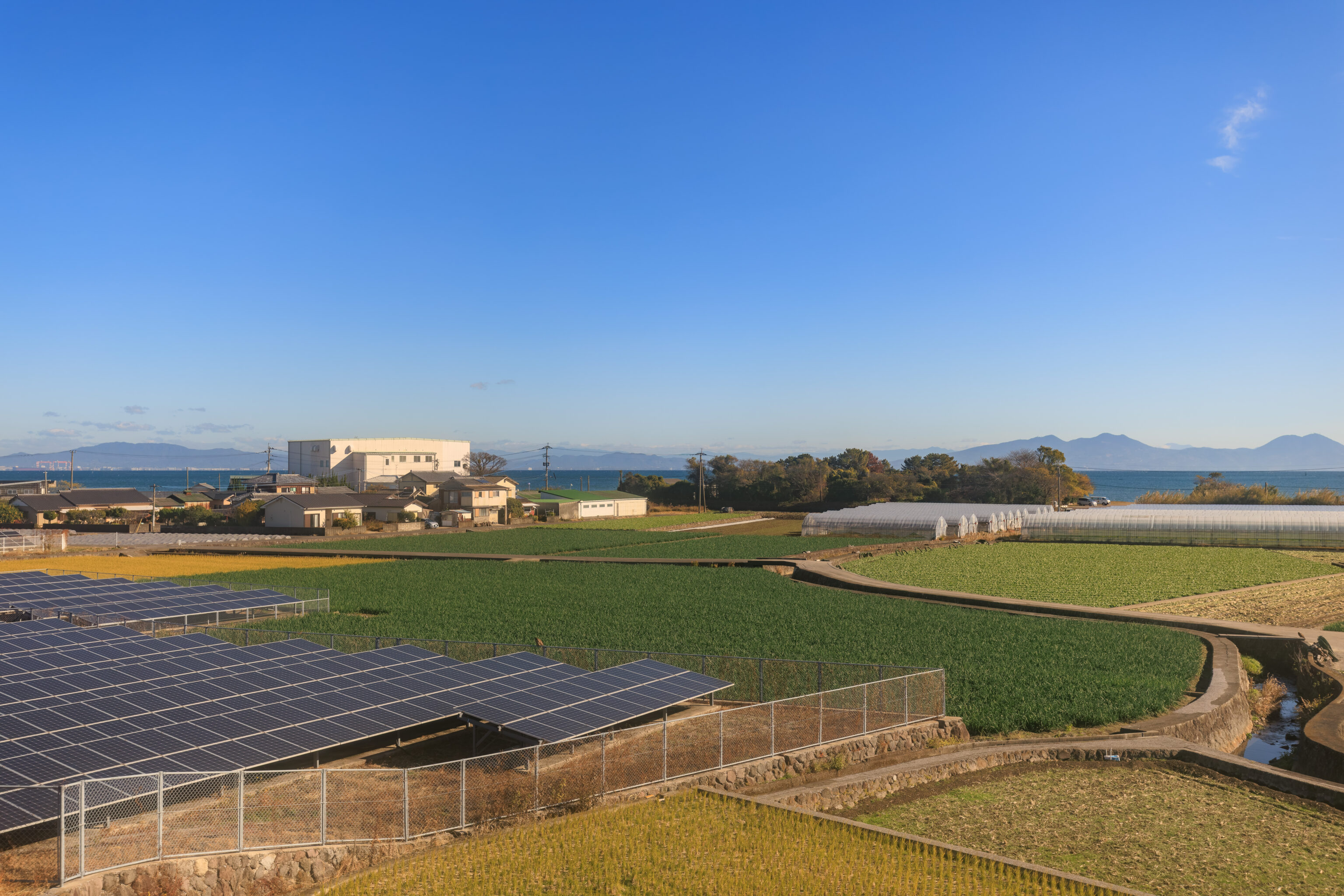
The Shimabara Tetsudo Line basically runs along the northern edge of a volcanic peninsula, the 島原半島 Shimabara Peninsula, to the east of Nagasaki. Once we got to the northeastern side of this route, we were able to see the mountains in Kumamoto Prefecture on the opposite side of the Ariake Sea.
Shimabara Castle
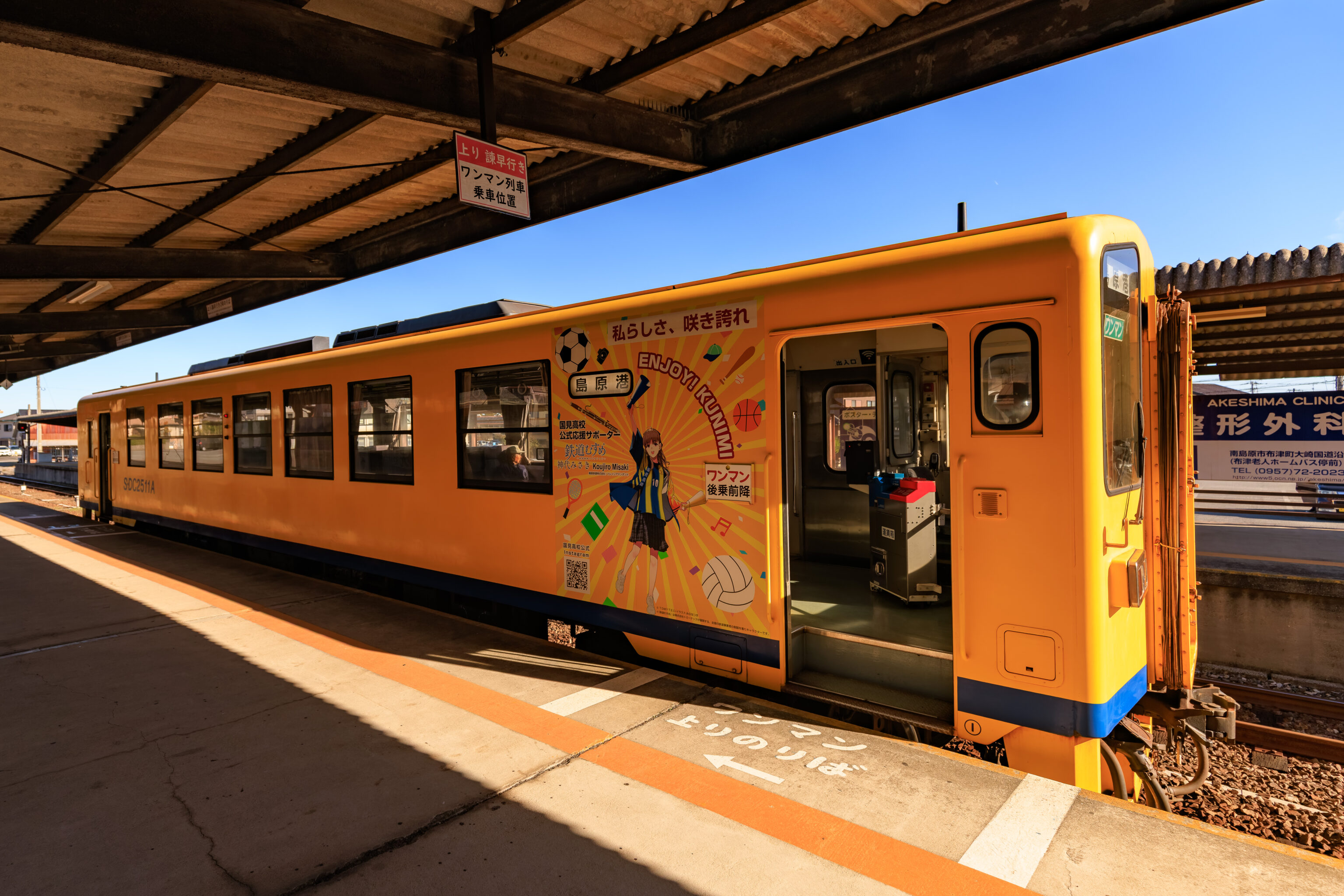
We arrived at Shimabara Station at around 10:30am. it turns out the train we were on featured Koujiro Misaki, the same character we saw at Saigo Station. The sign by the door indicates that this is a one man train and to board from the rear and exit from the front. Basically, it operates like a bus.
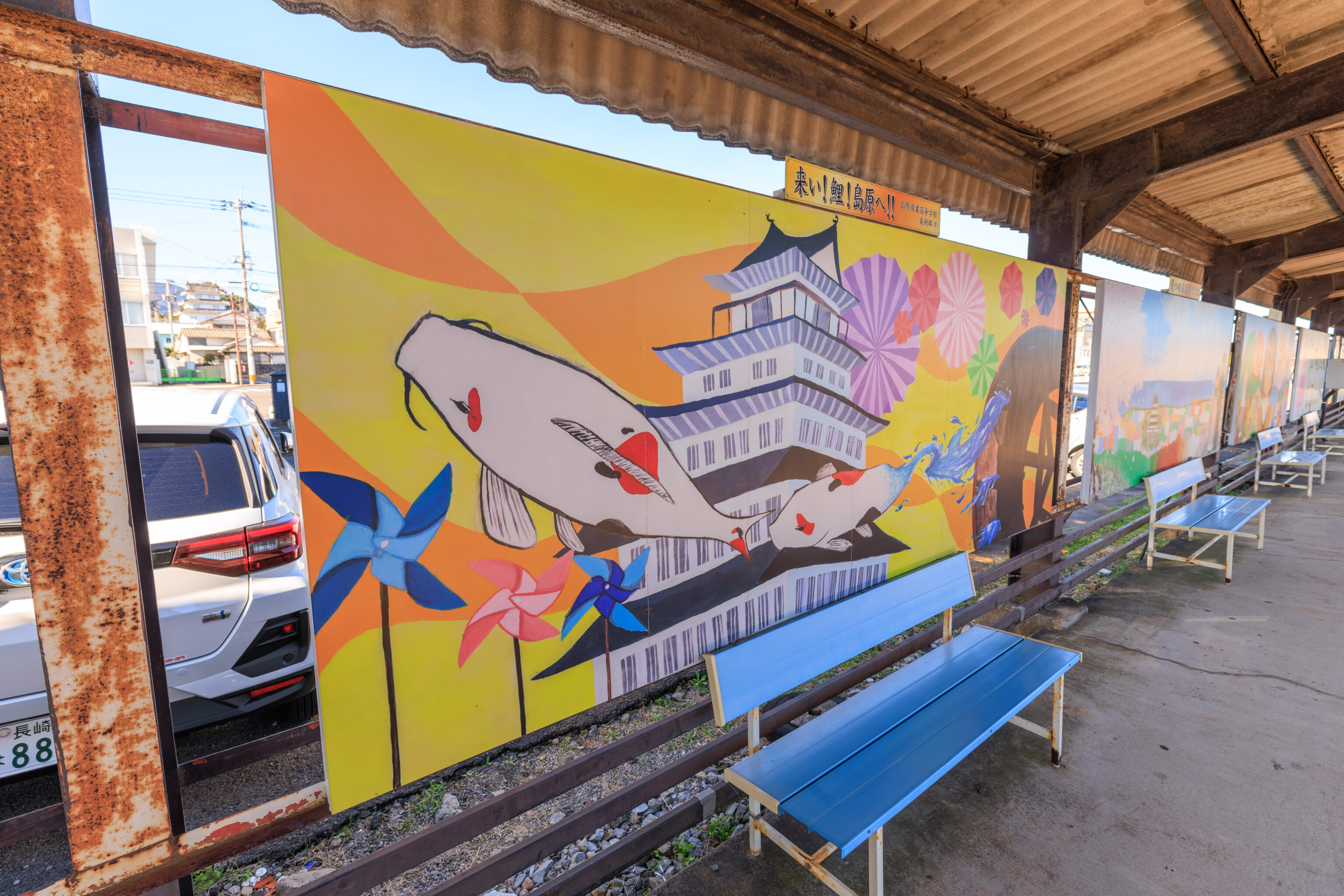
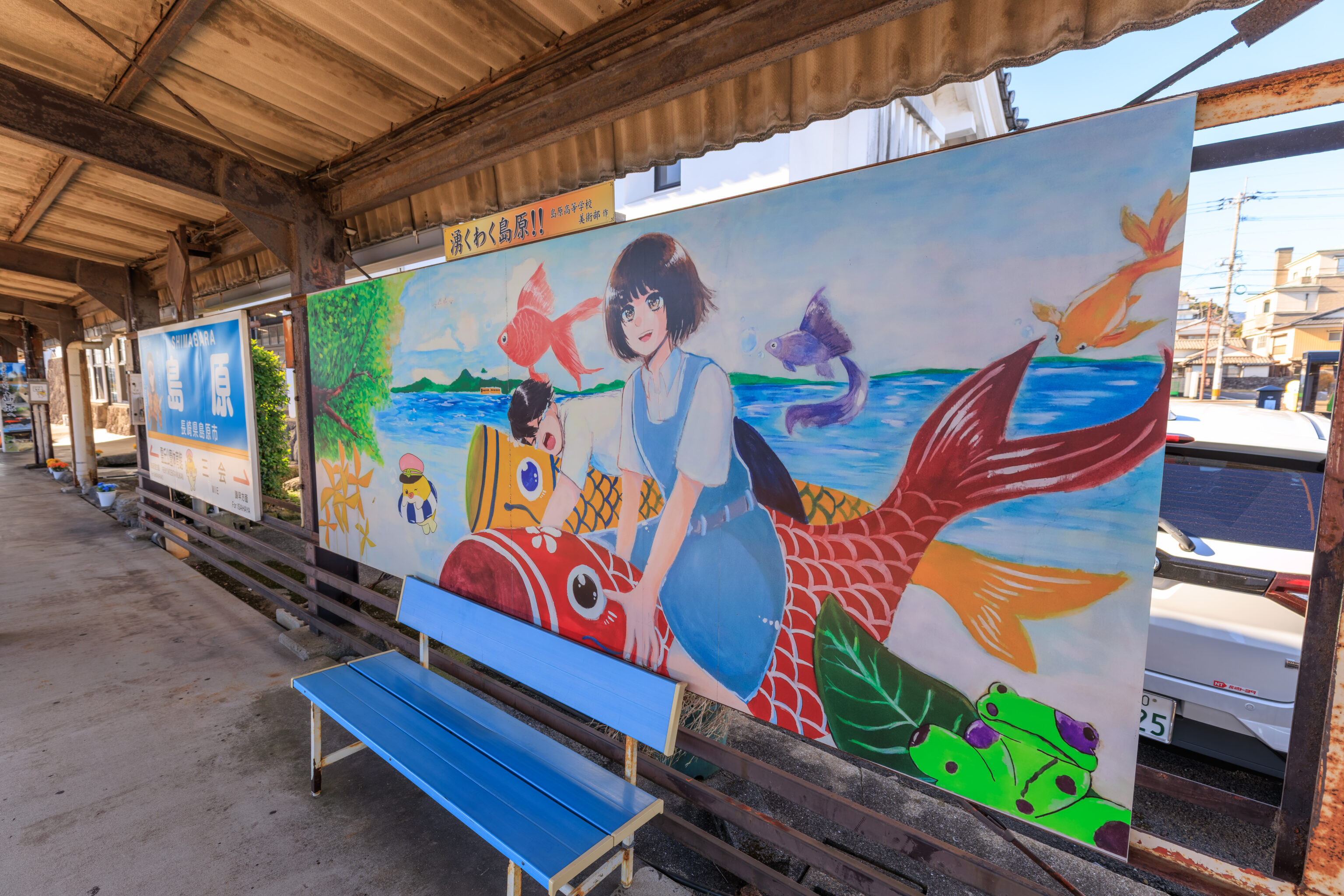
Shimabara Station featured some pretty artwork!
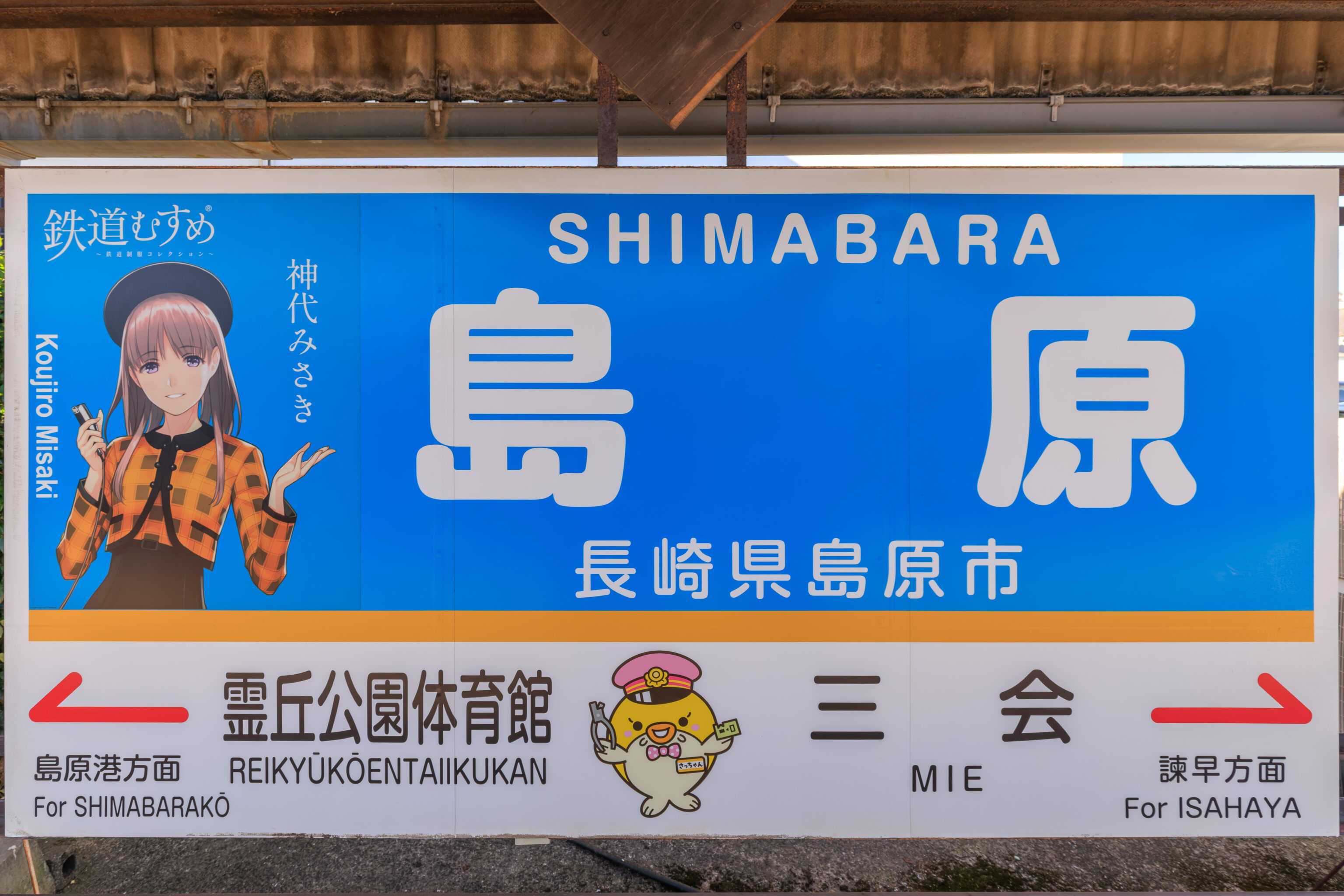
Shimabara’s station sign also features Koujiro Misaki along with Sacchan.
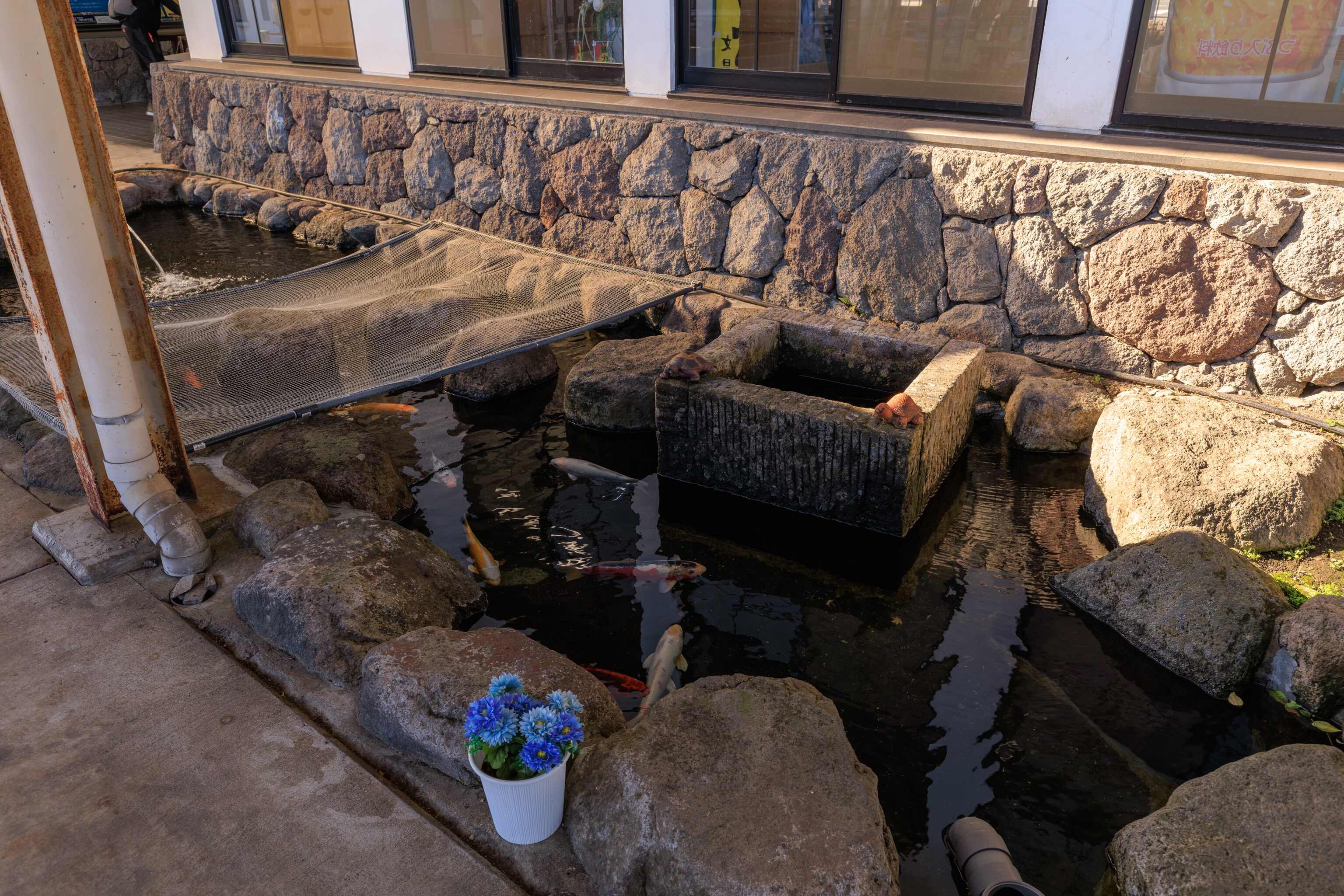
We noticed this small pool of water by the station building along with koi. Shimabara is famous for its spring water and koi filled canals.
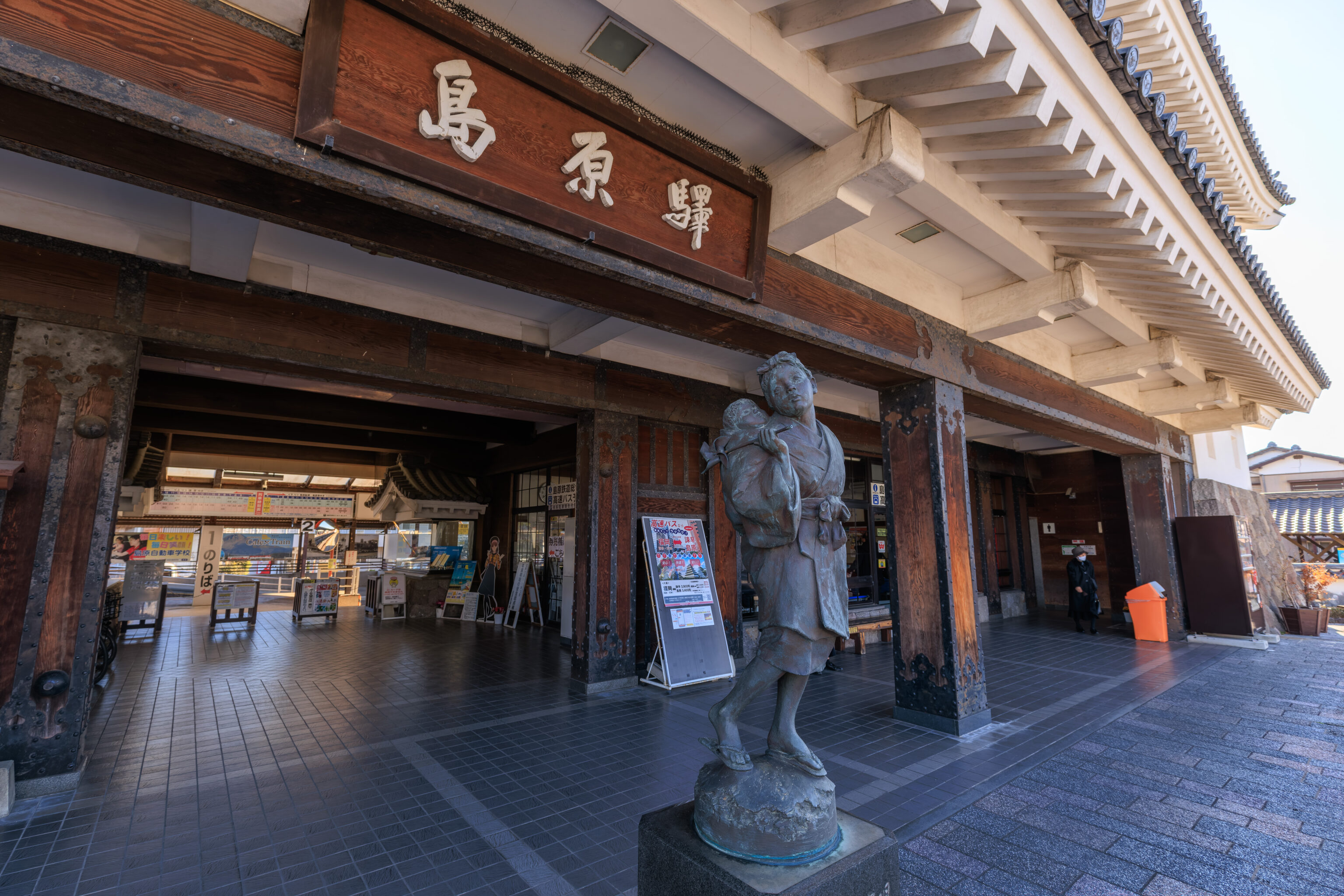
After exiting the station, we decided to first head to 島原城 Shimabara Castle.
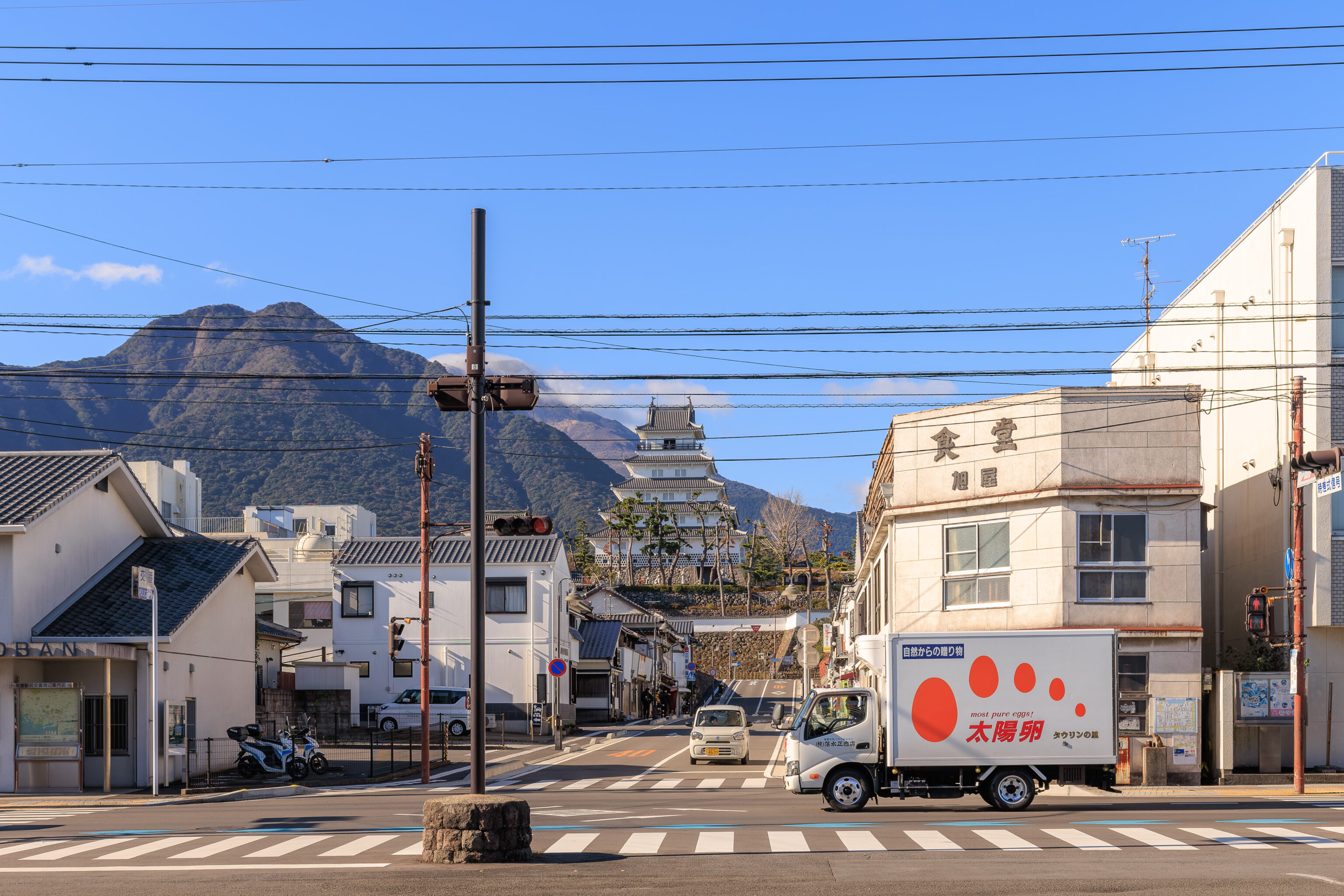
We could actually see the castle from the train station!
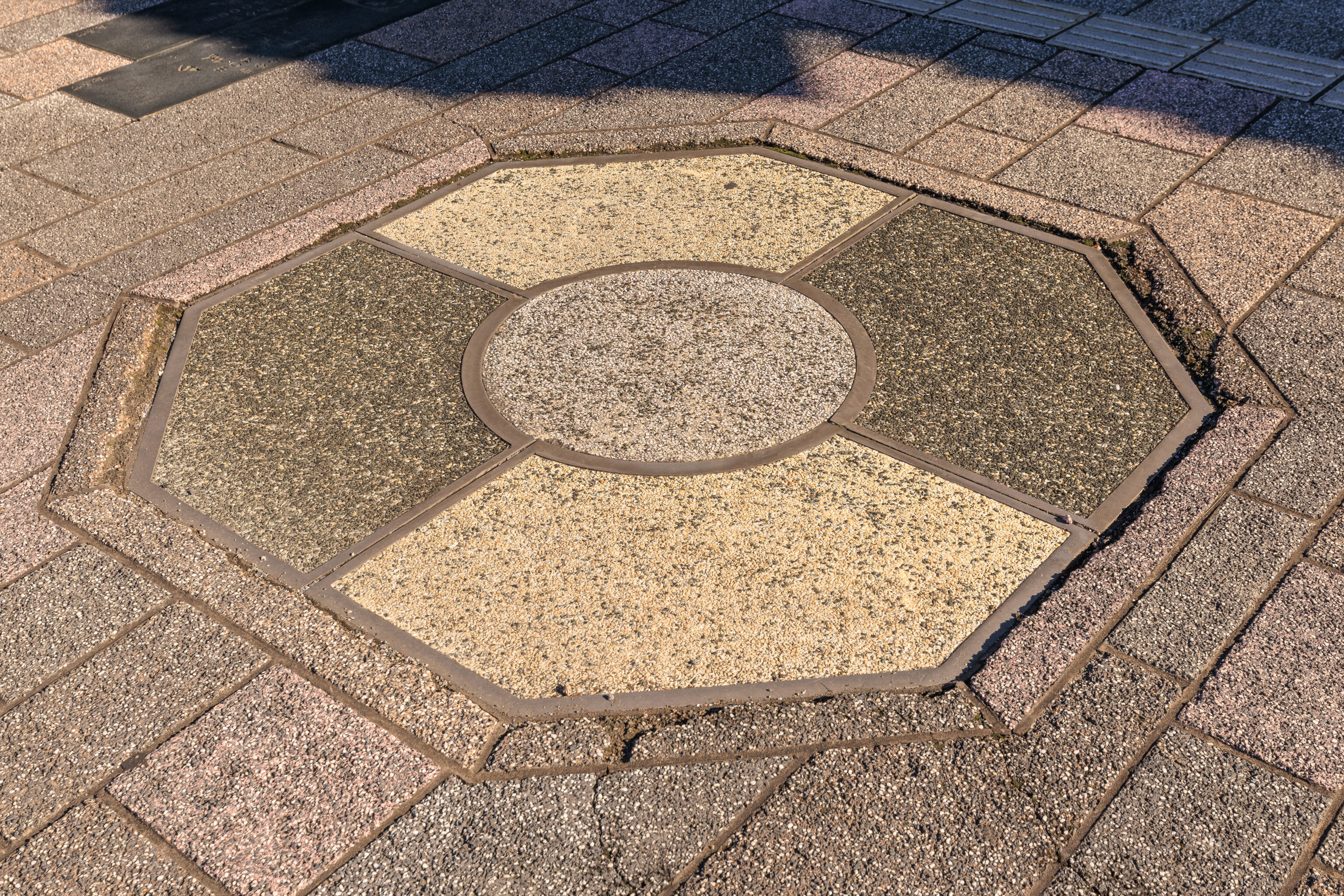
Why did we photograph this? I have no idea!
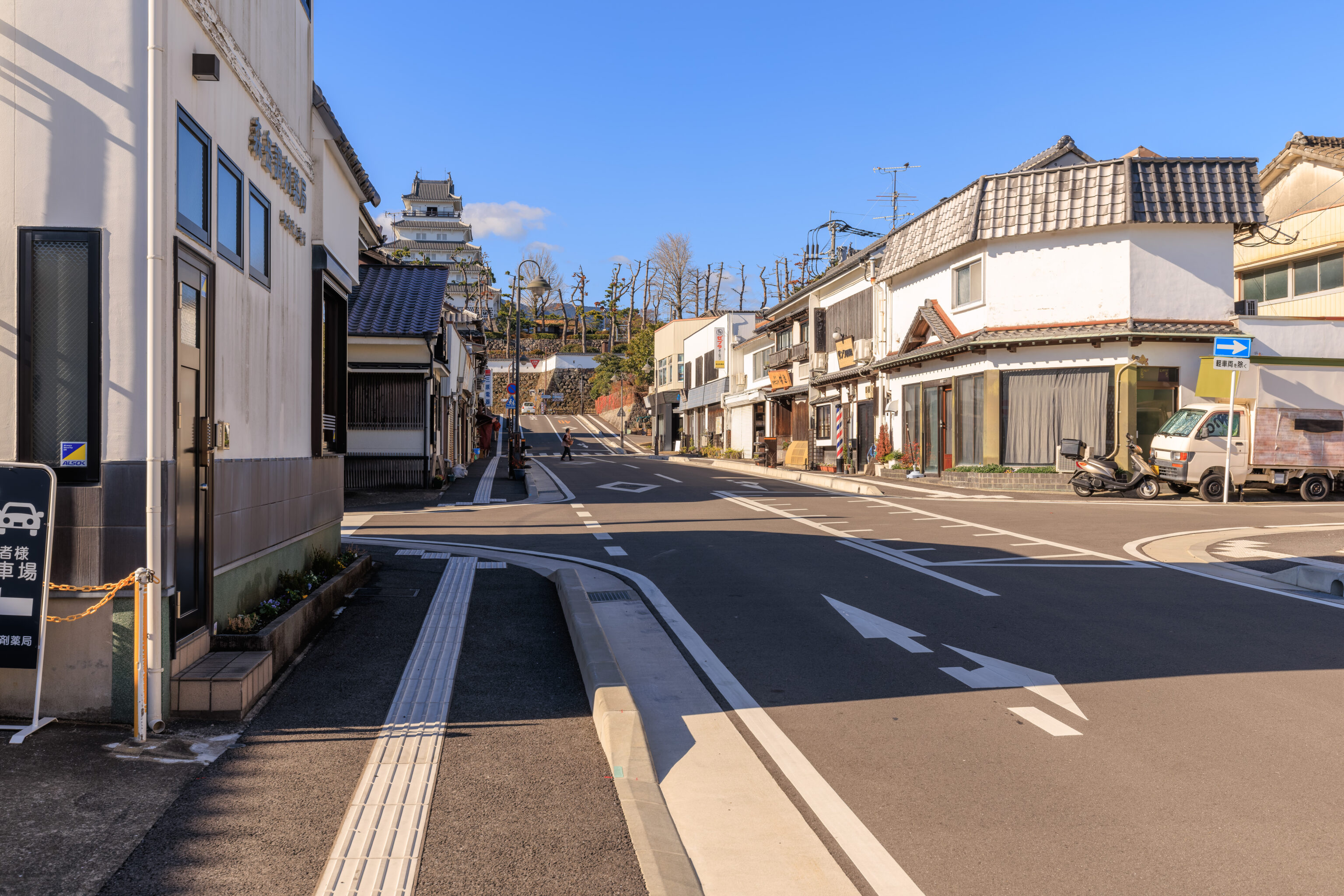
We started to walk towards the castle…
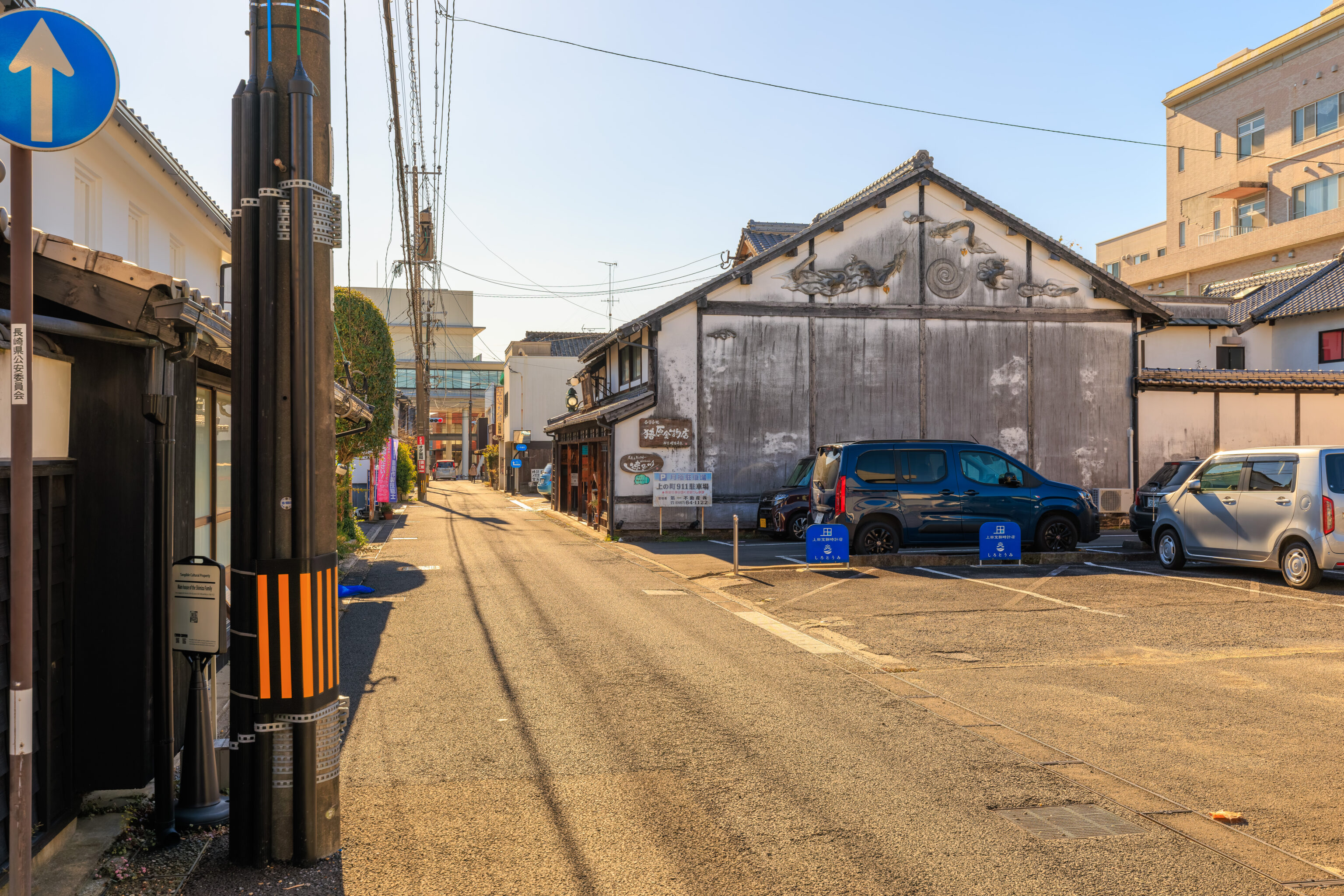
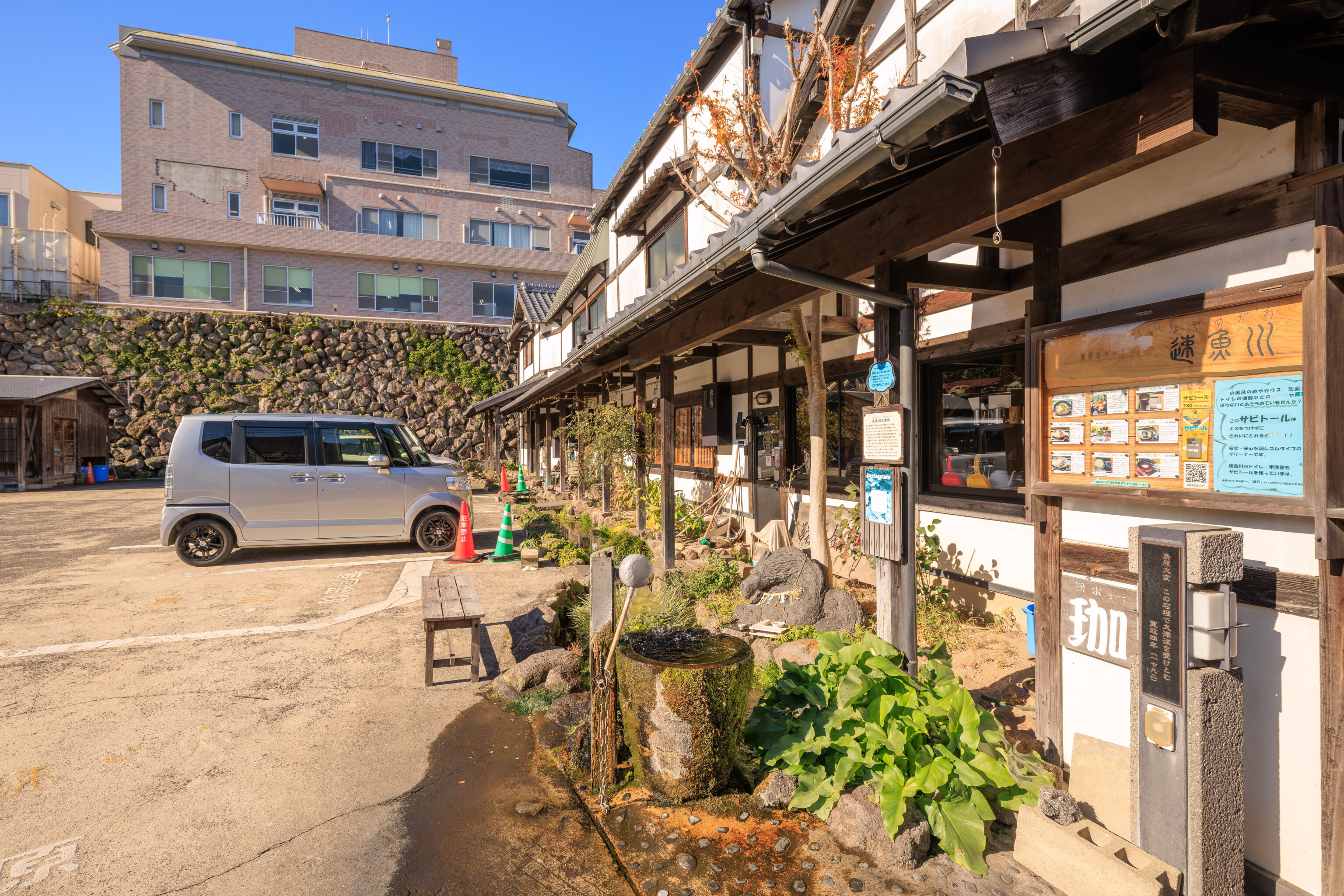
But, we turned left for a short detour just two blocks away from the station. This building here is the 猪原金物店 Inohara Hardware Store. The city describes it as being in business since 1877 and as the second oldest store in Kyushu. We briefly went in to take a look. They sold quite a bit of things!
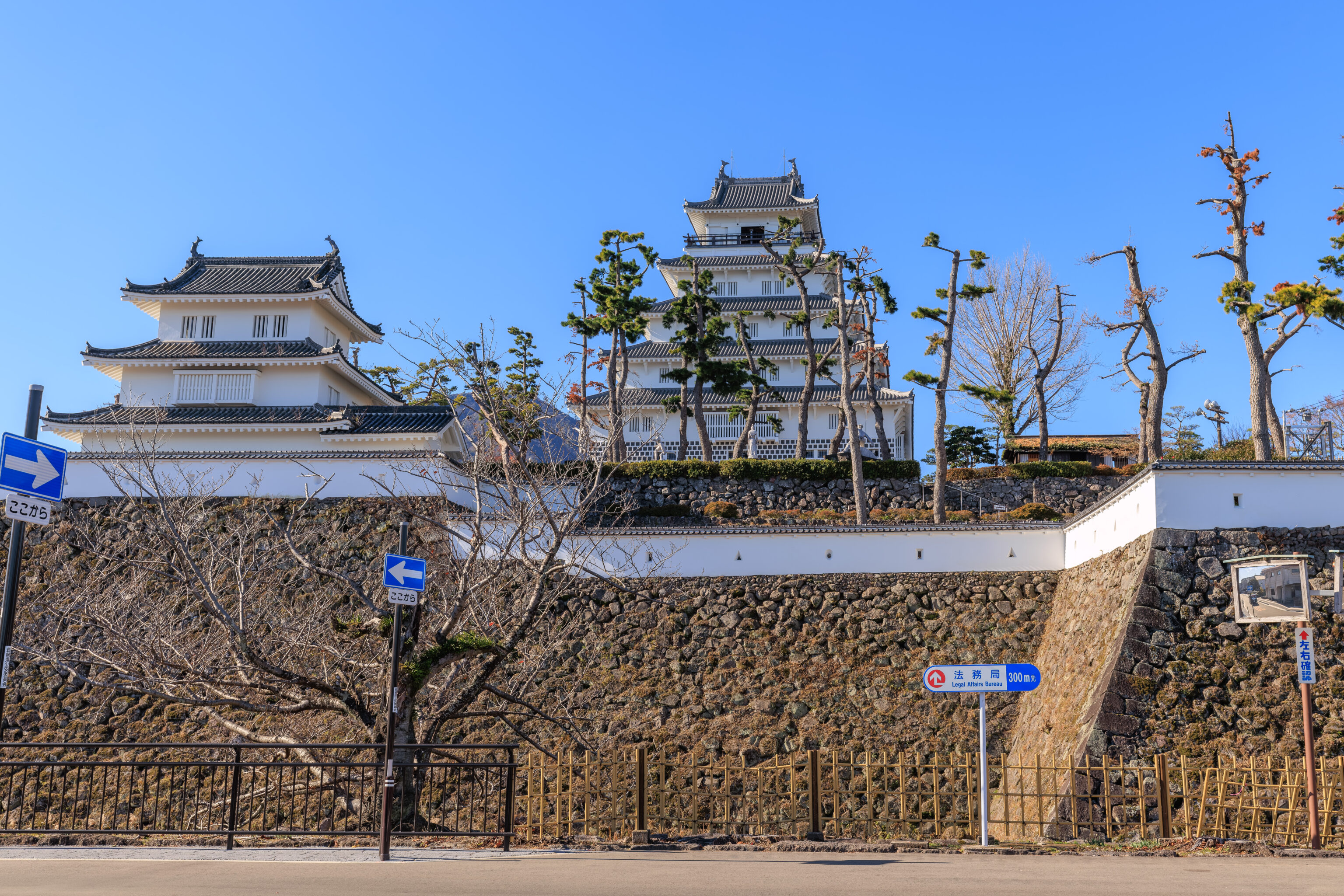
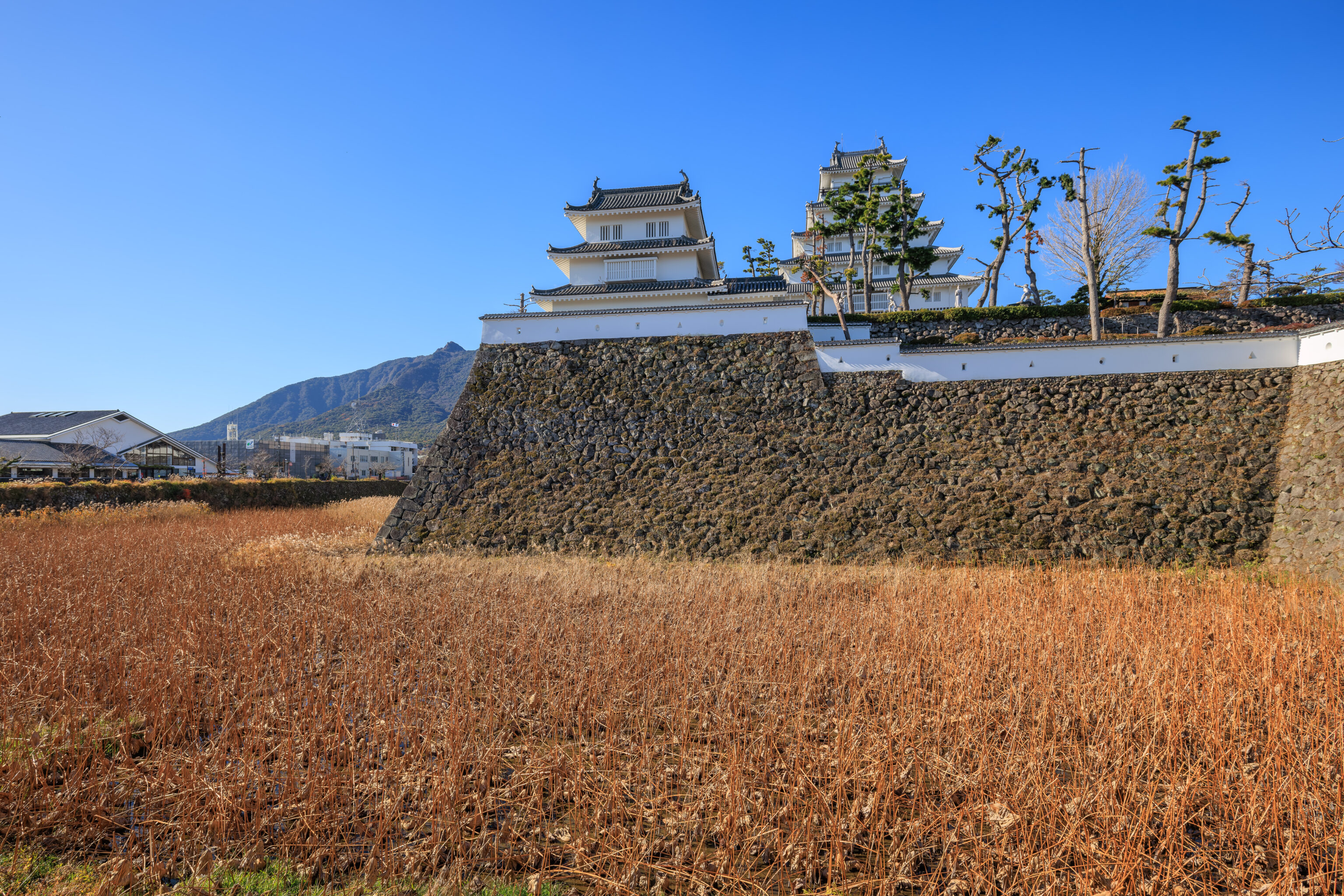
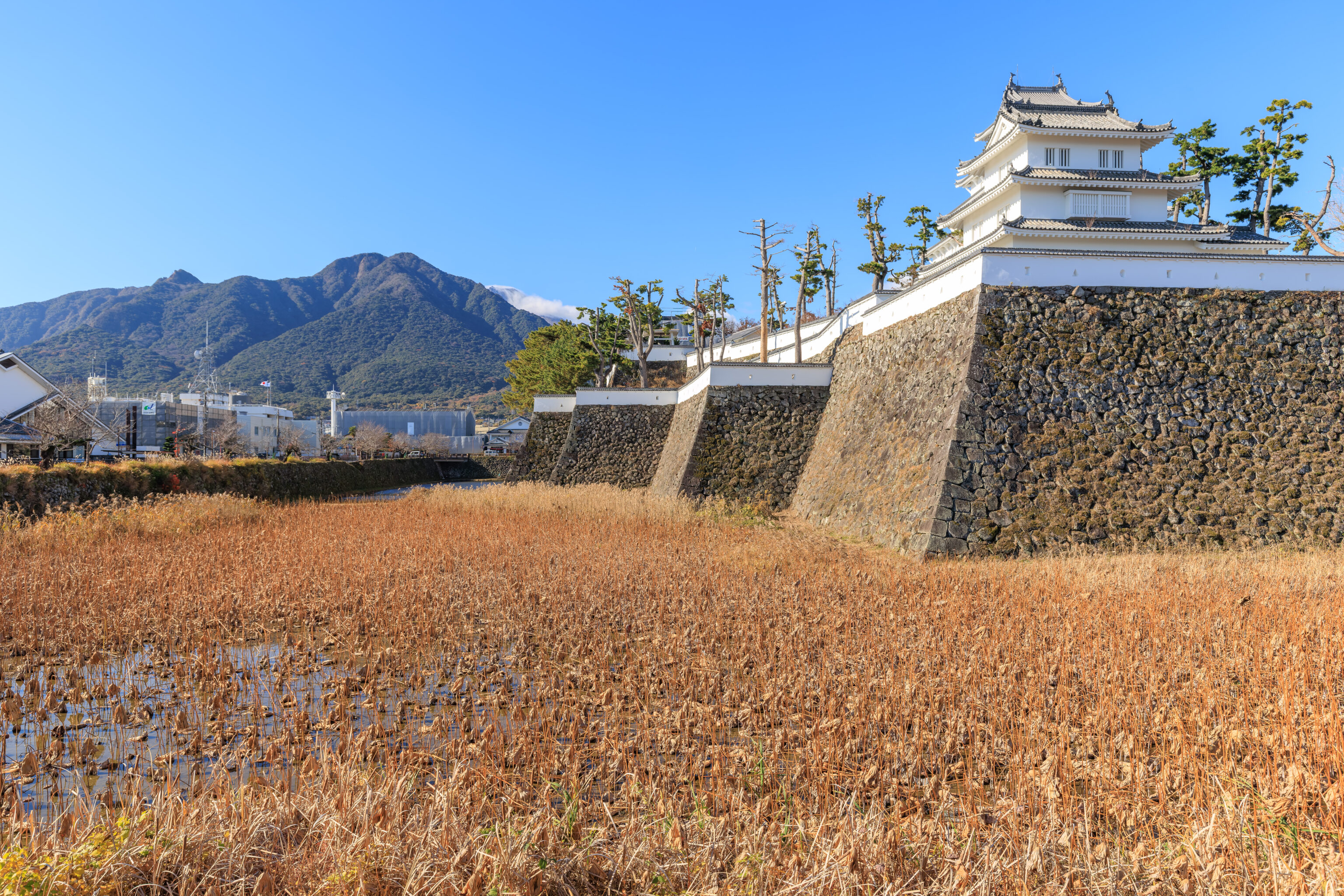
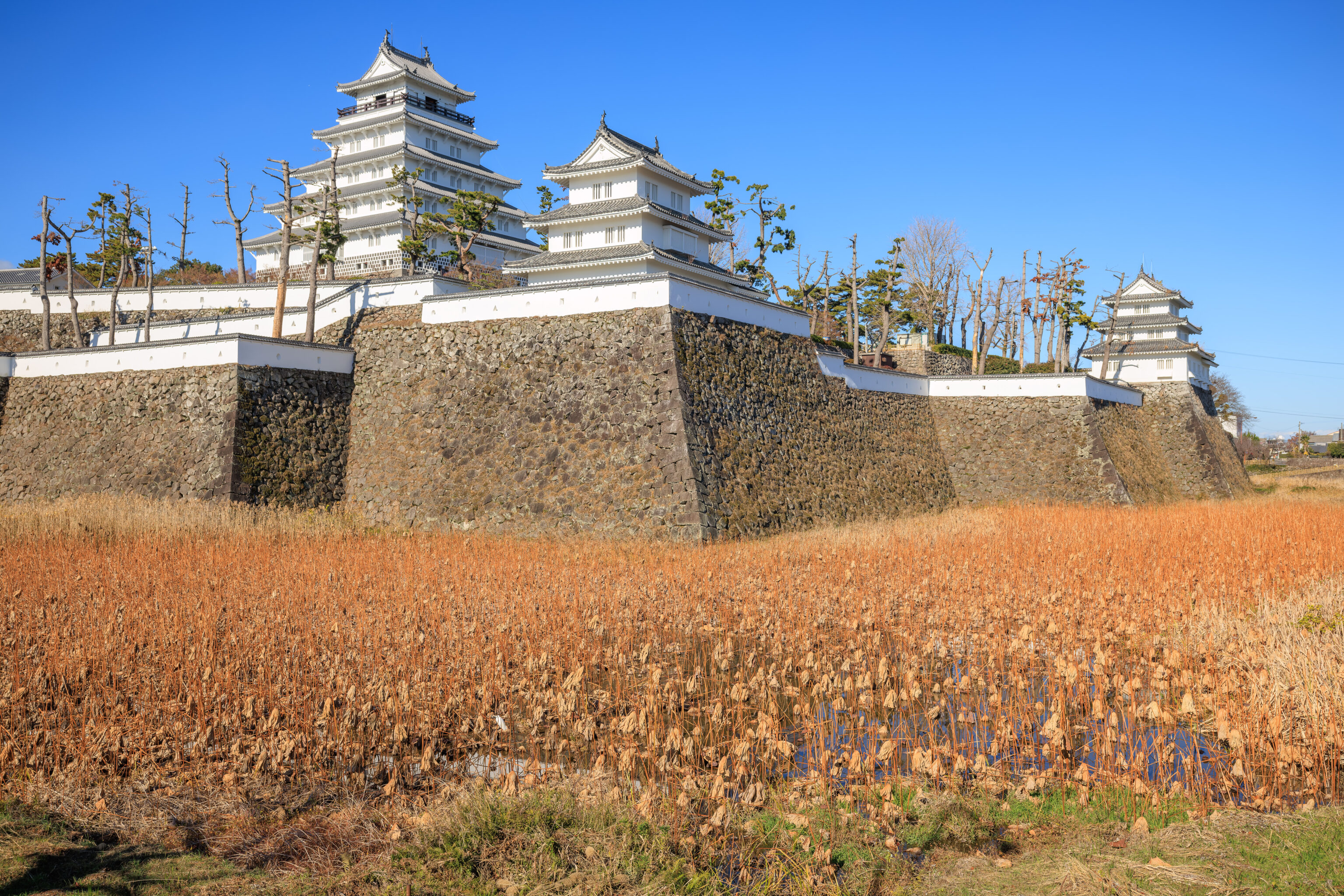
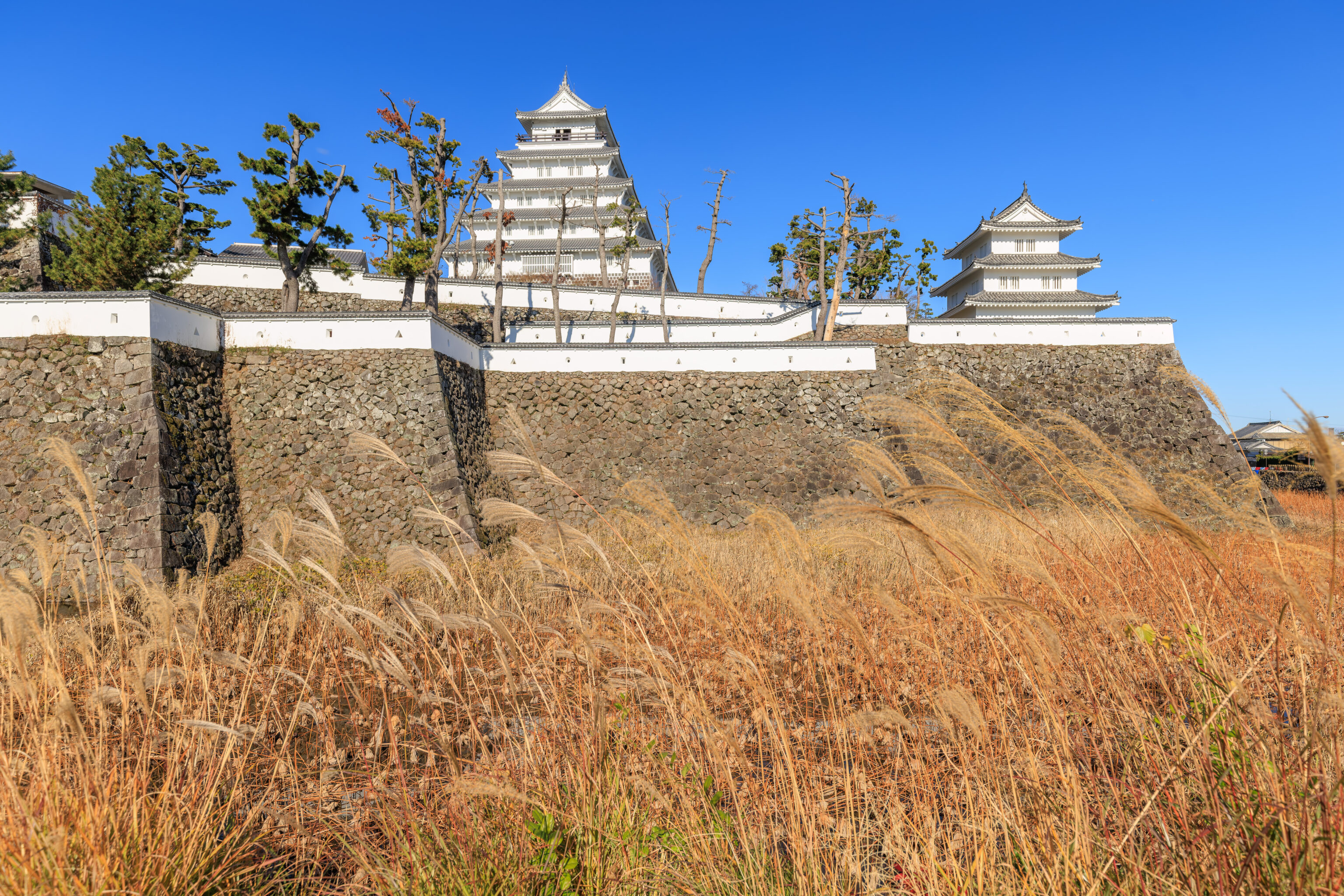
We then backtracked to continue on to the castle. Although the castle is just three blocks away from the train station, the entrance is actually on the opposite side. The total distance is about three times as long as those three blocks.
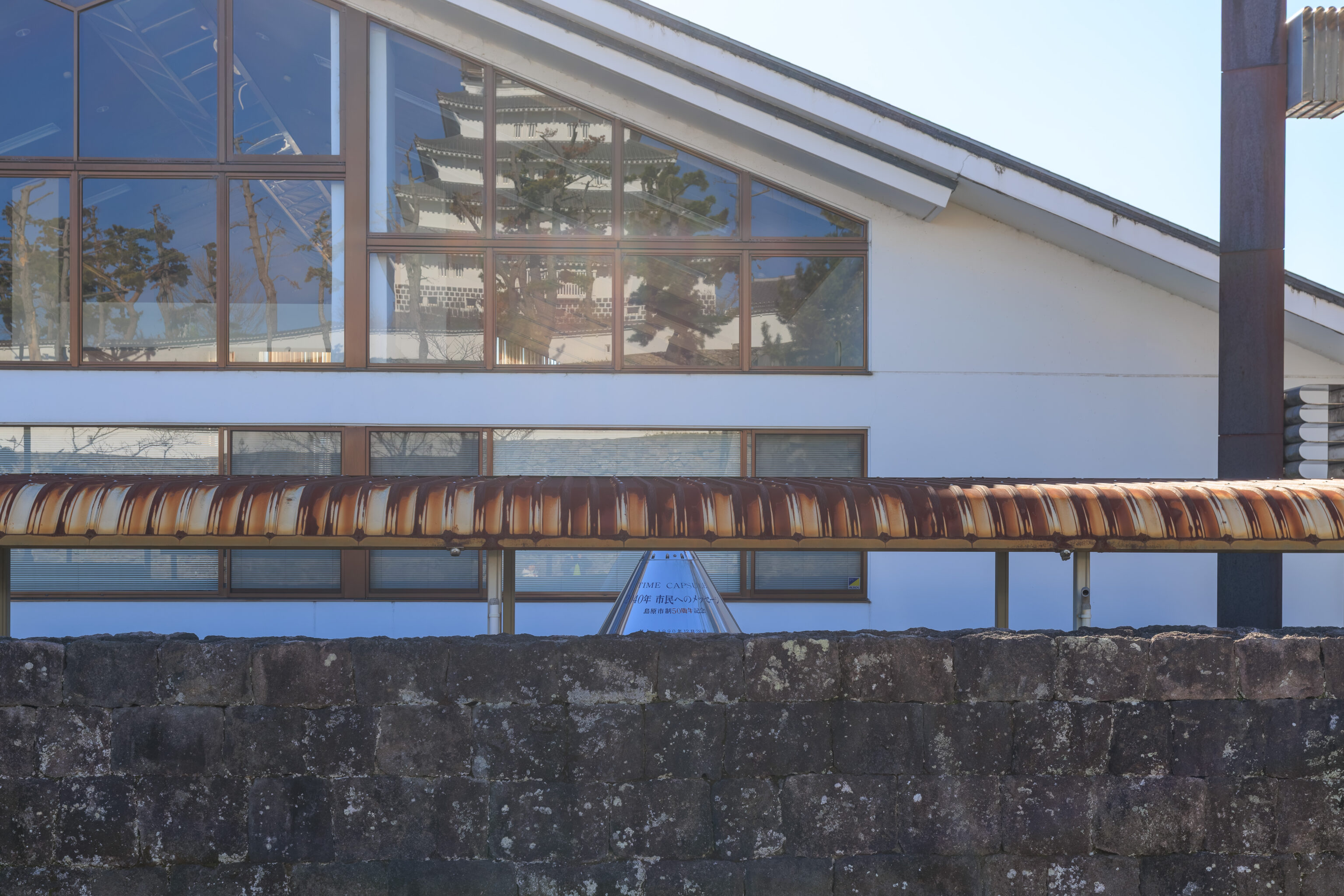
While we were on the south side of the castle, we noticed a time capsule and the castle reflected in a building’s windows! This building appears to be a library.
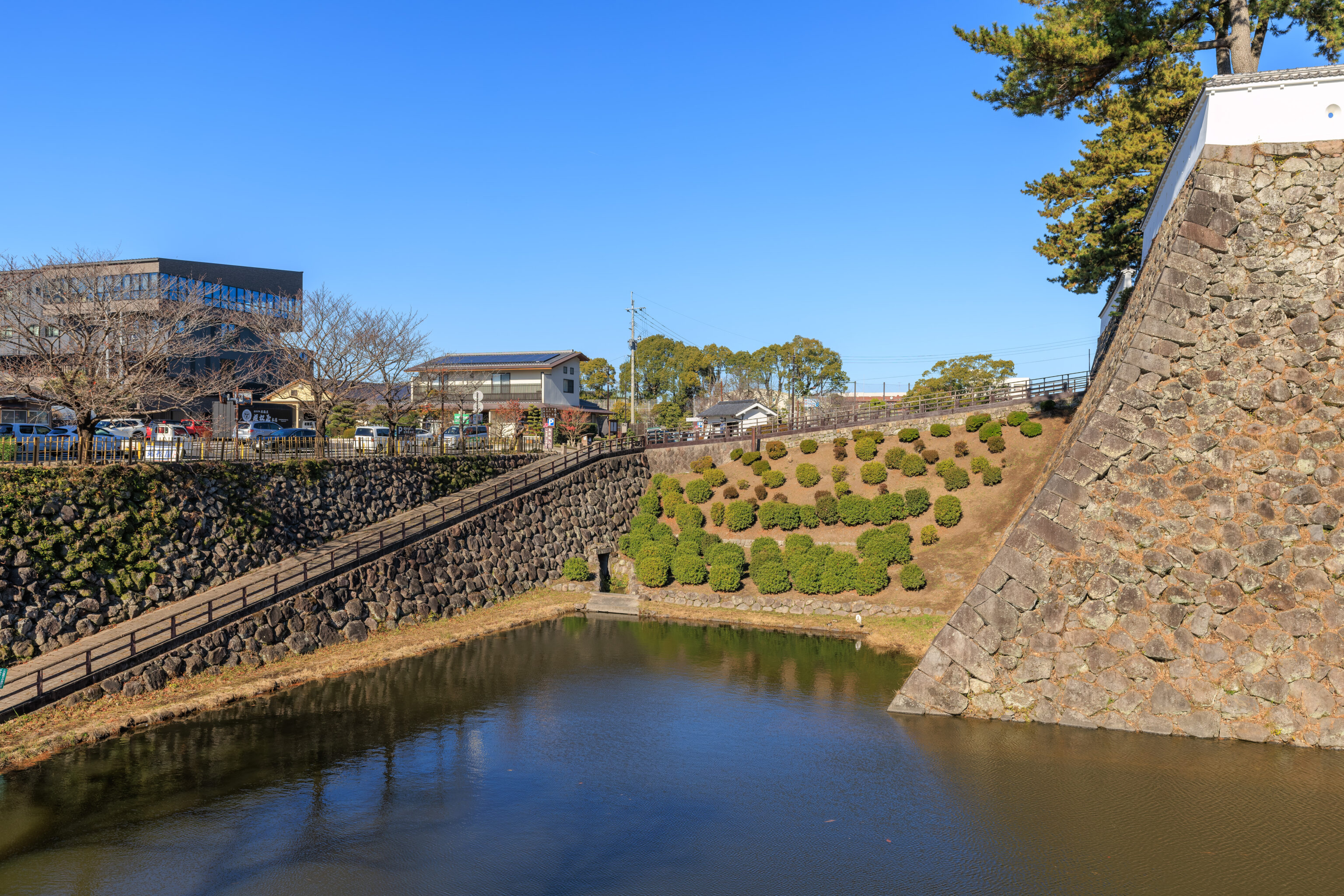
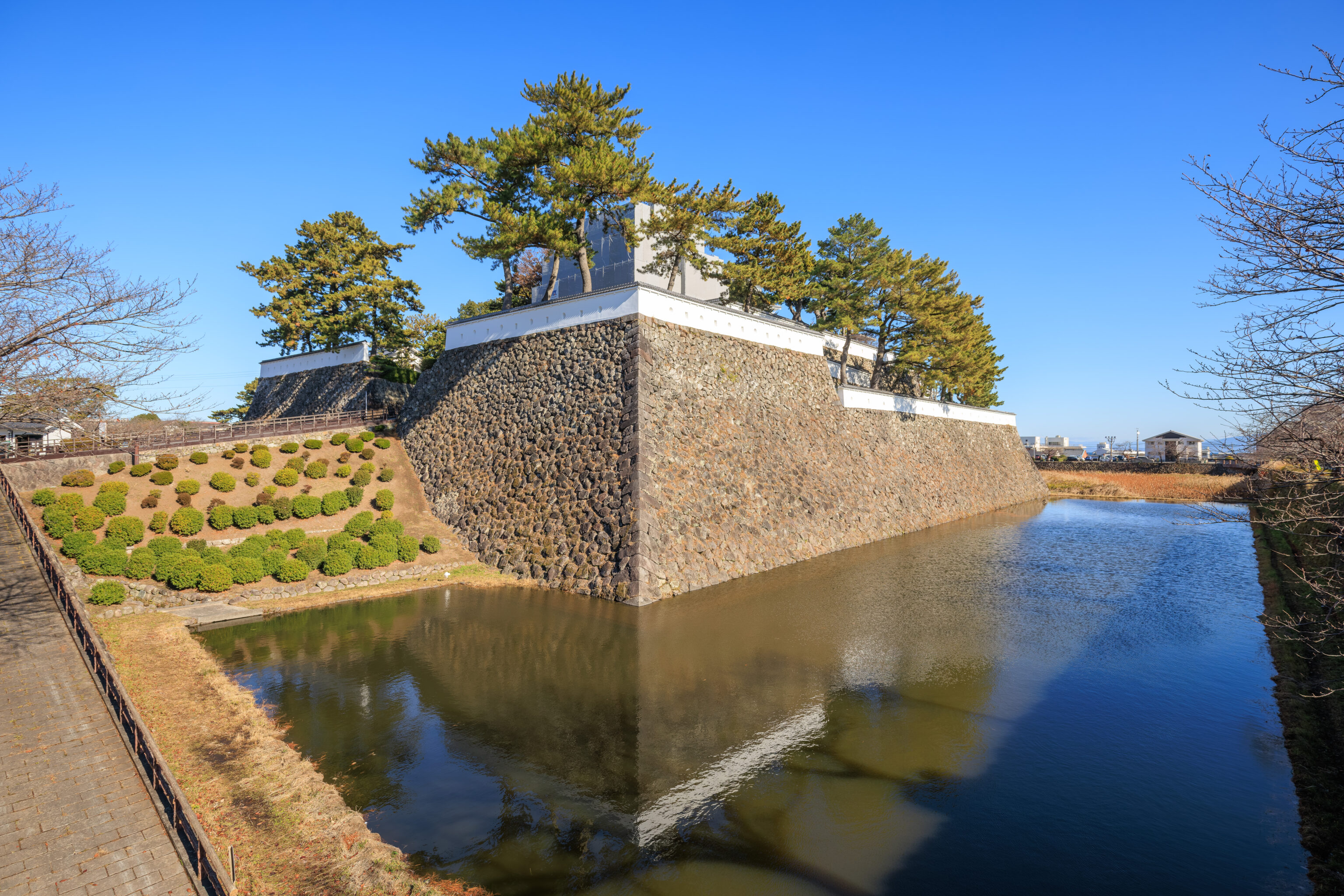
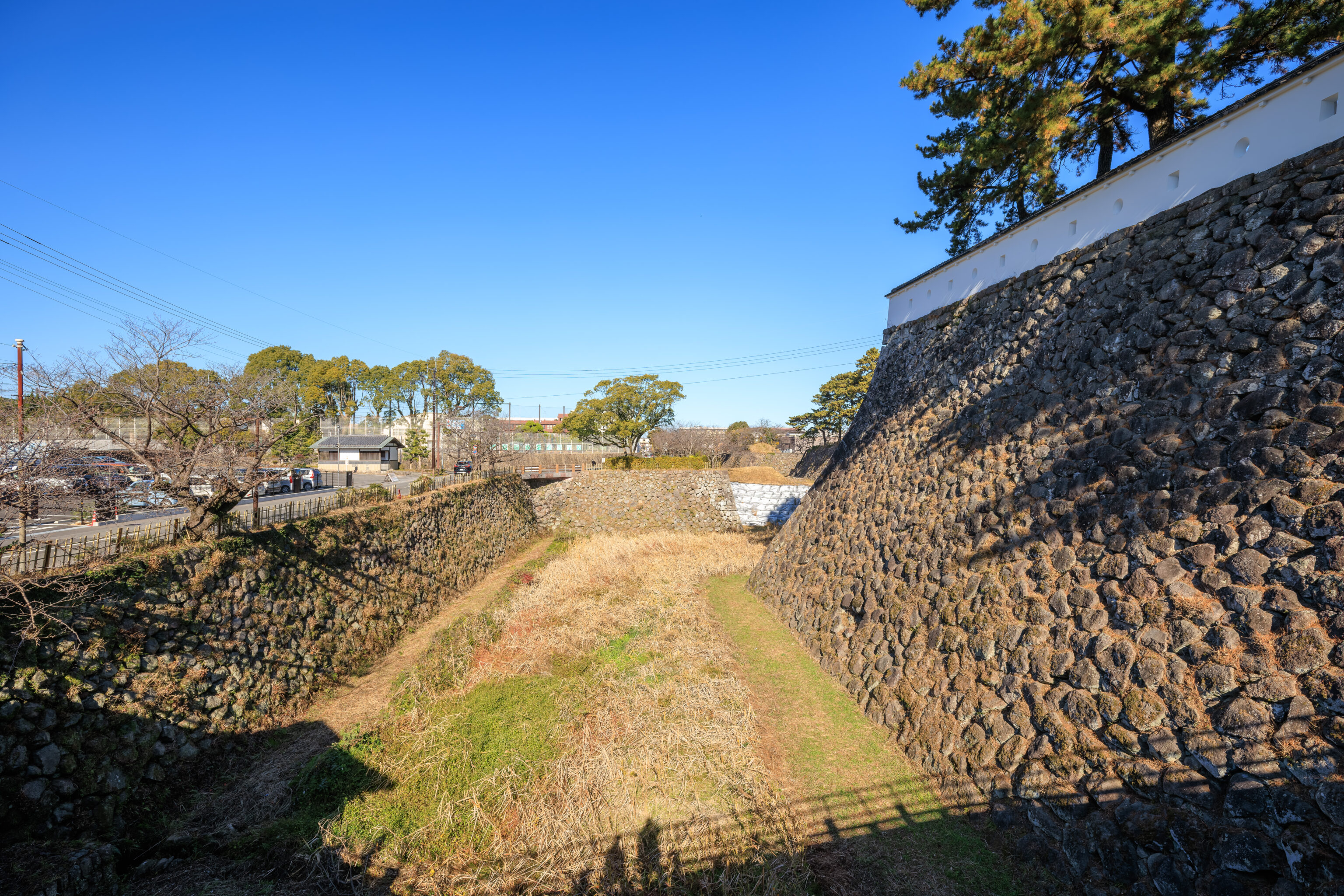
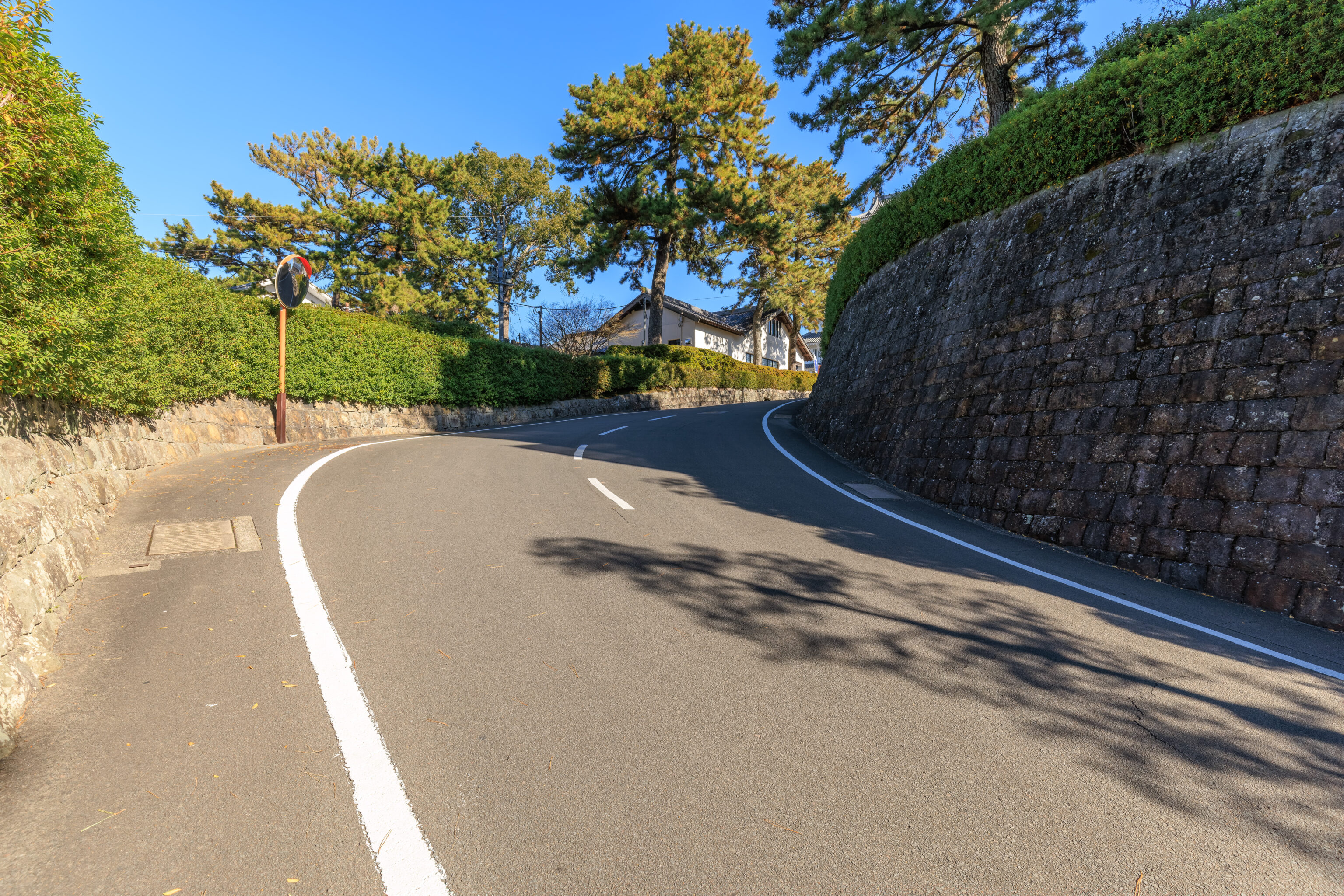
We continued on until we reached the castle’s west side where there was a driveway that led up to the castle.
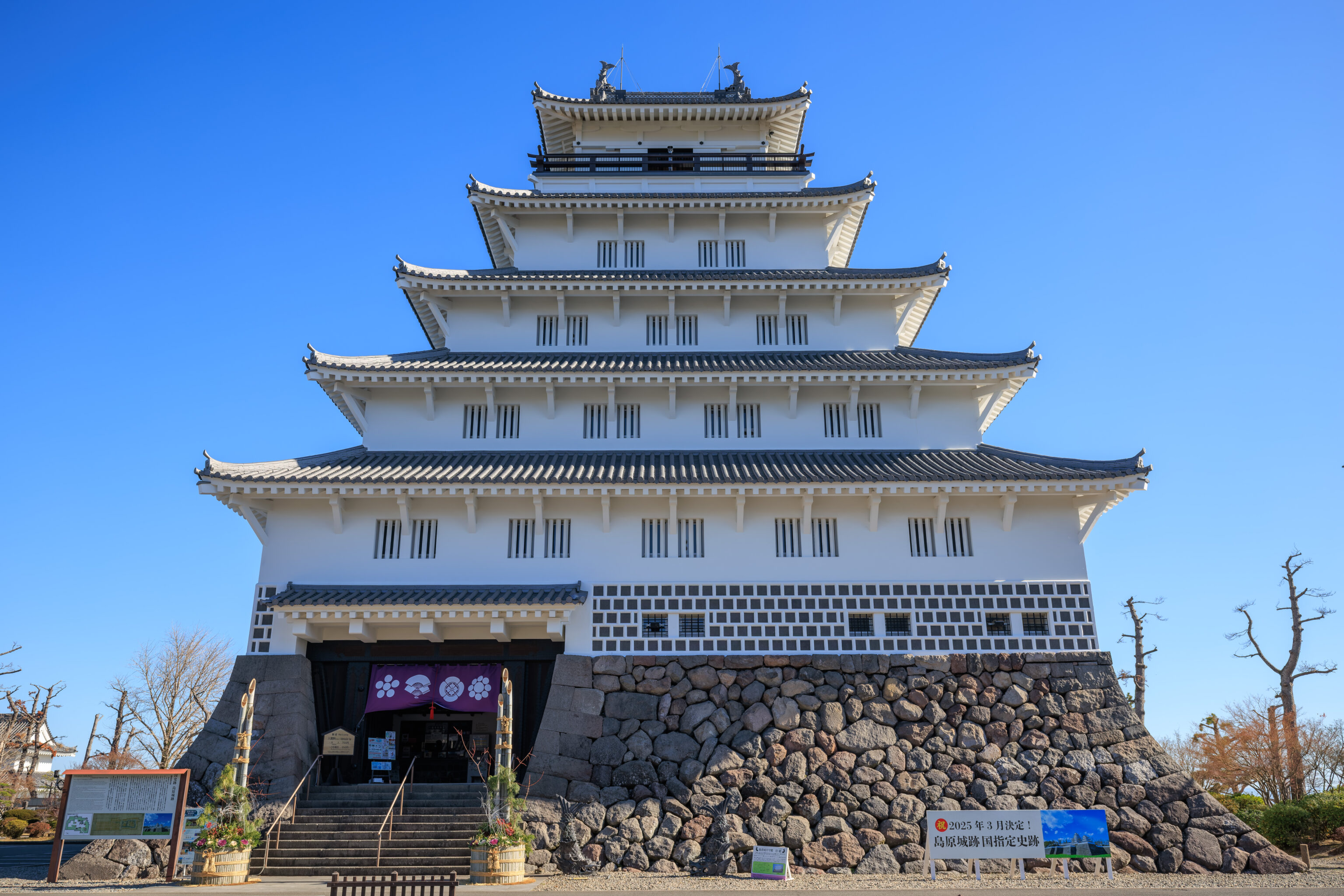
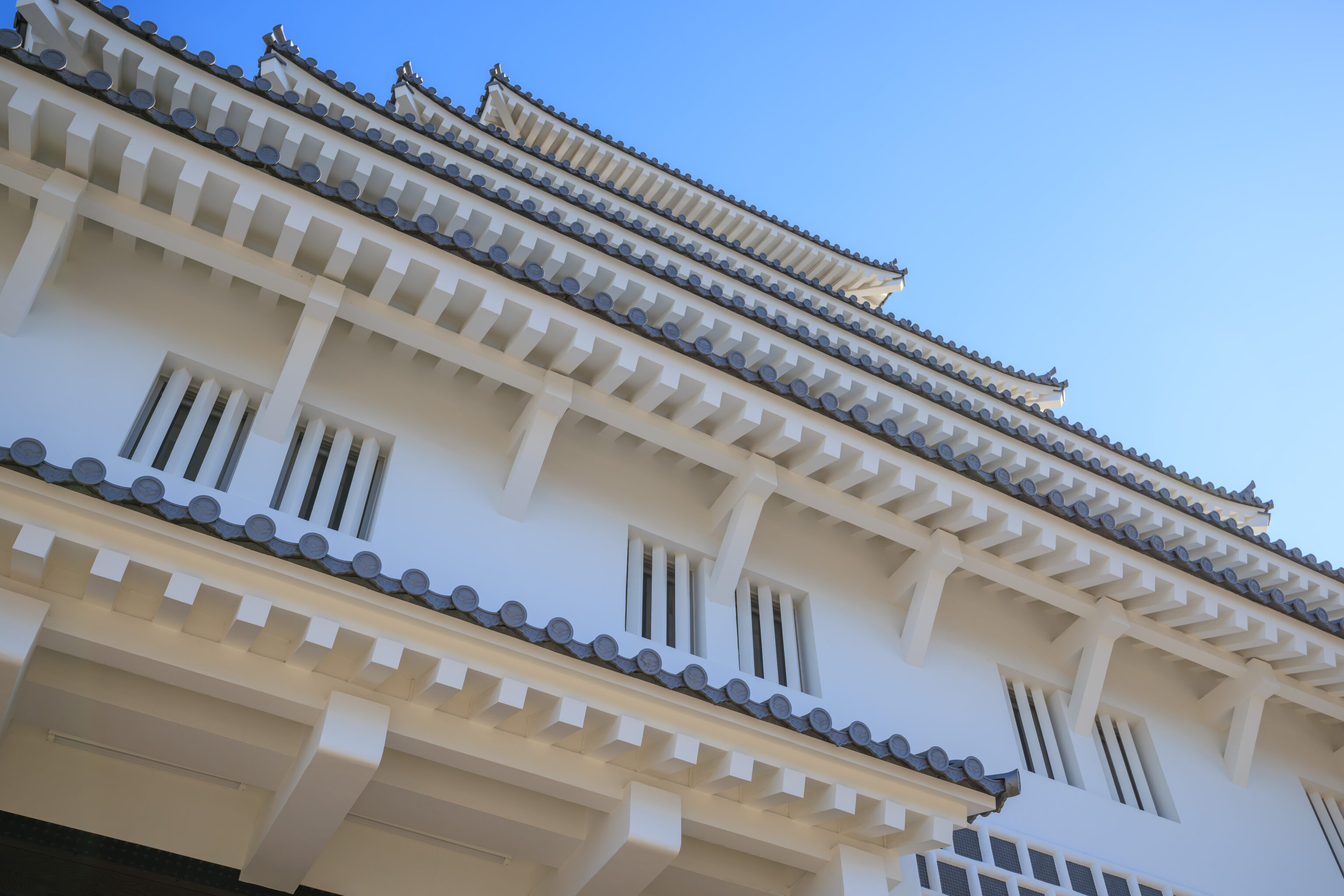
Like most castles that are currently standing in Japan, this one is a concrete reproduction. Most castles in Japan that survived into the 19th century were destroyed as a result of the Meiji Restoration which ended the feudal domain system and removed the daimyos from power.
A sign outside of the castle provided some history. Unfortunately, the English text is pretty awful and we didn’t photograph the Japanese.
Shimabara Castle Ruins, a National Historic Site
The origins of Shimabara Castle

Shimabara Castle was built by Shigemasa Matsukura who took over the domain from Gojo. In the base, one feudal domain and one castle, in 1618, had prohibited new castle construction but received castle permission from shoguns and construction. It was completed after approximately seven years. At the same time, he developed the town around Shimabara castle and samurai residence.

Put in the main bailey is that castle tower of five floors has no gable. It is said that didn't make the gable because of the cut-down of expenses, the simple appearance of the Shimabara castle is one of the features. The Ninomaru follow the Honmaru, and the Sannomaru, where the lord of  the castle lived in his palace, is located to the north.

There are disparate a role Honnmaru and Ninomaru for fighting, and Sannomaru as a government about the specific structure of the edo period. In the normal case, we imagine Honnmaru and Ninomaru are fortified with a wall but the real is a castle area that spreads out the stone wall of approximately 350 m to east and west, approximately 1200 m to north and south. In the past time, there placed hira yagura of thirty-two, could respond to a battle even if a simple plane structure like a rectangle.

Kagamiishi incorporated in stone wall catch a glimpse of the castle construction of the momoyama period, the other hand, the Shimabara castle that was using a castle construction technology of an early Edo period will be said terminus of the modern castle wall.

Since then, it has served as the residence of four clans, Matsukura clan, Kouriki clan, Matsudaira clan, Toda clan, and again the Matsudaira clan spanning 19 generations.

During that time, in 1637 it withstood the fierce by Shiro Amakusa commanding general attacks of the rebels during the Shimabara Rebellion, and in 1792 it endured successive earthquakes and a massive tsunami during the Shimabara Catastrophe. With the Meiji Restoration, the castle was abandoned and later dismantled. However, efforts to fulfill the dream of reconstructing the castle, which had been ongoing for years among the people of Shimabara, led to the restoration of the castle tower in 1964.
– Text from a sign.
The sign quoted above mentions the Shimabara Catastrophe. This was an eruption of Mount Unzen, the volcano to the west of Shimabara, which caused earthquakes, landslides, and a tsunami in 1792. Mount Unzen is at the center of the Shimabara Peninsula and presumably the reason why this peninsula exists.
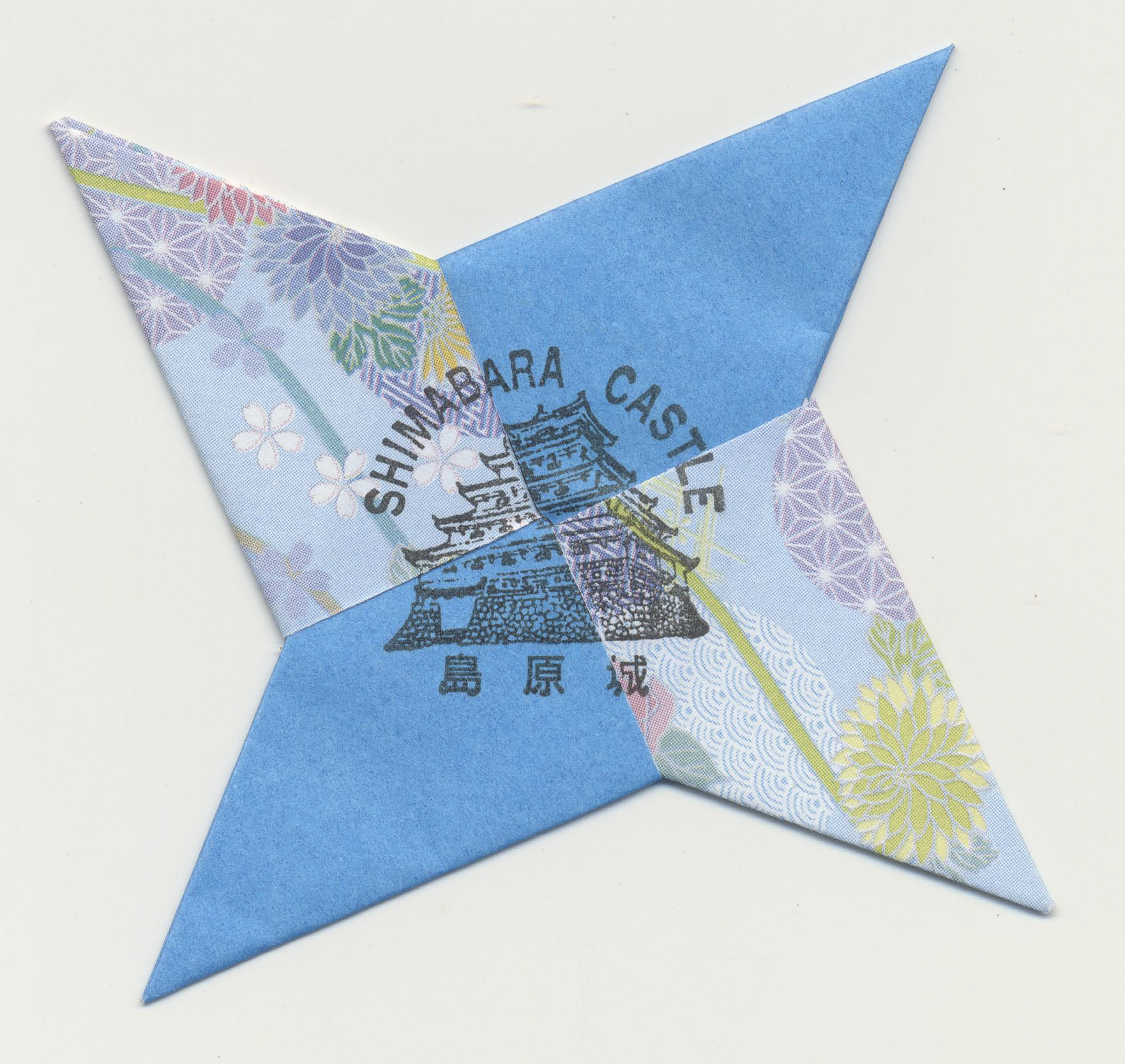
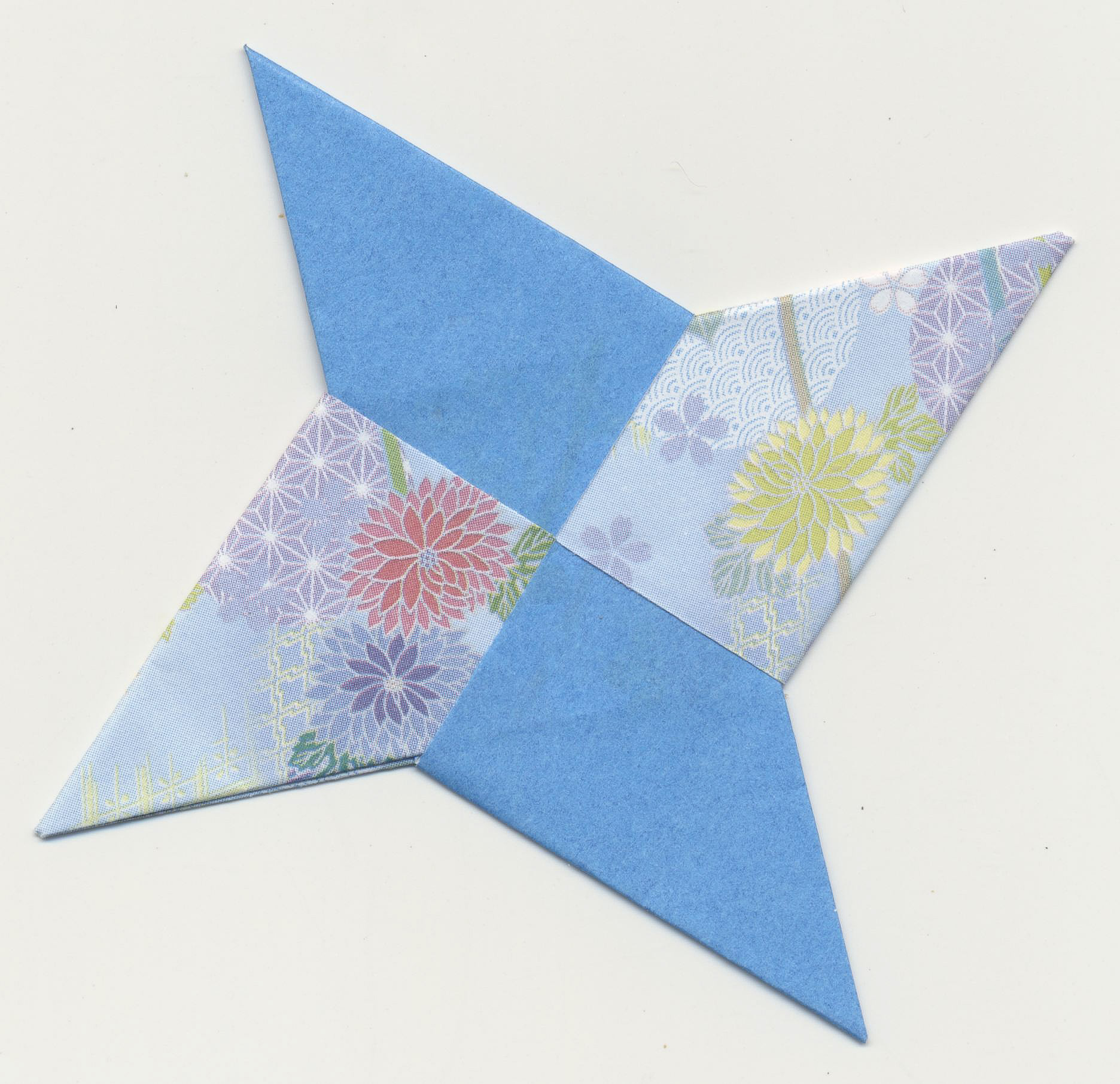
We purchased tickets from a small ticket office at the base of the castle. We received origami shuriken stamped with an image of the castle.
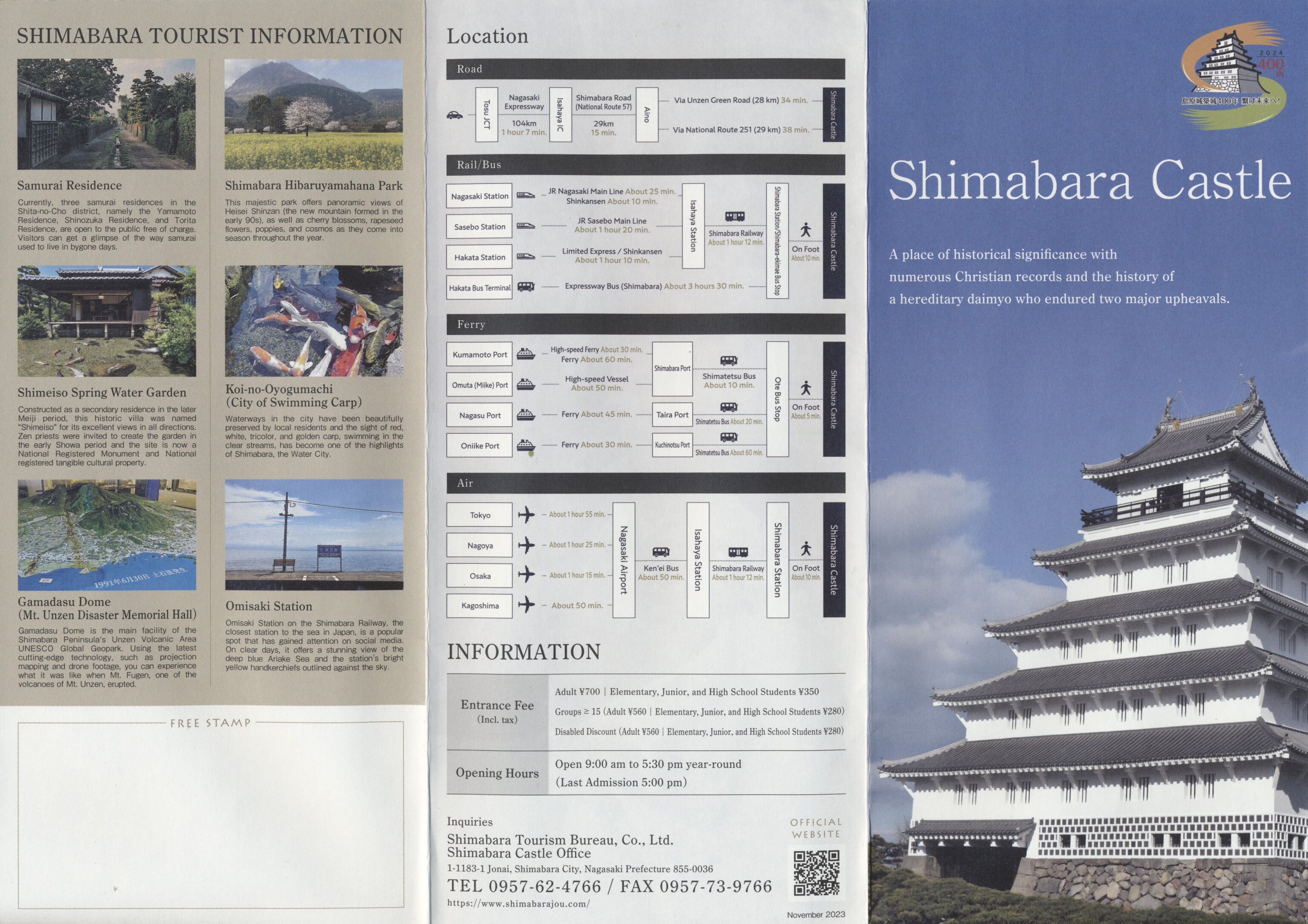
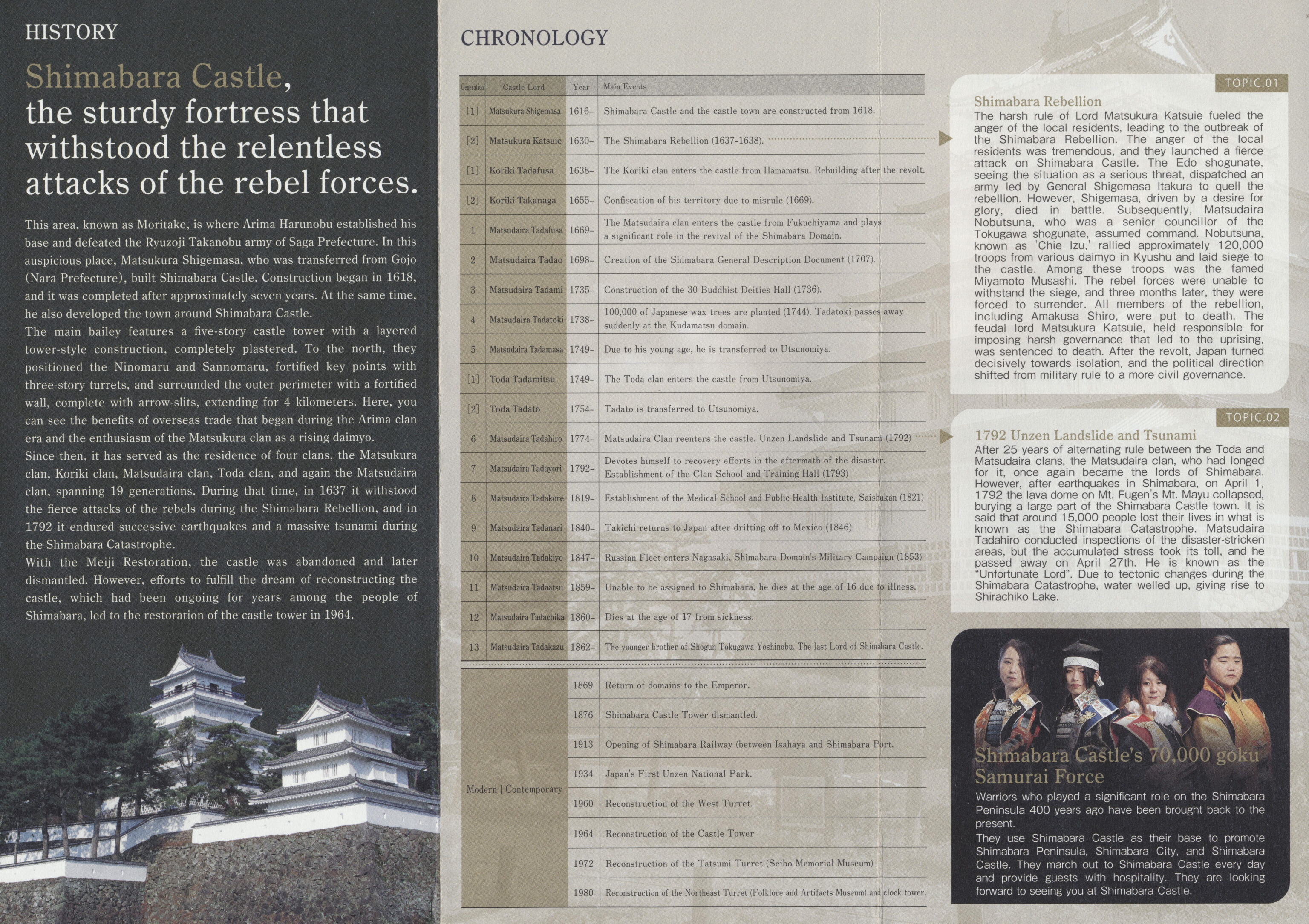
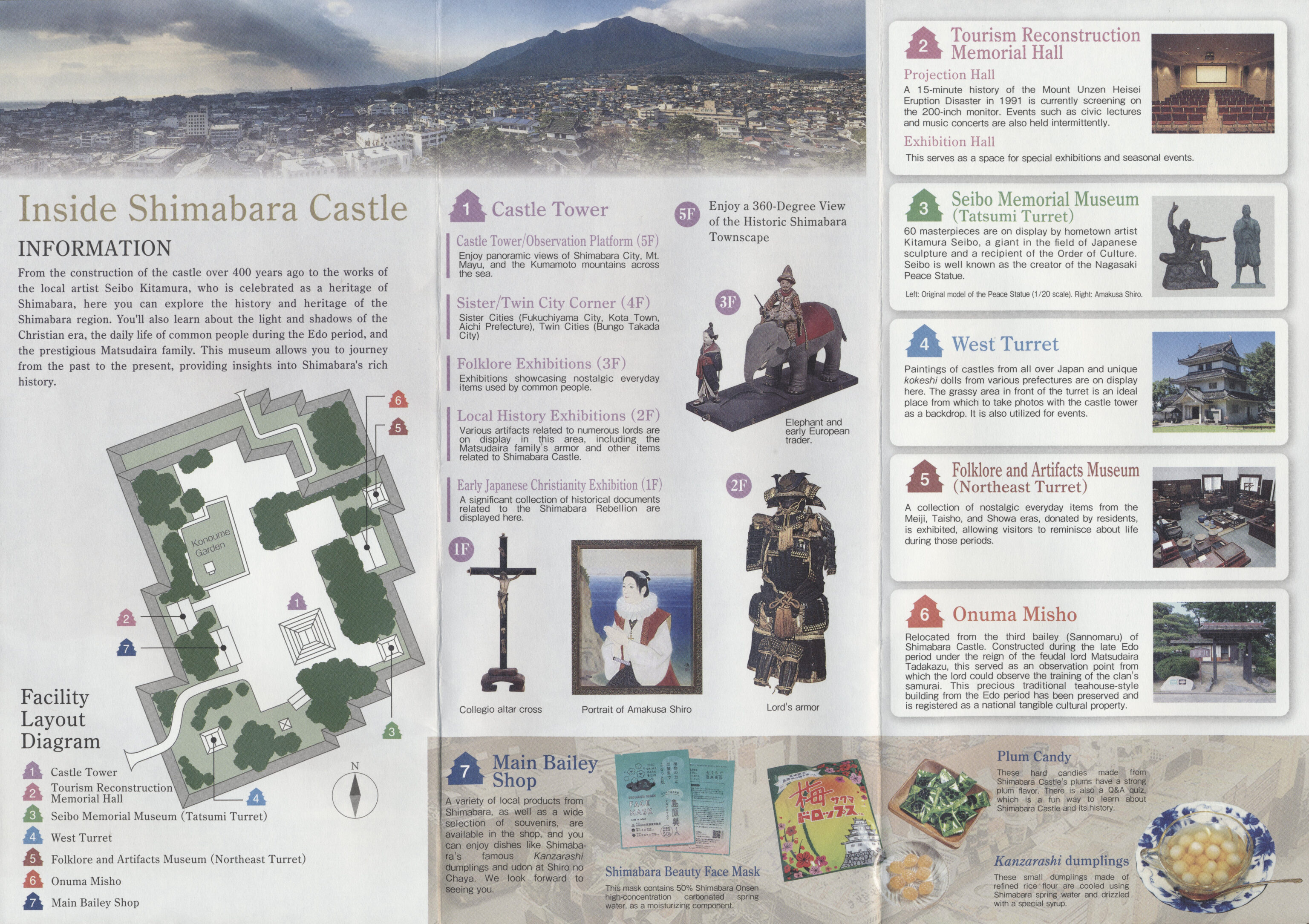
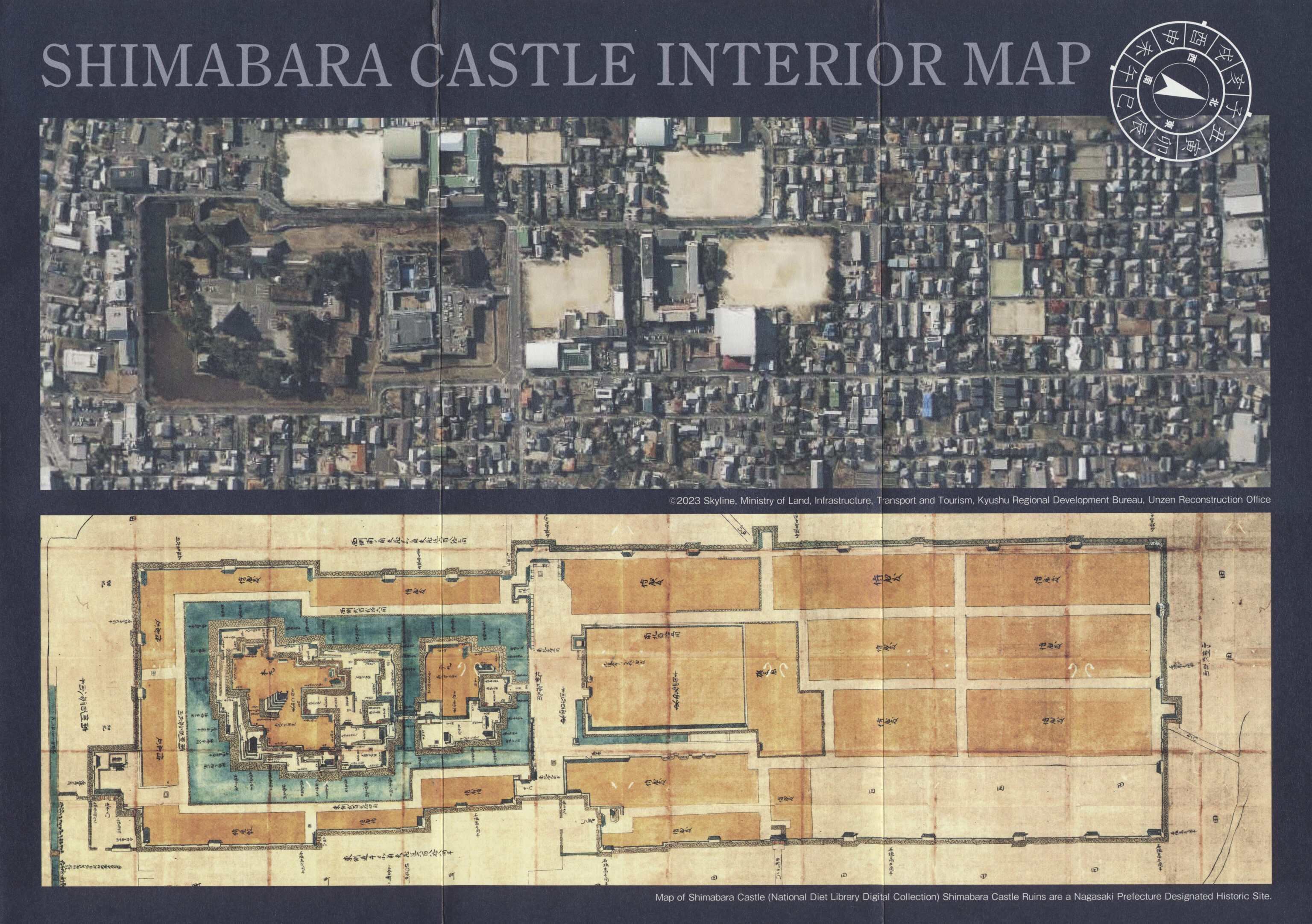
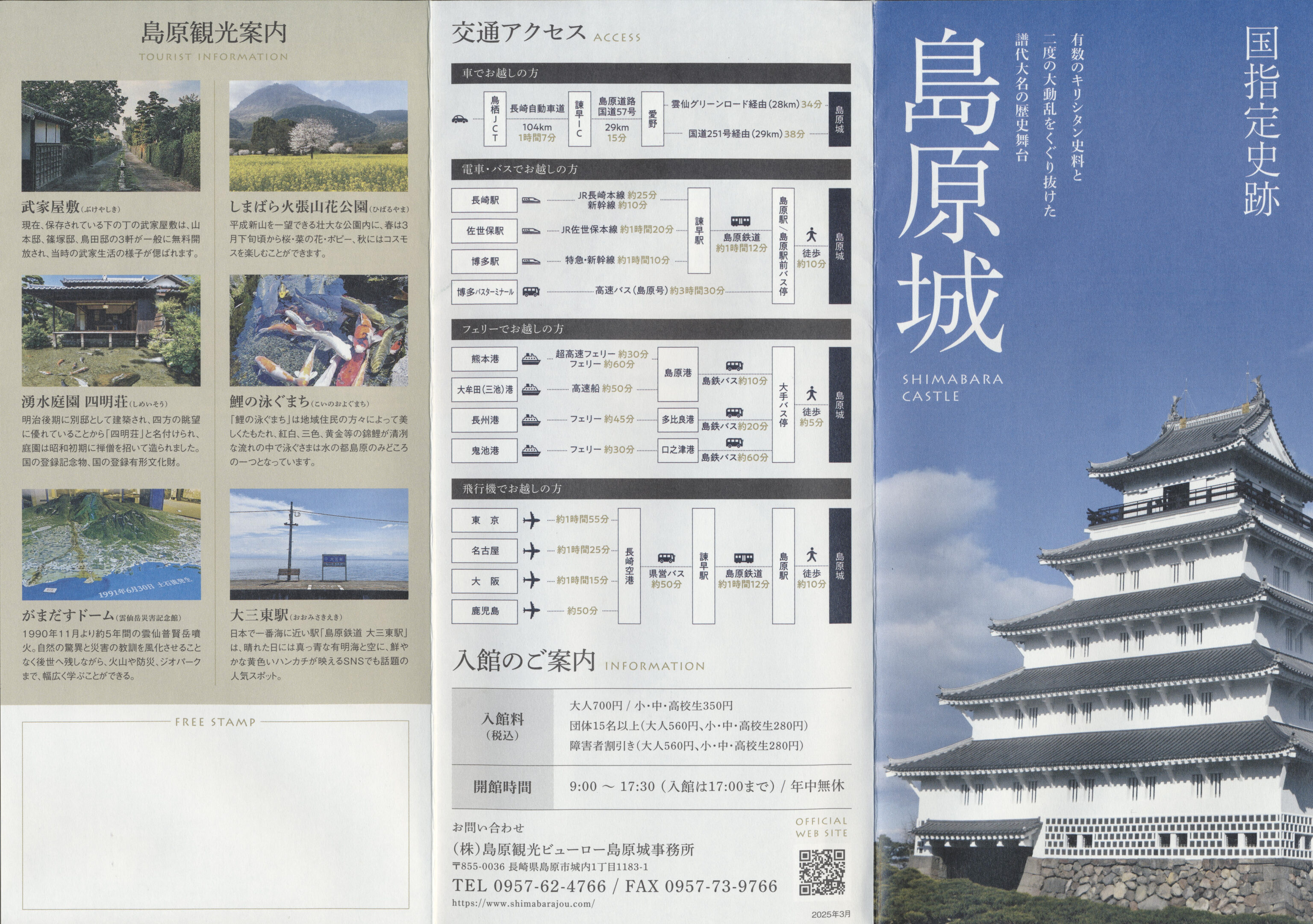
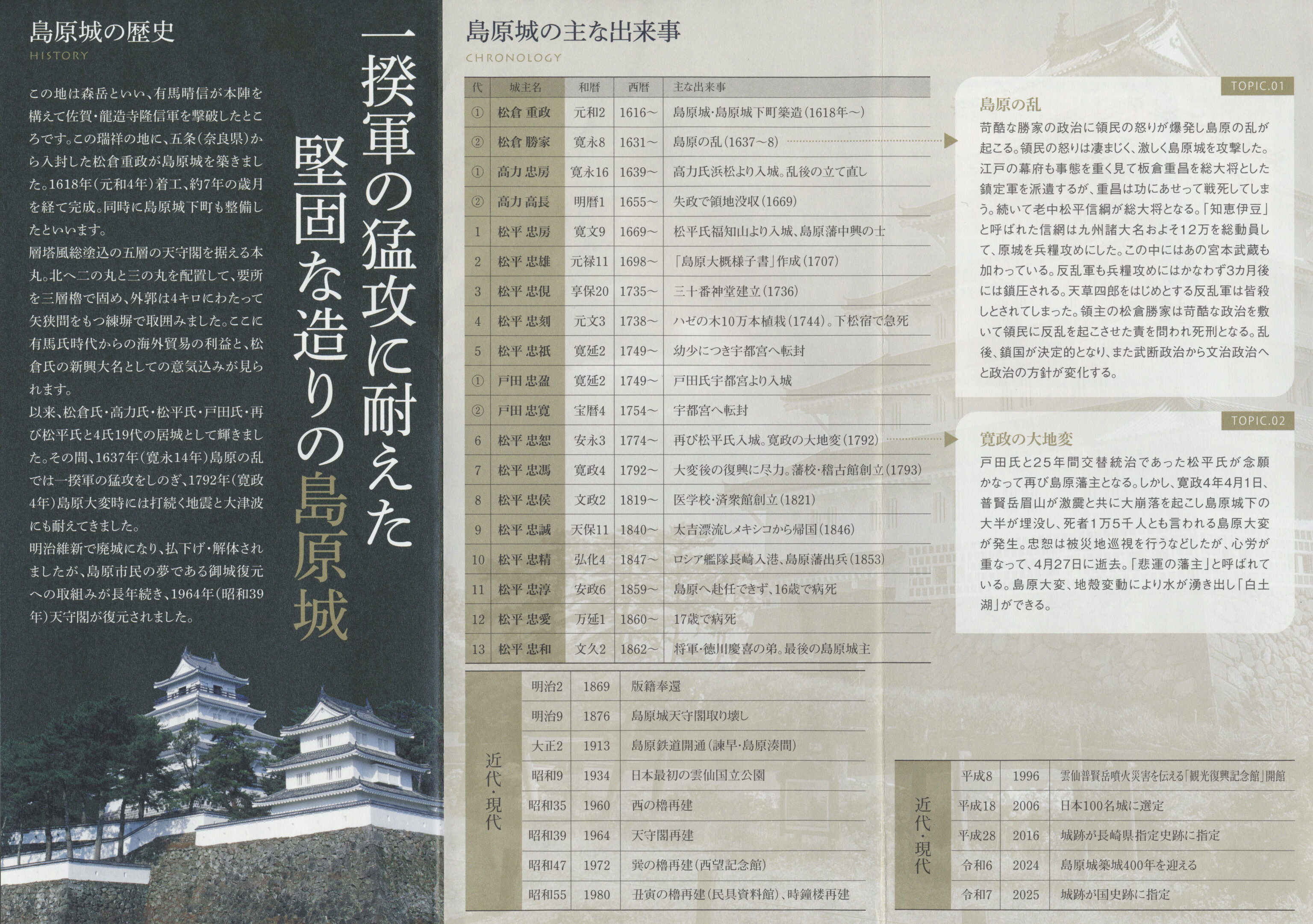
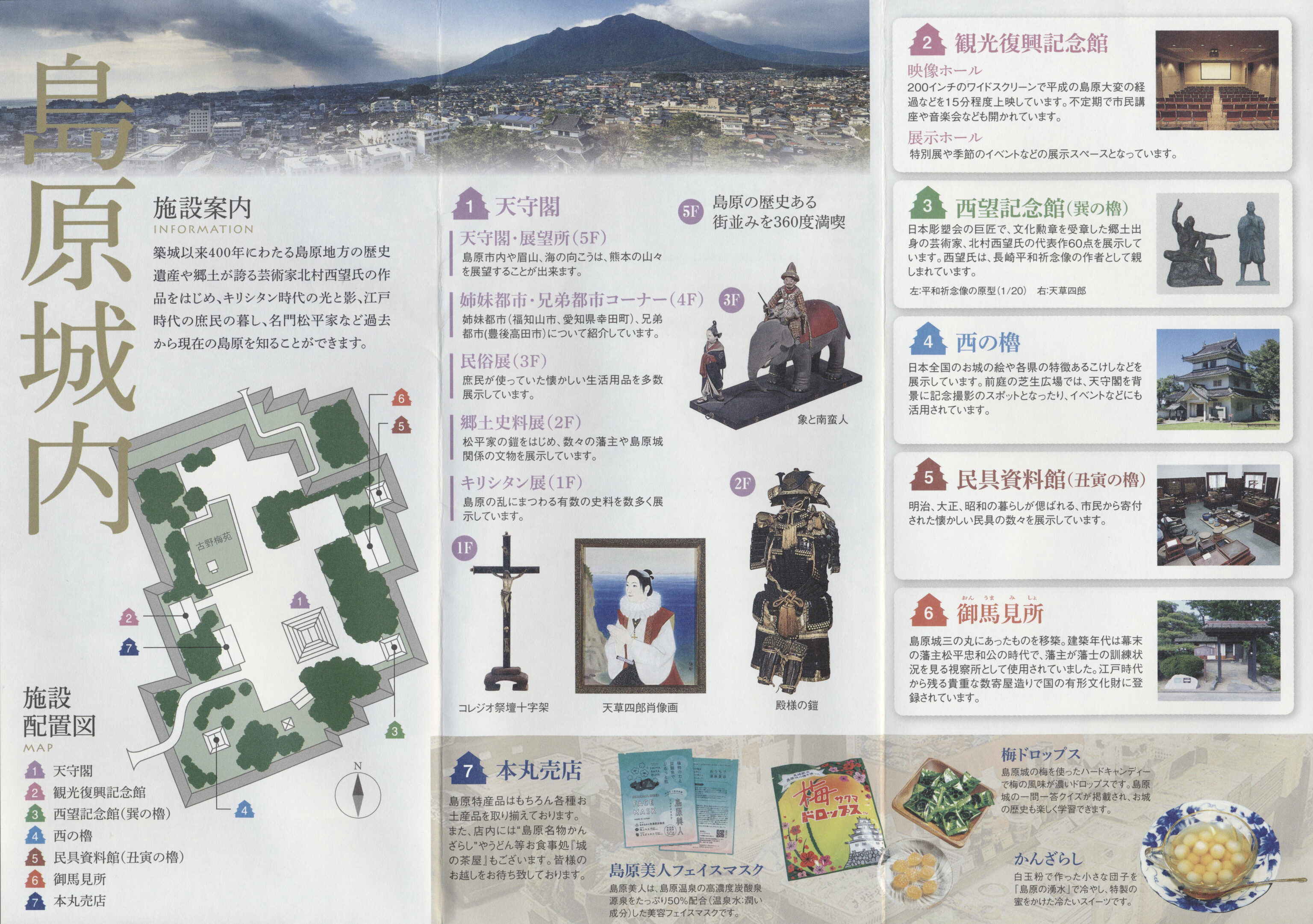
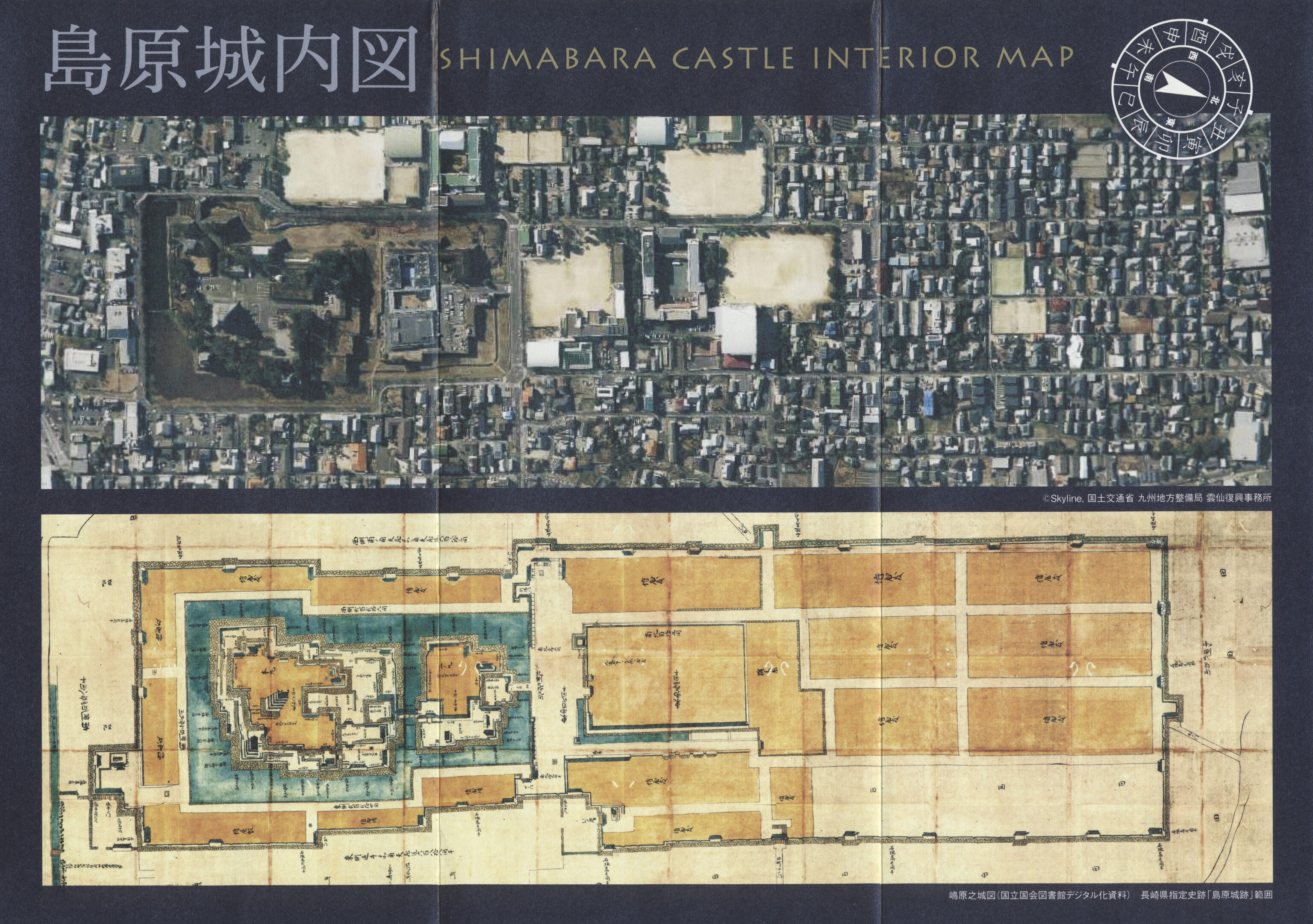
We also got English and Japanese pamphlets containing information and maps.
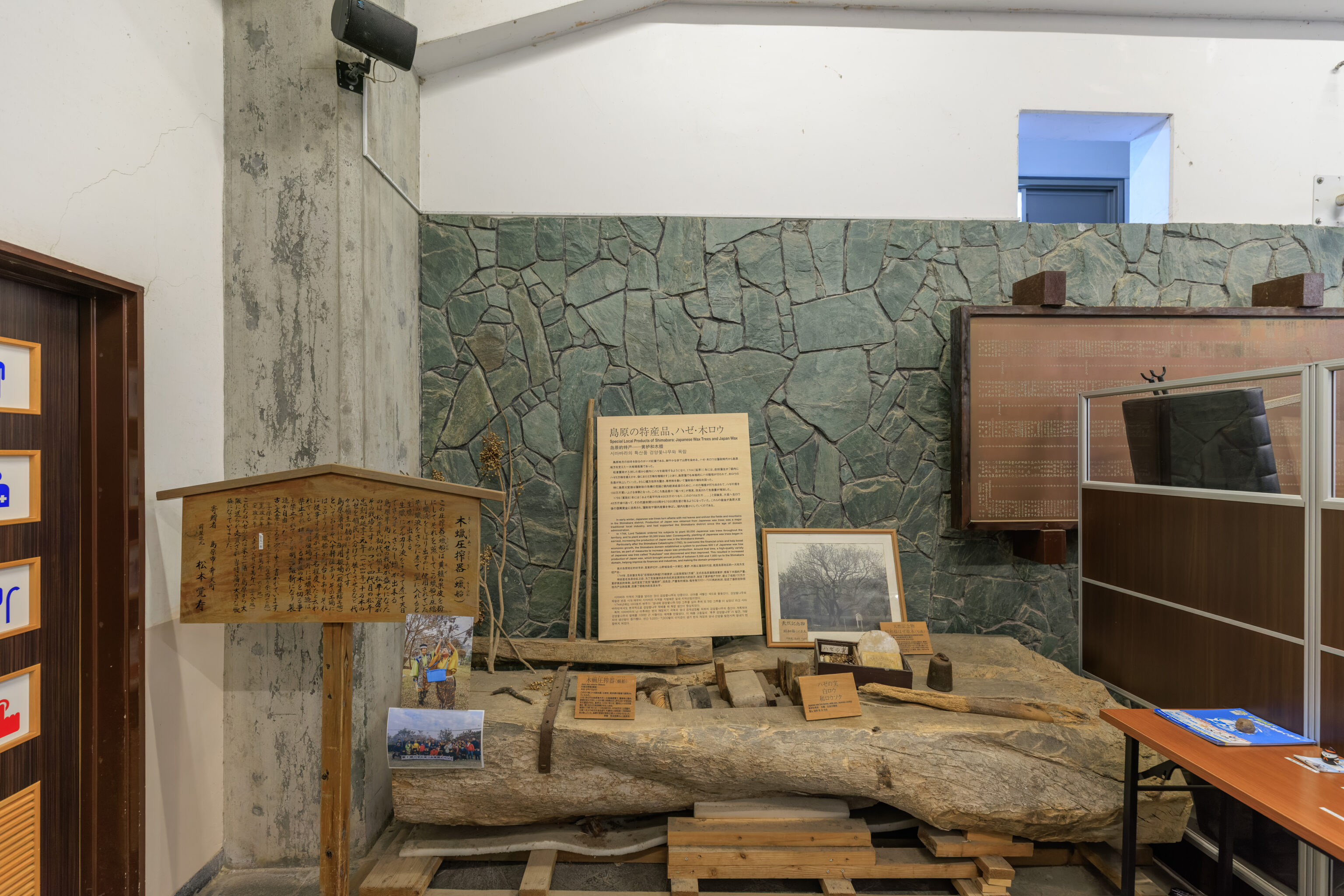
Apparently, Shimabara was historically a large producer of wax, specifically, something referred to as Japan Wax.
Special Local Products of Shimabara: Japanese Wax Trees and Japan Wax
In early winter, Japanese wax trees turn aflame with red leaves and enliven the fields and mountains in the Shimabara district. Production of Japan wax obtained from Japanese wax trees was a major traditional local industry, and had supported the Shimabara district since the age of domain administration.

In 1744, Lord Tadatoki ordered his subjects to plant 50,000 Japanese wax trees throughout the territory, and to plant another 50,000 trees later. Consequently, planting of Japanese wax trees began in earnest, increasing the production of Japan wax in the Shimabara domain.

Particularly after the Shimabara Catastrophe (1792), to overcome the financial crisis and help boost economic growth, the Shimabara domain established a system to purchase 600 t of Japanese wax tree berries, as part of measures to increase Japan wax production. Around that time, a high-quality variety of Japanese wax tree called "Fukuhaze" was discovered and then improved. This resulted in increased production of Japan wax, which brought annual profits of between 5,000 and 7,000 ryo to the Shimabara domain, helping improve its finances and industries, and making the domain prosperous.
– Text from the sign in the background.
The wooden sign on the left goes into some detail about wax production.
Wood Wax Press
This press (wax press) was used to grind the peel of the Japanese wax tree into a powder, steam it, and then compress it in this press to extract the wax coating.

Boiling the resulting wax liquid and pouring it into a mold produced "raw wax." Mixing the "raw wax" with an alkaline solution, boiling it, and then drying it in the sun produced "bleached wax."

The cultivation of Japanese wax trees became popular on the Shimabara Peninsula because Matsudaira Tadafusa, the first lord of the Matsudaira clan, promoted its cultivation, and then, in 1744, the fourth lord, Matsudaira Tadakatsu, distributed 100,000 Japanese wax trees to the people to plant, demonstrating the encouragement of successive lords.

Within the Shimabara domain, there were approximately 80 official factory buildings (factories directly controlled by the lord), and it is said that these factories had several of these "wax presses," employing around 2,000 people. Wax production was prohibited outside of the official workshops, and cutting down the Japanese wax trees was also forbidden, but production became free after the Meiji Restoration.

According to old documents, it is written as follows:
In 1720 (Kyoho 5), over 21,860 kin (approximately 13 tons)
In 1791 (Kansei 3), 1 million kin (600 tons)
In 1856 (Ansei 3), 6.2 million kin (3,780 tons)

These wax nuts, along with polished rice, were sent from Shimabara to Osaka and traded, becoming a major source of income for the domain at the time.
– Text from the wooden sign on the left, read and translated using Google Gemini and Translate.
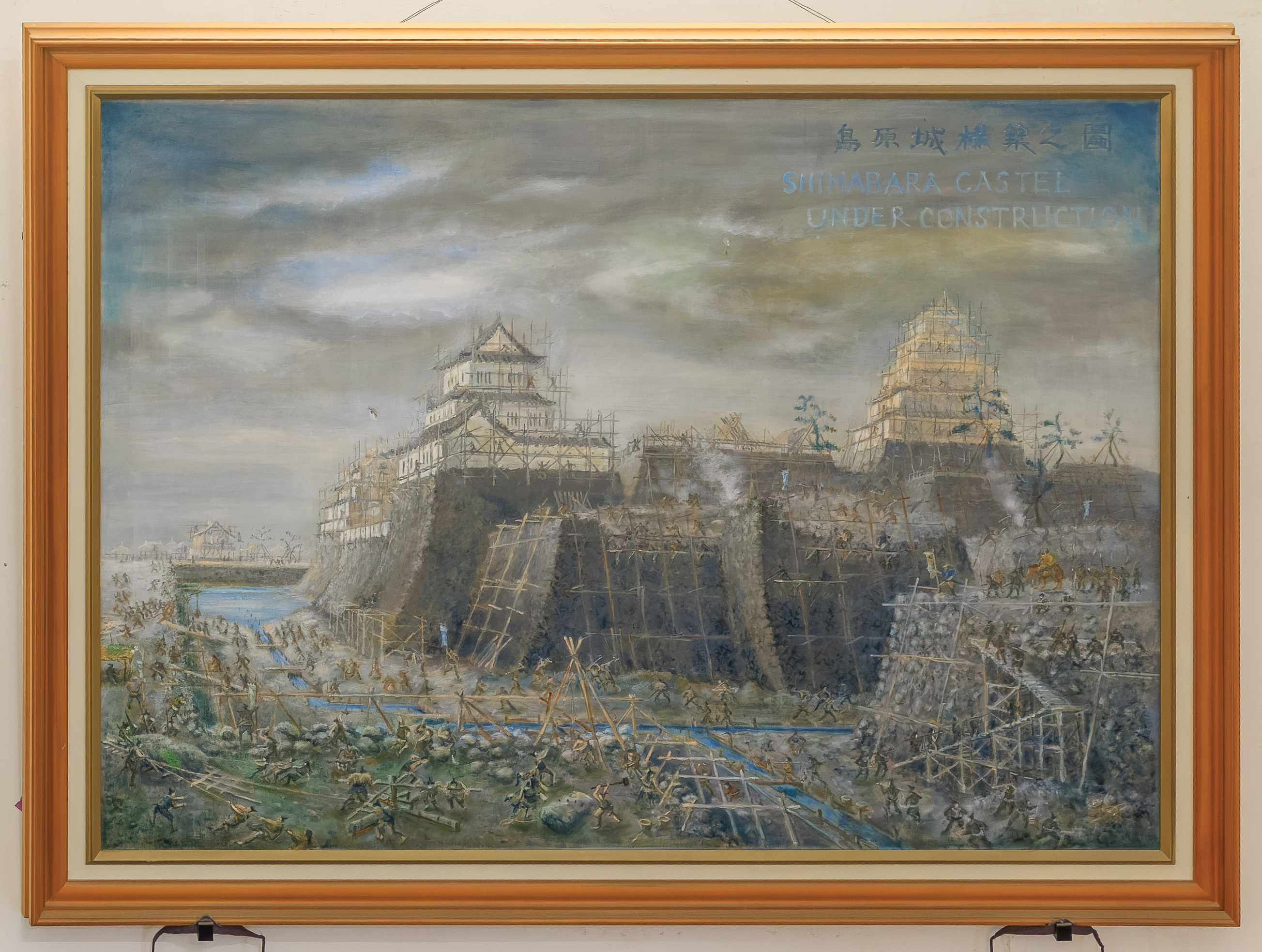
This painting depicts Shimabara Castle while it was being constructed.
Illustration of the Construction of Shimabara Castle
After the Arima clan lord was transferred to Nobeoka, Matsukura Bungo-no-kami was appointed by the shogunate to rule Shimabara in Hizen Province as the lord of a 40,000 koku domain. Matsukura decided to demolish Hara Castle and the old forts within his territory and construct a new castle on the Moritake hill. He assigned labor to the village headmen and mobilized them for hard labor. Matsukura Bungo-no-kami was renowned as a master castle builder, and the castle was vast, elegant, and strategically designed. Each section of the construction was assigned a time limit; those who were late were punished, while those who completed it early were rewarded. With 300 to 500 men working daily, the construction took 7 years and 3 months, and despite numerous casualties from accidents during construction, it was finally completed after the labor of a total of 1 million people. During this time, the economic burden on the people was unspeakable, and it is said that some secretly crossed themselves during the work due to the immense suffering. The Shimabara Rebellion occurred 13 years after the castle was completed.

Note: This illustration depicts the construction progress from 3.5 to 6 years after the start of construction, all in one frame.
Explanation. Illustrations by Shojiro Miyazaki
– Text from a sign, read and translated using Google Gemini and Translate.
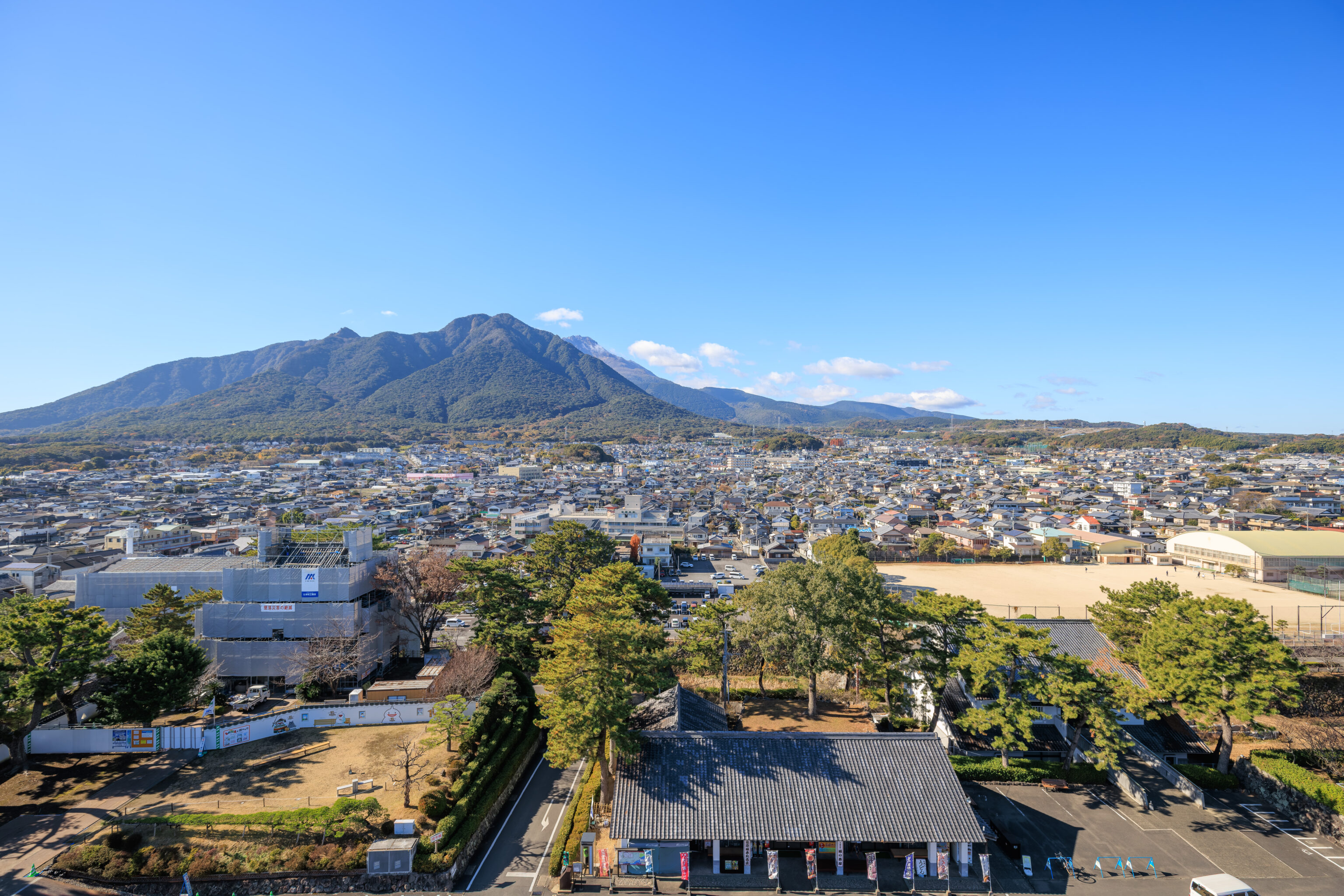
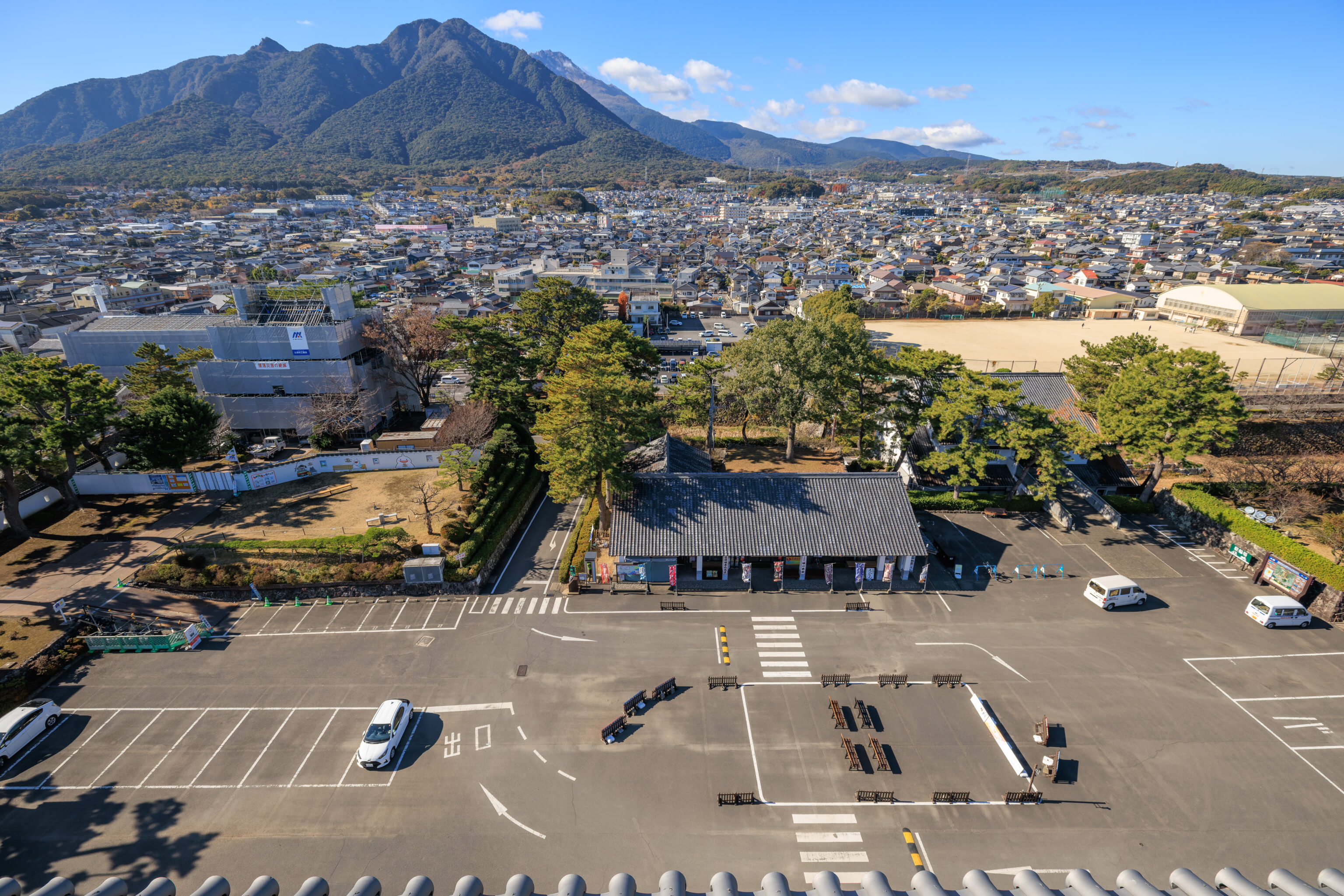
We headed right to the top of the modern concrete Shimabara Castle. The 360° view was excellent! Looking to the west, we could see Mount Unzen in the background. Mount Unzen is made up of multiple peaks, of which 平成新山 Heisei Shinzan is the highest. Looking downwards, we could the driveway up to the castle as well as a parking lot and the castle’s gift shop.
Let's Look at the West Side from the Top of the Castle (Towards Mount Fugen)
The mountain in the foreground is Mount Mayuyama, and the mountain to its right and behind it is Mount Heisei-shinzan. In 1792 (late Edo period), Mount Mayuyama collapsed in a horseshoe shape due to the eruption of Mount Fugen. A large amount of earth and debris flowed into the sea, causing numerous tsunamis. A total of 15,000 people lost their lives in Shimabara and Kumamoto. This is known as the "Shimabara Disaster and Higo Disaster."

Approximately 200 years later, in 1991, Mount Fugen erupted again. Pyroclastic flows and mudslides caused immense damage. This time, Mount Mayuyama acted as a shield, protecting the center of Shimabara.

The two paintings depict the area before and after the 1792 collapse of Mount Mayuyama. The threat of disaster is immediately apparent.
– Text from a sign, read and translated using Google Gemini and Translate.
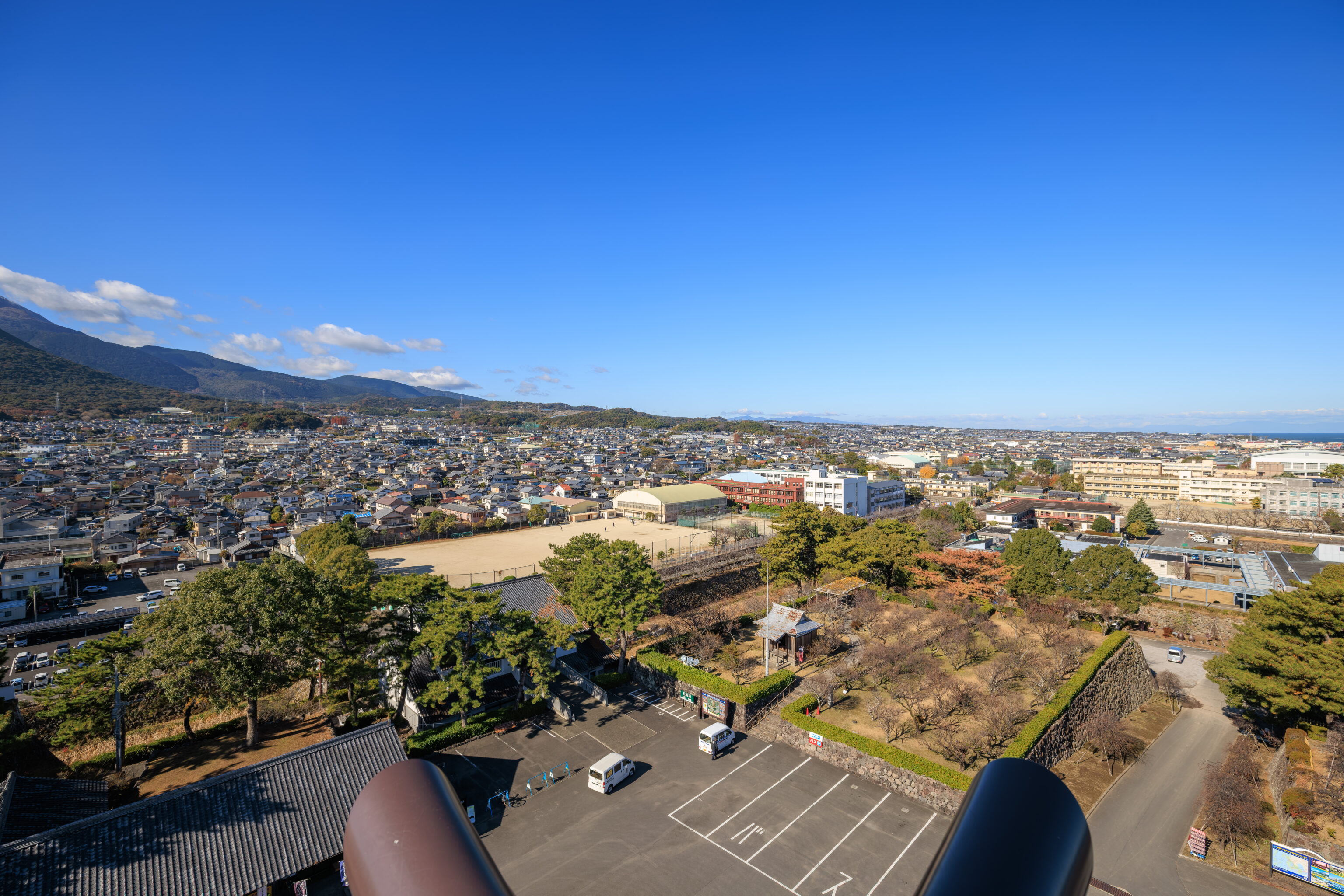
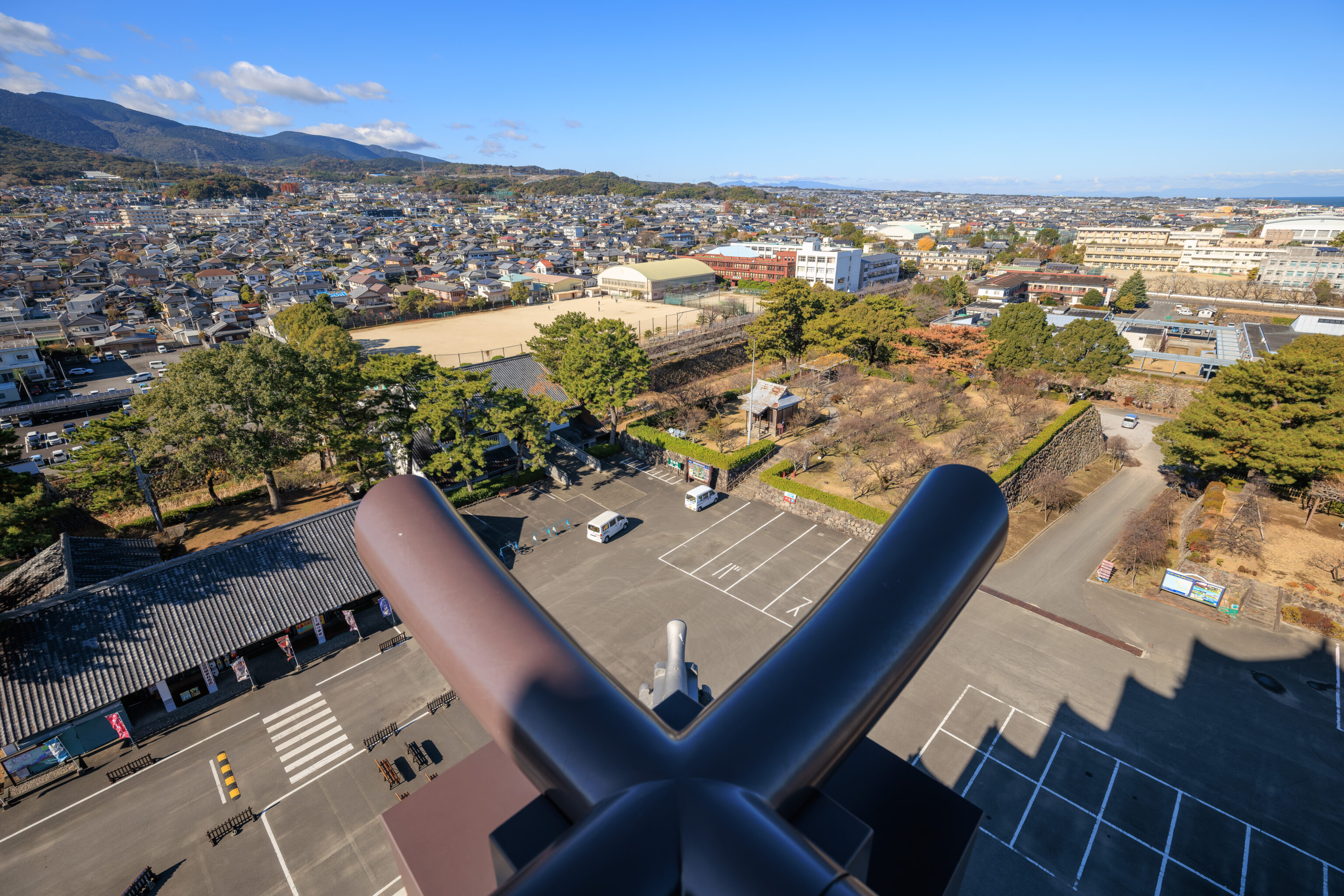
We took photographs every 45° clockwise. This was the view to the northwest. The land is sloped as we are effectively on the foothills of Mount Unzen.
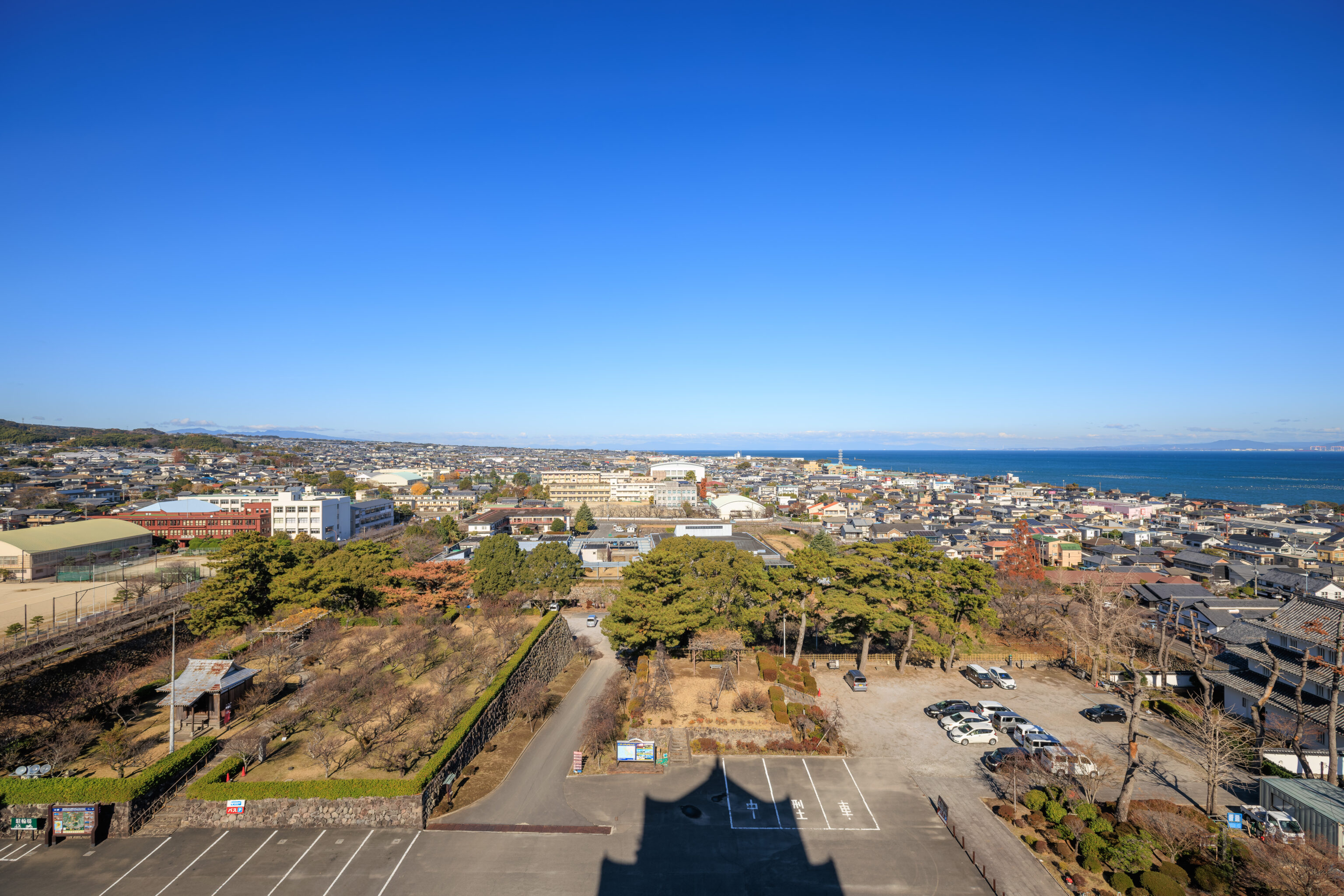
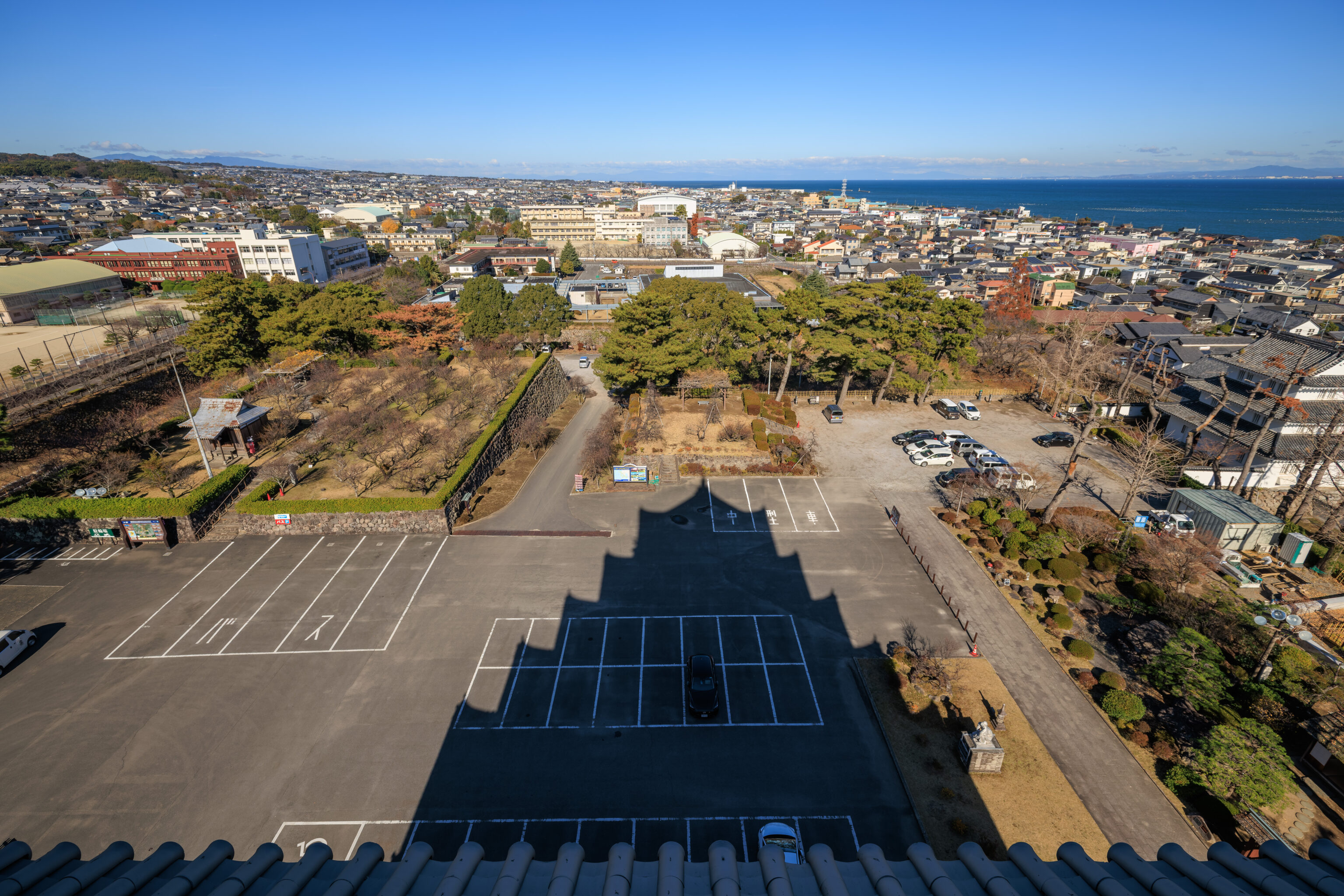
Looking to the north, we can see the Ariake Sea on the right.
Let's Look at the North Side from the Top of the Castle (Towards Isahaya)
From here, we can clearly see the layout of Shimabara Castle. The layout is like the "divisions" in residential land development. Shimabara Castle is of a type called "renkaku-shiki".

Its characteristic feature is that the baileys, such as the "honmaru" (main keep) and "ninomaru" (second bailey), are lined up in a straight line. 400 years ago, there were no tall buildings. Looking up at the castle from the Ariake Sea, it must have looked magnificent and majestic, like a giant warship.
– Text from a sign, translated using Google.
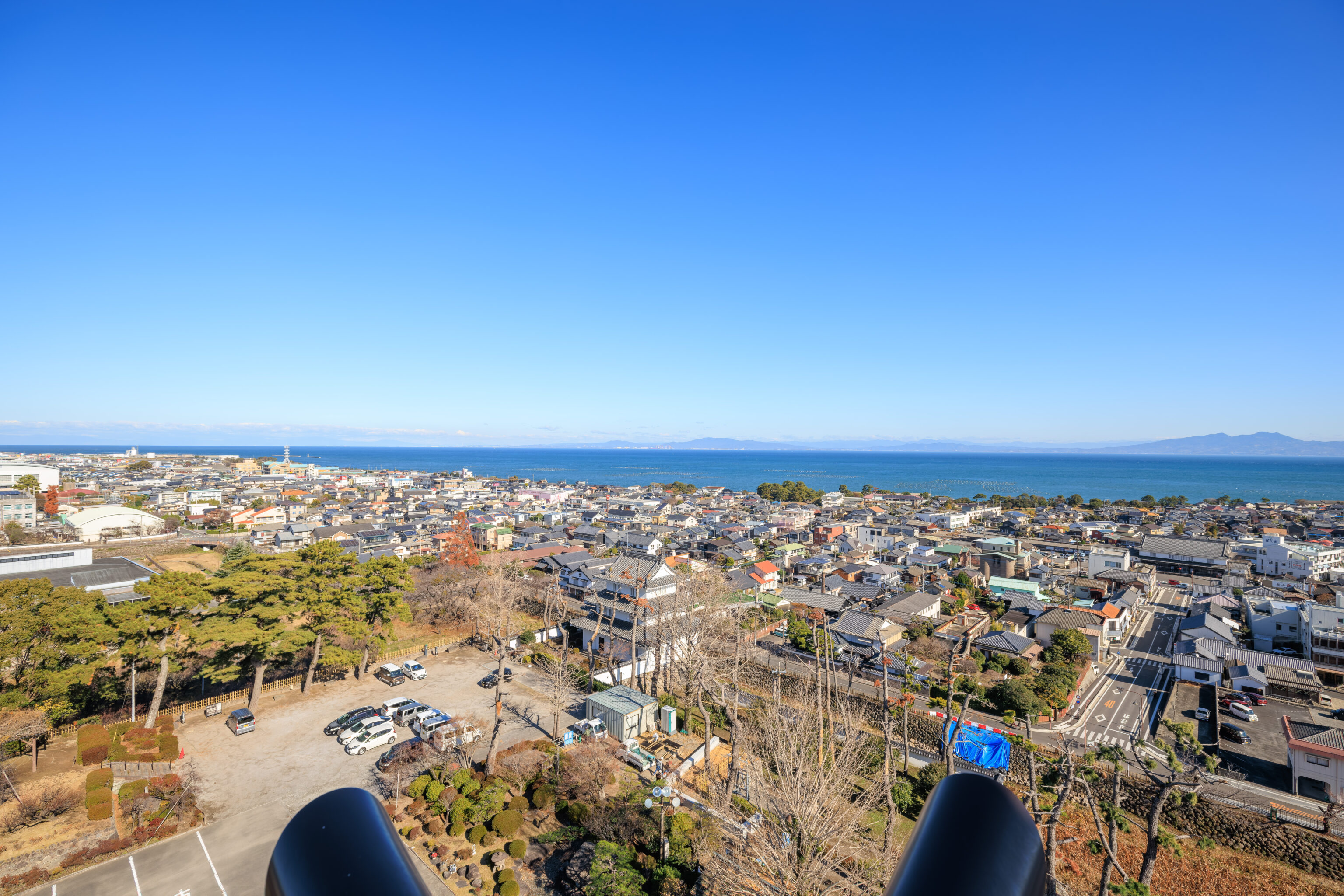
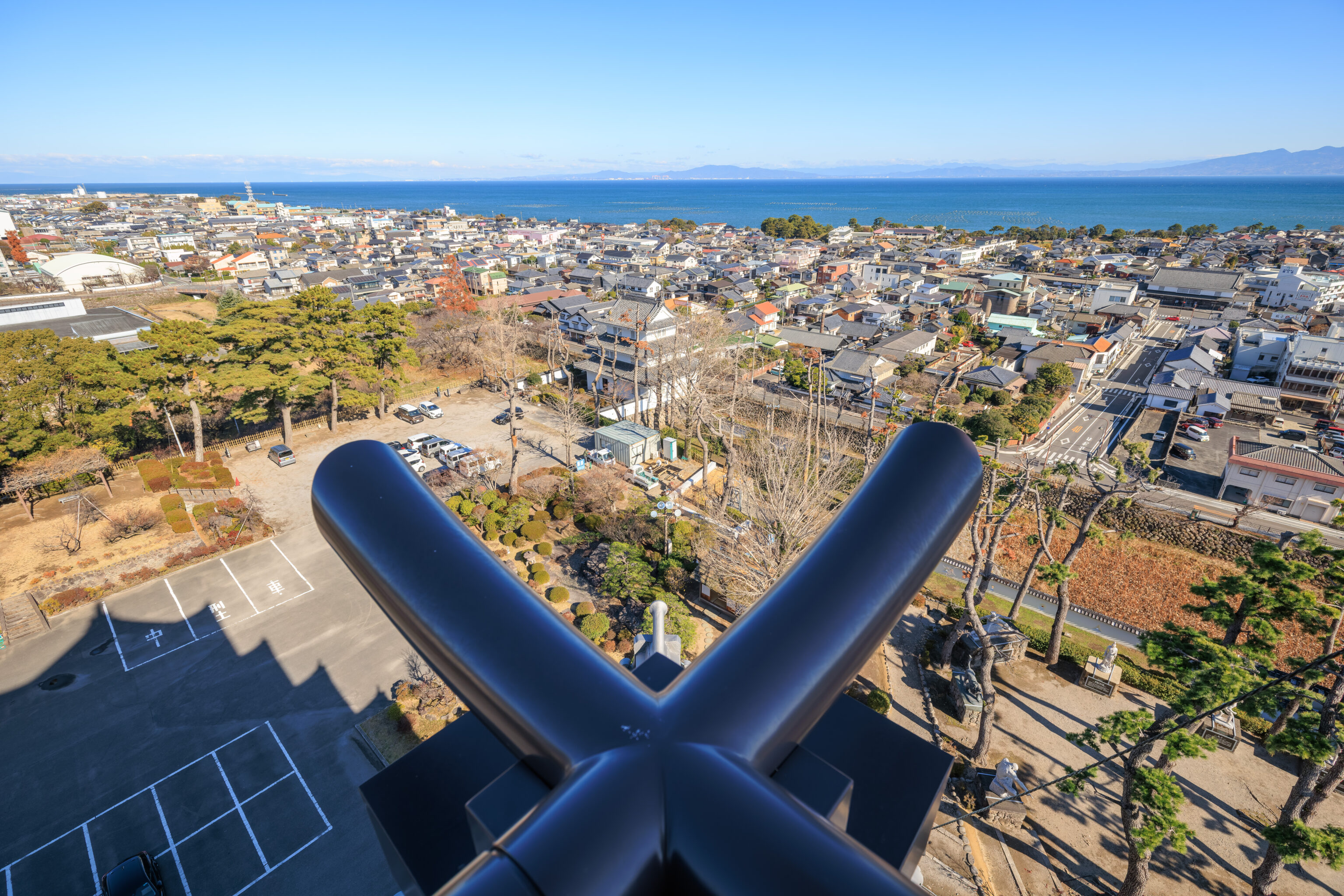
Looking to the northeast, we can start to see the mountains in Kumamoto Prefecture on the other side of the Ariake Sea.
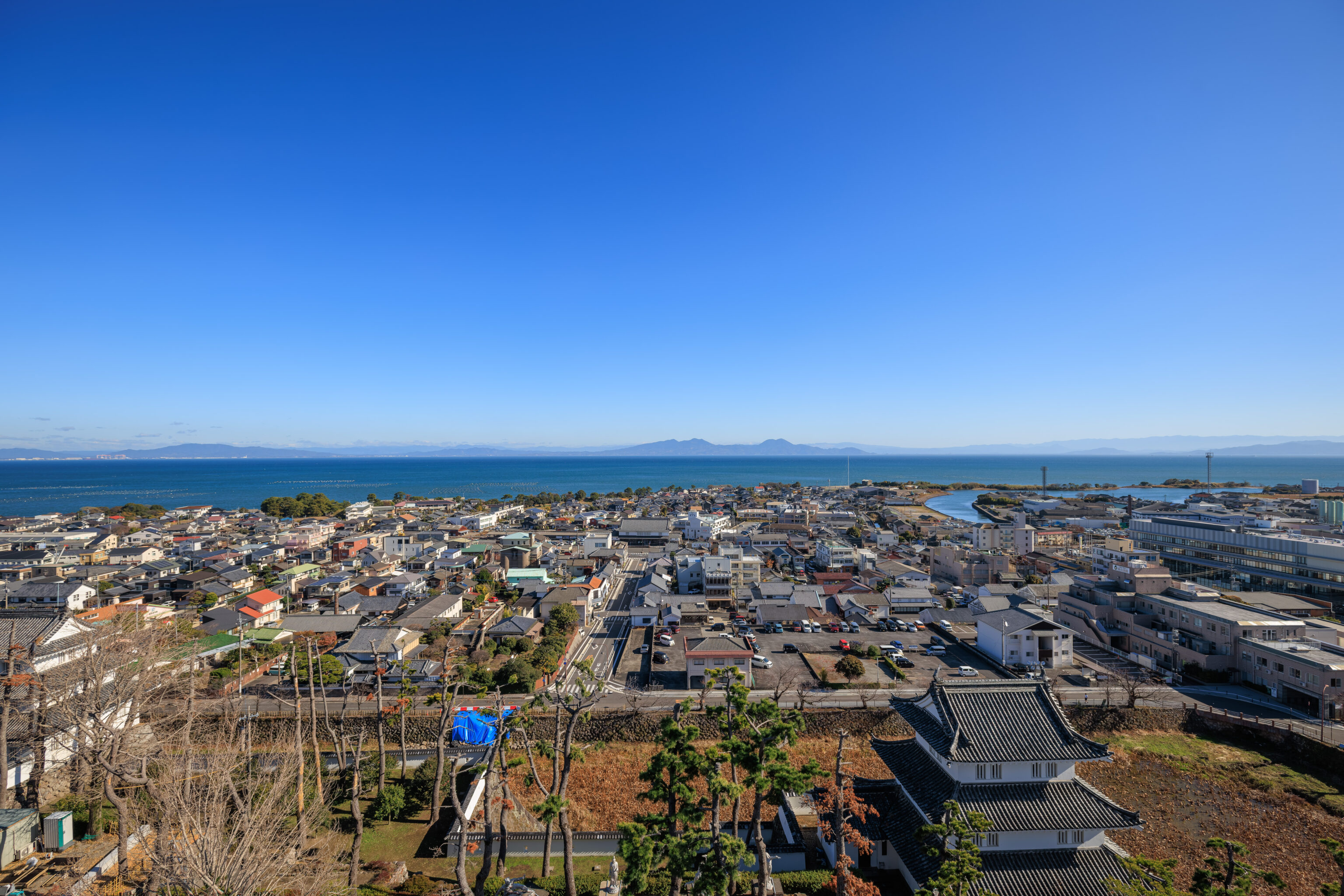
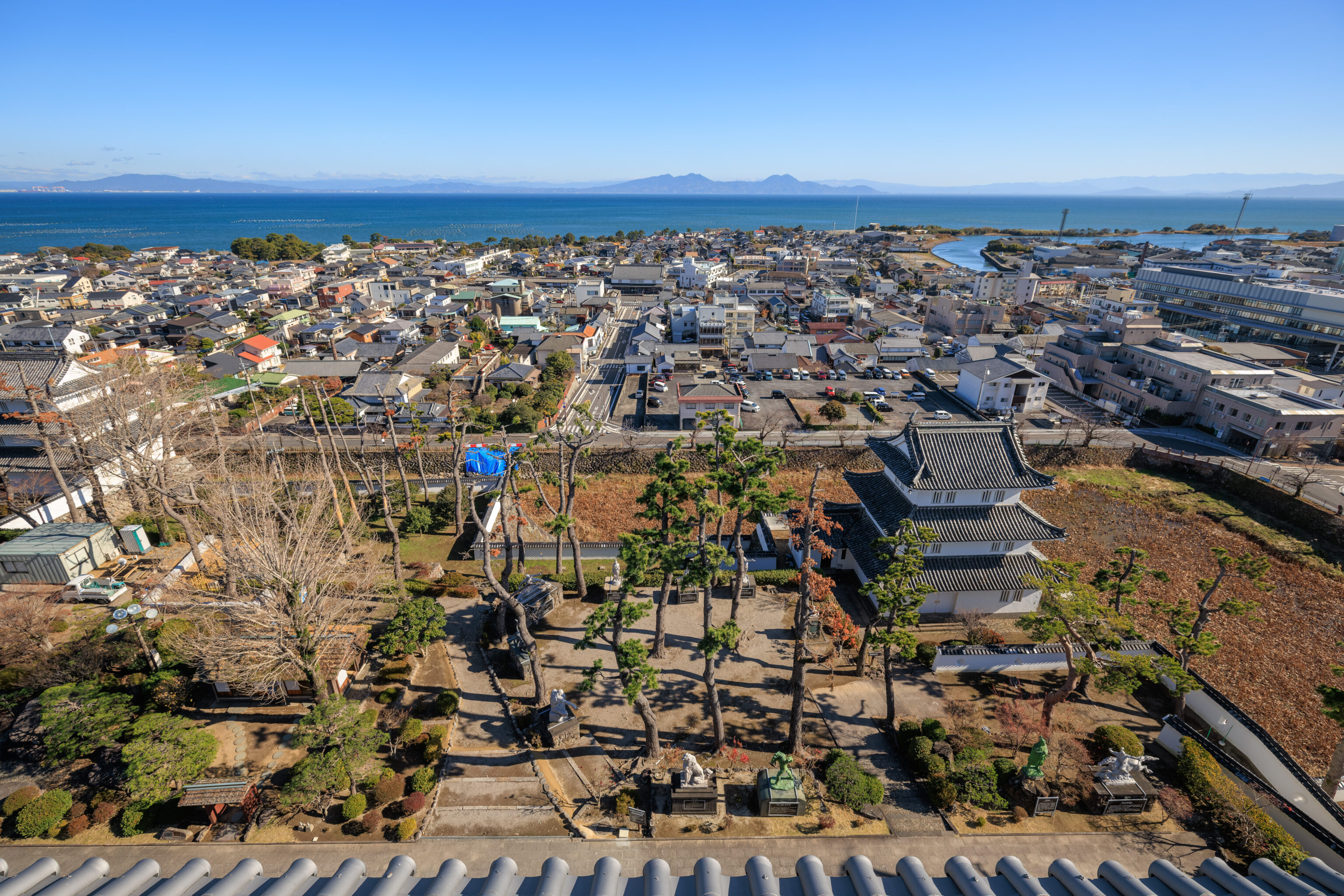
Looking to the east, we’re basically looking directly at Kumamoto Prefecture. We can also see Shimabara Station three blocks away.
Let's Look at the East Side from the Top of the Castle (Towards Kumamoto)
The Shimabara Station of the Shimabara Railway Co., Ltd. is modeled after the main gate of Shimabara, which stood 400 years ago. As can be seen from old maps, Shimabara flourished around its port as a key point for transportation on the Ariake Sea. However, in the Meiji era, there was a need for a means of transporting goods faster and in larger quantities than by ship. 39 years after Japan's first railway ran between Shinbashi and Yokohama in 1872, a railway line was built between Isahaya and Aino in 1911, and in 1913 (Taisho 2), the entire line of approximately 43 km to Shimabara Port was completed.

From the Taisho to Showa periods, the Shimabara Railway made a significant contribution to the development of the peninsula's economy by providing direct service to Hakata and serving as a means of transportation for local residents' shopping, commuting, and schooling. The greatest contributor to this was Mototaro Ueki. He called himself "Tekkyosai" (Iron Maniac) and was a great man who also served as the first mayor of Shimabara. The "Deeply Sad Farewell" plaque presented by Mr. Ueki is displayed alongside the No. 1 locomotive at the Railway Museum in Saitama Prefecture.
– Text from a sign, read and translated using Google Gemini and Translate.
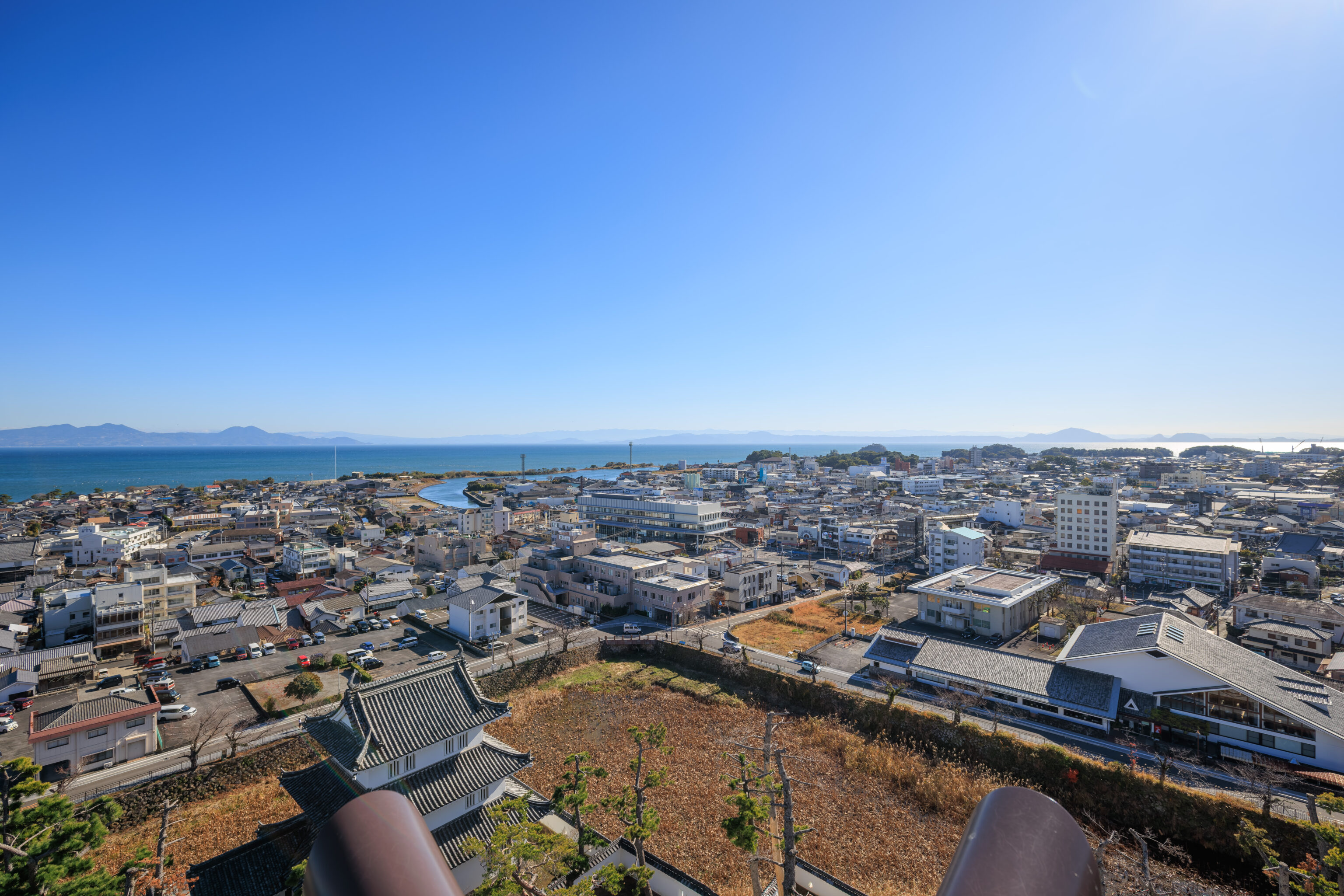
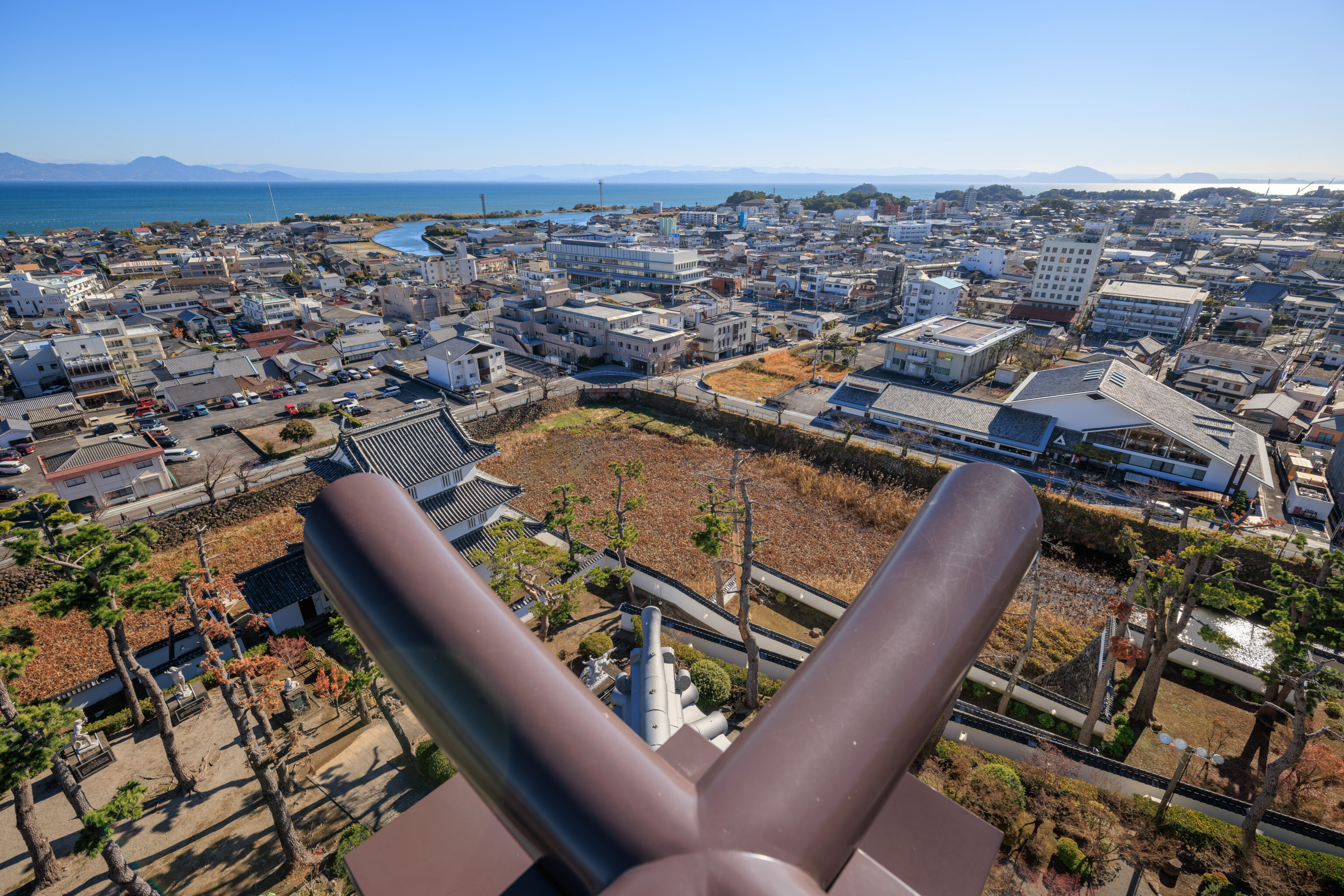
The view to the southeast…
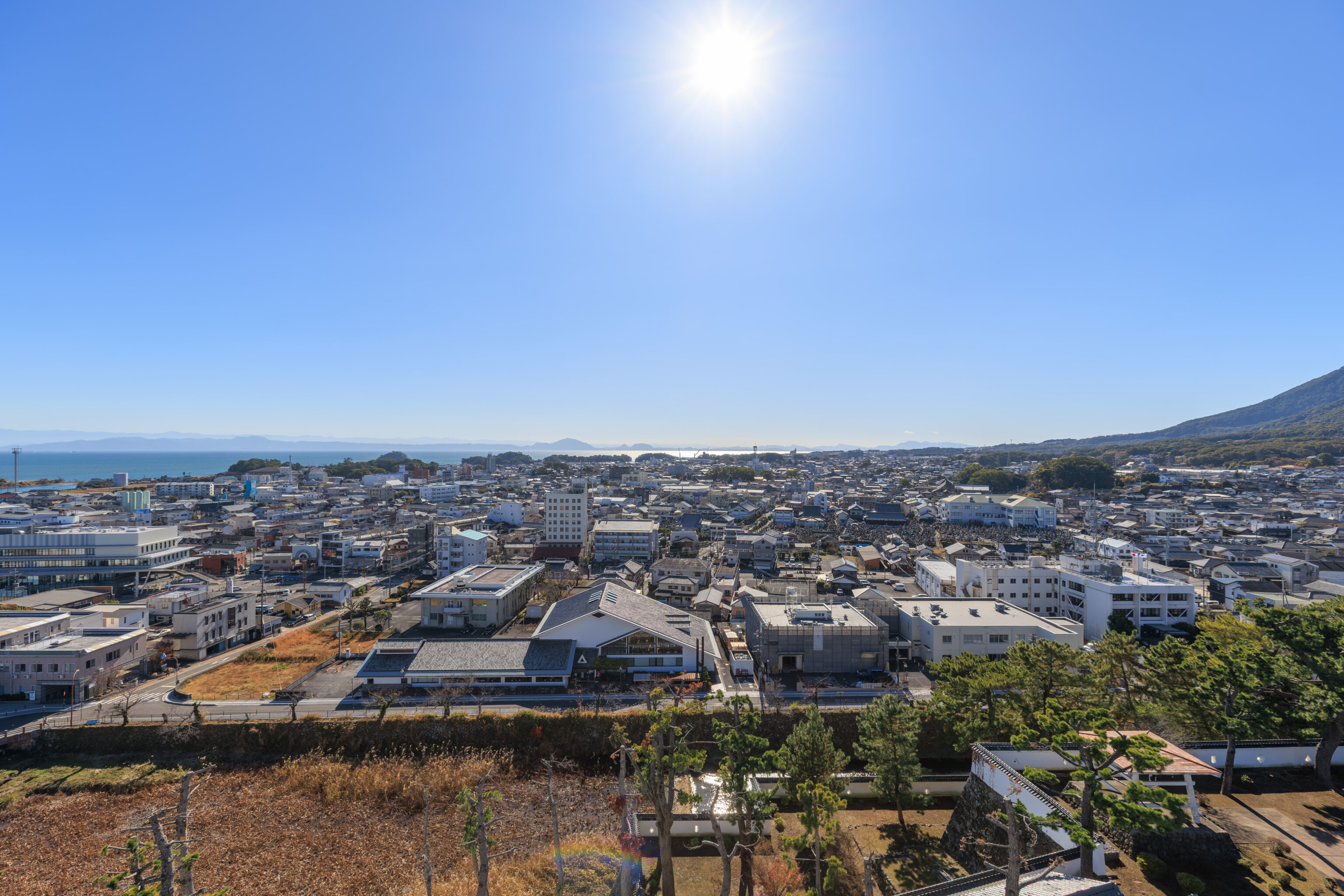
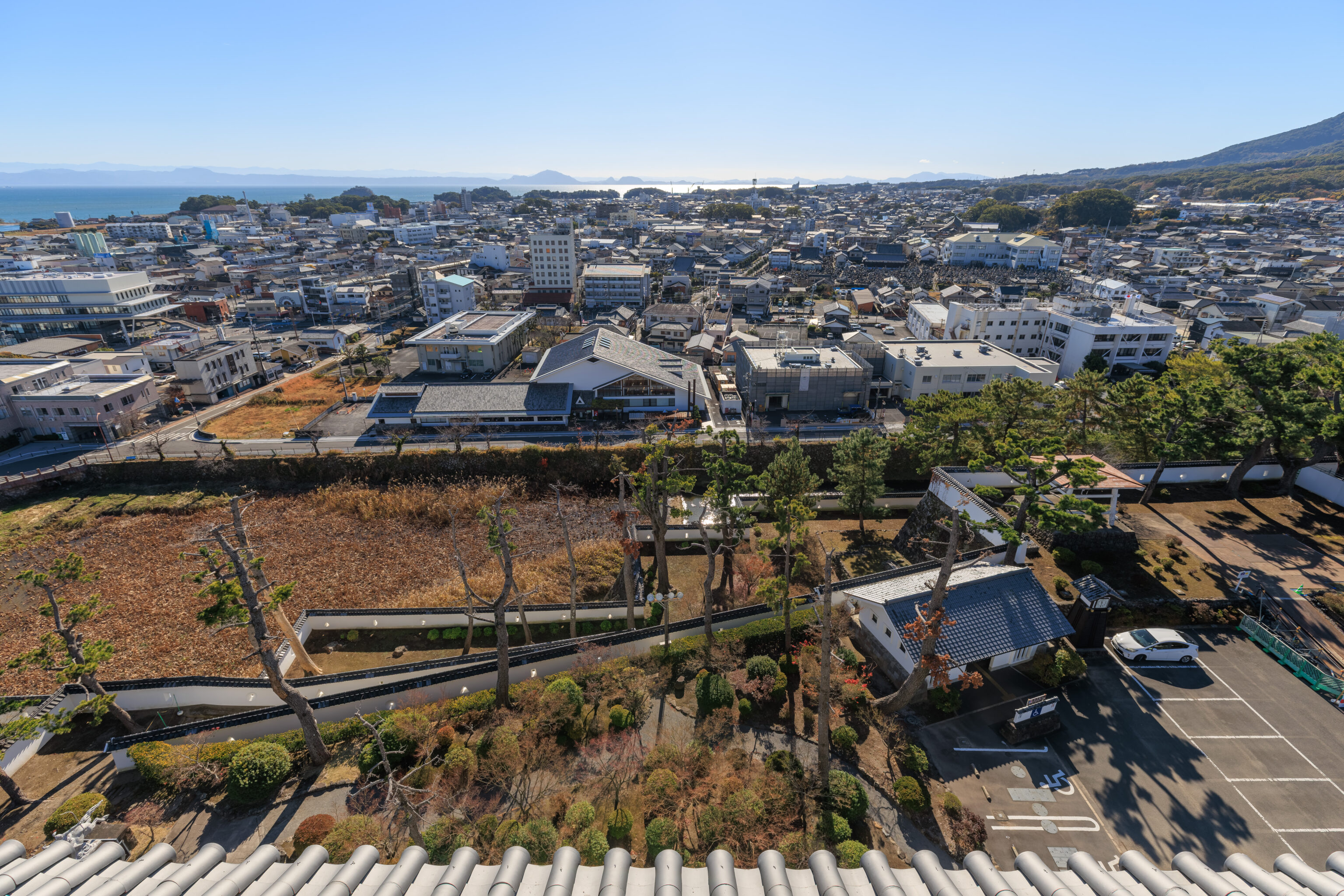
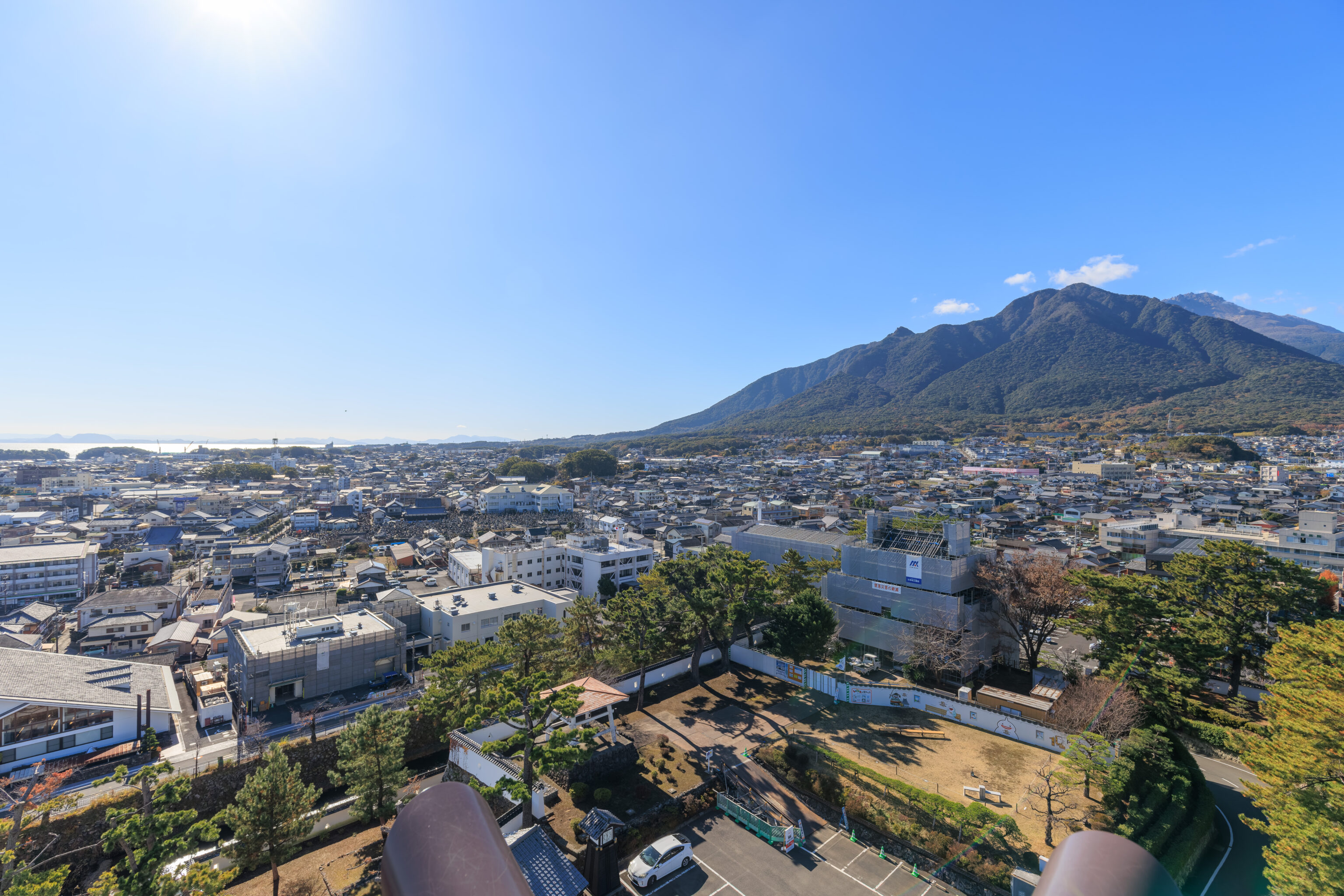
The view to the south, looking into the Sun.
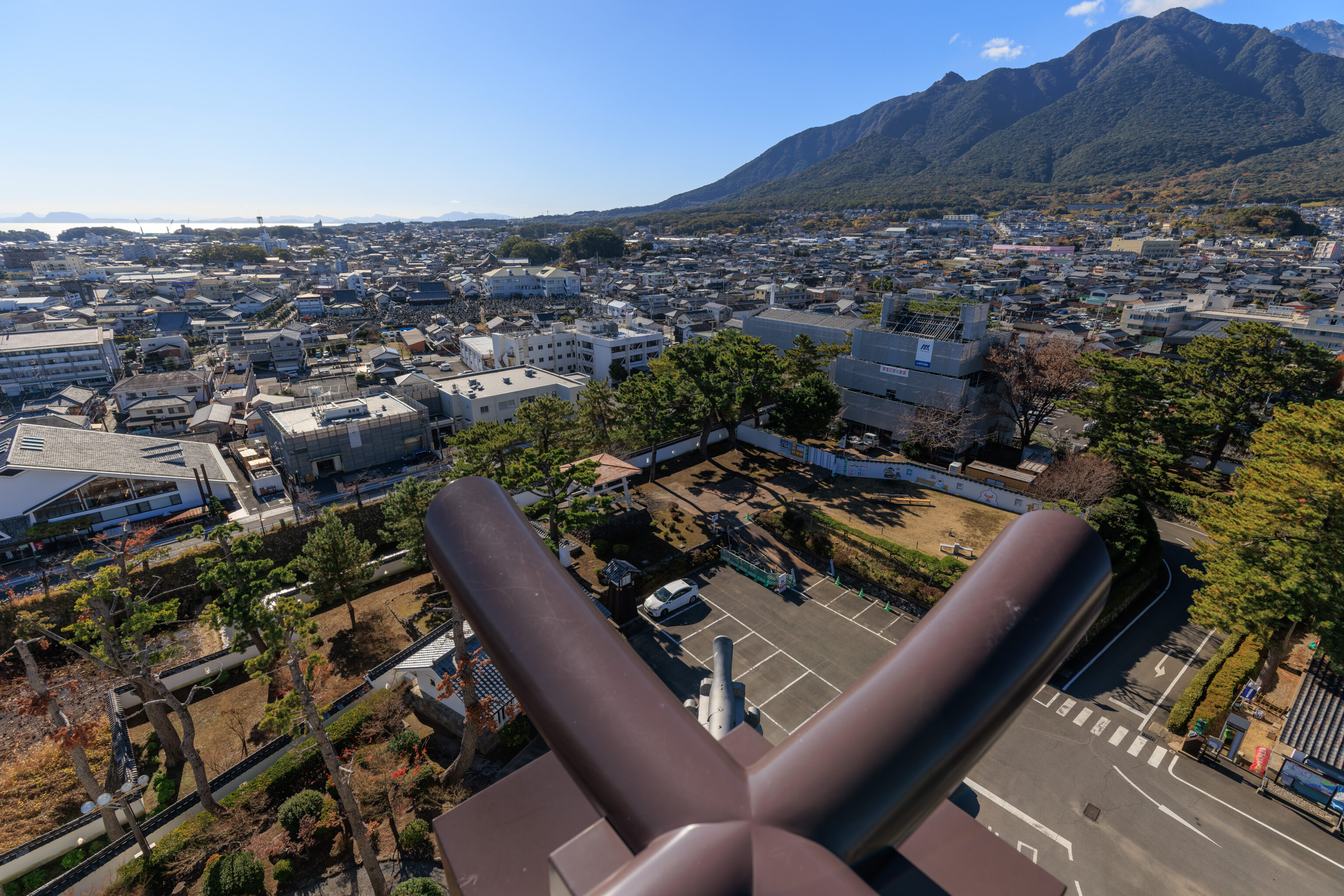
Finally, the view to the southwest.
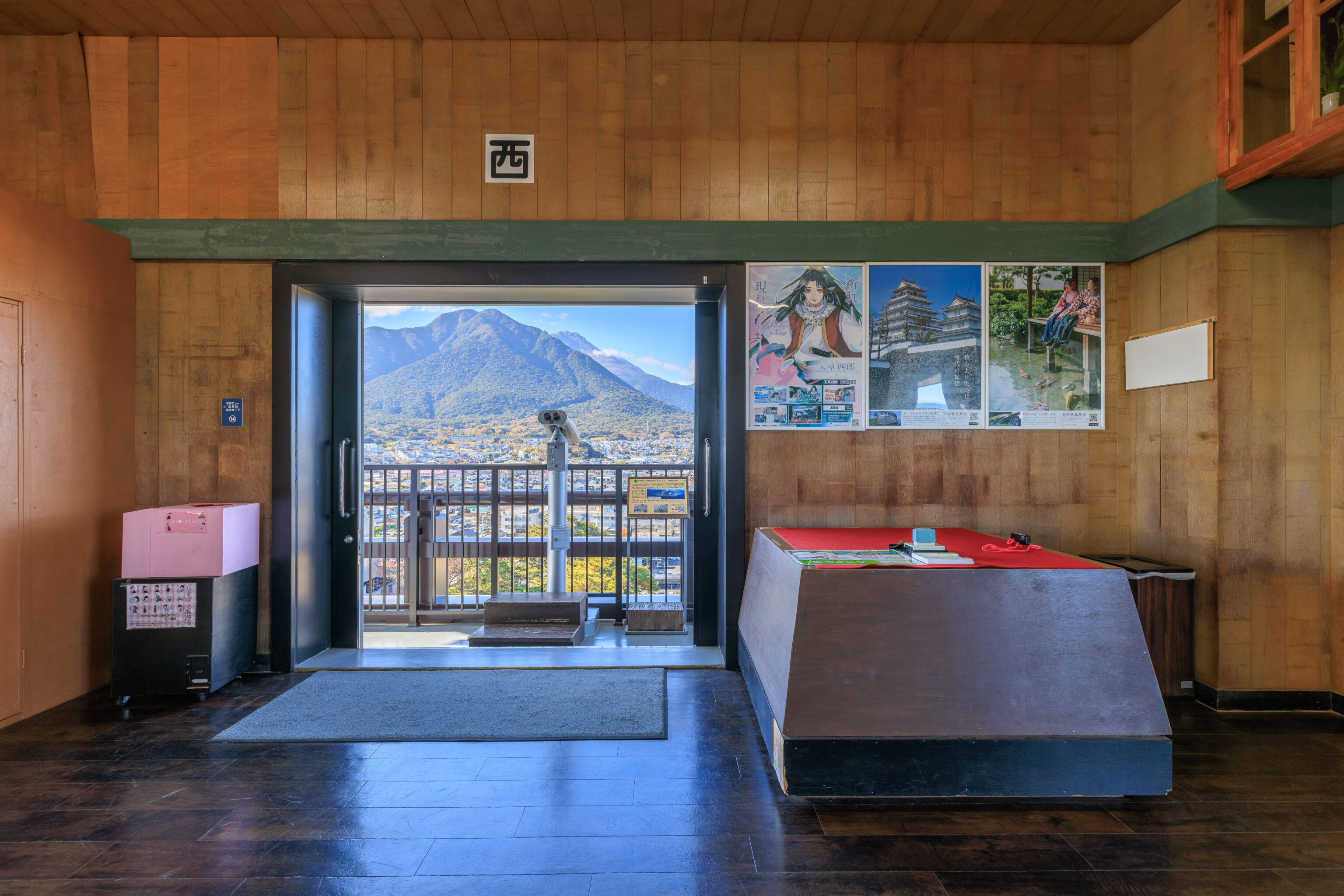
The interior of the top floor of the castle had this old but not ancient appearance with wood paneled walls. There were various informational displays within this room.
The Ancient Wisdom Hidden in the Shimabara Castle's Stone Walls
-A Castle Built with the Blessings of the Earth -

One of the reasons Shimabara Castle was built here and why the castle town prospered is the abundance of water. Just upstream from the castle, there is an volcanic fan (a fan-shaped area where sediment and debris are deposited by volcanic activity) where high-quality water, slowly filtered over time, naturally springs up. The castle's strategic location provided access to underground water flowing beneath it, offering a significant advantage.

If you look closely at the stone walls of Shimabara Castle, you will notice an ingenious feature: extra corners were added to make the walls stronger and more durable. This design also made the castle easier to defend and harder to attack by eliminating blind spots.

Channels were built to take full advantage of the abundant spring water resources. The castle flourished around these channels, showing how important they were for the local community.
– Text from a sign.
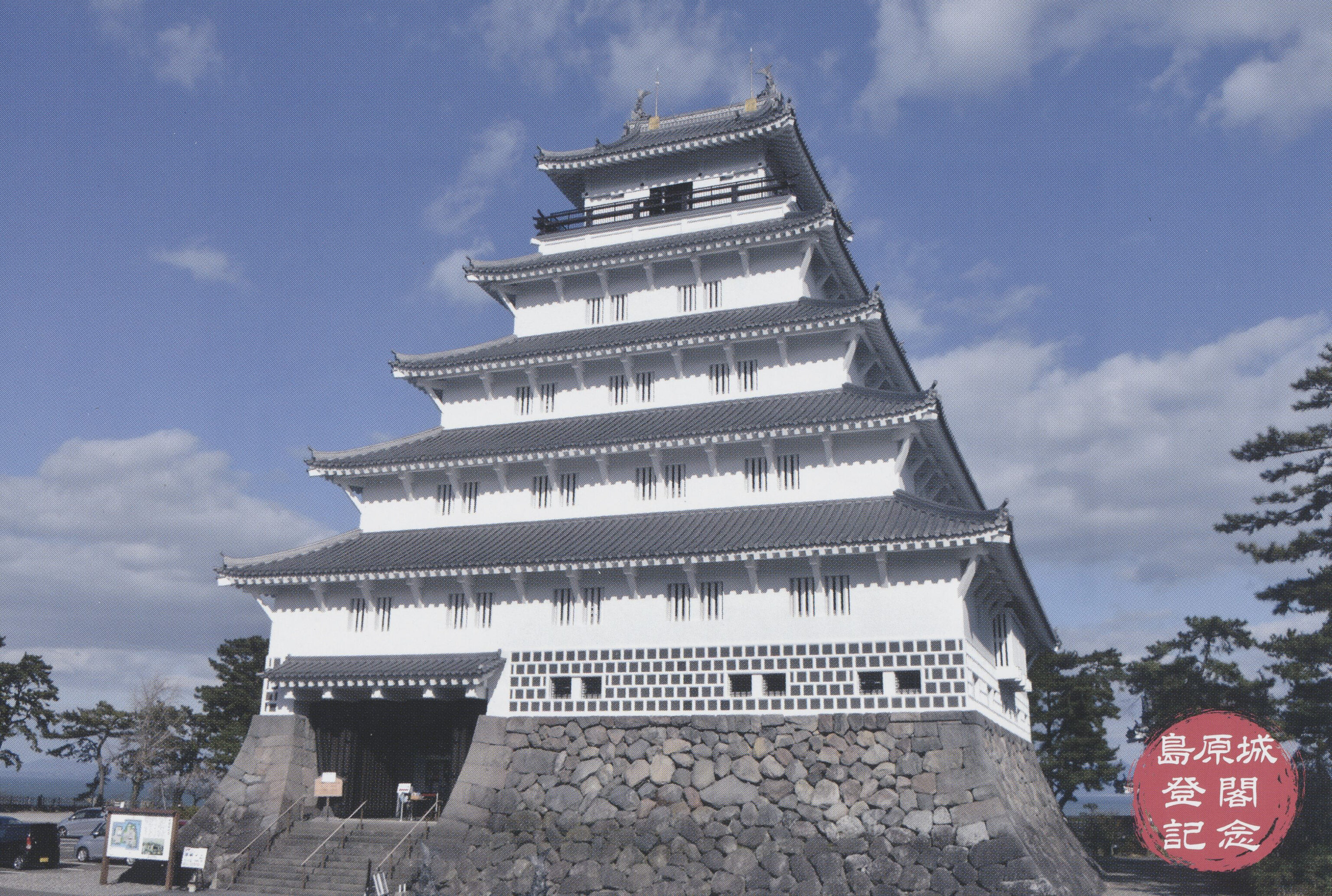

There was a stamp station on a table. When we entered the castle, we were given postcards. The stamp goes on the postcard. There are multiple stamps in various places in Shimabara which combine to form a single image. We’ll see how we do later today!
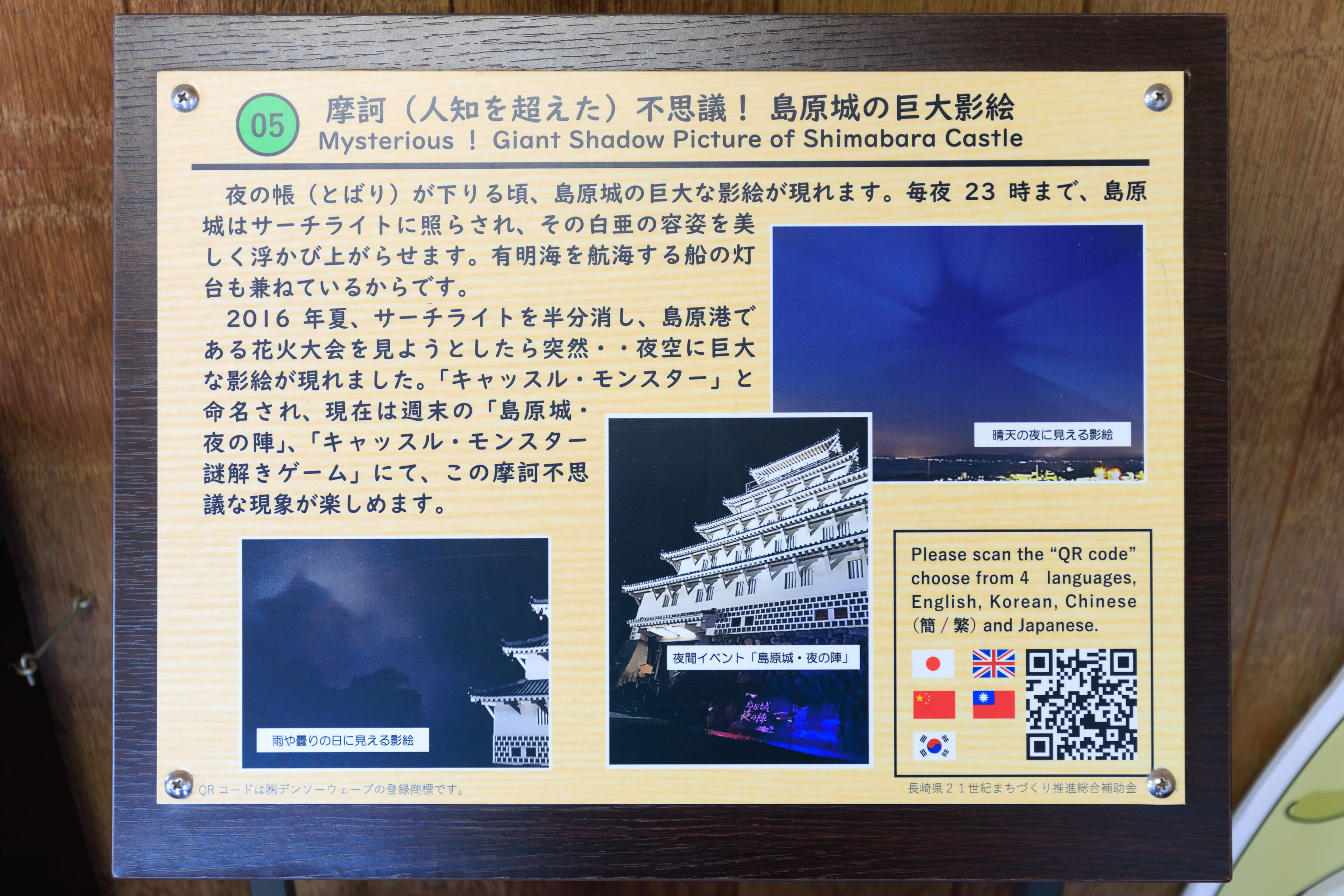
Mysterious (Beyond Human Comprehension) and Wonderful! Giant Shadow Picture of Shimabara Castle
As night falls, a giant silhouette of Shimabara Castle appears. Every night until 11 PM, Shimabara Castle is illuminated by searchlights, beautifully highlighting its pristine white form. This is because it also serves as a lighthouse for ships navigating the Ariake Sea.

In the summer of 2016, when half the searchlights were turned off to watch the fireworks display at Shimabara Port, a giant silhouette suddenly appeared in the night sky. Named the "Castle Monster," this mysterious phenomenon can now be enjoyed at the weekend events "Shimabara Castle Night Festival" and the "Castle Monster Mystery Solving Game."
– Text from a sign, read and translated using Google Gemini and Translate.
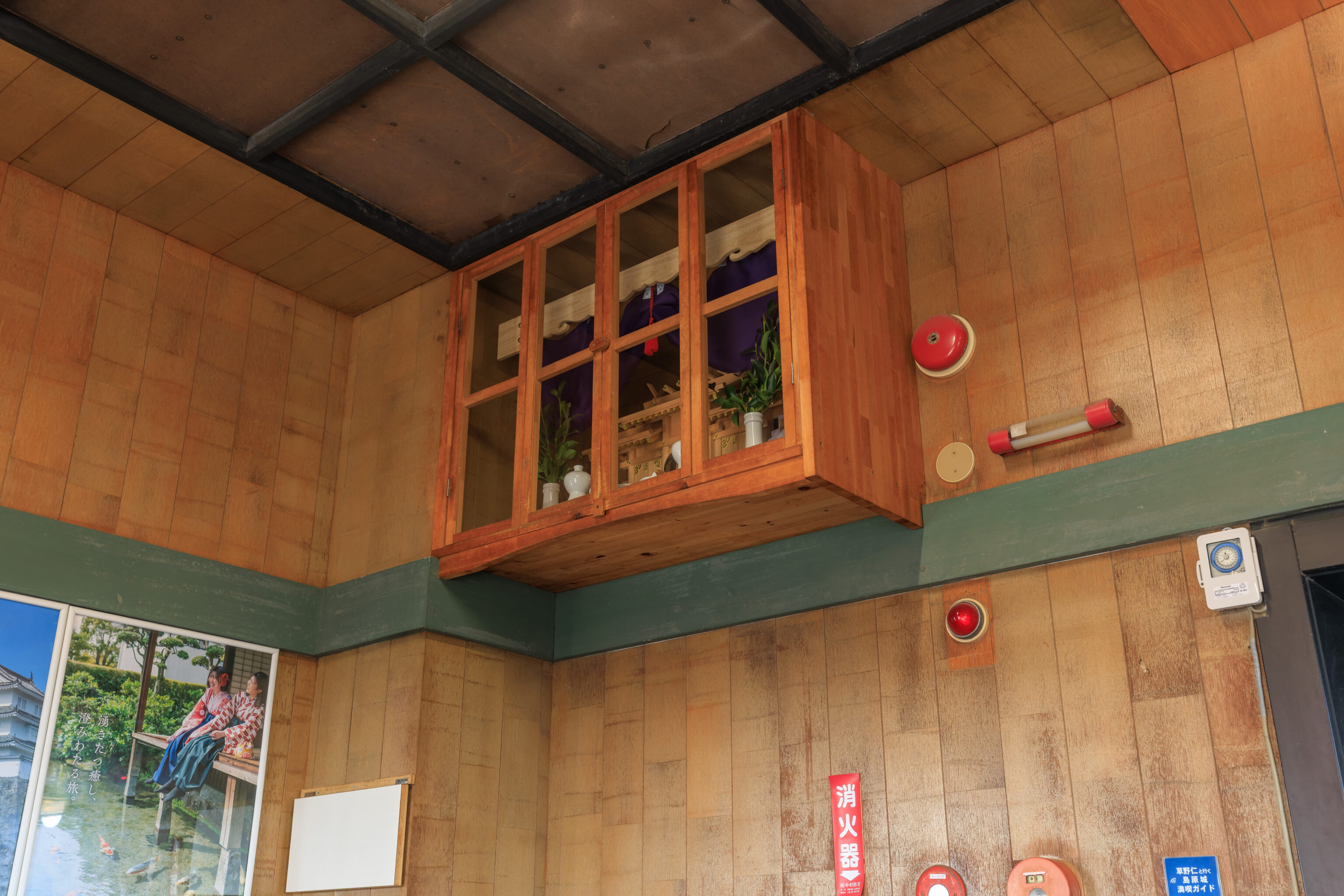
This little cabinet mounted on the wall above head level contained a small shrine.
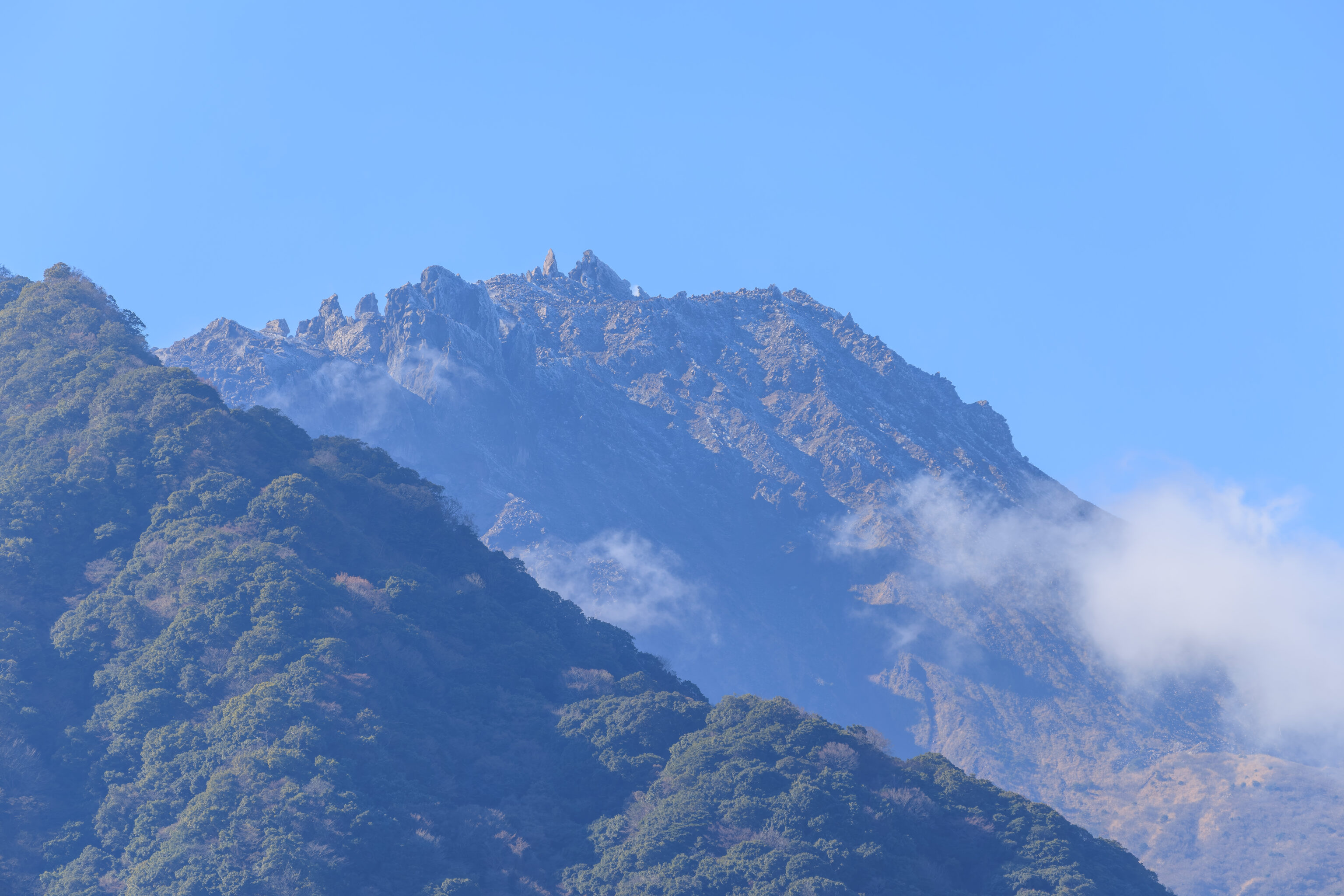
We went back outside to take a look around using the telephoto lens. The peak in the background is Heisei Shinzan, the highest peak of Mount Unzen.
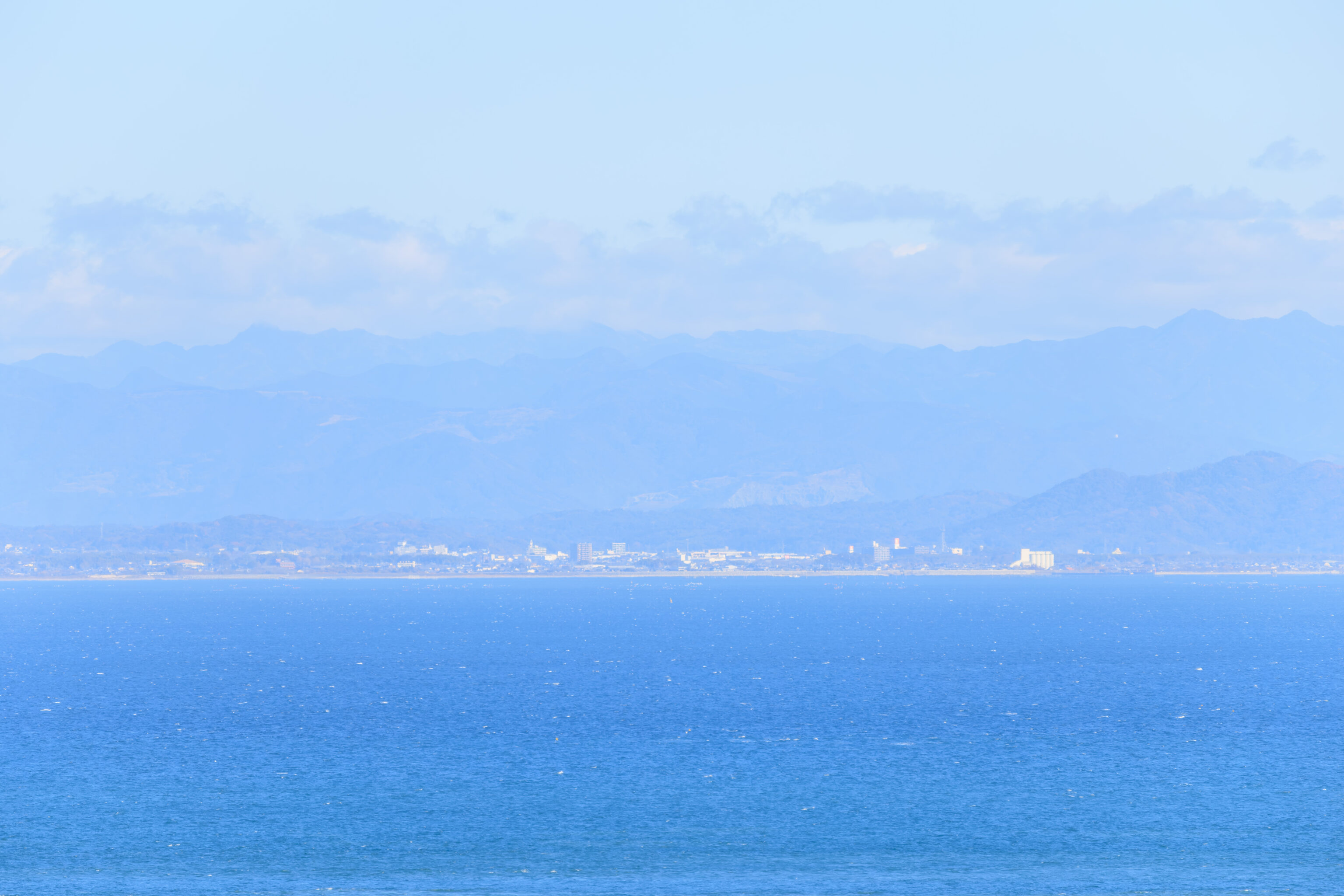
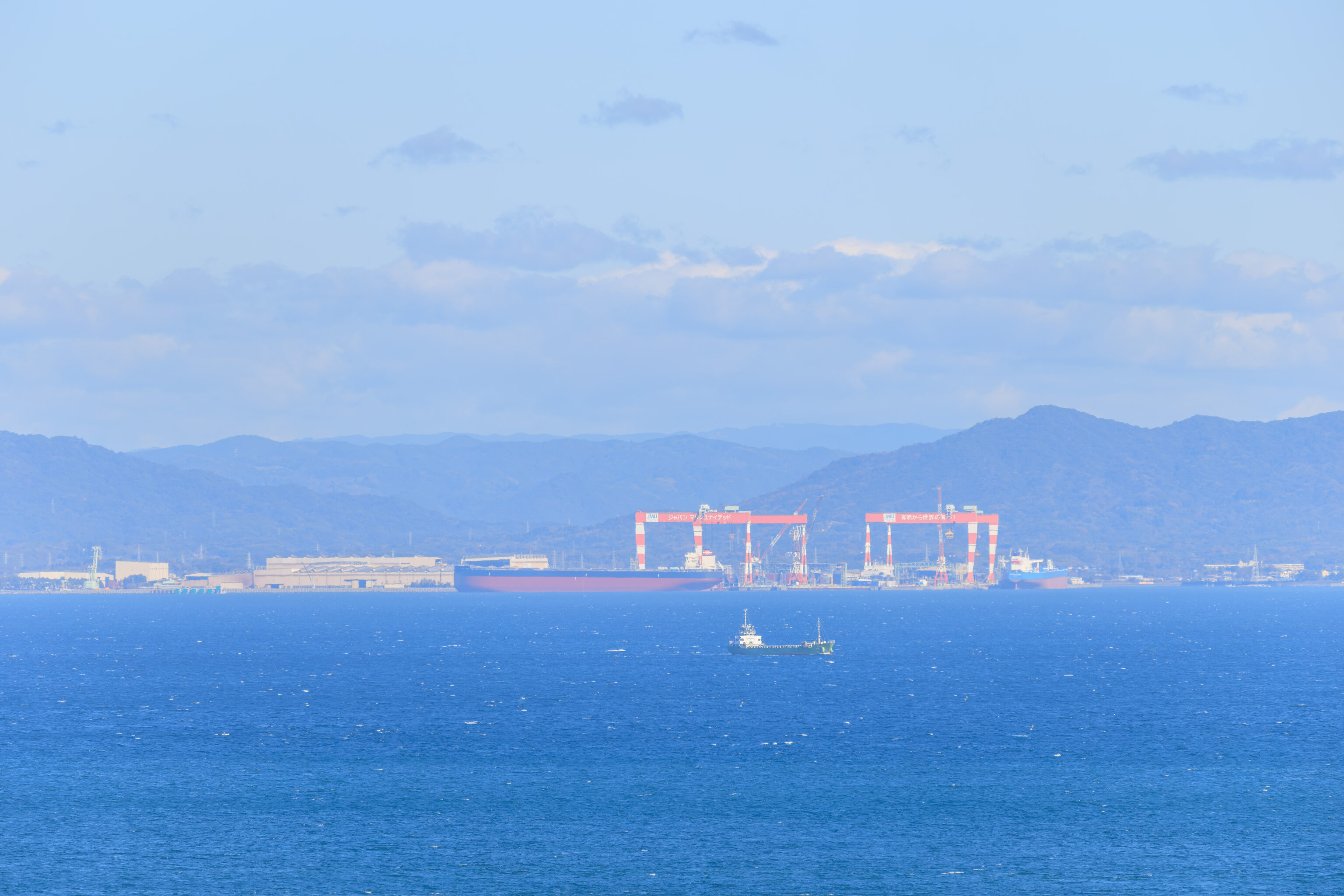
Looking to the east, we could see many buildings in Kumamoto Prefecture. Although Kumamoto City is only a few miles inland, there are some low mountains between the city and the sea, meaning we cannot see the city from here.
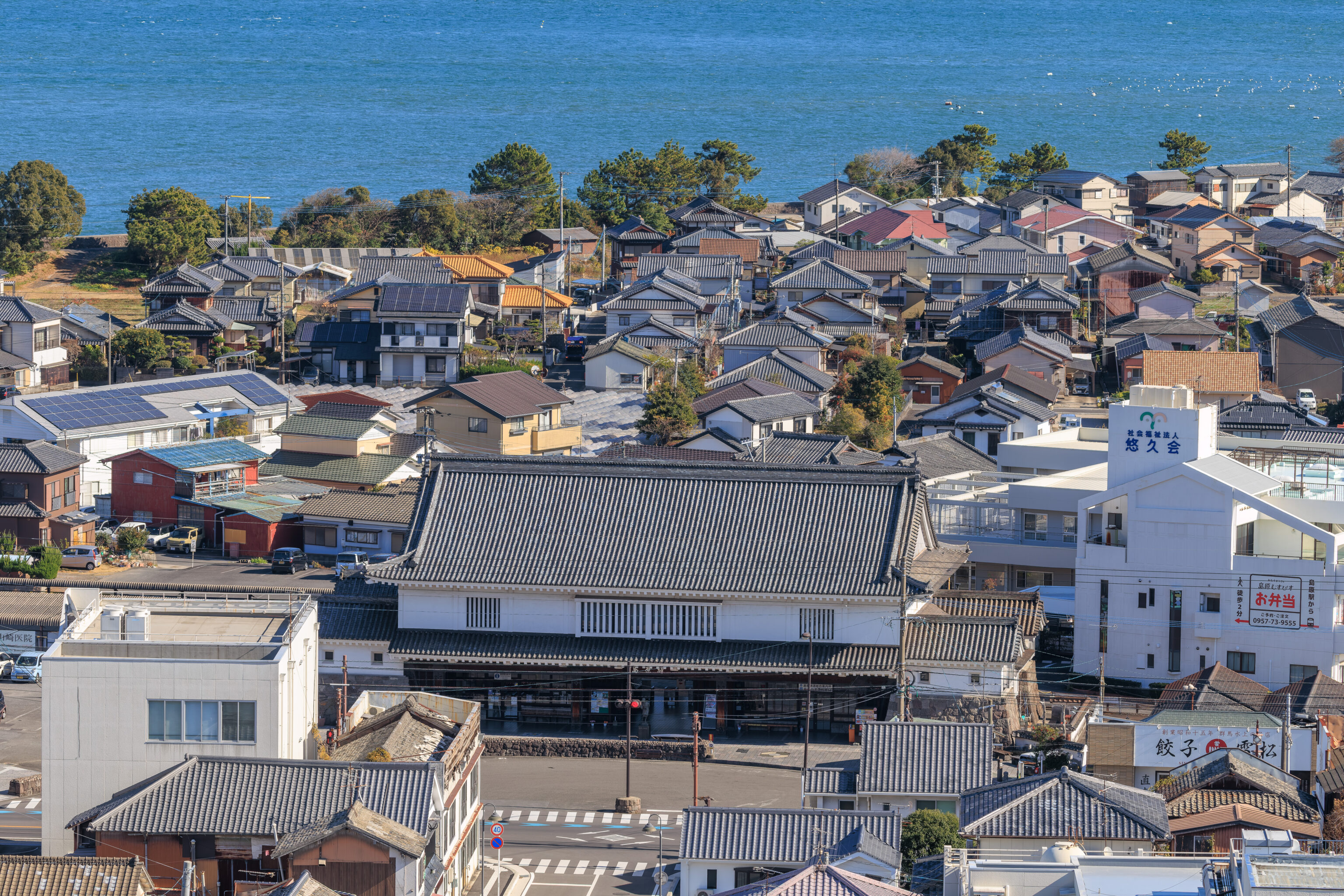
Looking down, we got a good look at Shimabara Station.
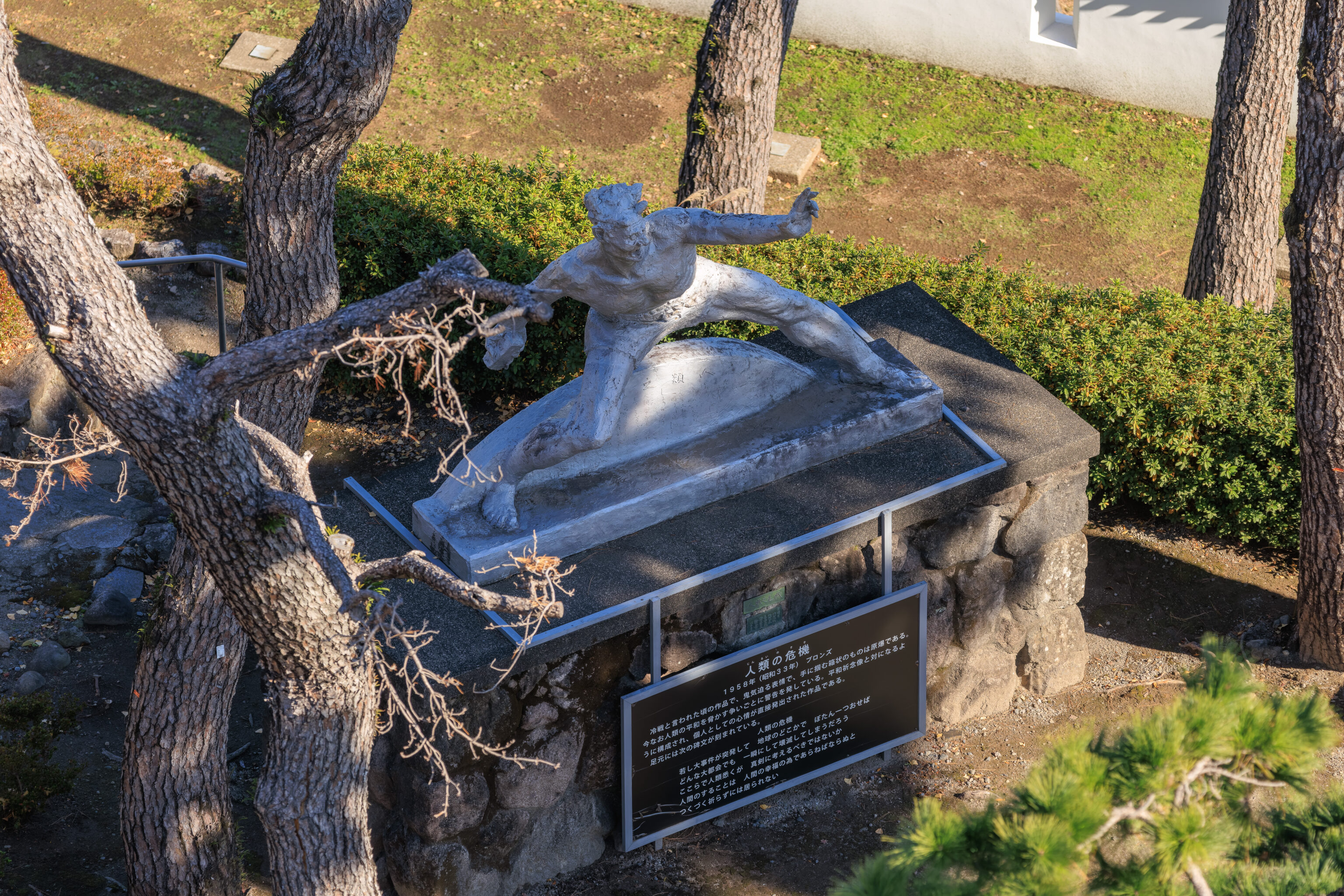
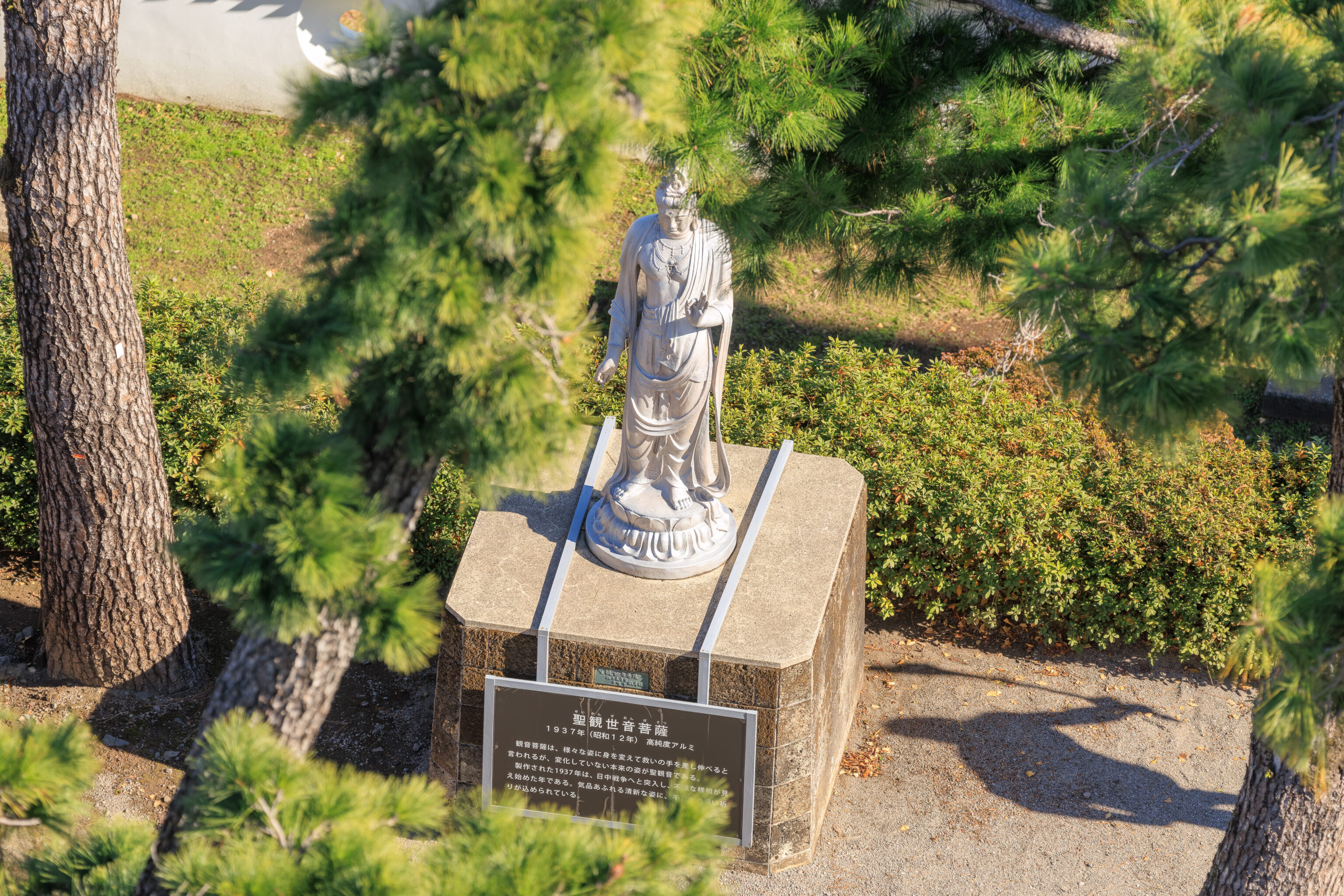
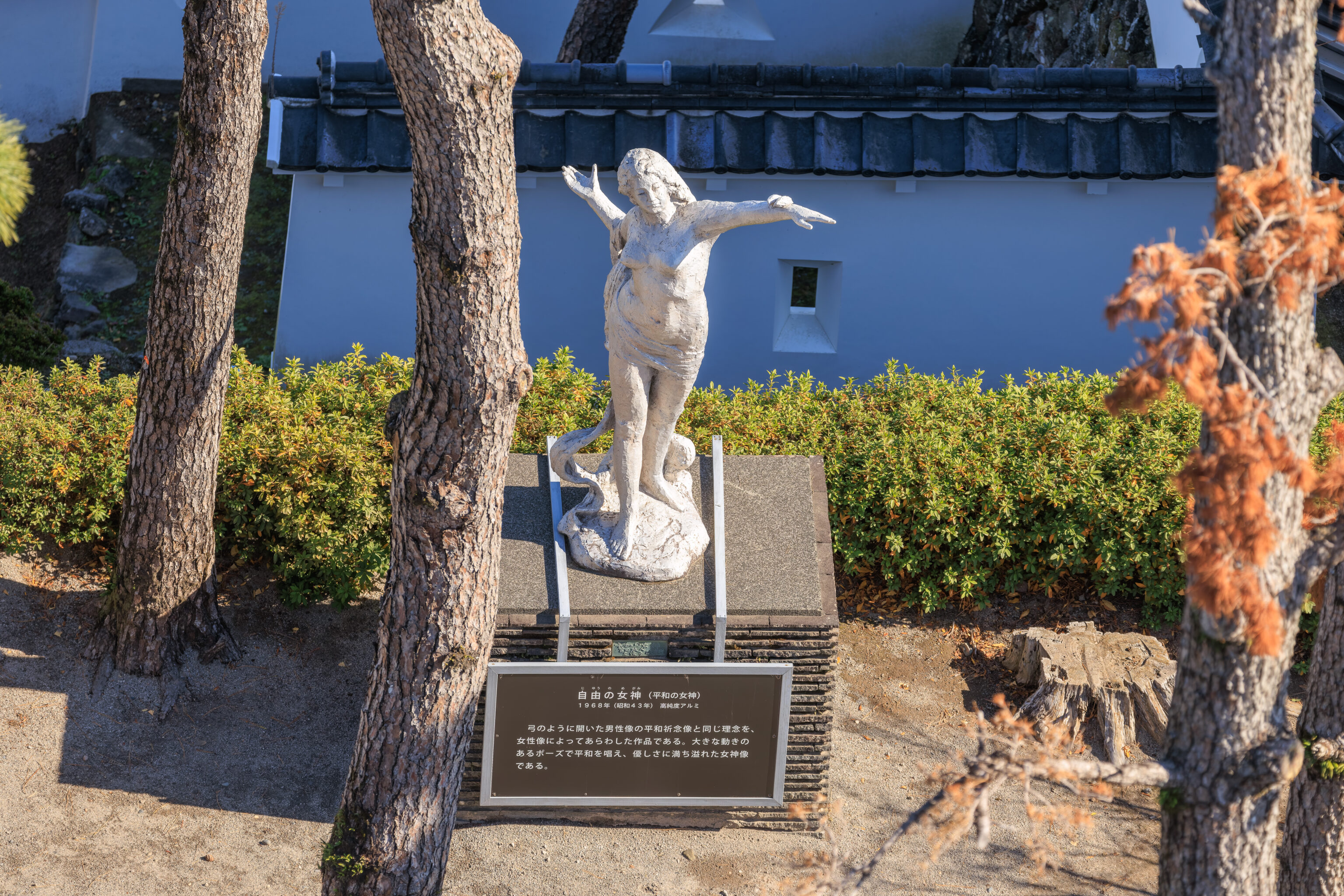
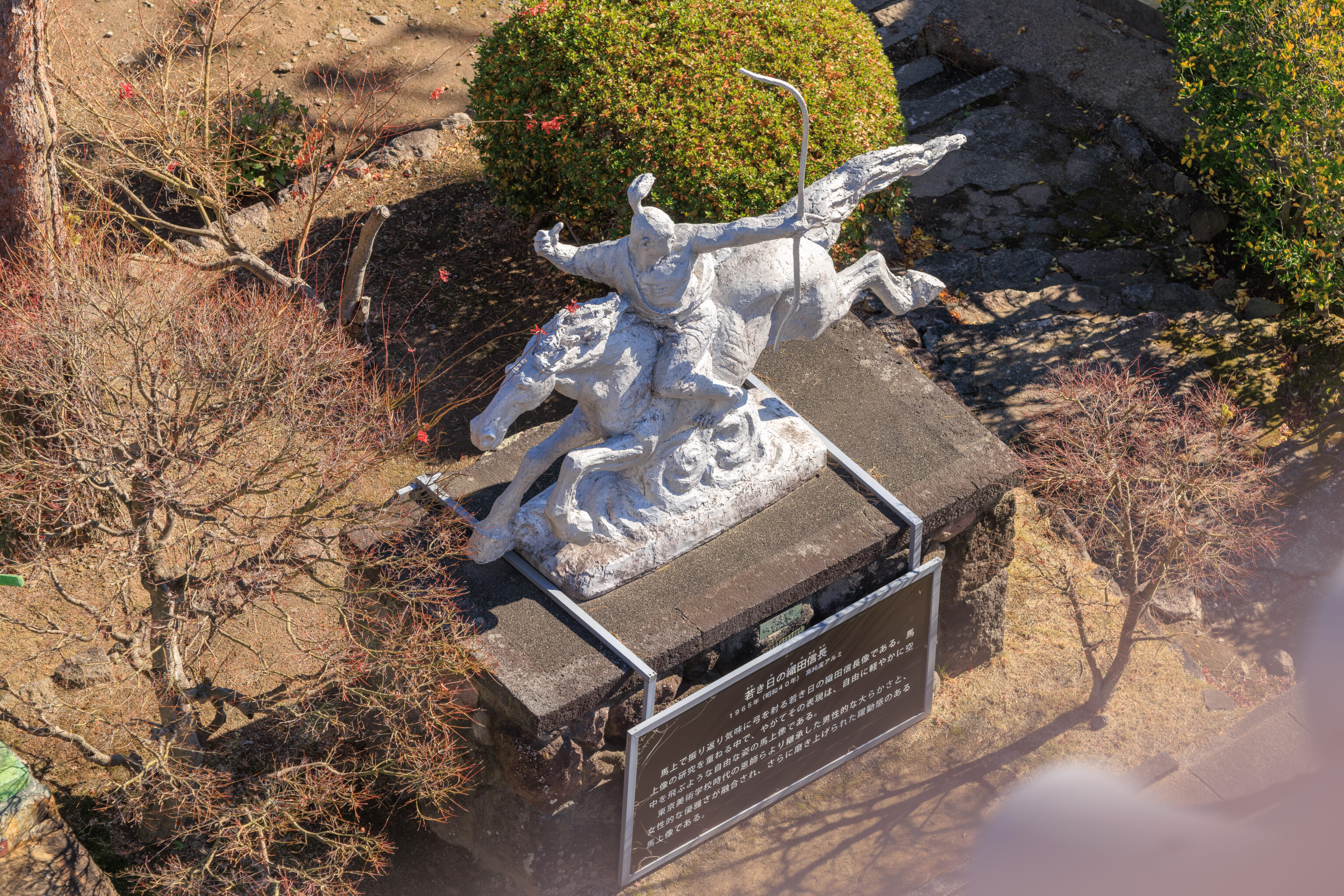
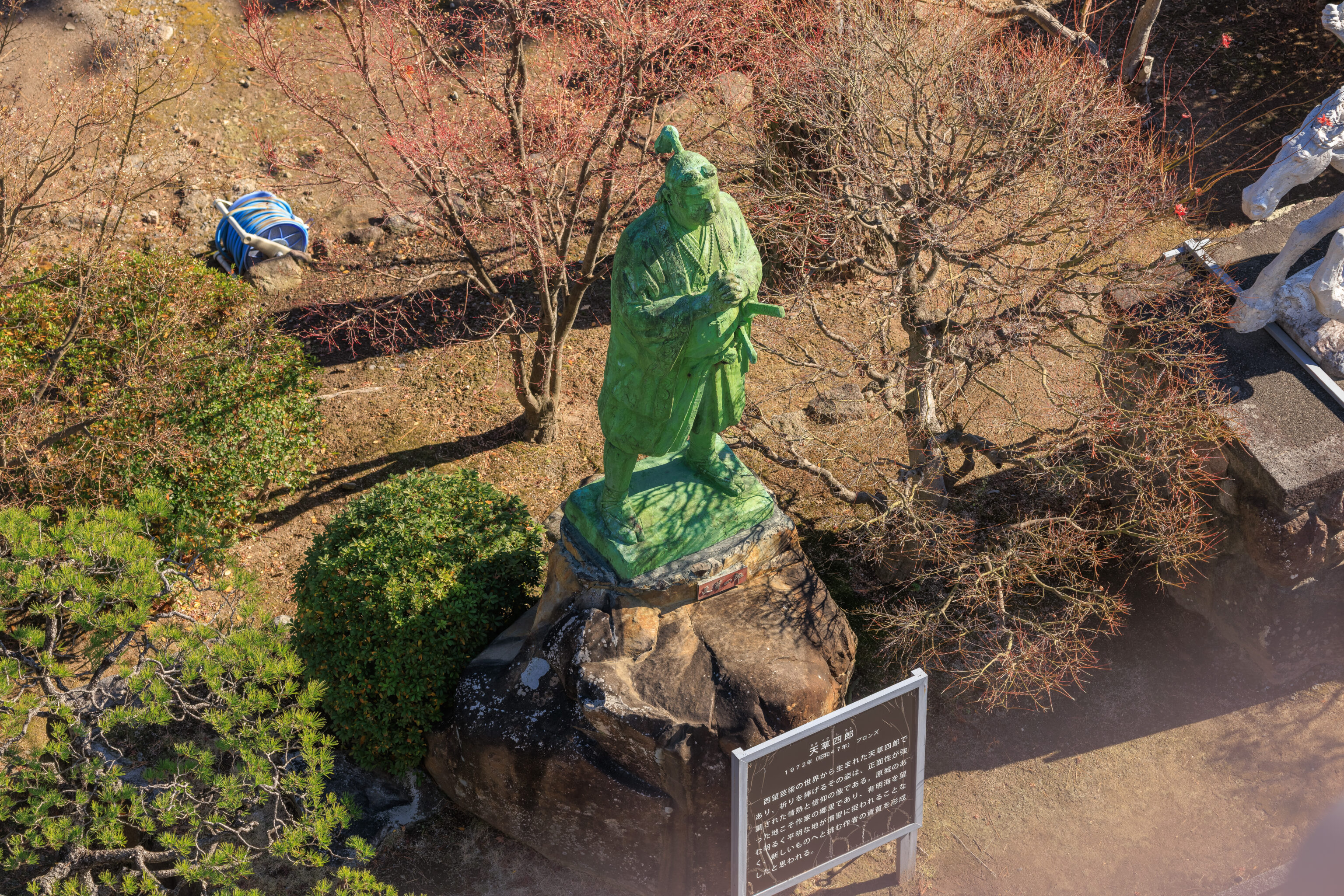
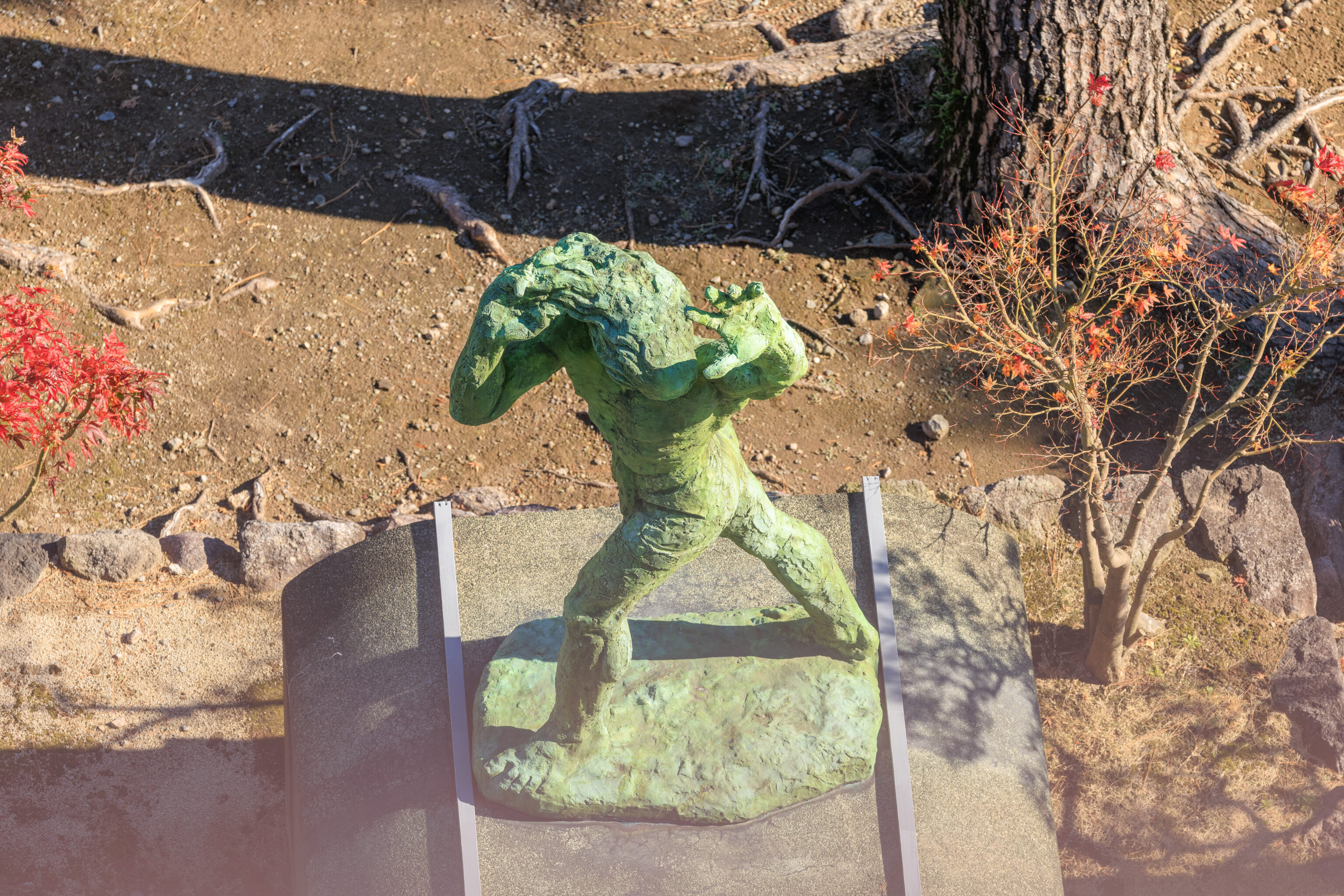
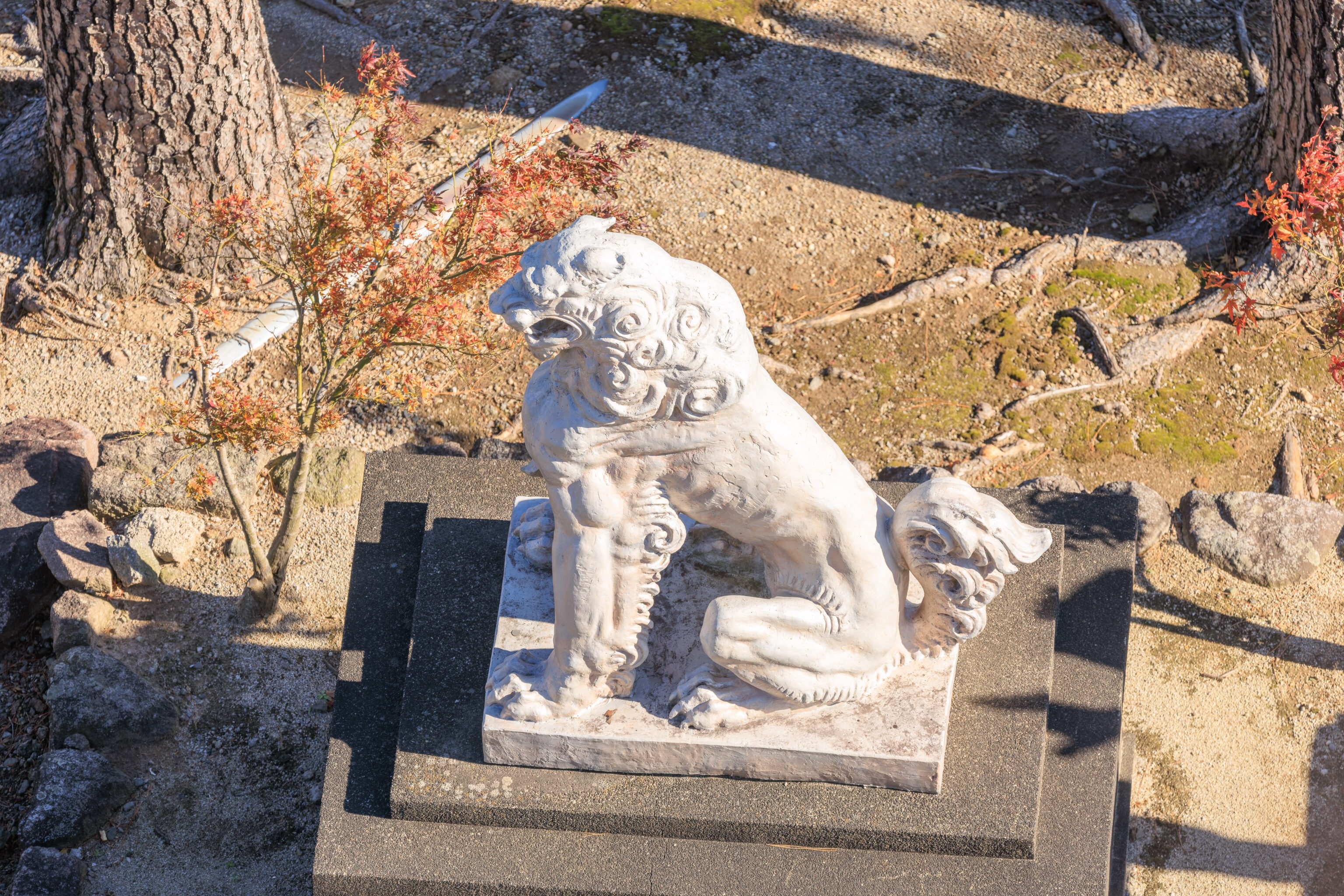
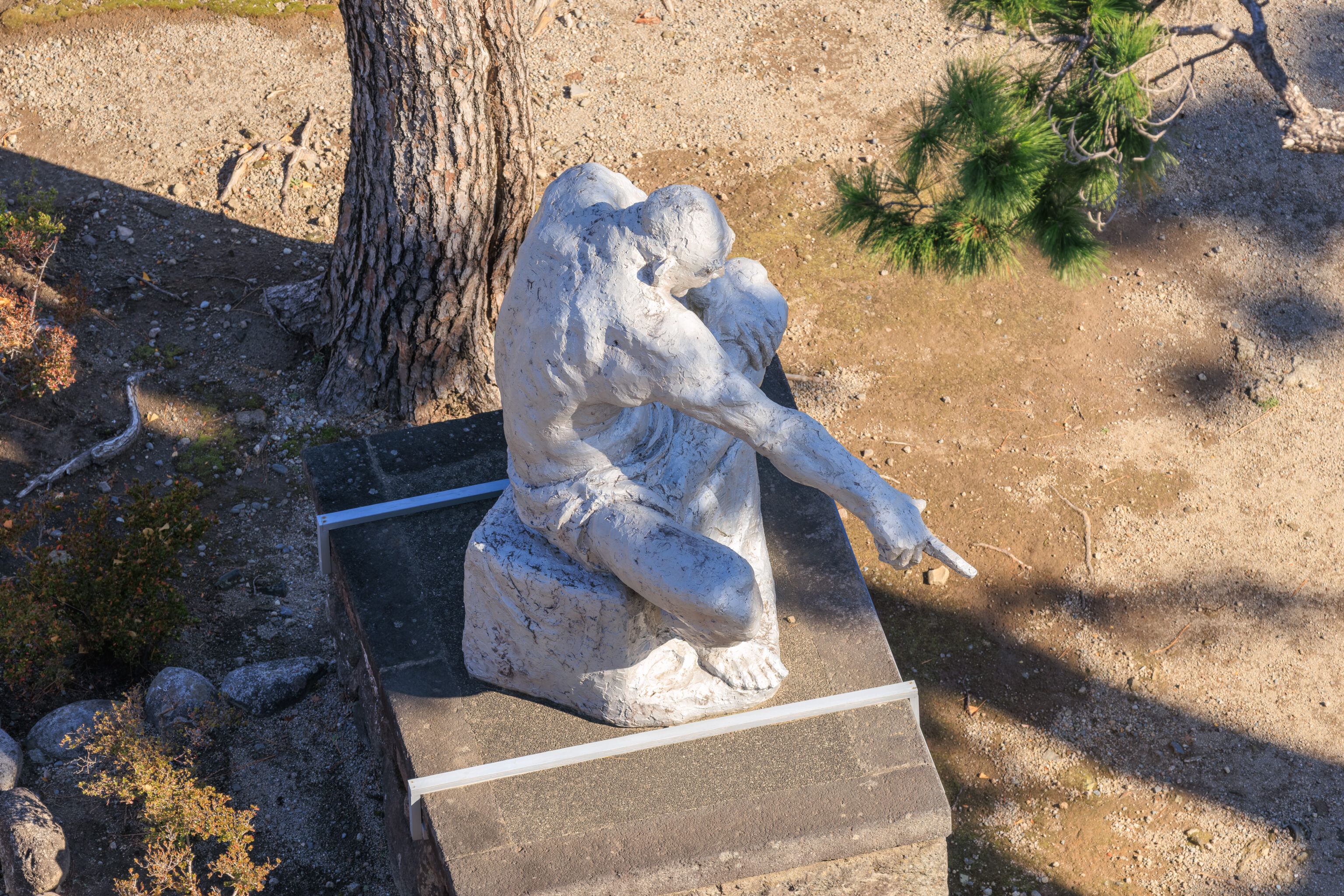
We also noticed that there are various statues down by the base of the castle.
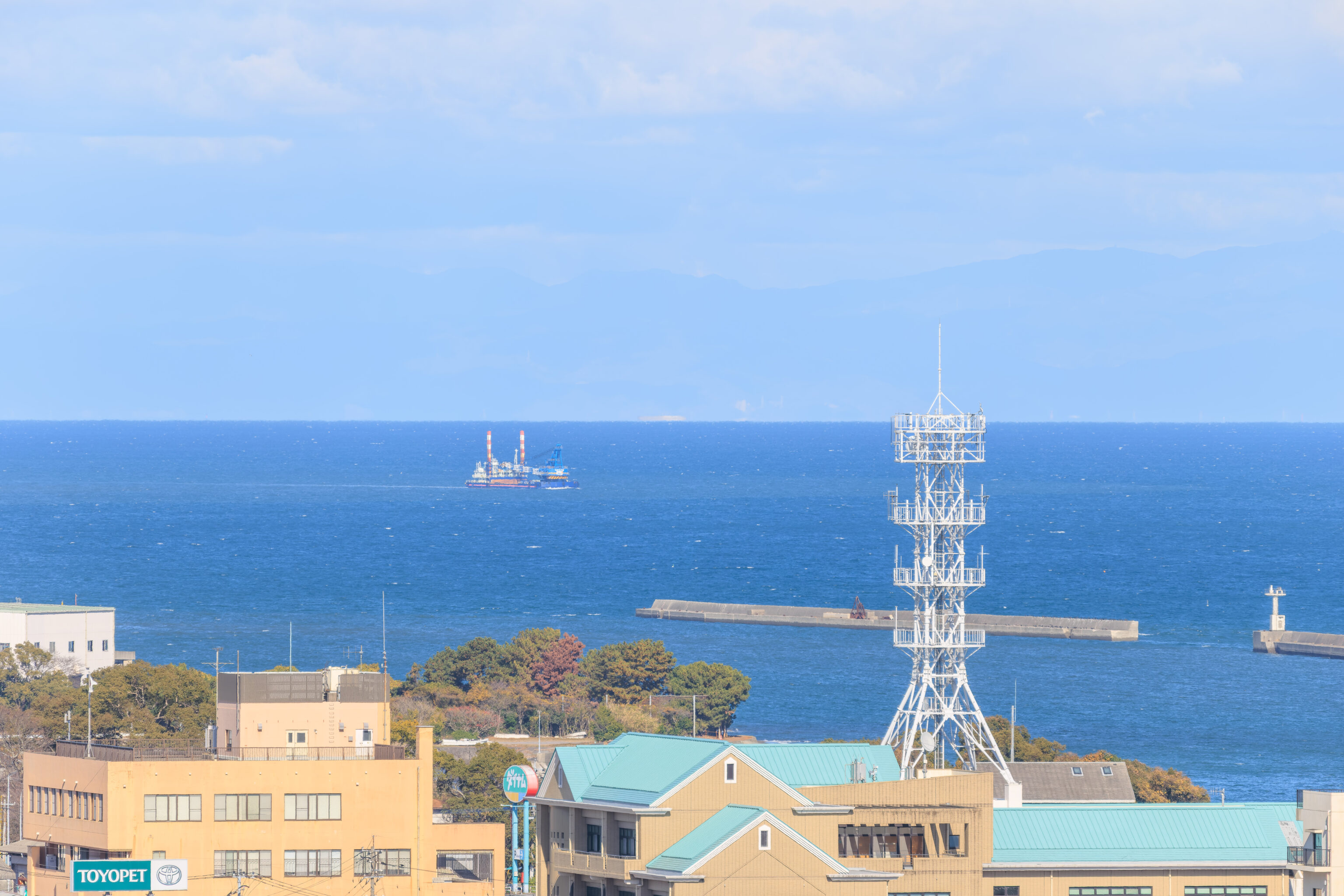
Not sure what this vessel is…
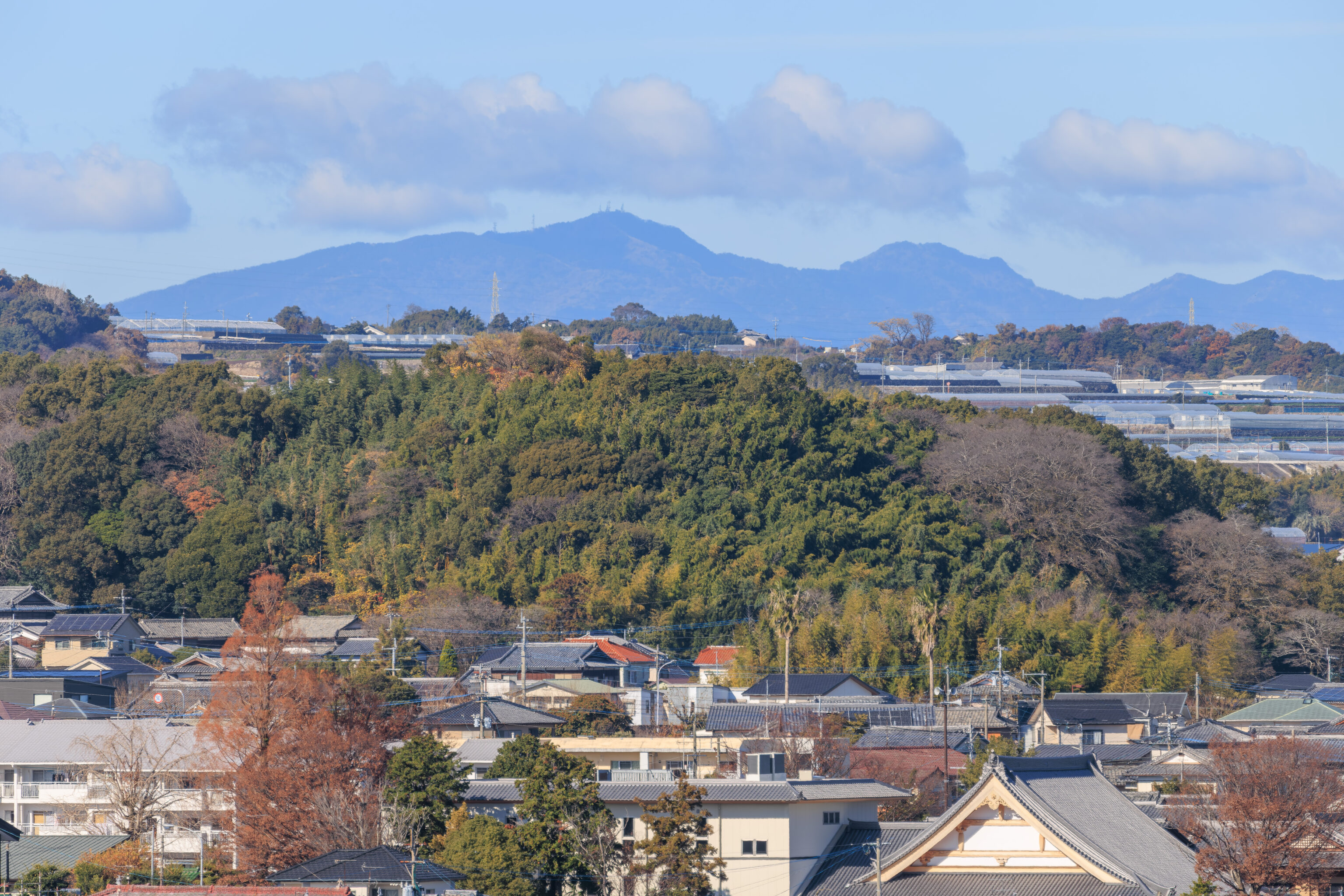
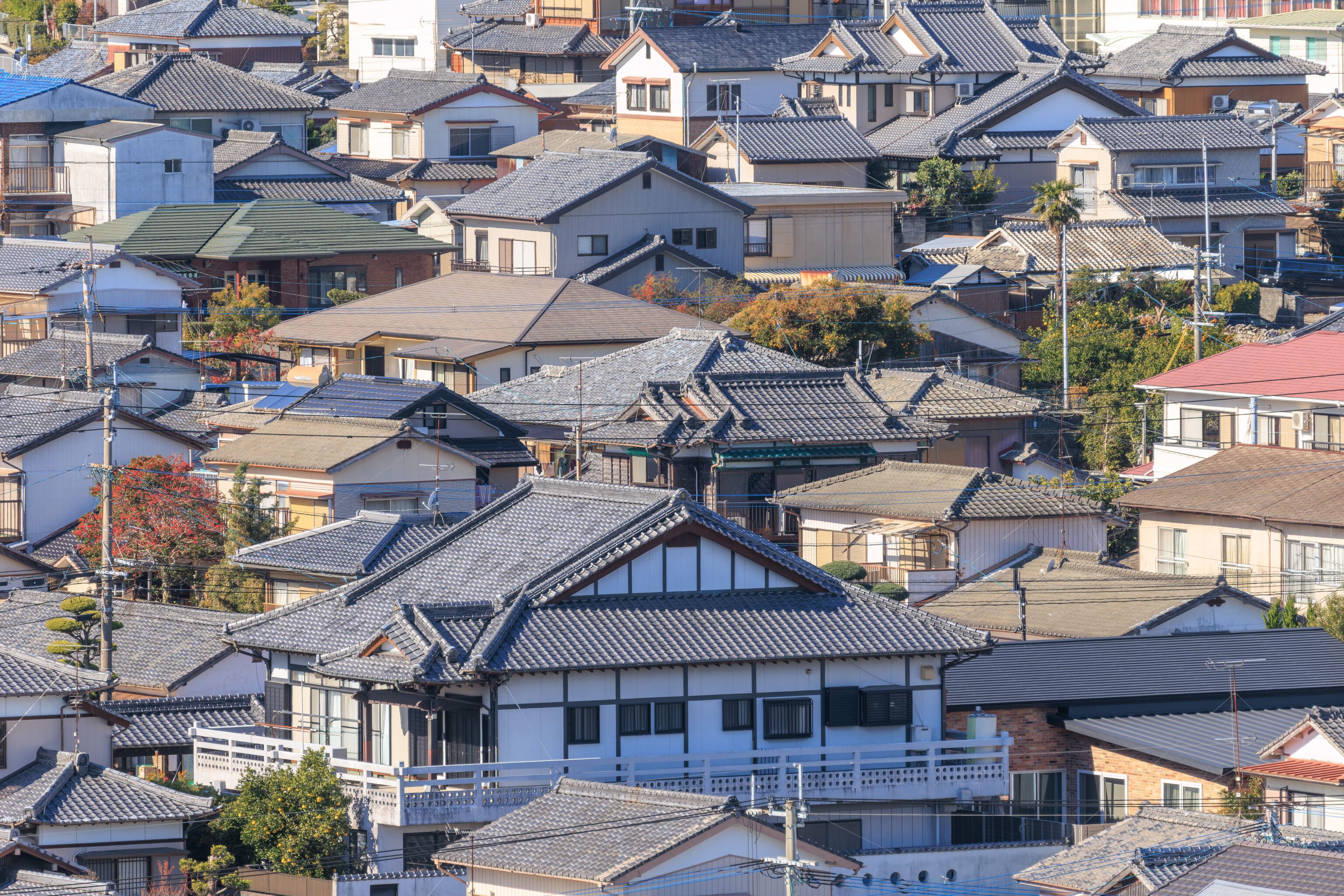
There isn’t too much that stands out to us here in Shimabara as we’re not familiar with the area.
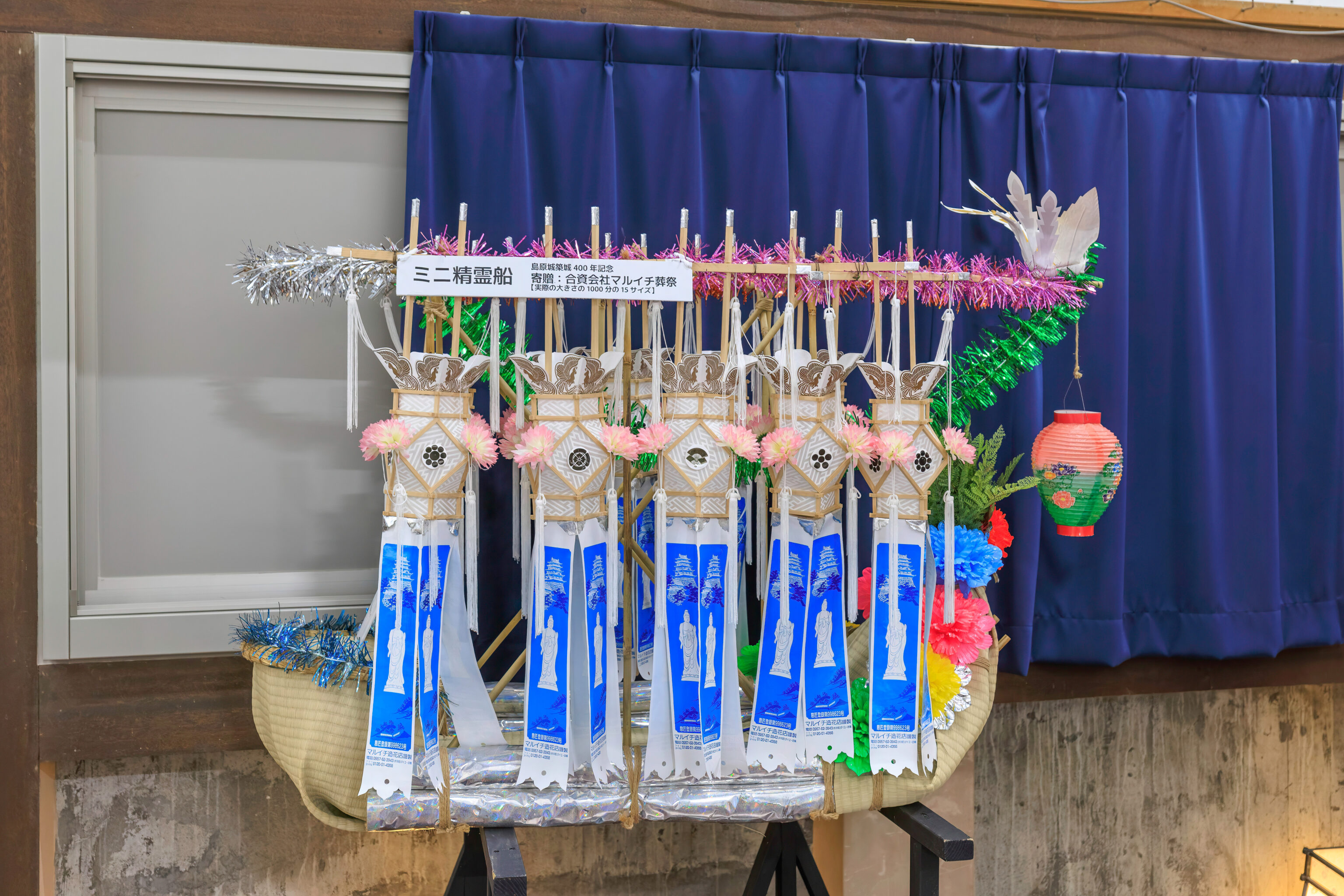
This is a minuature model of a 精霊船 Shōrōbune (Spirit Boat). They are used in Nagasaki Prefecture as part of the お盆 Obon, a yearly festival to honor the spirits of the dead.
Miniature Spirit Boat
Commemorating the 400th Anniversary of the Construction of Shimabara Castle
Donated by: Maruichi Funeral Services Co., Ltd.
[15/1000th the actual size]
– Text from the label atop the spirit boat, translated using Google.
A sign on the back of the spirit boat discusses the 精霊流し Spirit Boat Procession on Obon:
Spirit Boat Procession
On August 15th, the "Shoryo Nagashi" (spirit boat procession), which illuminates the evening of the Obon festival, is one of Shimabara's traditional events.

Its history spans over 300 years, and it is said that after the Shimabara Rebellion of 1637, it became such a lively event in order to suppress the resurgence of Christianity and promote Buddhism, or to conceal the presence of Christians.

The spirit boats are carried along with the spirited shouts of "Namaido!" The cut-glass lanterns adorning them are unique to Shimabara, and their splendor and tradition, along with the Shoryo Nagashi, have been designated as a cultural property of the city.

The spirit boats and cut-glass lanterns, unique to Shimabara, create an atmosphere of both liveliness and tranquility. It is a tradition that we hope will be preserved forever.
– Text from a sign, read and translated using Google Gemini and Translate.
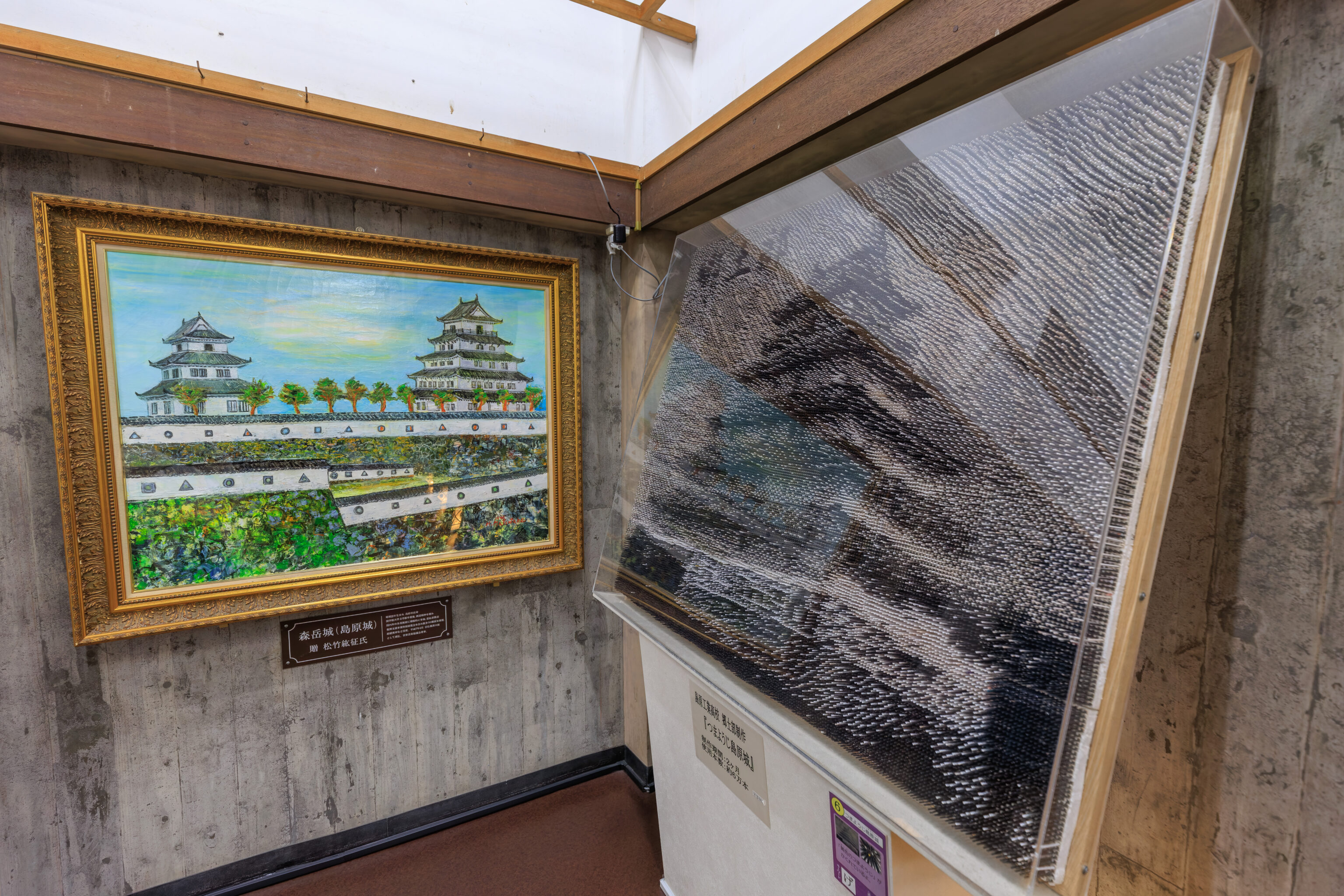
The artwork on the right is an image of Shimabara Castle made with 60,000 toothpicks! This is quite a bit reminiscent of the toy that’s made up of a frame with many little metal posts inside organized into a grid. One can push their hand into it, or their face, etc, to make a three dimensional image. This is apparently called Pin Art.
Shimabara Technical High School Local History Club Production
"Shimabara Castle made with toothpicks"
Production period: 2 months
Number of toothpicks used: Approximately 60,000
– Text from the sign below the toothpick image, read and translated using Google Gemini and Translate.
The painting on the left is nice too.
Moritake Castle (Shimabara Castle)
Presented by Hiroyuki Matsutake

Born in 1946 in Shimabara City.

After graduating from the Faculty of Letters at Kokugakuin University, he cultivated his artistic spirit.

He actively participated in various art exhibitions both domestically and internationally, and held numerous solo exhibitions, including a special exhibition for the reconstruction support project of Mount Unzen Fugen.

He received awards such as the Konju Medal. In April 1995, he traveled to France as a Japan-France Goodwill Ambassador.

He is a director of the World Art Council.
– Text from a sign, translated using Google.
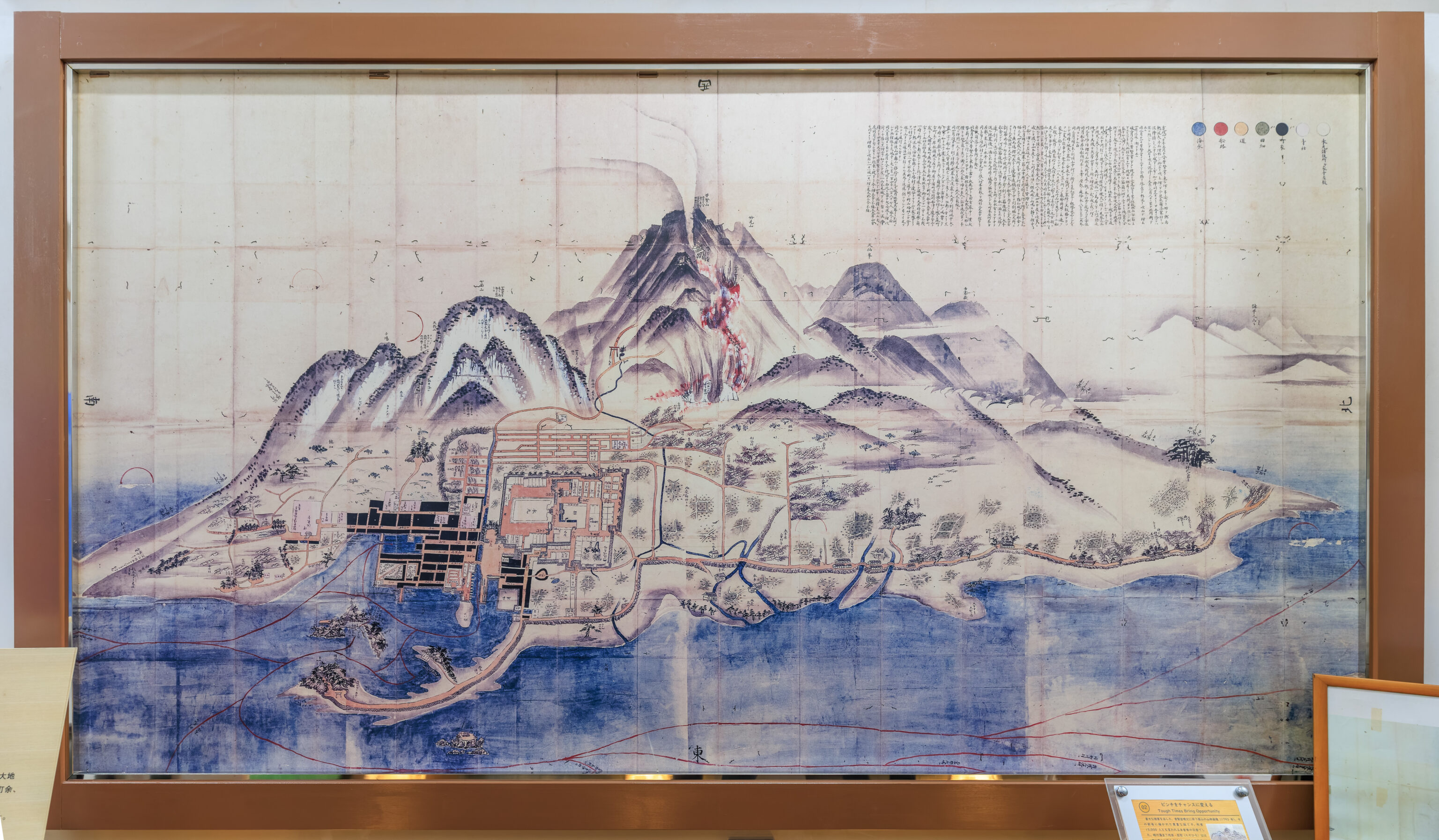
This piece illustrates the Shimabara Catastrophe.
Shimabara Catastrophe
On May 21, 1792 (April 1 of the 4th year of Kansei, the lunar calendar), a catastrophic volcanic disaster occurred. Mt. Mayuyama (a lava dome rising behind the Shimabara castle town) collapsed, blanketing the castle town with debris avalanche. This disaster killed 10,184 people, swept away 10,665 houses, destroyed 2,932 houses, more than 313 cho of paddy fields, more than 115 cho of dry fields and more than 34 cho of salt fields, and damaged 530 ships. The huge tsunami that ensued struck the villages in Shimabara and traveled across the sea and hit the opposite shores of Kumamoto and Amakusa, claiming the lives of 15,000 people who were swept away. This great catastrophe is called the Shimabara Taihen Higo Meiwaku (Shimabara Catastrophe and nuisance to Higo Province).

Since the previous year, a series of earthquakes had been occurring in the Shimabara district. When the new year began, Mt. Fugendate started to erupt. The lava flowed down the mountain and through valleys and reached Senbongi in Sugitani Village. And finally, Mt. Mayuyama collapsed. A thick blanket of debris covered the entire area of the castle town from the Otegomon gate and southward. The height of the tsunami generated at that time reached 10 meters, causing damage to 22 towns and villages, from Yamada Village in the north to Minami Arima Village in the south. This catastrophe is one of the worst disasters in the history of Japan. From the castle tower's observatory, you can still view the traces of the Shimabara Catastrophe.
– Text from a sign.
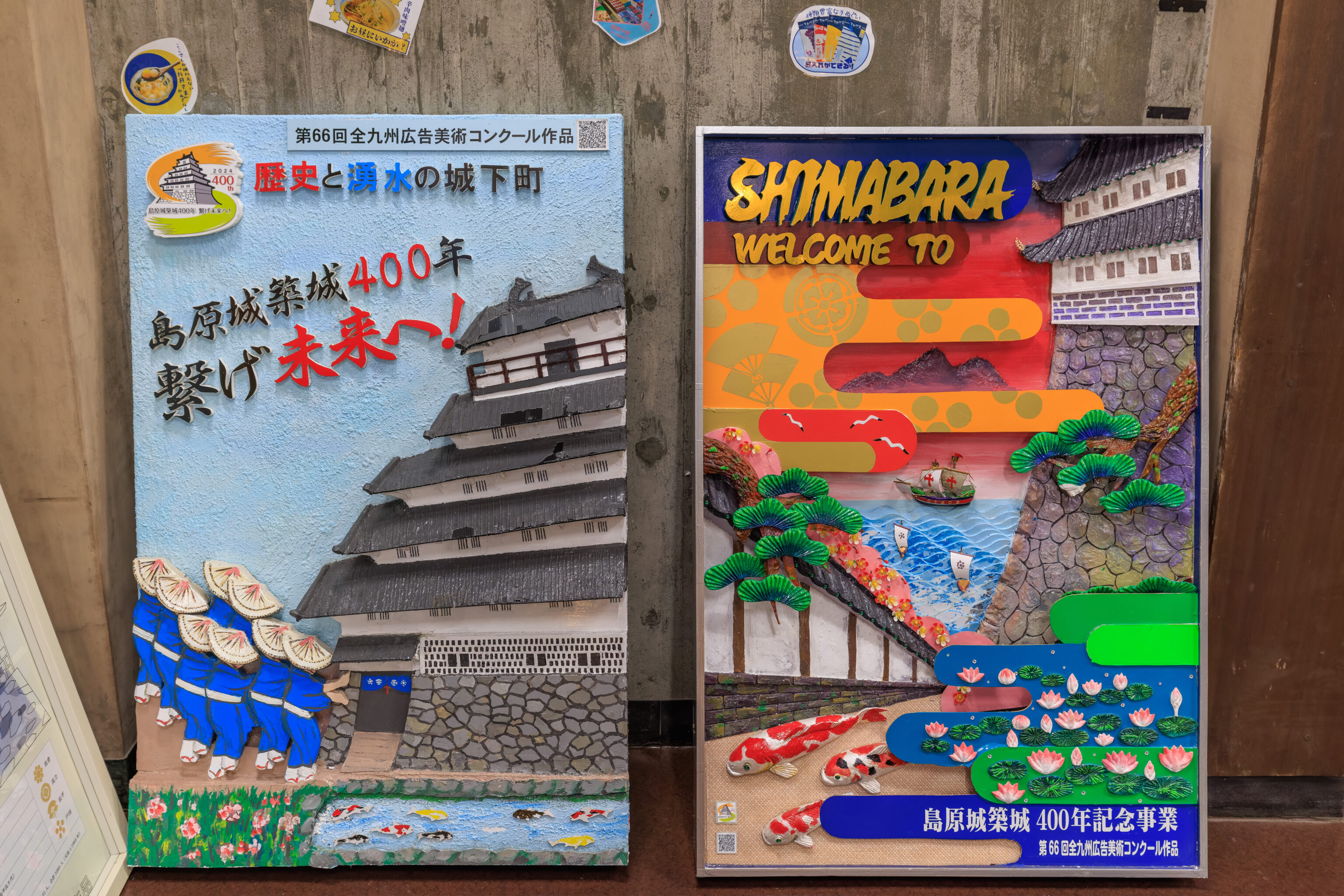
These two signs would make excellent magnets!
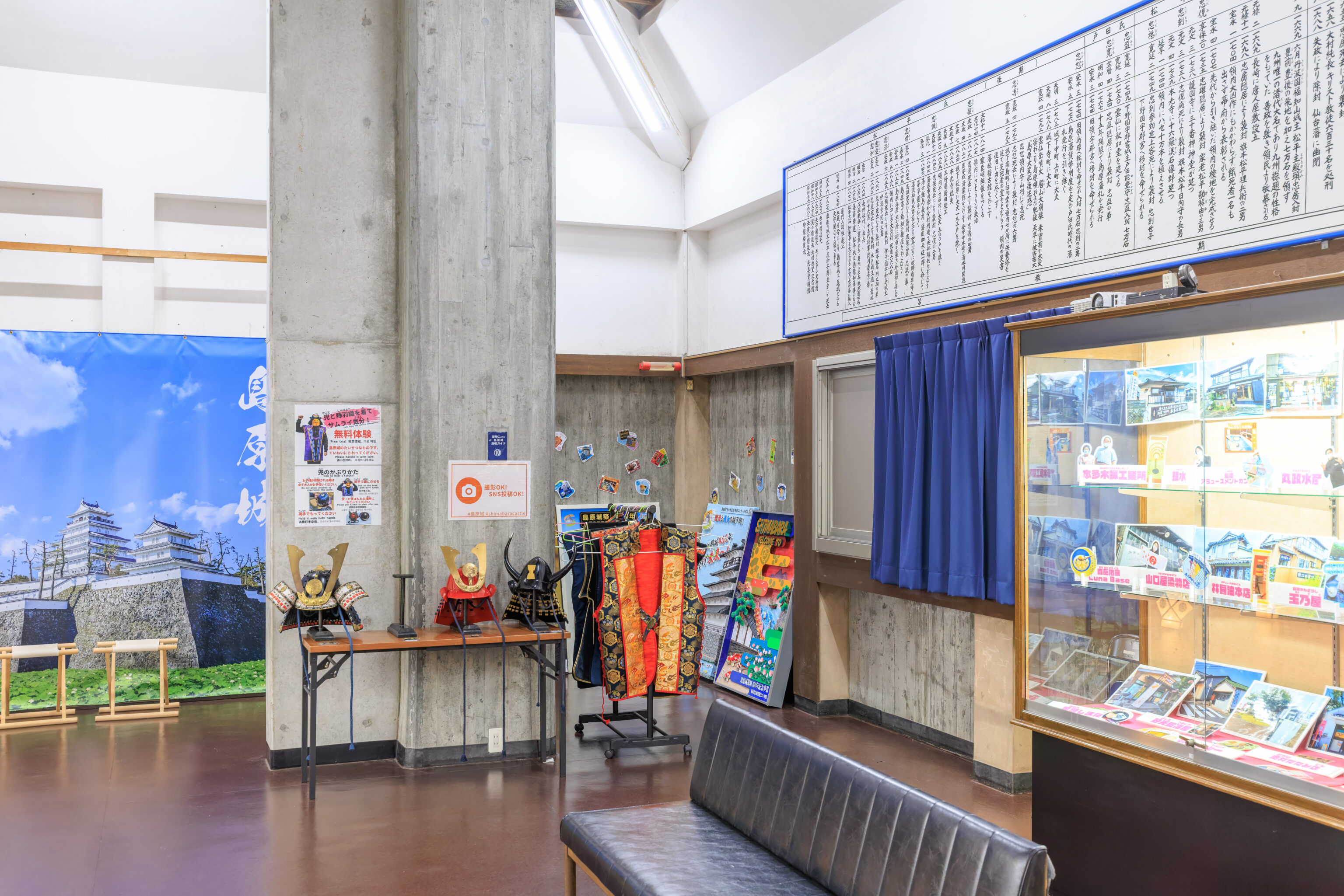
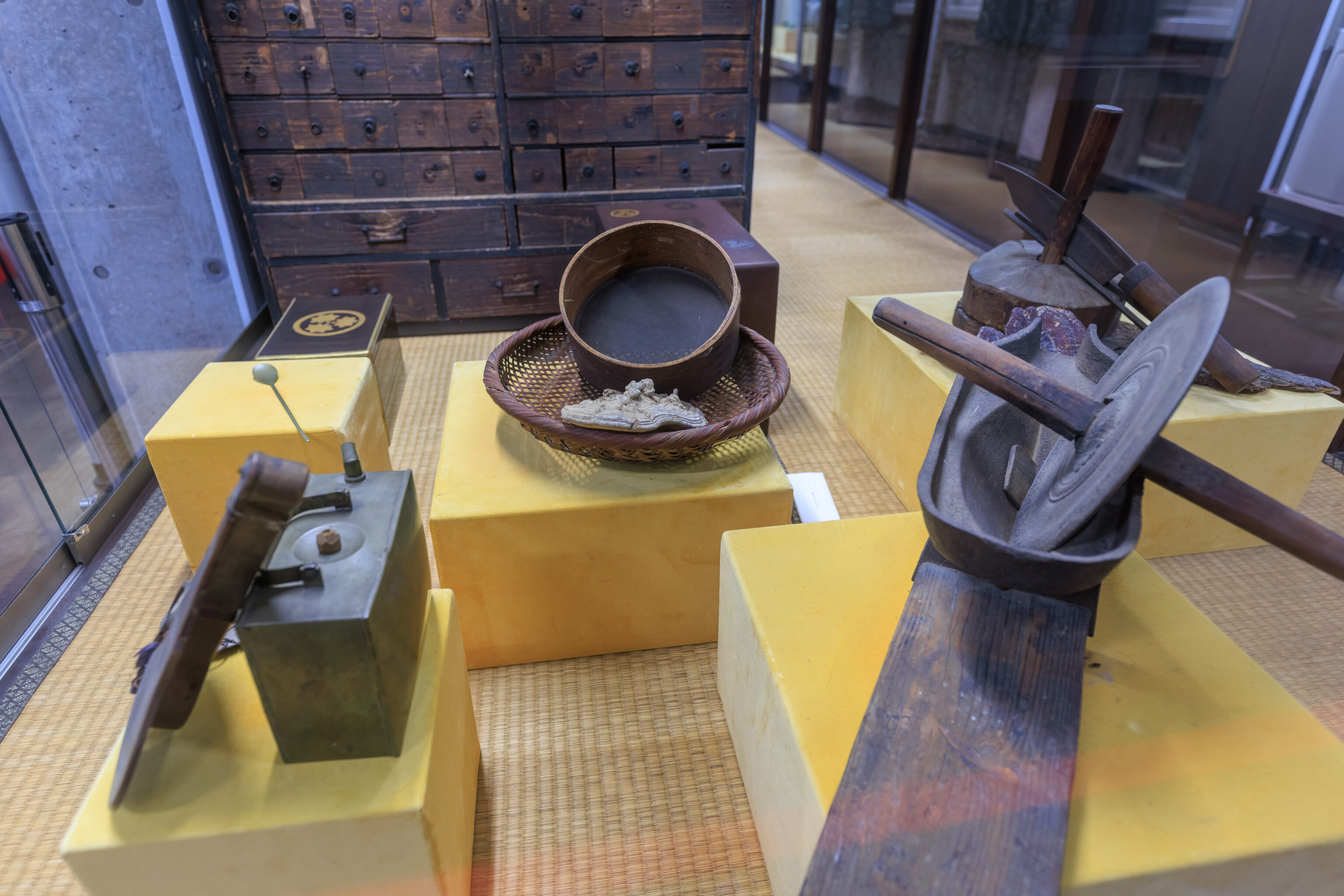
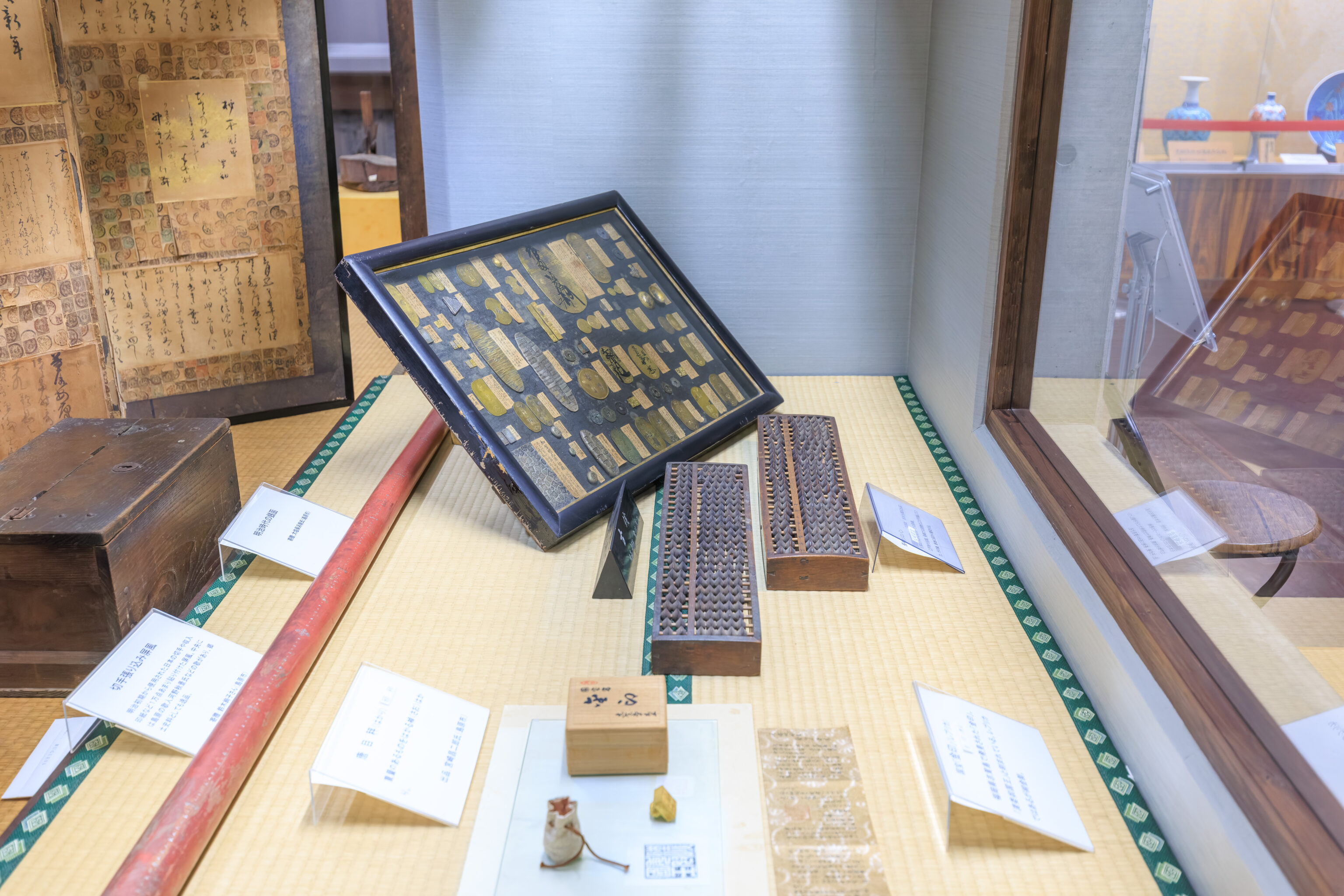
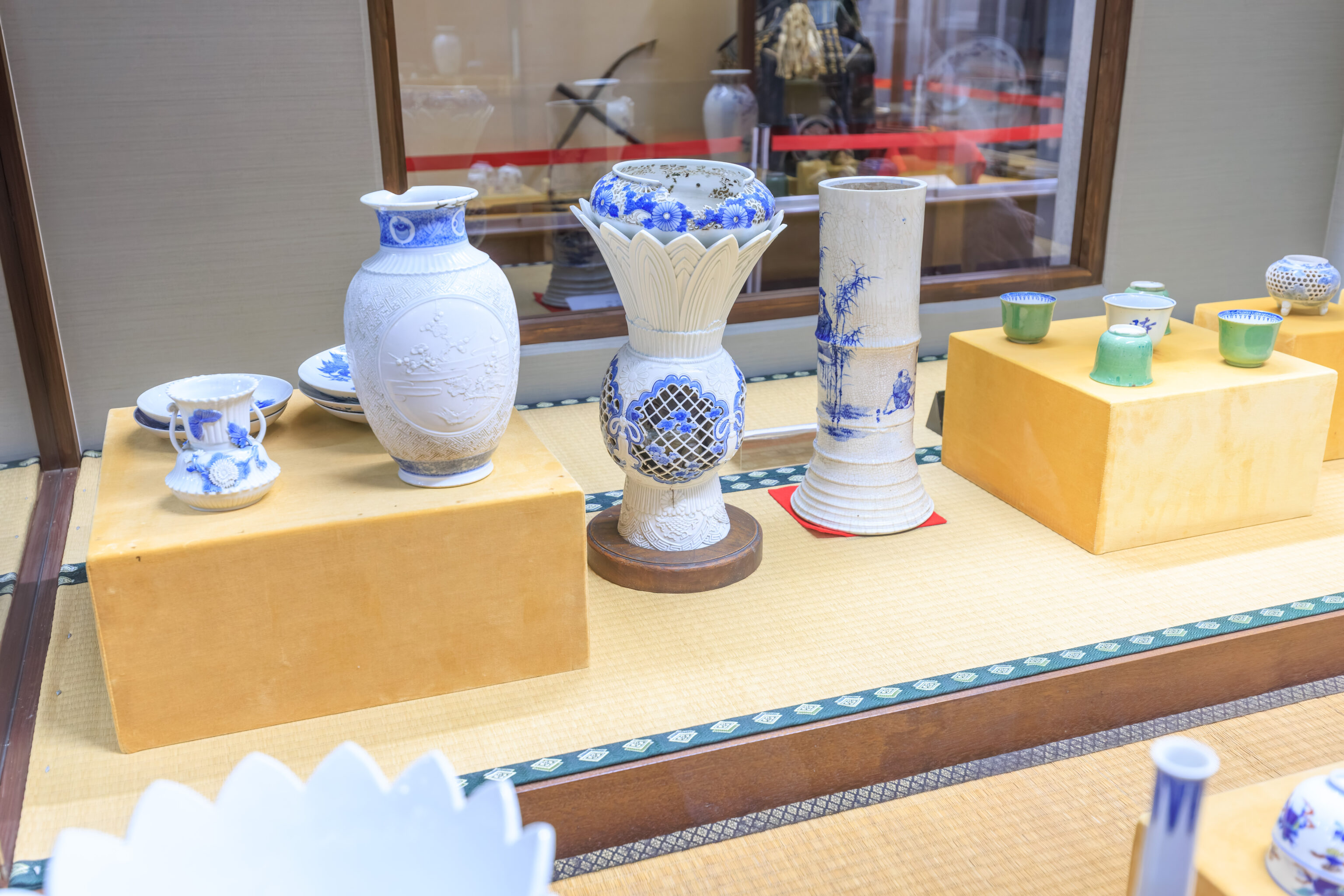
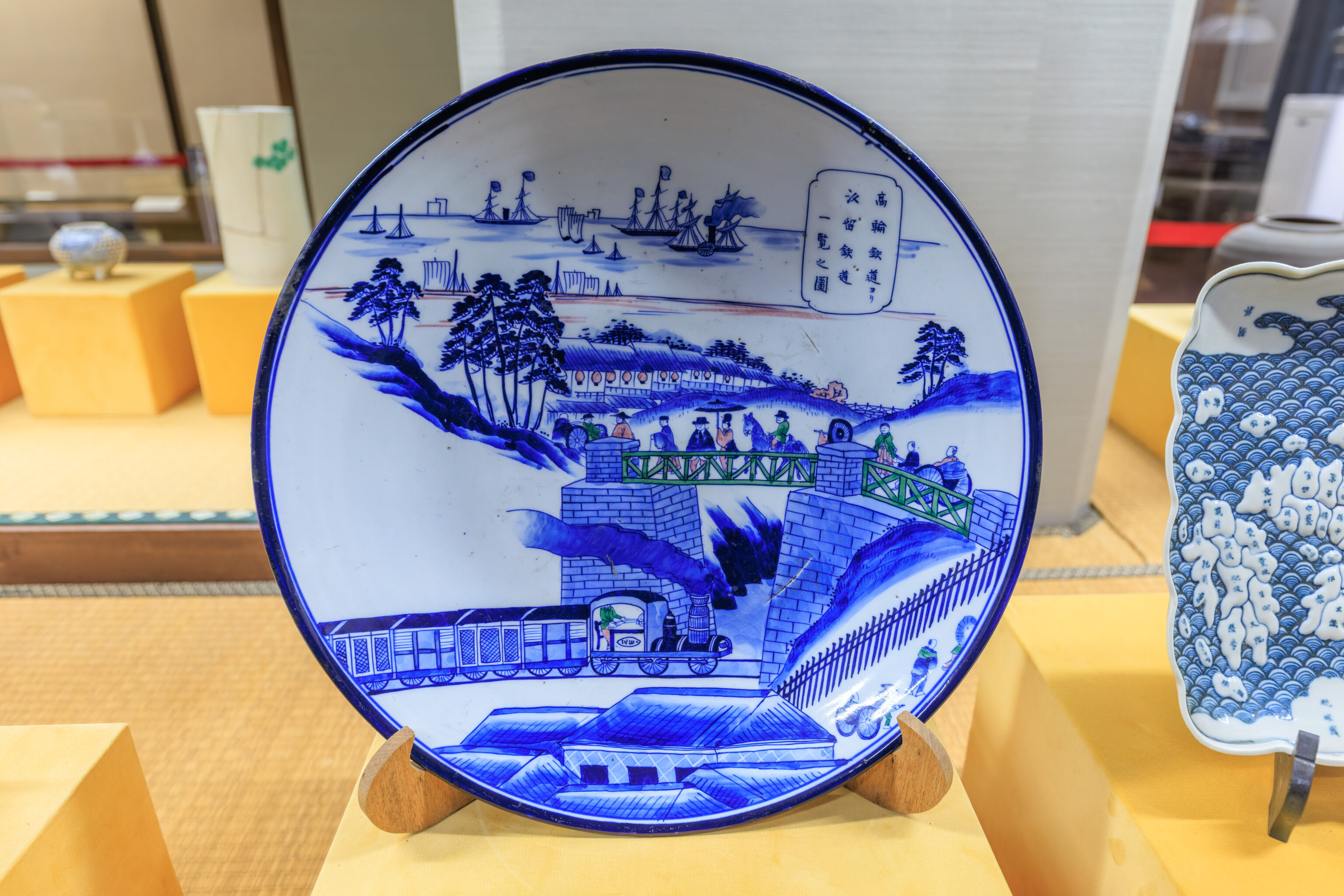
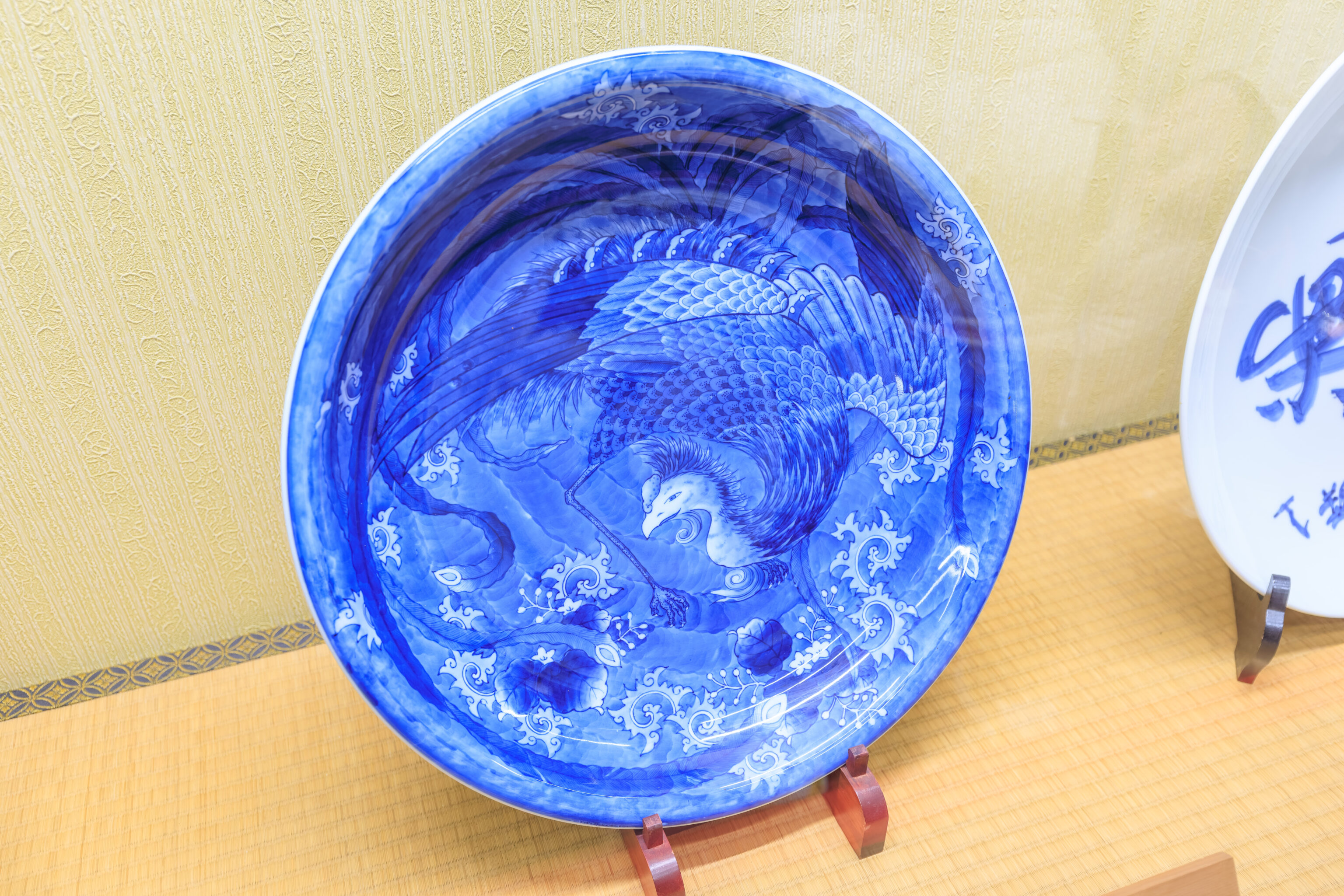
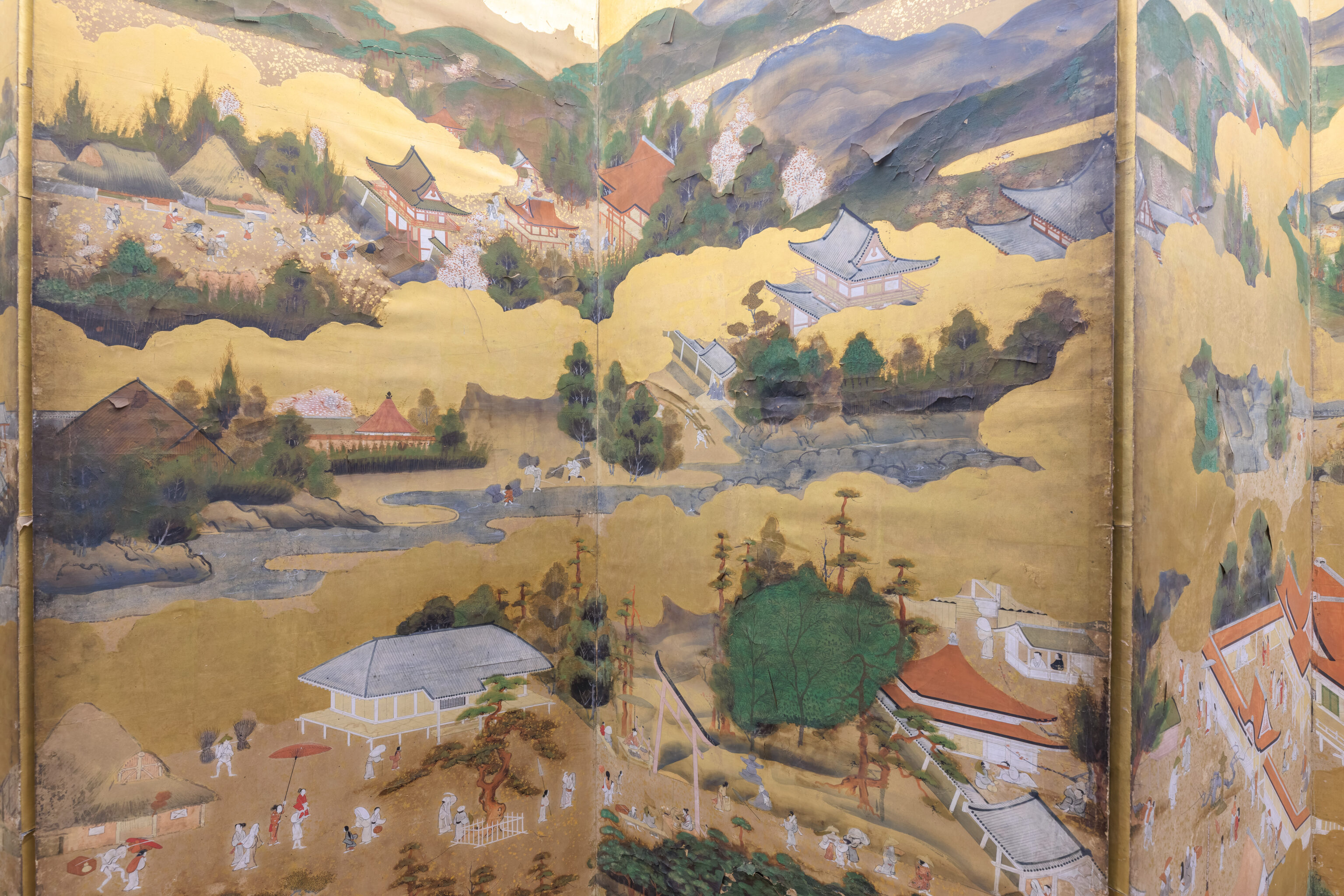
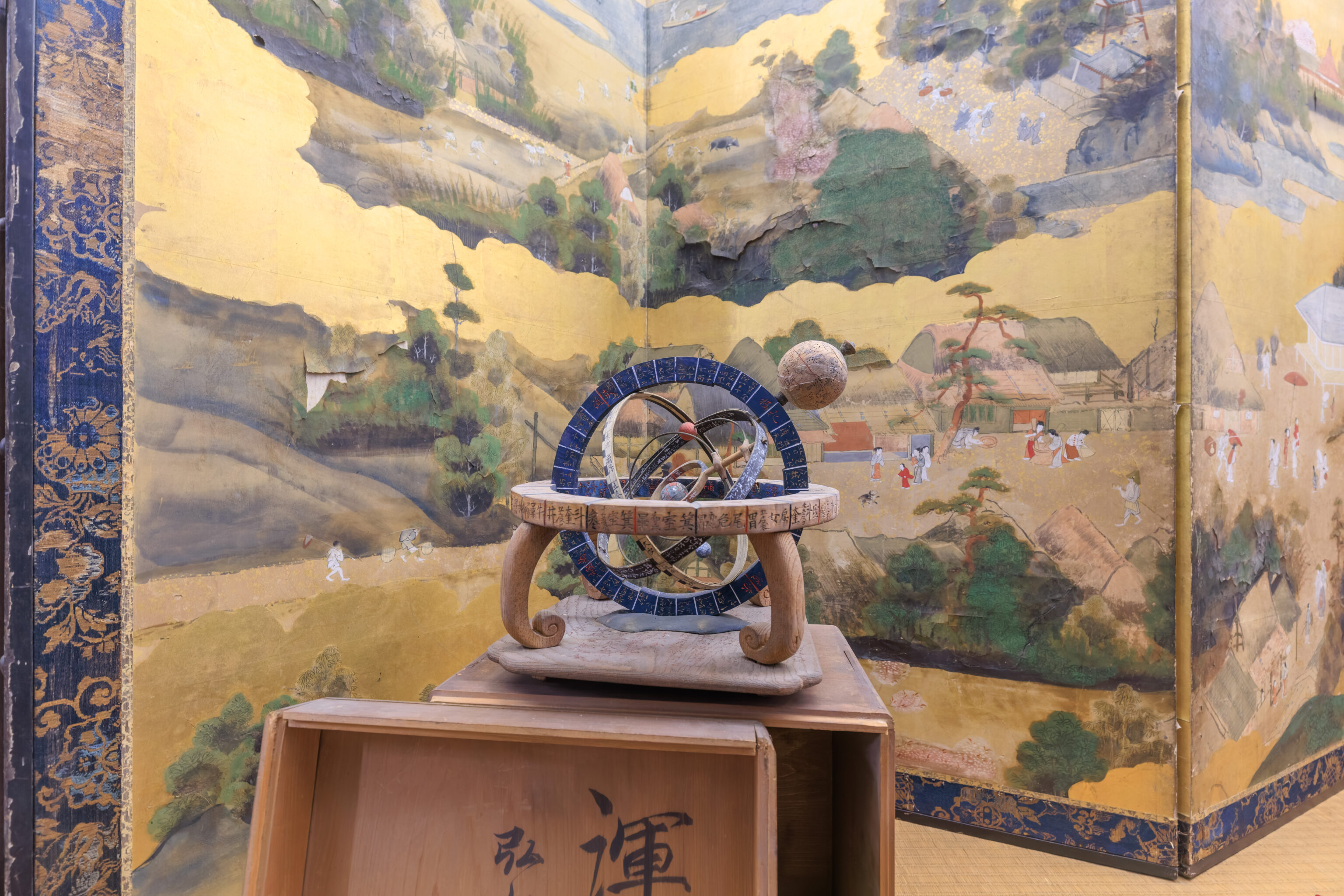
In addition to the two signs, there were various other items on display in this room.
A sign explained the transition from the feudal domain system to the modern prefectural system after the Meiji Restoration.
Haihan Chiken (Abolition of Feudal Domains and Establishment of Prefectures) Leads to a New Era
In the closing days of the Tokugawa shogunate, the Shimabara domain was in confusion. Since its lords from the Matsudaira clan were heredity vassals and said to be acting as secret watchdogs over Kyushu, the domain took a wait-and-see attitude. This can be considered the cause of its delay in responding to the Meiji Restoration.

After Hanseki Hokan was carried out in 1869, Lord Tadakazu was appointed as Shimabara domain's governor. In 1871, the Shimabara domain was abolished and became part of the new Nagasaki Prefecture. A branch office of the prefectural government was placed at the site of the former Shimabara domain office.

The Shimabara Peninsula at this time was worth about 38,000 koku, and was home to more than 128,000 citizens and more than 6,500 samurai members (plus over 3,000 citizens of the Kojiro-nabeshima clan's fiefdom, which was worth 3,000 koku).

The previous year, the town/village headman system was abolished, and two years later, new administrative districts were set up. Subsequently, two towns and 28 villages were established on the Shimabara Peninsula. Farmers, tradesmen and artisans were permitted to have surnames. The Meiji government also permitted freedom of cultivation to farmers, and abolished the edict prohibiting the permanent sale of land. In this way, people began to be liberated from feudal rule
– Text from a sign.
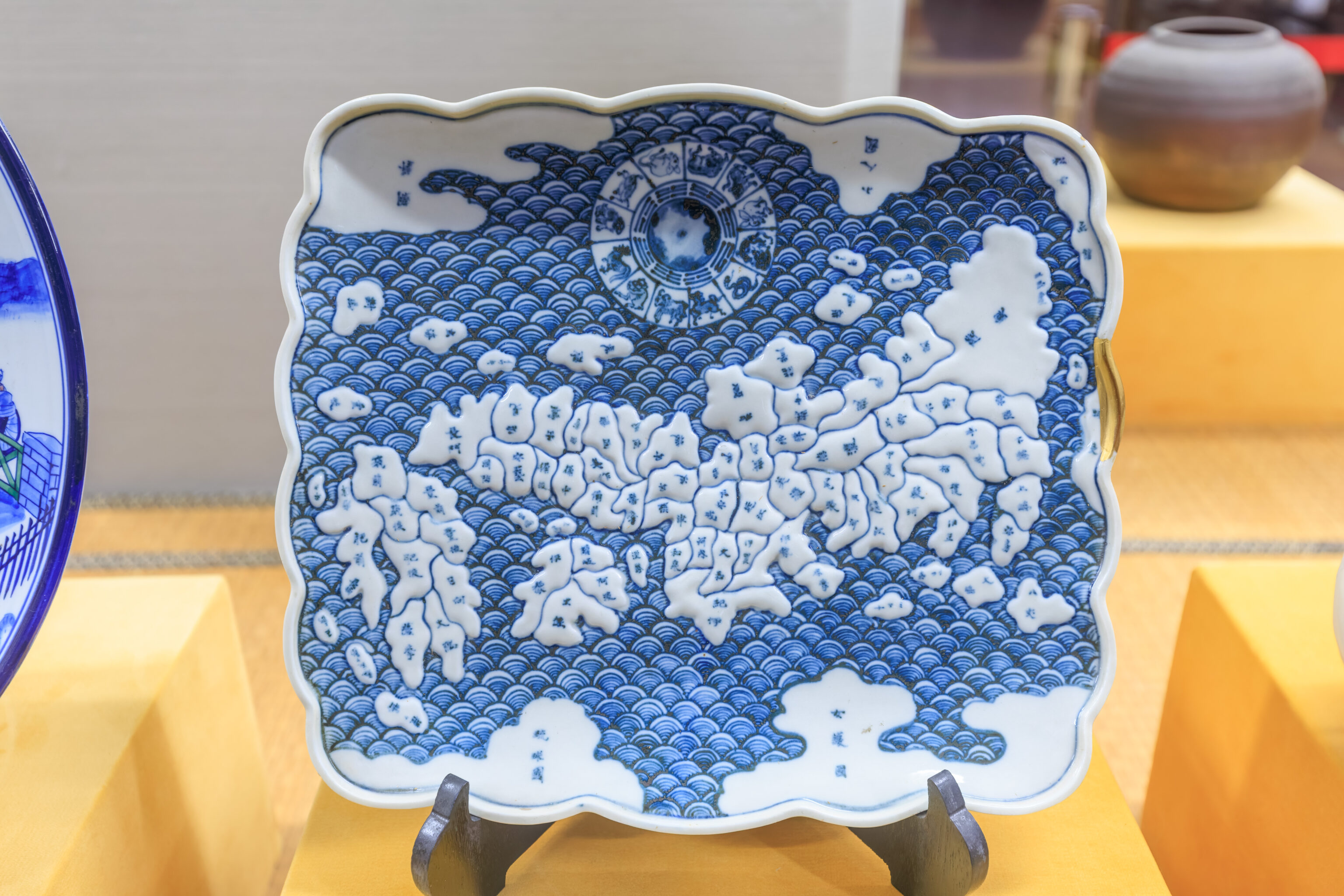
This plate depicts historical provinces of Japan.
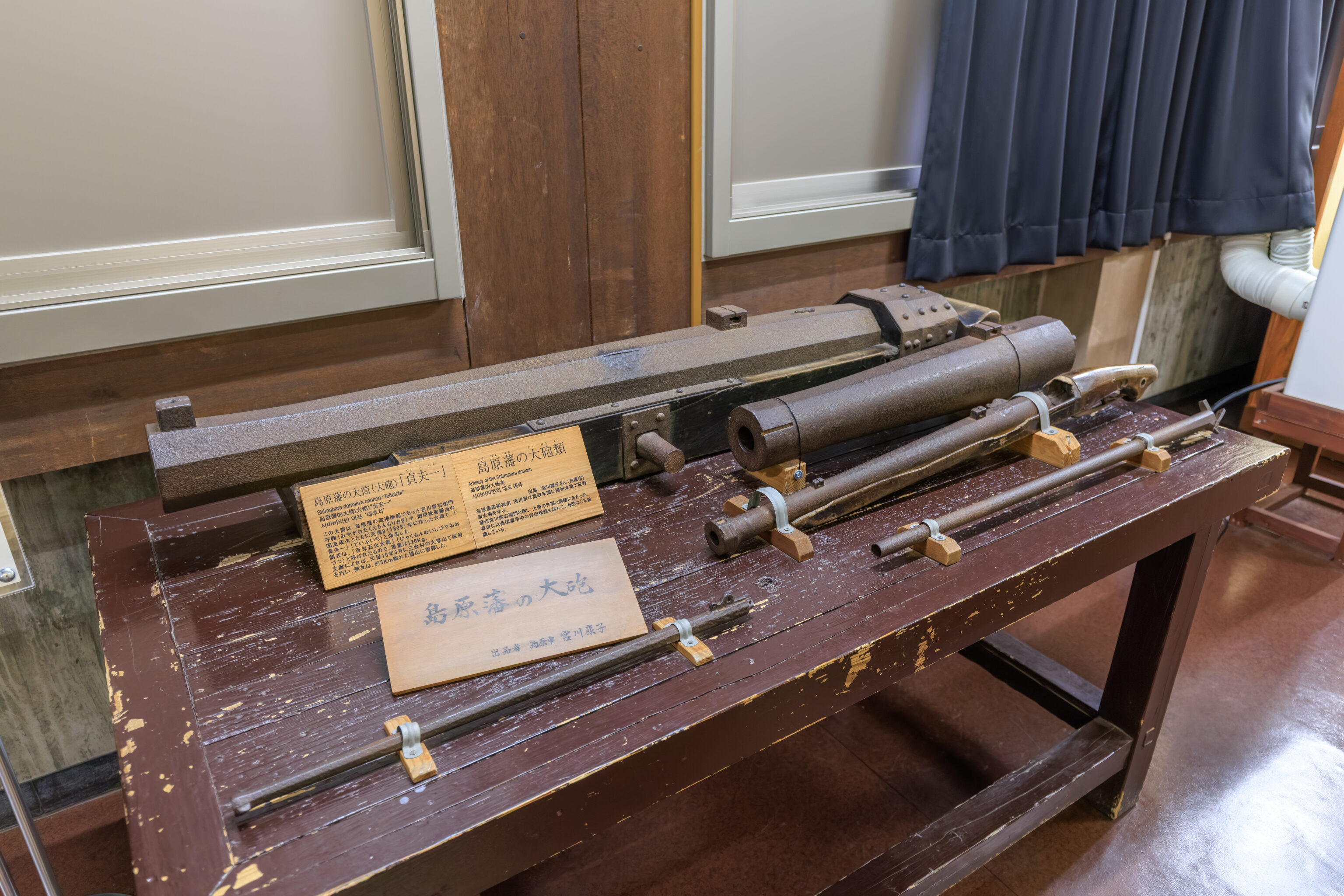
This display shows some weaponry from the Shimabara Domain, particularly the big gun named Teifuichi.
Shimabara domain's cannon "Teifuichi"
This cannon was made in 1838 (Tenpo 9) by Miyagawa Takuemon Morioki, a gunnery instructor for the Shimabara Domain, together with Kunitomo Masahisa, a gunsmith in the domain's service. It was named "Teifuichi."

Its official designation was "Hyakumonmeishibiya Oozutsu" (100-momme Stone-Fire Cannon), and it weighed 120 kg.

According to historical documents, a test firing was conducted in March of Tenpo 10 (1839) at Otsukayama in Mikai Village, and the projectile landed on Mayuyama, approximately 3 km away.
– Text from left wooden panel in the photograph above, read and translated using Google Gemini and Translate.
Artillery of the Shimabara domain
Exhibitor: Yasuko Miyagawa (Shimabara City)

The Miyagawa family, artillery instructors for the Shimabara Domain, studied Ogino-ha firearms in Marugame, Sanuki Province during the Kansei era.

Successive generations of the family, known as Miyagawa Doemon, were involved in the manufacture and training of large cannons.

During the late Edo period, Yoshida Shoin, who was studying in western Japan, also visited the family and discussed coastal defense and other matters.
– Text from right wooden panel in the photograph above, read and translated using Google Gemini and Translate.
Artillery and Lighthouse
The Shimabara Domain's martial arts included artillery (firearms and cannons). You can see the evolution of firearms, from the matchlock guns imported during the Sengoku period, to the mounted pistols (bajōzutsu), and the Spencer rifles (repeating rifles) used in the Meiji Restoration.

The cannon called Teifuichi was made in 1838 by the Miyagawa family, who served as artillery instructors for the Shimabara Domain, in collaboration with the domain's official gunsmith. Weighing 120 kg, it is said that test firings hit Mount Mayuyama, 3 km away.

During the late Edo period, when foreign ships began to appear, Yoshida Shōin, who was studying abroad, visited the Miyagawa family and discussed coastal defense. The site of the Miyagawa family residence remains in the samurai residence district.

After the Meiji Restoration, Shimabara, having supported the shogunate, likely felt somewhat behind. However, the merchants of Shimabara possessed a pioneering spirit. They were the first in the country to jointly fund the construction of a lighthouse in the Ariake Sea, which became a driving force in leading Shimabara in the future.
– Text from a sign, read and translated using Google Gemini and Translate.
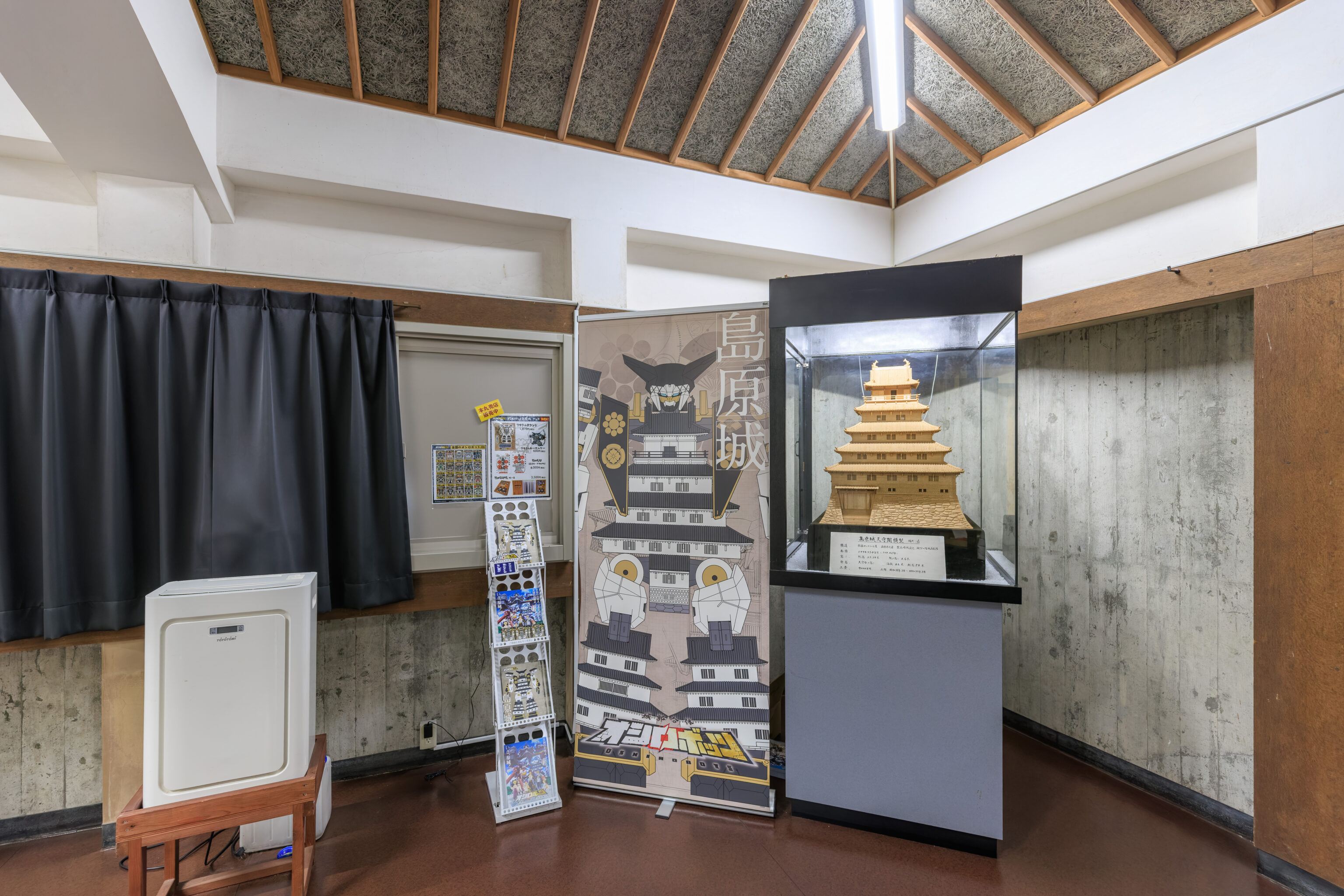
The banner at the center of this photograph depicts a robot castle!
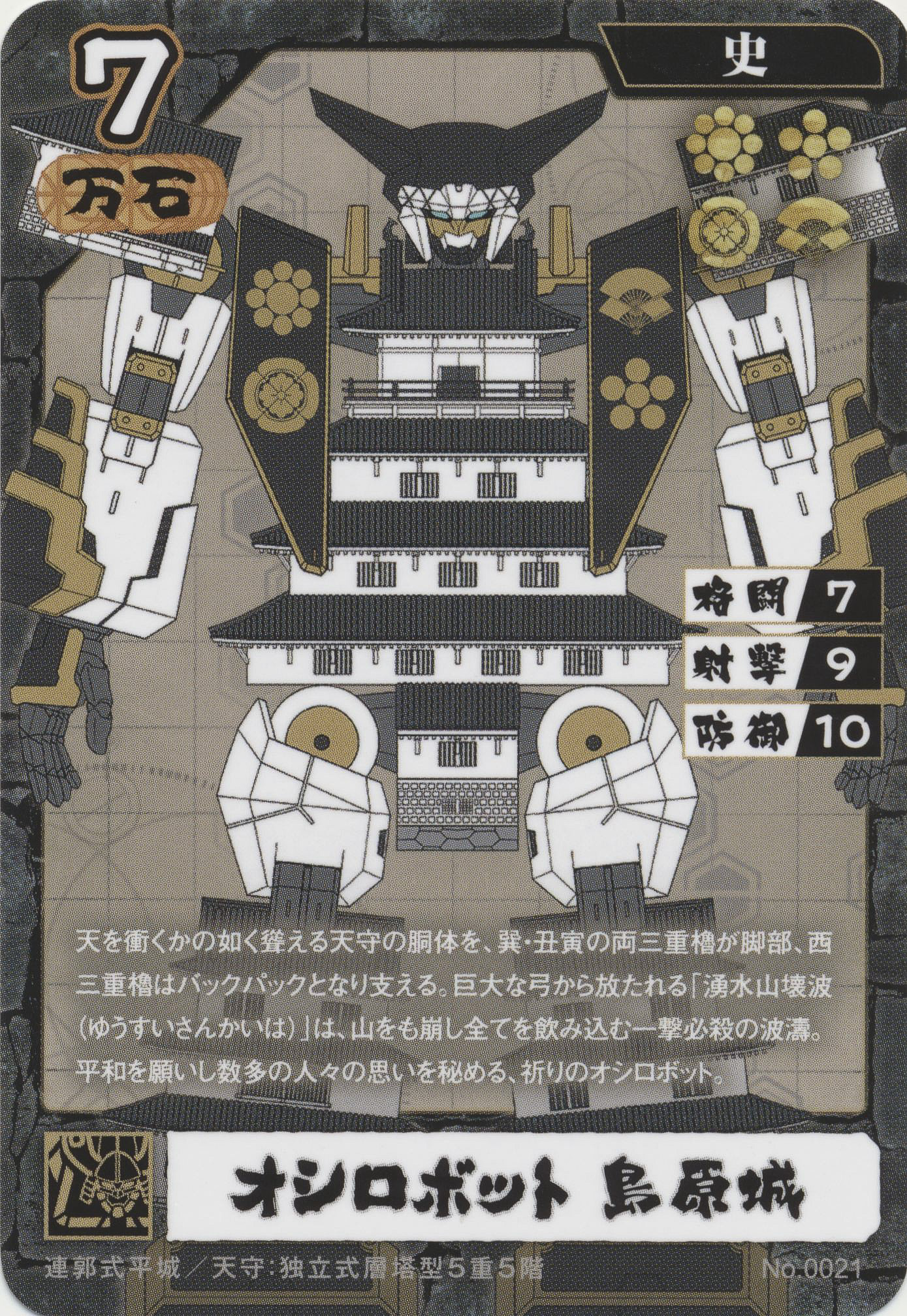
This robot Shimabara Castle is part of the Oshirobots. This seems to be some sort of multimedia project by the MIXI company. There are Oshirobots for over twenty real castles in Japan.
There are a number of short Oshirobots videos available on YouTube, including an introductory short anime.
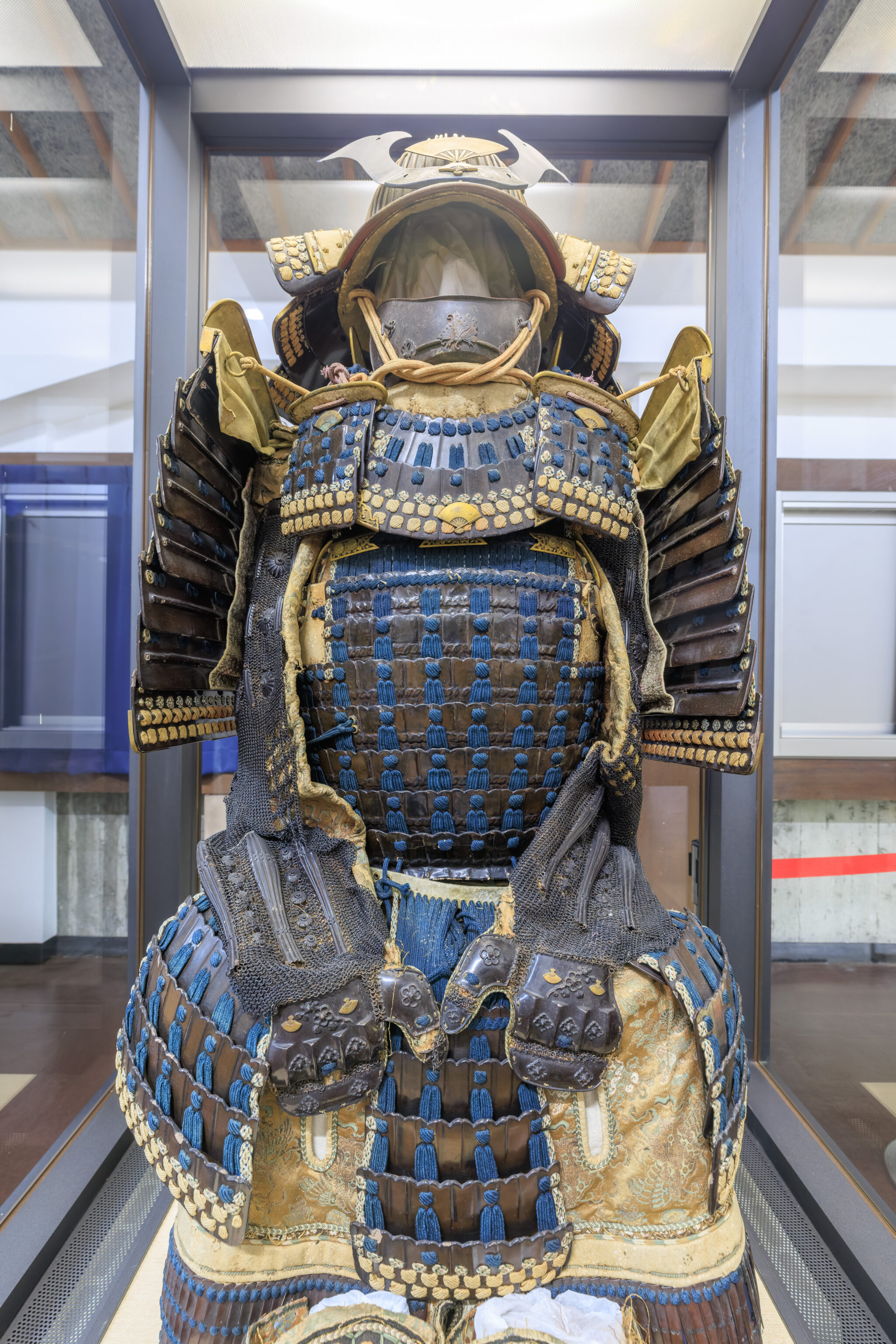
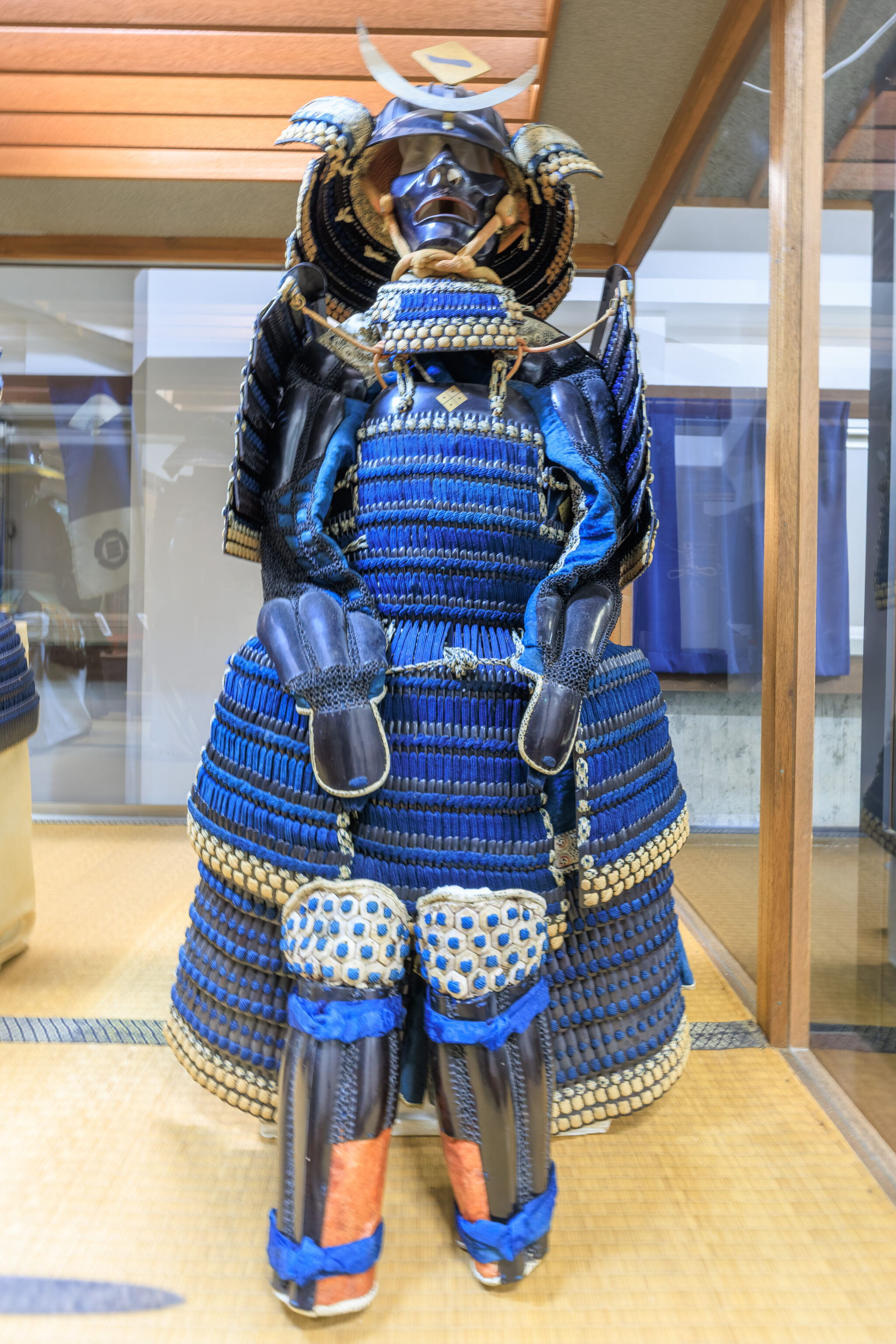
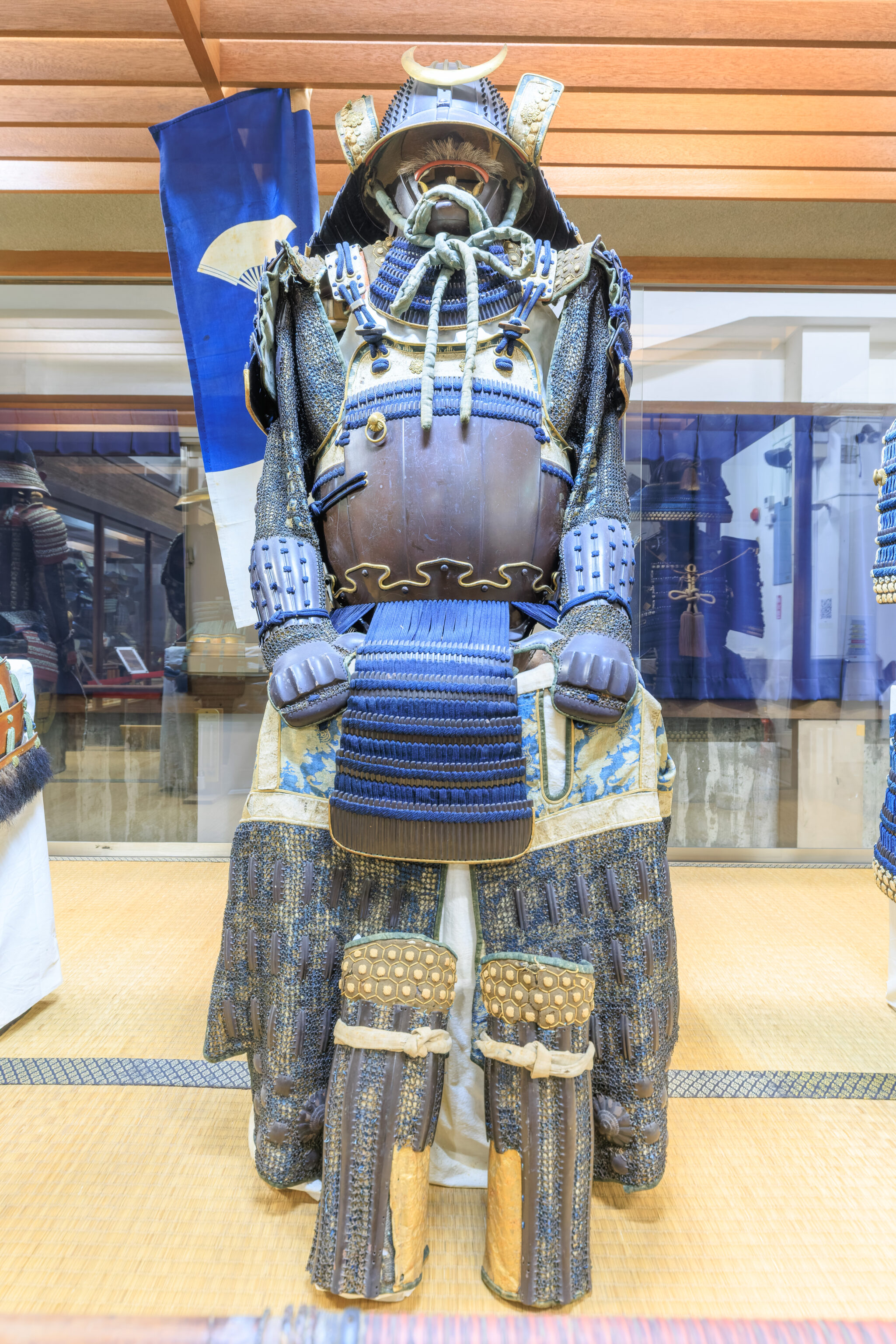
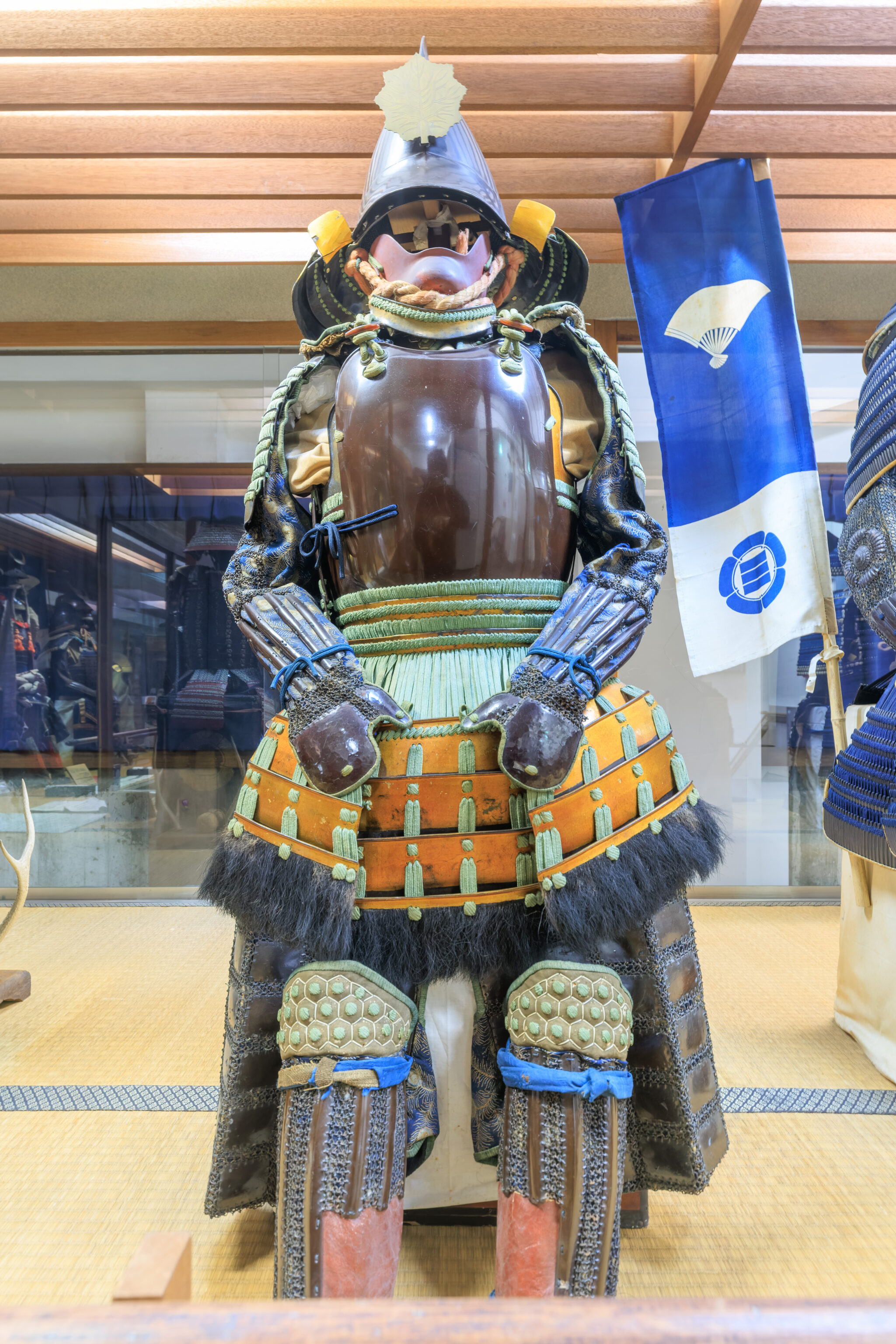
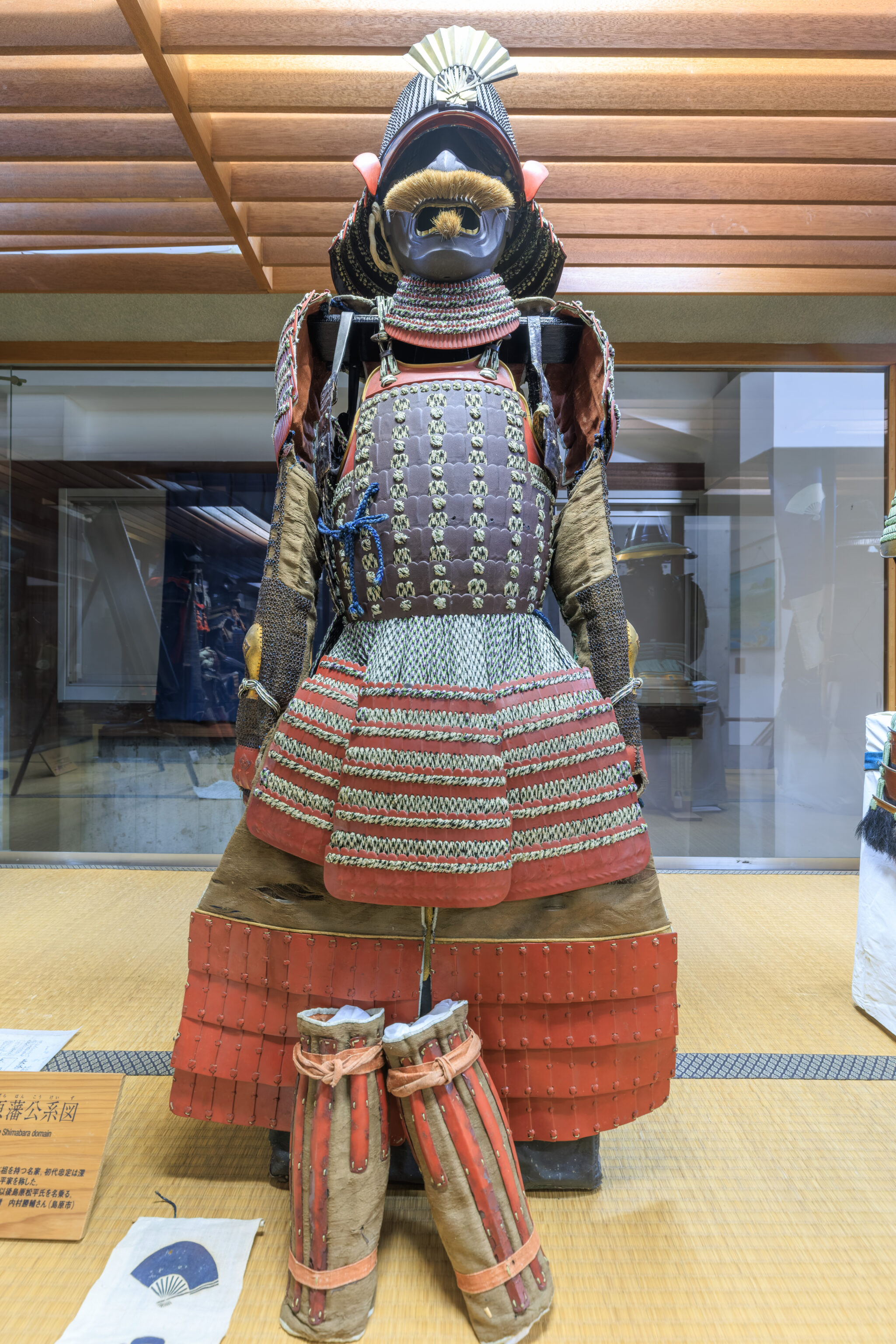
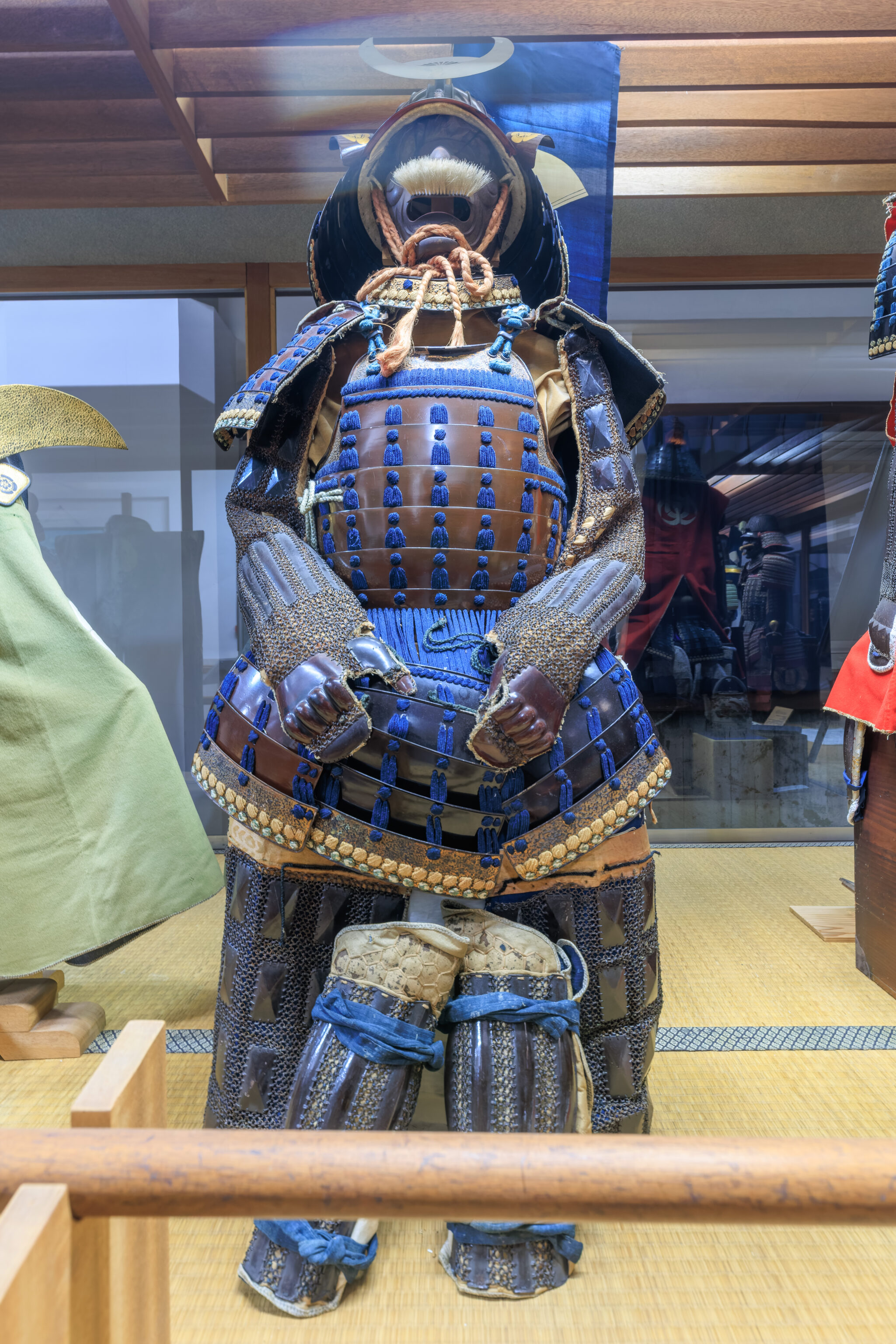
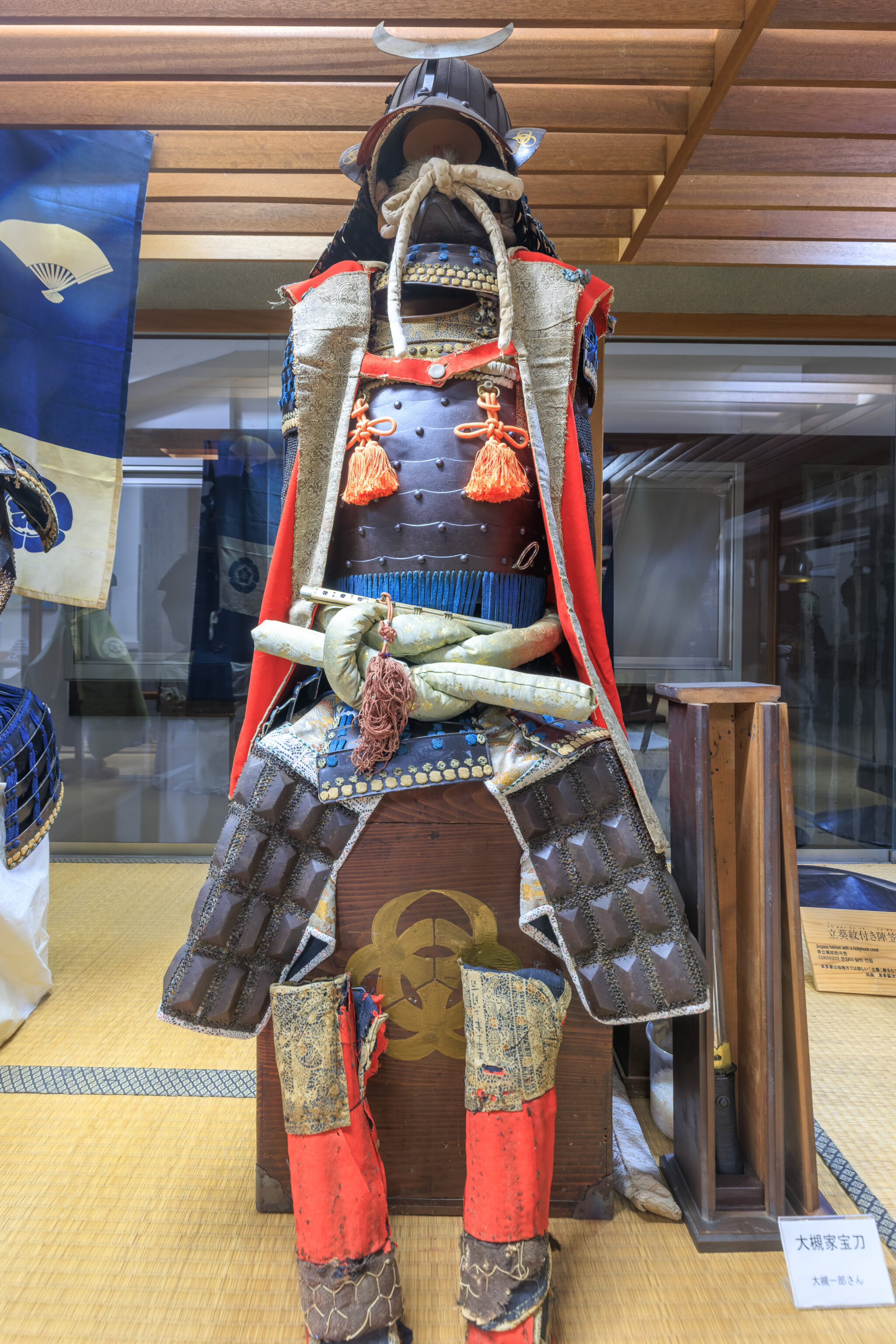
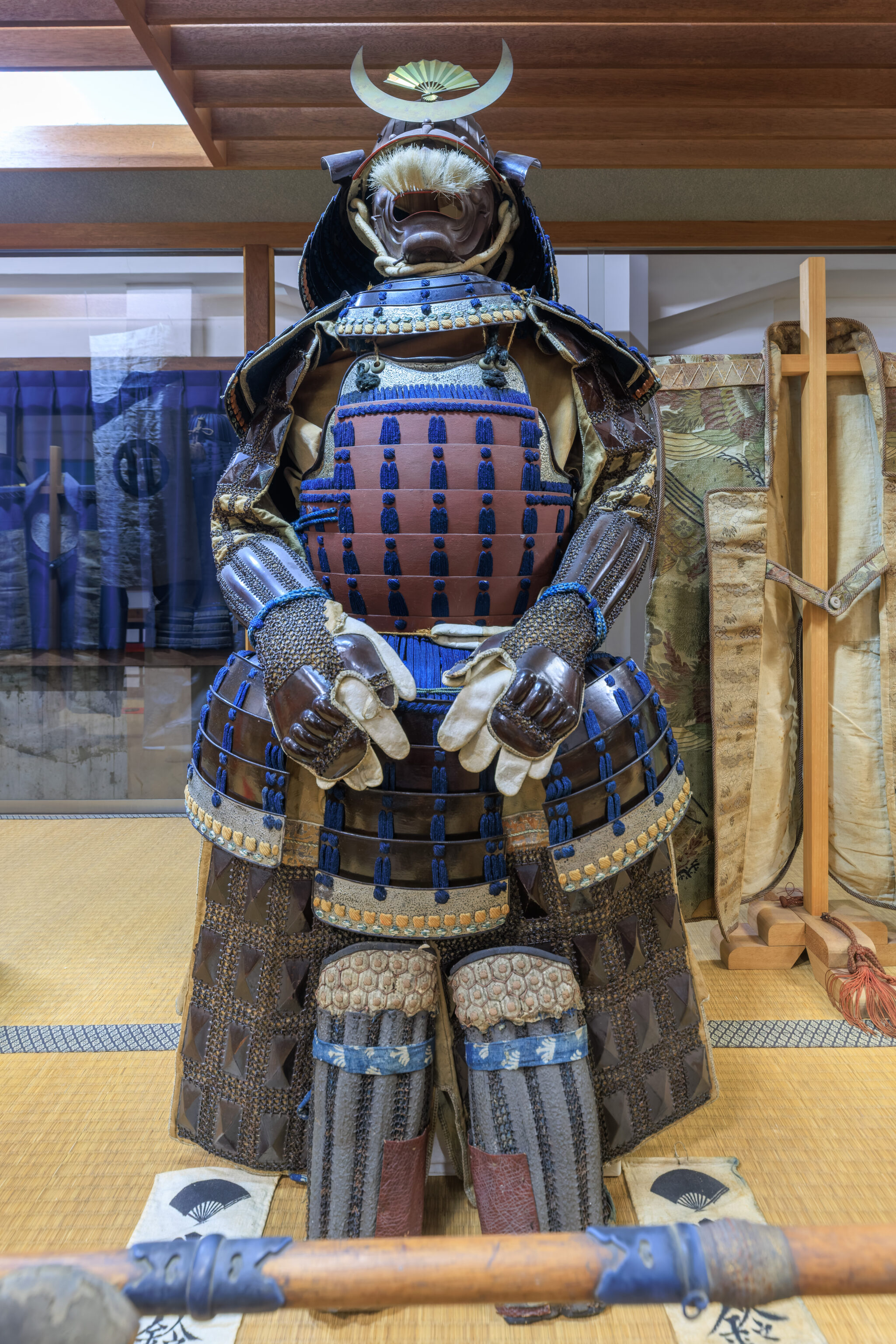
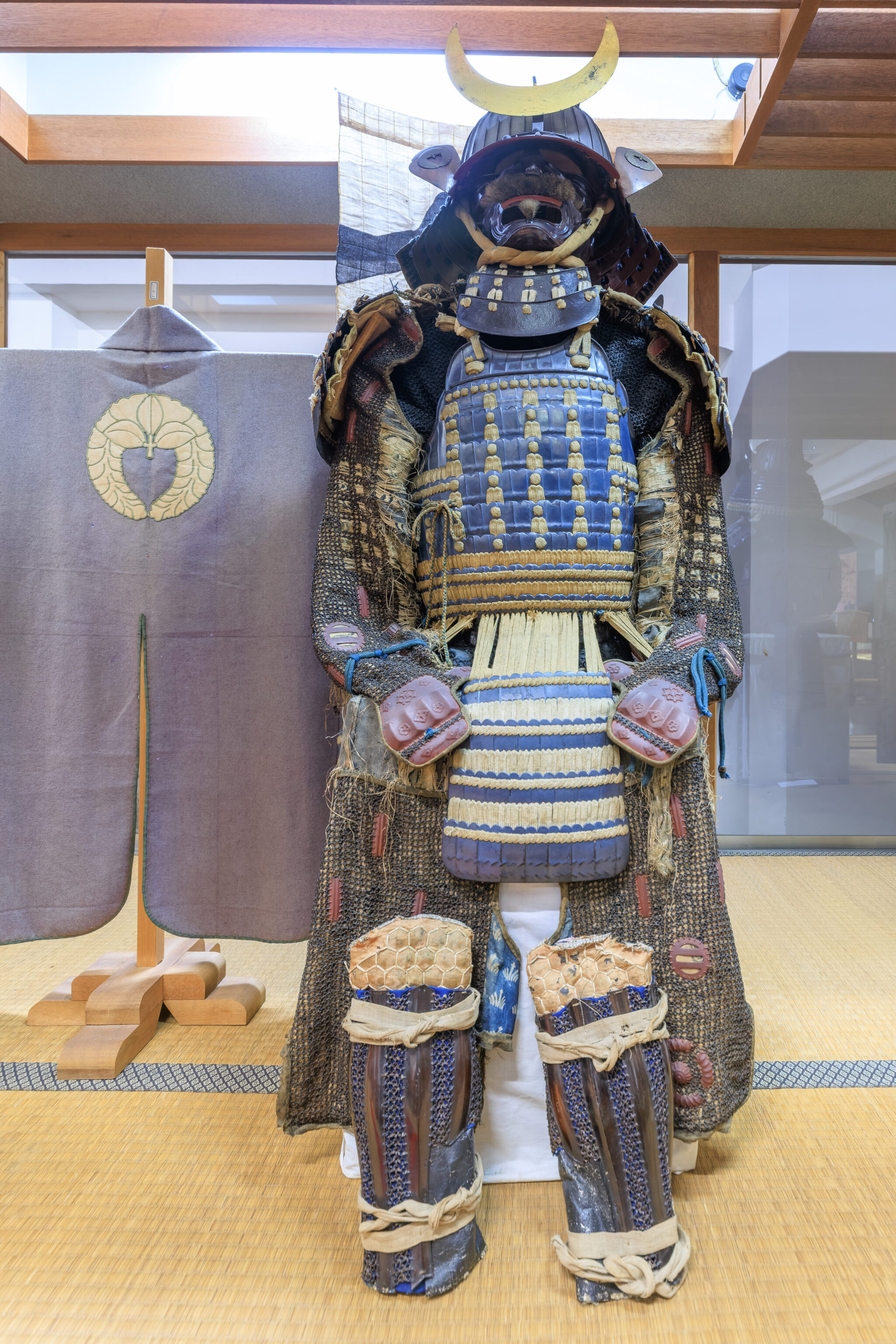
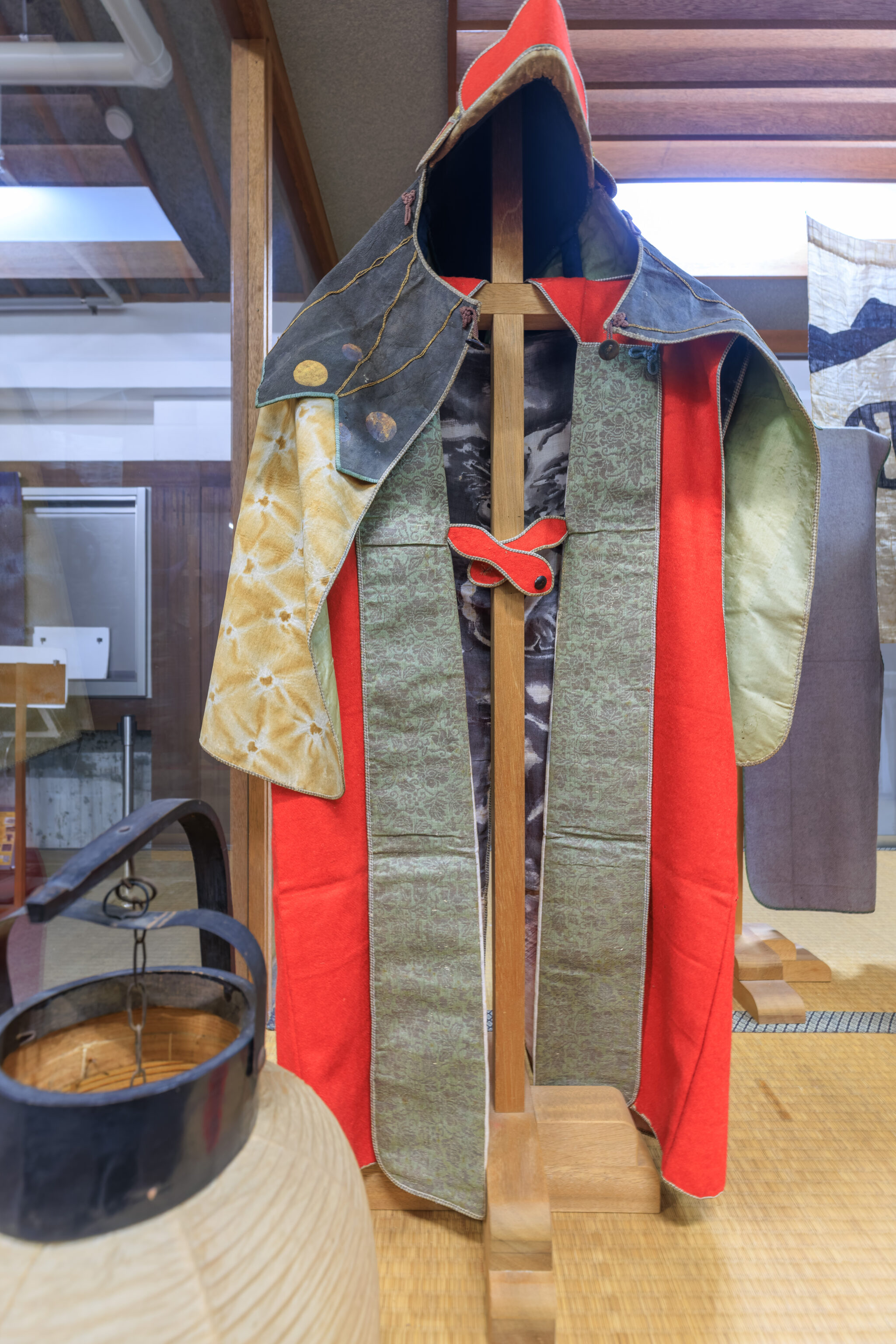
There were also some sets of samurai armor on display. Although the last one seems like it belongs to a spell casting mage, it is actually a fire fighting uniform!
Firefighting Attire
In the event of a fire, the magistrate takes command from the front lines and works to extinguish it. The attire worn at that time is made of woolen cloth with intricate embroidery, and is luxuriously crafted.

Submitted by Mine Nakamura (Shimabara City)
– Text from a sign below the final photograph above, read and translated using Google Gemini and Translate.
It may look like a flashy firefighting outfit, but...
Are you familiar with the saying, "Fires and fights are the flowers of Edo"? During the 267 years of the Edo shogunate, 1,798 fires occurred in Edo, 49 of which are recorded in historical documents, such as the Great Fire of Meireki (1657: over 100,000 deaths, destruction of Edo Castle's keep).

The exhibited item is a fire-fighting outfit believed to have been worn by a magistrate of the Shimabara domain. It's a luxurious garment made of rasha (a thick woolen fabric) with intricate embroidery. While fires were a riot, it seems they were also a "perfect occasion" for showcasing one's stylish and courageous character.

The lining features the eyes of a dragon. Since ancient times, dragons have been considered mythical creatures believed to control water and weather.
– Text from a sign, read and translated using Google Gemini and Translate.
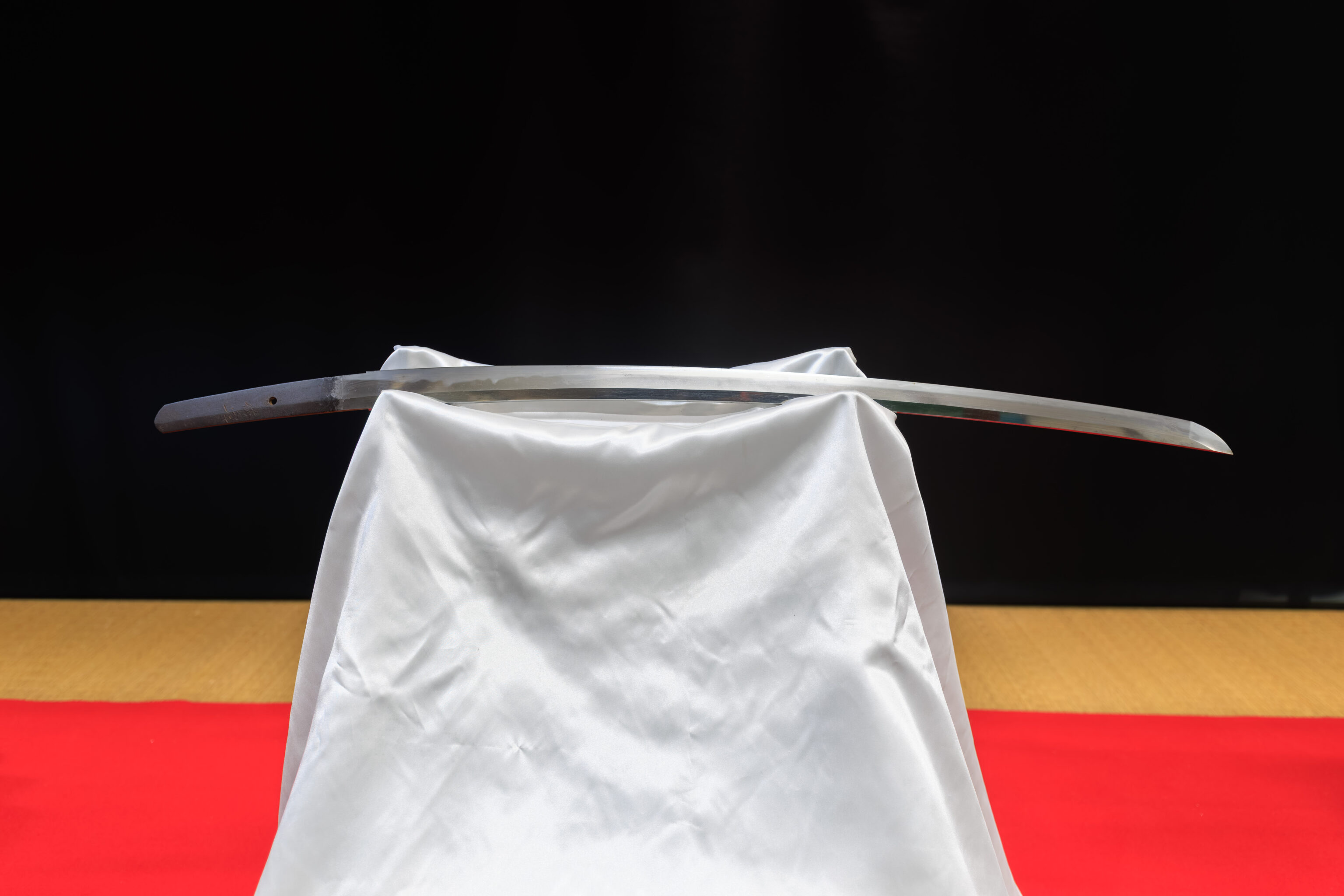
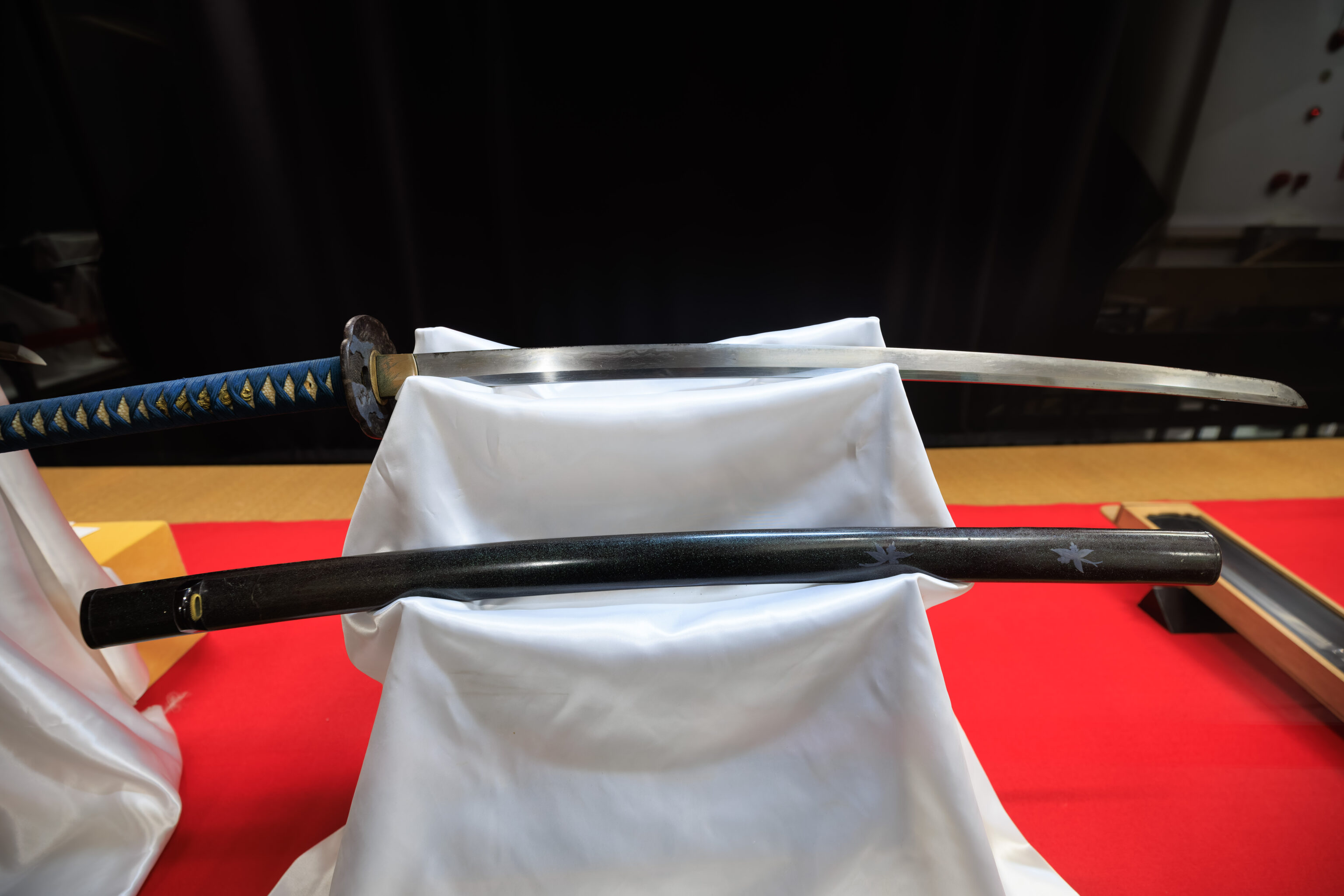
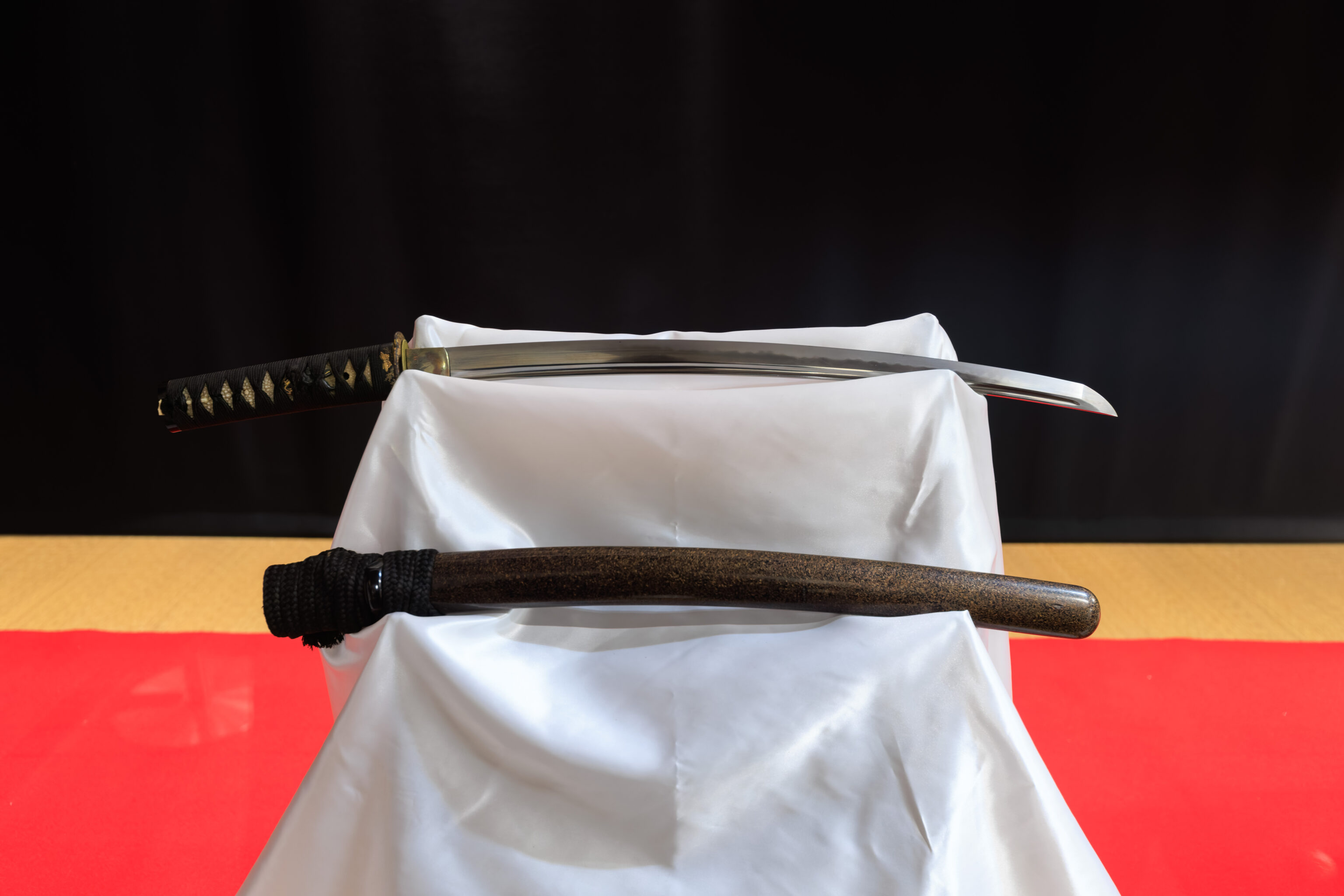
There were some swords on display as well.
A sign discussed the Matsudaira clan, who became the daimyo of the Shimabara Domain.
New Lord from the Matsudaira Clan
Lord Matsudaira Tadafusa was from the Fukozu Matsudaira clan, one of the so-called seven Matsudaira clans. Three generations of his ancestors desperately battled in support of Tokugawa Ieyasu in various regions. Therefore the Fukozu Matsudaira clan gained Ieyasu's great trust for its military prowess.

In 1669, replacing the Koriki clan, Matsudaira Tonomonokami Tadafusa came to Shimabara as a feudal lord. At this point, he became a daimyo with revenues of more than 65,900 koku, since he was given, in addition to the Shimabara fiefdom worth 38,300 koku, the 99 villages of Buzen and Bungo provinces, worth 27,590 koku.

Lords from the Matsudaira clan were assigned to conduct surveillance of Nagasaki, a domain directly governed by the shogunate, and also to serve as a secret watchdog over Kyushu and govern the Shimabara domain. In other words, they played a deterrent role in Kyushu, where there were many non-hereditary vassals (tozama daimyo).

Before Lord Matsudaira Tadafusa arrived, the Shimabara domain changed hands often: from Lord Arima, Matsukura (two generations) to Koriki (two generations). However, under the lordship of the Matsudaira clan, stable rule continued for nearly 200 years (although for 25 years the territory was exchanged with that of the Utsunomiya Toda clan). Stable rule allowed the domain to enjoy economic and cultural prosperity.
– Text from a sign.
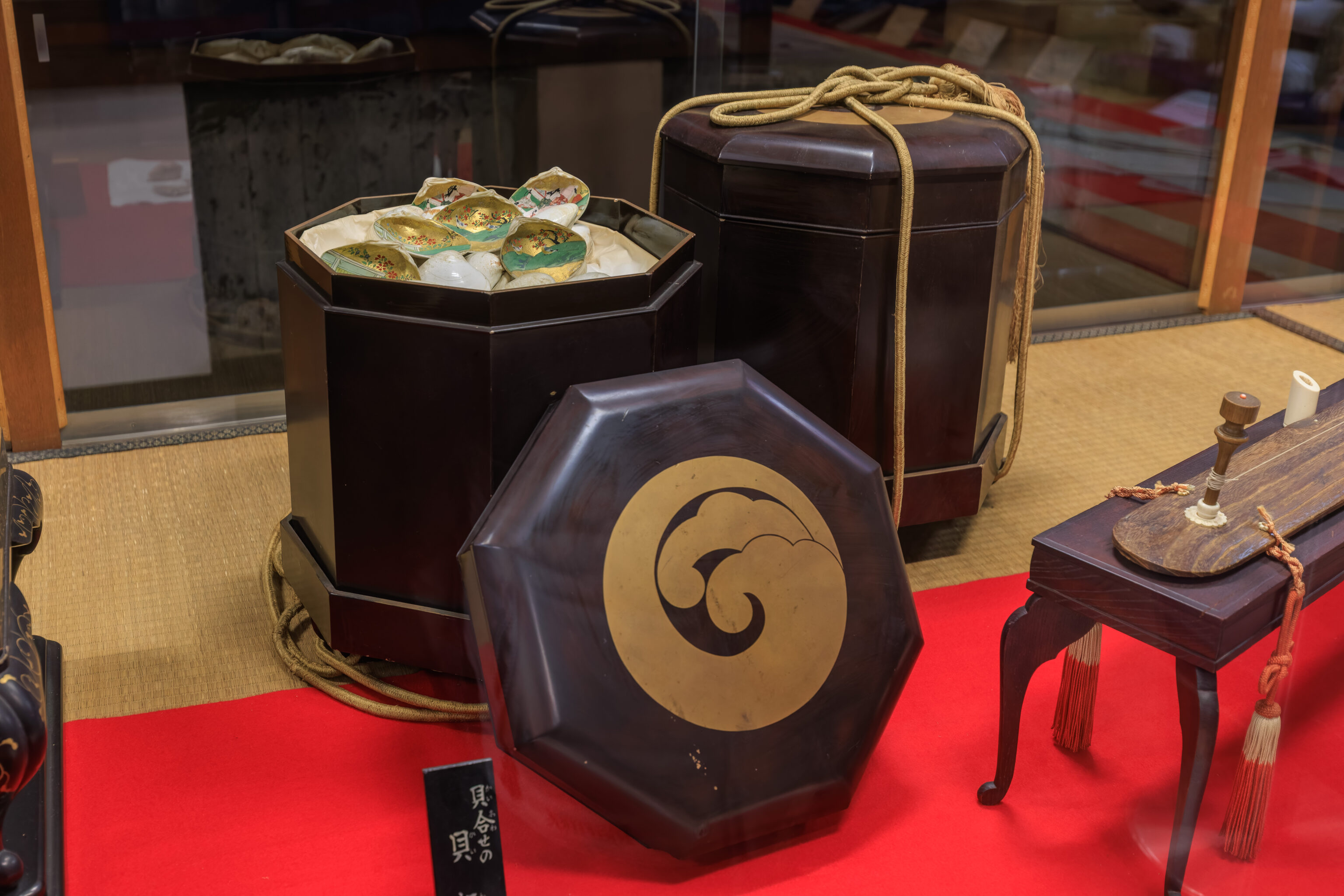
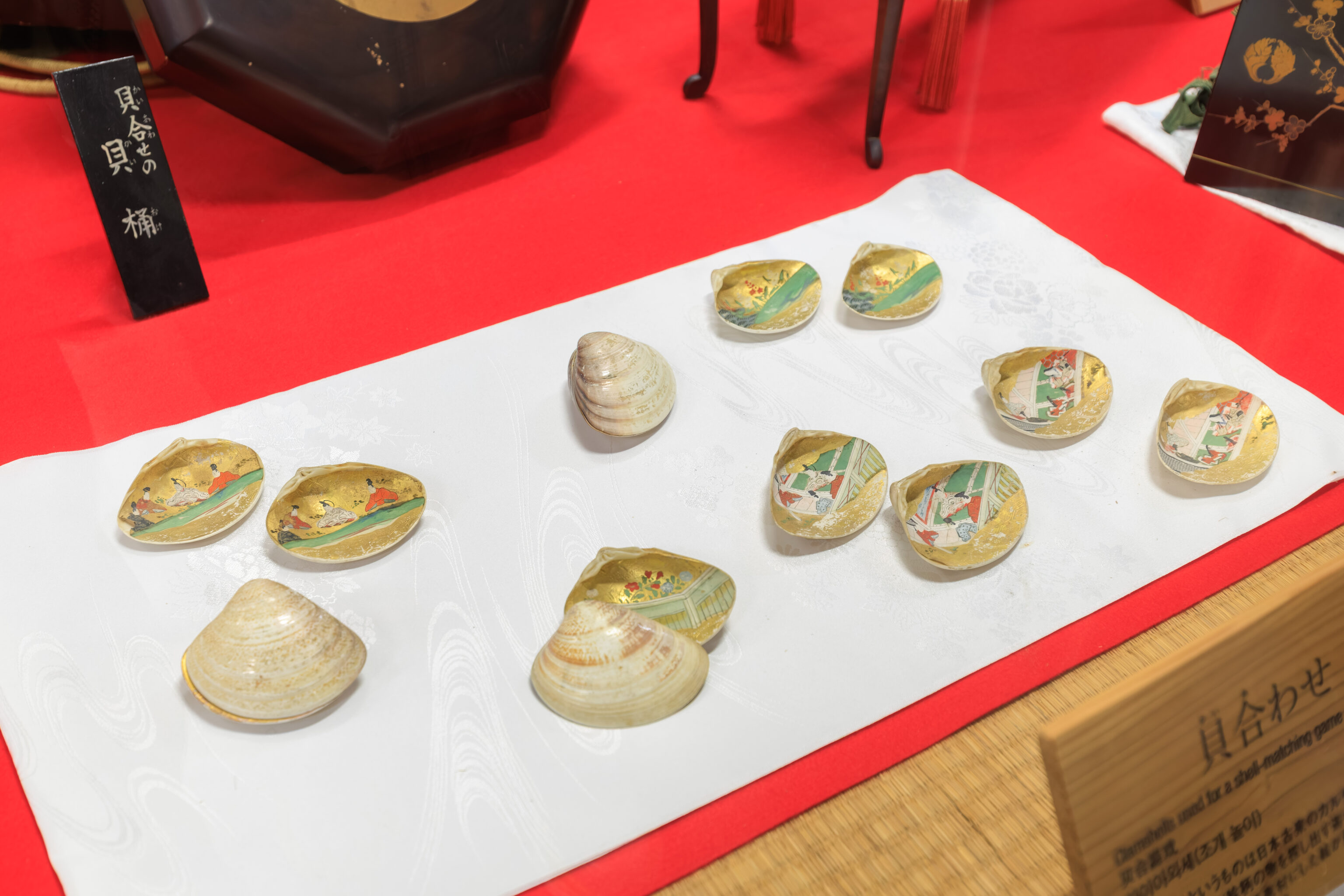
These colorfully painted shells look like they may be pretty ornaments or useful for storing small items. But no, they are used for 貝合わせ Kai-awase (Shell Matching), apparently a game going as far back as the 12th century!
Clamshells used for a shell-matching game
*Kai-awase* is a traditional Japanese card-like game that involves finding matching pairs of shells from a set placed face-down. The interiors of the shells are beautifully decorated with paintings featuring themes such as the beauties of nature (flowers, birds, wind, and moon) or scenes from *The Tale of Genji*. These were items cherished by noblewomen.

Exhibited by: Showa Matsuo (Shimabara City)
– Text from a sign, translated using Google.
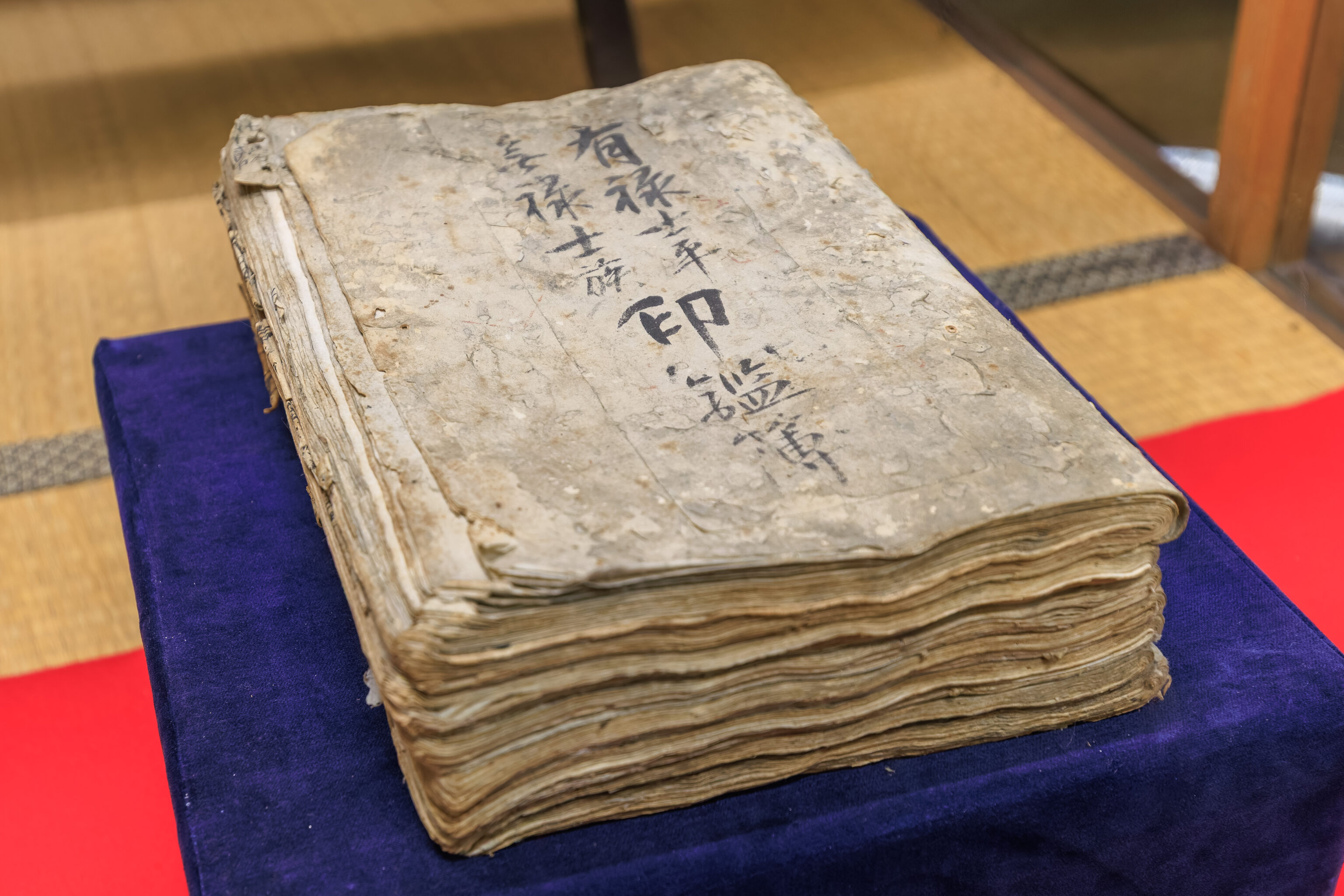
This appears to be a register of seals. Seals would have been used to identify the person or authority on a document, much like a signature in the modern western world.
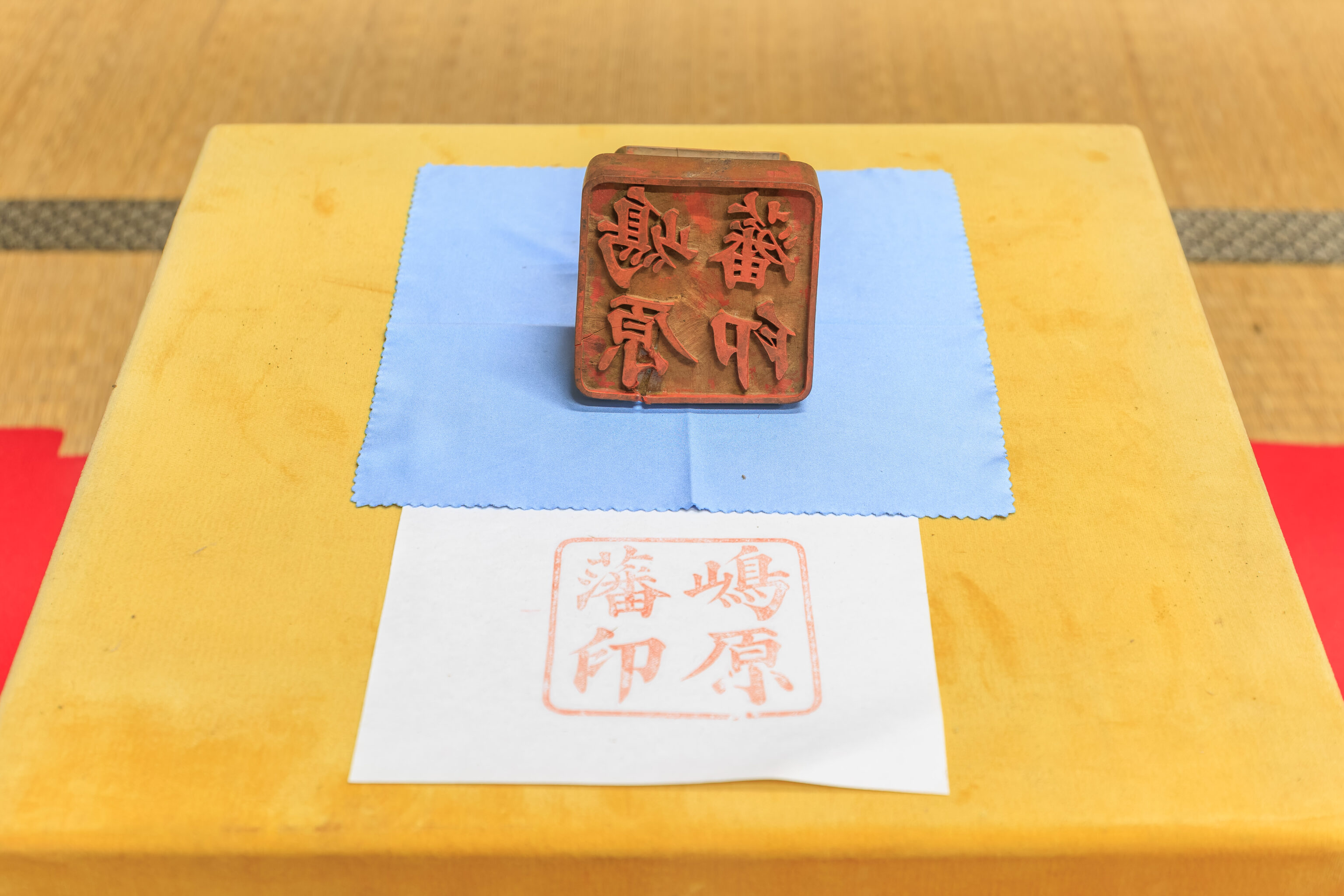
This is a seal that was used in Shimabara early in the Meiji era before the prefectures were established.
Seal of the Shimabara Domain
This "domain seal" was used during the transition to the new Meiji administrative system following the abolition of the Shimabara Domain. It was in use for only a brief period prior to the establishment of Nagasaki Prefecture. It serves as a valuable artifact documenting the dissolution of the Shimabara Domain.

Donated by Mr. Teiichiro Yamamoto (Shimabara City)
– Text from a sign, translated using Google.
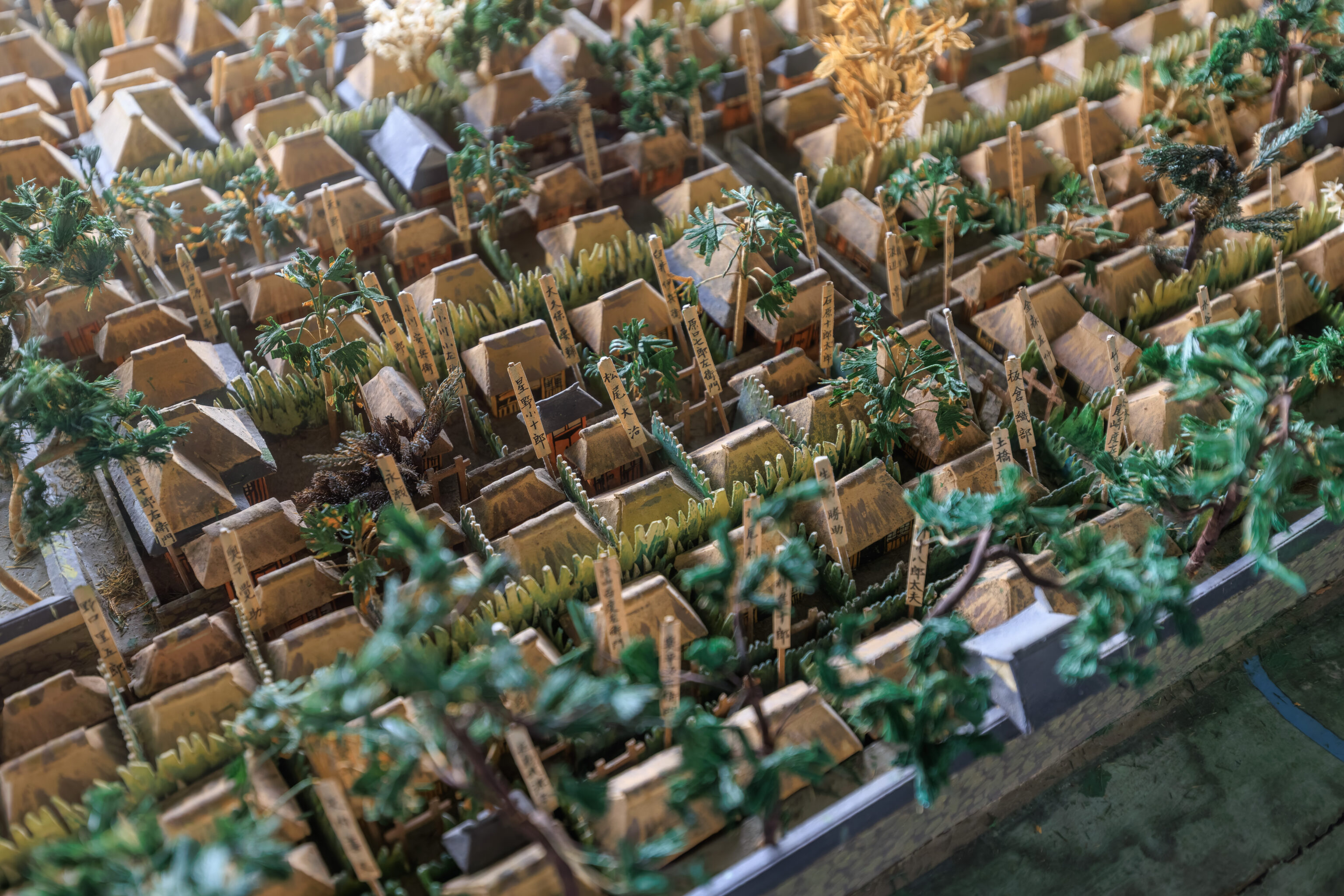
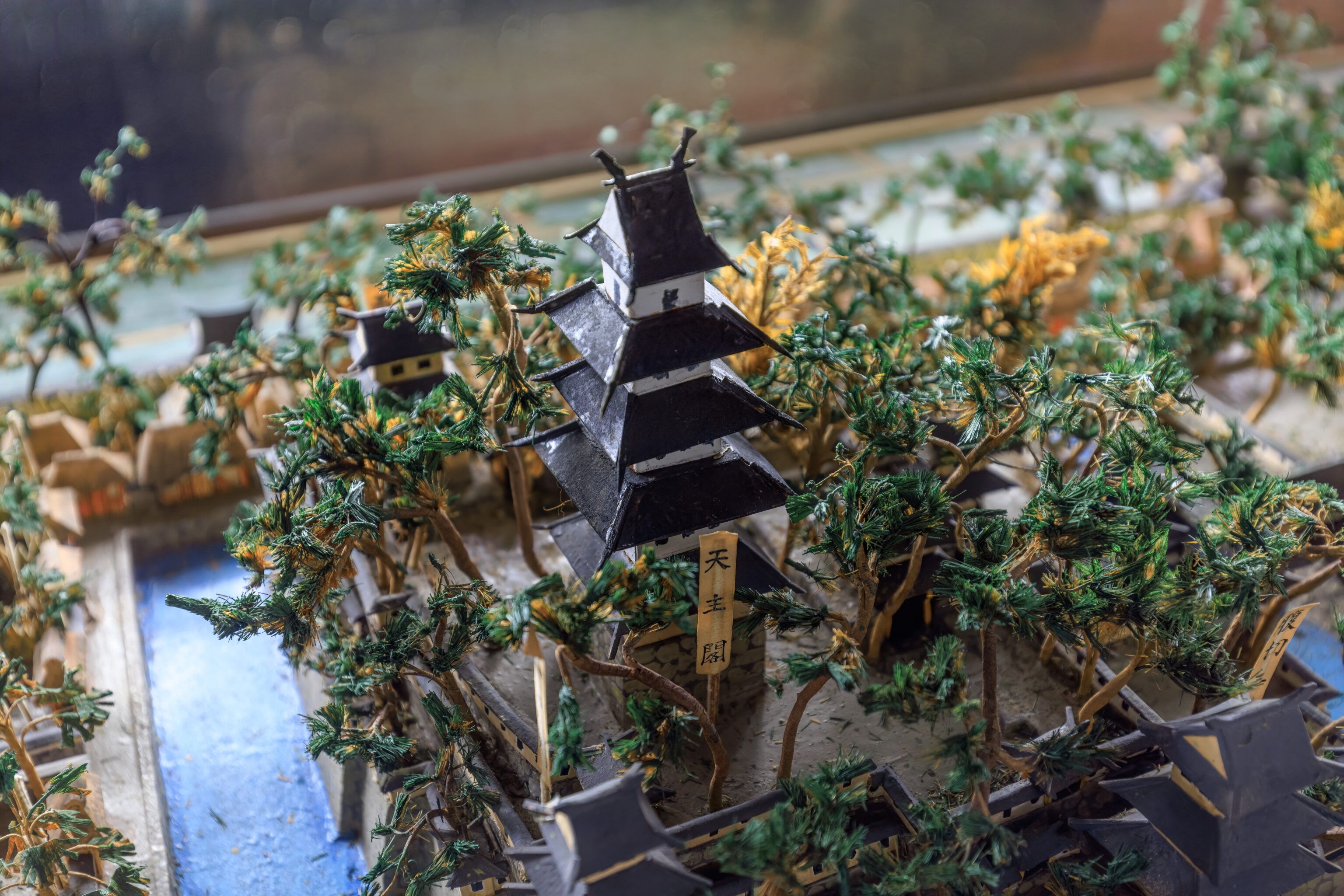
A large and very detailed model depicted Shimabara Castle and the surrounding land.
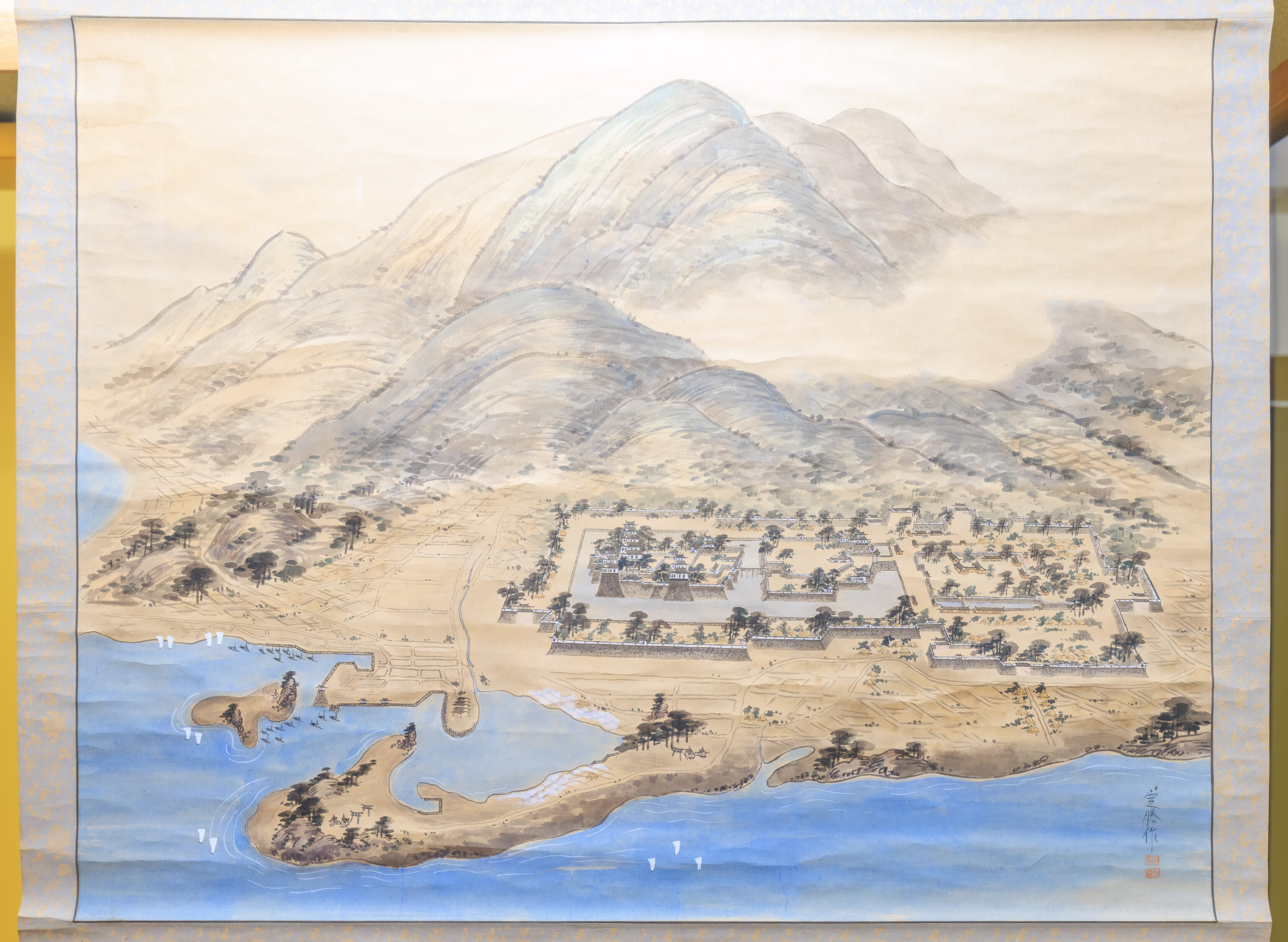
This scroll also depicts the castle.
A sign discusses the creation of Shimabara Castle by new daimyo Matsukura Shigemasa.
Completion of Shimabara Castle
The new lord of Shimabara, Matsukura Bungonokami Shigemasa started governing the domain with enthusiasm typical of a daimyo in the Warring States period, such as launching a project to construct a large-scale castle. Around 1624, it was completed as Shimabara Castle. Matsukura Shigemasa came to Shimabara from Gojo (Nara Prefecture) after his predecessor Arima Naozumi was transferred to Nobeoka. Shigemasa built this new castle as a base for governing his fiefdom. At the same time, he developed Shimabara as a castle town.

The castle's outer precinct measured 350 meters east to west, and 1,200 meters north to south, and was surrounded by a wall 3,800 meters long. In the southern part of the inner precinct was the Honmaru, or main enclosure. Located to the north of the Honmaru were the Ninomaru, or secondary enclosure, and Sannomaru, tertiary enclosure. A five-story, 32-meter-high castle tower stood on the Honmaru, where three-story turrets were set up in three locations. The Sannomaru housed the lord's residence and the domain office as well as the palace. The residential area for higher ranking warriors was located within the castle premises; that for lower ranking warriors was placed on the outer west side of the premises.
– Text from a sign.
The text refers to Matsukura Shigemasa as having the title 豊後守 Bungo no Kami. Bungo was one of the provinces of Japan, most of which has become Oita Prefecture. We were in Bungo earlier on this trip when we visited the area around Yufuin, Beppu, and Oita. It seems that while Bungo no Kami would have been the title for the governor of Bungo Province, it eventually became an honorific title that didn’t really have anything to do with Bungo itself.
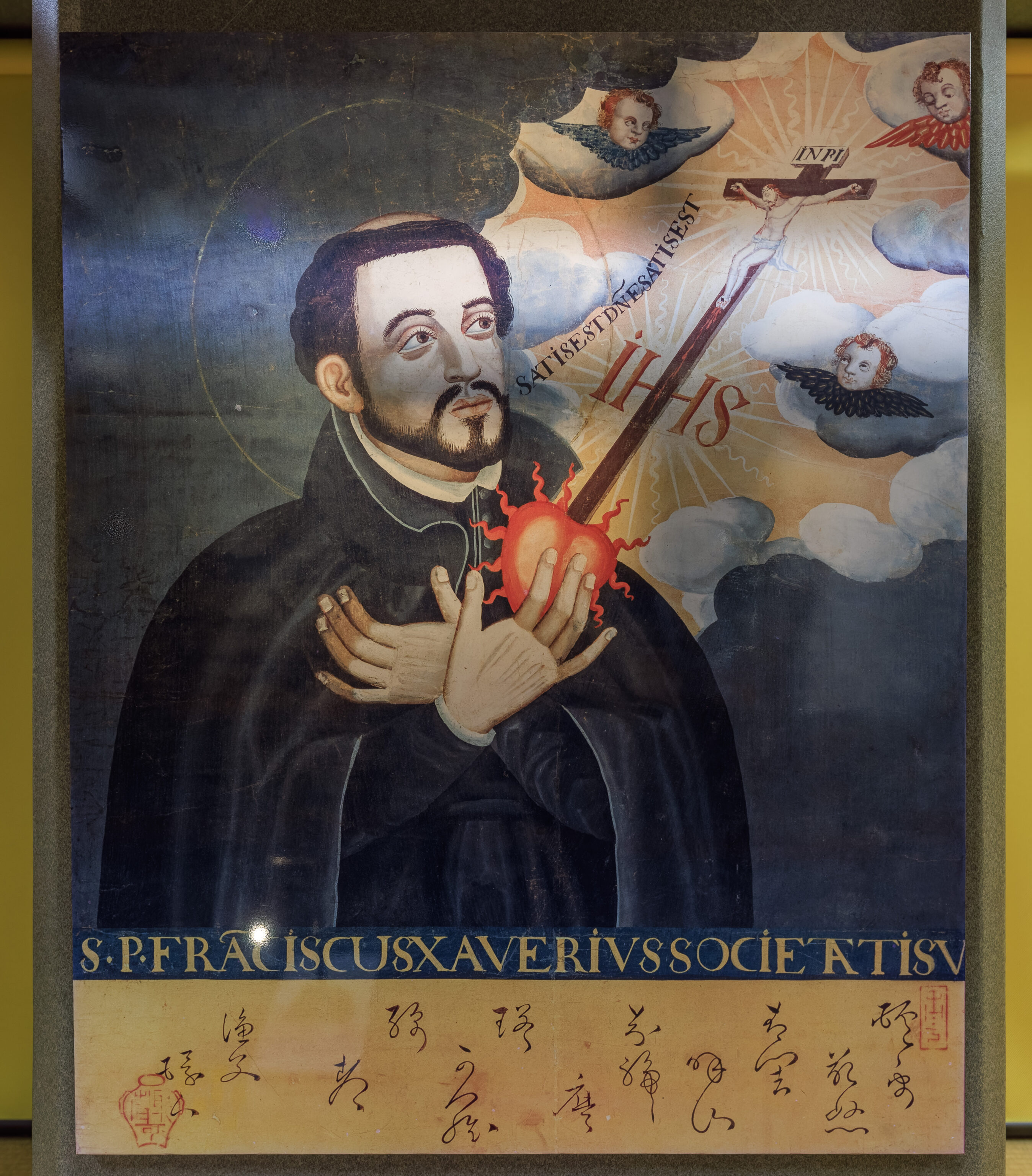
This painting depicts Saint Francis Xavier, the missionary who brought Christianity to Japan.
Portrait of Saint Francis Xavier
Discovered in Osaka Prefecture in 1920, this is a valuable early Japanese Western-style painting and Christian religious painting. Needless to say, Xavier was the one who introduced Christianity to Japan. Holding a red heart representing his teacher's firm faith and deep passion for missionary work, he gazes up at the crucified Christ, murmuring, "God, this heart is purified and filled." In the center of the cross, the abbreviation IHS for Jesus Christ shines brightly. At the bottom, the kanji characters read San Francisco Saverio Sacramento, meaning "Saint Francis Xavier is performing the sacraments." The signature of Gyofu Kanjin can be seen.
– Text from a sign below the painting, translated using Google Translate.
Another sign briefly details the spread of Christianity into Shimabara:
Christianity Arrives in Shimabara
Christianity, first introduced to Japan by Francis Xavier, spread to the western and eastern parts of Kyushu, and reached the Shimabara Peninsula in 1563. After Arima Yoshisada, the feudal lord of the Shimabara domain, gave permission to construct a church at Kuchinotsu Port, Jesuit missionary Luis de Almeida came to Shimabara and propagated Christianity in the district, which saw a rapid spread of the religion. In 1567, a Portuguese ship entered the Port of Kuchinotsu, and the Arima clan earnestly started the so-called Nanban trade with Europe. Yoshisada was also converted to Christianity, and churches were built in various parts of Shimabara. The Shimabara Peninsula thus came to serve as a major center for Christianity in Japan.
– Text from a sign.
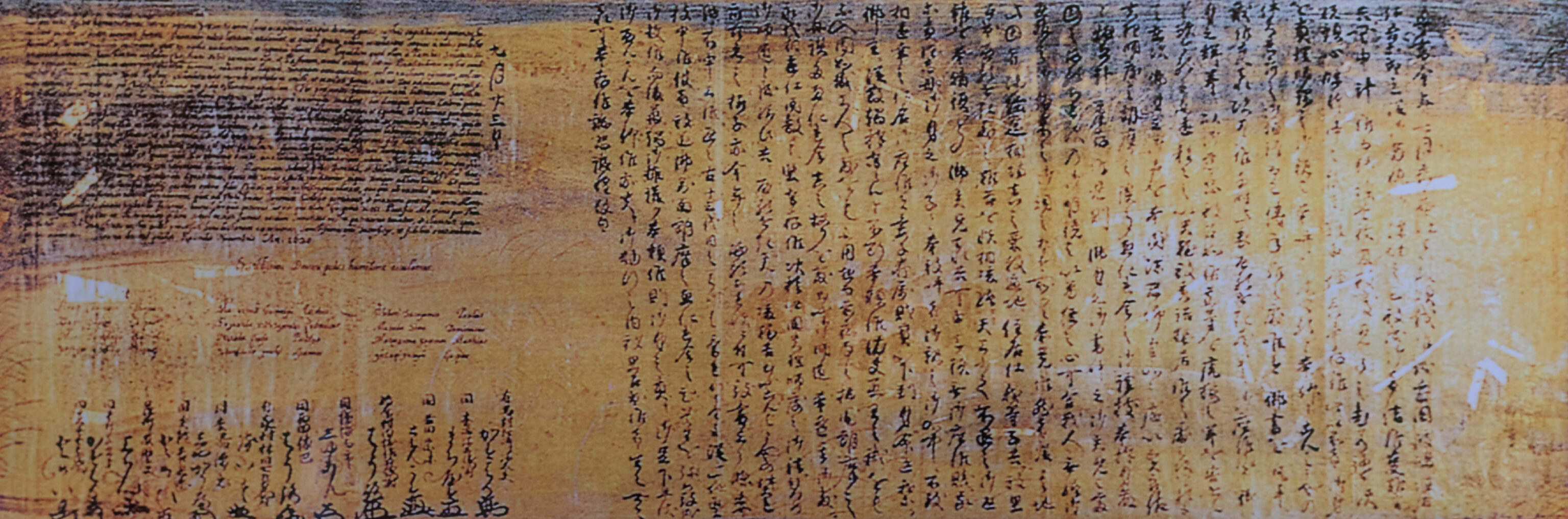
This is a reproduction of a letter written to the Pope. The original is at the Vatican Library with scans available online.
Letter to the Pope
In 1619, Pope Paul V sent a letter of encouragement to Japanese believers suffering under persecution. In response, believers in Shimabara—following the example of Julian Nakaura (of the Tenshō Embassy to Europe)—drafted a reply signed by twelve representatives. At that time, the persecution of Christians was underway in Shimabara (thirty-seven of these individuals were beatified in 2008).

The photograph shows a document housed in the Vatican Library. The area within the red dotted line contains a letter addressed to Pope Paul V from Japan, bearing the inscription: "This life as a testament of faith—burning with fervor..."

The white dotted line indicates the signatures of the twelve individuals. The characters for "Arima Village" are also visible.
– Text from a sign, read and translated using Google Gemini and Translate.
So what does the letter say? Luckily, Matthew Aegrin (u/matt_aegrin on Reddit) has translated it!
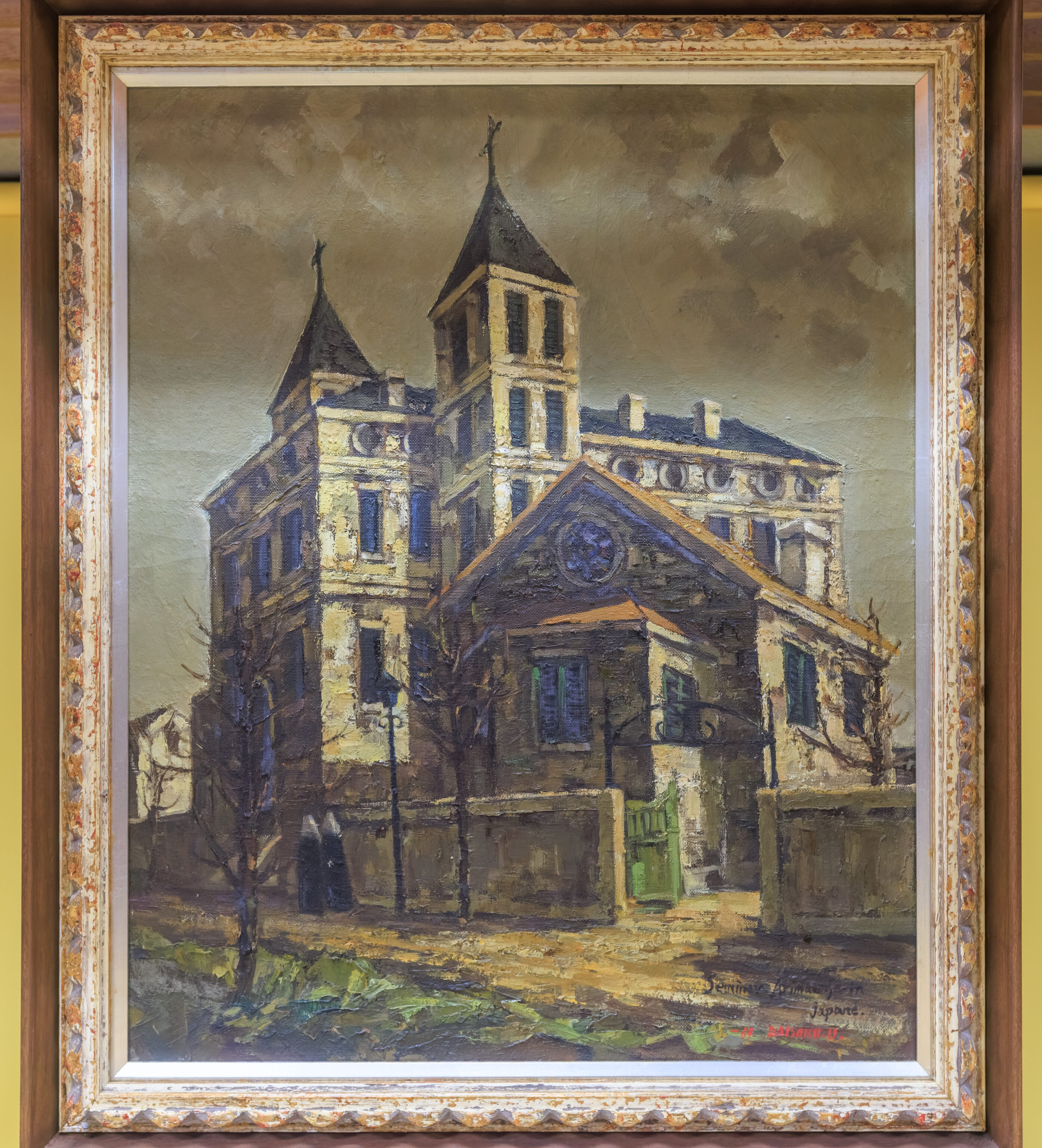
This painting depicts a seminary in Arima, Japan, according to the text at bottom right. The Arima Clan were the daimyo of the Shimabara Domain until 1614. Was there a place called Arima? 南有馬町 South Arima Town was on the southern side of the Mount Unzen and is today part of 南島原市 South Shimabara City. A bit of Google Maps sleuthing reveals the 有馬のセミナリヨ跡 Site of the Arima Seminary and an official Nagasaki Prefecture page on the Estimated Site of the Arima Seminary.
Seminario
A primary seminary established based on the European educational system. Higher-level seminaries, known as *colégios*, were also opened. Visitor Valignano, who arrived in Japan in 1579, recognized the need to train Japanese clergy and opened schools in Arima and Azuchi the following year. Boys as young as ten were admitted to these boarding schools, where they studied subjects such as theology, Latin, Japanese, history, and music. Miguel Chijiwa, Mancio Ito, Julian Nakaura, and Martin Hara traveled to Rome to meet the Pope in 1582; they were warmly welcomed and successfully fulfilled their important mission.
– Text from a sign below the painting, translated using Google Translate.
The quoted text above mentions a trip to Rome by four Japanese. The quoted text for the letter to the Pope also mentioned this trip, referred to as the Tensho Embassy. A sign provided more detail about this trip:
Four Boy Ambassadors, including Chijiwa Miguel, Visit Rome
To convey how prosperous Christianity was in Japan at that time, four Japanese boys left Japan for Europe to see and express appreciation to the Pope. They were members of the Boys' Delegation to Europe, also known as the Tensho Embassy.

Since Father Alessandro Valignano recognized Japanese people's excellence, he wanted to tell European people how wonderful Japanese people were, while letting Japanese people understand the development of Western culture centering on Christianity. It was therefore decided to send a Japanese embassy to Rome, consisting of four boy delegates selected from among Seminario students. Chijiwa Miguel, a cousin of Arima Harunobu and a nephew of Omura Sumitada, and Ito Mancio from Miyazaki, who was distantly related to Otomo Sorin, served as chief delegates of the mission. The two other members were Nakaura Julião and Hara Martino. In February 1582, the embassy left Nagasaki Port and arrived in Portugal in 1585. On March 23, the ambassadors had an audience with Pope Gregory XIII. They were greatly welcomed, admirably fulfilling their mission. The embassy safely arrived back in Nagasaki in July 1590.

The four ambassadors were subsequently ordained, but later Chijiwa Miguel abandoned the faith. The remaining three continued working to support churches during the period of religious oppression.
– Text from a sign.
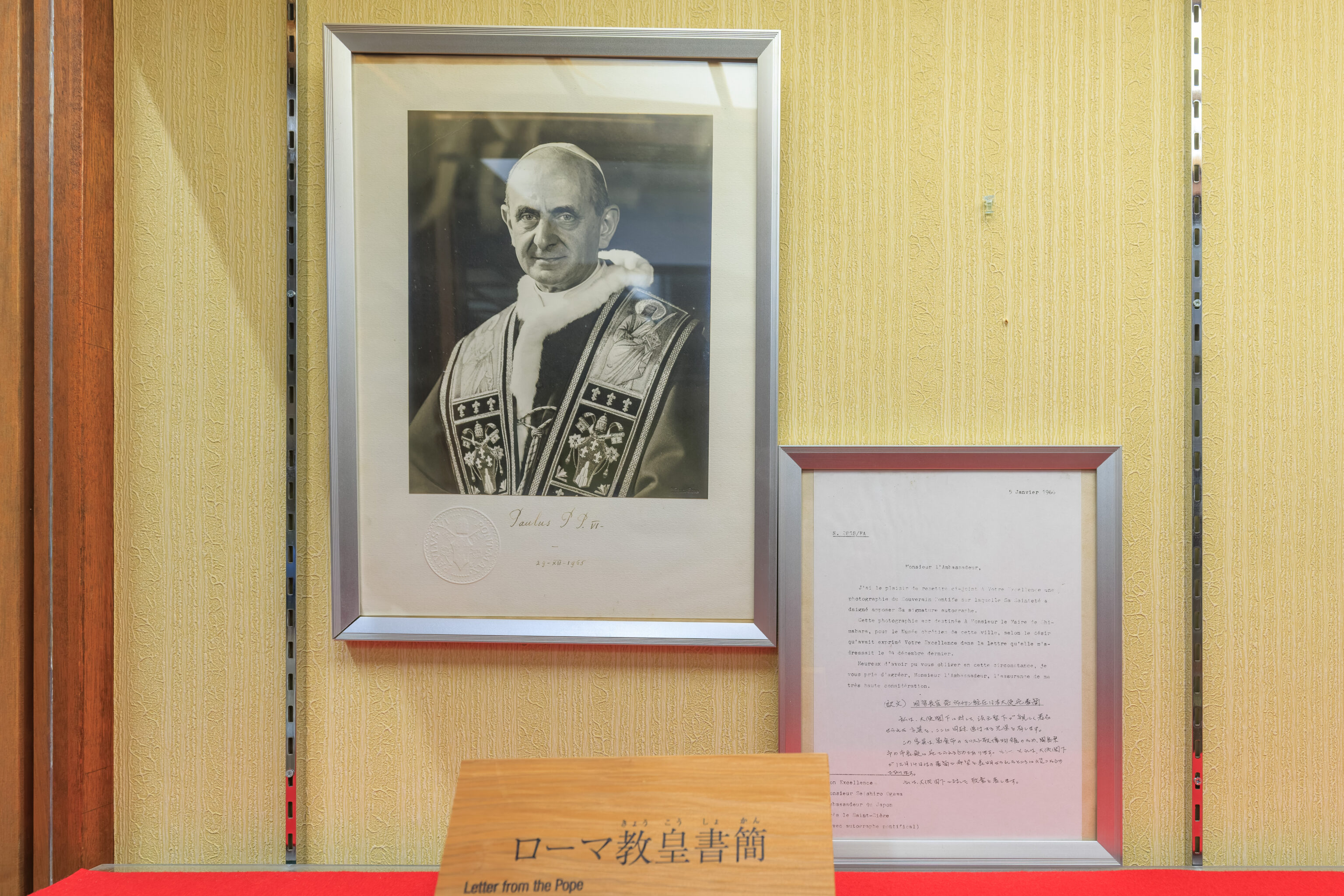
This is a letter that sent by Pope Paul VI in 1966.
Letter from the Pope
Pope Paul VI presented a photograph and a letter to mark the opening of the Shimabara Castle Christian Historical Museum.
– Text from the wooden sign partially visible in the photograph above, translated using Google.
The letter, which is in French, reads:
January 5, 1966
No. 2818/FA

Mr. Ambassador,

I have the pleasure of enclosing herewith, for Your Excellency, a photograph of the Sovereign Pontiff upon which His Holiness has graciously affixed His autograph signature.

This photograph is intended for the Mayor of Shimabara, for the city's Christian Museum, in accordance with the wish Your Excellency expressed in the letter addressed to me on December 14th.

Delighted to have been of service to you in this matter, I beg you to accept, Mr. Ambassador, the assurance of my highest consideration.
– Text from the letter, translated using Google Gemini.
The museum referred to in the letter appears to be this exhibit here in the castle.
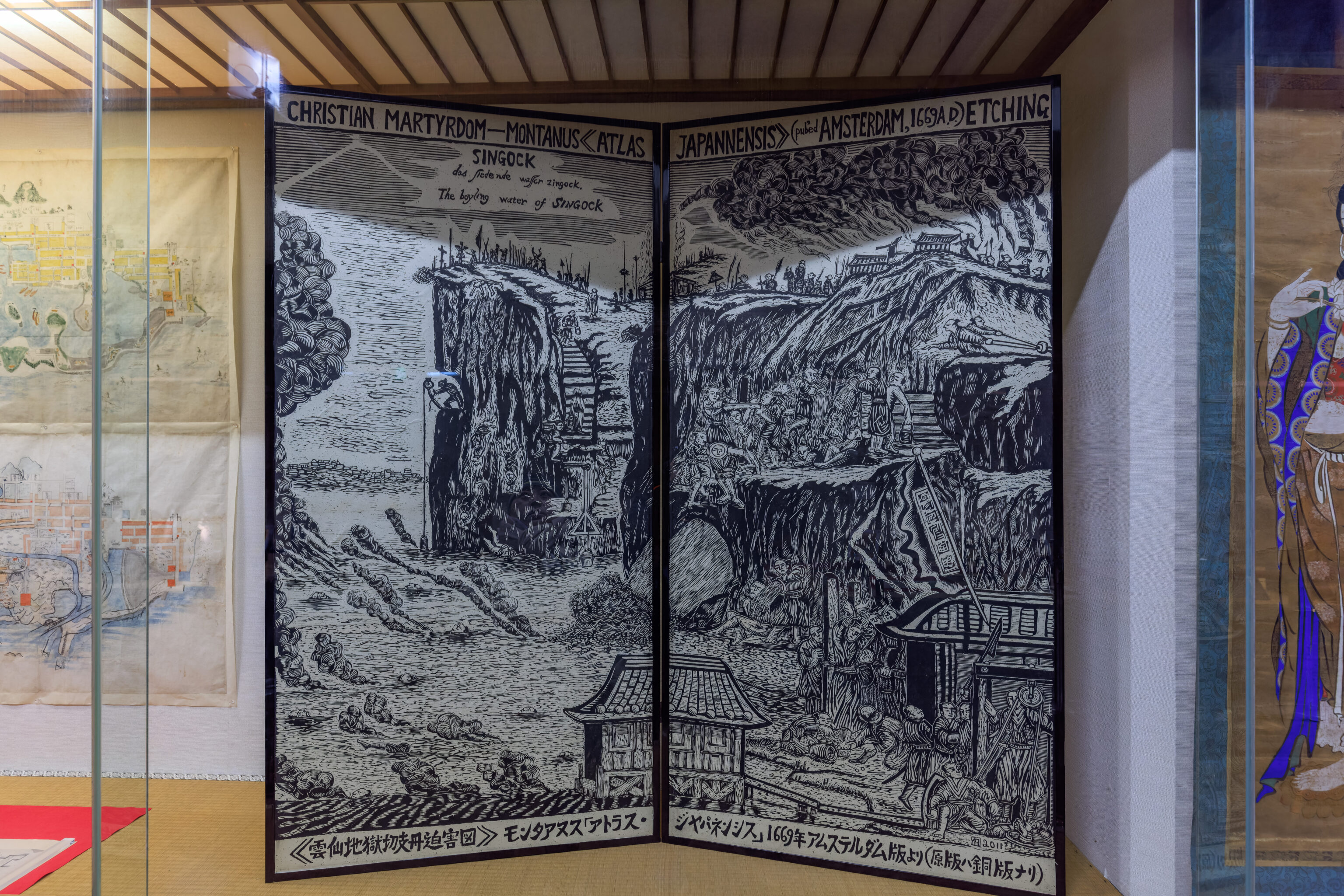
These two panels display Christian martyrdom, basically, the murder of Christians.
"Illustration of the Persecution of Christians at Unzen Jigoku" — from Montanus's *Atlas Japannensis* (Amsterdam edition, 1669; original is a copperplate engraving).
– Text from the bottom of the panels, read and translated using Google Gemini and Translate.
A sign goes into further detail…
Unzen Hell: Land of Martyrdom
Unzen Volcano has been known as a sacred place since ancient times. When pilgrims visiting the mountain took a close look at the craters, they called them "hells" due to their hell-like appearance. The searing ground and scalding springs were compared to Hell, said to be a place where wicked people are sent. These hells were used as sites for gruesome torture and executions of Christians during the time of religious persecution.

After Matsukura Shigemasa came to Shimabara as the new feudal lord, he severely cracked down on Christianity. Around 1627, the torture in the hells of Unzen Volcano began. Christians arrested in the Shimabara Peninsula and Nagasaki were sent up to Mt. Unzen, where they were subjected to torture, having scalding hot water thrown over their bodies from the hell's boiling springs, and pressured to abandon their faith. Those who refused to renounce their faith were unmercifully thrown alive into the boiling springs. Many Christians died for their faith. These incidents of torture were so gruesome that they were reported as far as to Europe. A Dutch missionary and historian (1625-83), Arnoldus Montanus, painted a picture showing the Christian torture in the Unzen hells. A total of 37 Christians, including Uchibori Sakuemon, were martyred and later beatified.
– Text from a sign, translated using Google.
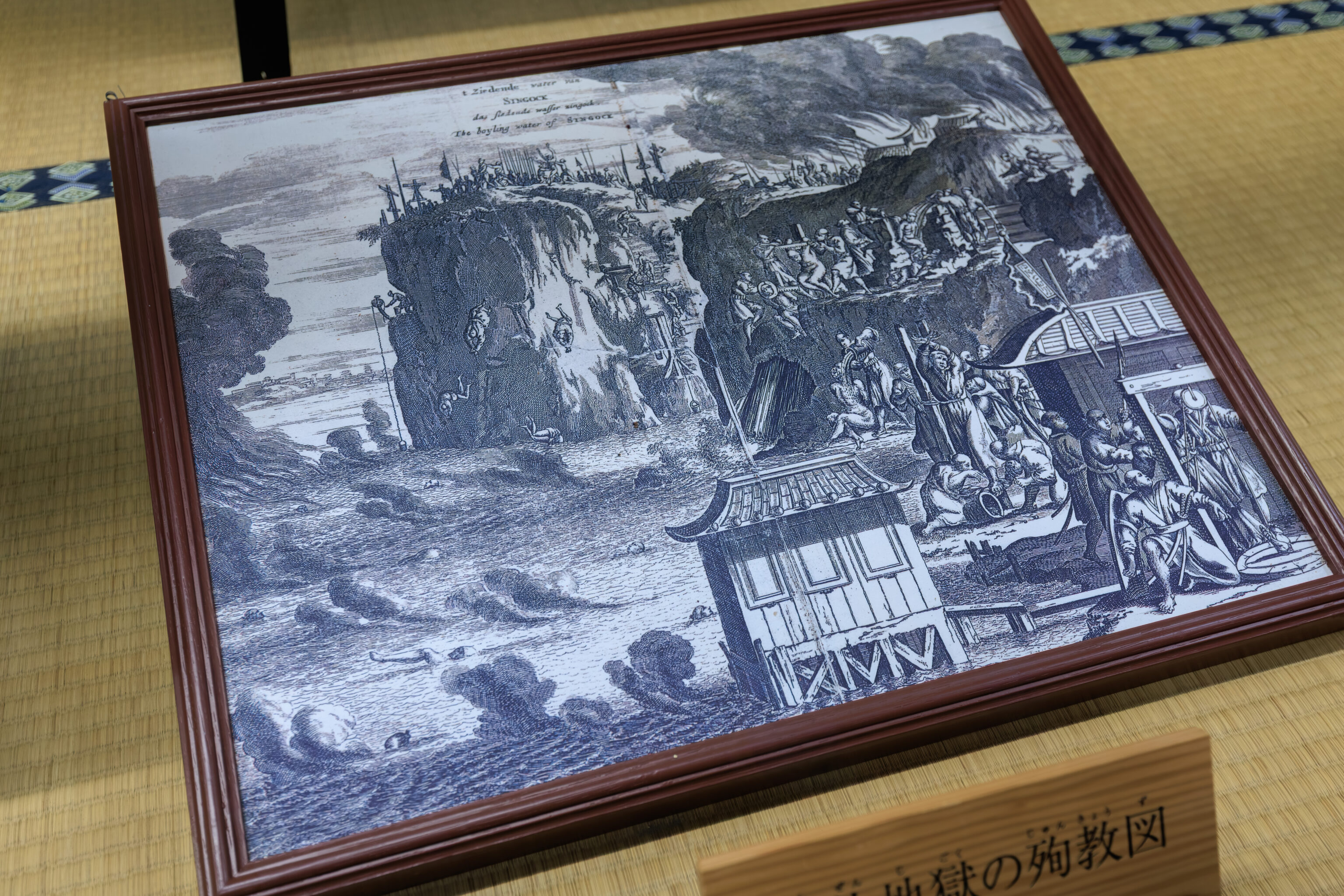
This is a different rendition of the same Unzen martyrdom scene on the two panels above.
Picture of Martyrdom in Unzen Hell
Torture and persecution demanding renunciation were carried out in various places, but believers in Shimabara and Nagasaki were dragged to Unzen and threatened into renunciation. This is known as the hellish torture, and its horrors shocked people in Europe. A picture of it is included in Montanus's "History of Japan," published in 1669. It conveys the horrific nature of the persecution of Christians in the Shimabara region to this day.
– Text from a sign, translated using Google.
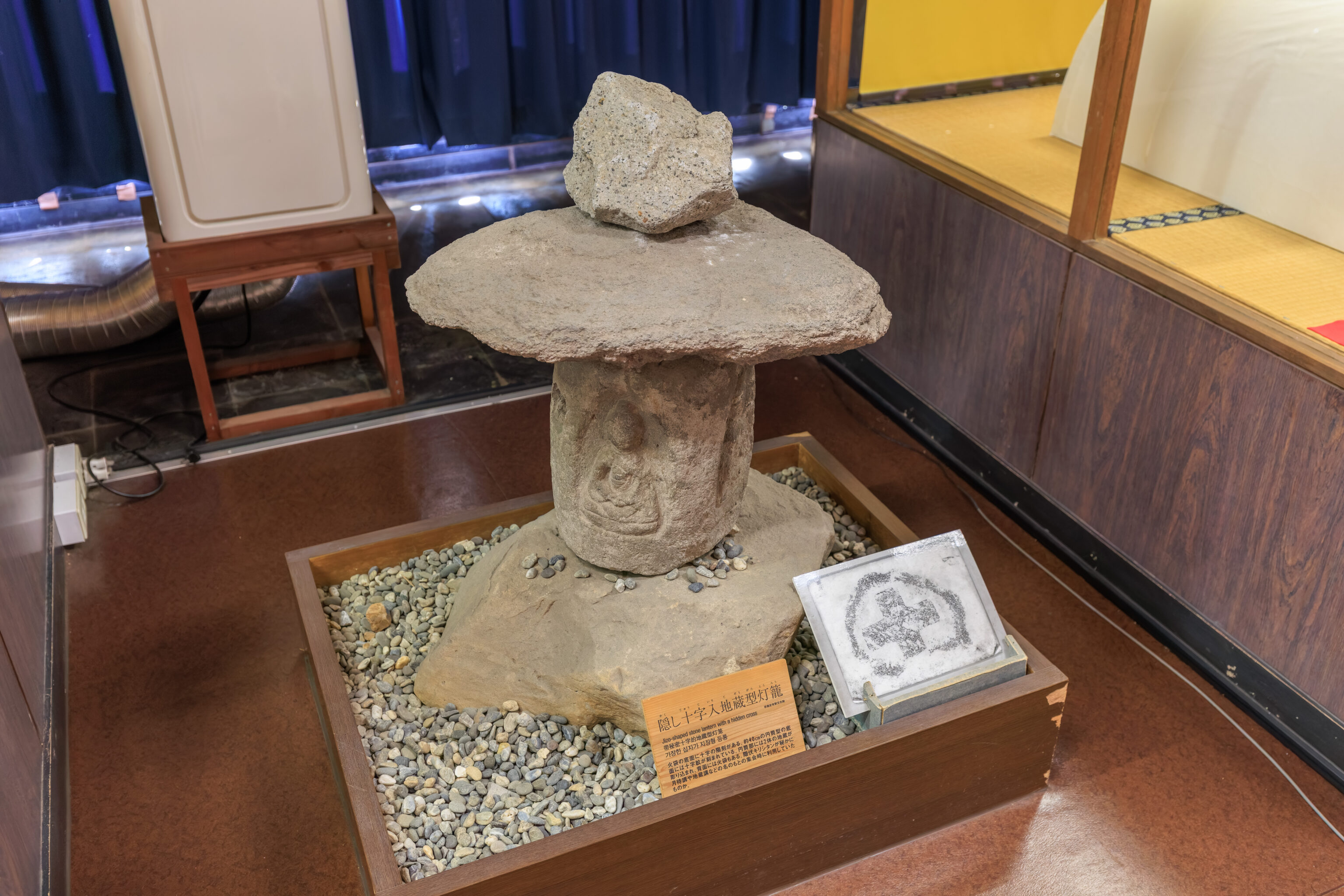
After Christianity was outlawed, Christians had to hide their faith. This stone lantern is one example as it has a hidden cross inside.
Jizo-style Stone Lantern with a Concealed Cross Design
City-Designated Tangible Cultural Property

A cross is carved in relief on the bottom of the fire chamber. A cross motif is incised on the base of the cylindrical body, which measures approximately 40 cm in height. Two figures of Jizo are carved into the cylindrical section, and there is also a fire chamber opening on the back. It may have been used by Hidden Christians during secret gatherings held under the guise of groups such as *Tsukimachi-ko* (moon-worshiping confraternities) or *Jizo-ko* (Jizo-worshiping confraternities).
– Text from the wooden sign in the photograph above, read and translated using Google Gemini and Translate.
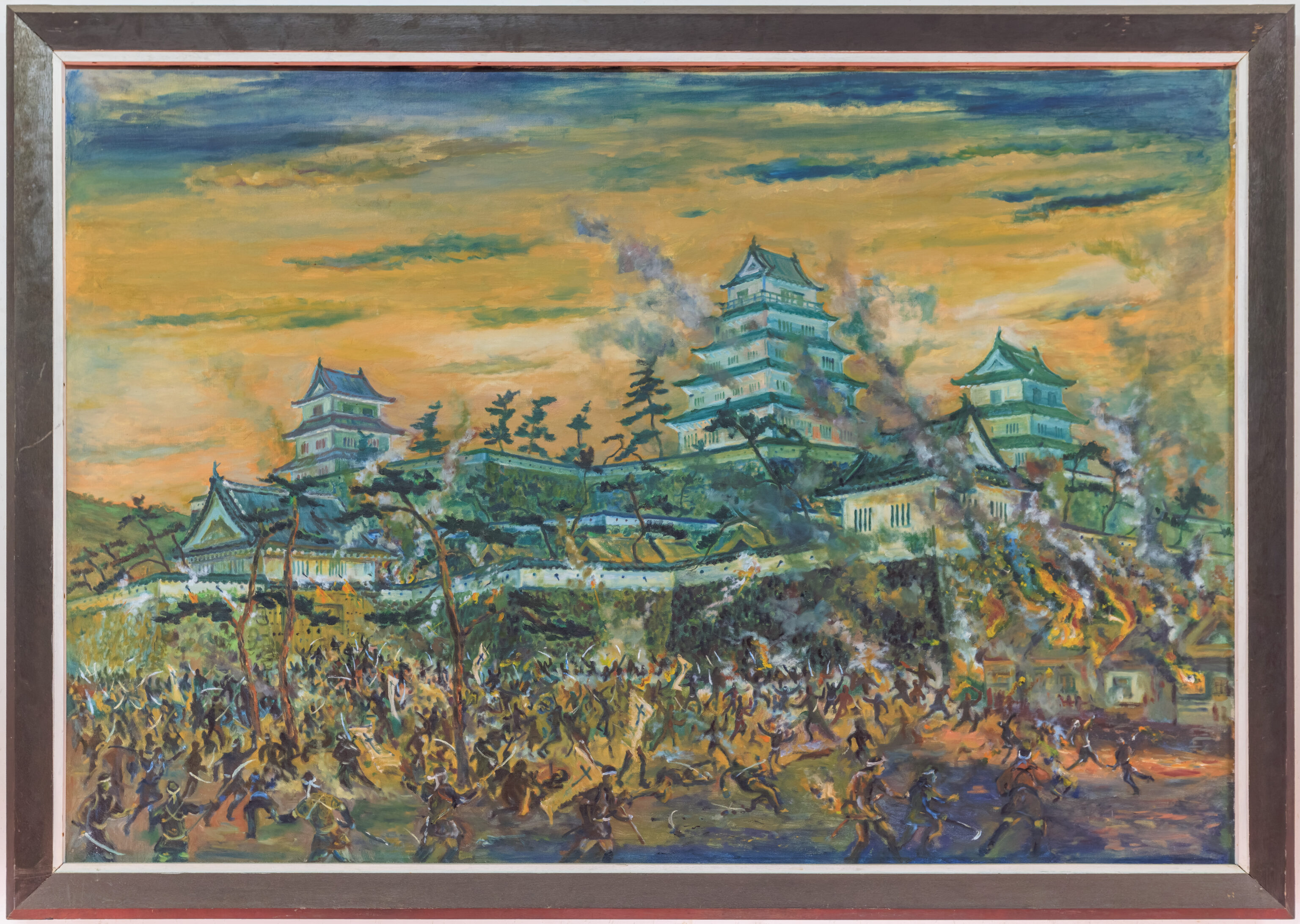
This painting depicts the Otemon Battle during the Shimabara Uprising.
The Battle of Otemon Gate during the Shimabara Uprising
On October 25, 1637 (Kanei 14), farmers in the southern part of the Shimabara region revolted against the oppressive rule of the Shimabara domain lord and attacked Shimabara Castle. However, they were unable to capture it and retreated, taking refuge in the ruins of Hara Castle. This marked the beginning of the Shimabara Rebellion.

Illustration by Shojiro Miyazaki
– Text from a sign, read and translated using Google Gemini and Translate.
We previously read about Hara Castle on a sign. It was abandonded in favor of constructing Shimabara Castle. Another sign provided some detail about the Shimabara Uprising:
Shimabara Uprising
In 1637, the Shimabara Uprising, a great rebellion that shook the whole country, broke out centering in the Shimabara district. Around the time when Matsukura Katsuie became the new lord of the Shimabara domain, the shuinsen trade (trade by ships with a shogunal charter for foreign trade) came to be abolished. The lord therefore had to shift the domain's trade-dependent financial policy to a policy of increasing revenues within the domain. Katsuie raised the land tax (nengu), and severely collected the tax even when crop yields declined due to prolonged bad weather, driving peasants in the Shimabara district into starvation.

That same year, circulars were issued to bring villagers back to Christianity. On October 25, riots began in various villages in the southern part of the Shimabara Peninsula against local magistrate control. The next day, people in each village attacked Shimabara Castle but they failed. The peasants participated in the rebellion barricaded themselves in the ruins of Hara Castle. Notably, almost the entire population of all the villages in the southern Shimabara Peninsula participated in the rebellion, and was later joined by residents of the Amakusa Islands. The number of people joining the rebellion is considered to be 27,000 (or 37,000, according to another account). This rebellion eventually developed into the Shimabara Uprising, which had great impact across Japan.
– Text from a sign.
Another sign discussed the treatment of Christians:
Fumi-e and Hidden Christians
The Shimabara Uprising was not merely resistance against the feudal lord, but a great rebellion that denied the shogunate and domain system. The shogunate, however, also labeled the uprising as a Christian revolt, and stressed that Christianity would disturb the country. Therefore the existing edict against Christianity was enforced even more stringently. In the Shimabara domain, humiliating interrogations called fumie were strictly carried out to weed out Christians. To identify adherents of Christianity, all the people in each village were summoned together and required to tread upon an icon of Jesus or the Virgin Mary, thereby proving they were non-Christians. All the villagers were then required to become supporters of a Buddhist temple, and record their sects and denominations in ledgers called Shumon-ninbetsu-cho. Those who had formerly believed in Christianity but abandoned their faith, as well as their descendants were called ruizoku, and put under surveillance for five to seven generations. When a person of ruizoku died, his/her town's or village's headman had to report the death to the government to ensure that the corpse underwent examination by a government official.

Despite such a stringent crackdown, some people continued practicing Christianity in secret. However, they considerably drifted away from Christian teachings, under the long-lasting situation where they had no missionaries or church. These people were called "underground Christians." In 1804, a serious issue arose when 5,000 people were revealed to be worshiping a different religious statue in Amakusa, which was under the custodial jurisdiction of the Shimabara domain.
– Text from a sign.
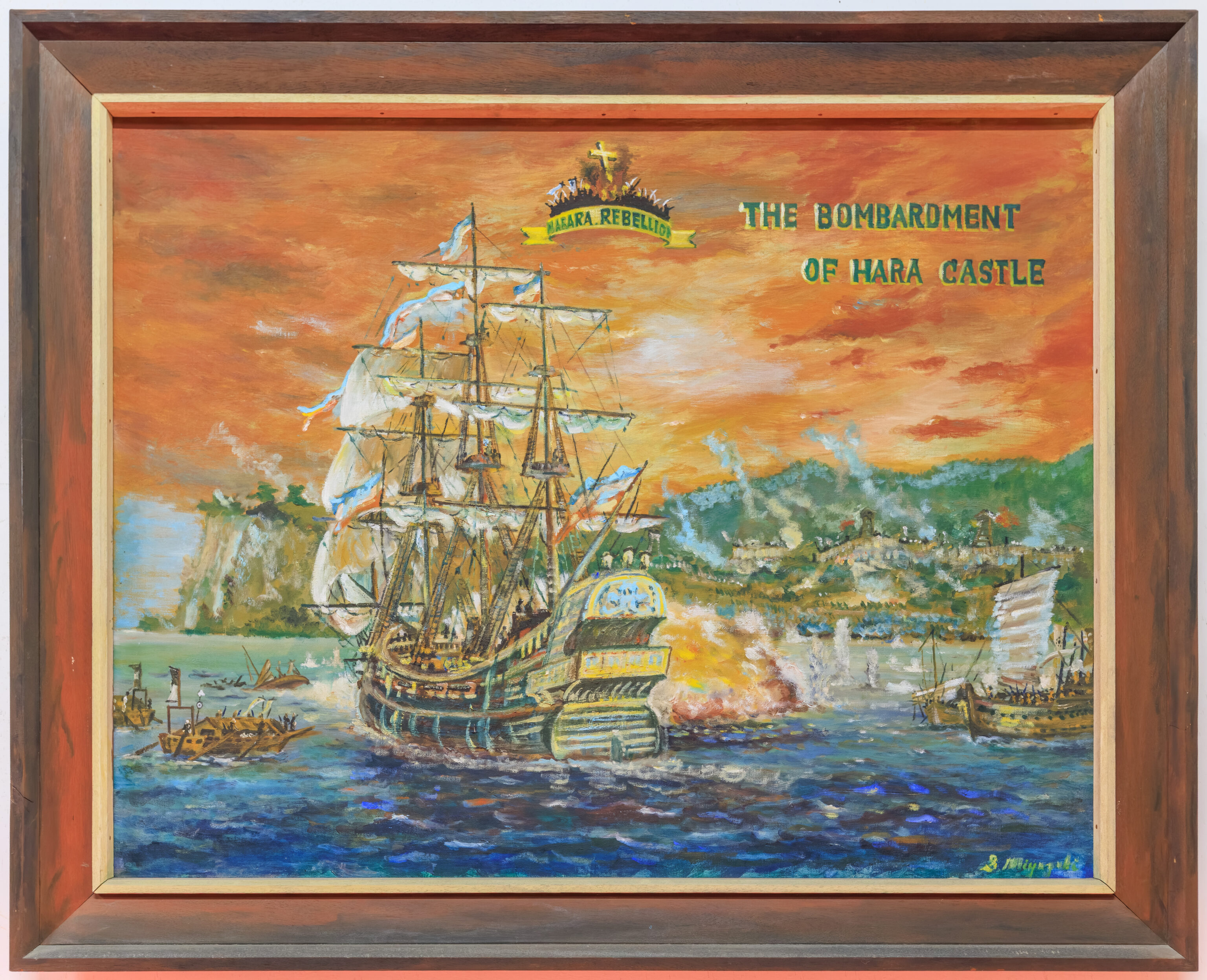
This painting depicts Dutch ships bombarding Hara Castle.
Illustration of the Dutch Ship Bombardment of Hara Castle
Matsudaira Nobutsuna, the Shogunate's envoy, requested cooperation in suppressing the rebellion from Nicholas Cookebacker, the head of the Dutch trading post in Hirado, by ordering him to "sail a Dutch ship to Arima."

The De Leip arrived off the coast of Arima on January 11th and bombarded Hara Castle. They also attacked from land with cannons that had been sent earlier. However, both sides were criticized for "relying on foreign aid," and on January 28th, they were ordered to withdraw. It is said that they fired 426 cannonballs during that time. Some of the cannonballs are on display in the main building.

Illustration by Shojiro Miyazaki
– Text from a sign, read and translated using Google Gemini and Translate.
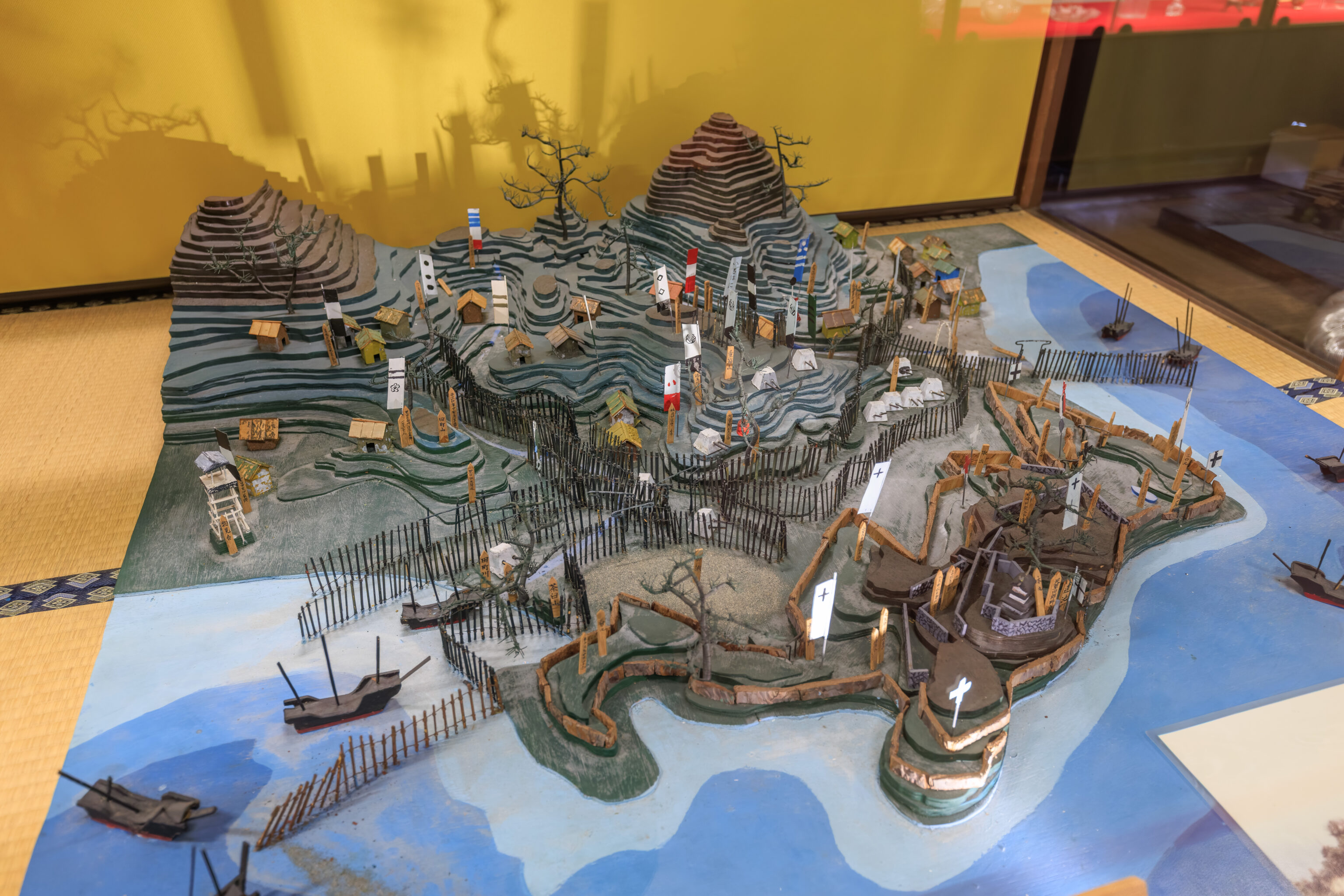
This model depicts the attack on Hara Castle:
Model of the Siege of Hara Castle
The insurgent forces holed up in the ruins of Hara Castle maintained high morale. The combined forces of the Shogunate and various daimyo, numbering 120,000 troops, surrounded the castle and laid siege to it, attempting to starve the defenders out. Local junior high school students created and exhibited a scale model illustrating the battle.

Created by Minami-Arima Junior High School
– Text from a sign, translated using Google.
A sign discusses Amakusa Shiro, the sixteen year old leader of the uprising, and how a peasants’ uprising managed to have as much success as they did.
Amakusa Shiro
All the villagers from the 14 villages in the southern part of the Shimabara Peninsula joined the riots. The number of these participants was 24,000, which was 60% of the total population of the Shimabara Peninsula. Riots also began in the Amakusa Islands. The rebels from Shimabara and Amakusa decided to join forces, and gathered in the ruins of Hara Castle, at which they barricaded themselves. It was 16-year-old Amakusa Shiro who led the rebel peasants.

The peasants were grouped by village, and members of each group lived en masse, with the defensive positions shared by all groups. Each village headman served as a mediator, and provided general care for the villagers. Since before the rebellion, each district had a Christian society, which formed community solidarity among the villagers. Backed by the combination of such community solidarity and religious power, participating peasants maintained a remarkably high level of morale. The former Arima and Konishi retainers and their masterless samurai worked as councilors, and they were in charge of military affairs. During the battles, these warriors led the farmer troops and fought at the front lines. They made Amakusa Shiro the leader and symbol of the uprising, and brought together the peasants under the battle flag of Shiro. These clever strategies and the strong solidarity among the peasants distinguished this uprising from other peasants' revolts, helping it develop into a great rebellion.
– Text from a sign.
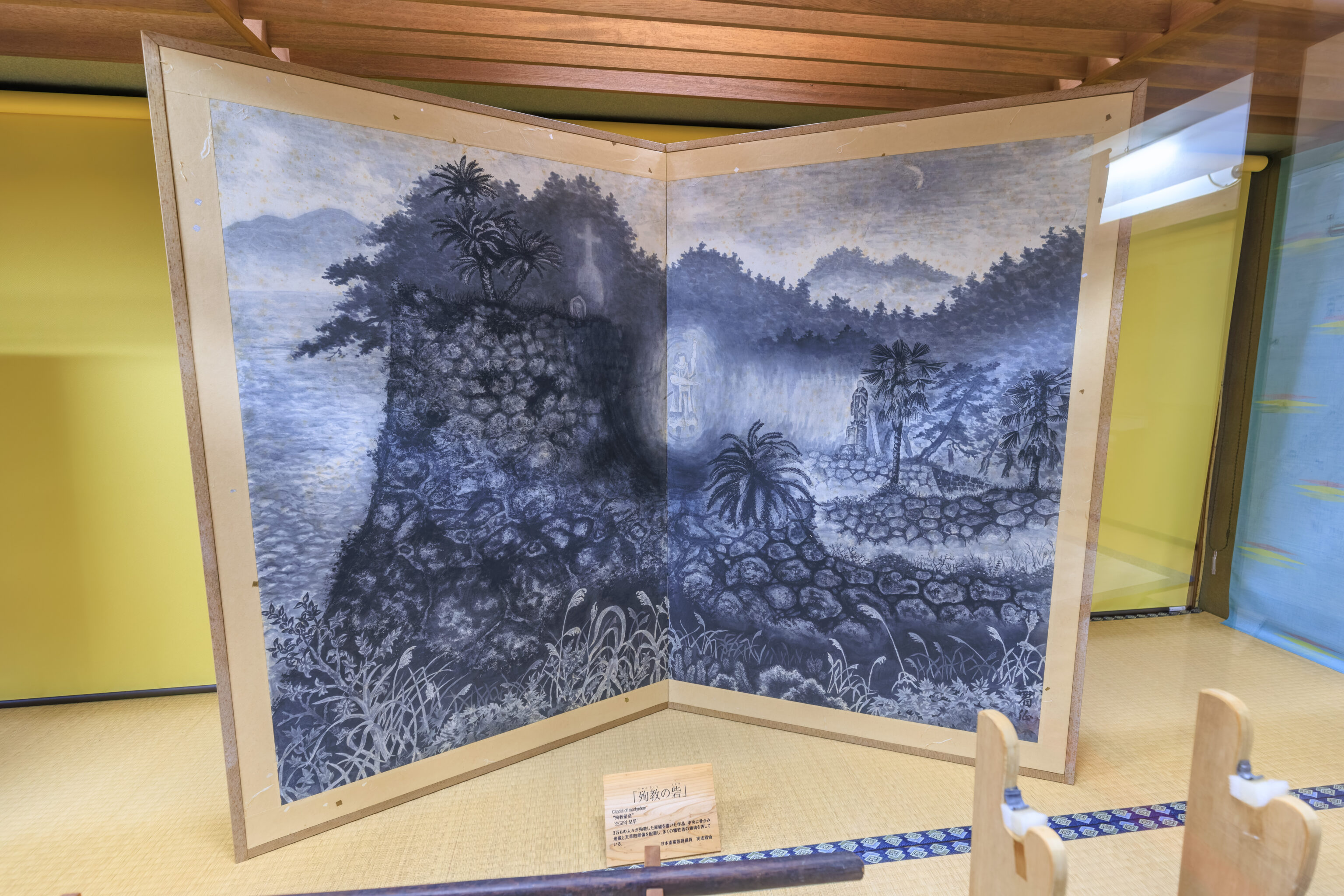
Ultimately, the uprising was crushed and possibly everyone was exectued.
"Citadel of Martyrdom"
This work depicts Hara Castle, the site where as many as 30,000 people met a martyr's death. By placing the "Honkami Jizo" (Bone-Gnawing Jizo) and a statue of Amakusa Shiro at the center, the artist expresses a prayer for the repose of the souls of the many victims.

Bisen Jijo, Councilor of the Nihon Nanga-in (Japan Nanga Academy)
– Text from a sign, translated using Google.
Although the uprising ended up with the participants being executed, it did not end well for the daimyo as he ultimately met the same fate:
Restoration after the Shimabara Uprising
Within the precincts of Yawata Shrine, located near the site of Hara Castle, is a monument called "Kubizuka," built in memory of the victims of the Shimabara Uprising. This was erected by Suzuki Shigenari, a local magistrate dispatched to rebuild Amakusa after the rebellion.

Lord Matsukura Katsuie was charged with responsibility for the rebellion and thus beheaded, and his domain was confiscated. In 1638, Koriki Tadafusa was appointed as the new lord of the Shimabara domain. His first mission was to restore the areas worth 22,000 koku, which suffered a total loss of population. To accomplish this task, it was urgently necessary to resettle farmers in these areas. In 1642, the shogunate ordered domains in western Japan to resettle farmers in Shimabara and Amakusa districts. Those who immigrated on this shogunate's order were called Kogi Hyakusho (official immigrant farmers). In addition, Lord Koriki ordered that ownerless land be given to those who cultivated it and exempted them from land tax. Consequently, many people within the domain and from other parts of Japan came to settle in the deserted areas. They were called Kakekomi Hyakusho (last-minute immigrant farmers).

Through these measures, the number of people in villages increased, and Shimabara took a steady step toward reconstruction. According to records, in 1674 the domain's population reached 45,687, which was larger than before the rebellion.
– Text from a sign.
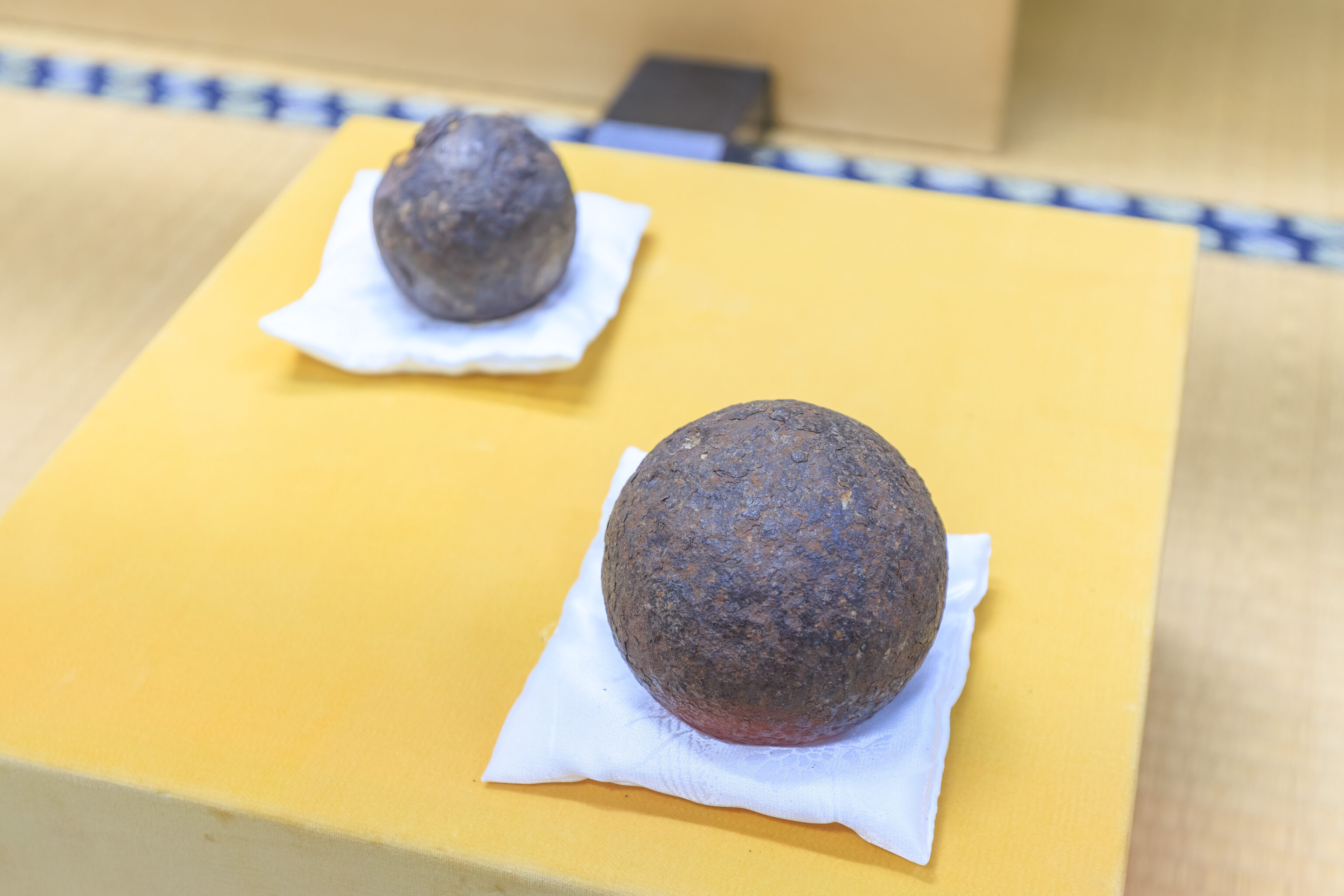
These are two of the cannonballs fired by the Dutch against Hara Castle previously mentioned on a sign.
Cannonball Excavated from Hara Castle
The Shogunate forces had the Dutch ship *De Rijp* sail from Hirado to the waters off Hara Castle and bombarded the fortress from both sea and land. Although 426 rounds were fired at Hara Castle, the bombardment had little effect. These cannonballs were unearthed from fields near the castle and from the seabed.
– Text from a sign, read and translated using Google Gemini and Translate.
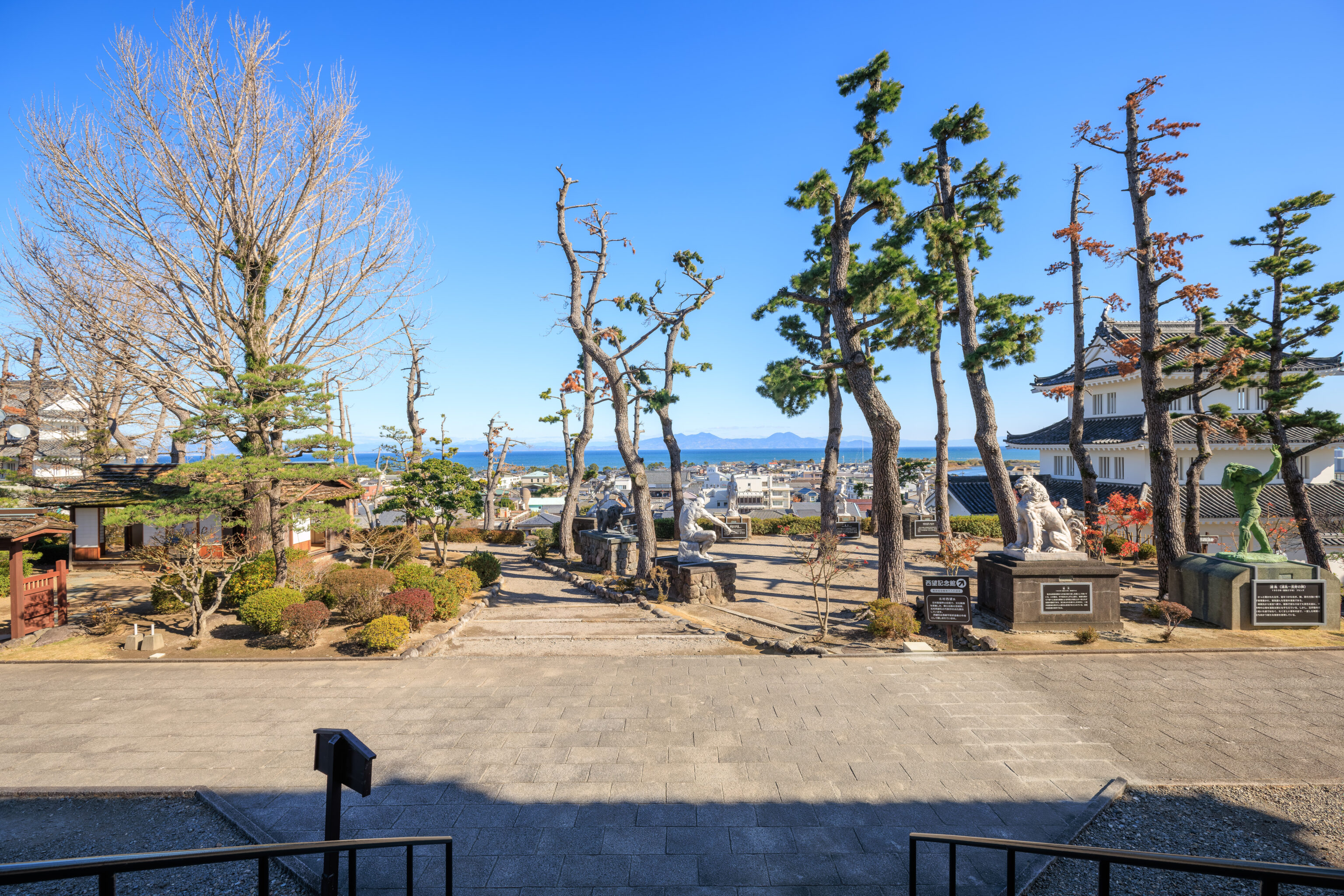
After returning to the ground floor of Shimabara Castle, we headed back outside.
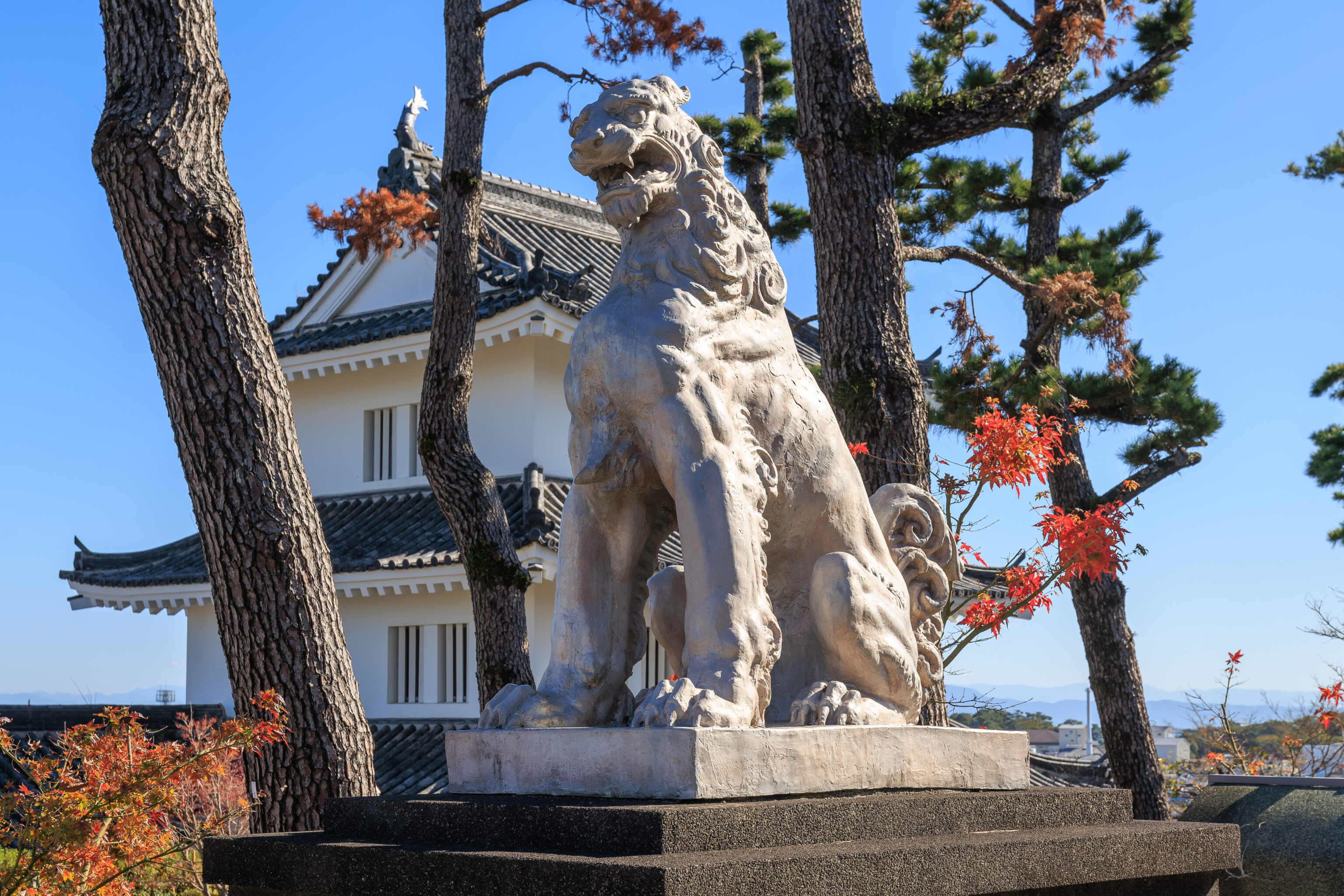
We went to take a look at the sculptures that we saw earlier from above. The sculptor of all the pieces here, 北村 西望 Seibo Kitamura, was the creator of the 平和祈念像 Peace Statue, which we saw yesterday at the Nagasaki 平和公園 Peace Park.
Komainu
1955 (Showa 30) — High-purity Aluminum

The artist has repeatedly used the *komainu* (guardian dog) as a subject since the early Showa era. This sculpture depicts the legendary spiritual beast with its head slightly tilted; the form—extending from a sturdy chest down to the lower body—embodies a free-flowing conception that fuses the acts of exhaling and inhaling into a unified whole. Amidst a dignified air brimming with vitality, the figure possesses a human-like expression tinged with a touch of melancholy. It is a masterpiece of the turbulent Showa era.
– Text from a plaque at the base of the above sculpture, read and translated using Google Gemini and Translate.
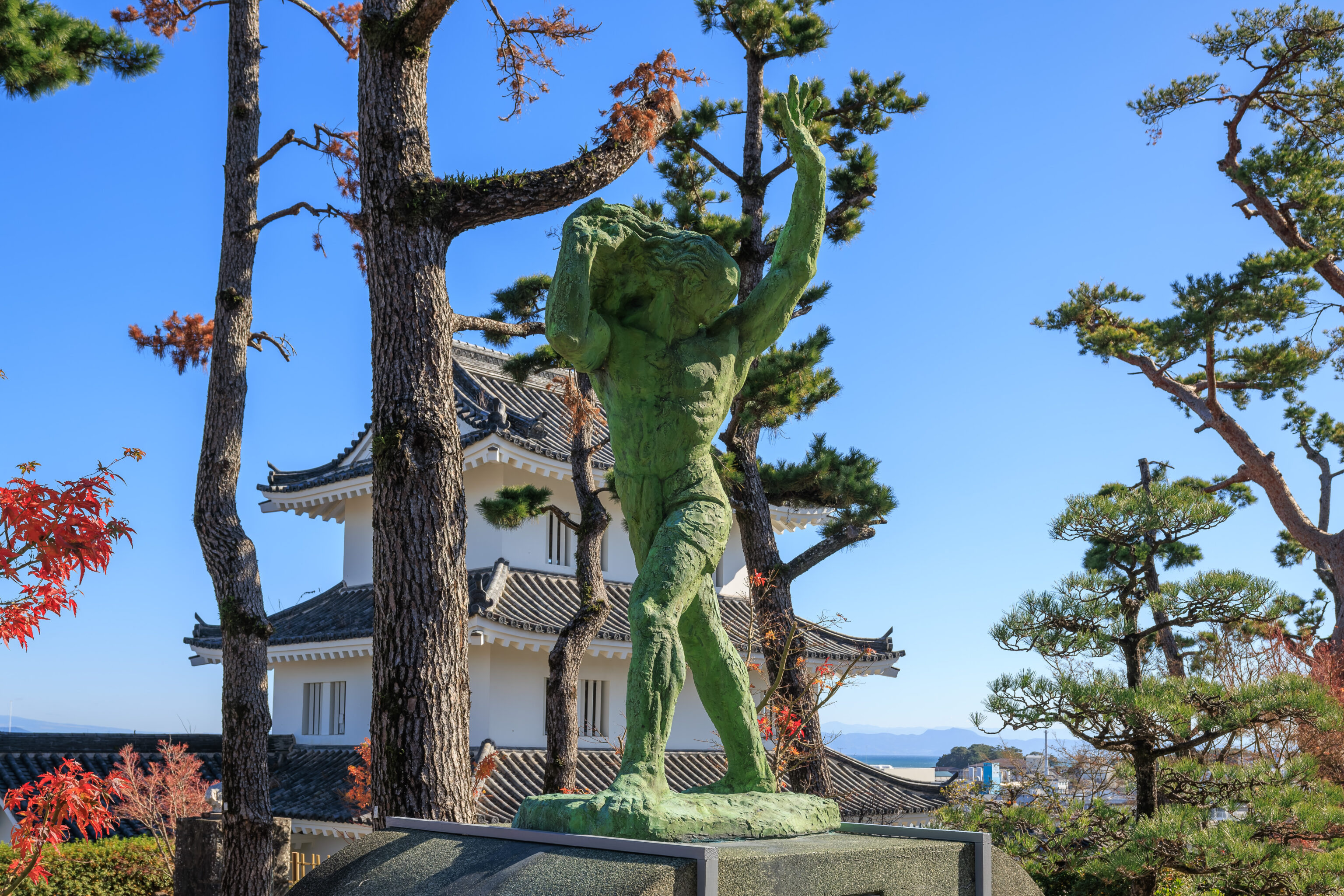
Urashima (Urashima – Dance of Longevity)
1950 (Showa 25), Bronze

He is depicted as a spirited young Urashima, with his left hand flung wide, his right hand grasping his hair, and his arms and shoulders rendered with powerful, expressive vigor.

Upon returning to Tokyo from his wartime evacuation site and confronting a landscape utterly transformed by the war, he likens his state of mind to that of Urashima Taro. Yet, rather than appearing aged by the smoke of the *tamatebako* (magic casket), he stands as a robust young man, embodying a renewed determination to face the drastically changed times.
– Text from a sign at the base of the above sculpture, read and translated using Google Gemini and Translate.
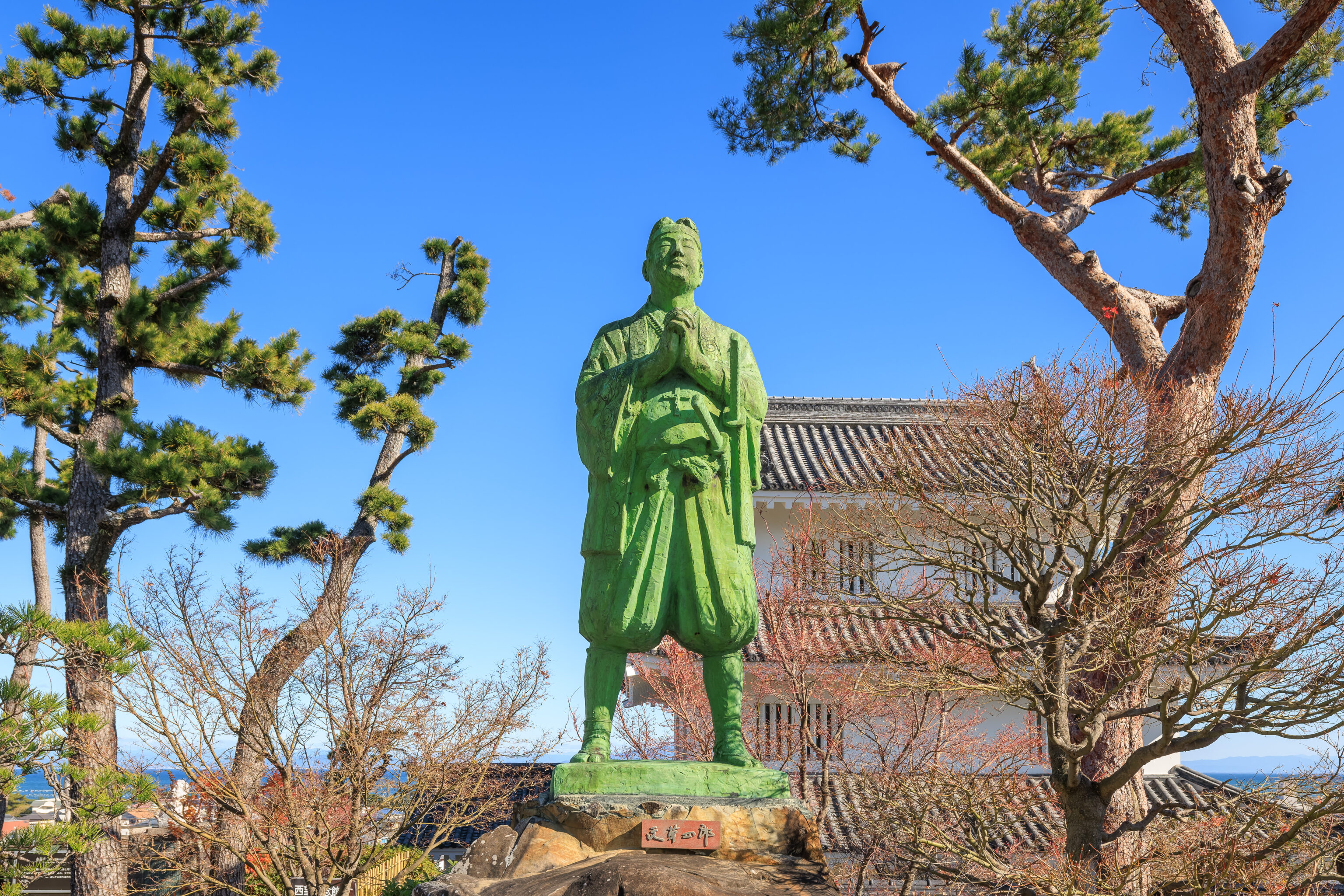
Amakusa Shirō
1972 (Showa 47), Bronze

This statue of Amakusa Shirō emerged from the artistic world of Seibō; the figure, captured in prayer, embodies both passion and faith through a composition that emphasizes a frontal orientation. The site of Hara Castle was the artist's own birthplace, and the bright, open landscape overlooking the Ariake Sea likely shaped his character—fostering a spirit that shunned convention and embraced the challenge of the new.
– Text from a sign at the base of the above sculpture, read and translated using Google Gemini and Translate.
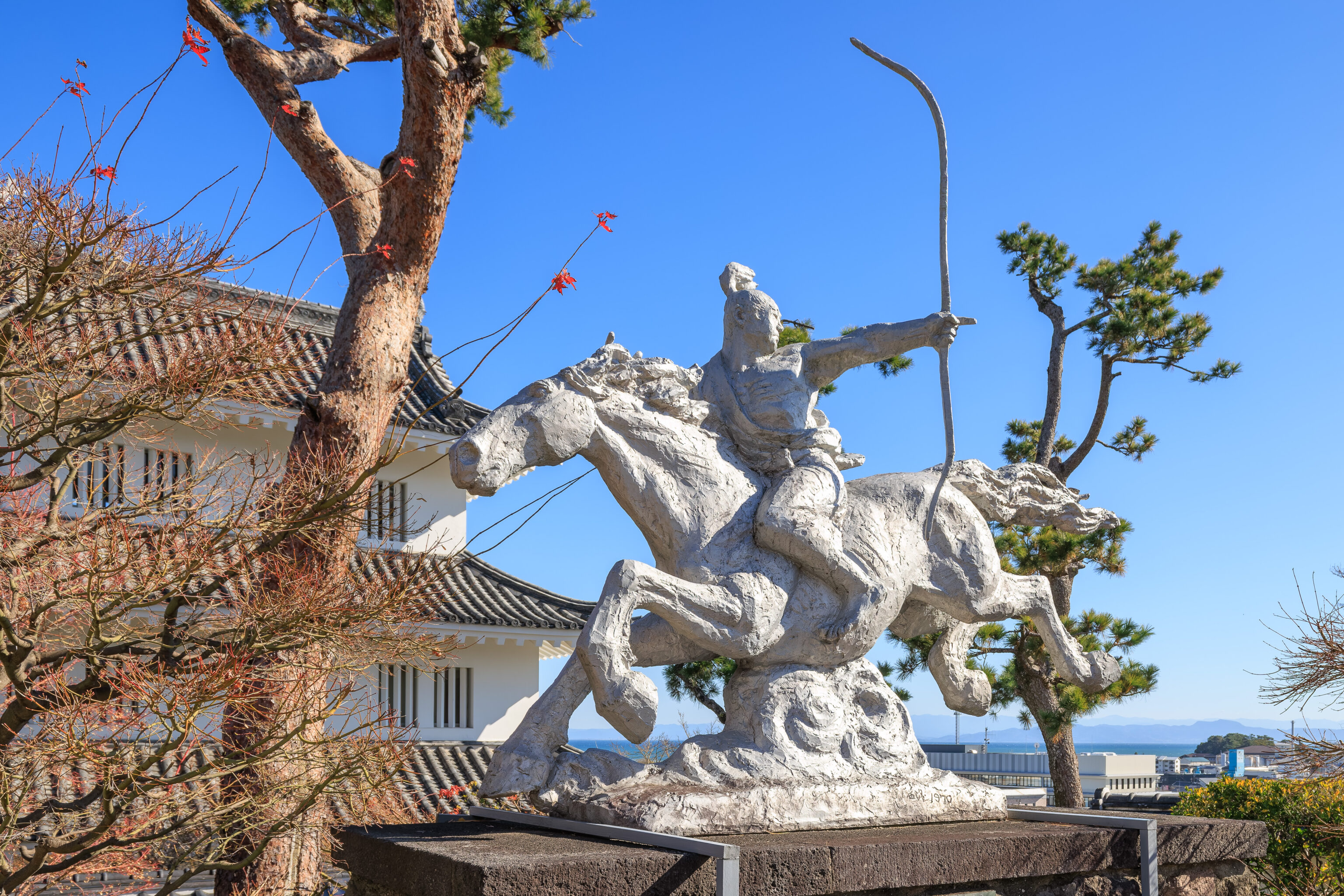
Oda Nobunaga in His Youth
1965 (Showa 40), High-purity aluminum

This is a statue of a young Oda Nobunaga depicted shooting an arrow while turning back in the saddle. Through extensive study of equestrian statues, the artist arrived at a composition that captures a sense of freedom and lightness, as if the figure were soaring through the air.

It is a dynamic equestrian statue that fuses the masculine boldness and feminine elegance inherited from mentors at the Tokyo School of Fine Arts, further refined to achieve a sense of vibrant motion.
– Text from a sign at the base of the above sculpture, read and translated using Google Gemini and Translate.
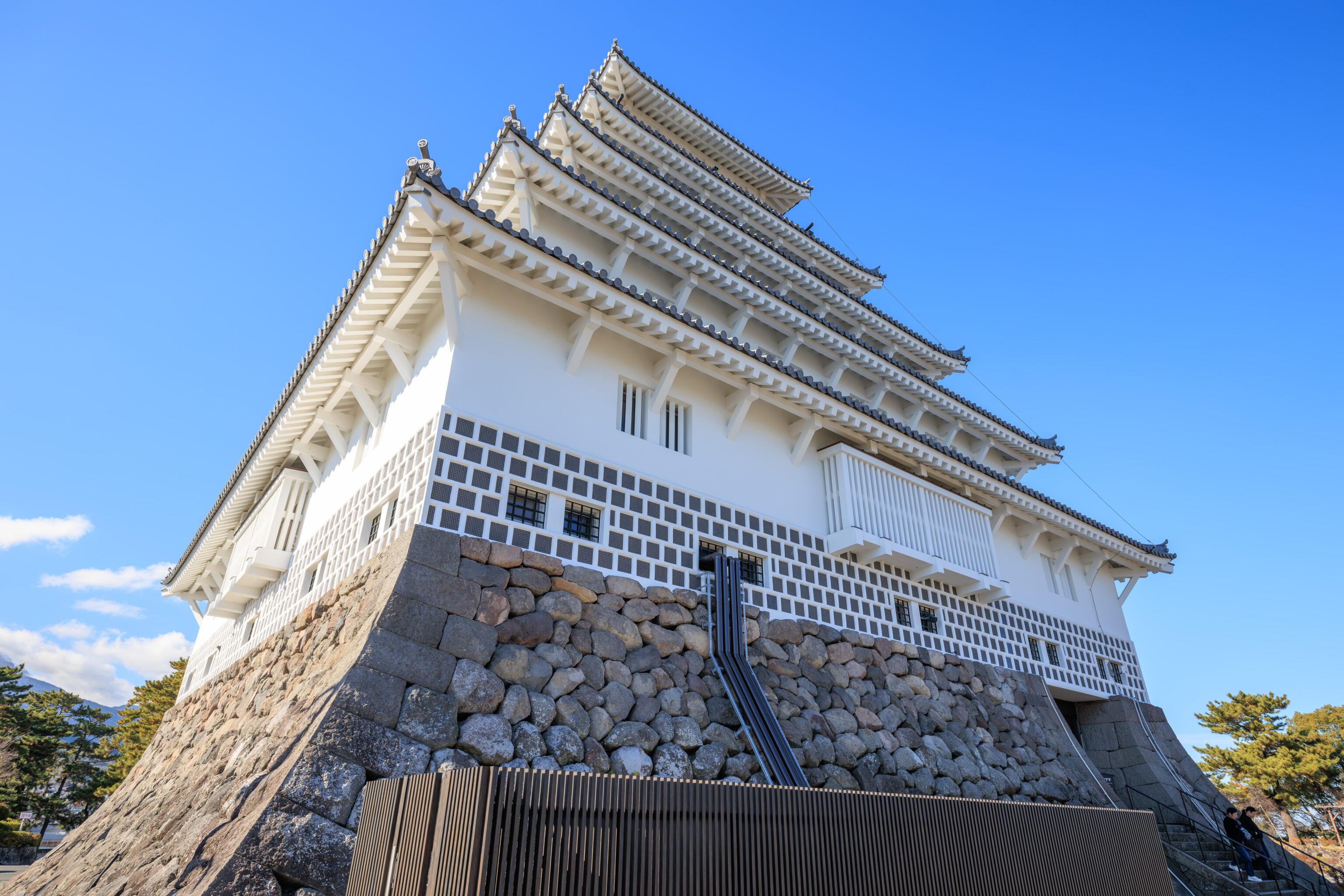
The modern concrete Shimabara Castle, as seen from behind.
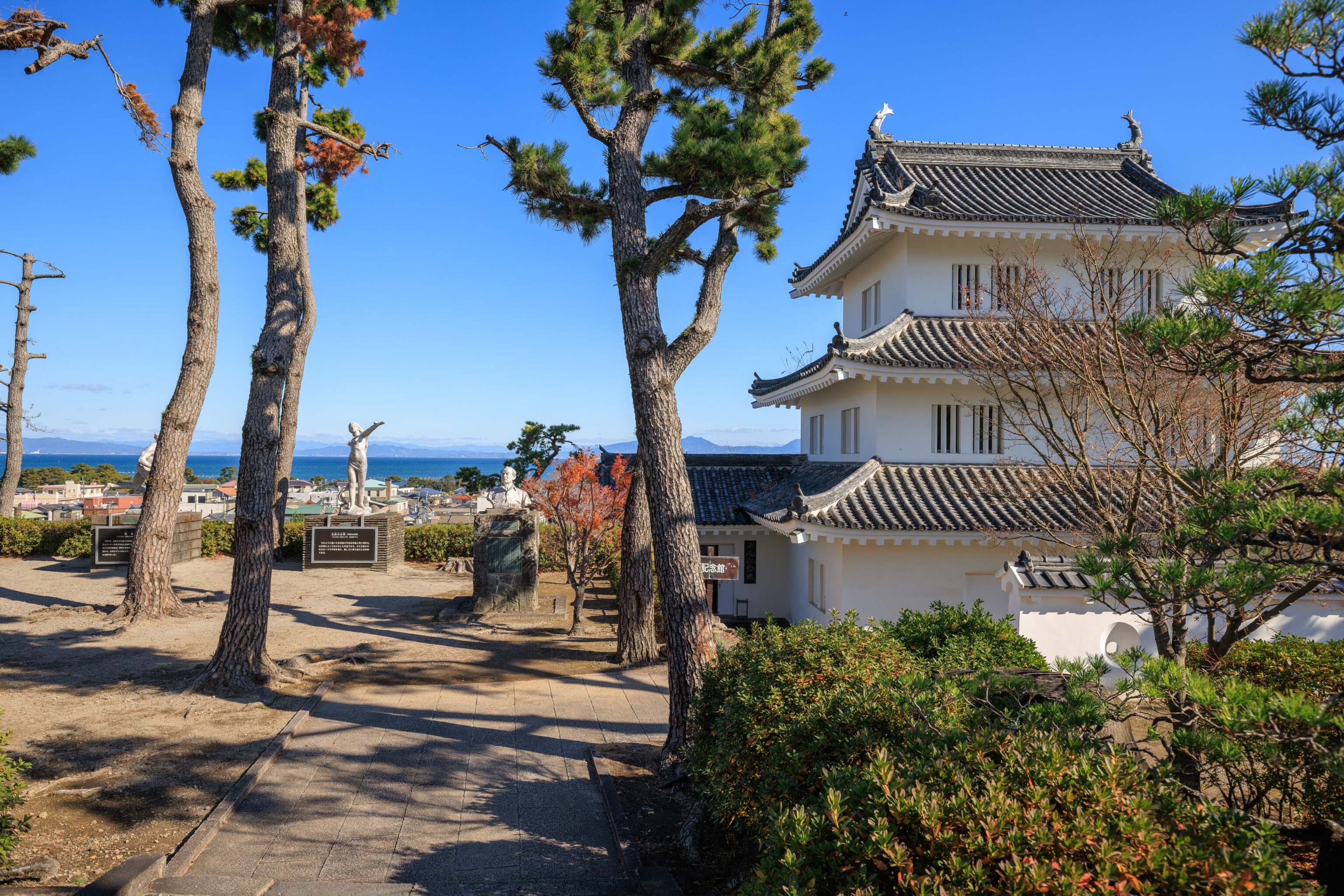
The view looking to the east, showing one of the castle’s smaller towers and some addtional sculptures.
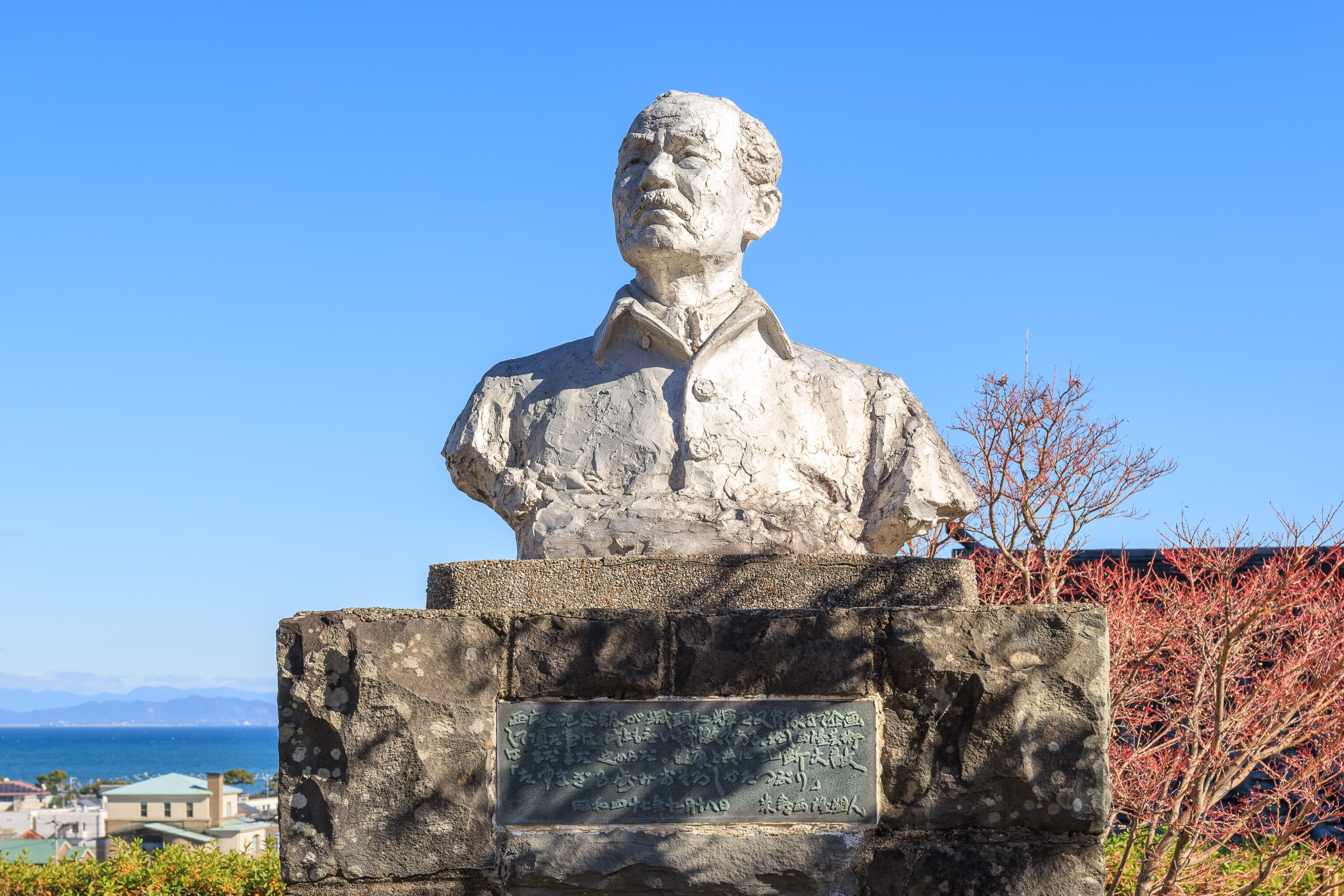
I am deeply moved that the Seibo Memorial Hall shines atop the castle grounds and that plans are even underway for a portrait; yet, the true journey of Seibo’s art is only just beginning. Along with maintaining my health, I must guard against complacency.
"Relentless is the pace of the snail."

November 18, 1972 — Sculptor Sojin (at age 88)
– Text from the plaque visible below the sculpture, read and translated using Google Gemini and Translate.
The Seibo Memorial Hall has been erected here to celebrate the 88th birthday of Seibo Kitamura—a master of Japanese sculpture hailing from our hometown of Shimabara—and to honor his enduring achievements. Each of his works, created across the Meiji, Taisho, and Showa eras, evokes a vivid emotional response and purifies the soul, radiating an eternal brilliance and grace. He is truly a national treasure of which Japan can be proud. The wellspring of Seibo’s art—characterized by its majestic power and the embodiment of divine compassion—can be traced to the nurturing influence of his hometown’s magnificent landscape and rich history. Realized through the artist's own generosity, the enthusiasm of the Tokyo-based Nanko Association, and the support of many others, this hall stands as a symbol of pride and joy for the people of Shimabara. It is a sanctuary of sculptural art without equal in the world. Visitors here will encounter the sublime elegance and essence of his work, finding themselves moved to a state of serene contemplation. It is our fervent hope that those born and raised in Shimabara will take the spirit and achievements of this great artist as a guiding torch, keeping the flame of their own artistic and personal striving burning bright.

An auspicious day in autumn, 1972
Inscribed by Tokuyoshi Matsuo, Mayor of Shimabara
– Text from a larger plaque out of view below the sculpture, read and translated using Google Gemini and Translate.
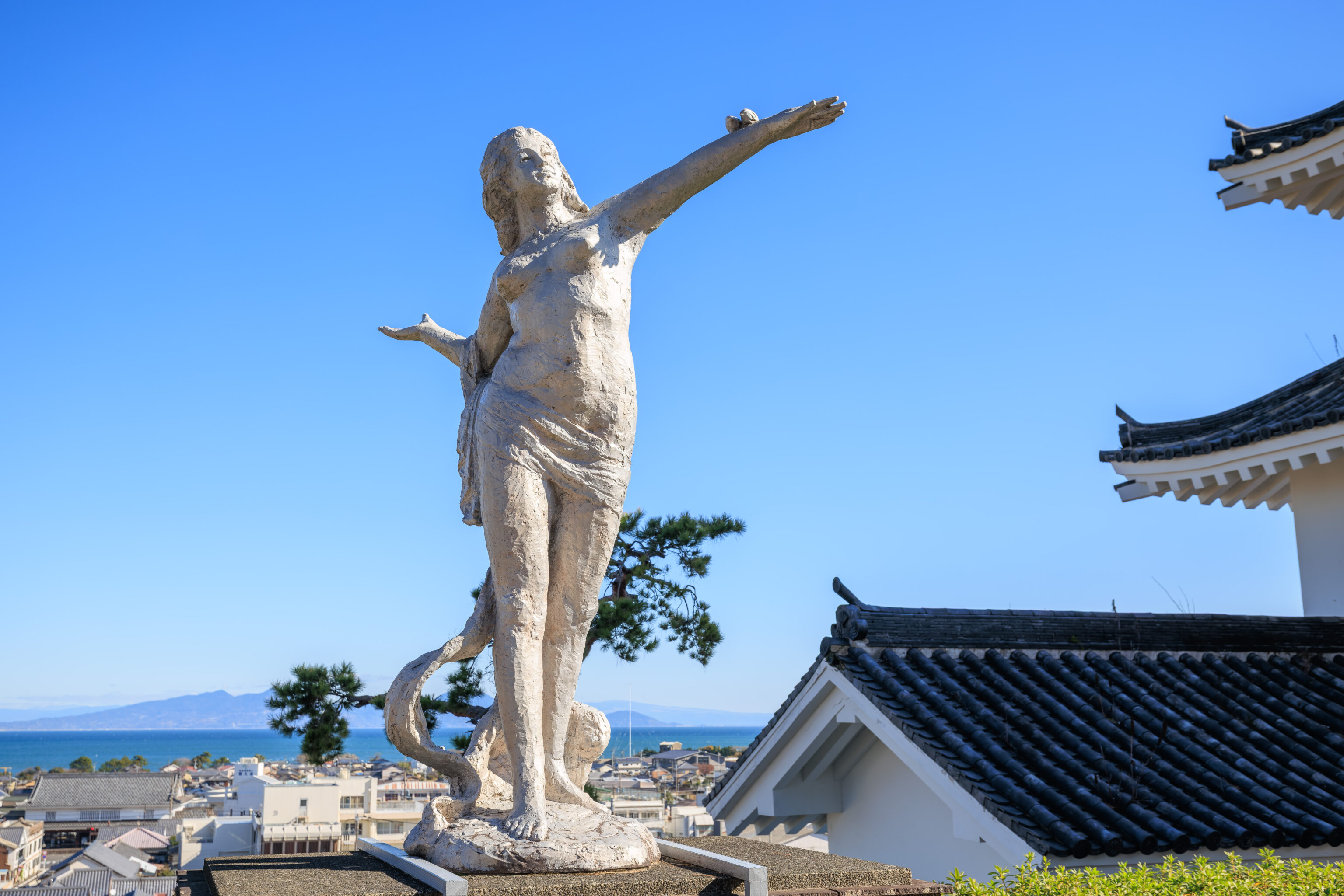
Goddess of Liberty (Goddess of Peace)
1968 (Showa 43), High-purity aluminum

This work embodies the same philosophy as the male Peace Statue—depicted with arms outstretched like a bow—but expresses it through the figure of a woman. It is a statue of a goddess, radiating gentleness and proclaiming peace through a dynamic, sweeping pose.
– Text from a sign at the base of the above sculpture, read and translated using Google Gemini and Translate.
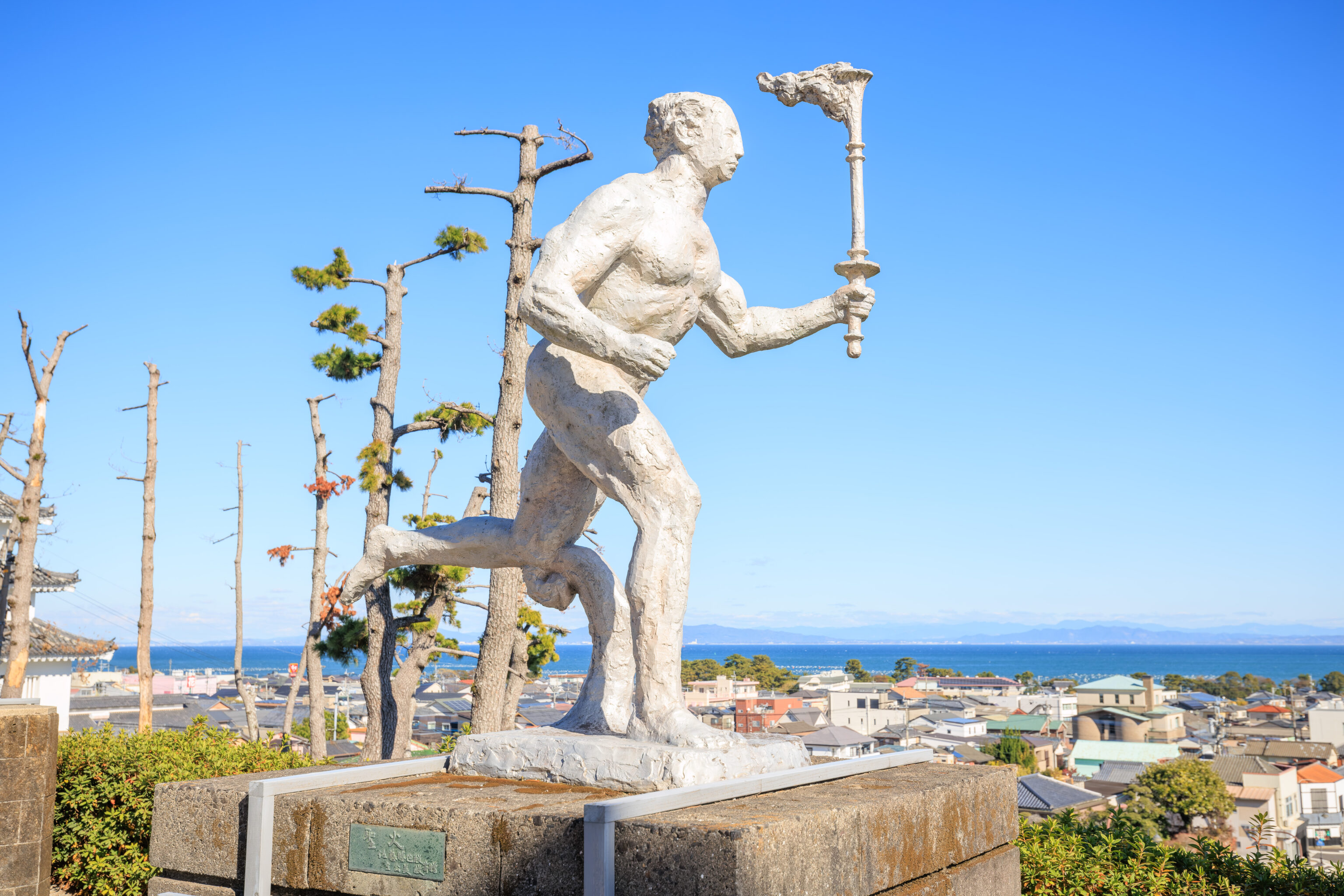
Sacred Flame
1965 (Showa 40), Bronze

This statue is modeled after a torchbearer who ran along National Route 15 just before the 1964 Tokyo Olympics. This messenger of peace, carrying the torch with a spirited stride, holds aloft a beacon of hope for the era. Reflecting an emphasis on health, the dynamic athlete—much like those of ancient Greece—was a key subject for the statue.
– Text from a sign at the base of the above sculpture, read and translated using Google Gemini and Translate.
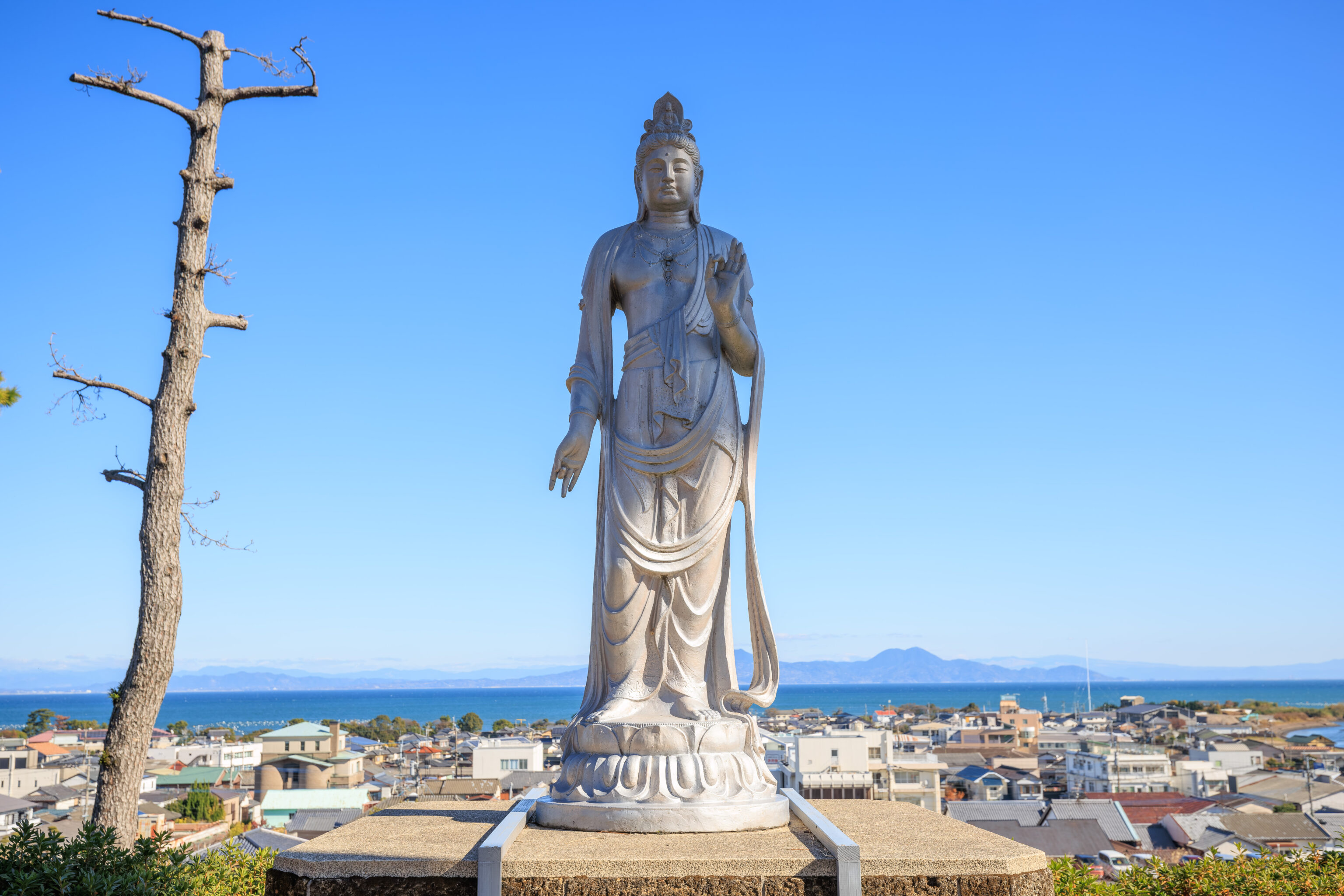
Sacred Kannon Bodhisattva
1937 (Showa 12), High-purity aluminum

While Kannon Bodhisattva is said to assume various forms to extend a helping hand, Sho-Kannon represents the deity's true, unchanging form.

This piece was created in 1937, a year marked by the outbreak of the Second Sino-Japanese War and the onset of an unsettling atmosphere. Its elegant and fresh appearance embodies a profound prayer for peace.
– Text from a sign at the base of the above sculpture, read and translated using Google Gemini and Translate.
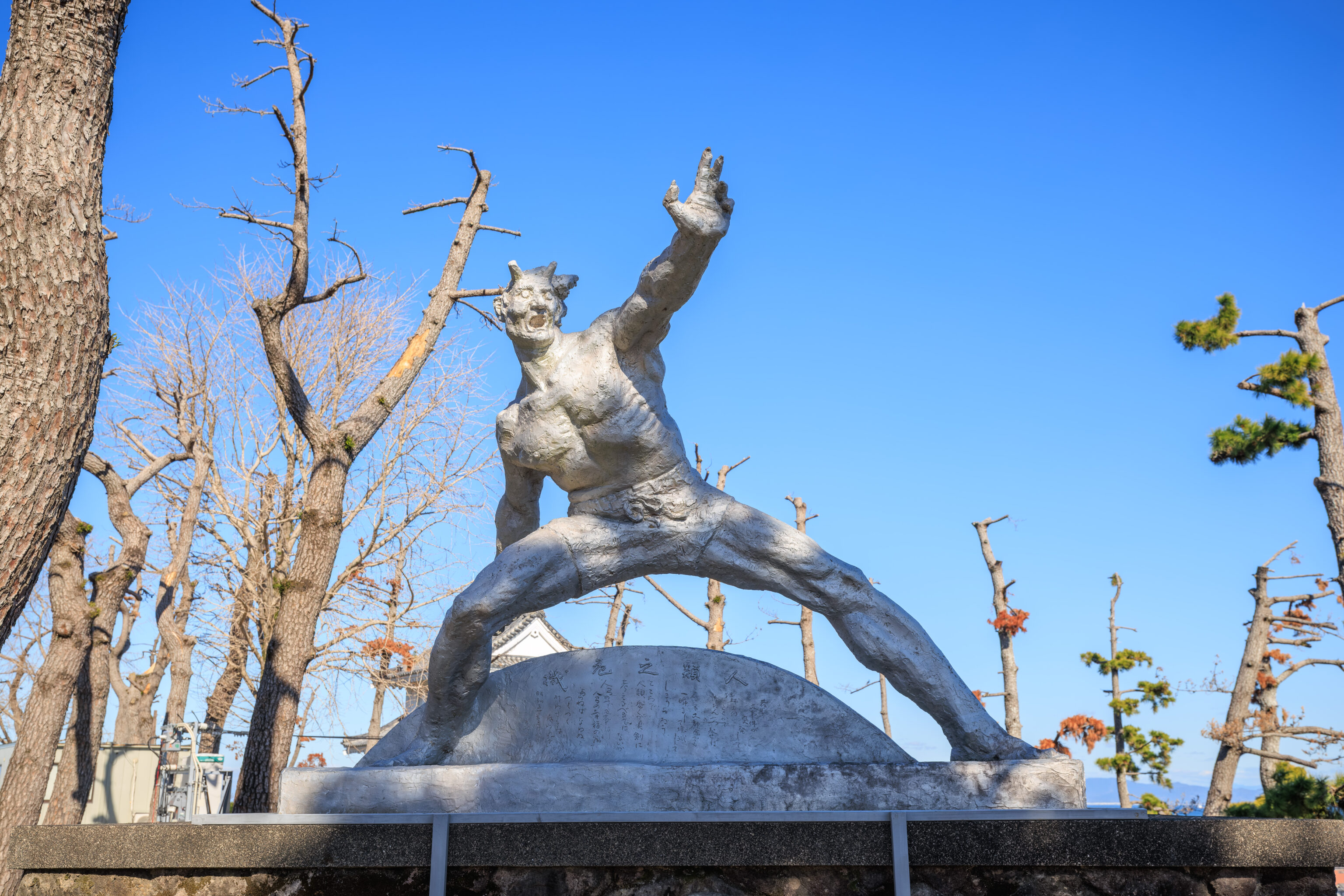
Crisis of Humanity
1958 (Showa 33), Bronze

Created during the Cold War era, this work depicts a figure with a harrowing expression clutching a box-like object—an atomic bomb. It serves as a warning against the conflicts that continue to threaten global peace. Designed to stand as a counterpart to the Peace Statue, the work gives direct expression to the artist's personal emotions.

The following inscription is carved at the base.

A Crisis for Humanity
If a major catastrophe were to erupt—
if, somewhere on Earth, a single button were pressed—
any great metropolis could be obliterated in an instant.
Is it not time for all of humanity to give this serious thought?
That the actions of mankind must serve the happiness of mankind—
I cannot help but pray for this with all my heart.
– Text from a sign at the base of the above sculpture, read and translated using Google Gemini and Translate.
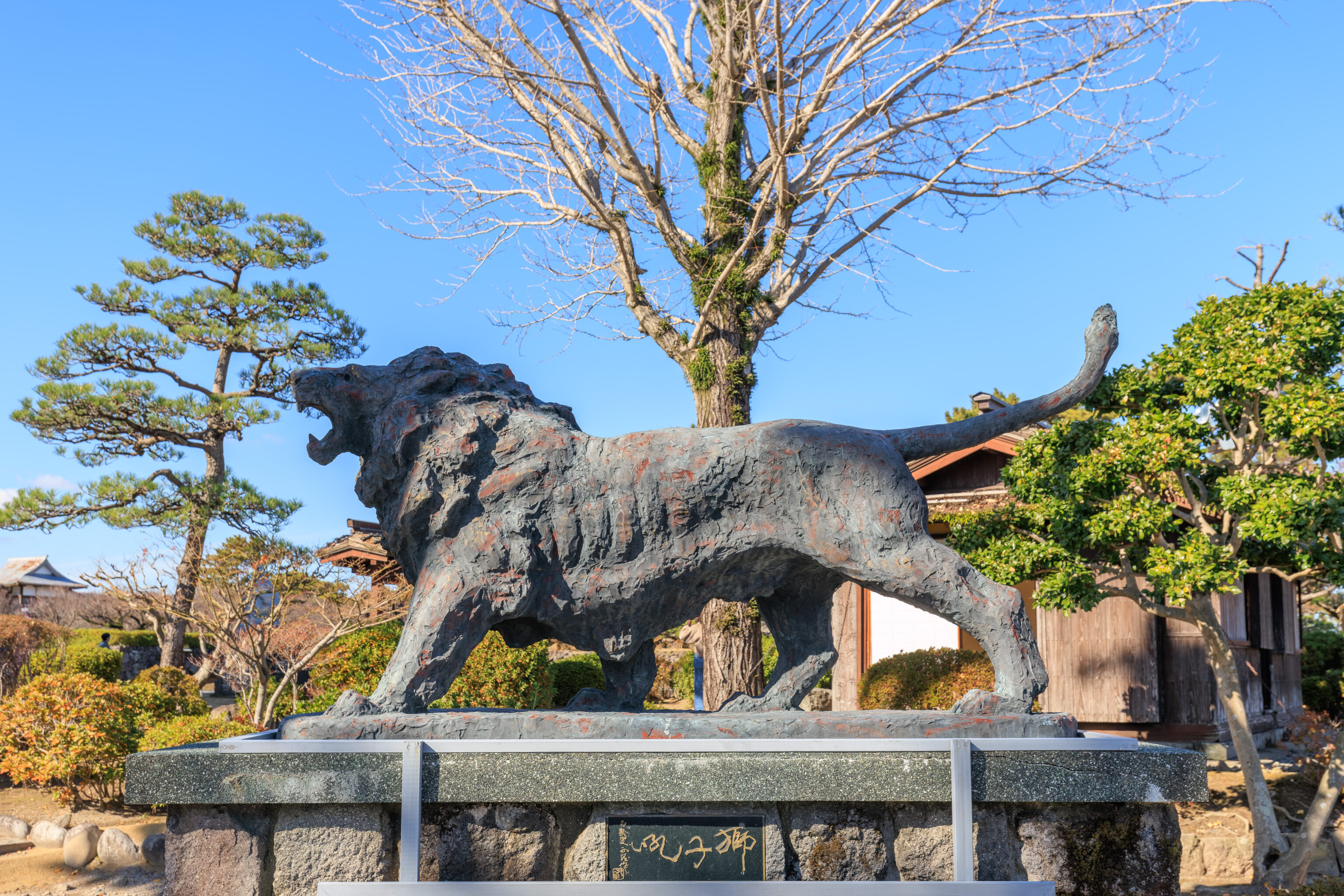
Lion's Roar
1939 (Showa 14), Bronze

This is a dynamic lion, baring its fangs and brimming with intense spirit.

The term *shishiku* (lion's roar) draws an analogy to the scene where surrounding animals cower and prostrate themselves in fear of a lion's ferocious roar; it symbolizes Shakyamuni Buddha preaching the Dharma with majestic confidence. With its dignified bearing and piercing gaze, it drives away all forms of evil.
– Text from a sign at the base of the above sculpture, read and translated using Google Gemini and Translate.
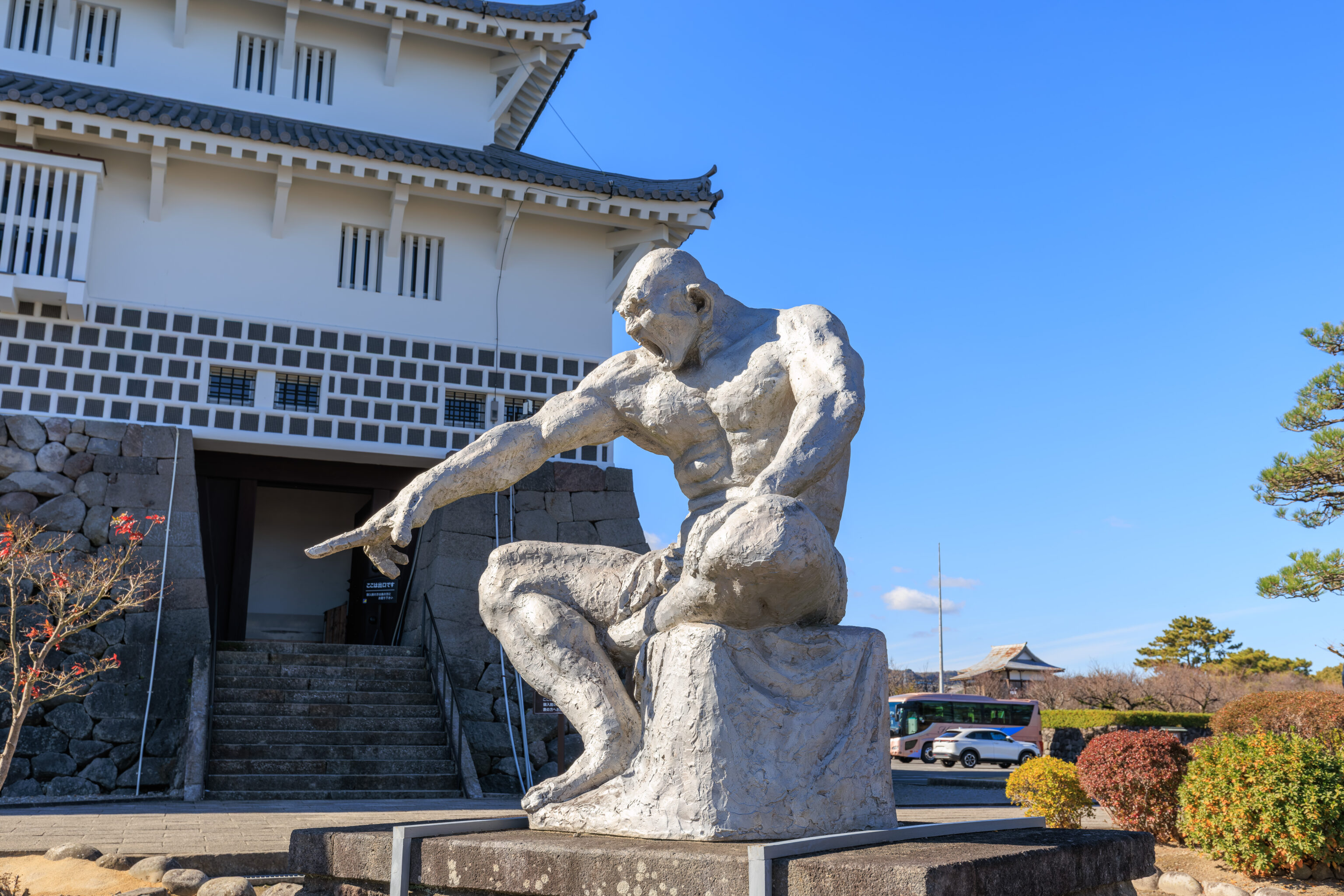
Nichiren Shōnin
1953 (Showa 28), High-purity aluminum

Nichiren Shonin stood firmly on the side of the common people to the very end, never yielding to oppression nor pandering to those in power. This sculpture captures him delivering a sermon with a compelling intensity born of his burning conviction. Amidst the passionate, dynamic energy of the figure, there radiates an air of stern solemnity that commands respect.

The inscription on the pedestal reads: "The Extraordinary Nichiren: A Life-or-Death Sermon Fueled by Conviction."

Created while the artist was working on the Peace Statue, this piece stands as one of his representative post-war works.
– Text from a sign at the base of the above sculpture, read and translated using Google Gemini and Translate.
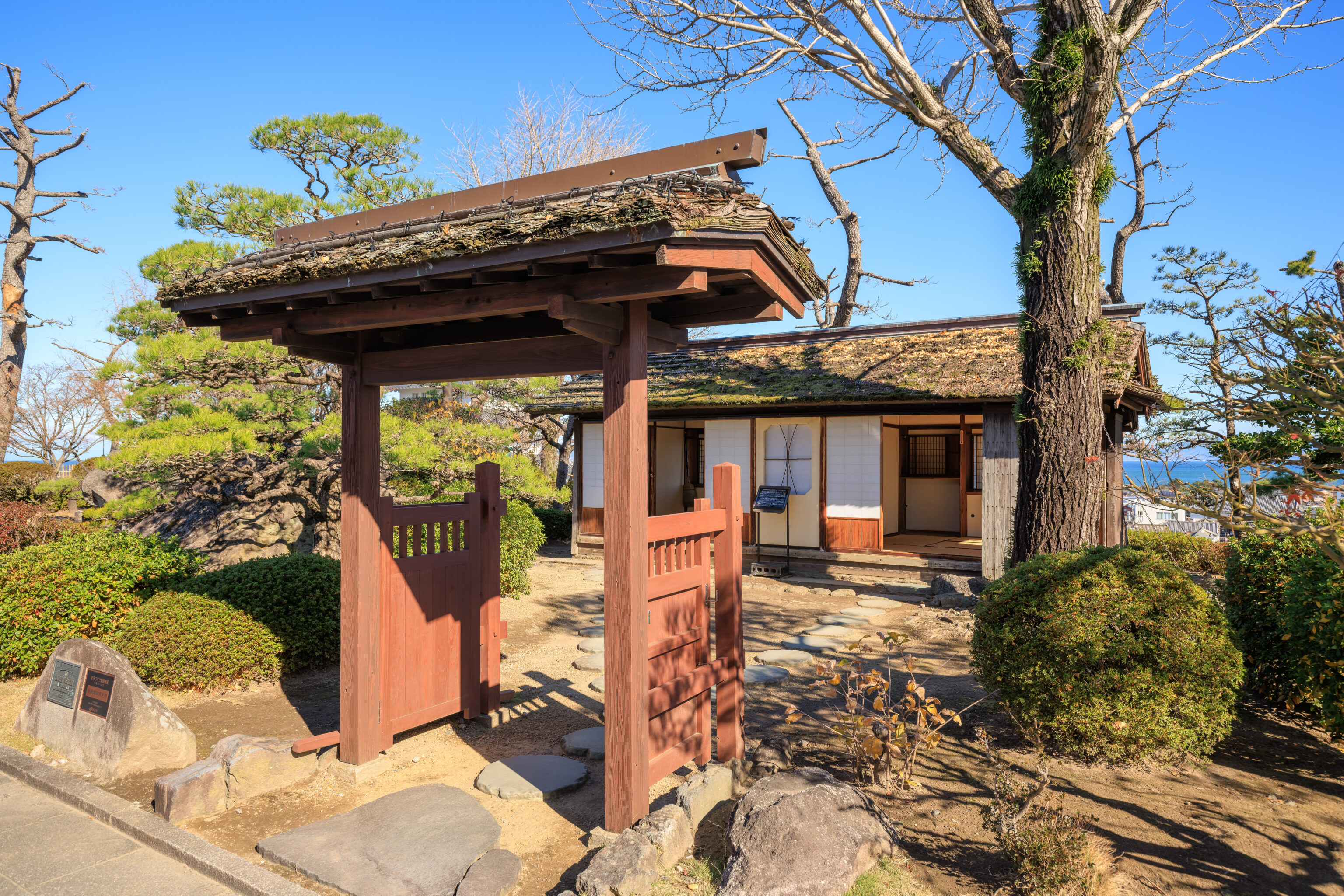
We continued on to check out this small building. It is one of the older remaining buildings here at the castle.
Shimabara Castle Horse-Viewing Pavilion
The *Omamijo* (Viewing Pavilion) was originally built during the tenure of Lord Matsudaira Tadakazu—the domain's lord at the end of the Edo period—to allow him to observe the training of his samurai retainers. Although it currently stands a short distance northeast of the Shimabara Castle keep, it was originally located in the *Sannomaru* (Third Bailey) area, near the present-day Shimabara High School. Following the Meiji Restoration, it was relocated to Kuchinotsu Town, but was later moved back to the castle grounds in 1966.

The *Omamijo* is a single-story wooden structure featuring a gabled roof thatched with cedar bark. Its layout consists of two 4.5-mat rooms situated on either side of a central tatami-floored corridor. Large openings fitted with *shoji* (paper sliding screens) span three sides of the building: the front (west side) and both the left and right sides. Overall, the structure reflects the *sukiya* style, characterized by a framework of slender timber.

It is a valuable structure, serving as one of the few remaining historical buildings associated with Shimabara Castle. In March 2013, it was designated as a Registered Tangible Cultural Property of Japan.
– Text from a sign in front of the building, read and translated using Google Gemini and Translate.
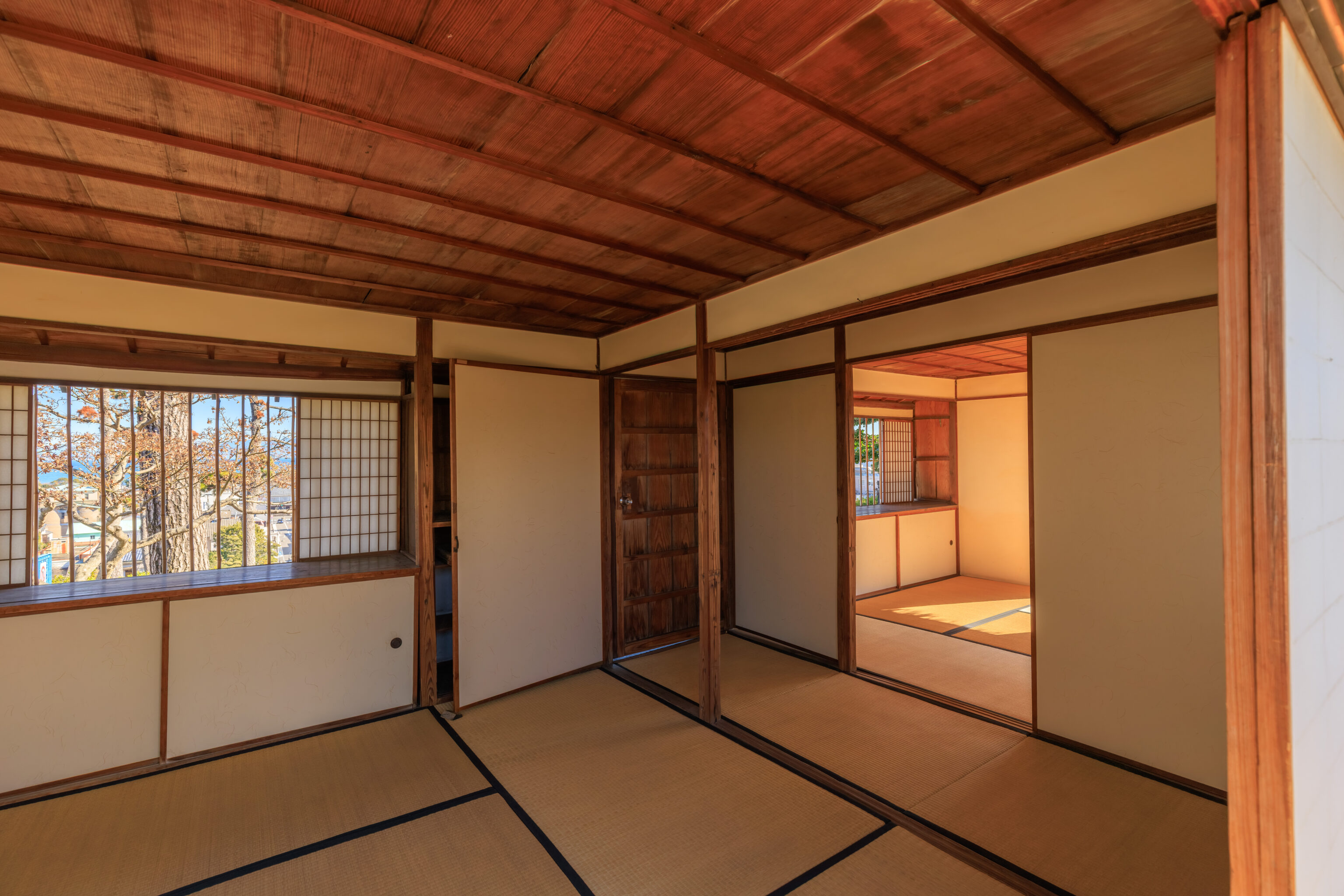
There doesn’t seem to be anything inside.
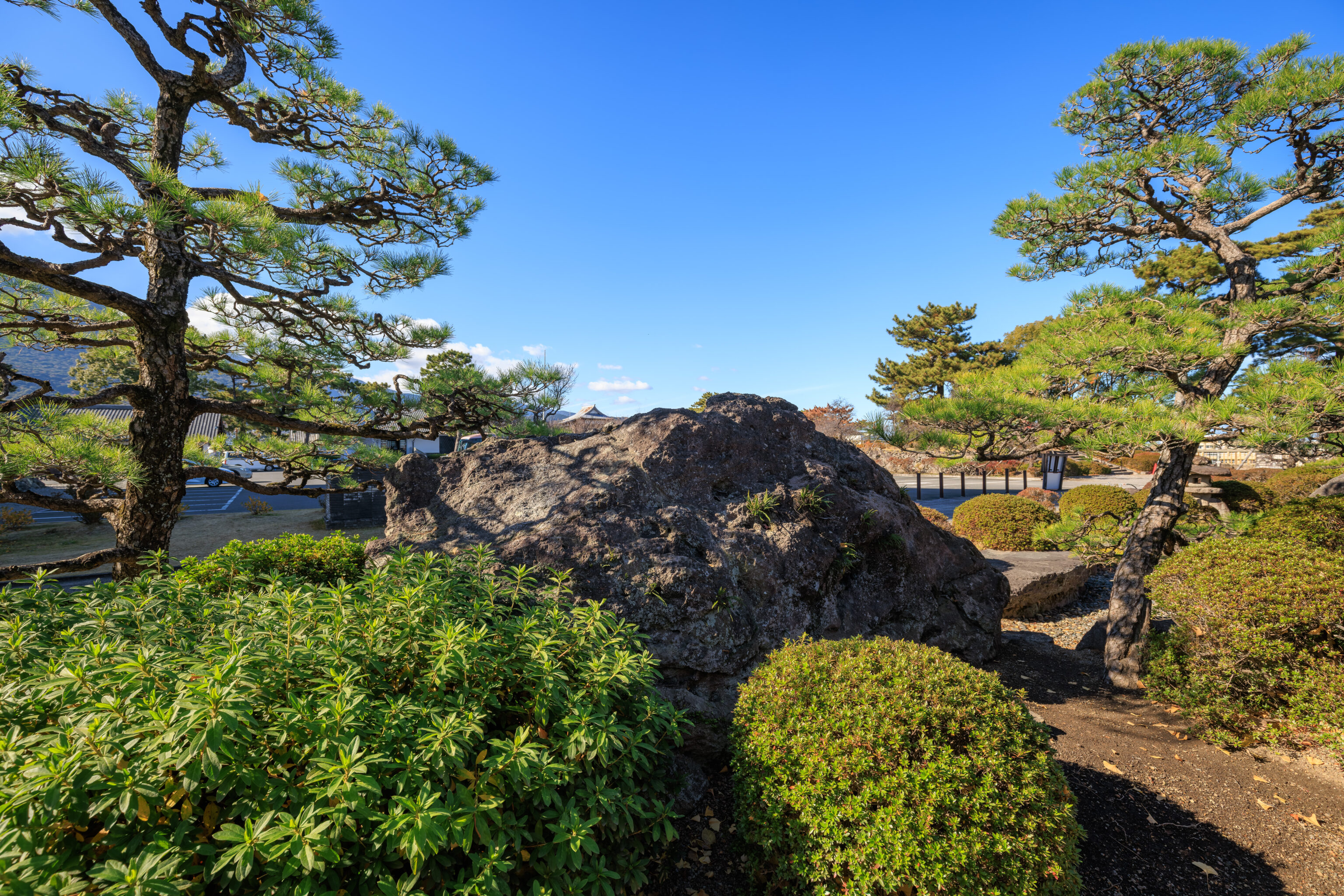
Just a nice view…
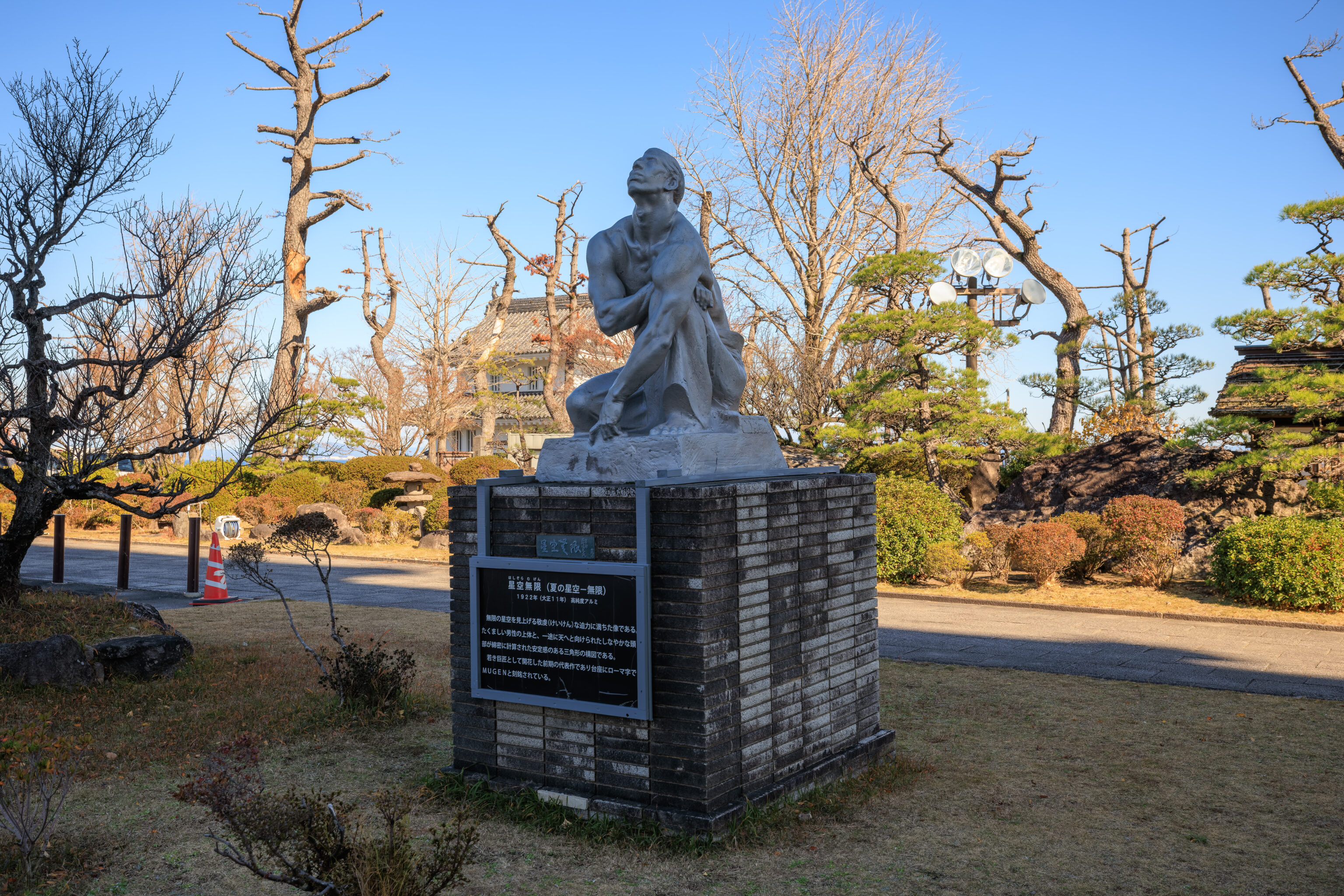
Infinite Starry Sky (Summer Starry Sky—Infinite)
1922 (Taisho 11), High-purity aluminum

The statue radiates a sense of reverent awe as it gazes up at the infinite starry sky.

It features a composition based on a carefully calculated, stable triangle formed by the robust upper body of a man and a supple head turned intently toward the heavens.

This is a masterpiece from the artist's early period—marking his emergence as a young master—and bears the inscription "MUGEN" in Roman letters on its base.
– Text from a sign at the base of the above sculpture, read and translated using Google Gemini and Translate.
The word mentioned on the sign, 無限 mugen, means unlimited, or infinity.
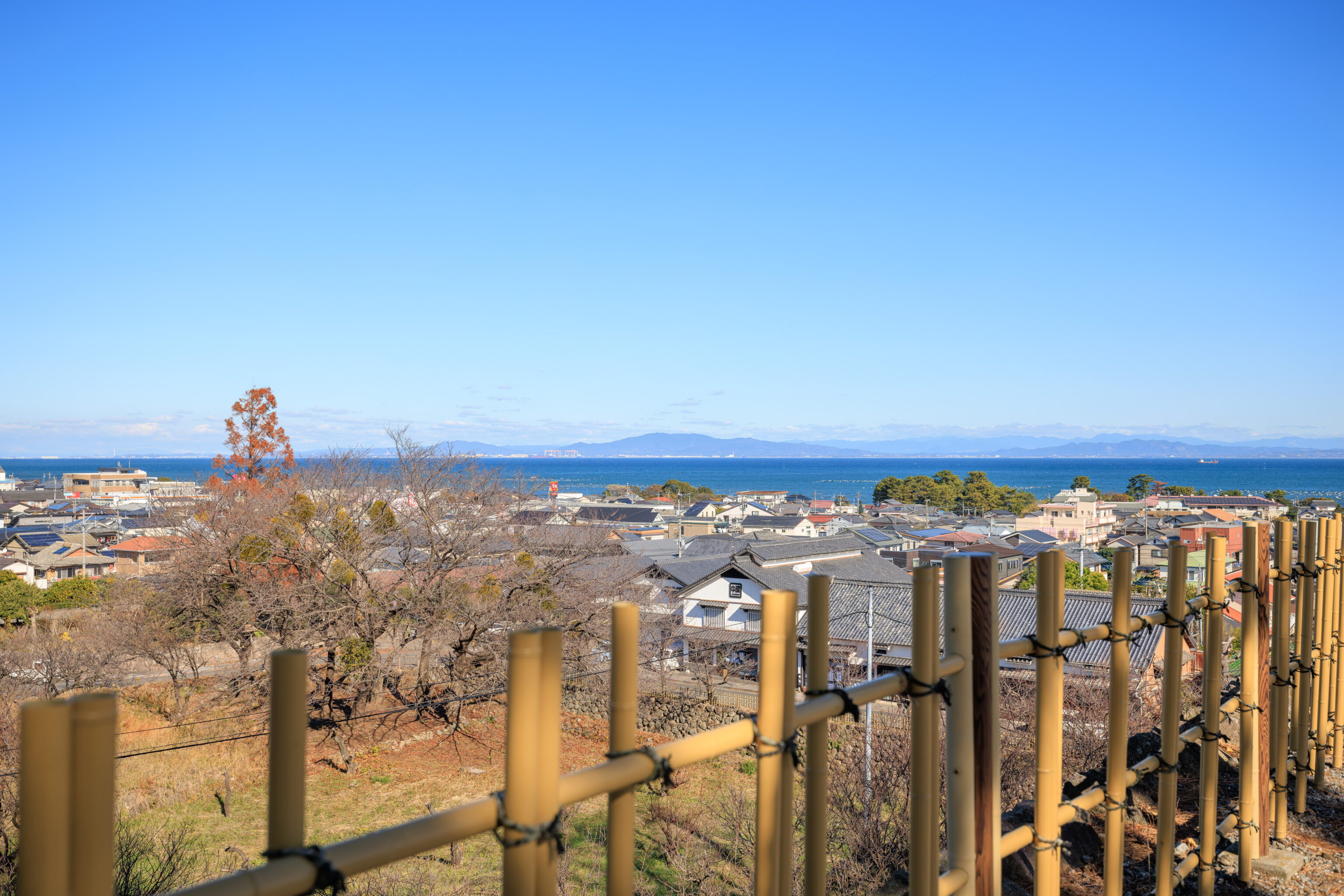
We walked to the west, basically to the north side of the castle. From here, we could look over some bamboo fencing atop the castle wall.
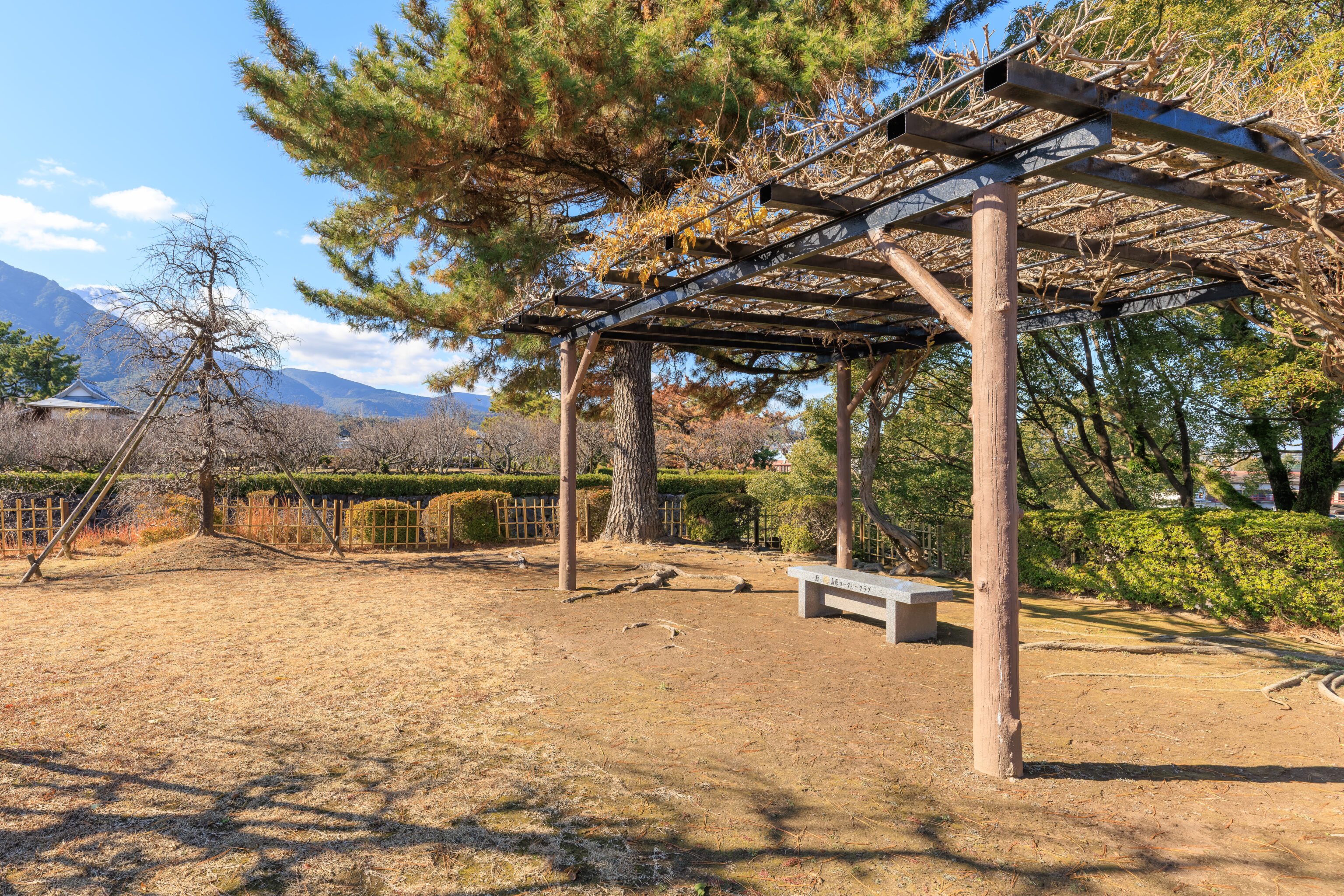
This looks like it would be a nice shaded place to sit in the summer!
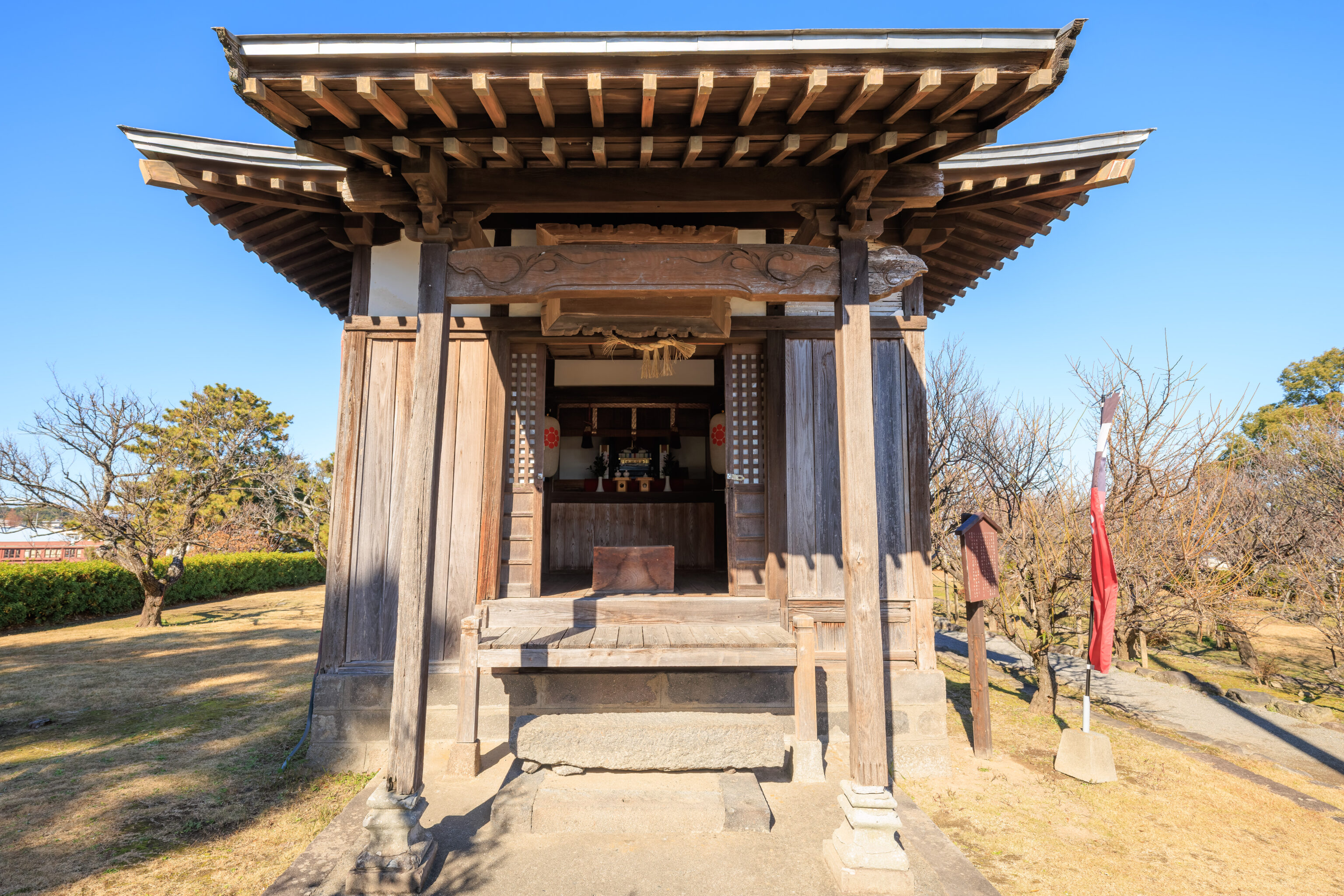
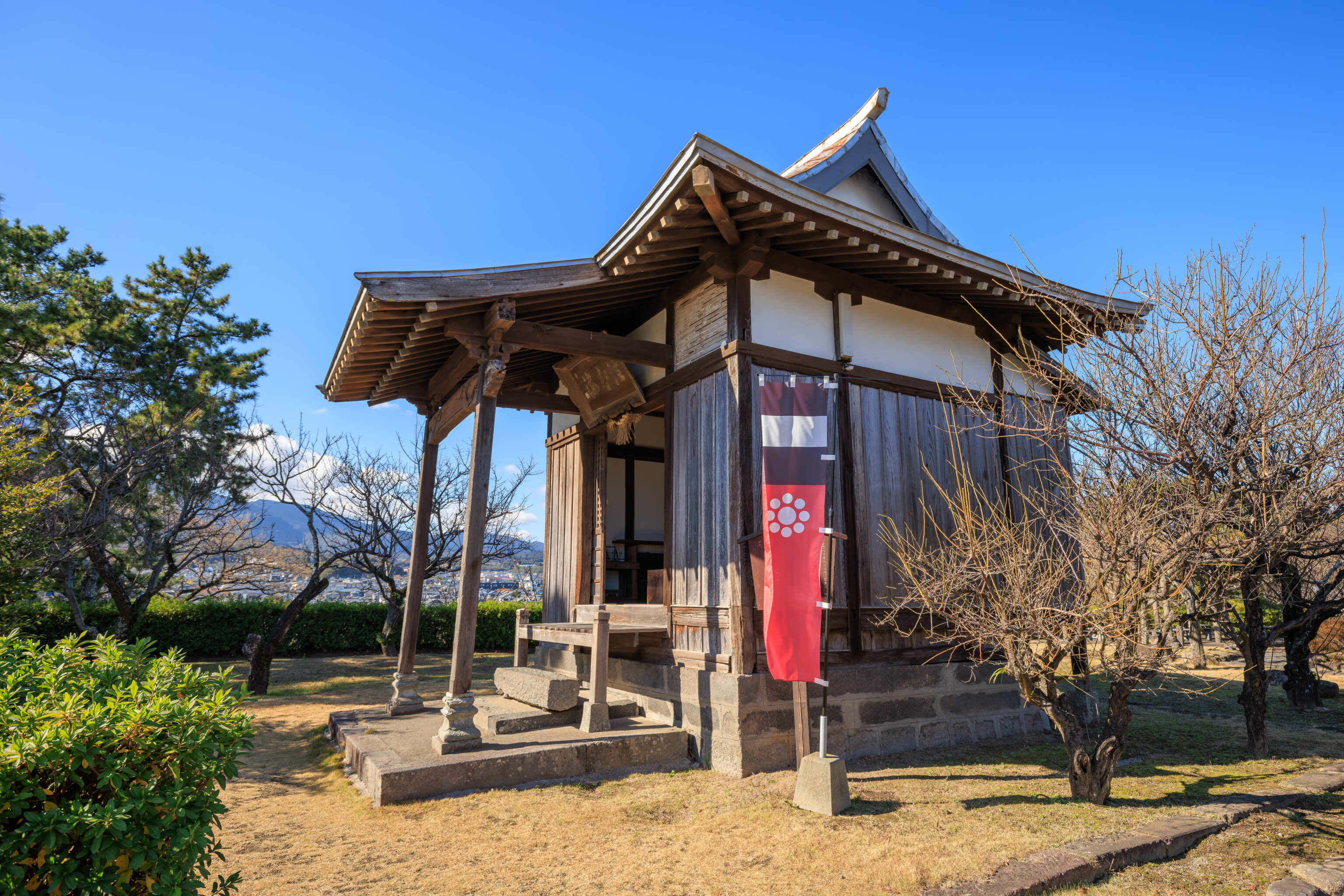
This area, identified as the 古野梅苑 Konoume Garden, had a small shrine.
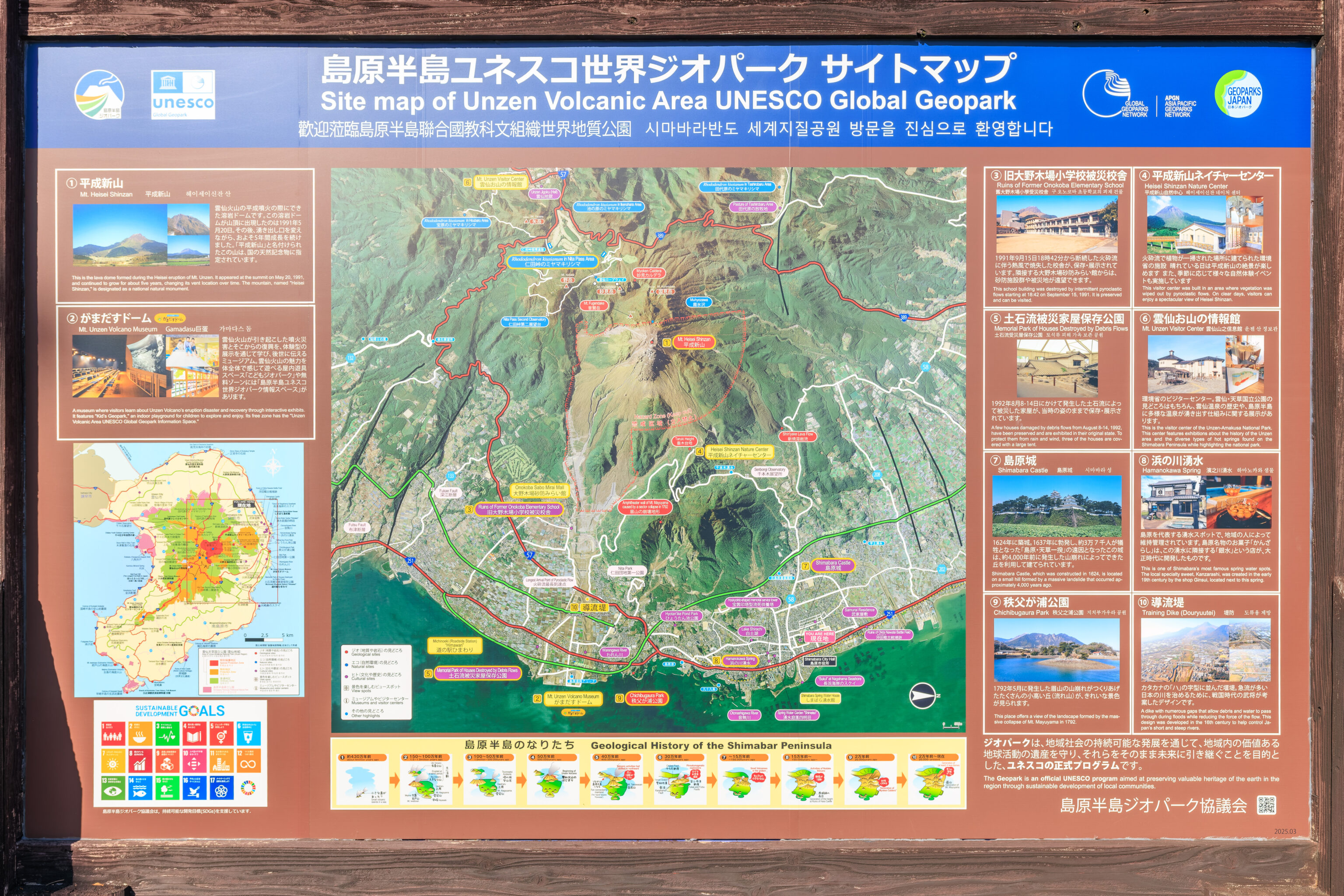
A sign here had a map showing the area around Mount Unzen and Shimabara. Many of the places on this map are not easy to visit unless you have a car.
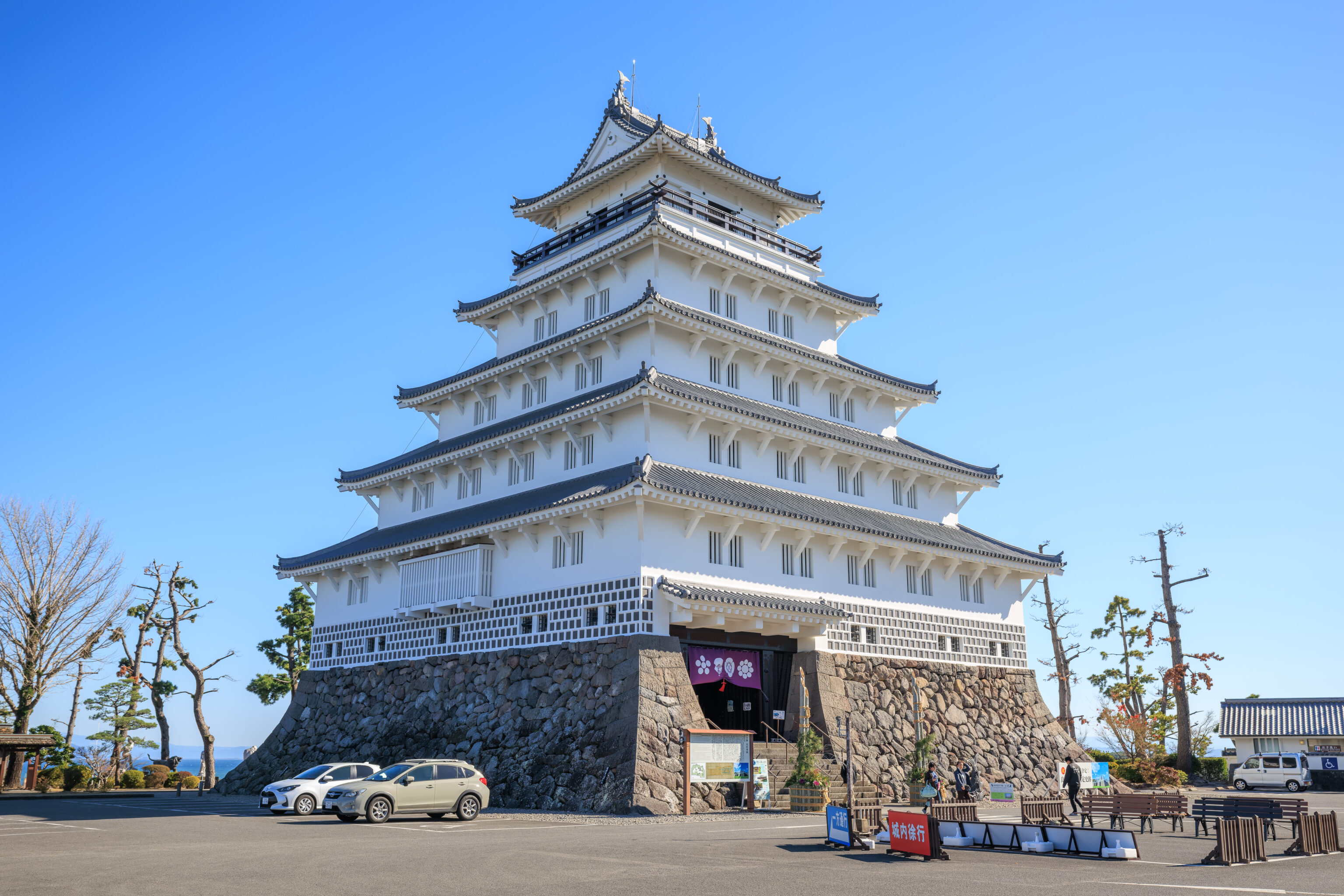
This was the view of the castle from in front of the gift shop.
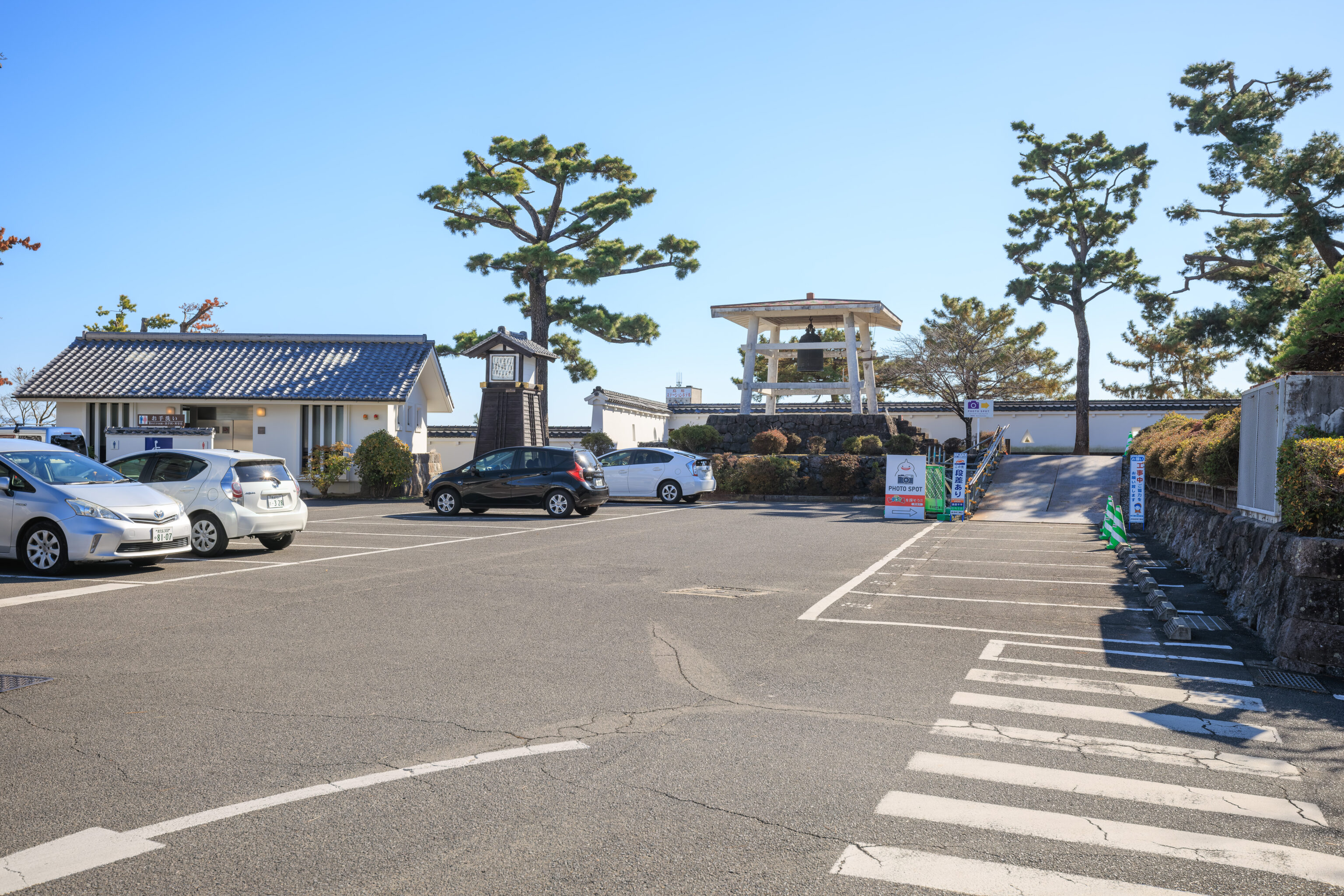
There was a bell over to the south. We headed in that direction and up the ramp seen on the right.
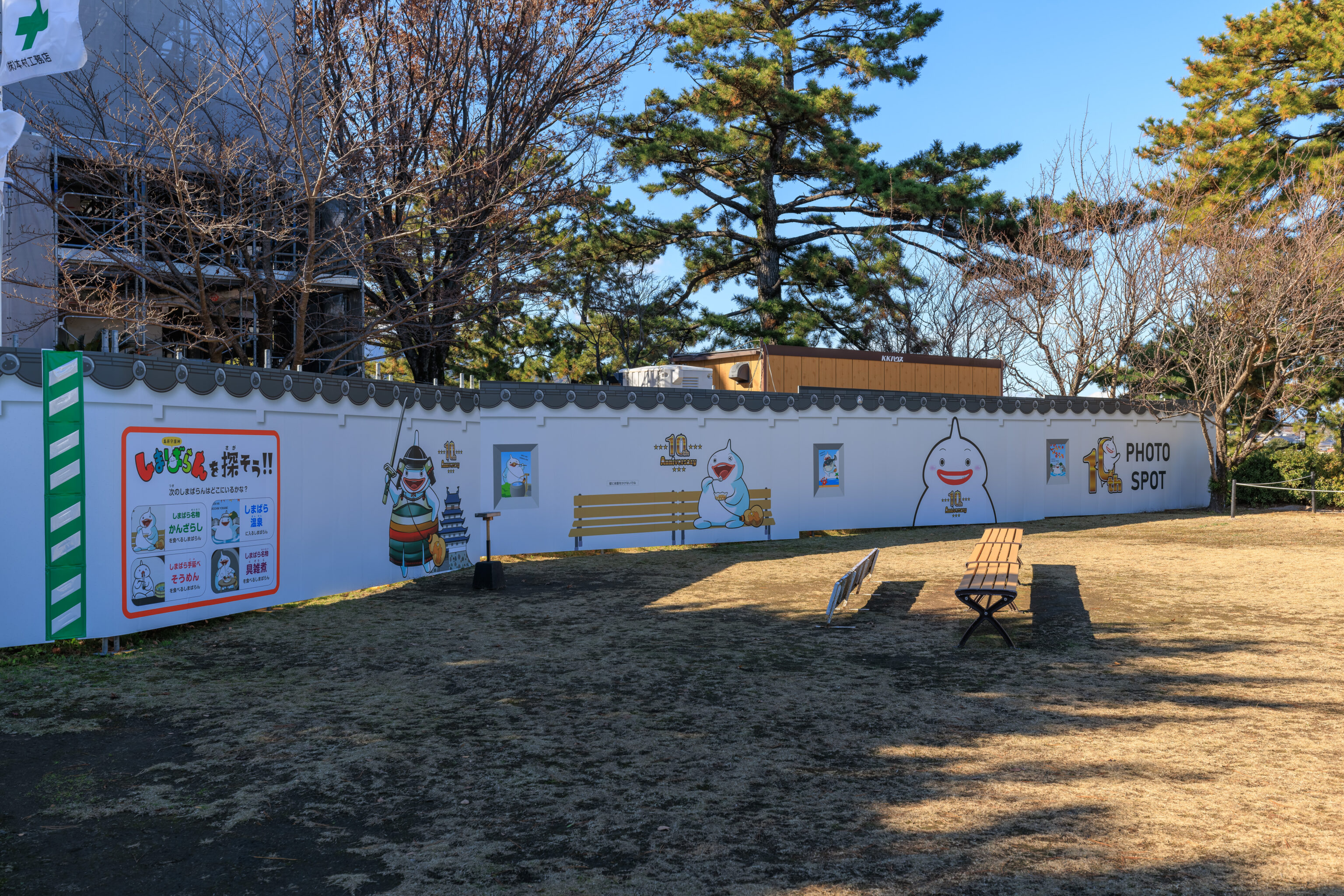
This area, which contains one of the castle’s towers, was undergoing reconstruction activities. The character depicted on the wall is しまばらん Shimabaran, the guardian deity mascot of Shimabara Castle.
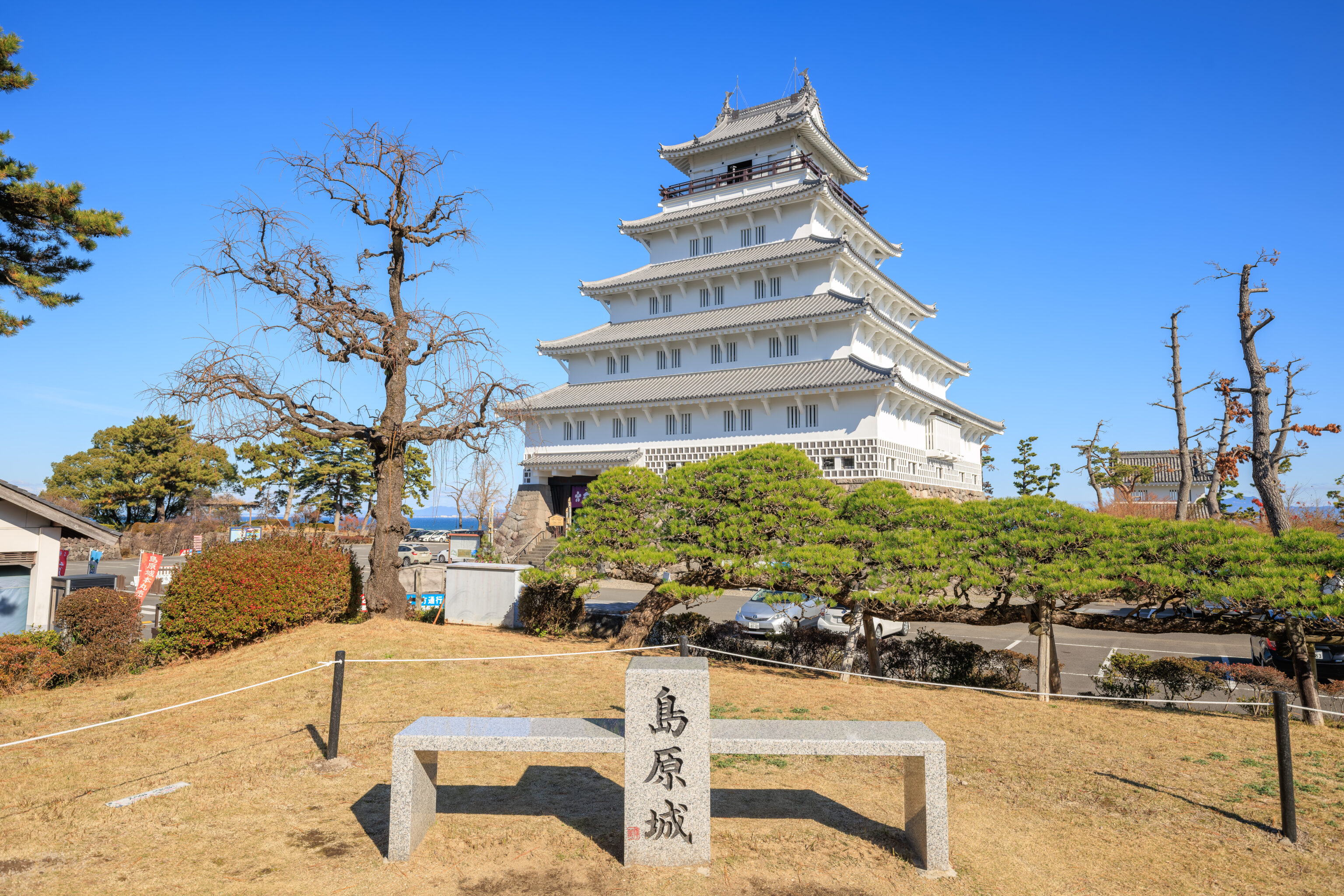
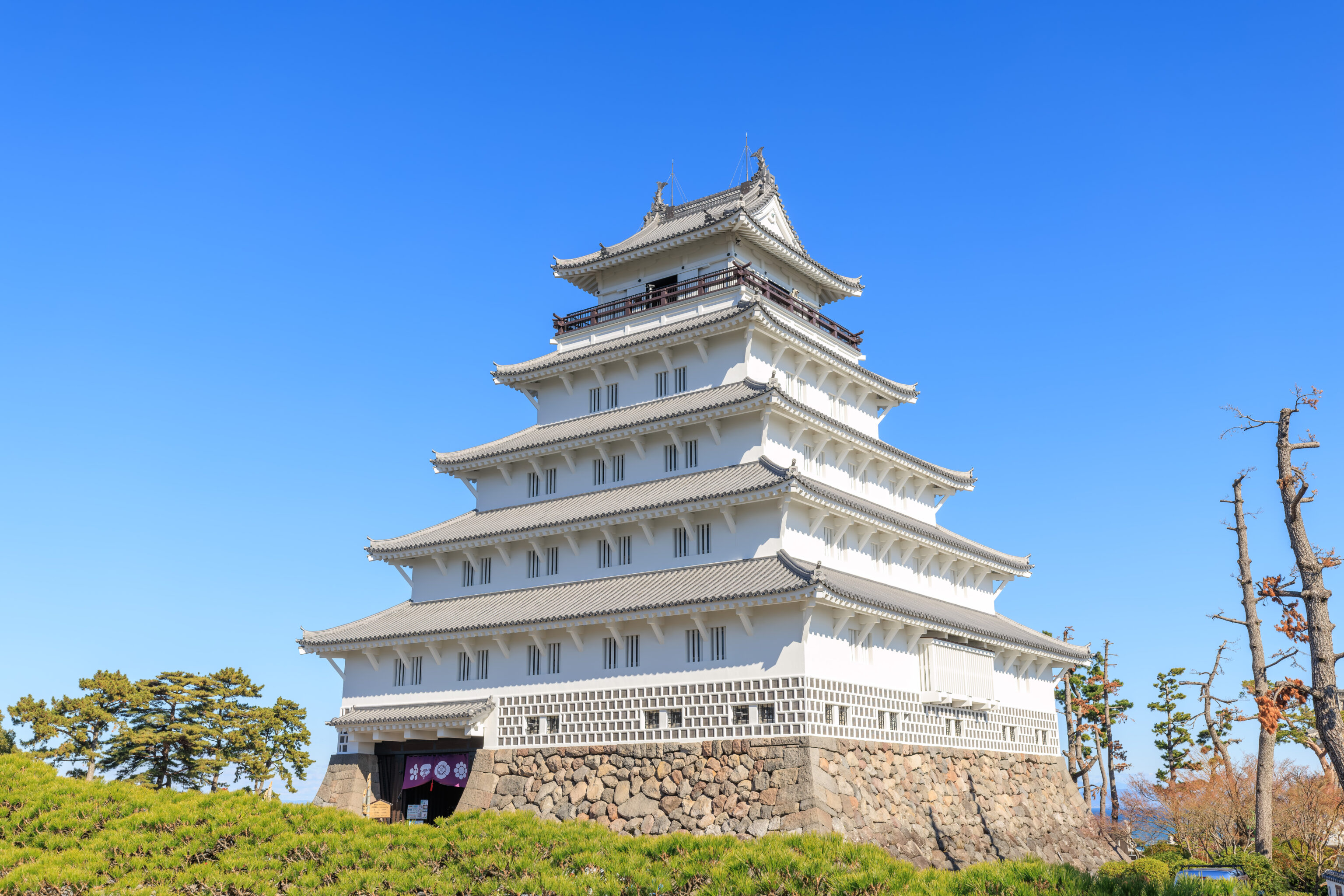
This ended up being a great photo spot for the castle!
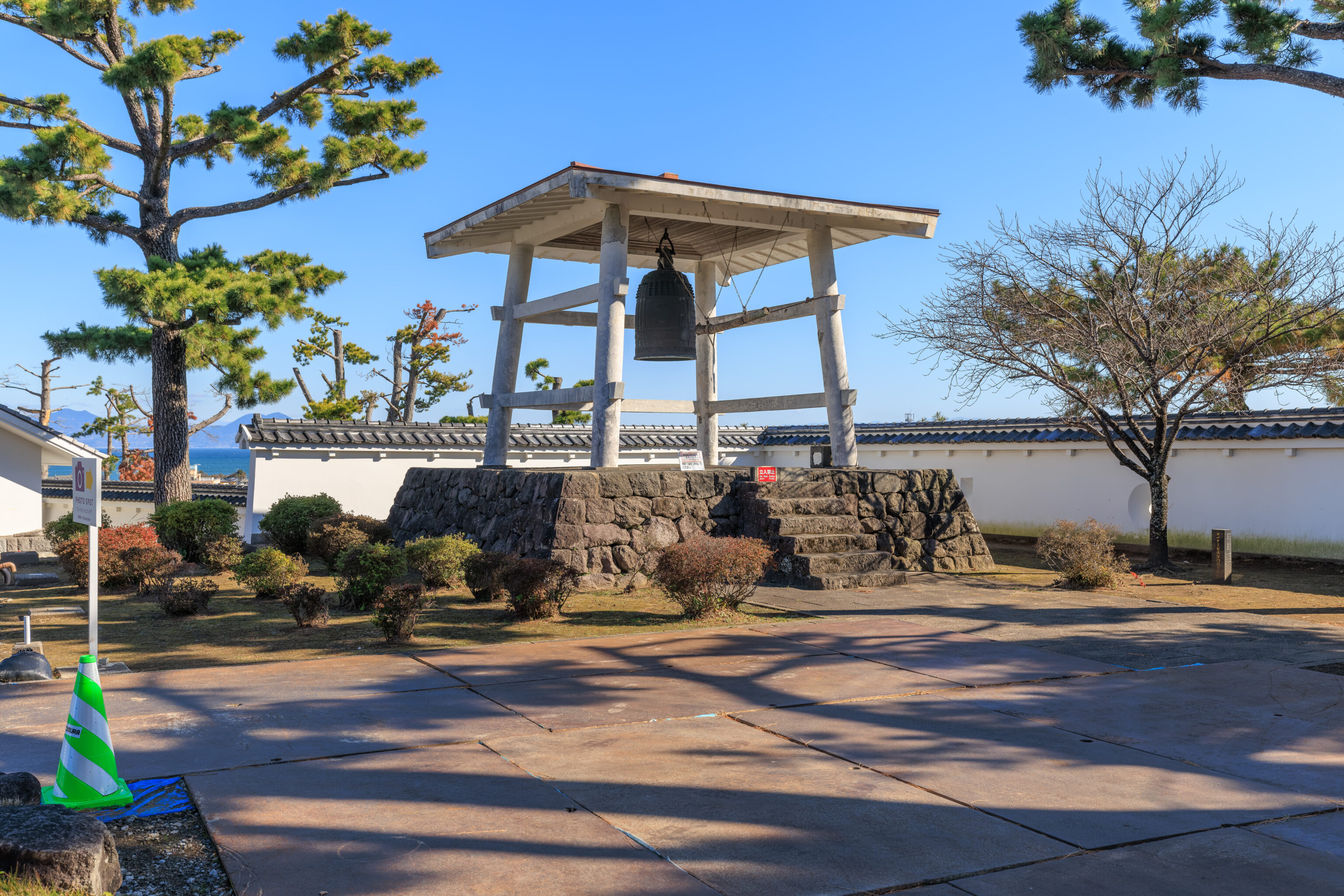
The bell pavilion was pretty simple.
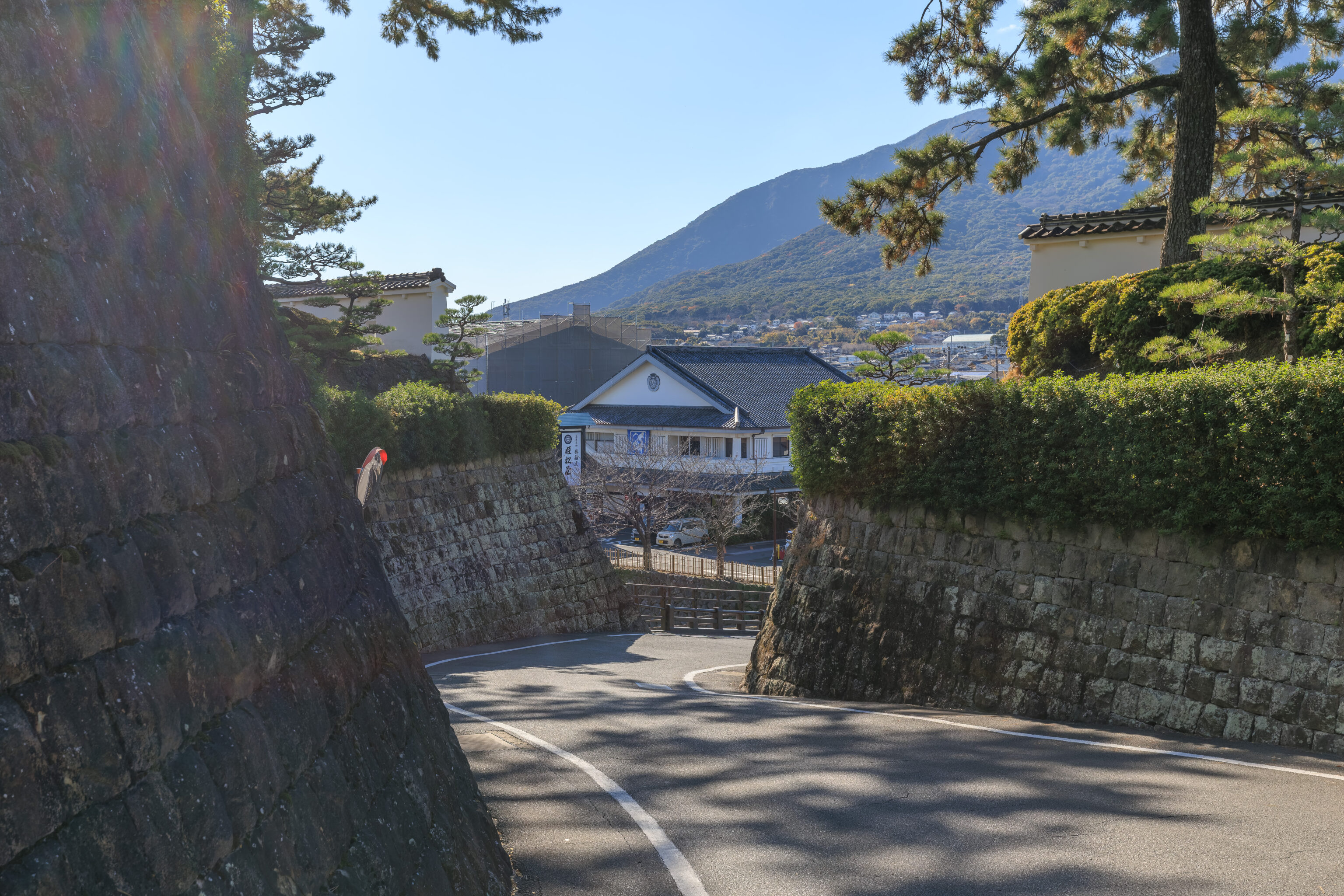
We headed down the driveway at around 12:50pm and decided to get lunch nearby.
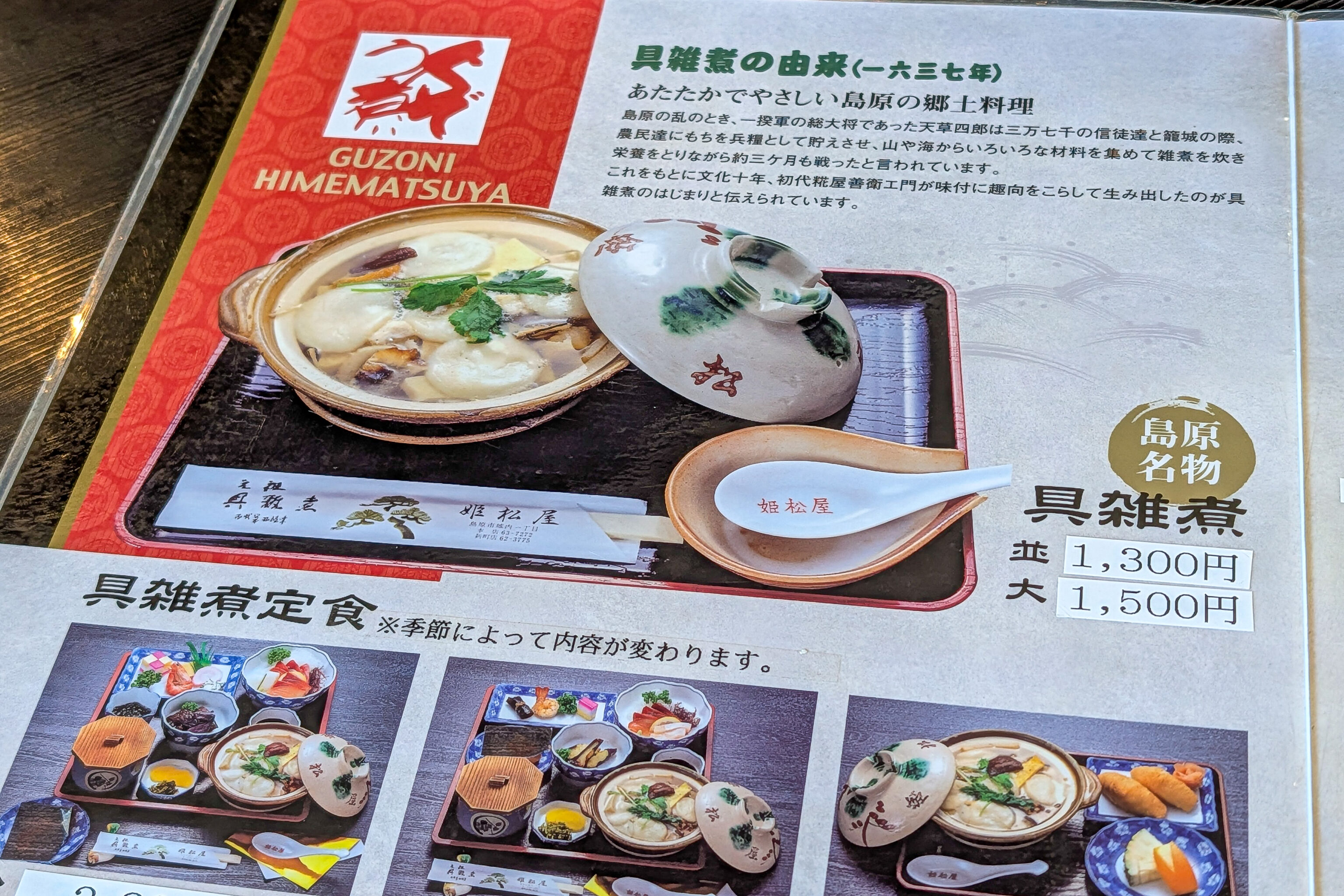
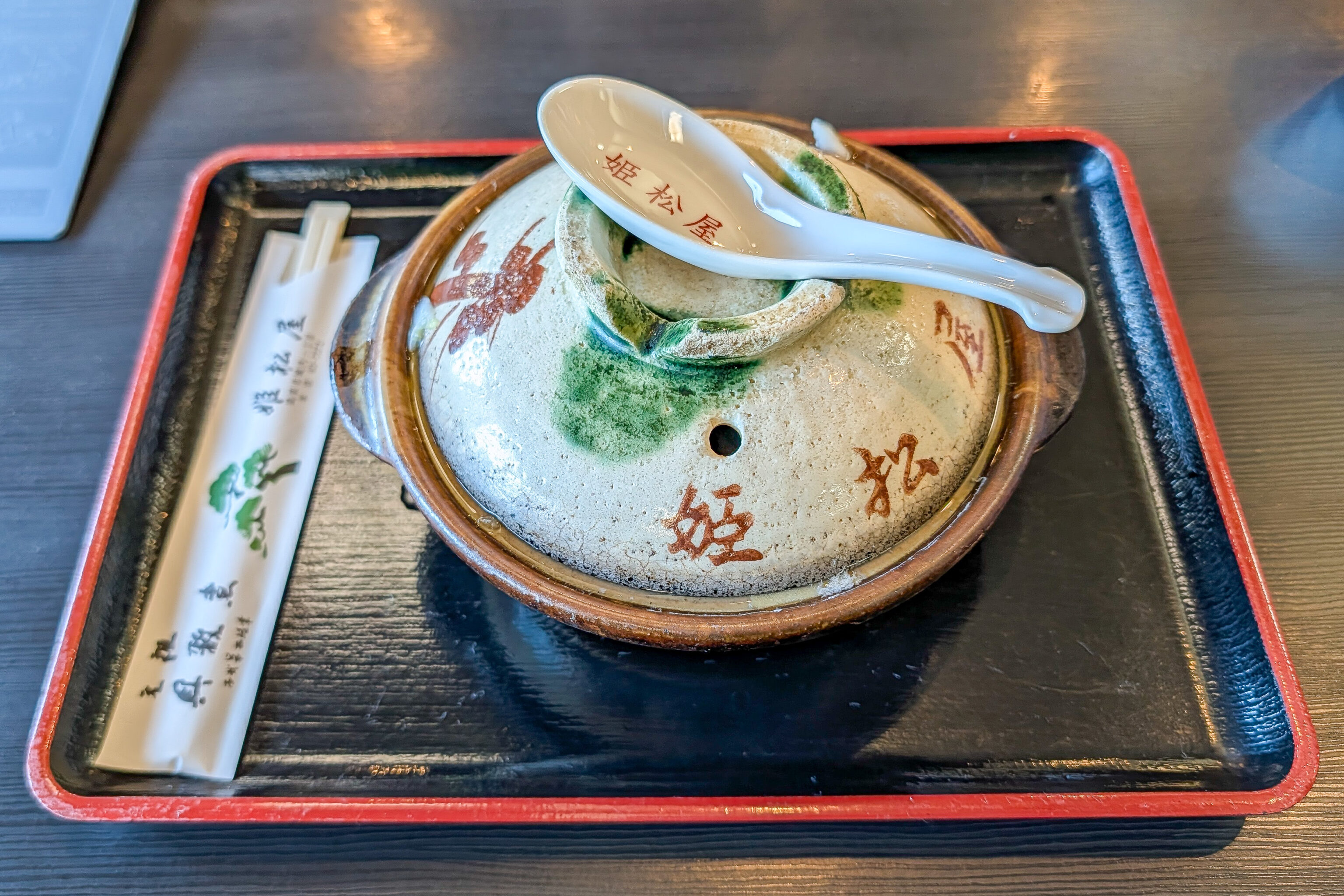
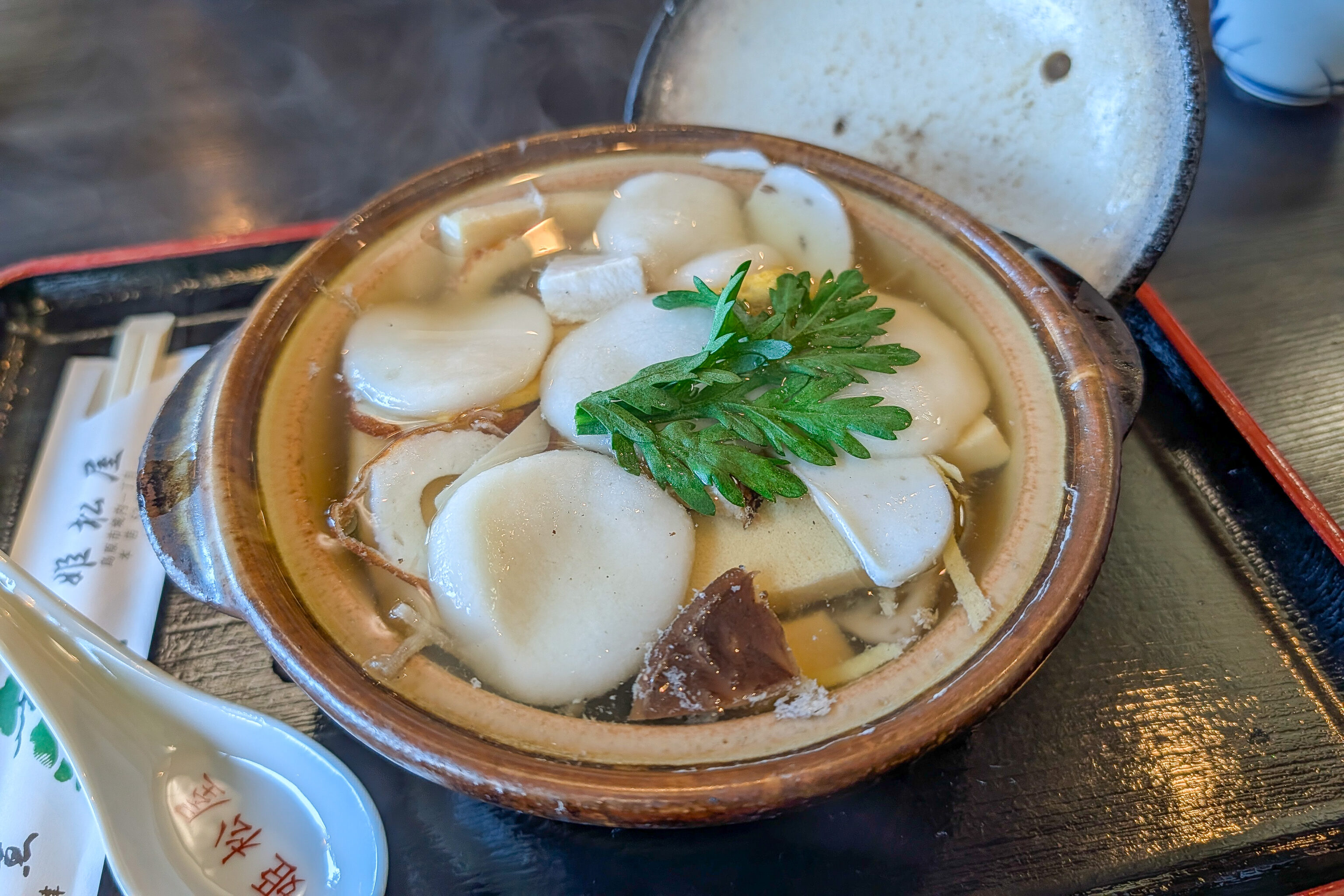
We had lunch at 姫松屋 Himematsuya, a restaurant across the street from Shimabara Castle. Their specialty is 具雑煮 guzoni, a local specialty of Shimabara. It is a soup that is made with rice cake and a variety of local ingredients. It is said to have originated in 1637 during the Shimabara Rebellion.
The Origin of Guzōni (1637)
Warm and comforting local cuisine from Shimabara.

It is said that during the Shimabara Rebellion, Amakusa Shiro—the supreme commander of the insurgent forces—and his 37,000 followers held out in the castle for approximately three months; they sustained themselves by stockpiling *mochi* (rice cakes) as provisions and cooking *zōni* (a traditional soup with rice cakes) using various ingredients gathered from the mountains and sea.

*Gu-zōni*—a version of this soup packed with ingredients—is said to have originated in 1813, when the first generation proprieter Koujiya Kiemon created it by applying his own creative touch to the seasoning.
– Text from the top of the menu, read and translated using Google Gemini and Translate and the “Guzōni” Himematsu-ya Main Restaurant page on Enjoy! Shimabara.
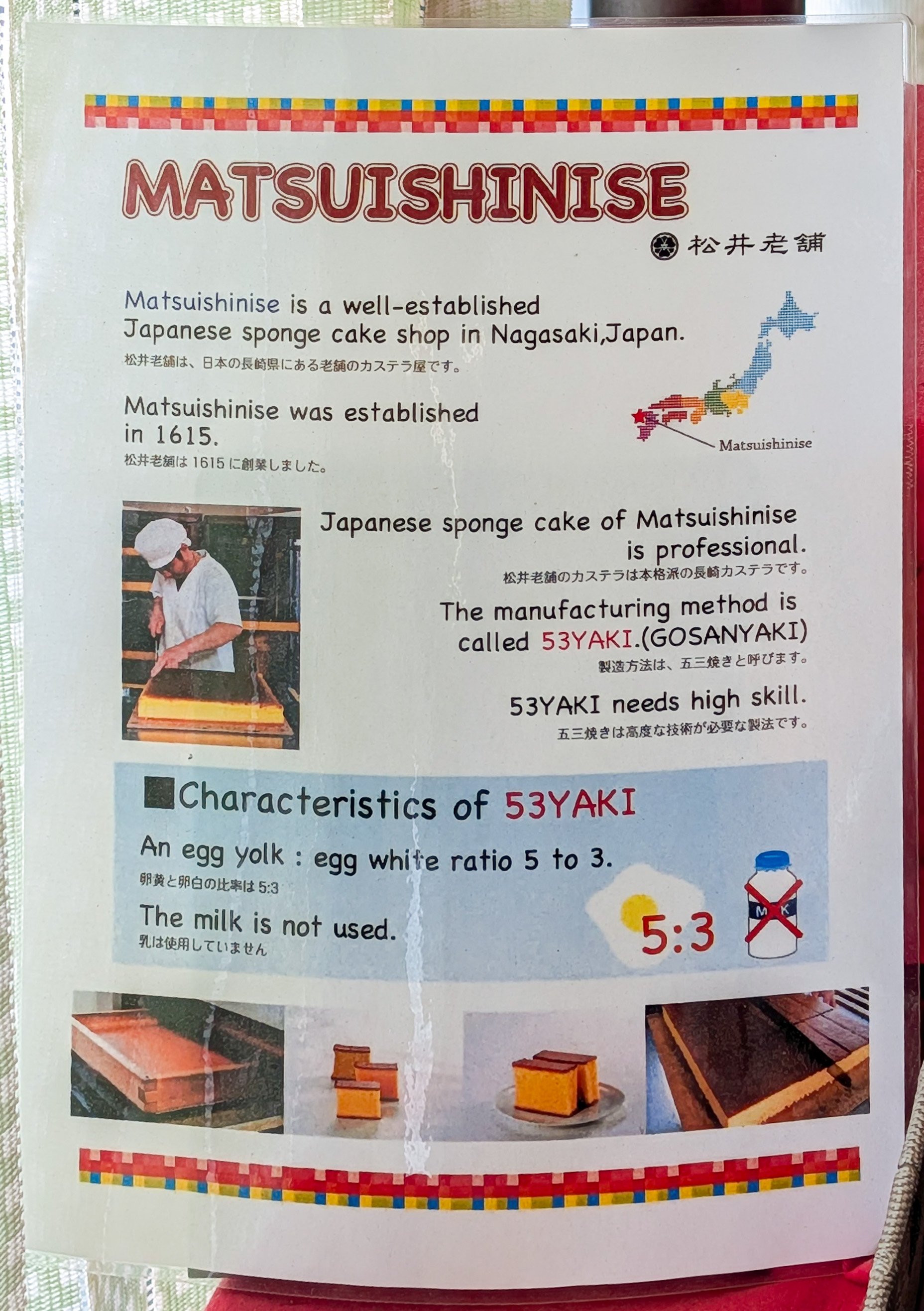
After lunch, we walked a short distaqnce to the northwest to visit 松井老舗 Matsuishinise, a small bakery that makes castella and has been in business since 1615! They make a specific kind of castella, referred to as 五三焼 gosanyaki (5 3 bake), which refers to the 5:3 ratio of egg yolks to egg whites that is used. It is explained on this sign that we photographed.
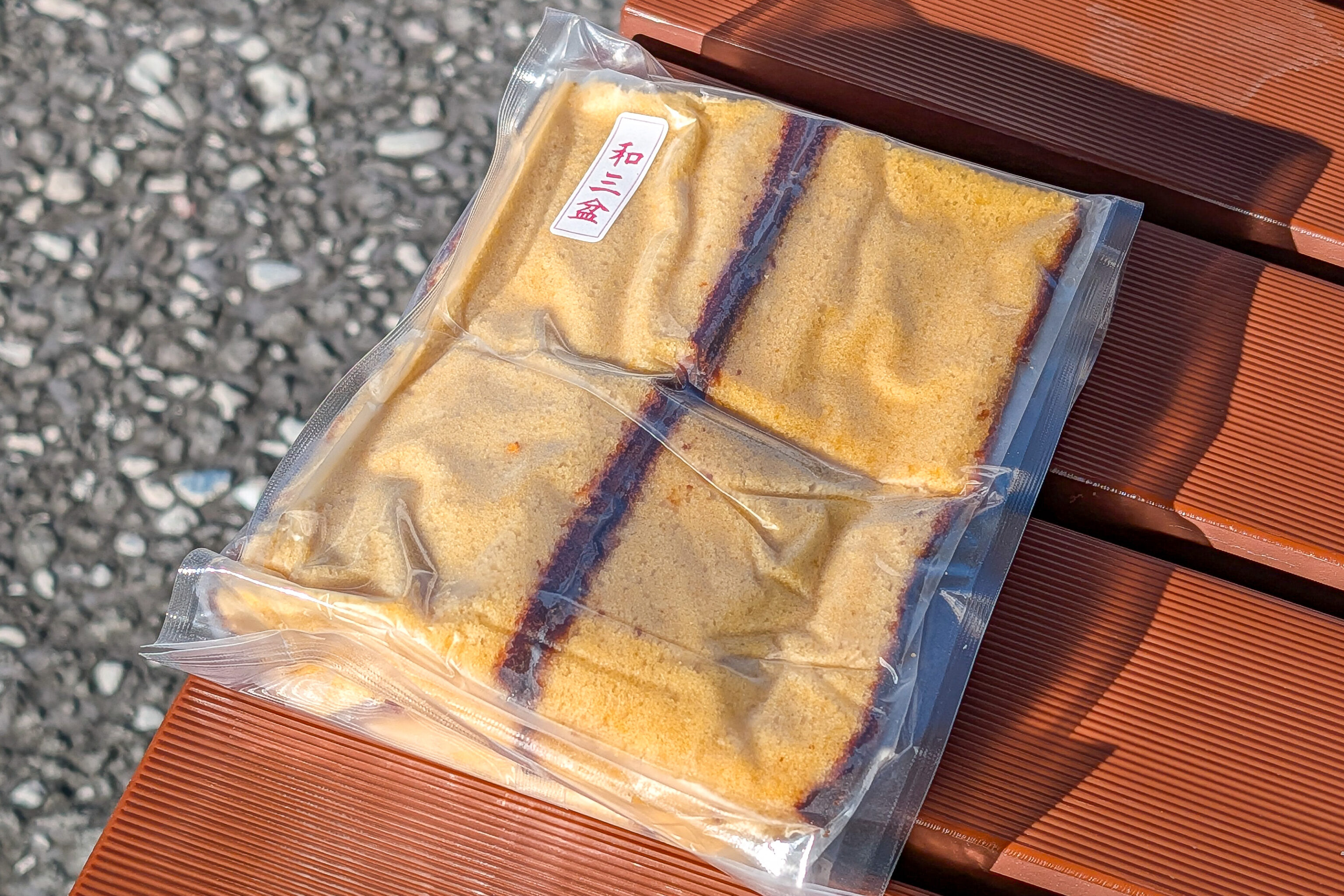
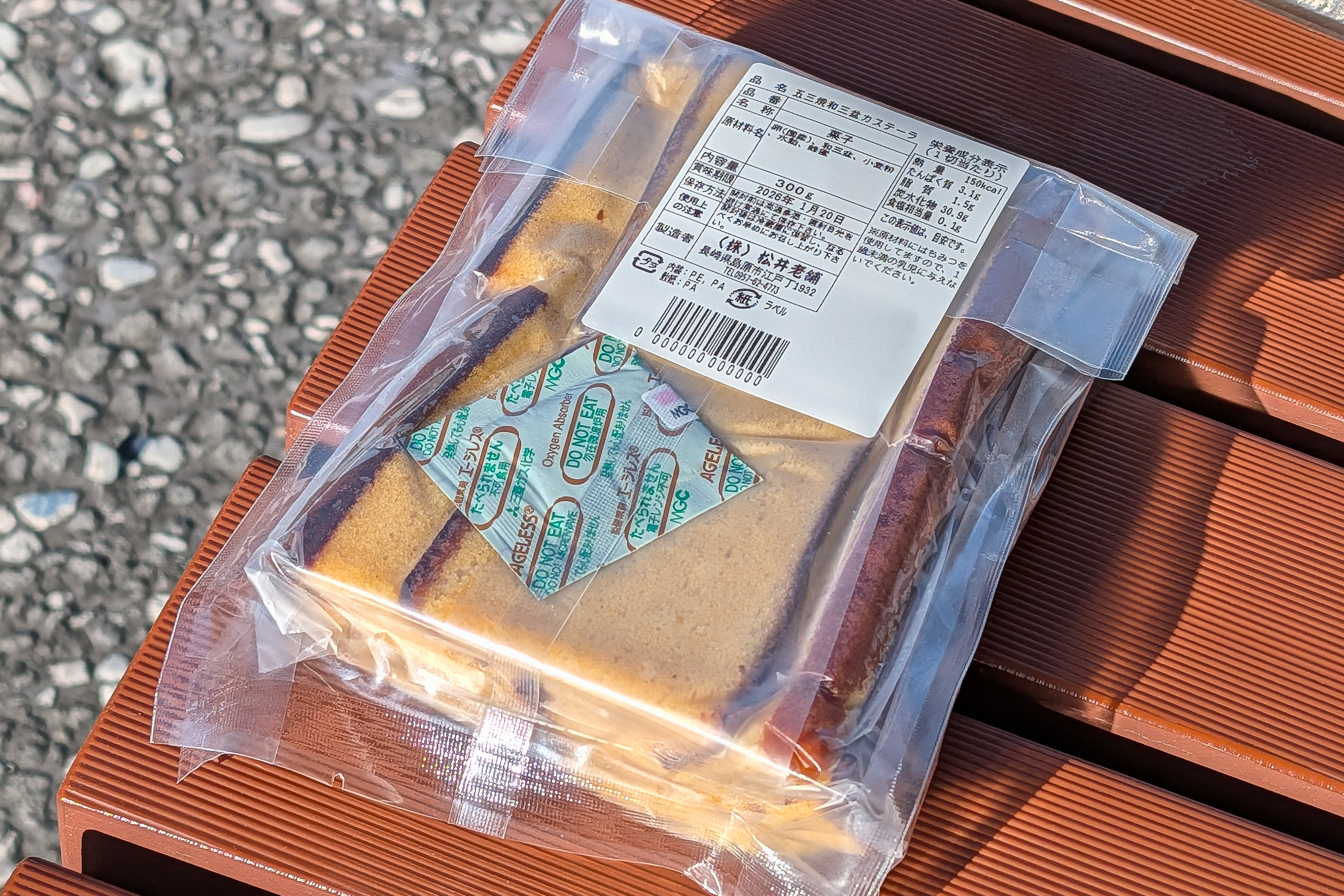
Matsuishinise sells nicely packaged castellas as omiyage. We were happy to see that they also sold these end pieces at a discount price. These pieces aren’t suitable for use as omiyage but taste the same. Perfect for eating ourselves! We put them in our backpack to eat later on.
Gosan-yaki Castella with Wasanbon Sugar
Product Name: Gosanyaki Wasanbon Castella
Category: Confectionery
Ingredients: Eggs (domestic), Sugar, Wasanbon sugar, Wheat flour, Starch syrup, Honey
Net Weight: 300g
Best Before: July 20, 2026
Storage Method: Store away from direct sunlight, high temperatures, and high humidity.
Precautions: After opening, store in the refrigerator and consume as soon as possible.
Manufacturer: Matsui Shinise Co., Ltd.
Address: 1932 Edomachi, Shimabara City, Nagasaki Prefecture
TEL: 0957-62-4773

Nutritional Information
Per individual slice
Calories: 150 kcal
Protein: 3.1 g
Fat: 1.5 g
Carbohydrates: 36.9 g
Salt Equivalent: 0.1 g
These values are approximate guidelines.

Because honey is used as an ingredient, please do not feed this product to infants under 1 year of age.
– Text from the label on the packaging, read and translated using Google Gemini.
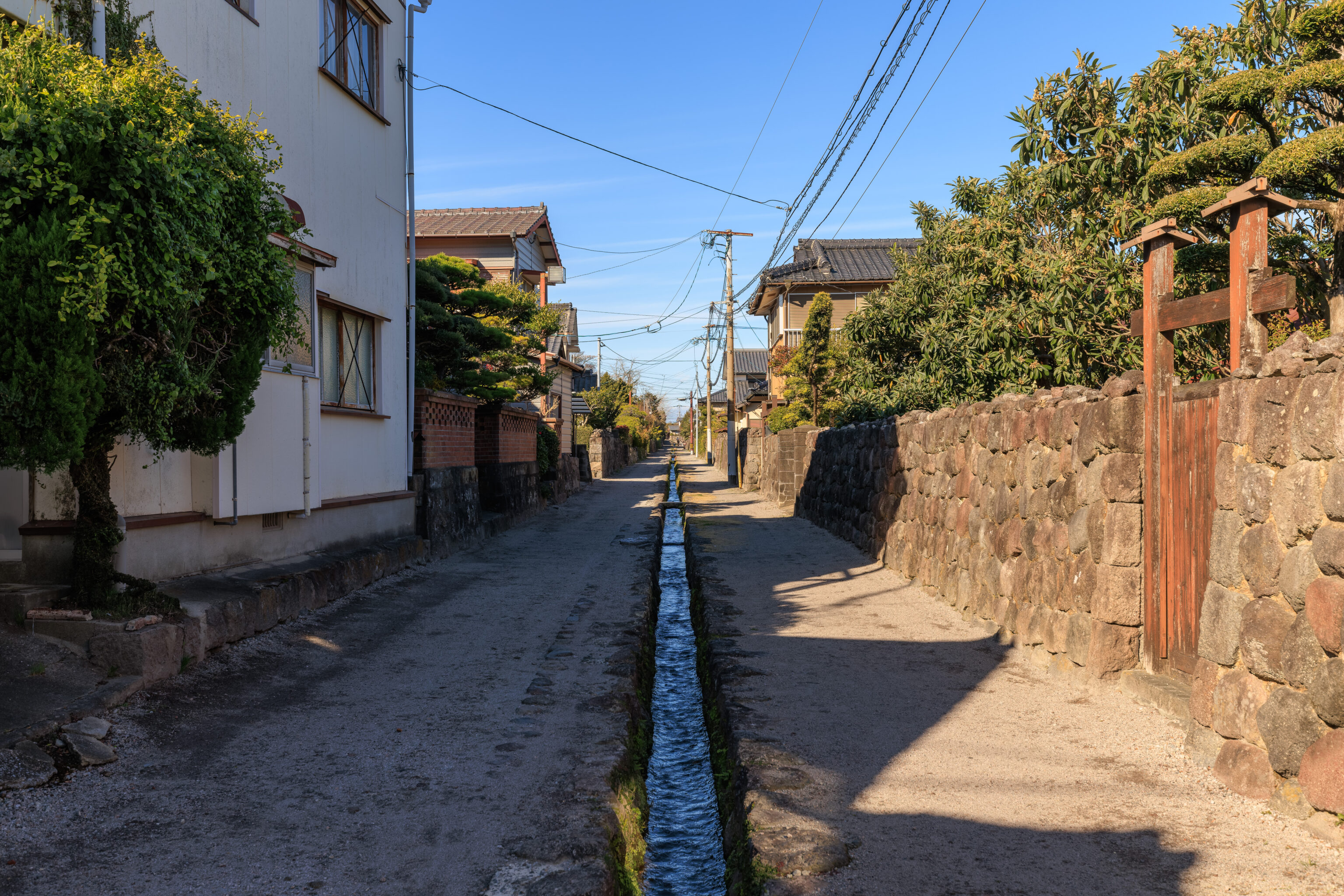
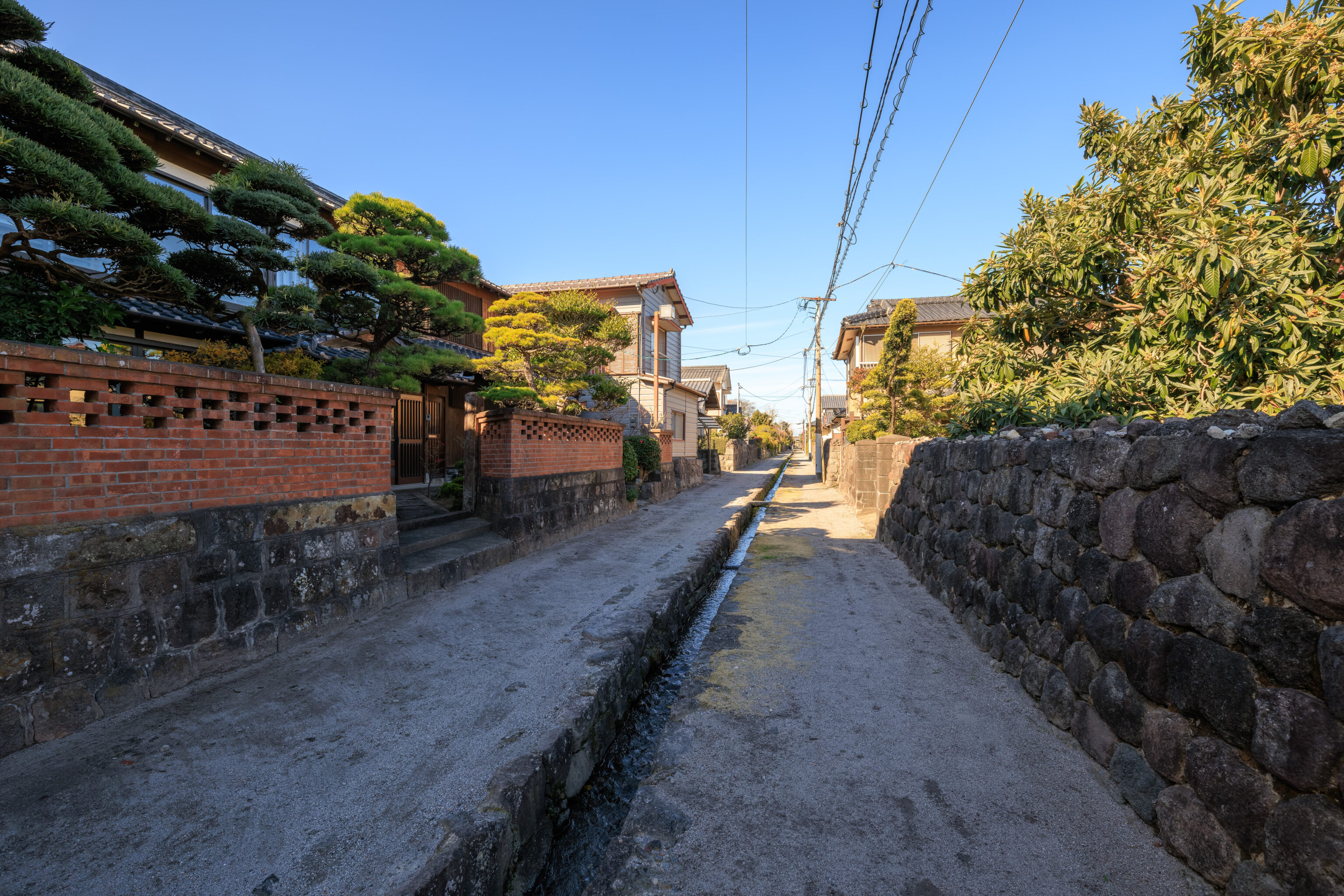
Nearby, we found the start of this historic road with a spring water fed canal running down the middle. This area is referred to as the 武家屋敷通り Samurai Residences Street and 武家屋敷水路 Samurai Residences Waterway.
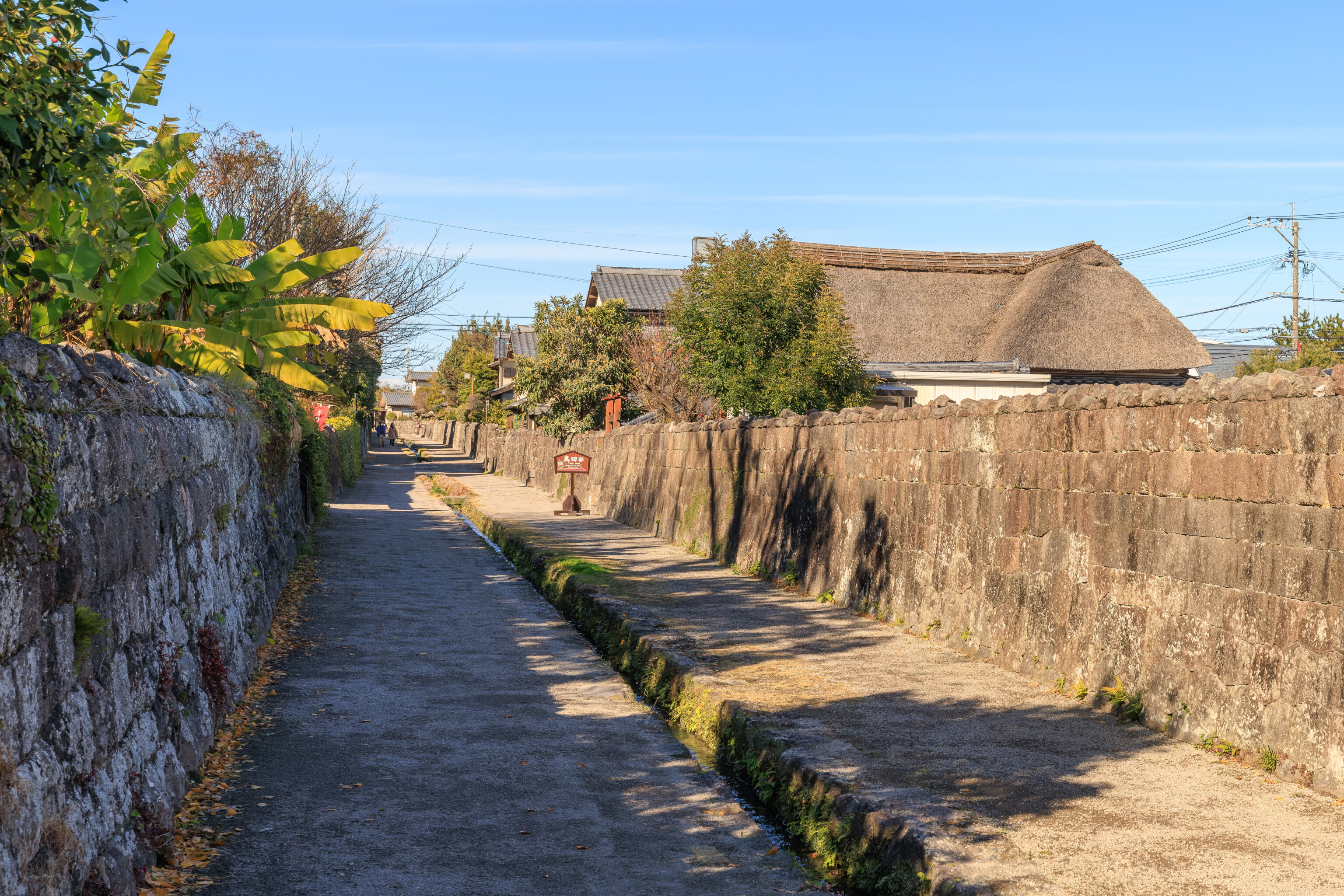
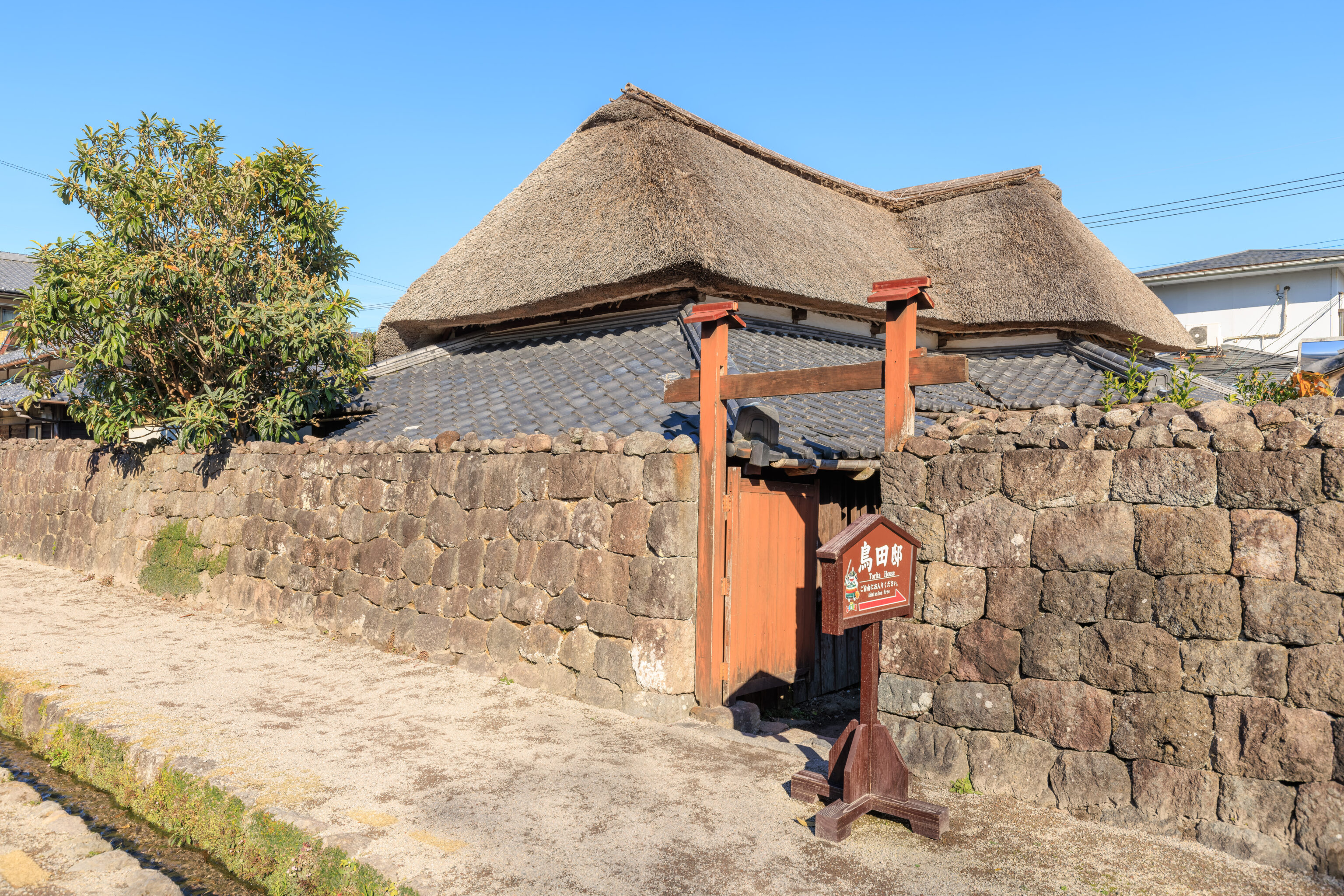
In modern times, there are a few samurai residences that have been preserved and are open to the public for free. This one is the 鳥田邸 Torita House and belonged to a family that had been here since 1669.
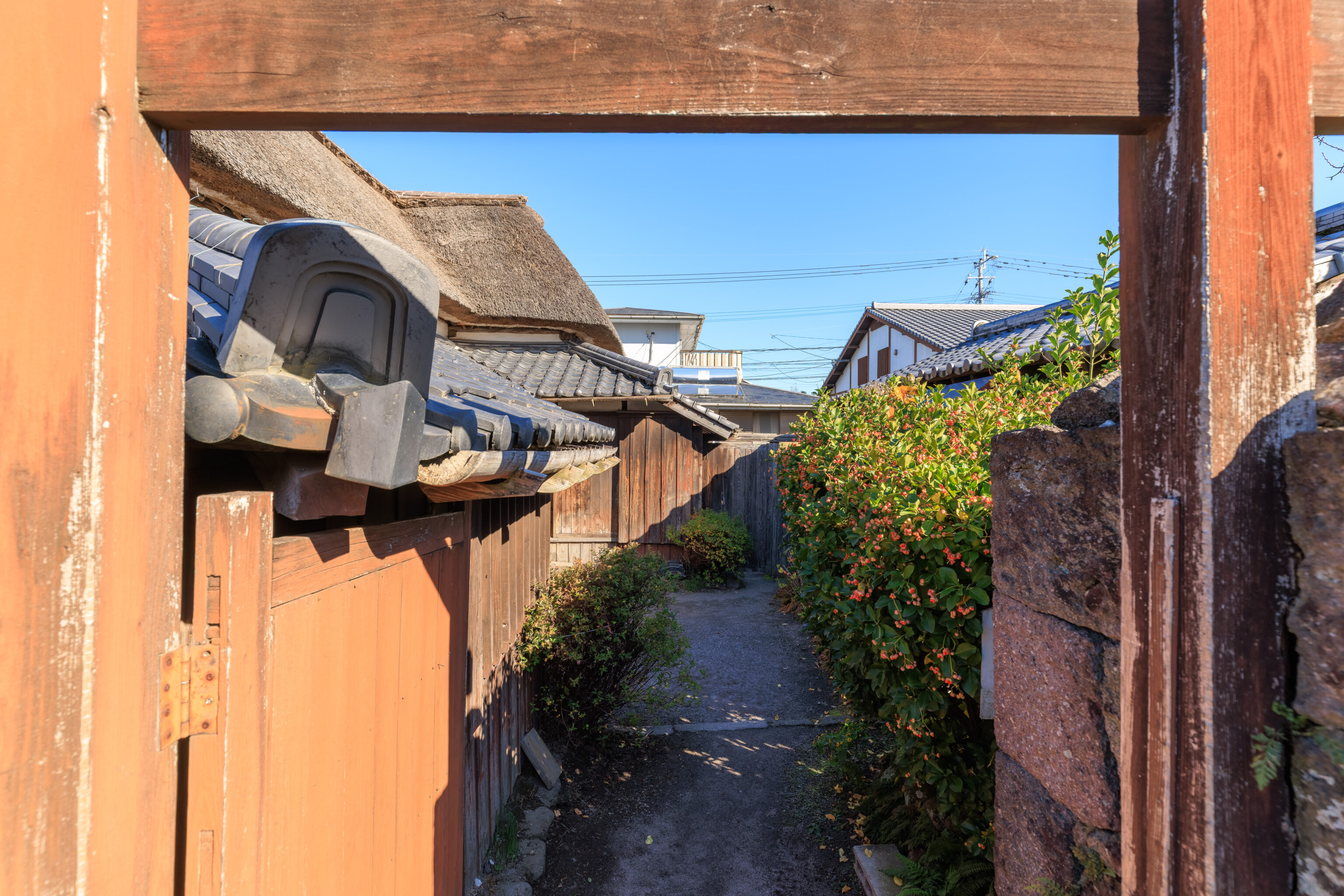
Lets go in and take a look!
Torita Residence
An old family dating back to the early days of Lord Matsudaira, the Torita family accompanied the domain lord, moving with him to Yoshida in Mikawa province and Fukuchiyama in Tanba province, before coming to Shimabara in 1669. The family served as successive local administrators and clerks, and in the closing years of the Tokugawa Shogunate they received a stipend of 7 koku for two persons for persons allowed direct access to the domain lord and held important posts in timber administration, religious and boat traffic control. The houses in this district were for middle and lower ranking samurai and were each set in a plot of land measuring almost 300 square meters. Loquat, persimmon, orange and other fruit trees were planted on each property. The canal running down the middle of the street was used for daily water needs.
– Text from a sign.
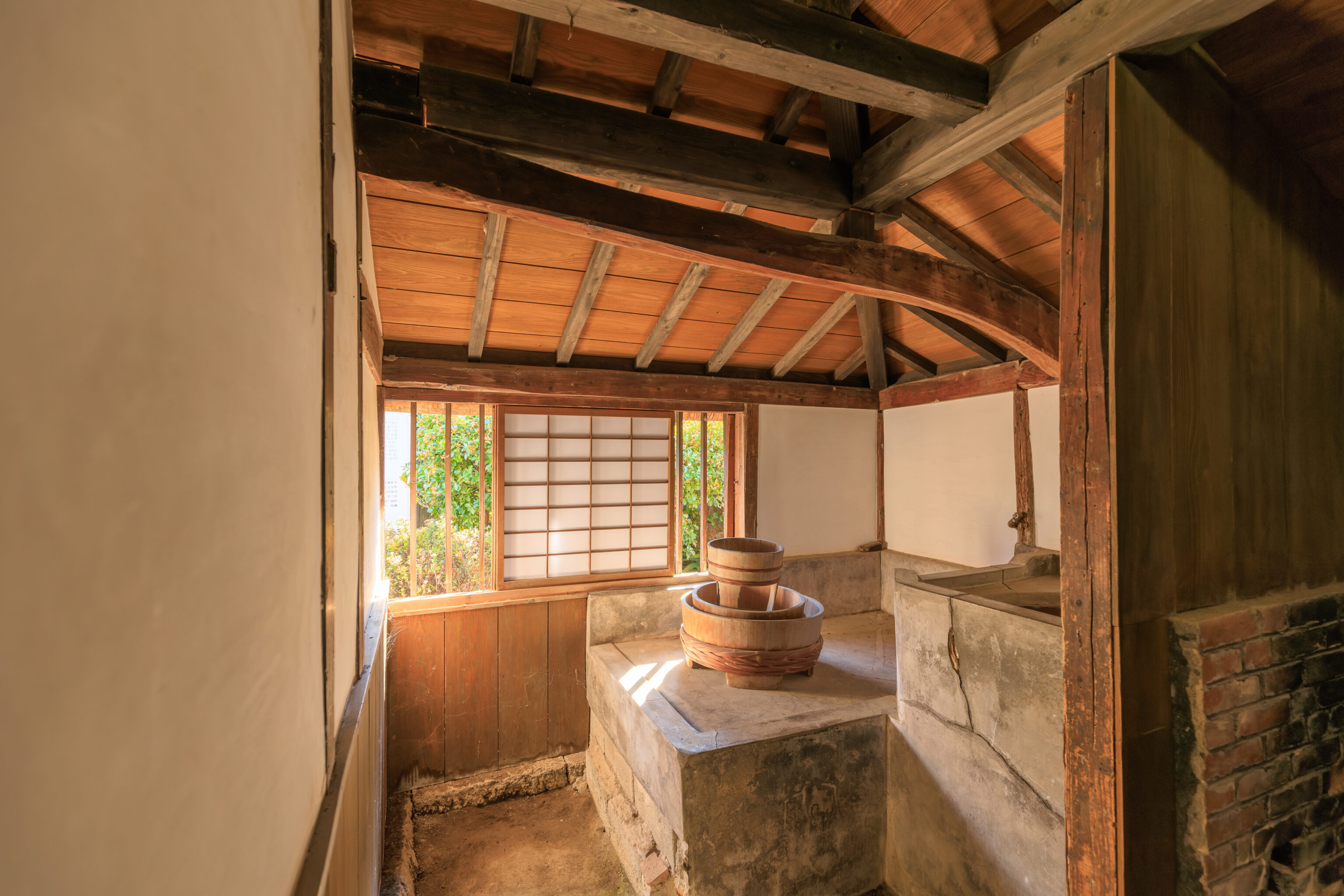
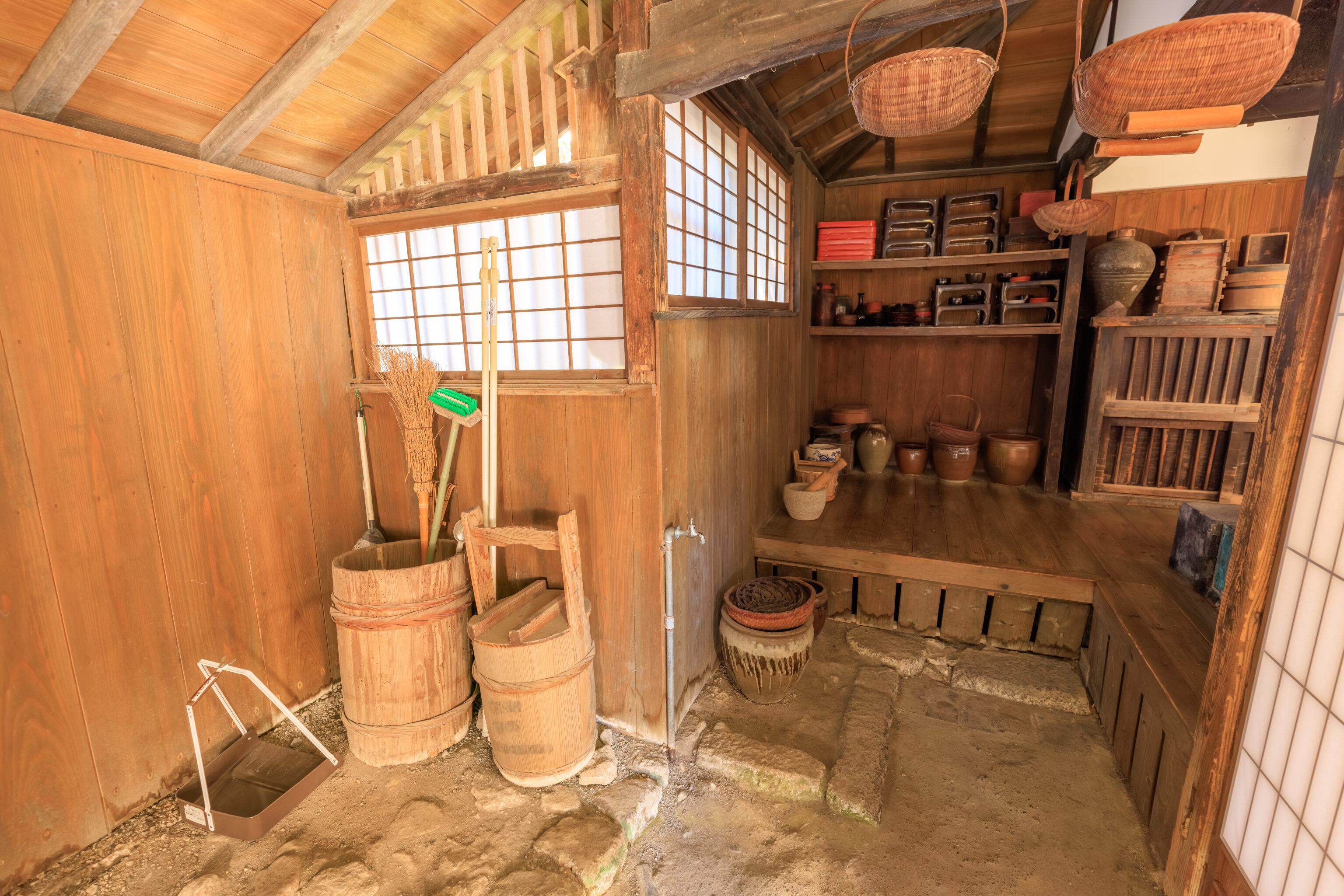
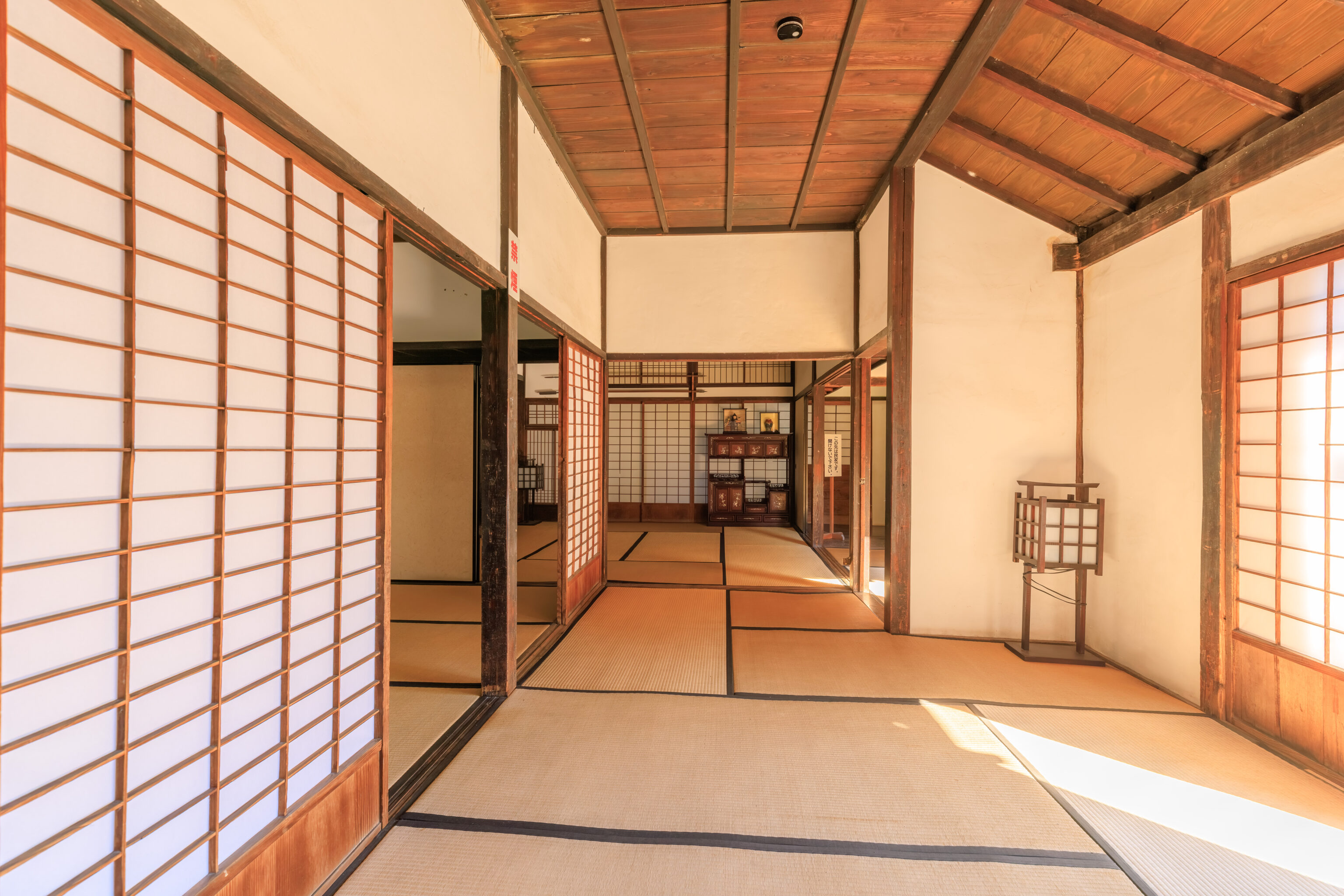
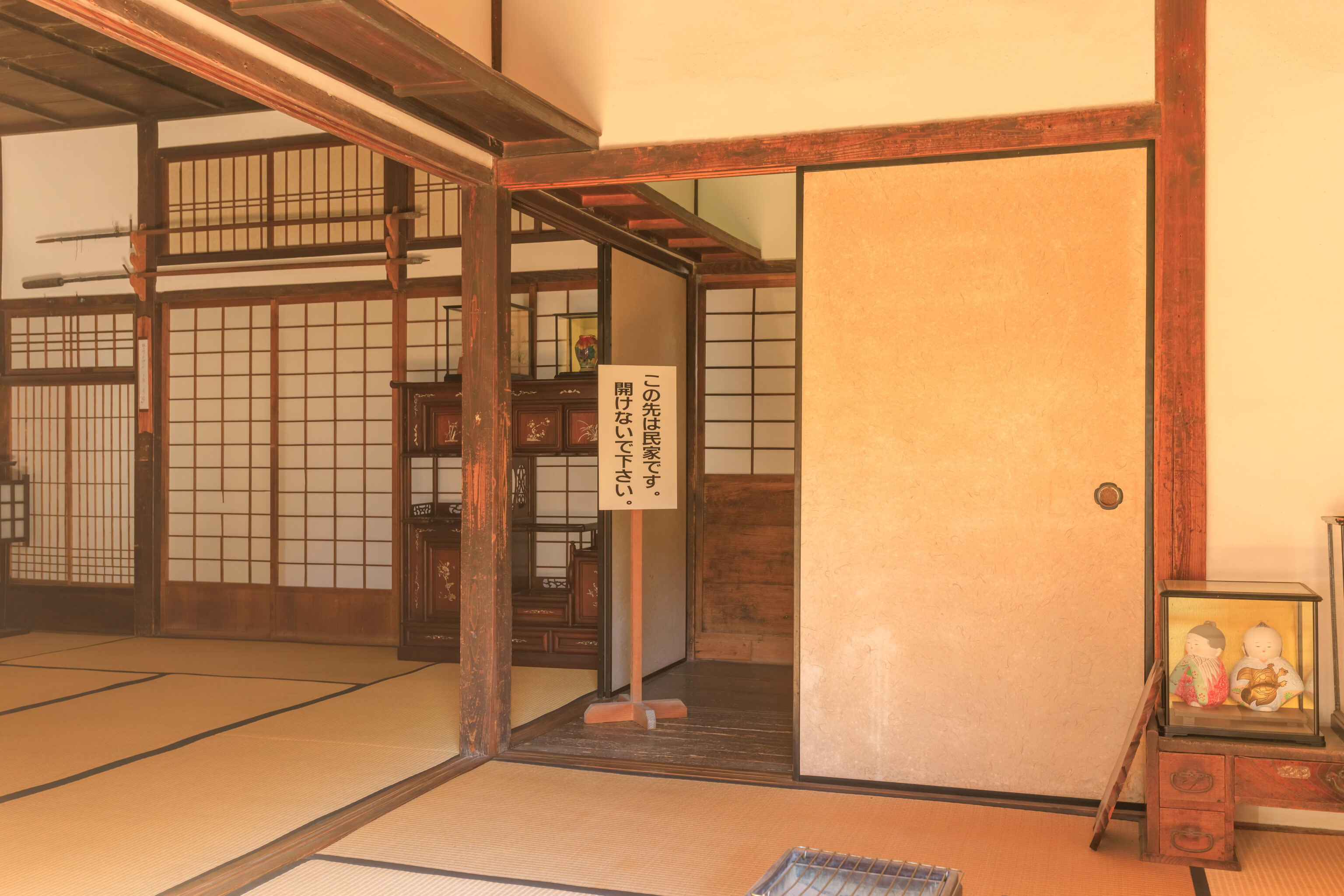
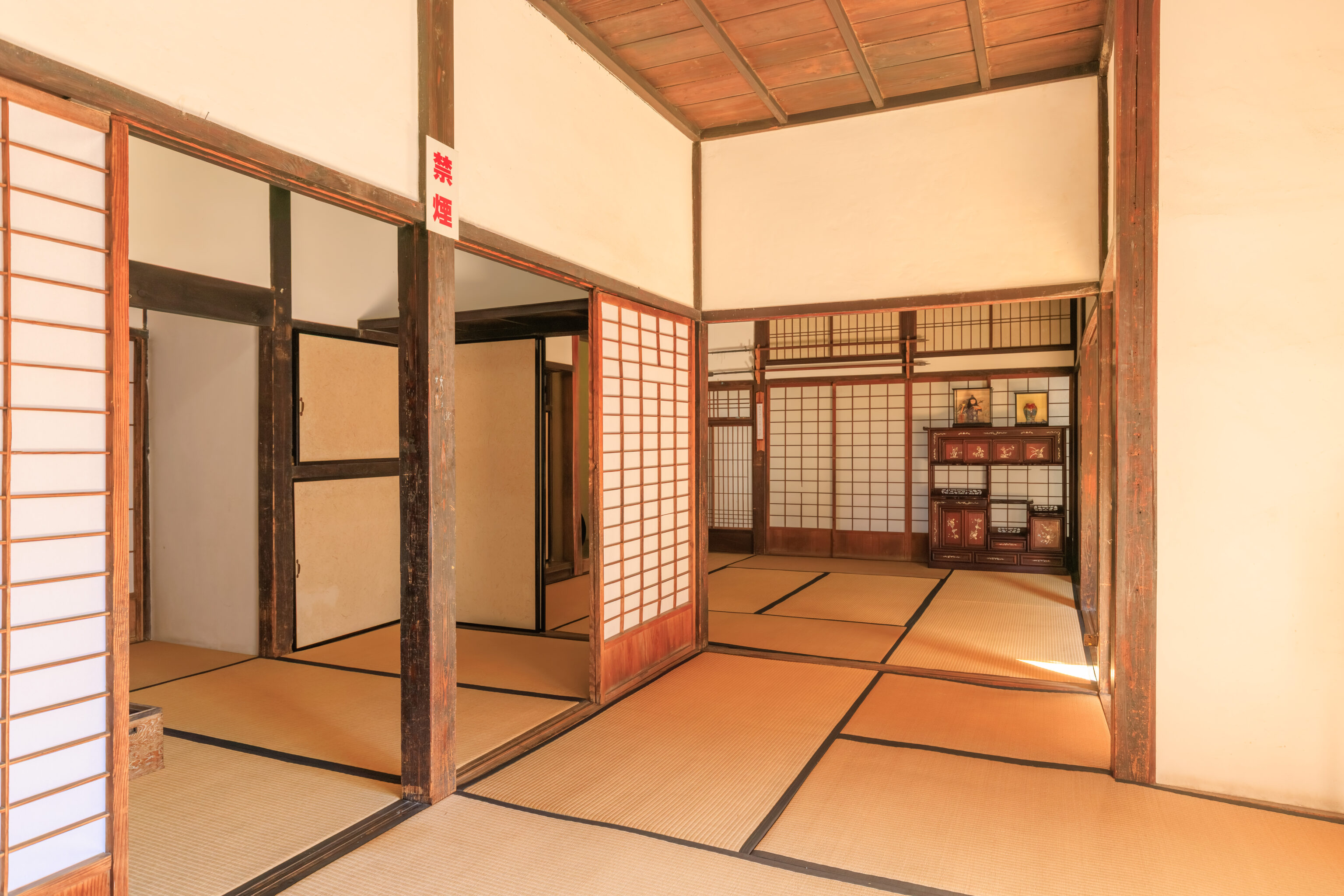
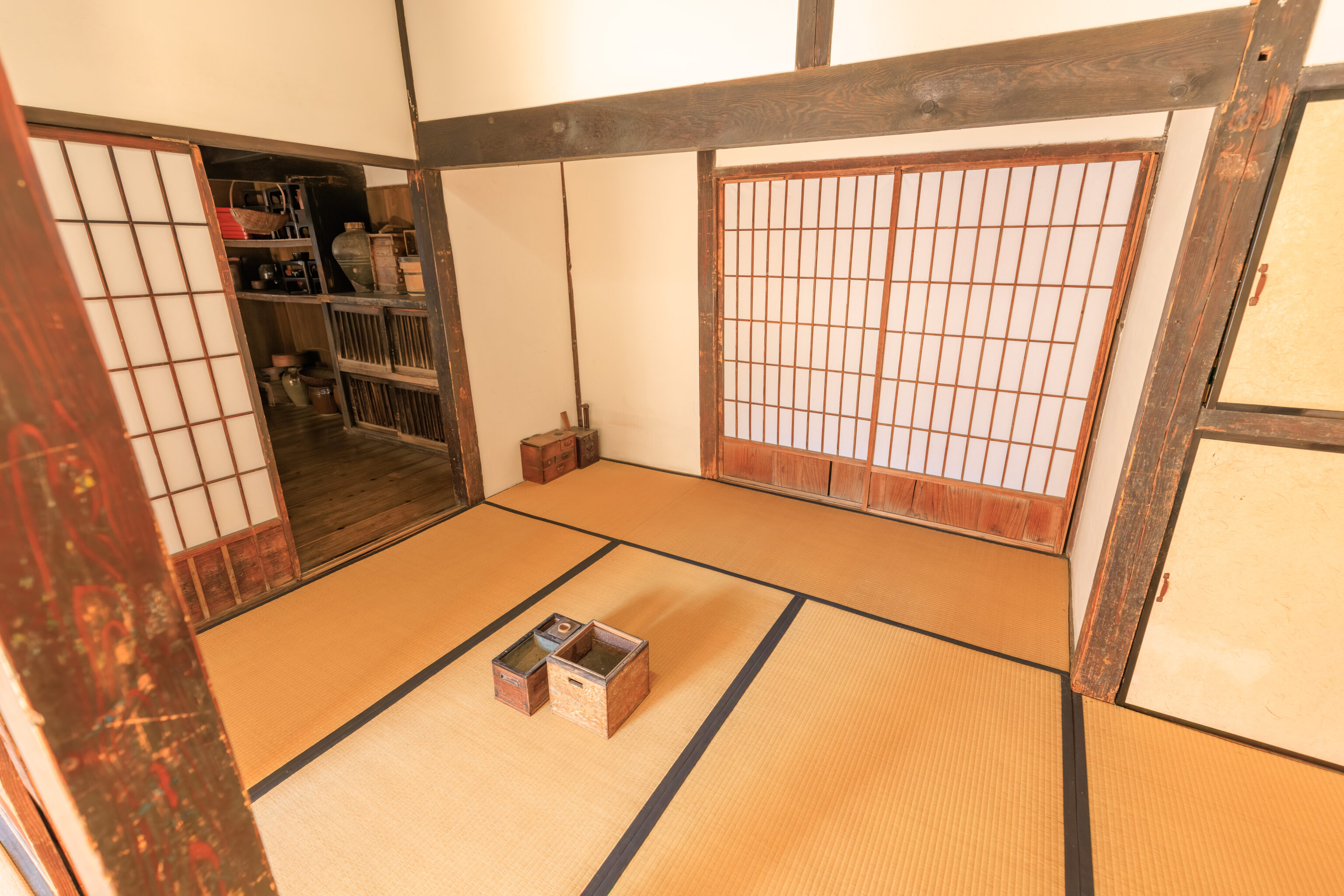
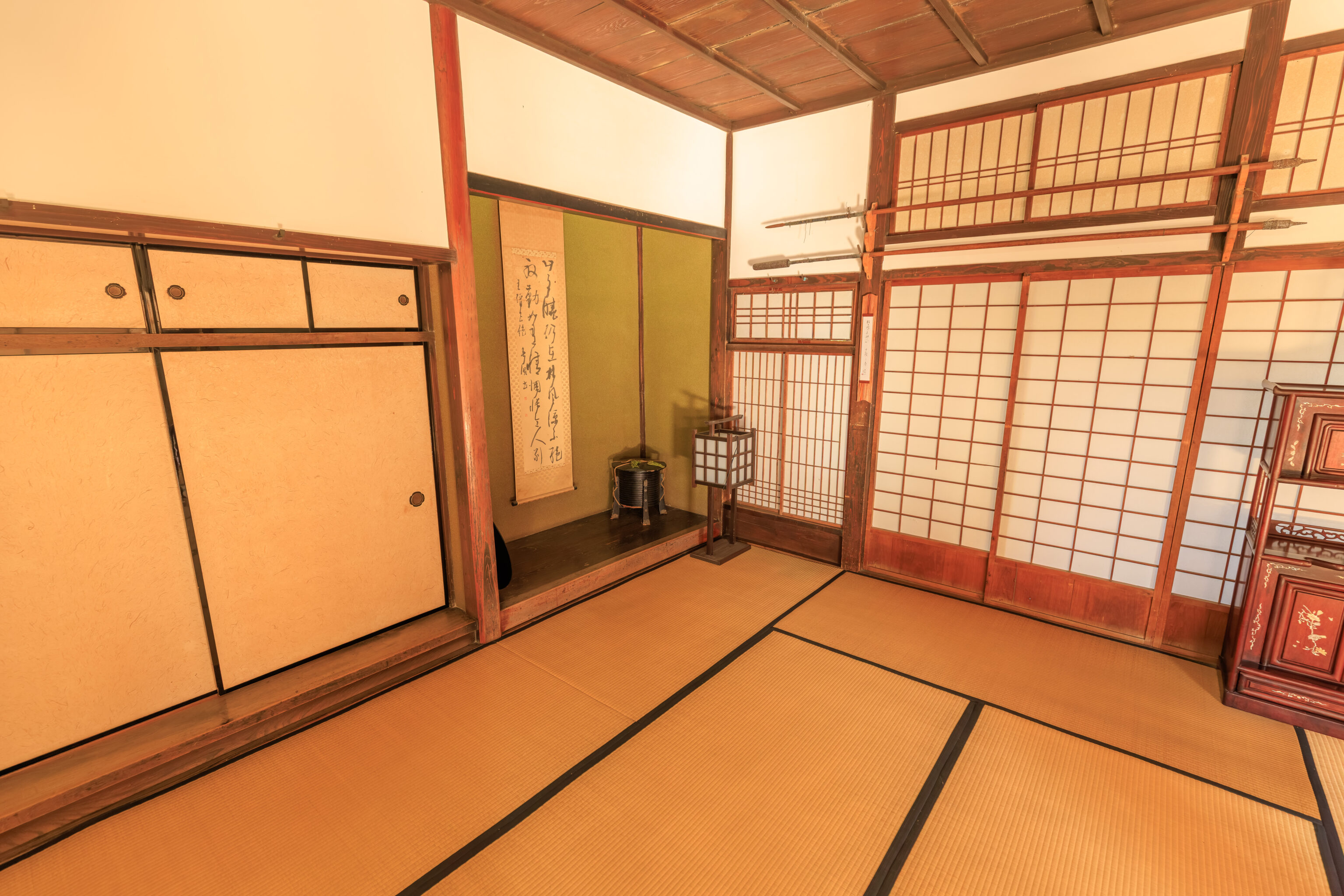
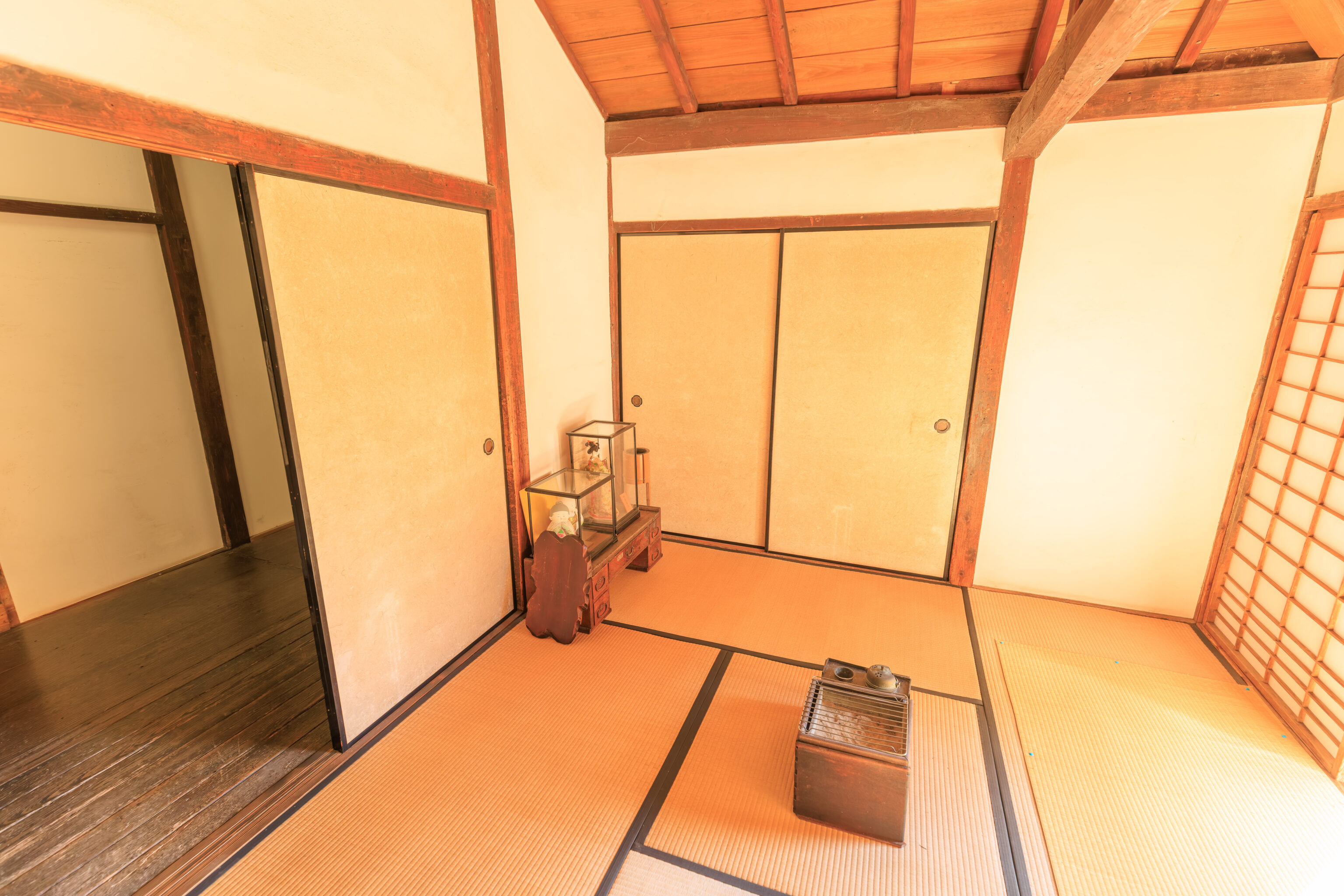
This looks like it could be a comfortable place to stay if it were a ryokan!
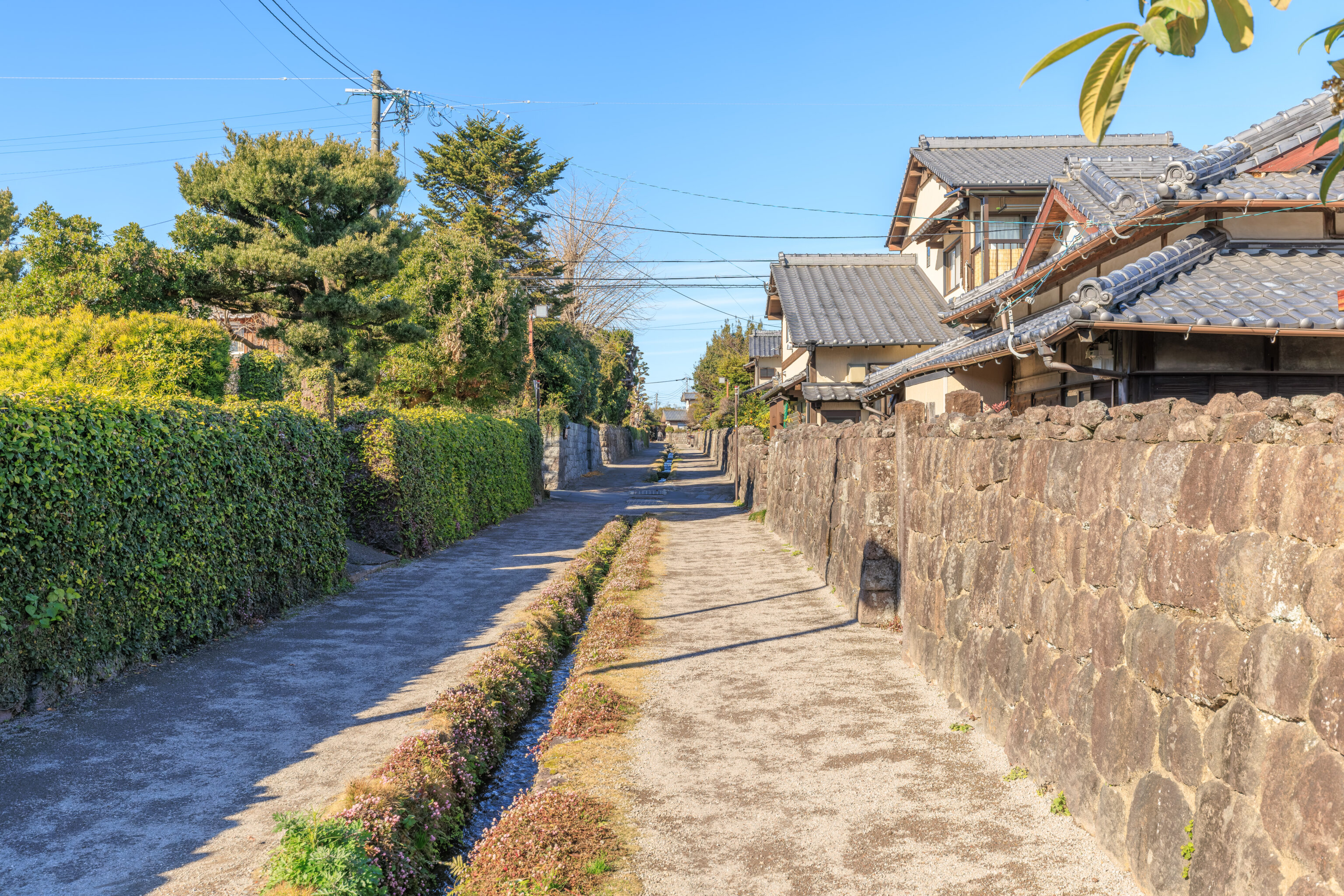
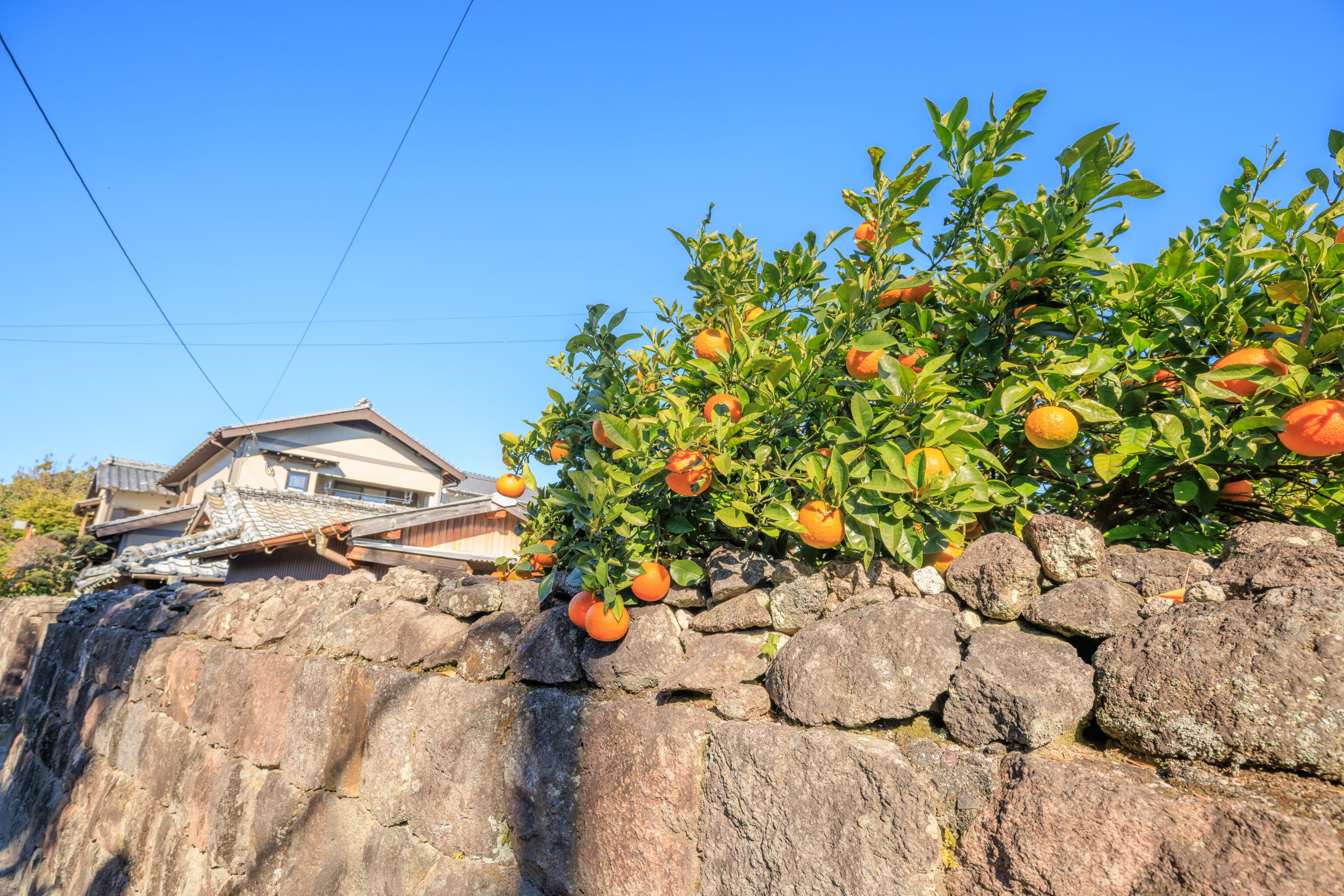
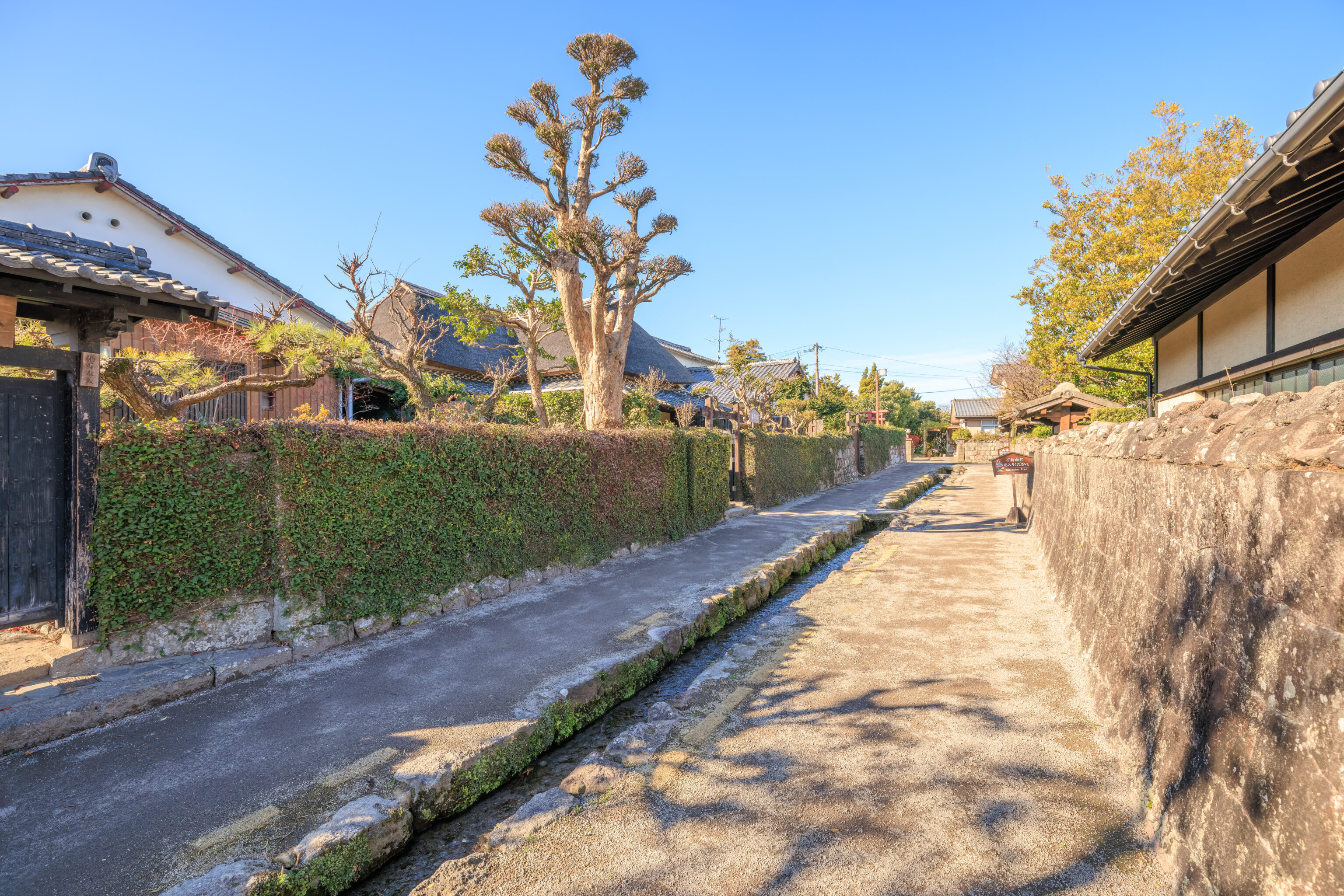
We headed back out and continued walking to the north.
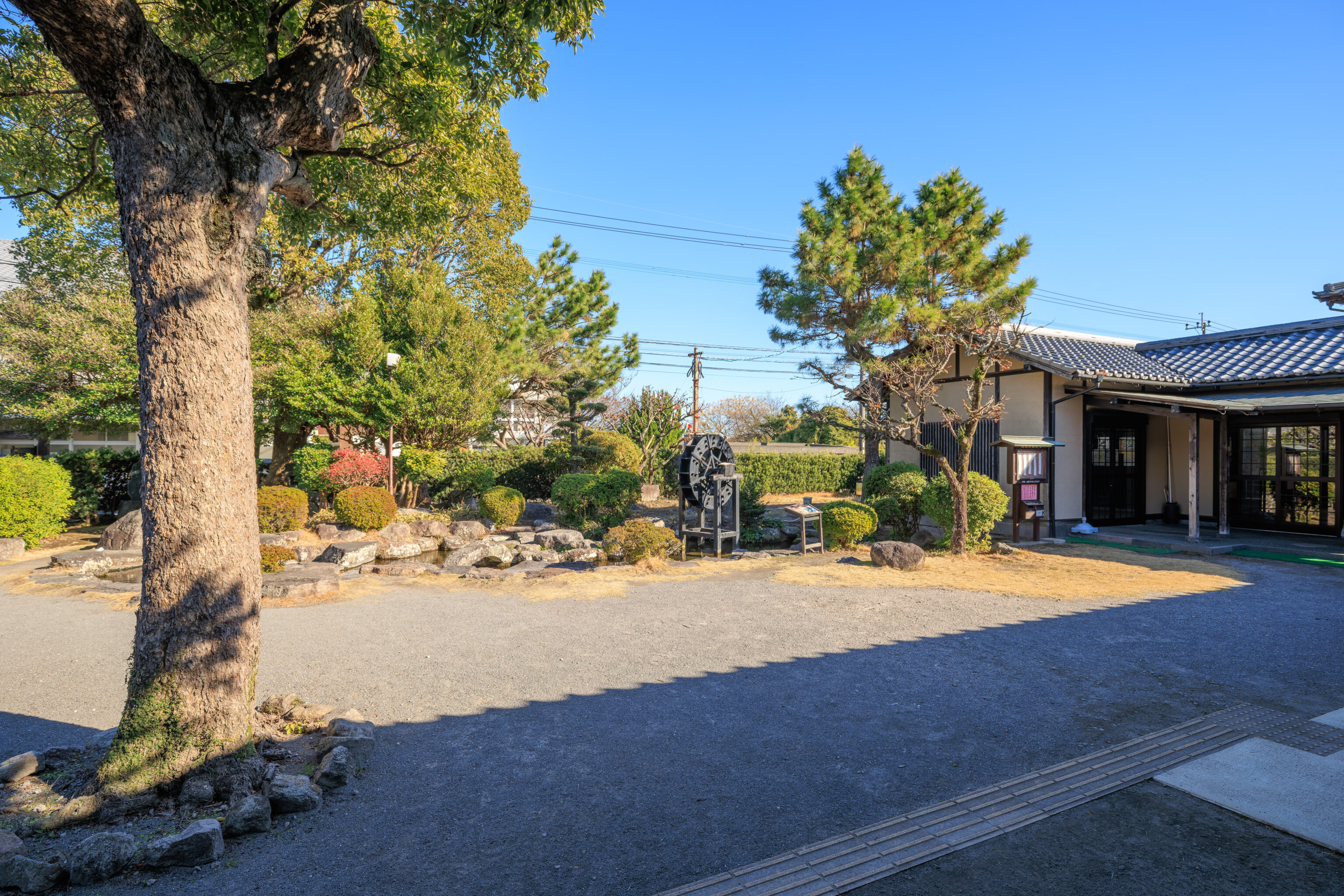
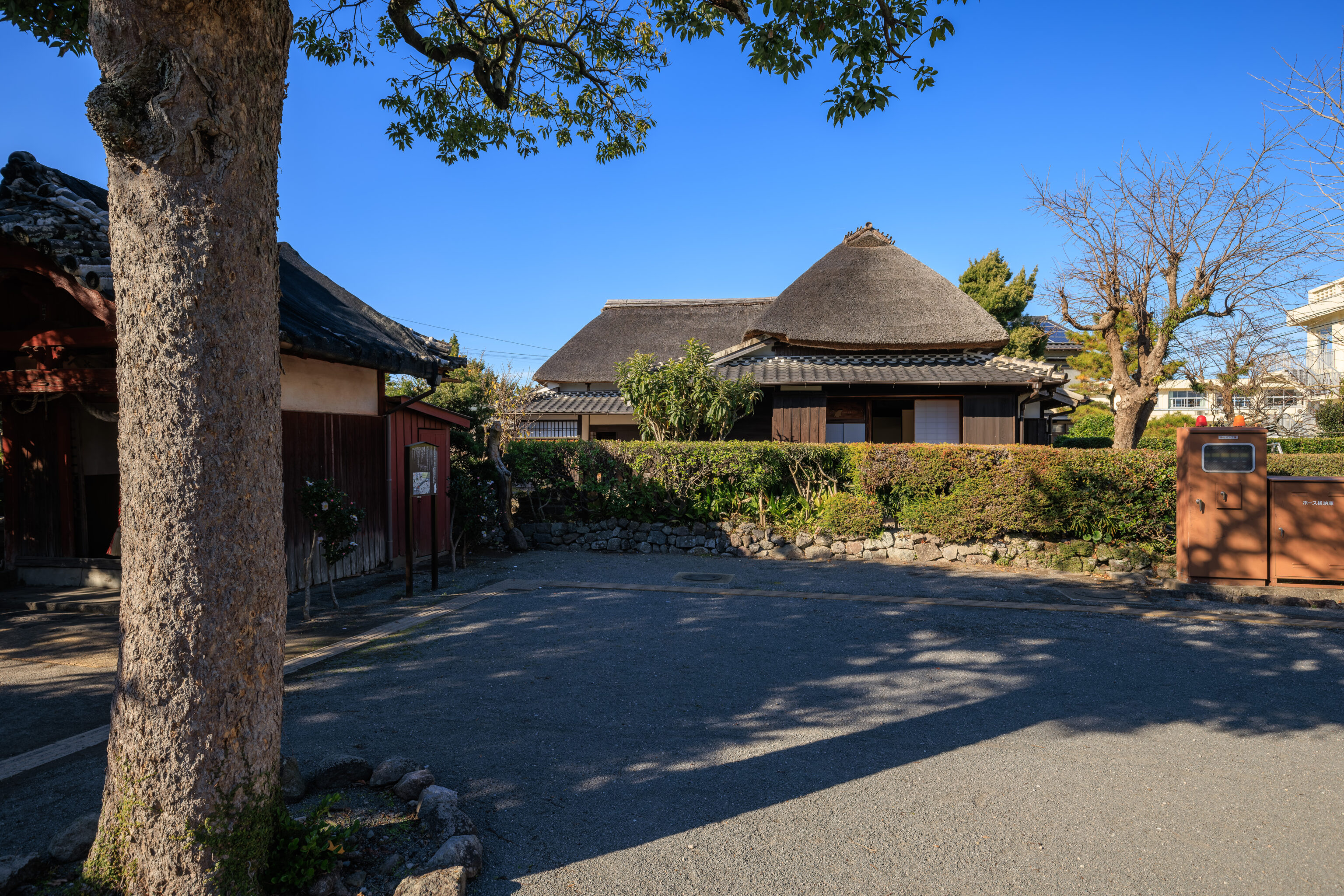
We ended up walking into a little… What should we call this? A park?
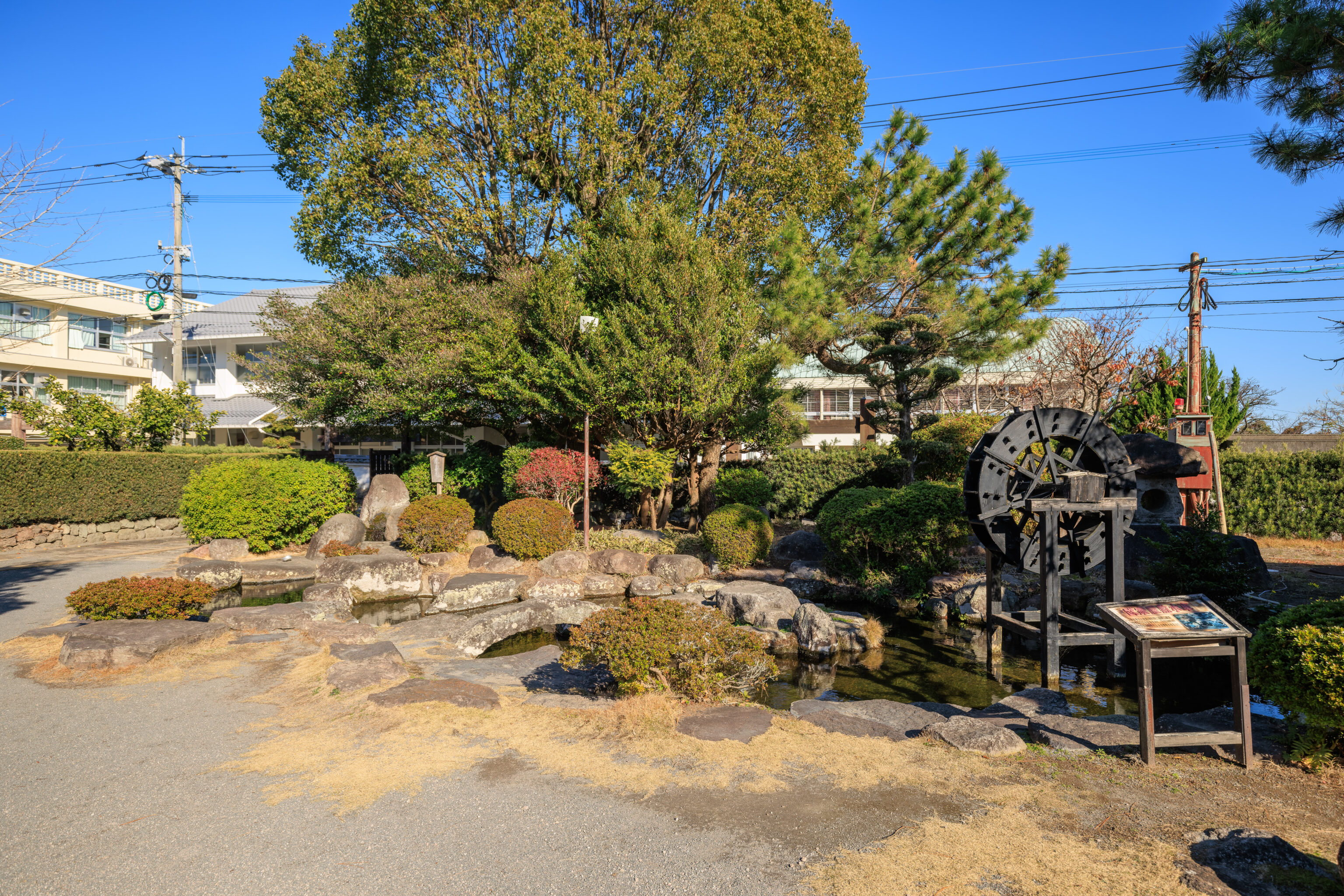
There was a small water wheel next to a building that seems to serve as a place to sit and rest. According to the sign, it is a modern creation by the 島原工業高校 Shimabara Technical High School.
We didn’t photograph the sign but it is sort of legible from this perspective. It may read something like this:
This waterwheel was constructed in October 2012 by the Architecture and Architectural Technology departments of Shimabara Technical High School, and repairs for long-standing malfunctions and other issues were carried out by the same departments in September 2017.
– Text from the sign in front of the water wheel, read and translated using Google Gemini.
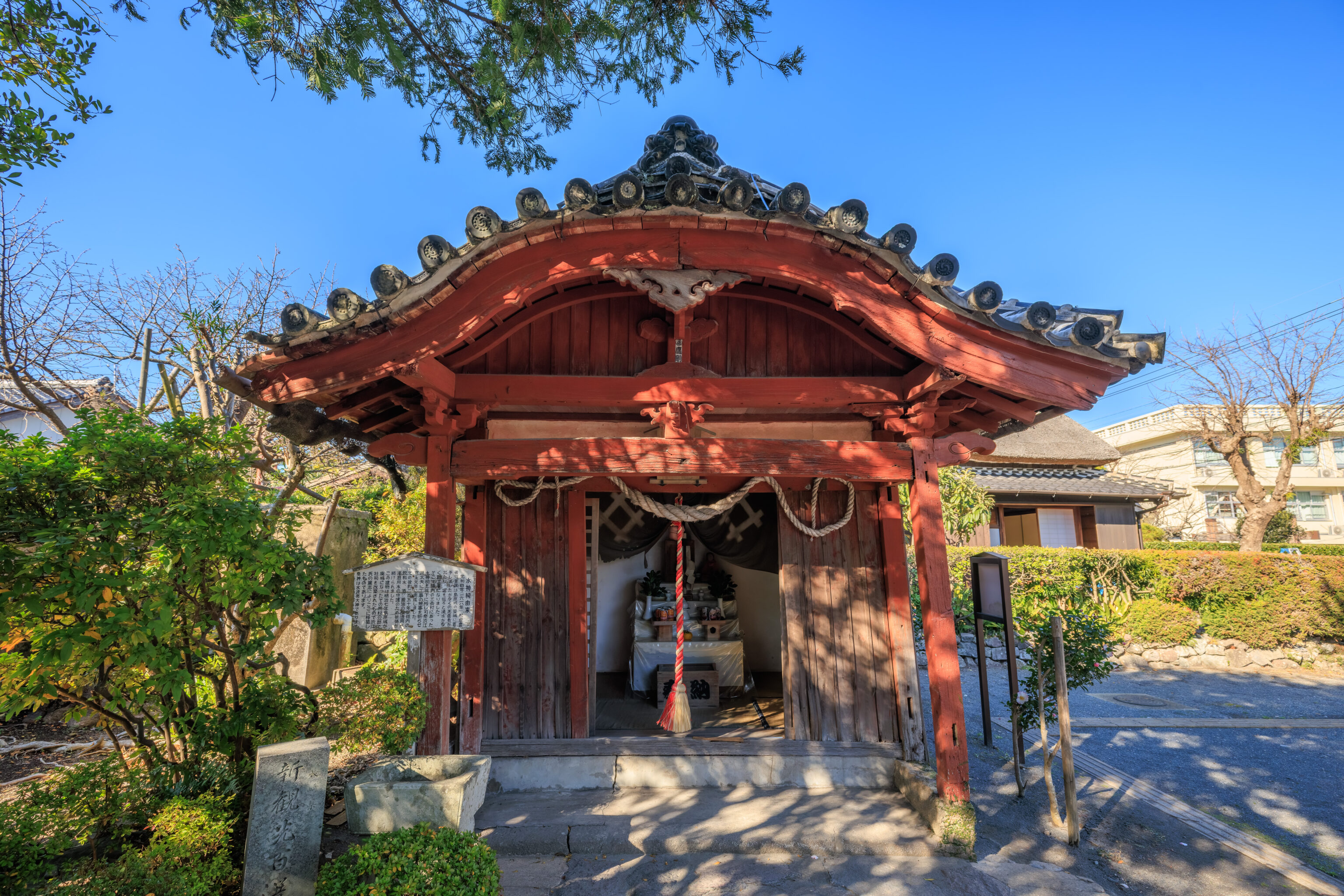
There was a small shrine in the corner, built in 1874 using wood from the original Shimabara Castle after it was destroyed after the Meiji Restoration as a result of the 廃城令 Haijō Edict.
Origins of the Water Deity Shrine
In 1618, Matsukura Bungo-no-Kami Shigemasa began the construction of Shimabara Castle; however, the project was plagued by numerous casualties and engineering difficulties caused by abundant groundwater encountered while digging the moats.

To address this, a shrine dedicated to the Water Deity—originally located in Mie Village within the domain—was relocated to the castle town. The priest Shibue Gendayū was appointed to offer prayers for the project's safety, and the castle was successfully completed in 1624.

For approximately 250 years thereafter, prayers continued to be offered to safeguard the domain's water supply, including drinking water and water used for brewing sake and soy sauce, as well as for irrigation.

The current shrine structure was rebuilt in 1874 using timber salvaged from Shimabara Castle after it was decommissioned; it was relocated to this site through the dedicated efforts of the Shibue family.

The enshrined deity is Mizuha-no-Me-no-Okami.
– Text from the sign on the left, read and translated using Google Gemini and Translate.
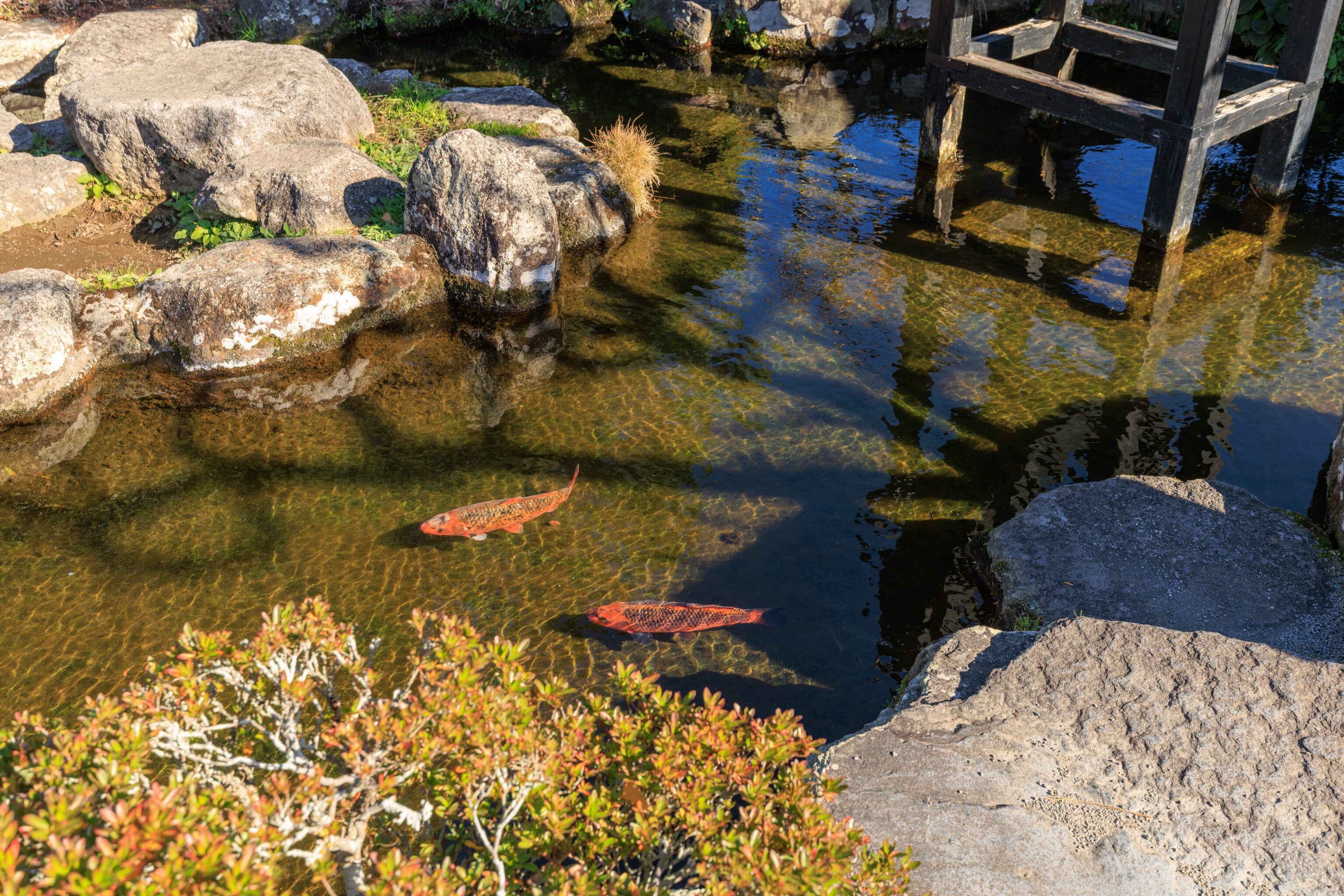
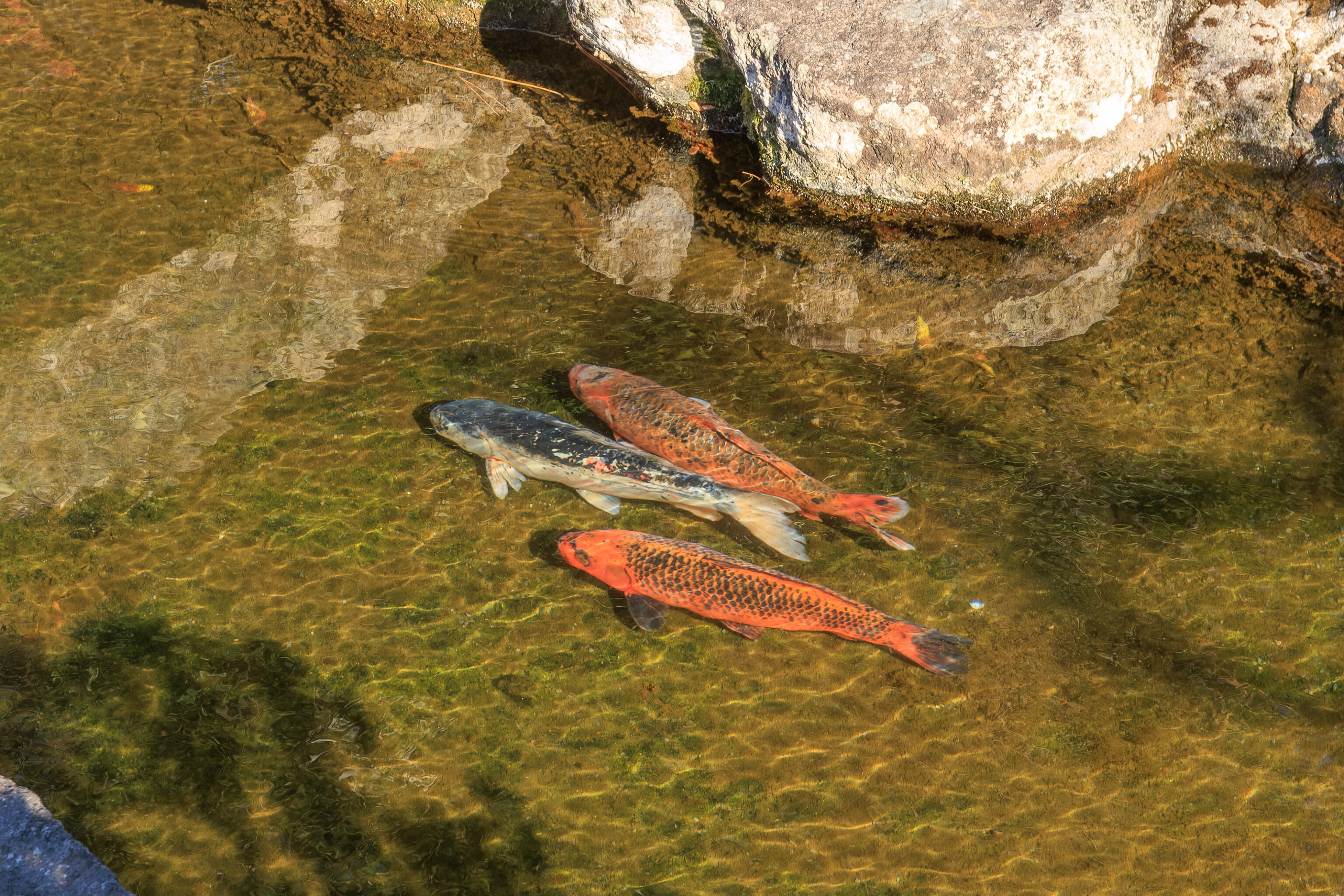
The little pond below the waterwheel had a few koi swimming around.
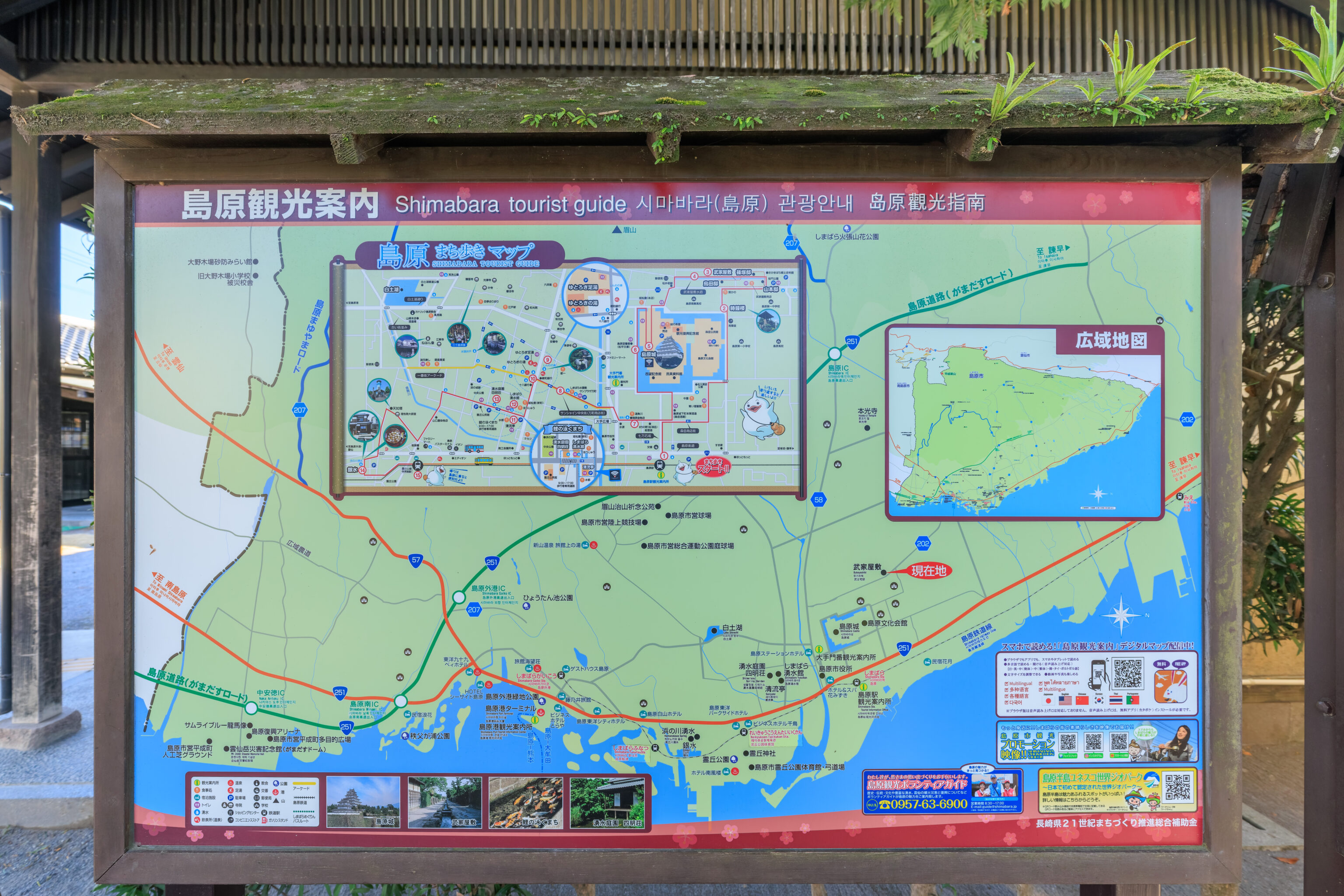
There was also a sign with a map of tourist sites in the area. The map has a suggested walking route marked in red.
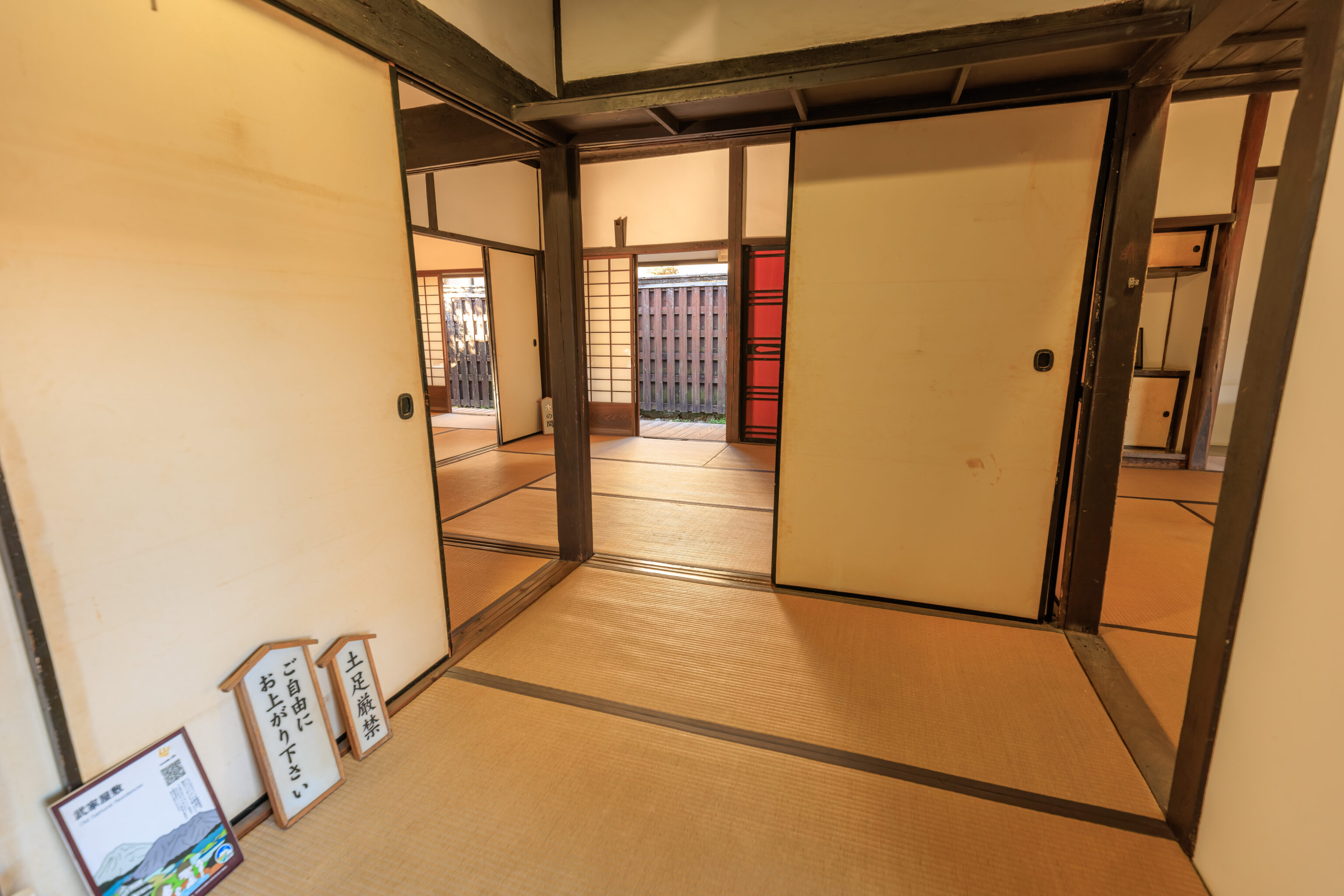
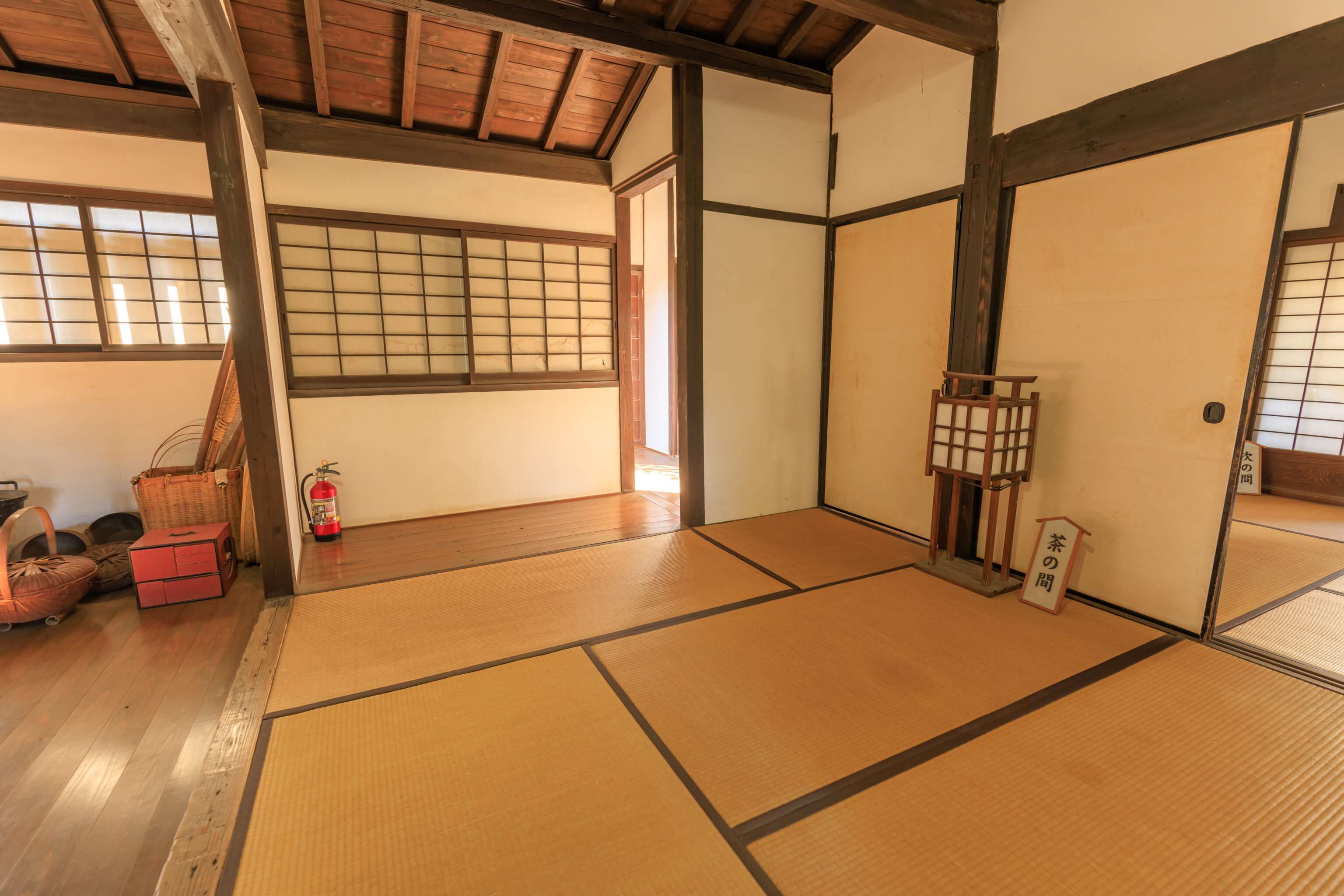
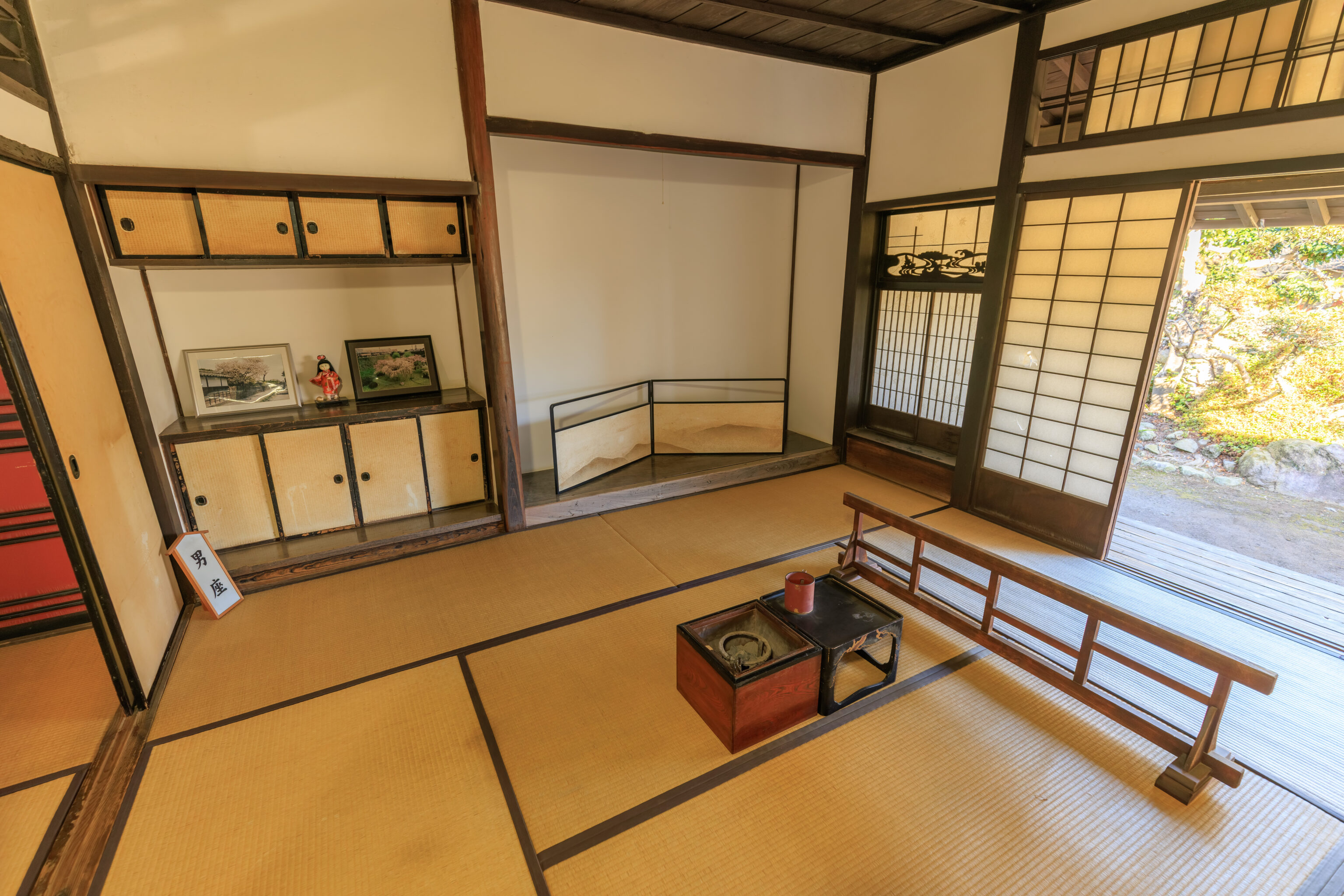
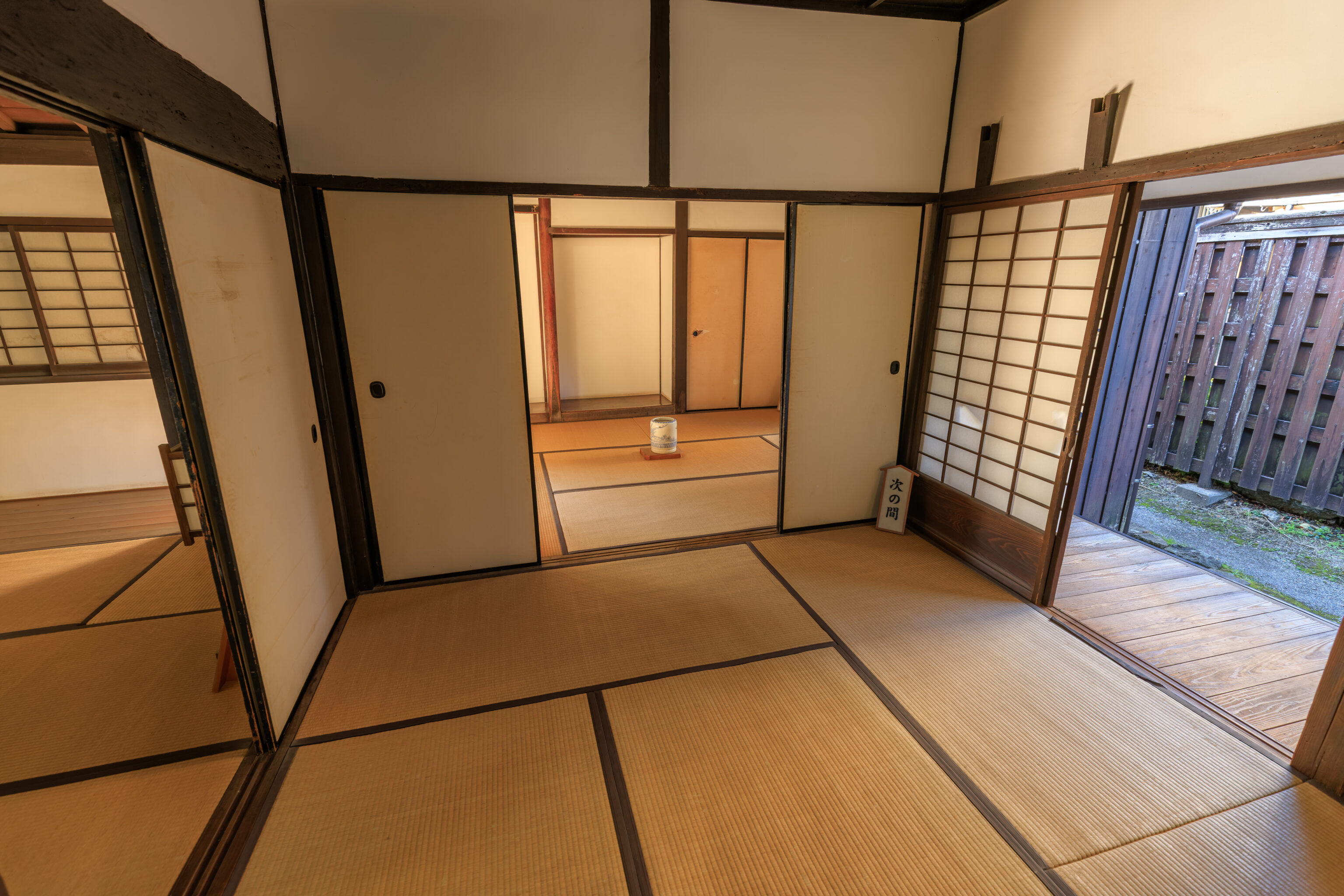
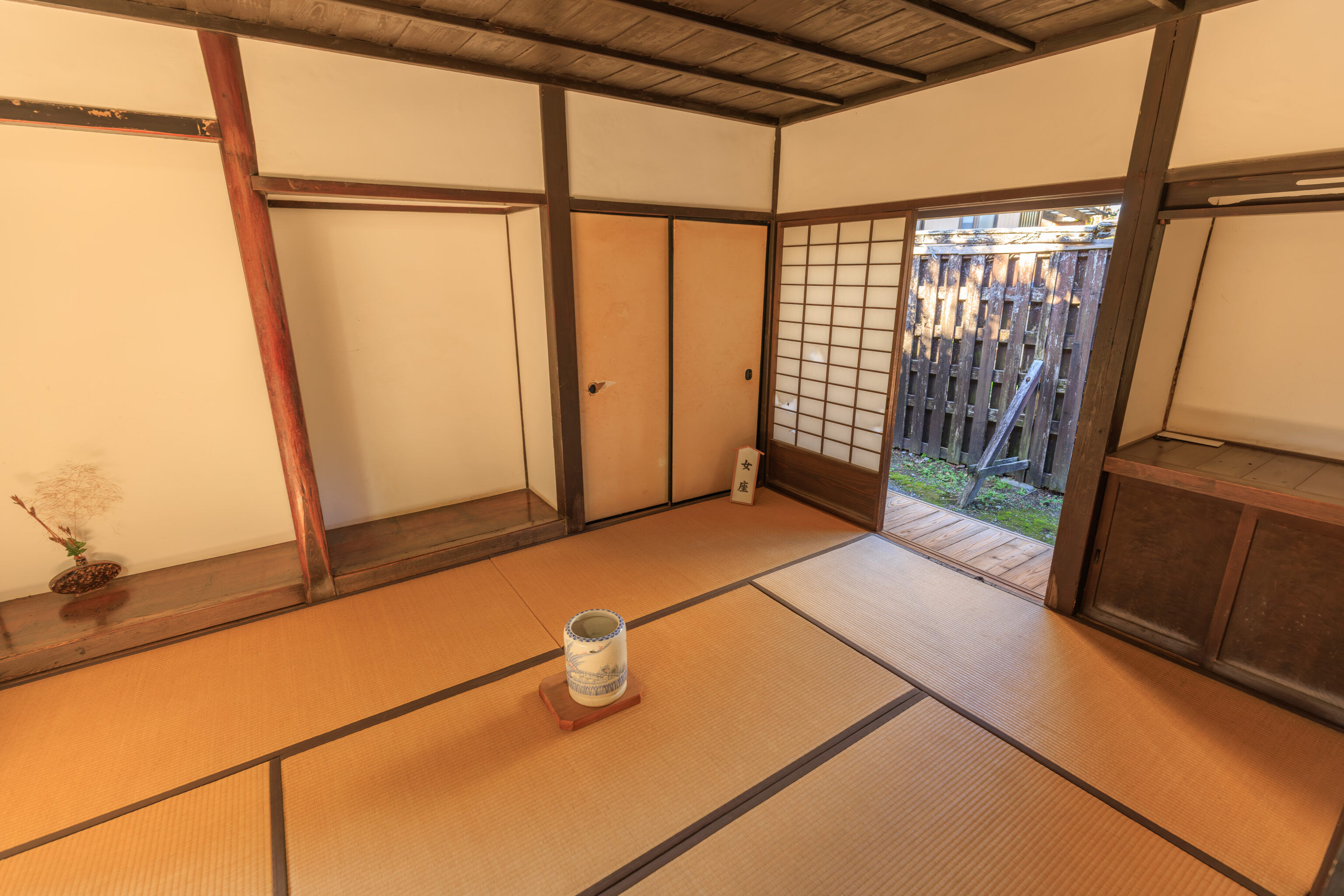
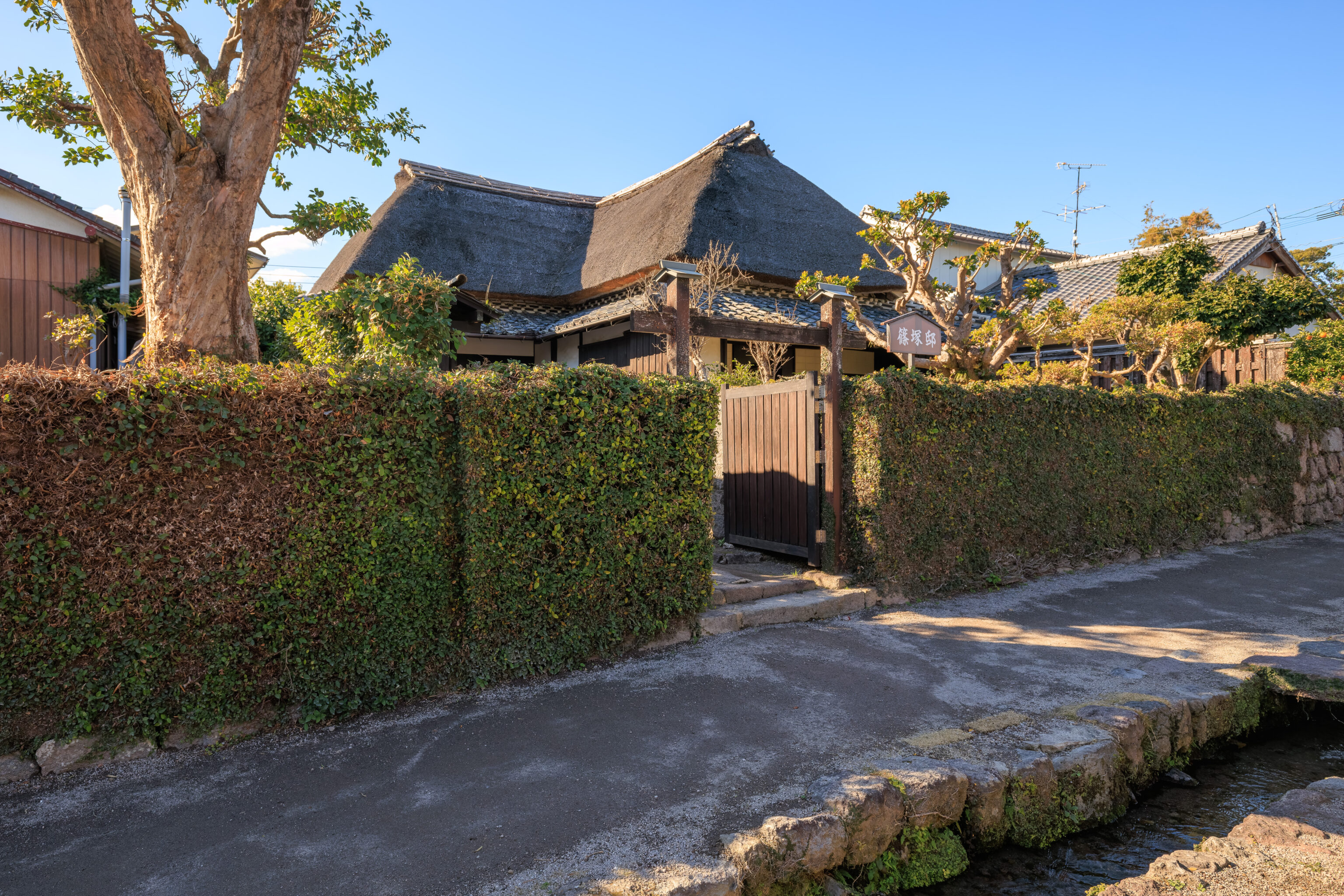
The next samurai residence that we visited was the 篠塚邸 Shinozuka Residence, which was across the street.
Shinozuka Residence
The Shinozuka family lived in this house and the name Junemon was handed down as the first name for generations. Originally from Fukozu in Mikawa province (present-day Aichi prefecture), they followed Lord Matsudaira Tadafusa when he moved from Fukuchiyama in Tamba province in 1669, a domain worth 50,000 koku, to be lord of 70,000 koku Shimabara Castle and 11 generations of Shinozuka served the domain lord until the early years of the Meiji period. They received a stipend of 8 to 13 koku for two persons and worked mainly as clerks and local administrators. All the samurai houses in this district occupied an area of almost 300 square meters.
– Text from a sign.
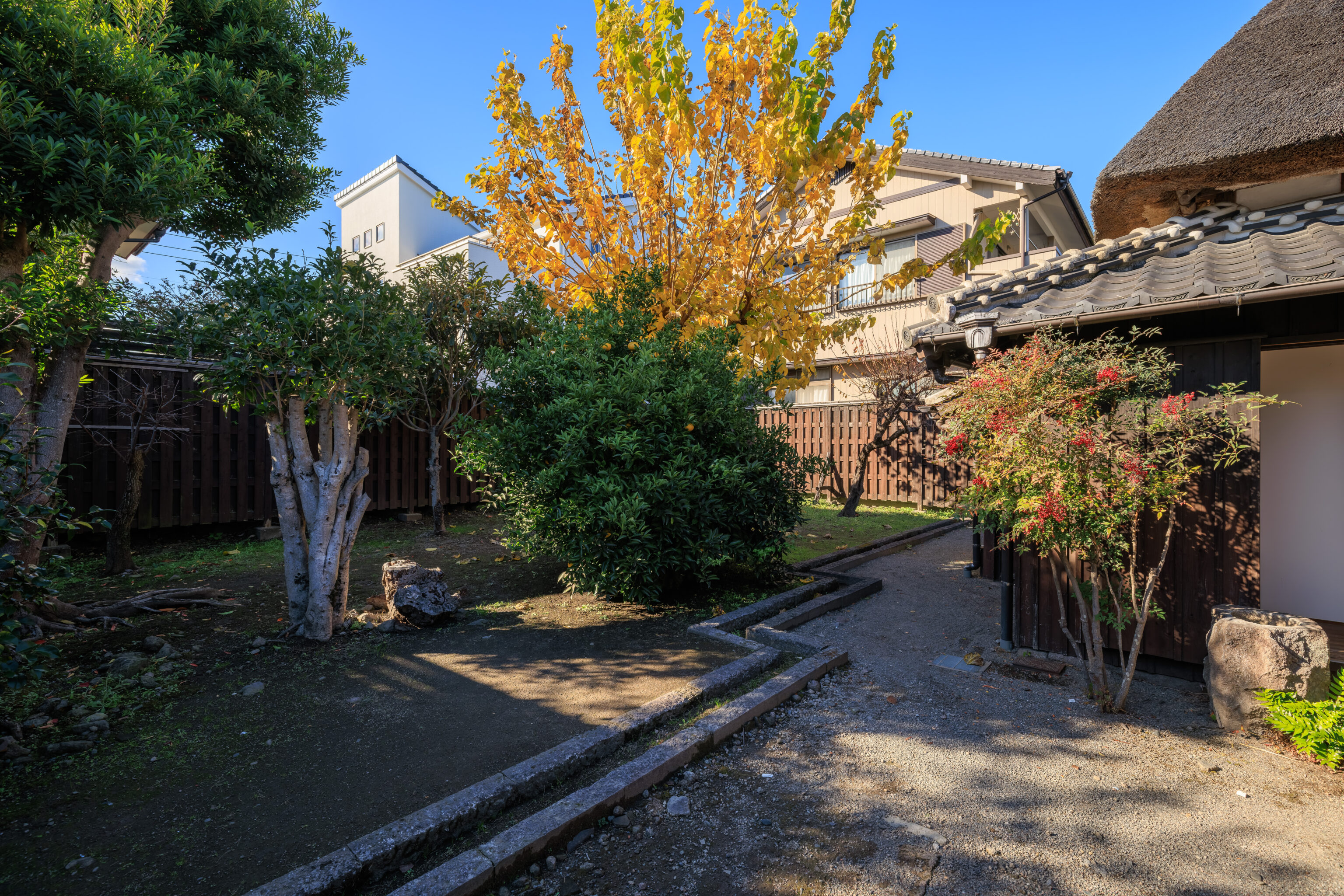
There was a little yard outside of the house. Would it have been like this during the Edo period?
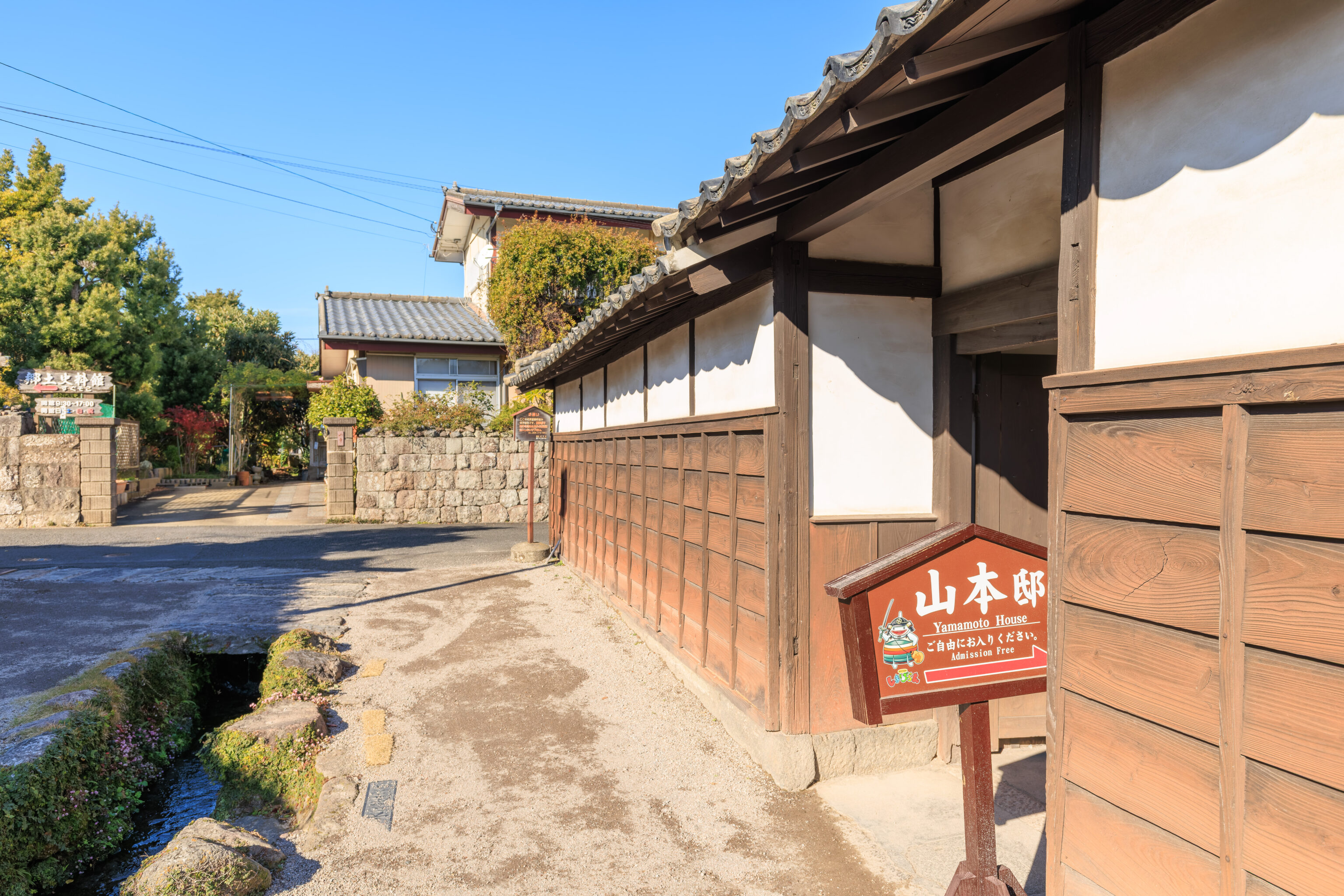
The next house we entered was the 山本郎 Yamamoto House.
Yamamoto Residence
(Built in 1868, first year of Meiji)

Yamamoto Sagozaemon, the founder of the Yamamoto family, became a retainer to the Matsudaira daimyo clan, first serving Matsudaira Tadatoshi, lord of Yoshida Castle in Mikawa (present-day Aichi Prefecture), who preceded Matsudaira Tadafusa. When the fifth Matsudaira lord Tadamasa was transferred to Utsunomiya han by the shogun in 1749, and the sixth lord Tadahiro was similarly transferred to Shimabara han in 1774, the Yamamoto family accompanied their lords on each move. The family served 13 generations of Matsudaira lords until the end of the Tokugawa shogunate. After the Meiji Restoration, the Yamamoto family, which had enjoyed the trust of the castle lords it served, continued for ten more generations including Yamamoto Goro and Yamamoto Hidetake.

Each successive generation of the Yamamoto family held important offices. Fifth-generation Yamamoto Shigechika is noted for obtaining an Itto-ryu swordsmanship qualification in 1790, mastery in Ogino-ryu flintlock shooting in 1804, and full mastery in daijujutsu marksmanship in 1811

The Yamamoto household received as stipend 17 koku plus a two-person allotment of rice, The gate of the residence was built with special permission by Matsudaira Tadakazu, the last castle lord the family served.
– Text from a sign.
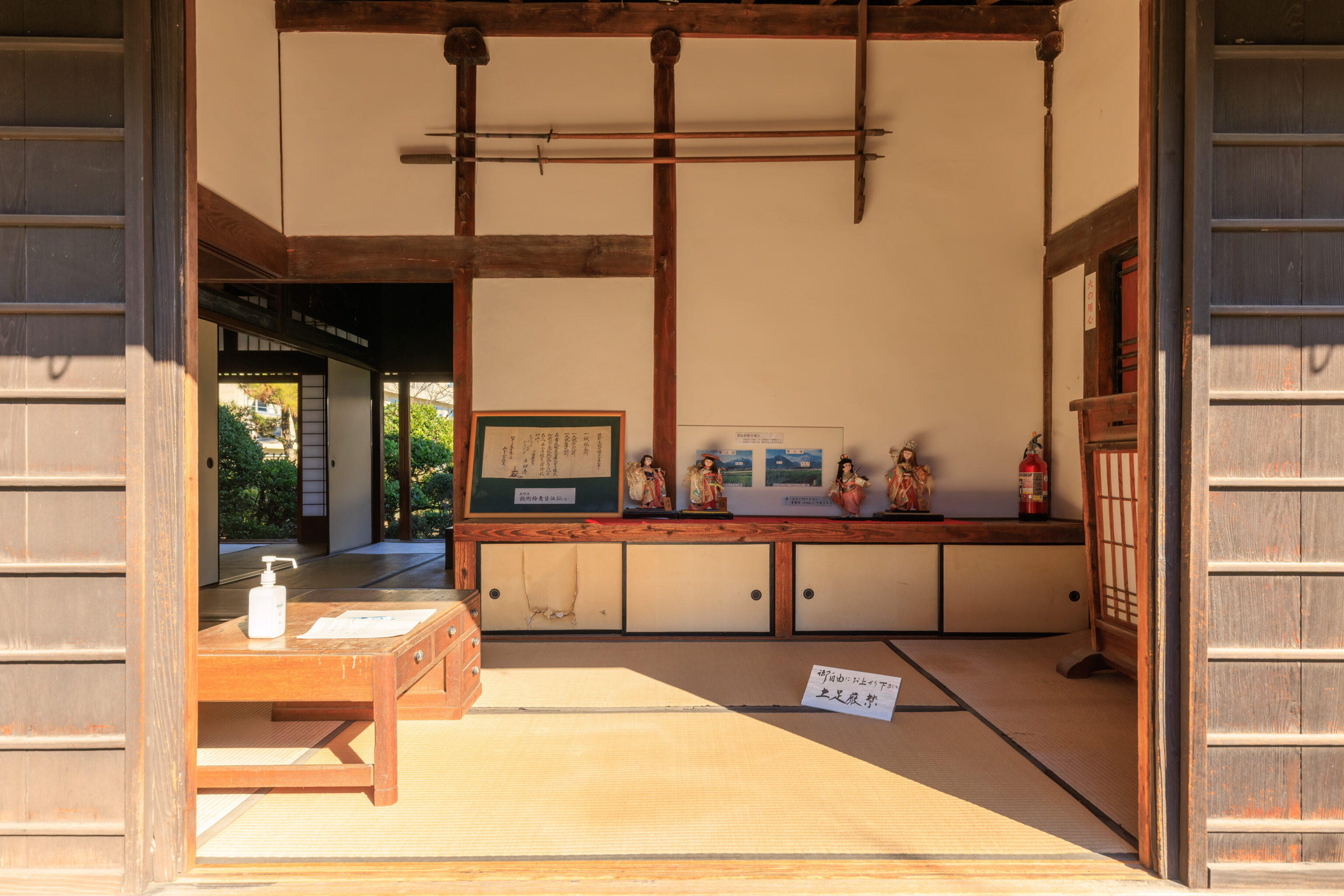
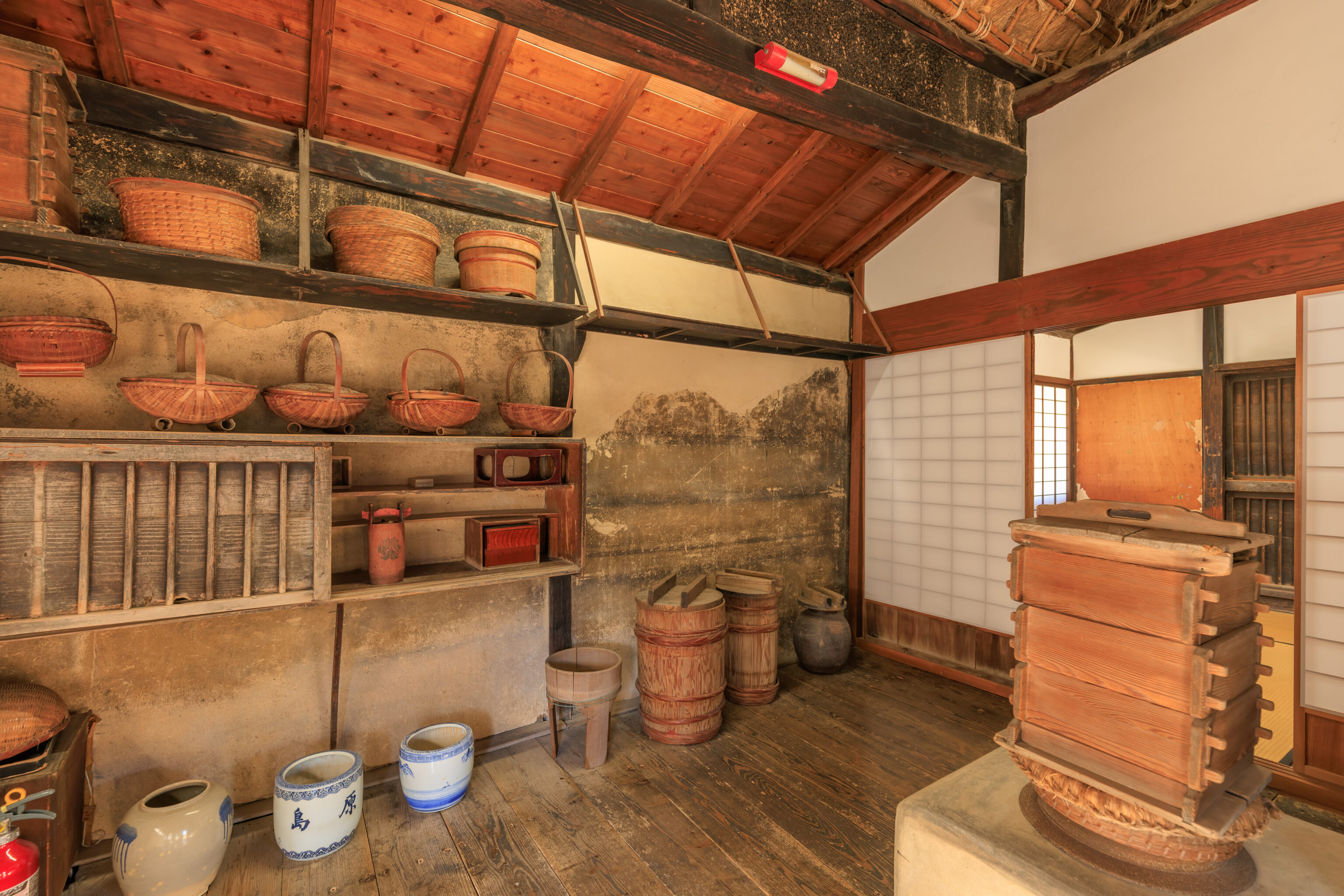
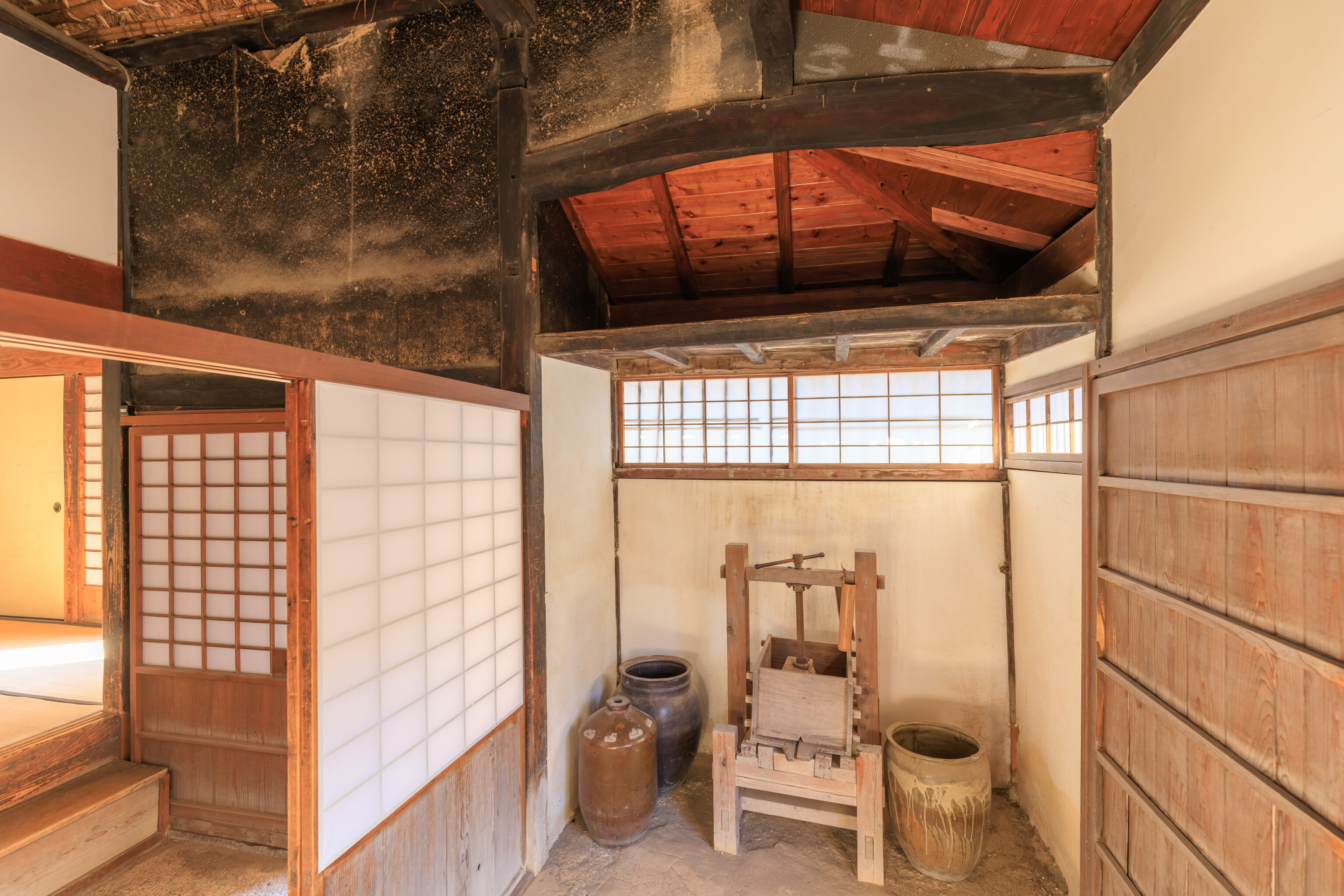
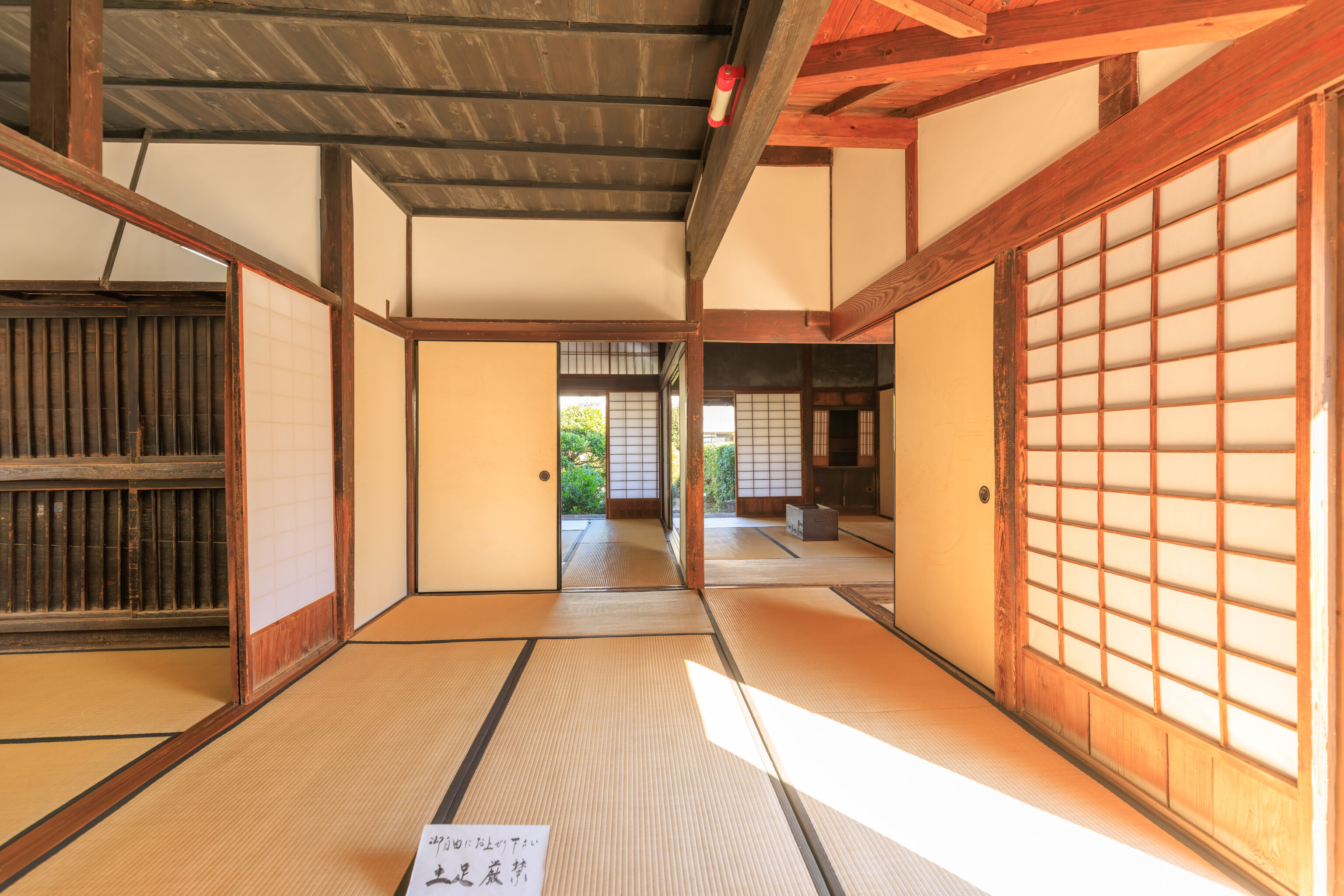
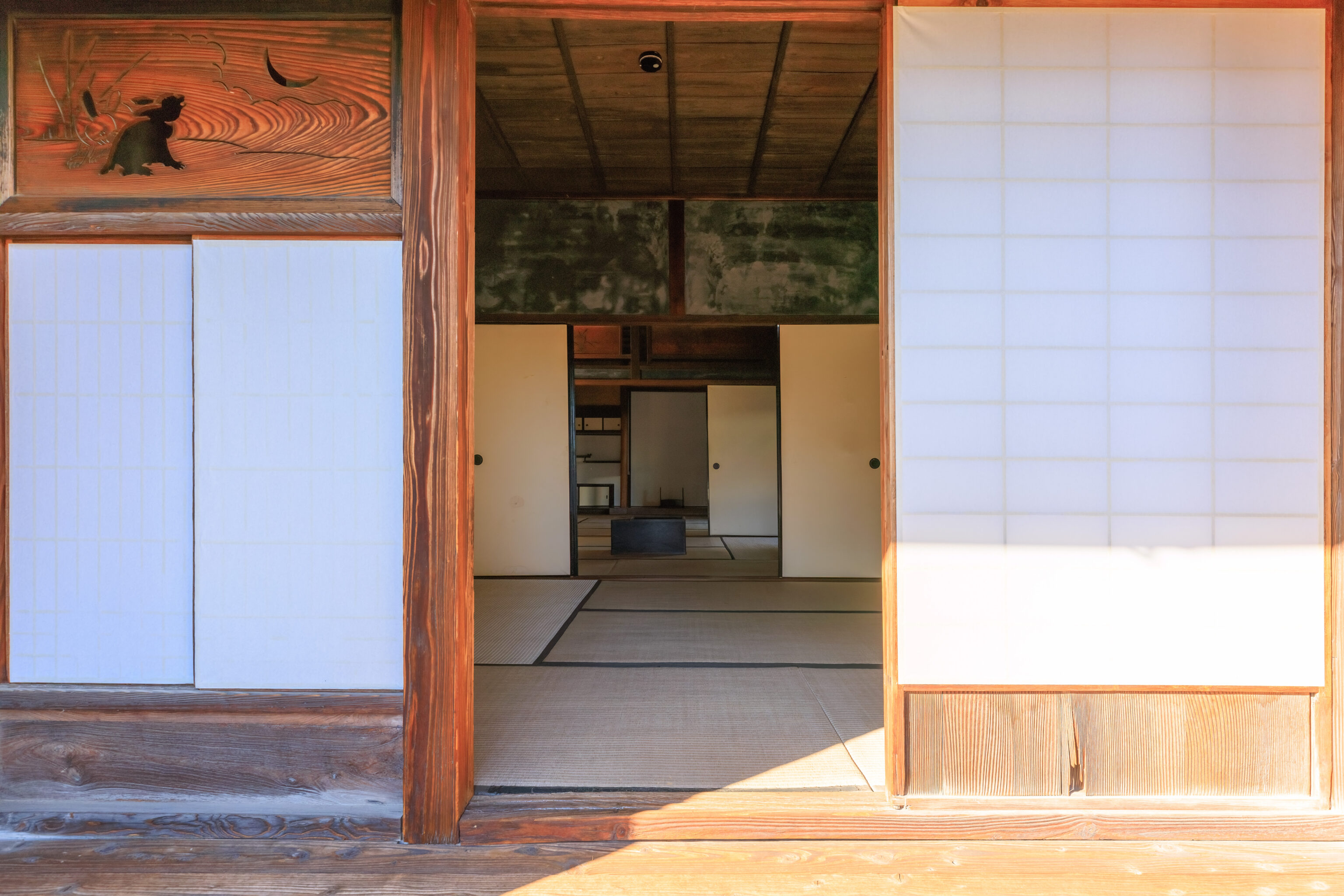
There was a little scene carved into the wall at the upper left corner of this photograph. Its not something we’ve noticed in other residences here.
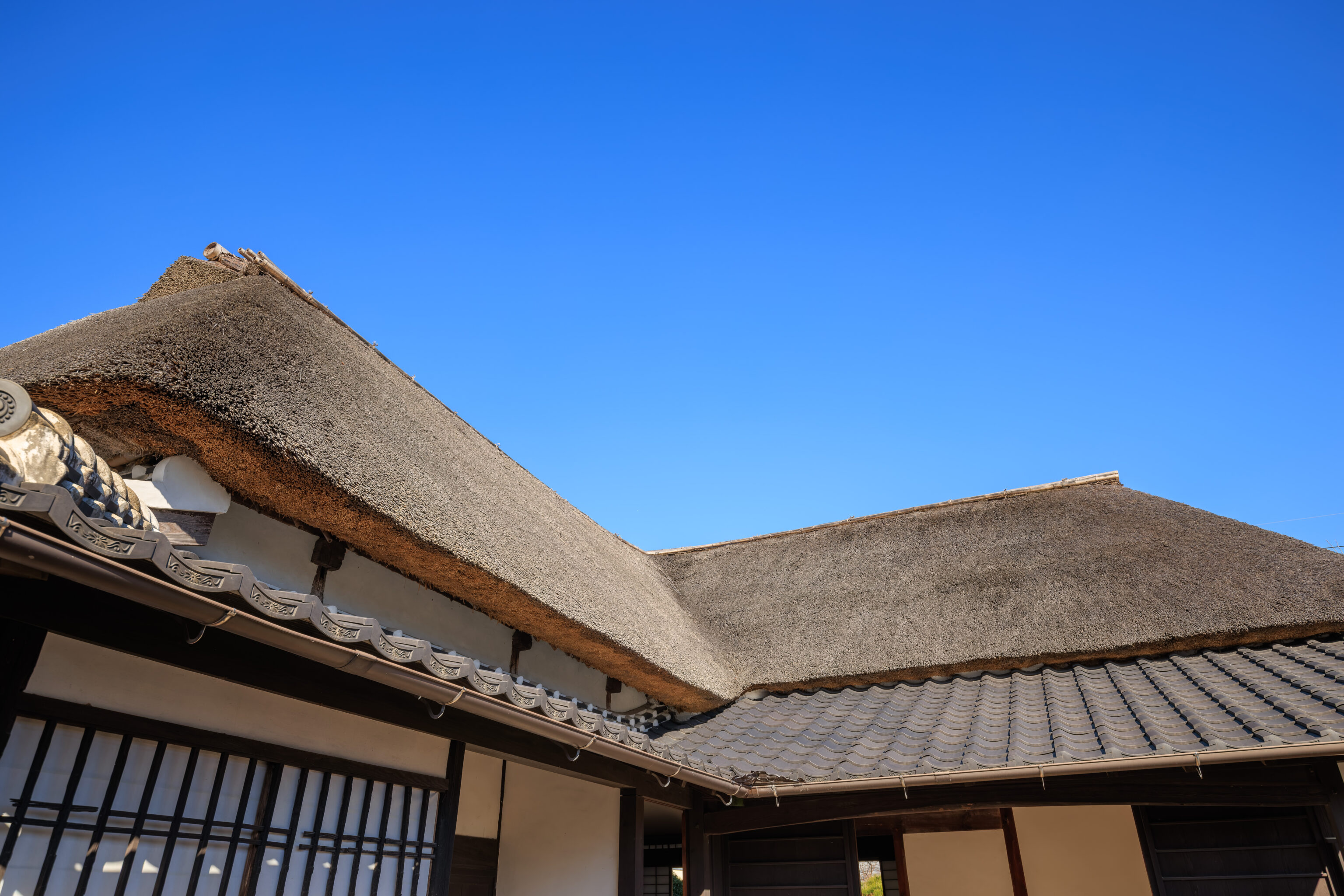
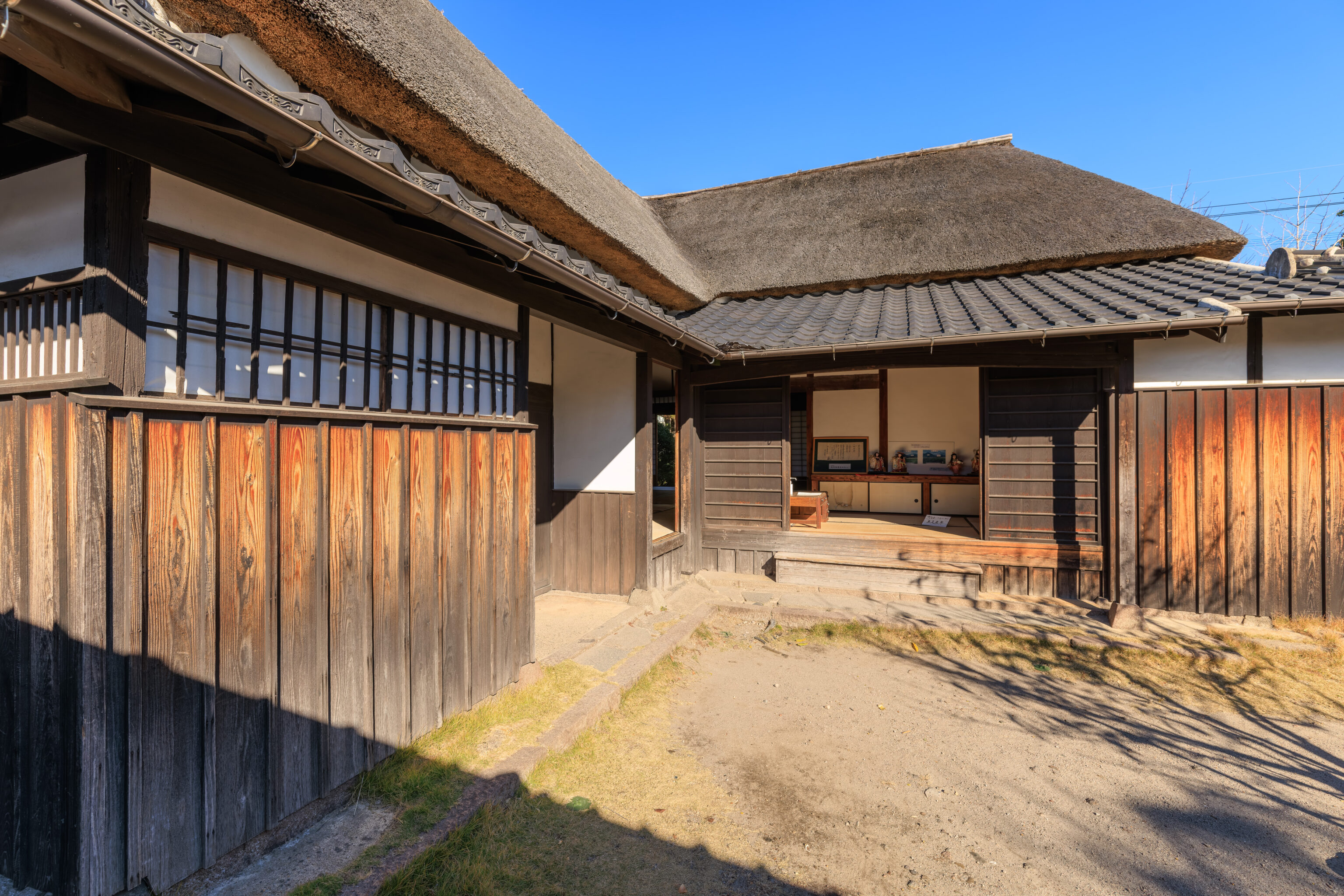
This house has a 茅葺 kayabuki (thatched) roof rather than a tiled one.
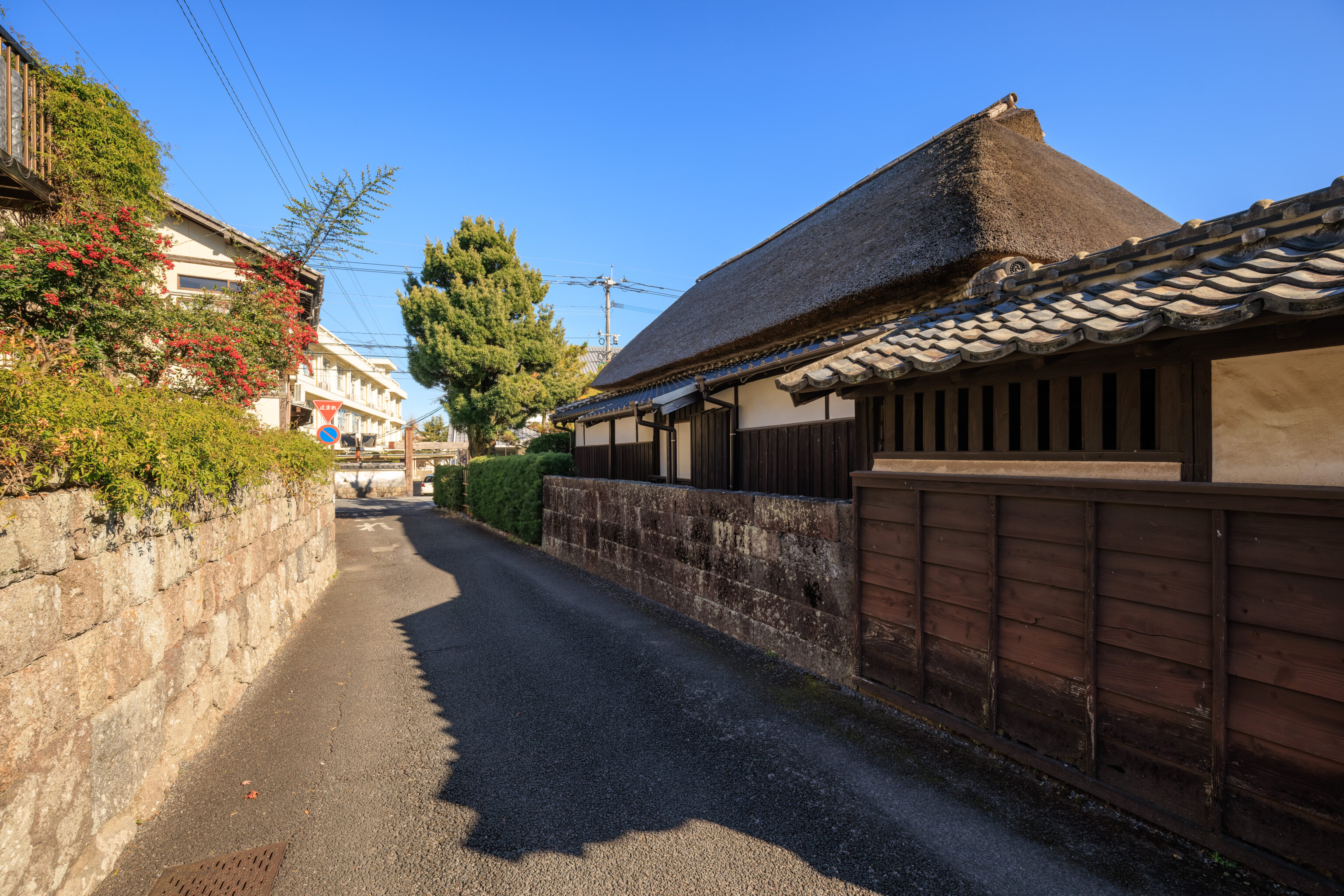
A view of the house from an interesecting street.
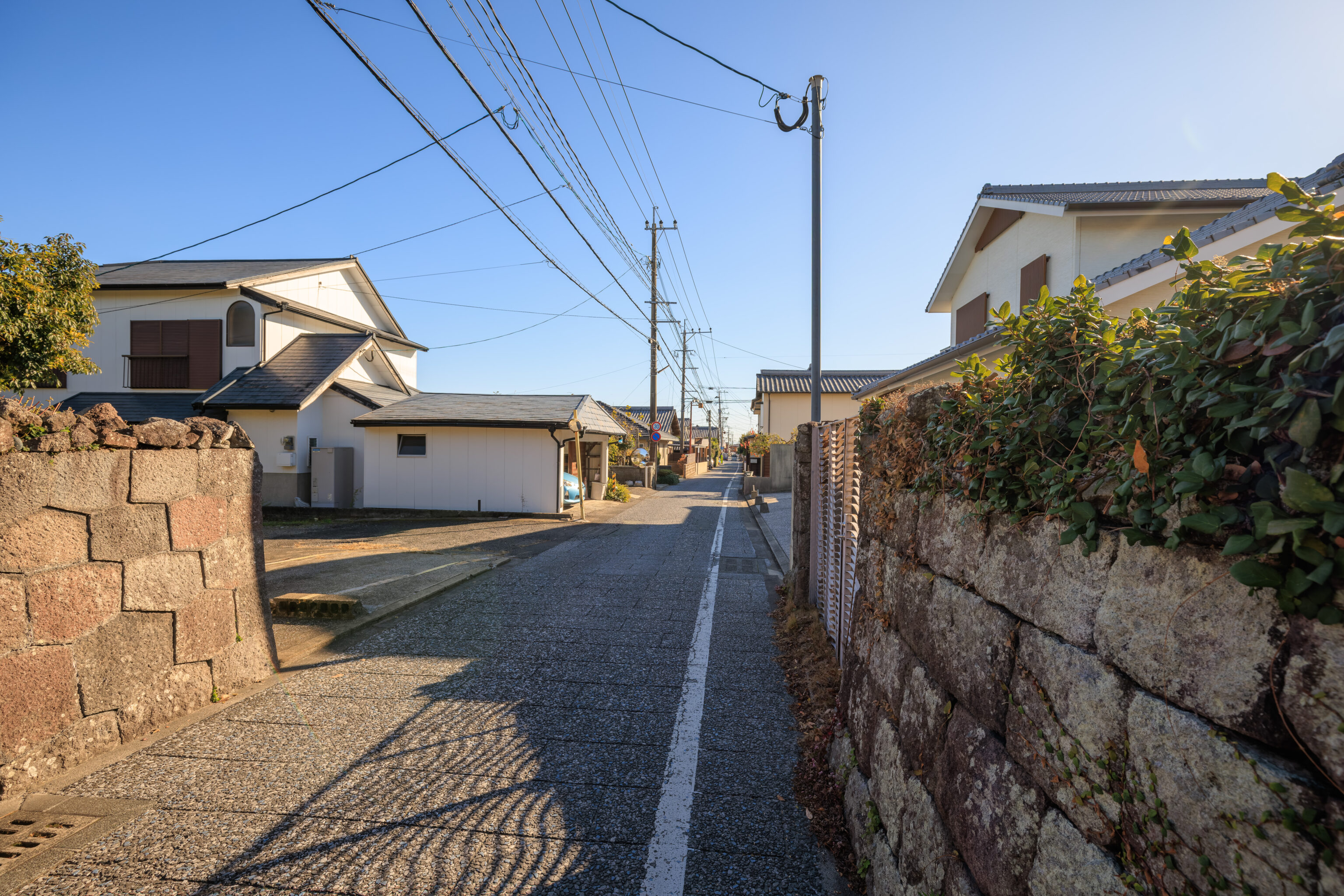
Having reached the end of the road, we walked down a narrow parallel street to head back in the direction of the castle.
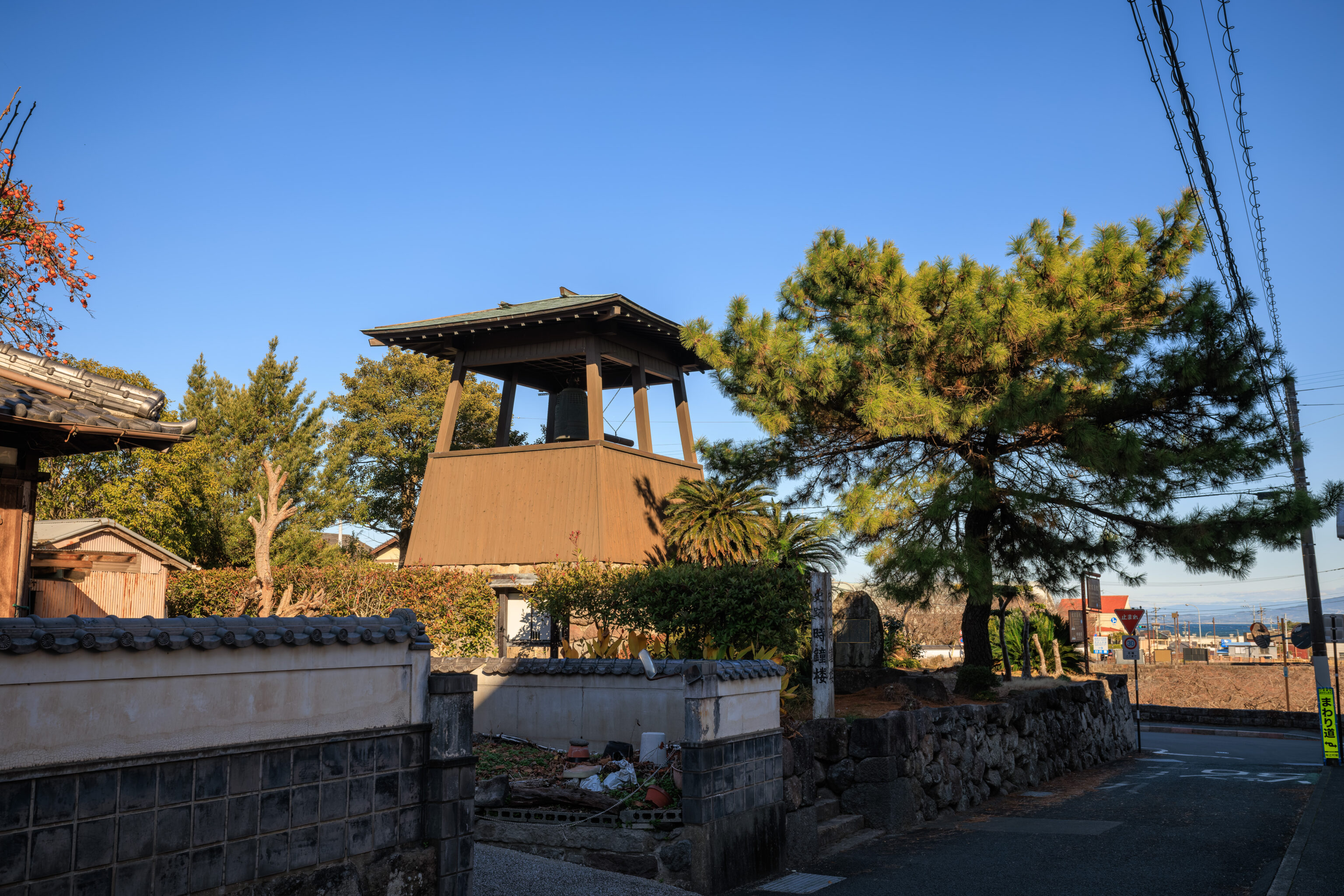
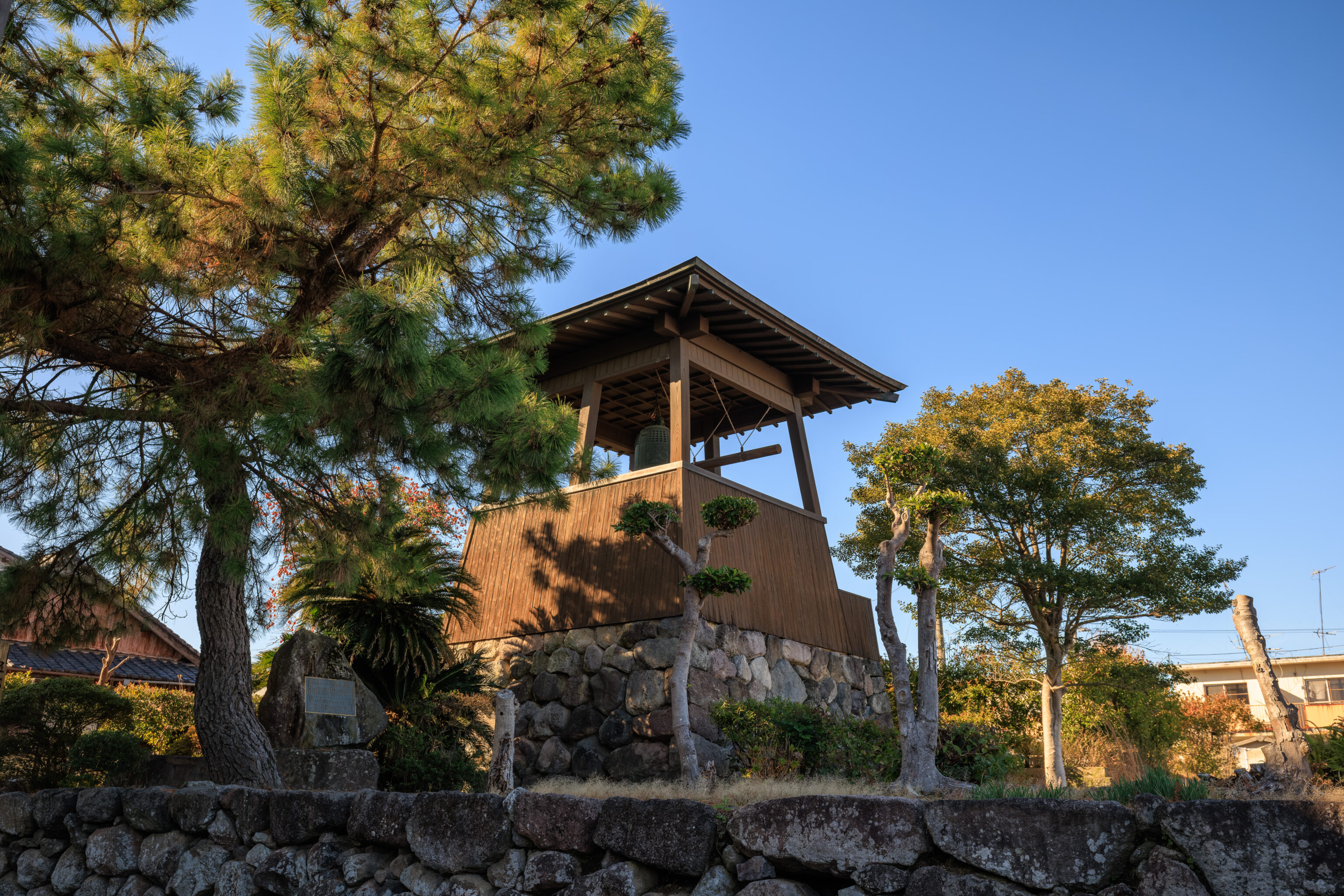
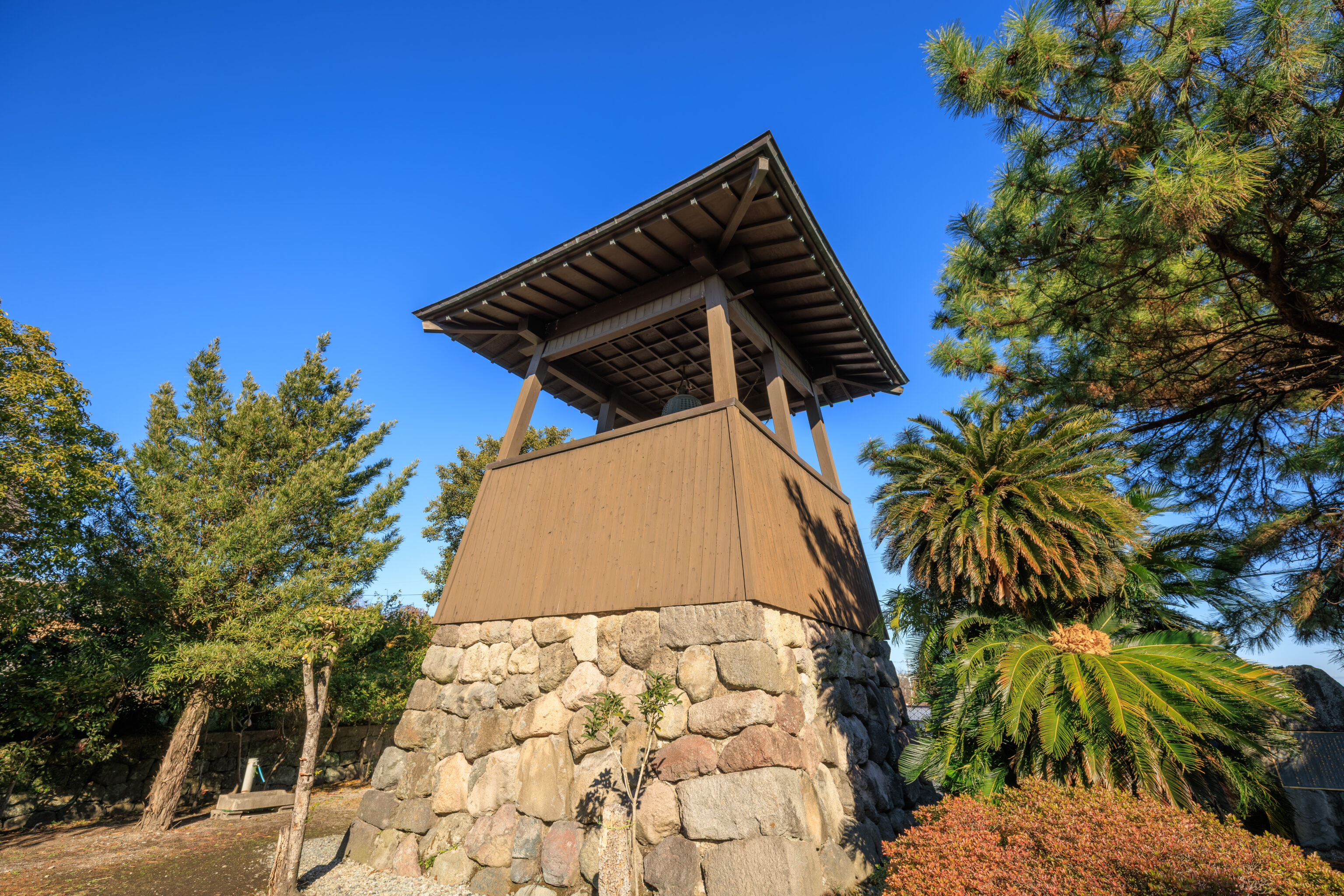
After walking for a bit and then turning left to go east, we came across this small tower.
Time Signal Bell Tower
Lord Matsudaira Tadafusa, the daimyo of the Shimabara Domain, held the view that "informing the people of the time and ensuring they observe it is essential to good governance." Consequently, in 1675 (the third year of the Enpō era), he commissioned Fujiwara Masatsugu—a master craftsman from Bungo-Takada—to cast a massive bell. He then erected a bell tower on this site, where the bell was rung at regular intervals to announce the time.

For the next 270 years, the bell became an integral part of daily life, affectionately known to the people of Shimabara as "Okami no Kane" (the Lord's Bell). However, in 1944—amidst the Pacific War—it was surrendered for the war effort, bringing its long history to an end.

The bell was restored in 1980, made possible by the aspirations and voluntary contributions of dedicated citizens; its inscriptions and decorative patterns are the work of Seibō Kitamura, a preeminent figure in the Japanese world of sculpture.
– Text from a sign, read and translated using Google Gemini and Translate.
Unfortunately, there was no way to get a closer look at the bell.
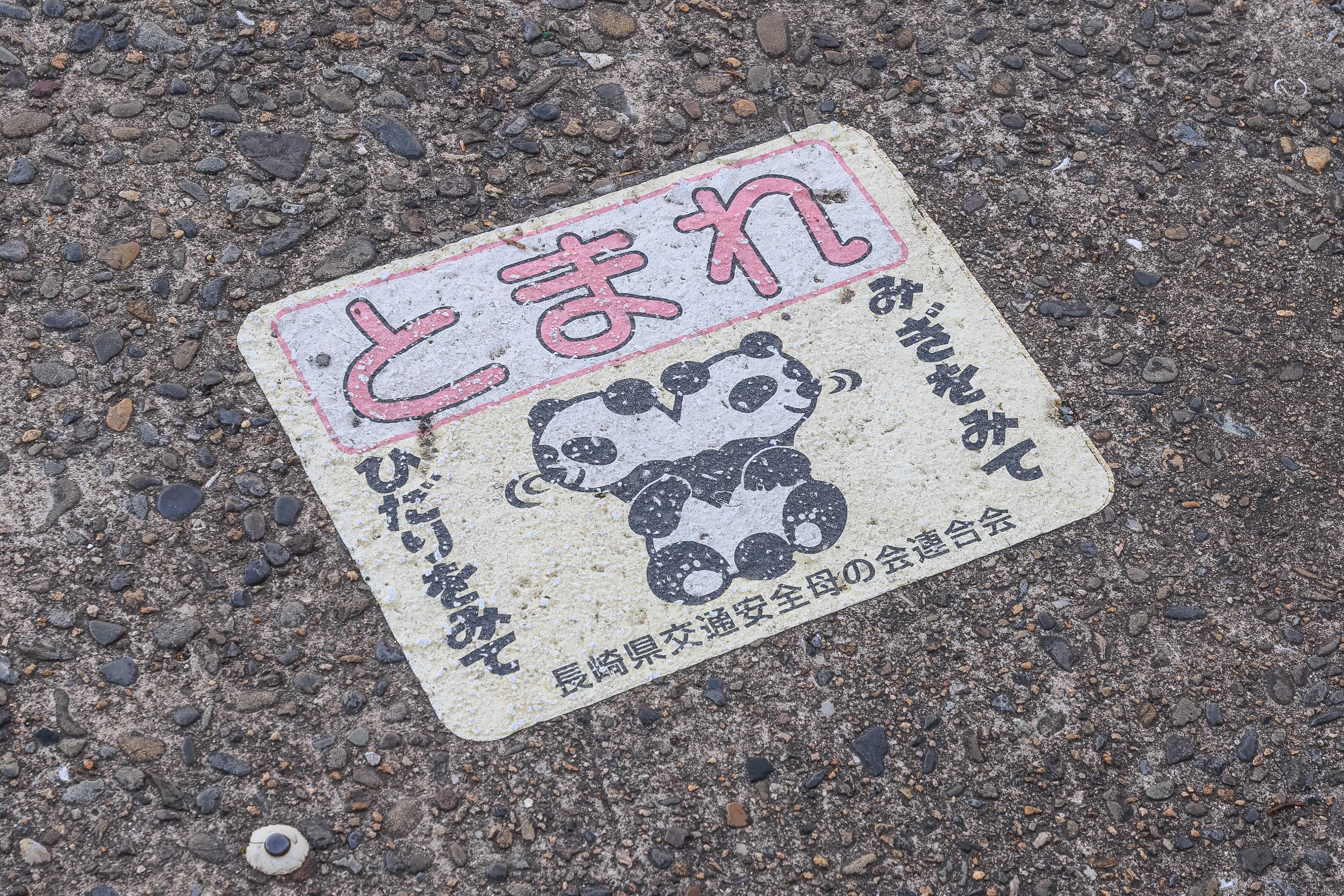
We’ve seen these before!
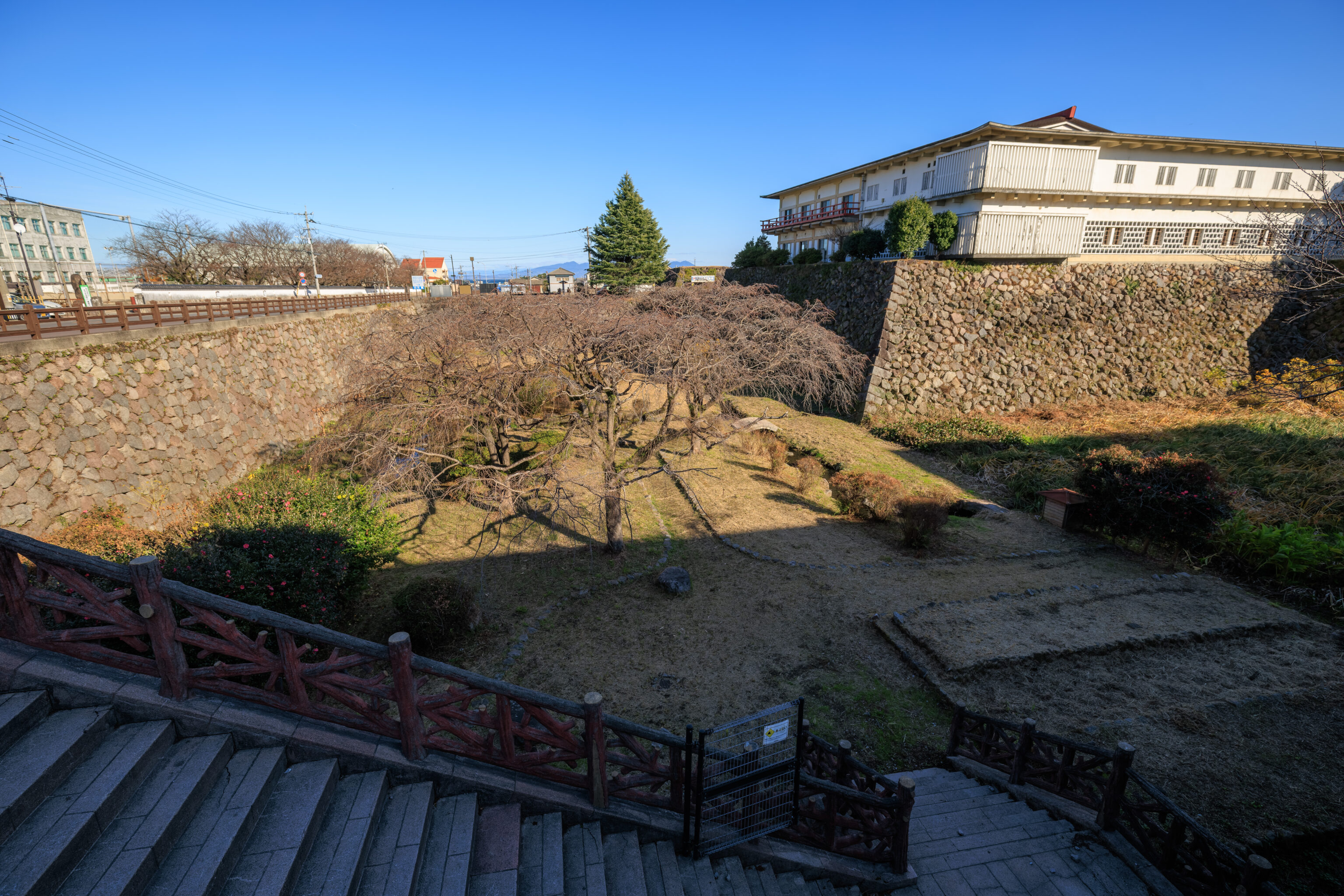
We ended up at the northwestern corner of Shimabara Castle’s walls. The buildings that stand here today include a commnity center and cultural hall.
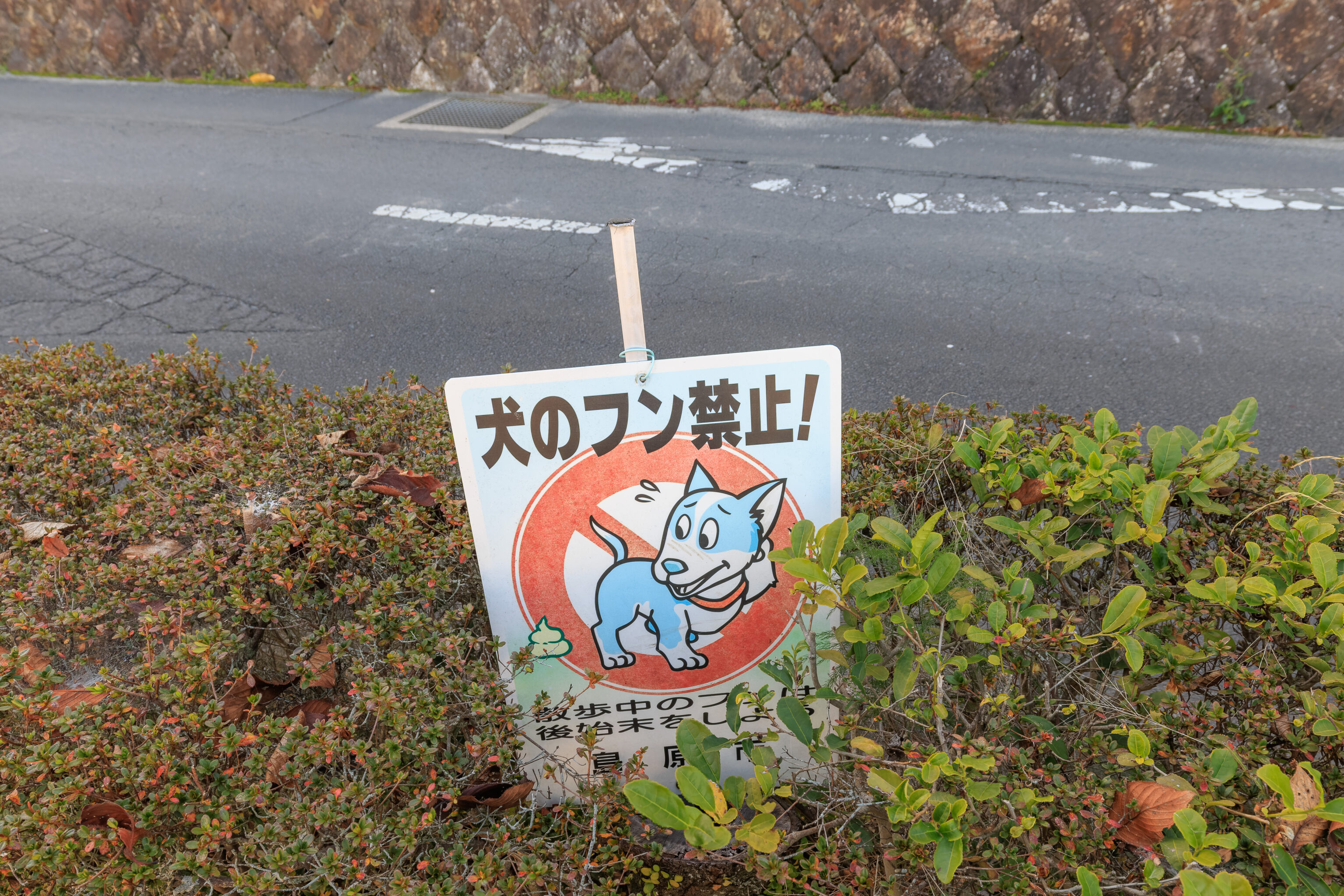
Pick up after your dog!
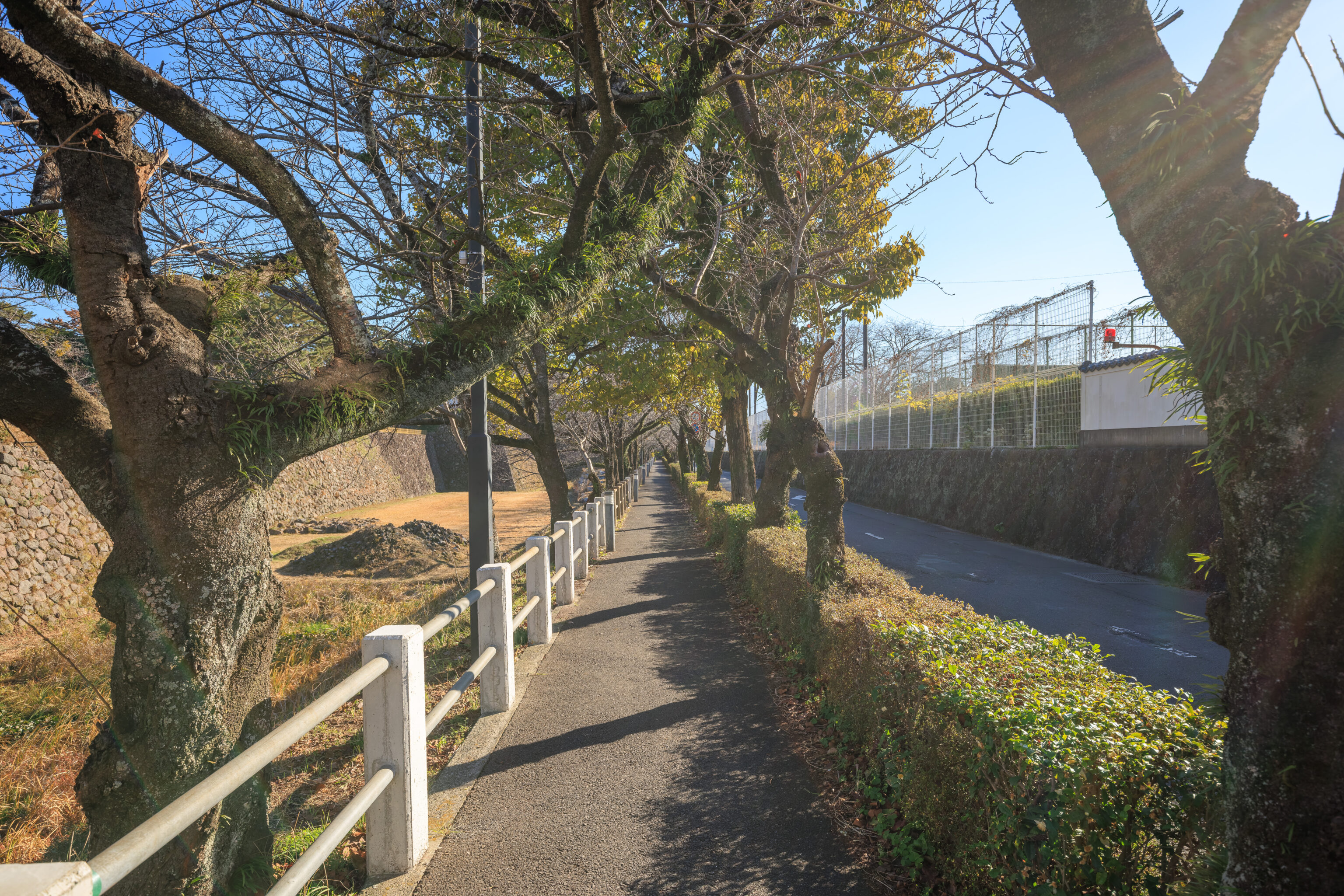
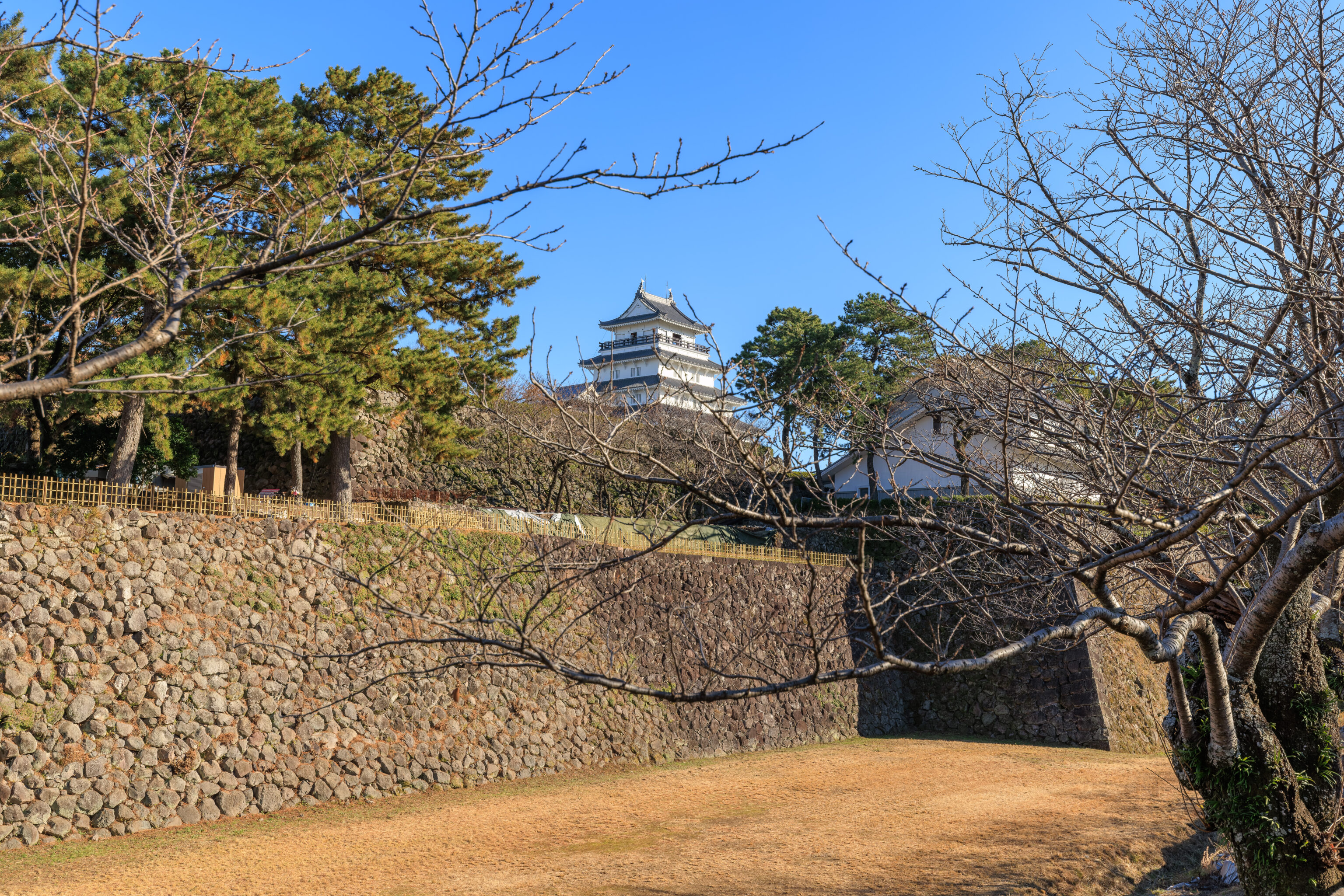
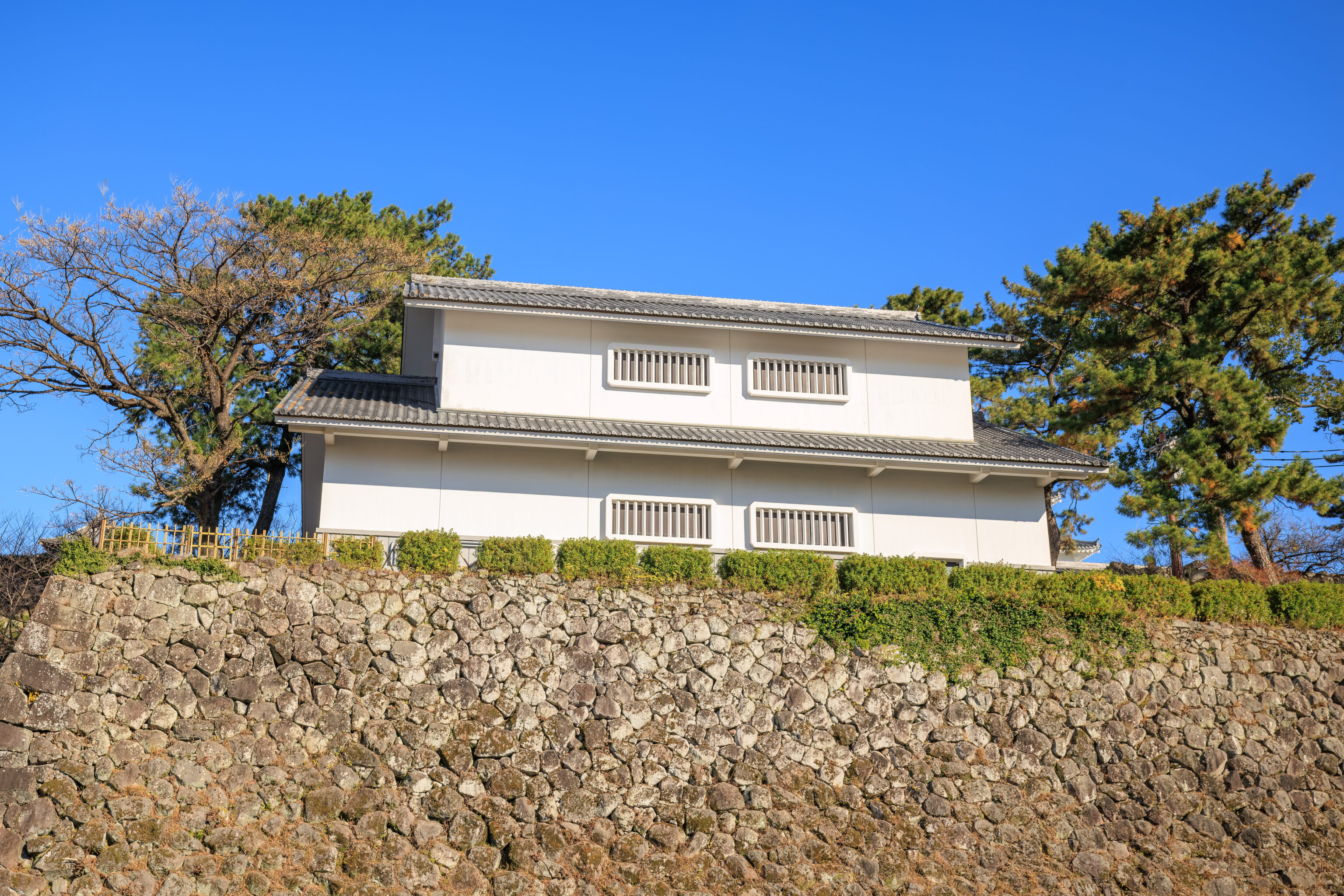
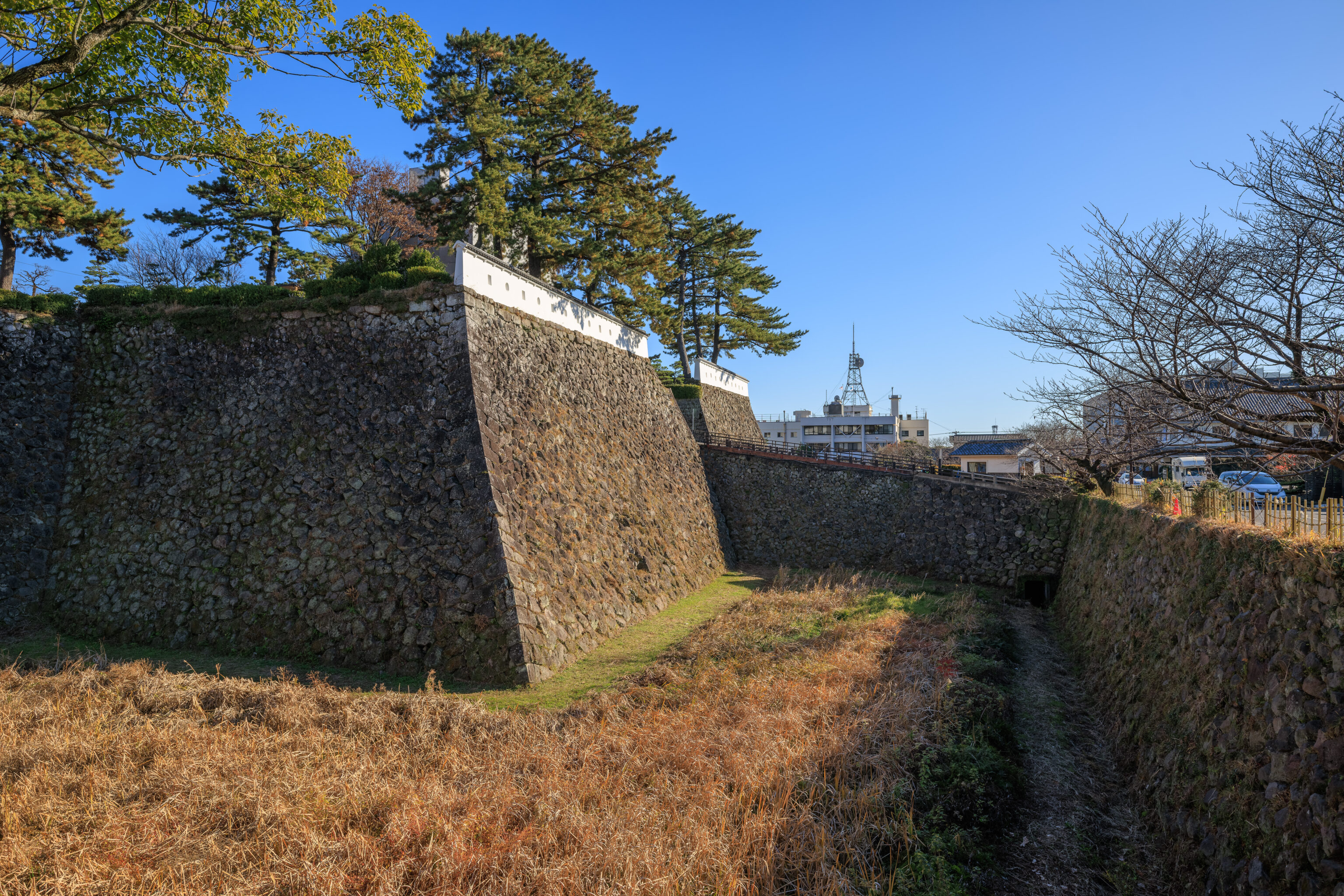
We walked down a tree lined sidewalk with the castle walls to our left.
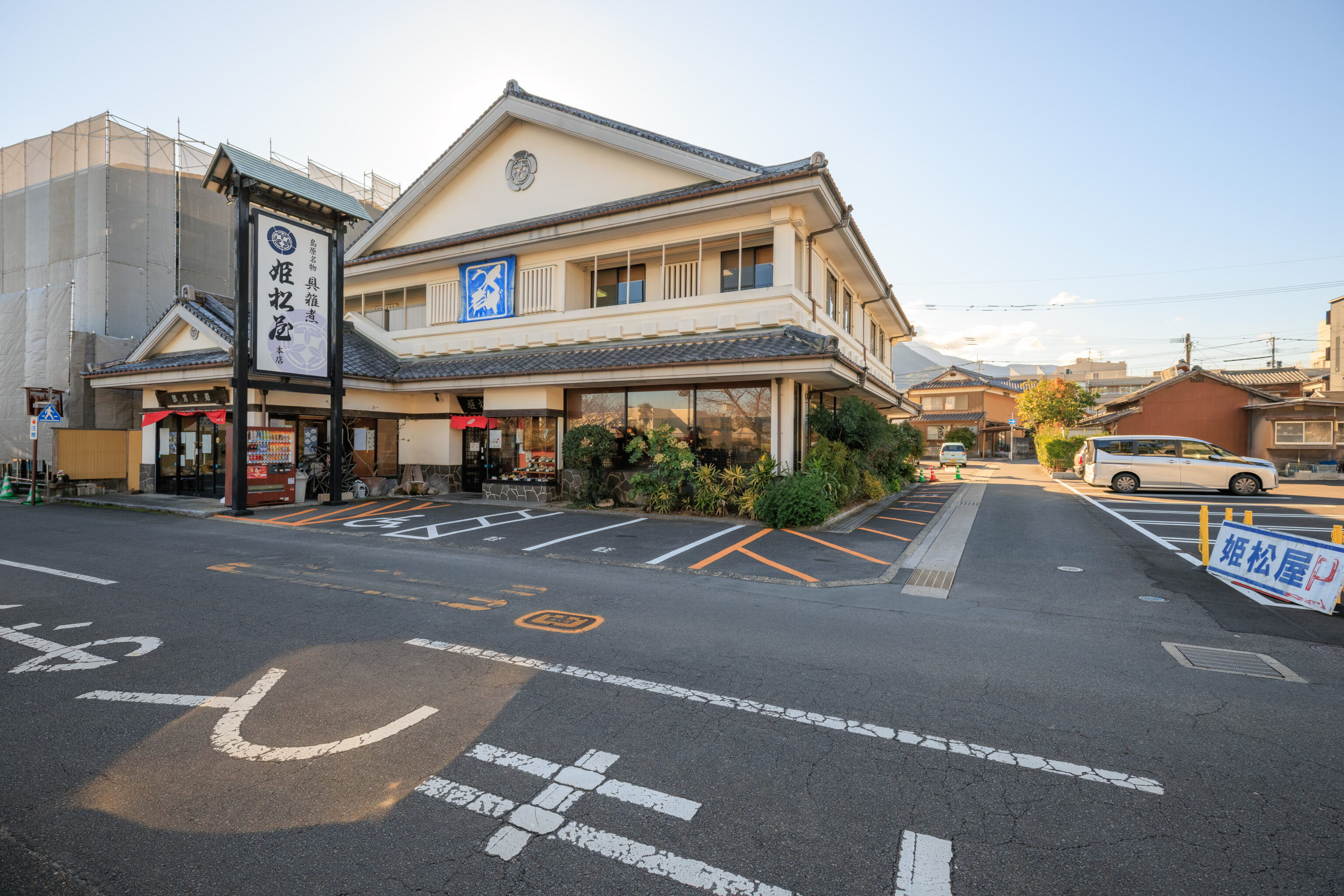
We walked by the restaurant that we had lunch at.
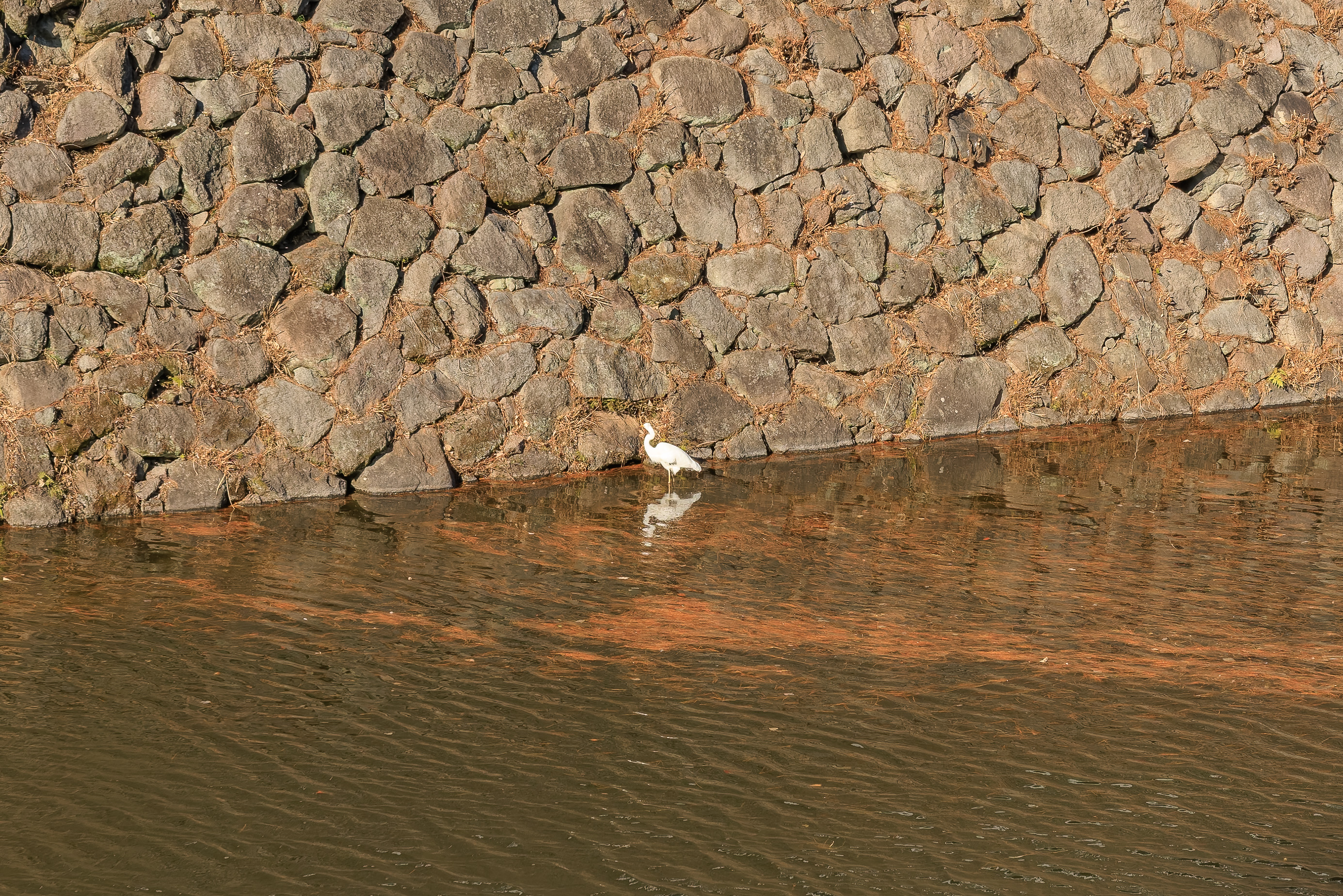
Is this a Great Egret?
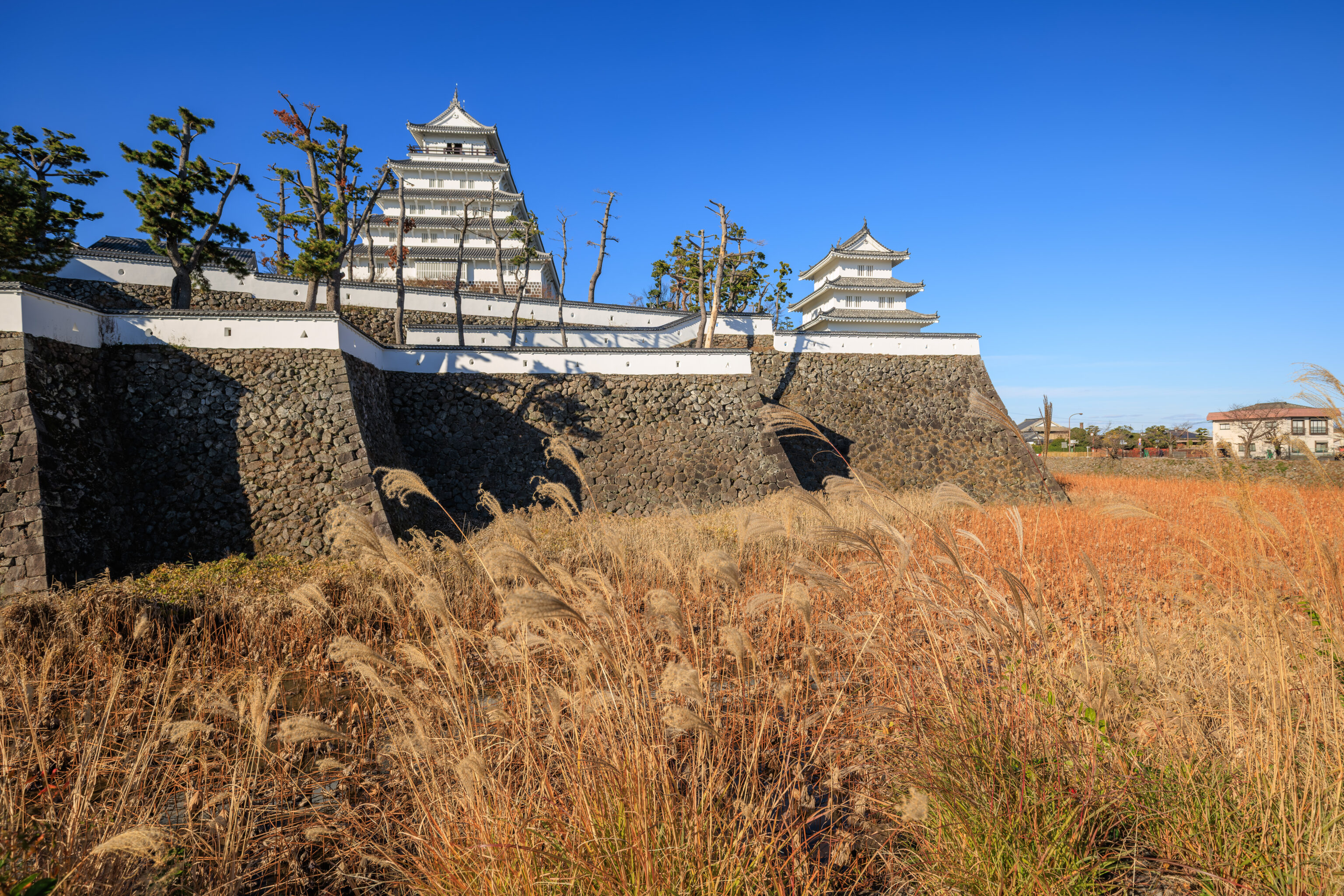
We turned left and followed the castle’s southern wall, backtracking on the route that we took when we arrived in the morning.
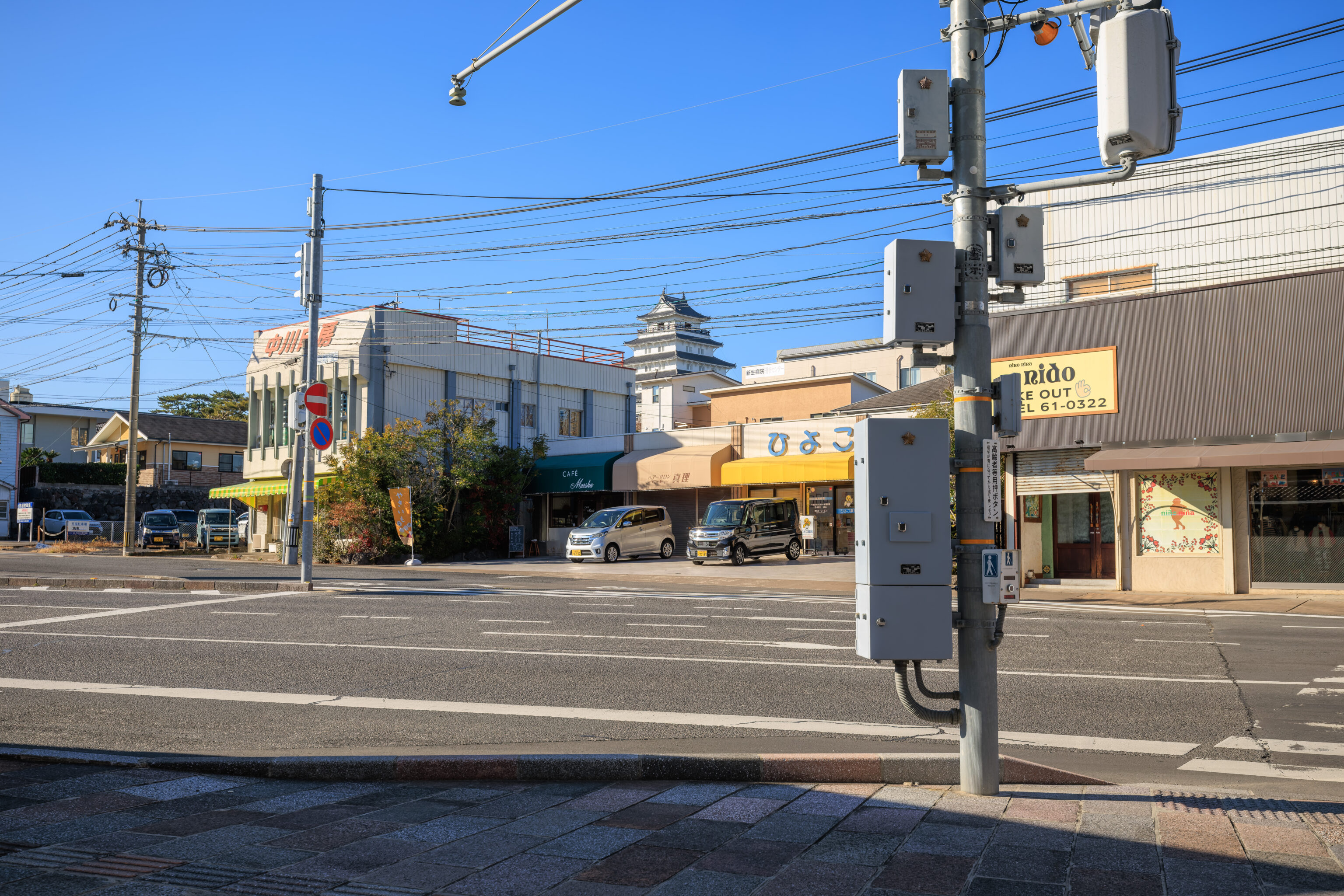
Upon reaching the southeastern corner of the castle’s wall, we walked to the south and then east until we saw a nice place to sit down. We started to eat the castella that we bought earlier. It was excellent and we ended up just eating it all!
This was right by the city’s very modern looking city hall. We should have photographed it!
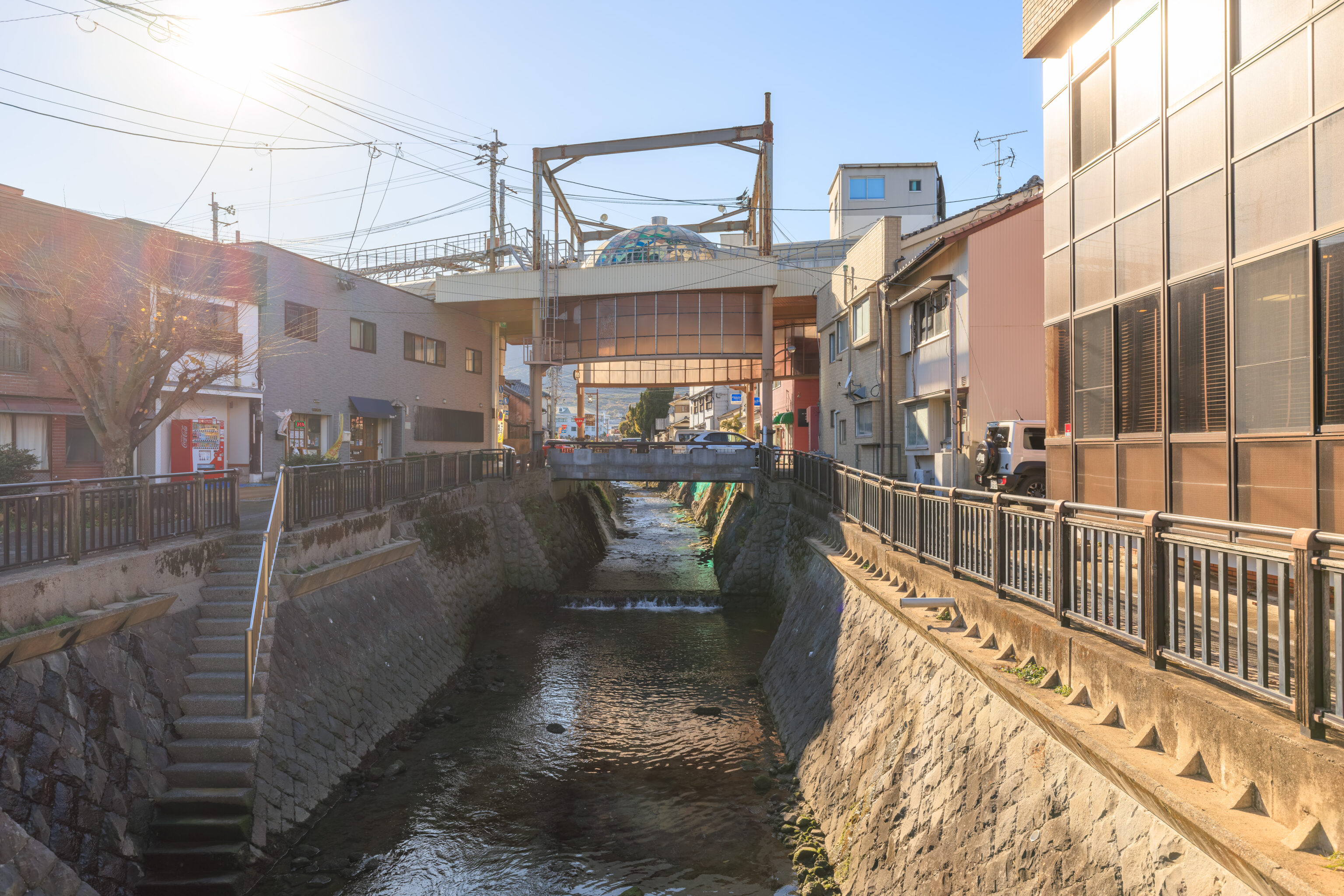
After our little castella break, we contined walking to the south. We crossed over the 大手川 Otegawa, a river which empties out into the sea.
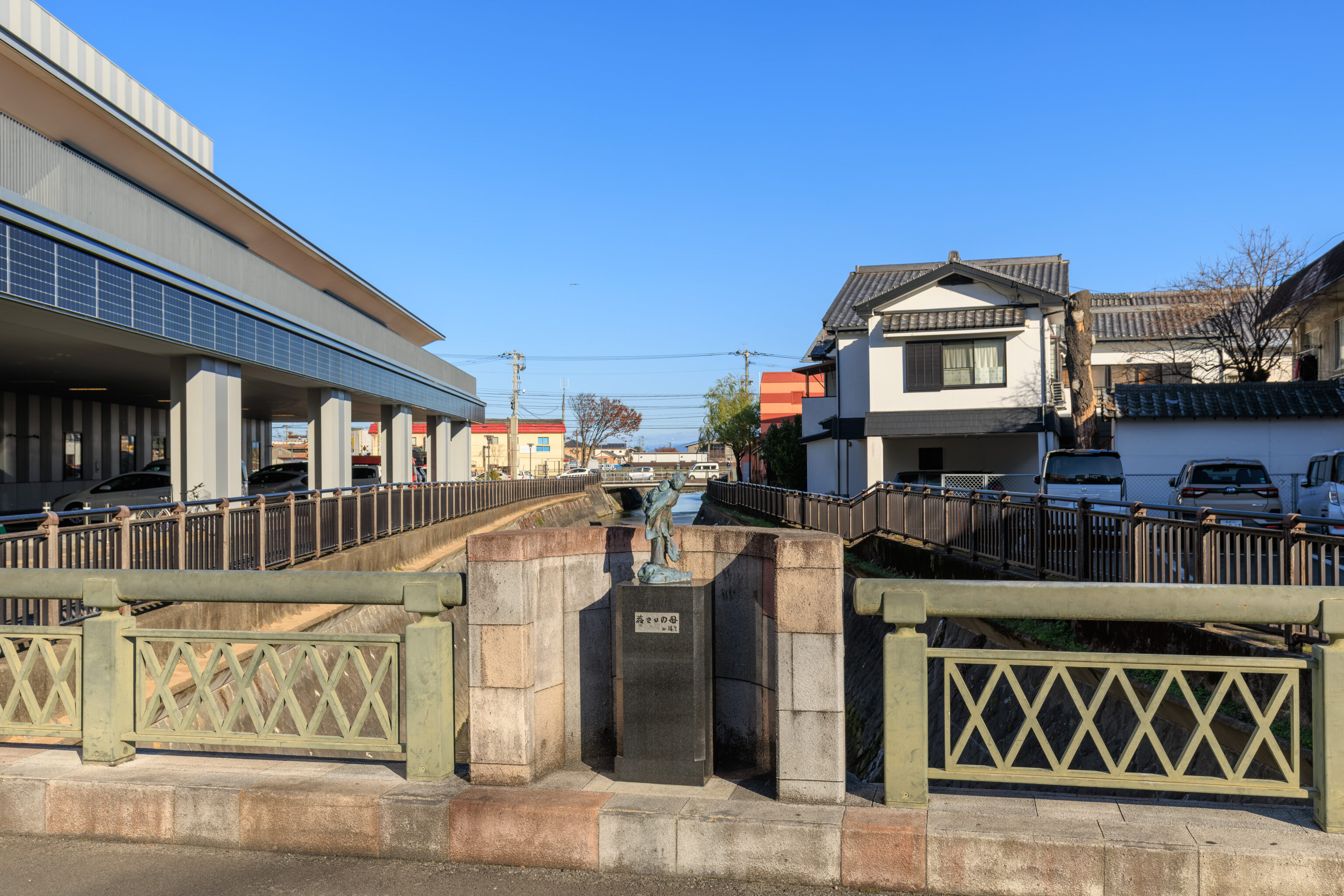
There was a little sculpture created by Seibo Kitamura on the east side of the bridge.
Mother in Her Youth
Made by Seibo
– Text from the plaque below the sculpture, read and translated using Google Gemini and Translate.
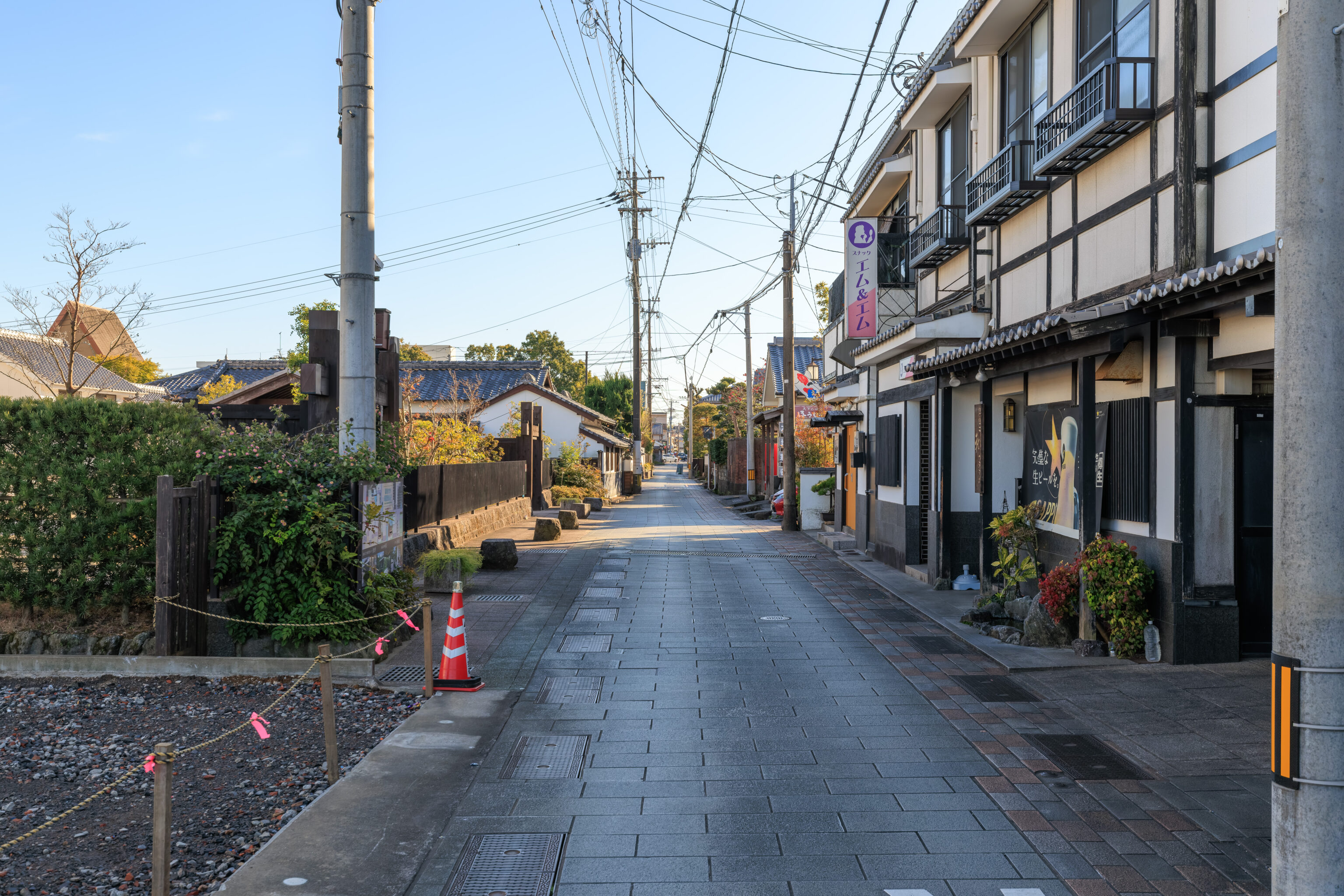
We continued walking to the south through a residential area.
Koi no Oyogu Machi
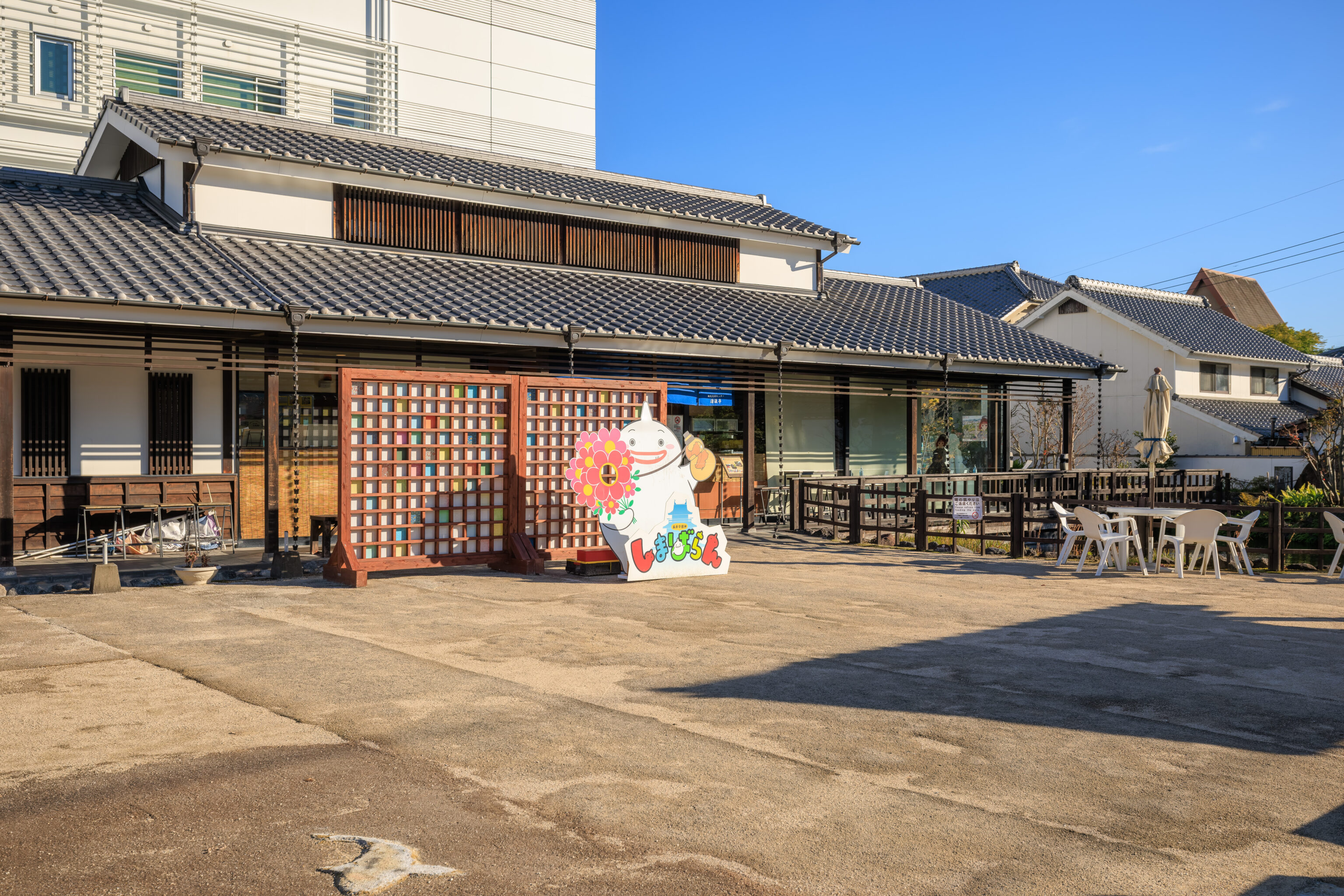
We came upon the 鯉の泳ぐまち 観光交流センター「清流亭」”Town Where Carp Swim” Tourism and Exchange Center: Seiryutei.
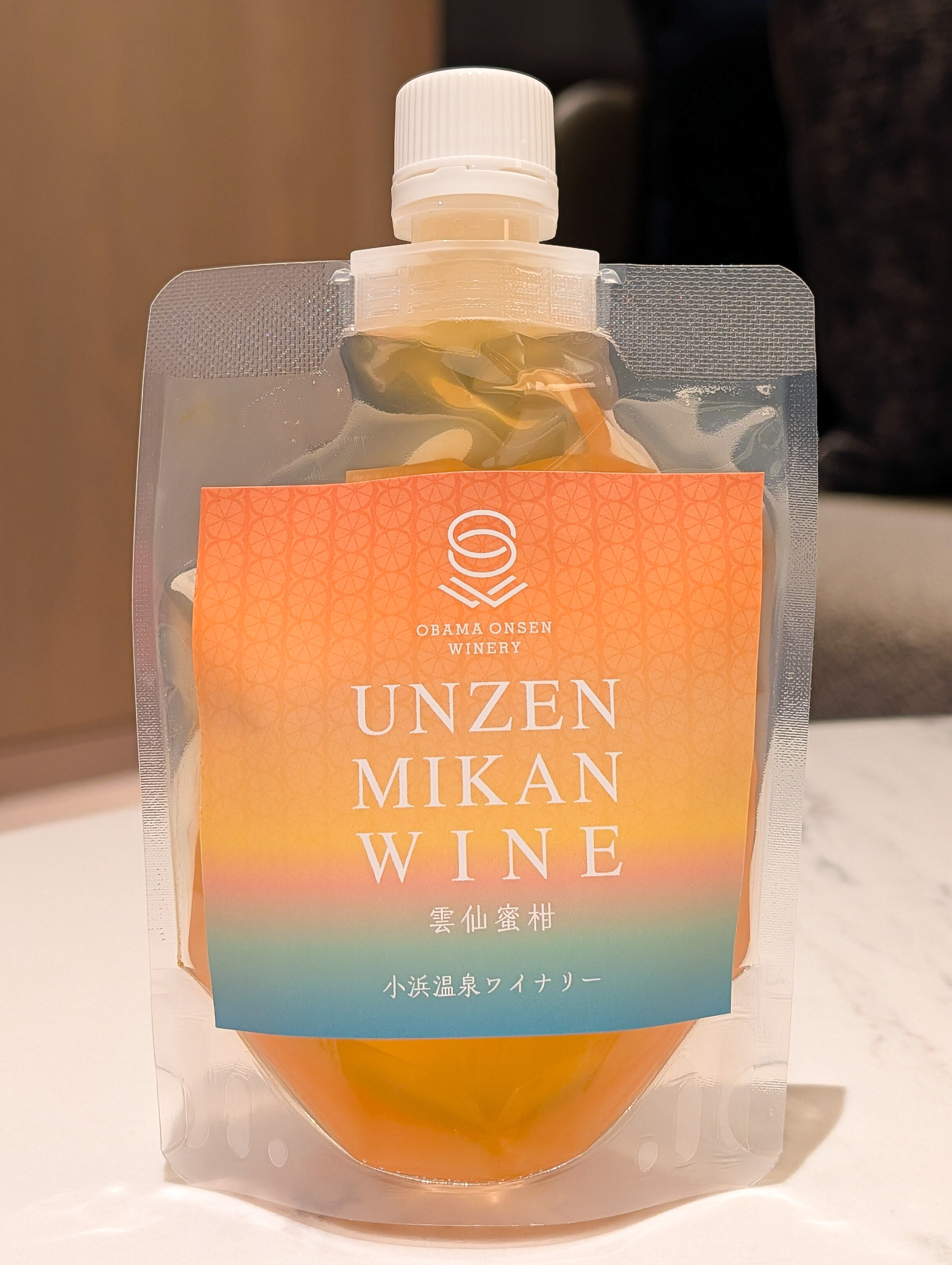
We bought a bit of local mikan wine.
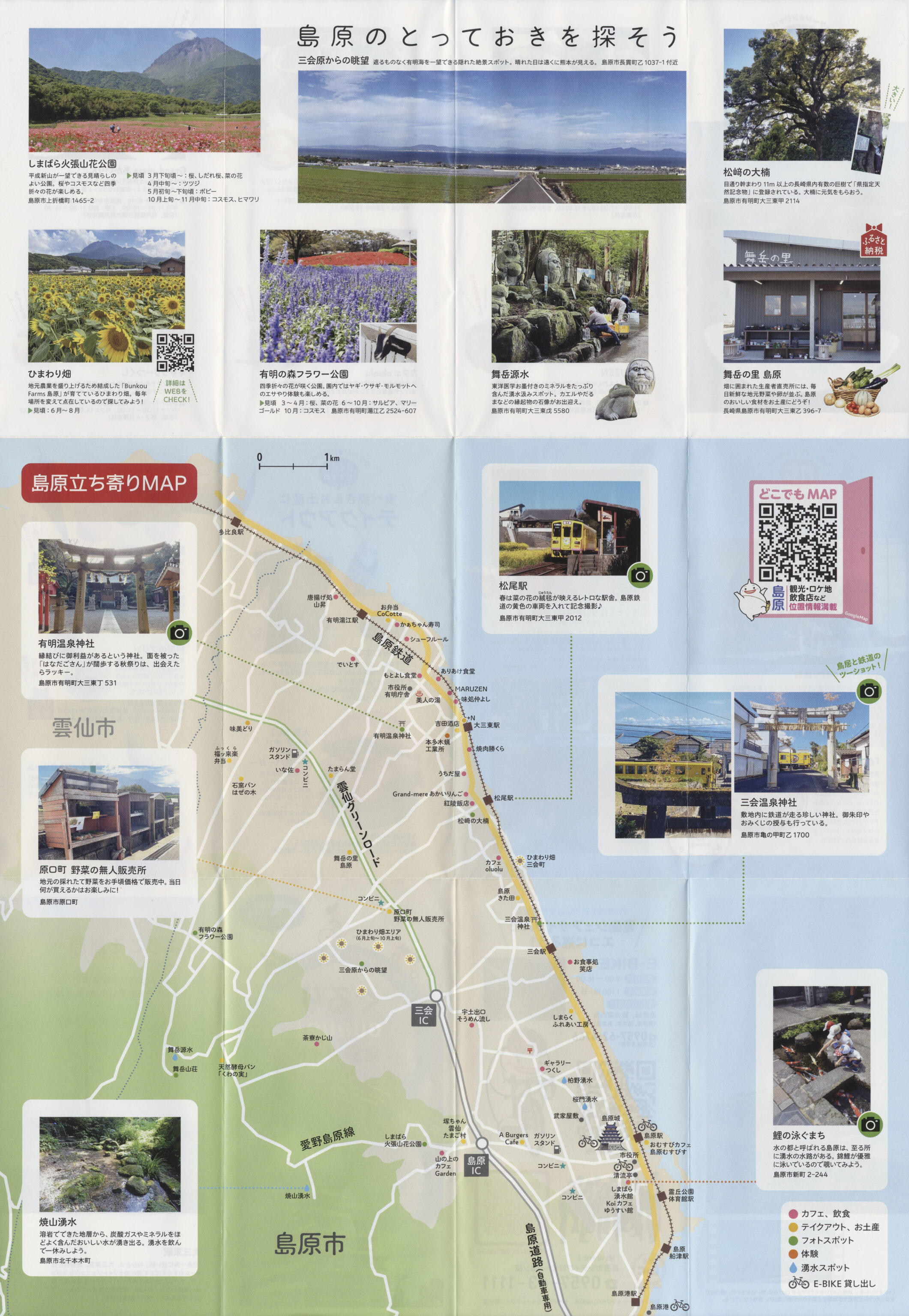
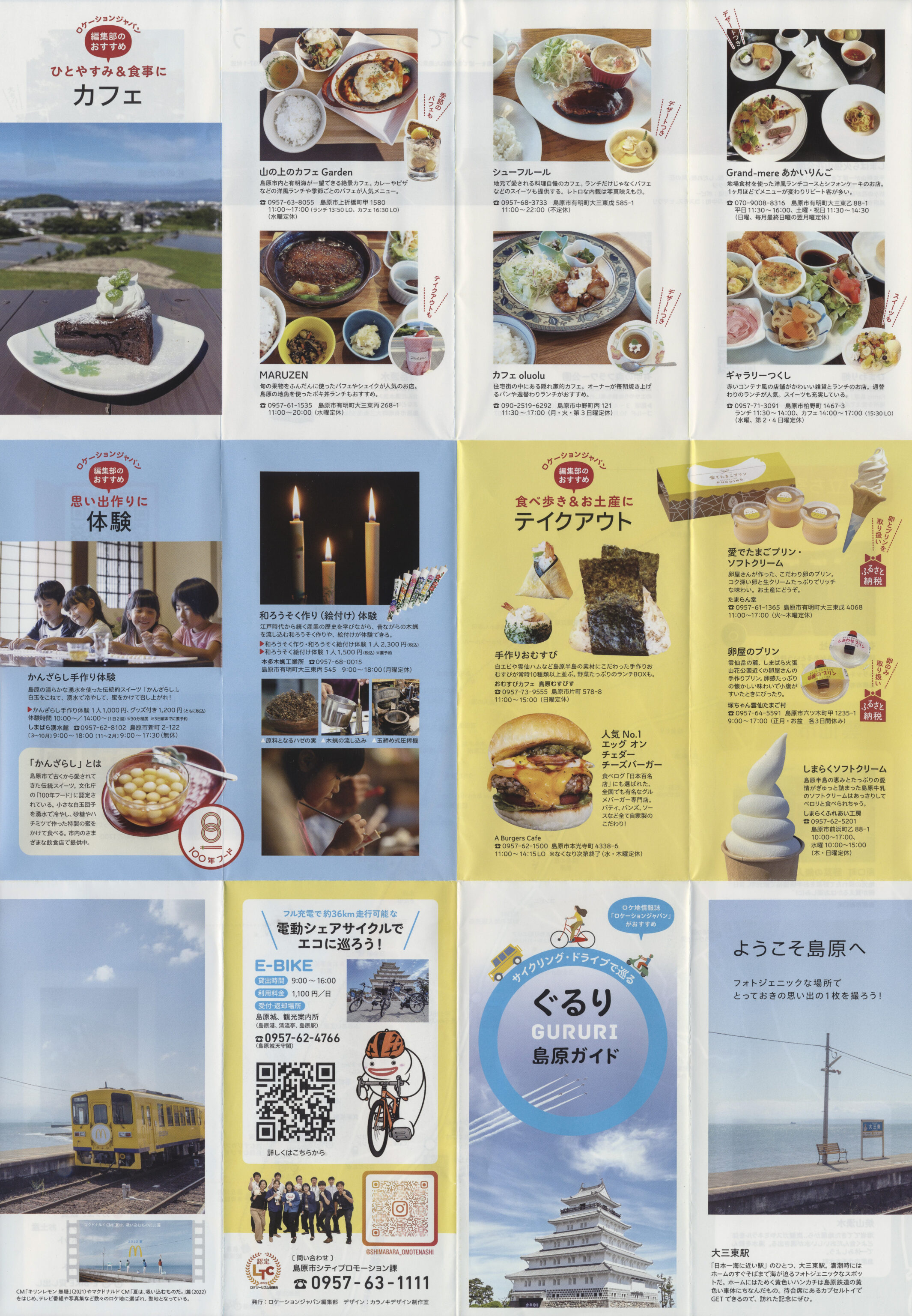
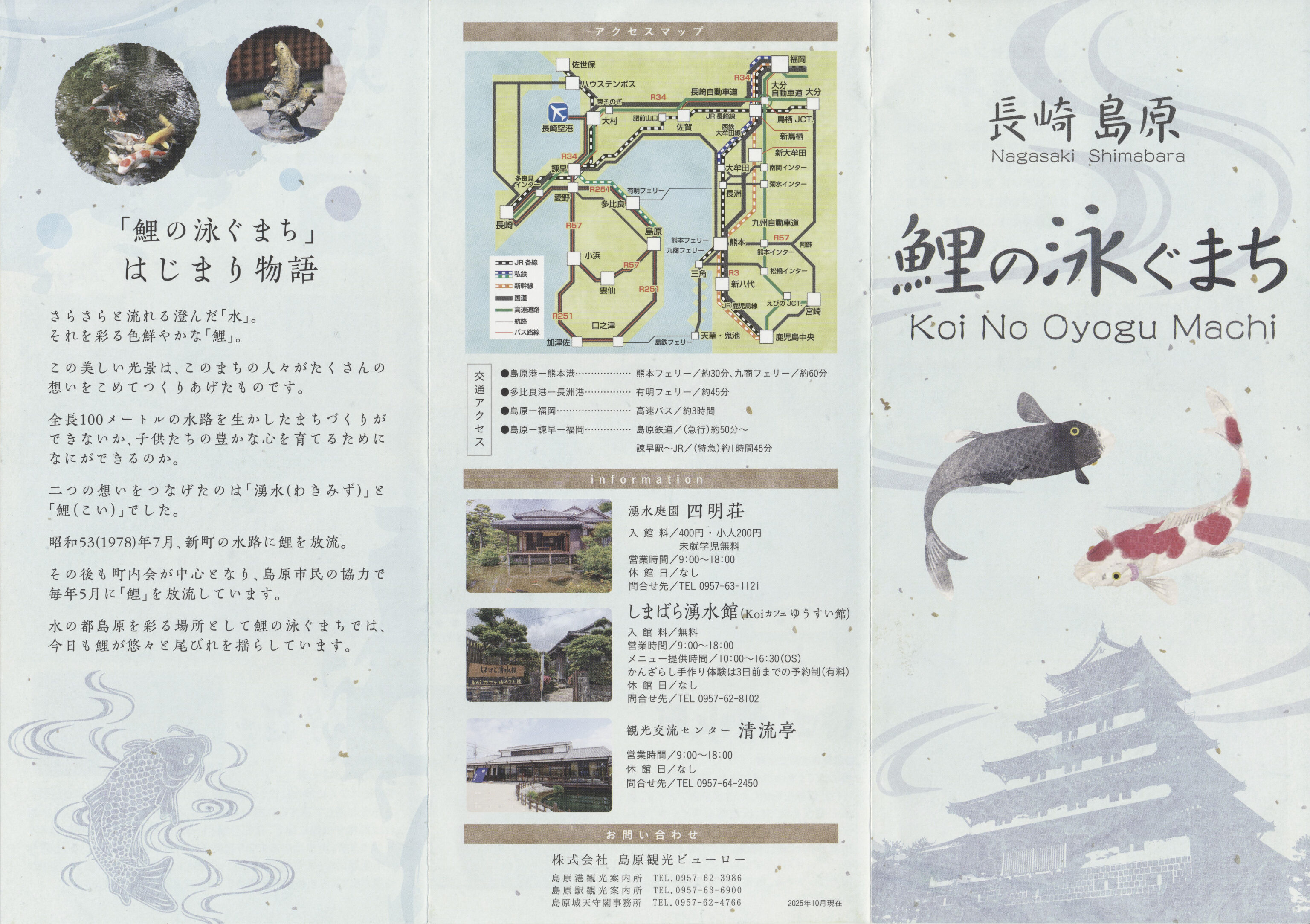
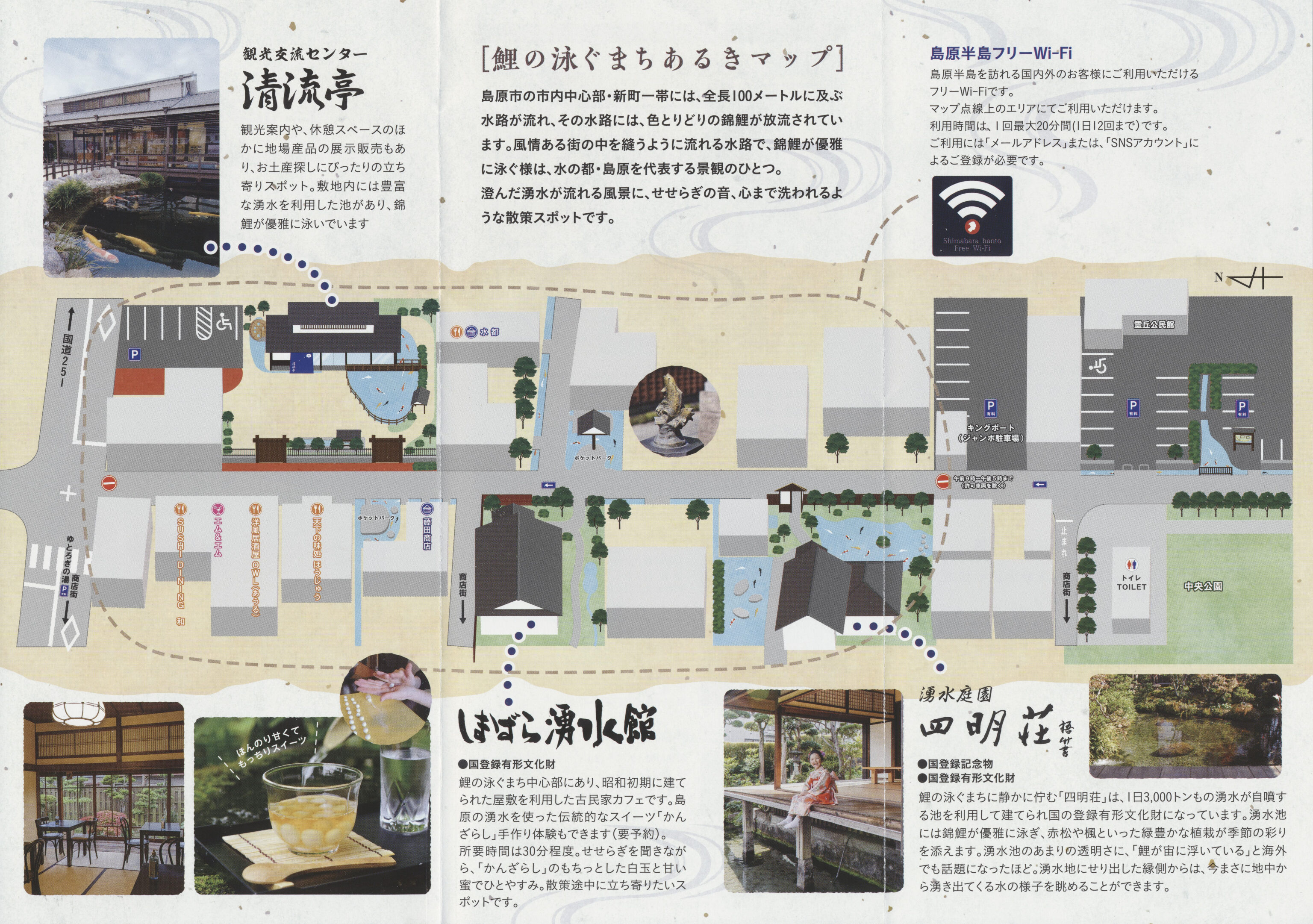
We may or may not have picked up these pamphlets here, but it seems like a good place to present them!
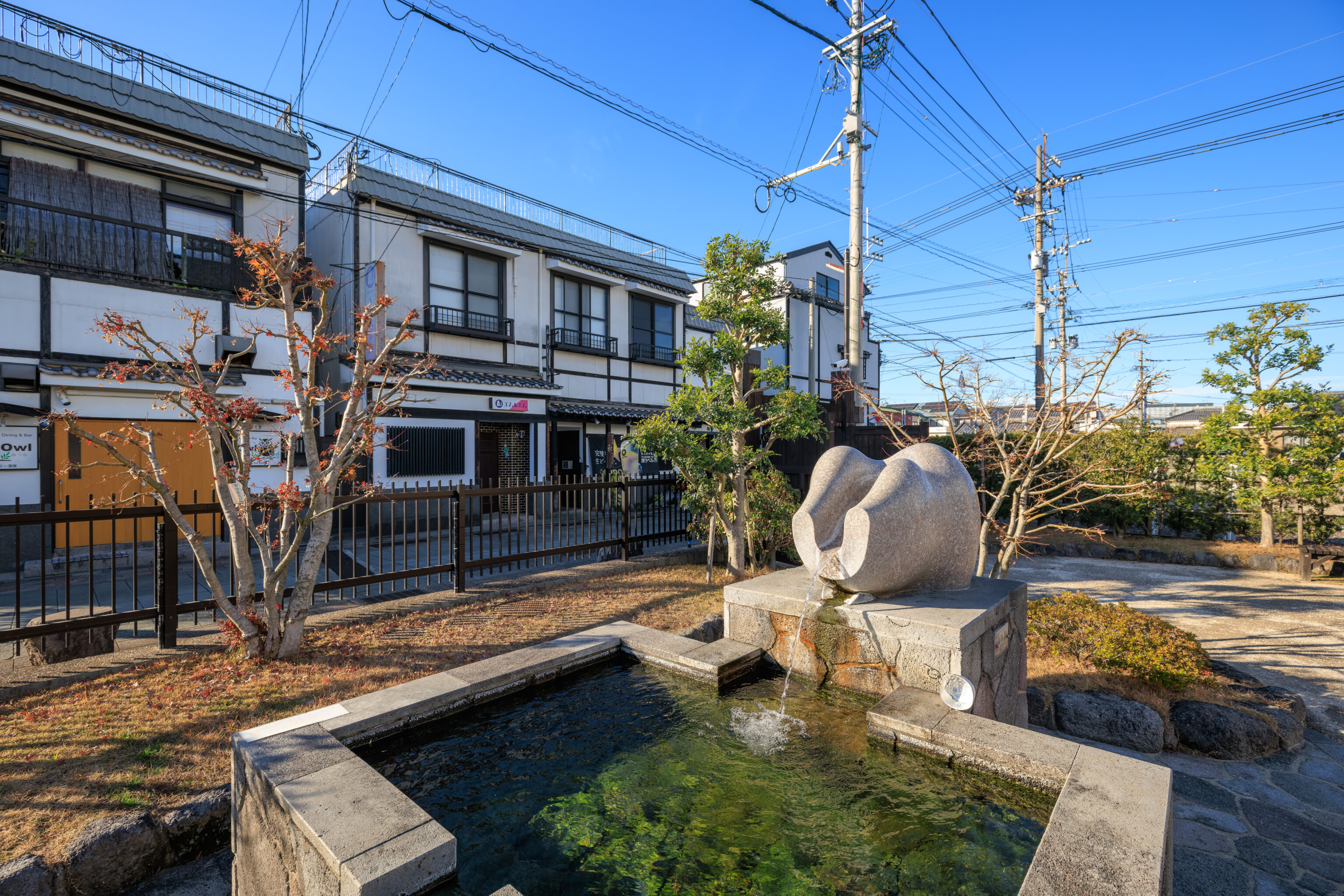
There was an interestingly sculpted spring water fountain in front of the building.
A Must-Visit Before or After Strolling Through the "Town Where Carp Swim" — Tourist Exchange Center Seiryutei
It is located just north of the "Town Where Carp Swim" area. Why not ask about unique local highlights before you set off on your stroll? You might hear about spots where water bubbles up from the ground, places featuring *shimenawa* (sacred straw ropes) displayed out of season, or a *fusuma* (sliding door) that stops partway open...

It is sure to make your walk even more enjoyable as you search for the answers!

Please stop by again after your stroll. We offer a wide selection of souvenirs and crafts that Shimabara City proudly designates as "Shimabara Special Quality."
– Text from a sign, read and translated using Google Gemini and Translate.
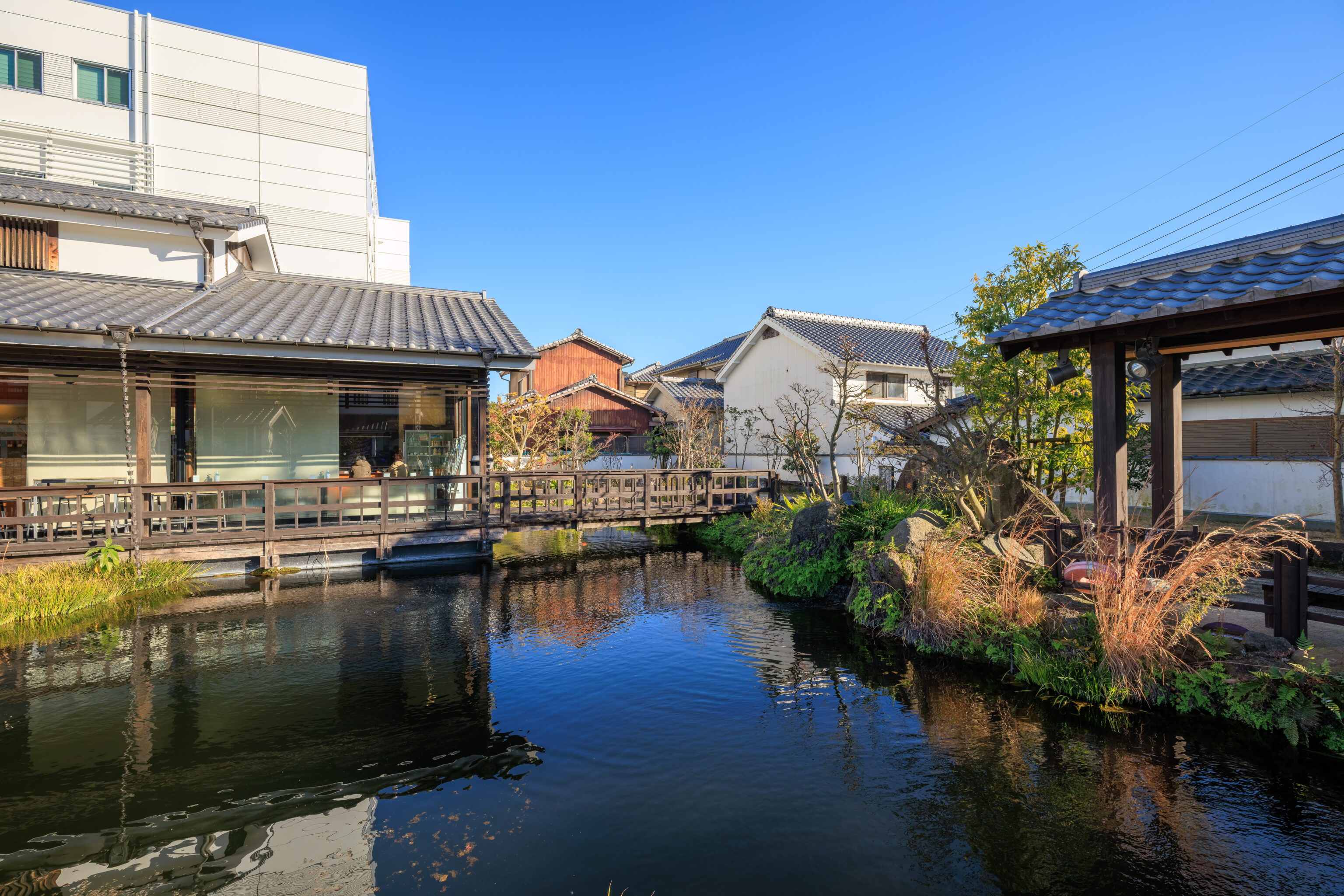
There was also a pool of calm water. As the sign and pamphlet suggest, this area is known as the 鯉の泳ぐまち Koi no Oyogu Machi (Town Where Koi Swim).
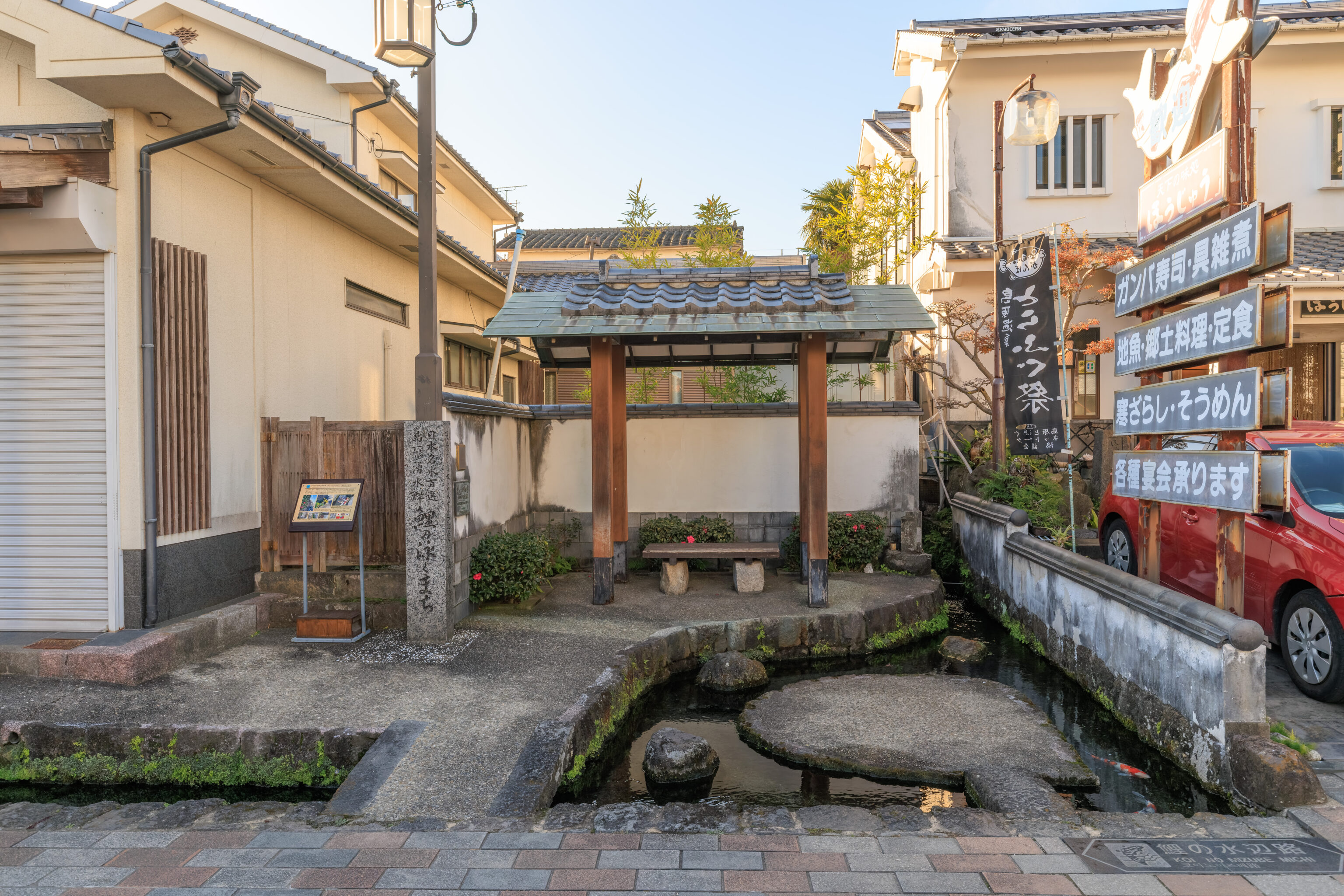
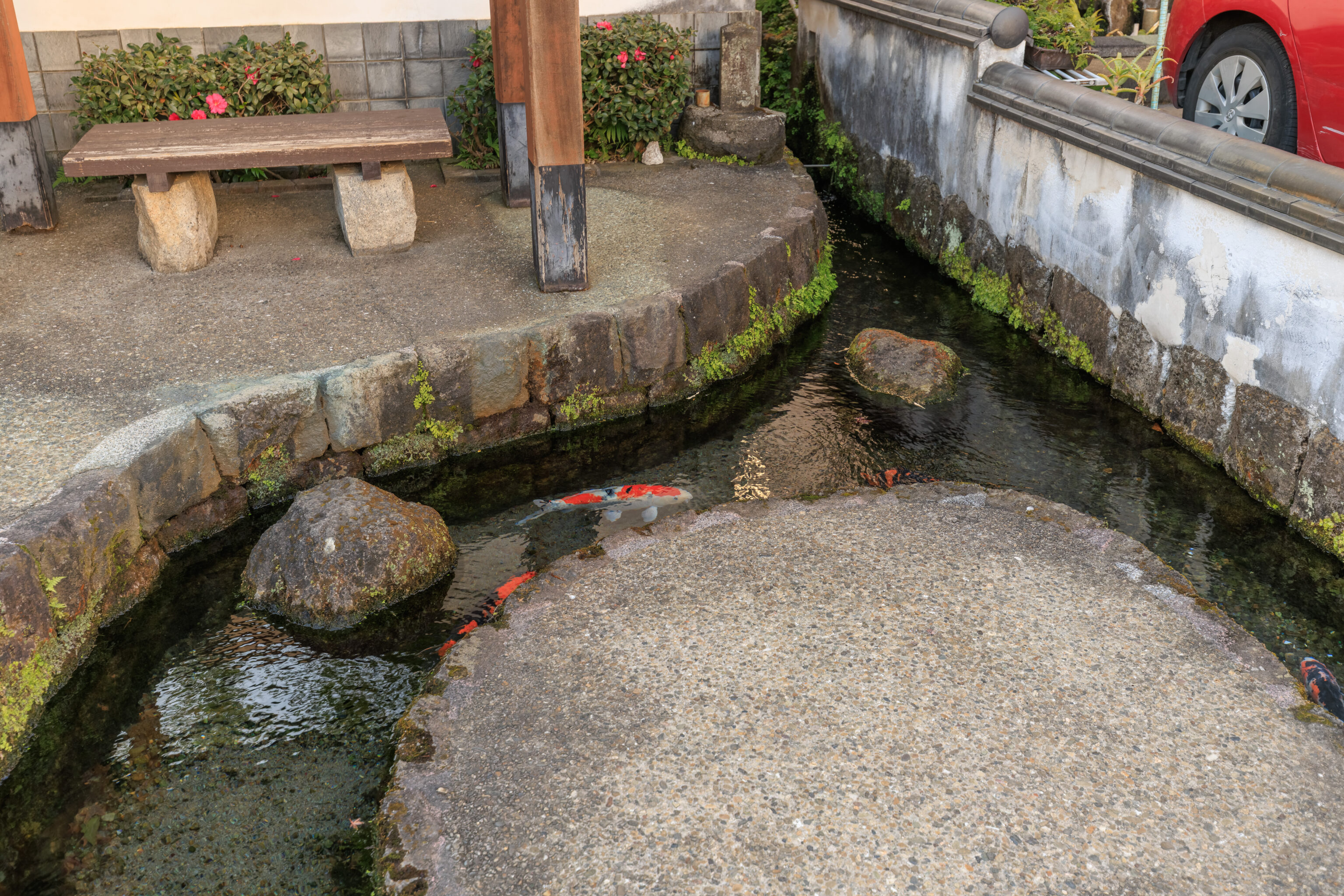
This is where the neighborhood’s nickname comes from! The canals here, like the ones we saw earlier on the north side of the castle, contain natural spring water. Koi have been released into the canals here and leisurly swim through the clean water!
The Original Scenery of Shimabara, the City of Water: Take a Leisurely Stroll Through the "Town Where Carp Swim"
It is said that in this Shinmachi area, spring water bubbles up if you dig just about 50 centimeters into the ground. The area is also known as the "Town Where Carp Swim"—a name that originated when local neighborhood association members released colorful carp into the waters to help nurture the children's rich sensibilities. In 1985, the site was designated as one of the "100 Remarkable Waters of Japan" under the name "Shimabara Spring Water Group."

Despite being in the middle of the city, the stream is amazingly clear, and lovely flowers bloom along the waterway.

A memorial service for carp is held every May.

Gratitude for water, and "water gods" are everywhere...but sometimes we also need a playful spirit.
– Text from a sign, read and translated using Google Gemini and Translate.
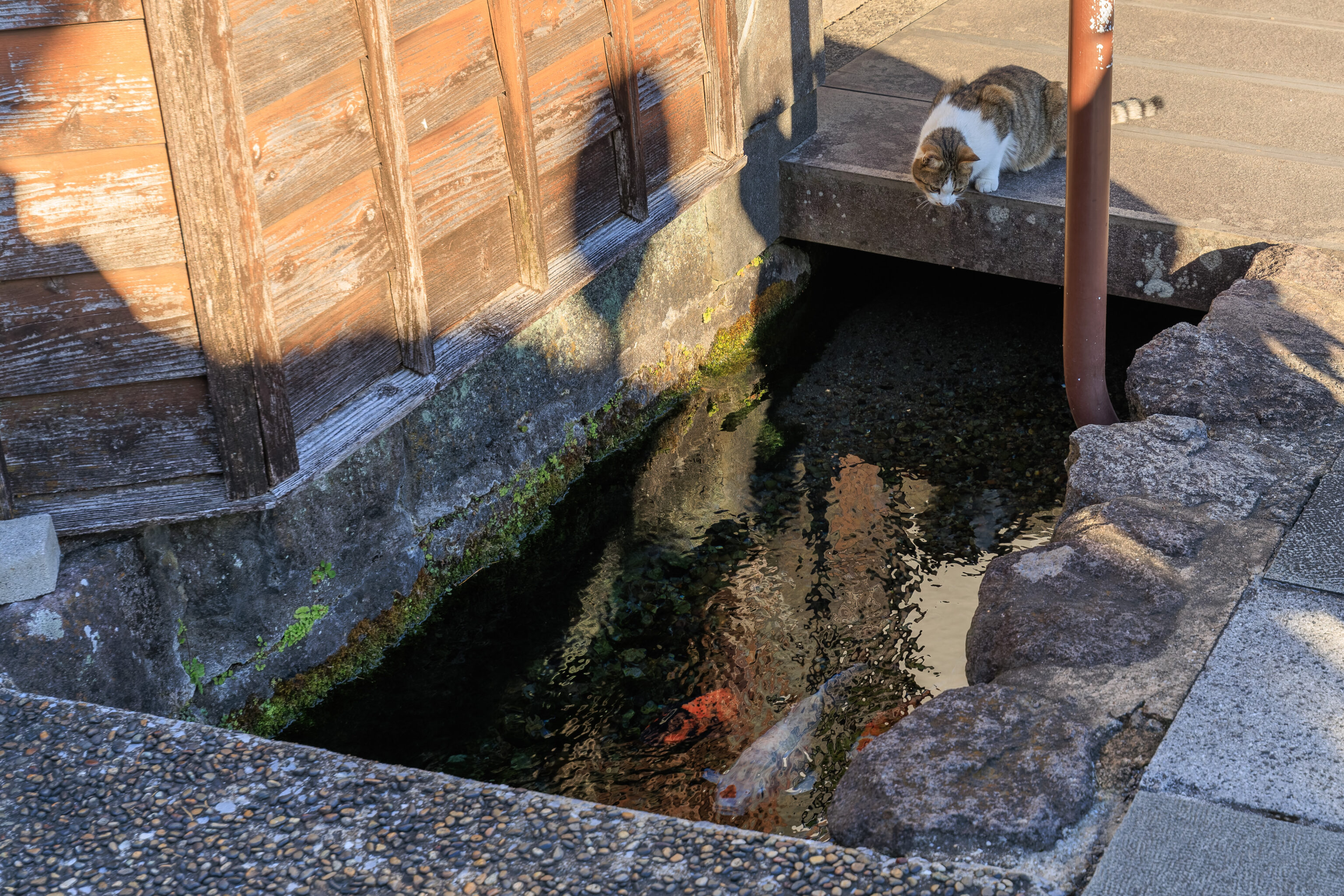
It isn’t just us humans that appreciate the koi though!
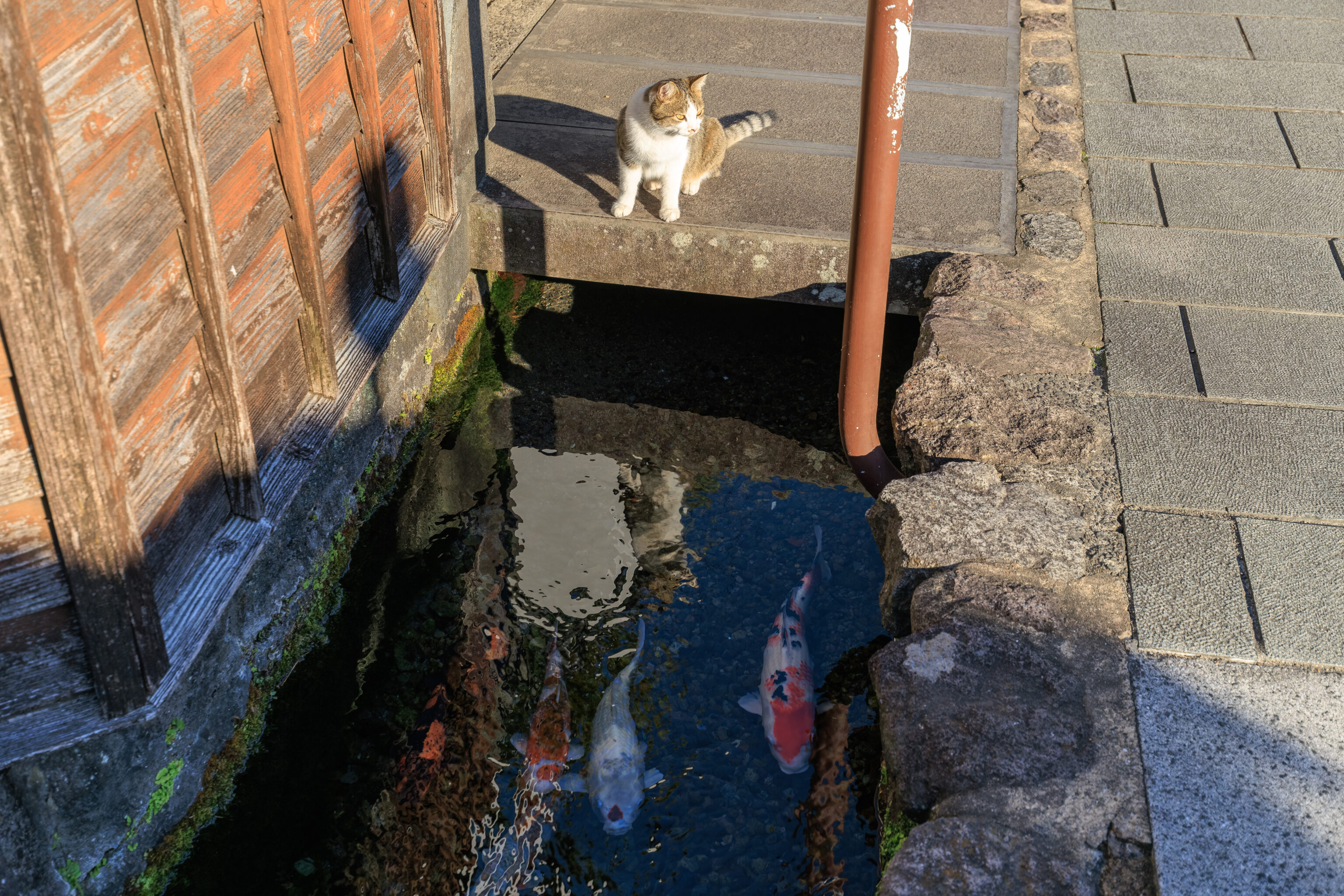
Has this cat had fish before?
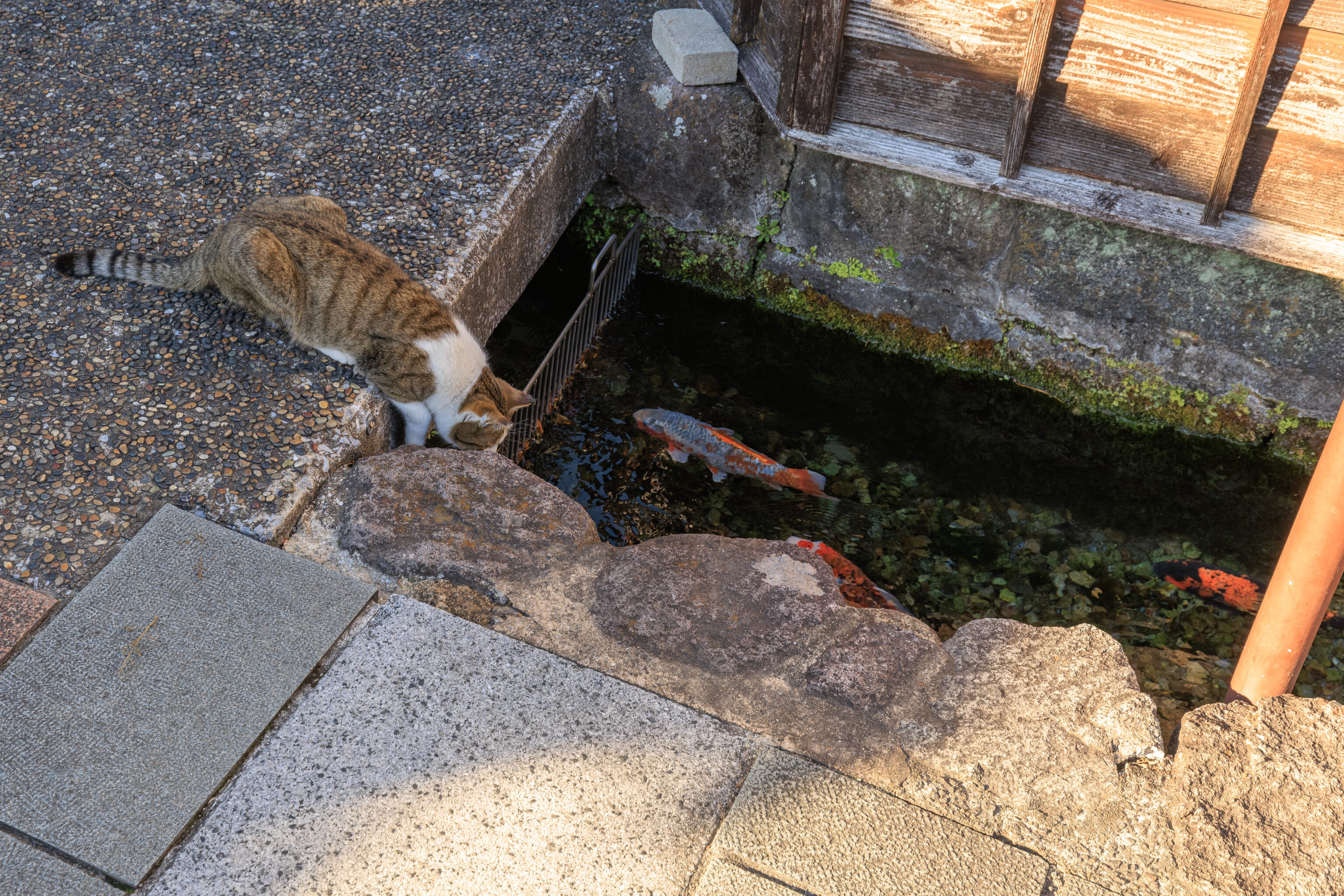
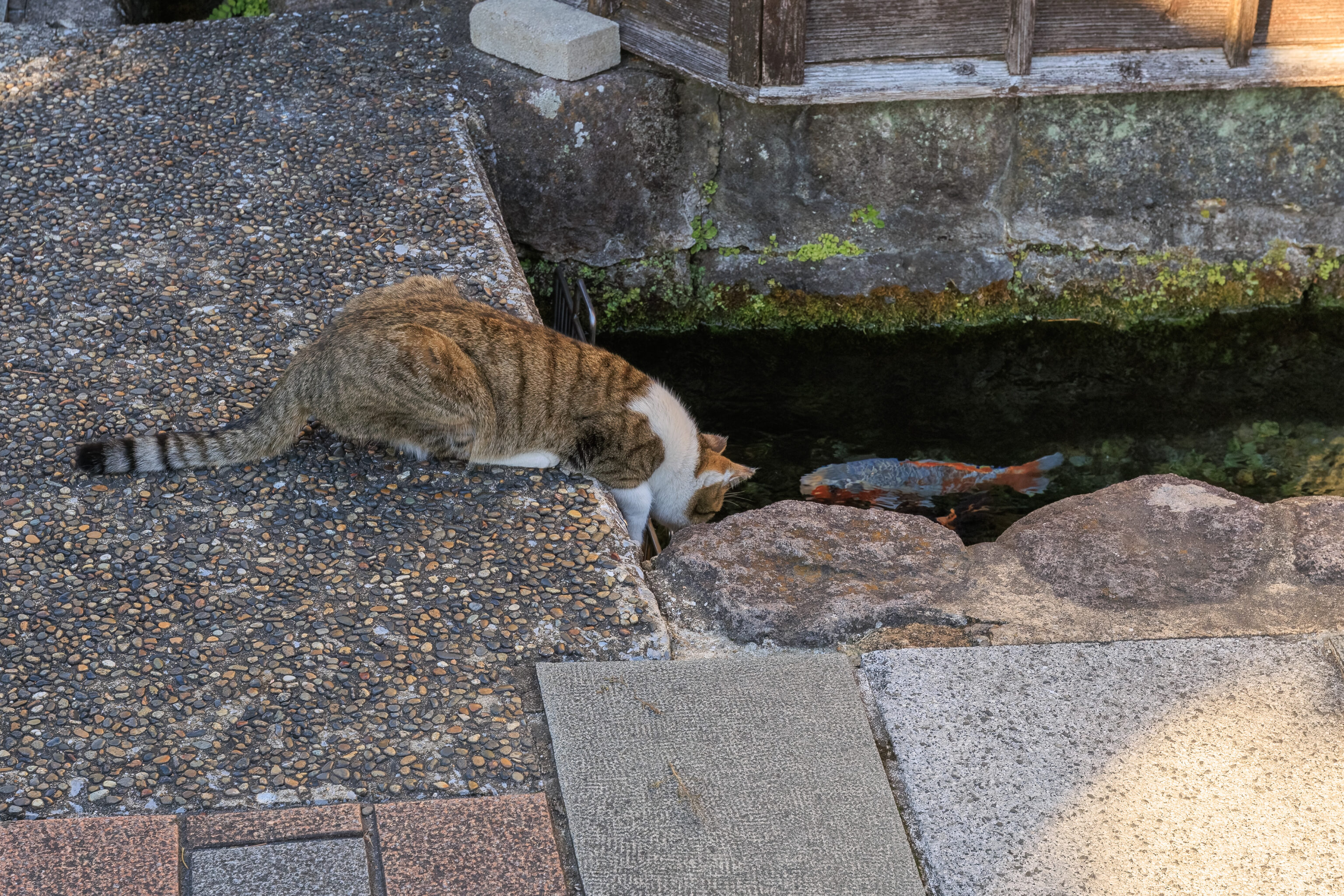
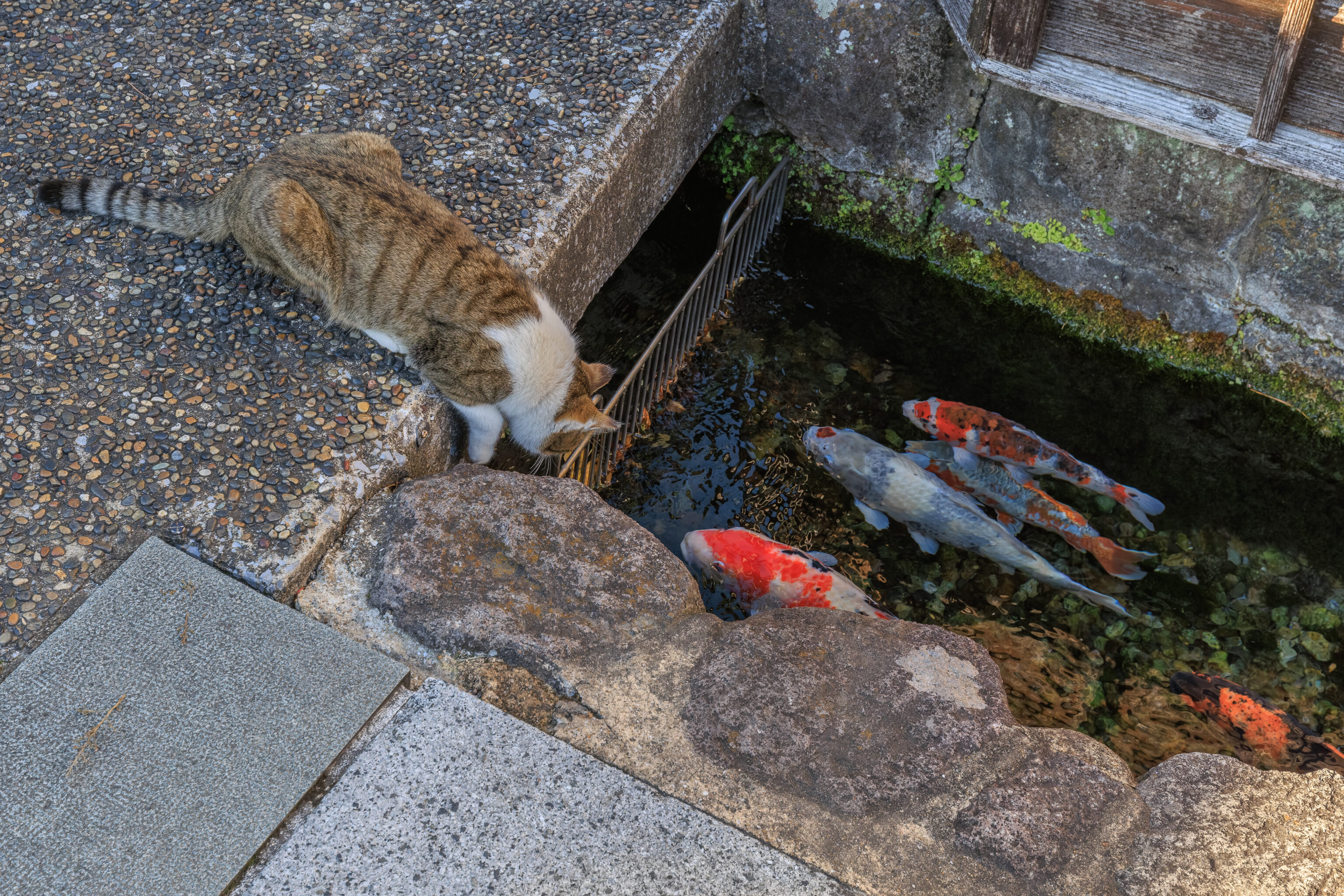
This does not seem like a good idea!
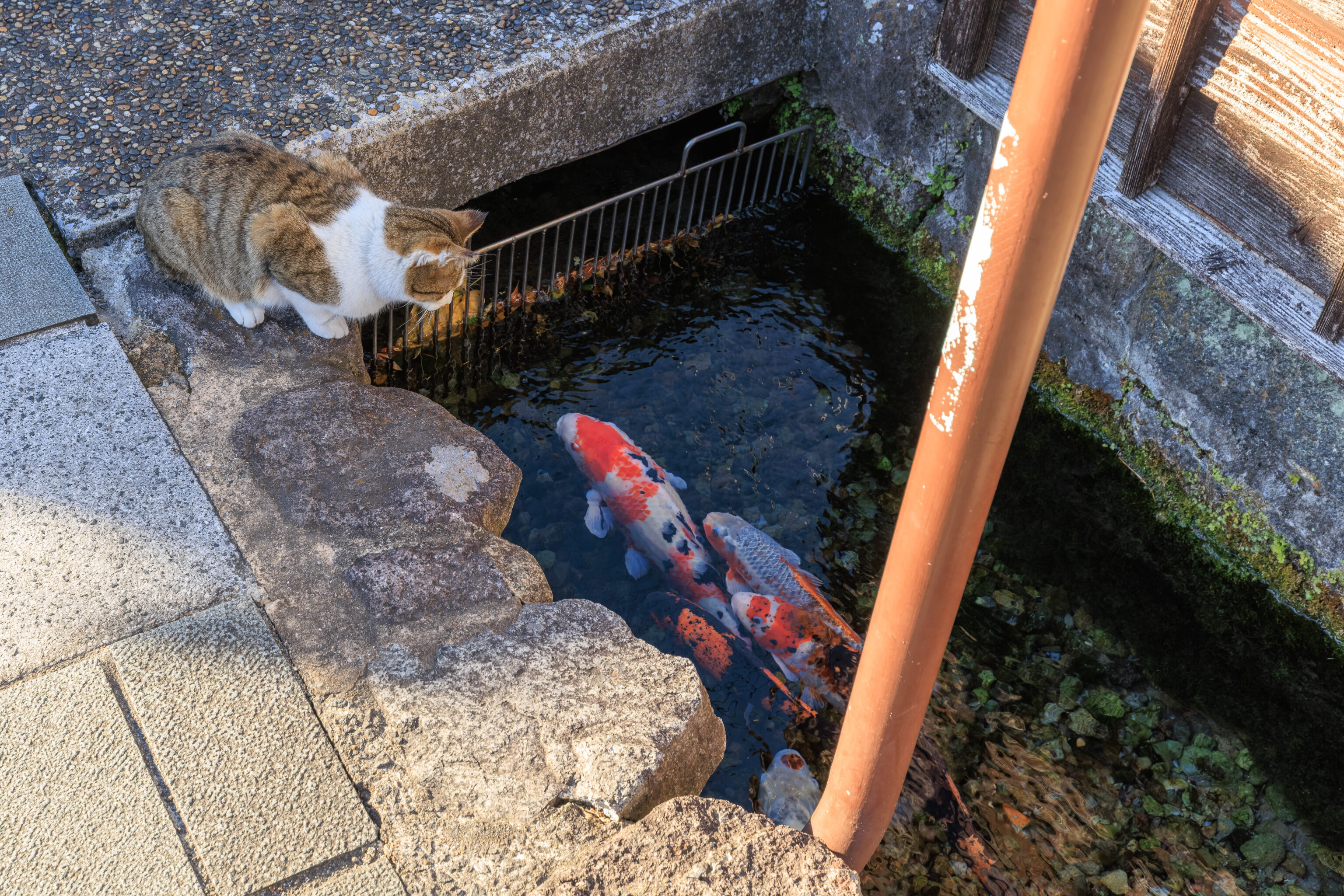
Maybe another day…
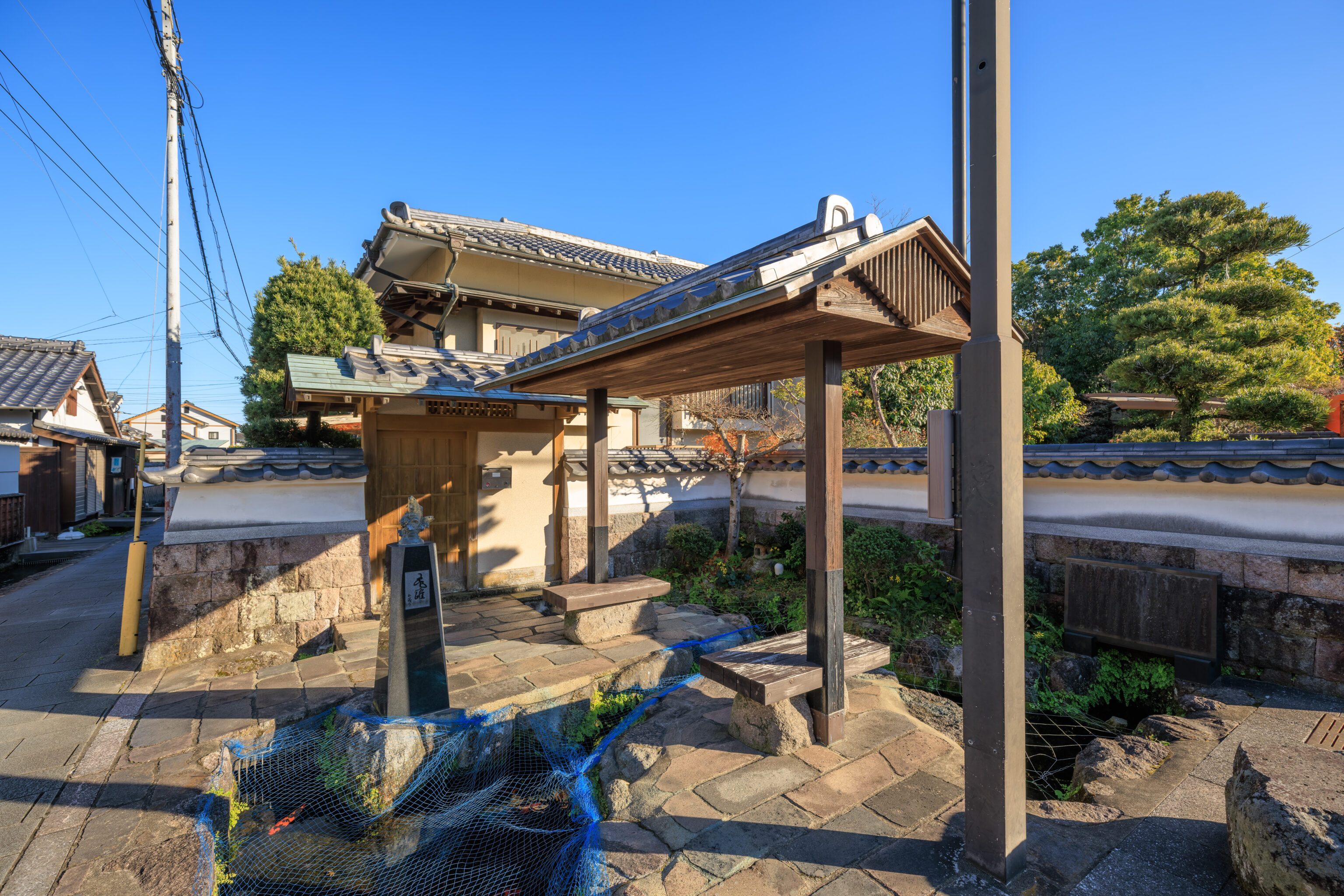
There was some netting over the canal here. Is it to protect smaller koi from birds? And cats?
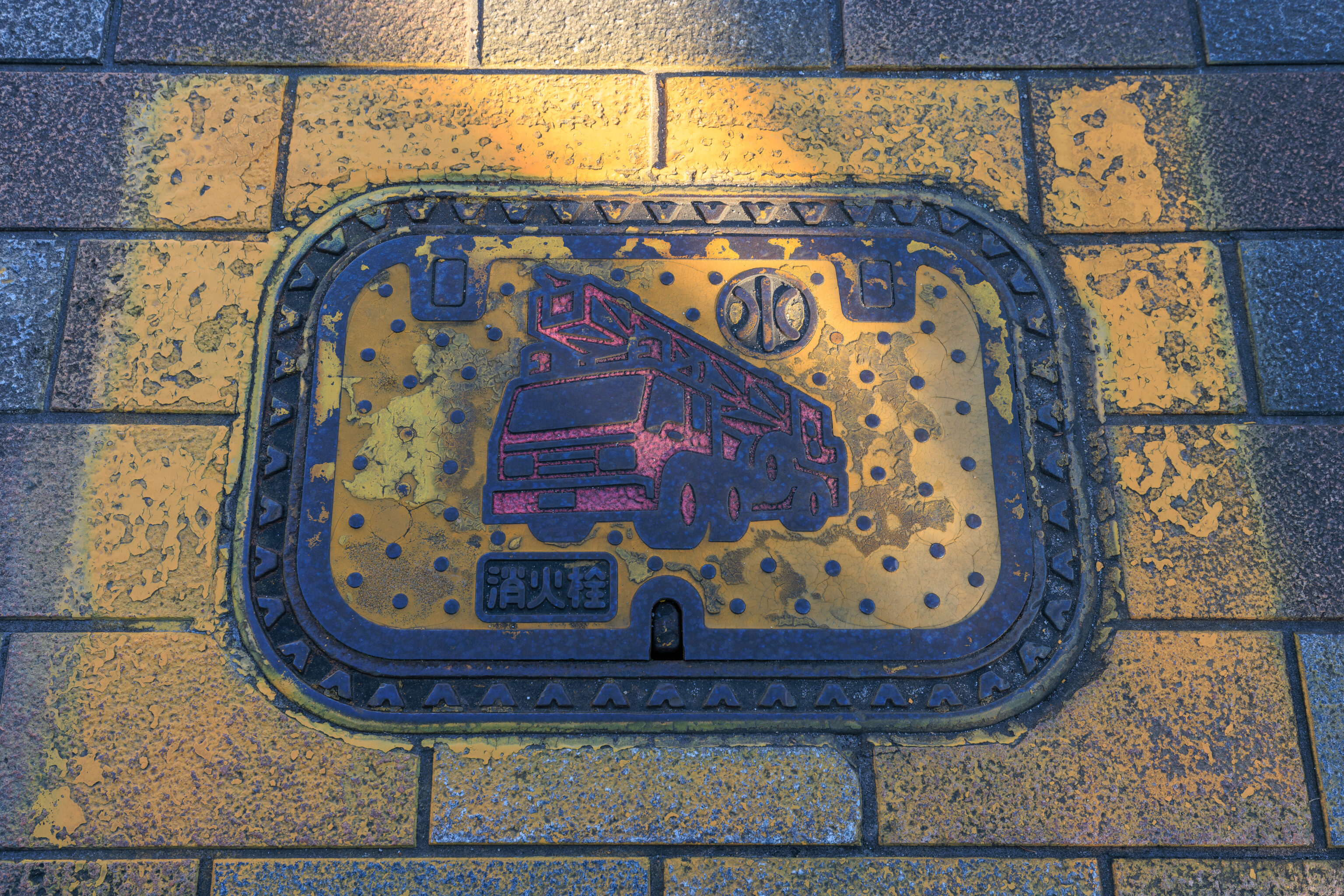
Continuing on… We walked by a fire department utility cover. It’s kind of a standard image.
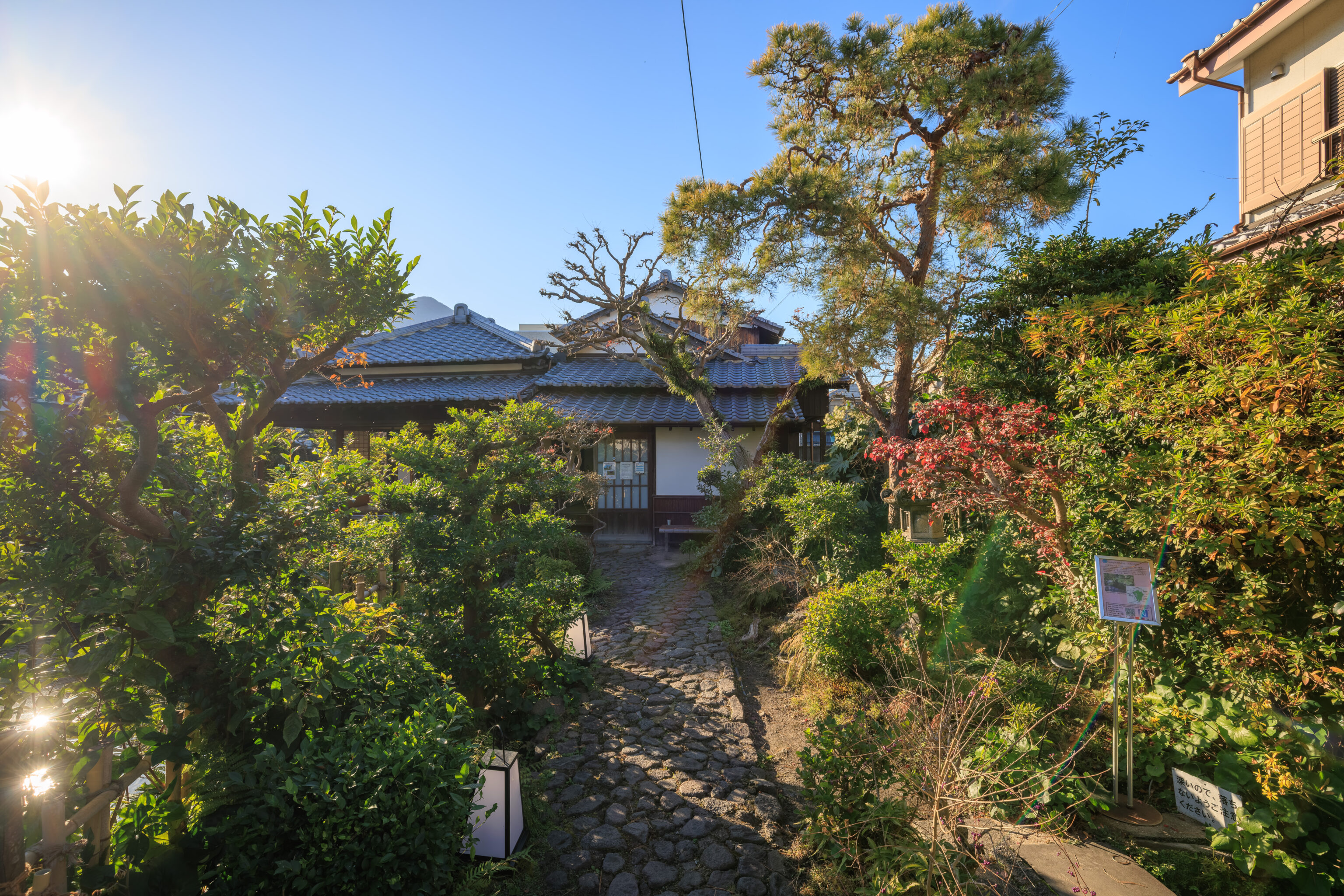
We went in to take a look at the 四明荘 Shimeiso, a 湧水庭園 spring water garden.
Shimeiso Spring Water Garden: Making the Most of Abundant Spring Water
"Shimeiso" was named for the magnificent views it offers in all directions. It features a pond fed by a natural spring that gushes forth approximately 3,000 tons of water daily, and the site is designated as a Registered Tangible Cultural Property and a National Monument. Colorful koi swim in the water, while irises, moss, and trees add seasonal beauty to the surroundings.

The water is so incredibly clear that it has garnered attention overseas, with people remarking that the koi look as if they are floating in mid-air.

An L-shaped veranda extends out over the pond, creating an elegant vista where the interior rooms and the garden blend seamlessly together.
– Text from a sign, read and translated using Google Gemini and Translate.
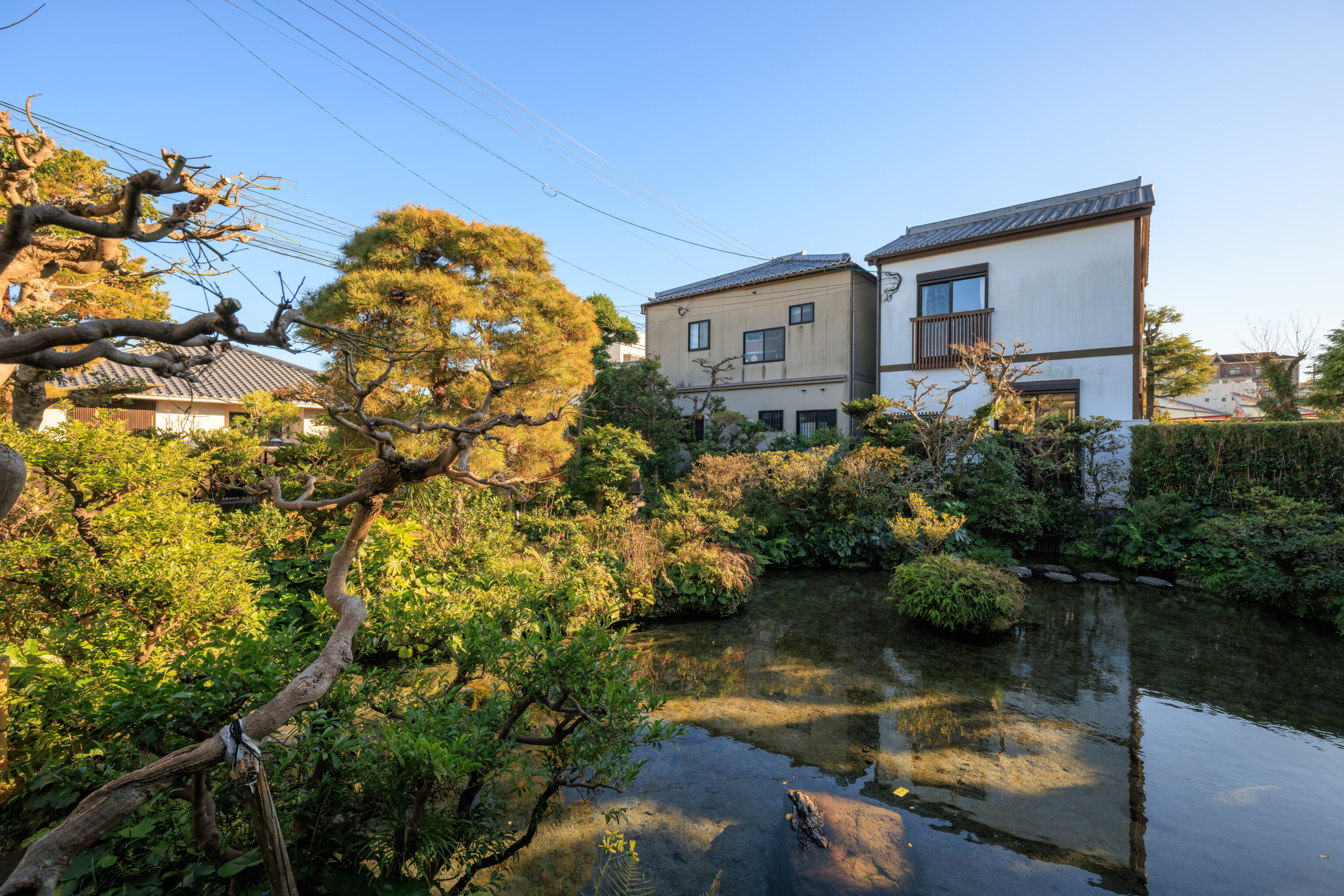
The Shimeiso has a very calm spring water pond in front.
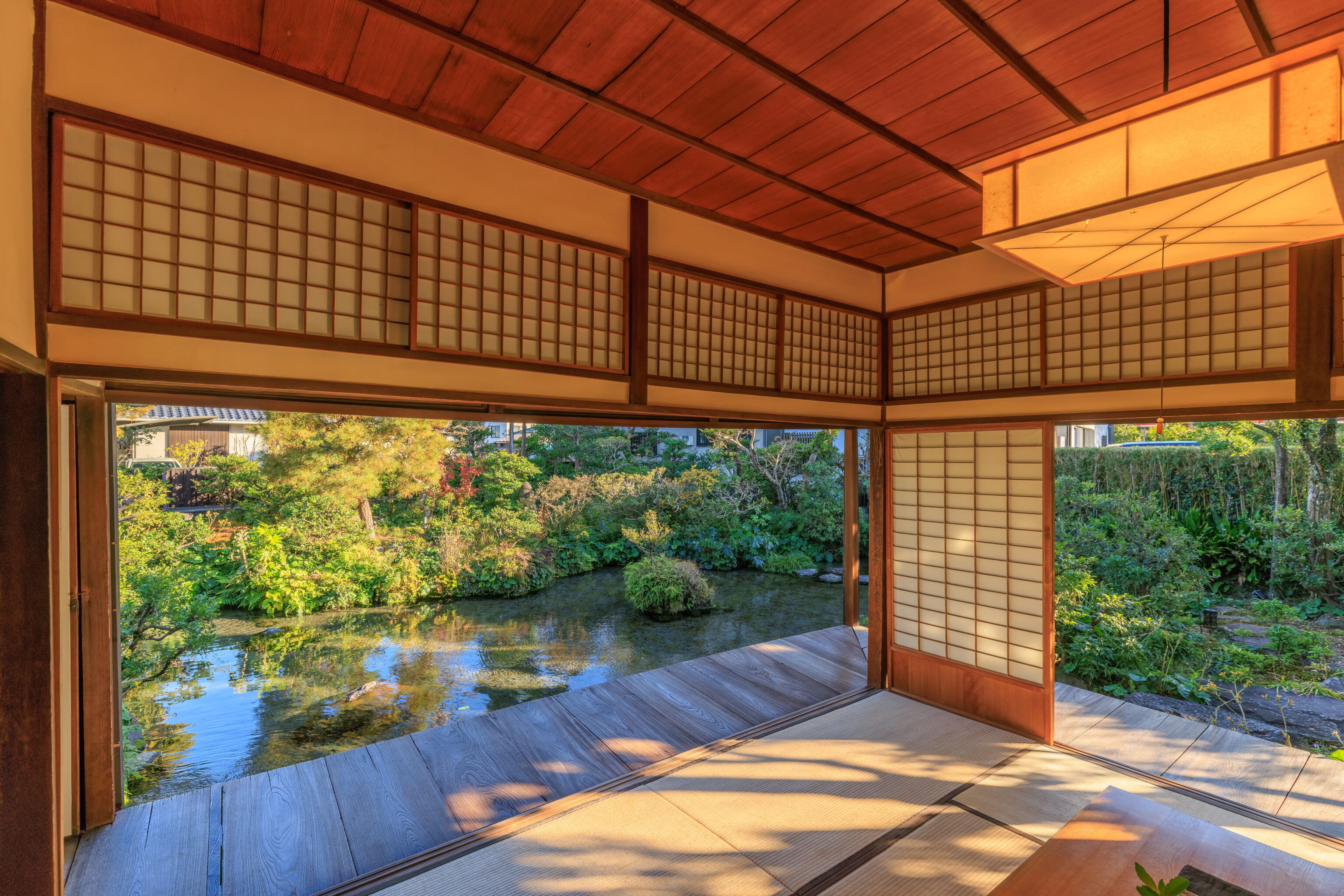
The Shimeiso has a nice quiet room with an excellent view of the pond.
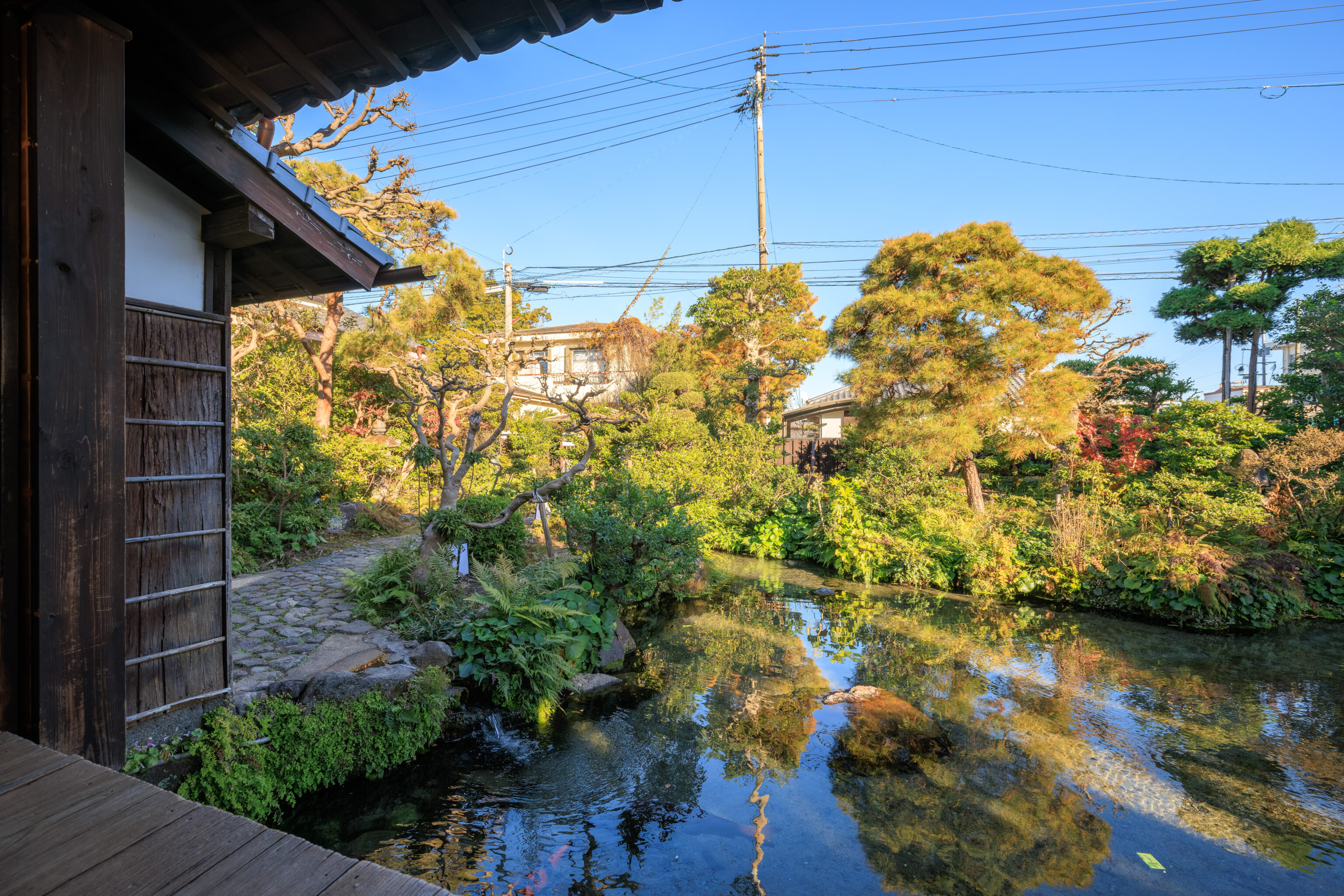
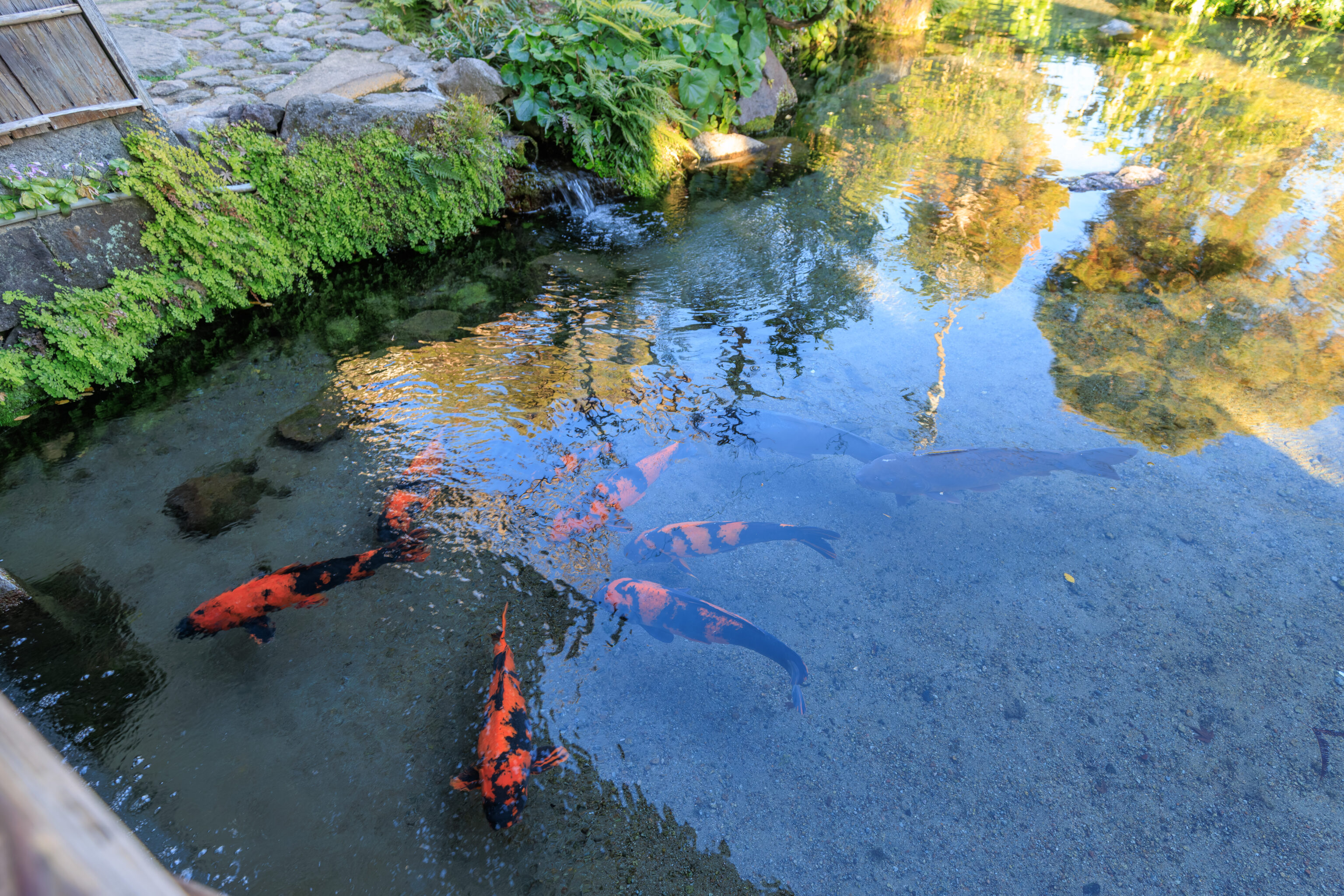
A perfect place to sit, relax, and watch the koi!
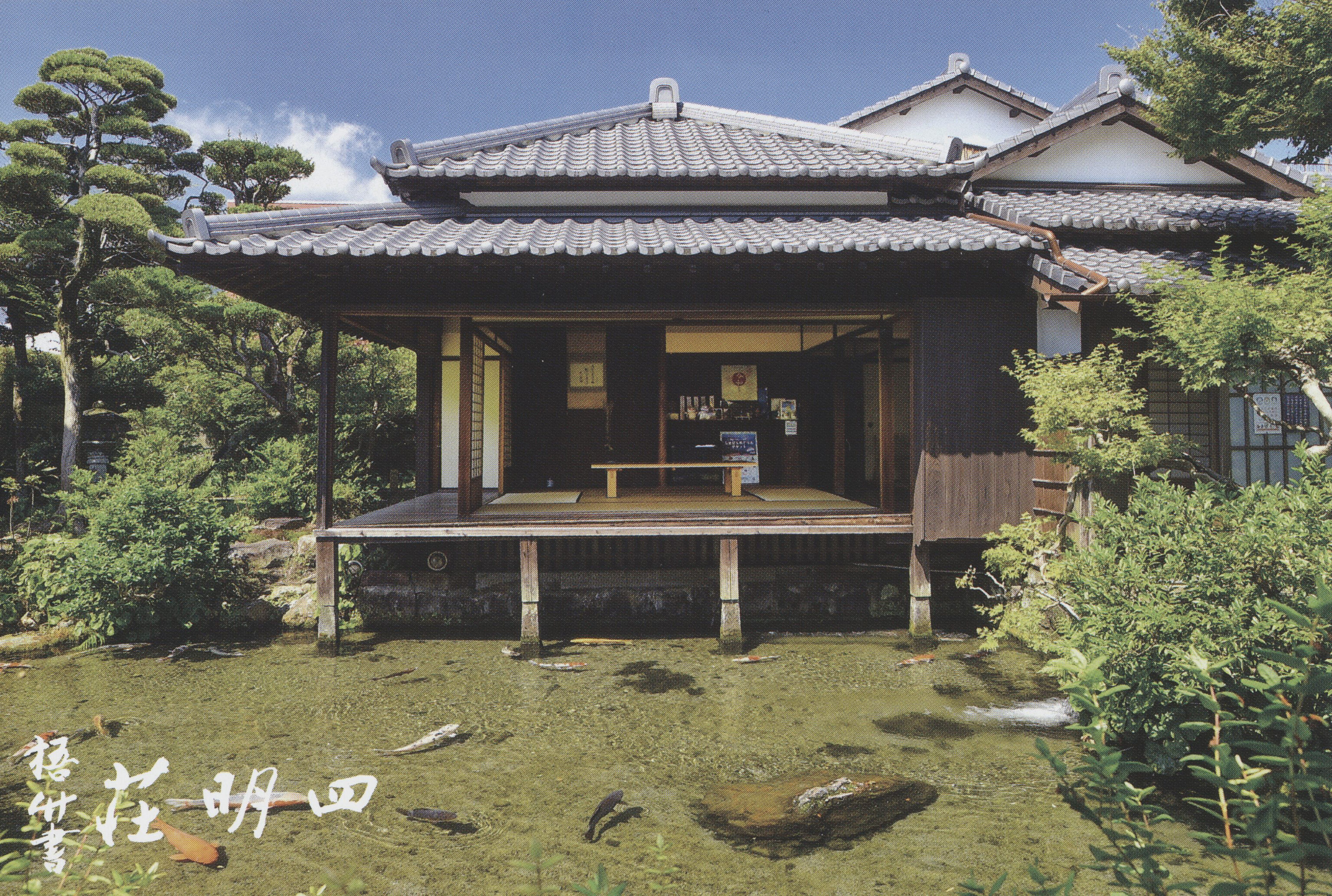
While here, we discovered that there are different versions of the stampable Shimabara postcards! We received postcards here featuring the Shimeiso.
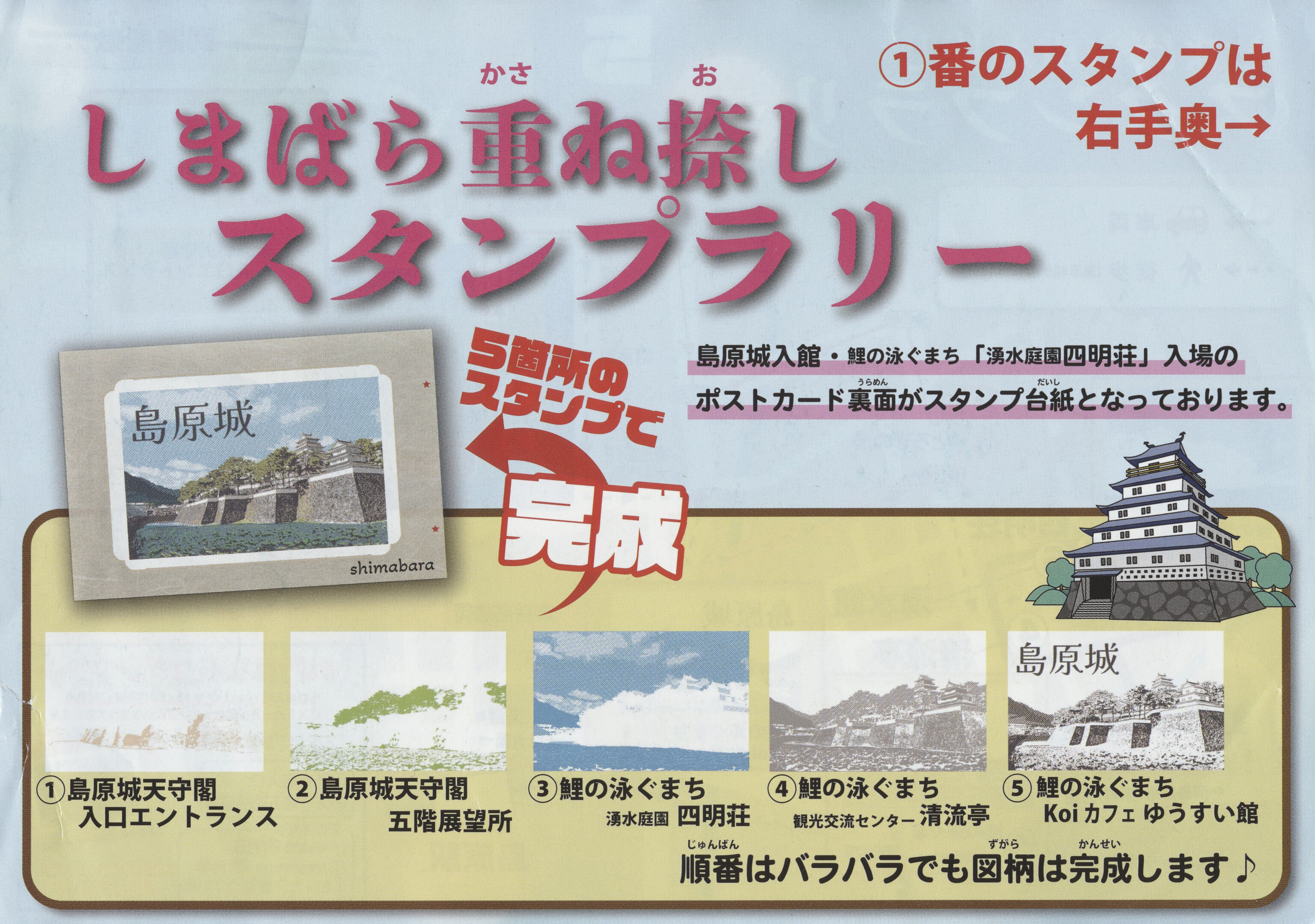
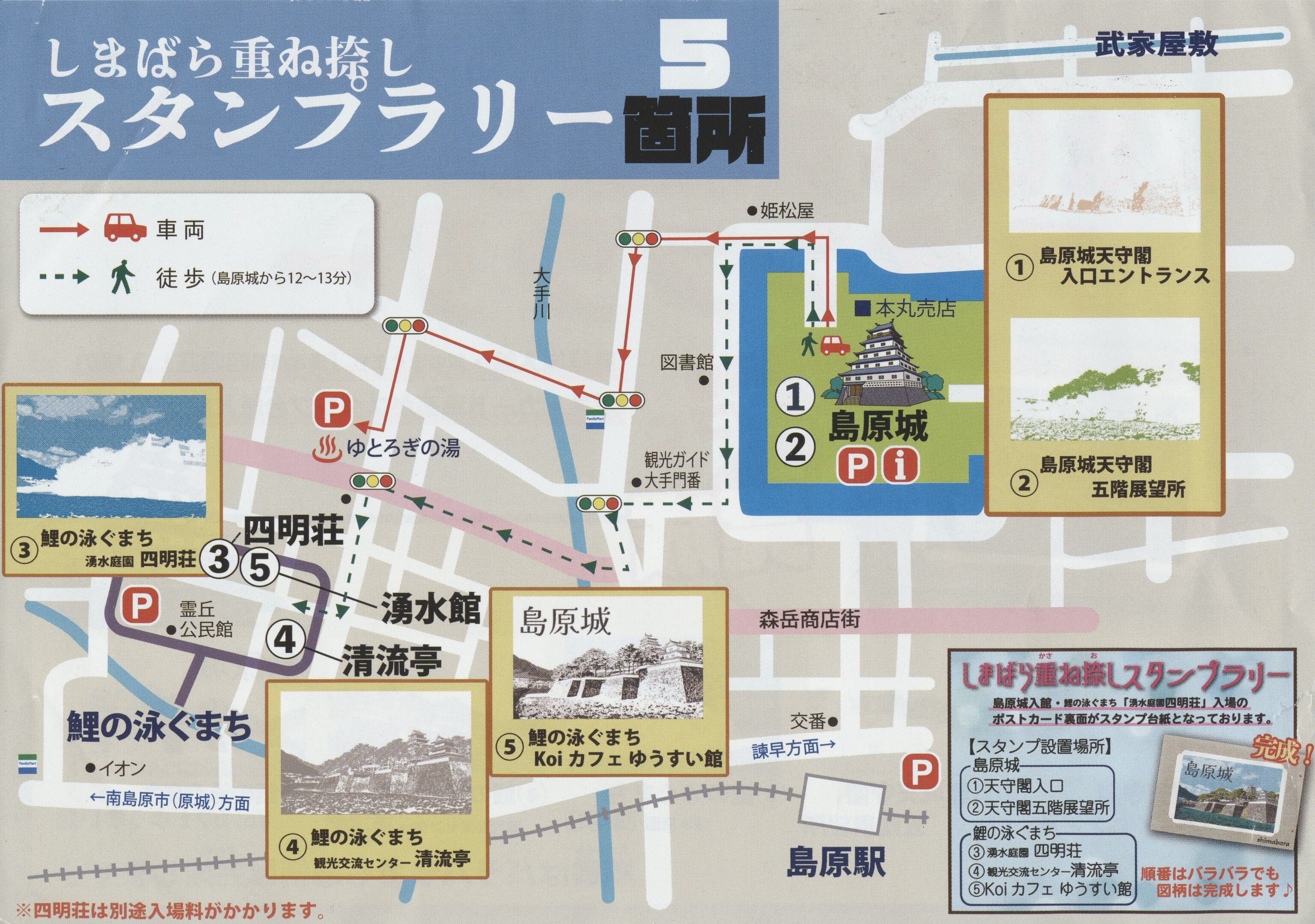
This sheet shows the final image and the stamp locations.
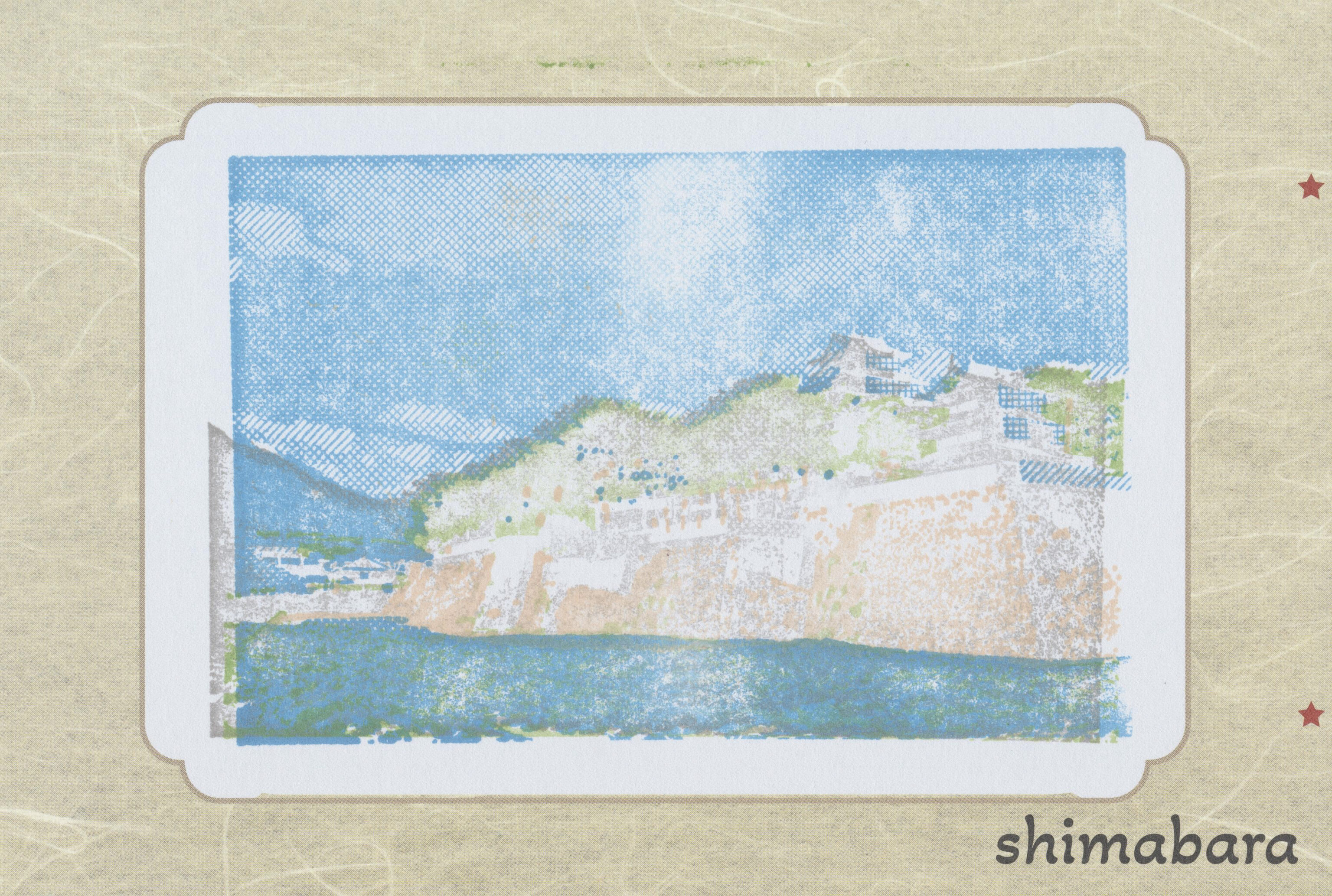
We missed #5, which was actually almost next door in a cafe. Maybe we should have went…
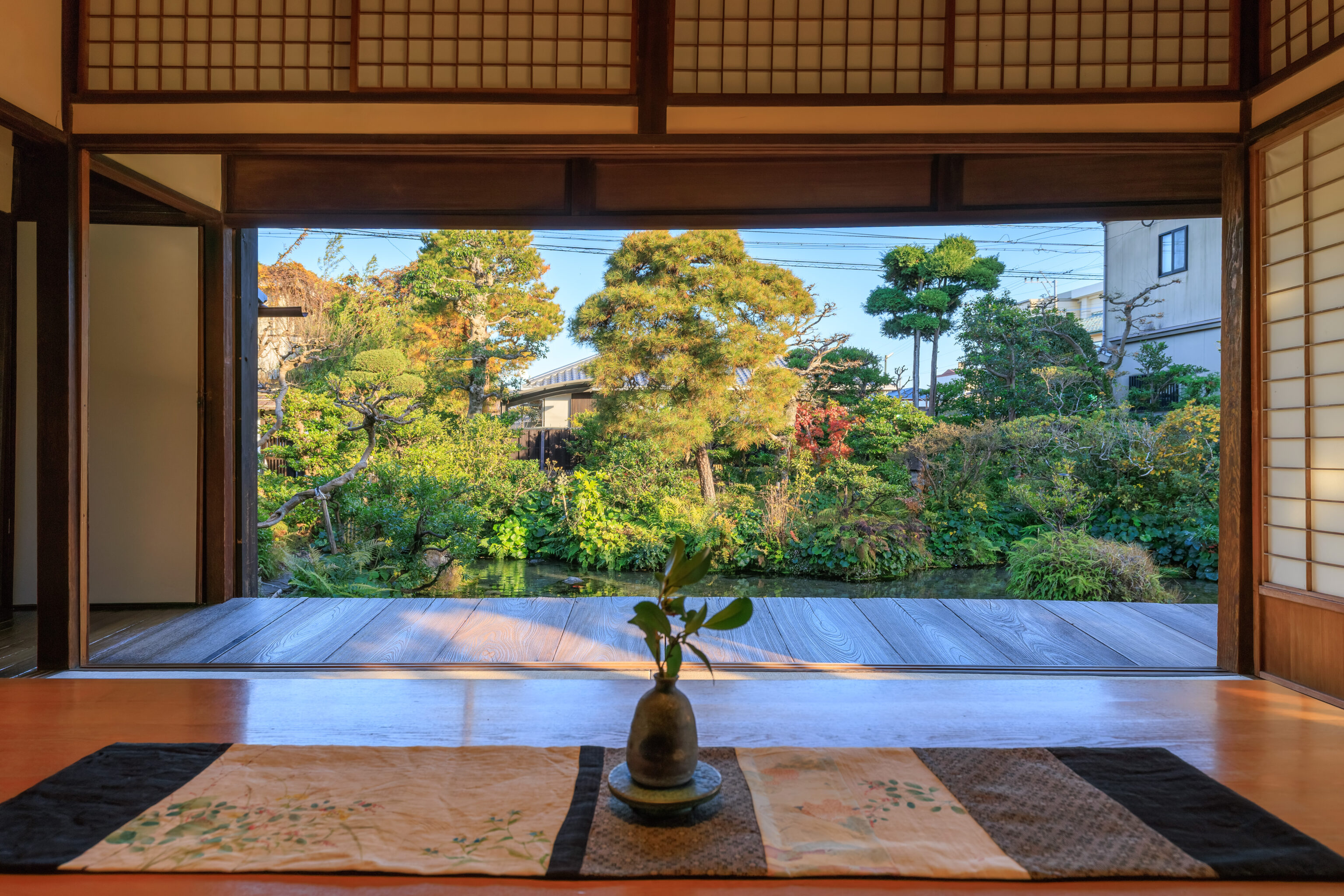
The 女将 okami, not sure if that term applies here, suggested this view!
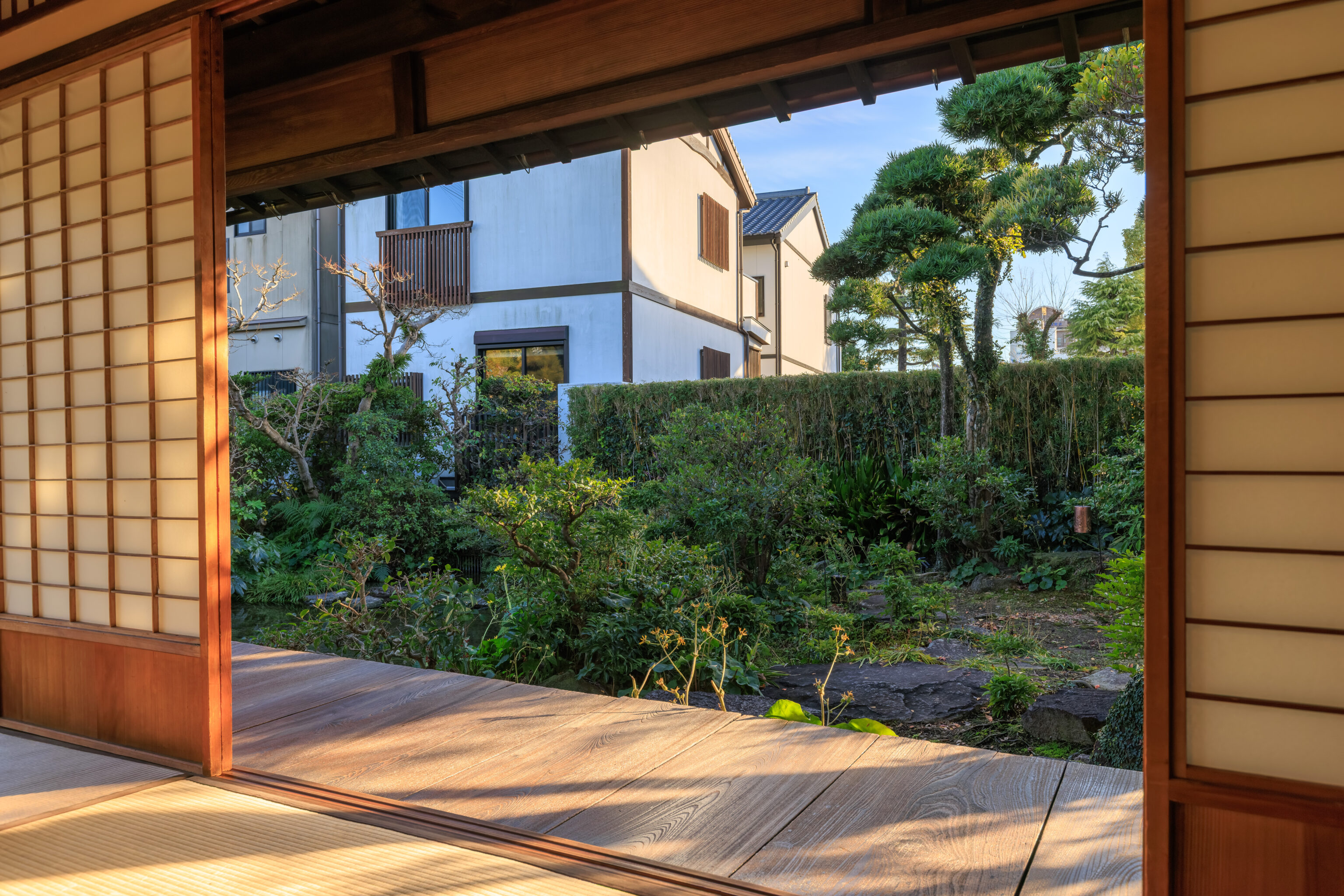
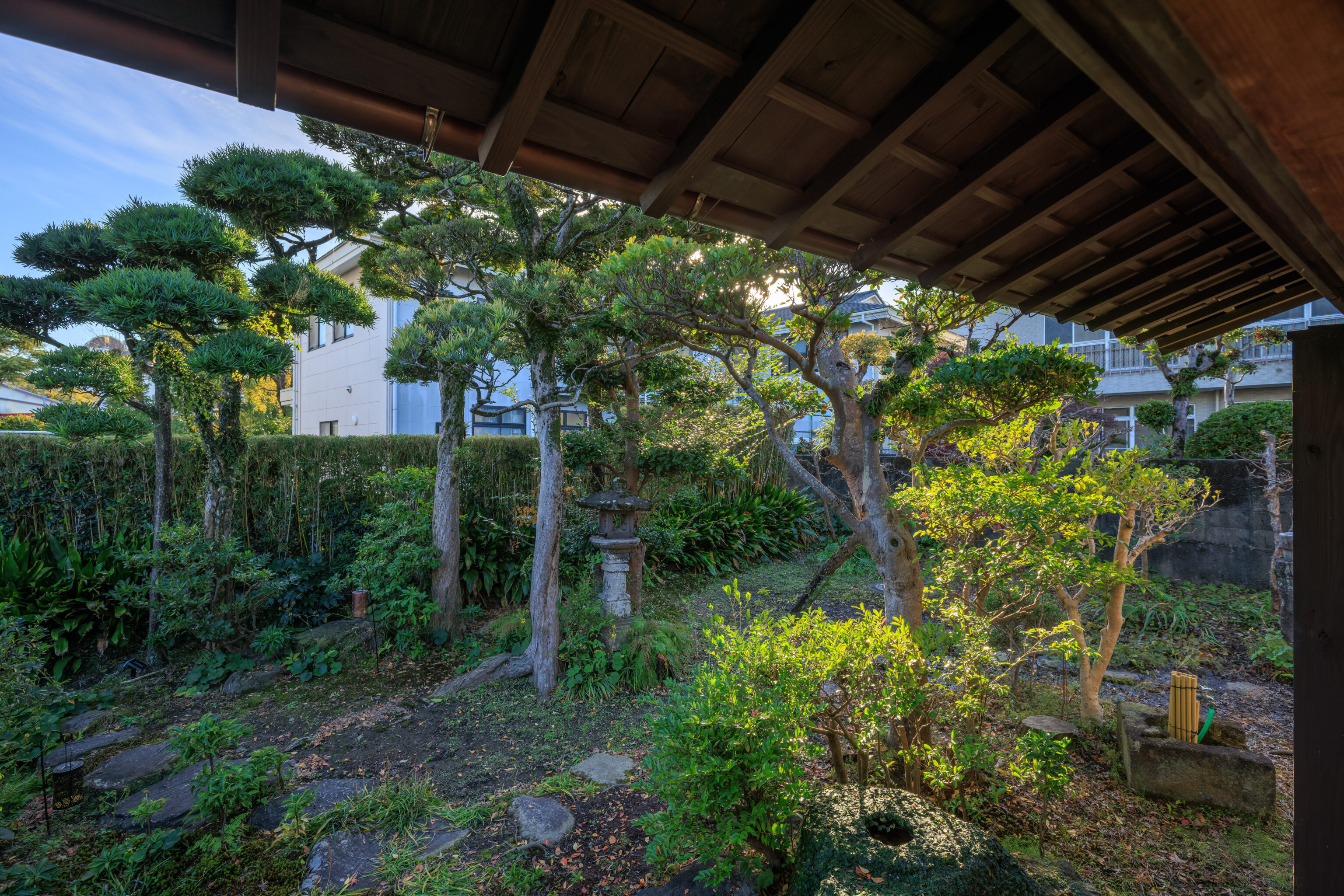
There are also views of the garden on the side of the Shimeiso.
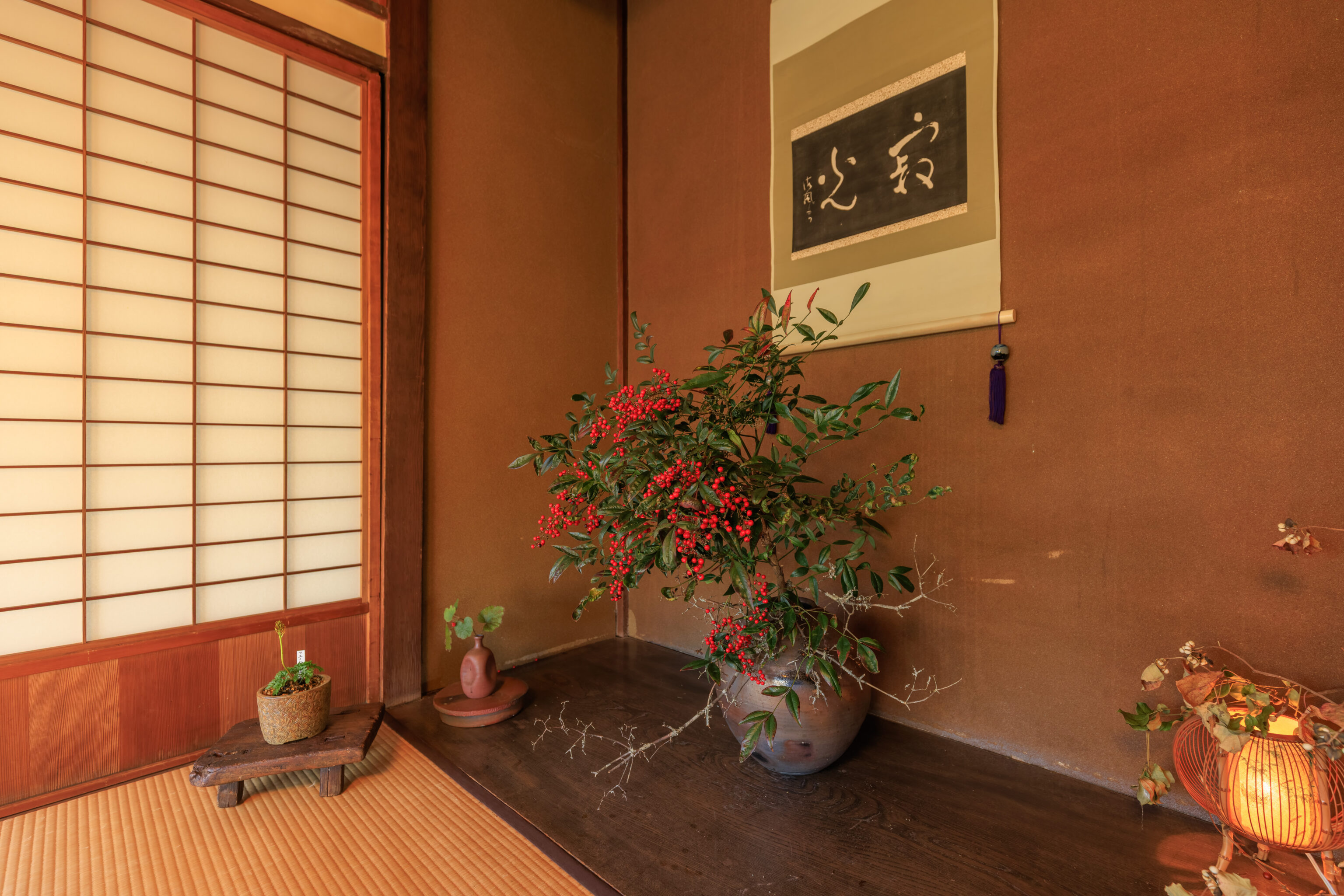
A plant with little red berries… Is this 南天 Nanten (Southern Sky)? Interestingly, this plant has apparently become invasive in parts of the US and is toxic when consumed in sufficient quanities. This was the topic of a paper available from the NIH that documents Cedar Waxwing deaths from ingesting these little red berries.
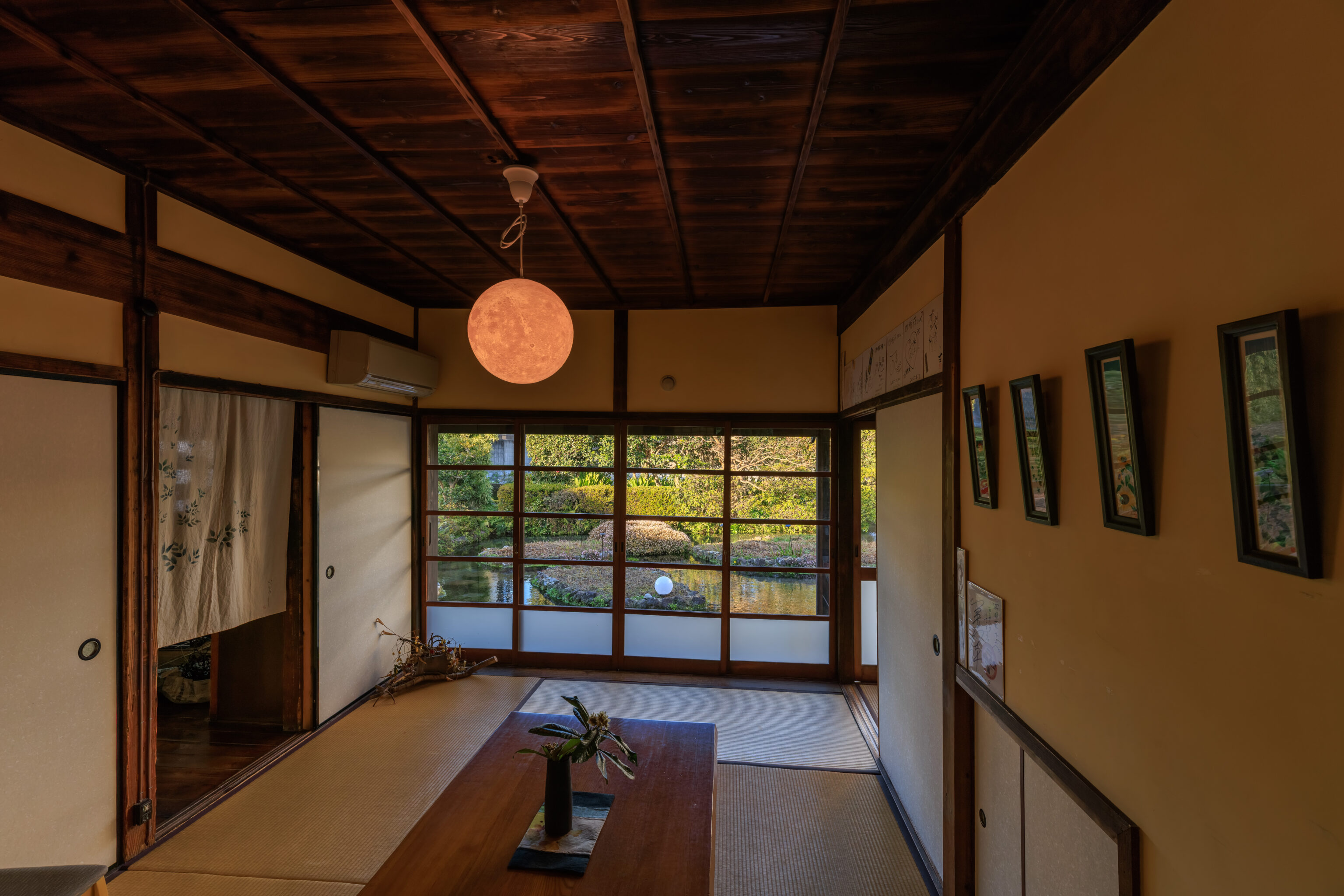
This room overlooks an addtional spring water pond at the rear of the Shimeiso. The light in this room is patterned after the Moon!
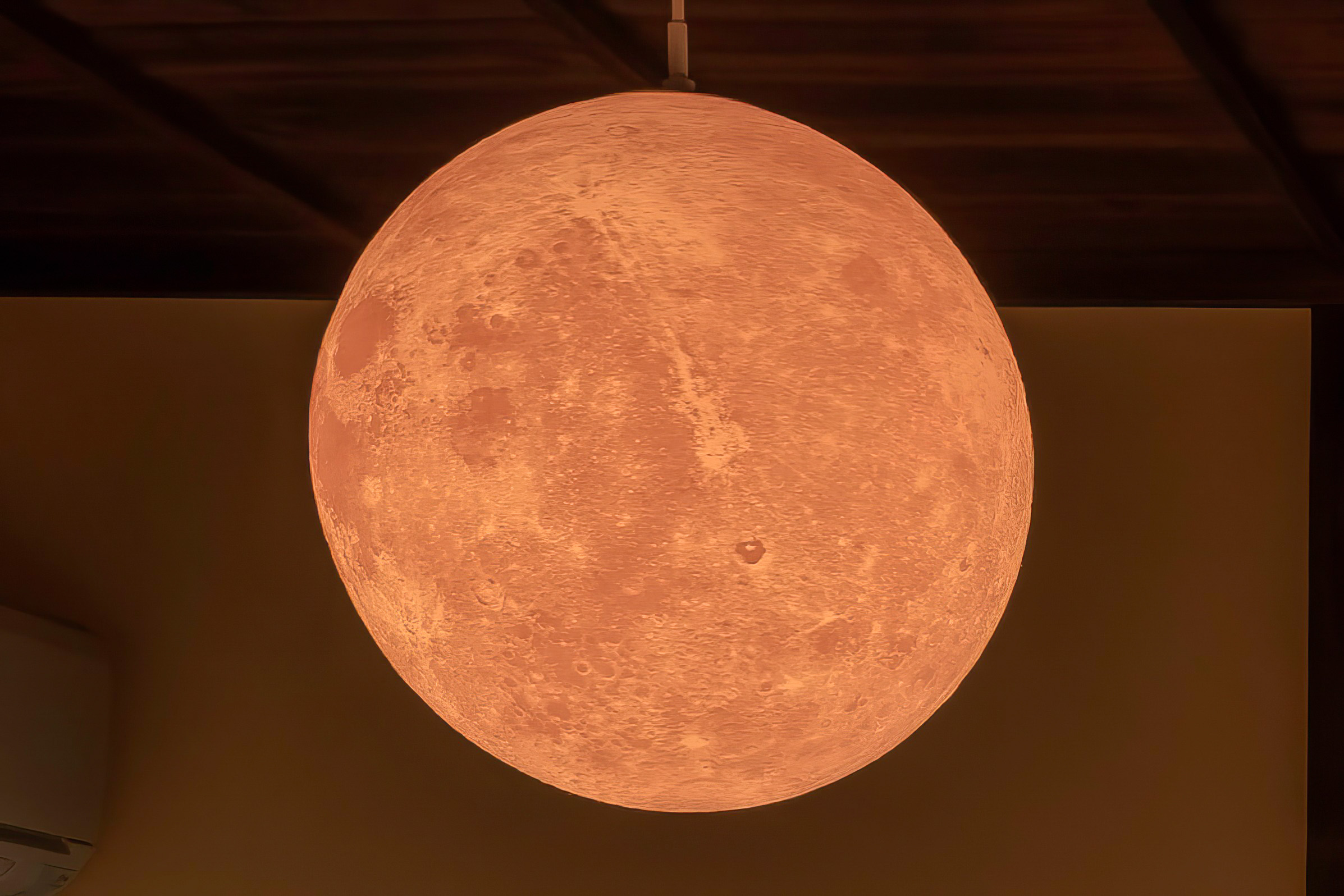
Computer, enhance! This is actually a pretty cool lamp… There is a bit of distortion due to the use of a wide angle lens and the lamp not being in the middle of the scene.
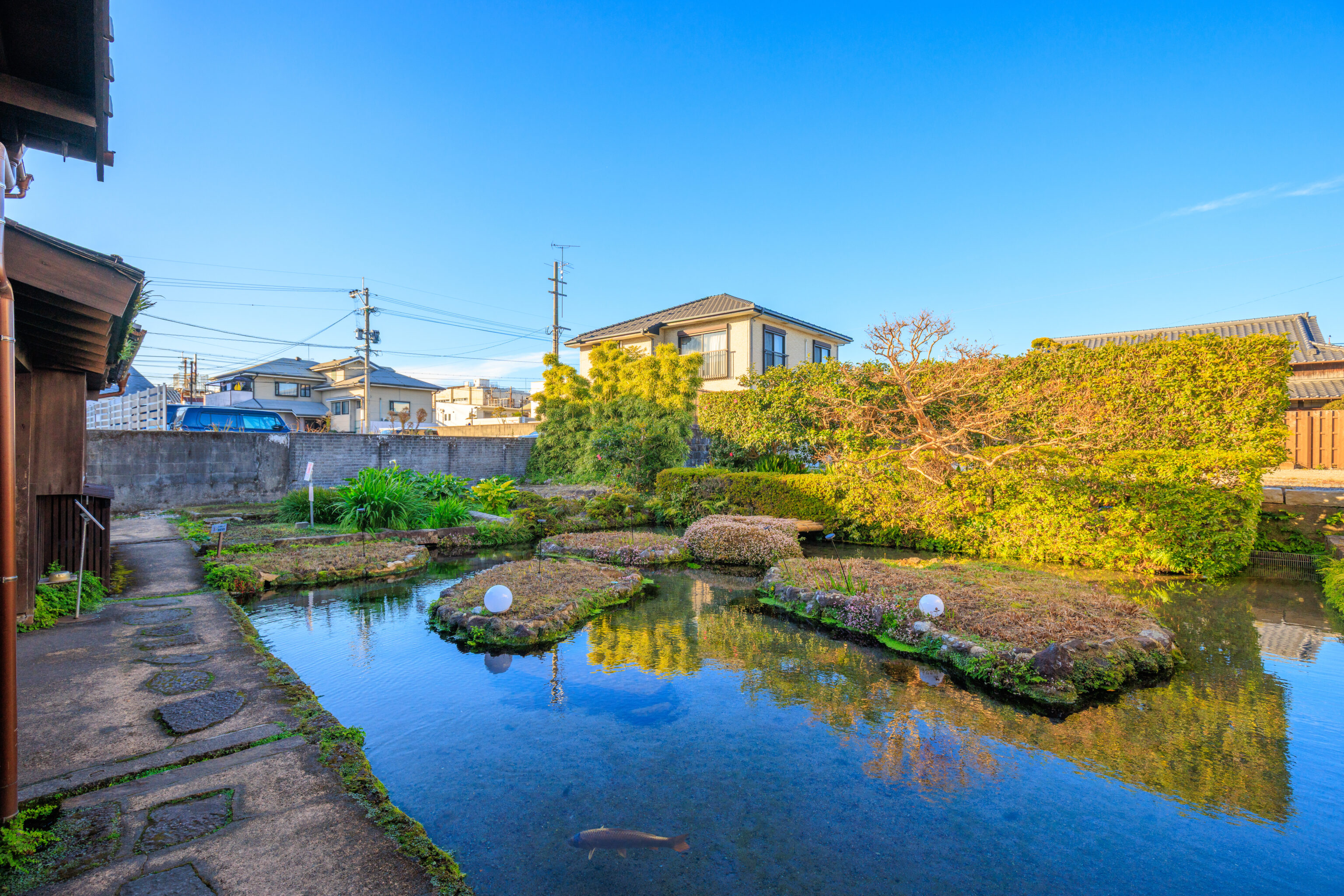
We went to take a look at the garden behind the Shimeiso. It seems there would be more back here in other seasons?
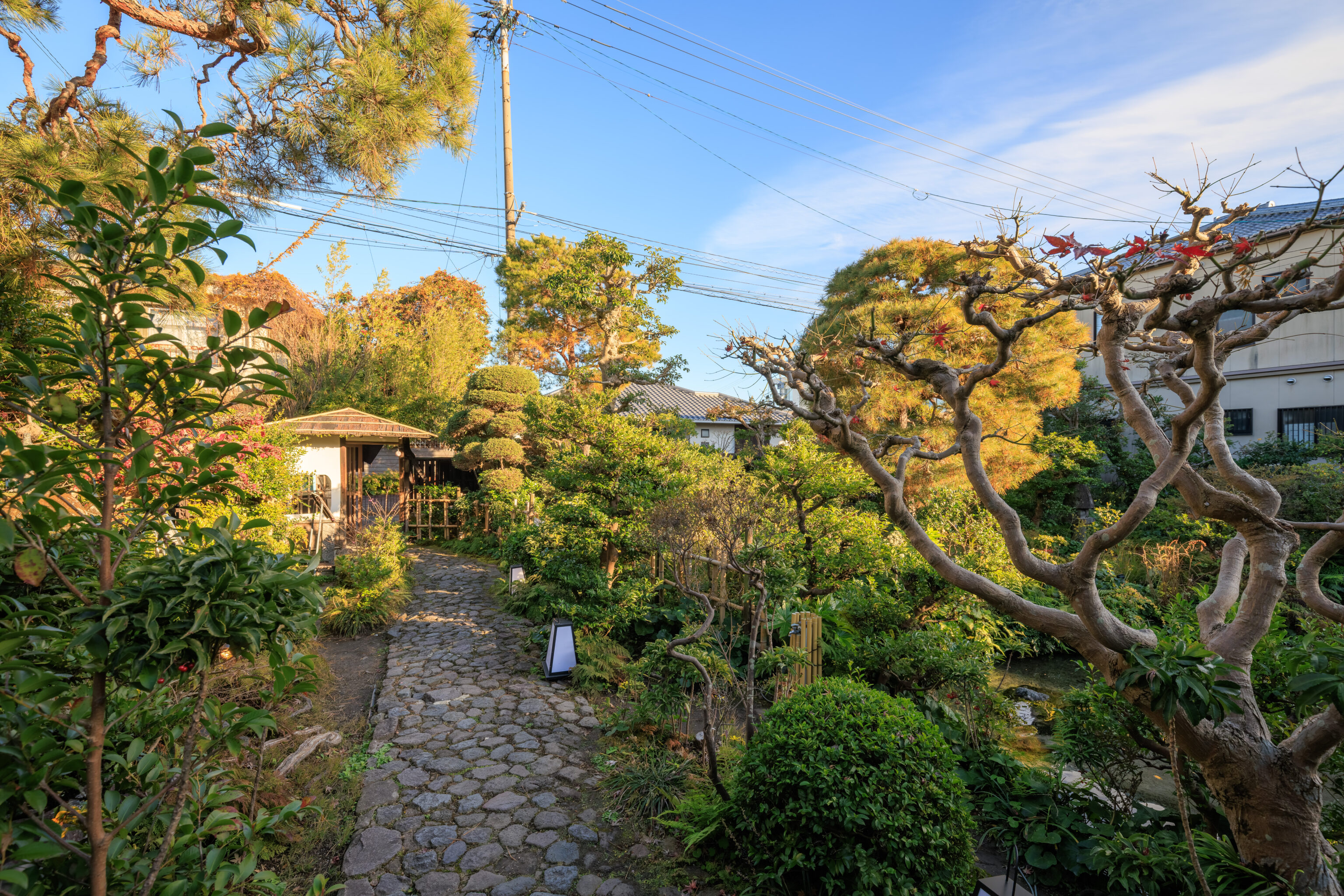
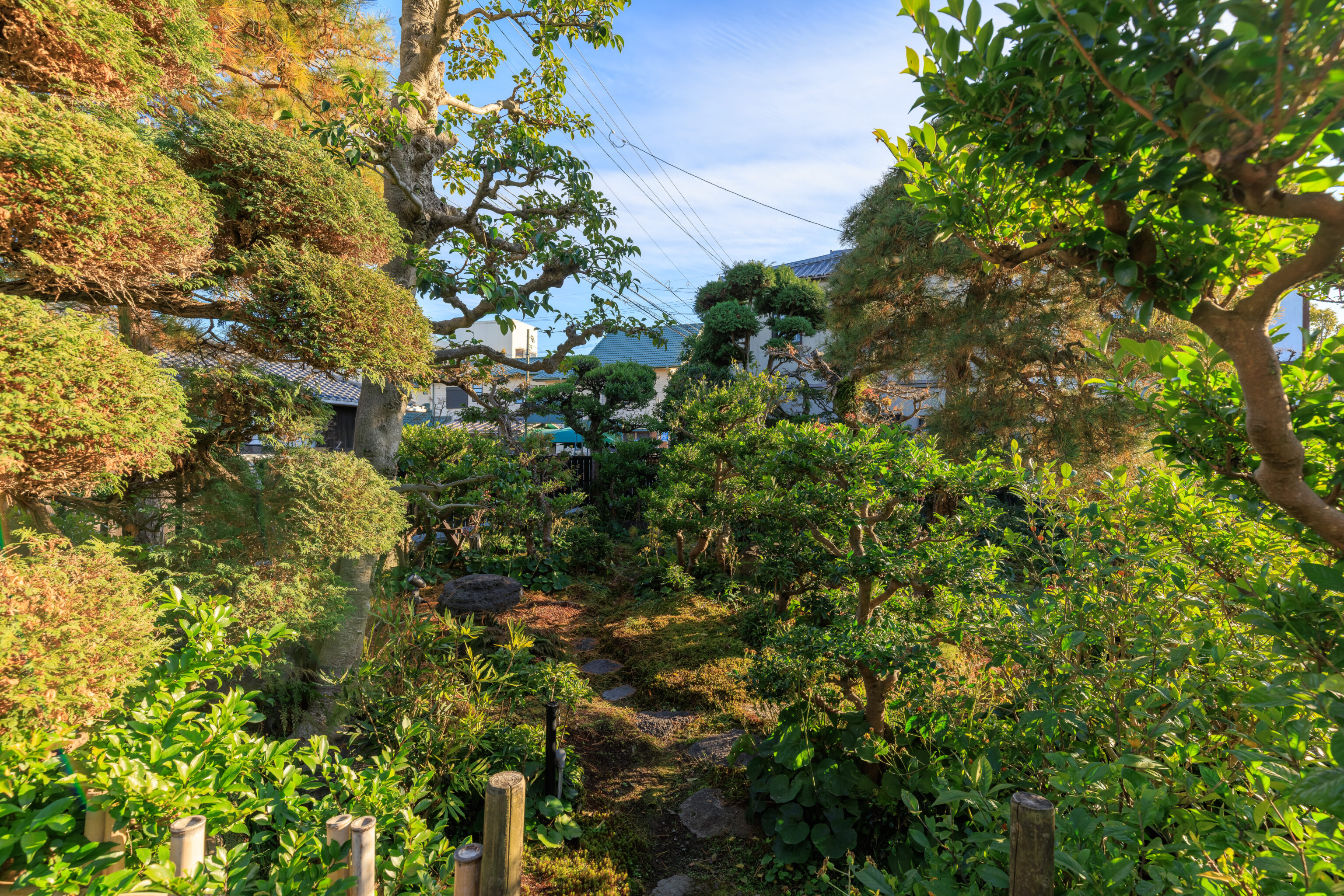
We returned to the front to exit.
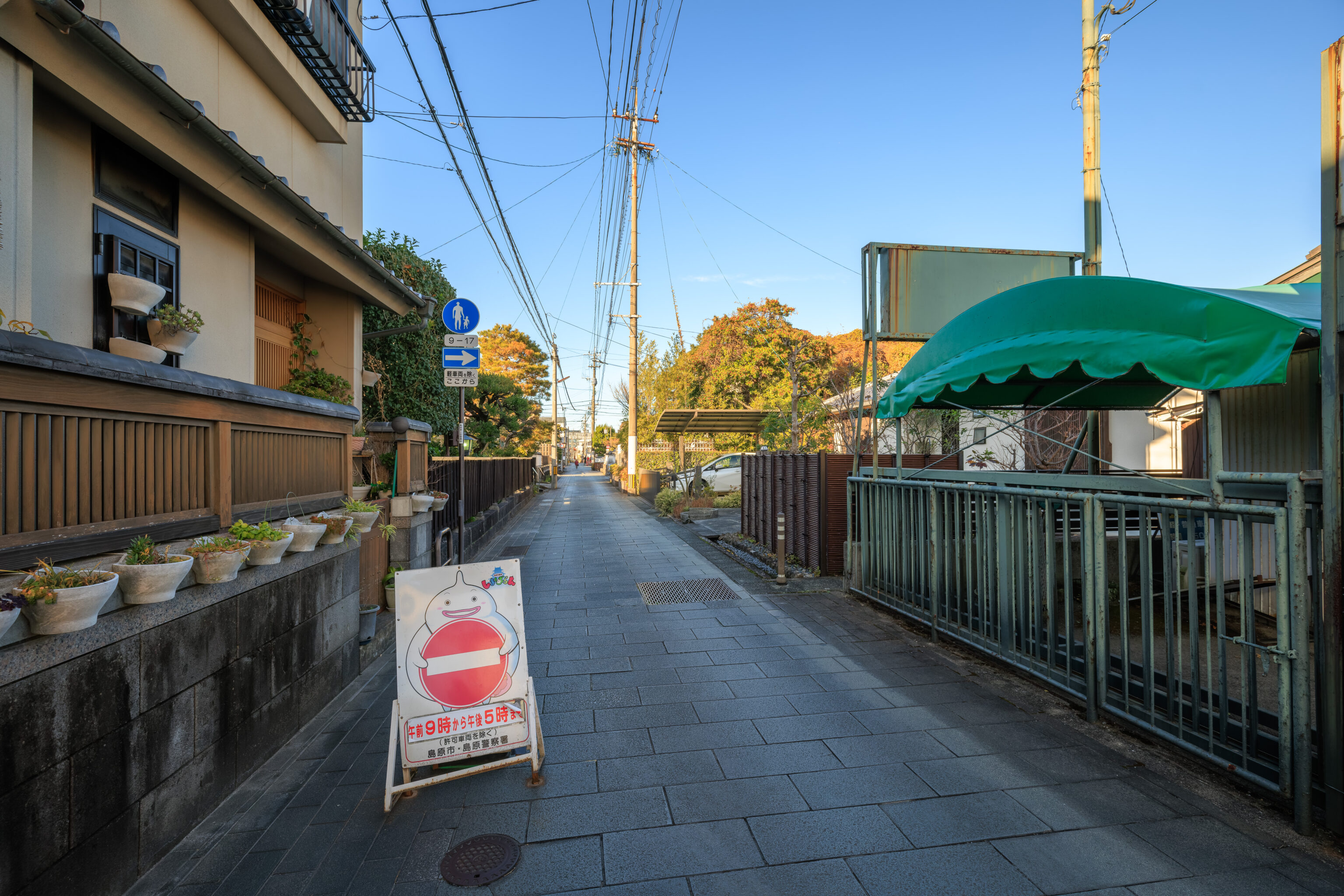
This says that from 9am to 5pm, only permitted vehicles are allowed to drive here.
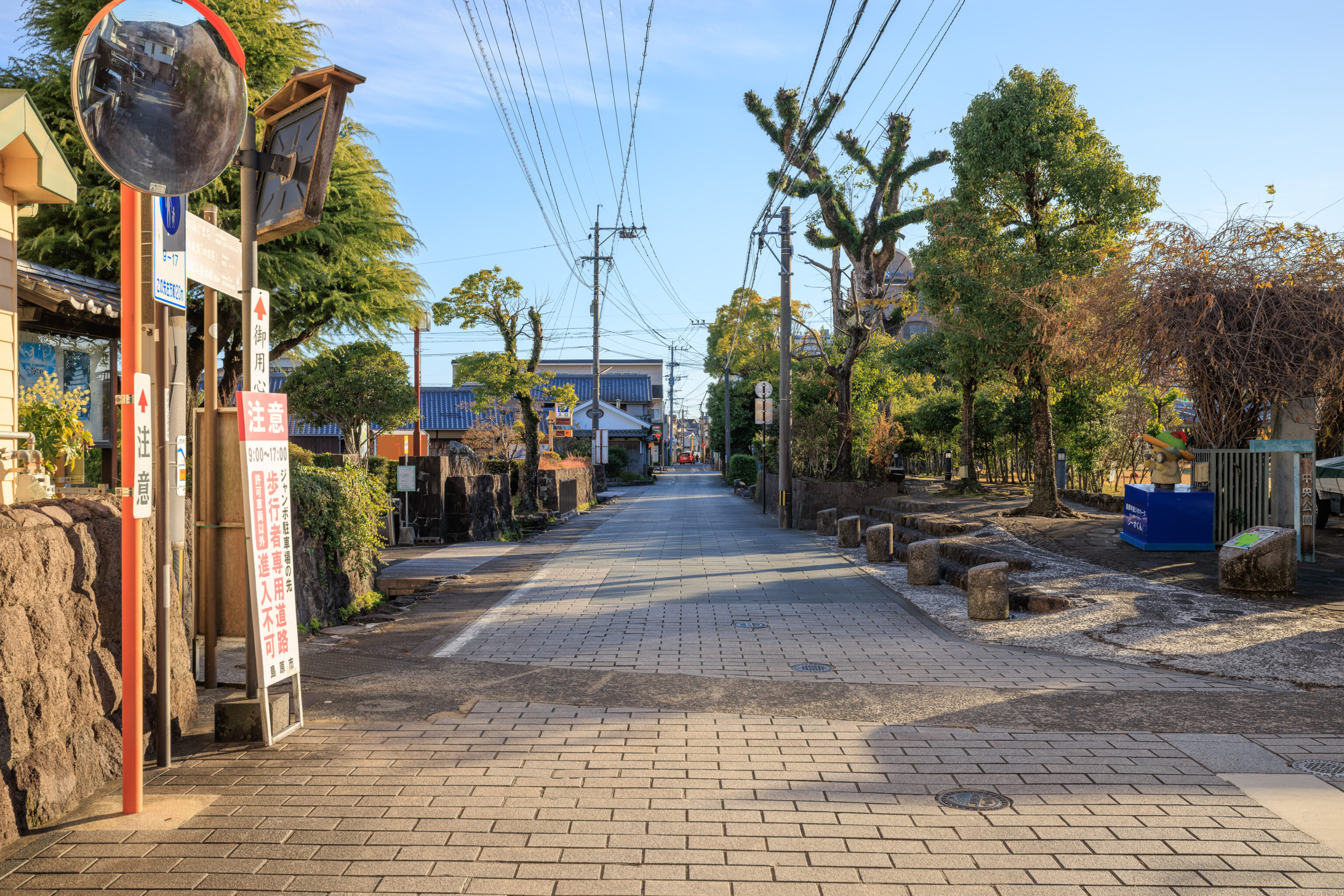
We continued walking to the south.
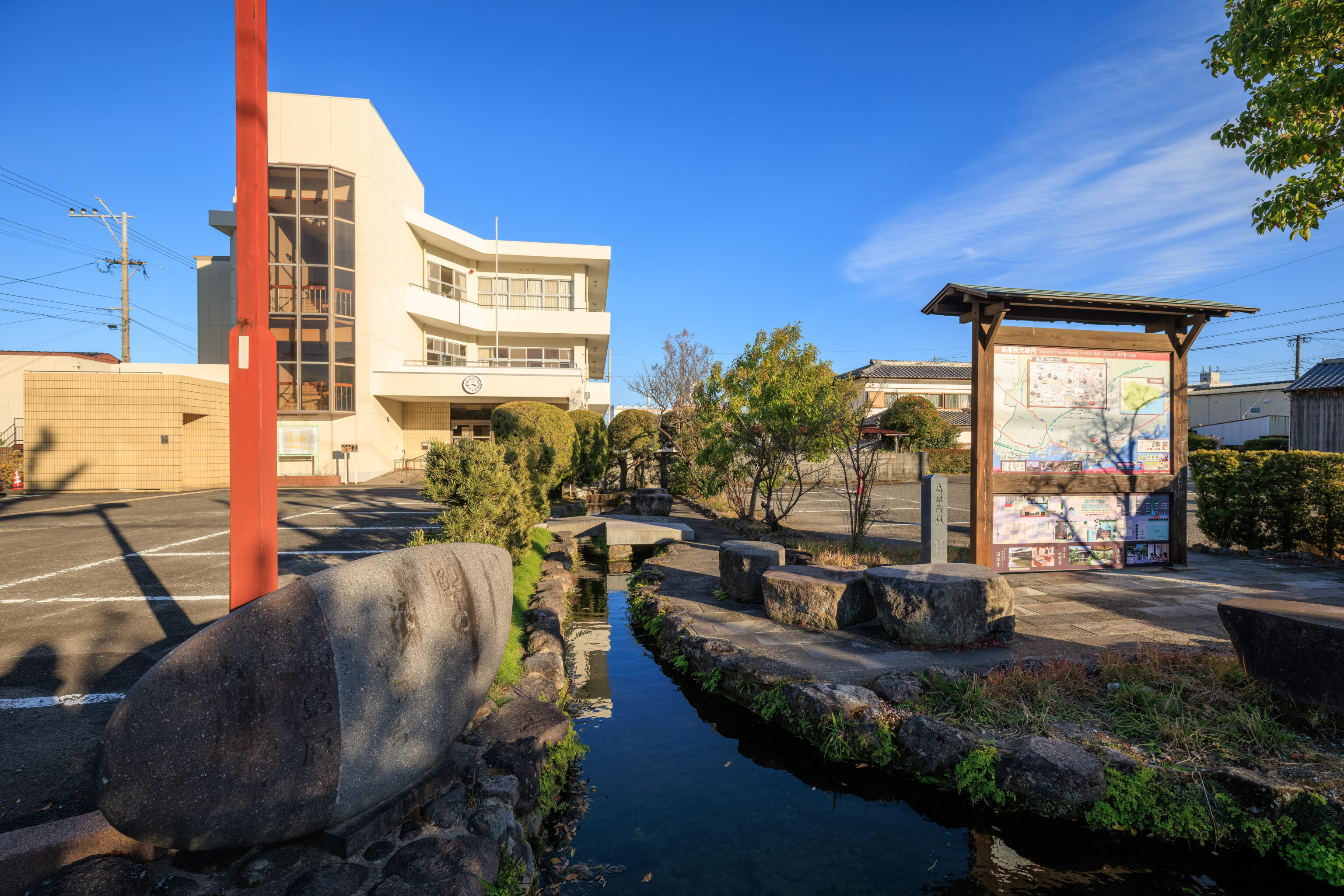
The spring water canal was less visible until we reached this point in front of what seems to be one of Shimabara’s community centers.
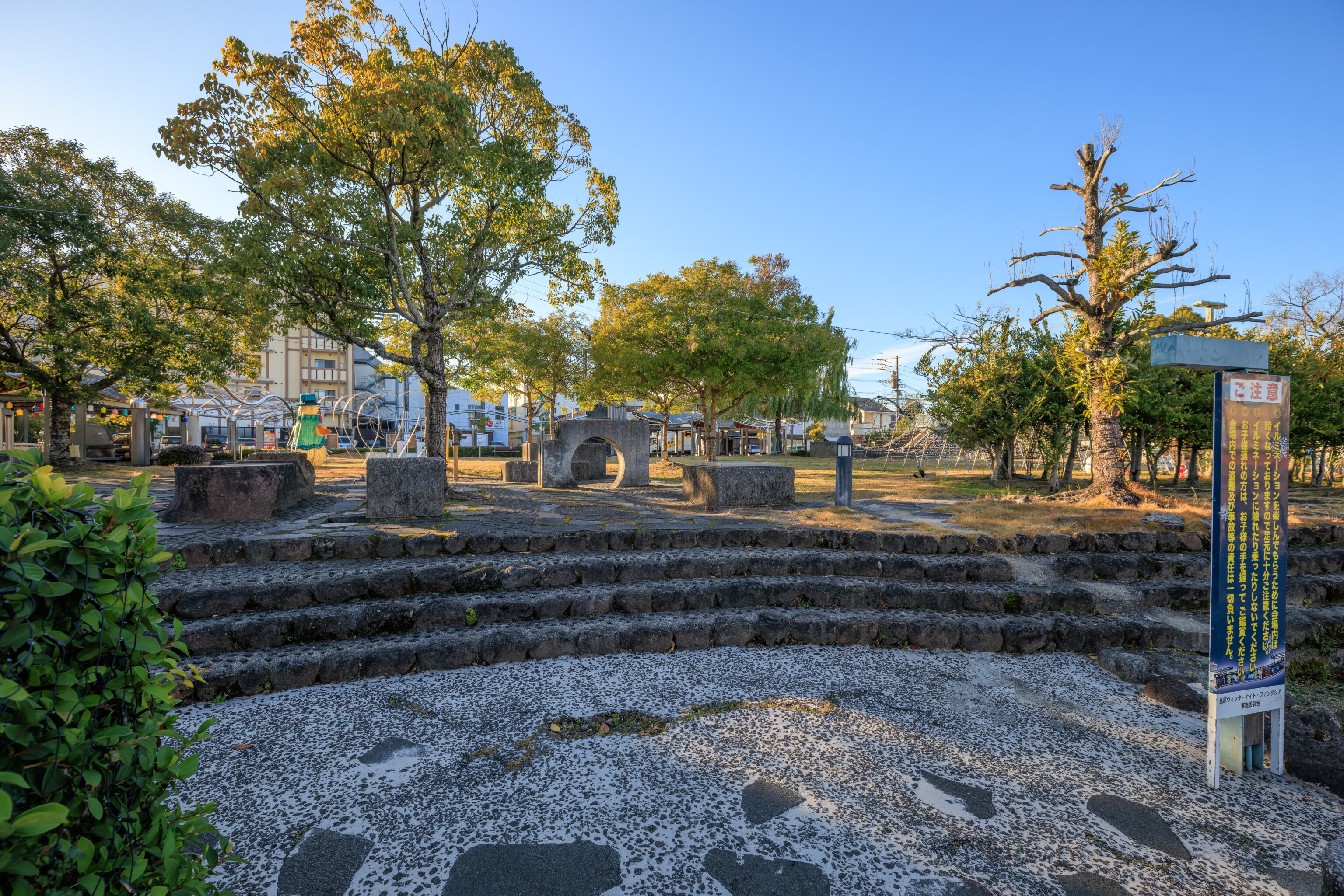
There was also a park here. According to the sign on the left, there are winter illuminations here:
Important Notice
◎ To enhance the enjoyment of the illuminations, the venue is kept dark; please watch your step carefully.

◎ Please do not touch or climb on the illuminations.

◎ If you are accompanied by children, please hold their hands while viewing the displays.

◎ We accept no responsibility for theft, accidents, or other incidents within the venue.

Shimabara Winter Night Fantasia Organizing Committee
– Text from the sign on the right of the above photograph, read and translated using Google Gemini and Translate.
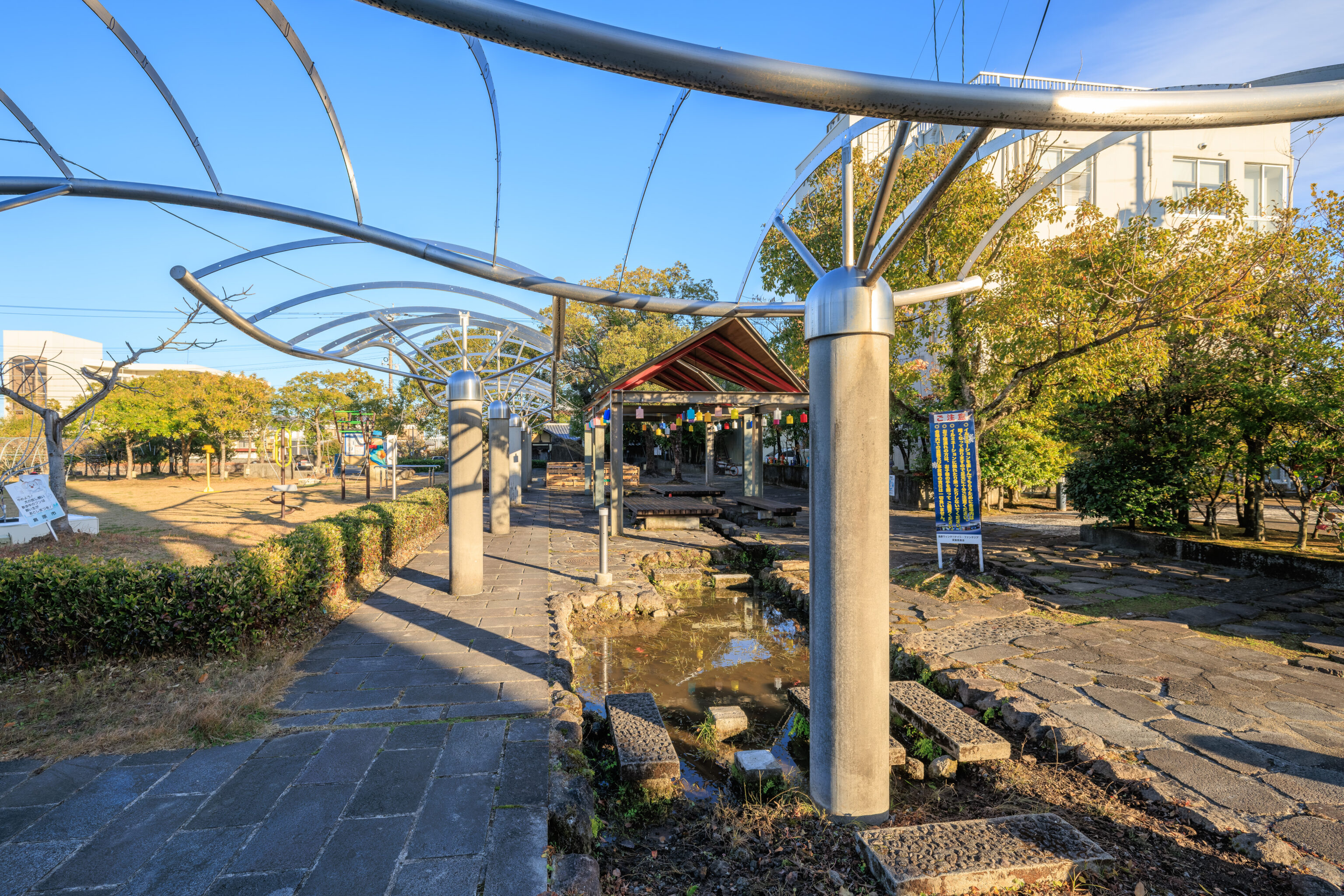
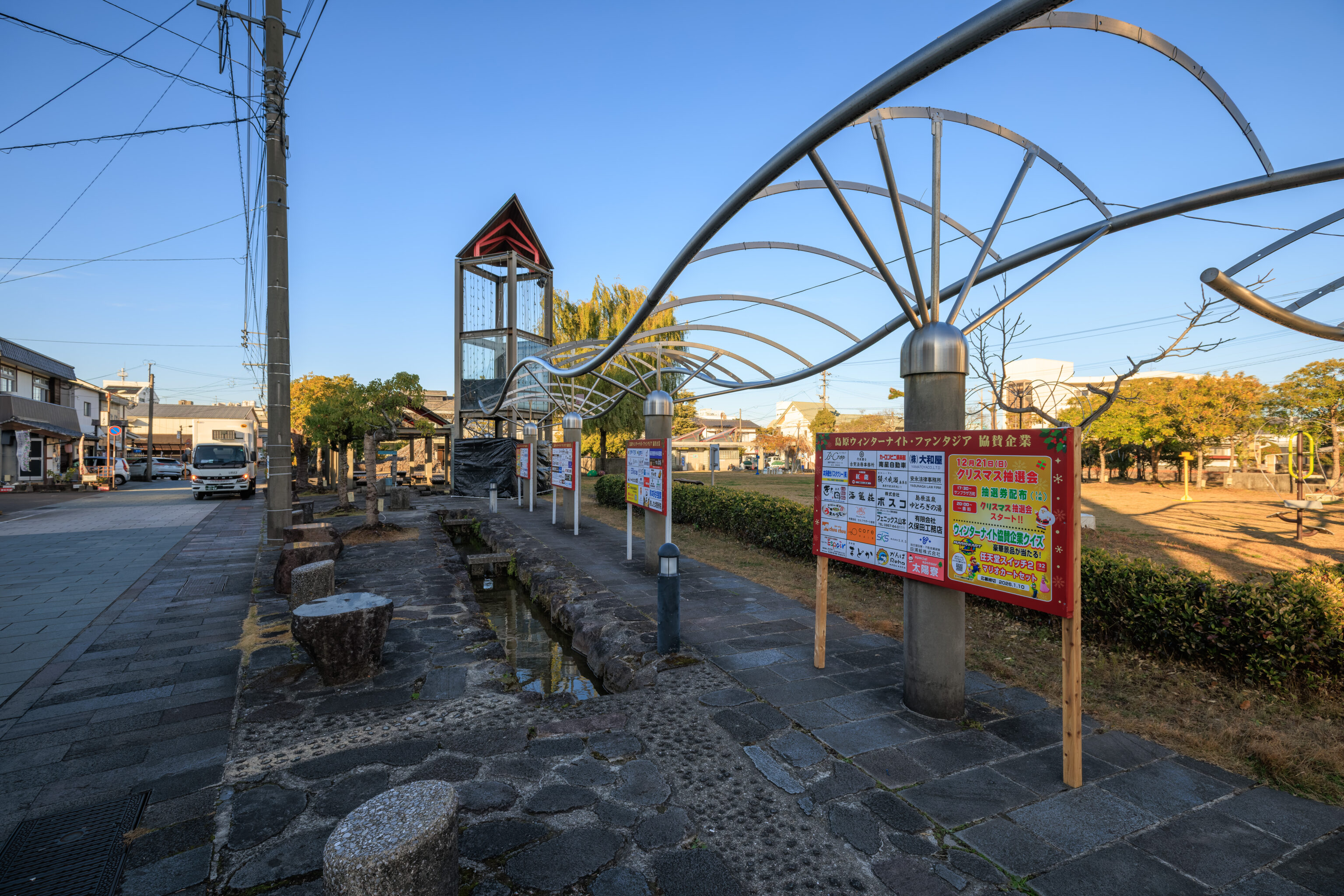
The spring water canal does run through this park but otherwise, although there was formerly a castle here, there’s not much here of interest to tourists.
Site of Hama Castle
Origins of Hama Castle

This area once jutted out into the sea, and "Hama Castle"—built by the Shimabara clan, a powerful local family said to be a branch of the Arima clan—stood here. However, the "Shimabara Catastrophe" of 1792 (Kansei 4) caused the area to be filled in with sediment, resulting in the current topography.

During the Sengoku (Warring States) period, the Arima clan—bolstered by the achievements of leaders such as Takazumi, Suminori, and Haruzumi Arima—brought roughly the eastern half of Hizen Province under their control; the Shimabara clan served as their vanguard in these campaigns. However, the rise of Ryūzōji Takanobu in Saga checked the Arima clan's expansion, eventually confining their territory solely to the Shimabara Peninsula.

It is said that the lord at the time, Sumishige Shimabara, permitted the Christian missionary Almeida to preach and had a church constructed in this vicinity (in 1563).

In 1584 (Tenshō 12), Ryūzōji Takanobu personally led an expedition to Shimabara, clashing with the allied forces of the Arima and Shimazu clans at Okitanawate. Takanobu was killed in the battle, and Sumitoyo—the son of Sumishige Shimabara, who had fought on the Ryūzōji side—reportedly surrendered the castle and left the area.

The lord who succeeded the Arima clan was Matsukura Shigemasa; he used Hama Castle as his base of operations until the construction of Shimabara Castle was completed.

The place names "Hori-machi" and "Nakabori-machi" are derived from this castle.

A portion of the Hama Castle site became the Shimabara Municipal Dai-ichi Elementary School; following the school's relocation in 1972 (Shōwa 47), the area was converted into Chūō Park, a beloved spot for local residents.
– Text from a plaque on a stone marker, read and translated using Google Gemini and Translate.
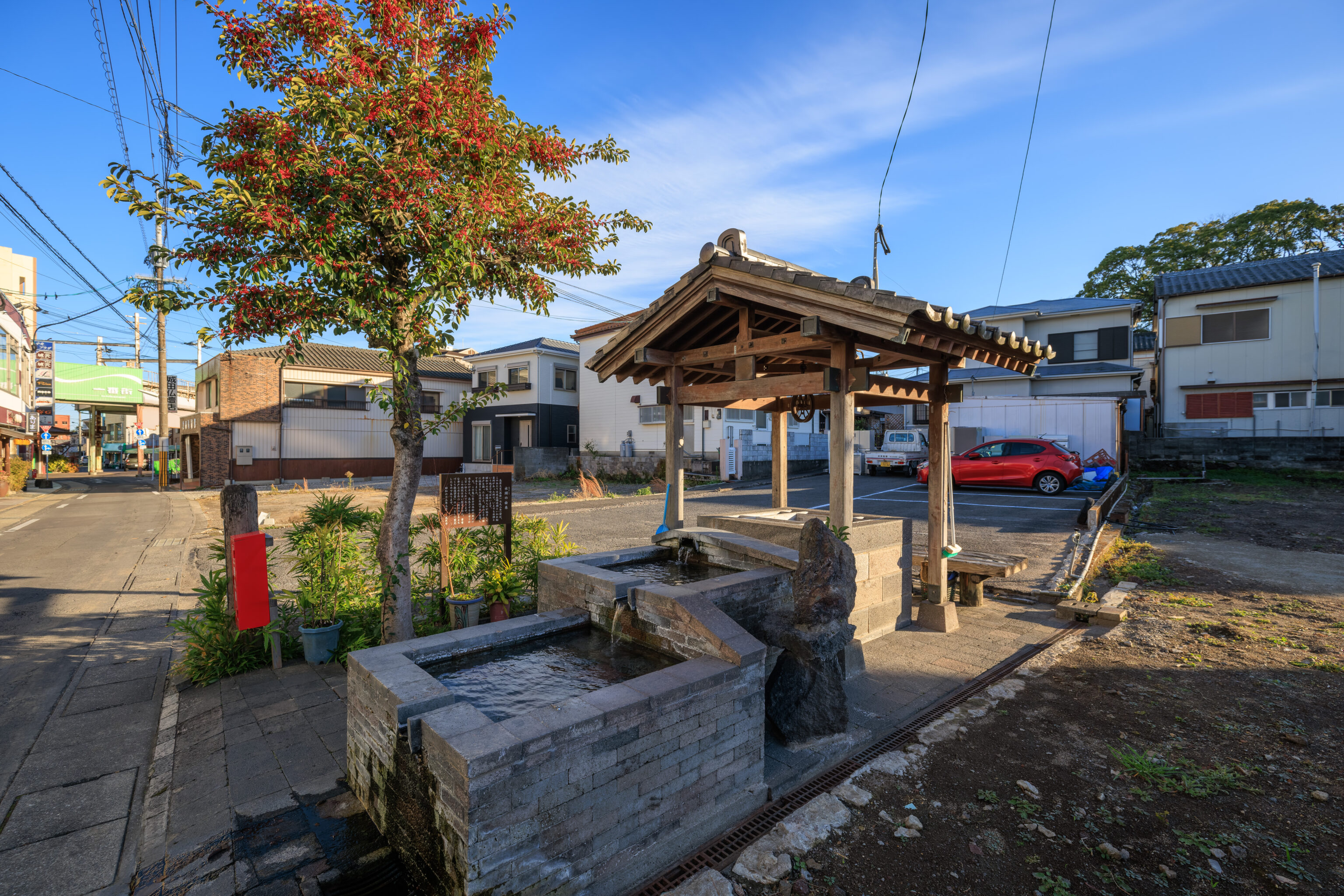
We made a right turn and started walking to the west. A short distance away, we walked past a well and fountain.
The Origin of "Mizugashira"
Before the Shimabara Catastrophe of 1792, this area was known as "Hatoba-Mizugashira" (Pier Head) and served as the site of a maritime checkpoint; the name "Mizugashira" remains in use to this day.

In 1941, local residents collaborated to dig a well here, resulting in the natural upwelling of clear, cold groundwater—water nurtured by the lush greenery of Mount Mayuyama.

It has long been said that pouring water over this turtle statue—using a number of ladles equal to one's own age—will bring a long life.

This facility was developed to preserve this precious well and its water, which possess a rich history, as part of the prefecture's "Project to Promote Vibrant Community Development."

March 1988, Shimabara City
– Text from a sign visible by the tree in the photograph above, read and translated using Google Gemini and Translate.
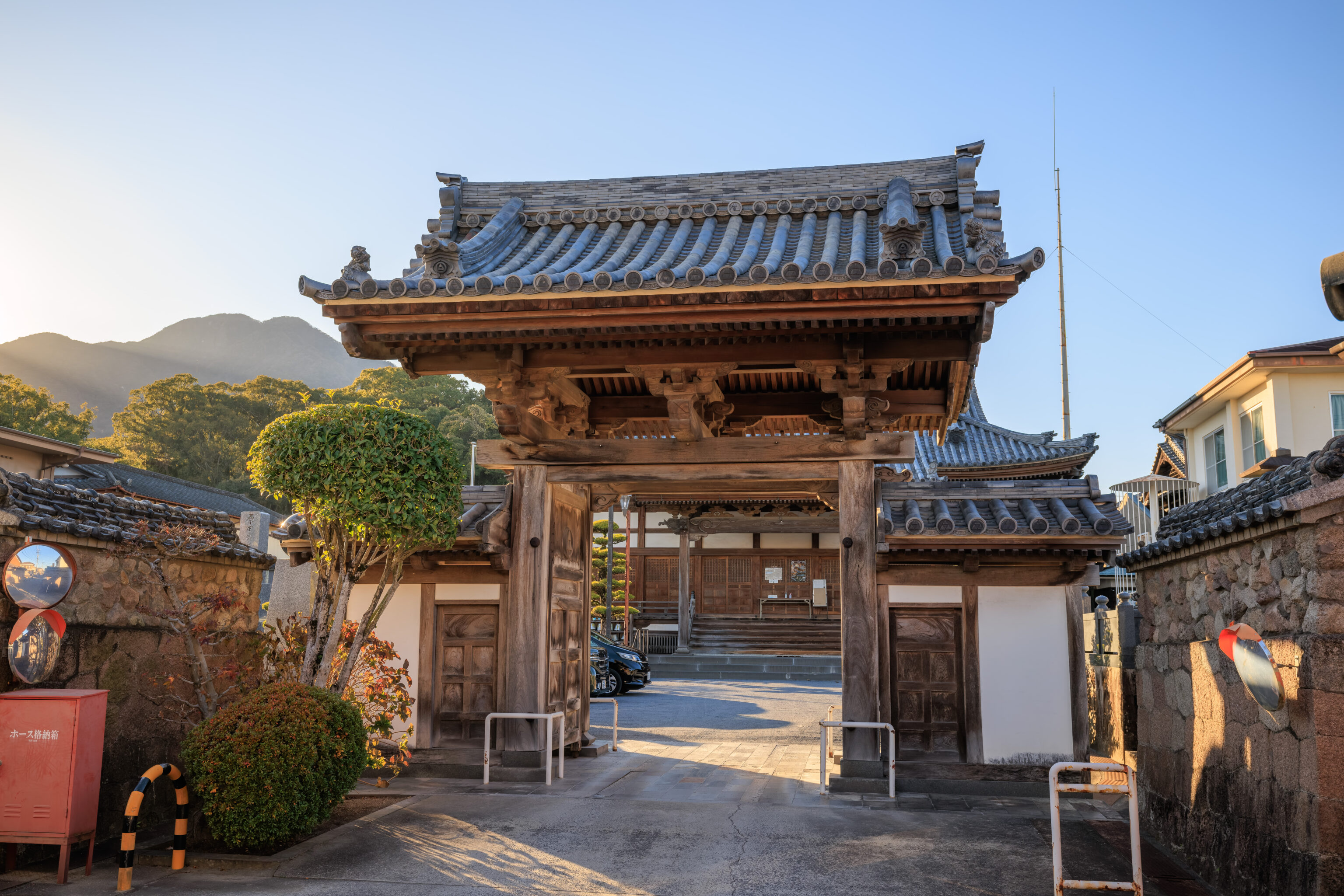
Further to the west, at the end of the street, we reached a temple, 善法寺 Zenhoji. Although there was a vehicle present inside, it seemed kind of closed. Maybe we could still have gone in to take a quick look? We did not though.
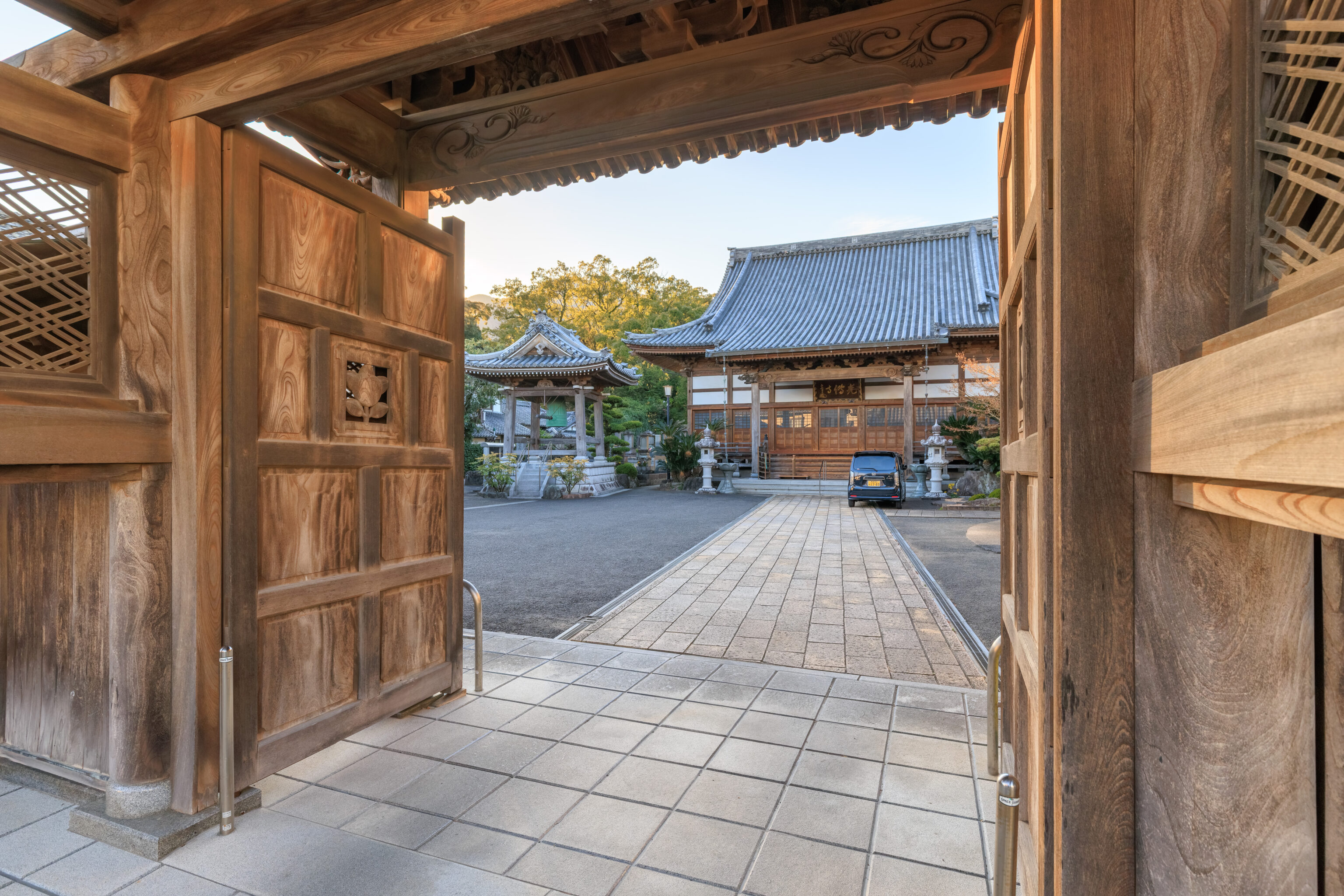
Instead, we turned to the left, and soon saw another temple, 光傳寺 Kodenji. Again, the the gate was open but the building doors were closed.
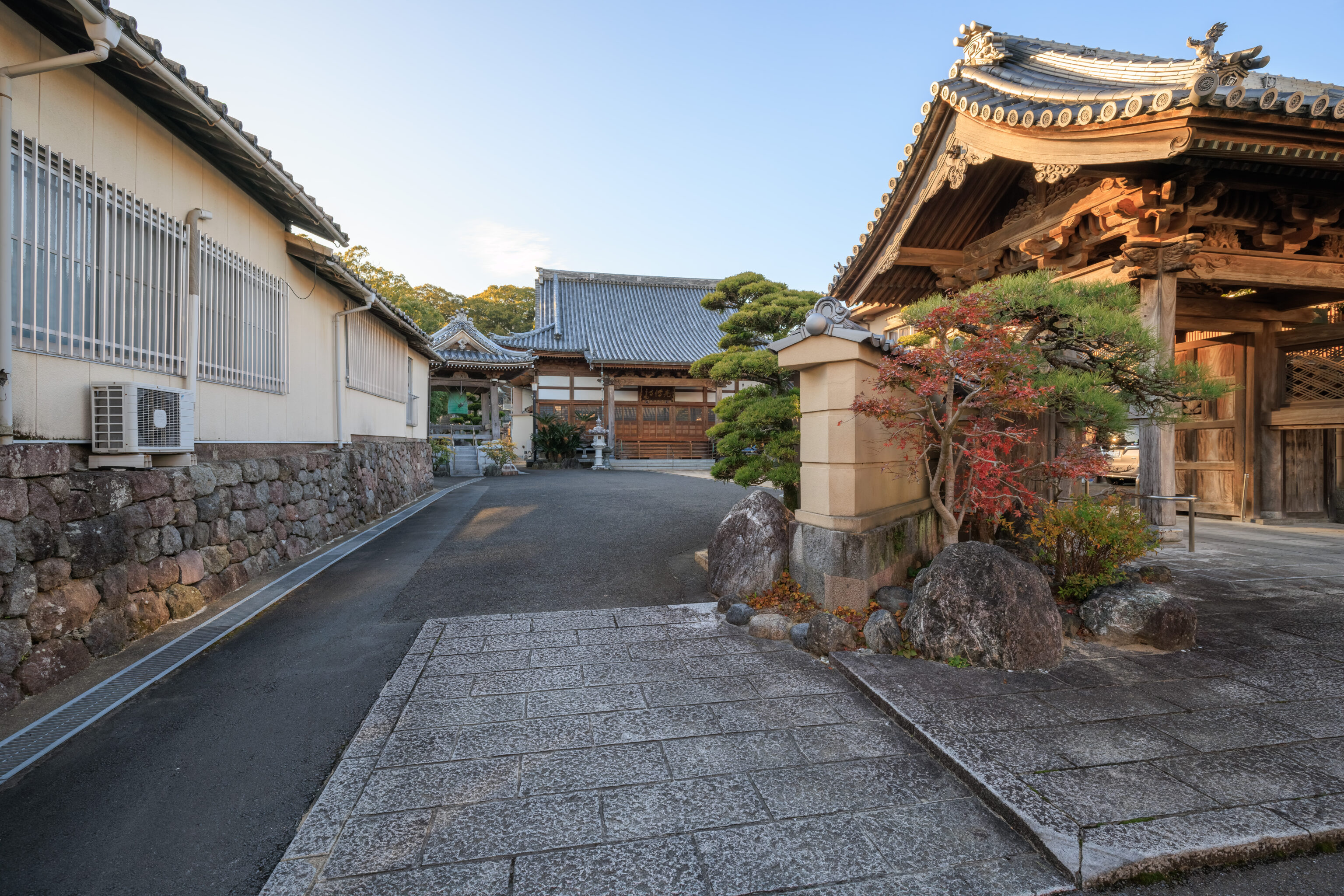
Still looked the same from this driveway next to the driveway next to the gate.
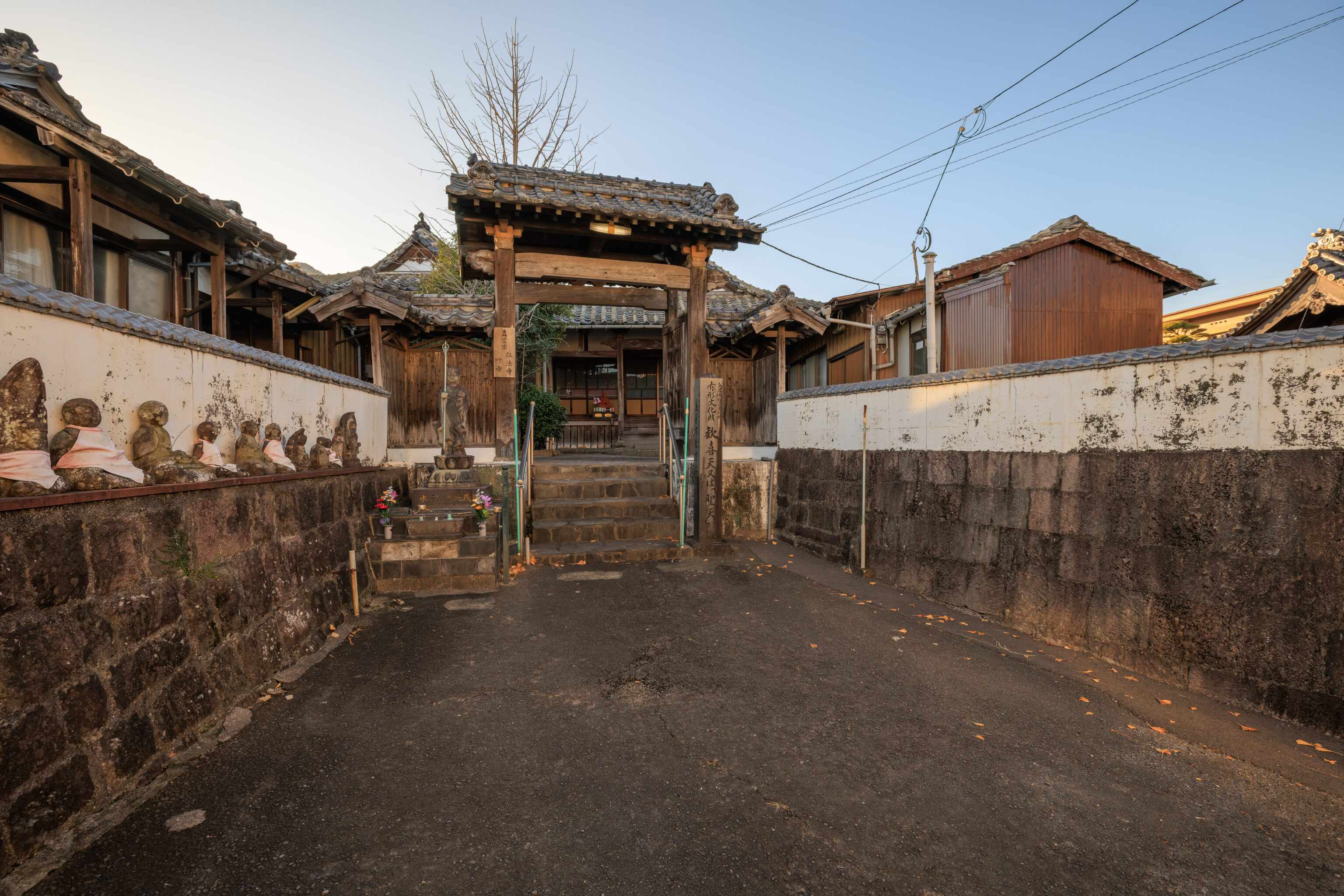
This is part of the Buddhist temple that we just saw? Or its own place?
Shimabara City Designated Tangible Cultural Property
"Kangiten" or "Shoten"
Statue of "Happiness Diety" or "Virtuous emperor

Kangiten is a *hibutsu* (secret Buddha image) enshrined at Kan-no-ji Temple. The statue's surface is pitch-black and coated with a sheen of oil—likely the result of the esoteric *Goma* fire ritual having been performed before it countless times.

Known in Sanskrit as *Vinayaka* (often translated as *Zobiten*, or "Elephant-Nosed Deity"), this deity is also referred to as *Shoten*.

Worshipped as a deity who grants wealth and prosperity, eliminates calamity, and ensures the fulfillment of all virtuous undertakings, the figure is depicted as a divine couple locked in an embrace. Both figures possess the head of an elephant and the body of a human; this form, featuring two elephant heads on two bodies—with one body taking a female form and the other a Bodhisattva form—is a distinctive iconographic style.

Designated on September 3, 1992
Shimabara City Board of Education
– Text from a sign, read and translated using Google Gemini and Translate.
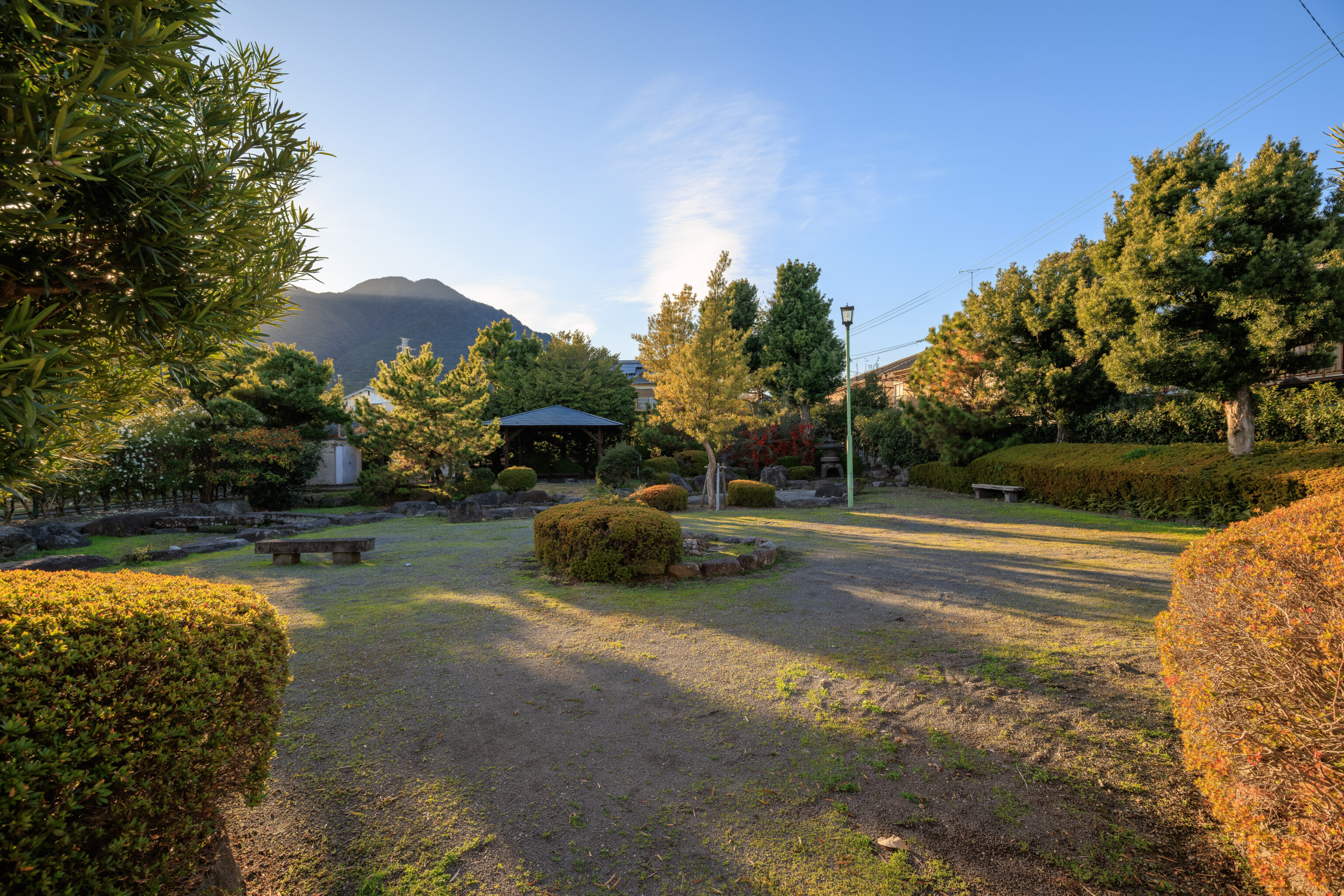
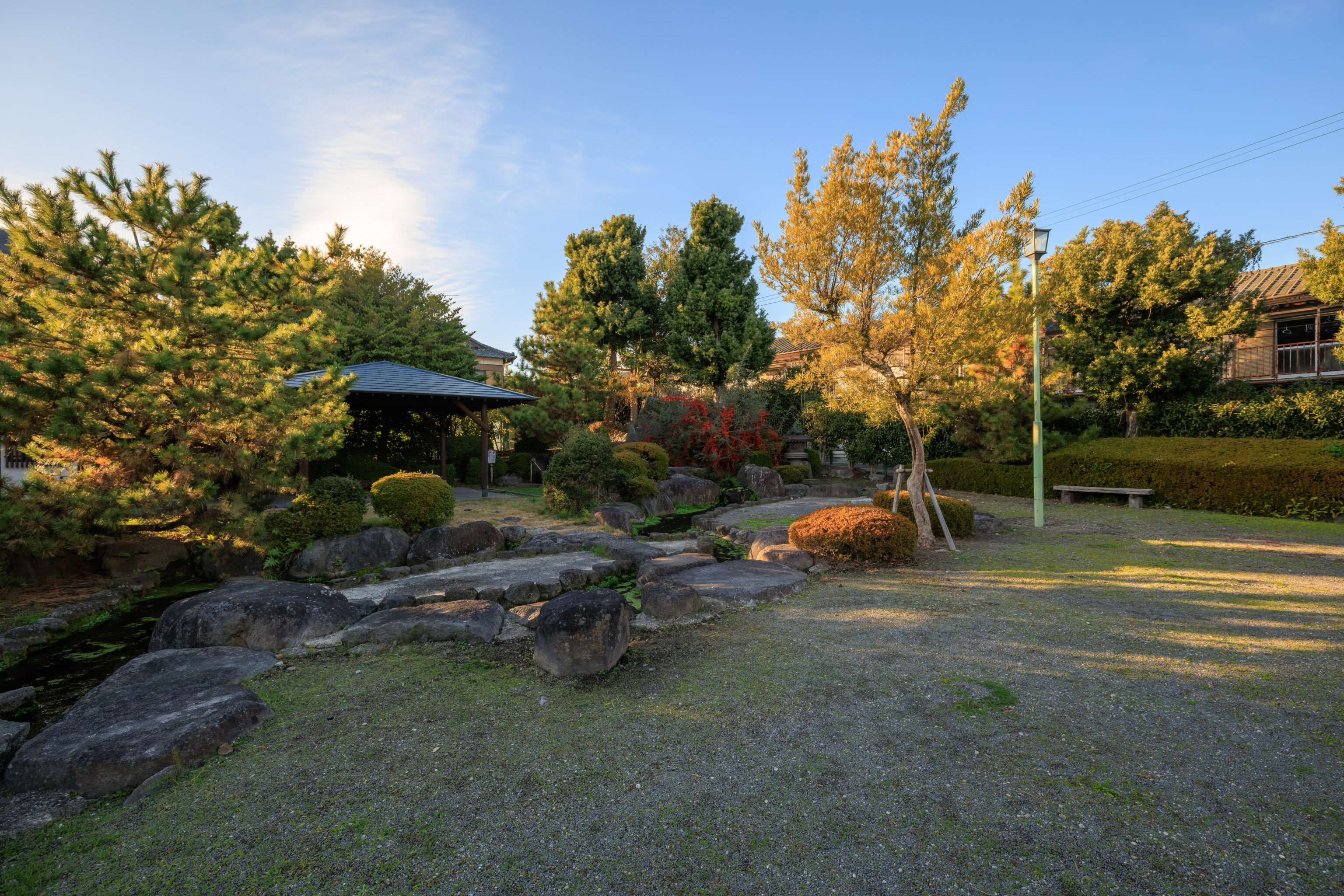
We continued walking to the south, passing by a small park.
Jisen Park
History of the Park

This area was once renowned for its tea. It served as a place of relaxation where people of old would whisk tea using the fresh spring water that bubbled up here, engaging in lively conversation while gazing out at the beautiful Shirado Pond and the spring itself.

Visitors to the estate here would say that "all the unpleasant and troublesome things of the world are washed away by the pure water," leading them to call the site "Jisen-tei" (Ear-Washing Pavilion).

Shimabara City
– Text from a sign, read and translated using Google Gemini and Translate..
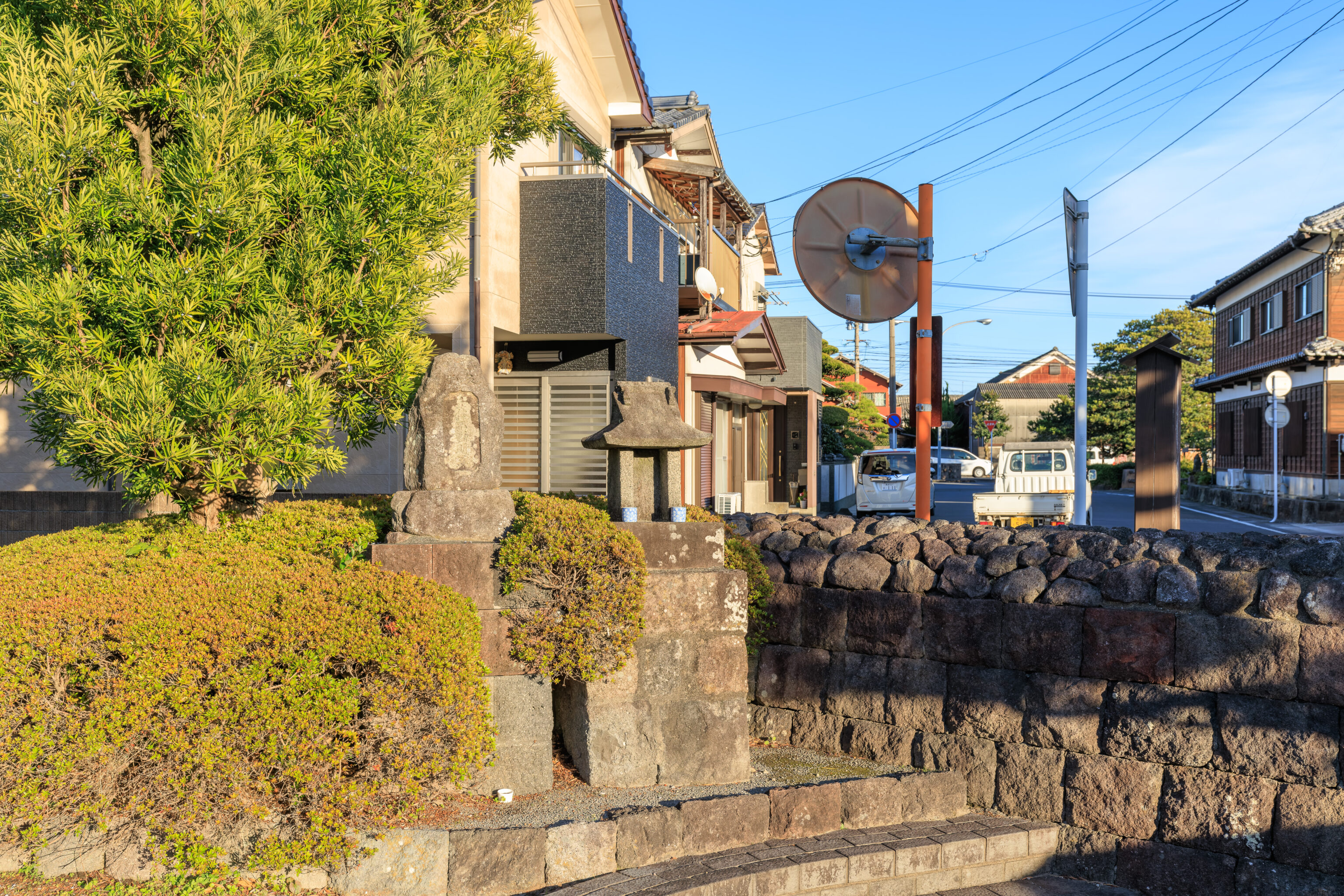
A small shrine…
Shirachiko
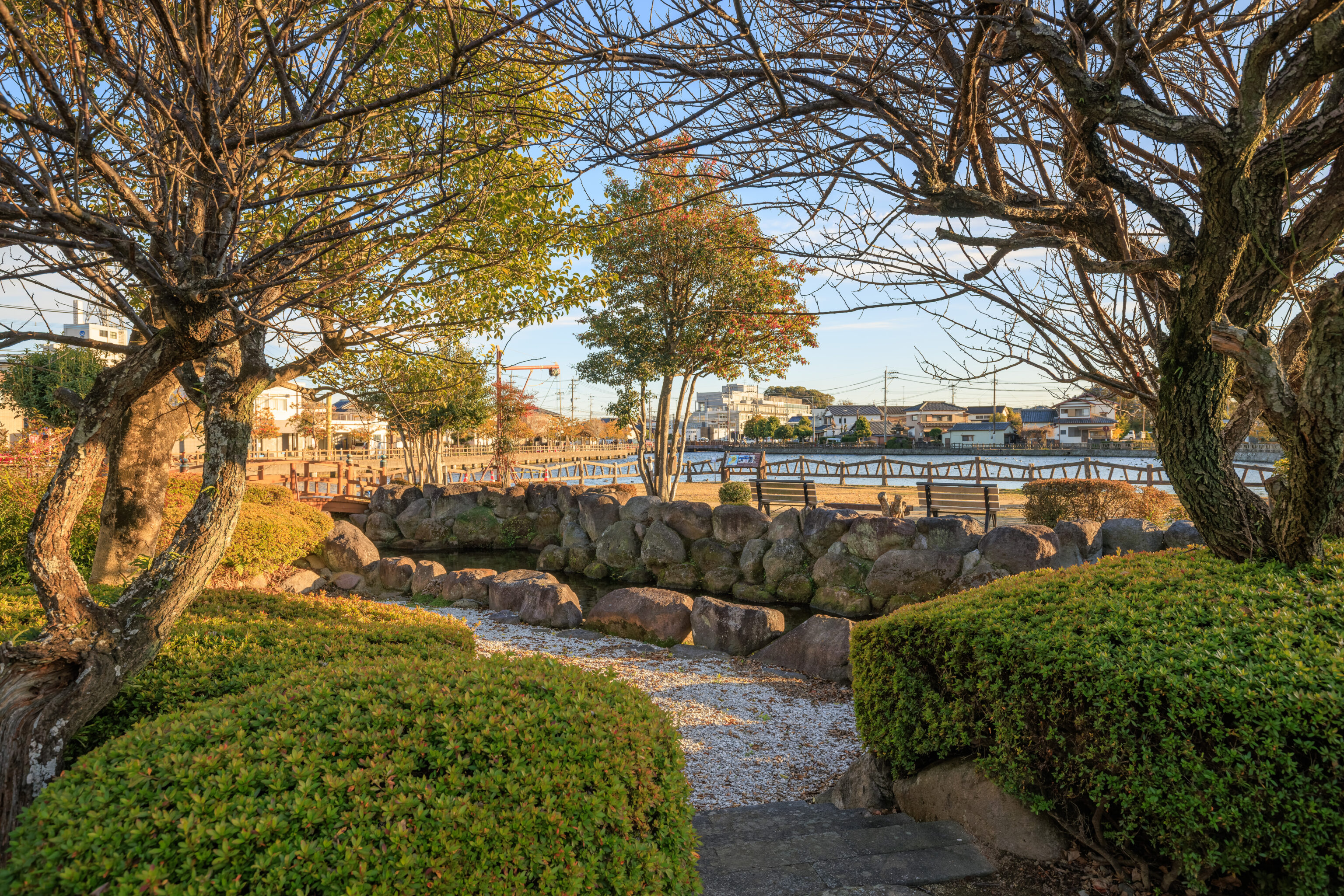
Across the street from the little park, we reached 白土湖 Shirachiko.
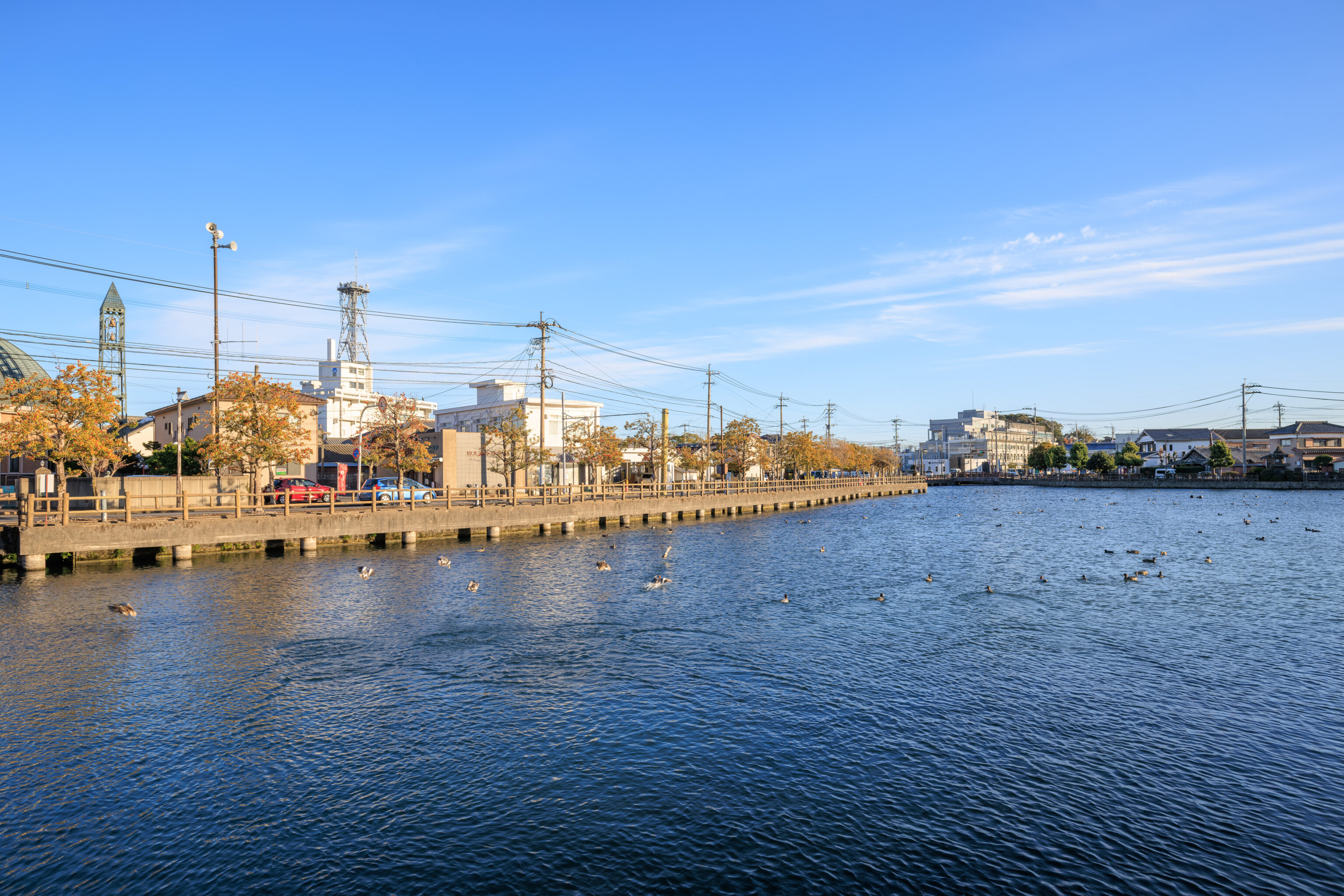
Many water birds were enjoying Shirachiko!
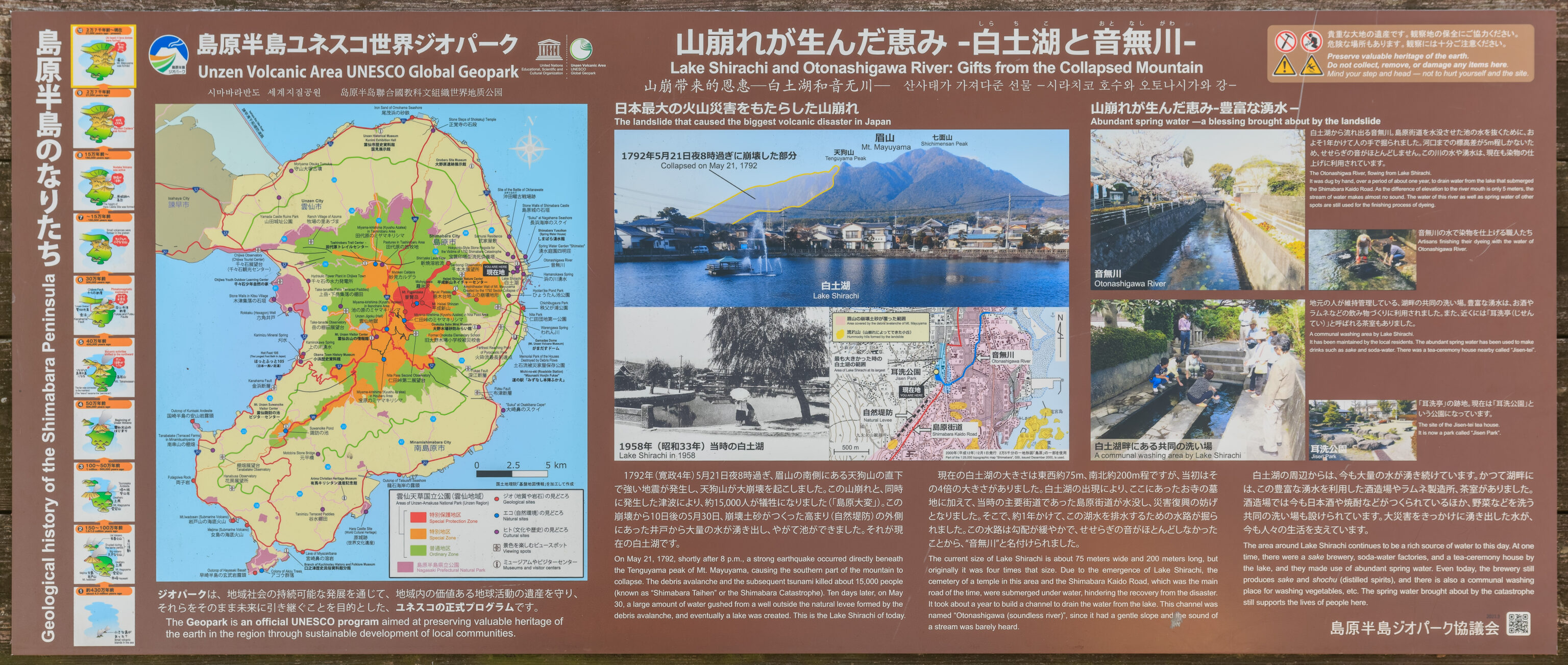
A sign provided a map of the Shimabara Peninsula and provided some information about Shirachiko.
Lake Shirachi and Otonashigawa River: Gifts from the Collapsed Mountain

The landslide that caused the biggest volcanic disaster in Japan
On May 21, 1792, shortly after 8 p.m., a strong earthquake occurred directly beneath the Tenguyama peak of Mt. Mayuyama, causing the southern part of the mountain to collapse. The debris avalanche and the subsequent tsunami killed about 15,000 people (known as "Shimabara Taihen" or the Shimabara Catastrophe). Ten days later, on May 30, a large amount of water gushed from a well outside the natural levee formed by the debris avalanche, and eventually a lake was created. This is the Lake Shirachi of today.

The current size of Lake Shirachi is about 75 meters wide and 200 meters long, but originally it was four times that size. Due to the emergence of Lake Shirachi, the cemetery of a temple in this area and the Shimabara Kaido Road, which was the main road of the time, were submerged under water, hindering the recovery from the disaster. It took about a year to build a channel to drain the water from the lake. This channel was named "Otonashigawa (soundless river)", since it had a gentle slope and the sound of a stream was barely heard.

The area around Lake Shirachi continues to be a rich source of water to this day. At one time, there were a sake brewery, soda-water factories, and a tea-ceremony house by the lake, and they made use of abundant spring water. Even today, the brewery still produces sake and shochu (distilled spirits), and there is also a communal washing place for washing vegetables, etc. The spring water brought about by the catastrophe still supports the lives of people here.

Abundant spring water - a blessing brought about by the landslide
The Otonashigawa River, flowing from Lake Shirachi. It was dug by hand, over a period of about one year, to drain water from the lake that submerged the Shimabara Kaido Road. As the difference of elevation to the river mouth is only 5 meters, the stream of water makes almost no sound. The water of this river as well as spring water of other spots are still used for the finishing process of dyeing.

A communal washing area by Lake Shirachi. It has been maintained by the local residents. The abundant spring water has been used to make drinks such as sake and soda-water. There was a tea-ceremony house nearby called "Jisen-tei".
– Text from the sign above.
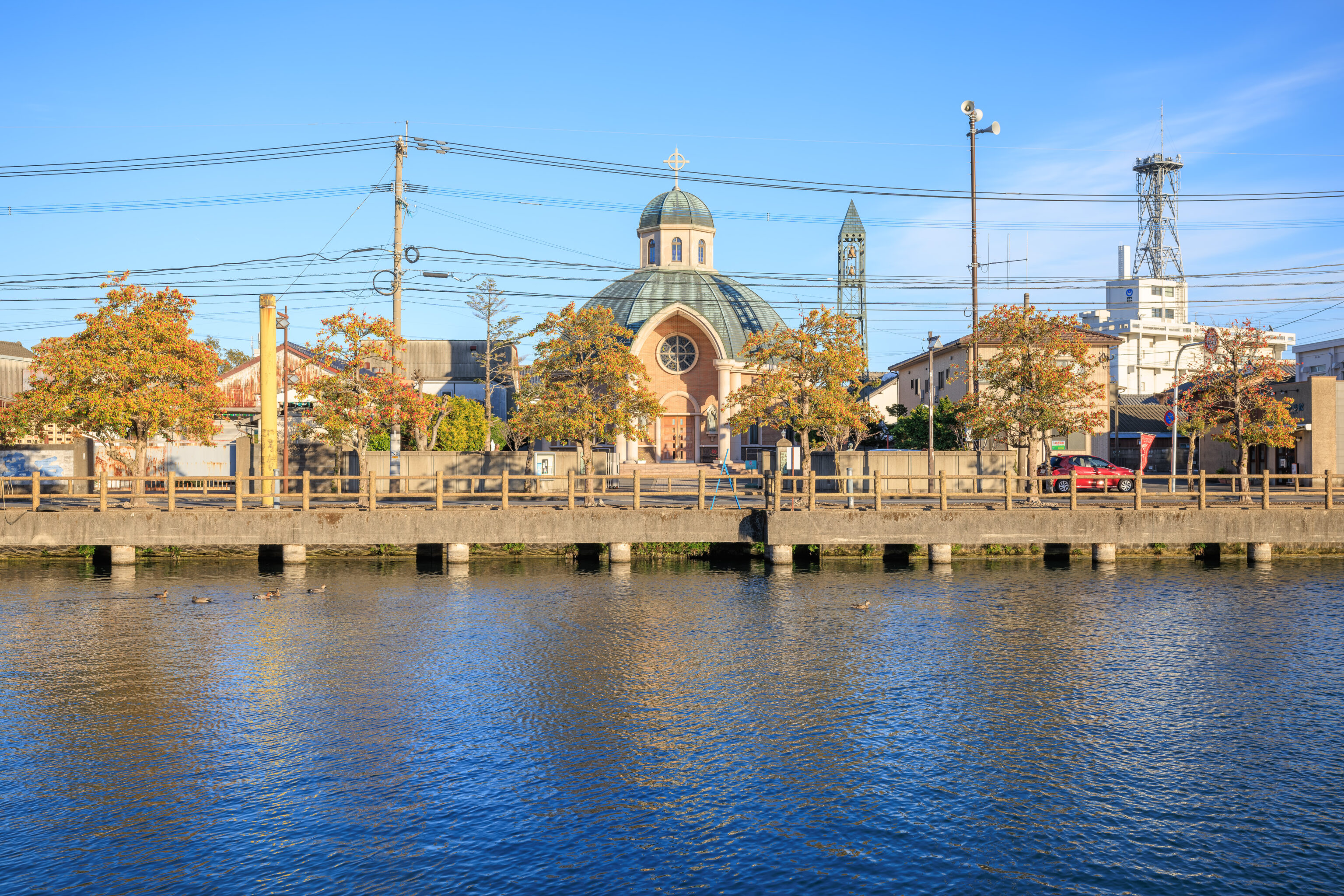
There was a church on the east side of the lake. The name of this church appears to be the 日本26聖人殉教者 The Twenty-Six Martyrs of Japan. Google Maps and OpenStreetMap both simply list it as カトリック島原教会 Catholic Shimabara Church.
So who were the 26 martyrs of Japan? 26 Catholics, of whom 6 were foreigners, were ordered to be executed by Toyotomi Hideyoshi. And they were, in Nagasaki.
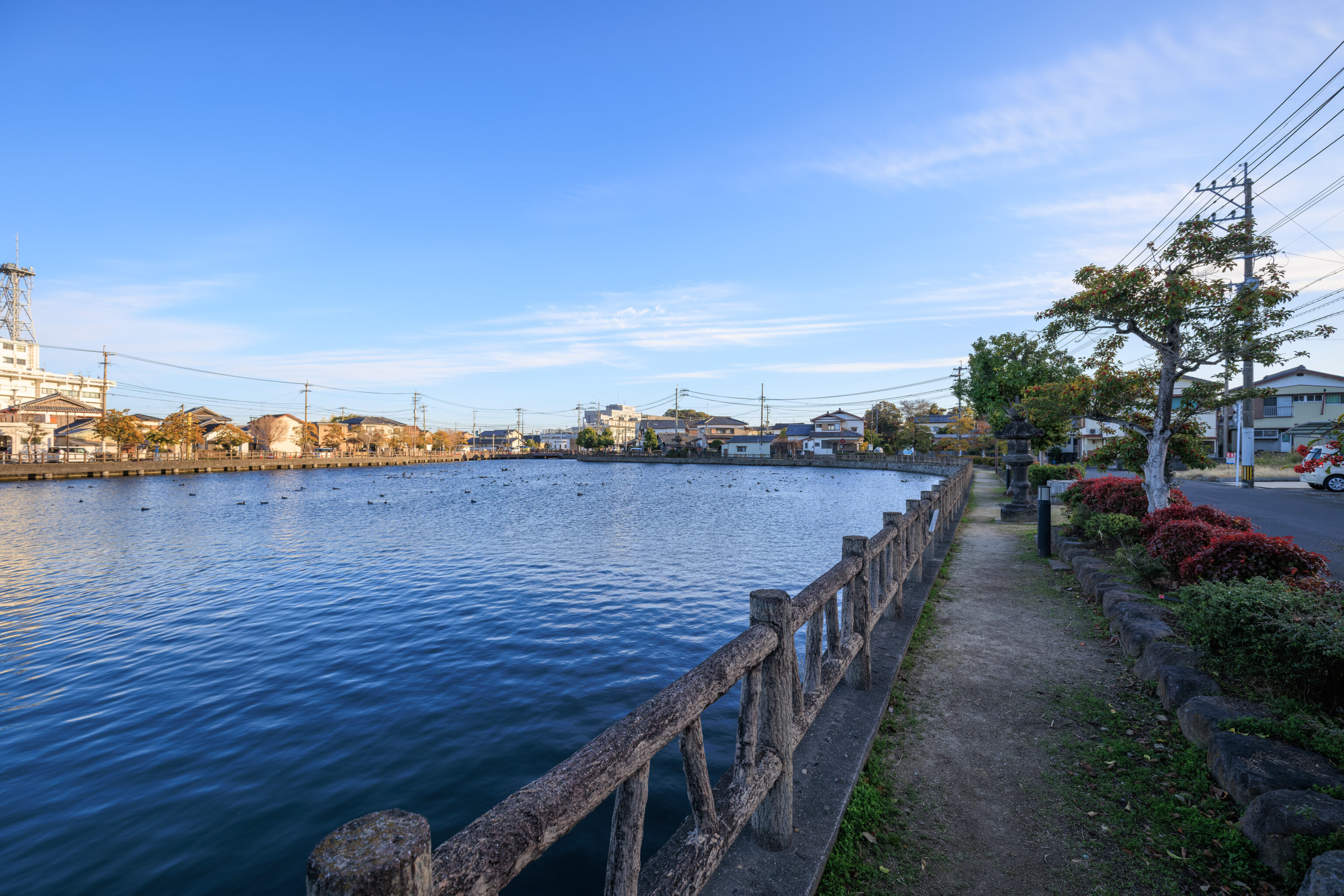
We continued walking to the south along the west side of the lake.
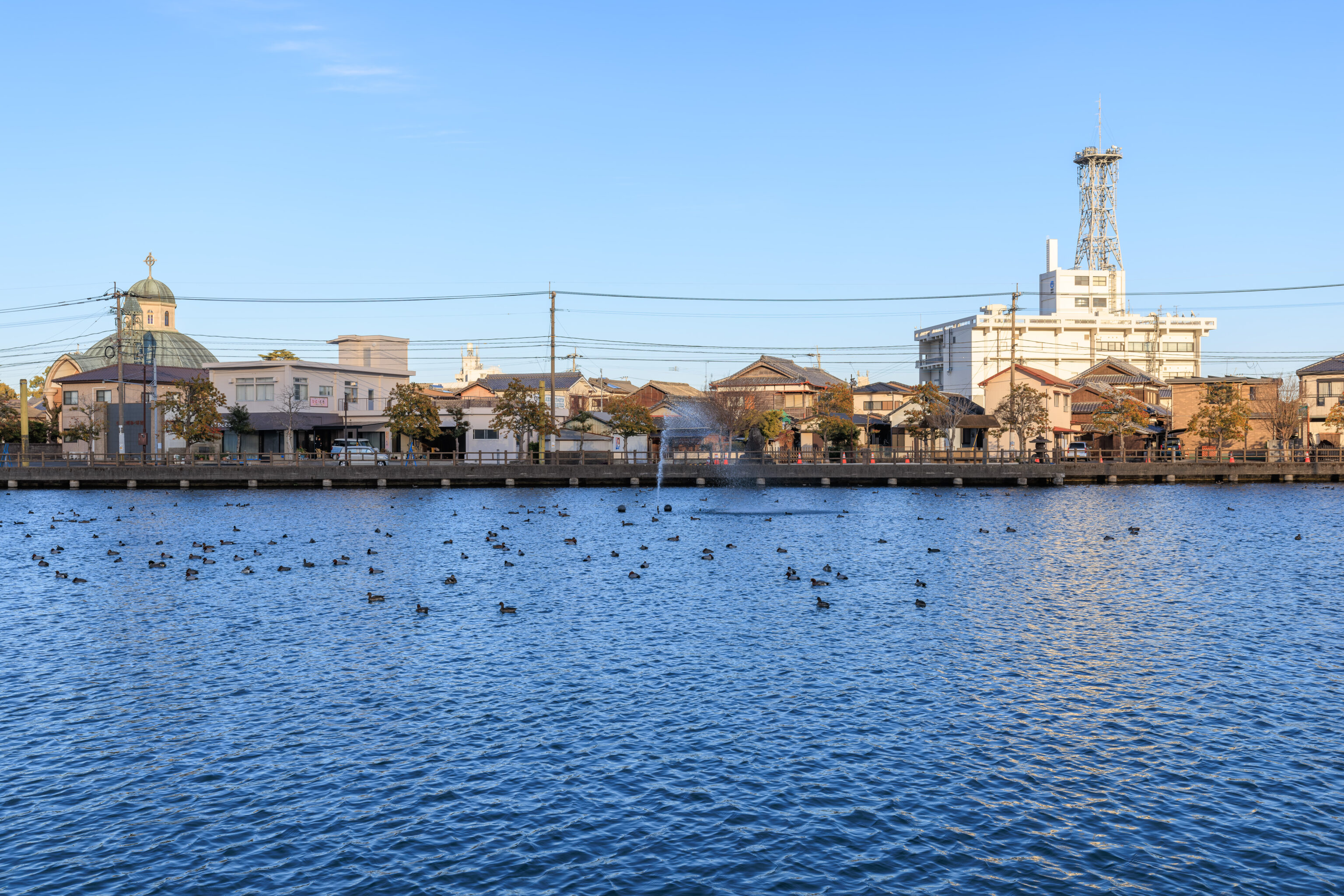
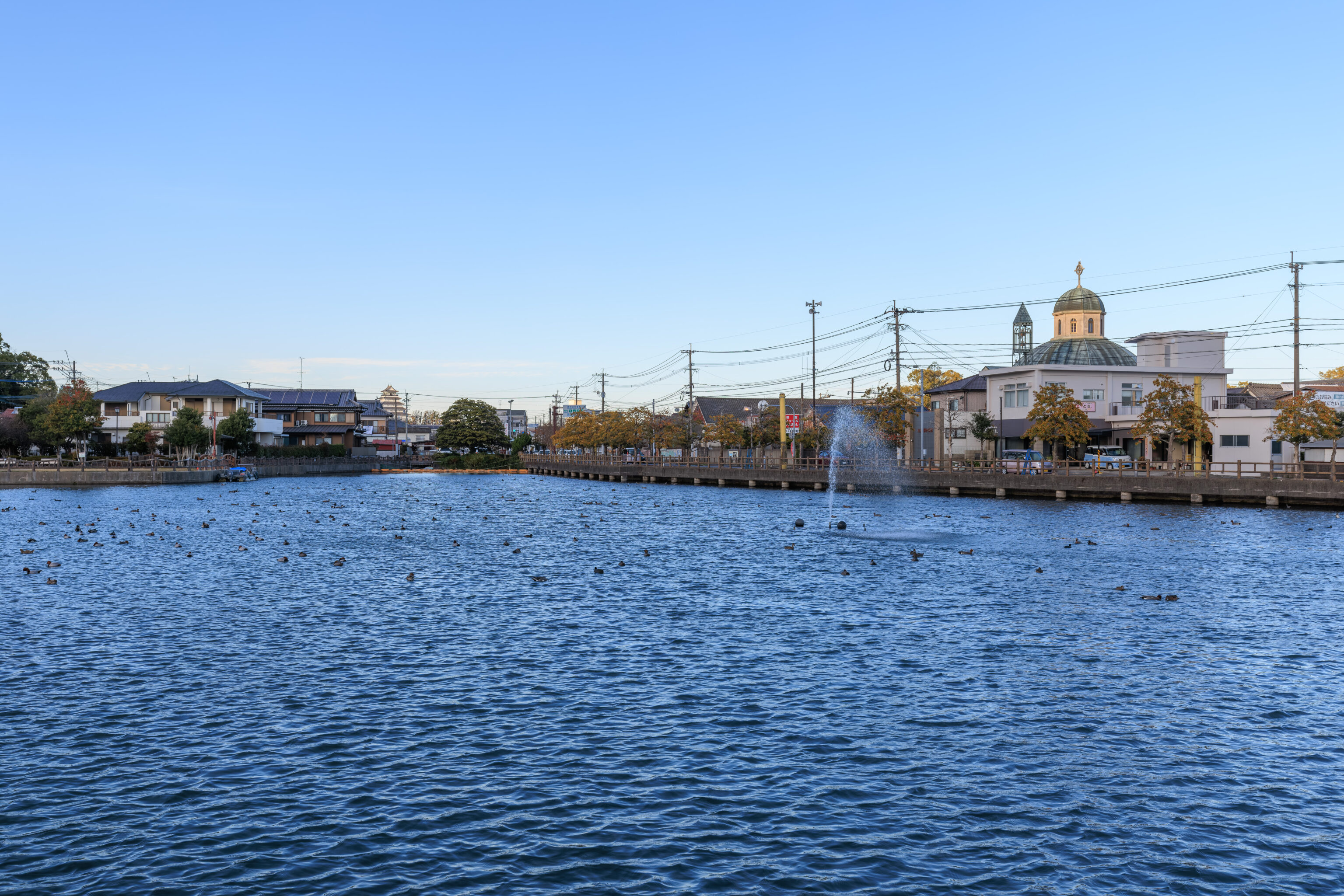
We noticed that the lake actually has a very small fountain!
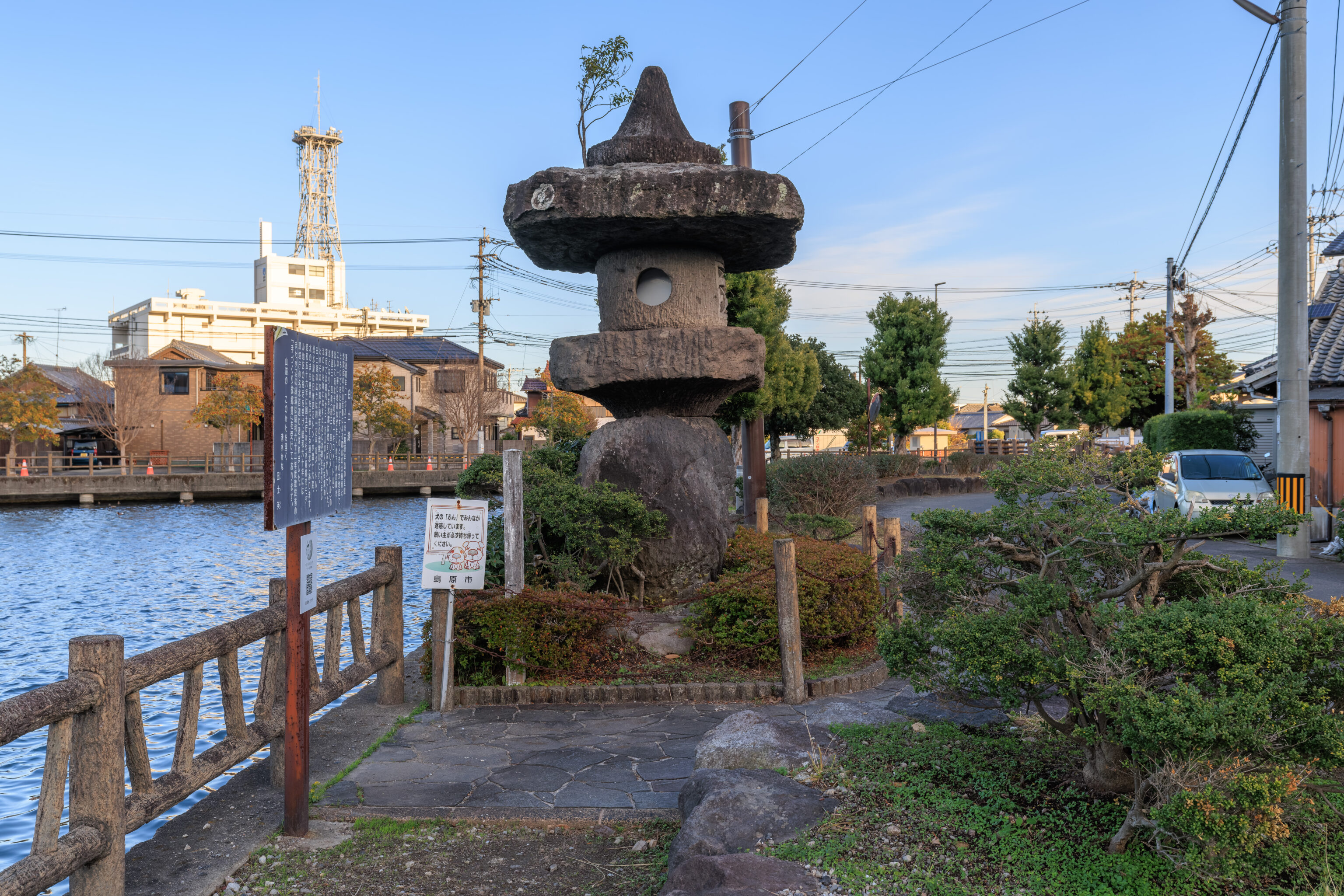
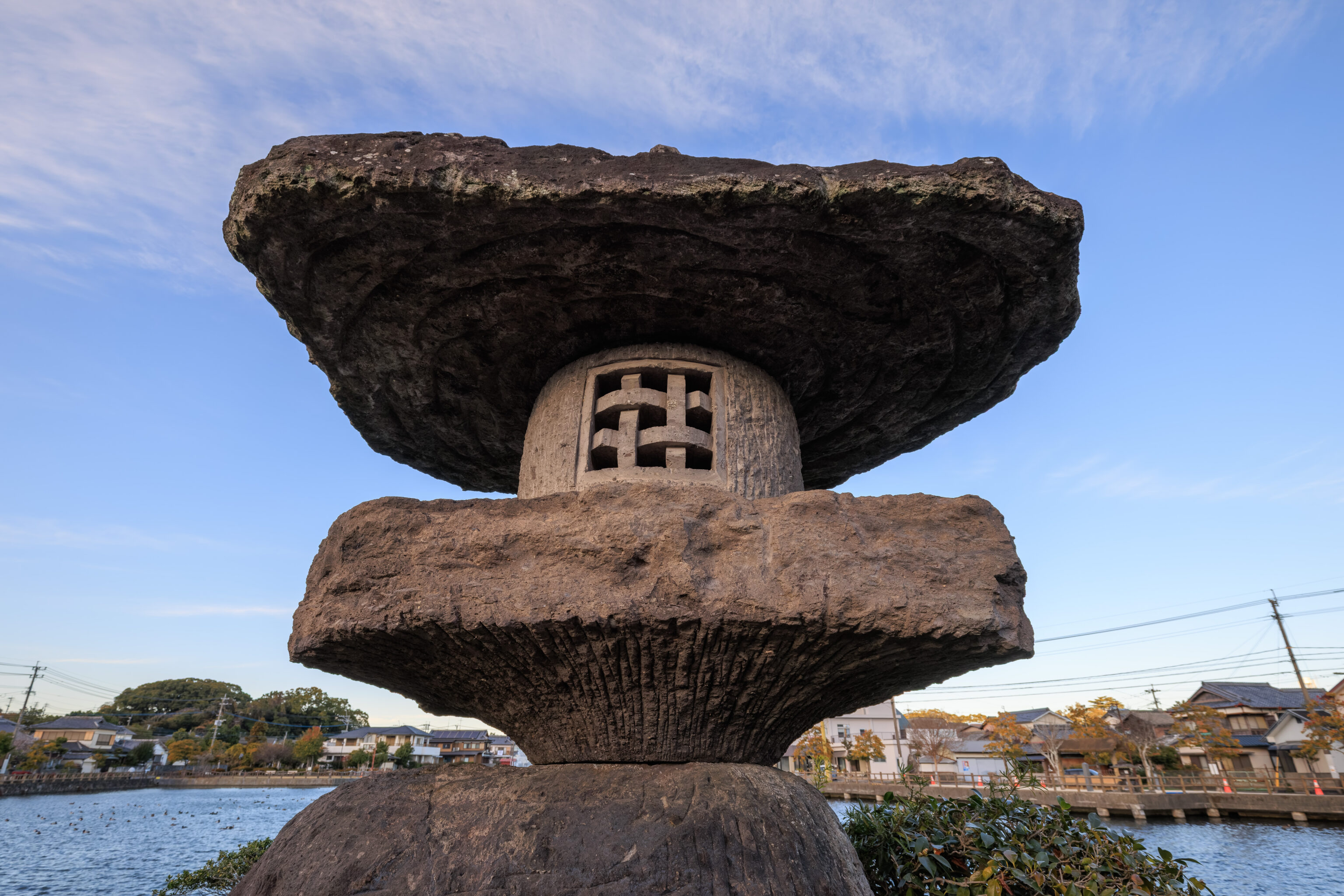
There was a large stone lantern, seen here from two different perspectives, on the south side of the lake. A sign near the lantern provided a description of the lake.
Shirachi-ko (Lake Shirachi)
This lake was formed in 1792 (the fourth year of the Kansei era) during the massive collapse of Mt. Mayu, triggered by volcanic activity at Mt. Fugen on the Shimabara Peninsula. The cataclysmic event caused fissures to open across the area, allowing groundwater to gush forth and create a pond measuring approximately 1 kilometer from north to south and 300 to 400 meters from east to west; the water level continued to rise steadily. The domain administration mobilized 10,000 laborers from the region to construct a waterway to drain the pond's water into the sea; this waterway is known today as the Otonashi River.
Lake Shirachi covers an area of approximately 10,000 square meters, with a daily spring water discharge of 40,000 tons and a water temperature of 16°C; it stands as a representative spring of Shimabara, a city renowned for its water.
In 1981, the site was designated a "Model Area for Water and Greenery Cities" by the National Land Agency, and in 1985, it was selected by the Environment Agency as one of the "100 Famous Waters of Japan." Additionally, the waterside greenway received the "Handmade Hometown Award" from the Ministry of Construction in the 1987 fiscal year.
Clear waters gush forth
Since the mountain's great collapse—
Pure, cool springs abound.
— Denshi Ei
– Text from a sign, read and translated using Google Gemini and Translate.
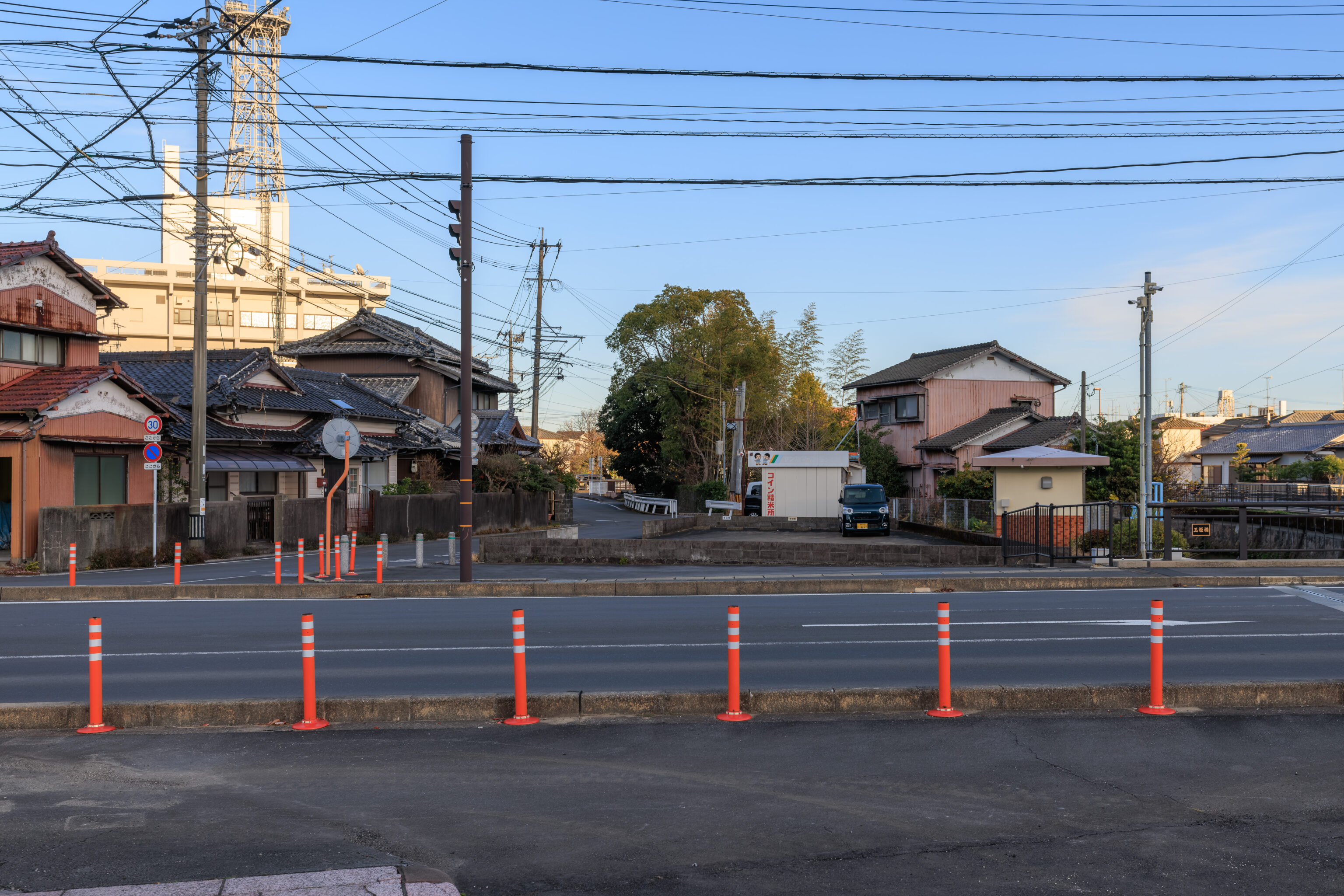
After reaching the souther tip of the lake, we crossed this street to begin walking to the east.
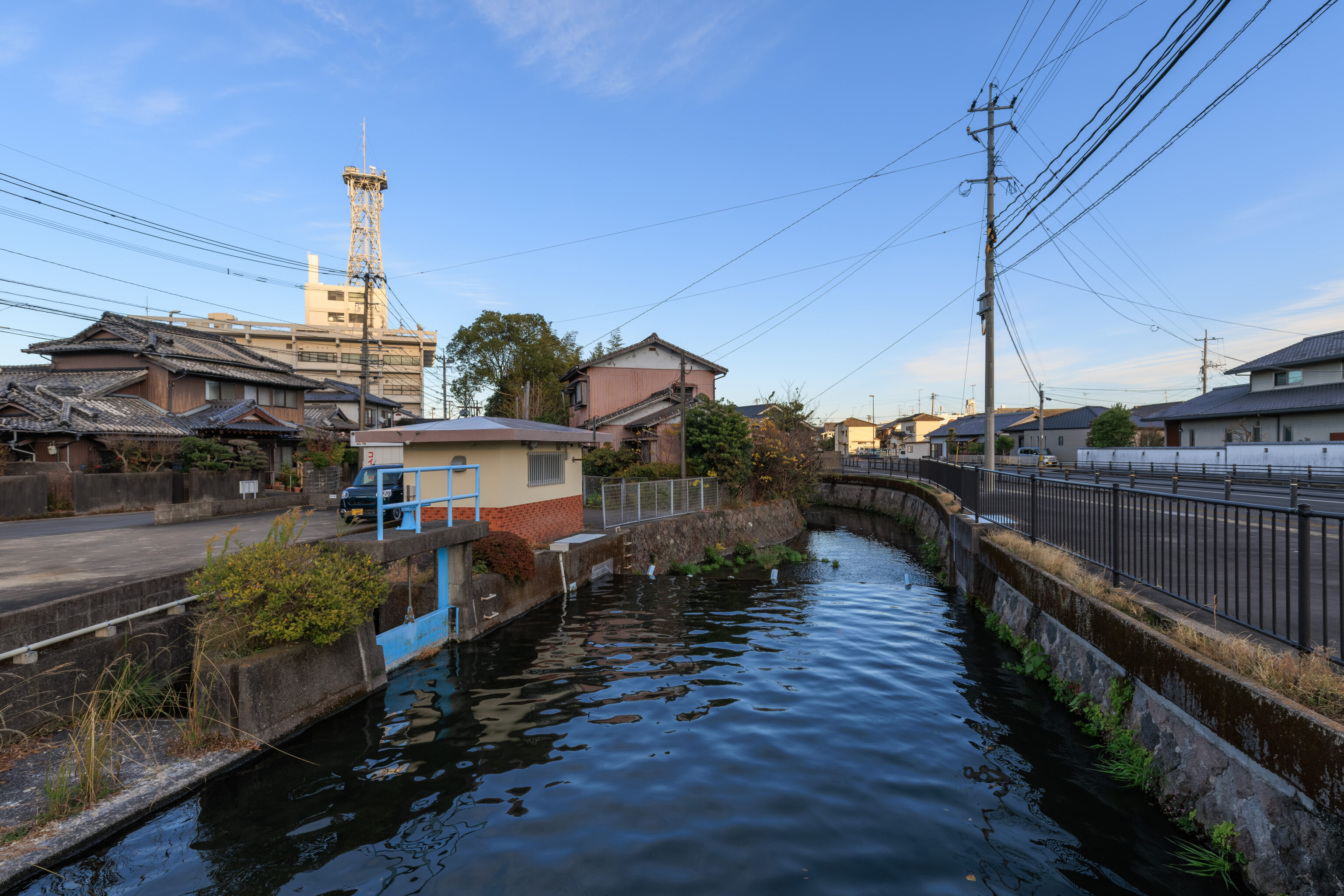
We walked over to a road by the Otonashigawa, the river that was dug by hand to reduce the amount of water in the lake.
Over on the left, in the little building next to the blue water gate, there was a coin operated rice milling machine. You bring your dry rice grain and the machine mills it so that it is ready to be cooked.
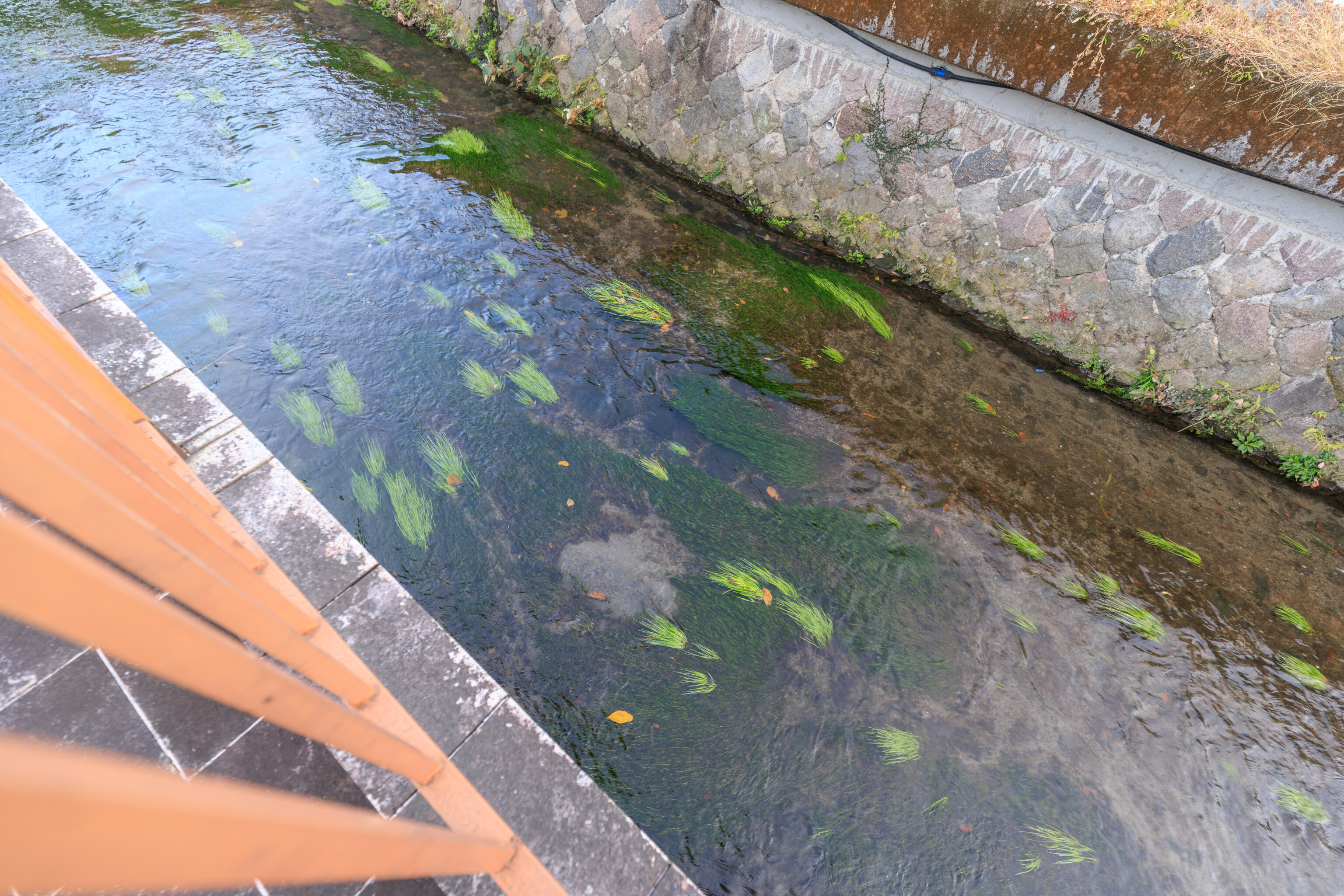
The water here was shallow and clear.
Hamanokawa Spring
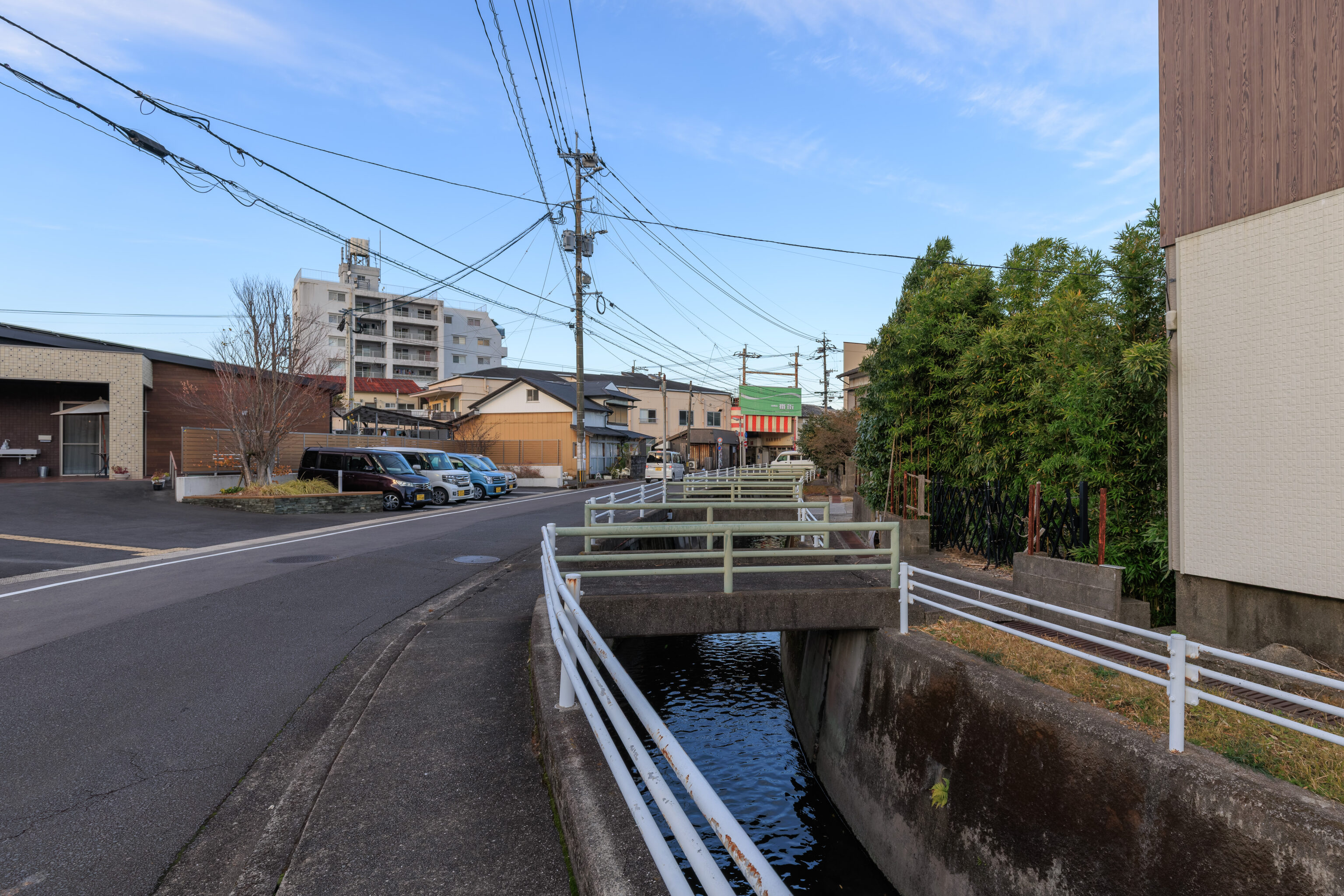
We walked to the east along the Otonashigawa’s north side to head to the 浜の川湧水 Hamanokawa Spring, the final place we plan on visiting today.
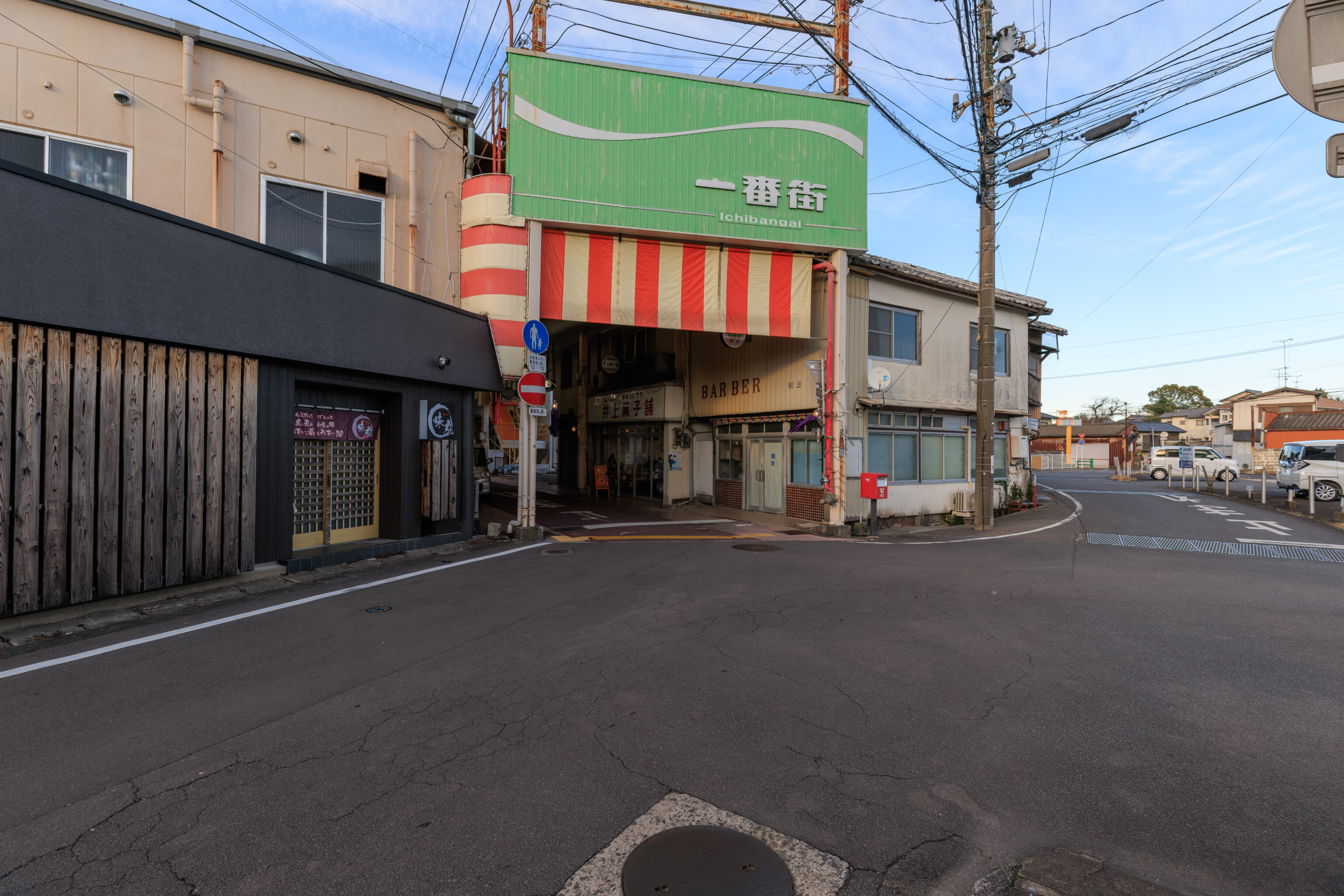
We turned to the right here, by the southern end of the 一番街 Ichibangai shopping arcade. This covered shopping street is pretty long and runs all the way back to city hall, the place where we stopped to eat our castella earlier.
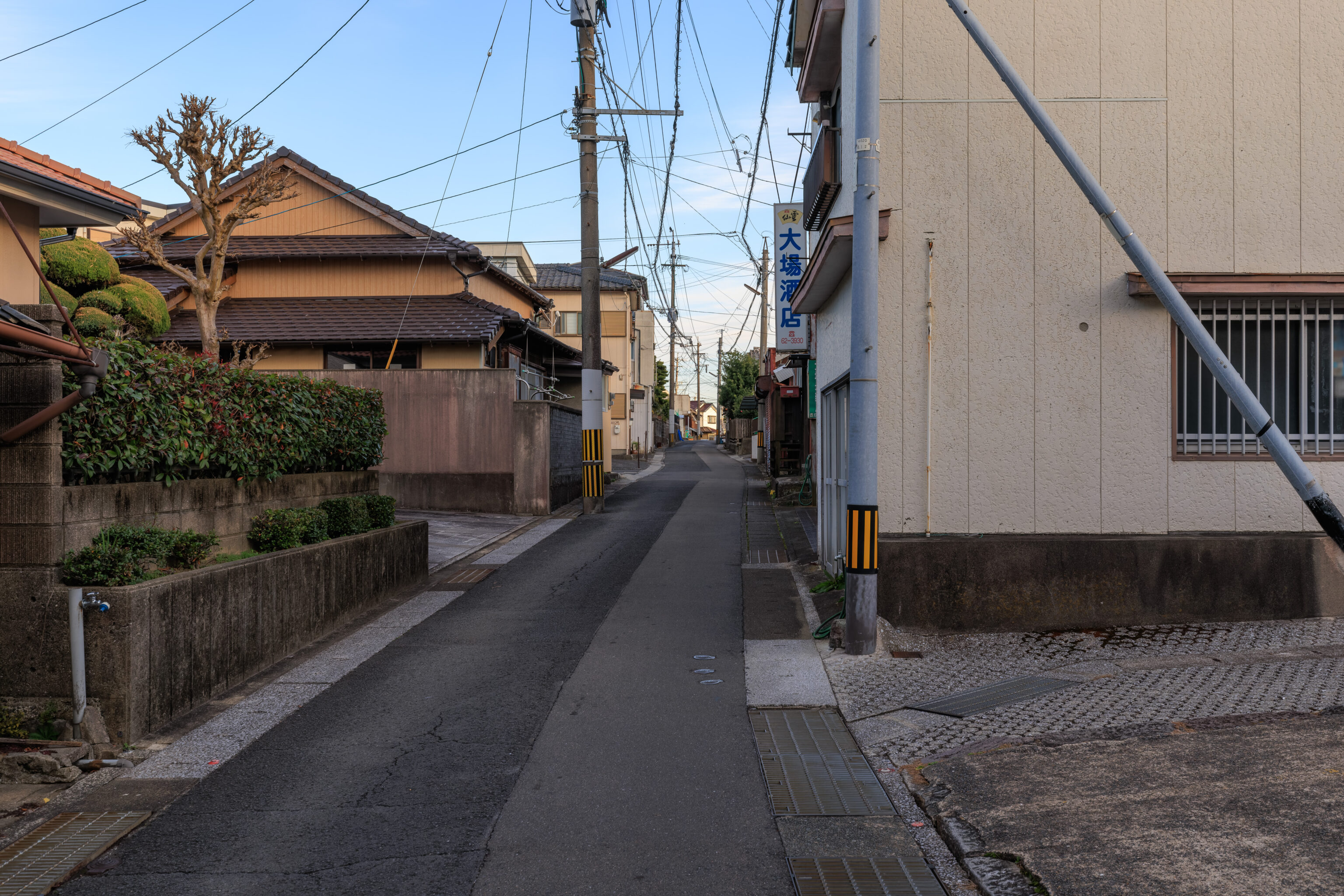
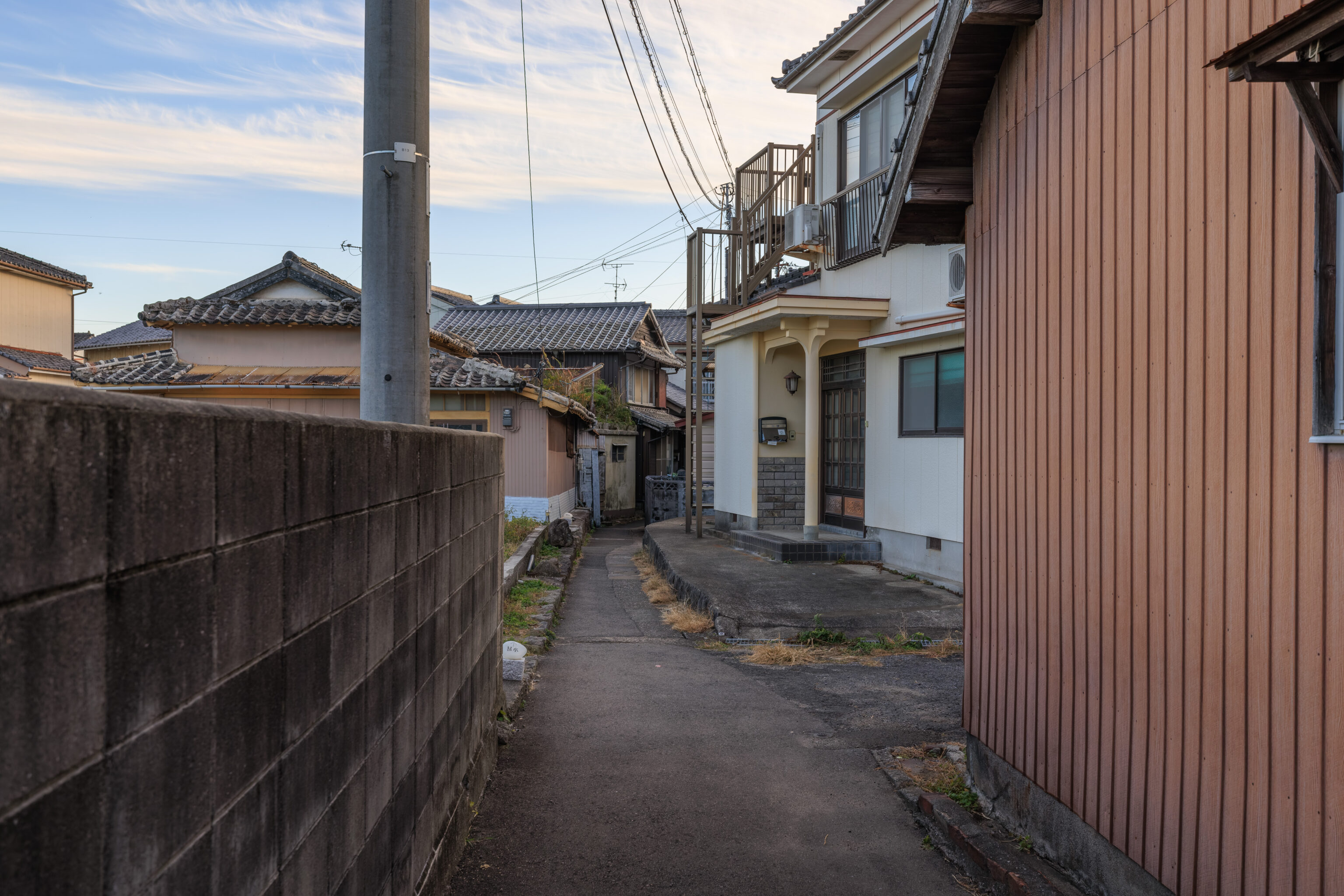
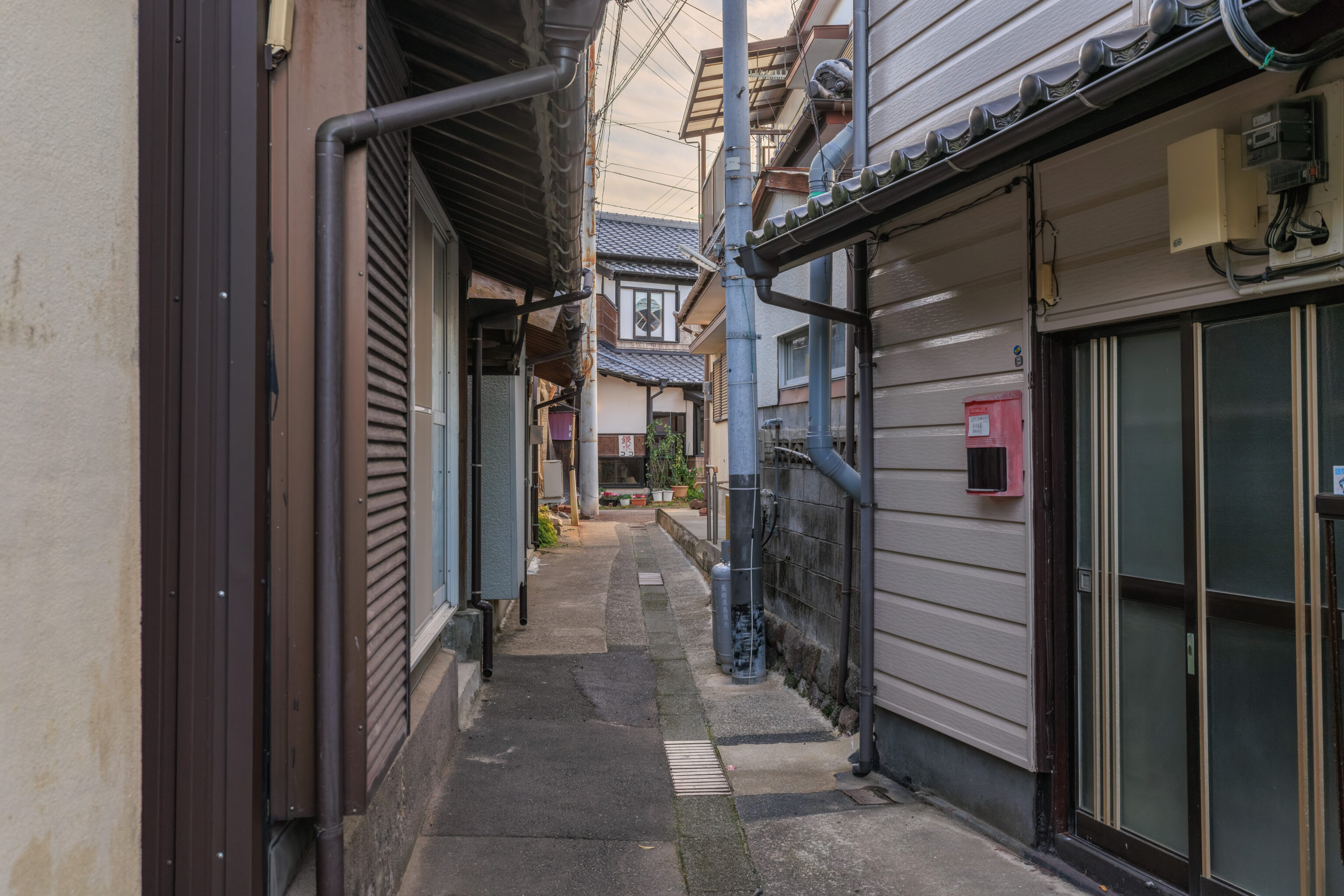
Wew walked down a much smaller road for awhile before turning right to head south. This area was a bit of a maze of narrow alleys.
Markers on the ground like this helped!
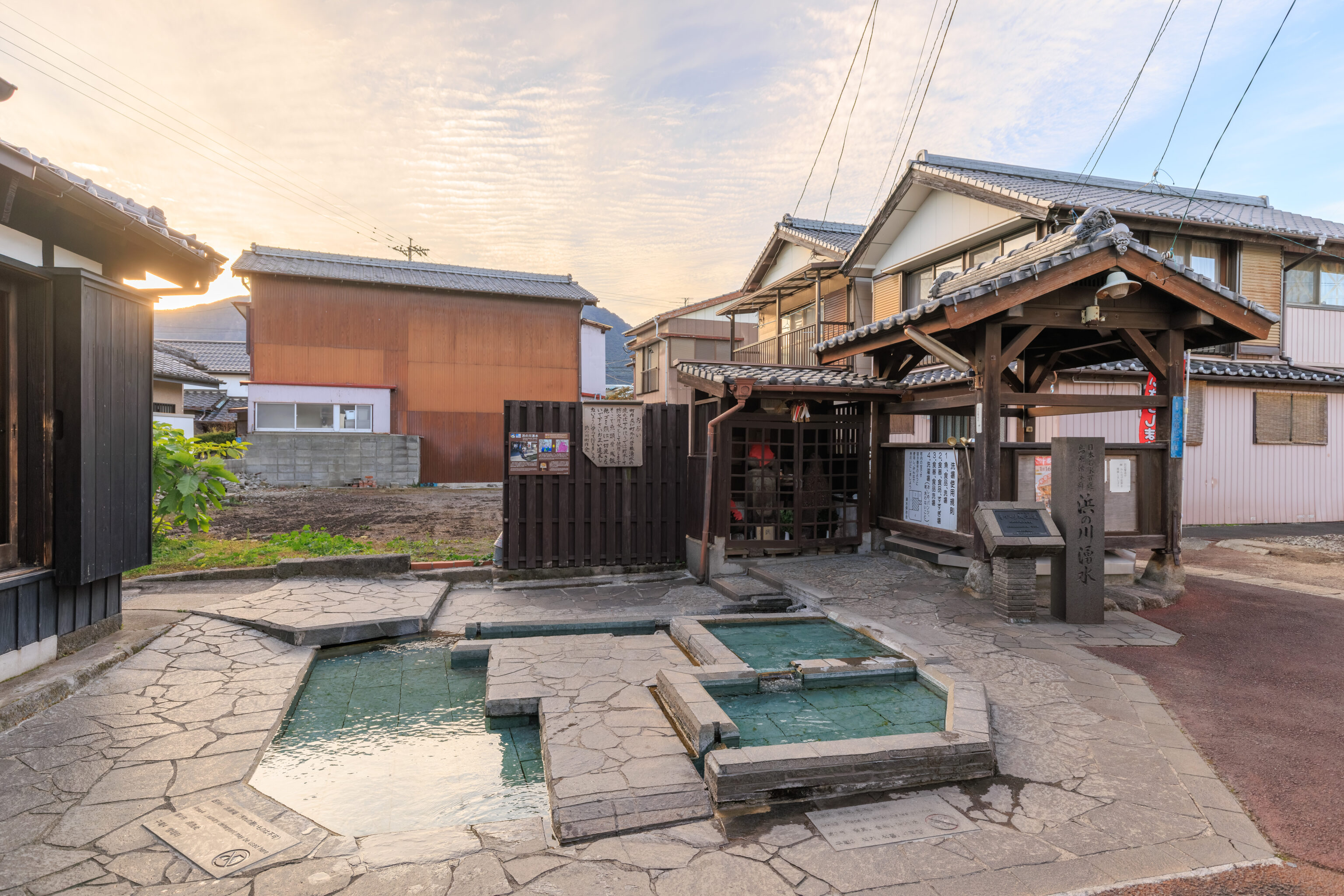
Finally, we reached our destination, the Hamanokawa Spring!
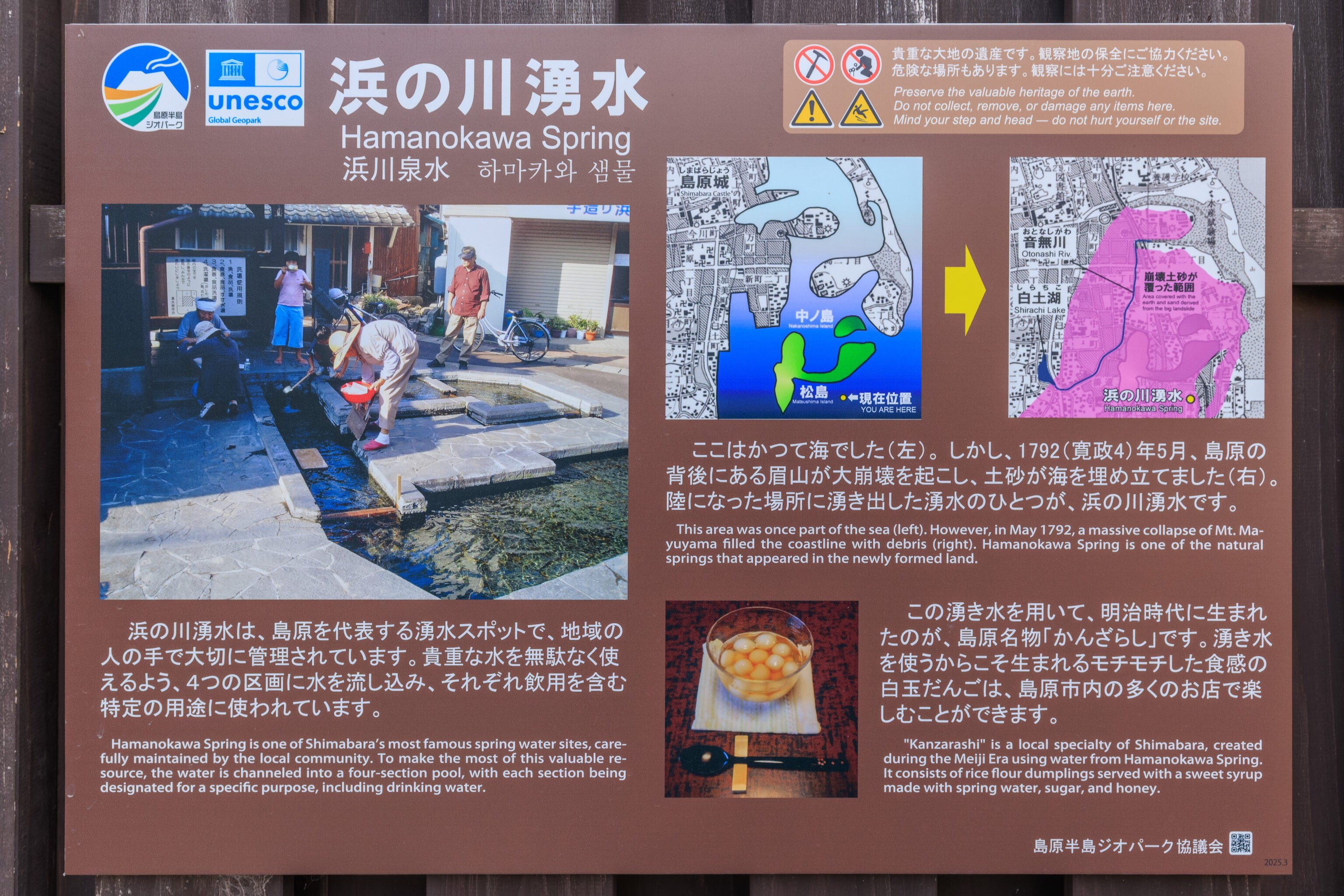
Hamanokawa Spring
Hamanokawa Spring is one of Shimabara's most famous spring water sites, carefully maintained by the local community. To make the most of this valuable resource, the water is channeled into a four-section pool, with each section being designated for a specific purpose, including drinking water.

This area was once part of the sea (left). However, in May 1792, a massive collapse of Mt. Mayuyama filled the coastline with debris (right). Hamanokawa Spring is one of the natural springs that appeared in the newly formed land.

"Kanzarashi" is a local specialty of Shimabara, created during the Meiji Era using water from Hamanokawa Spring. It consists of rice flour dumplings served with a sweet syrup made with spring water, sugar, and honey.
– Text from the sign above.
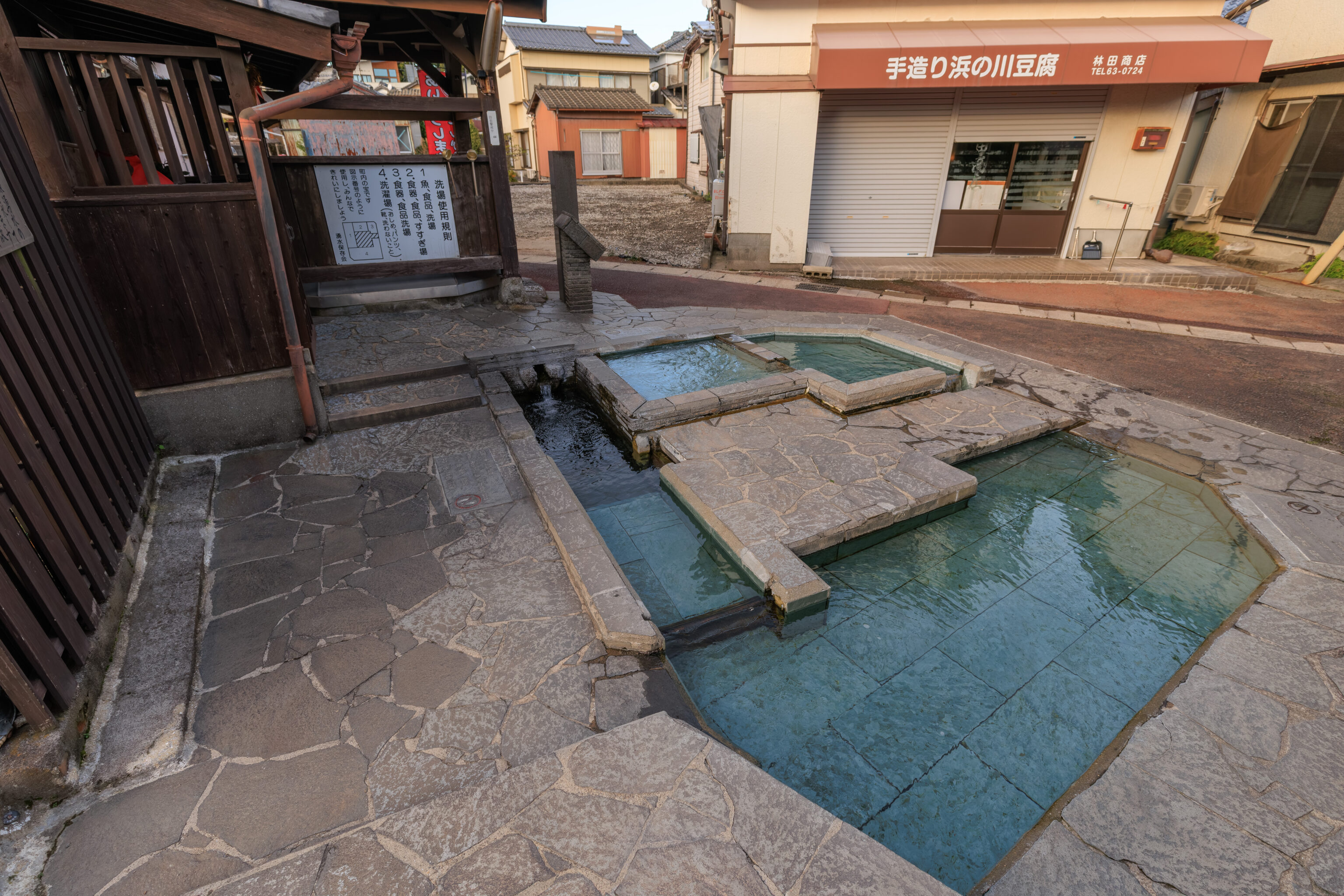
The spring water is not just used for drinking and cooking, it can also be used here for washing food, dishes, and clothes!
There are different zones for different purposes. They are marked on the sign in the background as well as on the ground.
Washing Area Rules
1. Washing area for fish and food
2. Rinsing area for dishes and food
3. Washing area for dishes and food
4. Laundry area (Do not wash diapers, underwear, or shoes here)

This is a local treasure. Please use the facilities as shown in the diagrams, and let's all keep them clean.

Spring Water Preservation Society
– Text from the sign at upper left, read and translated using Google Gemini and Translate.
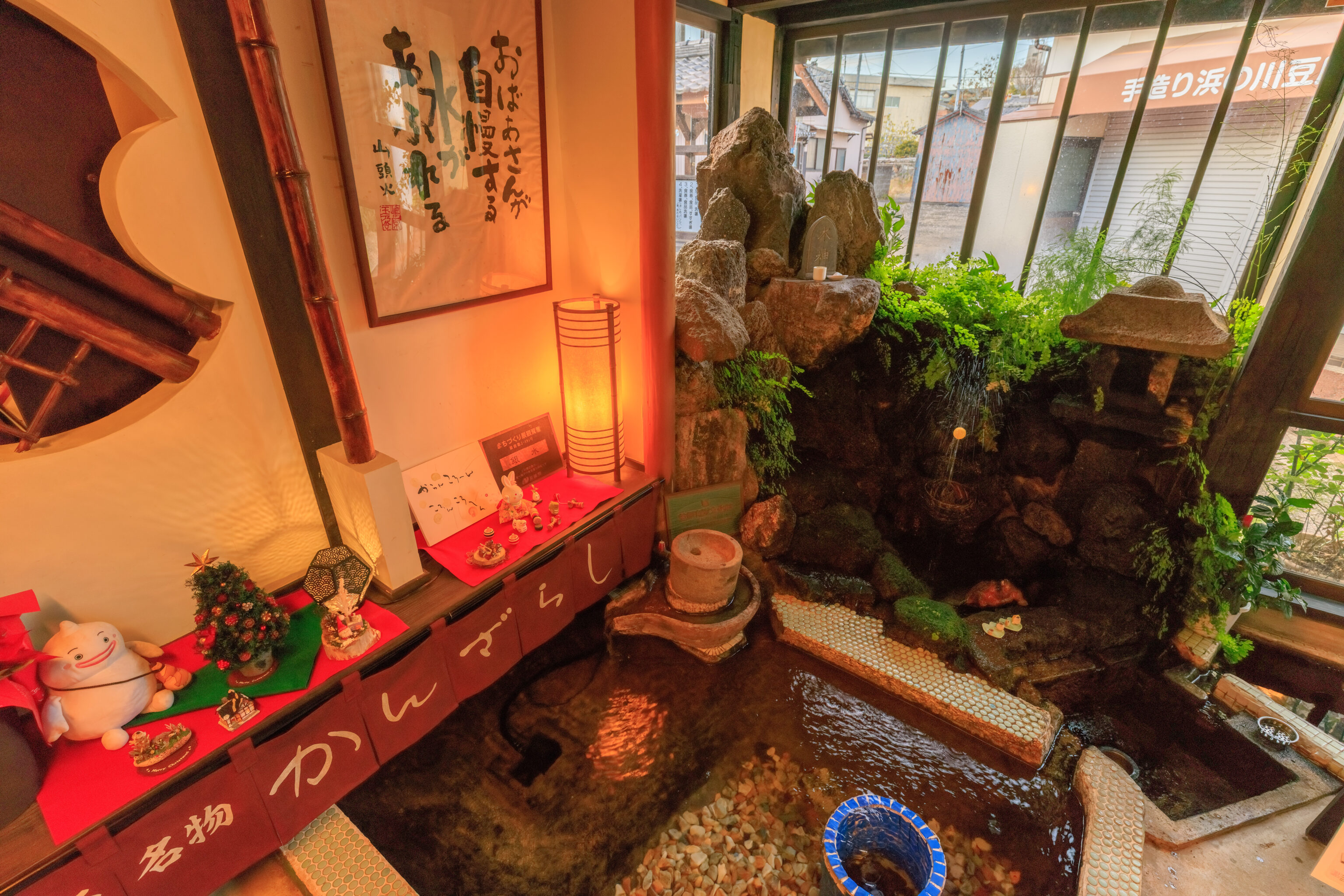
Hamanokawa Spring is right next to 銀水 Ginsui (Silver Water), a cafe that makes かんざらし Kanzarashi.
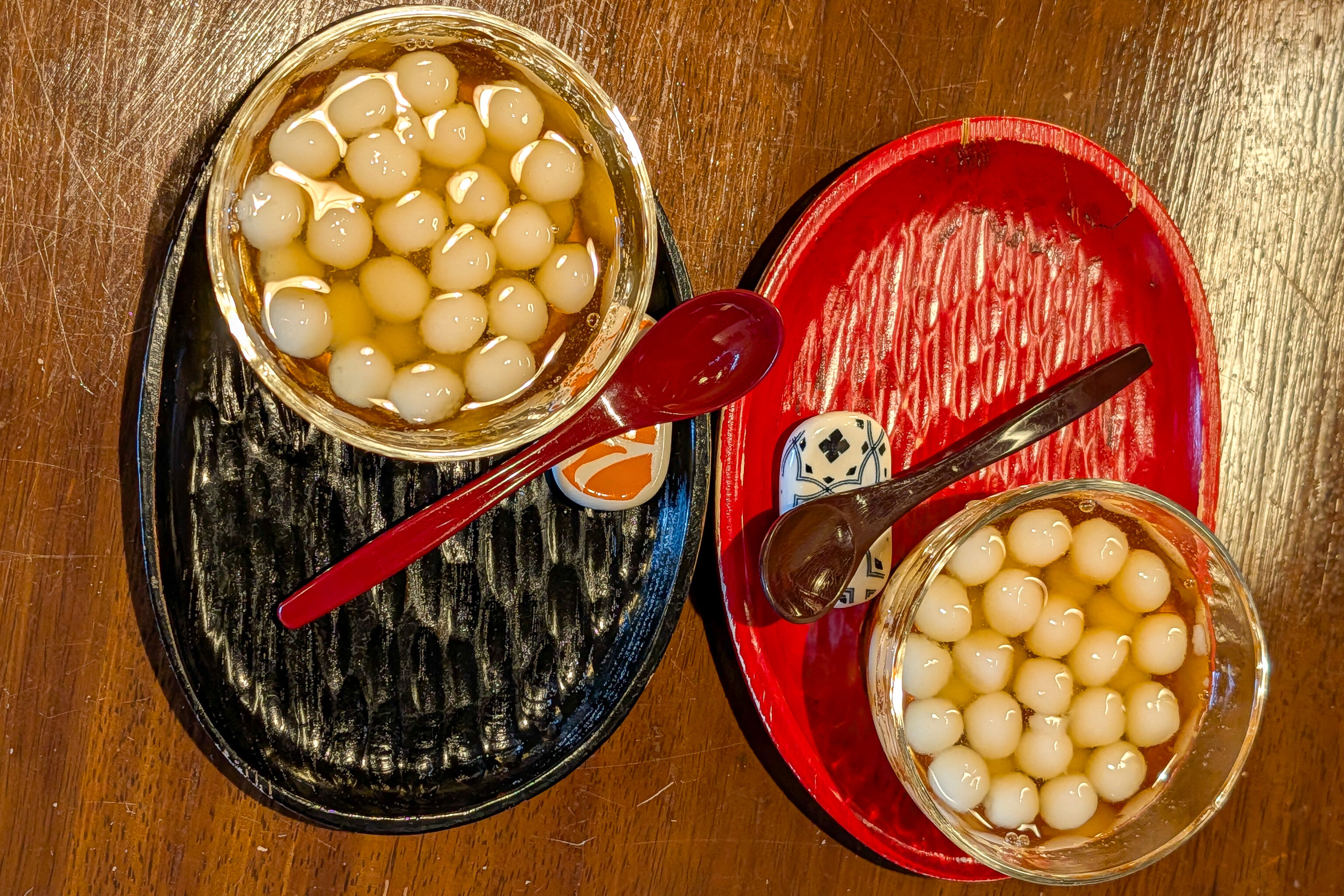
Kanzarashi is made from glutinous rice flour and prepared using the spring water from the Hamanokawa Spring. They are served cold in cold spring water and are consumed with honey and/or sugar. We were possibly the last customers of the day as they closed at 5pm, 10 minutes before we left.
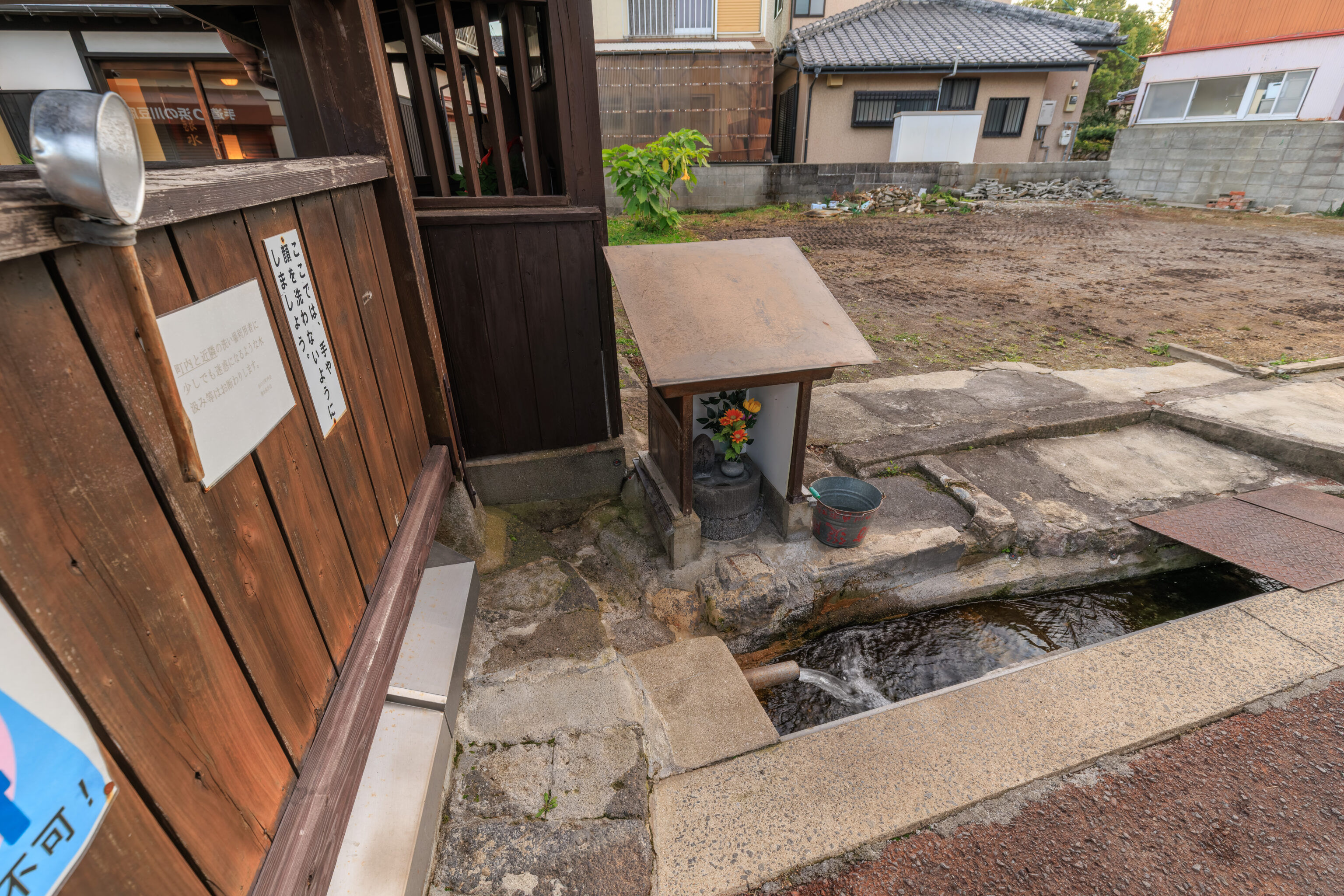
There was a little shrine outside.
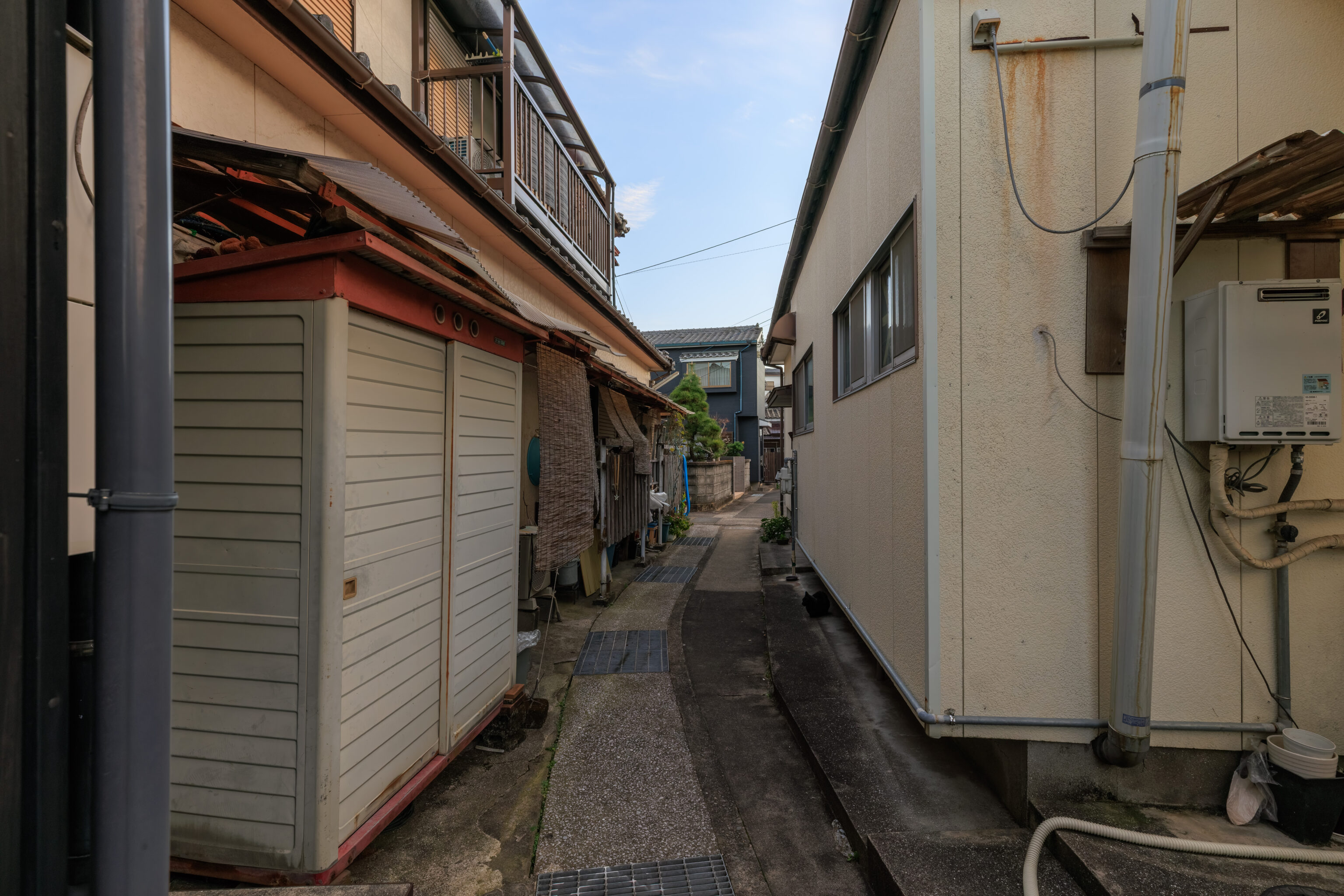
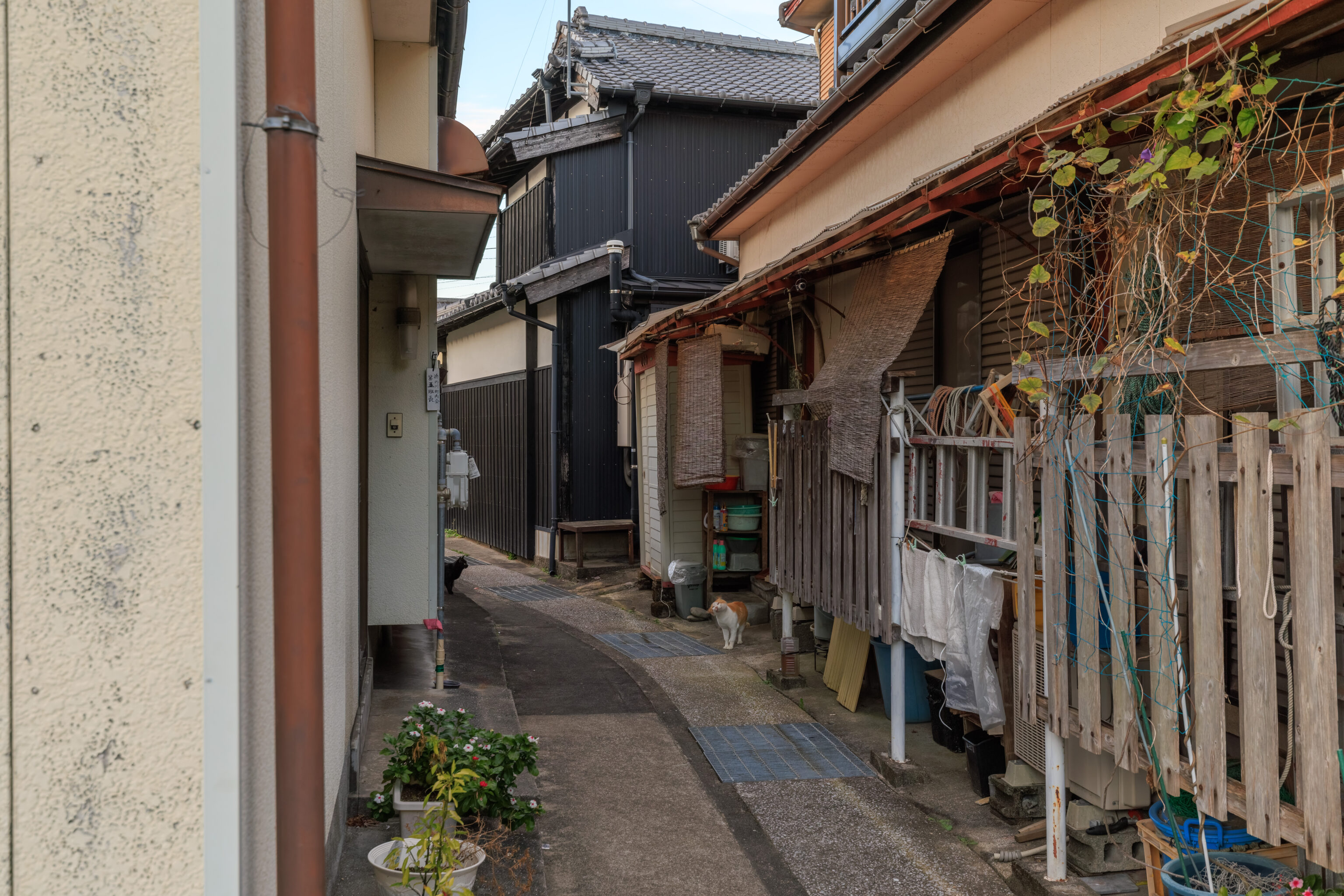
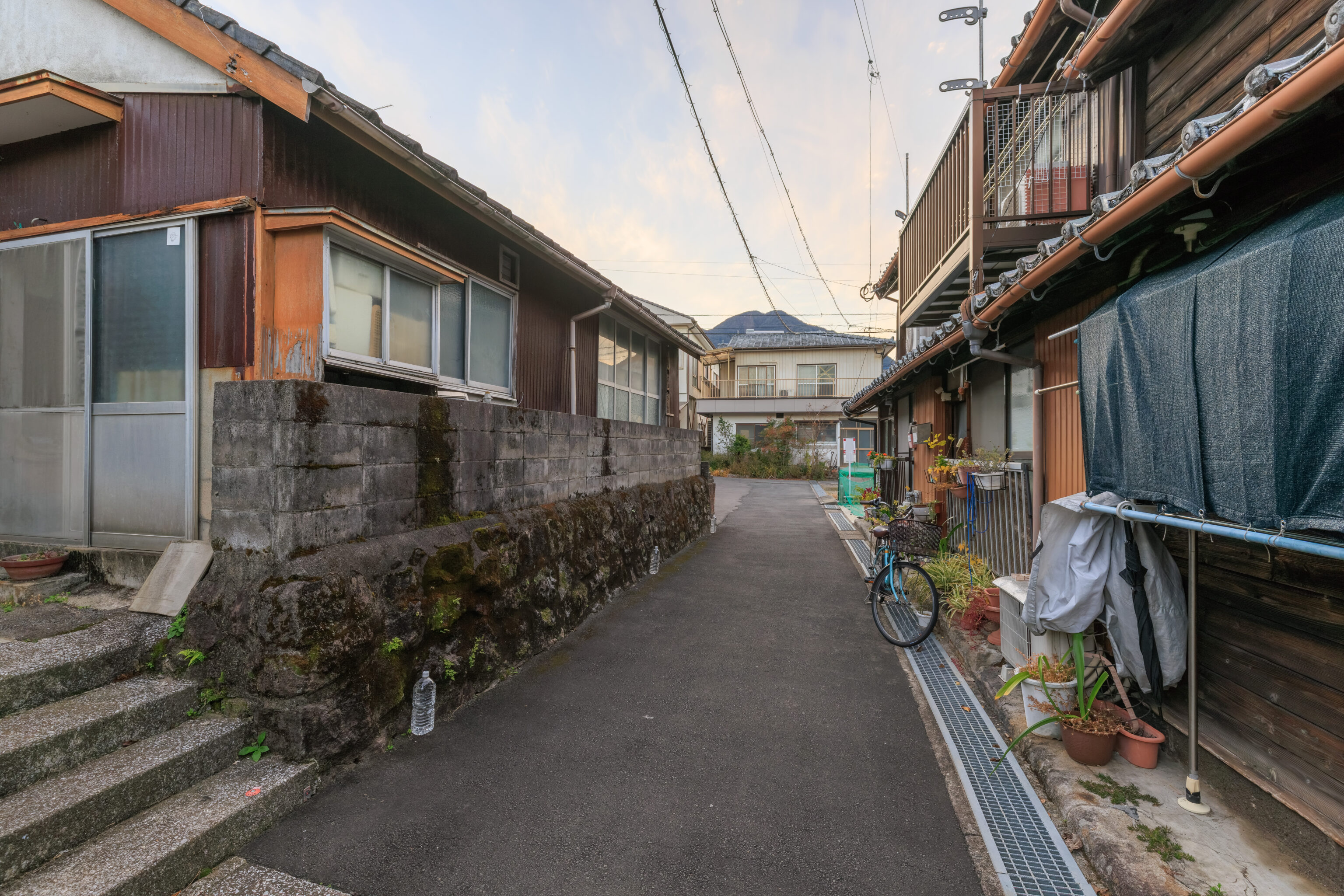
Rather than return to Shimabara Station to the north, we headed south to a closer station, Shimabara-Funatsu Station.
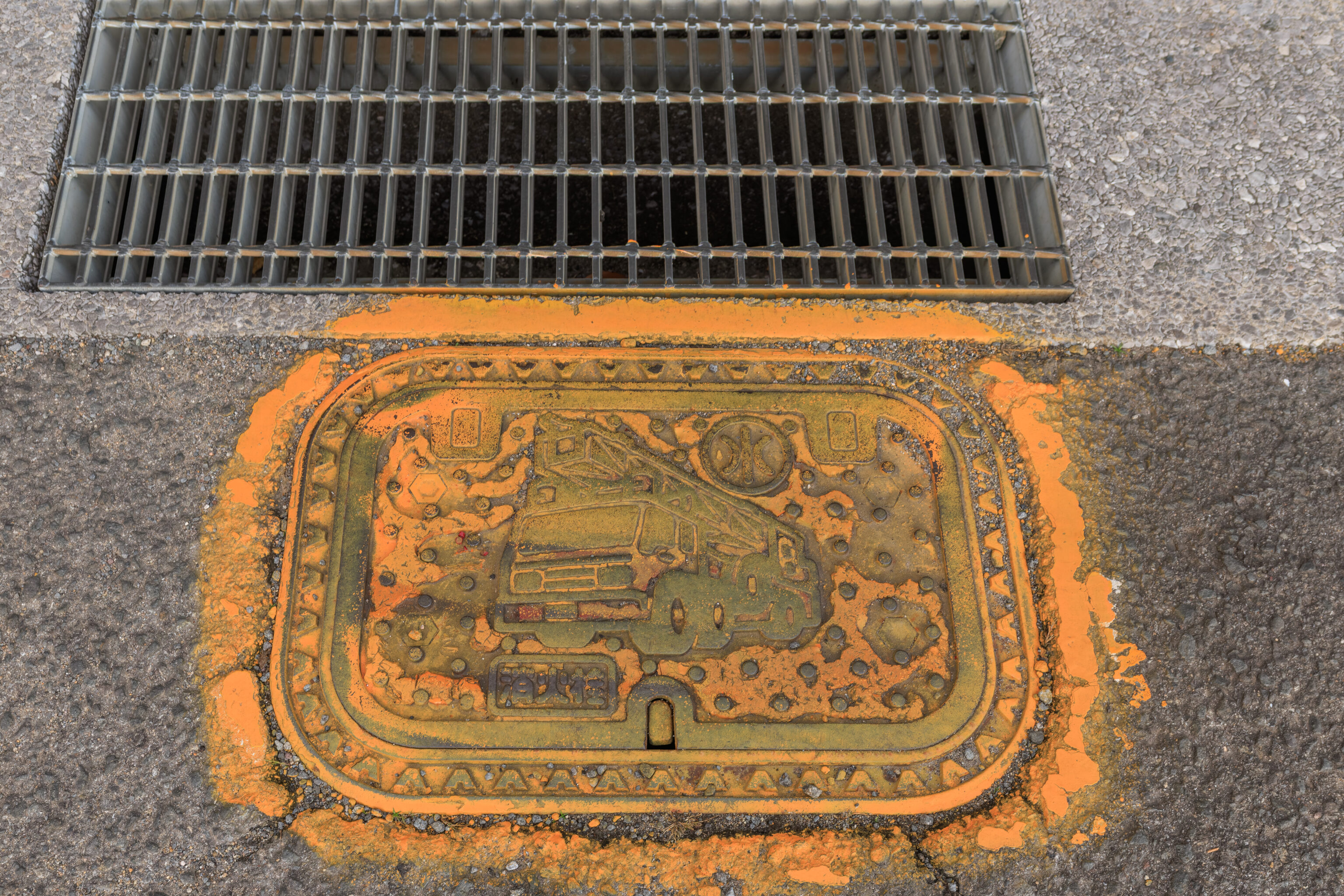
This fire truck image seems to be pretty common!
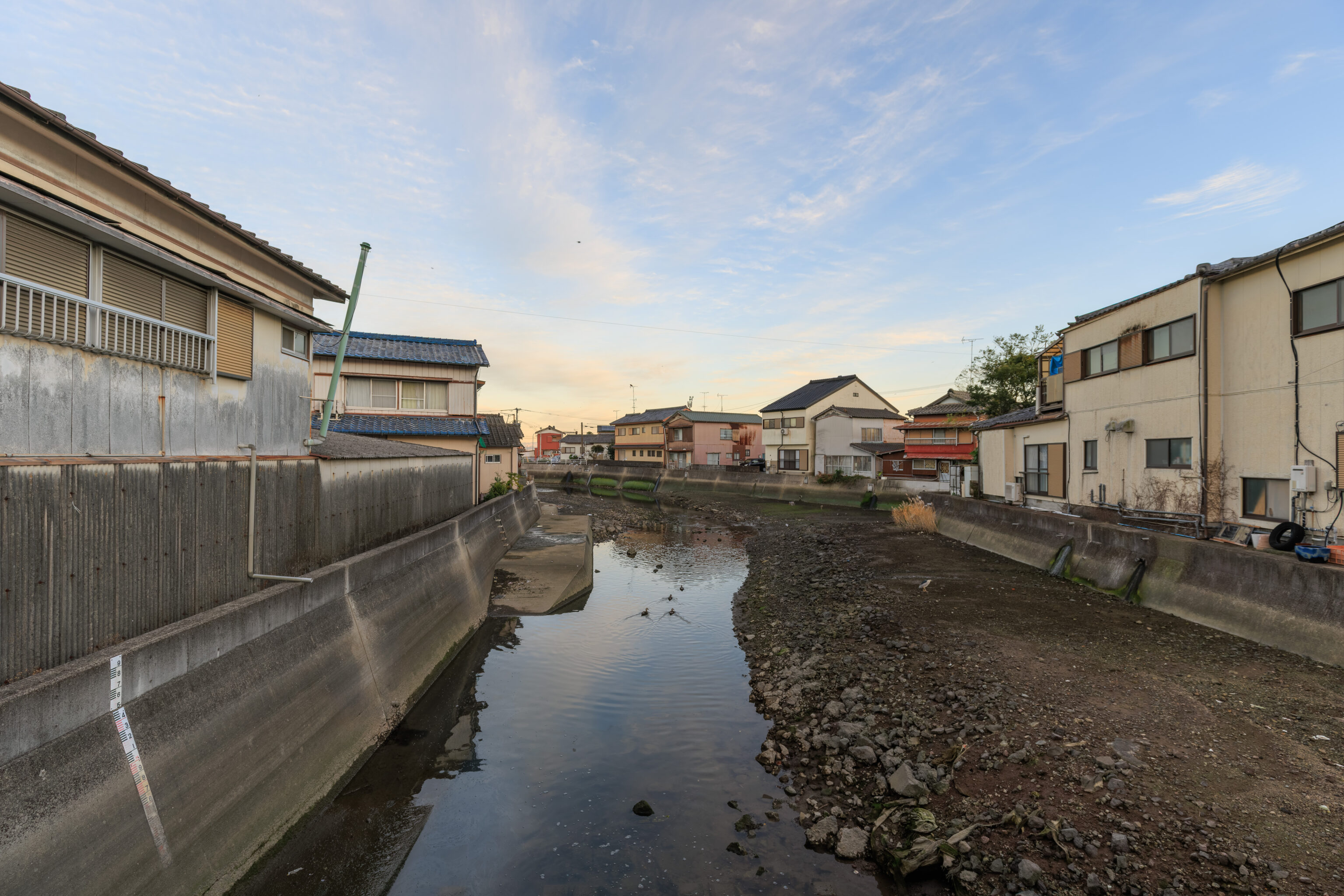
After walking for a few minutes, we crossed a river, the 白水川 White Water River.
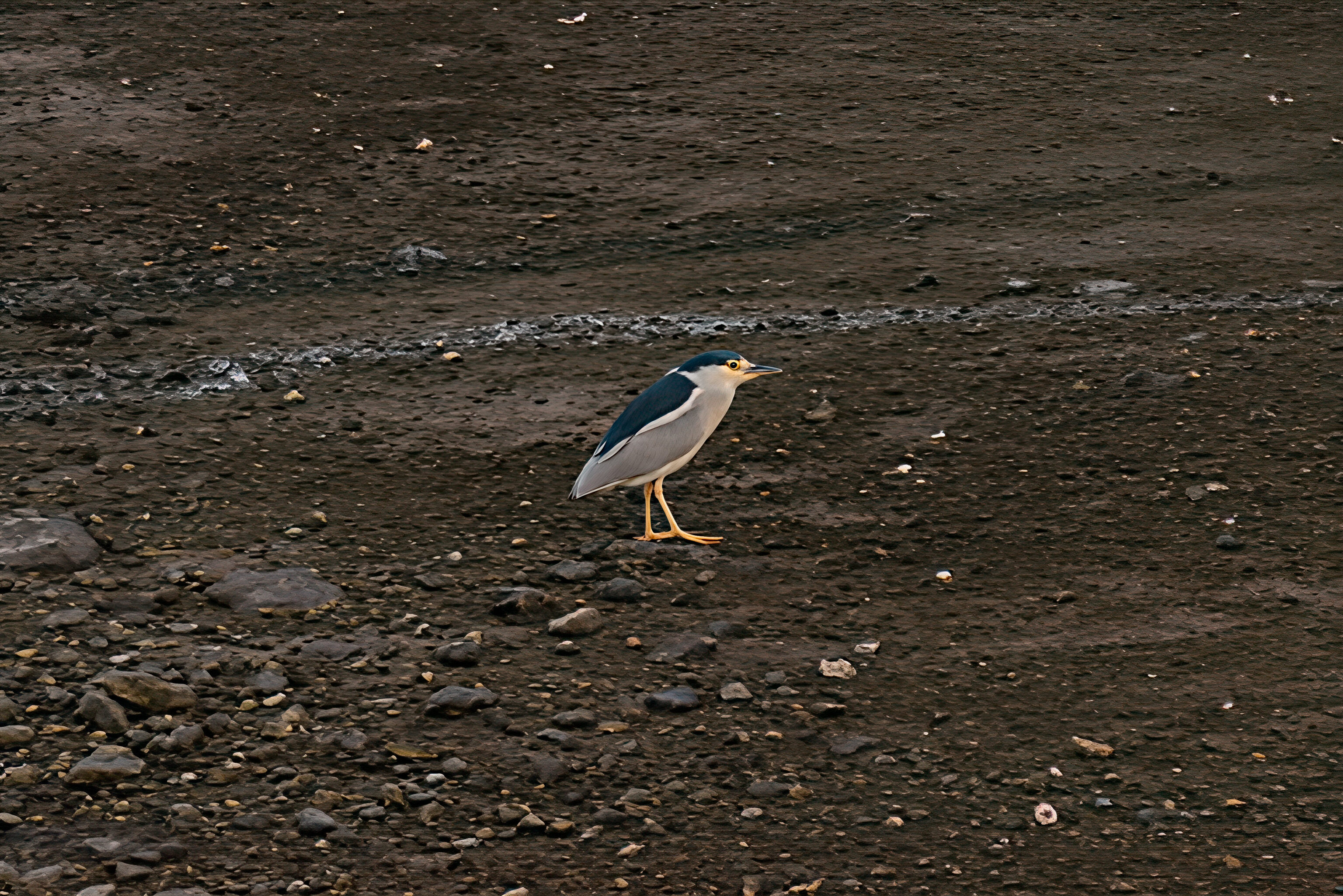
This is a highly enlarged and AI enhanced photograph of a bird we saw at this river. Well, perhaps enhanced isn’t quite the right way to phrase it. This was cropped out of the photo above it. So what species is this bird? Could it be a Black-Crowned Night Heron? This species is seen all over the world, including the US. We’ve never seen one though!
The eye color being yellow in the photograph above seems to be an AI hallucination. The original photograph simply does not have enough detail to determine eye color. The white between the black and gray also seems rather exaggerated. Taking these inaccuracies into account, it looks like it really is a Black-Crowned Night Heron!
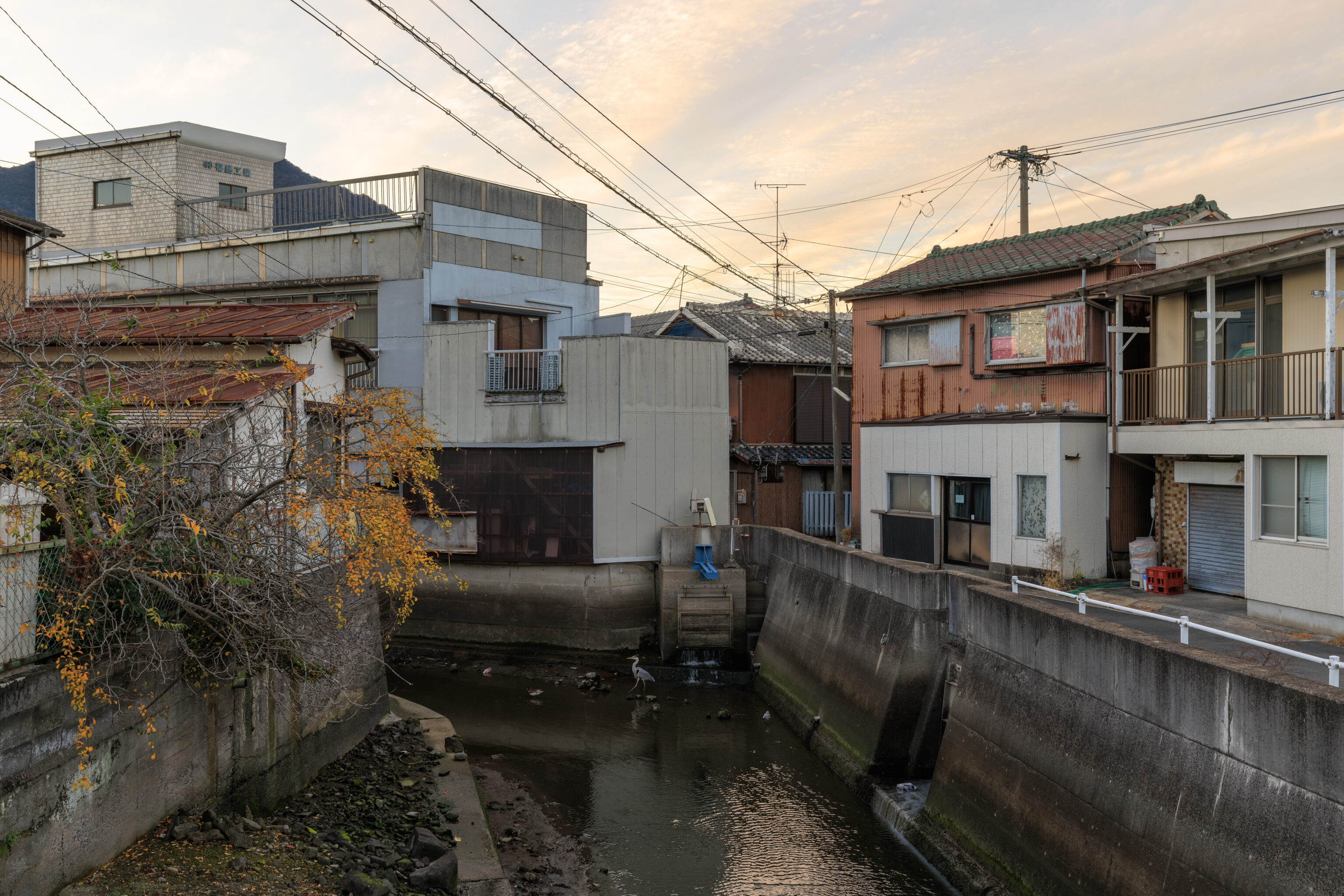
There’s another heron species here. This one is easy, Gray Heron. There’s another bird just to the left of the herojn. Its definitely a duck. maybe a Eurasian Wigeon? There are actually two other birds. The other two are facing away from us, which makes it difficult to guess what they might be.
The view looking to the west as we reached the end of the road we were walking on. The train station is in the opposite direciton.
Shimabara to Nagasaki
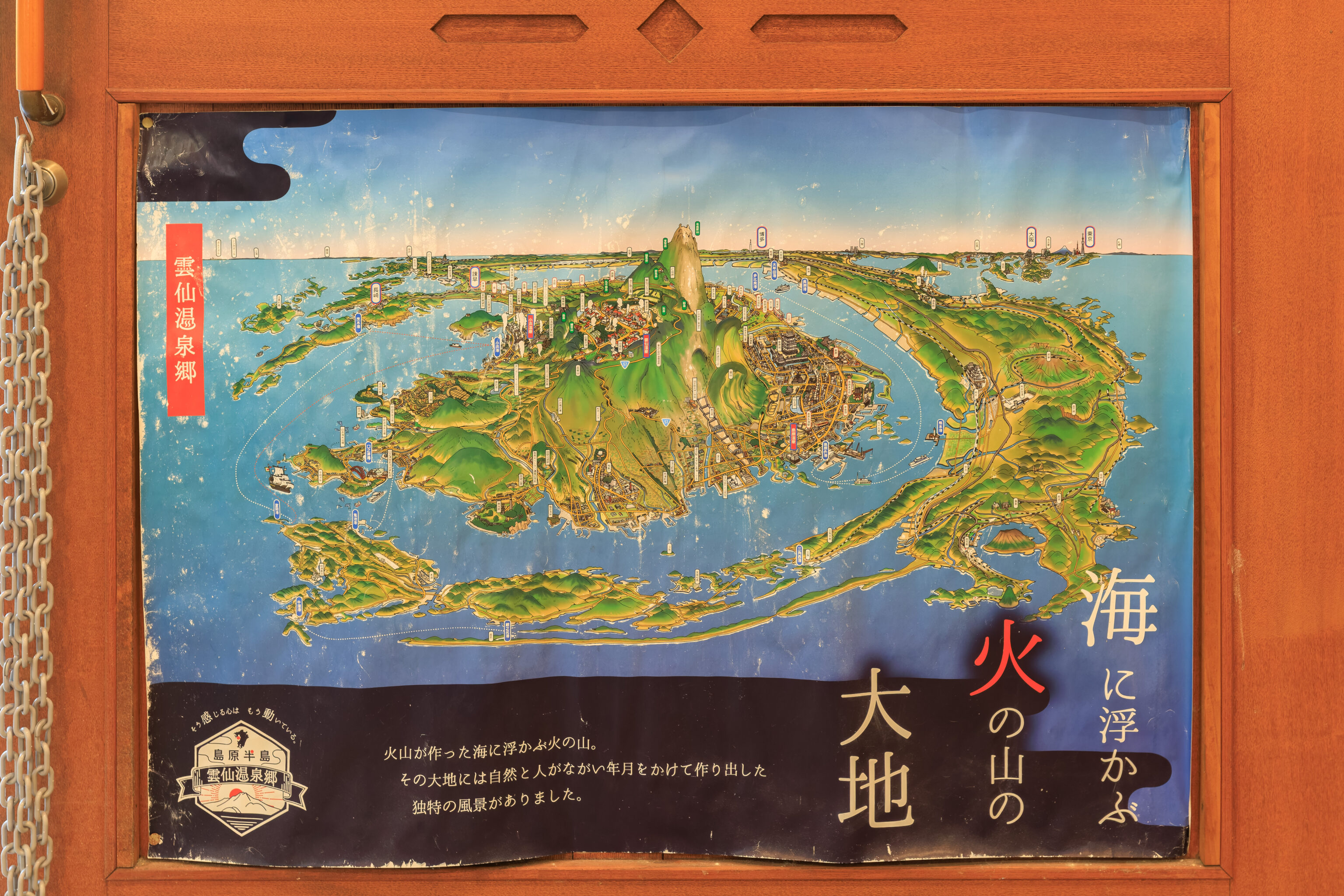
This map was at the train station. It depicts the Shimabara Peninsula, which is the land mass at the center. This seems to be advertising for the 雲仙温泉郷 Unzen Onsen Village. This hot spring area is on the southwestern side of the volcanic peaks of Mount Unzen.
A volcanic mountain rising from a sea created by volcanoes.
Across its landscape lay a unique scenery,
shaped over ages by the interplay of nature and humanity.
– Text from the map above, read and translated using Google Gemini and Translate.
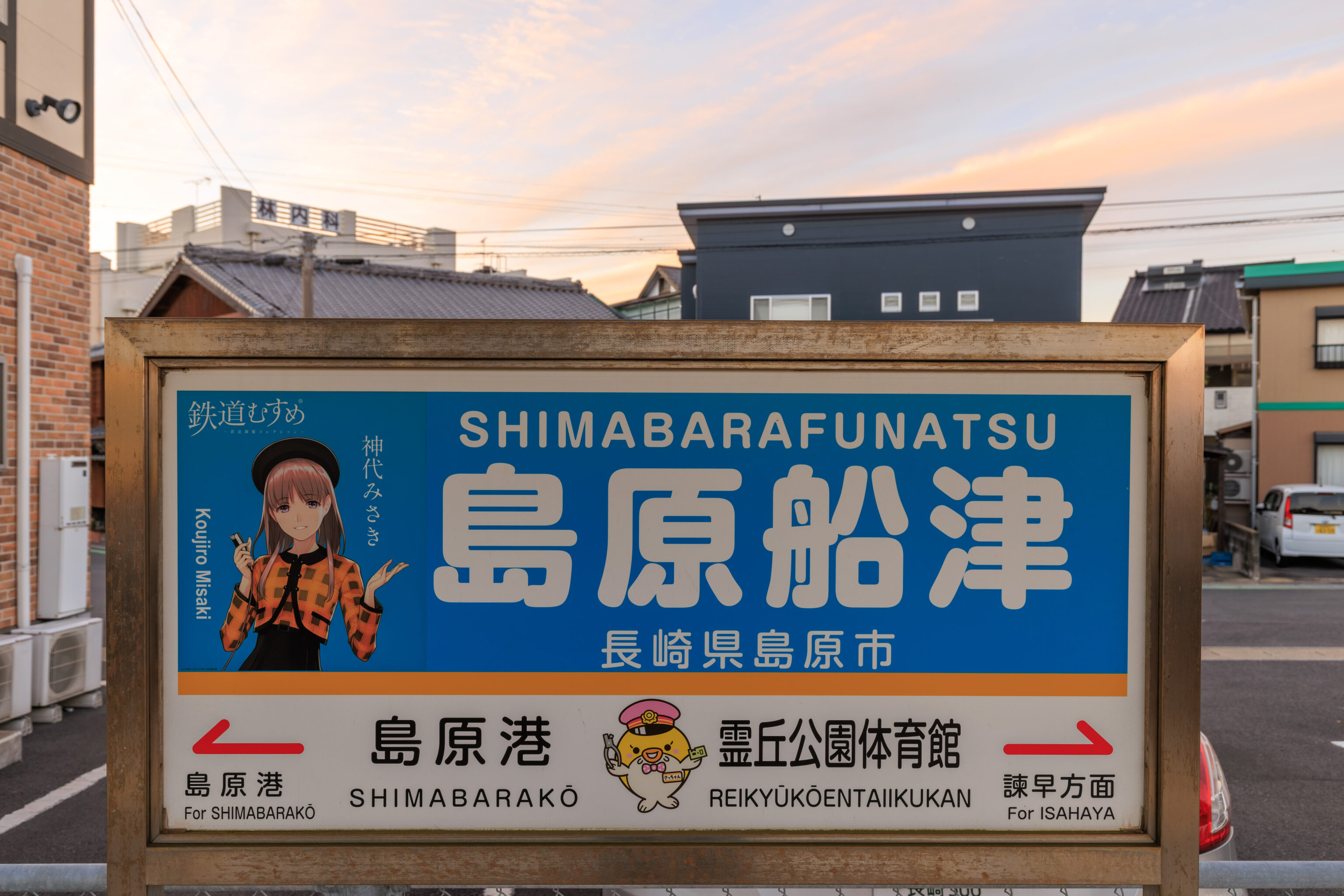
We had a good amount of time before our train would arrive here at 島原船津駅 Shimabara-Funatsu Station.
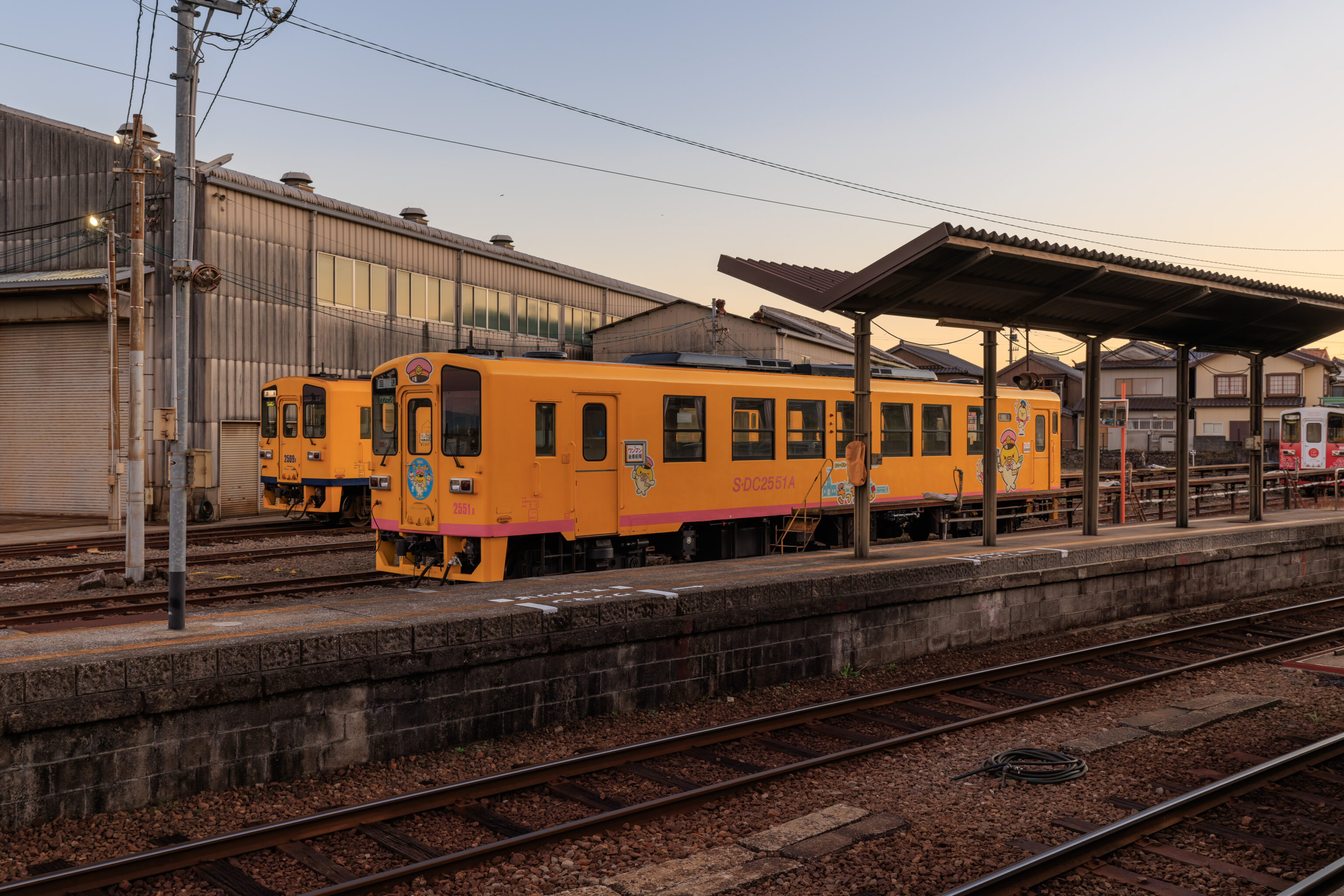
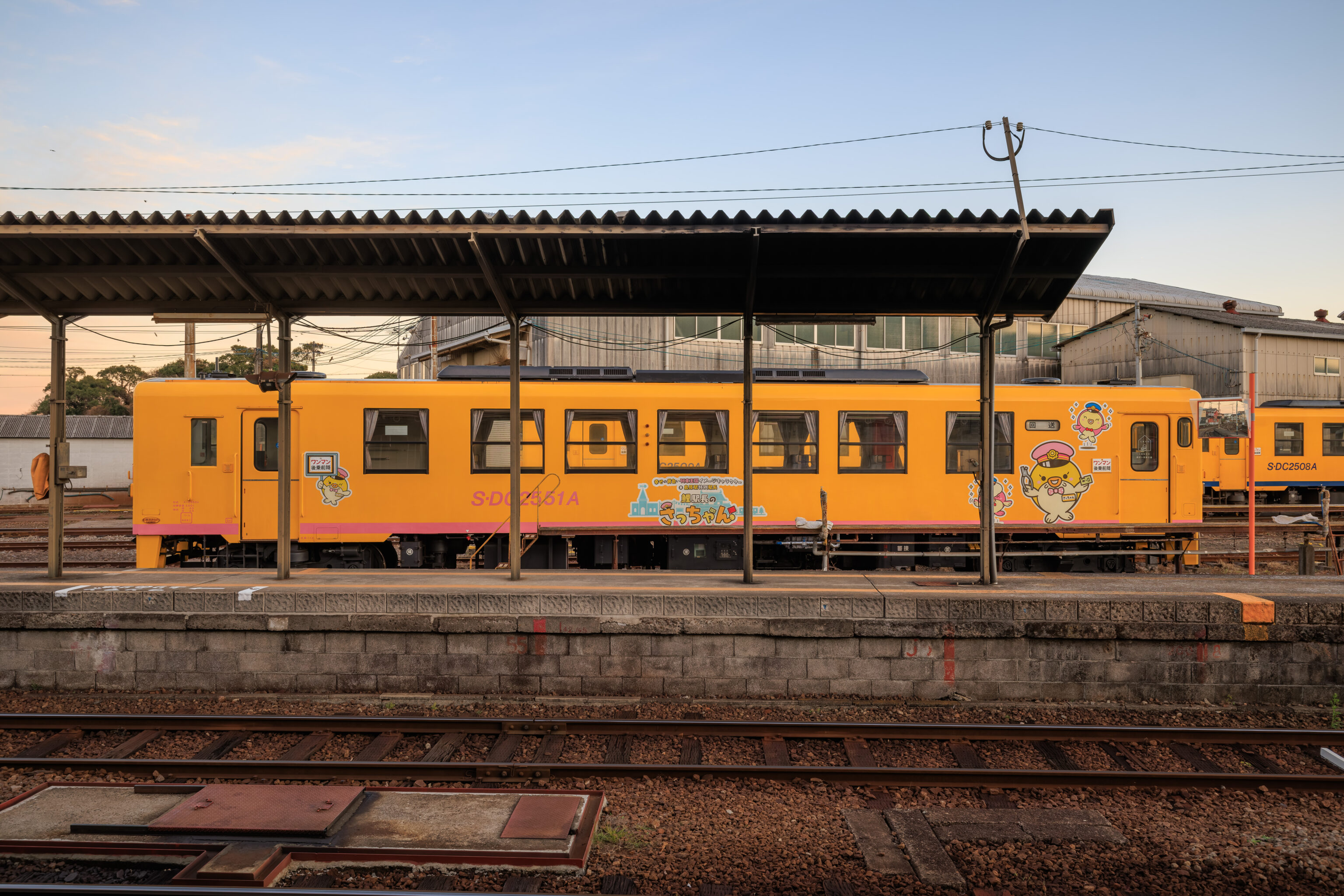
Although the station building was pretty small, it had many tracks and many parked trains. The trains all seemed to have various decorations. This one features Sacchan, the koi mascot that we saw when we arrived.
Mascot Character for the "Kingdom of Happy Yellow Trains"
Also serving as Special Stationmaster of Shimabara Station
Sacchan, the Koi Stationmaster
– Text from the center of the train, read and translated using Google Gemini and Translate.
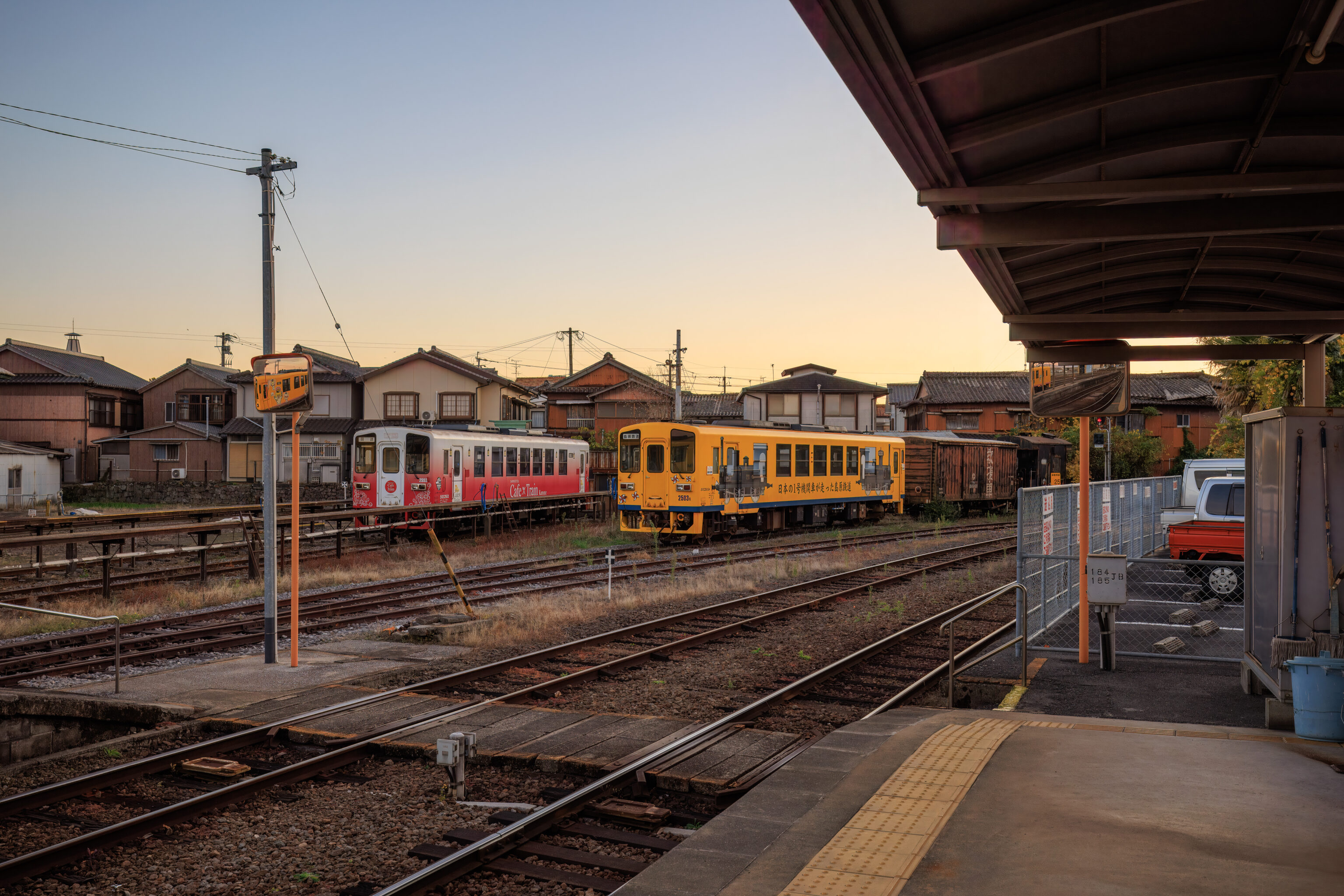
The red and white train on the left is the カフェトレイン Cafe Train. It’s exactly what it sounds like! The yellow train at center here features an old steam engine.
The Shimabara Railway, where Japan's Locomotive No. 1 ran!
– Text from the side of the yellow train, translated using Google Translate.
It turns out that this 1号機関車 Locomotive No. 1 was a steam engine built in the UK for Japan. It ran between Tokyo and Yokohama from 1872 until 1911 and then ran here on the Shimabara Railway until 1930! This engine still exists and resides at a museum in Saitama.
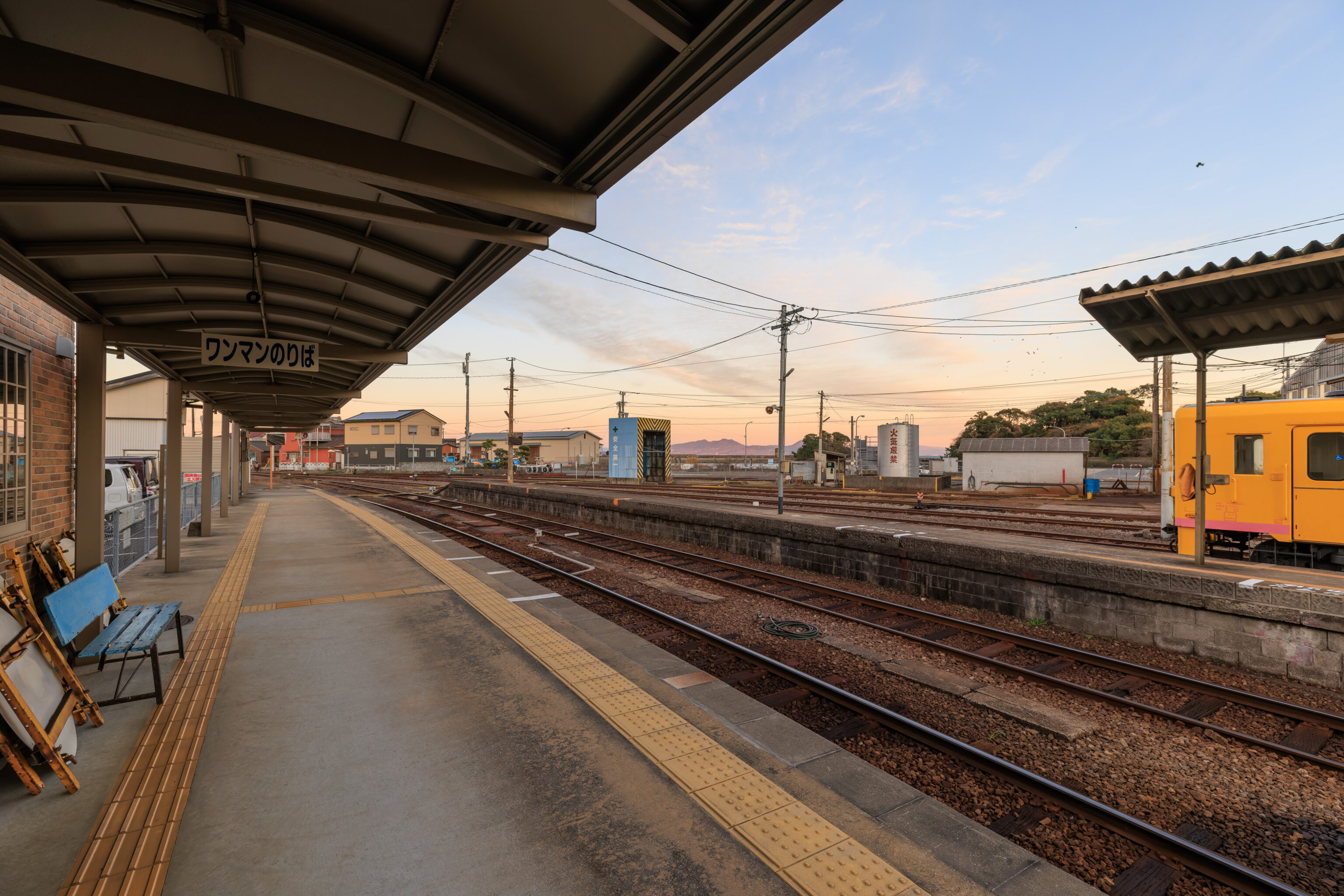
Almost sunset!
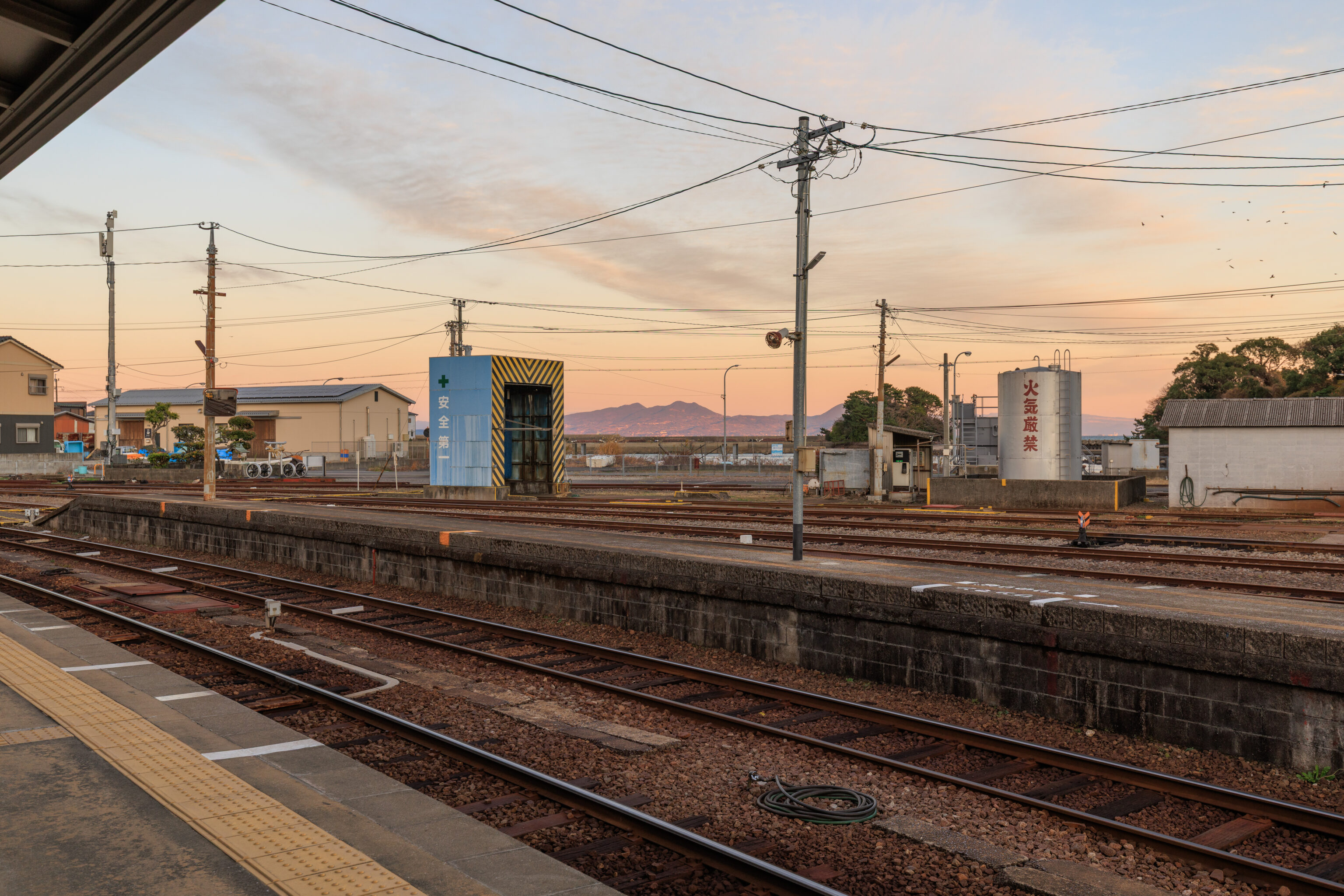
We could see the mountains were glowing in Kumamoto Prefecture.
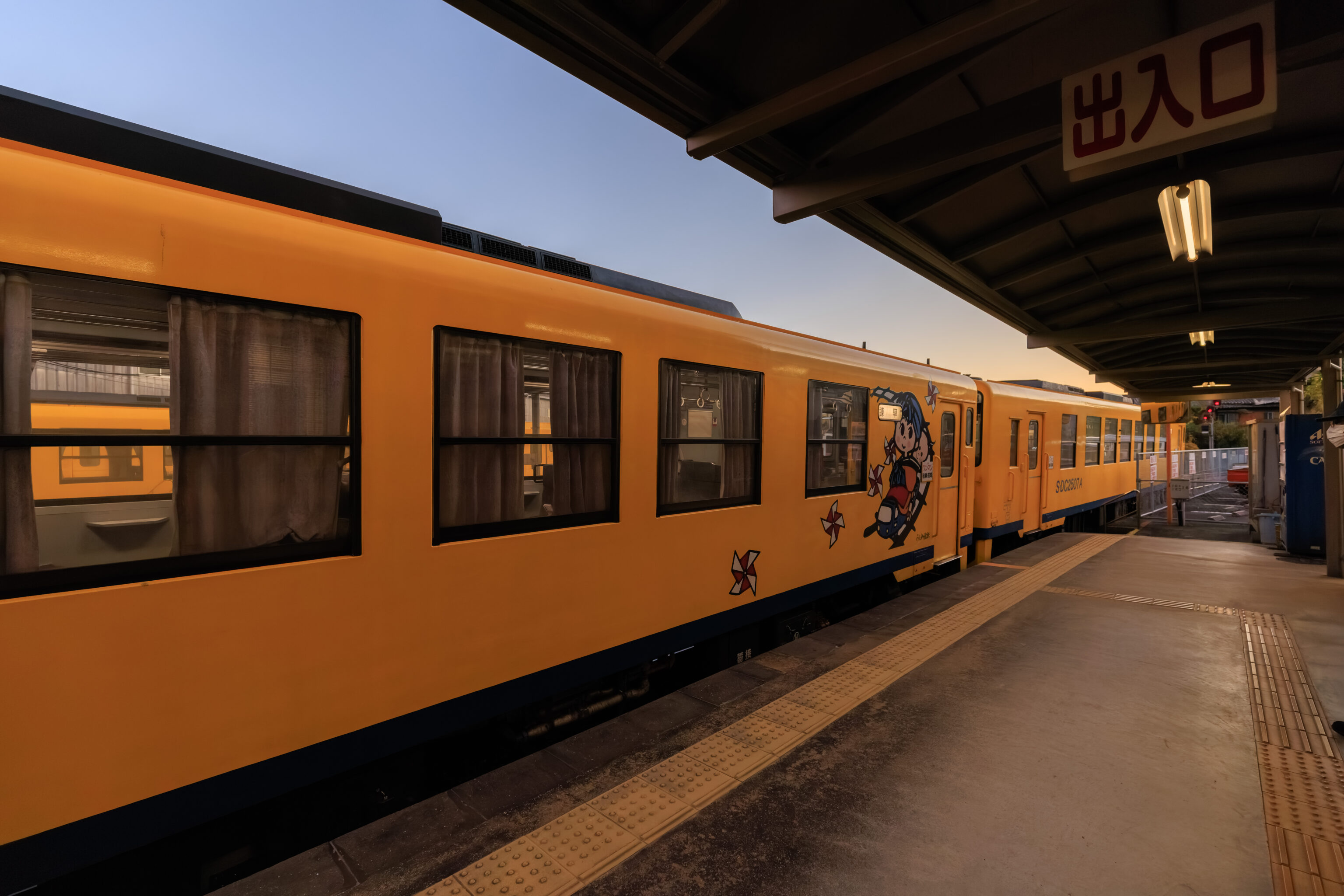
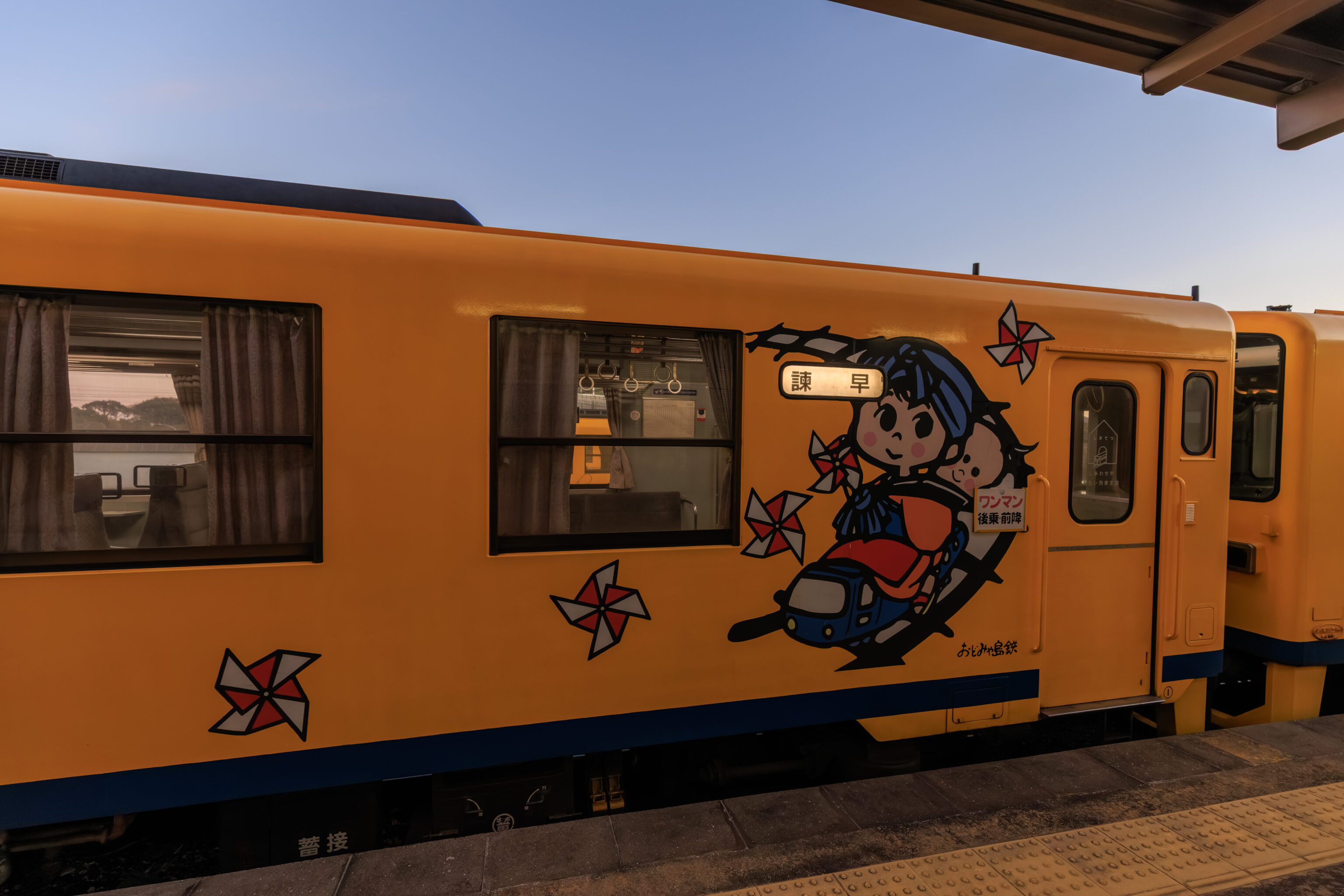
Our train arrived at 5:18pm. It had two cars!
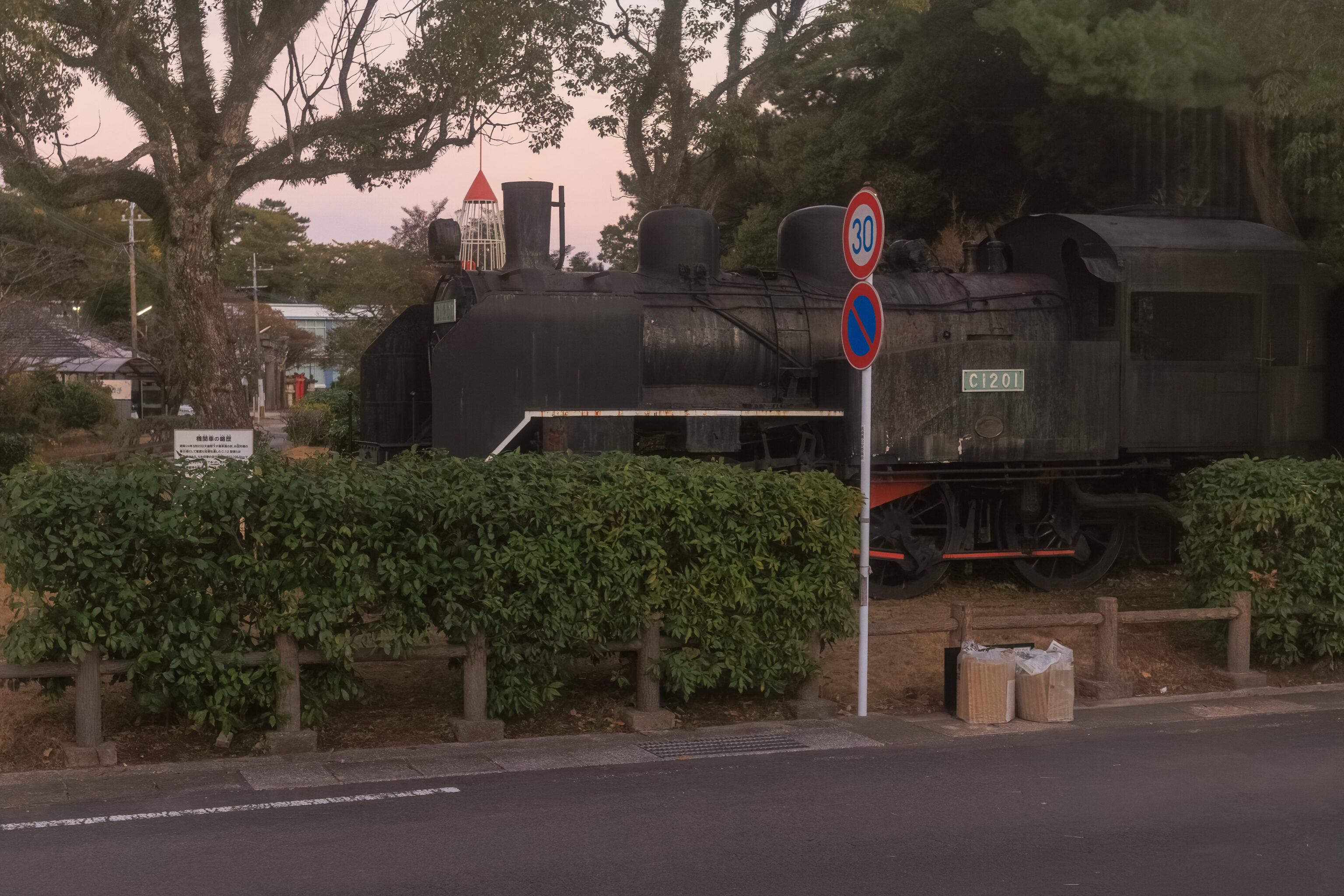
This old steam engine was at the next station, 霊丘公園体育館駅 Reikyu Park Gymnasium Station. Although we did not know anything about this locomotive, it was easy to find a photo of a sign describing it on Google Maps:
Locomotive History
This locomotive is of the same model as the C12-type engine that played a pivotal role in hauling the Imperial train during His Majesty the Emperor's visit to the island on May 25, 1949. It covered a total distance of 853,096.8 km over a service life spanning more than 20 years. Operations ceased and the locomotive was retired to the depot in 1968, when the Shimabara Railway replaced its steam locomotives with diesel ones.

1 Model: C12 Type
2 Number: C1201
3 Maximum Dimensions: (Length) 11.35m, (Width) 2.85m, (Height) 3.90m
4 Weight: 50 t
5 Horsepower: 500 HP
6 Date of Manufacture: January 1948
7 Manufacturer: Nippon Sharyo, Ltd.
– Text from a sign posted on Google Maps, read and translated using Google Gemini and Translate.
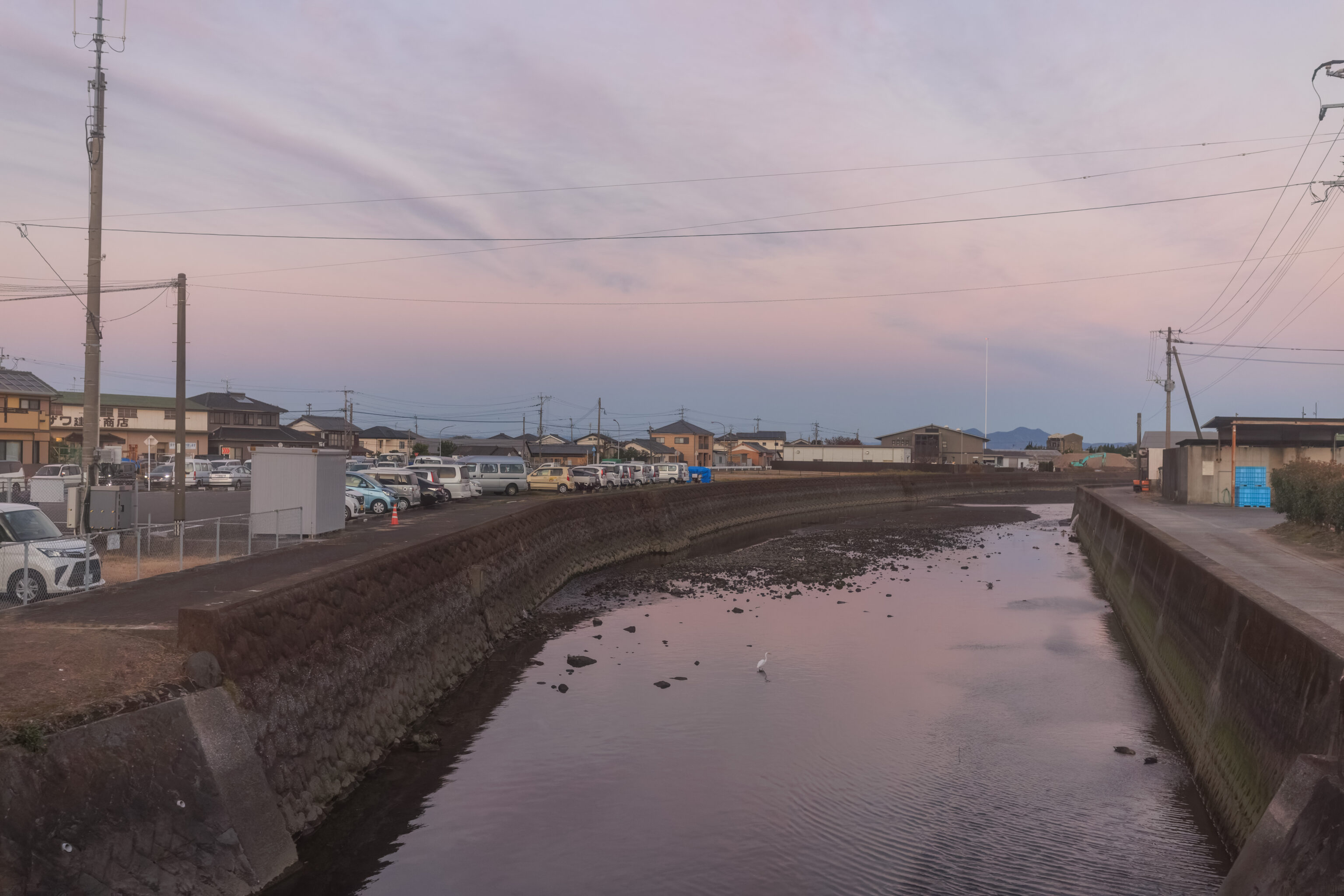
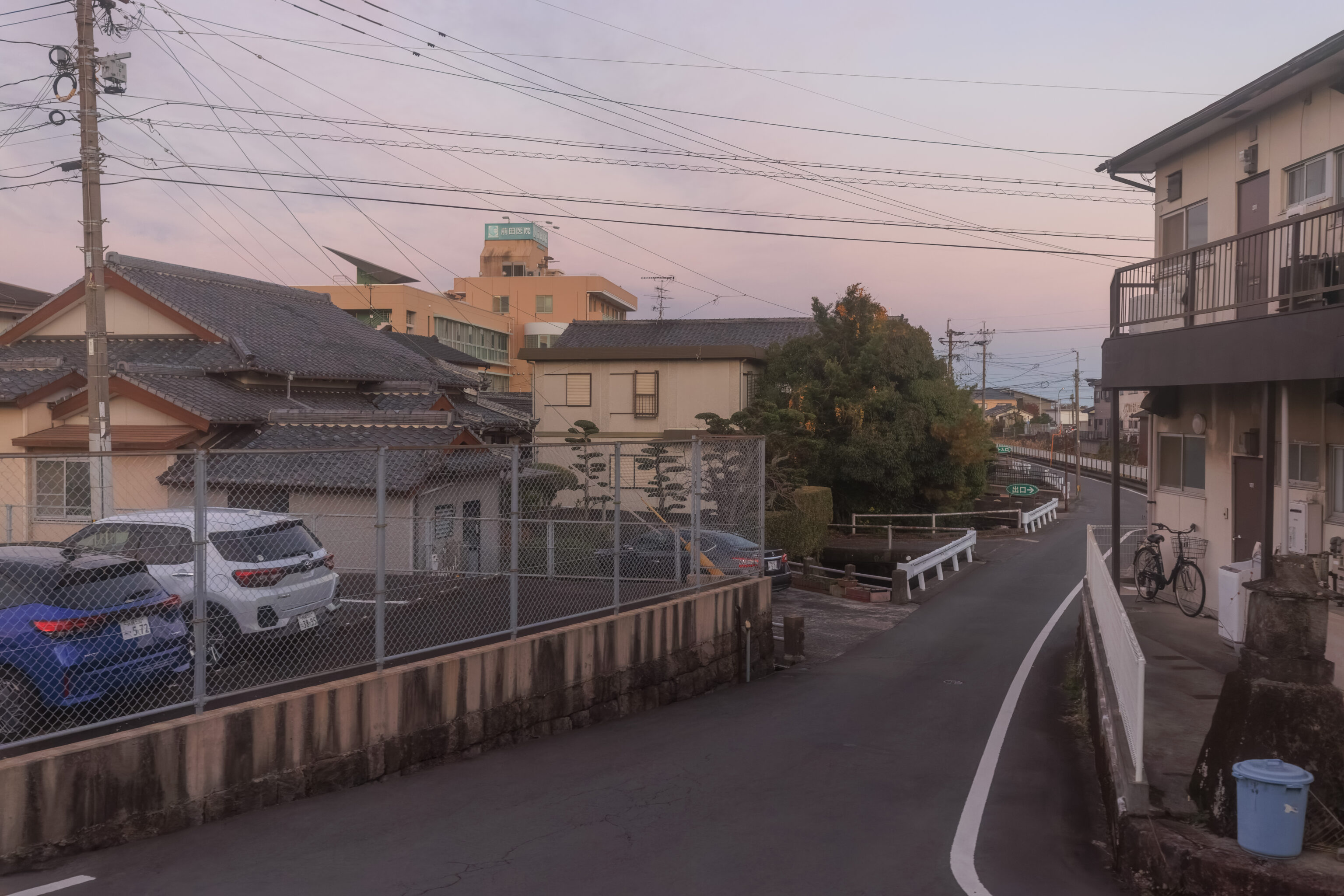
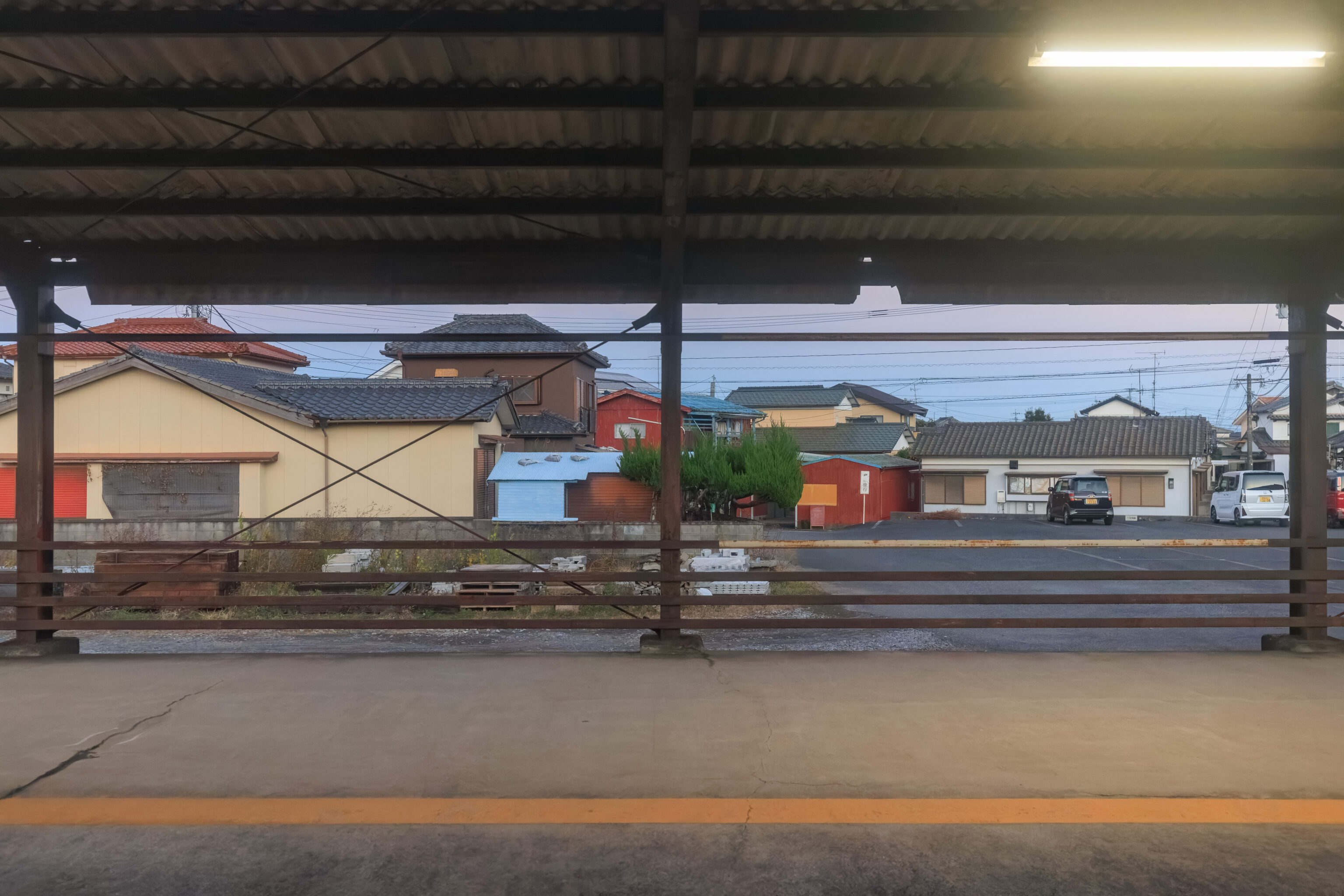
There was a bit of nice pink color in the sky as the Sun set and we headed back to Nagasaki.
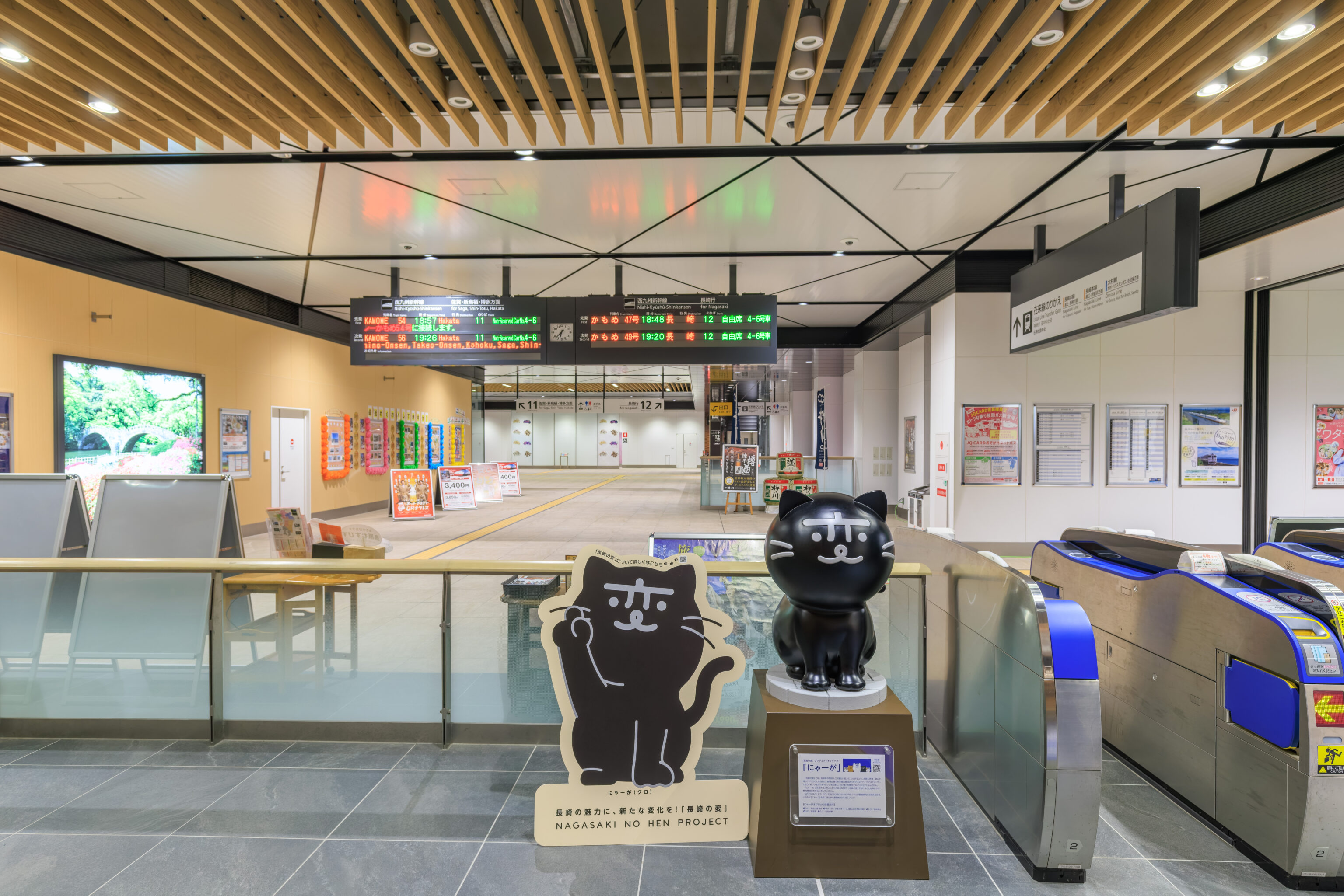
After arriving at Isahaya Station, we walked over to the entrance gates for the Nishi Kyushu Shinkansen. The timing worked out such that this would be the best way to get back to Nagasaki.
We saw this black cat mascot, にゃーが Nya-ga, before on our first day in Nagasaki! It is part of the Nagasaki no Hen Project.
These sake barrels are from the 杵の川 Kinokawa brewery here in Isahaya. The topmost barrel features a Kamome Shinkansen design, the Shinkansen we’re about to take.
The trip from Isahaya to Nagasaki takes a bit less than ten minutes on the Shinkansen, more than three times faster than the fastest conventional train.
Nagasaki
We made it back to Nagasaki just before 7pm. We’ve noticed and photographed this display before. This time, we took a look at the signs as well.
From seed to seed.
What is displayed here is the 'the life of vegetables' born from a farm that practices traditional farming, where the process does not end with the harvest, but continues with watching over the crops until they wither, collecting their seeds, and then sowing them once more.

Vegetables, too, bloom, wither, and form seeds as their pods inflate. Stems that do not break in order to protect the seeds, fruits that lie down after fully nourishing the seeds, and then the seeds that are born to grow again and bloom. The stems that do not break in order to protect the seeds, the fruits that lie down after pouring all their nutrients into nurturing the seeds, and the seeds that are born to grow again and bloom.

By weaving the strength that life inherently holds into the future,
we are able to receive life. From this exhibit, if you can picture the landscape of a vibrant field where vegetable flowers bloom, your dining experience may look a little different.
– Text from the sign at bottom left.
Everything exhibited here originated from the vegetable fields of a single farmer, Masatoshi Iwasaki, in Unzen City, Nagasaki Prefecture, born of his year-round labor.

As vegetable varieties were selectively bred for mass production, countless delicious heirloom varieties vanished. Once a seed is lost, it is gone forever.

Amidst this trend, Mr. Iwasaki chose to "keep the seeds alive"— even though the farming process is incredibly labor-intensive, and even though his work might go unnoticed by the world. He and his wife cultivate as many as 78 different varieties of vegetables entirely on their own.

They understand the unique character of each of these 78 varieties; they do not simply harvest and move on, but remain dedicated to the crops until they wither and yield their seeds. They do this to preserve the diversity of food culture for the next hundred years. Throughout the six-month exhibition period, we will display vegetable flowers brought from Mr. Iwasaki’s fields in Unzen as they bloom. We invite you to enjoy the changing seasonal displays.
– Text from a sign near center, read and translated using Google Gemini and Translate.
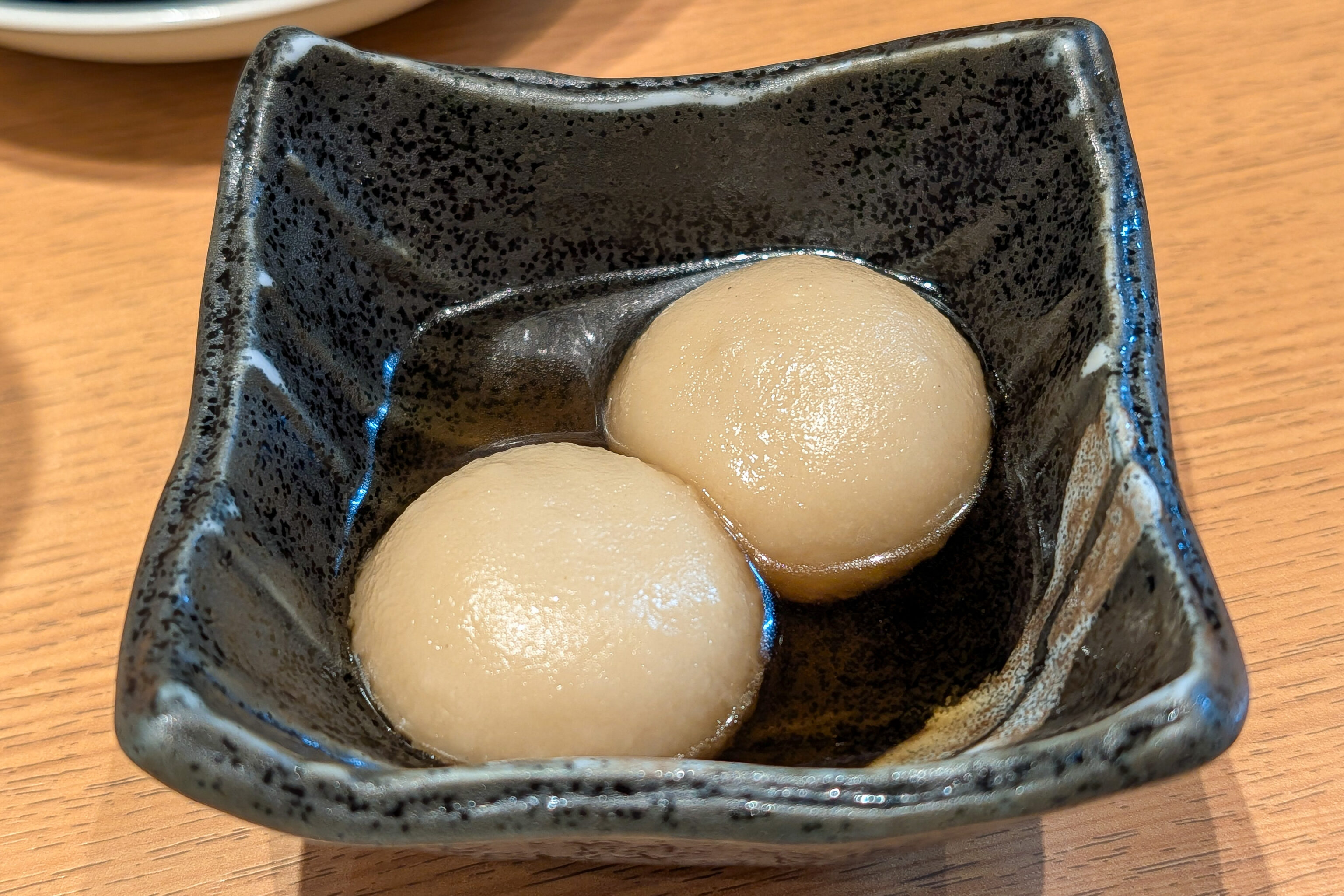
We had dinner at 海鮮炙り屋 いぶき地 Kaisen Aburiya Ibukiji Ibukichi, a grilled seafood restaurant at the train station. Dango were provided at the start of the meal.
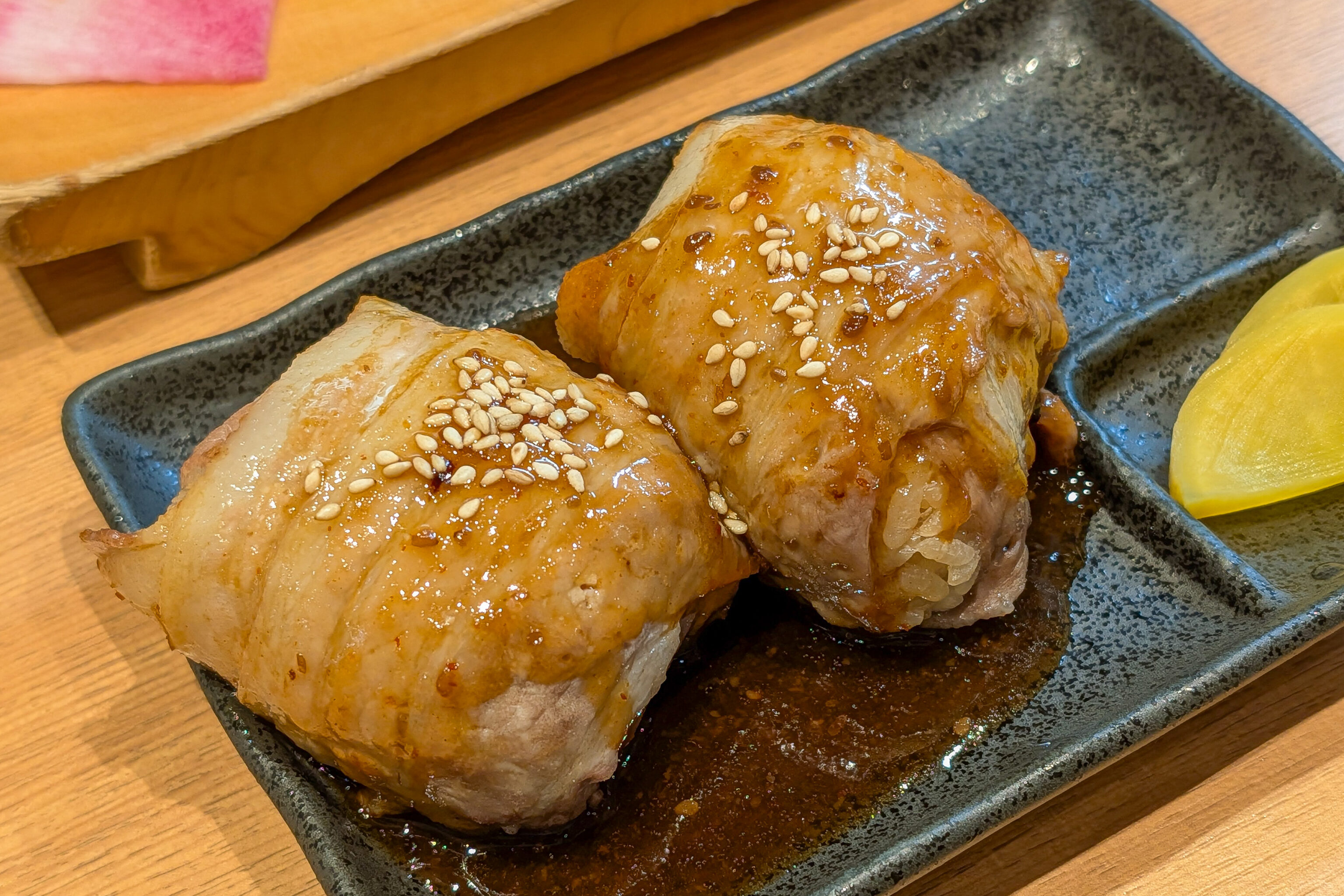
We ordered pork belly onigiri, sashimi, which we somehow neglected to photograph…
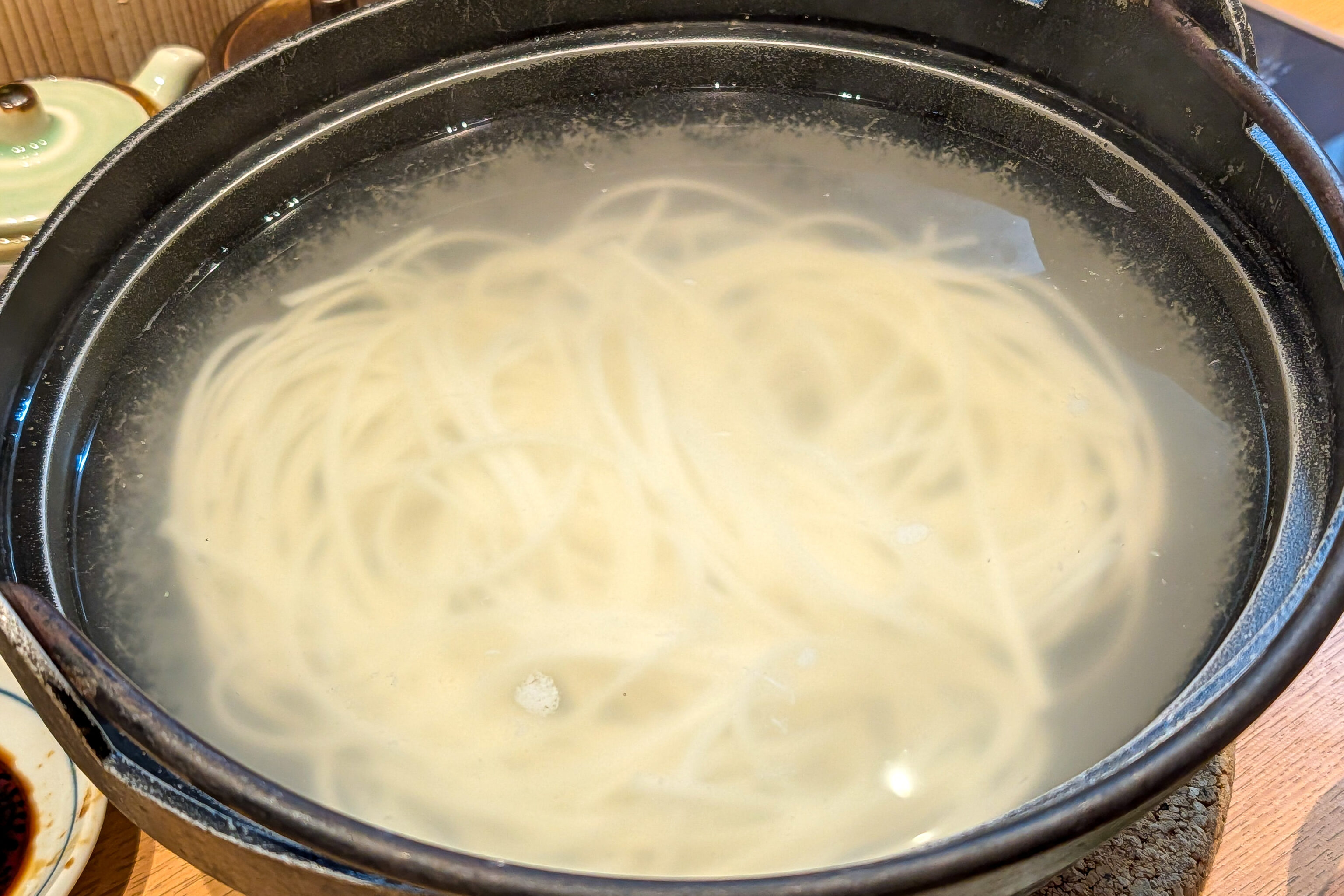
五島うどん Goto udon, which is udon from the Goto Islands…
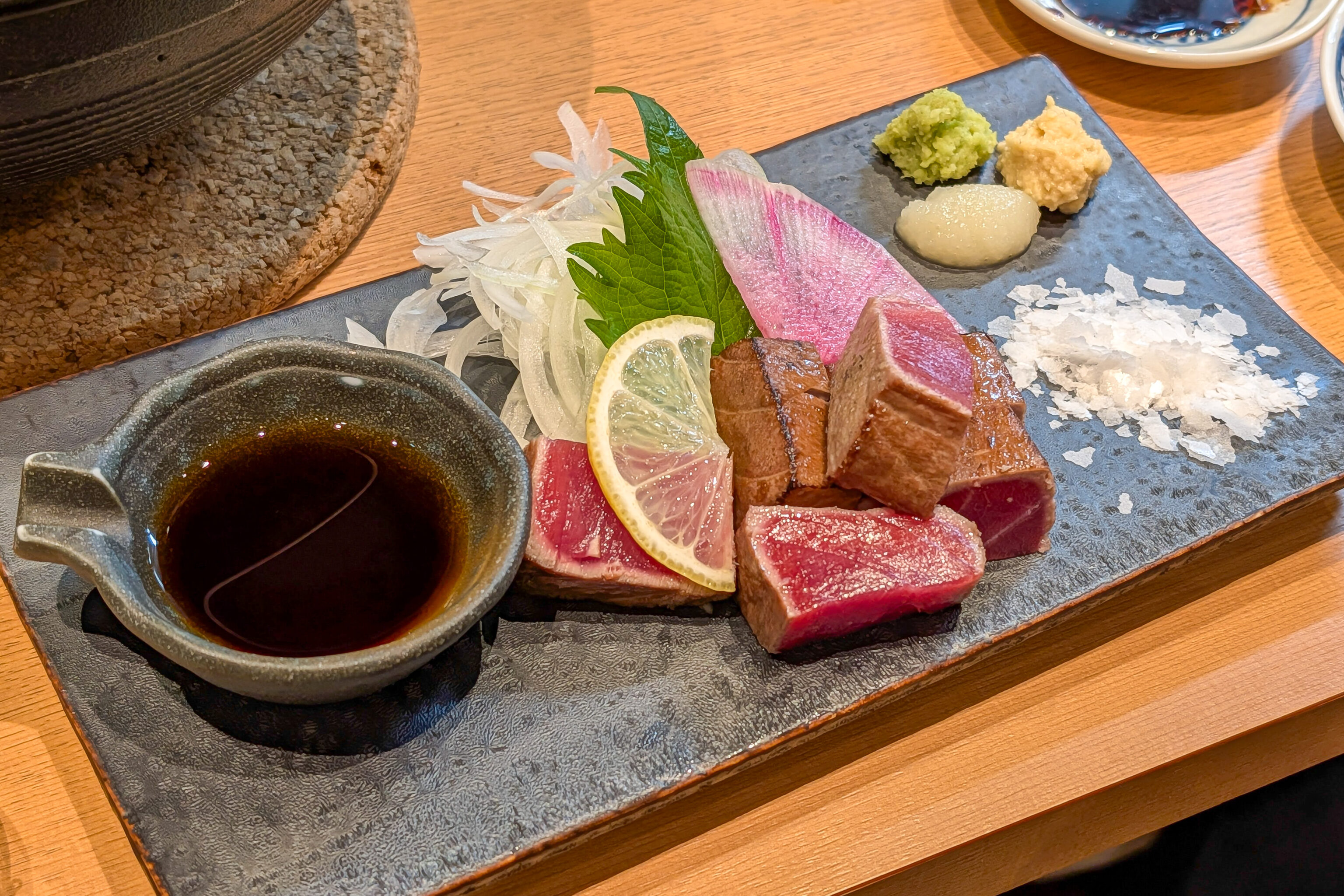
Flame seared tuna…
Various seafood skewers…
And miso chicken skewers.
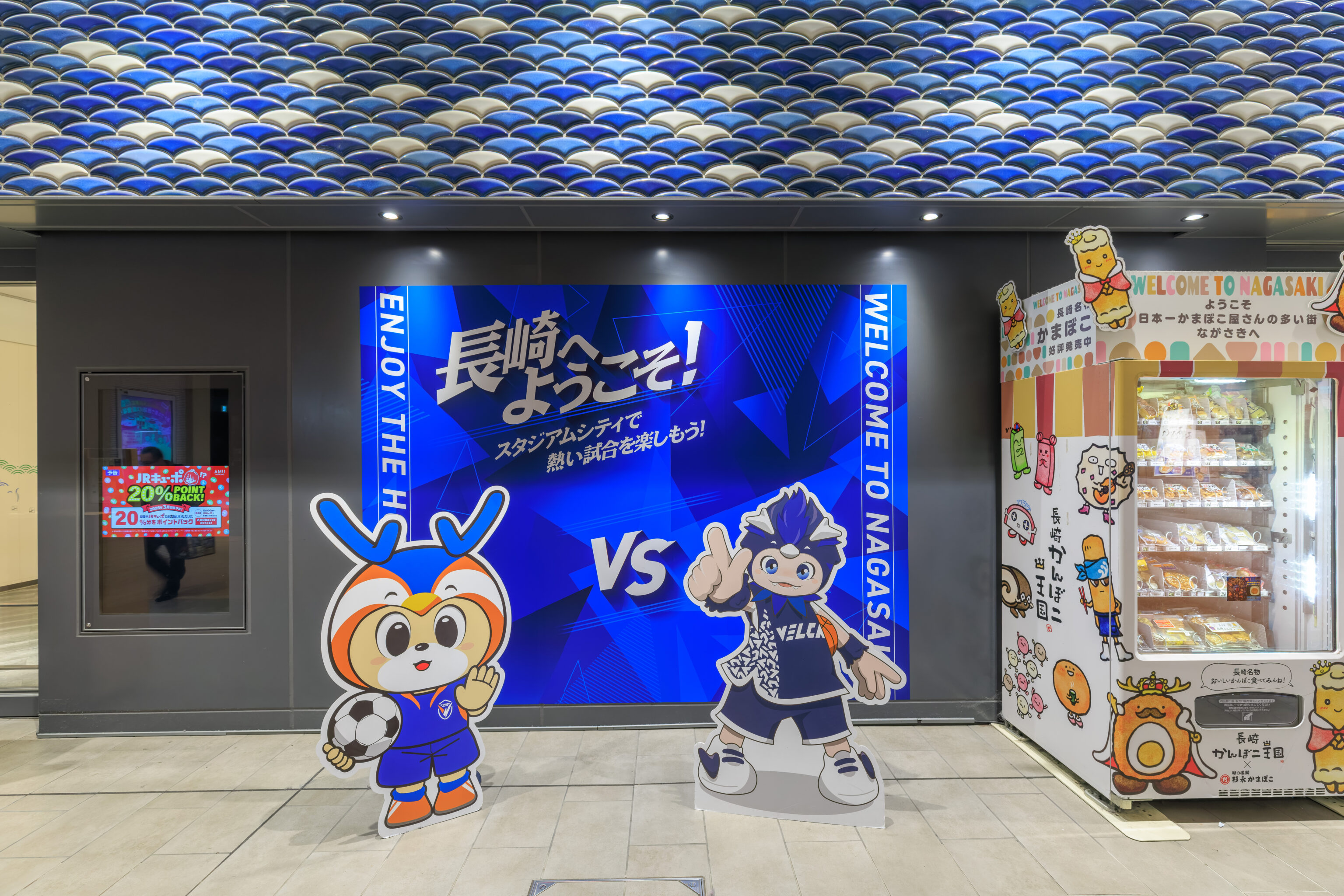
This display is advertising two of Nagasaki’s sports teams, the V・ファーレン V-Varen football team and ヴェルカ Velca basketball team. And of course, given that this is not the USA, football is what we’d call soccer back home. Both teams play at Stadium City.
Welcome to Nagasaki!
Enjoy an exciting match at Stadium City!
– Text from the blue background above, read and translated using Google Gemini and Translate.
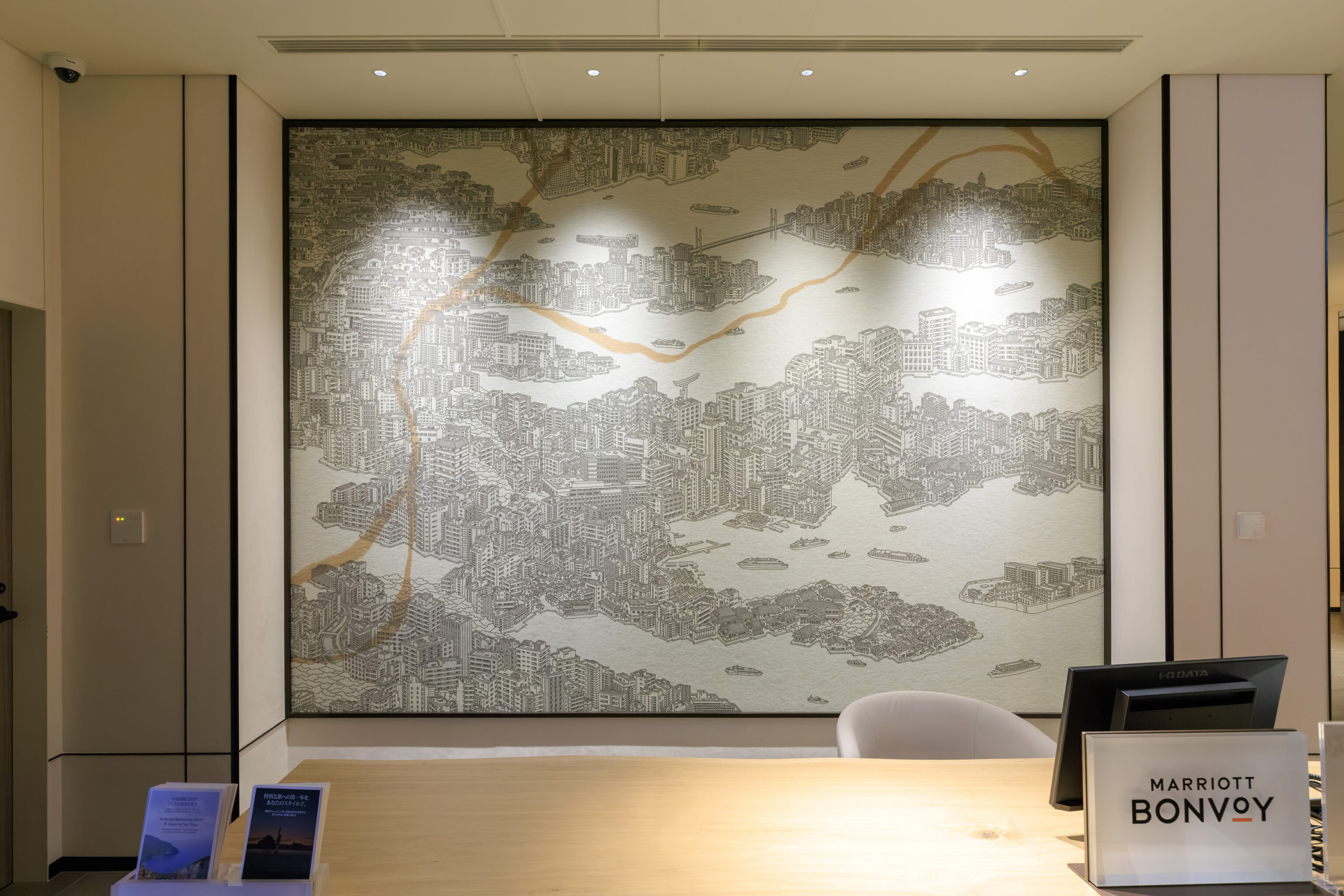
This mural at the Marriott depicts various locations in Nagasaki. The one legged torii at 山王神社 Sanno-jinja is prominently at the center. Above and to the left a bit, we can see the UNESCO World Heritiage Giant Cantilever Crane. This Marriott is present as well, it is below and to the left of the torii. The island around the bottom right is probably Gunkan-jima. The Peace Statue at the Peace Park can be seen at the very left. There’s almost certainly other locations depicted as well.
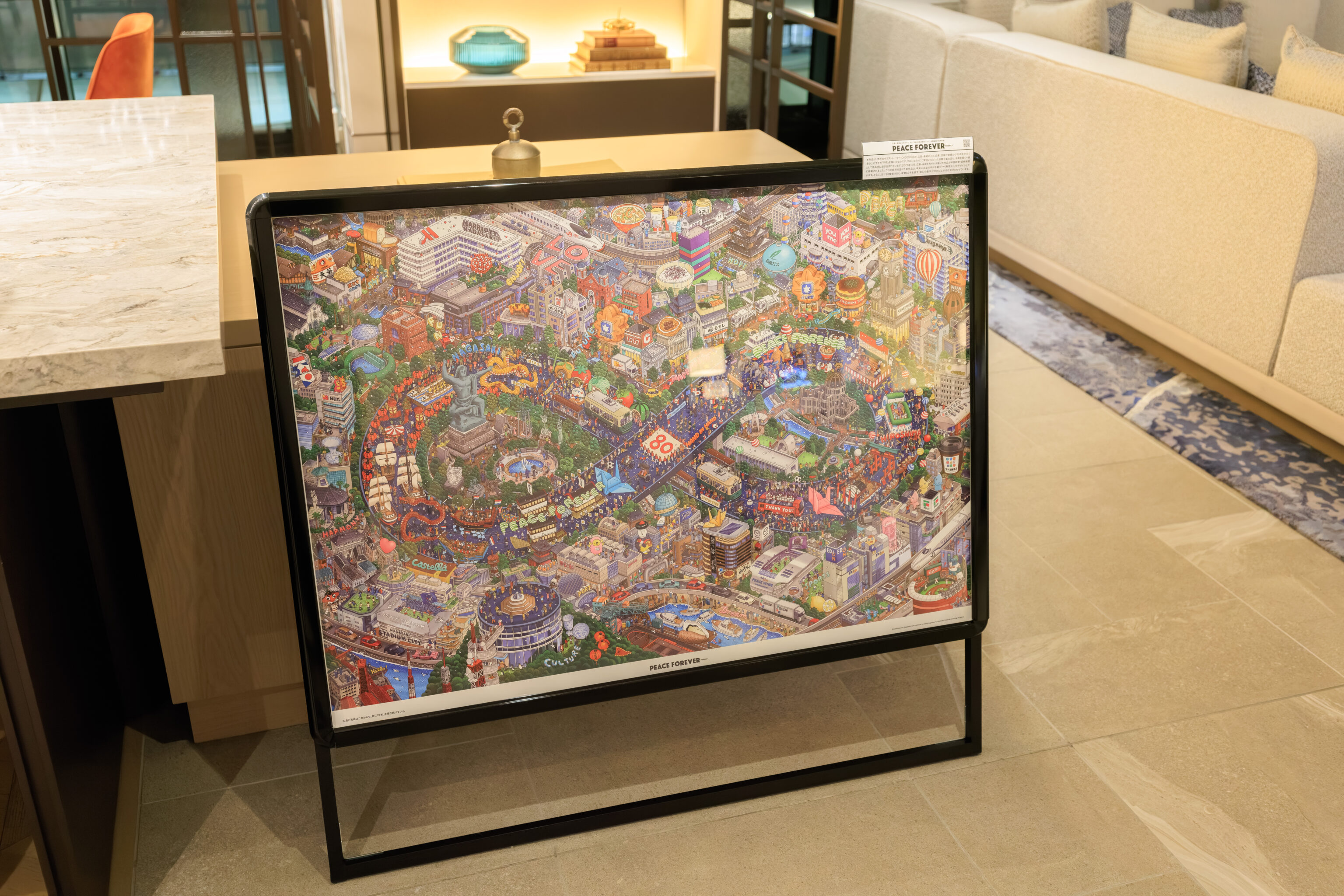
This framed drawing is depicts scenes from Hiroshima nd Nagasaki. There’s quite a bit crammed into this one frame! Many businesses are depicted, including this Marriott at upper left.
PEACE FOREVER PROJECT
Hiroshima and Nagasaki will continue to envision "peace" together. Chugoku Shimbun × Nagasaki Shimbun

This artwork, created by the world-renowned illustrator IC4DESIGN, depicts the "peace" that the people, companies, and organizations of Hiroshima and Nagasaki have built over the 80 years since the atomic bombings. Sponsoring companies that supported the project are also illustrated within the work as participants in building this peace. In October 2025, the artworks—depicting Hiroshima and Nagasaki respectively—were published in the *Chugoku Shimbun* and *Nagasaki Shimbun* newspapers. The composition, which places the two cities side-by-side, features an "infinity" symbol (∞) at the center, representing a wish for eternal peace. Furthermore, the design includes a hidden feature: when rotated 90 degrees to the left, the number "80" emerges, signifying the 80 years since the bombings.
– Text from the label at the upper right corner of the frame, read and translated using Google Gemini and Translate.
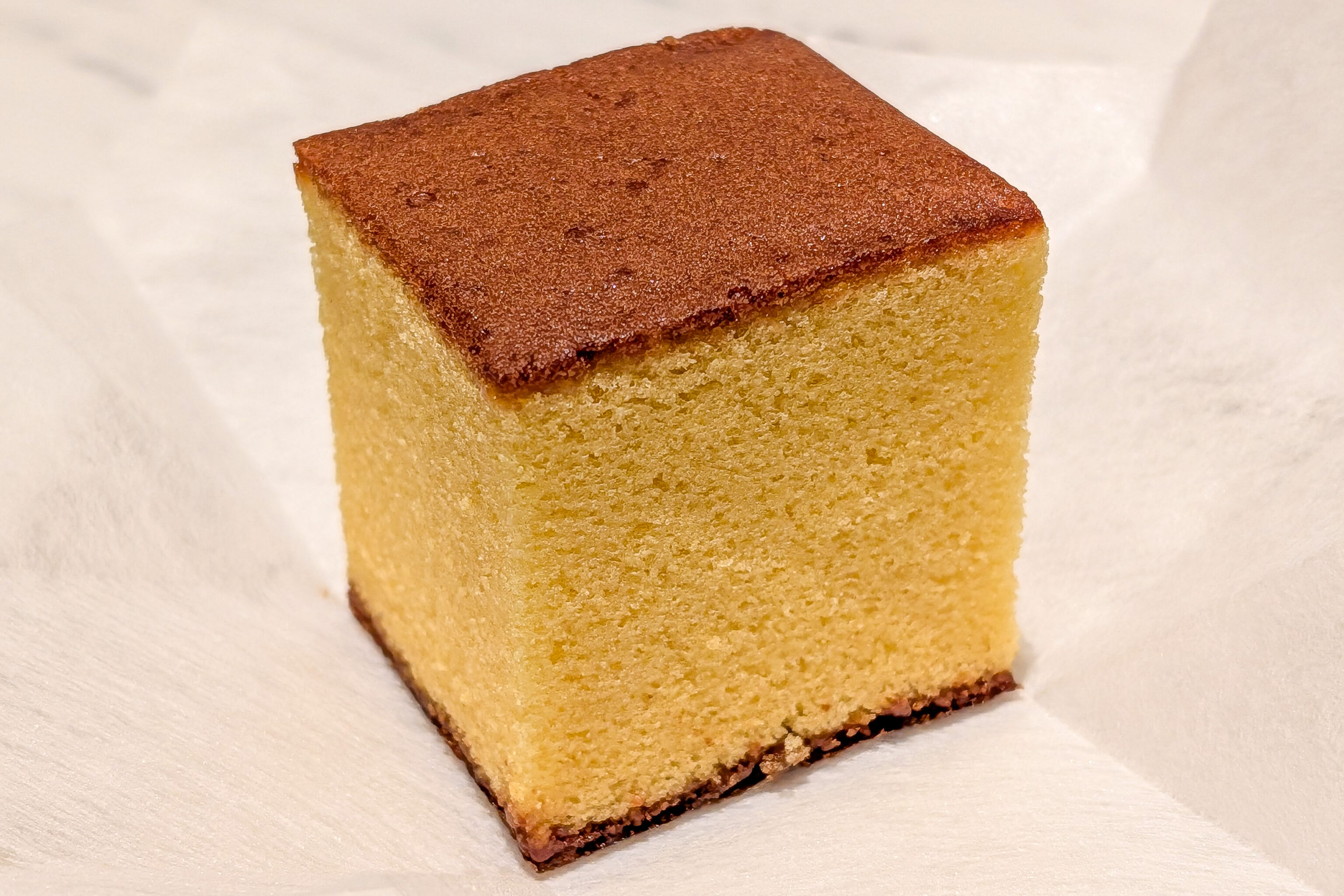
We finished the final castella that we got when we first checked in. This also is a good reference for what the typical castella that is sold to customers looks like compared to the vaccuum sealed pieces we ate today at Shimabara.