
In the morning, we walked from the Grand Hyatt over to the Nishitetsu Fukuoka Tenjin Station to take the train to 太宰府 Dazaifu. We had lunch at a special Ichiran restaurant featuring auspicious five sided bowls and longer 59cm noodles. After, we walked through the tourist shopping street on the way to 太宰府天満宮 Dazaifu Tenmangu. We walked through the large shrine before visiting the 九州国立博物館 Kyushu National Museum nearby. We had some snacks on the way back to the train station before returning to Fukuoka for a sushi dinner and Amaou Strawberries.
Morning in Fukuoka
After waking up at the Grand Hyatt Fukuoka, we decided to visit Dazaifu, which isn’t too far away from Fukuoka. The easiest way to get there is to take the Nishitetsu train from the Fukuoka Tenjin Station to Dazaifu Station. And as we don’t have complimentary breakfast at the Grand Hyatt, we decided to get something to eat around the Nishitetsu station before leaving Fukuoka.
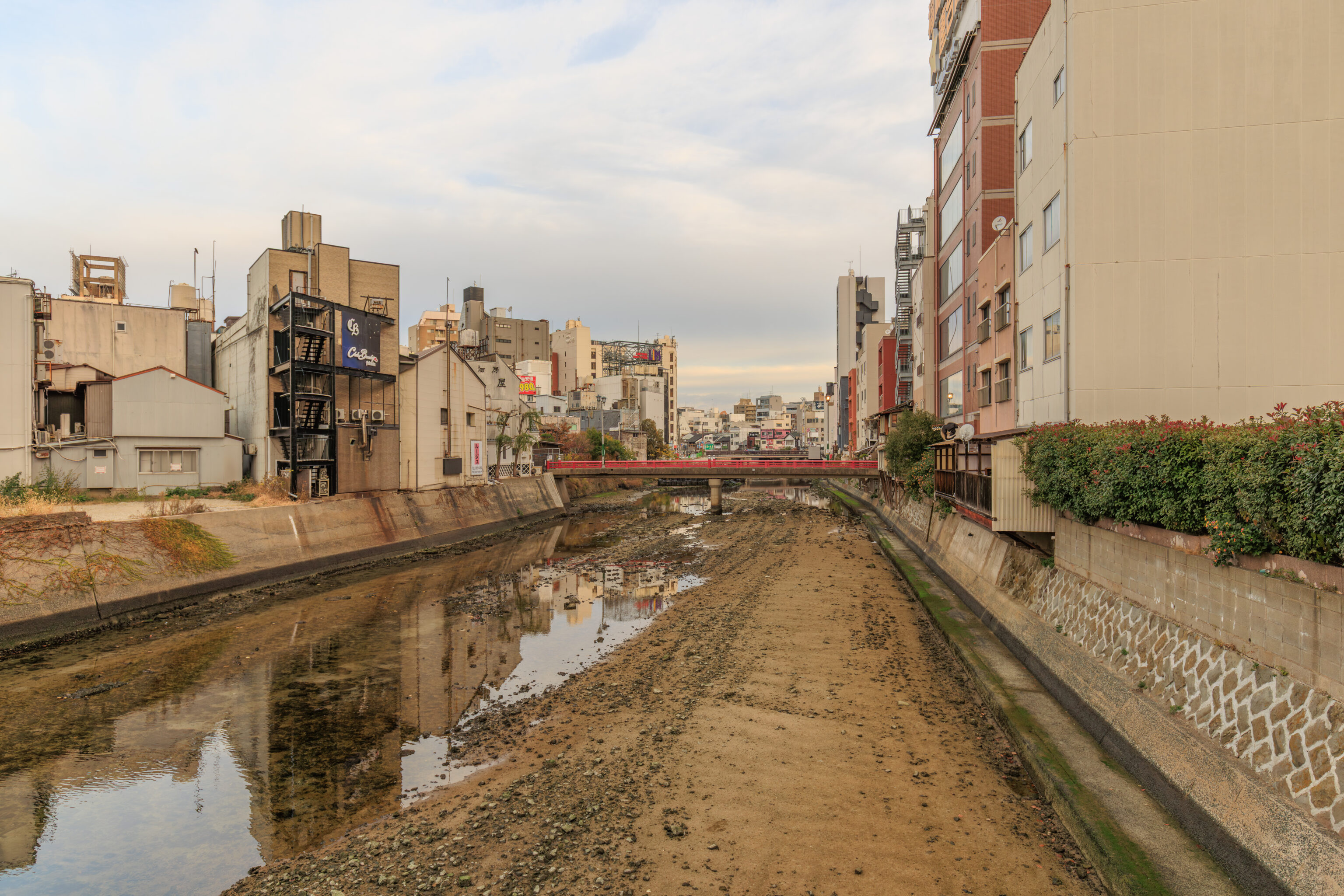
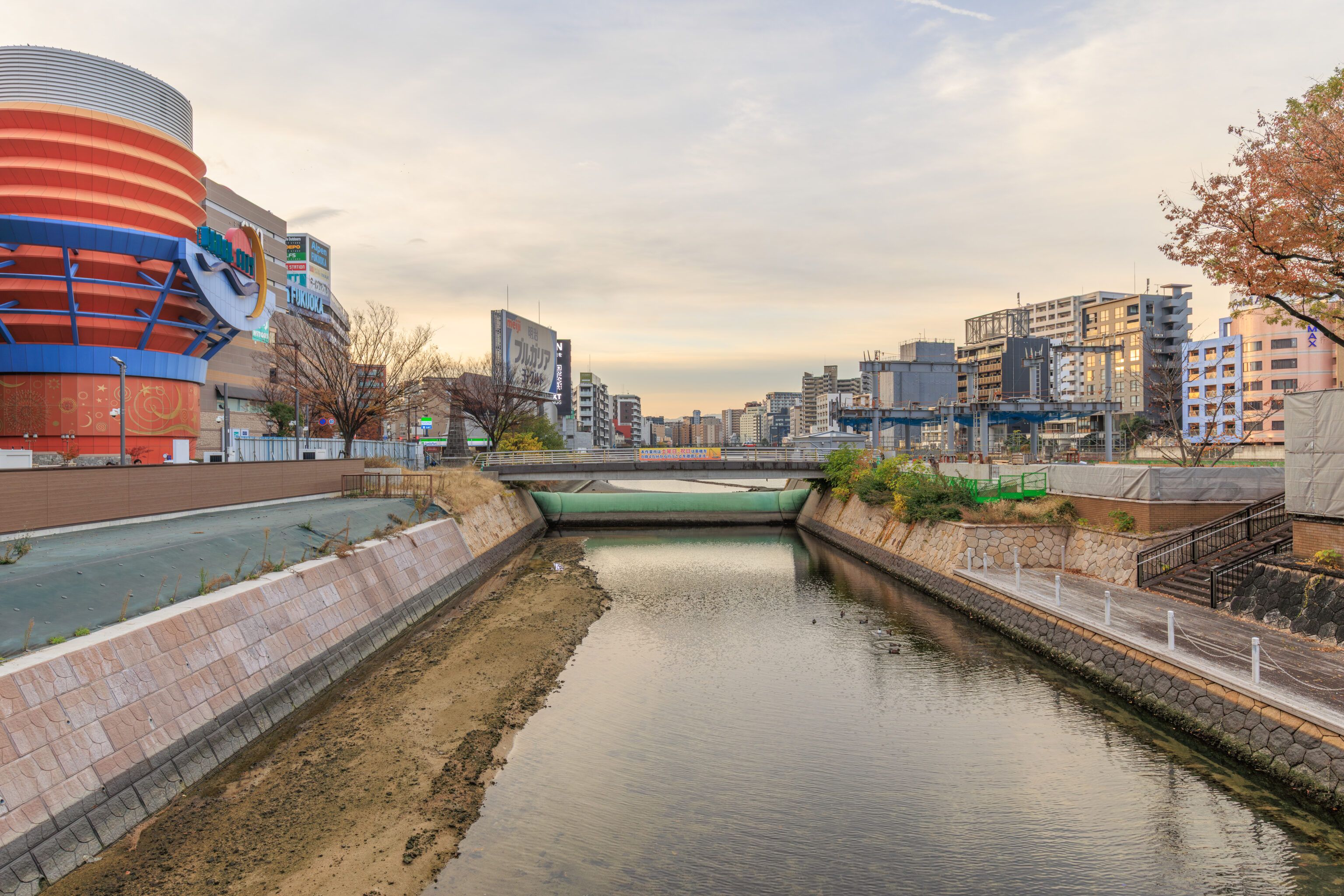
We decided to walk to the station. We started off by crossing the Hakata River in front of the Grand Hyatt via the 清流橋 Seiryubashi (Clear or Pure Stream Bridge). The river was extremely low at the time.
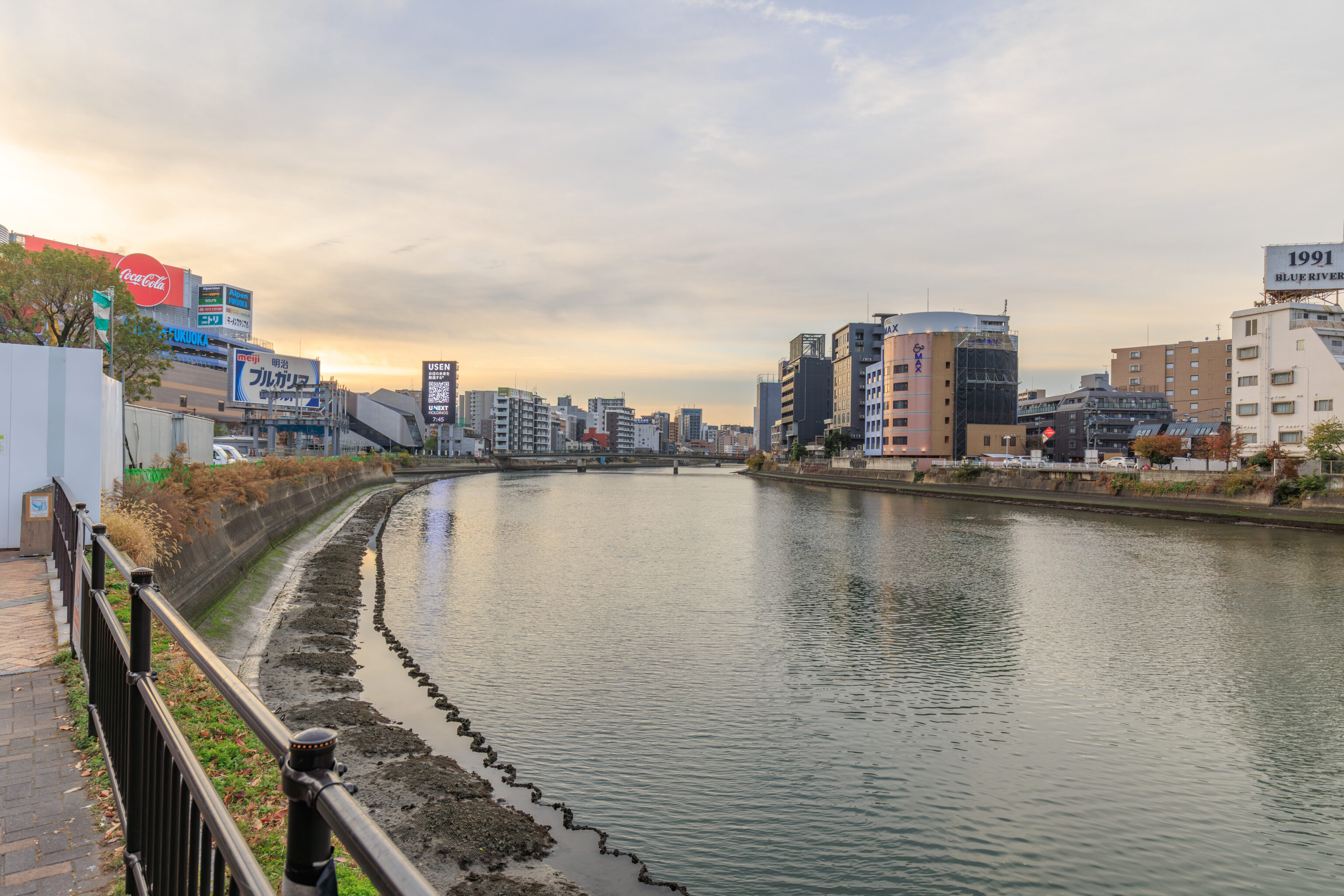
There was unfortunately construction going on at the 清流公園 Seiryu Park at the southern tip of Nakasu. An article on フクリパ from 2023 indicates that a renovation of this park was scheduled to begin in 2024 and end in 2025.
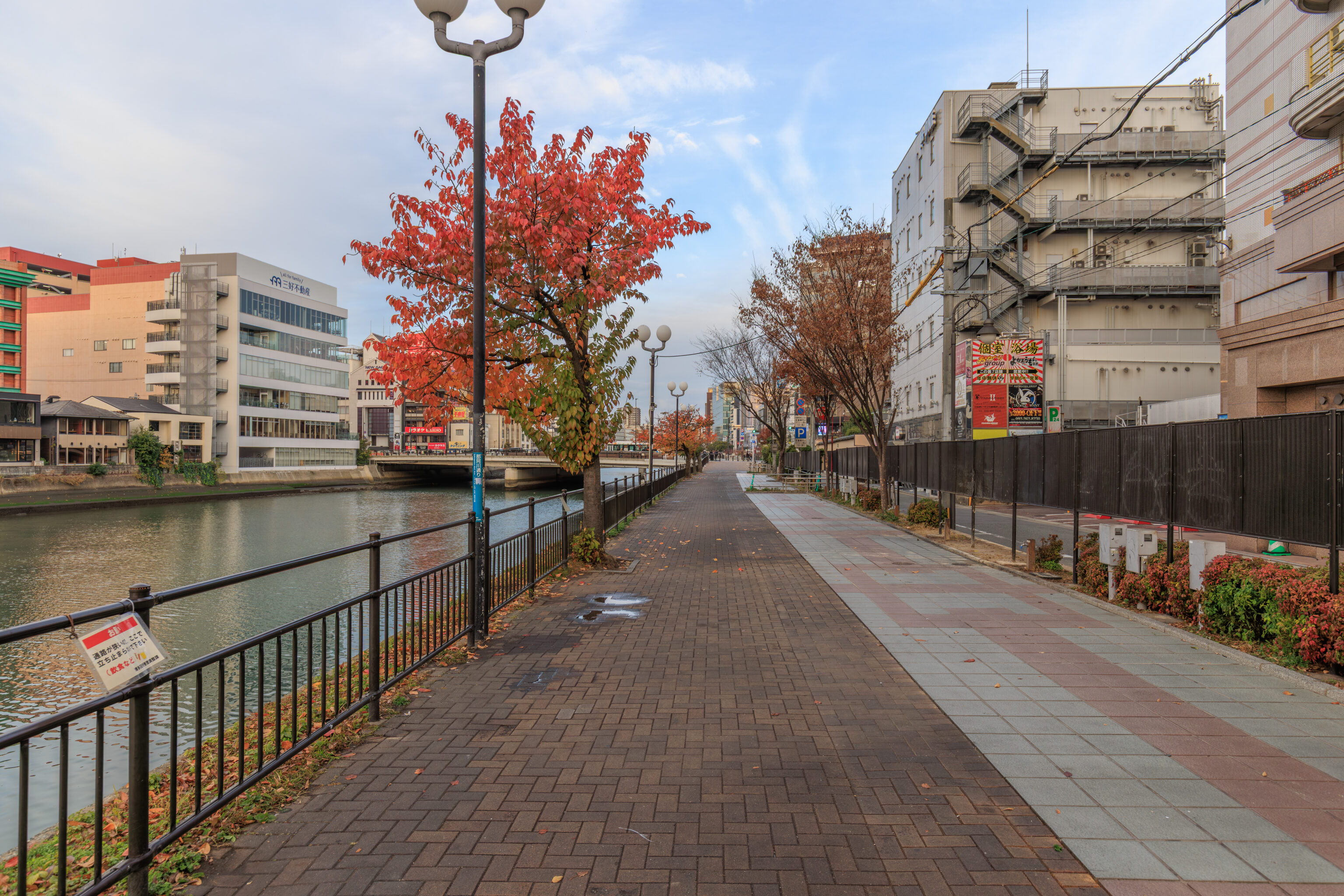
We walked to the north along the Naka River on the street that has 屋台 yatai (food stalls) in the evening. As one would expect from Japan, the area was pretty clean.
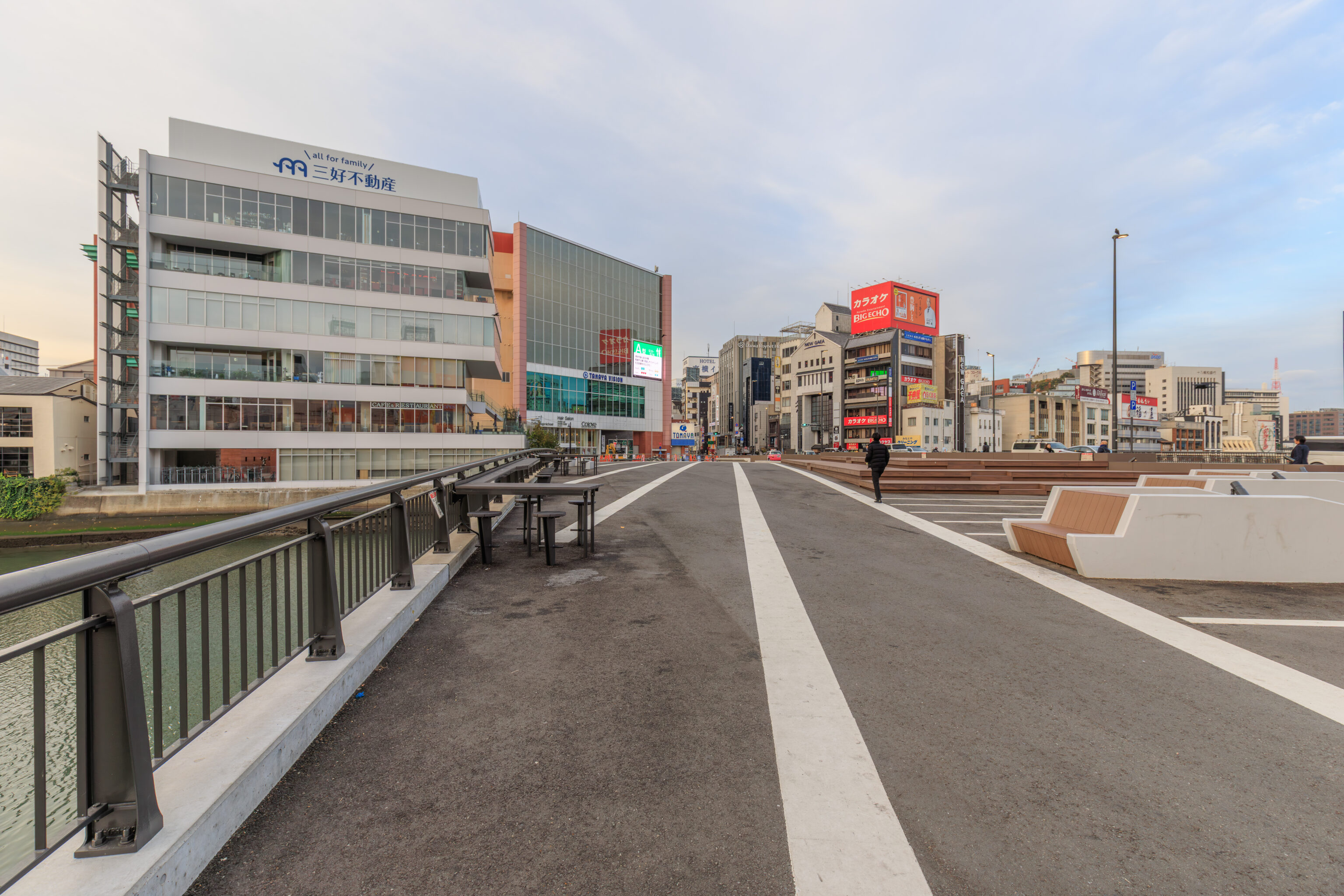
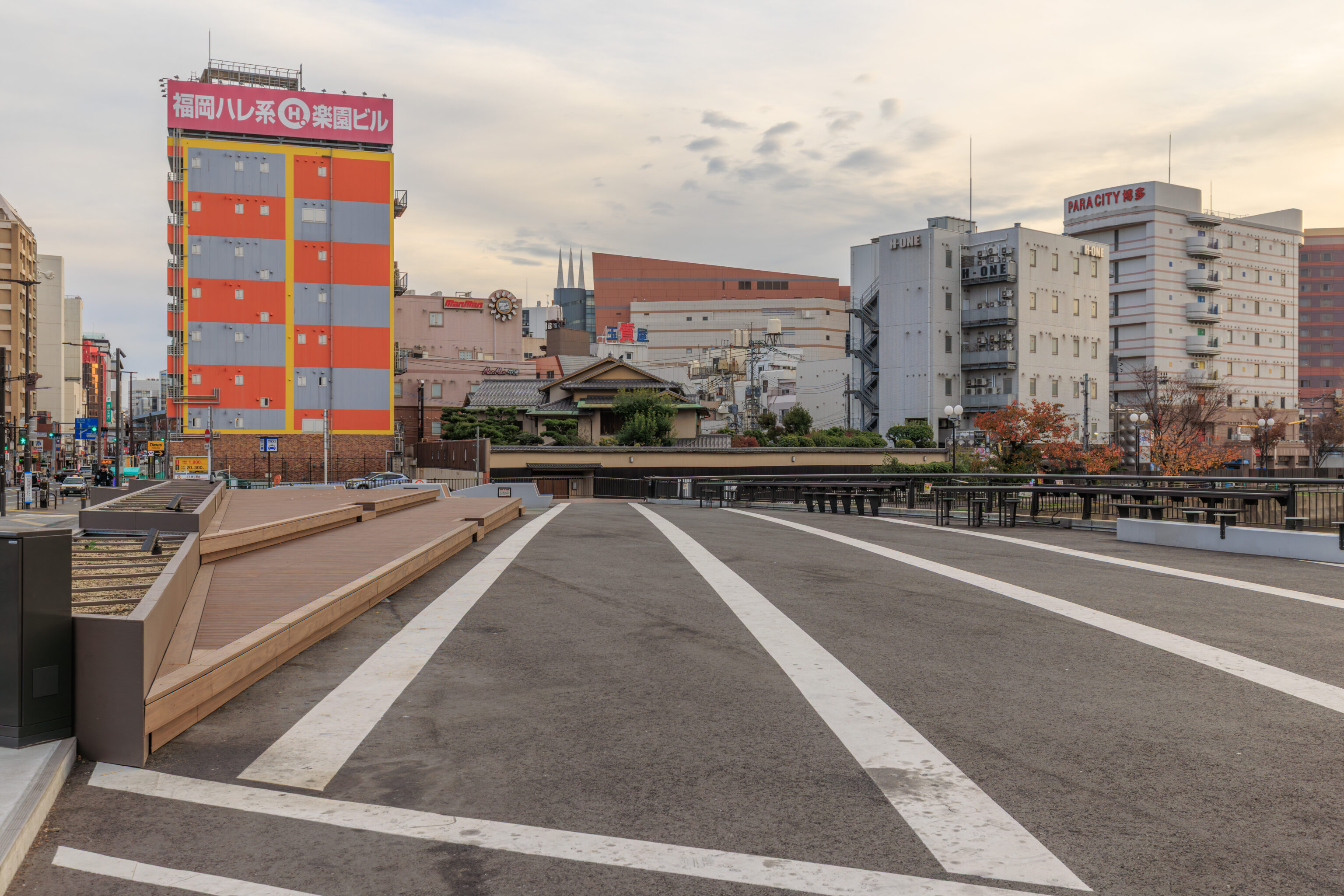
We turned left to cross the river via the 春吉橋 Haruyoshi Bridge. This bridge has a wide pedestrian plaza next to the roadway.
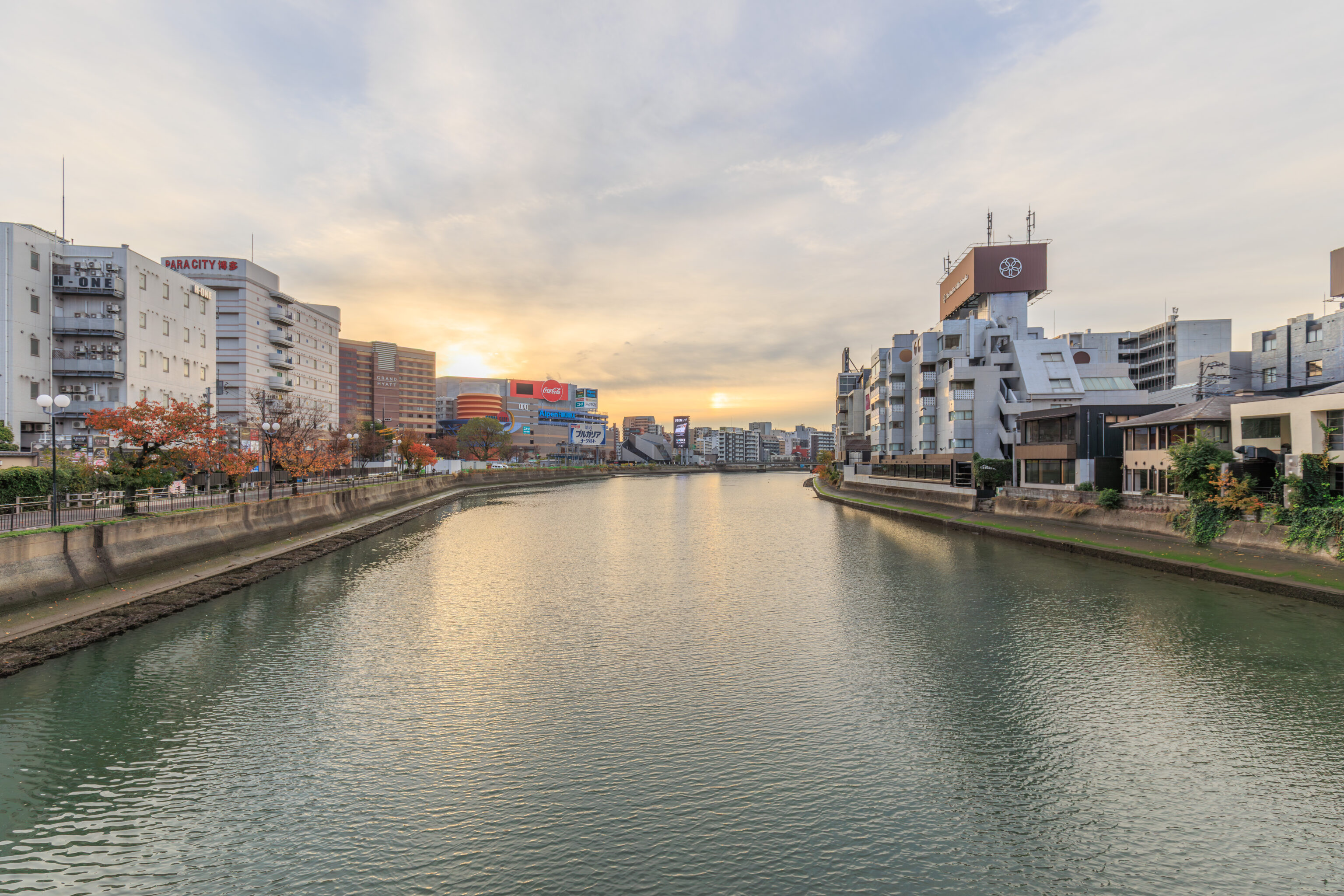
The view to the southeast with the Sun rising behind the Grand Hyatt and Canal City.
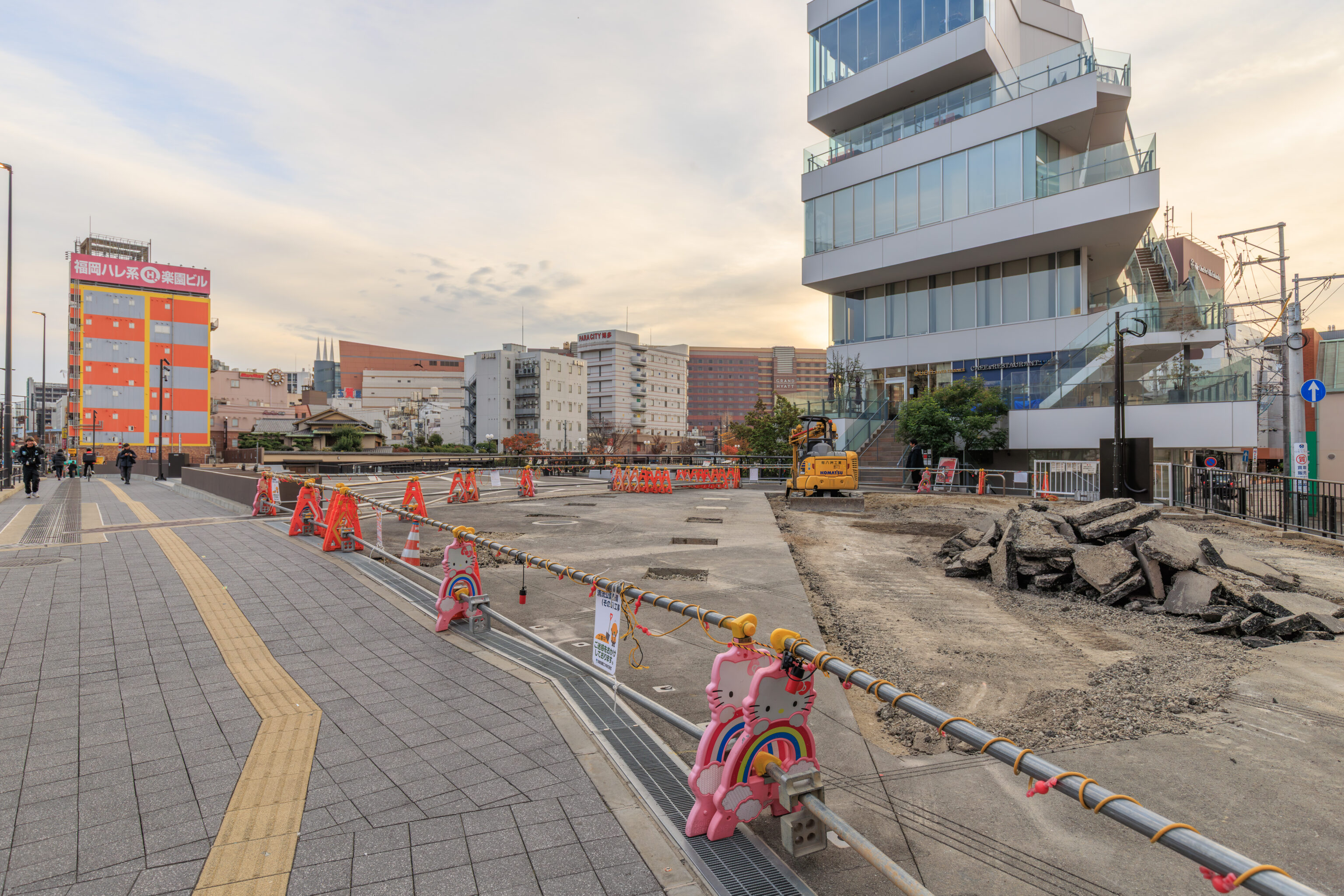
There was a bit of construction going on at the west end of the bridge. The temporary fencing for the construction site had Hello Kitty themed posts!
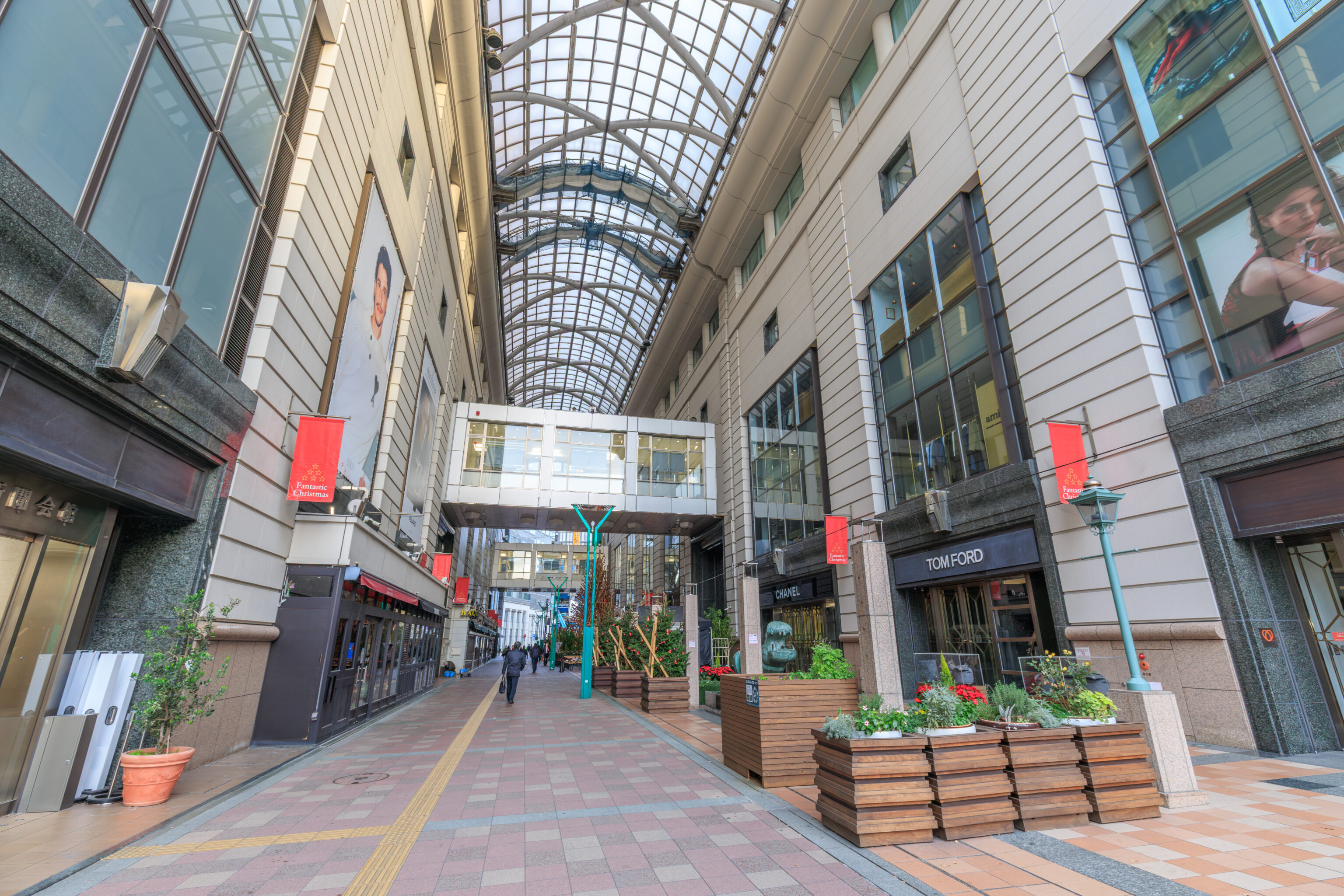
We continued to the west for about ten minutes until we reached this covered passageway. The buildings on both sides are part of the Daimaru department store.
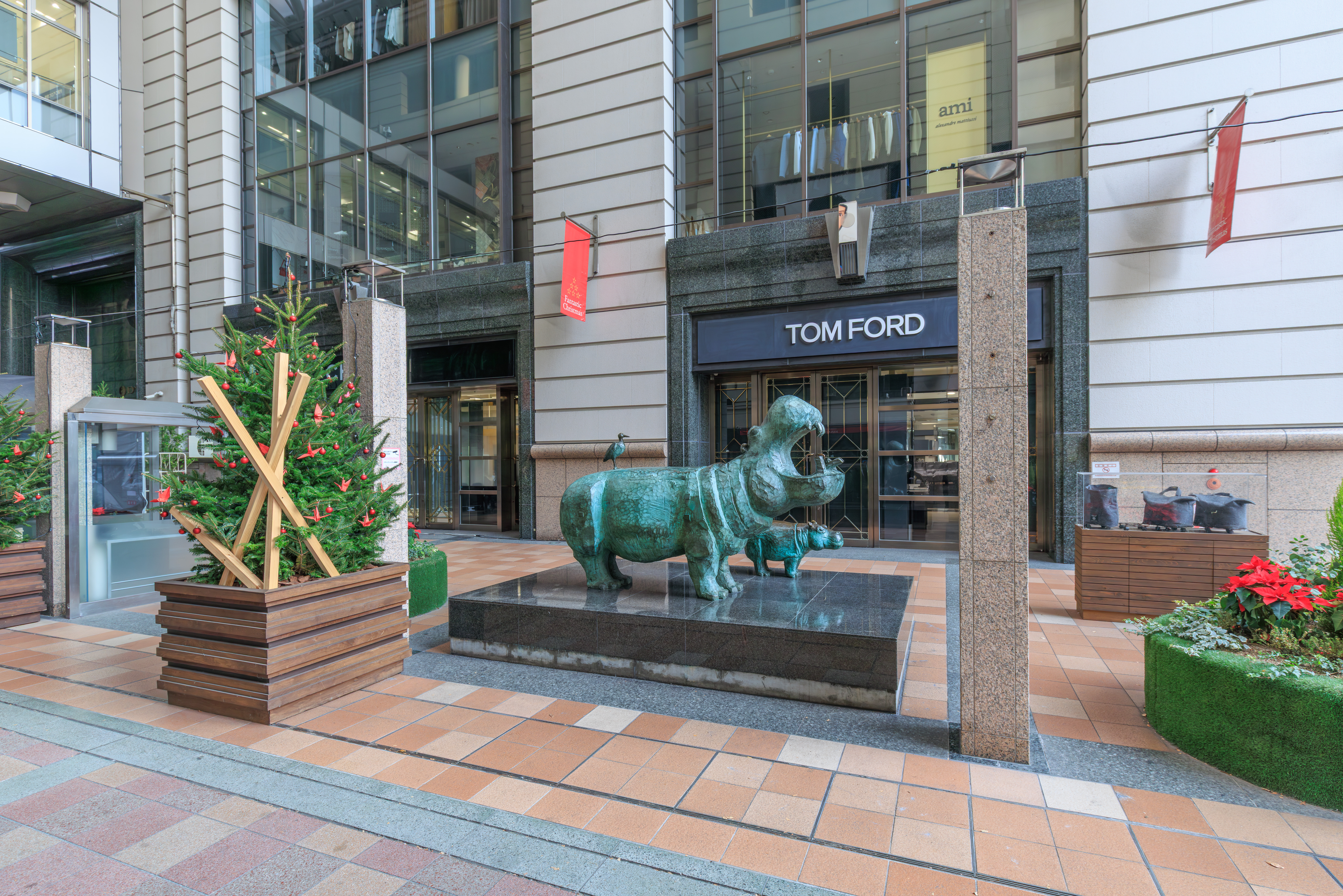
We saw two hippos…
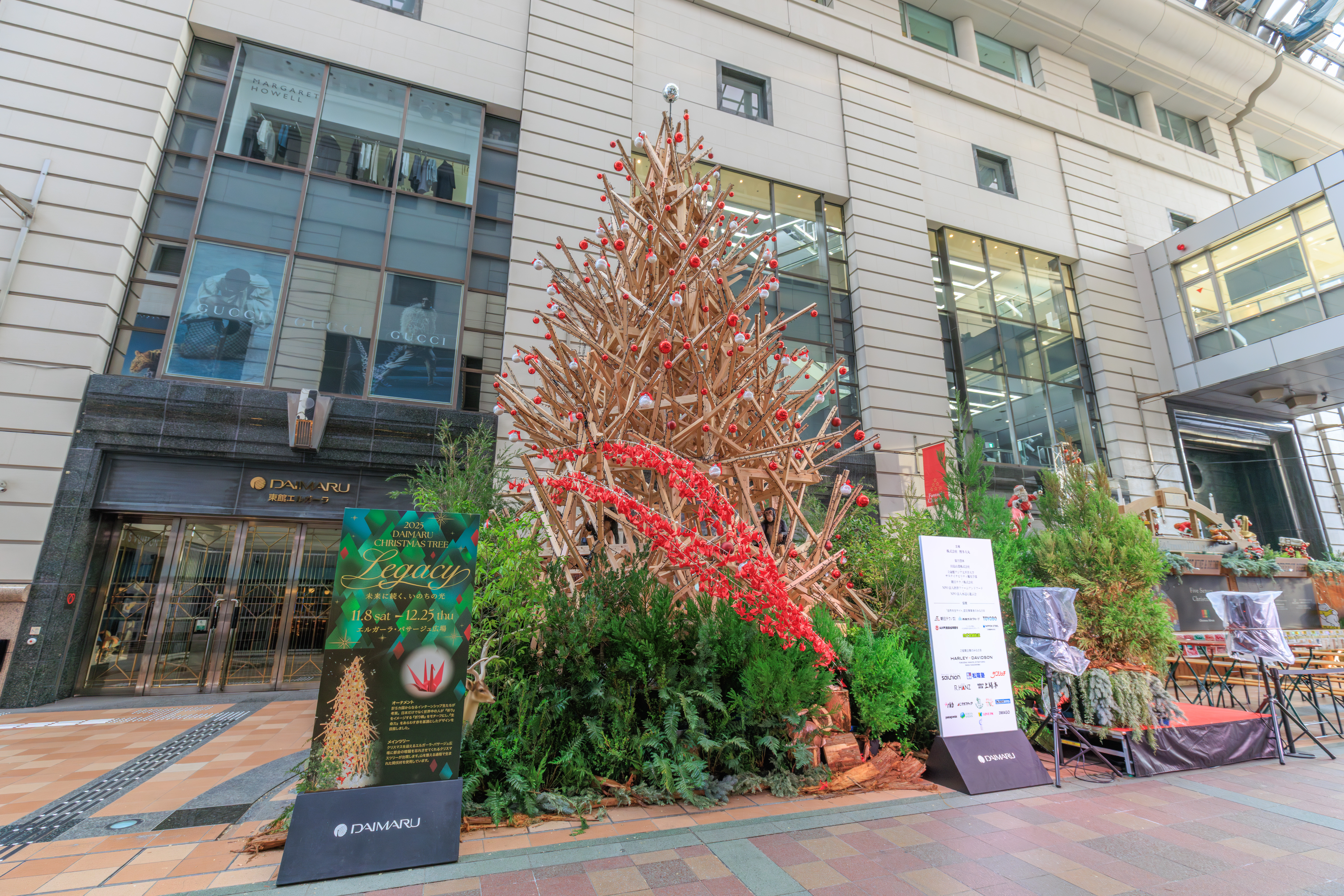
And Christmas decorations. There is a story behind this Christmas tree:
The theme for 2025 is:
Legacy
— The Light of Life, Enduring into the Future —

This winter, we have entrusted our hopes for the future to a single Christmas tree.

Since time immemorial, humanity has lived in harmony with nature. At times, through the gentle touch of human hands, light is brought to desolate mountainsides, reviving them into lush environments where a multitude of living creatures can thrive.

To ensure that we may continue to coexist with this diverse array of life, let us pass on the legacy of nature to the generations of the future!

2025 CHRISTMAS TREE
Story

The "Kyushu Expedition Team"—an initiative dedicated to promoting SDGs at the Daimaru Fukuoka Tenjin store—has launched a special project in collaboration with Tajima Sangyo Co., Ltd. and the College of Sustainability Tourism at Ritsumeikan Asia Pacific University (APU). Through the medium of a Christmas tree, this project aims to carry forward into the future the heartfelt aspirations of those who dedicate themselves to the ongoing preservation of nature.

Co-creation with Those Who Know the Forest
Tajima Sangyo Co., Ltd.
Kyushu Expedition Team

At the very heart of the tree's design lies Tajima Sangyo—a family of forest owners who have lived in harmony with the woods since the Kamakura period.

Operating in the Hita region of Oita Prefecture—one of Japan's premier cedar-producing areas—they have sustained their forestry operations to this very day. Their core philosophy regarding forest stewardship is simple yet resolute: "We will steadfastly protect the forest."

The Kyushu Expedition Team was deeply moved by Tajima Sangyo's profound gratitude toward their forebears—who tirelessly guarded the woods before them—and by their unwavering conviction to nurture the forest—a precious "legacy" inherited from the past—so that it may flourish into the future for the benefit of the next generation. Inspired by these sentiments, the team proposed a collaborative effort to create a Christmas tree together.

Through this co-creation with true forest specialists, a Christmas tree imbued with a powerful and meaningful message has come to life.

Co-created with Tajima Sangyo
The Main Tree

This tree is constructed using thinned timber—wood harvested during the essential process of maintaining and tending to the mountain forests managed by Tajima Sangyo.

Rather than going to waste, these trees have been given a new life, reborn as a magnificent Christmas tree.

It is a distinctive tree that allows visitors to truly feel the natural warmth and gentle presence of the wood itself.
– Text from a nearby sign, translated using Google.
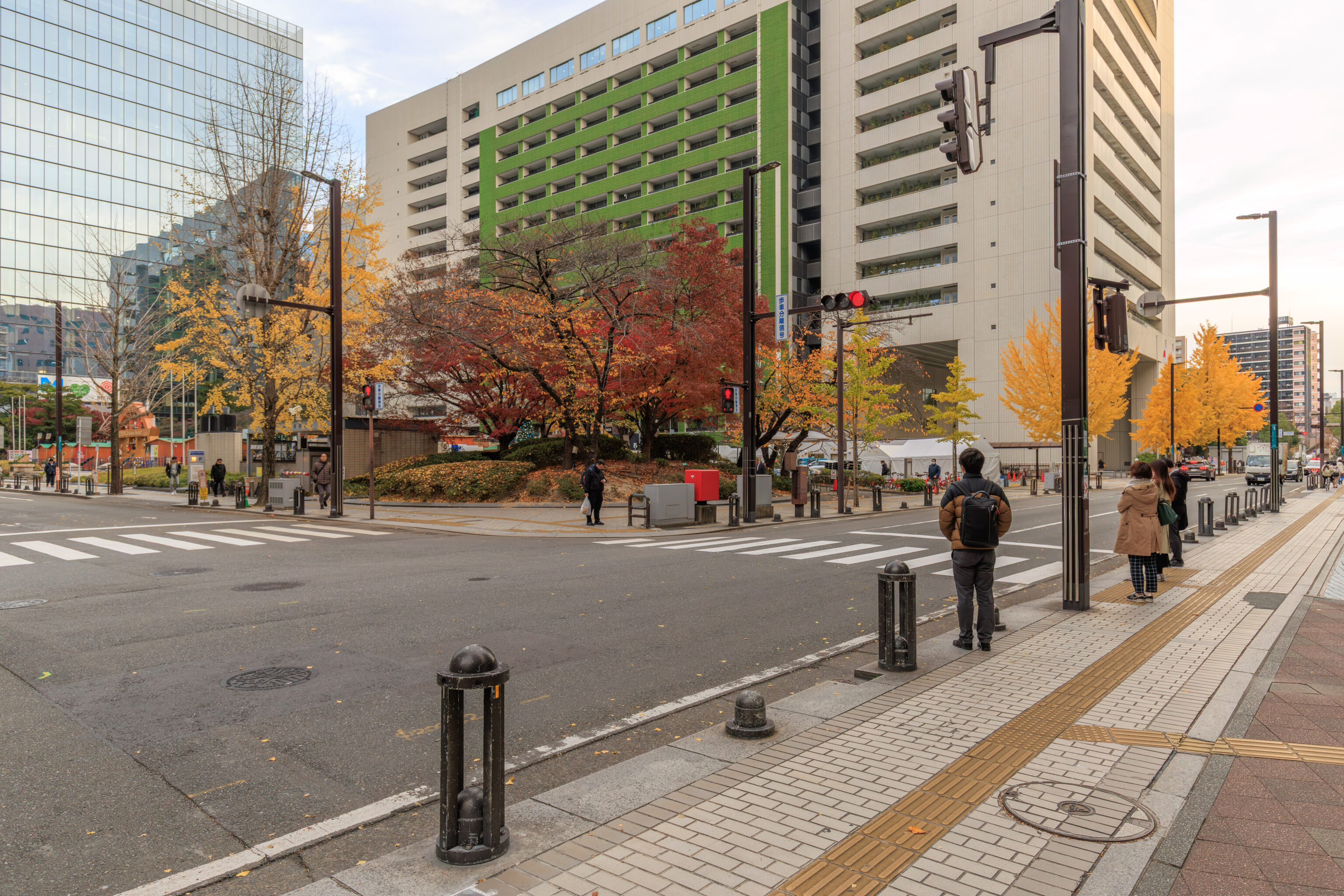
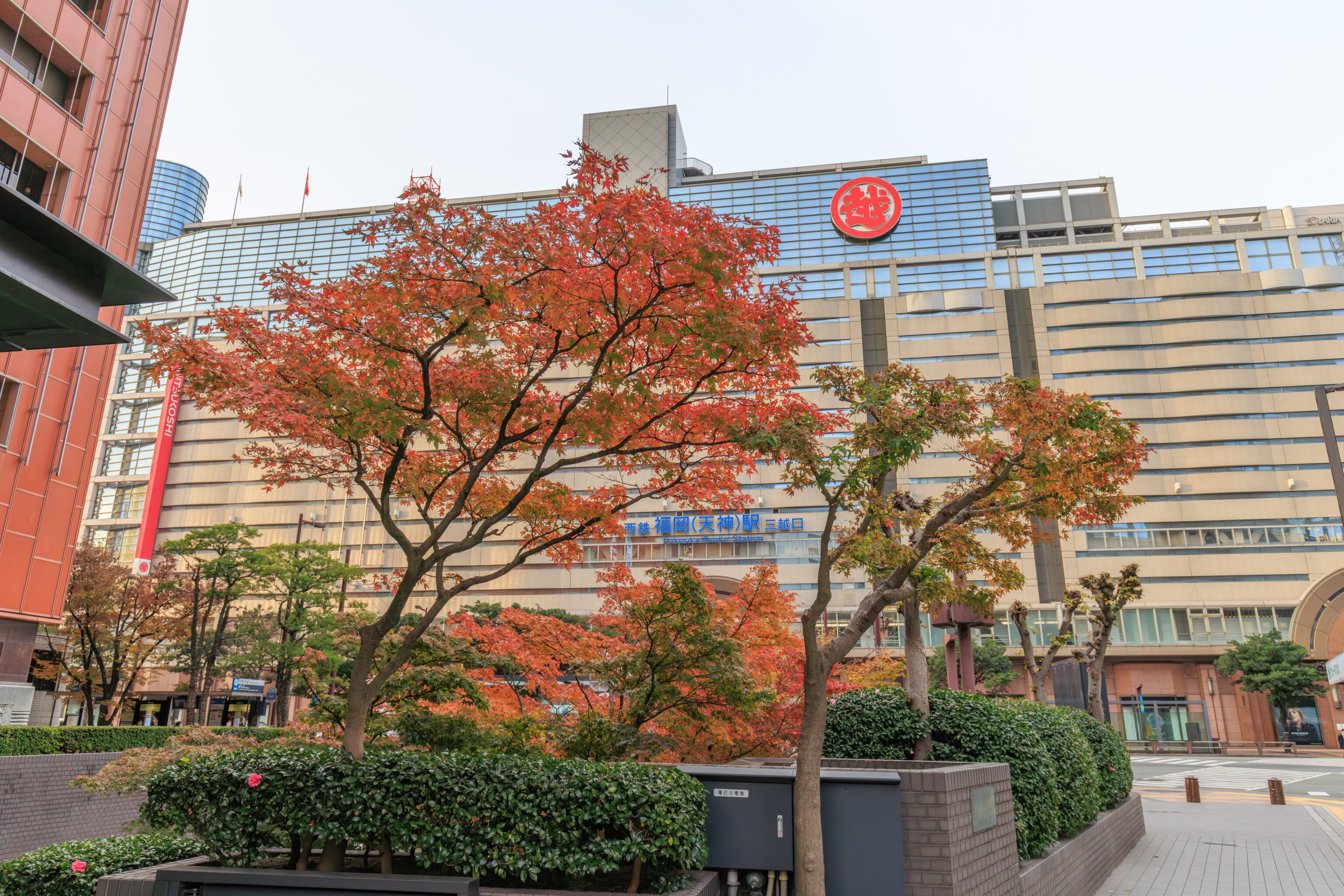
We continued walking to the west.
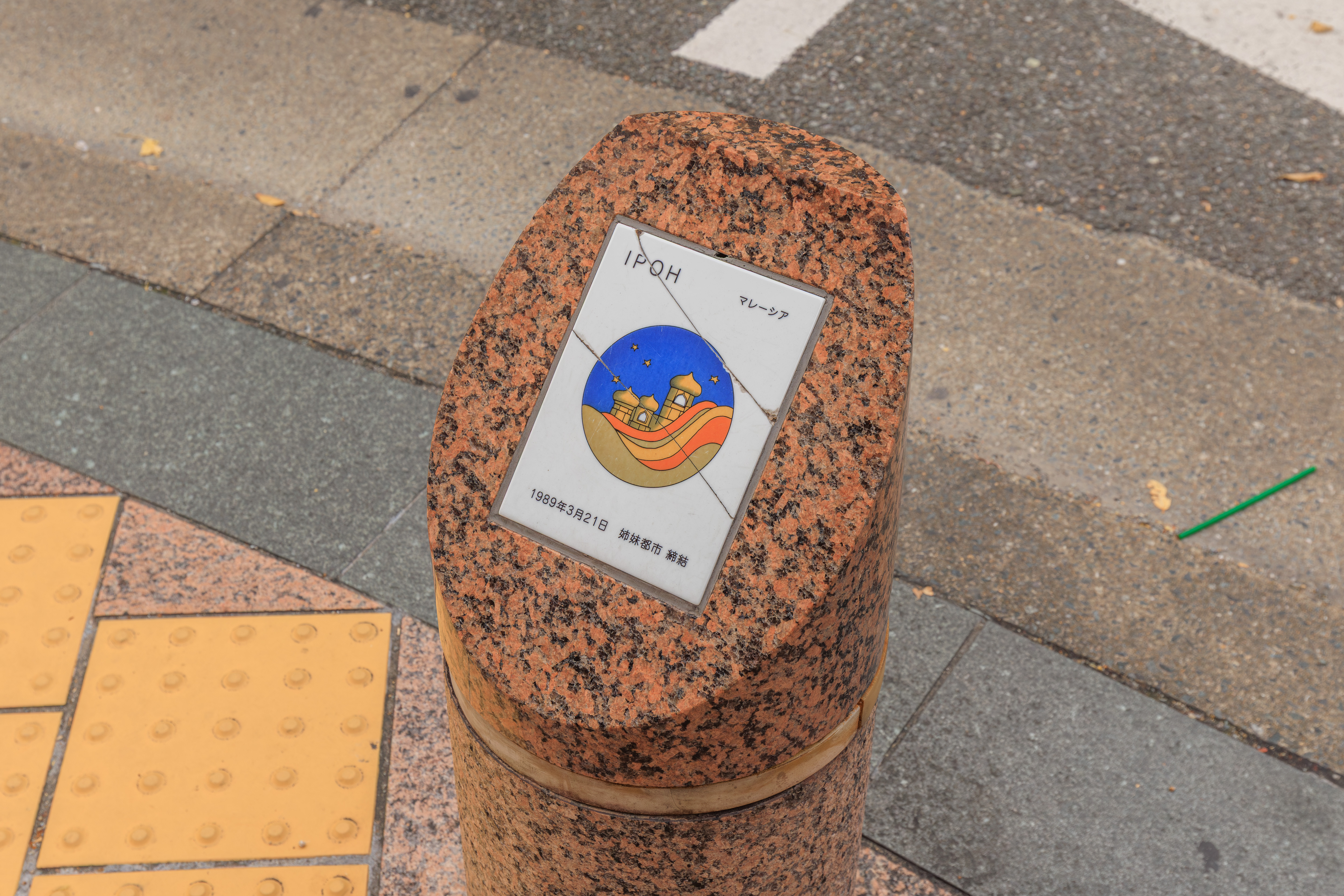
The graphic on this post indicates that Fukuoka has a sister city agreement with Ipoh, Indonesia.
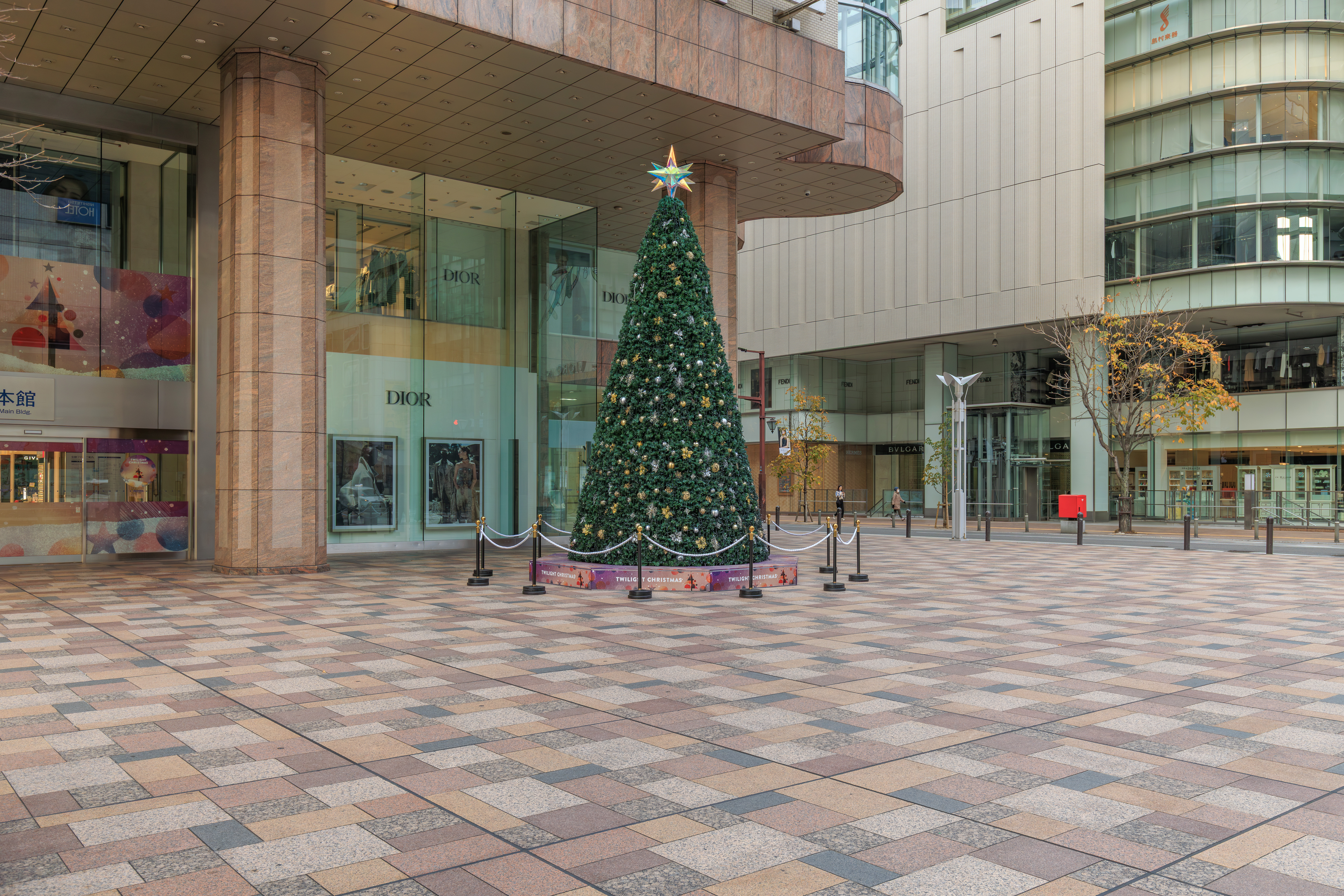
We passed by another Christmas tree in front of the 岩田屋本店 Iwataya Main Store.
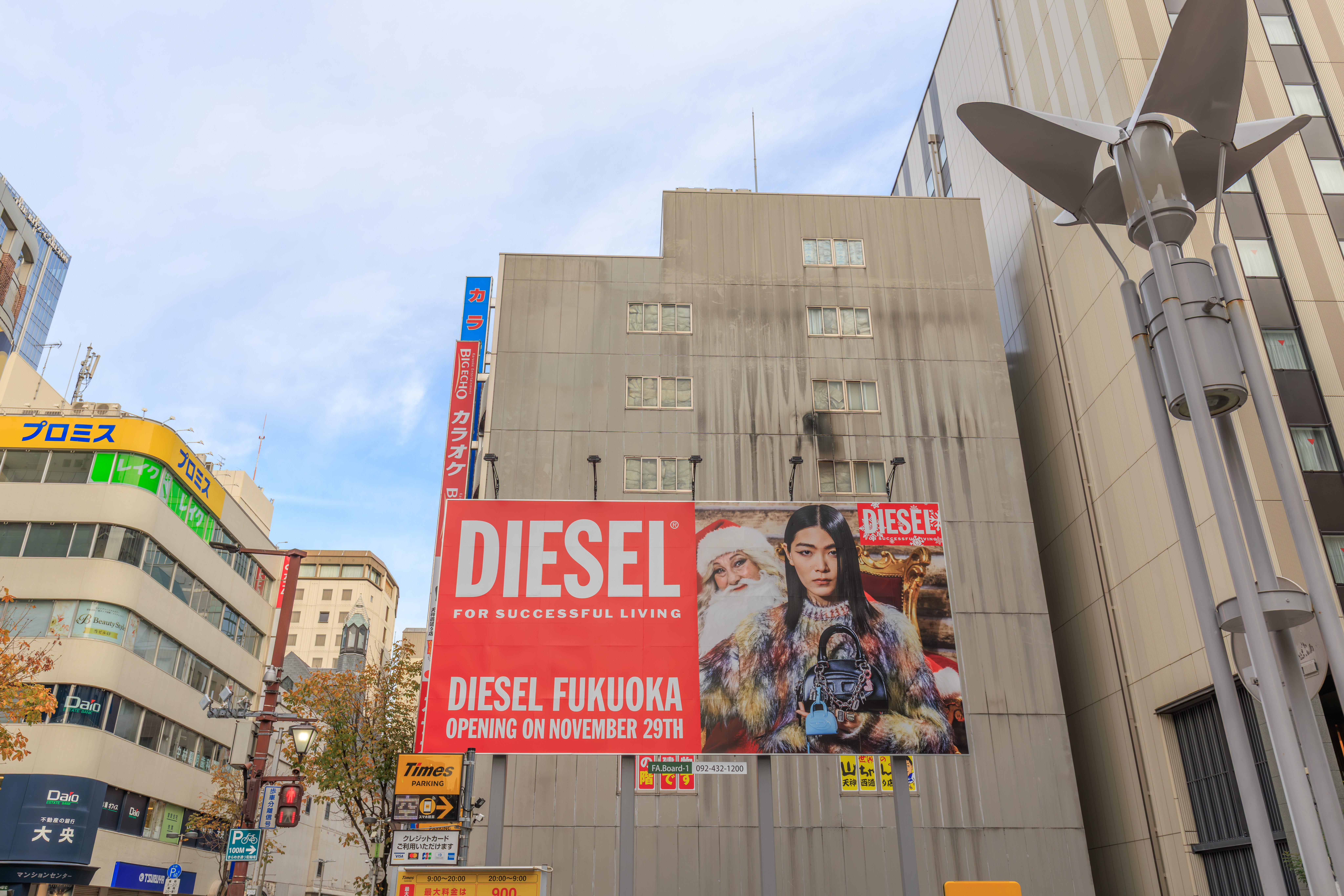
We also came across this ad for a Diesel store, which should have just opened, featuring a possibly female Santa Claus.
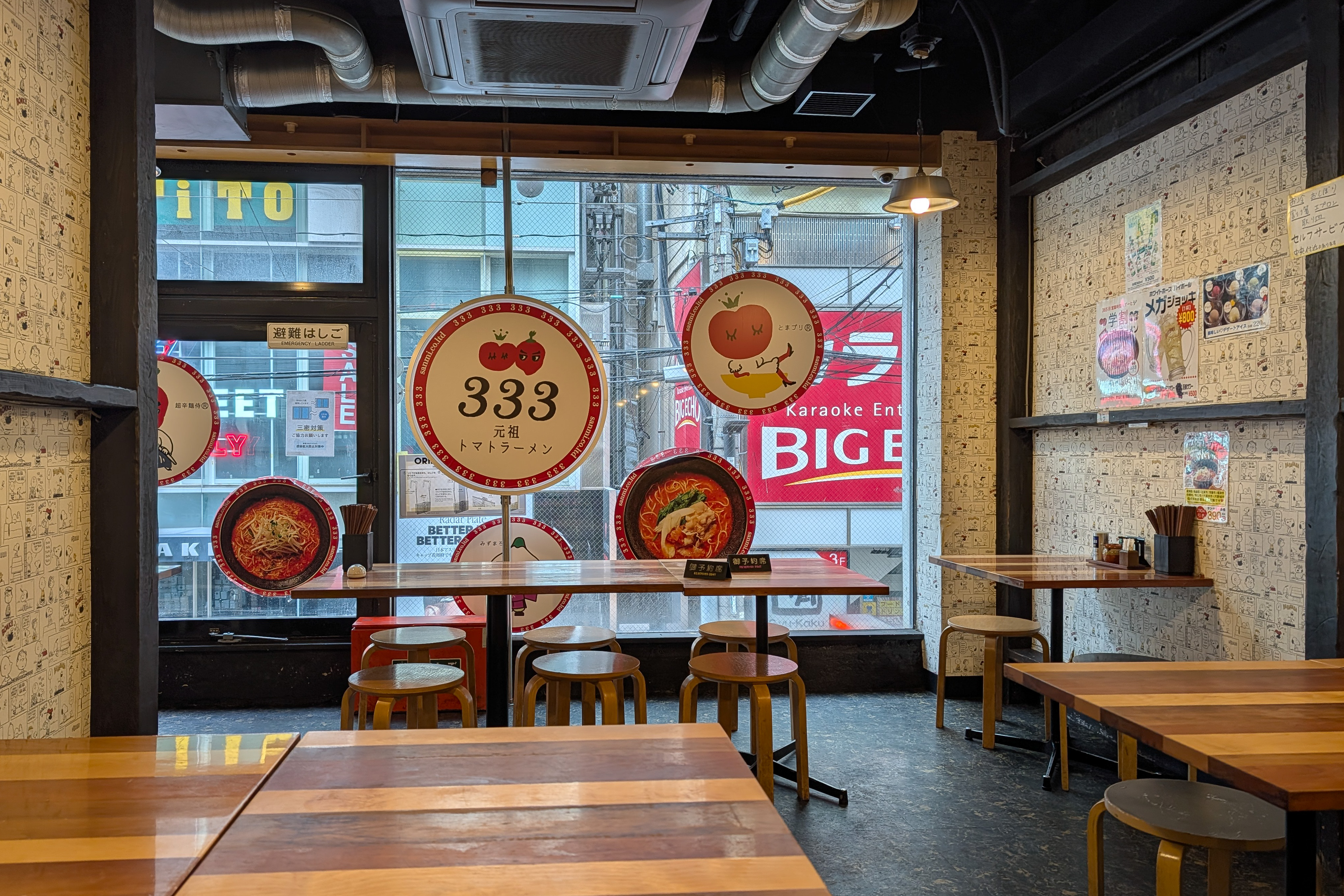
It was a bit hard to find but we arrived at our destination, 三味 Sanmi, which seems to also go by 333. They have three specialties – tomato ramen, spicy noodles, and motsunabe. We are here for the tomato ramen, something we haven’t had before.

The walls featured Peanuts comics!
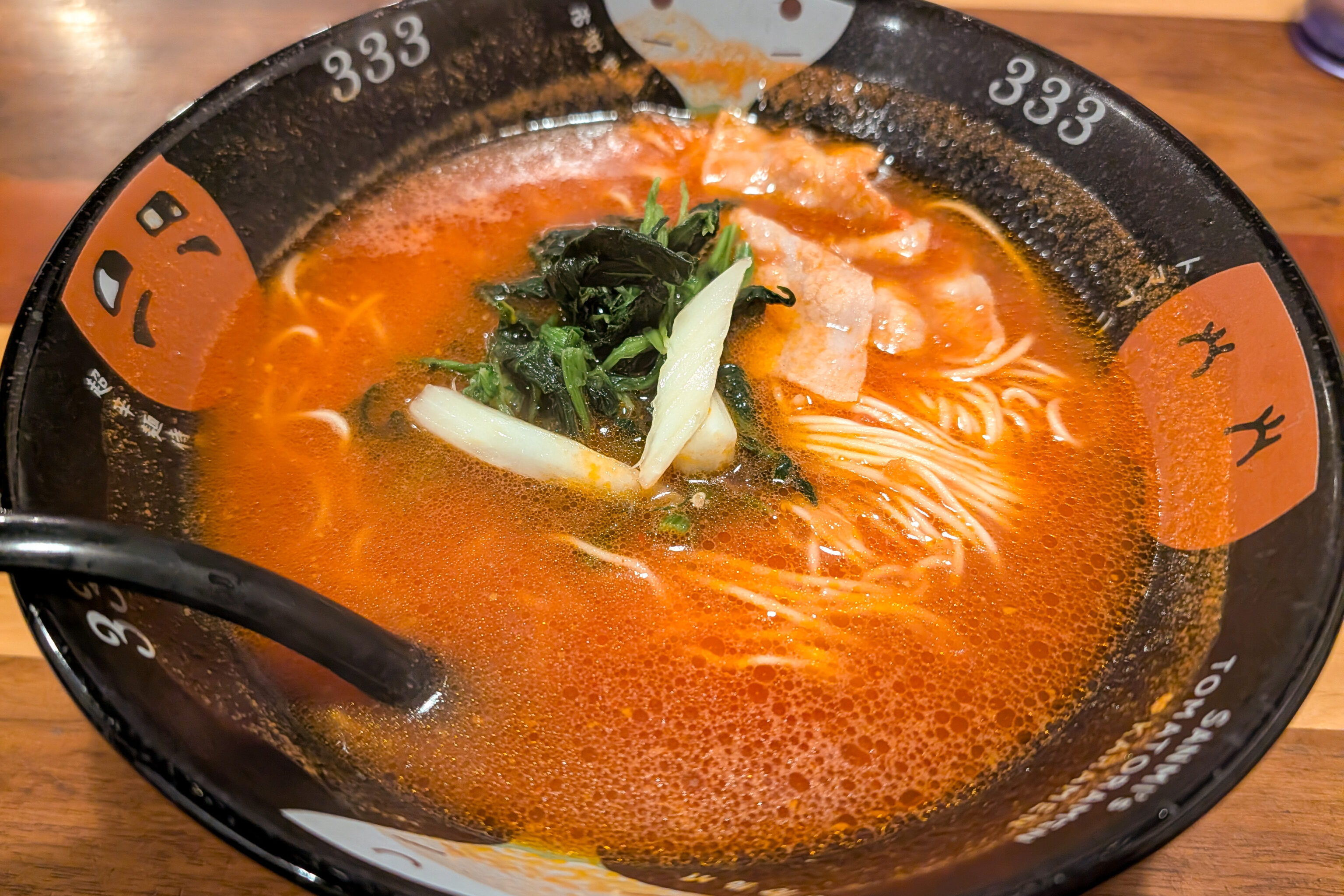
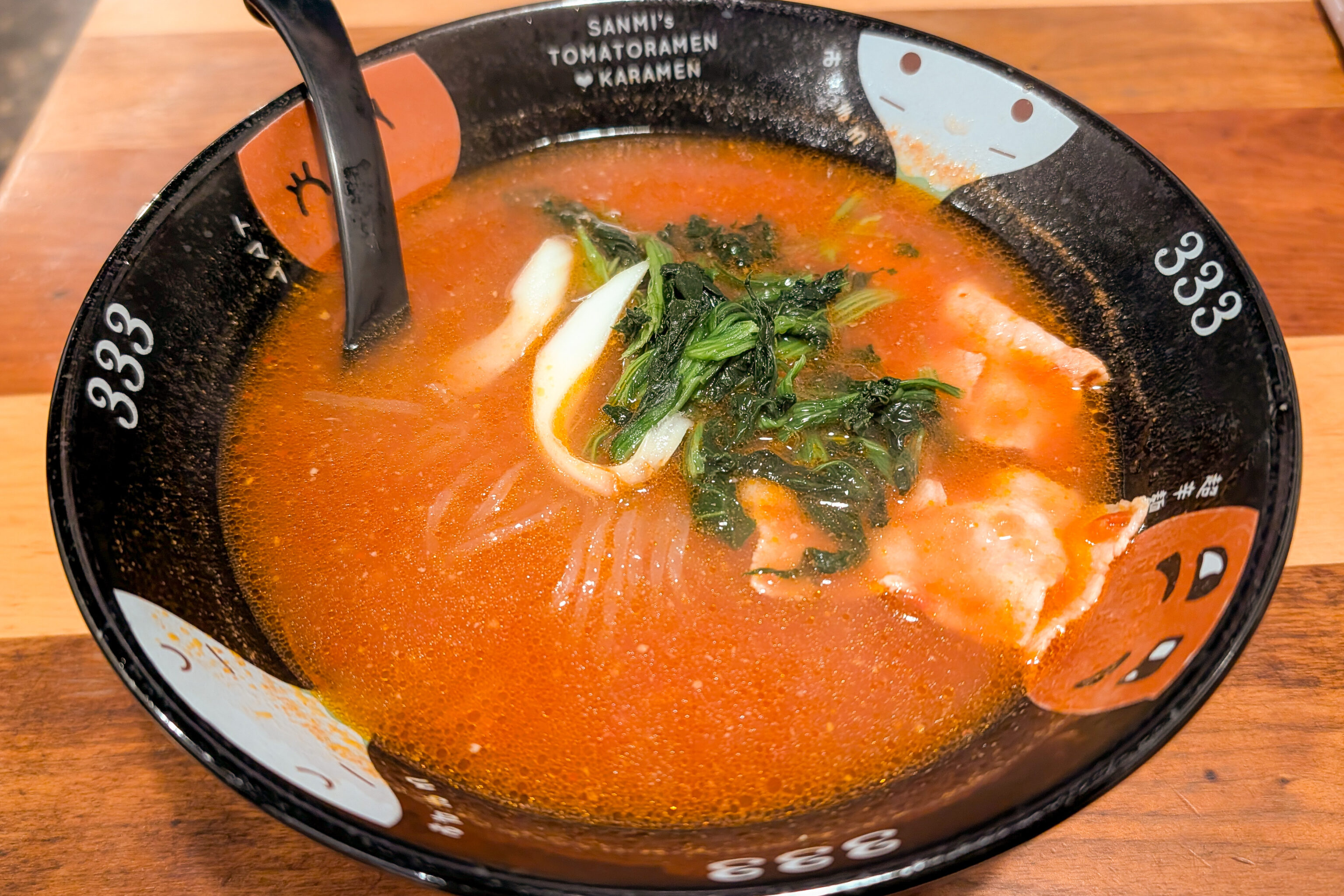
We got two tomato broth bowls, one Japanese ramen and the other with what seemed to be described as having konjac noodles. We’ve never had Japanese konjac noodles before. They seemed to be a bit like Chinese fensi noodles rather than what we expected from konjac.
Both tomato based broths were good. The flavor was somewhat light, a bit like tomato hot pot.
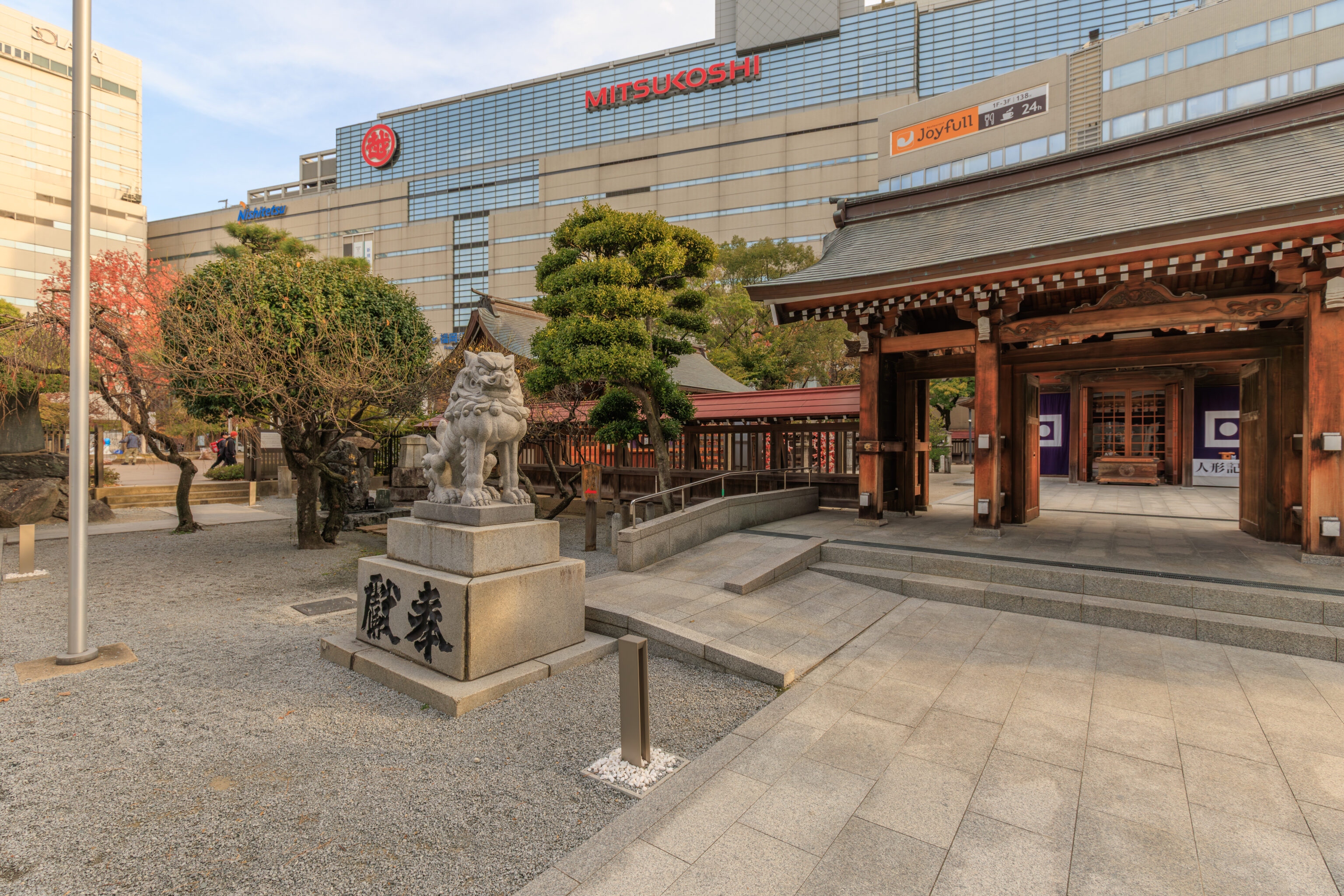
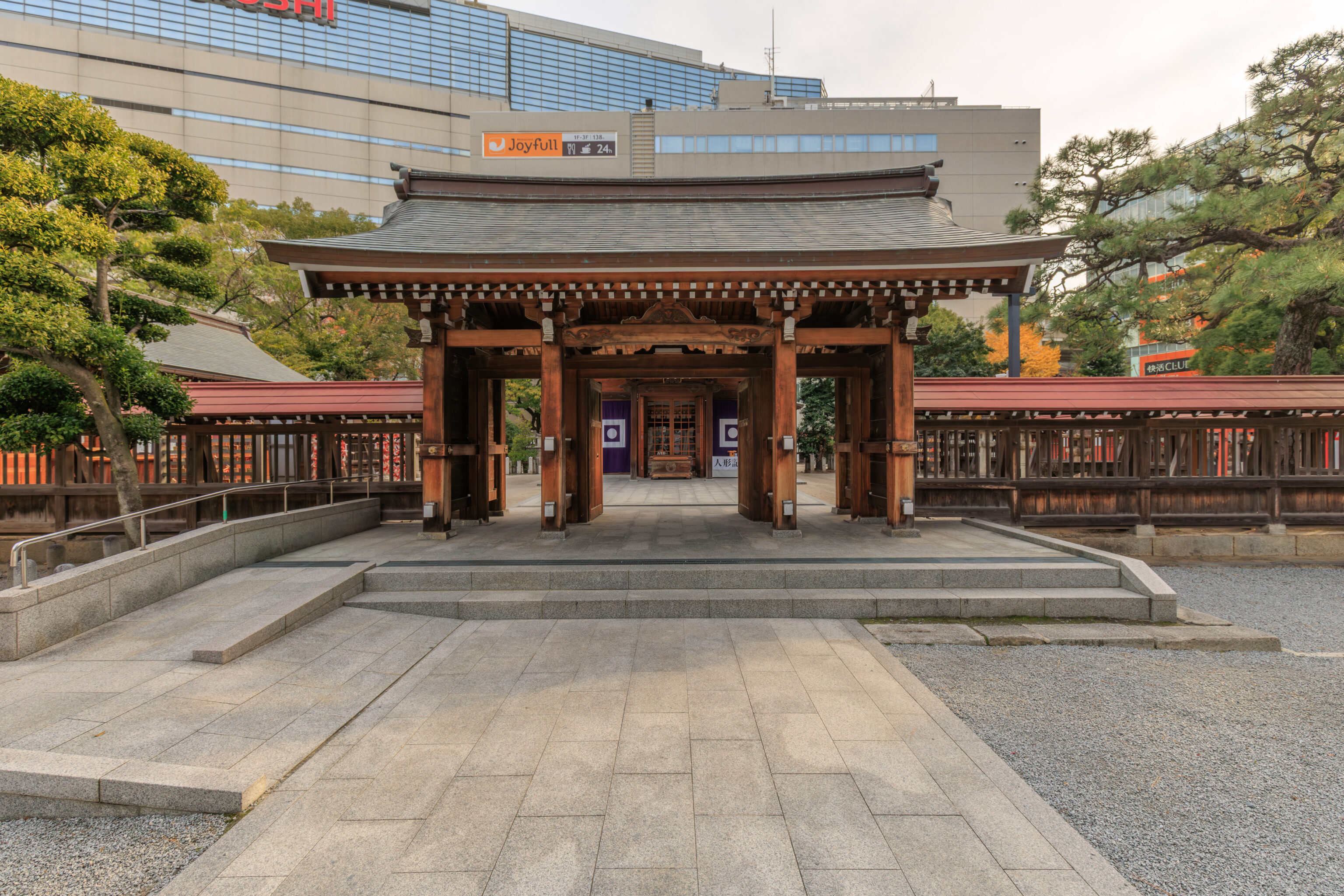
While trying to locate the entrance to the Nishitetsu station, we came across the Shinto 警固神社 Kego-jinja.
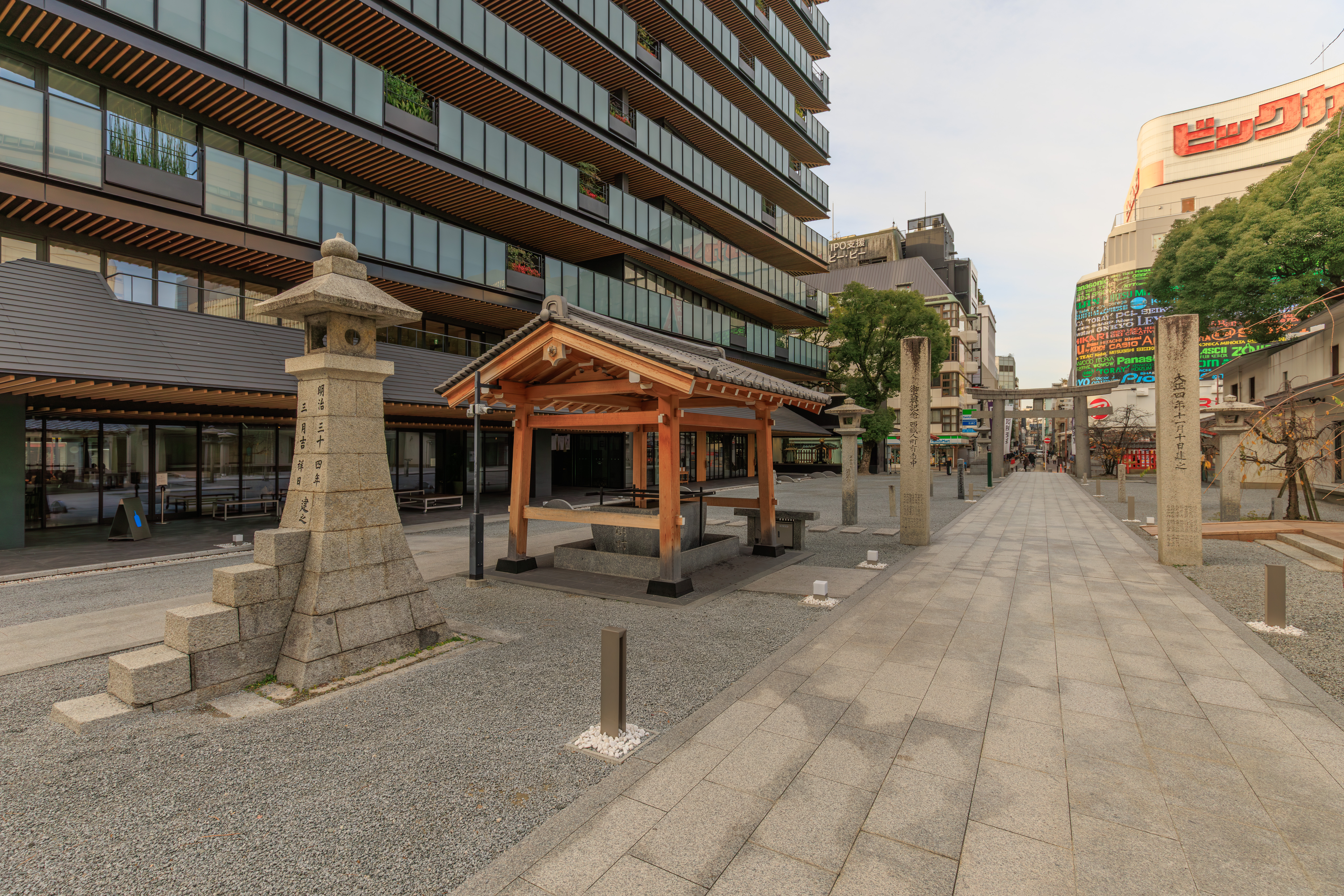
The view looking to the west from the entrance to the shrine.
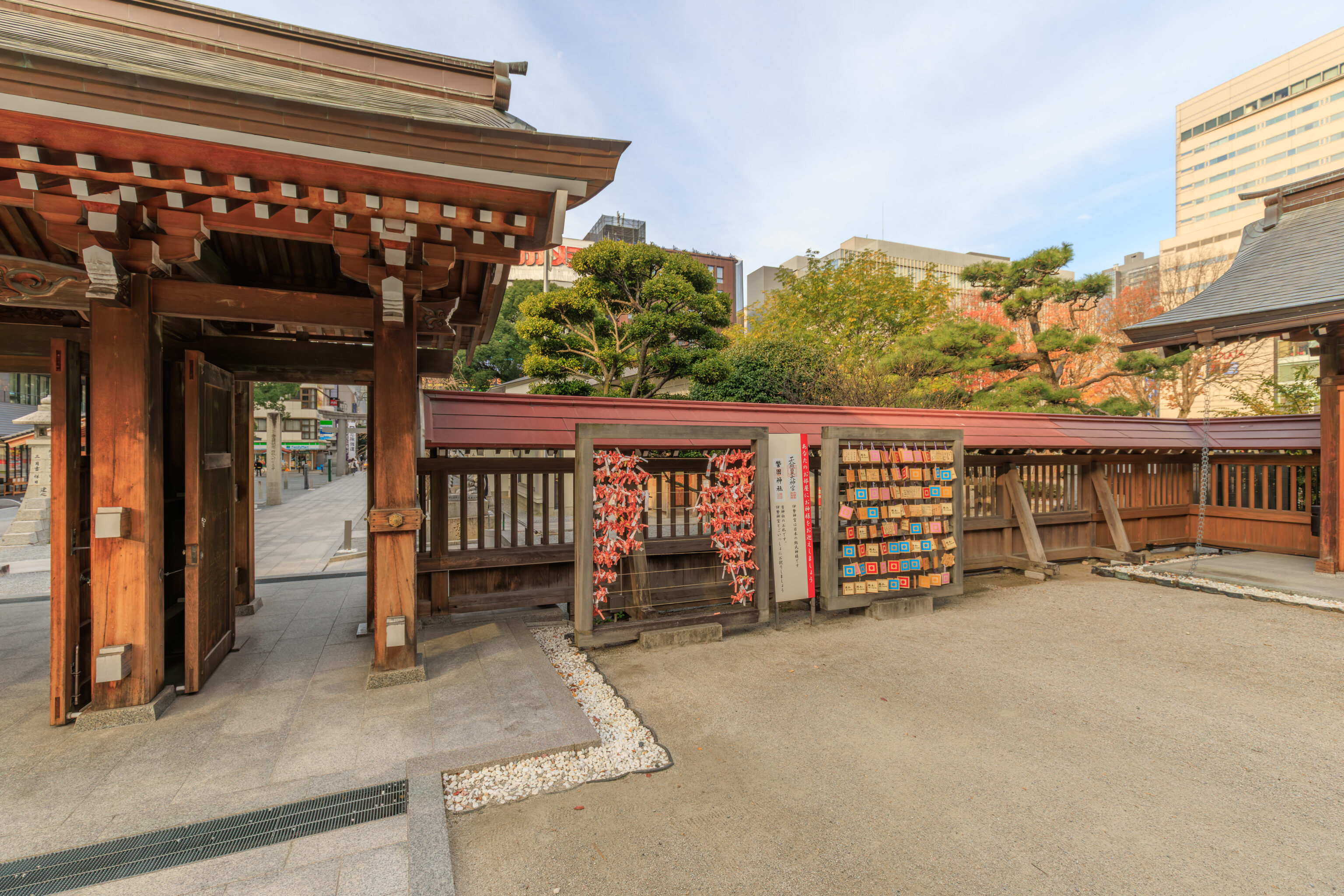
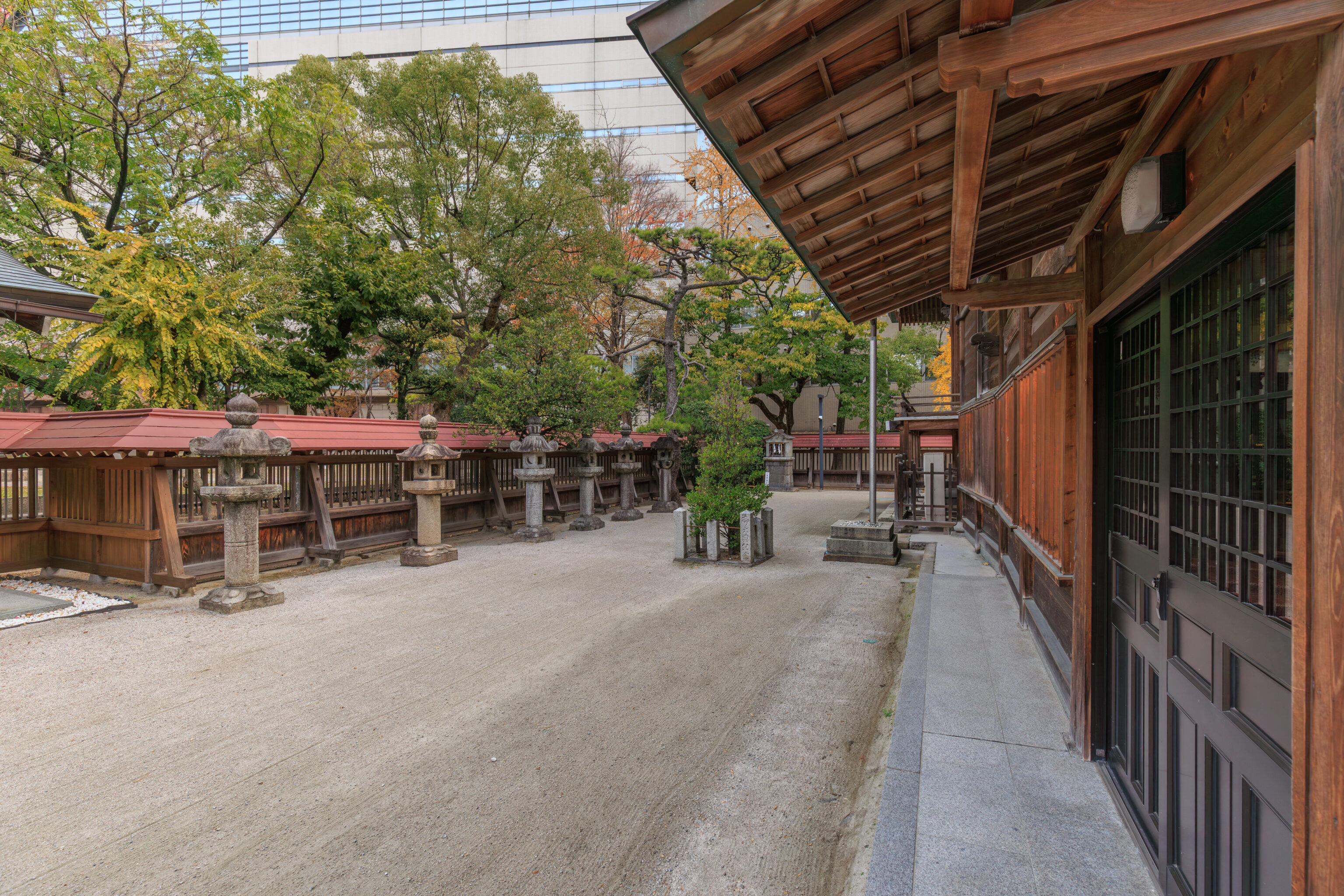
We walked in to take a look. It was 8:50am and there was almost no one around.
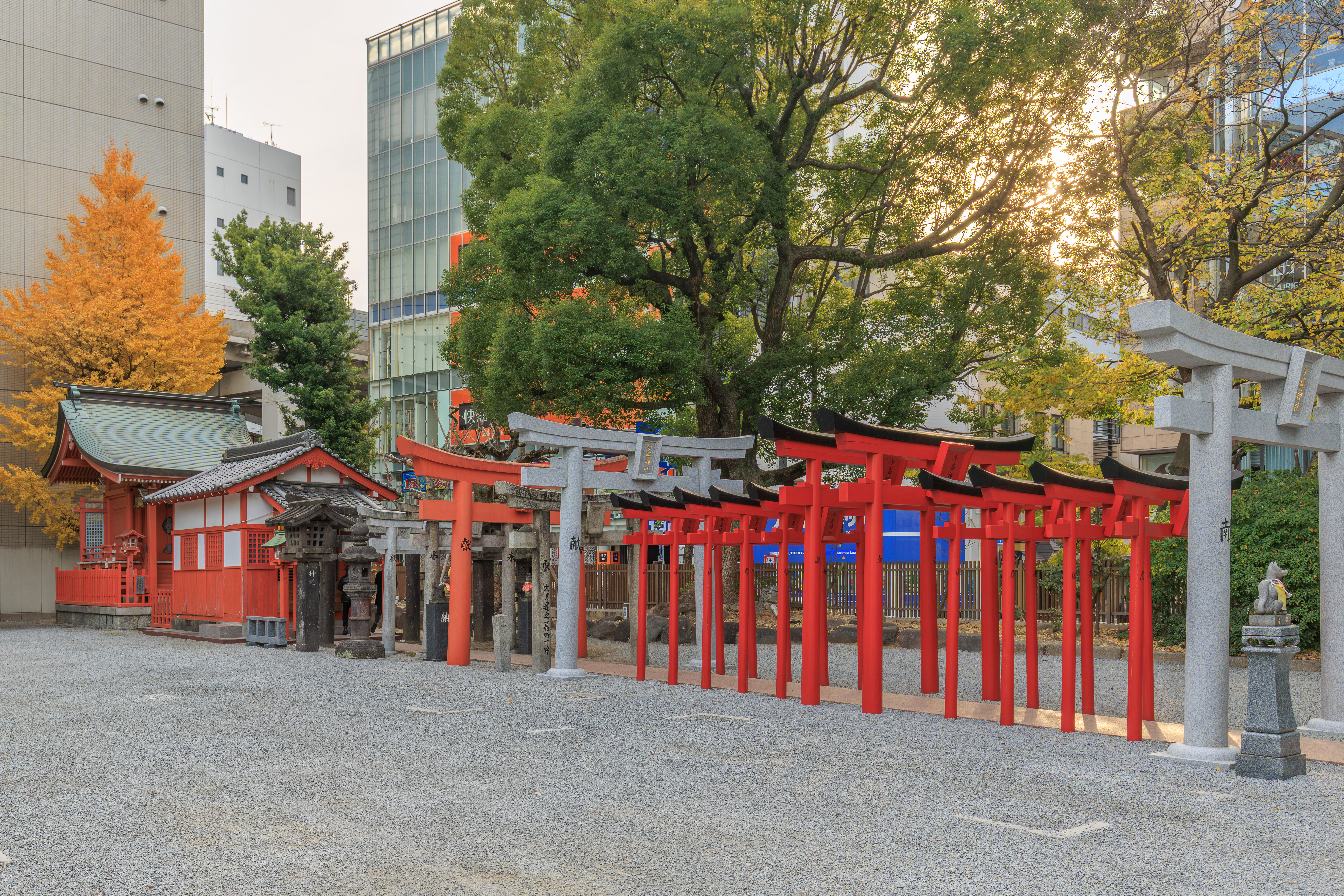
There was a series of varied torii leading to a sub-shrine…
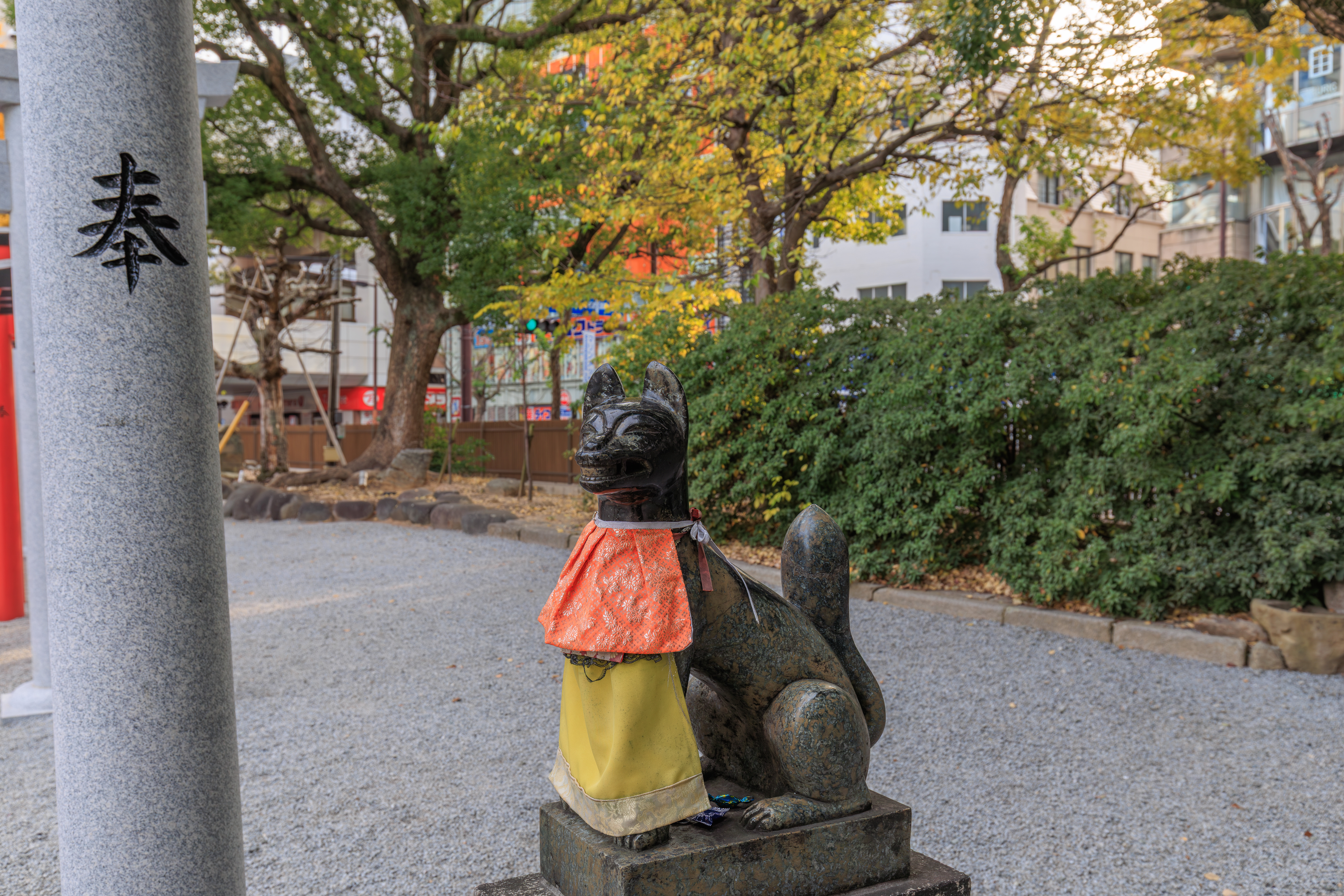
As well as a fox. That indicates this is an Inari shrine.
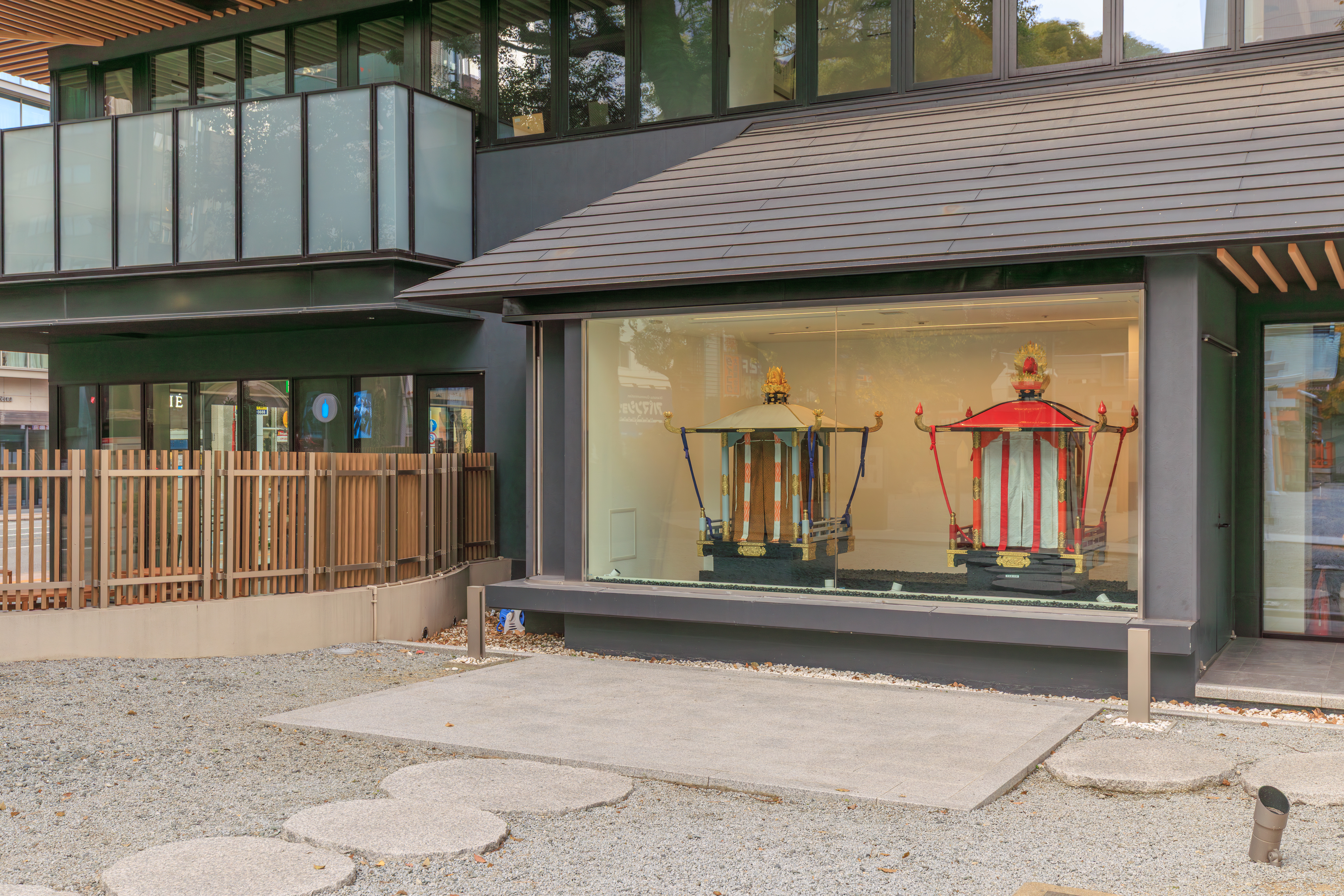
These might be mikoshi, portable palanquin shrines?
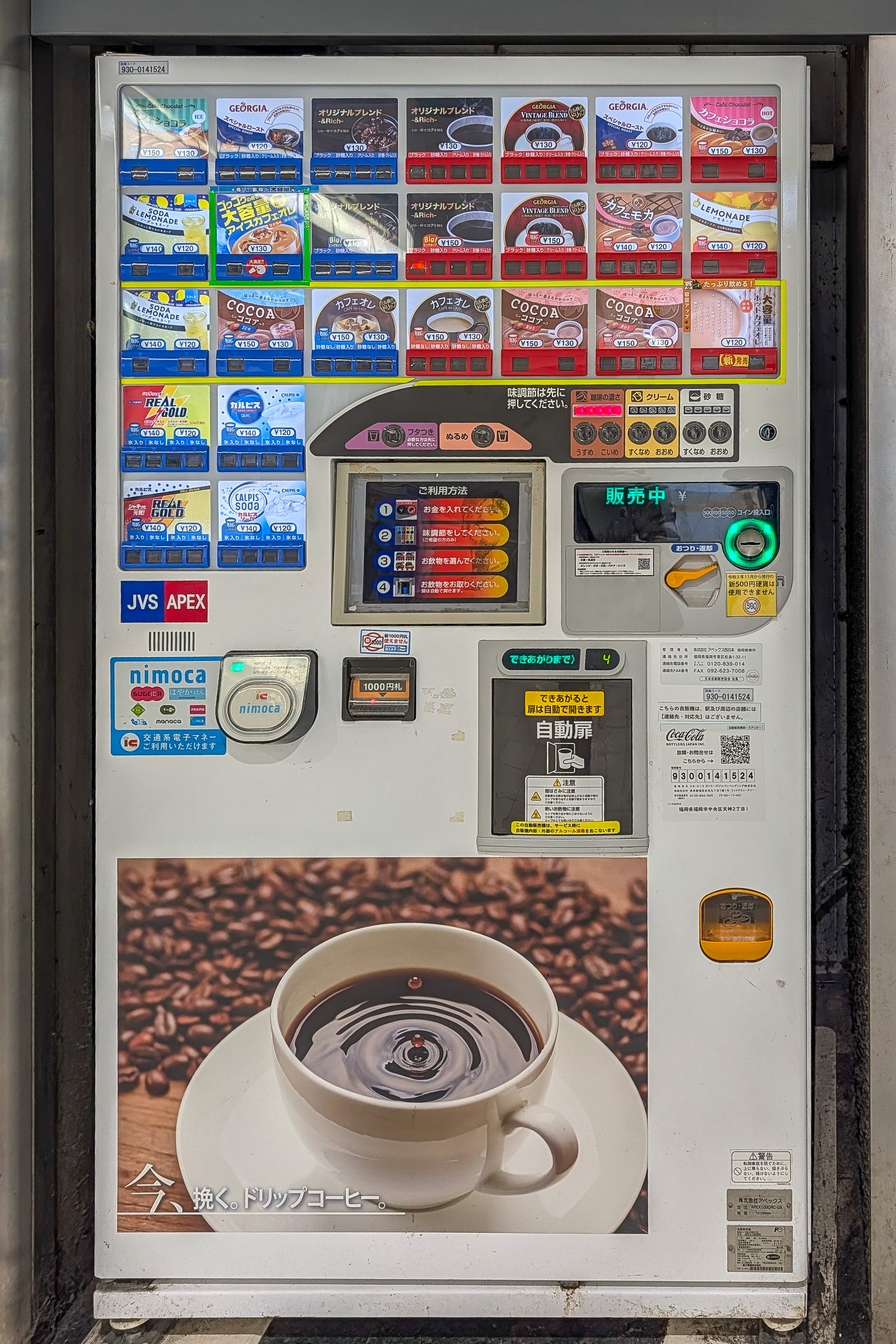
We found the entrance to the Nishitetsu station nearby. We bought tickets and entered the station. There was still some time until our train would depart so we bought some coffee from this vending machine.
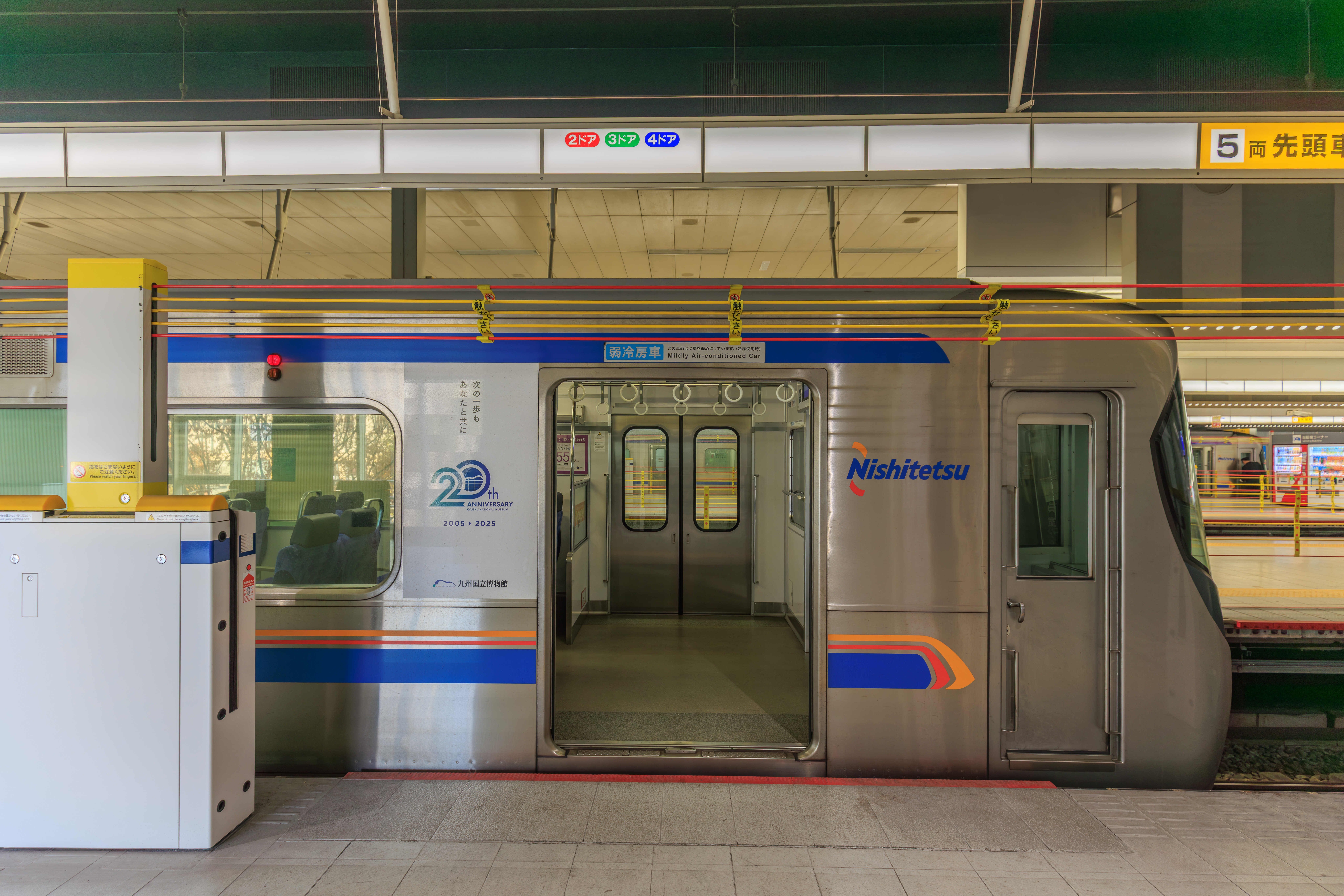
Our train in the station. From Fukuoka, there are trains that go directly to Dazaifu and others that require transferring at the Nishitetsu Futsukaichi Station. The Japanese transportation system is efficient and reliable. Both options basically take the same time to get to Dazaifu.
Dazaifu
After arriving at 太宰府 Dazaifu, we decided to walk over to the nearby Dazaifu Tenmangu, a Shinto shrine.
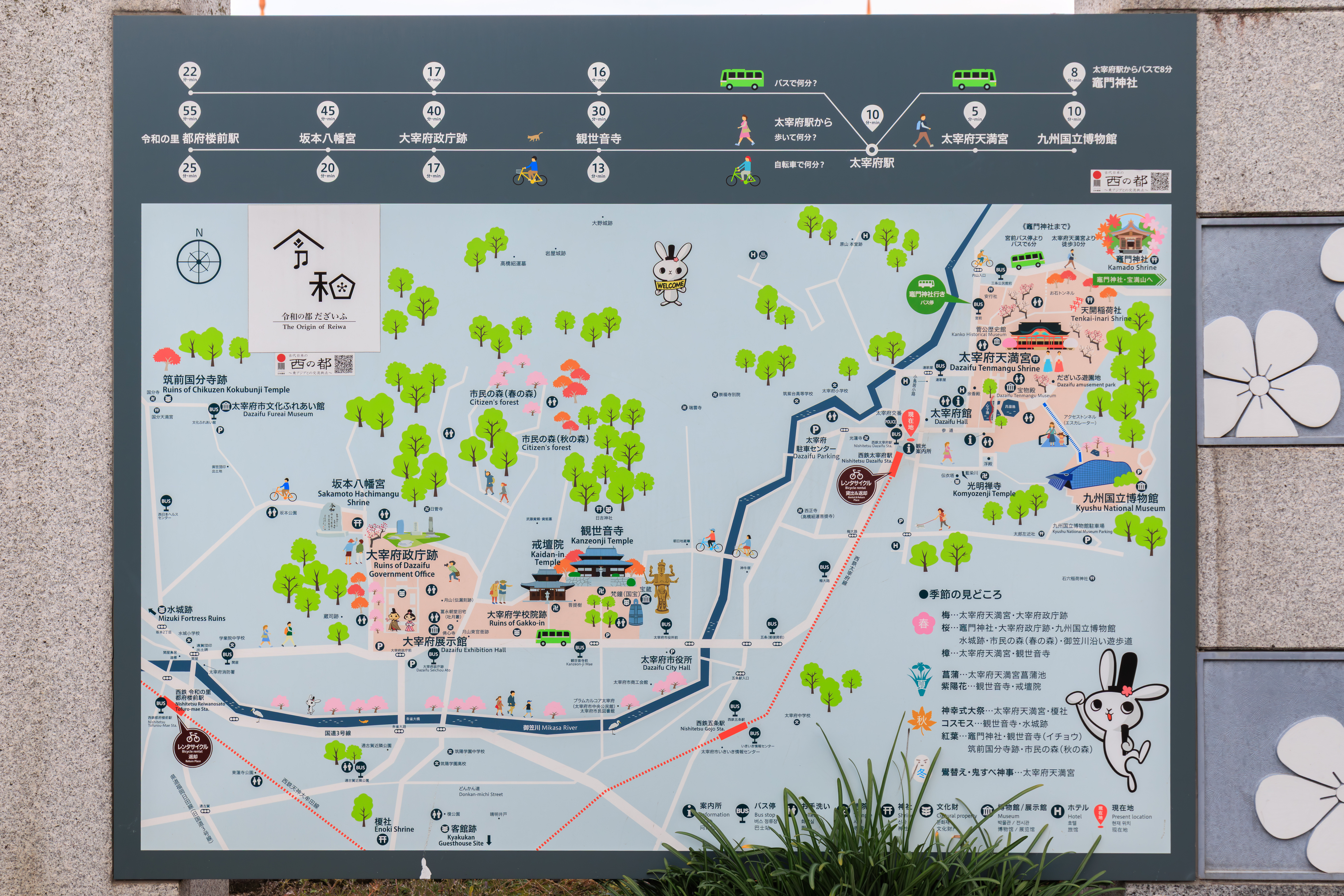
We found sign with a map of Dazaifu by the station. Dazaifu has two areas of interest. One is here and the other is a little bit to the southwest.
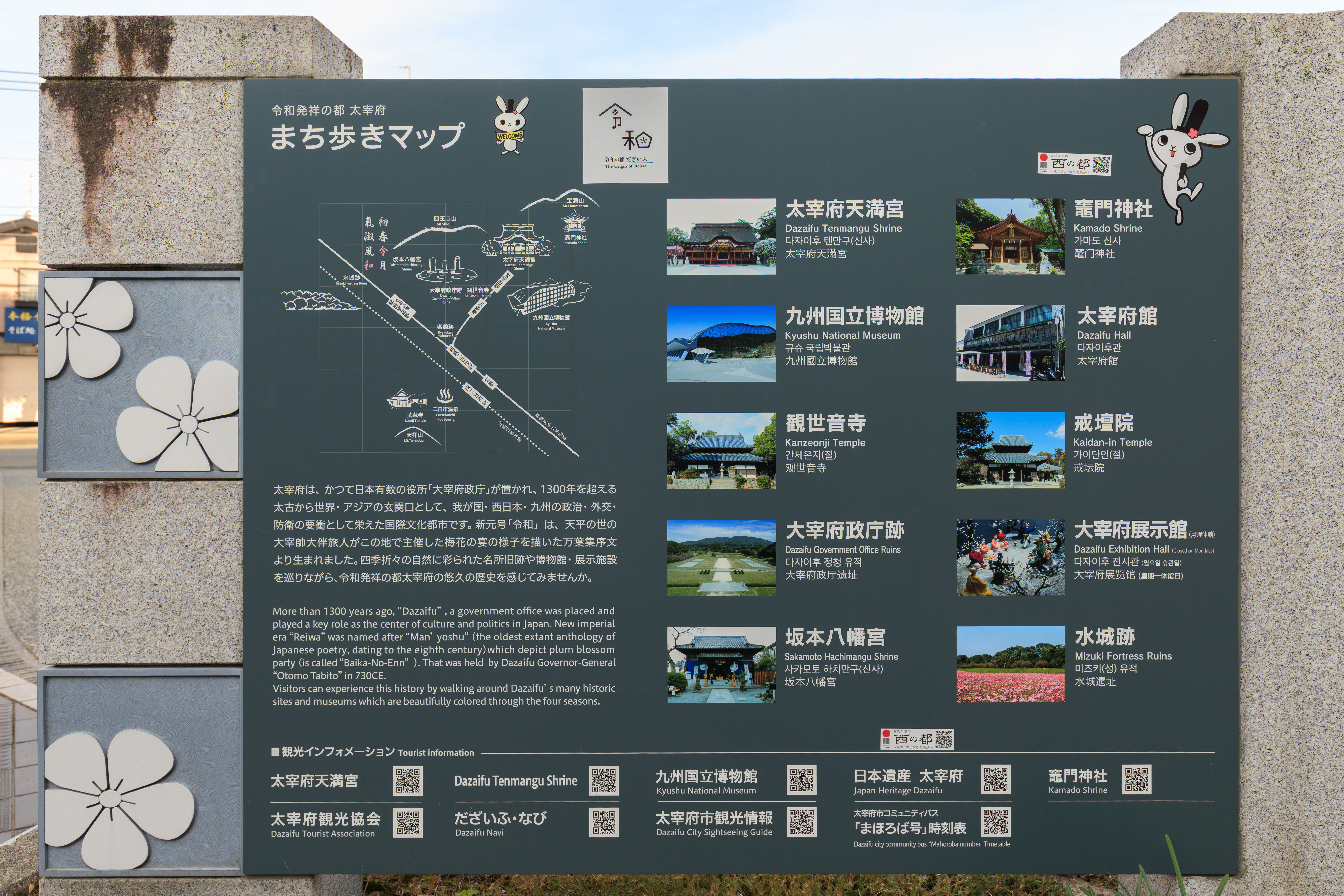
This sign lists the top tourist destinations in Dazaifu.
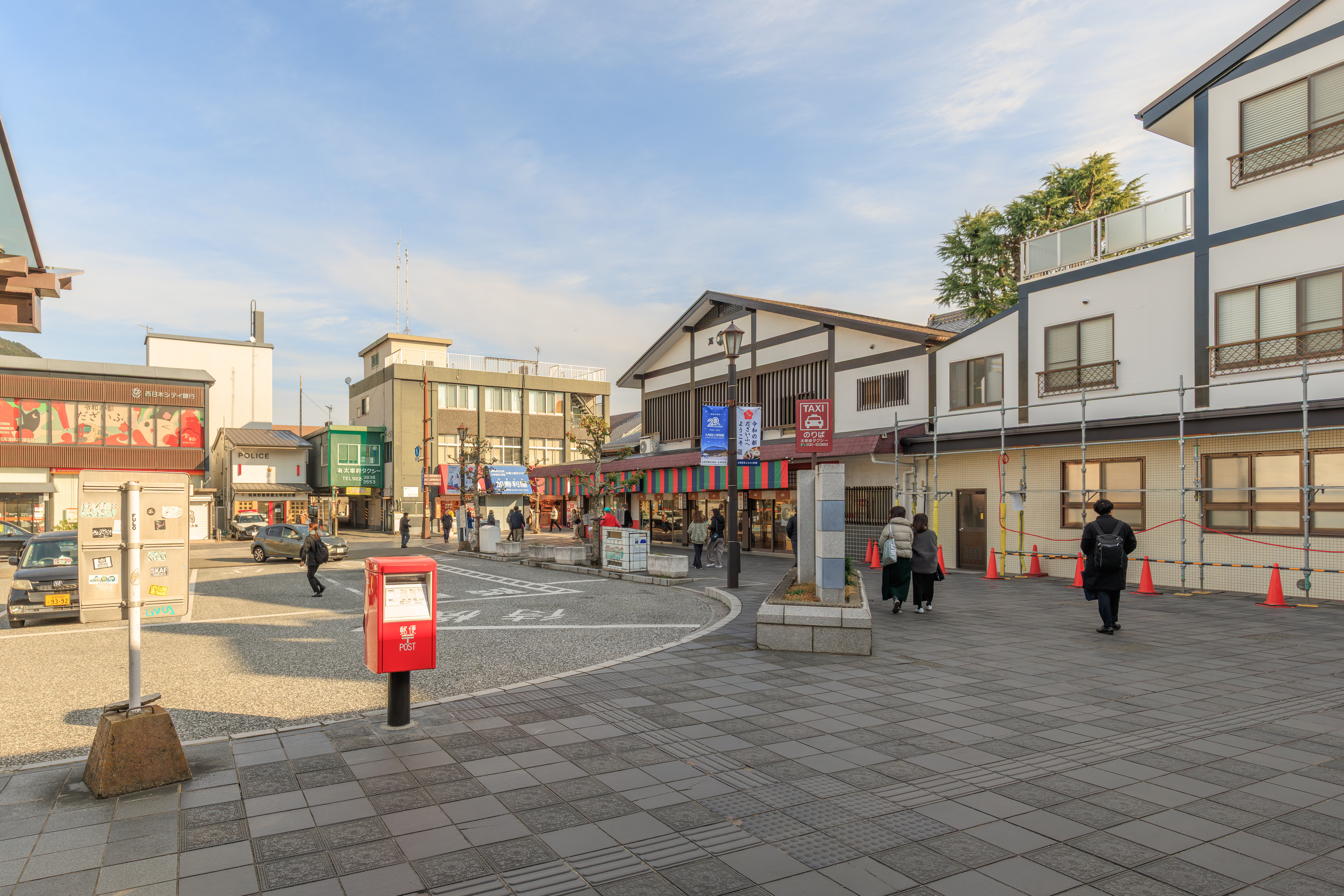
So, we were going to walk over to the Tenmangu. But, we realized there is a special Ichiran restaurant here by the station. It is at the center of the photo above.
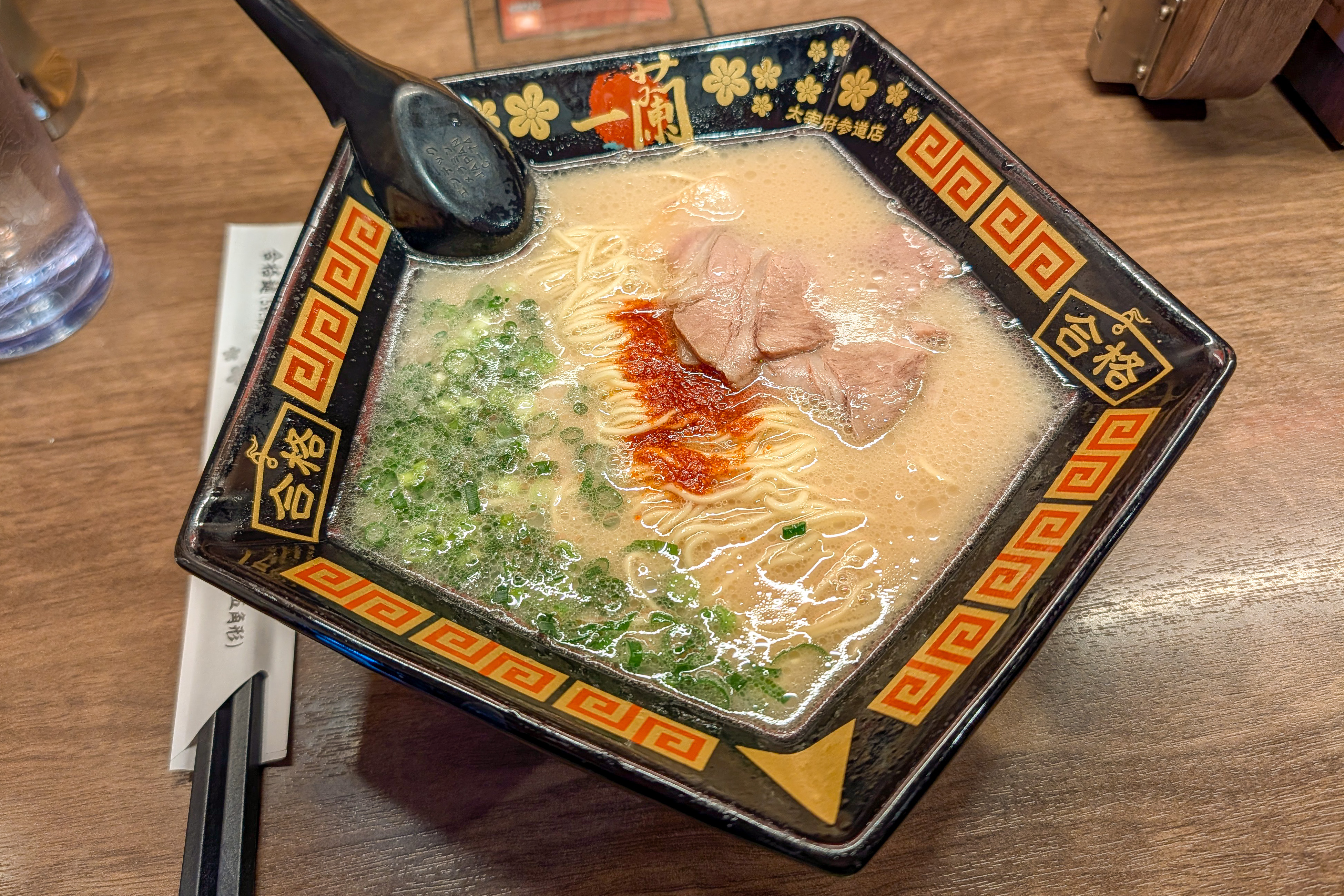
Ichiran is a big ramen chain in Japan and is from Fukuoka. So, it would be natural to eat at their main shop in Fukuoka, which isn’t too far from the Grand Hyatt where we are staying. But, this Ichiran here is special. It has five sided ramen bowls as well as noodles that are longer than the standard Ichiran ramen noodle.
There was a queue, although luckily it wasn’t too long.
Lucky Charms at the Dazaifu Sando Store

1 The "Success" Bowl
This five-sided (pentagonal) bowl is imbued with our heartfelt wish to deliver "Success" (a homophone for "five-sided" in Japanese) directly to our customers. The bowl features a design incorporating the *ume* (plum blossom)—the symbol of Dazaifu—along with "Success *Ema*" (votive plaques) adorning the rim, and the character for "Decision" inscribed at the very bottom. Furthermore, your meal is served with matching five-sided chopsticks—our special "Success Chopsticks."

2 Goukaku-men (Success Noodles)
Since ancient times, noodles have been regarded as a highly auspicious food. Created with the wish that "long-lasting happiness" may visit our customers, *Goukaku-men* are crafted to be far longer than standard noodles. Their length—a symbolic 59 centimeters—is more than double that of ordinary noodles. We hope you savor their deliciousness for as long as possible, and that enduring happiness may be yours.

3 Kotodama (The Spirit of Words) —Hospitality Through Language—
All of us—the entire staff—serve our customers using greetings specifically crafted to evoke "happiness" and "success." It is said that words possess a spiritual power—*Kotodama*—that can infuse a space with energy. With this belief in mind, we deliver our words to you, praying that they fill you with hope and a profound sense of happiness.

4 Lucky Charms Throughout the Shop
At our Dazaifu Sando store, we have filled the interior with various lucky charms to ensure that happiness visits as many of our customers as possible! You will find auspicious items everywhere—bearing words of good fortune such as "Success," "Passing," "No Falling" (meaning you won't fail), and simply "Happiness."

We invite you to seek them out, embrace their abundant good luck, and welcome happiness into your life. We sincerely wish you all the very best.
– Text from a sign, translated using Google.
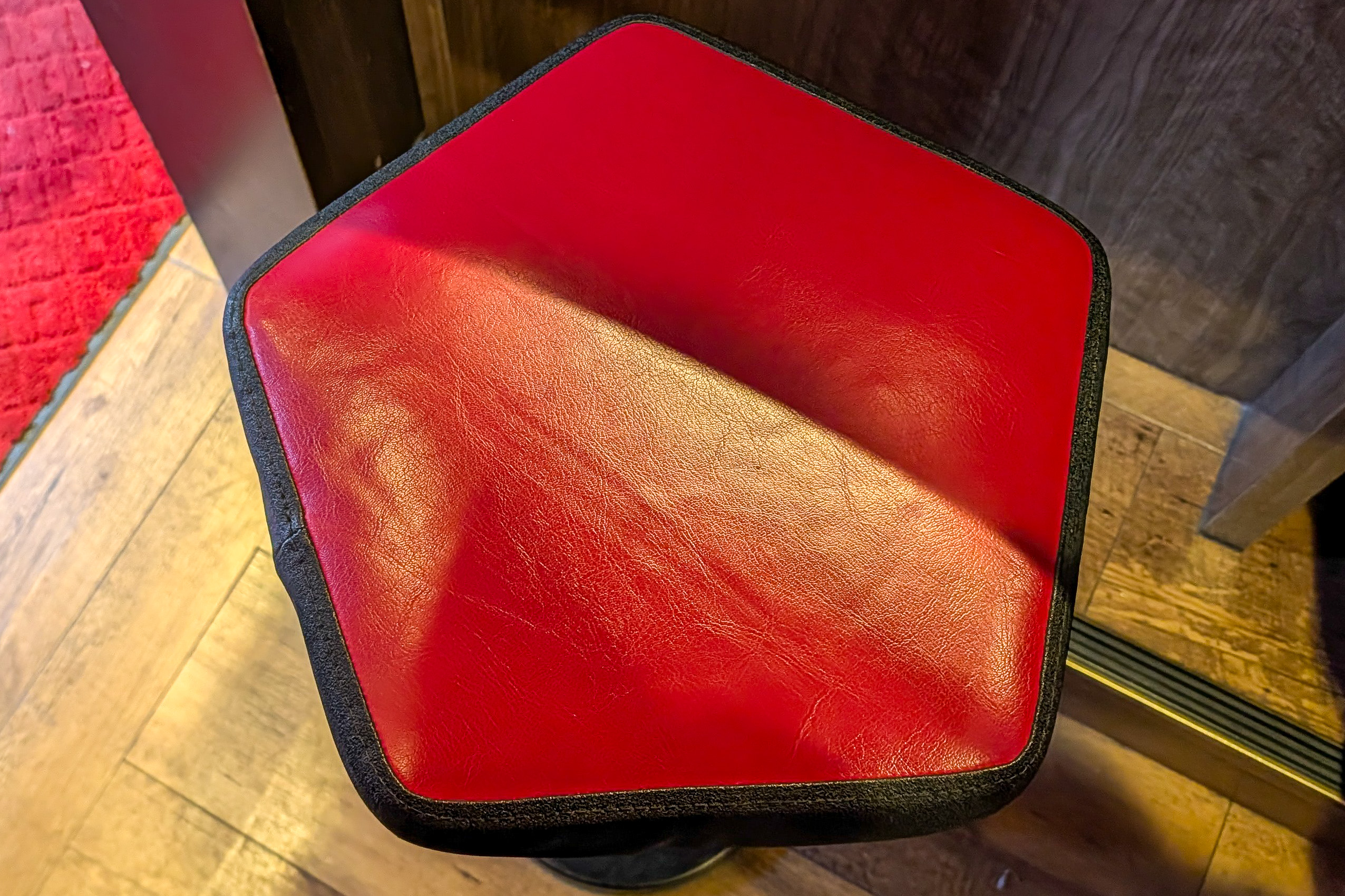
We ended up waiting maybe 20 minutes or so before being seated. Even the seats are five sided here!
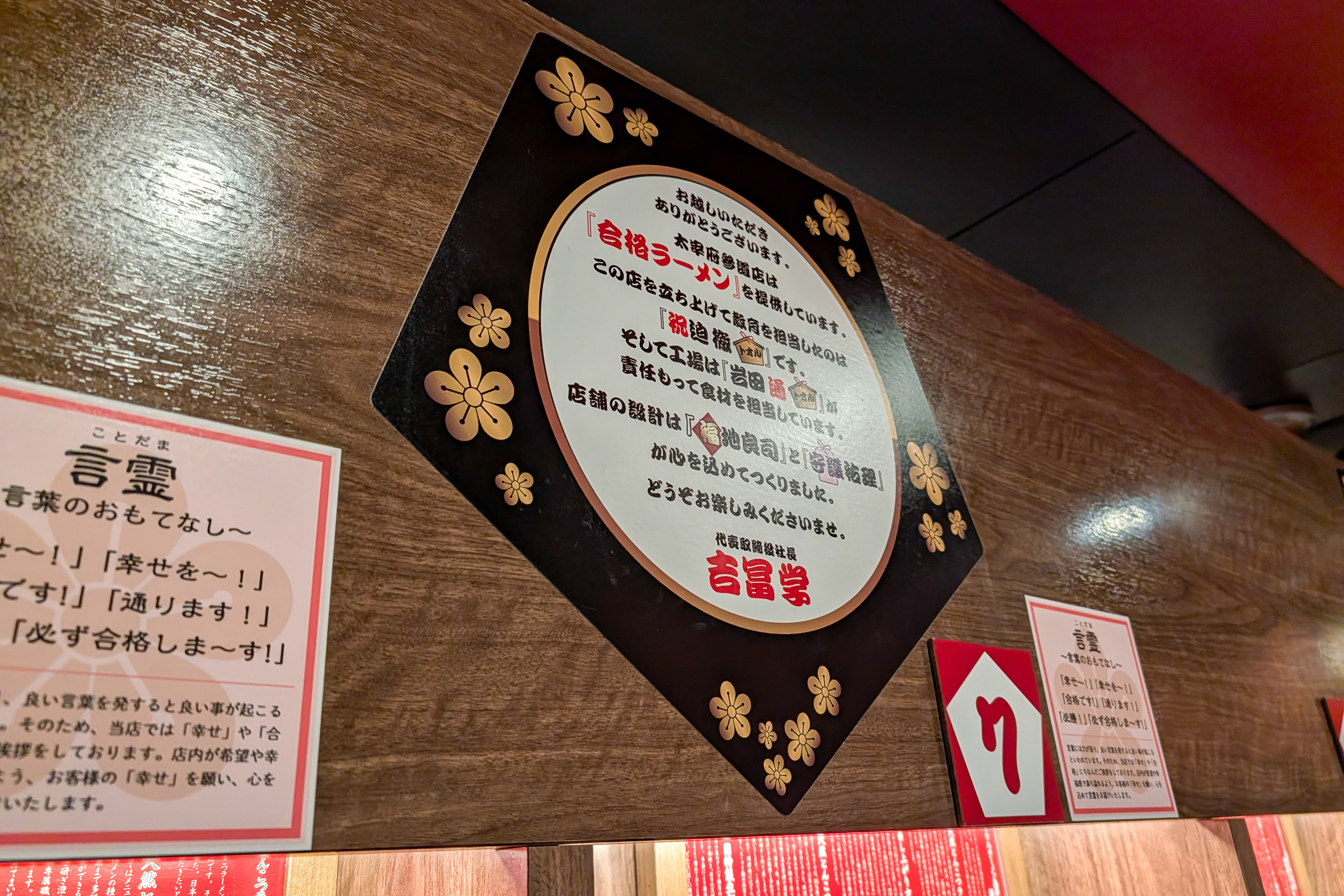
This five sided sign contains a message from the CEO of Ichiran, Manabu Yoshitomi:
Thank you for visiting us.

Our Dazaifu Sando location proudly serves our signature "Goukaku Ramen" (Success Ramen).

The person responsible for establishing this shop and overseeing its operations is Tetsuka Iwaizako.

Meanwhile, Toru Iwata takes full responsibility for the ingredients and production at our facility.

The shop's interior was designed and crafted with heartfelt dedication by Ryoji Gochi and Yuri Shugo.

We hope you enjoy your visit.

Manabu Yoshitomi
President and CEO
– Text from a sign, translated using Google.

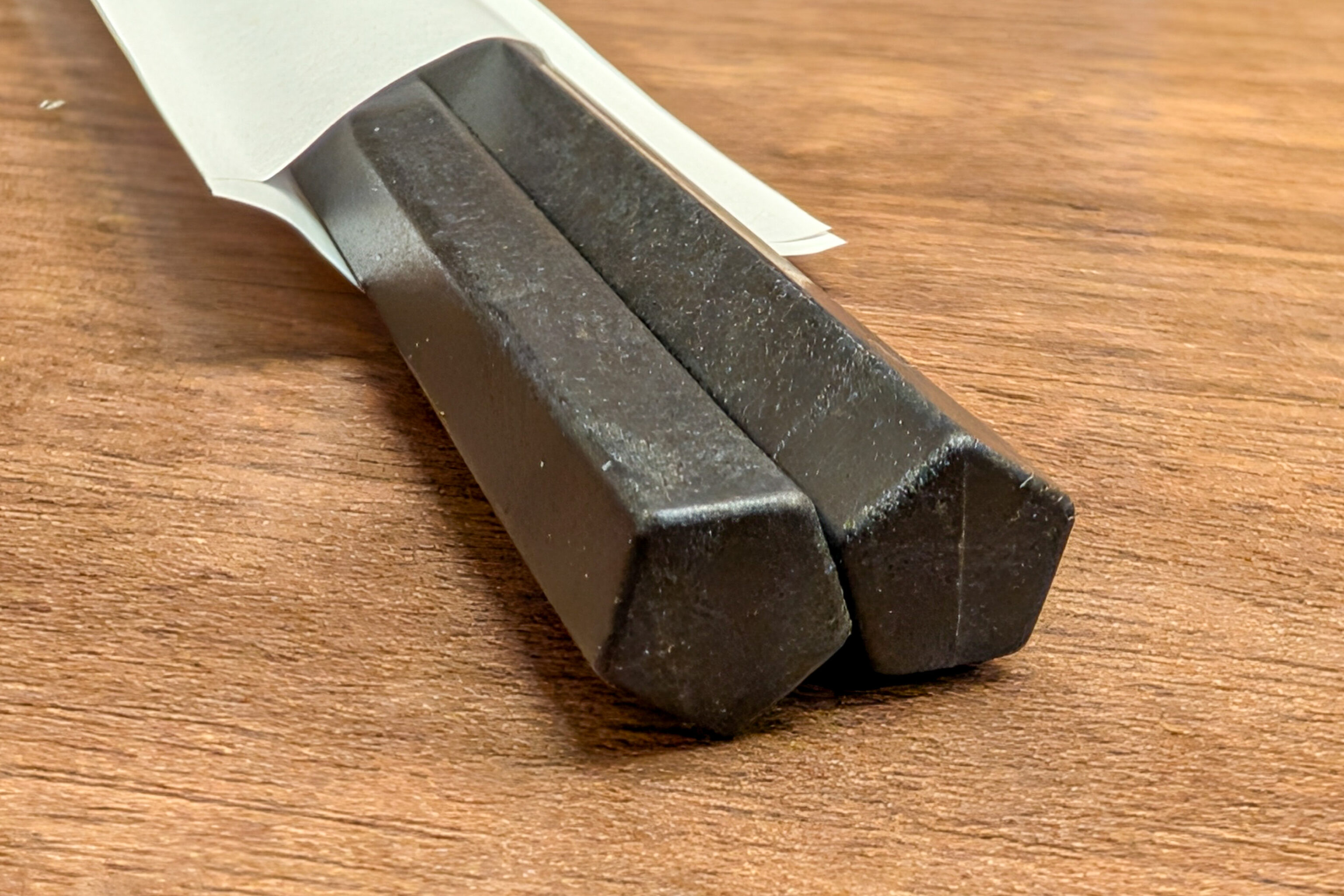
The chopsticks are also five sided!
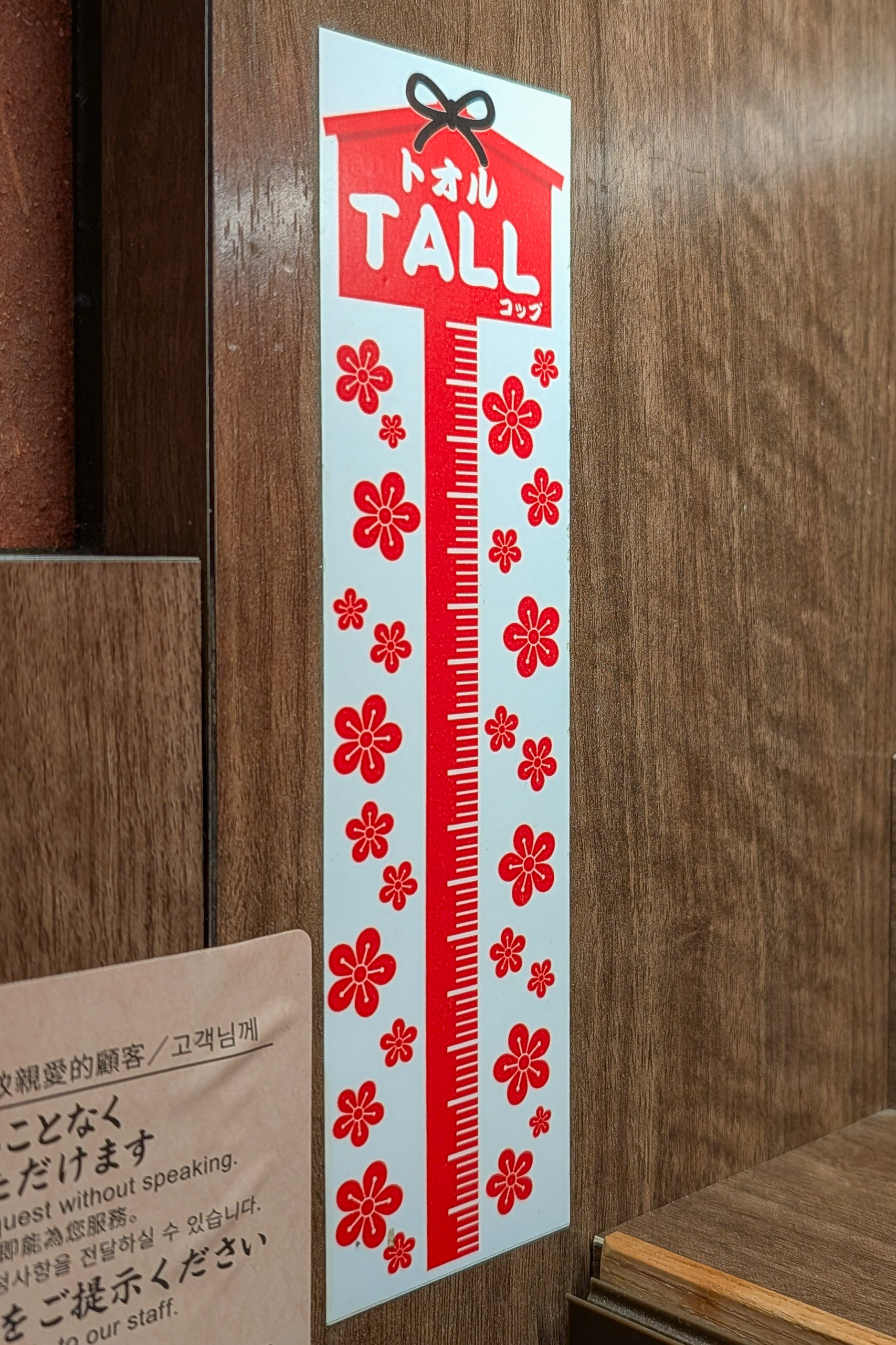
There was a ruler on the wall, kind of like what you would use to measure your eight. Is it 59 centimeters tall?
Service is fast at Ichiran. Our five sided bowls of ramen came out a few short minutes after we sat down.
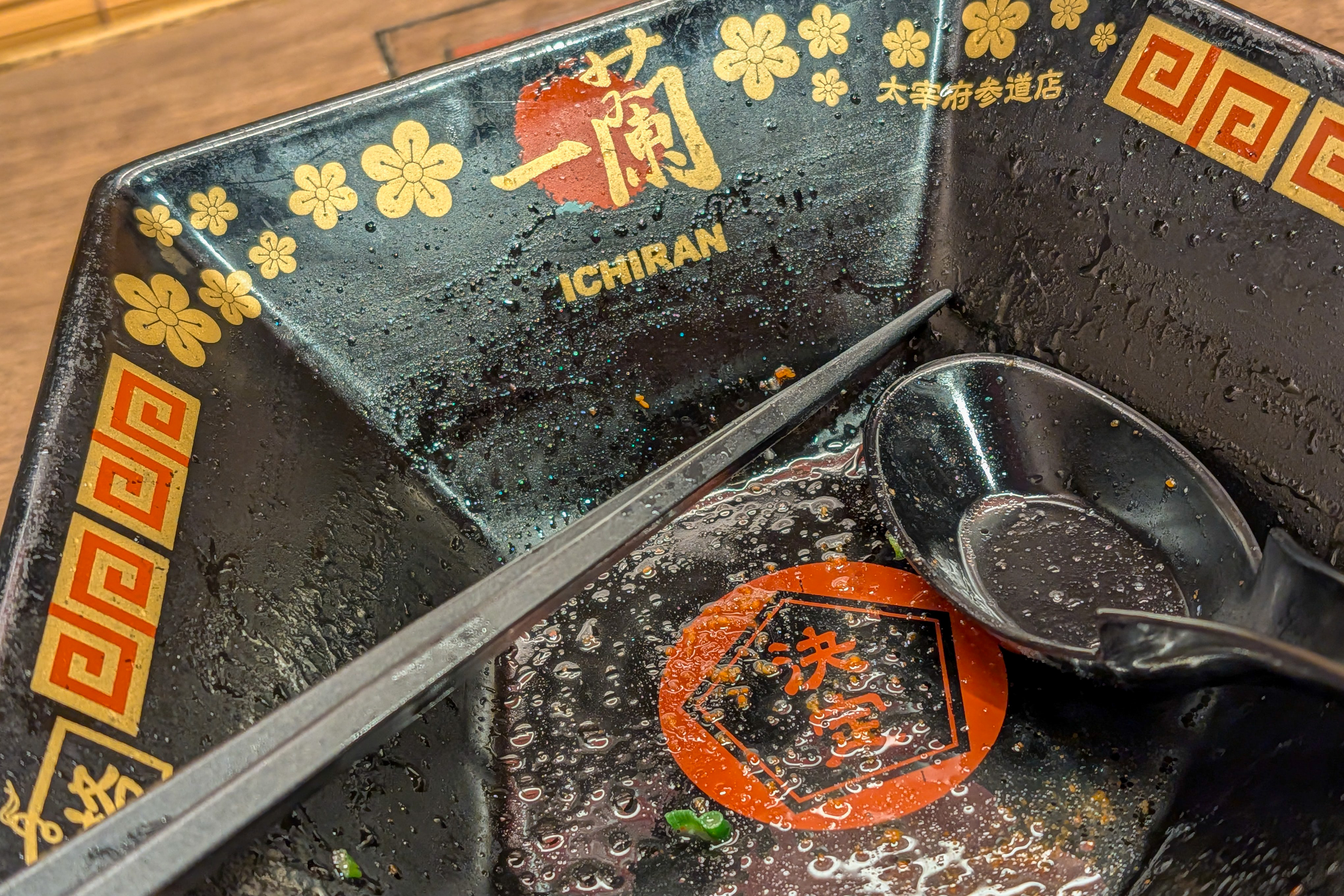
Other than the ramen being longer, it was the same as other Ichiran locations. Ichiran is very consistent so it was pretty good.
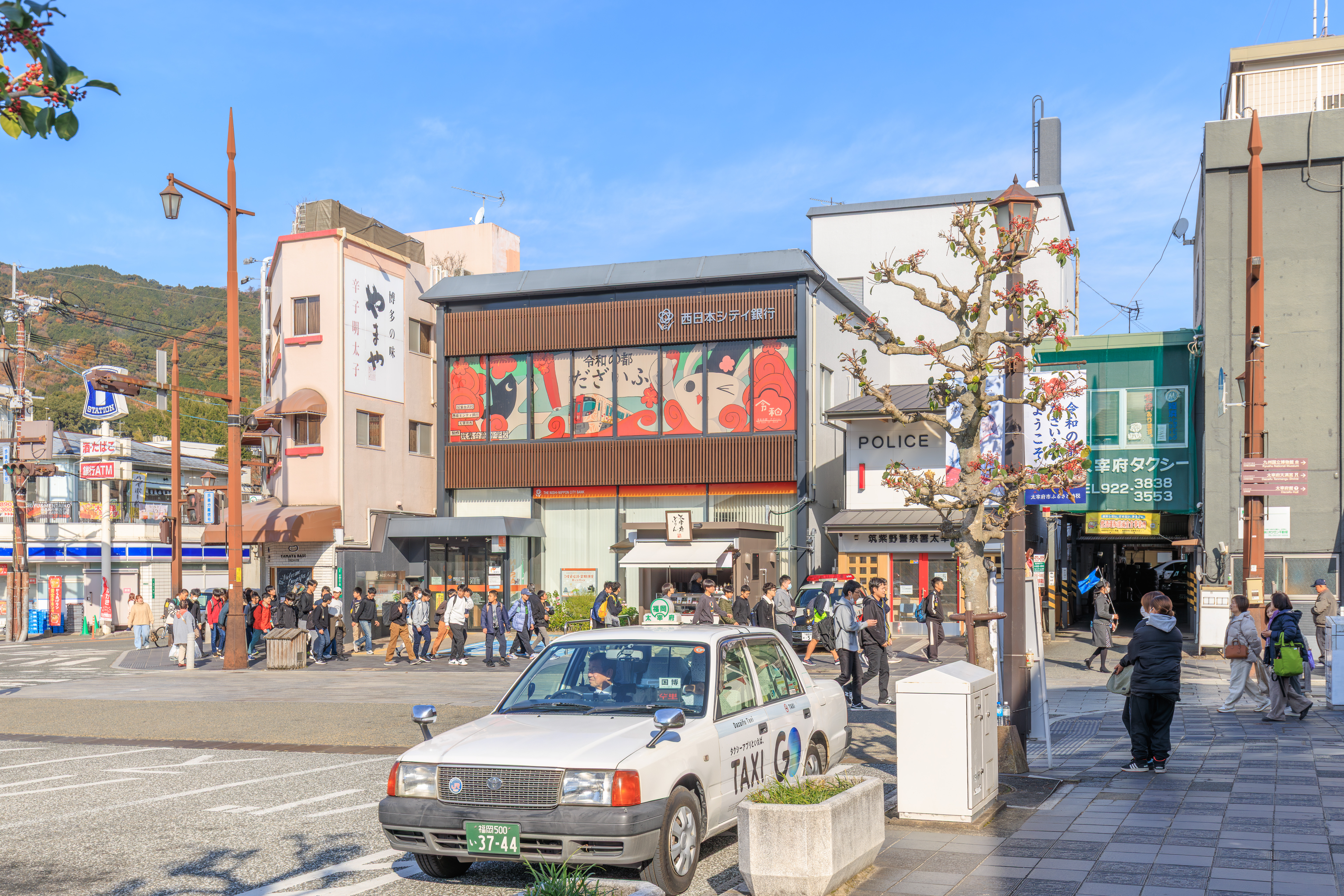
After eating, we headed out to actually head to the Tenmangu! By now, it was 10:30am and clearly already more busy than when we arrived. We saw a large school group that just arrived.
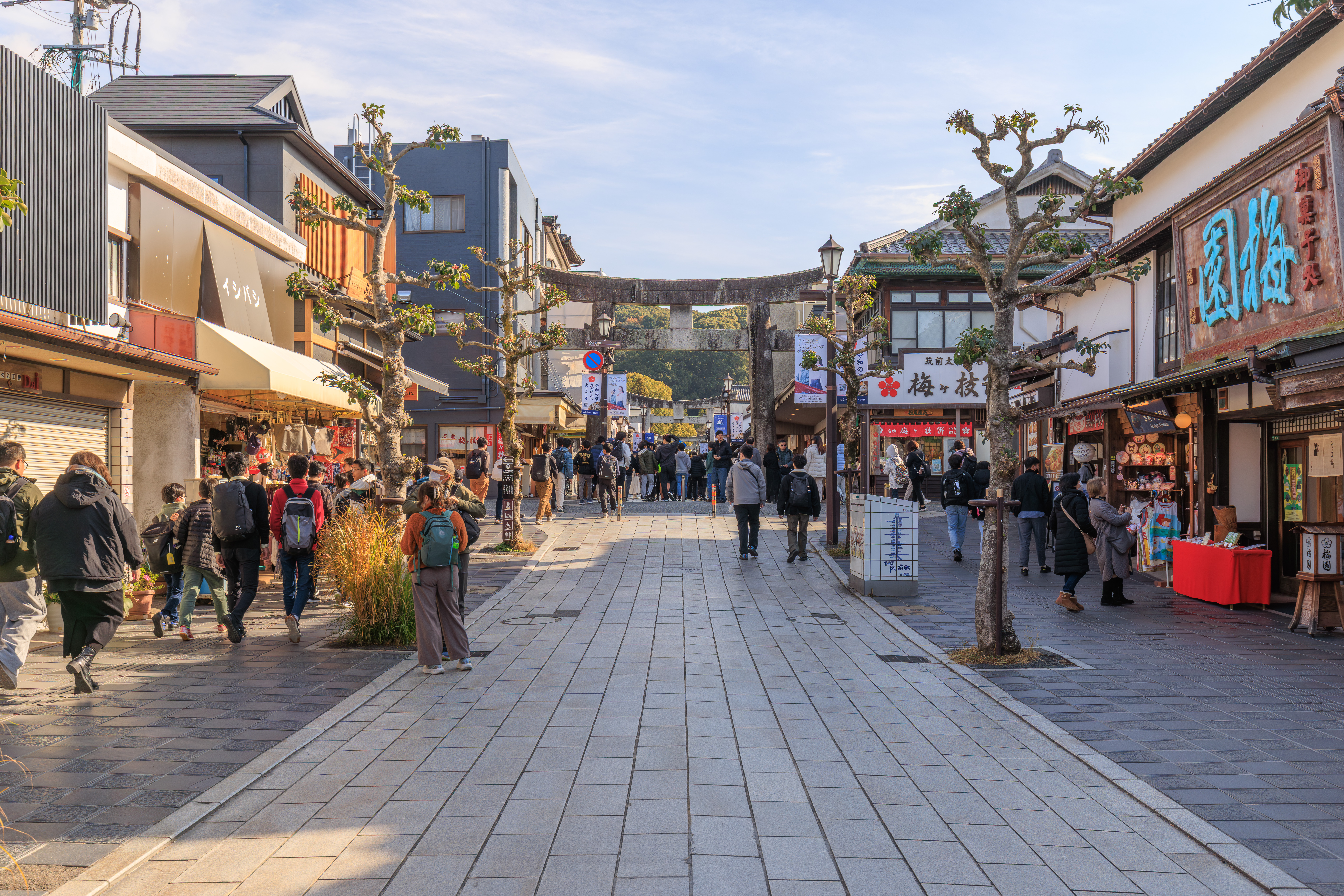
We started to walk to the east along the Dazaifu Omotesando, a shopping street that leads to the Tenmangu. The name of this shopping street is descriptive to its location in front of the shrine.
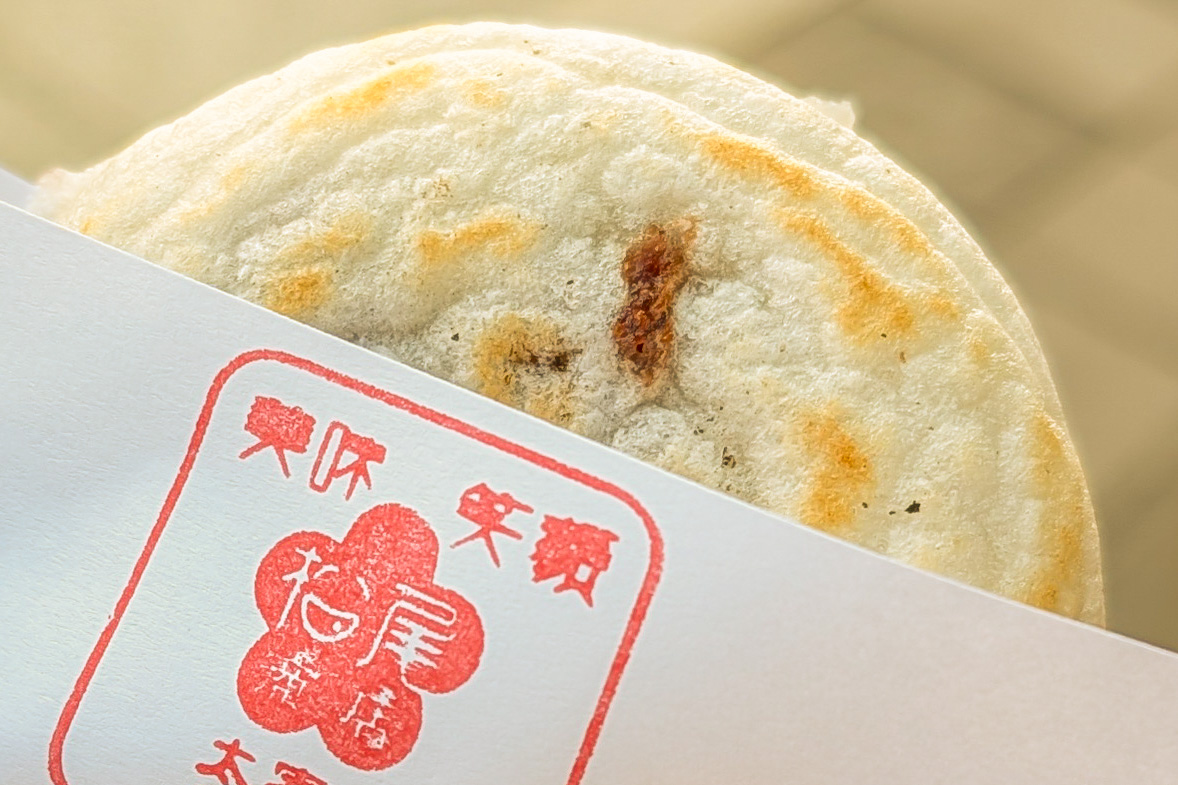
We got our first snack from 松尾商店 Matsuo Shoten, a somewhat random shop that we walked by. We got a umegae mochi, which is a grilled rice cake with red bean. It was excellent as it was freshly prepared as it was hot and a bit crispy. It is actually a local specialty from Dazaifu.
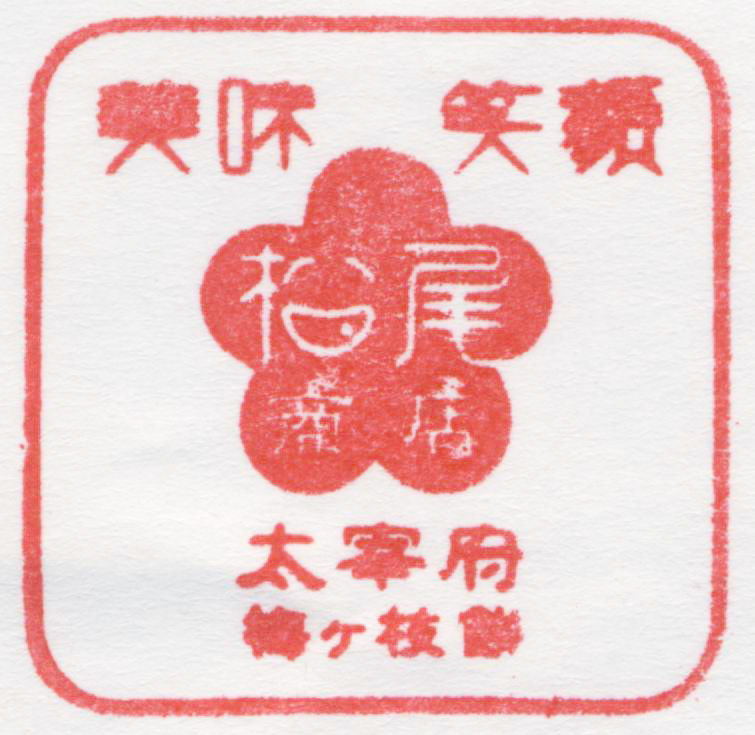
The shop’s logo from the wrapper, which is the only reason why we were able to identify where we got this from!
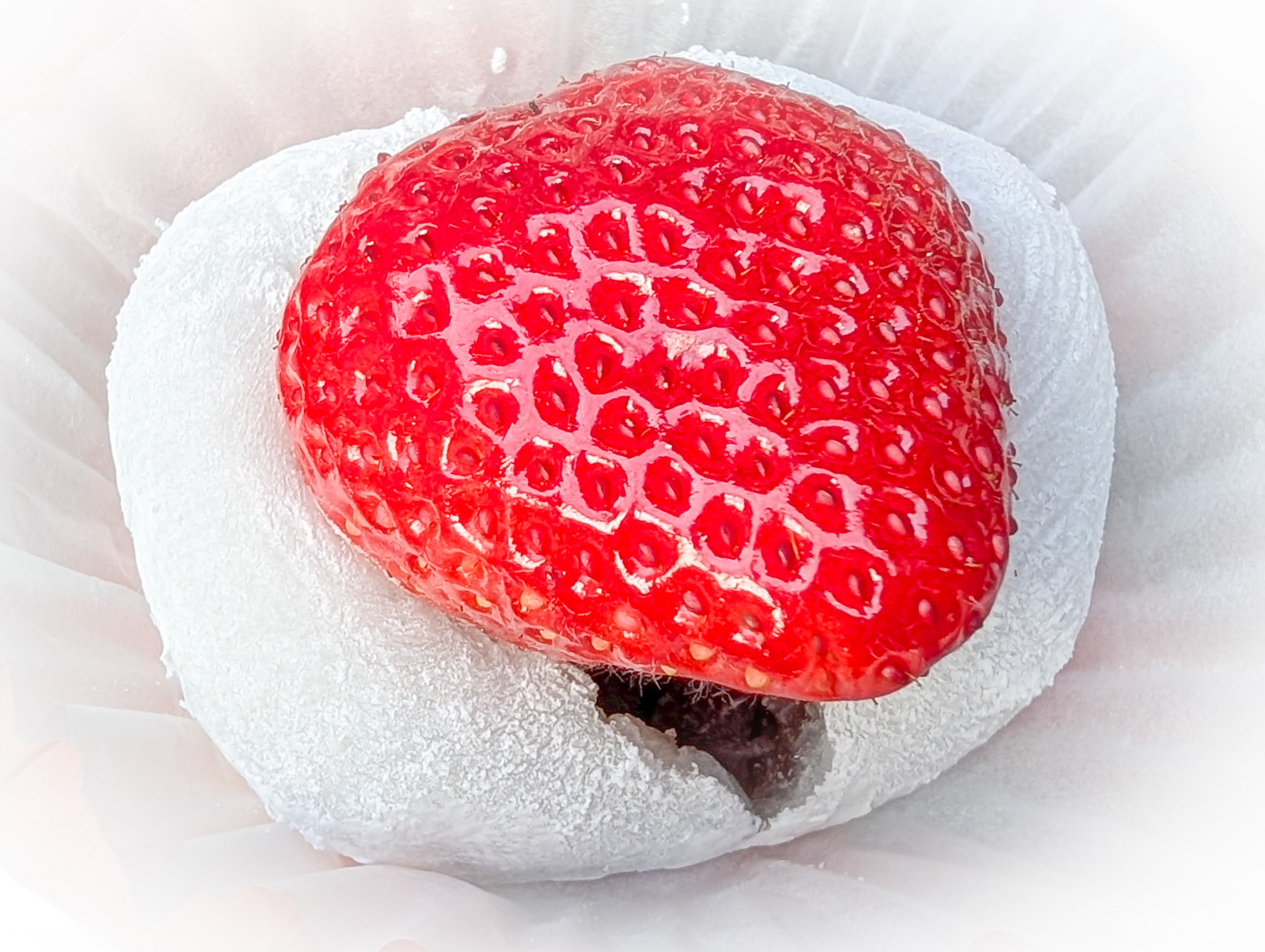
We then got a strawberry daifuku from a busy shop. The strawberry was a local Amaou Strawberry. Unfortunately, we didn’t note what shop we visited and there is no wrapper or anything to help identify it. But it was very good!
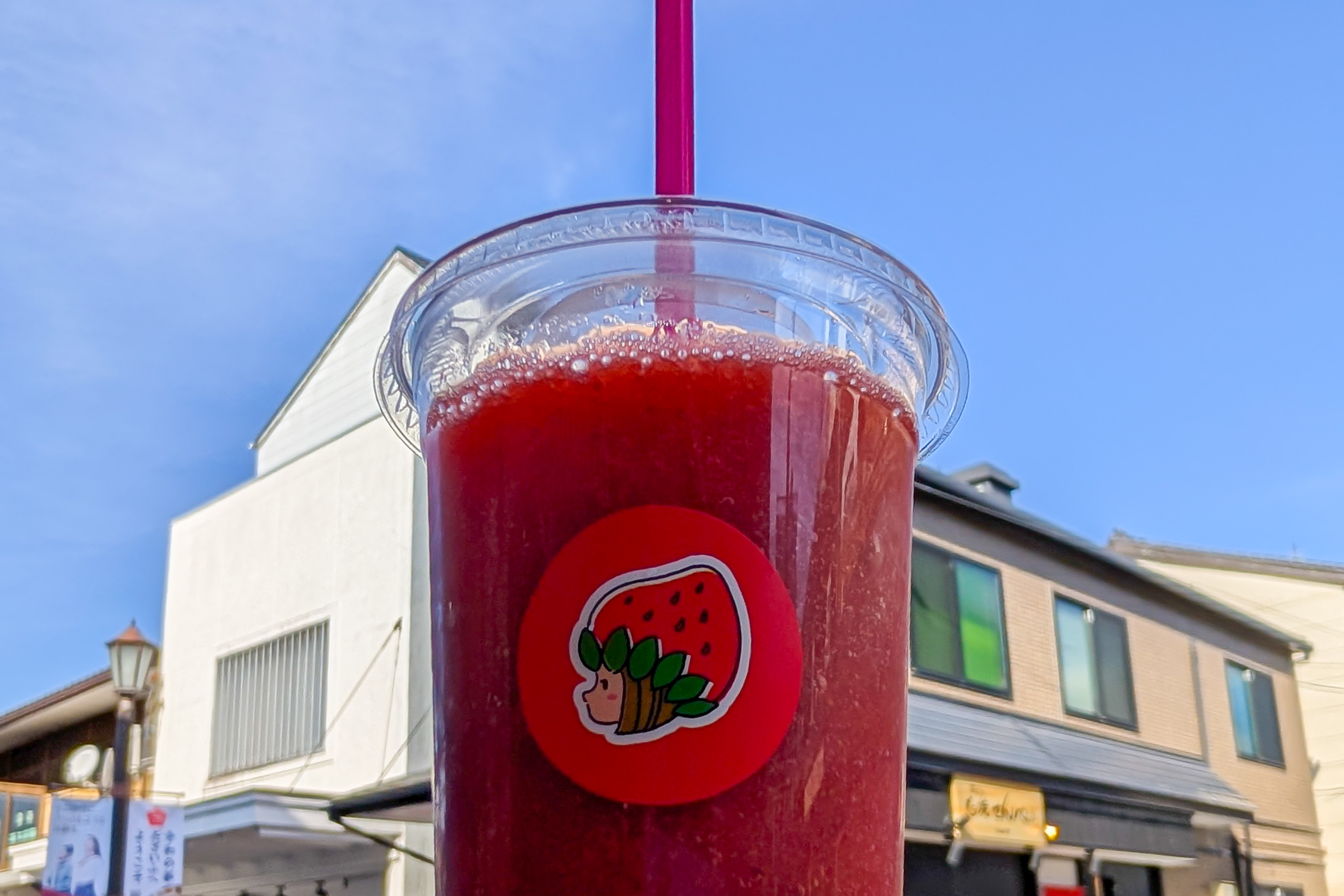
We then got an Amaou Strawberry drink, probably best described as a slushie, from Kingberry.
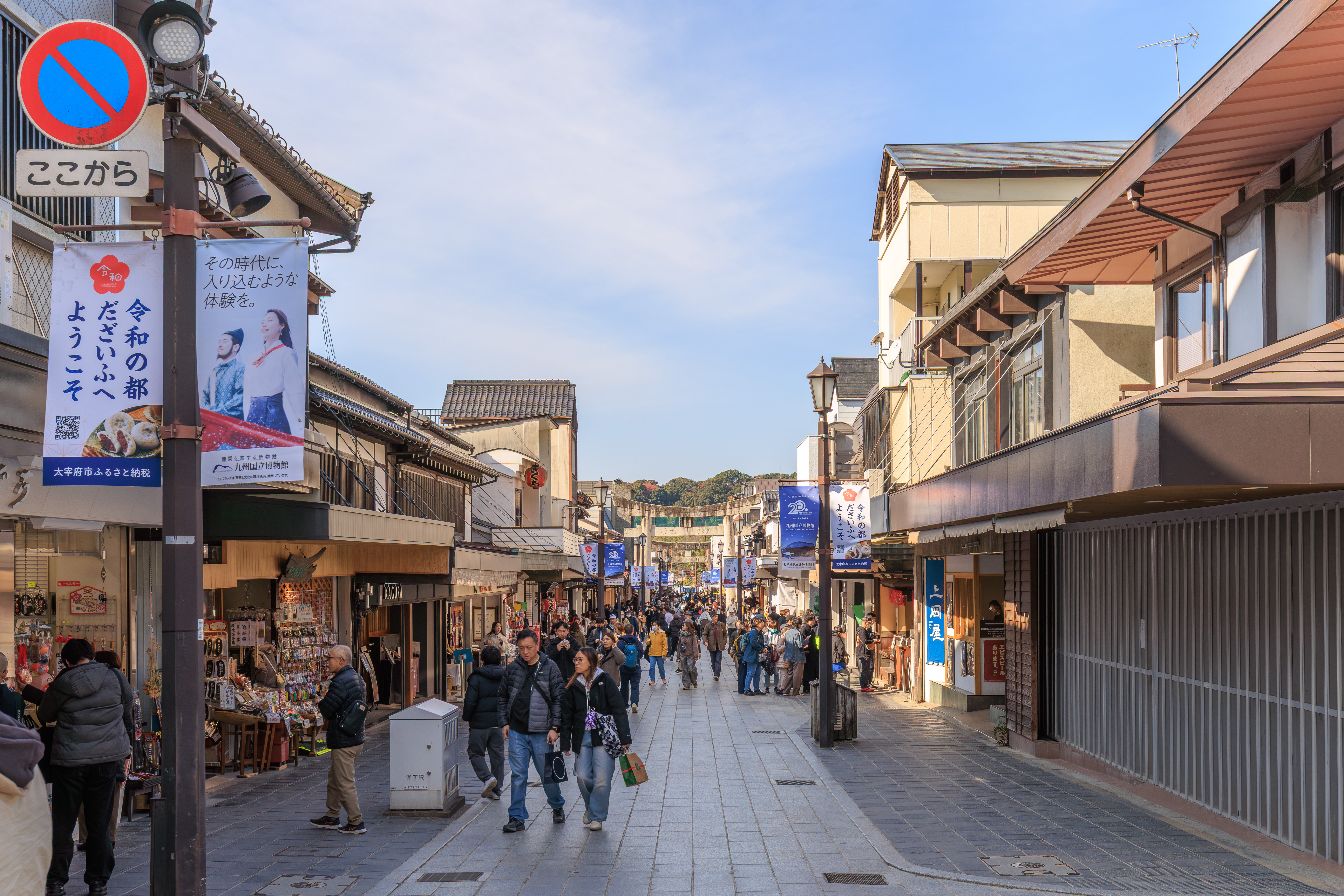
Quite busy!
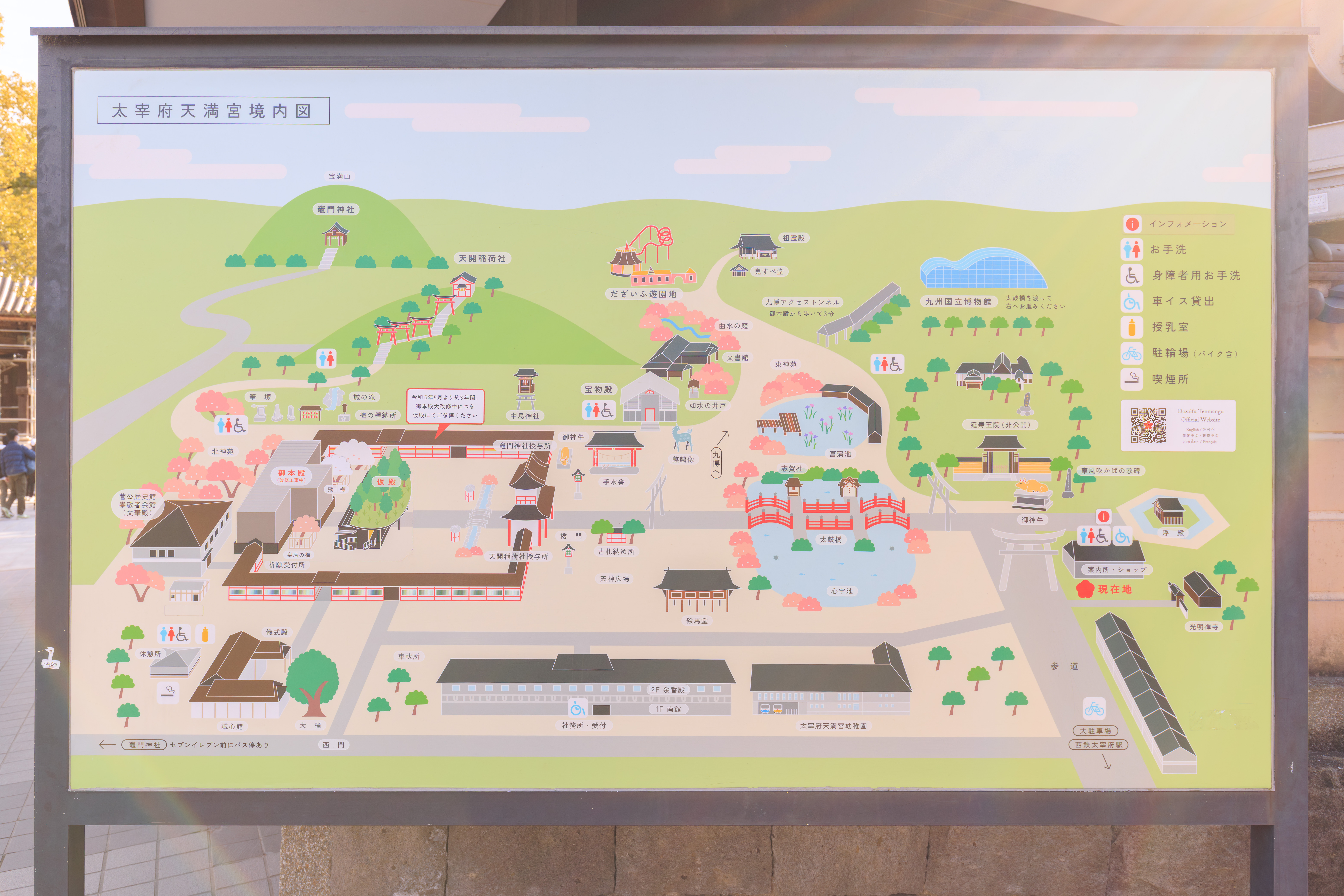
We came across a sign with a map of the shrine when we reached the end of the shopping street.
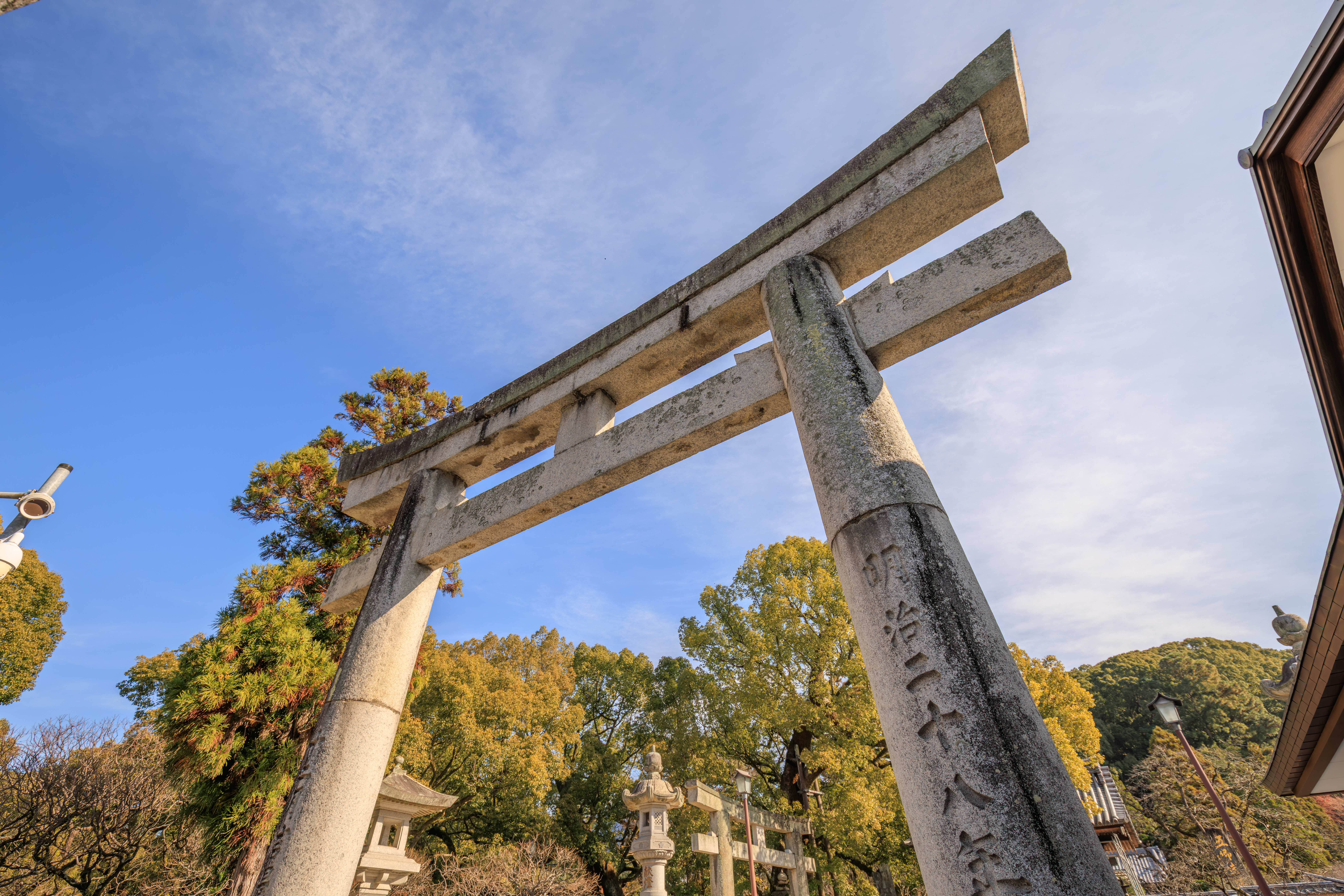
This large concrete torii was nearby, one of the two shown on the right side of the map above. It should be the torii that is at the end of the omotesando.
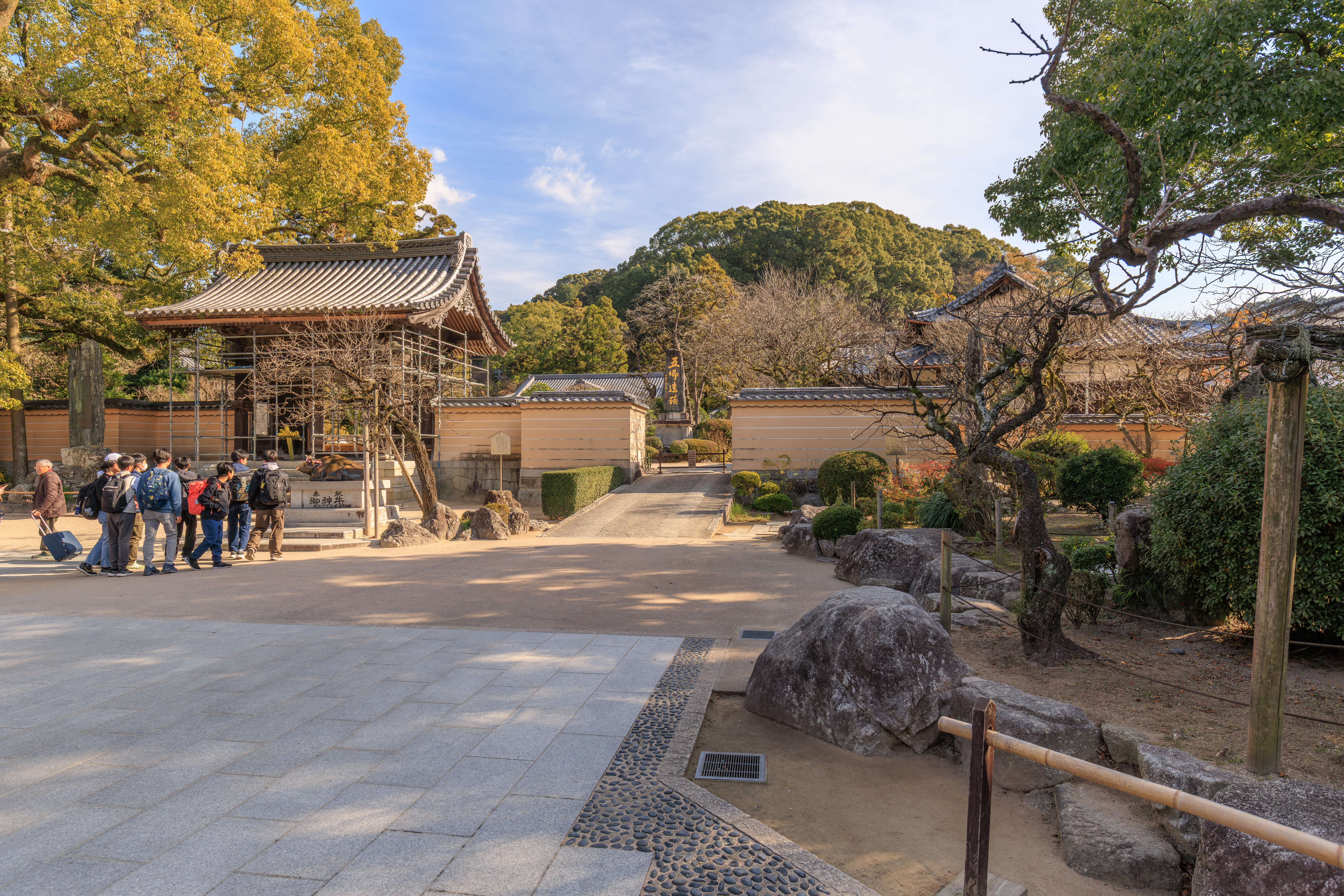
There are other Shinto and Buddhist sites here as well. The closed path in front of us appears to be the entrance to 延壽王院 Enjuo-in. This appears to be the residence of the chief priest of the Tenmangu.
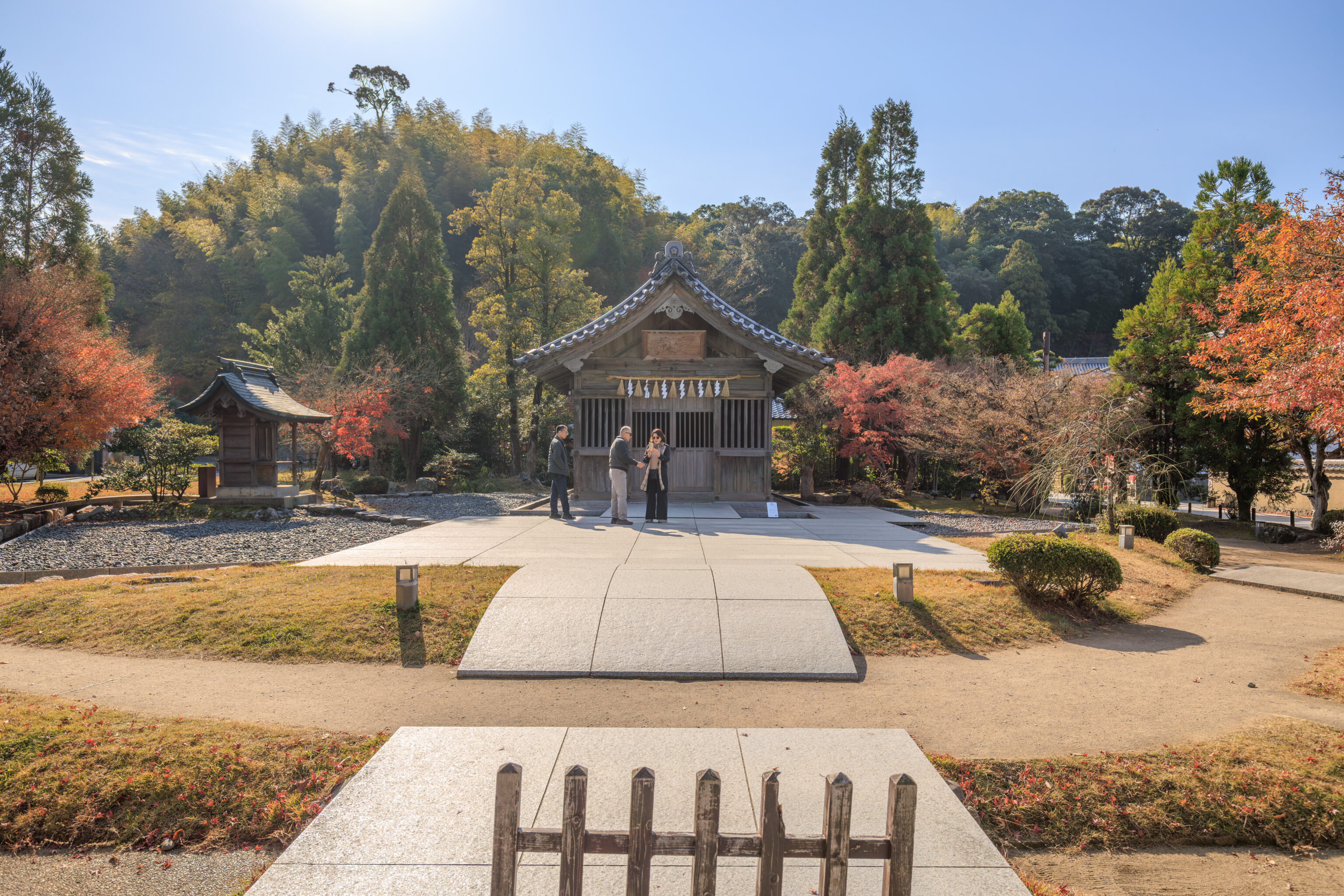
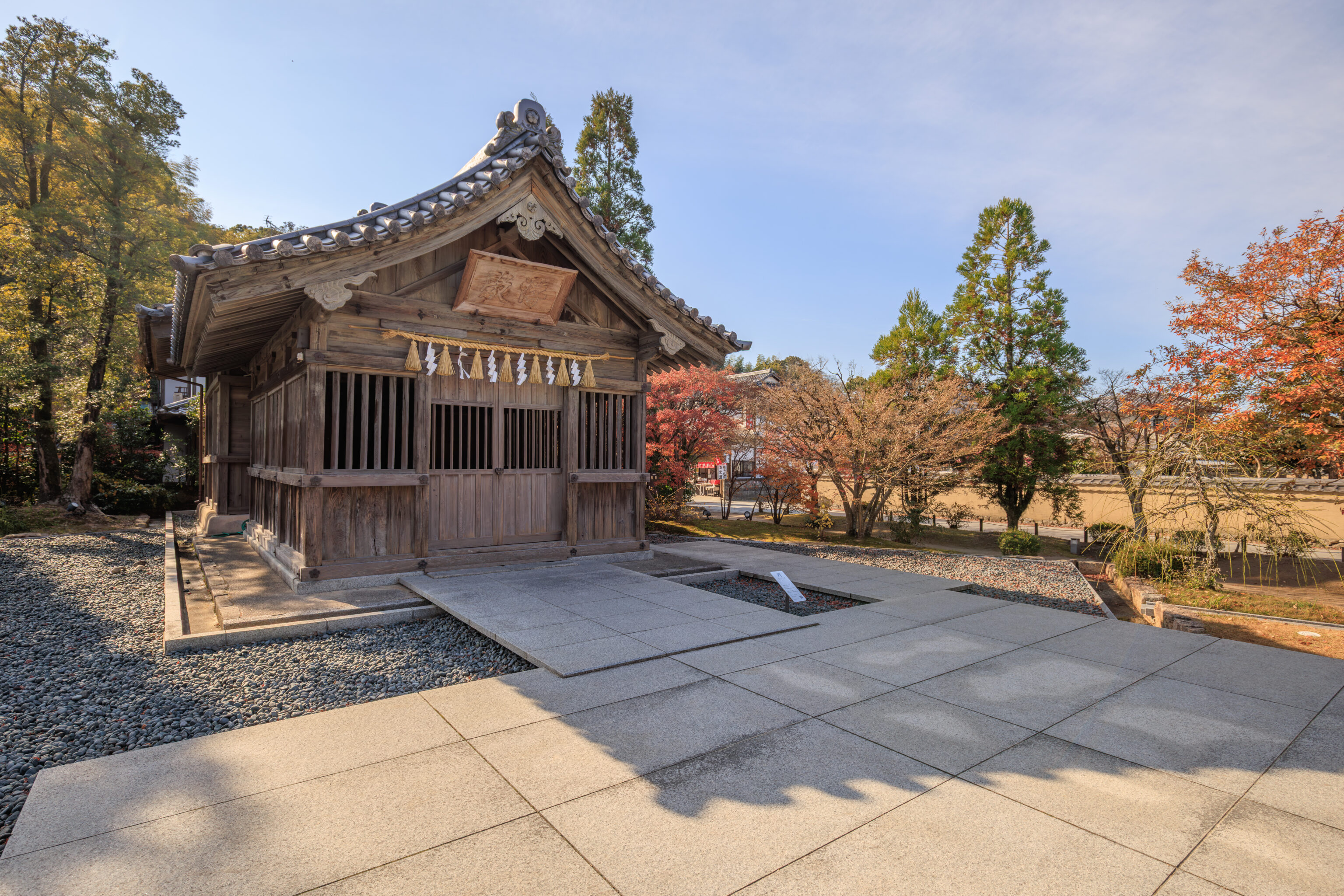
Before going to the Tenmangu, we decided to walk around the area first. This little building is just to the south of the east end of the omotesando. It looks like it may be a Shinto shrine.
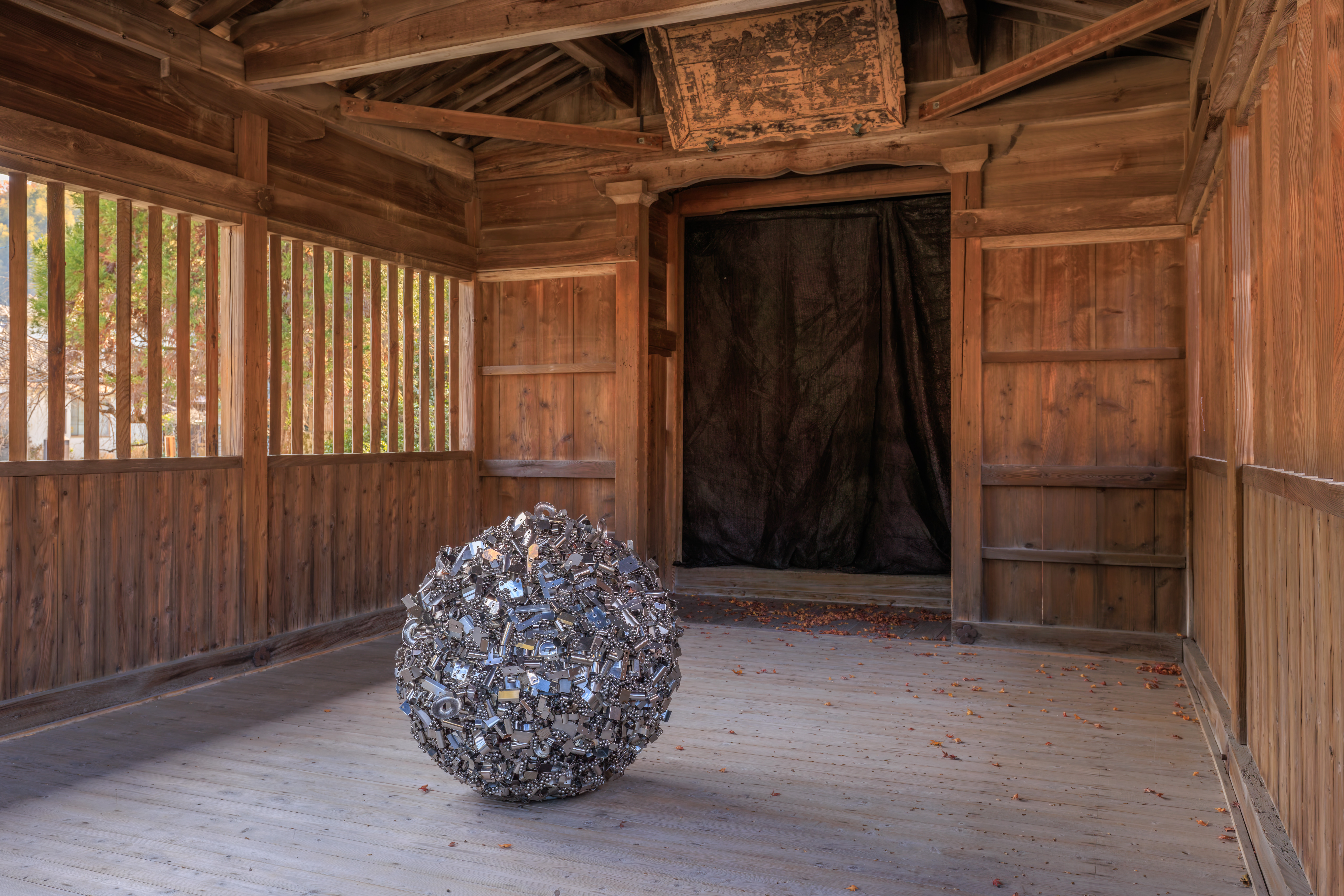
However, it is not. Or at least, it is no longer.
KEIDAI ART MUSEUM

1
Really shiny stuff that doesn't mean anything


Ryan Gander
2011
– Text from a sign.
This is part of an art installation by the Keidai Art Musuem.
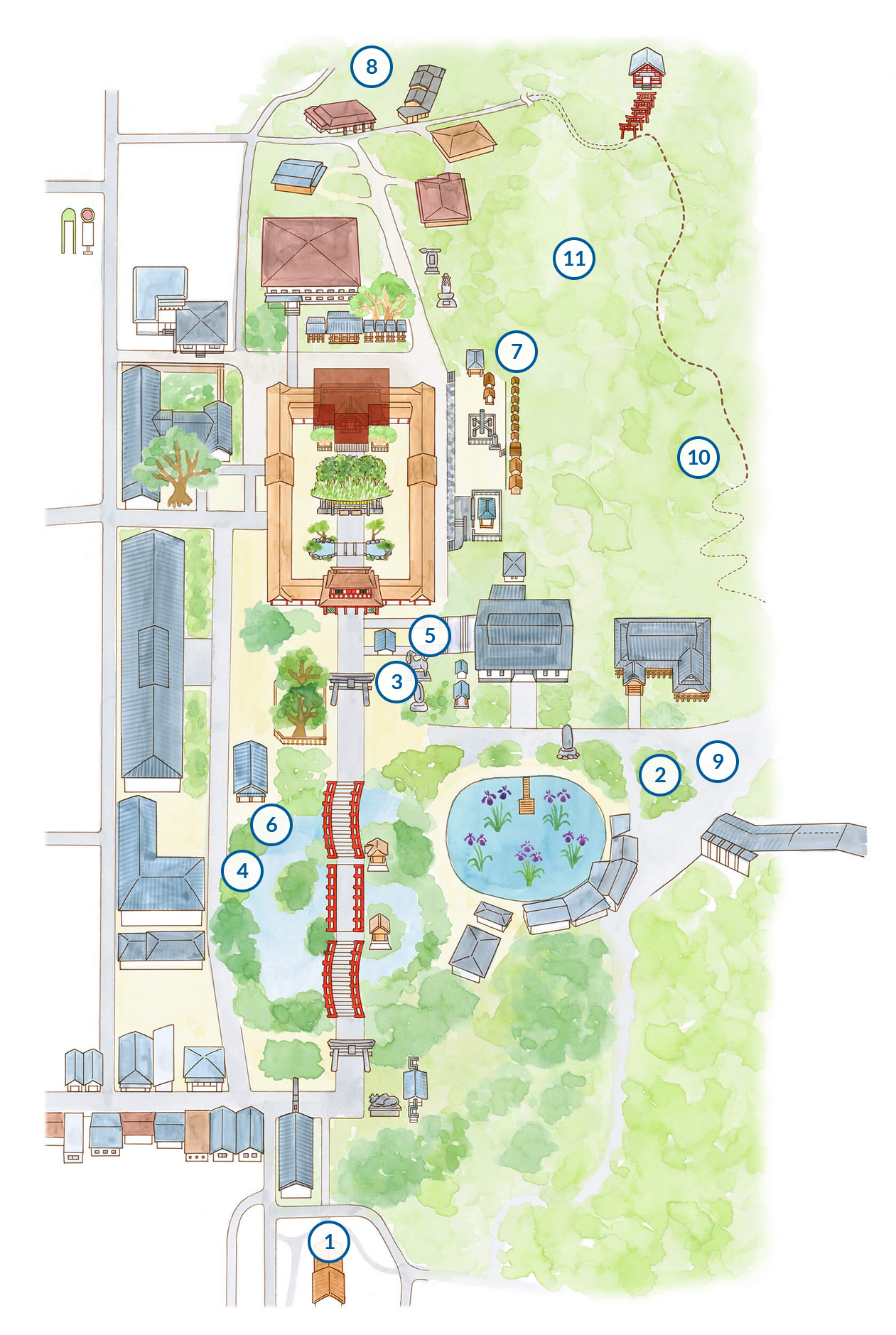
The museum has 11 permanent installations here at Dazaifu Tenmangu. The museum’s Map page has the map on the left as well as descriptions of the installations.
— What’s this bright sparkling sphere?

This sphere is made of countless metal scraps attracted and attached by magnets. Although it has a powerful presence, the magnetic force at its center is not visible to the eye. There’s a special meaning to viewing such a work of art that expresses the invisible nature of the core of things here at Dazaifu Tenmangu. That’s because the gods in whom we believe and to whom we pray, are not visible to our eyes. Perhaps the artist intended to convey the presence of something important that we cannot see with our eyes.

*The doors are usually kept closed. This work may not be exhibited due to shrine events.

©Ryan Gander, Courtesy of TARO NASU
– Text from the Keidai Art Museum website Map page: https://keidai.art/en/aruku.
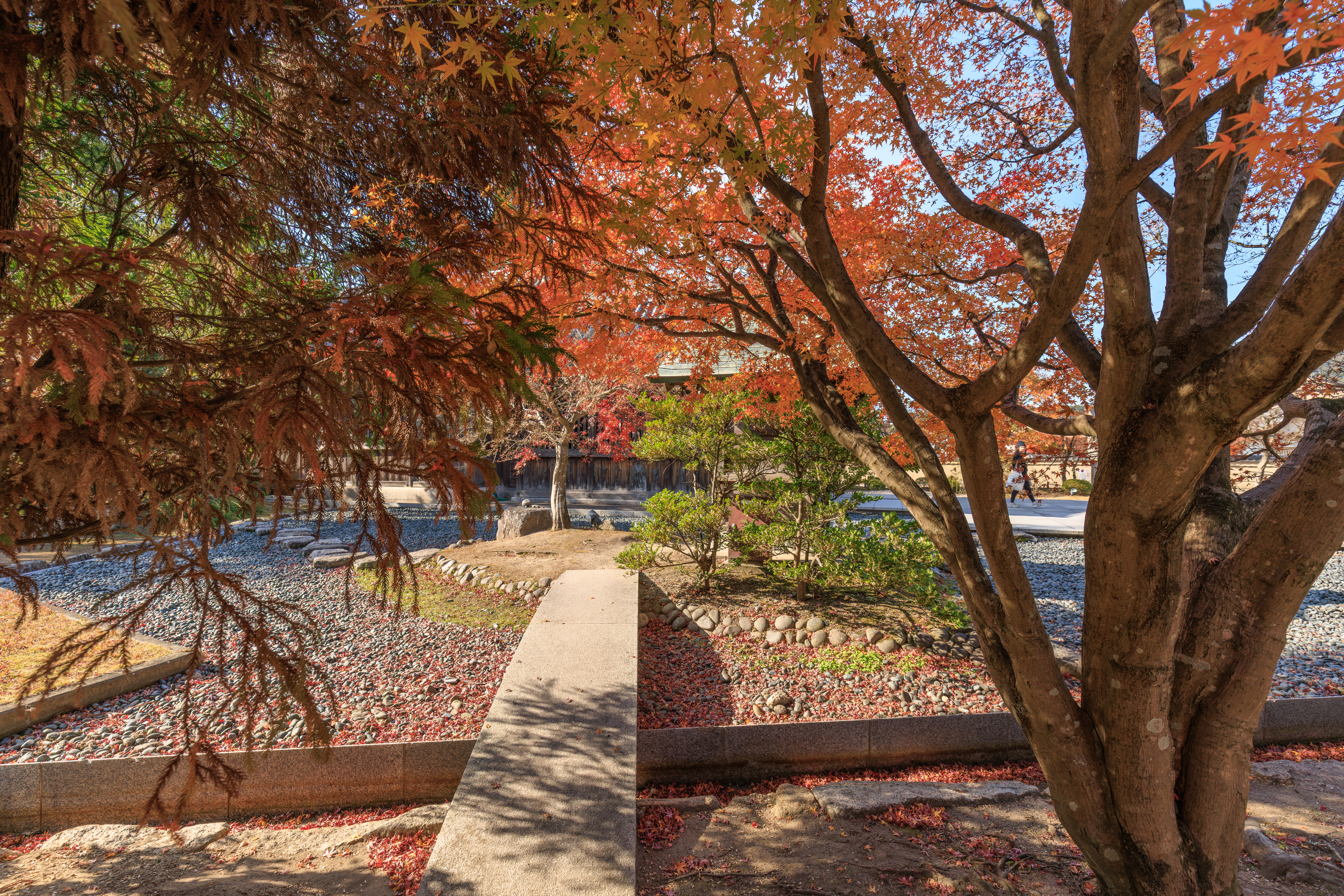
It seems like there should be water here?
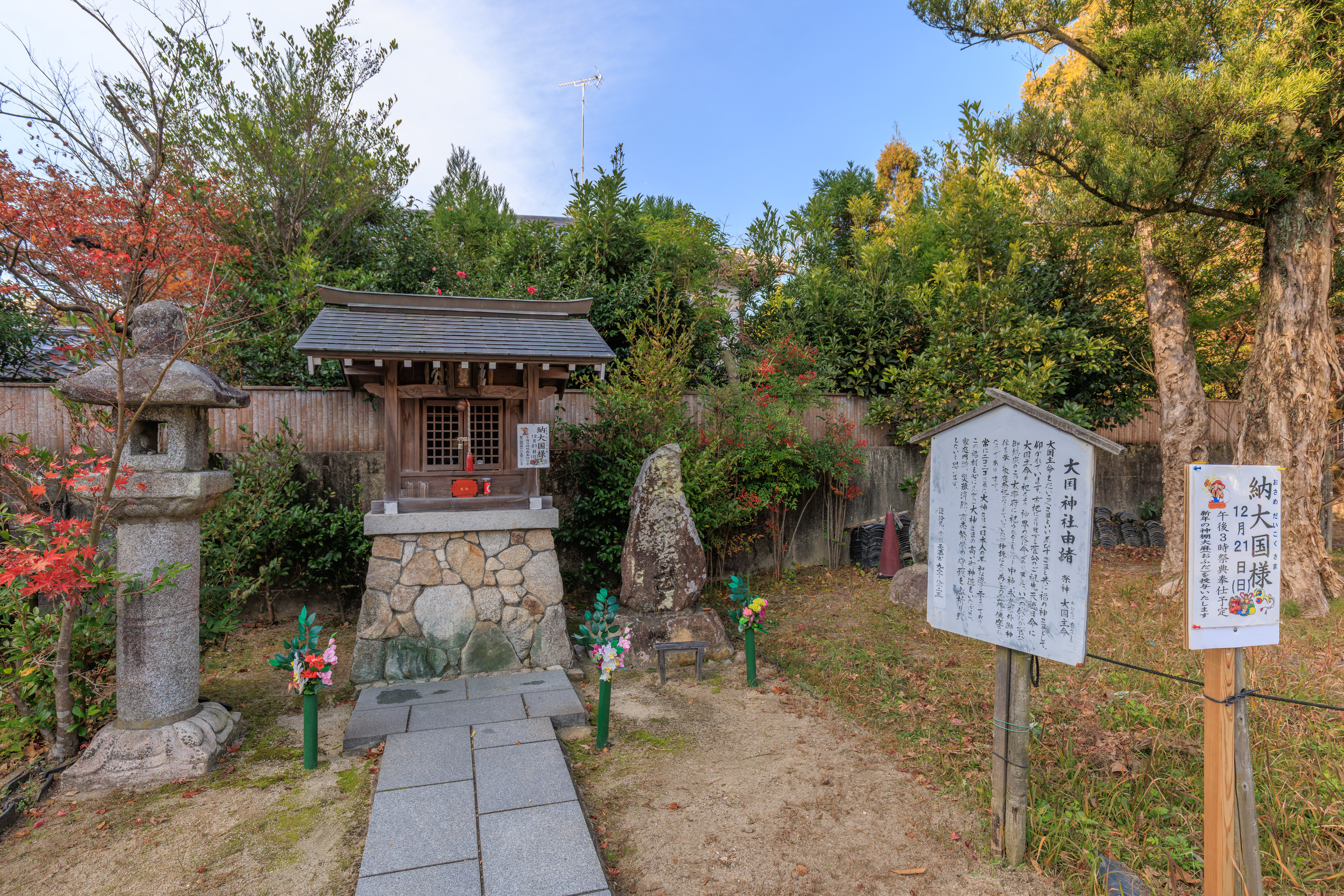
This small shrine
History of Okuni Shrine
**Enshrined Deity:** Okuninushi-no-Mikoto

Okuninushi-no-Mikoto—also affectionately known as "Daikoku-sama"—is revered alongside Ebisu-sama as one of the Deities of Good Fortune. According to ancient records, the divine realm once issued a decree to Sugawara no Michizane's ancestor, Amenohi-no-Mikoto, commanding him to enshrine Okuninushi-no-Mikoto. Consequently, the deity came to be enshrined here in Dazaifu, the very site where Lord Michizane himself would later be venerated. Although the sacred object representing the deity was at one point entrusted to the Nakagami and Nagamitsu families for private domestic worship, a divine oracle eventually commanded that the deity return to reside once again upon this very ground.

This Great Deity, whose countenance is perpetually wreathed in a gentle smile, embodies the peaceful spirit of the Japanese people. By keeping this benevolent visage in our hearts, we may partake in the deity's profound virtues and divine grace. We invite you to offer your prayers here for domestic harmony, protection against misfortune, and prosperity in business.

— Okuni Shrine
– Text from the larger sign on the right, translated using Google.
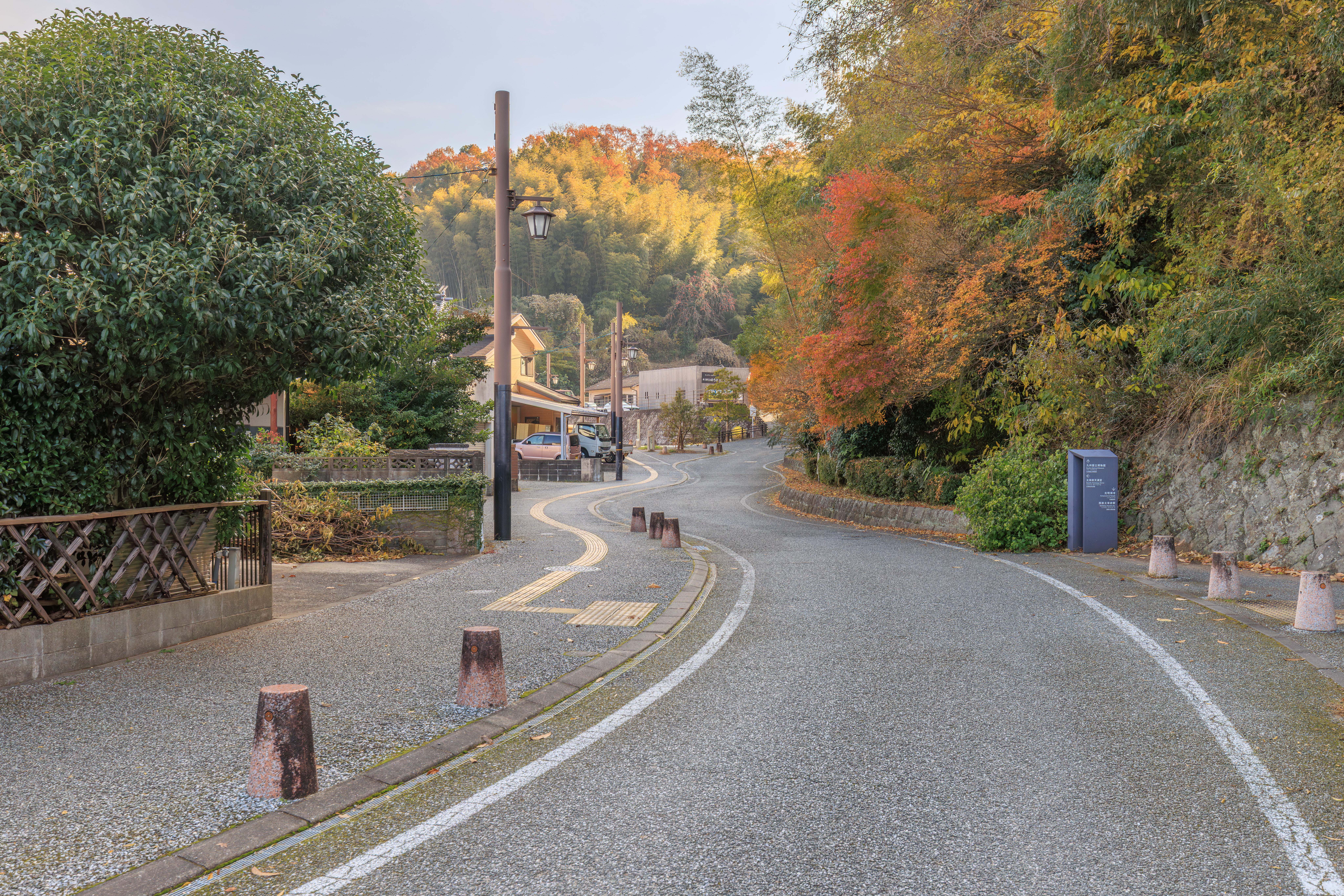
We ended up on this road with basically no one around.
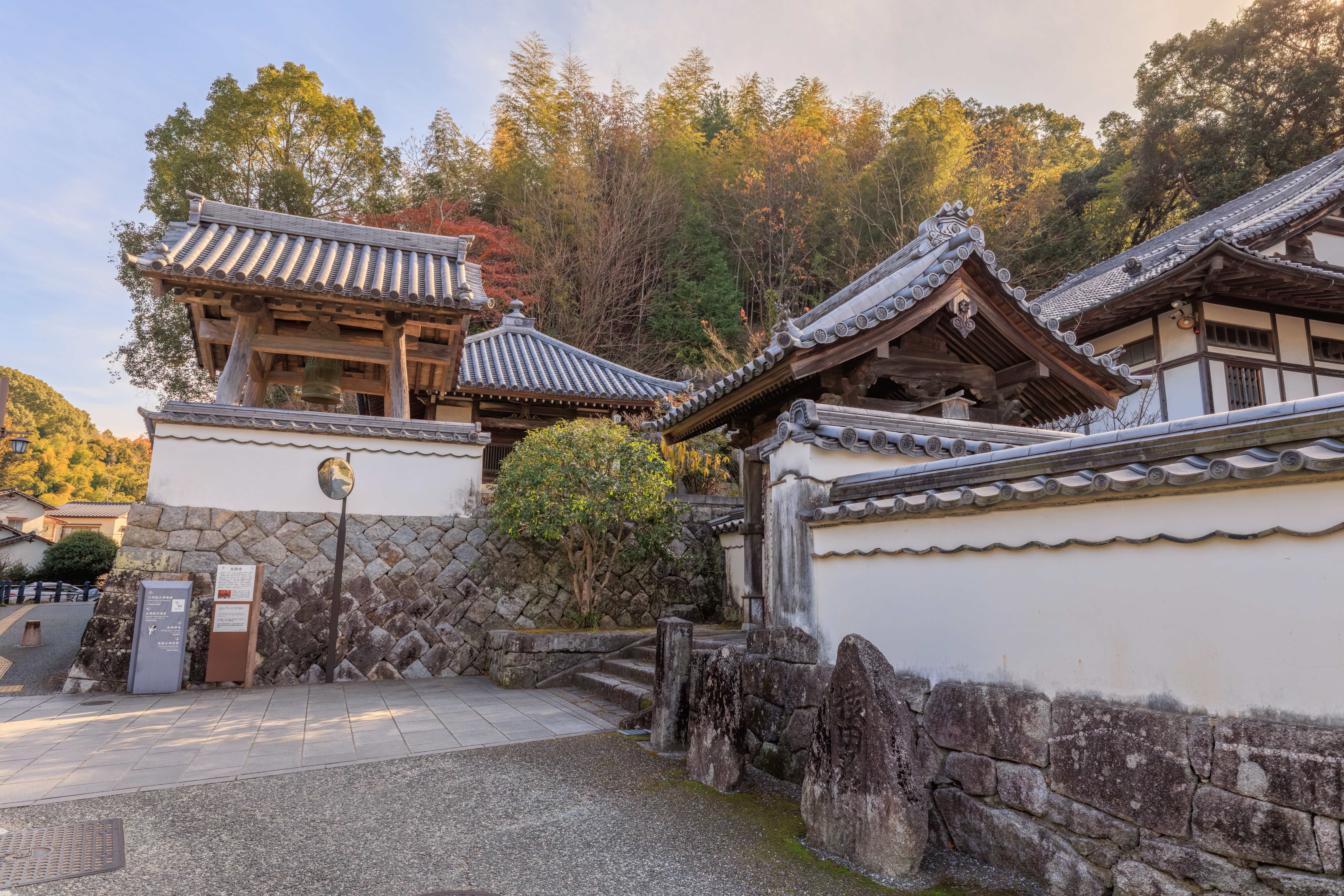
We reached a Buddhist temple that was nearby, 光明寺 Komyo-ji. However, it was closed.
Komyoji Temple

Komyoji Temple is a Rinzai Zen temple founded in 1273 by Tetsugyu Enshin, and the following legend of the Tenjin who traveled to Song China remains there:

"In the middle of the Kamakura period, Sugawara no Michizane (the spirit of Sugawara no Michizane) sought the teachings of Zen and appeared before Enni (Shoichi Kokushi, founder of Tofuku-ji Temple in Kyoto and Joten-ji Temple in Hakata). At Enni's urging, Sugawara no Michizane traveled to Song China and attained enlightenment under Wuzhun Shifan (a Zen monk of the Rinzai school). Sugawara no Michizane then appeared before Enni again, He entrusted the monk's robe bestowed upon him by his master. Later, Sugawara no Michizane appeared before Enni's disciple, Tetsugyu Enshin, and instructed him to enshrine the robe in one place. Following this instruction, the robe was enshrined, creating a stupa dedicated to the monk's robes, and Komyoji Temple was built beside it.

Komyoji Temple Garden
(Prefectural Designated Scenic Spot: Designated March 14, 2014)

The gardens on the front and back of the main hall were created in 1957 by landscape architect Shigemori Mirei. The front garden features 15 stones arranged in a 7-5-3 pattern, abstractly representing the character "光" (ko, meaning light) in Komyoji Temple's name. The main garden is a seated garden viewed from the main hall or tea room. Based on the legend of the Tenjin who traveled to Song China, it depicts the ocean with white sand and numerous rock formations creating rocky islands. Many maple trees create diverse garden landscapes that change with the seasons.
– Text from a sign seen on the left side of the photo above, translated using Google.
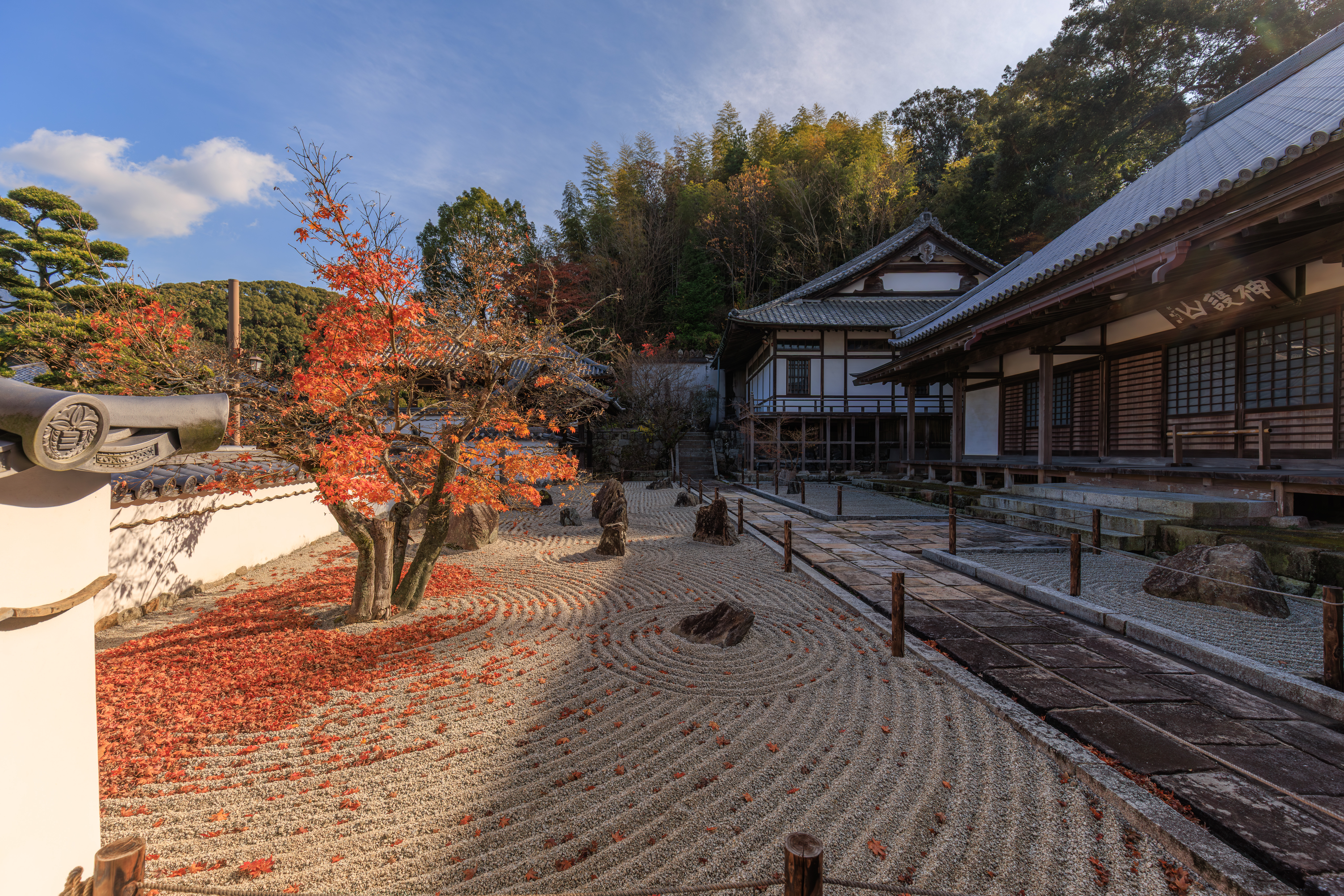
We were able to peek in through the closed gate to see some of the garden in the front.
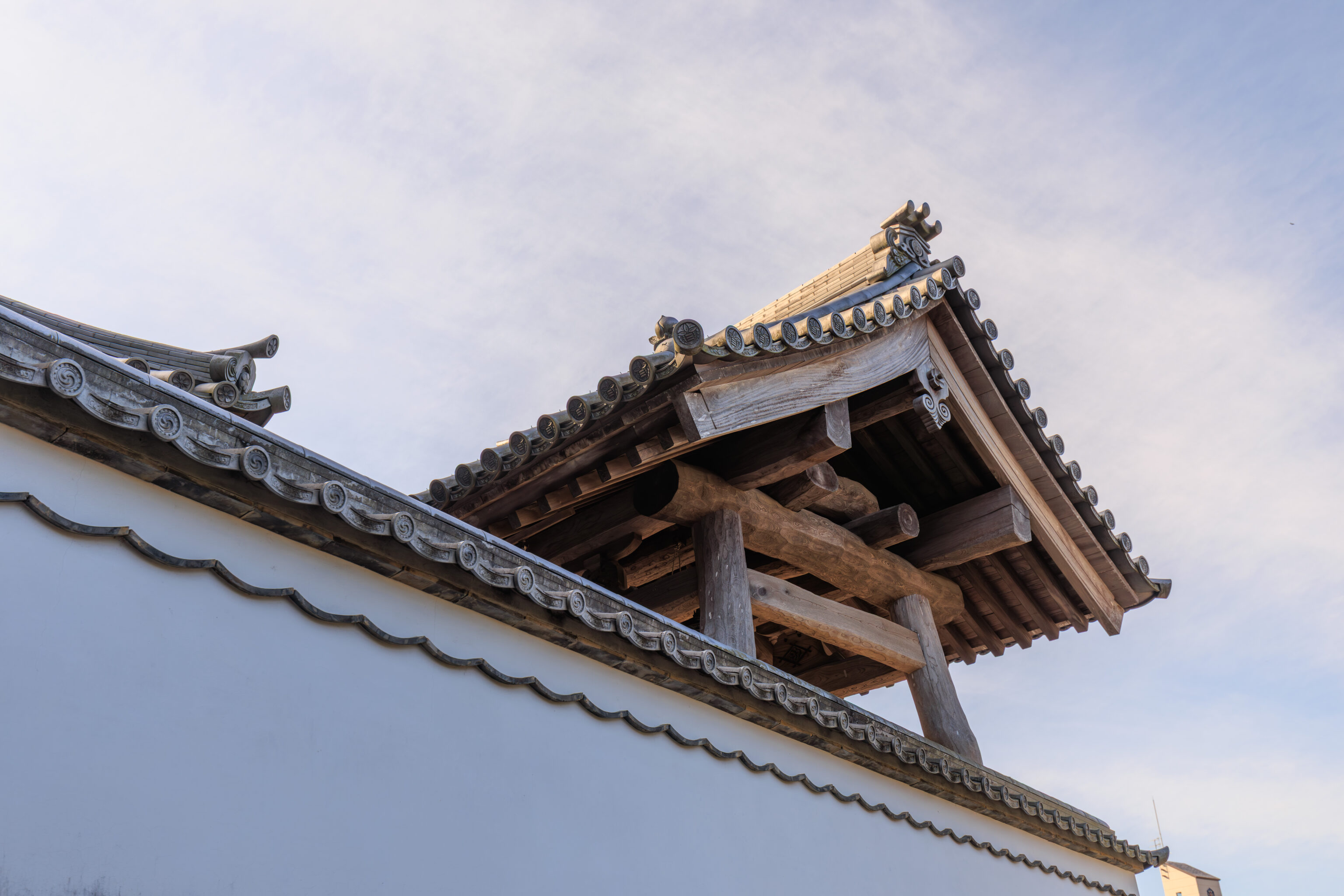
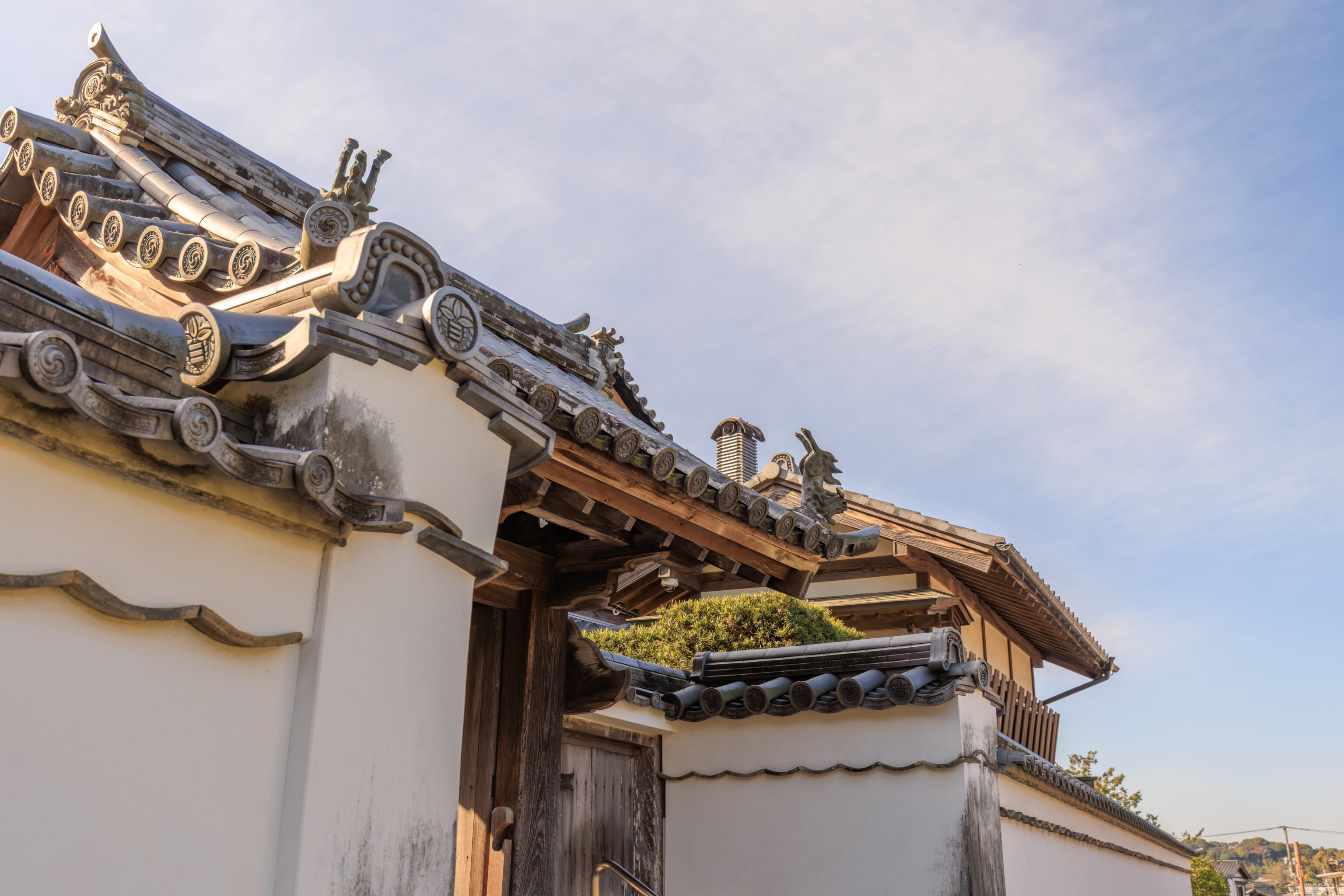
Some of the roof elements of the temple.
Dazaifu Tenmangu
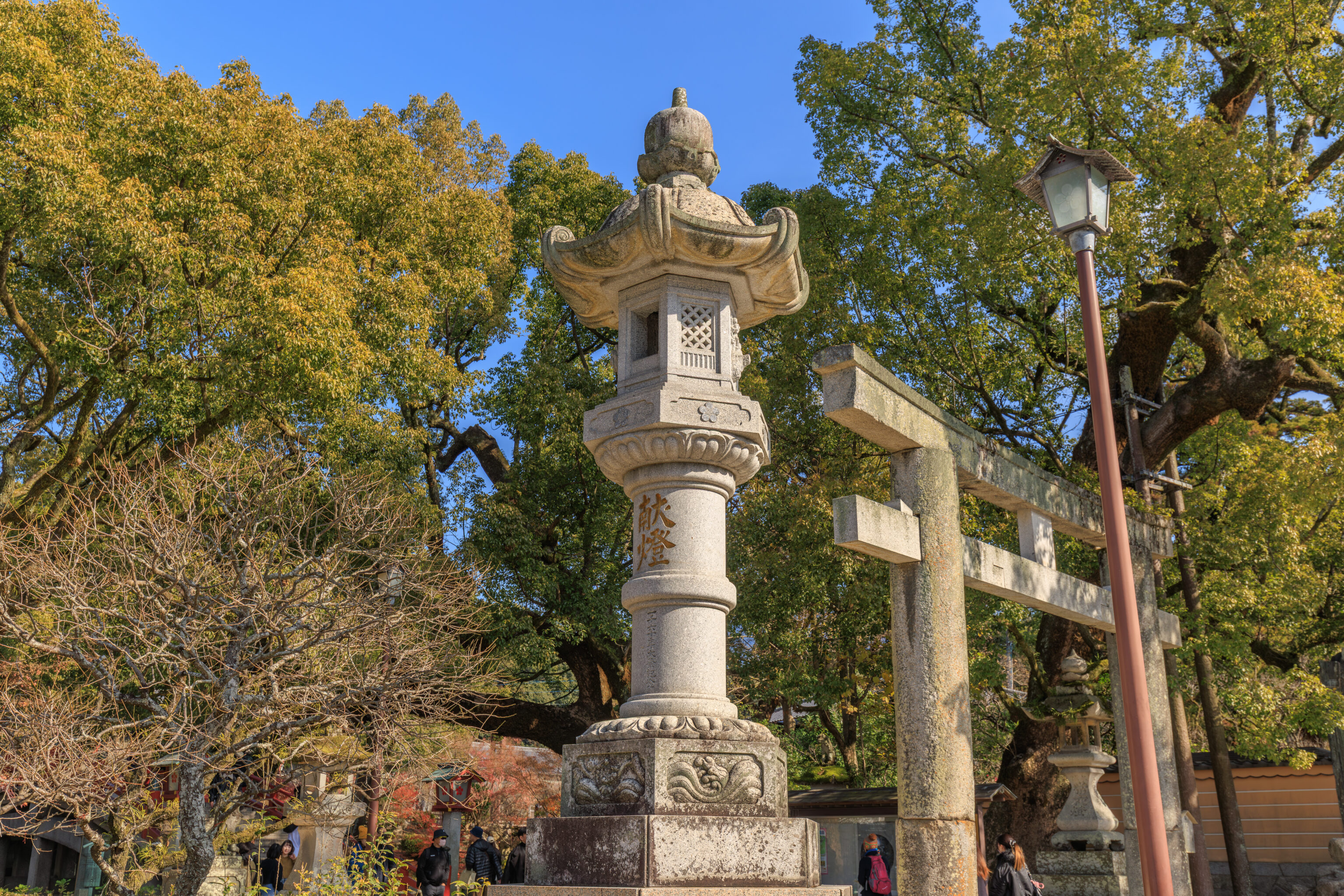
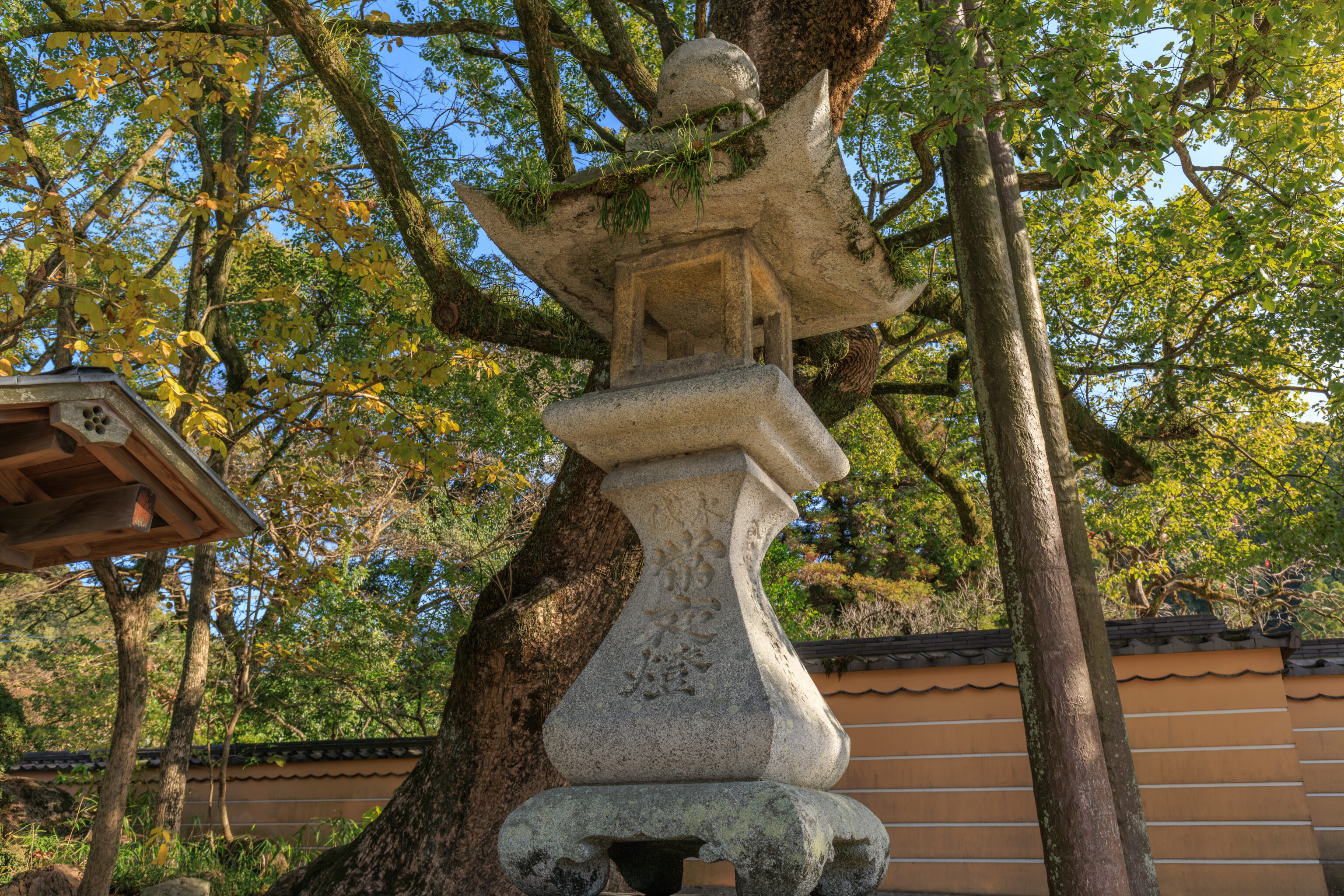
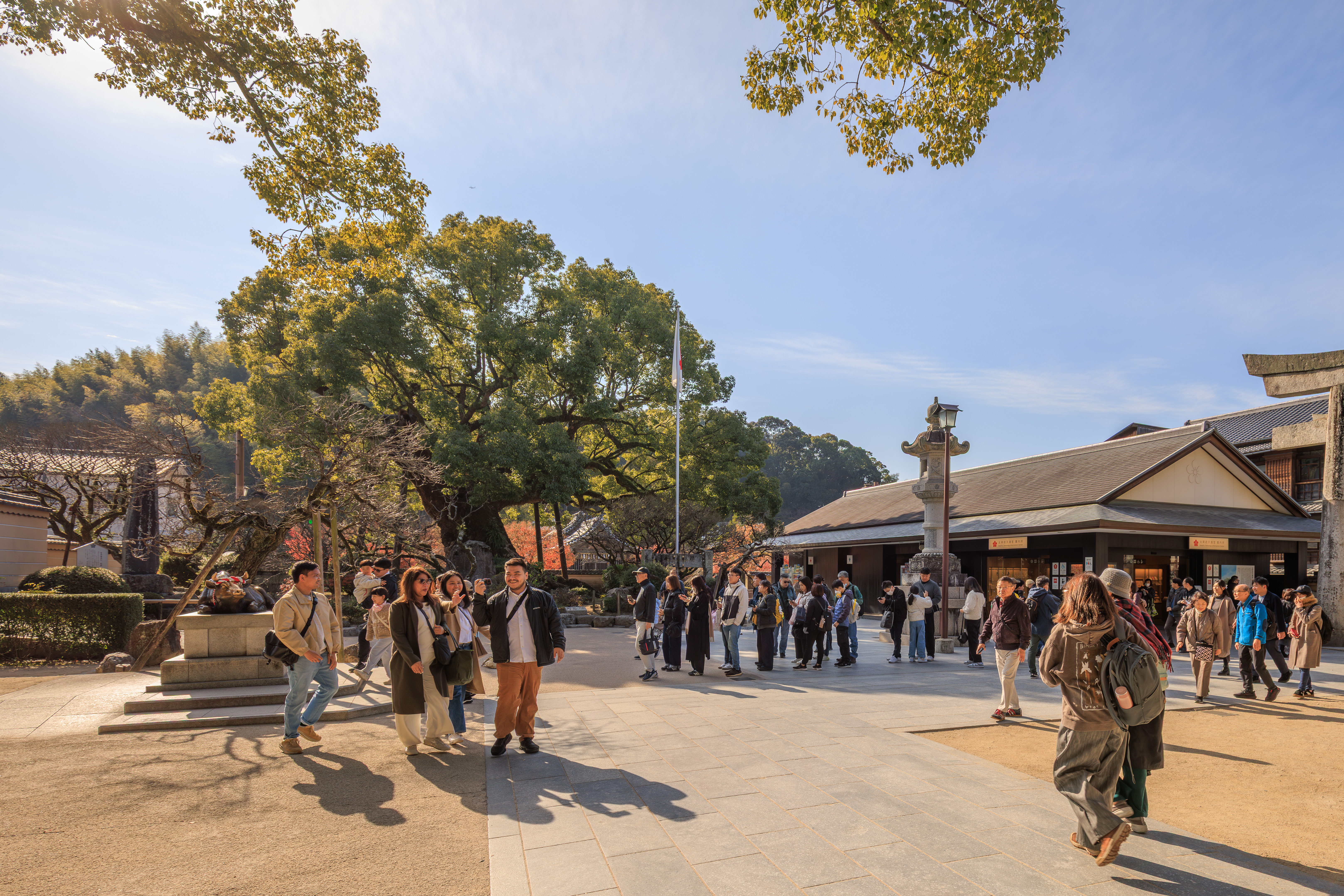
We went back north to head into 太宰府天満宮 Dazaifu Tenmangu.
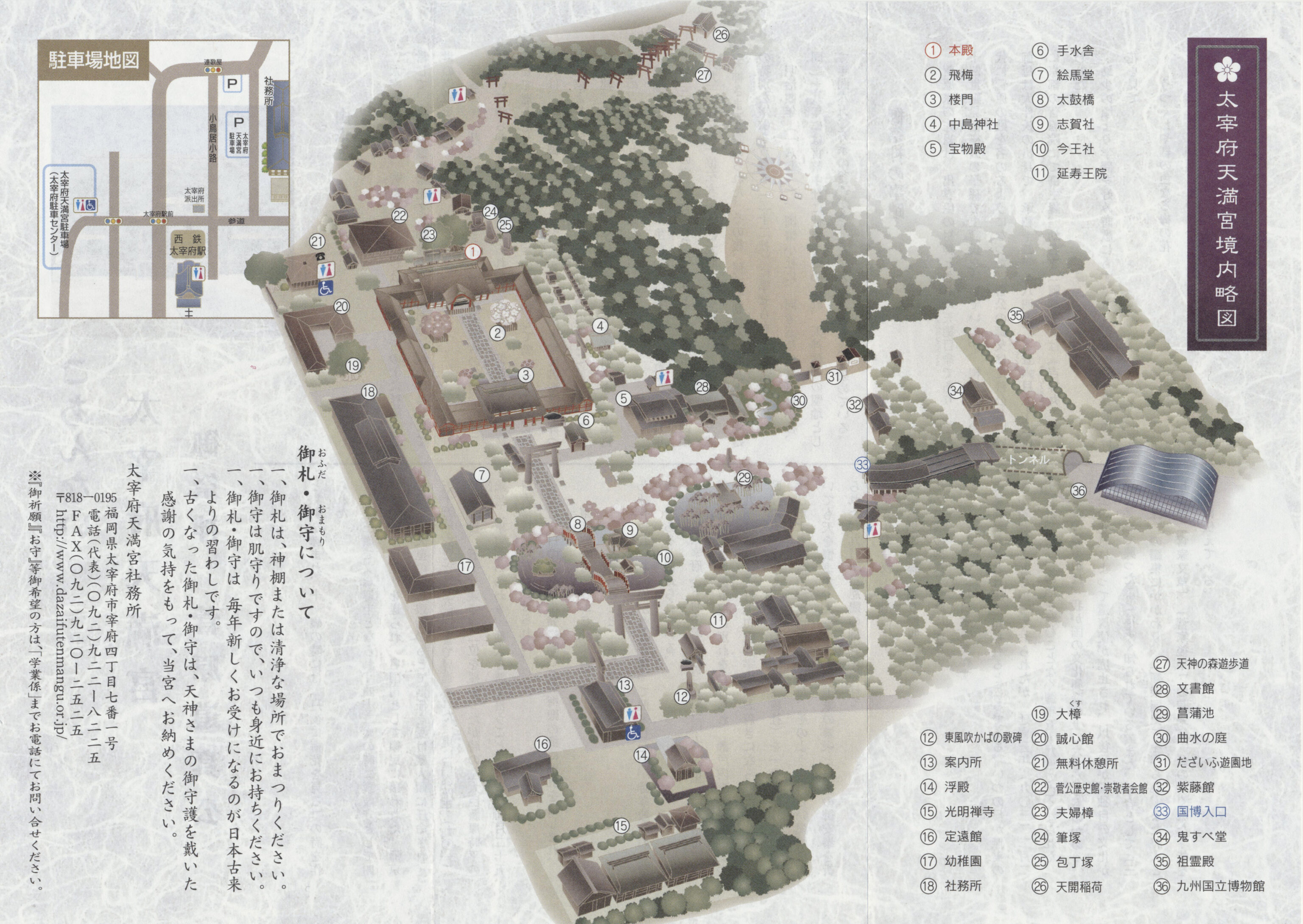
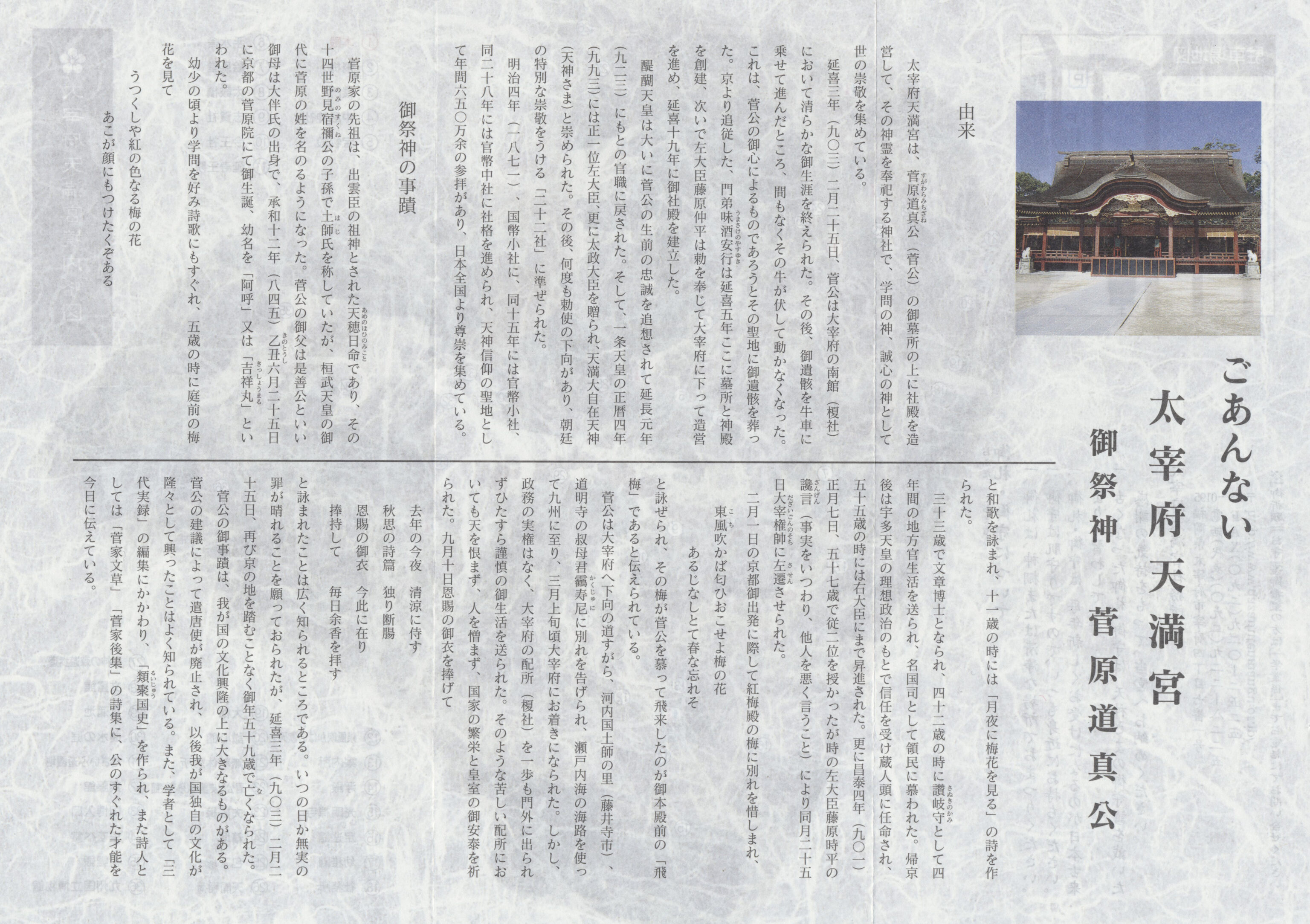
We picked up this map of the shrine grounds somewhere today.
Full Translated Text
Guide
Dazaifu Tenmangu

Enshrined Deity
Sugawara no Michizane

**Origins**

Dazaifu Tenmangu is a shrine established atop the burial site of Lord Sugawara no Michizane (known as "Suganko") to enshrine his divine spirit; it is revered by the public as the deity of scholarship and sincerity.

On February 25, Engi 3 (903), Lord Sugawara brought his pure and virtuous life to a close at the Southern Residence (Enoki-sha) in Dazaifu. Subsequently, when his remains were placed upon an oxcart to be transported, the ox soon lay down and refused to move. Interpreting this as a manifestation of Lord Sugawara's own will, his remains were interred at that sacred spot. His disciple, Ajisake no Yasuyuki—who had followed him from the capital—established a tomb and a shrine building at this site in Engi 5 (905). Subsequently, the Minister of the Left, Fujiwara no Tadahira, traveled to Dazaifu in obedience to an Imperial Edict to oversee construction, and the main shrine building was completed in Engi 19 (919).

Emperor Daigo, deeply reflecting upon Lord Sugawara's unwavering loyalty during his lifetime, posthumously restored him to his original official rank in Enchō 1 (923). Furthermore, in Shōryaku 4 (993)—during the reign of Emperor Ichijō—he was posthumously granted the highest court rank of Senior First Rank, the title of Minister of the Left, and subsequently that of Grand Minister of State; he came to be revered as *Tenman Daijizaitenjin* (commonly known as "Tenjin-sama"). Thereafter, Imperial Envoys were dispatched to the shrine on numerous occasions, and it was accorded a status equivalent to the "Twenty-Two Shrines"—a select group of shrines receiving the special reverence of the Imperial Court.

In Meiji 4 (1871), the shrine was designated a *Kokuhei Shōsha* (Minor National Shrine); its rank was subsequently elevated to *Kanpei Shōsha* (Minor Imperial Shrine) in Meiji 15 (1882), and further to *Kanpei Chūsha* (Intermediate Imperial Shrine) in Meiji 28 (1895). As a sacred center of the Tenjin faith, the shrine attracts over 6.5 million visitors annually and commands the deep reverence of people throughout Japan.

**The Deeds of the Enshrined Deity**

The ancestors of the Sugawara family trace their lineage back to *Ame no Hoakari no Mikoto*—the ancestral deity of the Izumo no Omi clan. They were descendants of *Nomi no Sukune* (the 14th generation from the progenitor) and originally bore the clan name *Haji*; however, during the reign of Emperor Kanmu, they adopted the surname *Sugawara*. Sugako’s father was known as Lord Koreyoshi, and his mother hailed from the Ōtomo clan. He was born on the 25th day of the sixth month of the twelfth year of the Jōwa era (845)—a year designated *Kinoto-Ushi*—at the Sugawara-in residence in Kyoto; his childhood name was "Ako" or "Kichijōmaru."

Upon Gazing at Flowers

From his earliest childhood, he possessed a deep love for learning and displayed exceptional talent in poetry and song. When he was five years old, gazing at the plum blossoms in his garden, he composed the following verse:

How beautiful—
These plum blossoms, crimson-hued;
I long to touch them to my face.

He composed *waka* poetry from a young age, and by the time he was eleven, he had already penned a poem titled "Viewing Plum Blossoms on a Moonlit Night."

At the age of thirty-three, he was appointed *Monjō Hakase* (Doctor of Literature). Later, at forty-two, he served a four-year tenure as the Governor of Sanuki Province, where he was deeply beloved by the local populace as an exemplary administrator. Upon his return to the capital, he gained the full trust of Emperor Uda—who was then striving to realize his political ideals—and was appointed *Kurodo no Tō* (Head Chamberlain); by the age of fifty-five, he had risen to the rank of Minister of the Right. Furthermore, on the seventh day of the first month of Engi 4 (901)—at the age of fifty-seven—he was granted the Senior Second Rank. However, due to the malicious slander (*zangen*) of the then-Minister of the Left, Fujiwara no Tokihira—who twisted the facts to speak ill of him—he was demoted and exiled to the post of *Dazai no Gon no Sochi* (Provisional Governor-General of Dazaifu) on the twenty-fifth day of that same month.

On February 1st, as he departed Kyoto, he bade a sorrowful farewell to the plum trees at the Kōbai-den (Hall of Red Plums), composing the verse:

*When the east wind blows,*
*Send forth your fragrance, oh plum blossoms—*
*Do not forget the spring,*
*Even though your master is gone.*

Legend has it that, out of deep devotion to Lord Sugawara, that very plum tree flew all the way to Dazaifu—and it is said to be the "Flying Plum" (*Tobi-ume*) that stands before the Main Sanctuary to this day.

On his journey down to Dazaifu, while passing through the village of Haji in Kawachi Province (present-day Fujiidera City), Lord Sugawara bade farewell to his aunt, the nun Kakuju-ni, at Dōmyō-ji Temple. He then traveled via the sea routes of the Seto Inland Sea, finally arriving at Dazaifu in early March. However, he held no actual political authority there; confined to his place of exile within the Dazaifu compound (specifically, the Enoki Shrine), he spent his days in strict seclusion, never once stepping beyond the gates of his residence. Yet, even amidst such arduous exile, he bore no grudge against Heaven and harbored no hatred toward others; instead, he devoted himself to praying for the prosperity of the nation and the enduring peace of the Imperial Family. On September 10th, as he reverently held up a robe that had been bestowed upon him as a gift by the Emperor, he composed the following widely renowned poem:

*On this very night last year,*
*I attended the Emperor in the Seiryō-den;*
*Now, a poem of autumn melancholy—*
*I recite it alone, my heart torn with grief.*
*The robe bestowed by the Emperor*
*Lies here before me now;*
*I hold it close in reverence,*
*And each day, I breathe in its lingering fragrance.*

 He had long harbored the hope that, one day, his innocence would be vindicated; however, on the 25th day of the second month of the third year of the Engi era (903), he passed away at the age of fifty-nine, never again to set foot in the capital. The legacy of Lord Sugawara holds immense significance in the advancement of our nation's culture. It is a well-known fact that, acting upon his counsel, the missions to Tang China were abolished—a decision that subsequently paved the way for the flourishing rise of a culture uniquely indigenous to Japan. Furthermore, in his capacity as a scholar, he played a role in the compilation of the *Sandai Jitsuroku* and authored the *Ruijū Kokushi*; as a poet, his exceptional talents continue to be celebrated to this day through his poetry collections, the *Kanke Bunso* and the *Kanke Kōshū*.
– Text from the map, translated using Google.
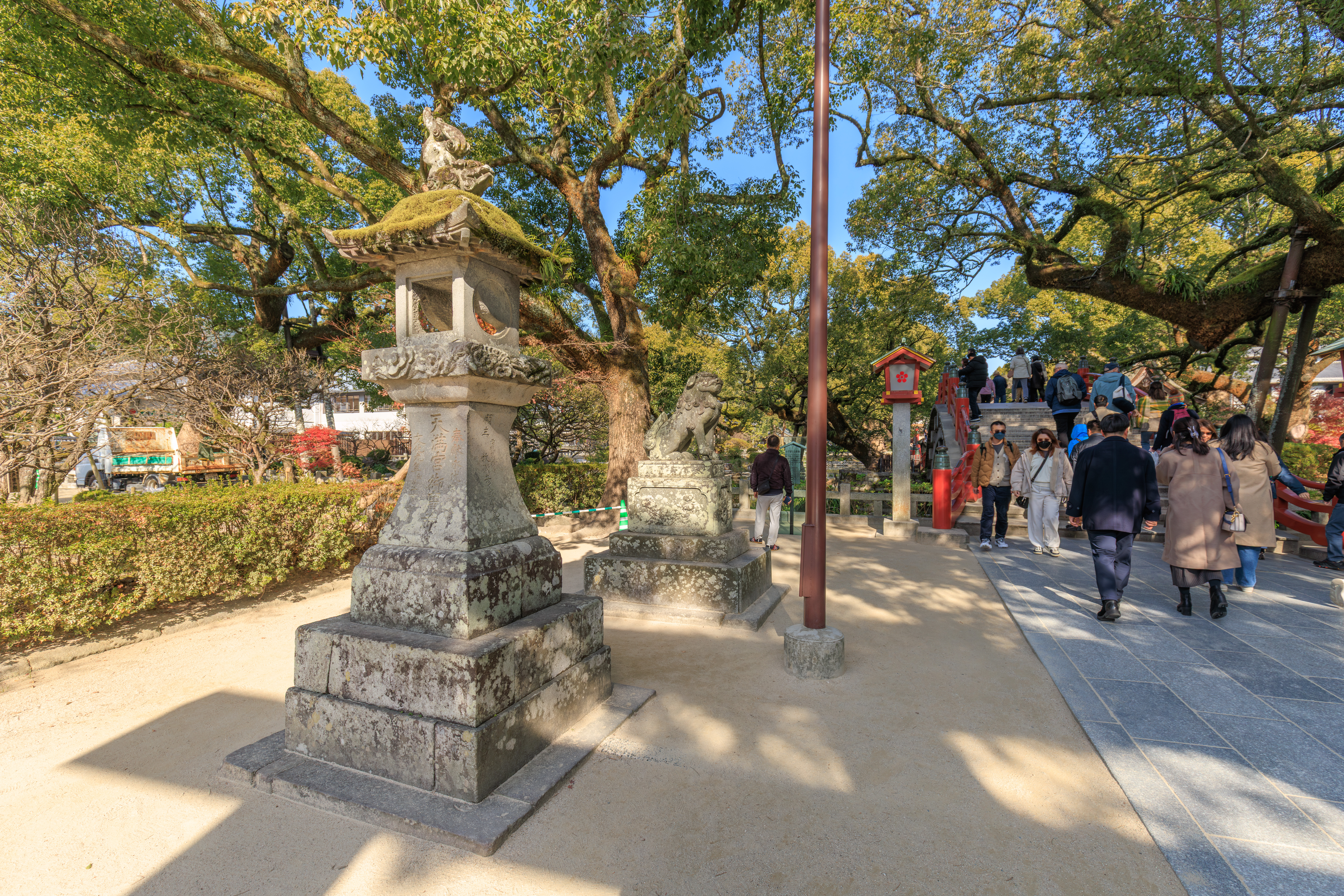
The path north within the shrine grounds was pretty busy.
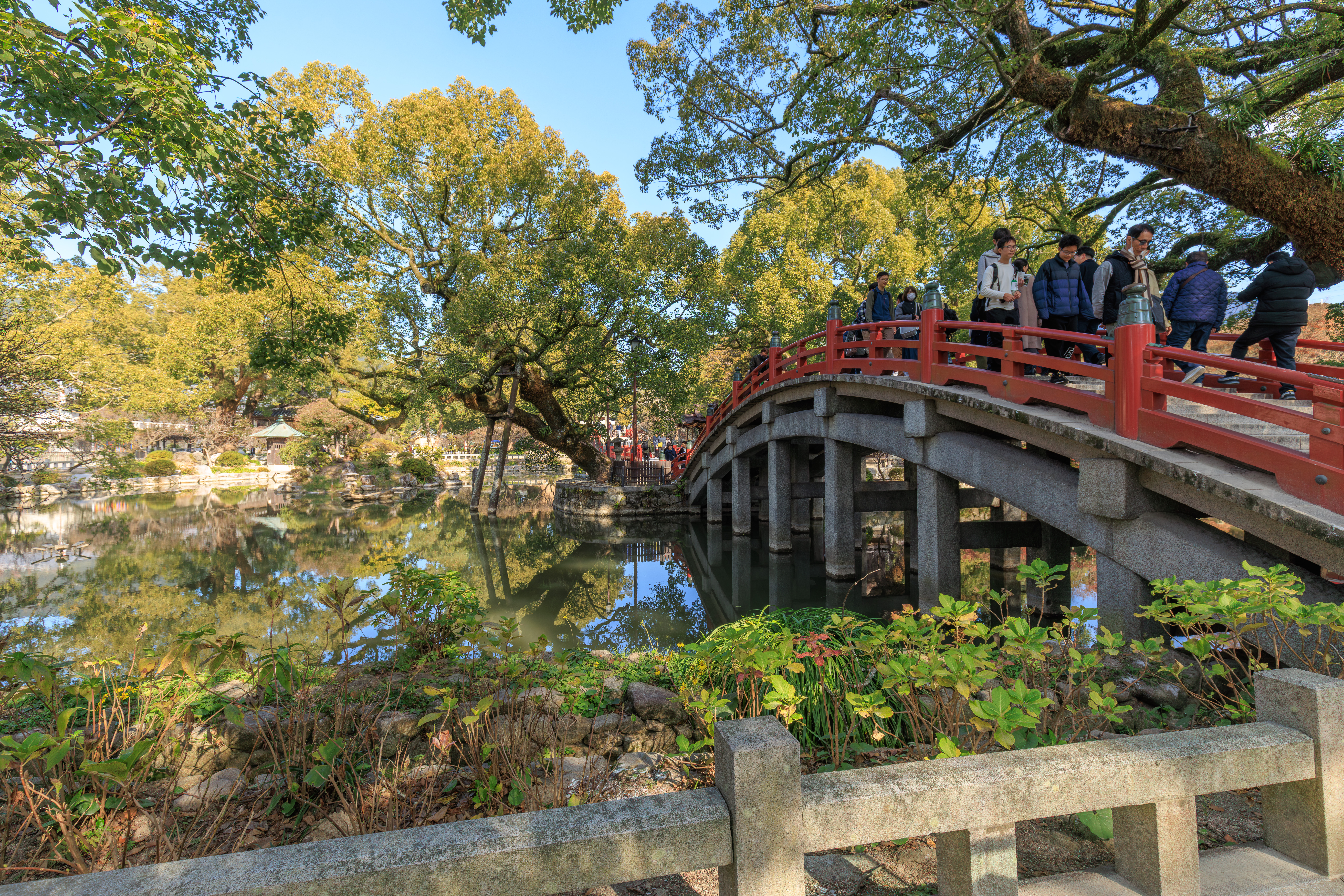
We quickly came to a bridge, the Taikobashi, going over a pond, the Shinjiike.
Taikobashi and Shinjiike
Taiko-Bridge and Shinji-Pond

The bridge is formed from three elements. Approaching the bridge from the section furthest from the Honden, the first arched section represents the past, the flat central section the present, and the second arched section the future. The design of the bridge is typical of Buddhist architectural conception and reflects the concept that one thought only should be held at a given time. Shiujiike (Shinji-Pond) is pond shaped to resemble the ideogram for "heart" and if viewed from an elevated position the four strokes of the character 'shin' (心) are clearly seen.
– Text from a glass sign by the bridge.
The sign mentions the Shinji Pond being shaped like the character for heart. The name of the pond, 心字, is actually just heart character. The Taiko in the bridge’s name is 太鼓, or drum. So it’s the Heart Character Pond and Drum Bridge. So why Drum Bridge? Apparently, this is another name for 月桥 Moon Bridge, which is a bridge with a high arch so that it looks like the Moon when reflected on the water’s surface.
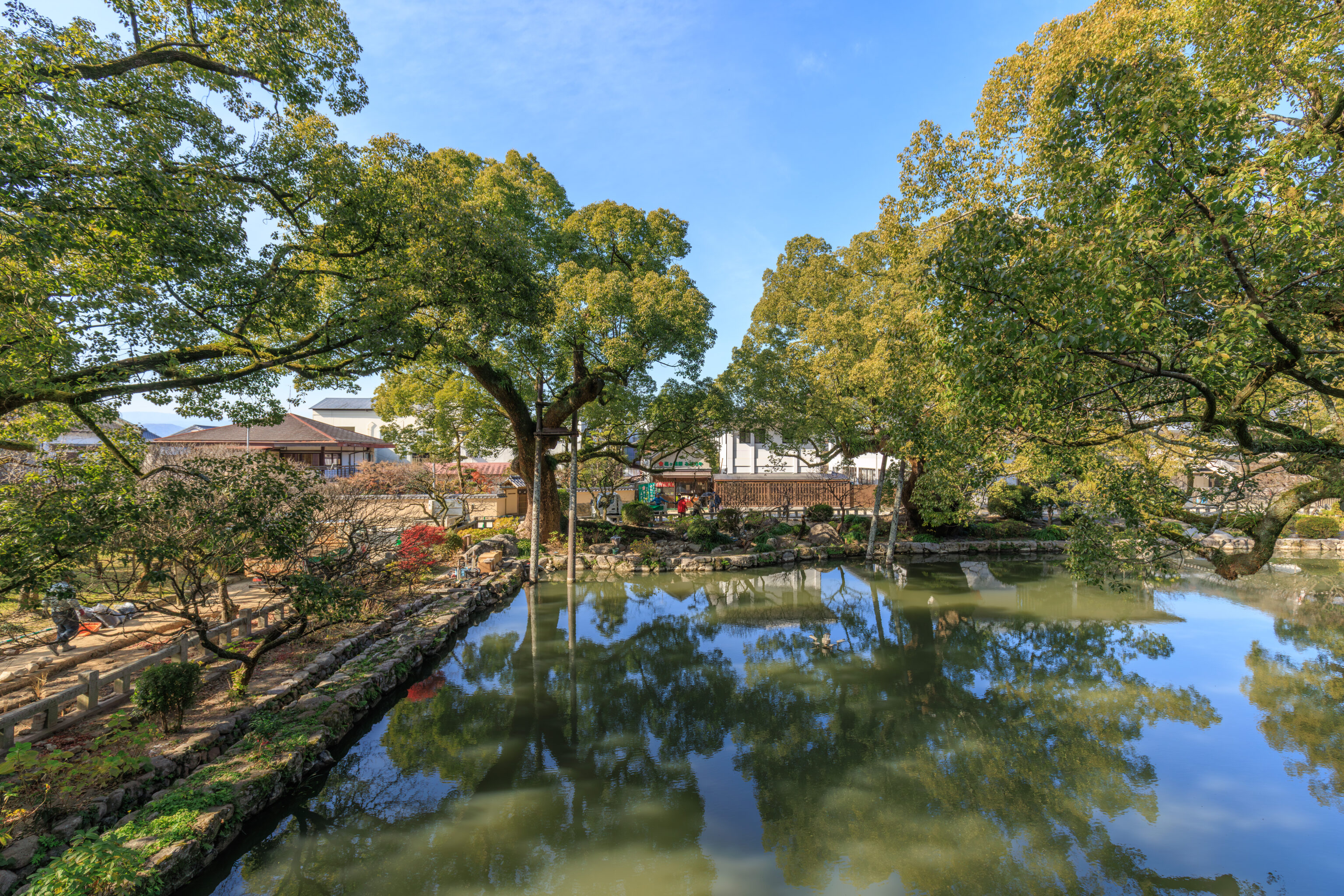
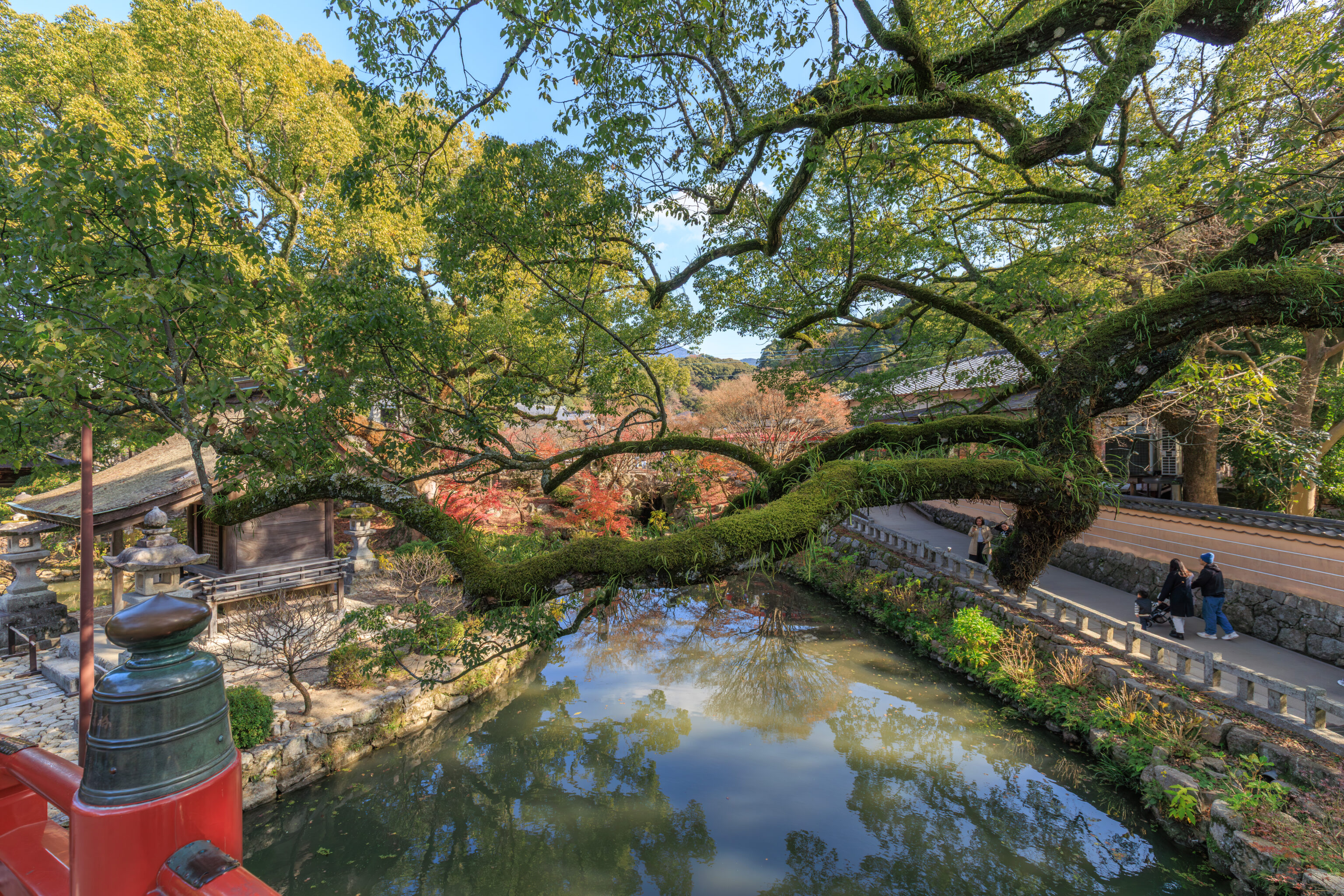
The Shinji Pond, as seen from the Taiko Bridge.
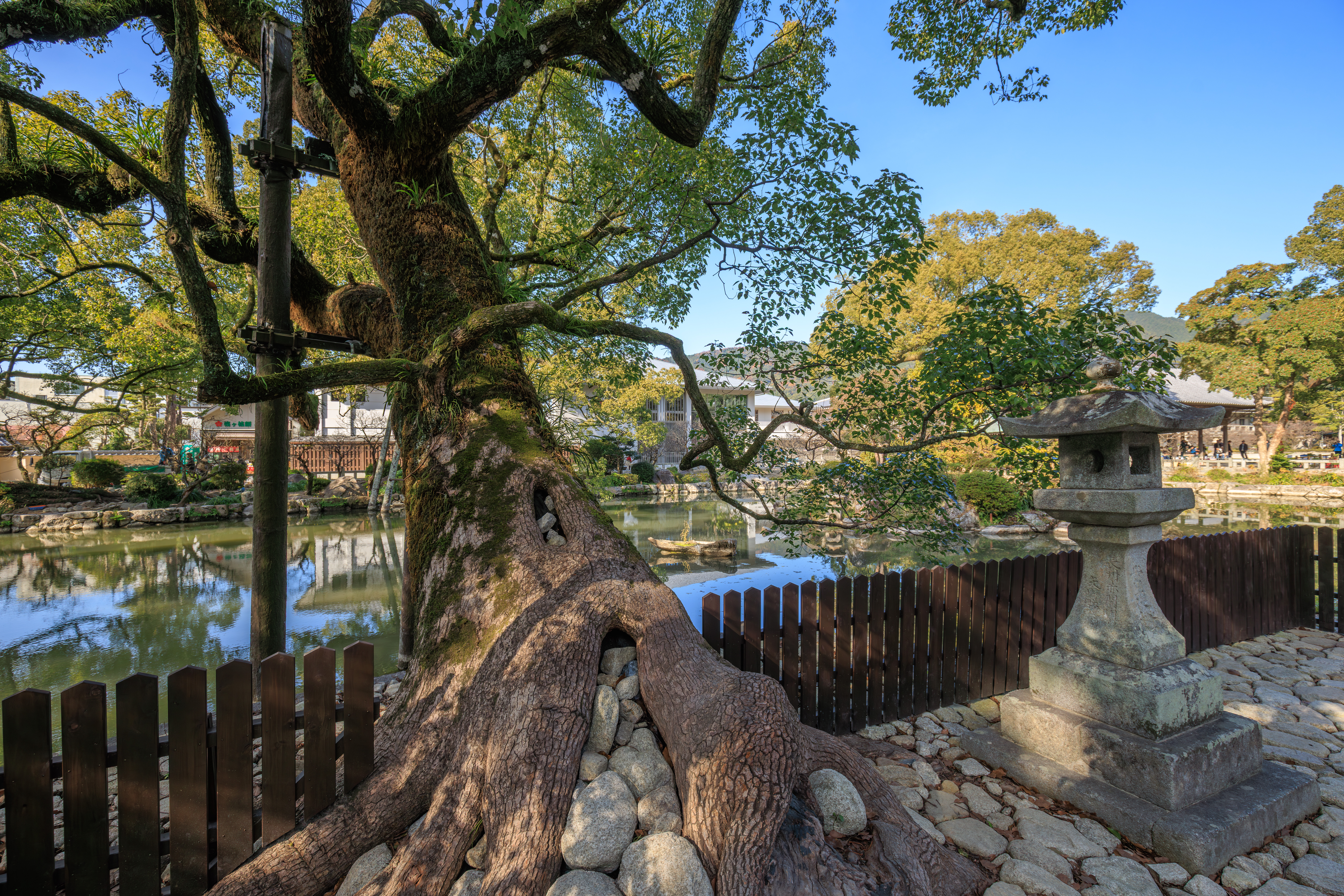
We crossed over the southern section of the bridge and ended up on a little island within the pond. This tree there seems to have grown over some stones. Or were the stones put into holes in the tree?
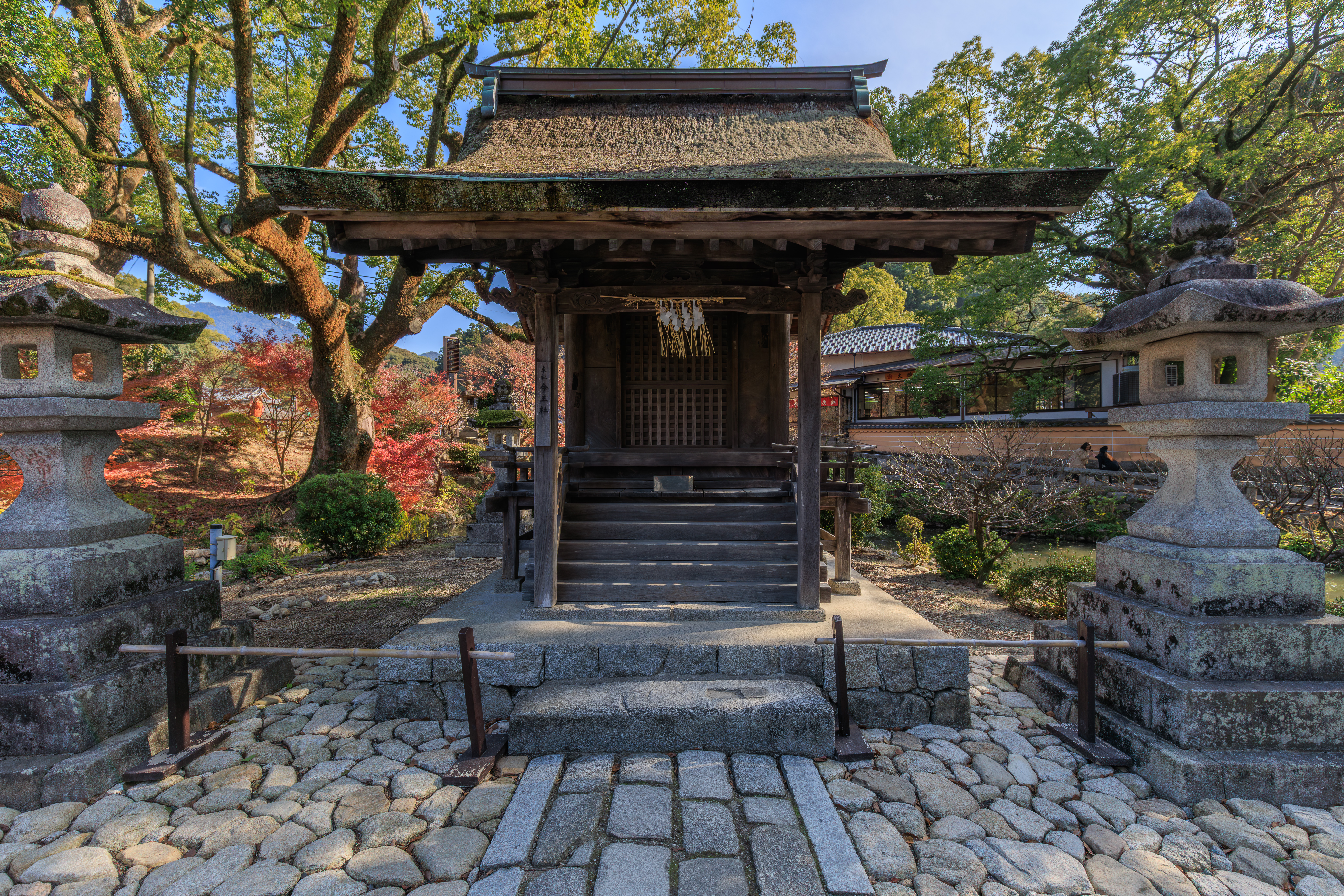
The island also contained a little shrine.
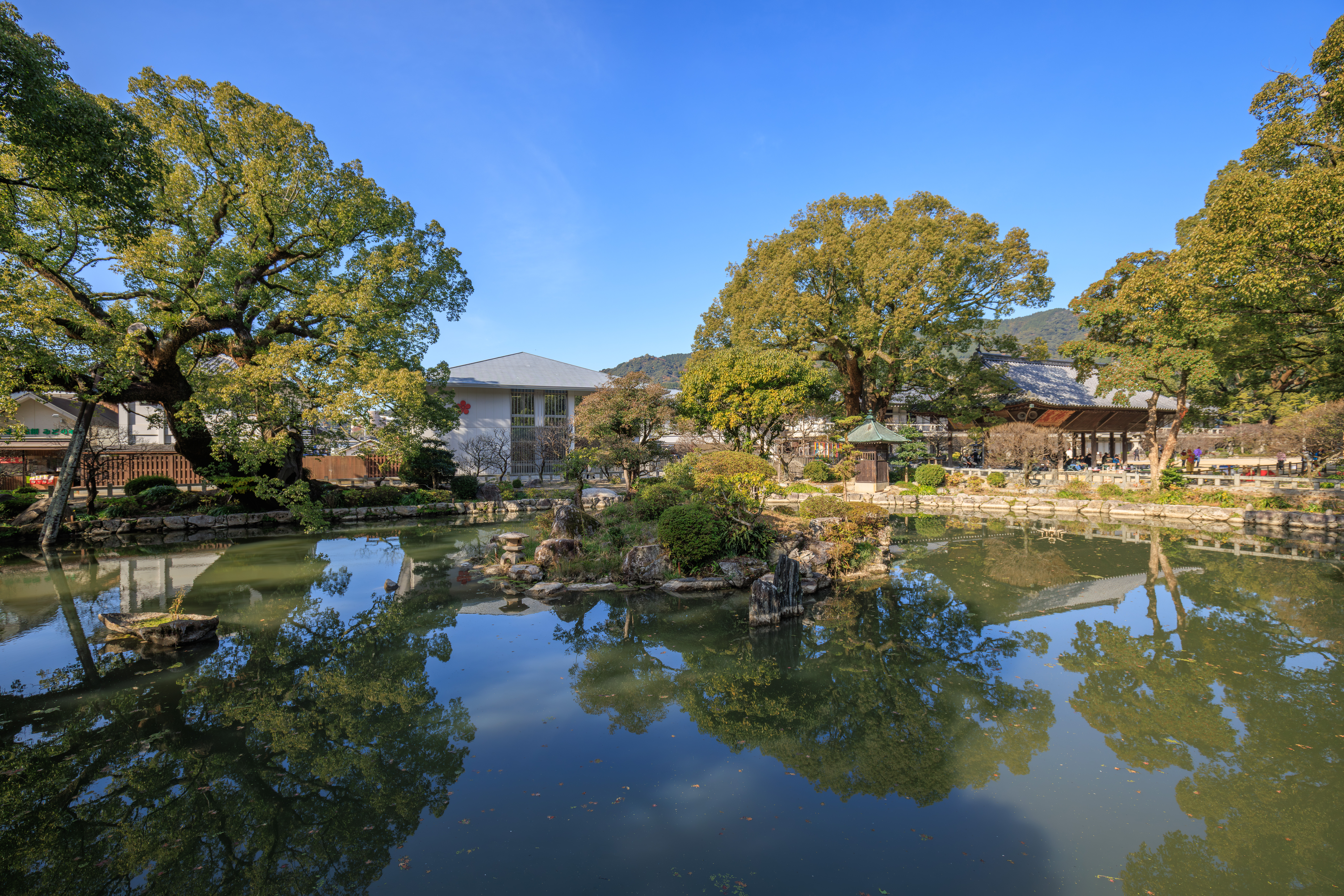
The view to the northwest from the island, or maybe the middle bridge, showing an even smaller island.
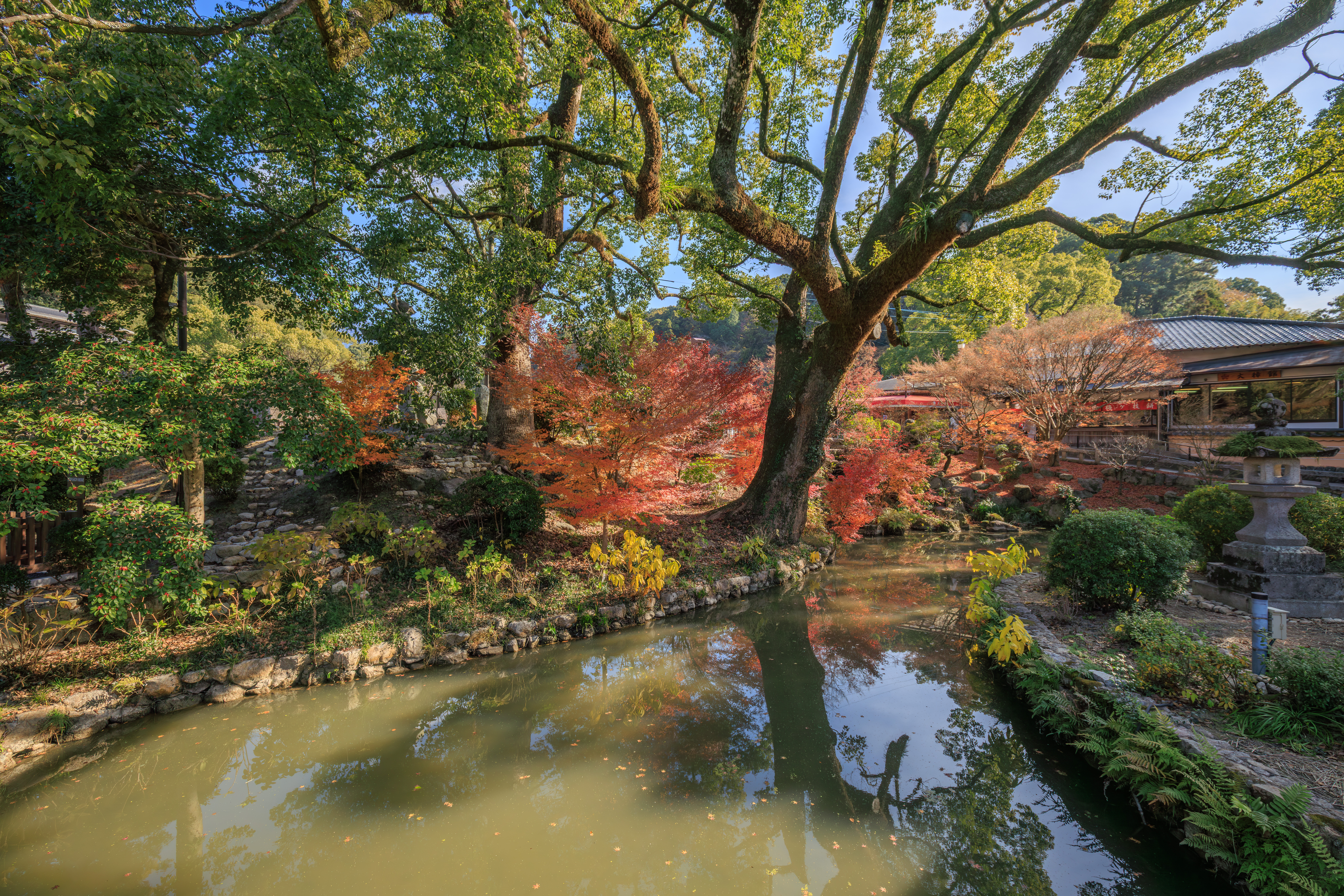
This was the view to the southeast.
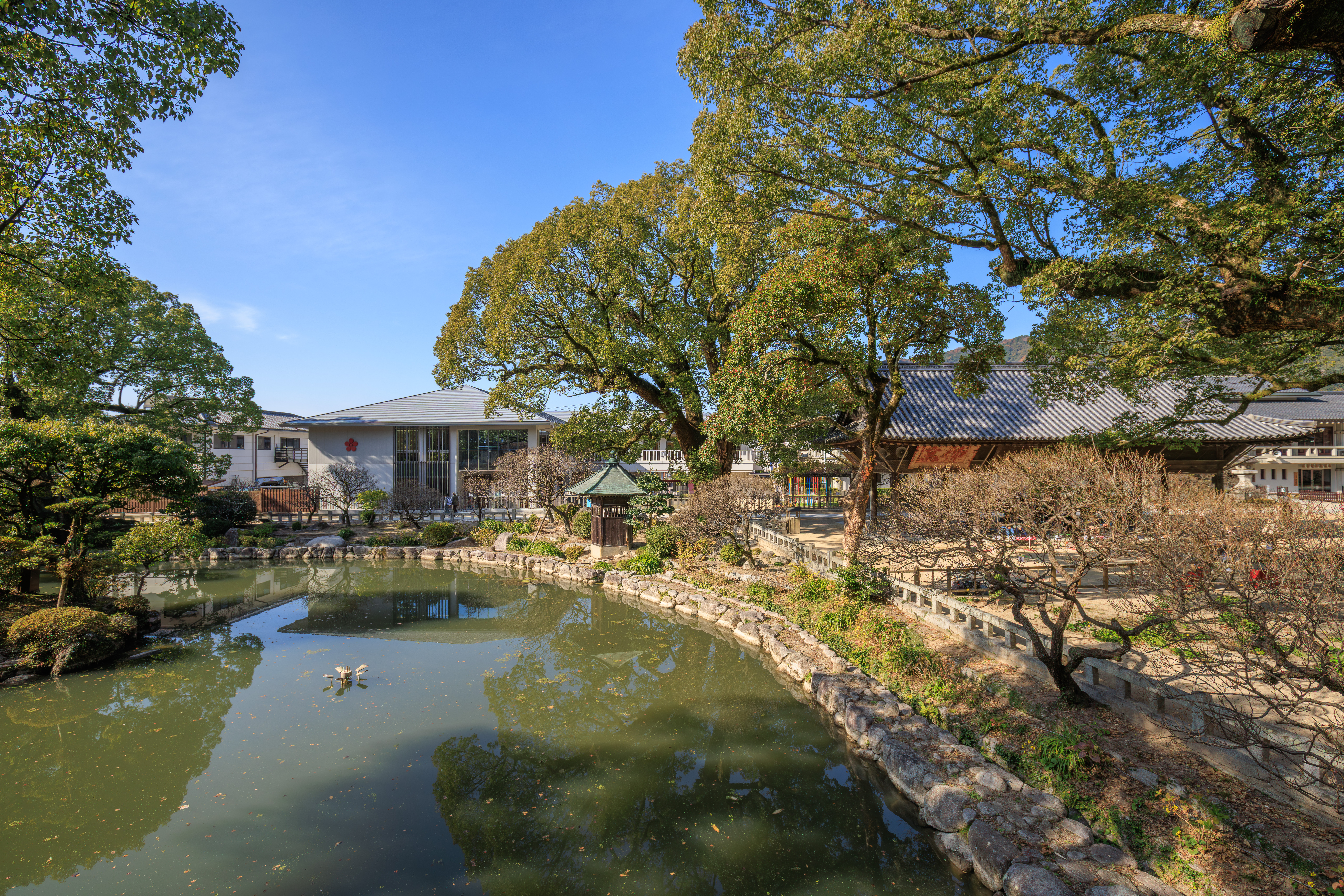
This was the view to the west from atop the northernmost section of bridge.
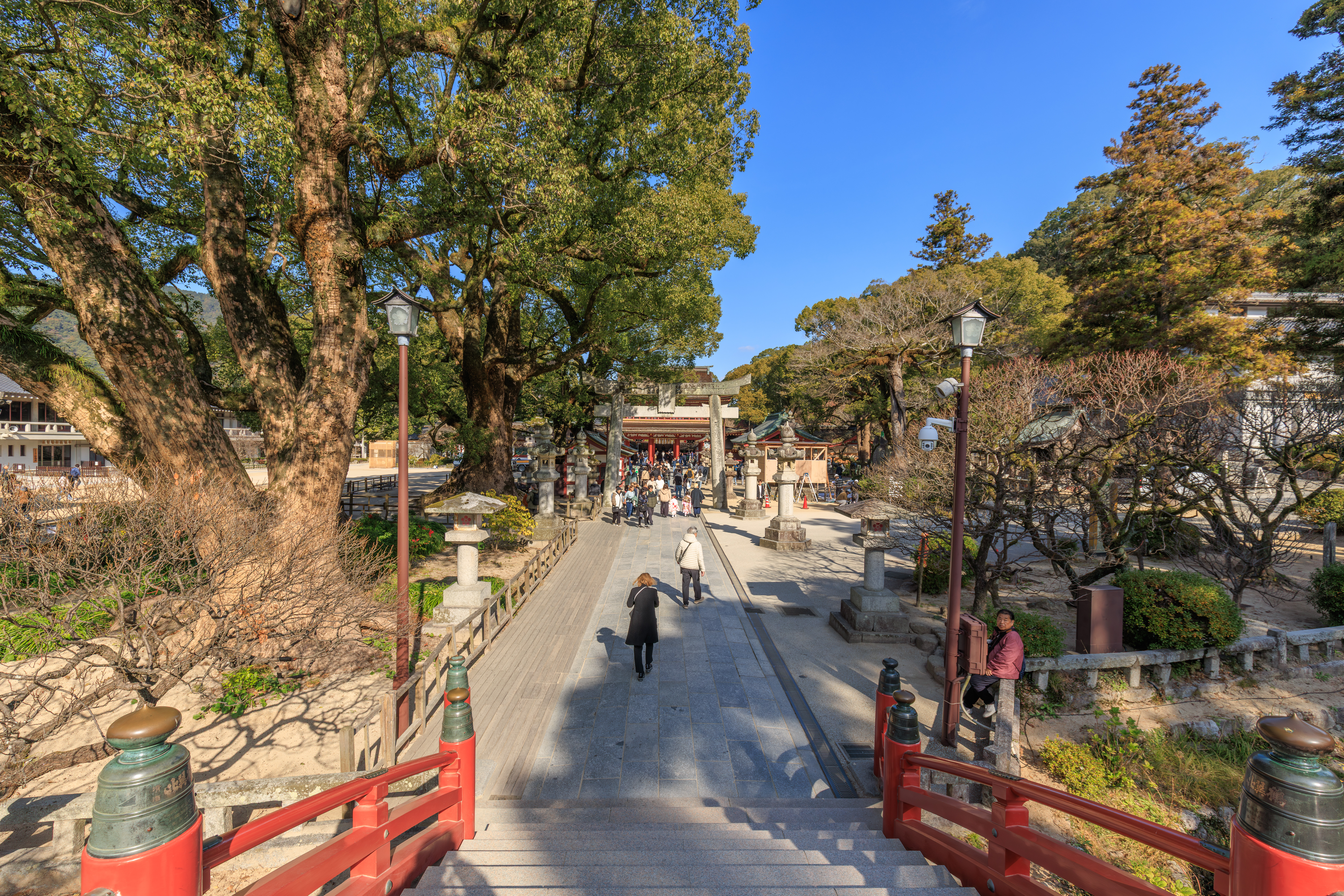
Looking to the north from the top of the bridge.
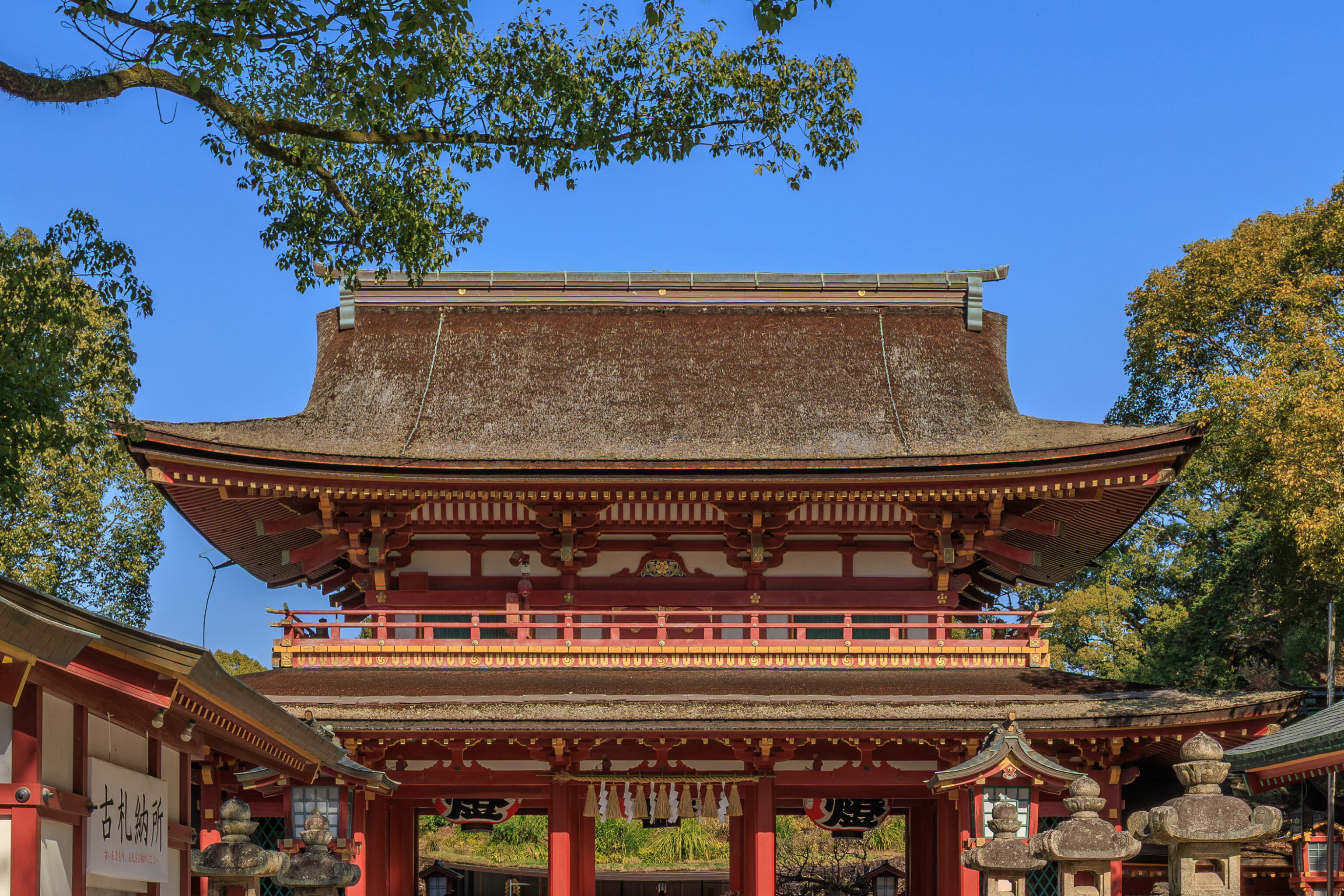
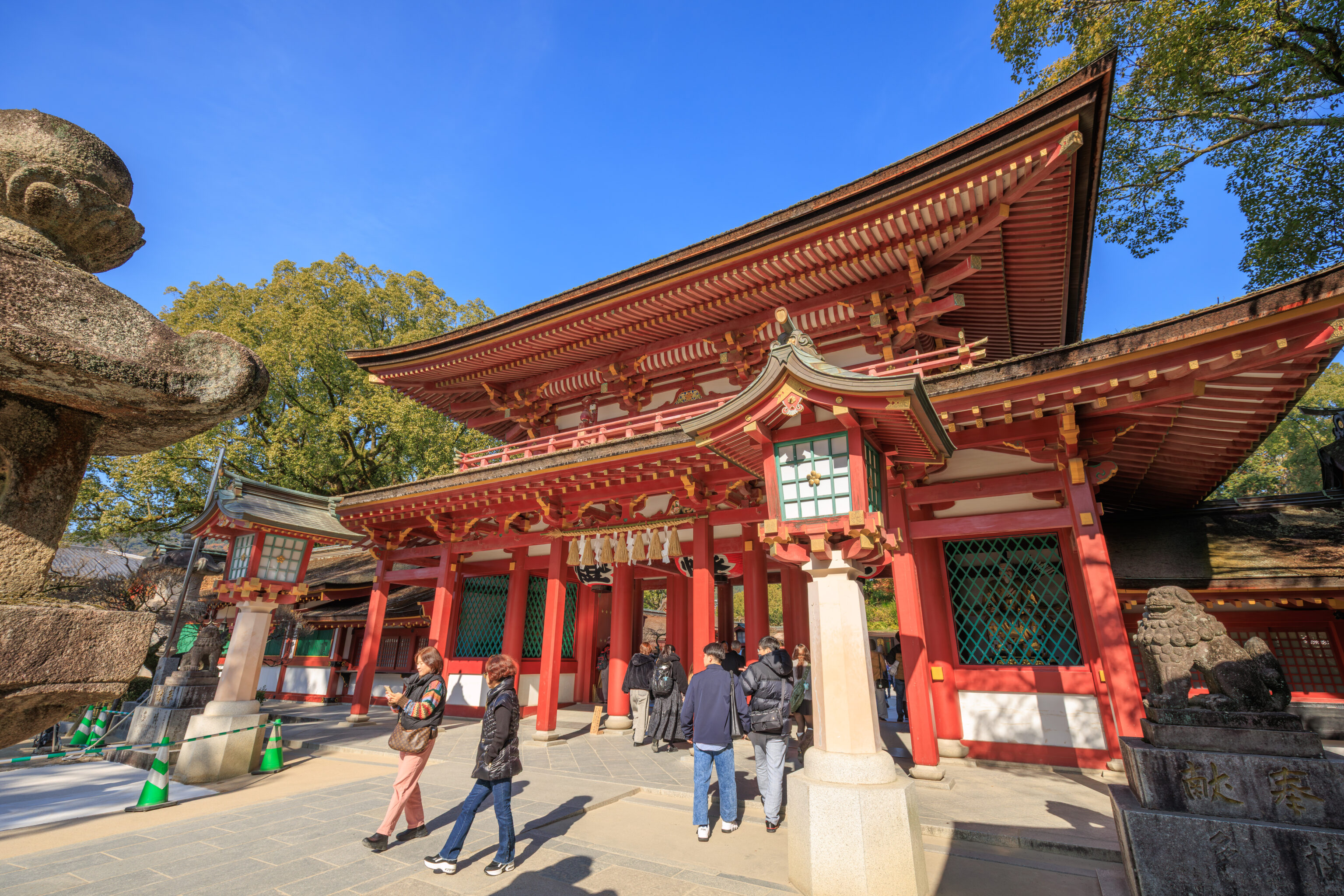
We continued on to the shrine’s 楼門 romon, a type of two story gate.
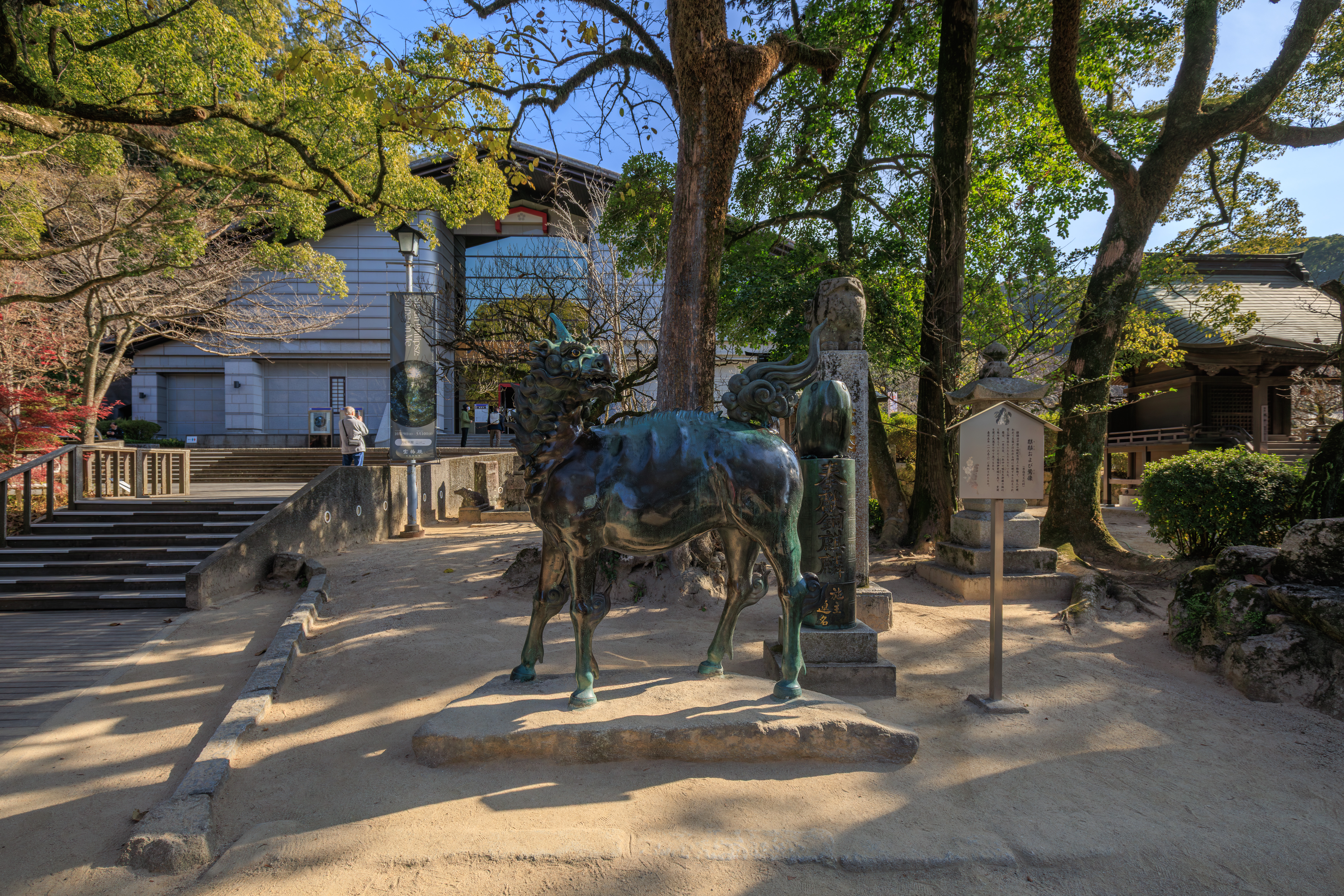
There are two creatures here just outside of the gate, specifically a 麒麟 kirin, and a 鸞 ran atop the column.
The Kirin
Statues of the Kirin and the Ran

(Prefecturally Designated Cultural Properties)

The Kirin is a mythical creature rooted in Chinese auspicious folklore; it is said to appear only when a virtuous sage emerges and the Way of Righteous Rule is upheld. As such, this statue may be interpreted as a tribute to the saintly virtues of Sugawara no Michizane (Kanko).

The Ran is a bird closely associated with the *Usobegae Shinji* (Falsehood Exchange Ritual) held on January 7th—a ceremony in which the "falsehoods" of the past year are exchanged for the absolute sincerity of Tenjin-sama. It also serves as a guardian bird of the Tenmangu shrine, believed to bring good fortune and blessings.

These statues were dedicated to the shrine in the fifth year of the Kaei era (1852).
– Text from the sign on the right side of the above photograph, translated using Google.
The modern looking building in the background is the shrine’s museum and possibly treasure hall.
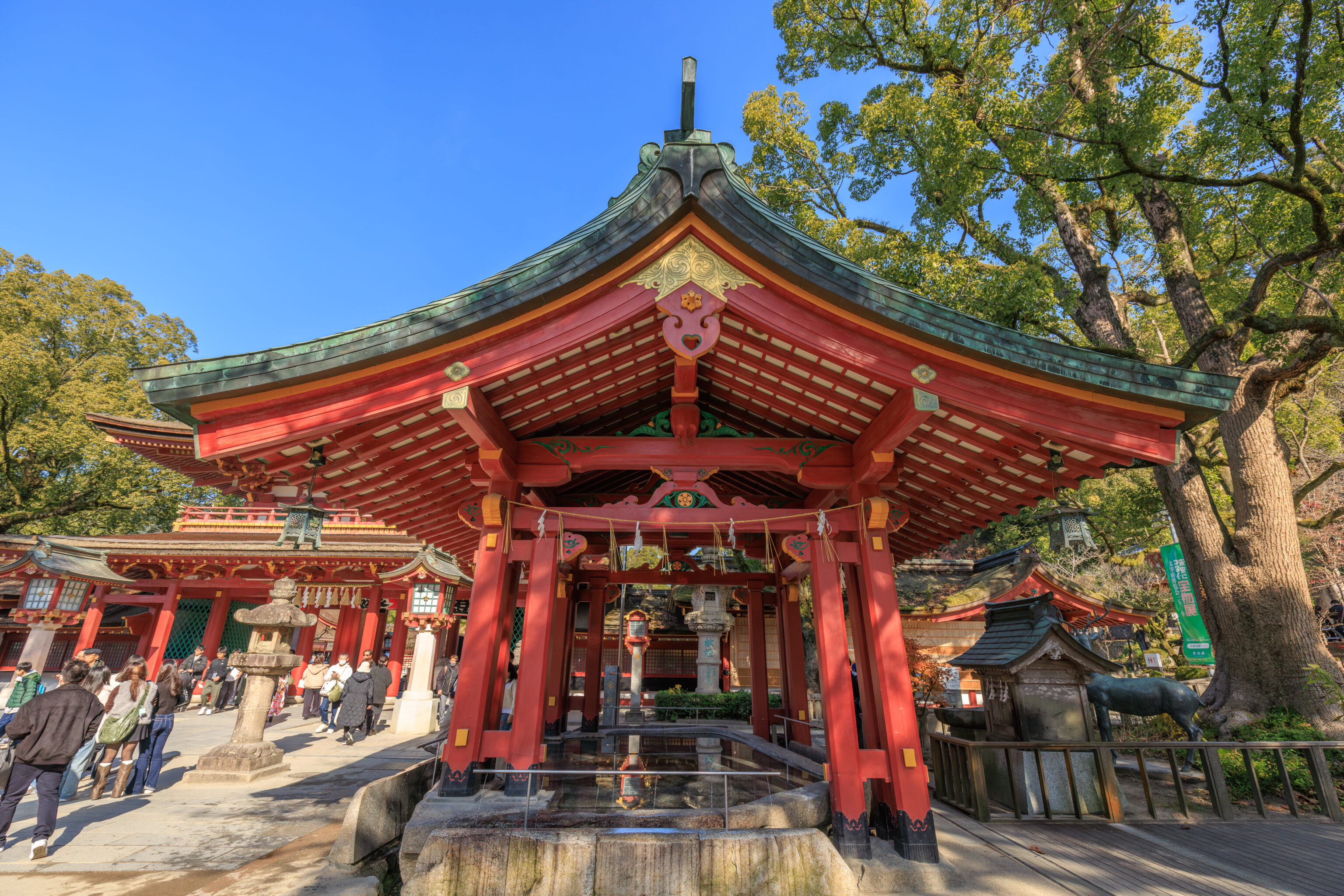
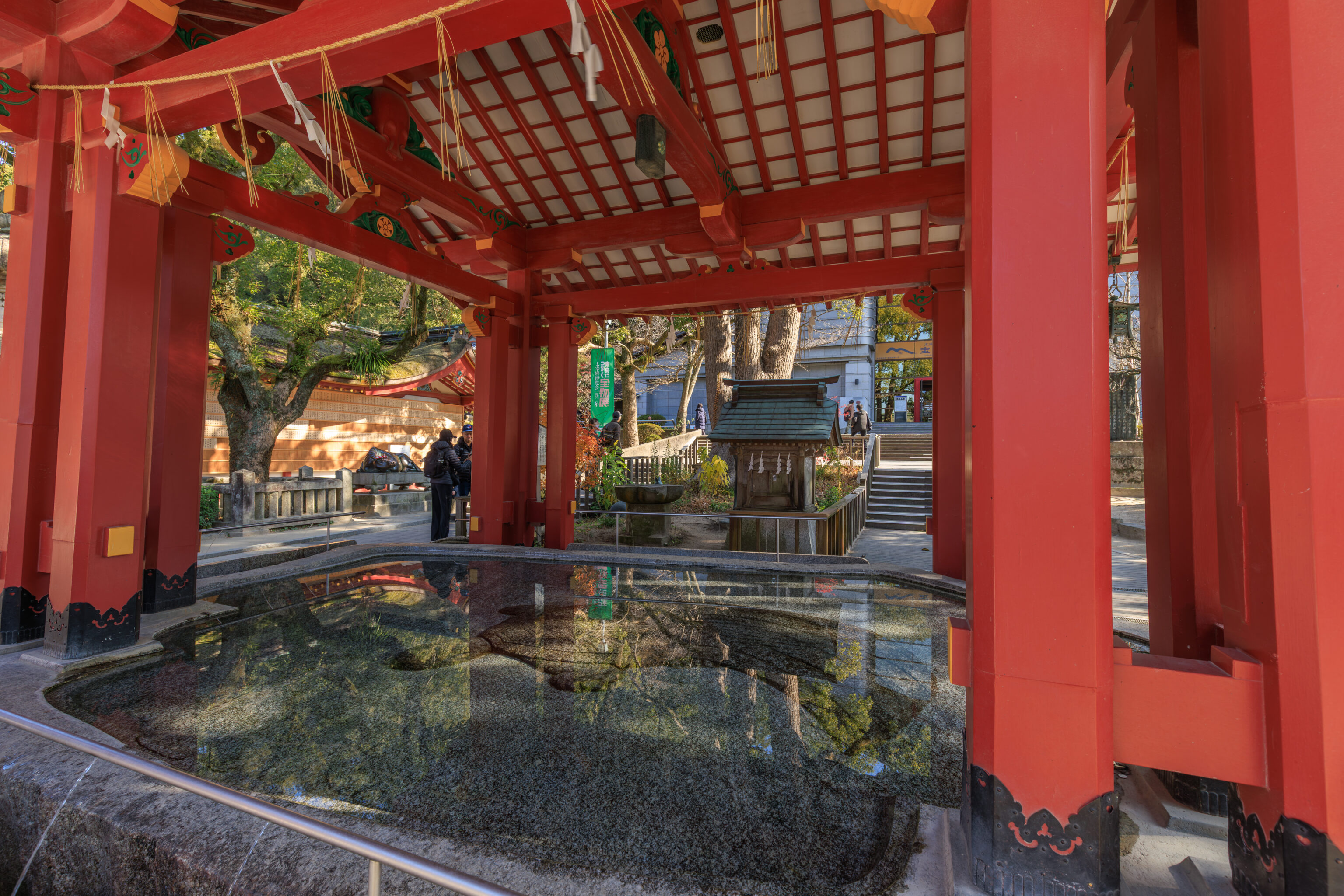
There was also a 手水舎 chozuya (purification pavilion).
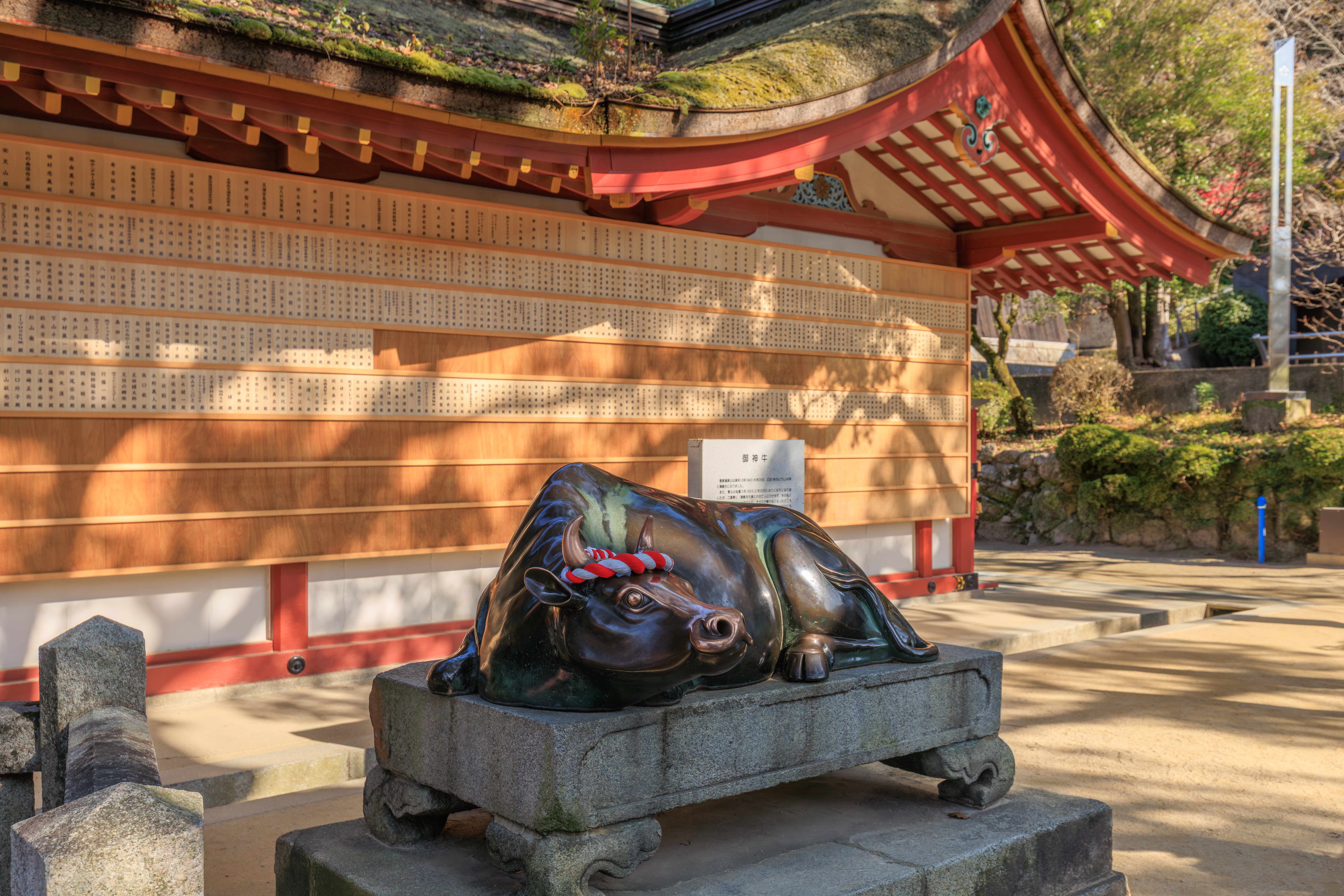
This 御神牛 goshingyu (sacred bull) was on the right side of the gate. We actually saw one earlier at the end of the omotesando, although we didn’t photograph it closely like here.
Special significance by Ushizai Dazaifu Tenmangiya. After the death of Michizane Sugawara, the author of Kogyola wrote that his remains were on the train, and when he arrived suddenly on the street, he was forced to move. This is the place where Michizane Sugawara's followers were buried, as well as others, and this is the location of the main shrine. There are 11 statues of shrines dedicated to the Sugawara family, statues of the sacred cows used to provide relief to countless tourists, and statues of all kinds of shrines. The largest bronze statue of a troupe, the torii gate at the entrance of the shrine, the least number of visitors come to this capital, the head of the bull, and the prayer for wisdom. Year after month came, the cow head was changed and the flash was written.
– Dazaifu Tenmangu, https://www.dazaifutenmangu.or.jp/tw/discover-dazaifu-tenmangu/shrine-grounds/, translated using Google.
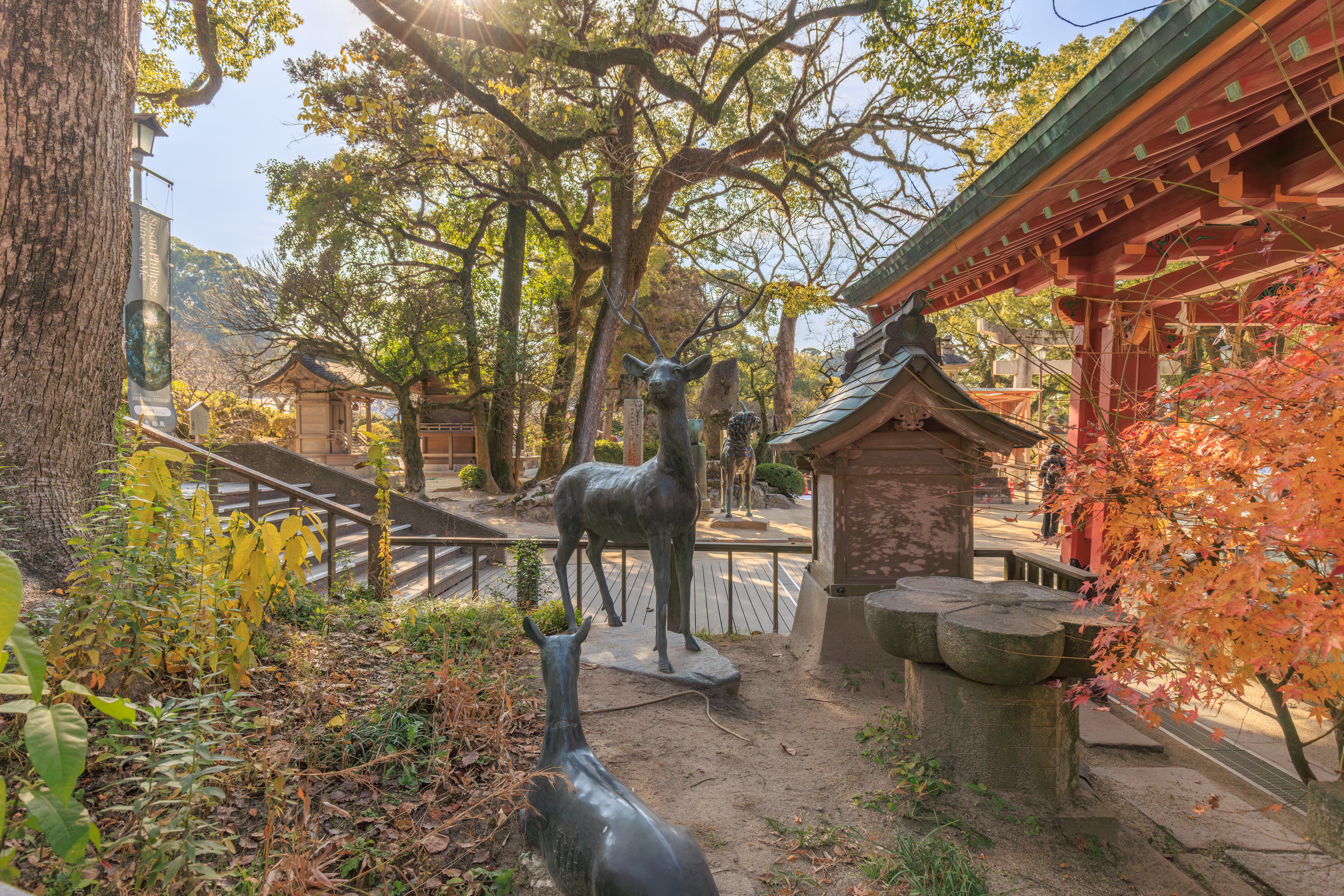
There were also some deer here opposite of the ran and kirin.
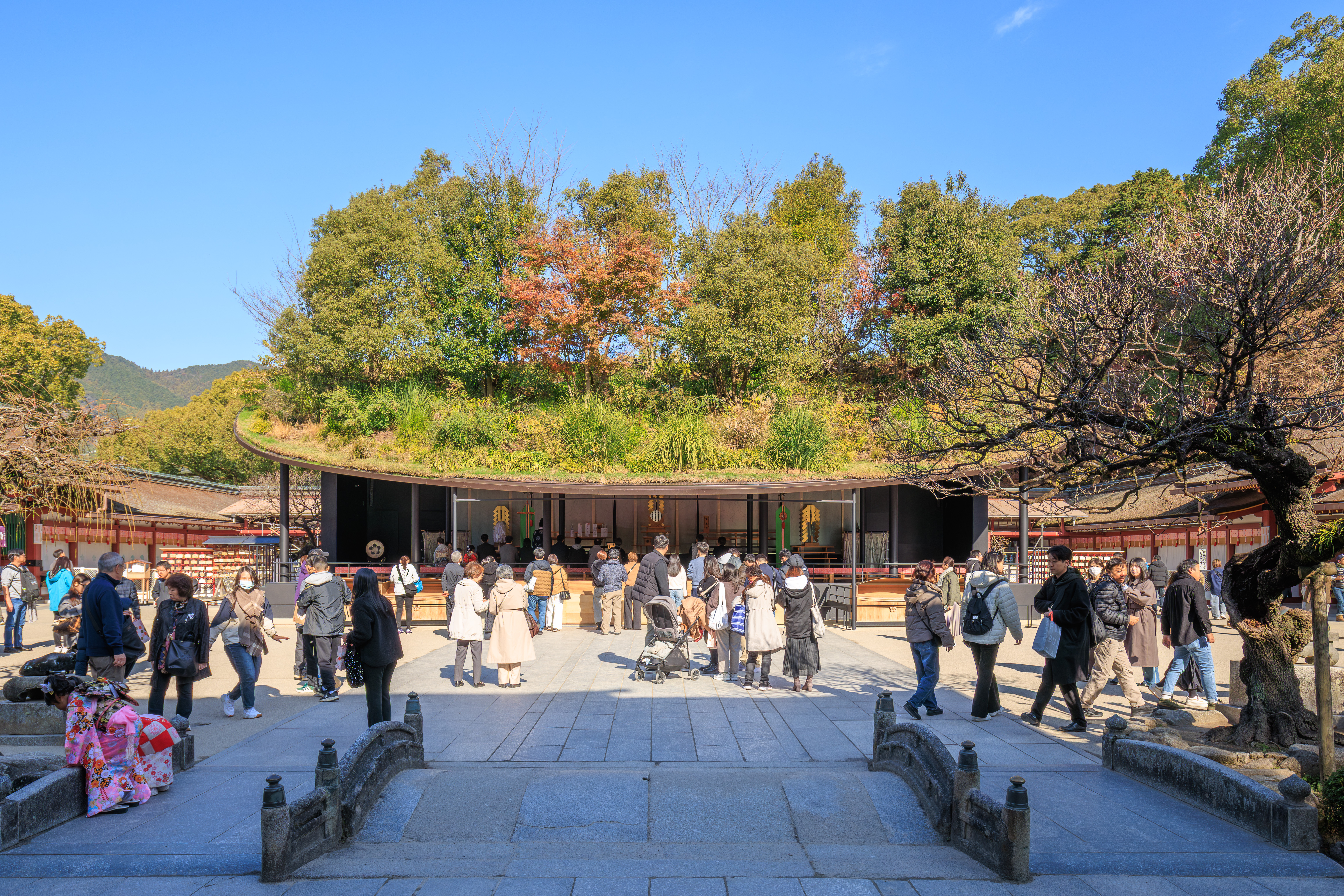
Upon passing through the gate, we found ourselves in front of a rather modern and unique shrine building! This is actually a temporary structure as the 本殿 honden (main sanctuary), built in 1591, is being renovated and scheduled to be completed next year.
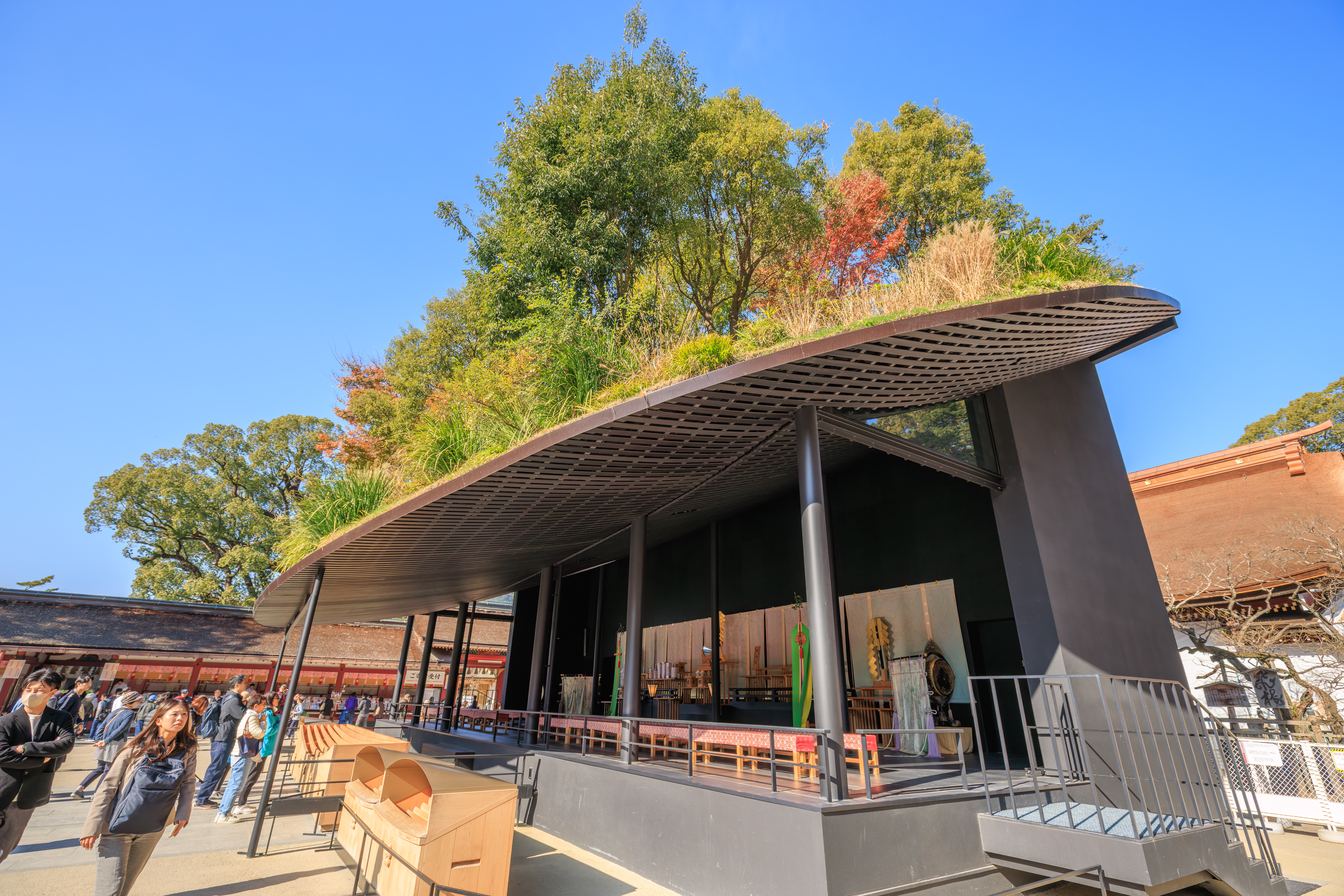
This temporary hall is quite impressive!
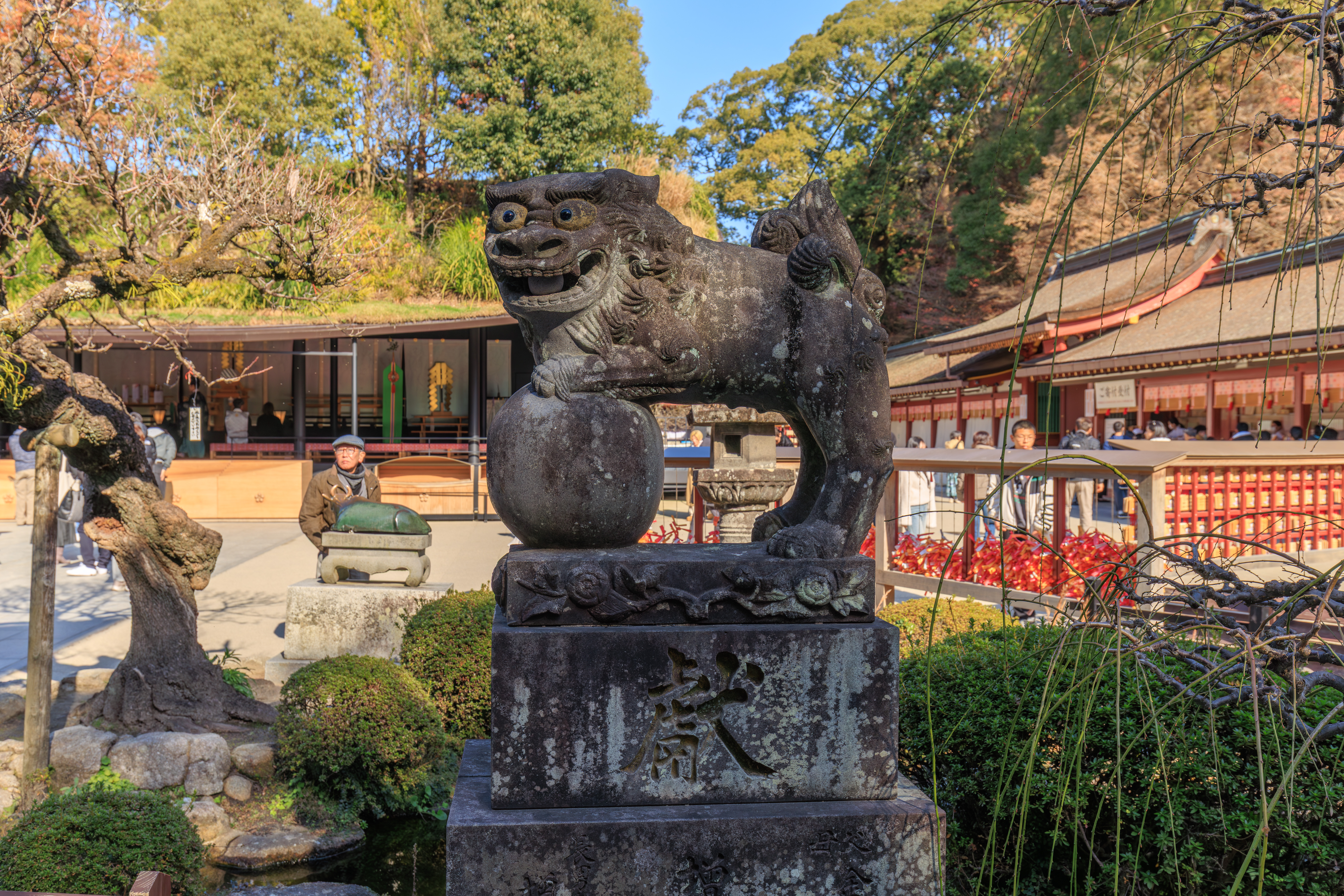
This is a 狛犬 komainu, guardian of the shrine.
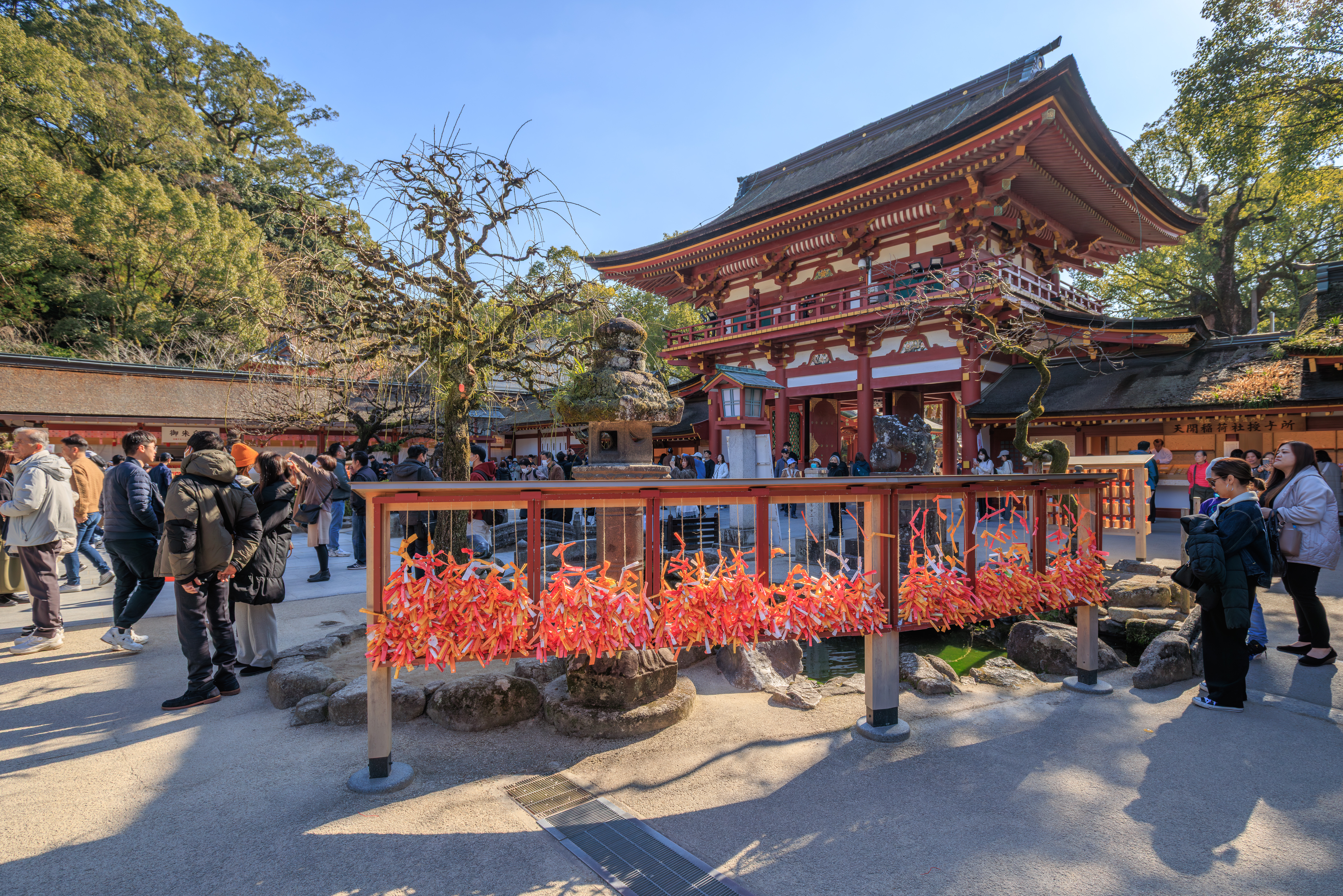
It was pretty busy here in the central courtyard around the honden.
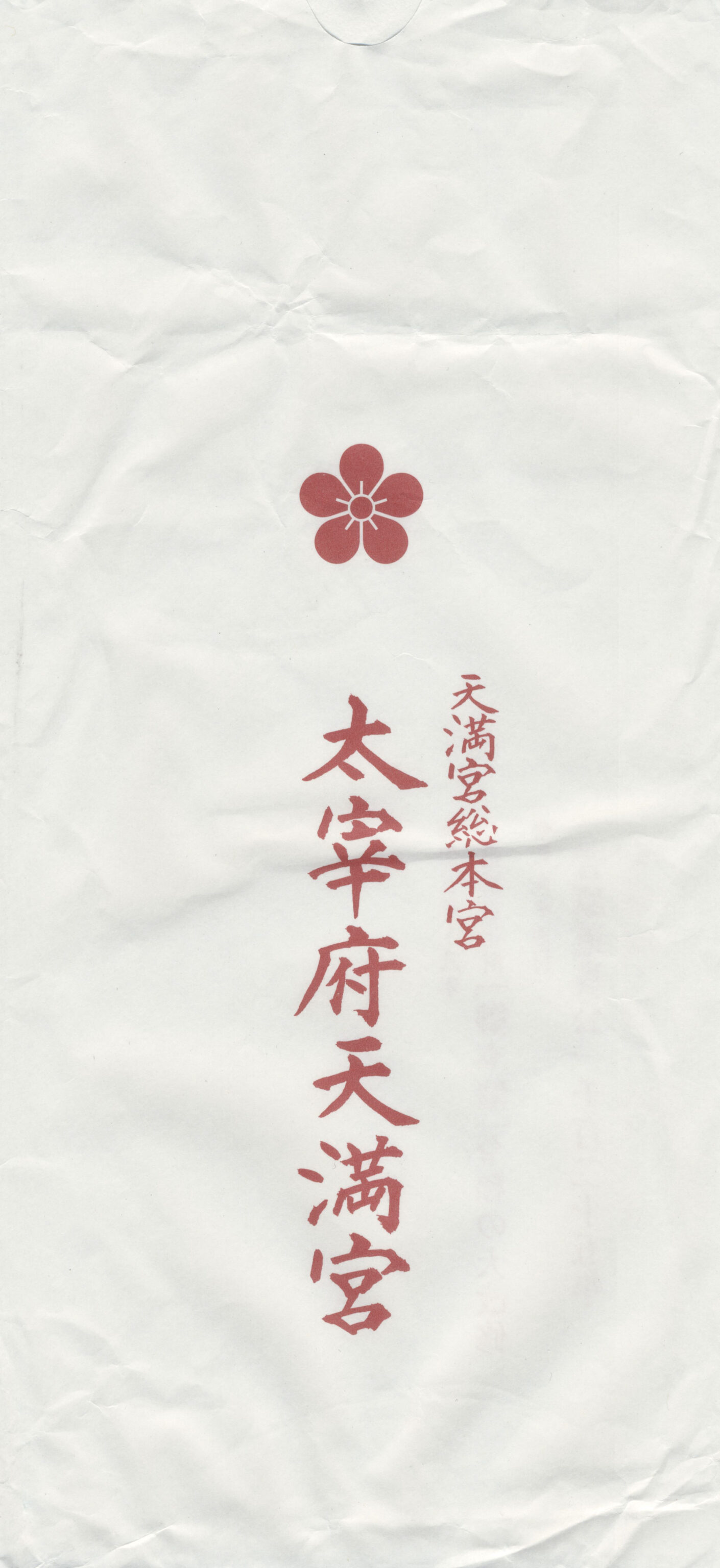
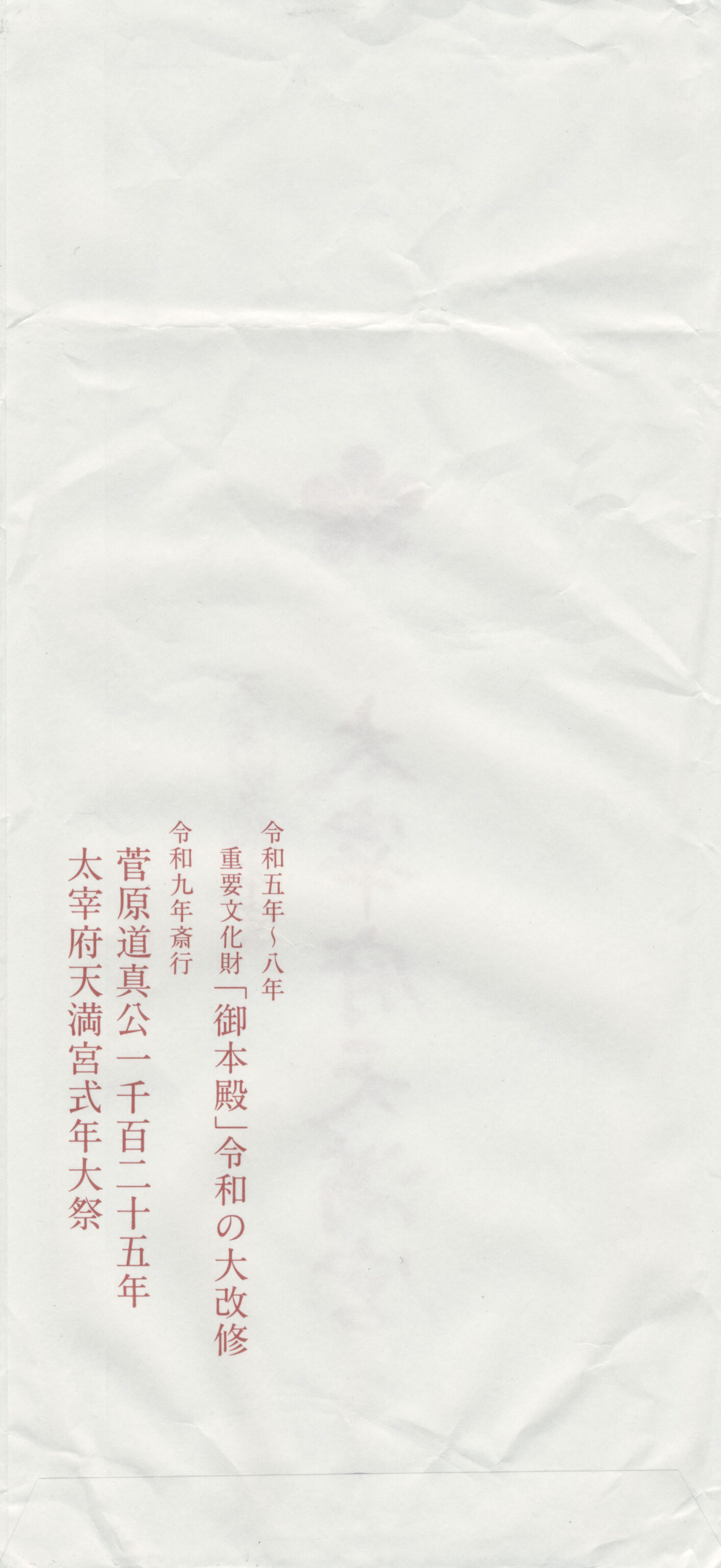
At some point here, we picked up some items from the shrine store.
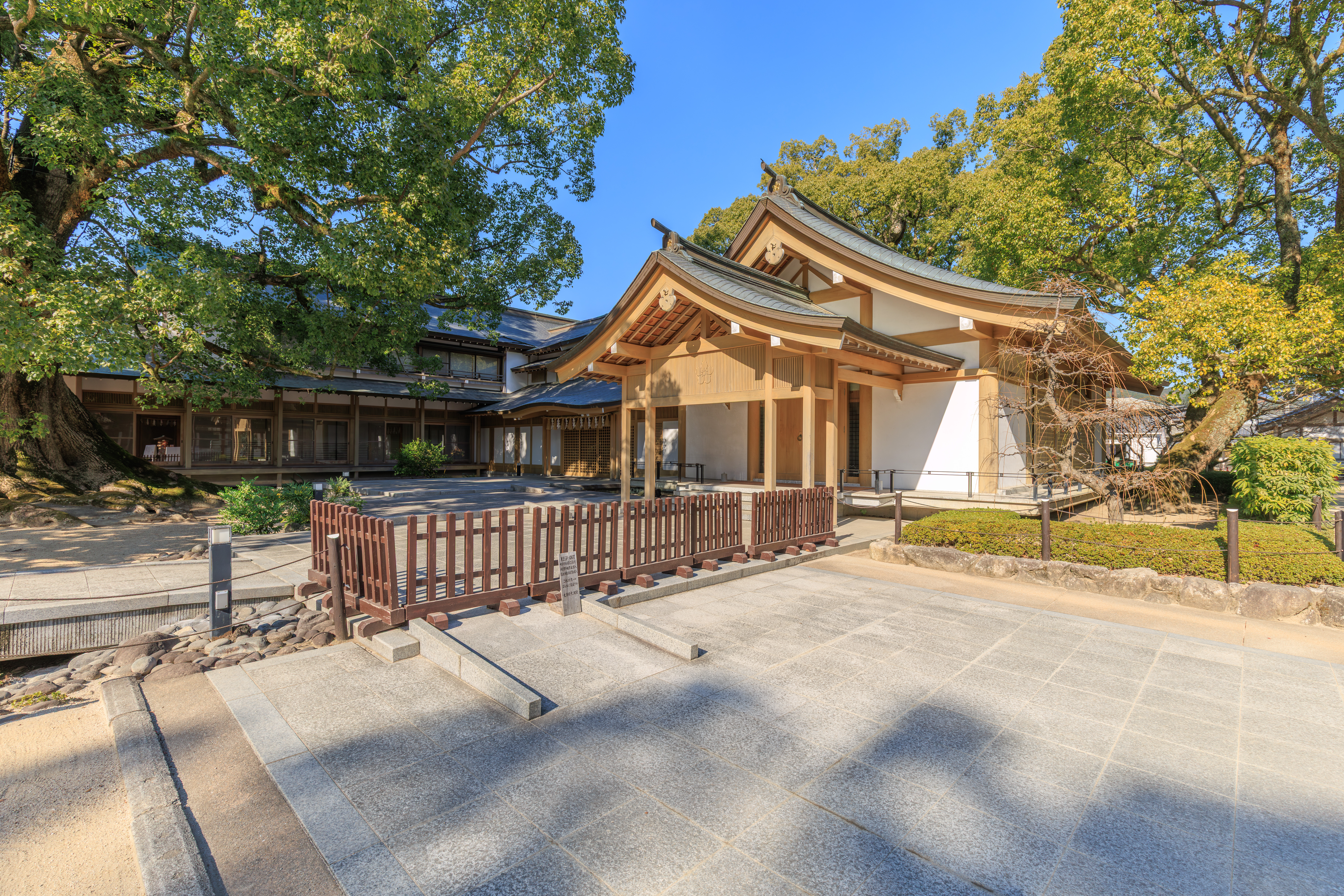
This area to the left of the walled courtyard around the honden was off limits. The shrine building on the right looks pretty new.
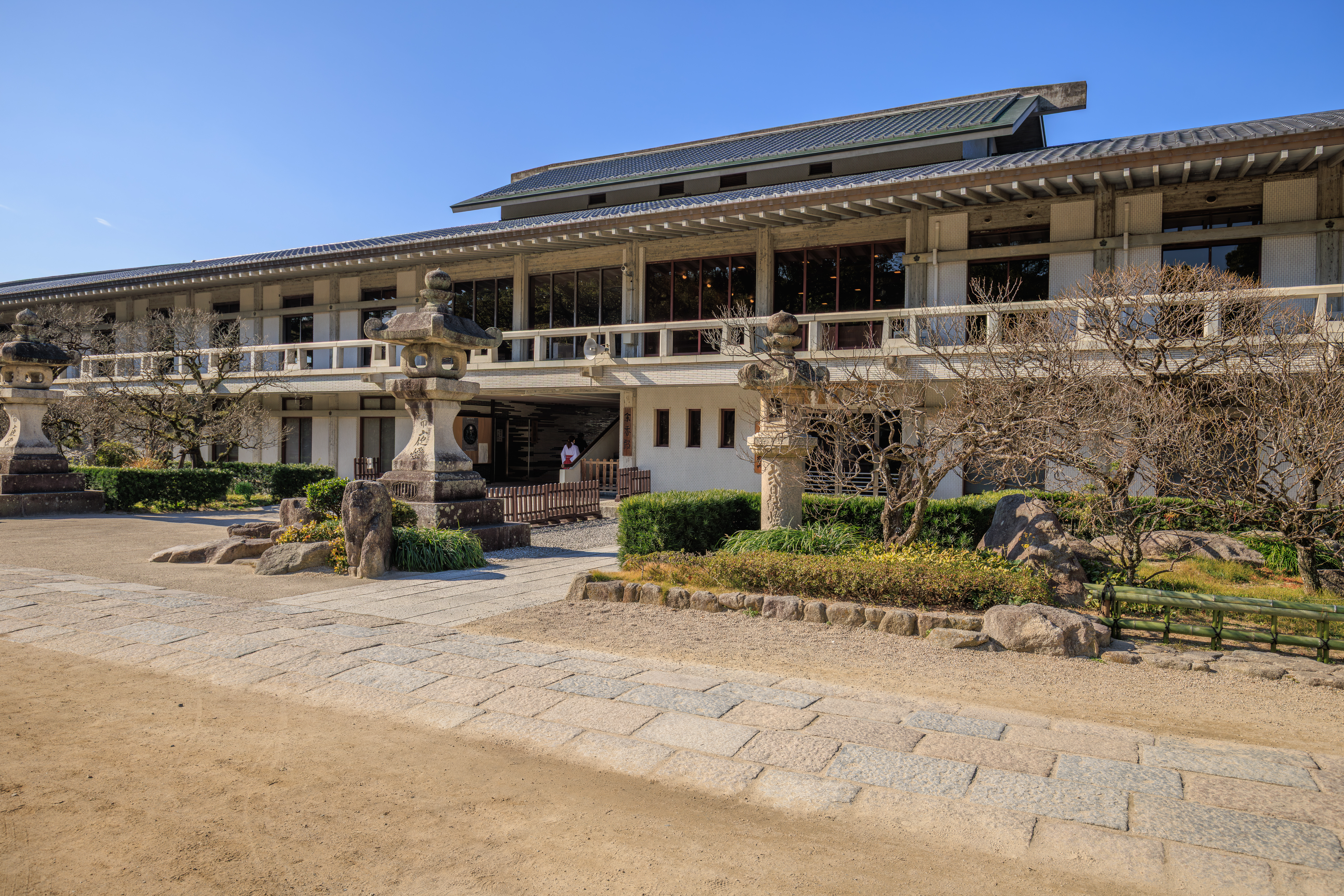
This long building seems to be the 余香殿 Yokoden and seems to contain shrine offices.
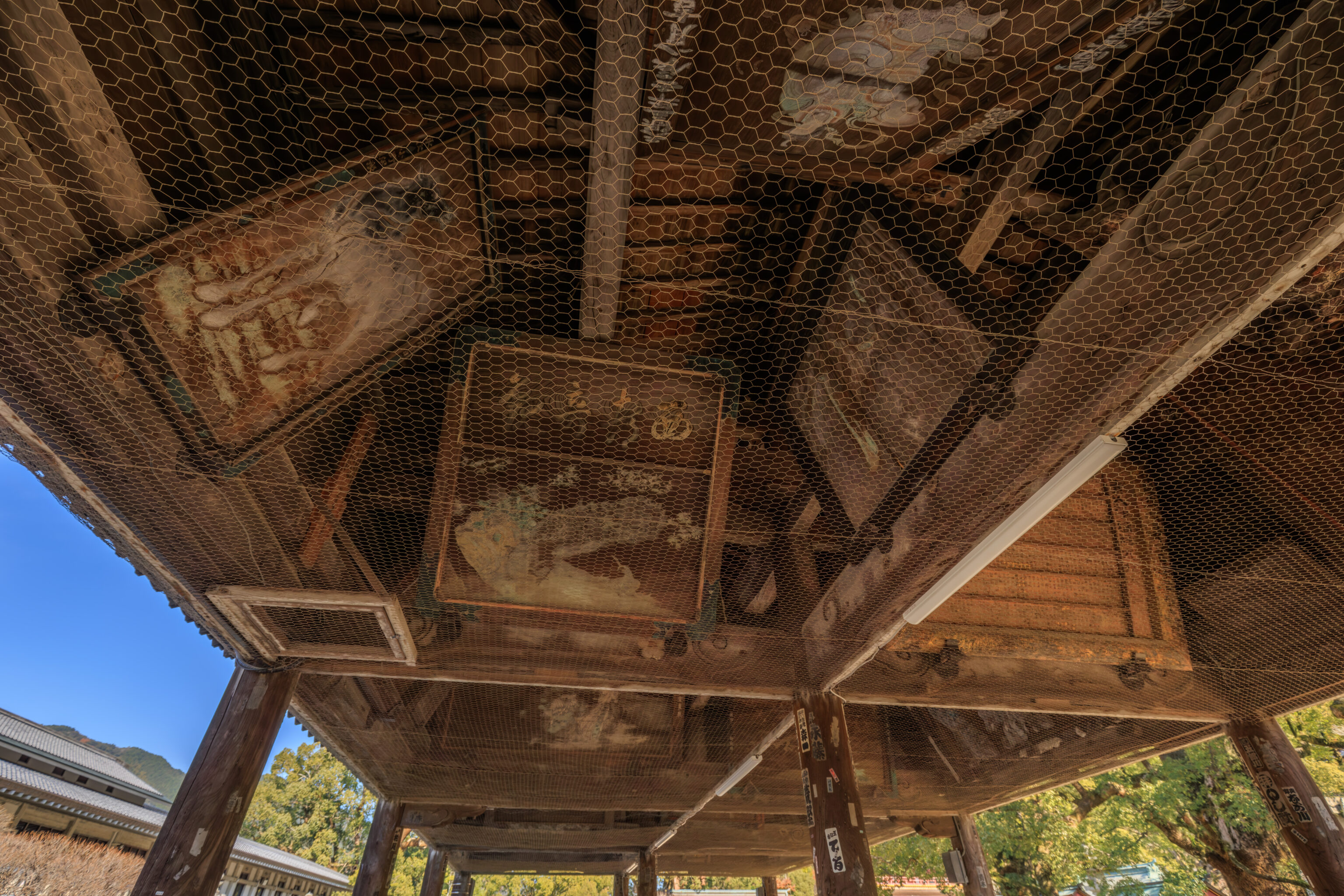
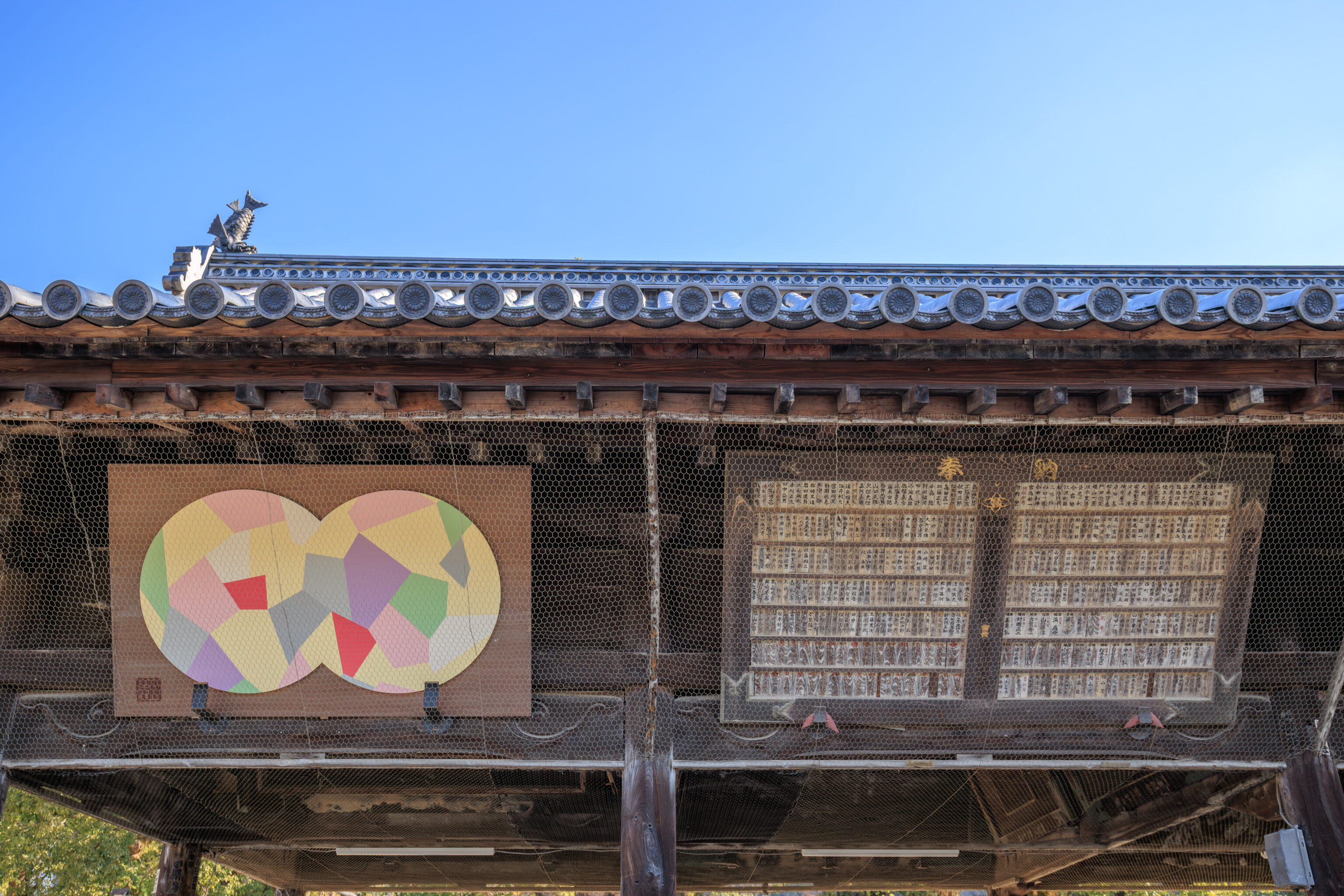
Some panels hung on the roof of one of the shrine’s open pavilions.
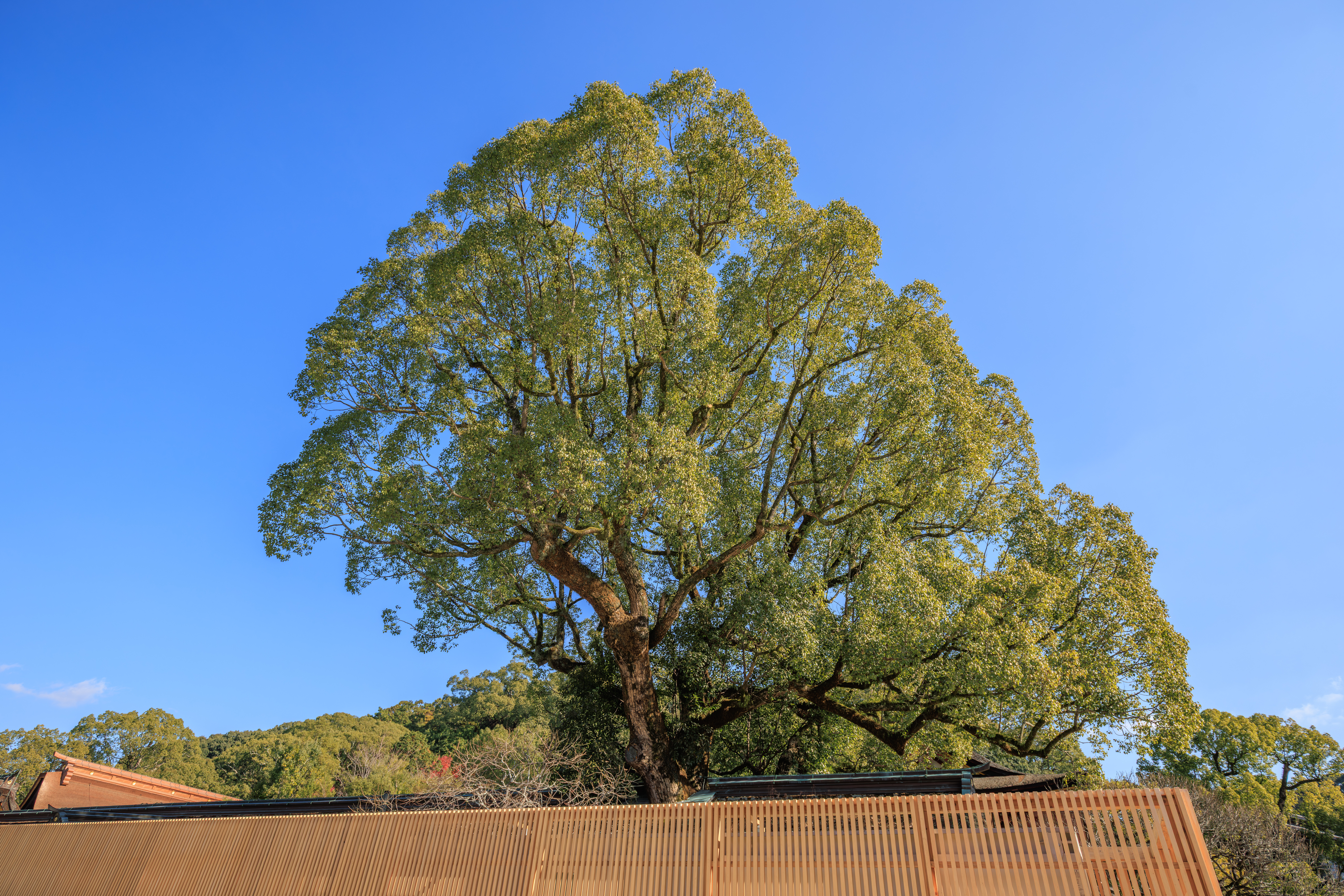
A very large tree towering over the shrine buildings.
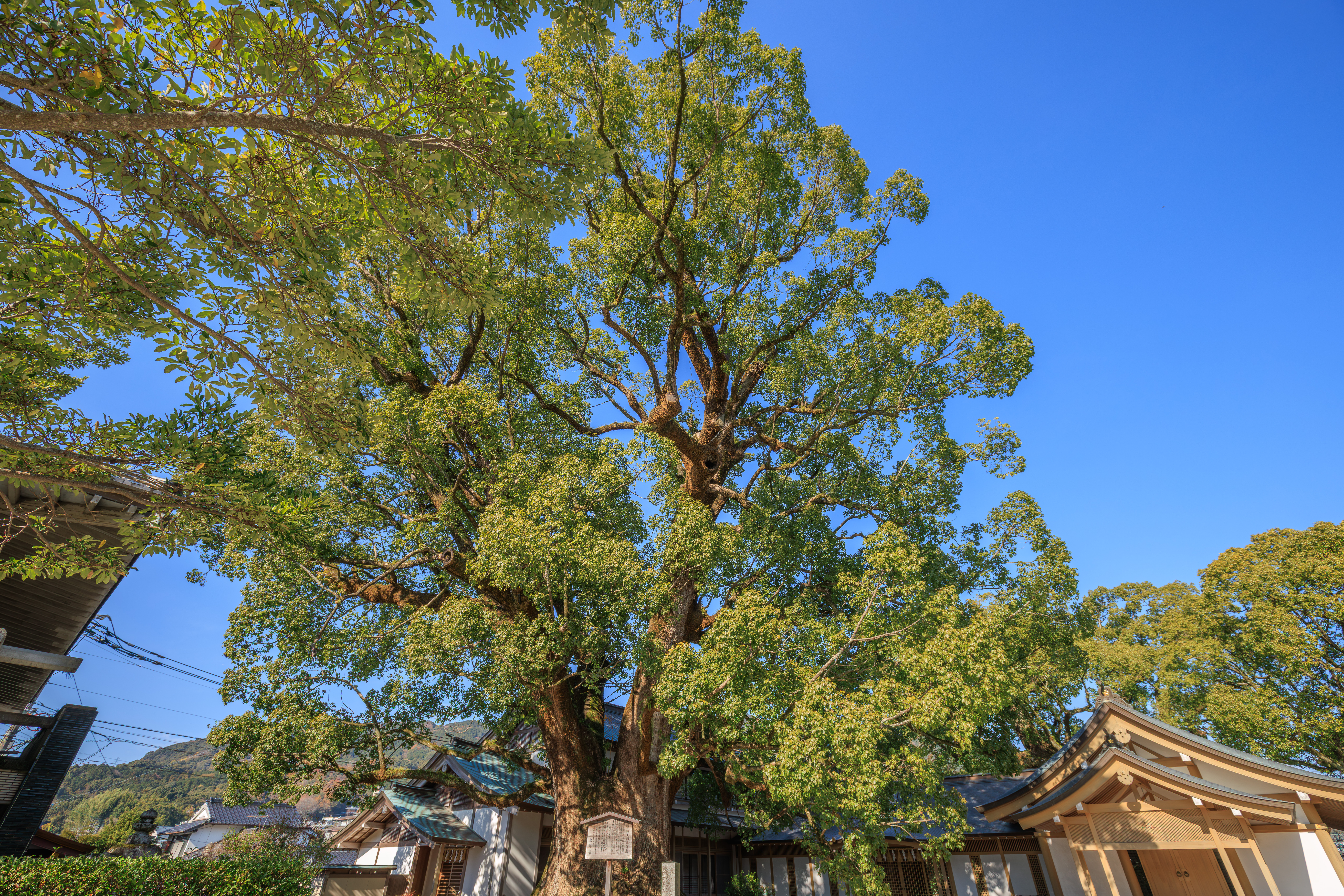
This tree is a camphor tree that has been designated as a natural monument since 1923.
The Great Camphor Tree (Kaki) — Natural Monument

Designated as a Natural Monument. (Designation established in the 12th Year of the Taisho Era [1923].) This tree stands as a quintessential example of a colossal camphor; its age is estimated to be anywhere from one thousand to fifteen hundred years.

Possessing immense historical and ecological value, it requires strict preservation and protection.

**Notice**

*   Do not use open flames in the vicinity.
*   Do not damage the roots, trunk, or branches.
*   Do not trample the soil around the roots.

Please strictly observe the above precautions.

March, 13th Year of the Taisho Era (1924)

"Any person who violates these regulations shall be punished in accordance with national law."

Ministry of Education
– Text from the sign on the tree’s trunk, translated using Google.
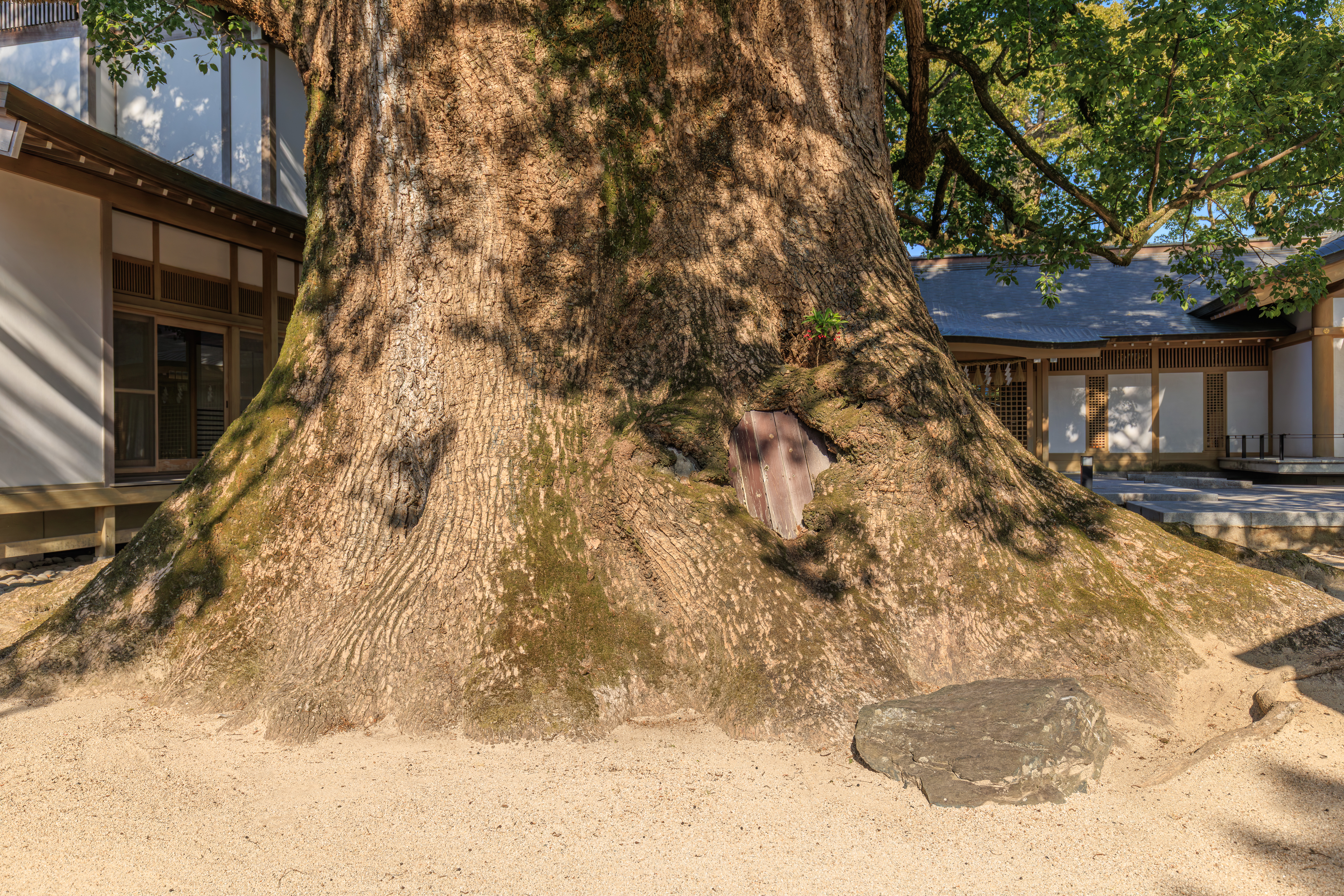
A hole in the trunk near its base was nicely boarded up! The little clump of leaves with berries growing right above it makes it seem like this could be a nice home for a hobbit!
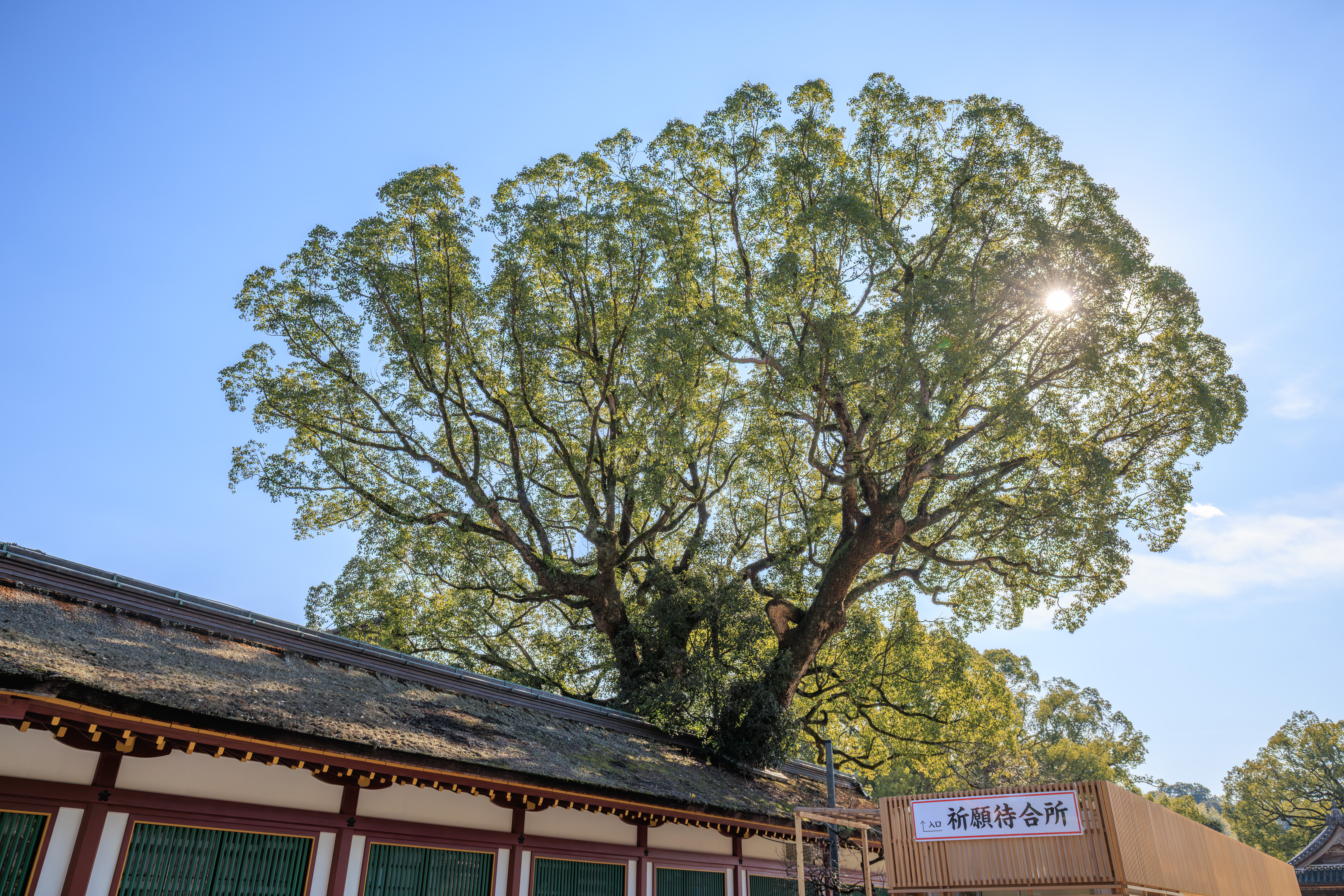
The structure here on the left has a hole for this tree’s right trunk!
We wanted to walk through the area behind the honden on the way to a path that leads through a mountainous, or perhaps just hilly, section of the shrine. However, it was inaccessible due to construction. We ended up detouring around the construction to the west. Although, it seems there was probably a path that we missed.
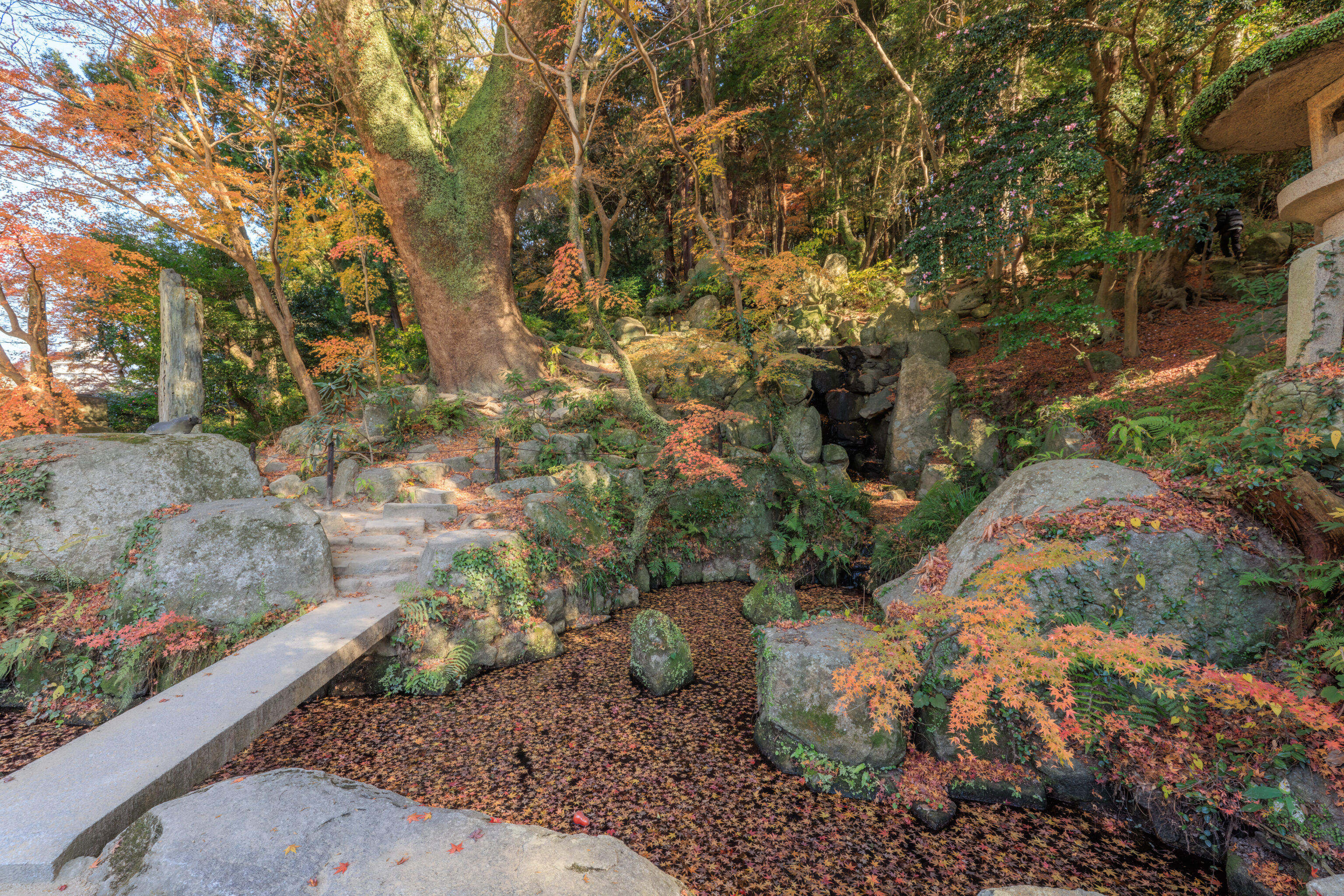
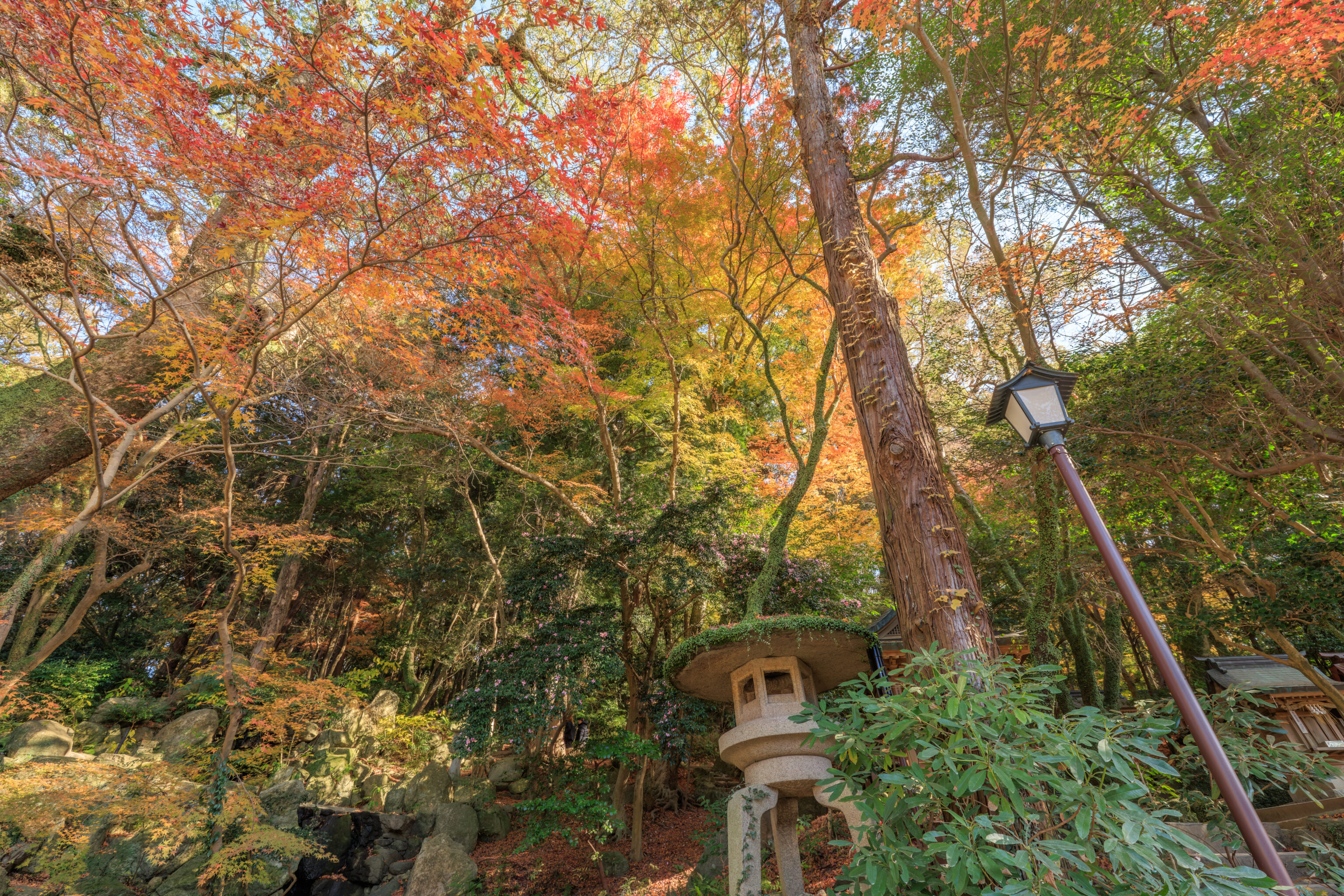
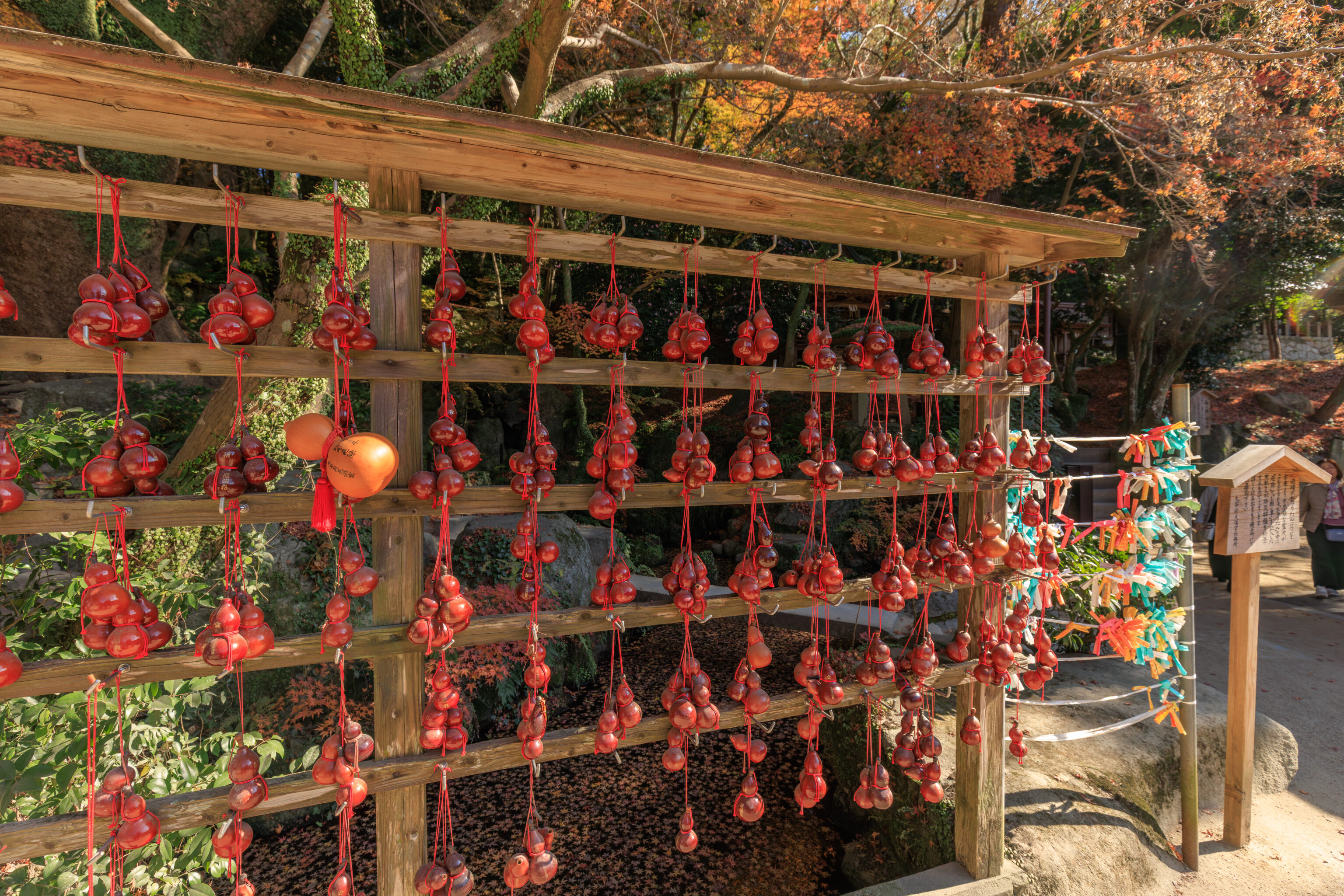
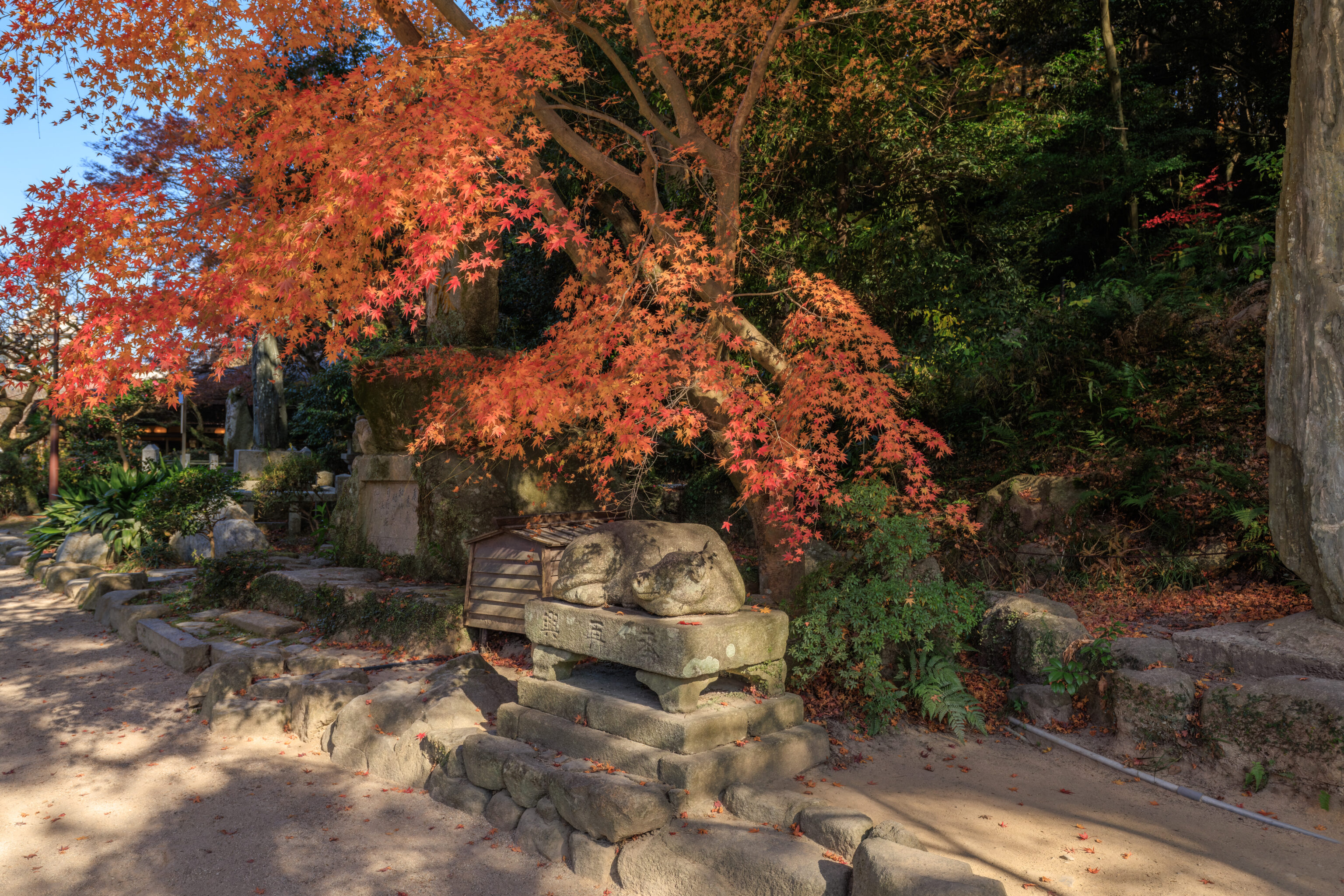
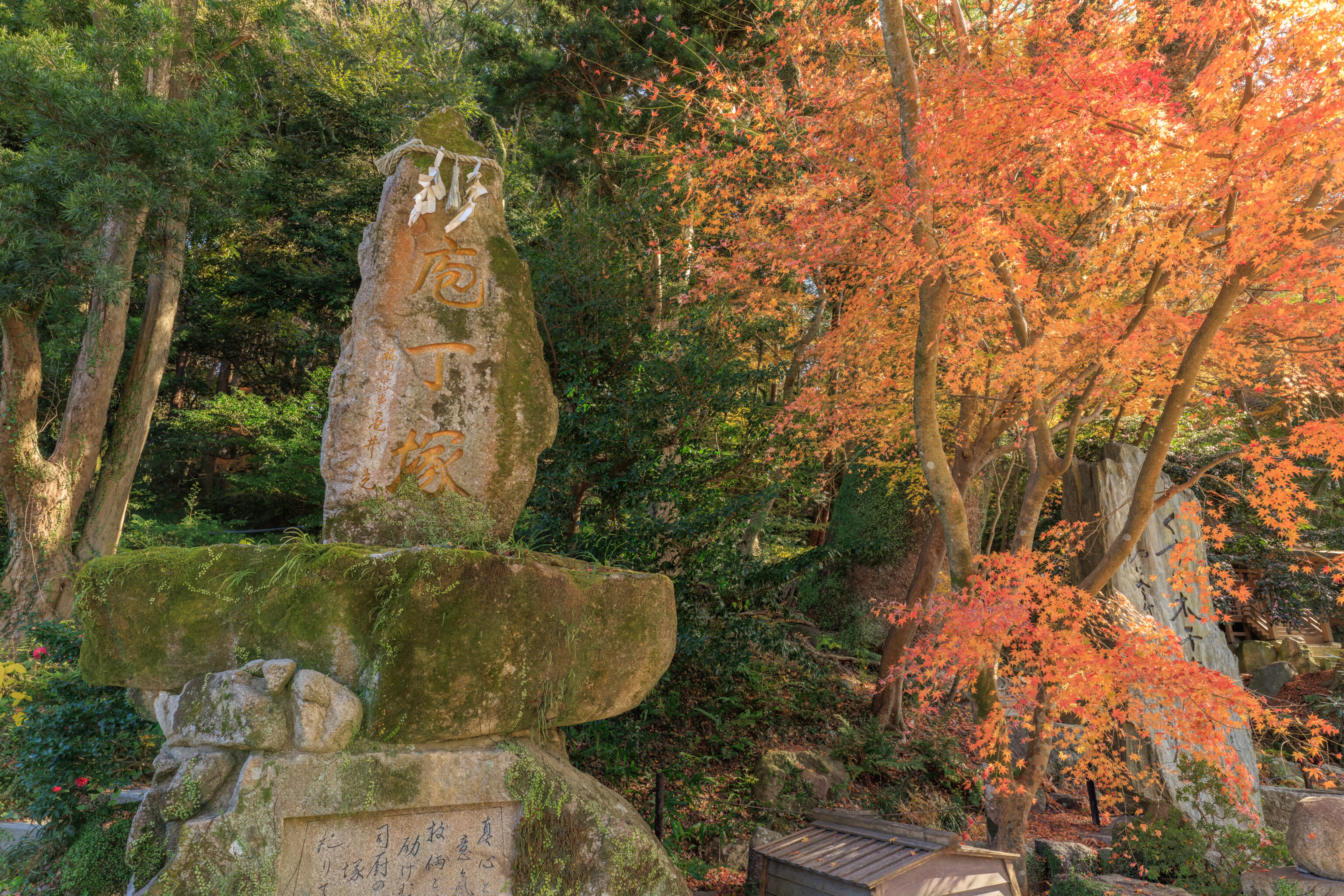
This area to the north was at the edge of the hill on the east side of the shrine. There were some nice fall colors in this area!
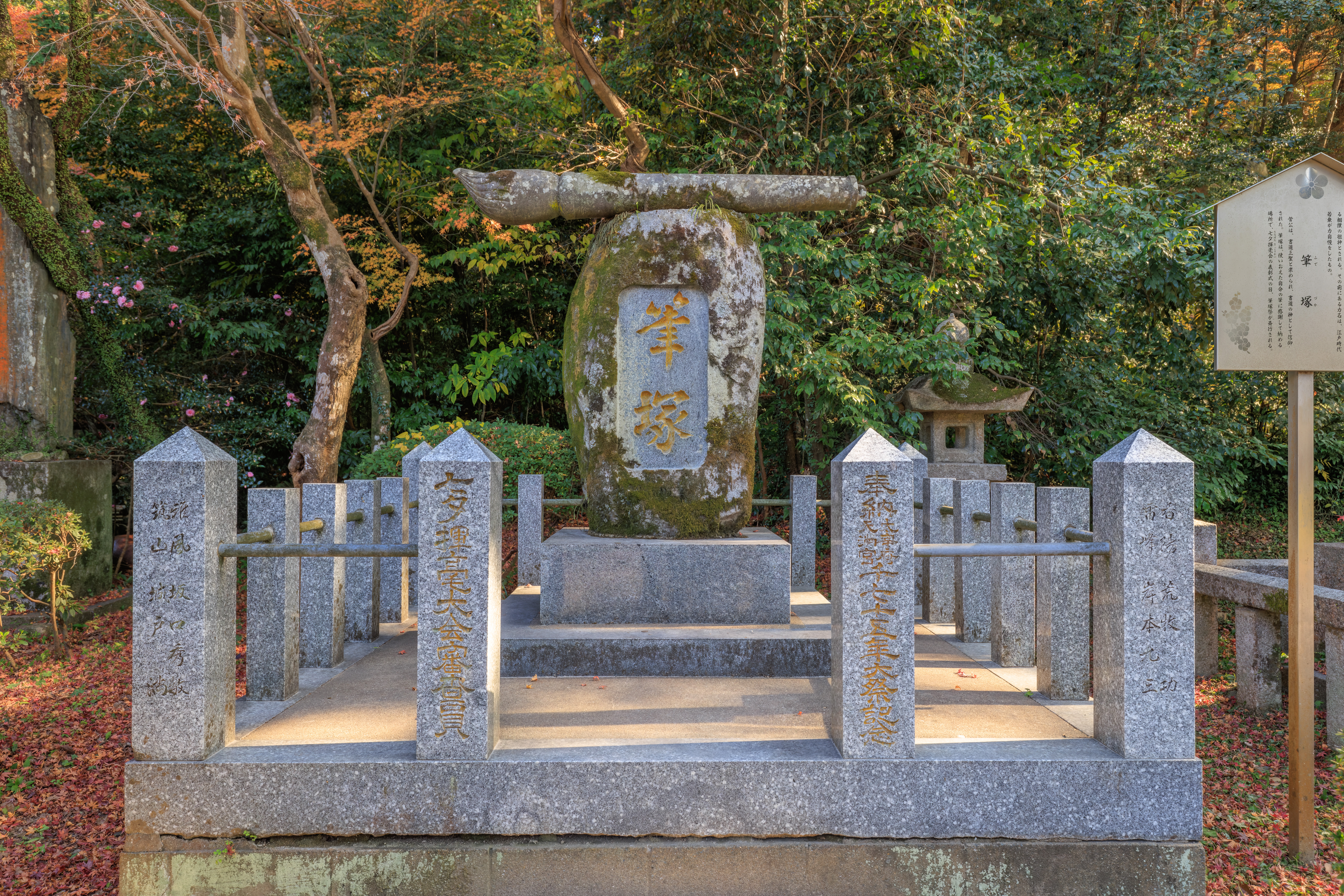
This is the 筆塚 Fudedzuka and is dedicated to Sugawara no Michizane, the deity of calligraphy.
The Fudezuka (Brush Mound)
Lord Sugawara is celebrated as one of the "Three Stars of Calligraphy" and is worshipped as the patron deity of the art. The *Fudezuka* serves as a repository where calligraphers respectfully dedicate their used brushes in gratitude for their service; a special dedication ceremony is held here on the day of the awards presentation for the Tanabata Calligraphy Contest.
– Text from the sign on the right, translated using Google.
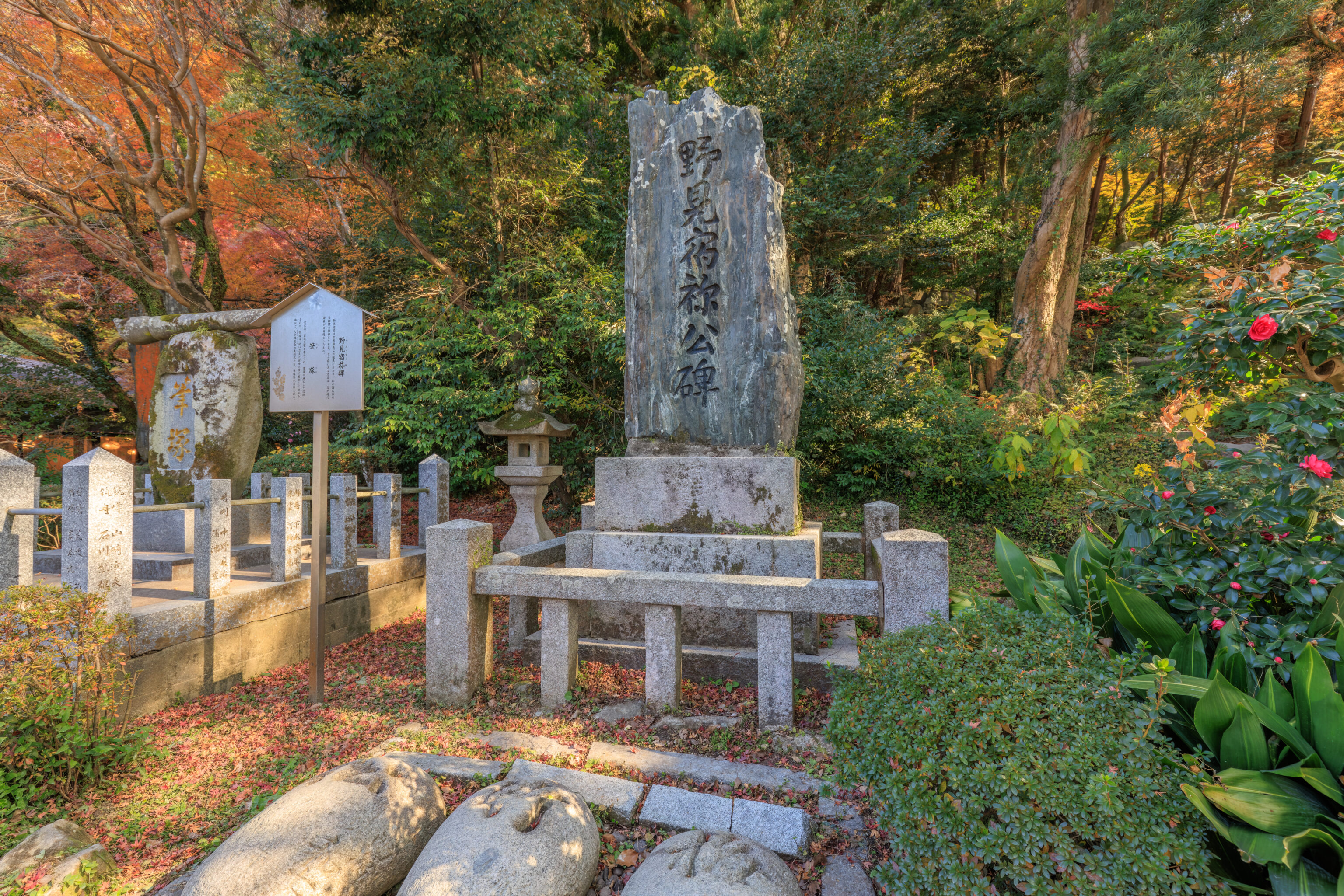
The stone at the center of the frame marks the 野見宿祢碑 Nomi no Sukune Monument, dedicated to the deity of sumo.
The Nomi no Sukune Monument
Nomi no Sukune was an ancestor of Lord Sugawara no Michizane and is revered as the founding deity of sumo wrestling in Japan. The "Strength Stone" situated in front of the monument was used during the Edo period by young men to demonstrate their physical prowess.
– Text from the sign on the left, translated using Google.
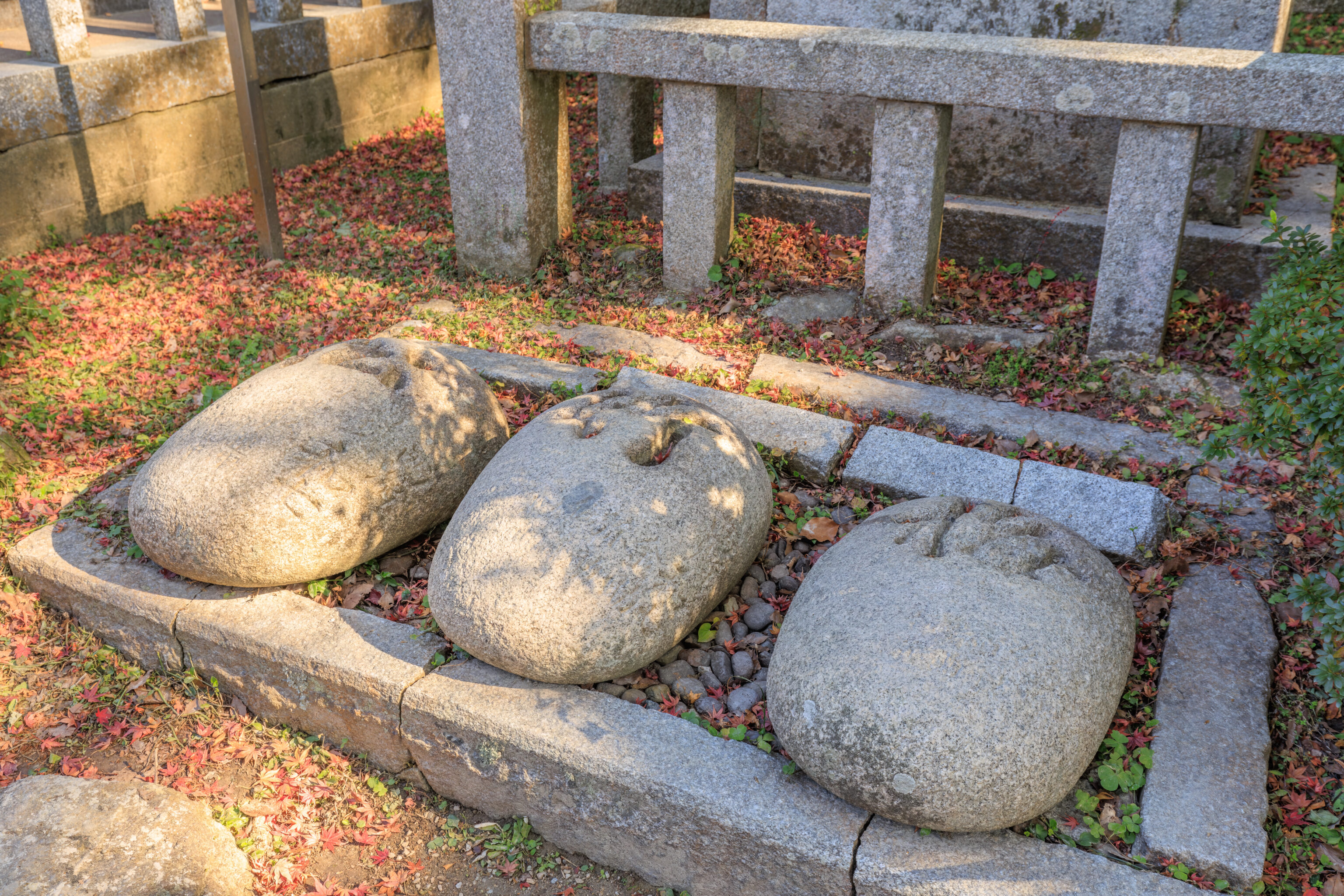
These three stones are 力石 chikaraishi, the strength stones mentioned on the sign. The test seems to be if you can lift them?
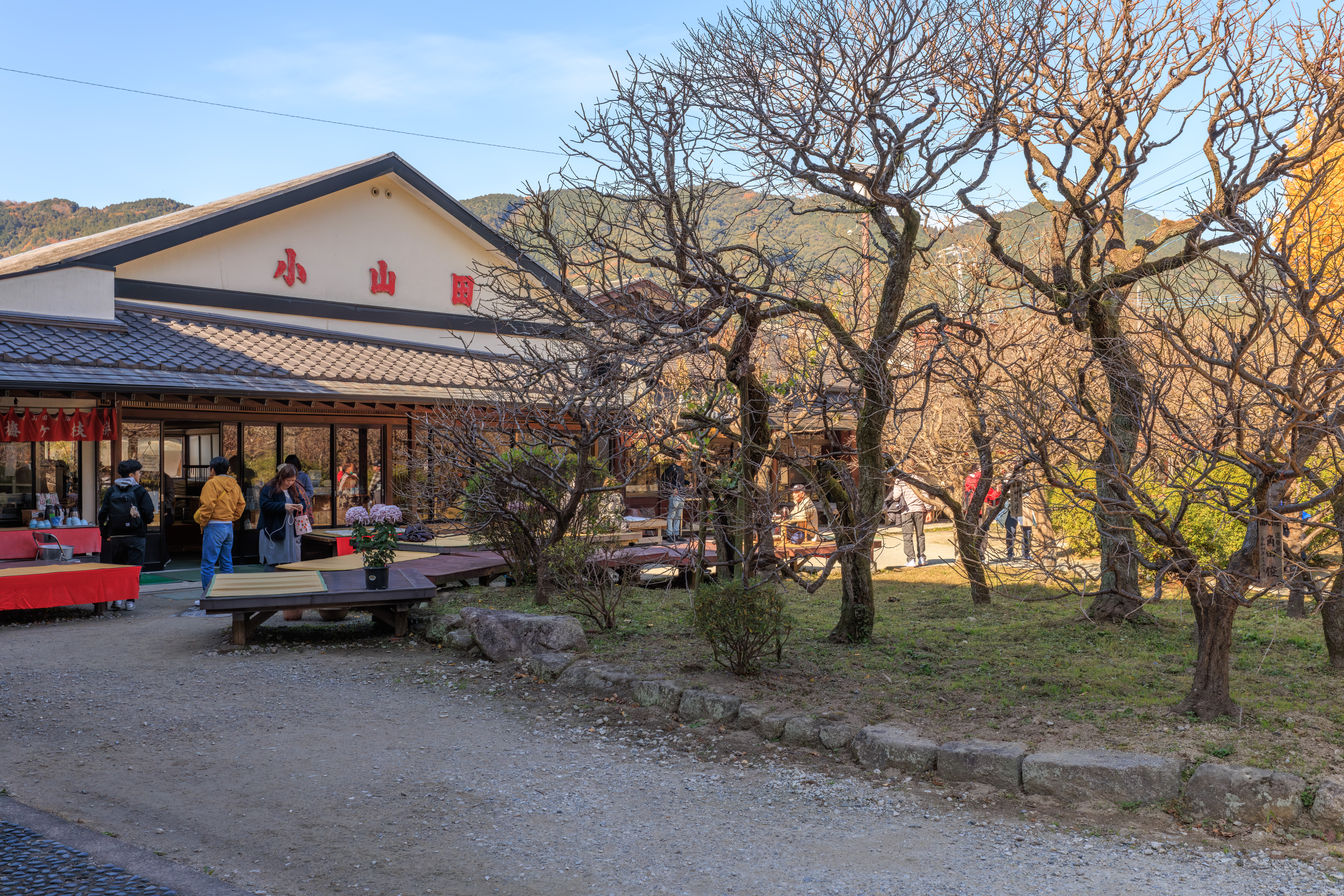
There were some 茶屋 chaya in this area. That might not be the most correct term but basically these are businesses where one can rest and have tea as well as a snack or a meal.
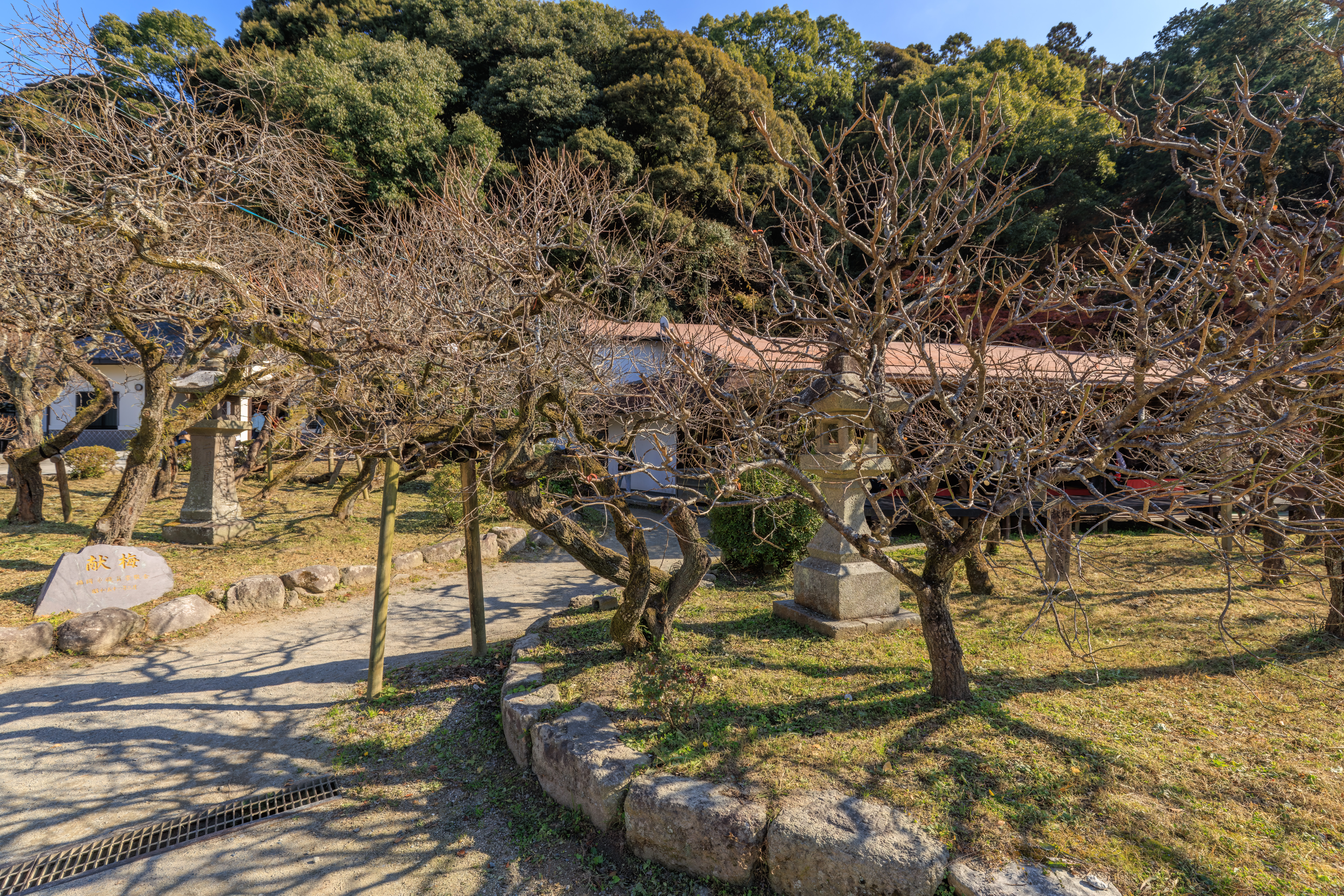
This should be nice once spring comes around…
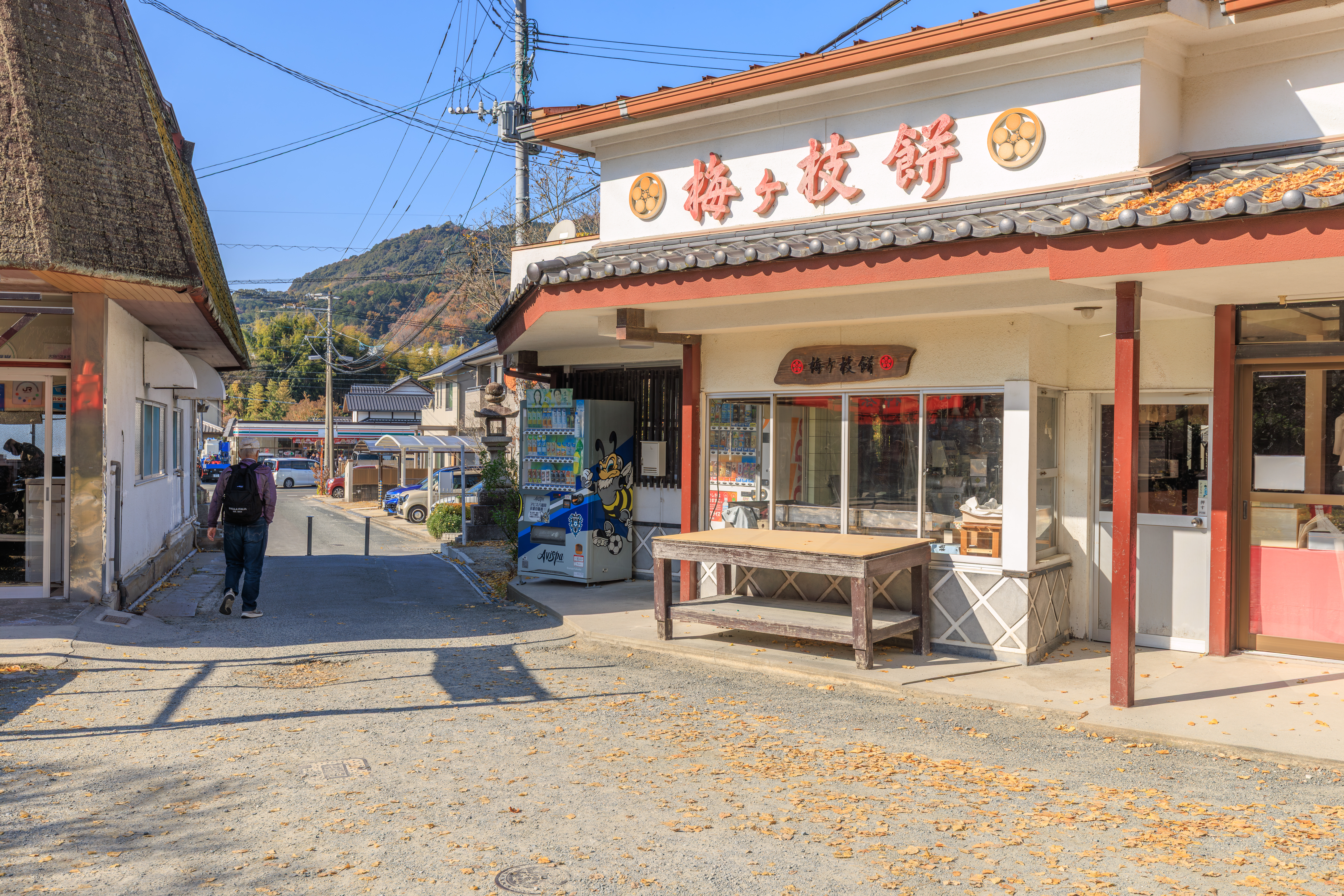
Why did we take this photograph? Is it the soccer bee on the vending machine?
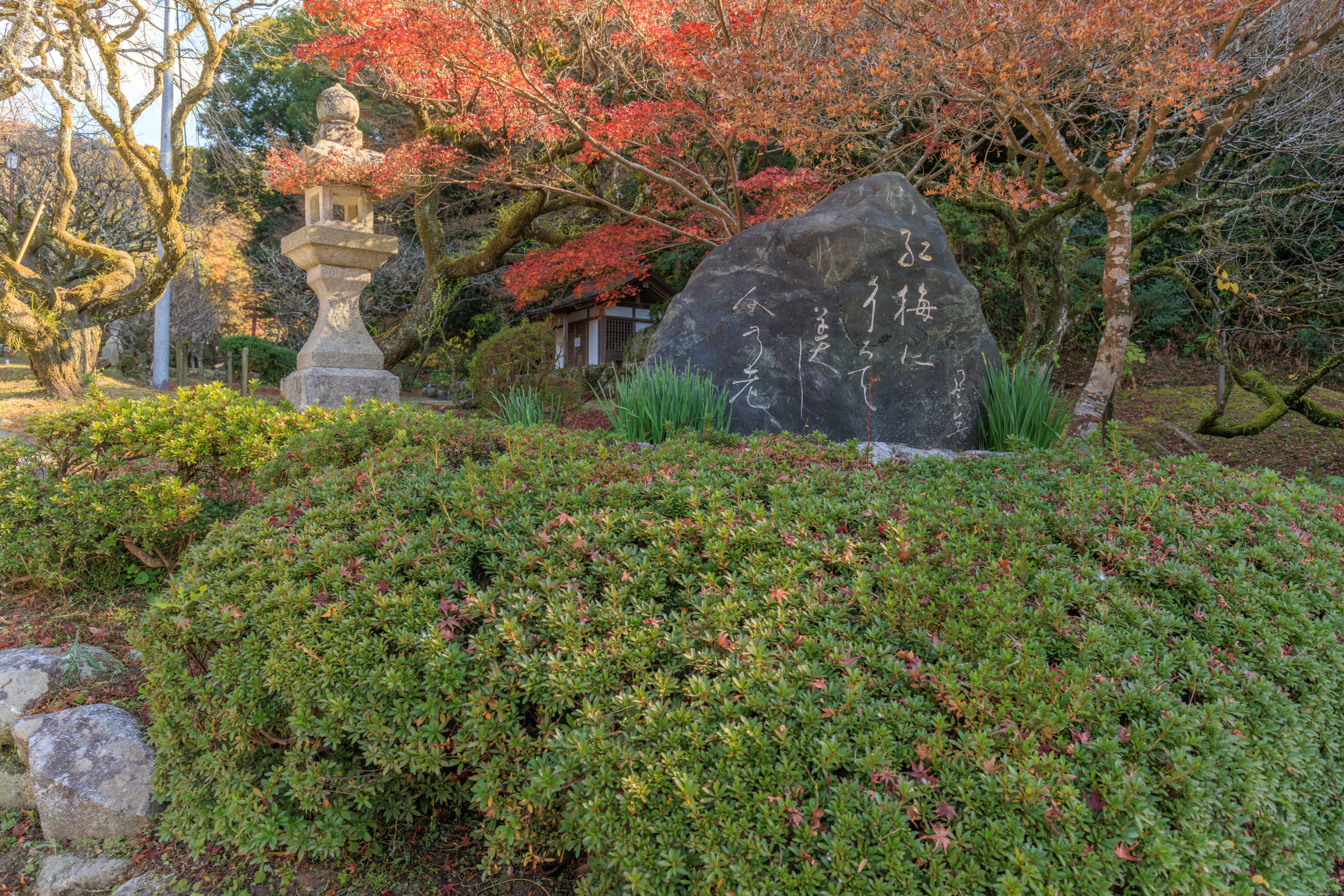
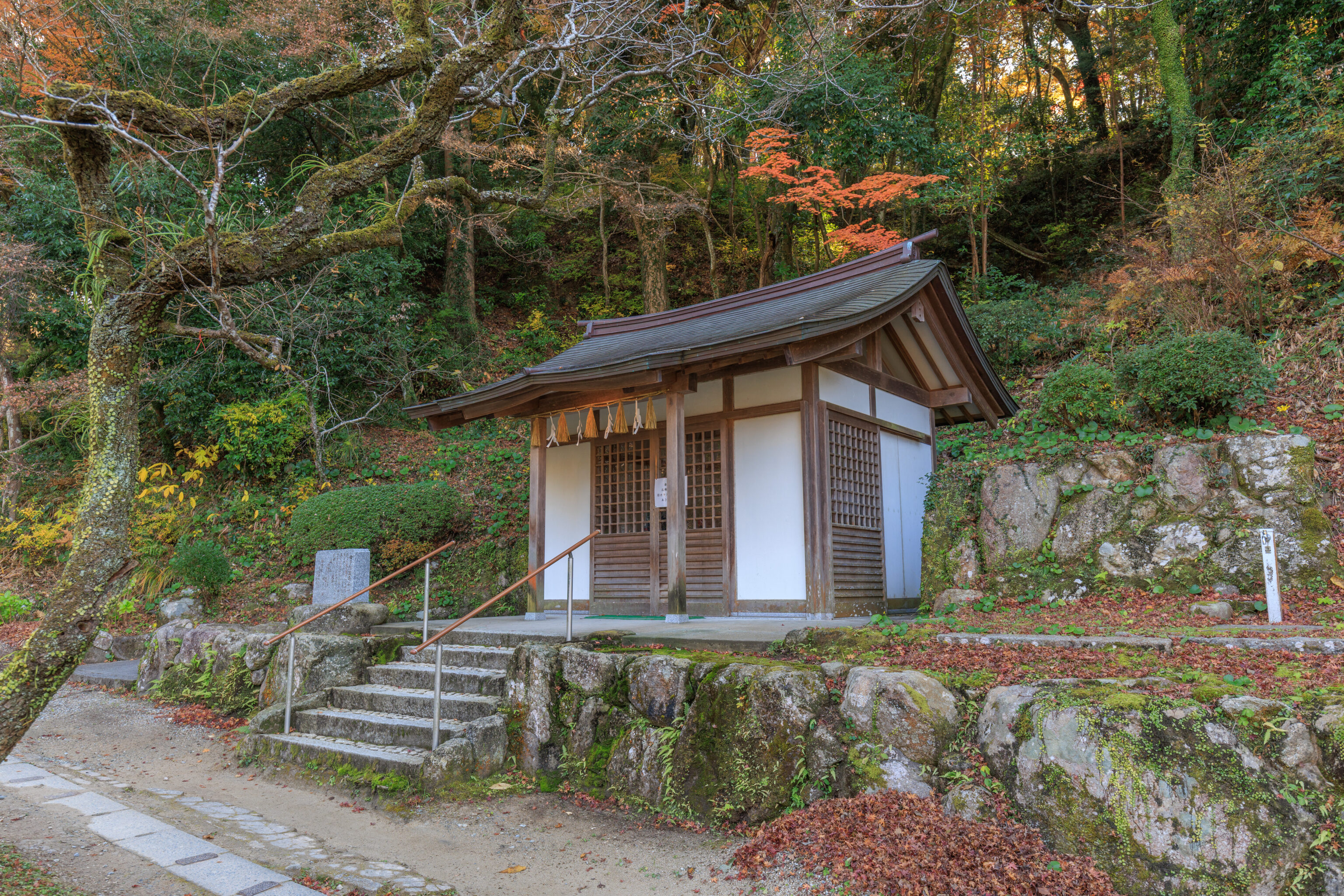
We started walking to the east along the path that leads up into the hills on the east side of the shrine grounds.
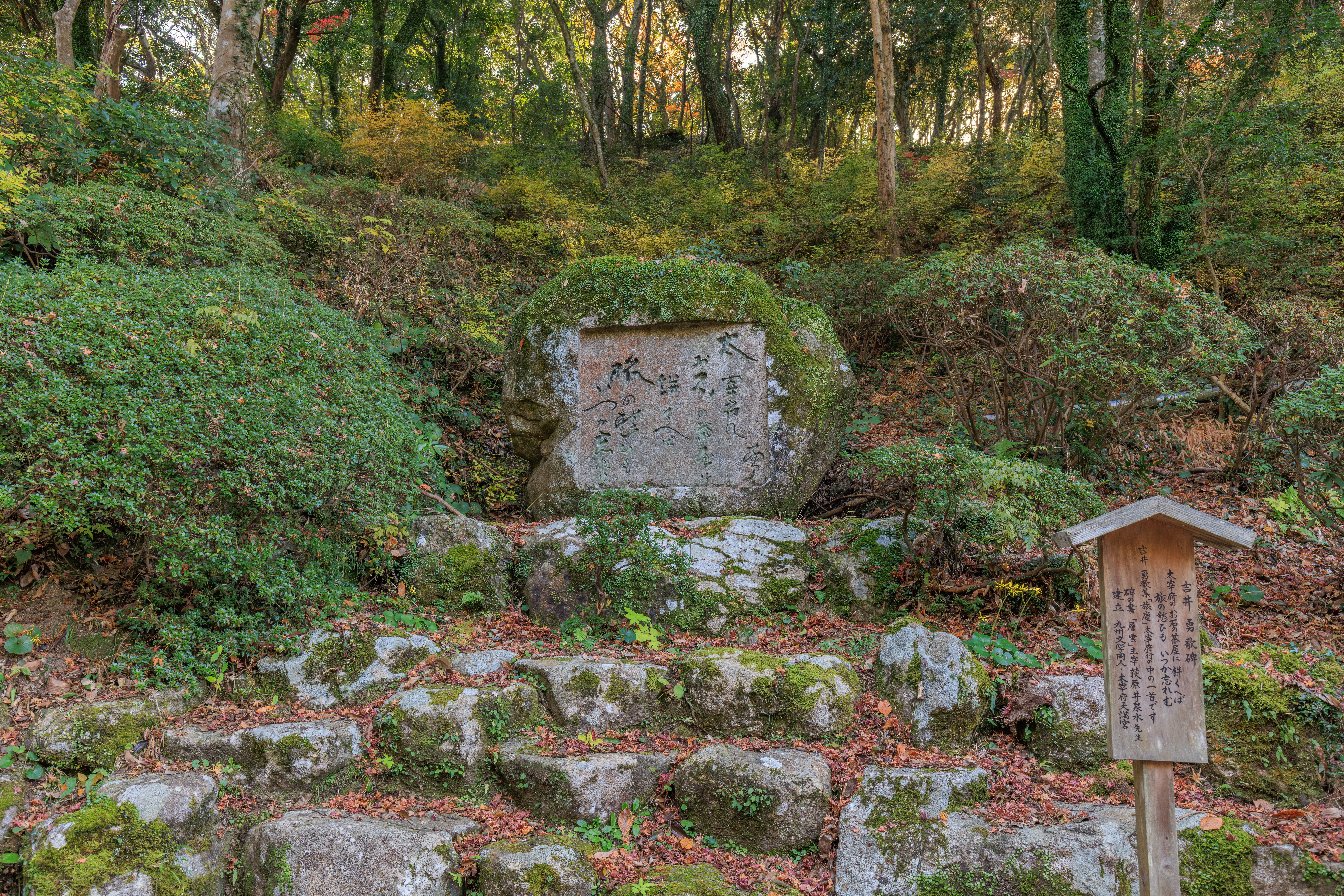
Monument to a Poem by Isamu Yoshii

At Oishi-no-Chaya in Dazaifu, as I partake of rice cakes, I feel that the melancholy of my journey, too, will someday fade away.

This verse is one of the poems featured in *Dazaifu-yuki* (Journey to Dazaifu), a section within Isamu Yoshii’s poetry collection, *Tabi-yoshi*.

Calligraphy on the Monument: Mr. Seisensui Ogiwara, Founder of the *Sōun* School

Erected by: The *Kyushu Bungaku* Literary Circle and Dazaifu Tenmangu Shrine
– Text from the sign on the right, translated using Google.
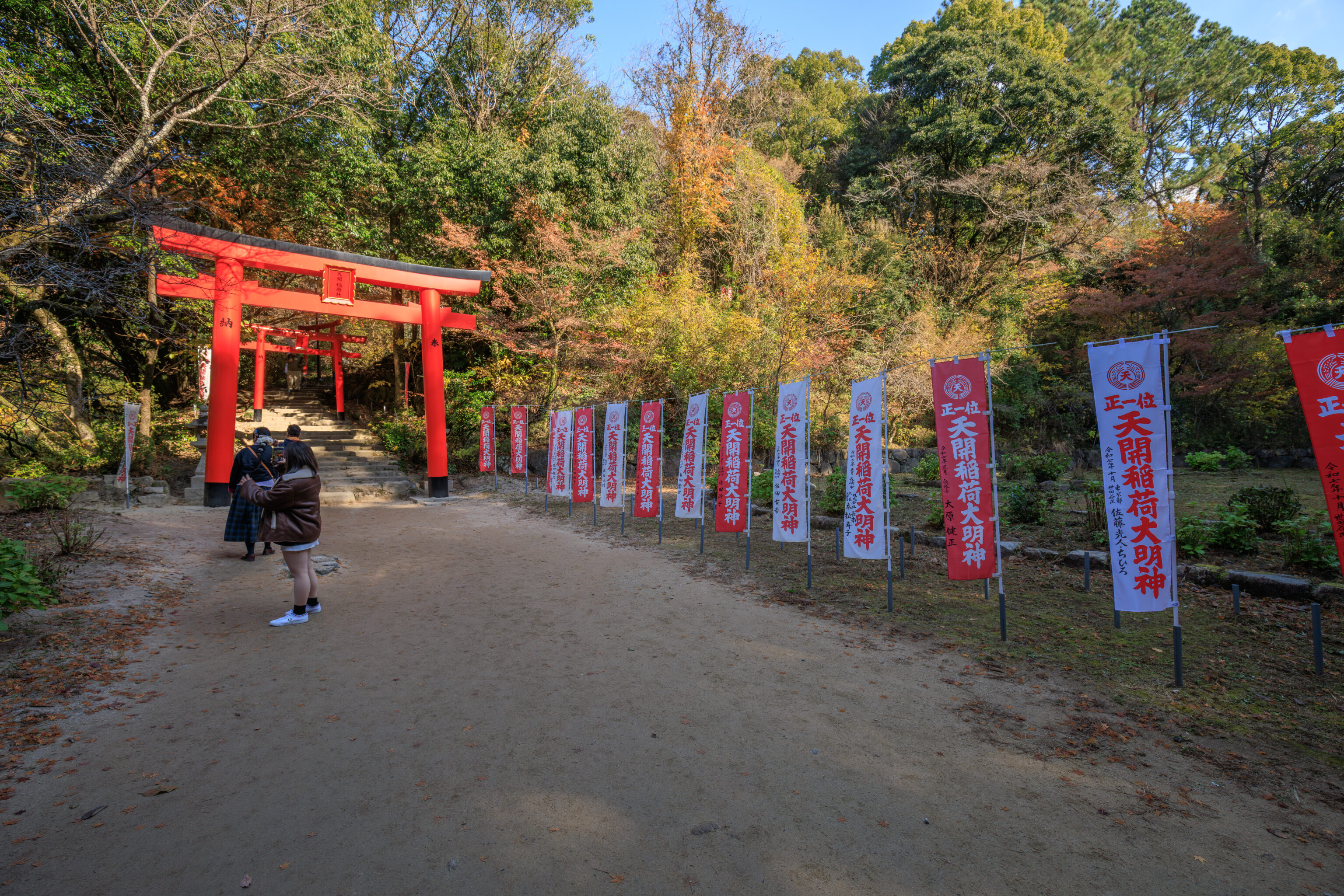
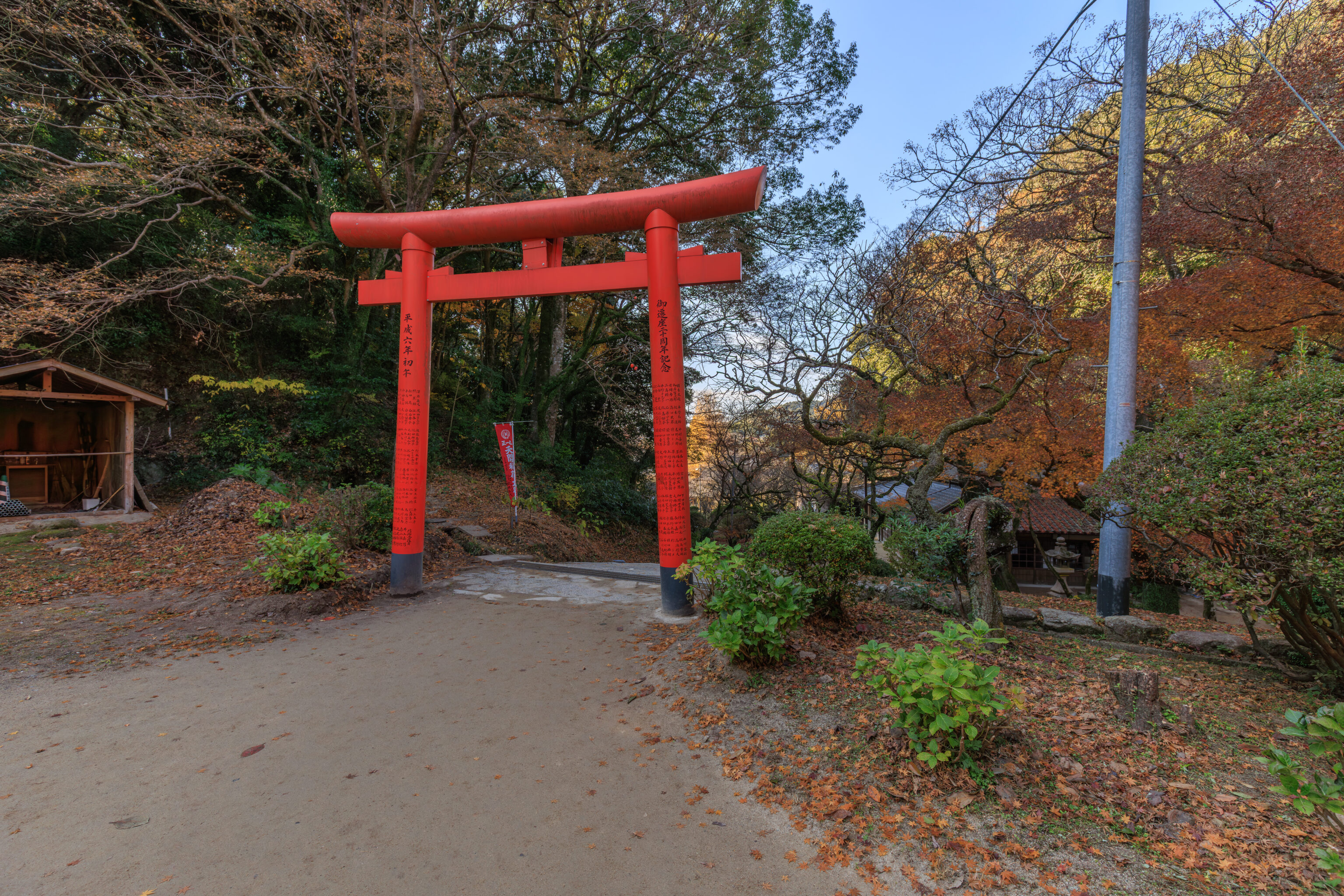
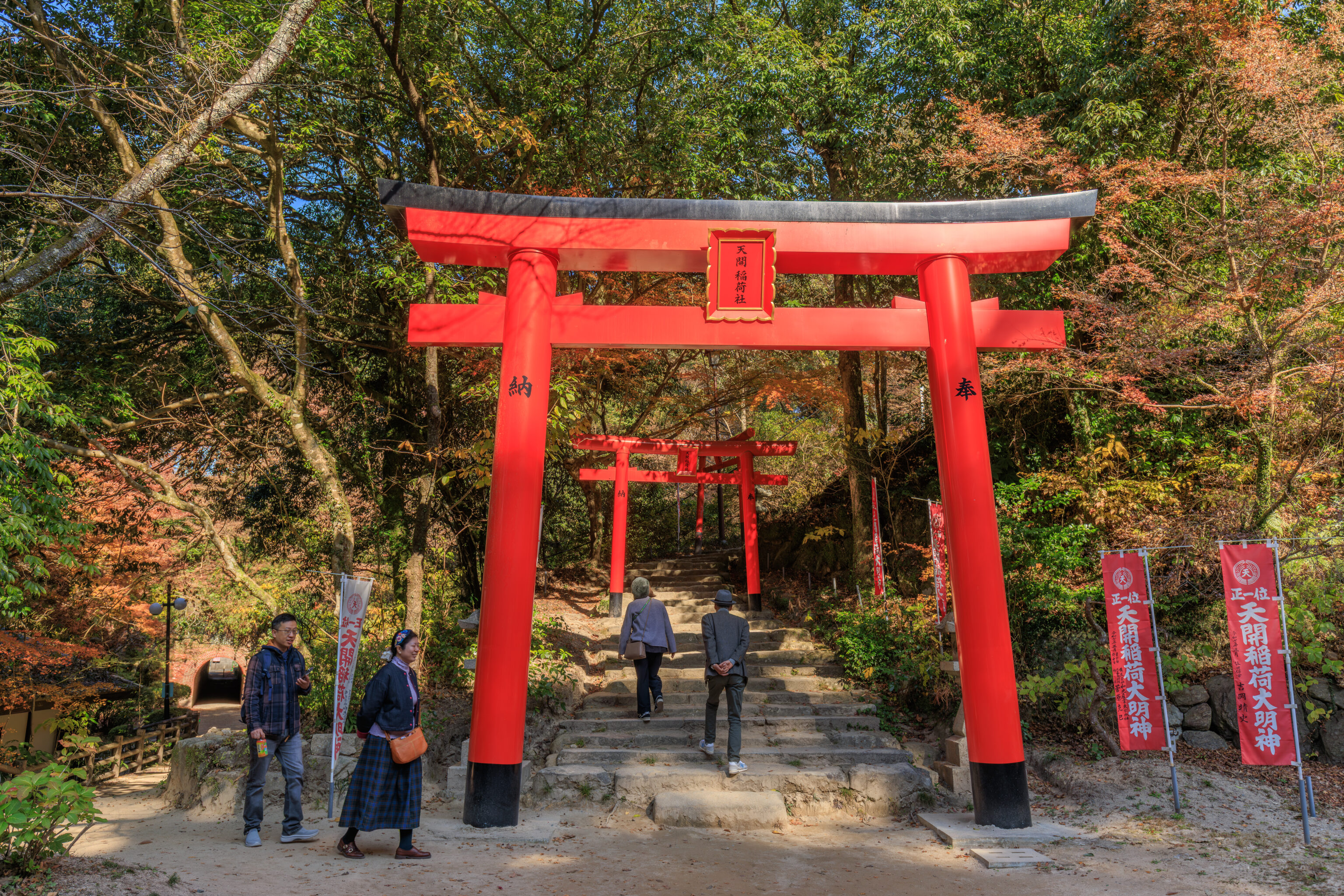
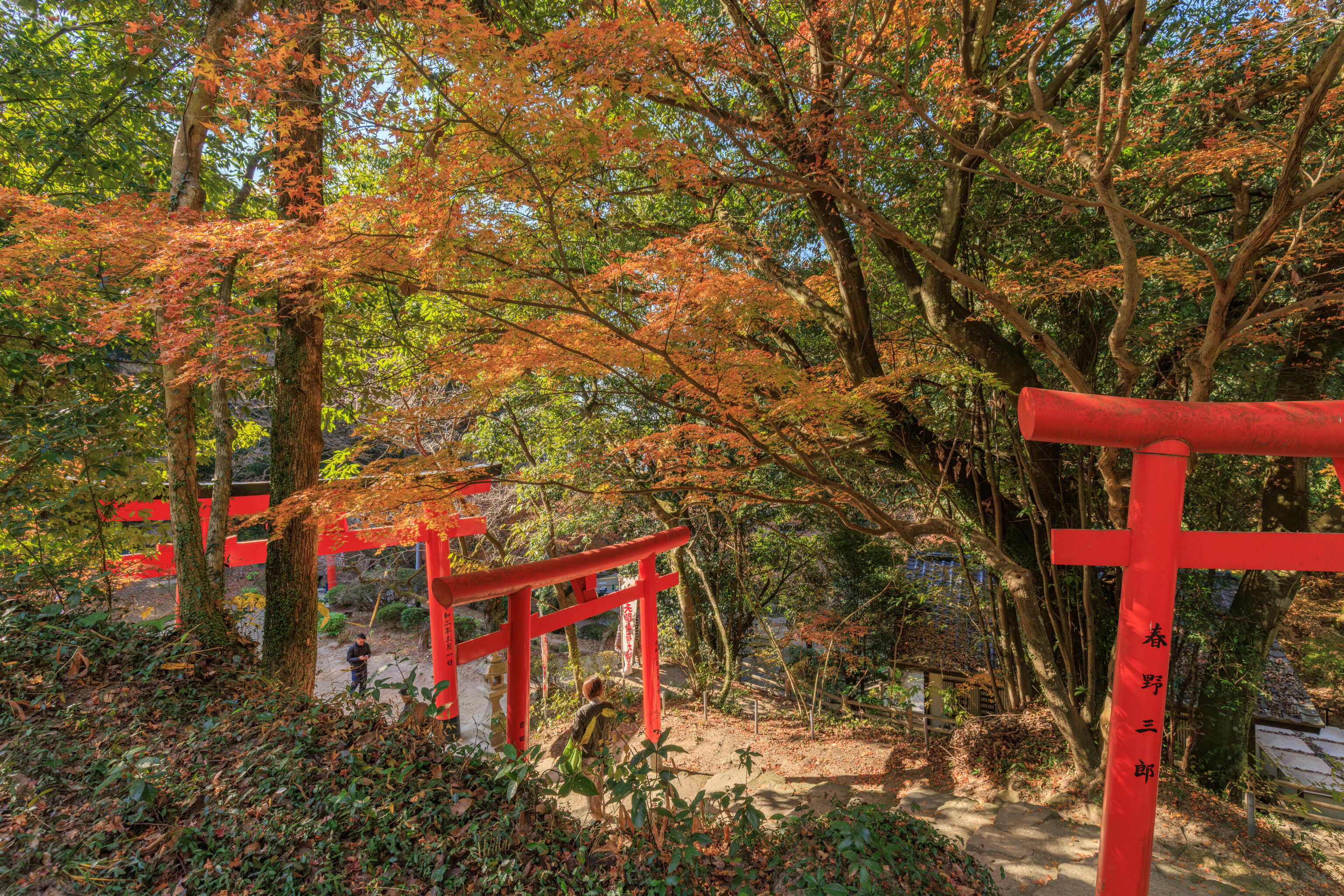
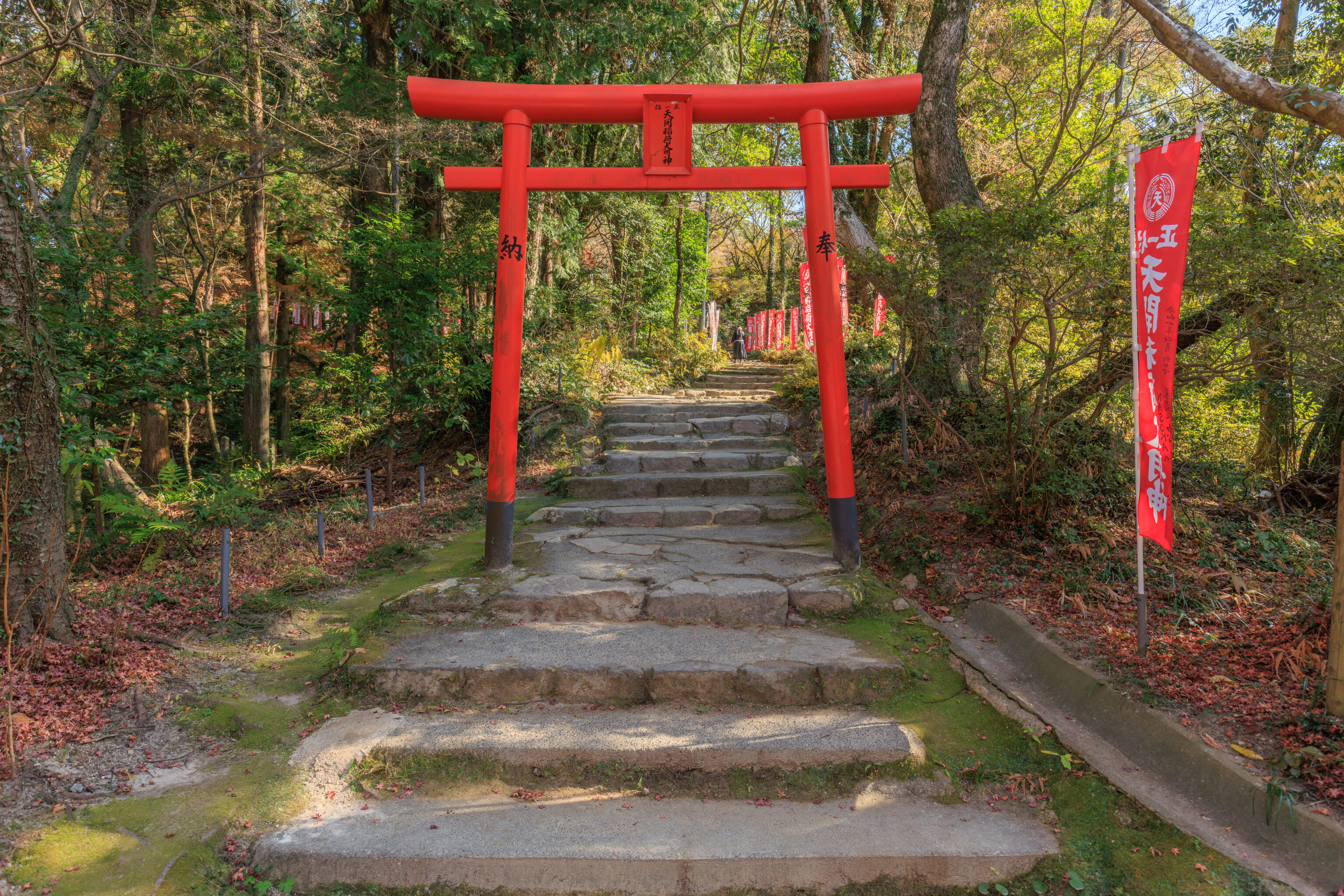
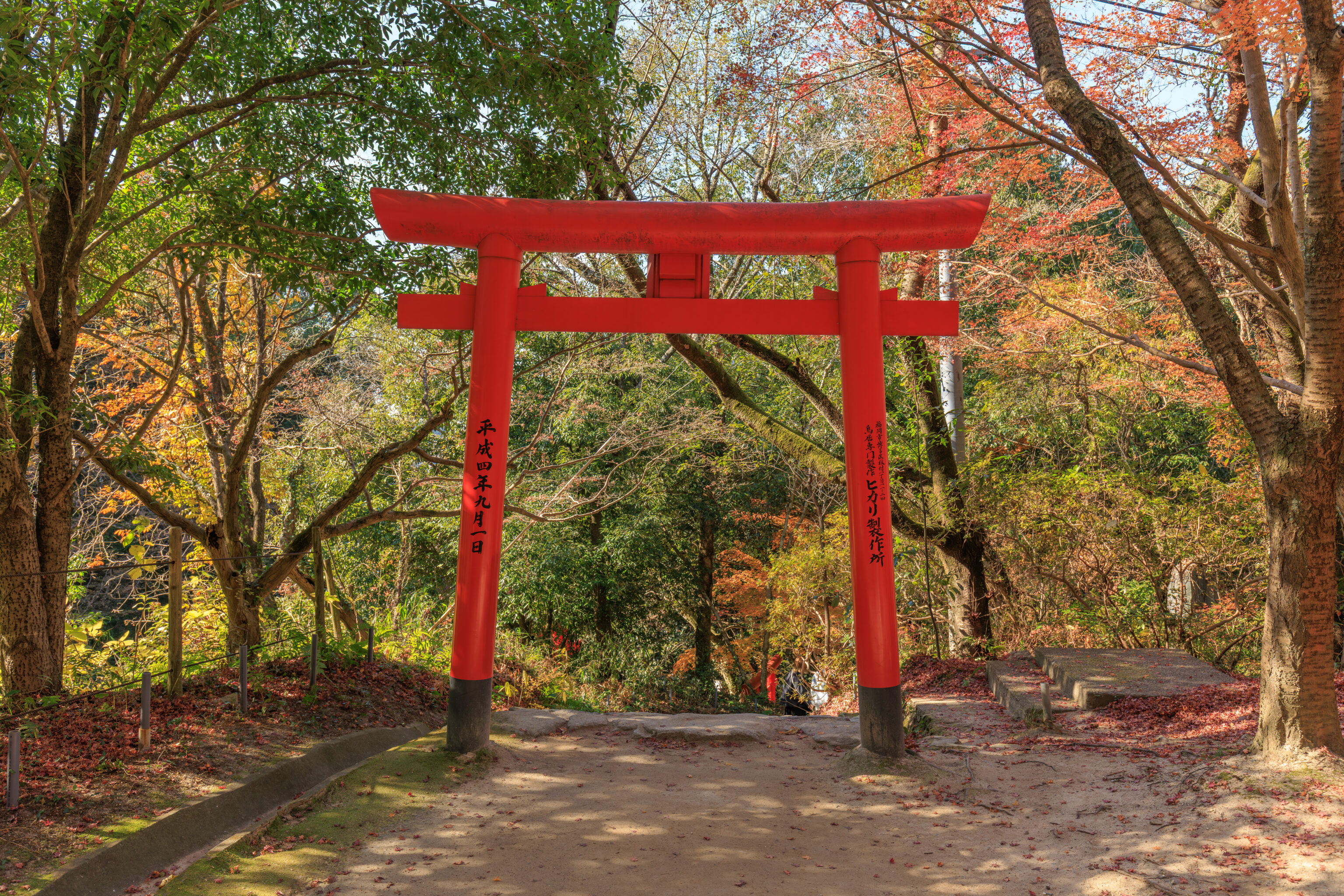
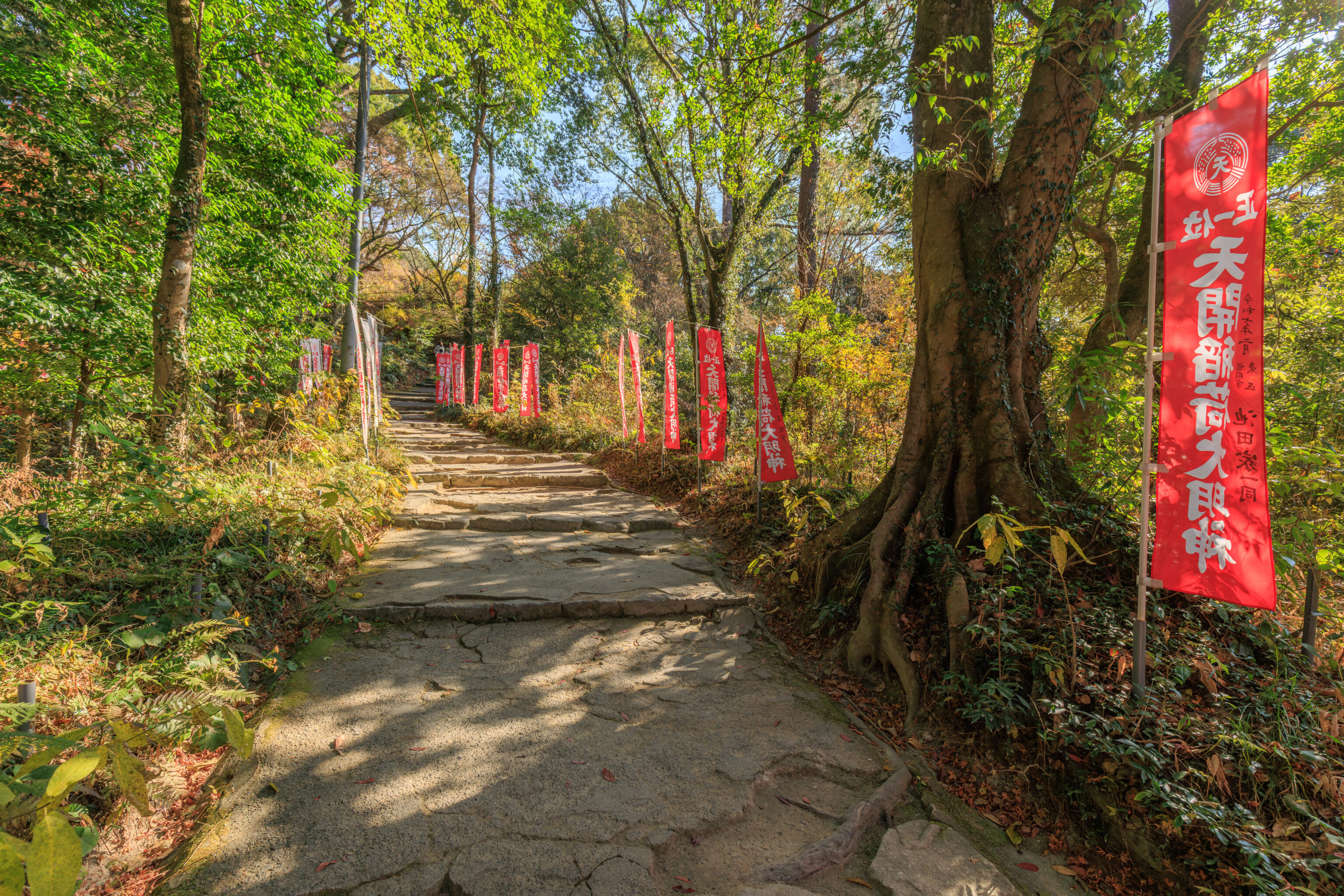
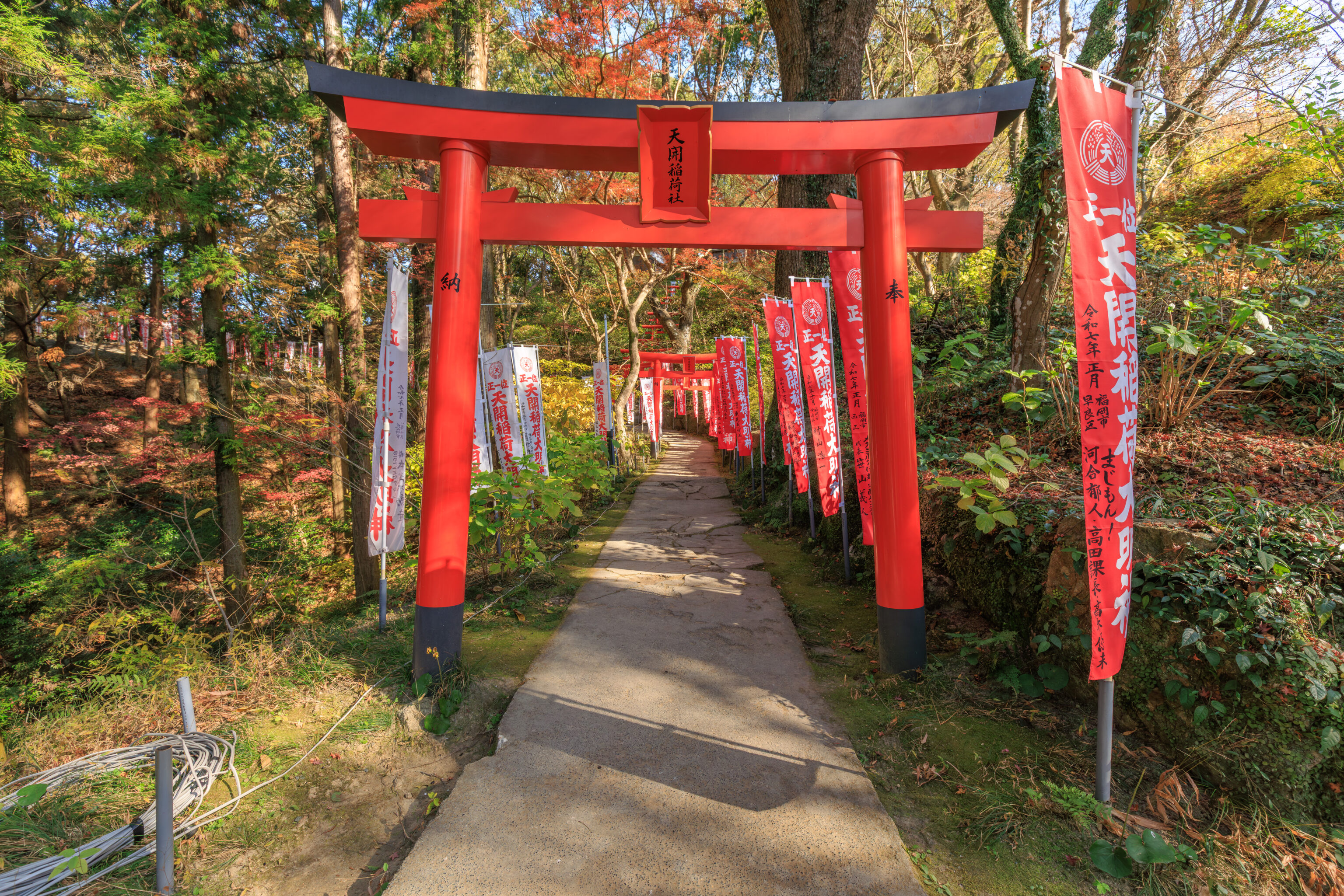
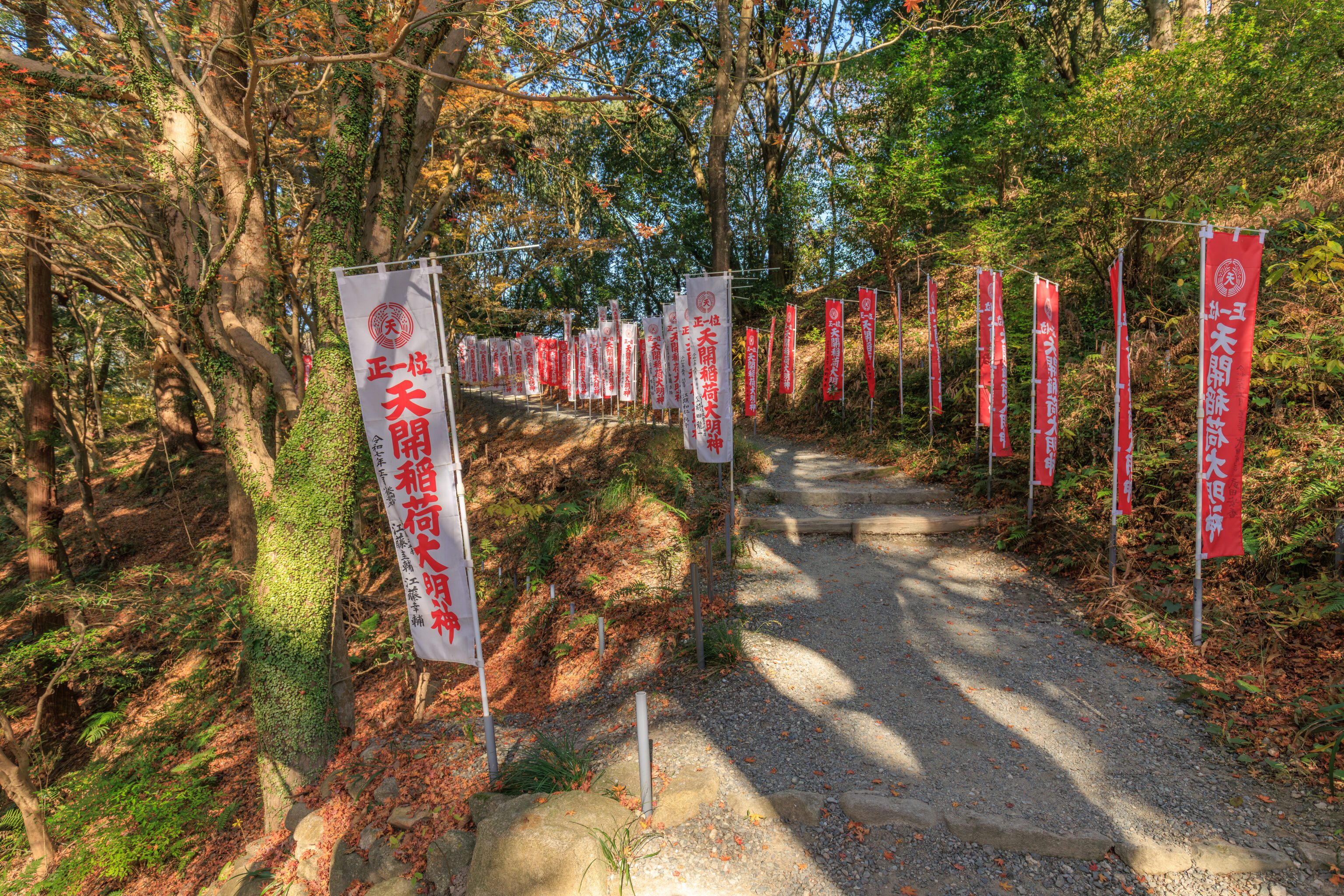
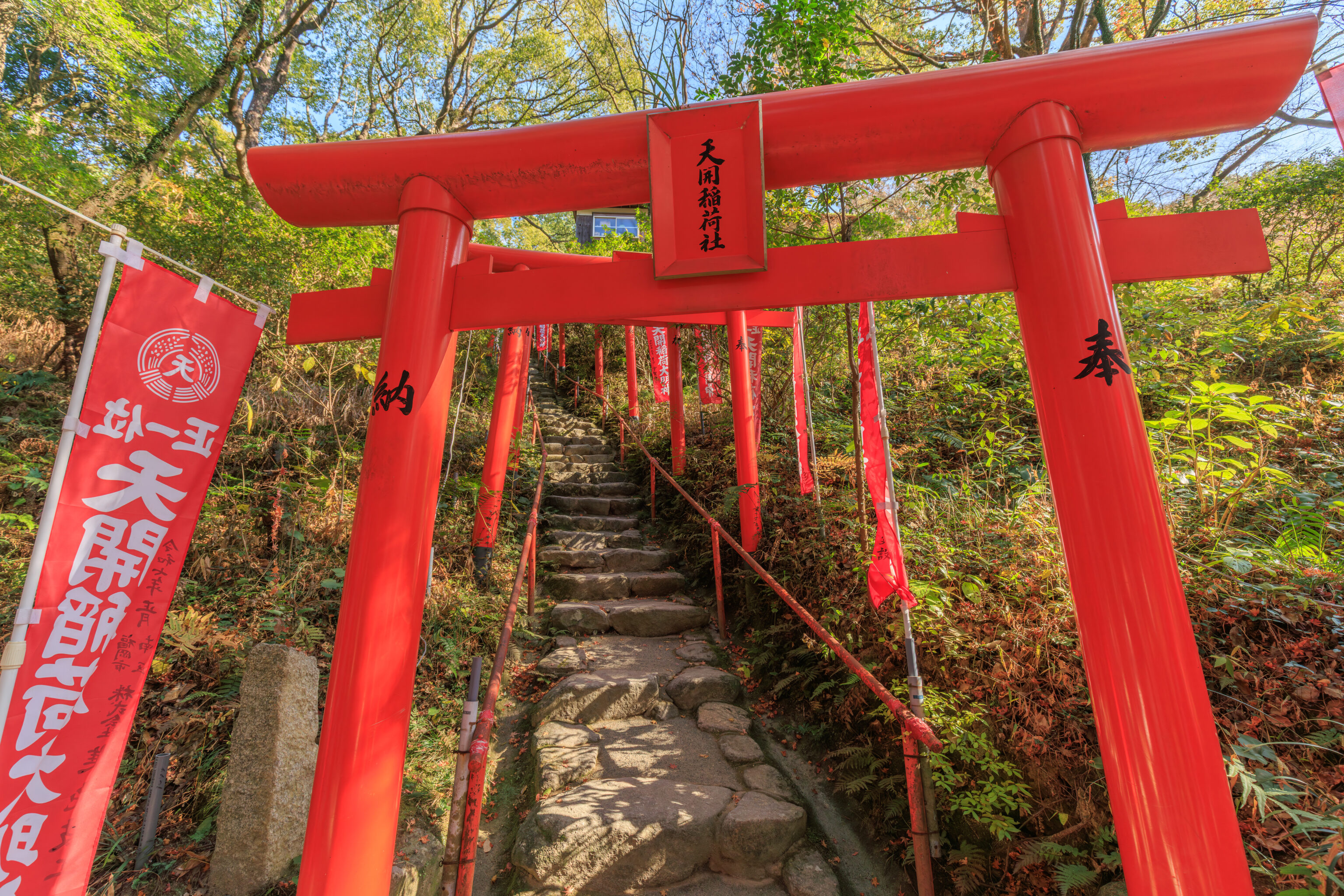
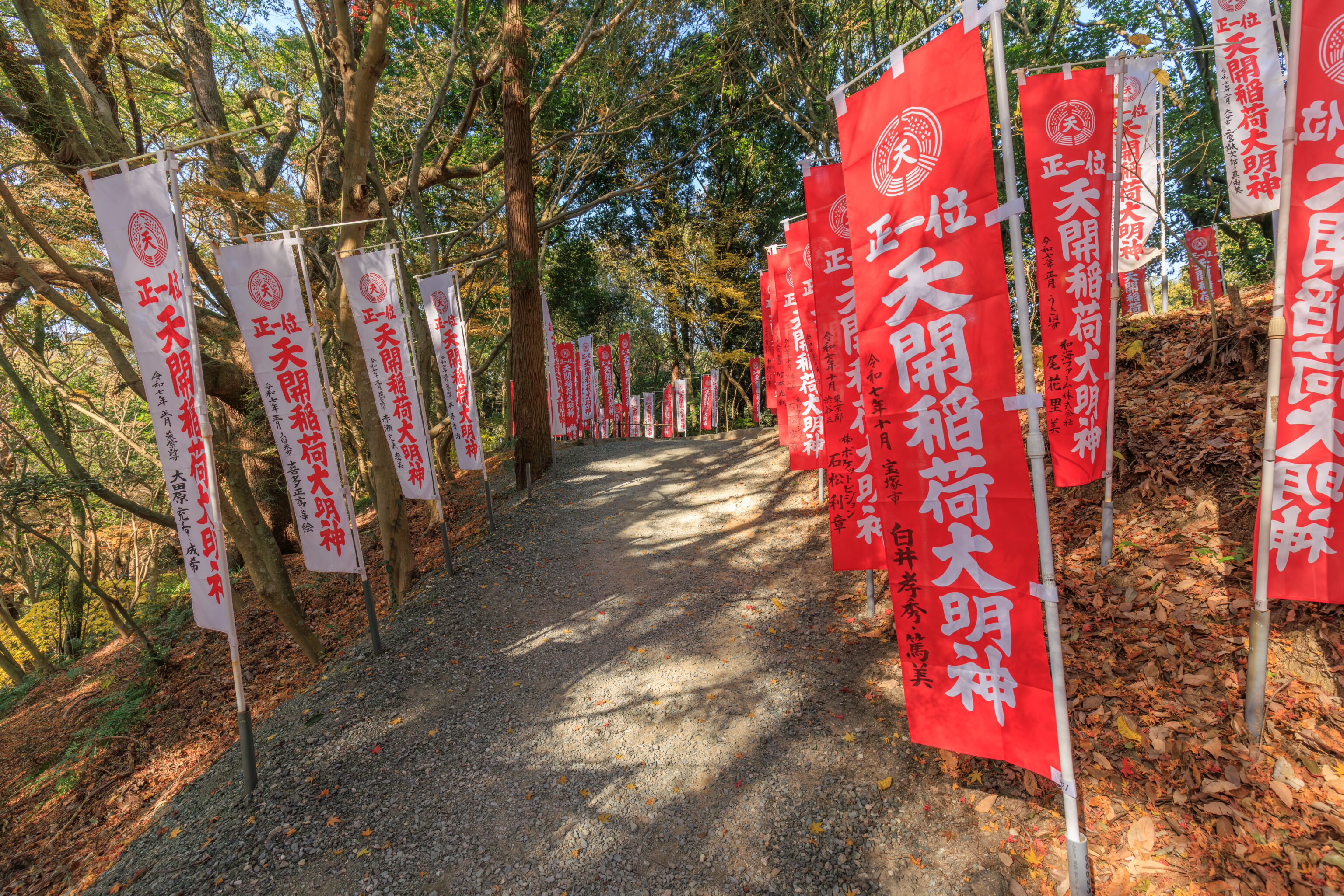
We passed through a series of toriis as we followed the path up the hill to the east.
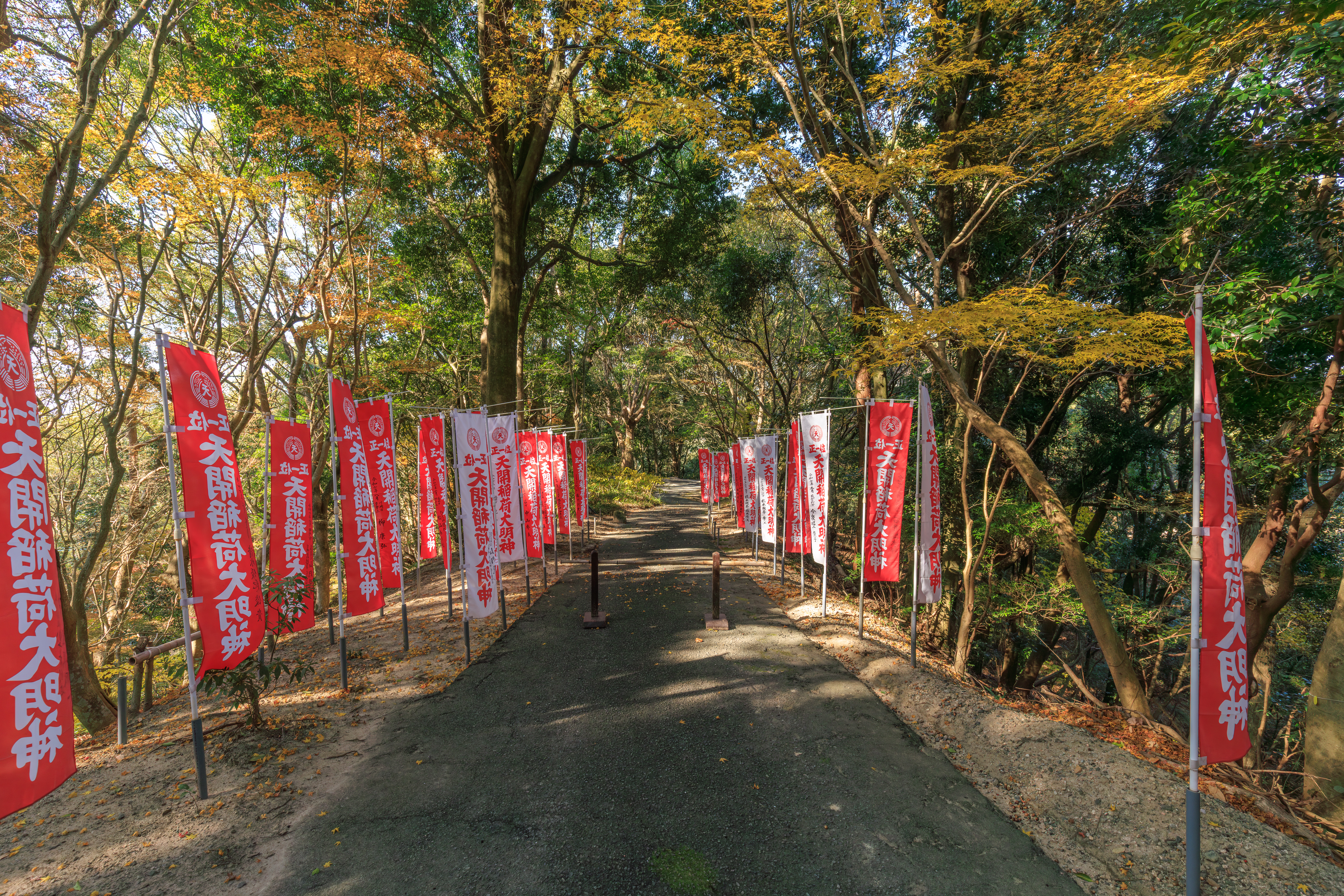
This is not the way.
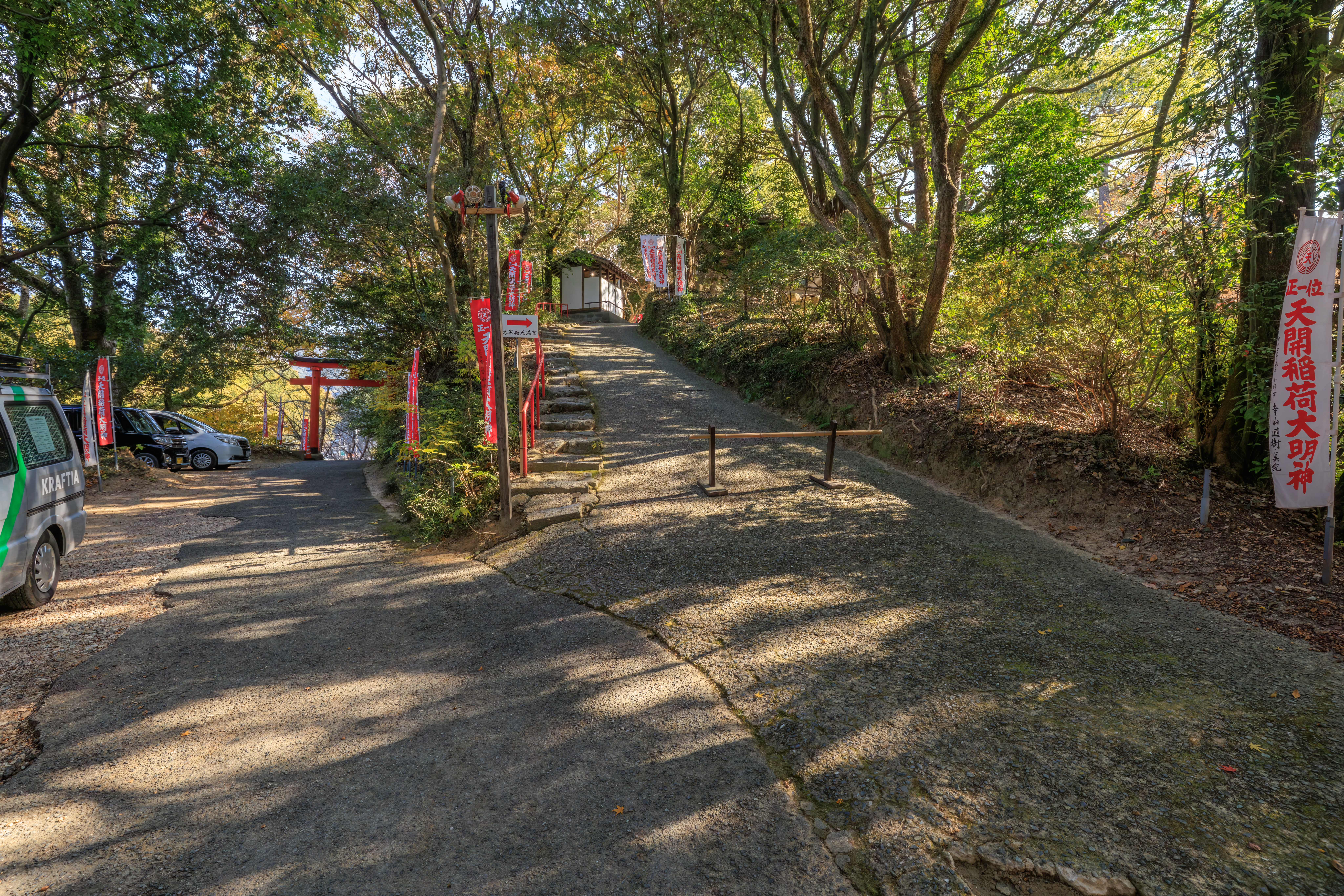
This may be the way? This barrier seems to be to prevent cars from driving up this slope. Maybe. We’ll see.
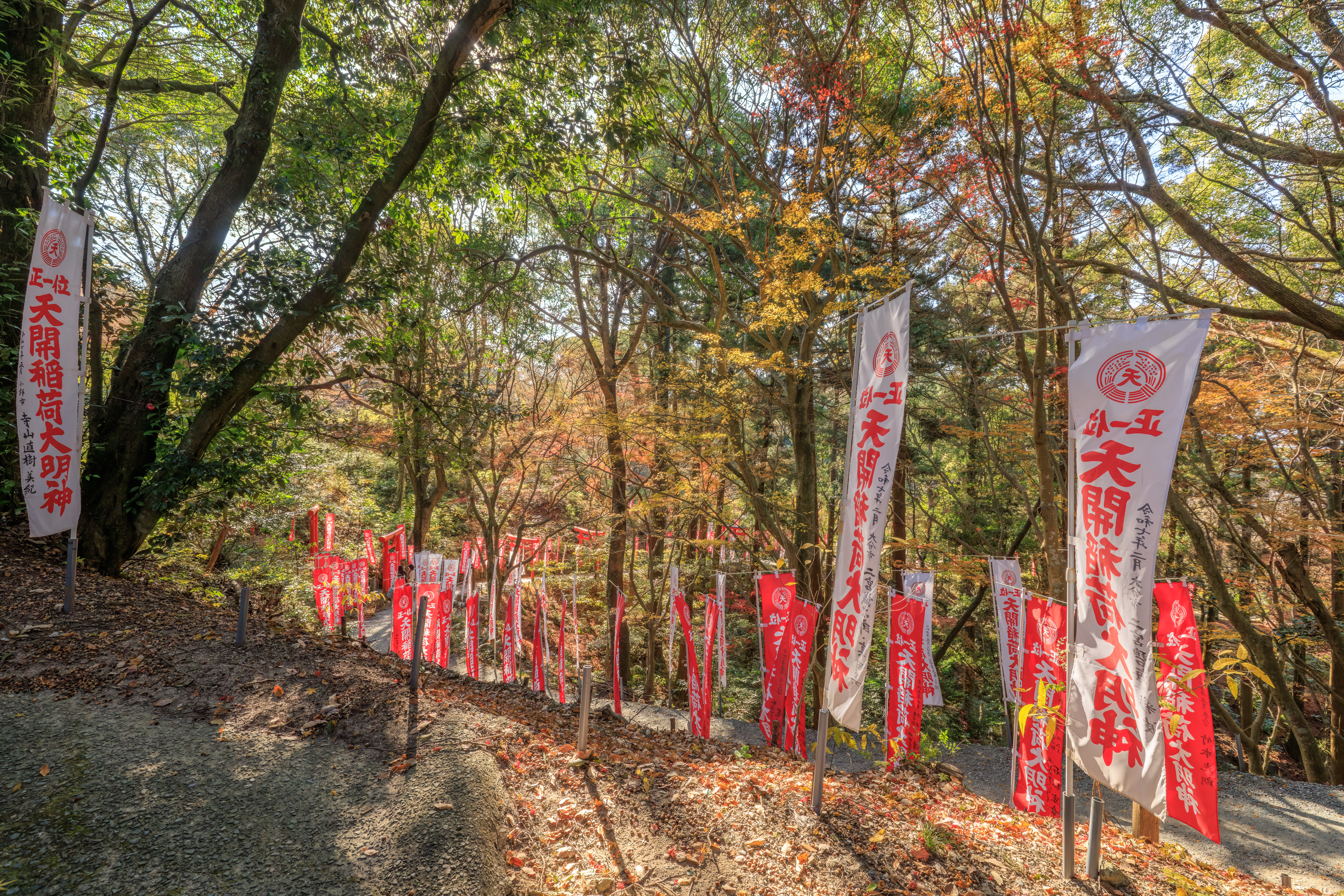
The path was pretty steep…
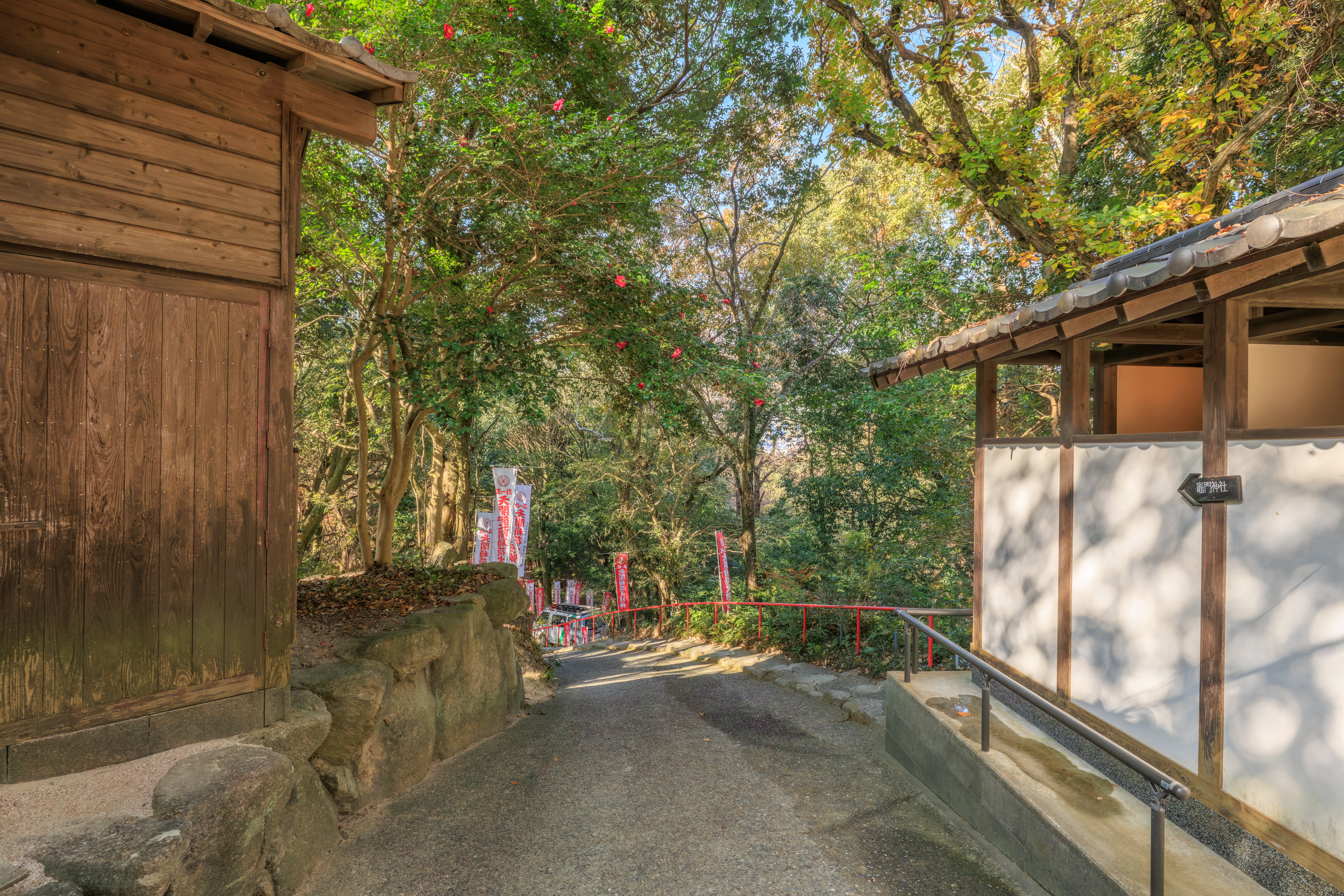
But we made it to the top!
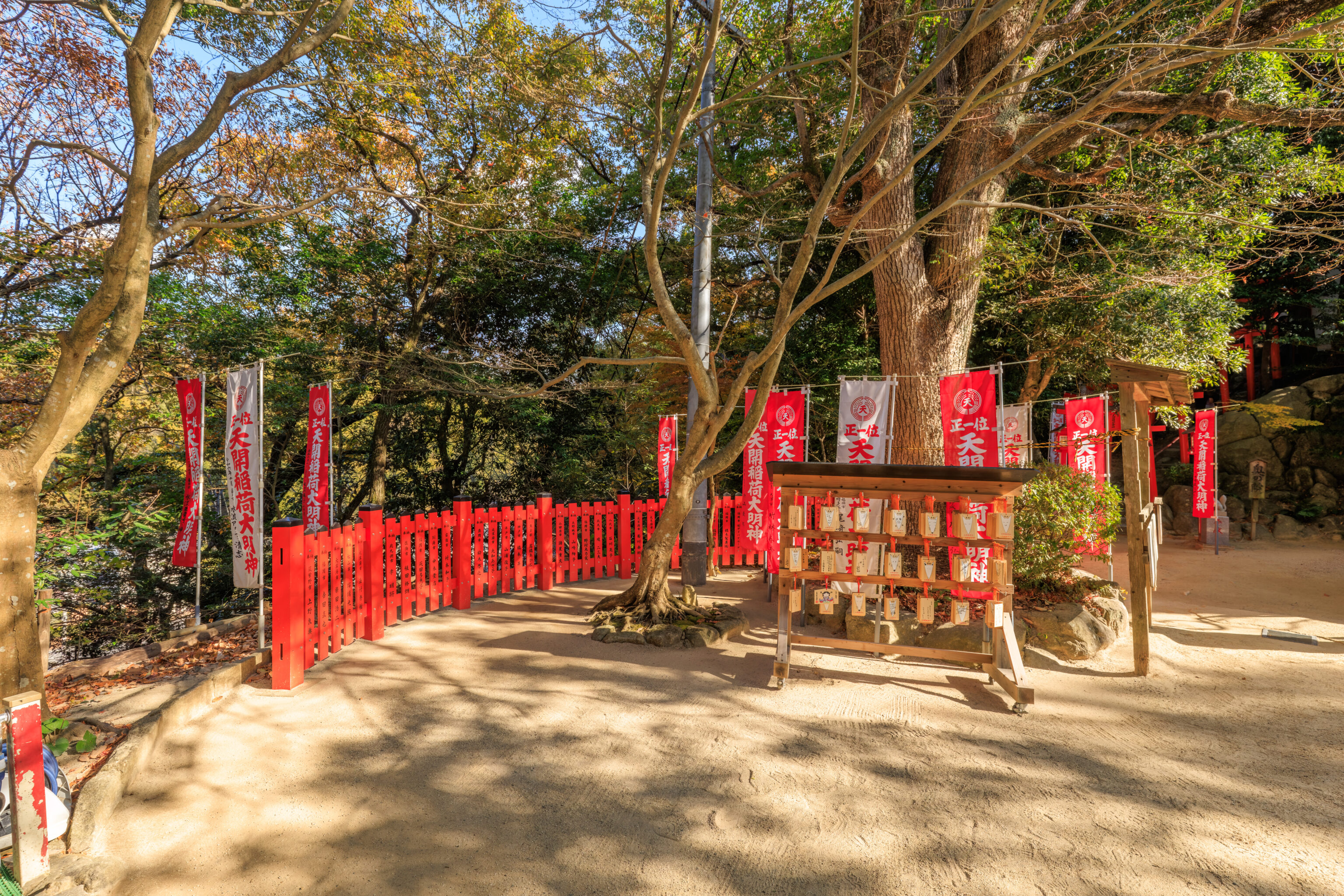
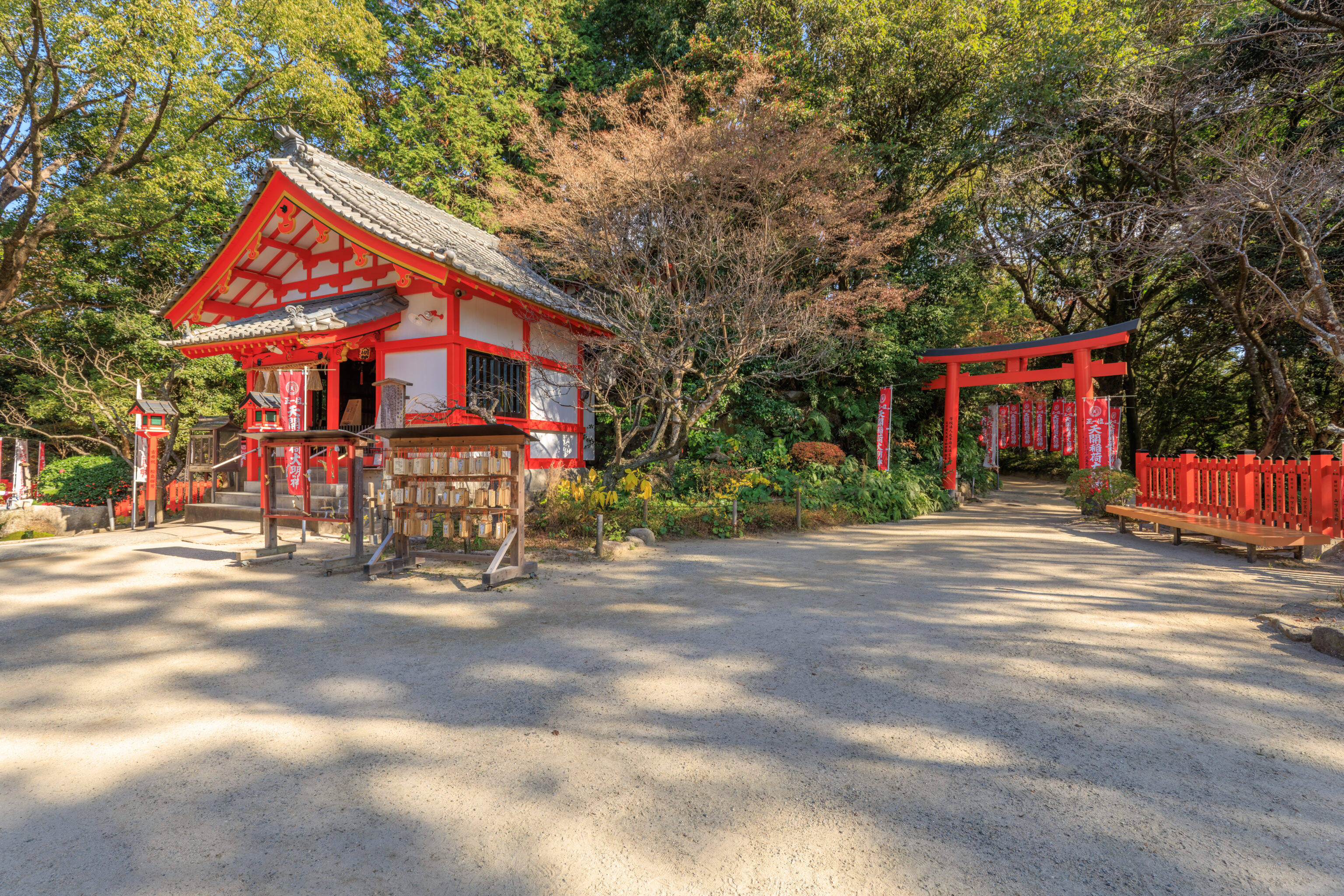
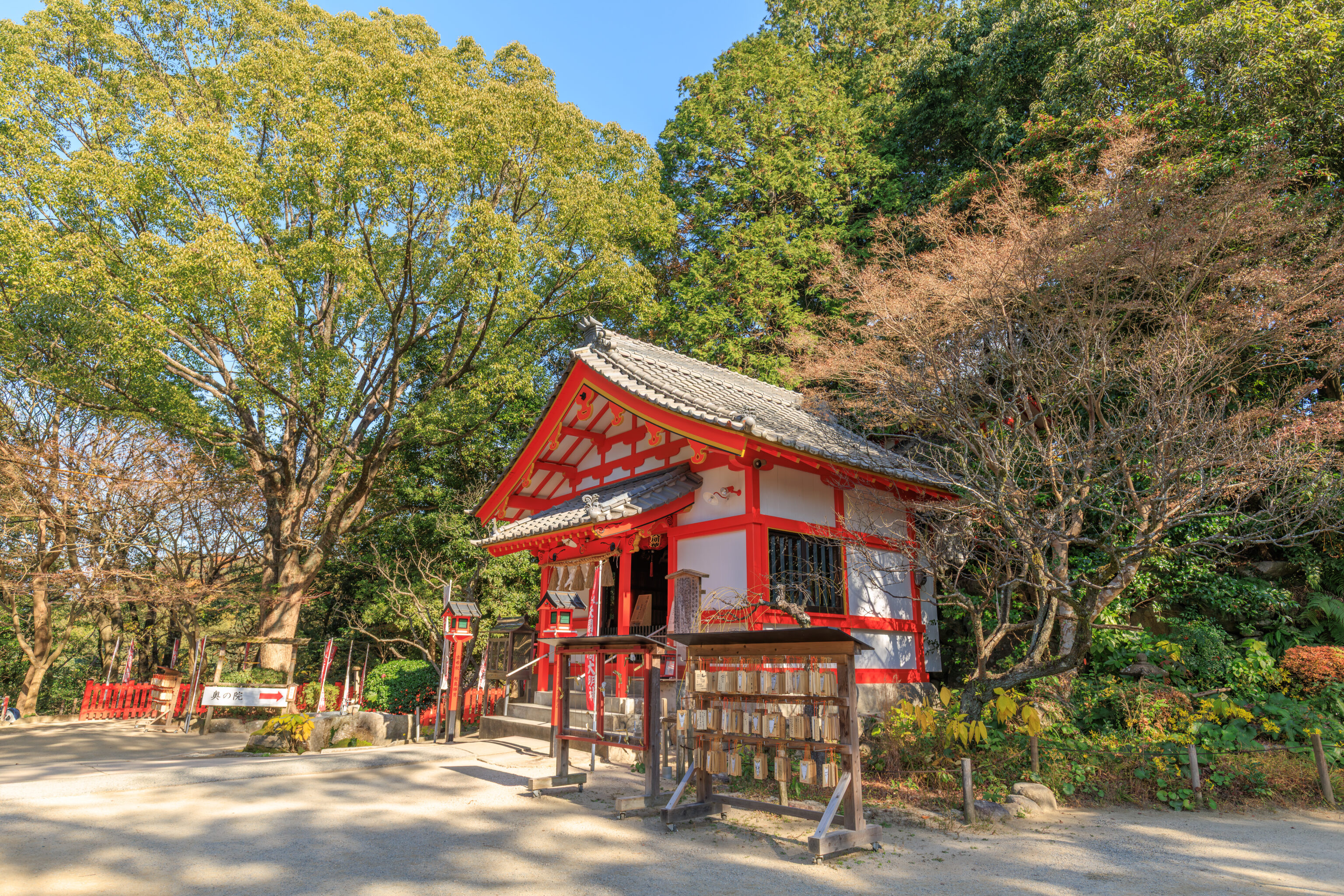
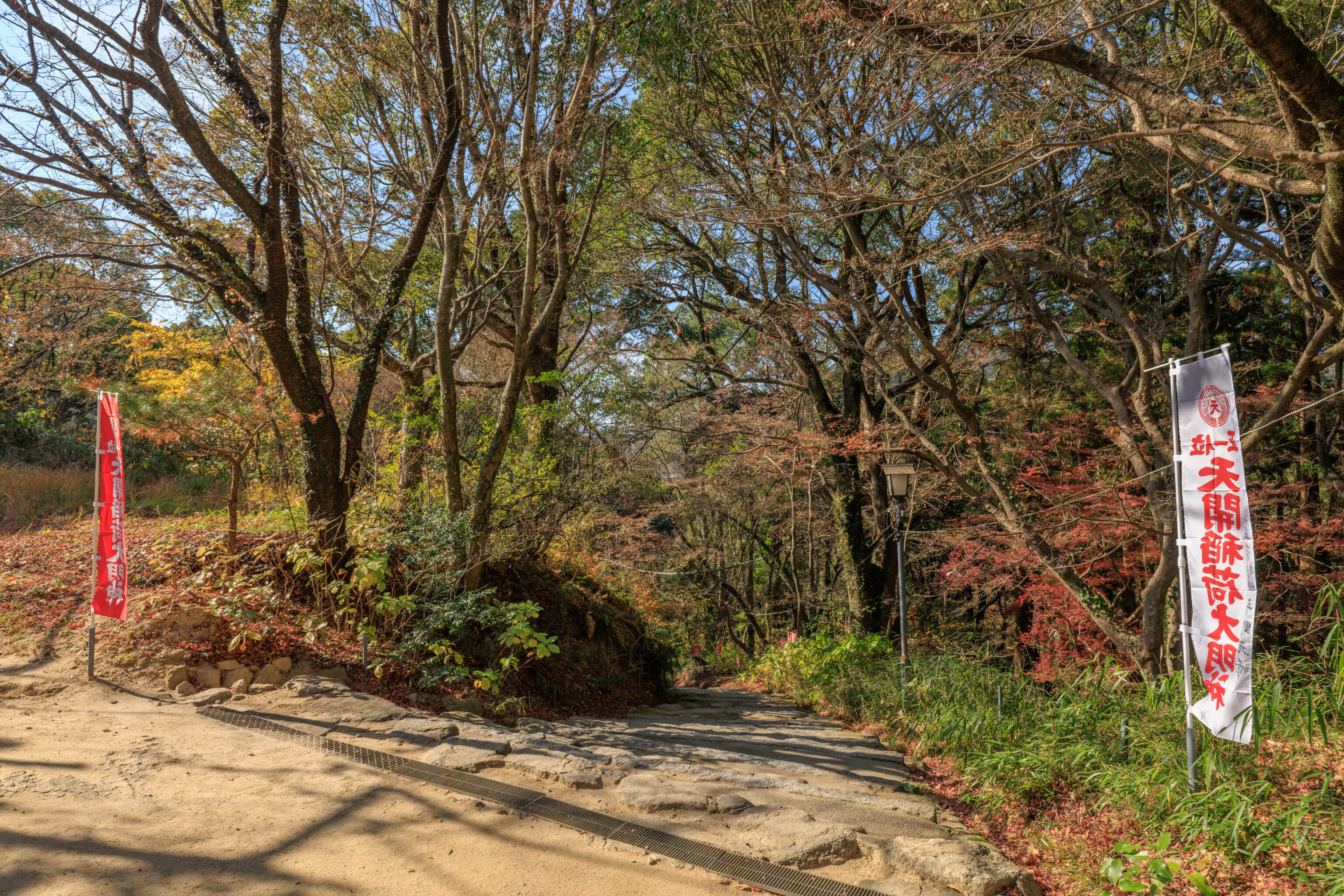
This clearing at the top of the hill is the 天開稲荷社 Tenkai Inari Shrine.
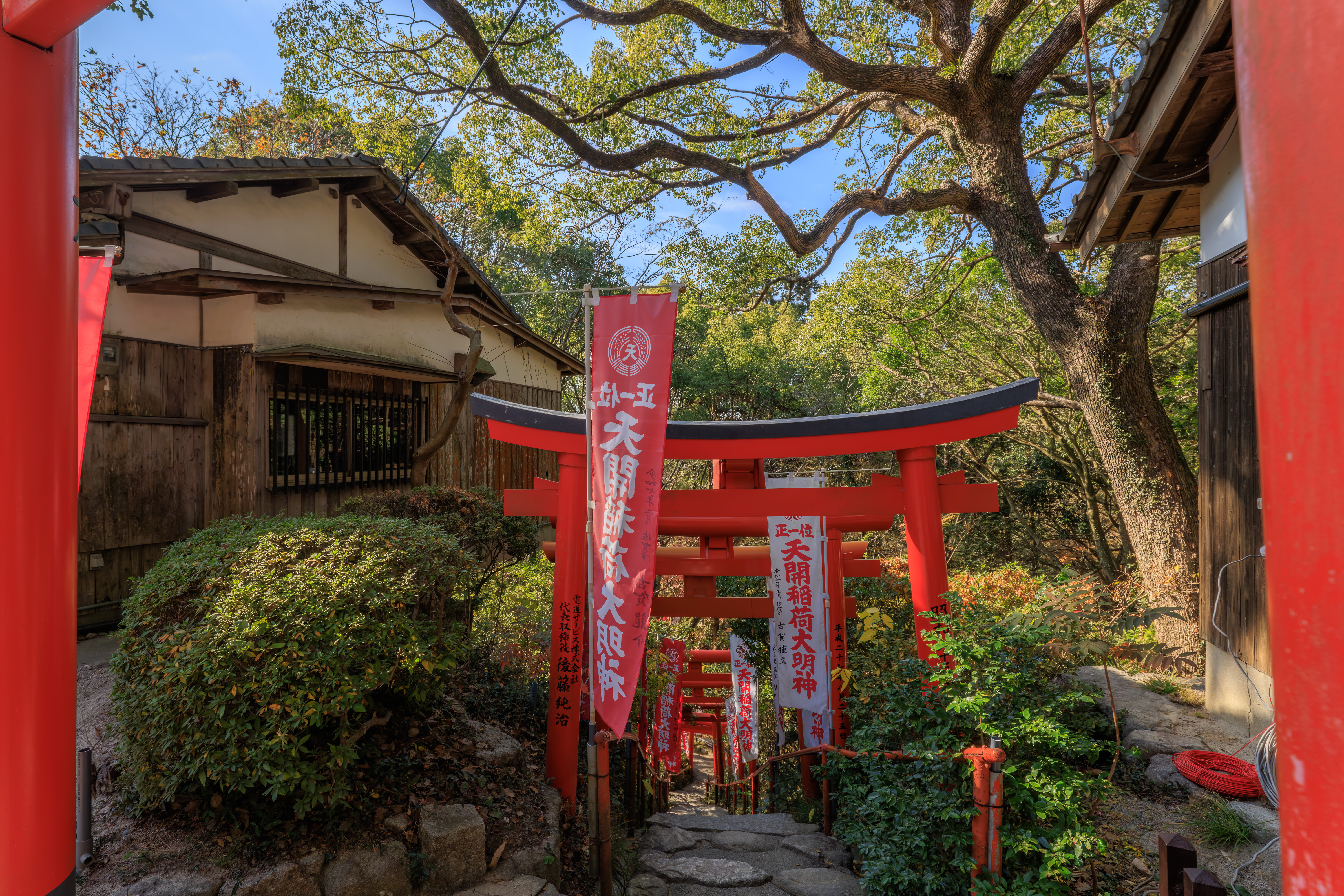
A narrow pedestrian path leads down the hill. We could have come up this way.
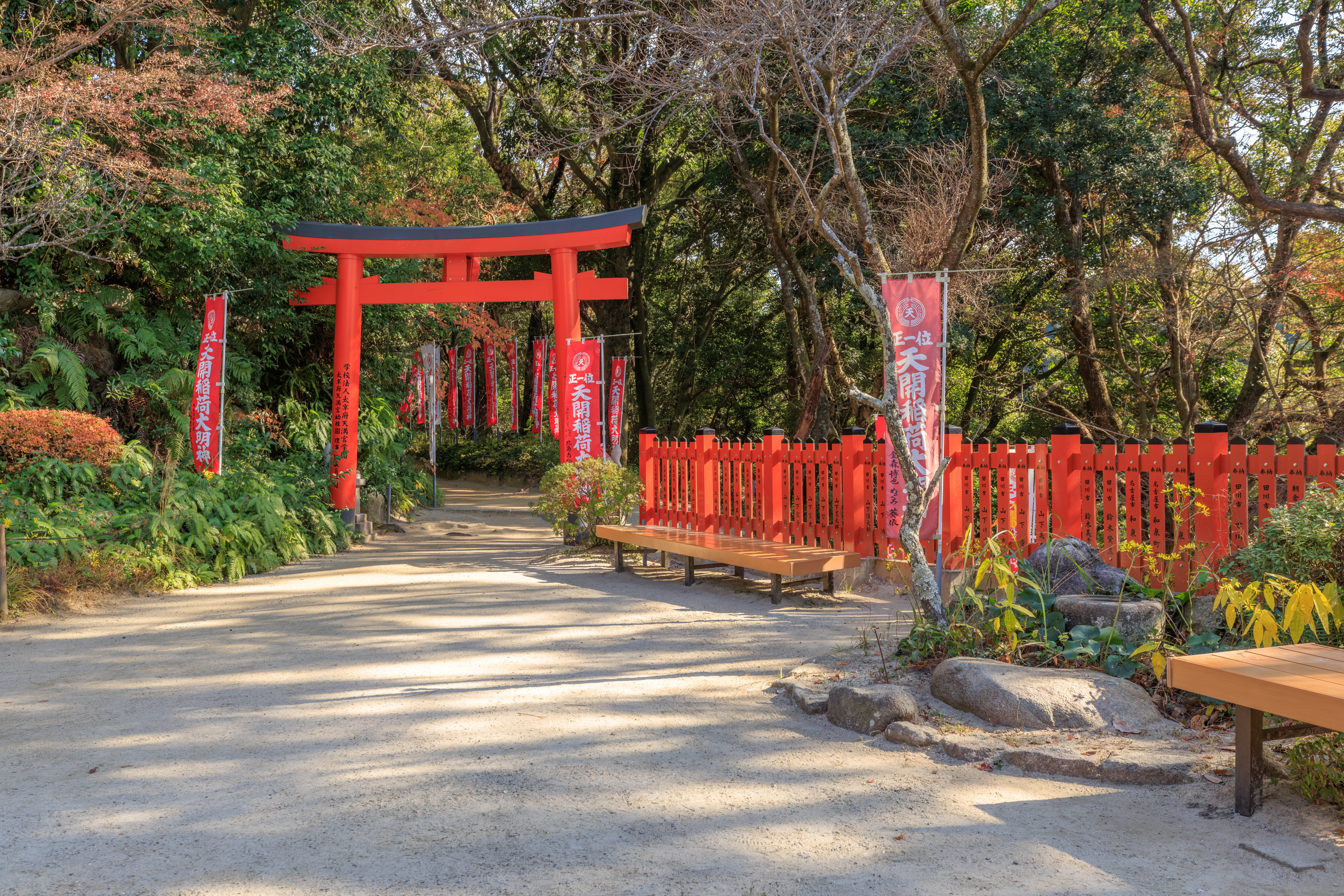
This level path goes somewhere, perhaps south to loop back to the front of Daizaifu Tenmangu?
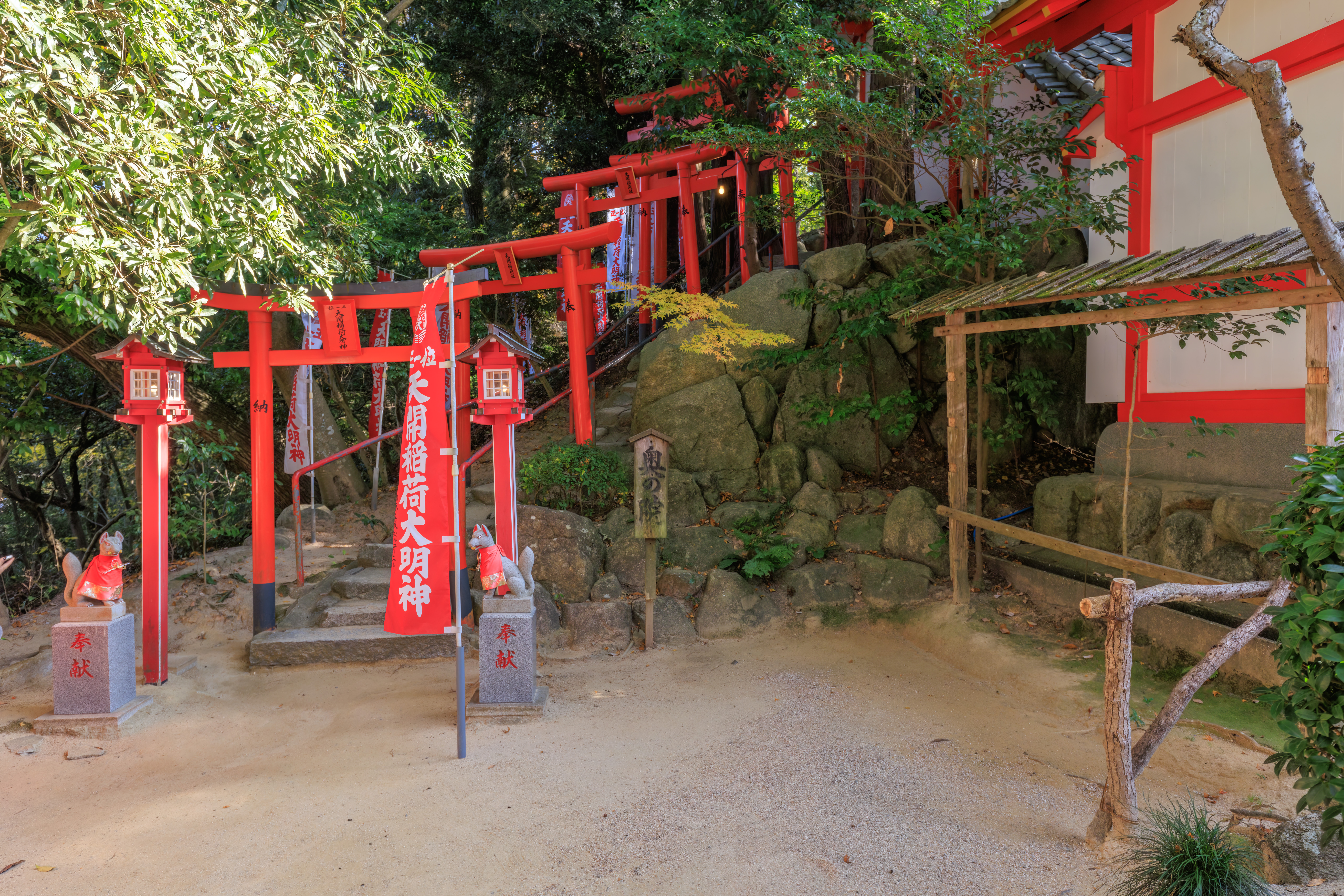
And this path goes up.
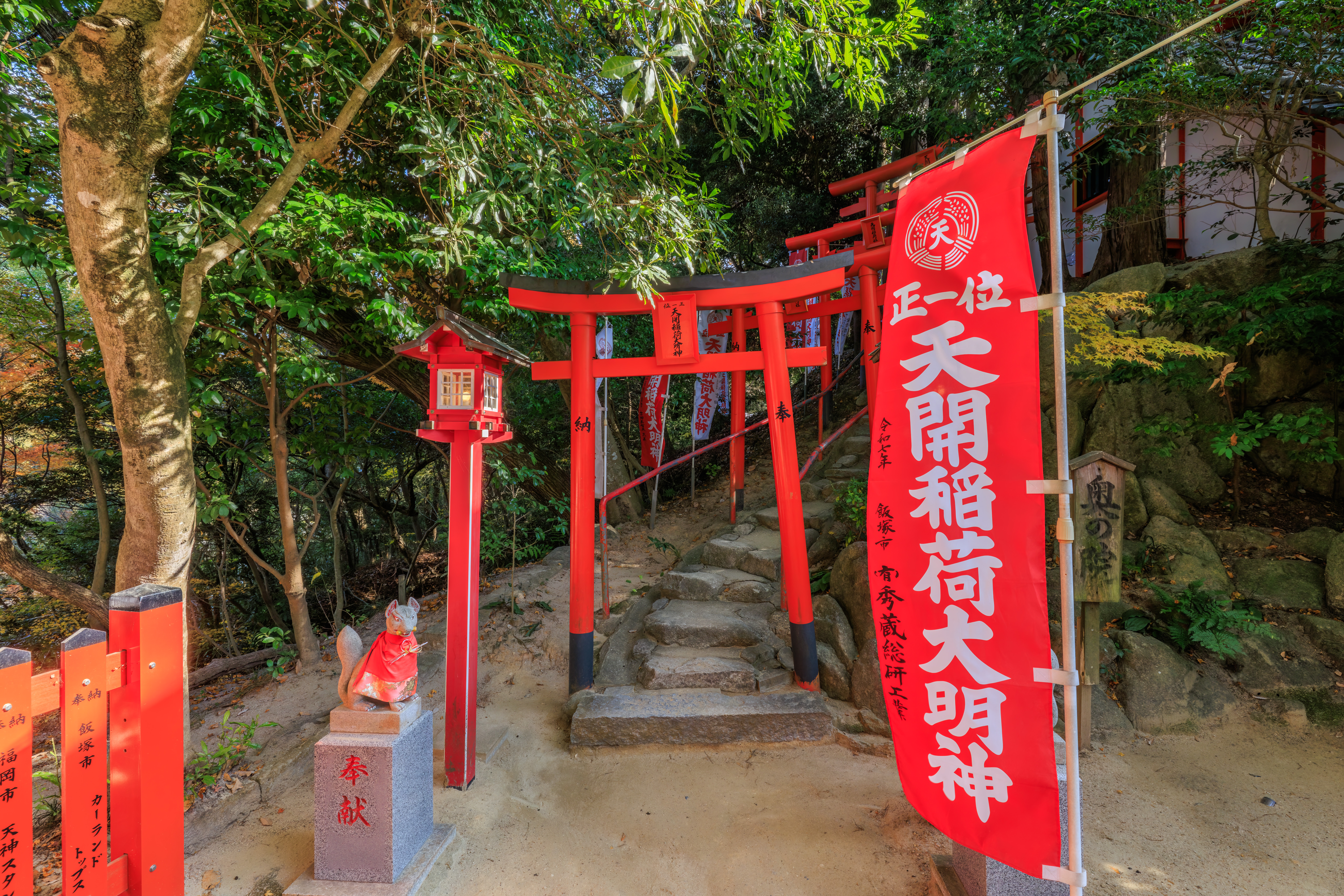
Let’s go!
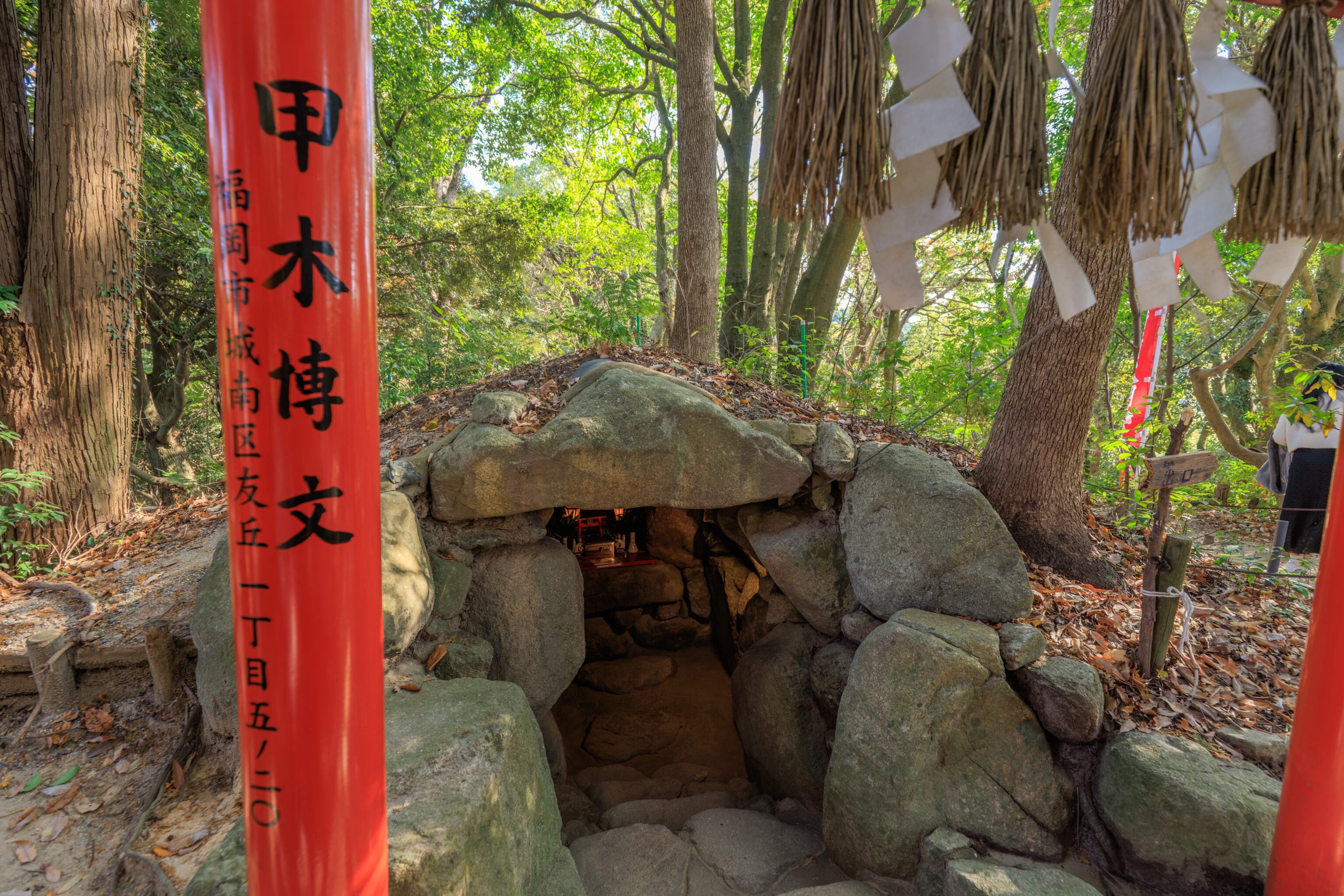
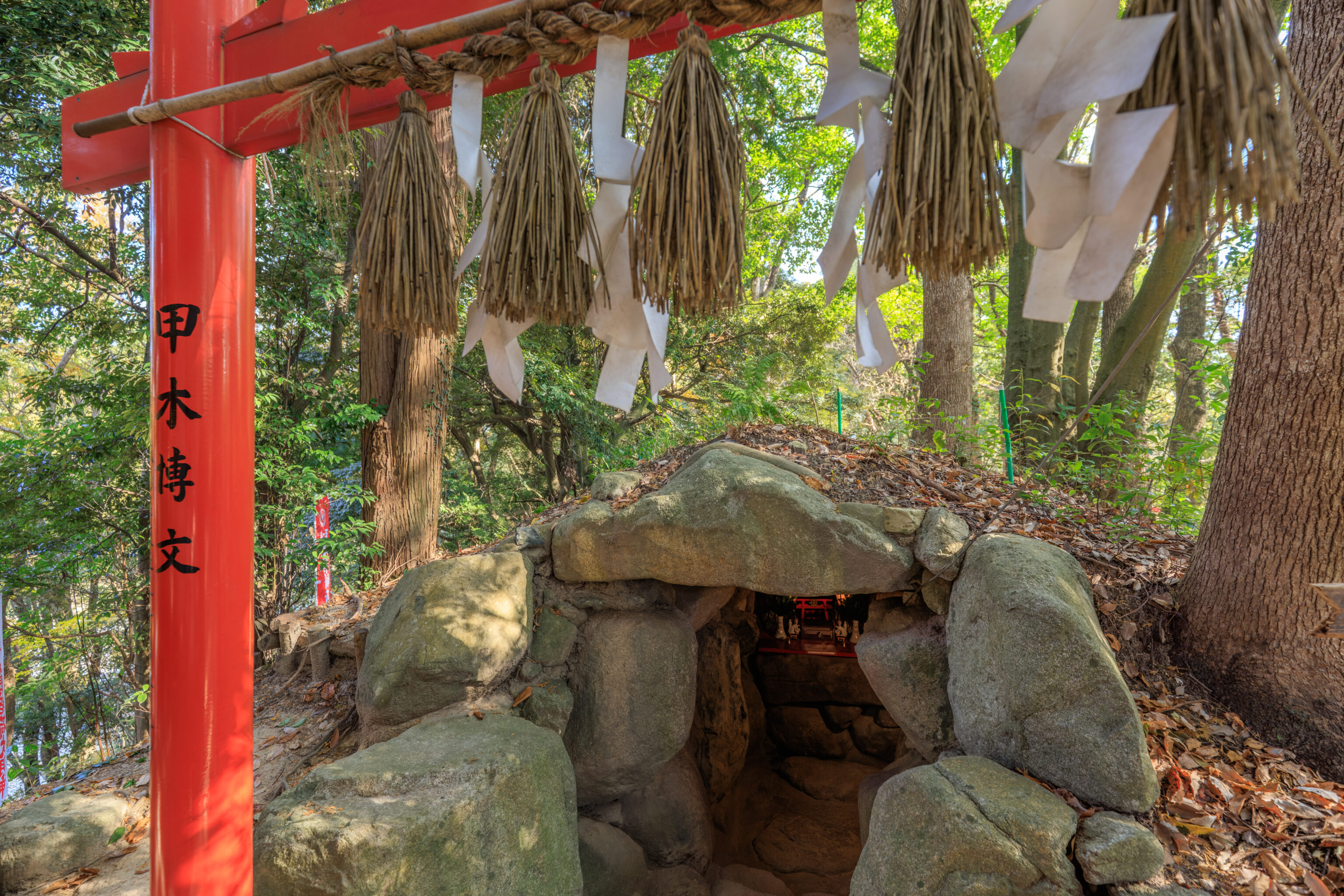
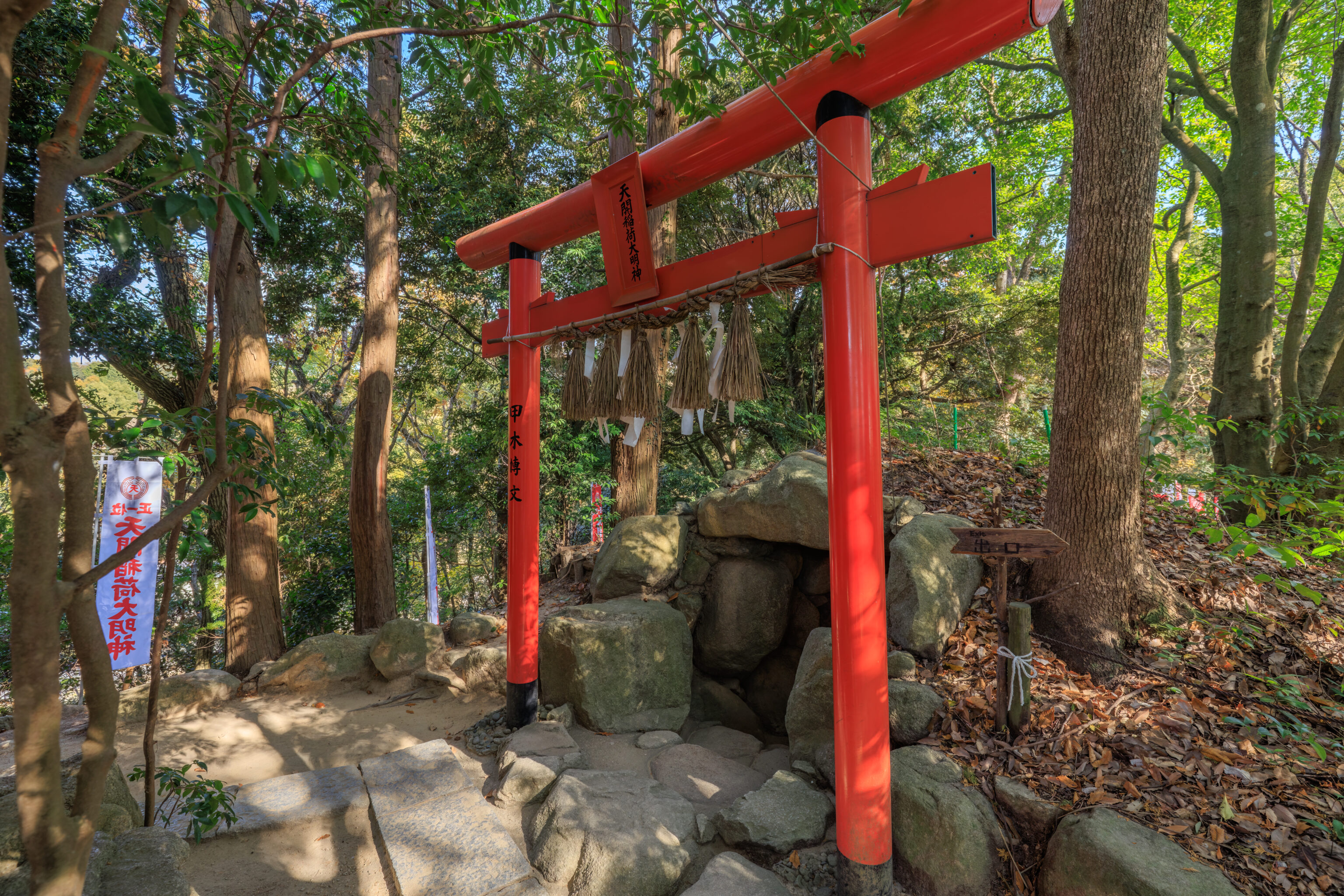
The stone steps led to the inner sanctuary, contained within a small cave.
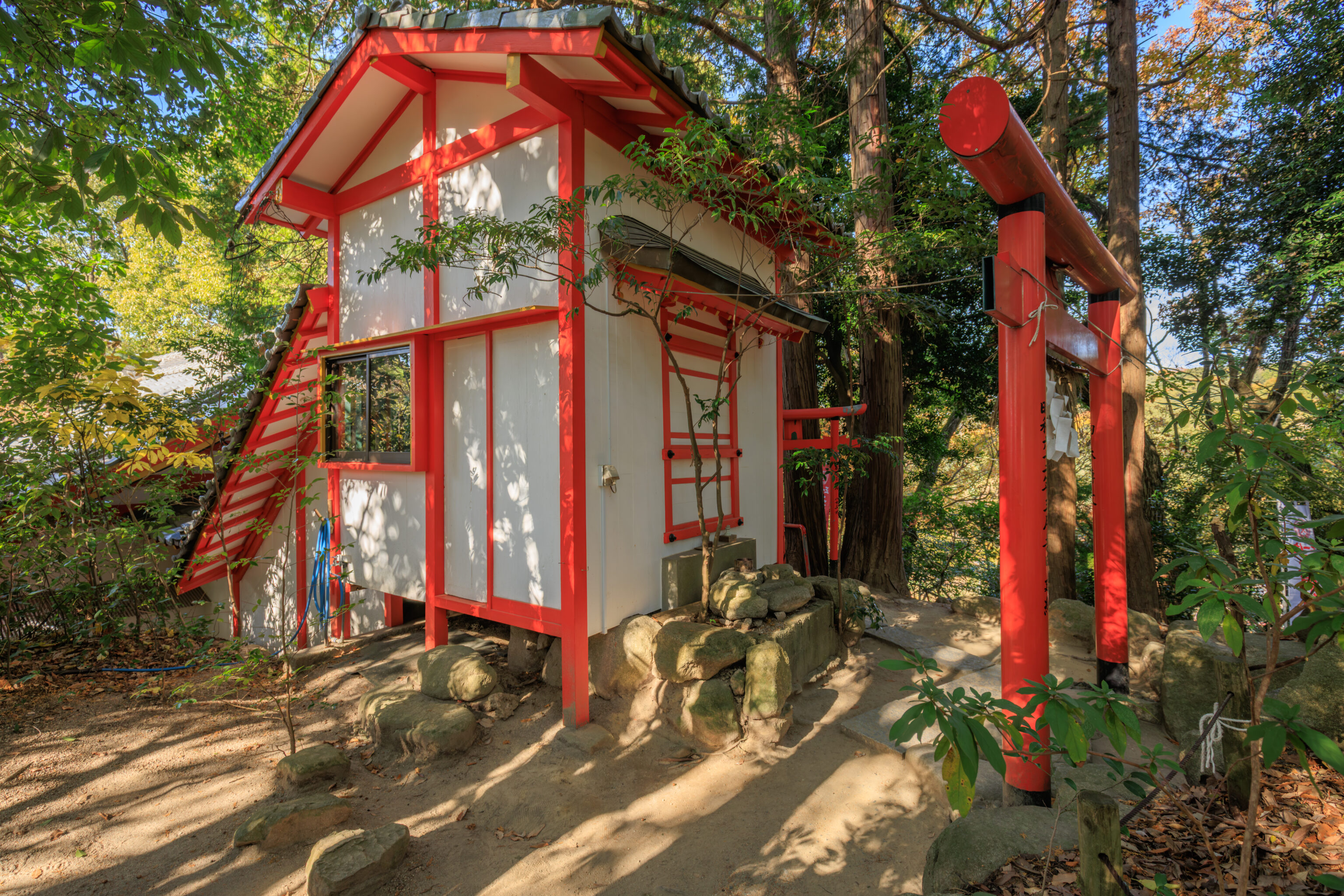
There was also a small building.
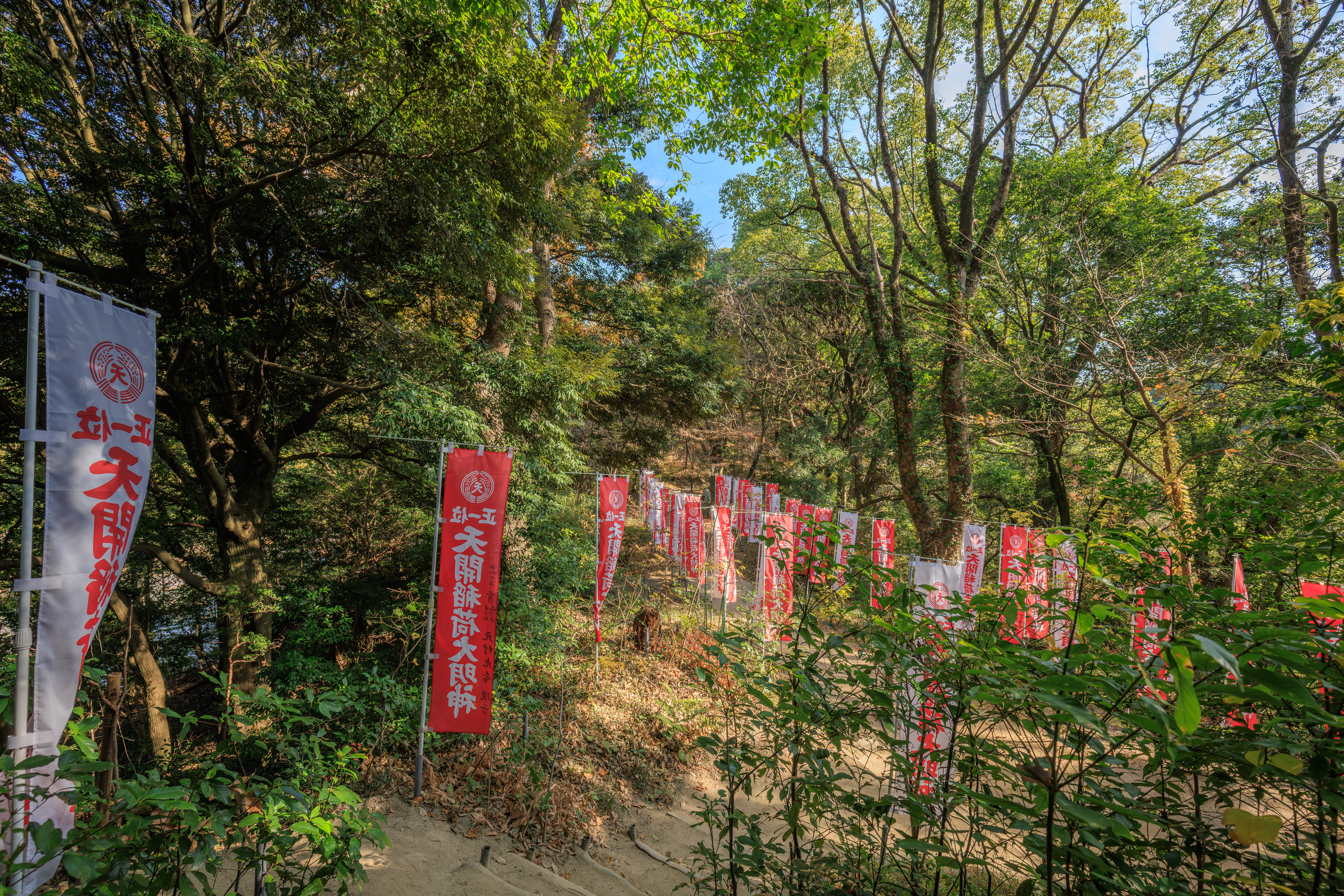
We headed back down via this path.
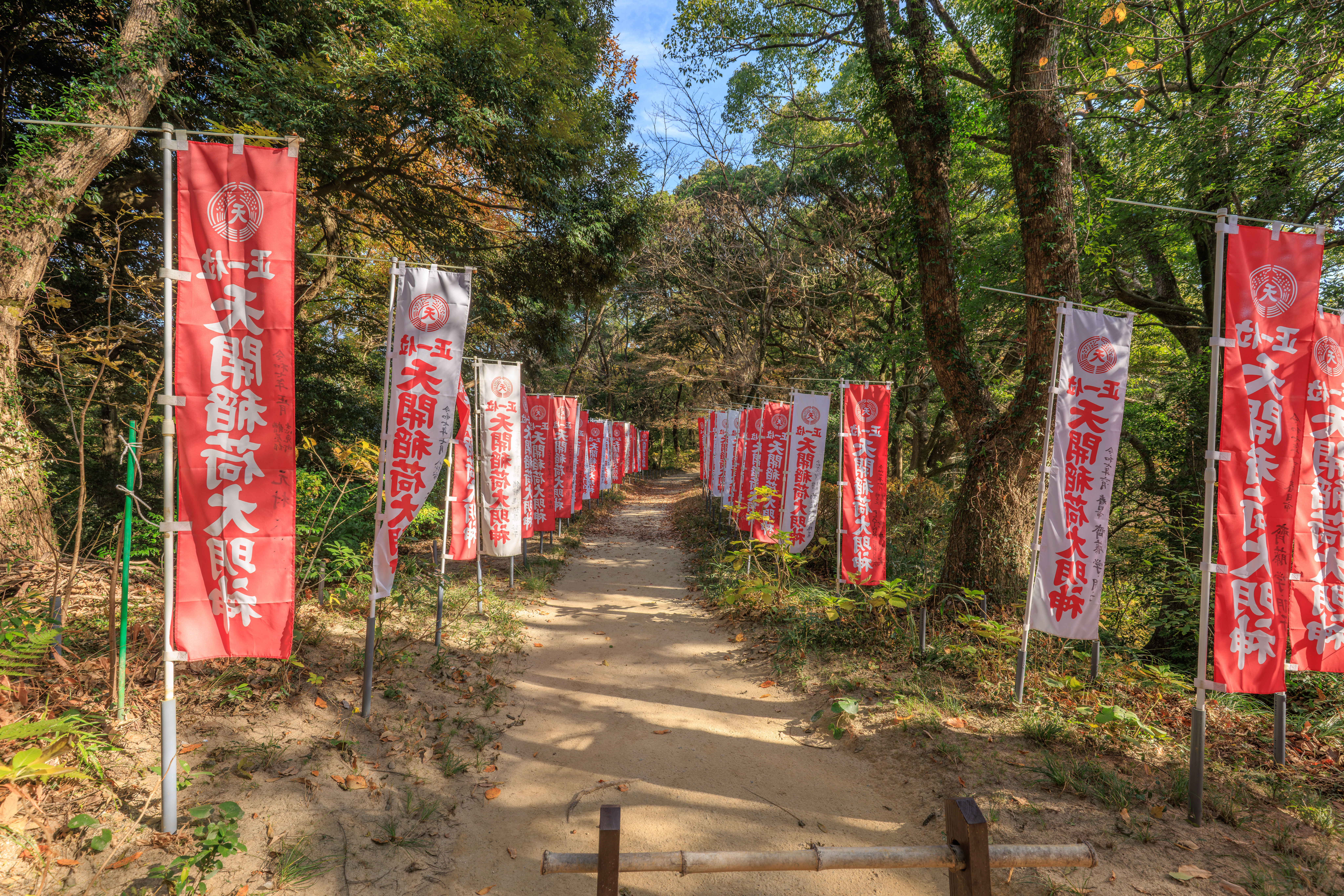
Can’t go this way.
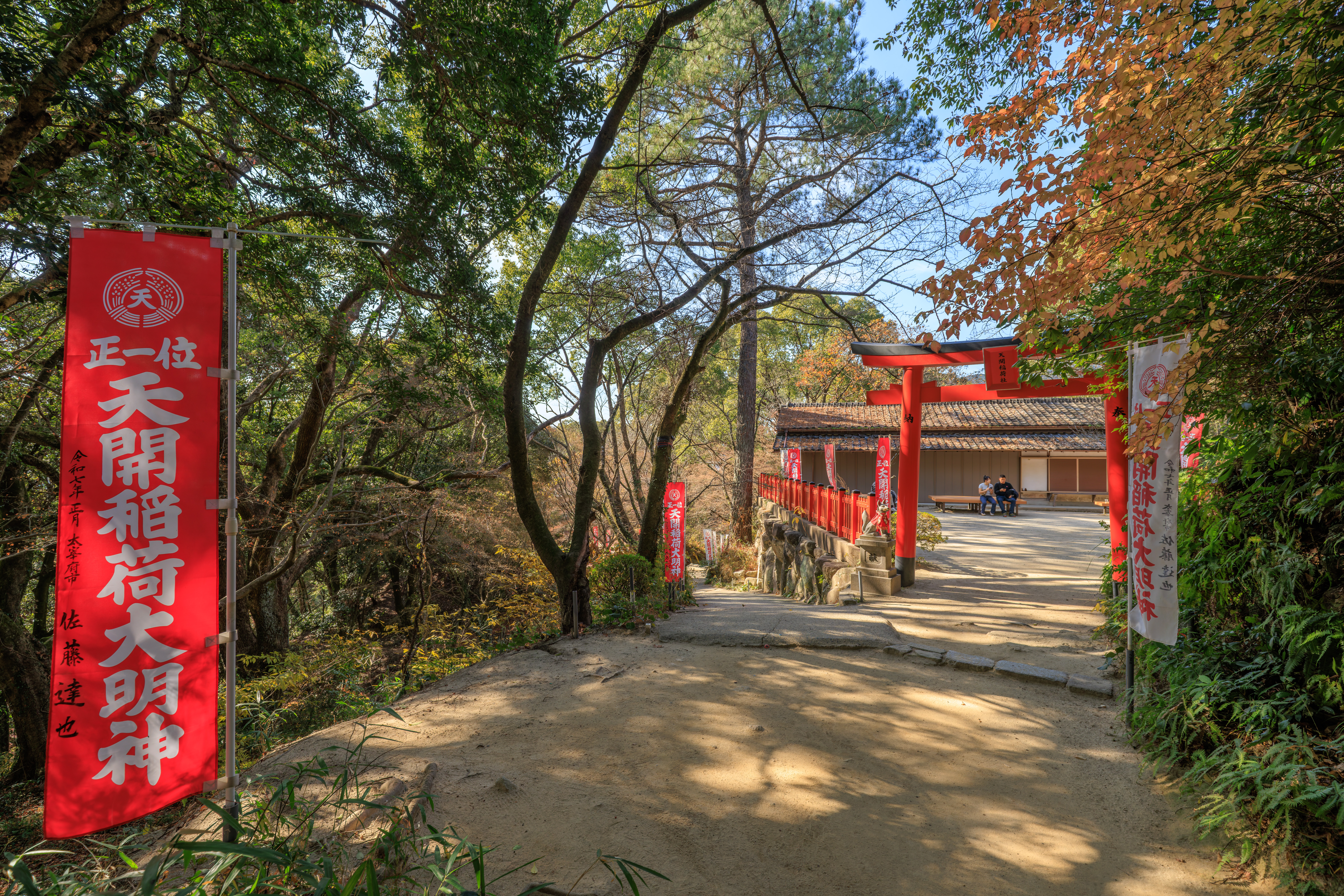
We ended up back at the clearing below. We arrived here via the level path we saw earlier.
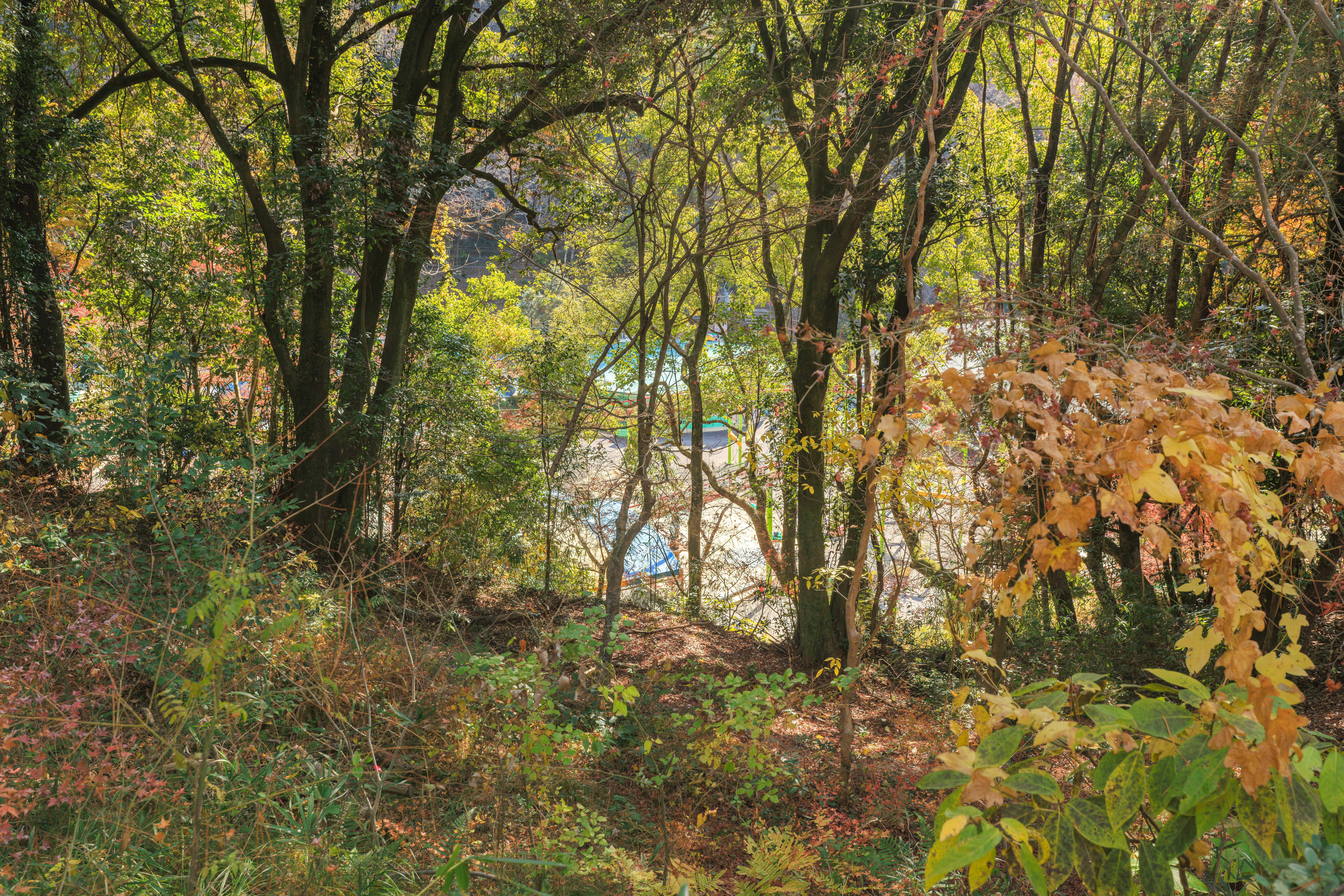
It isn’t obvious from the prior photographs but there was a junction in the path that allowed us to continue walking to the south beyond the Inari shrine that we were at. Along the way, looking to the left below the hill, we saw some of the structures within だざいふ遊園地 Dazaifu Yuenchi, a small amusement park for young children that is adjacent to the Dazaifu Tenmangu.
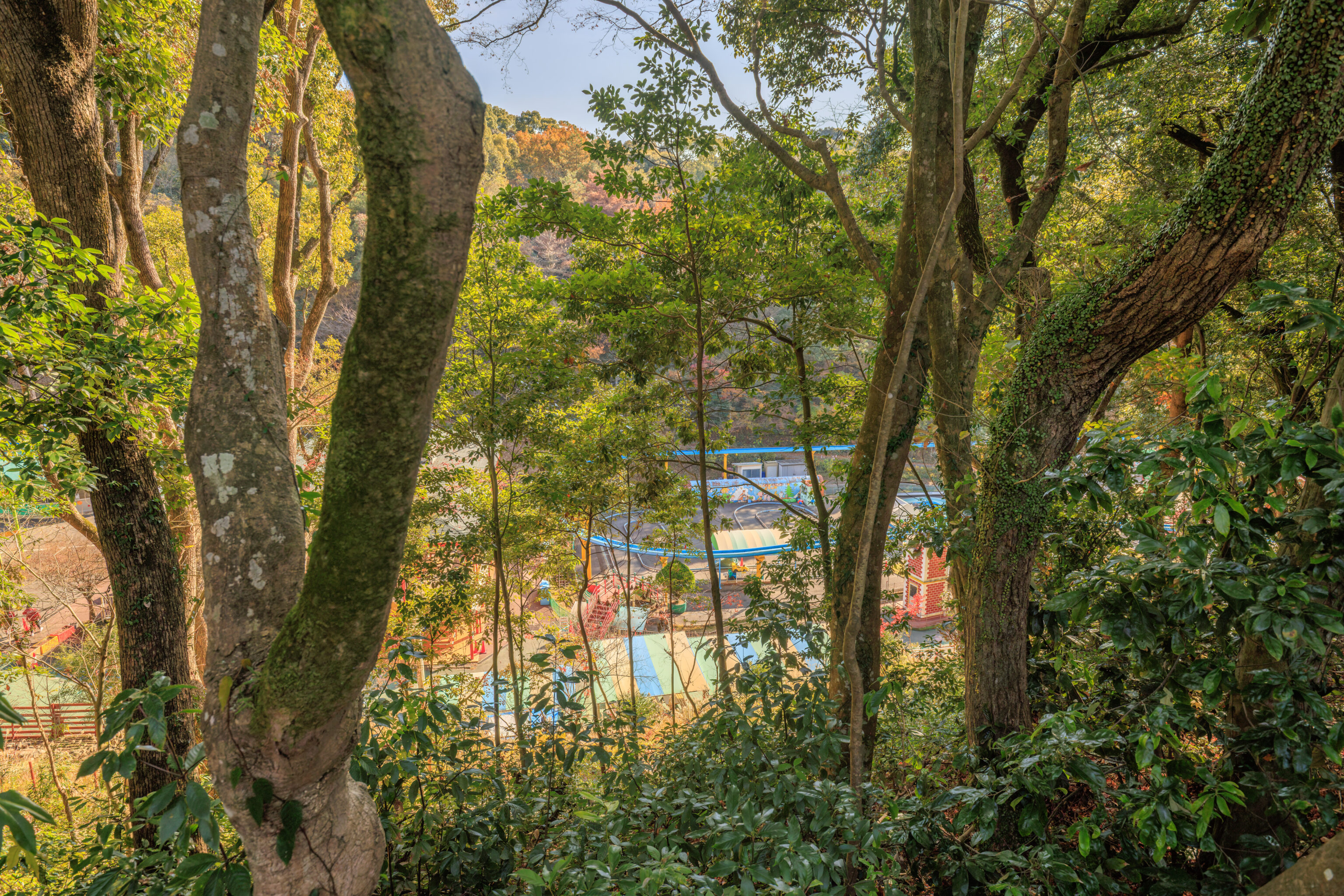
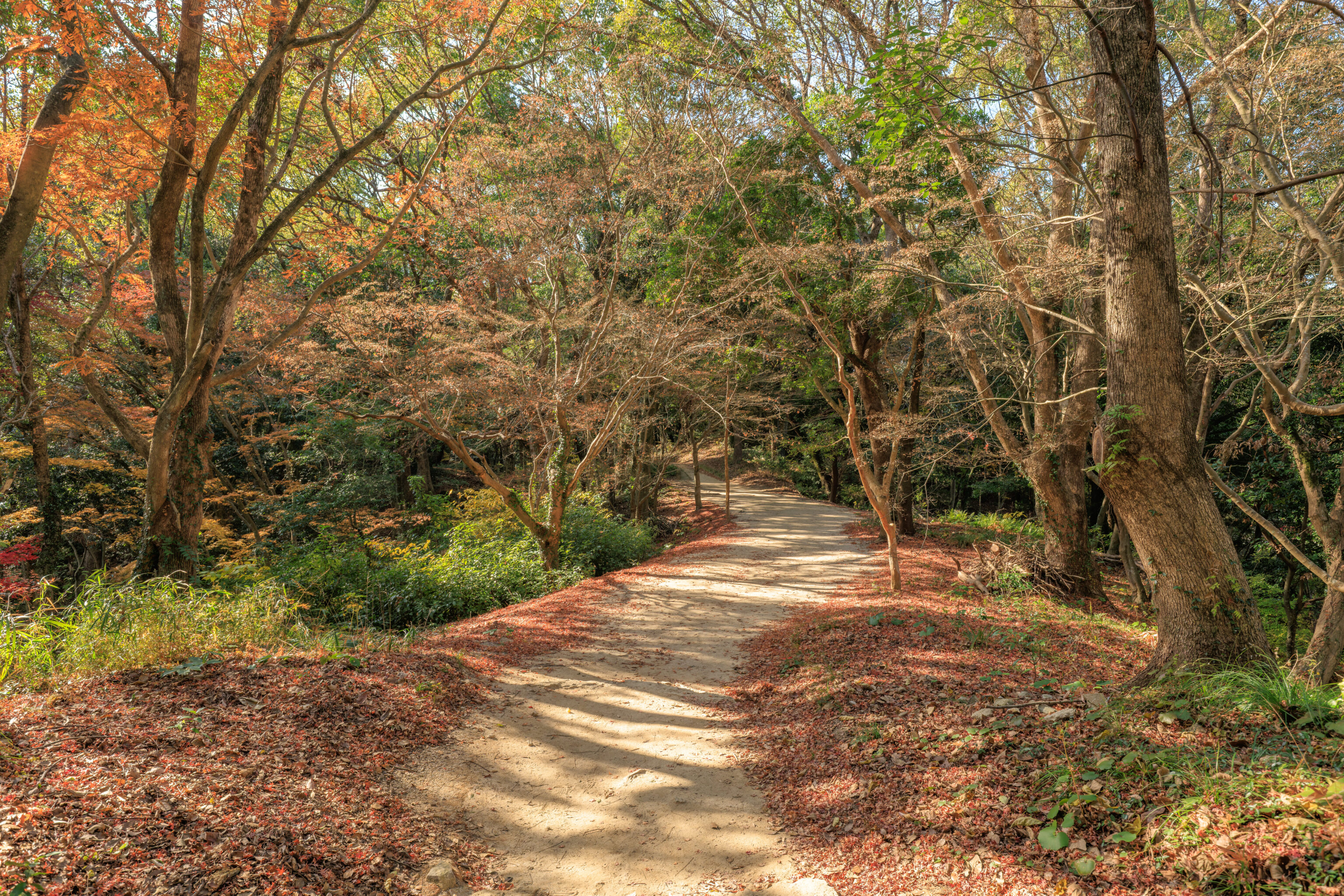
We continued following the path south…
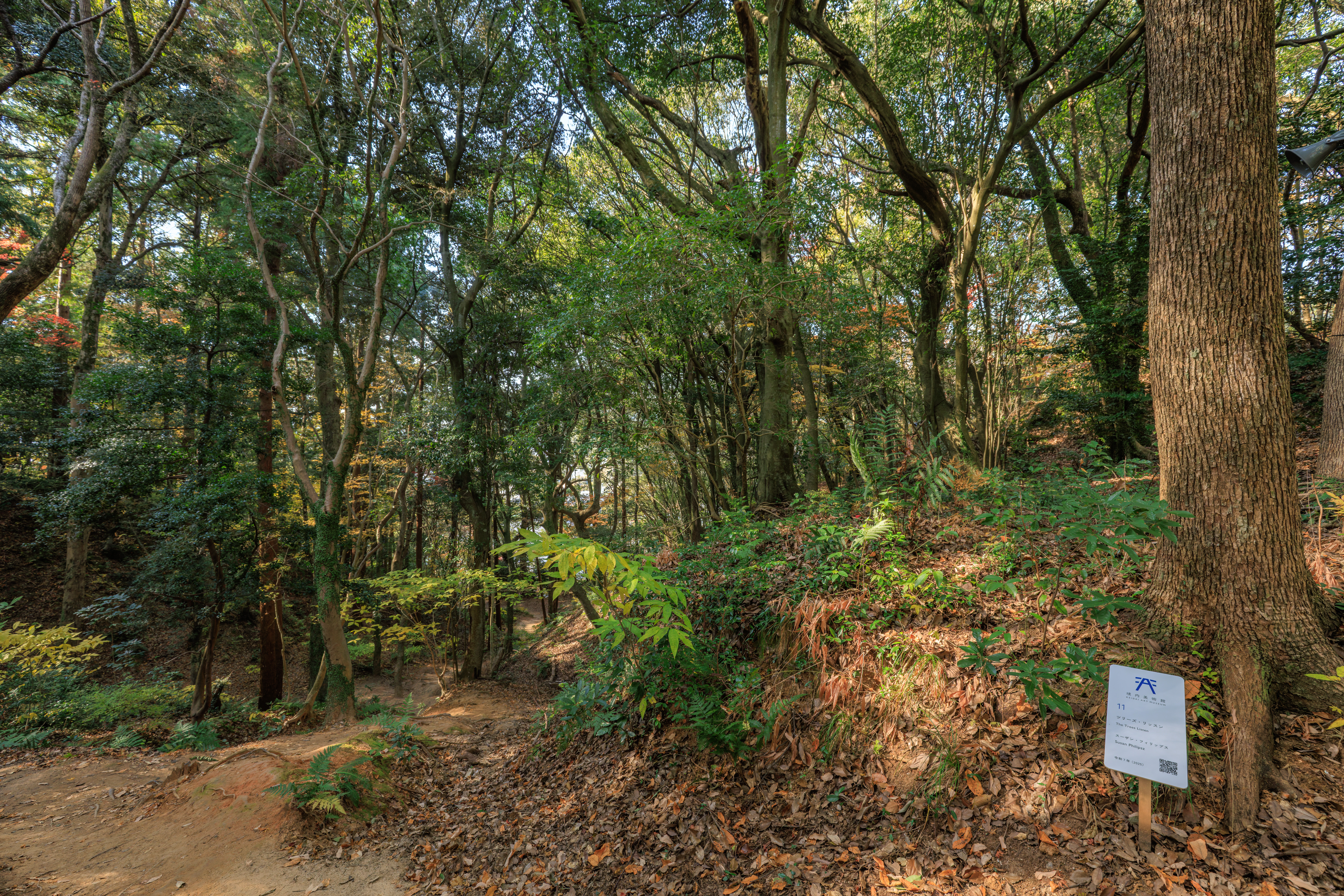
Until we came upon a familiar sign placed by the Keidai Art Museum. We have arrived at #11, The Trees Listen by Susan Philipsz, installed this year.
— If the trees could listen—

The sound of the conch shells echoing through the forest is at times as strong as the wind, and at times as faint as a breath. The eight shells sound from different directions, making the entire forest feel like a single instrument. In Western imagery, the North Wind is sometimes depicted blowing a conch shell, and inspired by that image, the artist reflected on the paths people take and on life itself. As you listen to the whispers of the forest, take a moment to sense the act of “listening” that lies quietly within the silence.

※This installation consists of sounds played from speakers dispersed throughout the forest. Please enjoy it as you walk through the woods. Available from 9:00 AM to 5:00 PM.
– Text from the Keidai Art Museum website Map page: https://keidai.art/en/aruku.
We didn’t want to deviate from our path so we continued on without seeing, or rather listening, to the installation.
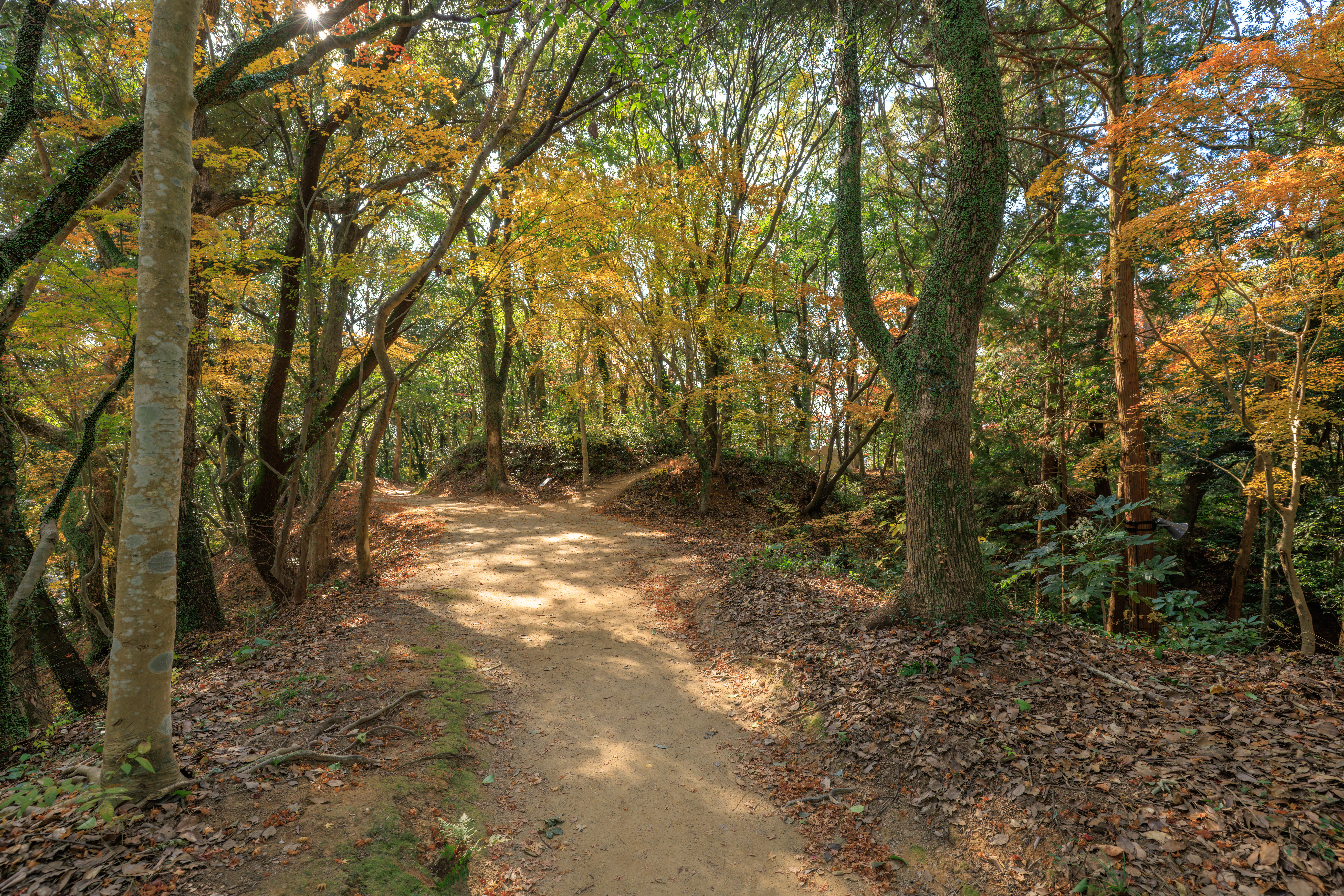
Continuing on, we came to a junction with something to our right in the woods.
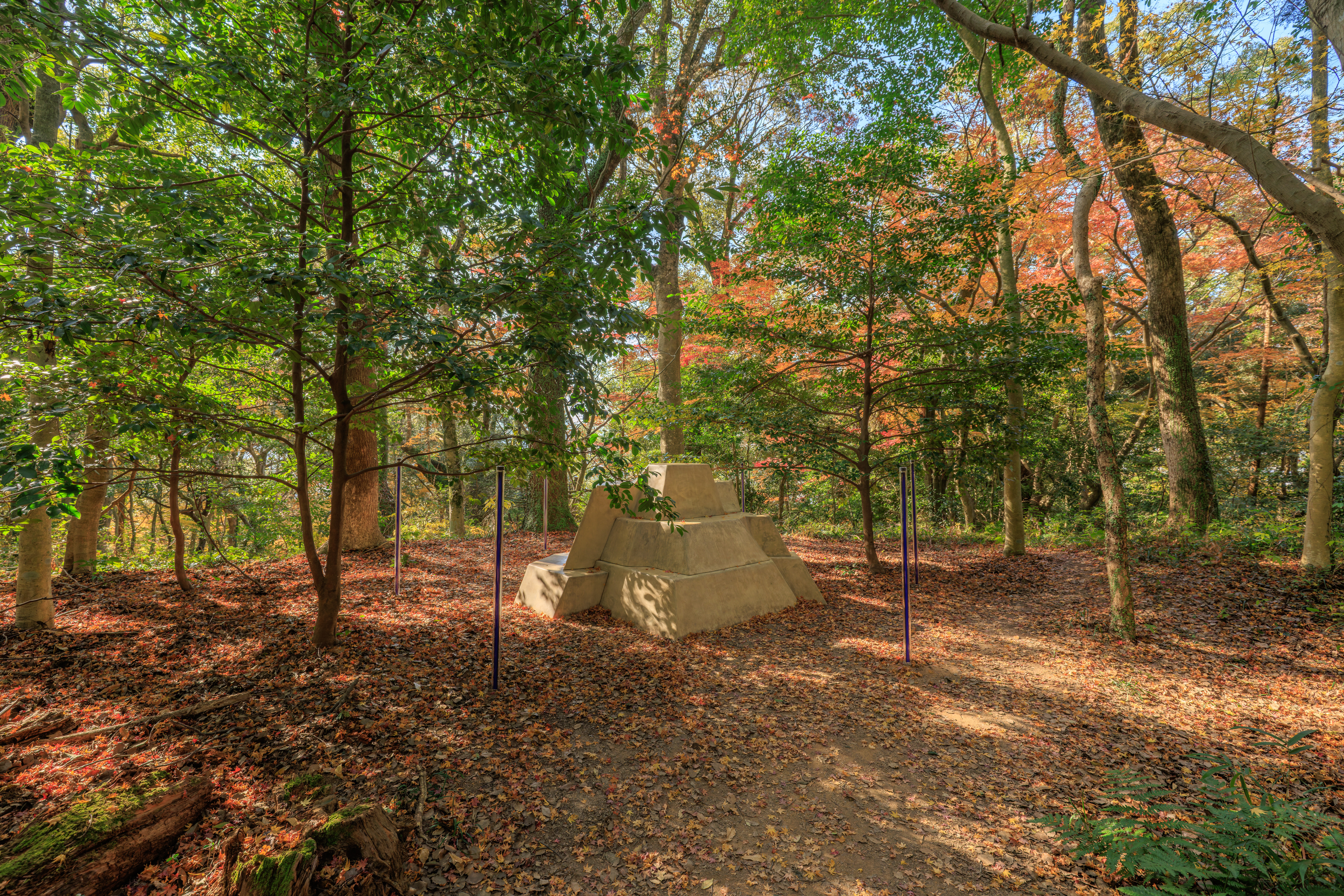
This was #10, Echo and Narcissus by Mika Taijima in 2022.
— Echo and Narcissus are indispensable to each other.
“Echo” is a meditation sculpture which resembles ancient pyramid structures and sci-fi polygonal spacecraft. It is both a site and object for seated meditation. The surface of the sculpture is made using phosphorescent material, is charged with increasing energy and glows electrified like a screen during the day and actively captures light energy from a combination of sunlight and black-light, called “Narcissus”, transforming the work into a ‘charged’ object, that is visualized as glowing light even as the sun sets into night in the shrine woods. This is a sustainable piece of work that captures and circulates natural energy.

*You can sit on the artwork, but please do not climb on it with your shoes on.

©Mika Tajima, Courtesy of TARO NASU, Photo by Yasushi Ichikawa
– Text from the Keidai Art Museum website Map page: https://keidai.art/en/aruku.
We’re not really sure what we were supposed to see here so we continued on.
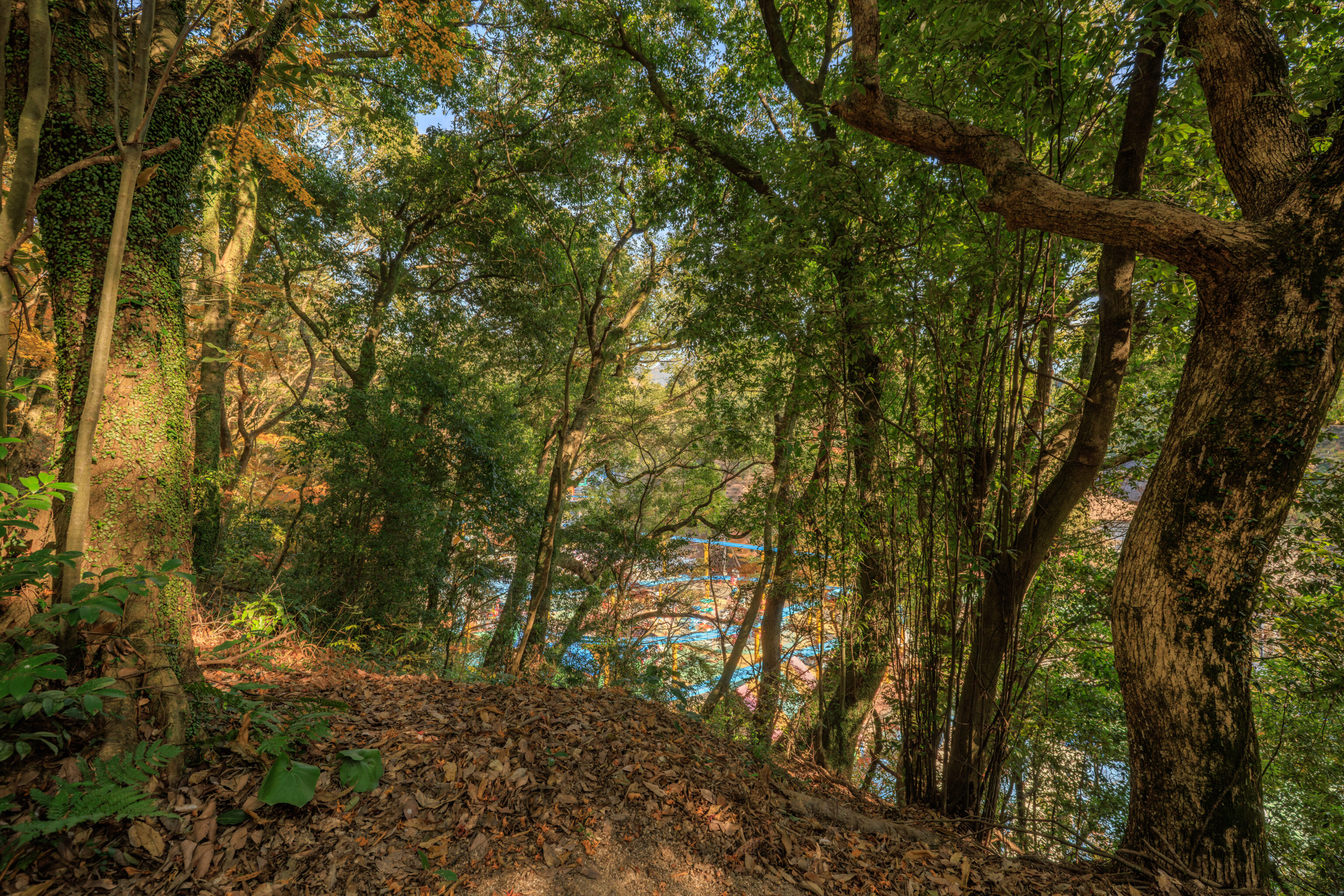
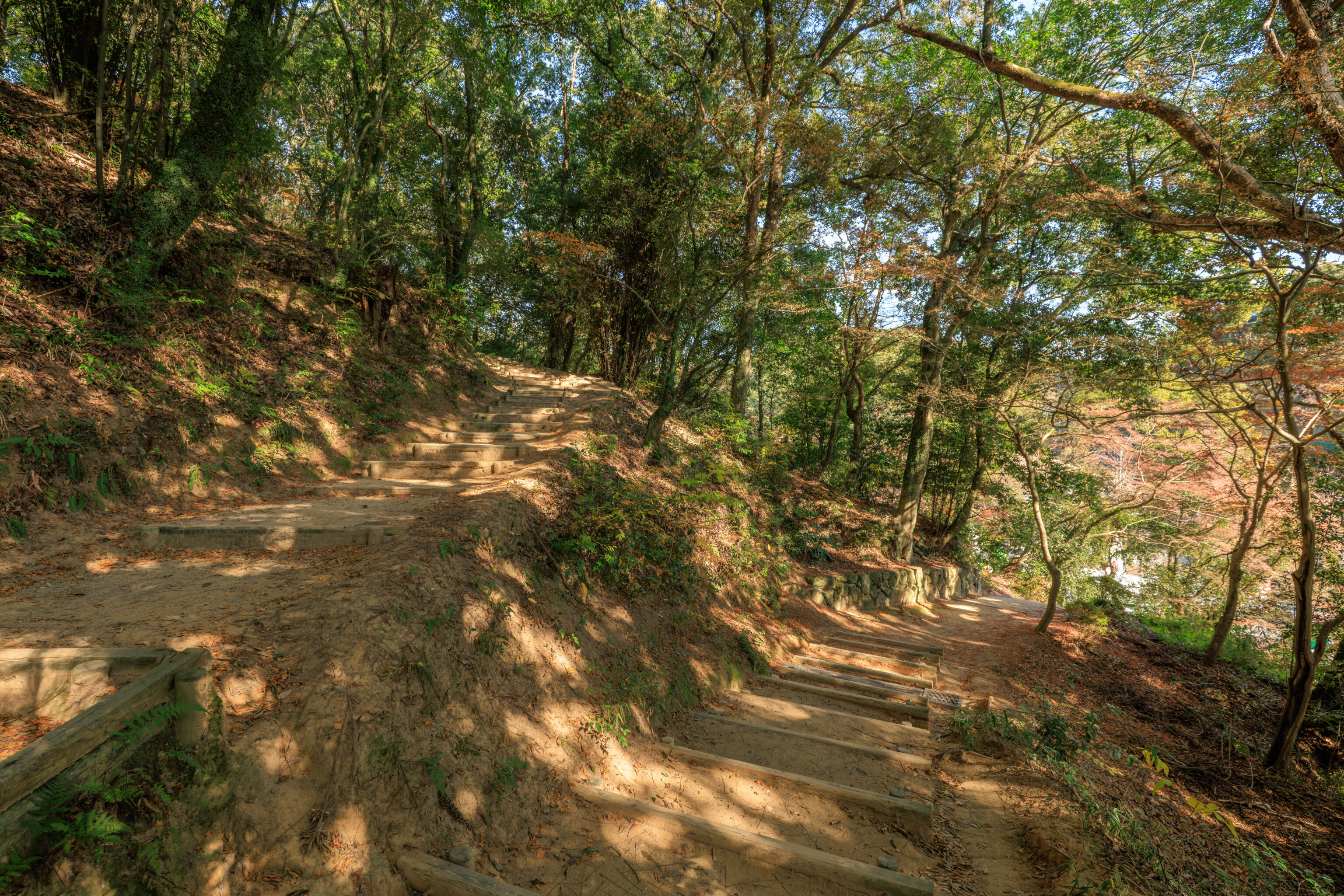
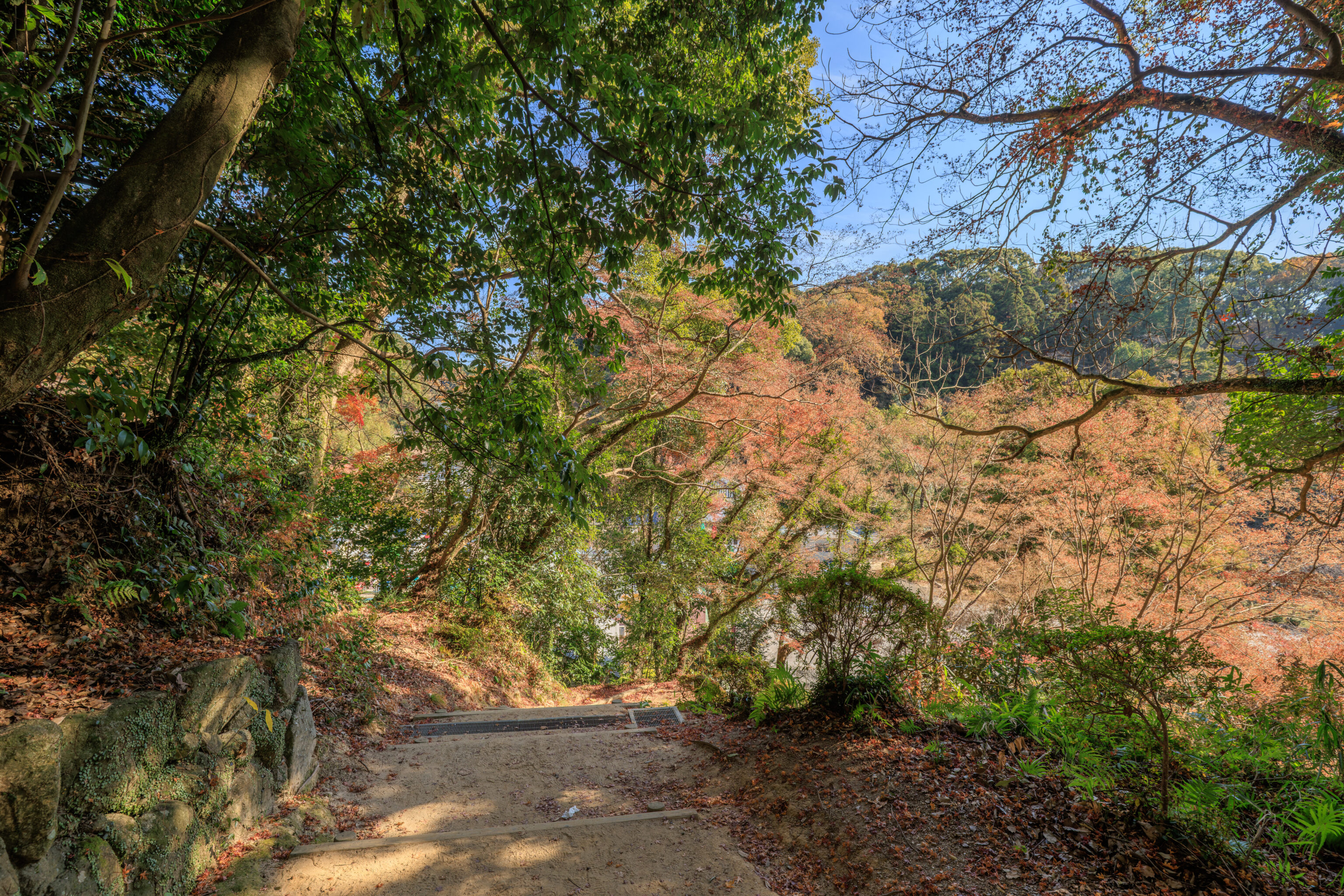
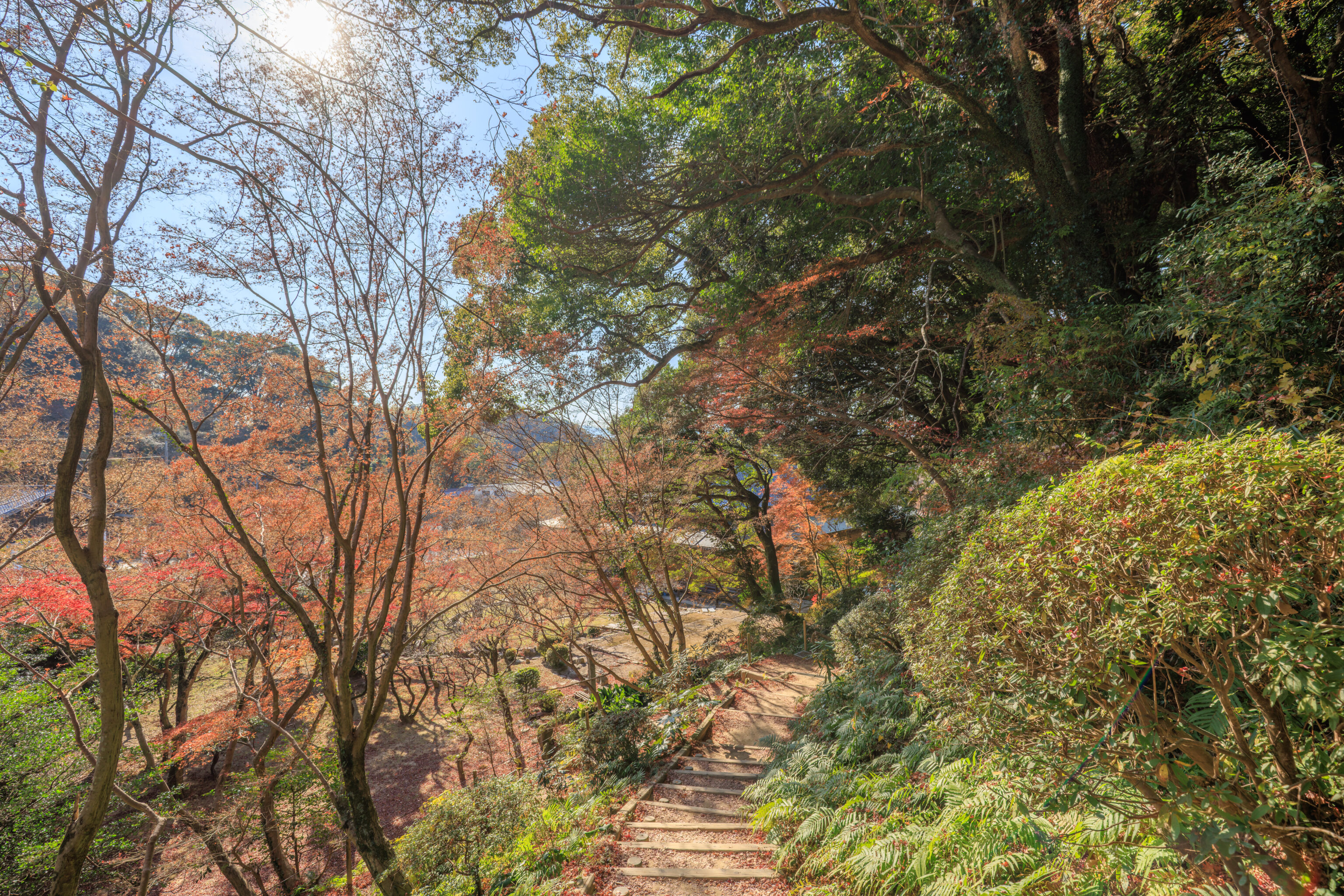
We followed the path as it began to descend.
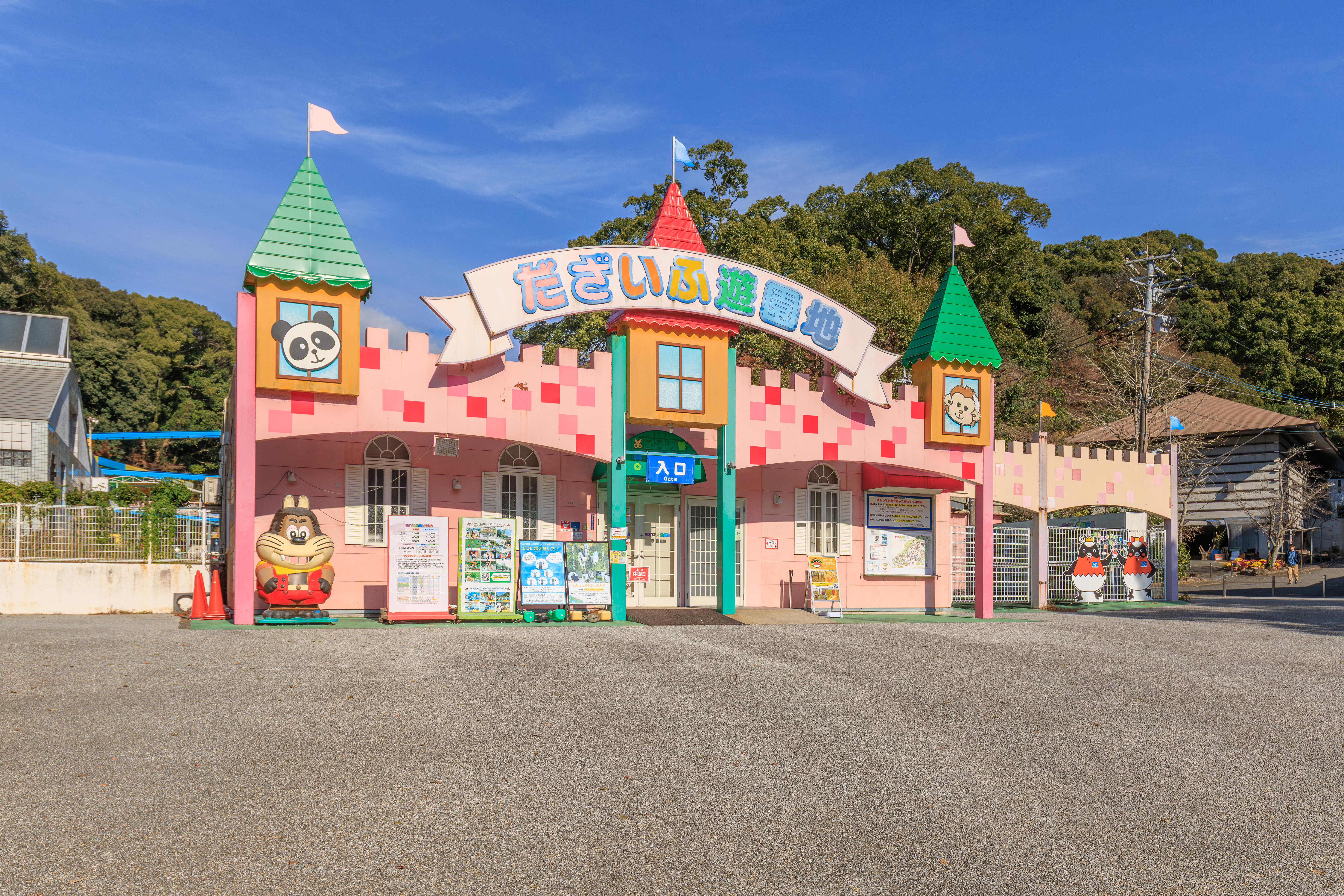
We ended up by the entrance to the amusement park, which was closed. There were a few people inside though, perhaps staff working on maintenance or something like that.
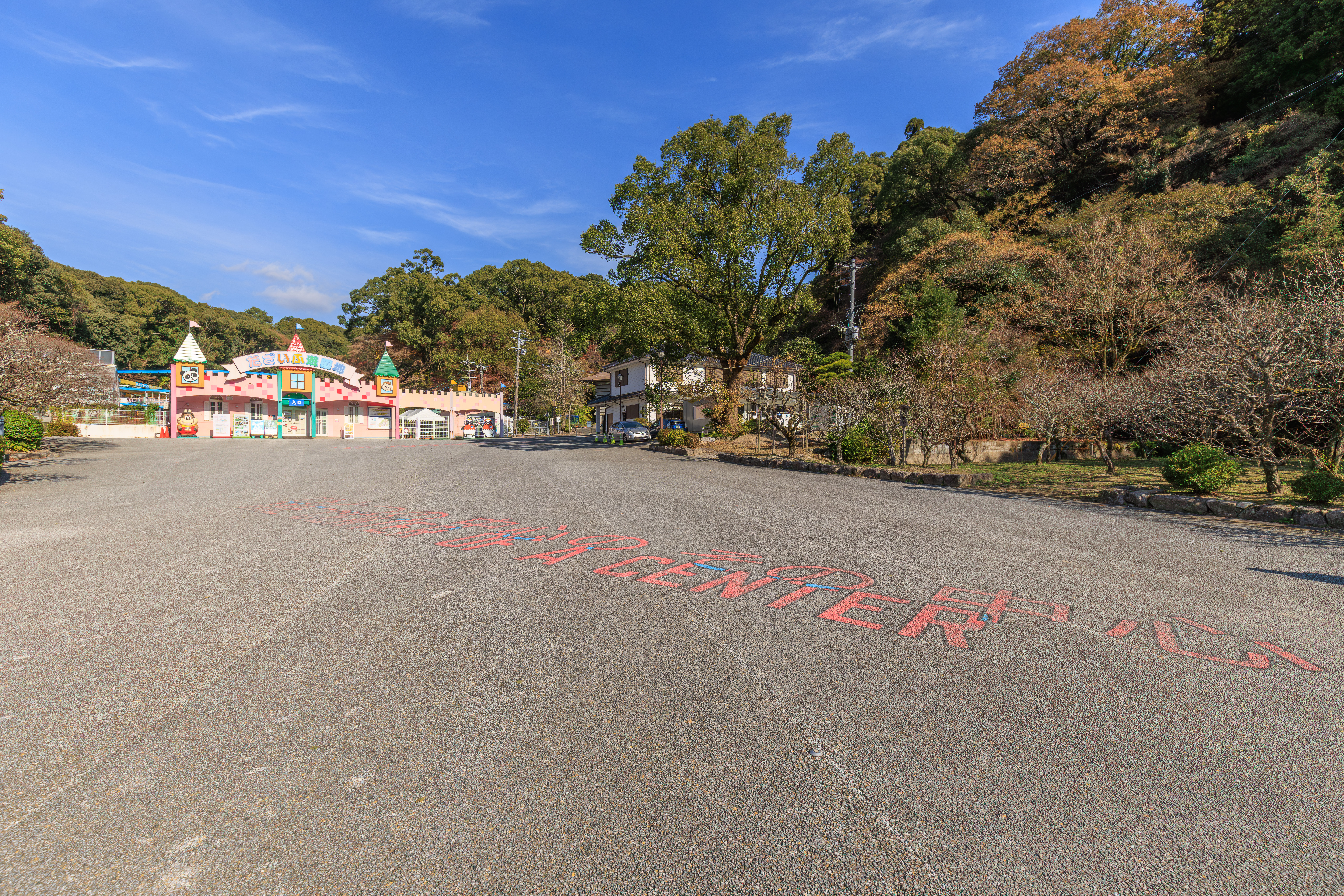
We noticed this text on the ground, THE CENTER OF A CENTER. Huh? We didn’t realize it at the time but it was another art installation by Lawrence Weiner in 2020.
— The center of a center?
The artist, who sees his own works as sculptures realized through combinations of words, created the sculpture THE CENTER OF A CENTER in a spacious area on the ground, while pondering Dazaifu Tenmangu. Although the deep meaning of these words may seem bewildering, the artist argues that the important point is to walk on the ground while thinking about the words that are written here. He says that this work can mean nothing on its own but gains meaning as a work of art once it has inspired communication between the viewer and the work.

©Lawrence Weiner, Courtesy of TARO NASU, Photo by Kazuaki Koganemaru
– Text from the Keidai Art Museum website Map page: https://keidai.art/en/aruku.
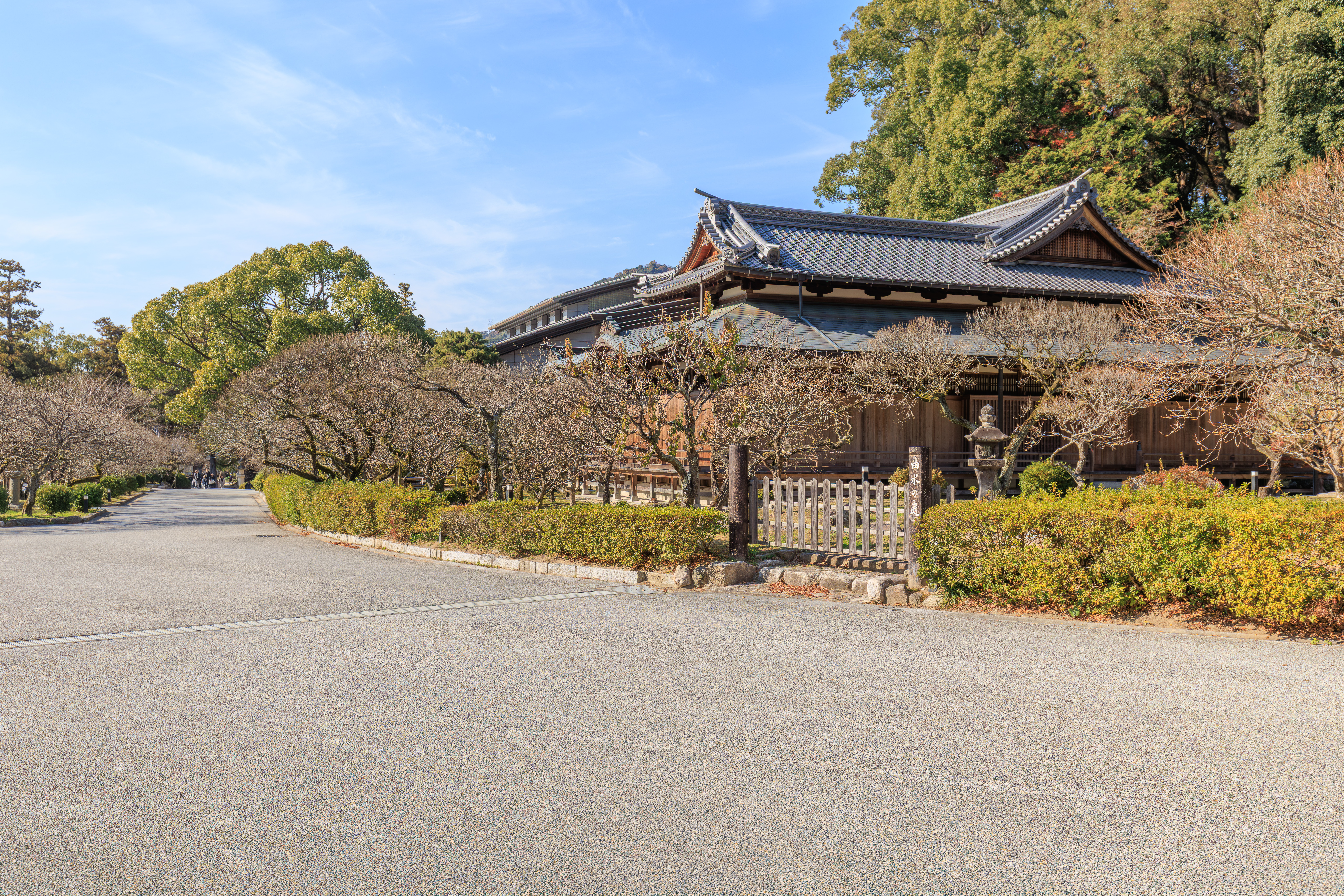
We continued past the amusement park. This building here on the right, which is next to the Dazaifu Tenmangu Musuem, is the shrine’s archives building.
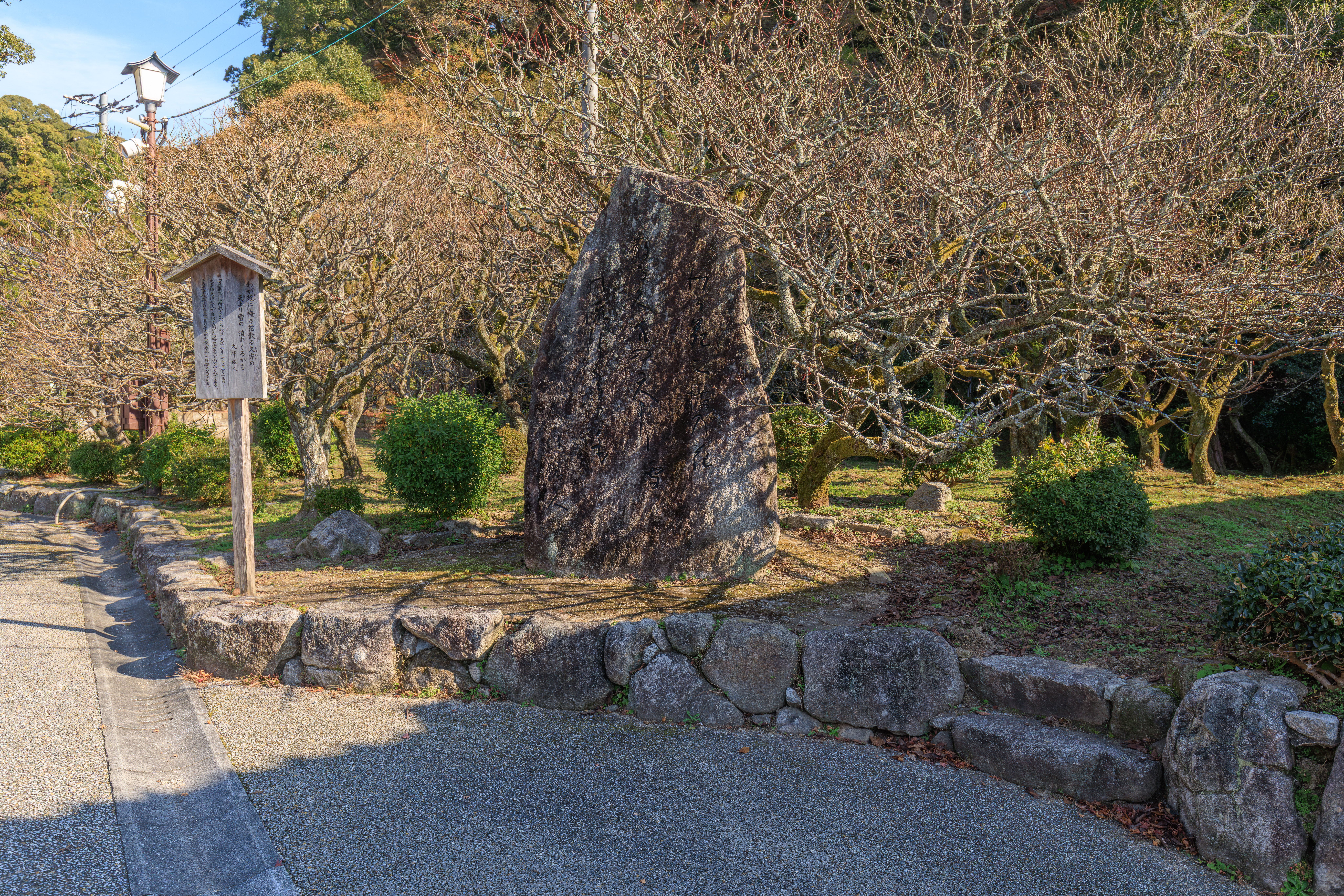
Hisakata
In my garden, where plum blossoms flutter down,
Does a stream of snow drift hither
From the distant, high heavens above?
— Ōtomo no Tabito

This poem, collected in the *Man'yōshū* (Collection of Ten Thousand Leaves), was composed on the 13th day of the first month of Tenpyō 2 (730).

It was recited by Ōtomo no Tabito—then serving as the Governor-General of Dazaifu—during the "Plum Blossom Banquet" (Ume no Hana no En) hosted at his private residence.

Notably, the preface to the thirty-three poems composed at this very gathering served as the textual source for the current era name, "Reiwa."
– Text from the sign on the left, translated using Google.
Kyushu National Museum
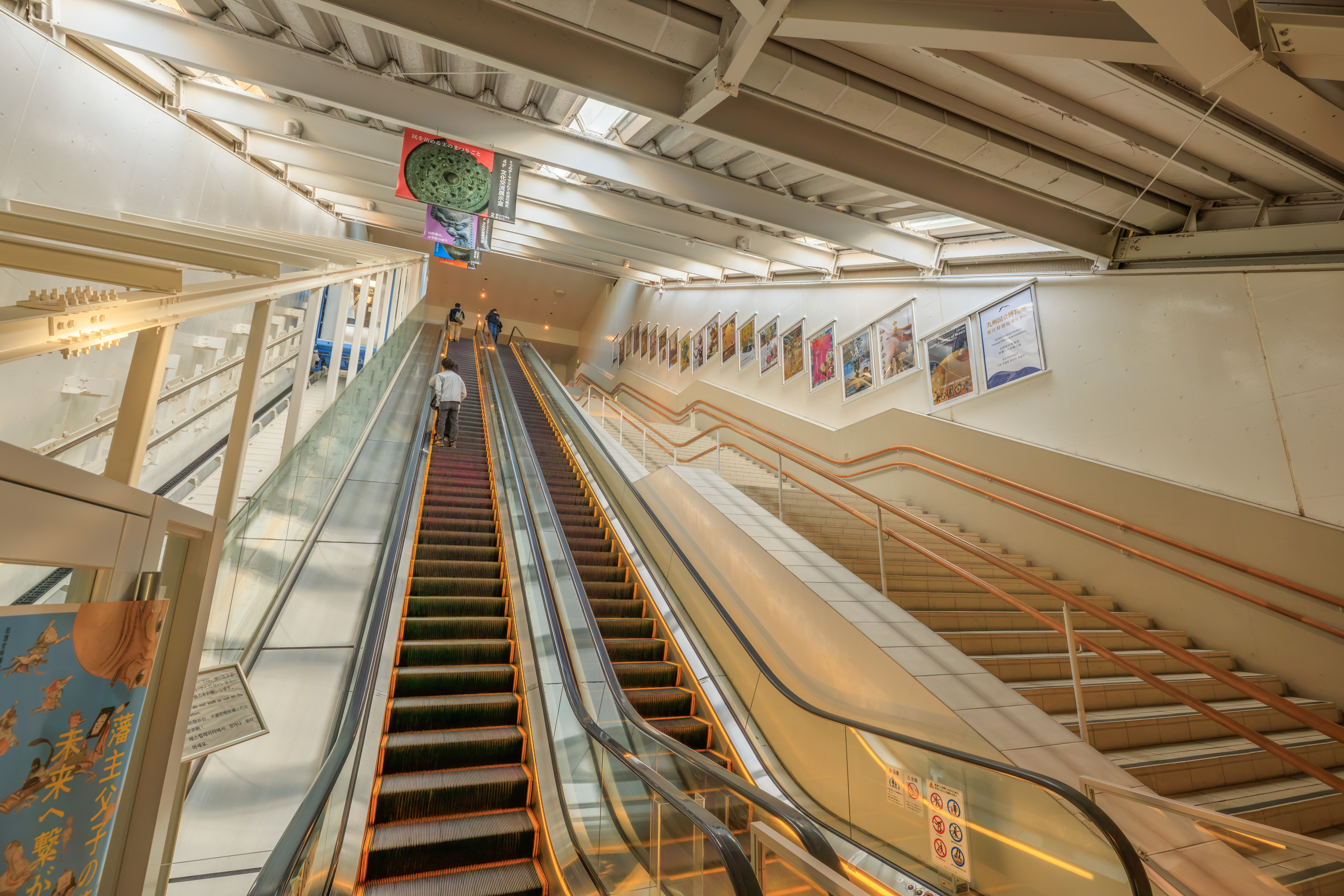
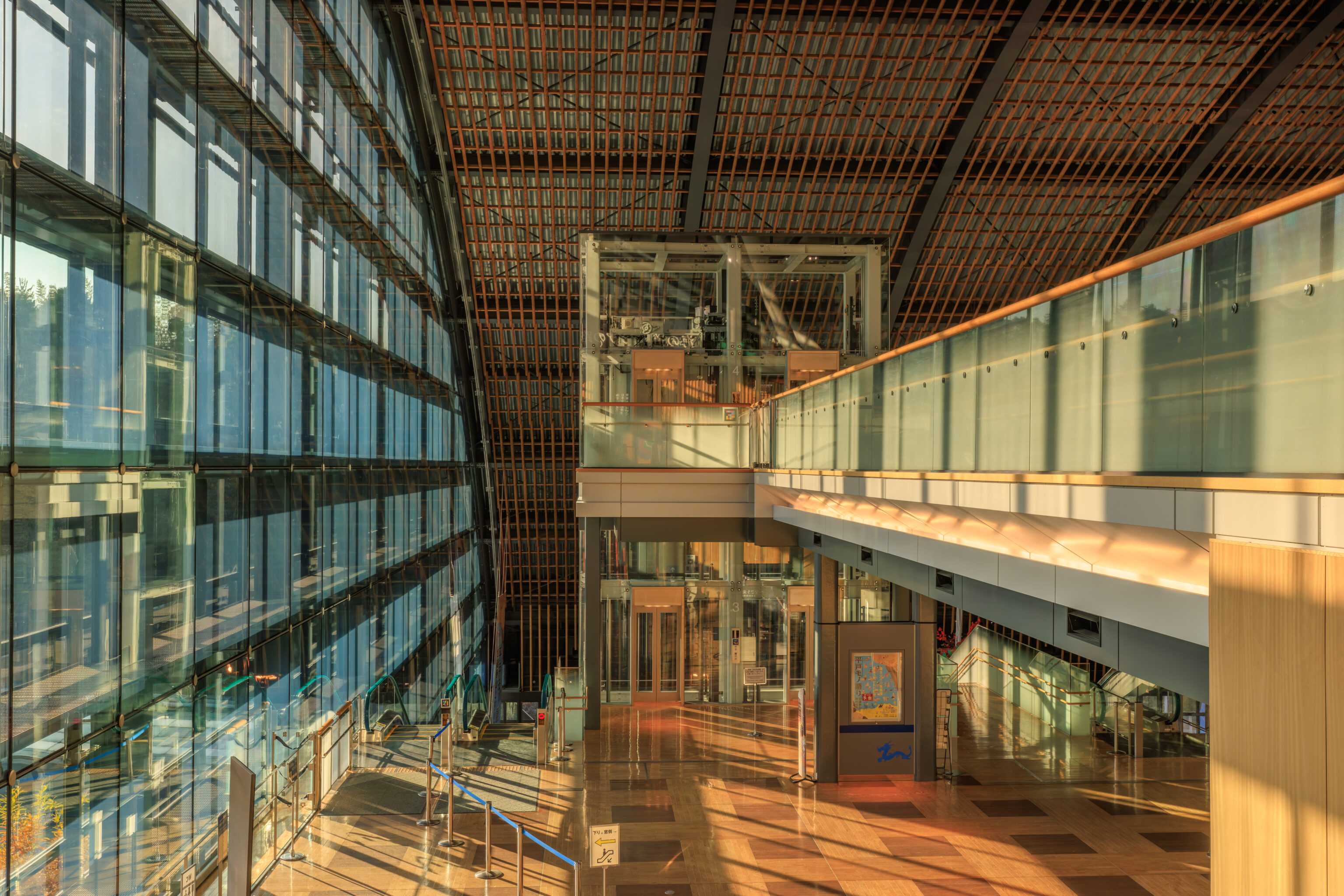
The entrance to the 九州国立博物館 Kyushu National Museum is between Dazaifu Tenmangu and the amusement park. Or more accurately, there is an escalator here that goes up the side of a hill to the museum.
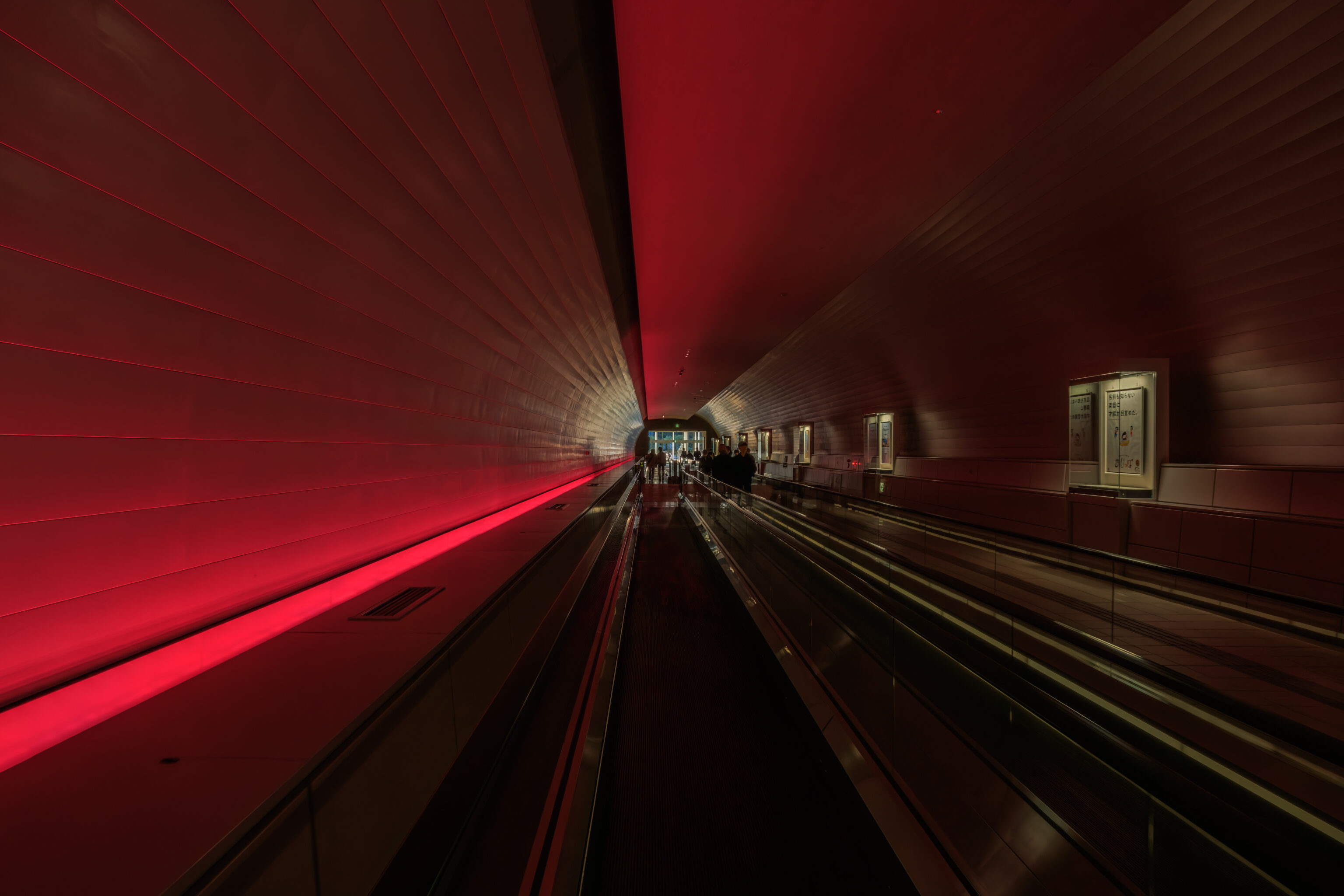
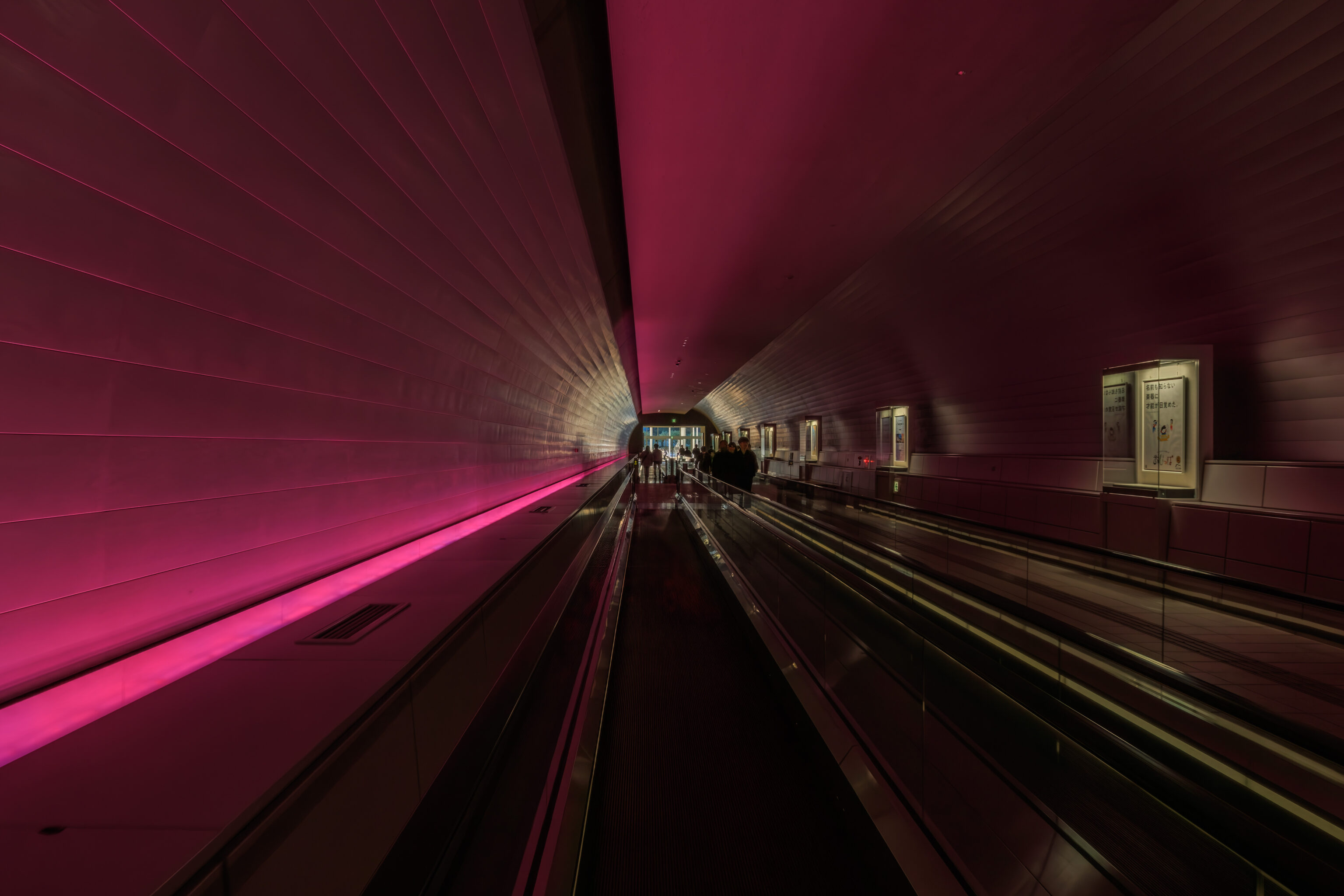
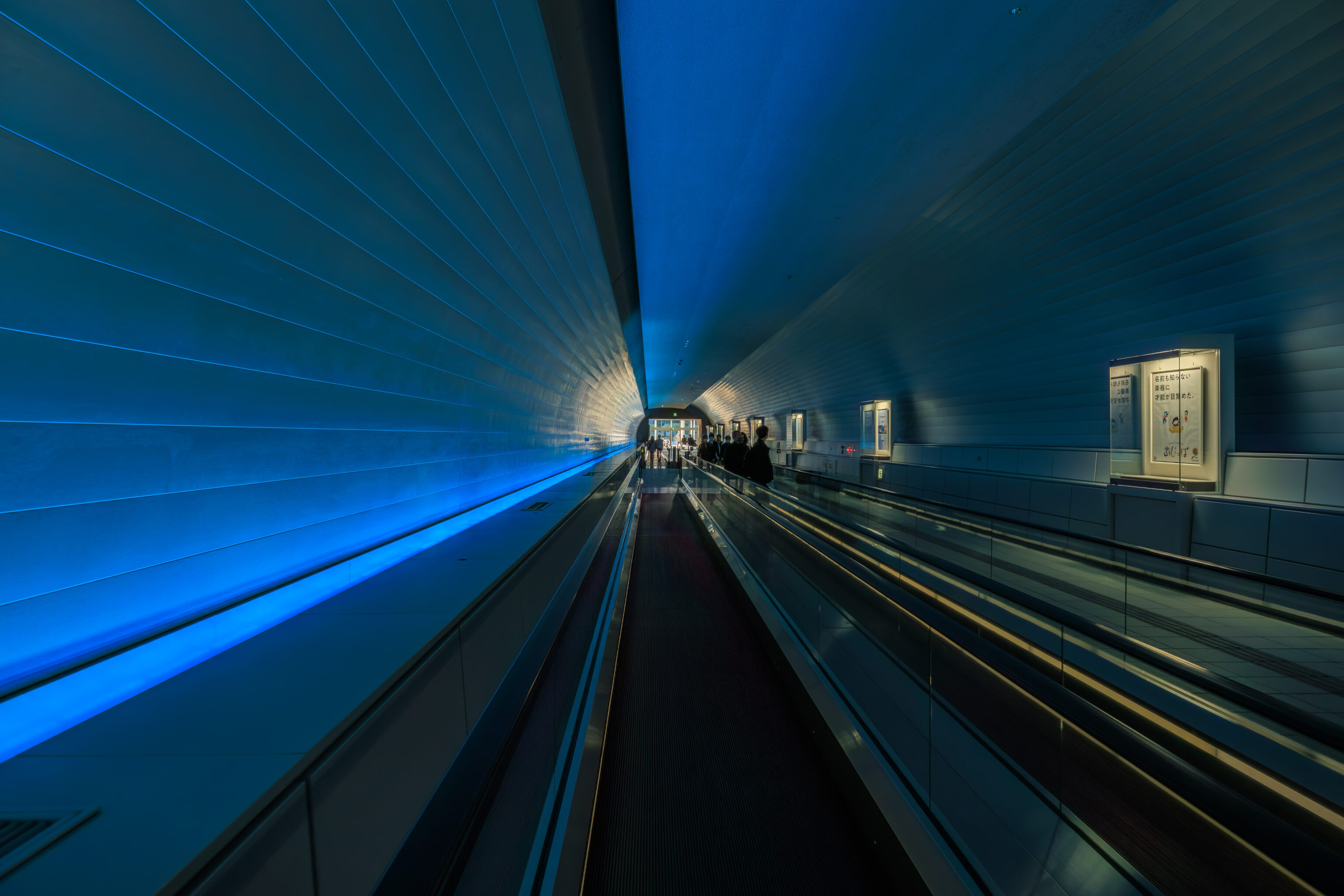
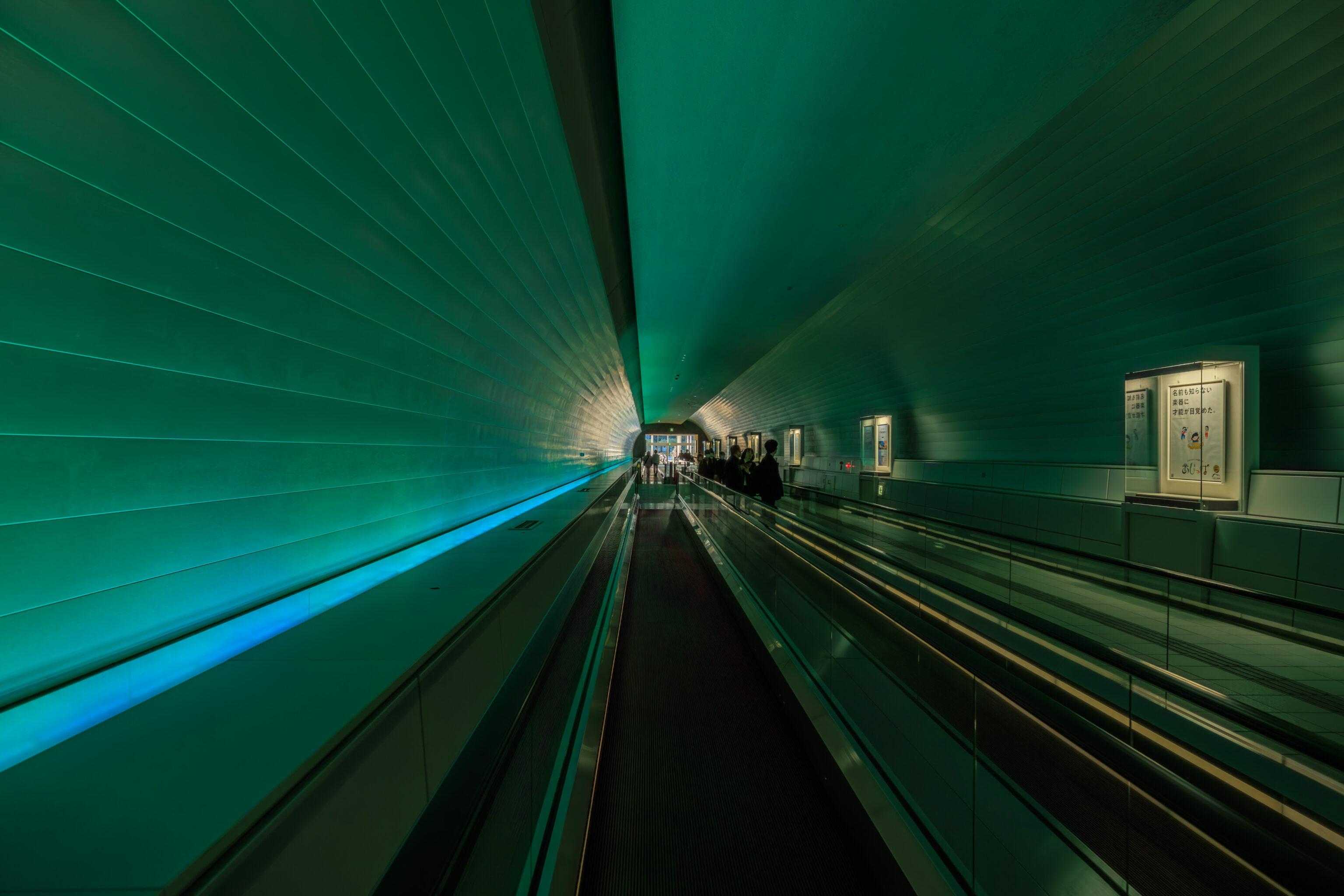
After the escalator, there is a level tunnel with moving walkways. The colors in the tunnel change over time.
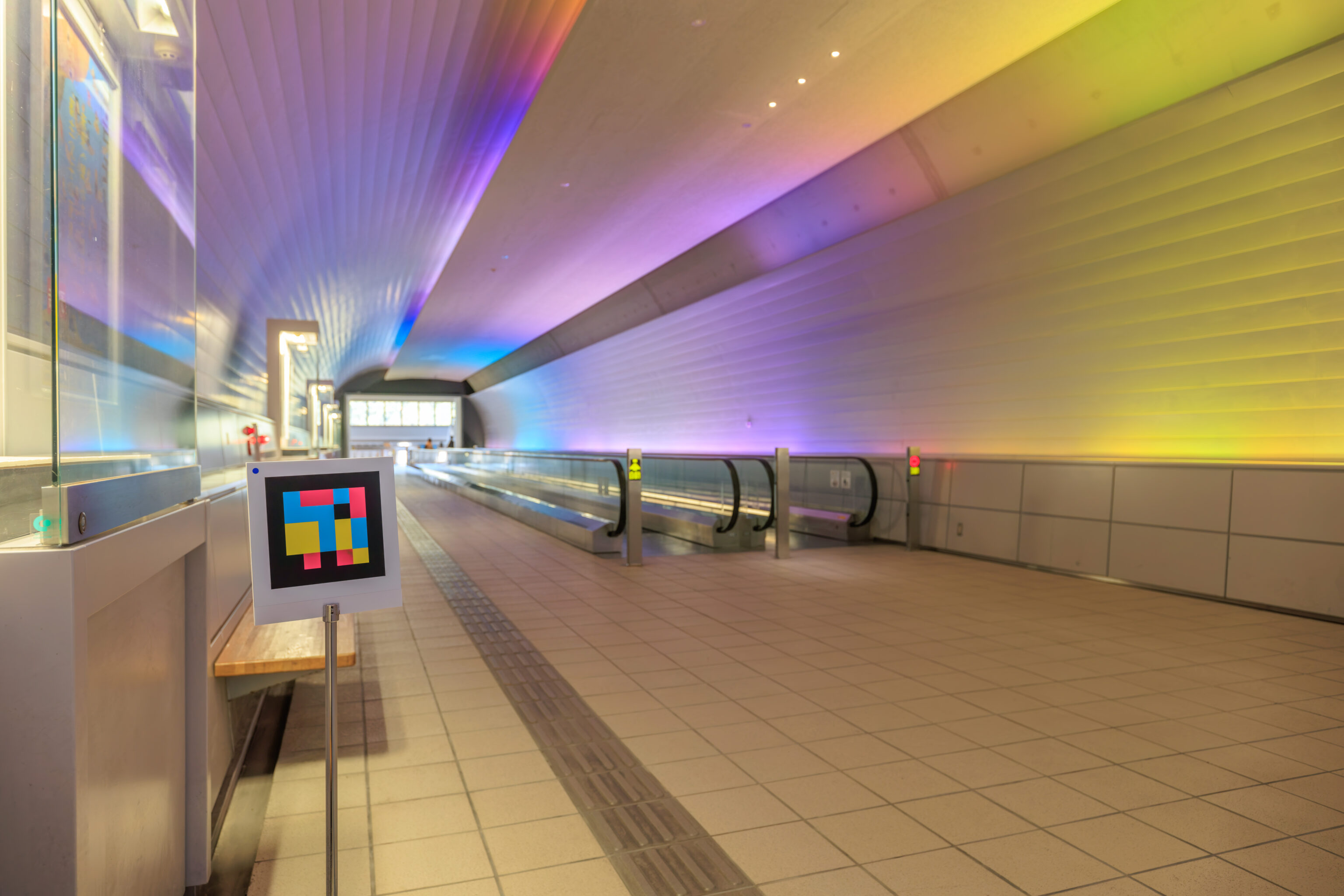
We weren’t sure what this square sign meant.
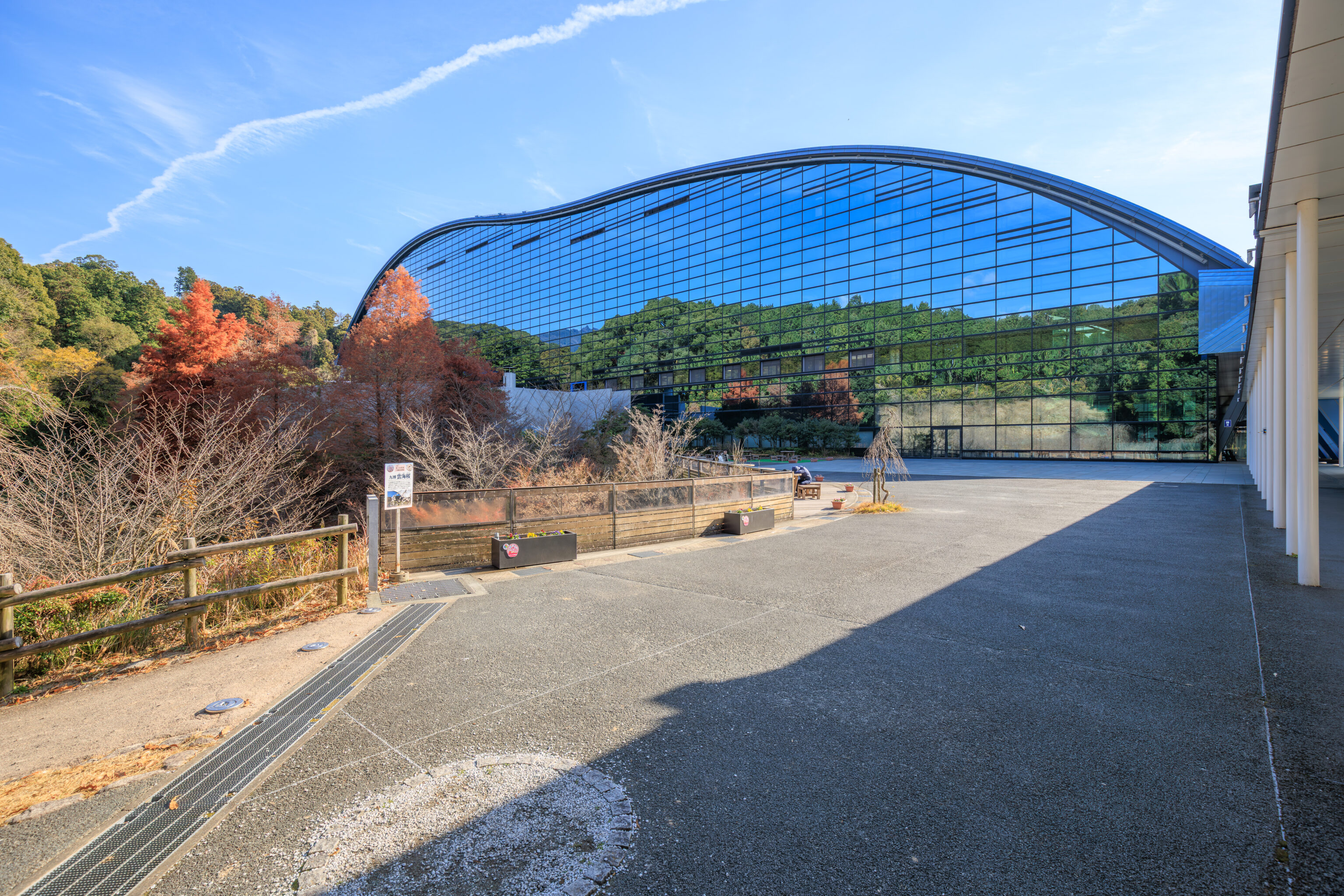
After exiting the tunnel, we saw the modern building that houses the museum.
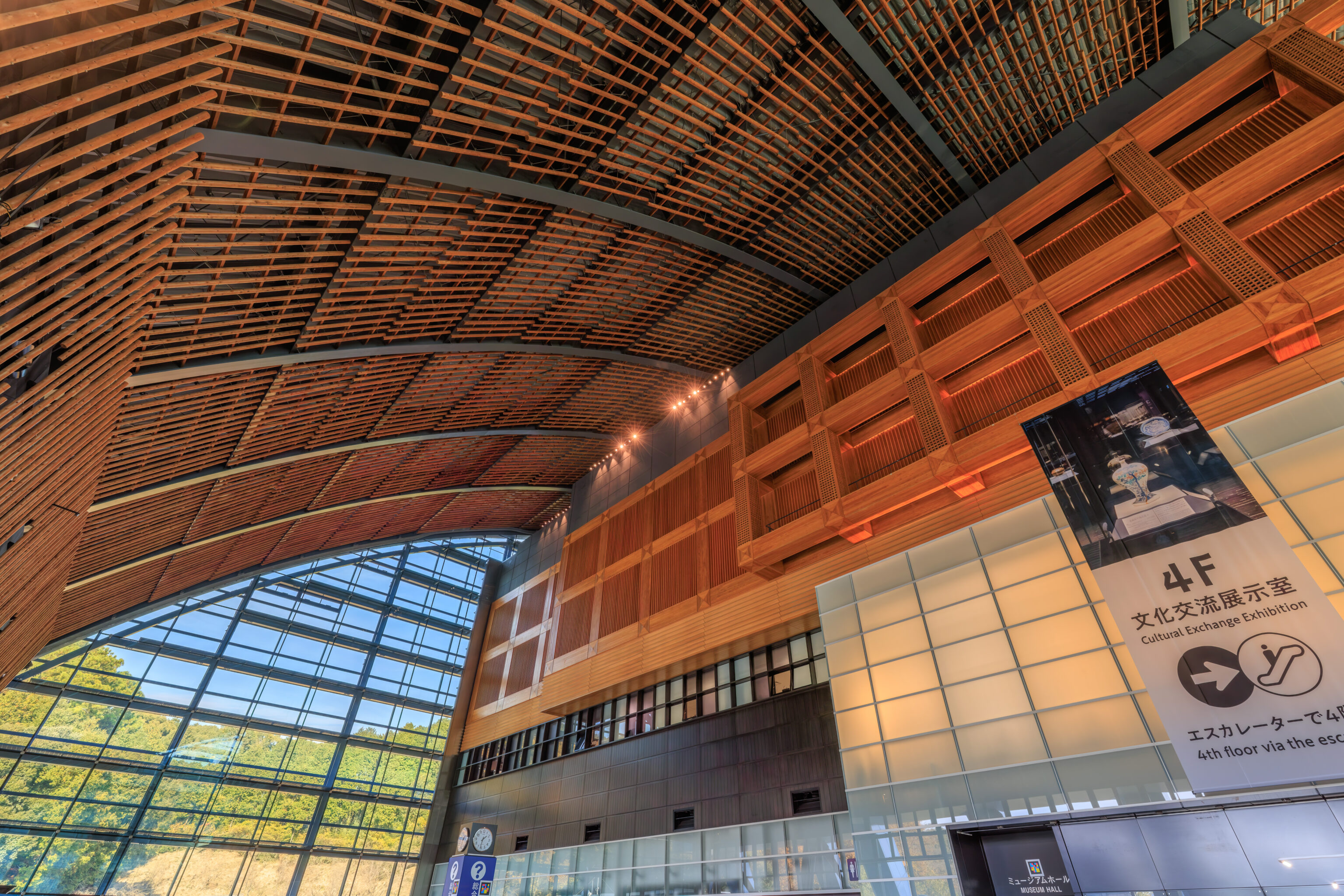
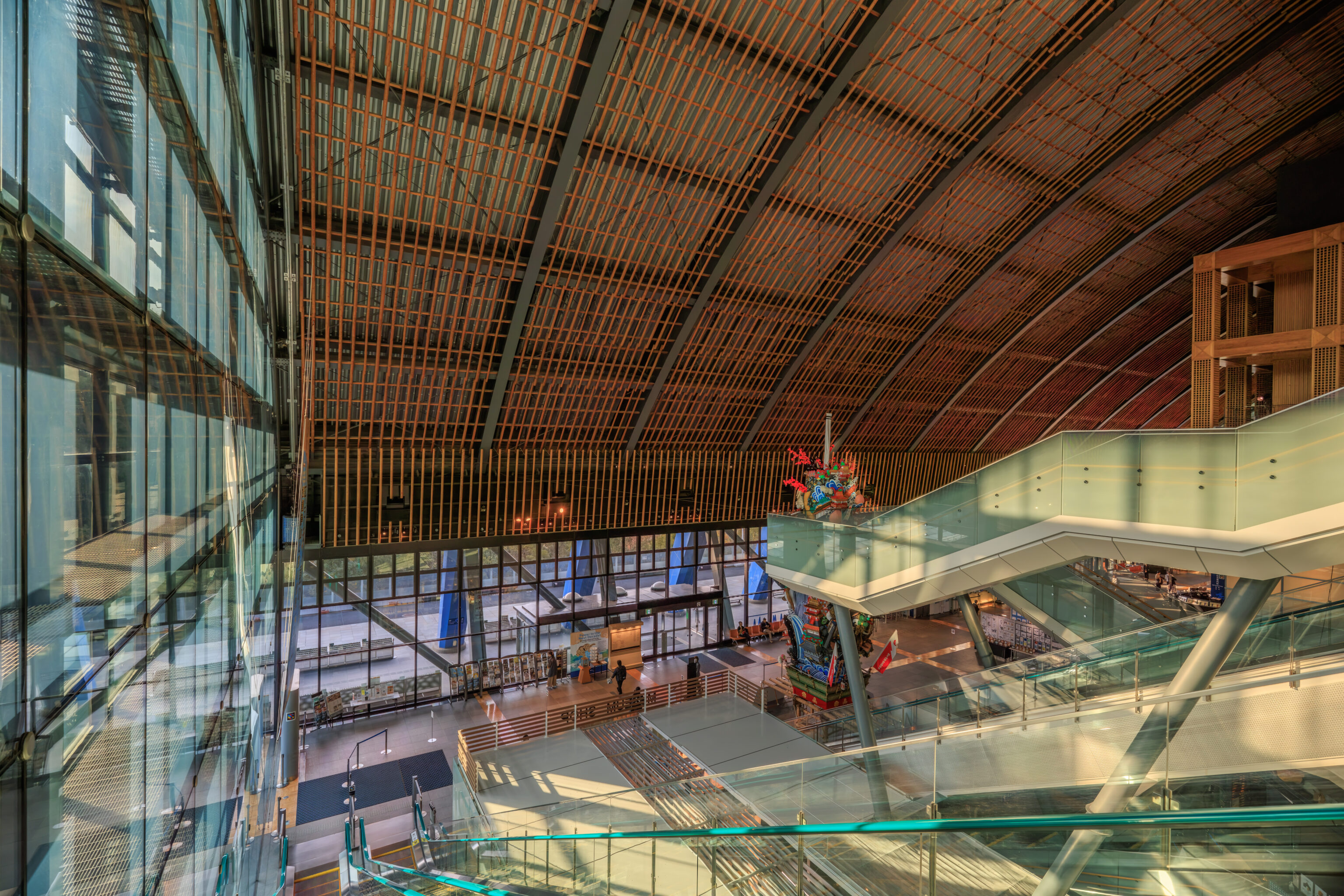
We entered into a vast open space. The building seems to actually be a shell around a more conventional structure inside.
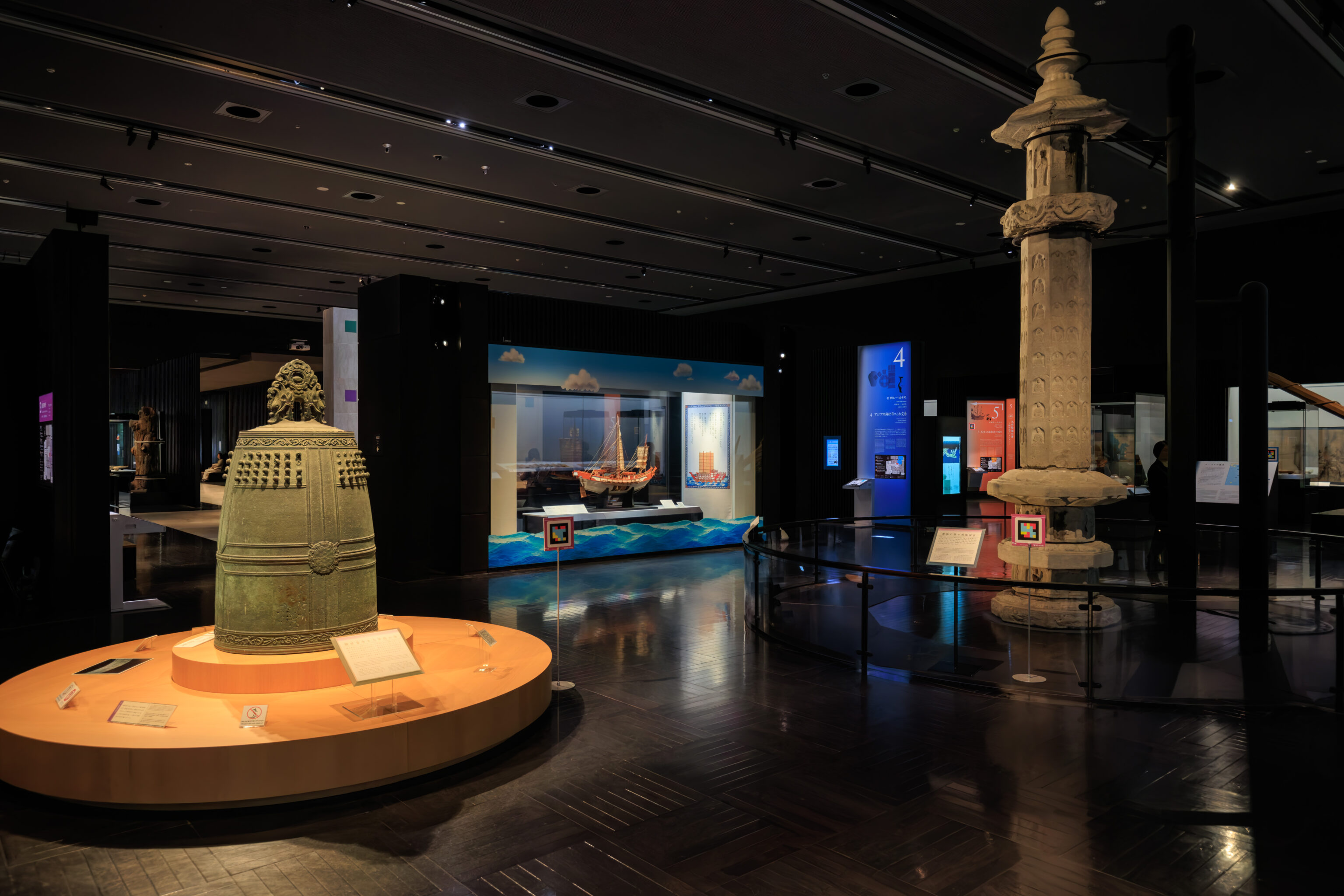
We bought tickets and left our bags and jackets at the cloakroom. It is the 20th anniversary of this museum!
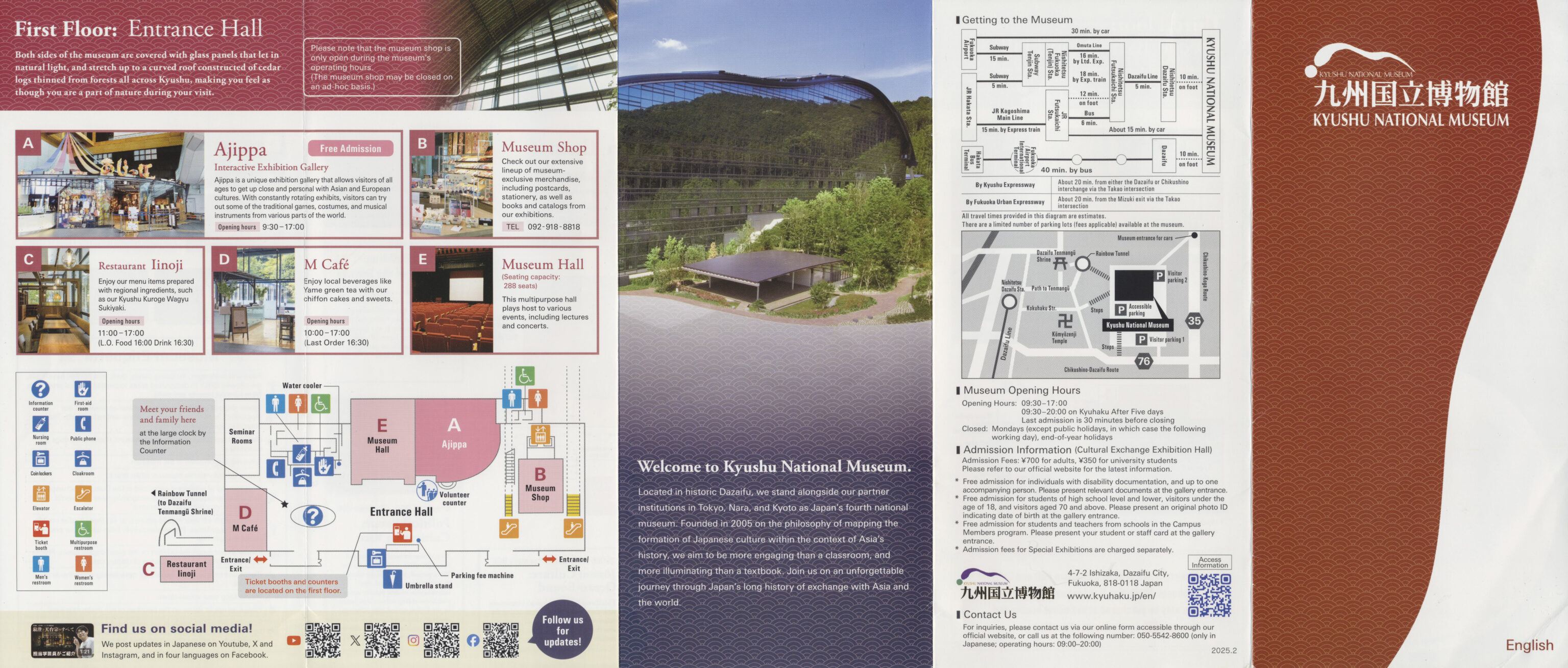
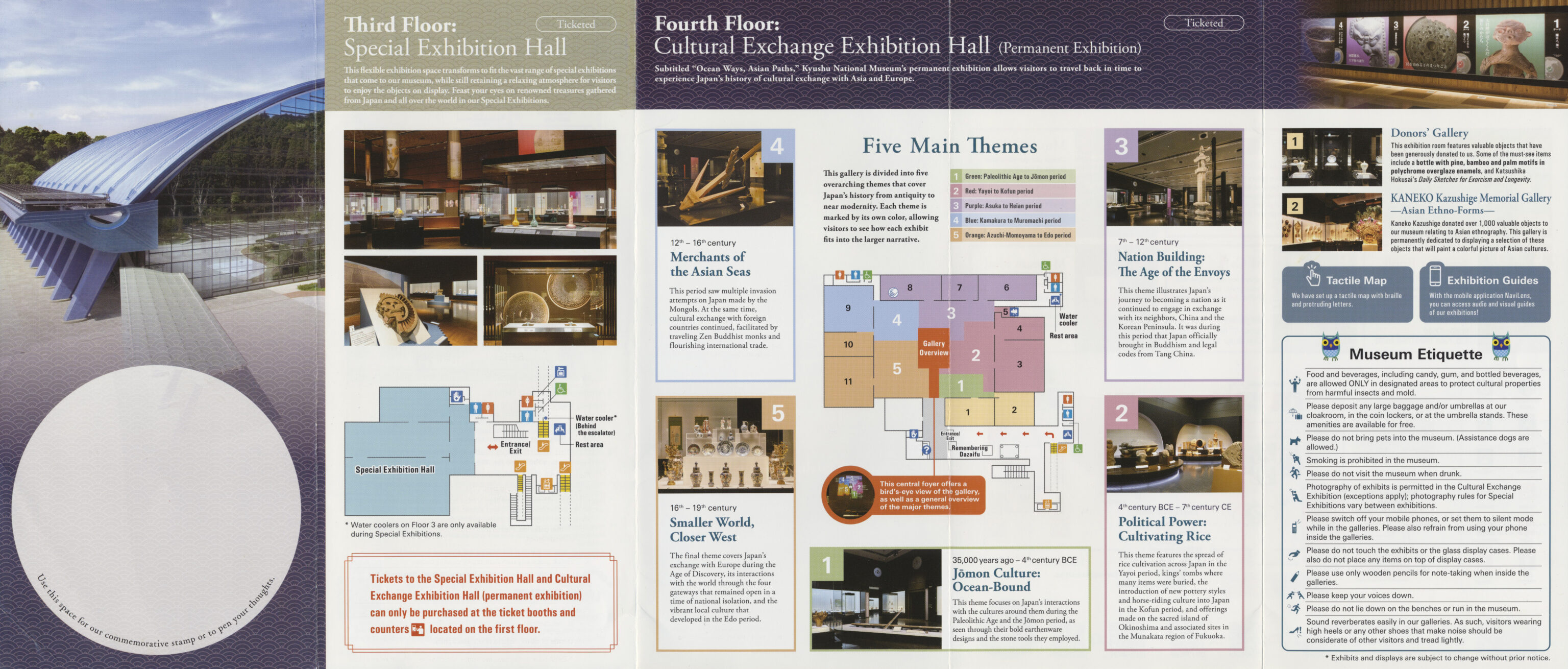
We also picked up a map of the museum.
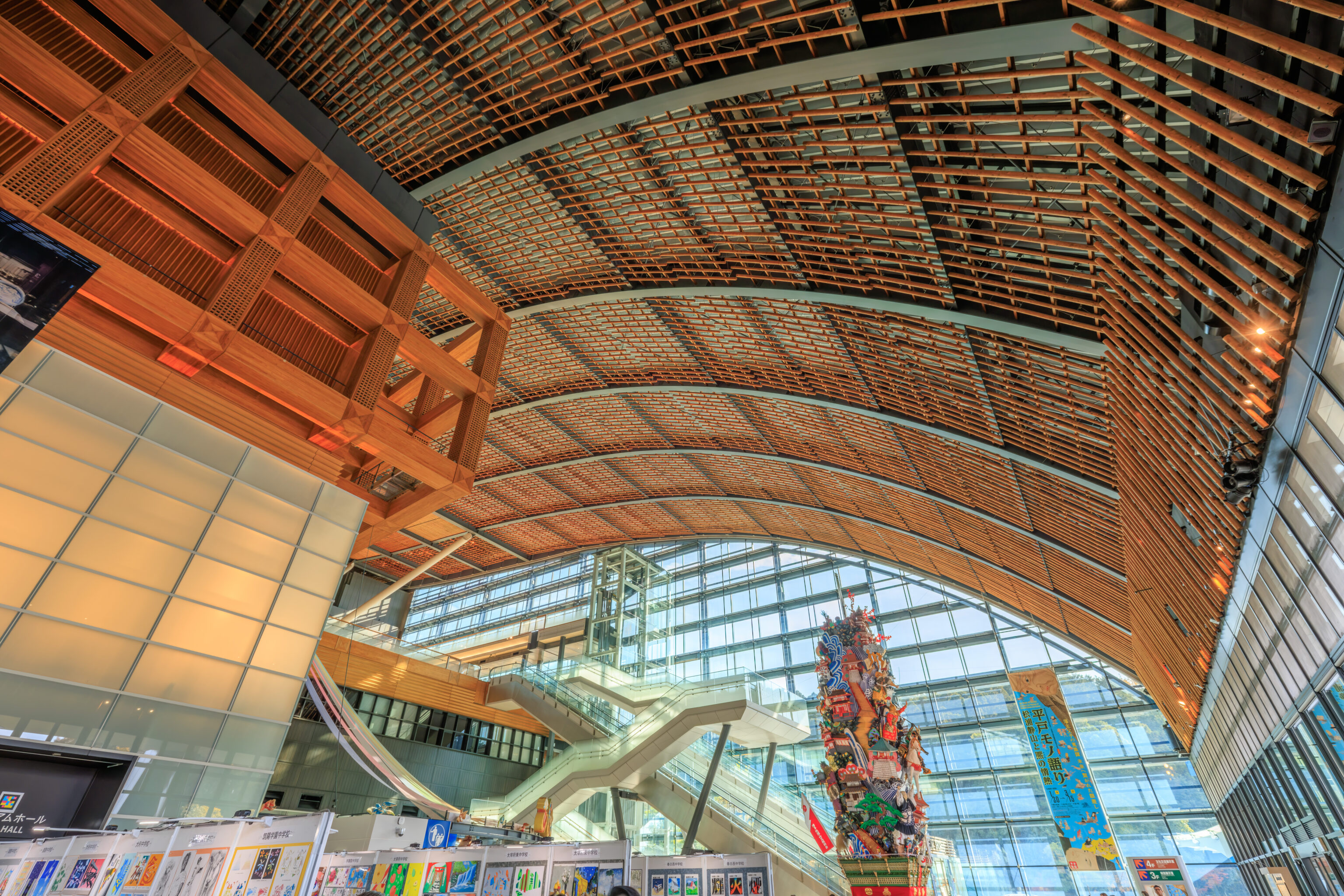
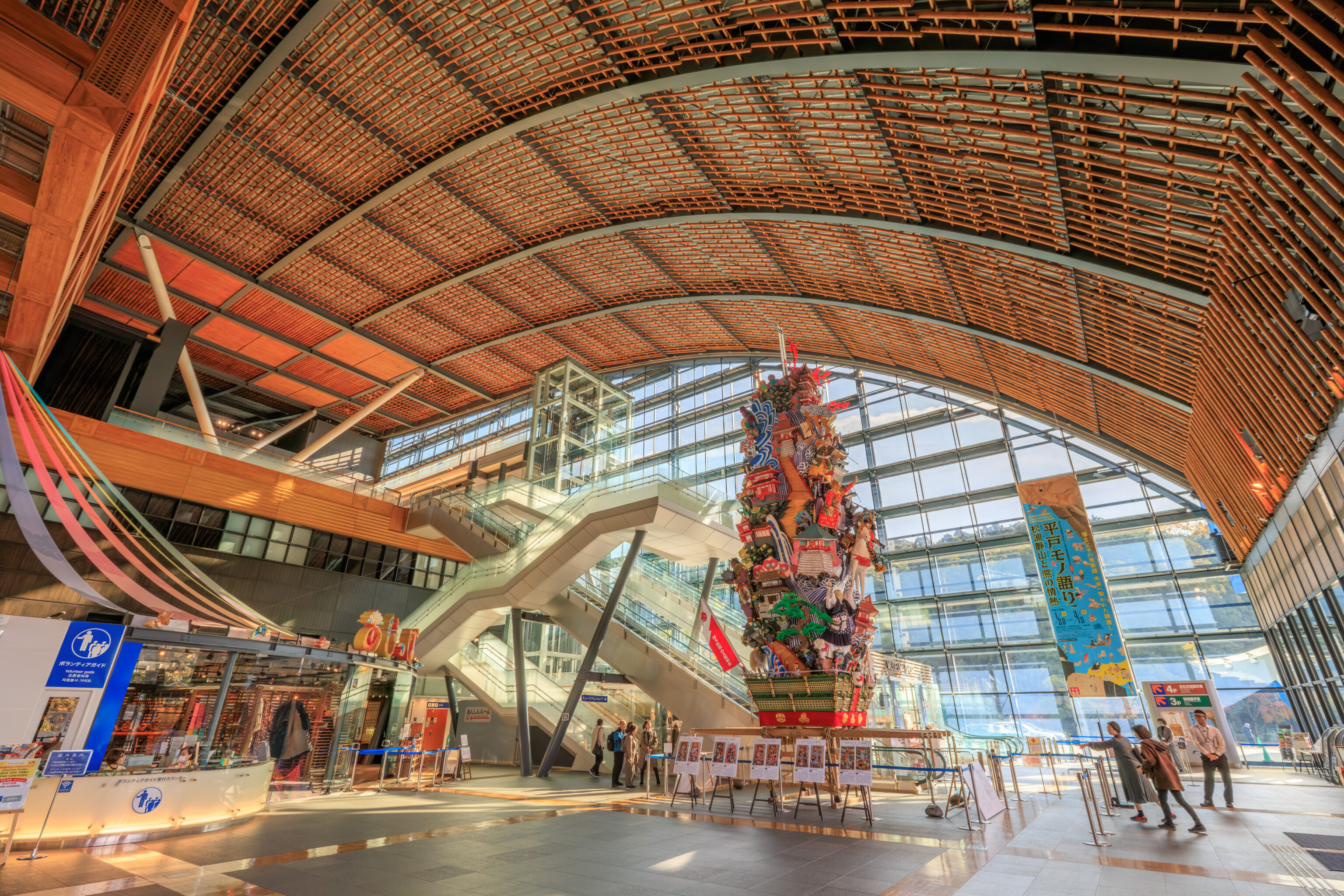
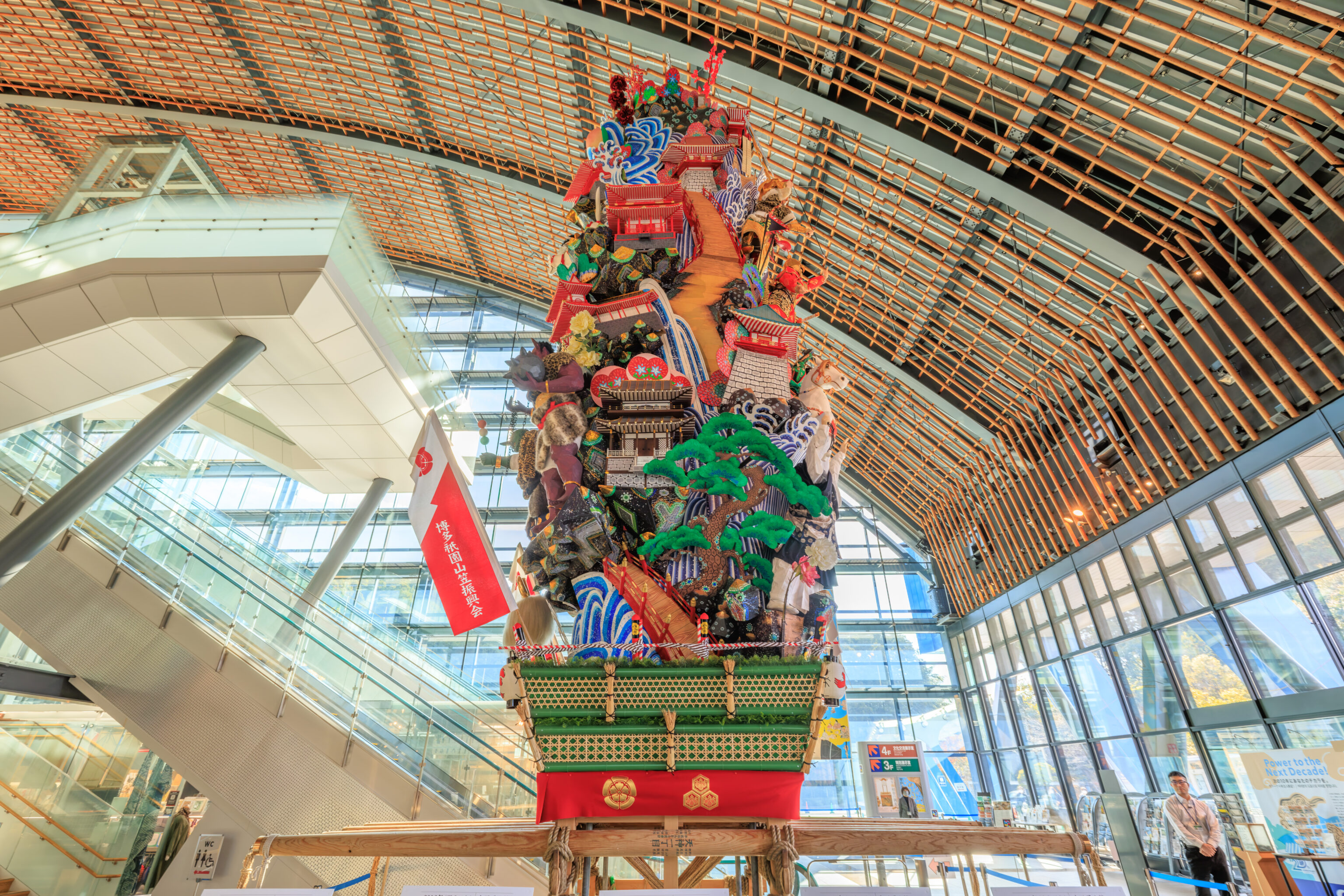
There was a large 飾り山 kazariyama, a type of matsuri float, near the escalators that go up to the exhibition space. The style of this float was very similar to the one we saw two days ago in Hakata at Kushida-jinja.
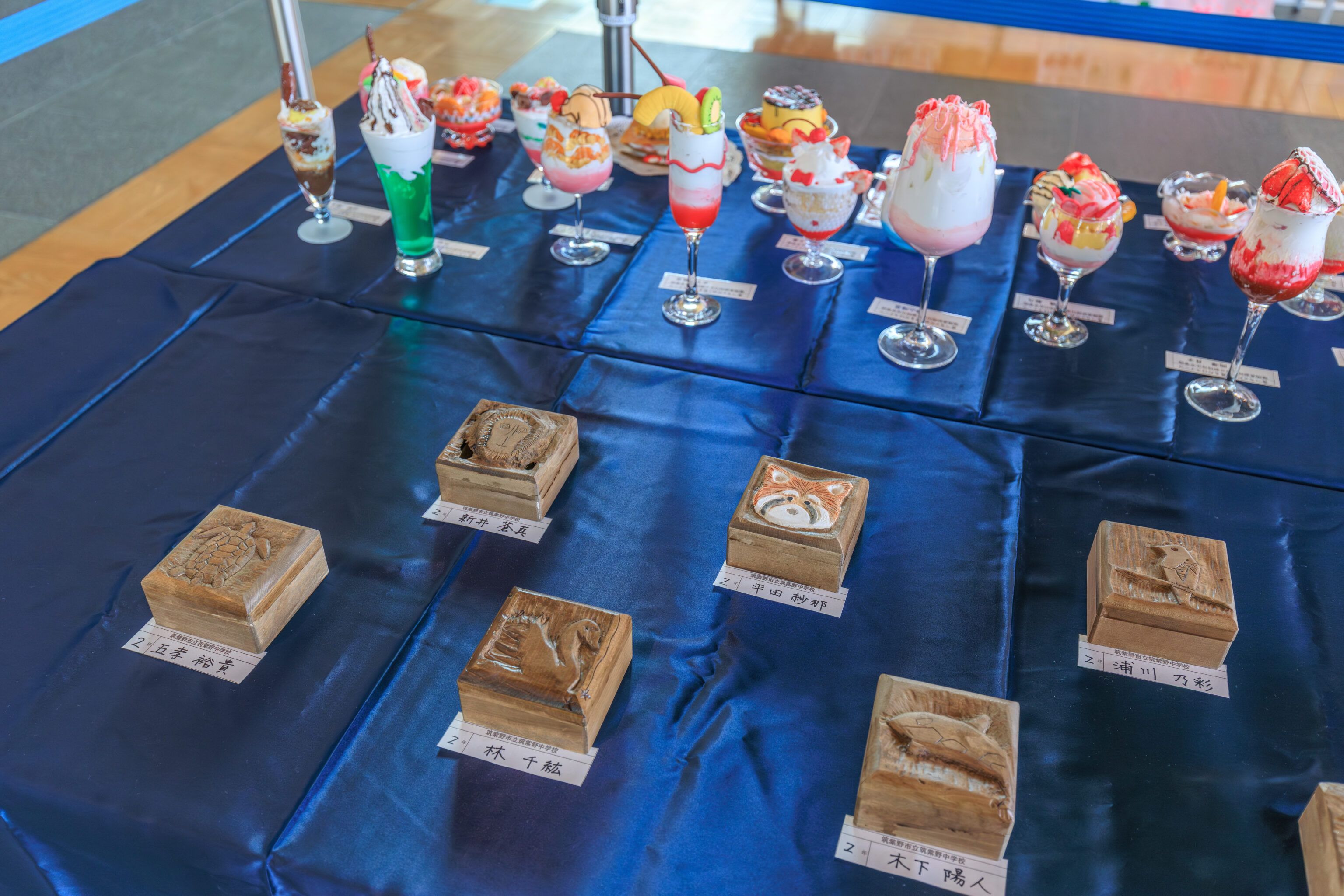
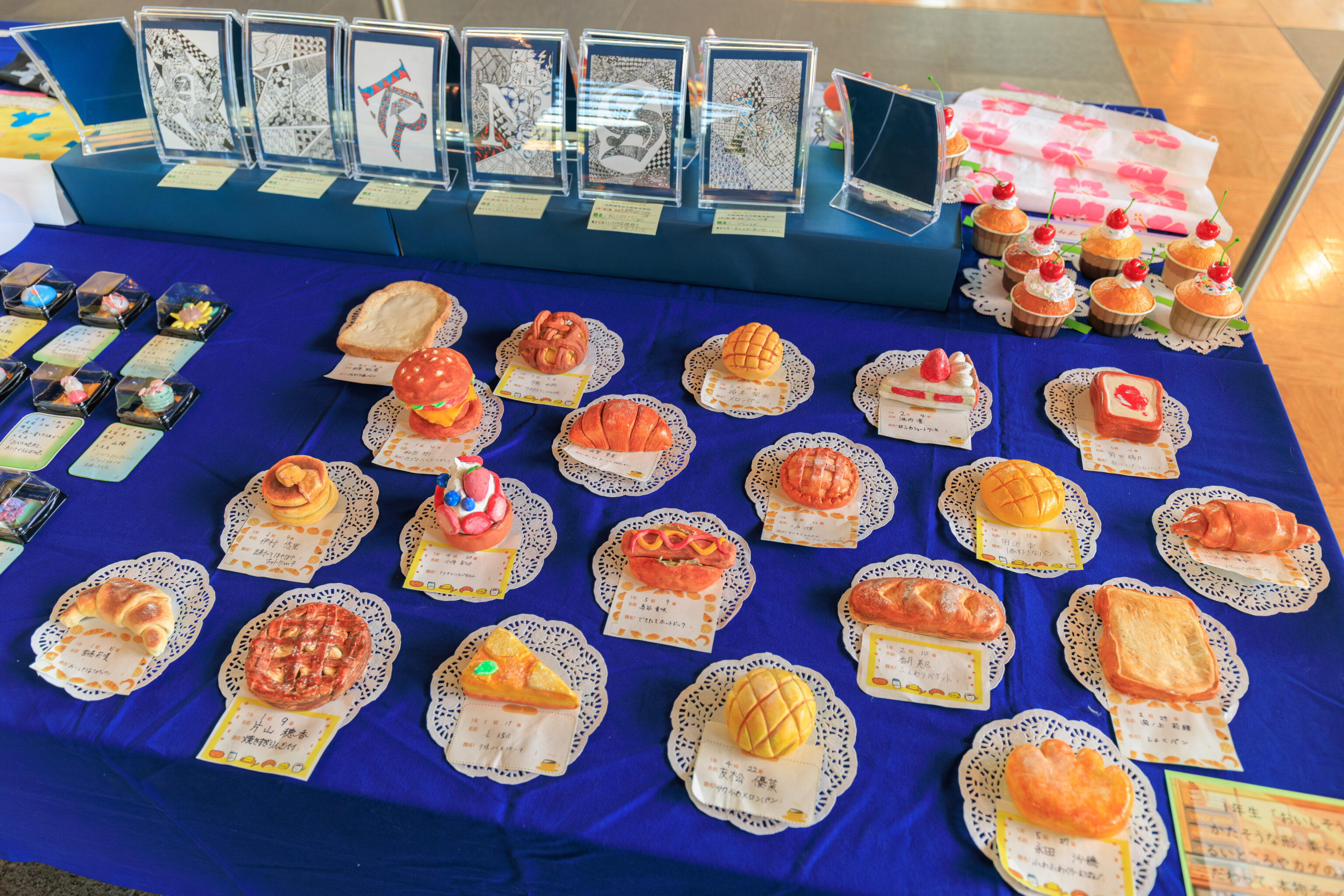
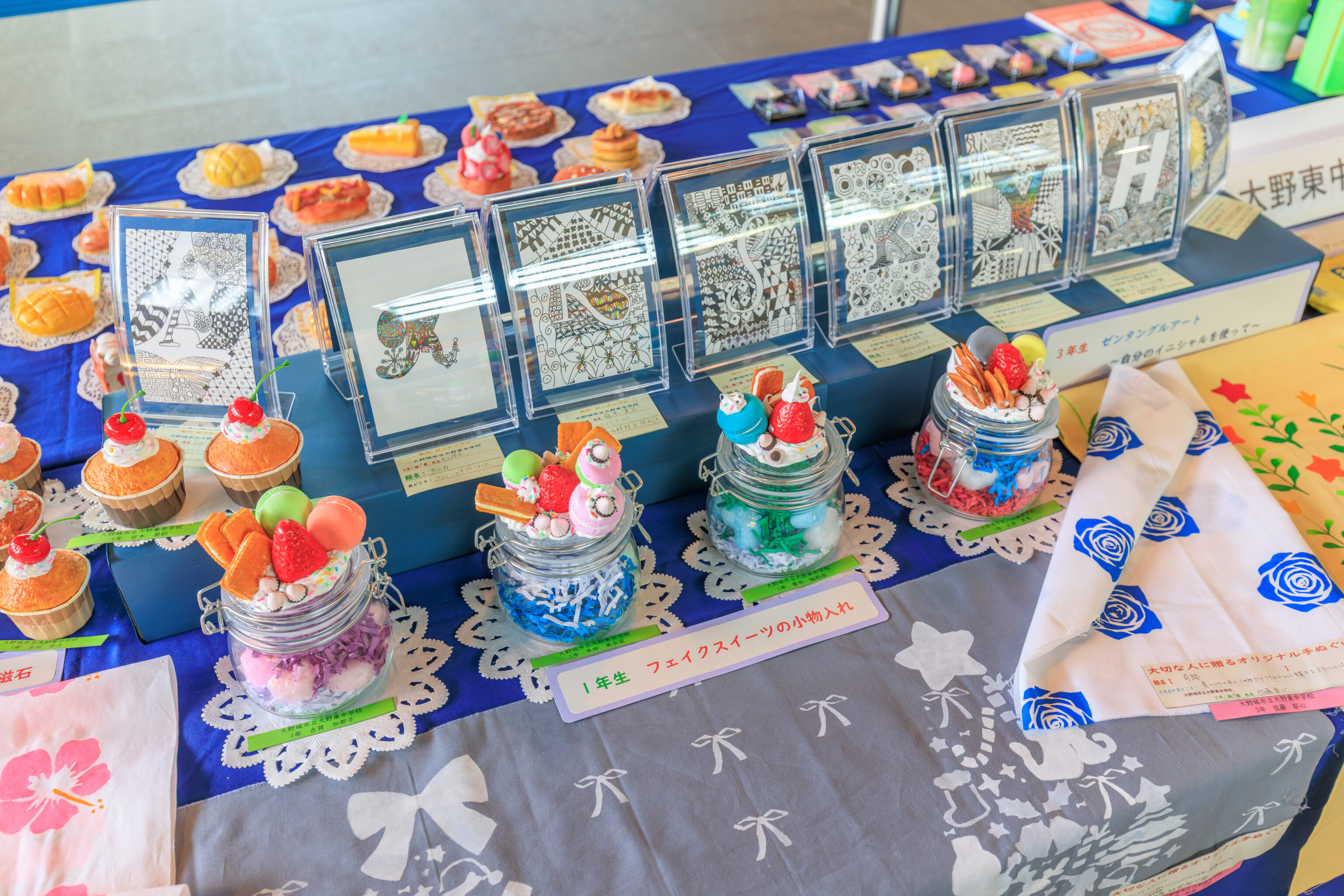
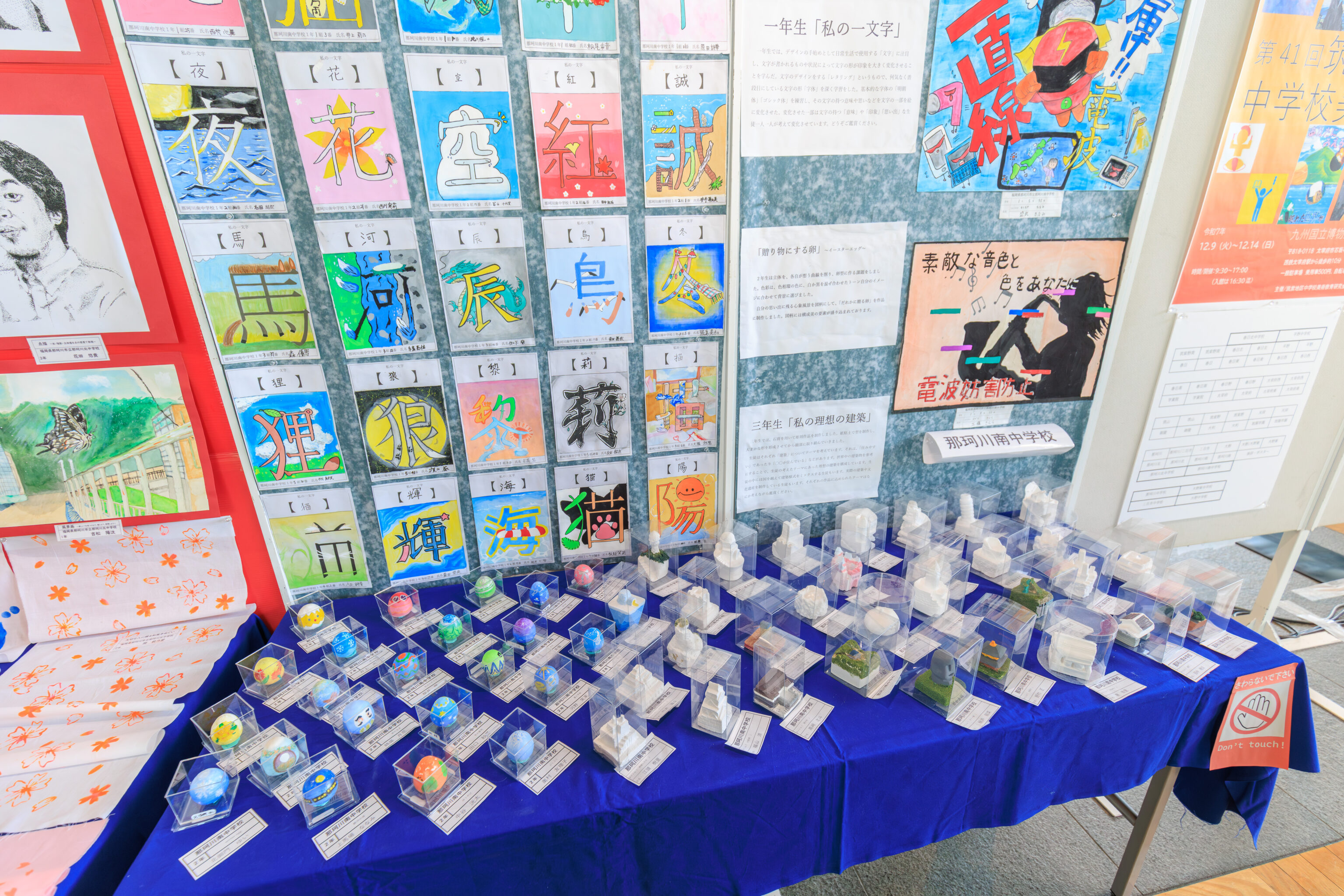
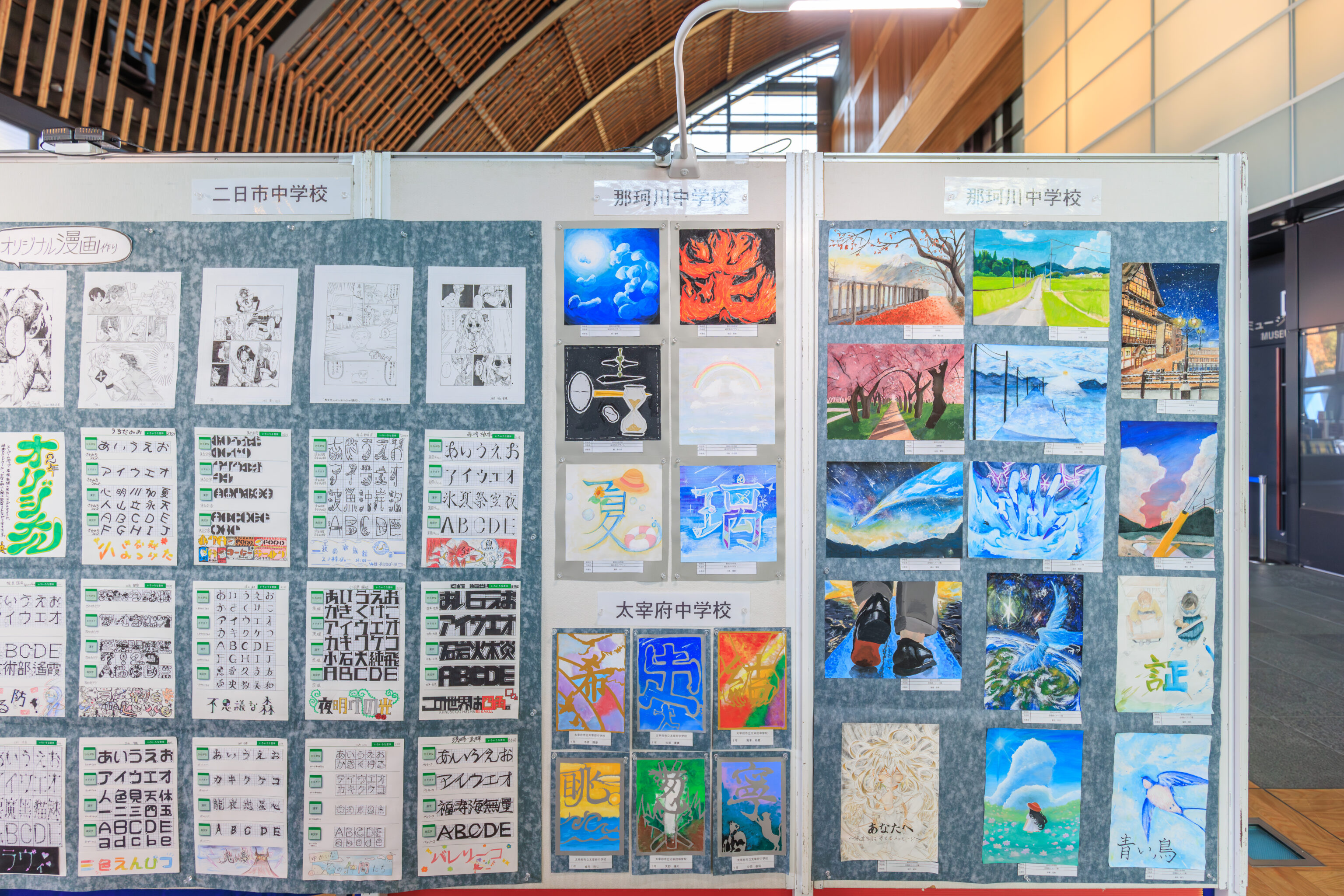
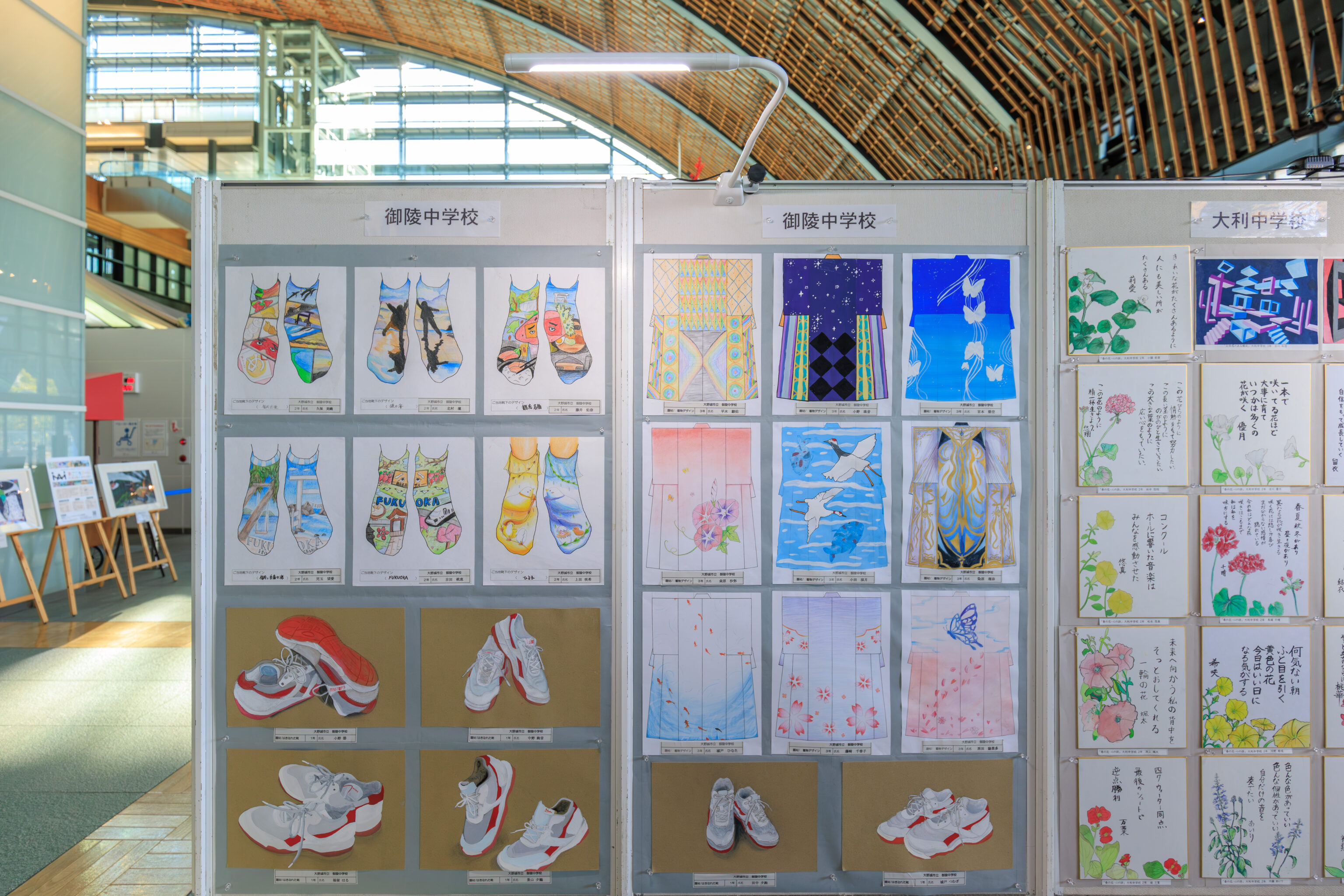
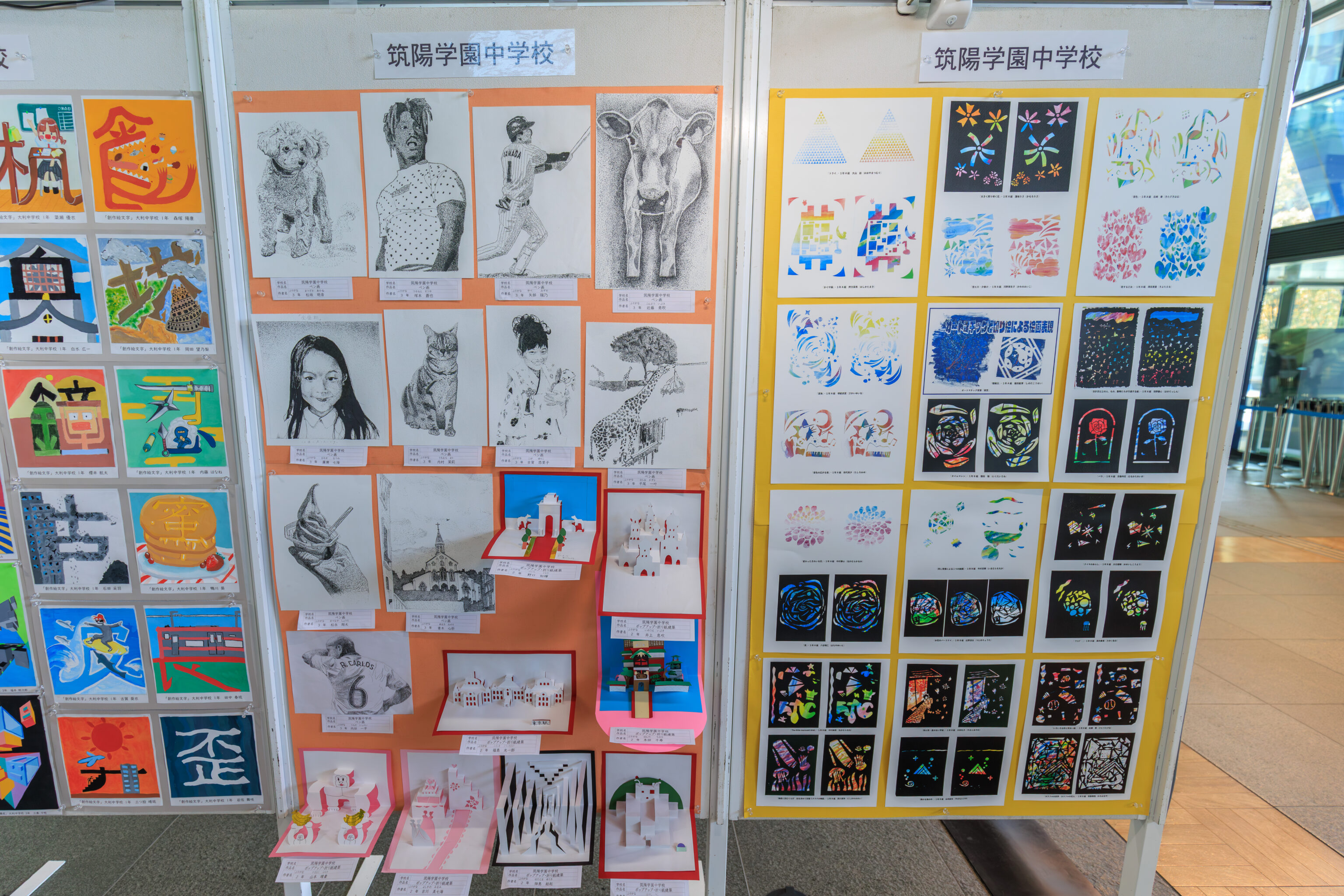
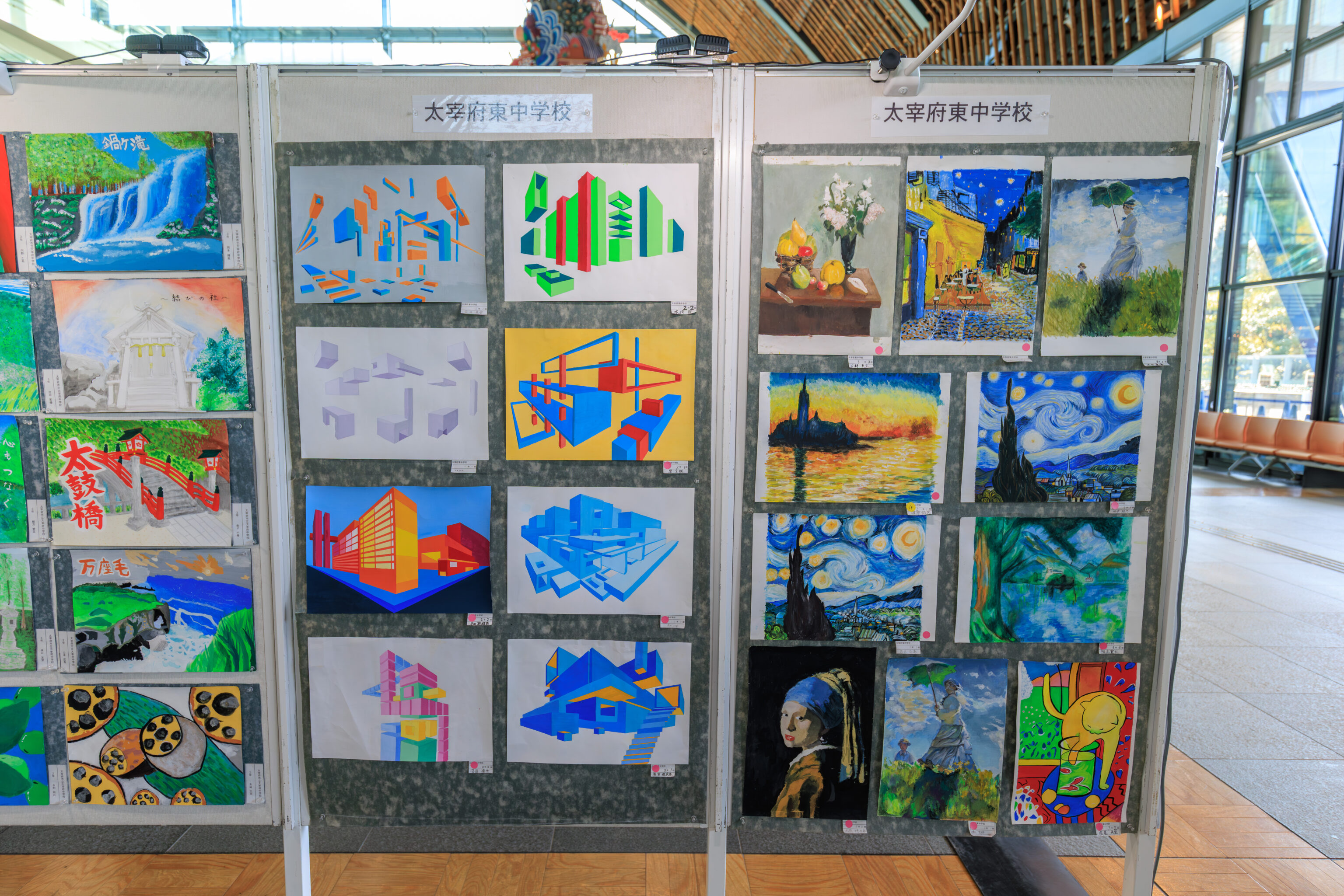
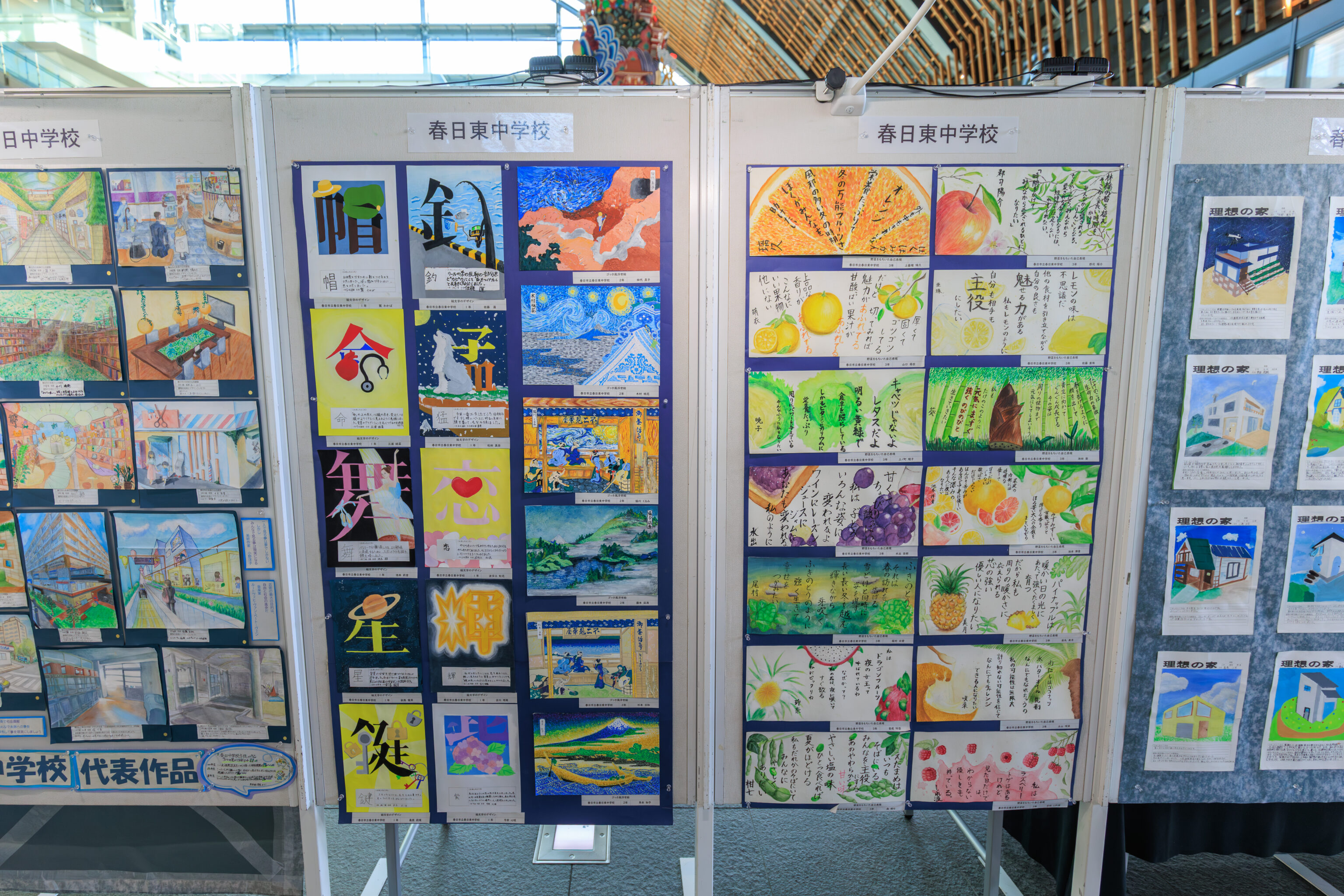
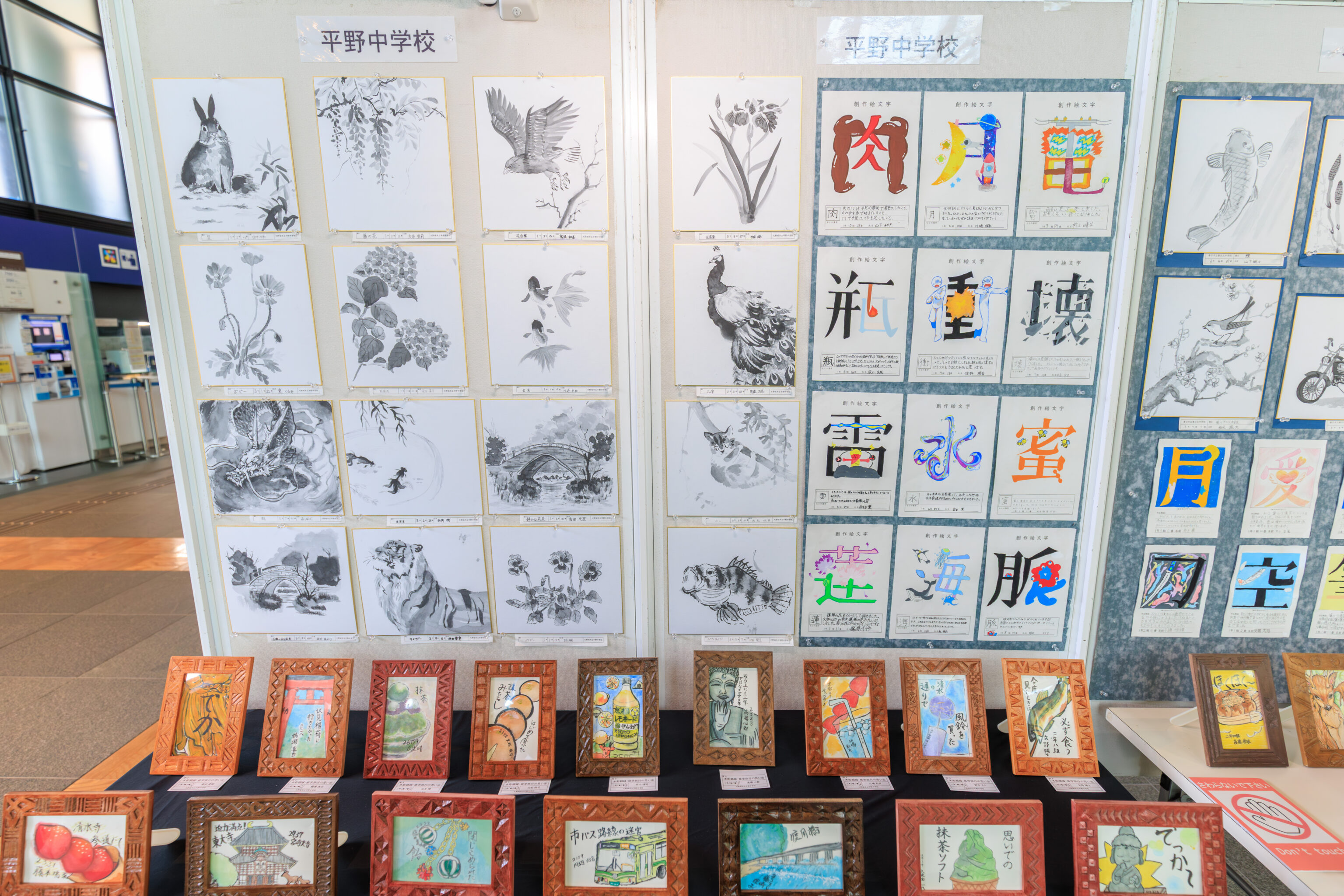
The lobby area where we entered also had an exhibition of art created by school children.
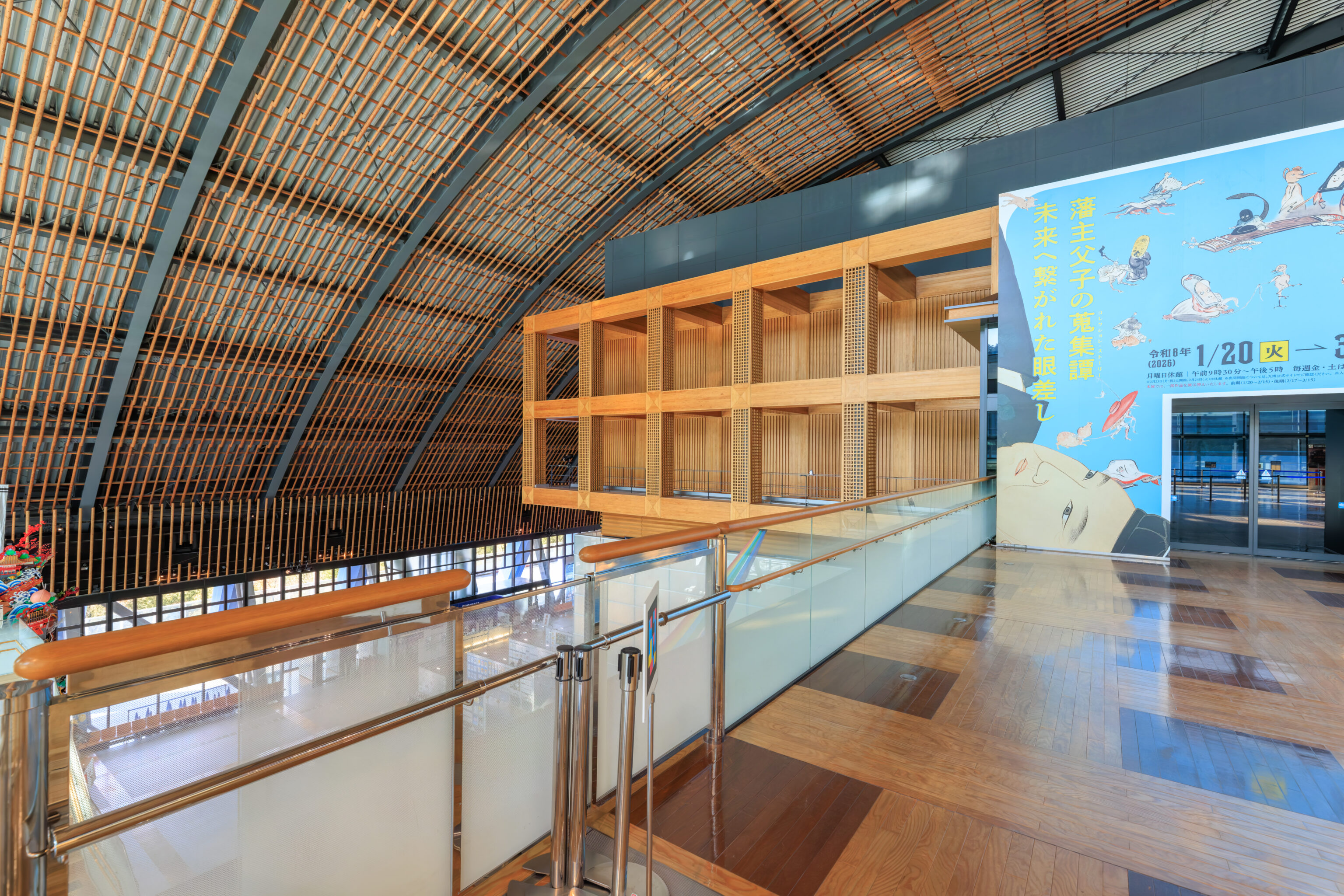
We then took the escalators upstairs.
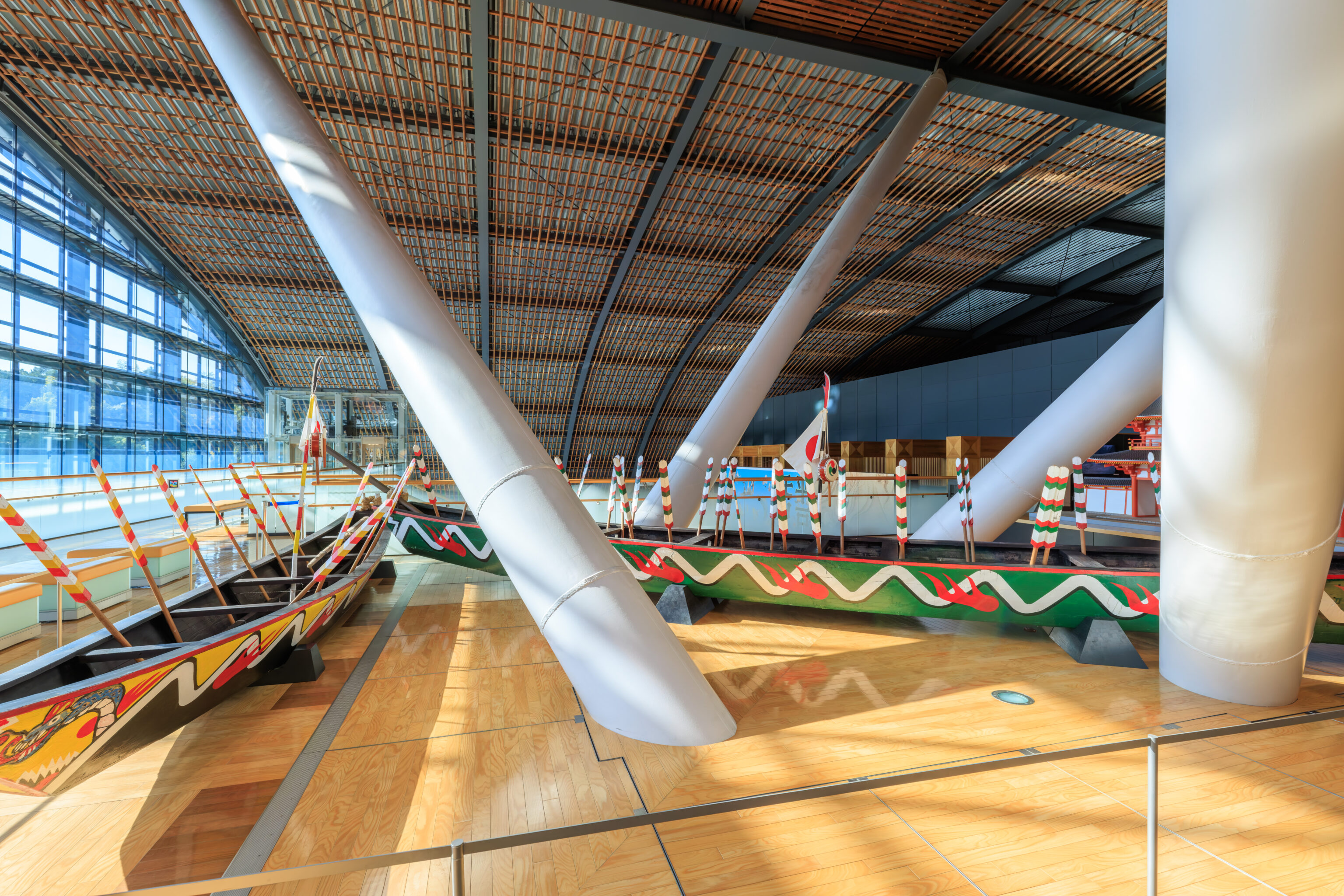
This area was basically an open platform next to the entrance to the museum’s main exhibition space. There were some items on display such as these dragon boats from Okinawa.
Harī Racing Boats of Shioya Bay

*Harī* (Dragon Boat) refers to a boat-rowing competition held throughout Okinawa, in which participants pray to the Sea God for maritime safety, bountiful harvests, and good health. These races are frequently held on the fourth day of the fifth lunar month (known as *Yukkanuhī*) or around the time of the *Obon* festival in July. In Shioya Bay, located in the village of Ogimi in northern Okinawa Prefecture, the races take place during *Ungami* (the Sea God Festival)—specifically on the first Day of the Boar (*I-no-hi*) following the lunar *Obon* festival. Even within the *Ungami* festivities at Shioya Bay—which have been designated as a National Important Intangible Folk Cultural Property—the *Ugan-Harī* (Ritual Harī Race) stands out as the main highlight. The *Harī* boat on display here is one that was actually used during the *Ungami* festival at Shioya Bay. Competitive rowing events like *Harī* have spread beyond Okinawa to places such as Nagasaki, Fujian Province in China, and various regions across Southeast Asia; they can truly be described as events that symbolize the rich maritime culture of Asia.

Produced: Circa 1945–1954 (Showa Era, 1920s)
Kyushu National Museum (Donated by the Shioya and Tamina Districts)
– Text from a sign, translated using Google.
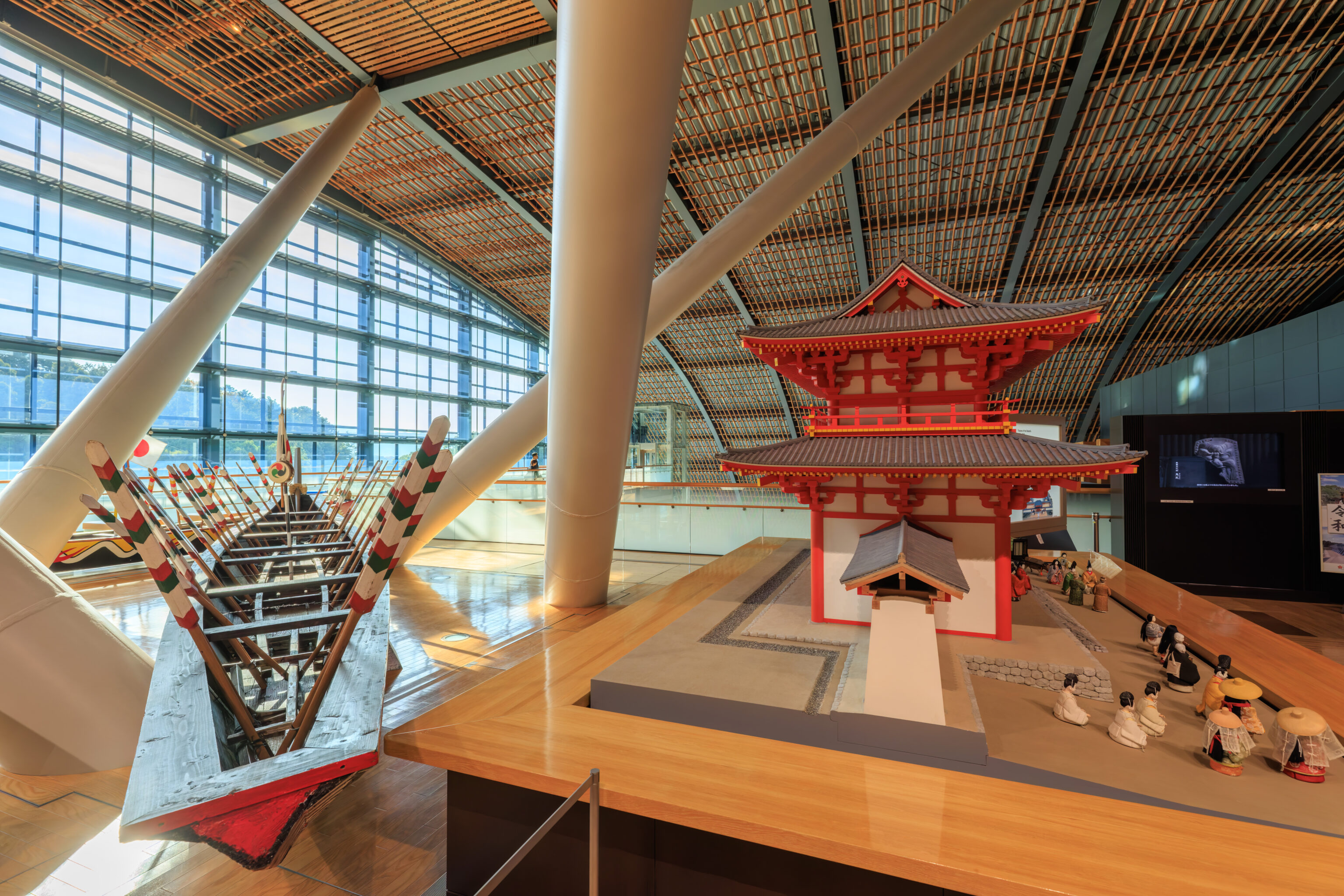
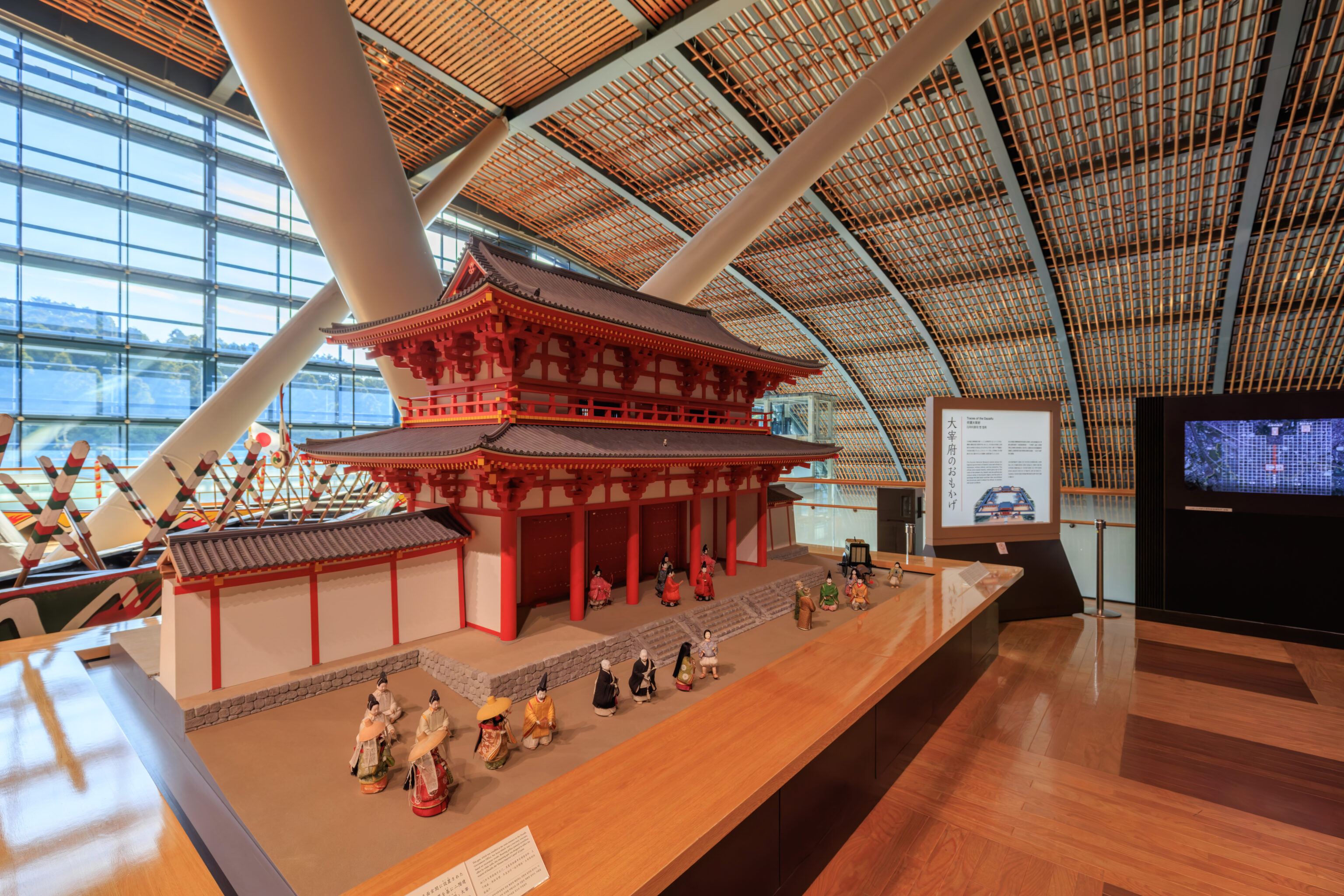
There was also a small model of a gate that was originally here at the museum site. This site was the location of Dazaifu, the name for the government offices that were here.
What is Dazaifu?
Here in Dazaifu City, where the Kyushu National Museum now stands, there was once an office responsible for diplomacy, military affairs, and tax collection. Its name was Dazaifu.  Dazaifu was the political and cultural center of the Kyushu region and a window for exchange with East Asian countries. This section introduces Dazaifu and the earthen fortifications and water castles built for its defense.
– Text from a sign, translated using Google.
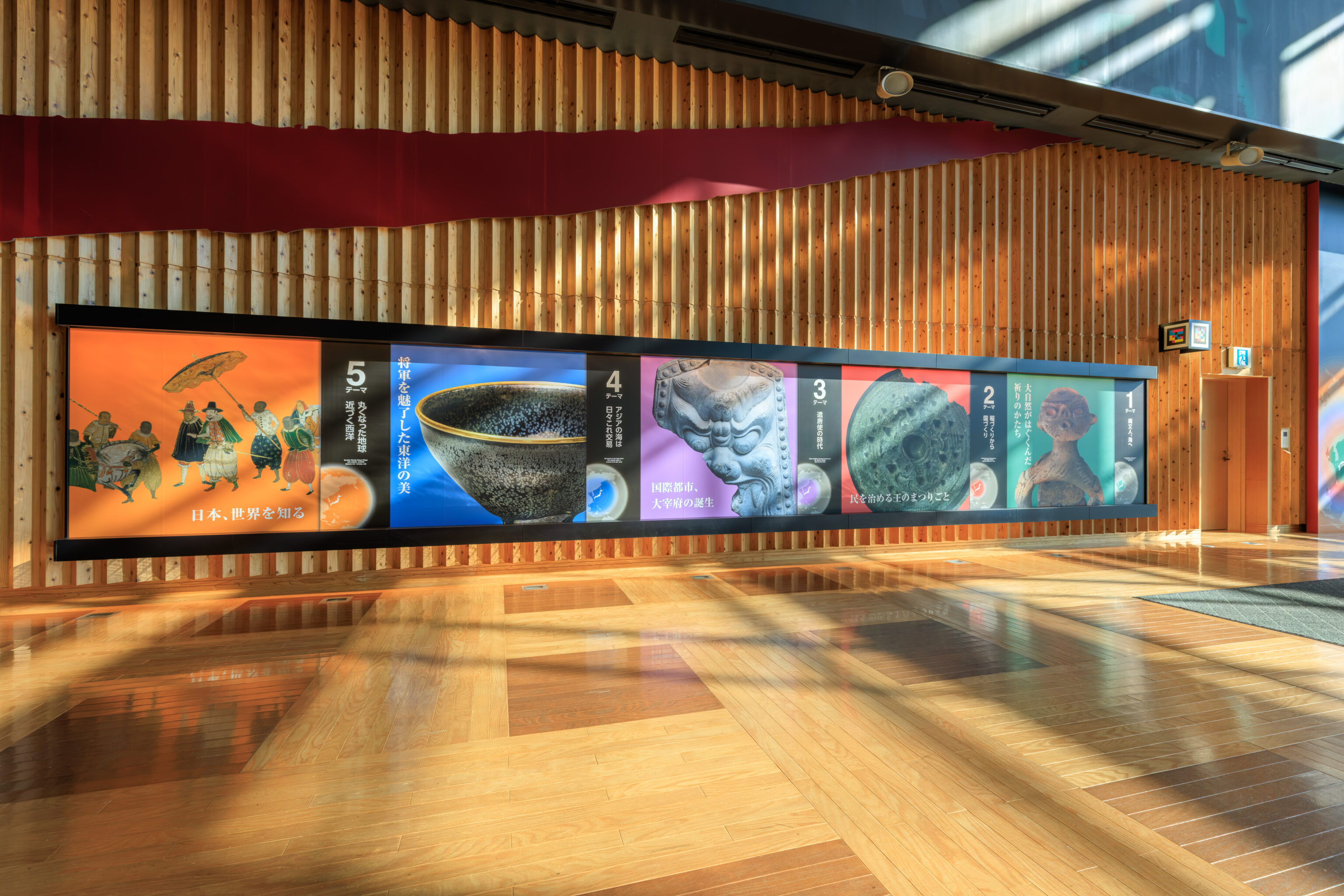
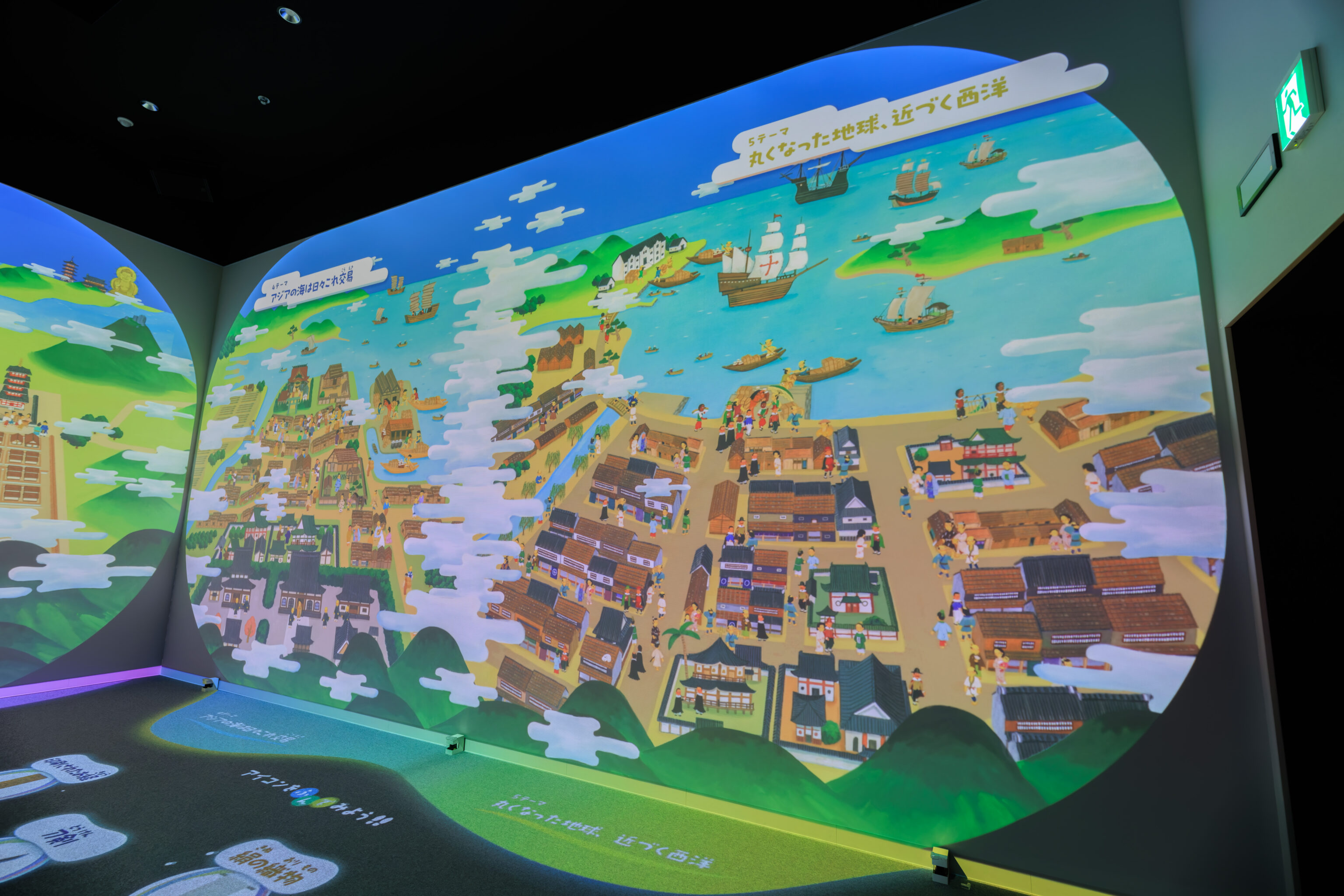
This display shows the five themed areas within the exhibition space.
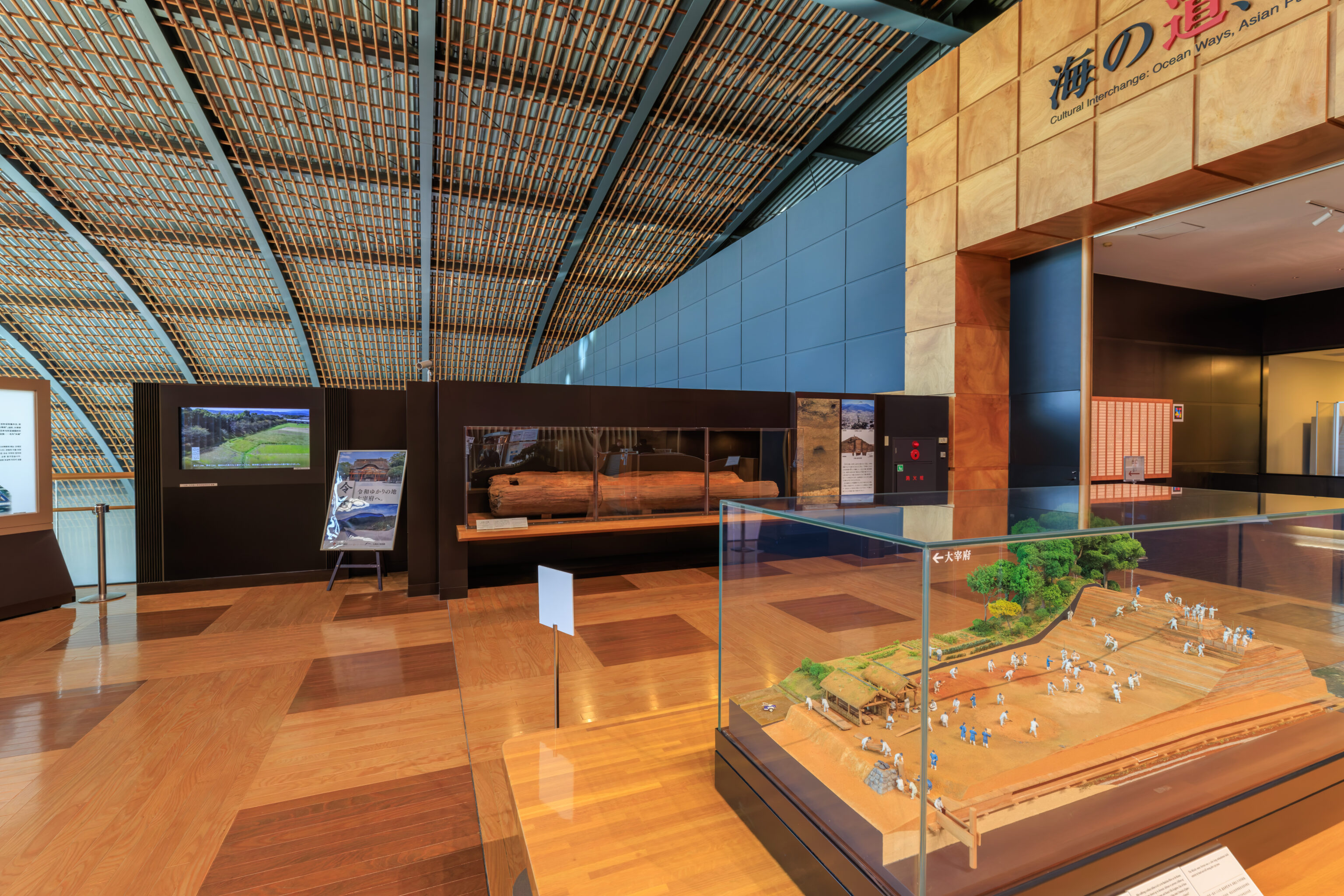
The display here at bottom right shows what is described as a mizuki, or water fortress.
After suffering a military defeat in 663 at the Baekchon River on the Korean peninsula, Japan shored up its domestic defenses to prevent a follow-up attack from China's Tang dynasty and Korea's Silla kingdom. One of these was the the Mizuki bulwark, as described in Nihon shoki (Chronicles of Japan): "A large dike was built to store water. It's called 'Mizuki' (water fortress)".

The Mizuki water fortress was a 1.2km long embankment built
entirely by hand and still strong after 1350 years.
– Text from a sign.
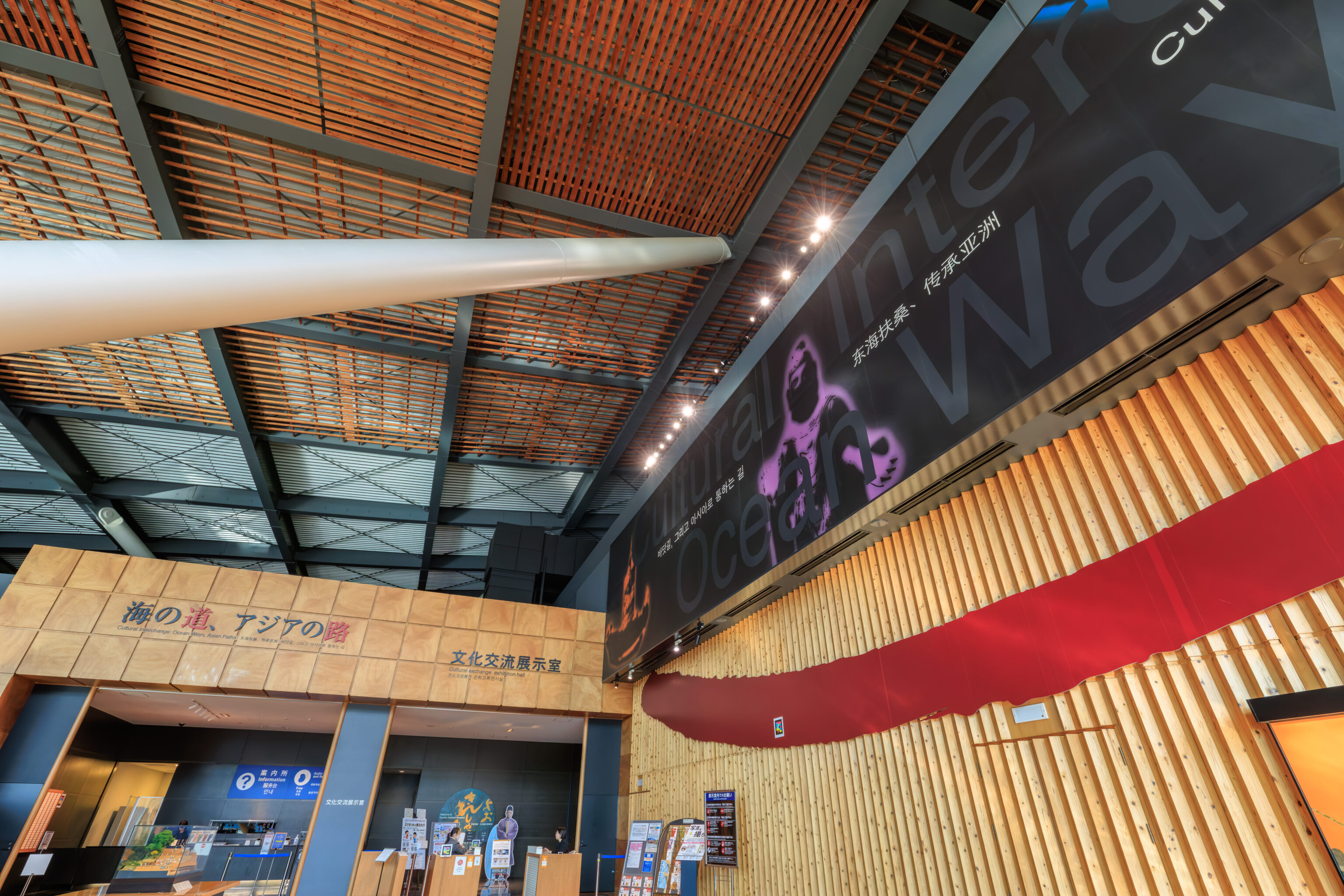
We entered the exhibition hall through the entrance here.
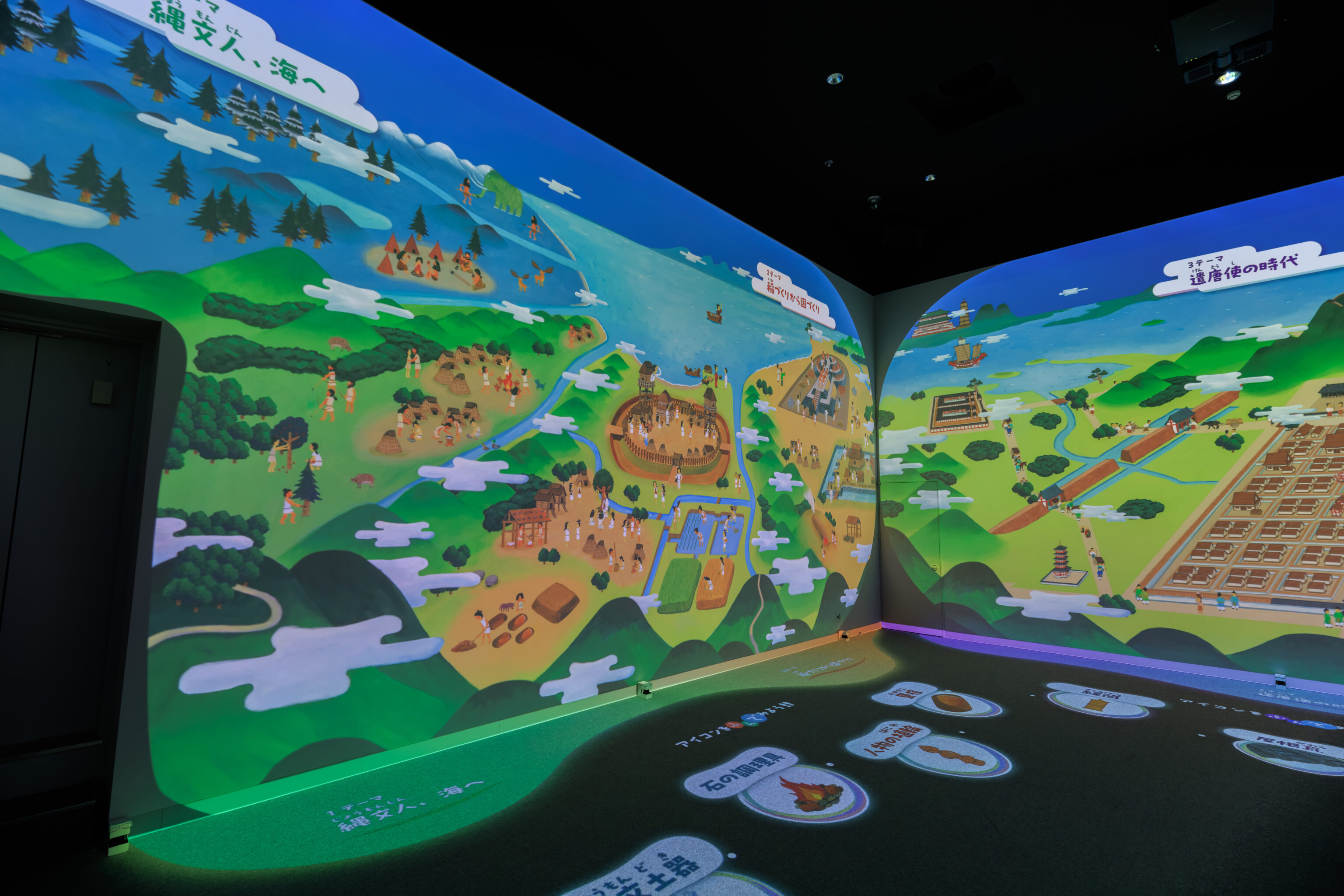

Near the entrance, we walked into a projection room which introduces Dazaifu, the government offices that once stood here at the museum site.
Travelling through Time in Dazaifu
A Japanese bullfinch appears as a guide before a woman walking around the ruins of Dazaifu Government Office. This bird leads her back in time to the Nara period (710-794), where she discovers the ruins transforming into the ancient capital of Dazaifu, a sprawling city and fortress surrounded by battlements. Originally built as a strategic defense base, Dazaifu eventually became the political center of Kyushu, welcoming overseas envoys and merchants as a hub for international exchange. It was also a center of advanced Buddhist culture, where monks from Japan and other countries gathered. Feasts for nobles were held here, too. Such is the history connecting Dazaifu, past and present.
– Text from a sign.
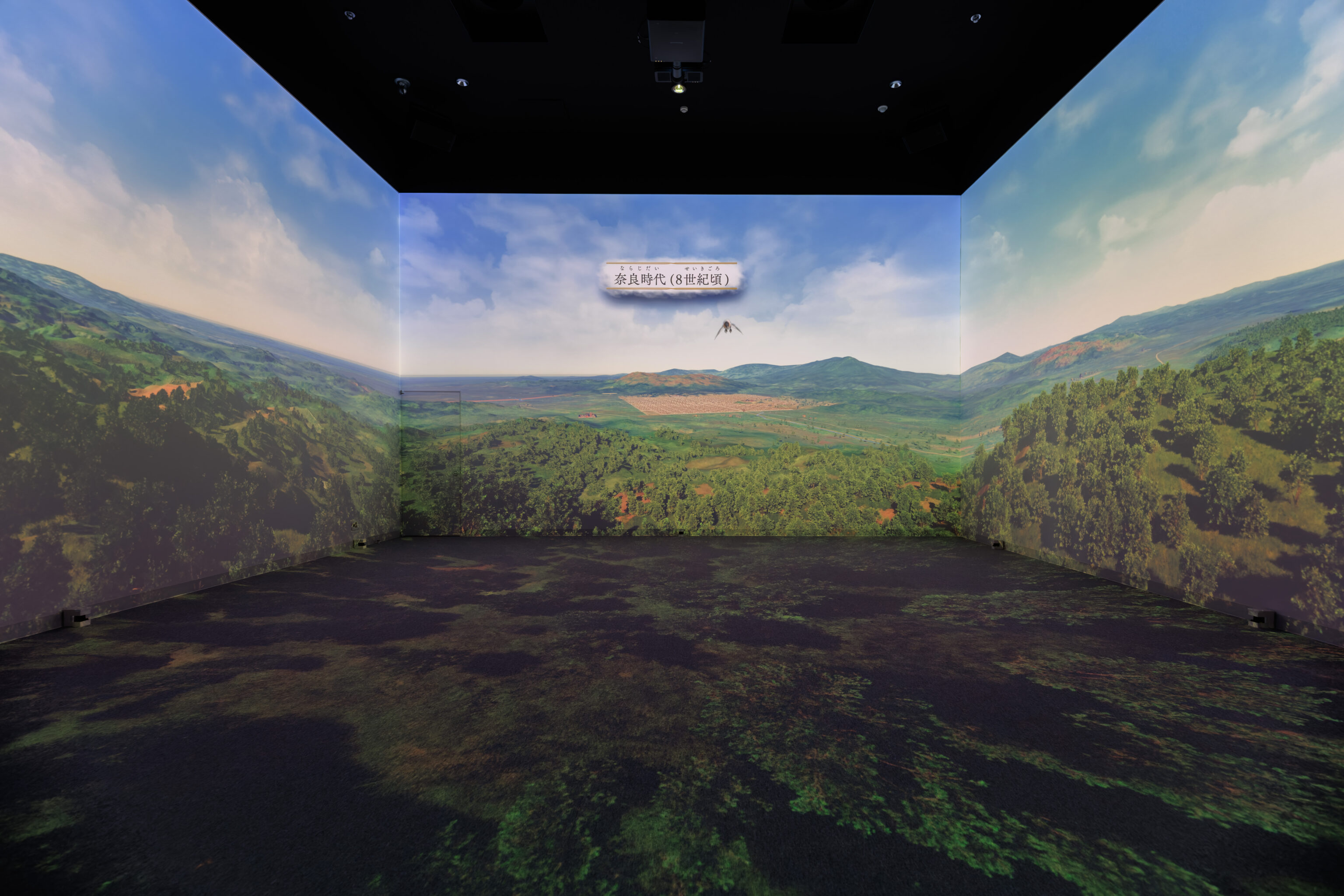
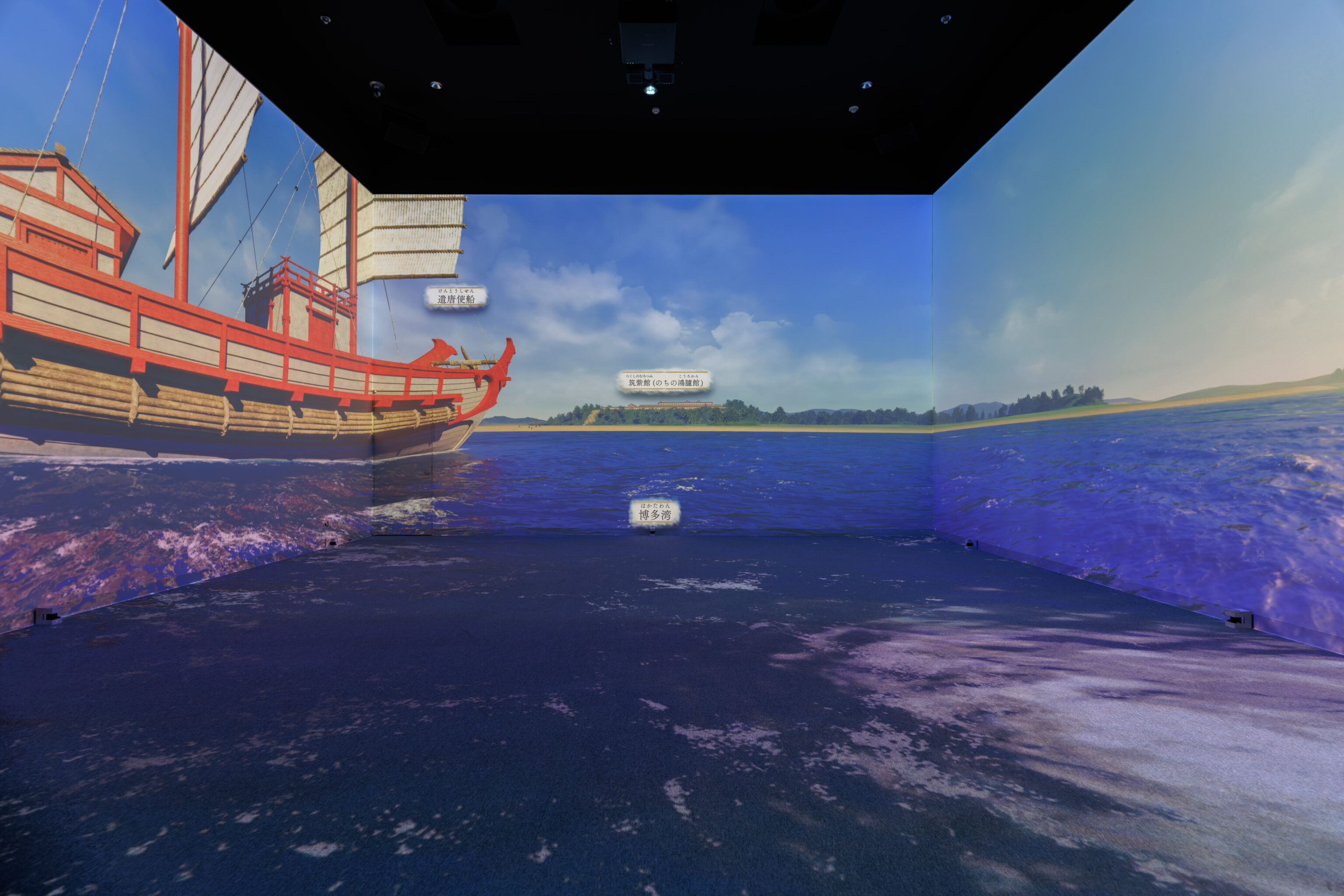
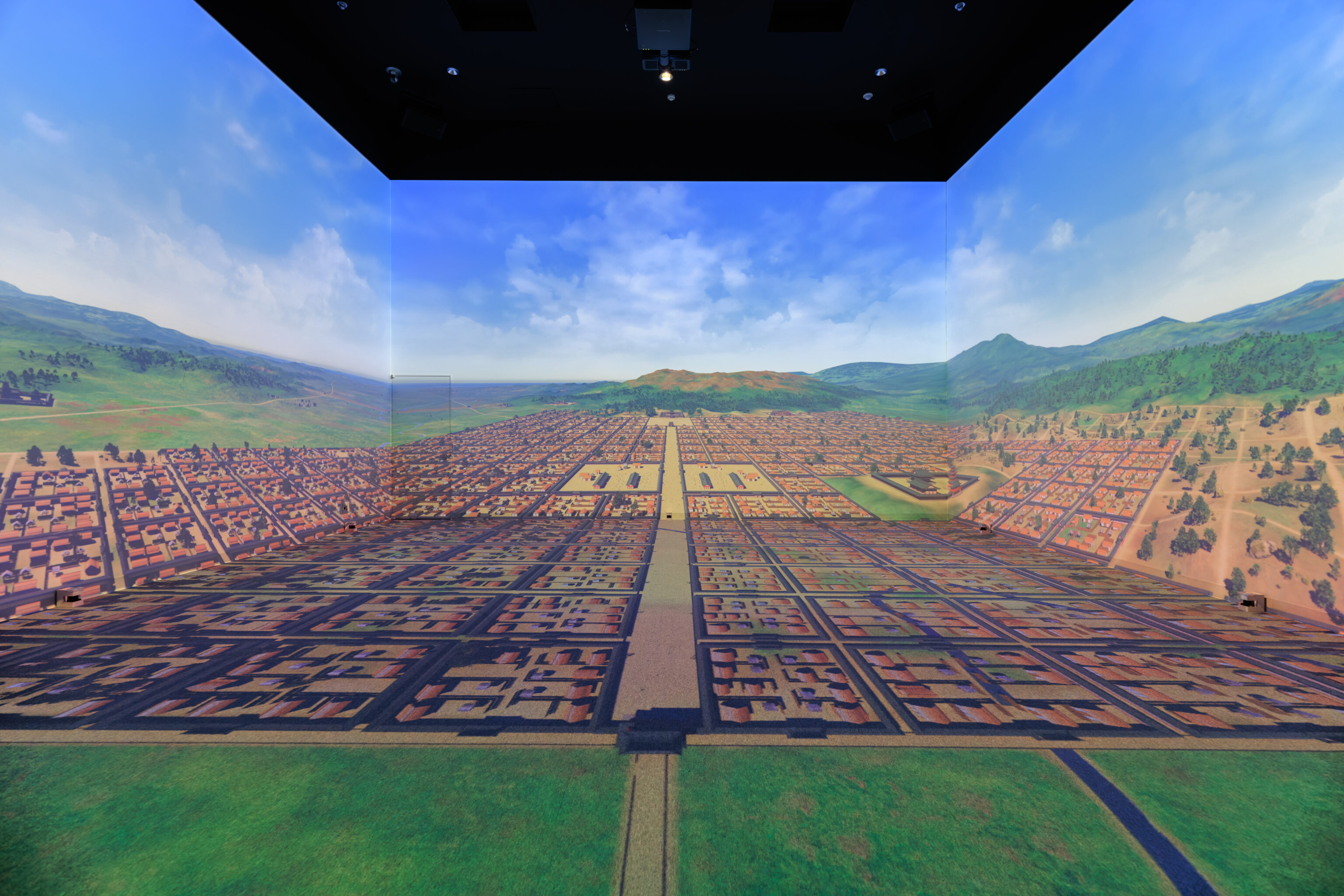
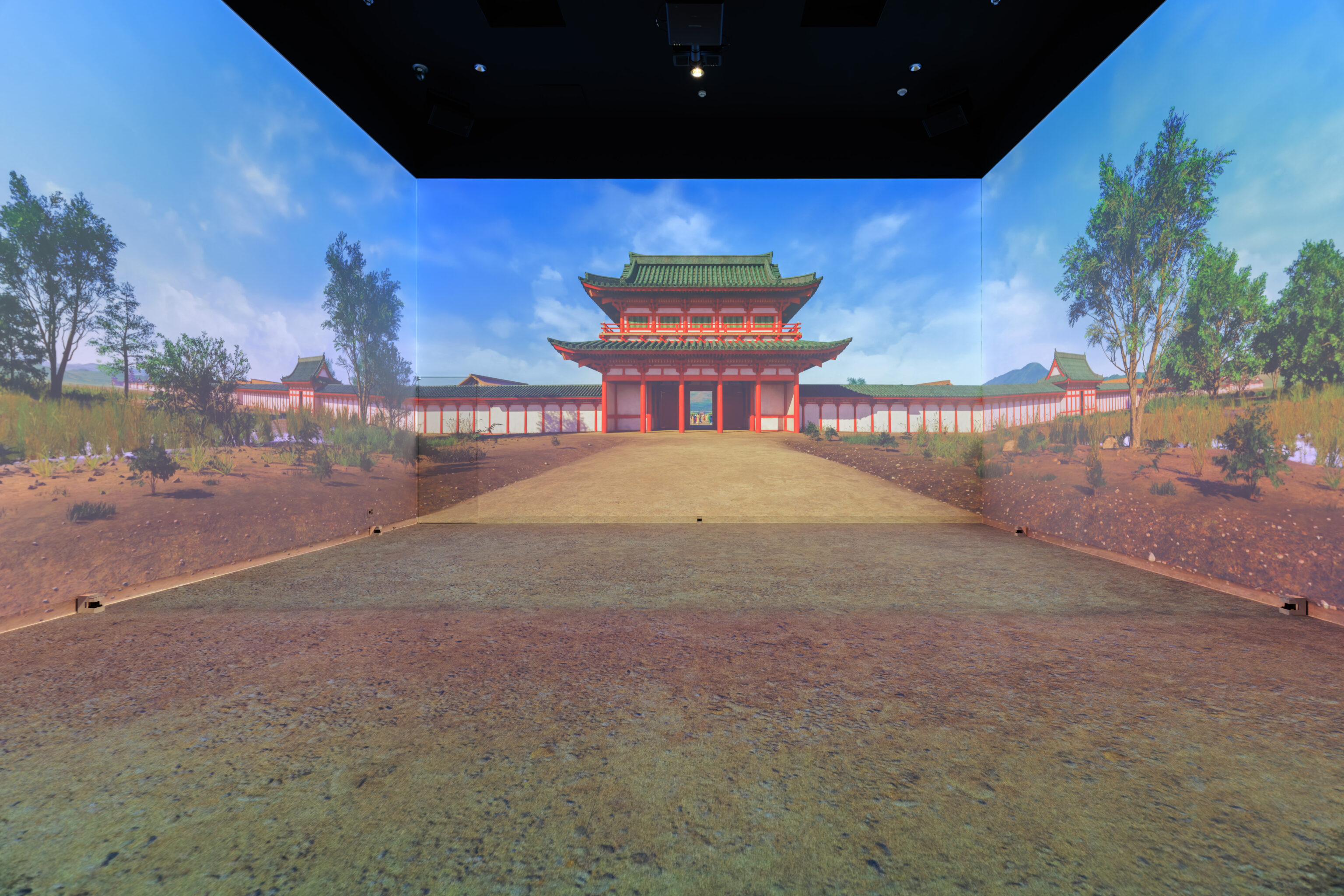
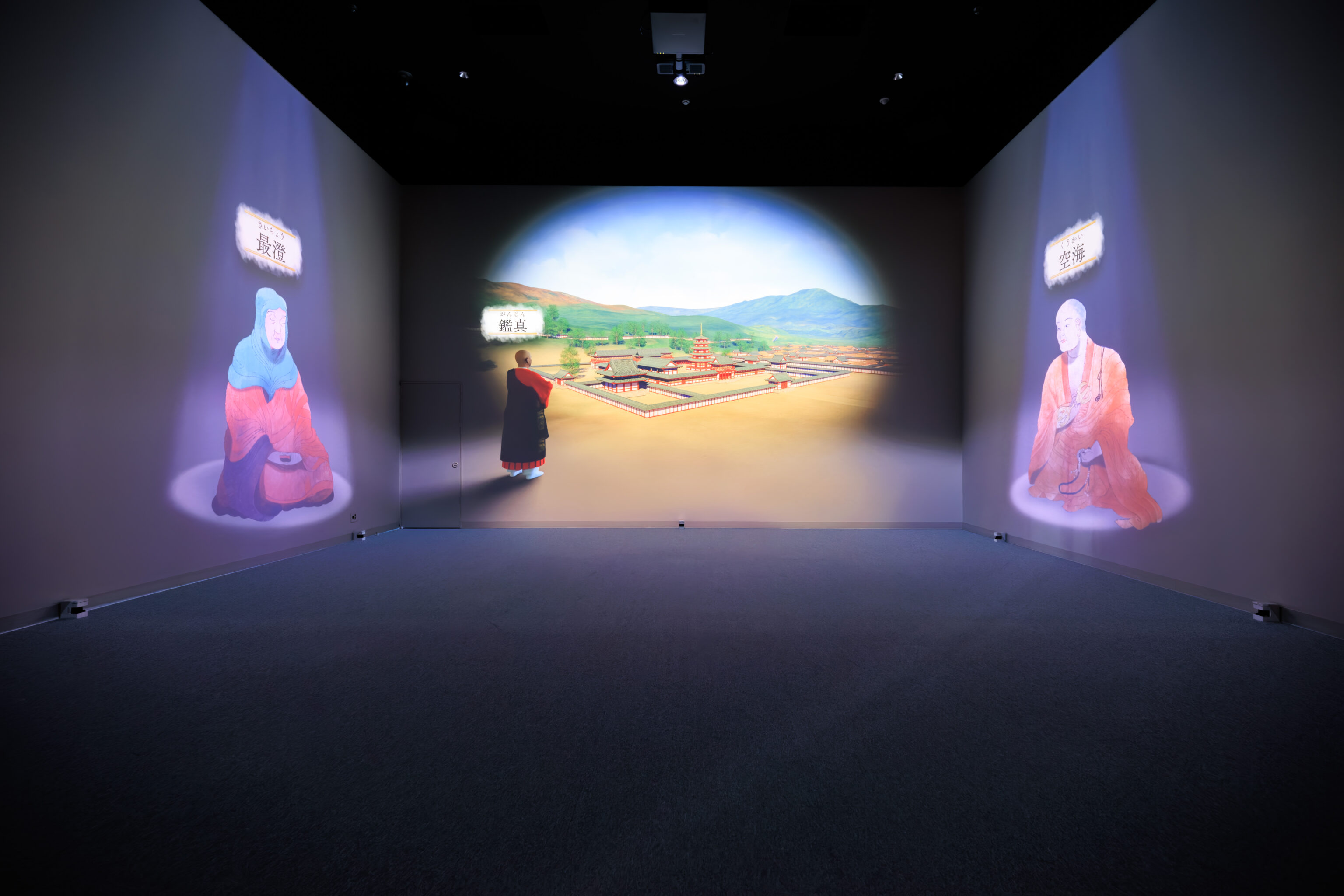
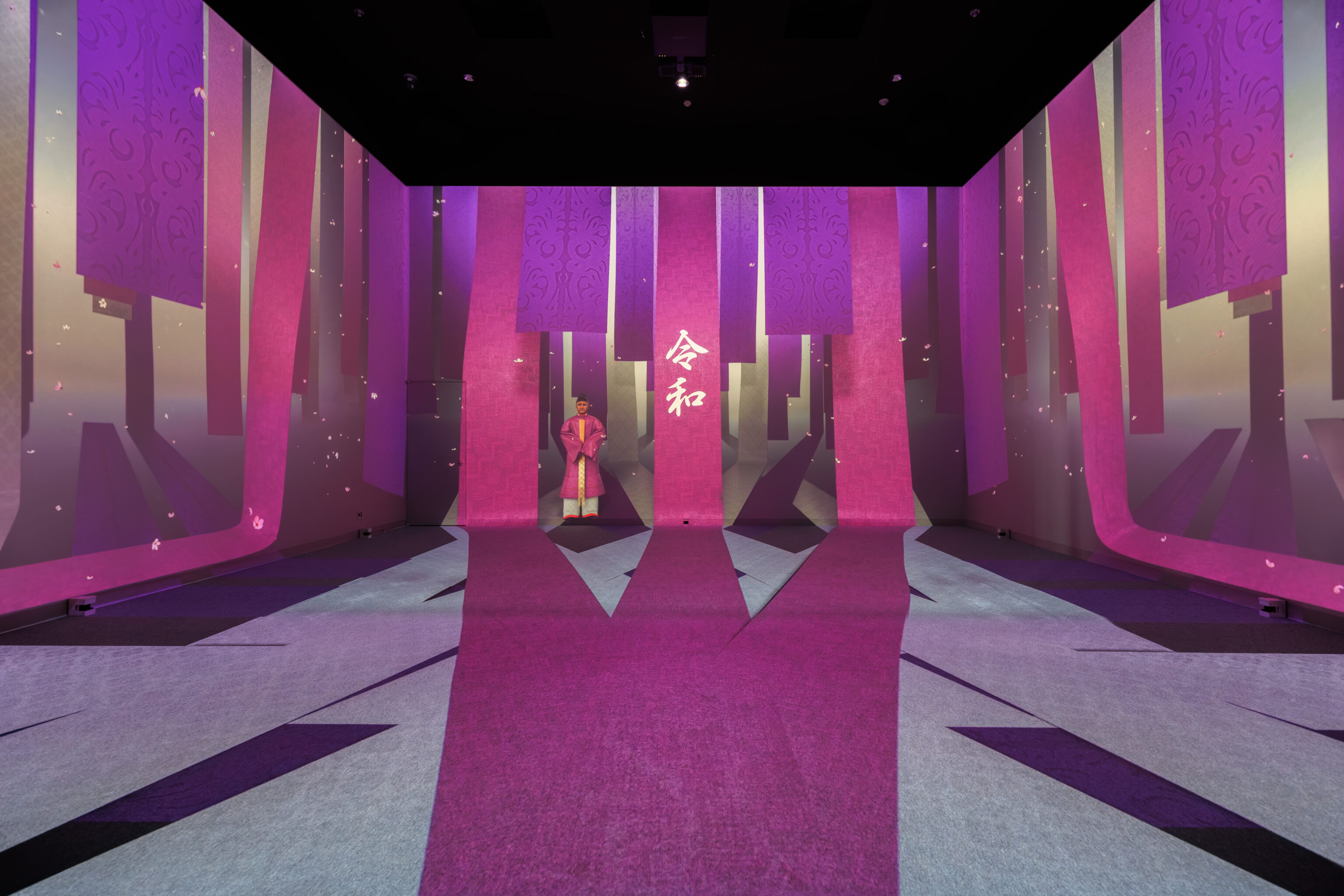
We took a few photographs of the projected video before continuing on. Although the museum’s permanent exhibition space is only on one floor, there was a huge amount of artifacts within that space. The museum website has a long list of what is on display here. Note that this list seems like it is kept updated so it may not reflect what we saw during this visit.
While walking through this space, we simply photographed seemed to be interesting.
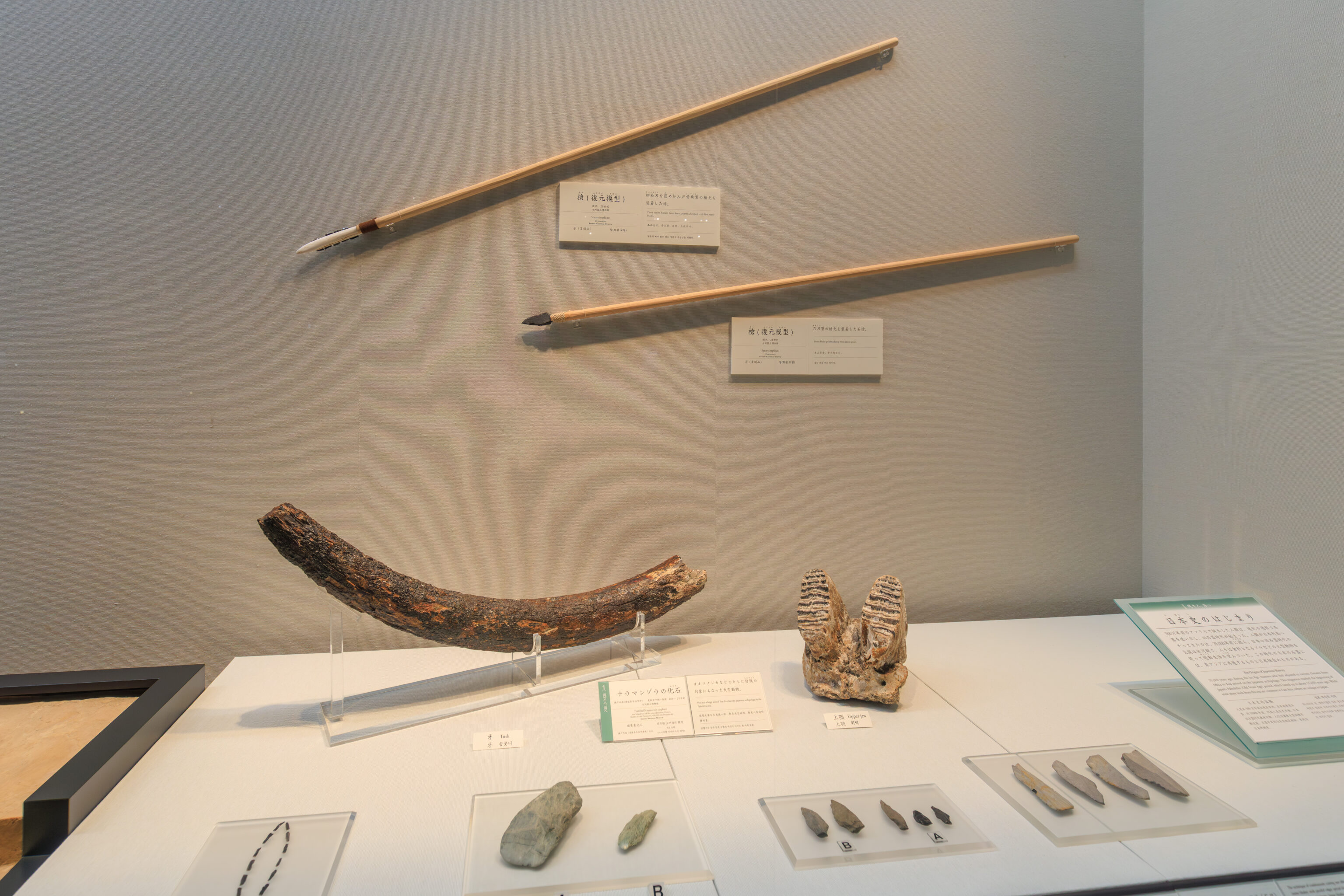
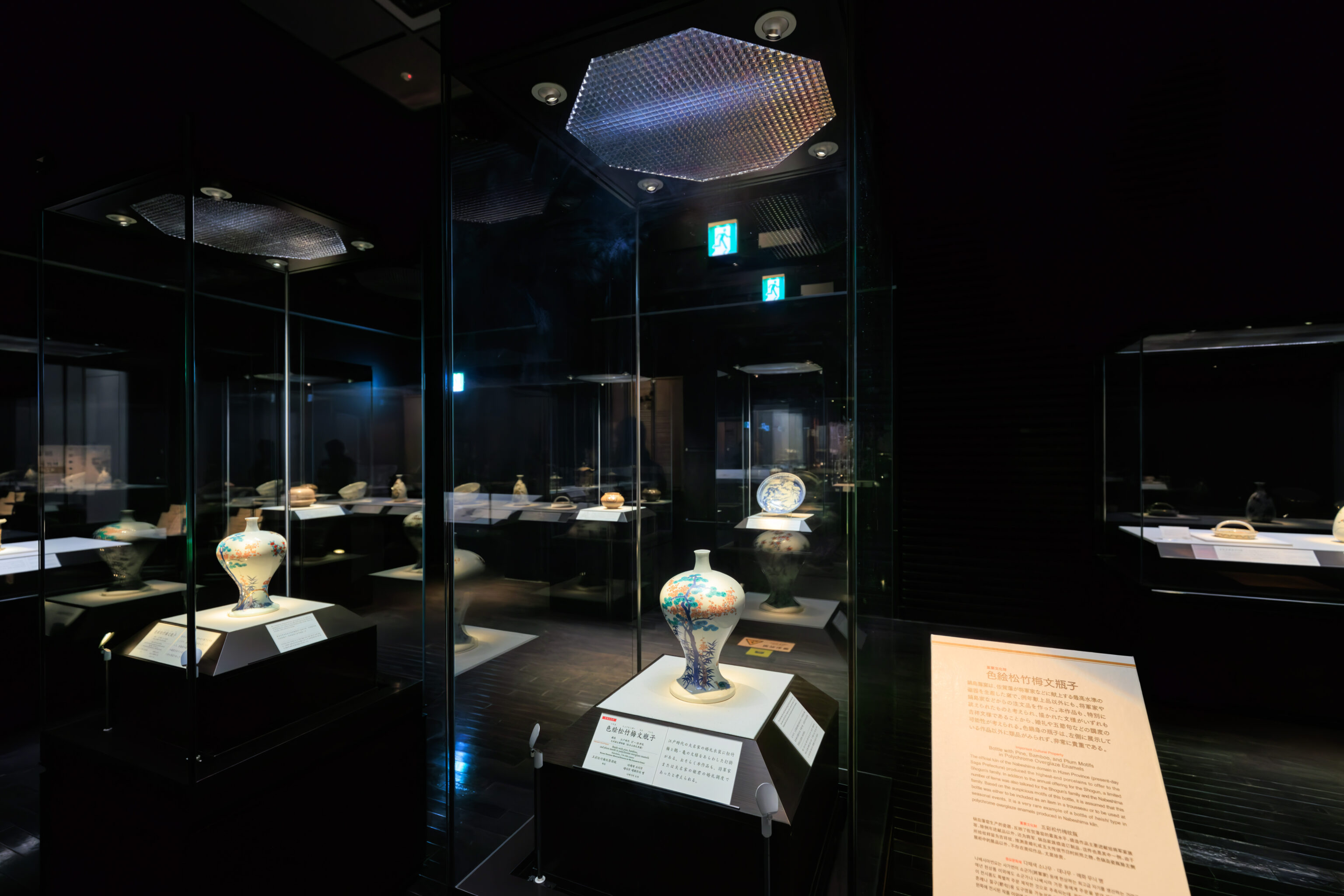
Important Cultural Property
Bottle with Pine, Bamboo, and Plum Motifs in Polychrome Overglaze Enamels

The official kiln of the Nabeshima domain in Hizen Province (present-day Saga Prefecture) produced the highest-end porcelains to offer to the Shogun's family. In addition to the annual offering for the Shogun, a limited number of items was also tailored for the Shogun's family and the Nabeshima family. Based on the auspicious motifs of this bottle, it is assumed that this bottle was either to be included as an item in a trousseau or to be used at seasonal events. It is a very rare example of a bottte of heishi type in polychrome overglaze enamels produced in Nabeshima kiln.
– Text from the sign at bottom right.
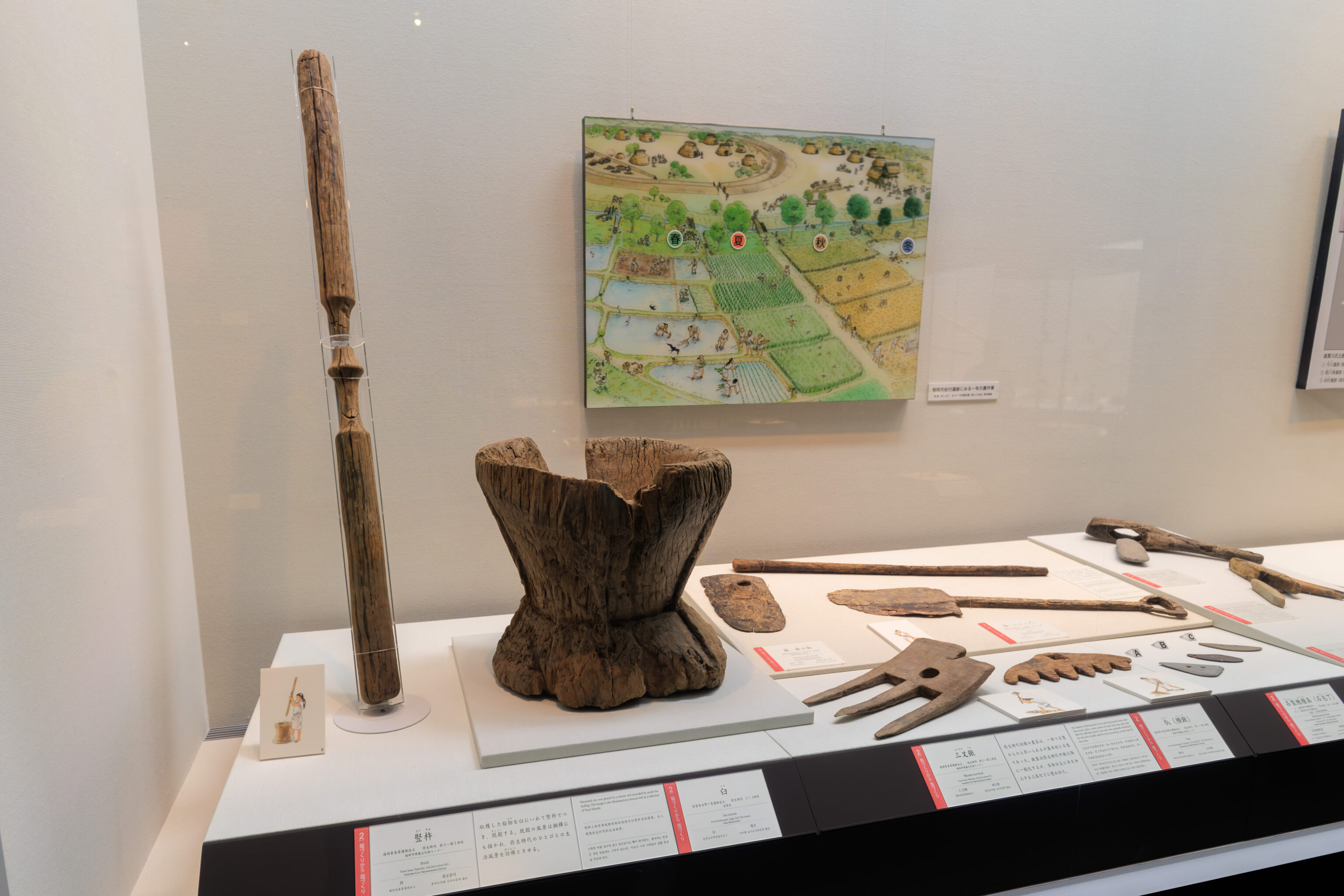
Tategine (Upright Pestle)
Excavated from the Suzumei Remains, Fukuoka Prefecture
Yayoi Period (3rd–2nd Century BCE)
Fukuoka City Buried Cultural Properties Center

Mortar
Excavated at the Yoshinogari Site, Saga Prefecture
Yayoi Period (2nd–3rd Century)
Saga Prefecture

The harvested rice stalks are placed in a mortar and pounded with an upright pestle to thresh the grain. Scenes of this threshing process are depicted on *dotaku* (bronze bells), evoking vivid images of daily life among the people of the Yayoi period.
– Text from the sign for the two large artifacts on the left, translated using Google.
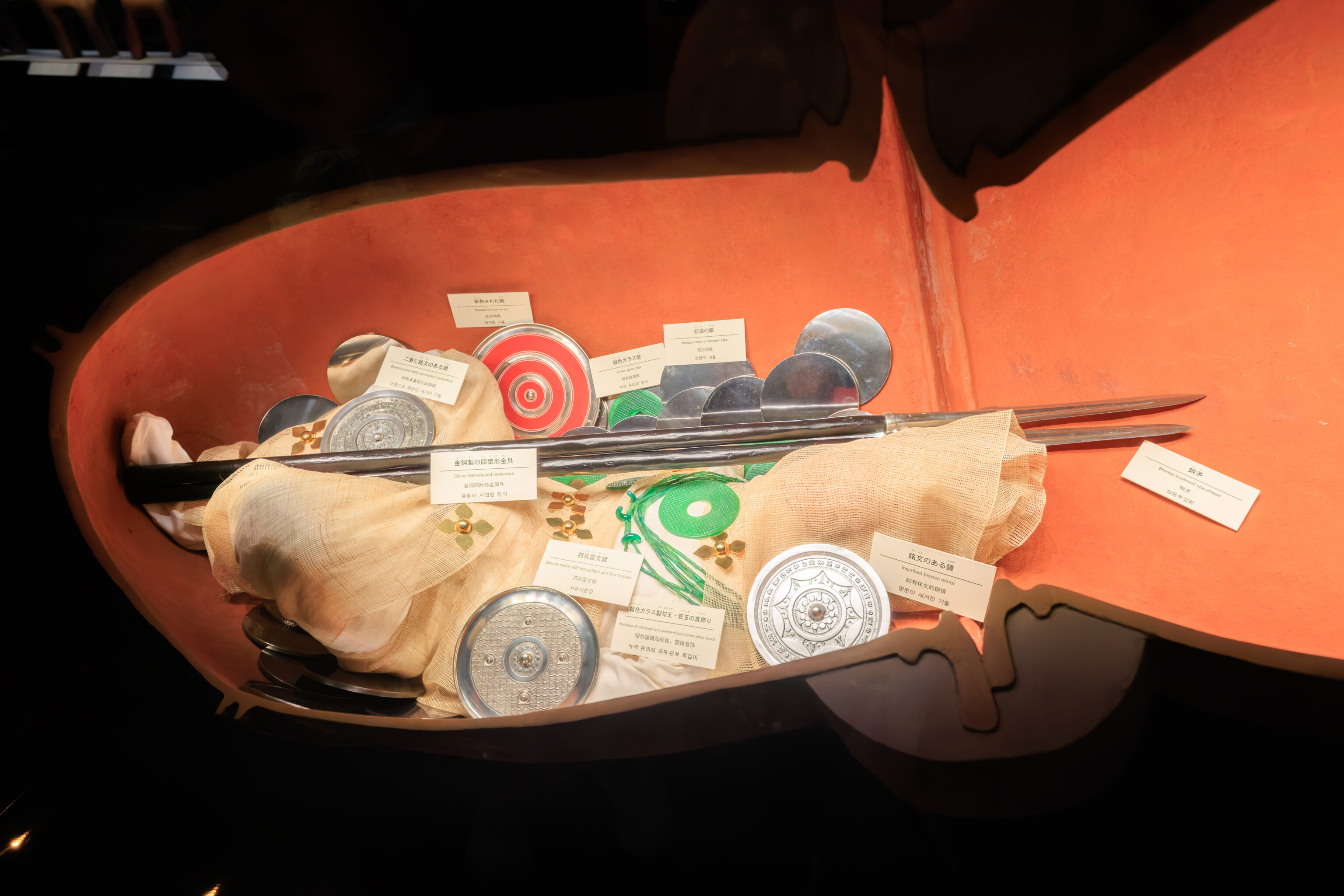
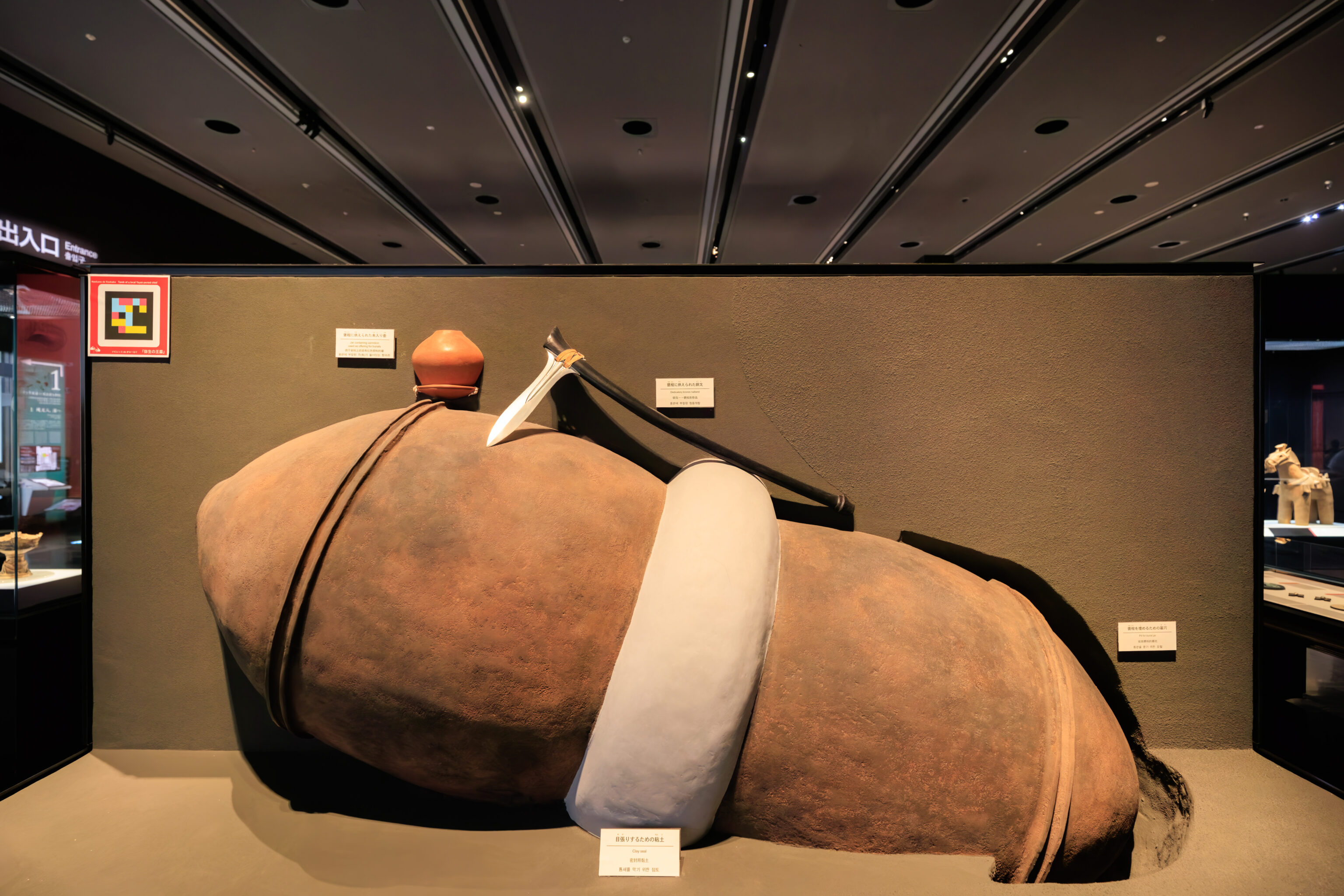
The two photographs above depict items that would have been placed in a tomb of a chief during the Yayoi period.
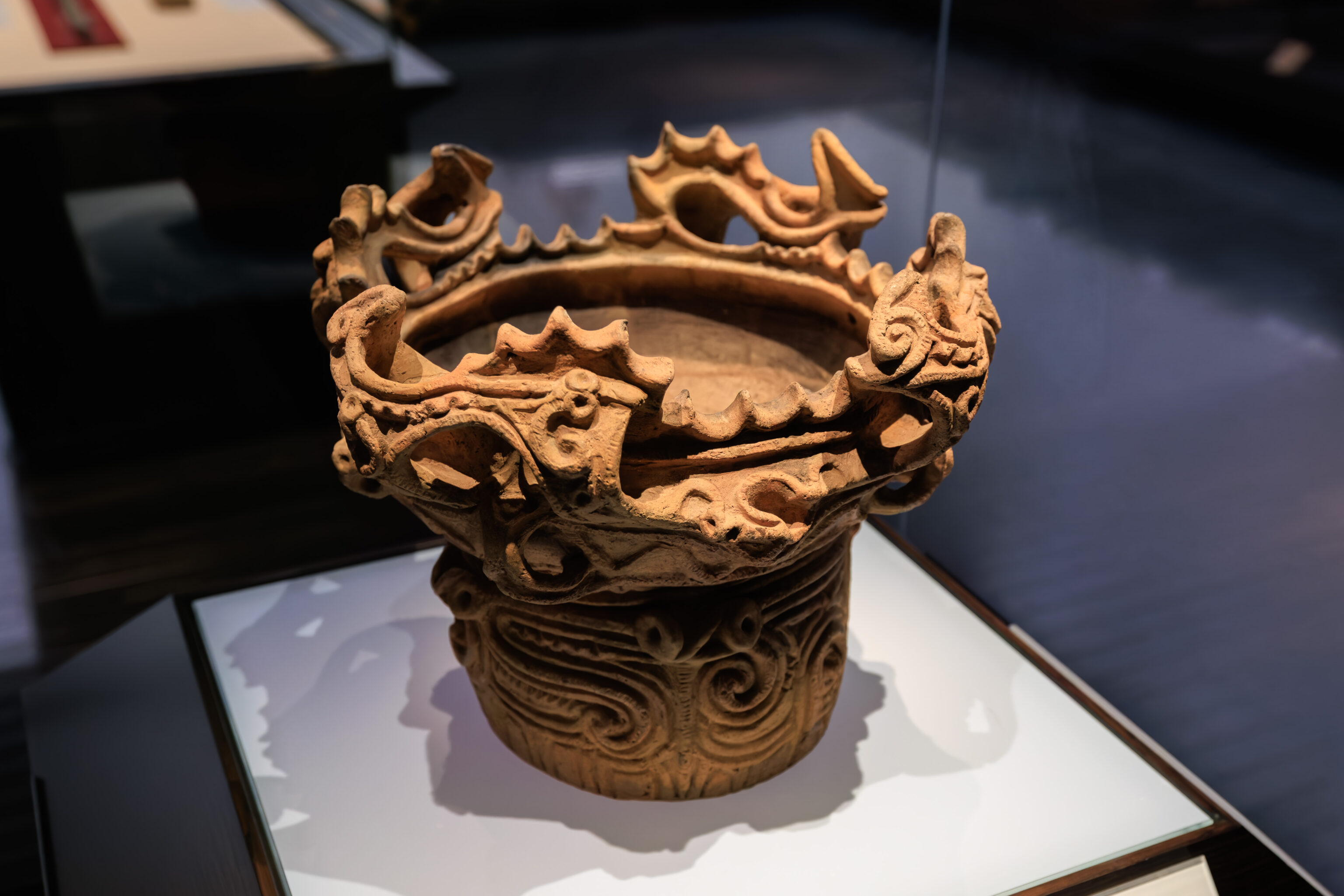
Flame-shaped earthenware vessel
From Dōjitte, Niigata, 3,000-2,000 BCE
Tsunan Town Board of Education, Niigata

Characterized by a rim likened to flickering flames, the "Flame-style" pottery stands as a quintessential masterpiece of the Jomon period. However, examples of this style appear only within a limited geographical area—specifically, northern Nagano Prefecture and the region centered on Niigata Prefecture. It represents one of the most intensely distinctive artistic expressions to emerge across the Japanese archipelago during the Middle Jomon period.
– Text from the sign for this artifact, translated using Google.
The piece of pottery above could be 5,000 years old! Quite an amazing item.
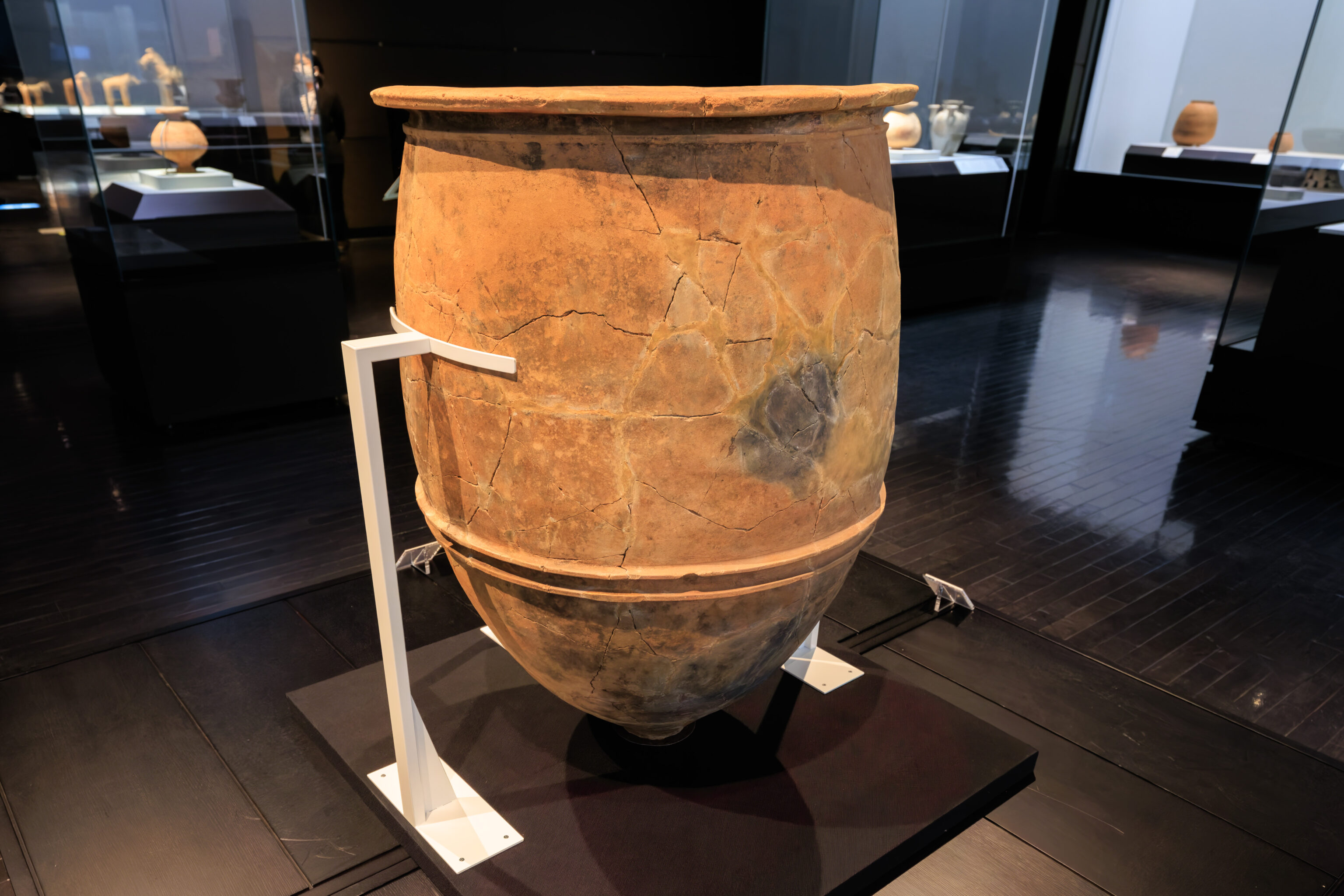
Jar Coffin
Kadota-Tsujita Site, Fukuoka Prefecture
Yayoi Period, 1st Century BCE
Fukuoka, Kyushu Historical Museum

A defining characteristic of Northern Kyushu during the Yayoi period is the *kamekanbo*—burials in which the deceased were interred within large earthenware jars. Initially, existing jar-shaped vessels were repurposed for this use; however, to accommodate the need for larger containers, their designs were subsequently refined, reaching their maximum dimensions during the middle Yayoi period. In some instances, multiple jars were joined together to form a single burial vessel.
– Text from the sign for this artifact, translated using Google.
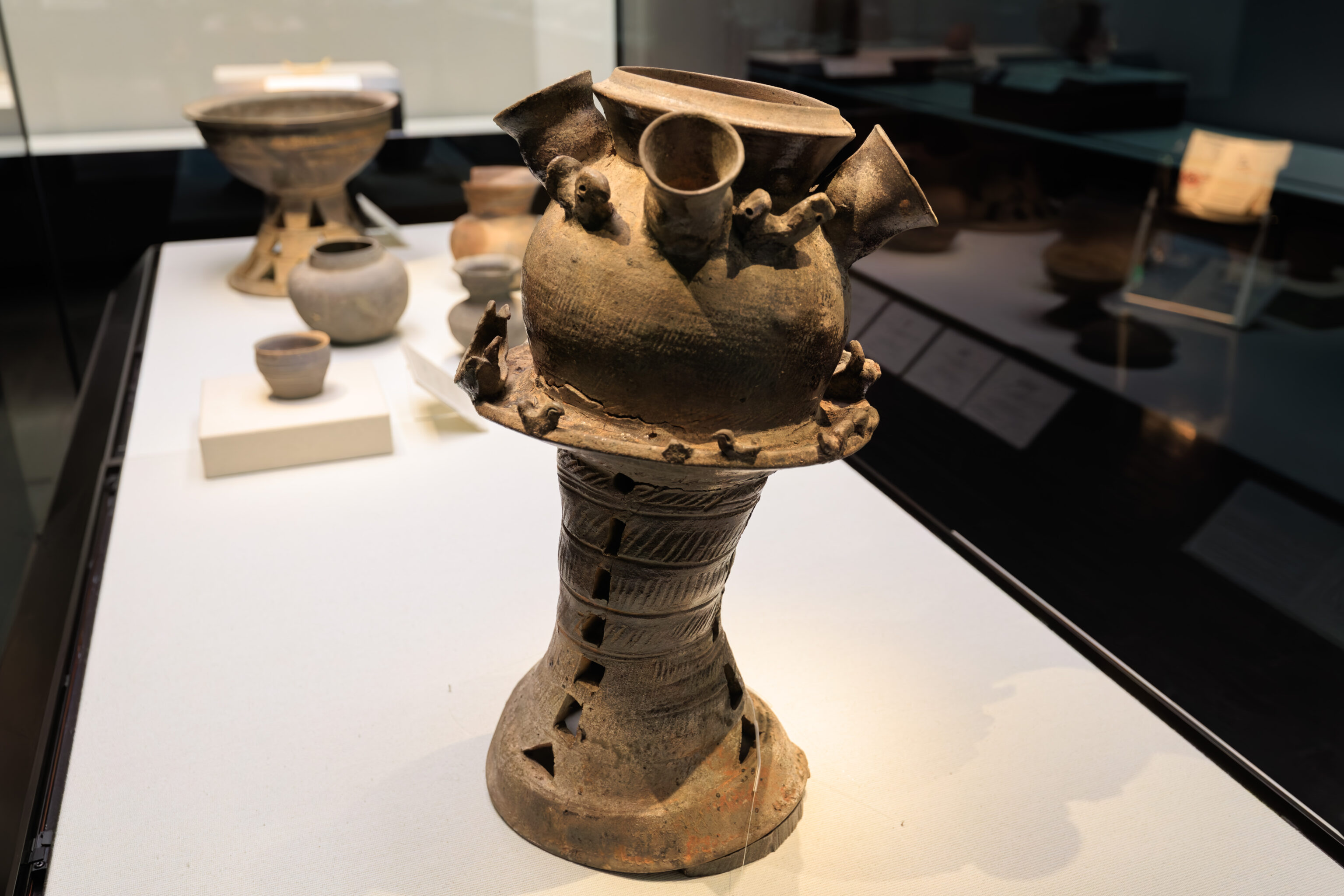
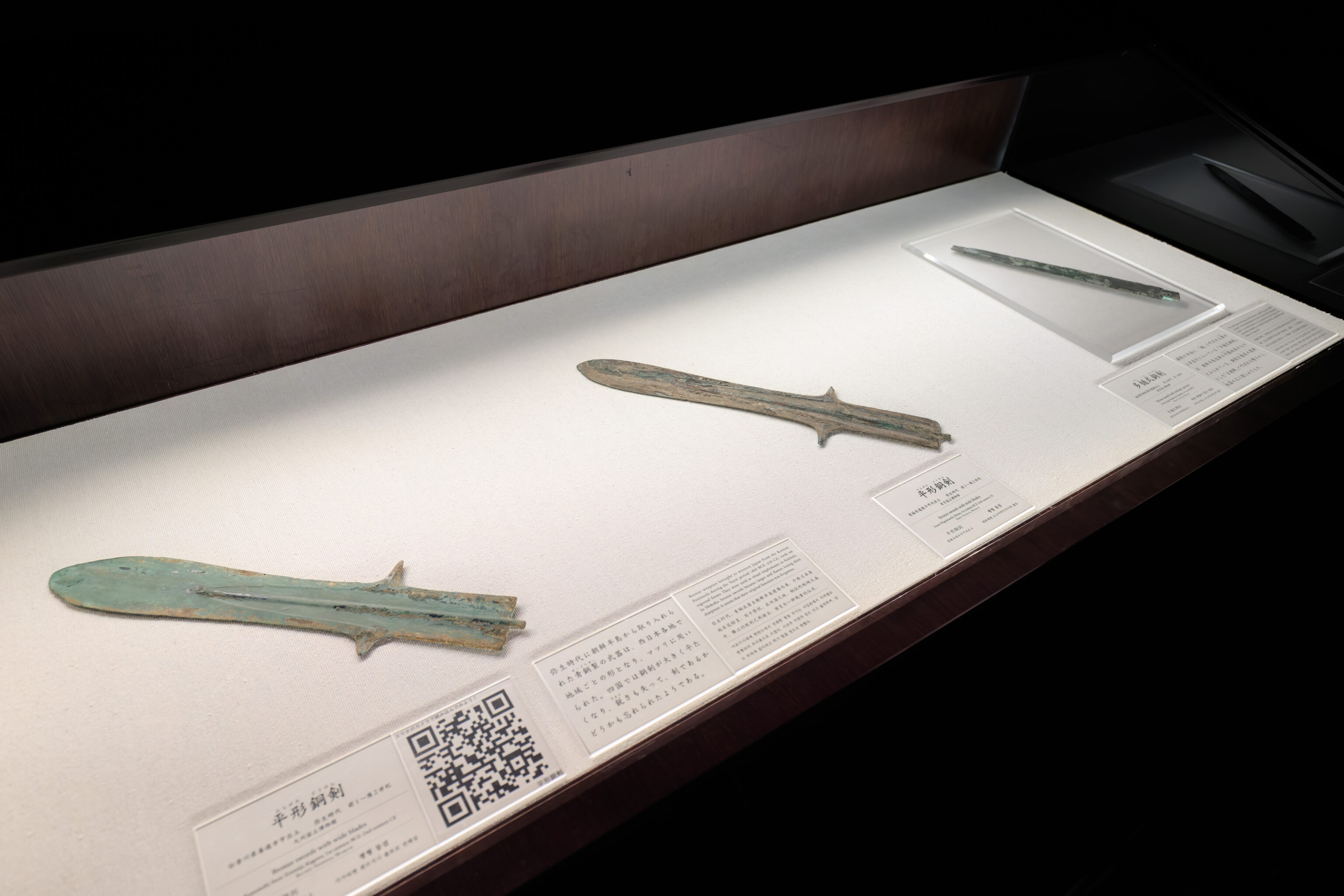
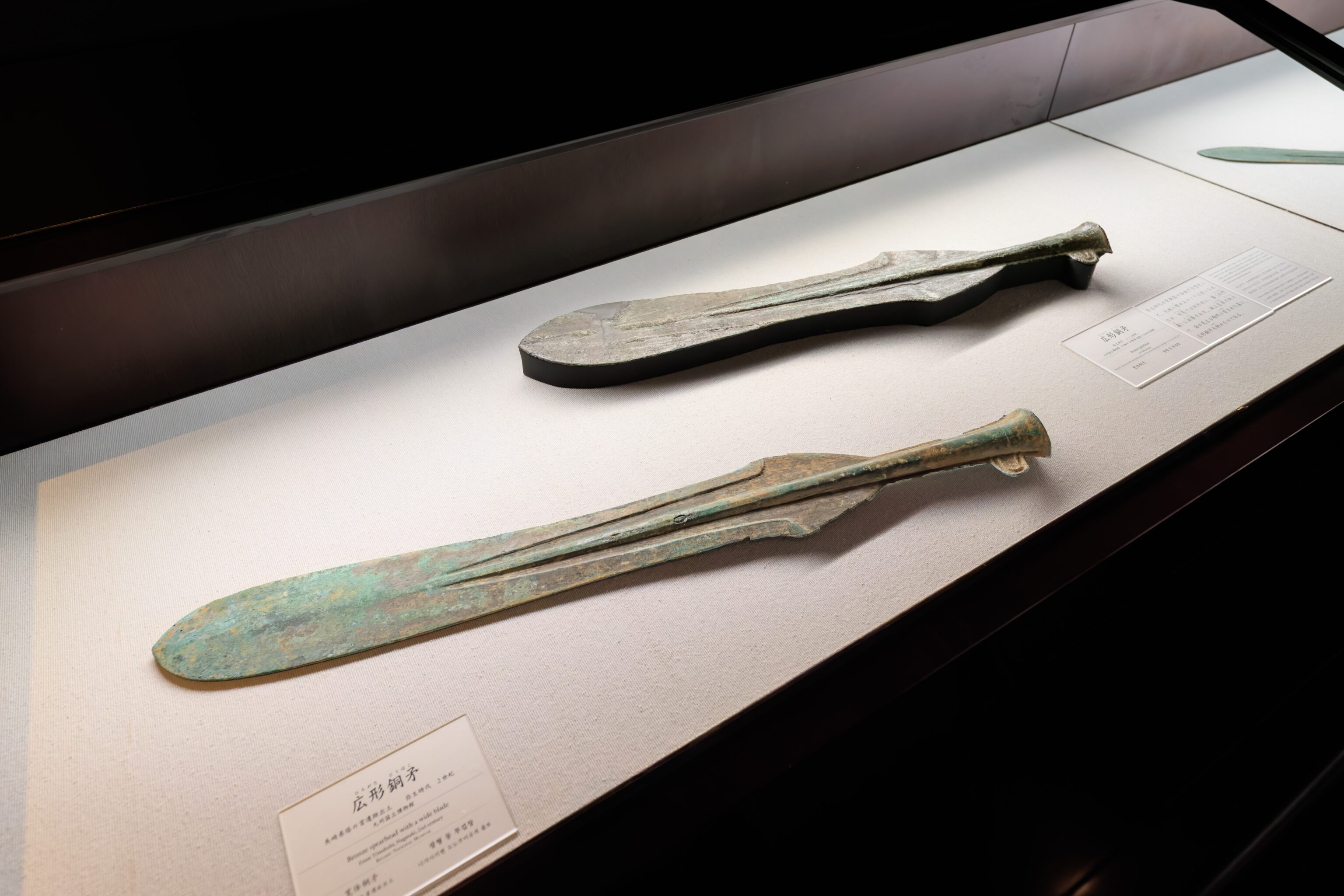
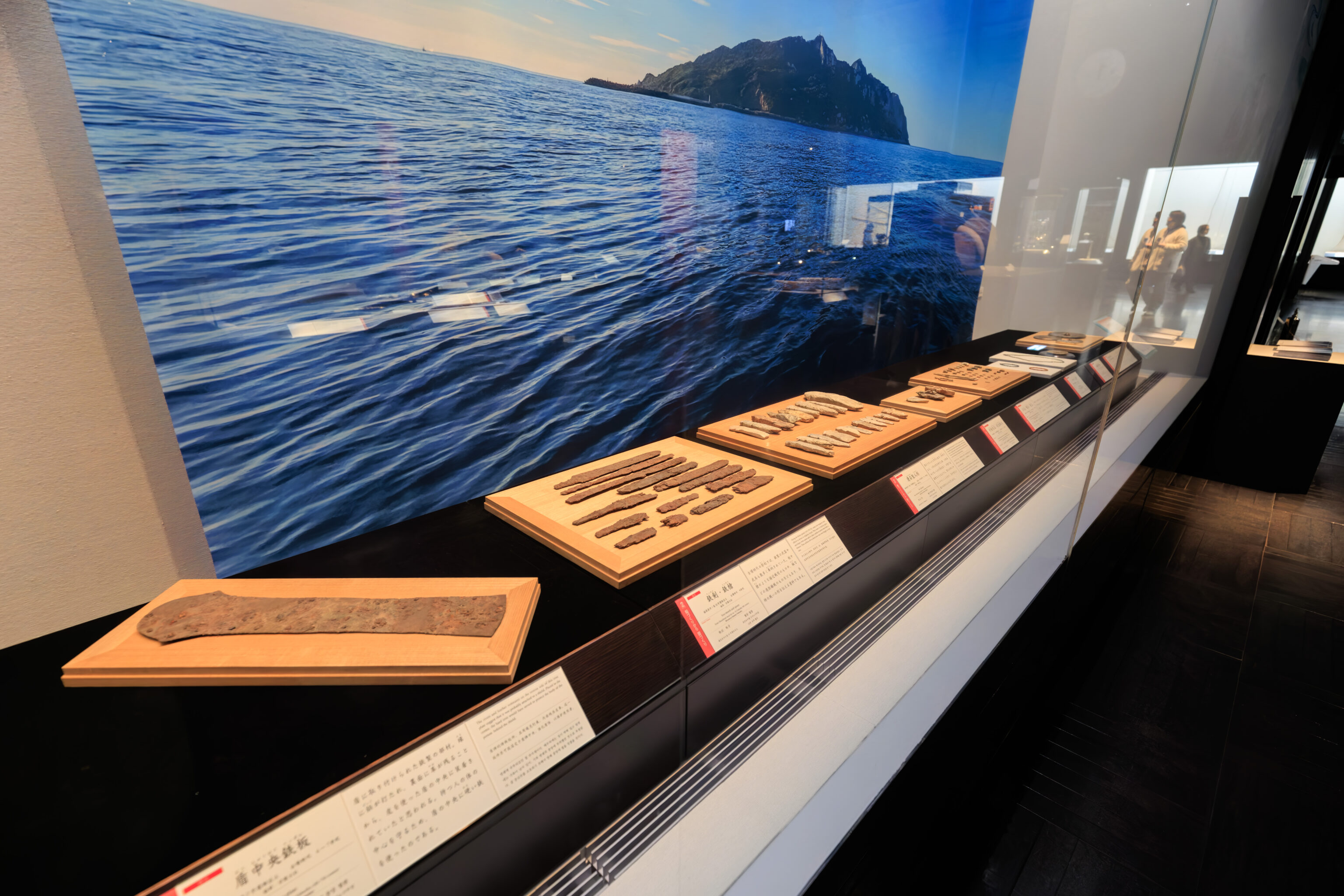
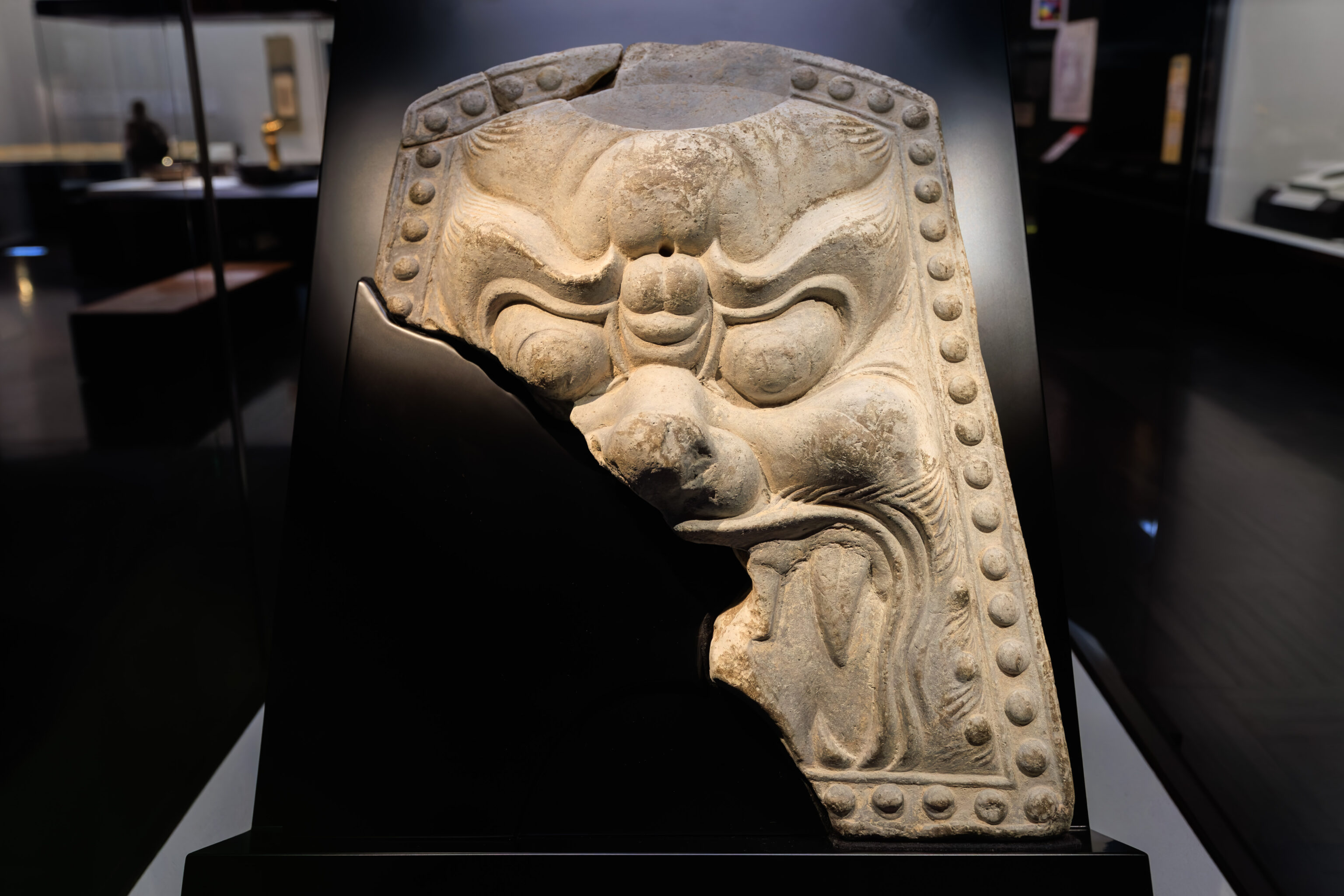
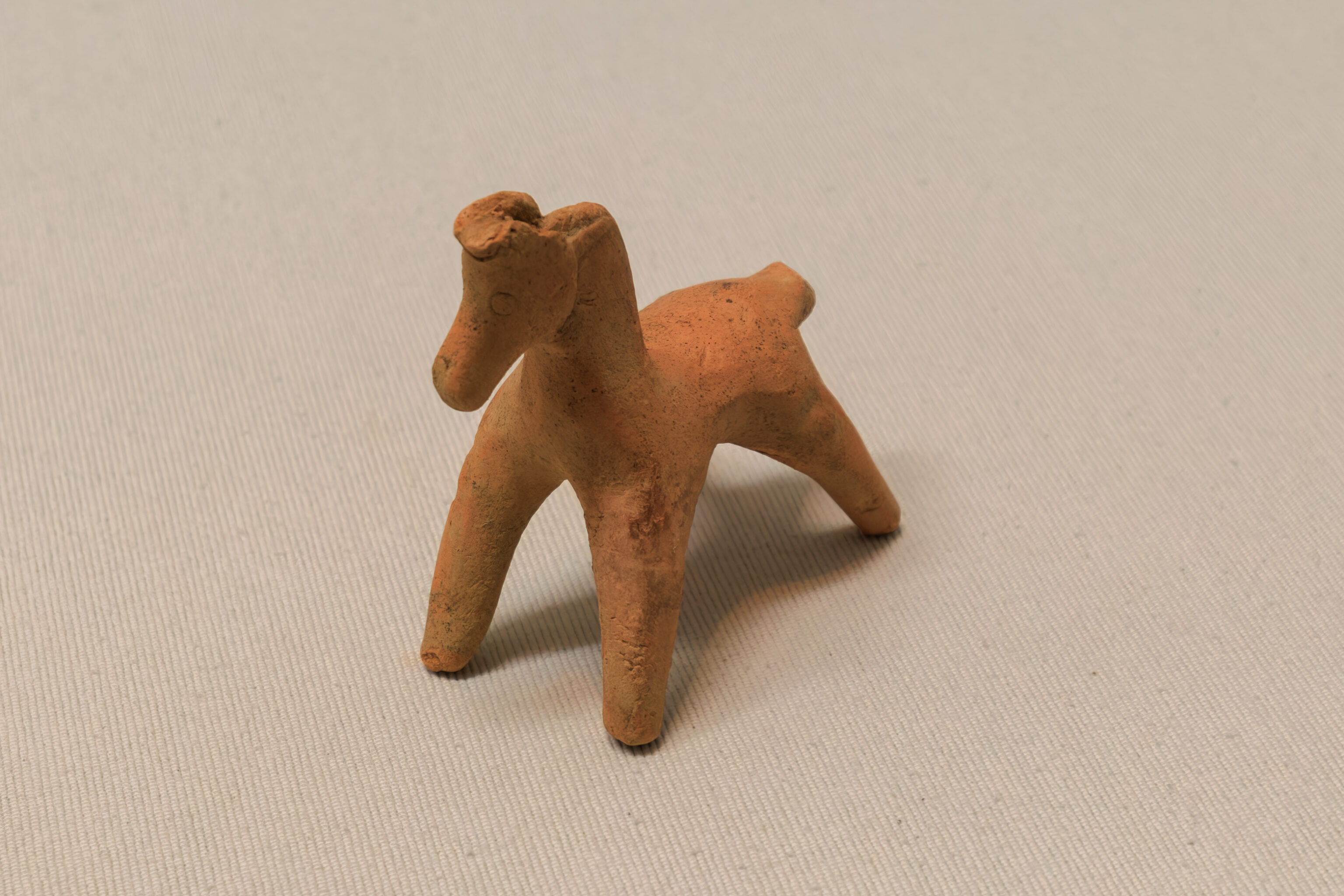
Many of the clay horses used in ancient rituals had their legs broken and were later discarded. The crescent-shaped heads of clay horses like this one are a distinctive feature of those that were unearthed at waterside excavation sites in the areas surrounding Kyoto and Nara.
– Text from a sign.
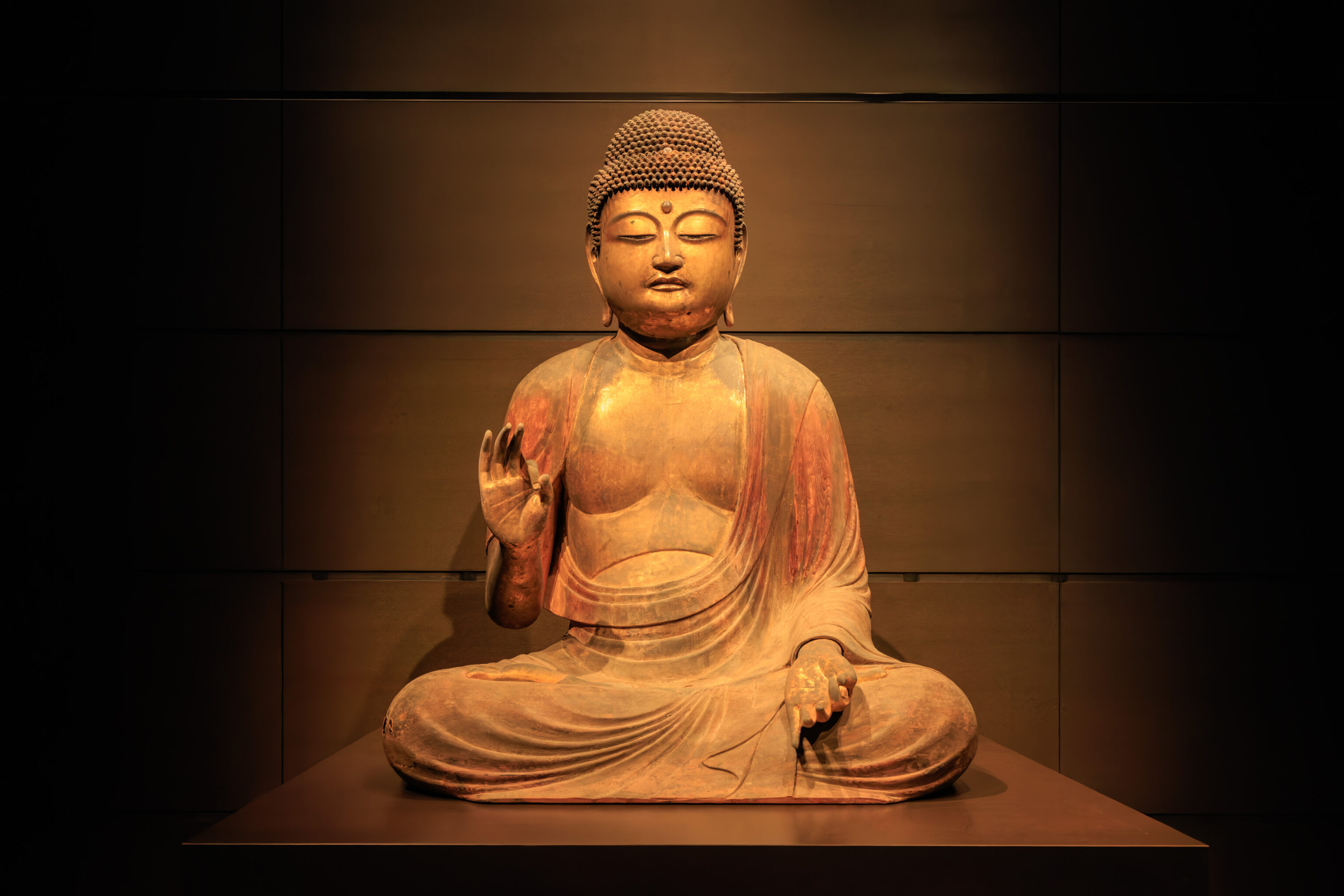
Seated Amida Buddha Statue
Heian Period, Kyoto National Museum

This statue was passed down in Sairin-ji temple in Kumiyama Town, south of Kyoto City. The buddha's mudra (hand grecure) welcomes the spirits of the dead to the Pure Land Paradise. His round face and gentle expression, the smooth planes used to shape the trunk of his body, and the drape of his clothing resemble the Amitabha Buddha carved in 1053 by Buddhist sculptor Jōchō. This suggests that this statue may also date to the eleventh century.
– Text from the partially legible sign for this artifact with English and Japanese, translated using Google.
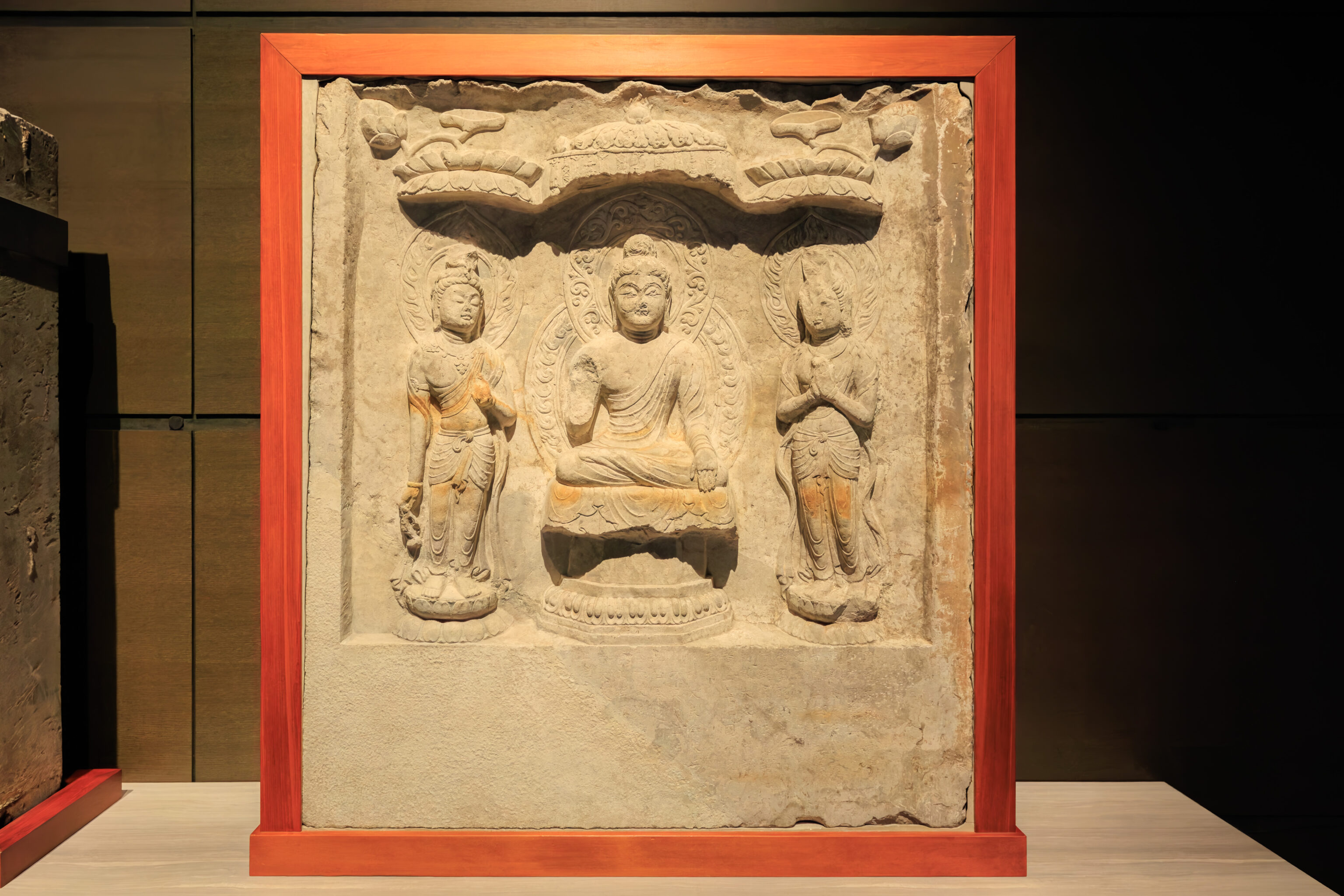
Buddhist Relief from the Tang Dynasty (China)
China, Xi'an City: Formerly at Baoqing Temple (Tang Dynasty) — Kyushu National Museum

A seated buddha is flanked by two bodhisattvas, beneath a parasol made of lotuses with spread petals. Fleshy depictions of figures were popular in Tang China, and this trend made its way to Japan when their envoys saw the Buddhist statues and reliefs in the Tang capital of Chang'an (present day Xi'an) and brought the idea back home.
– Text from the partially legible sign for this artifact with English and Japanese, translated using Google.
The stone relief has text inscribed into the bottom portion. However, it is basically illegible.
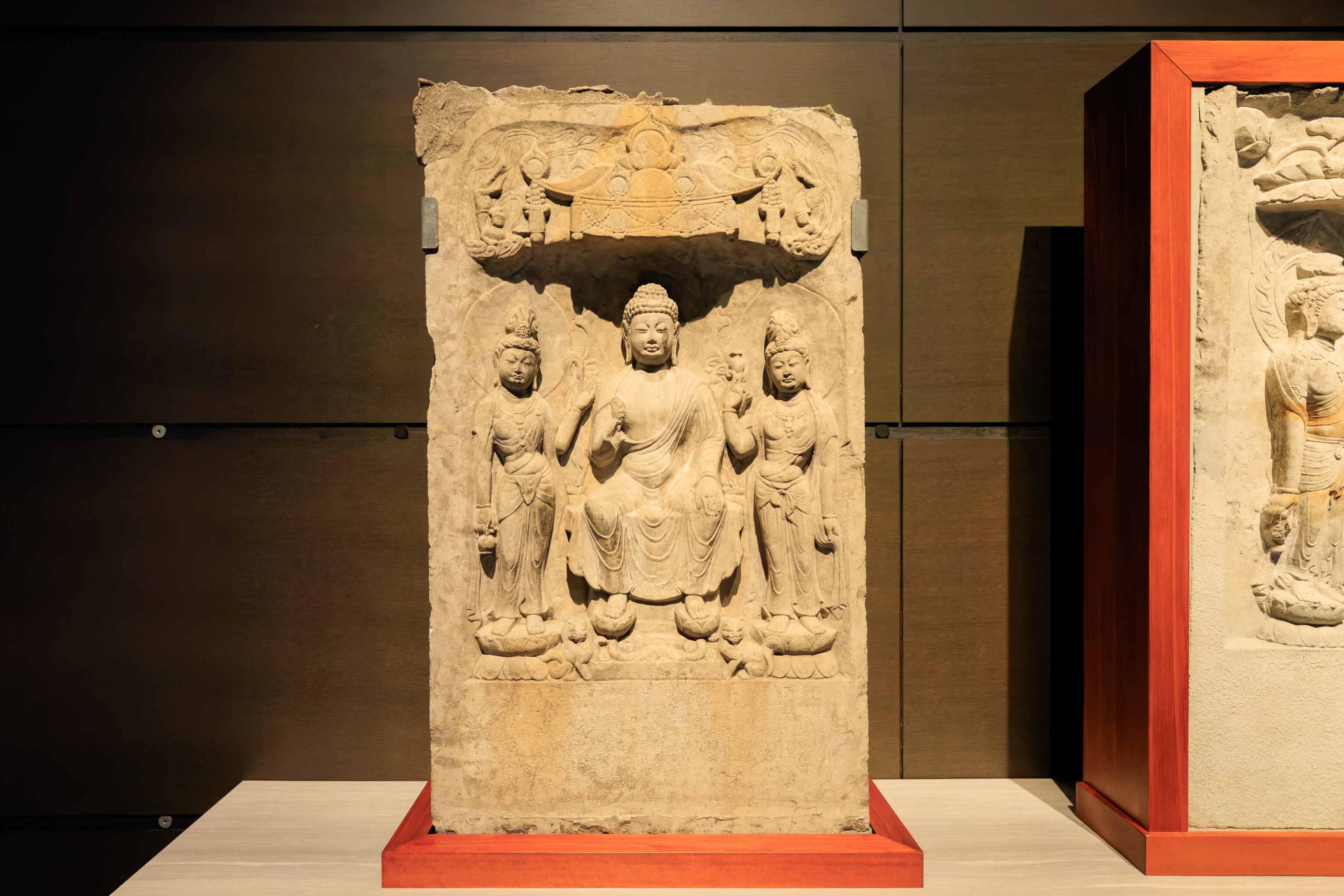
Buddhist Relief from the Tang Dynasty (China)
China, Tang Dynasty (8th Century)
(Formerly at Baoqing Temple, Xi'an, China)
Kyushu National Museum

This was one of the stone reliefs that decorated the inner walls of the Baoqing Temple in Xi'an, China. It was placed in the temple by monks and officials who served Wu Zetian (reigned 690-705), the only female monarch in all of Chinese history, as a prayer for her longevity and long reign.
– Text from the sign for this artifact with English and Japanese, translated using Google.
Like the previous stone relief, this one has text at the bottom as well. But it also is too hard to try to read.
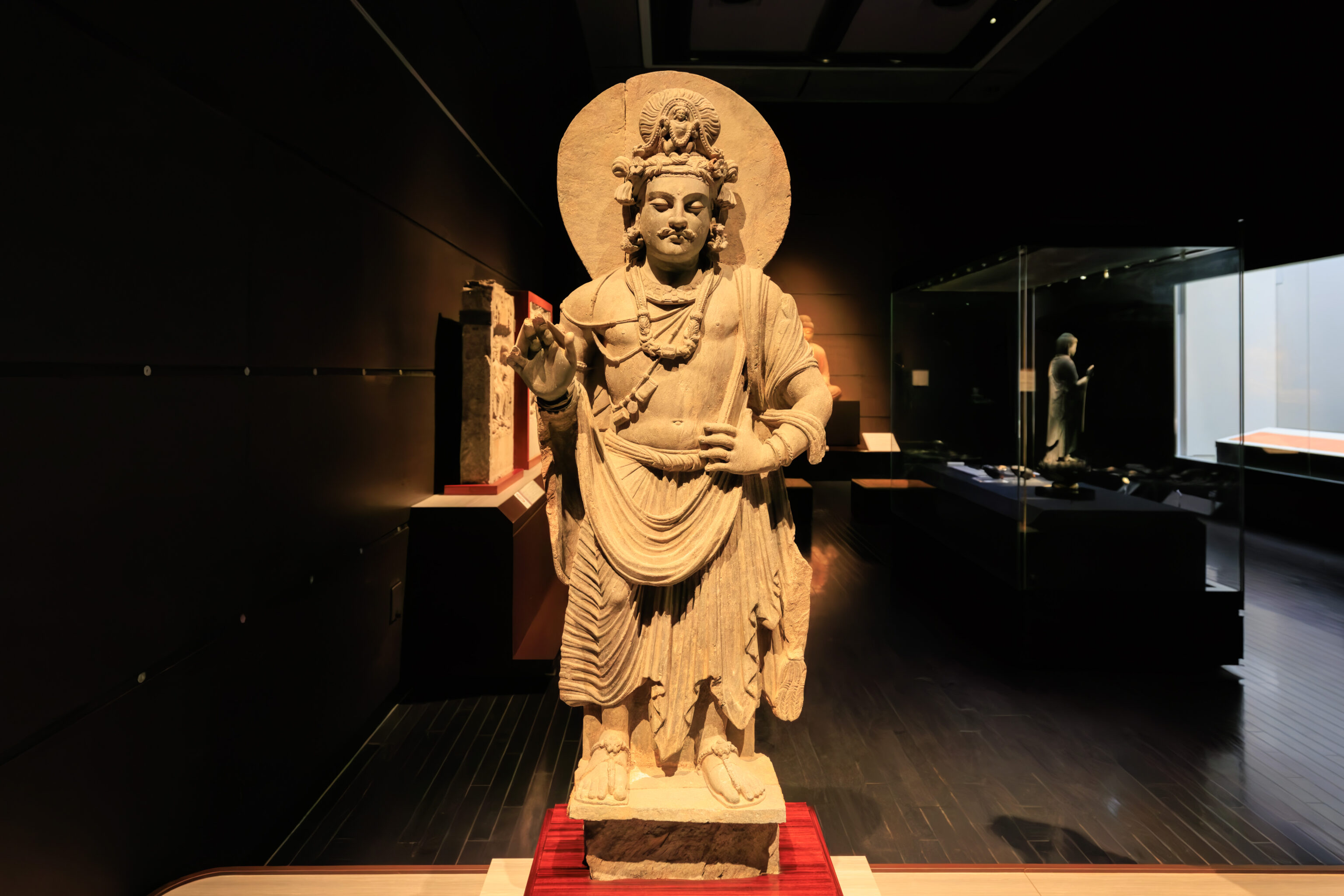
Standing Statue of the Buddha Before Enlightenment
Pakistan, Gandhara
2nd–3rd Century
Kyushu National Museum

The founder of Buddhism, Siddhartha Gautama, was born into the royal family. He attained enlightenment after he left his home. This statue is a rendering of the young prince before enlightenment, adorned with accessories such as a turban and a crown.
– Text from the sign for this artifact, translated using Google.
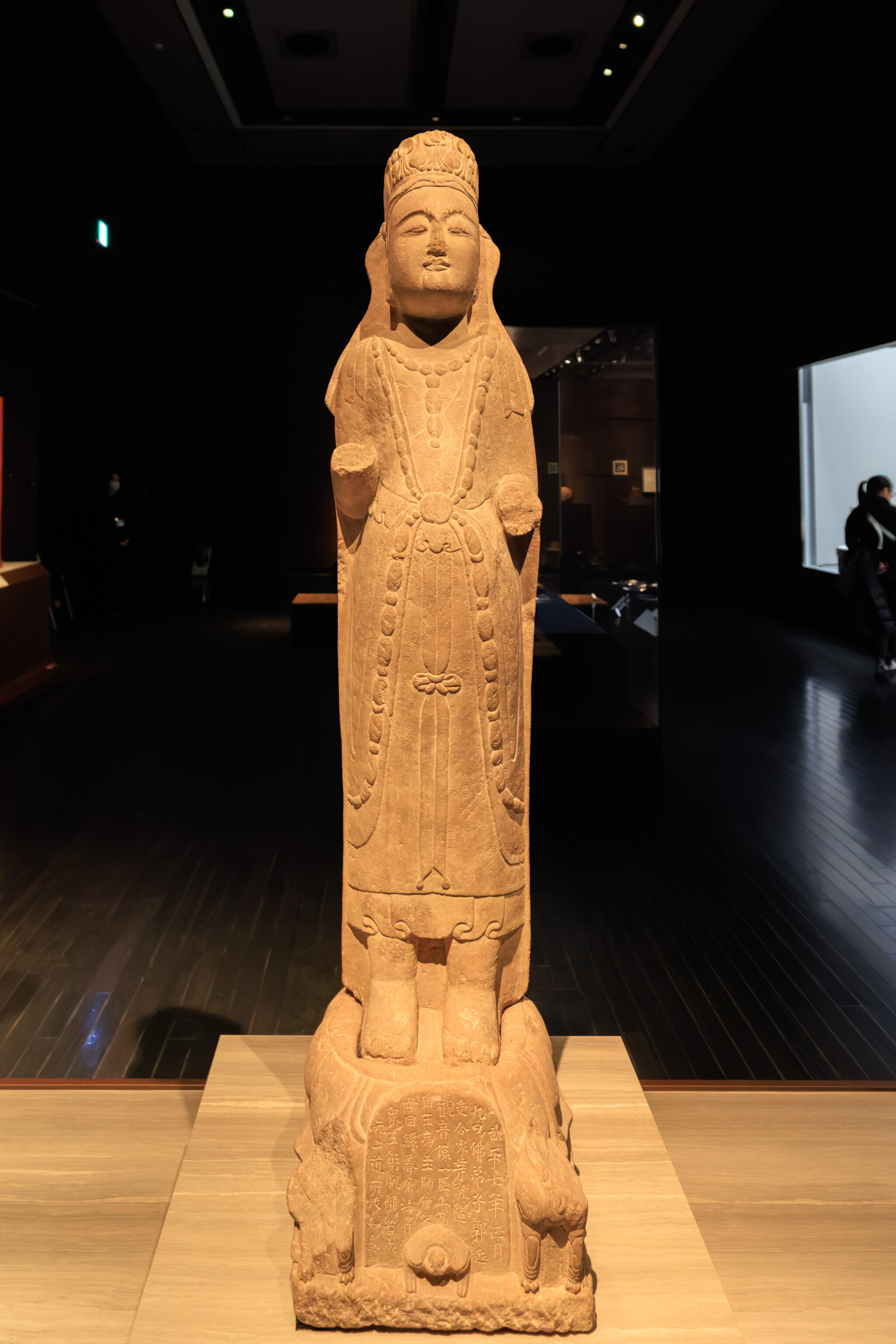
Standing Avalokiteshvara Bodhisattva
China, Northern Qi Dynasty, 576
Kyushu National Museum (Donated by Mr. Sakamoto Goro)

Here is a fine Buddhist statue from the Chinese Northern and Southern dynasties. The  inscription on the front of its pedestal identifies it as a statue of Avalokiteshvara by Guo Yanshou. The statue's plump face, protruding belly, and the ornaments crossing in an X shape are all features of Buddhist statues from that time.
– Text from the sign for this artifact with English and Japanese, translated using Google.
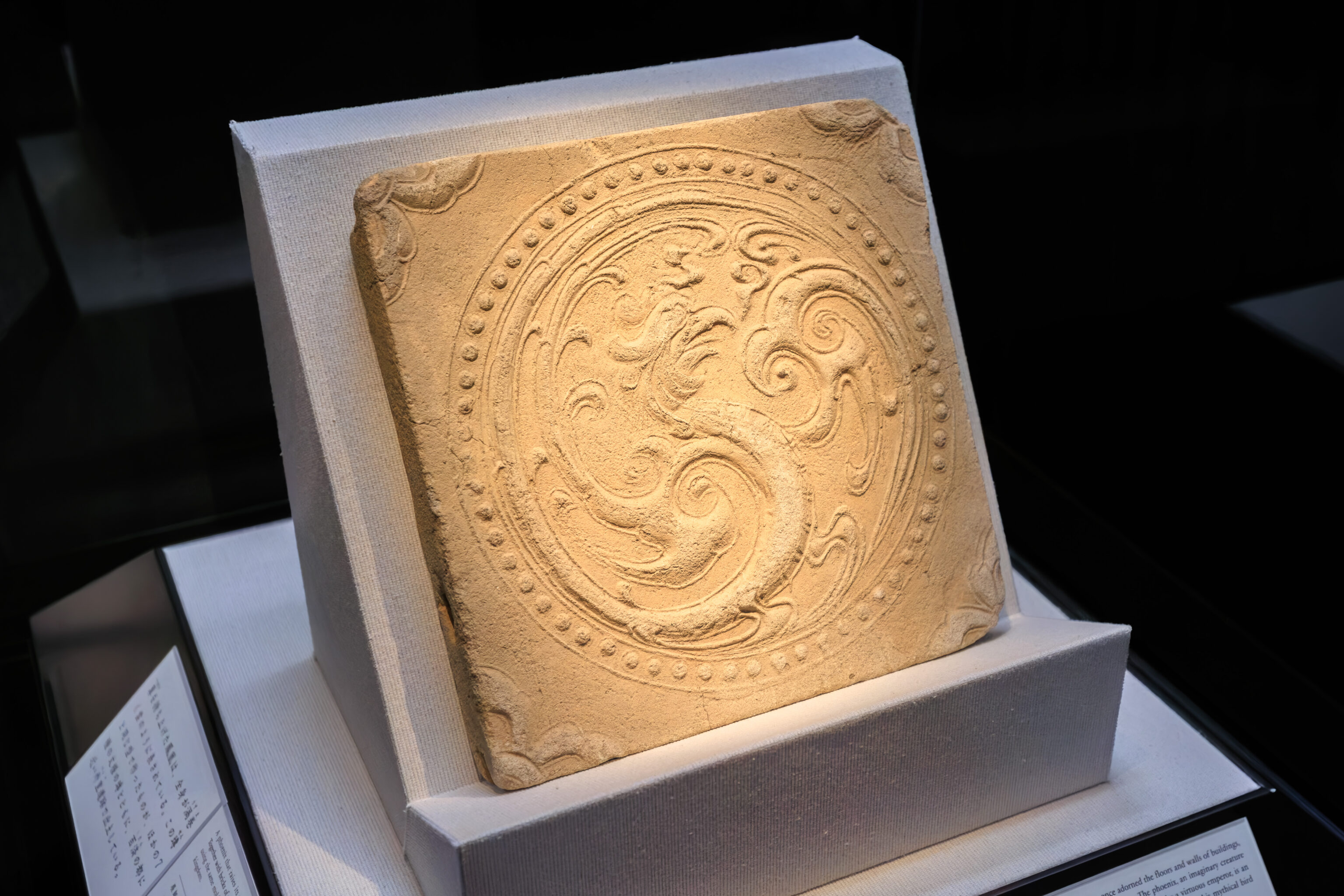
Brick of a phoenix design
Three Kingdoms period (Backje), 7th century
KYUSHU NATIONAL MUSEUM

Unglazed brick tiles once adorned the floors and walls of buildings, as well as temple foundations. The phoenix, an imaginary creature said to appear in peaceful times ruled by a virtuous emperor, is an auspicious motif. The stylized wings and tail of this mythical bird are beautifully rendered on this tile.
– Text from the sign for this artifact.
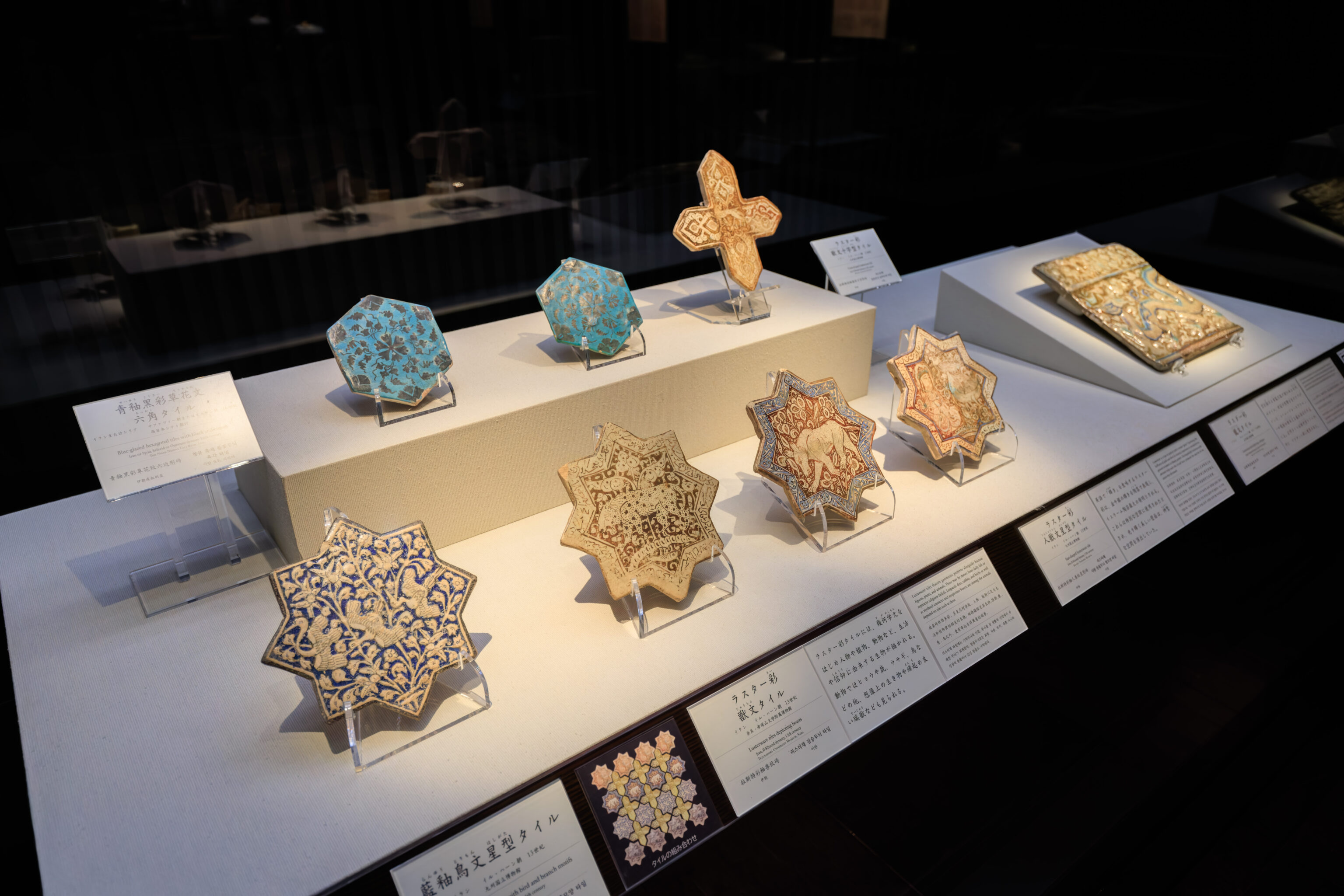
These tiles are from the Middle East.
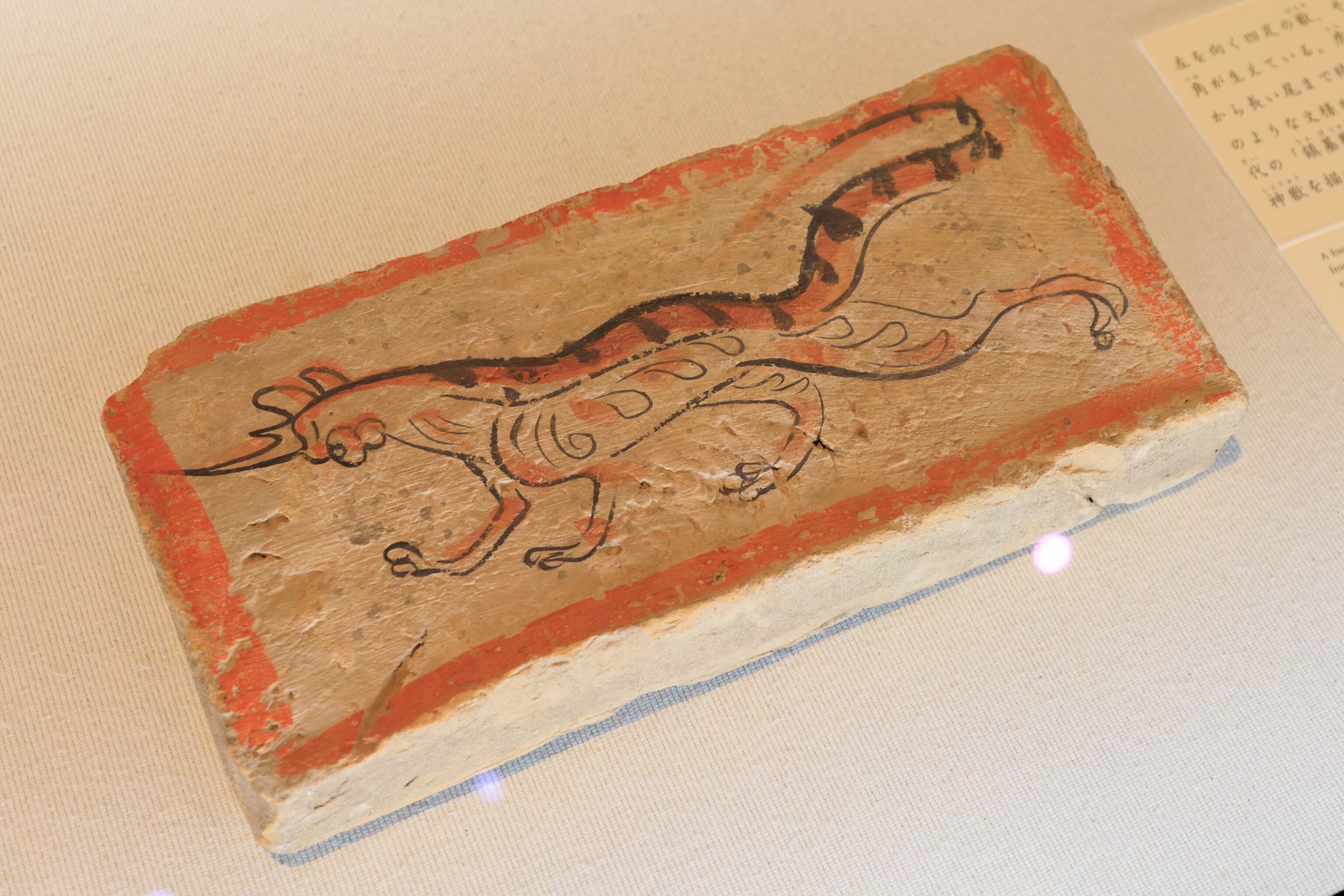
Painted brick tile
Gansu Province, China, Wei to Western Jin dynasty, 3rd-4th century
Tezukayama University Museum, Nara

A four-legged beast looks to the left, with sharp horns protruding from its head. While its belly has a scale-like pattern, tiger-like stripes run from its back to its long tail. Similar beasts appeared as "grave guardians" in the Han dynasty (618-907), so this tile is probably depicting a divine creator guarding a tomb.
– Text from the signs for this artifact.
Note that the text on the sign for the artifact mentions the Han dynasty, however, the dates given are for the Tang dynasty.
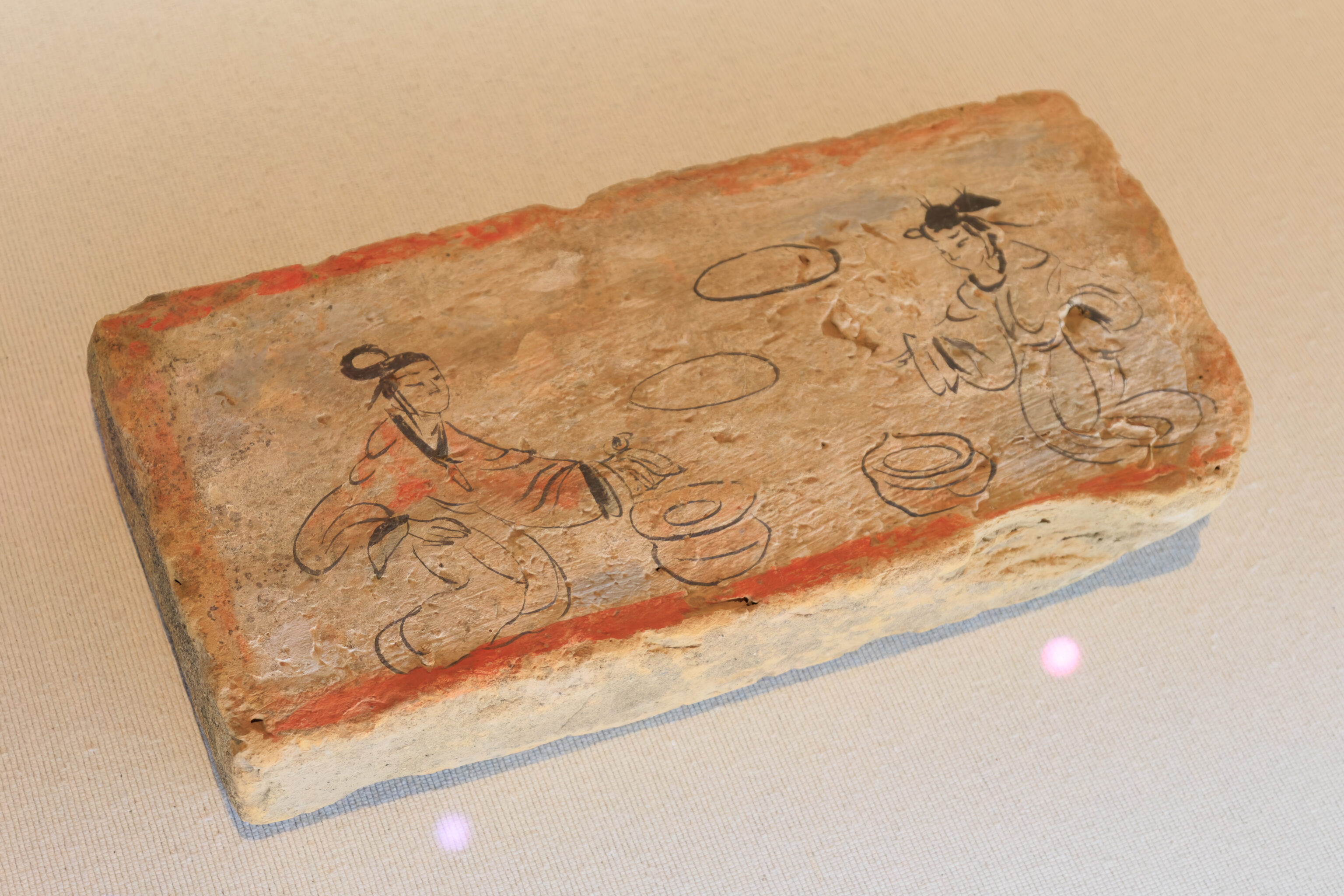
Painted brick tile
Gansu Province, China, Wei to Western Jin dynasty, 3rd-4th century
Tezukayama University Museum, Nara

This tile features a man and woman facing each other, with a jar-like vessel between them. In what is probably a banquet scene, the woman on the left offers something, while the man on the right seems to hold out a sake cup. Their loose, flowing garments indicate a high social rank.
– Text from the signs for this artifact.
Important Cultural Property
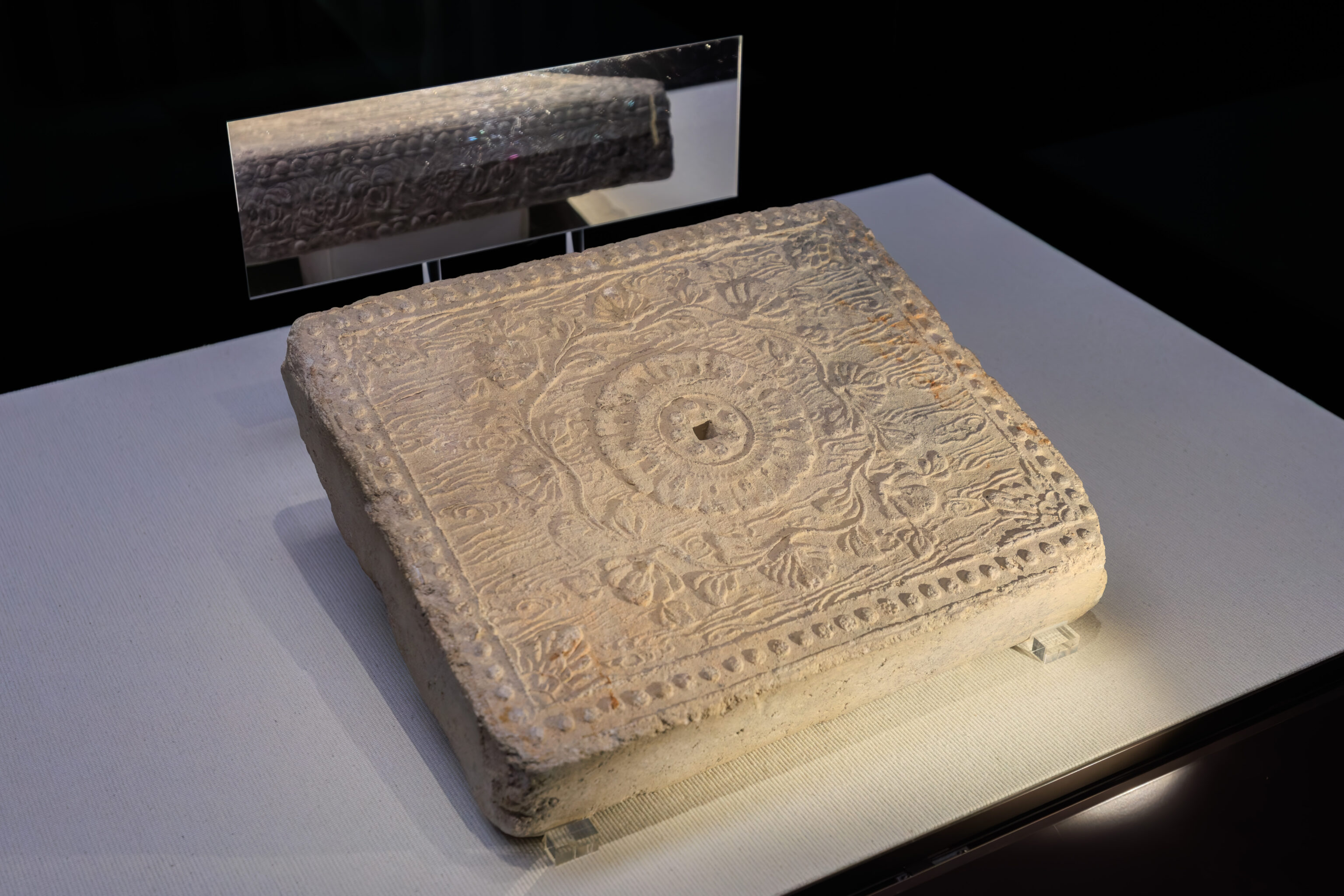
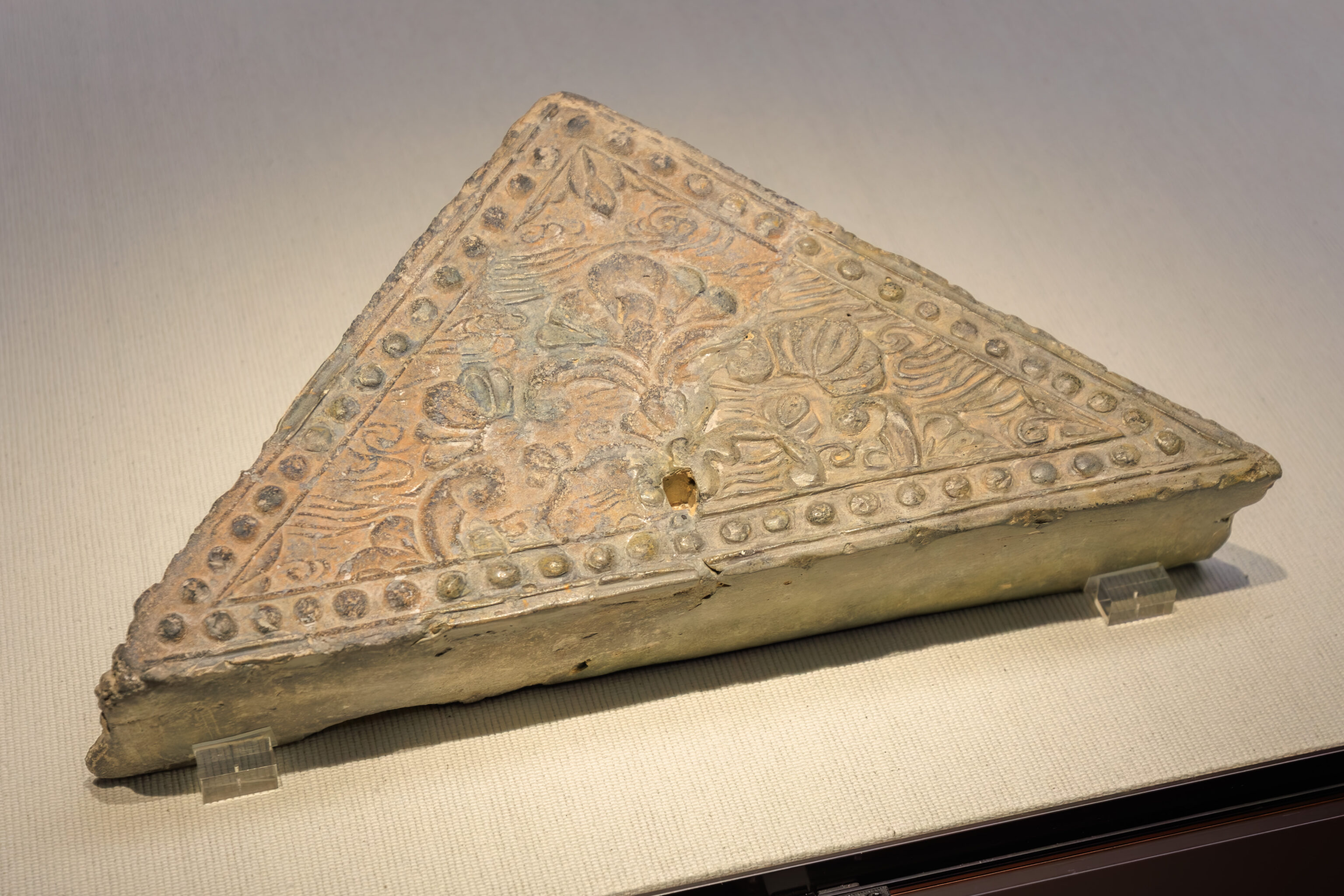
Triangular and rectangular patterned brick tiles
From the Dazaifu Gakkō-in site, Fukuoka, 8th century
Kyushu Historical Museum, Fukuoka

This ancient brick features a hōsōgemon arabesque floral motif that was widely used in Tang China. It is thought to have developed in China from floral patterns used in India and other countries further west. In Japan, this pattern was popular during the eighth to twelfth centuries.
– Text from the sign for the above two artifacts.
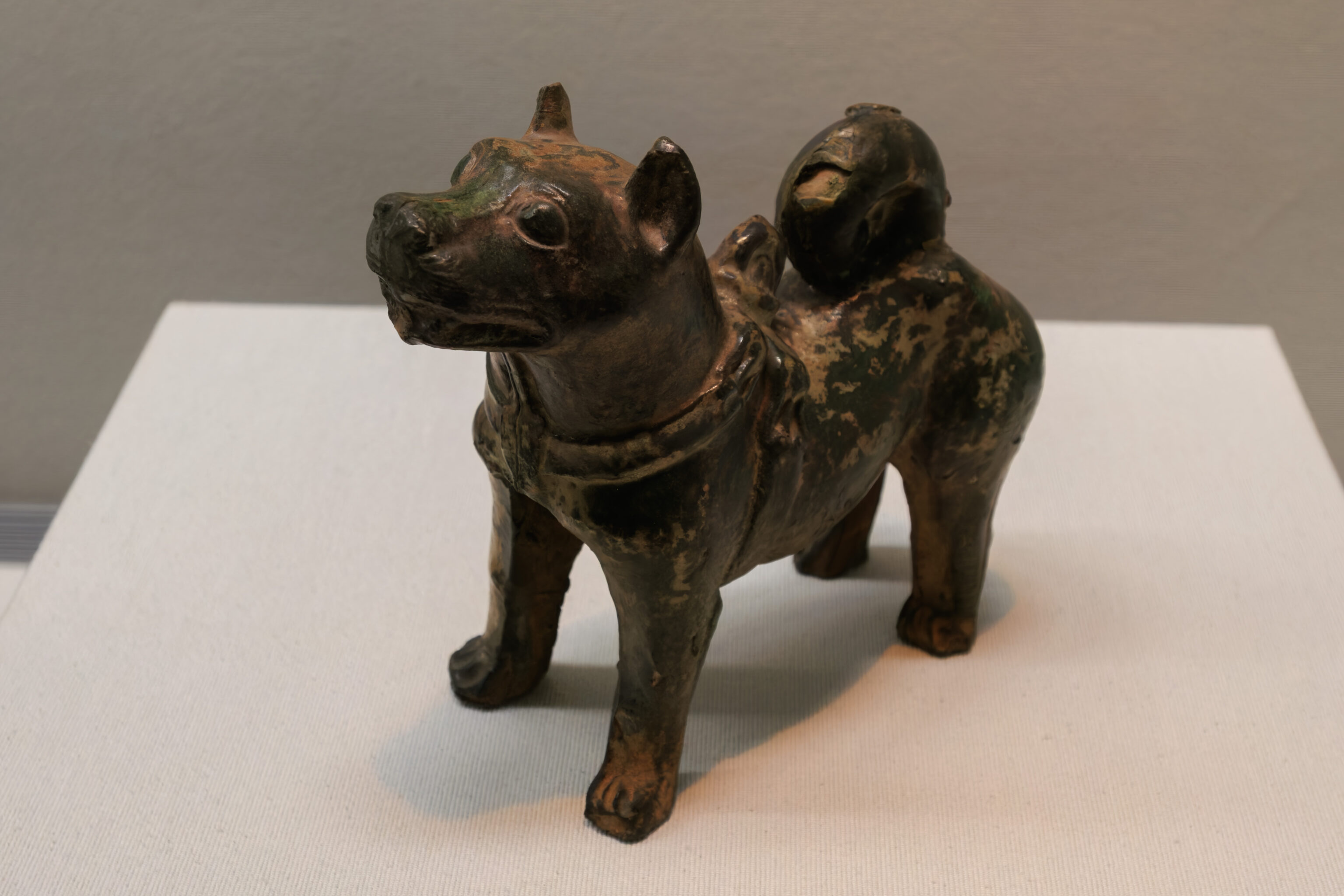
Green-glazed ceramic dog
China, Eastern Han-Western Han dynasties, 1st century BCE-1st century CE
Kyushu National Museum

This green-glazed ceramic dog was created as a burial offering. Its slightly upturned face and full, curly tail are endearing. The harness attached to its neck and torso, with metal fittings and claws, is also finely detailed. Perhaps it represented a hunting dog that had been kept by the deceased.
– Text from the sign for this artifact.
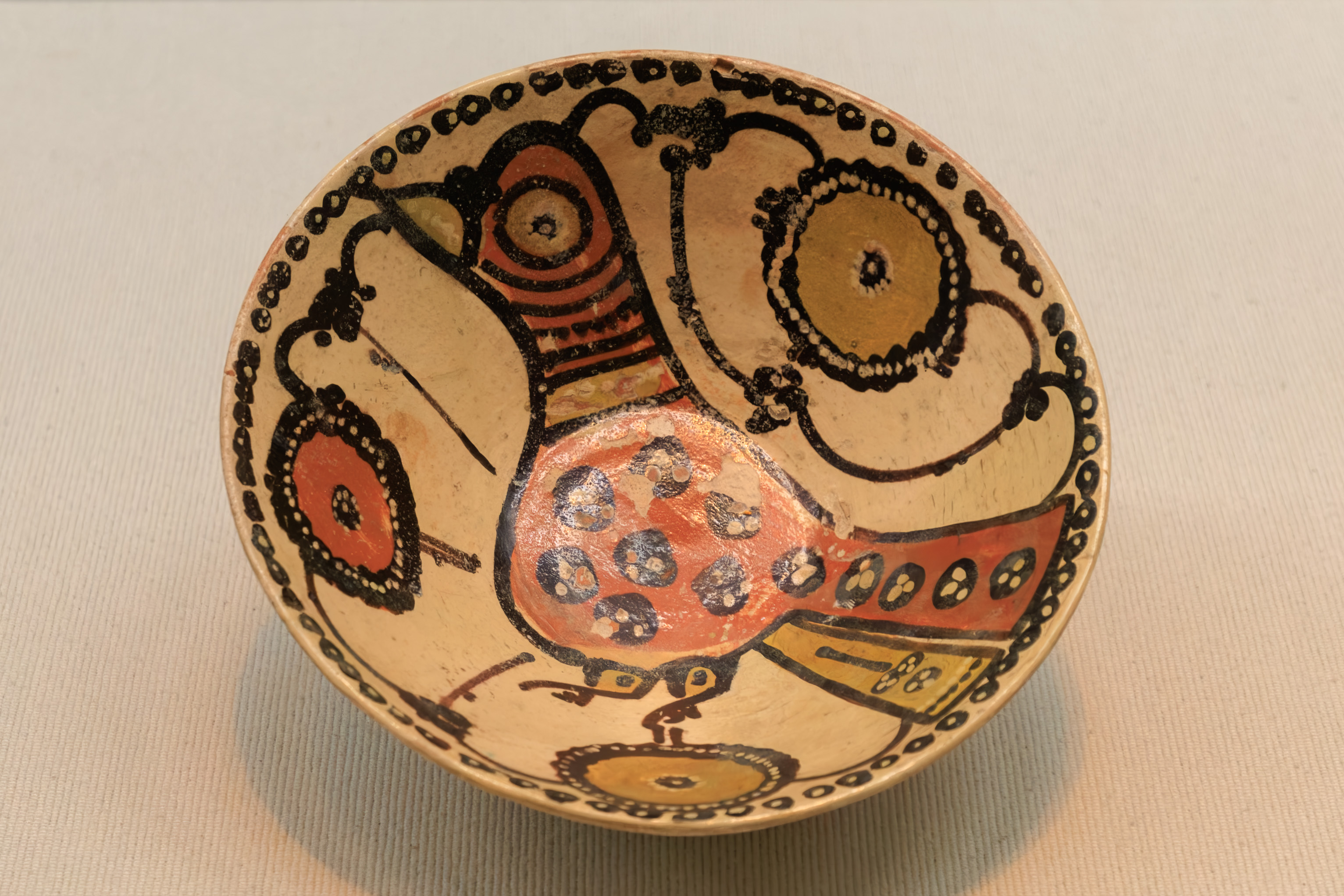
Bowl painted with a bird motif
Iran, Samanid dynasty, 10th-11th century
Kyushu National Museum
– Text from the sign for this artifact.
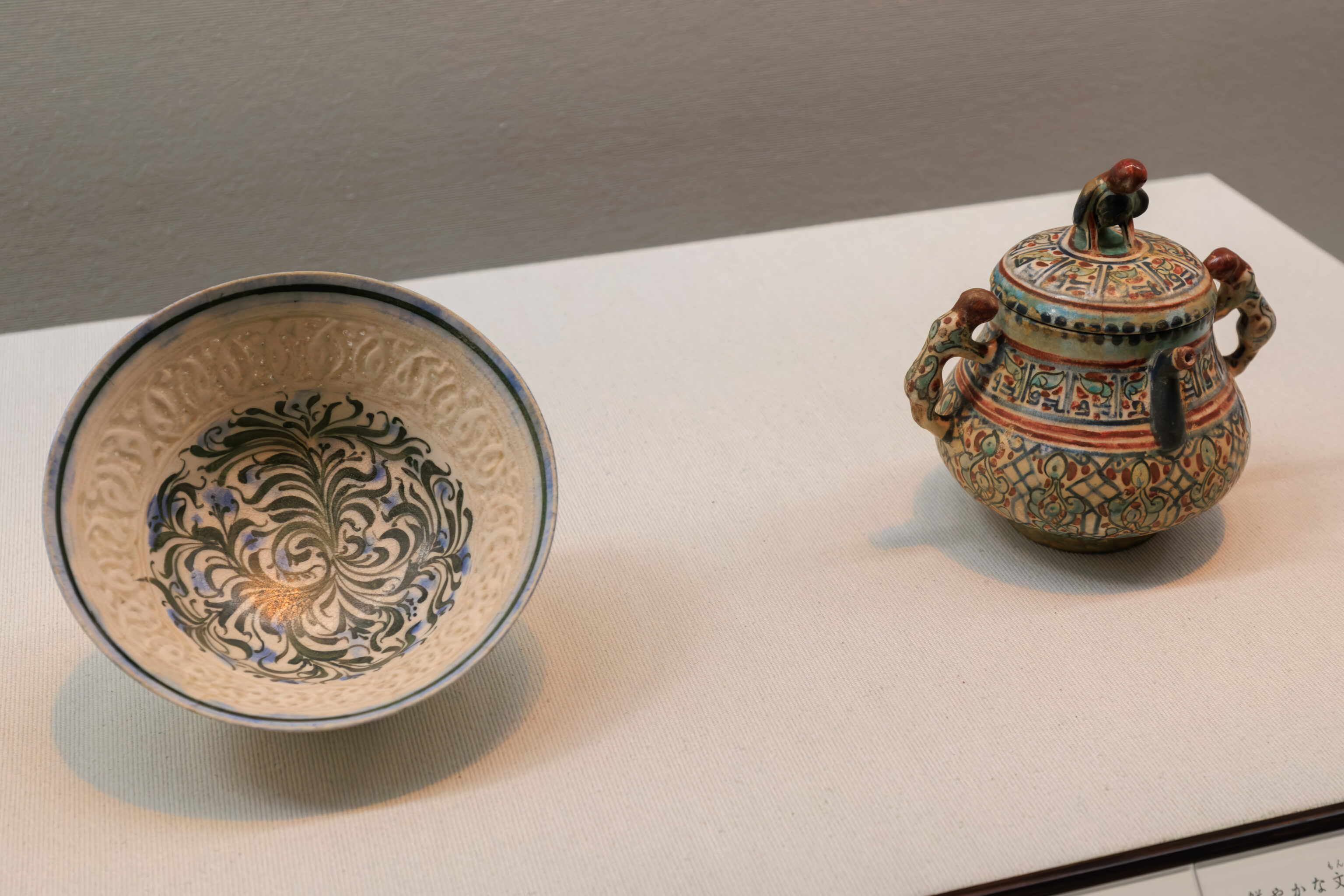
White-glazed hotaru-de bowl with indigo plant motifs
Iran, Il-Khanid dynasty, 13th-14th century
The Nishi-Nippon City Bank, Ltd.

Lidded jar with beast-shaped handles
Iran, Seljuq dynasty, 12th-13th century
The Nishi-Nippon City Bank, Ltd.
– Text from the sign for these two artifacts.
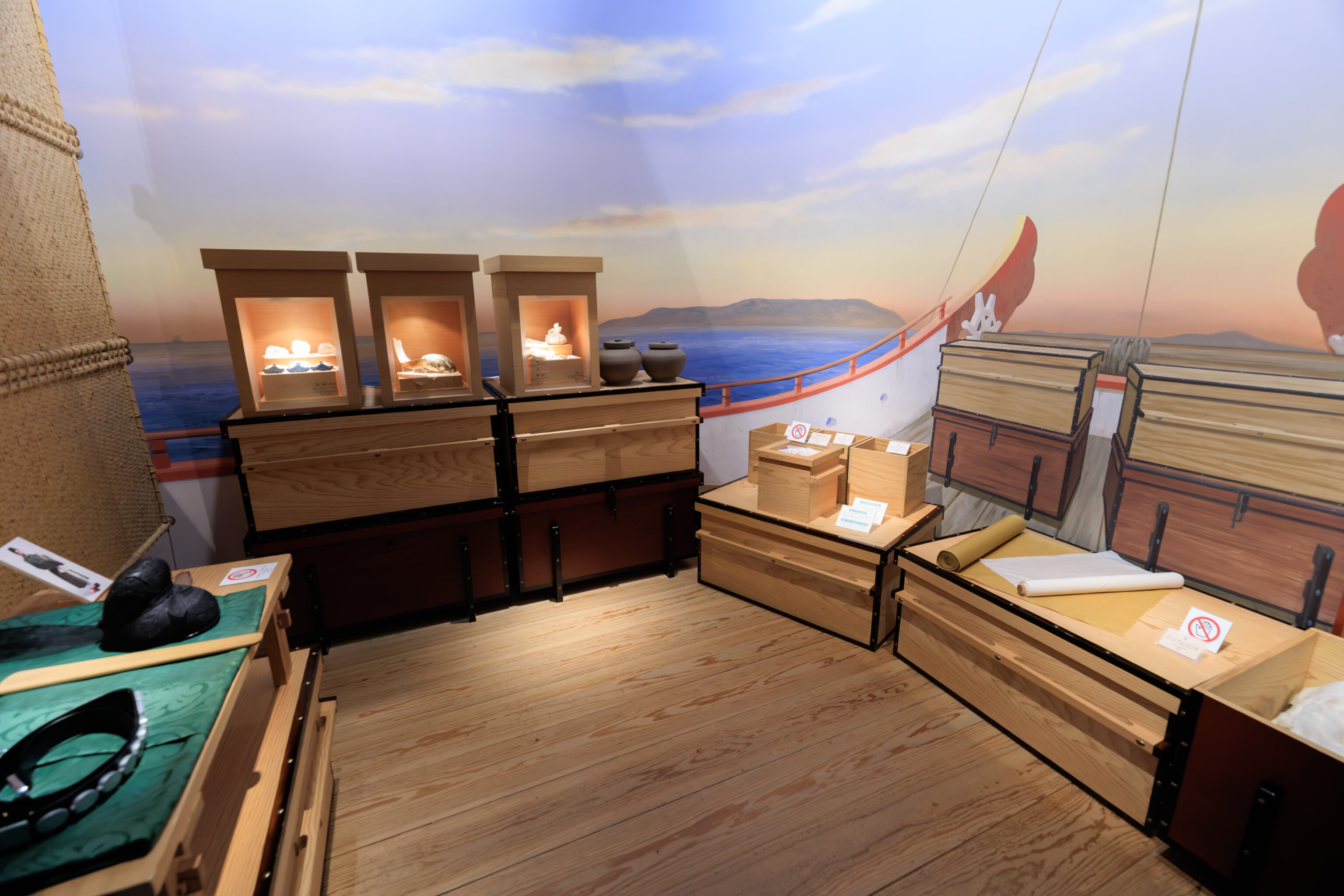
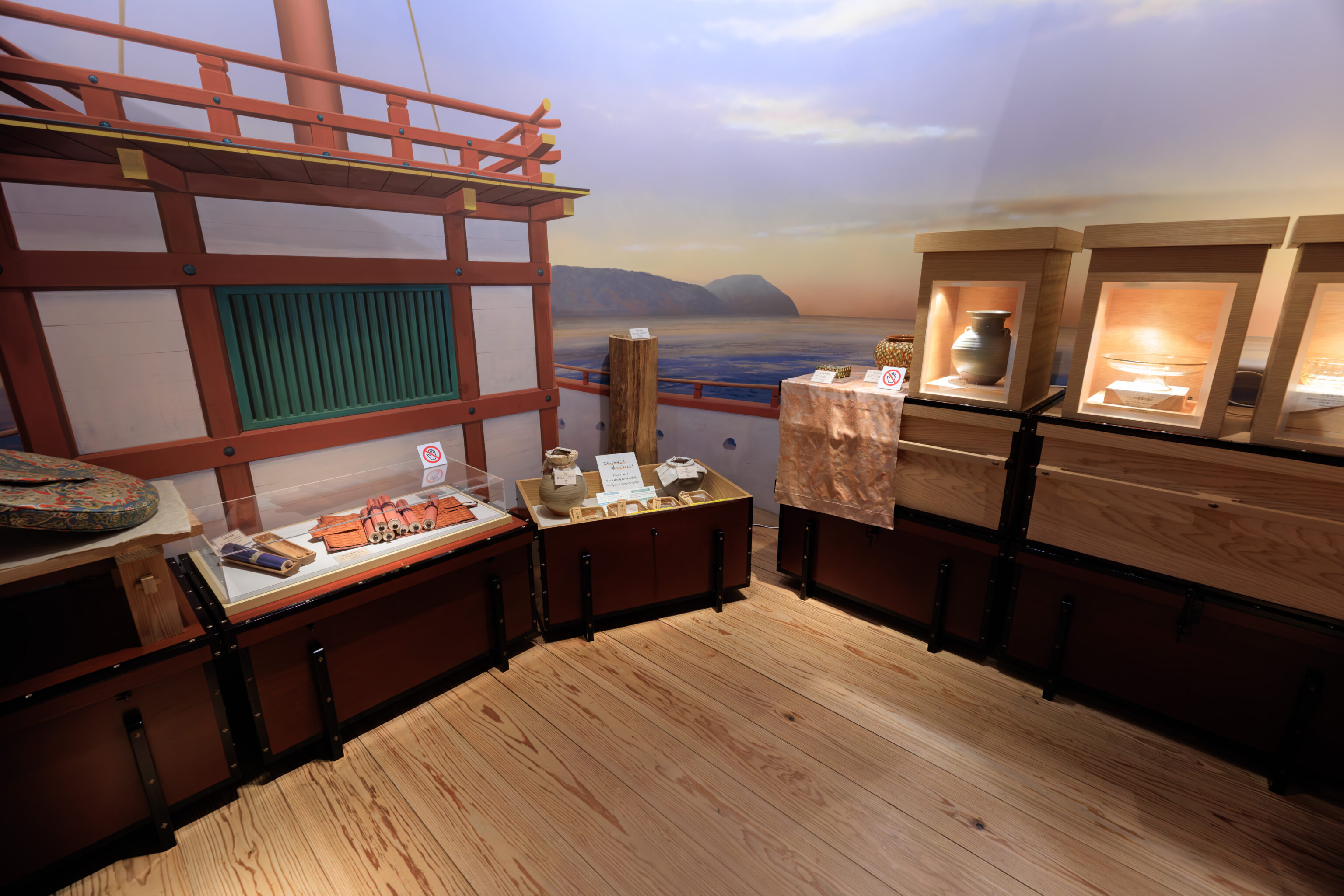
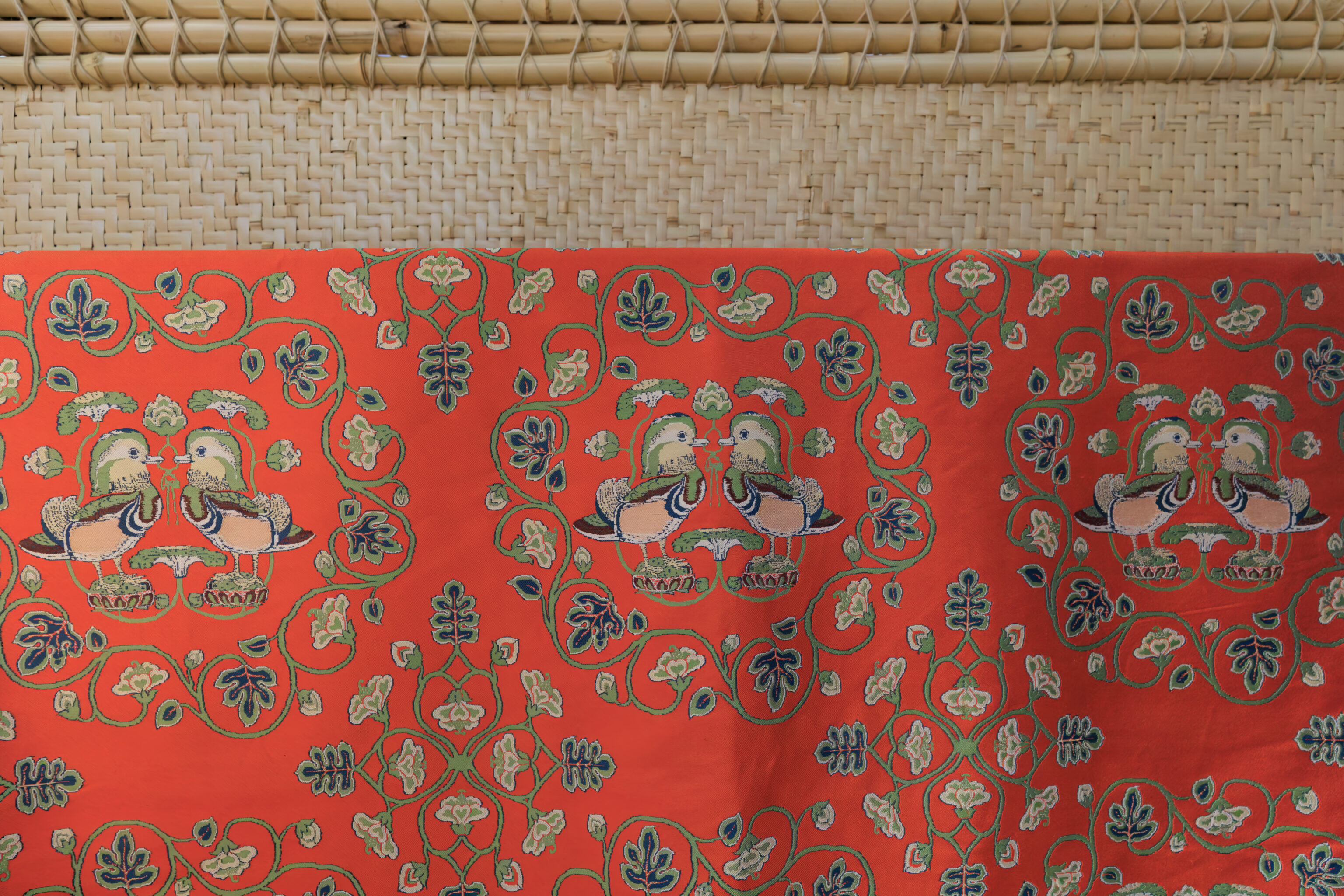
This room depicted what might be on a trade ship.
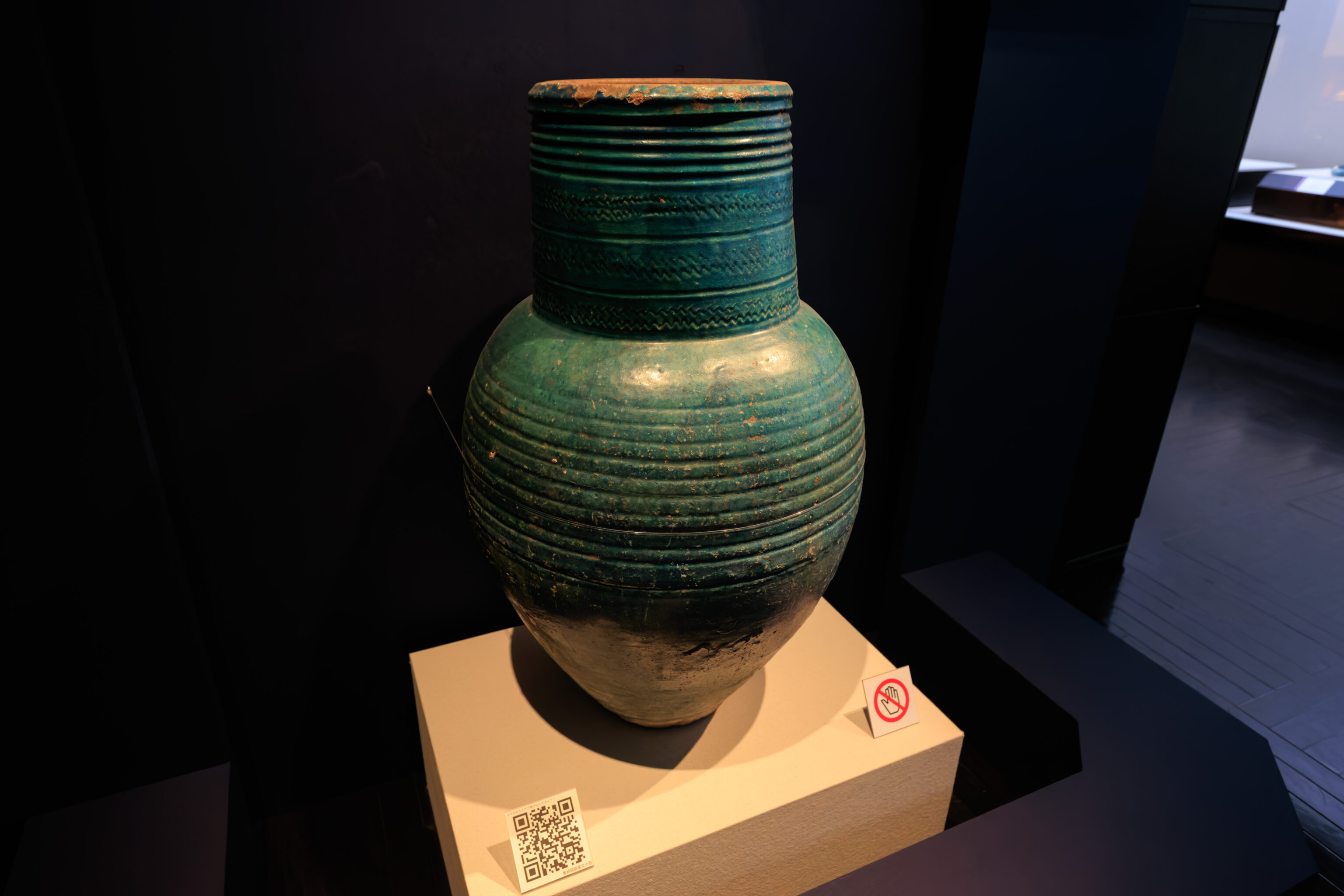
Large turquoise-glazed jar
Iran, 9th-11th century
The Nishi-Nippon City Bank, Ltd.

This bowl, glazed in a bright cobalt blue, is incised in dark indigo lines on its inner surface. While its shape shows a Chinese influence, the clay used to create this piece, as well as the colors and application of the glazes that cover it, are representative of Islamic ceramics.
– Text from the sign for this artifact.
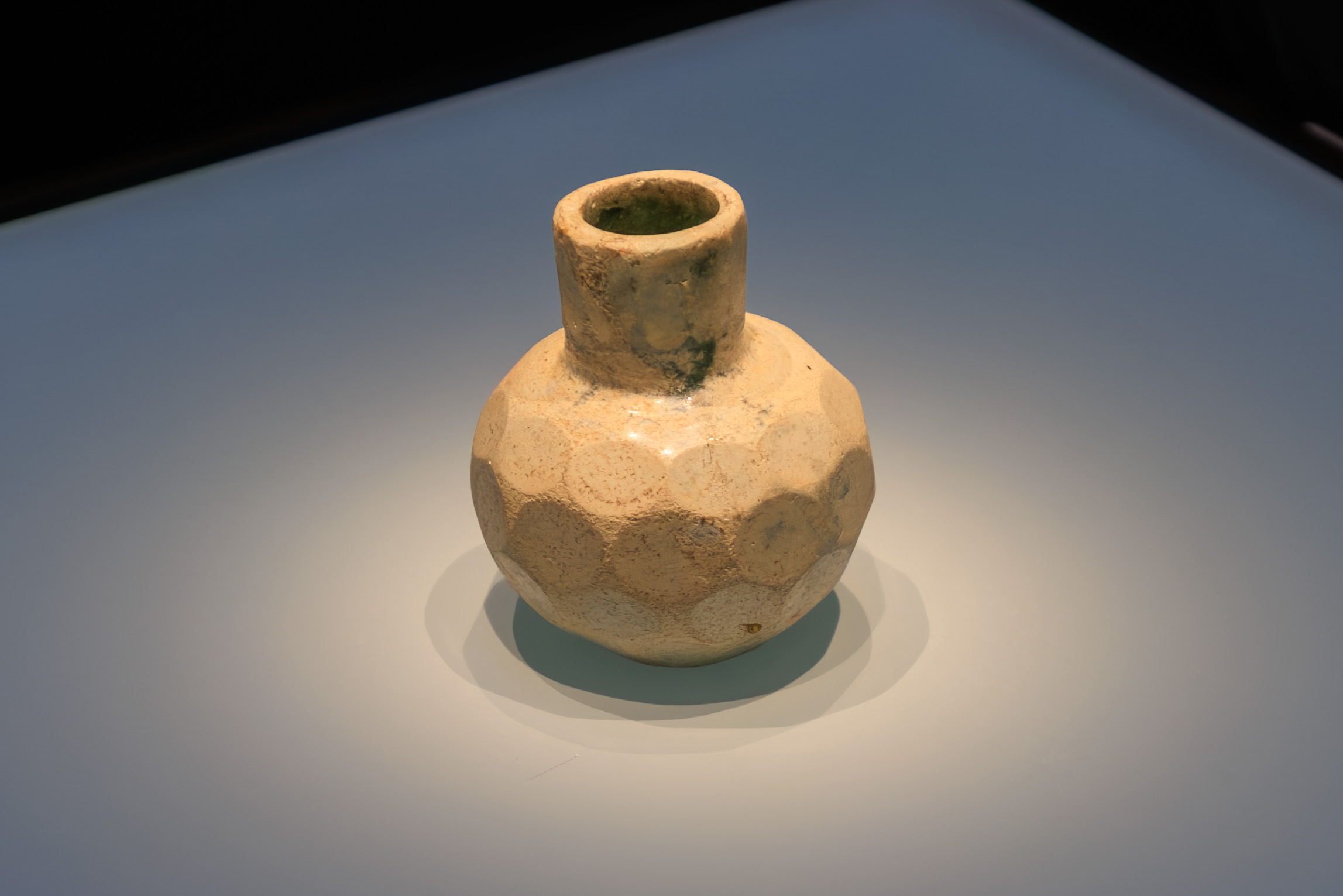
Small cut-glass bottle
From around Iran, early Islamic period, 8th-9th century
Kyushu National Museum

A small vessel adorned with cut decoration. Believed to have once held perfume or aromatic oil, it has taken on a whitish appearance, though traces of its original transparent green hue remain faintly visible. Its production techniques carry on the legacy of Sasanian cut glass—such as that found among the treasures of the Shōsōin—and similar artifacts.
– Text from the sign for this artifact, translated using Google.
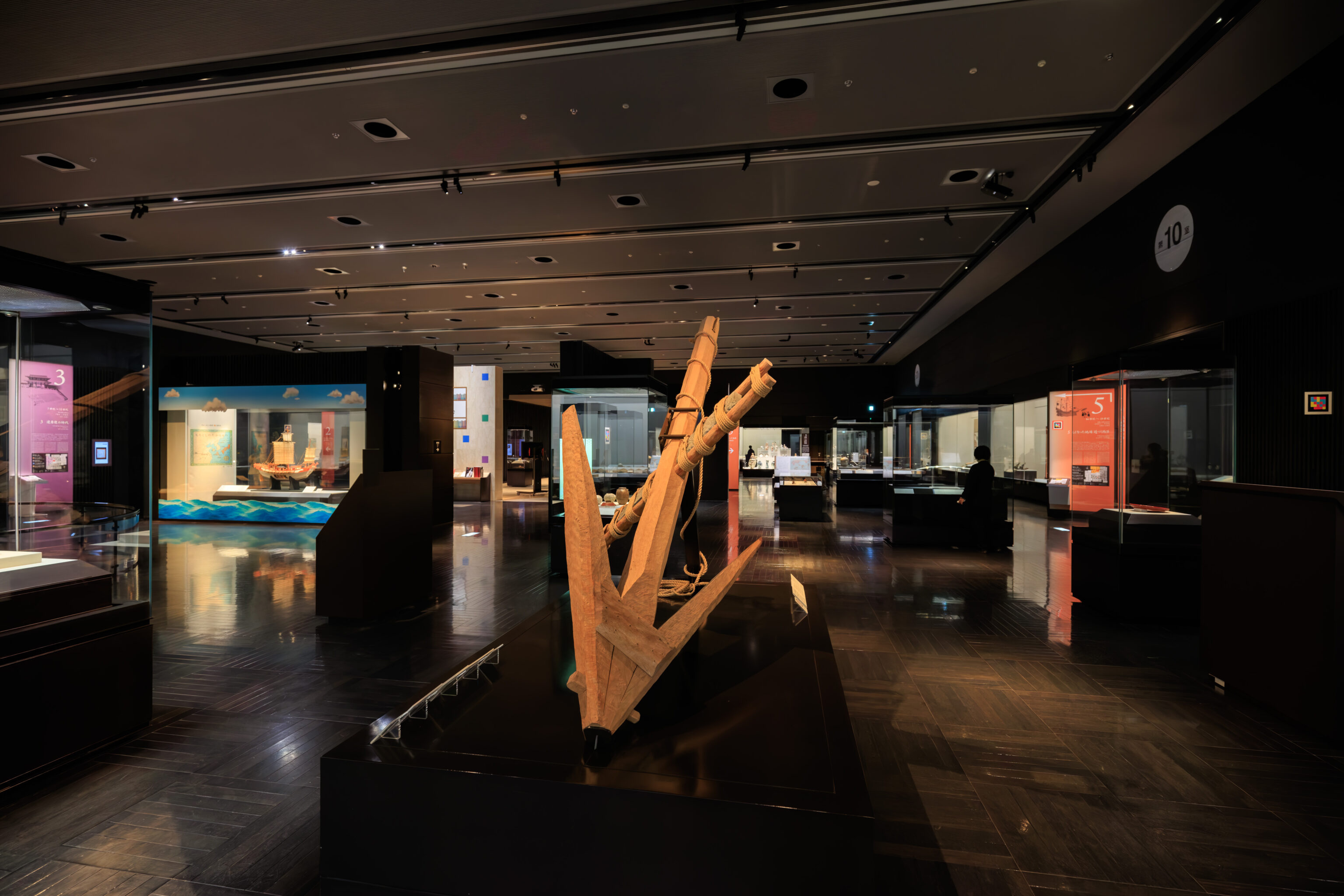
Anchor of an invading Mongol warship
From the Takashima underwater ruins, Nagasaki, 13th century
Matsuura City Board of Education, Nagasaki

This is a reproduction of a Mongol warship anchor. The stone portion is an actual fragment recovered from the shipwreck off Takashima, Nagasaki, while the wooden portion is a reimagination of what the rest of the anchor may have looked like. The state in which the anchor remnants were found suggests that the ship had been docked when it sank.
– Text from the sign for this artifact.
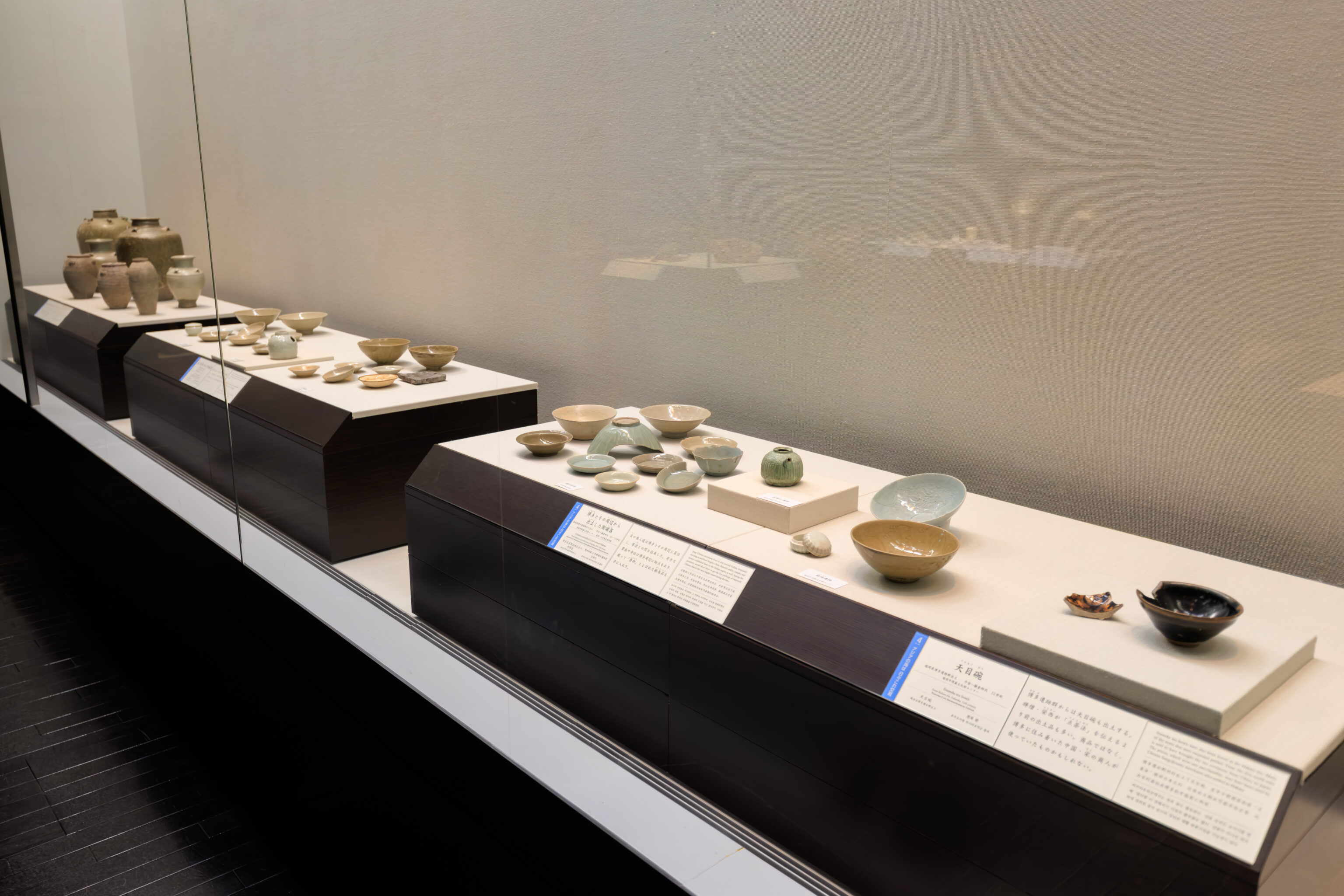
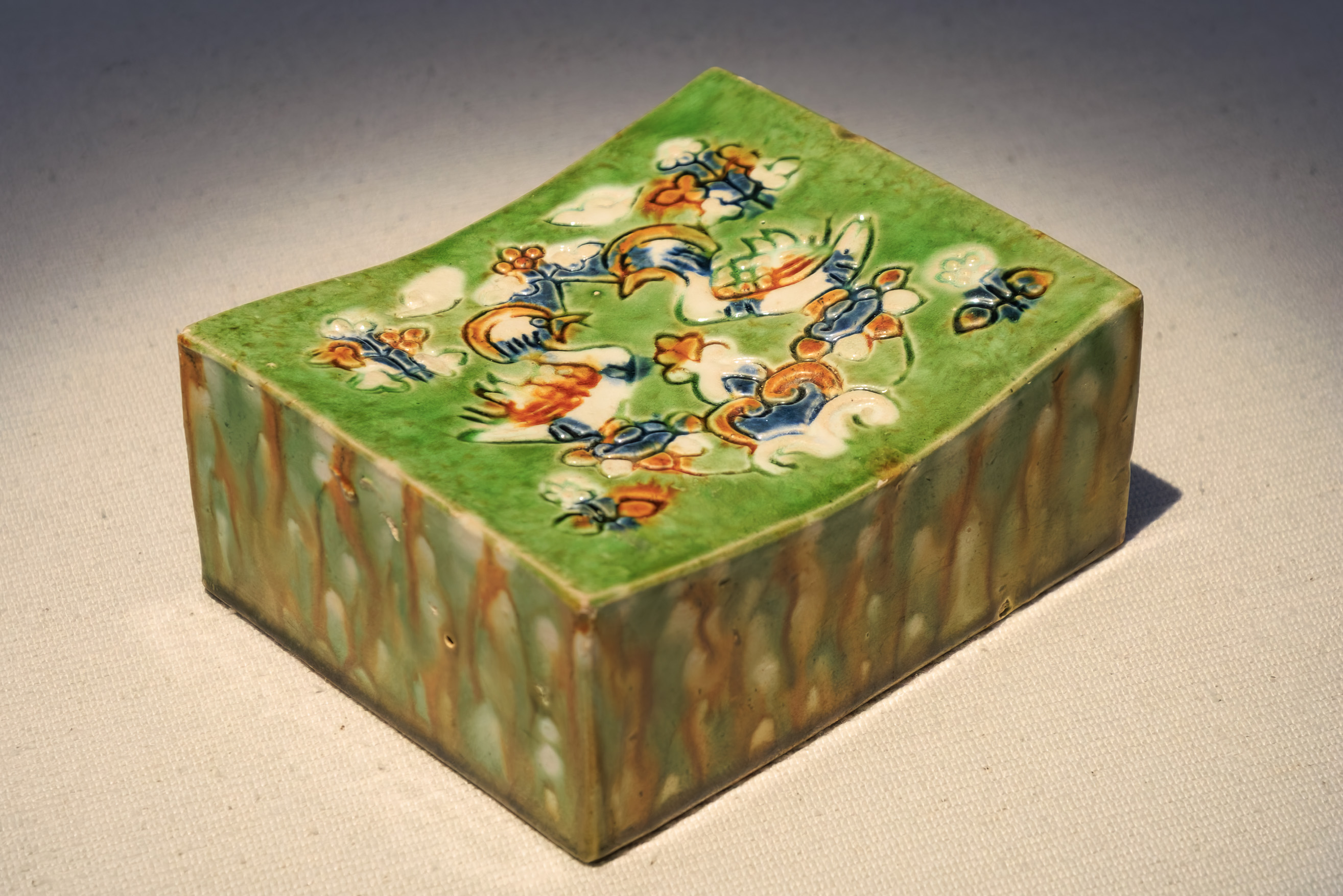
Sancai tri-color glazed ceramic pillow with mandarin ducks
Tang dynasty, 8th century
Kyushu National Museum

Sancai (tri-colored) ceramics were produced in the vicinity of Luoyang, a Tang sub-capital which was one of the major cities along the Silk Road. Richly colored in shades such as brown, indigo, and cream, Tang sancai ware like this ceramic pillow was widely distributed on the East-West trade network.
– Text from the sign for this artifact, translated using Google.
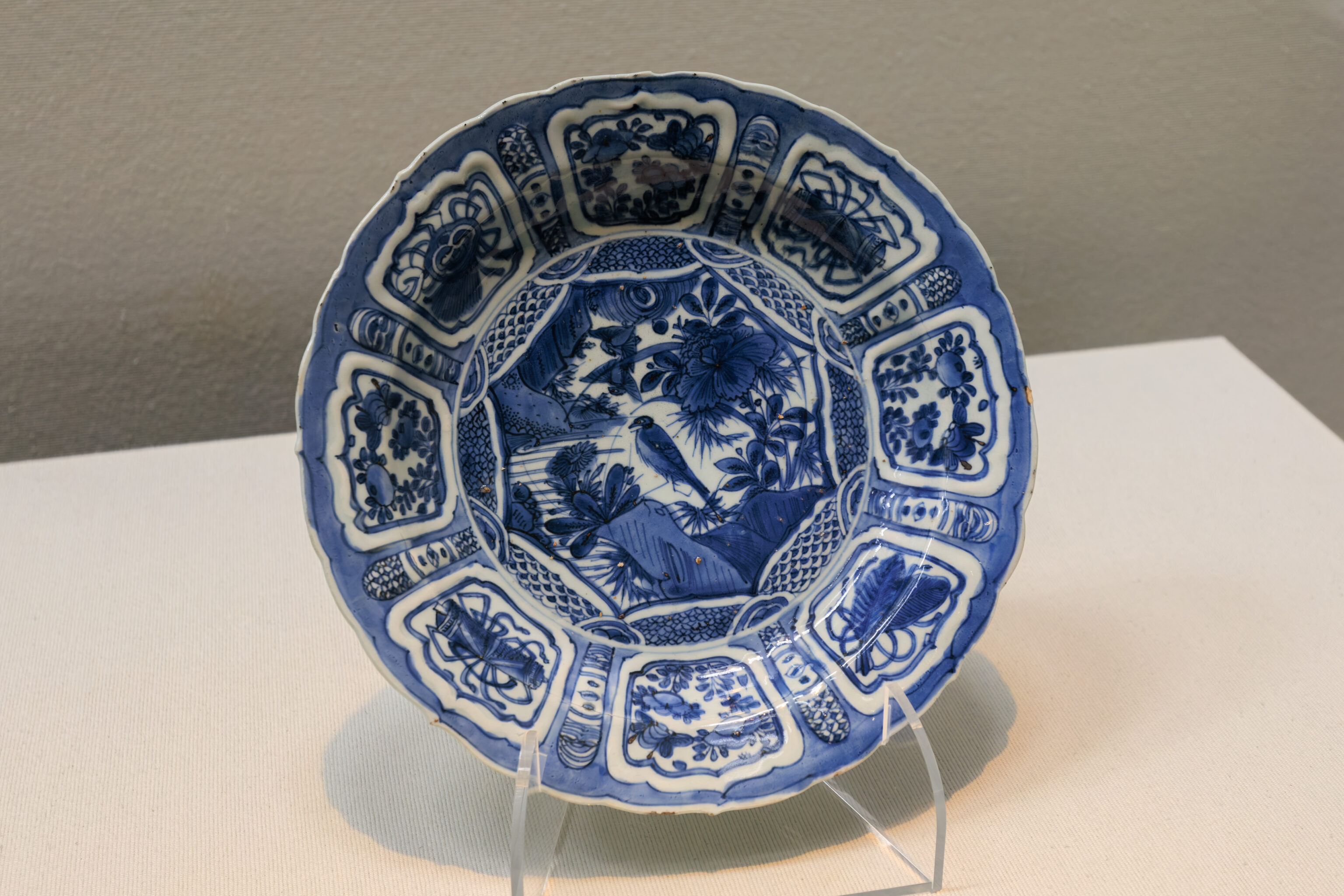
Dish depicting flowers and birds in underglaze blue
Jingdezhen kilns, Ming dynasty, 17th century
Ogori C.C. Collection

Chinese porcelains decorated in underglaze blue are also known as blue-and-white porcelains. Pieces produced in the imperial Jingdezhen kilns were exported all over the world, greatly impacting the ceramics industry in many countries. Blue-and-white porcelains were used as crockery by the upper samurai class in Japan.
– Text from the sign for this artifact.
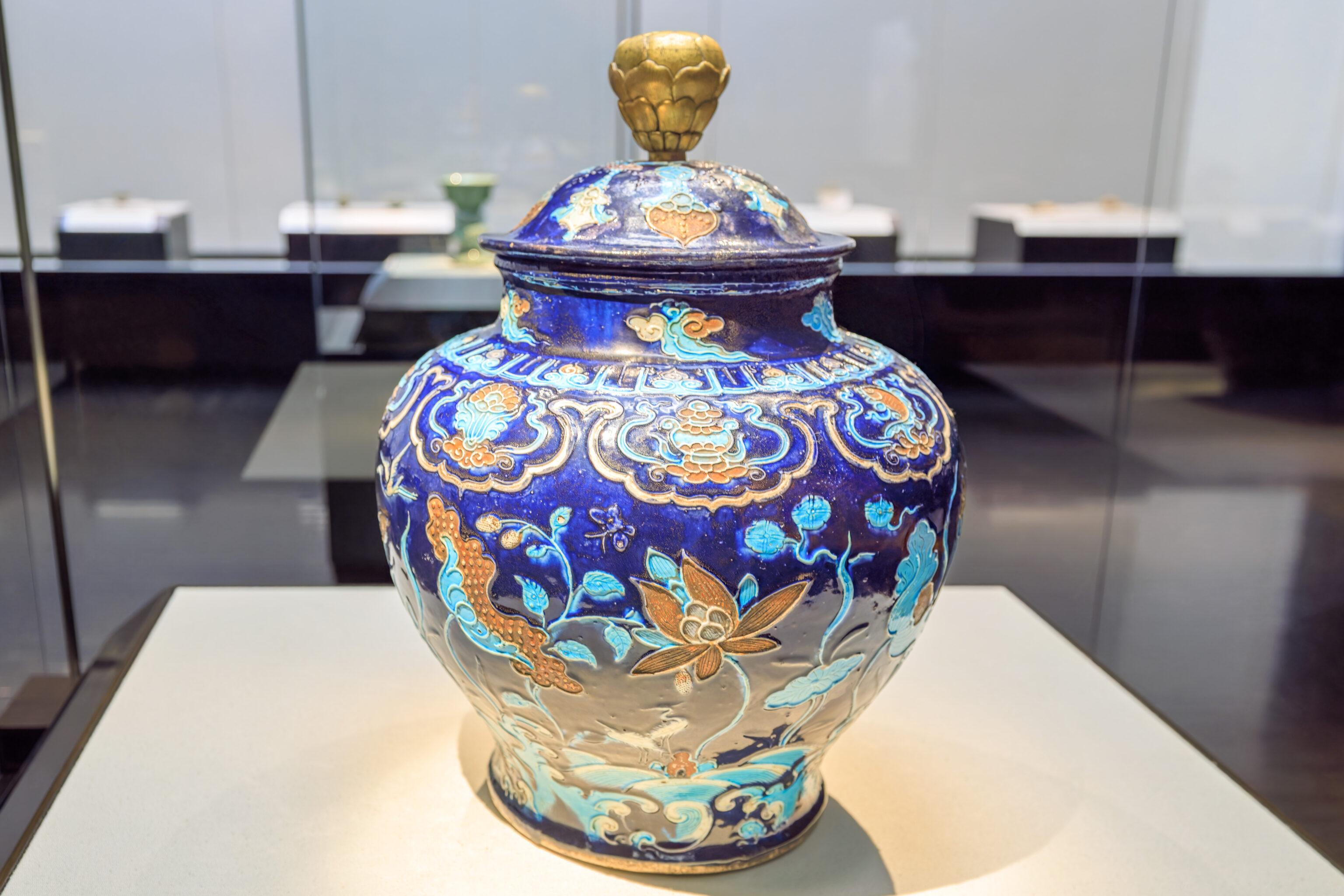
Important Cultural Property
Lidded fahua jar depicting herons and lotuses
Jingdezhen kilns, China, 15th-16th century
Kyushu National Museum

Fahua refers to a specific kind of tri-color glazed ceramics created in Ming China. Designs are often rendered in vibrant colored glaze within raised slip outlines. This object was originally designated a National Treasure under the old system in 1936, and reclassified as an Important Cultural Property in 1950.
– Text from the sign for this artifact.
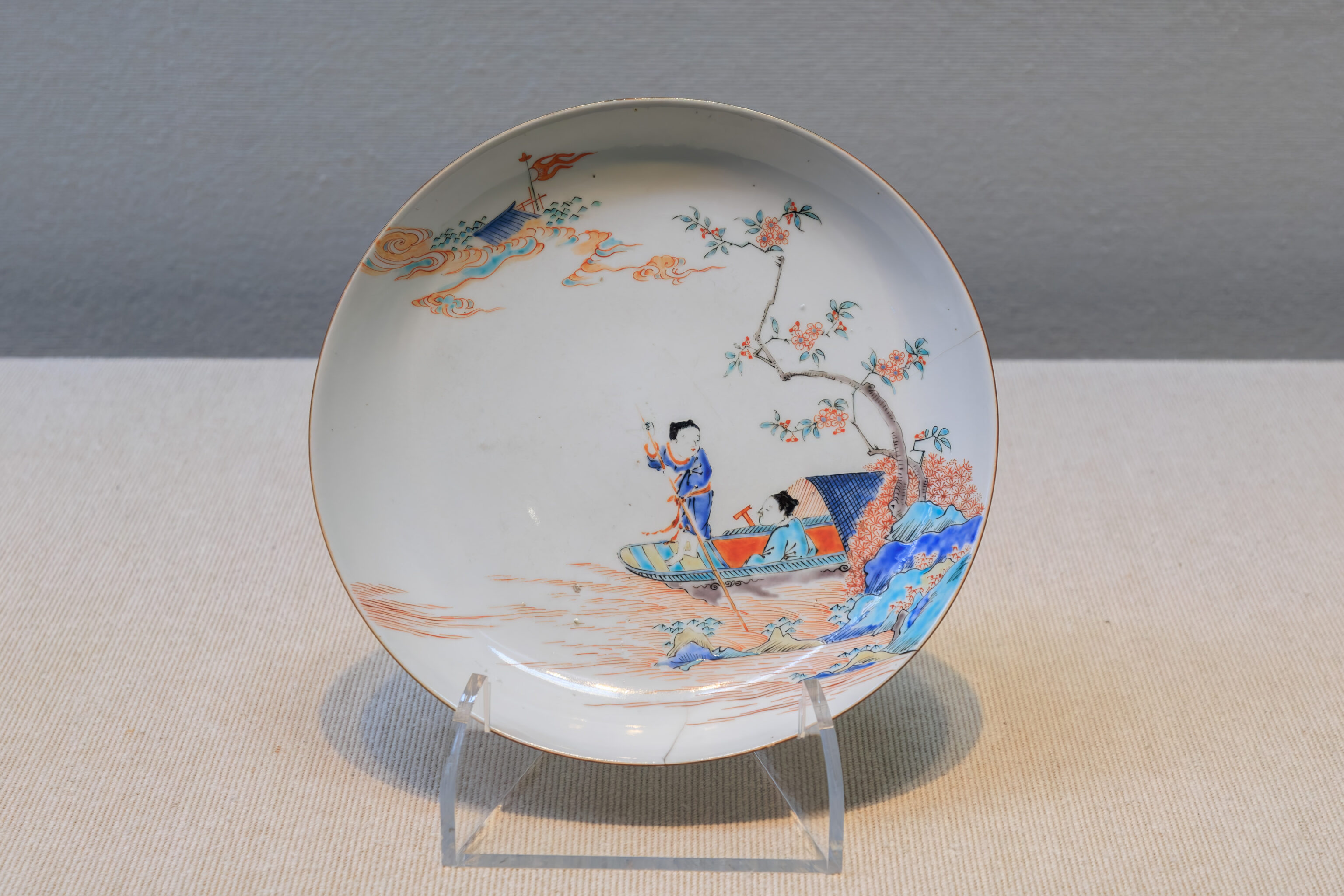
Dish decorated in overglaze enamels
Kakiemon kiln, Imari (Arita), 17th century
Tanakamaru Collection

Chinese figures are depicted taking a leisurely boat trip on this dish. This motif takes after a popular painting subject that portrays Northern Song Chinese Confucian scholar Zhou Maoshu (1017-73) accompanied by his attendants as he admires chrysanthemum flowers.
– Text from the sign for this artifact.
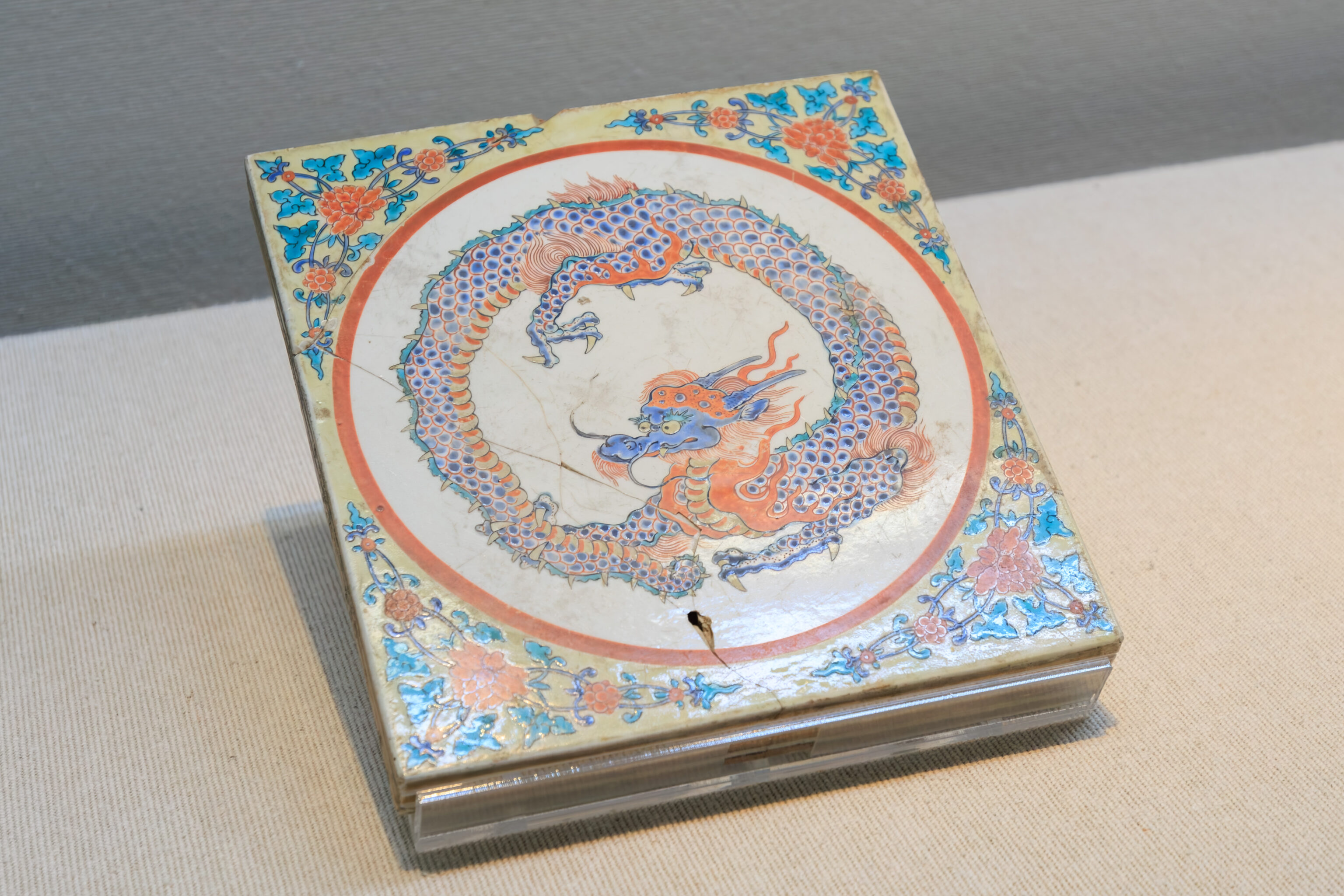
Ceramic tile depicting a coiled dragon in overglaze enamels
Kakiemon style, Imari (Arita), about 1677
Tanakamaru Collection

A similar tile adorns the sutra hall of Kyoto's Nishihongan-ji Temple. which was established in 1677. It bears a signature identifying its maker as Doi Genzaemon of Arita. Doi was the person who had erected the grave of the third Kakiemon head, and his name also appears on a surviving clay mold.
– Text from the sign for this artifact.
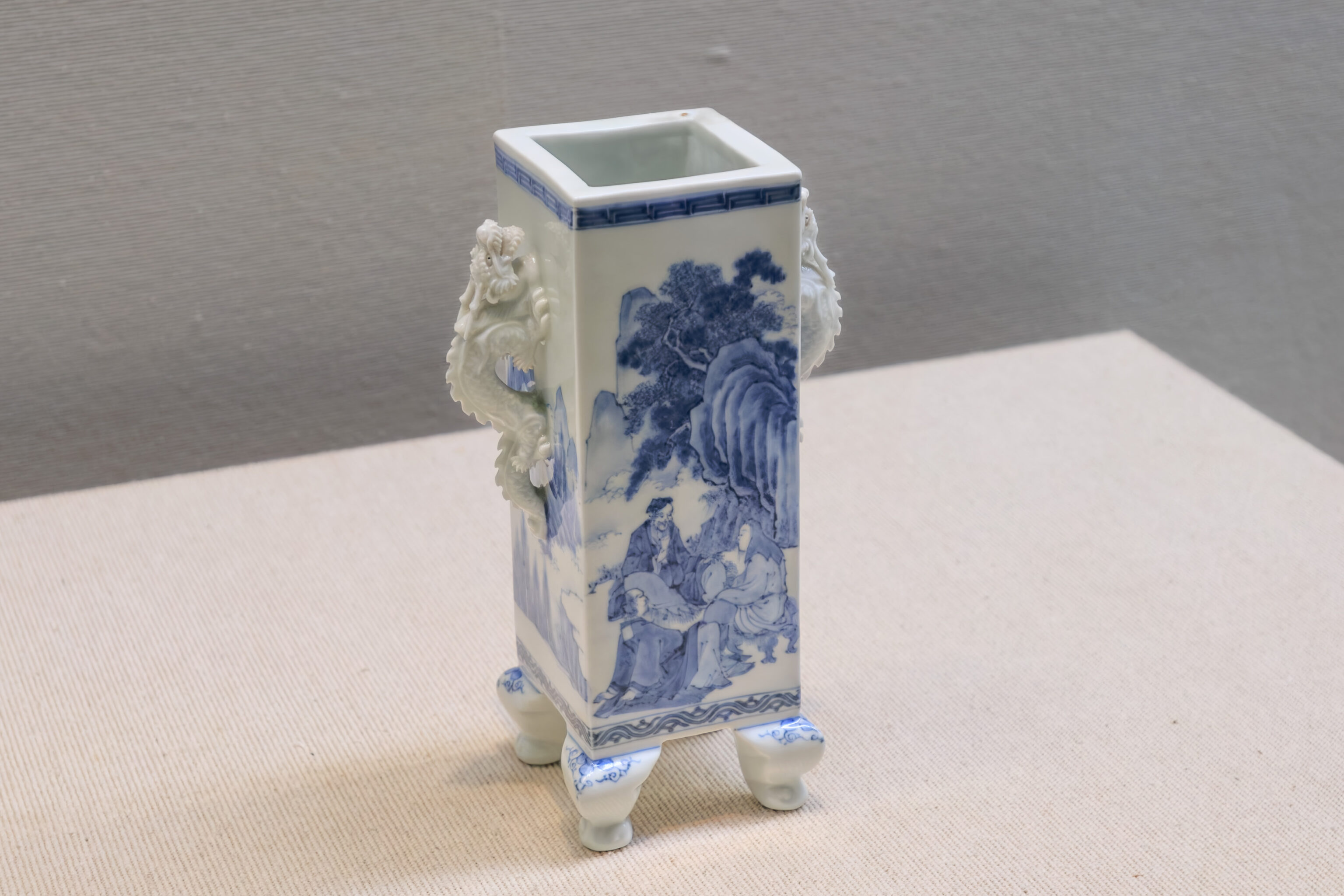
Square flower vase decorated in underglaze blue
Hirado kilns, 19th century
Tanakamaru Collection

Hirado ware (also known as Mikawachi ware) refers to ceramics
made in the Hirado domain. Ceramists there had begun making
porcelains in the Kan'ei era (1624-1644) during the early Edo period.
Hirado is known for creating delicate and detailed blue-and-white
porcelains, as well as saikumono.
– Text from the sign for this artifact.
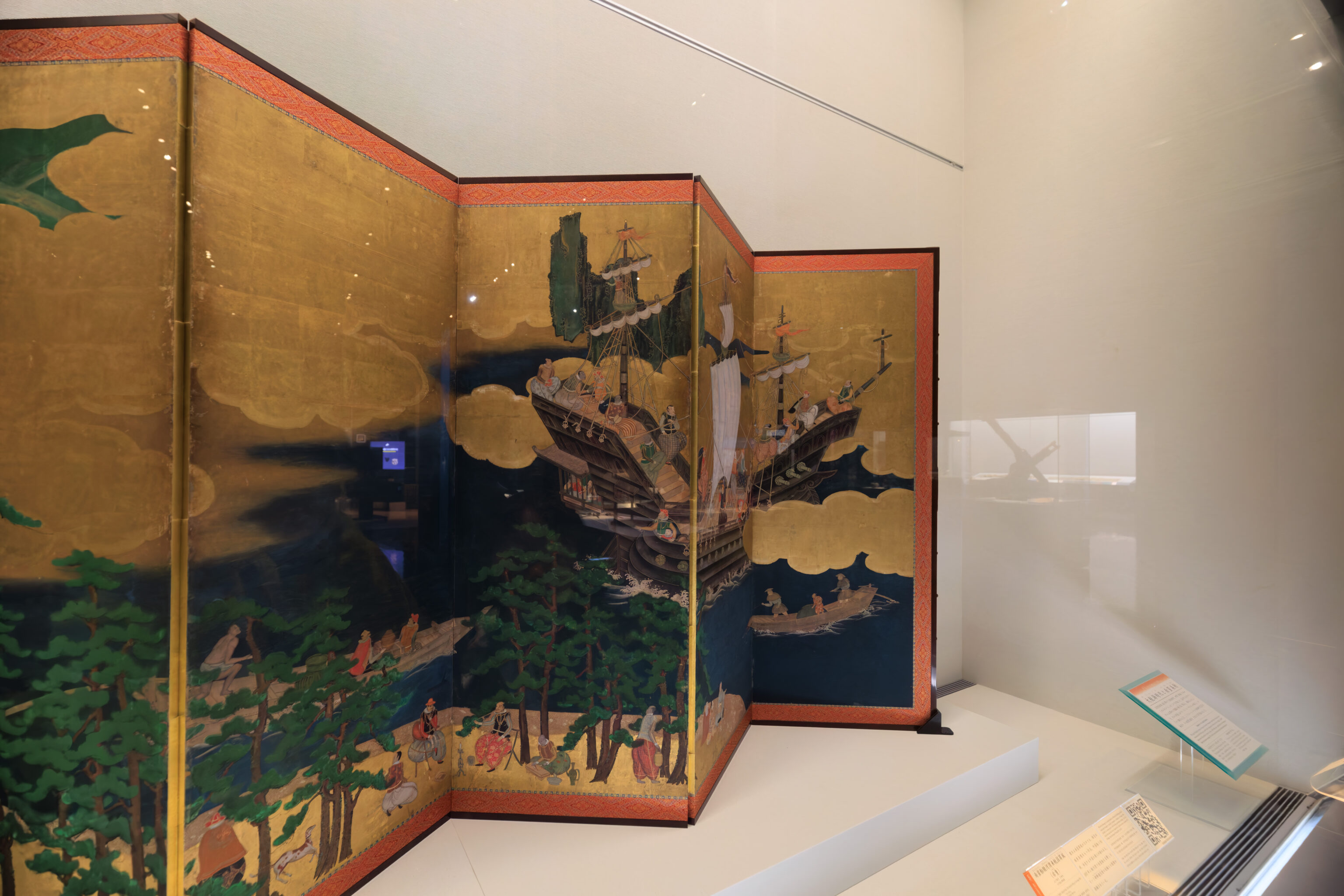
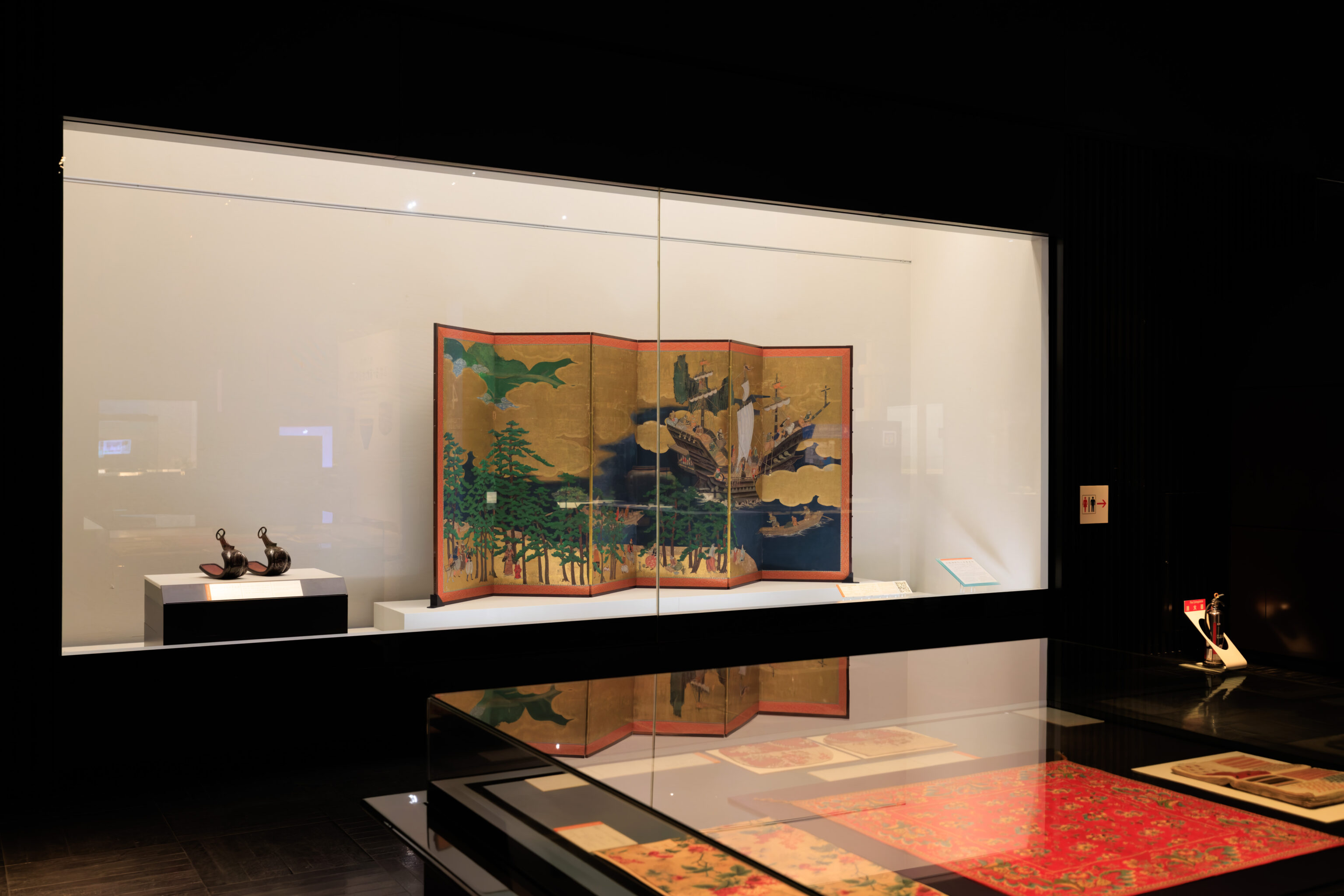
Folding screen (right) depicting a European ship at Suruga Bay
17th century
Kyushu National Museum

Among the many extant *Nanban* folding screens, this work stands out for its distinctive depiction of the landscape. It portrays foreign ships, a pine grove, and foreign merchants at rest. It has been noted that this piece bears a connection to the records of a Korean diplomatic envoy who witnessed a *Nanban* ship in Suruga Bay in 1607.
– Text from the sign for this folding screen.
Nanban Art in the Age of Discovery
The Age of Discovery began in the early 15th century. Portugal and Spain, venturing out into the world, aimed for Asia. In 1543, a Chinese ship carrying Portuguese sailors drifted ashore on Tanegashima Island, bringing with it firearms. Six years later, Francis Xavier arrived in Japan, introducing Christianity. This marked the beginning of serious exchange with Europe, and its influence extended to many areas, including economy and culture.
– Text from a nearby sign, translated using Google.
Some of the events from this era are portrayed in the recent historical drama Shogun, which was based on real events.
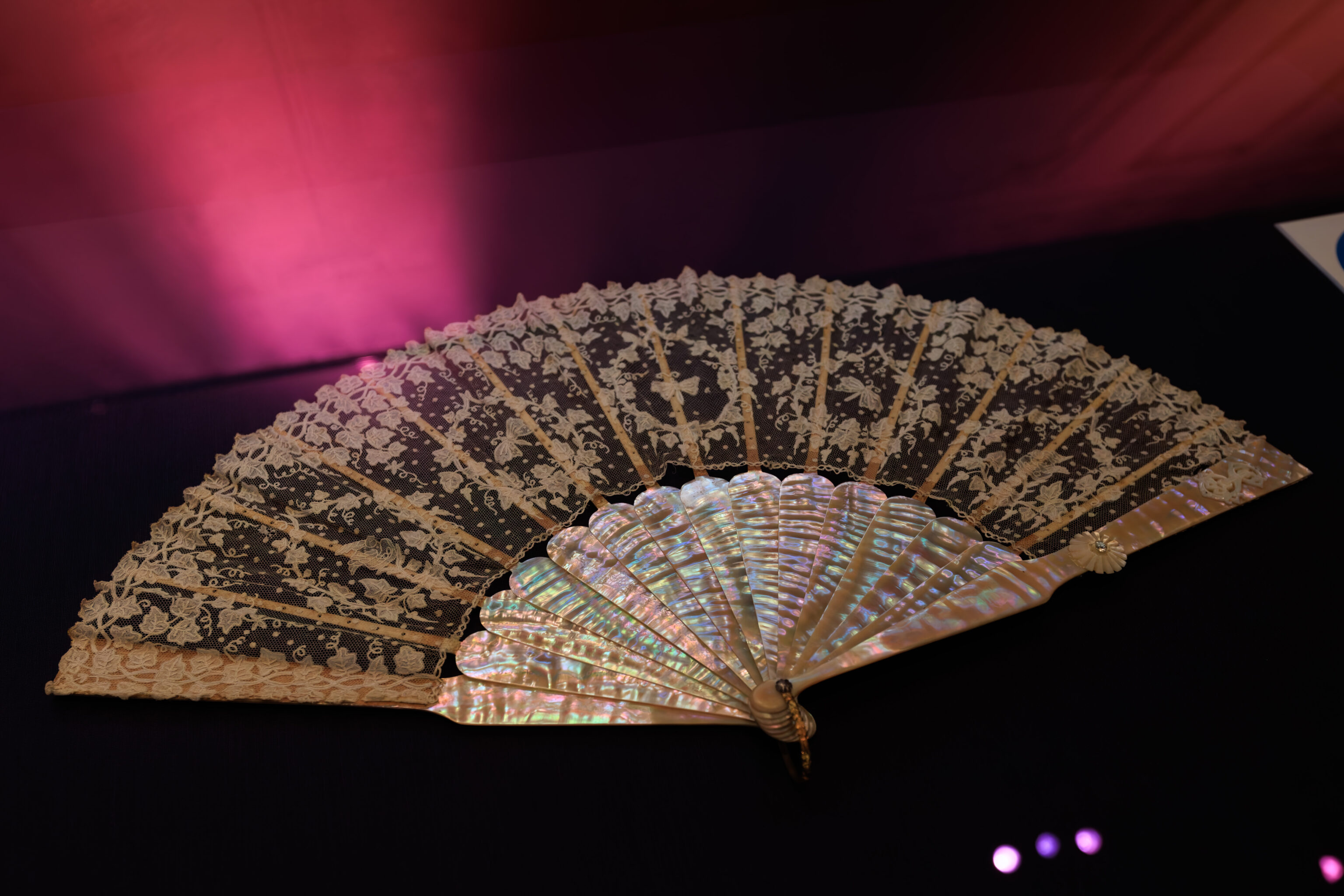
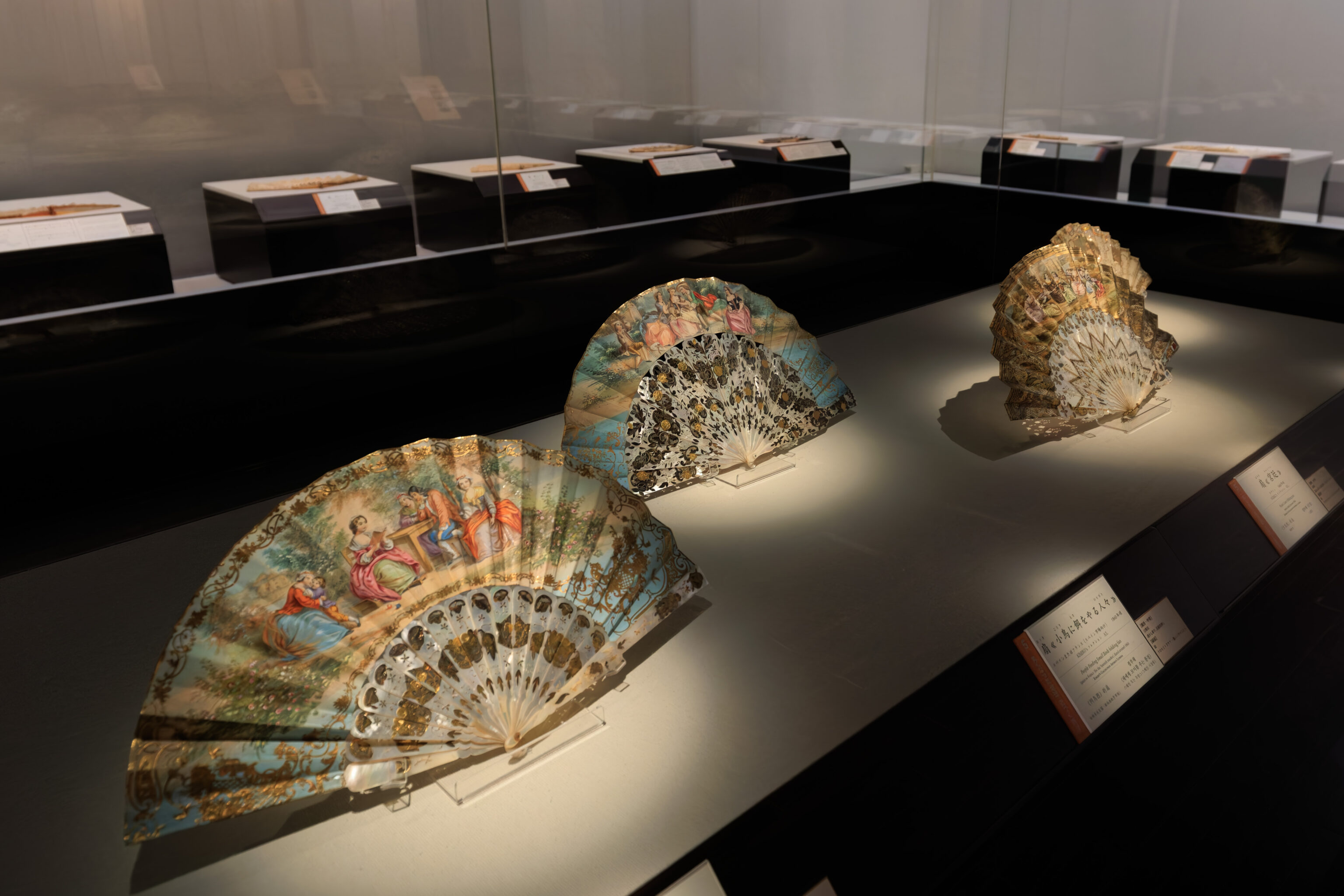
White lace folding fan
Fan: France, lace: Belgium, dated around 1860
Kimiko's Collection Artisan Lumina

In addition to Chantilly in France, Belgium is renowned as a producer of the finest lace. This folding fan depicts butterflies and birds brooding eggs within grapevine garland frames, all embroidered with needles and thread.
– Text from the sign for this artifact.
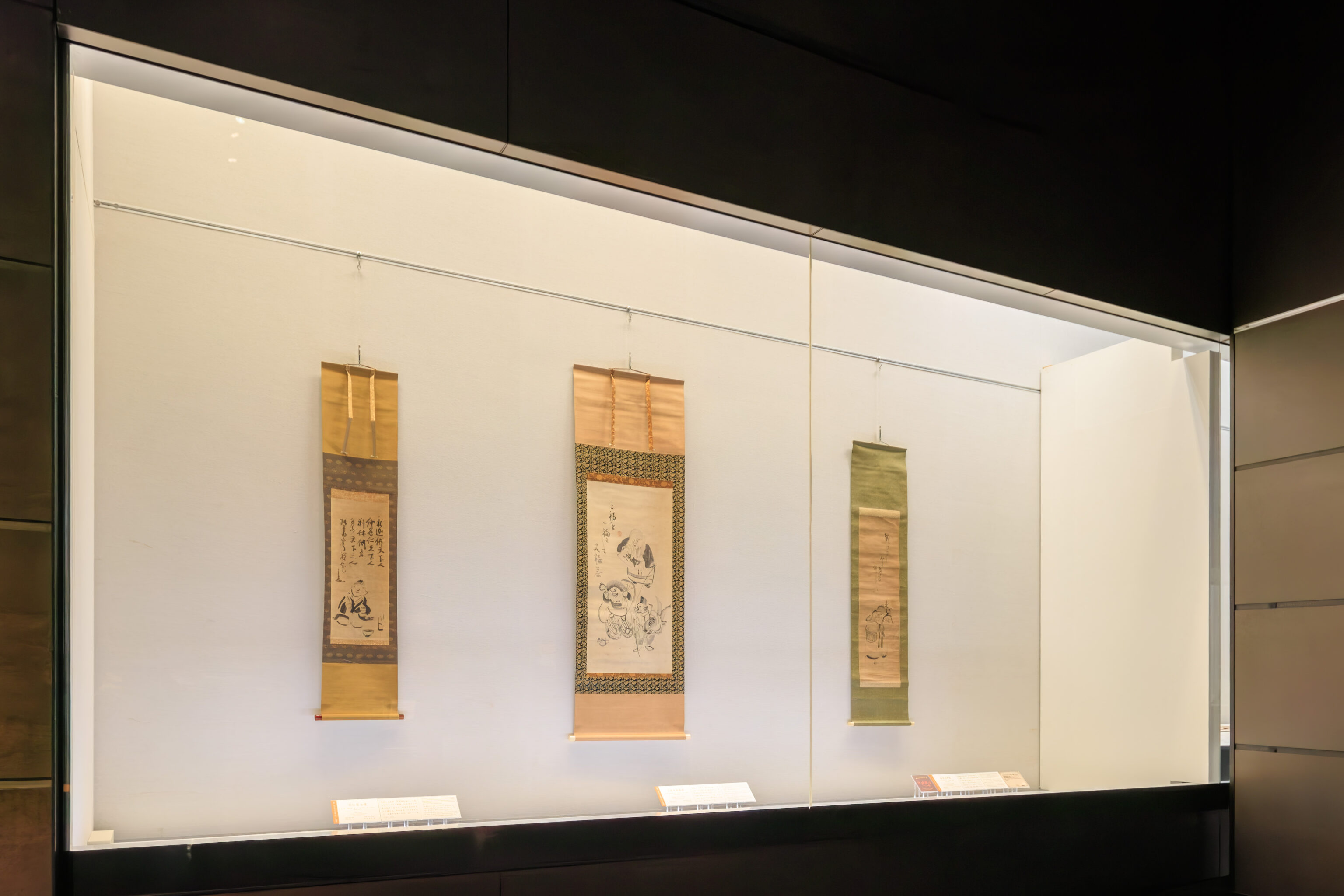
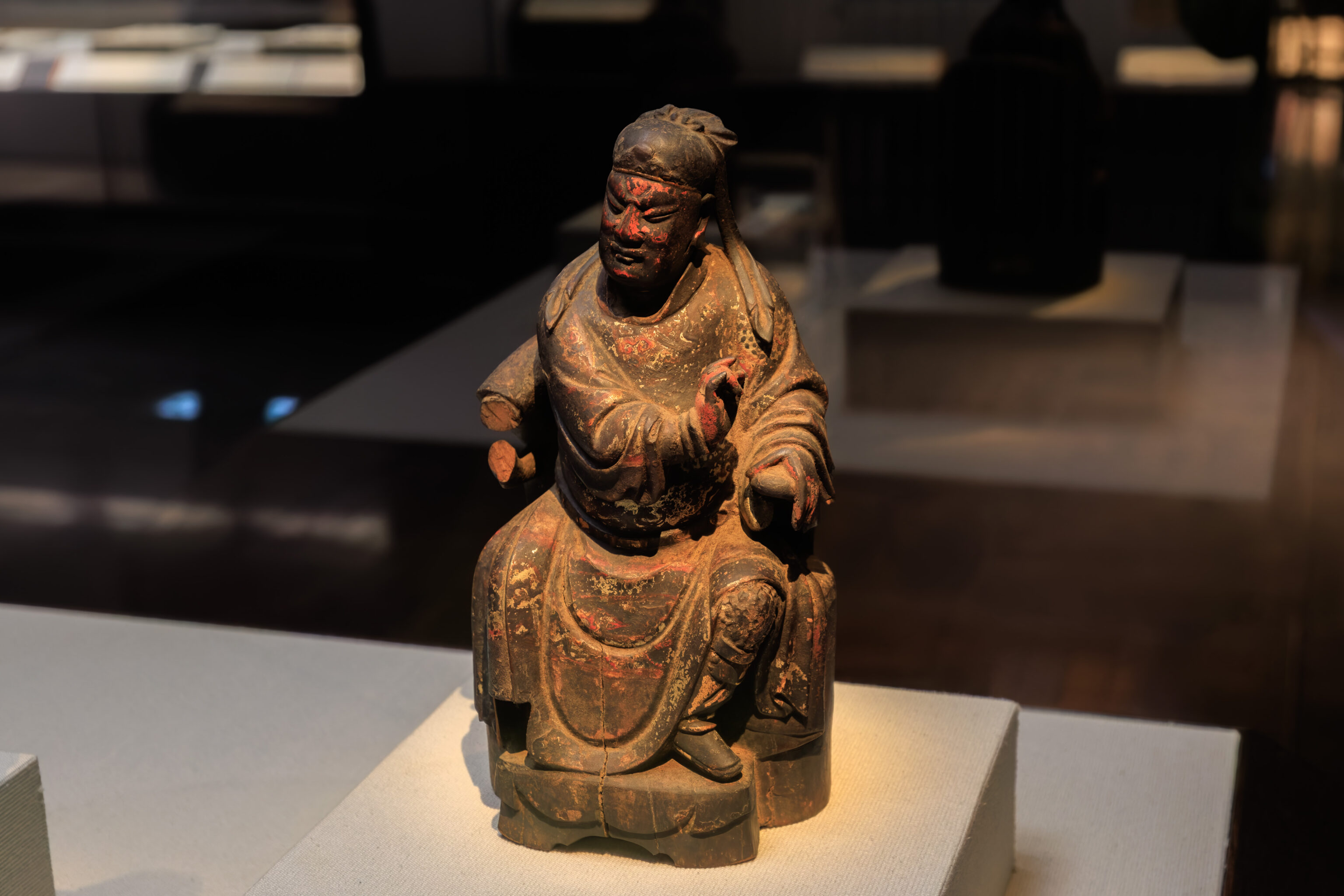
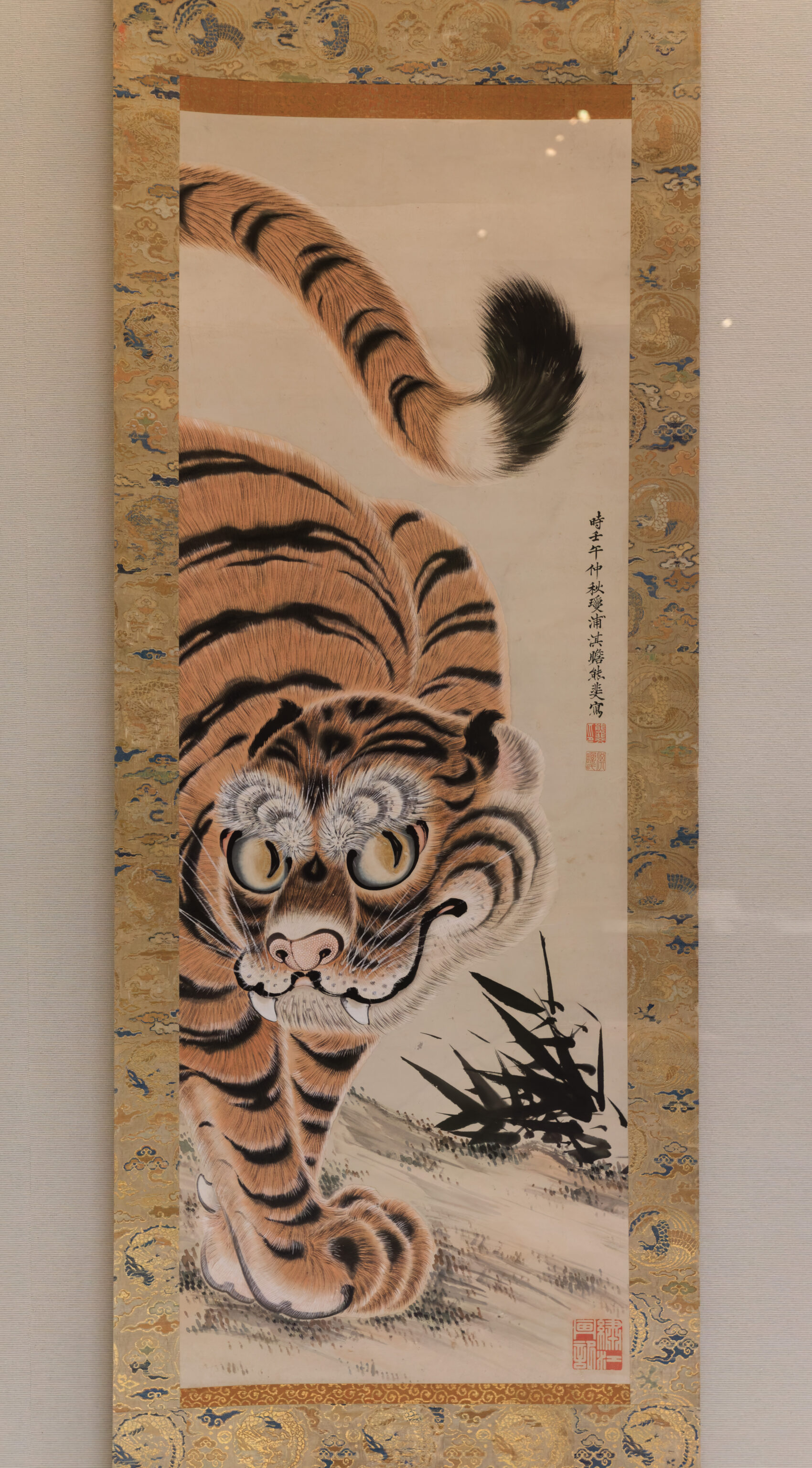
Guan Yu
Qing dynasty, 18th century
Tokyo National Musuem
– Text from the sign for this artifact.
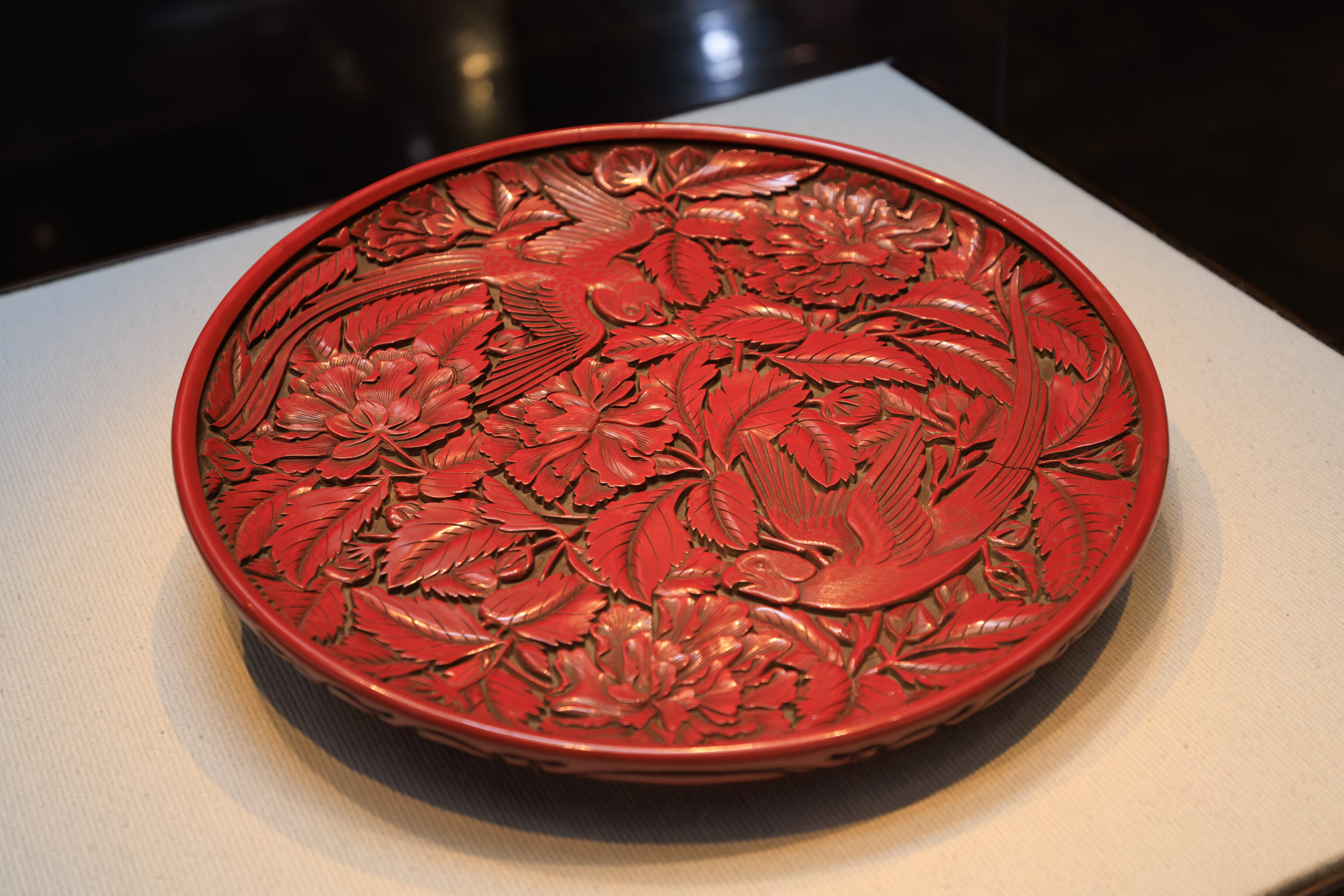
Carved lacquer tray depicting birds and flowers
Yuan to Ming dynasty, 14th century
Kyushu National Museum

The designs on this tray were formed by carving into layers of lacquer piled on top of one another. Works with a top layer of red lacquer, such as this, are known as tsuishu (lit., "piled red"). This work was created to hold tools and placed as decoration in the study of a traditional Japanese house.
– Text from the sign for this artifact.
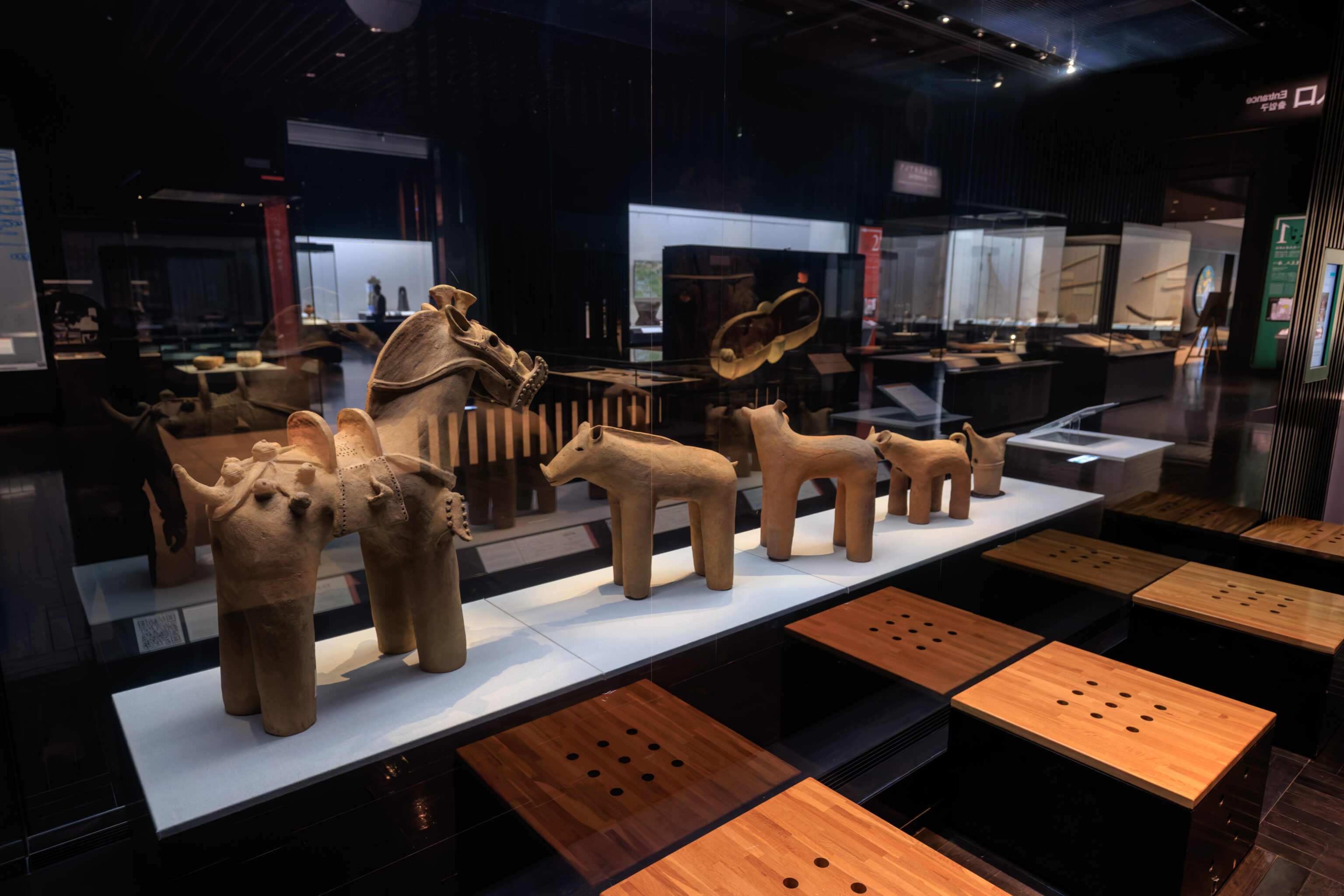
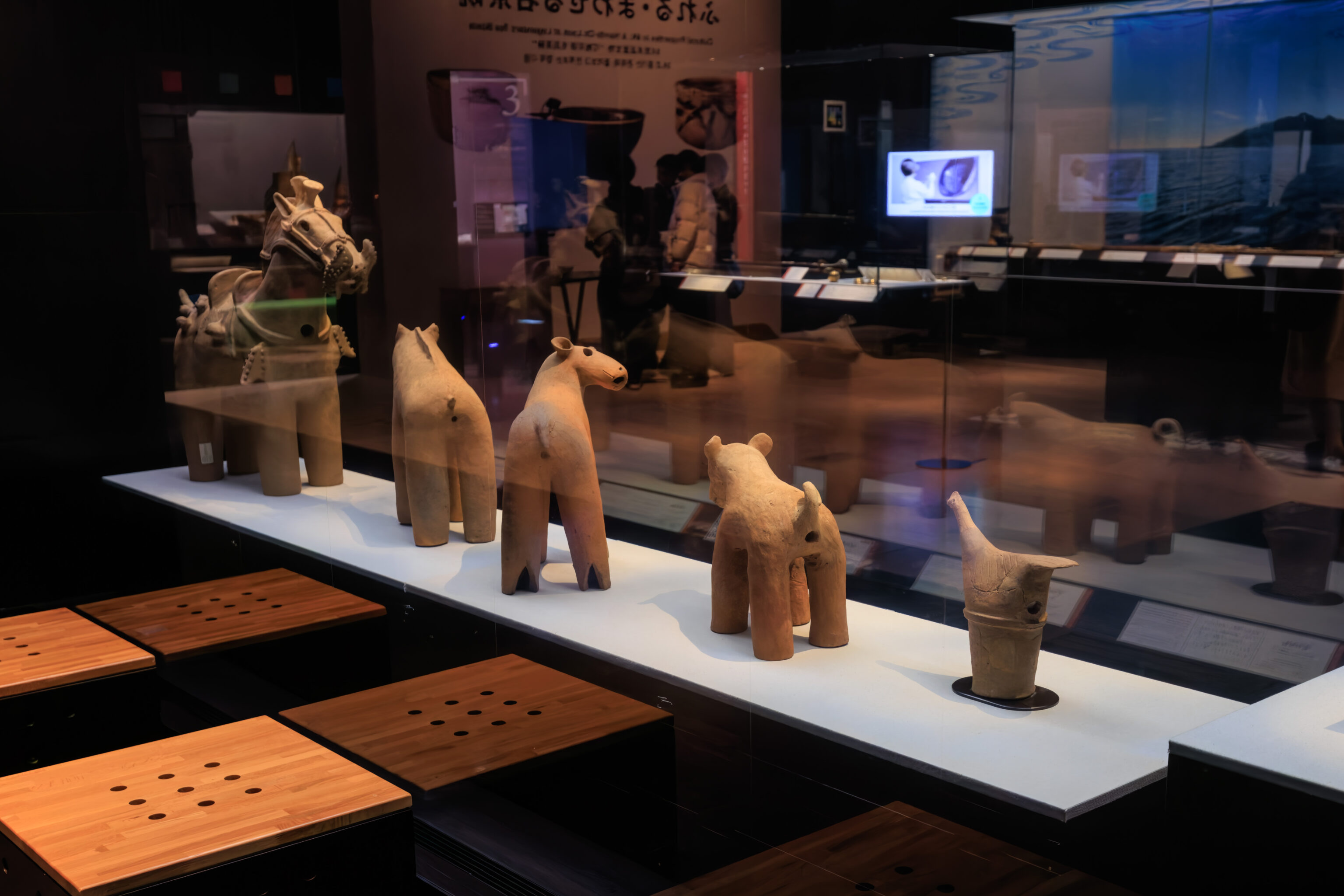
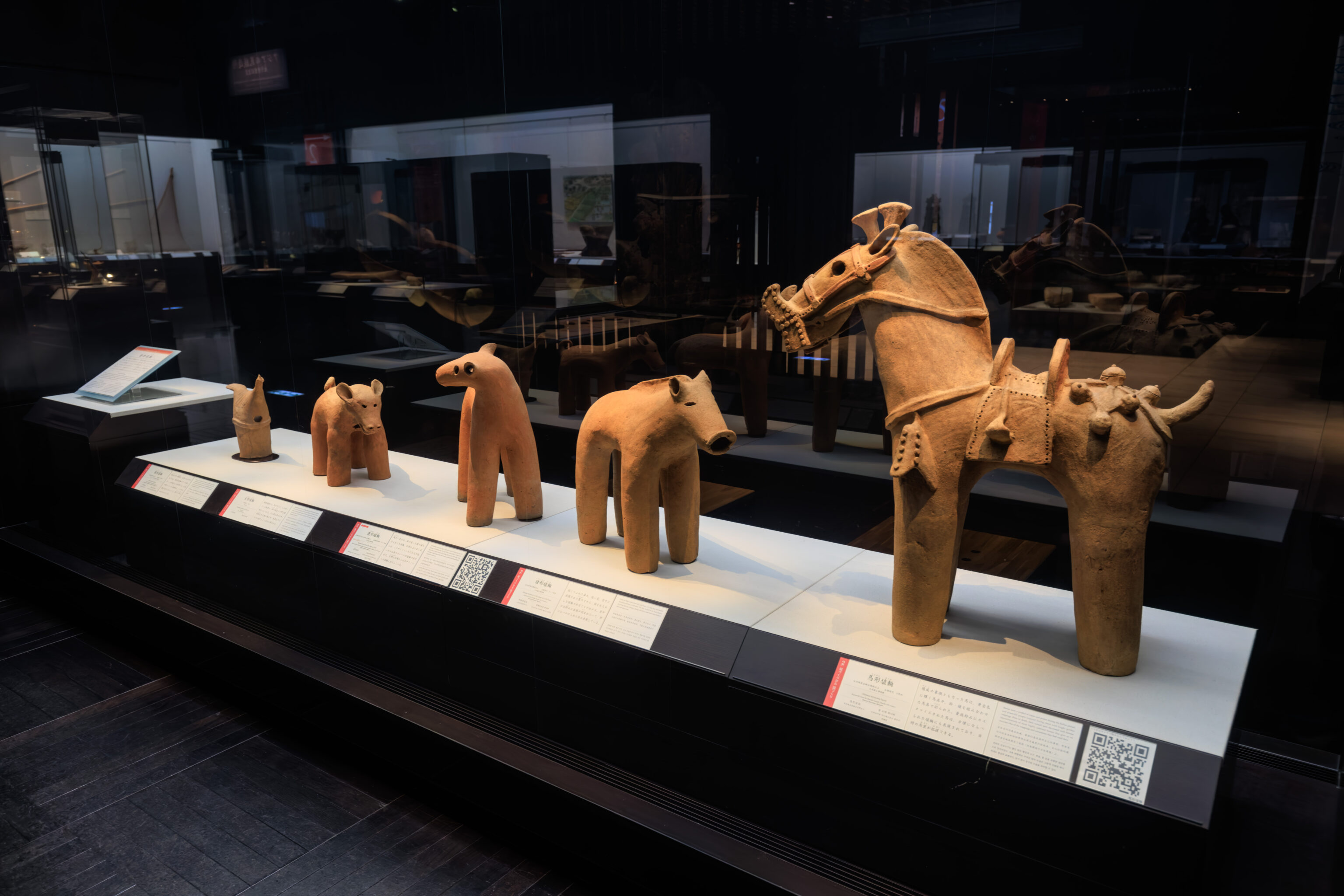
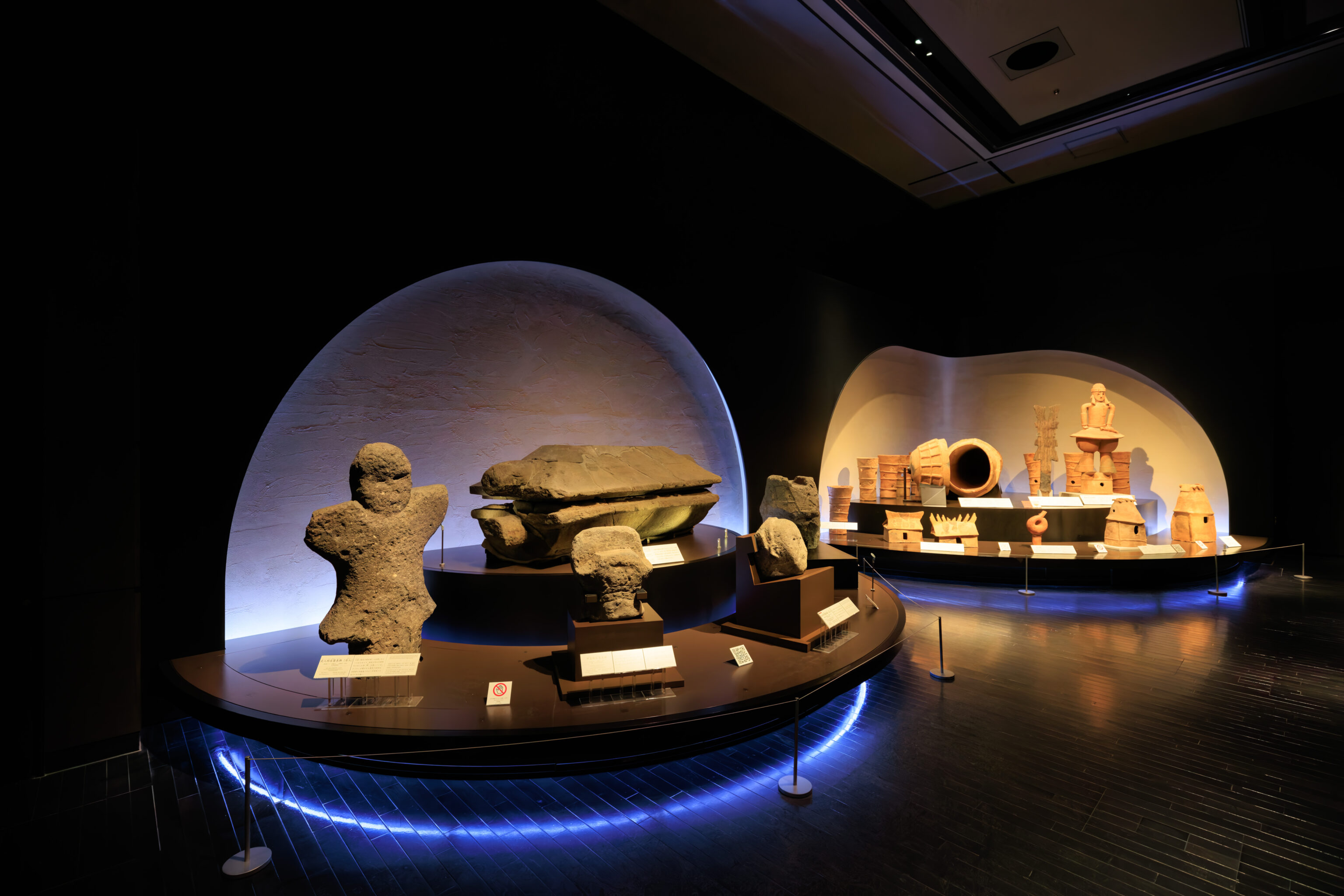
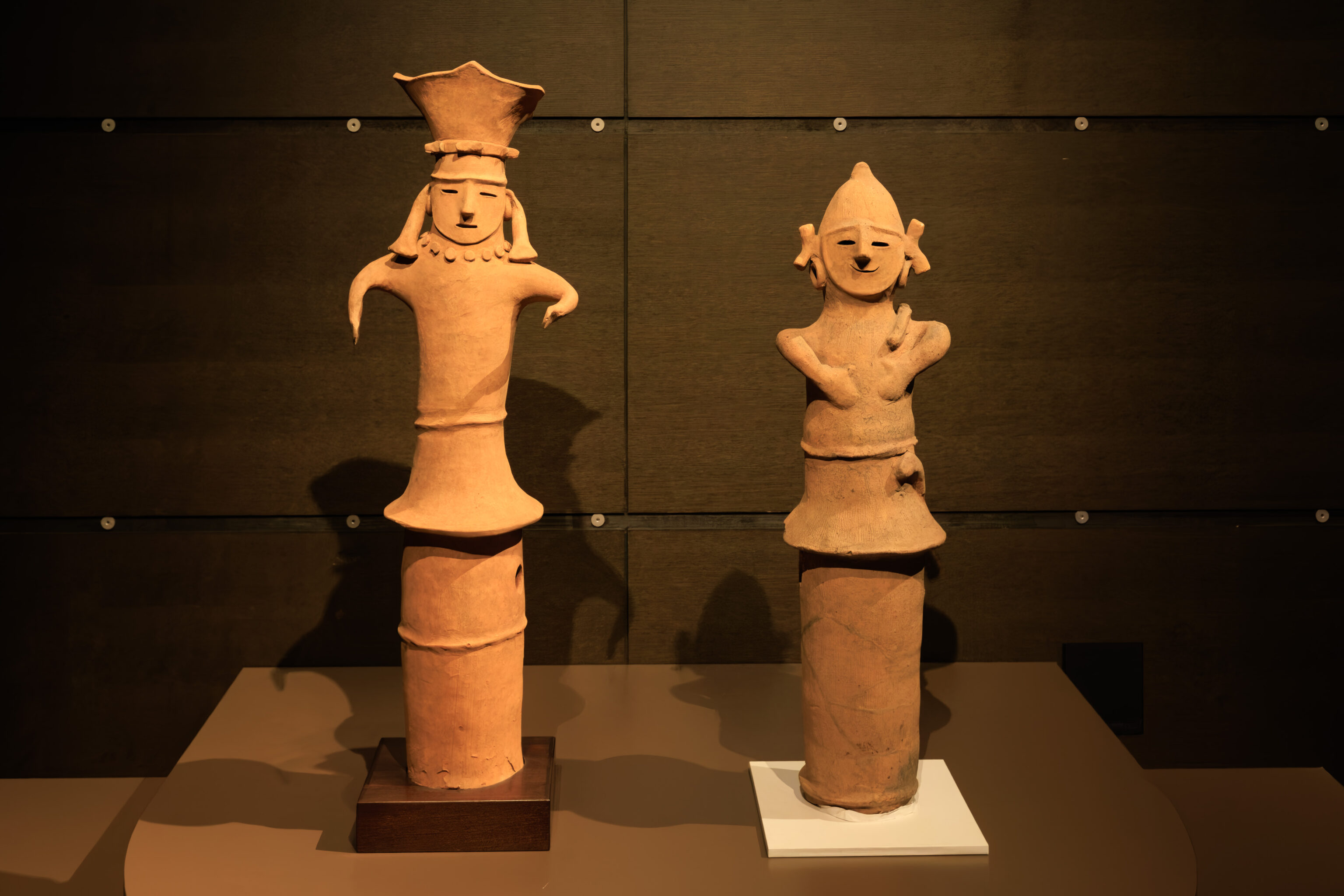
These animal figures are haniwa:
Animal-Shaped Haniwa
Haniwa were large clay figurines of various shapes, including animals, that decorated the tops of burial mounds. Horses and chickens were placed at the tombs of elites. Dogs, birds, and deer were arranged to depict hunting scenes. While each figurine looks like the animal it is meant to represent, it also features some deformation typical to haniwa.
– Text from a sign.
The largest of these haniwa is a the horse facing the others:
Haniwa terracotta horse
Reportedly from the Manabe tumuli, Ibaraki, 6th century
Kyushu National Museum

Horses were a symbol of status and power during the Kofun period and powerful people enjoyed fitting them with bright golden trappings. Even in death, their tumuli were decorated with haniwa representations of these highly adorned horses that give us an accurate idea of the trappings and ornaments they had used then.
– Text from the sign for the horse haniwa.
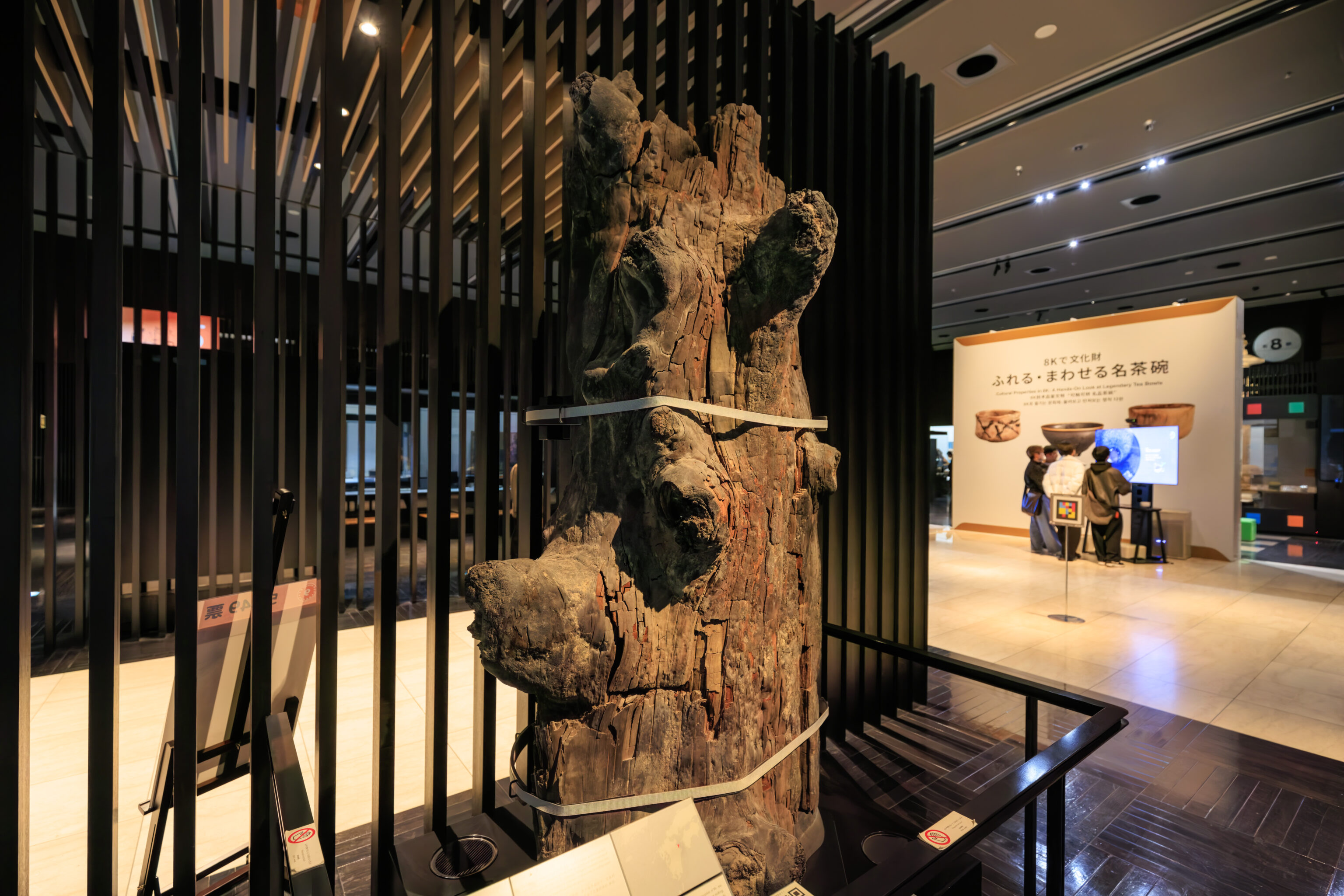
A tree of the genus Picea (Picea, Malvaceae family)
Excavated from Honjyoyamabe, Saiki, Oita Prefecture, 90,000 years ago (Late Pleistocene).
Kyushu National Museum (Donated by Honjyo, Saiki City, Oita Prefecture [formerly Honjyo Village, Oita Prefecture])

This piece of wood was felled by the explosive eruption of Mt. Aso 90,000 years ago. The scorched marks on the surface are striking. The eruption occurred on a massive scale, reaching even Yamaguchi and Ehime.
– Text from the sign for this artifact, partially translated using Google.
We plan on vising Mount Aso, the volcano that killed this tree, on this trip.
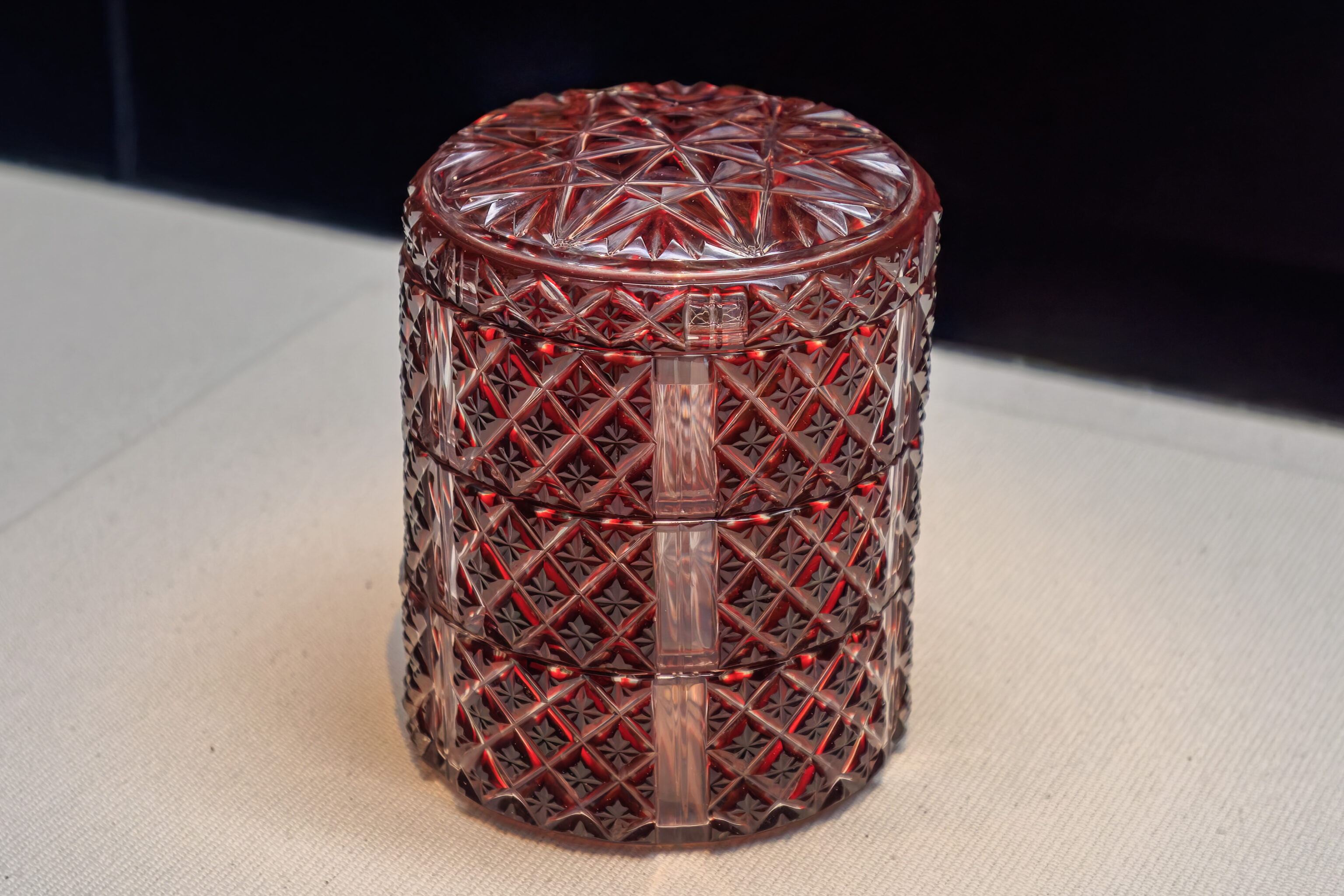
Three-tiered cut-glass box
19th century
Kyushu National Museum

Here is an example of cut glass, a new industrial product created in the Satsuma Domain from the end of the Edo period to the beginning of the Meiji period. It features a bright red color and beautiful designs cut delicately in glass.
– Text from the sign for this artifact.
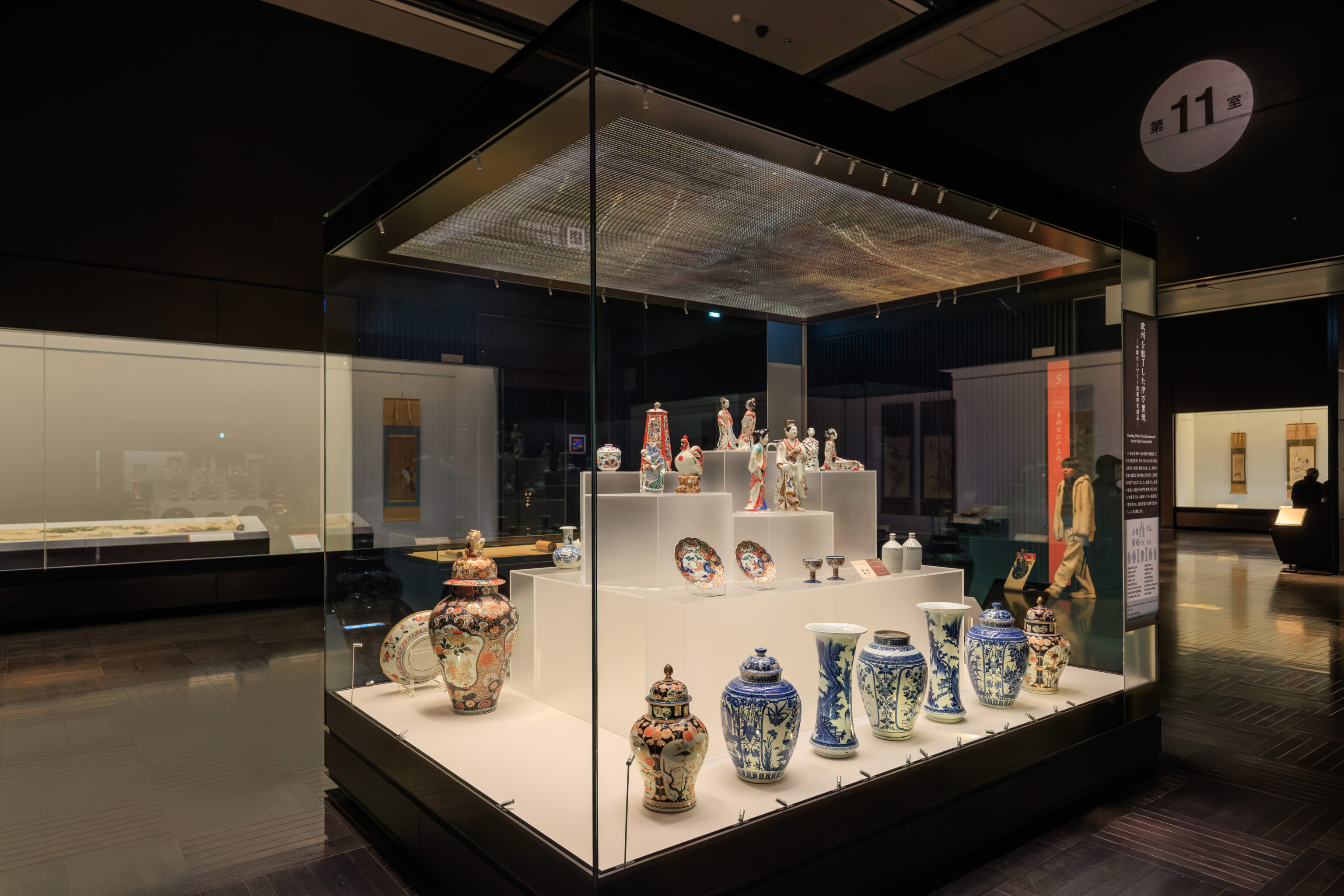
Imari porcelain that captivated Europe
- Donated by Ogori Country Club

From the mid-17th century to the mid-18th century, Imari porcelain produced in Arita (present-day Saga Prefecture) was exported in large quantities to Europe. This precious Oriental porcelain came to be known as "White Gold" and enjoyed immense popularity among royalty and the aristocracy. To this day, numerous examples of Imari ware can still be found within the historic castles and palaces of Europe. This exhibition showcases one of Japan's premier collections of antique Imari ware, generously donated by the Ogori Country Club.
– Mostly legible text from the sign on the right side of the display case, translated using Google.
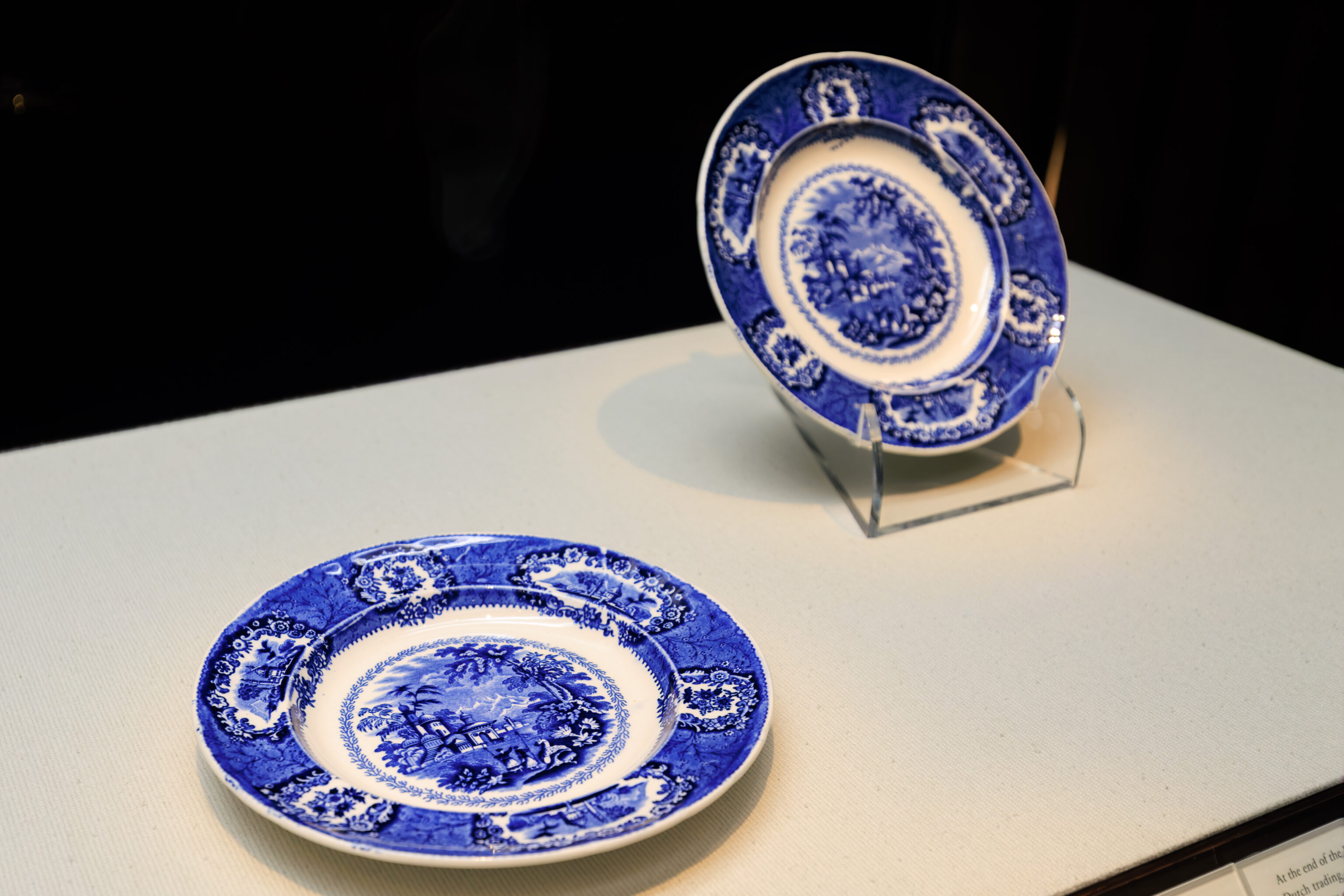
Plates with indigo paintings of oriental landscapes
Maastricht, Holland, dated around 1863
Kyushu National Museum (Donated by Mr. Hattori Kazuhiko)

At the end of the Edo period, European ceramics imported through Dutch trading posts (called "Holland ware") became popular in various parts of Japan, especially Nagasaki. Using a technique known as "copperplate transfer" images engraved on copper plates were first transferred onto paper, then ceramics.
– Text from the sign for these two artifacts.
After walking through the entire permanent exhibition area by around 3:30pm, we headed back downstairs and went to the gift shop to take a look around.
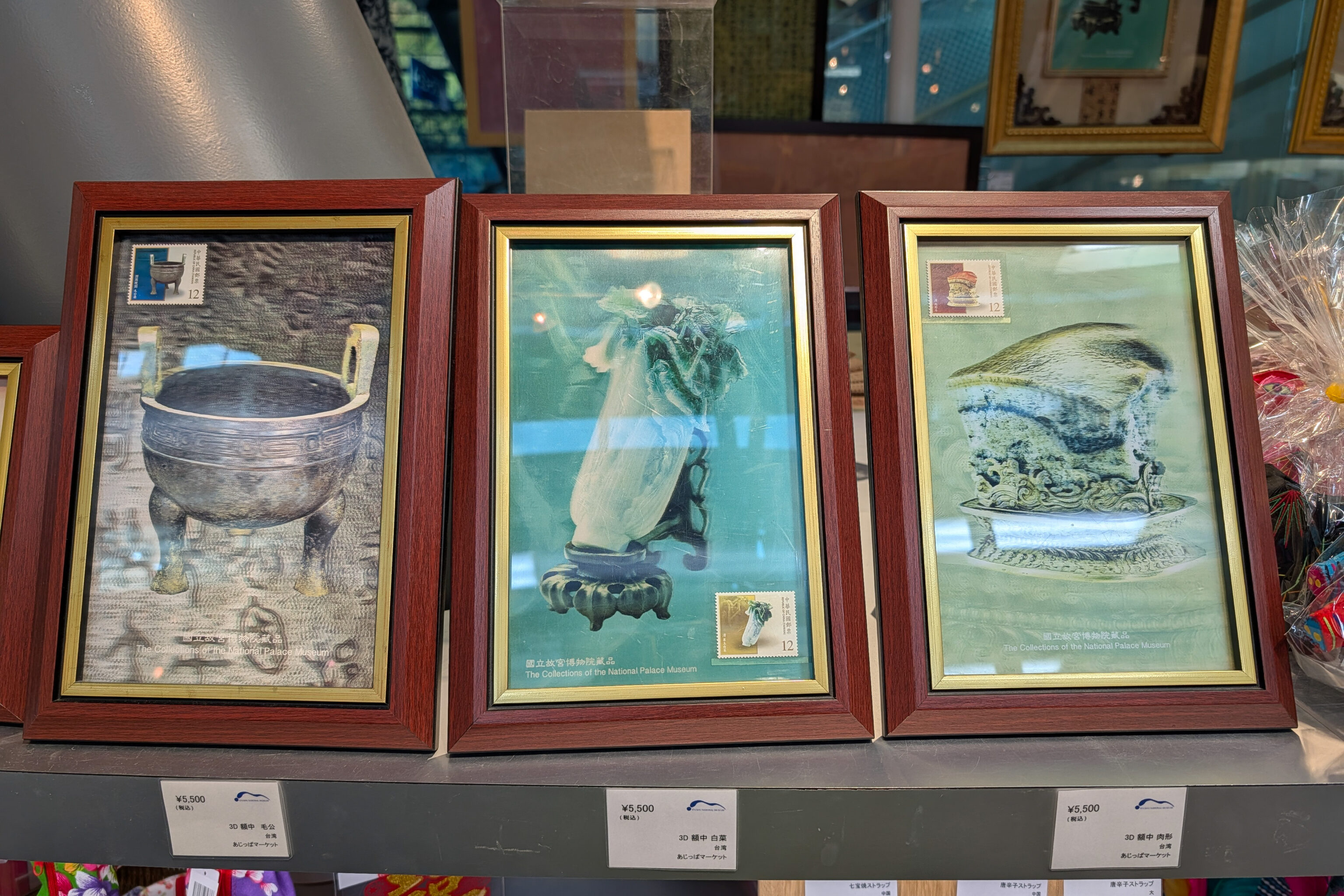
We wrere surprised to see these framed pictures of artifacts from the 國立故宮博物院 National Palace Museum in Taipei!
The middle piece is the 翠玉白菜 Jadeite Cabbage, which was the first thing we saw during our visit in June. Unfortunately, the 肉形石 Meat-Shaped Stone was not on display that day but we did see a sign describing it. The piece on the left is the 毛公鼎 Mao Gong Ding. We either didn’t see it or didn’t photograph it. We did see the similar 大克鼎 Da Ke Ding during our visit though.
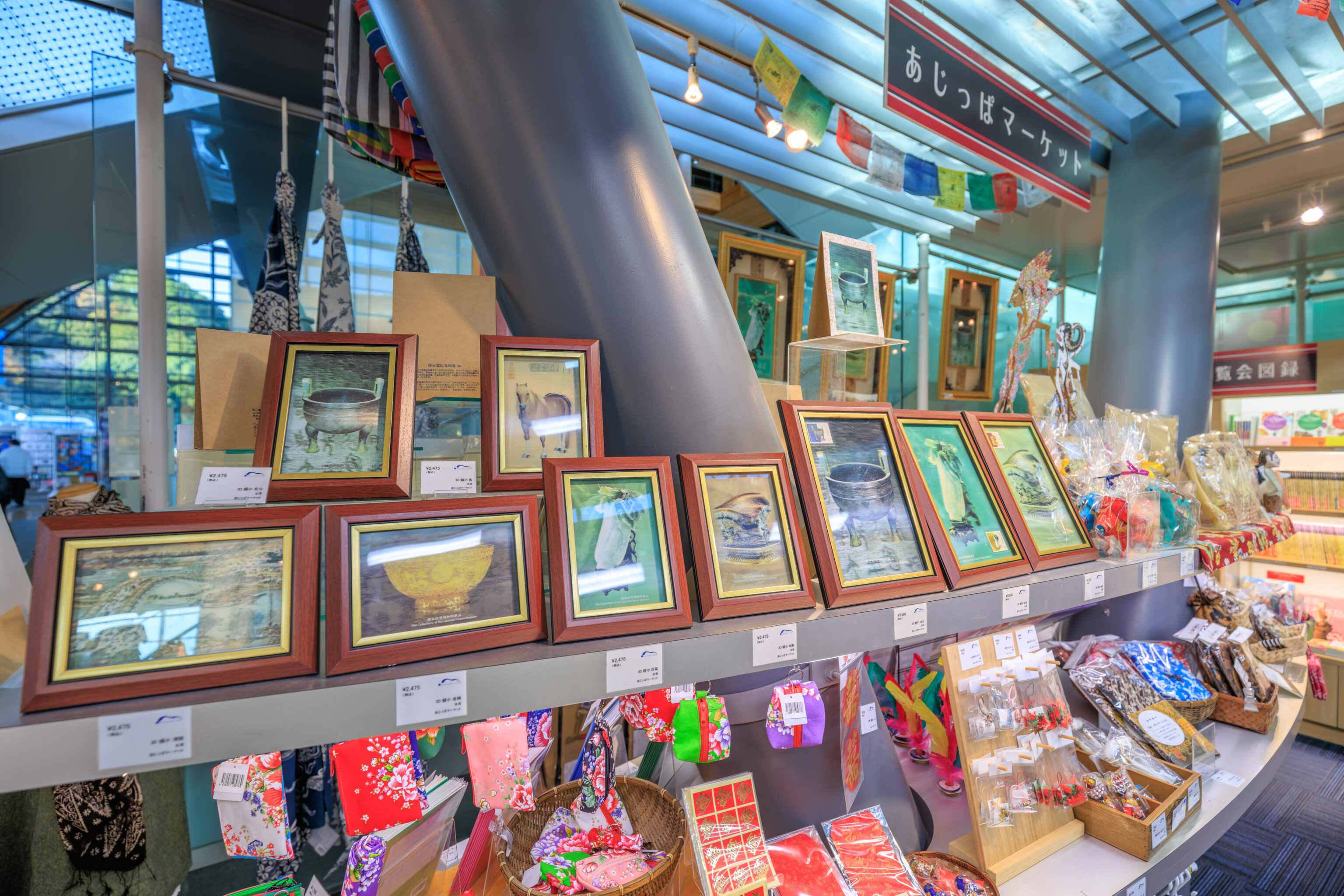
They had images of these artifacts in various sizes and formats. And of course, plenty of other stuff too.
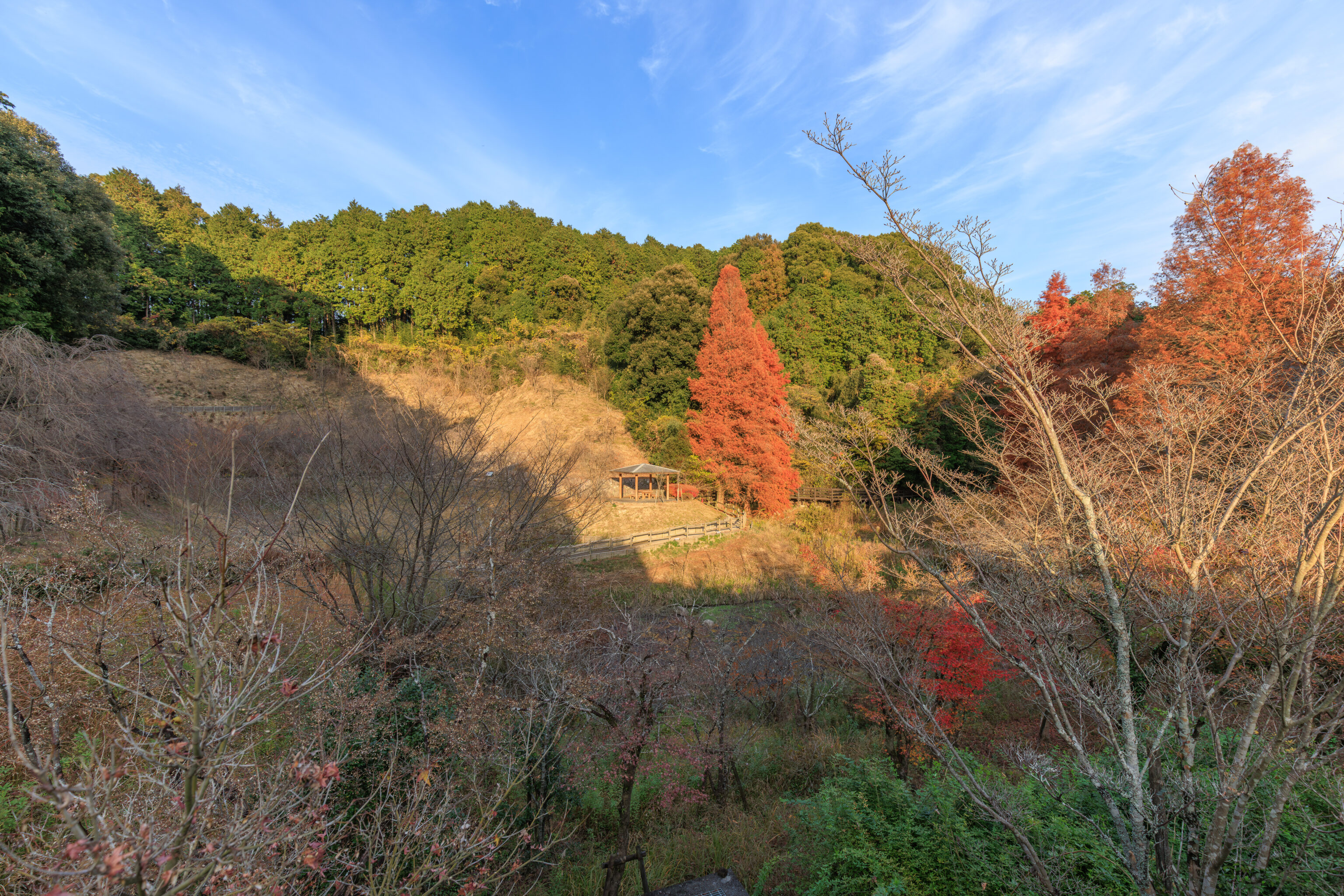
The Sun was starting to get low on the horizon when we stepped outside just before 4pm. There was a kind of park-like area to the north of the museum building. It was a bit late to explore though.
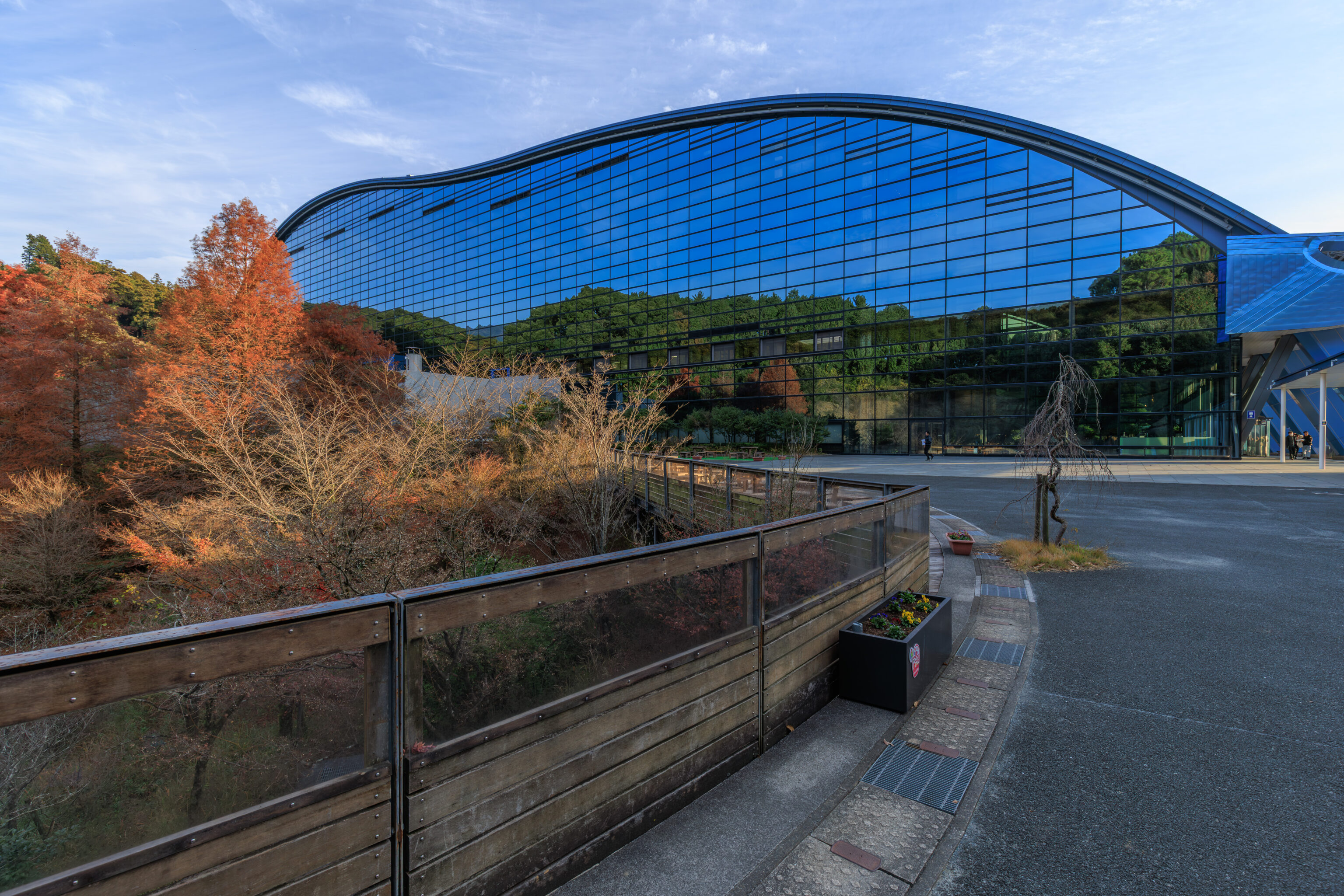
We went to return to the tunnel and escalators to get back to Dazaifu Tenmangu.
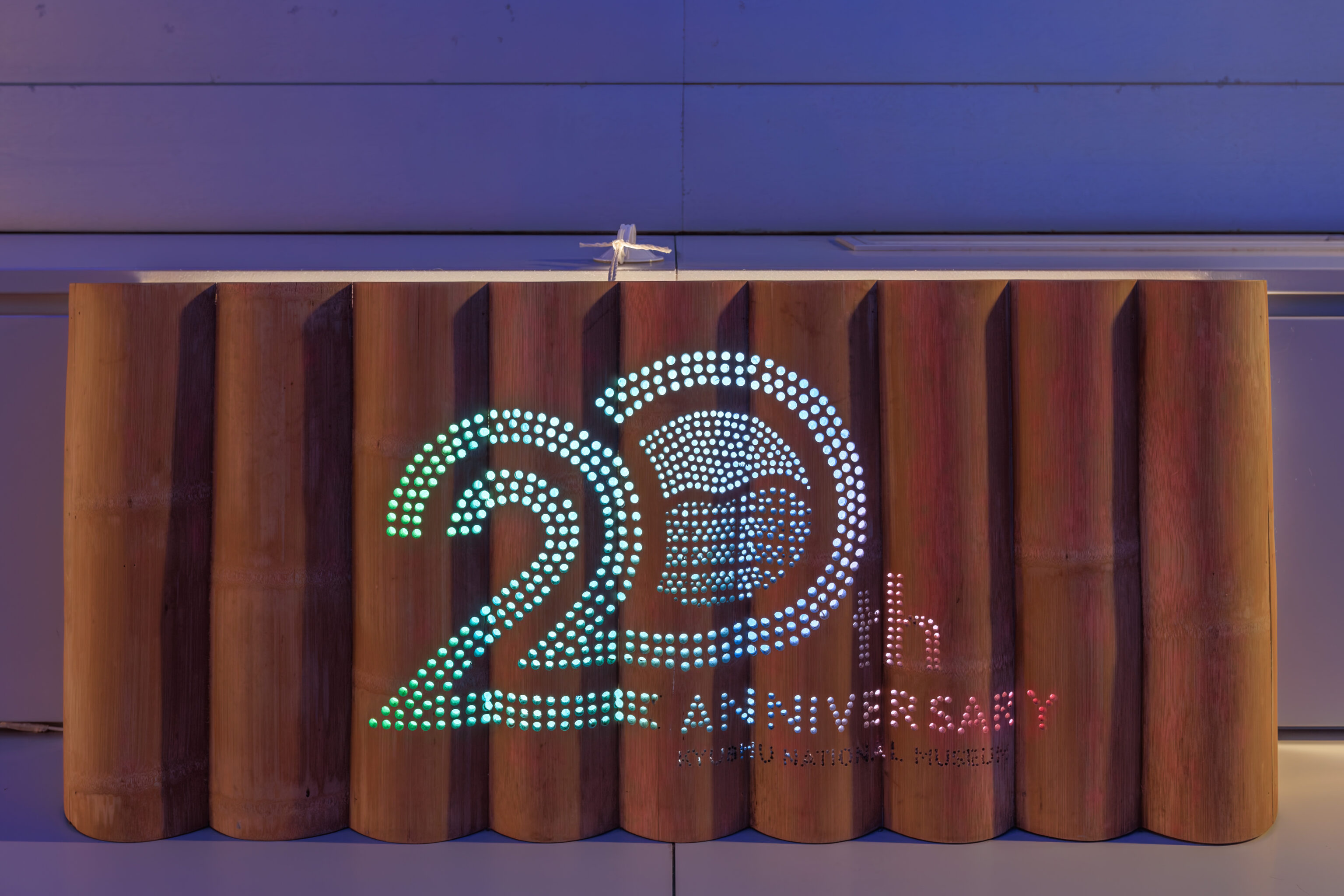
This lighted 20th anniversary display was in the tunnel. We didn’t notice it before.
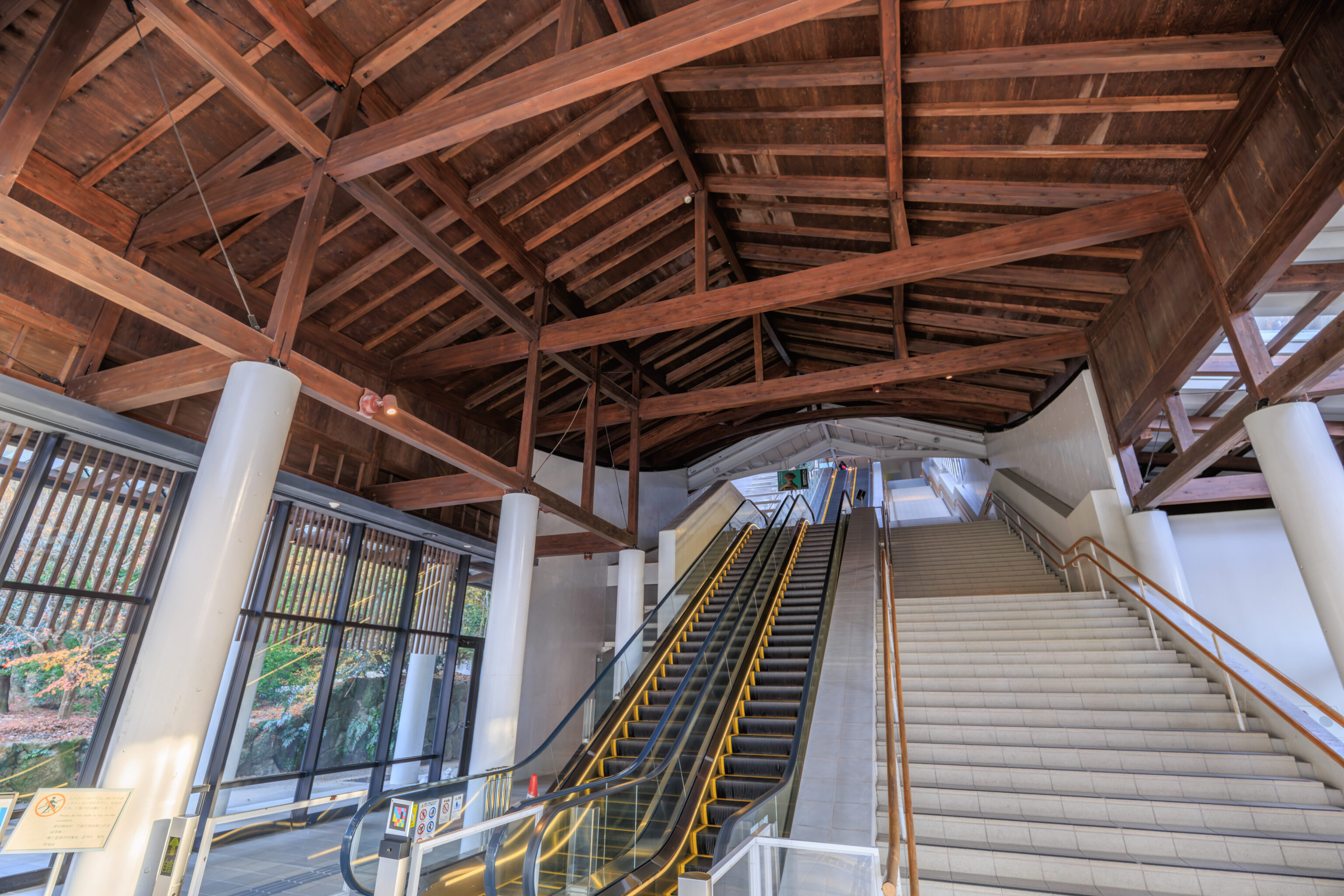
There was no one else around as we descended by escalator.
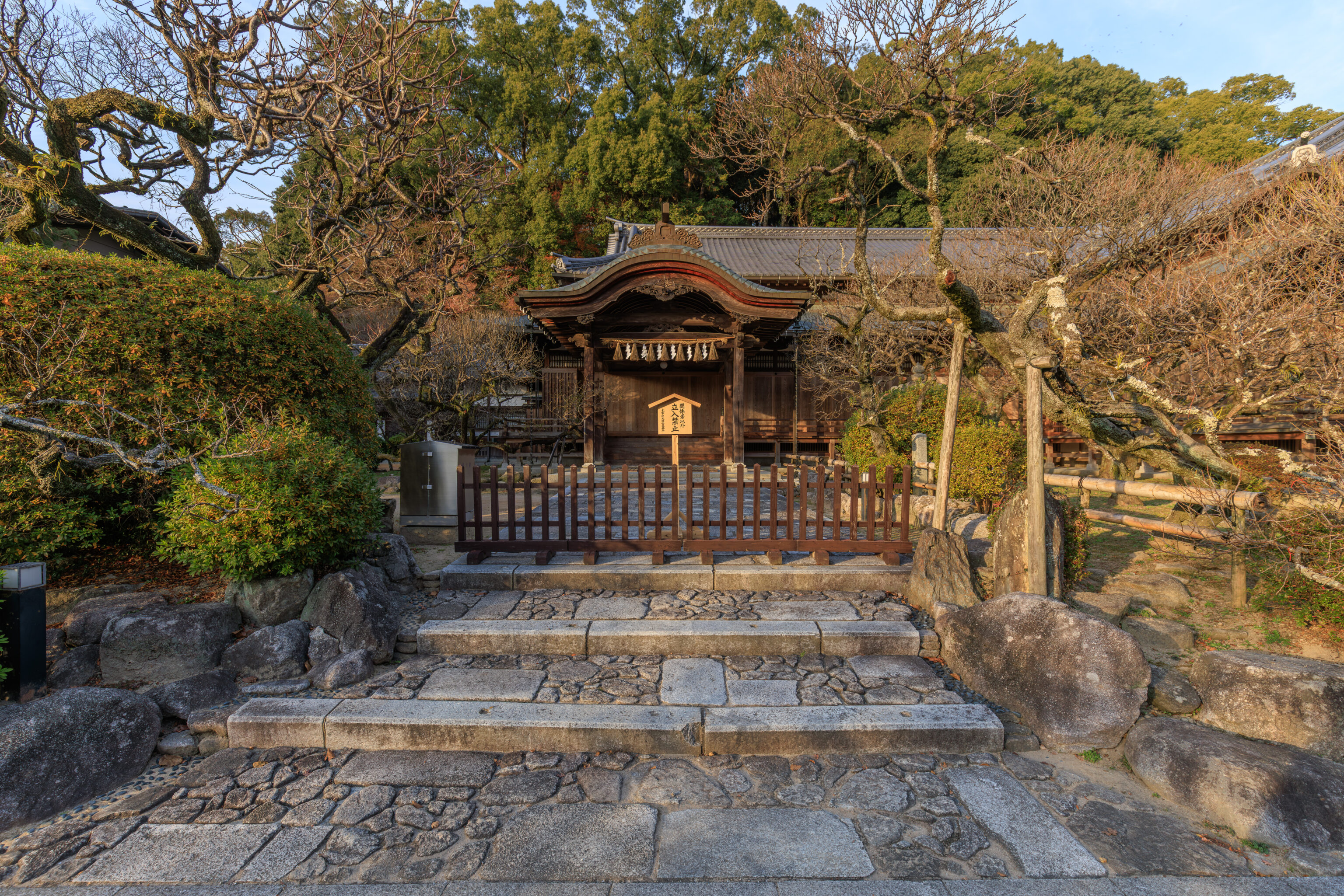
This is the shrine’s archive building that we photographed just before going to the museum.
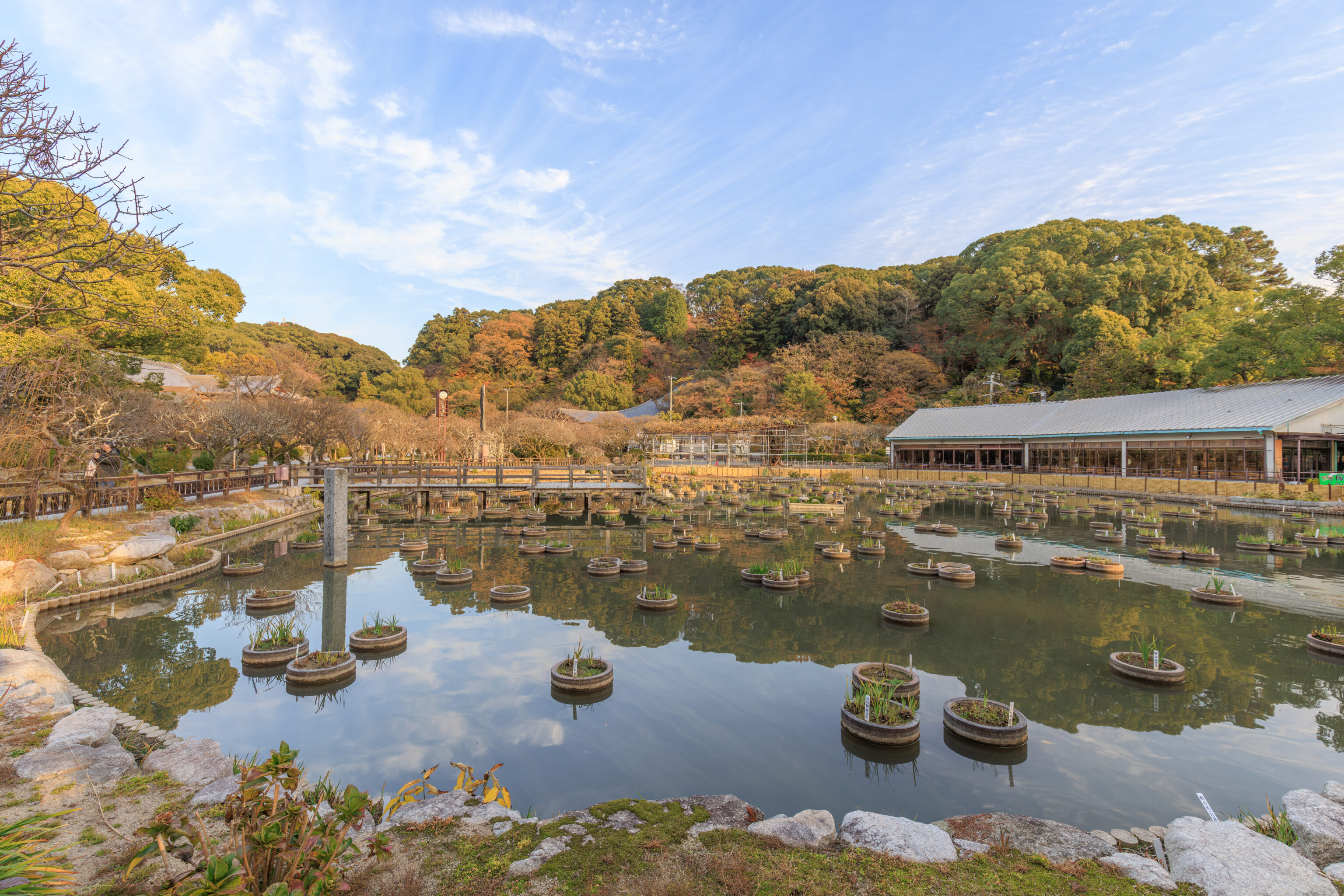
This pond, the 菖蒲池 Iris Pond, is just to the west of the museum’s escalators.
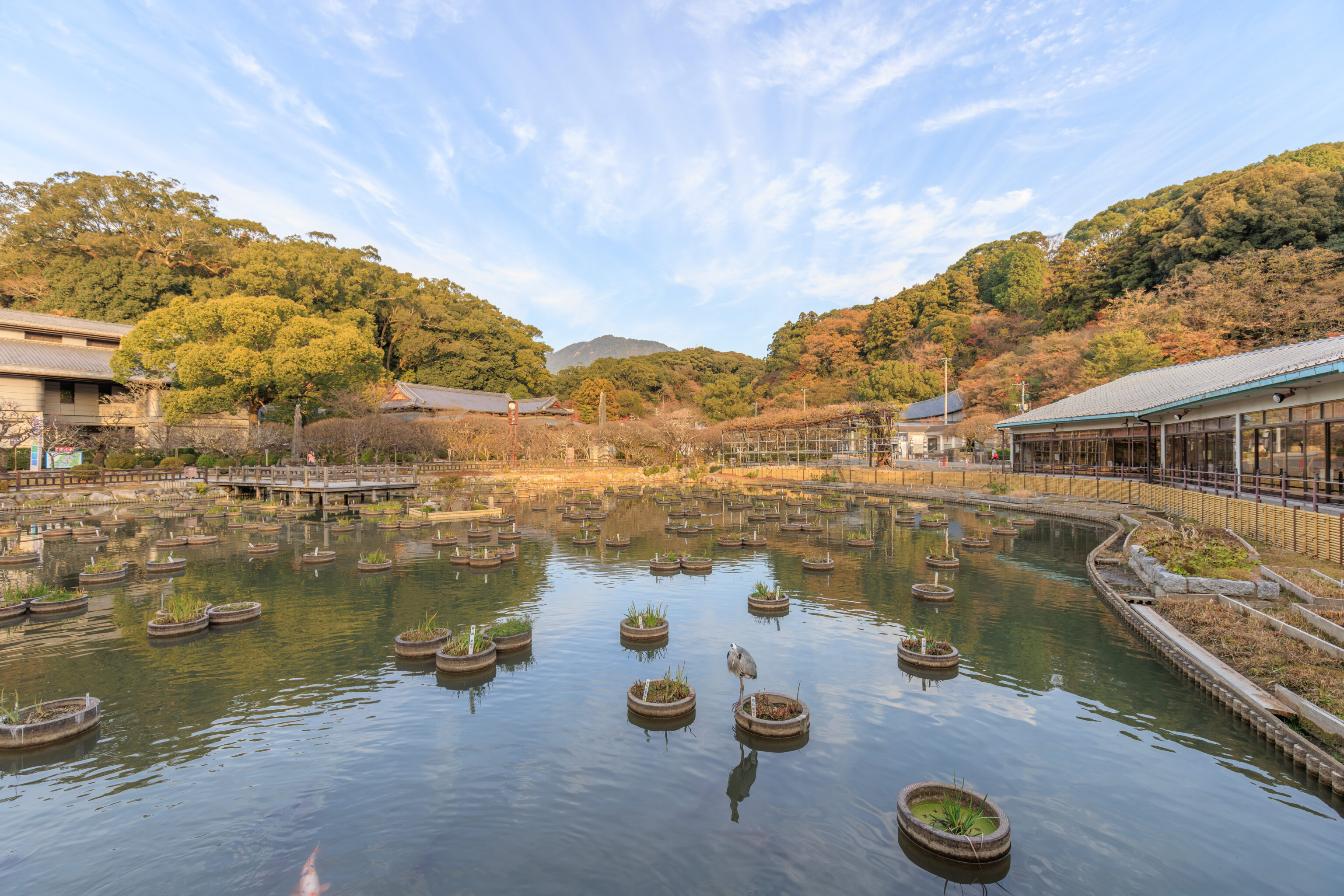
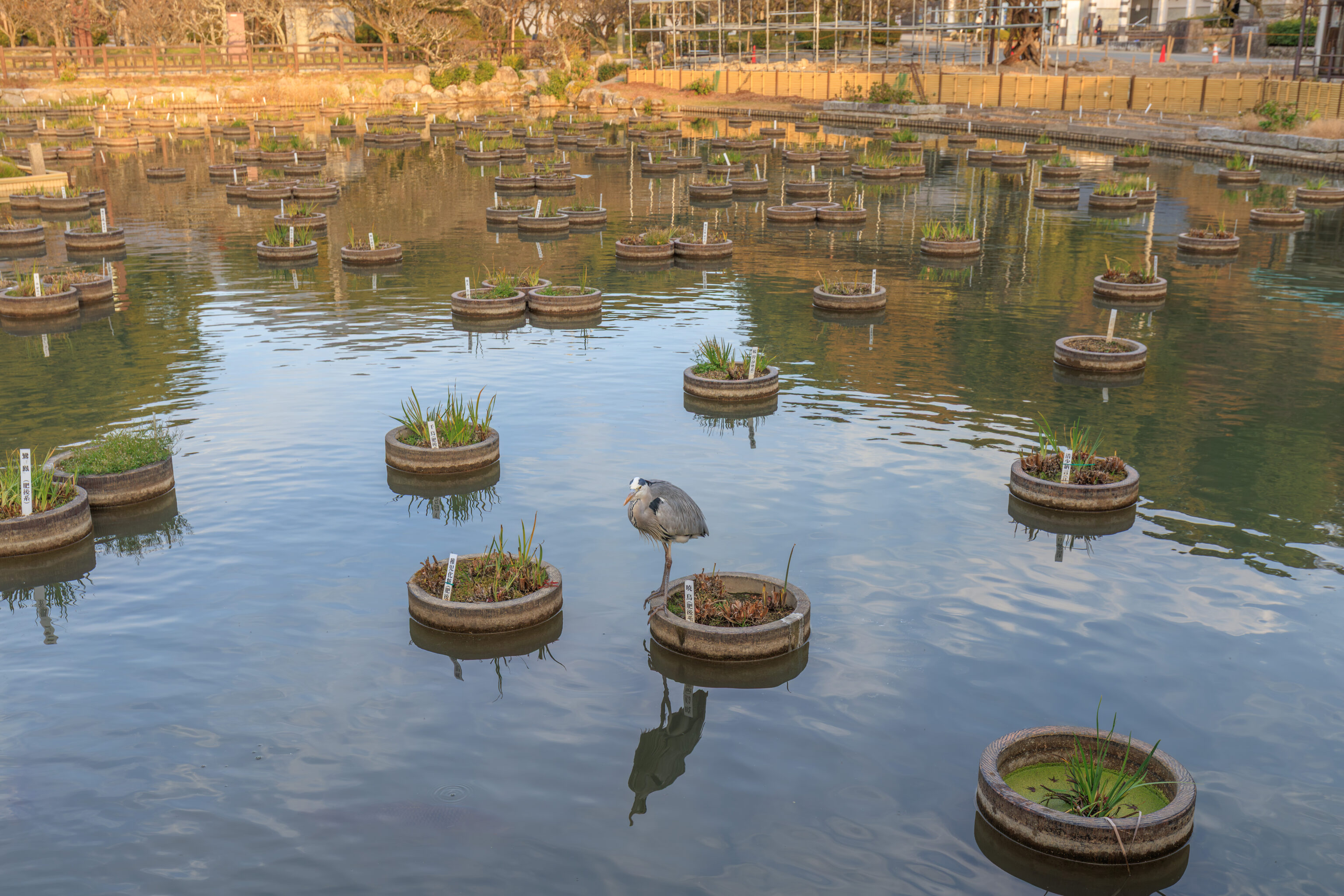
The was a Gray Heron patiently waiting on one of the planters. The koi that we could see were all too big to hunt.
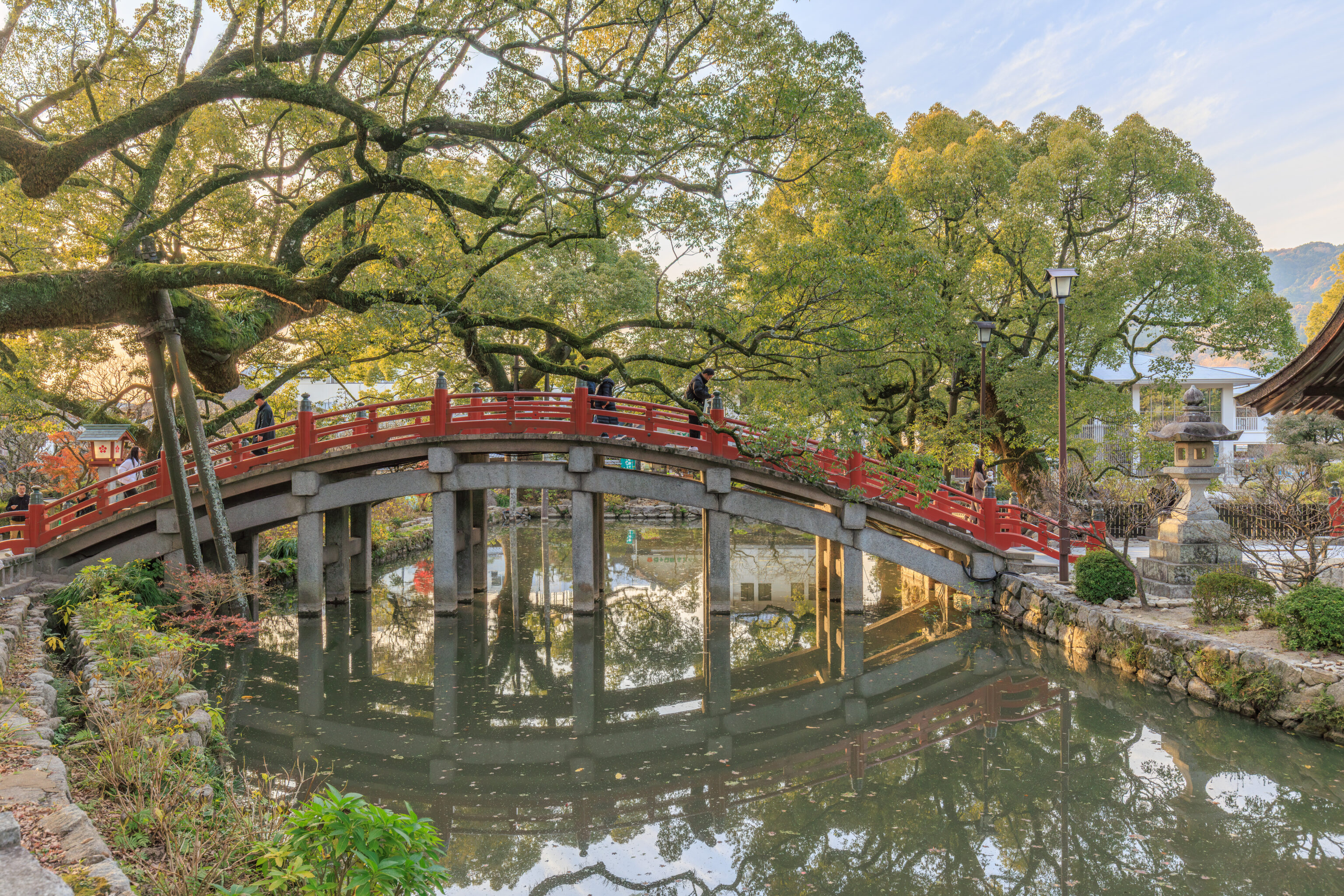
Looking to the west, we could see the northern section of the Taikobashi.
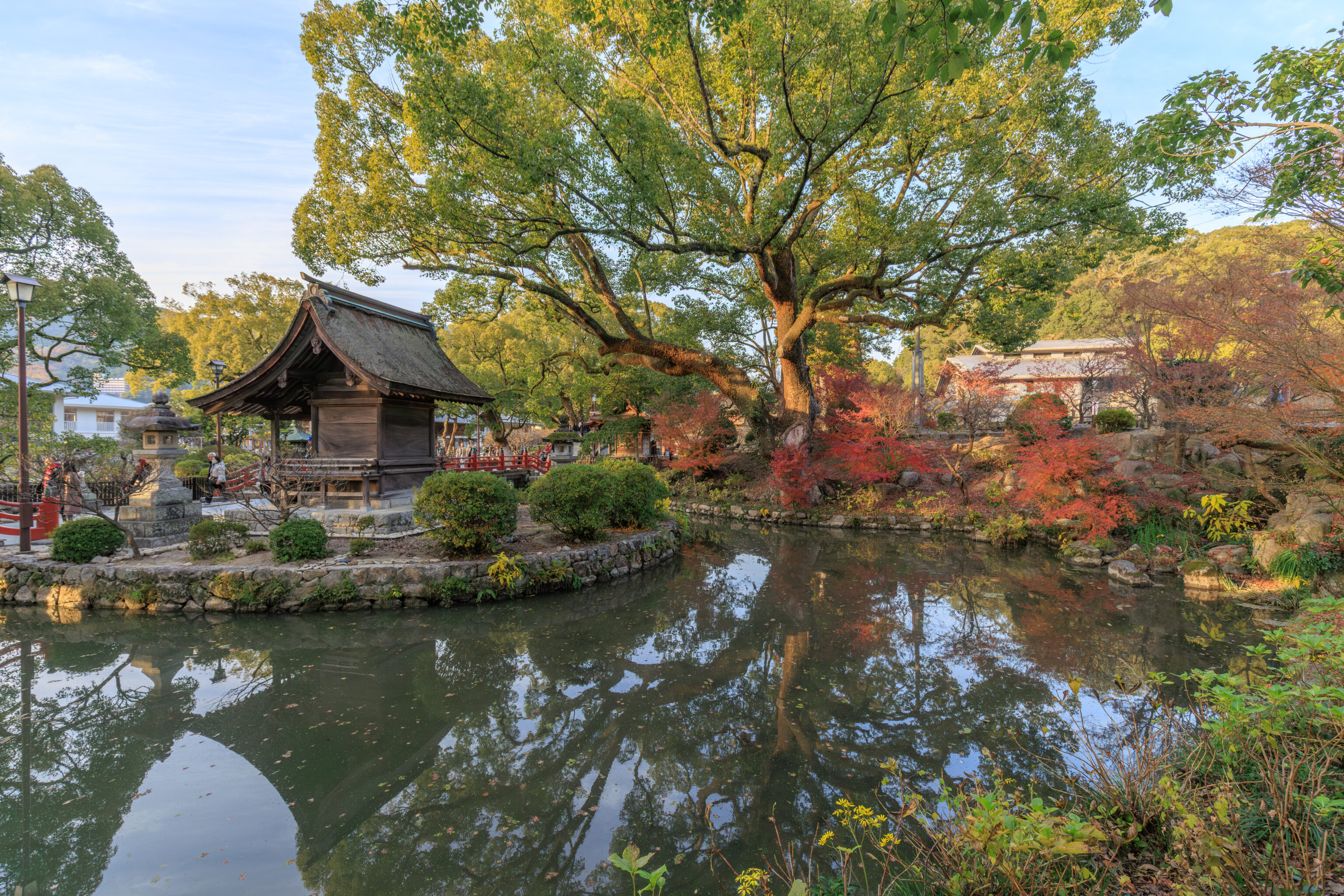
And, here we see the island between the southern and middle sections of the bridge.
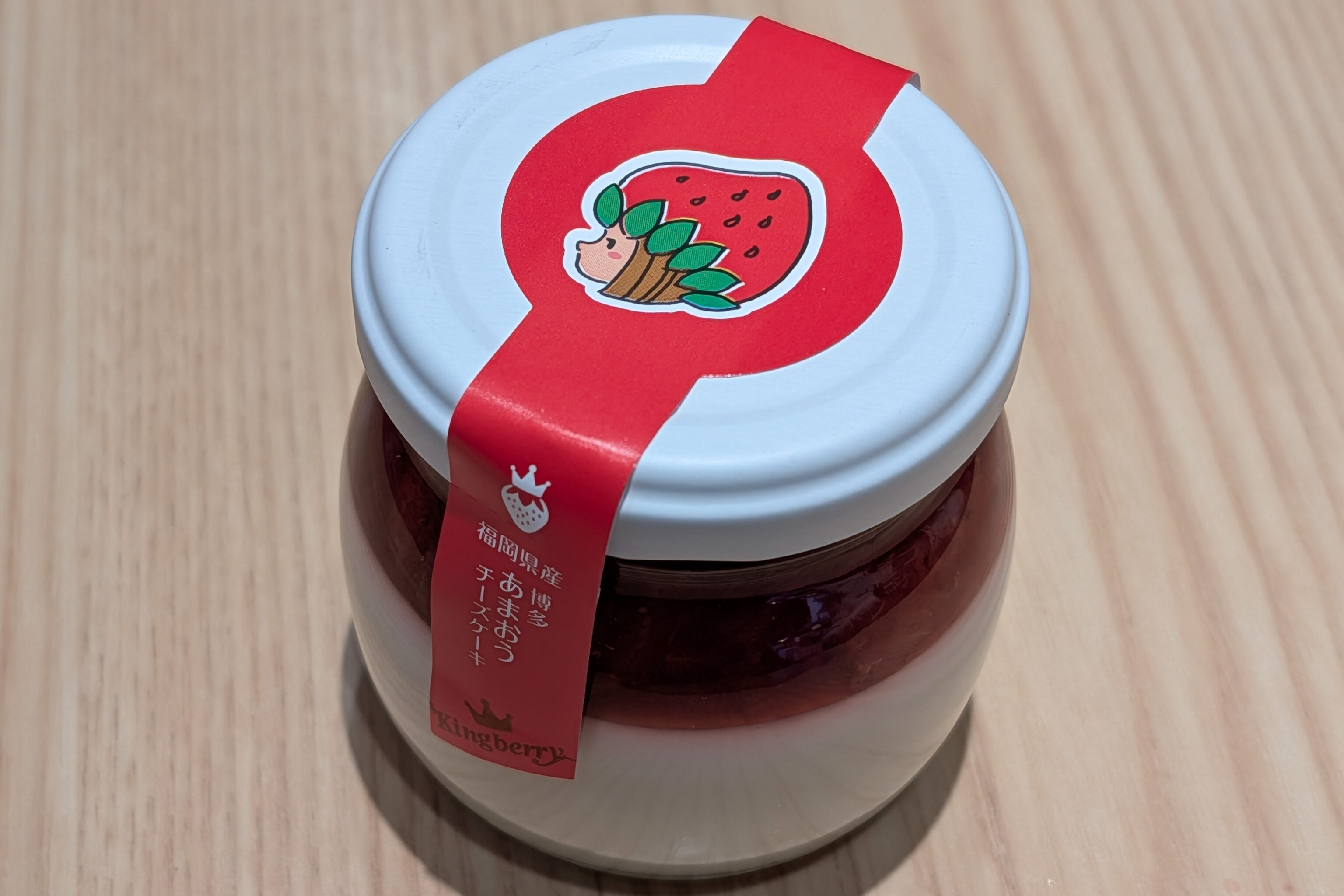
As we made our way back to the train station, we stopped by Kingberry again and got what probably could be described as a jar of cheesecake with strawberry.
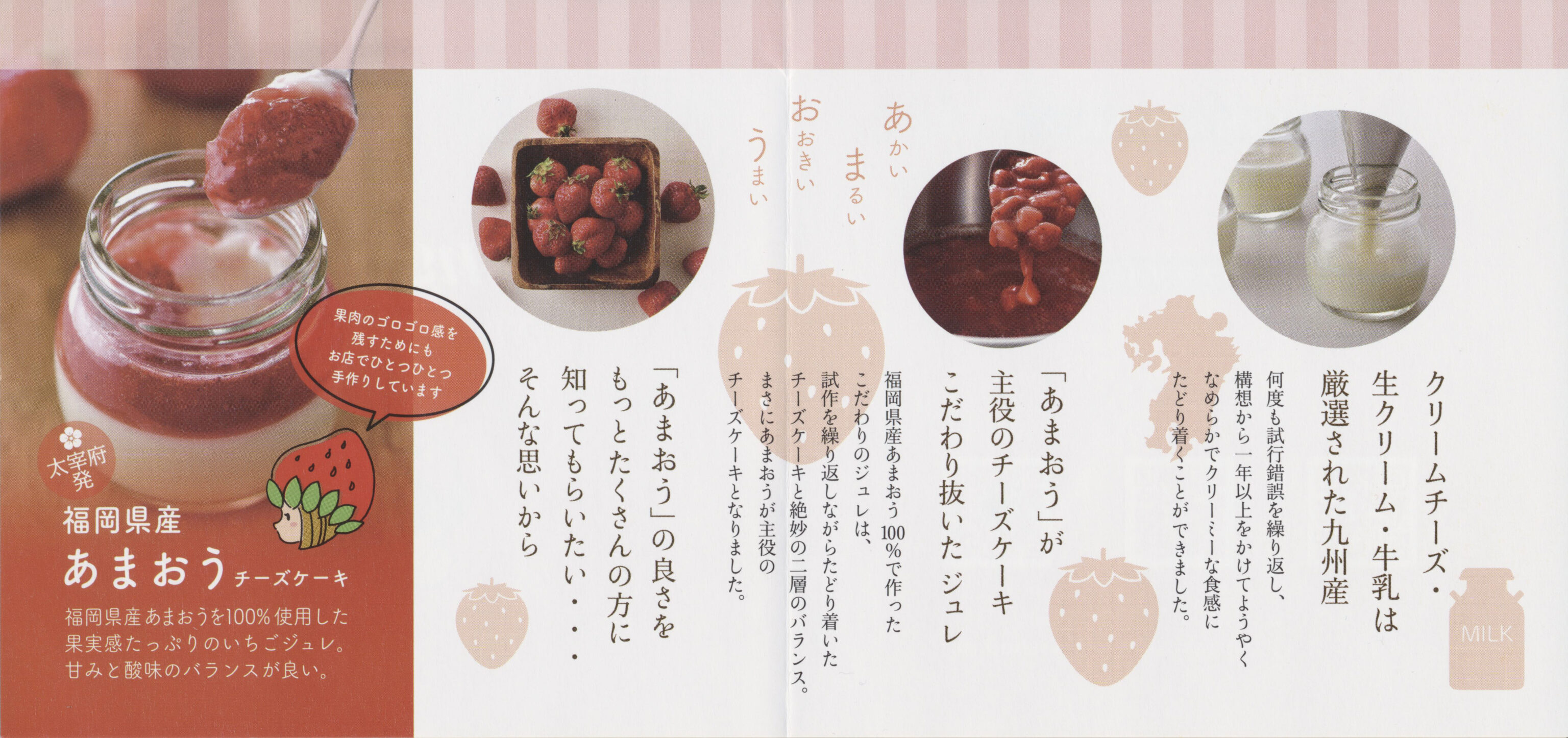
Kingberry’s specialty is actually Amaou Strawberry cheesecake so getting this featured item makes sense!
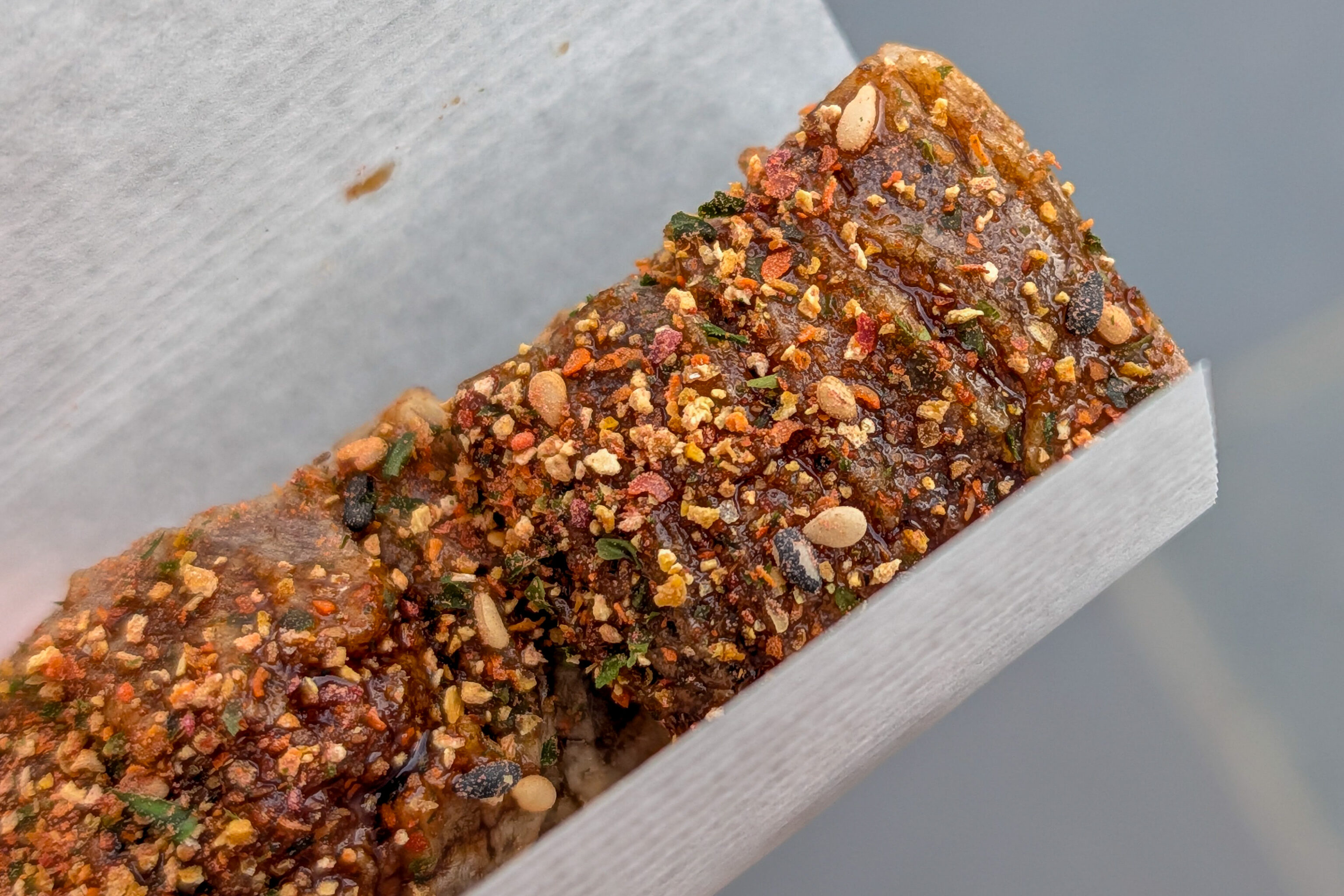
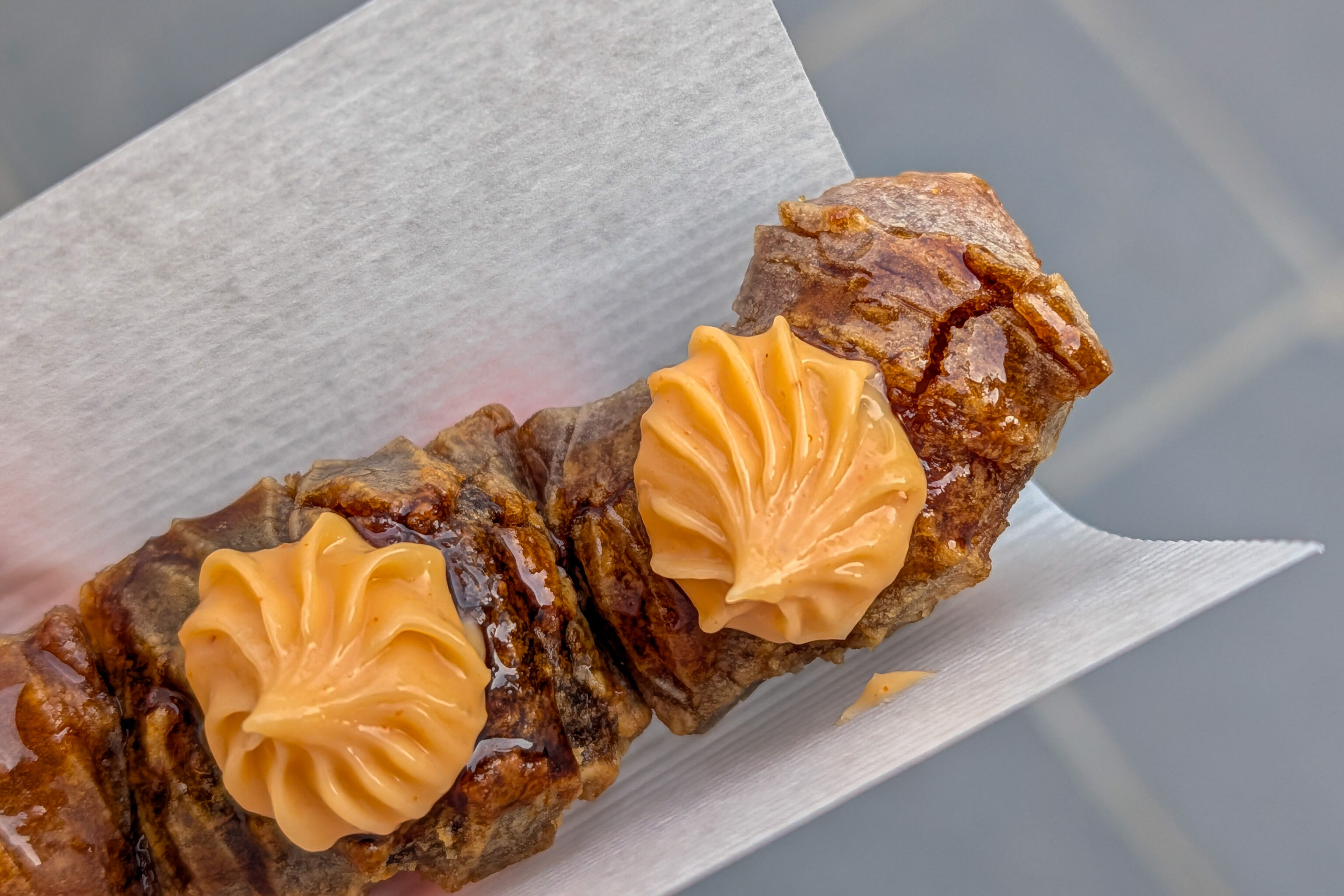
Next, we got two grilled rice cake skewers, which have a meat-like appearance. There were many varieties available. We got spicy cod roe and mayonnaise, and plum and seven spices. They were good.
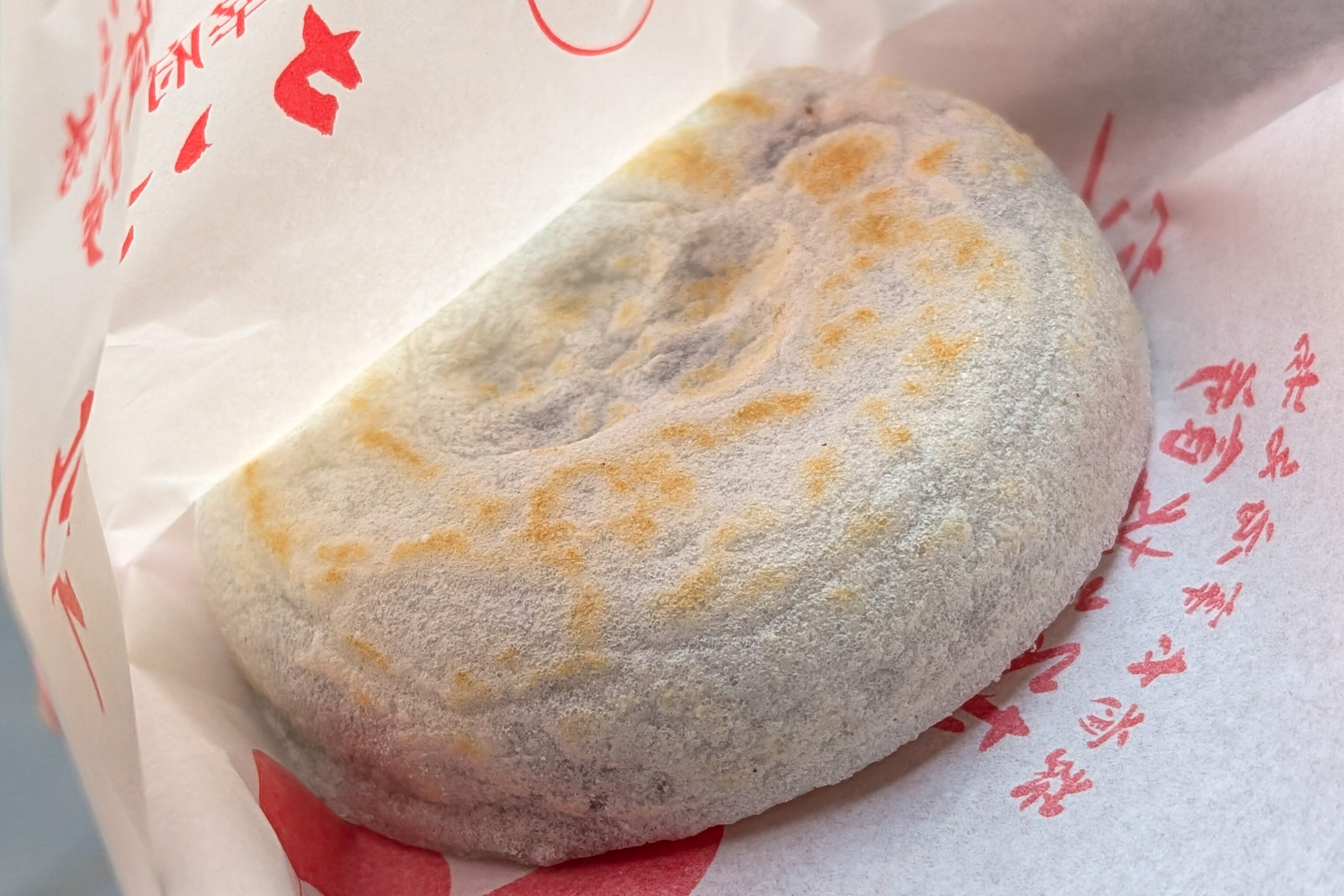
We also got another umegae mochi, although from different shop than the one we visited in the morning.
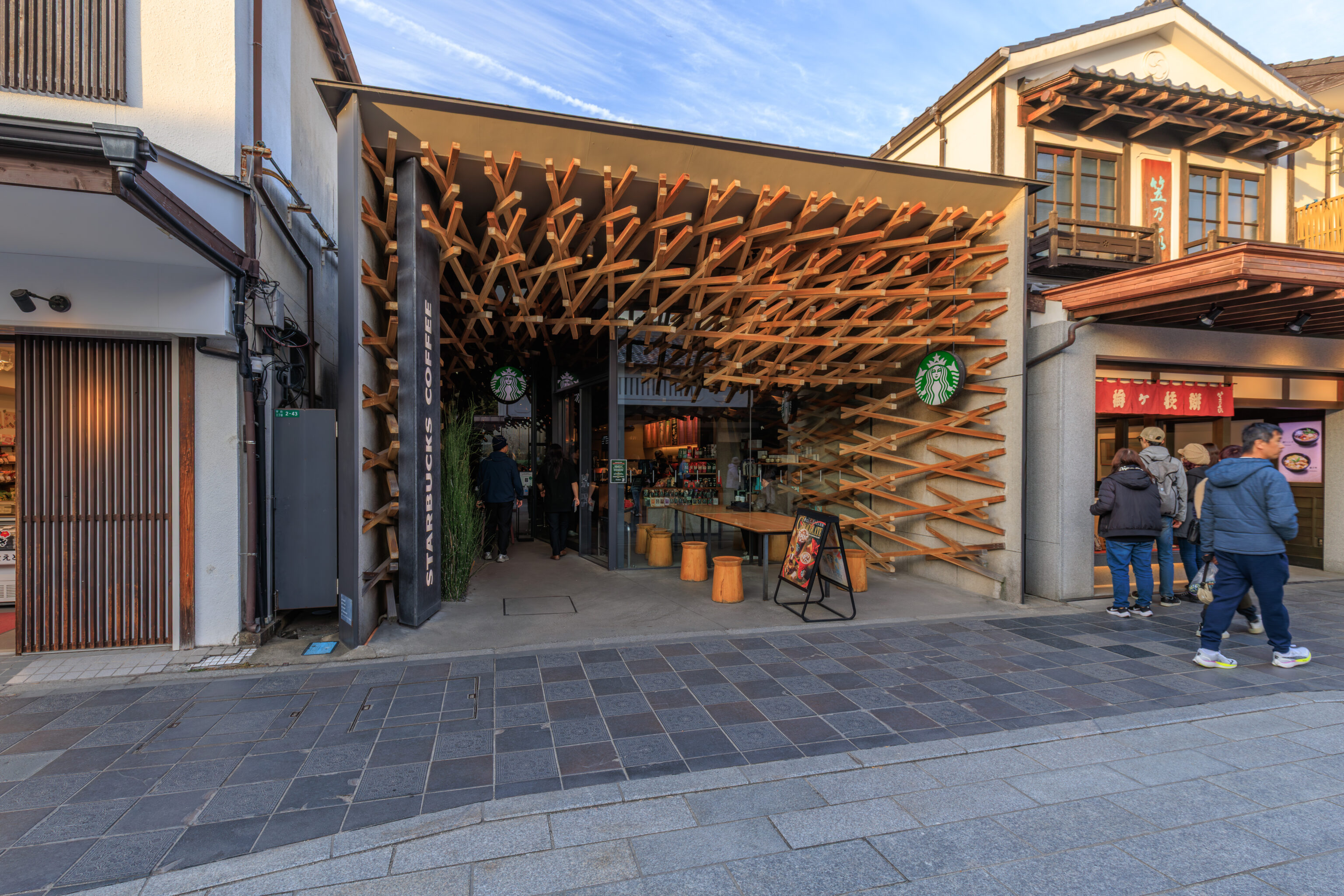
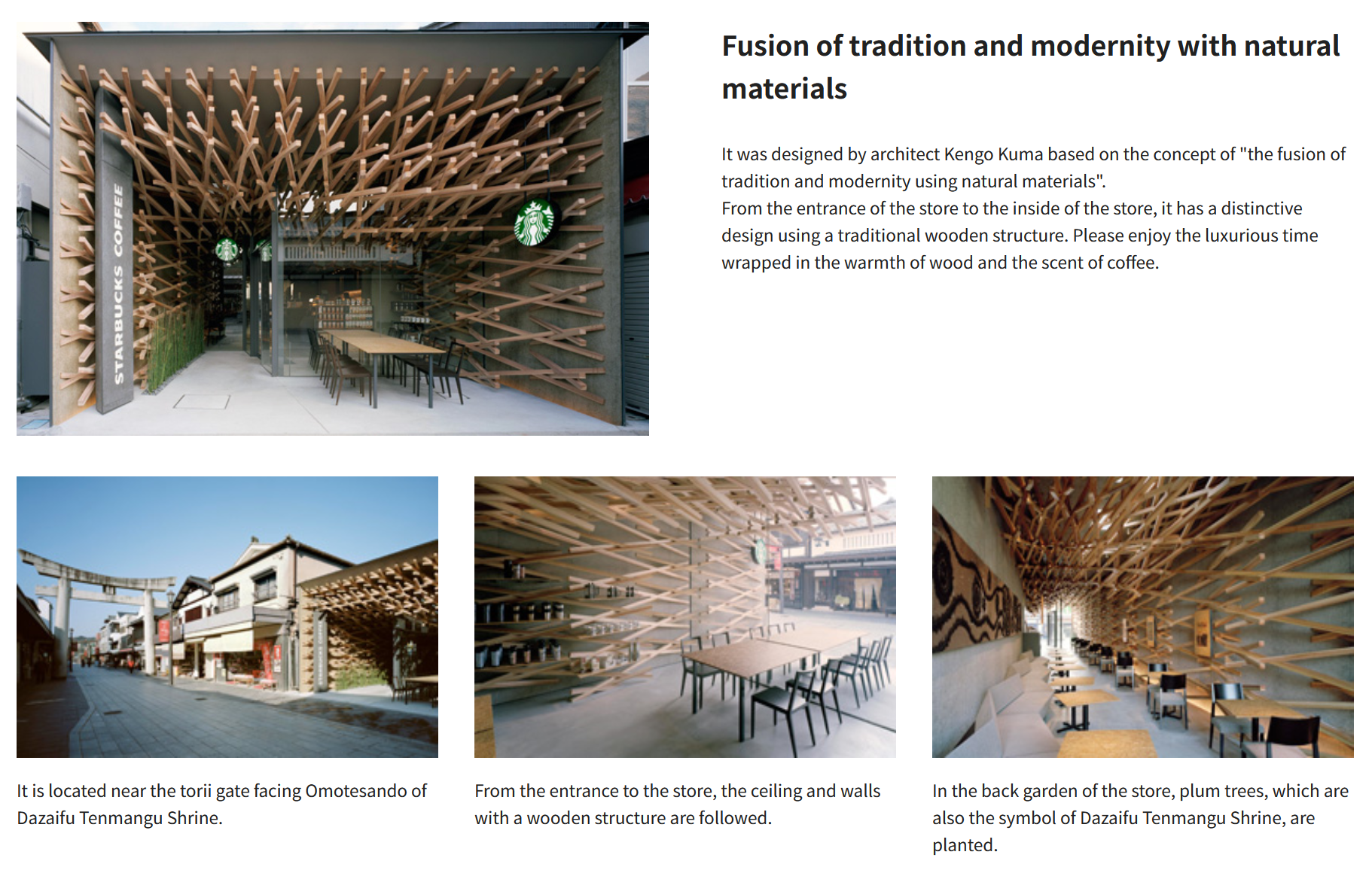
We walked by a Starbucks with an interesting exterior design and is considered a Regional Landmark store.
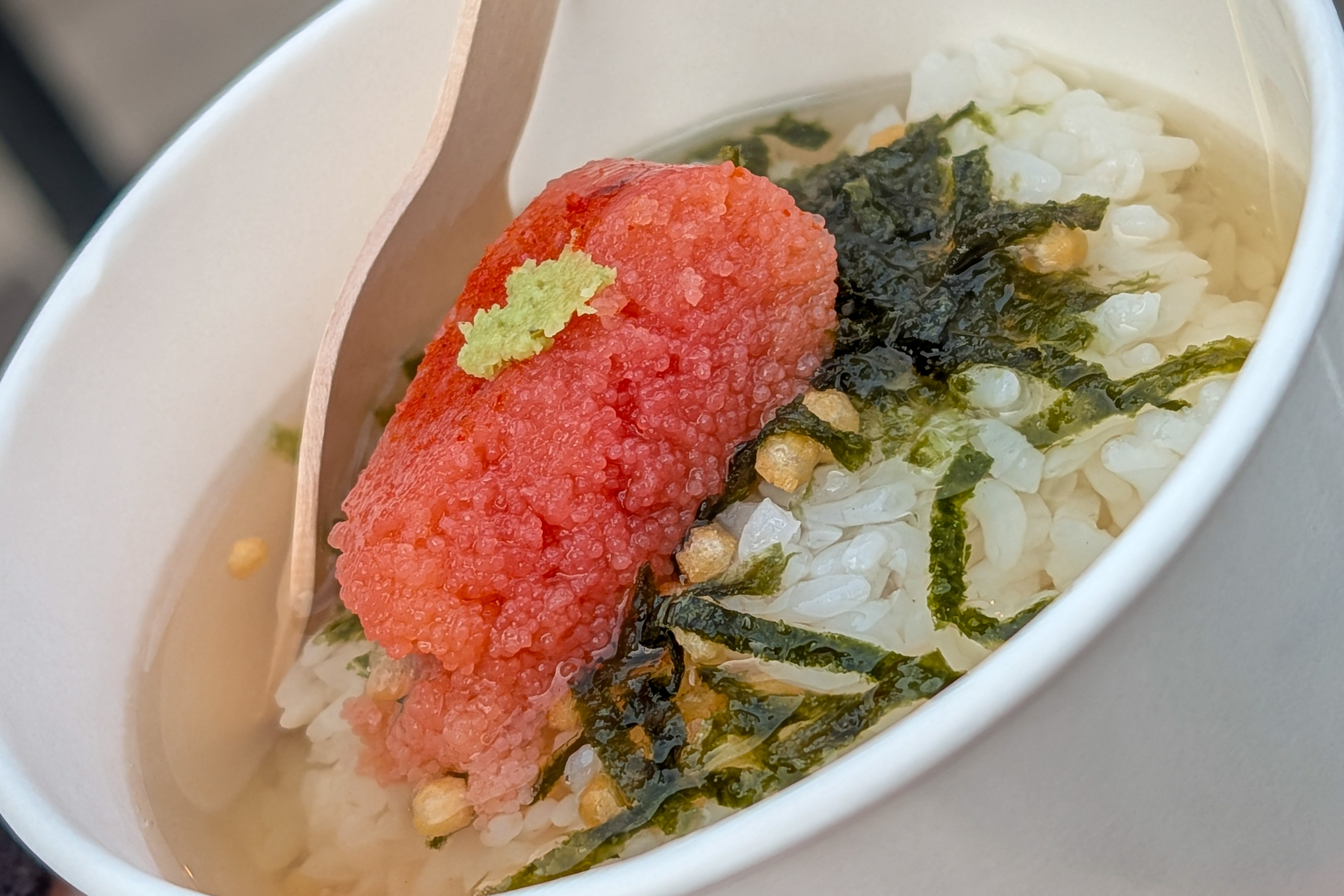
Continuing on, we got a mentaiko ochazuke. Mentaiko is pollack roe cured with red chili pepper and is originally from Korea and is considered to be a specialty from Fukuoka in Japan. Ochazuke is rice in a broth or tea along, often with other ingredients so that its not just rice. So, this is rice with a dashi broth and pollack roe on top.
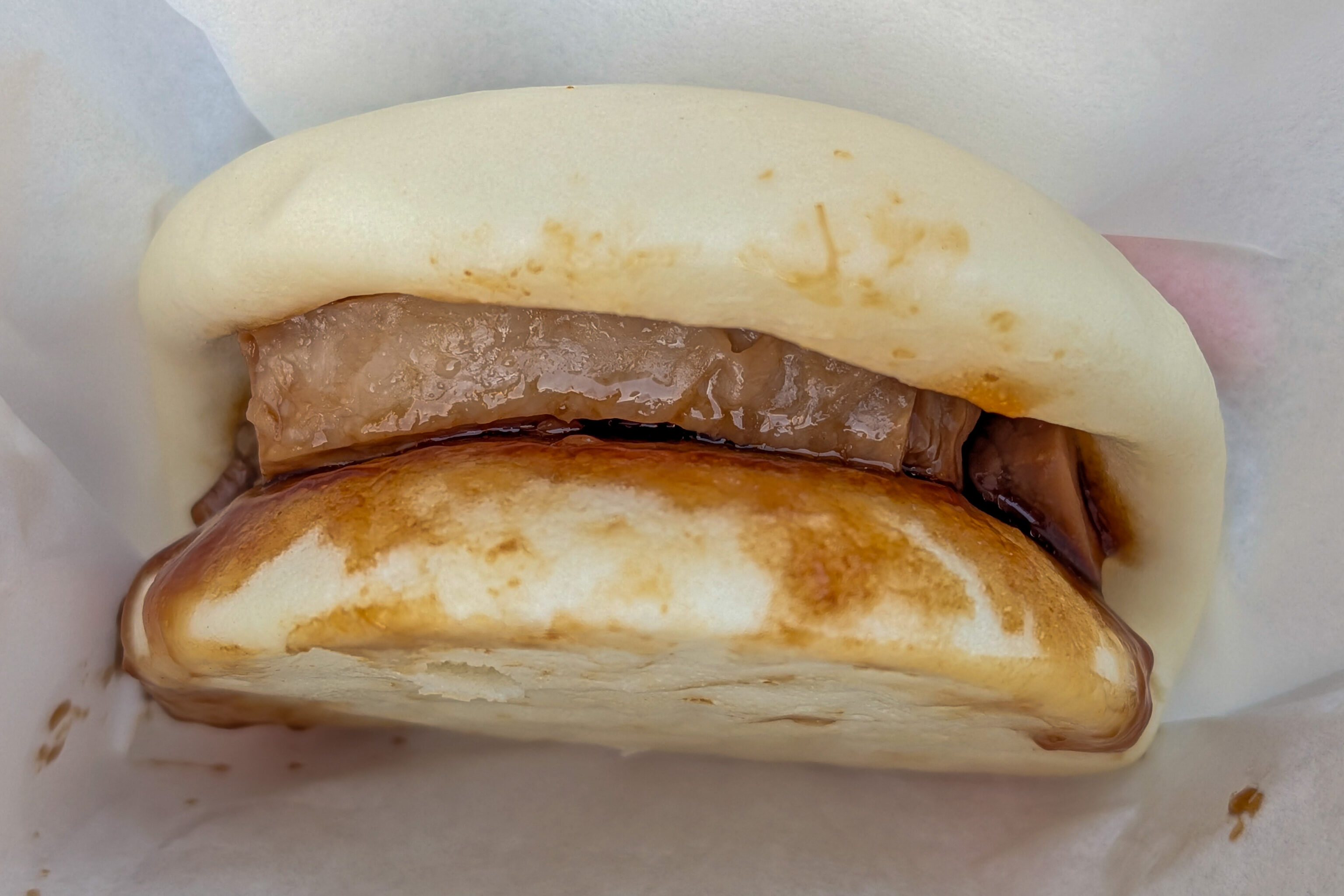
This guabao, basically pork belly in a steamed bun, is described locally in Japanese as gokakuniman. The name is a play on words as gokaku is to basically pass an exam and kakuniman is the proper name for gaubao. This name is due to the presence of the shrine here which is visited for luck on exams. It was nicely steamed and very good.
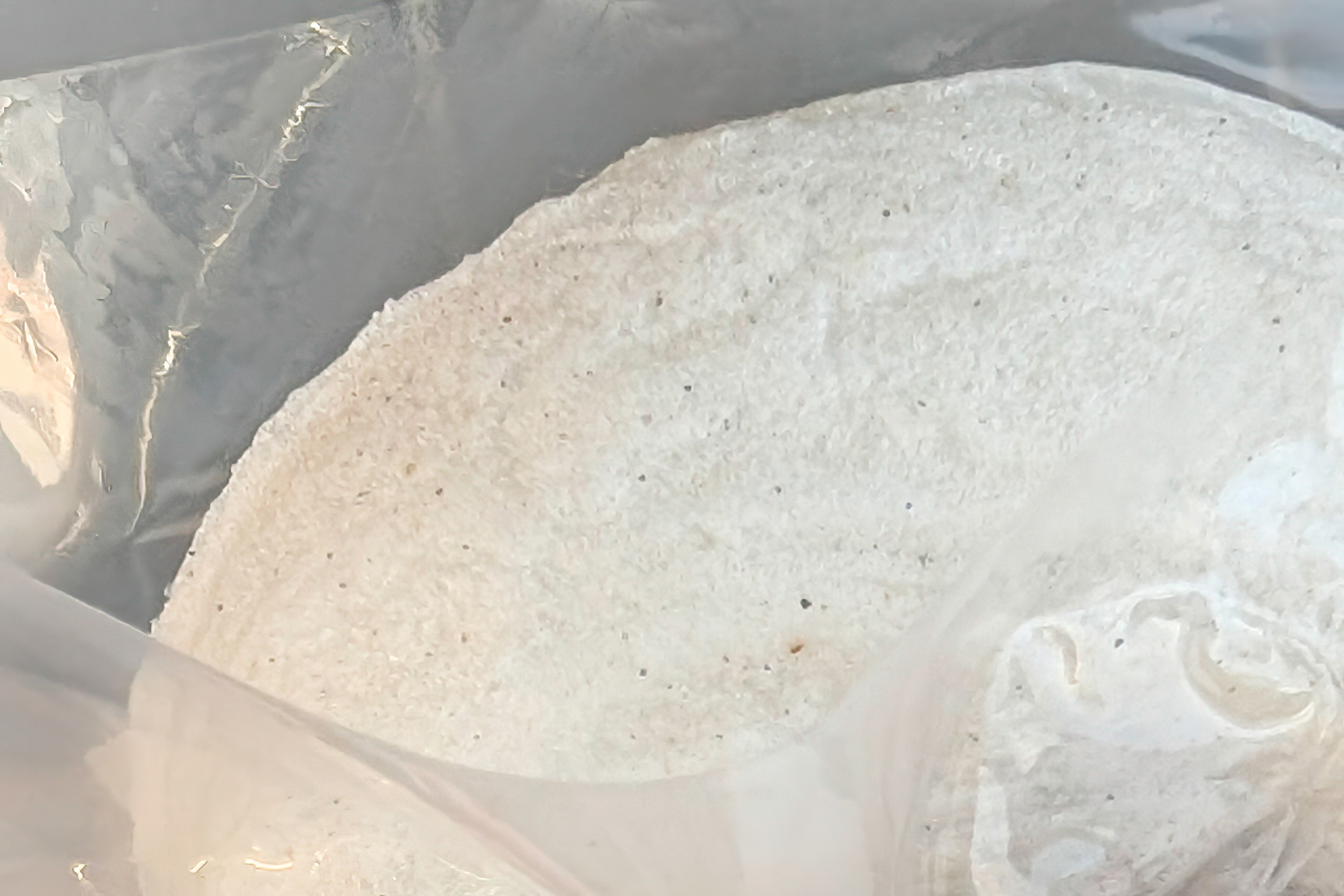
Another umegae mochi!
Fukuoka
After taking the Nishitetsu train back to Fukuoka, we decided to get dinner near the Tenjin Station. We decided on the Hyotan kaiten sushi restaurant within Solaria Stage, a shopping mall connected to the station.
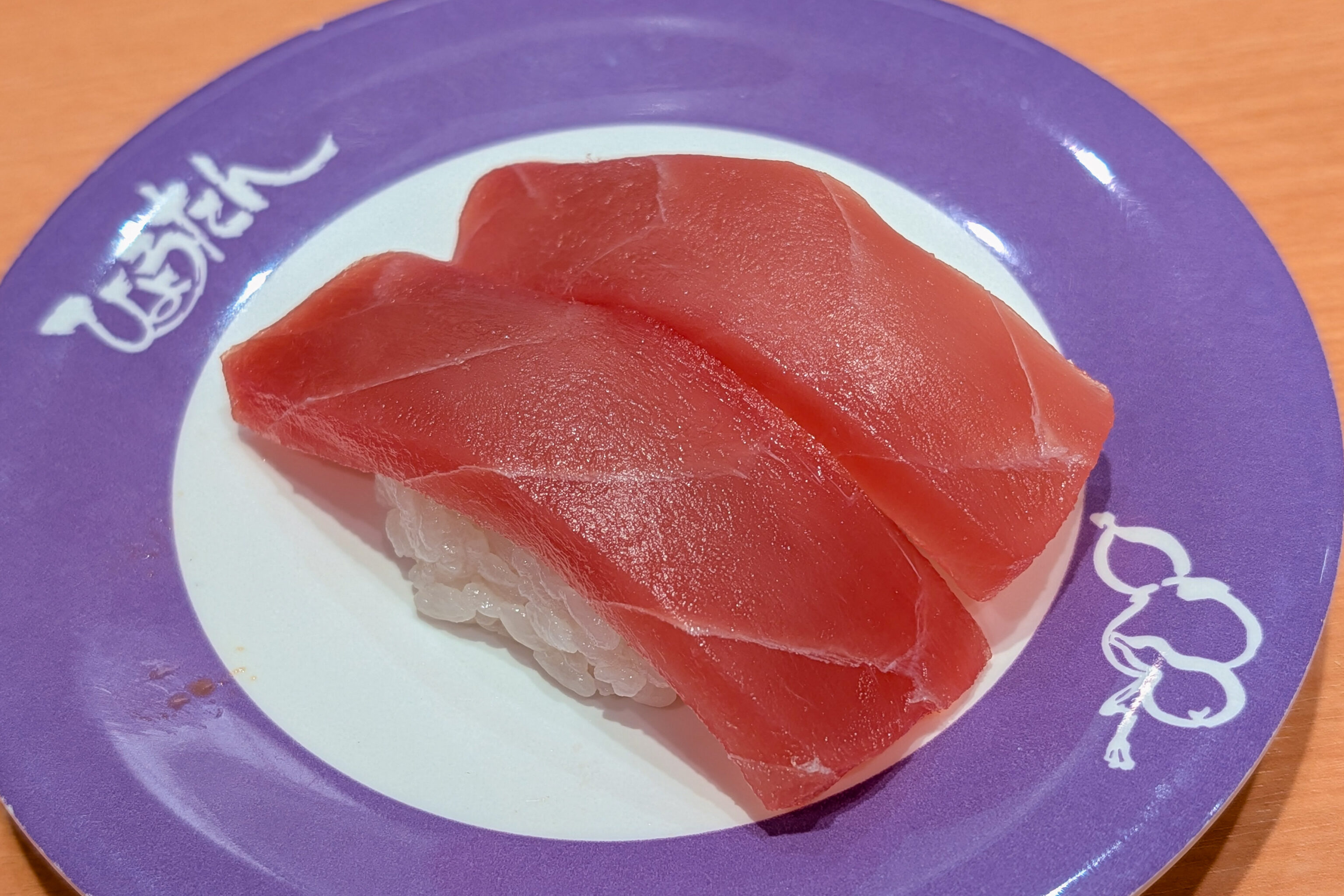
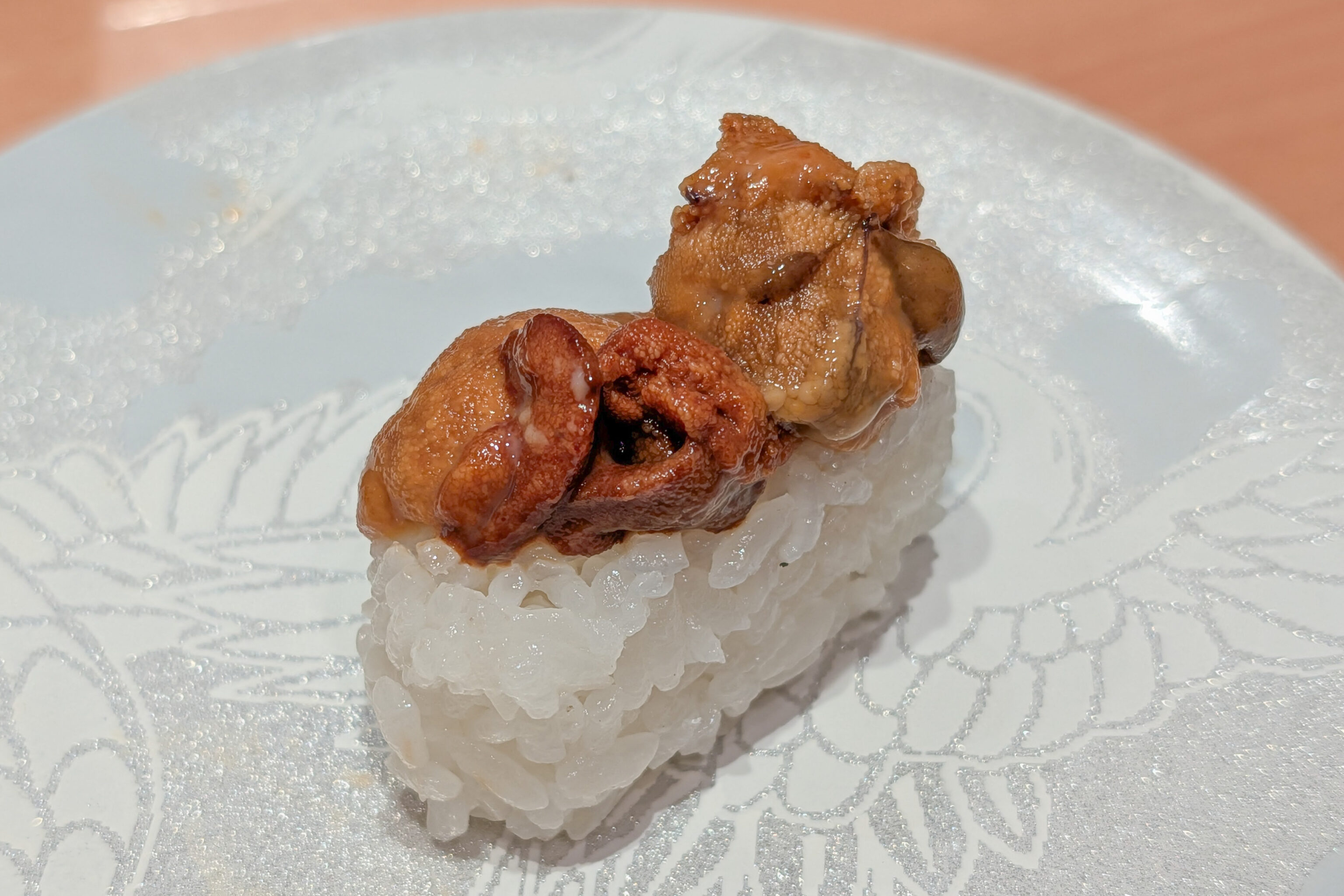
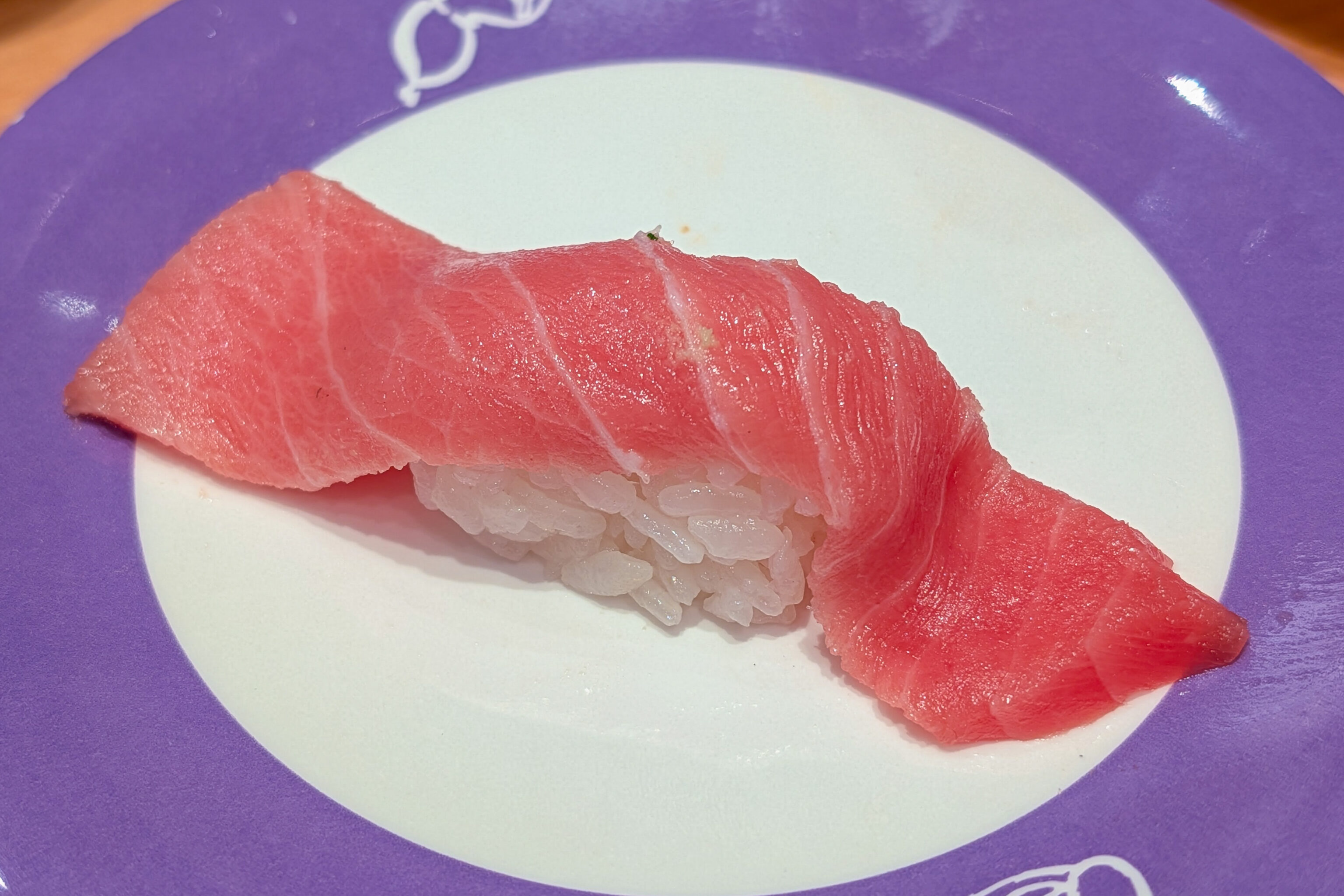
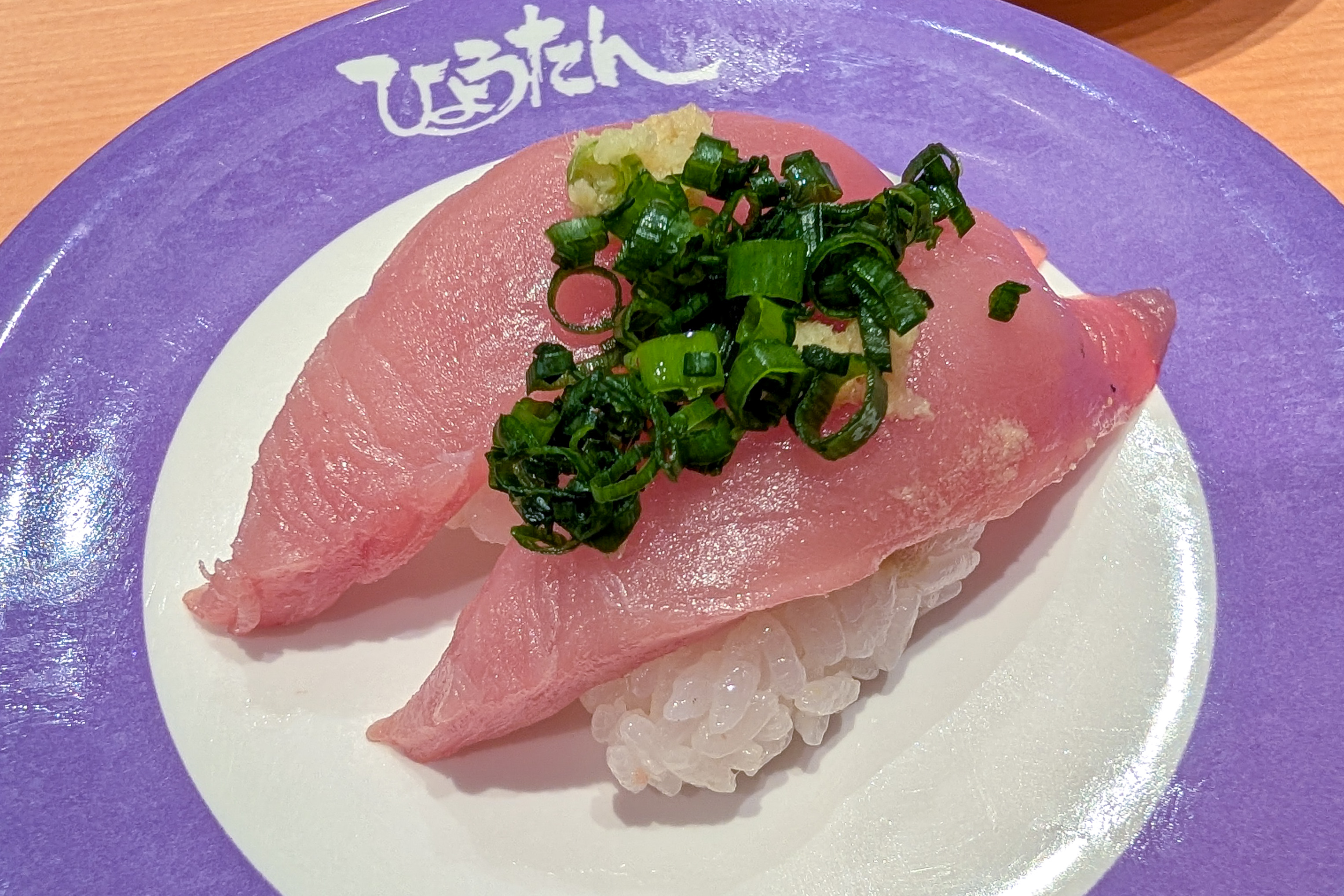
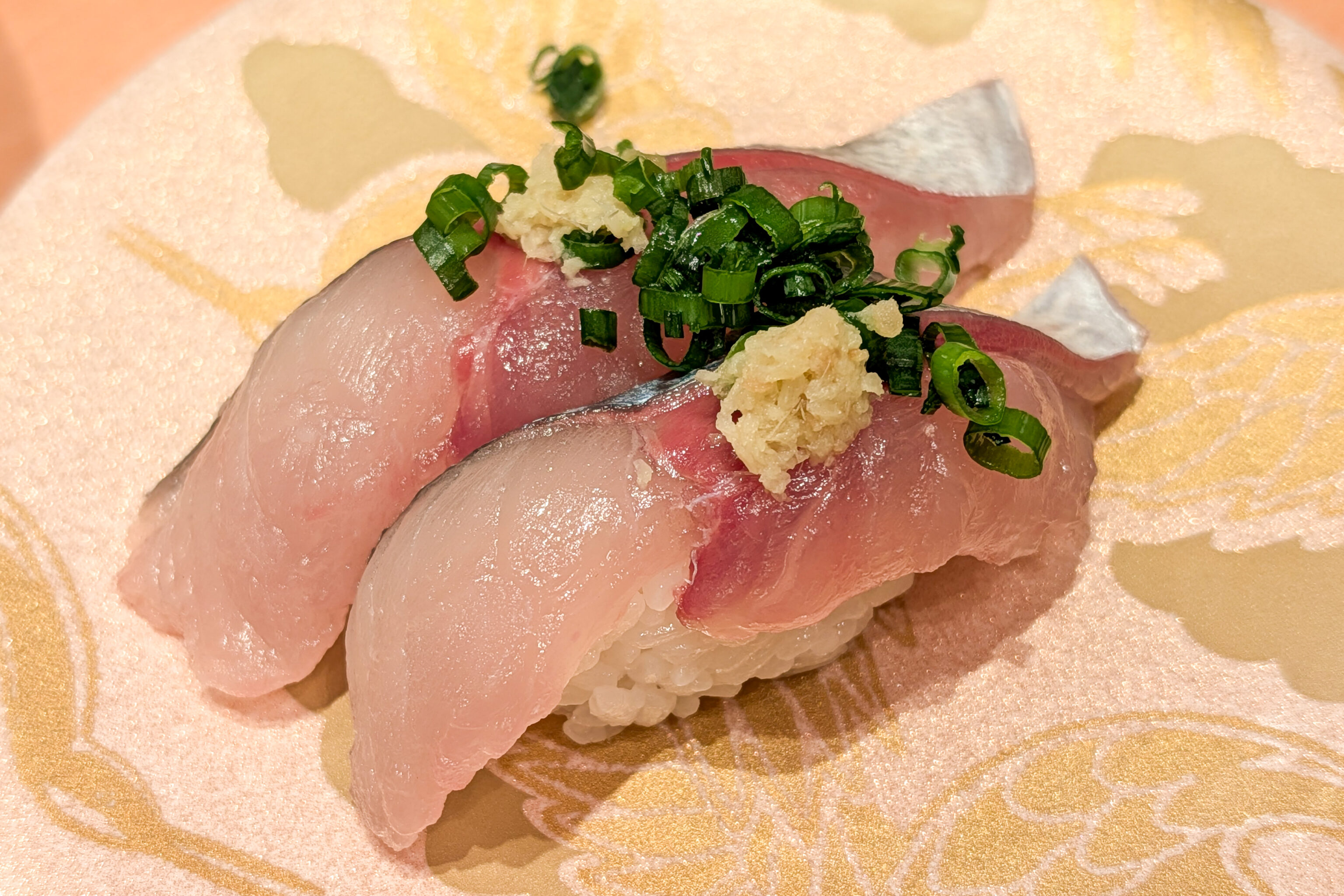
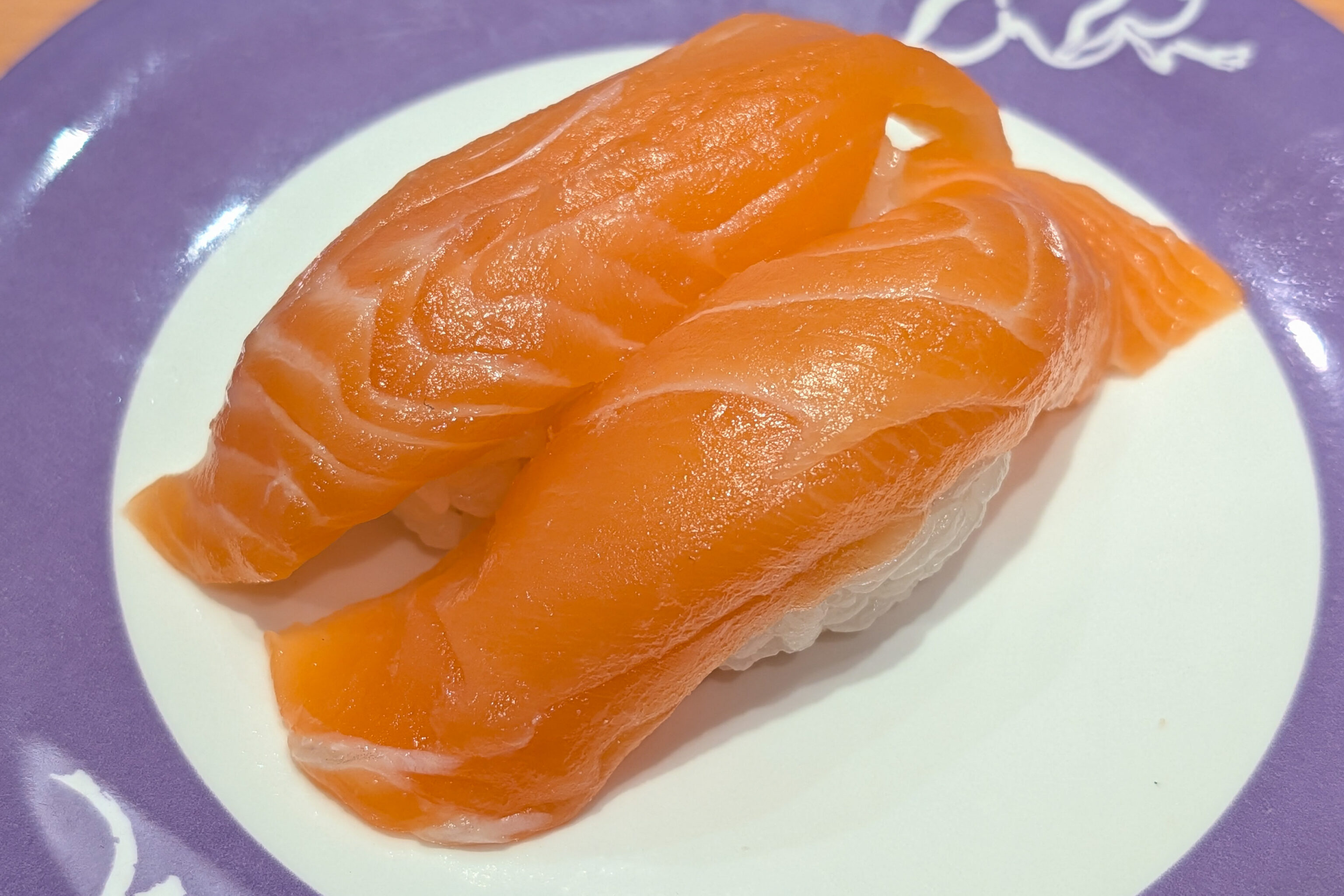
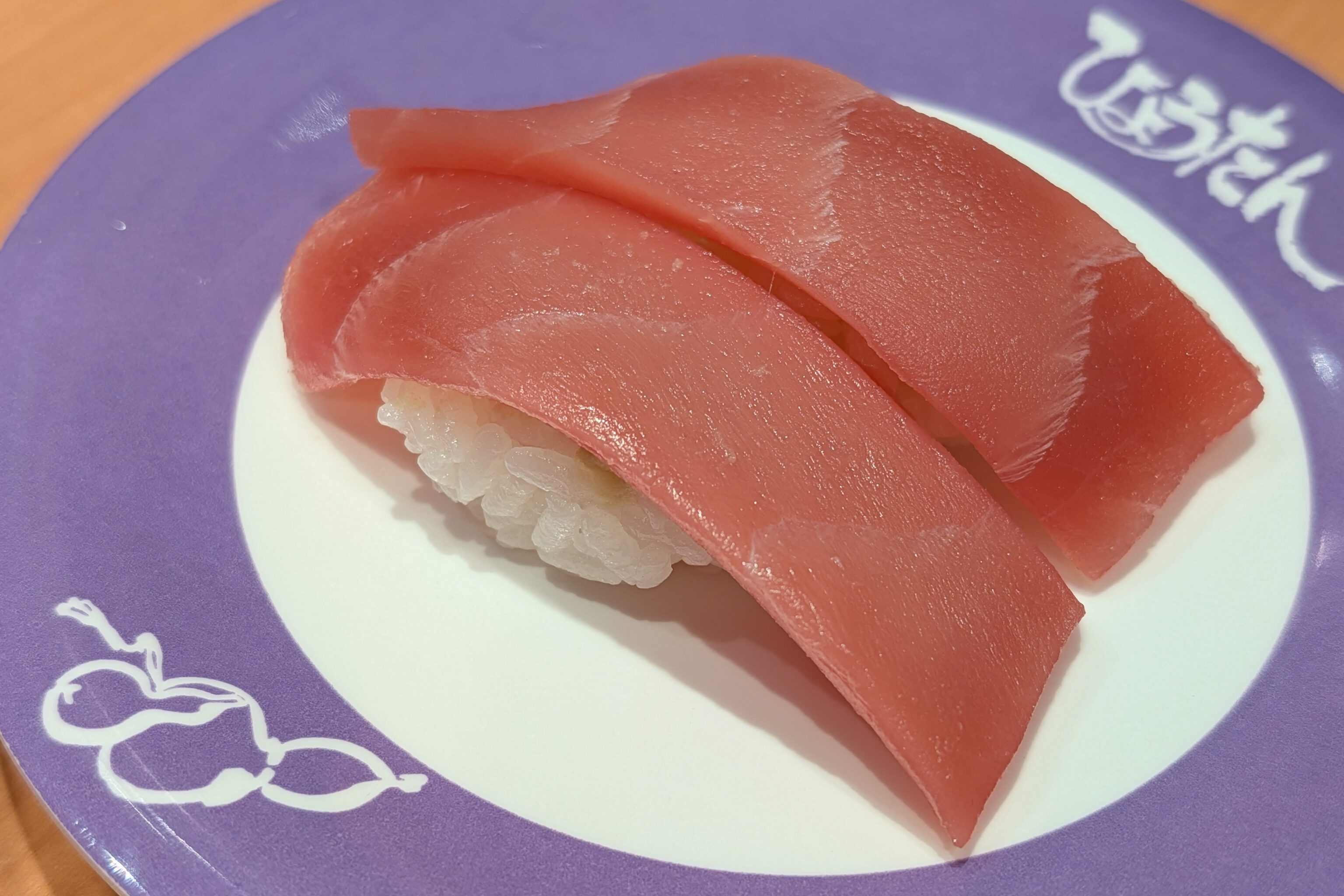
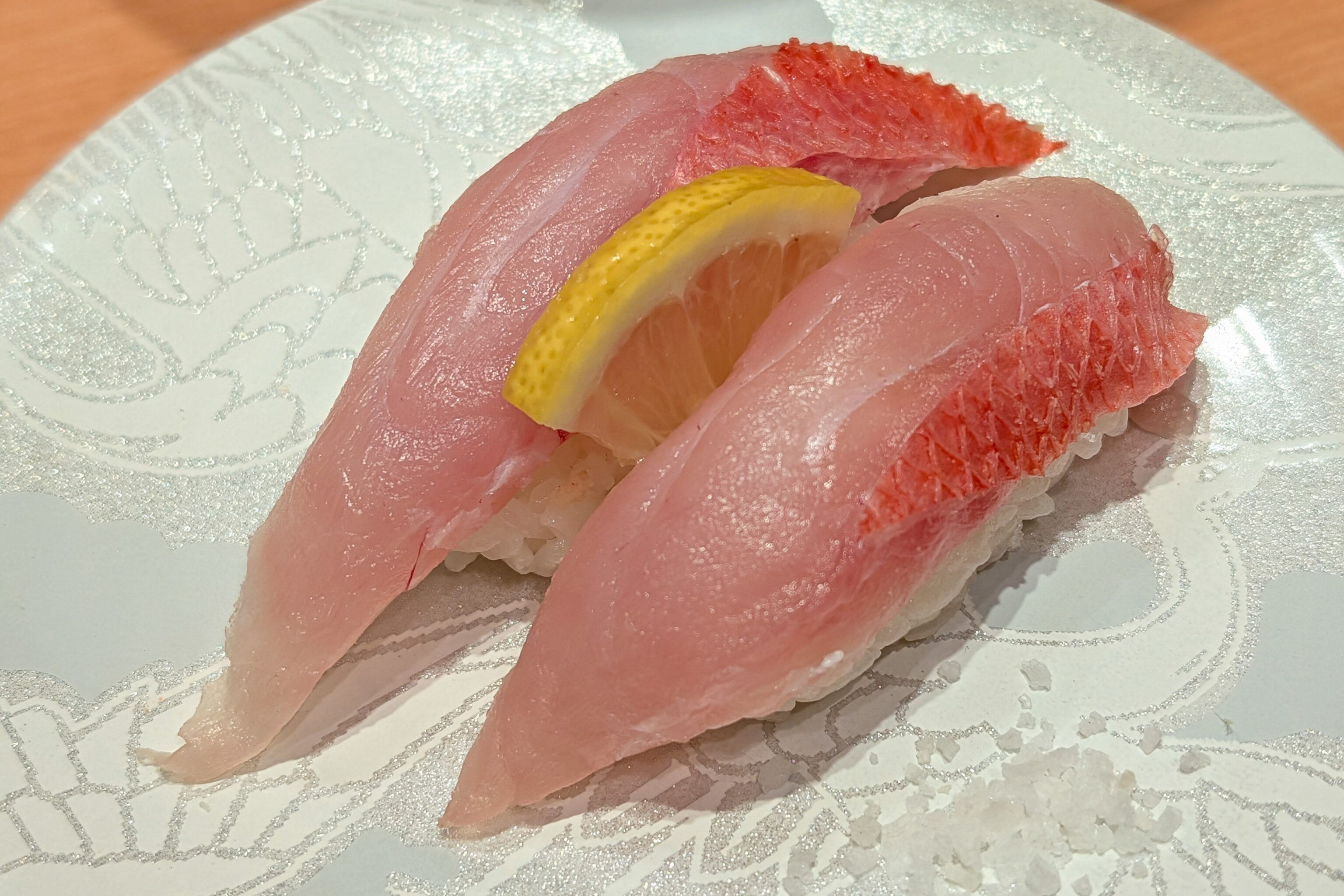
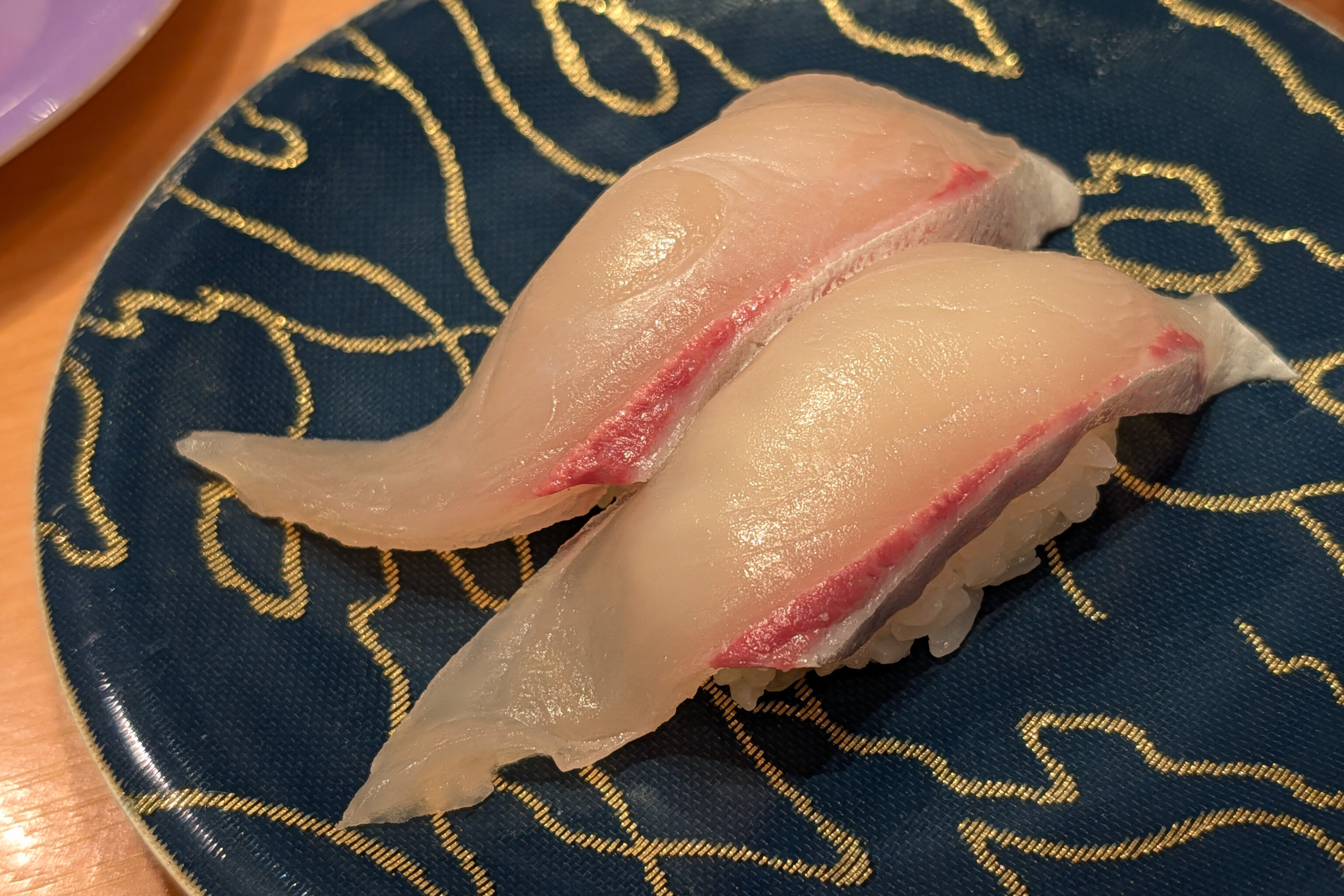
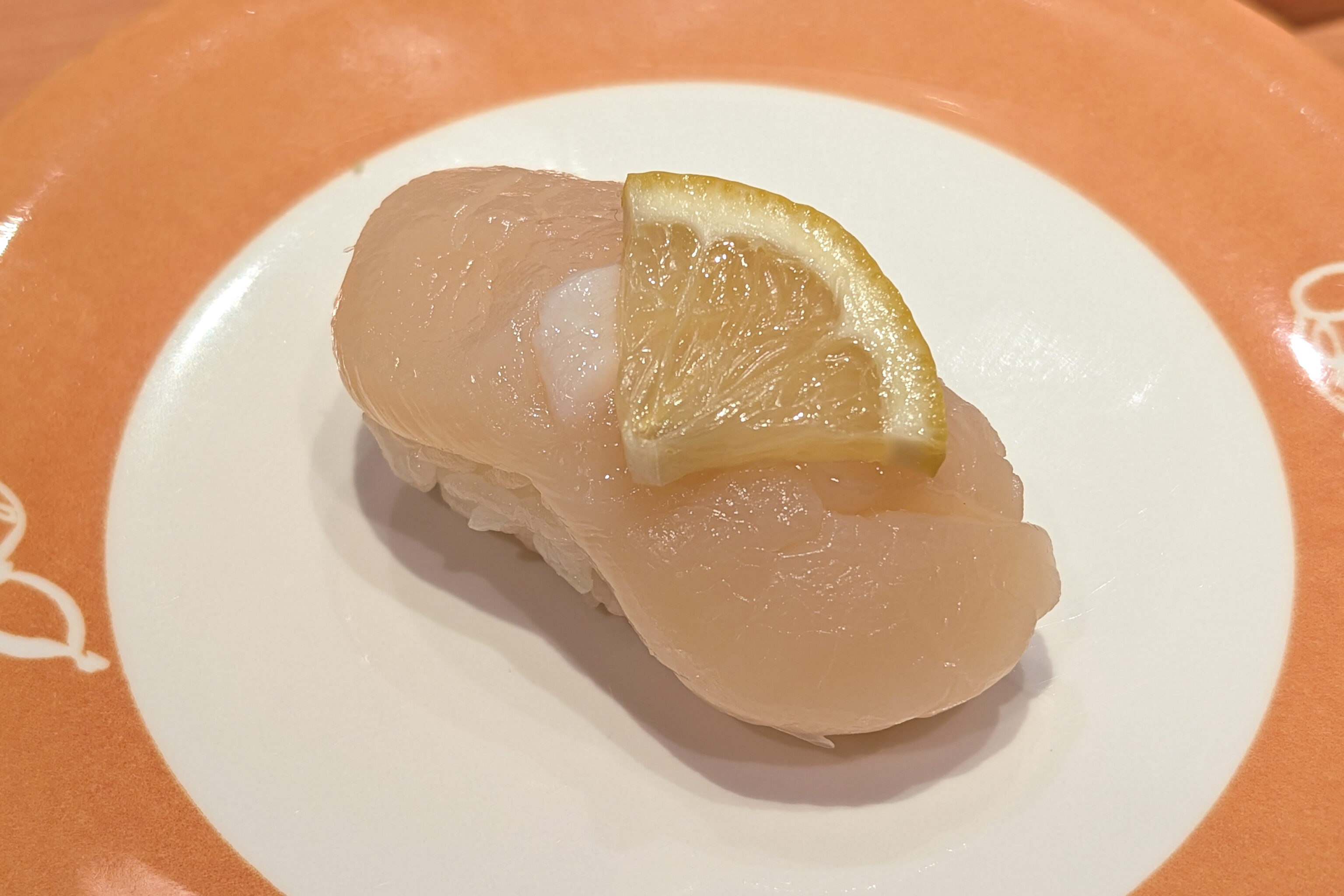
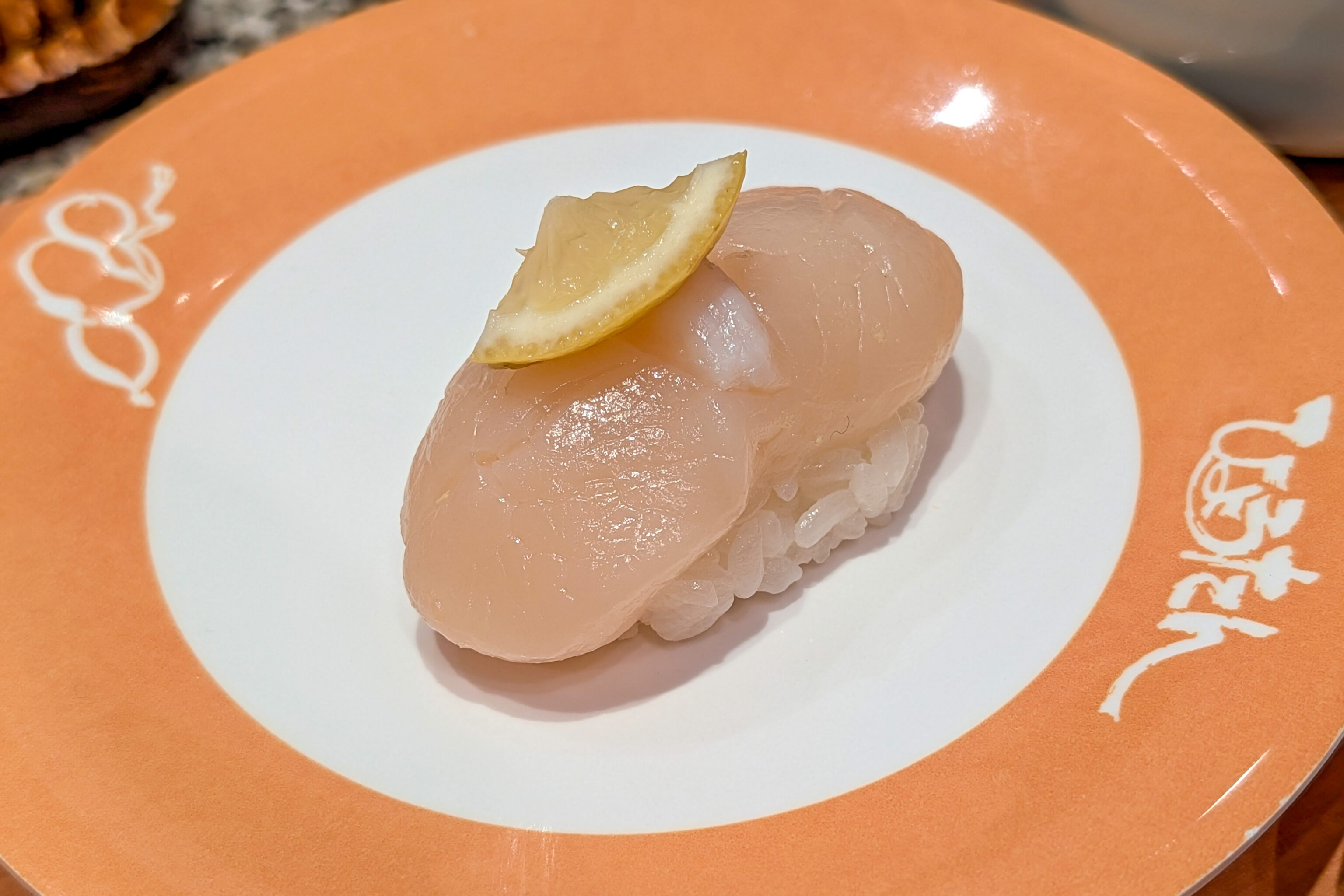
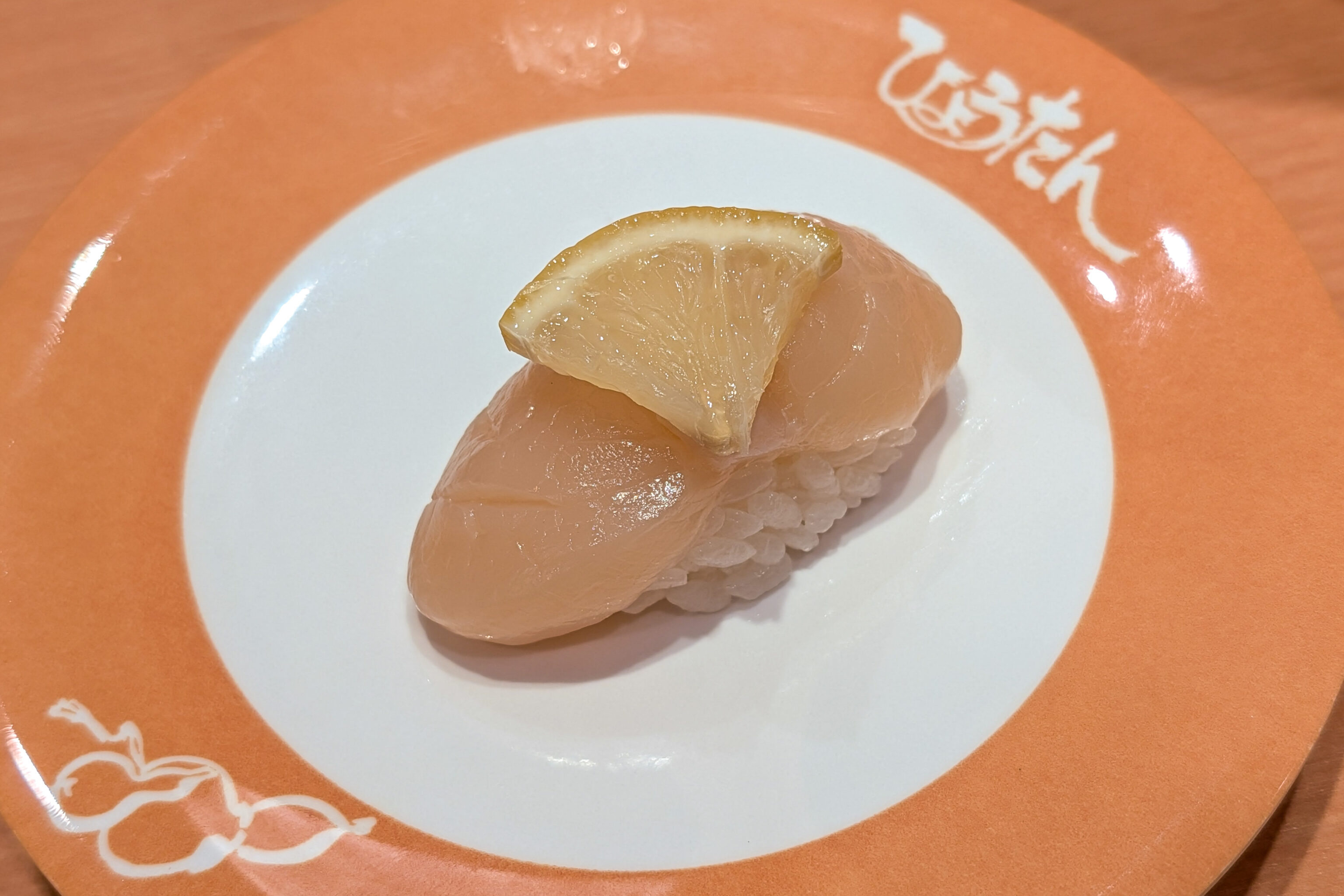
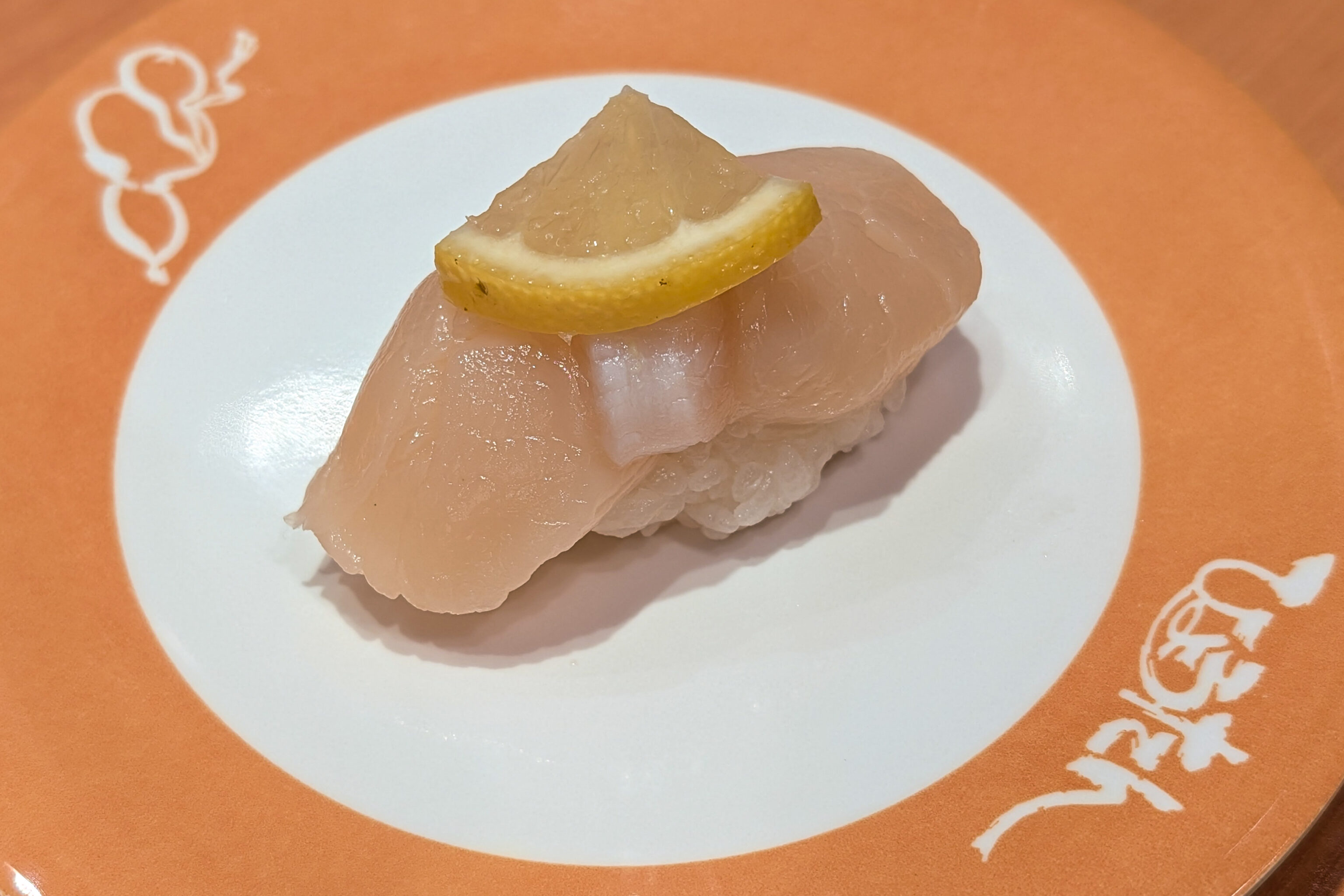
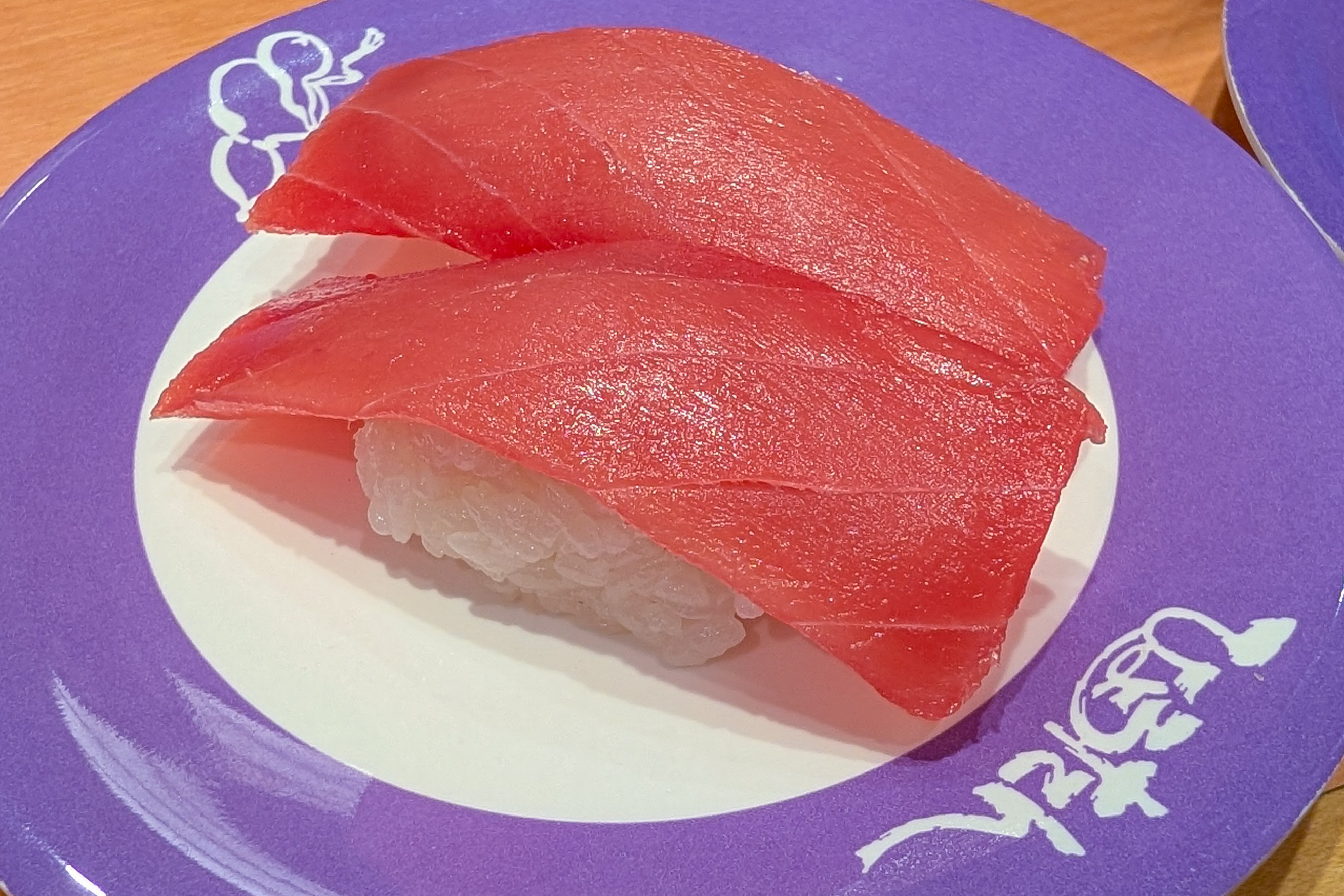
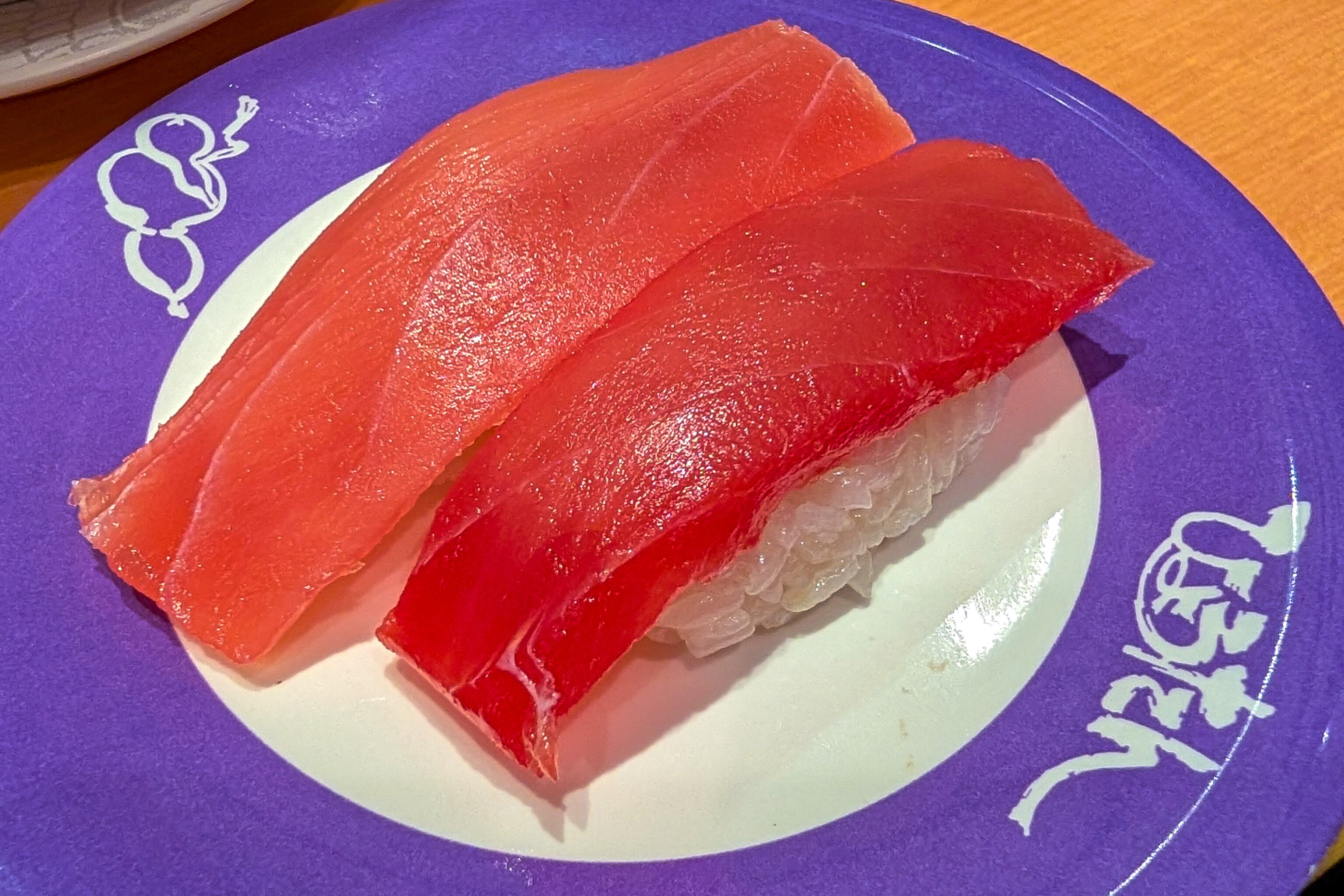
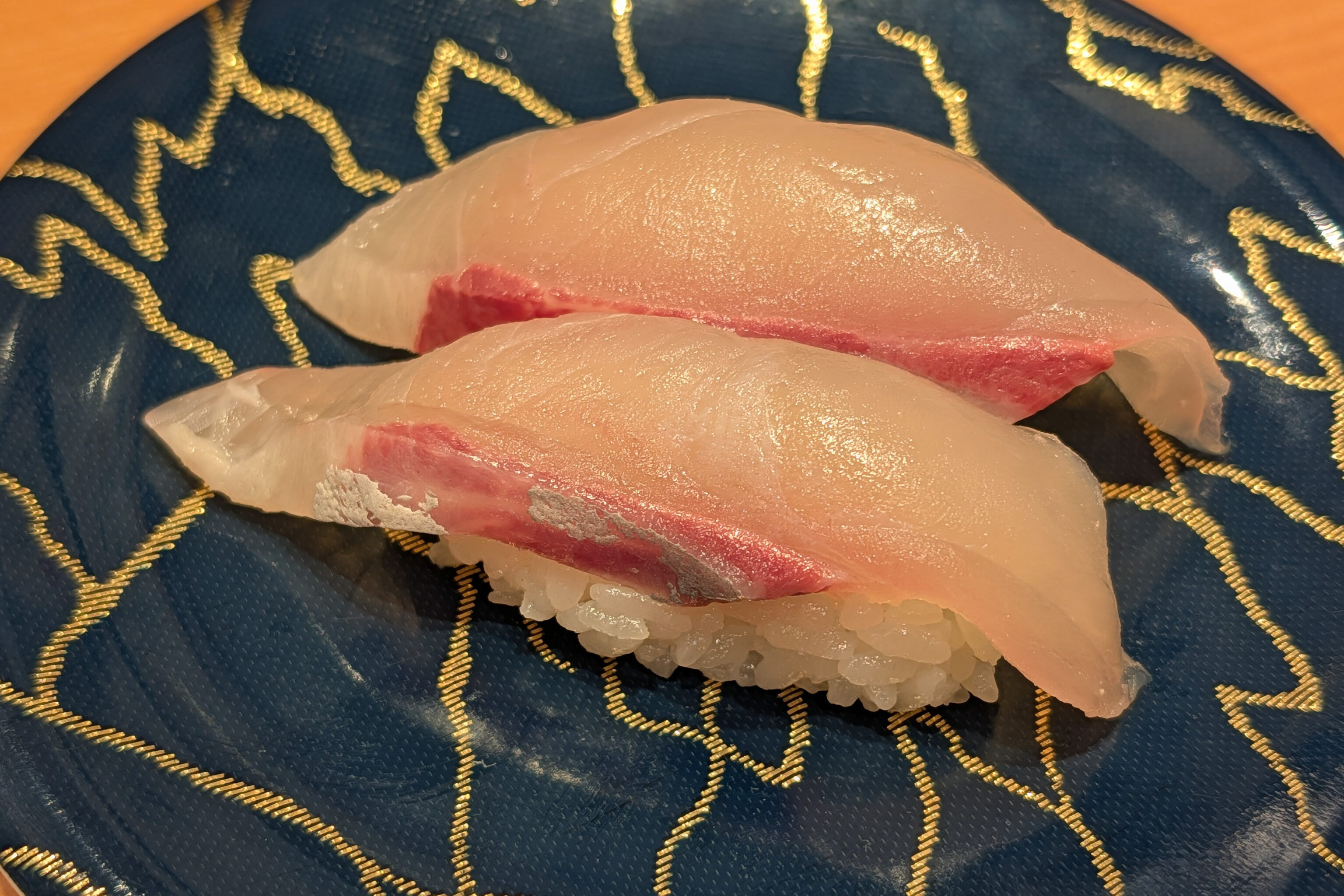
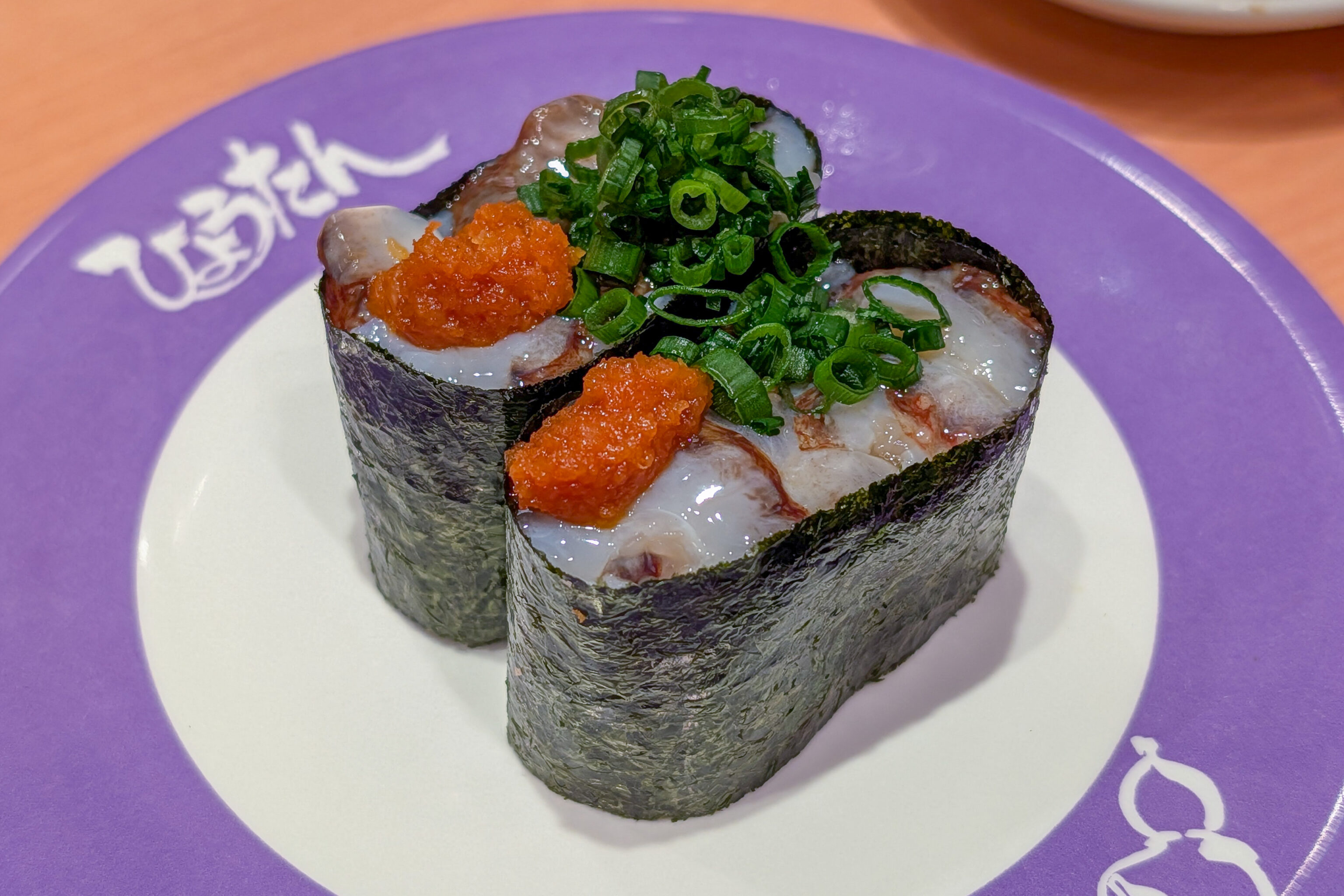
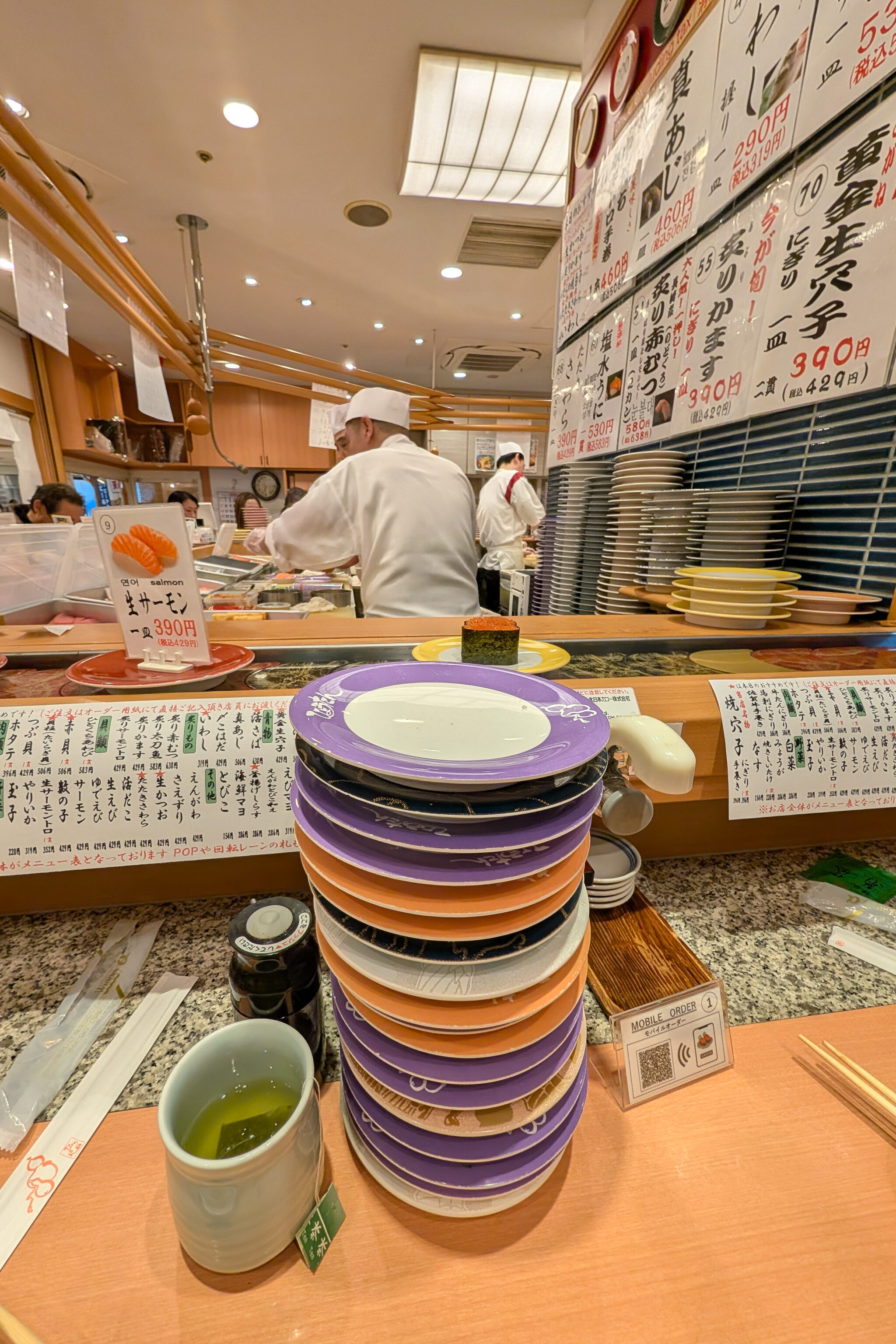
The restaurant was a bit busy and we had to queue for a bit, although the wait wasn’t too bad. Unfortunately, it was pretty mediocre for the price point.
The worst was unfortunately the standard tuna, which was still partly frozen when served. Otherwise, the fish quality seemed pretty mixed. The scallops were excellent though and very sweet.
We’re not sure if this restaurant was simply expensive or things have gotten more pricey since our last visit to Japan almost a year ago. It could be a bit of both.
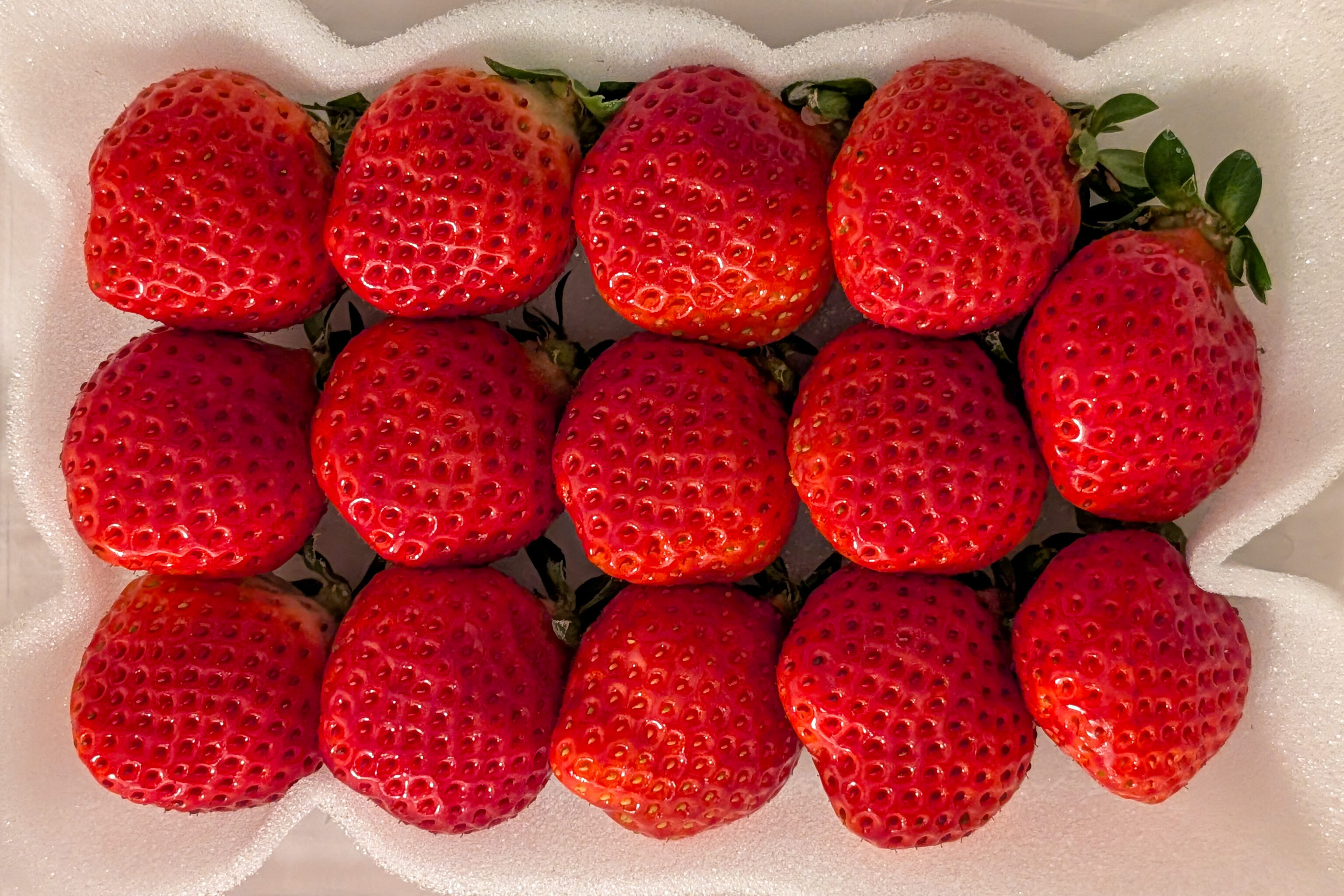
We also bought some Amaou Strawberries from the Reganet supermarket within Solaria Stage, which we ate back at the Grand Hyatt. They were excellent!