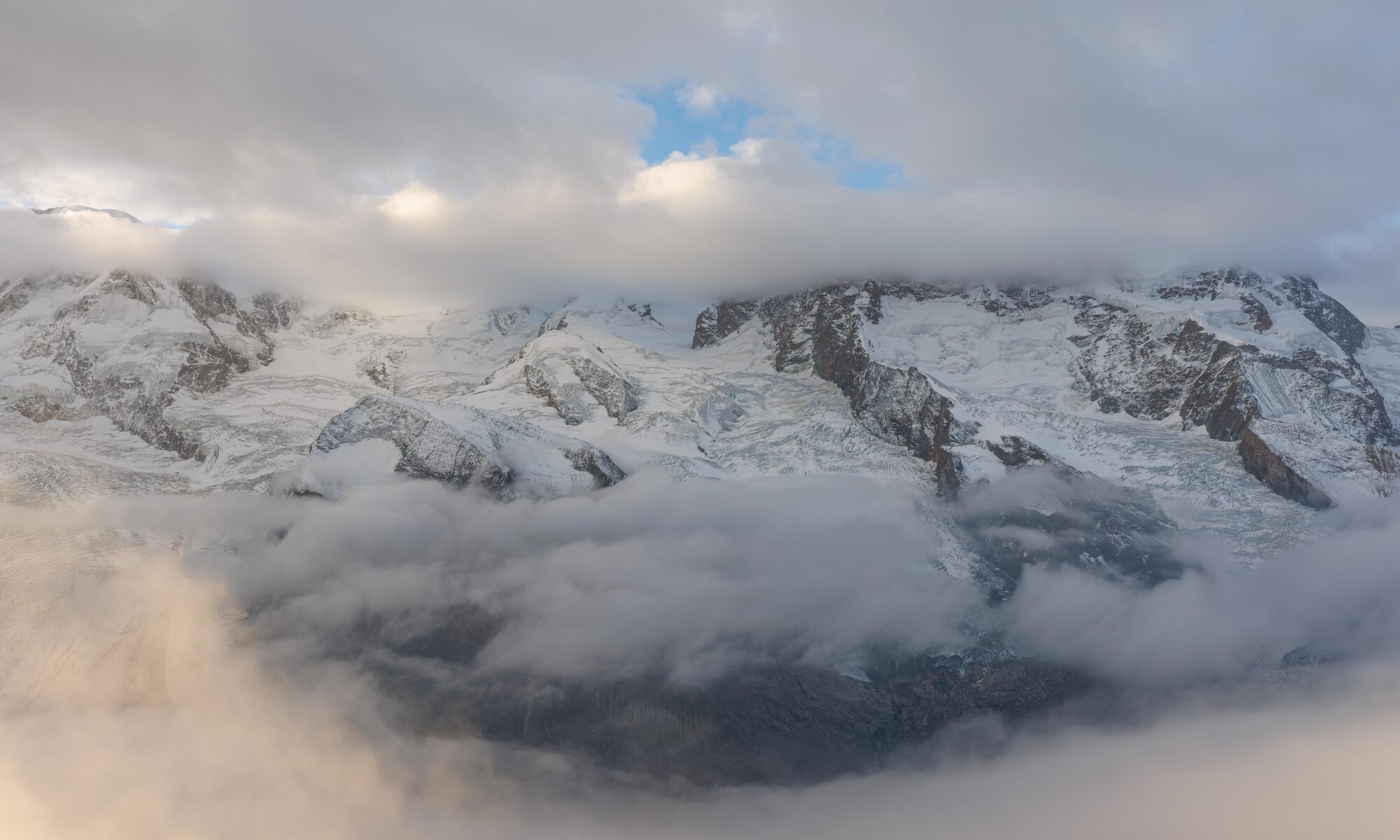

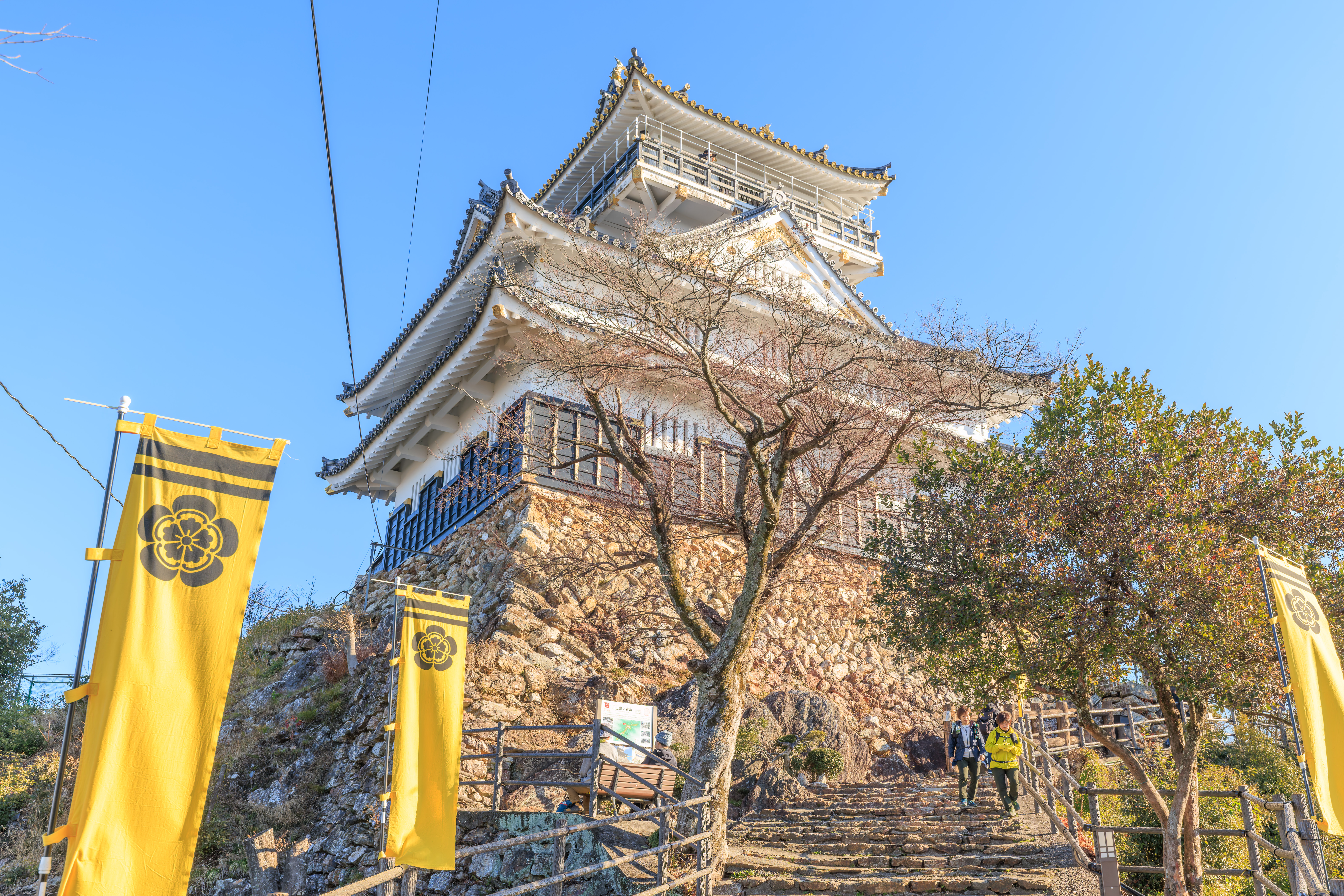
Upon waking up at the 名古屋マリオットアソシアホテル Nagoya Marriott Associa Hotel, we headed upstairs to the lounge for breakfast where we also saw the sunrise. We took the train over to 岐阜 Gifu and ascended to 岐阜城 Gifu Castle via aerial tram and a short walk. After, we had lunch and visited 正法寺 Shōhō-ji to see its Great Buddha Statue before walking around 岐阜公園 Gifu Park. We ended our visit in Gifu with a walk through the historic 川原町 Kawaramachi before returning to Nagoya for dinner.
Morning
It was still dark out when we woke up at the 名古屋マリオットアソシアホテル Nagoya Marriott Associa Hotel. After getting ready, we headed upstairs to the lounge on the 35th floor for breakfast.
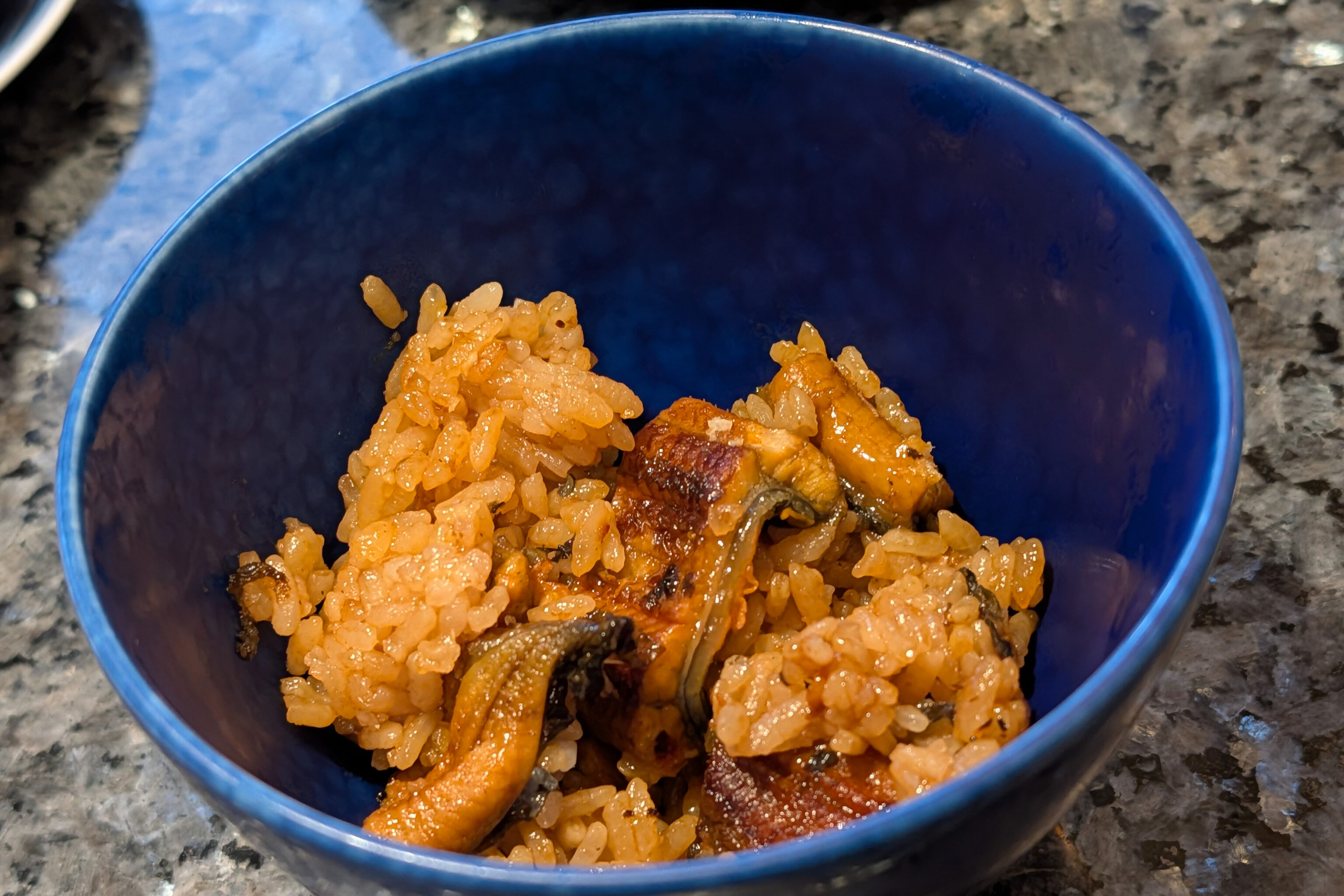
The selection was pretty limited. The best item by far was the hitsumabushi, a dish that originates from Nagoya.
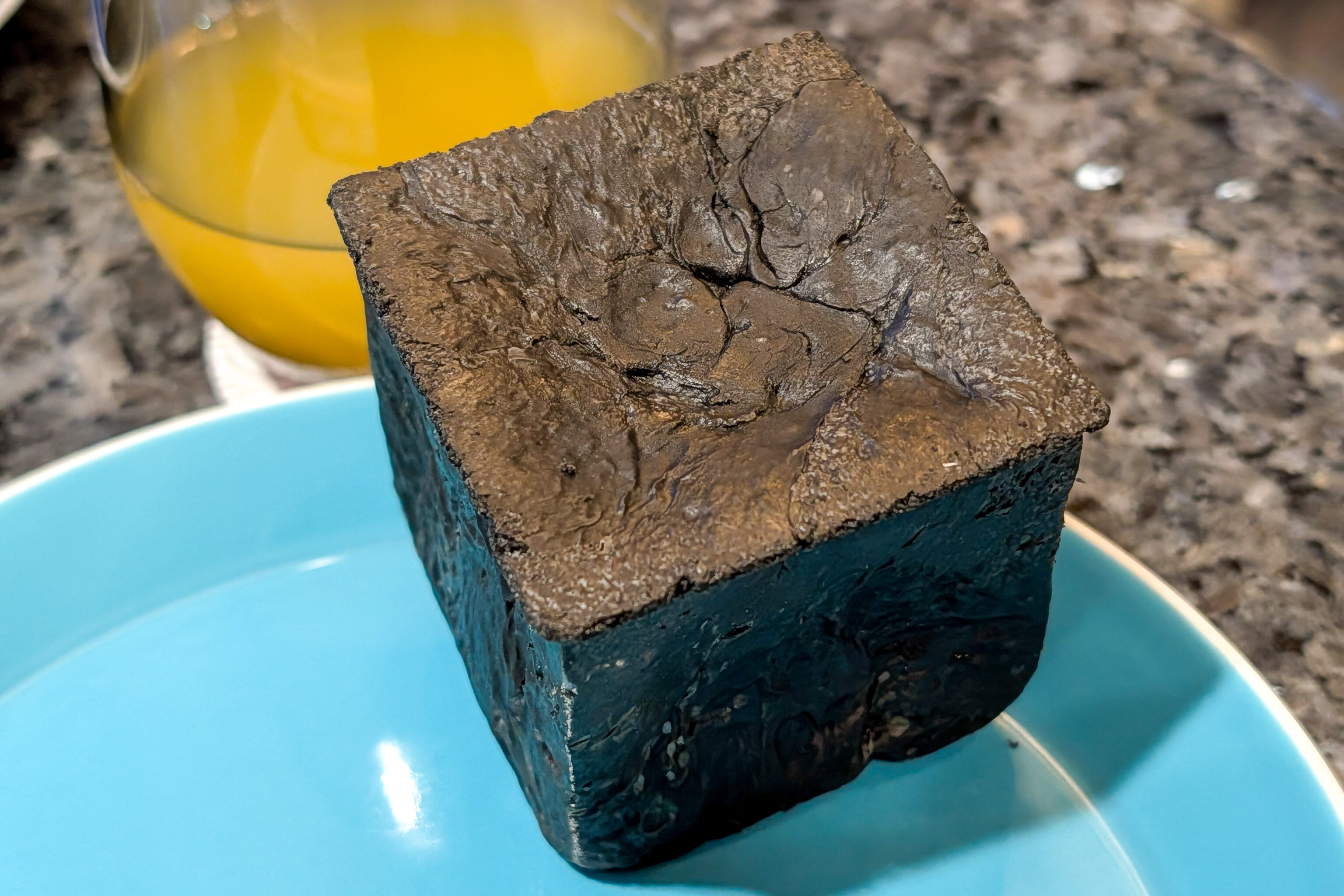
Is this a Borg cube? No… It is bread with curry inside! Definitely an interesting item that was just kind of OK.
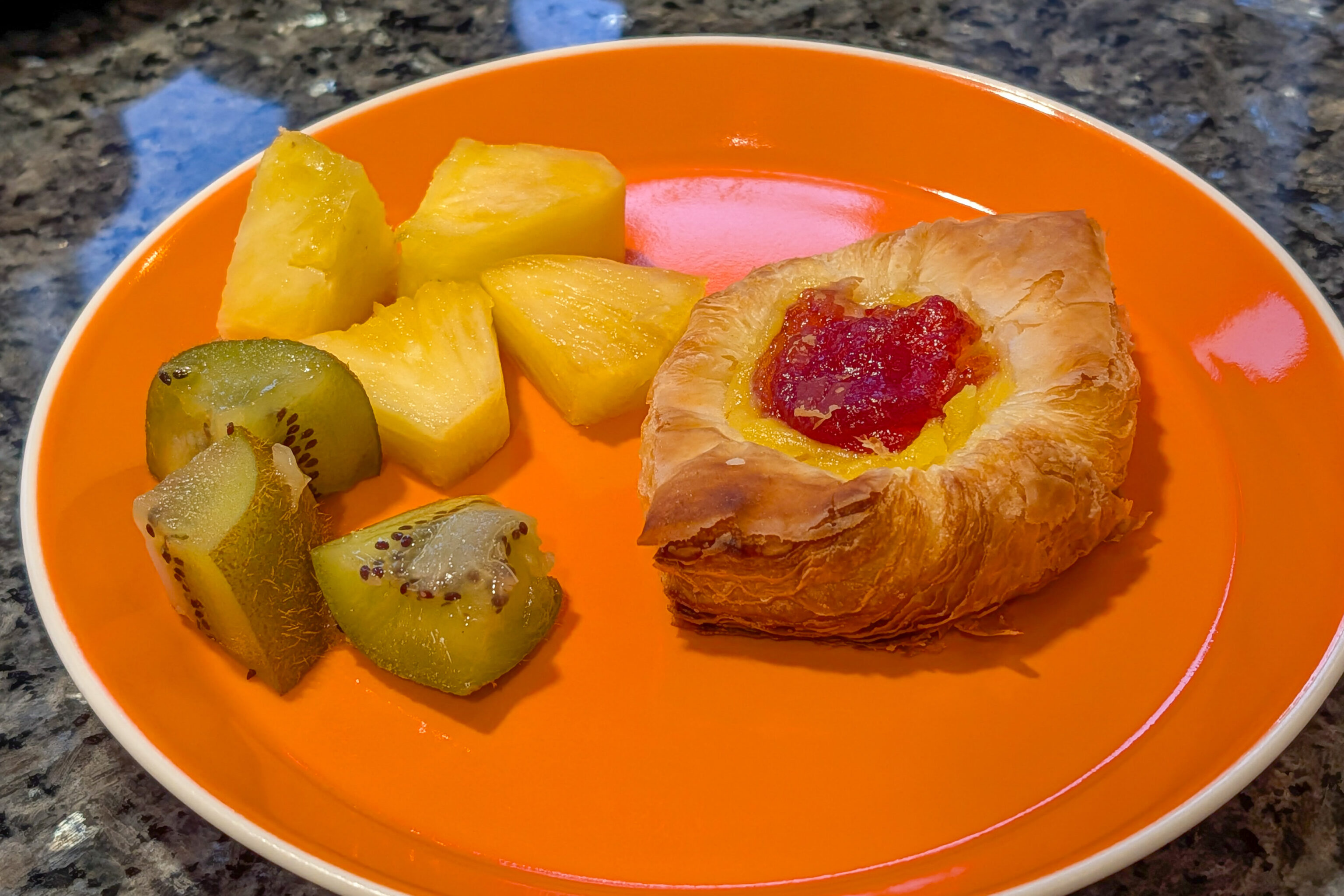
The other bread item that we tried was terrible. Most of the available items were pretty unappealing compared to just going to a konbini.
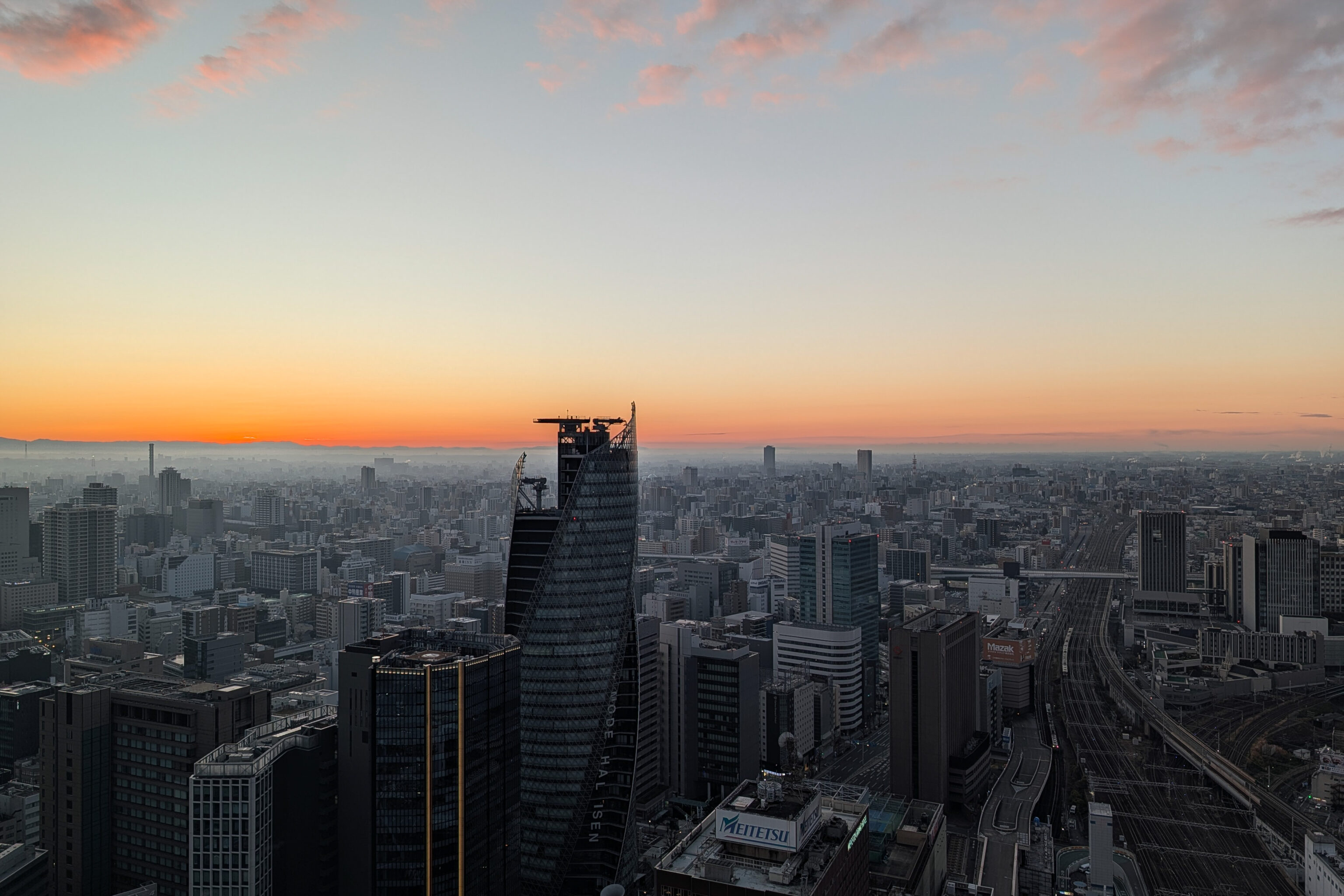
Although breakfast overall was pretty awful, we at least got to see sunrise from the lounge!
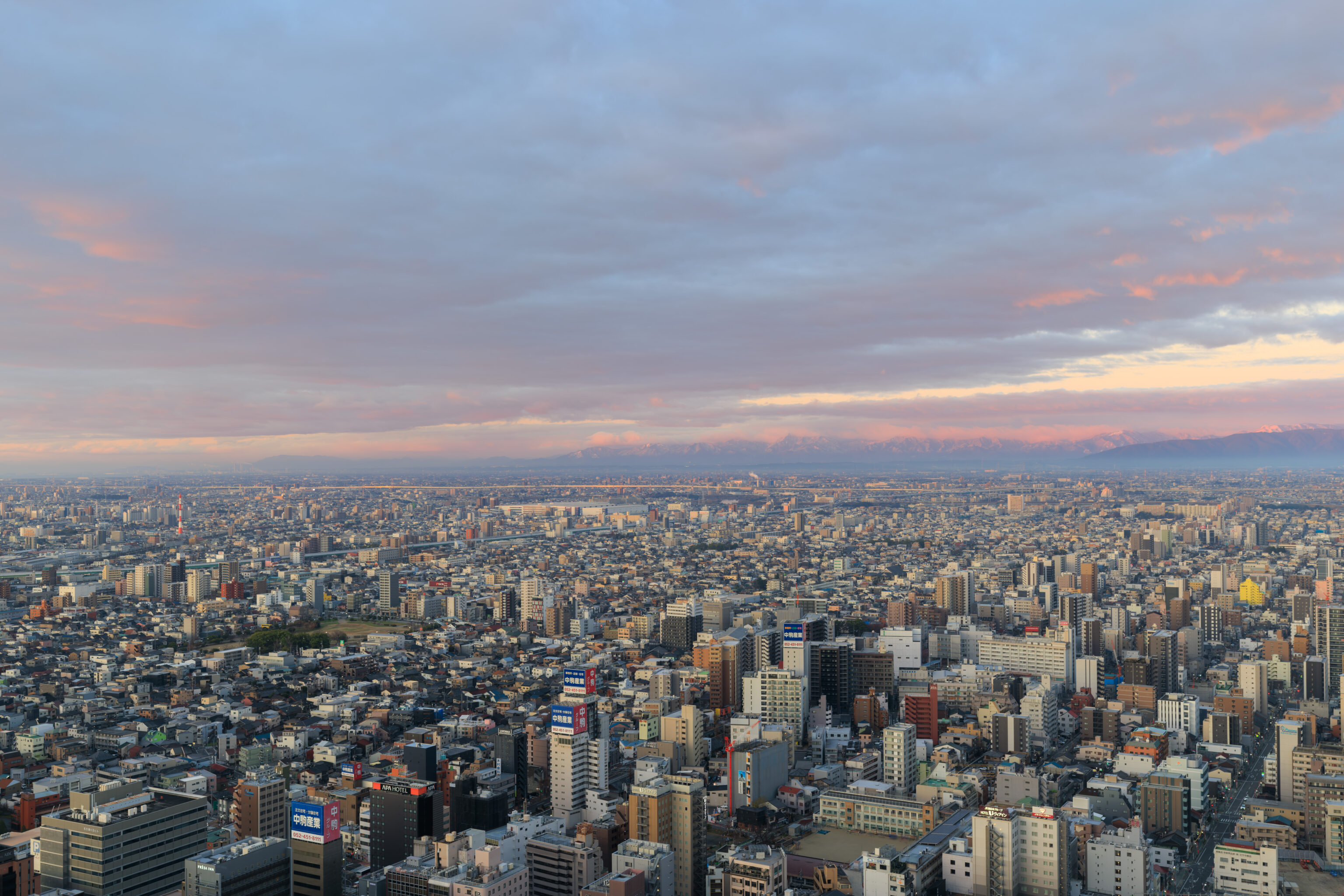
We returned to our room while there was still a bit of color in the sky.
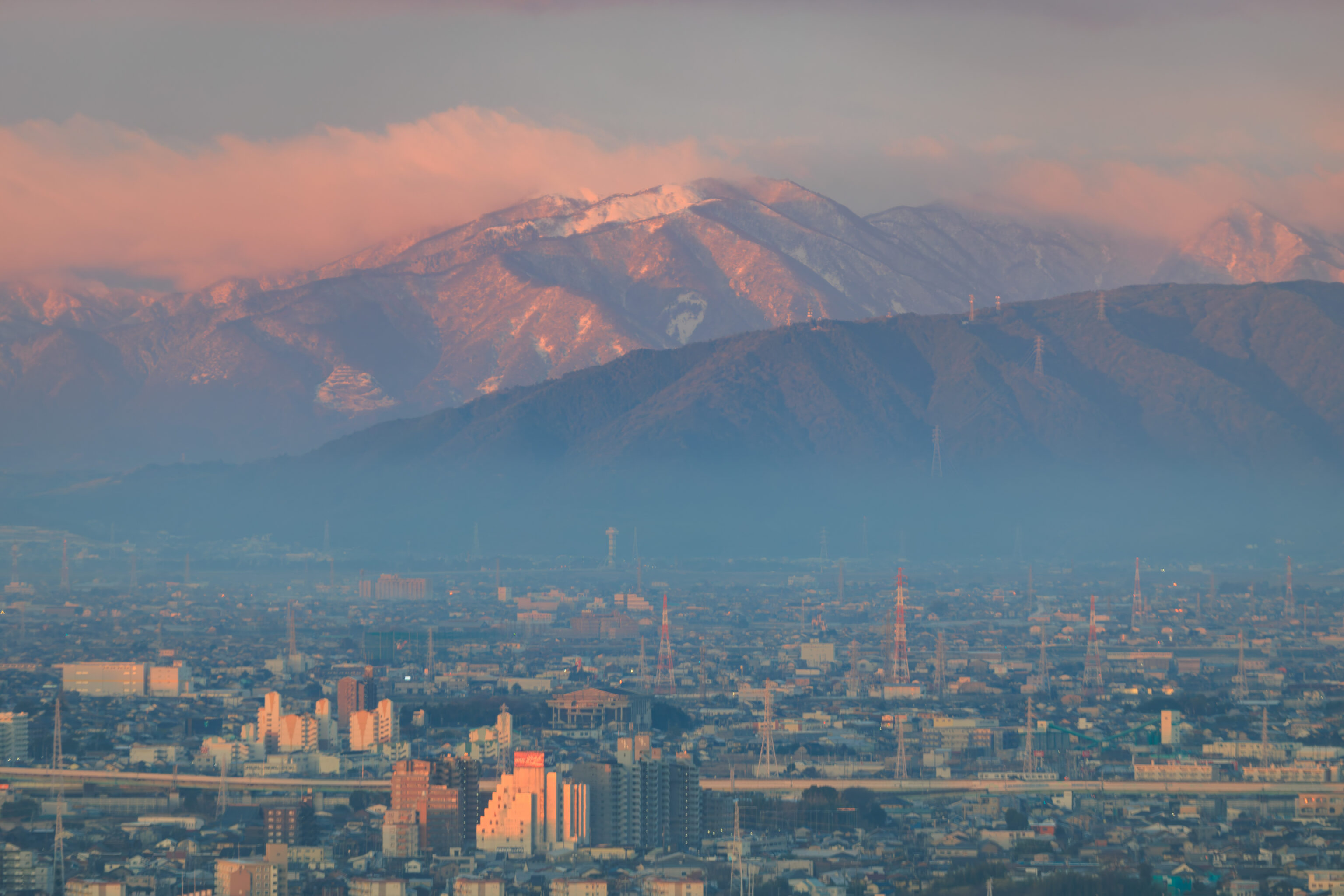
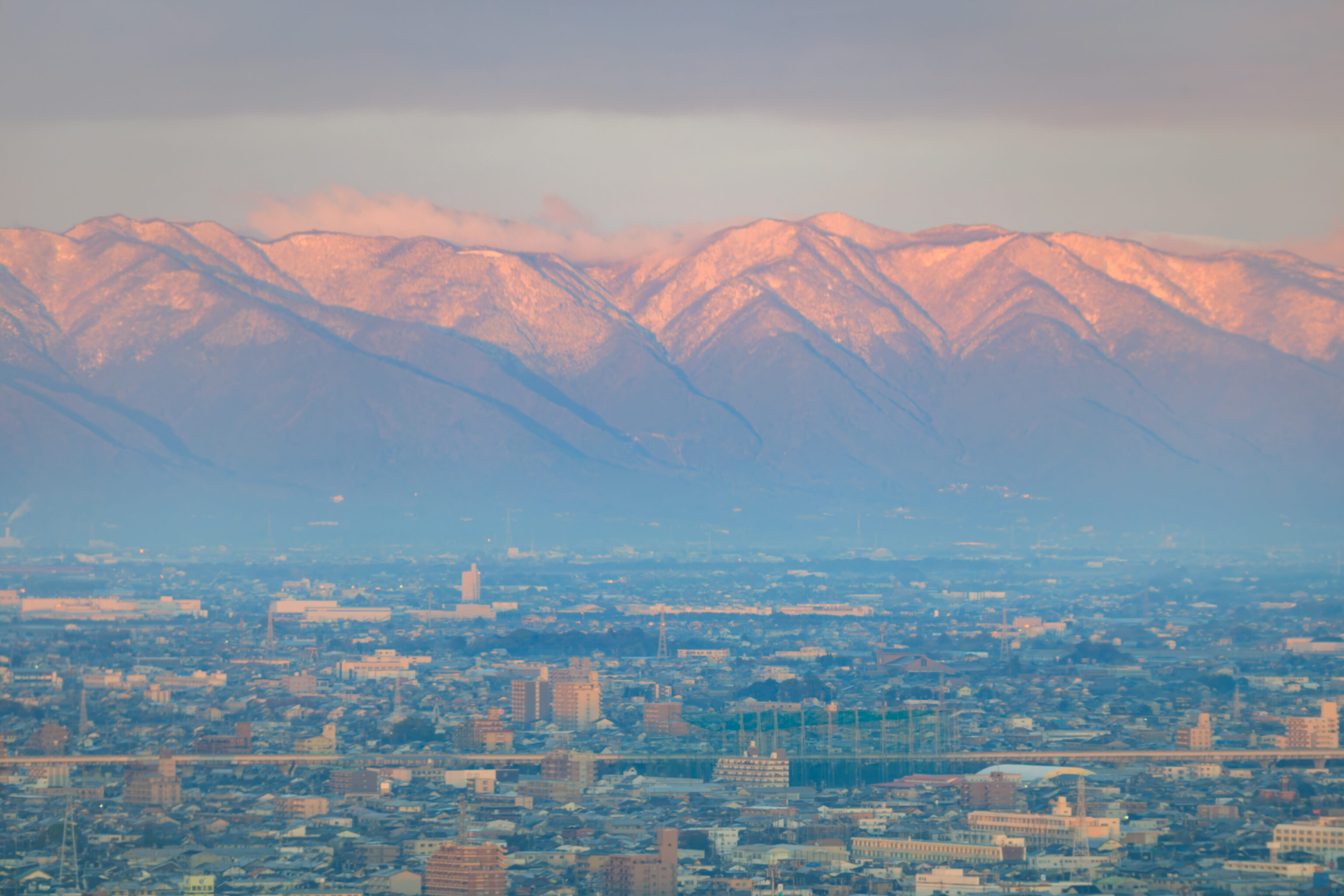
There was definitely snow atop the mountains just beyond the city!
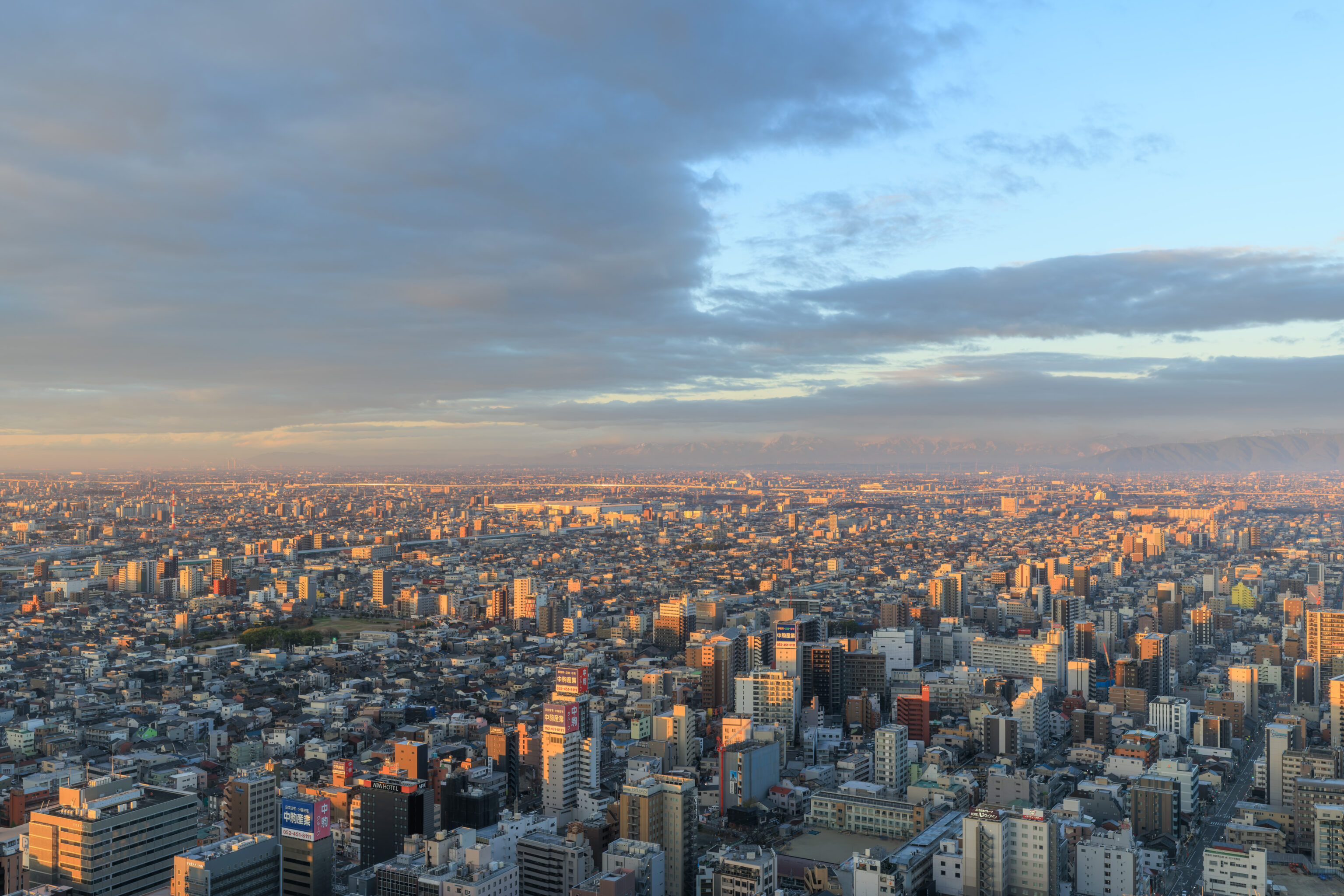
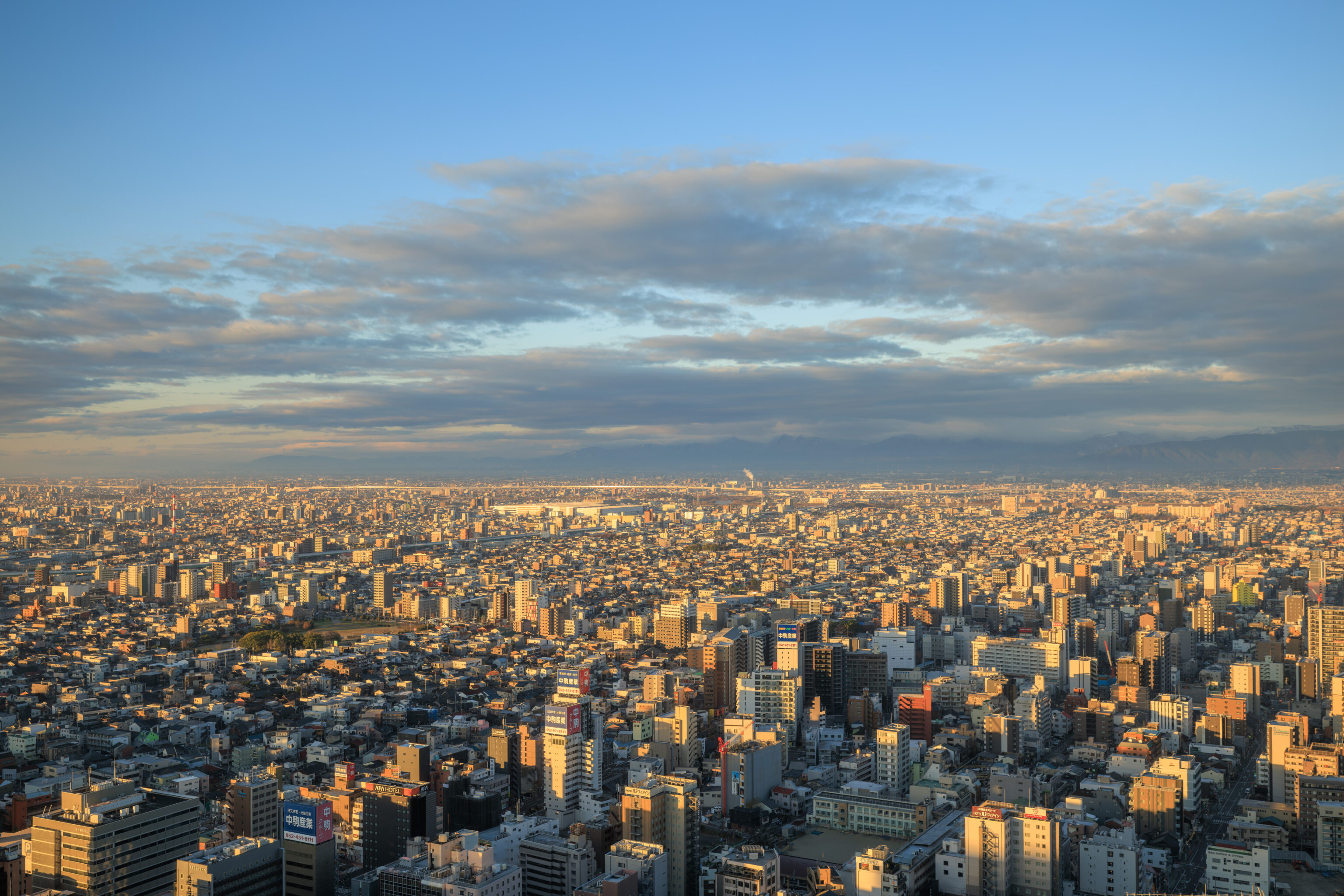
Although there were some clouds in the sky, particularly after sunrise, it seemed to clear up a bit in the next half hour.
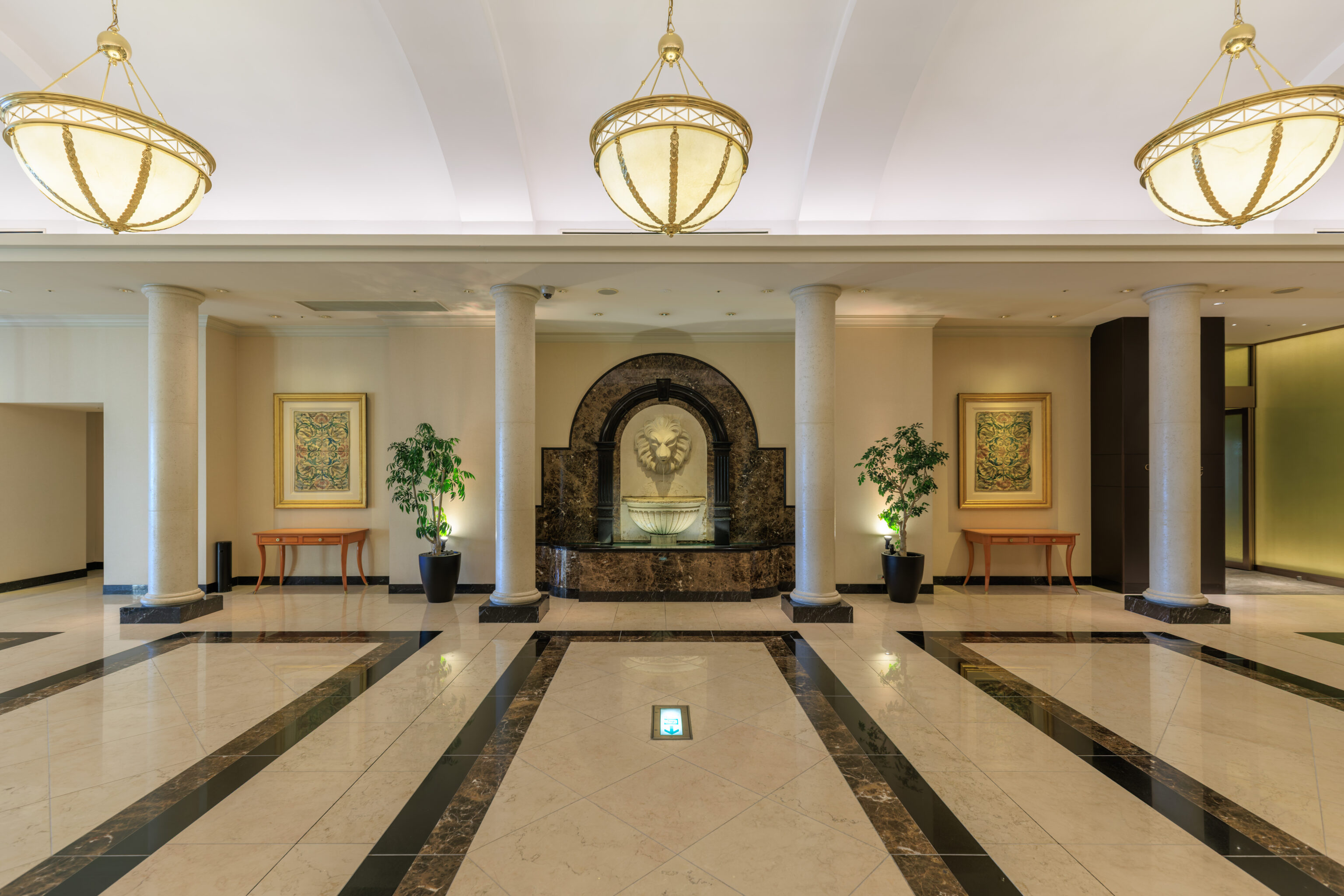
The 15th floor lobby has a very European appearance.
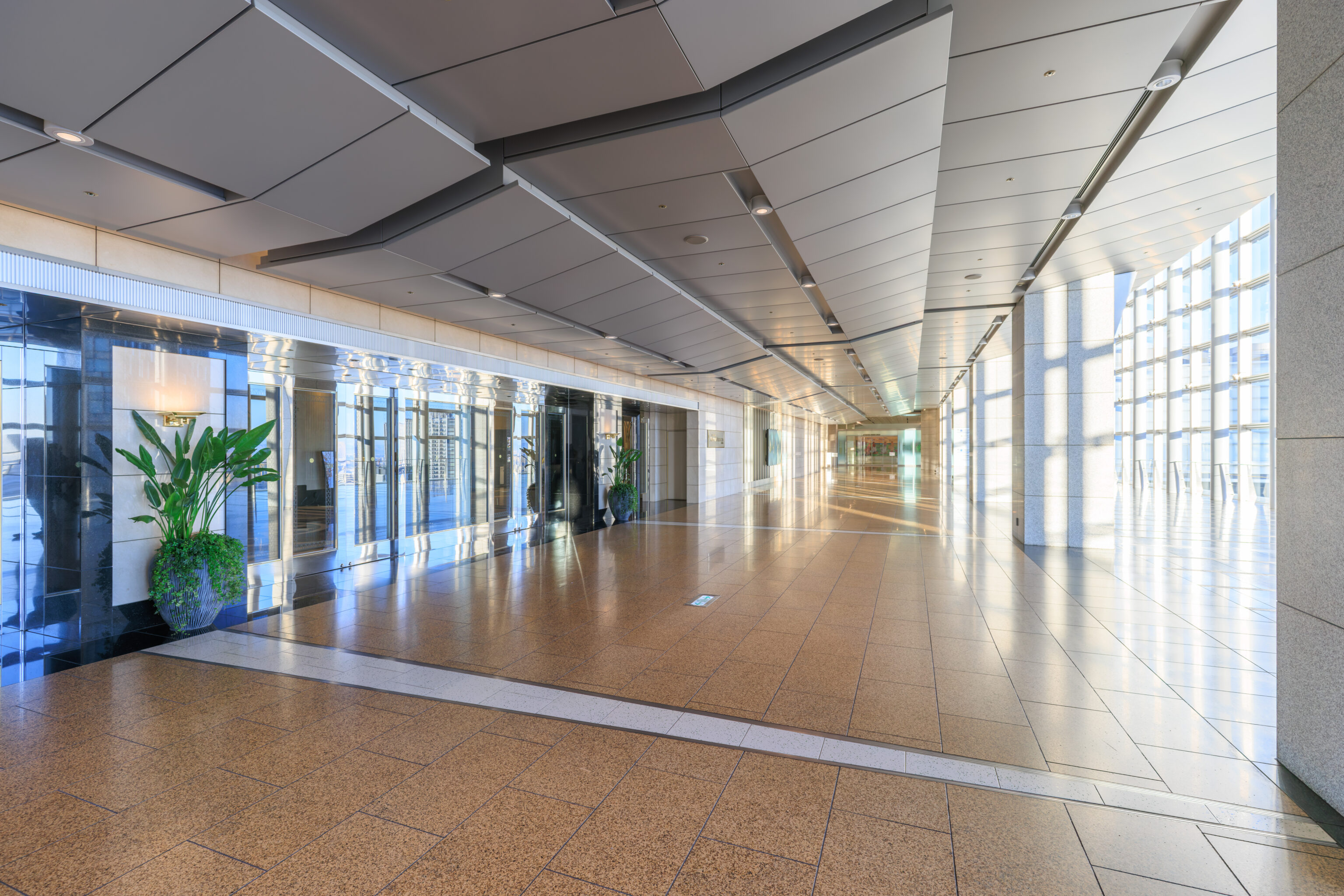
There is actually an external corridor outside of the lobby area. We took an elevator down from with the Marriott’s lobby to get to the ground floor of Nagoya Station.
It is possible to get to Gifu by train via the JR Tokaido Line or the Meitetsu Line. JR is faster with the shortest trip taking just 19 minutes. We took JR.
Gifu Castle
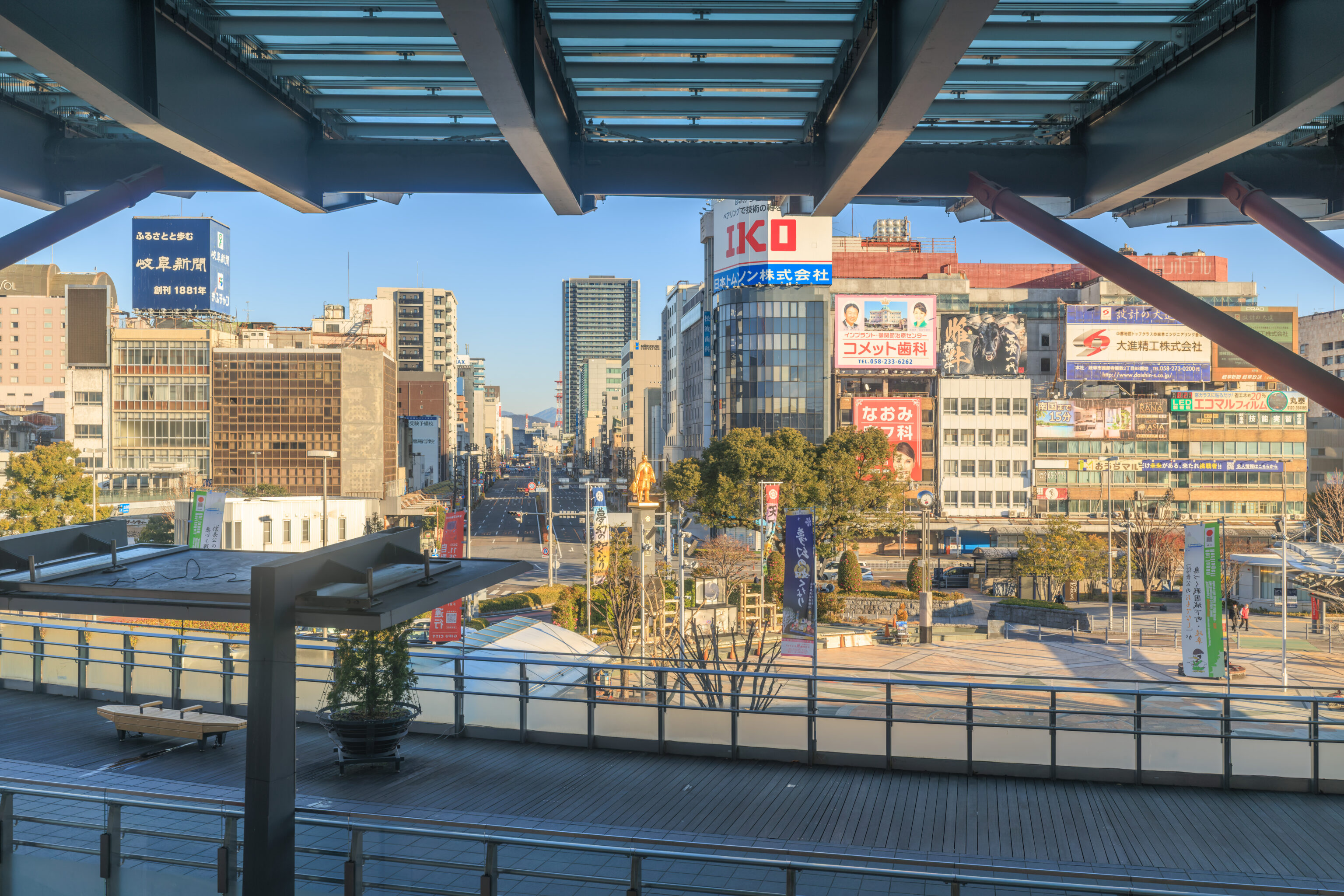
We arrived at Gifu Station just before 8:30am.
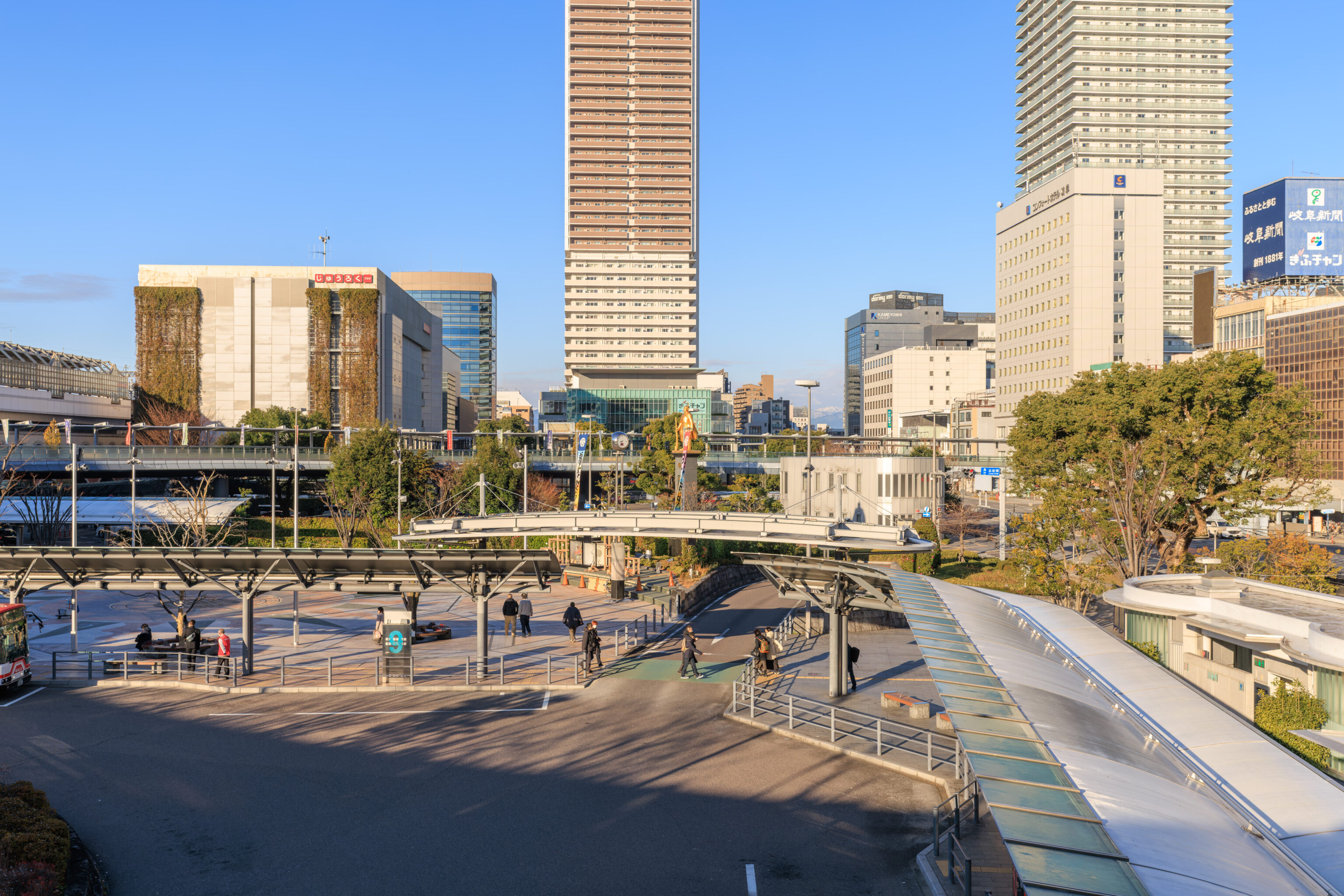
Most of the locations of interest to tourists like us are to the north of Gifu Station. There are a few bus options to get there, all of which take about 15 minutes. The busses depart from the station’s bus terminal on the northeast side of the building, seen here below us.
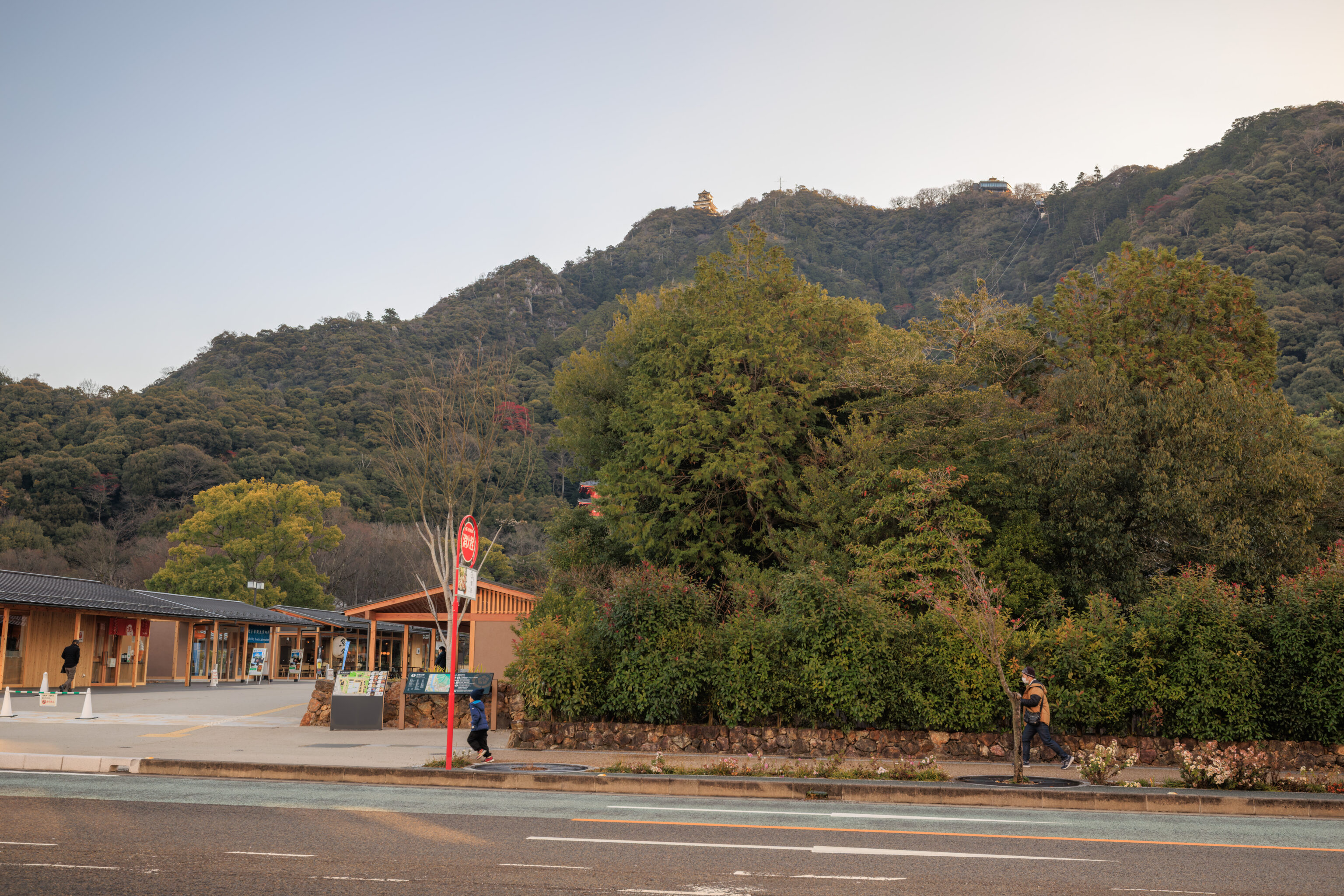
We took the bus to the 岐阜公園・岐阜城 Gifu Park・Gifu Castle stop. Looking across the street, we could see Gifu Castle high up above. Getting to the castle requires taking an aerial tram, unless you want to hike up!
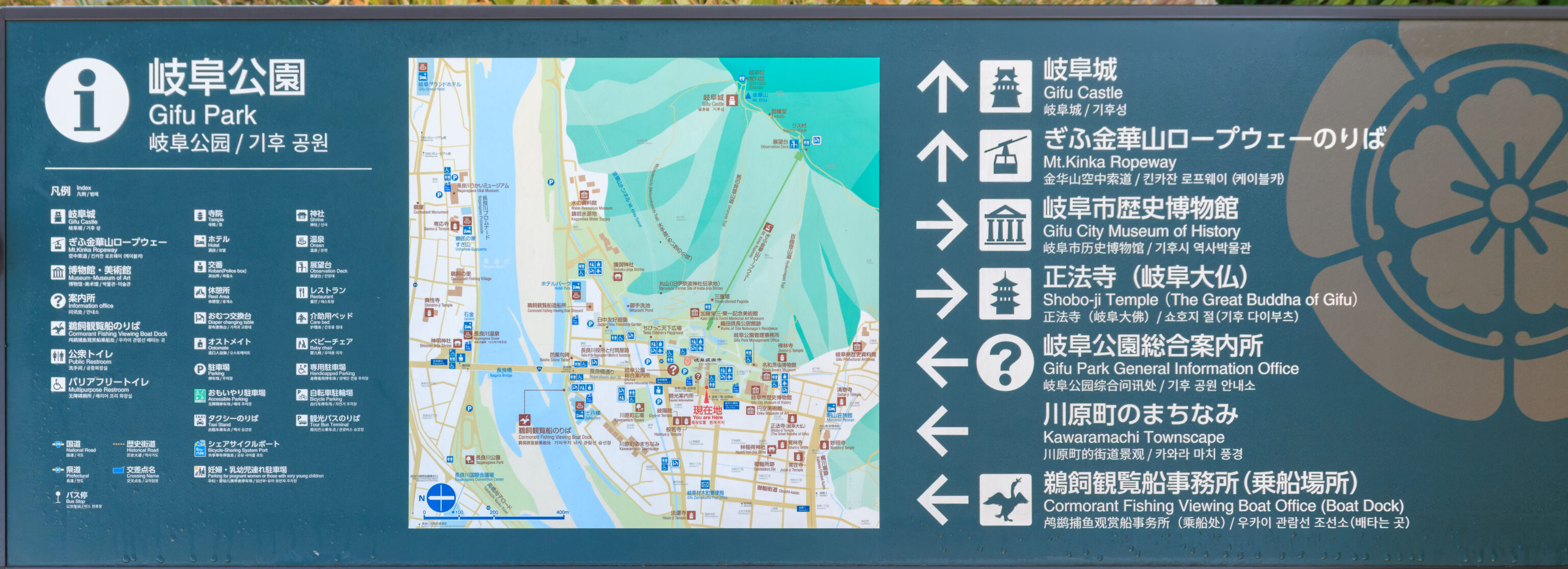
We came upon a sign with a map of the area. This area here that we are in at the base of the mountains is Gifu Park.
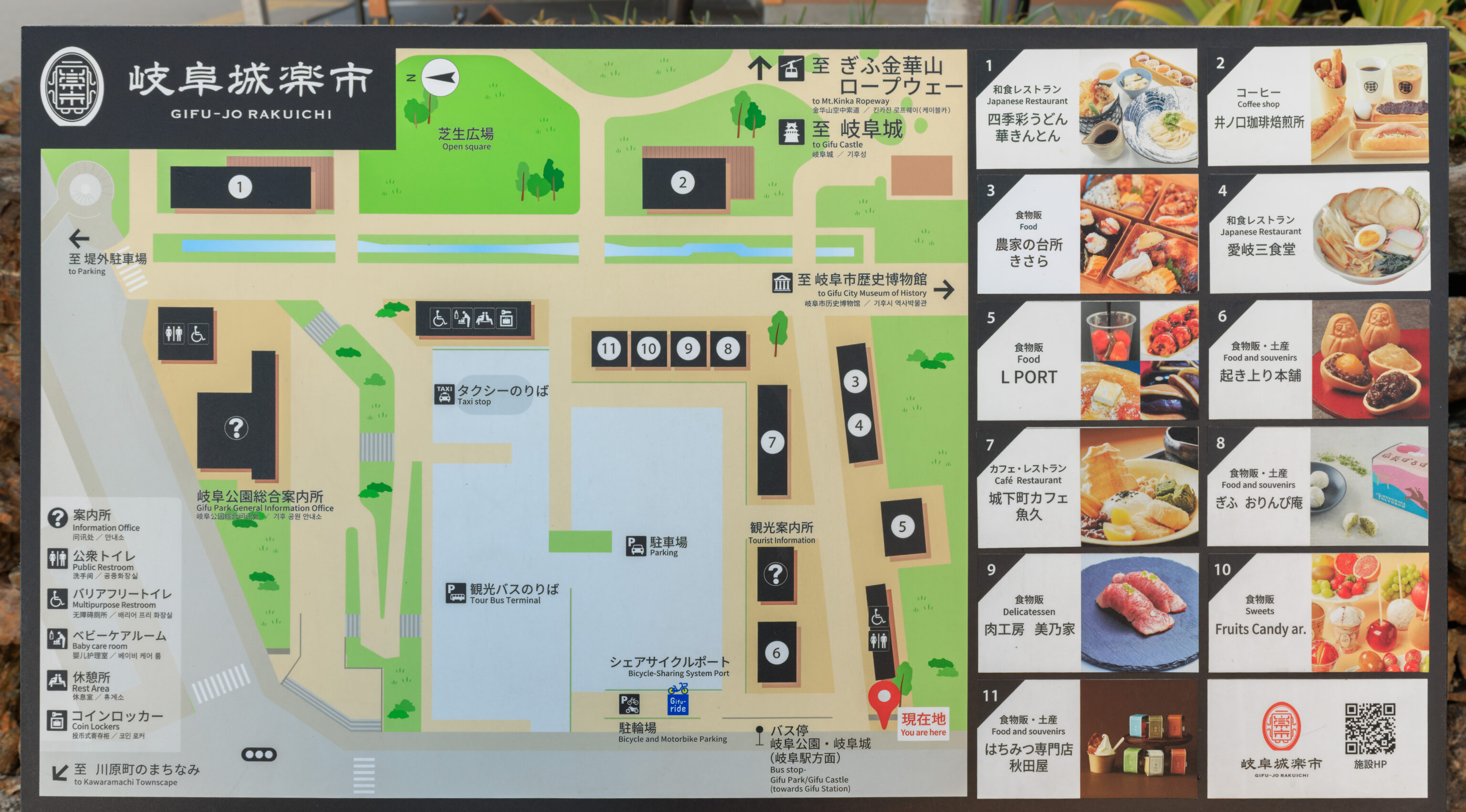
There was also a sign showing the various food options on the path to the aerial tram station.
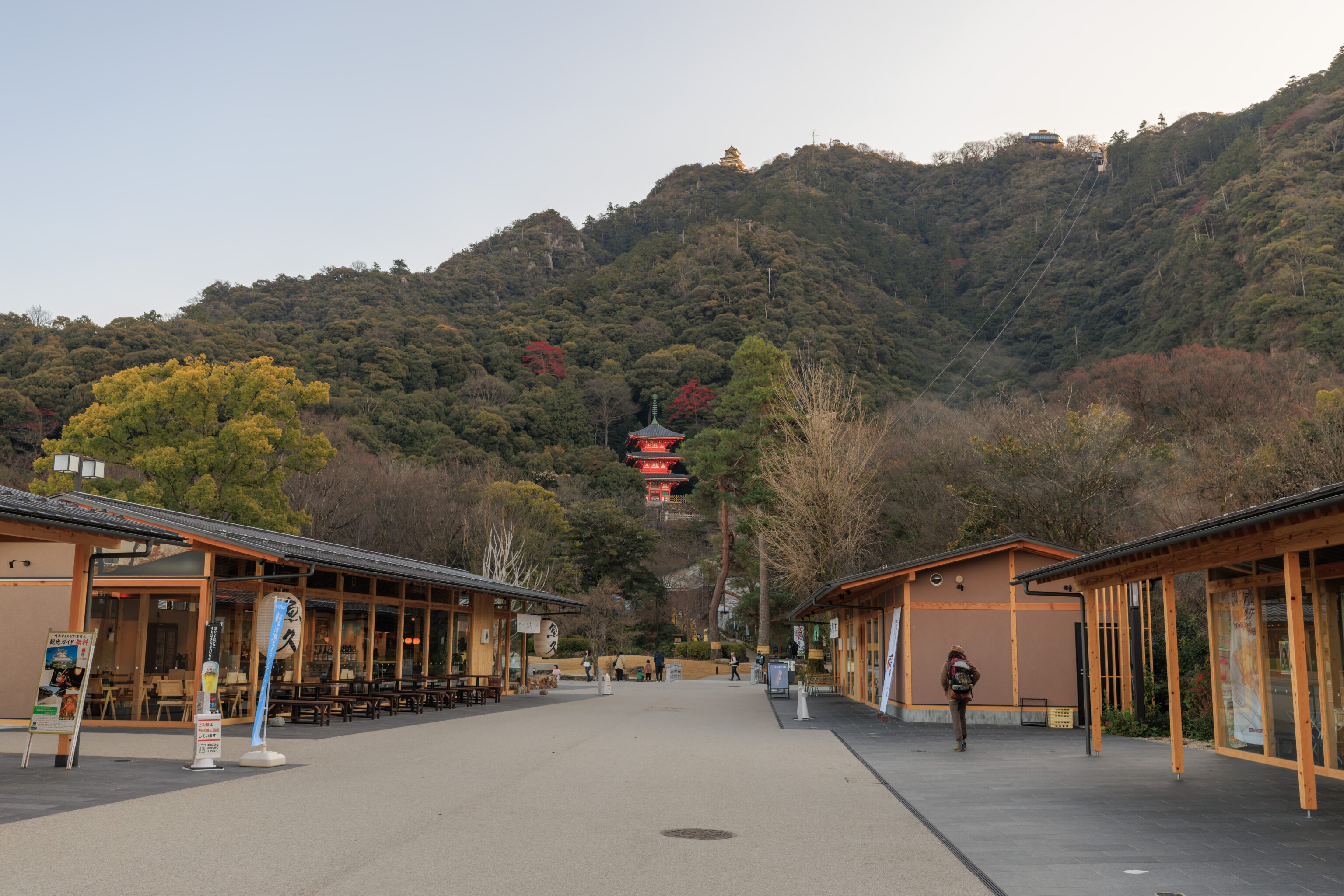
We started to head towards the aerial tram, passing through the food service area depicted on the map above.
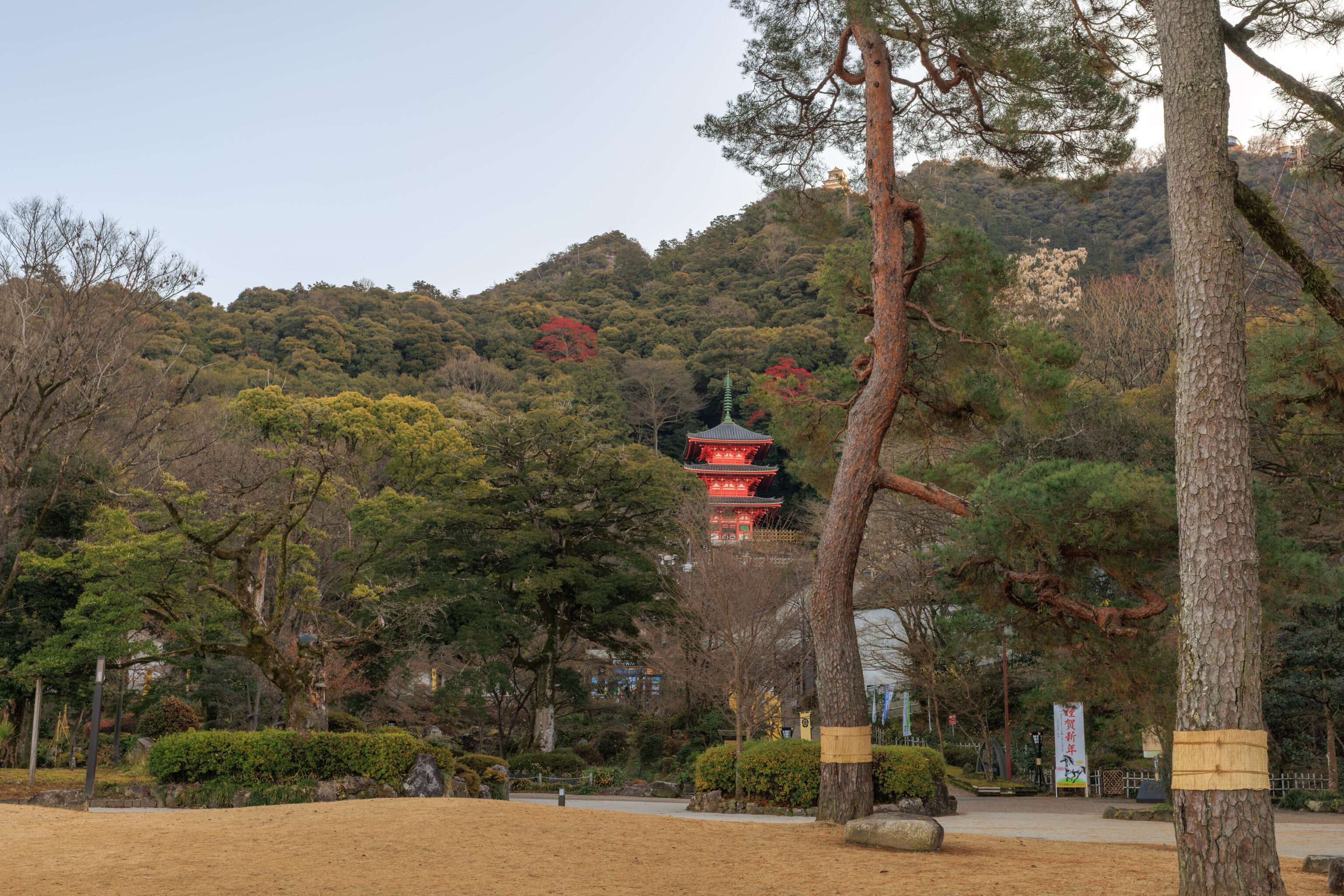
Directly in front of us, we could see the Three Story Pagoda within Gifu Park.
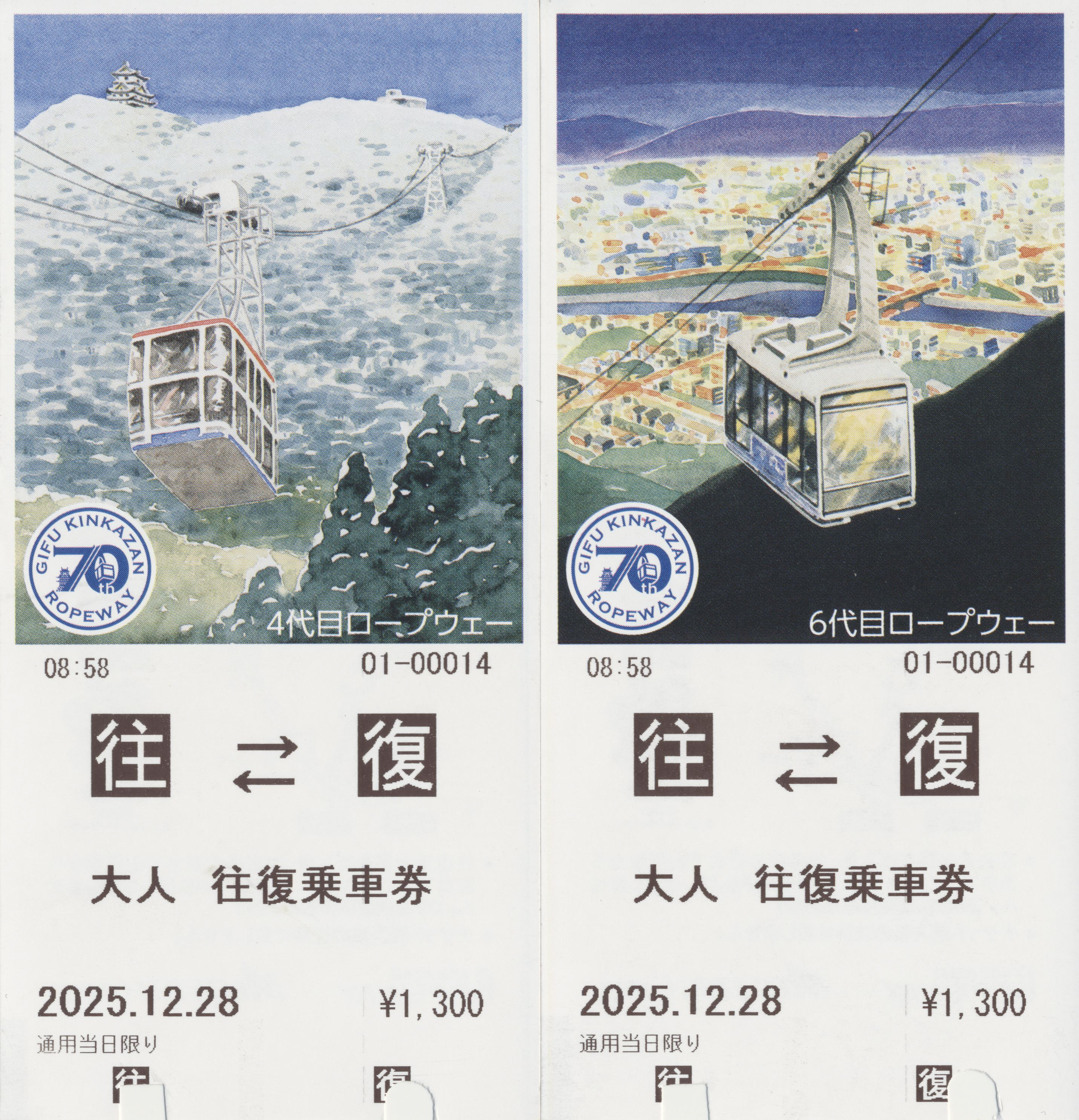
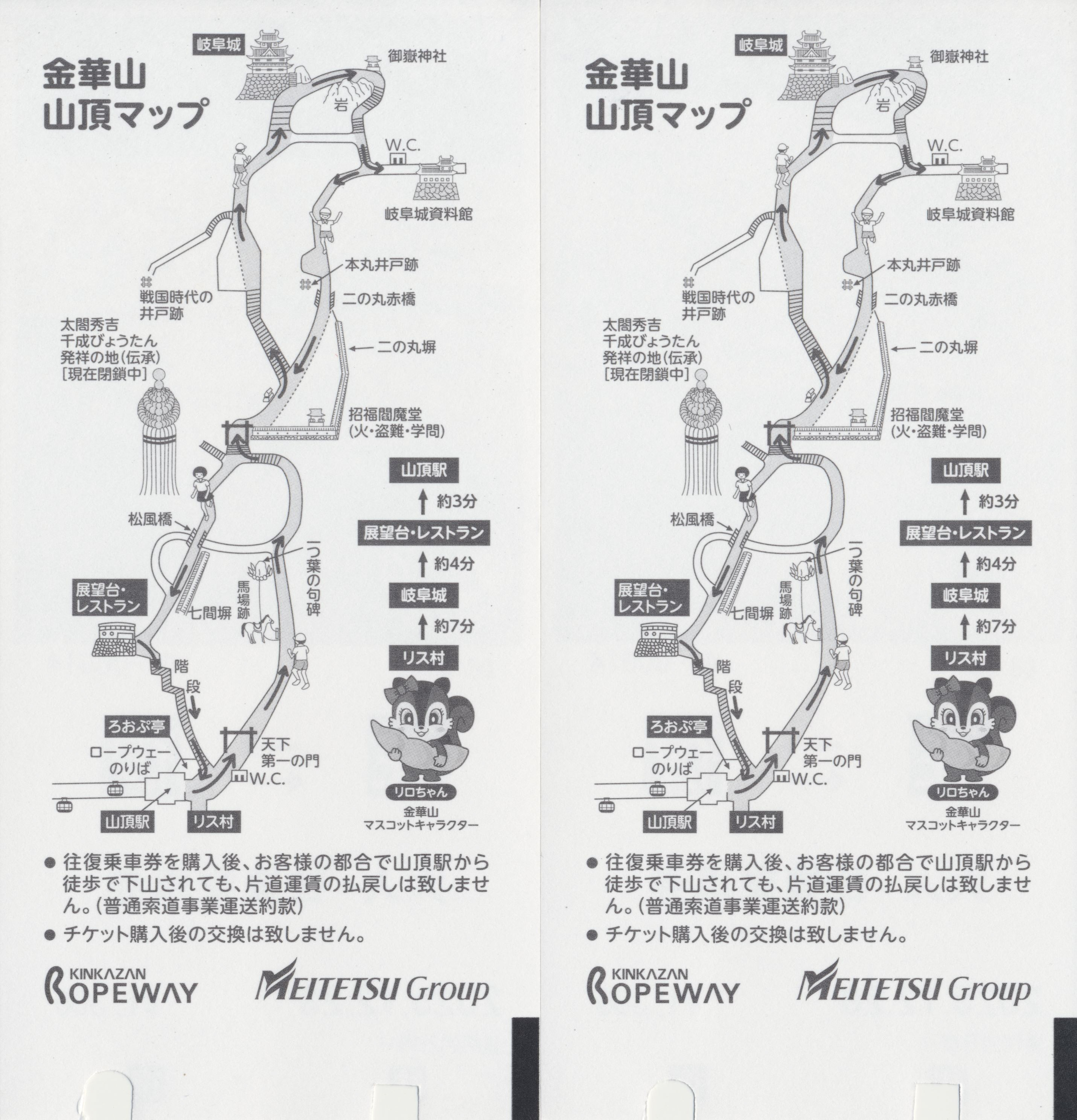
Upon reaching the station, we bought round trip tickets for the ぎふ金華山ロープウェー Gifu Kinkazan Ropeway. It is its 70th anniversary!
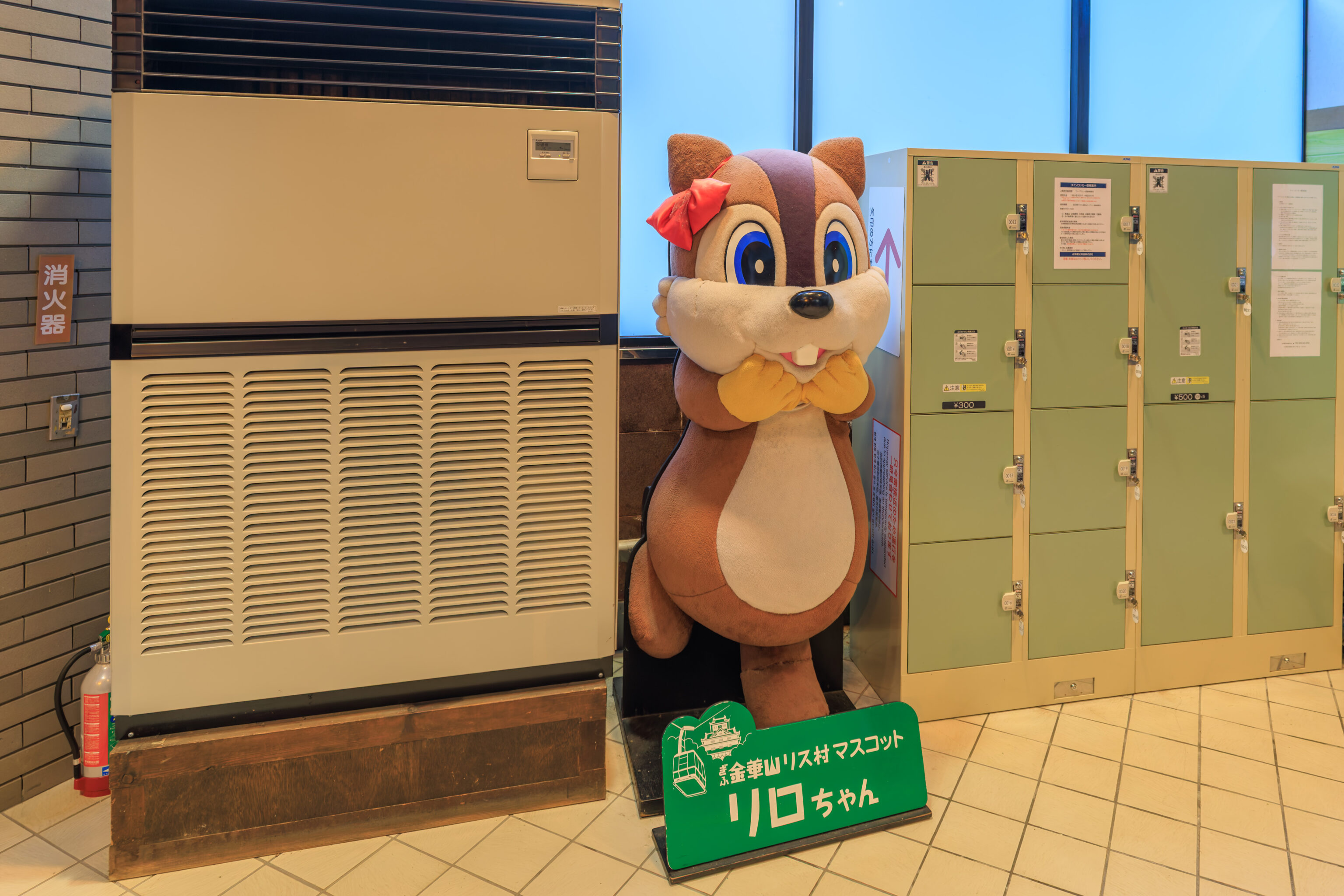
We had to wait a few minutes for the next departure. This squirrel sculpture depicts リロちゃん Riro-chan, the mascot of the ぎふ 金華山リス村 Gifu Kinkazan Squirrel Village.
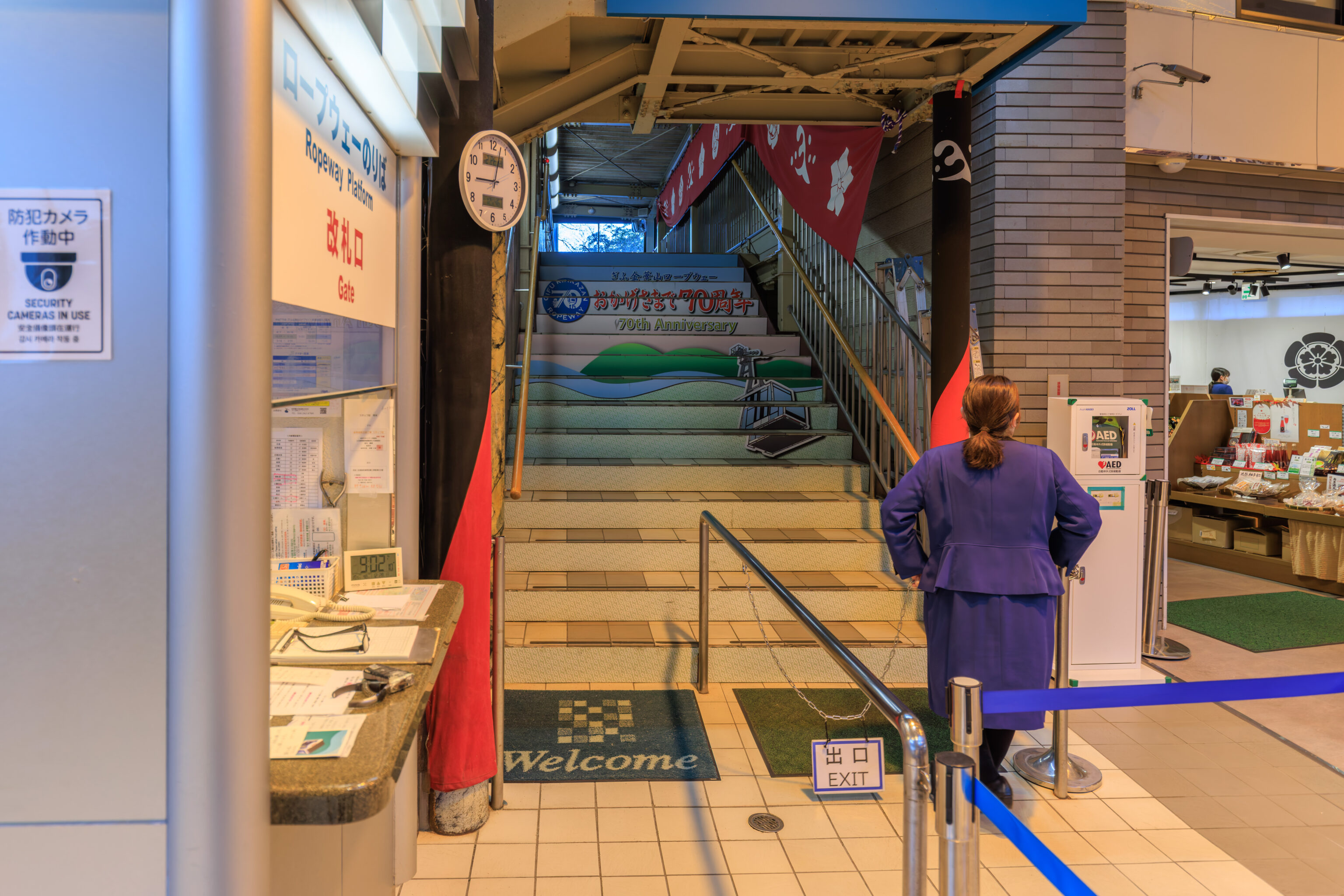
The entrance to the ropeway.
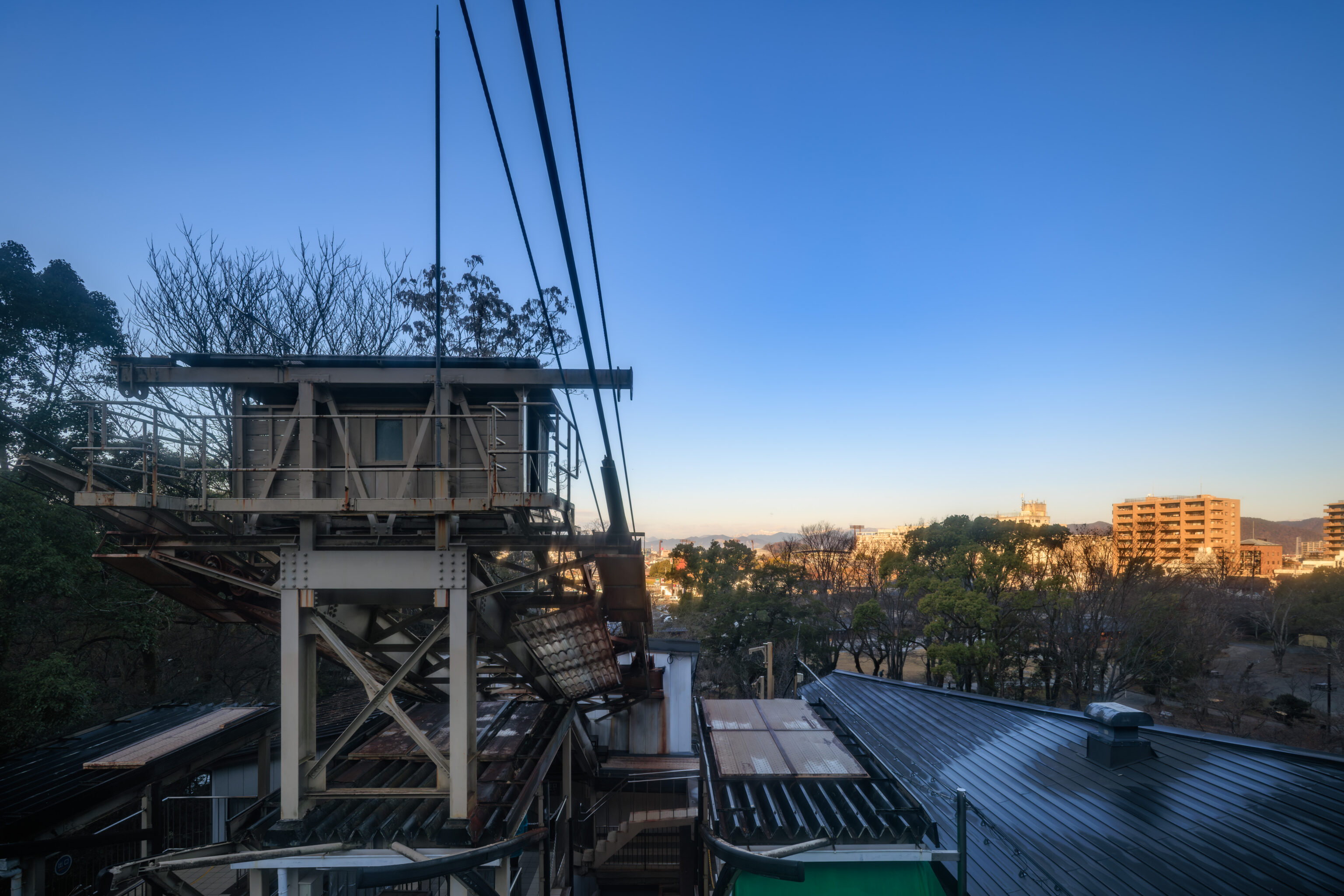
We started to ascend at around 9:06am.
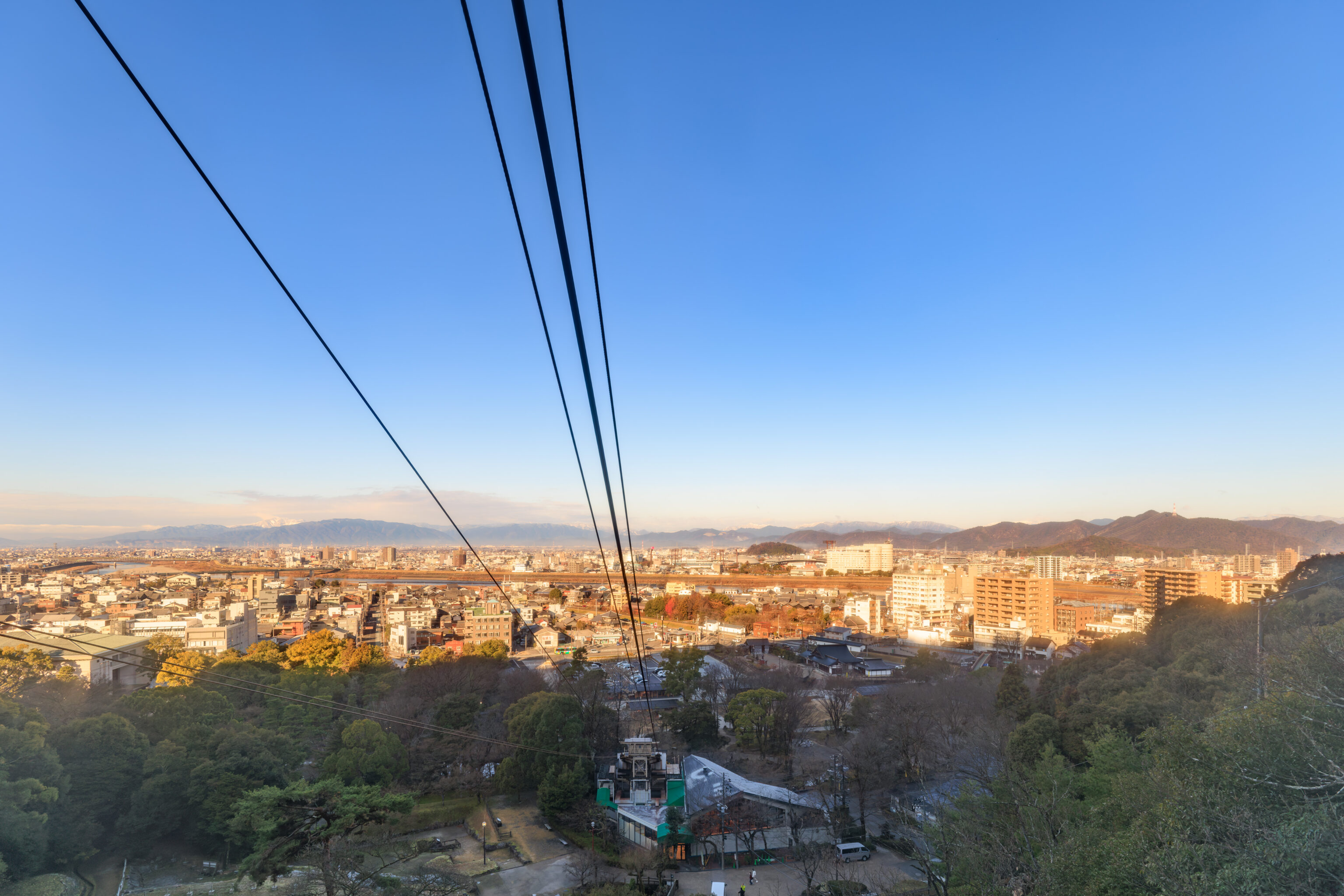
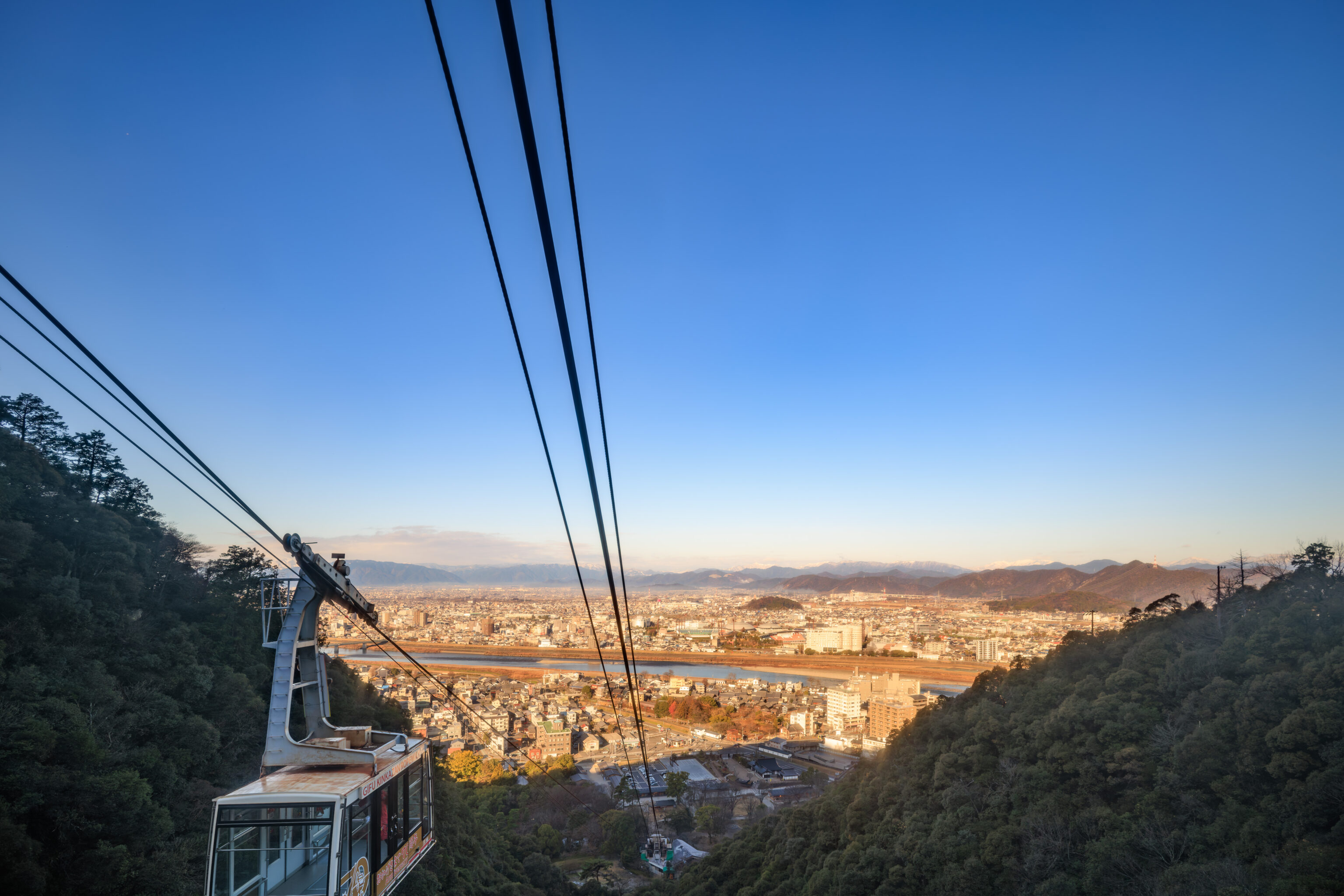
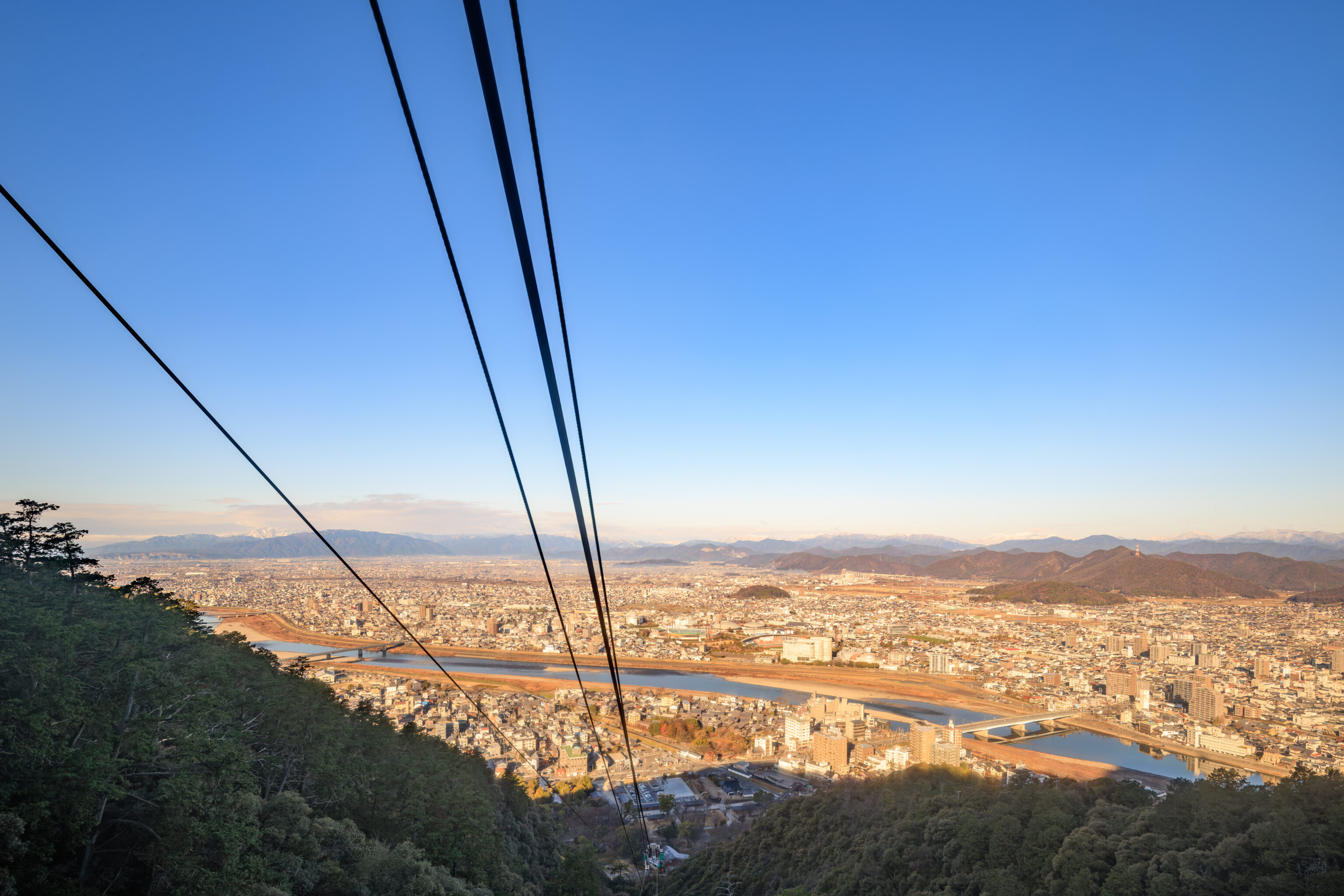
The trip is pretty short at about four minutes.
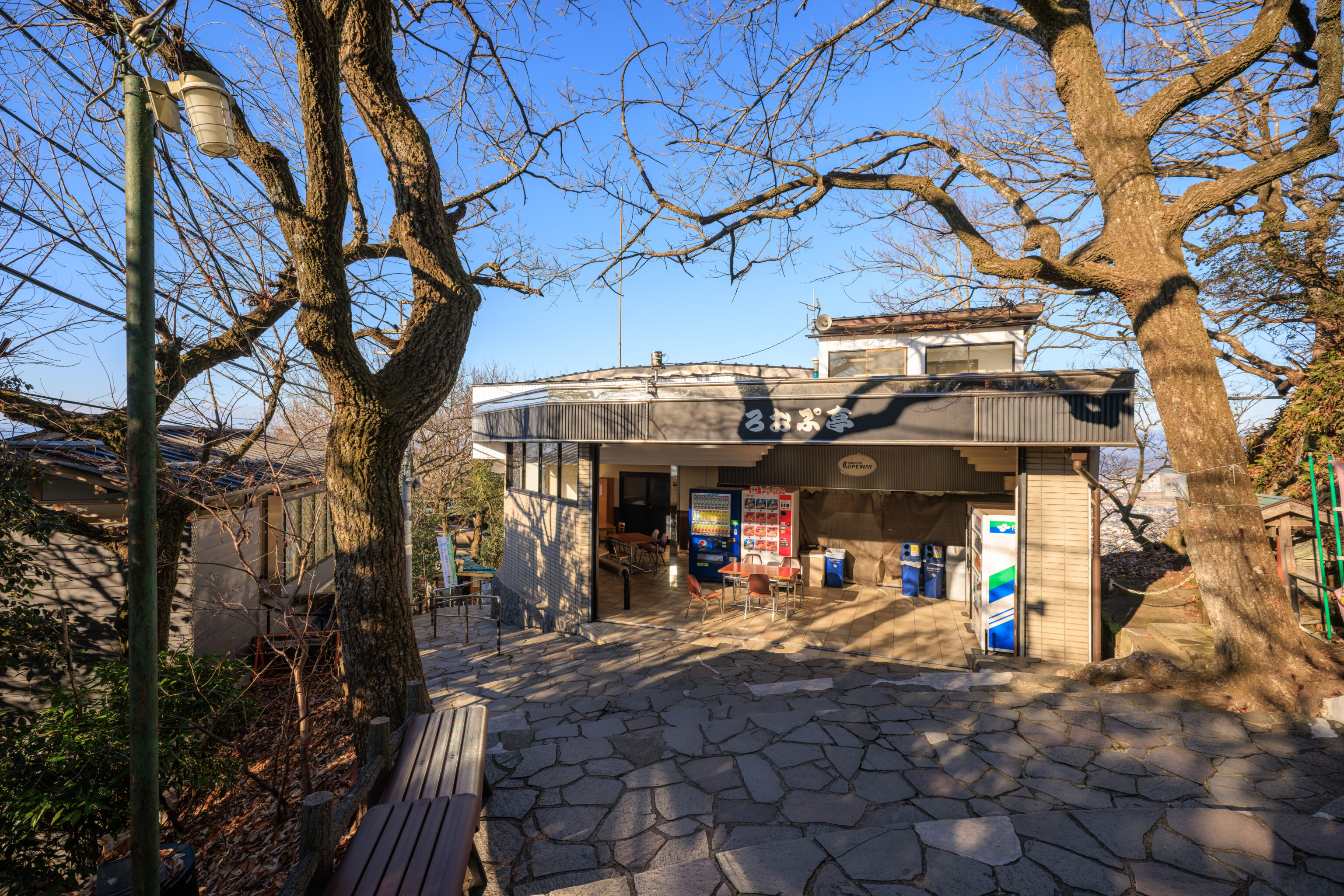
The ropeway’s upper terminal.
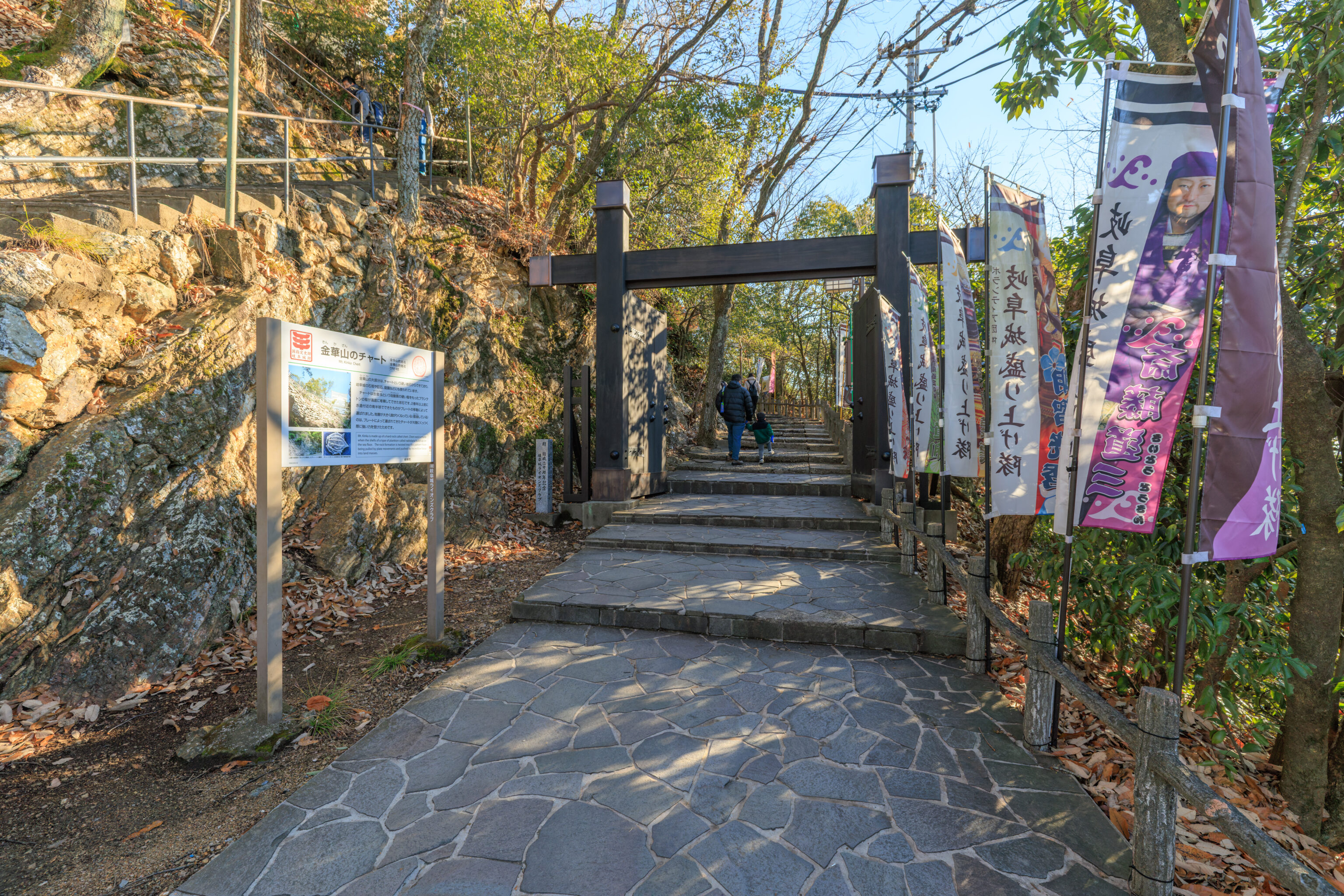
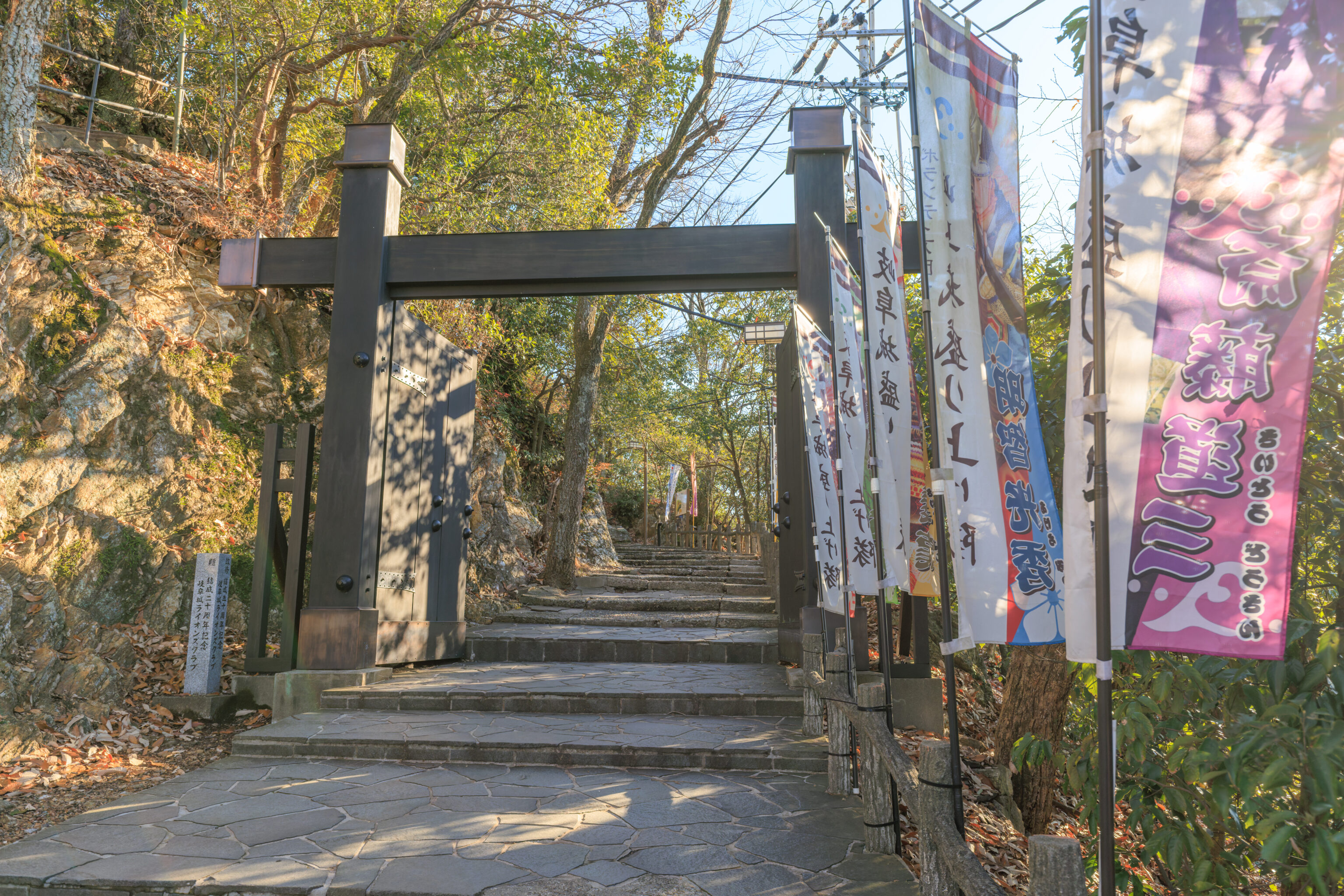
We started to walk to the northeast along a path that would take us to Gifu Castle.
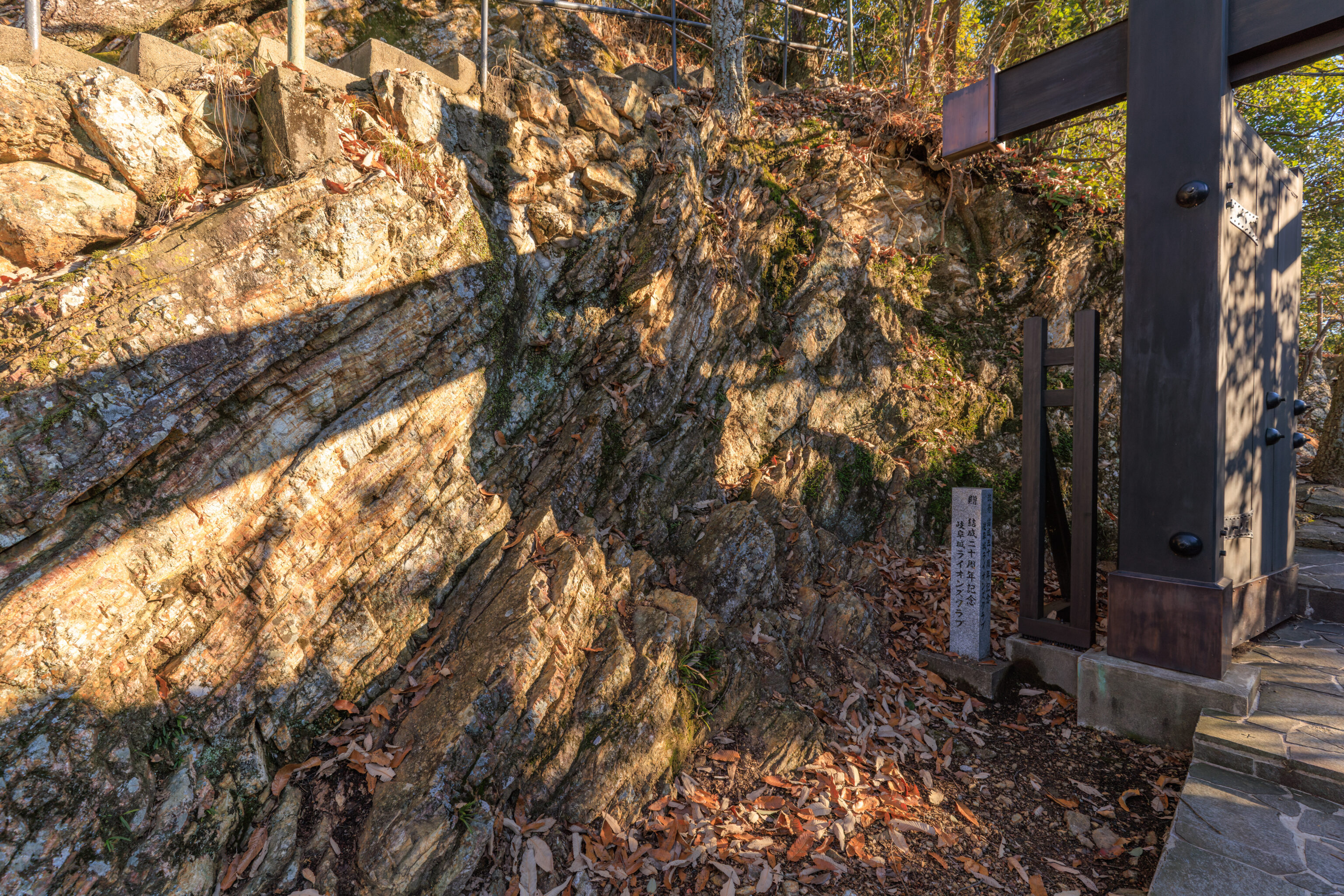
The stone here is known as Mount Kinka Chert, as explained by a sign:
Nationally Designated Historic Site: Ruins of Gifu Castle
Mount Kinka Chert

Most of Mount Kinkazan is composed of a hard rock known as chert; this material is also used in the stone walls, massive boulders, and gardens of Gifu Castle.

Chert is a rock formed from the accumulation of the hard, siliceous shells of plankton called radiolarians on the ocean floor. Originally formed in the Southern Hemisphere near the equator over 200 million years ago, the rock was transported to its current location by tectonic plate movement. The pronounced folding of the rock strata occurred because the chert was subjected to immense pressure when it collided with and attached to the continent.
– Text from a sign, read using Google Gemini and translated using Google Translate.
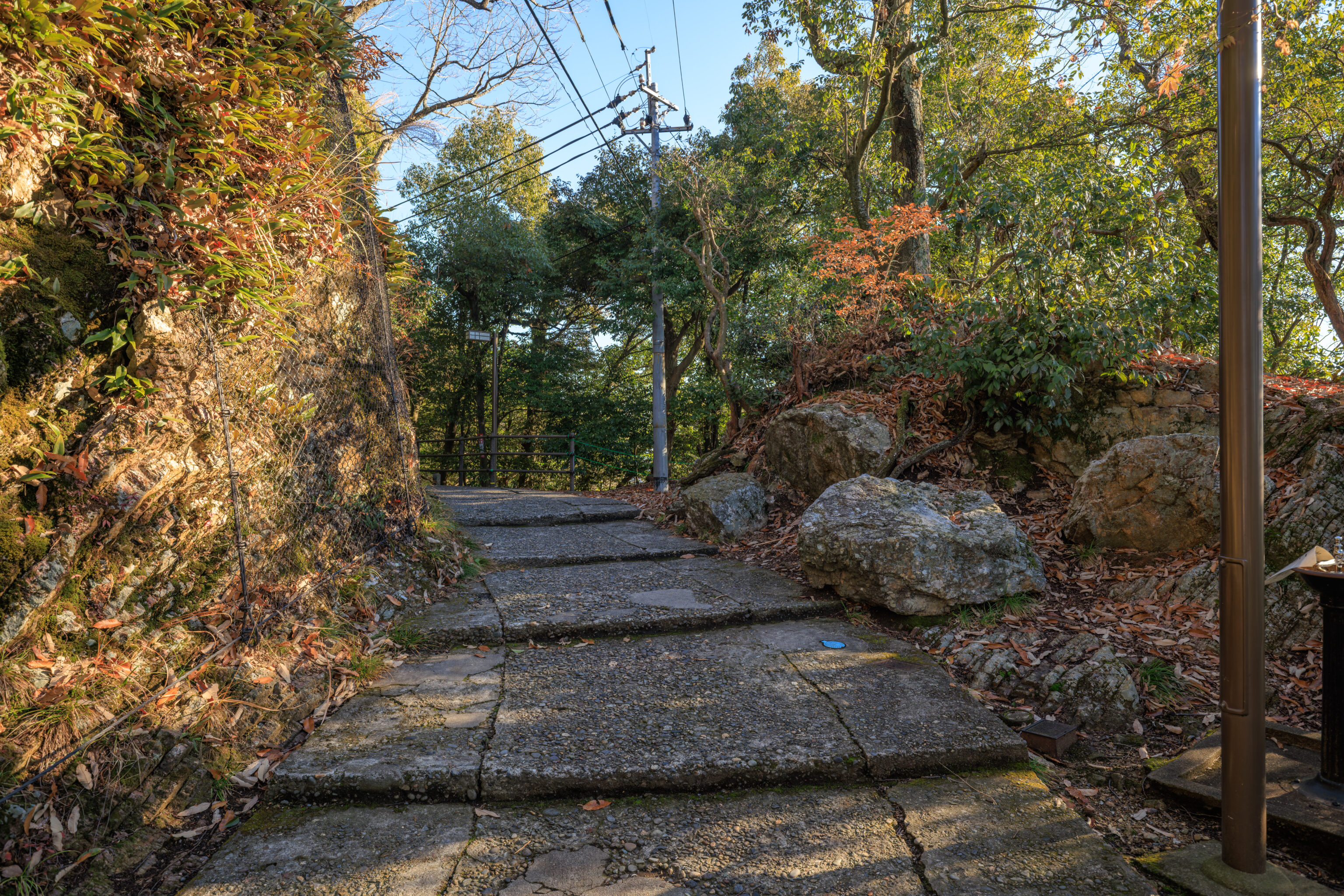
It is believed that there was a gate around where we are standing now.
Nationally Designated Historic Site: Ruins of Gifu Castle
Site of the First Gate (Ichinomon)

This is the location identified as the "First Gate" in maps and records from the Edo period.  Today, some of the stone walls and fallen megaliths remain. Much like the entrance to the residence site at the foot of the mountain (Gifu Park), one can see how massive stones were once lined up along the path.
– Text from a sign, read using Google Gemini and translated using Google Translate.
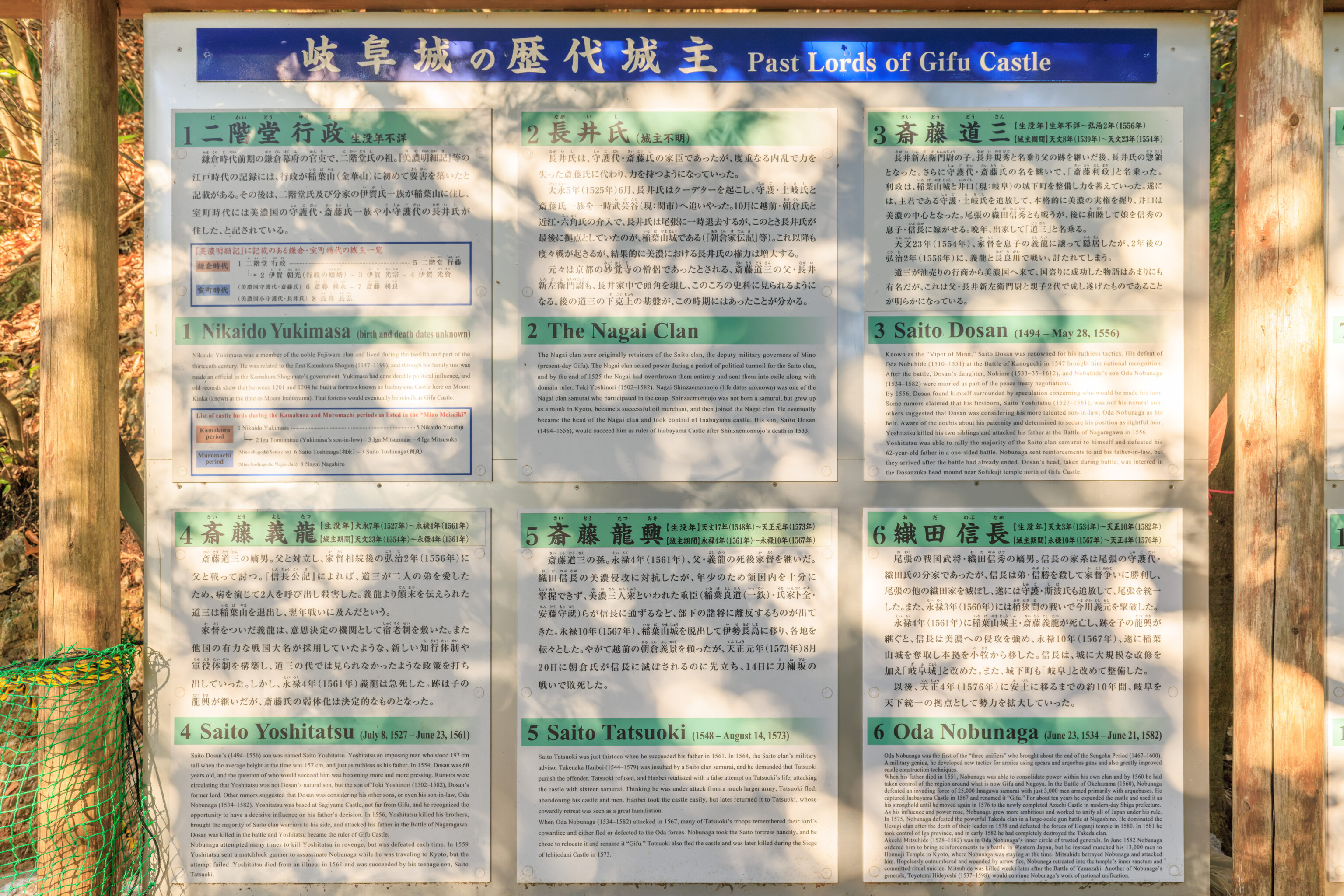
Past Lords of Gifu Castle

1. Nikaido Yukimasa (birth and death dates unknown)
Nikaido Yukimasa was a member of the noble Fujiwara clan and lived during the twelfth and part of the thirteenth century. He was related to the first Kamakura Shogun (1147-1199), and through his family ties was made an official in the Kamakura Shogunate's government. Yukimasa had considerable political influence, and old records show that between 1201 and 1204 he built a fortress known as Inabayama Castle here on Mount Kinka (known at the time as Mount Inabayama). That fortress would eventually be rebuilt as Gifu Castle.

List of castle lords during the Kamakura and Muromachi periods as listed in the "Mino Meisaiki"

Kamakura period
1 Nikaido Yukimasa ... 5 Nikaido Yukifuji
  └─► 2 Iga Tomomitsu (Yukimasa's son-in-law)
      3 Iga Mitsumune
      4 Iga Mitsusuke


Muromachi period
(Mino shugodai Saito clan) 6 Saito Toshinaga(利永) - 7 Saito Toshinaga(利良)
(Mino koshugodai Nagai clan) 8 Nagai Nagahiro

2. The Nagai Clan
The Nagai clan were originally retainers of the Saito clan, the deputy military governors of Mino (present-day Gifu). The Nagai clan seized power during a period of political turmoil for the Saito clan, and by the end of 1525 the Nagai had overthrown them entirely and sent them into exile along with domain ruler, Toki Yoshinori (1502-1582). Nagai Shinzaemonnojo (life dates unknown) was one of the Nagai clan samurai who participated in the coup. Shinzaemonnojo was not born a samurai, but grew up as a monk in Kyoto, became a successful oil merchant, and then joined the Nagai clan. He eventually became the head of the Nagai clan and took control of Inabayama castle. His son, Saito Dosan (1494-1556), would succeed him as ruler of Inabayama Castle after Shinzaemonnojo's death in 1533.

3. Saito Dosan (1494 - May 28, 1556)
Known as the "Viper of Mino," Saito Dosan was renowned for his ruthless tactics. His defeat of Oda Nobuhide (1510-1551) at the Battle of Kanoguchi in 1547 brought him national recognition. After the battle, Dosan's daughter, Nohime (1533~35-1612), and Nobuhide's son Oda Nobunaga (1534-1582) were married as part of the peace treaty negotiations.

By 1556, Dosan found himself surrounded by speculation concerning who would be made his heir. Some rumors claimed that his firstborn, Saito Yoshitatsu (1527-1561), was not his natural son; others suggested that Dosan was considering his more talented son-in law, Oda Nobunaga as his heir. Aware of the doubts about his paternity and determined to secure his position as rightful heir, Yoshitatsu killed his two siblings and attacked his father at the Battle of Nagaragawa in 1556.

Yoshitatsu was able to rally the majority of the Saito clan samurai to himself and defeated his 62-year-old father in a one-sided battle. Nobunaga sent reinforcements to aid his father-in-law, but they arrived after the battle had already ended. Dosan's head, taken during battle, was interred in the Dosanzuka head mound near Sofukuji temple north of Gifu Castle.

4. Saito Yoshitatsu (July 8, 1527 - June 23, 1561)
Saito Dosan's (1494-1556) son was named Saito Yoshitatsu. Yoshitatsu an imposing man who stood 197 cm tall when the average height at the time was 157 cm, and just as ruthless as his father. In 1554, Dosan was 60 years old, and the question of who would succeed him was becoming more and more pressing. Rumors were circulating that Yoshitatsu was not Dosan's natural son, but the son of Toki Yoshinori (1502-1582), Dosan's former lord. Other rumors suggested that Dosan was considering his other sons, or even his son-in-law, Oda Nobunaga (1534-1582). Yoshitatsu was based at Sagiyama Castle, not far from Gifu, and he recognized the opportunity to have a decisive influence on his father's decision. In 1556, Yoshitatsu killed his brothers, brought the majority of Saito clan warriors to his side, and attacked his father in the Battle of Nagaragawa. Dosan was killed in the battle and Yoshitatsu became the ruler of Gifu Castle.

Nobunaga attempted many times to kill Yoshitatsu in revenge, but was defeated each time. In 1559 Yoshitatsu sent a matchlock gunner to assassinate Nobunaga while he was traveling to Kyoto, but the attempt failed. Yoshitatsu died from an illness in 1561 and was succeeded by his teenage son, Saito Tatsuoki.

5. Saito Tatsuoki (1548 - August 14, 1573)
Saito Tatsuoki was just thirteen when he succeeded his father in 1561. In 1564, the Saito clan's military advisor Takenaka Hanbei (1544-1579) was insulted by a Saito clan samurai, and he demanded that Tatsuoki punish the offender. Tatsuoki refused, and Hanbei retaliated with a false attempt on Tatsuoki's life, attacking the castle with sixteen samurai. Thinking he was under attack from a much larger army, Tatsuoki fled, abandoning his castle and men. Hanbei took the castle easily, but later returned it to Tatsuoki, whose cowardly retreat was seen as a great humiliation.

When Oda Nobunaga (1534-1582) attacked in 1567, many of Tatsuoki's troops remembered their lord's cowardice and either fled or defected to the Oda forces. Nobunaga took the Saito fortress handily, and he chose to relocate it and rename it "Gifu." Tatsuoki also fled the castle and was later killed during the Siege of Ichijodani Castle in 1573.

6. Oda Nobunaga (June 23, 1534 - June 21, 1582)
Oda Nobunaga was the first of the "three unifiers" who brought about the end of the Sengoku Period (1467-1600). A military genius, he developed new tactics for armies using spears and arquebus guns and also greatly improved castle construction techniques.

When his father died in 1551, Nobunaga was able to consolidate power within his own clan and by 1560 he had taken control of the region around what is now Gifu and Nagoya. In the Battle of Okehazama (1560), Nobunaga defeated an invading force of 25,000 Imagawa samurai with just 3,000 men armed primarily with arquebuses. He captured Inabayama Castle in 1567 and renamed it "Gifu." For about ten years he expanded the castle and used it as his stronghold until he moved again in 1576 to the newly completed Azuchi Castle in modern-day Shiga prefecture. As his influence and power rose, Nobunaga grew more ambitious and worked to unify all of Japan under his rule. In 1575, Nobunaga defeated the powerful Takeda clan in a large-scale gun battle at Nagashino. He dominated the Uesugi clan after the death of their leader in 1578 and defeated the forces of Hoganji temple in 1580. In 1581 he took control of Iga province, and in early 1582 he had completely destroyed the Takeda clan.

Akechi Mitsuhide (1528-1582) was in Oda Nobunaga's inner circle of trusted generals. In June 1582 Nobunaga ordered him to bring reinforcements to a battle in Western Japan, but he instead marched his 13,000 men to Honnoji Temple in Kyoto, where Nobunaga was staying at the time. Mitsuhide betrayed Nobunaga and attacked him. Hopelessly outnumbered and wounded by arrow fire, Nobunaga retreated into the temple's inner sanctum and committed ritual suicide. Mitsuhide was killed weeks later after the Battle of Yamazaki. Another of Nobunaga's generals, Toyotomi Hideyoshi (1537-1598), would continue Nobunaga's work of national unification.
– English text from the sign above.
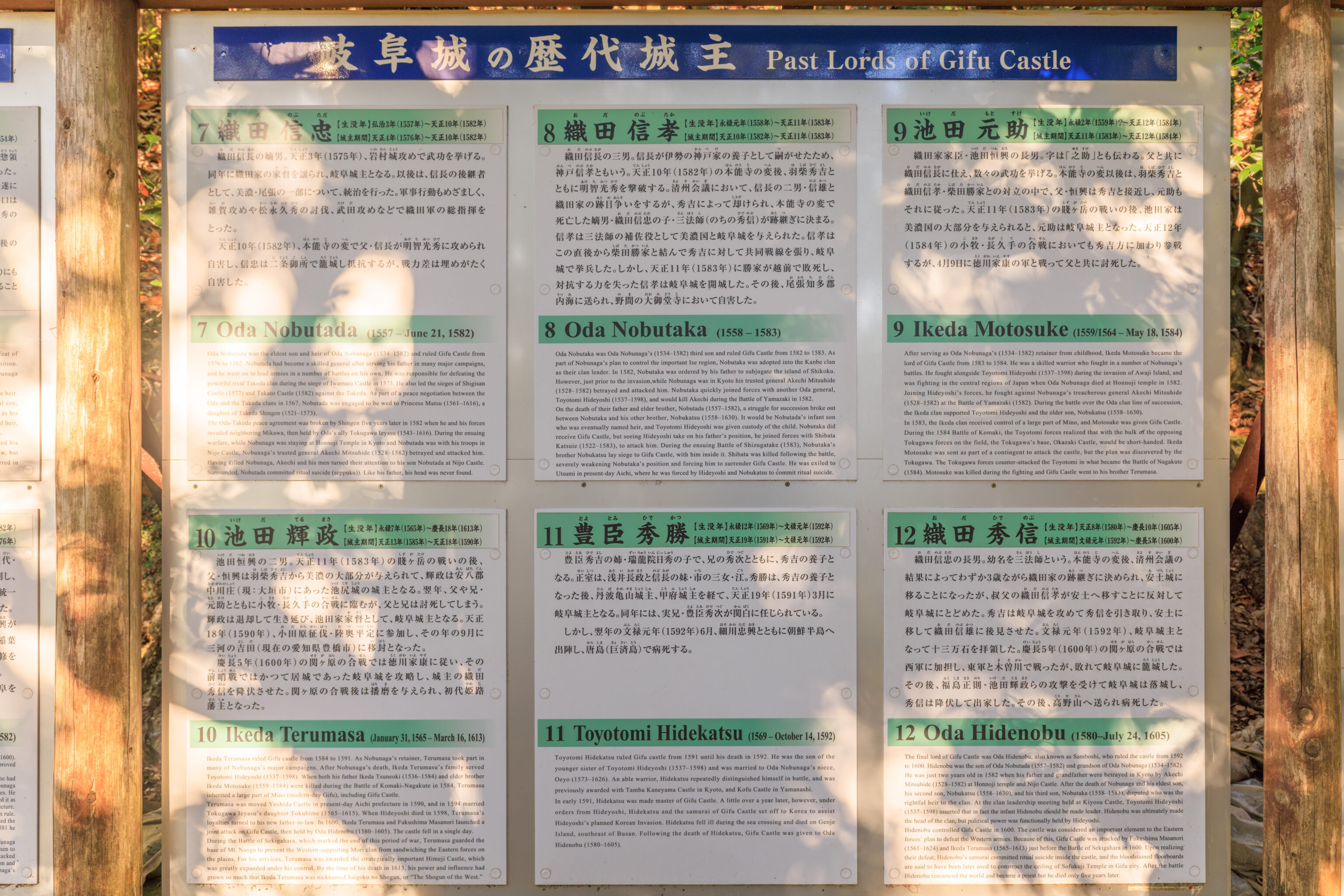
Past Lords of Gifu Castle
7. Oda Nobutada (1557- June 21, 1582)
Oda Nobutada was the eldest son and heir of Oda Nobunaga (1534-1582) and ruled Gifu Castle from 1576 to 1582. Nobutada had become a skilled general after serving his father in many major campaigns, and he went on to lead armies in a number of battles on his own. He was responsible for defeating the powerful rival Takeda clan during the siege of Iwamura Castle in 1575. He also led the sieges of Shigisan Castle (1577) and Takato Castle (1582) against the Takeda. As part of a peace negotiation between the Oda and the Takeda clans in 1567, Nobutada was engaged to be wed to Princess Matsu (1561-1616), a daughter of Takeda Shingen (1521-1573).

The Oda-Takeda peace agreement was broken by Shingen five years later in 1582 when he and his forces invaded neighboring Mikawa, then held by Oda's ally Tokugawa Ieyasu (1543-1616). During the ensuing warfare, while Nobunaga was staying at Honnoji Temple in Kyoto and Nobutada was with his troops in Nijo Castle, Nobunaga's trusted general Akechi Mitsuhide (1528-1582) betrayed and attacked him. Having Killed Nobunaga, Akechi and his men turned their attention to his son Nobutada at Nijo Castle. Surrounded, Nobutada committed ritual suicide (seppuku). Like his father, his head was never found.

8. Oda Nobutaka (1558- 1583)
Oda Nobutaka was Oda Nobunaga's (1534-1582) third son and ruled Gifu Castle from 1582 to 1583. As part of Nobunaga's plan to control the important Ise region, Nobutaka was adopted into the Kanbe clan as their clan leader. In 1582, Nobutaka was ordered by his father to subjugate the island of Shikoku. However, just prior to the invasion, while Nobunaga was in Kyoto his trusted general Akechi Mitsuhide (1528-1582) betrayed and attacked him. Nobutaka quickly joined forces with another Oda general, Toyotomi Hideyoshi (1537-1598), and would kill Akechi during the Battle of Yamazaki in 1582.

On the death of their father and elder brother, Nobutada (1557-1582), a struggle for succession broke out between Nobutaka and his other brother, Nobukatsu (1558-1630). It would be Nobutada's infant son who was eventually named heir, and Toyotomi Hideyoshi was given custody of the child. Nobutaka did receive Gifu Castle, but seeing Hideyoshi take on his father's position, he joined forces with Shibata Katsuie (1522-1583), to attack him. During the ensuing Battle of Shizugatake (1583), Nobutaka's brother Nobukatsu lay siege to Gifu Castle, with him inside it. Shibata was killed following the battle, severely weakening Nobutaka's position and forcing him to surrender Gifu Castle. He was exiled to Utsumi in present-day Aichi, where he was forced by Hideyoshi and Nobukatsu to commit ritual suicide.

9. Ikeda Motosuke (1559/1564 - May 18, 1584)
After serving as Oda Nobunaga's (1534-1582) retainer from childhood, Ikeda Motosuke became the lord of Gifu Castle from 1583 to 1584. He was a skilled warrior who fought in a number of Nobunaga's battles. He fought alongside Toyotomi Hideyoshi (1537-1598) during the invasion of Awaji Island, and was fighting in the central regions of Japan when Oda Nobunaga died at Honnoji temple in 1582. Joining Hideyoshi's forces, he fought against Nobunaga's treacherous general Akechi Mitsuhide (1528-1582) at the Battle of Yamazaki (1582). During the battle over the Oda clan line of succession, the Ikeda clan supported Toyotomi Hideyoshi and the elder son, Nobukatsu (1558-1630).

In 1583, the Ikeda clan received control of a large part of Mino, and Motosuke was given Gifu Castle. During the 1584 Battle of Komaki, the Toyotomi forces realized that with the bulk of the opposing Tokugawa forces on the field, the Tokugawa's base, Okazaki Castle, would be short-handed. Ikeda Motosuke was sent as part of a contingent to attack the castle, but the plan was discovered by the Tokugawa. The Tokugawa forces counter-attacked the Toyotomi in what became the Battle of Nagakute (1584). Motosuke was killed during the fighting and Gifu Castle went to his brother Terumasa.

10. Ikeda Terumasa (January 31, 1565- March 16, 1613)
Ikeda Terumasa ruled Gifu castle from 1584 to 1591. As Nobunaga's retainer, Terumasa took part in many of Nobunaga's major campaigns. After Nobunaga's death, Ikeda Terumasu's family served Toyotomi Hideyoshi (1537-1598). When both his father Ikeda Tsuneoki (1536-1584) and elder brother Ikeda Motosuke (1559-1584) were killed during the Battle of Komaki-Nagakute in 1584, Terumasa inherited a large part of Mino (modern-day Gifu), including Gifu Castle.

Terumasa was moved Yoshida Castle in present-day Aichi prefecture in 1590, and in 1594 married Tokugawa Ieyasu's daughter Tokuhime (1565-1615). When Hideyoshi died in 1598, Terumasa's loyalties turned to his new father-in-law. In 1600, Ikeda Terumasa and Fukushima Masanori launched a joint attack on Gifu Castle, then held by Oda Hidenobu (1580-1605). The castle fell in a single day. During the Battle of Sekigahara, which marked the end of this period of war, Terumasa guarded the base of Mt. Nangu to prevent the Western-supporting Mori clan from sandwiching the Eastern forces on the plains. For his services, Terumasa was awarded the strategically important Himeji Castle, which was greatly expanded under his control. By the time of his death in 1613, his power and influence had grown so much that Ikeda Terumasa was nicknamed Saigoku no Shogun, or "The Shogun of the West."

11. Toyotomi Hidekatsu (1569 - October 14, 1592)
Toyotomi Hidekatsu ruled Gifu castle from 1591 until his death in 1592. He was the son of the younger sister of Toyotomi Hideyoshi (1537-1598) and was married to Oda Nobunaga's niece, Oeyo (1573-1626). An able warrior, Hidekatsu repeatedly distinguished himself in battle, and was previously awarded with Tamba Kaneyama Castle in Kyoto, and Kofu Castle in Yamanashi. In early 1591, Hidekatsu was made master of Gifu Castle. A little over a year later, however, under orders from Hideyoshi, Hidekatsu and the samurai of Gifu Castle set off to Korea to assist Hideyoshi's planned Korean Invasion. Hidekatsu fell ill during the sea crossing and died on Geoje Island, southeast of Busan. Following the death of Hidekatsu, Gifu Castle was given to Oda Hidenobu (1580-1605).

12. Oda Hidenobu (1580-July 24, 1605)
The final lord of Gifu Castle was Oda Hidenobu, also known as Samboshi, who ruled the castle from 1592 to 1600. Hidenobu was the son of Oda Nobutada (1557-1582) and grandson of Oda Nobunaga (1534-1582). He was just two years old in 1582 when his father and grandfather were betrayed in Kyoto by Akechi Mitsuhide (1528-1582) at Honnoji temple and Nijo Castle. After the death of Nobunaga and his eldest son, his second son, Nobukatsu (1558-1630), and his third son, Nobutaka (1558-1583), disputed who was the rightful heir to the clan. At the clan leadership meeting held at Kiyosu Castle, Toyotomi Hideyoshi (1537-1598) asserted that in fact the infant Hidenobu should be made leader. Hidenobu was ultimately made the head of the clan, but political power was functionally held by Hideyoshi.

Hidenobu controlled Gifu Castle in 1600. The castle was considered an important element to the Eastern forces' plan to defeat the Western armies. Because of this, Gifu Castle was attacked by Fukushima Masanori (1561-1624) and Ikeda Terumasa (1565-1613) just before the Battle of Sekigahara in 1600. Upon realizing their defeat, Hidenobu's samurai committed ritual suicide inside the castle, and the bloodstained floorboards are said to have been later used to construct the ceiling of Sofukuji Temple in Gifu city. After the battle Hidenobu renounced the world and became a priest but he died only five years later.
– English text from the sign above.
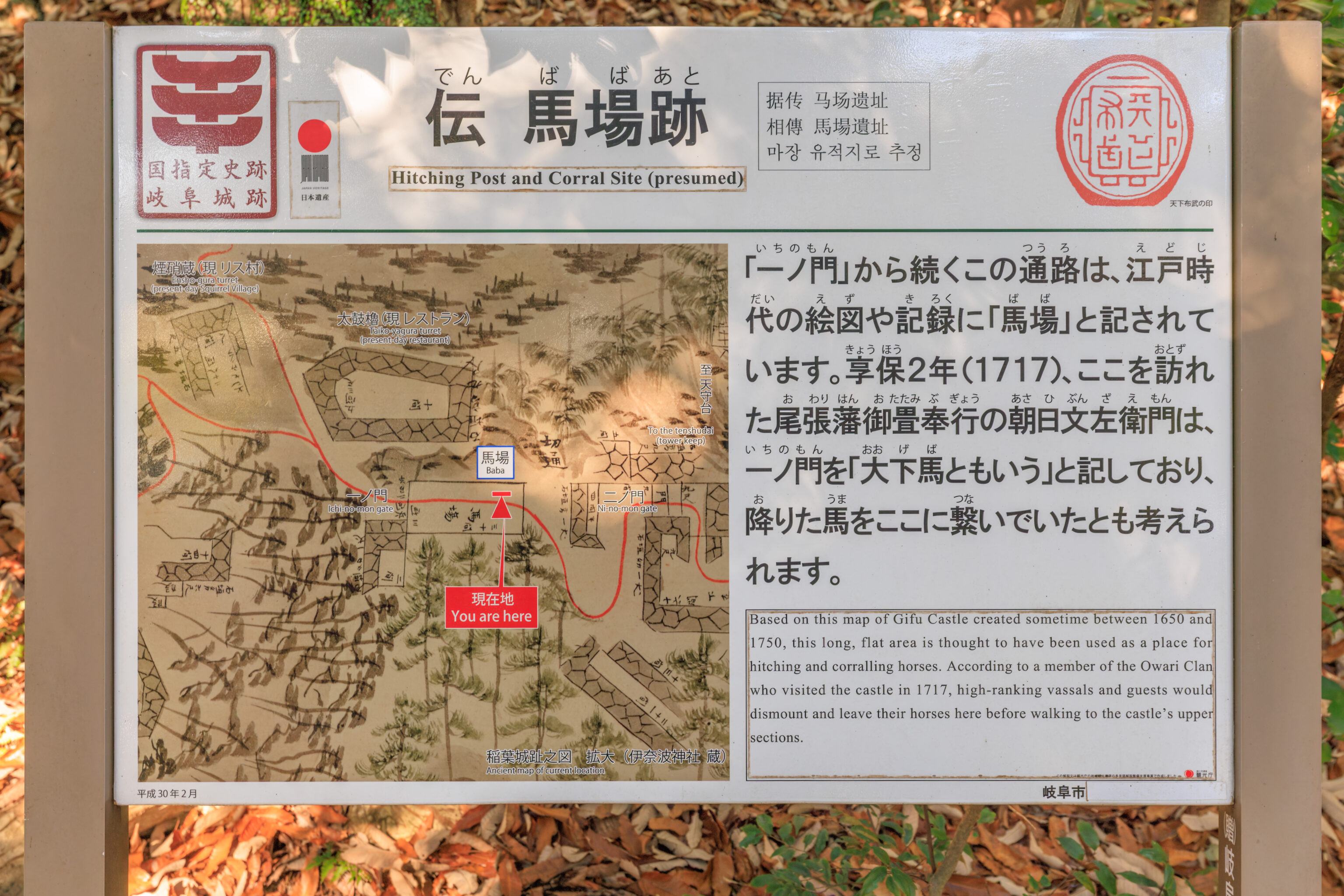
Some signed landmarks such as this one aren’t particularly notable. The sign does include a map which is why it is posted here.
Nationally Designated Historic Site: Ruins of Gifu Castle
Hitching Post and Corral Site (presumed)

This passageway, extending from the "Ichinomon" (First Gate), is recorded as the "Baba" (riding ground) in maps and documents from the Edo period. Asahi Bunzaemon, an official in charge of tatami mats for the Owari Domain who visited the site in 1717 (the second year of the Kyōhō era), noted that the Ichinomon was also known as the "Ōgeba" (Great Dismounting Gate); this suggests that horses were tethered here after riders dismounted.
– Text from the sign above, read using Google Gemini and translated using Google Translate.
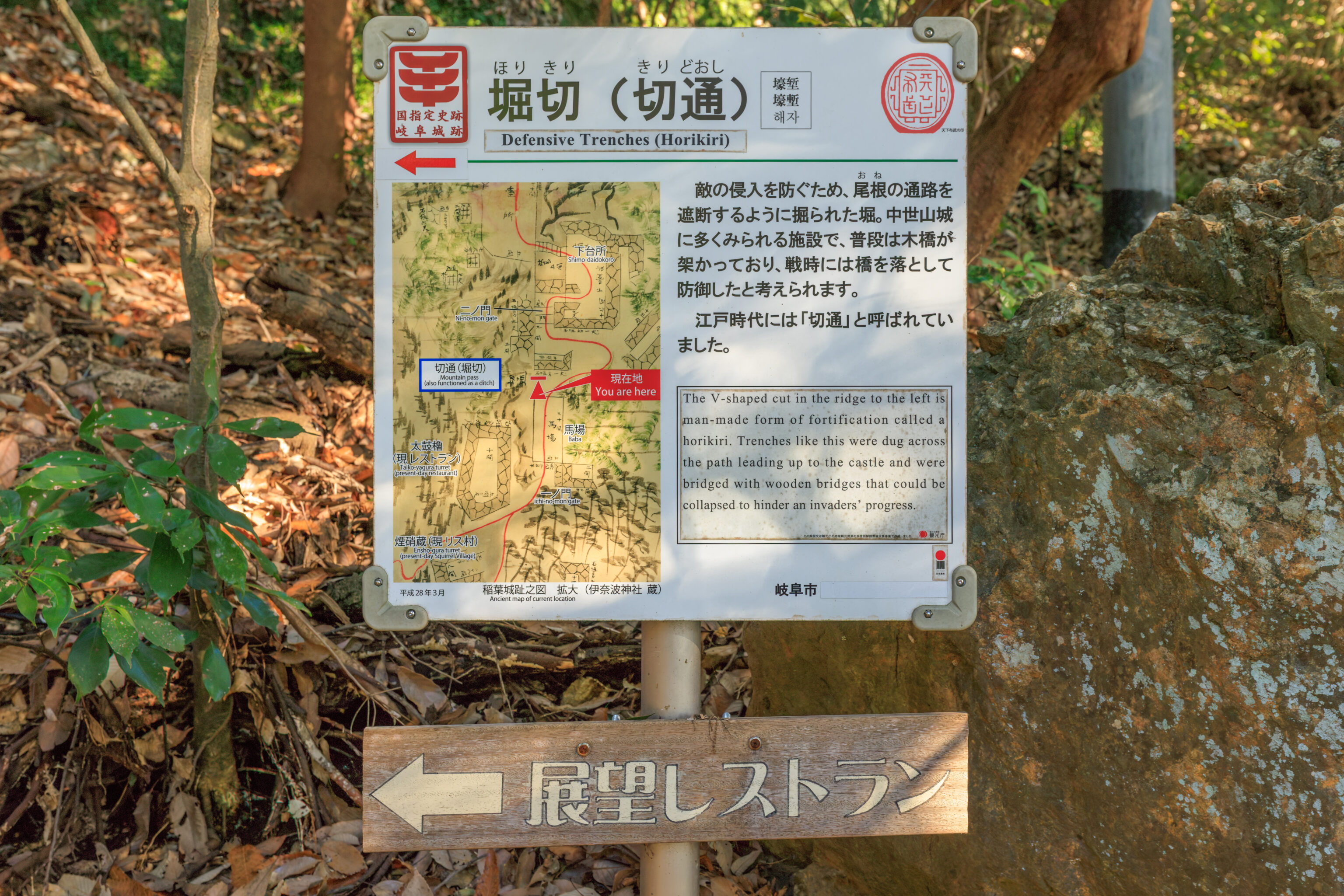
Like the previous sign, the landmark it is trying to identify isn’t particularly obvious.
Nationally Designated Historic Site: Ruins of Gifu Castle
Defensive Trenches (Horikiri)

This is a trench dug to block the path along a ridge and prevent enemy intrusion. It is a feature commonly found in medieval mountain castles; a wooden bridge would typically span the gap, but it is believed that the bridge would be dropped during wartime to aid in defense.

During the Edo period, it was known as a *kiridoshi* (cut-through passage).
– Text from the sign above, read using Google Gemini and translated using Google Translate.
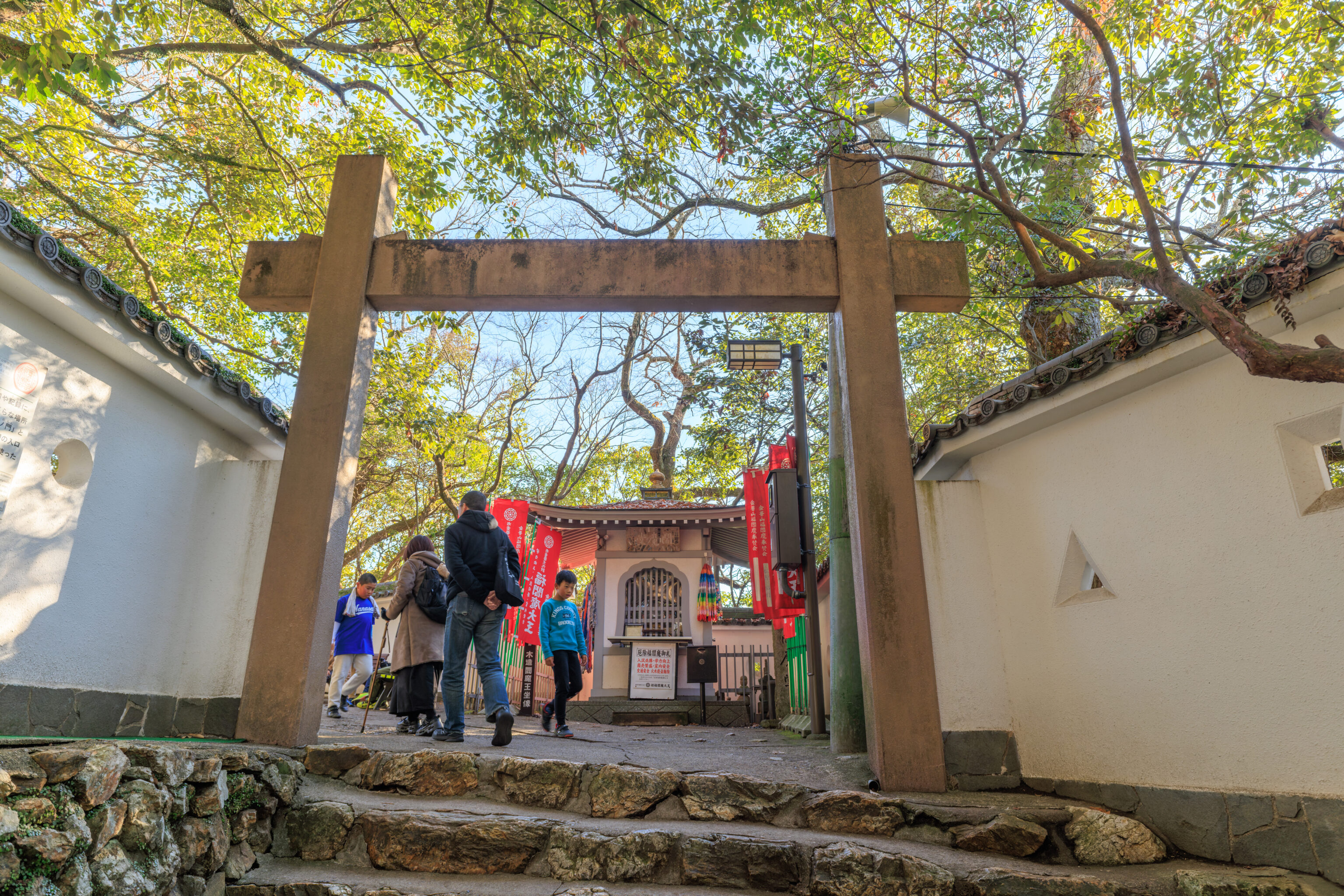
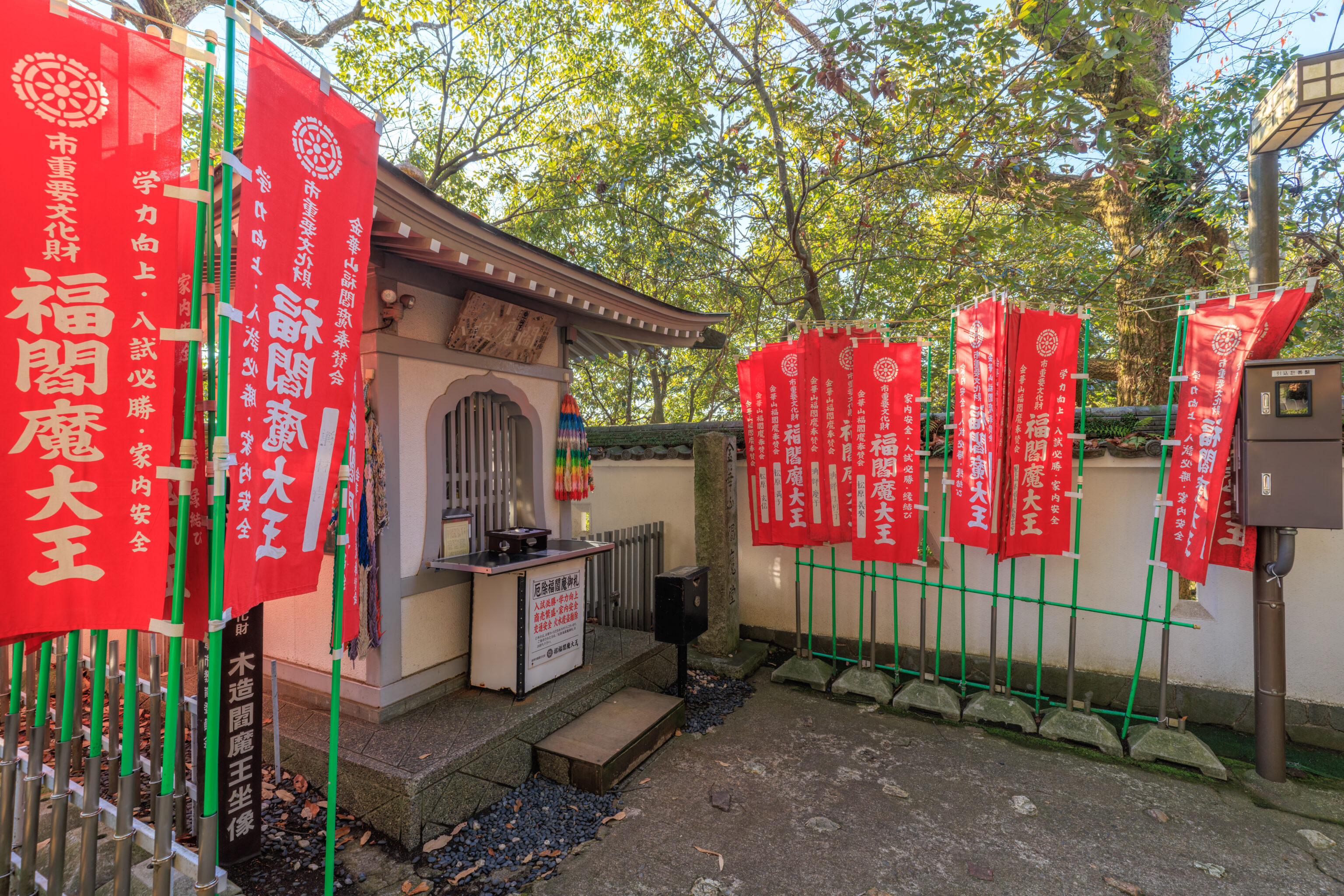
We continued on, passing through a small gate. There was a small shrine just beyond.
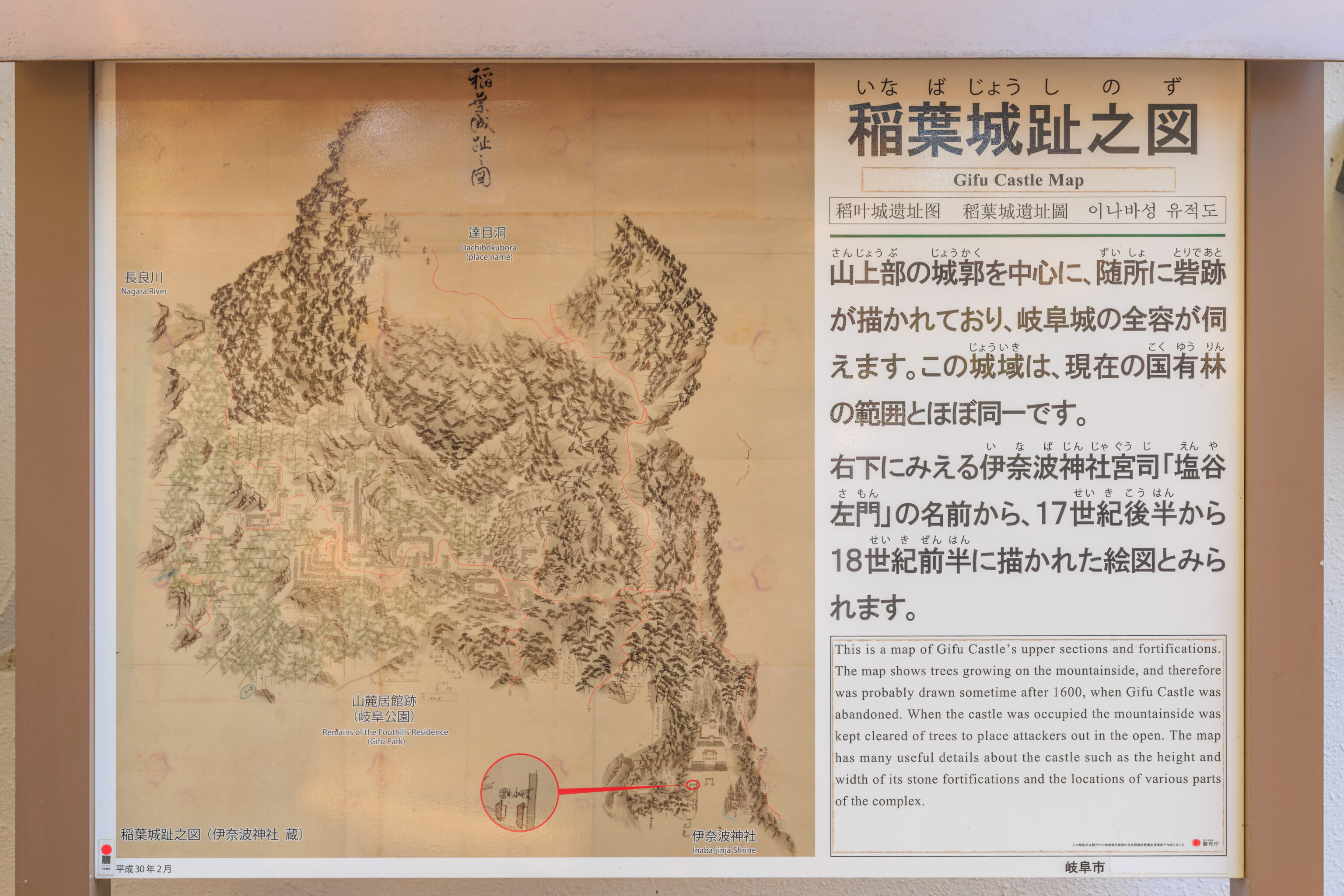
This map shows the historical appearance of this area after the castle was abandoned in the 1600s.
Illustration of the Ruins of Inaba Castle
Centered on the fortifications at the summit, the map depicts the remains of various outposts scattered throughout the area, offering a comprehensive view of Gifu Castle. The castle grounds shown here correspond almost exactly to the boundaries of the present-day national forest.

Based on the name "Enya Samon"—the chief priest of Inaba Shrine, visible in the bottom right—this map is believed to date from the period between the late 17th and early 18th centuries.
– Text from the sign above, read using Google Gemini and translated using Google Translate.
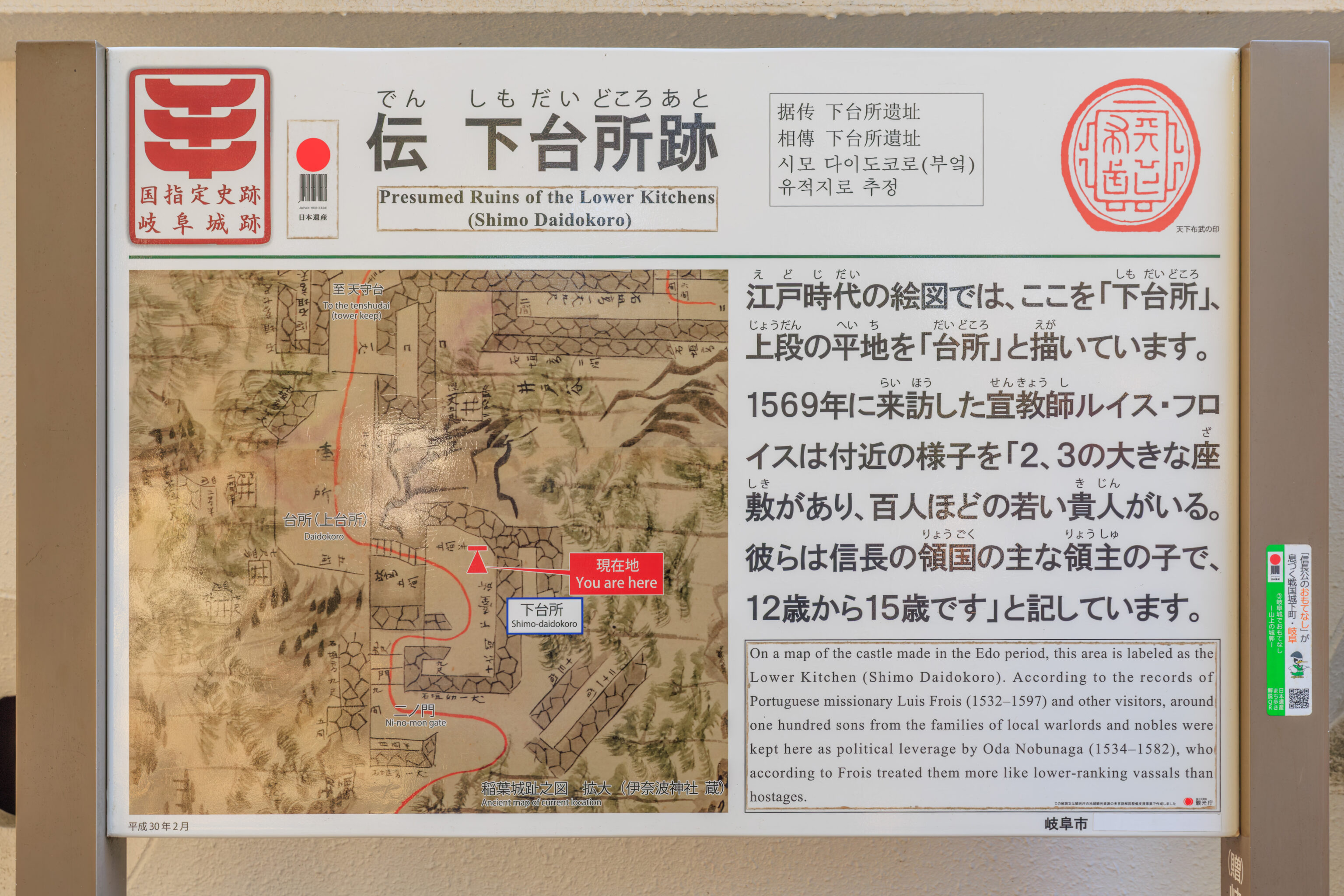
The area here by the gate and shrine is believed to have contained kitchen facilities.
Nationally Designated Historic Site: Ruins of Gifu Castle
Presumed Ruins of the Lower Kitchens (Shimo Daidokoro)

In Edo-period pictorial maps, this area is depicted as the "Lower Kitchen" (*Shimo-daidokoro*), while the flat area on the upper level is shown as the "Kitchen" (*Daidokoro*).

The missionary Luís Fróis, who visited in 1569, described the scene as follows: "There are two or three large reception rooms, and about a hundred young nobles. They are the sons of major feudal lords from Nobunaga's domains, aged between twelve and fifteen."
– Text from the sign above, read using Google Gemini and translated using Google Translate.
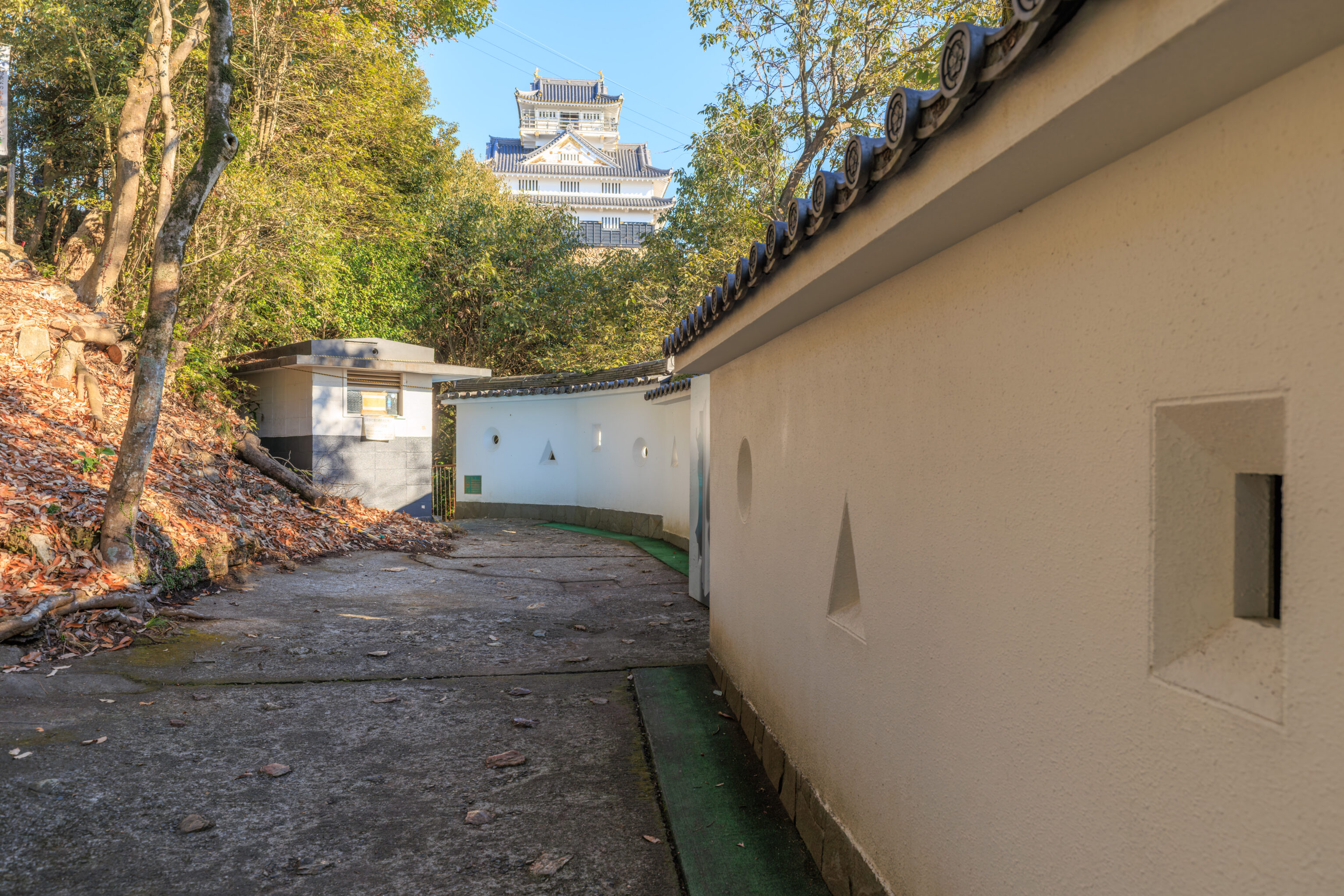
This area had a pretty good view of Gifu Castle.
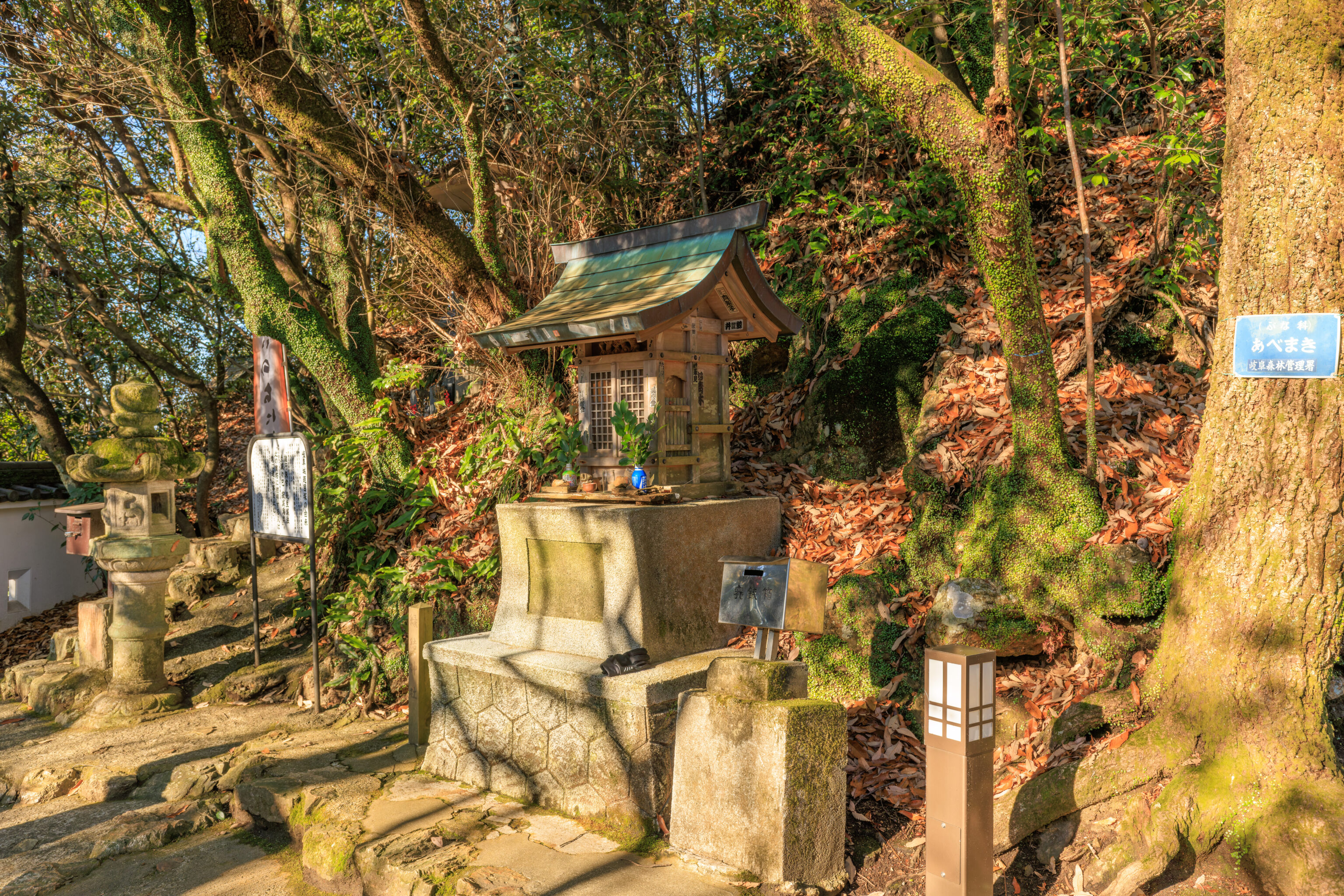
Another small shrine. Note the Pocari Sweat and some other bottle acting as vases!
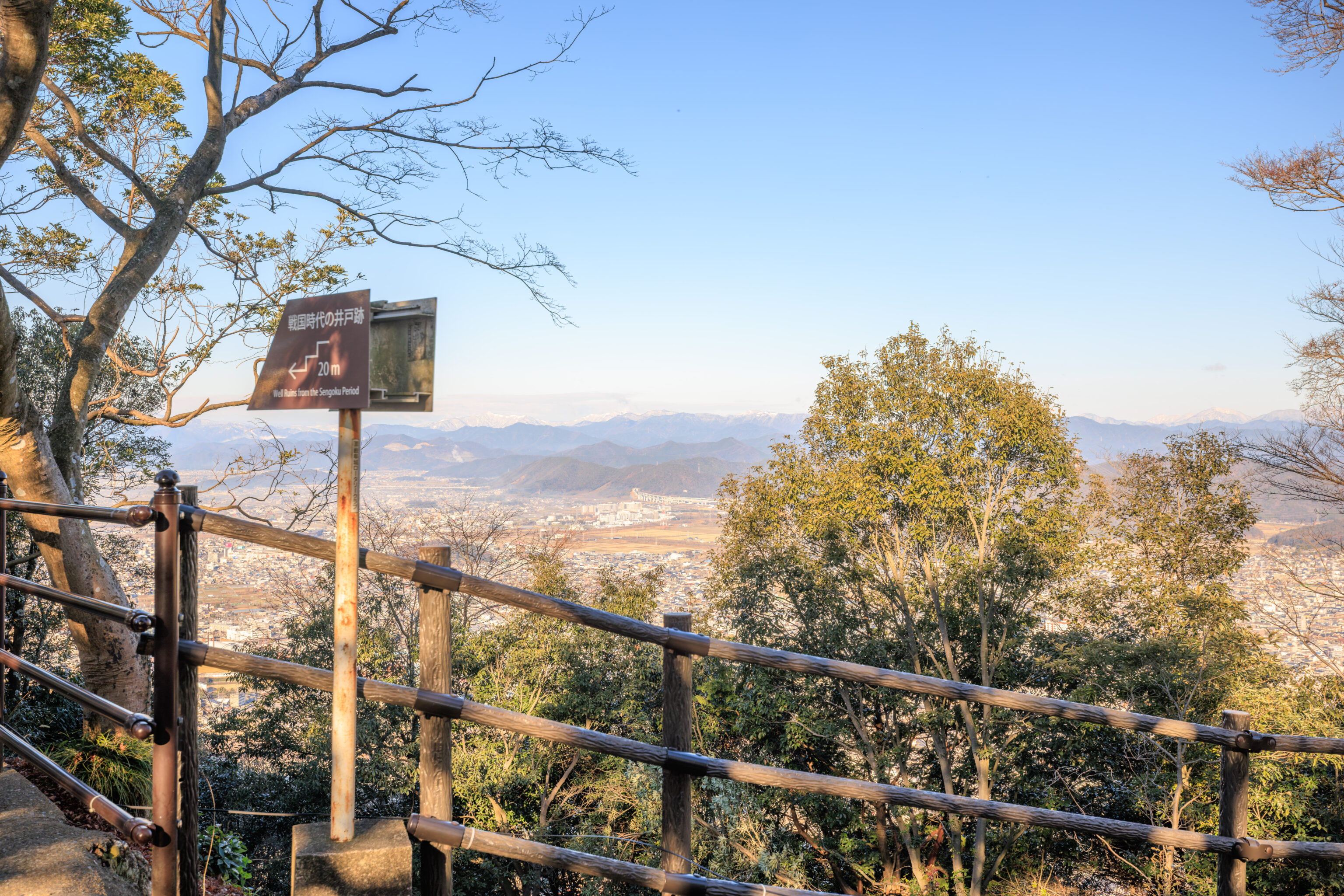
Continuing on, we had a bit of a view to… the southeast? Maybe?
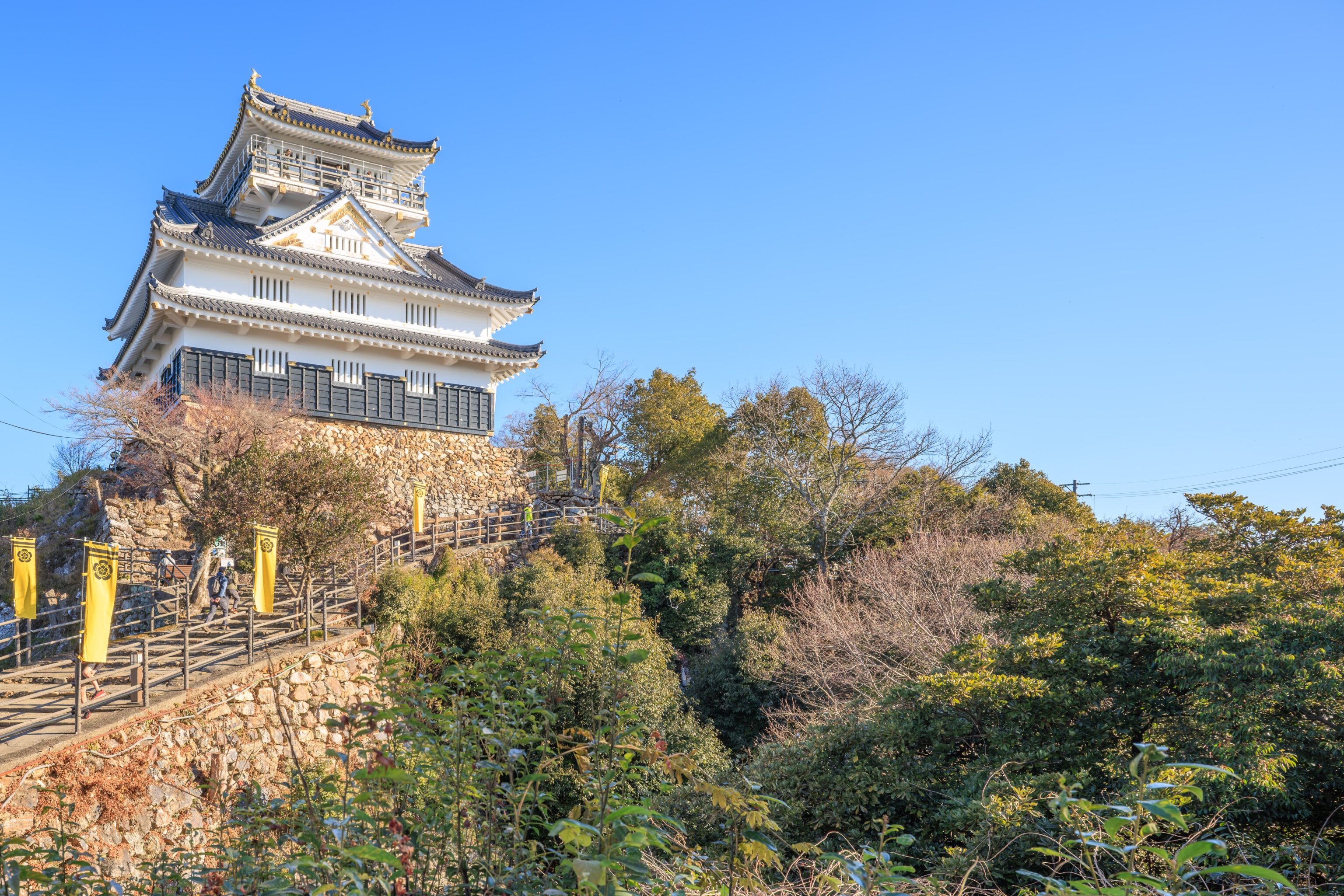
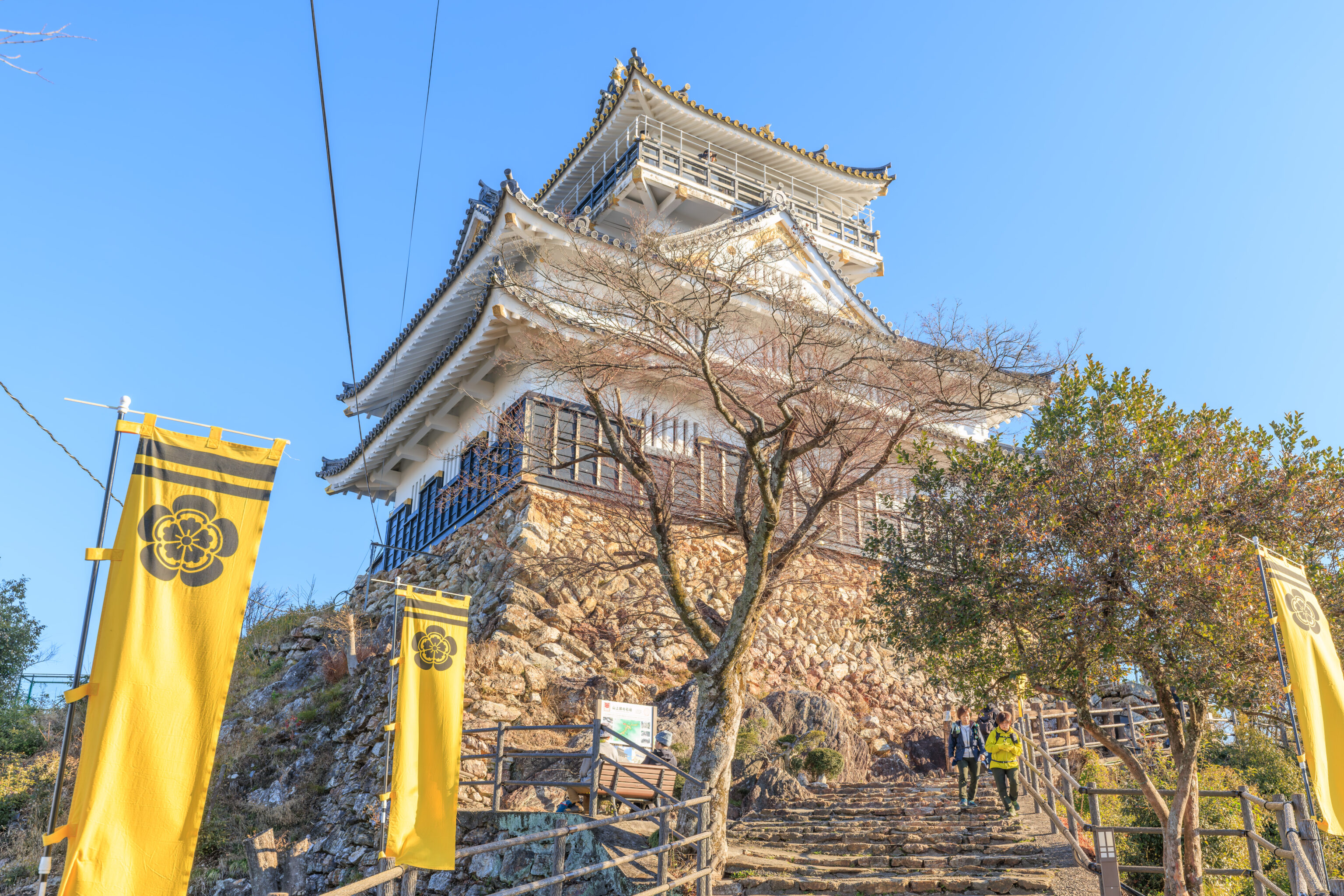
We followed the path along a relatively narrow ridge to finally reach Gifu Castle. Its worth noting that Gifu Castle is a concrete reproduction built in the 1950s.
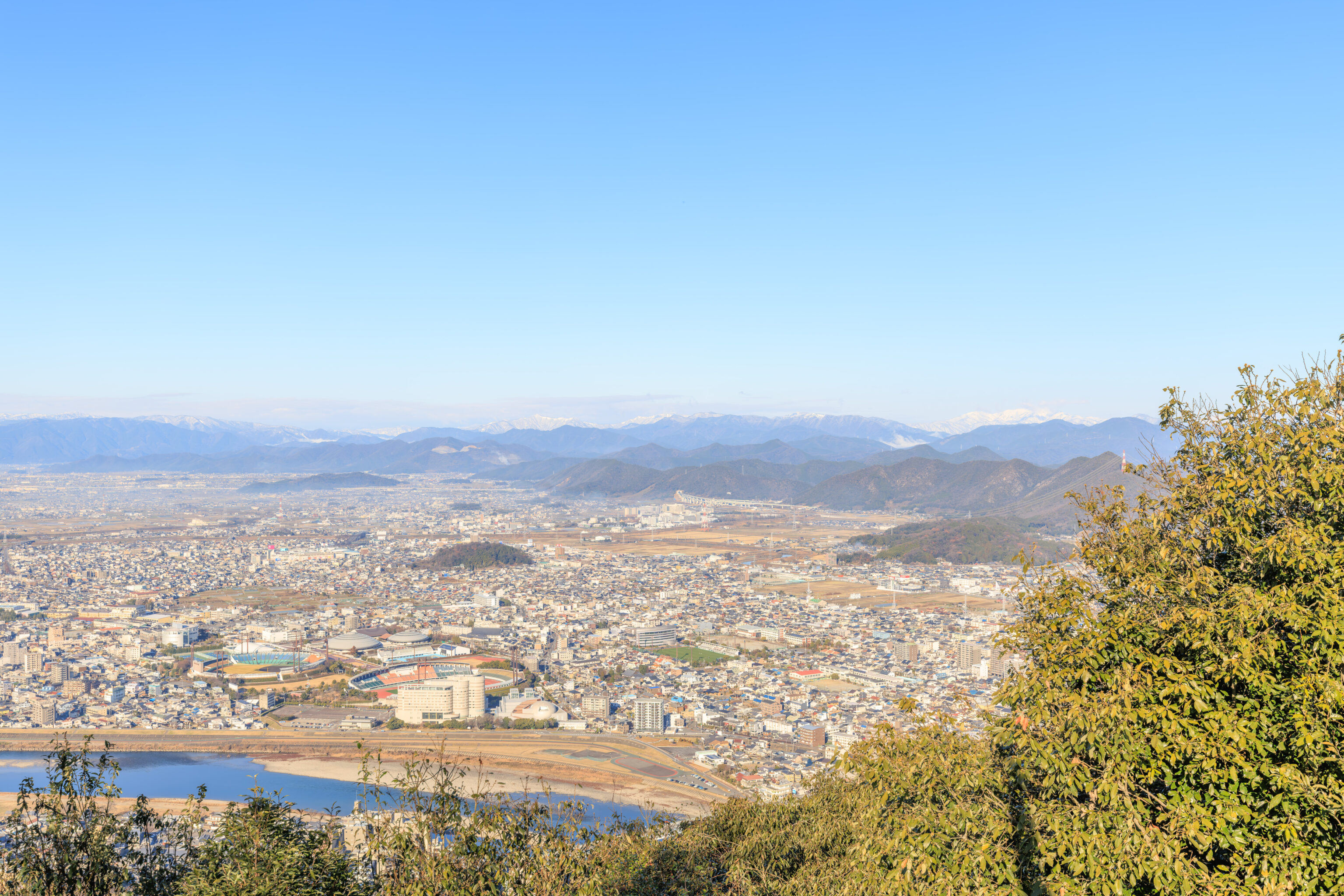
The view from the ridge looking to the northwest.
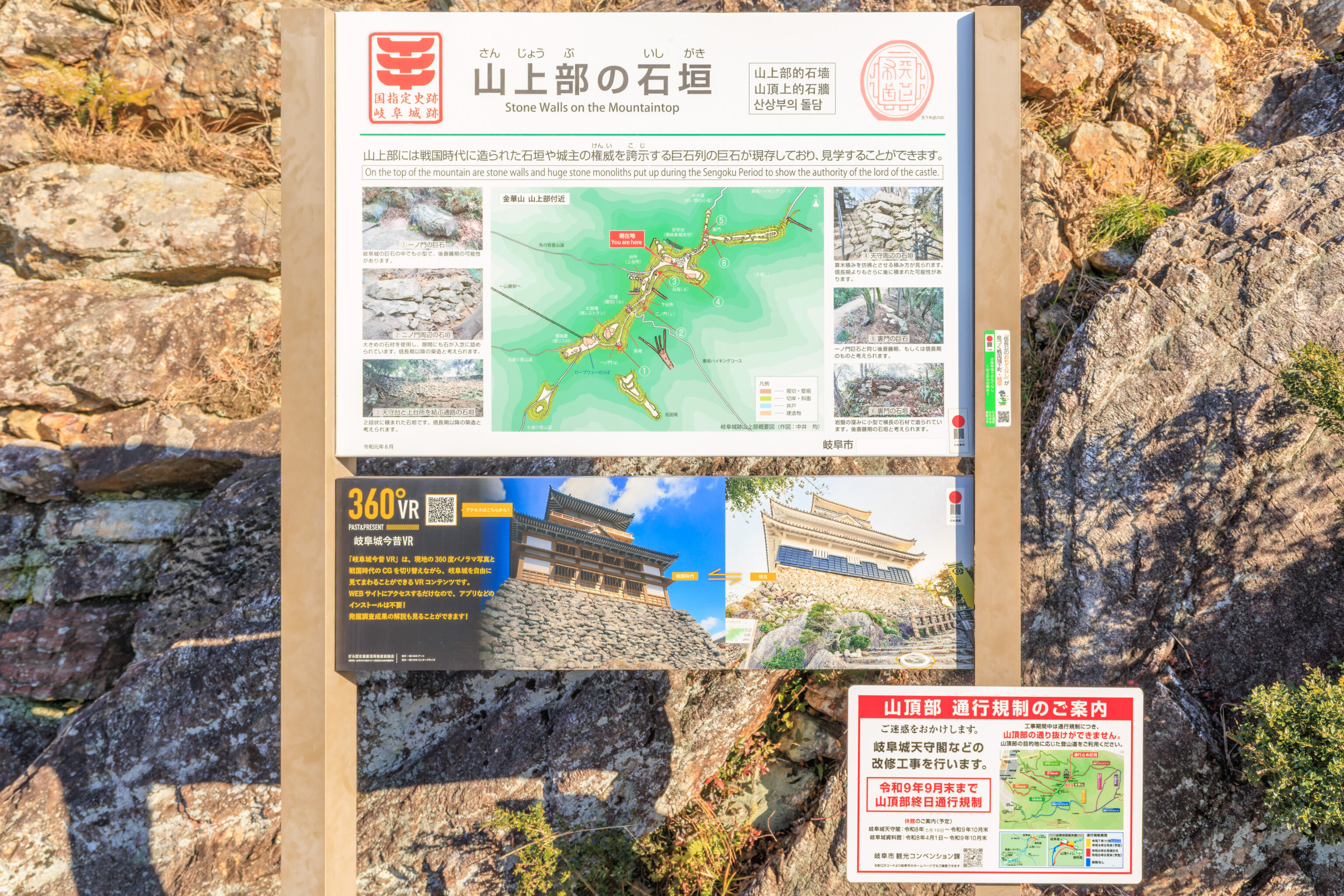
This map depicts various notable stone walls around the castle.
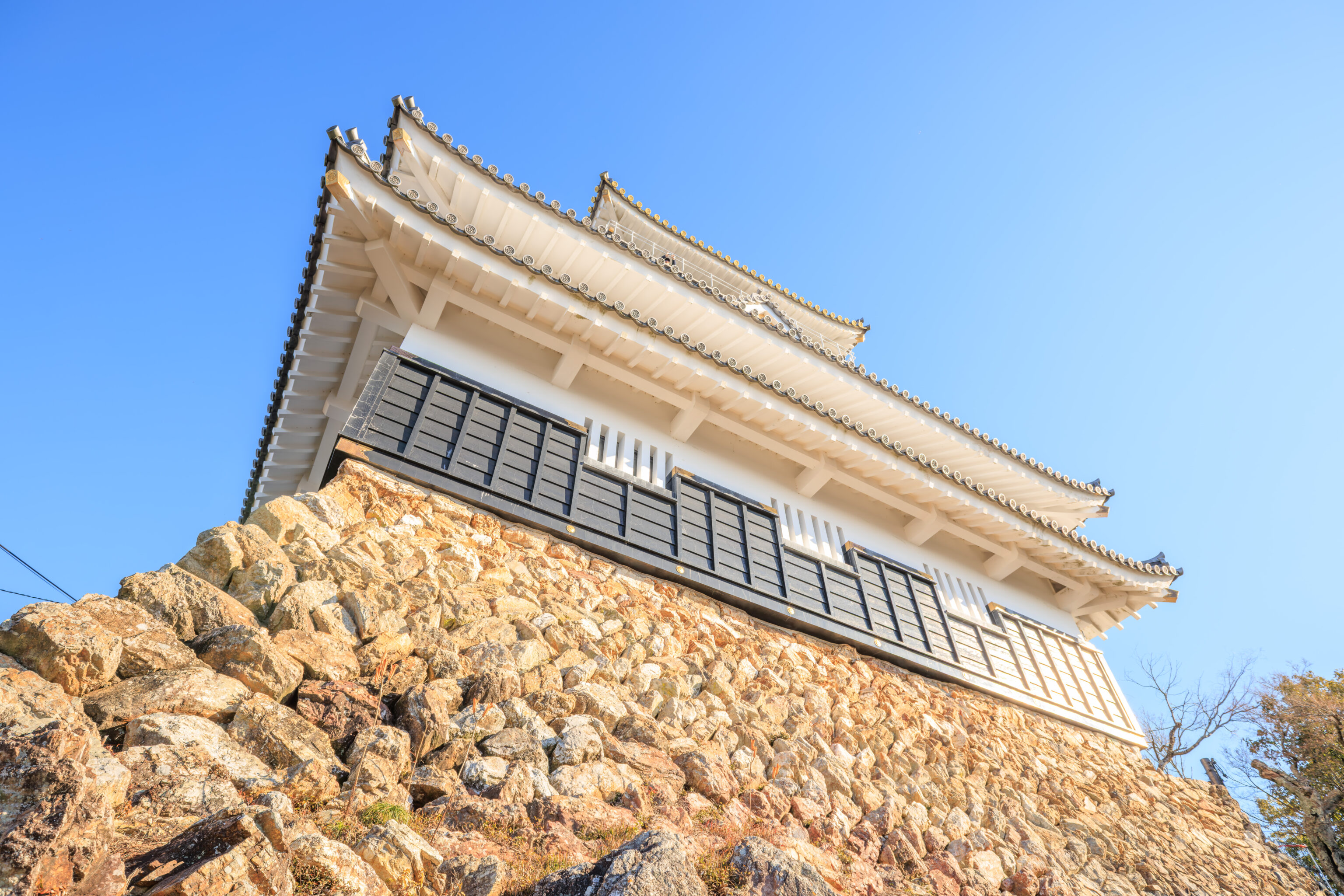
We continued below the base of the castle to reach its entrance on the east side.
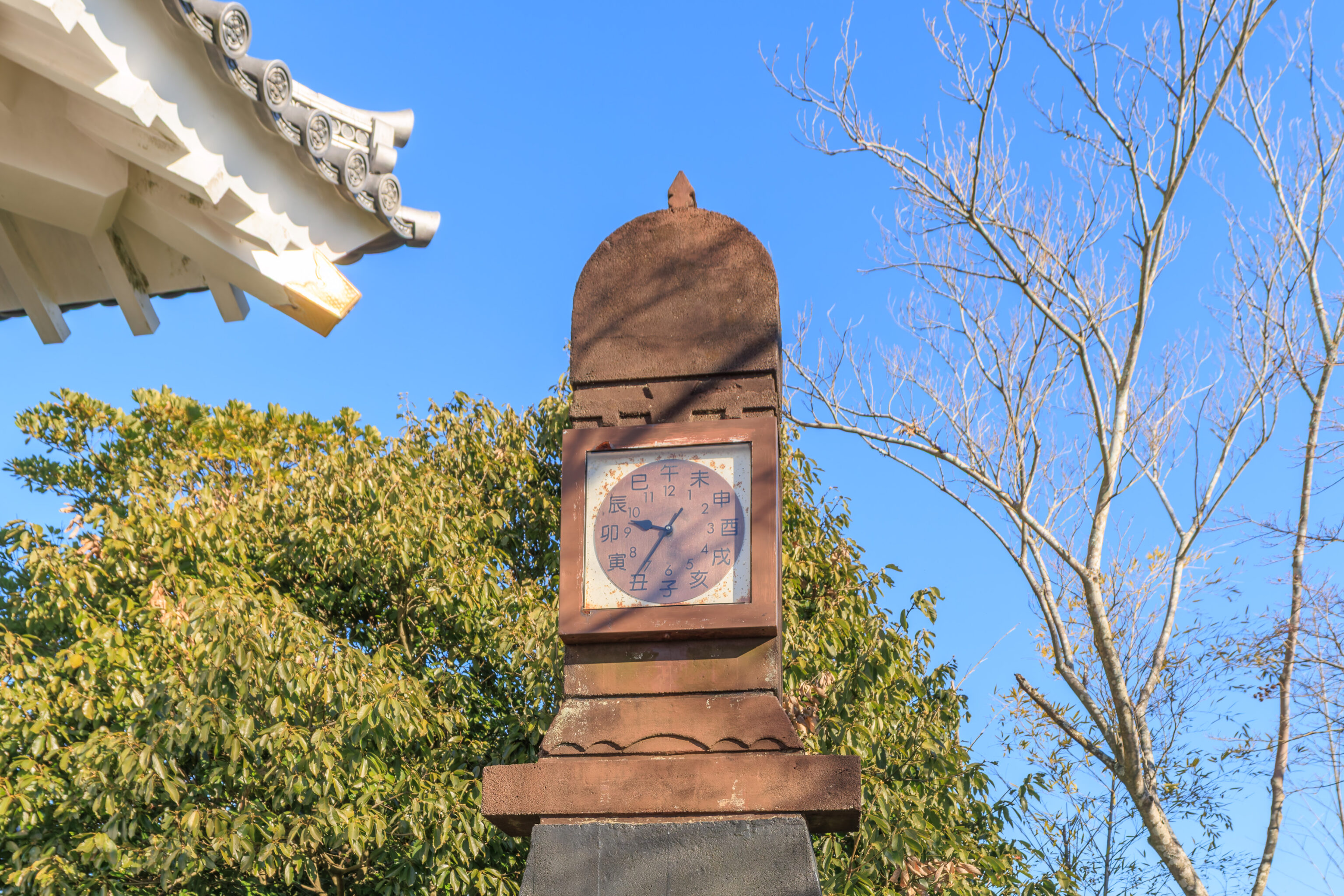
A sign is attached to the pedestal that this clock sits upon regarding the seismic safety, or lack thereof, of Gifu Castle:
[To Visitors to Gifu Castle]
The current Gifu Castle was reconstructed in 1956; as more than half a century has passed since then, a seismic assessment was conducted in the 2018 fiscal year. The results showed an "Is value" (seismic index of structure) ranging from 0.264 to 0.809, revealing that certain floors lack sufficient seismic performance to withstand a massive earthquake with a seismic intensity of upper 6 to 7.

In response, we have begun considering seismic retrofitting measures; however, the process will require a considerable amount of time to complete.

We ask all visitors to Gifu Castle to understand this situation. Furthermore, in the event of an earthquake, please remain calm and follow the instructions of the staff.
– Text from the sign below the clock, read using Google Gemini and translated using Google Translate.
There wasn’t any information about this specific clock but there was a sign that described this type of clock:
Castle Clocks
Also known as *daimyo* clocks or *wa-dokei* (traditional Japanese clocks), these timepieces trace their origins in Japan to a mechanical clock presented by Francis Xavier to the Ouchi clan of Suo Province (present-day Yamaguchi Prefecture). The clocks of that era were wall-mounted models that were complex to operate. Consequently, Japanese clockmakers applied their ingenuity to develop the *yagura-dokei* (tower clock)—a uniquely Japanese design featuring a dial marked with the twelve signs of the Chinese zodiac—achieving a level of precision unsurpassed anywhere in the world. Production of these traditional clocks ceased in November 1872 (the fifth year of the Meiji era) when the lunar calendar was replaced by the solar calendar.
– Text from the sign nearby, read using Google Gemini and translated using Google Translate.
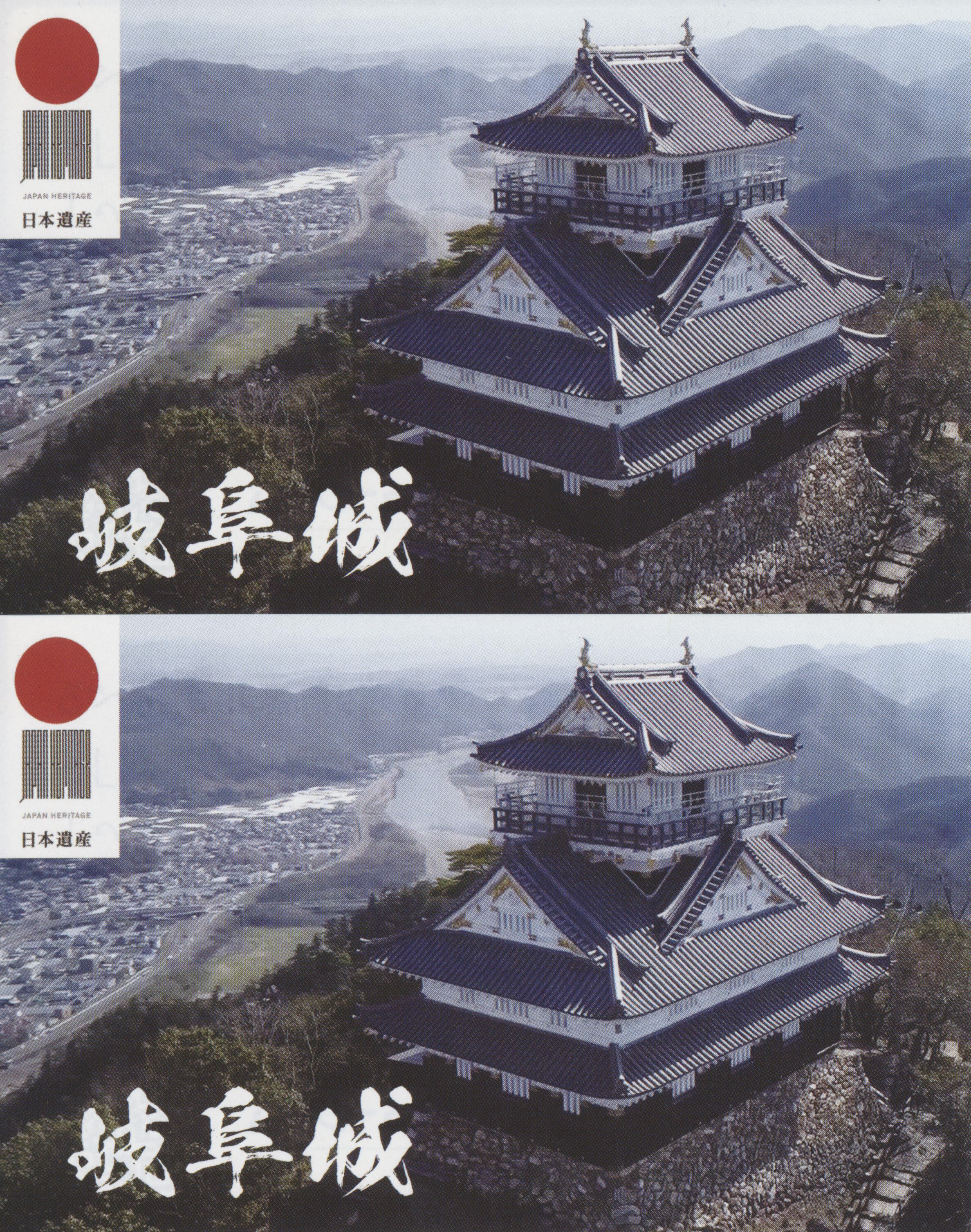
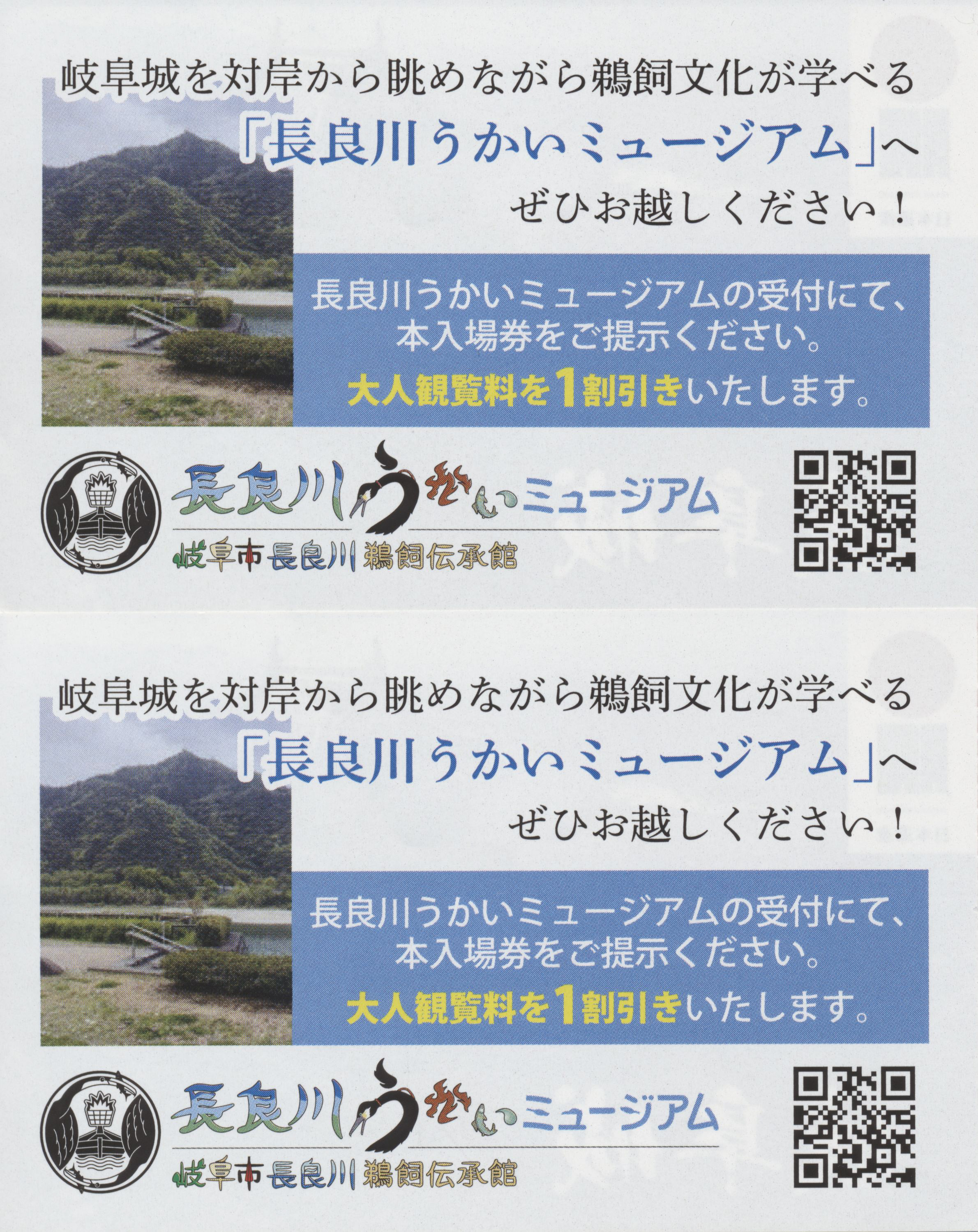
We purchased entry tickets at the castle.
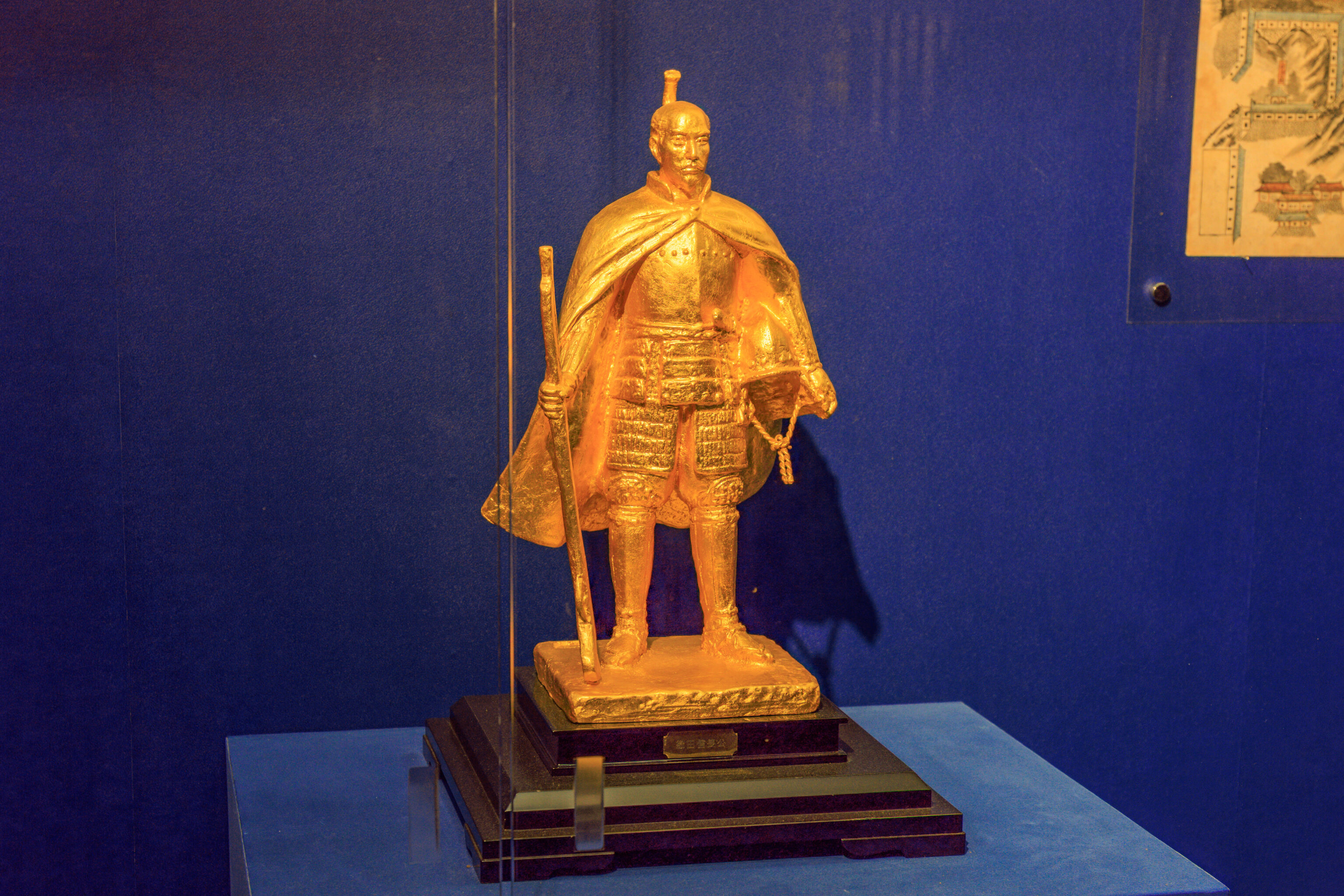
This small statue of Oda Nobunaga is a model of the much larger statue at Gifu Station.
Golden Statue of Oda Nobunaga (Replica)
The golden statue of Lord Oda Nobunaga was erected in 2009 at the Nobunaga Yume Hiroba (Nobunaga Dream Plaza) outside the north exit of JR Gifu Station, funded by citizen donations to commemorate the 120th anniversary of Gifu City's municipal incorporation.

The structure stands approximately 8 meters tall, including the pedestal, with the statue itself measuring about 3 meters in height and featuring a triple-layer gold leaf finish; it depicts Nobunaga wearing a cape, holding a Tanegashima matchlock gun in his right hand and a Western-style helmet in his left.
– Text from a plaque below this statue, read using Google Gemini and translated using Google Translate.
We actually saw the orignial statue at the station, although from far away.
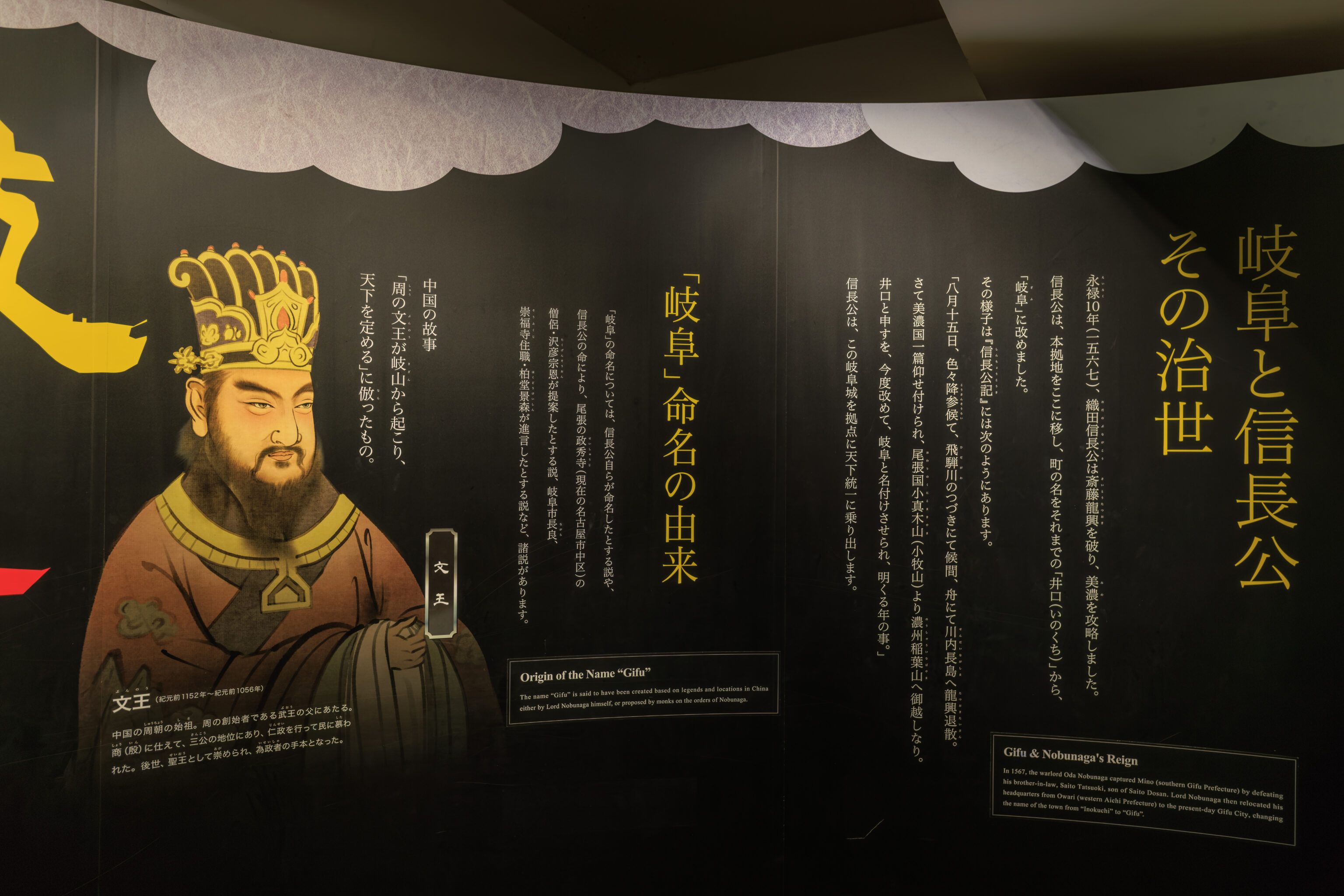
Gifu and Lord Nobunaga: His Reign
In the 10th year of Eiroku (1567), Oda Nobunaga defeated Saito Tatsuoki and conquered the Mino region. Nobunaga relocated his base of operations to this site and renamed the town from "Inokuchi"—as it had previously been known—to "Gifu."

The *Shinchō Kōki* (The Chronicle of Lord Nobunaga) describes these events as follows:

"On the 15th day of the eighth month... Tatsuoki retreated by boat to Kawauchi-Nagashima. Having brought the province of Mino under his control, Nobunaga moved his headquarters from Mt. Komaki in Owari Province to Mt. Inaba in Mino Province. He renamed the place 'Inokuchi' to 'Gifu'—an event that took place the following year."

Using Gifu Castle as his base, Nobunaga embarked on his campaign to unify the realm.

The Origin of the Name "Gifu"
There are various theories regarding the naming of "Gifu": one holds that Lord Nobunaga named it himself; another suggests it was proposed by Takugen Sōon, a monk from Seishu-ji Temple in Owari (located in present-day Naka Ward, Nagoya) at Nobunaga's behest; and yet another posits that it was recommended by Hakudō Keishin, the head priest of Sōfuku-ji Temple in Nagara, Gifu City.

Based on the Chinese historical anecdote:
"King Wen of Zhou rose from Mount Qi and unified the realm."

King Wen (1152 BC–1056 BC)
The progenitor of the Zhou Dynasty in China and the father of King Wu, the dynasty's founder. He served the Shang (Yin) Dynasty, holding the rank of *Sangong* (Three Ducal Ministers); through his benevolent rule, he earned the deep affection of the people. In later ages, he was revered as a sage-king and served as a model for rulers.
– Text from the wall photographed above, read using Google Gemini and translated using Google Translate.
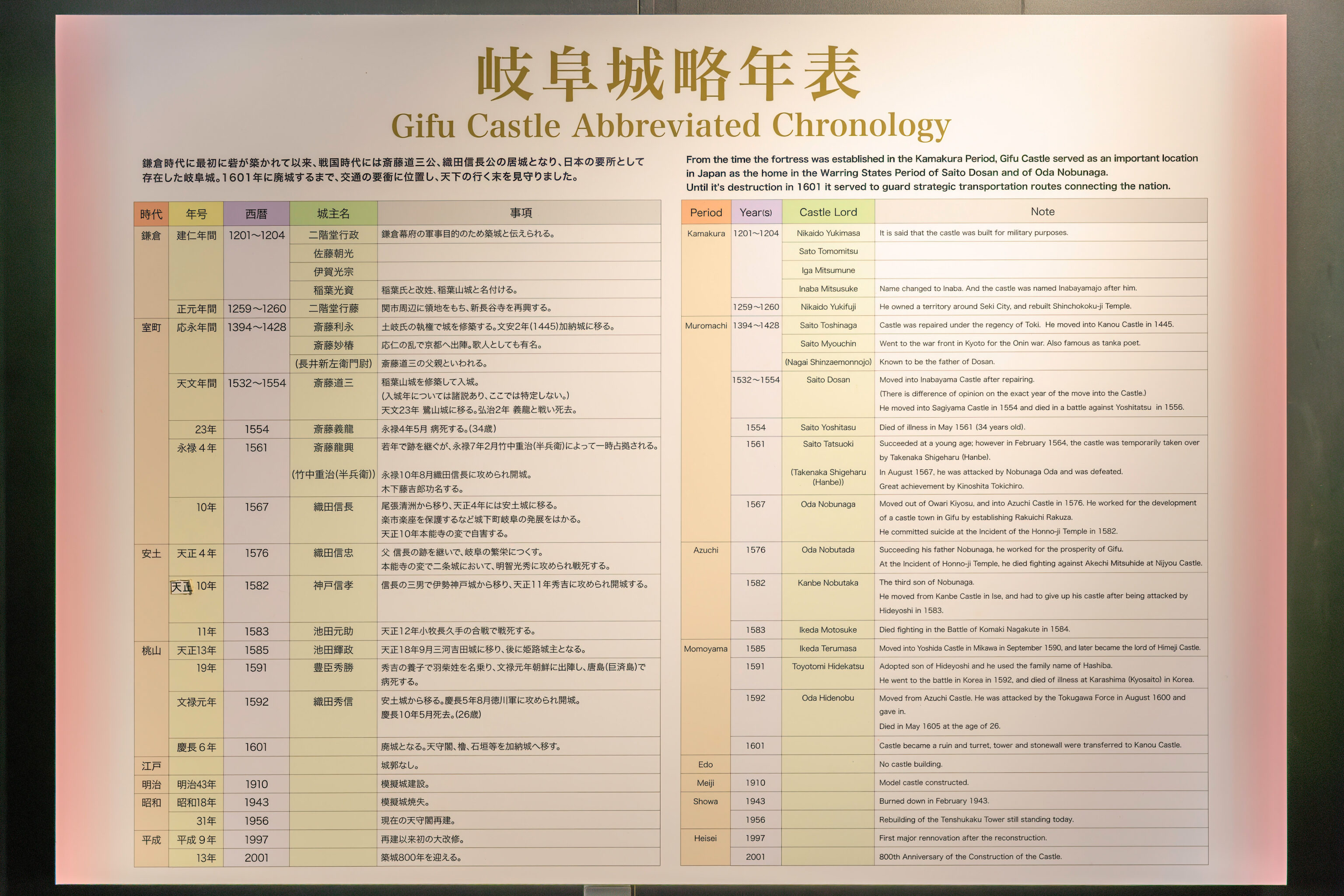
This sign provided a full chronology of the castle. Many of the events listed were described on the two signs describing the Past Lords of Gifu Castle that we saw on our way here.
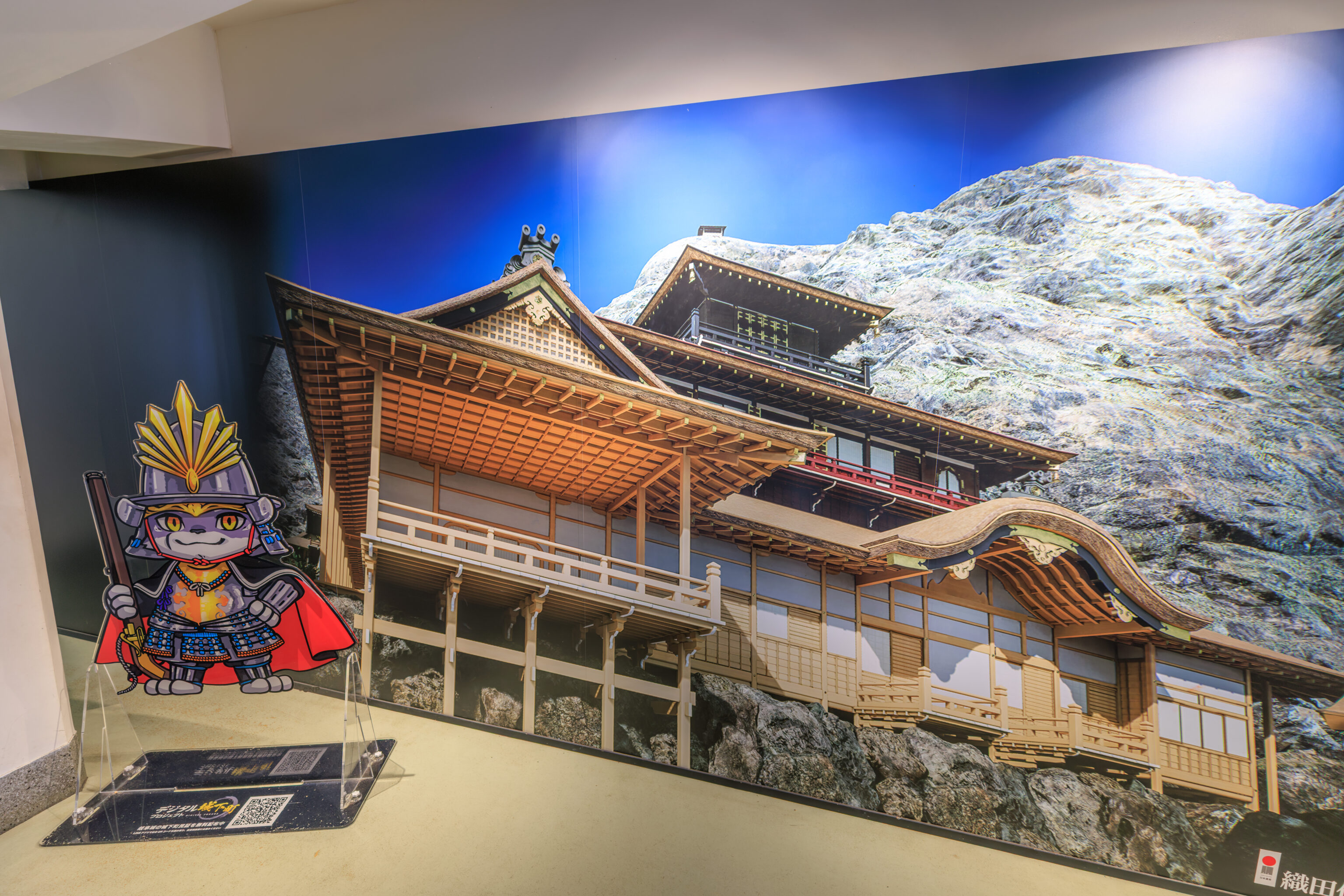
Gifu Castle wasn’t limited to the small castle keep that is here today. There were many other larger buildings below.
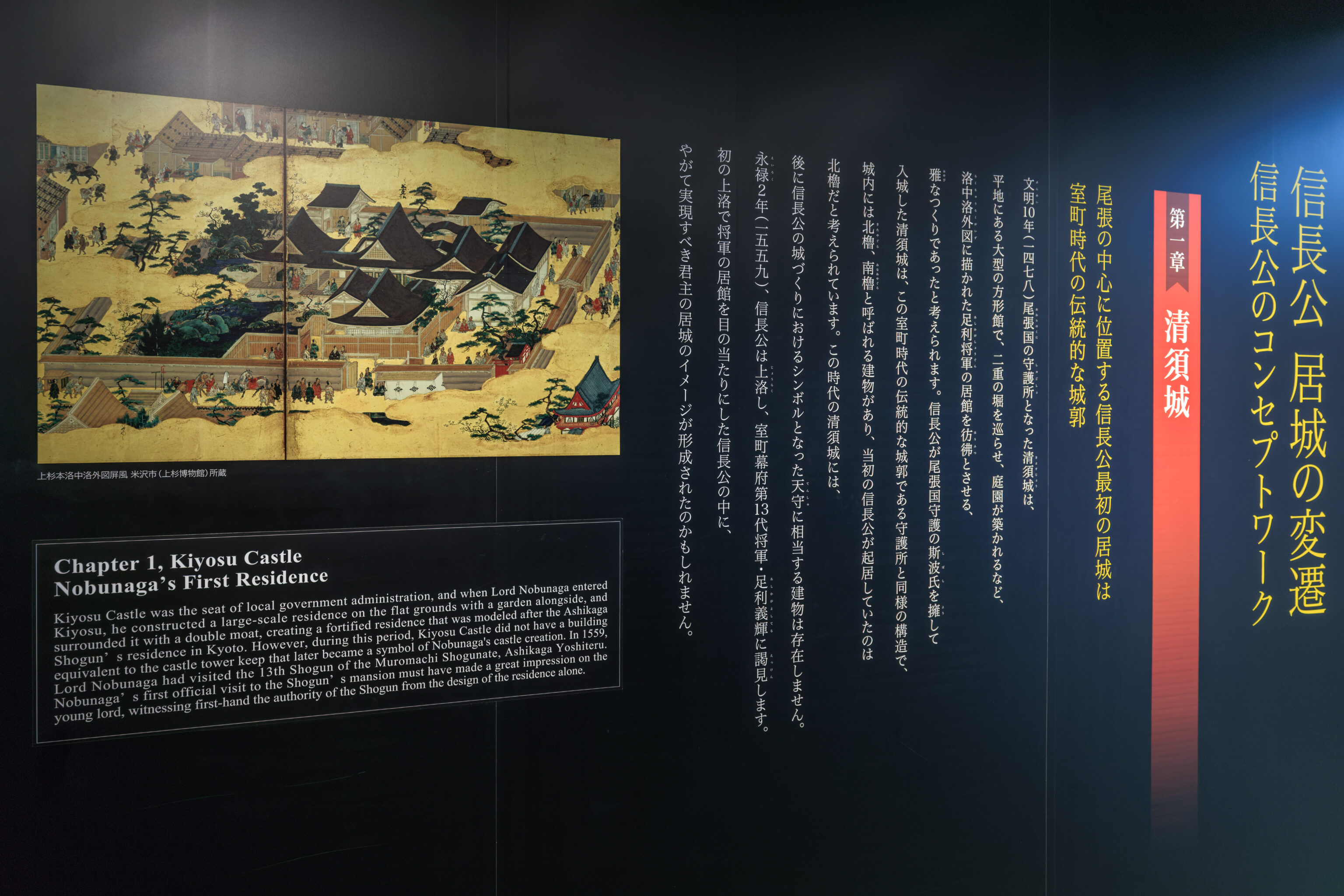
The Evolution of Lord Nobunaga's Castles: Lord Nobunaga's Conceptual Approach

Chapter 1: Kiyosu Castle
Lord Nobunaga's first castle, located in the heart of Owari, was a traditional castle of the Muromachi period.

Kiyosu Castle, which became the seat of the provincial governor (*shugo-sho*) for Owari Province in 1478, was a large, square-shaped fortified residence situated on flat land. Surrounded by a double moat and featuring constructed gardens, its elegant design is thought to have been reminiscent of the Ashikaga Shogun's residence as depicted in the famous *Rakuchū-Rakugai-zu* (Scenes In and Around the Capital) folding screens.

When Nobunaga entered Kiyosu Castle—bringing with him the Shiba clan, the hereditary governors of Owari—the castle retained the structural characteristics of a traditional Muromachi-period governor's seat. It included buildings known as the North Turret and the South Turret; the North Turret is believed to have served as Nobunaga's initial living quarters. Notably, the castle at this time lacked a *tenshu* (main keep)—a structure that would later become the hallmark of Nobunaga's castle-building style.

In 1559, Nobunaga traveled to the capital (*joraku*) and was granted an audience with Ashikaga Yoshiteru, the thirteenth shogun of the Muromachi Shogunate. Witnessing the shogun's residence firsthand during this visit may well have shaped Nobunaga's vision of what a sovereign's castle should be—a vision he would eventually bring to reality.
– Text from the wall photographed above, read using Google Gemini and translated using Google Translate.
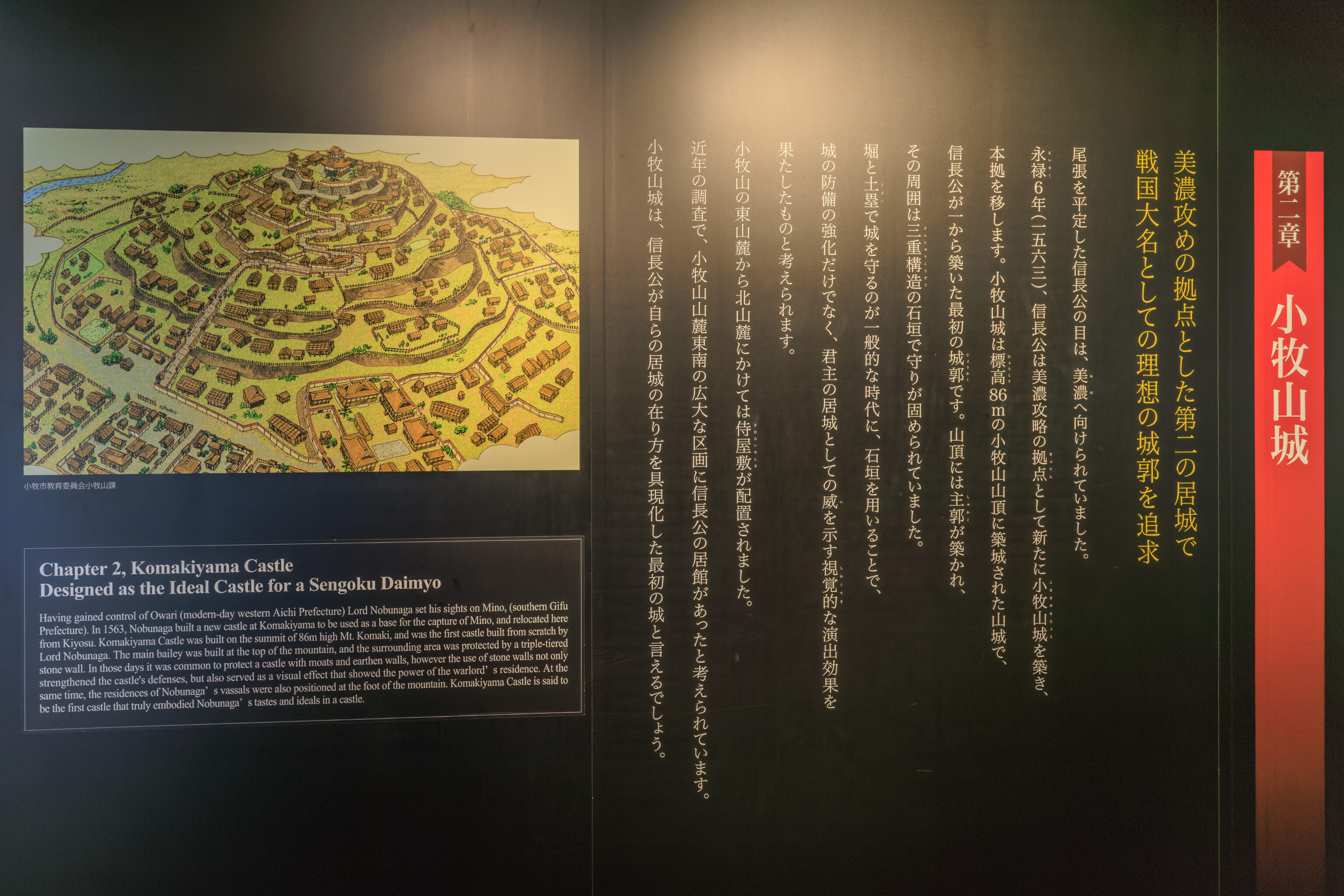
Chapter 2: Komakiyama Castle
A second castle serving as the base for the invasion of Mino, where he pursued the ideal castle design for a Sengoku daimyo.

Having pacified Owari, Lord Nobunaga turned his sights toward Mino.

In 1563, Lord Nobunaga built Komakiyama Castle as a strategic base for the conquest of Mino and relocated his headquarters there. Situated atop Mount Komaki—which rises 86 meters above sea level—this was the first castle Nobunaga built entirely from scratch. The main enclosure was constructed at the summit, fortified by a triple-layered stone wall.

In an era when castles were typically defended by moats and earthen ramparts, the use of stone walls not only bolstered the castle's defenses but also served a visual purpose: demonstrating the authority and prestige of the lord who resided there.

Recent surveys have revealed that samurai residences were laid out along the eastern and northern foothills of Mount Komaki.

Komakiyama Castle can be considered the first castle where Lord Nobunaga truly embodied his vision of what a lord's residence should be.
– Text from the wall photographed above, read using Google Gemini and translated using Google Translate.
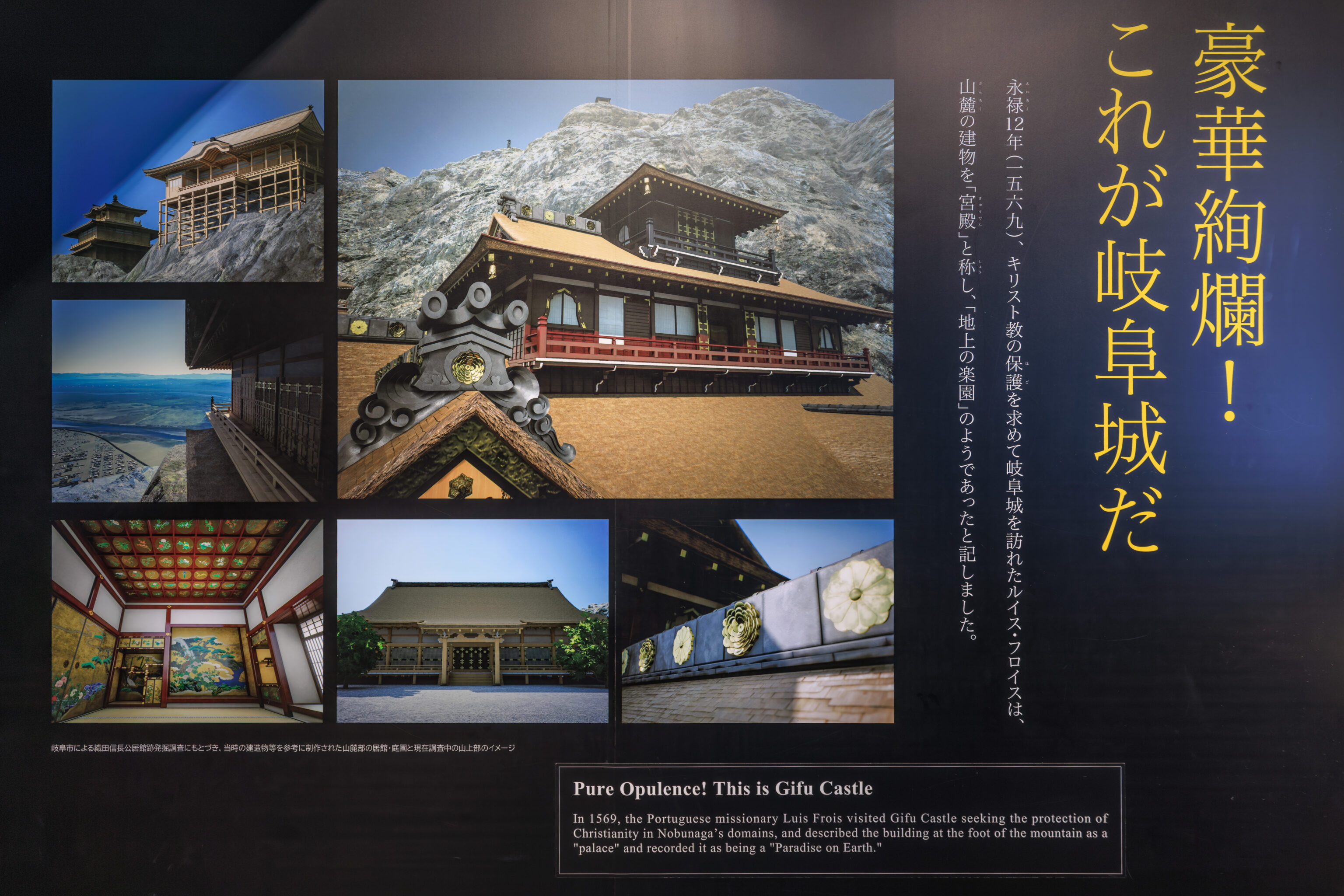
Opulent and magnificent! This is Gifu Castle.
In 1569, Luís Fróis visited Gifu Castle to seek protection for Christianity; he described the building at the foot of the mountain as a "palace" and likened it to an "earthly paradise."

An image showing the residence and gardens at the foot of the mountain—recreated based on Gifu City's archaeological excavations of Oda Nobunaga's residence and references to structures from that era—alongside the area at the summit currently under investigation.
– Text from the wall photographed above, read using Google Gemini and translated using Google Translate.
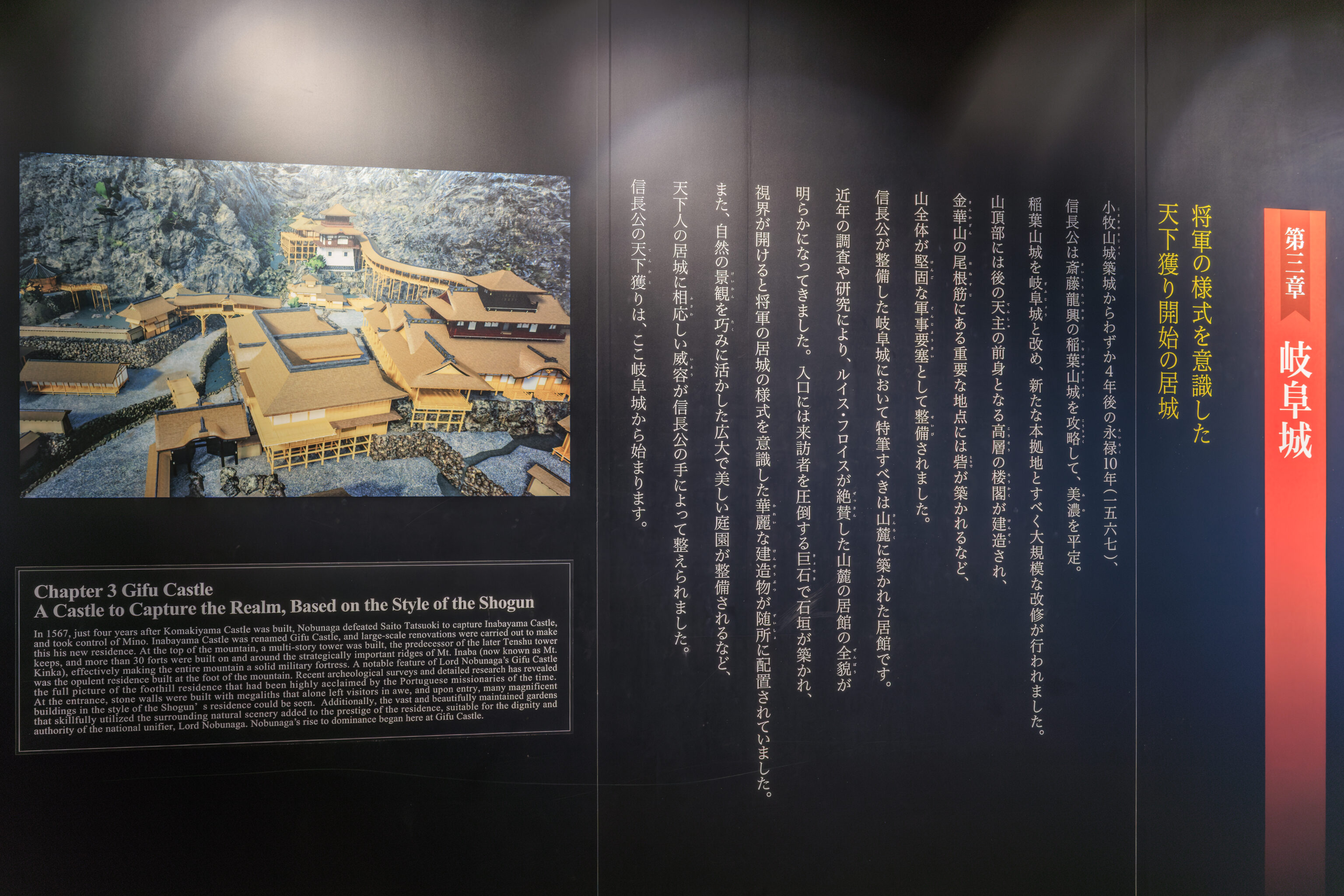
Chapter 3: Gifu Castle
A stronghold serving as the base for the campaign to conquer the realm, designed with the style of a Shogun in mind.

In 1567—just four years after the construction of Komakiyama Castle—Nobunaga conquered Inabayama Castle, held by Saito Tatsuoki, and pacified the Mino region.

He renamed Inabayama Castle "Gifu Castle" and undertook large-scale renovations to establish it as his new base of operations.

The entire mountain was transformed into a formidable military stronghold; a multi-story pavilion—the precursor to the later *tenshu* (castle keep)—was erected at the summit, and fortifications were built at strategic points along the ridges of Mount Kinka.

A particularly noteworthy feature of the Gifu Castle complex developed by Nobunaga was the residential palace built at the foot of the mountain.

Recent surveys and research have revealed the full scope of this residence, which was highly praised by the Jesuit missionary Luís Fróis. A massive stone wall was constructed at the entrance to overwhelm visitors, and beyond it lay a series of magnificent structures—designed with the style of a Shogun's residence in mind—arranged throughout the grounds. Lord Nobunaga also established a magnificent residence befitting a ruler of the realm, featuring a vast and beautiful garden that skillfully incorporated the natural landscape.

Lord Nobunaga’s quest to unify the nation began here at Gifu Castle.
– Text from the wall photographed above, read using Google Gemini and translated using Google Translate.
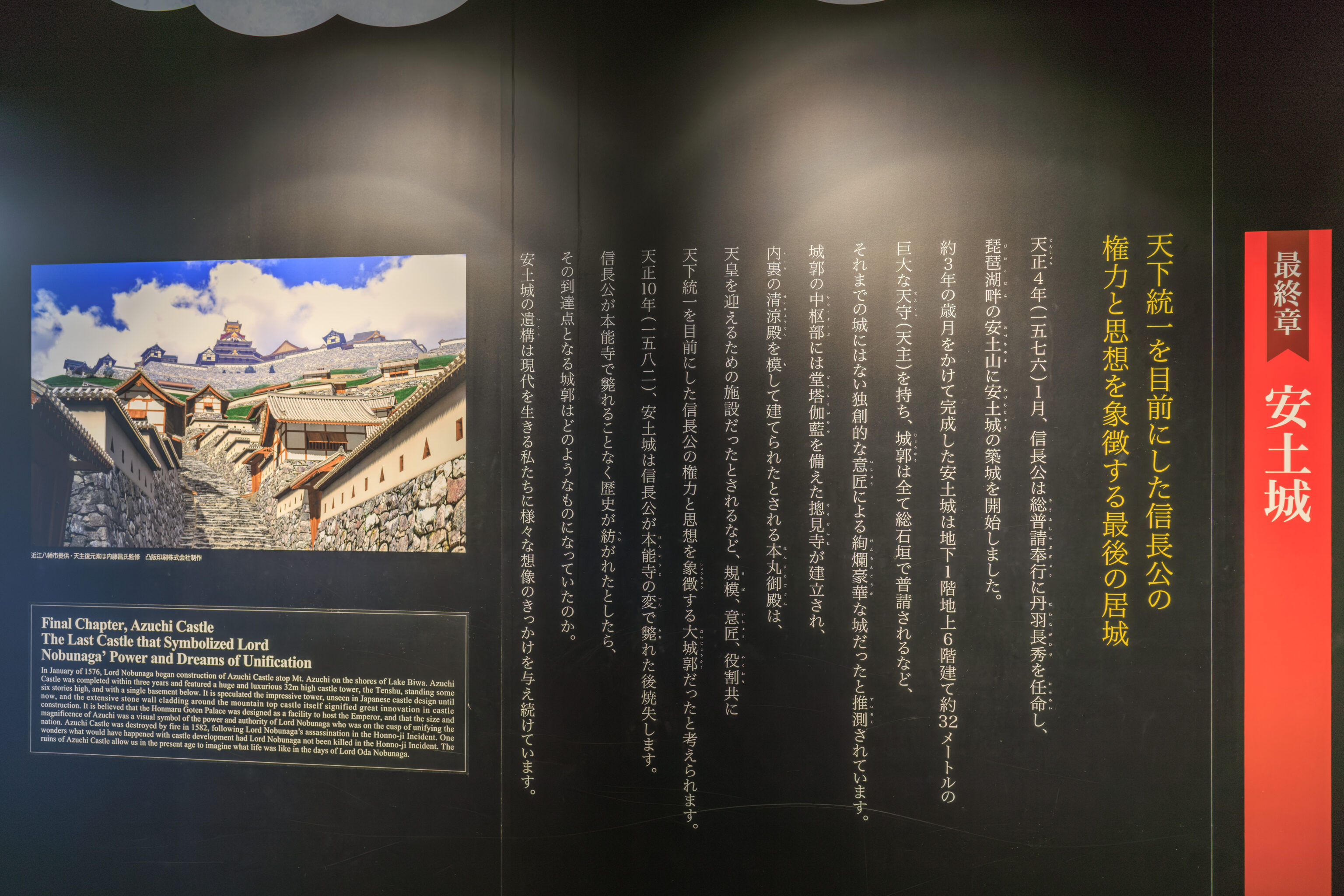
Final Chapter: Azuchi Castle
The final castle of Lord Nobunaga—symbolizing the power and ideology of a leader on the verge of unifying the realm.

In January 1576, Oda Nobunaga appointed Niwa Nagahide as the chief commissioner of construction and began building Azuchi Castle on Mount Azuchi, located on the shores of Lake Biwa.

Completed over a period of approximately three years, the castle featured a massive main keep—rising six stories above ground with one basement level and reaching a height of about 32 meters—and was constructed entirely with stone walls. It is believed to have been a magnificent, opulent structure characterized by a highly original design unlike any castle seen before.

Soken-ji Temple, complete with a full array of temple buildings, was erected in the castle's central precinct. Additionally, the Honmaru Palace—thought to have been modeled after the Seiryōden (Imperial Living Quarters) of the Imperial Palace and designed to host the Emperor—suggests that the castle was a monumental structure. In terms of scale, design, and function, it symbolized the power and vision of Nobunaga, who was on the verge of unifying the nation.

In 1582, Azuchi Castle burned down following Nobunaga's death in the Honnō-ji Incident. Had history unfolded without Lord Nobunaga falling at Honno-ji, what kind of castle would have stood as the ultimate culmination of his vision?

The remains of Azuchi Castle continue to spark the imagination of those of us living today.
– Text from the wall photographed above, read using Google Gemini and translated using Google Translate.
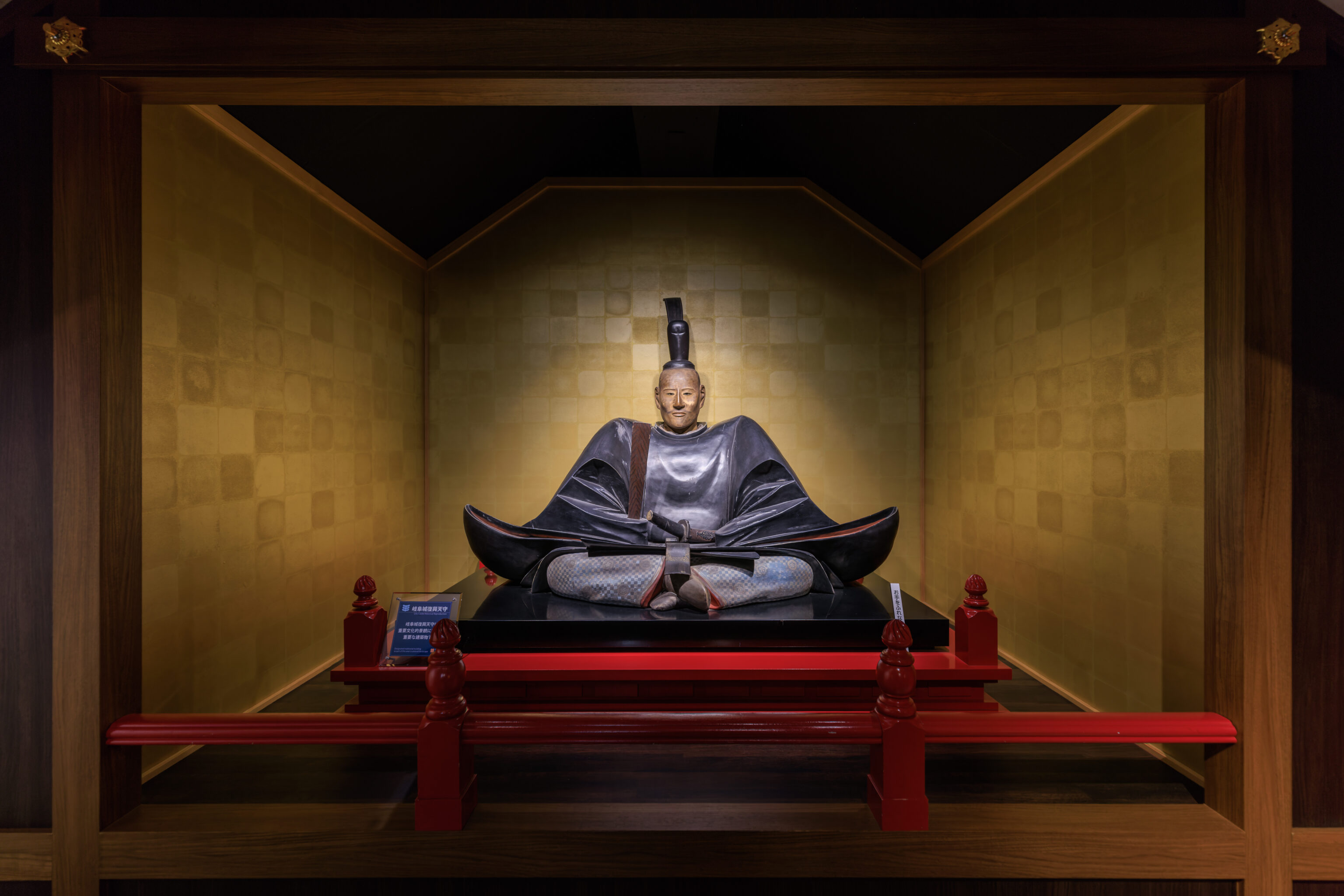
This wooden statue of Oda Nobunaga is a replica of the original in Soken-in at Daitoku-ji in Kyoto.
Wooden Seated Statue of Oda Nobunaga (Replica)
This wooden statue is a replica of the portrait sculpture enshrined in the main hall of Soken-in—a sub-temple built within the Daitoku-ji complex to serve as a memorial site for Lord Nobunaga, who perished in the Honno-ji Incident. It is a life-sized figure depicted in the formal *sokutai* court attire, exuding a dignified air.

The original seated statue at Soken-in is carved from Japanese cypress (*hinoki*). The head and body were crafted from separate pieces of wood; the head consists of two pieces joined front-to-back, while the torso is constructed like a box by assembling several pieces of wood—primarily three for the front and three for the back. It is a polychrome statue featuring inlaid crystal eyes (*gyokugan*). The outer robe (*hō*) is black, and the outer trousers (*ue-no-hakama*) feature a pattern of five-petaled *mokkō* (quince blossom) crests set against a black-and-white checkered background. An inscription in vermilion lacquer on the base of the statue records that it was created on an auspicious day in the fifth month of Tenshō 11 (1583) by the master sculptor Kōsei (known as Shichijō Daibusshi Kunaikyō Hōin). Given that the memorial service marking the first anniversary of Lord Nobunaga’s death—following his ritual suicide at Honno-ji on June 2, 1582—was held at Daitoku-ji on June 2, 1583, it is believed that this statue was created specifically for that occasion.
– Text from a sign, read using Google Gemini and translated using Google Translate.
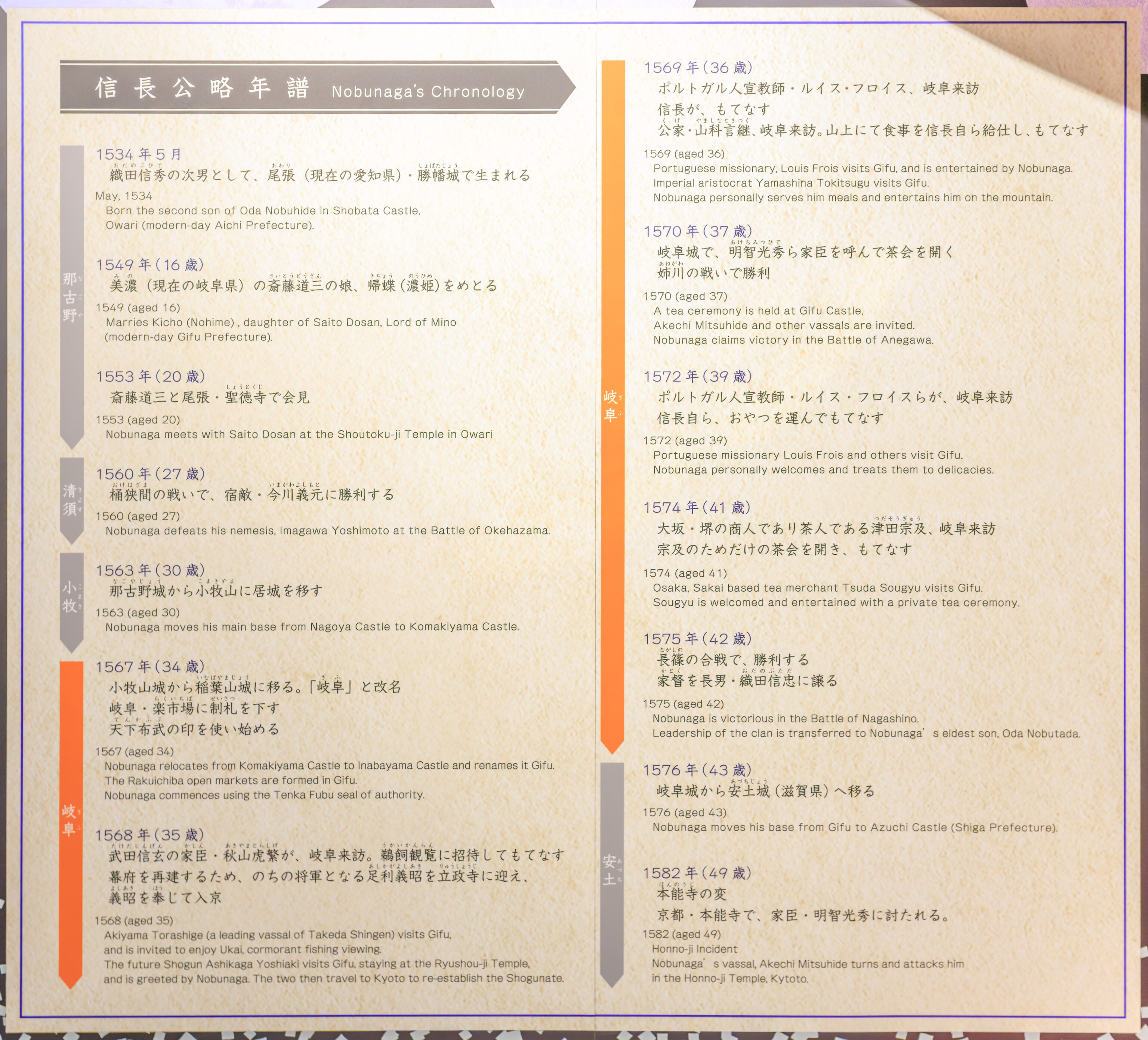
This sign contains a chronology of Oda Nobunaga’s life.
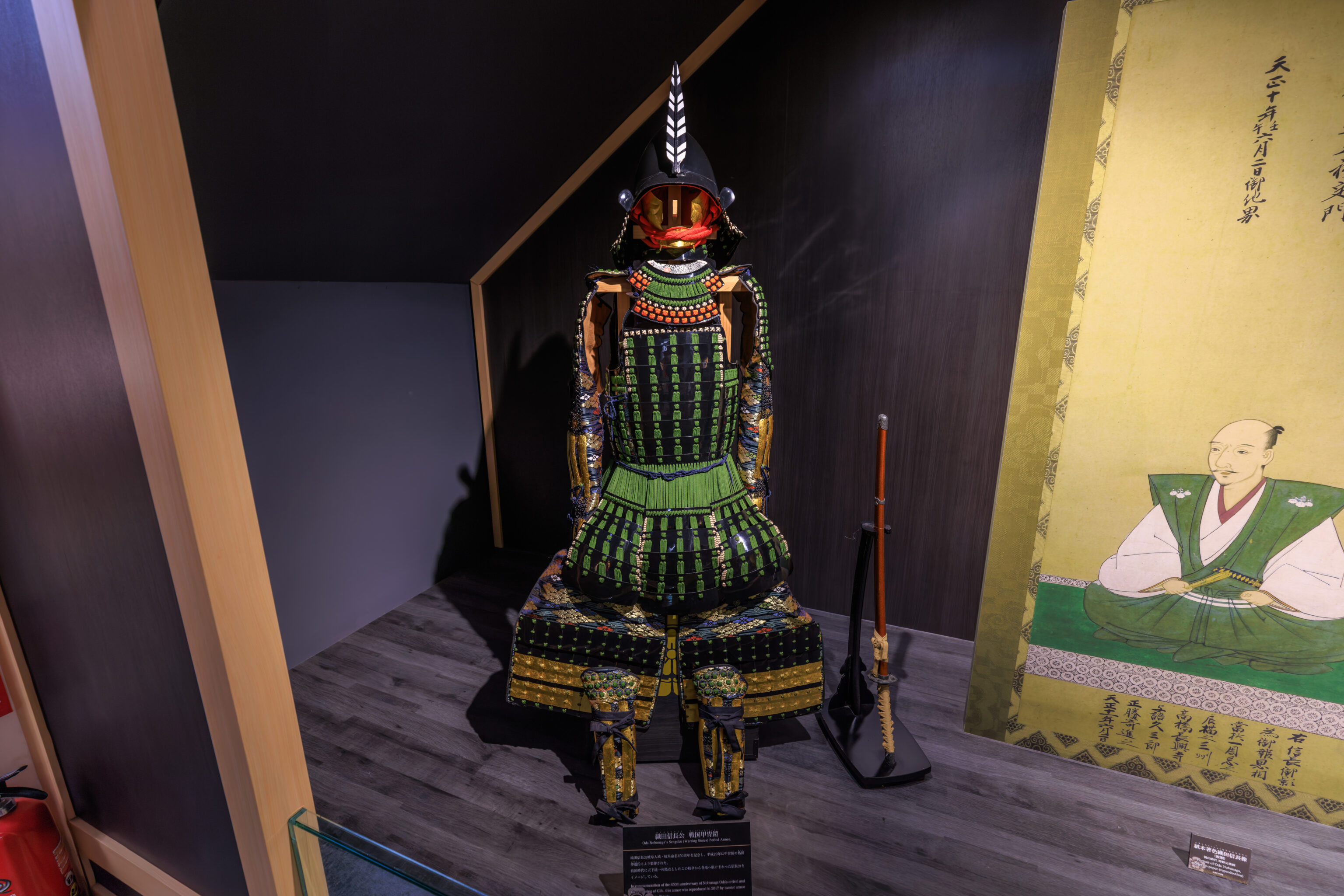
A modern replica of Oda Nobunaga’s armor.
Sengoku Period Armor of Lord Oda Nobunaga
This piece was created in 2017 by armor maker Shindo Atsuta to commemorate the 450th anniversary of Lord Oda Nobunaga’s entry into Gifu Castle and the naming of the city "Gifu."

It depicts the image of Lord Nobunaga as he rode out to various regions from Gifu—his base for unifying the country during the Warring States period.
– Text from the sign below the armor, read using Google Gemini and translated using Google Translate.
Unfortunately, we didn’t photograph the artwork next to the armor.
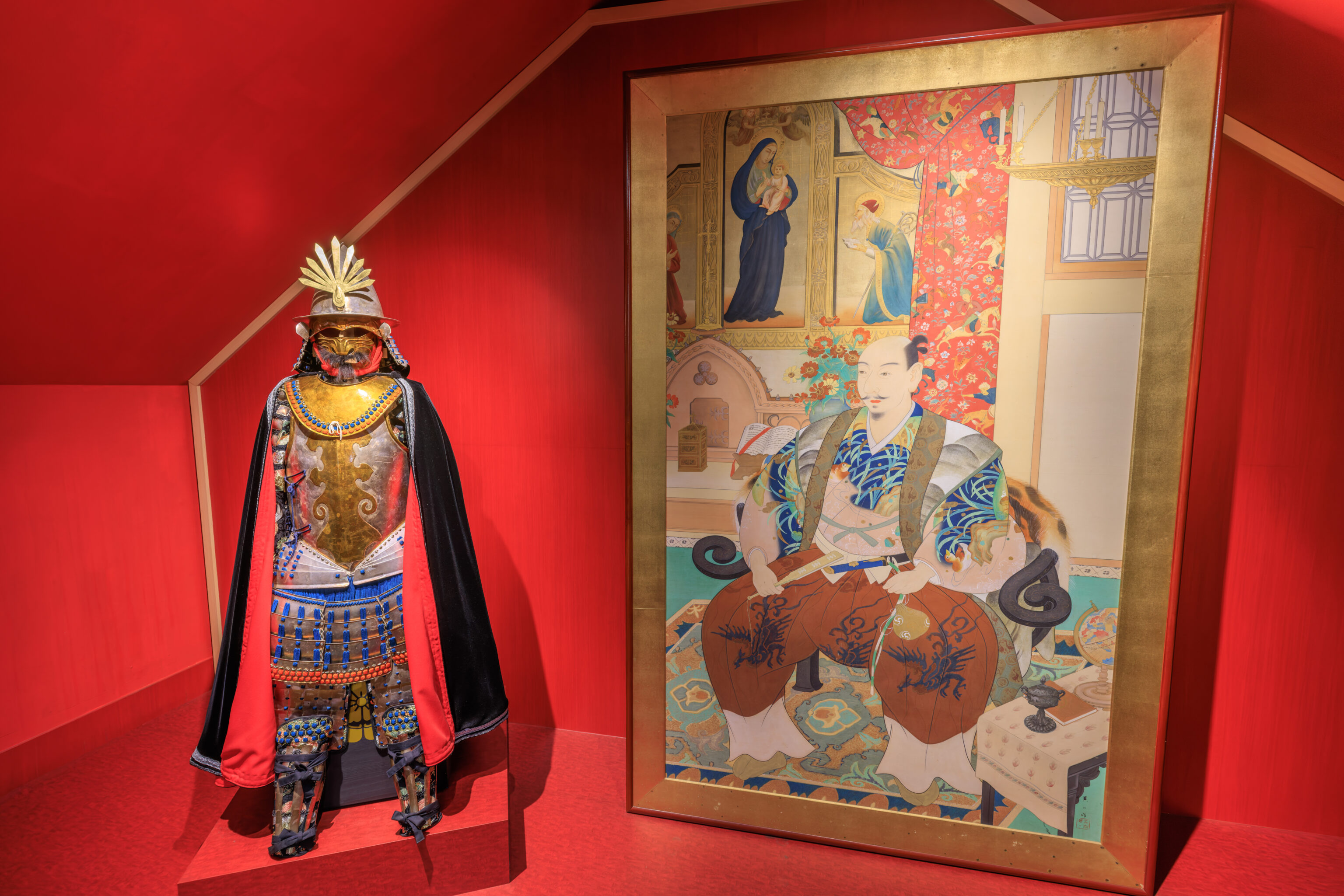
A modern replica of Oda Nobunaga‘s Nanban inspired armor. We learned while we were in Nagasaki about the Nanban trade.
Lord Oda Nobunaga: Nanban-style Armor with Silver Leaf Overlay
This suit of armor was created in 2017 by armor maker Shindo Atsuta to commemorate the 450th anniversary of Lord Oda Nobunaga’s entry into Gifu Castle and the naming of the city of Gifu.

It is modeled after the *Nanban* (Western-style) armor said to have been worn by Lord Nobunaga—a leader with a global outlook—and features a velvet-style *Nanban* cape draped over the shoulders.
– Text from a sign below the armor, read using Google Gemini and translated using Google Translate.
Additional signs described Oda Nobunaga’s interactions with the European world:
Lord Nobunaga, who set his sights on the world.
During the era in which Lord Nobunaga lived, the world was at the height of the Age of Discovery; European nations—led by Portugal and Spain—were undertaking global voyages, discovering new sea routes and continents, and aggressively expanding overseas.

Japan was recognized globally as an island nation in the Far East, and numerous missionaries—such as Francis Xavier and Luís Fróis of the Catholic Jesuit order, which championed "global evangelization"—visited the country to spread the faith.

In 1569, the Portuguese missionary Luís Fróis met Lord Nobunaga for the first time at the construction site of Nijo Castle; having gained Nobunaga's trust, he was granted permission to propagate Catholicism within the Kinai region.

Through his encounter with Fróis, Lord Nobunaga gained knowledge of Western scientific concepts and a broader understanding of the world; this prompted revolutionary changes in his governance and military tactics, effectively spearheading Japan's transition from the medieval to the early modern era.
– Text from a sign, read using Google Gemini and translated using Google Translate.
Luis Frois's Account of His Visit to Gifu Castle
The Portuguese missionary Luís Fróis visited Gifu to seek protection for Christianity and stayed for about eight days. During his visit, he was warmly welcomed and hospitably treated not only by Lord Nobunaga but also by his retainers.

In his *History of Japan*, Fróis provides a detailed account of the magnificence of Lord Nobunaga's residence and the generous hospitality he received.
– Text from a sign, read using Google Gemini and translated using Google Translate.
We continued on to the top floor of the castle.
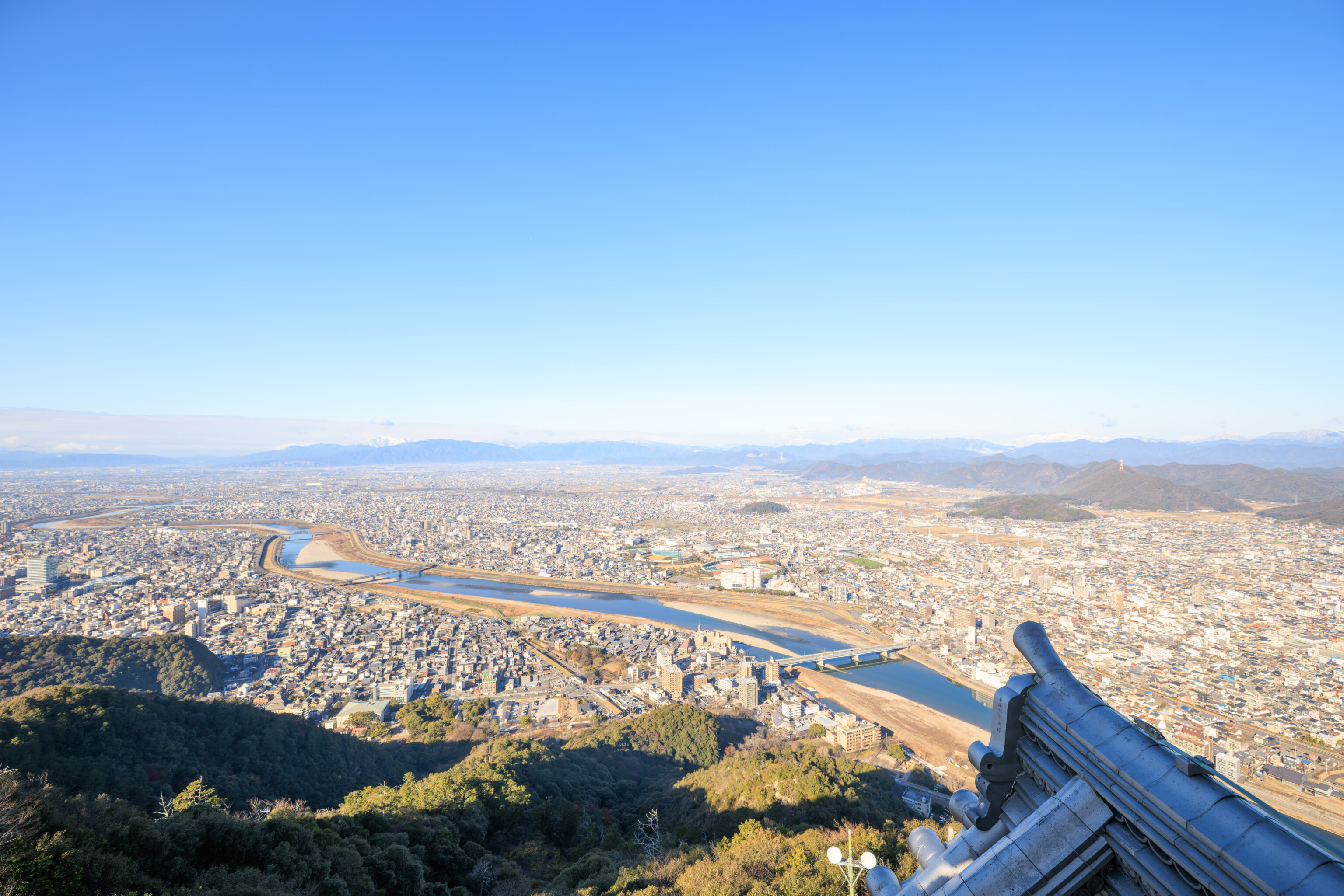
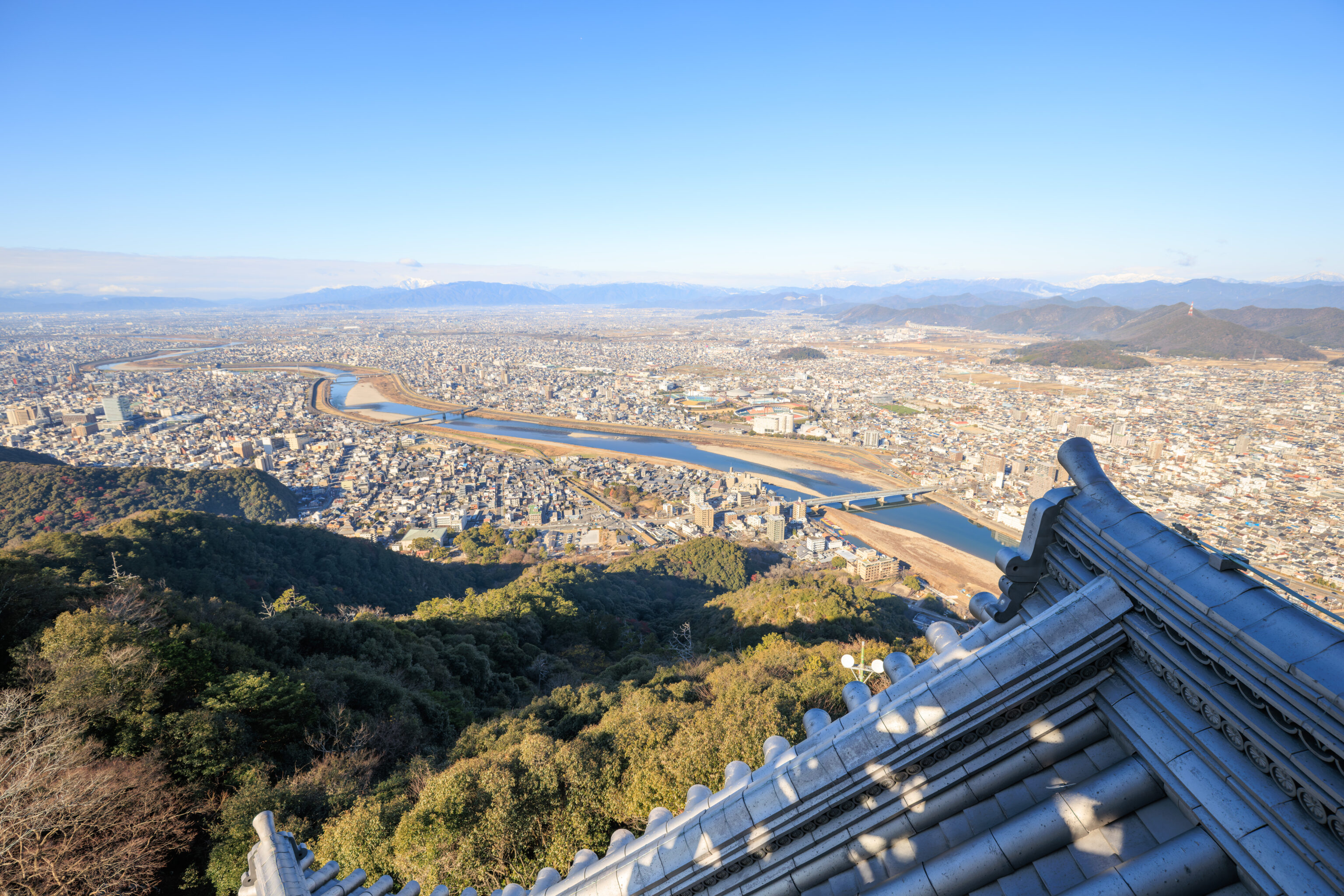
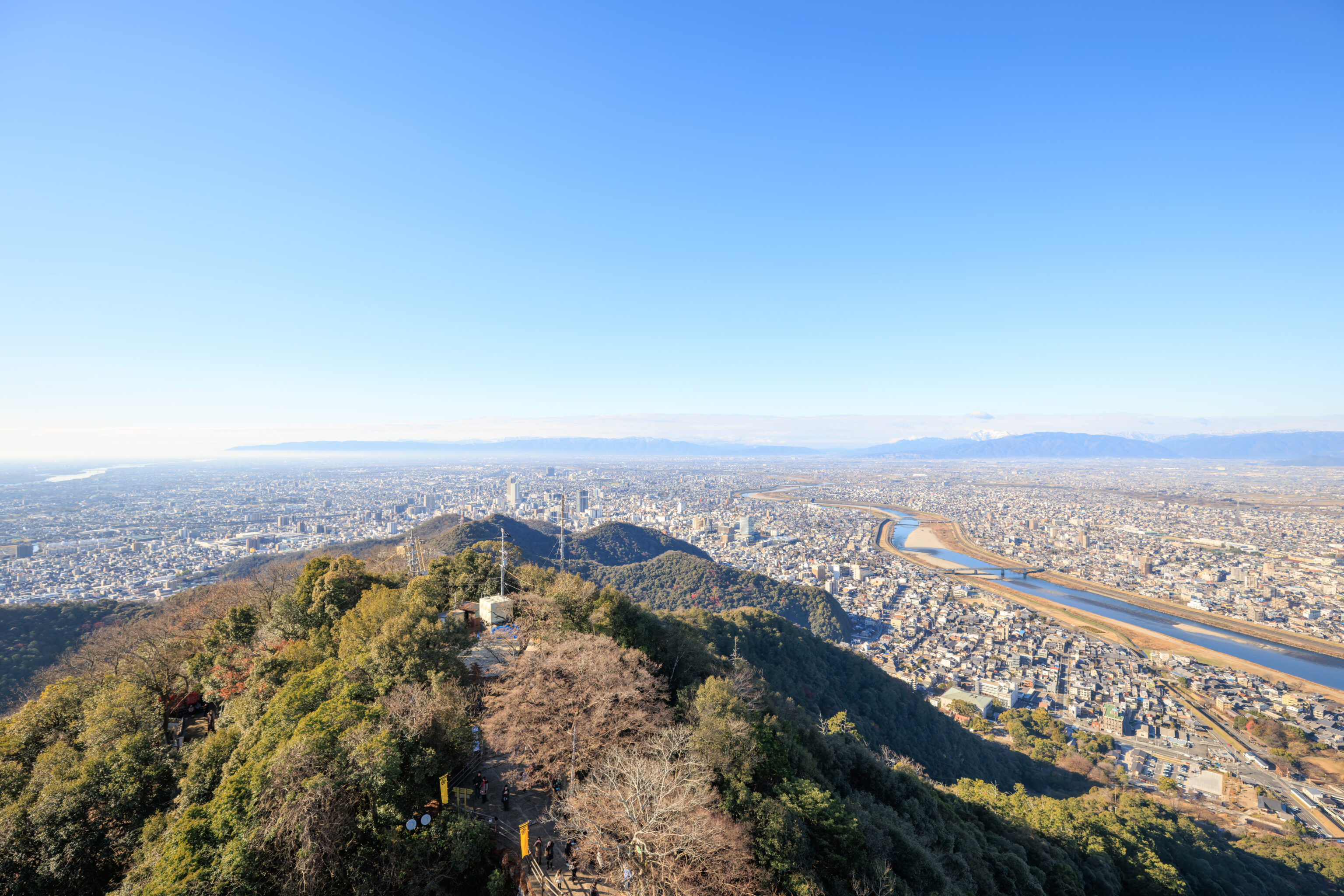
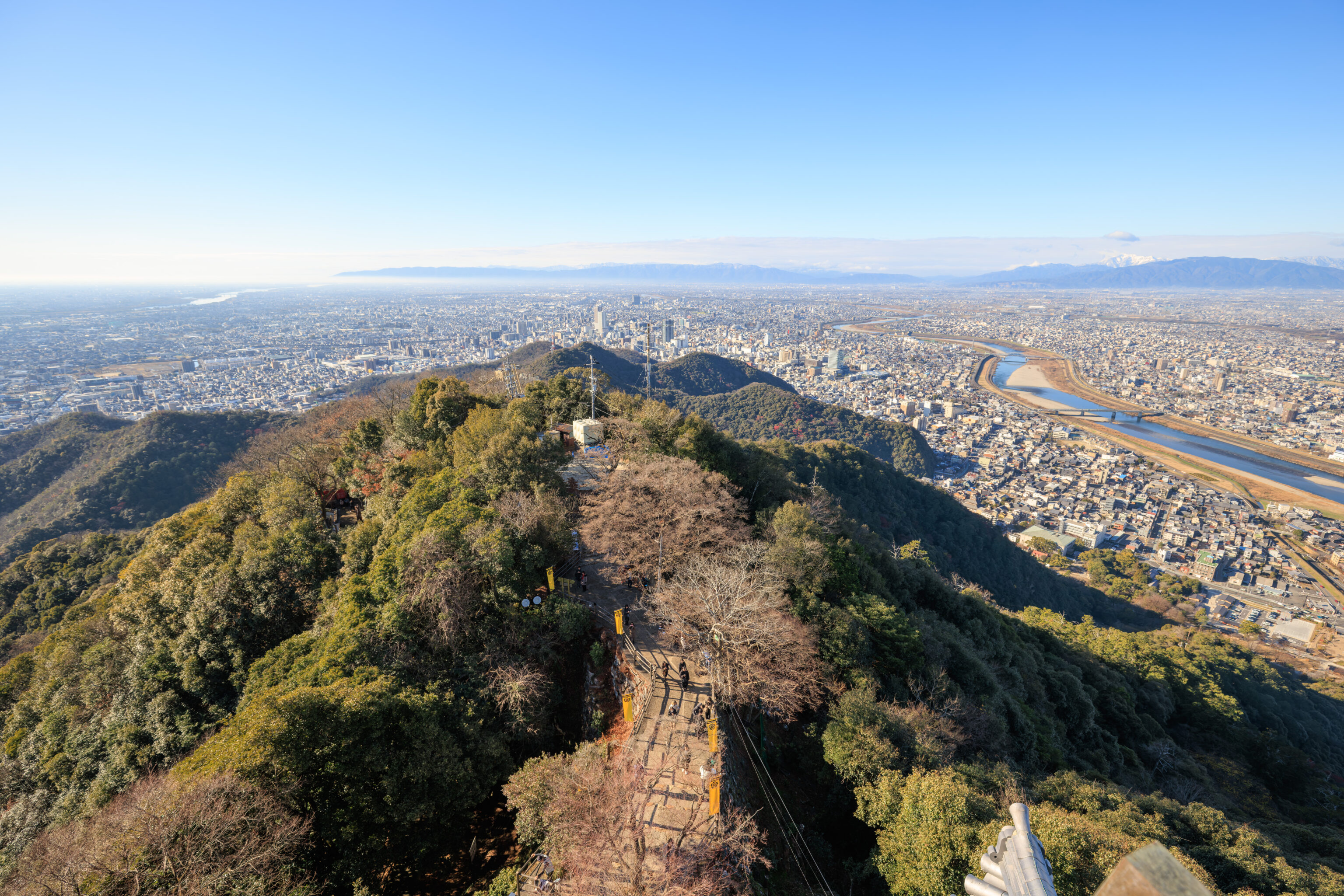
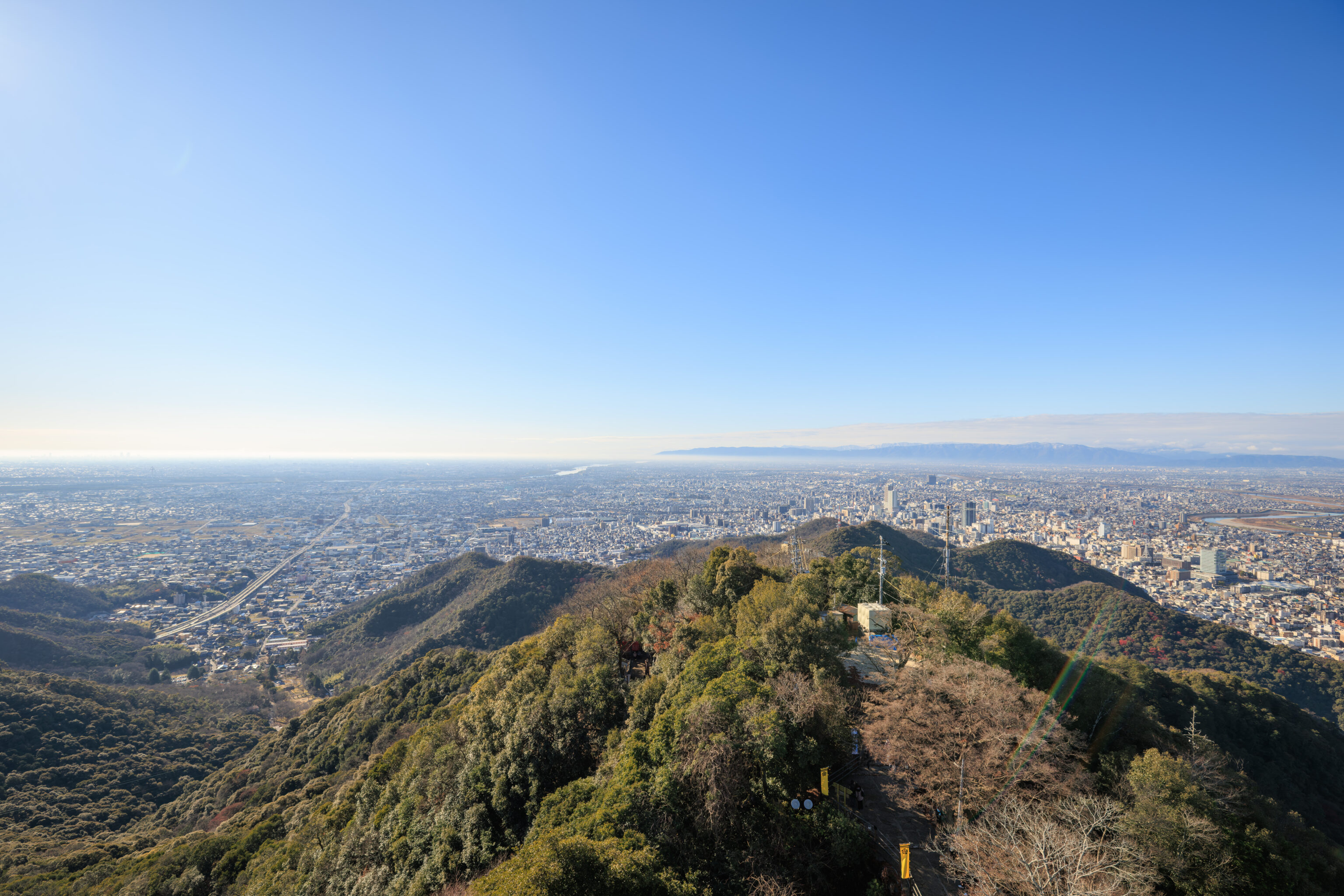
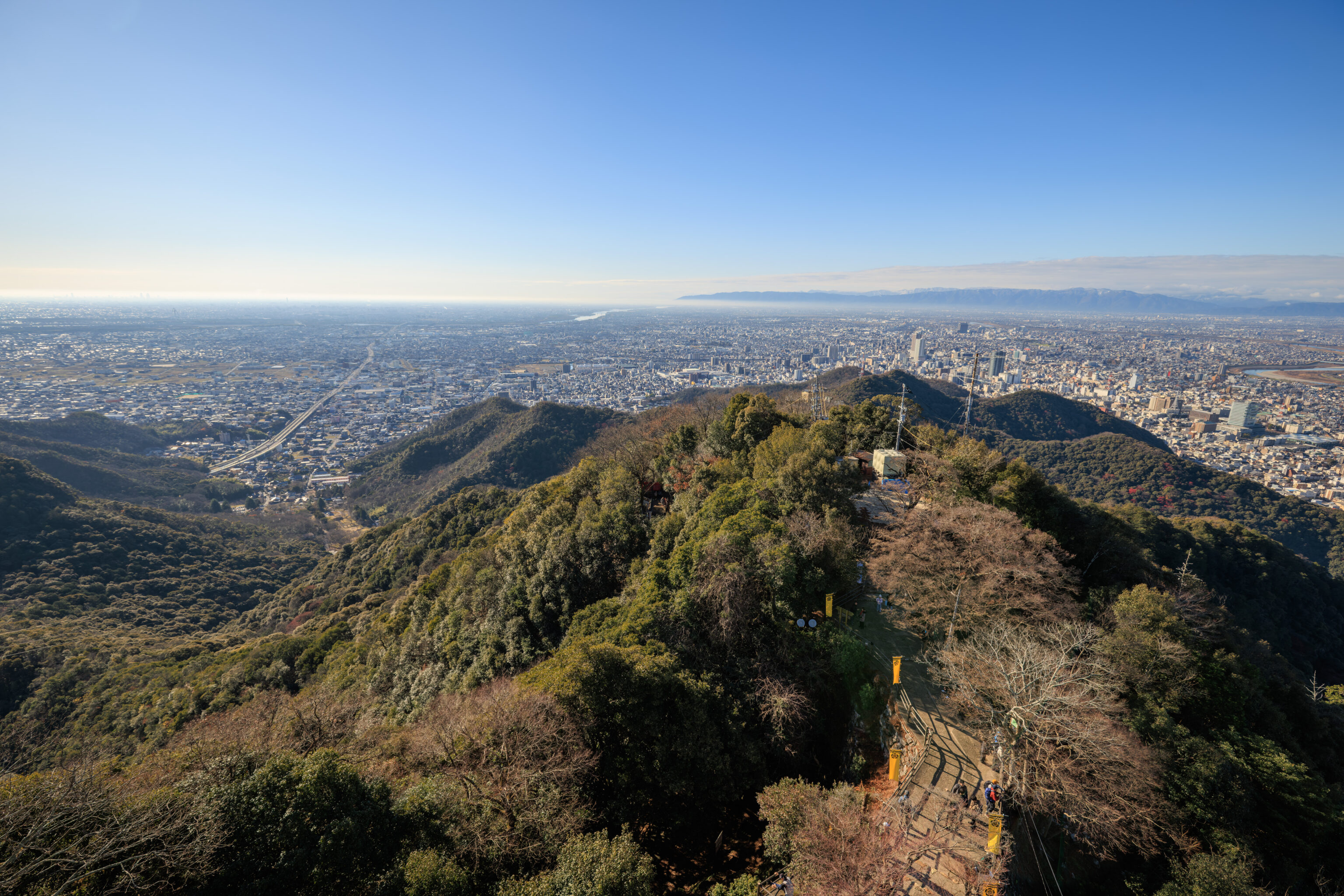
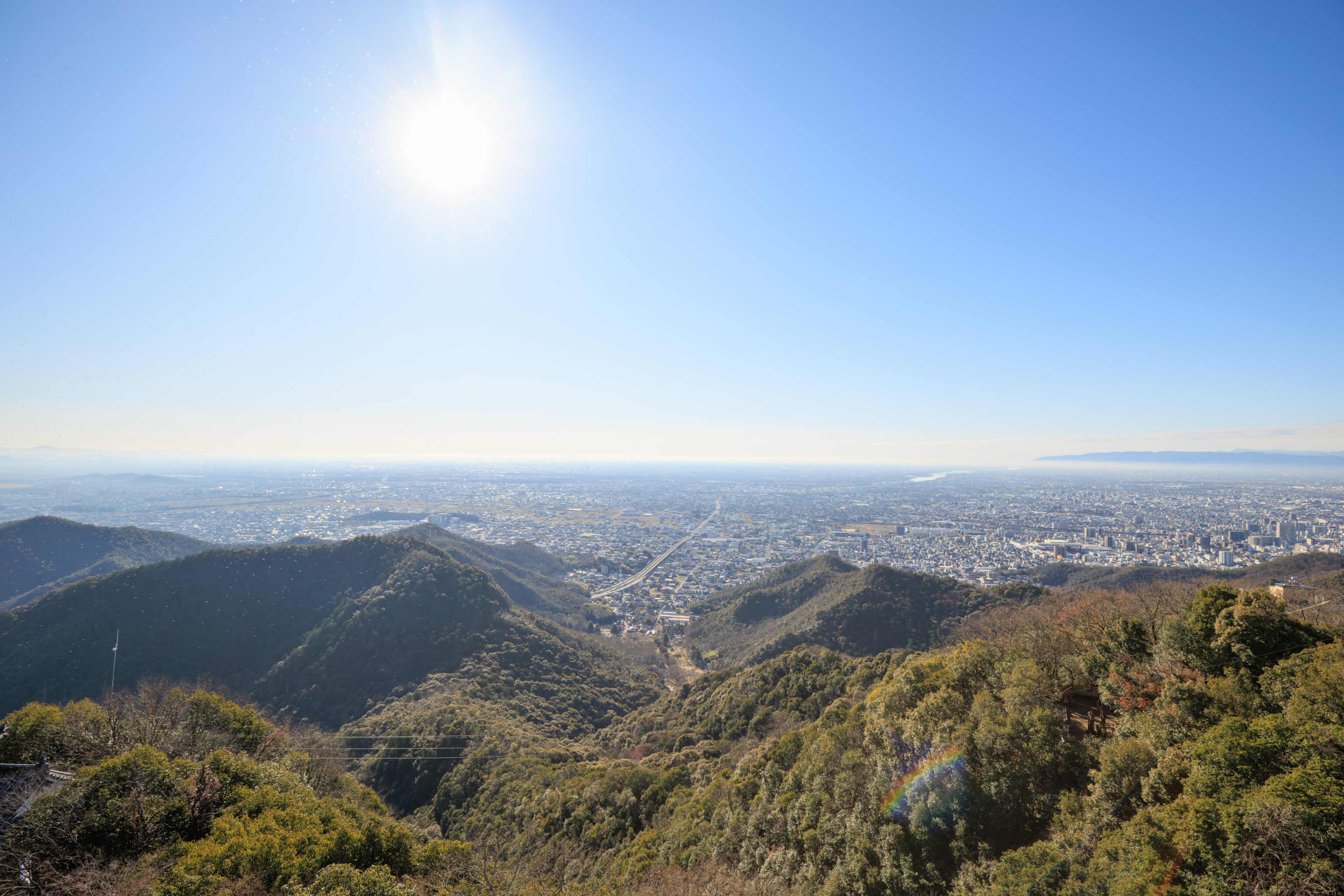
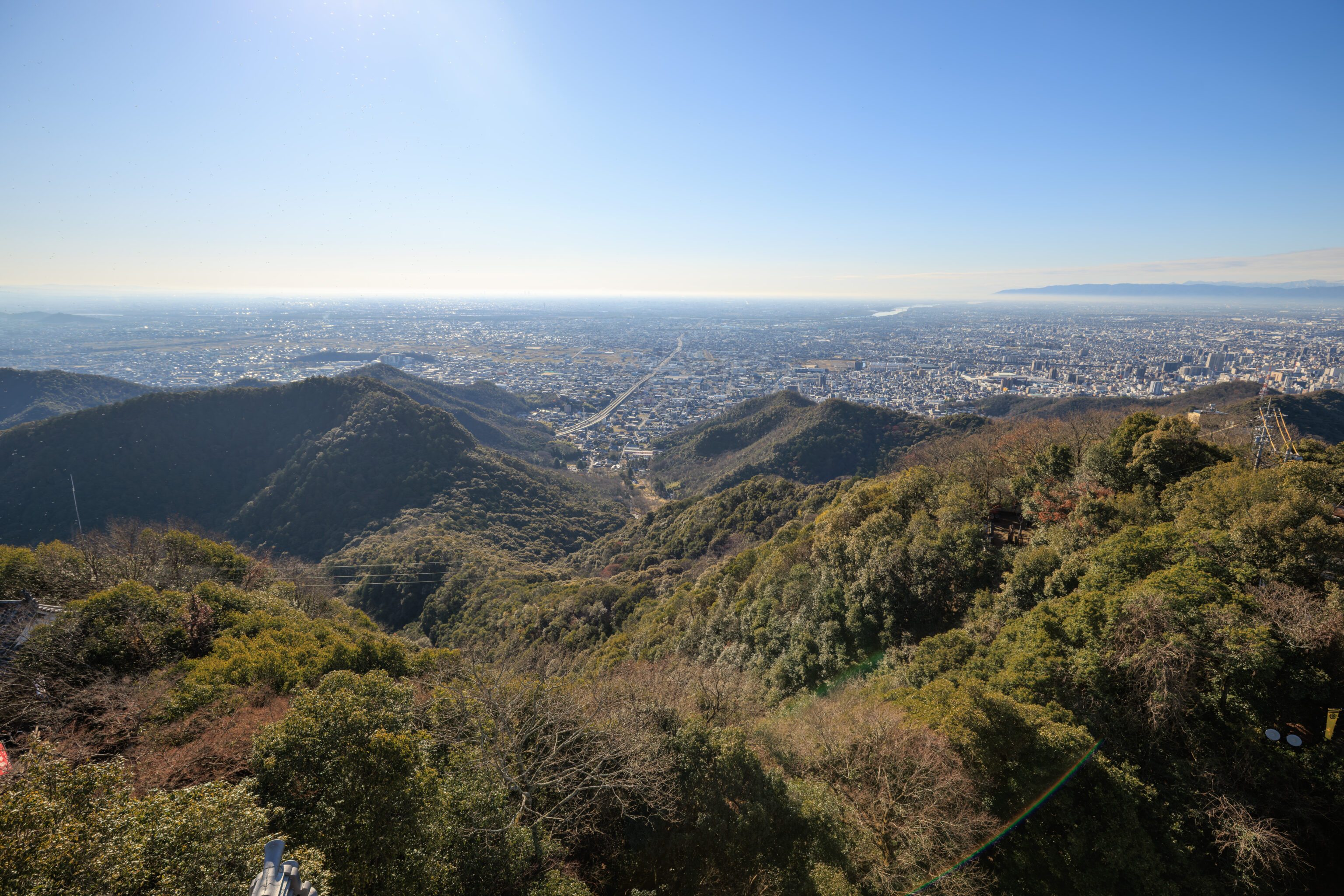
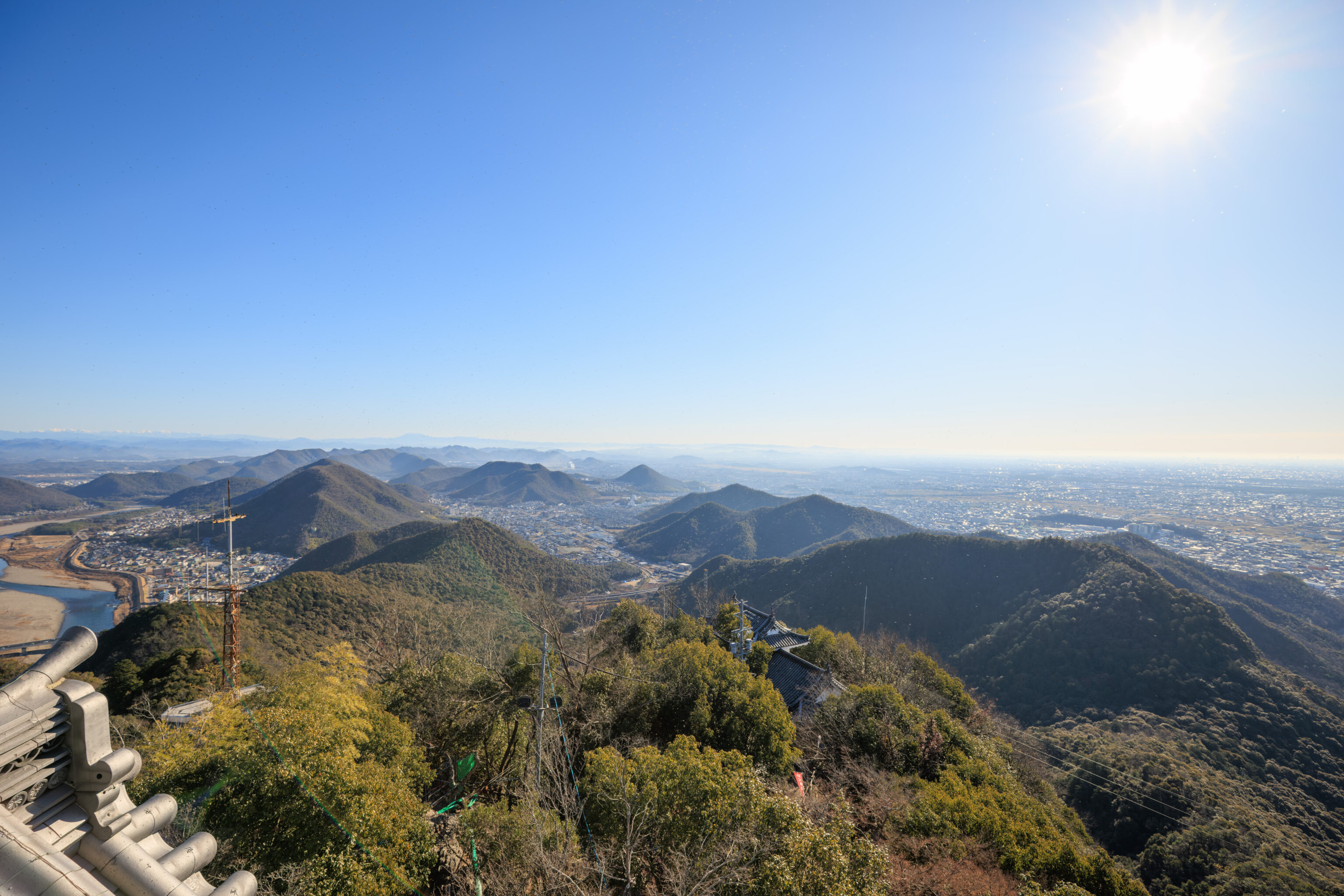
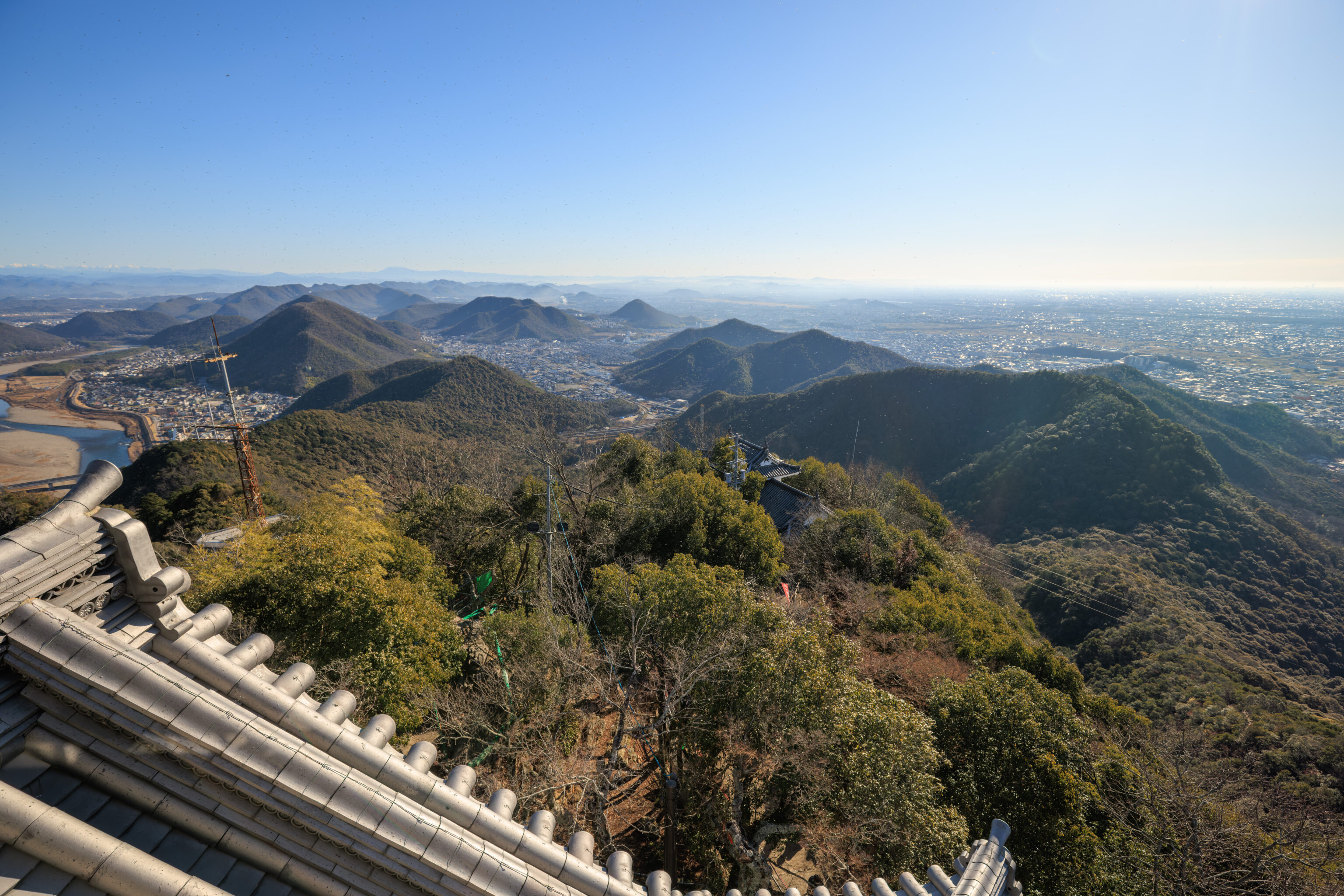
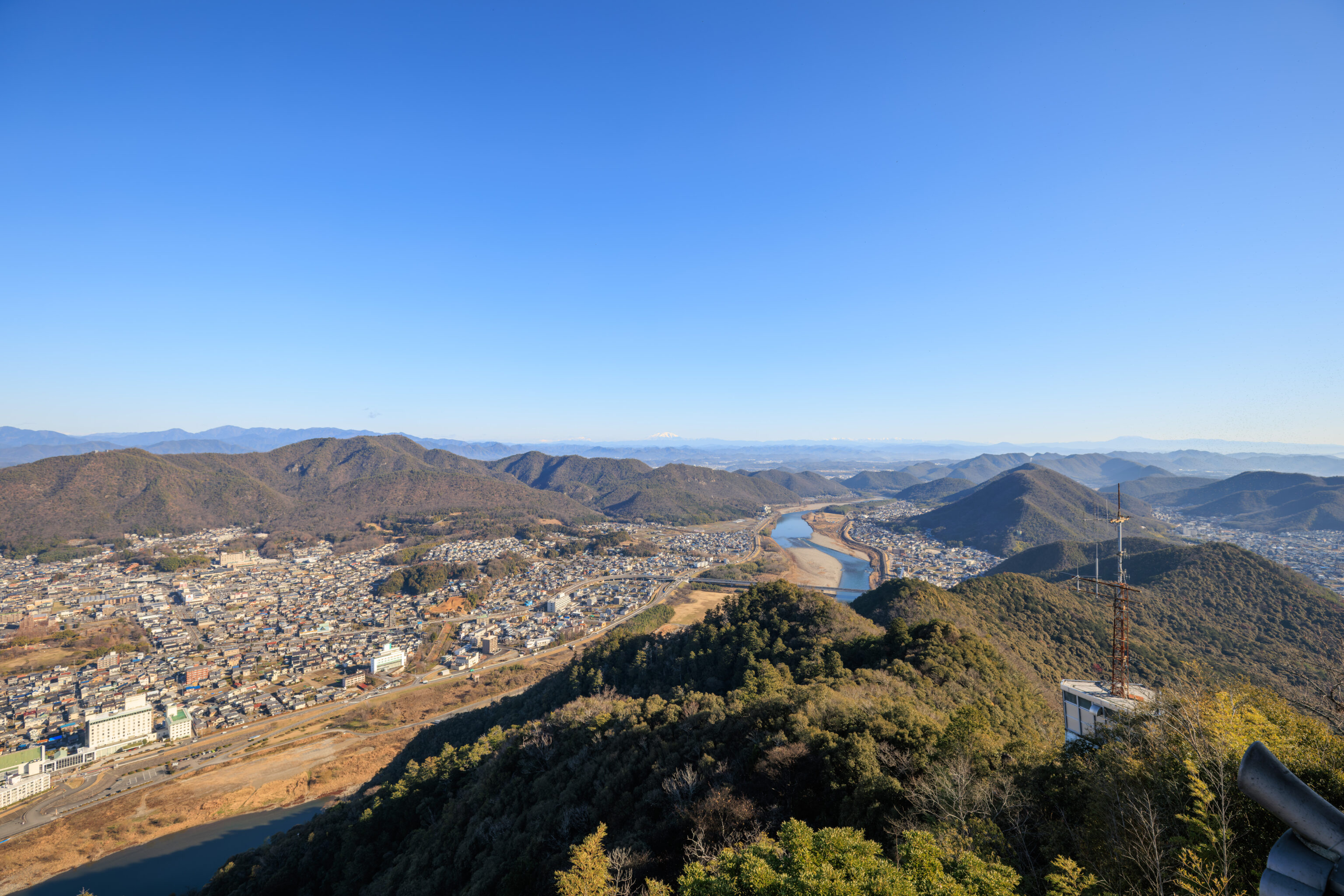
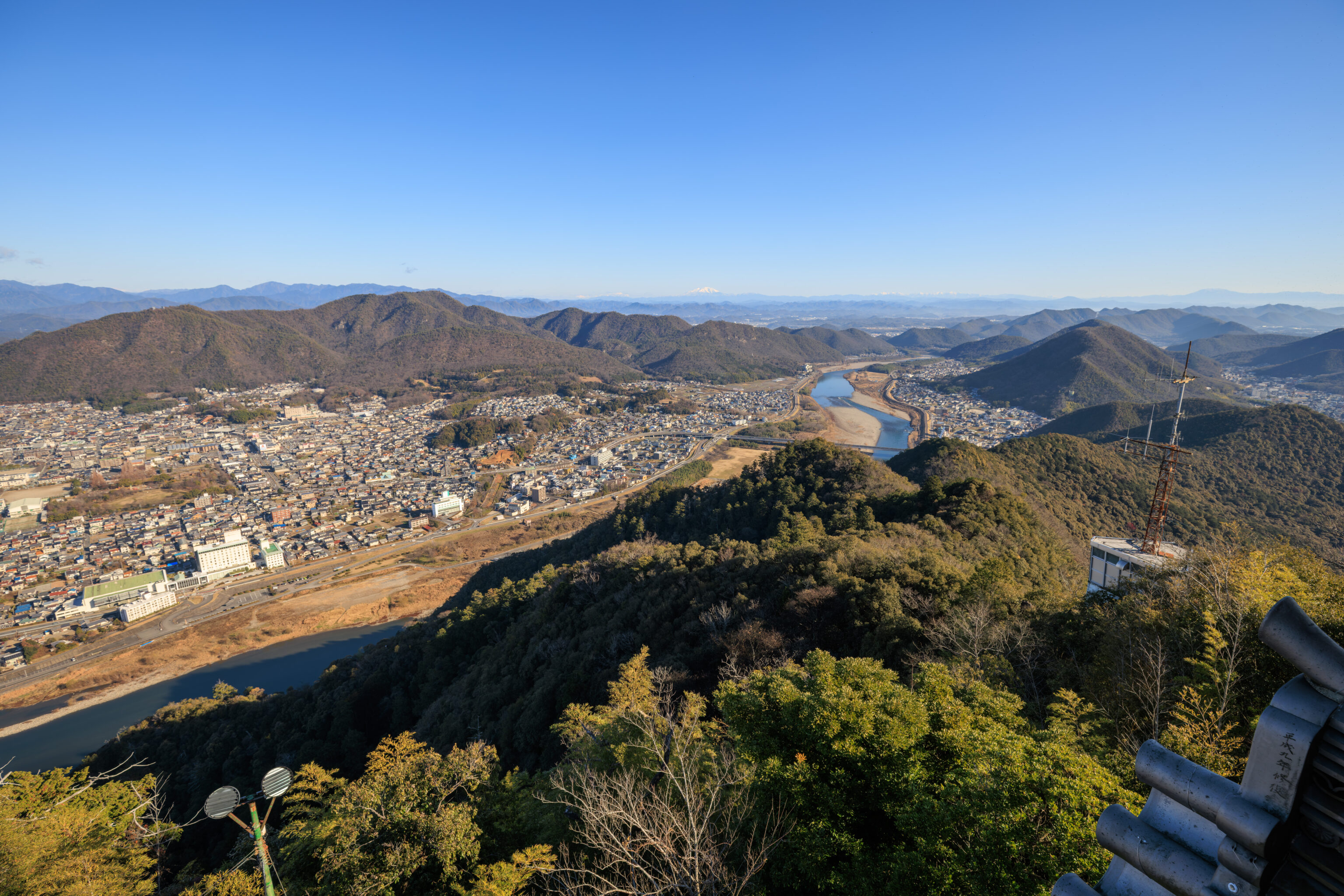
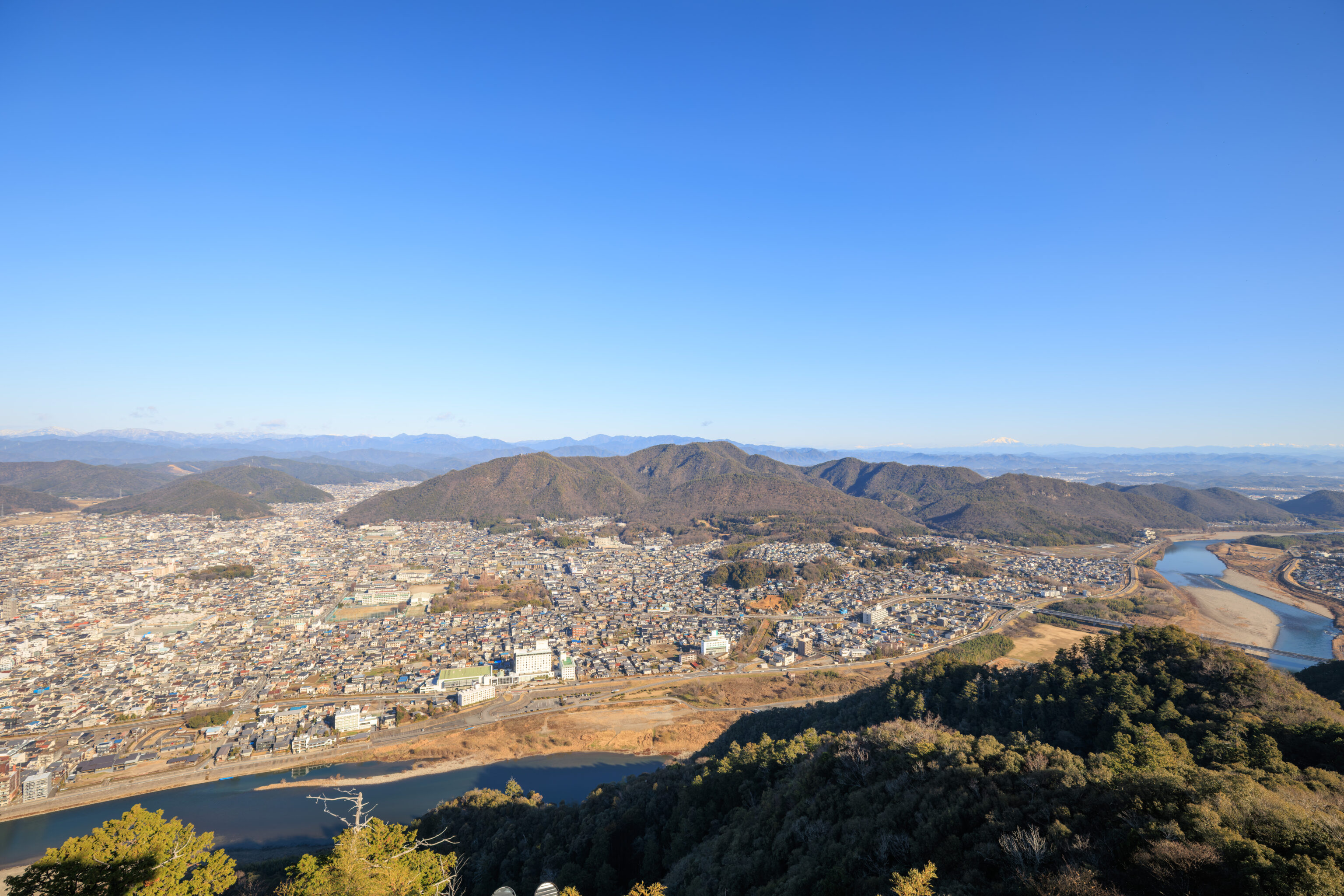
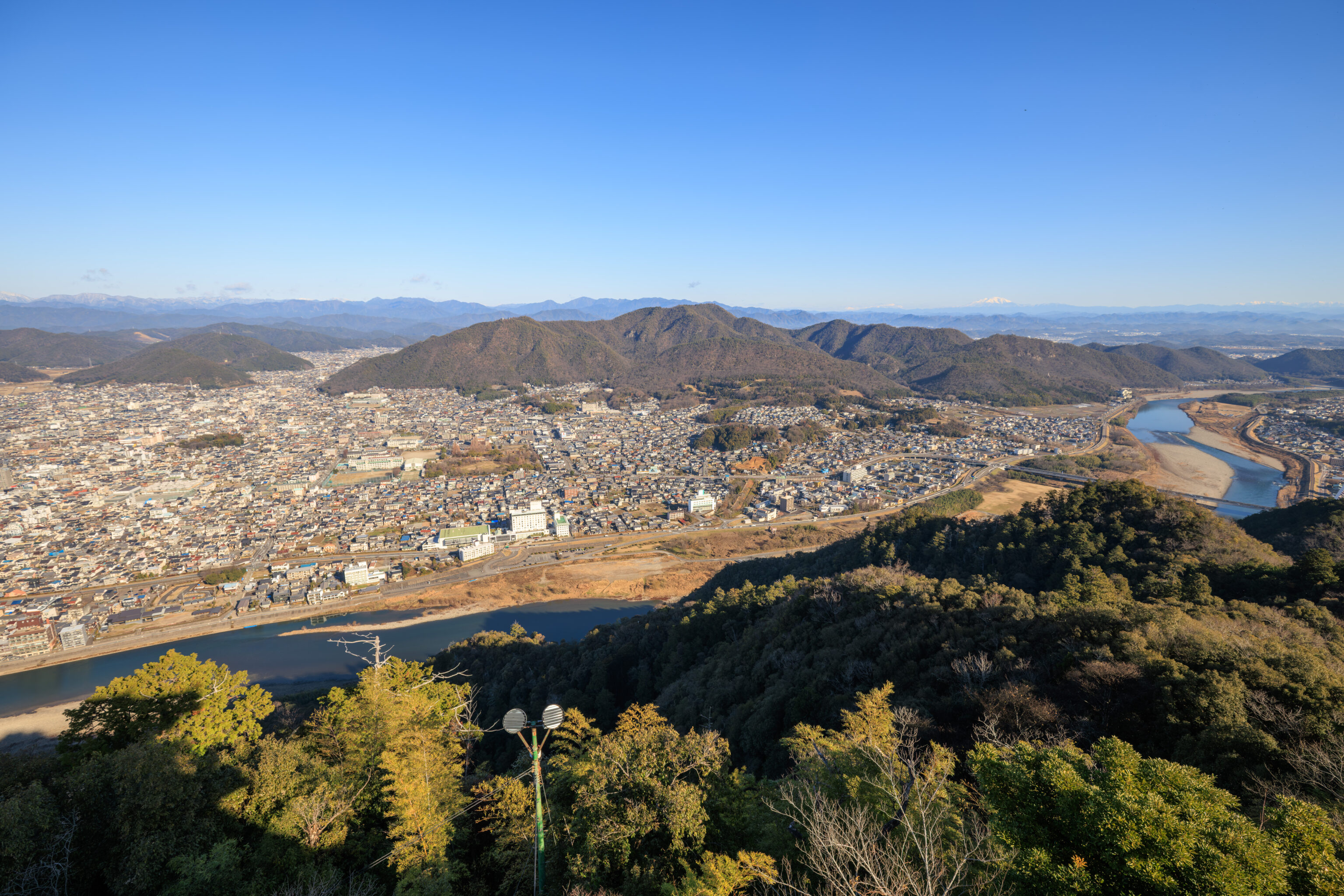
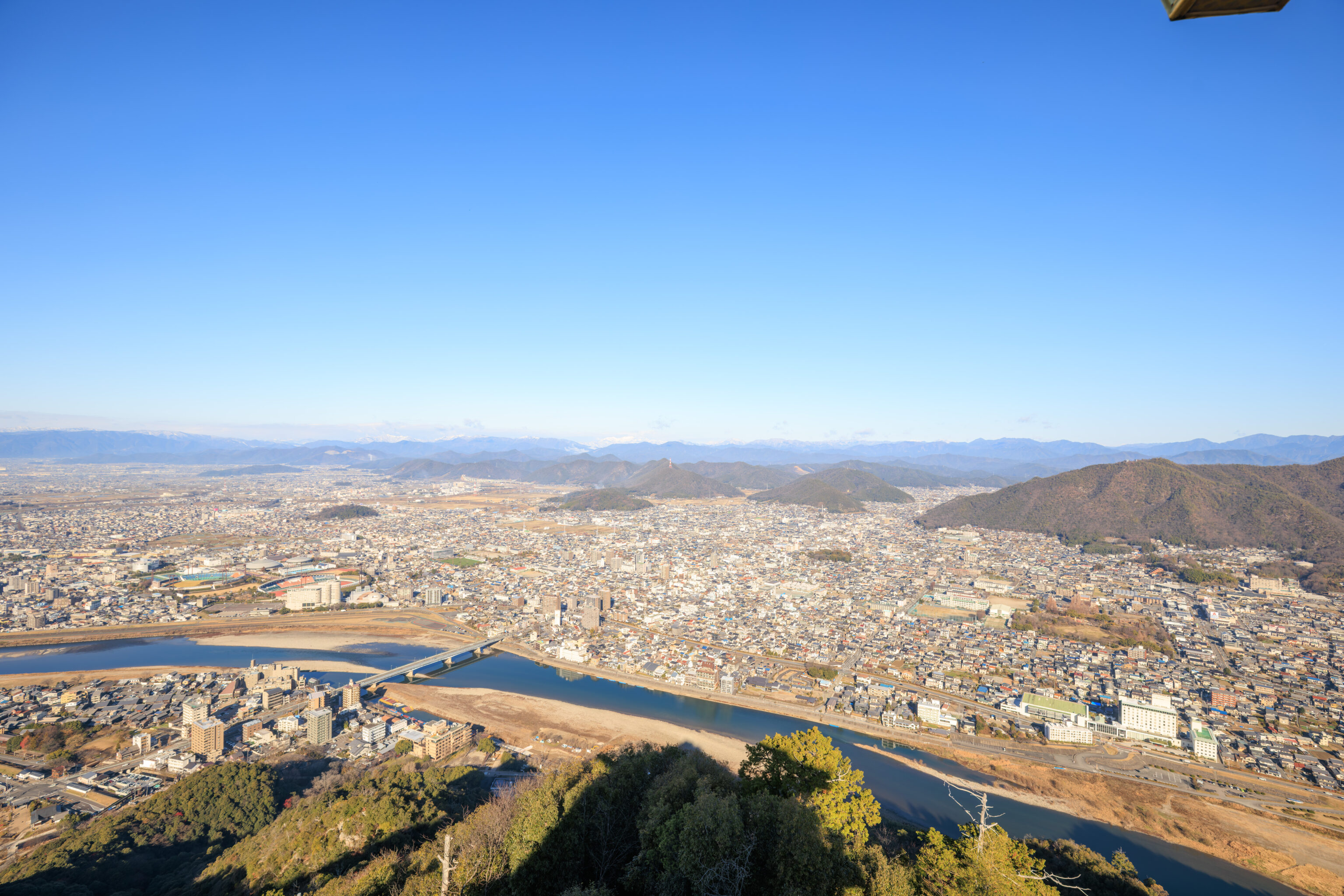
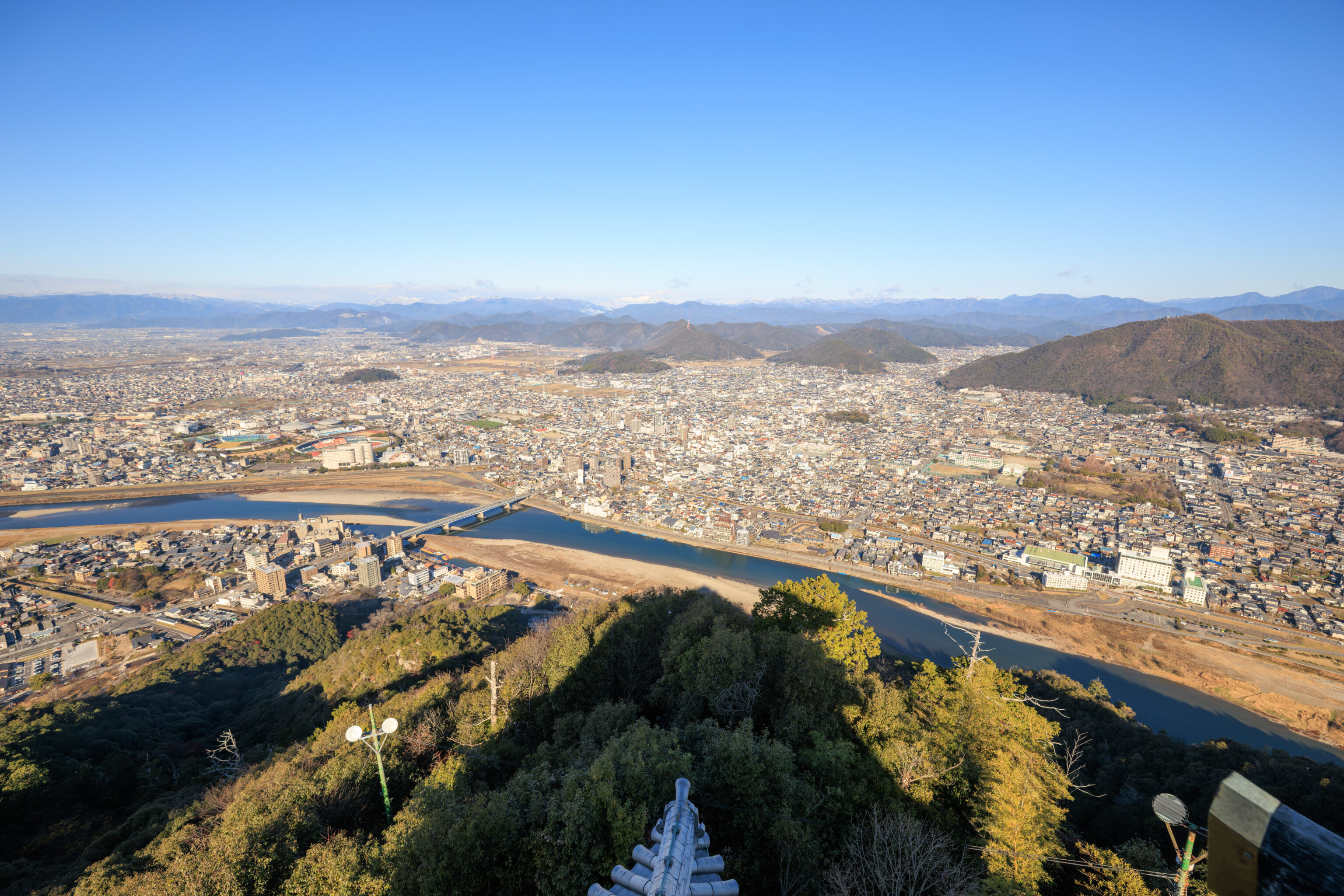
We photographed the view from the top in eight direcitons, looking straight out at the horizon and then down a bit.
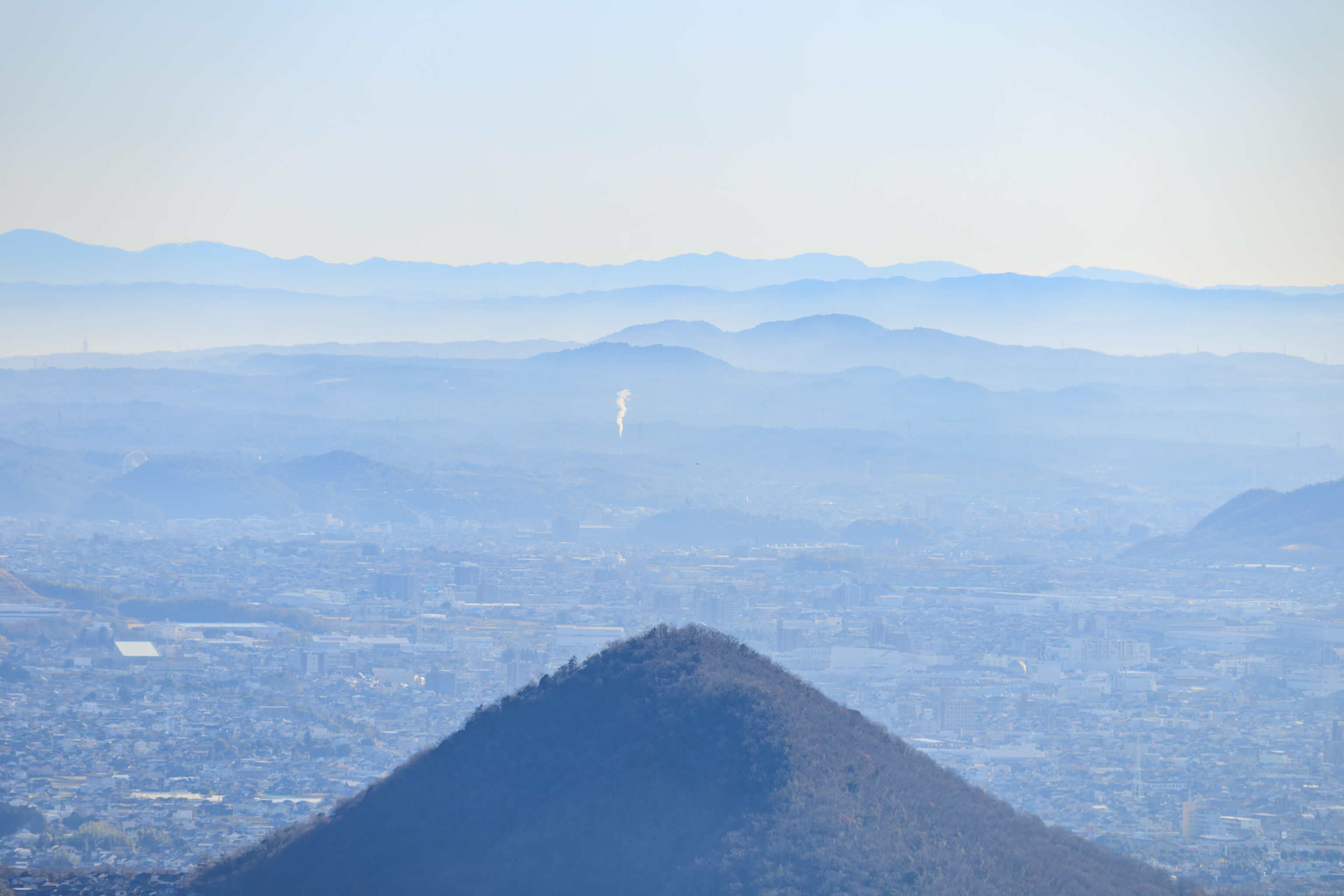
We then swapped to the telephoto lens to look around. It was unfortunately a bit hazy. Looking east and slightly south, it is possible to see the 16th century Inuyama Castle. Inuyama Castle has one of the twleve remaining historic wooden castle keeps, or tenshu, in Japan and is one of five designated as National Treasures.
The castle is at the center of the photograph above and is about half way in between the hilltop in the foreground and the white plume of smoke in the background.
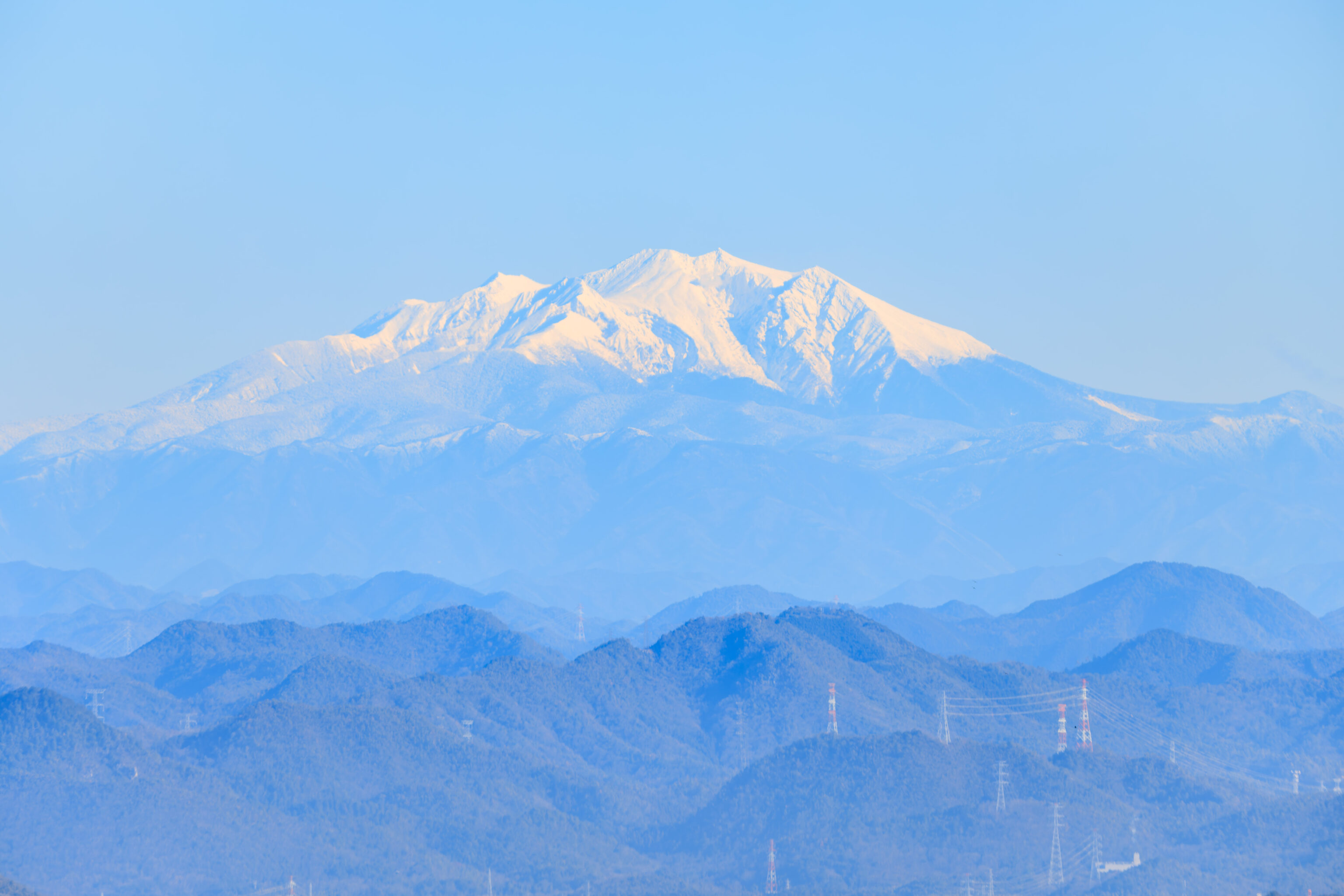
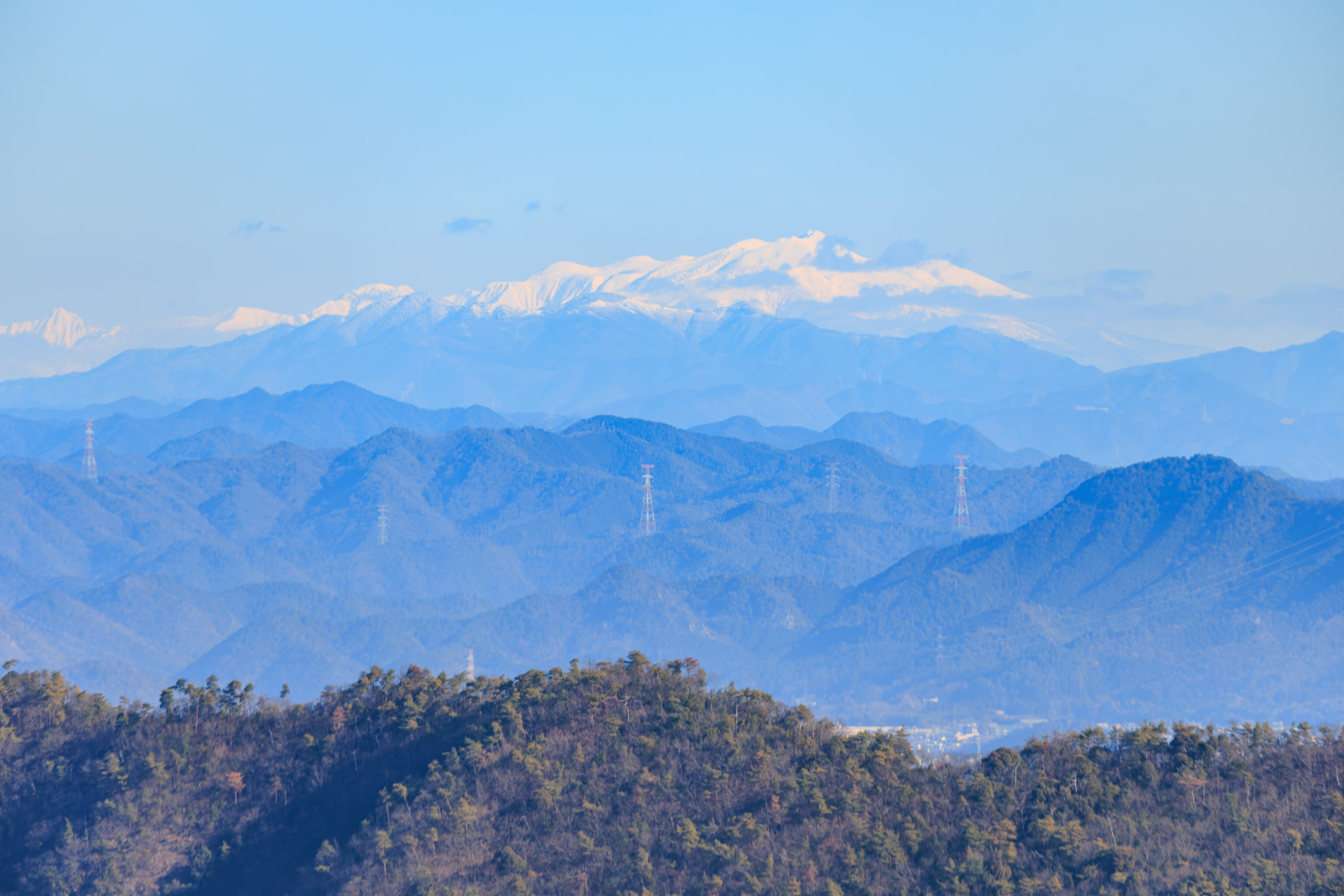
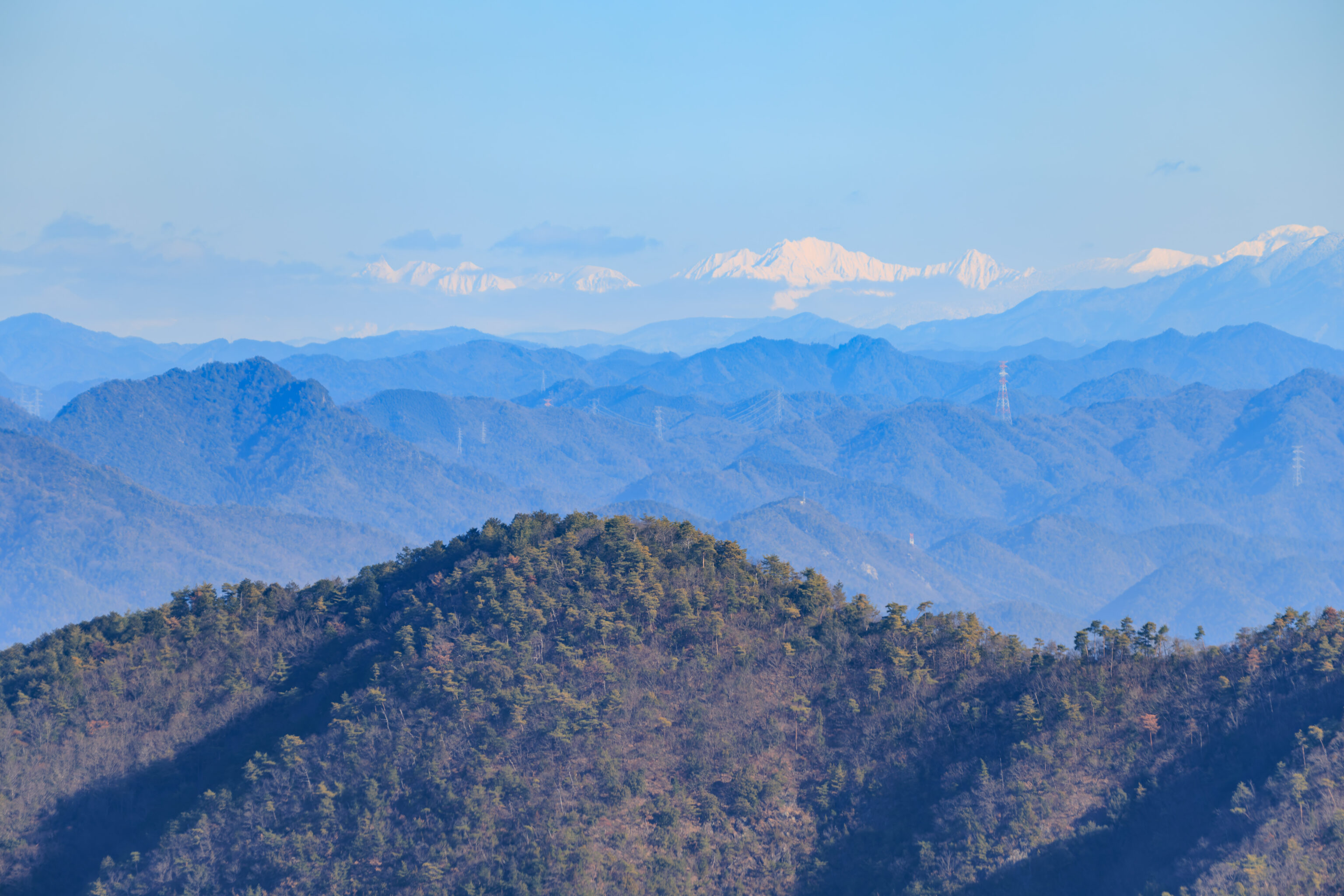
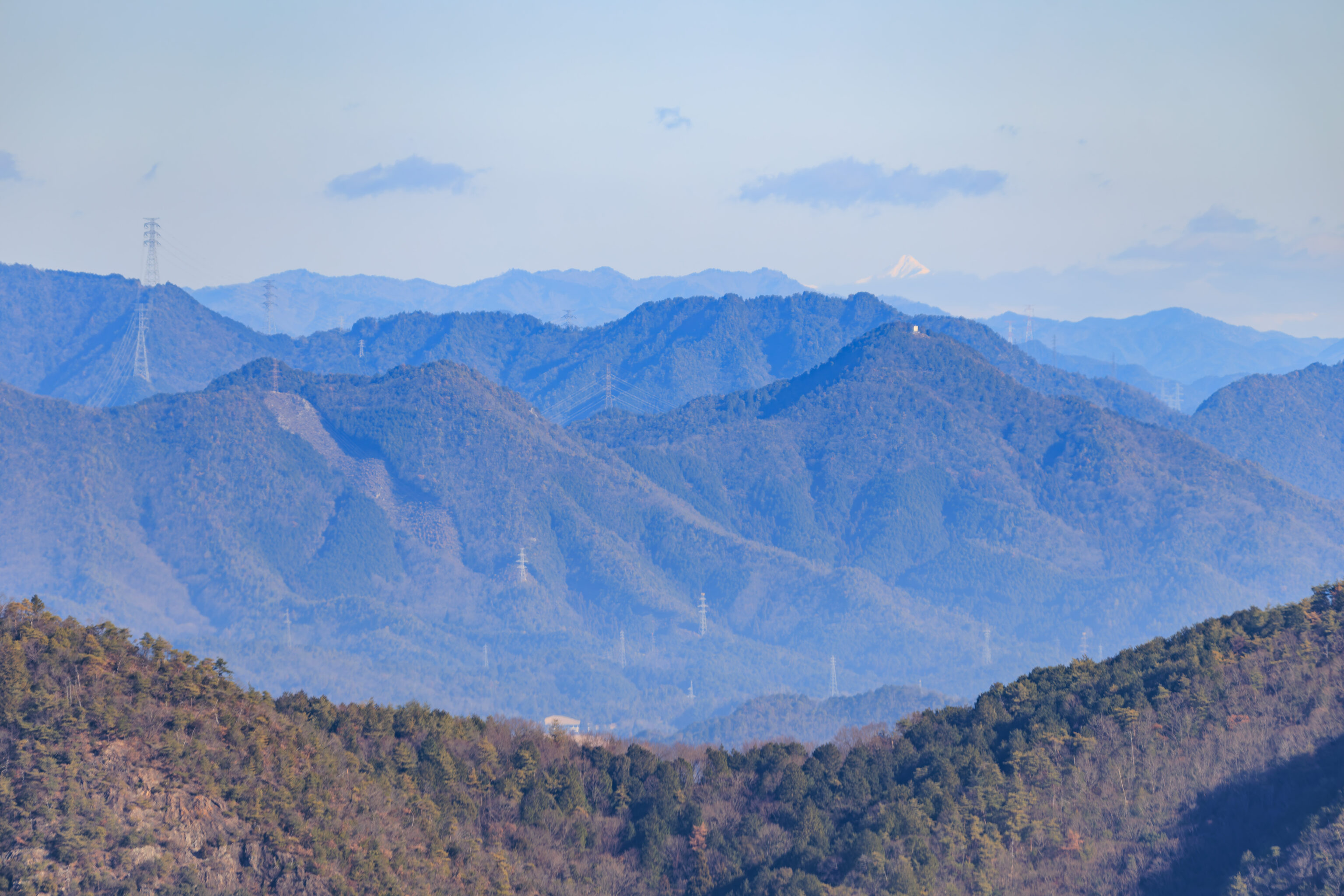
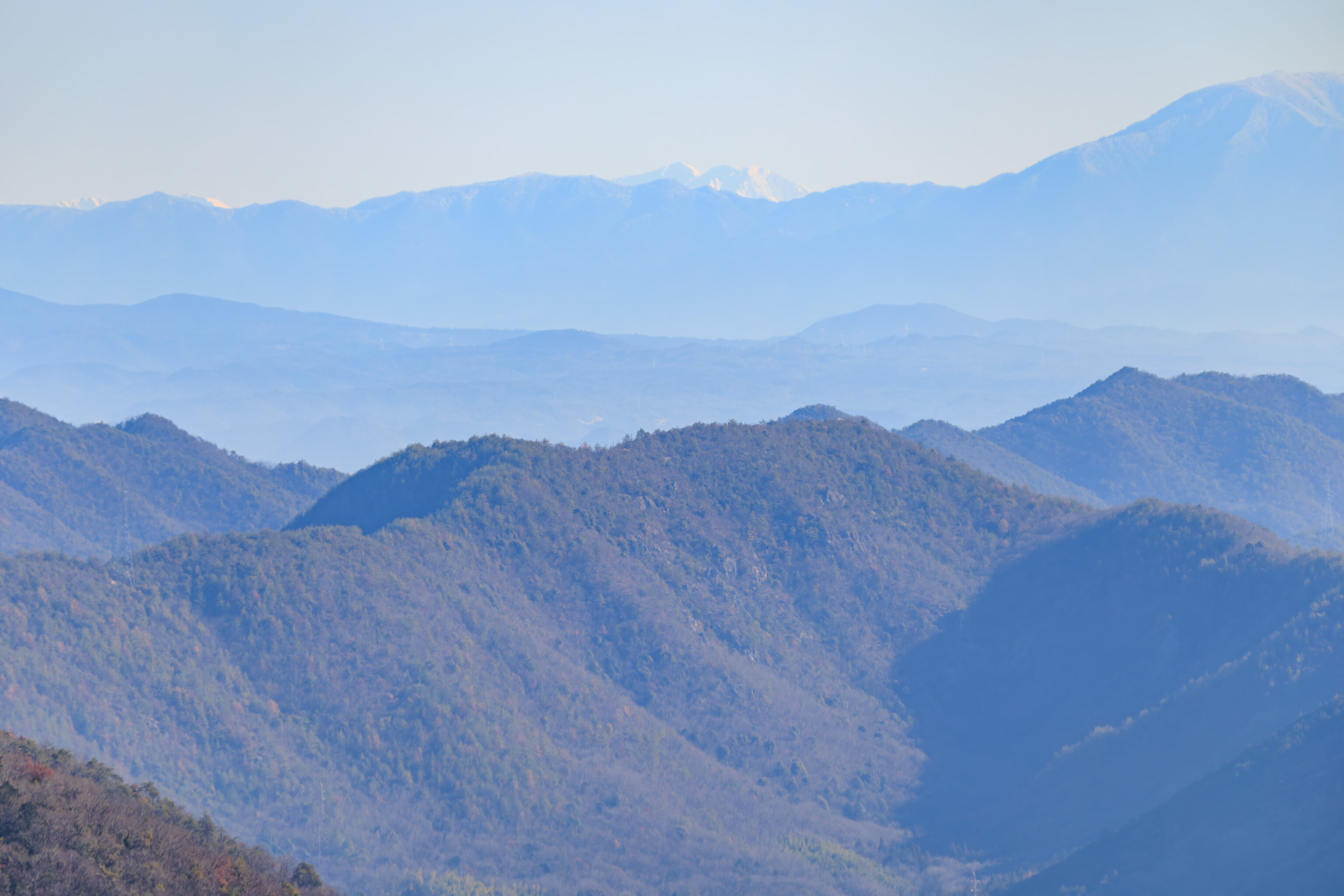
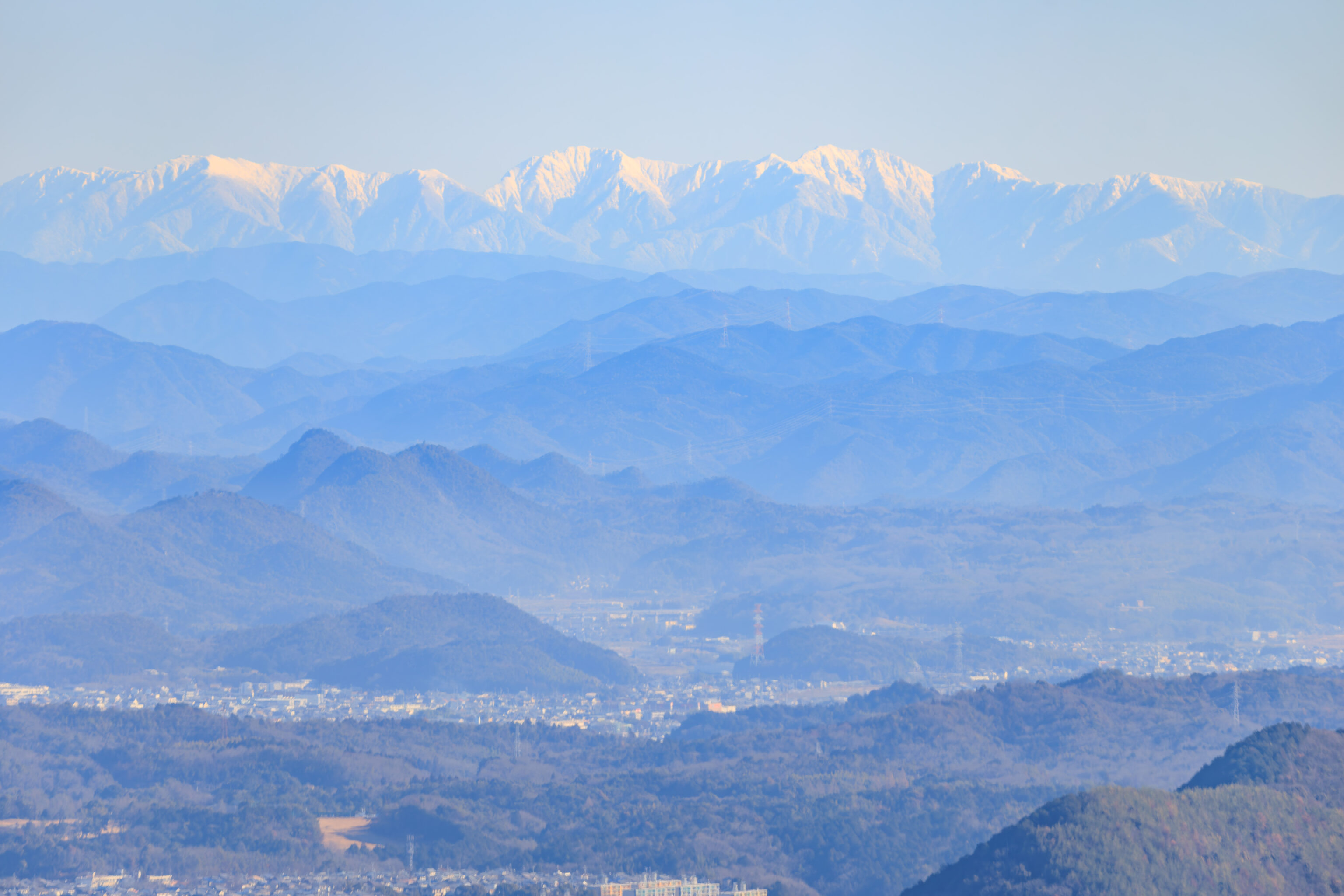
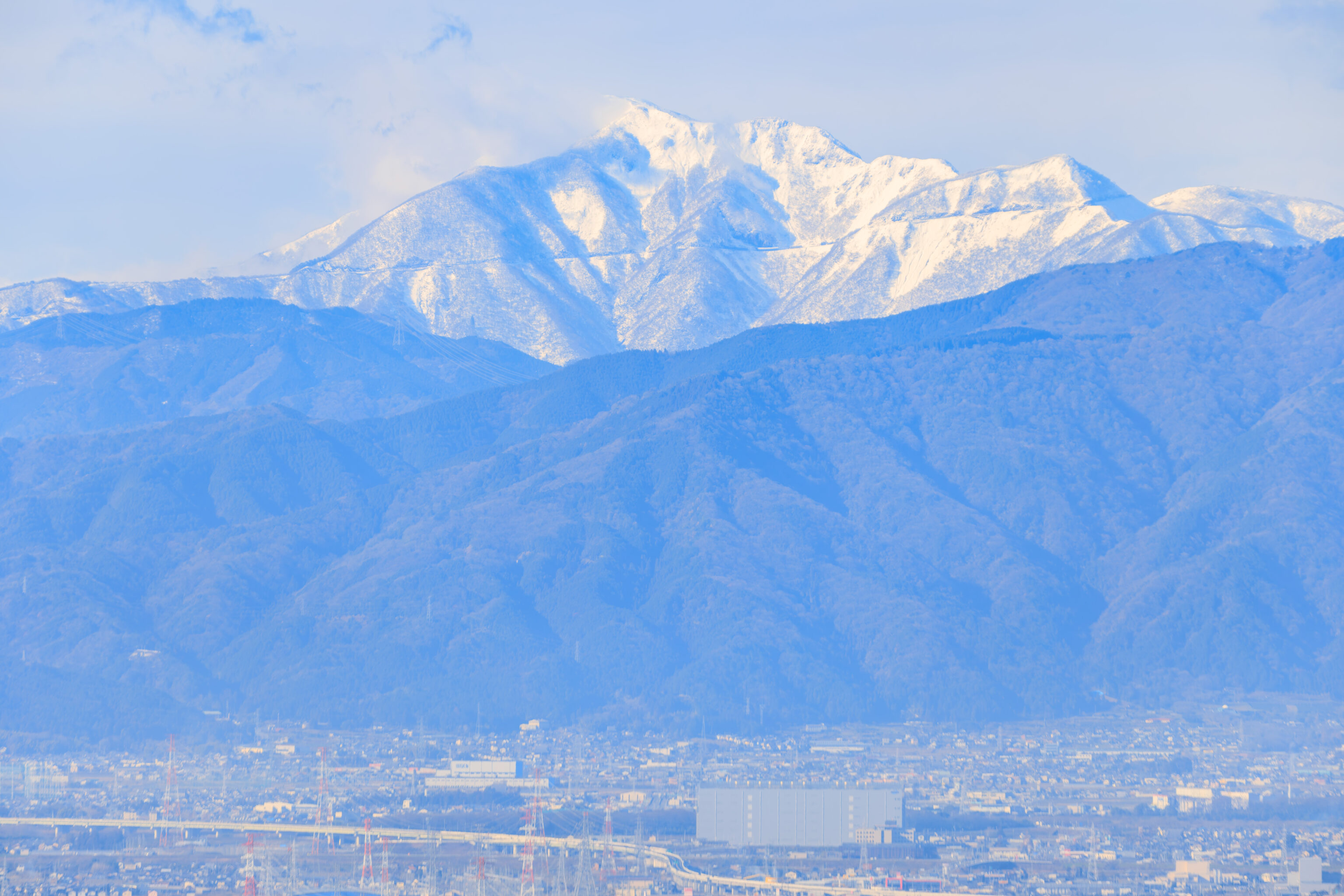
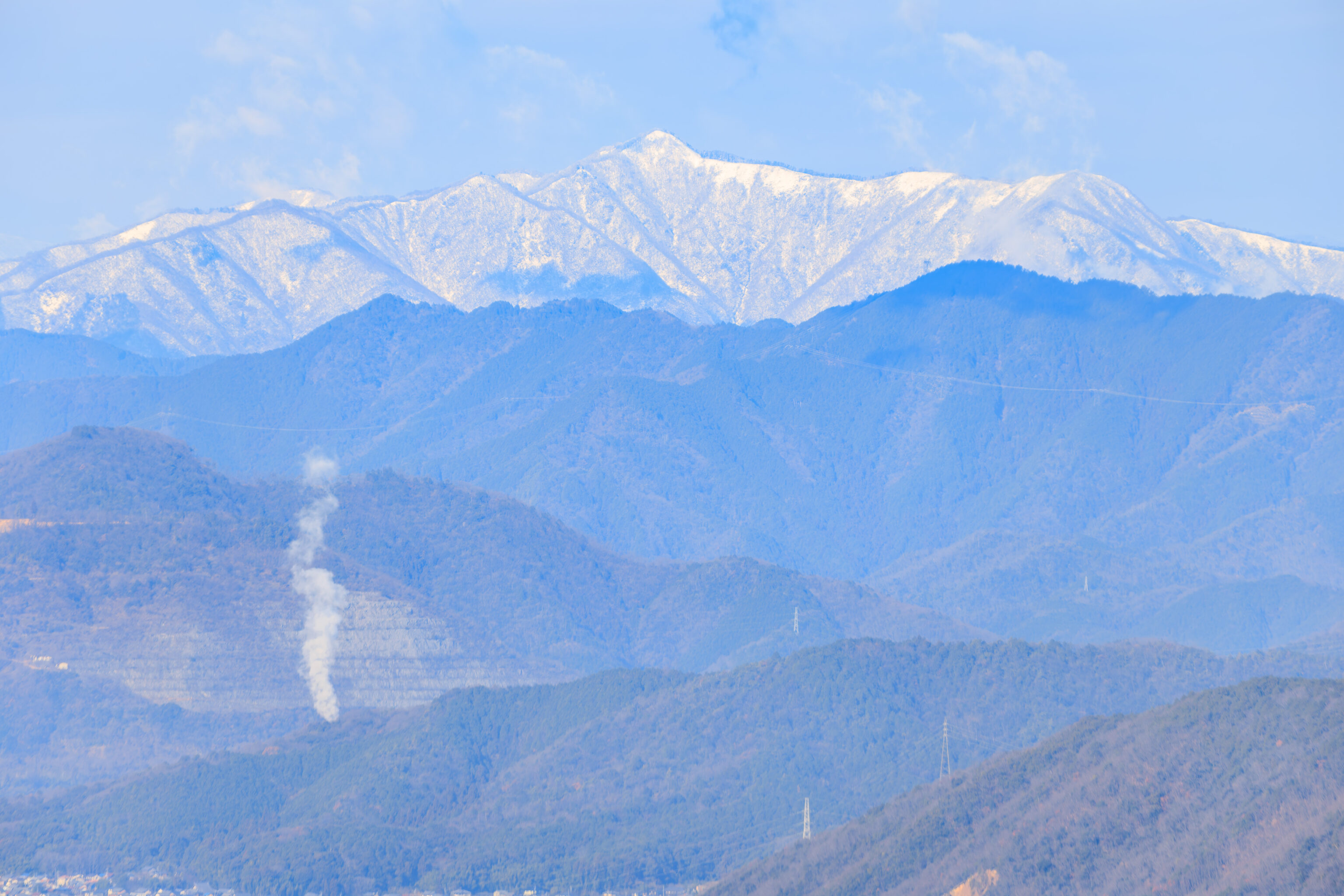
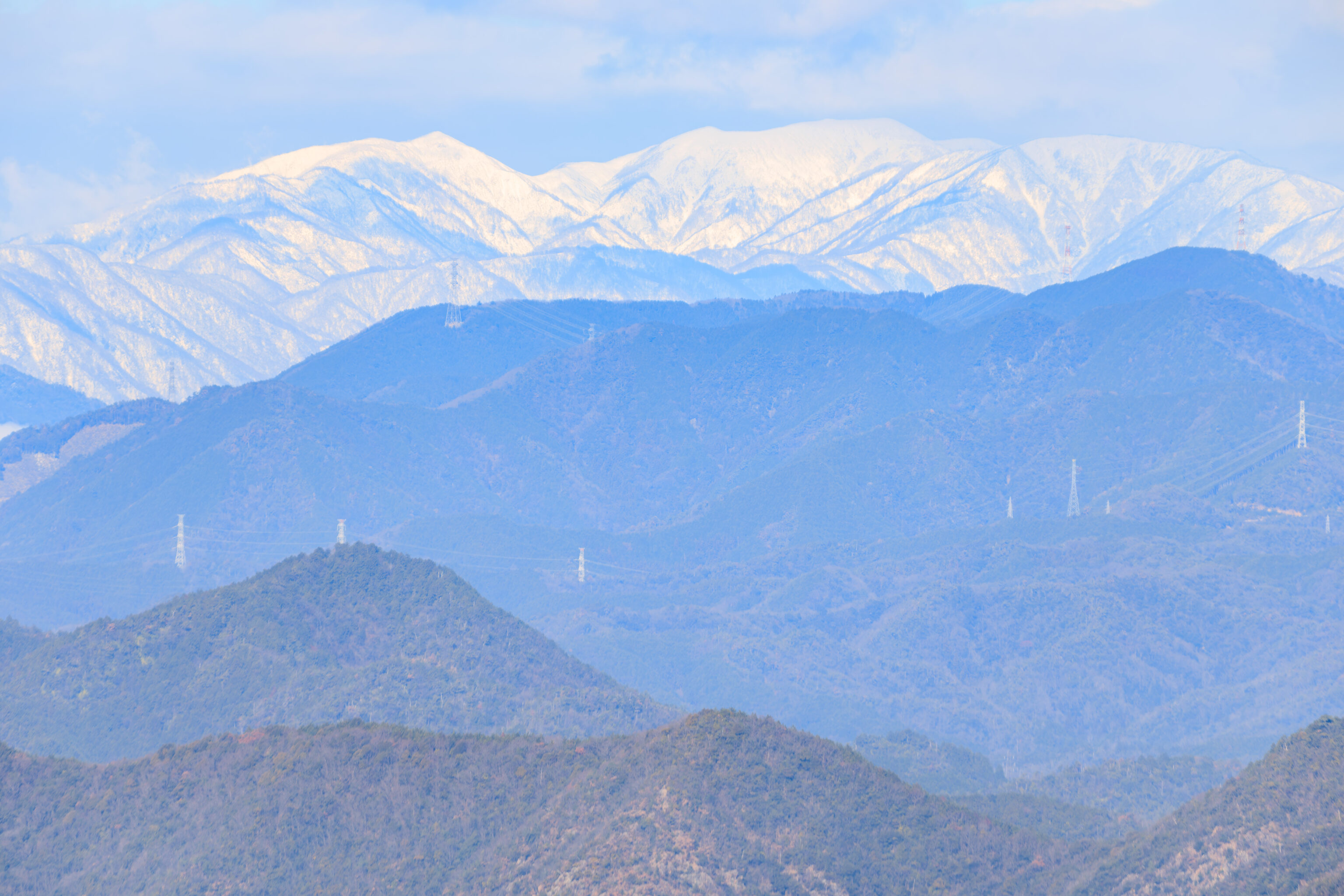
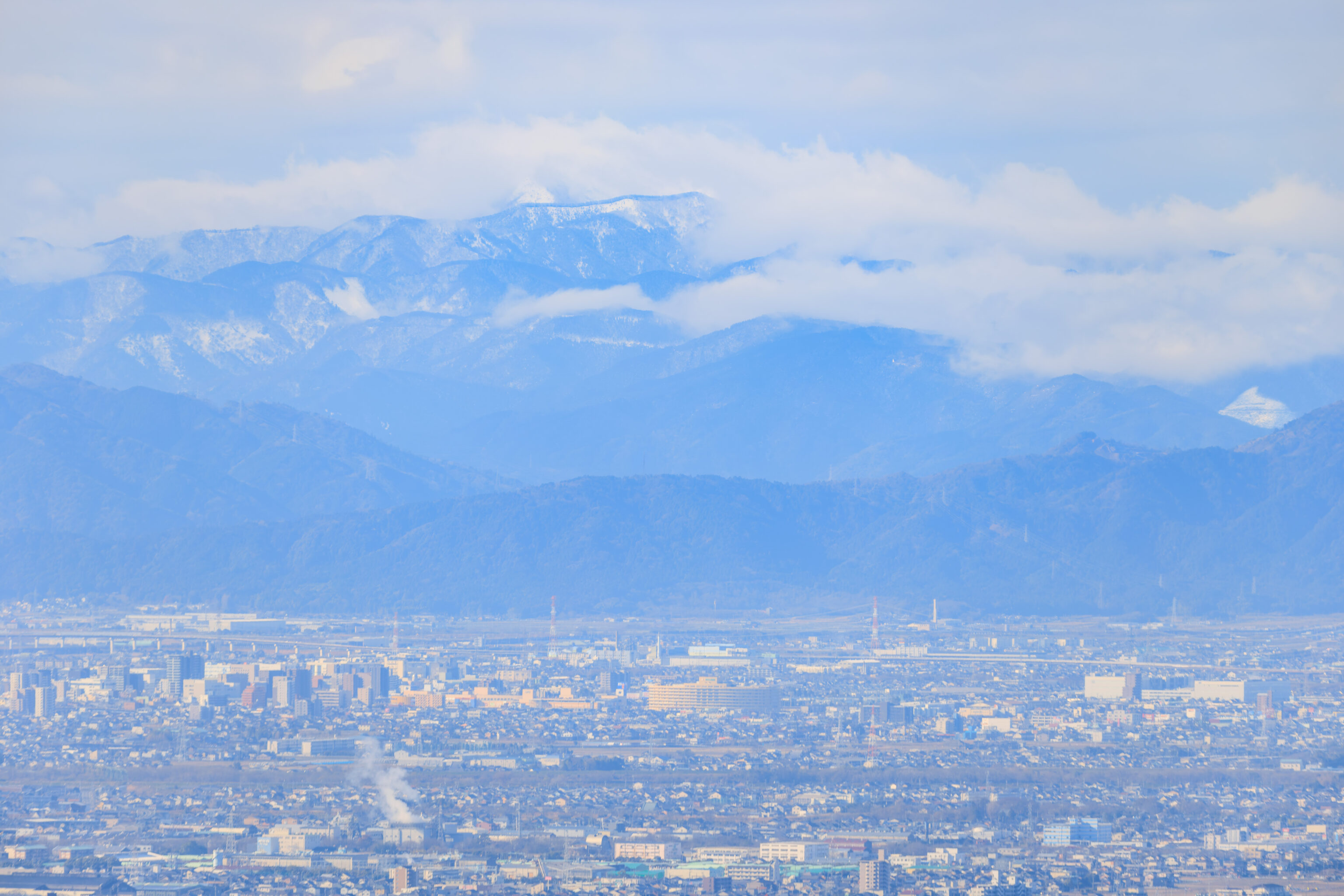
We looked around at the various snow capped mountains around us.
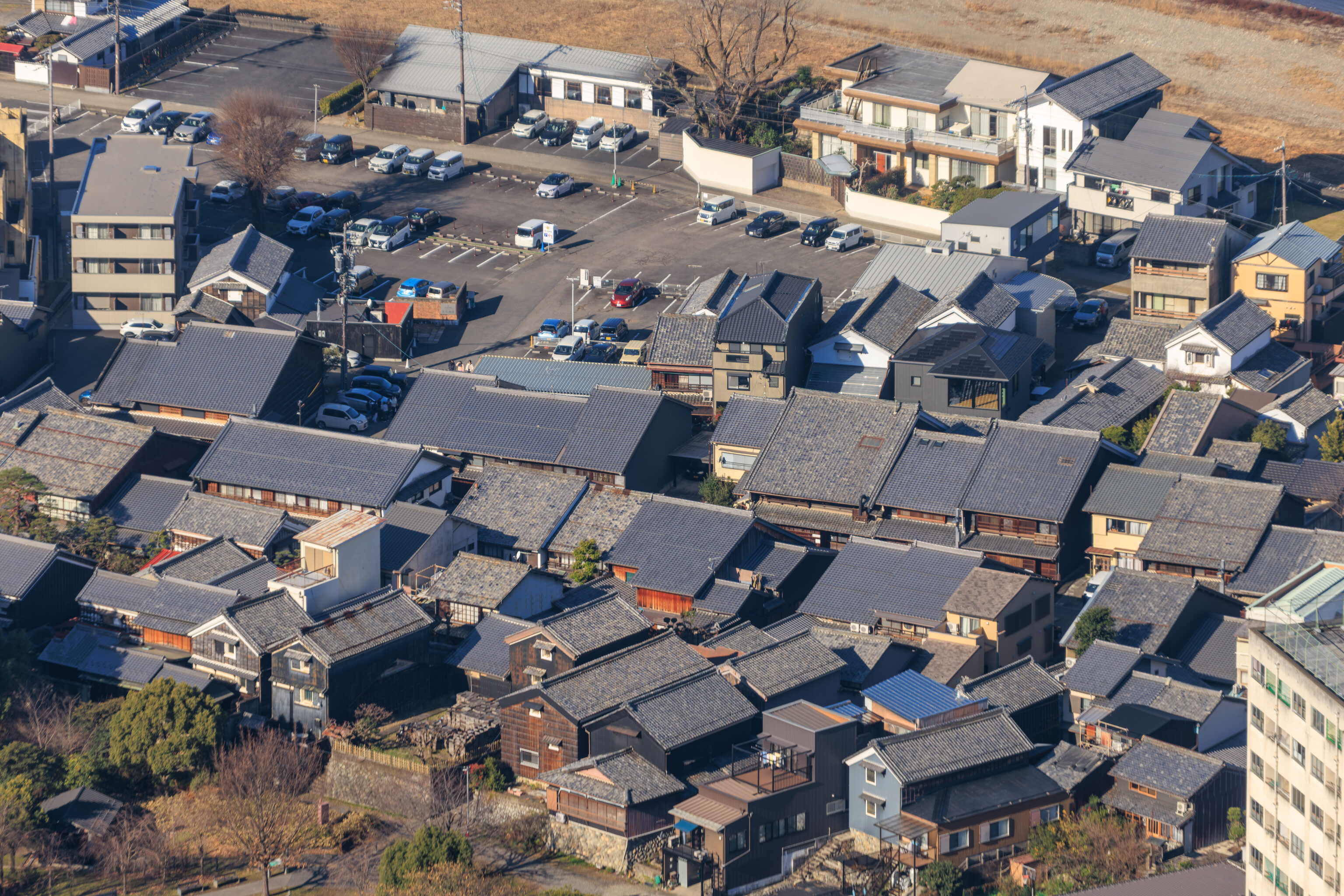
This is the Kawaramachi, a nearby historic merchant district that contains various preserved buildings.
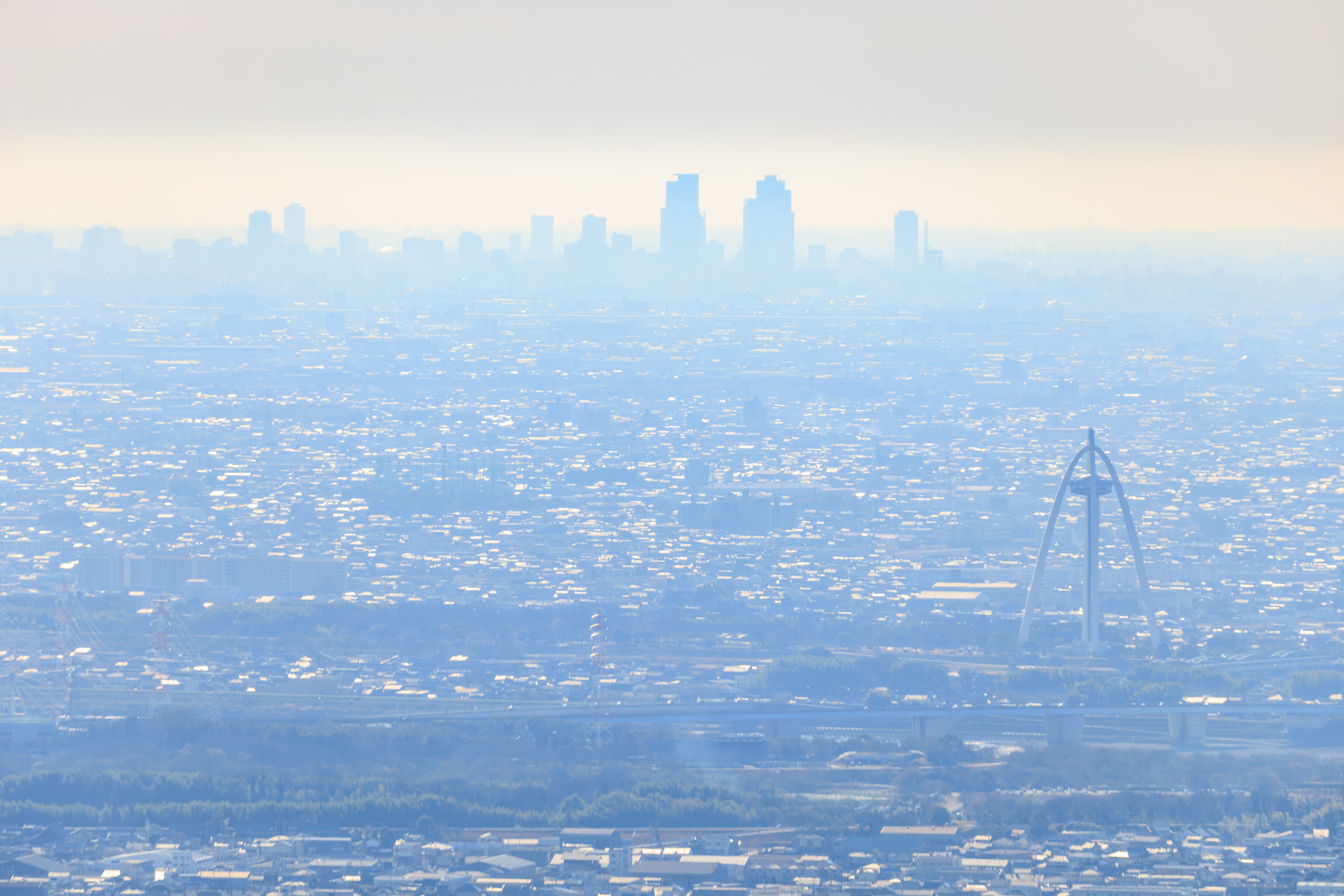
We could also see Nagoya to the south.
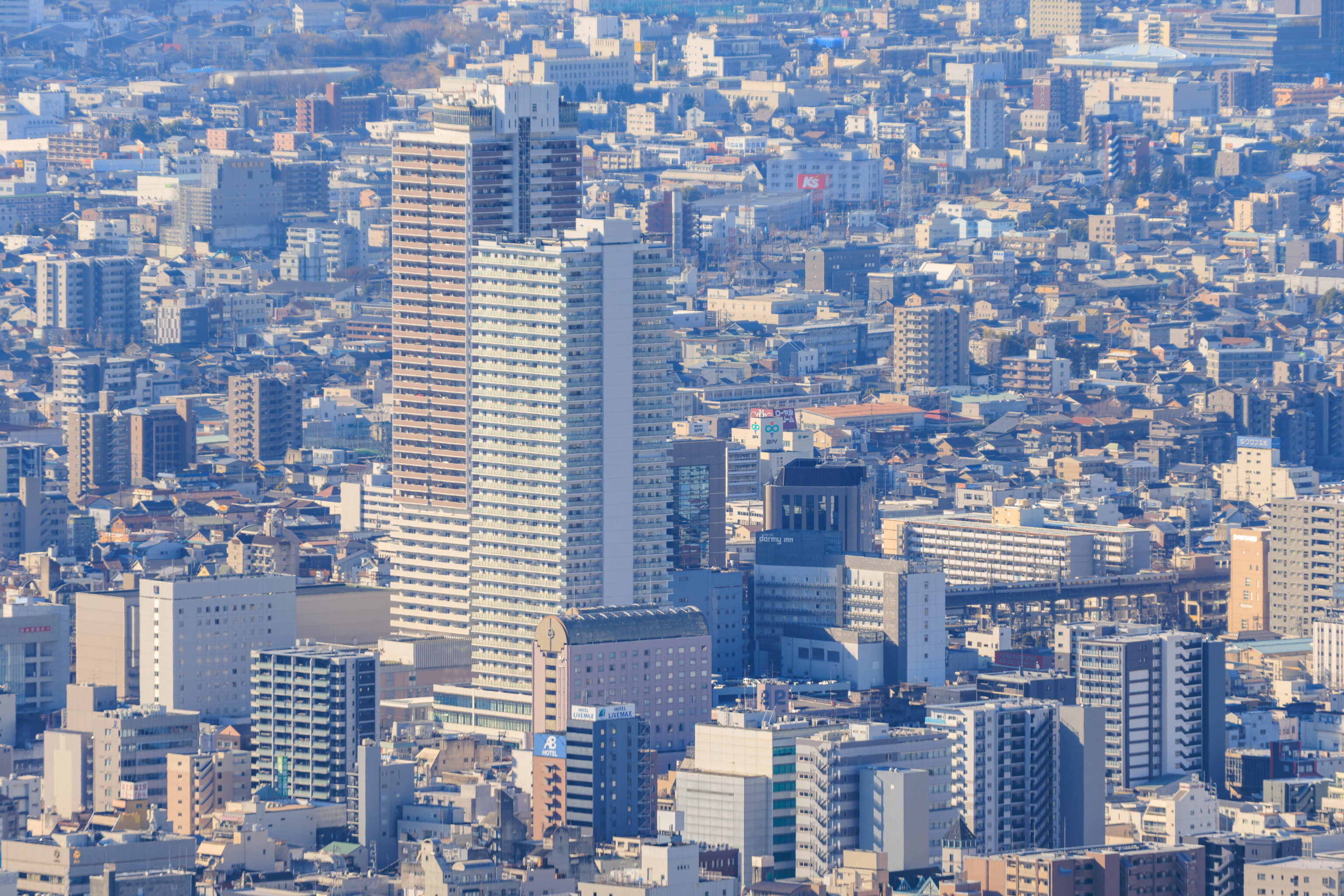
Just a typical urban scene… After enjoying the view, we left the castle and continued on to a small museum just to the east and slightly below the castle. Parts of the area weren’t accessible due to construction activities.
Gifu Castle Museum
Located one level below the Gifu Castle keep to the east is an enclosure measuring approximately 36 meters by 10.8 meters; it is believed that storehouses for provisions—such as rice, salt, and miso—and armories for bows and arrows once stood there.

In April 1975, a museum was constructed using donations from the citizens of Gifu; the building was designed as a two-story corner turret featuring white plastered walls and a tiled roof.
– Text from a sign, read using Google Gemini and translated using Google Translate.
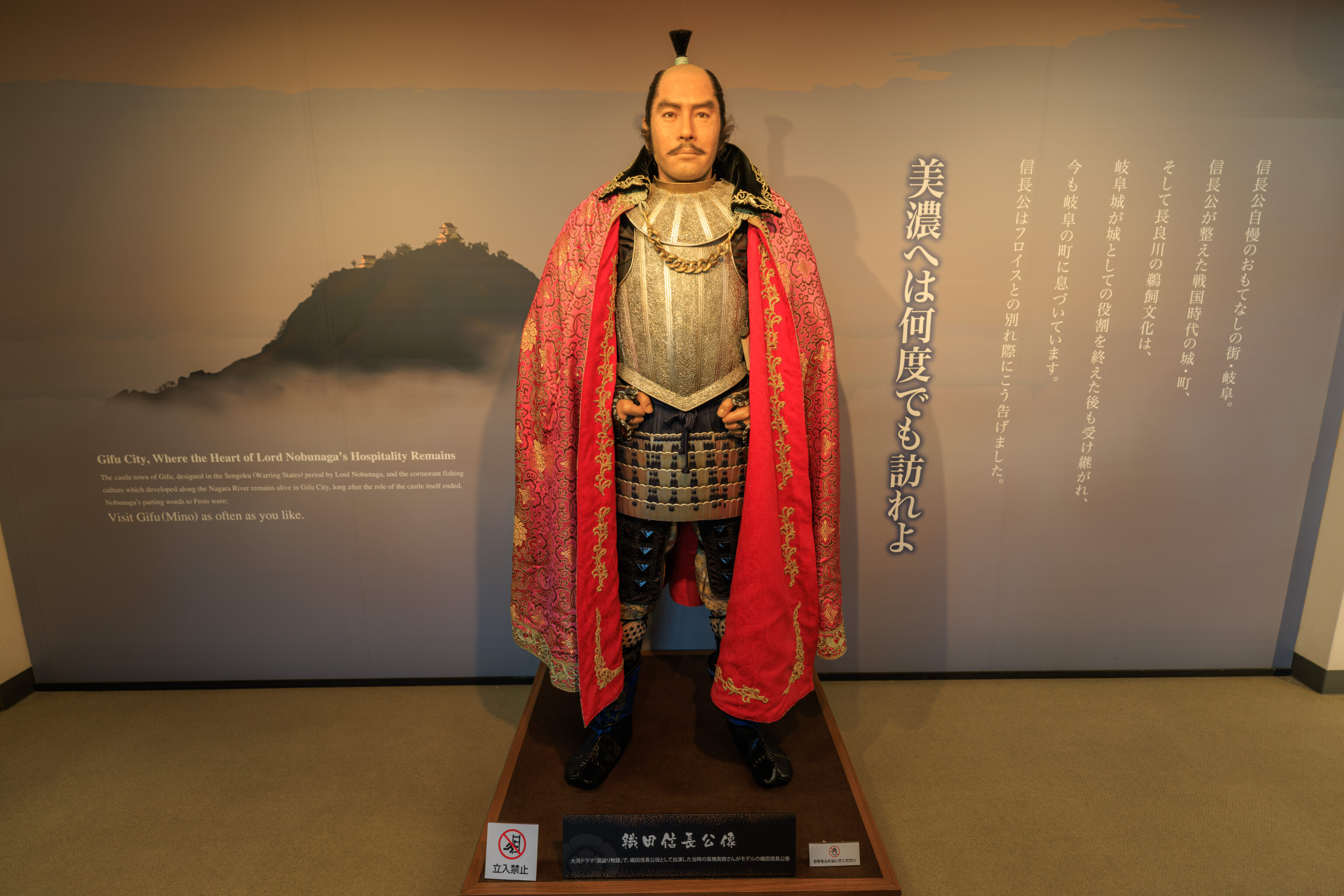
The musuem was pretty sparse. There was a statue of Oda Nobunaga as depicted by Hideki Takahashi in the historical drama Kunitori Monogatari.
Statue of Lord Oda Nobunaga
A statue of Oda Nobunaga modeled after Hideki Takahashi, who played the role of the warlord in the historical drama series *Kunitori Monogatari*.
– Text from the sign below the statue above, read using Google Gemini and translated using Google Translate.
Gifu—a city that takes pride in the hospitality established by Lord Nobunaga. The castle and town developed by Lord Nobunaga during the Warring States period, along with the cormorant fishing culture of the Nagara River, have been preserved long after Gifu Castle ceased to function as a fortress, and they remain a living part of the city today.

Upon parting ways with Luís Fróis, Lord Nobunaga spoke these words:
Visit Mino Again and Again.
– Text from the wall above, read using Google Gemini and translated using Google Translate.
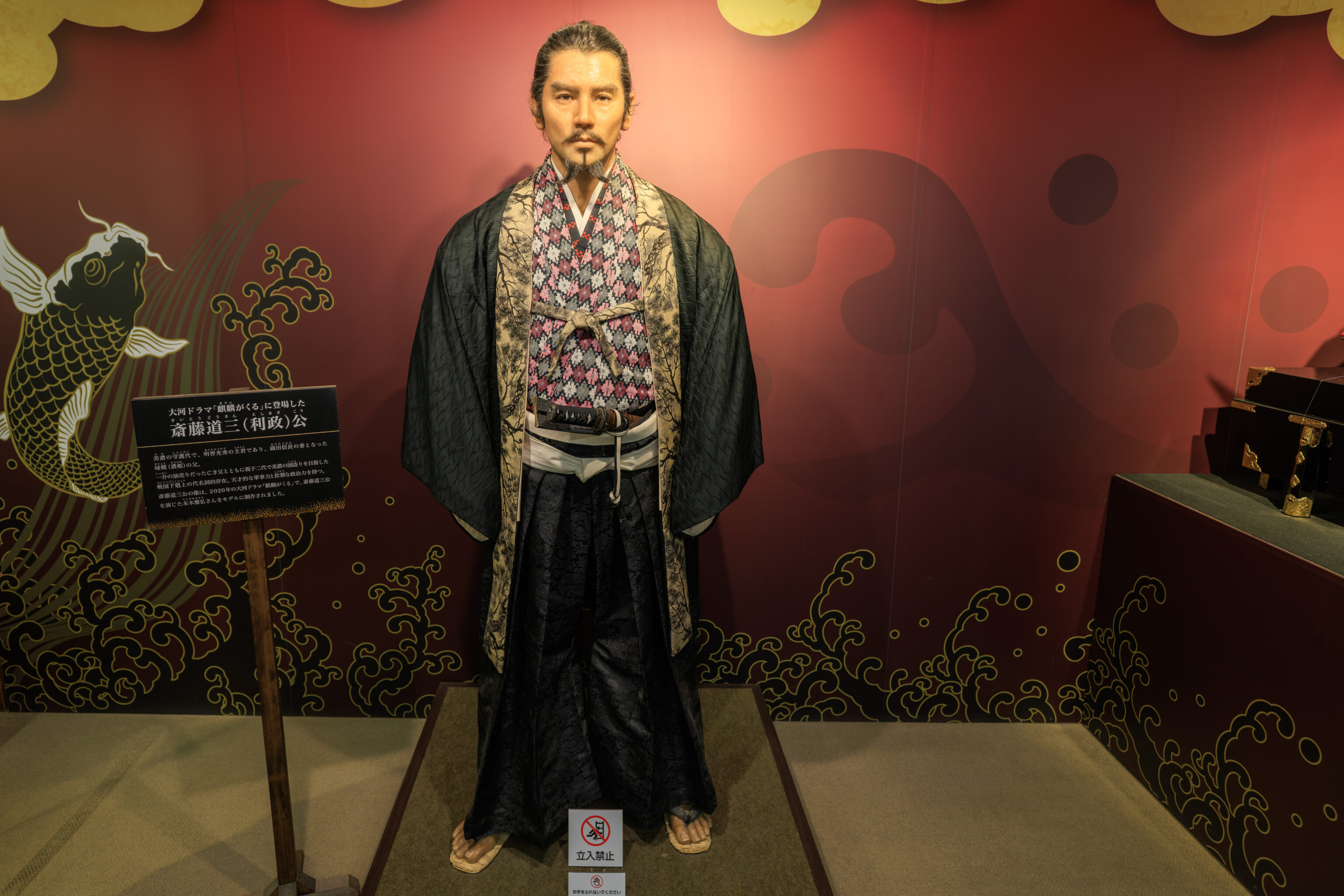
This statue depicts Masahiro Motoki as Saito Dosan in another historical drama, Kirin ga Kuru. Saito Dosan‘s daughter, Nohime, was married to Oda Nobunaga.
Lord Saito Dosan (Toshimasa), who appeared in the Taiga drama *Kirin ga Kuru*
He was the deputy military governor (*shugo-dai*) of Mino Province, the lord of Akechi Mitsuhide, and the father of Kicho (also known as Nohime), who became the wife of Oda Nobunaga.

He is the quintessential figure of the *gekokujo* era—where the lower overthrew the higher—having pursued the conquest of Mino Province over two generations alongside his father, who had started out as a mere oil merchant. He possessed both brilliant military acumen and cunning political skill.

The statue of Saito Dosan was created based on the likeness of actor Masahiro Motoki, who portrayed the character in the 2020 NHK historical drama *Kirin ga Kuru* (Awaiting the Kirin).
– Text from the sign on the left of the photograph above, read using Google Gemini and translated using Google Translate.
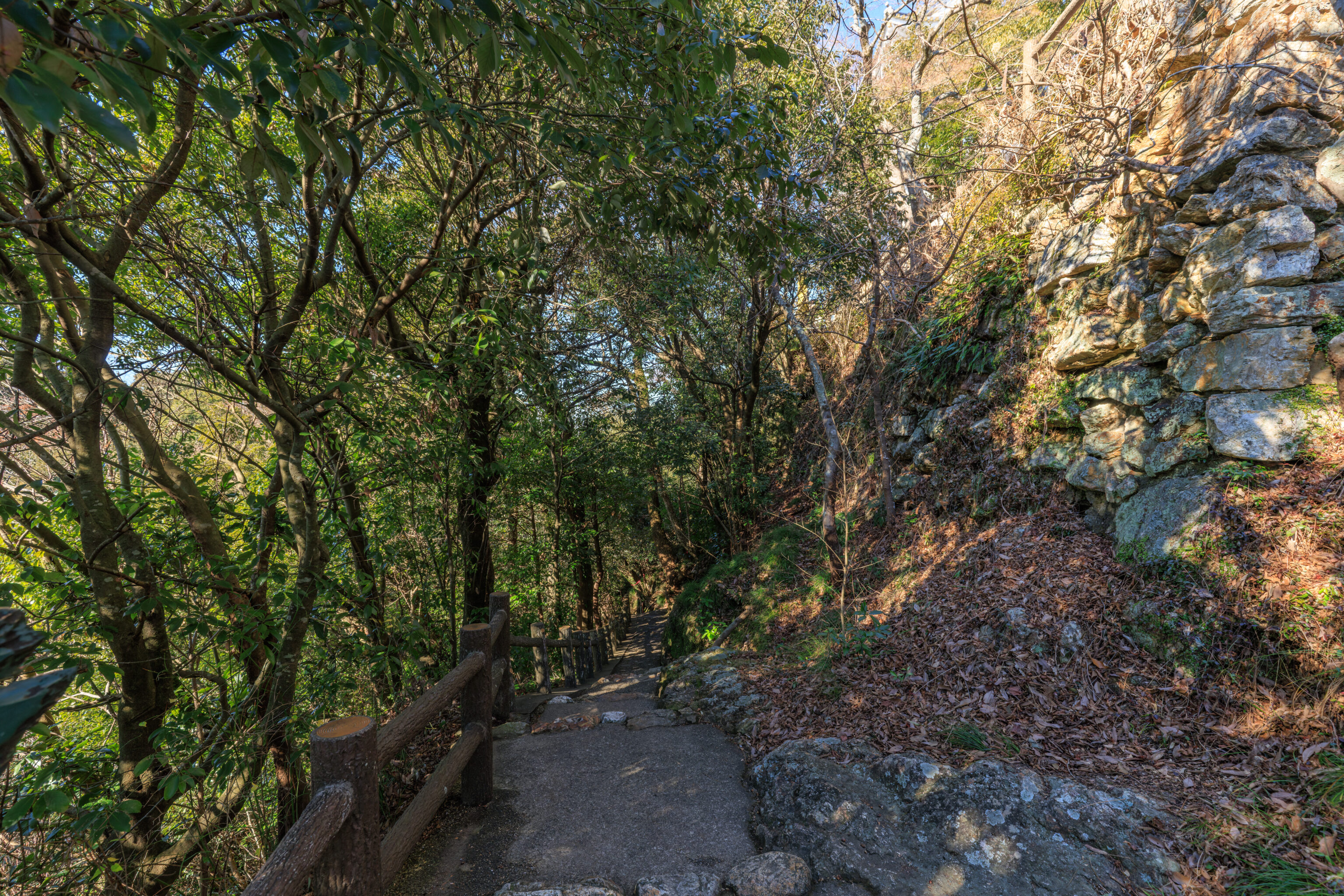
We decided to take an alternate path back to the upper ropeway station. Going this way avoids having to go back by the castle keep.
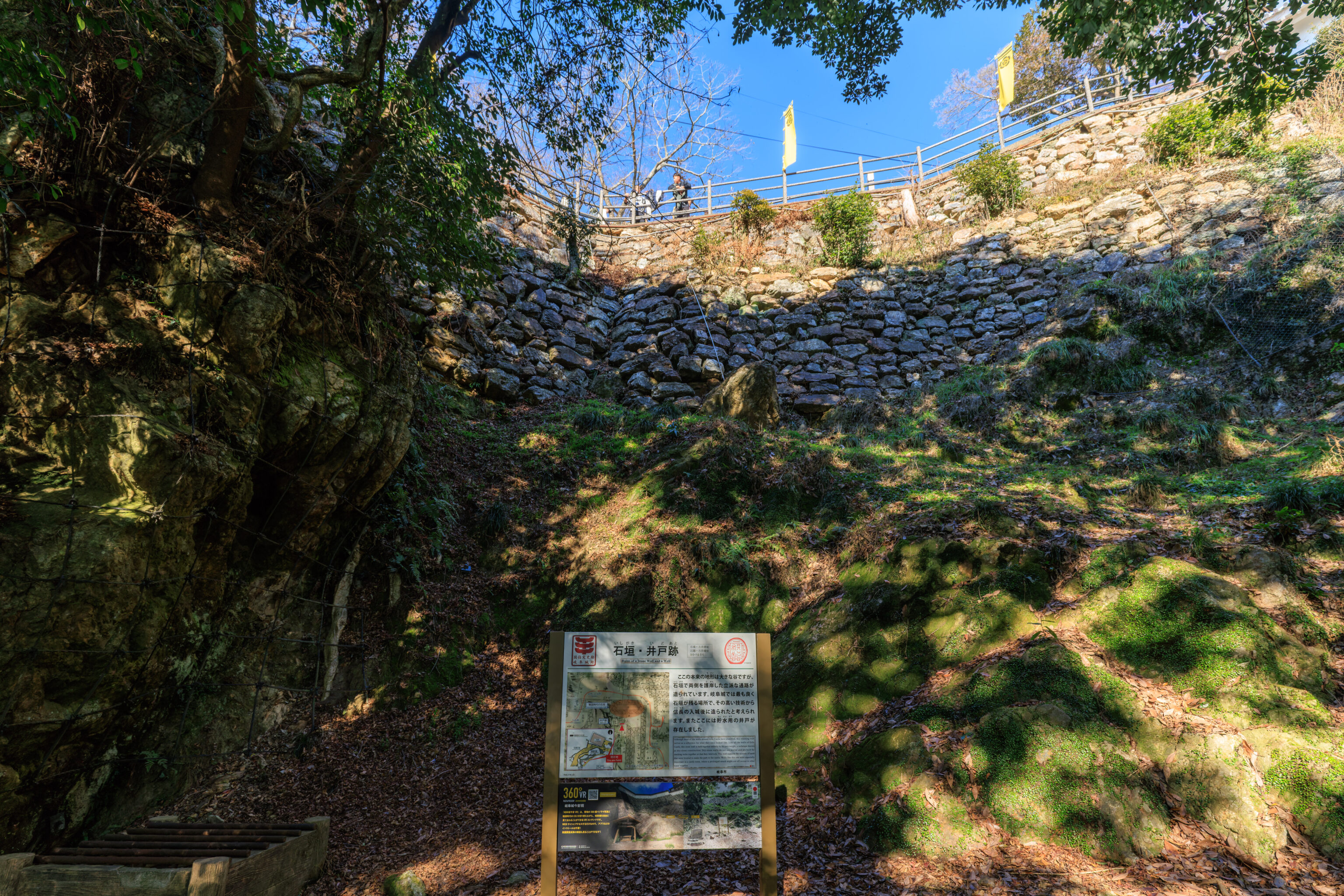
We passed just below the ridge that we walked on earlier to get to the castle. It turns out path on the ridge is actually supported by stone walls on either side.
Nationally Designated Historic Site: Ruins of Gifu Castle
Stone Wall and Well Site
Although the natural terrain here is a large valley, an impressive passageway has been constructed with stone walls reinforcing both sides. This area features the best-preserved stone masonry at Gifu Castle; the high level of craftsmanship suggests it was built after Nobunaga took up residence in the castle. A water-storage well was also located here.
– Text from the sign in the photograph above, read using Google Gemini and translated using Google Translate.
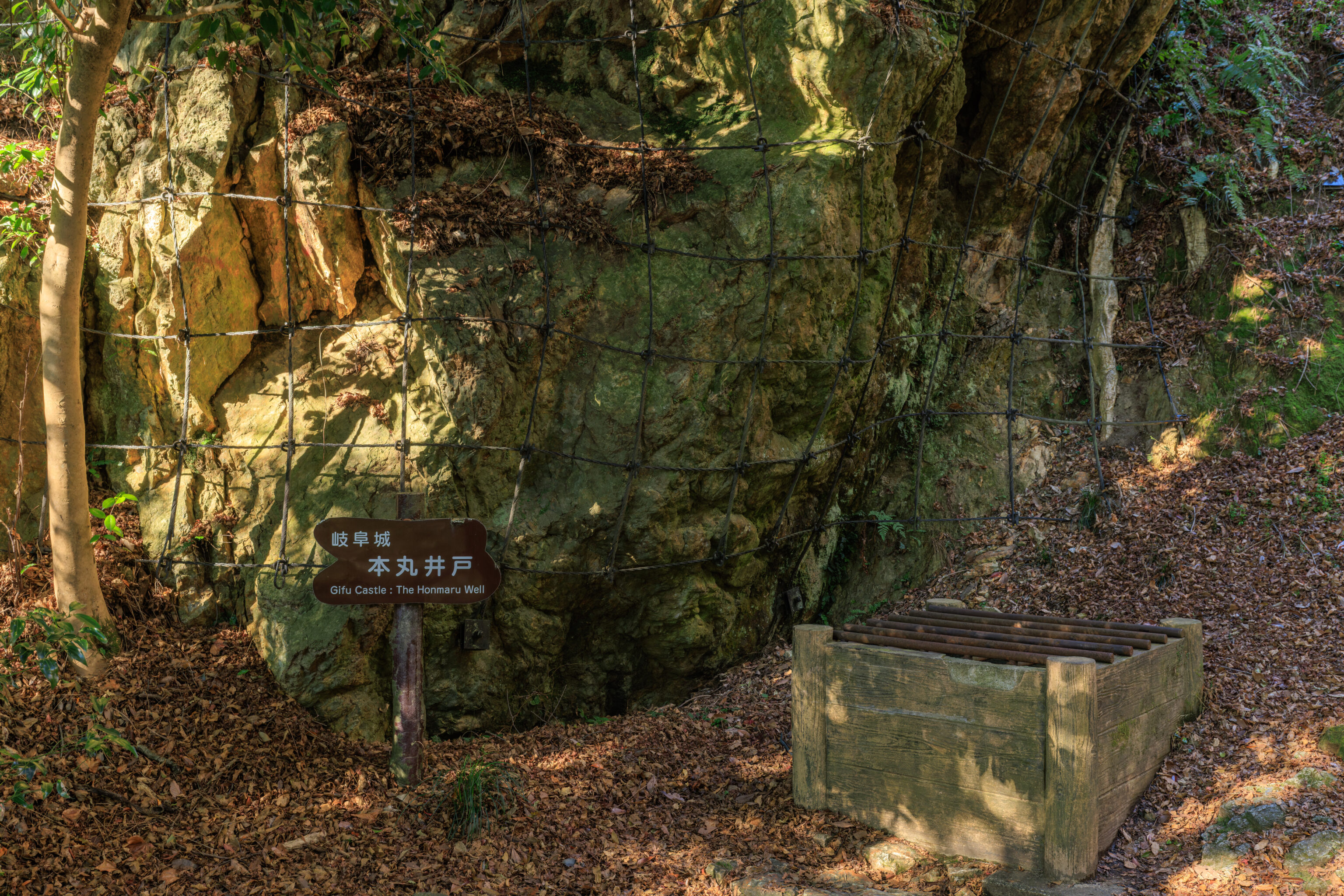
The well mentioned on the previous sign is here. The metal grate covering the top of the wall was actually visible at the bottom left of the previous photograph.
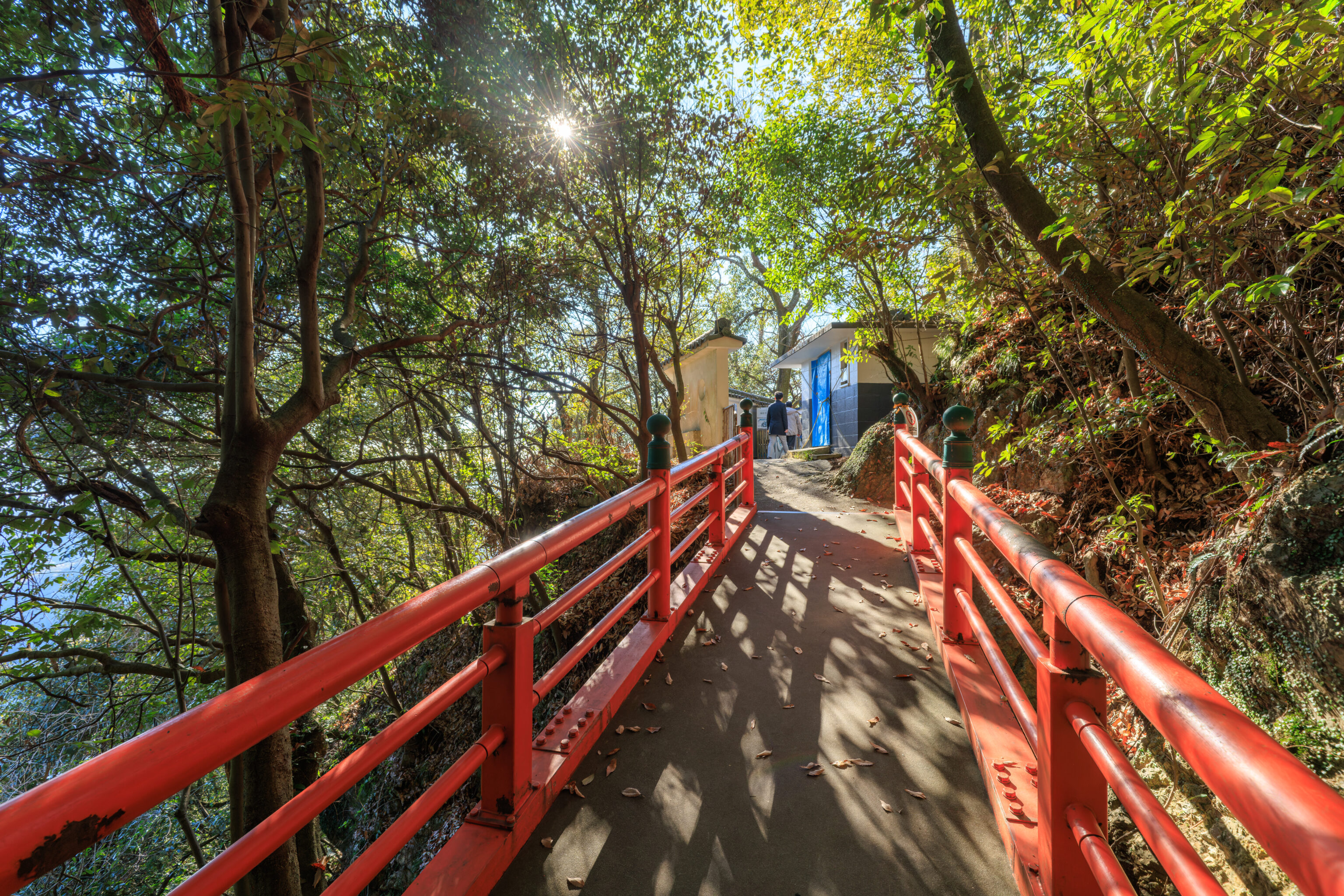
Continuing on, we crossed a small bridge.
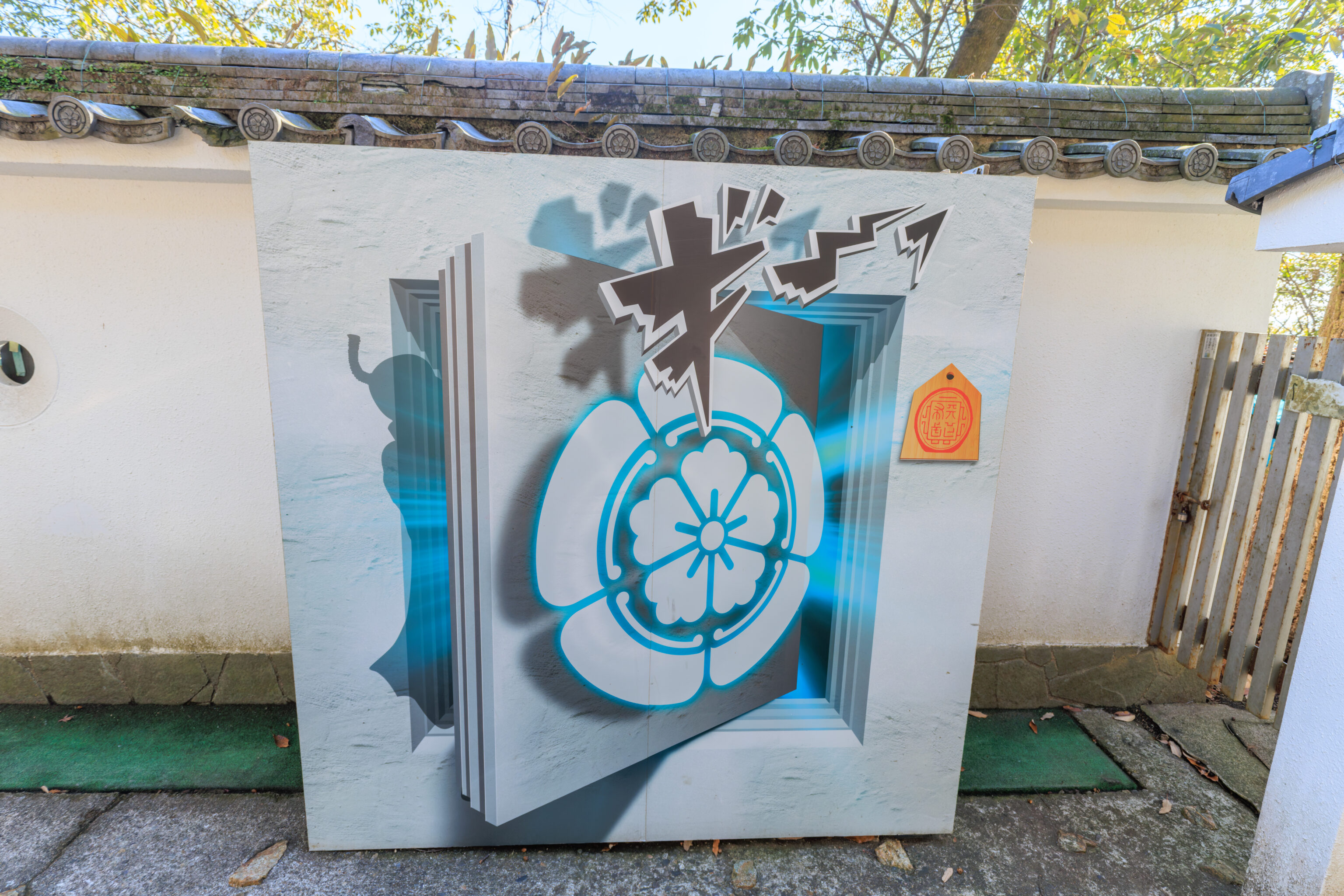
Not sure what this is about!
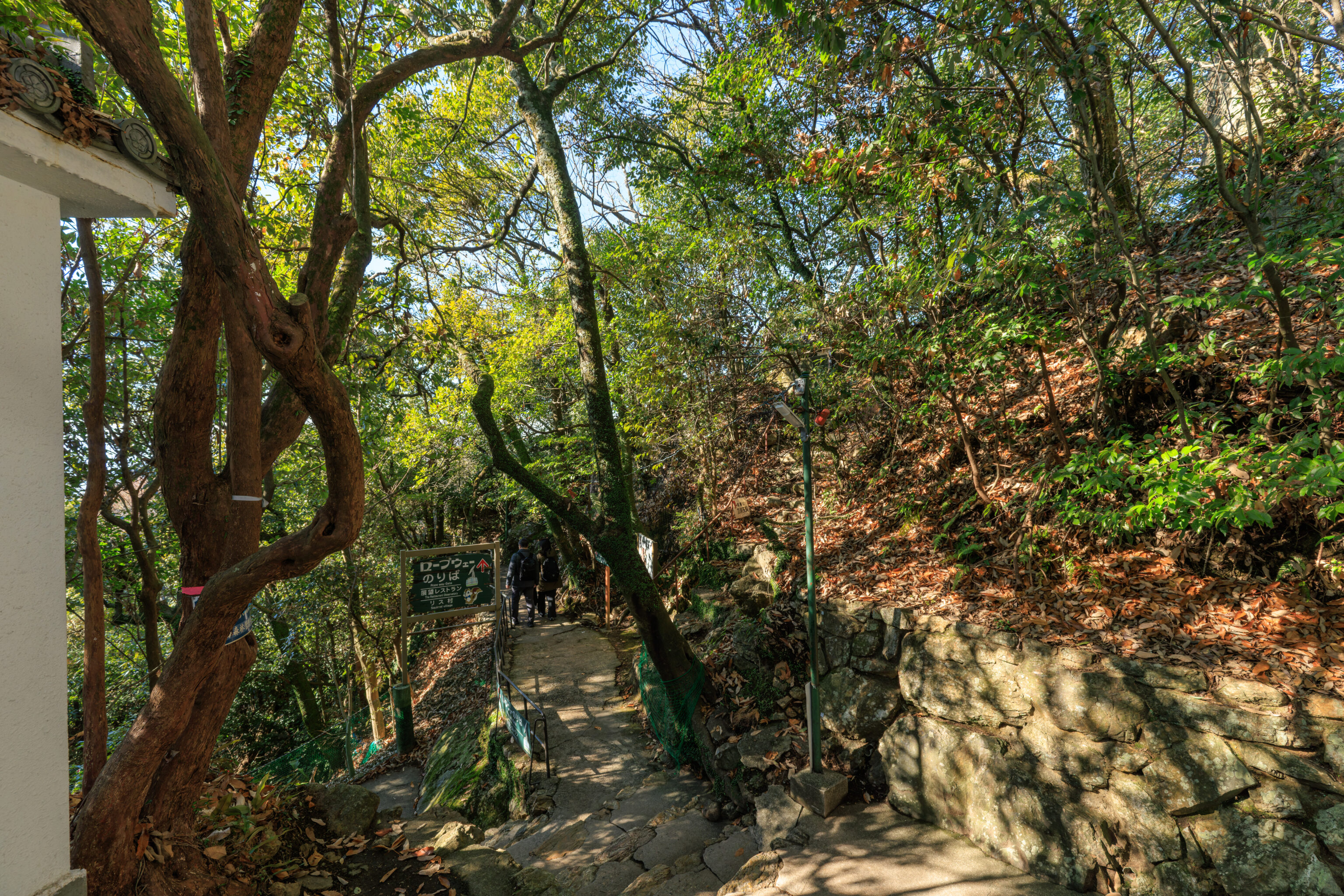
We continued on…
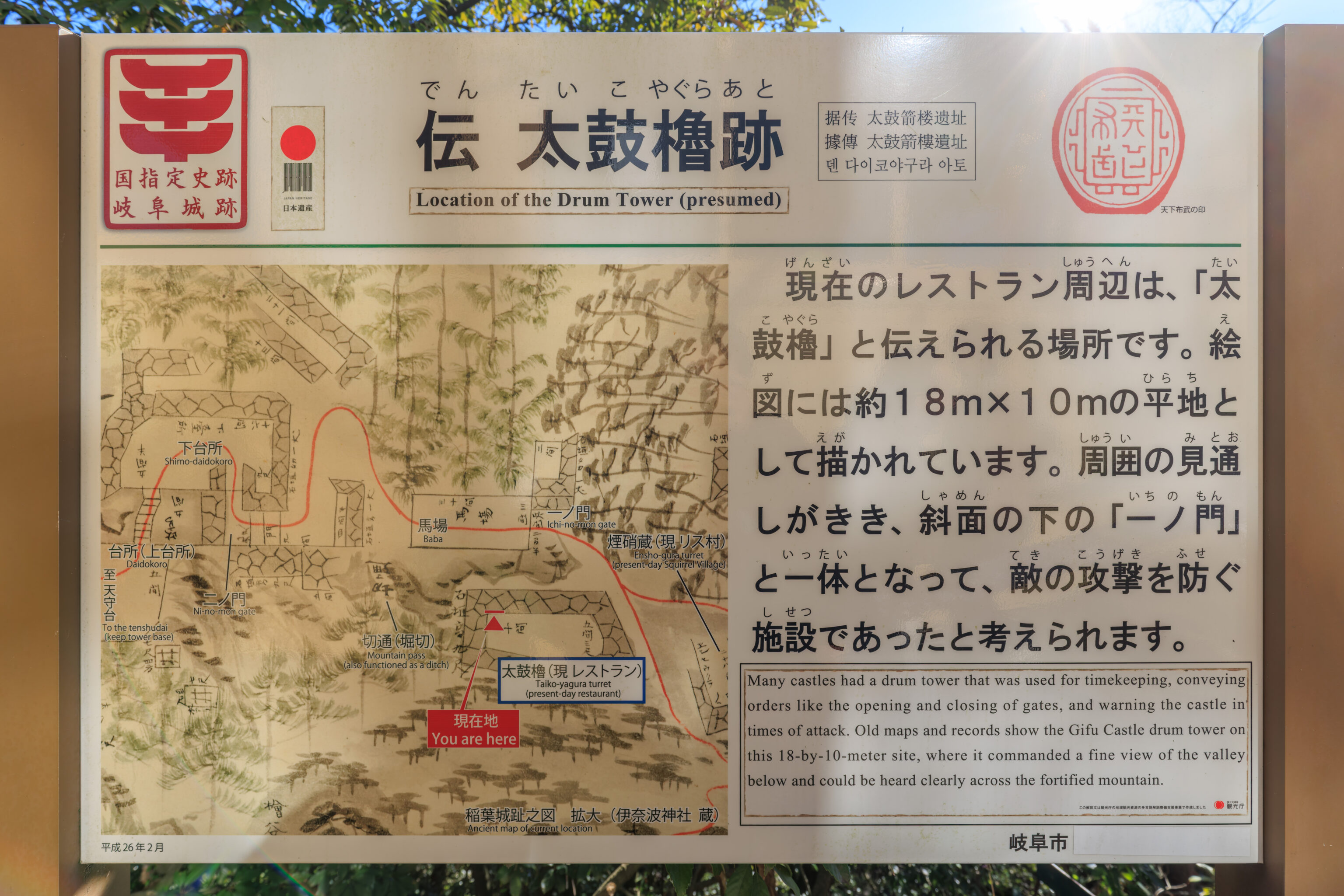
After rejoining the path that we walked on when arriving, we turned to the right to head to a modern observation deck and restaurant building. It was the former location of a castle tower:
Nationally Designated Historic Site: Ruins of Gifu Castle
Site of the Taiko Yagura (Drum Tower)
The area surrounding the current restaurant is the site of what is believed to have been the "Taiko Yagura" (Drum Tower). Historical illustrations depict it as a flat area measuring approximately 18 by 10 meters. Offering a clear view of the surroundings, it is thought to have functioned as a defensive structure that worked in tandem with the "Ichi-no-mon" (First Gate) located at the foot of the slope to repel enemy attacks.
– Text from the sign in the photograph above, read using Google Gemini and translated using Google Translate.
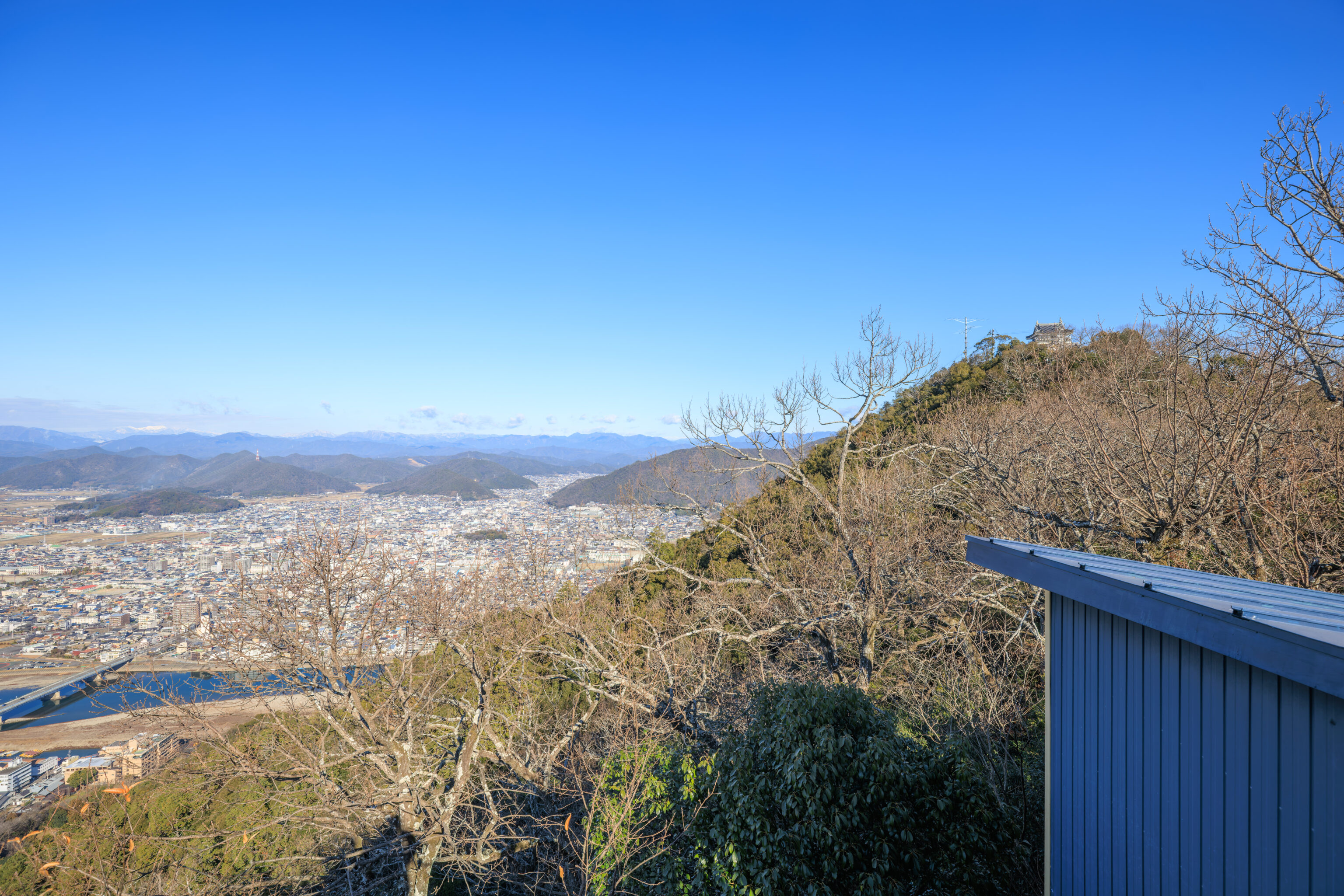
From the observation deck, we were able to look back and see Gifu Castle.
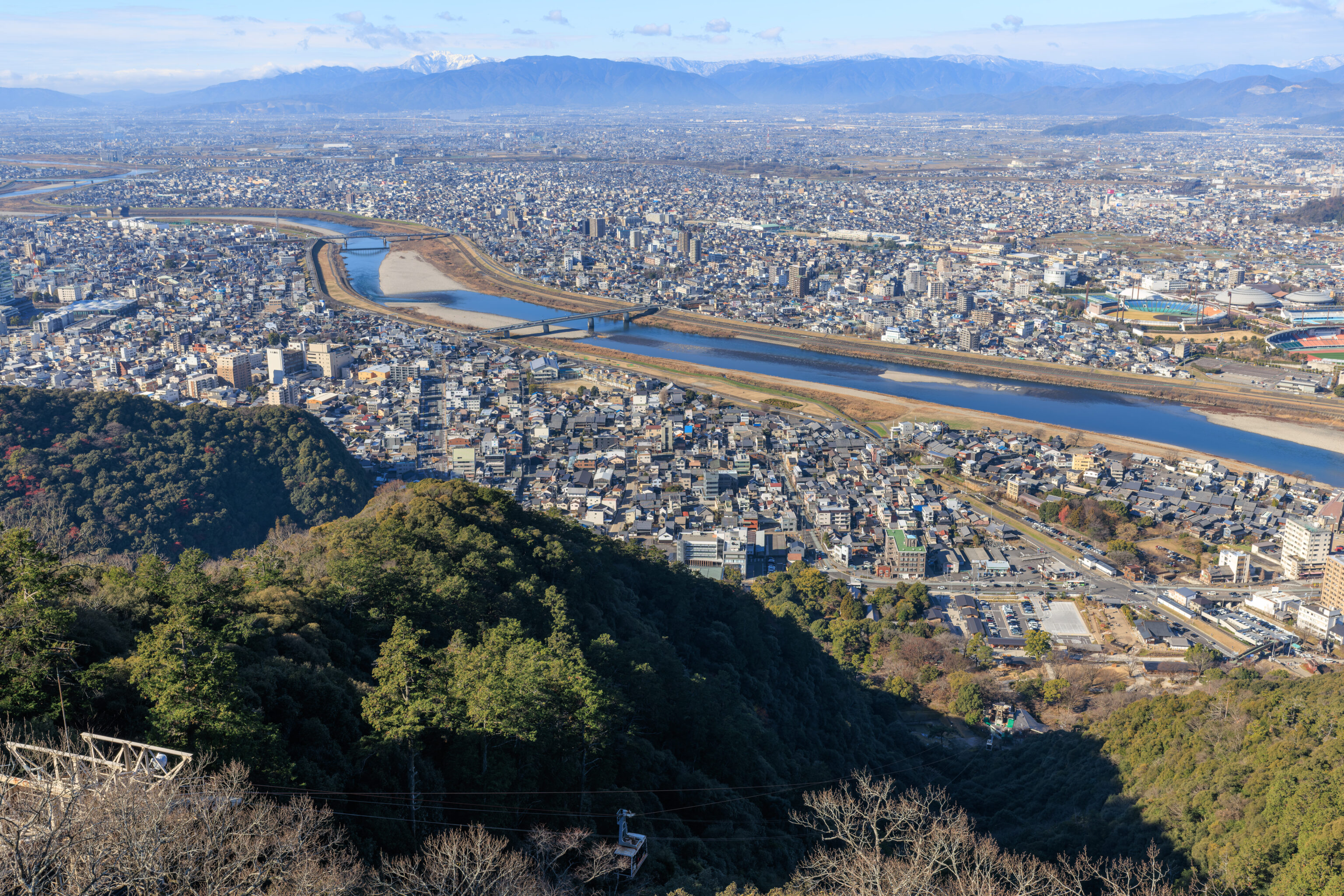
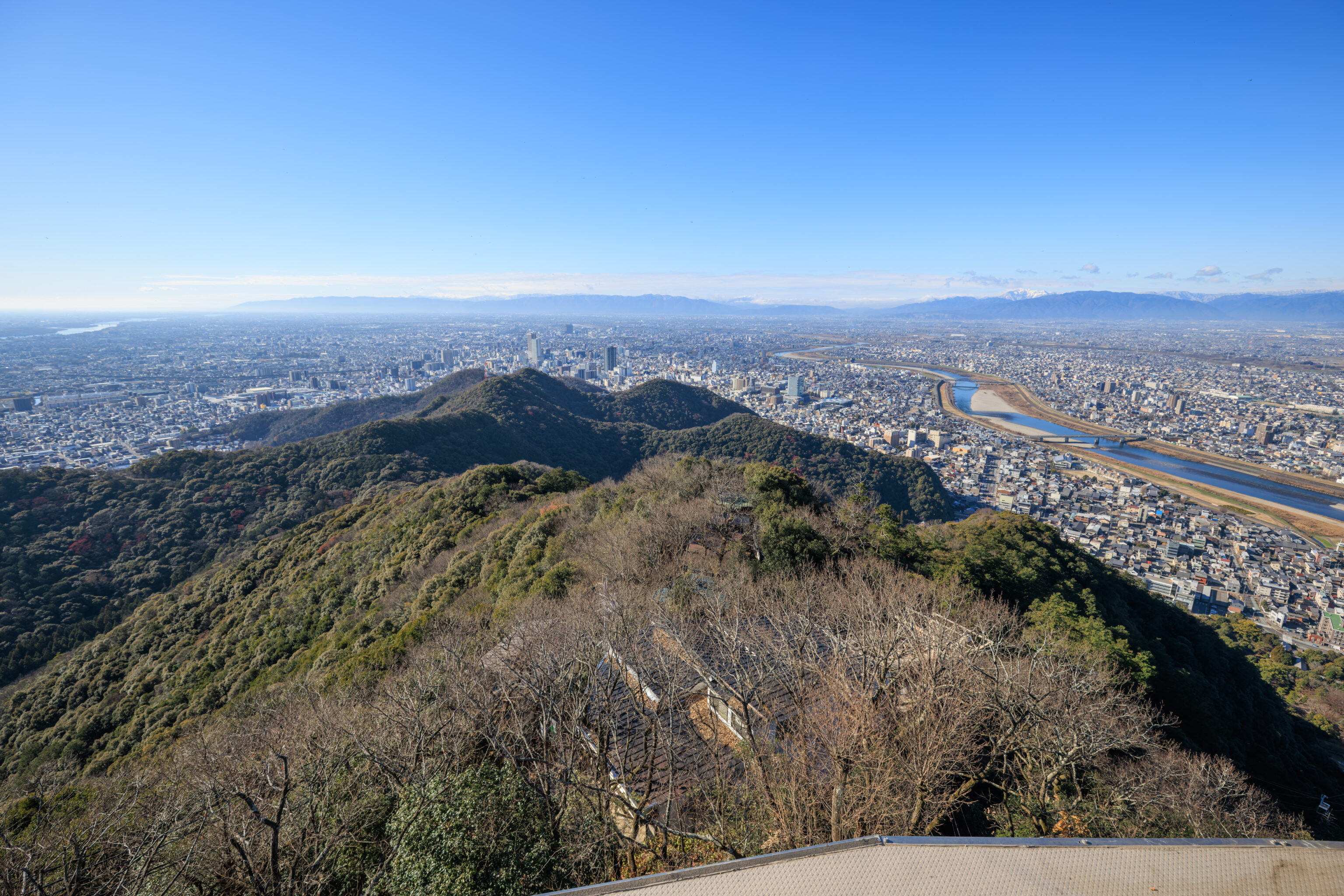
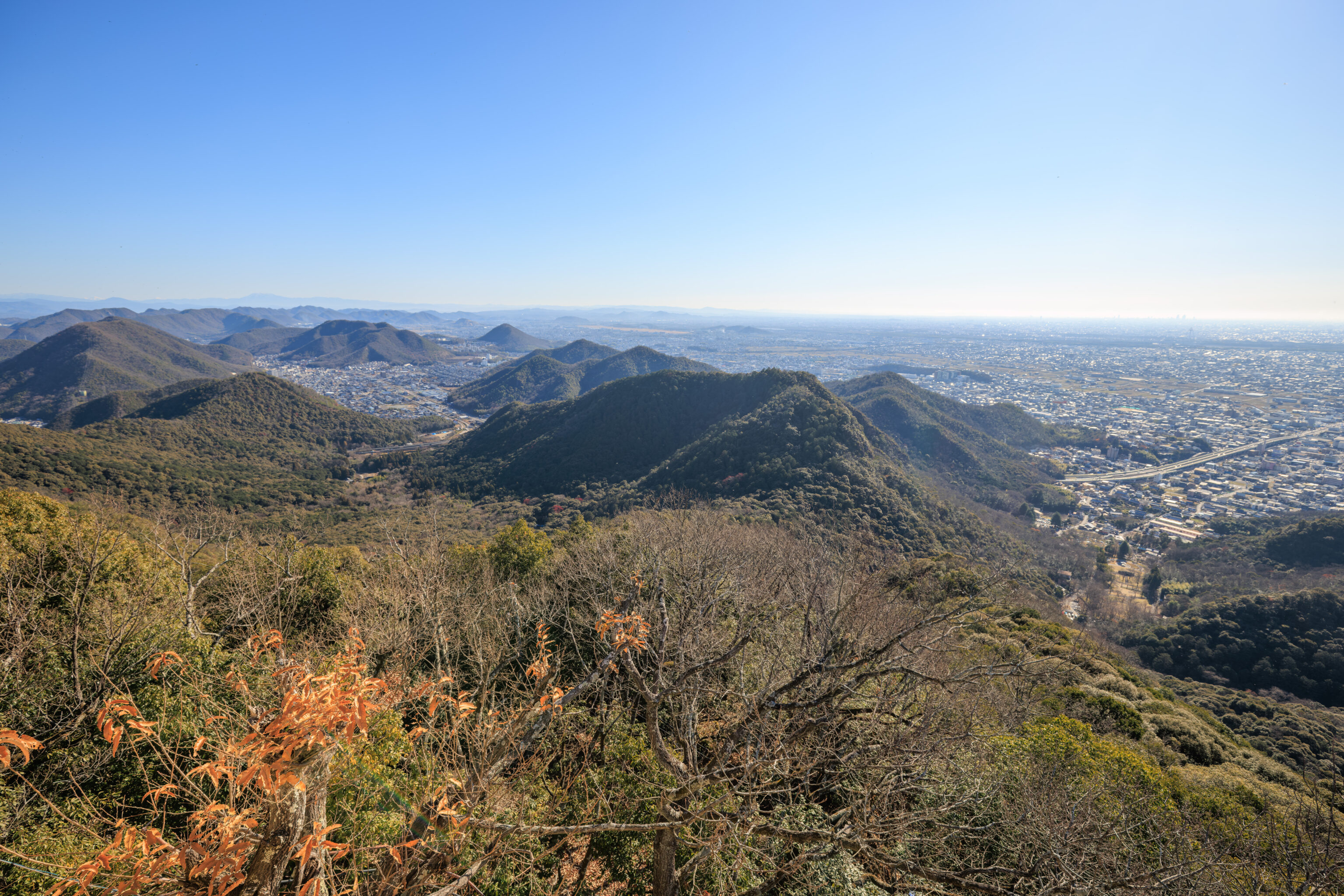
The view looking to the northwest to southwest.
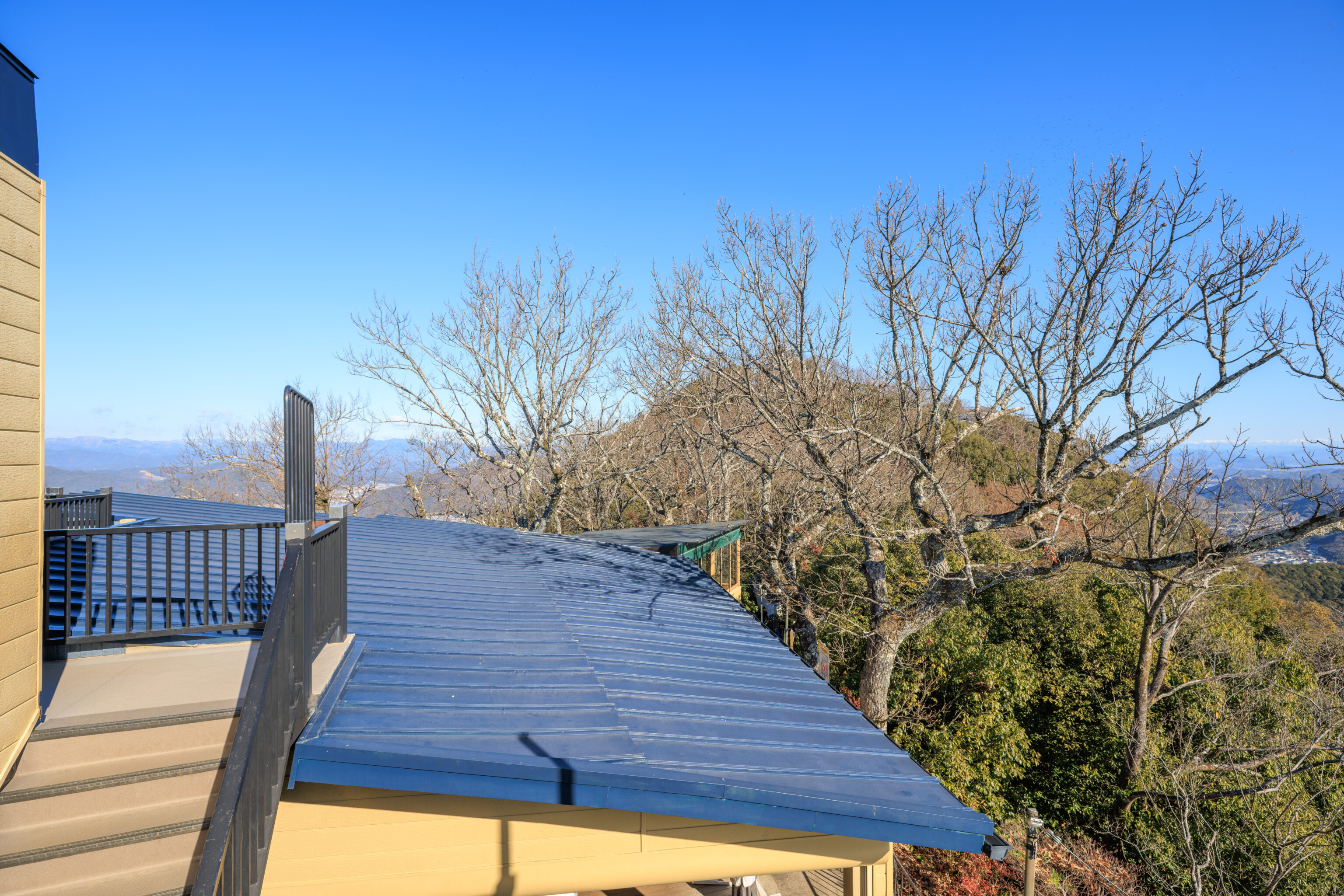
An obscured view looking back towards the castle.
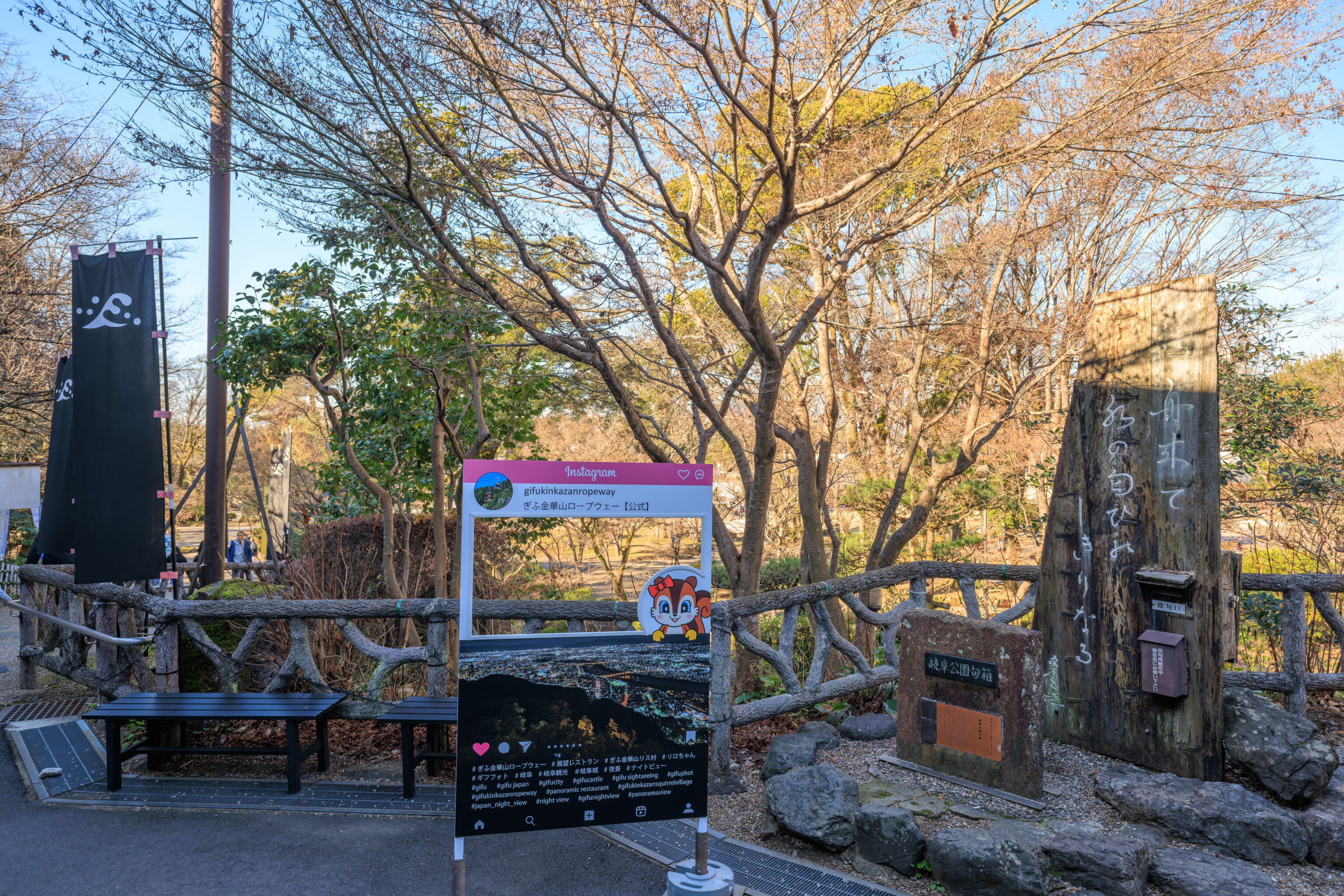
We took the ropeway back down, arriving at roughly 11am. We noticed this Instagram photo spot just ouside of the ropeway station building.
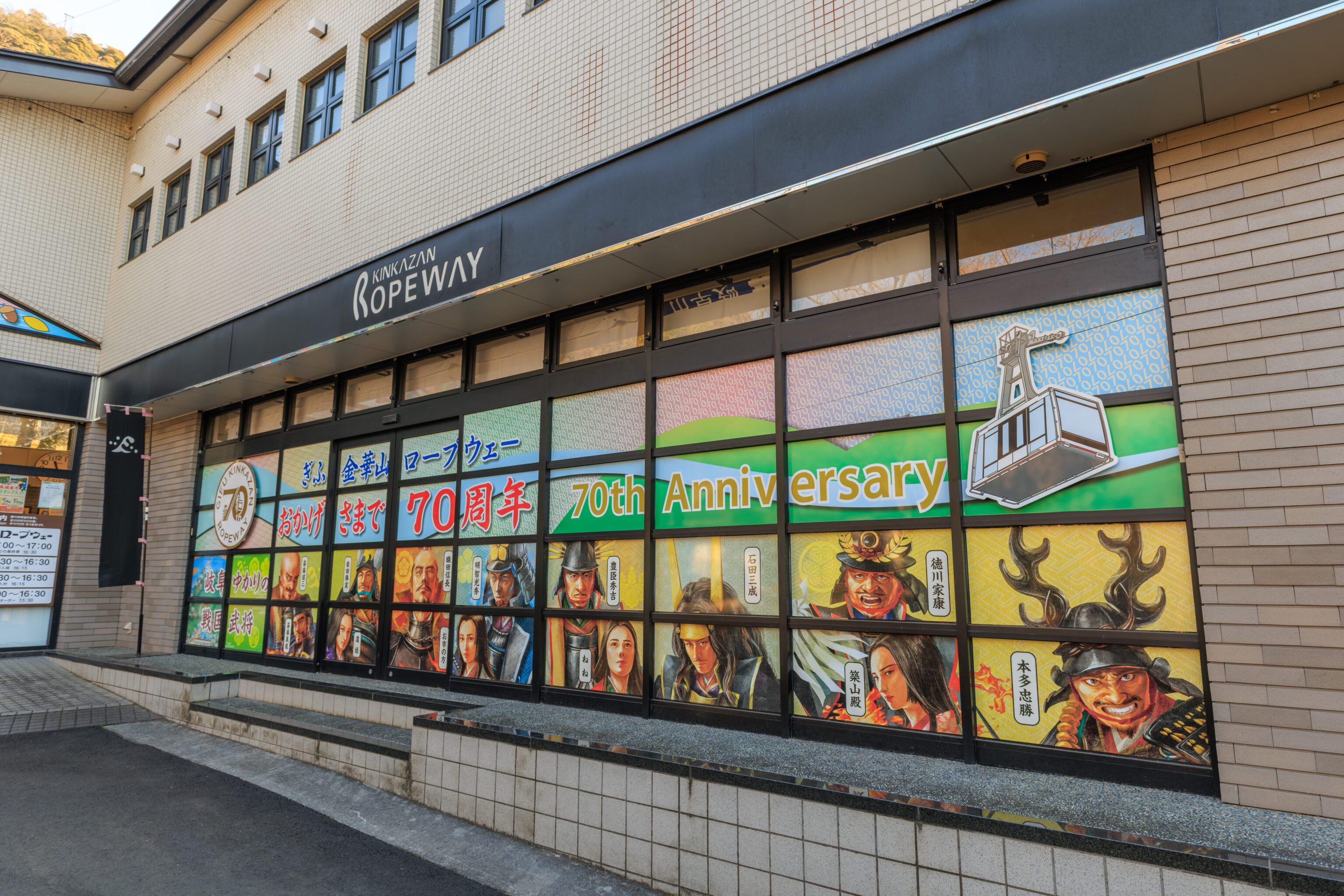
Happy 70th anniversary, Kinkazan Ropeway! The artwork depicts various warlords of the Sengoku period relavant to Gifu Castle. We spent a bit of time trying to figure out where to eat lunch before we continued on.
Lunch
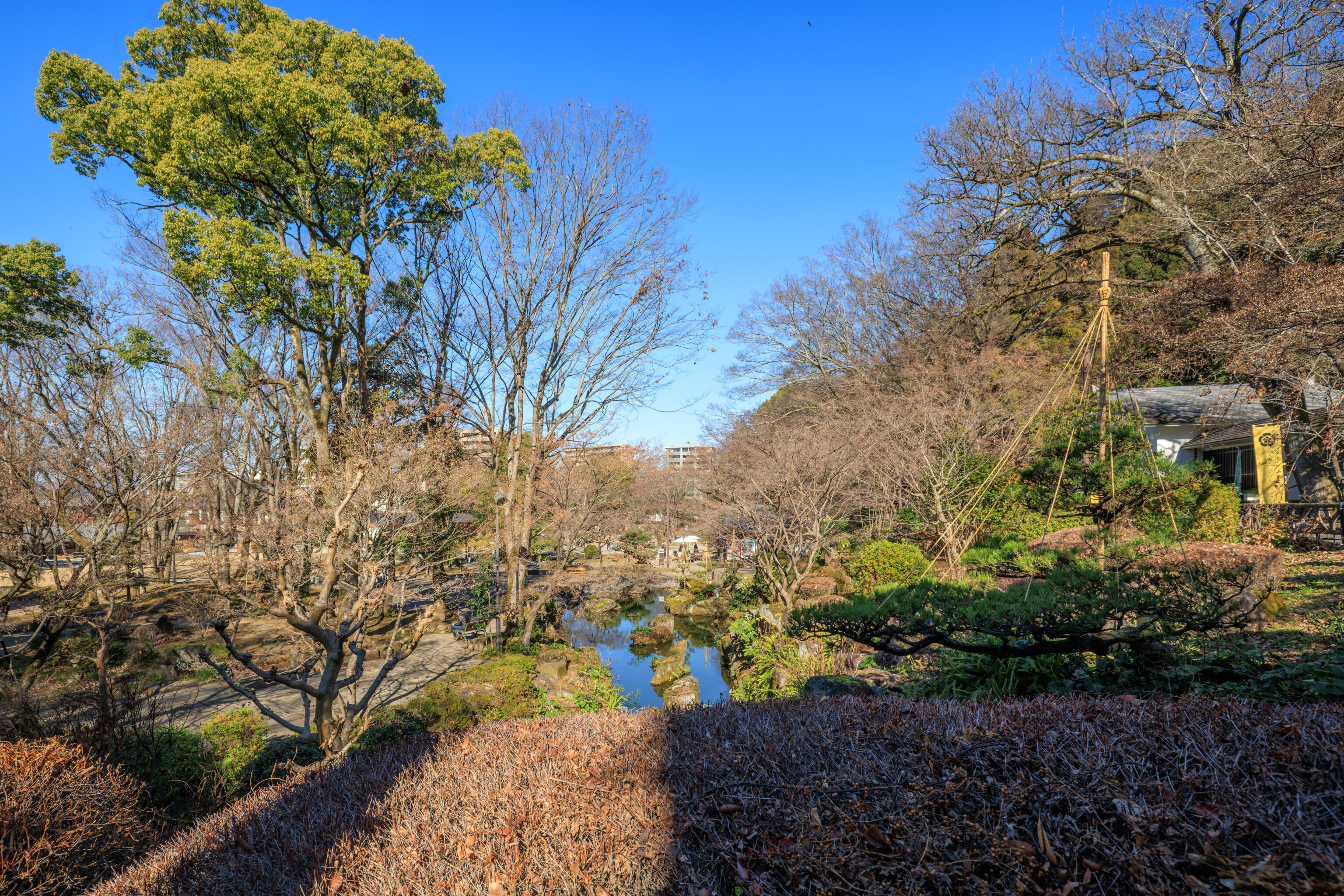
We picked a place to eat and started to walk to the west through Gifu Park. According to a stone sign, Gifu park won an Urban Landscape Award as one of 100 Choice Urban Landscapes.
Urban Landscape Award
100 Choice Urban Landscapes
Gifu Park and the Surrounding Area

The Urban Landscape Award was made to promote the creation of good city spaces and formation of scenery since 1991. Gifu Park and the Surrounding Area was selected in 1992 to receive the 100 Choice Urban Landscapes category award (a commendation from the Ministry of Construction). The 100 Choice Urban Landscapes is a distinction for areas and districts that, as general urban environments, cultivate good city spaces and are well put together. Specifically, the award is given to districts that people feel proud of as the face of their city, and that reside in central urban areas that are multipurpose and used by governmental, economic, cultural and other fields.
– Text from a sign.
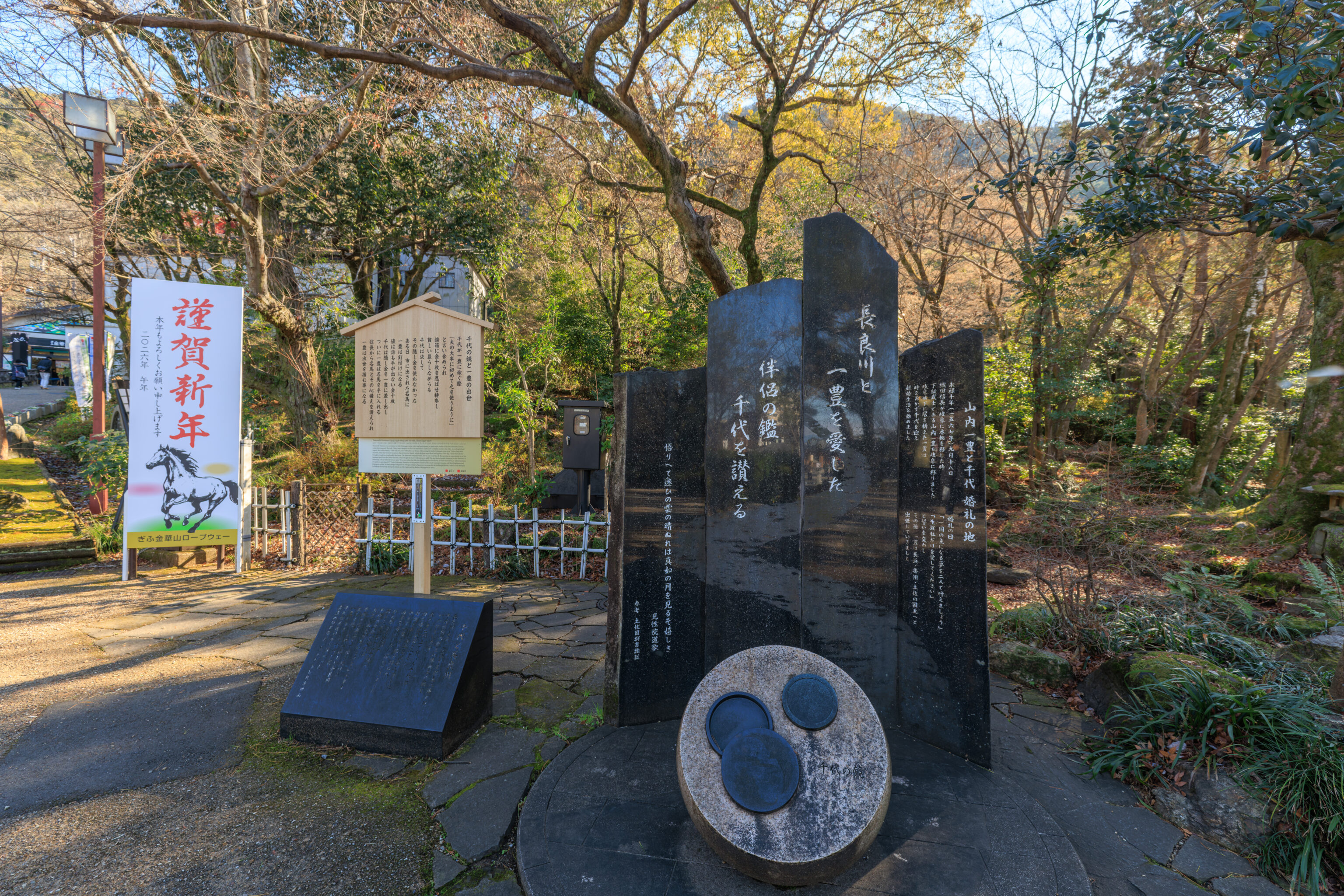
A monument and lots of text… It is all dedicated to Yamauchi Kazutoyo and his wife, Chiyo. Yamauchi Kazutoyo was a retainer under Oda Nobunaga and later became a daimyo of various domains.
Honoring Chiyo—a model spouse who loved the Nagara River and Kazutoyo.

The Site of the Wedding of Yamauchi Kazutoyo and Chiyo
September 18, 1567

When Oda Nobunaga relocated his base of operations to Gifu, Yamauchi Kazutoyo, a low-ranking samurai, moved there as well. After establishing a home in the castle town of Gifu, Kazutoyo soon welcomed Chiyo and began their life as newlyweds.

On their wedding day, they exchanged vows: "Let us realize the dream of becoming the lord of a province together," and "Please love only me for the rest of your life." In the years that followed, Kazutoyo rose through the ranks, eventually becoming the lord of the Nagahama, Kakegawa, and Tosa domains.
– Text from the monument, read using Google Gemini and translated using Google Translate.
Yamauchi Kazutoyo (1545/1546-1605) and his wife, Chiyo (1557-1617)
Yamauchi Kazutoyo was a retainer to Oda Nobunaga (1534-1582) and participated in most major battles of the late sixteenth century under his command. His wife, Chiyo, was a daughter of the Gujo Hachiman Castle Lord located in modern-day Gifu. According to local legend, she told Kazutoyo, "Love only me, and I will make your dream of becoming the lord of a domain come true." When they were married, Chiyo had received ten pieces of gold from her family, which she kept secret from her husband. One day, a local horse dealer brought around an exceptionally fine horse. The horse was very expensive, and no one could buy it. Recognizing an opportunity to set her husband apart from the other retainers, Chiyo bought the horse with her secret gold. The new horse brought Kazutoyo to the attention of Nobunaga, who is believed to have said; "If no one within the Oda clan had bought this fine horse, it would have been an embarrassment. I'm glad you purchased it!" Under Nobunaga, Kazutoyo would become master of the small Karakuni domain, and then Nagahama and Kakegawa castles. He later pledged allegiance to Tokugawa Ieyasu. Kazutoyo was awarded the lordship of Kochi Castle in Tosa Province in Shikoku for his help during the attack on Gifu Castle and the Battle of Sekigahara in 1600.
– Text from the wooden sign on the left.
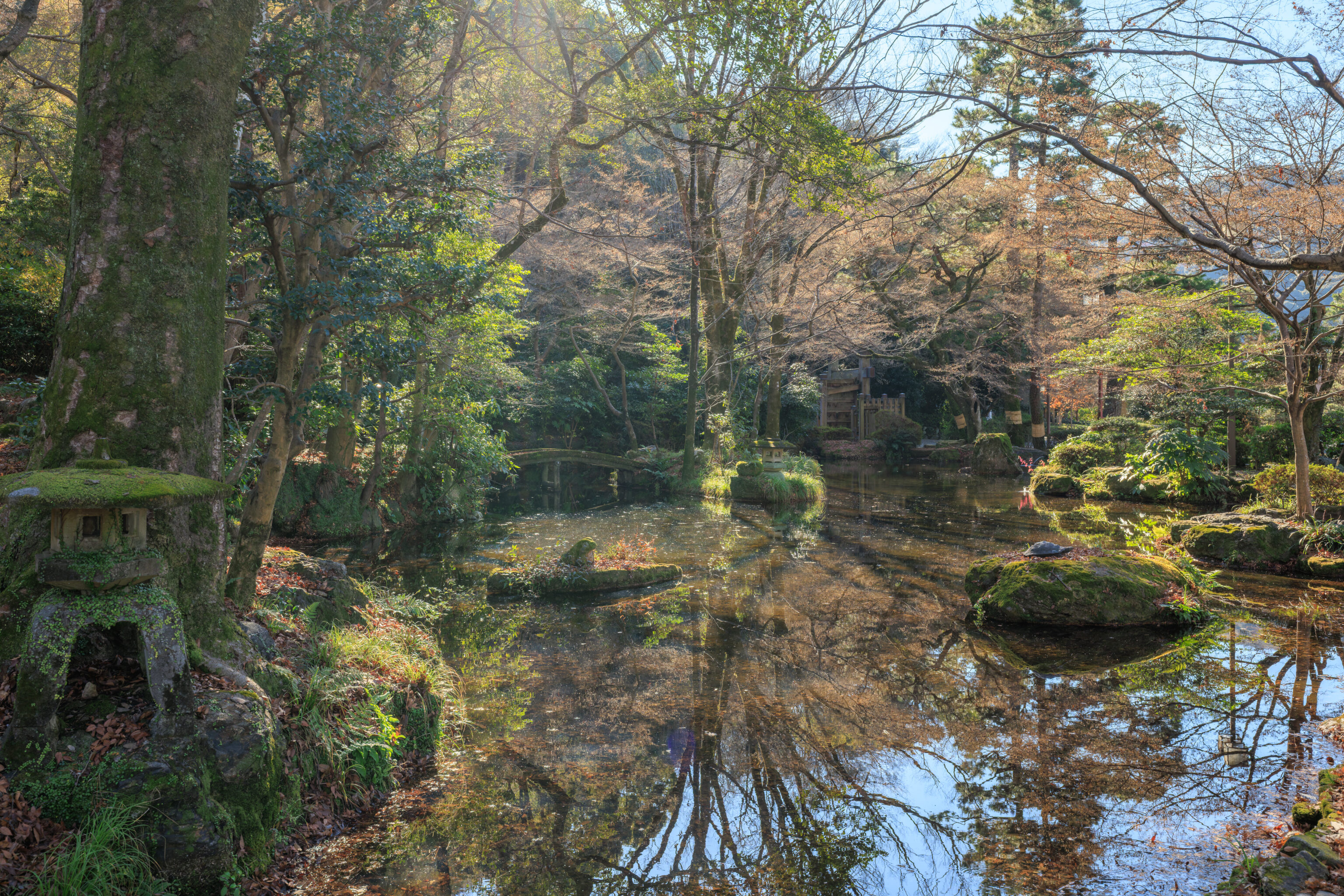
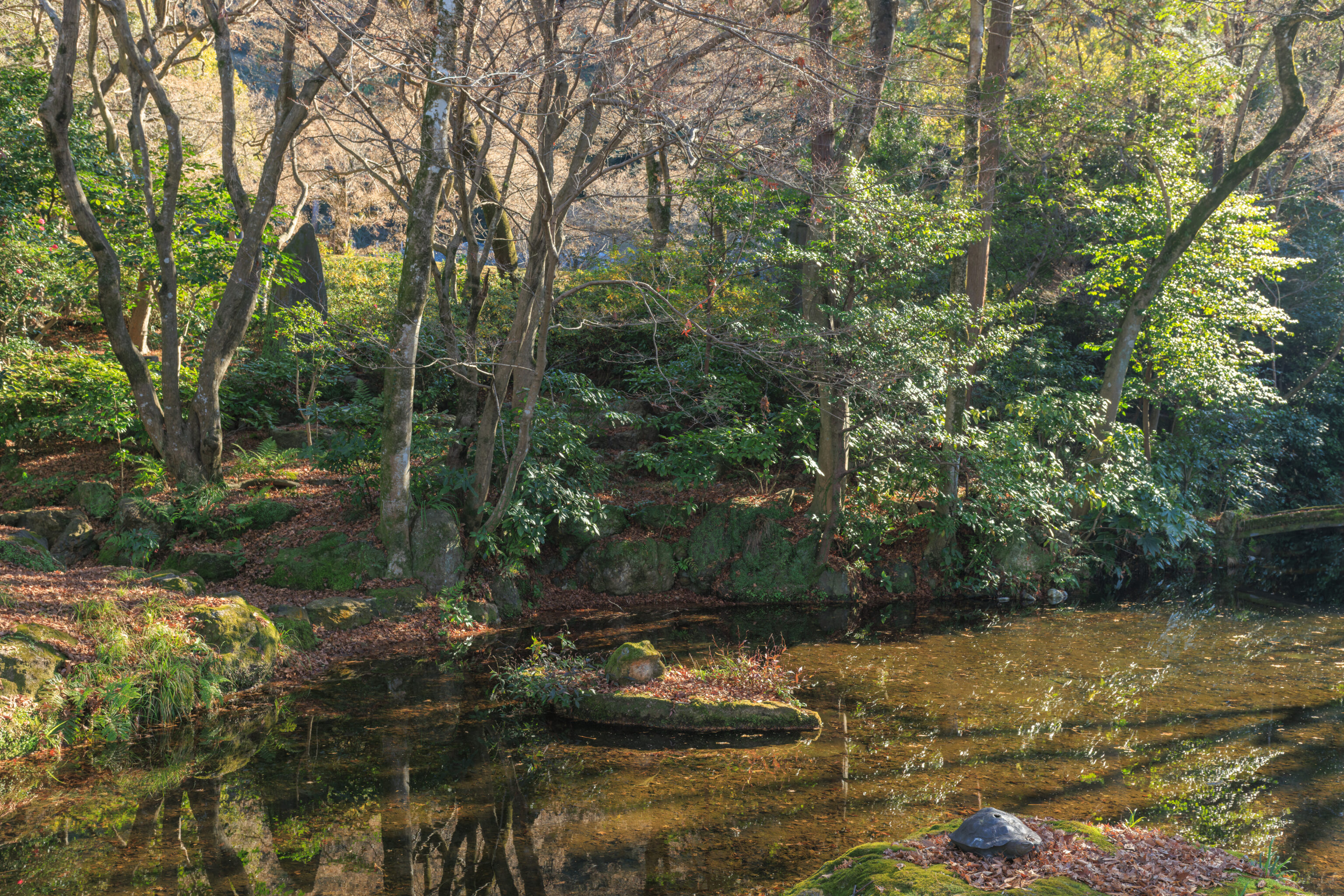
A nice quiet pond…
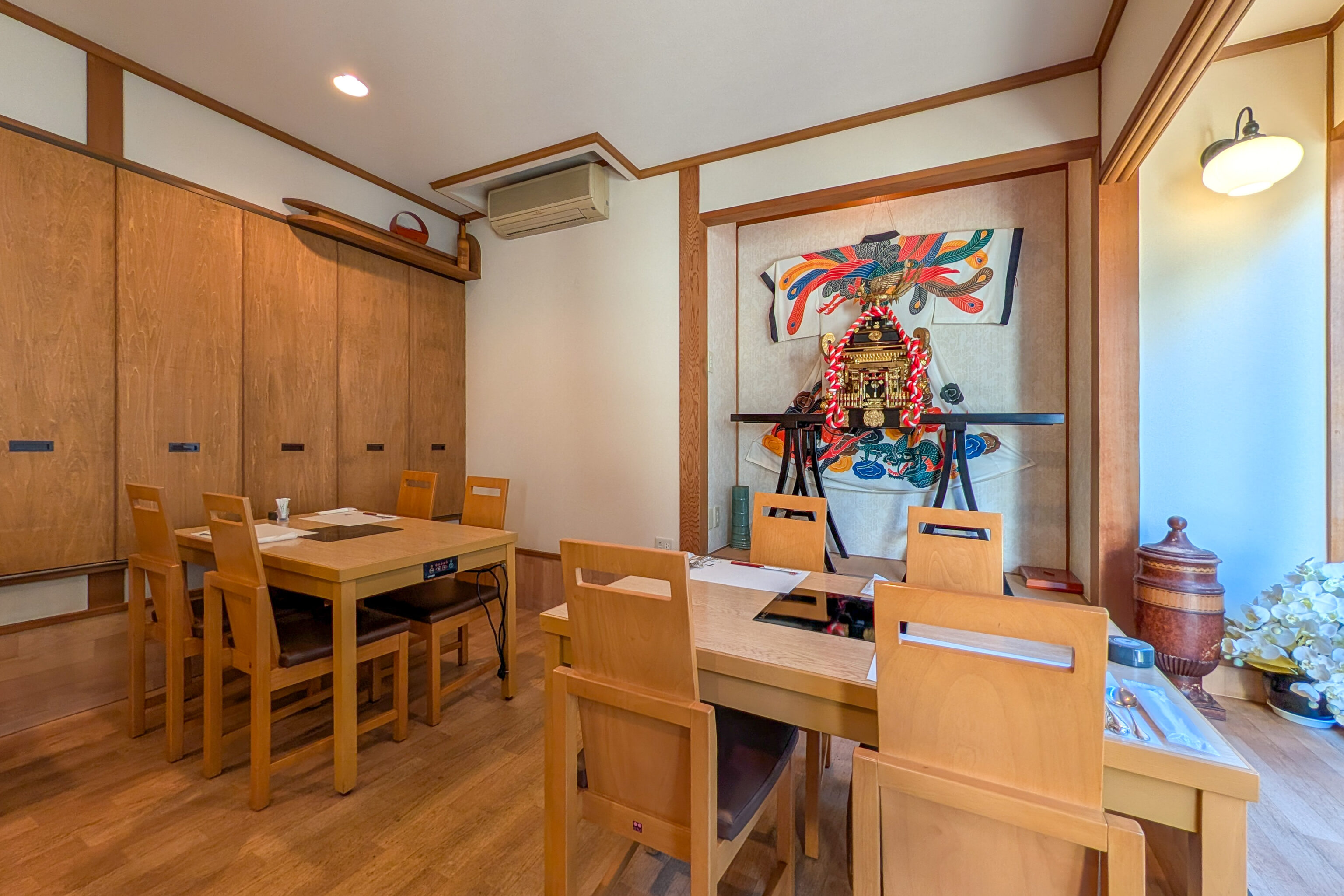

After crossing the road to the west of Gifu Park, we walked two blocks to the west to reach 飛騨牛かわい Hida Beef Kawai. We arrived not long after the 11:30am opening time.
As the name suggiests, they serve 飛騨牛 Hida Beef, the local beef of Gifu Prefecture. The name comes from the former Hida Province, which is now northern Gifu. The city of Gifu, where we are now, is in the south of the prefecture and is much closer to Nagoya than what was formerly Hida.
We have had Hida Beef before, having been to Takayama, a city to the north in what was Hida Province.
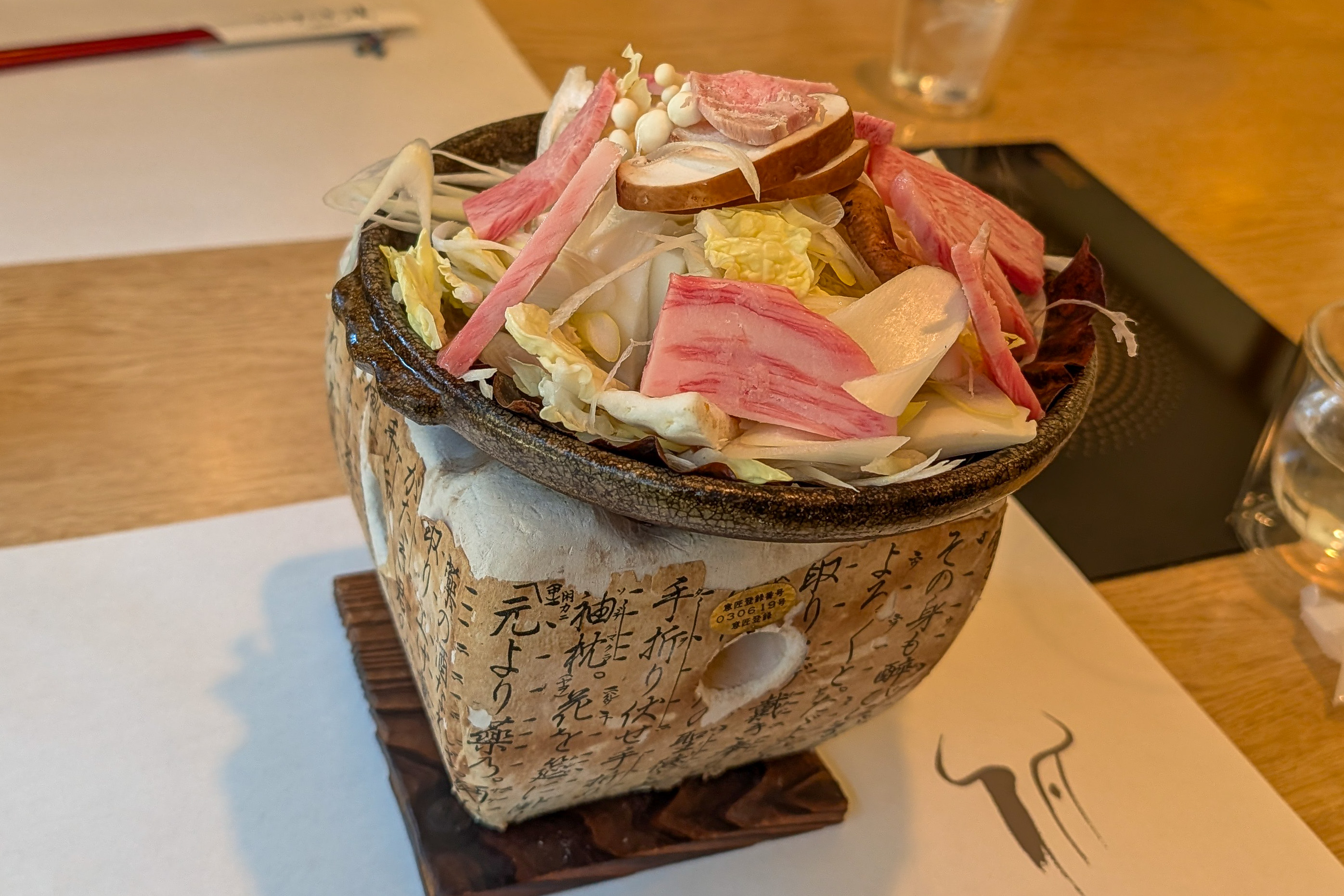
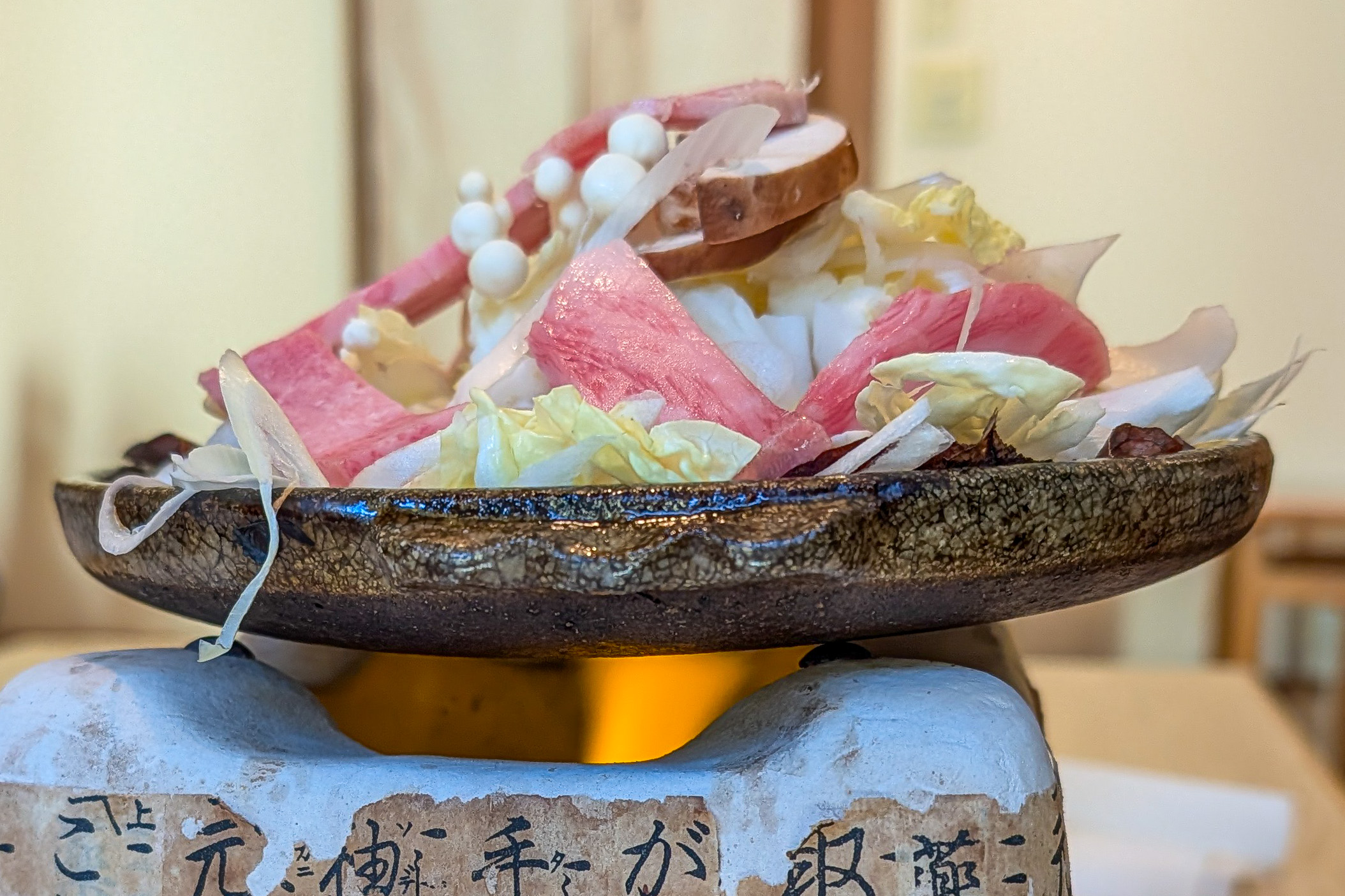
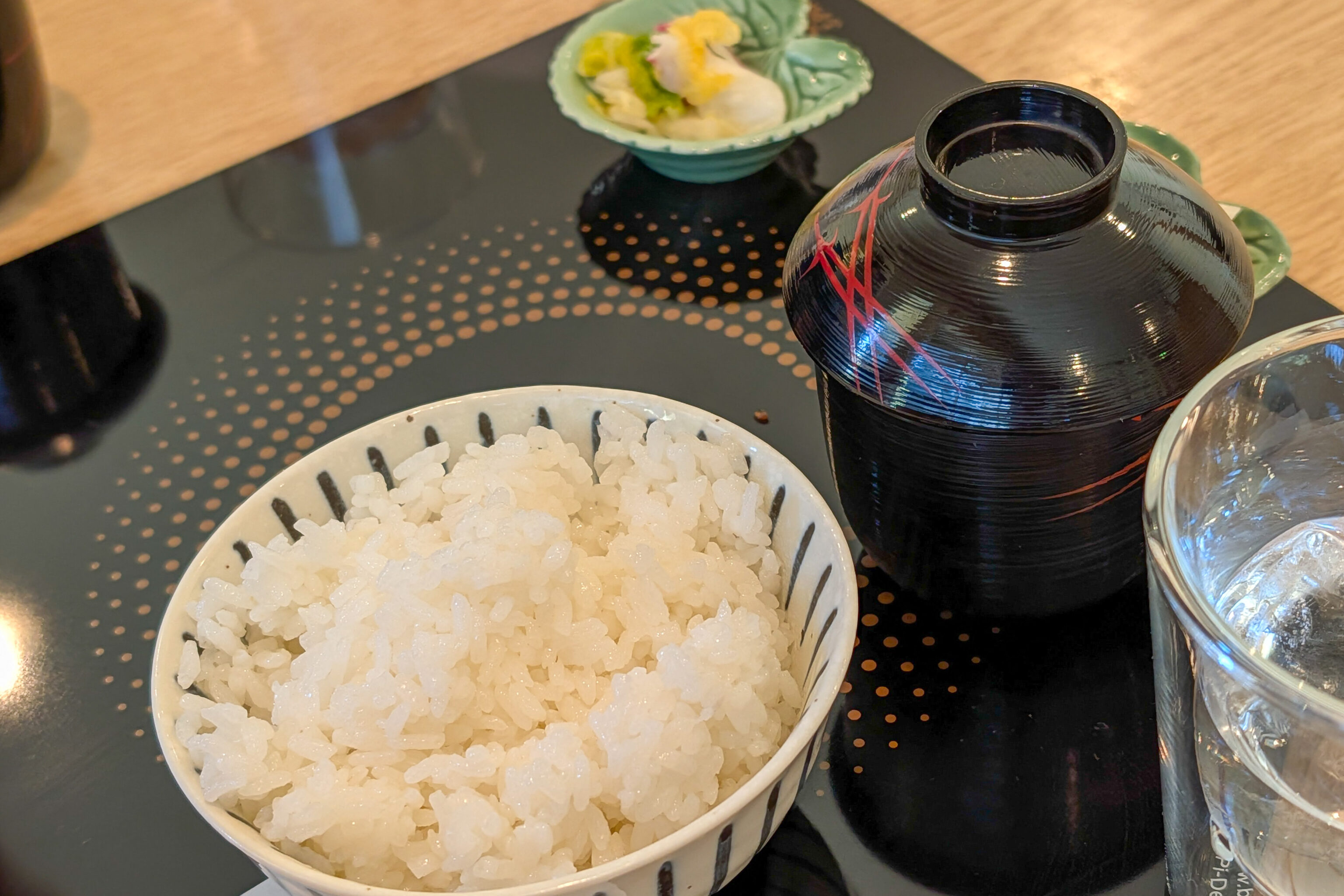
We ordered the hoba misoyaki, a local dish with Hida beef, vegetables, and miso cooked at the table, sort of like sukiyaki but not ending up with broth
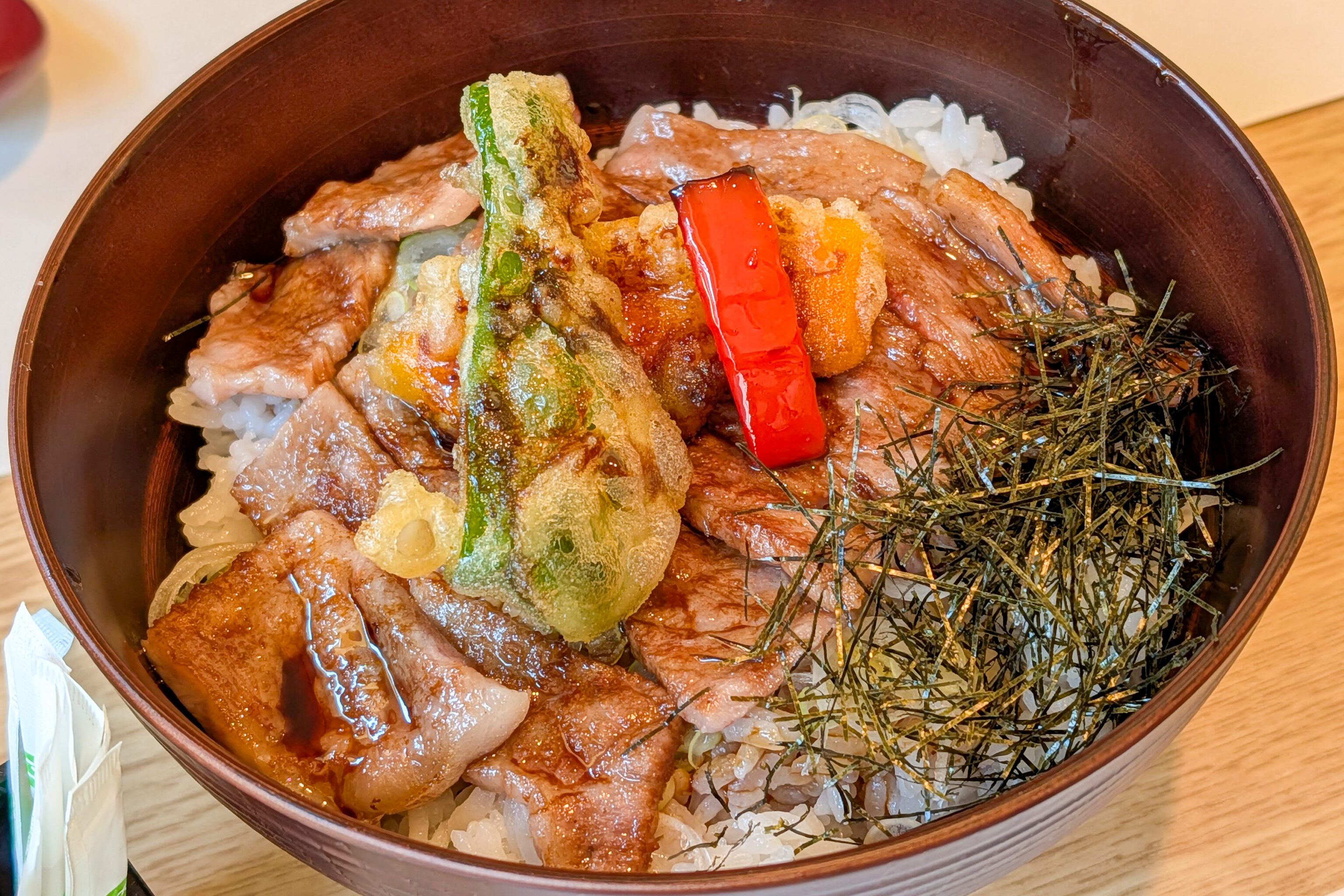
We also ordered the Hida gyudon. Both had the best beef we’ve had on this trip.
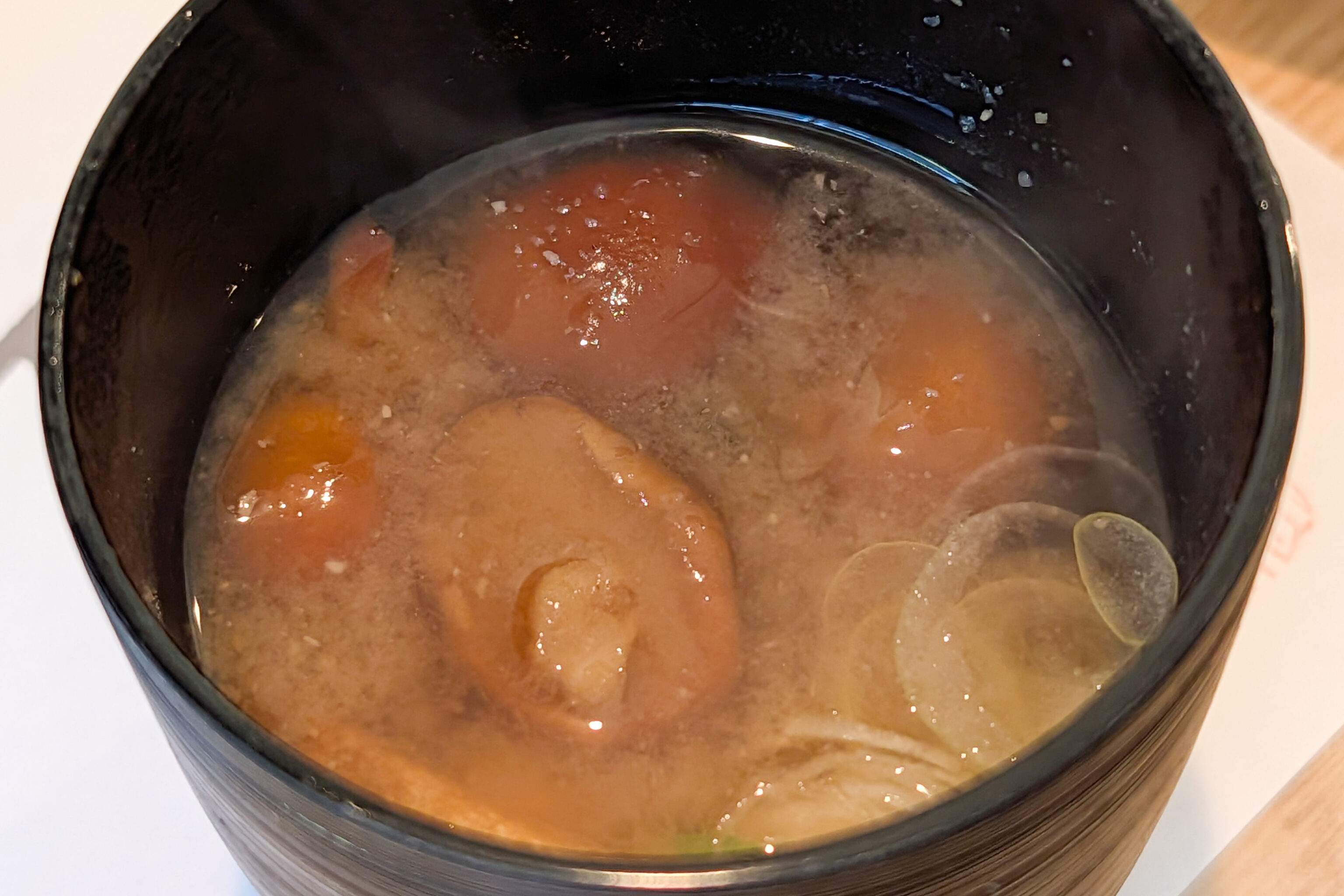
Soup was included.
Shōbō-ji
After lunch, we headed to the southeast to visit Shōbō-ji, a temple that contains the Great Buddha of Gifu.
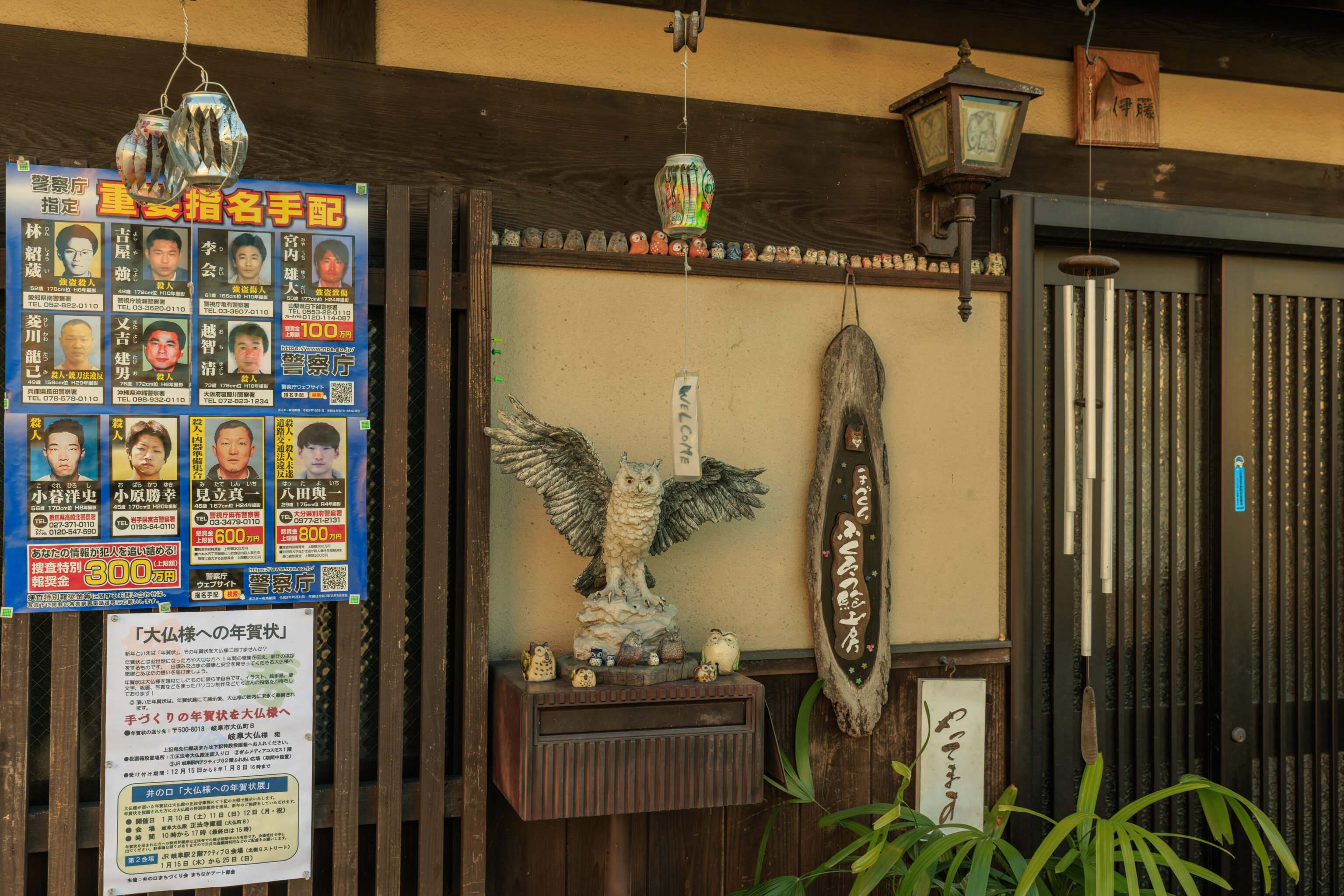
On the way, we passed by a shop with many owls along with a wanted poster!
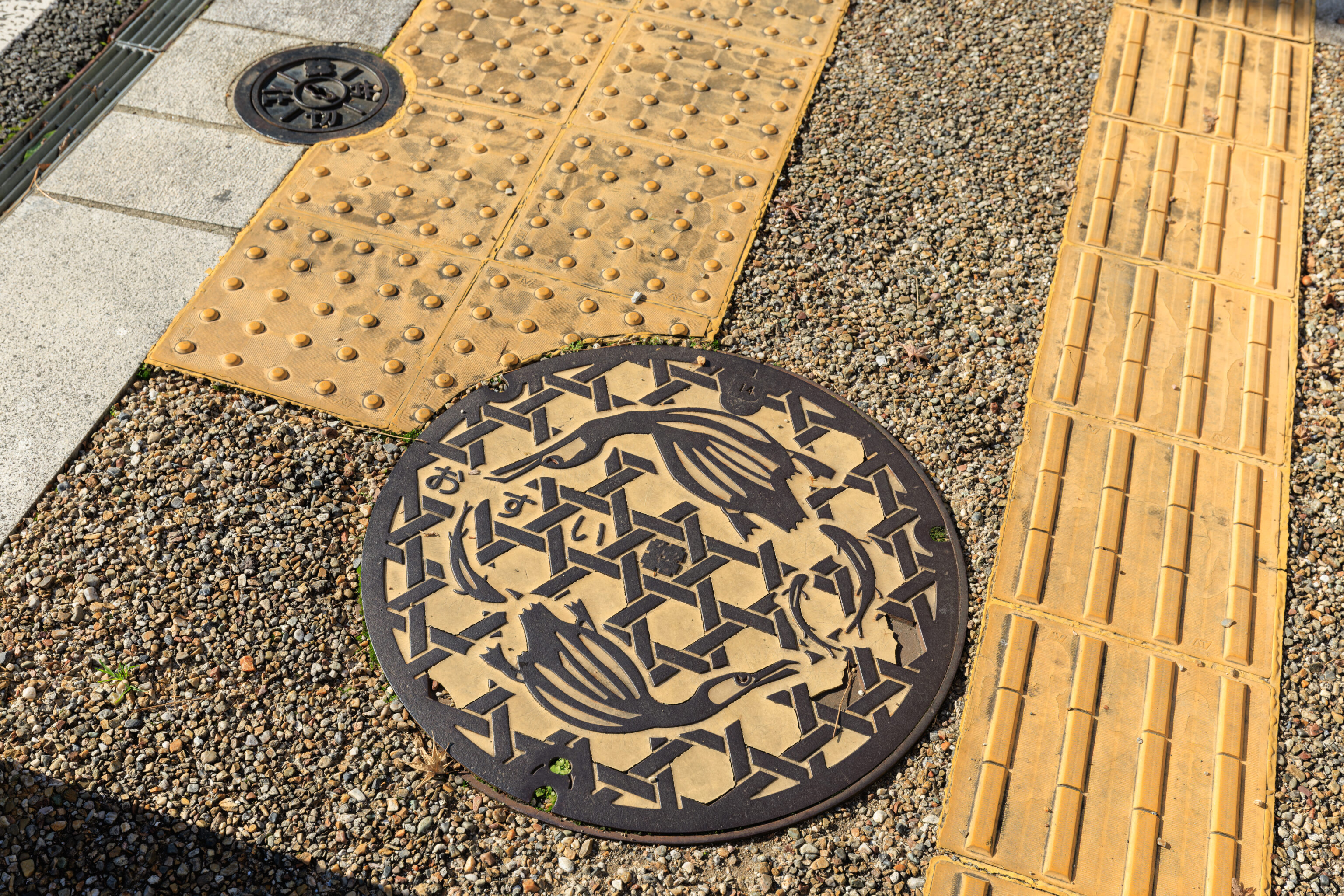
This utility cover depicts cormorant fishing on the 長良川 Nagara River.
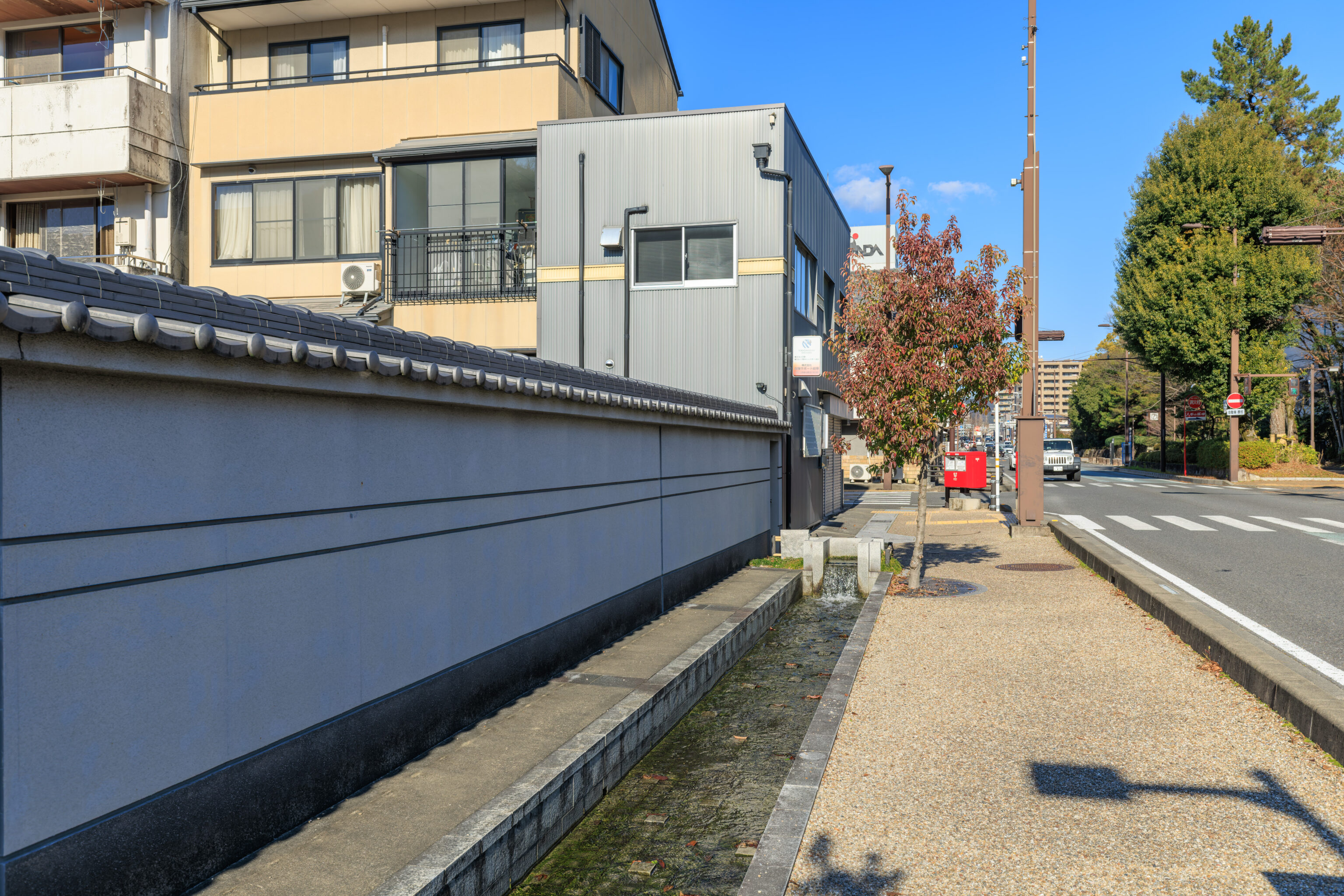
This part of the sidewalk next to the eastern entrance to Shōbō-ji had a little canal!
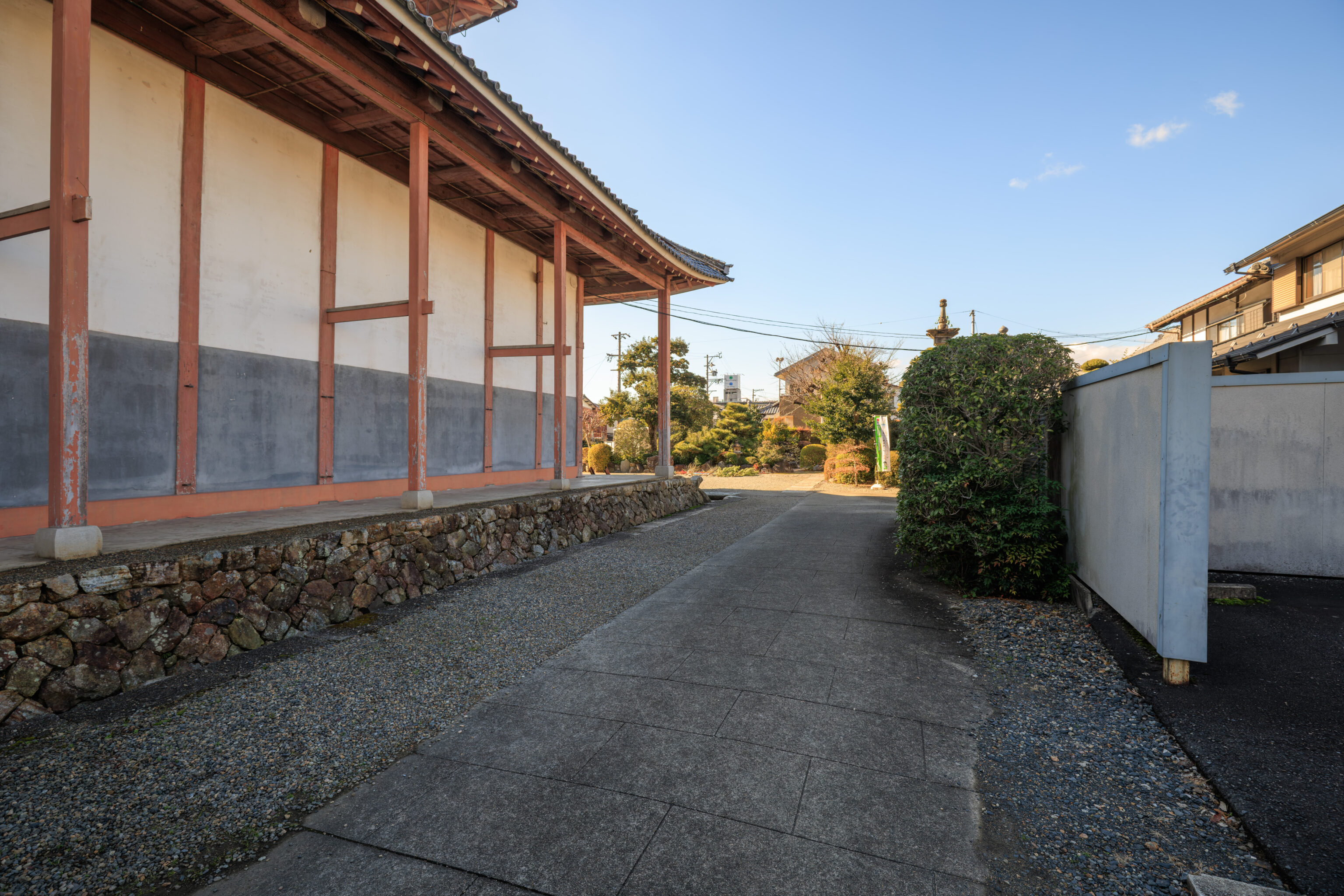
We walked around the corner to enter Shōbō-ji.
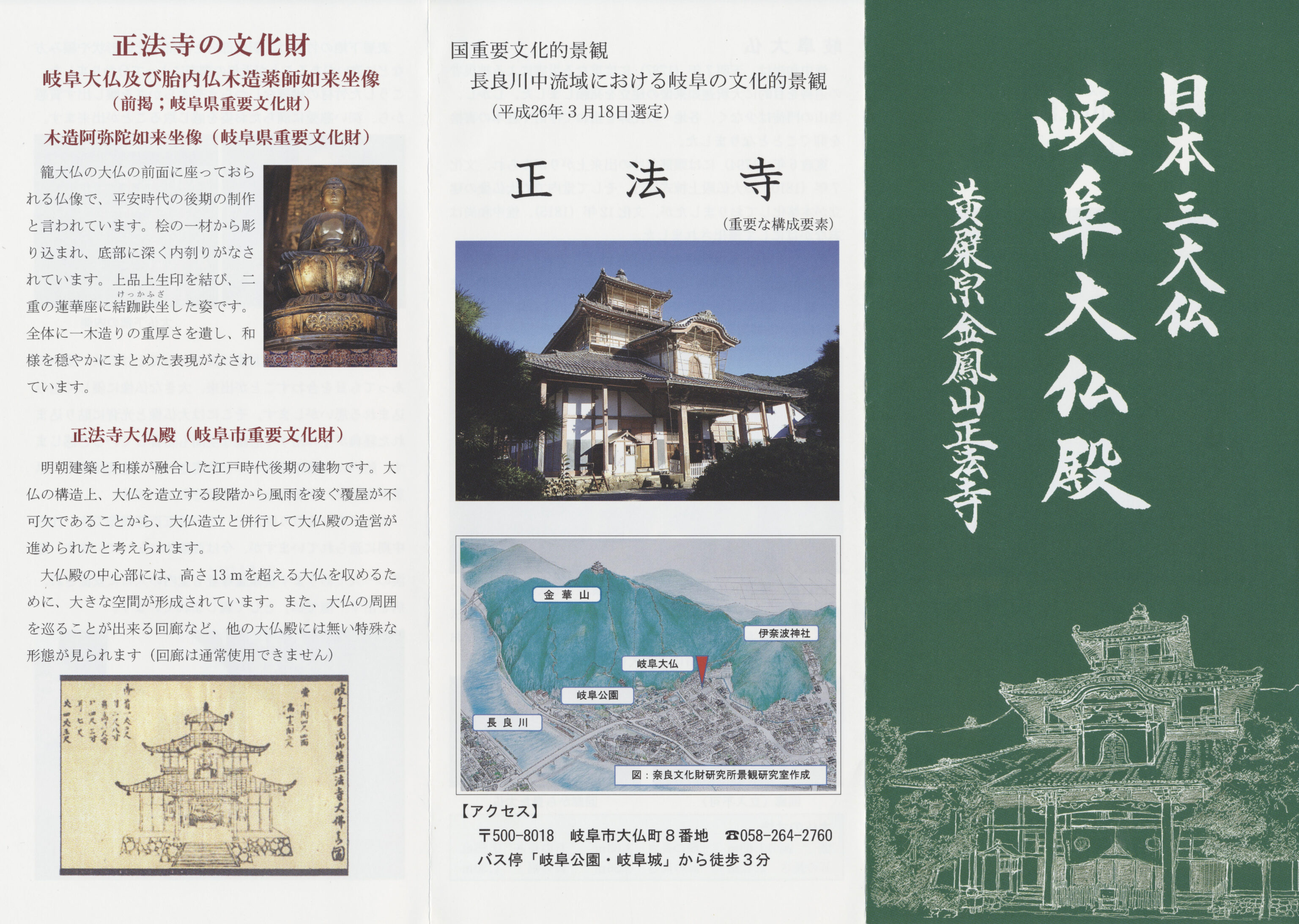
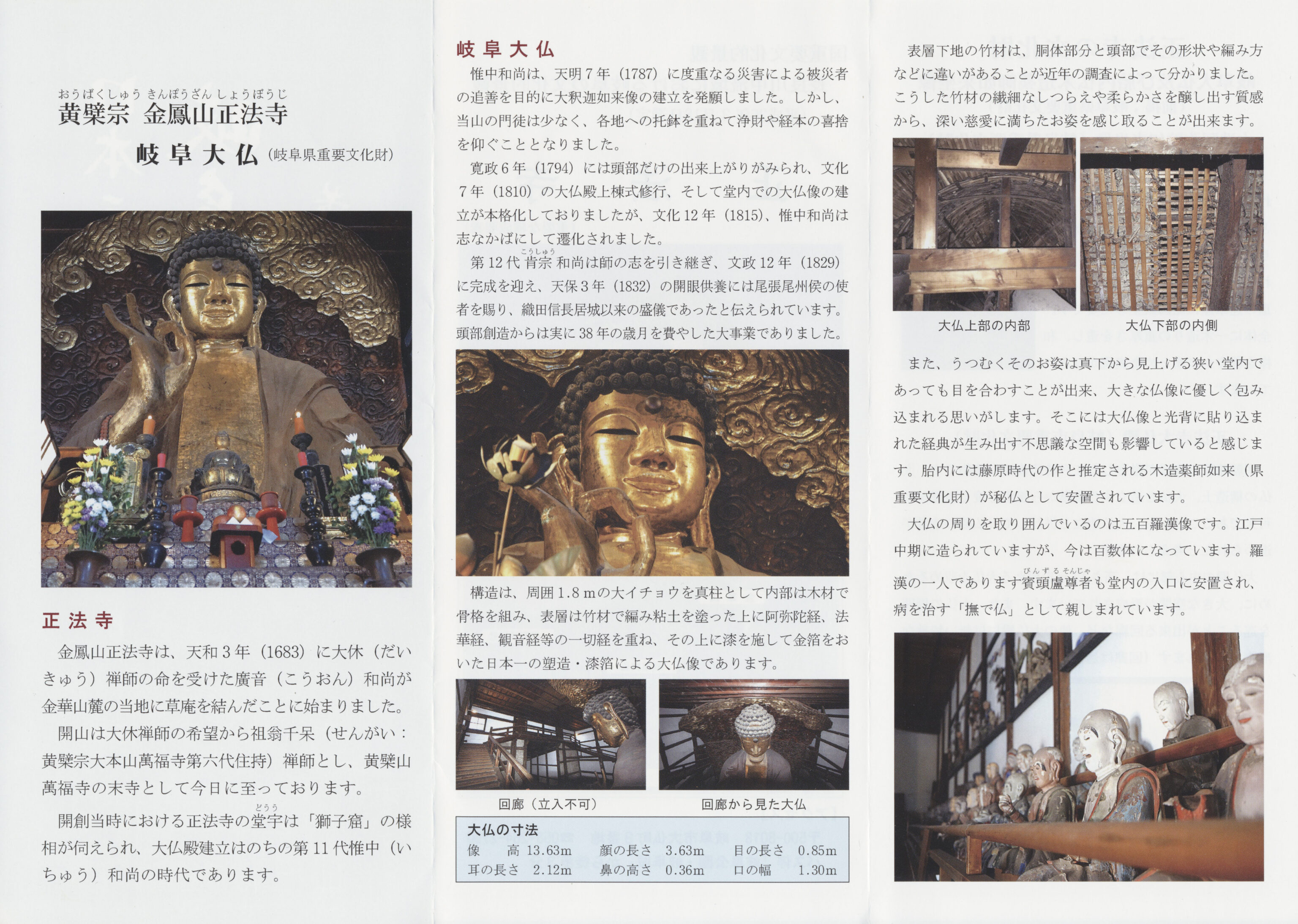
After paying the entrance fee, we picked up a Japanese language pamphlet.
Three Great Buddhas of Japan
Gifu Great Buddha Hall
Obaku Sect Kinpozan Shohoji Temple

Kinbozan Shoho-ji Temple (Obaku School)
Gifu Great Buddha (Gifu Prefecture Designated Cultural Property)

Shōhō-ji Temple
Konpozan Shōhō-ji traces its origins to 1683, when the monk Kōon—acting under the instruction of Zen Master Daikyū—established a hermitage at this site at the foot of Mt. Kinka.

In accordance with Daikyū’s wishes, Zen Master Soō Sengai (the sixth abbot of Manpuku-ji, the head temple of the Ōbaku school) was designated as the temple's founding master; the temple has continued to the present day as a branch of Manpuku-ji.

At the time of its founding, the temple complex resembled a "Lion's Cave" (a secluded hermitage); the Great Buddha Hall was not constructed until the era of the eleventh abbot, Ichū.

Gifu Great Buddha
In 1787, the monk Ichū vowed to erect a great statue of Shakyamuni Buddha to offer prayers for the repose of the souls of those who had perished in repeated natural disasters. However, as the temple had few parishioners, he had to travel extensively to solicit alms, seeking donations of funds and sutra texts.

By 1794, the head of the statue had been completed, and the project moved into full swing with the 1810 ceremony marking the raising of the Great Buddha Hall's roof frame and the subsequent assembly of the statue within the hall; however, Ichū passed away in 1815 before his vision could be fully realized.

The twelfth head monk, Kōshū, carried on his master's mission, bringing the project to completion in 1829. The eye-opening consecration ceremony held in 1832 was graced by an envoy from the Lord of Owari—an event said to have been the most magnificent ceremony held at the temple since the days when it served as the castle town of Oda Nobunaga. It was a monumental undertaking that spanned a full thirty-eight years from the creation of the head to final completion.

Its structure features a massive ginkgo tree—measuring 1.8 meters in circumference—as a central core, around which a wooden framework is assembled; the surface is formed from woven bamboo coated with clay, layered with scriptures such as the *Amitabha Sutra*, *Lotus Sutra*, and *Avalokitesvara Sutra*, and finally finished with lacquer and gold leaf, making it Japan's largest Great Buddha statue created using the clay-modeling and lacquer-gilding technique.

Even within the confines of the hall—where one looks up at the statue from directly below—it is possible to meet the gaze of the figure as it looks downward, creating a sense of being gently embraced by the massive Buddha. This atmosphere is also shaped by the extraordinary space created by the Great Buddha and the sutras affixed to its halo. Housed within the statue's interior is a wooden image of Yakushi Nyorai (Medicine Buddha)—believed to date back to the Fujiwara period—which is enshrined as a *hibutsu* (a sacred image rarely shown to the public).

Surrounding the Great Buddha are statues of the Five Hundred Rakan (disciples of the Buddha). Although originally created during the mid-Edo period, the collection now numbers several hundred figures. A statue of Binzuru Sonja is also enshrined near the hall's entrance; revered as a "Nade-botoke" (a Buddha to be rubbed), it is believed to possess the power to heal ailments.

Dimensions of the Great Buddha
Statue Height: 13.63 m
Face Length: 3.63 m
Eye Length: 0.85 m
Ear Length: 2.12 m
Nose Height: 0.36 m
Mouth Width: 1.30 m

Cultural Properties of Shōhōji Temple
Gifu Great Buddha and the wooden seated image of Yakushi Nyorai enshrined within it (cited above; Gifu Prefecture Designated Important Cultural Property)

Seated Wooden Statue of Amitabha Buddha (Gifu Prefecture Designated Cultural Property)
This Buddha statue sits in front of the "Kago Daibutsu" (Basket Great Buddha) and is believed to date back to the late Heian period. It is carved from a single block of Japanese cypress and features deep hollowing at the base. The figure is depicted seated in the full lotus position upon a double lotus pedestal, with hands forming the *jōbon jōshō-in* mudra (the highest gesture of welcome to the Pure Land).

The statue retains the substantial, solid presence characteristic of single-block construction while exhibiting a style that harmoniously blends the *Wayō* (native Japanese) aesthetic with a gentle, refined expression.

Shoho-ji Great Buddha Hall (Designated Important Cultural Property of Gifu City)
This building, dating from the late Edo period, features a fusion of Ming Dynasty Chinese architectural styles and traditional Japanese styles. Given the structural nature of the Great Buddha, a protective structure was essential from the very beginning of its construction to shield it from the elements; consequently, it is believed that the Great Buddha Hall was built concurrently with the statue itself.

A vast central space has been created within the hall to accommodate the Great Buddha, which stands over 13 meters tall. The structure also incorporates unique features not found in other Great Buddha halls, such as a corridor that allows visitors to walk around the statue (please note that the corridor is generally not open for use).

Important Cultural Landscape of Japan
Cultural Landscape of Gifu in the Middle Reaches of the Nagara River (Selected on March 18, 2014)
Shōbō-ji Temple (Important Component)
【Access】
8 Daibutsu-cho, Gifu City, 500-8018
A 3-minute walk from the "Gifu Park/Gifu Castle" bus stop.
– Text from the pamphlet above, read using Google Gemini and translated using Google Translate.
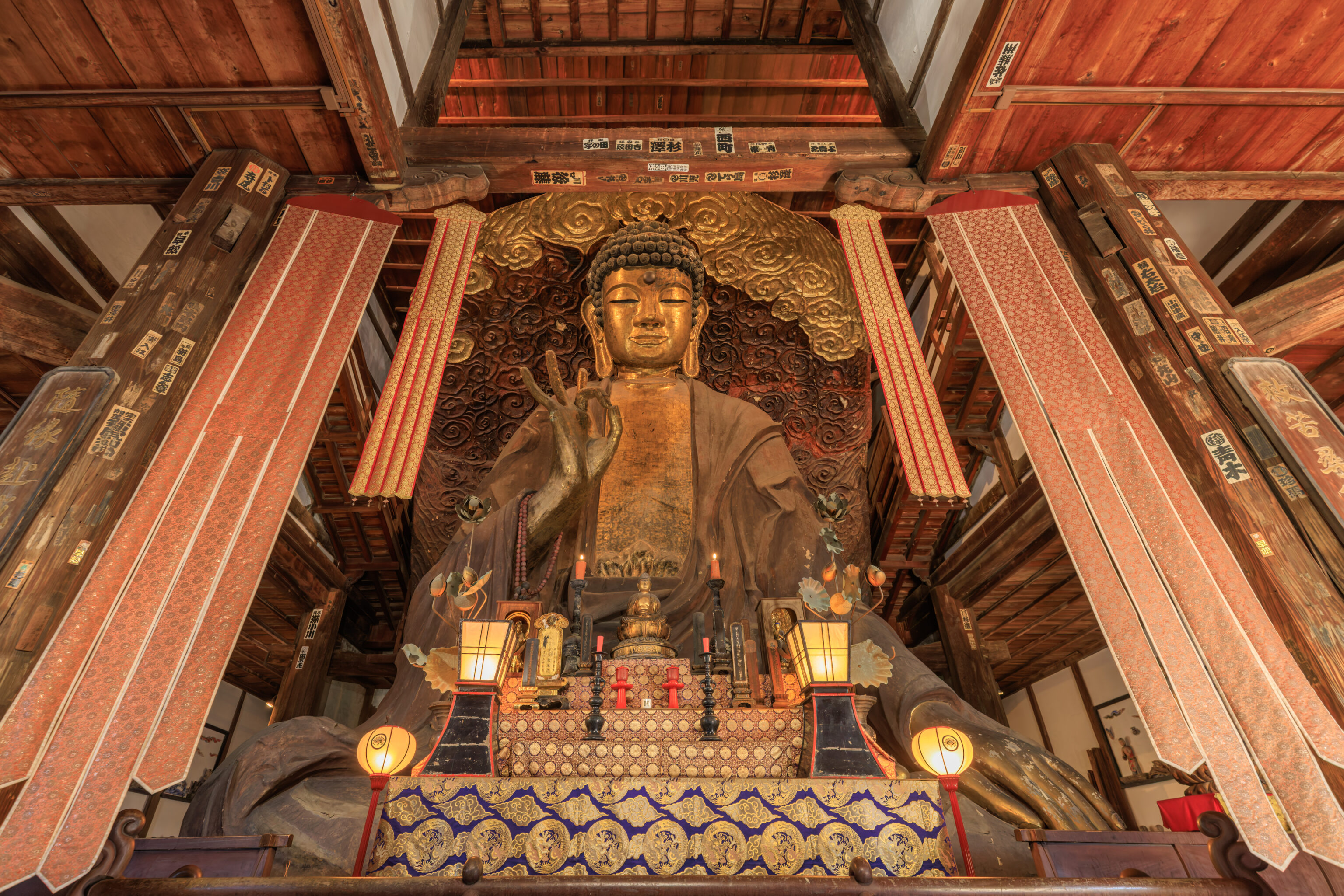
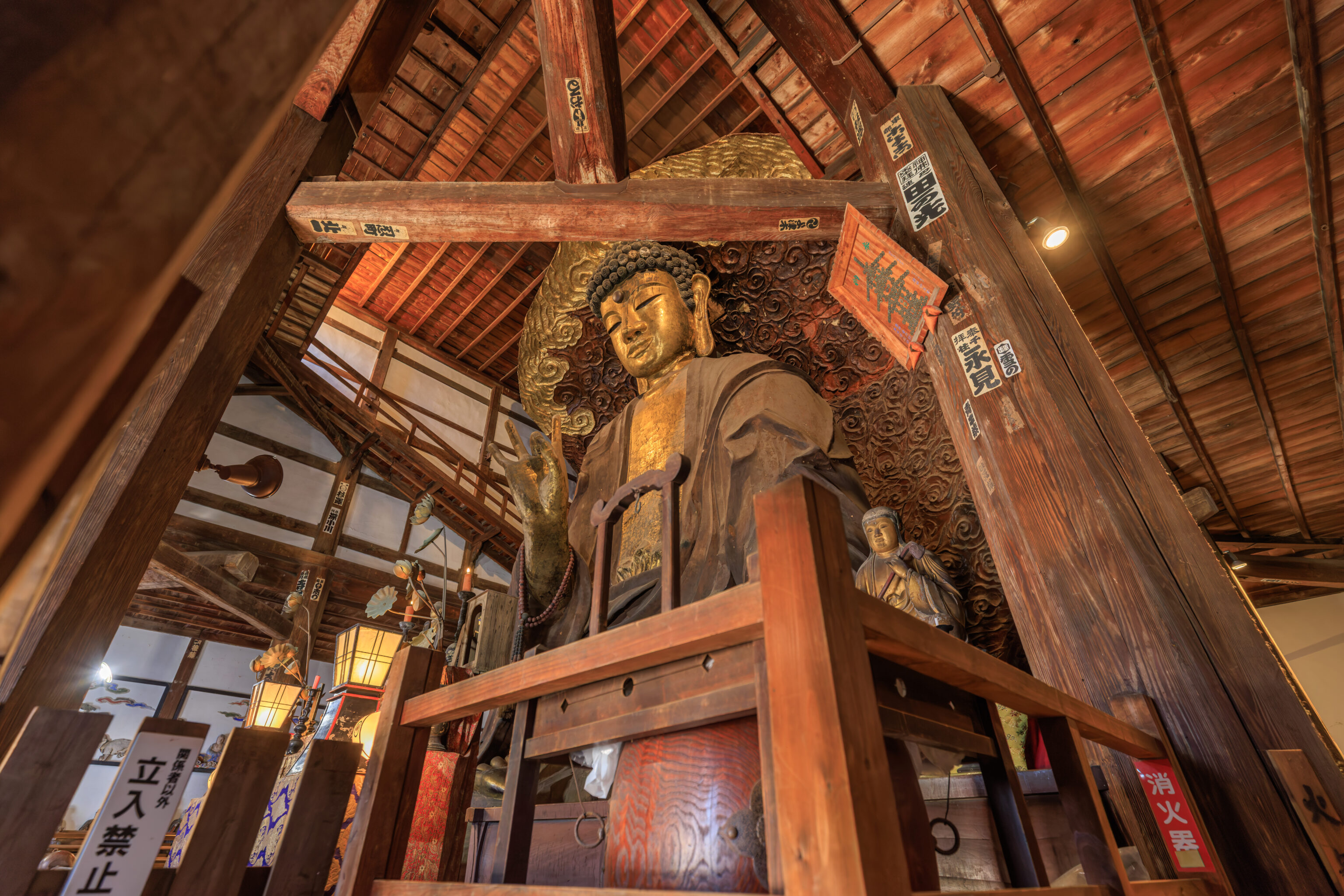
Upon entering, one immediately sees the Great Buddha Statue in front of them!
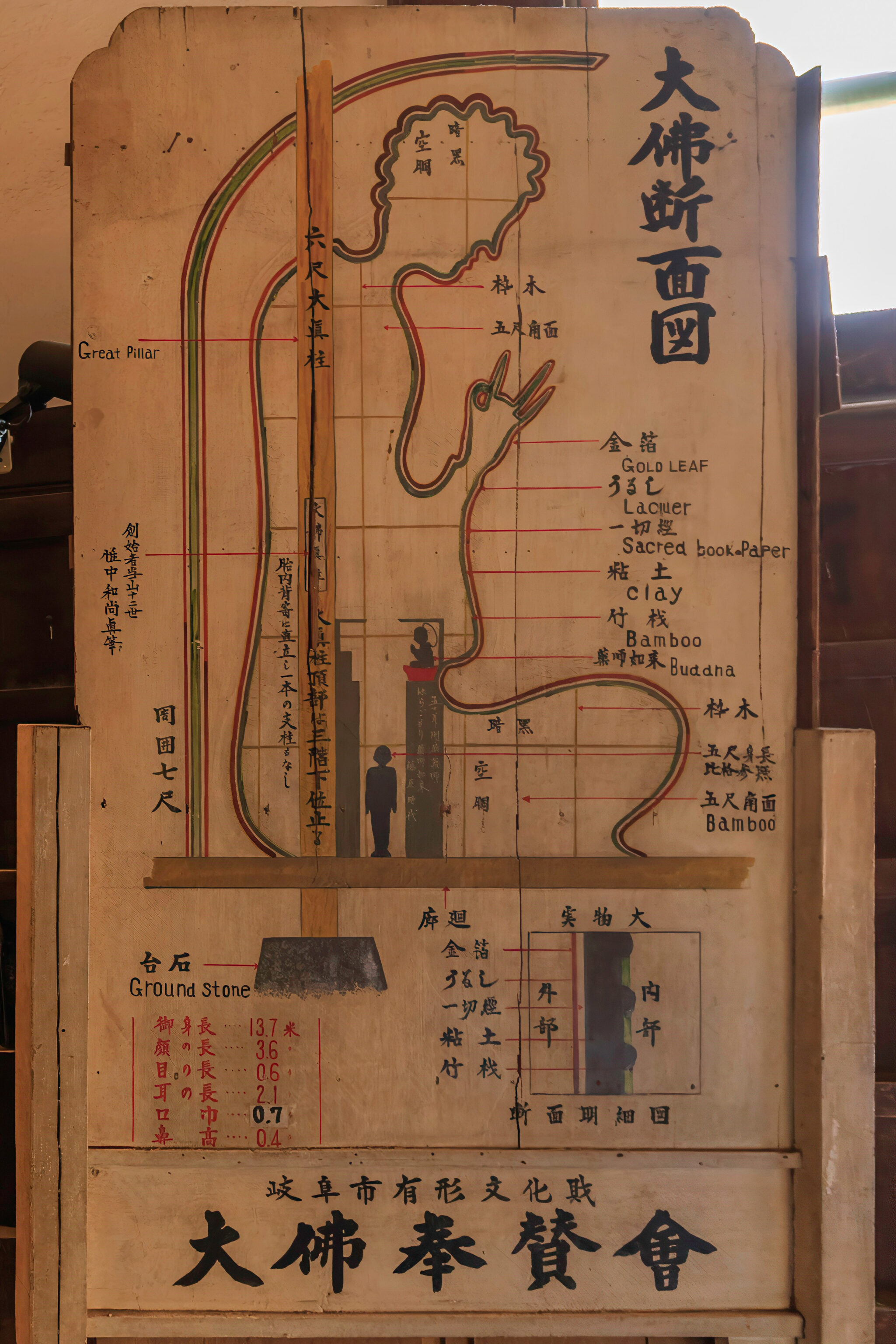
This cross section of the statue illustrates its size and structural components.
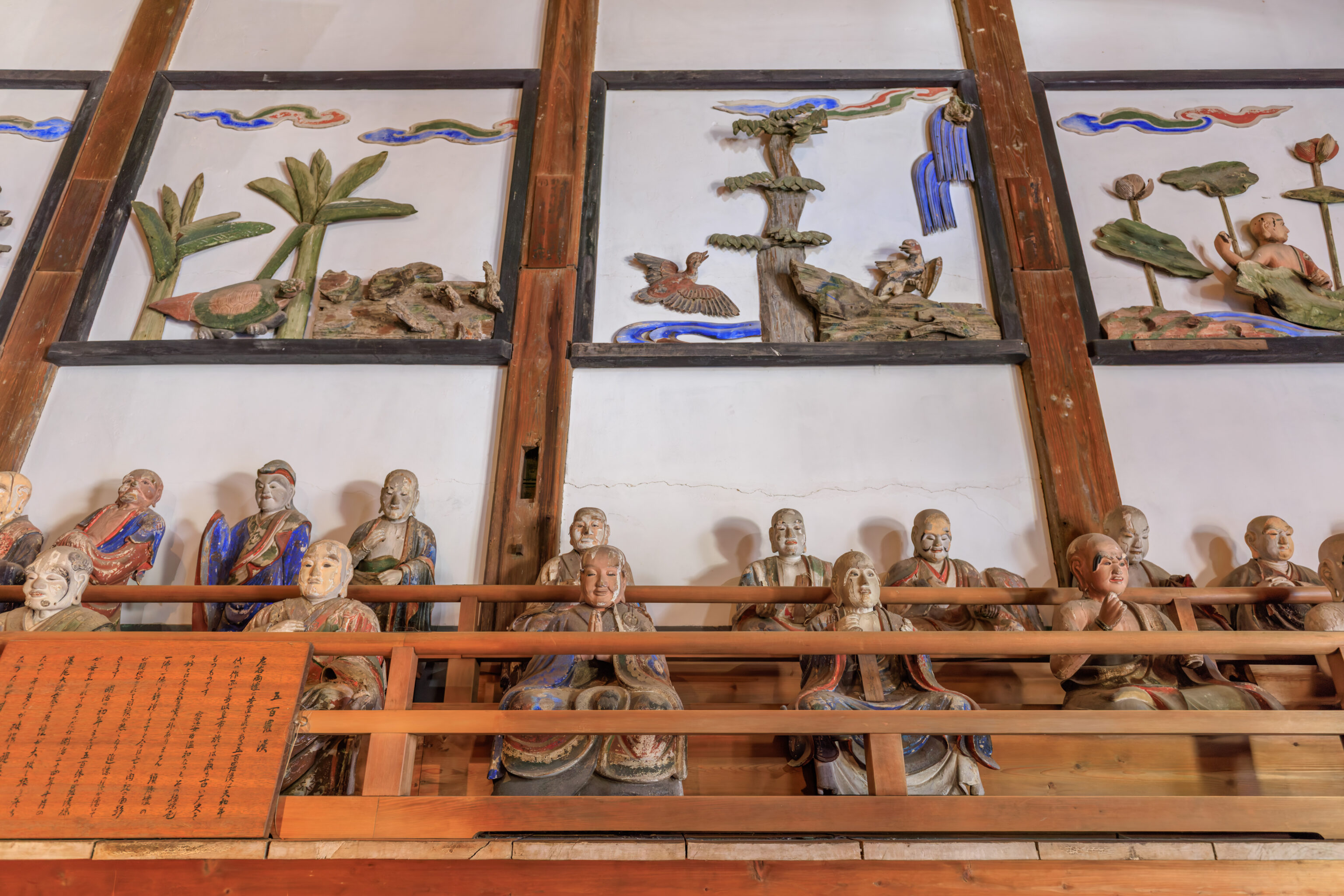
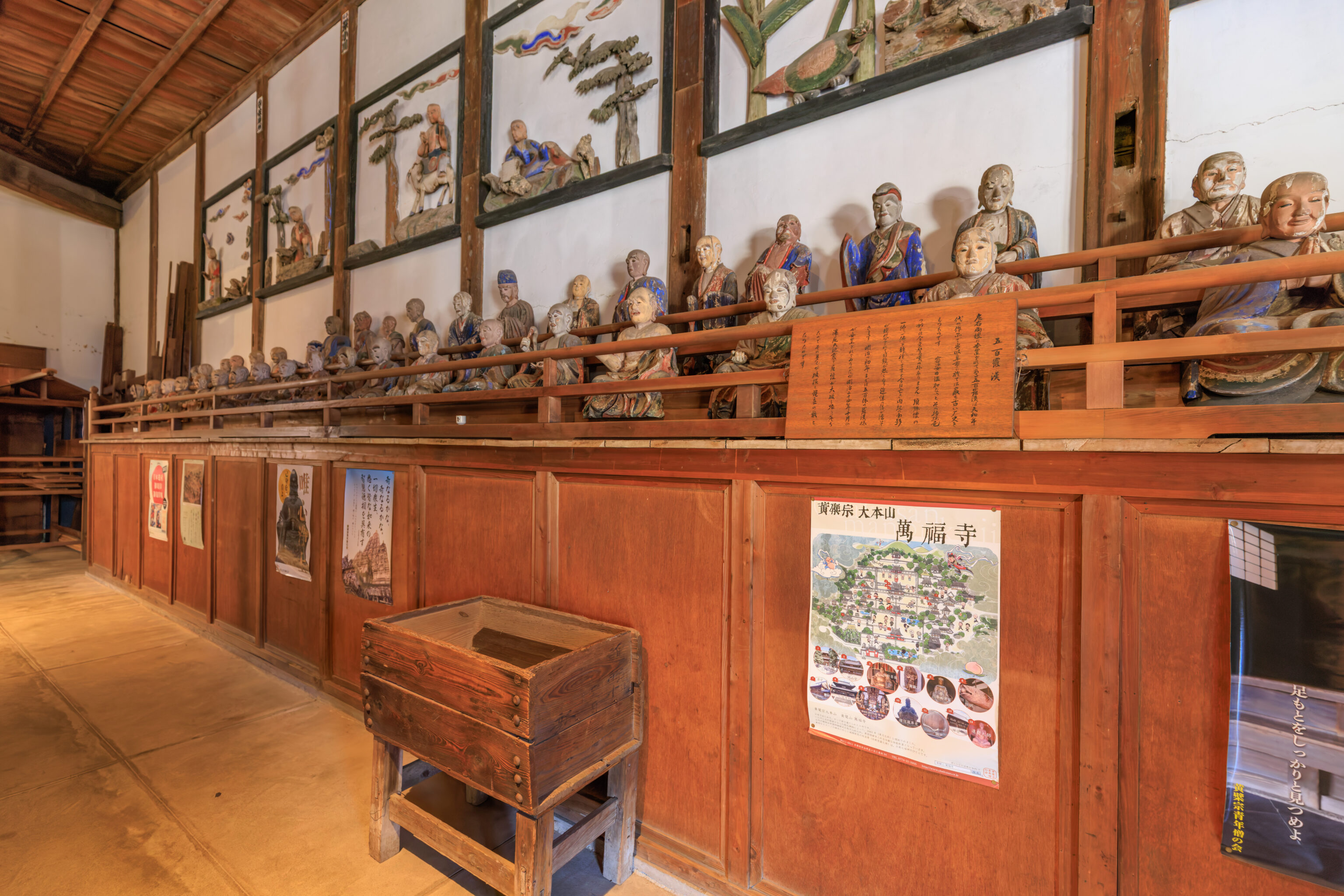
There were many small statues on the sides of the hall. These statues depict arhats, people who have achieved nirvana.
Five Hundred Arhats
The Five Hundred Arhats enshrined on the altars to the left and right date back to the Tenna era (1681–1684), making them the oldest of their kind in Gifu City. Their serene and gentle countenances, combined with their exquisite, richly colored finishes, continue to evoke a sense of awe. Gazing closely at each individual figure, one is moved to tears and filled with nostalgic longing as the faces of departed loved ones come to mind. Although five hundred Arhats were originally enshrined here, the great Nobi Earthquake of October 1891 caused the platforms to collapse; many of the statues fell and were damaged, resulting in the number that remains today.
– Text from the wooden sign in the two photos above, read using Google Gemini and translated using Google Translate.
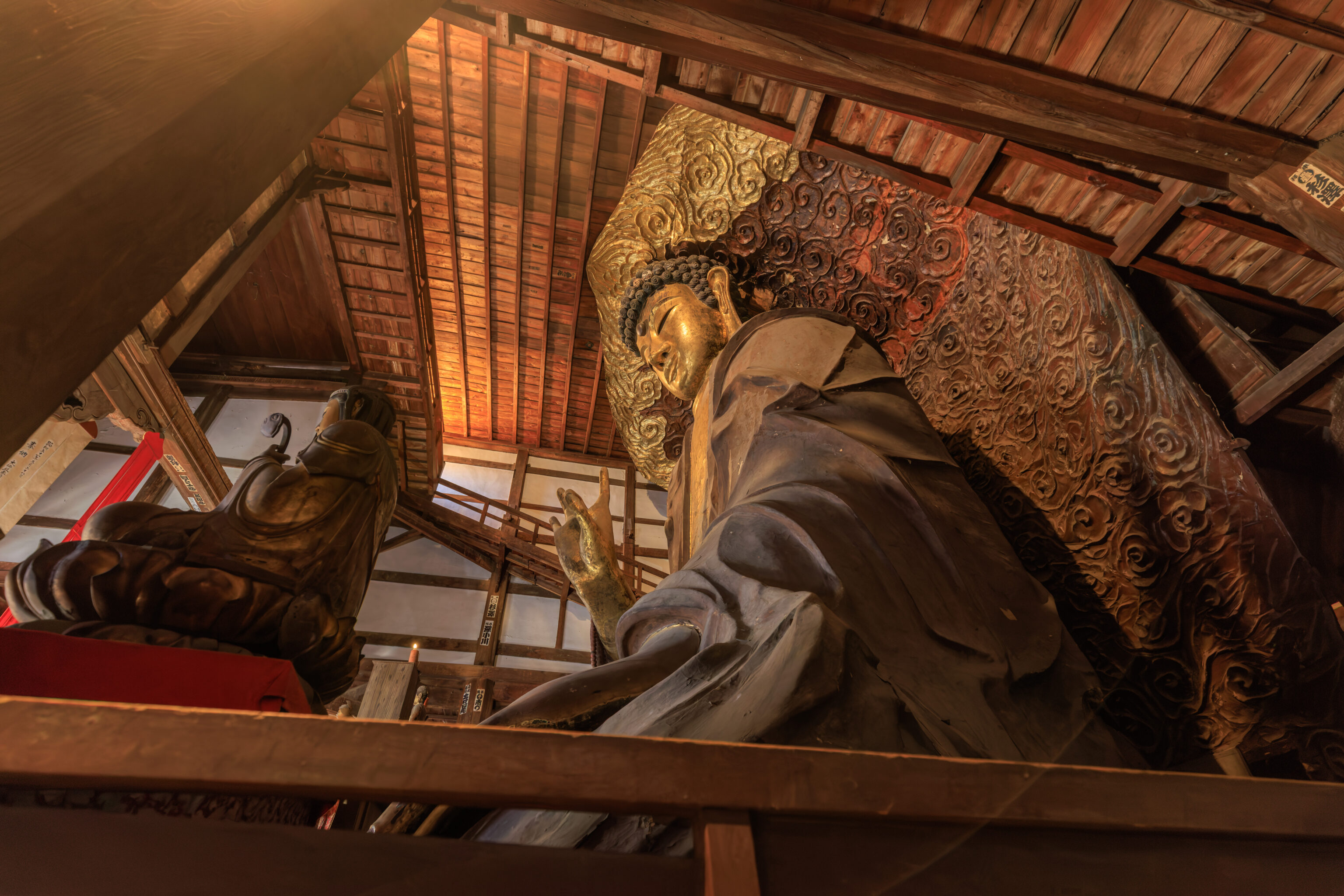
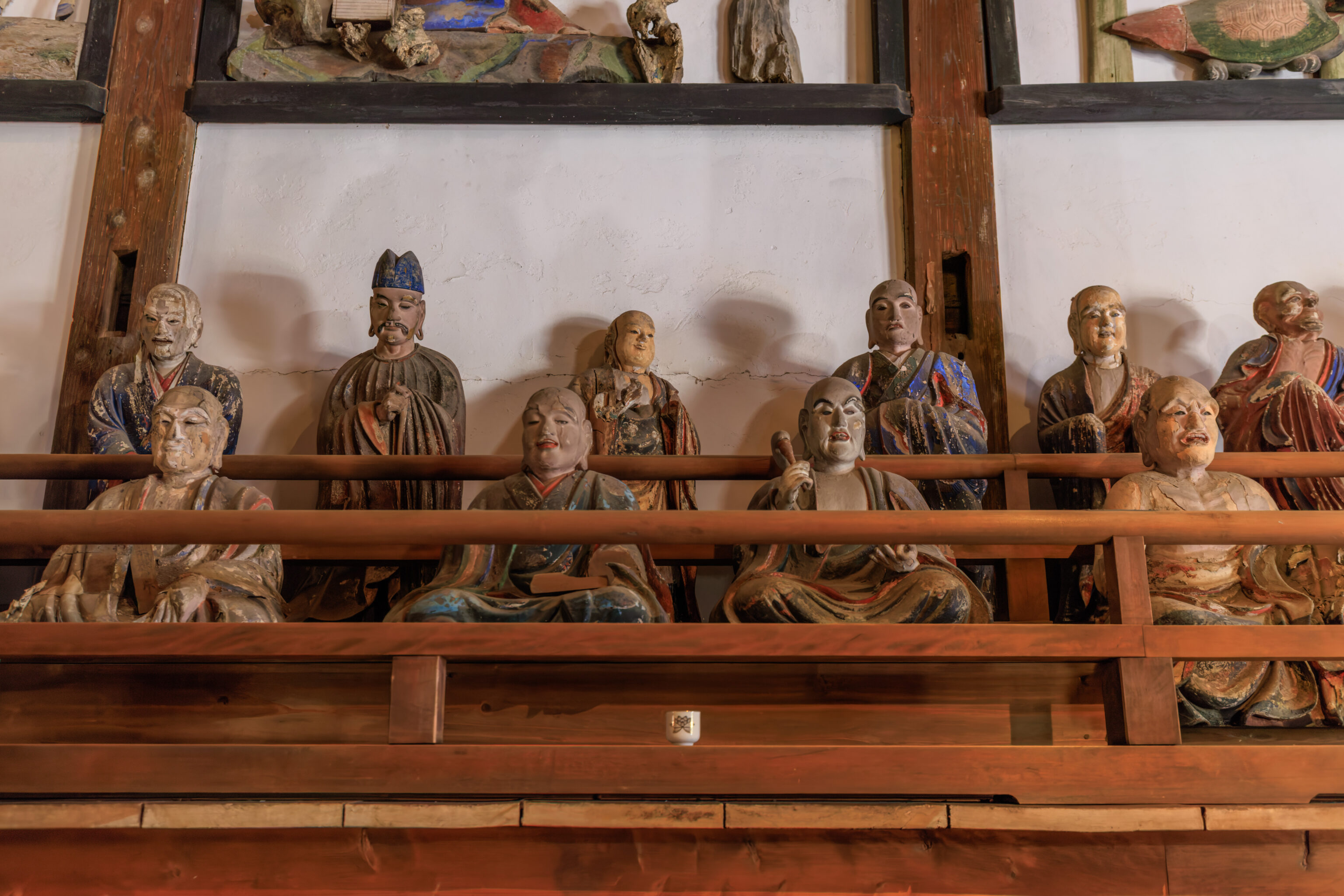
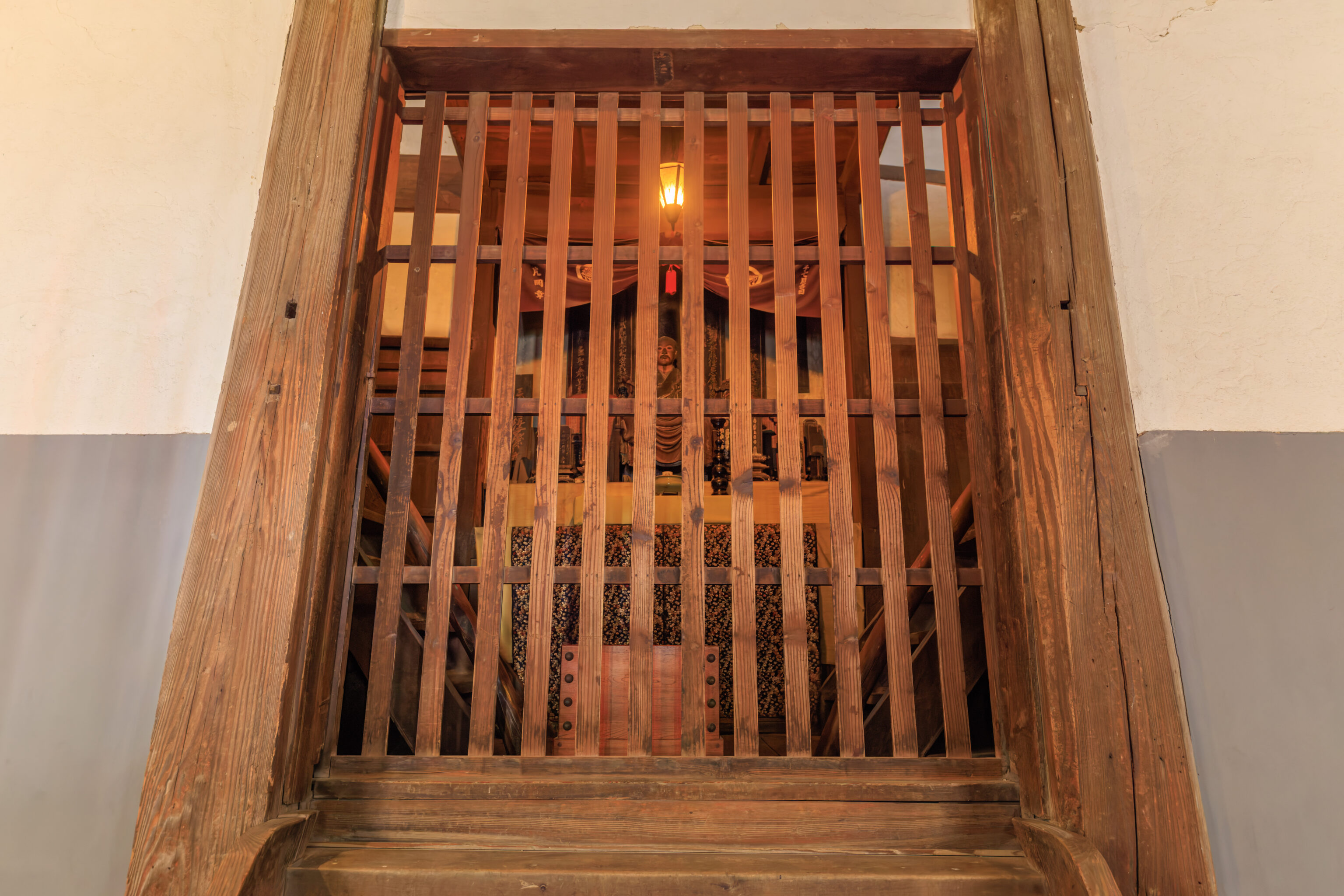
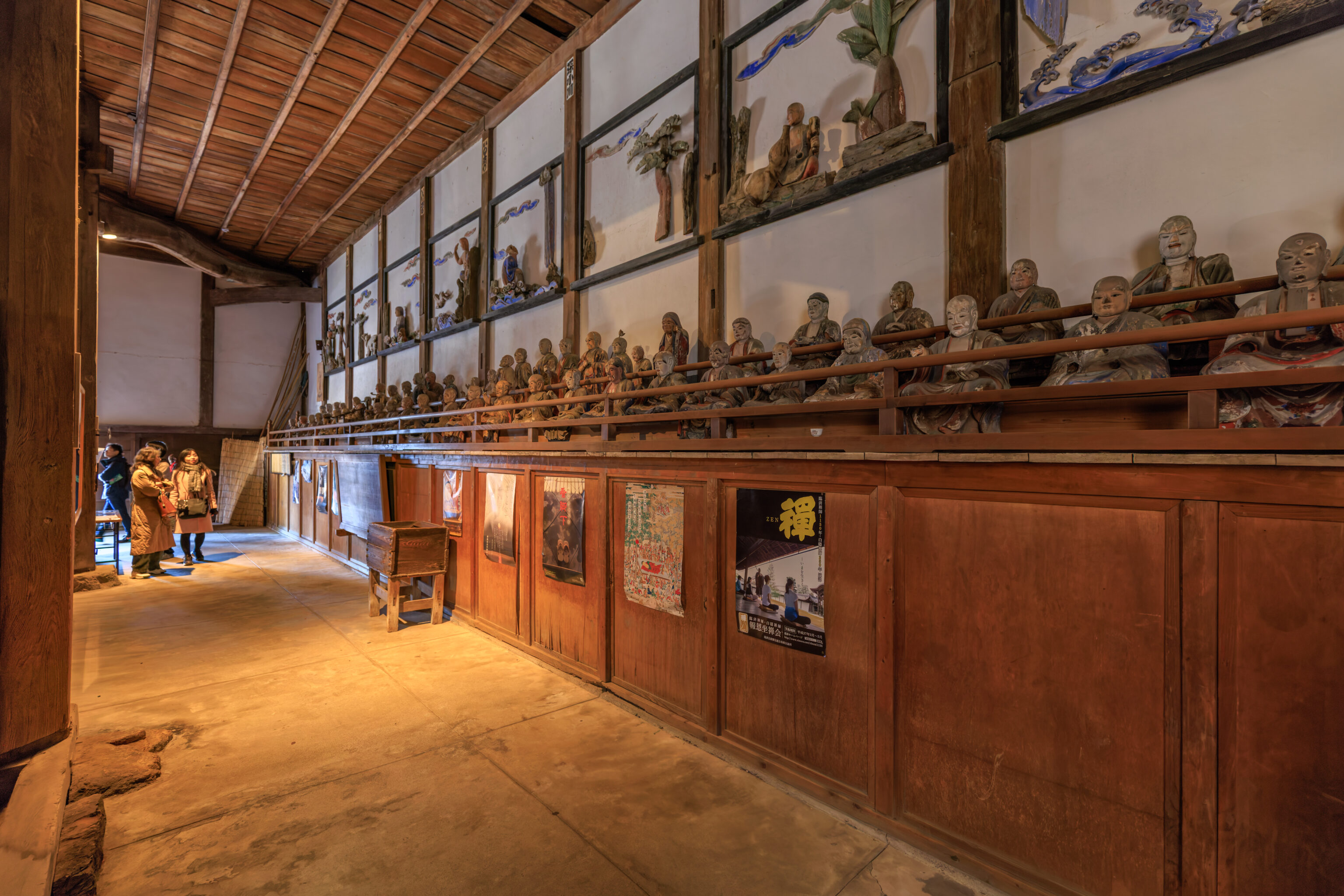
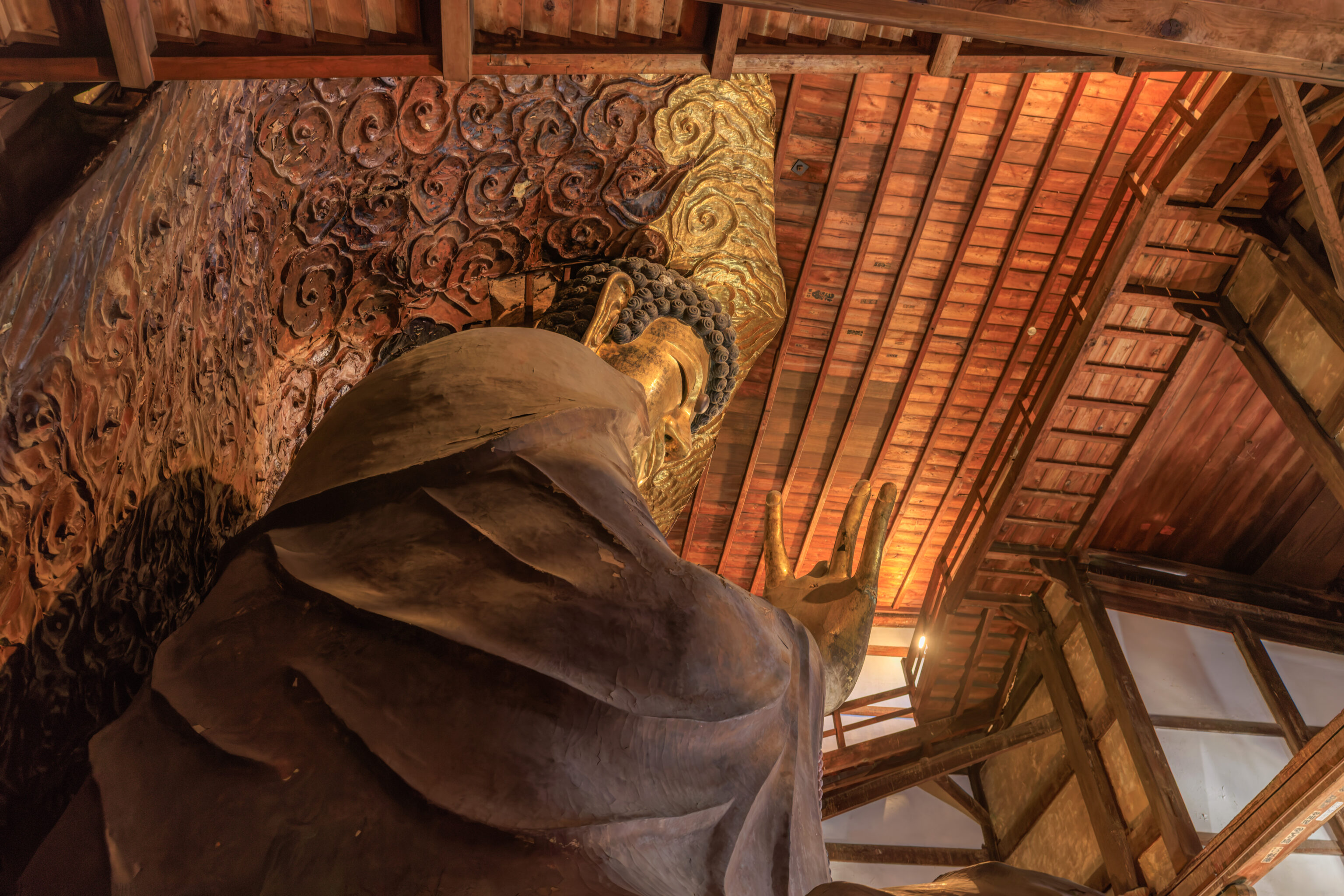
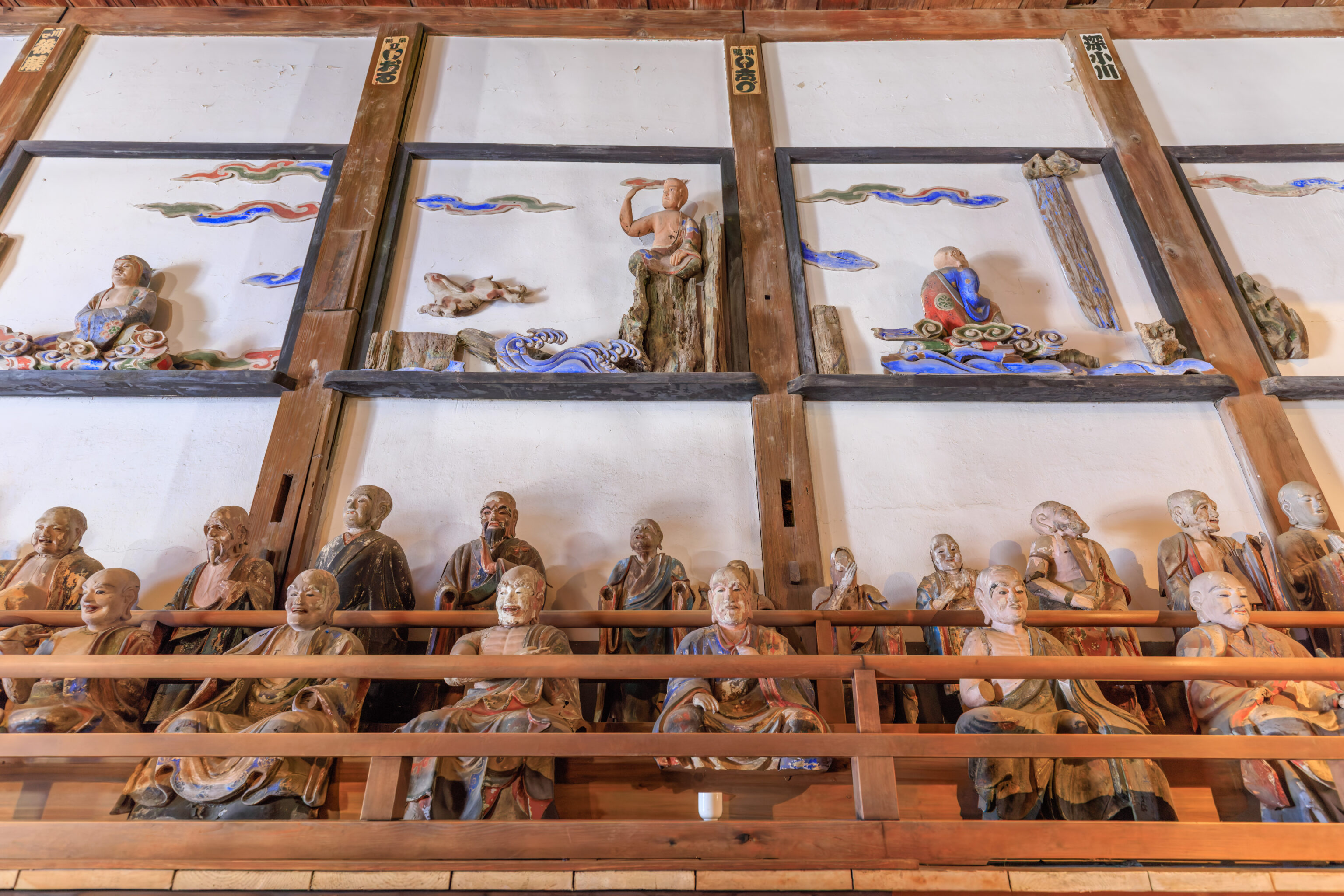
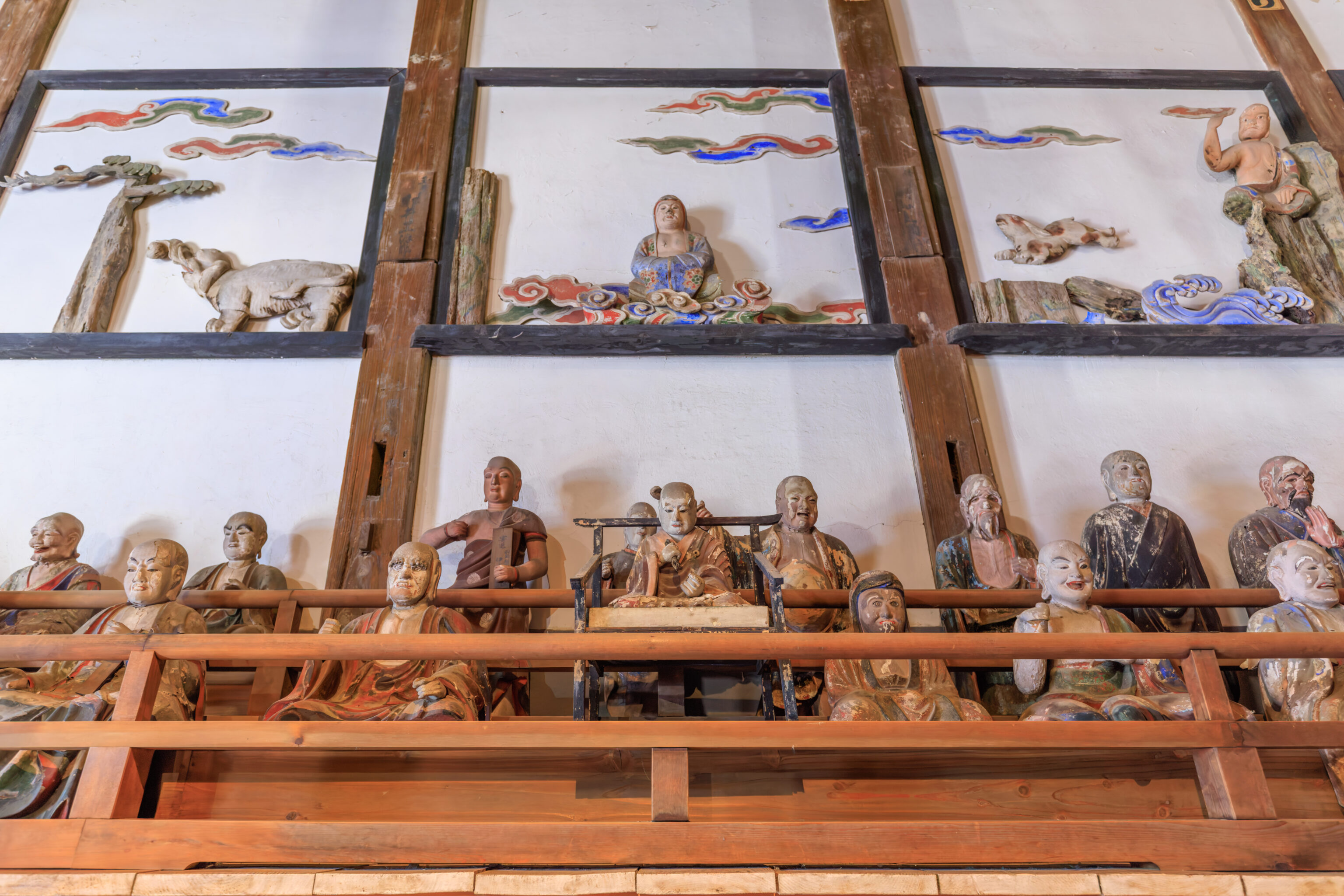
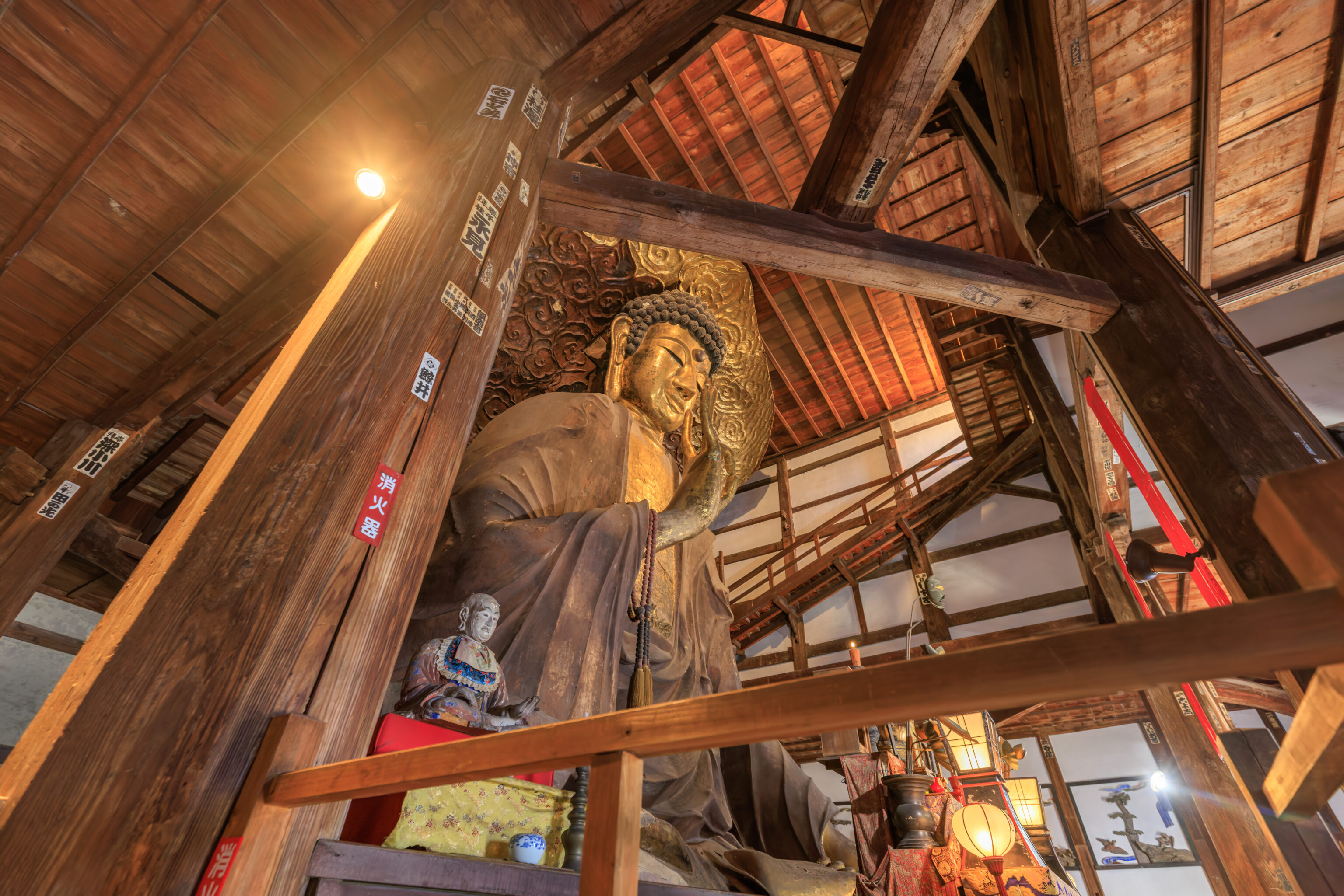
We walked around the Buddha until we got back to the front.
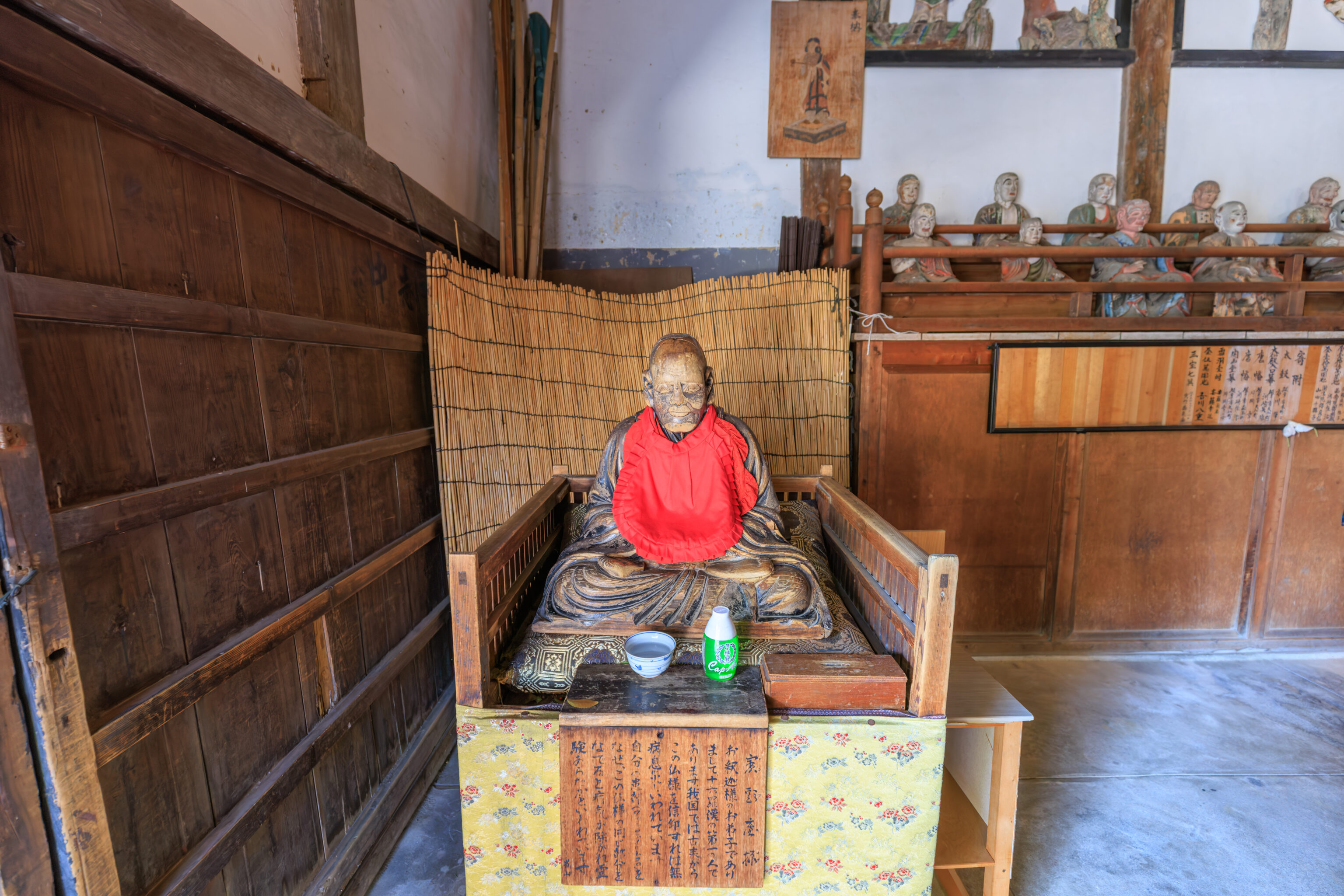
This statue depicts Binzuru Sonja and was mentioned in the temple’s pamphlet. The text on the sign in front of the statue is a bit worn but Google Gemini claims to be able to read it:
Binzuru-sama
He is a disciple of Shakyamuni Buddha and the foremost of the Sixteen Arhats. In Japan, it has long been believed that worshipping this figure brings freedom from illness and good health; it is said that if you stroke the corresponding part of the statue where you are experiencing pain or an ailment, the illness will be dispelled through his miraculous power.
– Text from the wooden sign in the photo above, read using Google Gemini and translated using Google Translate.
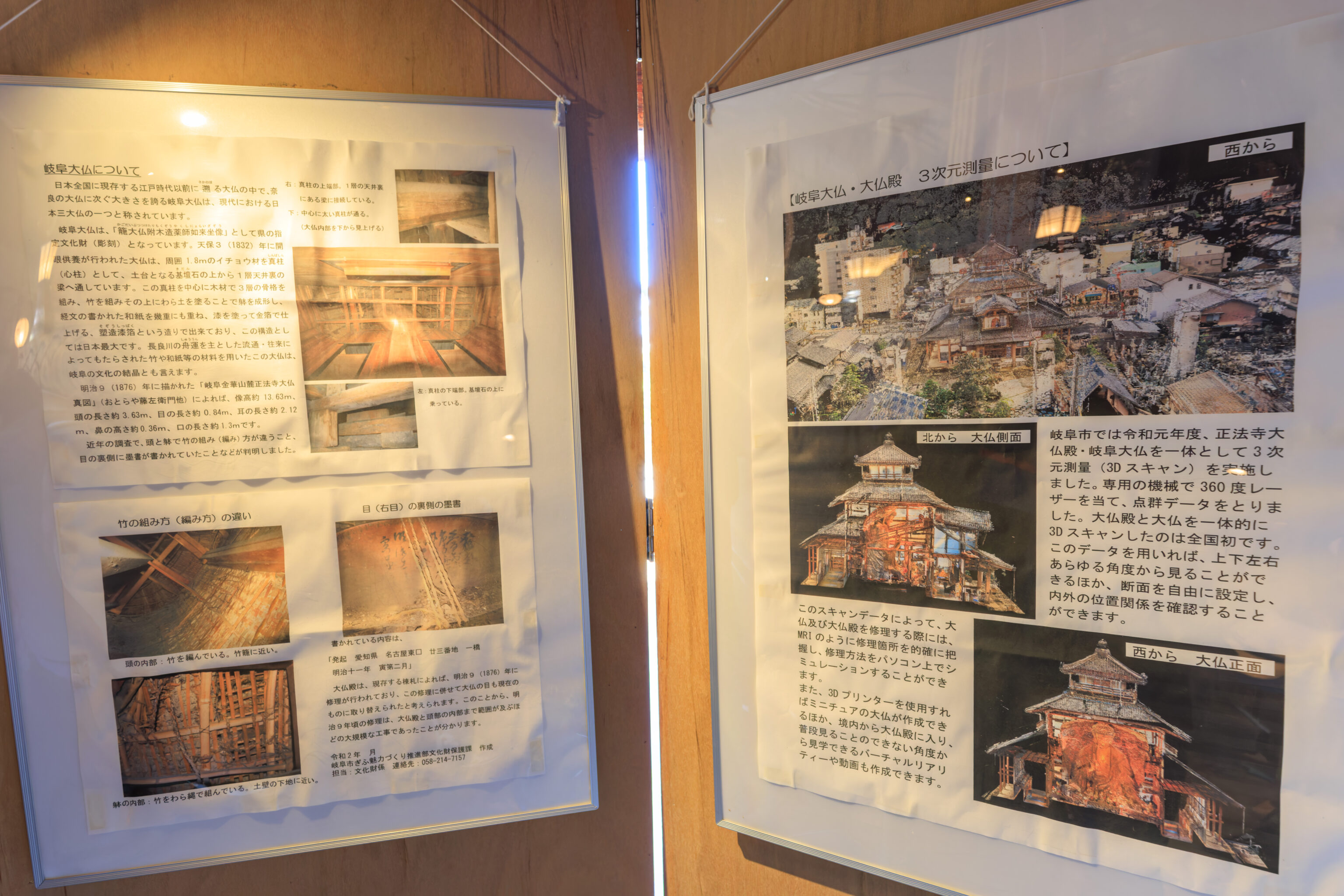
These three pages provide some additional detail about the Great Buddha, including pictures:
About the Gifu Great Buddha
Among the Great Buddha statues in Japan dating back to the Edo period or earlier, the Gifu Great Buddha—second in size only to the Great Buddha of Nara—is acclaimed as one of the "Three Great Buddhas of Japan" in modern times.

The Gifu Great Buddha is designated as a Prefectural Cultural Property (Sculpture) under the official name "Kago Daibutsu (Basket Great Buddha), including the Wooden Seated Statue of Yakushi Nyorai." The statue, consecrated in 1832, features a central pillar made of ginkgo wood with a circumference of 1.8 meters; this pillar extends from the stone foundation base up to the beams beneath the ceiling of the first level. A three-tiered wooden framework was constructed around this central pillar, and the body was shaped by weaving bamboo and applying a mixture of straw and clay. The surface was then finished using a technique known as *sozo-shippaku* (clay modeling with lacquer and gold leaf), involving multiple layers of *washi* paper inscribed with sutras, a coating of lacquer, and a final application of gold leaf. It is the largest statue in Japan built using this specific structural method. This Great Buddha—crafted from materials such as bamboo and *washi* (Japanese paper) brought in via the transport and travel networks centered on the Nagara River—can be considered a crystallization of Gifu's culture.

According to the *Gifu Kinkazan-roku Shōbō-ji Daibutsu Shinzu* (An Authentic Depiction of the Great Buddha at Shōhō-ji Temple at the Foot of Mt. Kinka in Gifu), created in 1876 by artists including Otora and Tōzaemon, the statue measures approximately 13.63 meters in total height, with a head length of about 3.63 meters, eye length of about 0.84 meters, ear length of about 2.12 meters, nose height of about 0.36 meters, and mouth width of about 1.3 meters.

Recent surveys have revealed details such as the differing bamboo weaving techniques used for the head versus the body, and the presence of an inscription in ink on the back of the eyes.
– Text from the upper left page in the photograph above, read using Google Gemini and translated using Google Translate.
Ink inscription on the back of the eye (right eye)
The written content is as follows:

"Initiator: Hitotsubashi, 23 Nagoya Higashiguchi, Aichi Prefecture
Second month of the Year of the Tiger, Meiji 11"

According to an extant ridge plaque, repairs were carried out on the Great Buddha Hall in 1876 (Meiji 9); it is believed that the eyes of the Great Buddha were replaced with the current ones at that time. This indicates that the repairs conducted around 1876 were a large-scale project, extending in scope from the Great Buddha Hall itself to the interior of the statue's head.

Prepared by the Cultural Property Protection Section, Gifu City Department for the Promotion of Gifu's Appeal
Contact: Cultural Property Unit | Tel: 058-214-7157
– Text from the bottom left page in the photograph above, read using Google Gemini and translated using Google Translate.
[Regarding 3D Surveying of the Gifu Great Buddha and Great Buddha Hall]
In the 2019 fiscal year, Gifu City conducted a 3D survey (3D scanning) of the Great Buddha Hall at Shoho-ji Temple and the Gifu Great Buddha, treating them as a single unit. Specialized equipment was used to project 360-degree lasers and capture point cloud data. This marked the first time in Japan that a Great Buddha Hall and its Great Buddha were 3D scanned together as one entity.

Using this data, the structures can be viewed from every angle—top, bottom, left, and right—and cross-sections can be freely defined to examine the spatial relationship between the interior and exterior.

This scan data allows for the precise identification of areas requiring repair—much like an MRI—and enables the simulation of repair methods on a computer.

Furthermore, 3D printers can be used to create miniature replicas of the Great Buddha, while virtual reality experiences and videos can be produced that allow viewers to enter the Great Buddha Hall from the temple grounds and observe the statue from angles not normally visible.
– Text from the right page in the photograph above, read using Google Gemini and translated using Google Translate.
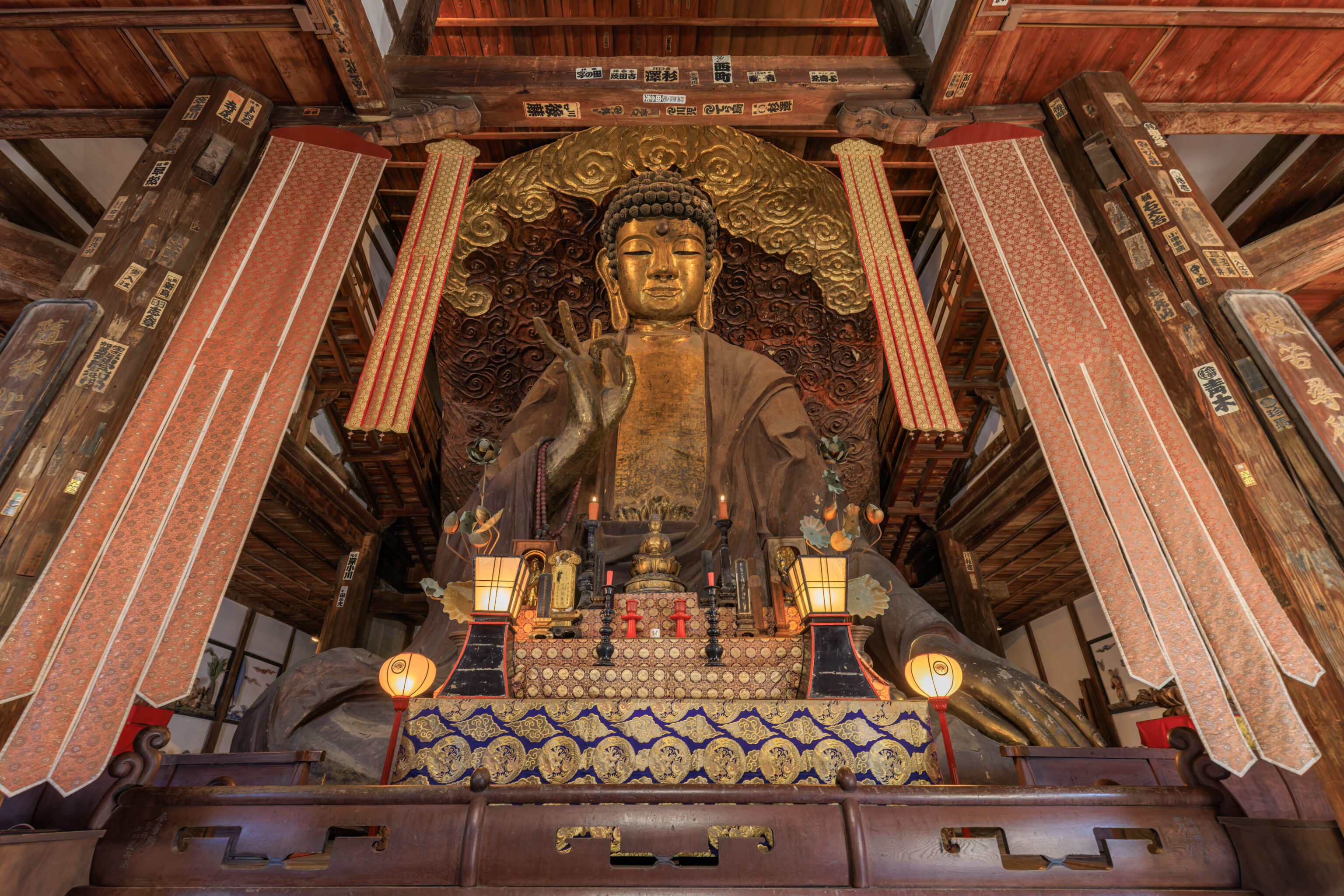
One last look before heading back out!
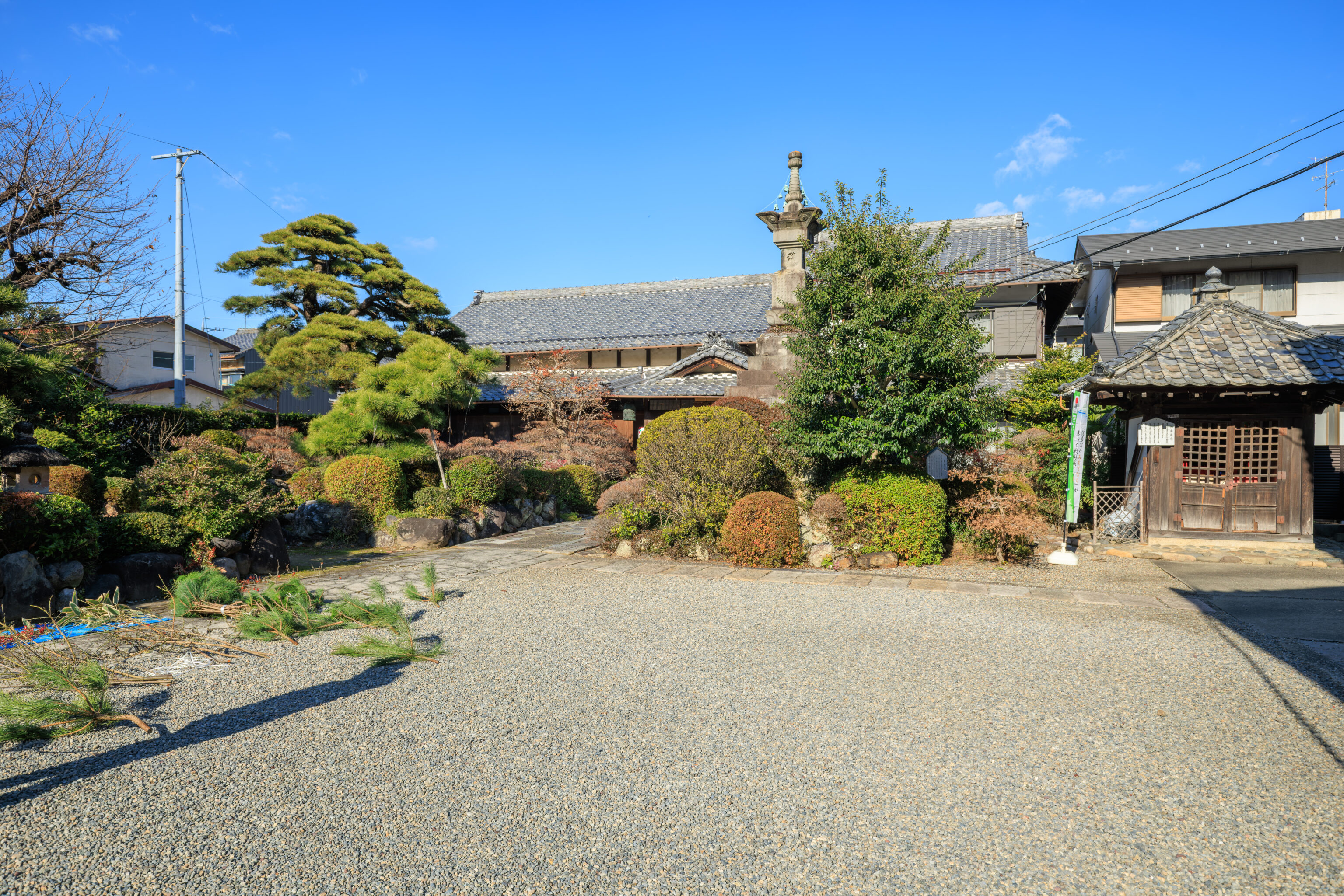
The view looking out from the front of the Great Buddha Hall.
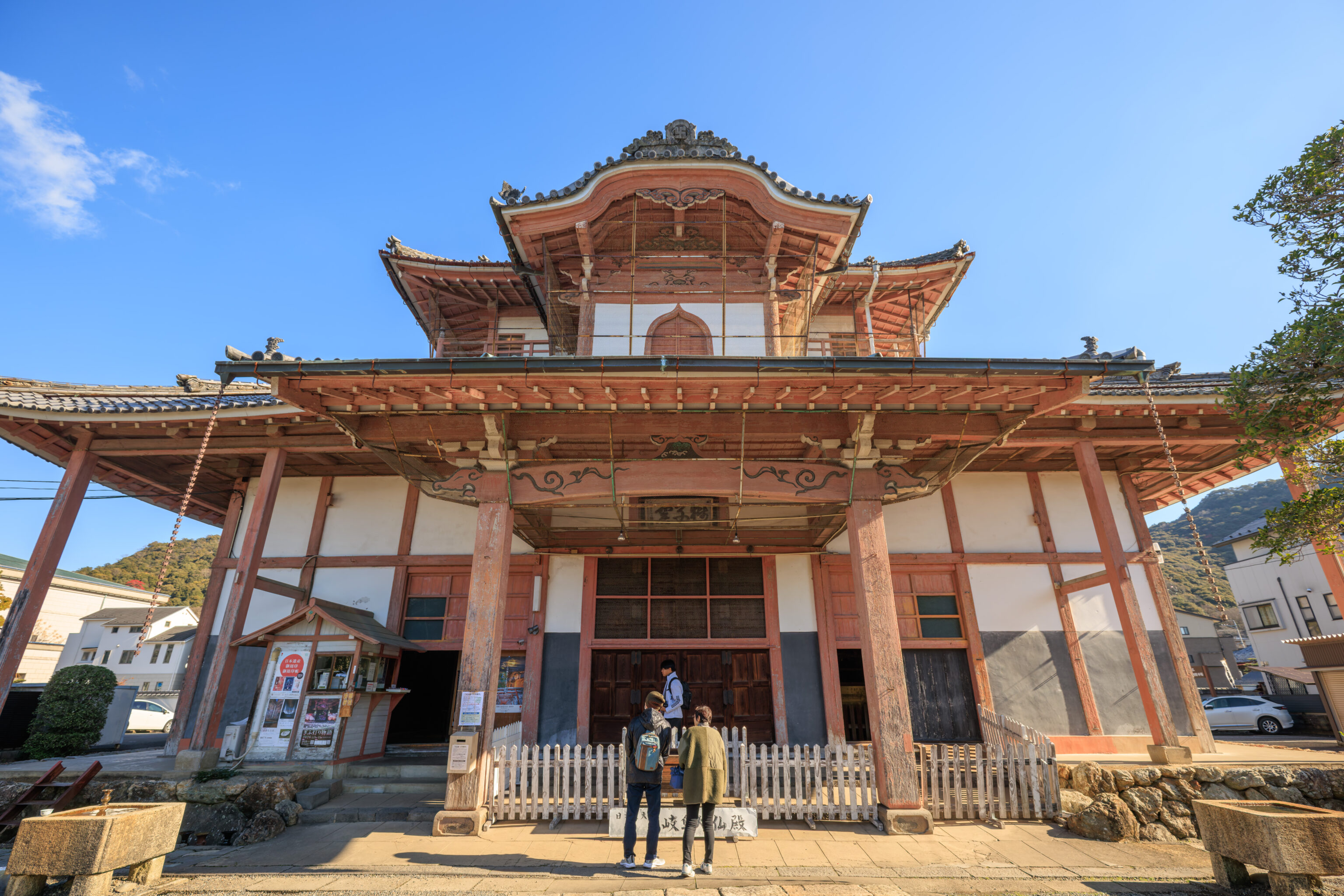
The Great Buddha Hall, as seen from the front.
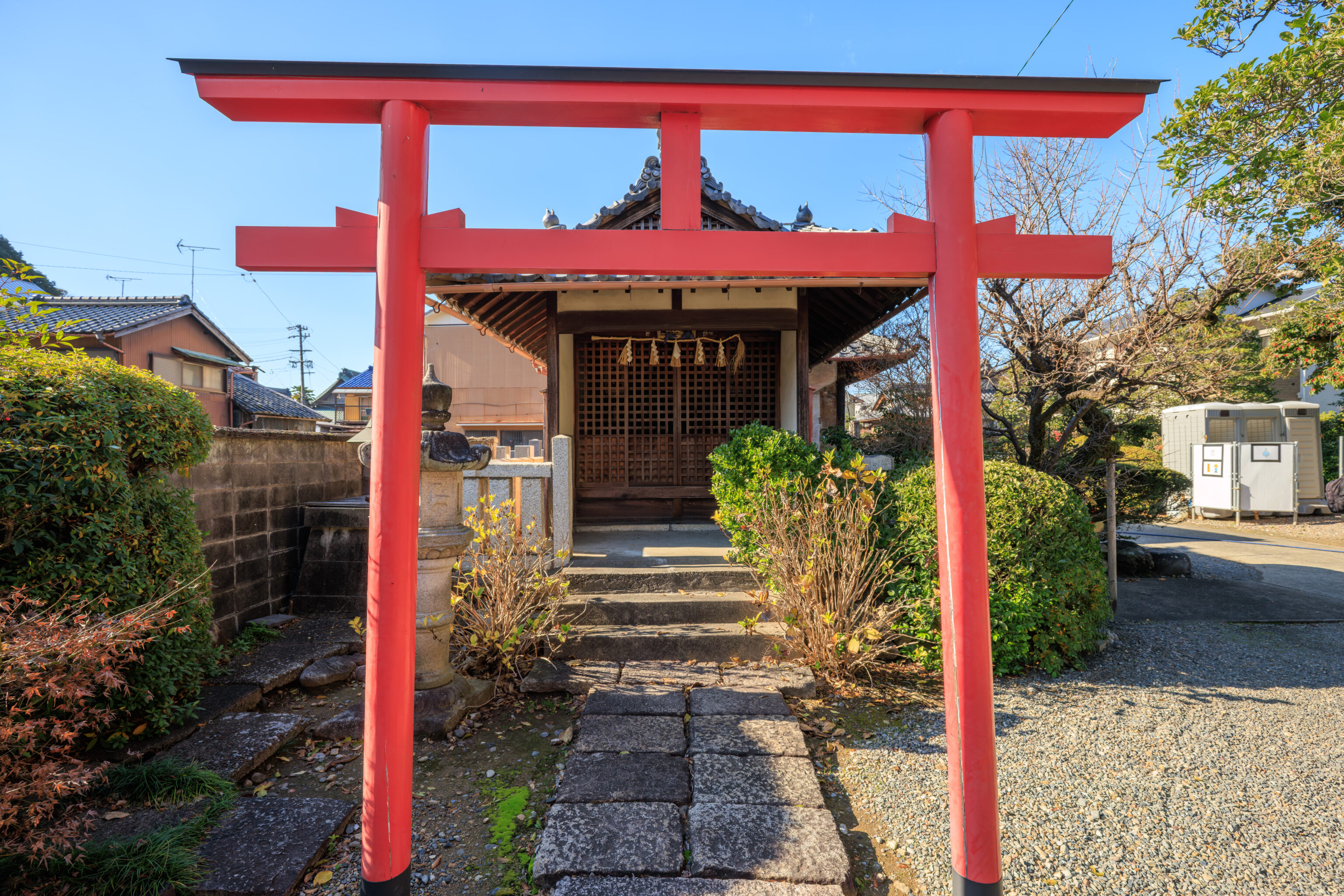
A shrine within the temple grounds.
Its a small detail, but in one of the photos above, there is a shadow of someone with a hose. A visitor tripped over this hose and fell.
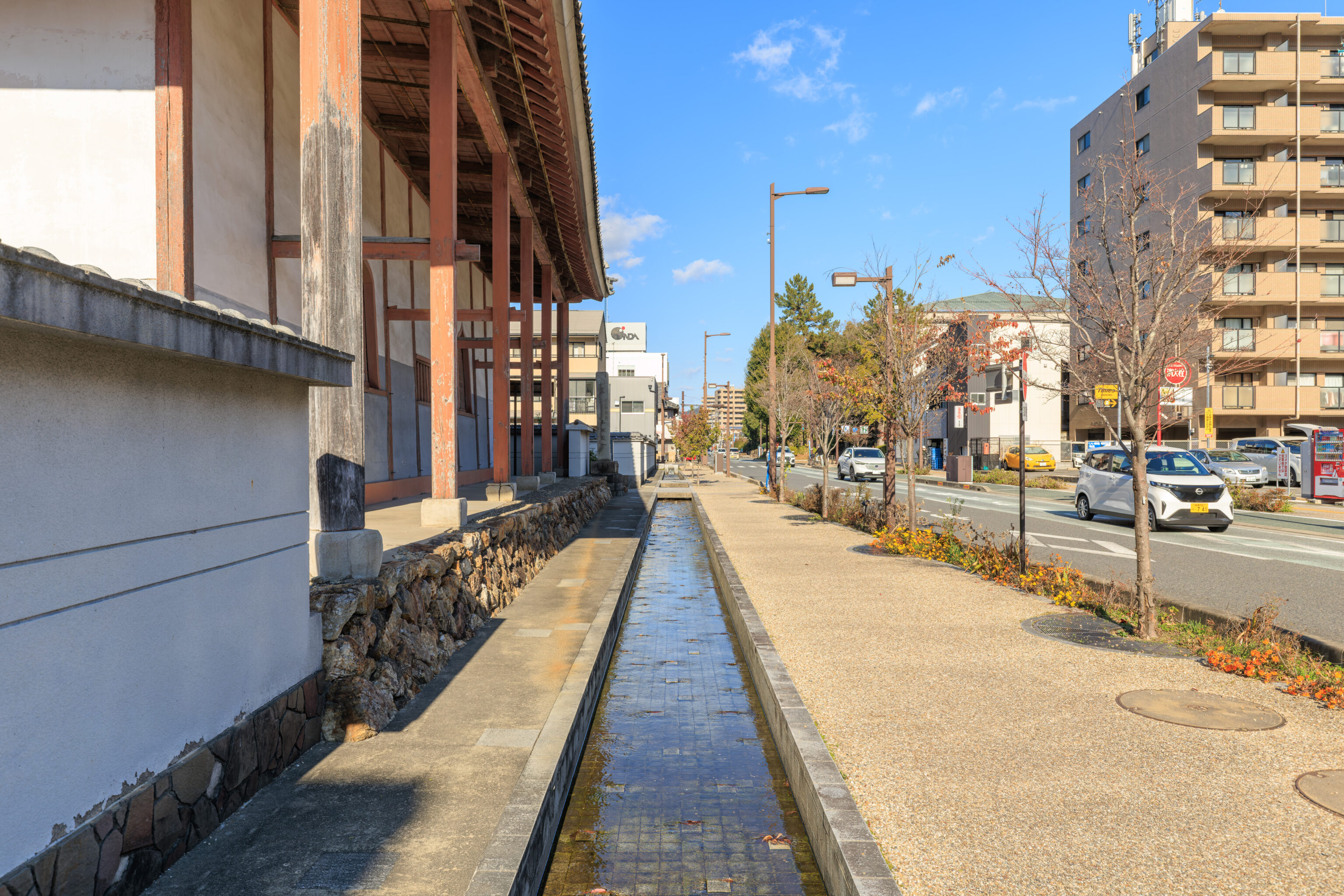
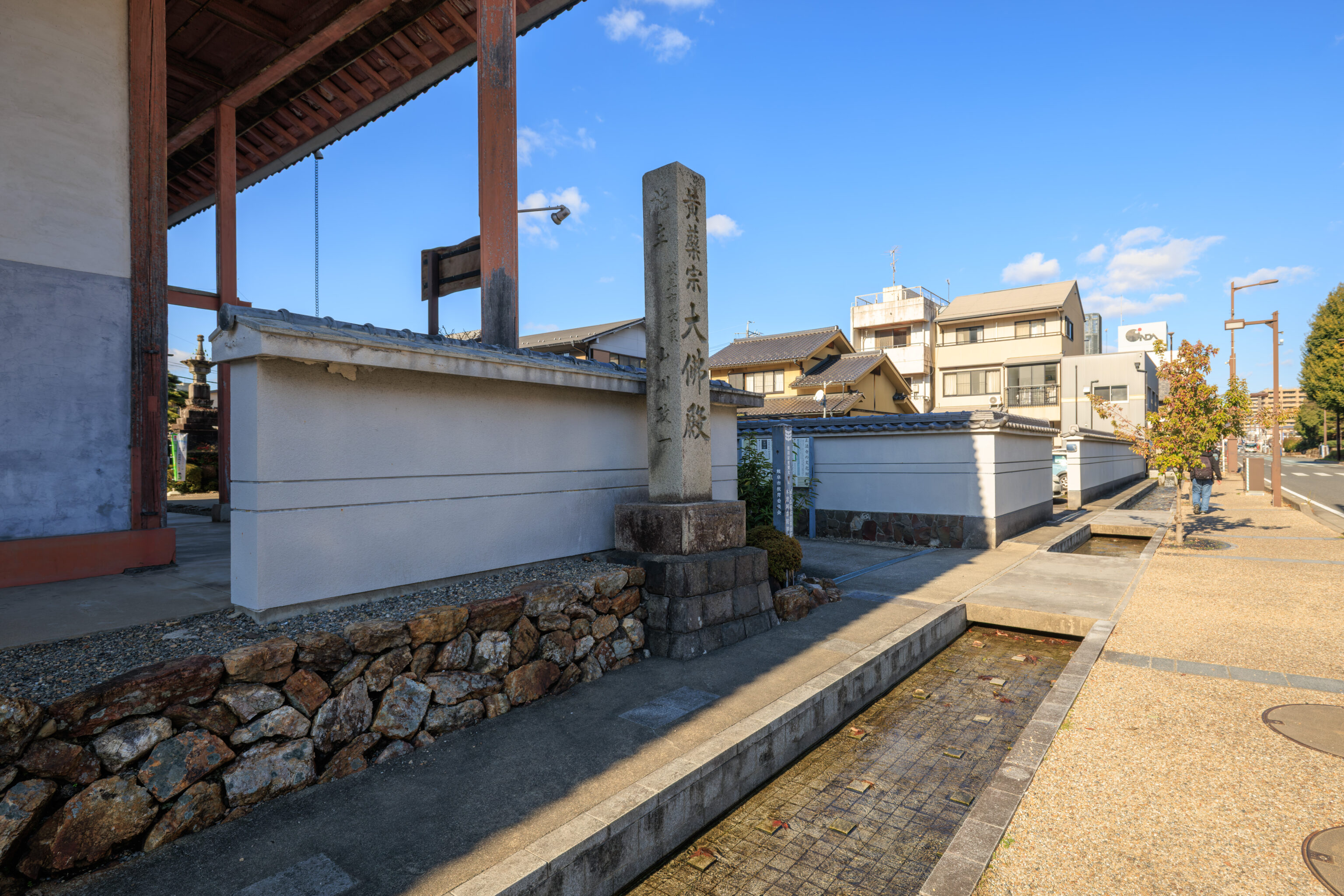
After our visit, we headed back to the road on the east side of the temple.
Gifu Park
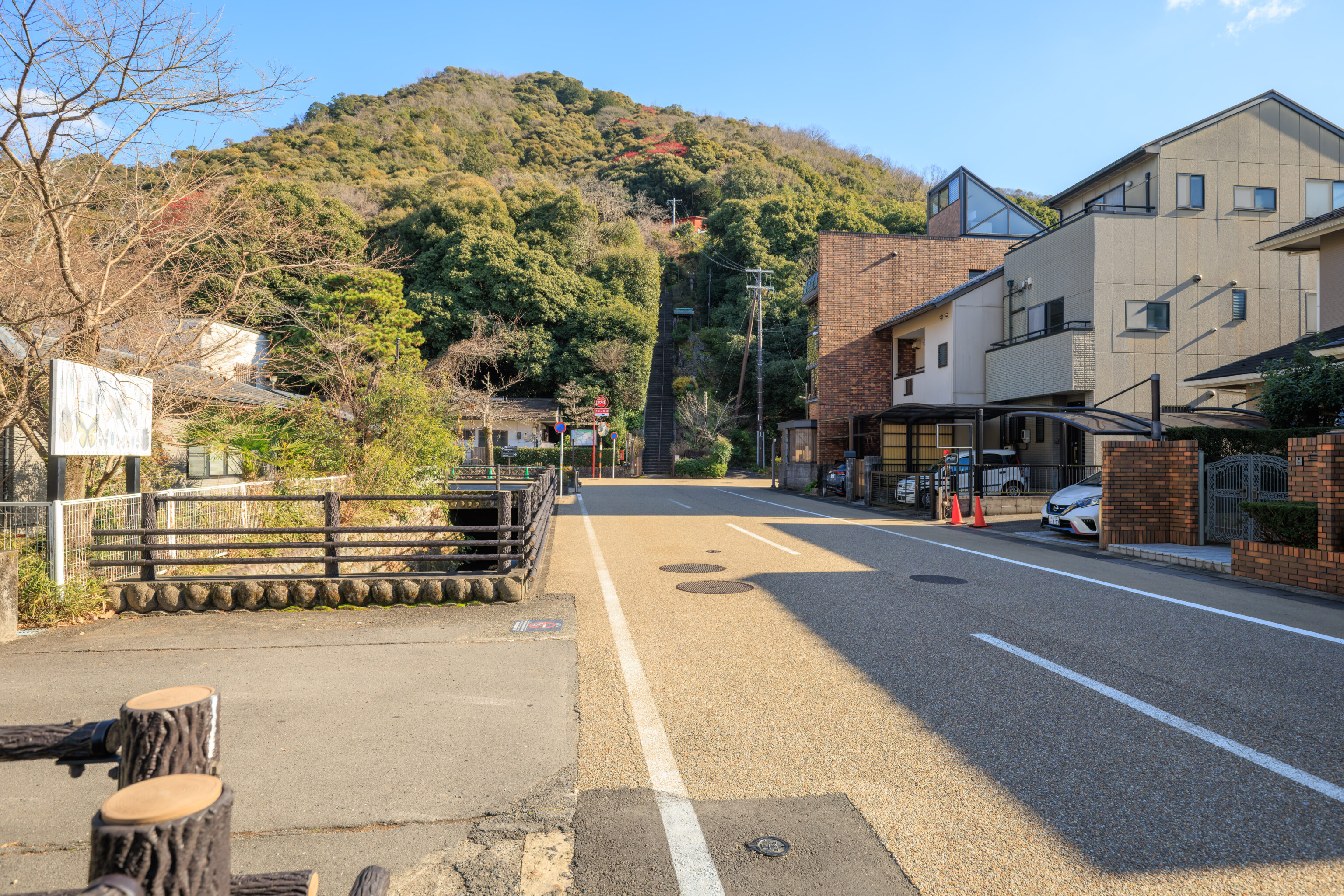
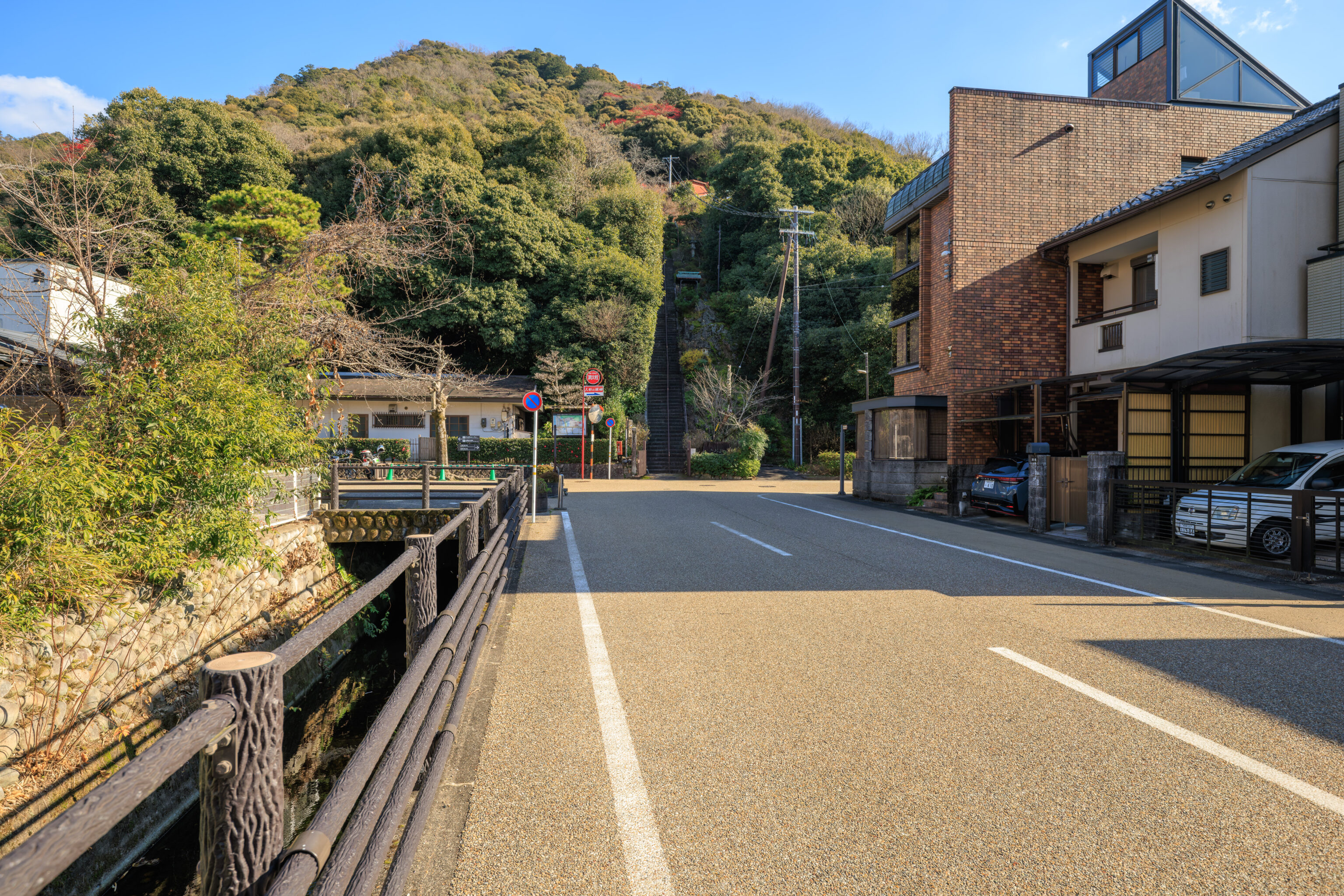
We then walked to the east to return to 岐阜公園 Gifu Park. The many stairs seen going up the hill in front of us lead to a temple, 禅林寺 Zenrin-ji. There is also a trail that goes up to Gifu Castle just to the right of the stairs.
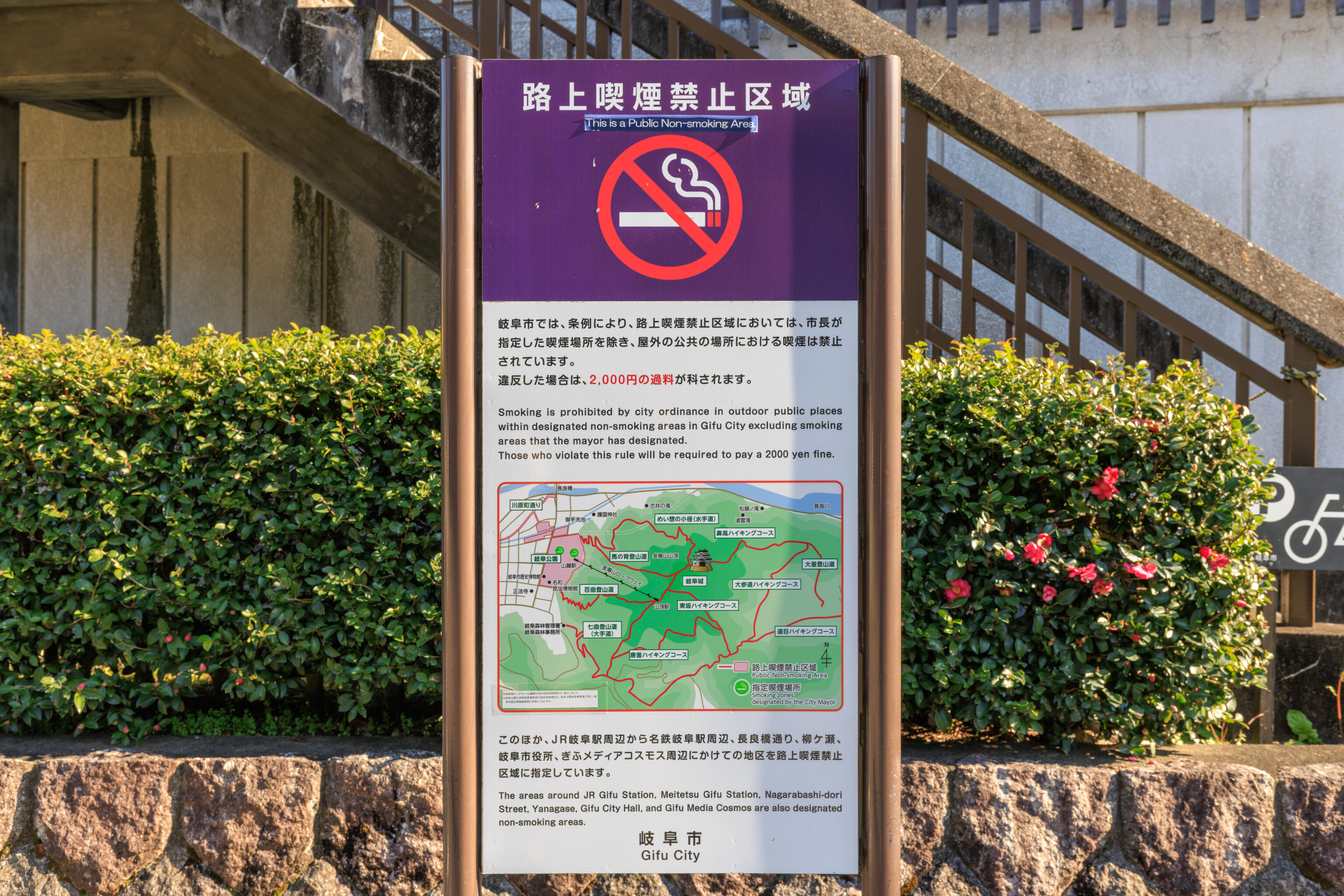
We walked a block to the end of the road and turned left. This sign had a map that depicts all the hiking trails in the mountains. And, it indicates the areas where public smoking is not permitted! The fine is ¥2000, or roughly $13 USD, which isn’t much of a fine. Although the Japanese do tend to follow rules, many also really love to smoke.
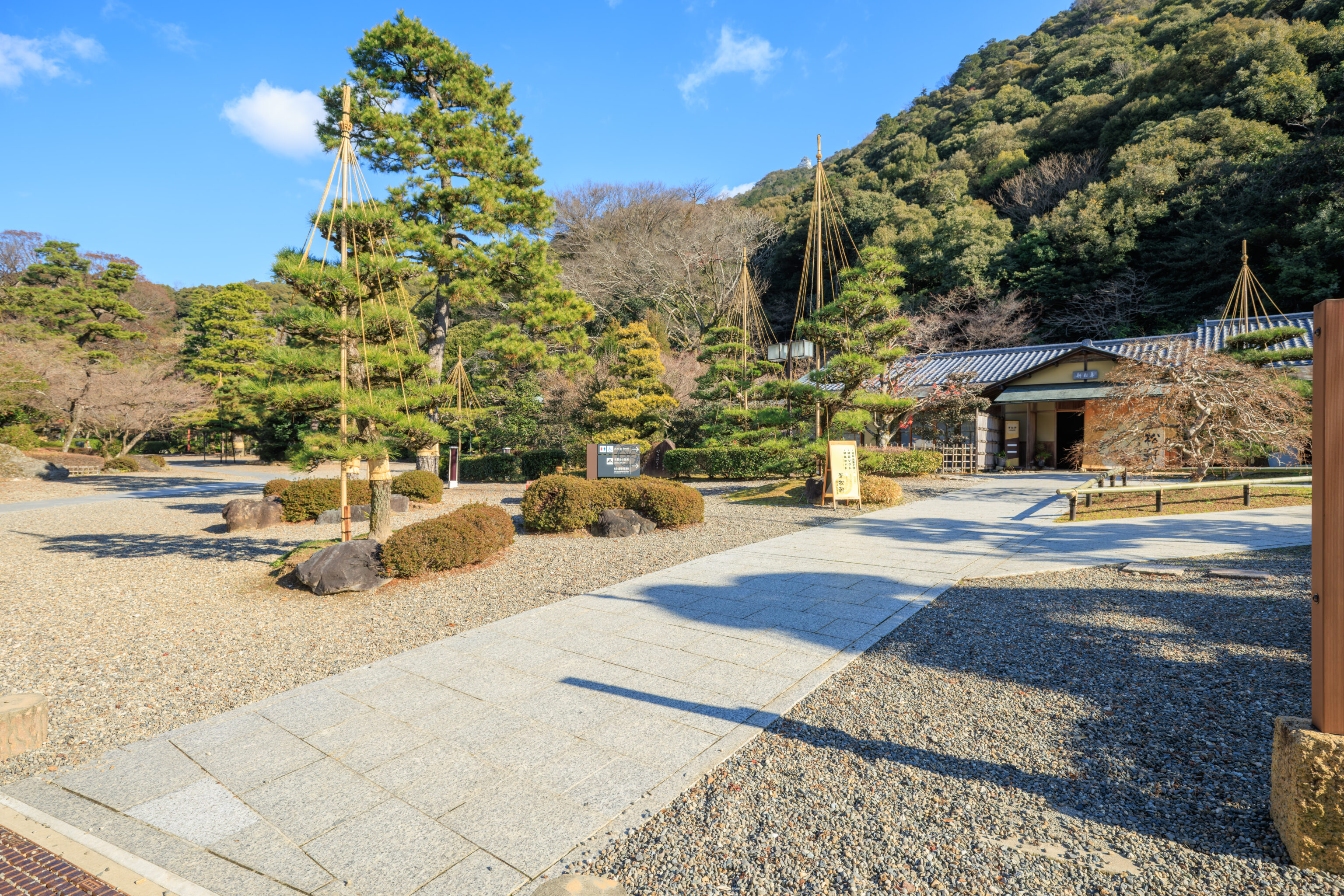
We then walked north into the park.
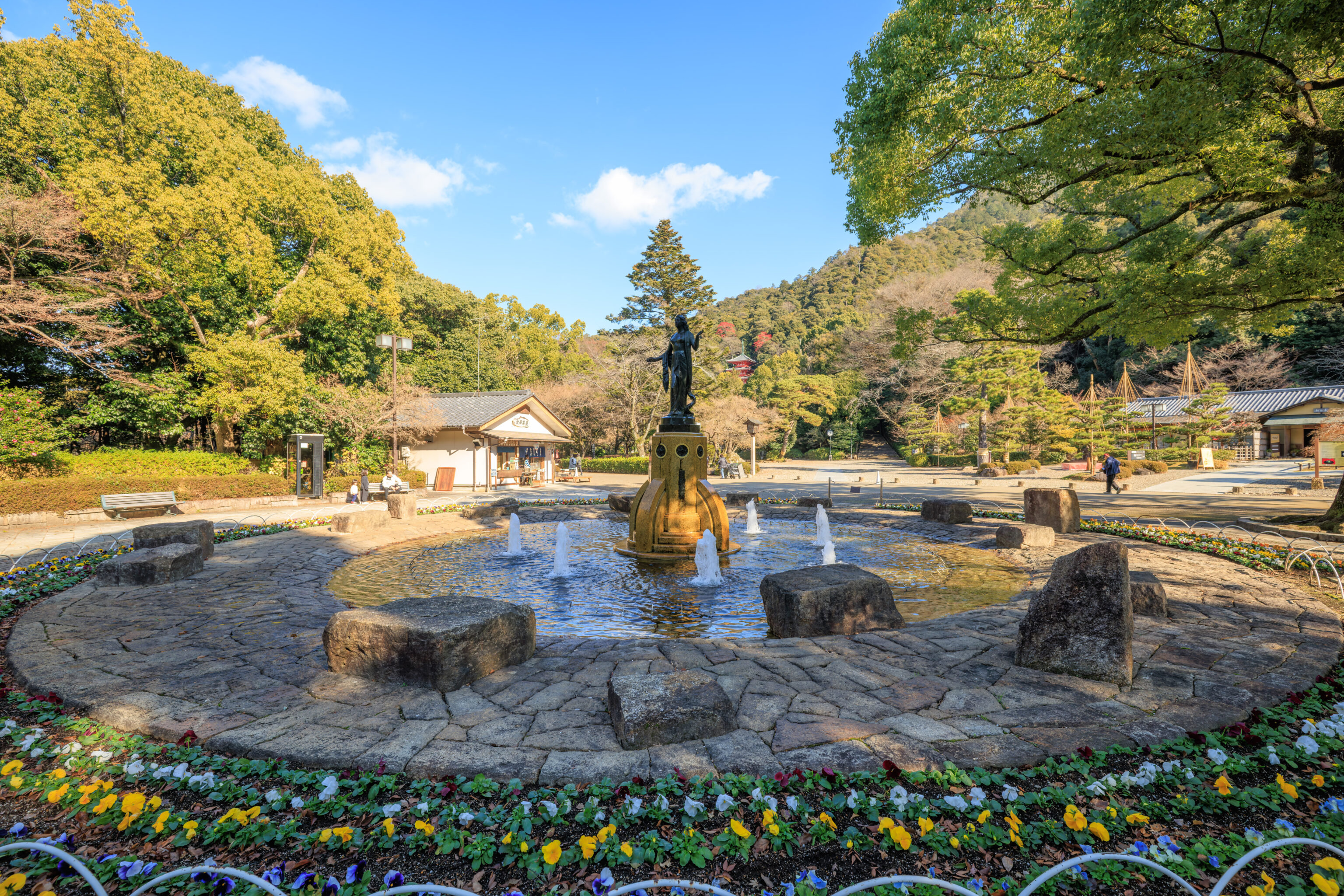
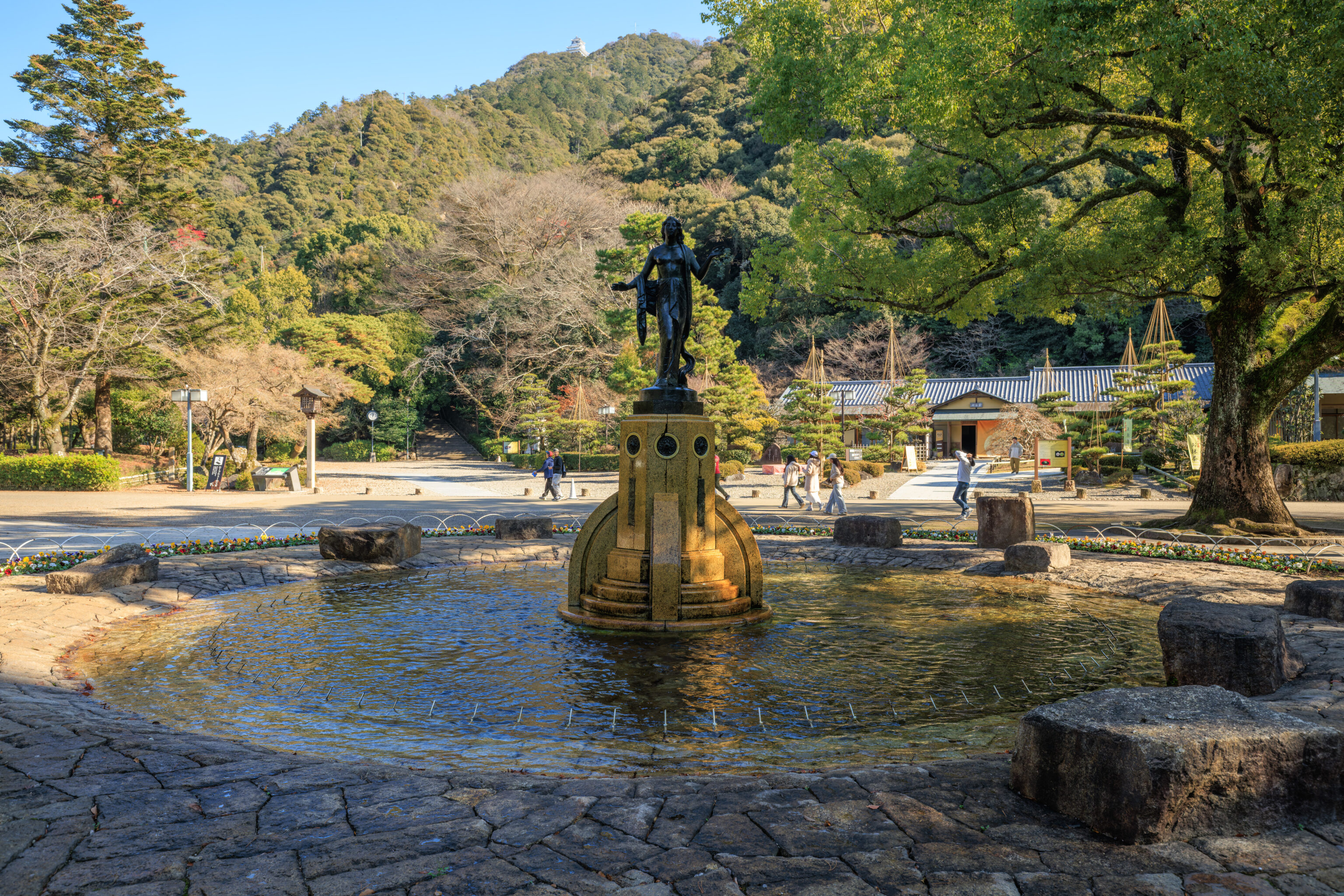
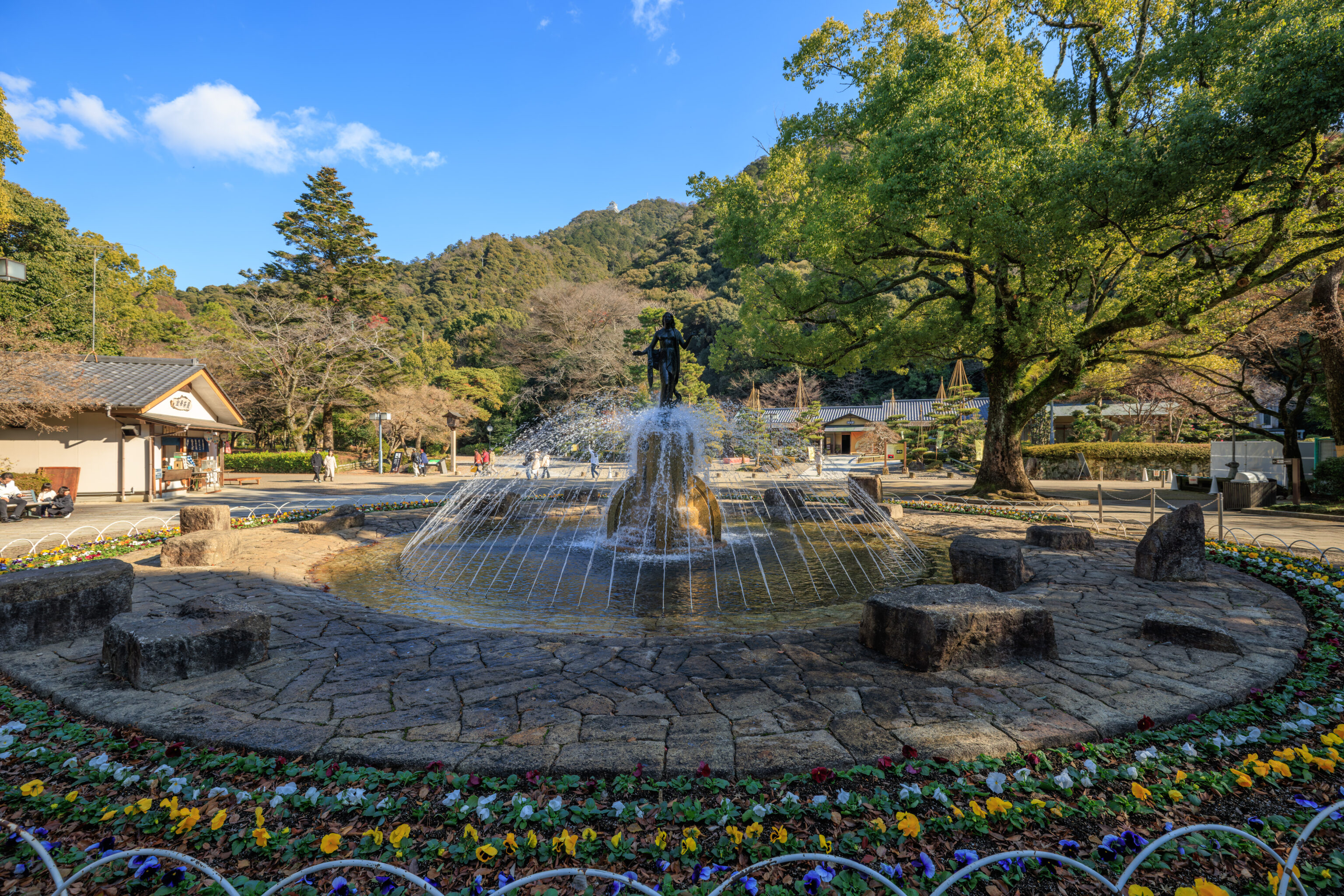
This is the 女神の噴水 Fountain of the Goddess and is at the beginning of the めい想の小径 Meditation Path. Although it sounds like it would be a nice peaceful stroll, it is actually a hike up the mountain! It ends at 金華山御嶽神社 Kinkasan Ontake Shrine, which is apparently a shrine between Gifu Castle and the Gifu Castle Museum. We didn’t notice this shrine earlier when we were up there. It was possibly in an area that was closed off to visitor access.
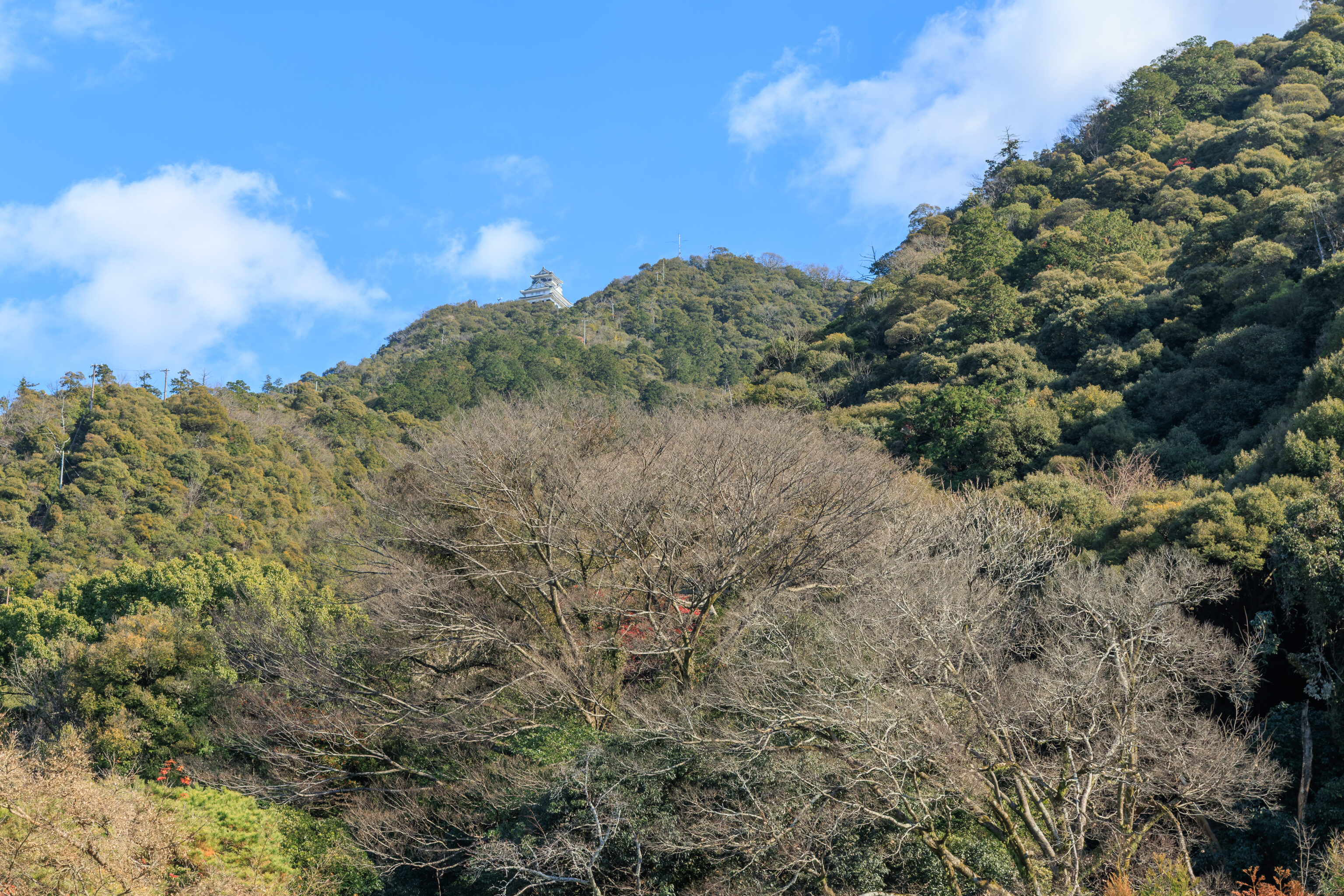
From here, we could look up and see Gifu Castle high above.
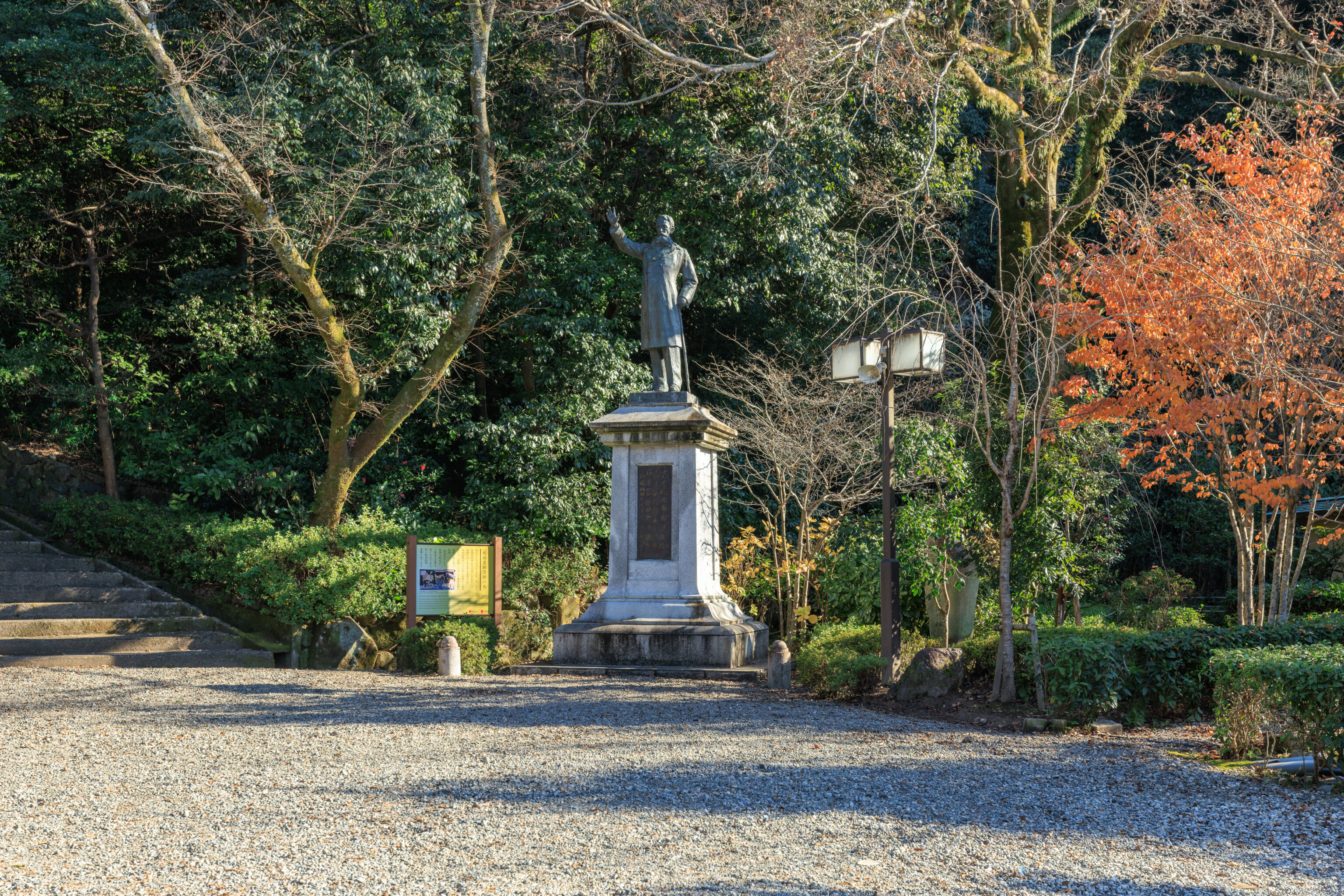
This statue depicts 板垣退助 Itagaki Taisuke. He was the founder of the first Liberal Party and a Prime Minister during the Meiji Era and was attacked here in 1882. This statue was erected in 1950 and replaced an earlier staute from 1918 that was removed, probably melted down, for the war effort.
The sign to the left of the statue provides some details.
The Site of the Attack on Itagaki Taisuke
At 1:00 p.m. on April 6, 1882, Itagaki Taisuke—then president of the Liberal Party—delivered a speech at the Chukyo-in hall before an audience of over one hundred people. Later that evening, as he stepped just a few paces out of the entrance after concluding the event, Aihara Naoyoshi shouted "Traitor to the nation!" and stabbed him in the chest.

It was then that he uttered the famous words: "Even if Itagaki dies, liberty shall not." This is the site where that attack took place.
– Japanese text from the sign to the left of the statue, read using Google Gemini and translated using Google Translate. Text captured from a photograph shared on Google Maps.
Site of Assassination Attempt on Itagaki Taisuke (1837-1919)
The founder of Japan's Liberal Party, Itagaki Taisuke, was almost assassinated near this spot, on April 6, 1882. As he was leaving the hall where he had given a speech, Itagaki was attacked by Aihara Shoukei (1854-unknown), a right-wing militant armed with a 27 cm dagger. Naofumi stabbed Itagaki in the left side of his chest. Taisuke fought back but was stabbed once more in the right side of his chest. Taisuke received further injuries to his hands and left cheek before the police were able to subdue and arrest the assailant. During the attack, Itagaki is said to have shouted, "Taisuke may die, but freedom shall never die!"
– English text from the sign to the left of the statue. Text captured from a photograph shared on Google Maps.
This is one of those rare cases where the different language texts each have some unique information!
The text on the plaque below the statue reads:
He long championed the cause of liberty and civil rights,
Bringing democracy to a nation in crisis and ushering in the peaceful Meiji era. A statesman and general of rare, all-encompassing talent—who else compares?

Respectfully inscribed upon the portrait of Mr. Itagaki by his junior, Shigeru Yoshida.
– Text from a photograph of the plaque below the statue on Google Maps, translated using Google.
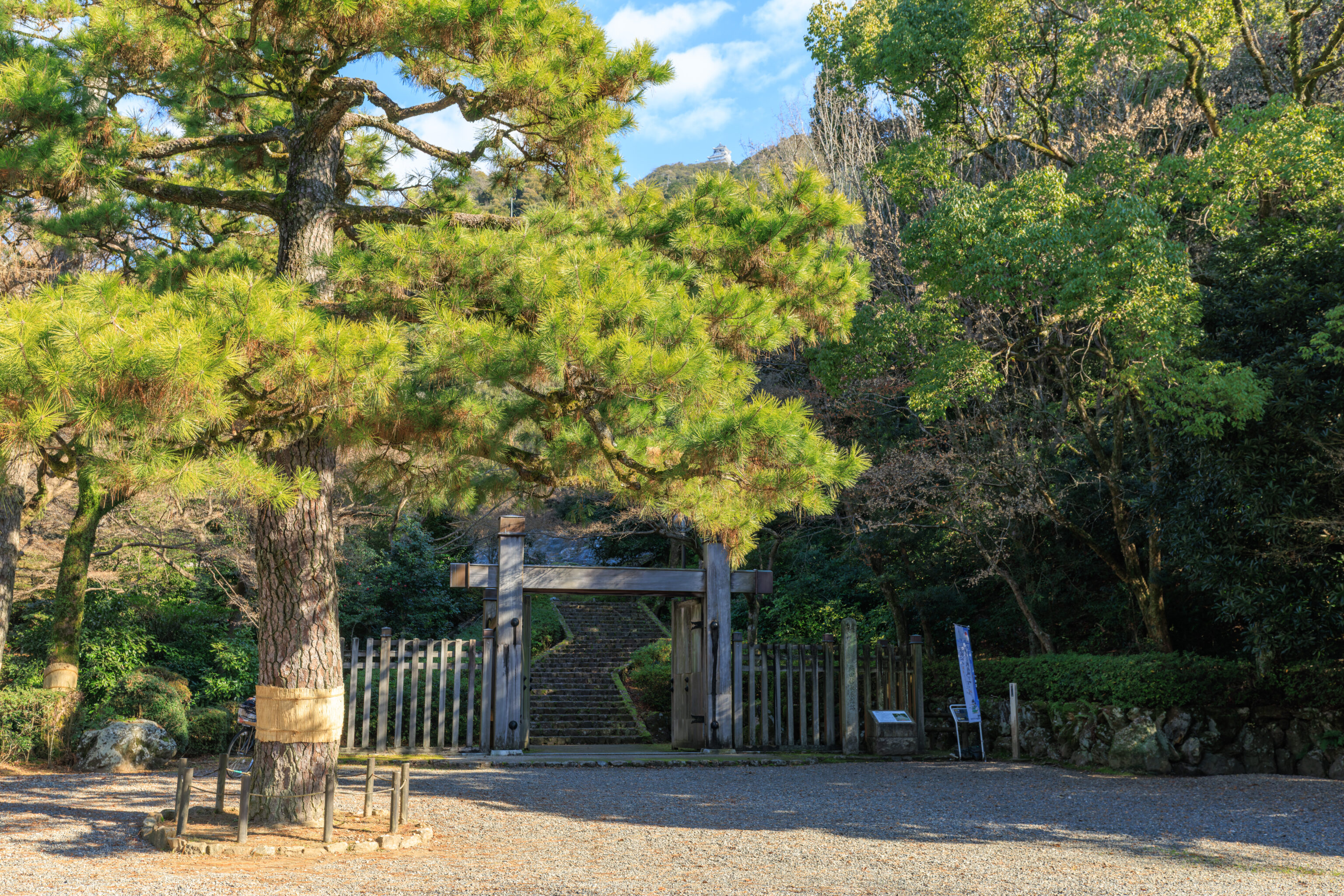
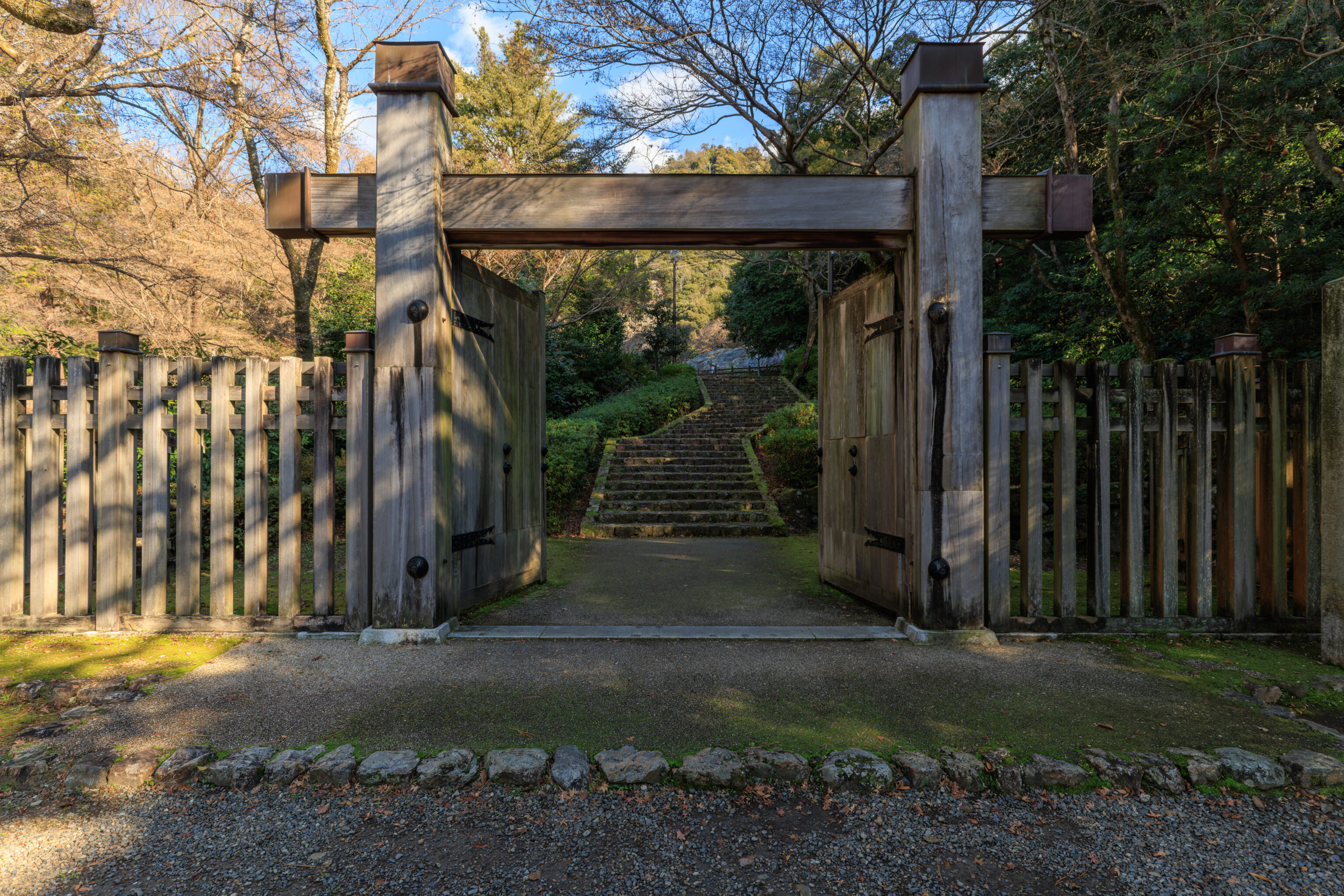
We continued on to the northeast through this open gate. The area beyond is believed to have been where the castle lord’s residence would have been.
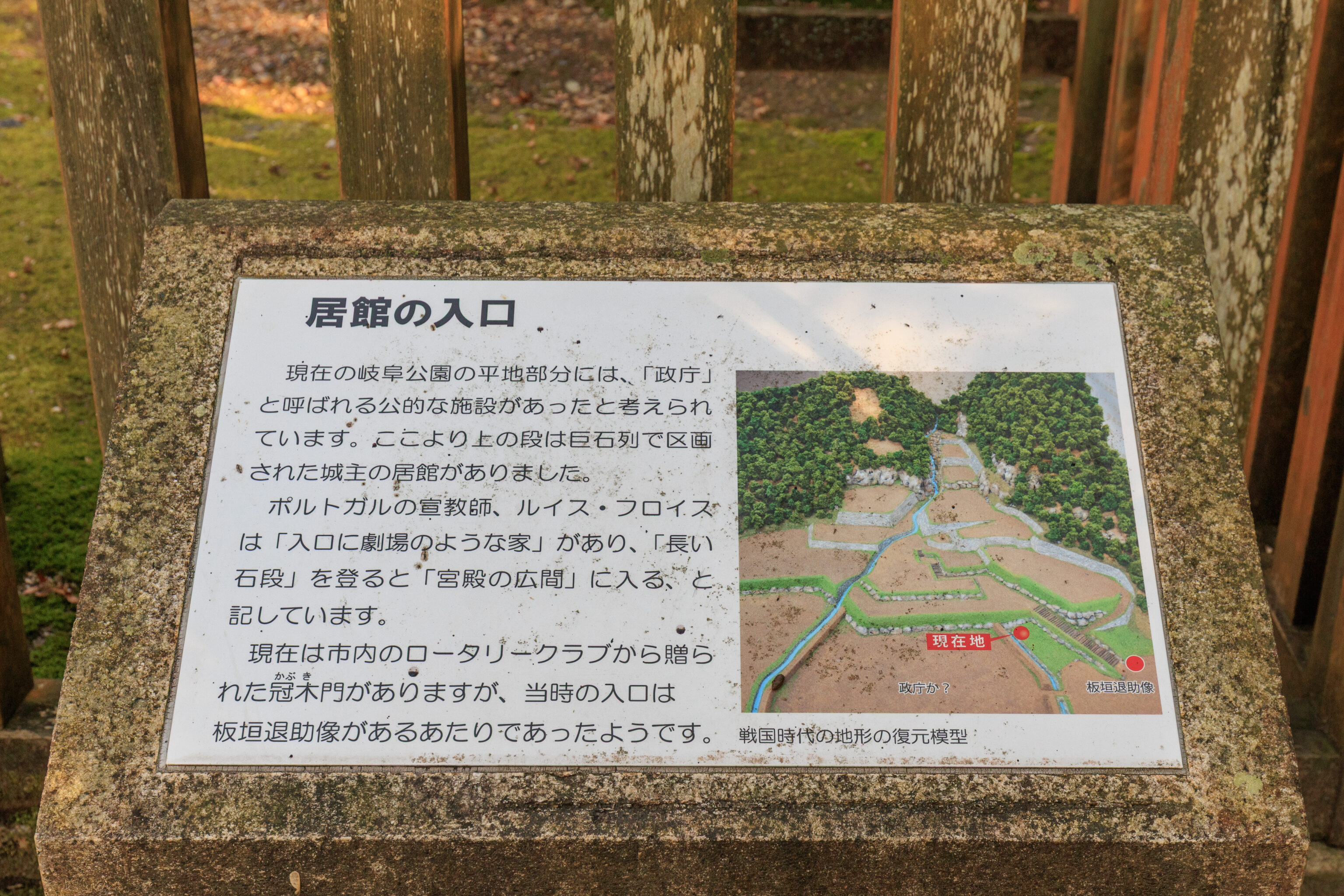
Entrance to the Lord's Residence
It is believed that an official administrative complex—or "seat of government"—once stood on the flat ground of what is now Gifu Park. On the higher terrace above this area lay the lord's residence, set apart by a row of massive stones.

The Portuguese missionary Luís Fróis recorded that there was a "theater-like building" at the entrance and that climbing a "long stone staircase" led into the "palace hall."

While a *kabukimon* (post-and-lintel gate) donated by a local Rotary Club stands there today, the original entrance appears to have been located near the statue of Itagaki Taisuke.

Reconstruction Model of the Terrain from the Sengoku Period
– Text from a the sign above, translated using Google Translate.
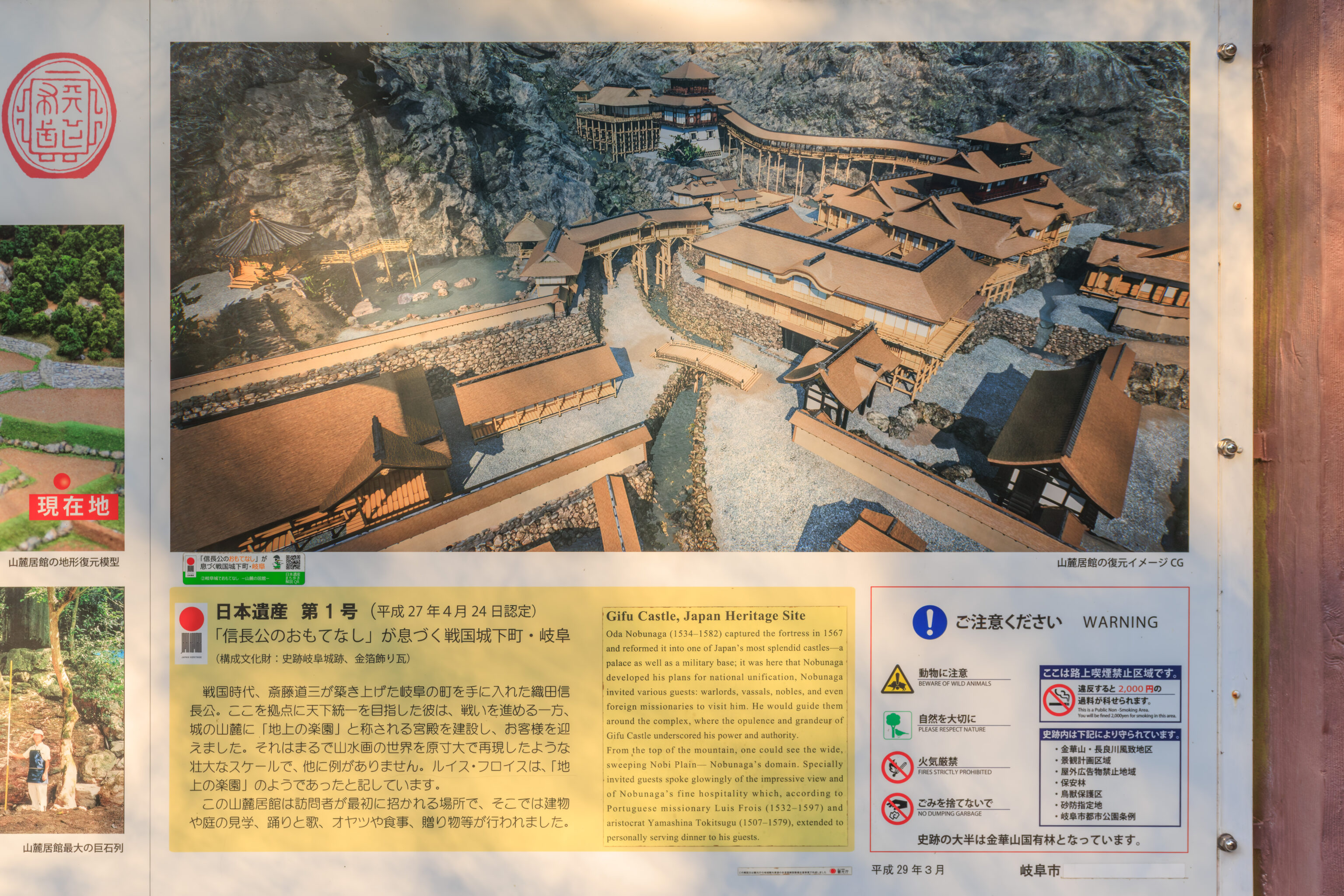
This sign depicts what the buildings here may have looked like. We actually saw this same graphic earlier in Gifu Castle.
Additional text on this sign not visible in the photograph above describes this area here in the foothills of the mountain above:
Site of the Castle Lord's Residence at the Foot of the Mountain (Site of Oda Nobunaga's Residence)
The mountainside residence consists of the Keyakidani stream flowing through the center and a series of terraced flat areas arranged on either side; these terraces are demarcated by stone walls, rows of massive stones, and megalithic masonry. There is an elevation difference of nearly 30 meters between the lowest terrace and the innermost section; it has become evident that the site was designed to create a dynamic, three-dimensional space that makes a visual impact, skillfully utilizing the valley-like terrain and surrounding bedrock. Another major characteristic of this residence is the presence of numerous garden remains and the use of gold-leaf-decorated roof tiles.

In 1569, the Portuguese missionary Luís Fróis visited Gifu Castle and toured the residence under the personal guidance of Lord Nobunaga. He described the layout as follows: the ground floor featured 15 to 20 reception rooms and five or six gardens; the second floor housed the quarters for the lady of the house and her attendants; the third floor contained a tea room; and the observation decks on the third and fourth floors offered a panoramic view of the town. The computer-generated image on the right was created based on Fróis's records and the findings of archaeological excavations.
– Text from the left part of the sign above, read using Google Gemini and translated using Google Translate.
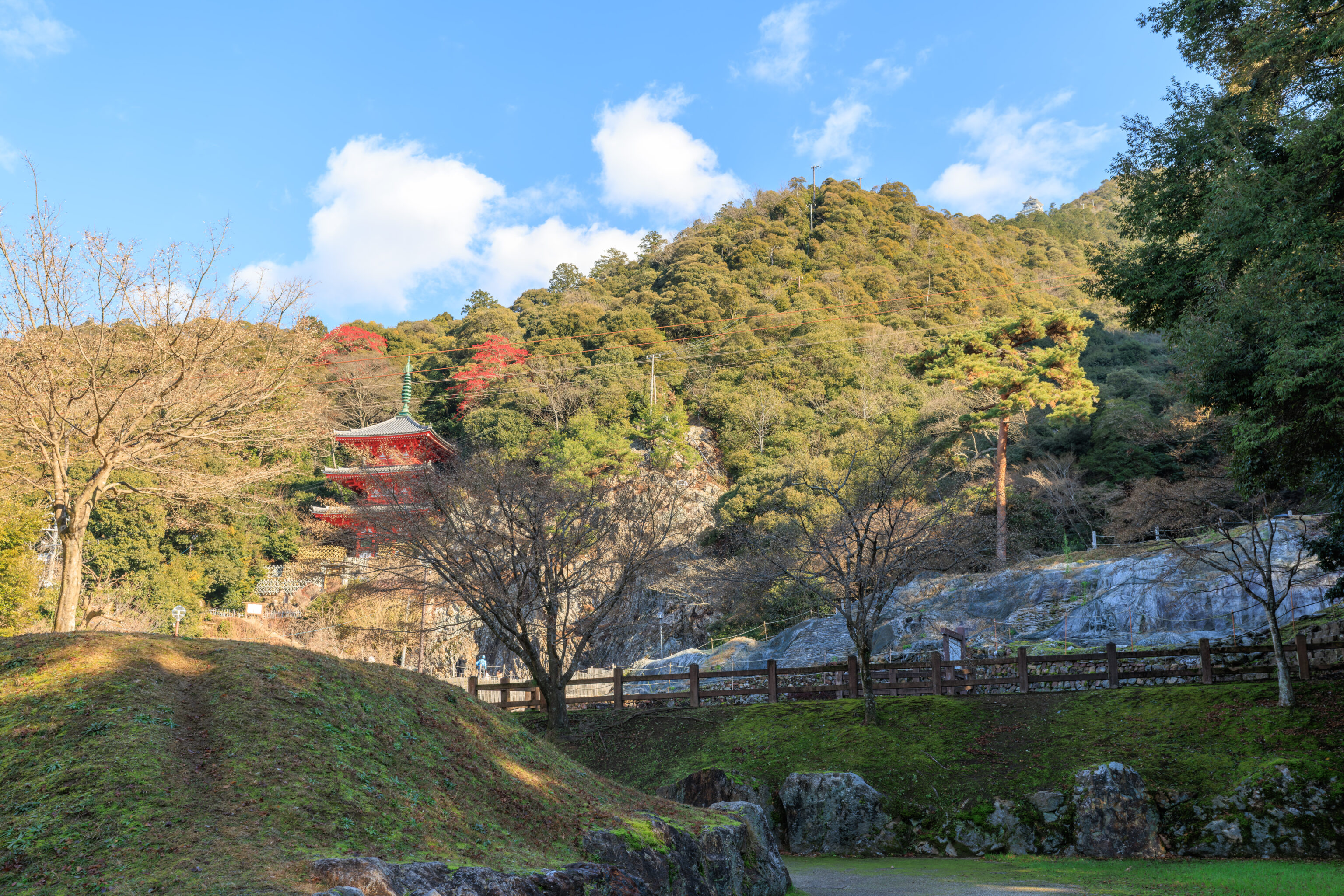
The buildings depicted would have been in this general area in front of us.
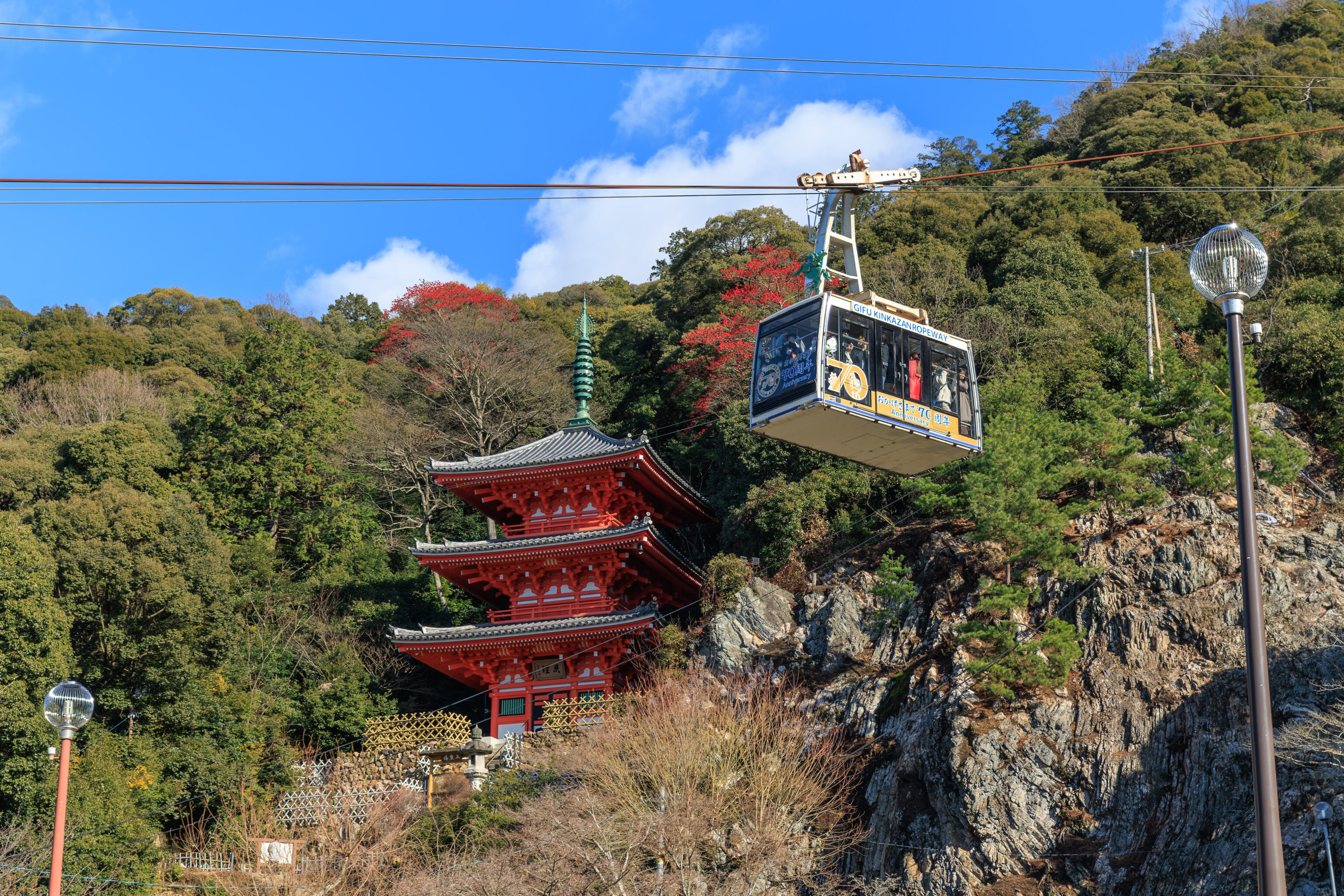
As we were walking around, we watched the aerial tram with its 70th anniversary livery pass by.
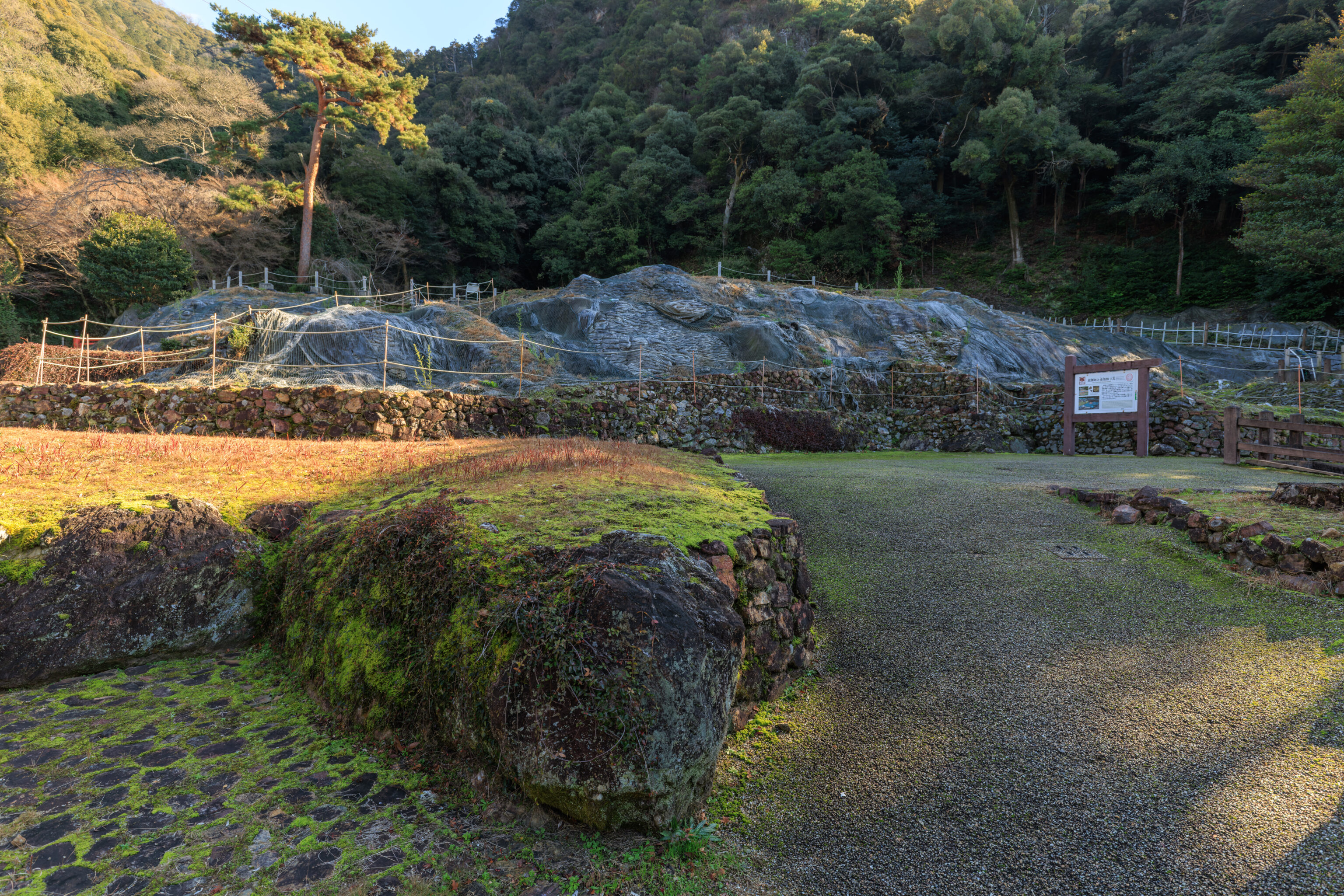
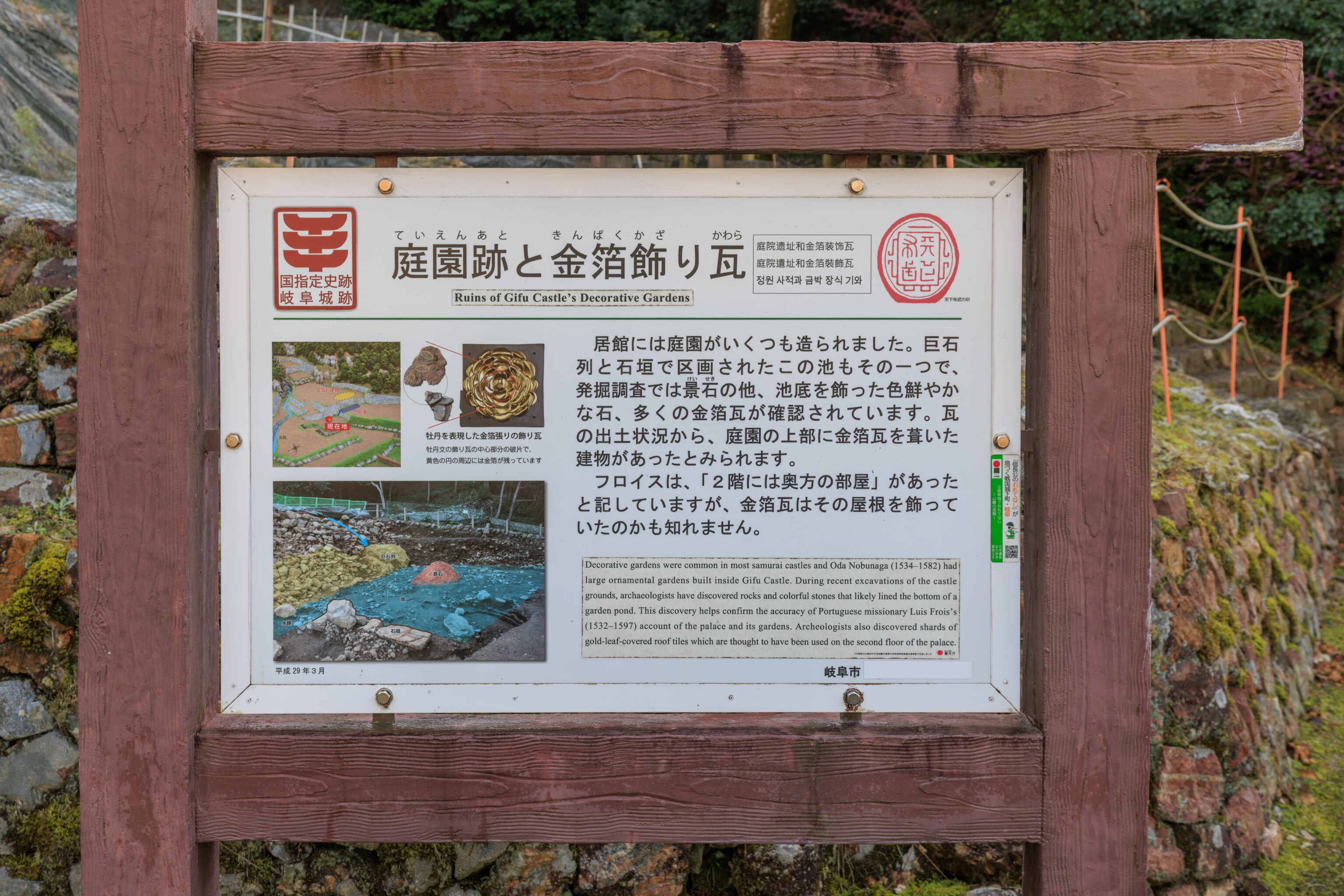
The area around this sign, which on the right in the photograph above this one, was excavated to discover the remnants of a garden as well as roof tiles.
Nationally Designated Historic Site: Ruins of Gifu Castle
Garden Ruins and Gold Leaf Decorated Roof Tiles
Several gardens were constructed within the residential complex. This pond, defined by rows of massive stones and stone walls, was one of them; archaeological excavations have uncovered not only landscape stones but also colorful stones that once adorned the pond bed, as well as numerous gold-leaf tiles. The distribution of these tiles suggests that a building roofed with gold-leaf tiles once stood above the garden.

Frois recorded that "the lady's chambers were on the second floor," and it is possible that the gold-leaf tiles adorned the roof of that structure.
– Text from a sign, translated using Google.
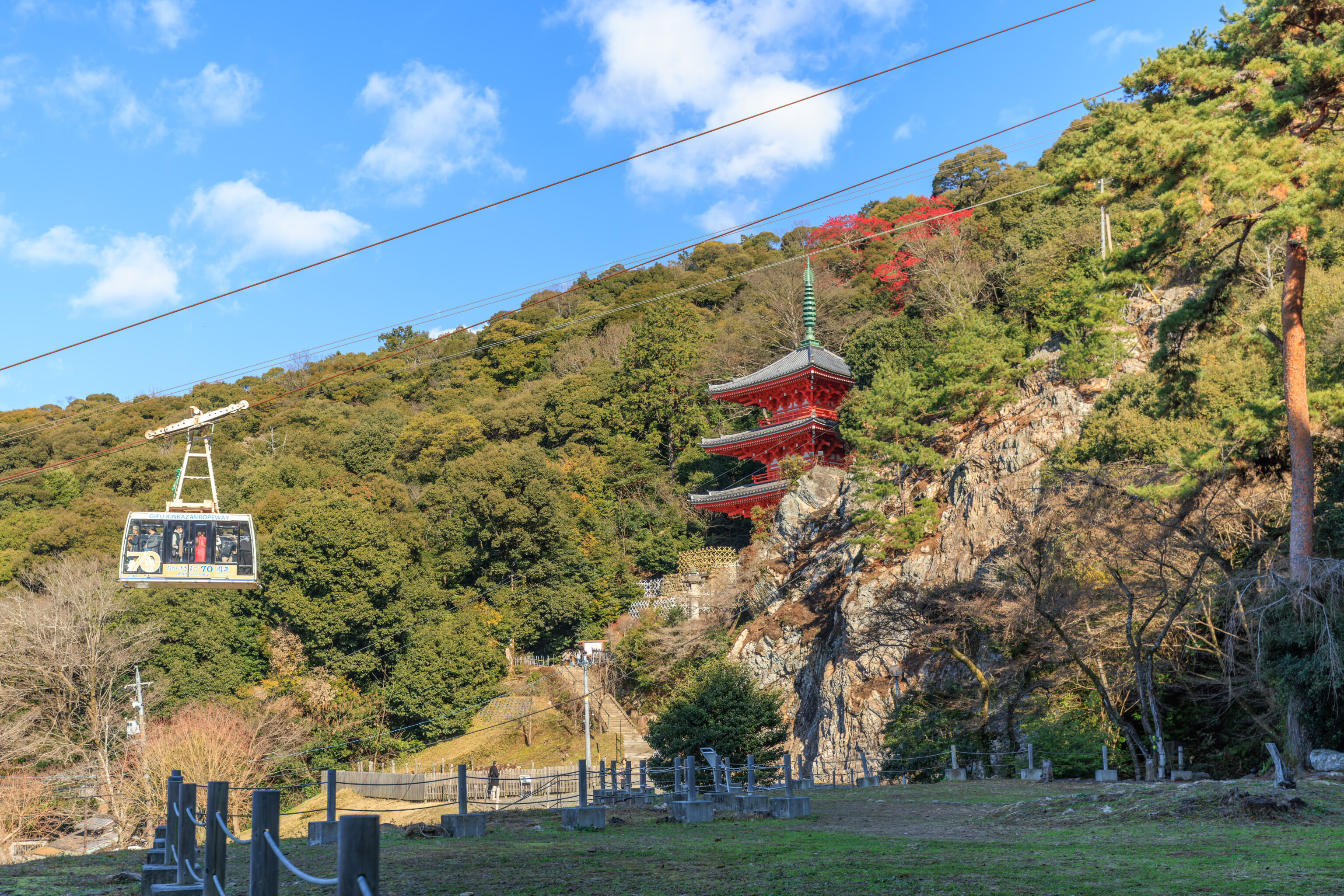
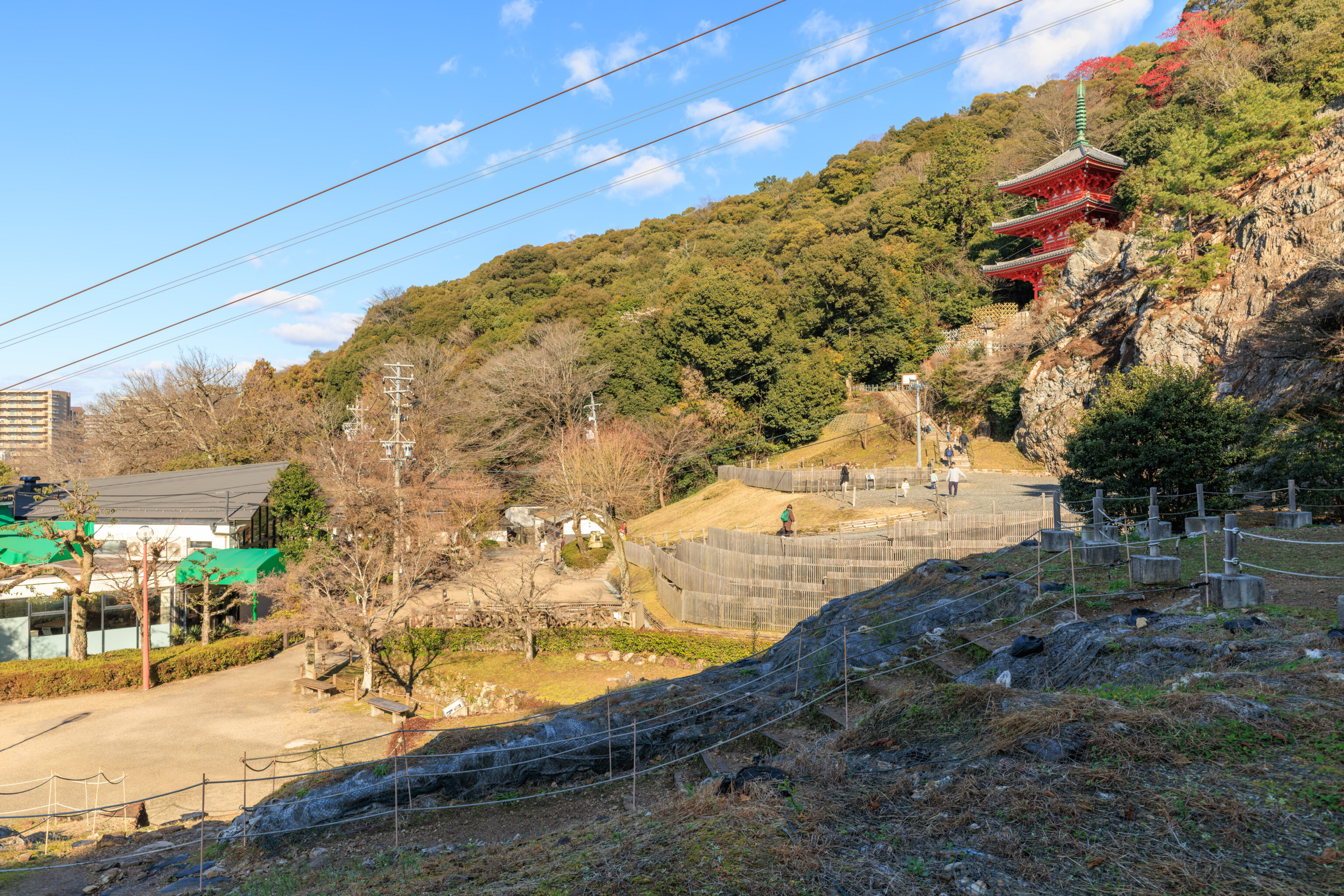
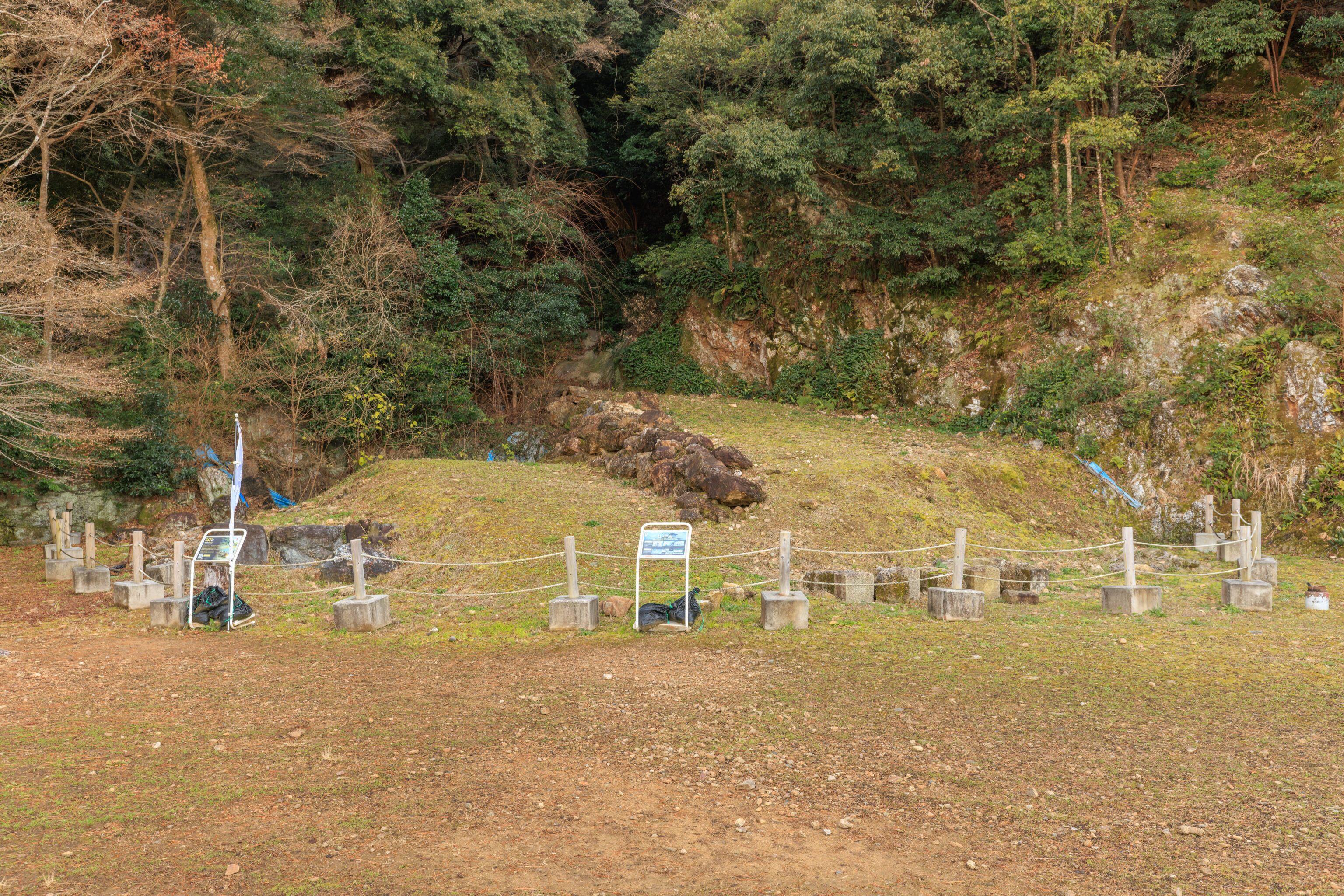
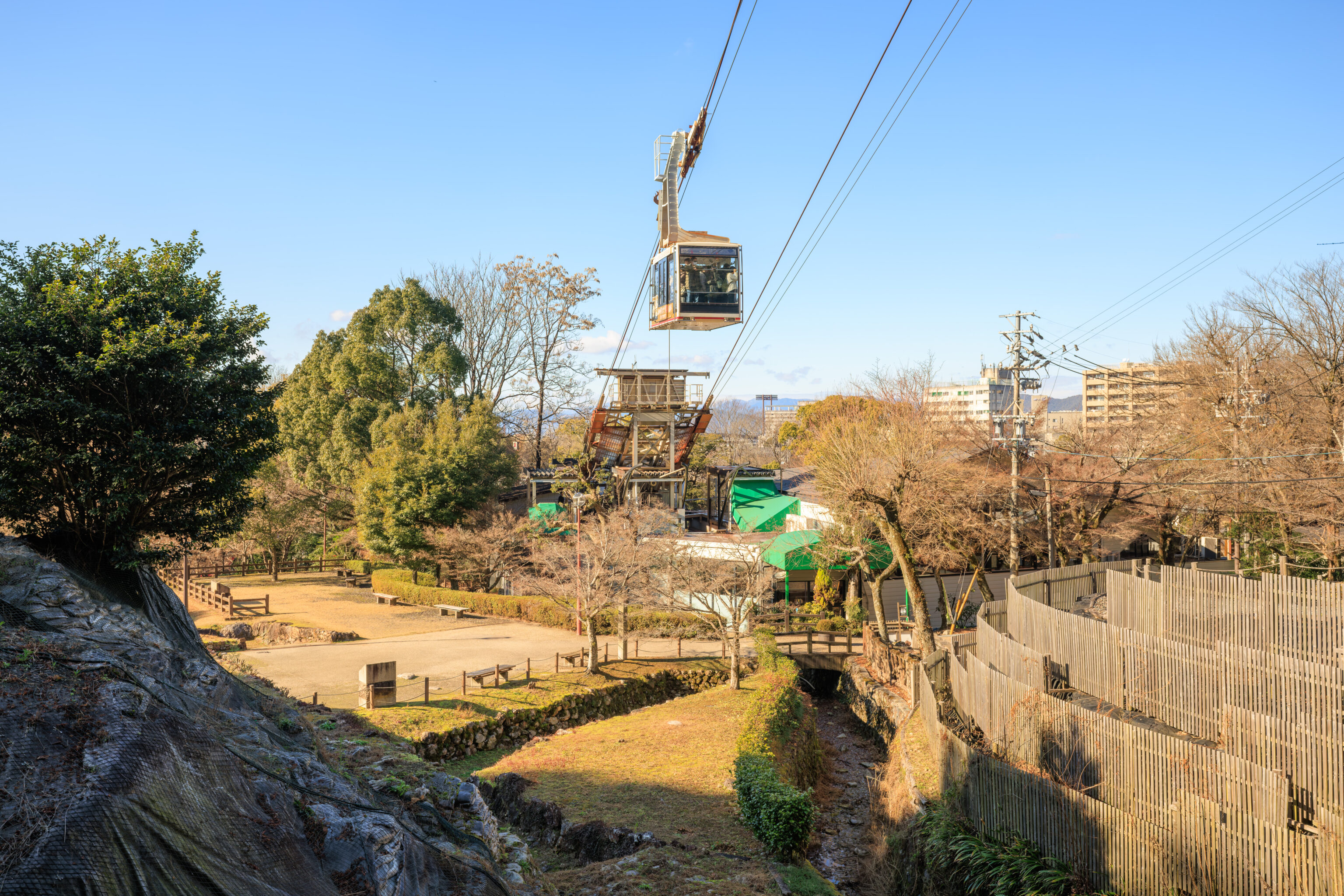
We walked around this area a bit…
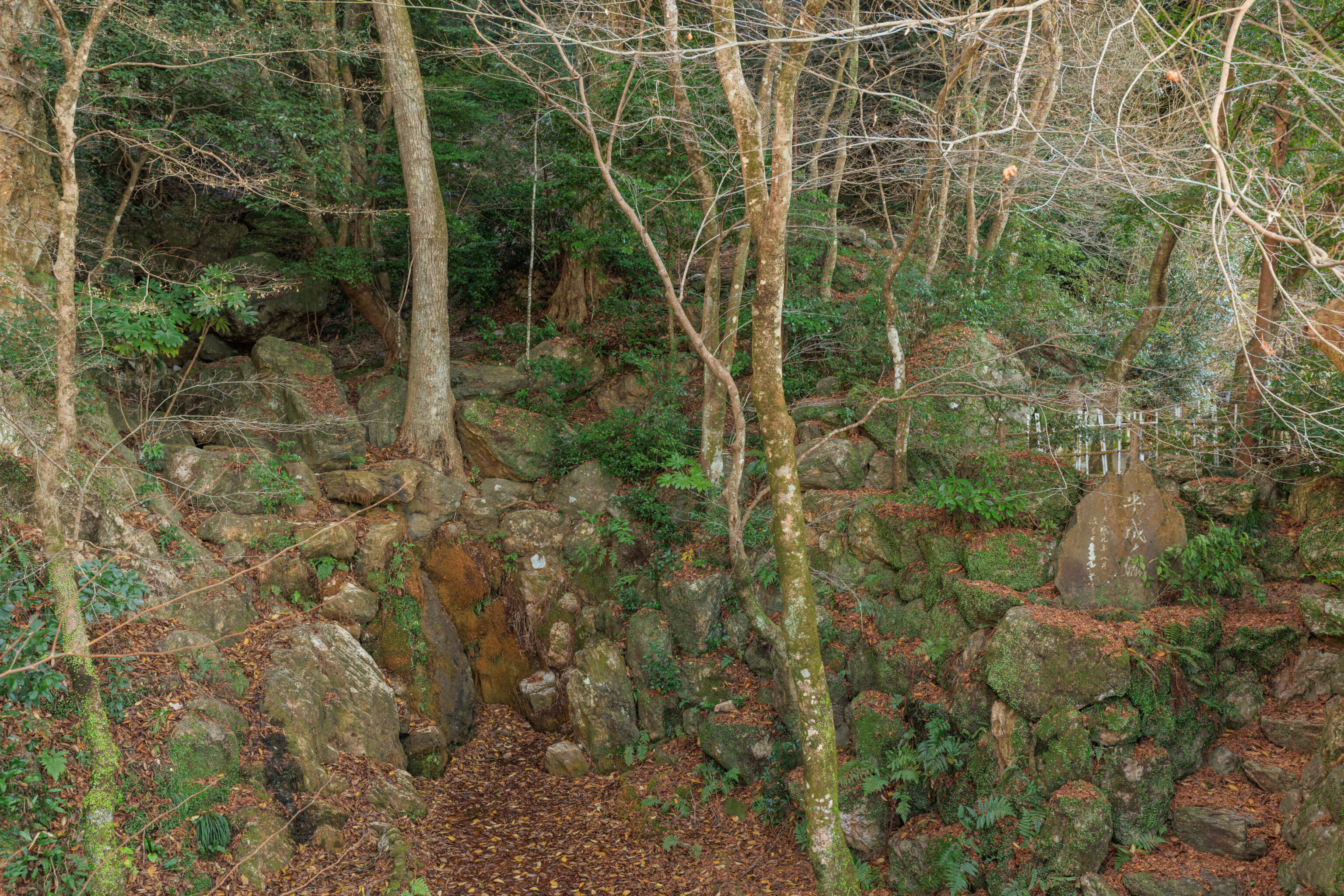
It seems like there is supposed to be a waterfall here which cascades down on the left side of this scene but maybe it is dry during this time of year?
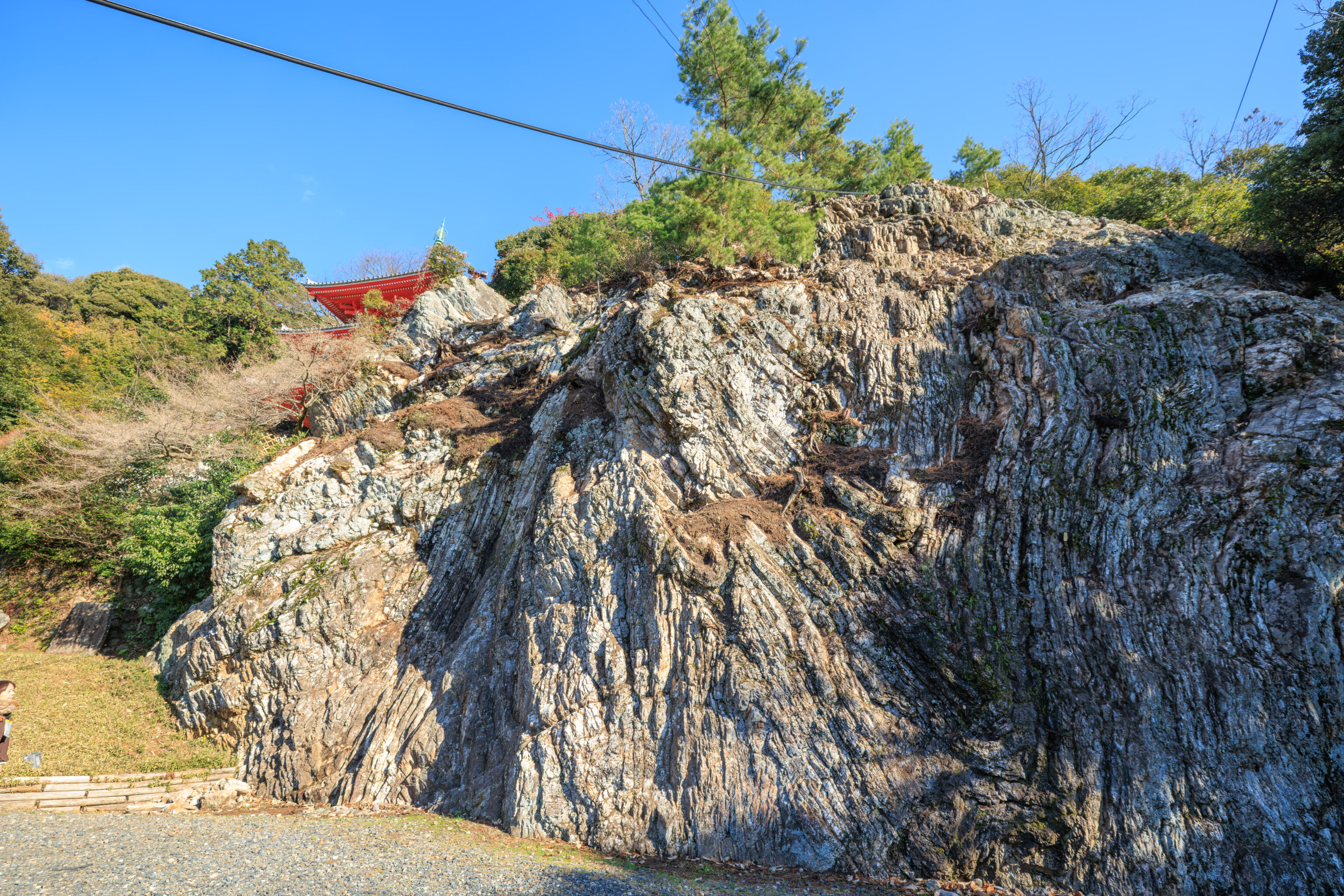
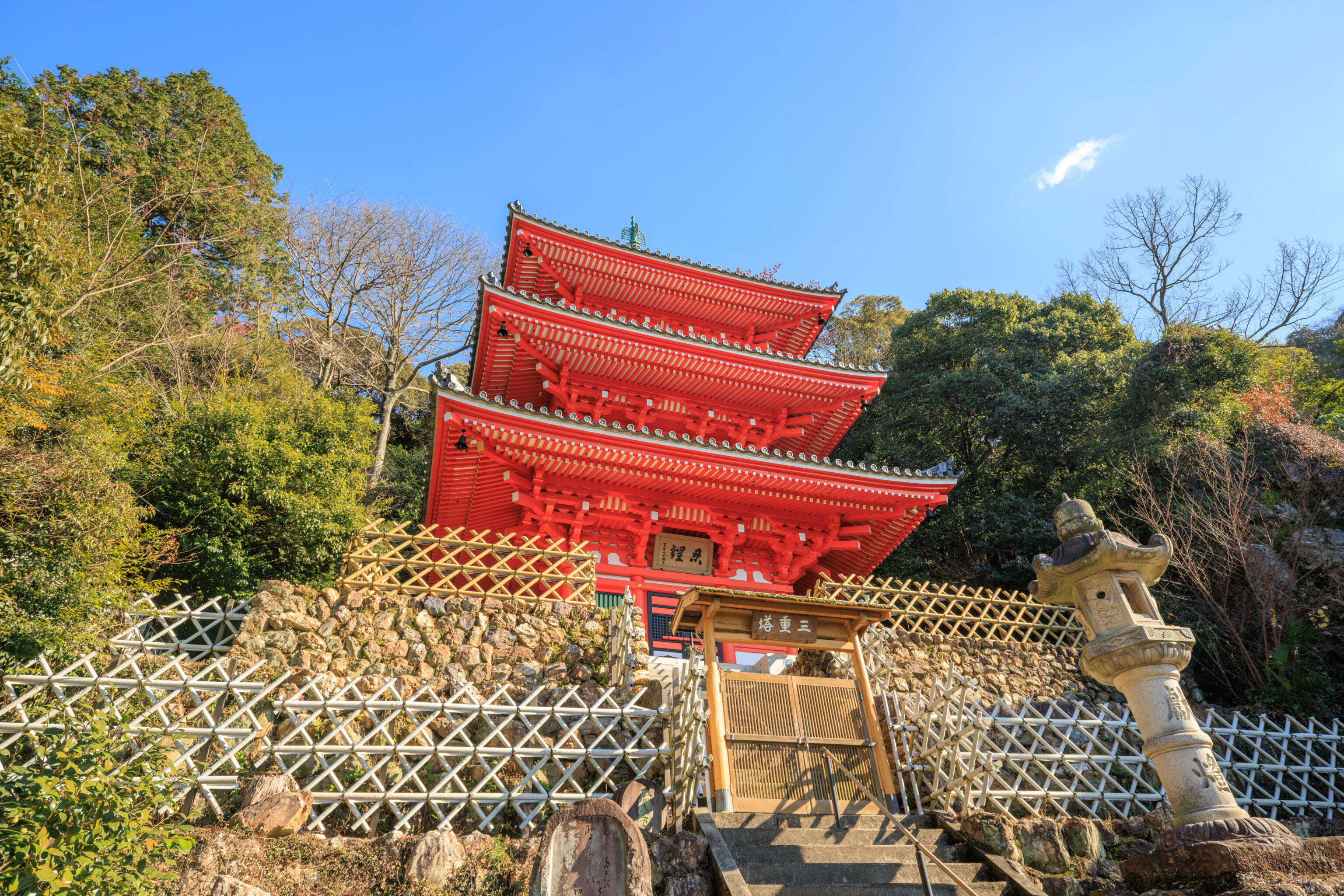
Continuing to the north, we approached the 三重塔 Three Story Pagoda. Unfortunately, this was as close as we could get. But, there was a sign:
Registered Tangible Cultural Property: Gifu Park Three-Story Pagoda
Registered on November 10, 2005

This three-story pagoda was erected by Gifu City on November 21, 1917, as a commemorative project celebrating the enthronement of Emperor Taisho; the project was funded in part by donations from the public.

The timber used in its construction came from the old Nagara Bridge, which had collapsed during the Nobi Earthquake on October 28, 1891.

The wooden three-story pagoda stands upon a two-tiered stone base, with each story measuring three bays (ken) on each side. Its central pillar employs a "suspended" design—hanging from chains so that it does not touch the foundation stone—a distinctive structural method seen in only a few examples nationwide from the late Edo period through the Meiji era.

The unadorned, harmonious, and classical design is the work of Chuta Ito, a figure acclaimed as the founder of Japanese architectural history and the architect behind structures such as Meiji Jingu Shrine. It is said that the site itself was selected by the Japanese-style painter Gyokudo Kawai—a graduate of a local elementary school in Gifu—who deemed it the perfect location for the pagoda.
– Text from a sign, read using Google Gemini and translated using Google Translate.
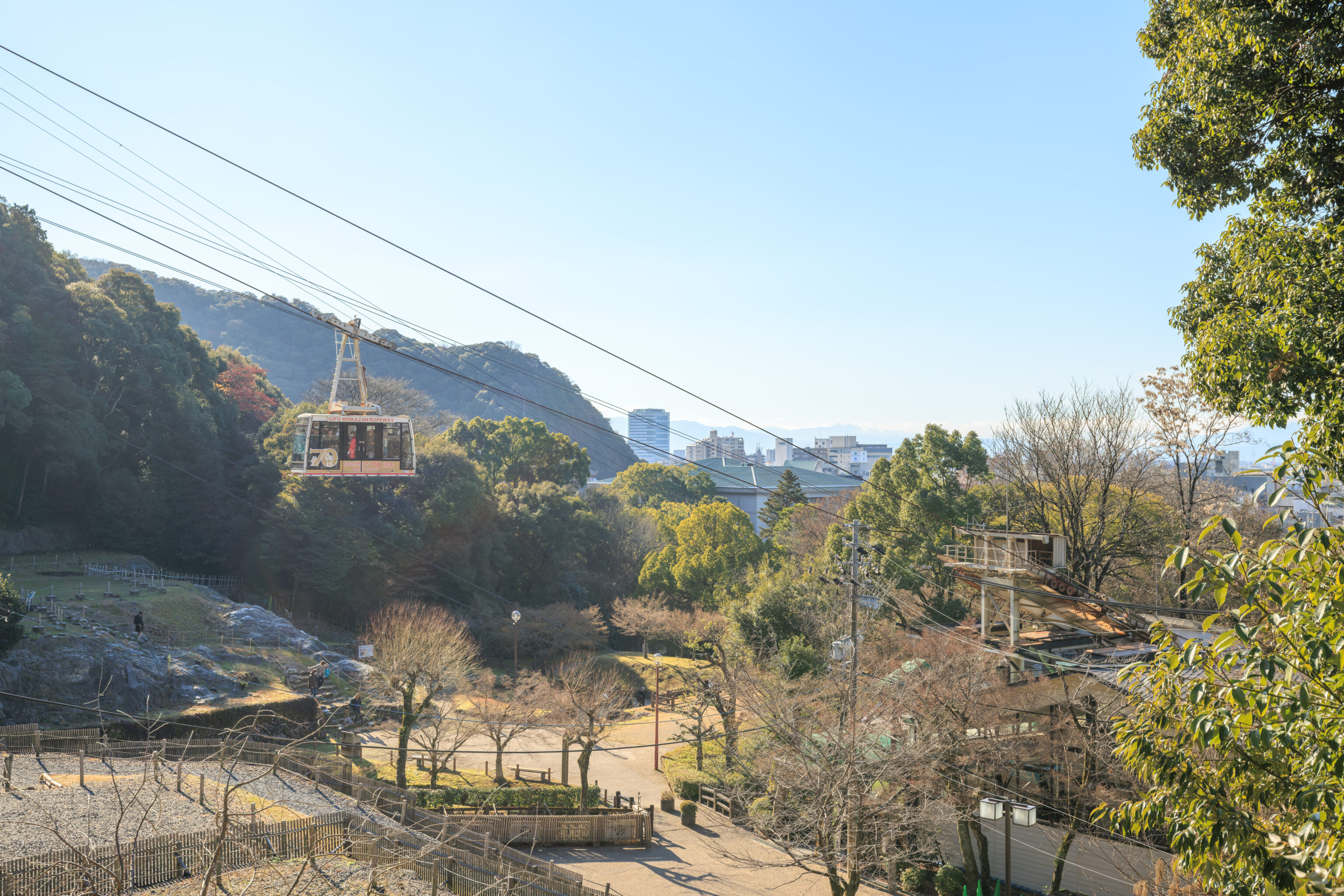
The view from in front of the pagoda.
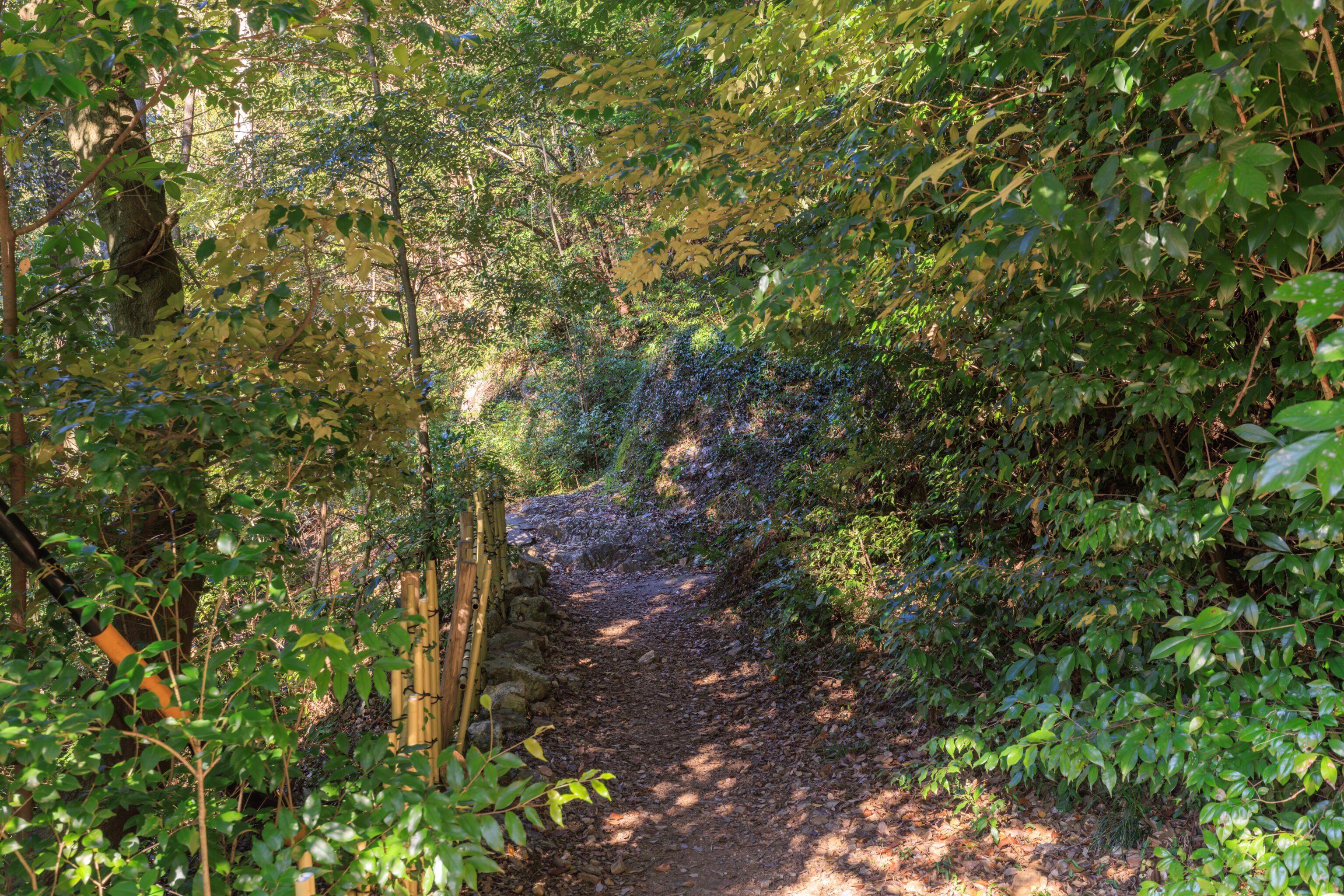
The trail continued on to the north through the woods…
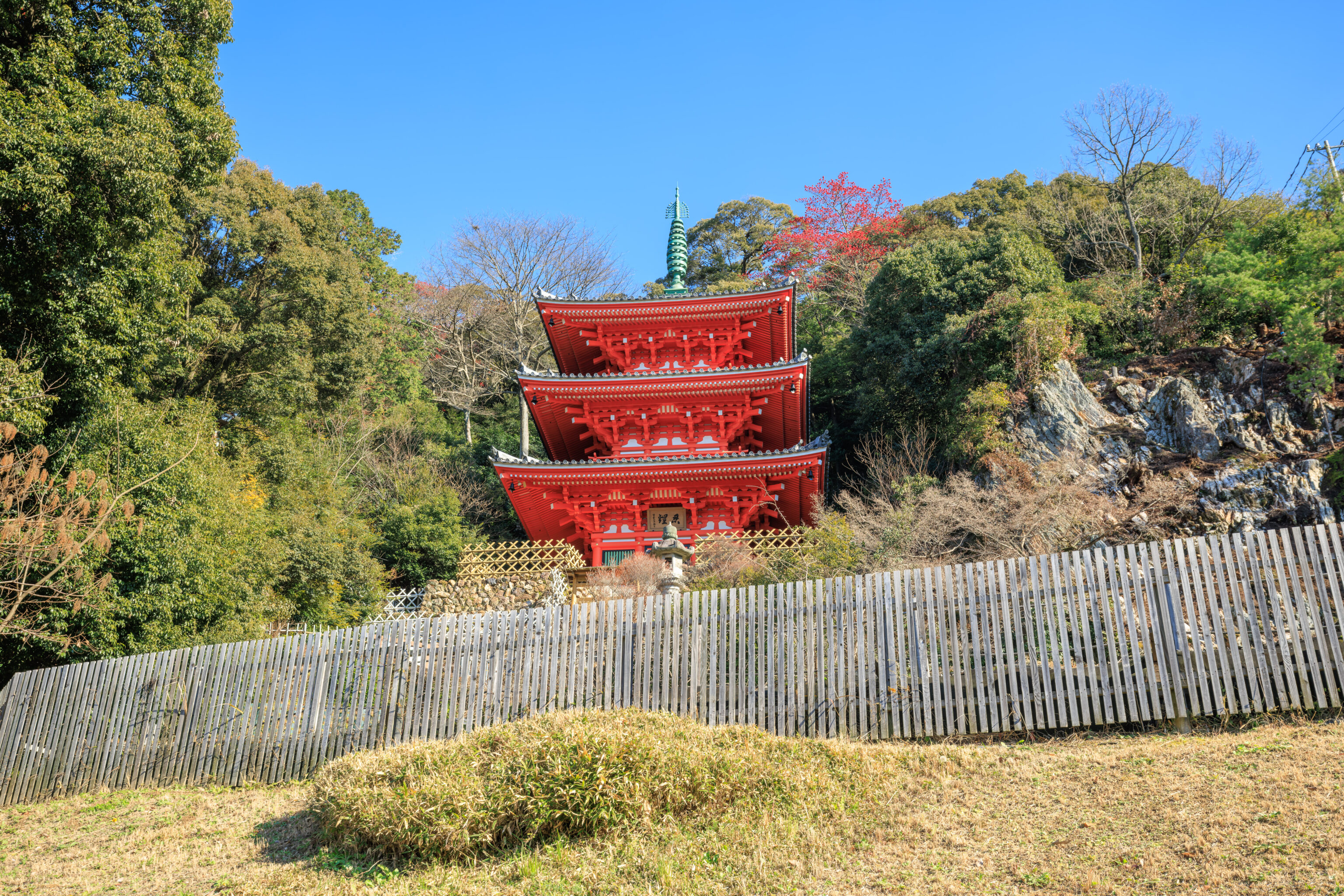
We turned around though and descended, walking towards the ropeway station below us. There was a pretty good view of the pagoda as we left.
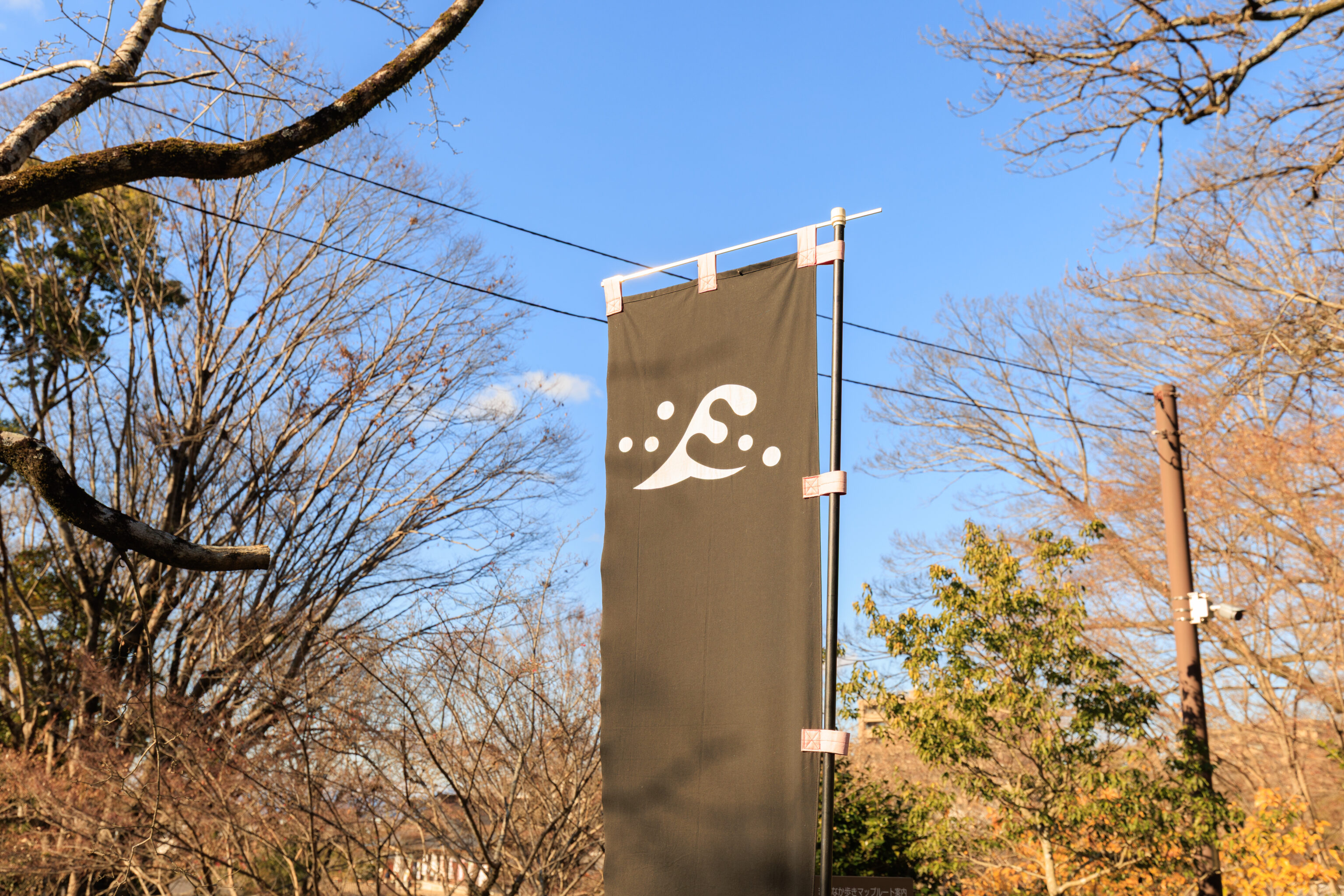
This banner depicts the family crest of Saito Dosan. It is a wave design that in modern times almost has a bit of a resemblence to Godzilla. It is no longer in use as the family line ended in 1573 after Saito Dosan and his two sons were all dead, events we read about earlier today.
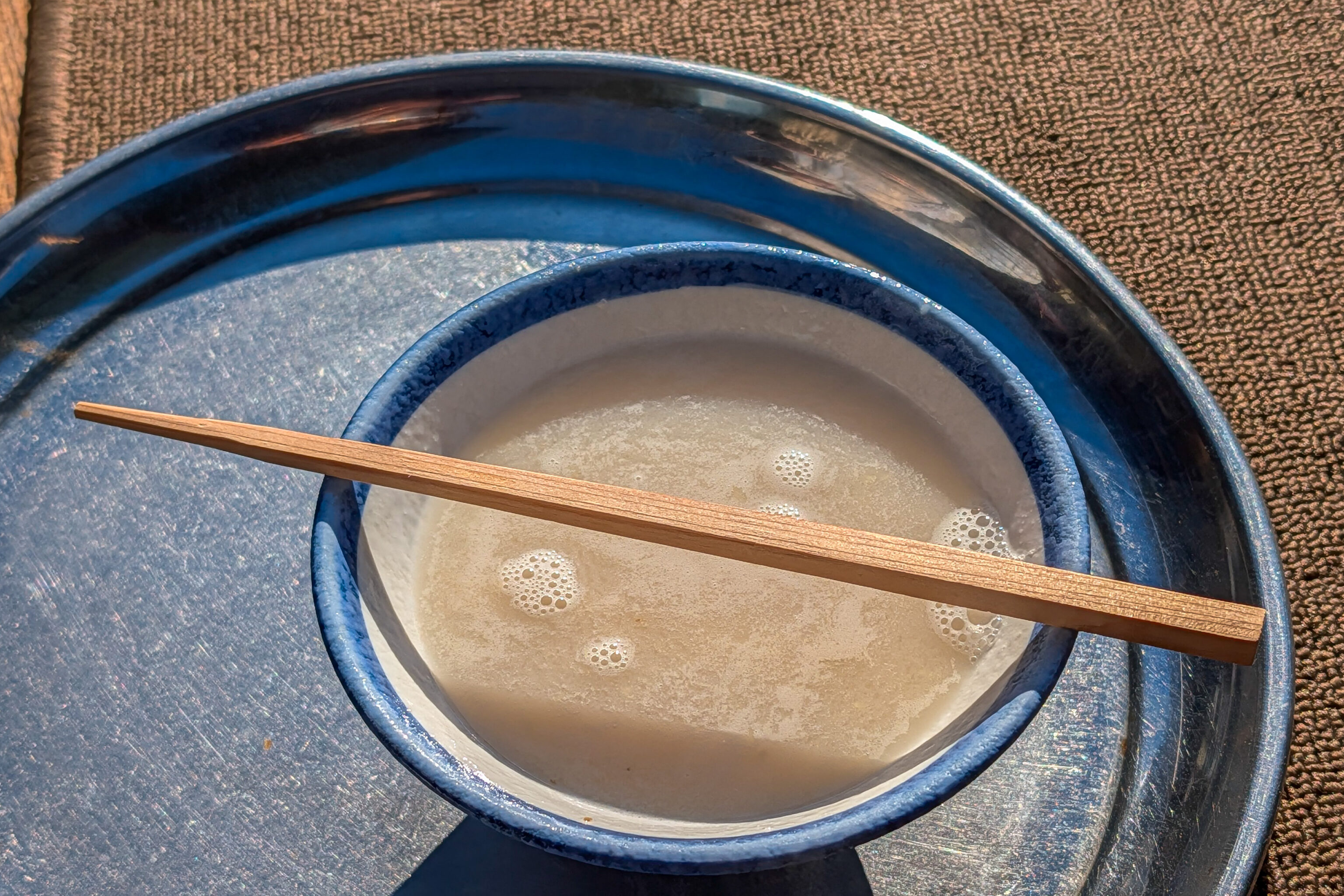
Walking to the north of the ropeway station, we stopped at 植木屋 Uekiya, still within Gifu Park, for a snack. We had amazake, a Japanese drink made of fermented rice. along with goheimochi and goheimochi
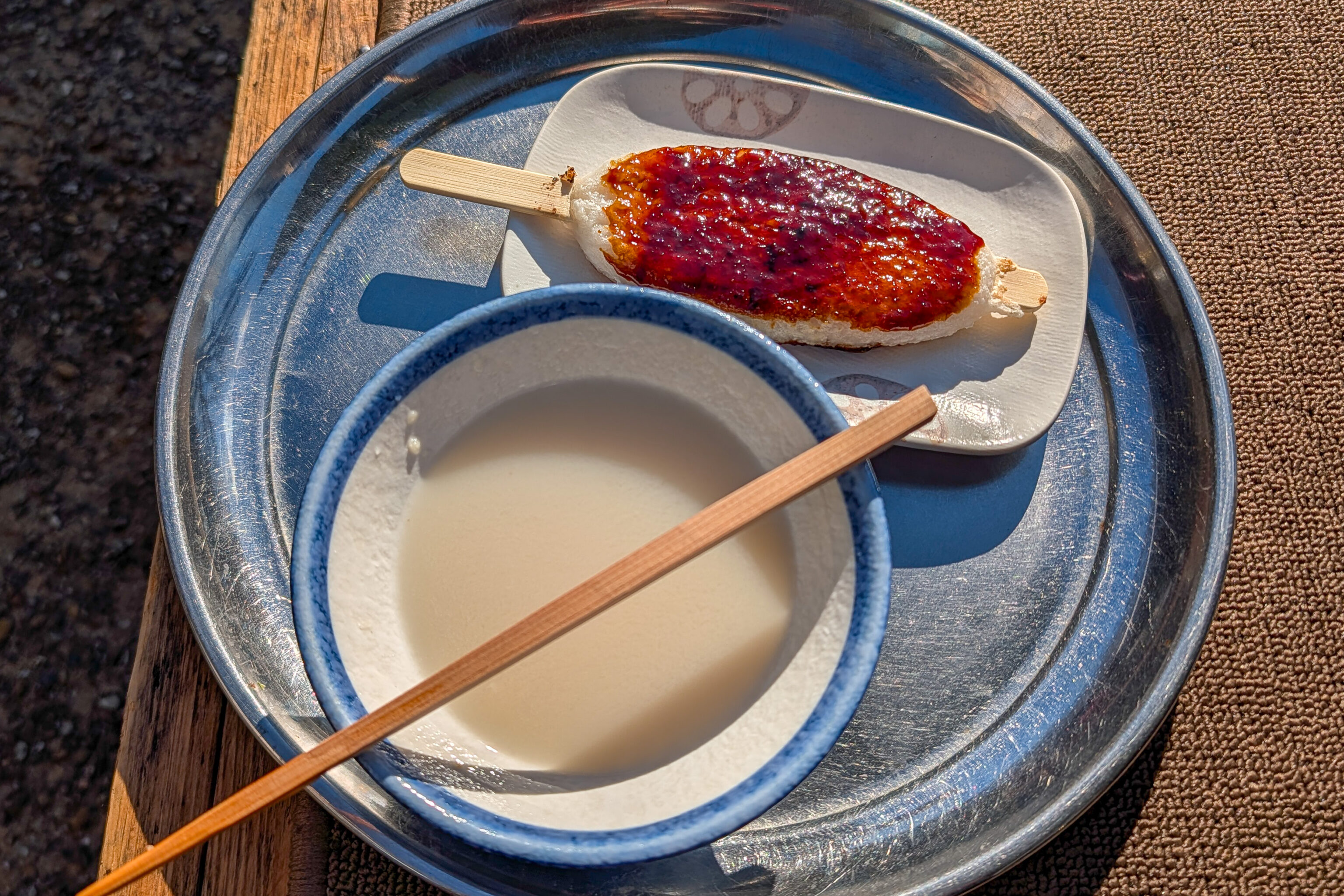
We also had goheimochi, basically grilled partially smushed rice with miso soy sauce.
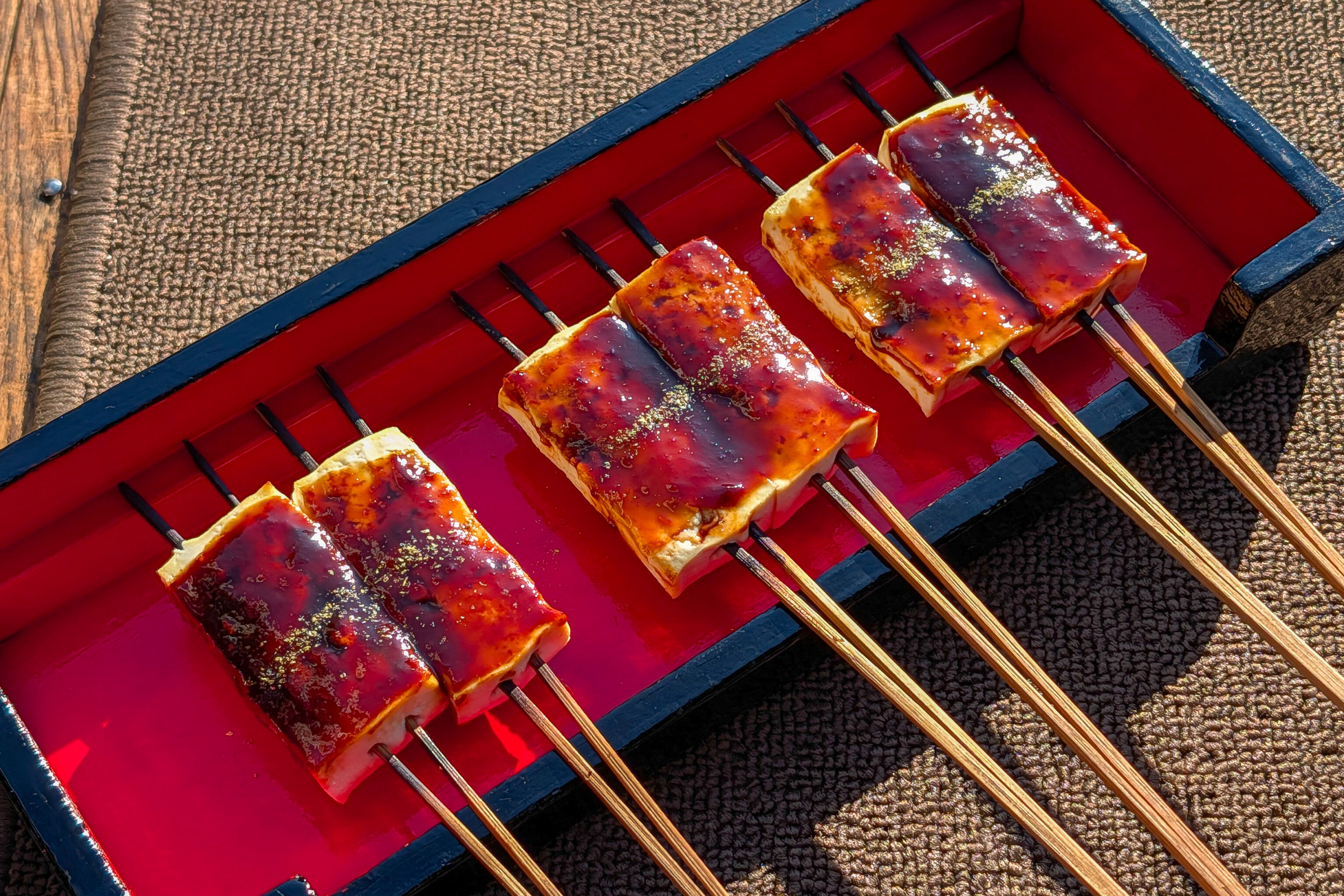
And, we had tofu dengaku, which is soft grilled tofu with the same miso soy sauce as the goheimochi.
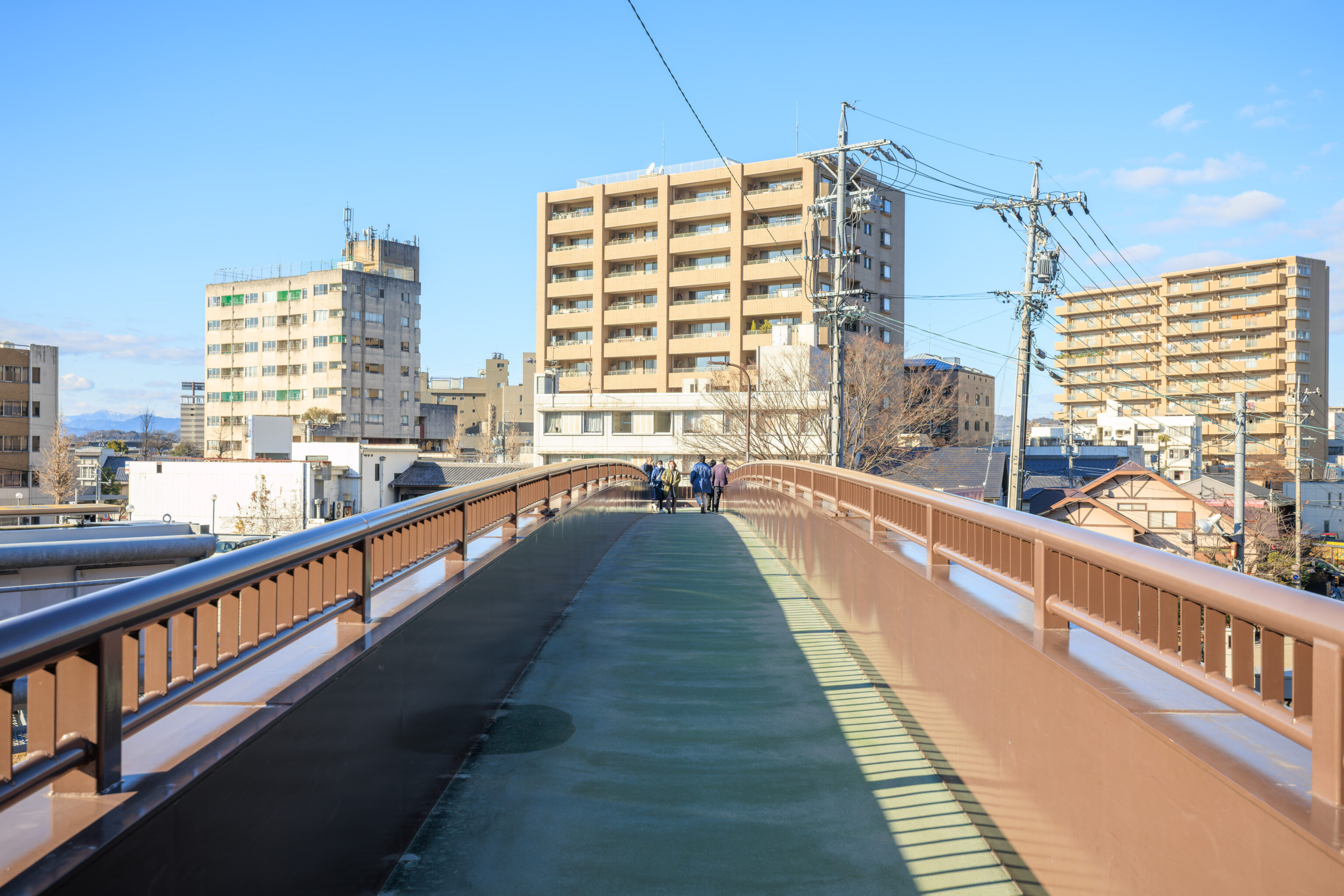
We contuinued walking to the north, crossing over a road via a pedestrian overpass.
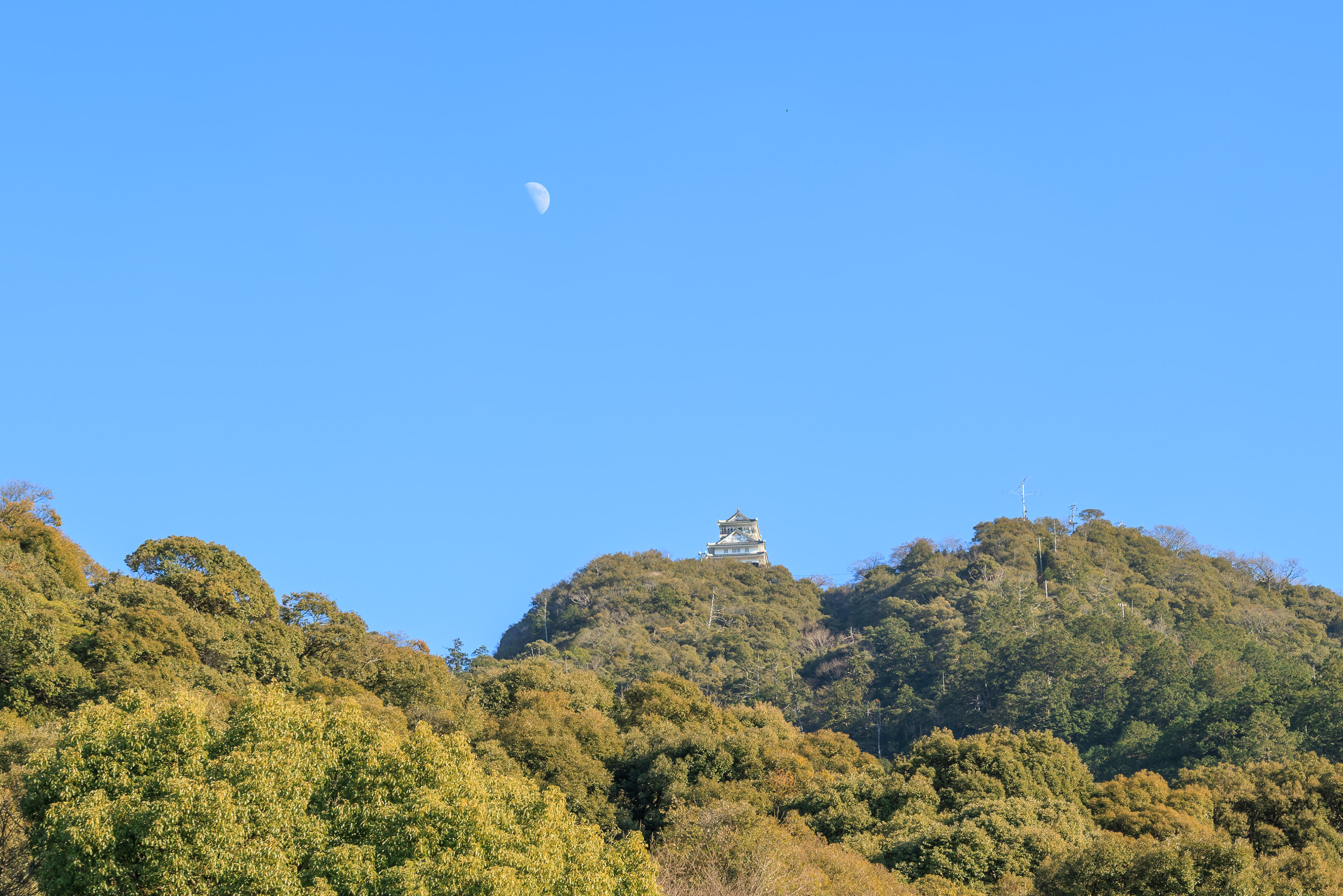
From here, looking up, we could see Gifu Castle and a half moon.
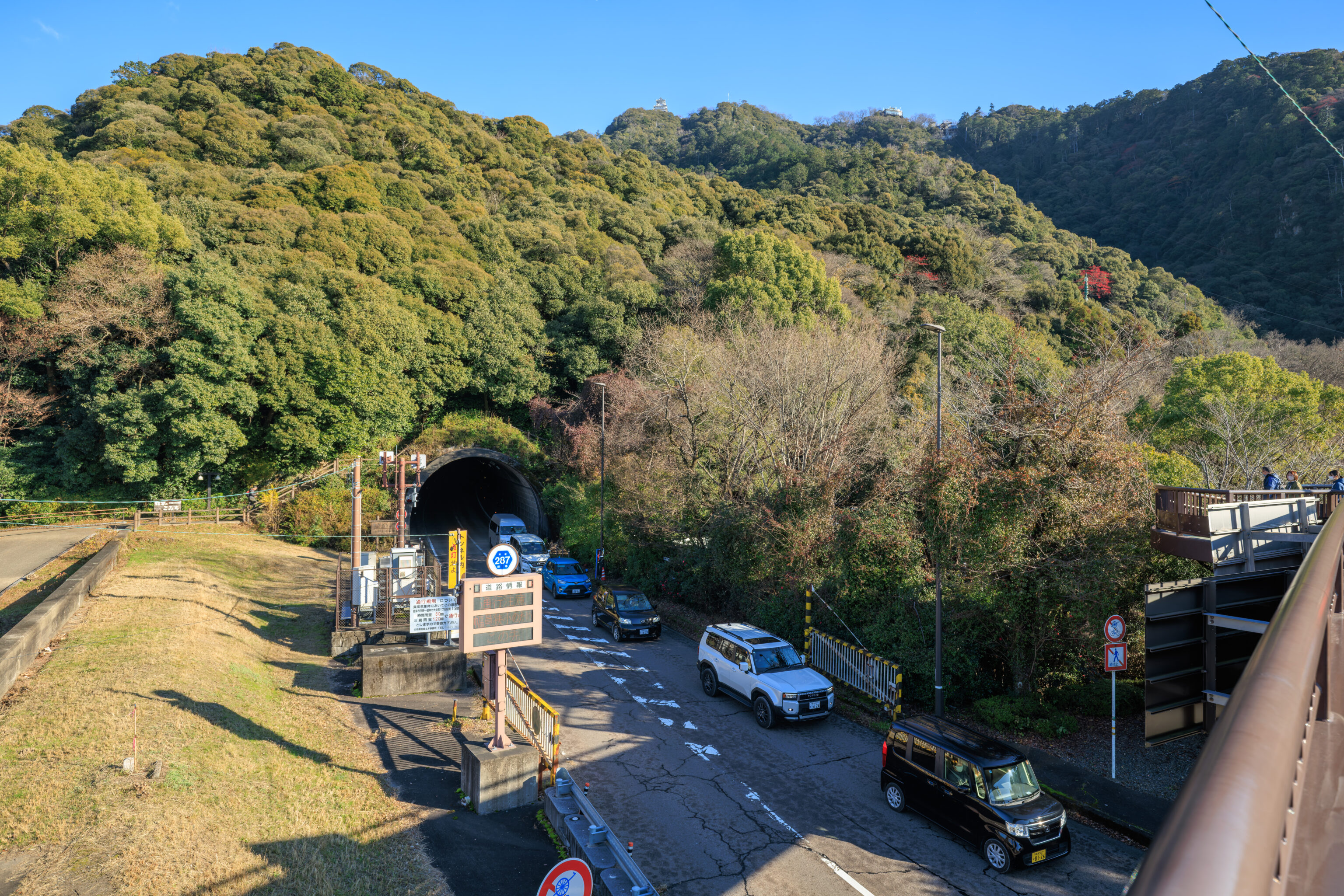
The road goes through the mountain under Gifu Castle.
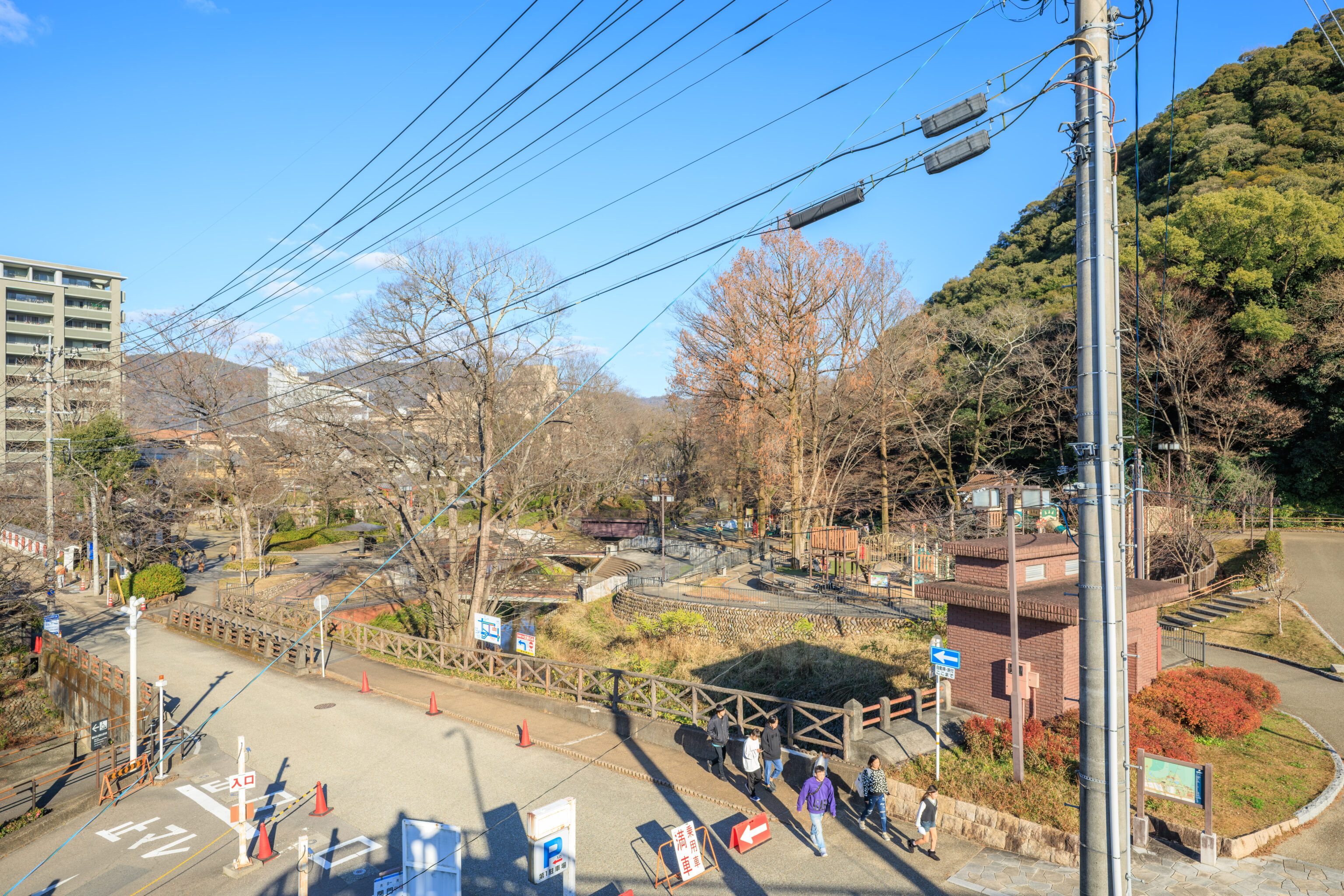
Beyond the overpass, we plan to walk to the northeast, which is where we’re looking at here.
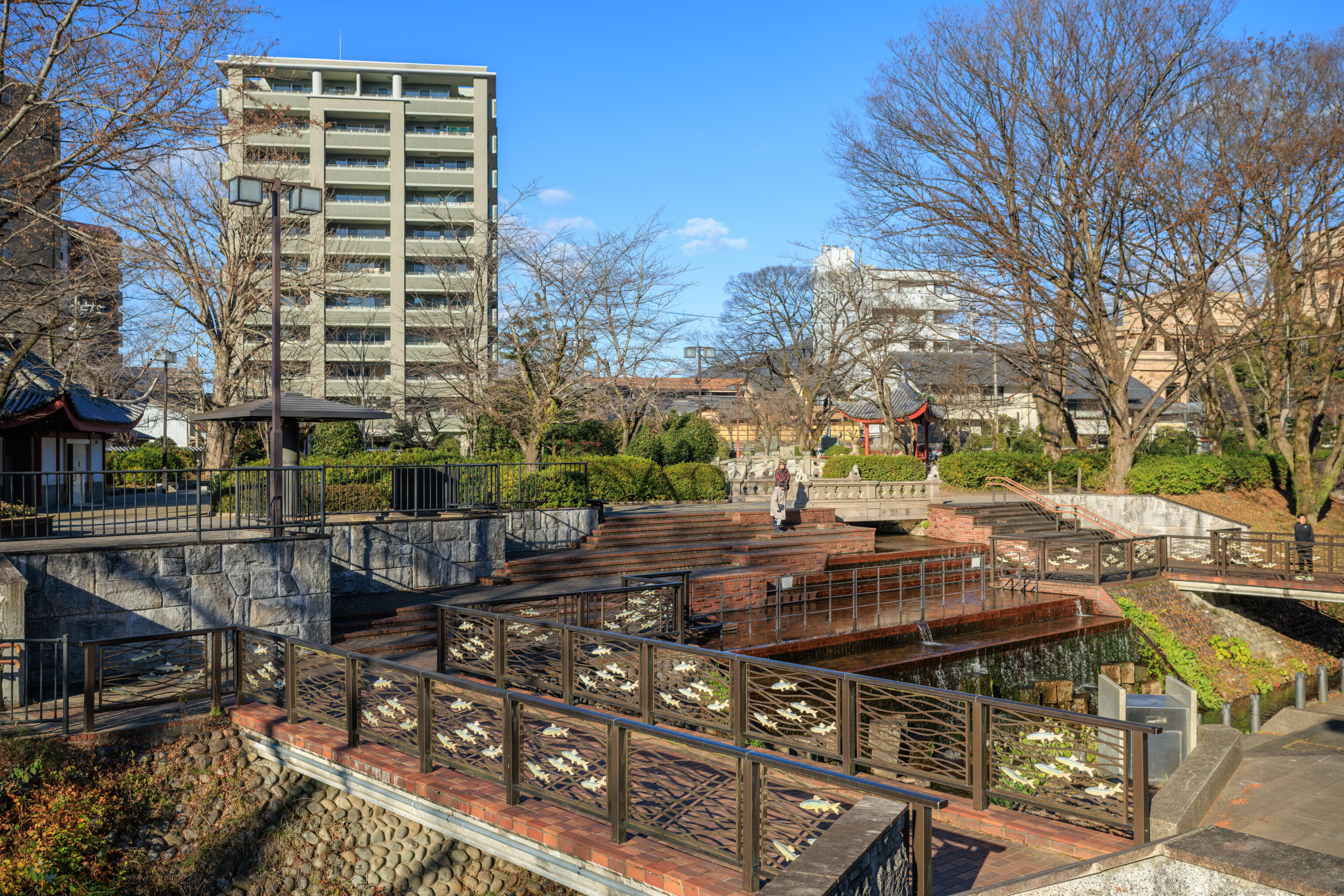
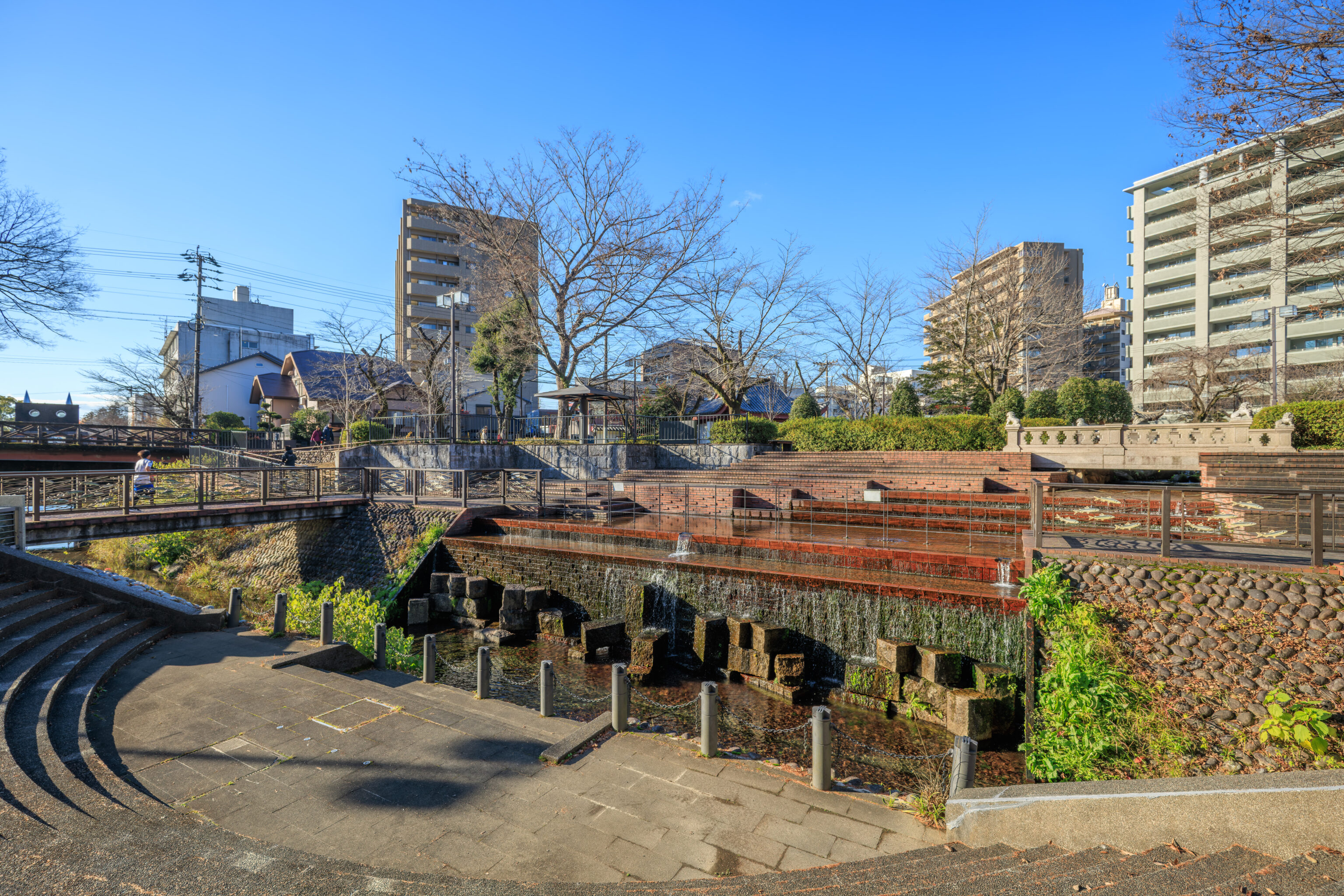
This area incorproates water into a multi-tiered landscape. It’s an interesting little space.
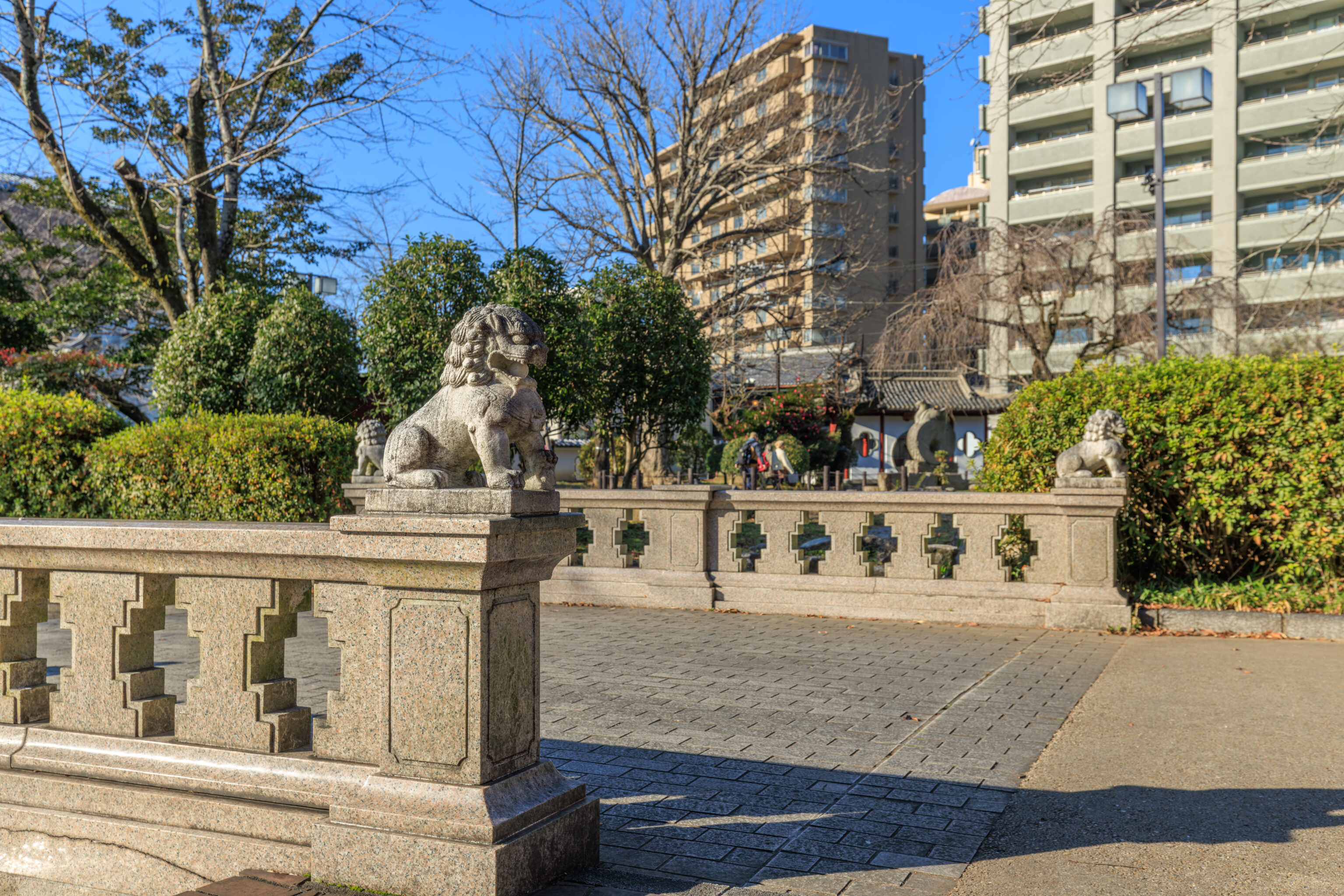
Four komainu guard this little pedestrian bridge.
We’ll visit this section of the park to our north later… We contined walking to the northeast along the base of Mount Kinka to our right.
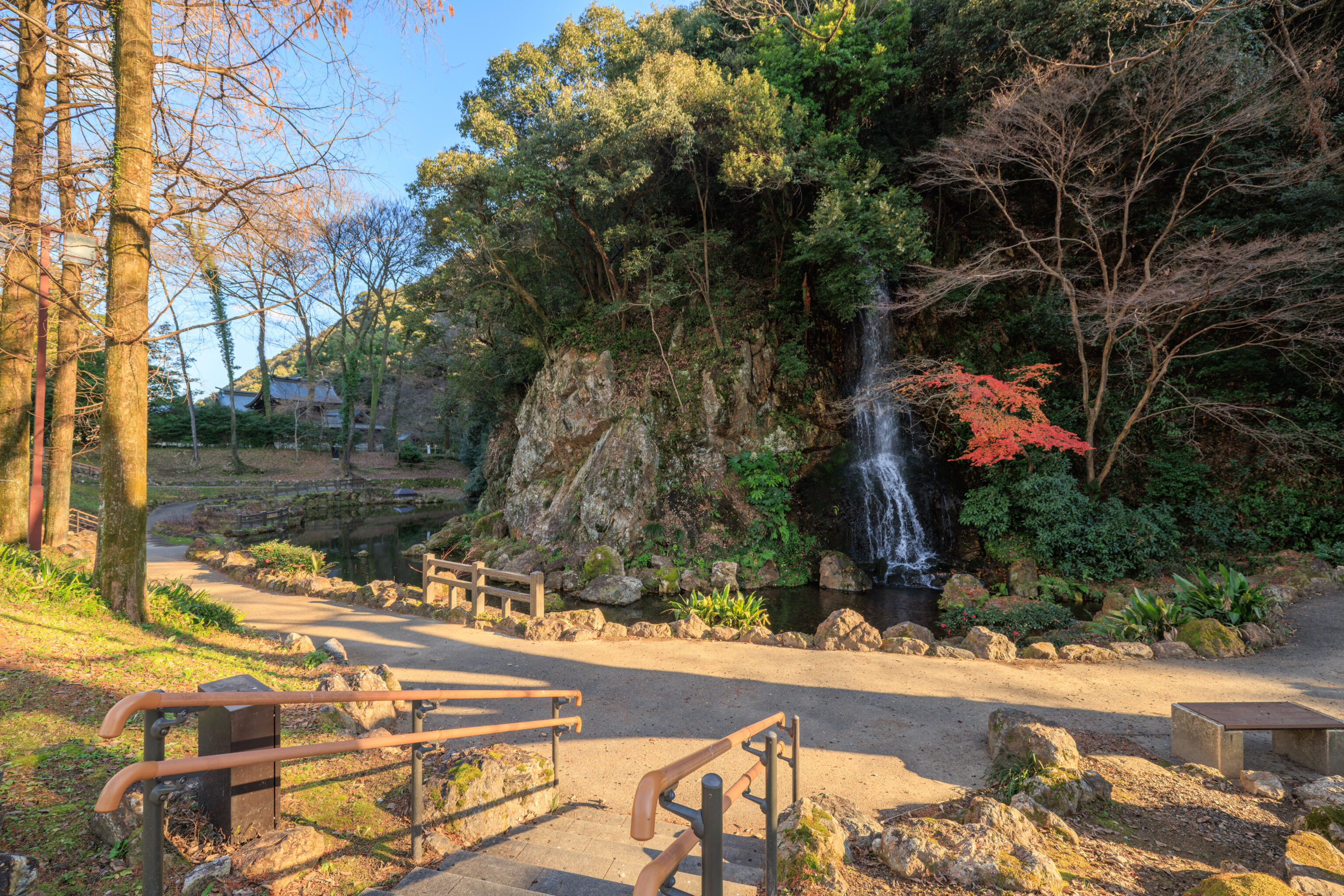
Ahead, there was a waterfall that flowed into a small pond, the Mitarashi Pond:
Mitarashi Pond
This pond takes its name from the fact that worshippers would wash their hands here before visiting Inaba Shrine, which was located on the mountain where the castle once stood.

In the fifth year of the Keicho era (1600 AD), the Battle of Sekigahara took place. Oda Hidenobu, the lord of Gifu Castle at the time, sided with Ishida Mitsunari; consequently, his castle fell after being besieged by the Tokugawa forces led by Fukushima Masanori and Ikeda Terumasa.

It is said that, during this event, a large number of the castle's ladies-in-waiting threw themselves into this pond to take their own lives.
– Japanese text from a sign, read using Google Gemini and translated using Google Translate.
Mitarashi Pond
The area around Mitarashi Pond is believed to have been the living quarters for the ladies-in-waiting who attended the wife of the lord of Gifu Castle. When the castle came under attack in August of 1600, power in Japan was split into two factions: the Western forces under the command of Oda Nobunaga's grandson, Hidenobu (1580-1605) and the Eastern forces lead by Fukushima Masanori (1561-1624) and Ikeda Terumasa (1565-1613). At the time, the pond was much bigger than it is today, and according to local legend when the castle came under siege many of the ladies-in-waiting chose to drown themselves rather than be captured by the enemy.
– English text from the same sign as the translated text above.
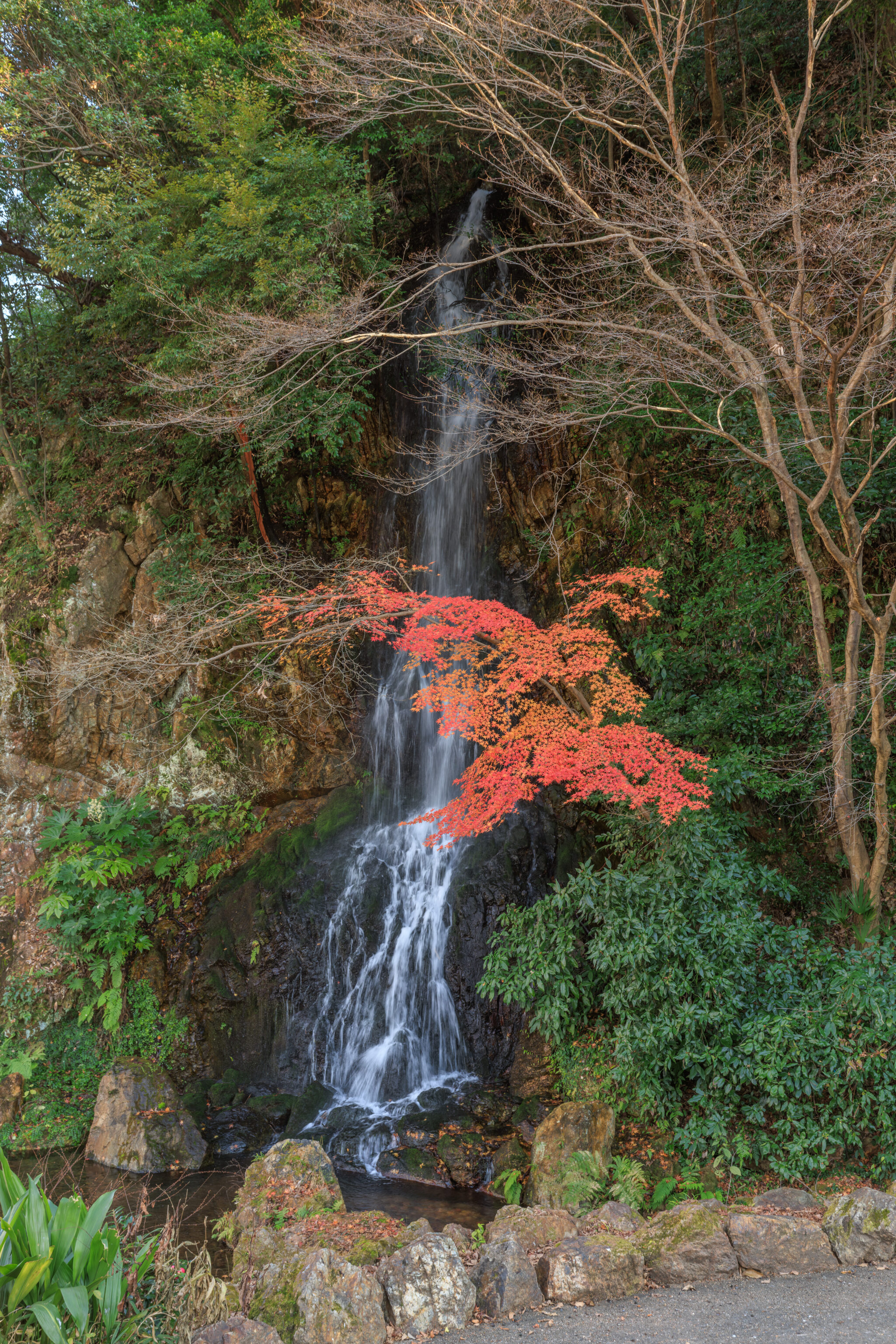
A closer look at the waterfall and a beautiful little momiji.
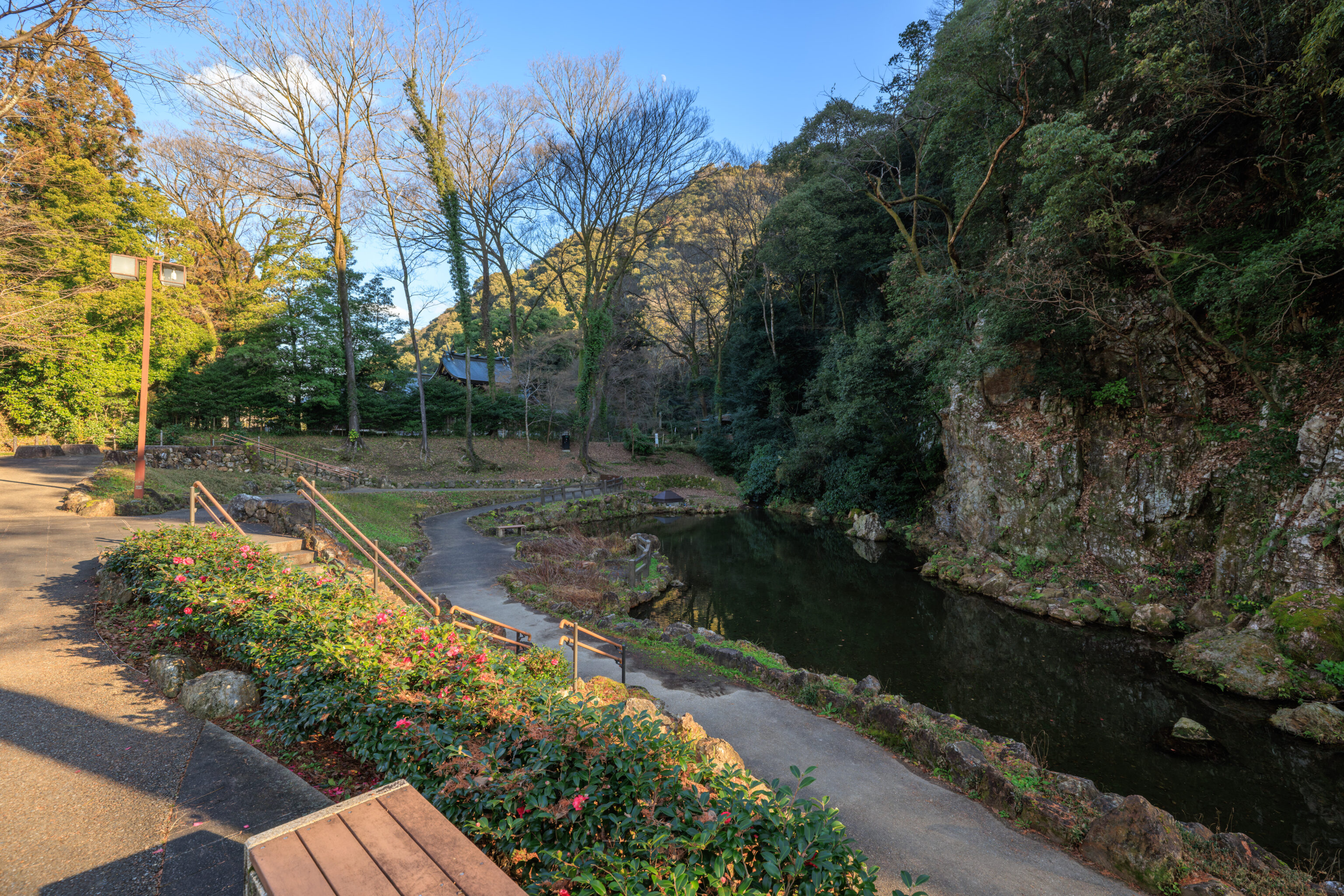
The view to the northeast showing the full size of the pond today.
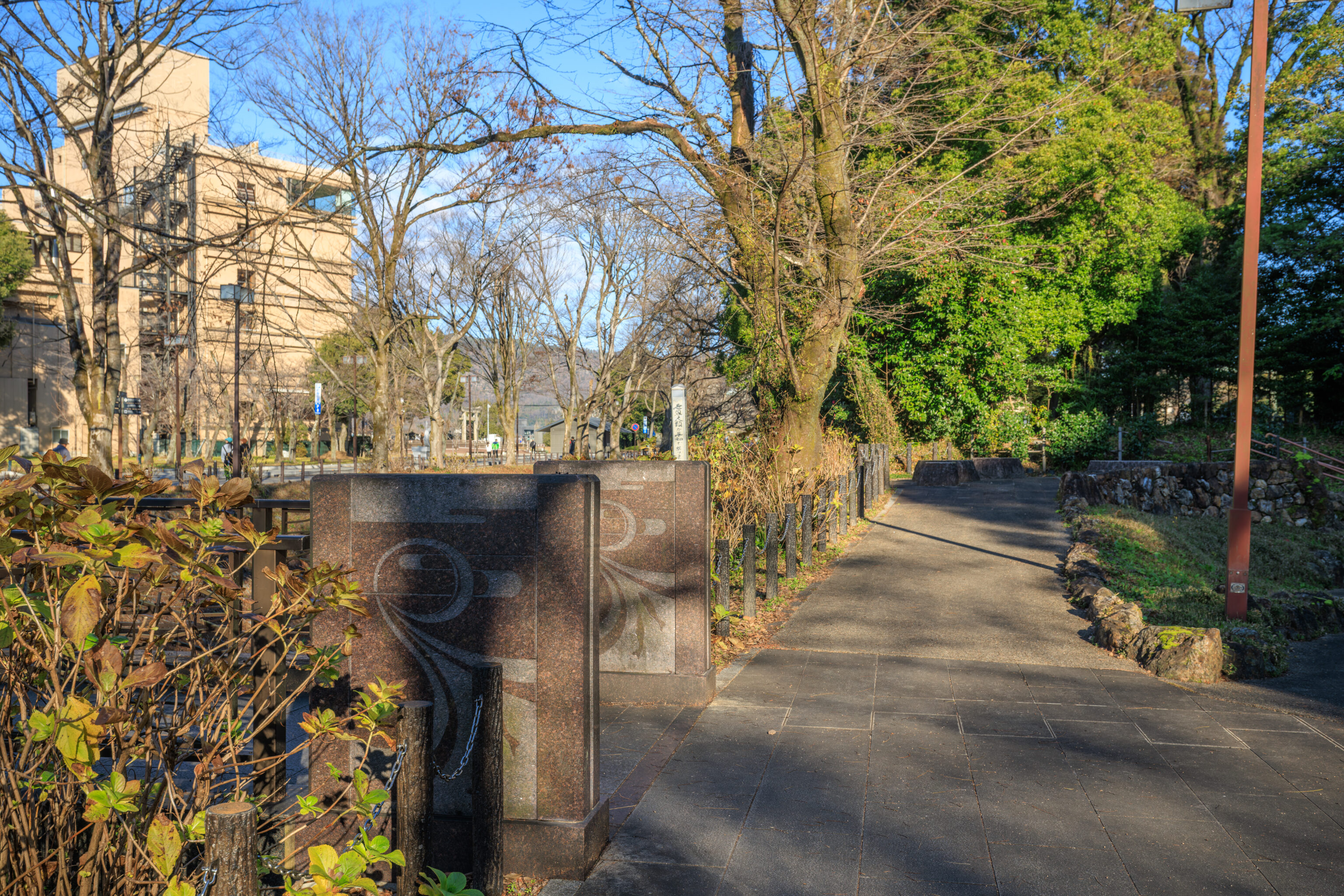
We continued to the northeast…
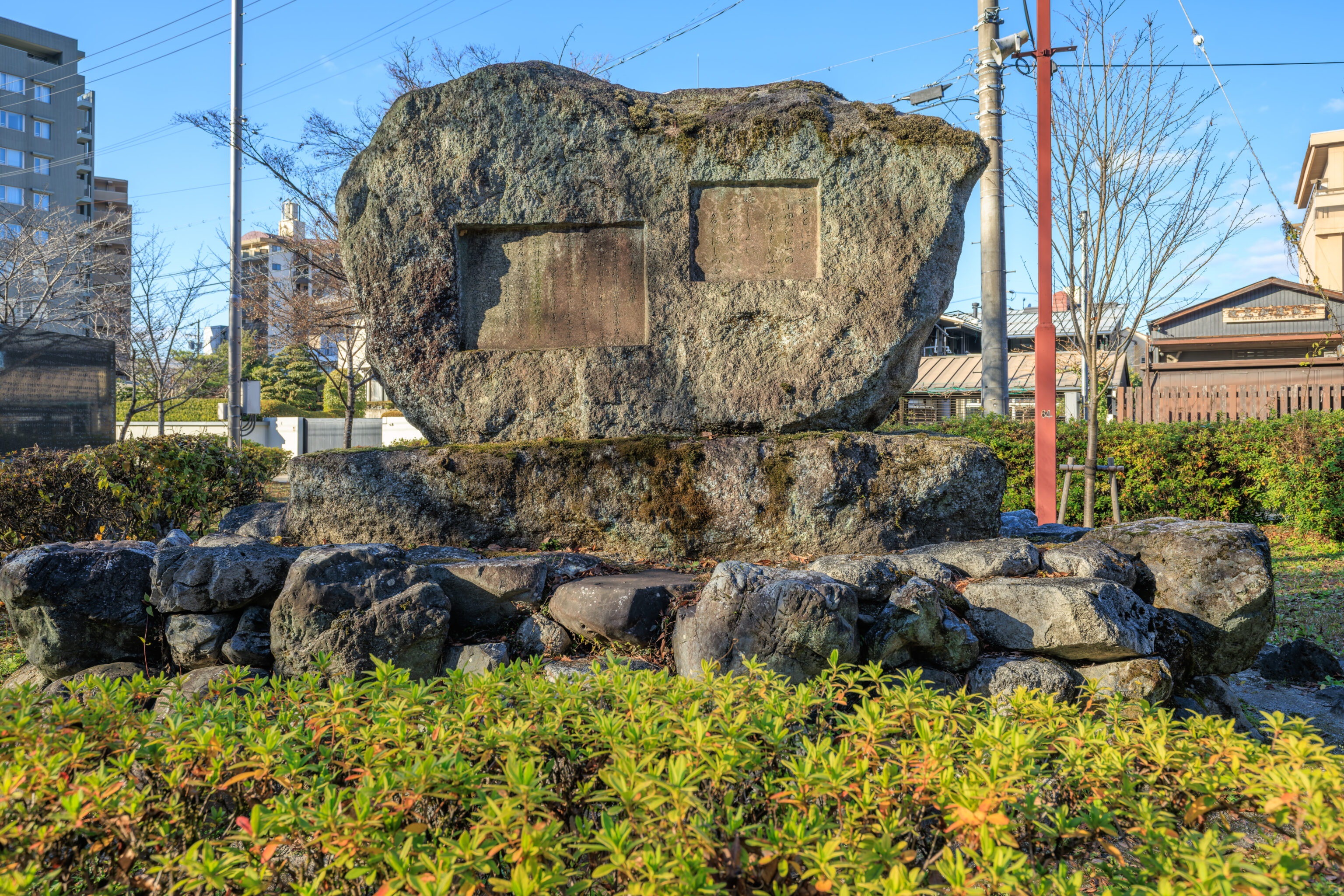
This stone marker is inscribed with two blocks of text. Google Gemini claims to be able to read it, although some text is missing and may be incorrect in places. It appears to be a memorial to 松平節 Matsudaira Setsu, who became a teacher in Gifu after graduating from university.
At the mountain's foot,
In the fields of Oda—
Where they say no bird sings—
Golden flowers bloom
Out of season,
Amidst the dawn-light of the peak.

Brief Biography of Dr. Setsu Matsudaira
Born in January 1876 in Tsunomiya, Tsuruga City, Fukui Prefecture. After graduating from Kokugakuin, he was appointed a teacher at Gifu Normal School in September 1899 and subsequently at Gifu Middle School in March 1908. He retired in May 1915. Thereafter, he served as the head priest of several shrines, including Nangu Shrine, Akamon Shrine, Kitano Shrine, and Kamo-wakeikazuchi Shrine. He passed away in June 1960.
– Text from the memorial marker in the photograph above, questionably read using Google Gemini and translated using Google Translate.
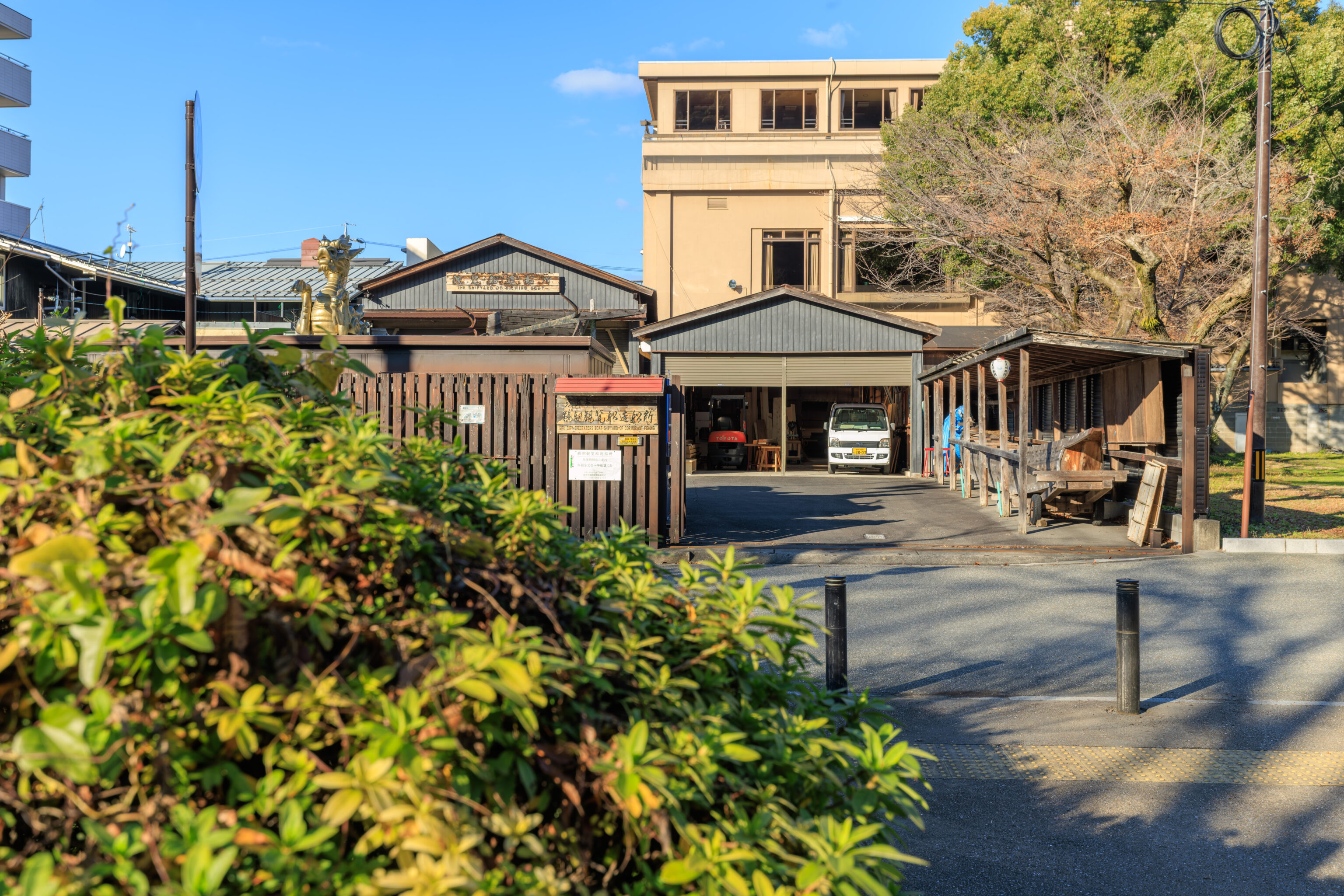
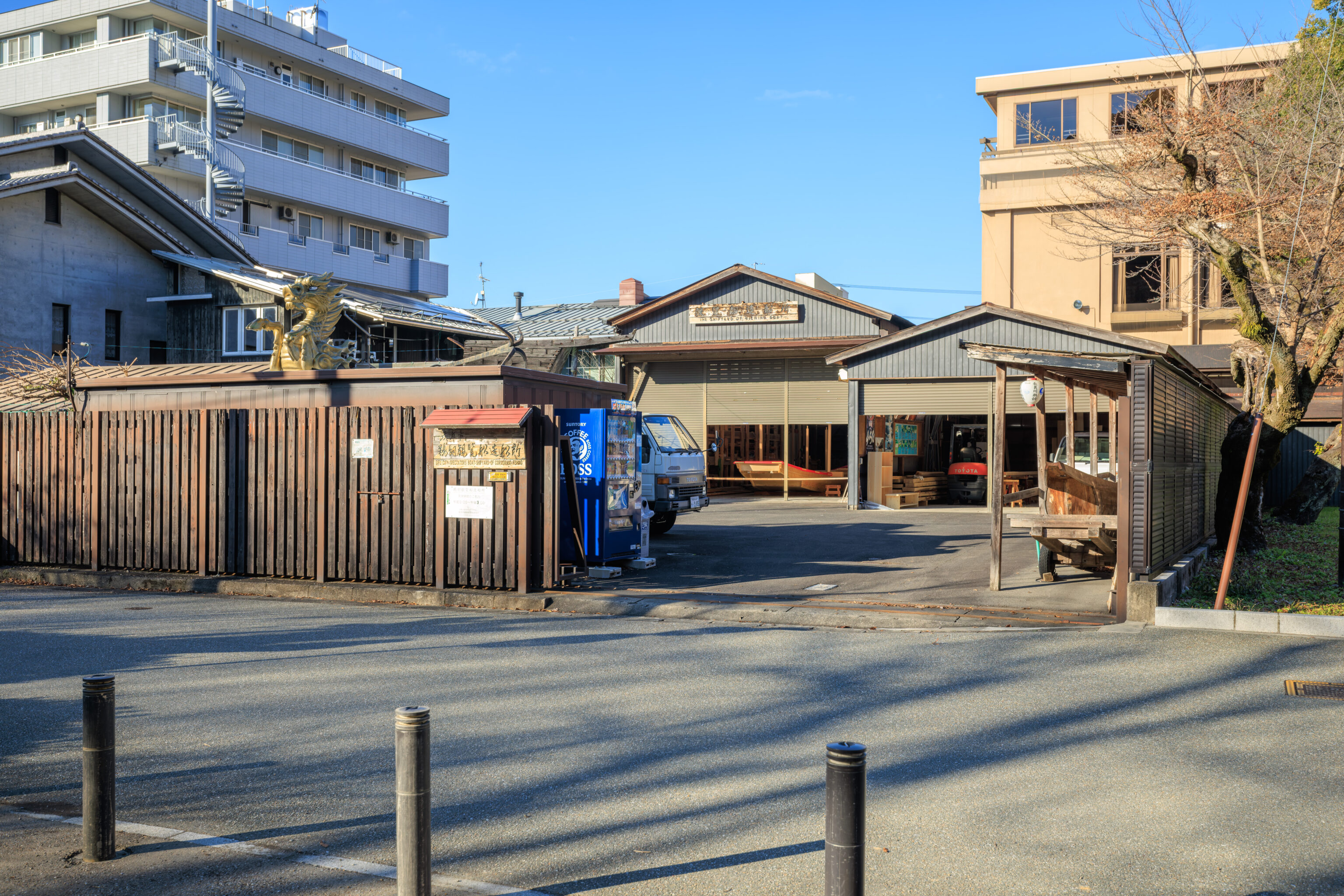
This is apparently the city workshop for cormorant fishing spectator boats!
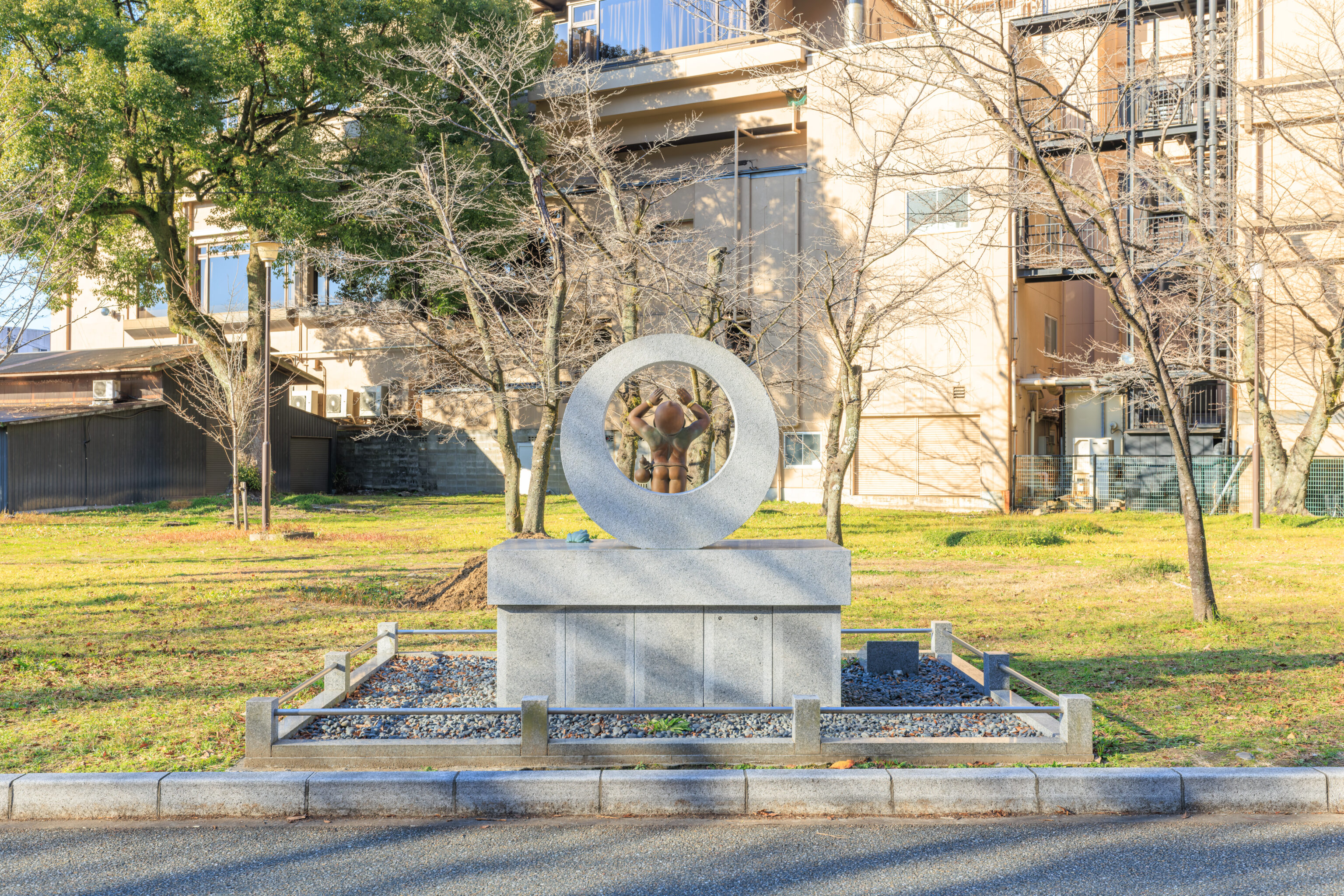
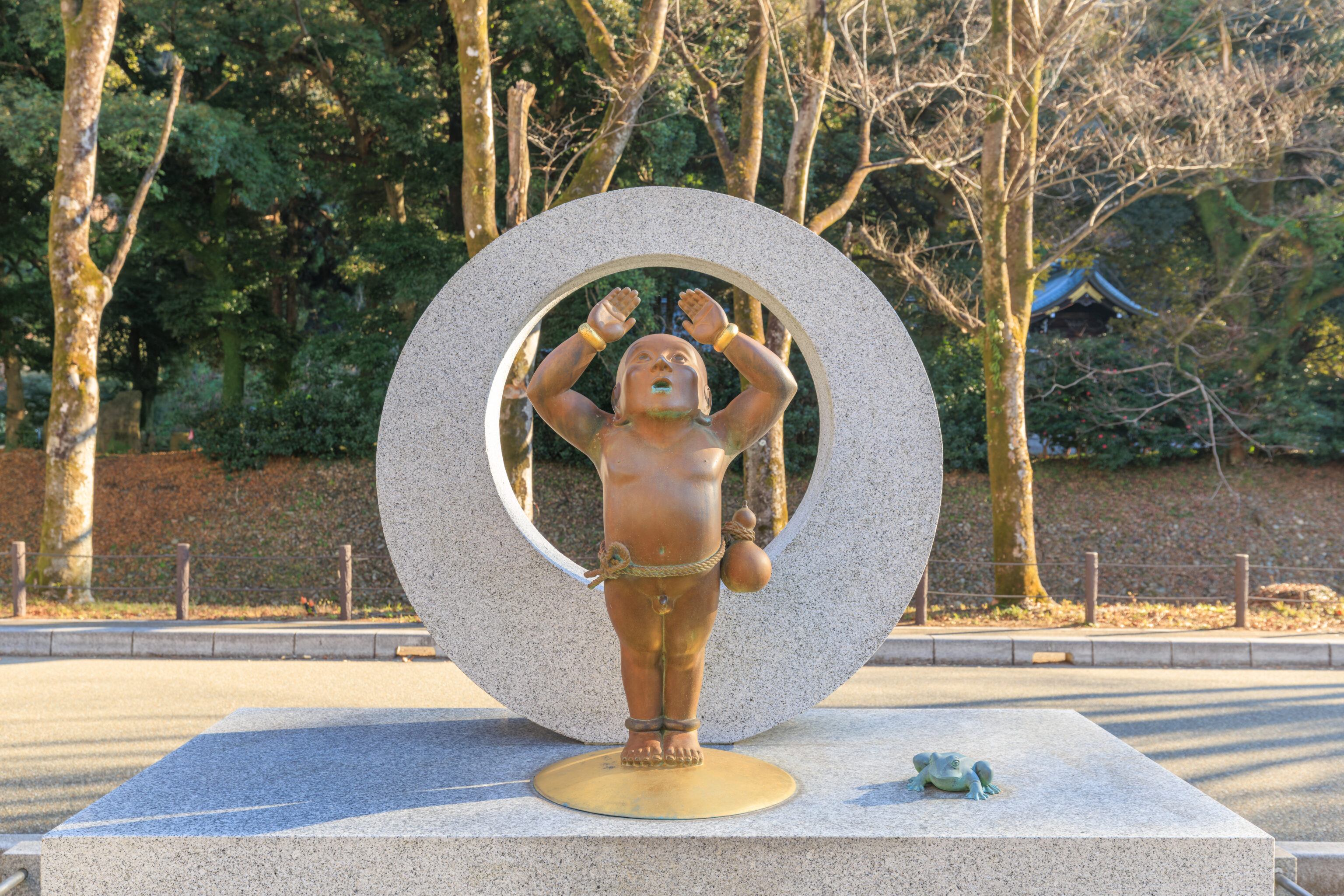
We walked as far as this odd sculpture!
Monument Inscription
This monument, the "Monument of Peace and Repose" (Yasuragi no Hi), honors the memory and achievements of the pioneers who contributed to labor movements, social movements, and campaigns to uphold peace and democracy in Gifu Prefecture.

November 21, 2005
Gifu Prefecture Workers' Welfare Council
– Text from a plaque on the ground for this sculpture, read using Google Gemini and translated using Google Translate.
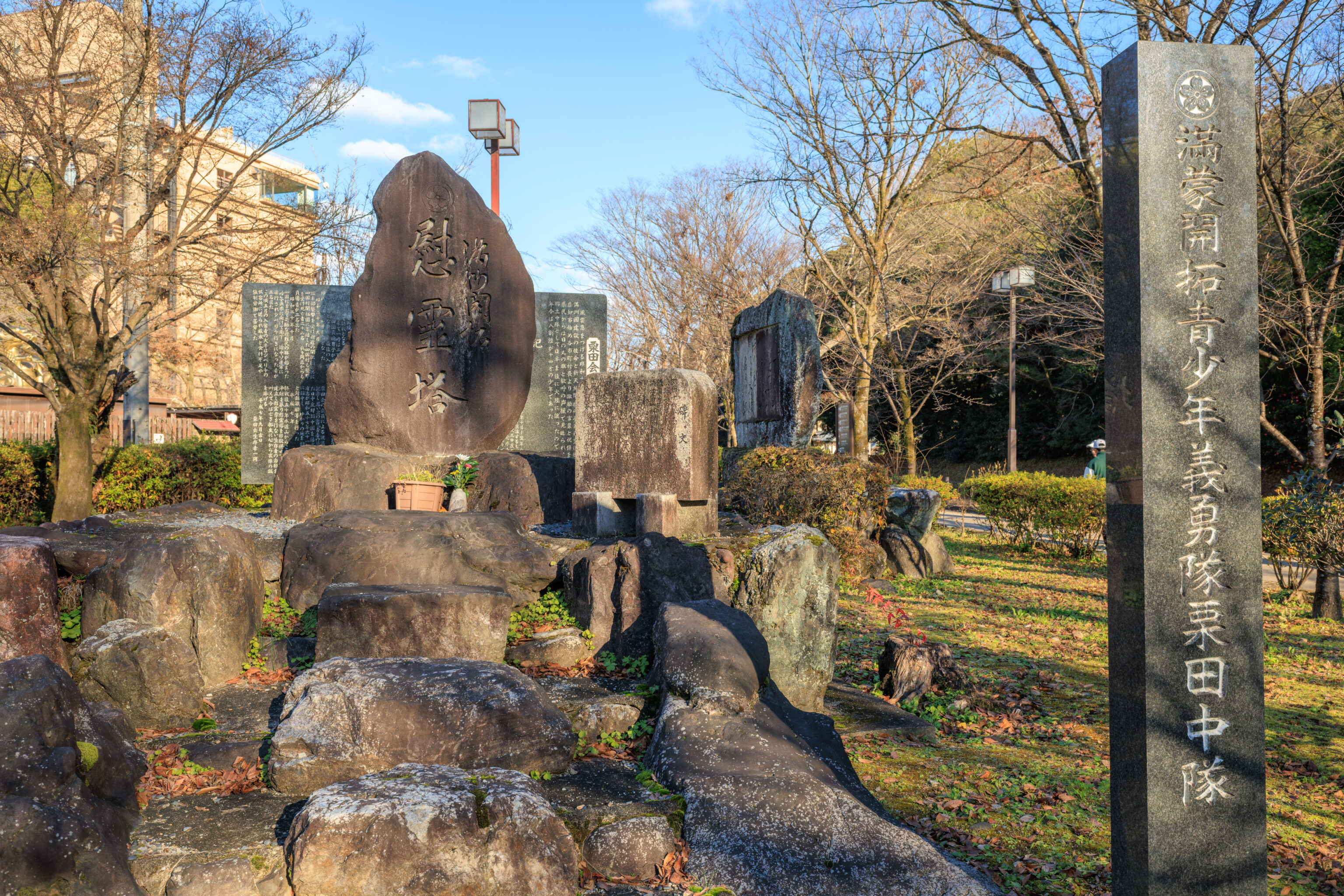
Backtracking now, we came across some more markers. The one on the right is dedicated to a unit of the Manchuria-Mongolia Youth Development Volunteer Corps, basically commemorating activites related to the Japanese invasion of China in the 1930s. The stone marker in the background is essentially the same thing.
In trying to research this, it seems that Japan recruited young Japanese from poor rural areas to try to repopulate northeastern China with ethnic Japanese. Ultimately, it did not go well for the recruits.
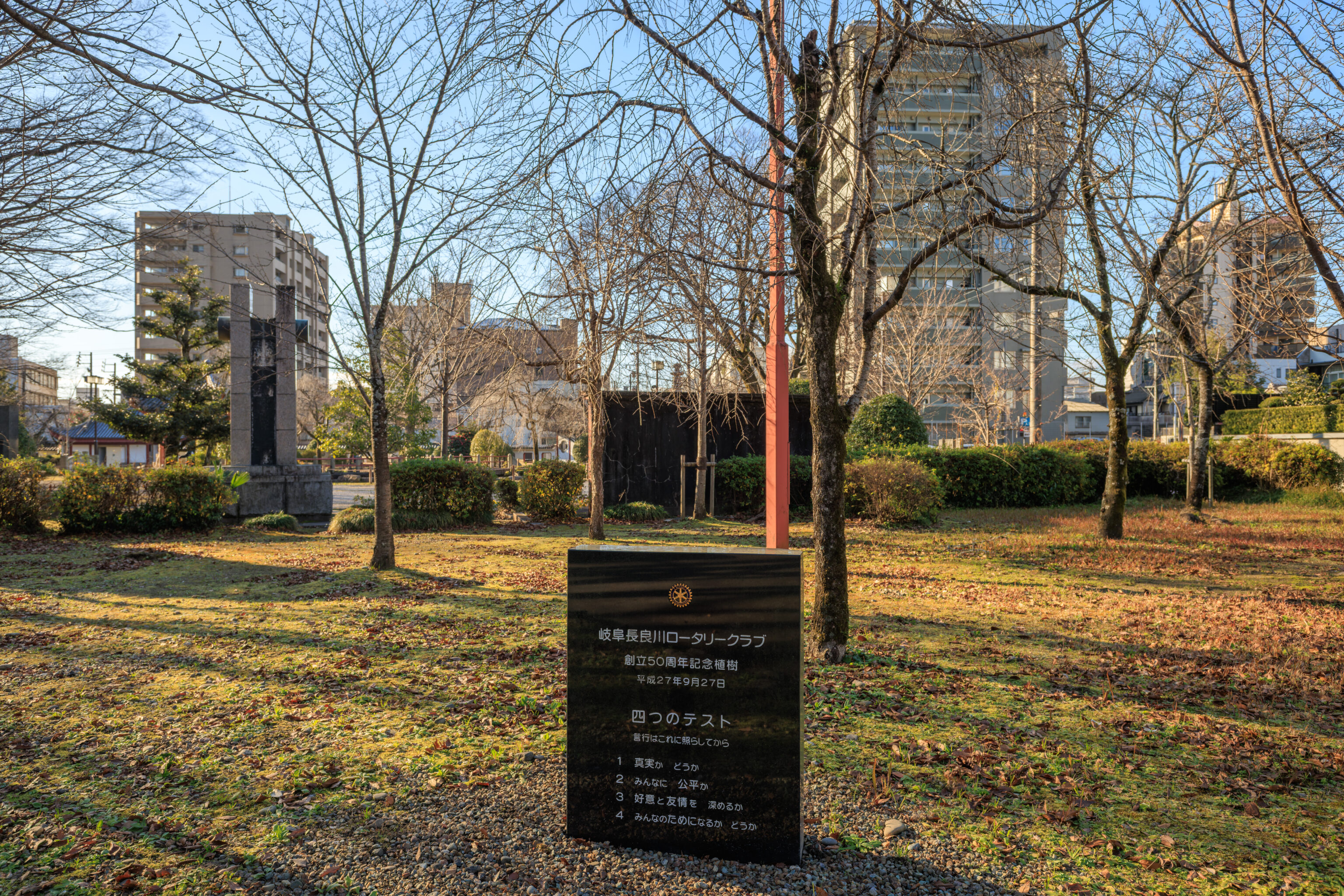
This marker was put up by Gifu Nagara River Rotary Club in honor of a tree planting to commemoriate their 50th anniversary.
Gifu Nagaragawa Rotary Club
Tree Planting to Commemorate the 50th Anniversary of the Founding
September 27, 2015

The Four-Way Test
Your words and actions should be judged in light of this.
1. Whether it is true or not
2. Is it fair to everyone?
3. Deepen affection and friendship?
4. Whether or not it benefits everyone
– Text from the marker in the photogrpah above, read using Google Gemini and translated using Google Translate.
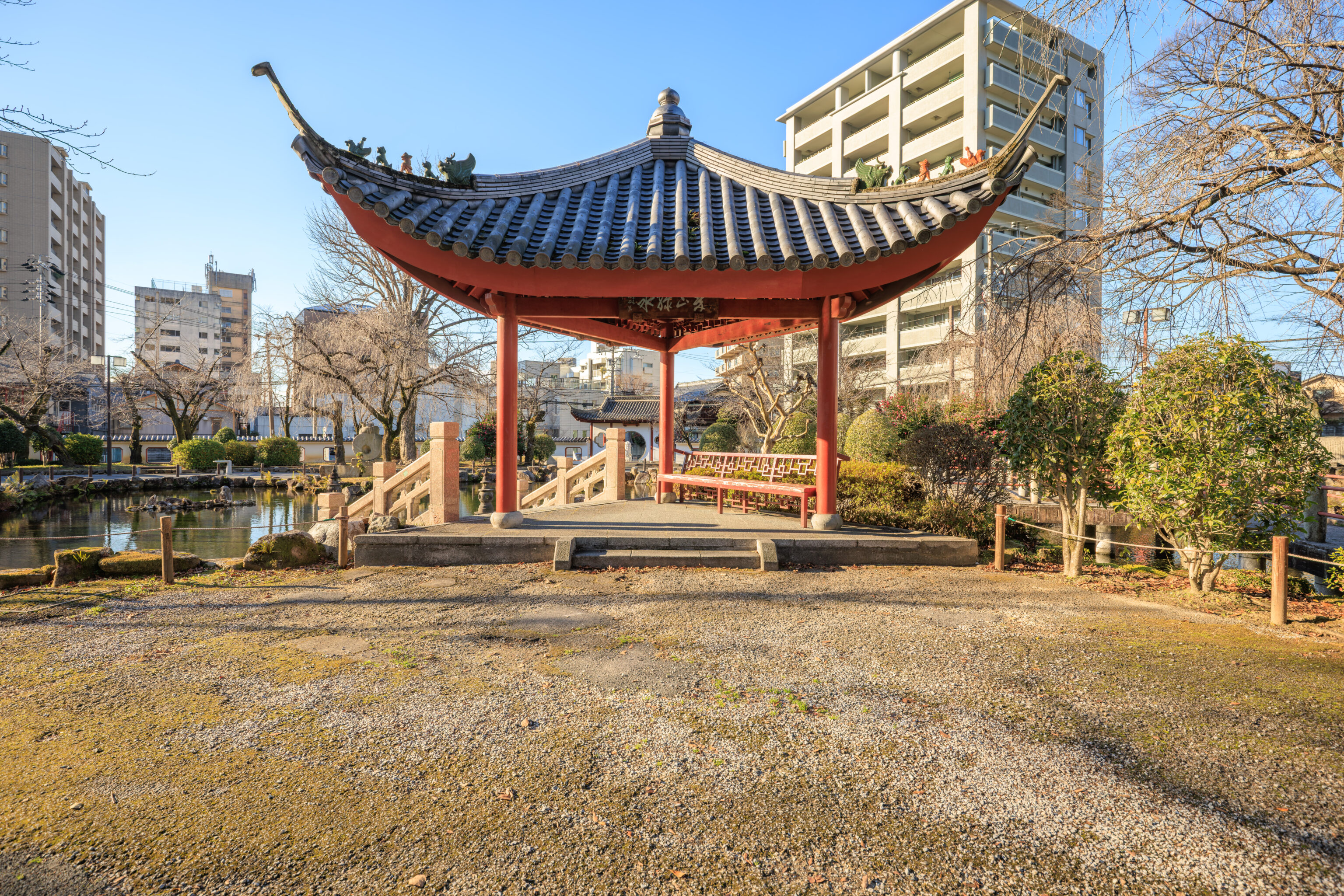
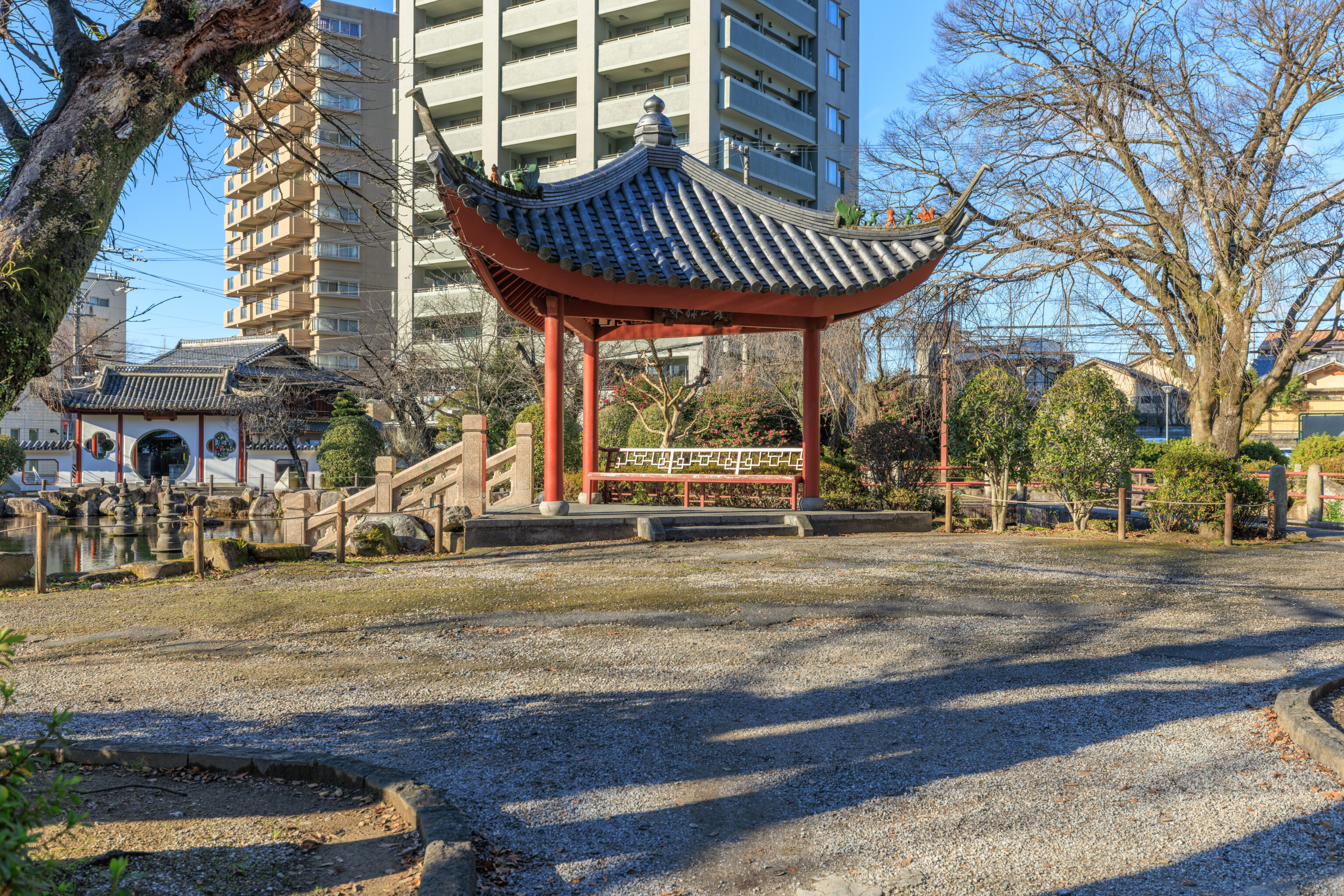
We walked over to this pavilion that we walked by earlier. It is part of the 日中友好庭園 Japan-China Friendship Garden. Its a bit funny as friedship between Japan and China as countries isn’t really a thing.
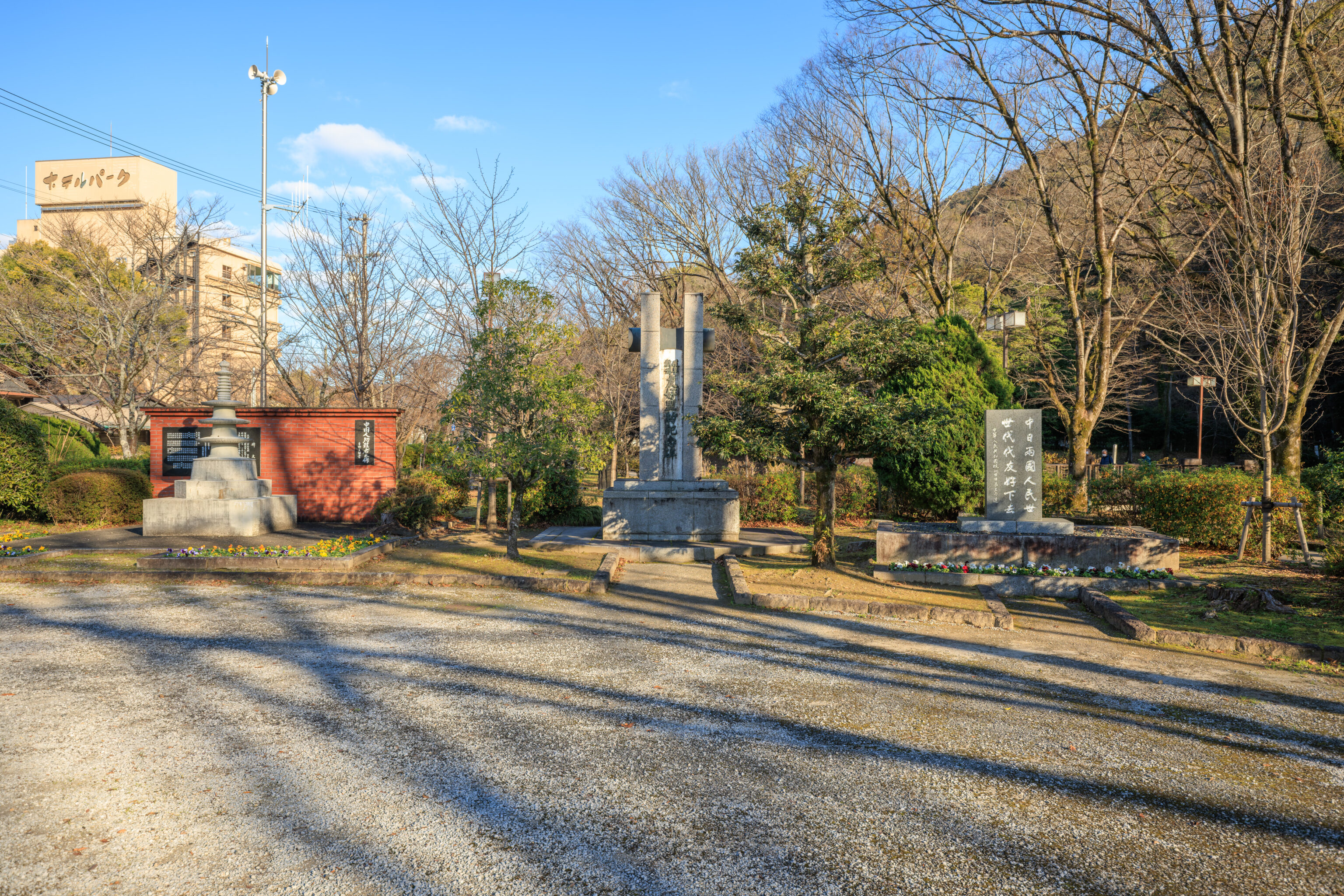
There were some addtional markers to the east. The tallest one at center is the 岐阜 杭州 友好盟約記念碑 Gifu Hangzhou Friendship Pact Monument, which seems to indicate a sister city type agreement between Gifu and Hangzhou.
The marker on the right was given by the mayor of Hangzhou and reads:
May the people of China and Japan remain friends from generation to generation.
Wang Zida, Mayor of Hangzhou, People's Republic of China
– Text from the stone marker on the right, read using Google Gemini translated using Google Translate.
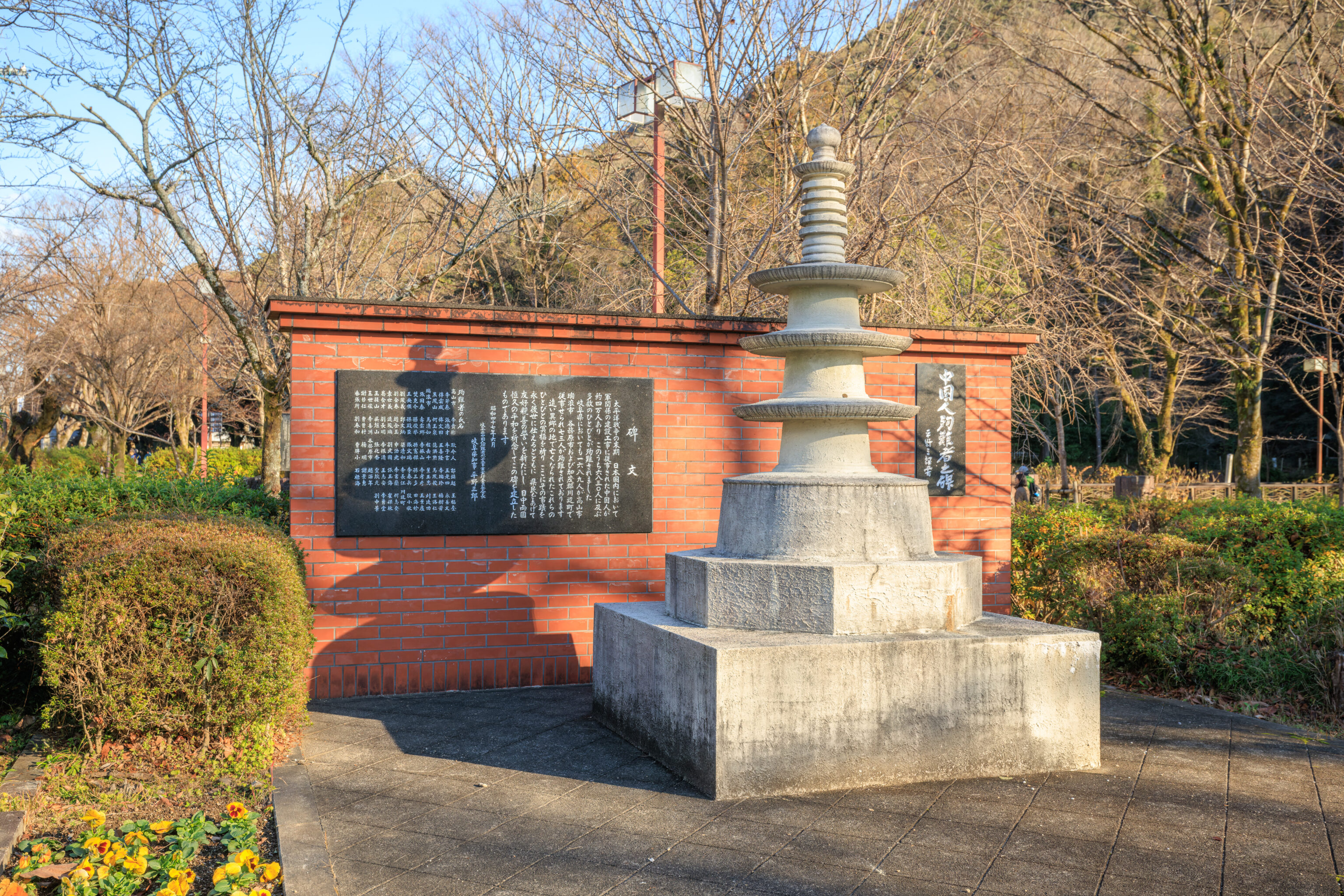
This memorial, which was on the left in the previous photograph, is a memorial to the Chinese prisoners taken by the Japanese and used as forced labor here in Gifu.
Monument to Chinese Martyrs
Calligraphy by Saburō Hirano

Inscription
Towards the end of the Pacific War, approximately 40,000 Chinese nationals were engaged in military-related construction work within Japan; of these, as many as 6,830 lost their lives.

In Gifu Prefecture, 1,689 individuals were assigned to work in the cities of Takayama, Mizunami, and Kakamigahara, as well as in the town of Kawabe in Kamo District; 73 of them perished.

We have erected this monument to pray for the repose of the souls of those who died in this distant, foreign land and to ensure their story is passed down to future generations. At the same time, we renew our pledge of friendship and goodwill on behalf of all the prefecture's residents and pray for lasting peace between Japan and China.

June 1972
Chairman, Executive Committee for the Memorial Project for Chinese Victims in Gifu Prefecture
Saburo Hirano, Governor of Gifu Prefecture

Names of the Victims
Takayama City
李芳泰, 傅雲成, 黒鳳山

Mizunami City
張国泰, 梵克介, 王央順, 劉鳳義, 劉金春, 袁世義, 葛金才, 王振山, 王世俊, 謝哲仁, 番張所, 李貴彬, 張徳才, 傅文田, 何王泉, 馬清如, 壽雲卿, 孫俊挙, 孫殿臣, 鄭文炳, 趙金玉, 連鳳瑞, 劉長明, 呉魁山, 李喜洲, 曹曽村, 劉春和, 耿介入, 牛子言, 王喜隆, 范洪勲, 程去千, 李振山, 孫憲傑, 張文瑞, 梁清和, 申治光, 劉建國, 李振清, 張化香

Kakamigahara City
揚明, 曹胖小, 郭鎮起, 王老四, 李瑞珍, 馬鳳俊, 薫王忠, 李考彦, 孫三多, 李春兵, 李長江, 李書蘭, 張玉海, 王志安, 賈舛元, 趙深年, 謝景恵, 石禄海, 王福奎, 永善文, 楊樹芳, 王洛仁, 劉連功, 王景盧, 田海珍, 段小秋

Kawabe Town
何志発, 崔保林, 李勇堂, 劉中華
– Text from the plaques on the wall, read using Google Gemini and translated using Google Translate.
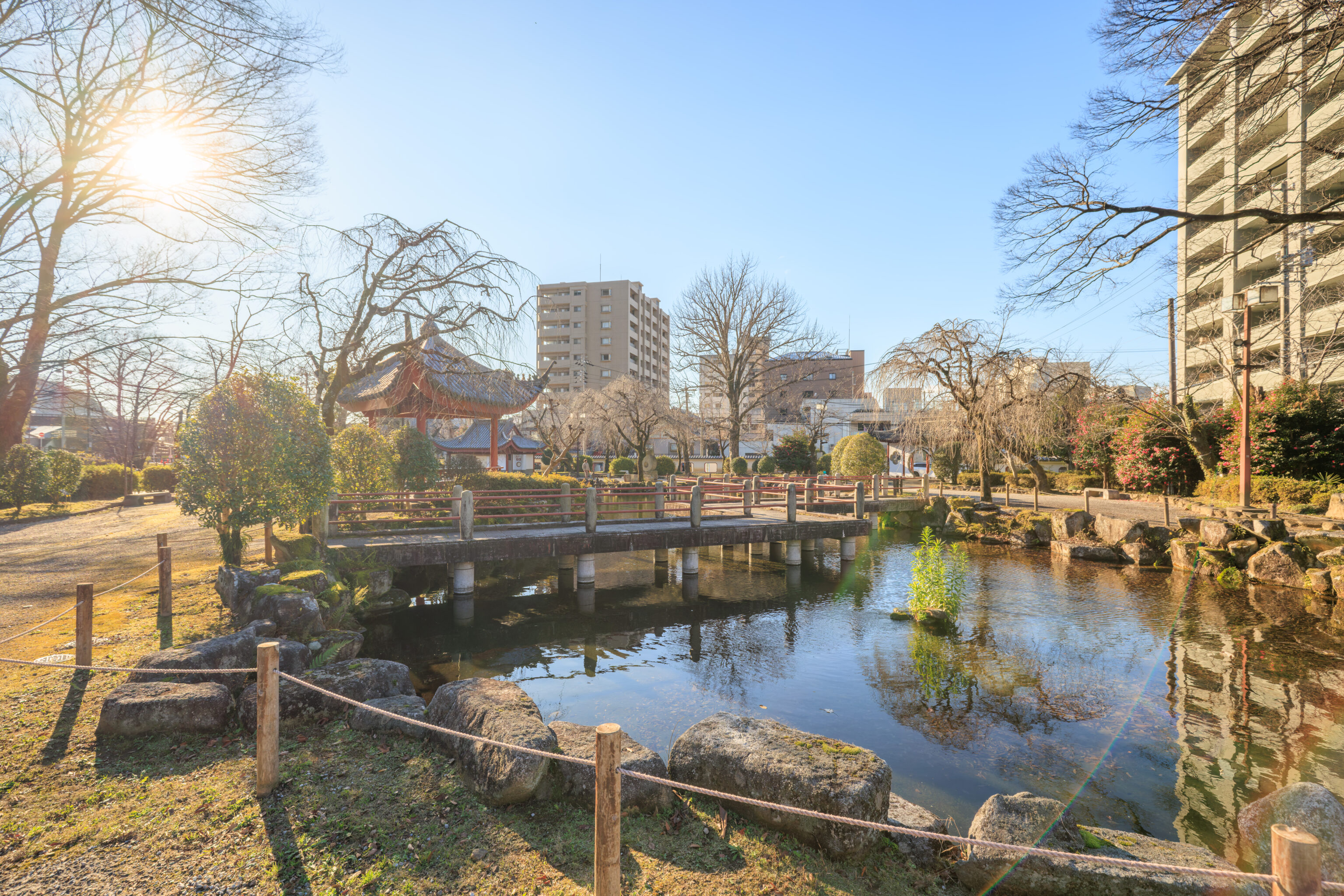
The garden, as seen from its east side.
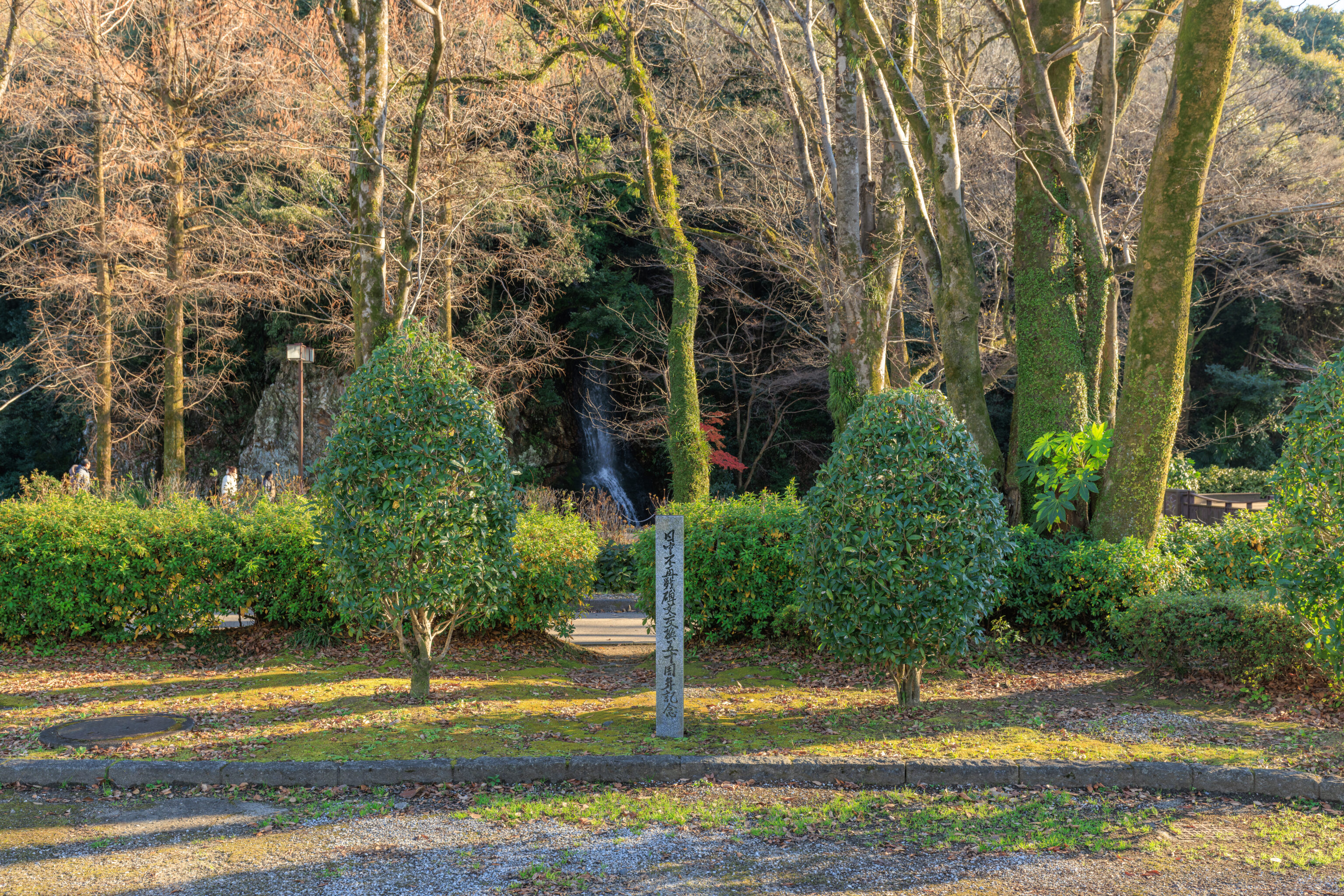
This small marker translates to, Commemorating the 50th Anniversary of the Exchange of Inscriptions for the “No More War Between Japan and China” Monument.
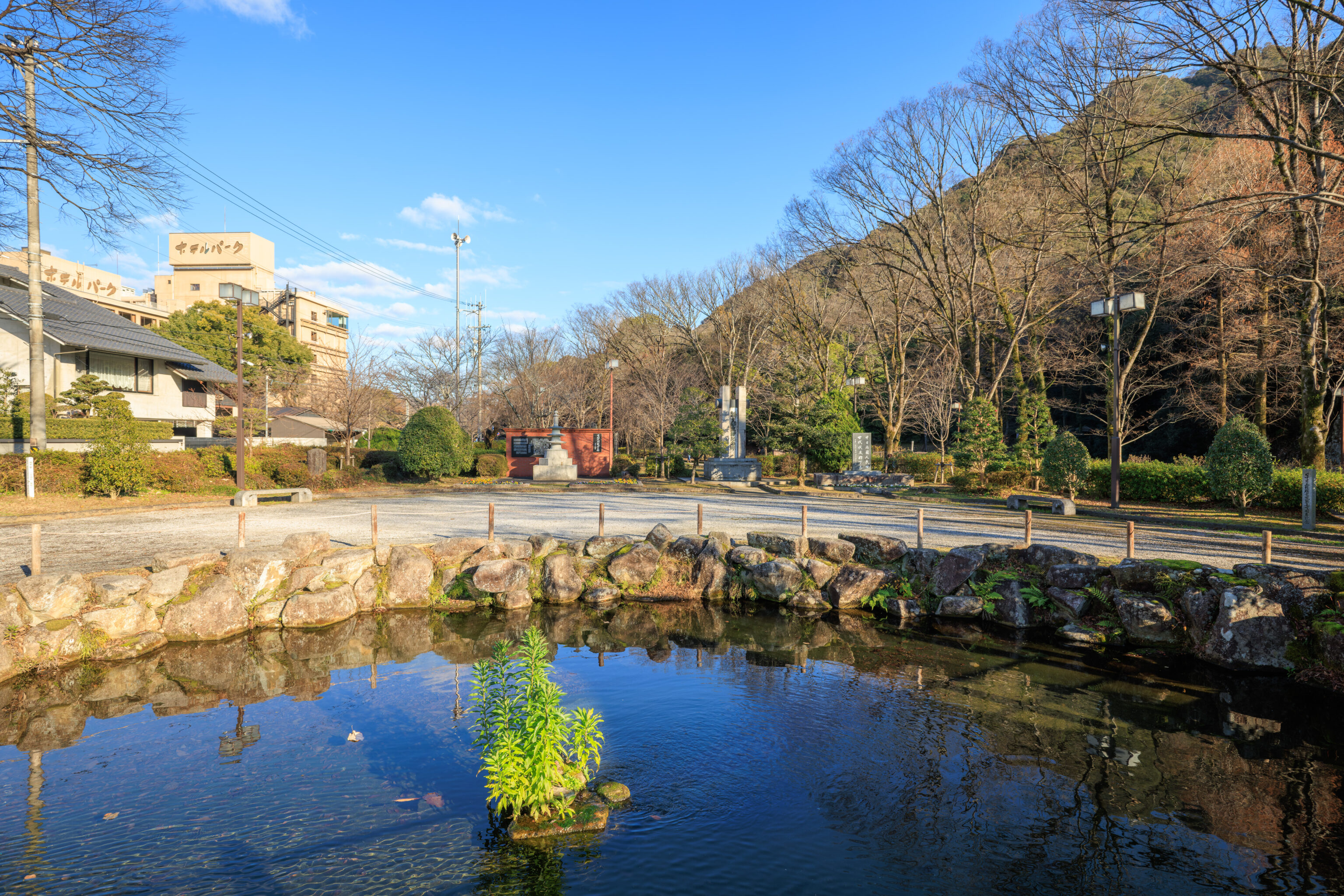
The view looking to the east from the bridge that runs across the pond in the garden.
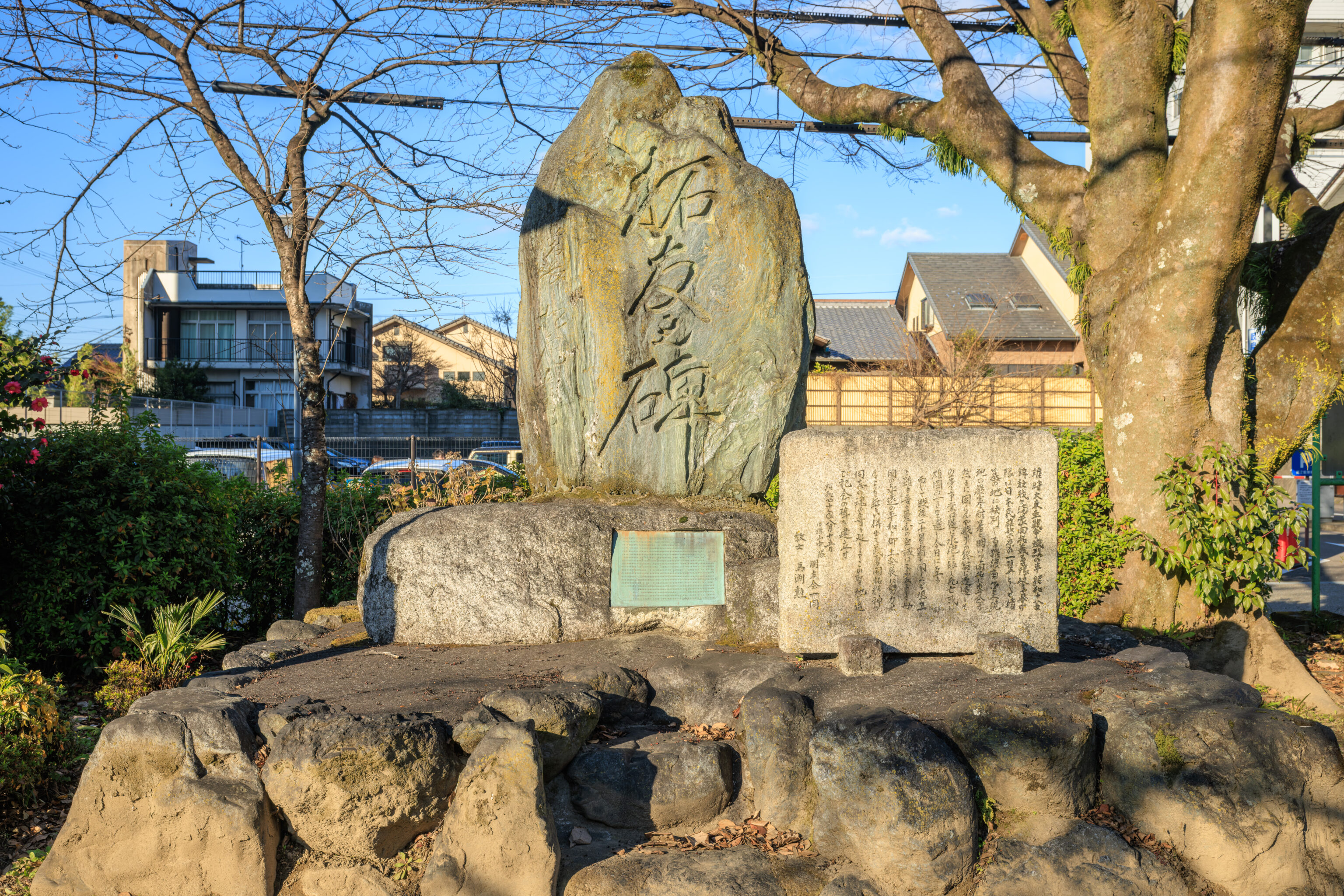
The large marker is insribed with text that transltes to, Stele Dedicated to Mentors and Friends. It is another war monument similar to the one we saw earlier.
In the year Showa 18 (1943), amidst the fierce intensity of the Greater East Asia War.

In the golden autumn, we—the Manchuria-Mongolia Pioneer Volunteer Corps—were stationed at Tsukiki. As part of the Japanese nation's great leap forward, we bade farewell to the graves of our forebears in the north and boldly ventured to Manchuria. There, we dedicated ourselves to pioneering the land, battling against both bitter cold and scorching heat. Yet, fate would have it that we encountered the end of the war; our monumental undertaking came to naught, and while some perished, others returned alive to the homeland to see this day. Now, twenty years have passed since the war's end. Though times have changed, our devotion to our unit remains steadfast. We pledge to strive for our motherland's eternal peace and the development of our hometowns. Furthermore, to serve as a spiritual resting place for the souls of our comrades and to honor the spirit of volunteer pioneering, we have erected this memorial monument here on this sacred ground.

August 15, 1970
All members of the former Chikukiyama Company Friendship Association
Teacher Isao Mabuchi
– Text from the stone tablet at bottom right, read using Google Gemini and translated using Google Translation.
The translation seems like it may be iffy in places, particuarly with names.
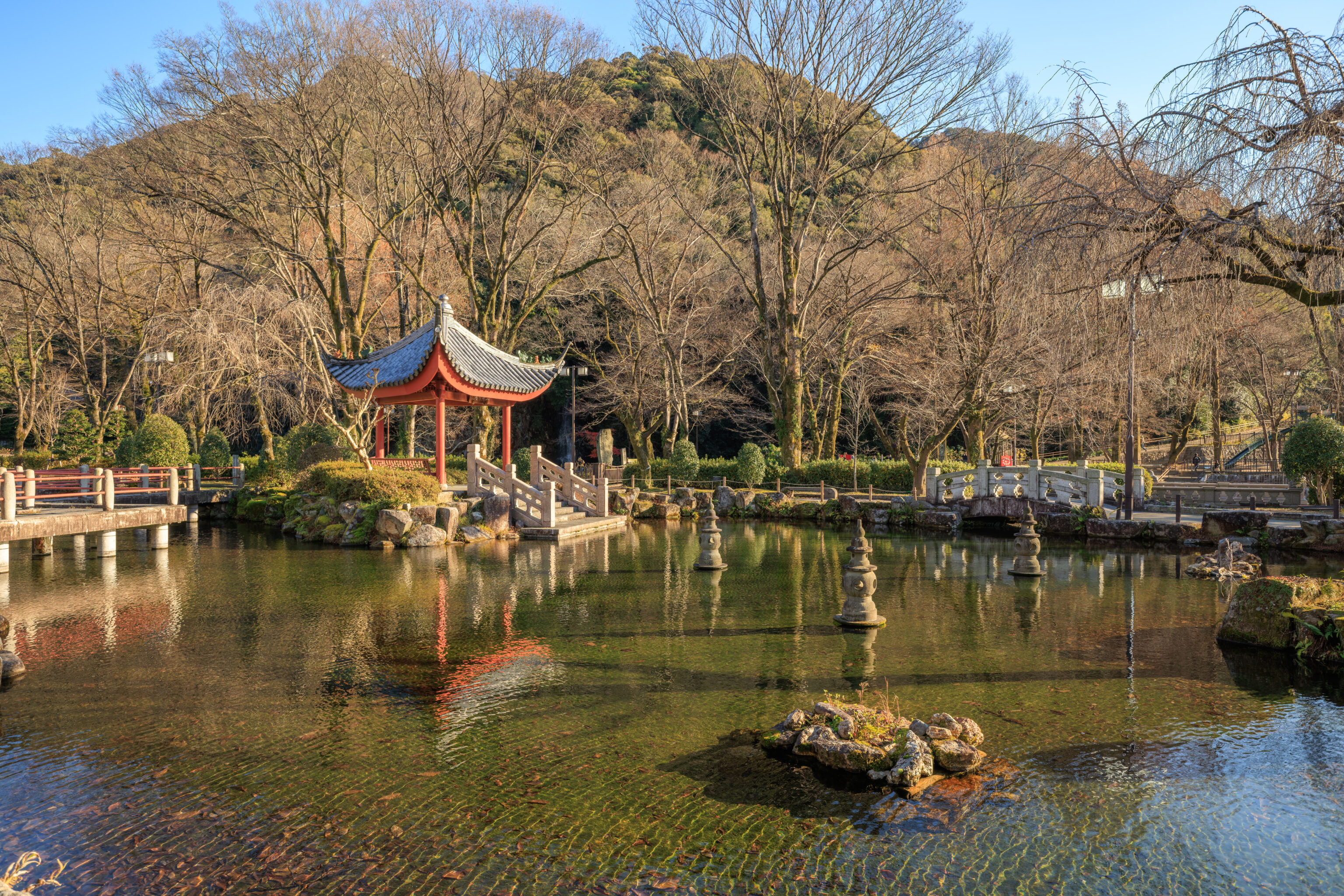
The pond, as seen from the west side.
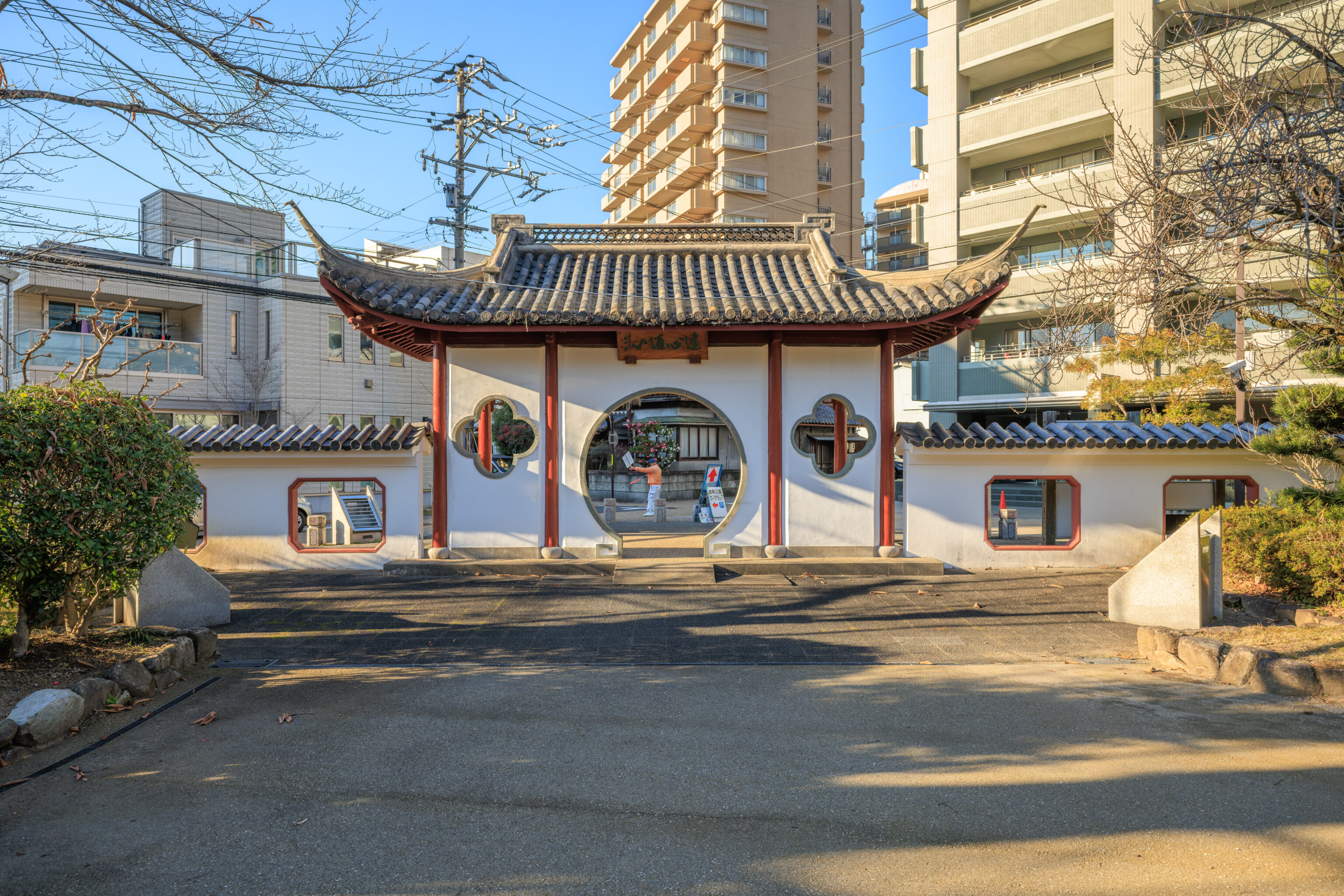
This gate leads to the northwest corner of the garden.
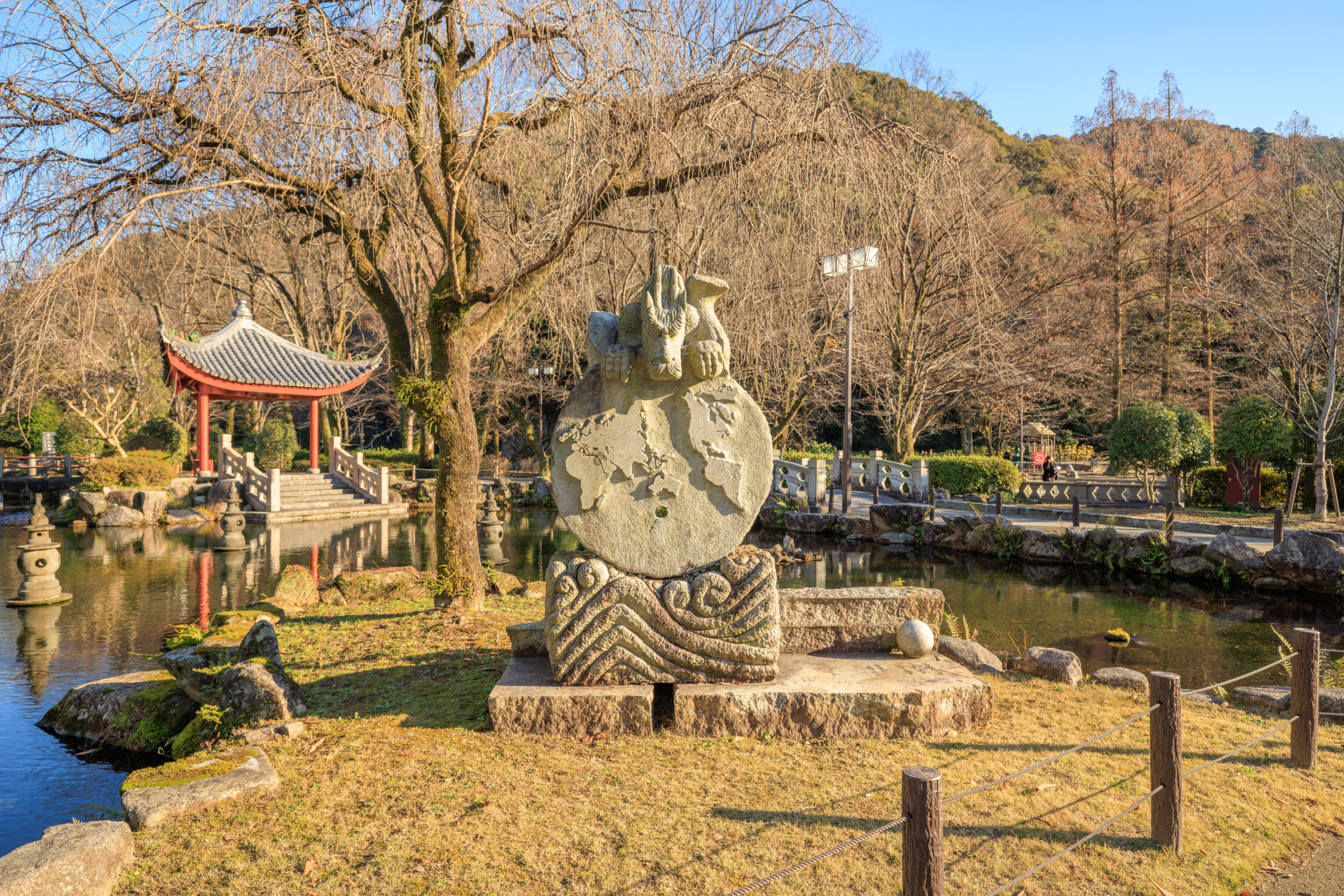
This looks like a globe with a dragon perched atop it. And there is what looks like an egg to its right. Unfortuantely, we can’t read the inscription at the base of this sculpture from here and we didn’t take any other photographs. And trying to get more information about this sculpture failed.
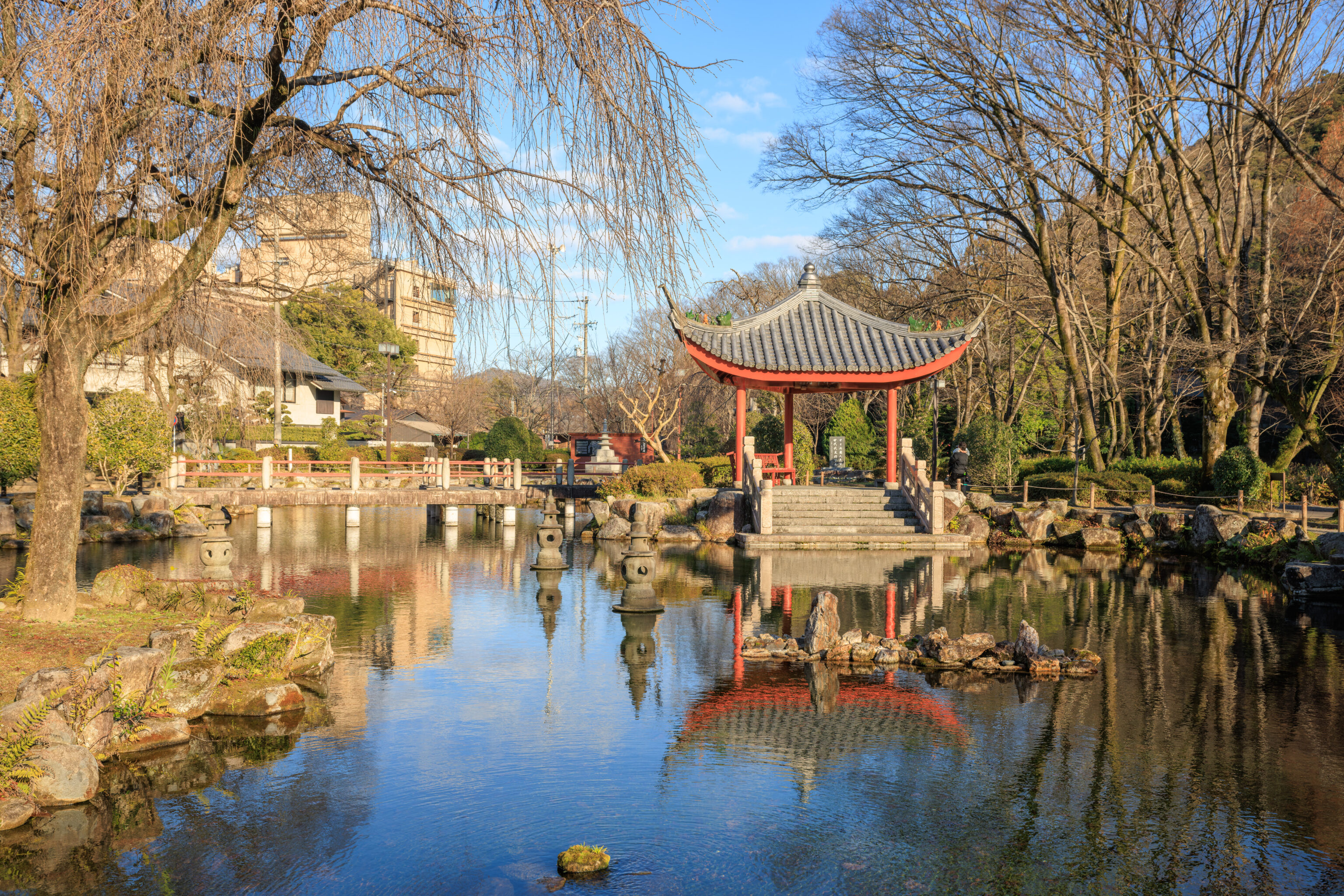
The pond, as seen from the southwest before we left.
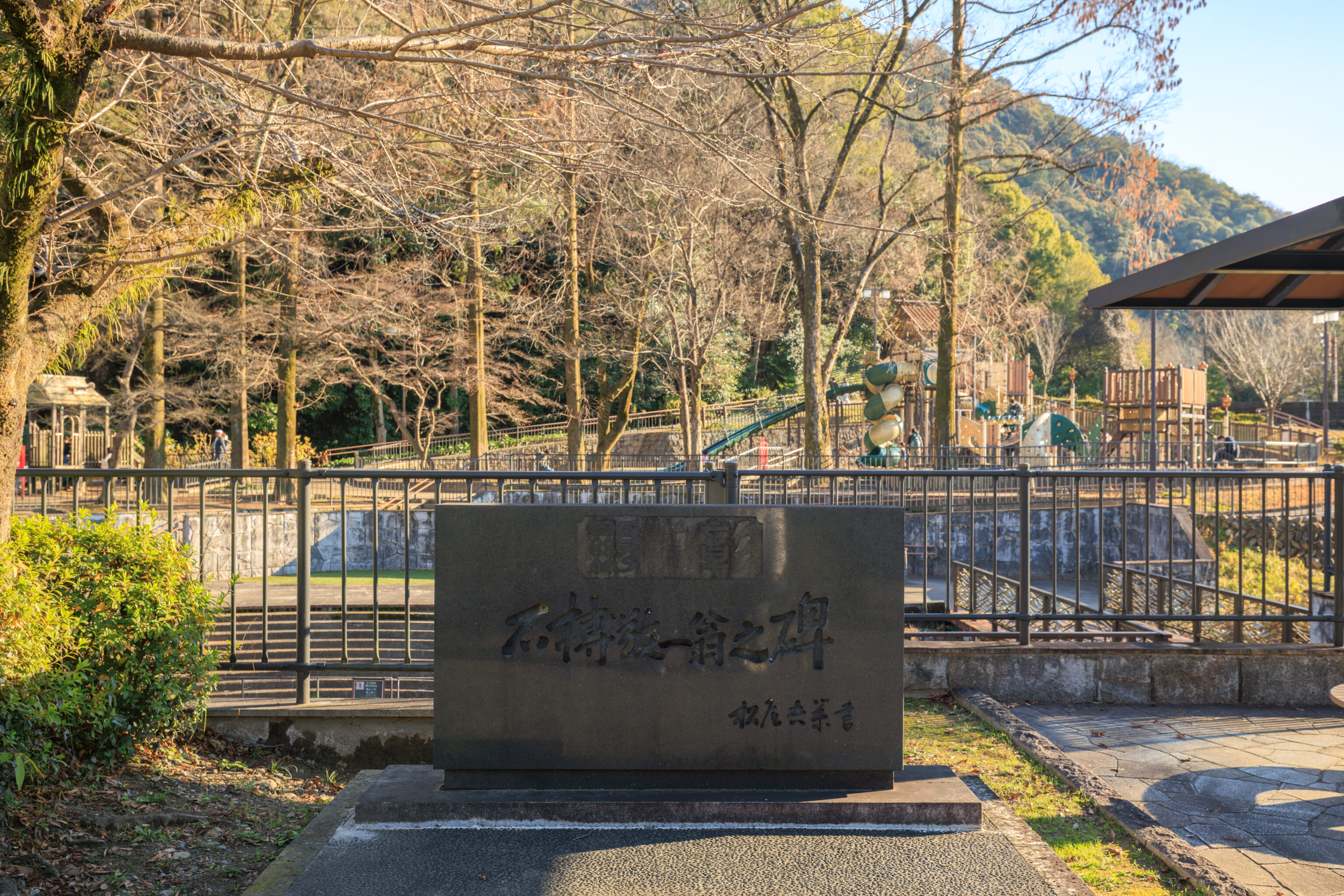
Trying to research this marker comes up with no useful results. Google Gemini thinks it translates to something like this:
彰顯 Commemoration
石榑敎一翁之碑 Monument to the Venerable Kyōichi Ishigure
松居共栄書 Calligraphy by Matsui Kyōei
– Text from the marker above, read using Google Gemini and translated with Google Gemini and Translate.
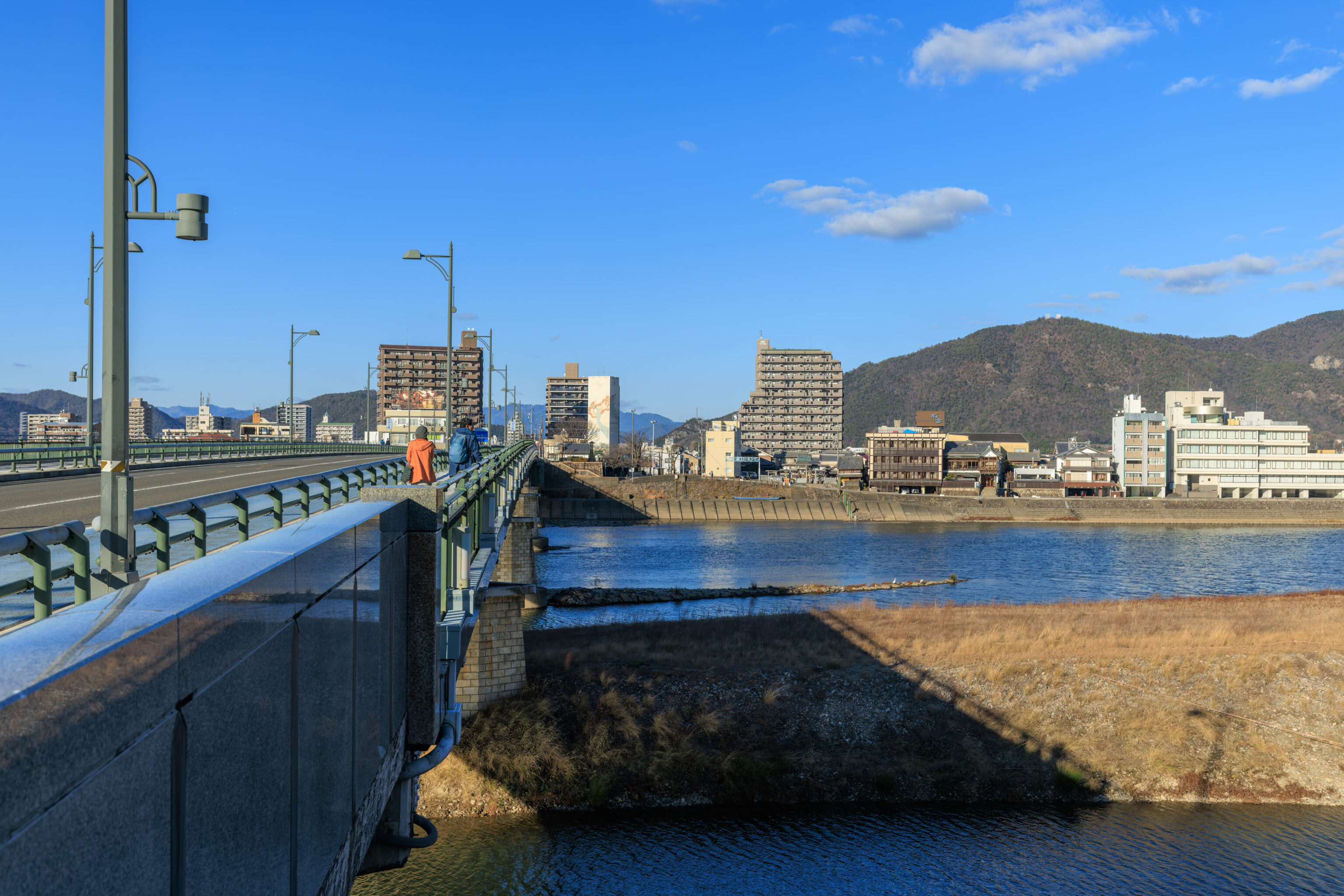
We walked to the northwest to reach the 長良橋 Nagara-bashi which crosses over the 長良川 Nagara-gawa.
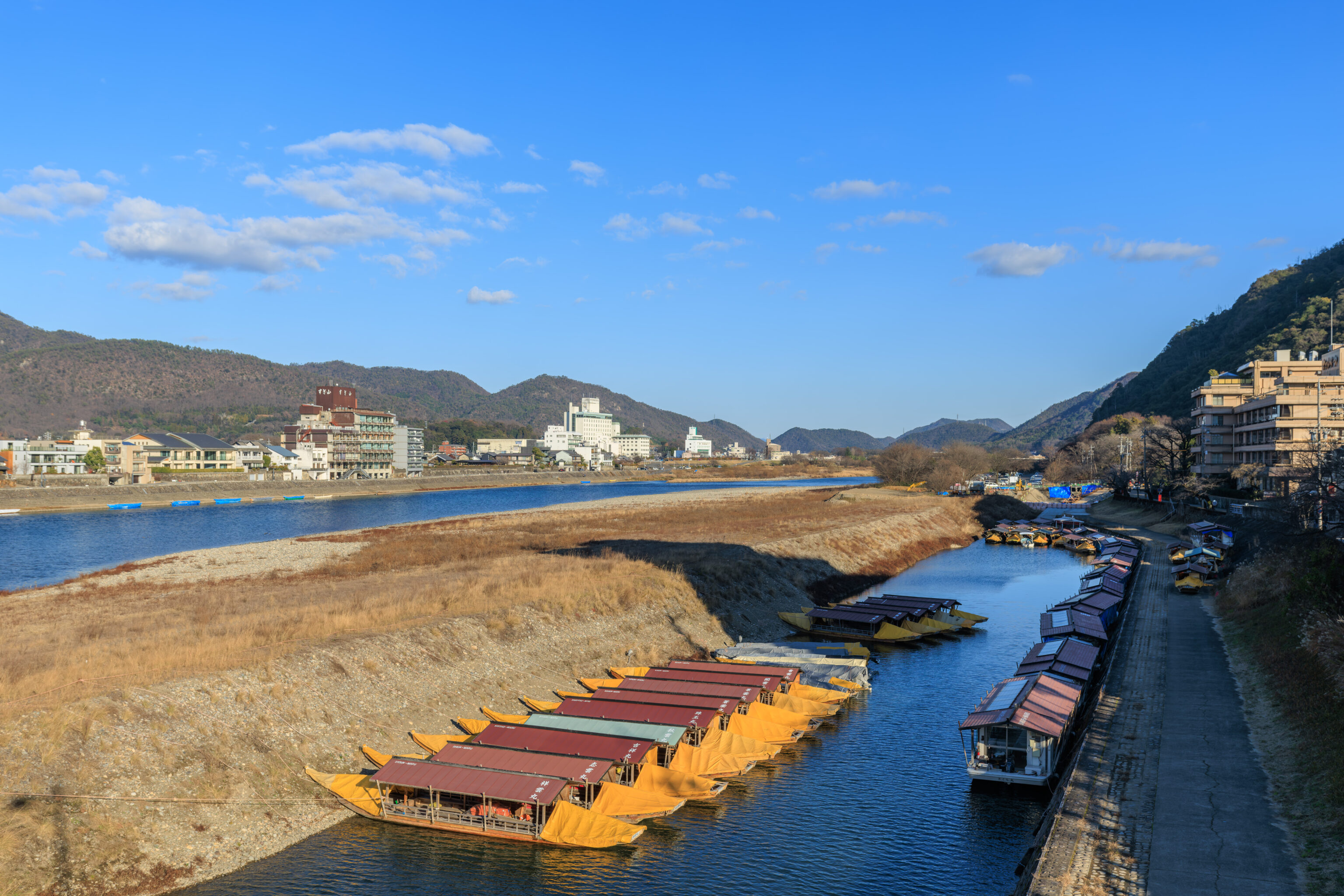
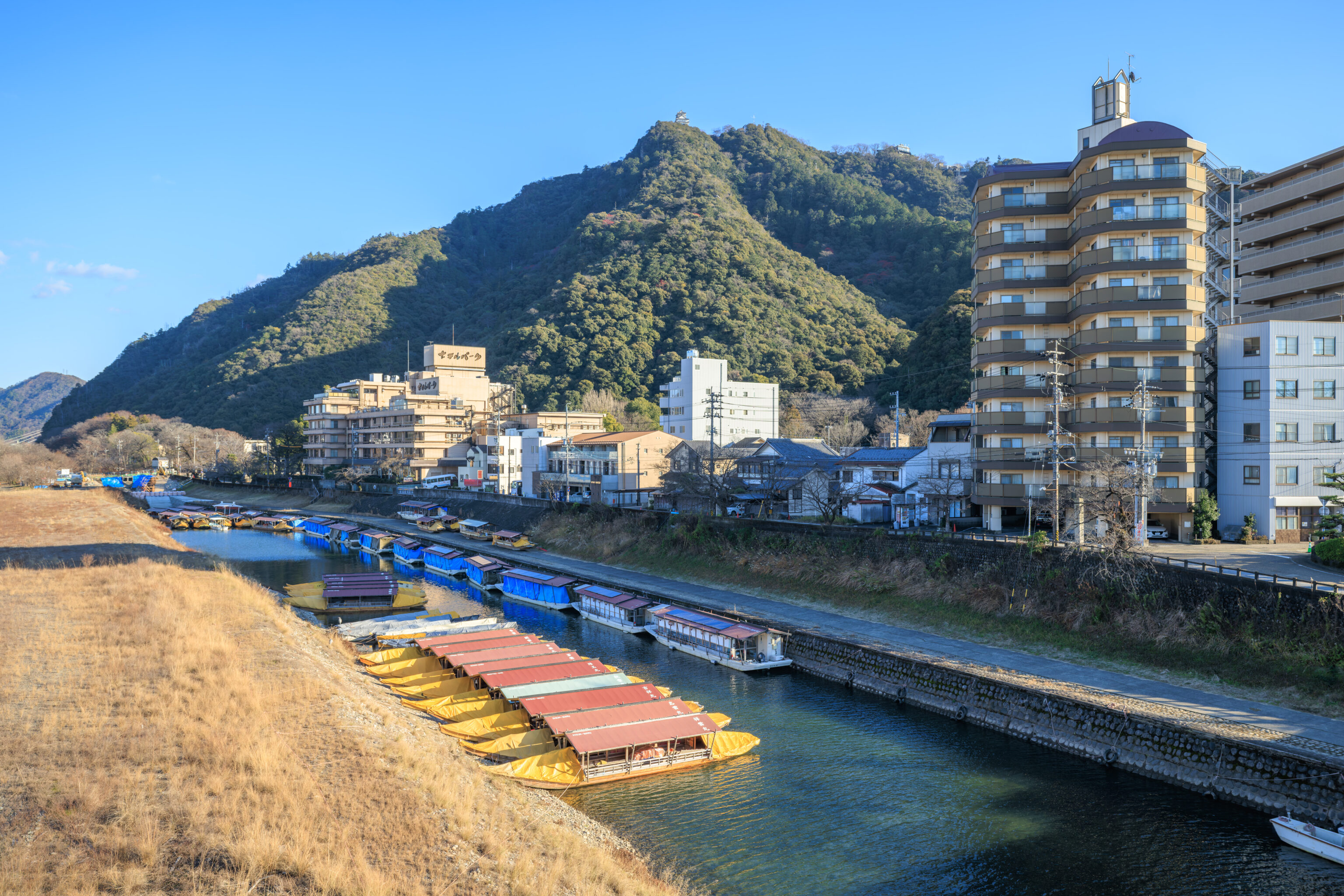
We walked out on the east side of the bridge. These boats moored here are comorant fishing and observation bots.
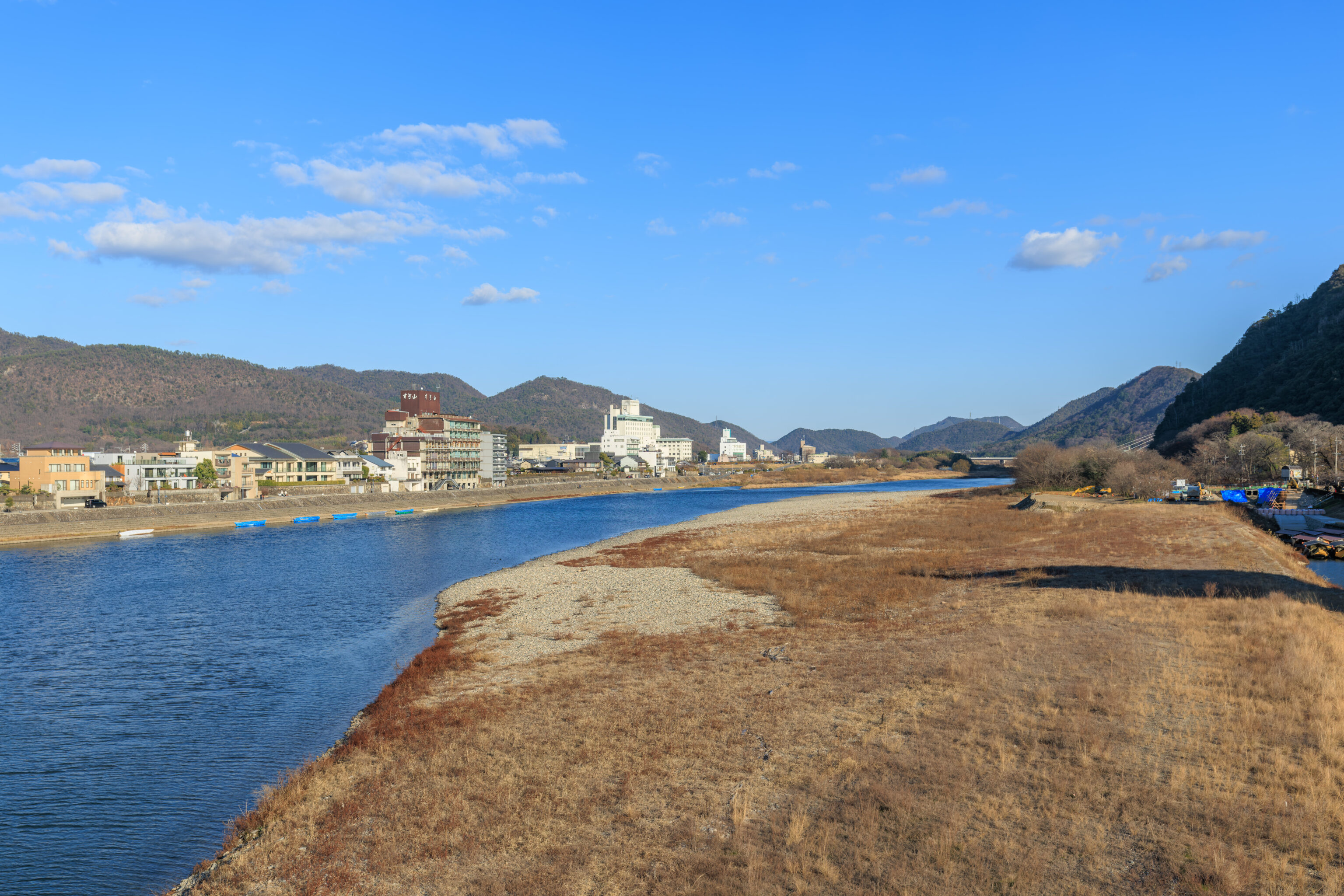
We didn’t go too far out as we didn’t actually want to cross the river.
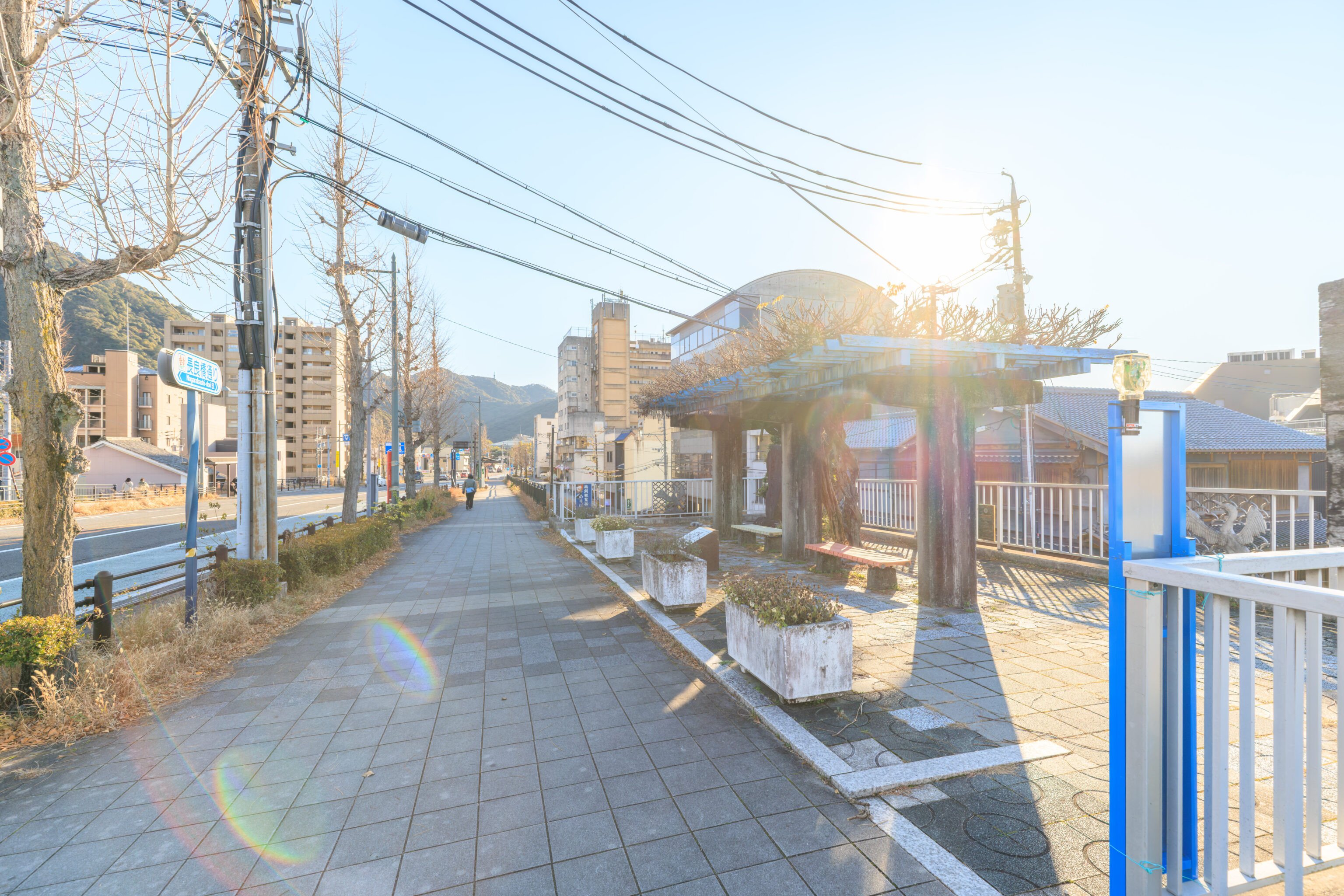
We returned to the south side of the river and crossed the road via a crosswalk. There was a bus stop here but it wasn’t time to leave yet!
Kawaramachi
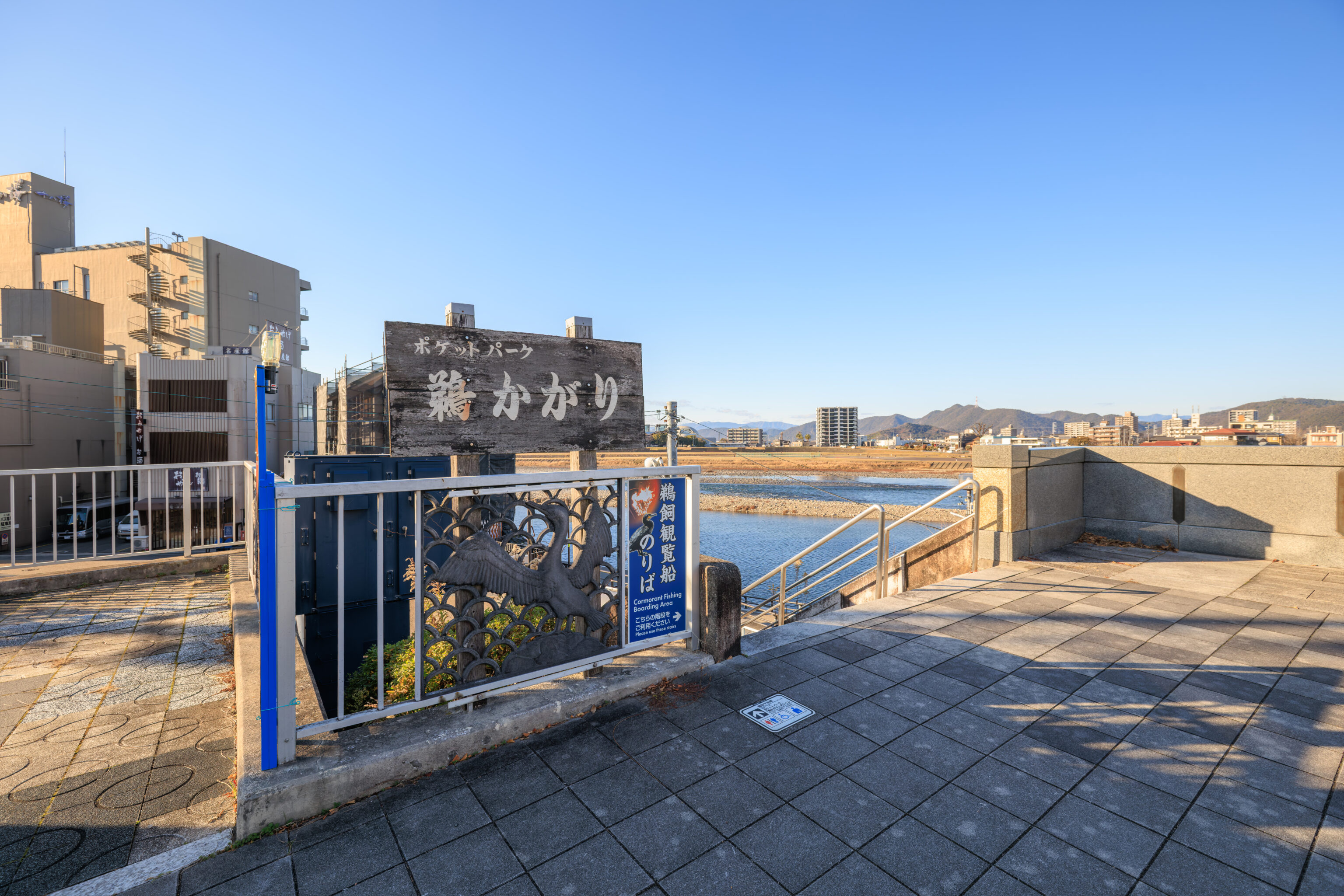
We walked down these stairs to get back down to ground level and to begin to walk through the 川原町 Kawaramachi, the city’s historic merchant district.
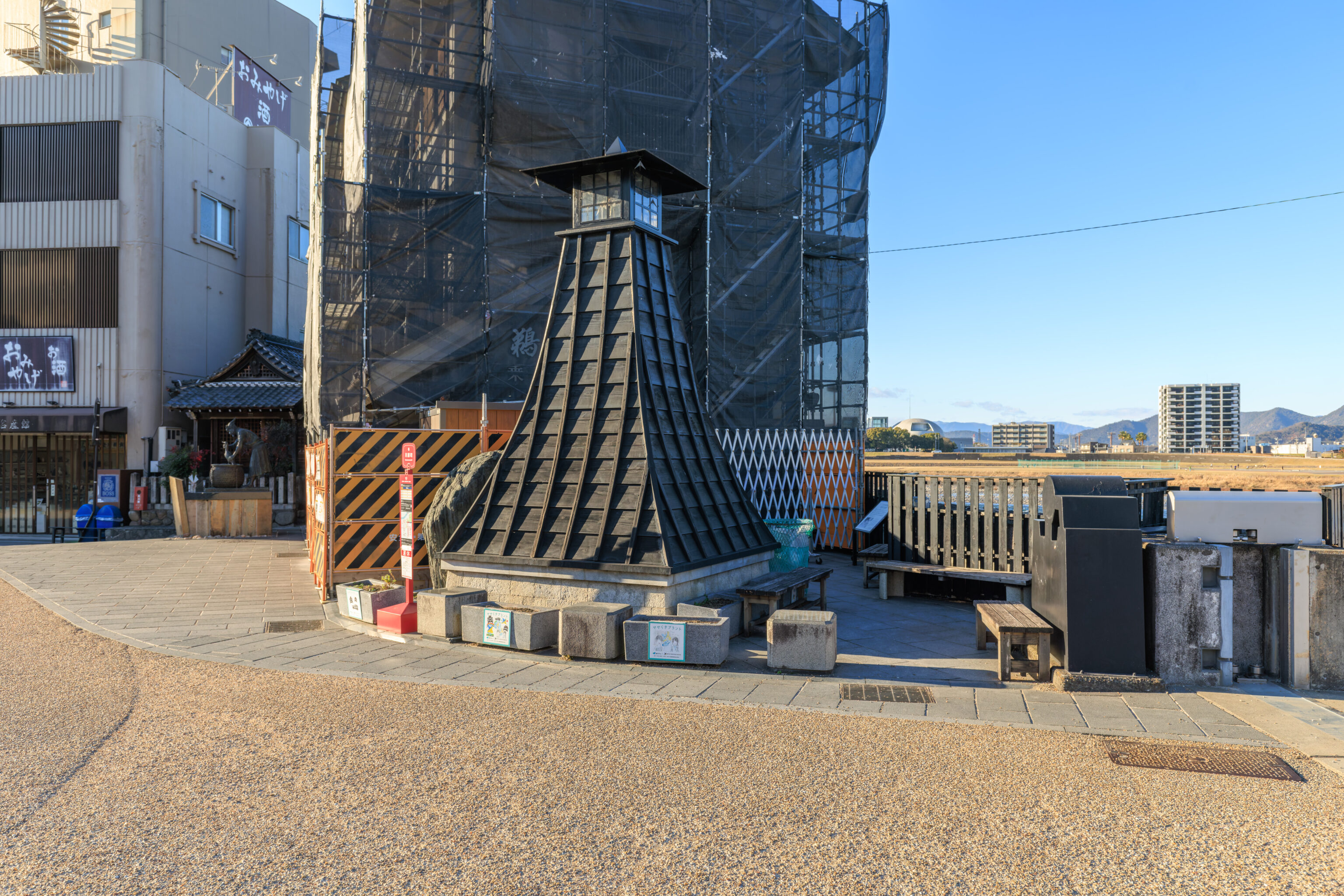
There was a little park right below the stairs. The cormorant fishing observation boats depart from around here when it is in season, which is from May through October.
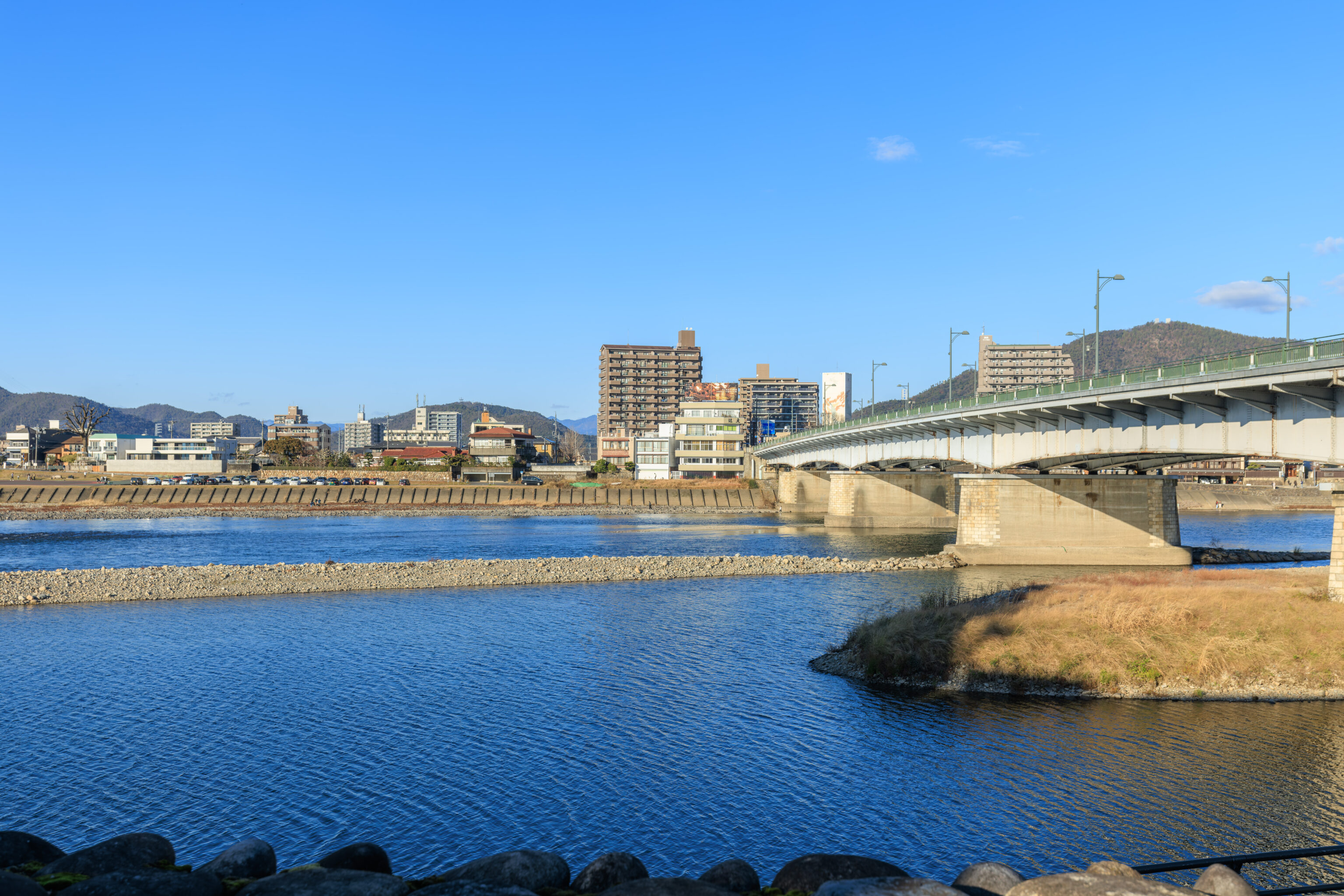
The view to the north looking across the Nagara-gawa.
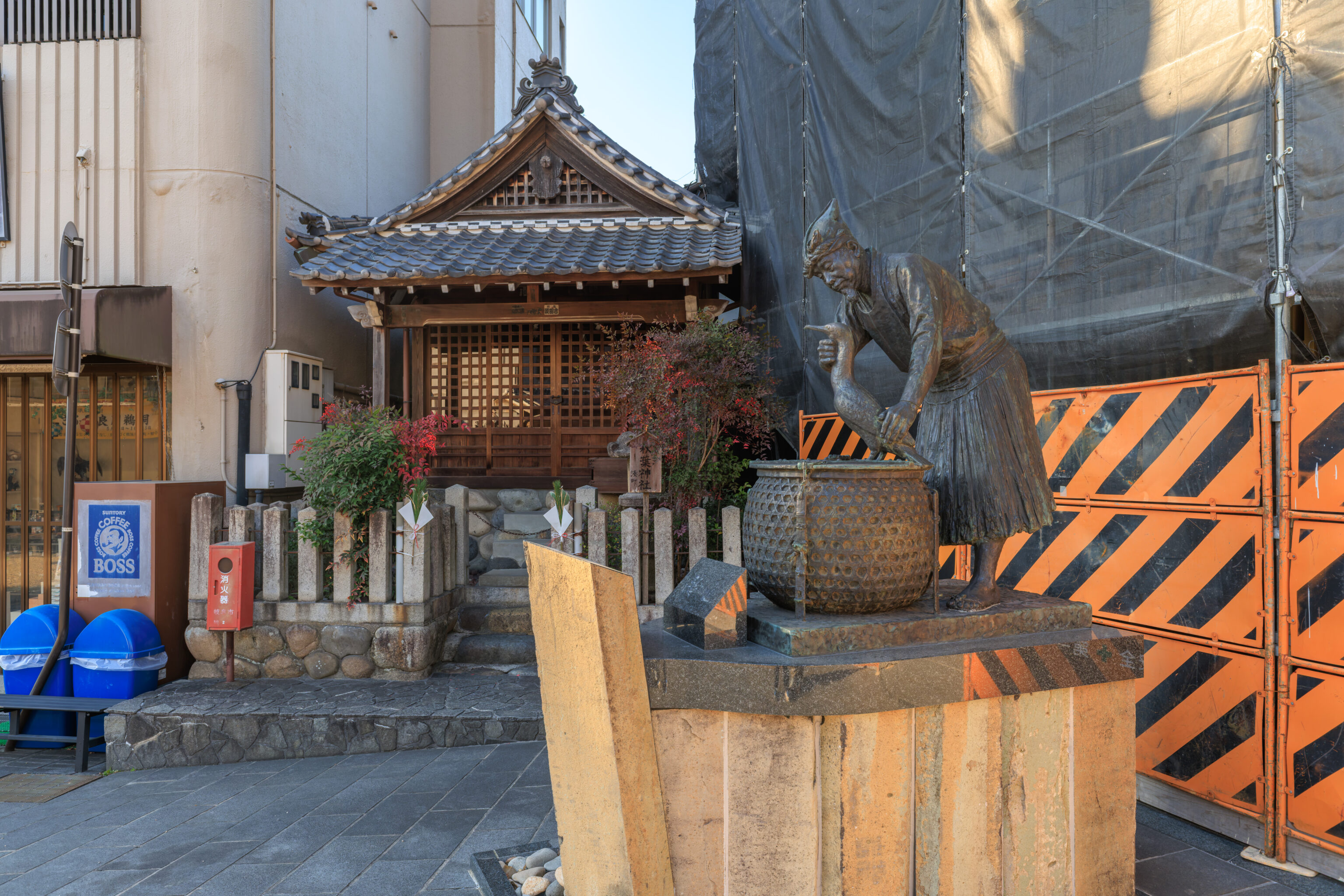
This sculpture depicts a fisherman and a cormorant. The platform seems to be shaped to evoke the image of a boat.
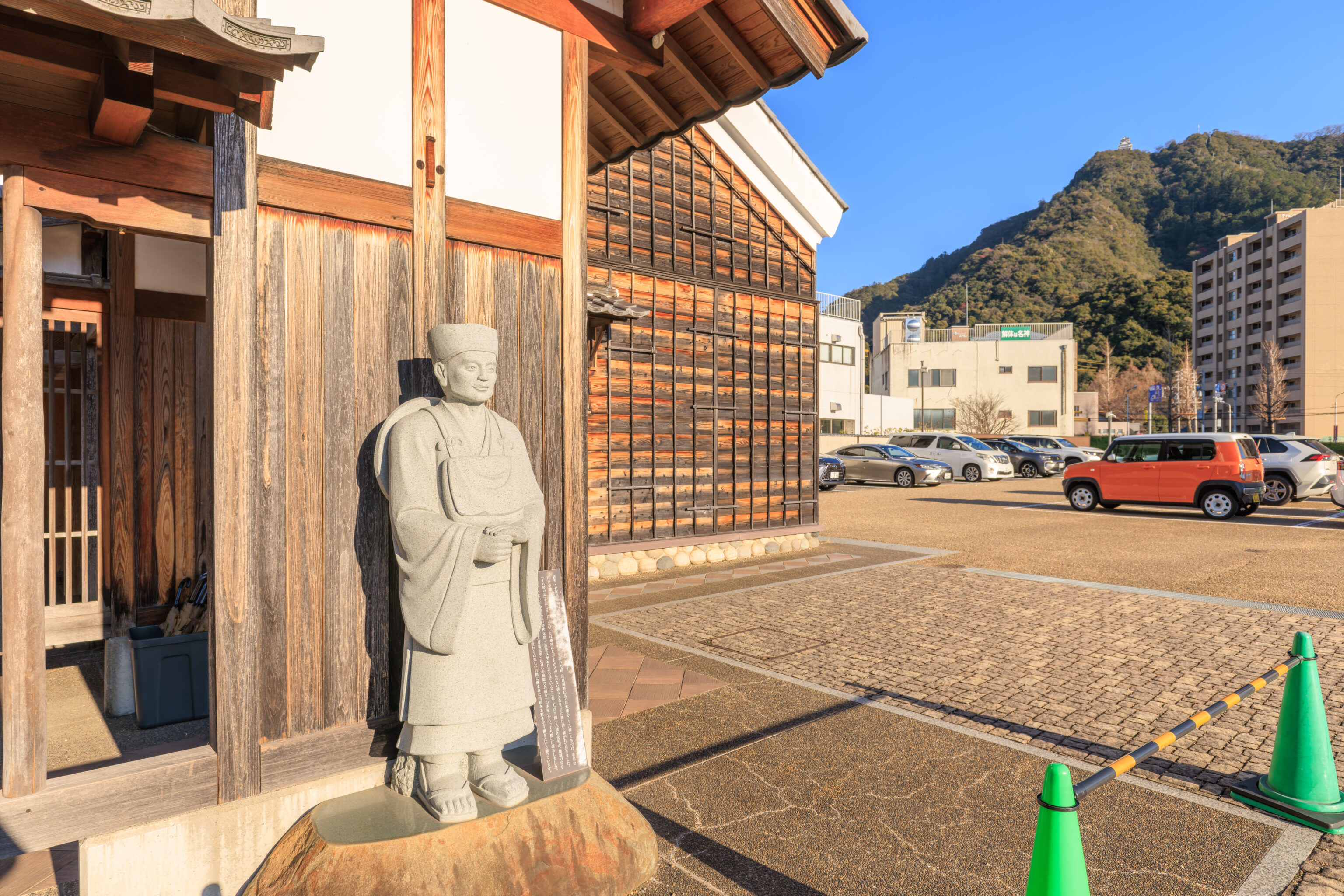
We started to walk down the road through the Kawaramachi.
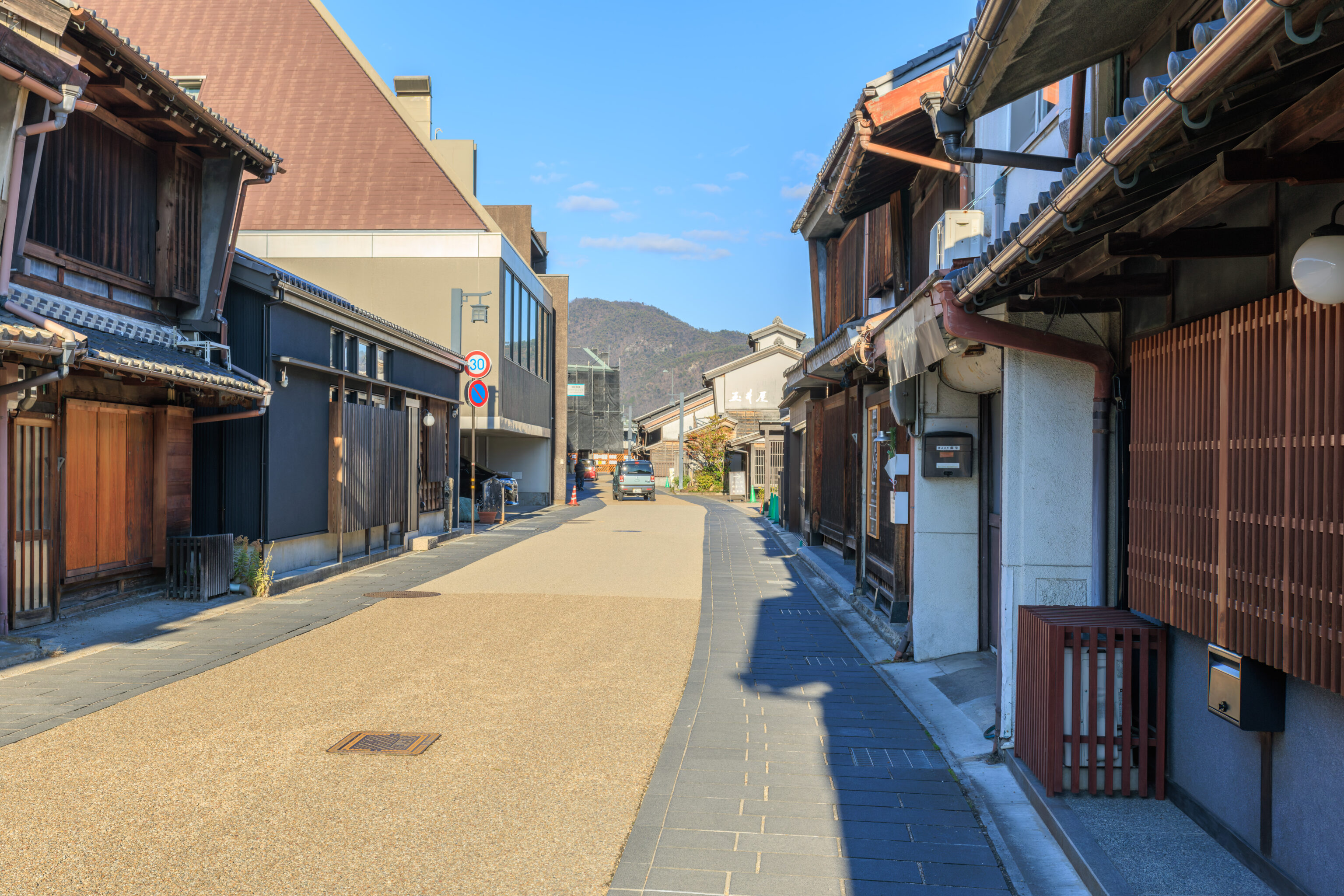
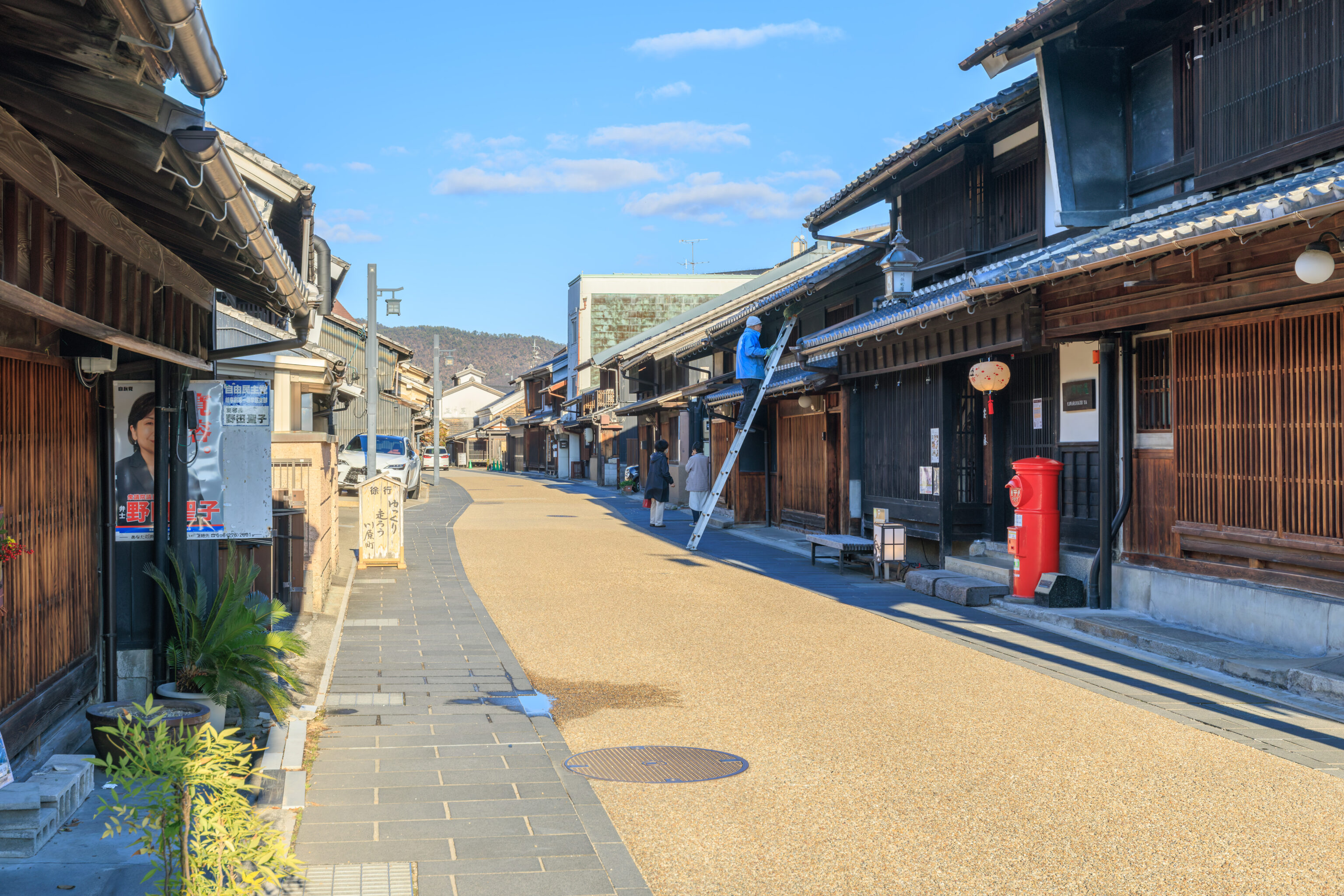
It was pretty quiet with almost nothing going on.
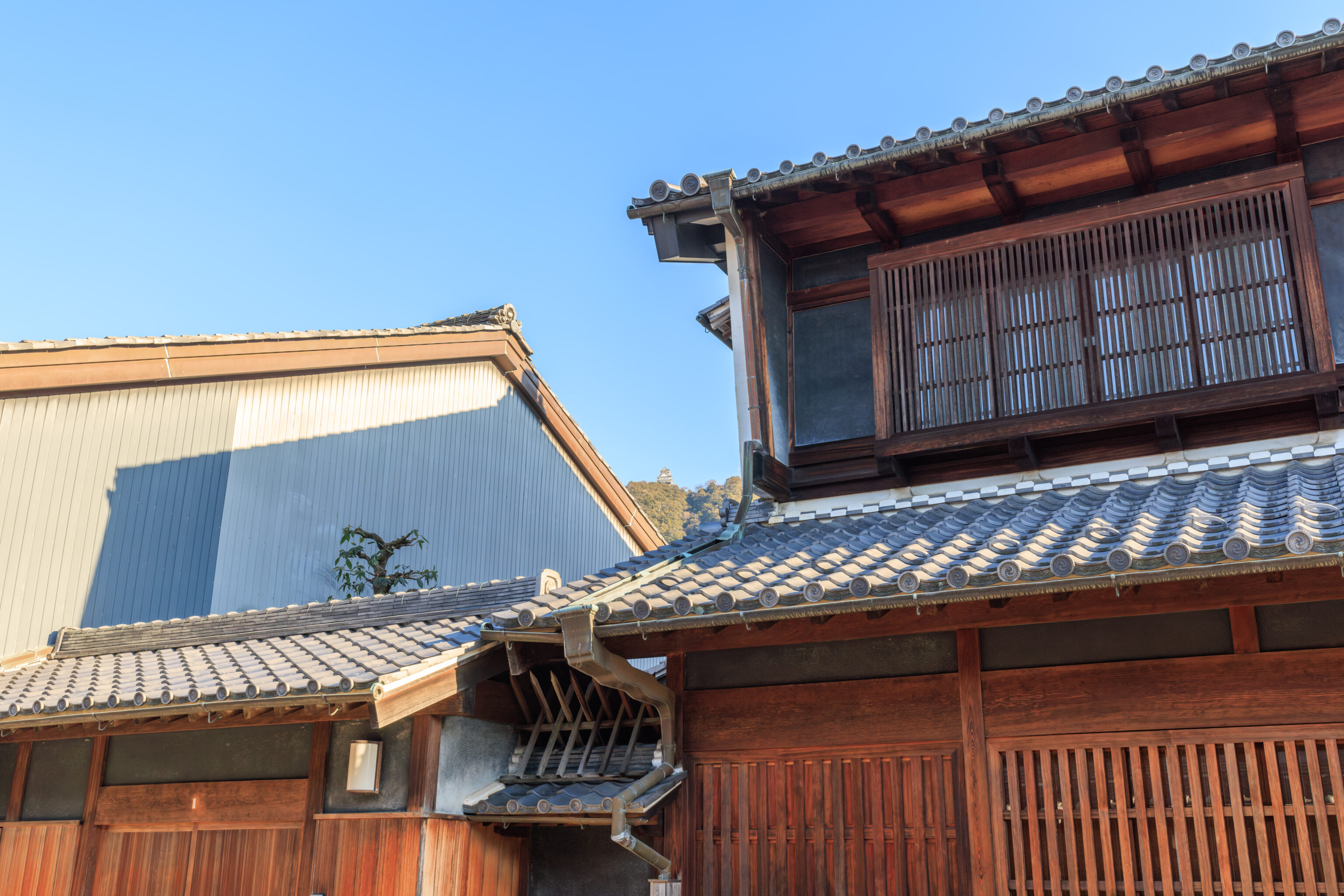
We were able to spot Gifu Castle through the gap between two of the buildings!
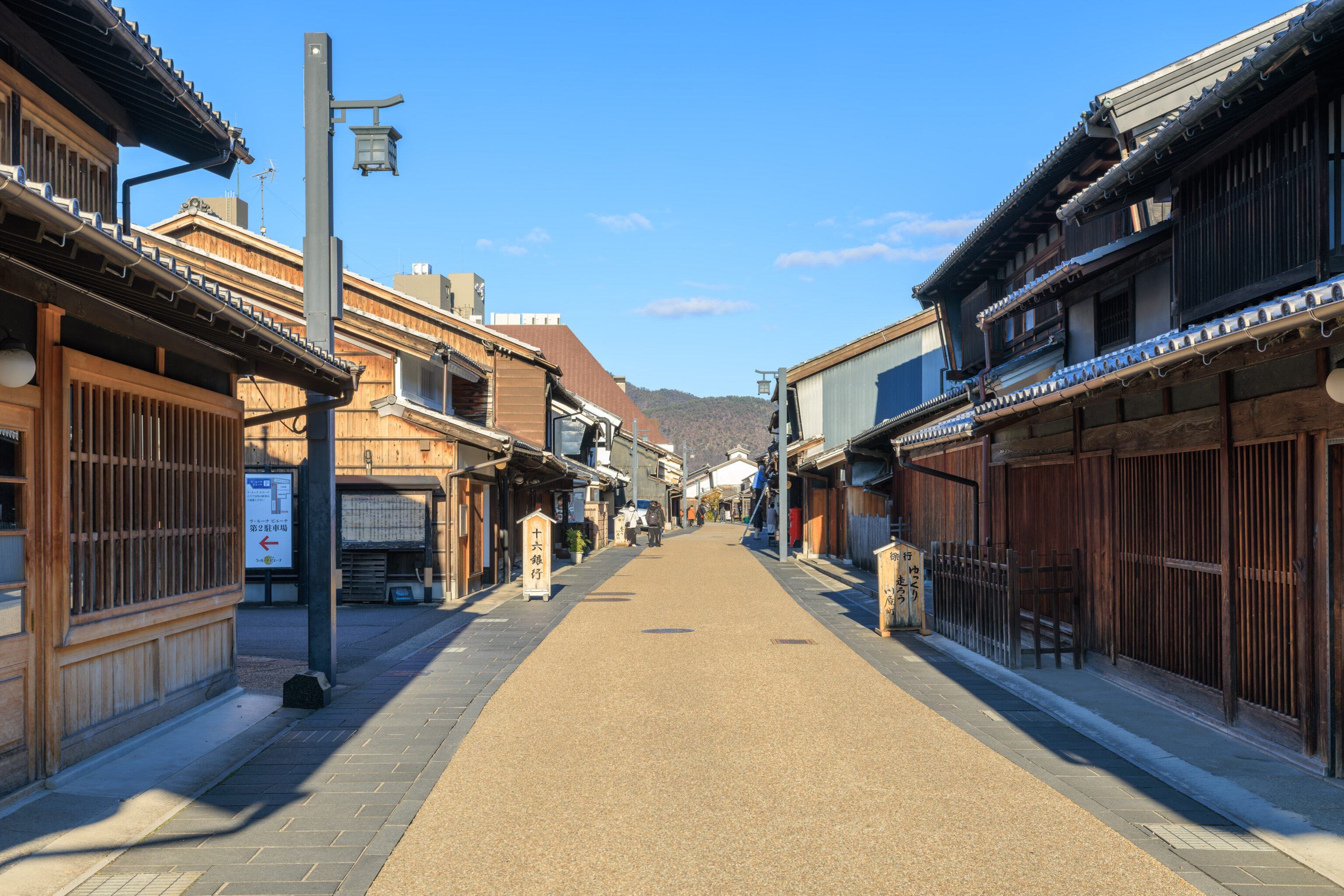
It was still pretty quiet as we got closer to the west end of the district.
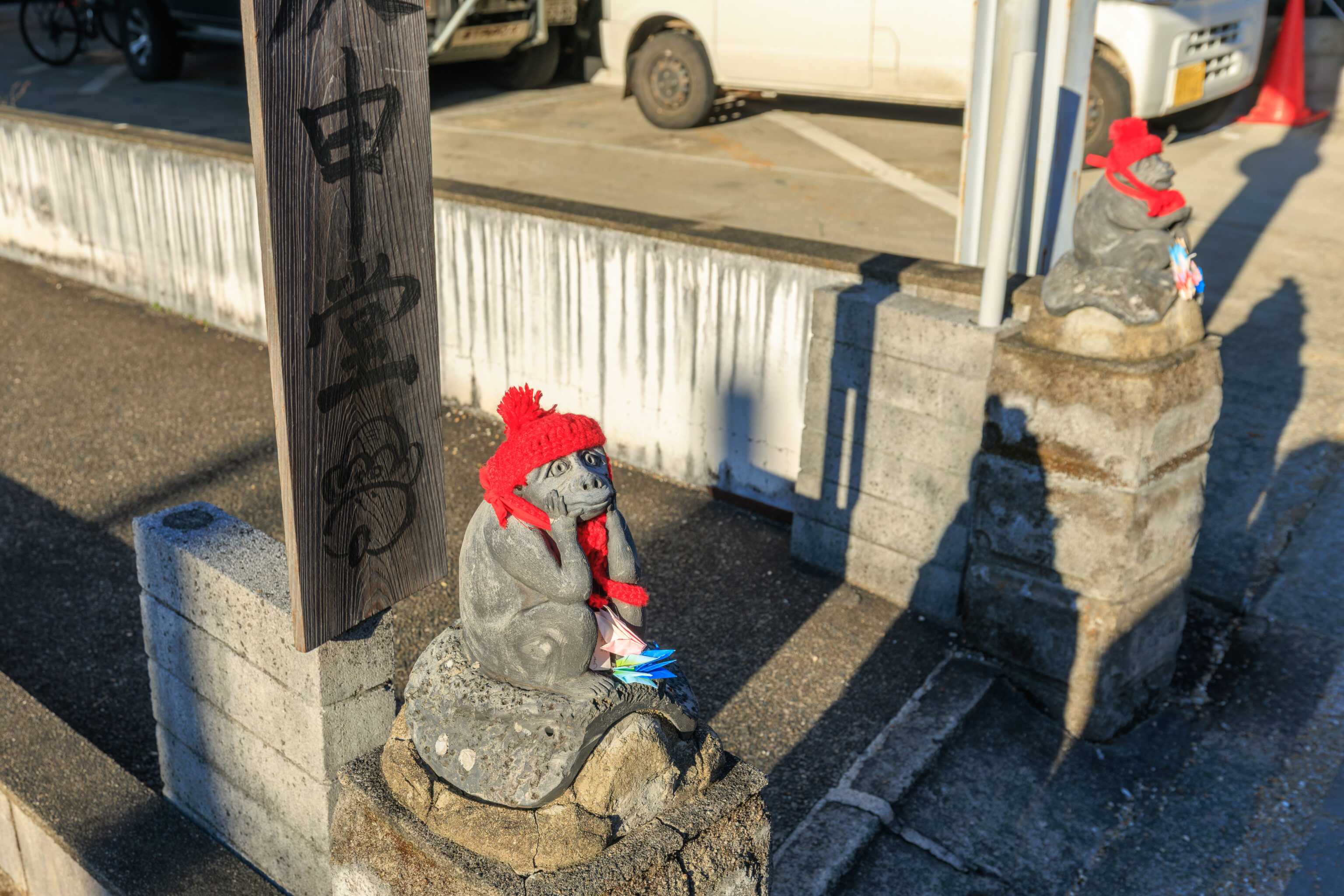
We spotted these two monkey sculptures at the beginning of a path. The red caps are similar to the red caps and such that are often put on Jizo statues. The sign indicates that this path leads to the 庚申堂 Kōshin-dō. The sign even has a humurous image of a monkey!
We walked down the path to take a look at what was there.
There isn’t really anything here that provides any information beyond this is a temple of some sort and the monkeys are important. The little calendar page hanging from the donation box reads:
With dignity and grace
Kōshin-dō

Backbiting is nothing more than a shadow. Live your daily life as usual, in good health.
– Text from the calendar hanging from the donation box, read using Google Gemini and translated using Google Translate.
Gifu’s Downtown Walking Tour series of webpages does discuss the Kōshin-dō! It was built by Saitō Yoshitatsu as part of a temple, 伝燈護国寺 Dento Gokoku-ji. This small hall is all that remains of the temple.
Another website, シビックプライドプレイス Civic Pride Place, also has a page about the Kōshin-dō. It suggests that this hall was rebuilt in the Edo period and used as a 庚申 Kōshin temple, which is why it has its current name. Monkeys are the messengers of Kōshin, which explains their presence.
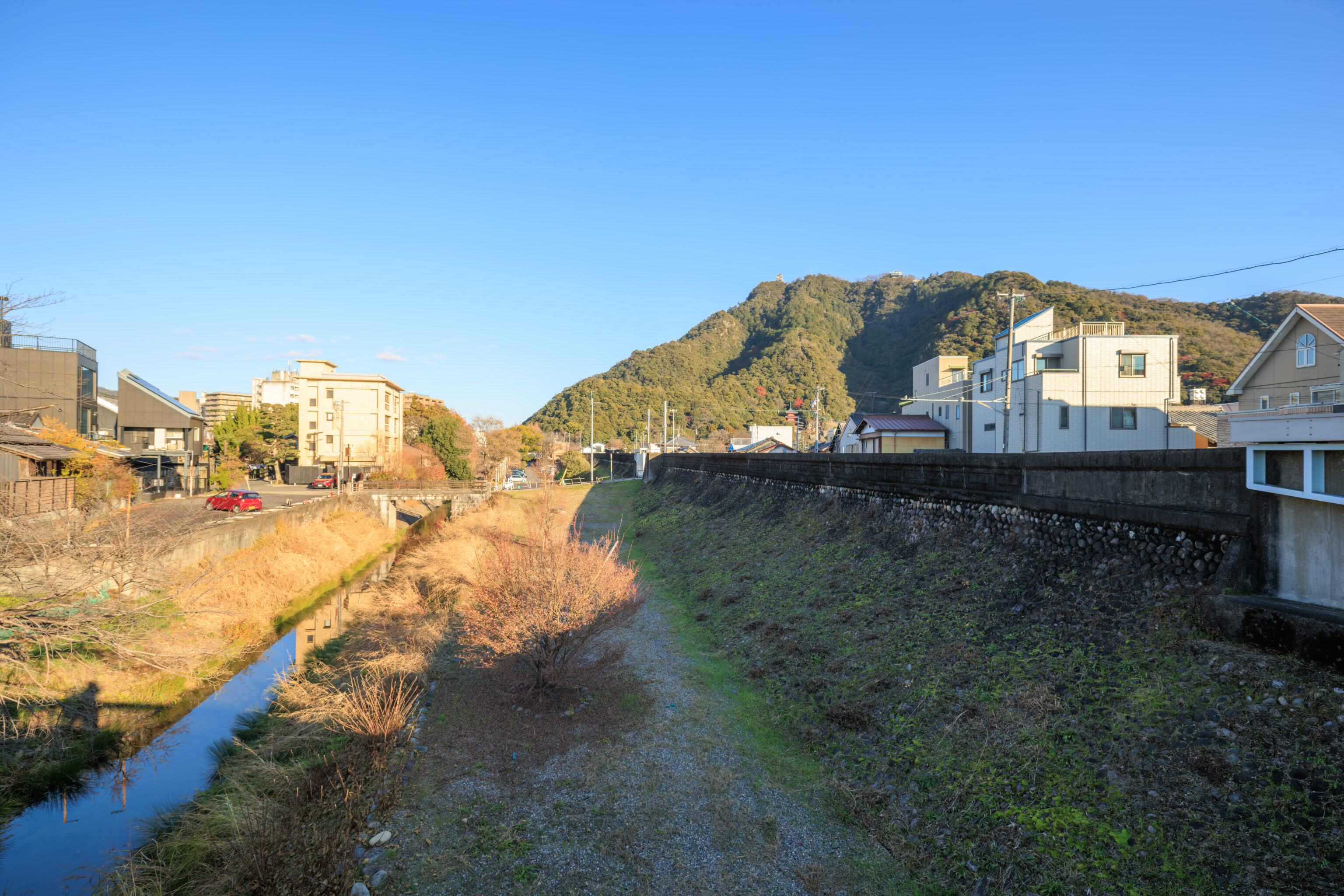
We didn’t actually walk all the way to the western end of the Kawaramachi. Instead, we turned left to take the second to last bridge over a stream on the southern edge of the district. This is the same stream we crossed over in Gifu Park this afternoon. This was the view from the bridge, probably named 霞橋 Kasumi Bridge, looking the east.
Once we reached the road on the southern side of the stream, we started to walk to the east. The road didn’t have a proper sidewalk, which isn’t ununsual in Japan. But, it didn’t have much of a shoulder either, particularly for a road of its size in a relatively urban environment. It was a bit sketchy.
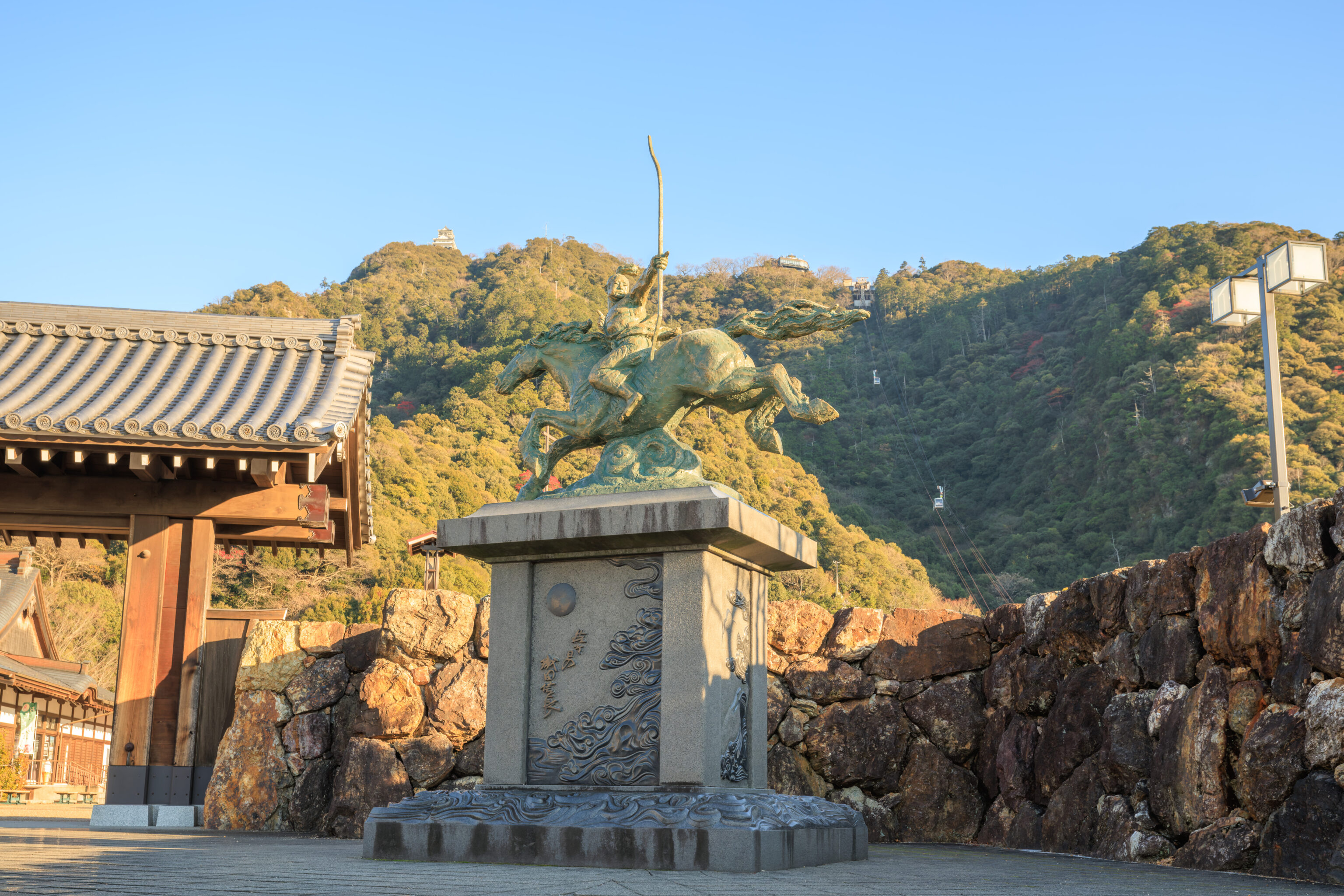
We walked three blocks along the side of the road to return to the western edge of Gifu Park. This fine statue depicts Oda Nobunaga. There is actually a large plaque behind the statue which has a brief description of the statue and a list of donors. The descriptive text reads:
This statue of Oda Nobunaga in his youth was created by Seibo Kitamura to commemorate the centennial of Gifu City's municipal organization and was donated by the individuals listed to the left.
– Text from a photograph on Google Maps of the plaque on the back of the statue’s pedestal, read using Google Gemini and translated using Google Translate.
The statue was created by Seibo Kitamura, who created the big blue Peace Statue in the Nagasaki Peace Park! We visited the park and saw his statue earlier on this trip. And, we saw many other sculptures that he created at Shimabara Castle!
We caught a bus from the bus stop just to the south of this statue to return to Gifu Station.
Gifu Station
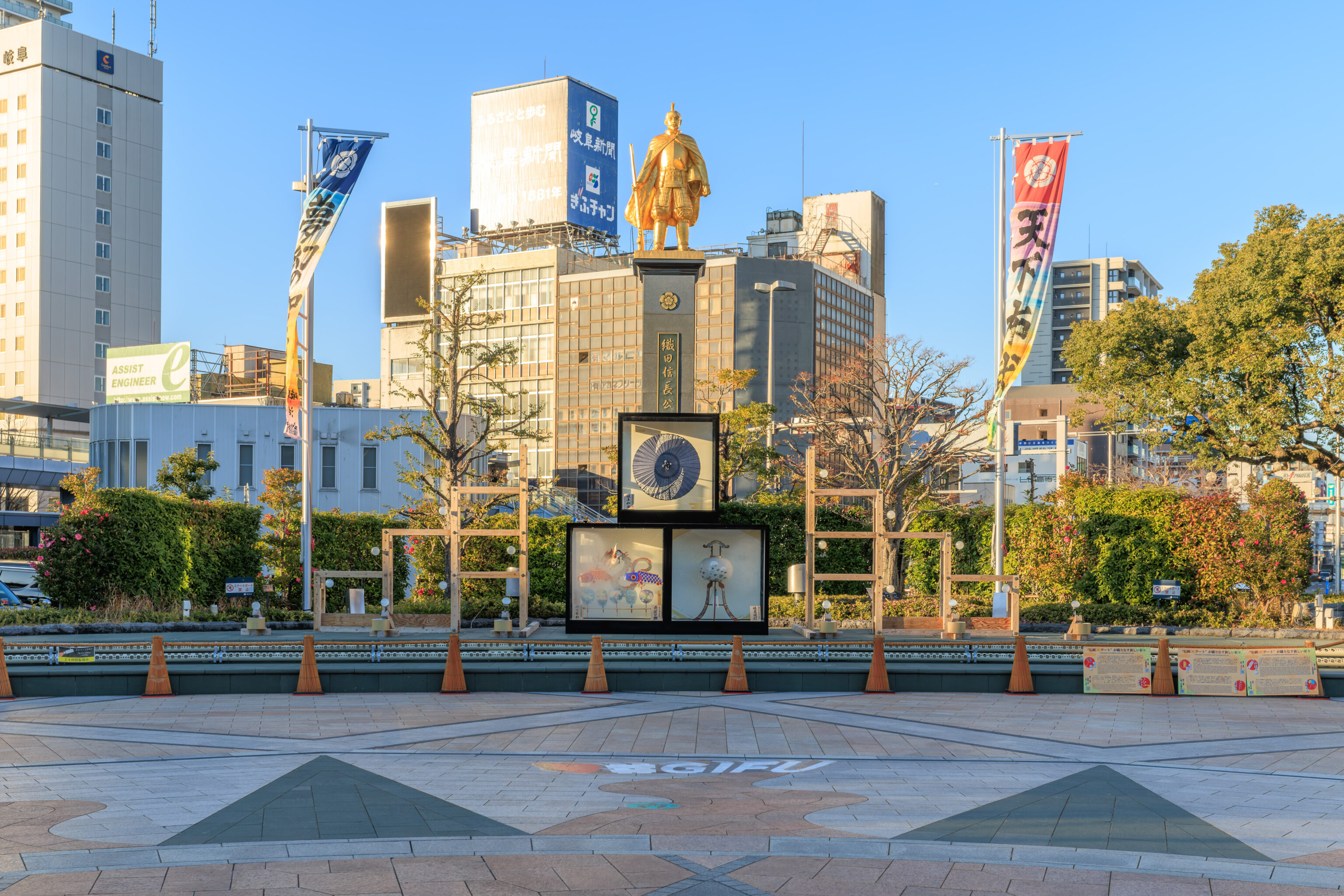
After returning to Gifu Station, we walked around the area in front of the station a bit. We walked over to see the golden statue of Oda Nobunaga, the same one that we saw a small replica of at Gifu Castle.
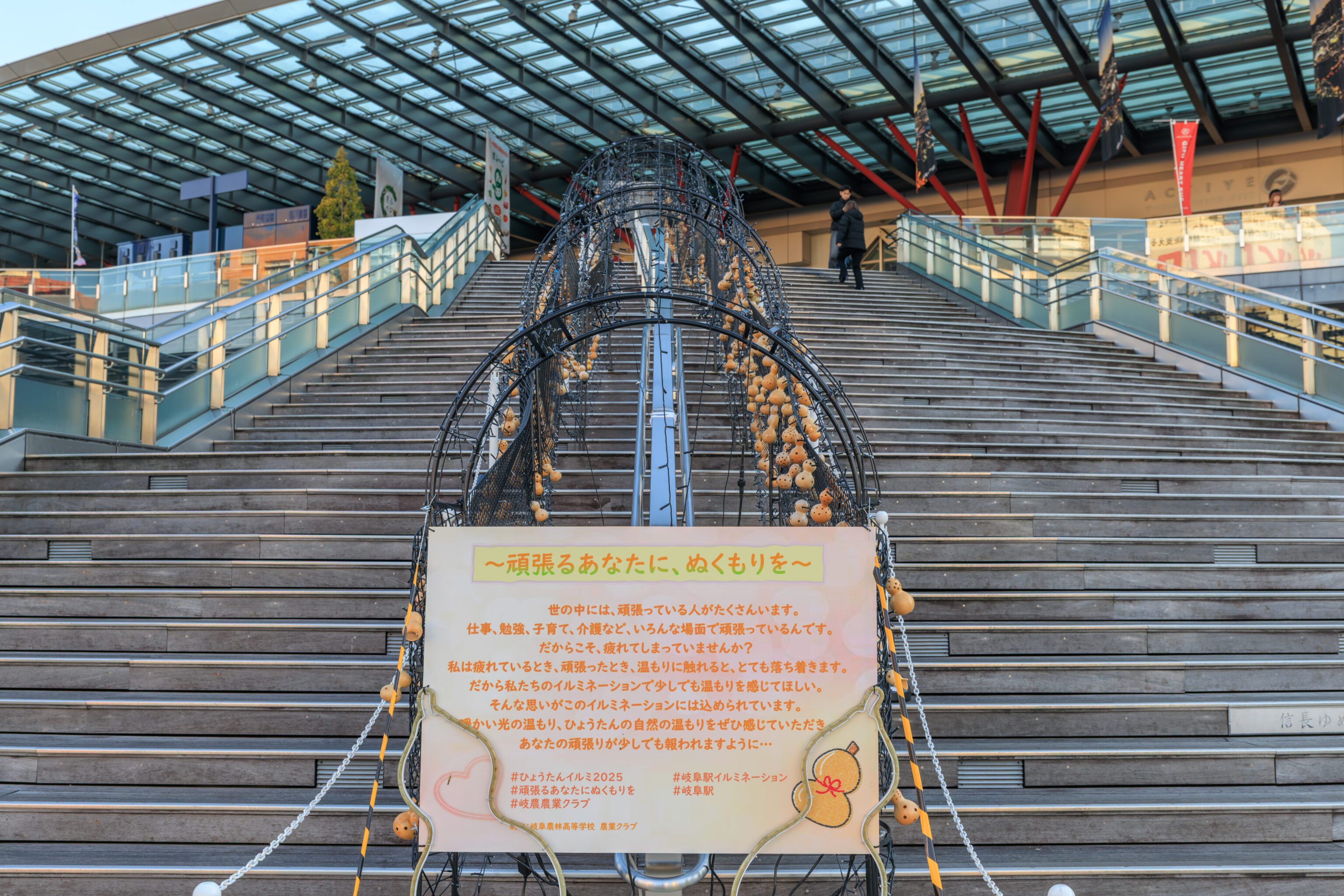
Looking back at the station, we saw a sign with a message on the stairs leading up to the second floor:
~Warmth for you, as you give it your all~
There are so many people out there working hard—whether at work, in their studies, raising children, or caring for loved ones. Because of that effort, you may be feeling exhausted. Personally, I find great comfort in warmth whenever I am tired or have been working hard. That is why we created this illumination display: we want you to feel that sense of warmth, even if just a little. We hope you experience the gentle glow of the lights and the natural warmth of the gourds, and that your hard work feels truly rewarded.

Gifu Agricultural and Forestry High School Agriculture Club
– Text from the sign in the photo above, read using Google Gemini and translated using Google Translate.
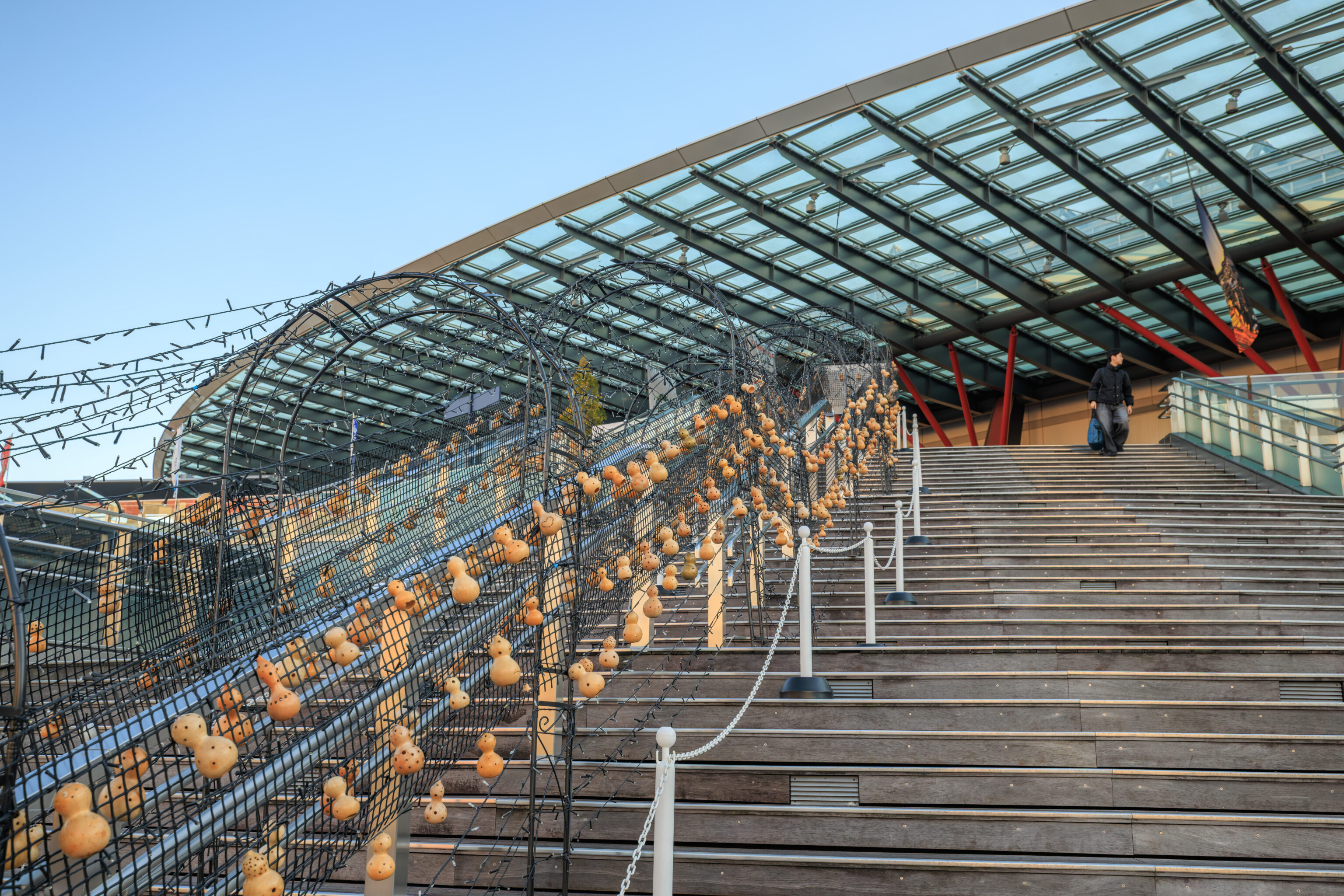
Why gourds? We’re not sure. But there is a connection with Toyotomi Hideyoshi, who initially had served under Oda Nobunaga. Toyotomi Hideyoshi’s umajirushi, basically a huge flag used on the battlefield, was shaped like a gourd.
国立国会図書館デジタルコレクション National Diet Library Digital Collections
The banner on the left is apparently what it would have looked like.
There is also apparently a legend from Yoro, which is a nearby town:
A local woodcutter discovered a stream that ran with fine sake. He filled a gourd and brought the liquid to his father. Drinking the liquid made his father feel youthful and turned his hair from gray to black. Empress Gensho of Nara visited Yōrō to try the liquid and it made her youthful, too.[
– Text from Wikipedia’s Yōrō, Gifu page.
So, gourds are locally important…
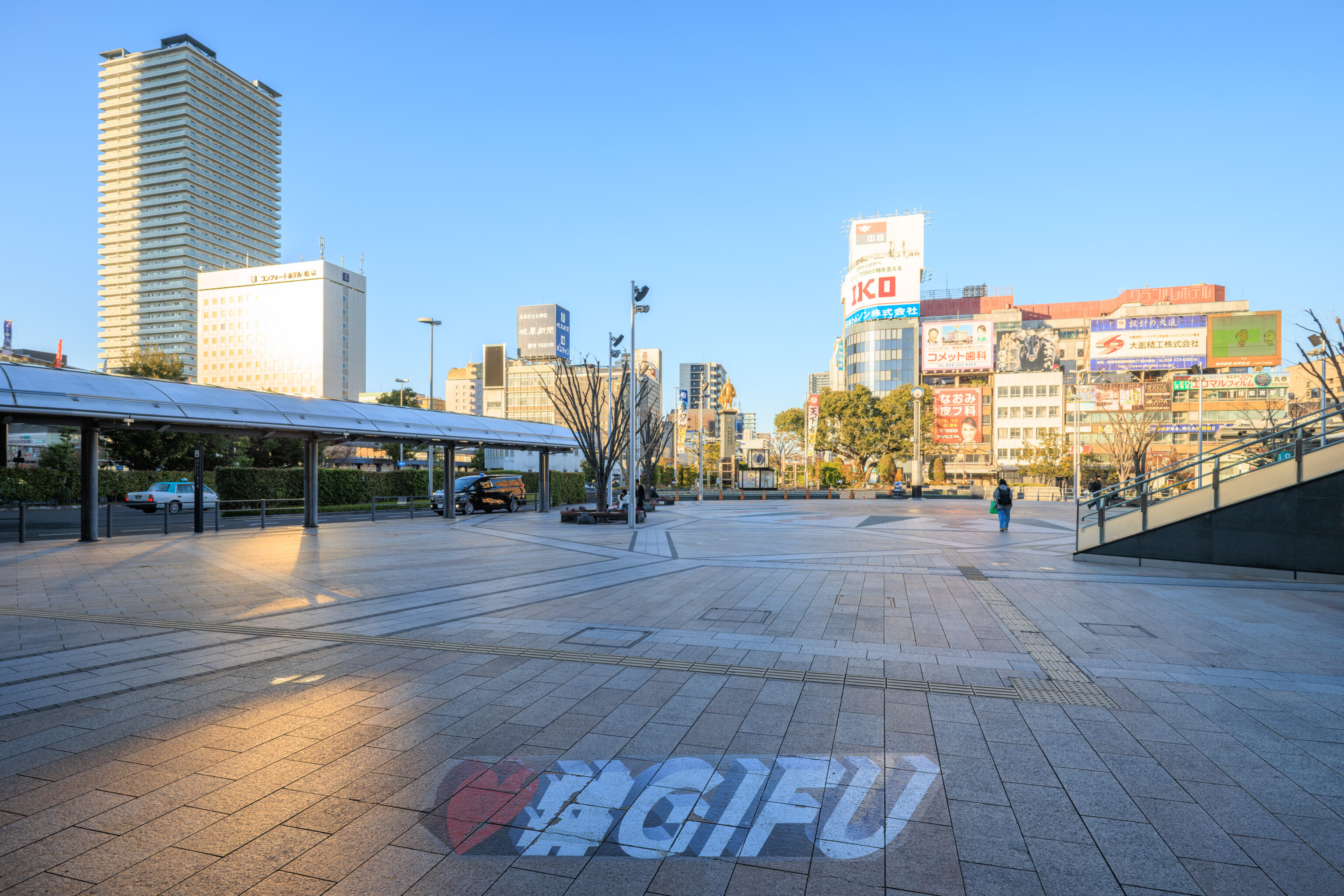
#GIFU
Nagoya

After returning to Nagoya Station, we decided to have hitsmabushi, a dish that originates here in Nagoya, for dinner at Hitsumabushi Bincho in the ESCA underground shopping mall. 備長炭 binchotan is a hardwood charcoal used for various forms of grilling in Japan. As the name suggests, this restaurant uses binchotan to grill eel. We arrived before the restaurant opened and were #1 in the queue with a wait of about 15 minutes.
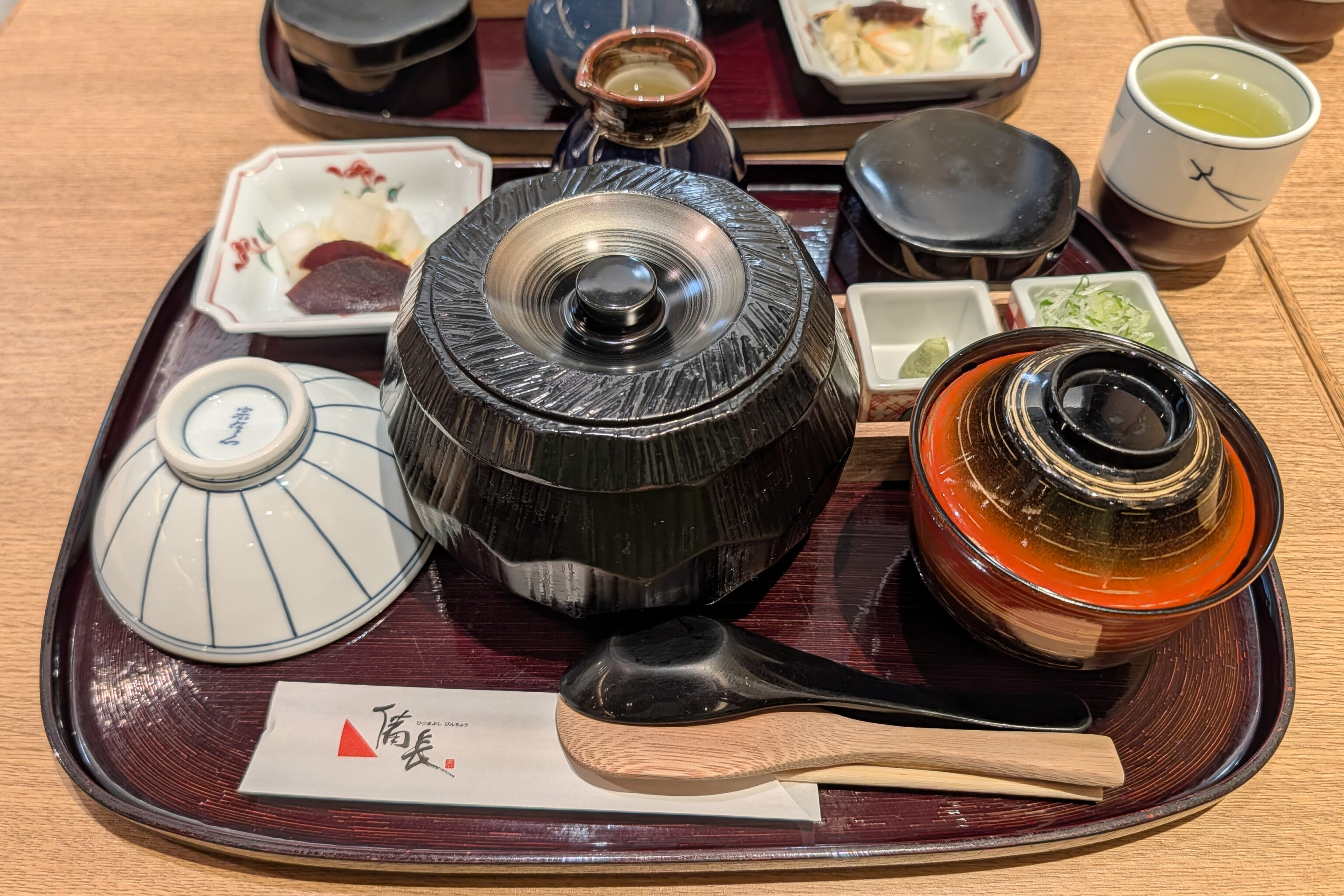
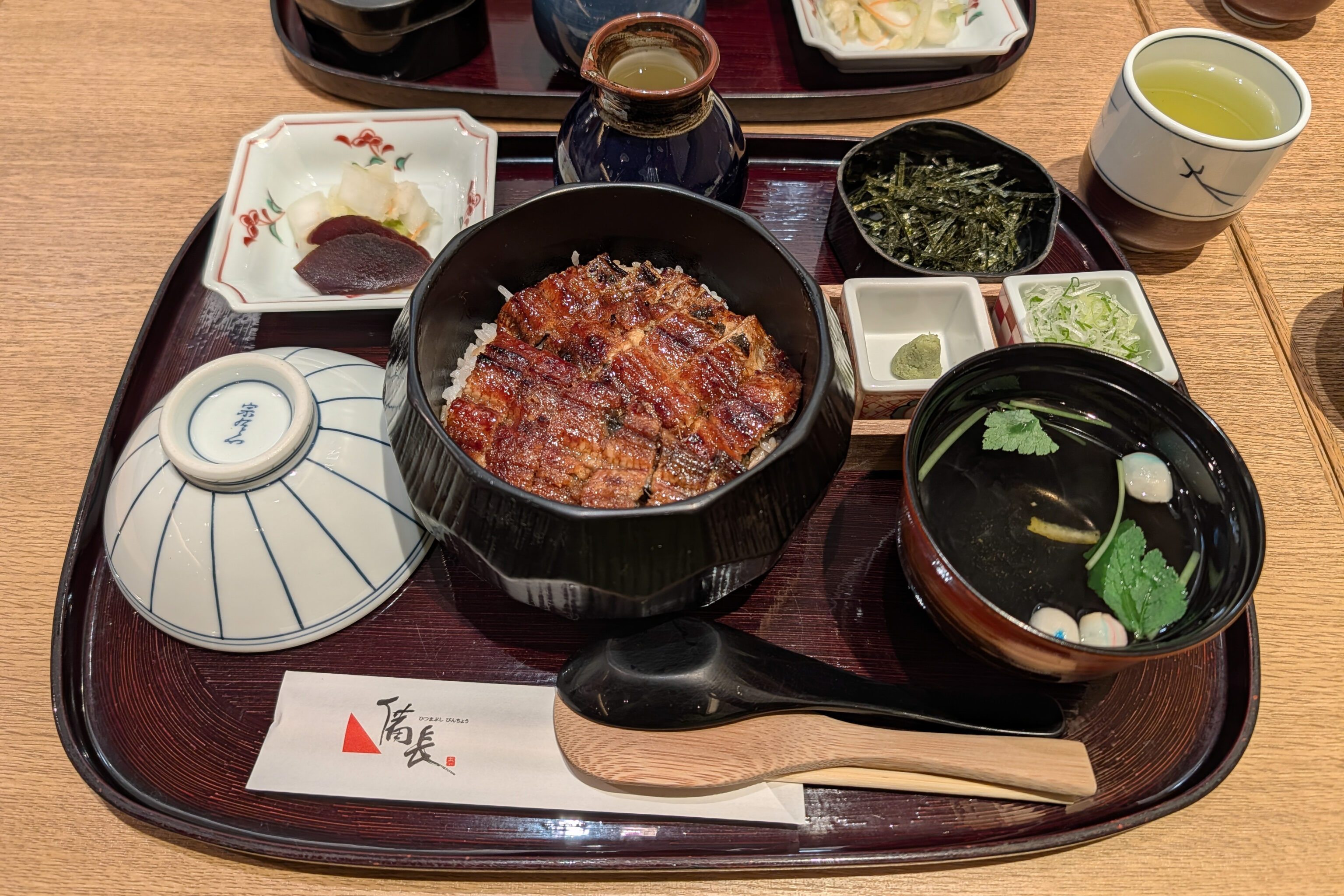
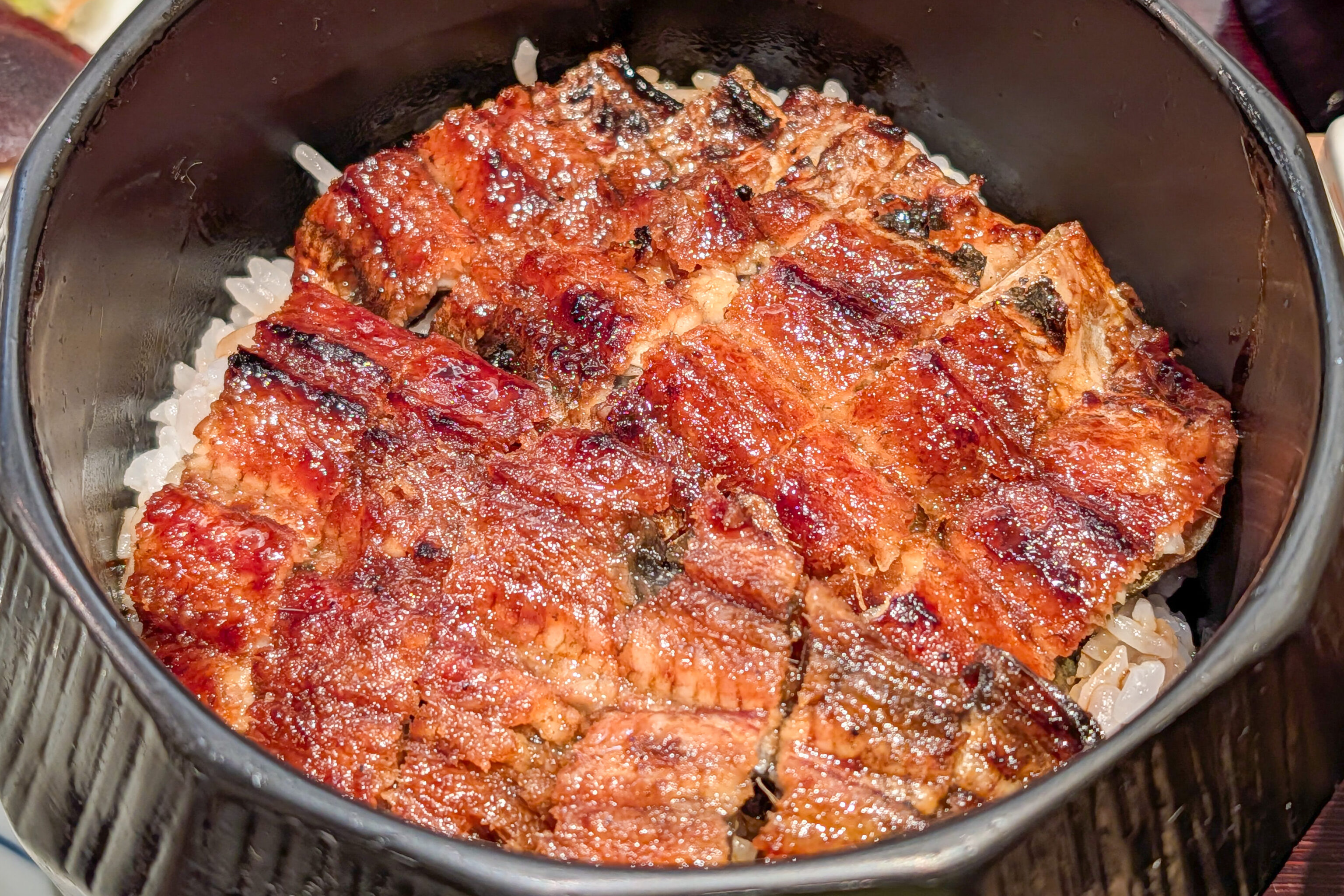
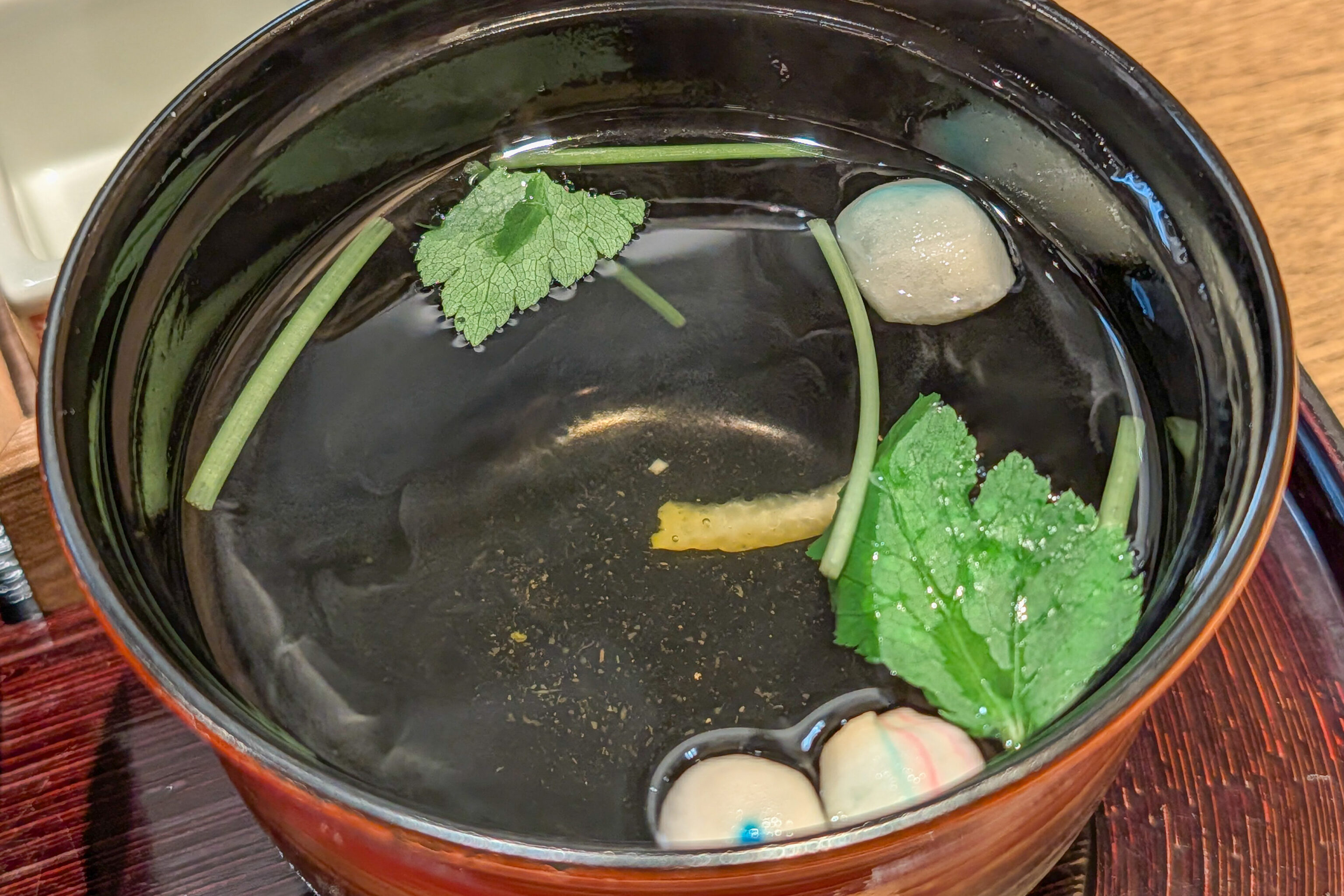
We got two of the 3/4th eel portions as we weren’t too hungry. The eel was fantastic!
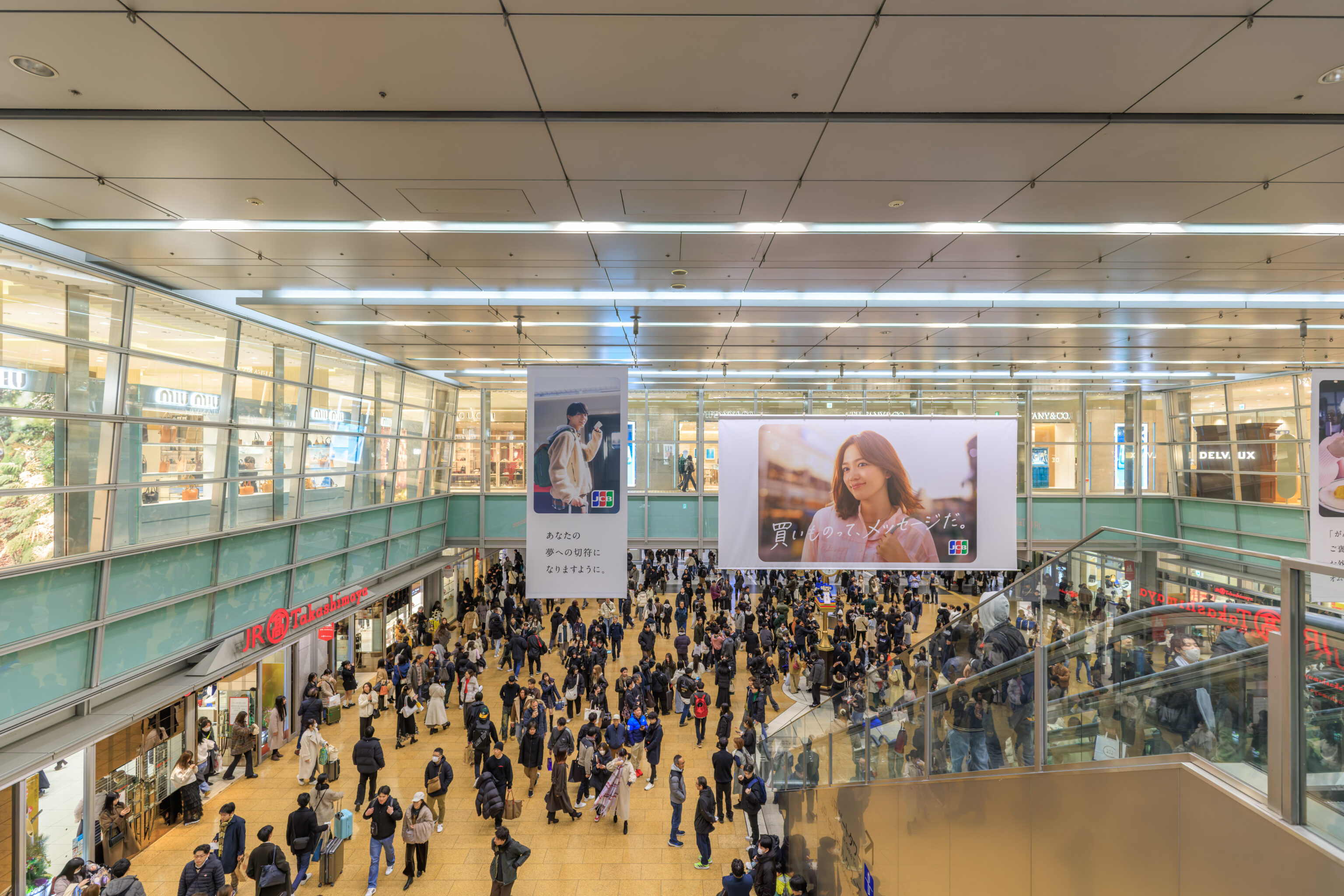
We decided to walk around a bit after dinner. The big room with the clock by the entrance to the Takashimaya department store was super busy, just like yesterday.
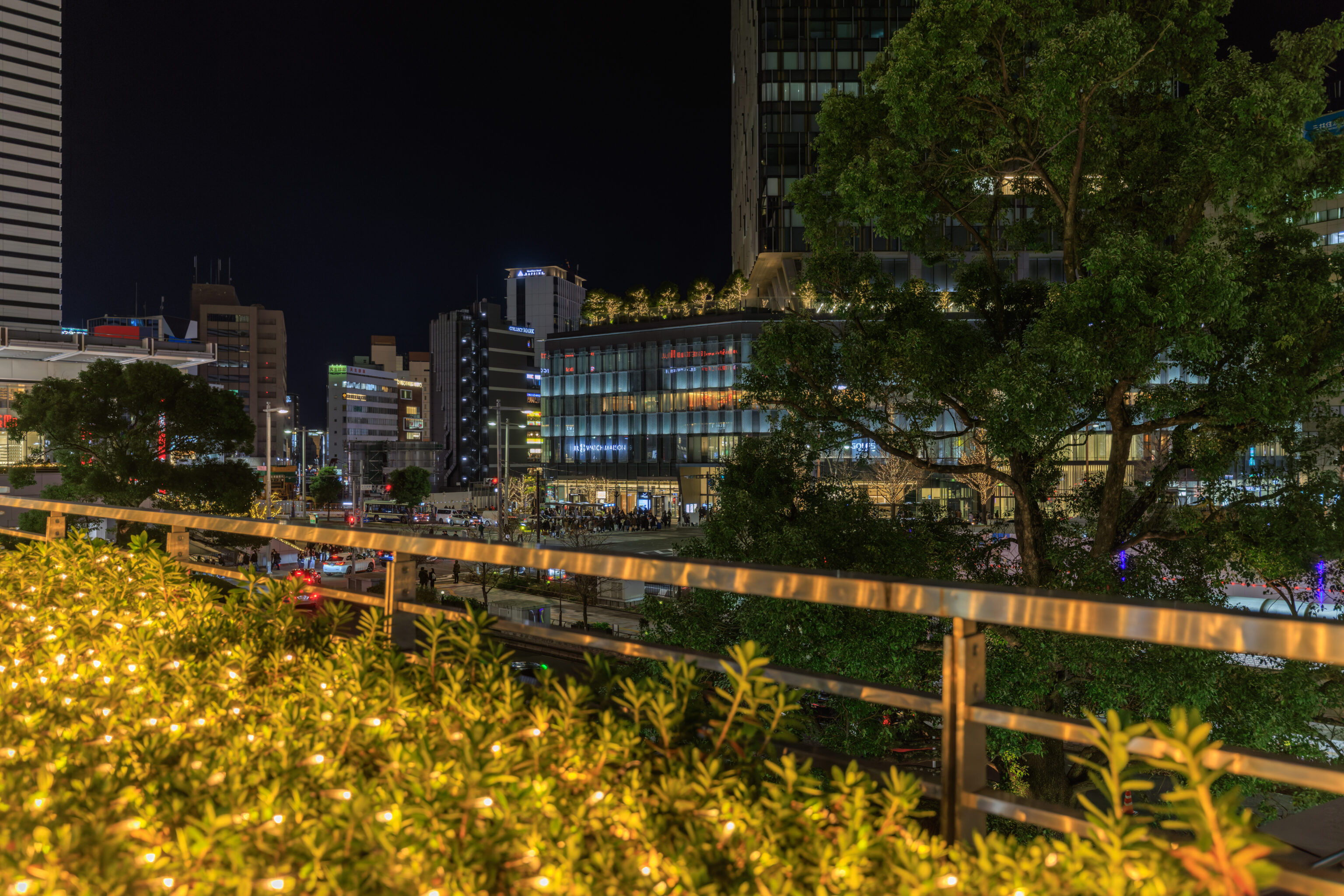
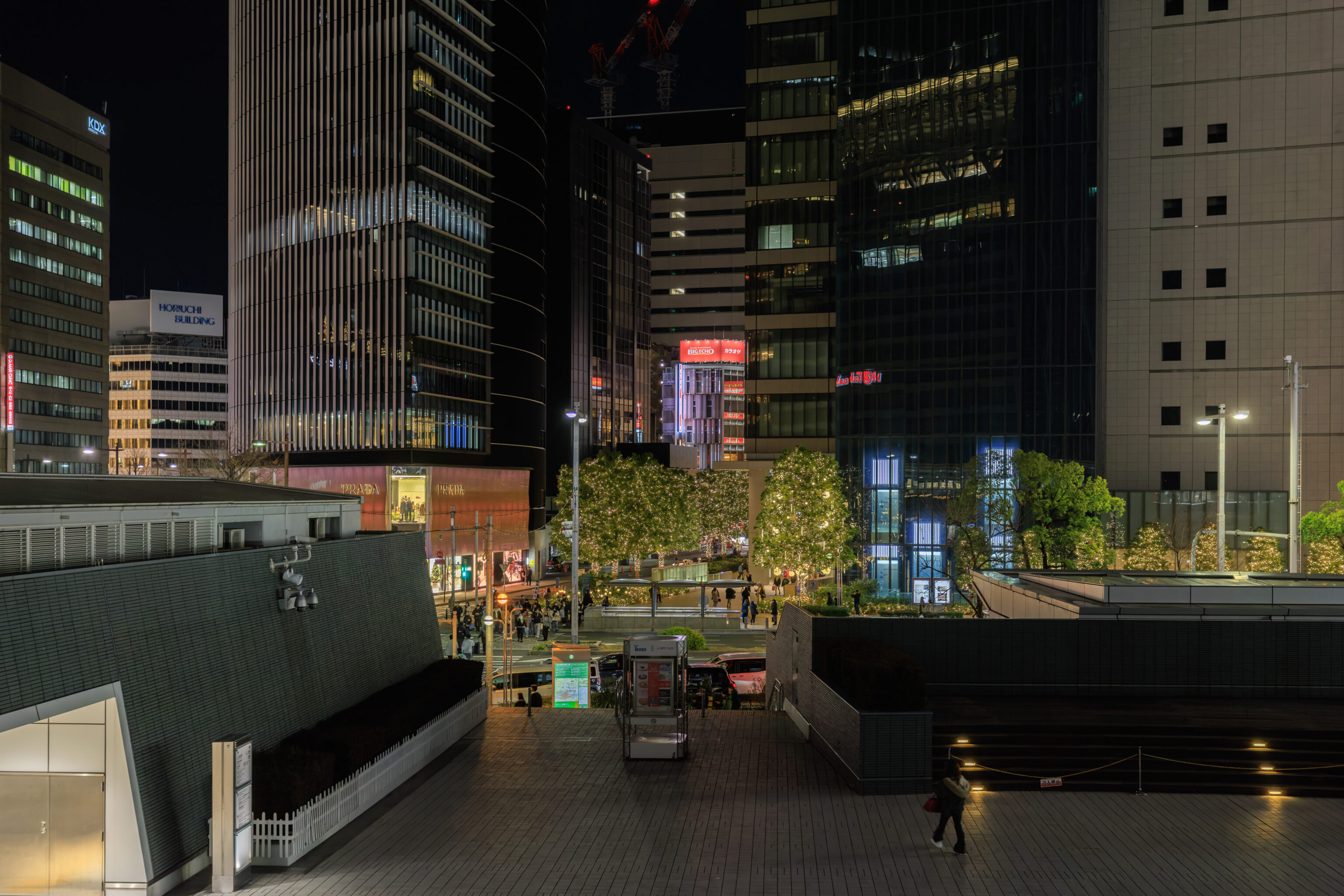
We went outside to take a look. In some places in Japan, Christmas illuminations don’t last long after Christmas. We were happy to see that there were still lights here by Nagoya Station.
We found a piano decorated with flowers, a dragon, and more importantly, a cat!
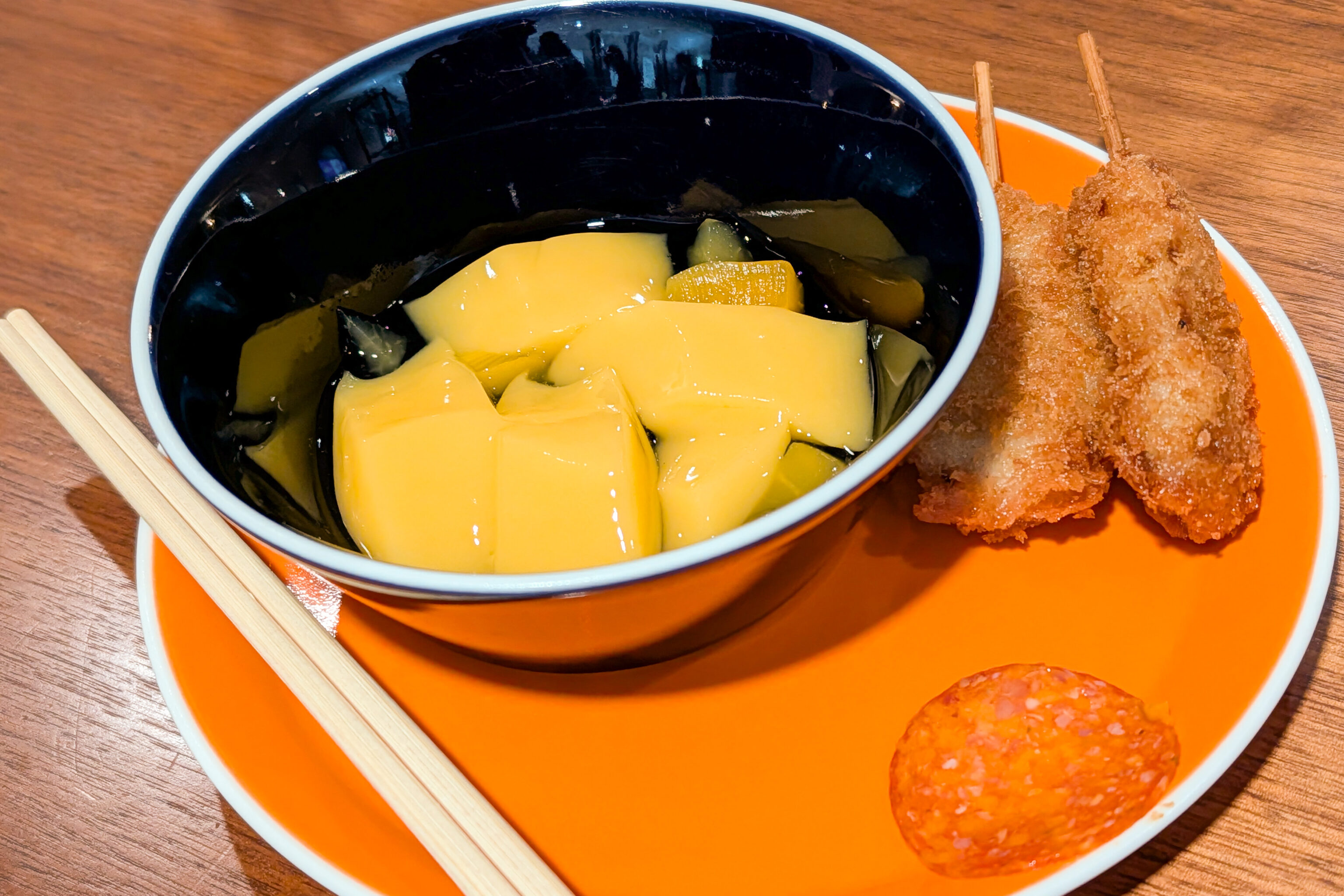
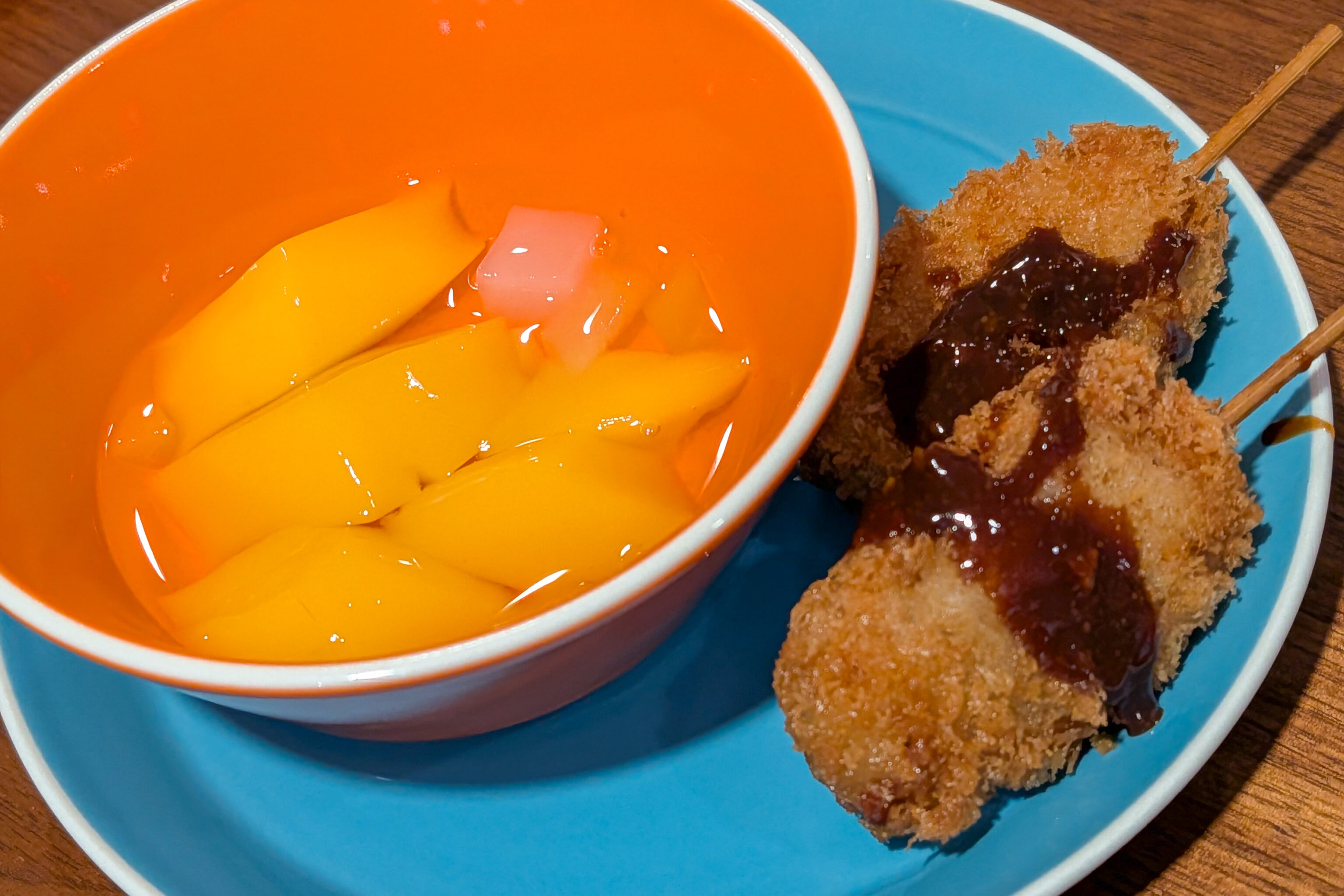
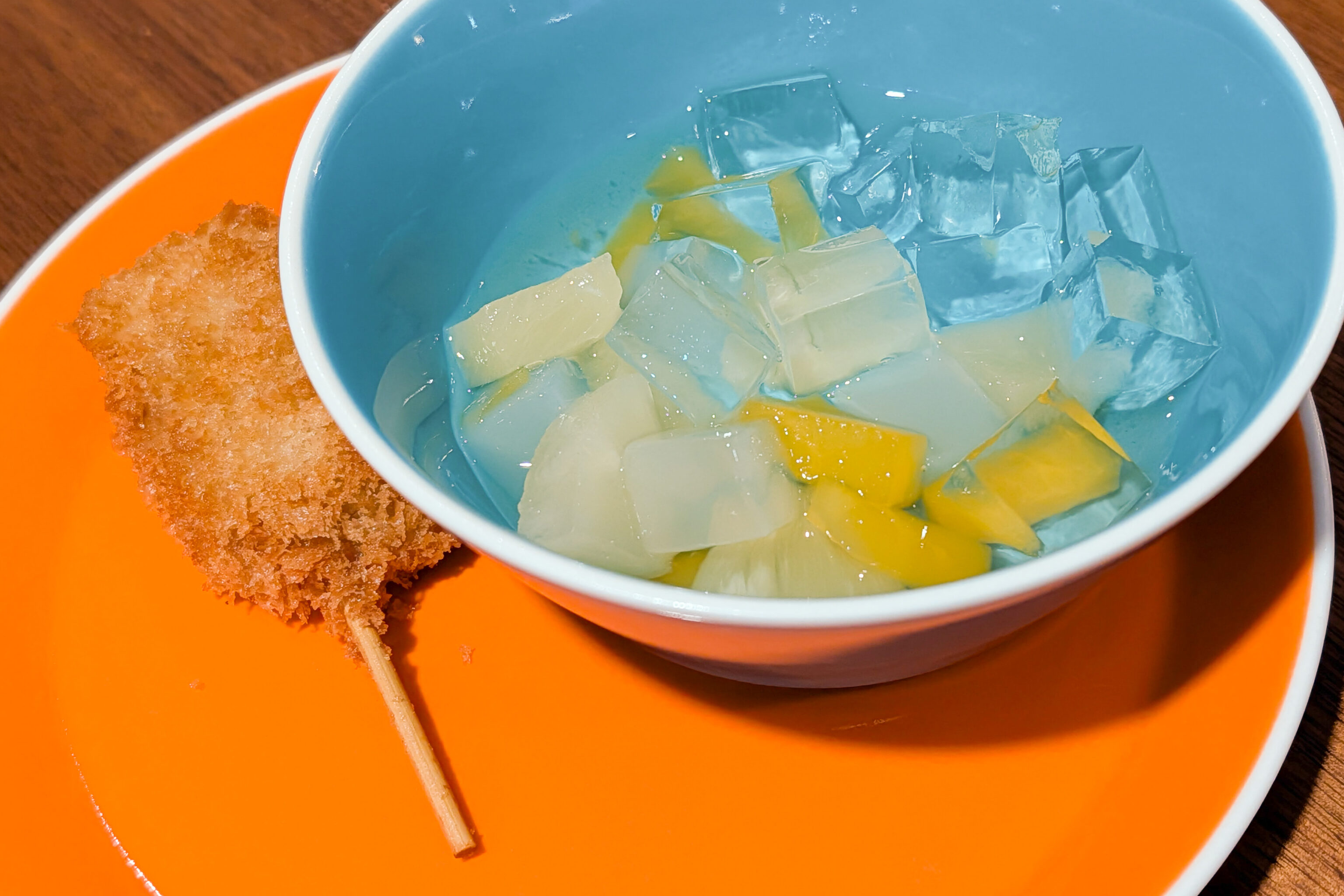
Later in the evening, we went up to the lounge at the Marriott to see what was available. There were some different items from yesterday. The kushikatshu was surprisingly good along with what was described as mango pudding.
Amusingly, this clock showed 0:52 to indicate 12:52am. Does it display the same thing at 12:52pm?