
After breakfast at the InterContinental Lyon Hotel-Dieu, we decided to head up to Beaune as the weather forecast was the most favorable there. We came upon a marching band and the 165th Hospices de Beaune Wine Auction! We enjoyed some music and food, saw some historic buildings and a bit of the auction, and visited the Fallot mustard factory.
Morning
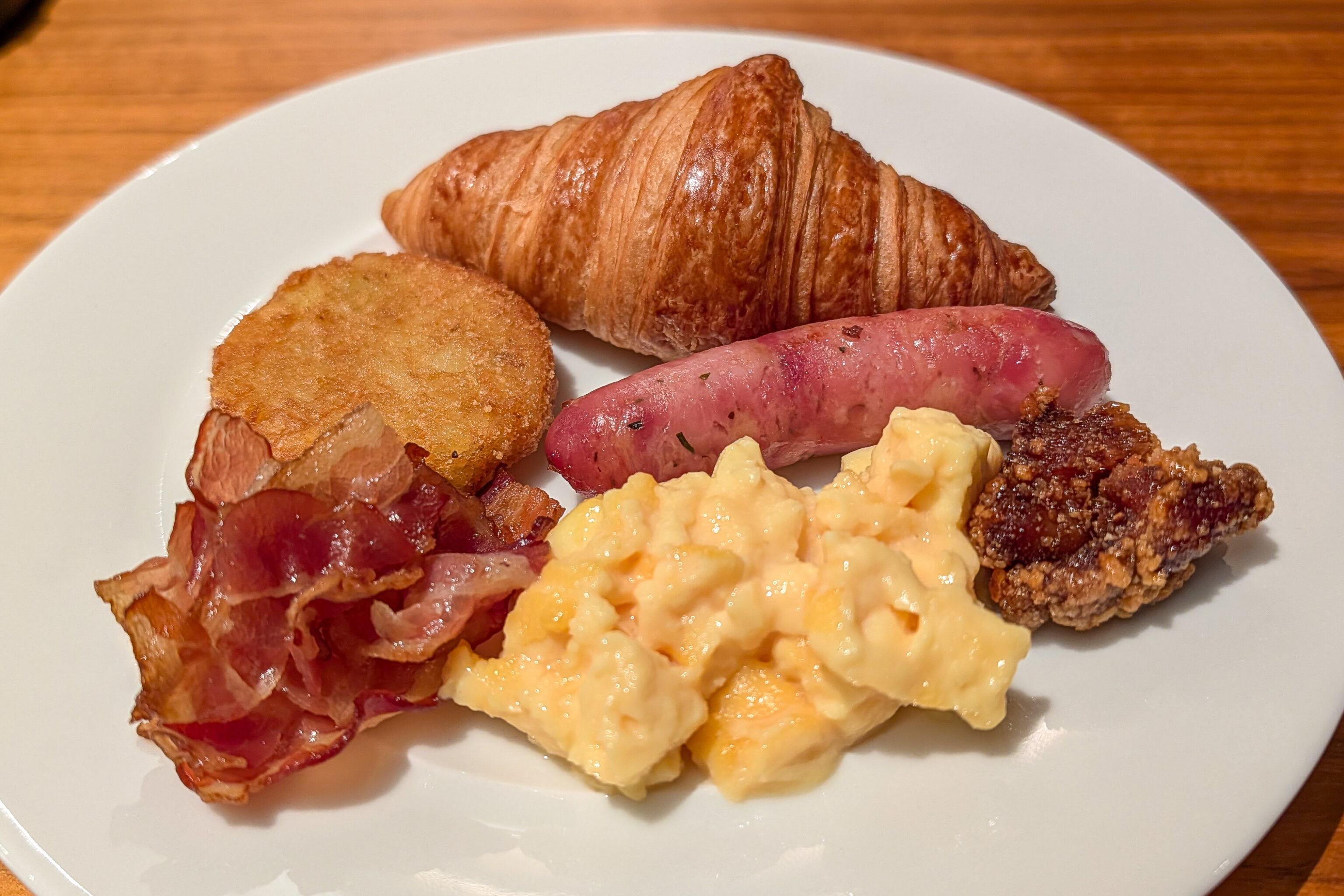
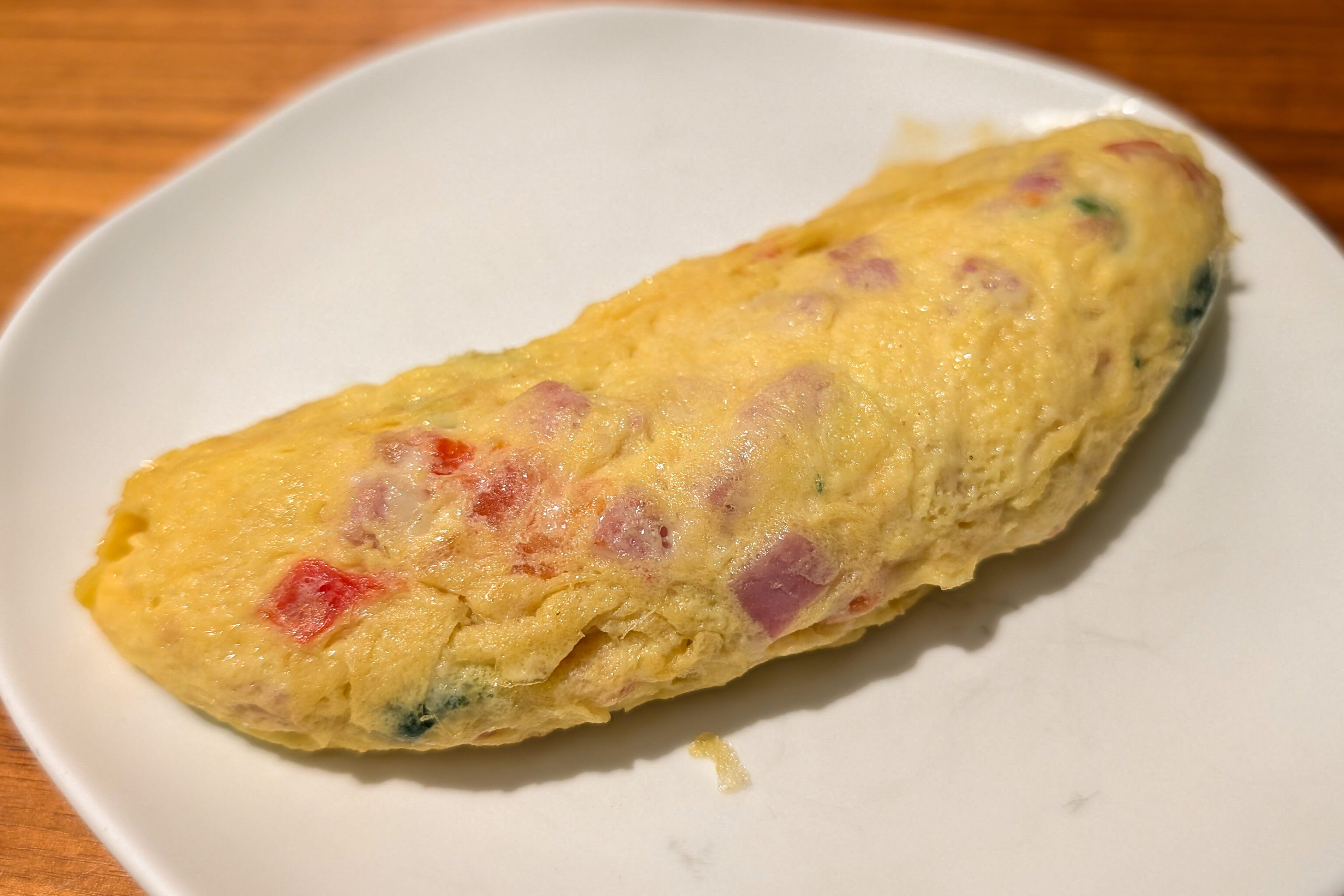
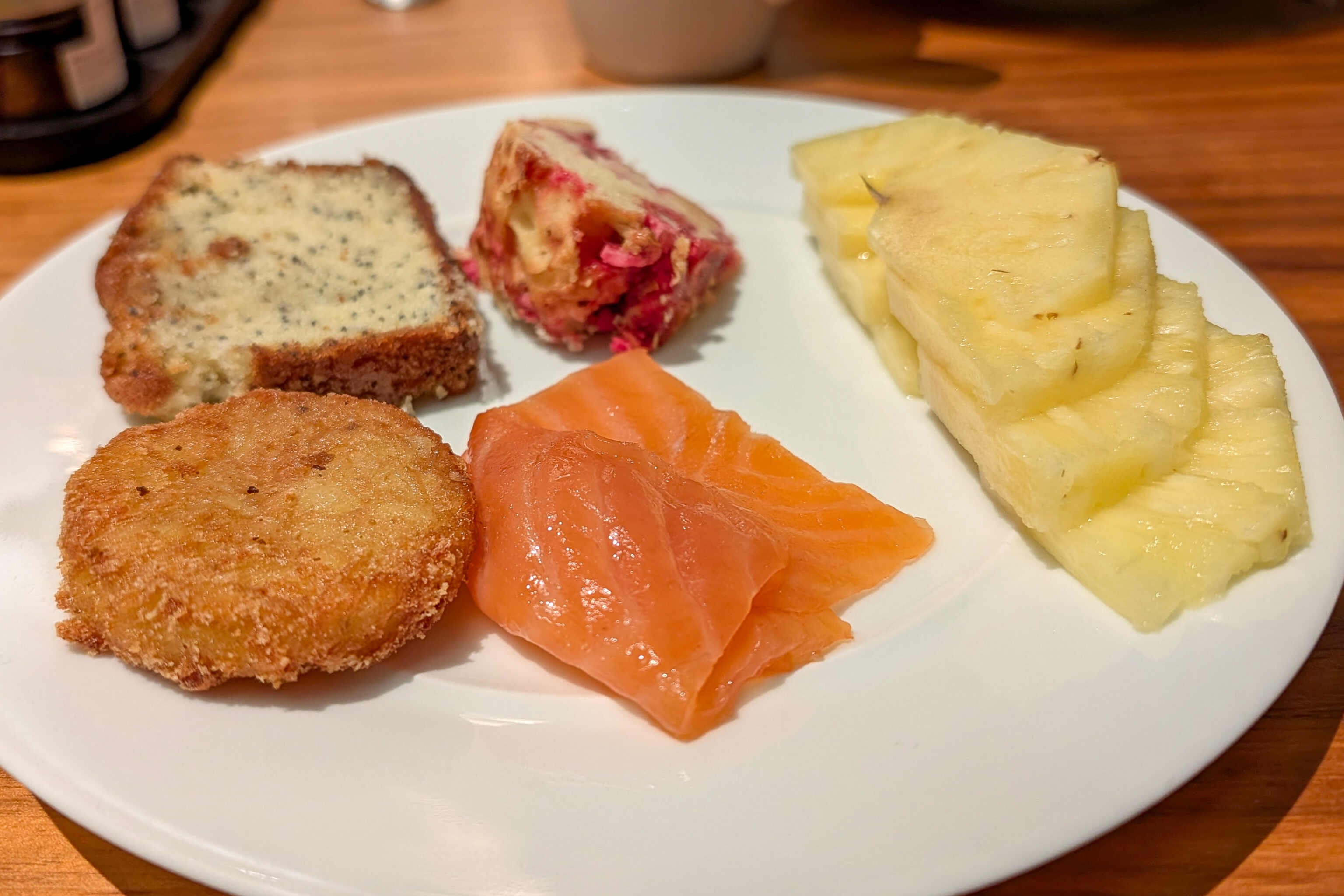
Breakfast at the InterContinental Lyon Hotel-Dieu was the same as it has been the previous few days. We had our favorites as well as the Korean chicken, which we keep getting even though it isn’t any good! It’s a bit of a novelty having it for breakfast in places that aren’t Korea!
Yesterday was a rainy day here in Lyon and the forecast for today was not great either. Locations to the south that we wanted to visit were forecasted to be even worse. So, we decided to go north up to Beaune. Beaune is a small city about 20 minutes to the south of Dijon by train. Although Beaune is in between Lyon and Dijon, it can take longer to get to Beaune than Dijon as generally Beaune does not have the faster TGV service.
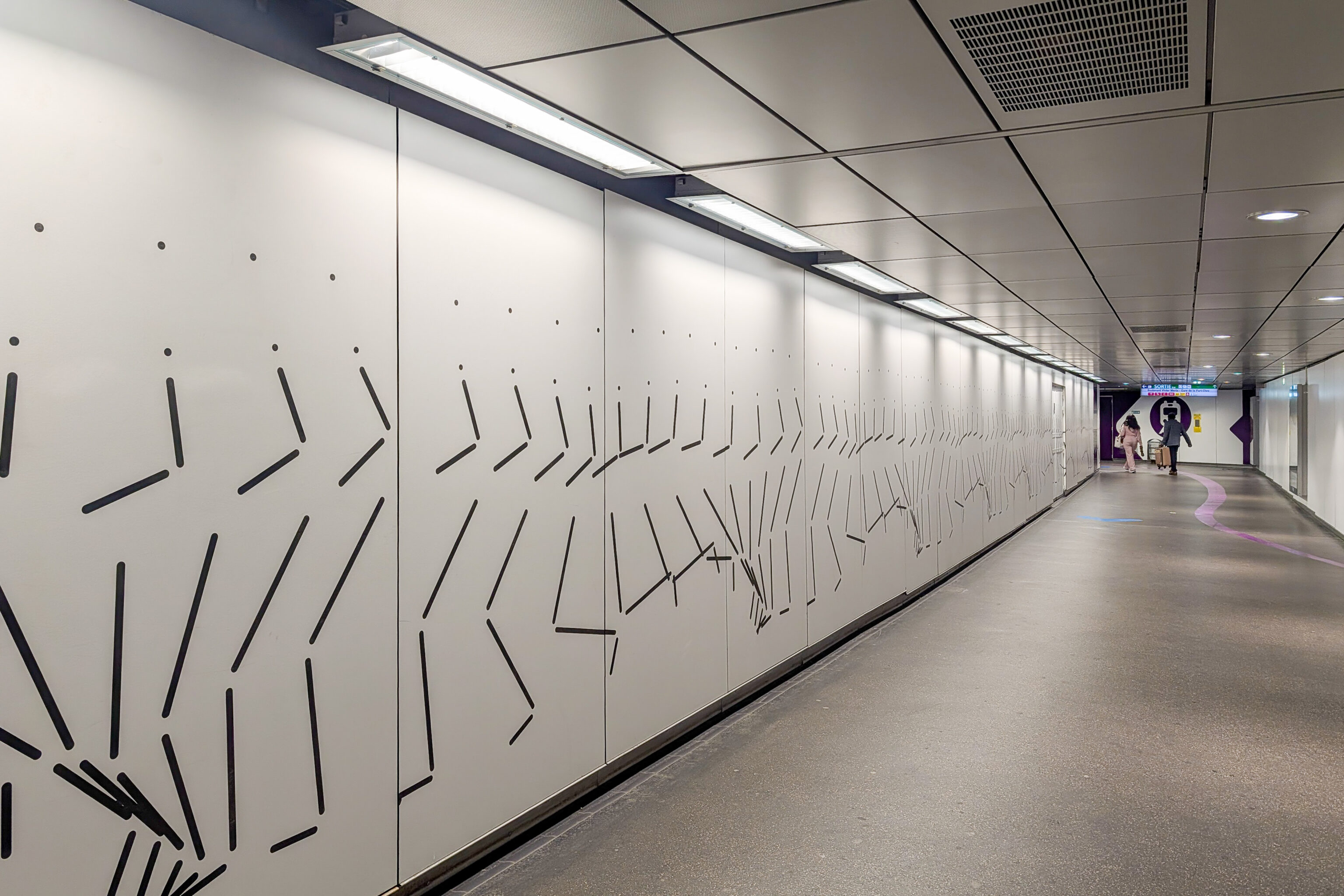
We headed to Lyon Part-Dieu to catch the next TER train to Beaune. We walked through this passageway to get from the Metro station to the train station.
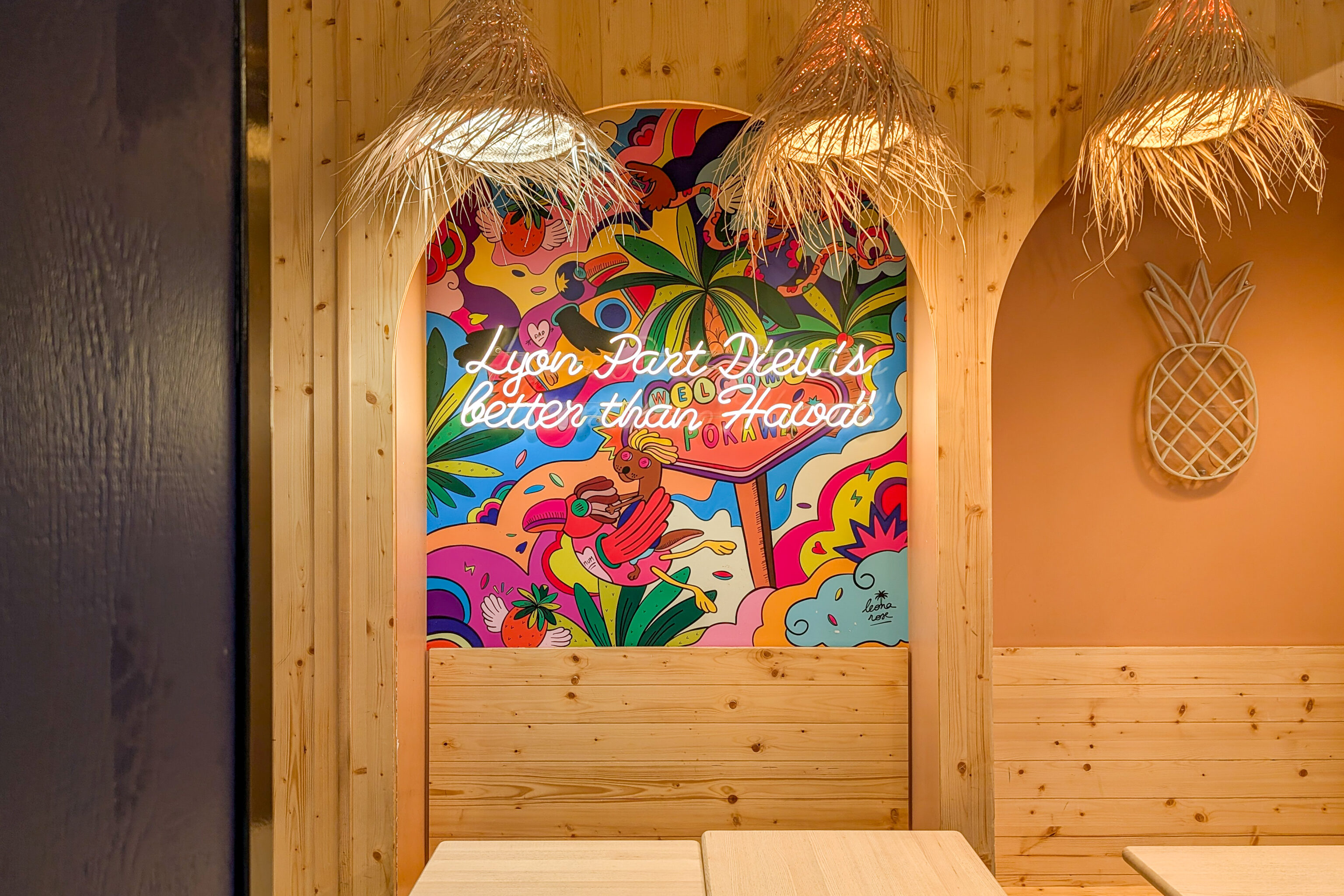
No… There’s nothing about Lyon Part-Dieu that’s better than Hawaii!
Beaune
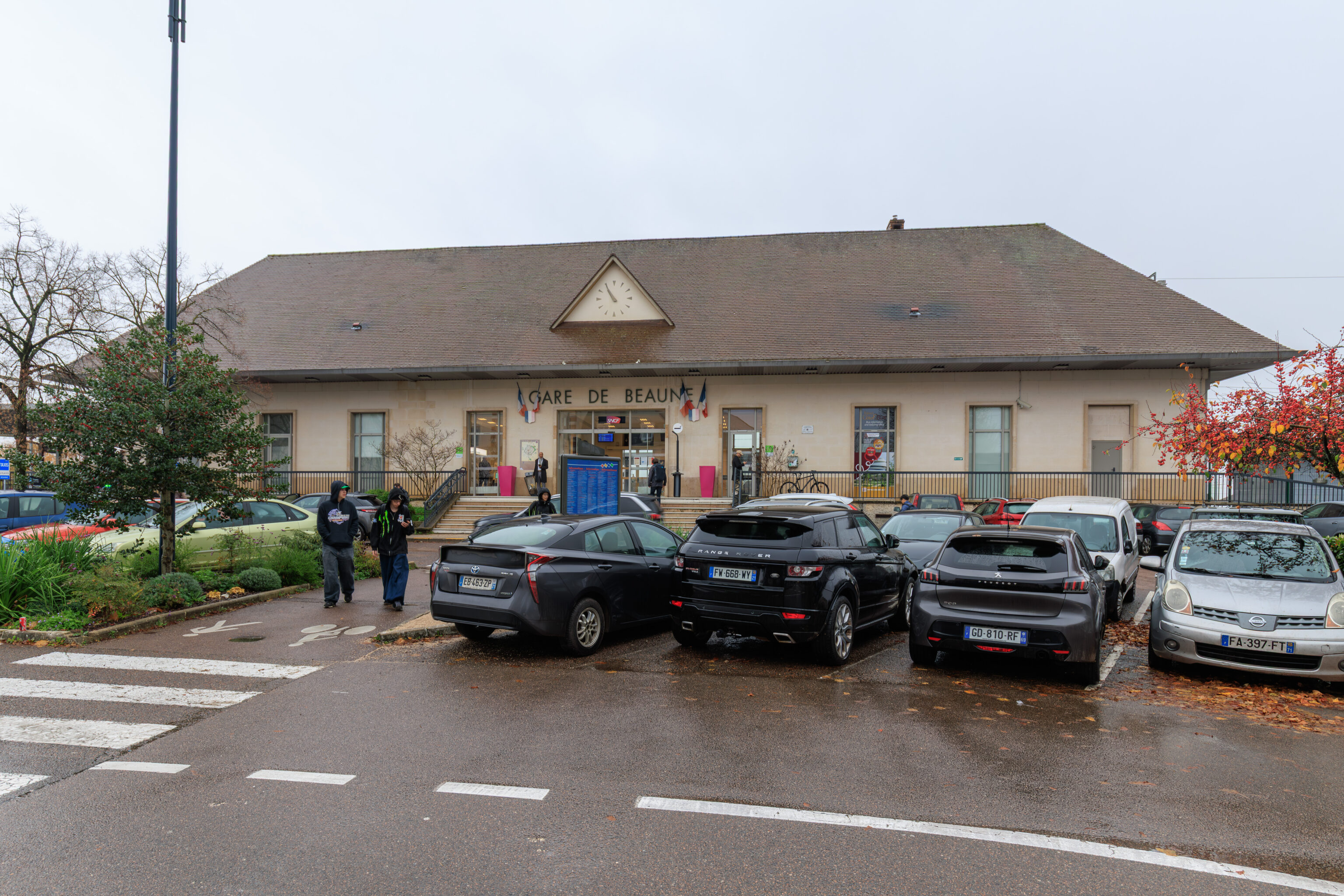
We arrived at Beaune at just before 11am after taking a TER train from Lyon Part-Dieu. While the weather wasn’t great, it wasn’t as bad as yesterday!
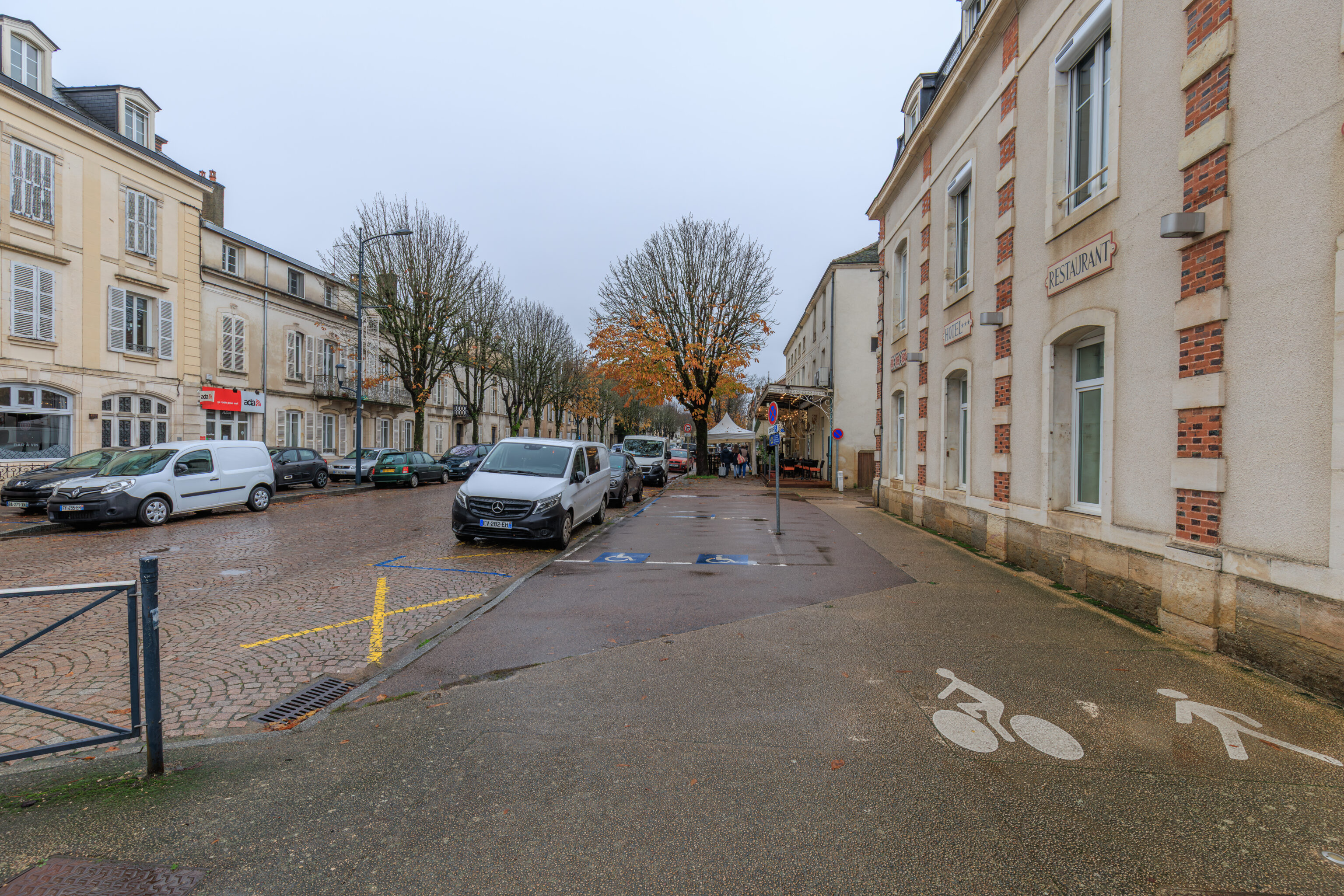
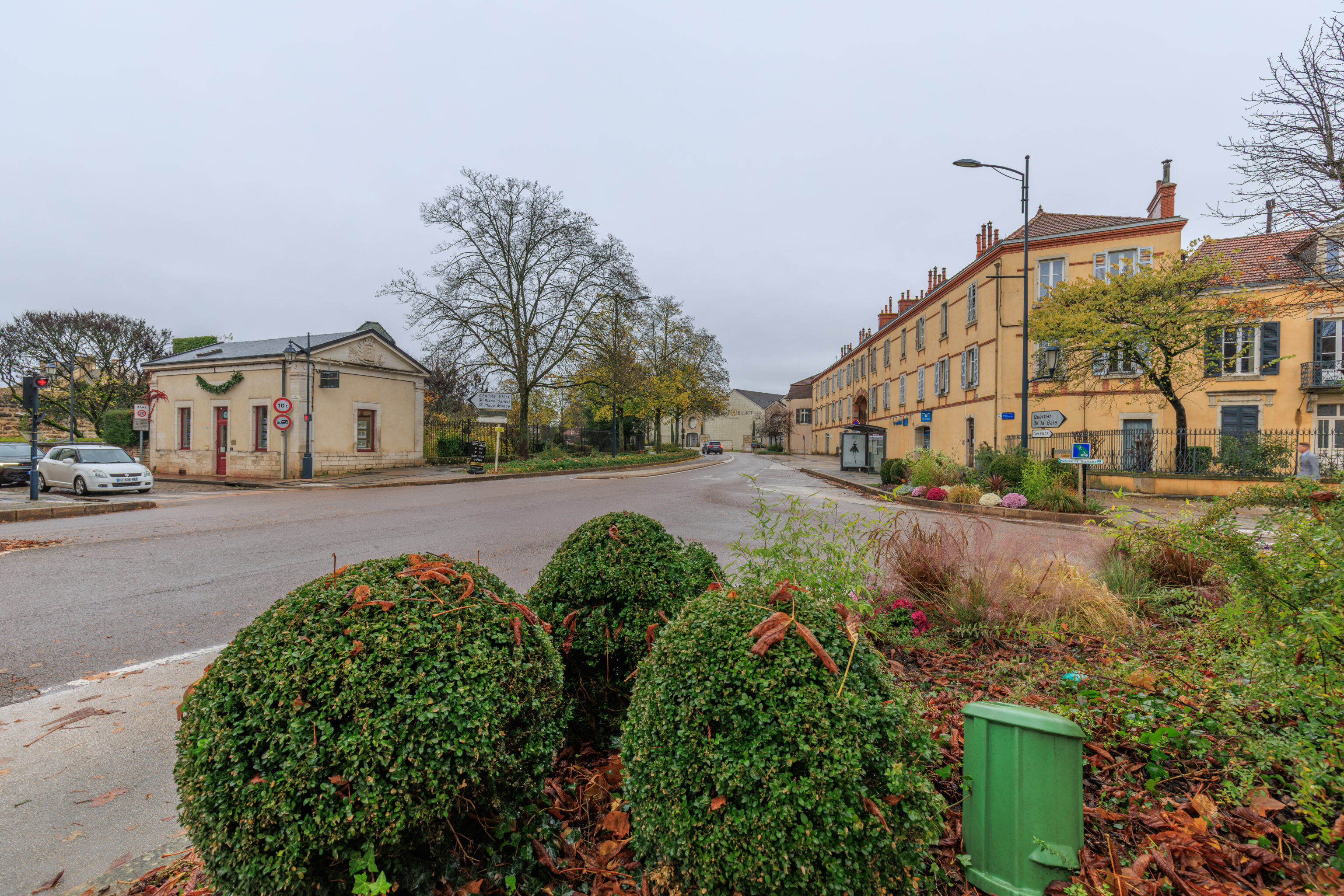
We walked to the west to get to the central historic area of the city.
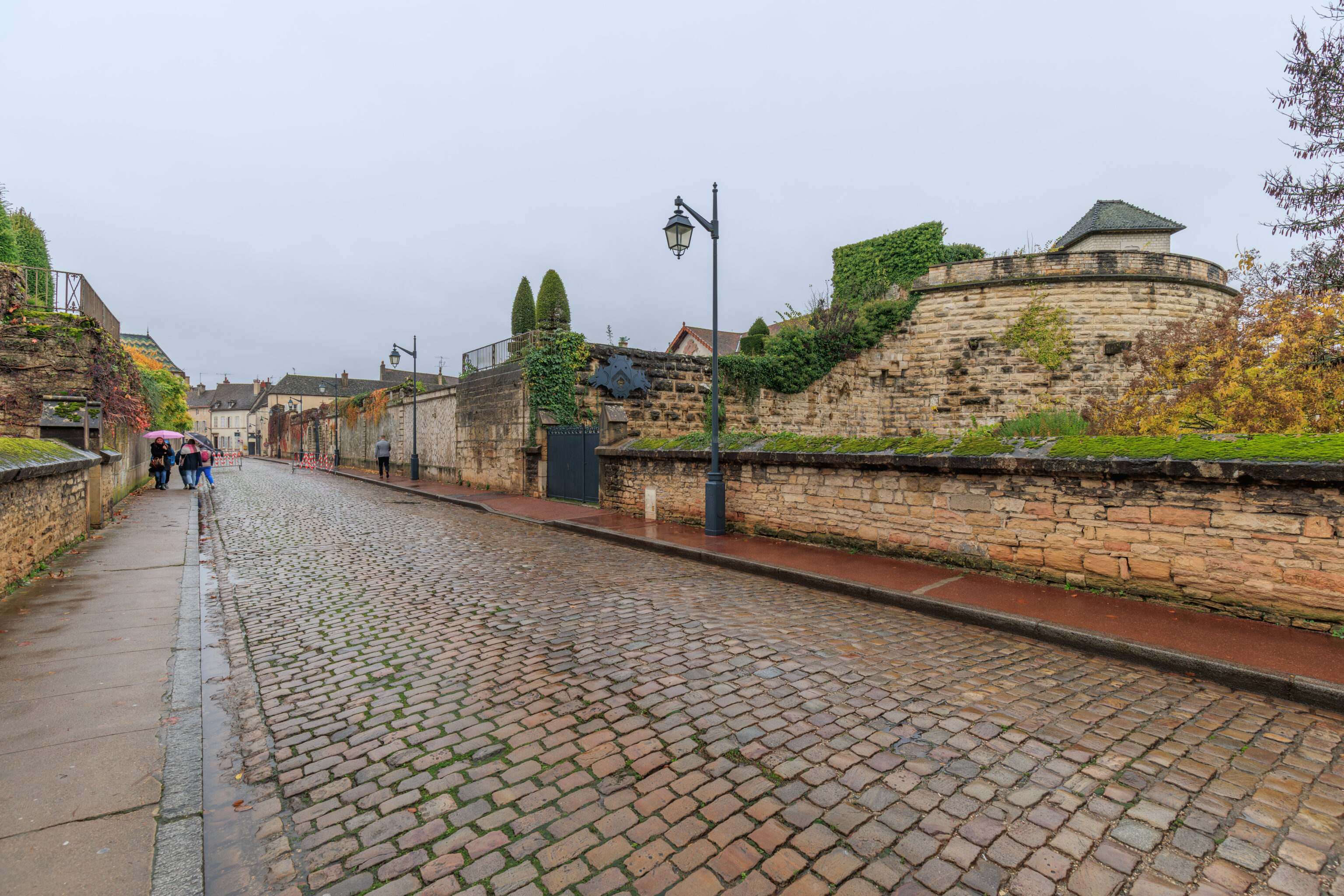
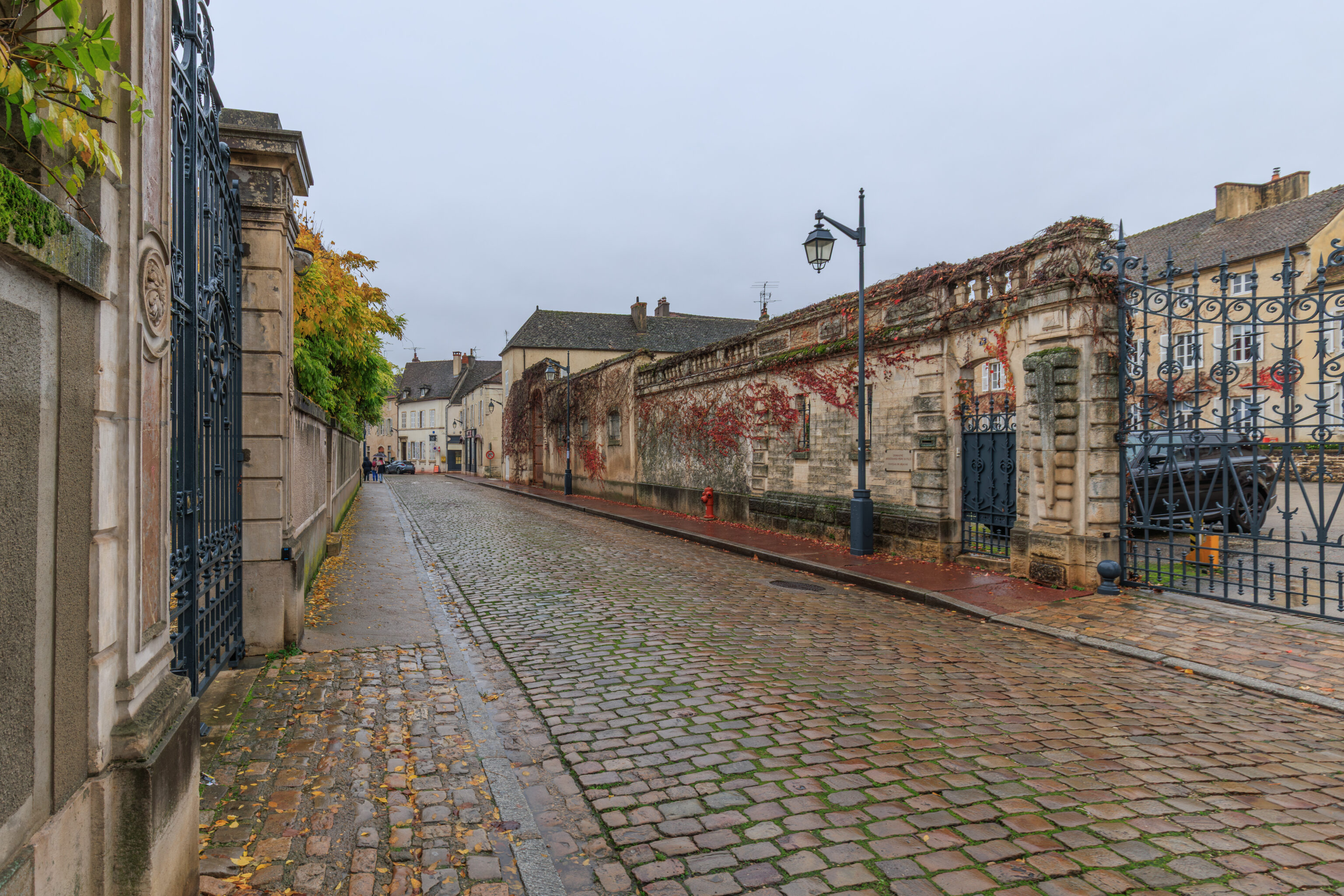
Beaune, like Dijon to the north, is in the Burgundy region, which is famous for its wine. Beaune has a number of wineries in the city. Bouchard Père et Fils is a winery located at the Château de Beaune, which was built at the eastern end of the city’s walls. Various sections of the city wall still exist today, but much has been lost.
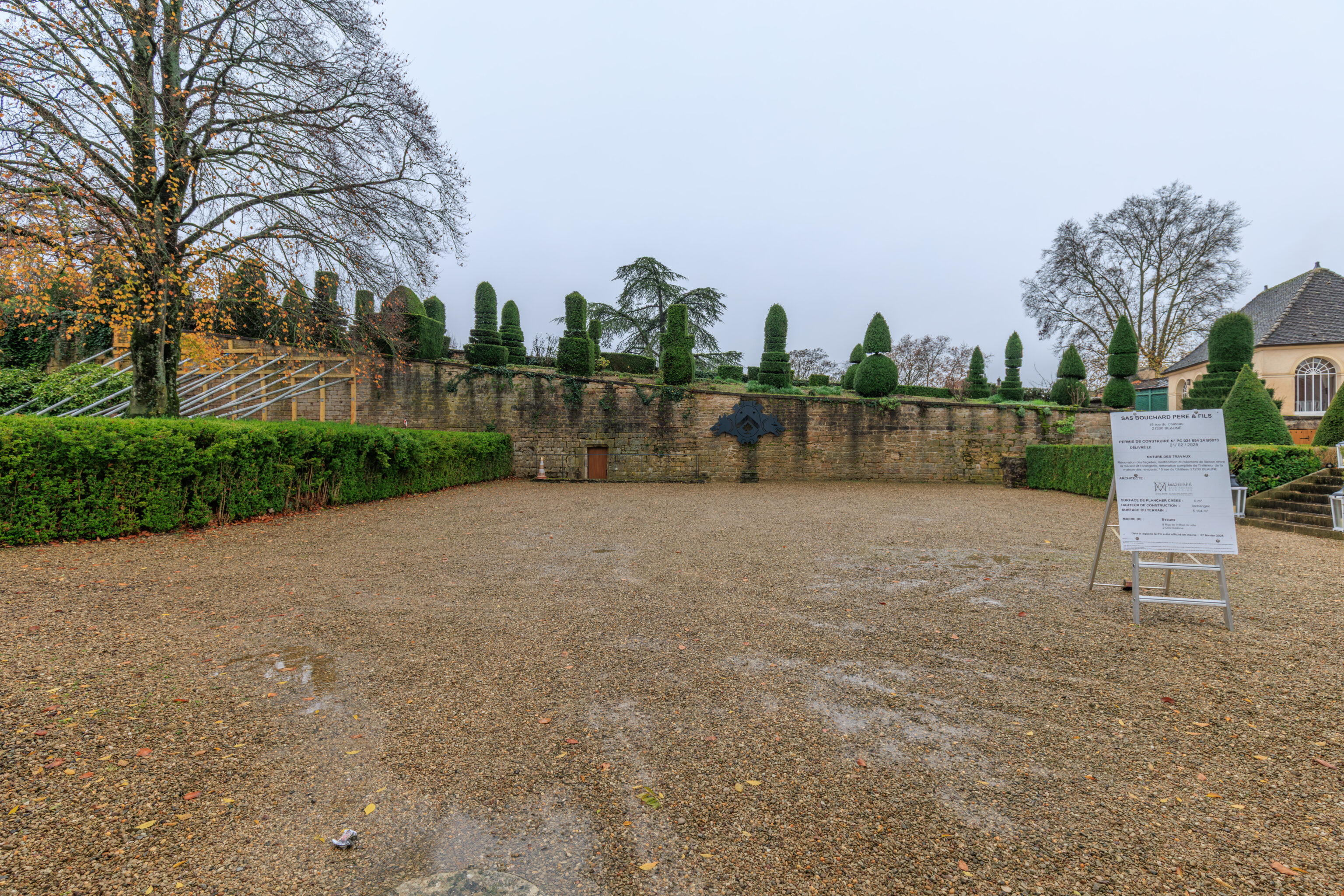
We peeked in through a closed gate at what is probably a parking lot. A sign indicates that there is renovation work taking place here.
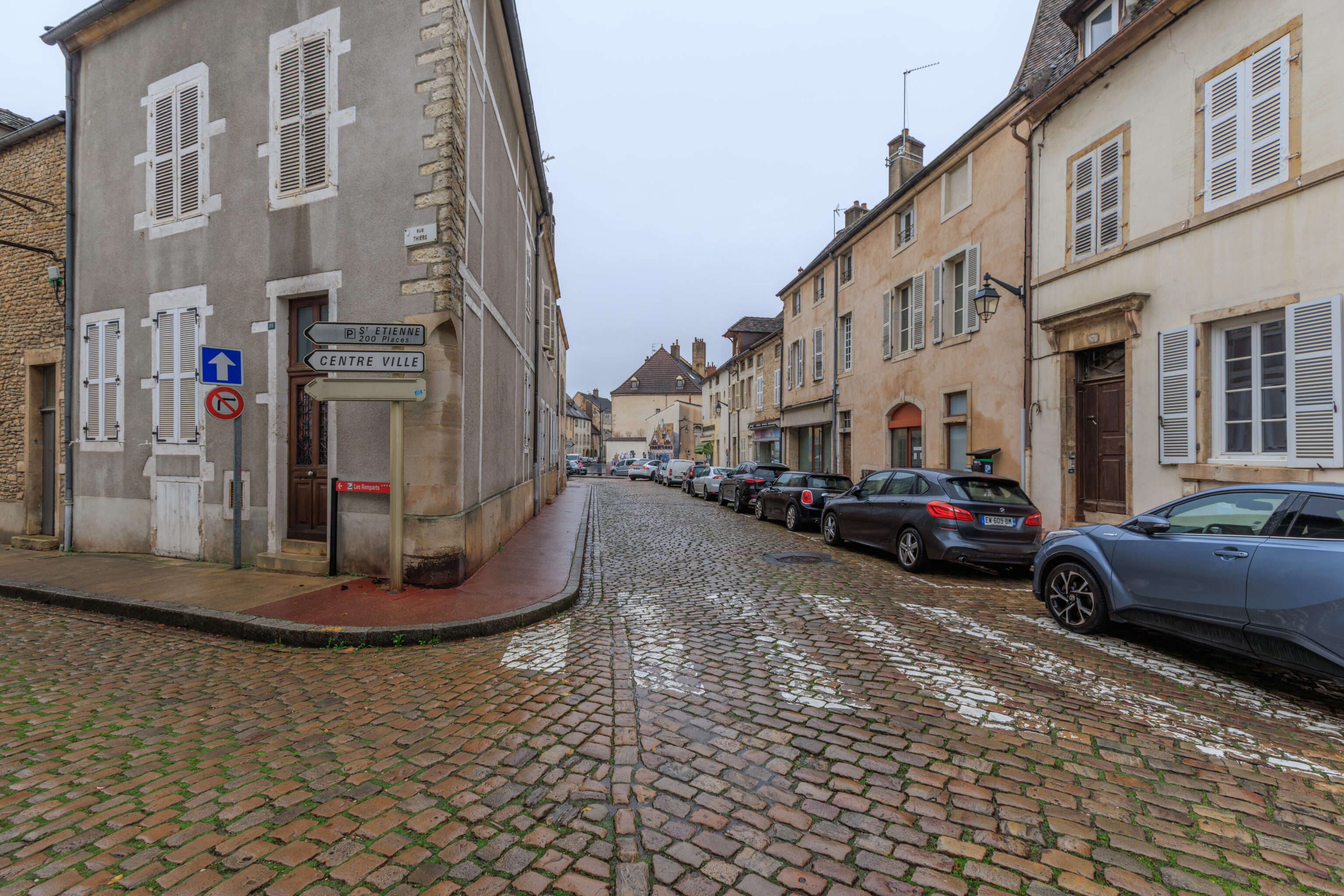
We continued on past the château and into the historic center of the city. Our intent was to go straight ahead, however, we heard music. It was a Sunday morning so we thought could it be related to church services? We ultimately decided to turn left to investigate the source of the music.
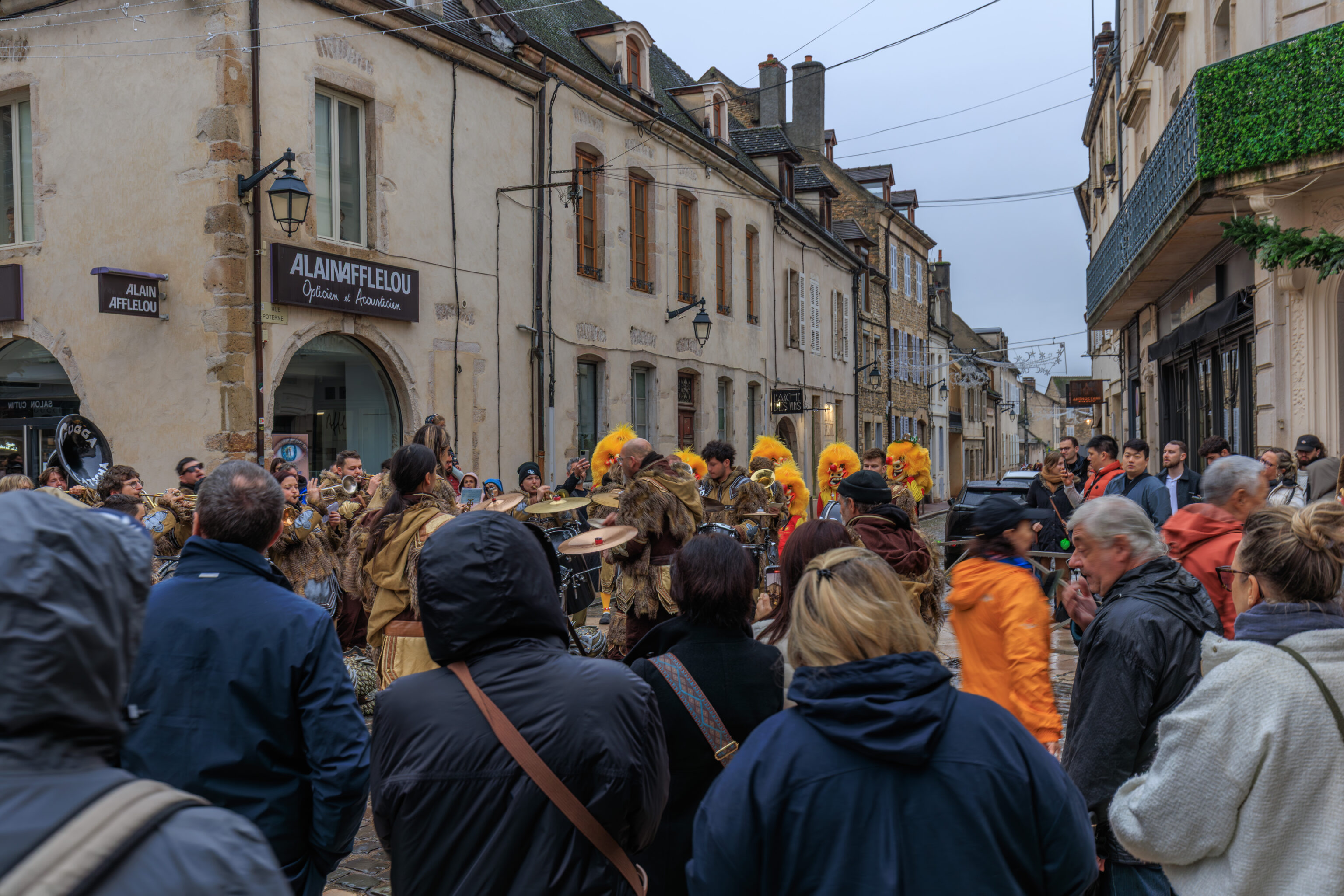
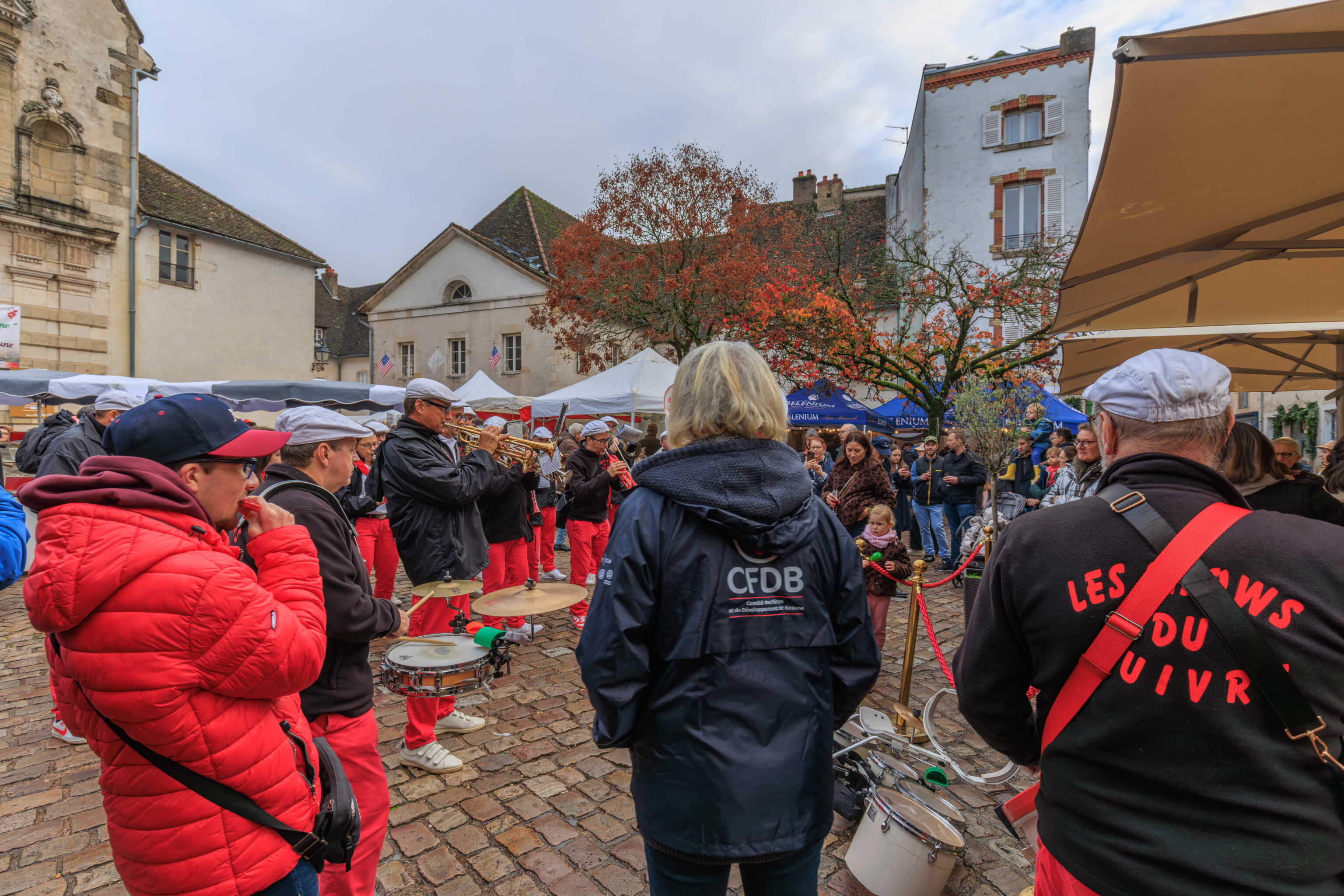
As we got closer, we saw a crowd of people ahead. The music sounded like a marching band. And indeed, that’s what it was, although a small one. But it wasn’t any old marching band as they were in costume!
We don’t know the history of marching bands in France, however, to us this felt very American!
We watched them for awhile. It wasn’t immediately obvious but their costumes are actually owl costumes! They are Gugga Ratscha (Facebook, Instagram) from Mulhouse, a city about two hours away by train near the border with Switzerland.
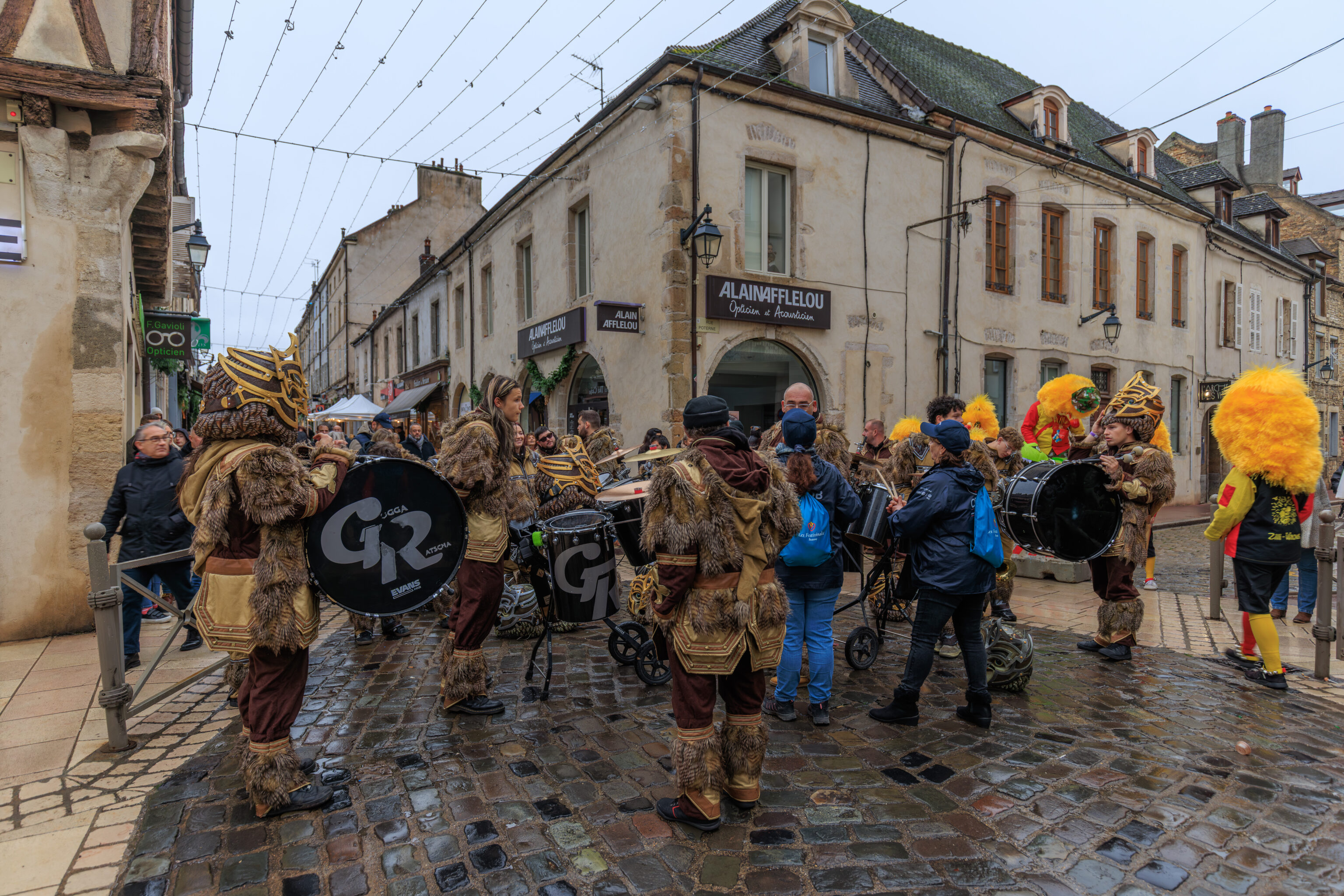
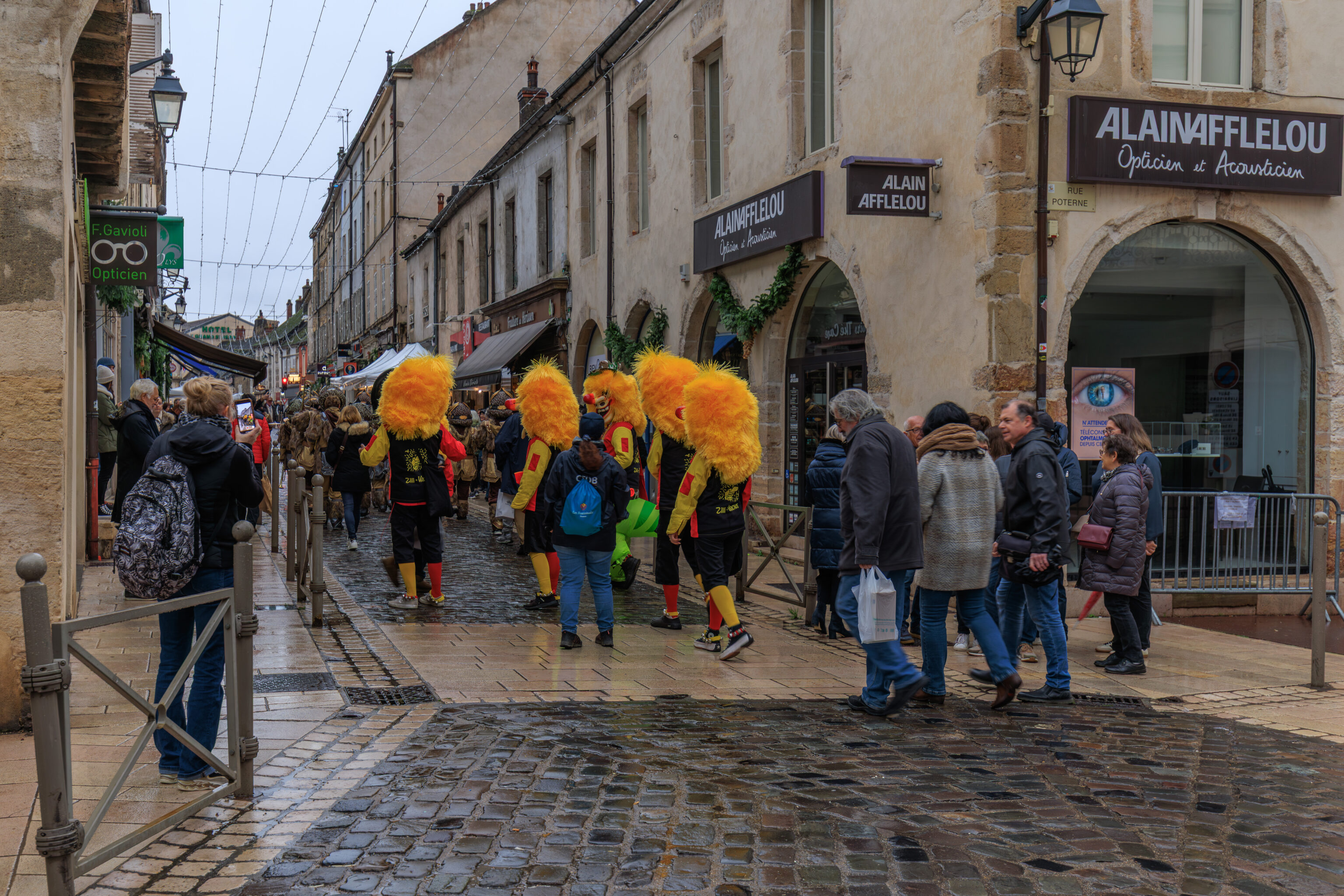
Soon, they put their headgear back on and started to march away!
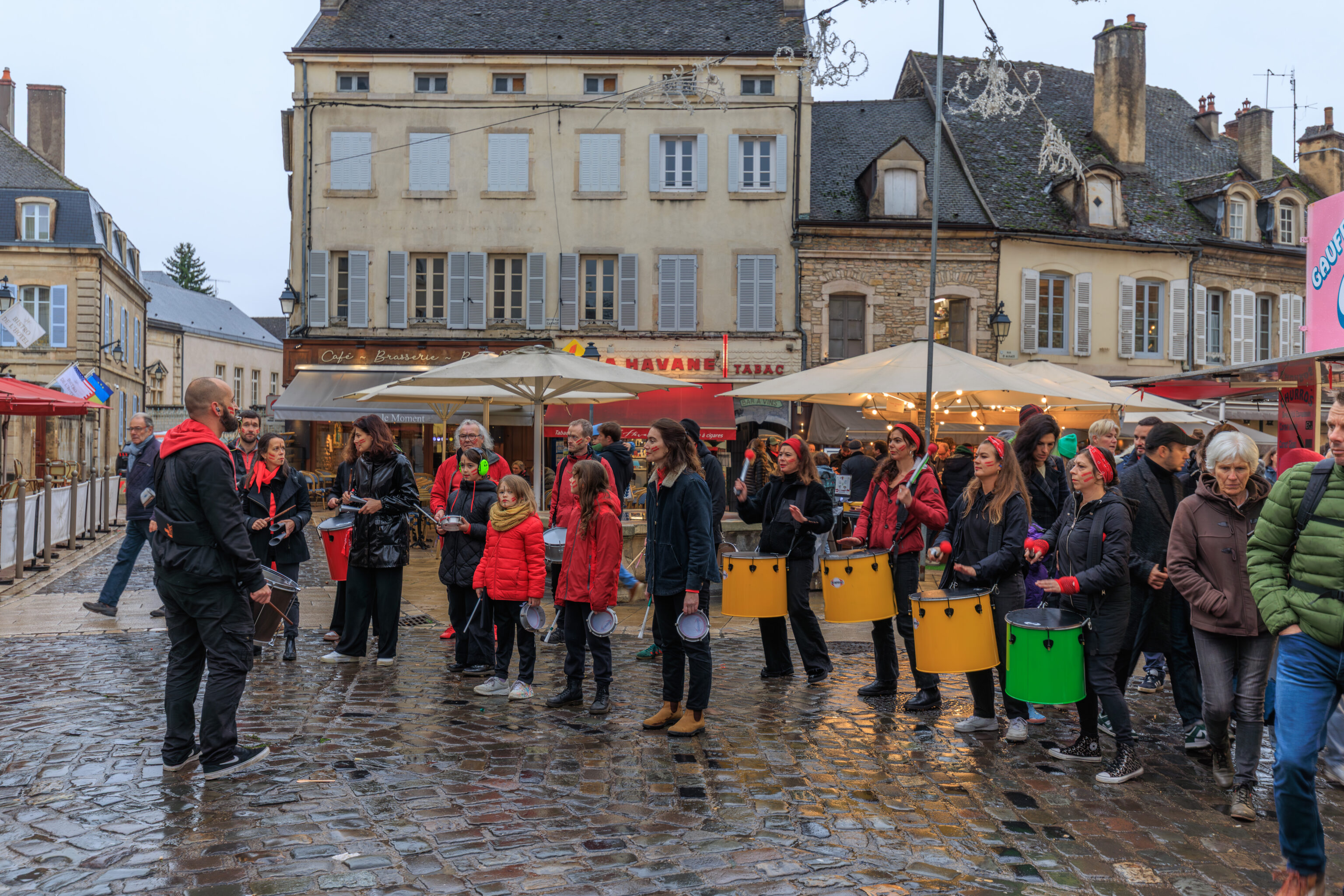
After walking further into the city center, we found more people and more bands. None were as good as the owl band though!
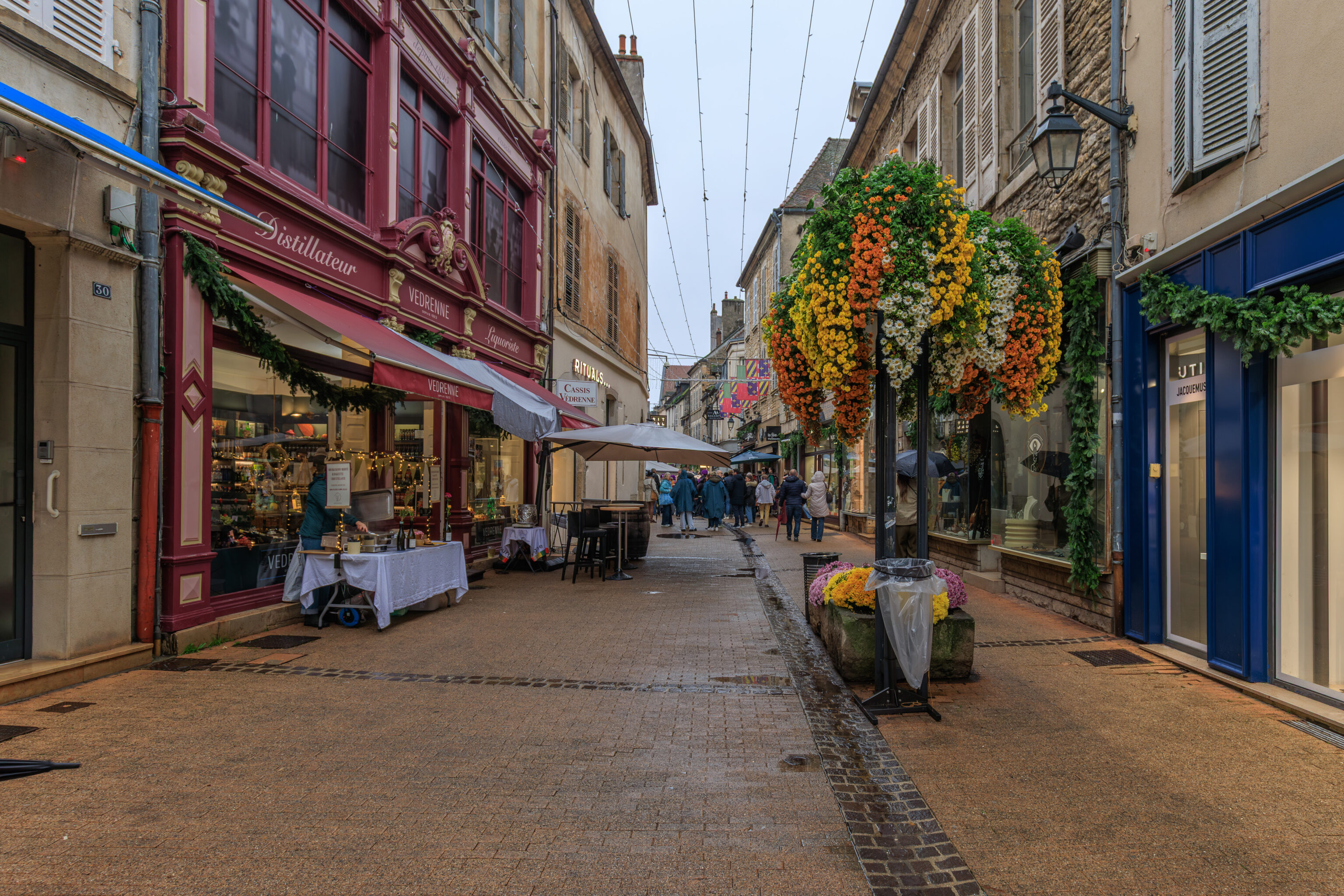
Surprisingly colorful flowers on an otherwise dreary day!
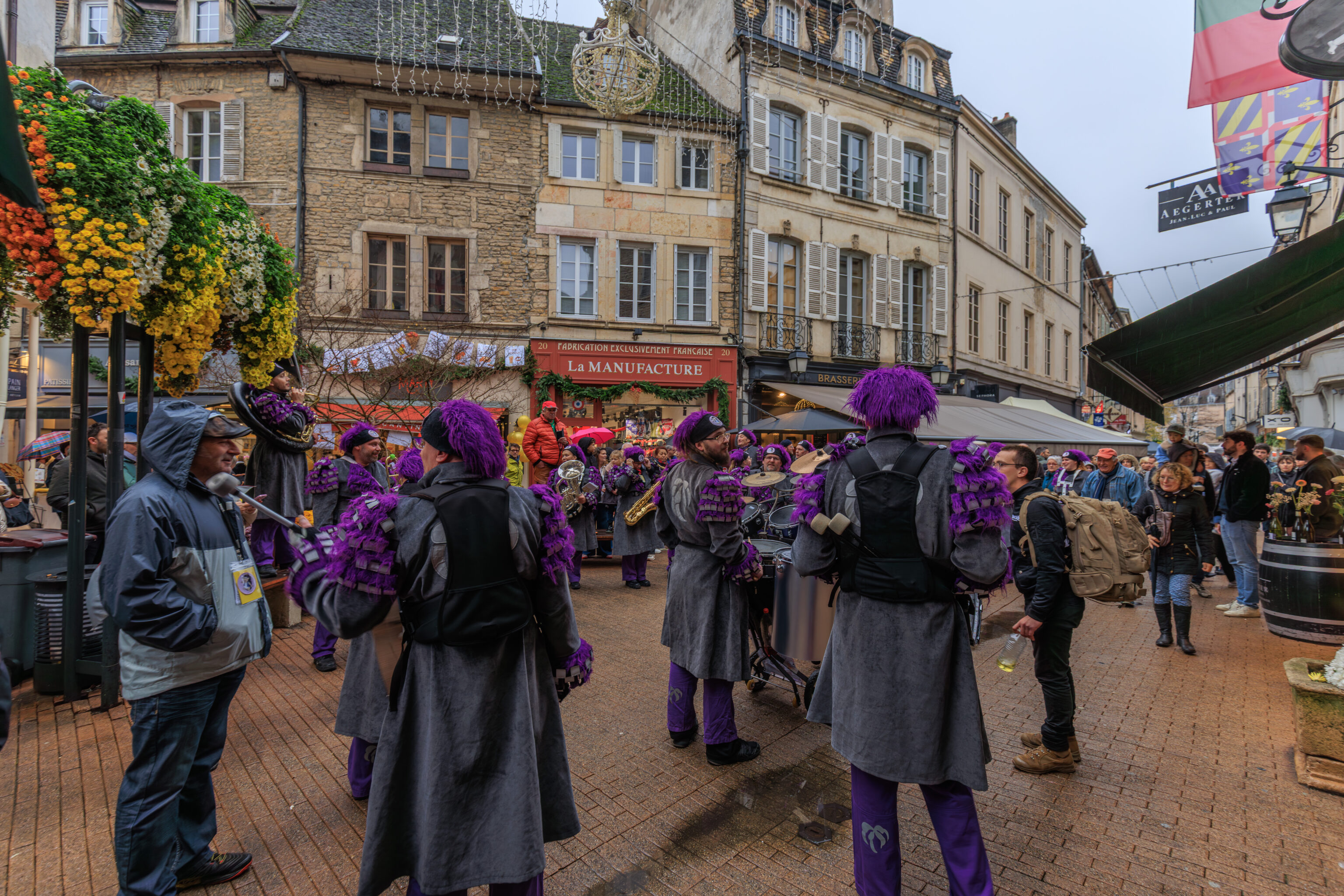
We came across a band that was purple themed.
The focus in this photo is on the guy facing away from us on the right, making everything else in the scene just a tad blurry. Oops.
They started to march away! A little bit of sleuthing reveals that they are Herisson’s Klick, a Guggenmusik band from Roche-lez-Beaupré, a town about 50 miles to the east near Besançon.
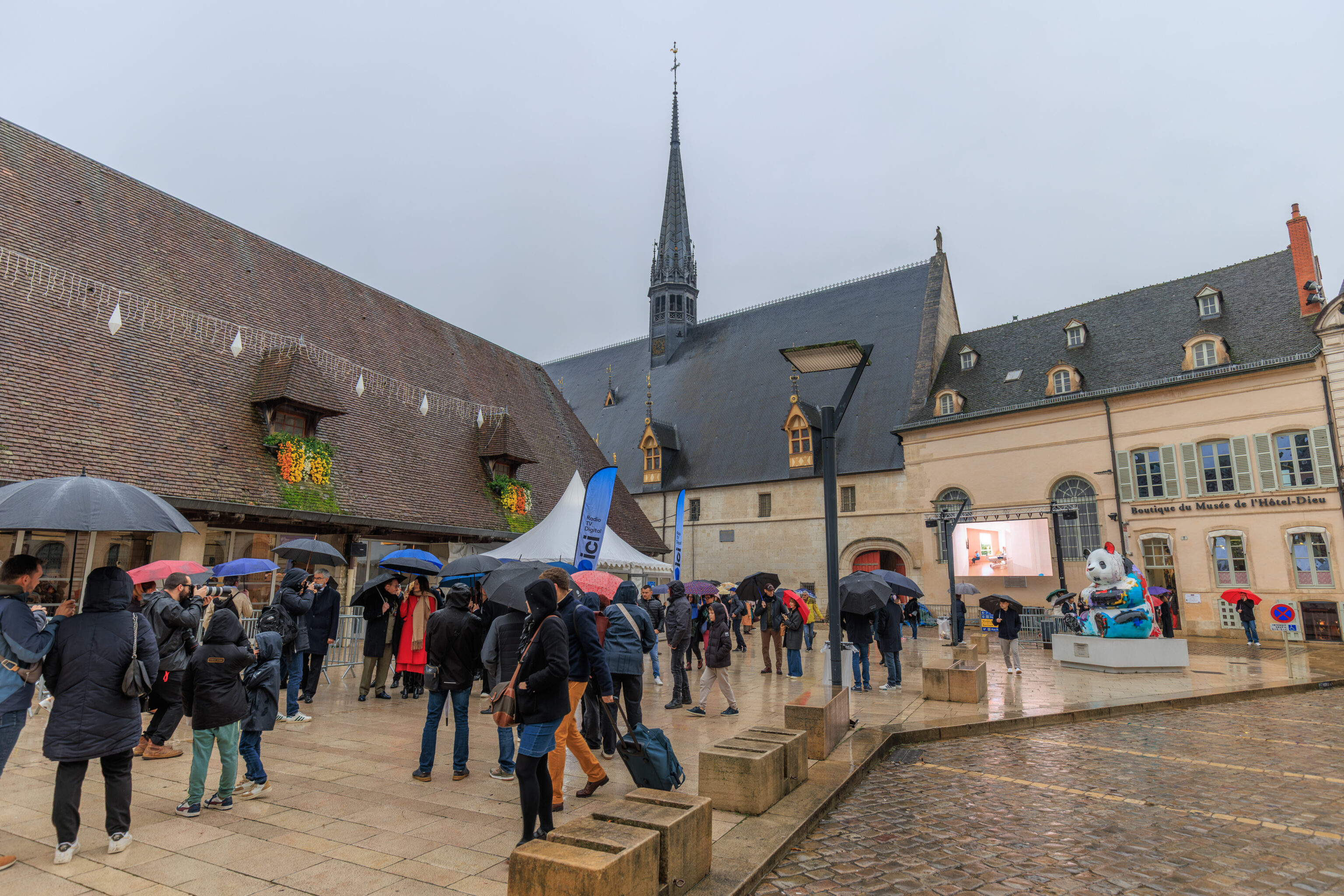
We continued on to the city’s market hall and the Hôtel-Dieu behind it. Normally, the market hall is home to a weekly market on Saturdays. Today, a Sunday, was very different. We did figure out a bit earlier that today was the 165ème Vente des Vins des Hospices de Beaune (165th Hospices de Beaune Wine Sale), an annual charity wine auction benefiting the Hospices de Beaune.
The Hospices de Beaune organization was originally formed in the 15th century to build and operate the Hôtel-Dieu in Beaune. A Hôtel-Dieu is basically a charity hospital for the poor. Today, the historic Hôtel-Dieu building is a museum and medical functions take place in more modern facilities. The InterContinental that we’re staying at in Lyon is in a former Hôtel-Dieu so we were already familiar with this term, although we hadn’t heard of it before planning this trip.
The Hospices de Beaune, in addition to being a medical organization, also have vineyards here in Burgundy totaling 60 hectares of land. The wines produced from these vineyards are sold annually at this auction.
The annual Fête des Grands Vins de Bourgogne (Burgundy Grand Cru Wine Festival) takes place annually and concurrently with the auction. This is basically a two day convention in Beaune’s Palais des Congrès (Convention Center). This is more for a general audience compared to the auction.
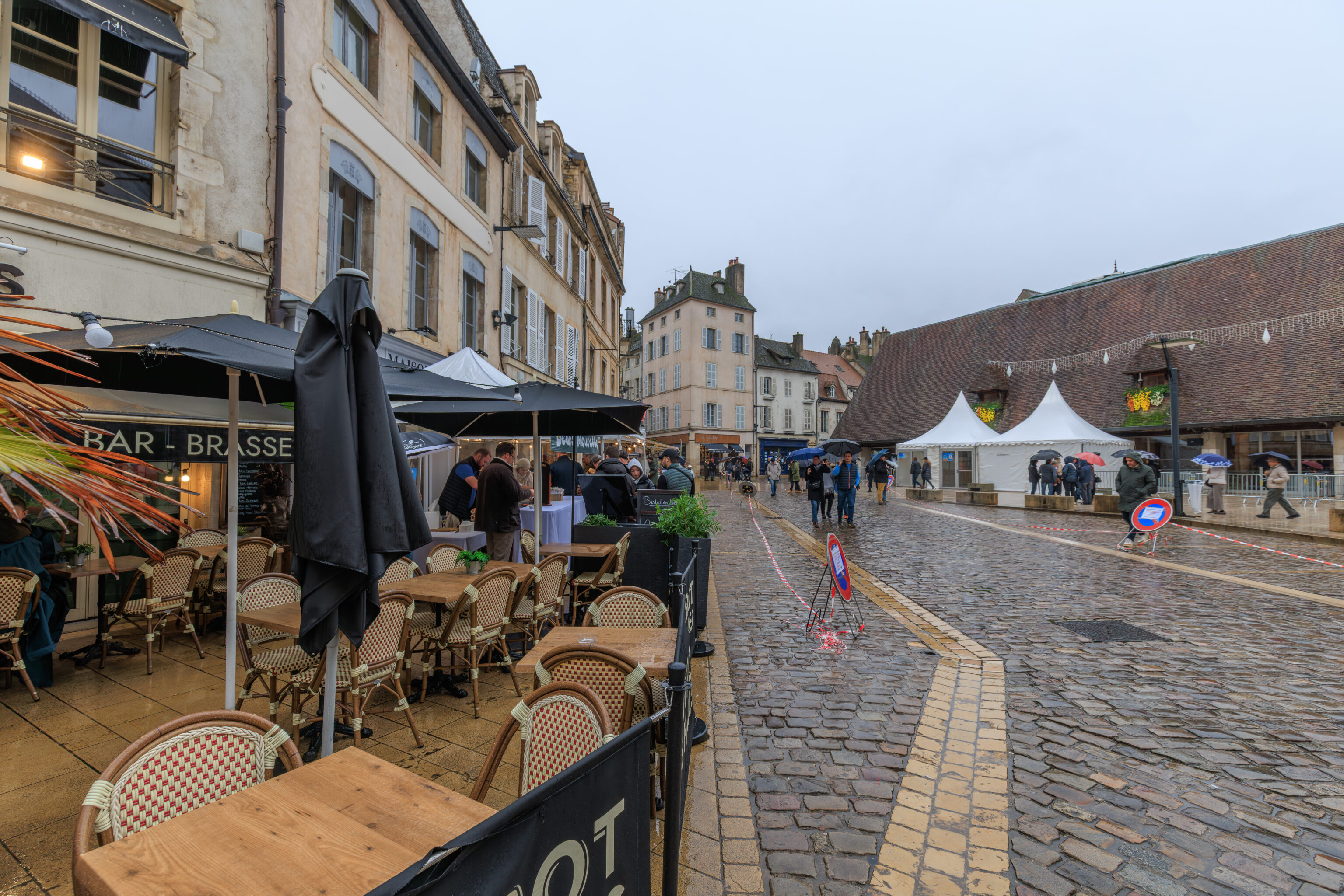
We decided to walk around a bit more.
We came upon a wine bottle opening contest! They were incredibly quick! We weren’t in the best place to record video so just have this little clip but we did see the entire contest. Or at least, this part of the contest if there was more!
Unfortunately the video is a bit shaky in a few places where the DaVinci Resolve couldn’t stabilize the camera movement. It was worse straight out of the camera.
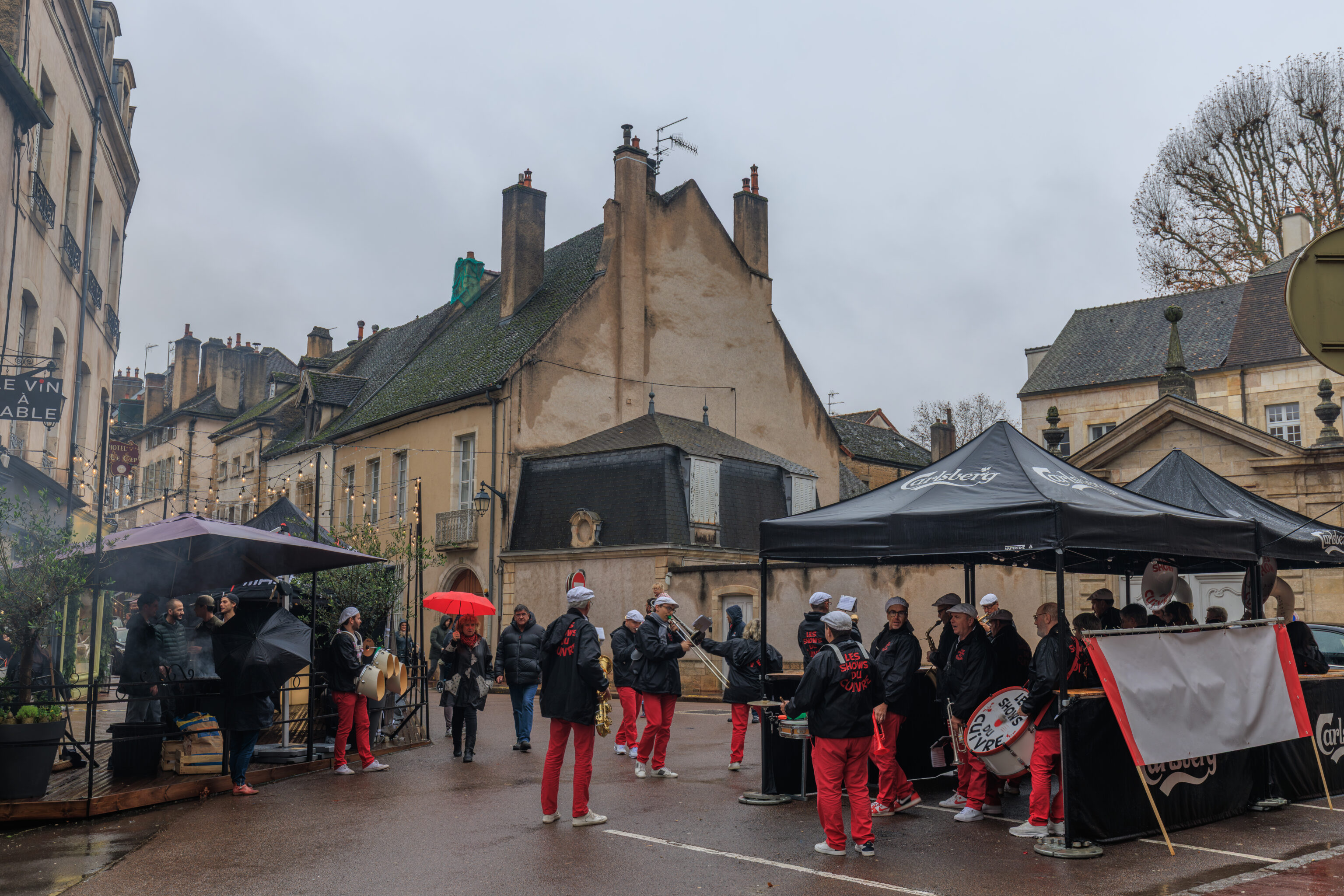
We came across another band.
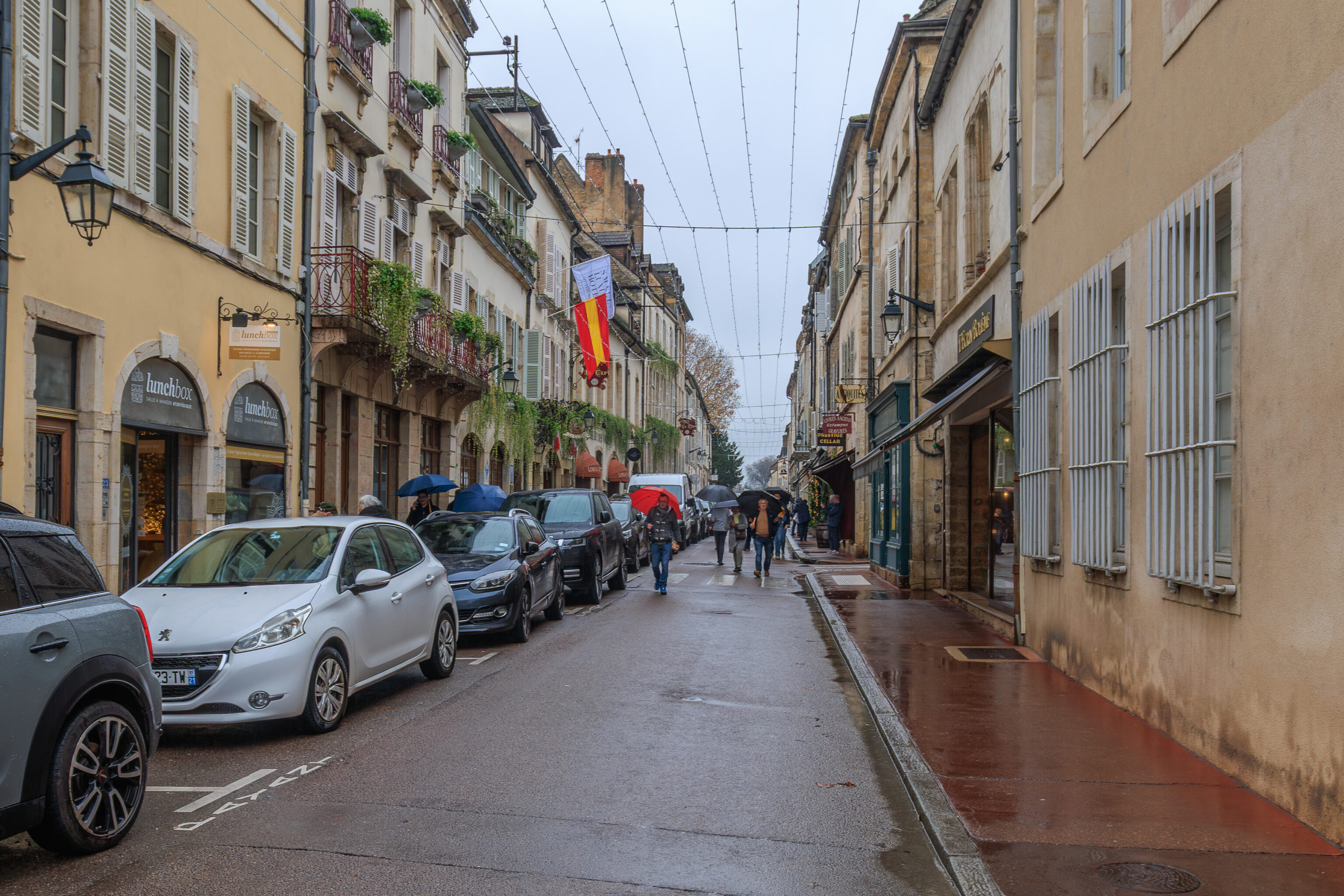
We decided to go check out Edmond Fallot, a local moutarderie (mustard factory). Their shop and factory is just a little bit southwest of the city’s central area.
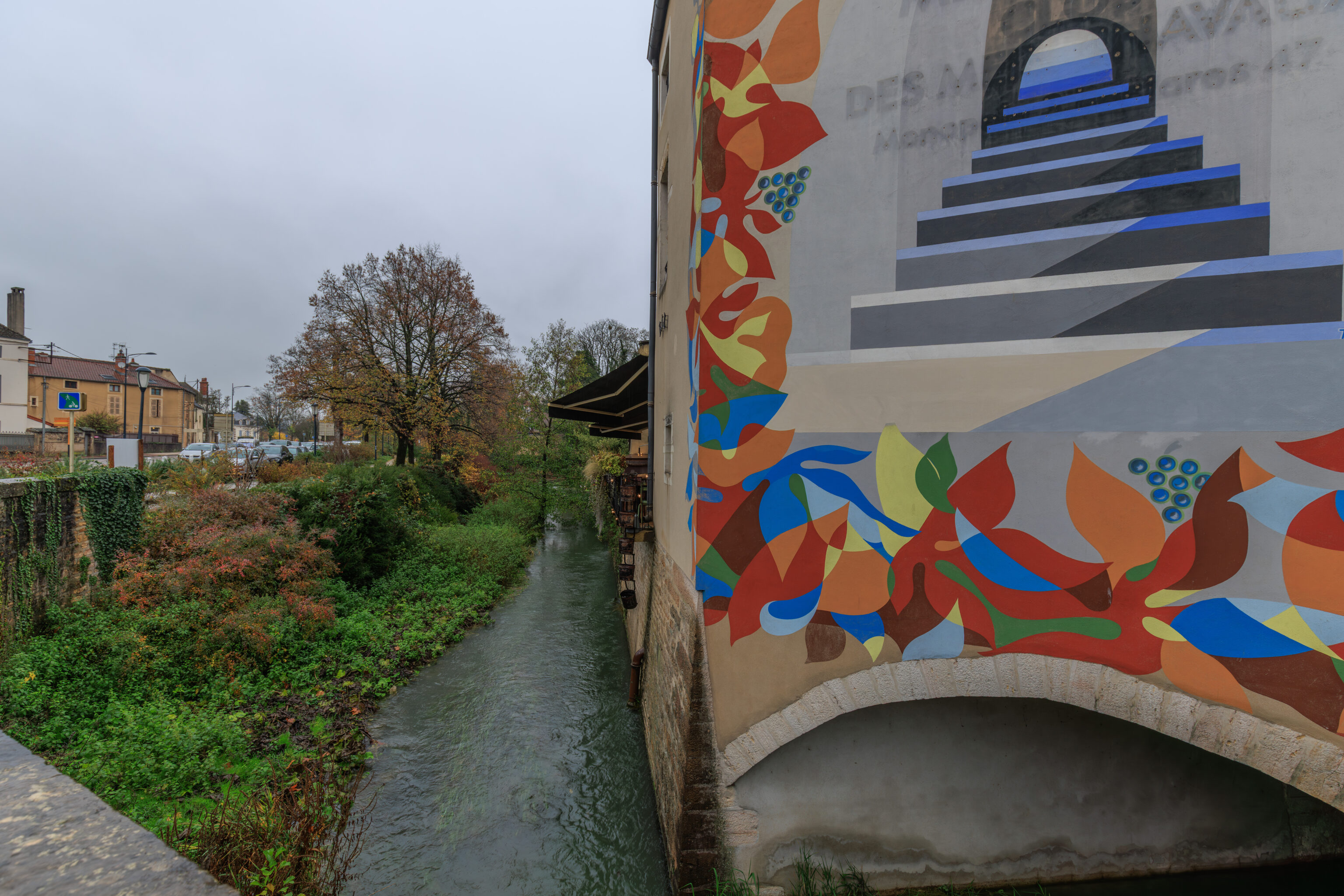
We crossed over a small stream. Historically, this was where the city’s walls were.
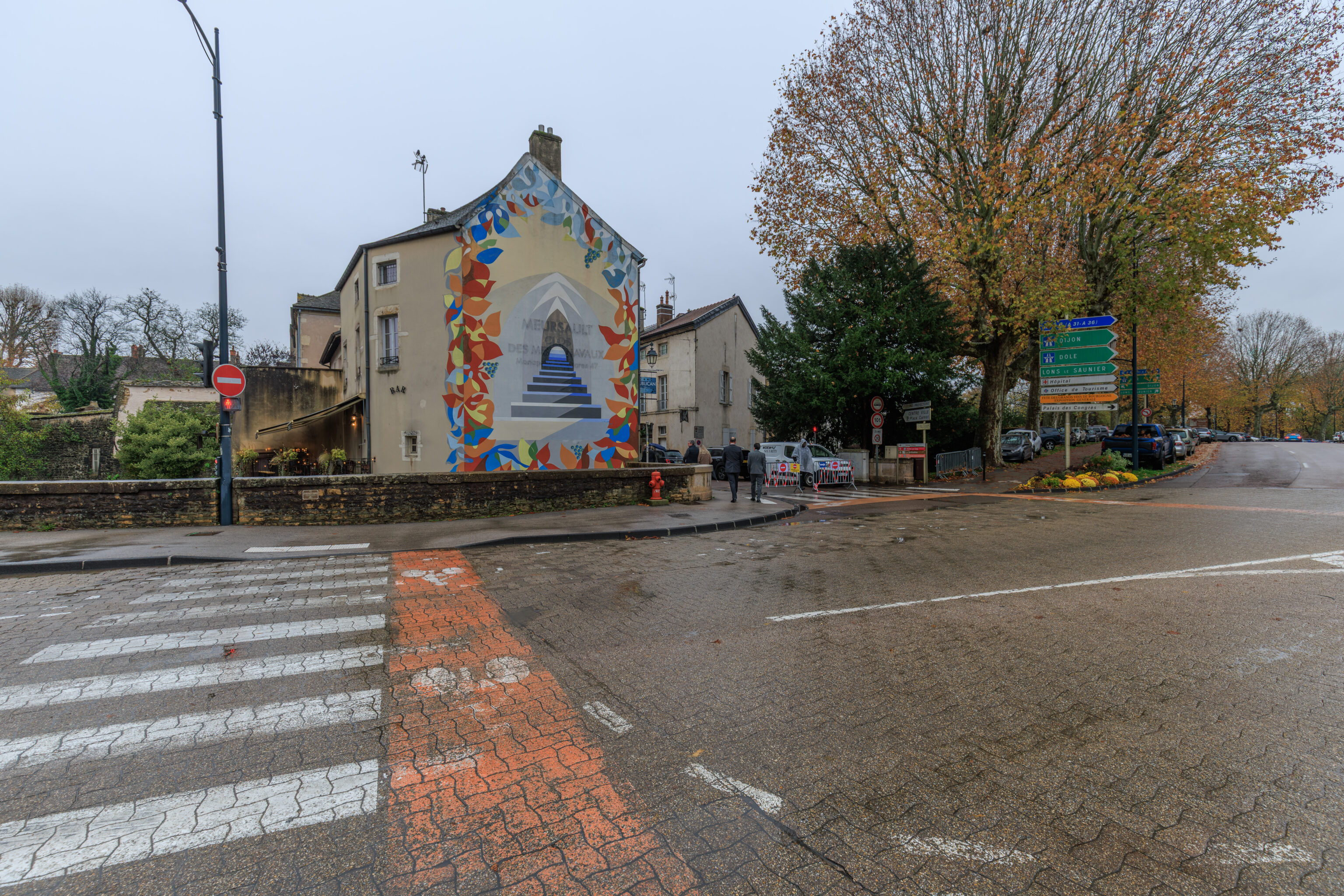
The mural on the building is better viewed from across the street. The city center was mostly closed off to cars today due to the wine festival and auction.
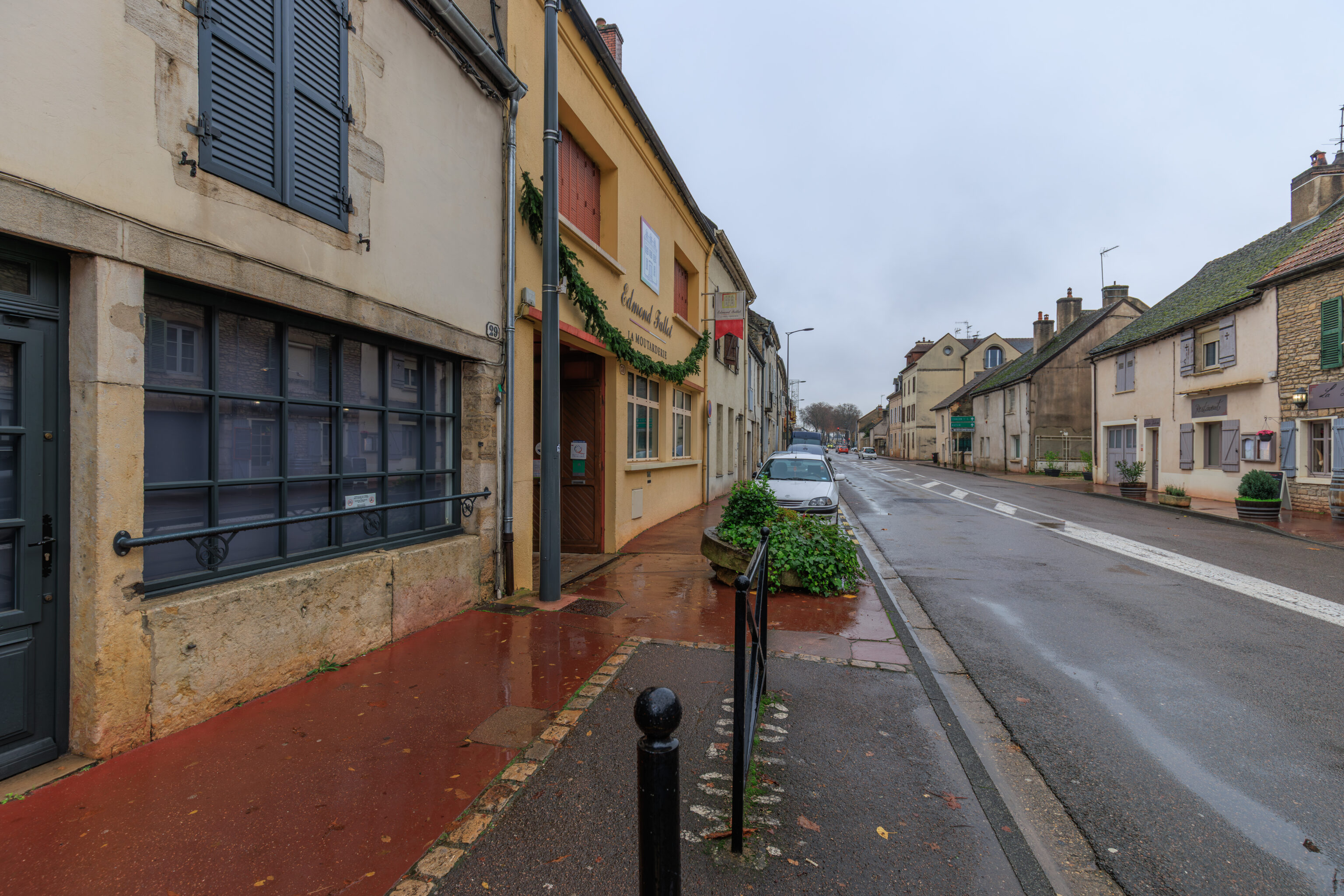
The Fallot moutarderie was just a block or so away.
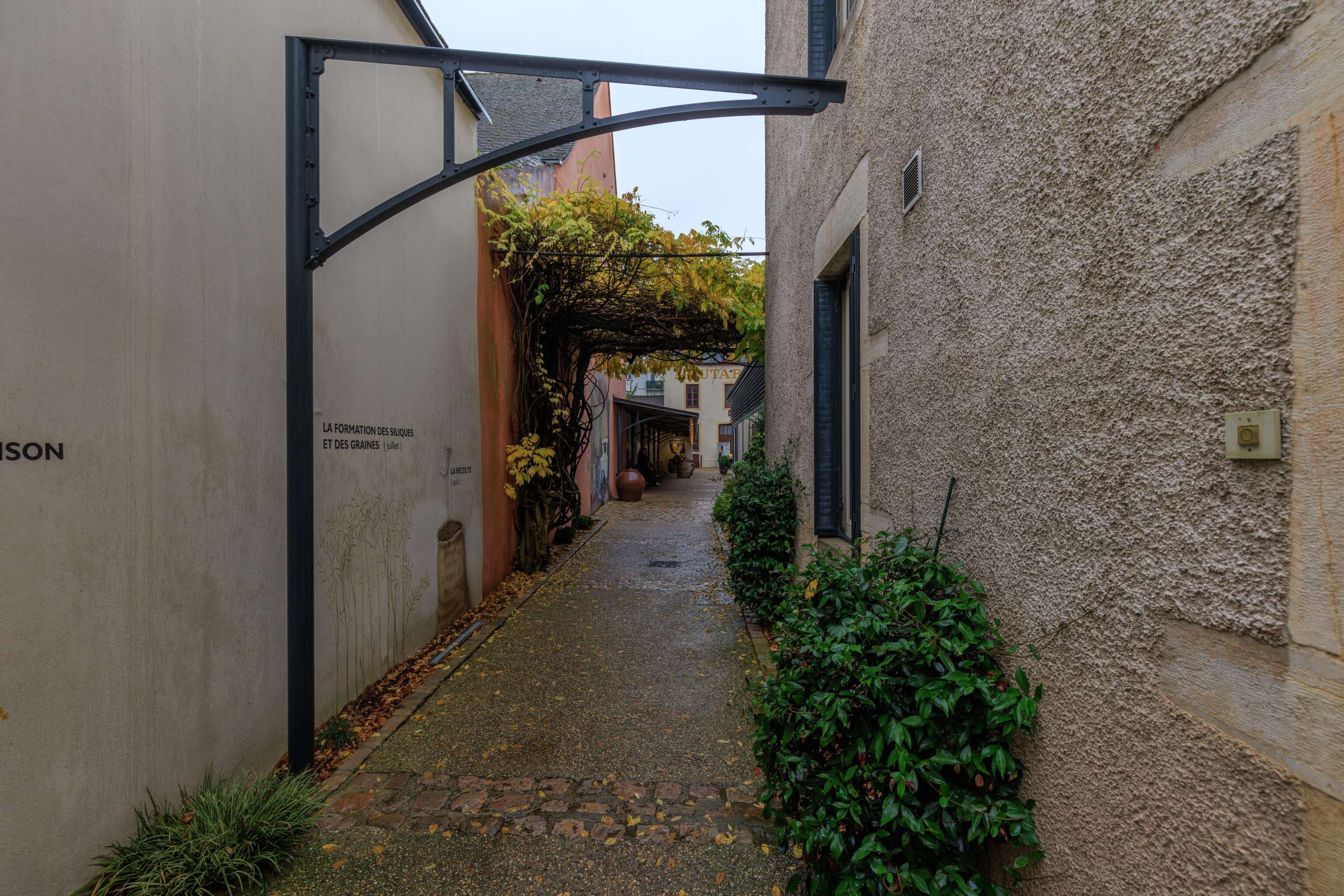
The entrance in the building’s facade actually leads to a short path that goes past the buildings by the street.
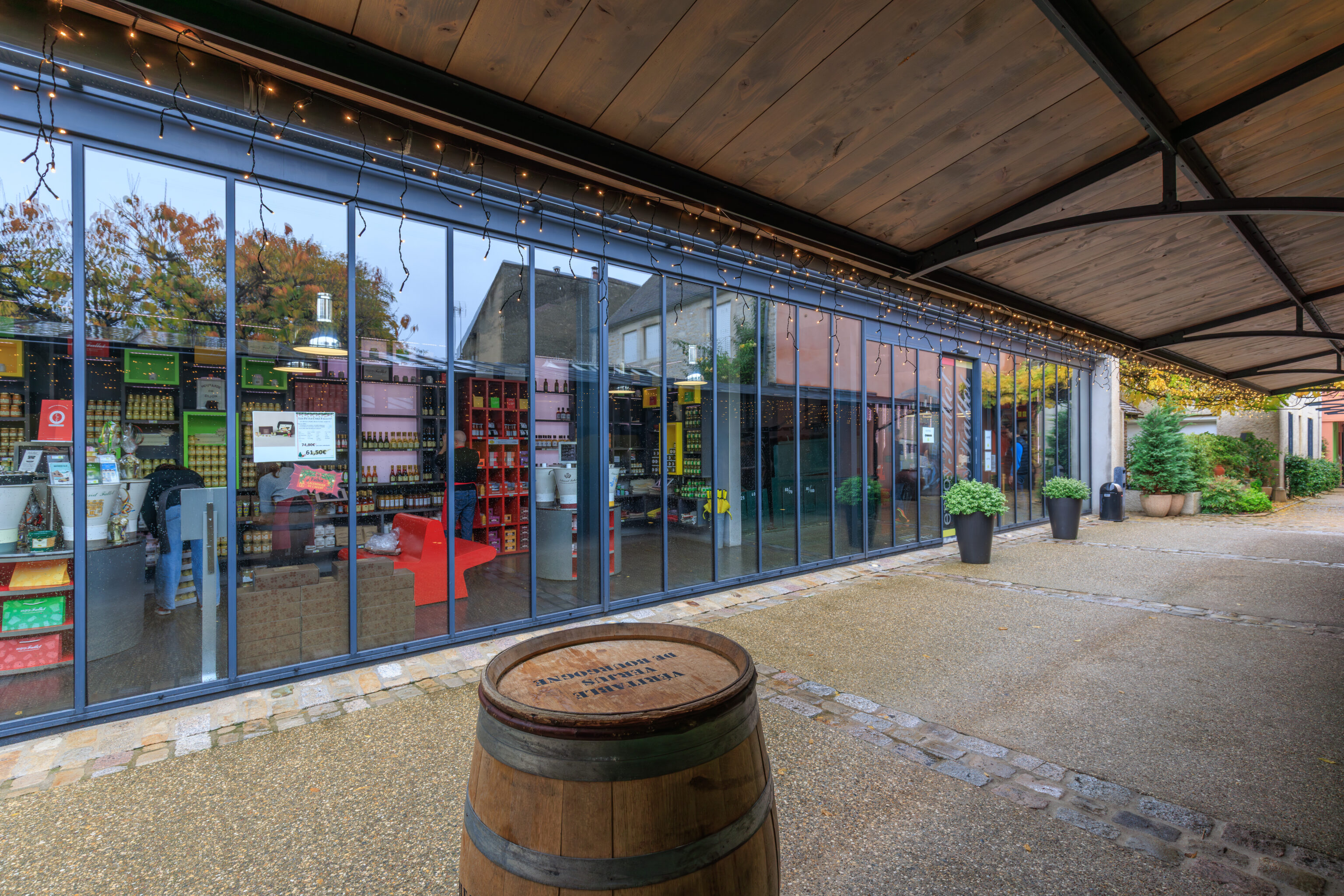
The path leads to Fallot’s shop. It turns out that tours are not particularly frequent. We got tickets for the next tour, which was scheduled for 1:30pm. It was now about noon.
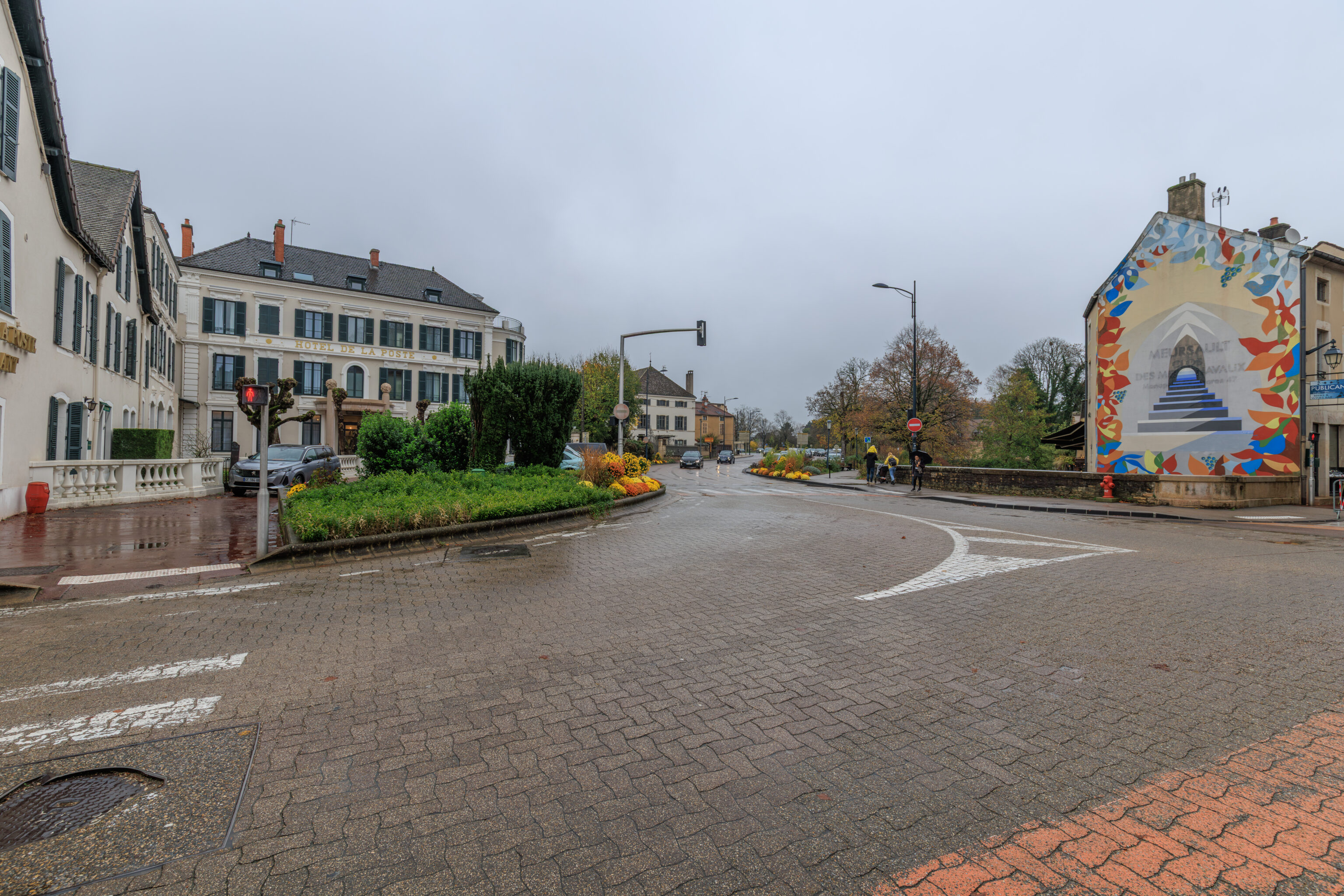
We decided to go back to the city center to walk around a bit more and try some of the food stands.
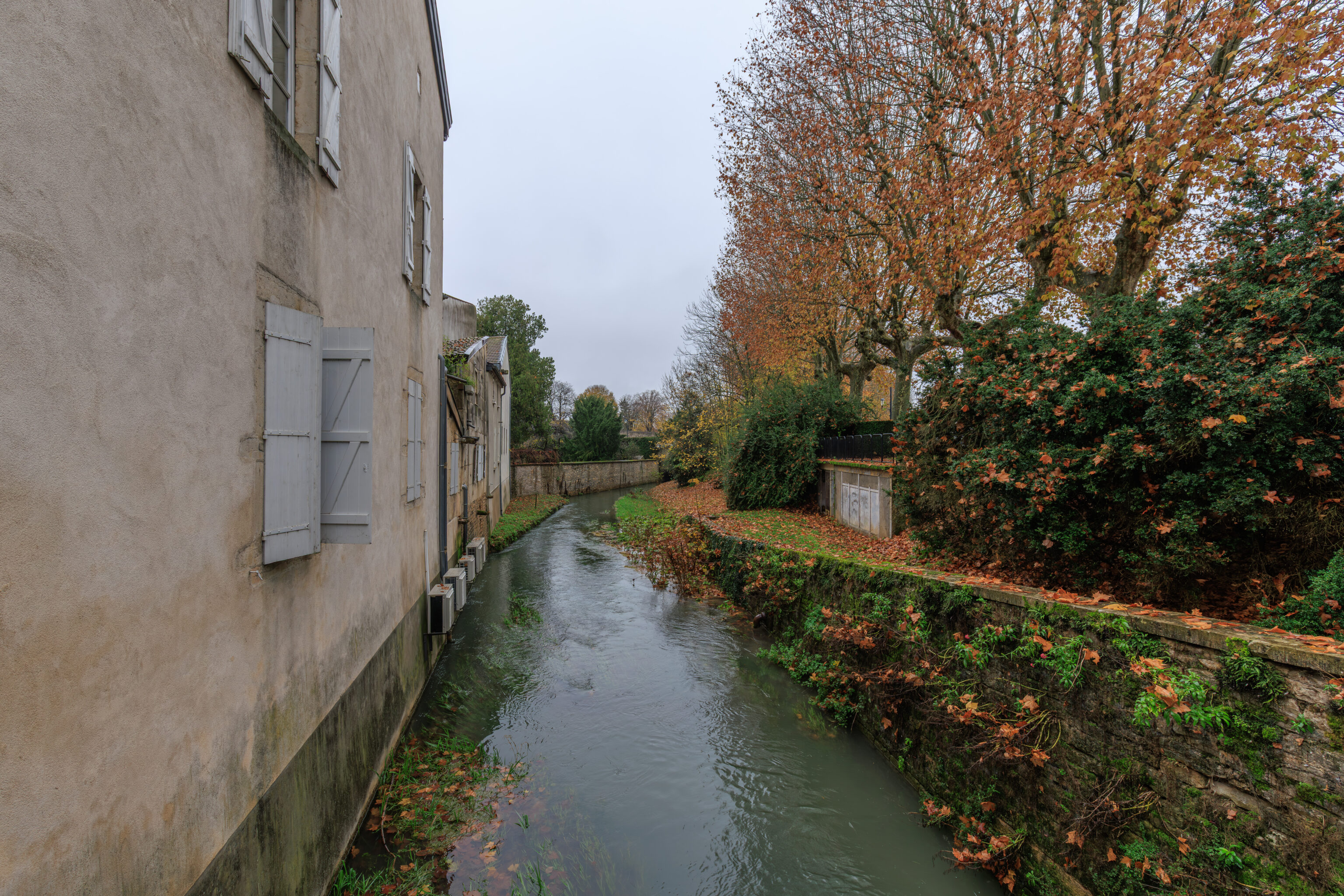
We passed back across the stream. This is the view in the opposite direction compared to when we crossed it earlier.
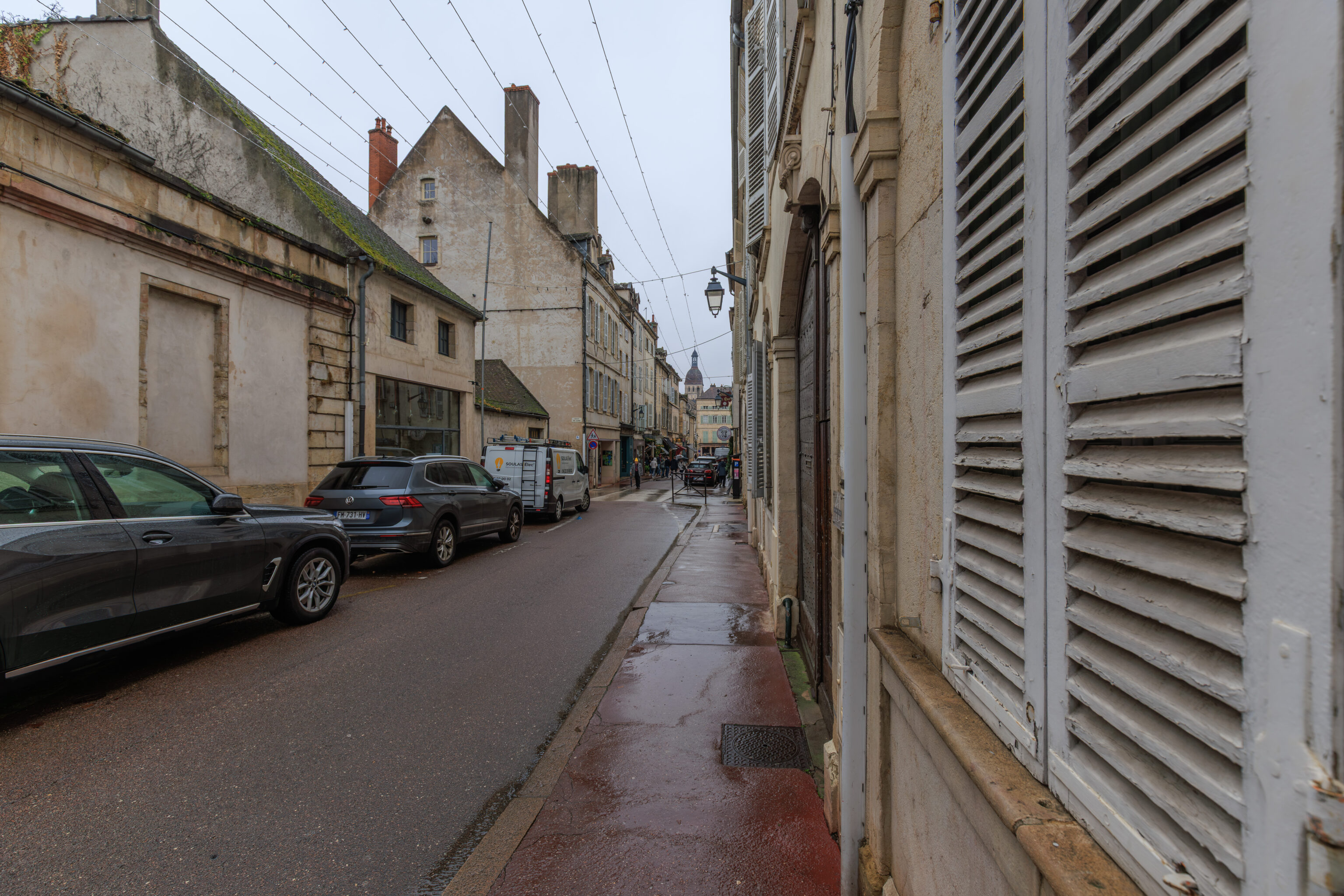
It was pretty quiet just a few blocks away from the festivities.
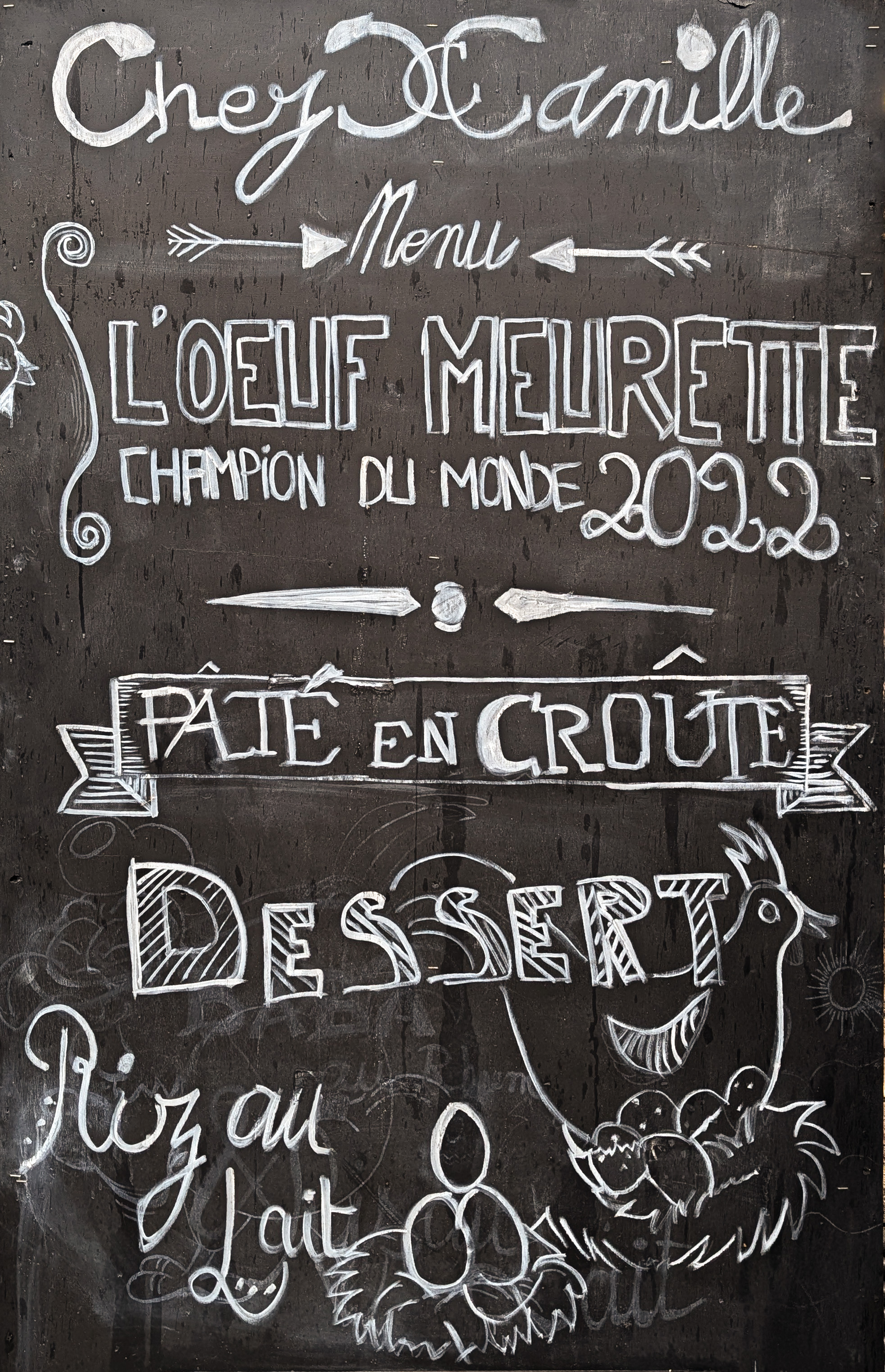
The first stand we visited was Chez Camille. This stand seems to be from a hotel and restaurant in nearby Arnay-le-Duc, a town to the northwest of Beaune.
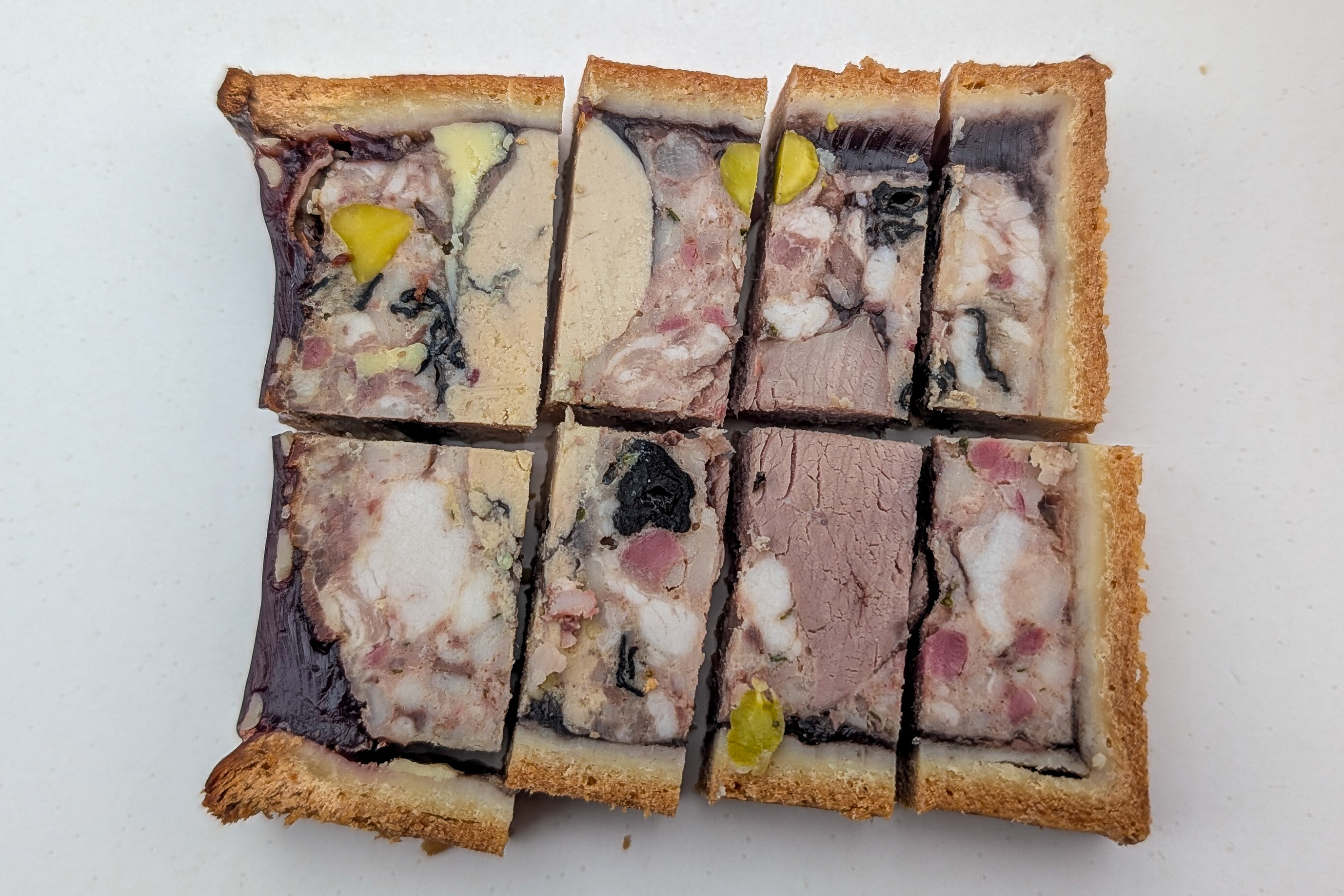
We started out with pâté. We had wanted to have this at dinner yesterday but they did not have any available at the time. This particular pâté option was named La Fameux (The Famous) and contains duck, foie gras, and hot wine jelly.
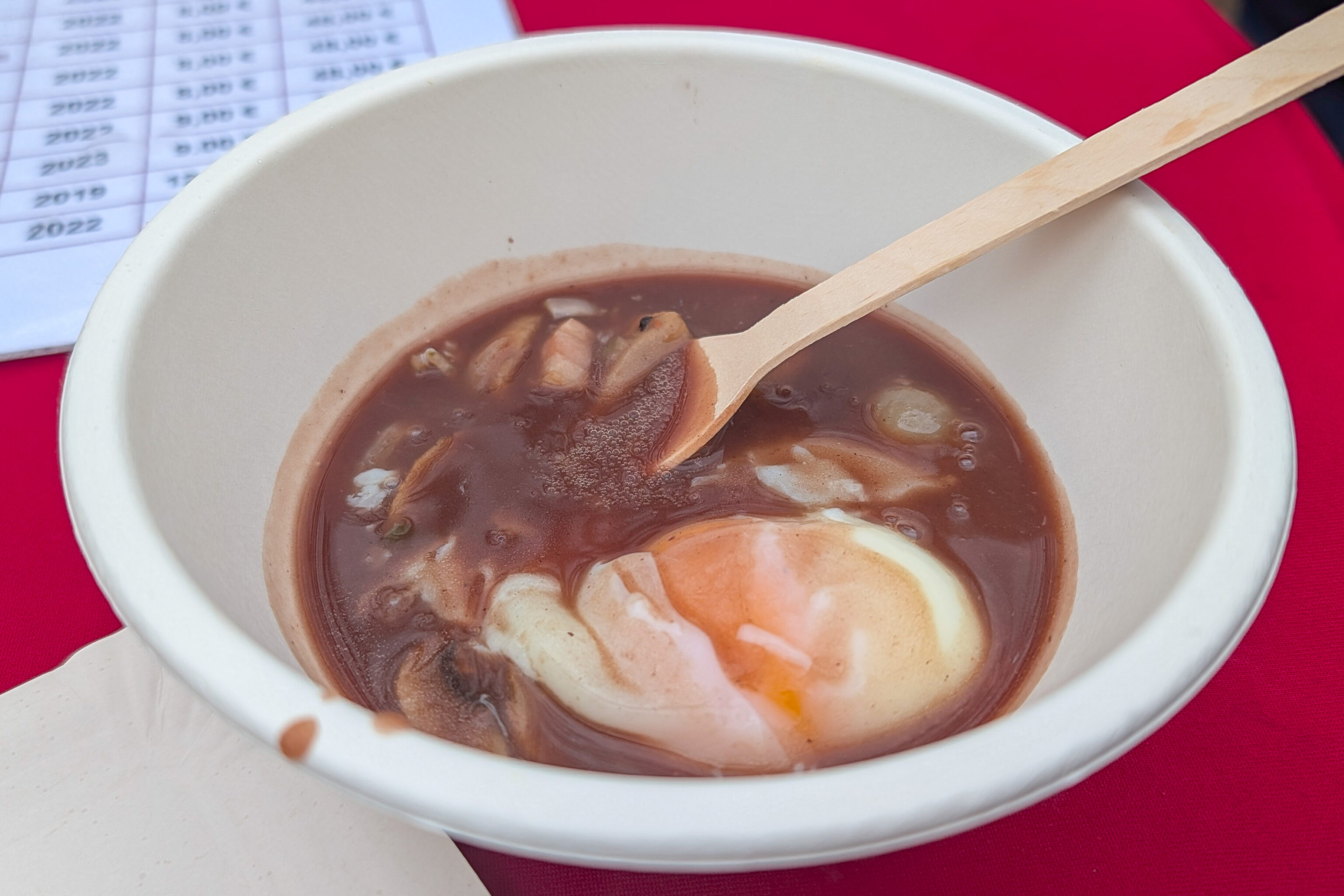
We also ordered L’oeuf Meurette, a local Burgundian egg dish. Their sign indicated that they were 2022 world champions and also that they were on the Top Chef reality cooking show.
It was kind of a weird dish with a poached egg in a Burgundy red wine sauce. We didn’t like it.
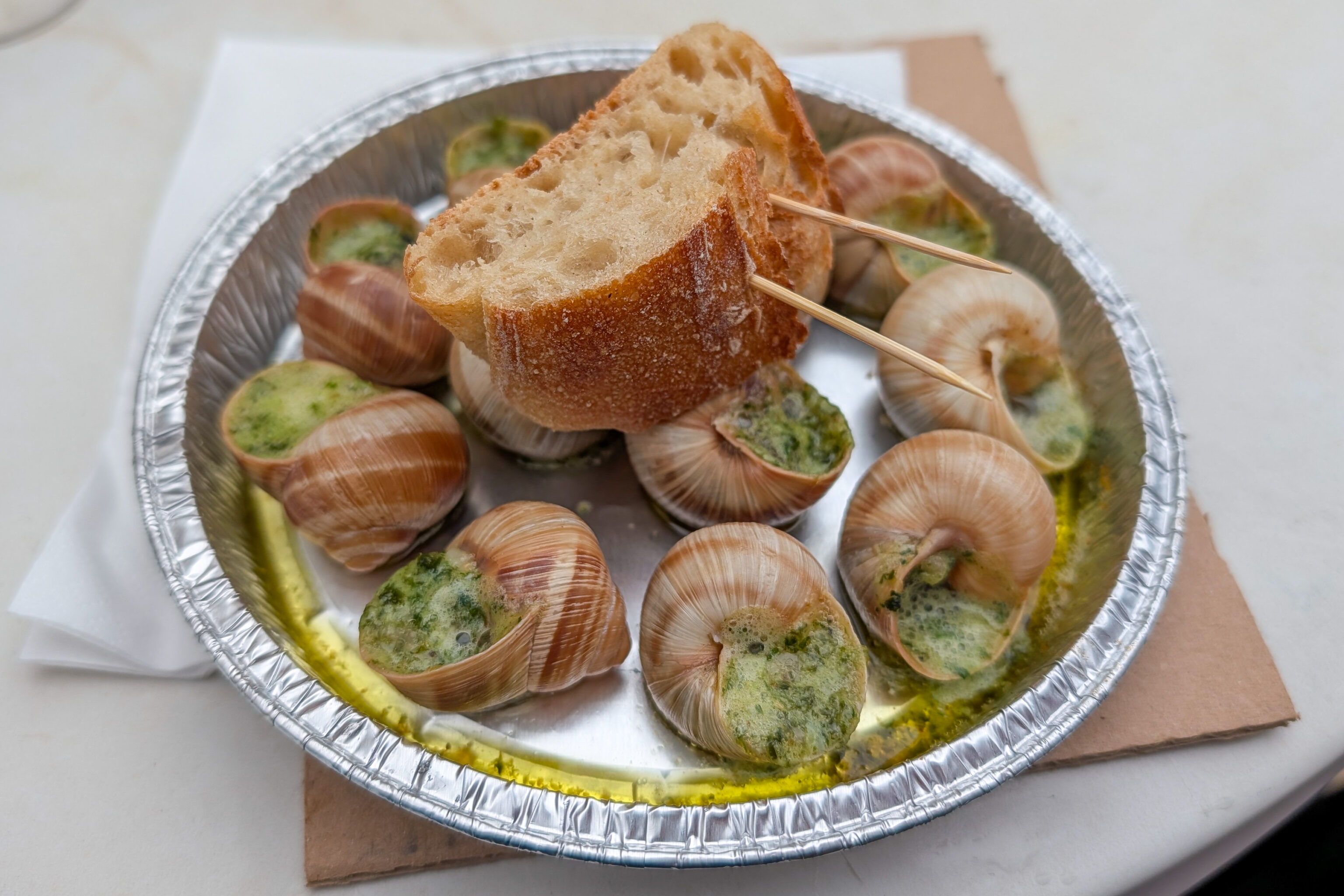
Our next stop was at the stand for Hélice, L’Escargotier Beaunois. This is a local shop from Beaune that specializes in escargot and also sells other snail based products. We got a dozen snails, Burgundy style of course.
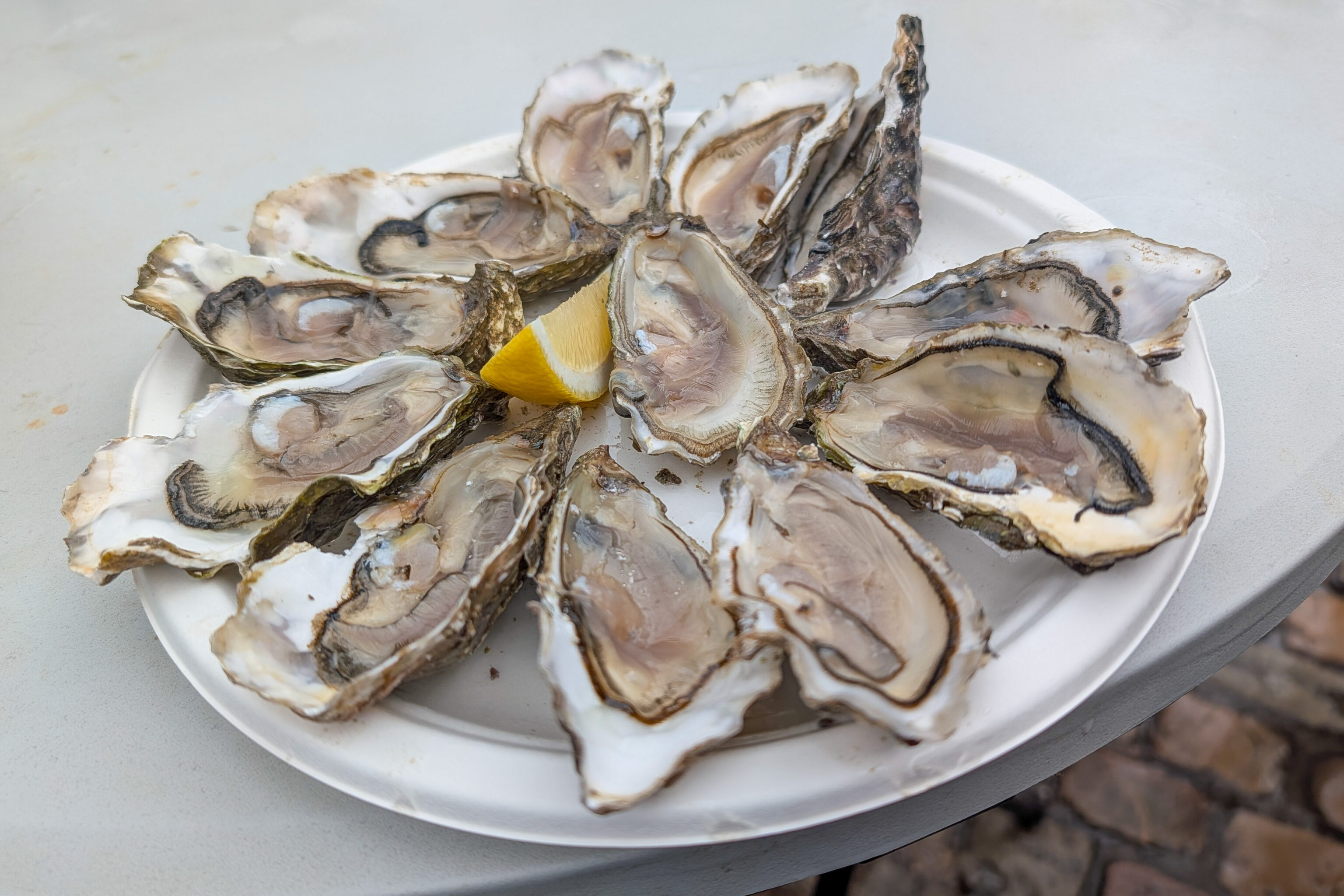
We continued on to a stand from an unknown vendor that sold oysters and scallops. We got some oysters, 10€ for a dozen, or about $12.
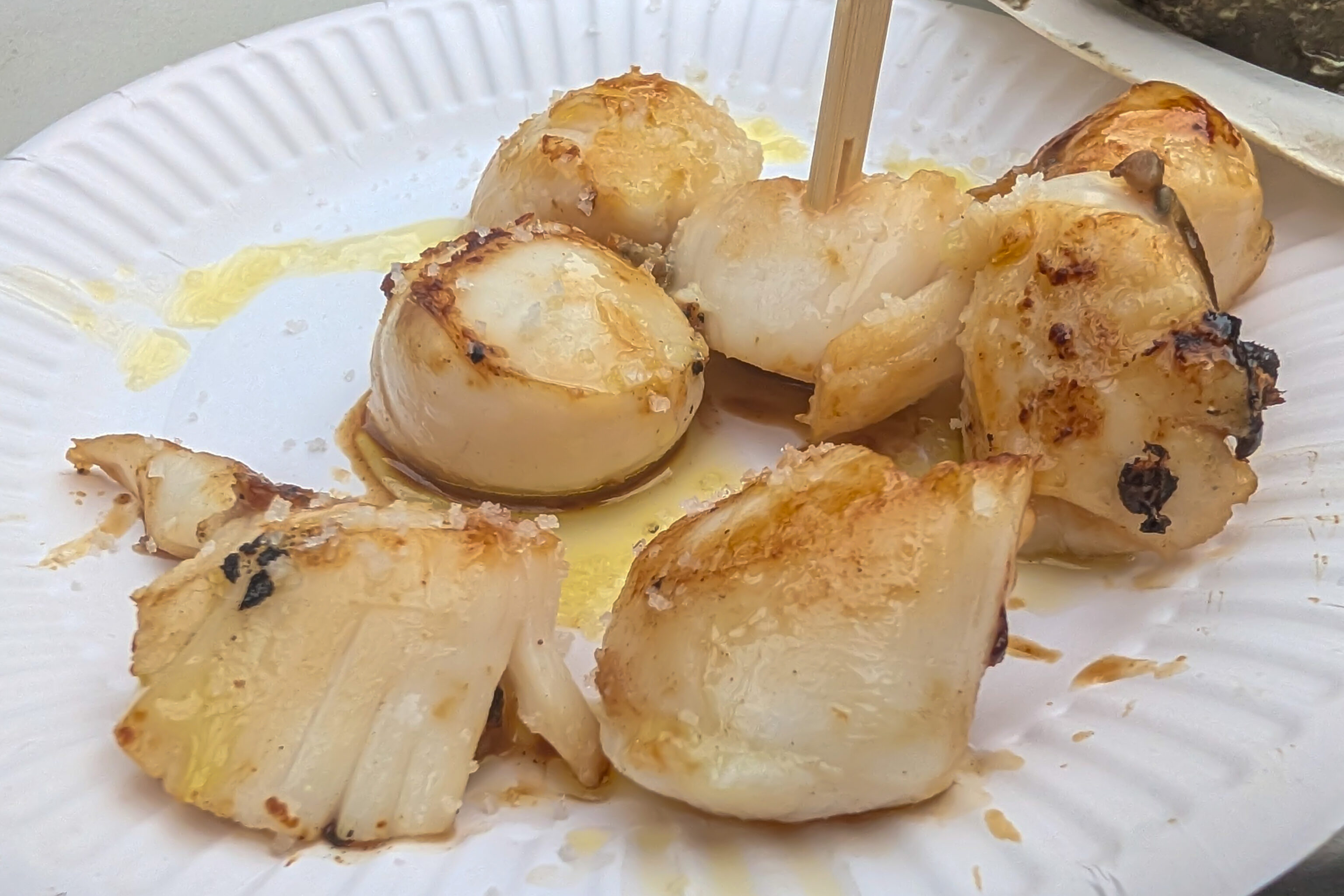
We also got their grilled scallops. They were fantastic! We actually ended up returning later and buying two more portions!
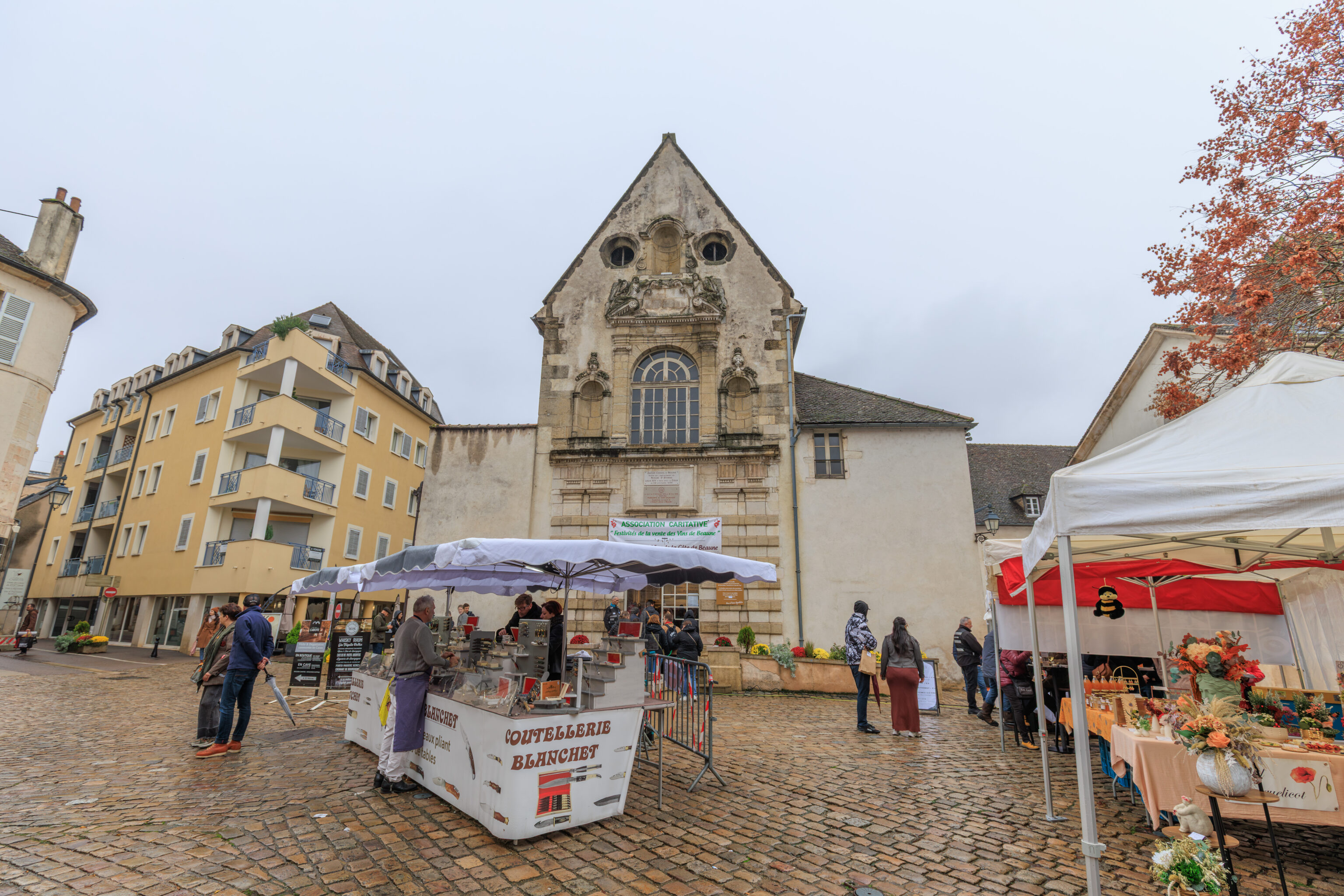
These stands were about a block away from the busiest area around Place Carnot.
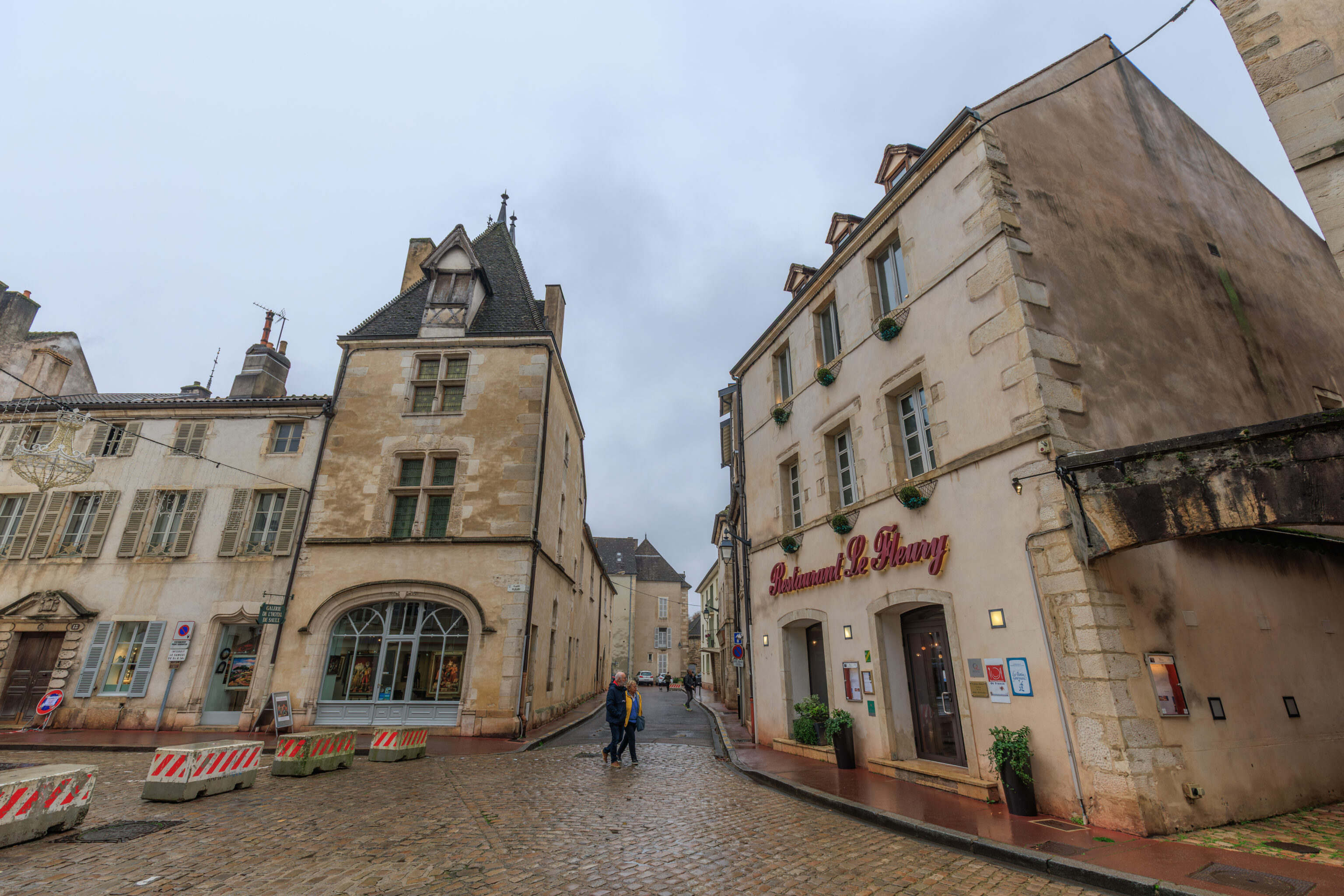
We started to walk back to the Fallot moutarderie for our tour.
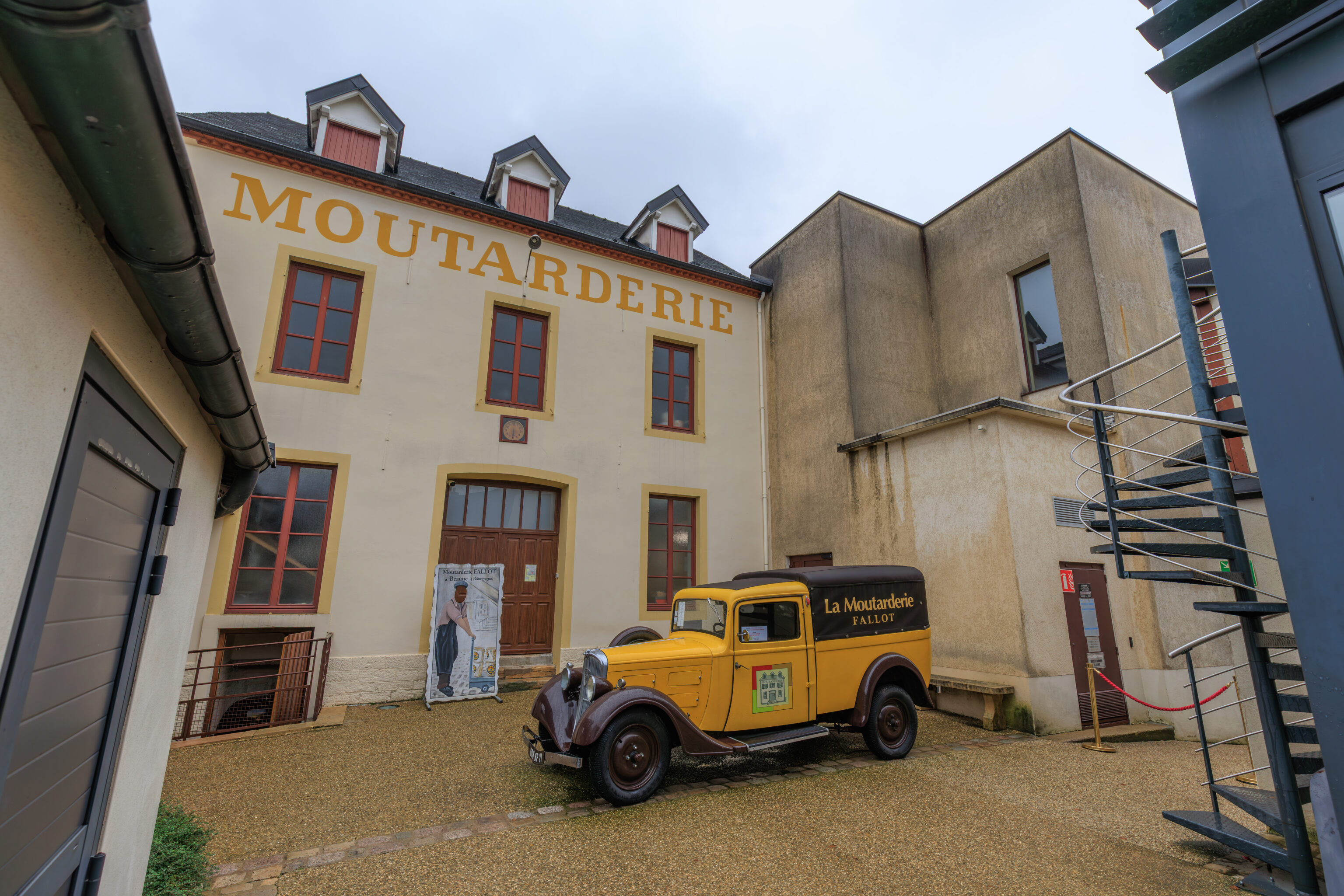
There was a historic delivery vehicle on display at the factory.
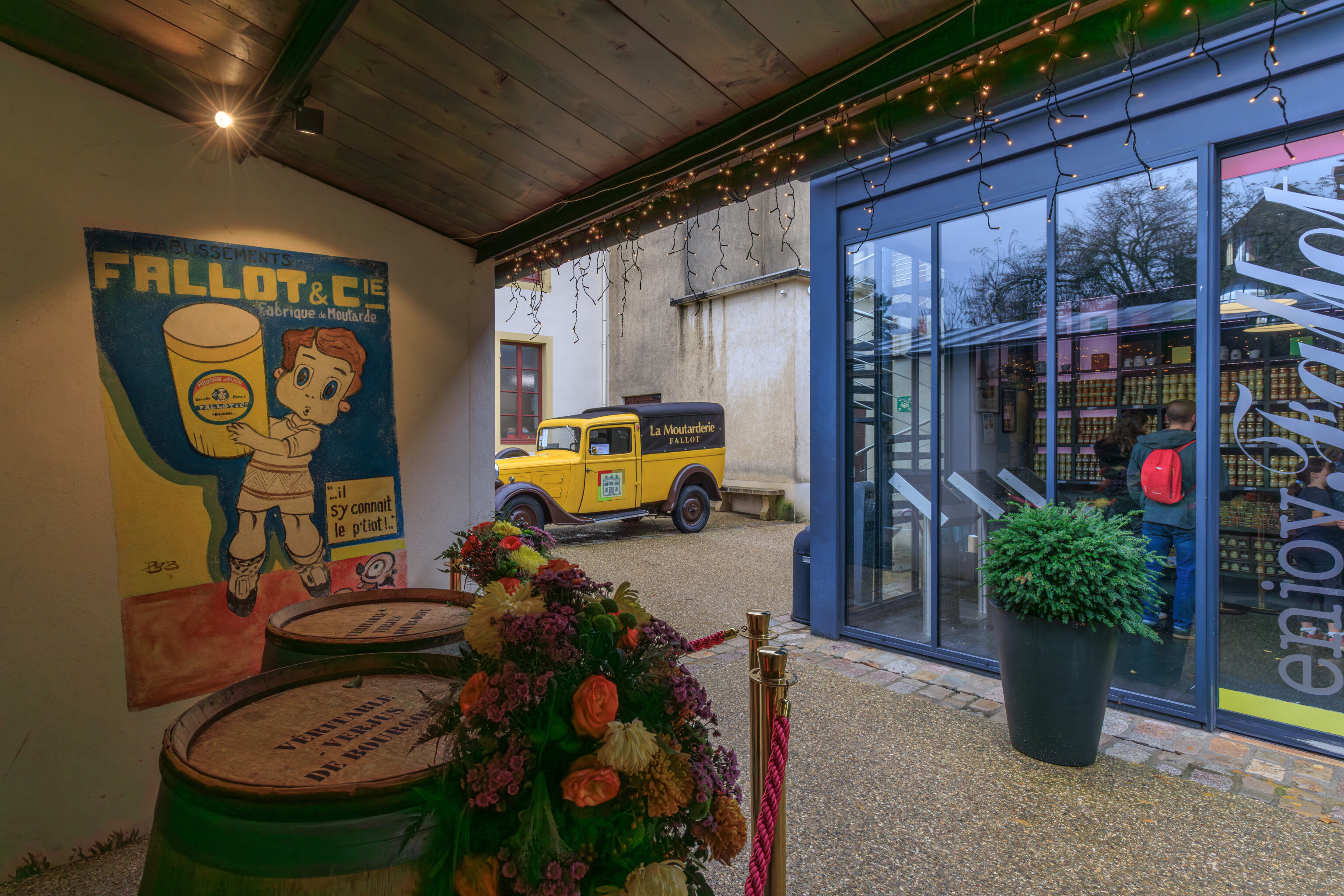
This covered area was a good place to wait for the tour to begin. We arrived a few minutes early.
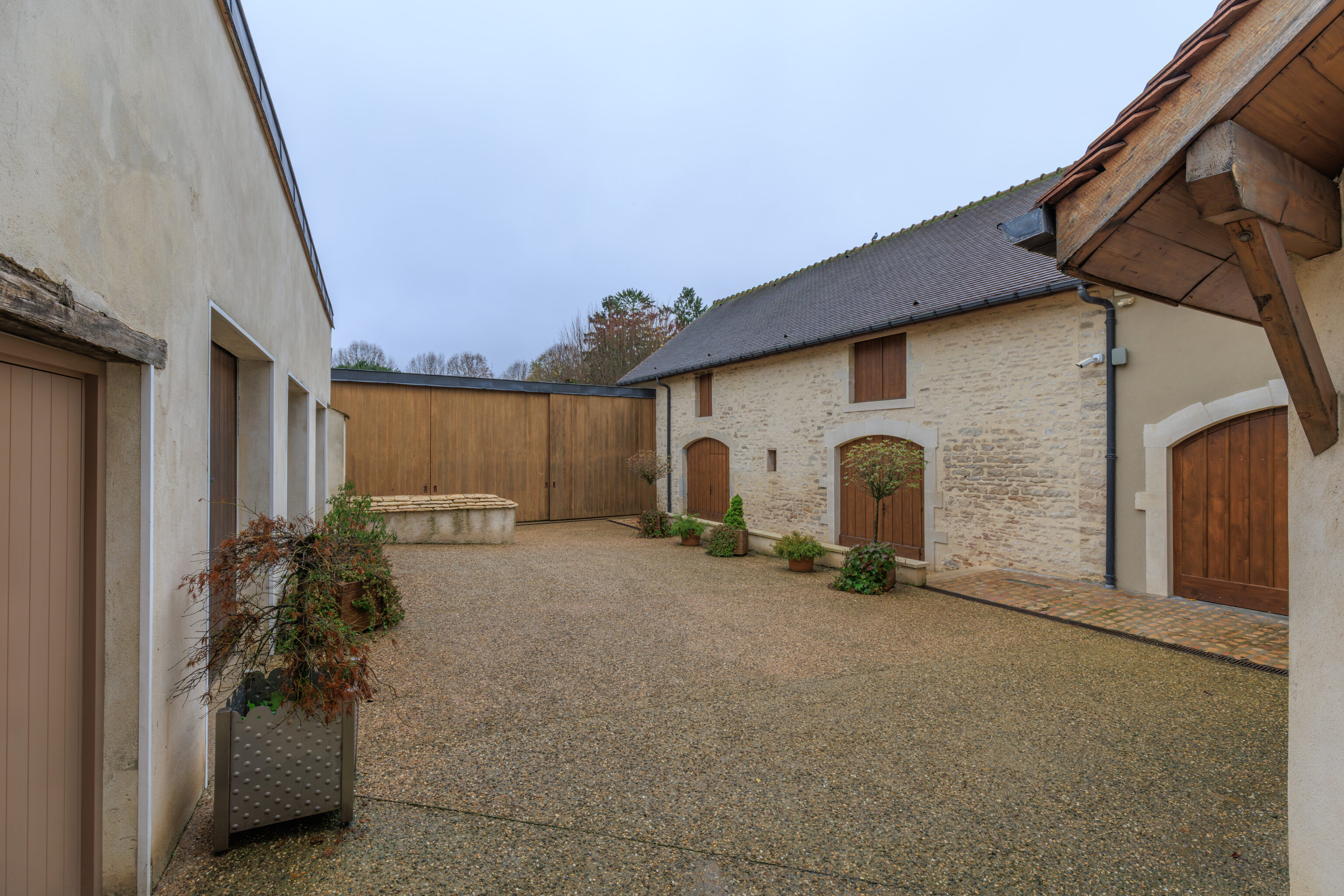
Unfortunately, photography was not permitted in any of the interesting areas of the tour. On the tour, the guide talked about mustard and its production. We also had the chance to sample some.
We learned that there was no protected brand for Dijon mustard. In 2008, the Moutarde de Bourgogne (Burgundy Mustard) brand was created. It requires mustard from the local area as well as the use of Burgundy white wine.
Fallot is a small independent brand. This is unlike Maille, which we visited while we were in Dijon. Maille is currently owned by Unilever and hasn’t been independently owned for many years.
So, we decided to buy some Fallot mustard after the tour.
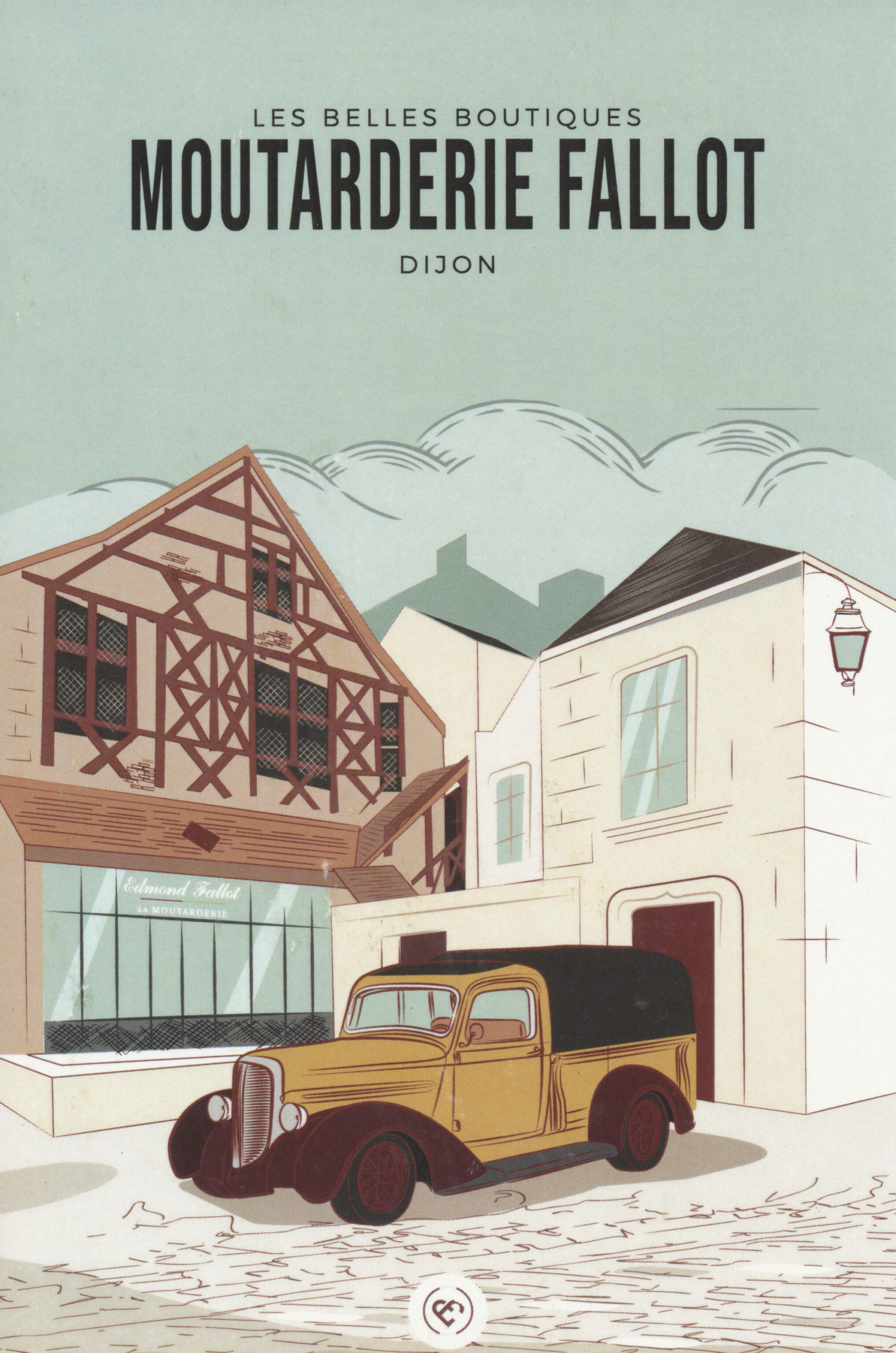
They also sold postcards, which we also purchased!
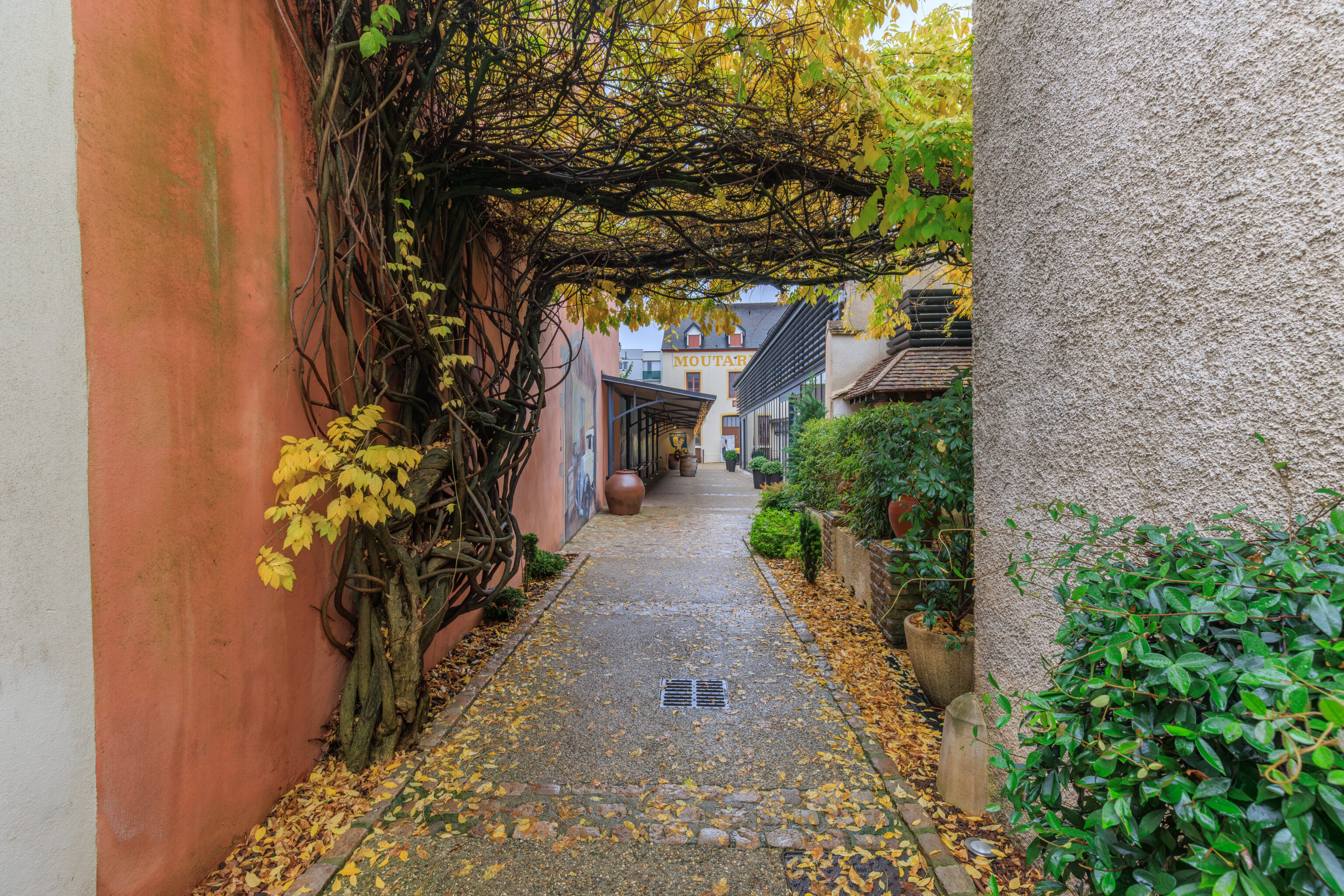
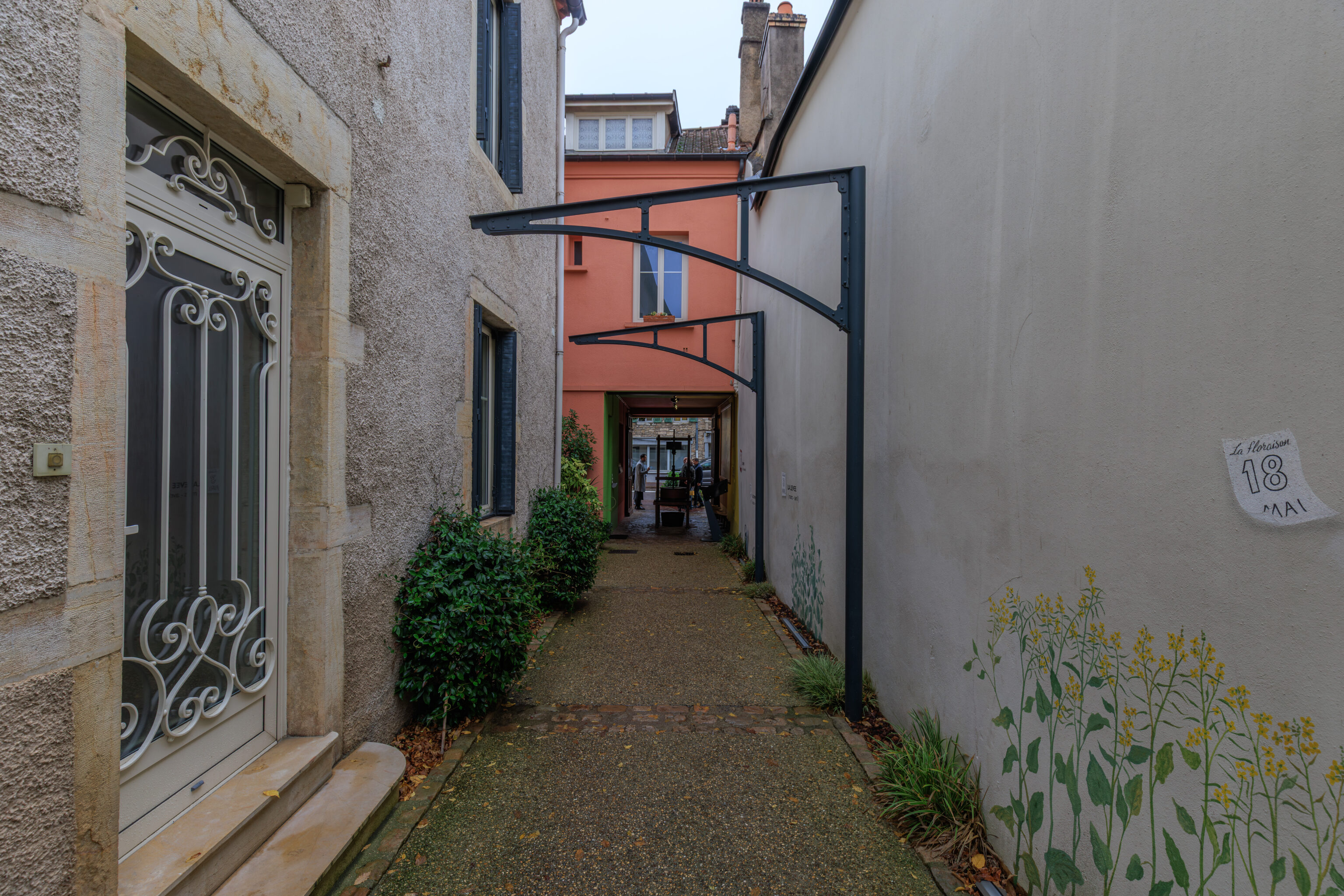
We left Fallot a little bit before 3pm and headed back to the city center.
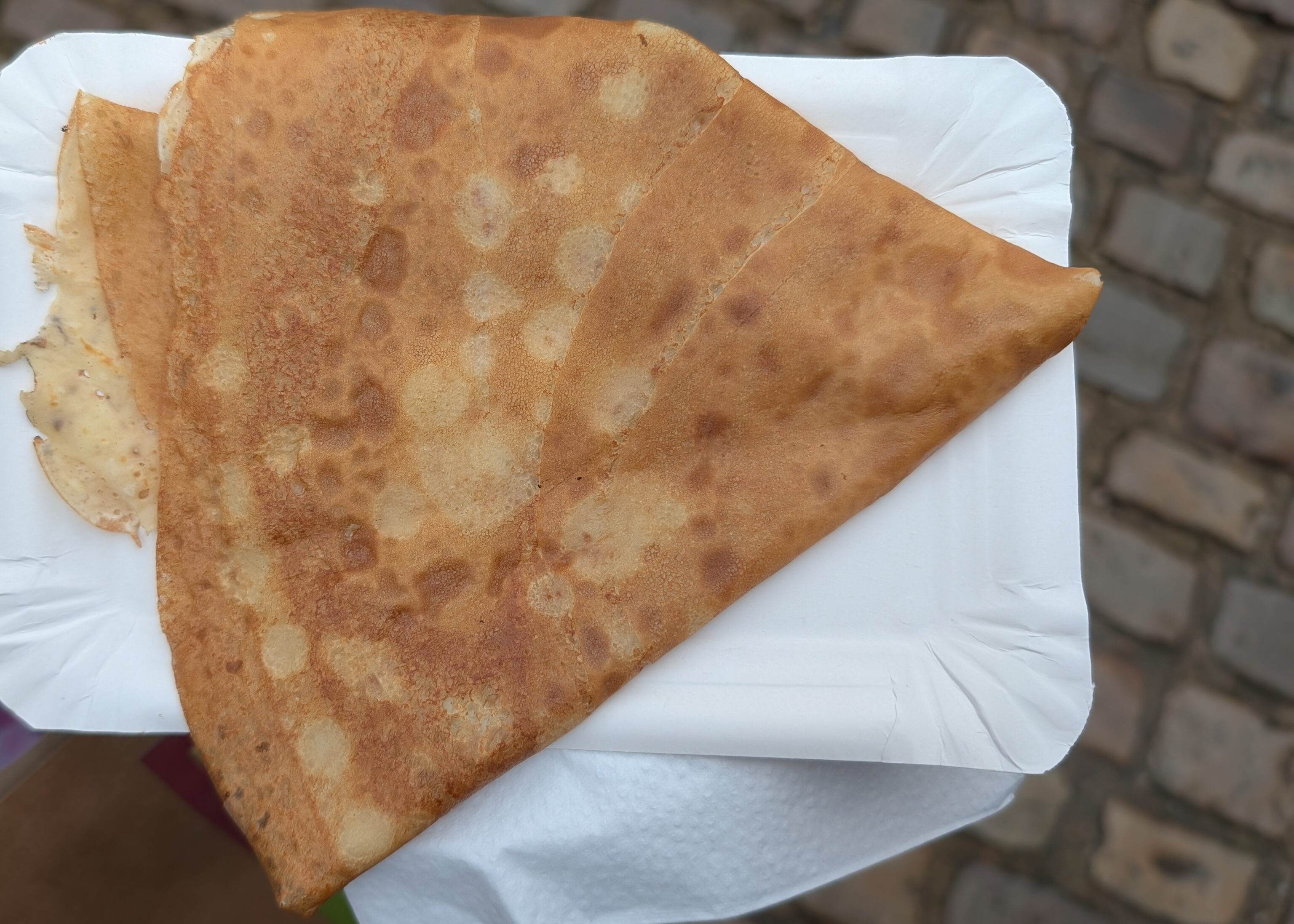
We stopped at a stand on the way and got a simple sugar crepe, which was a crepe with sugar sprinkled on it.
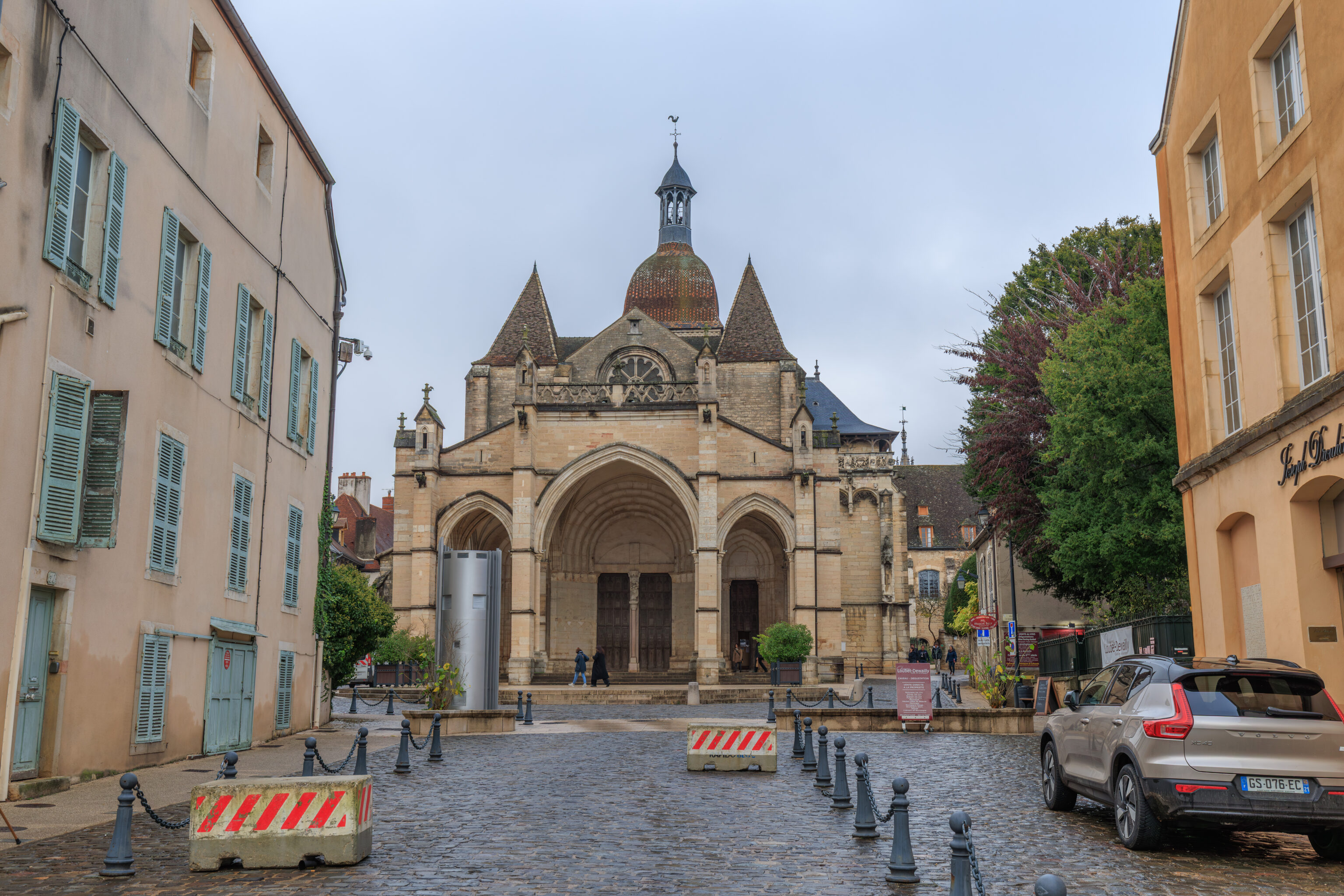
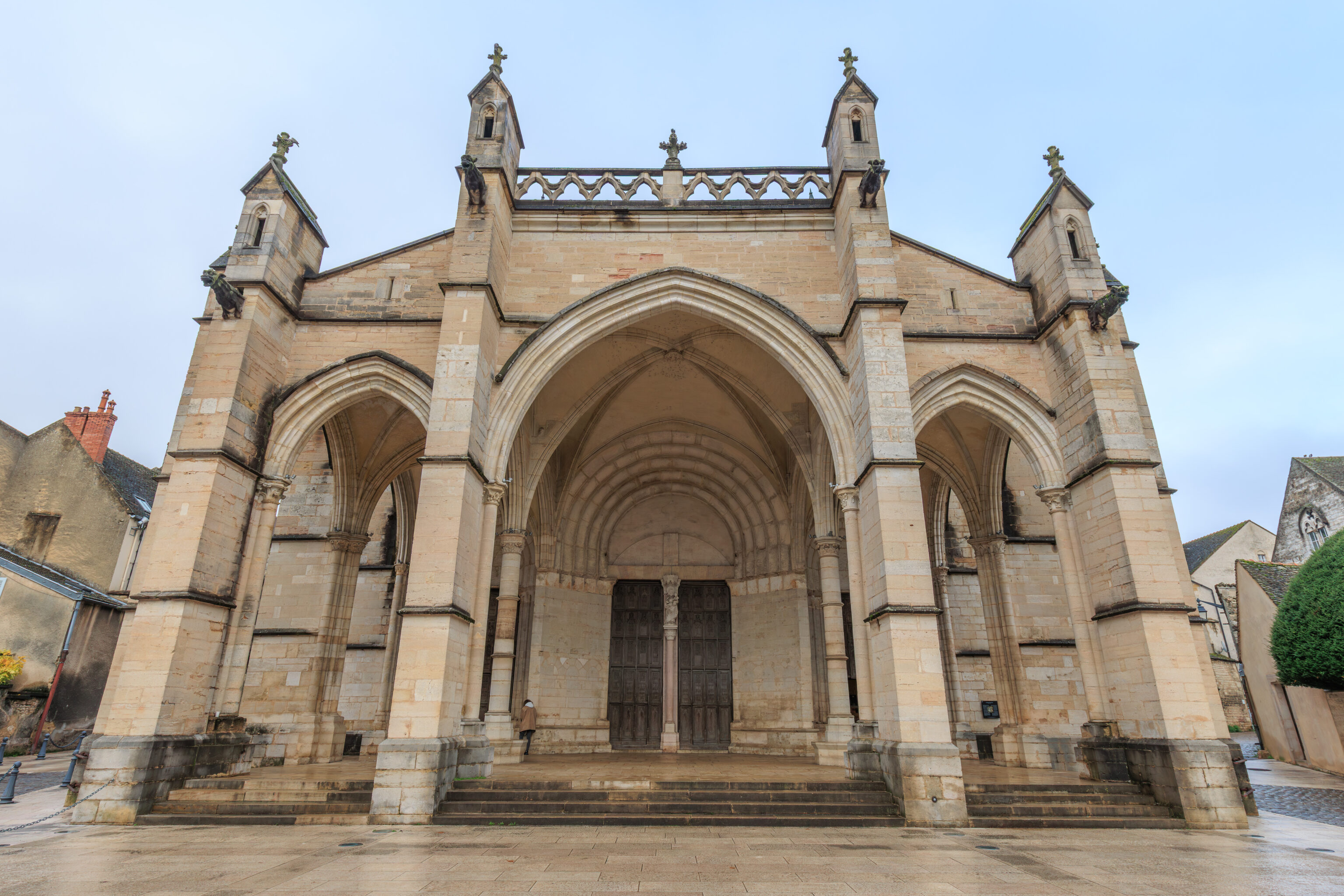
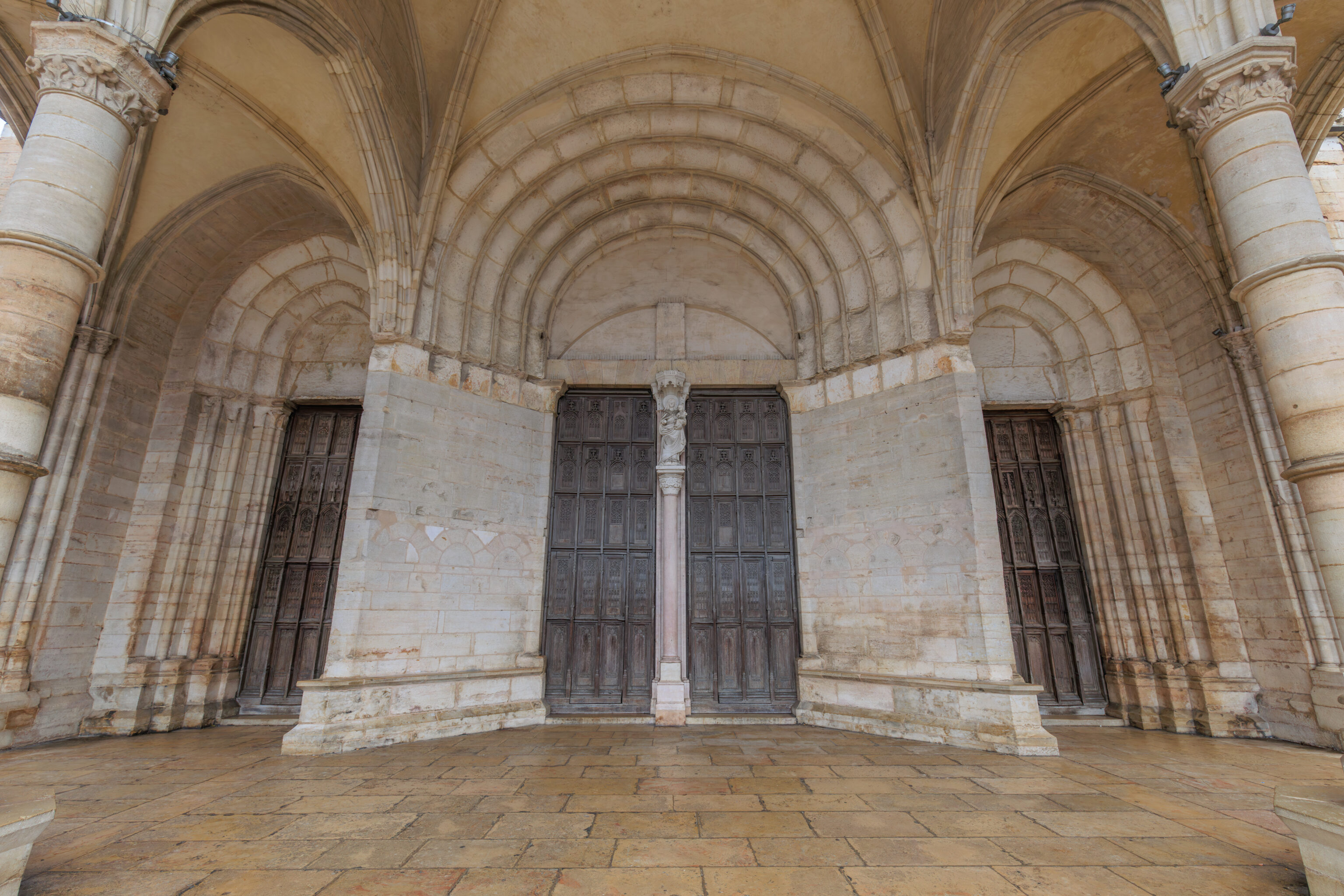
We walked over to the nearby Basilique Notre-Dame.
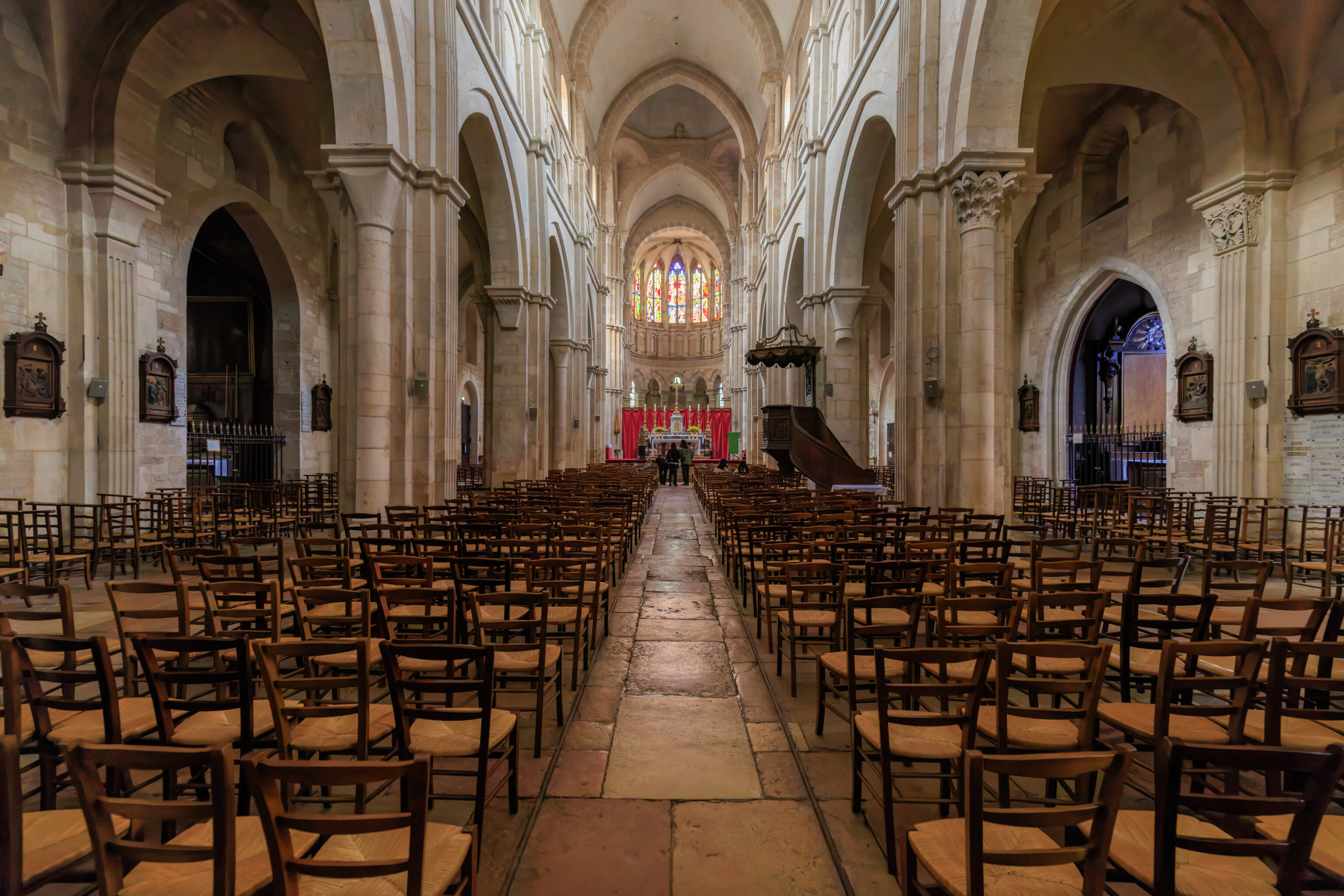
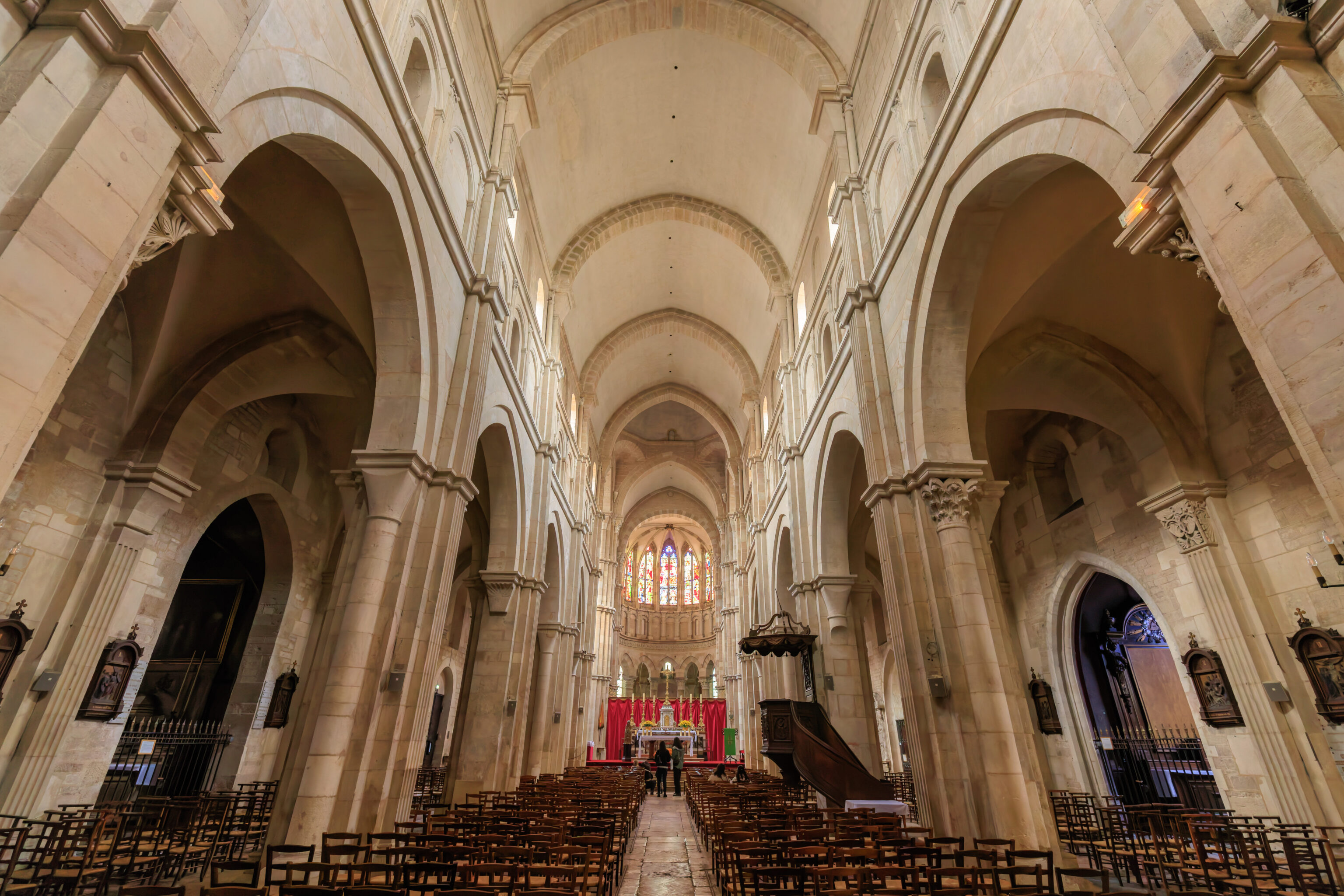
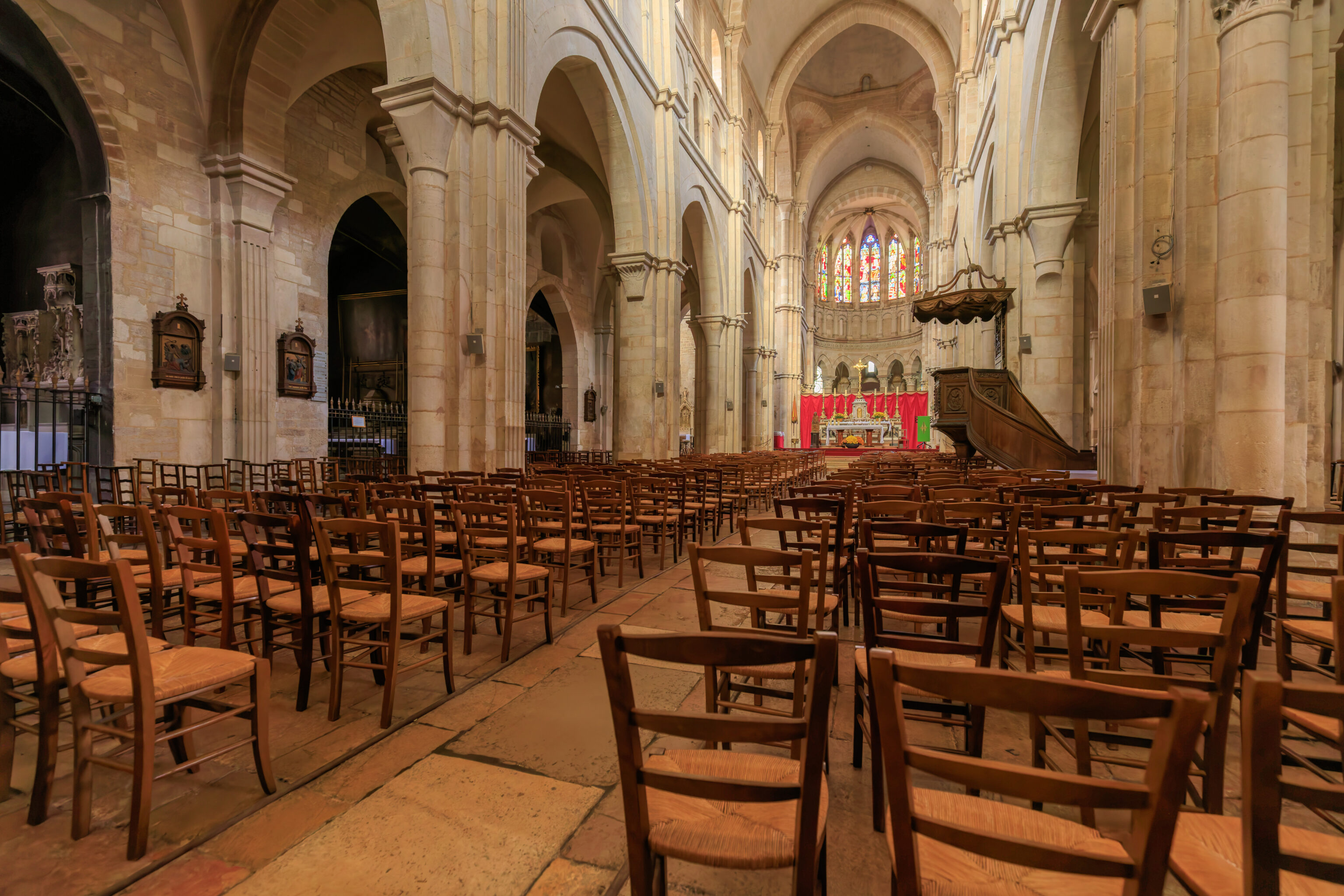
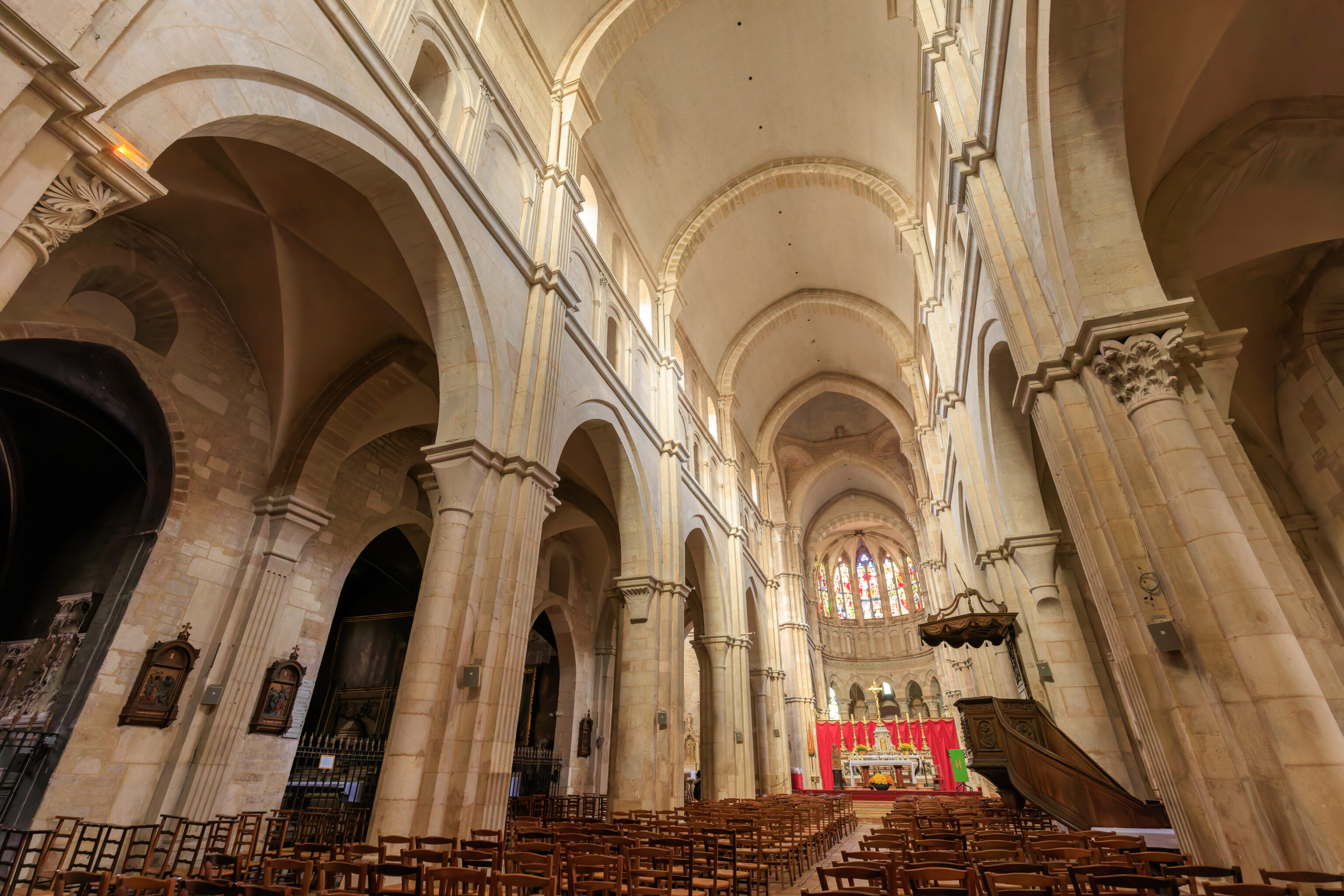
We went in to take a look. The interior was simply decorated compared to many other European churches that we’ve been to.
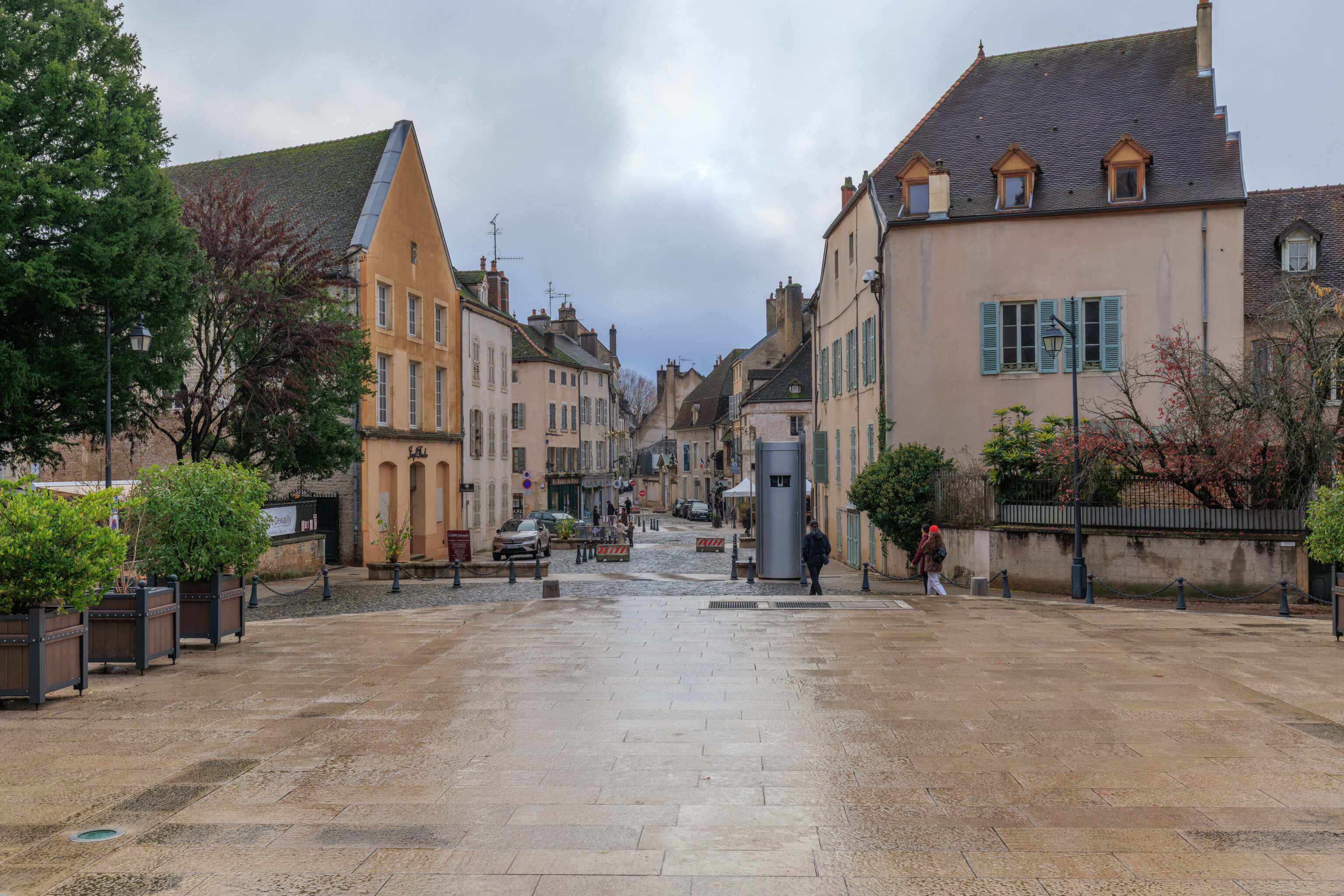
We headed back out after a short visit.
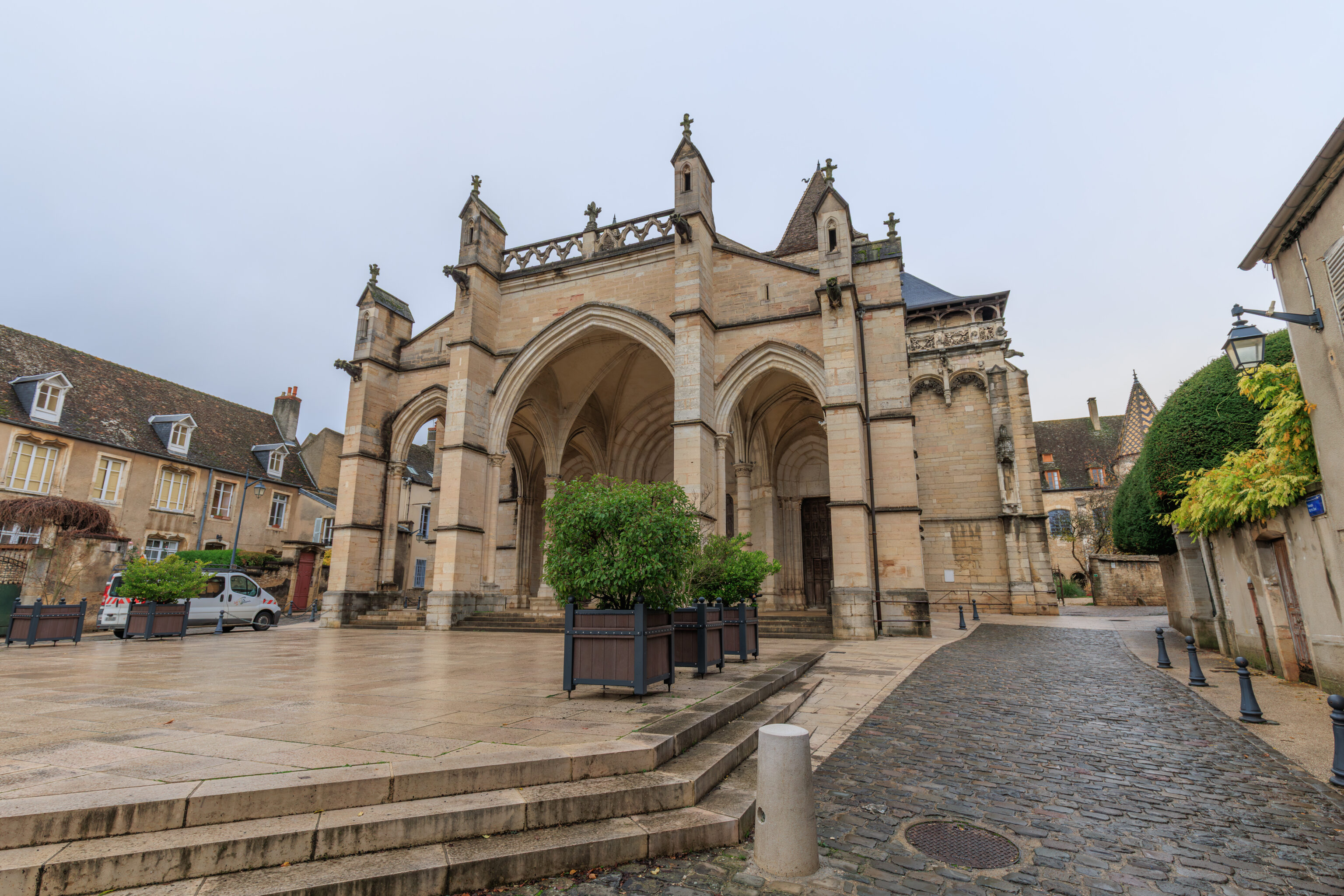
The basilica, as seen from the southwest.
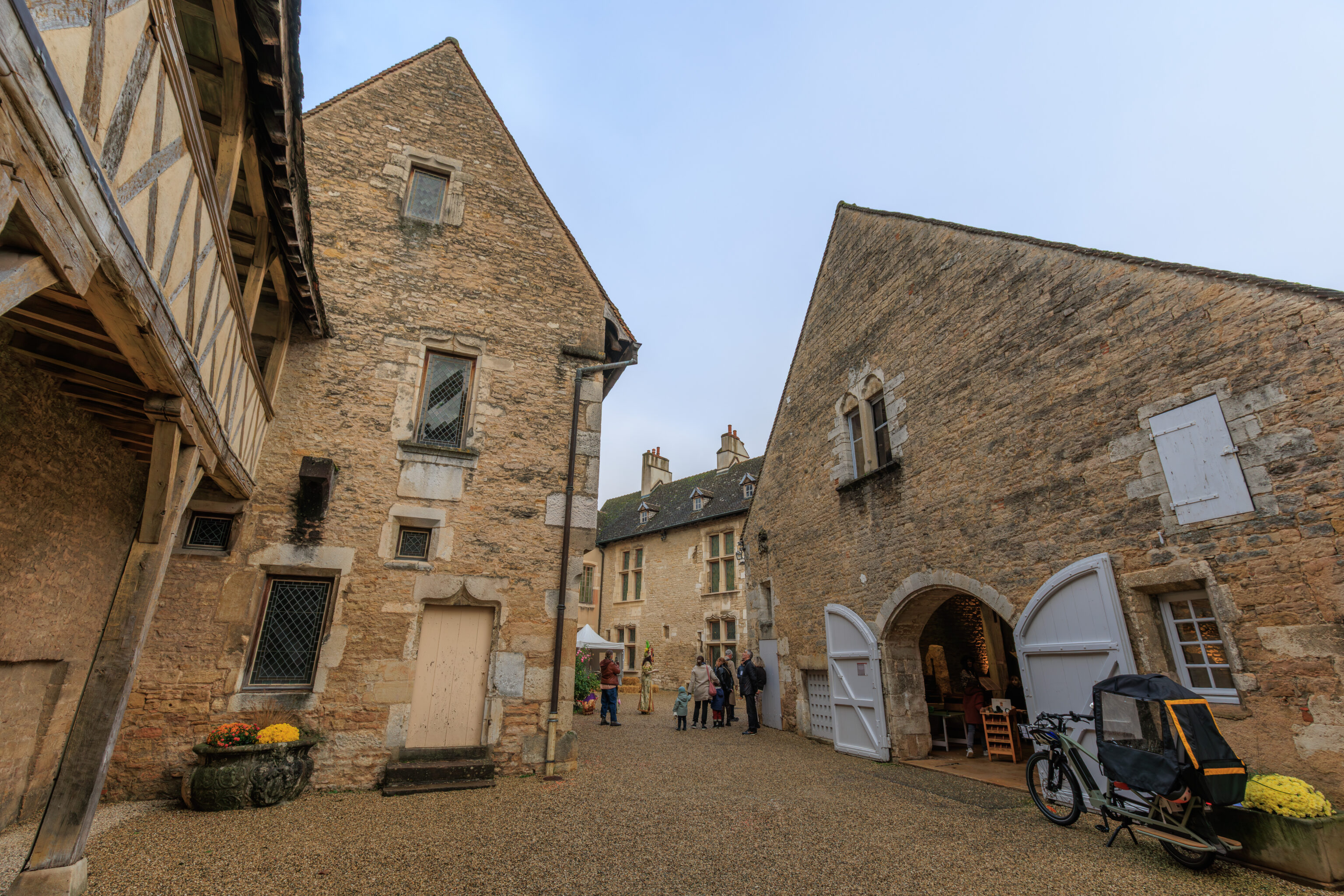
We walked down a side street to get back to where all the festivities were taking place.
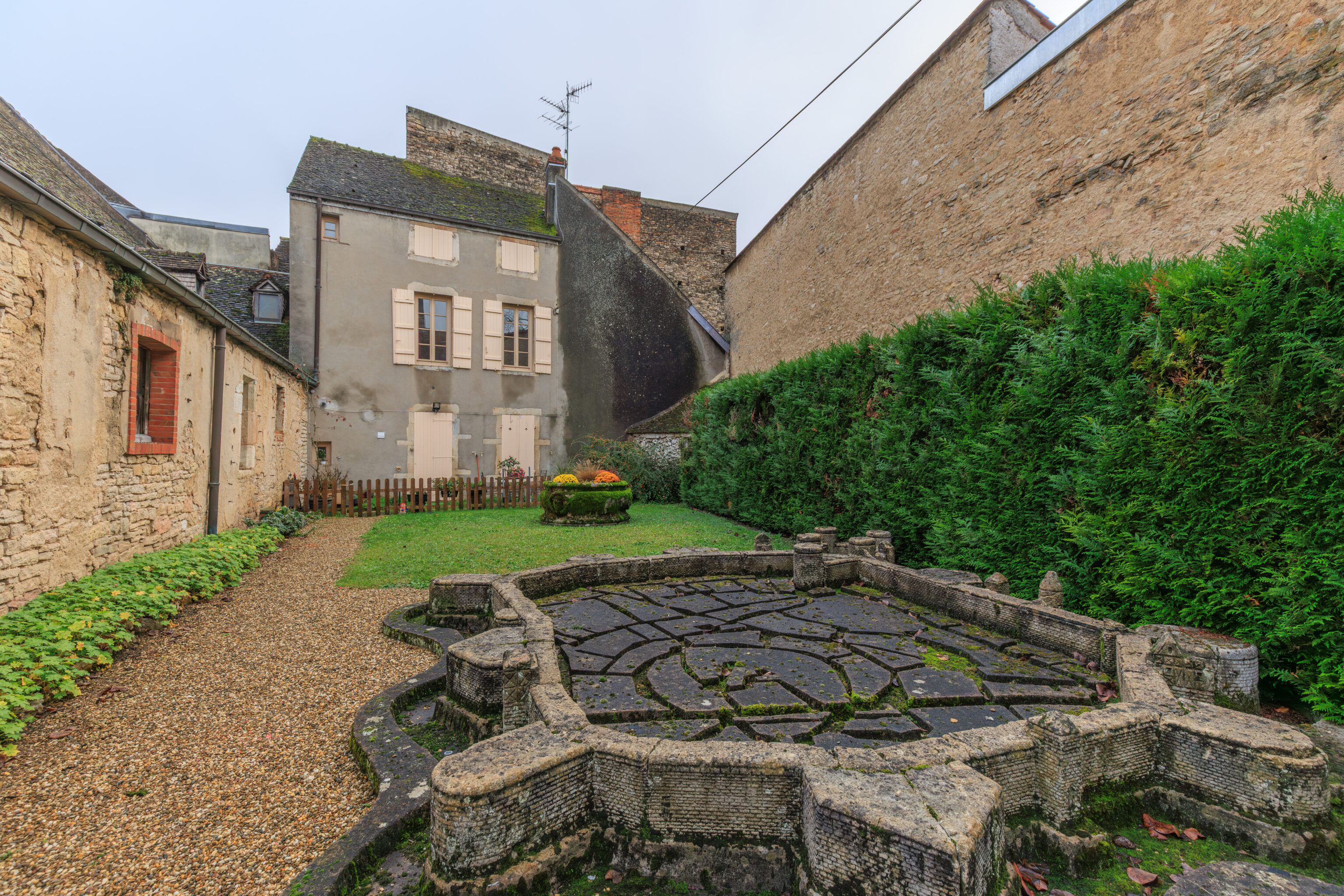
We ended up walking through what seemed like a back entrance to the Musée du Vin (Museum of Wine). We passed by a stone map of the city center with its walls intact. The actual museum is located in a historic building:
The mansion is located inside the old Gallo-Roman castrum. In the Middle Ages, it was the residence of the Dukes of Burgundy during their visits to Beaune, and it housed their court of justice, the Parliament of Burgundy. The city acquired the building in 1919 and installed its Wine Museum, one of the oldest French ethnological museums exclusively devoted to wine heritage, in 1946. This place of memory of the history of Burgundy and its wines retraces the history of viticulture, wine-making practices, cooperage, the wine trade and oenology.
– Sign
There seemed to be some sort of event going on at the museum. We continued on though.
We also walked through a building that contained more stands, mostly selling wine. The building, a bit of which can be seen on the left, seems top be the former Chapelle Saint-Étienne. Today, it seems to be something like an exhibition hall.
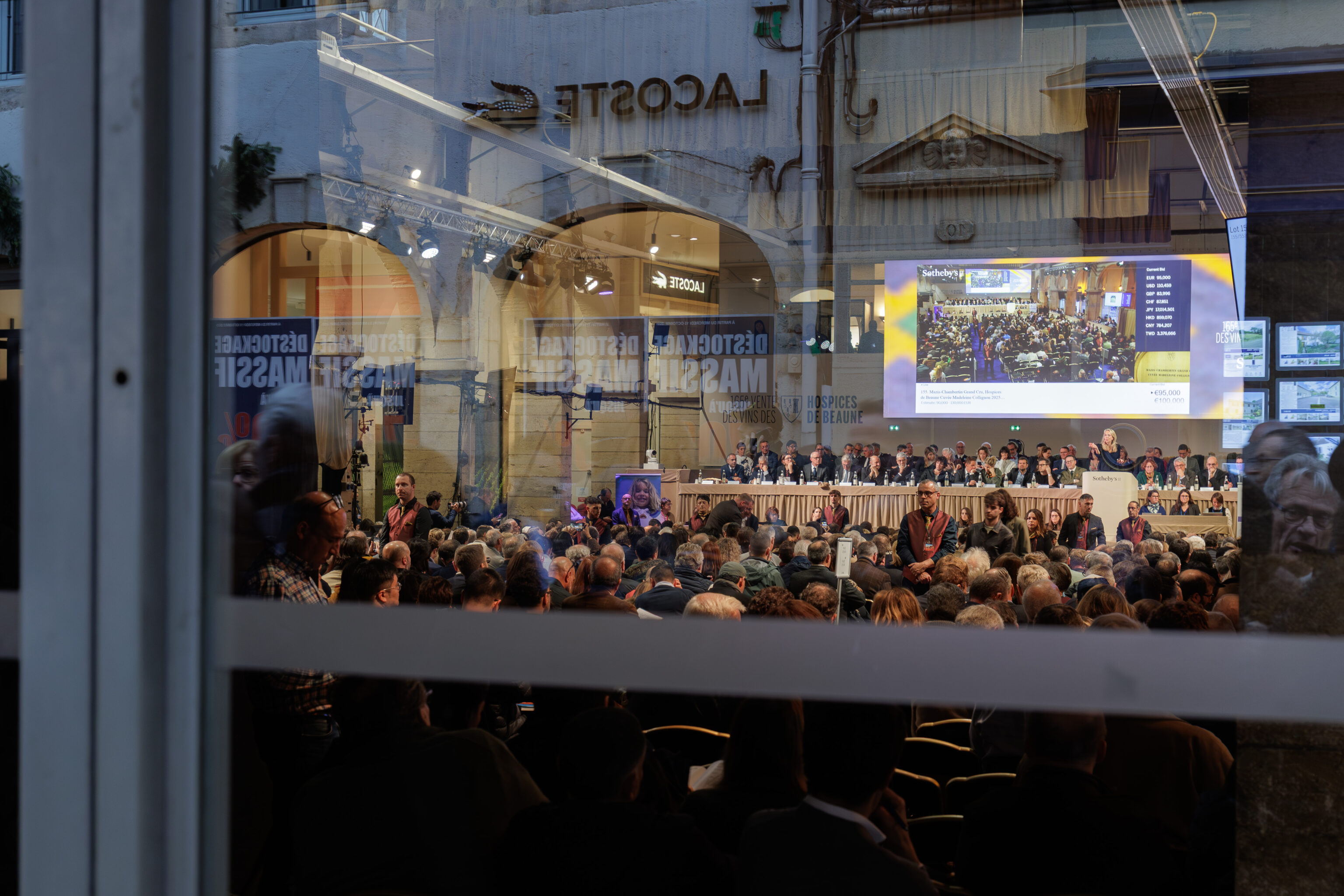
We ended up back by the market building where the wine auction was taking place. We were able to look in from some windows outside to see what was going on inside!
Hôtel-Dieu des Hospices Civils de Beaune
We weren’t sure if the Hôtel-Dieu, now a museum, was open to visitors as parts of it are used for auction related events. It turns out that it was open. So, we got tickets and went in!
The museum is actually open pretty late as far as museums go with a 6:30pm closing time right now in late Fall. They do seem to close for lunch in the colder months of the year though.
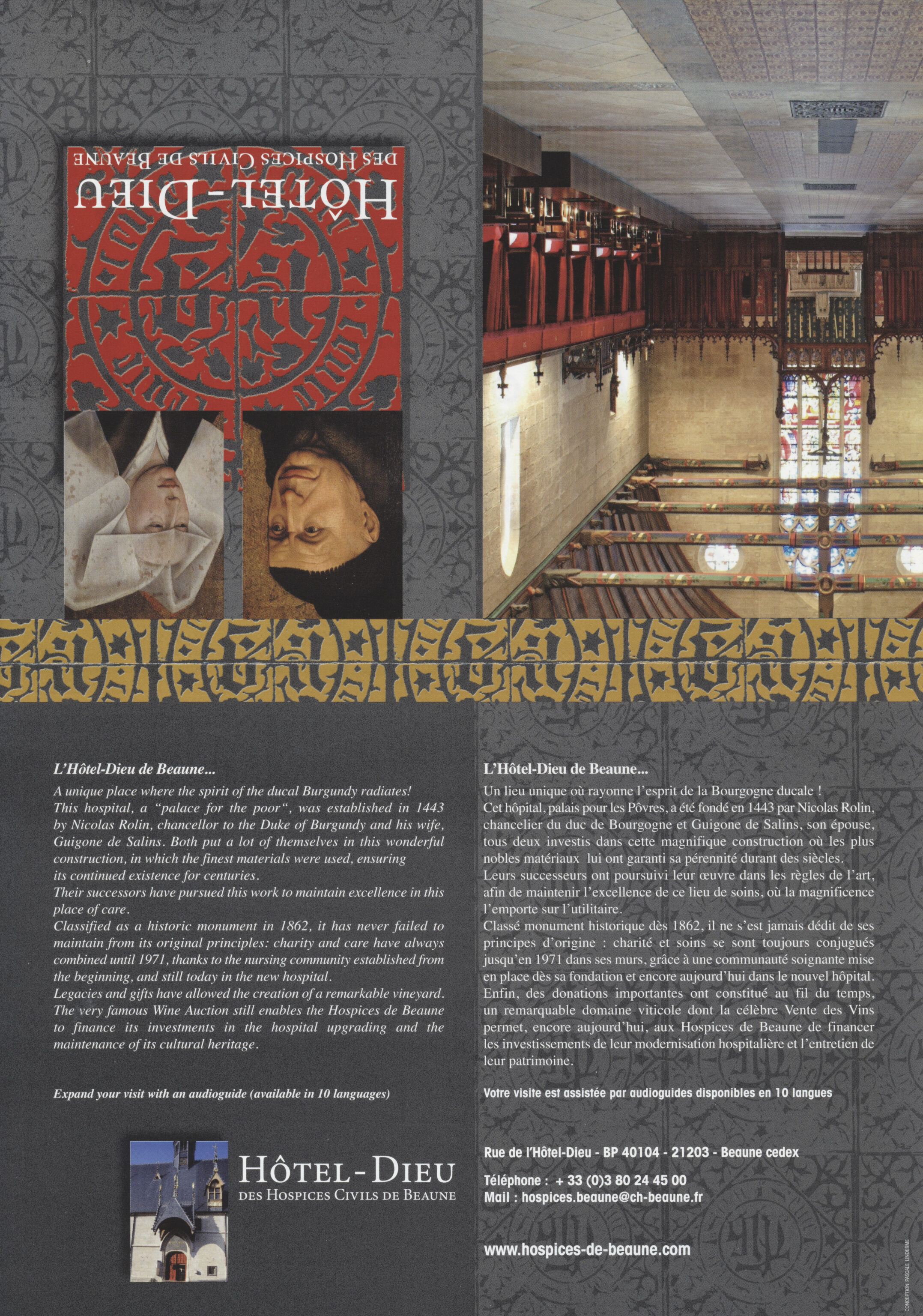
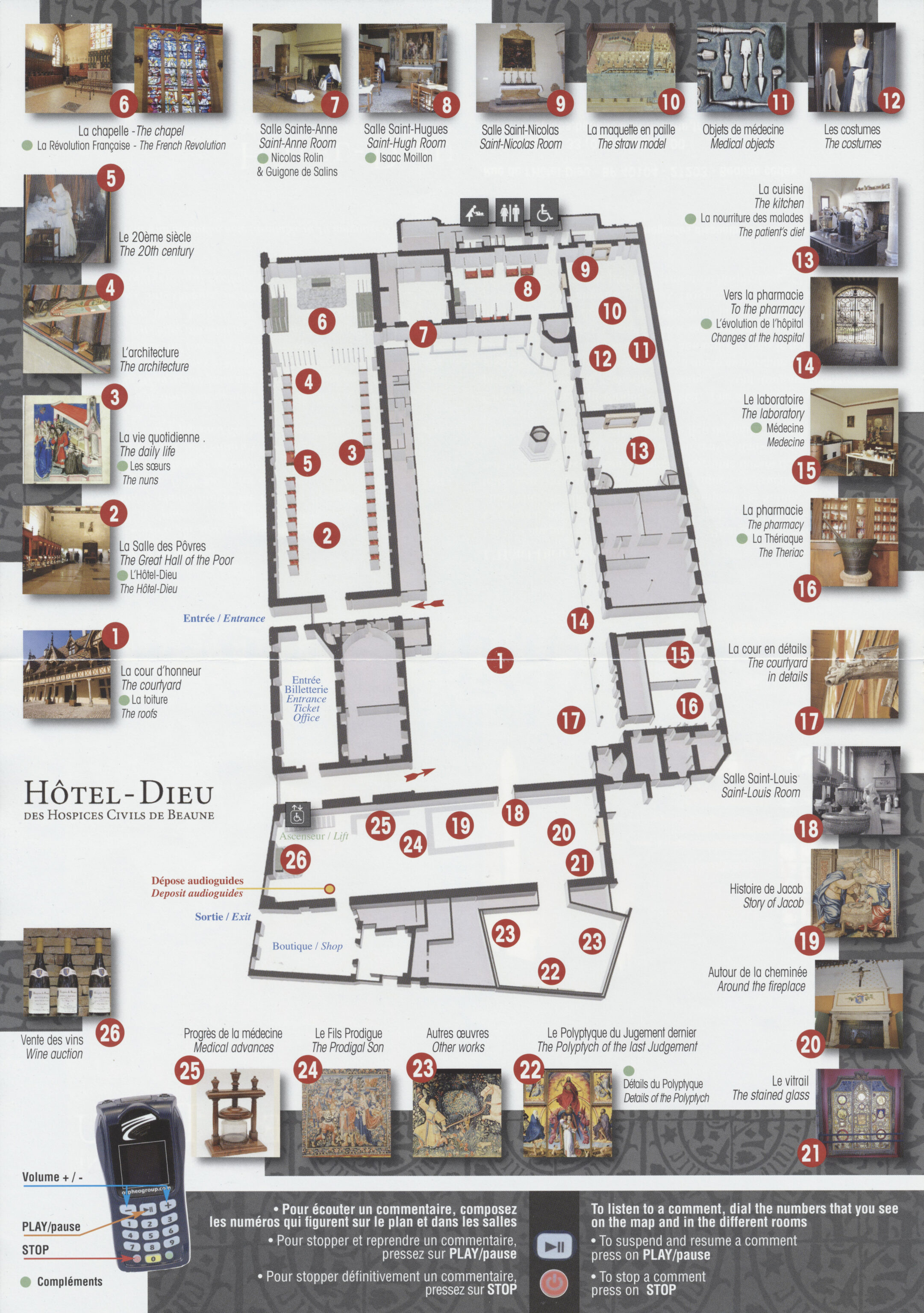
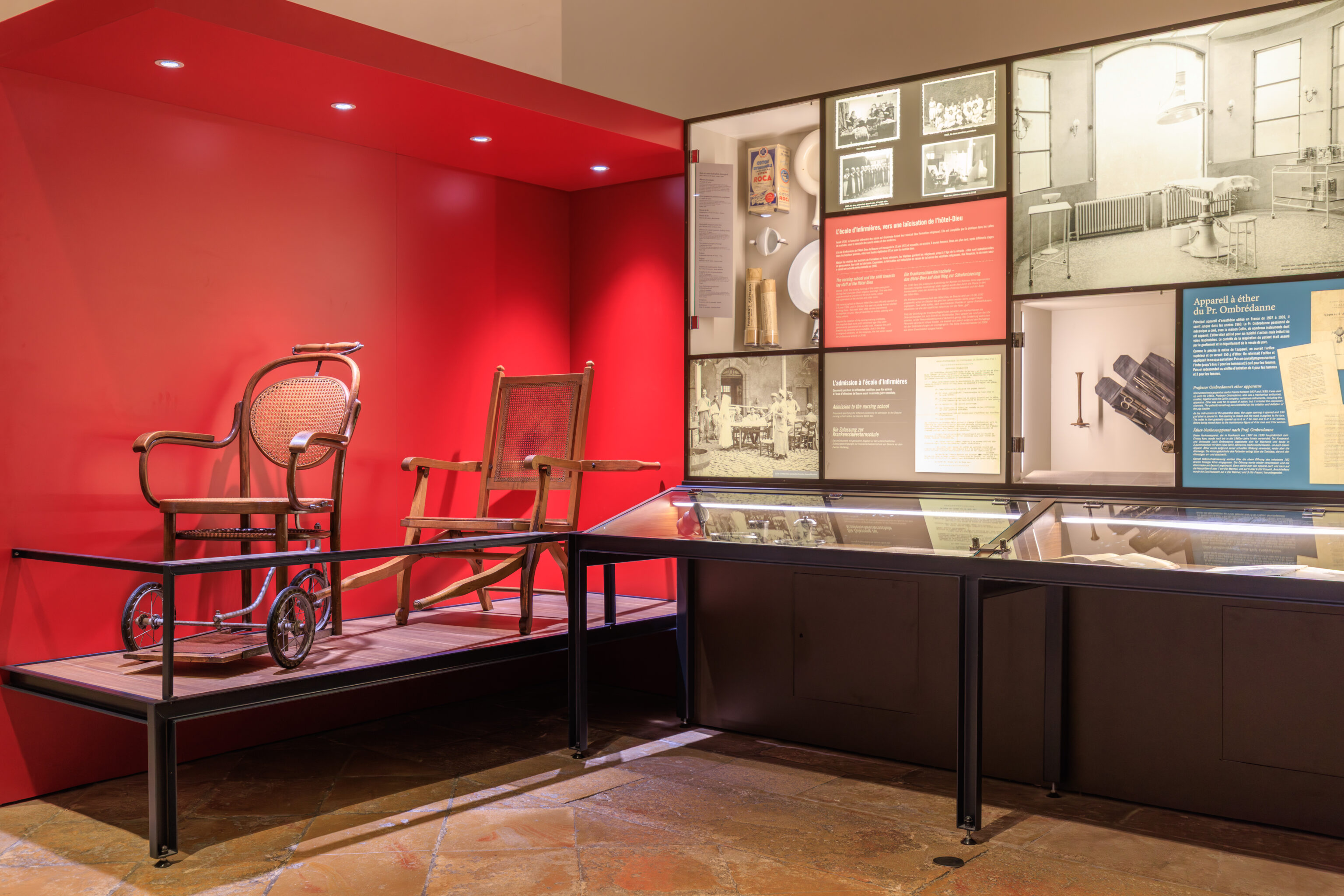
We picked up a small pamphlet which contained a map of the building.
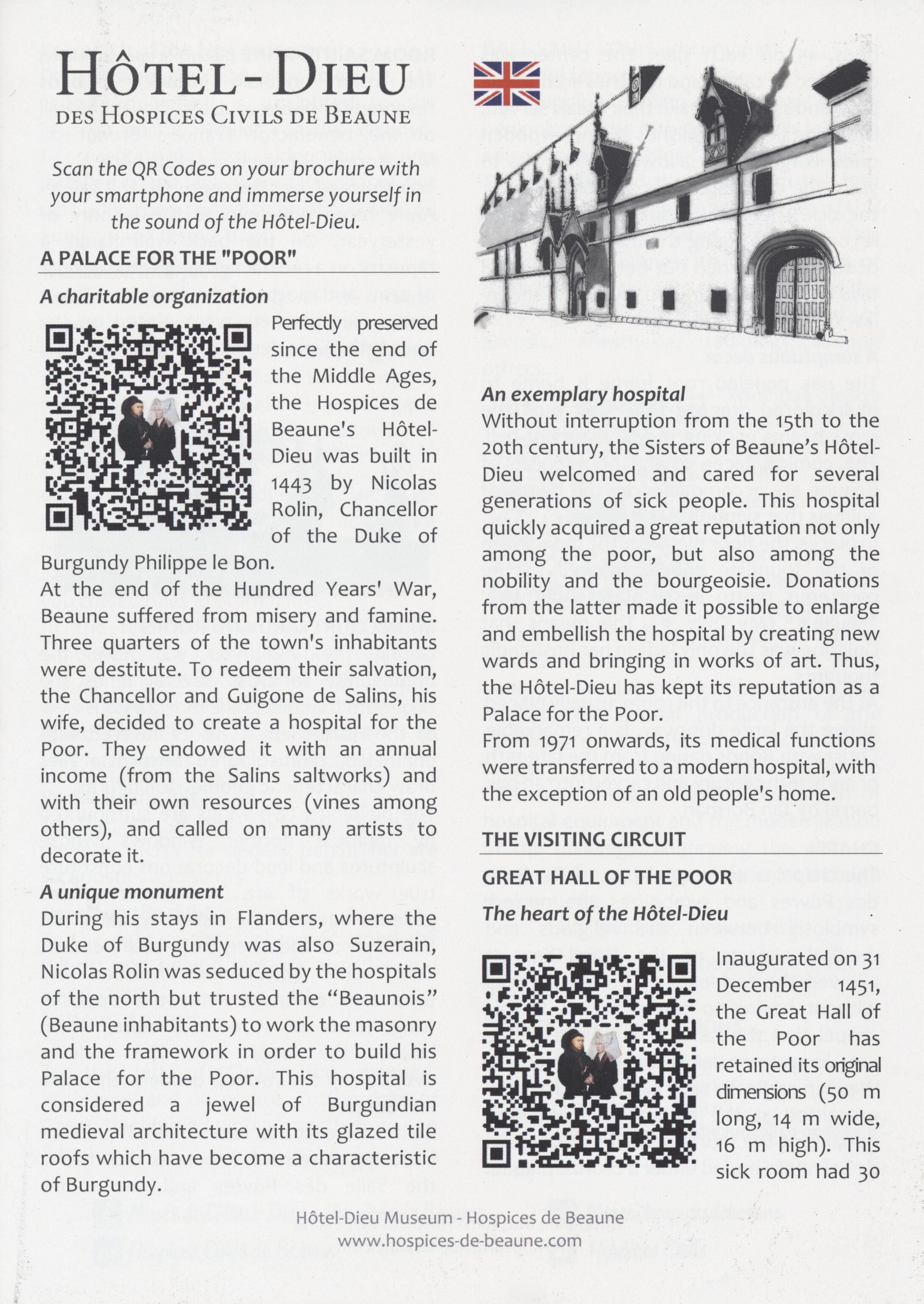
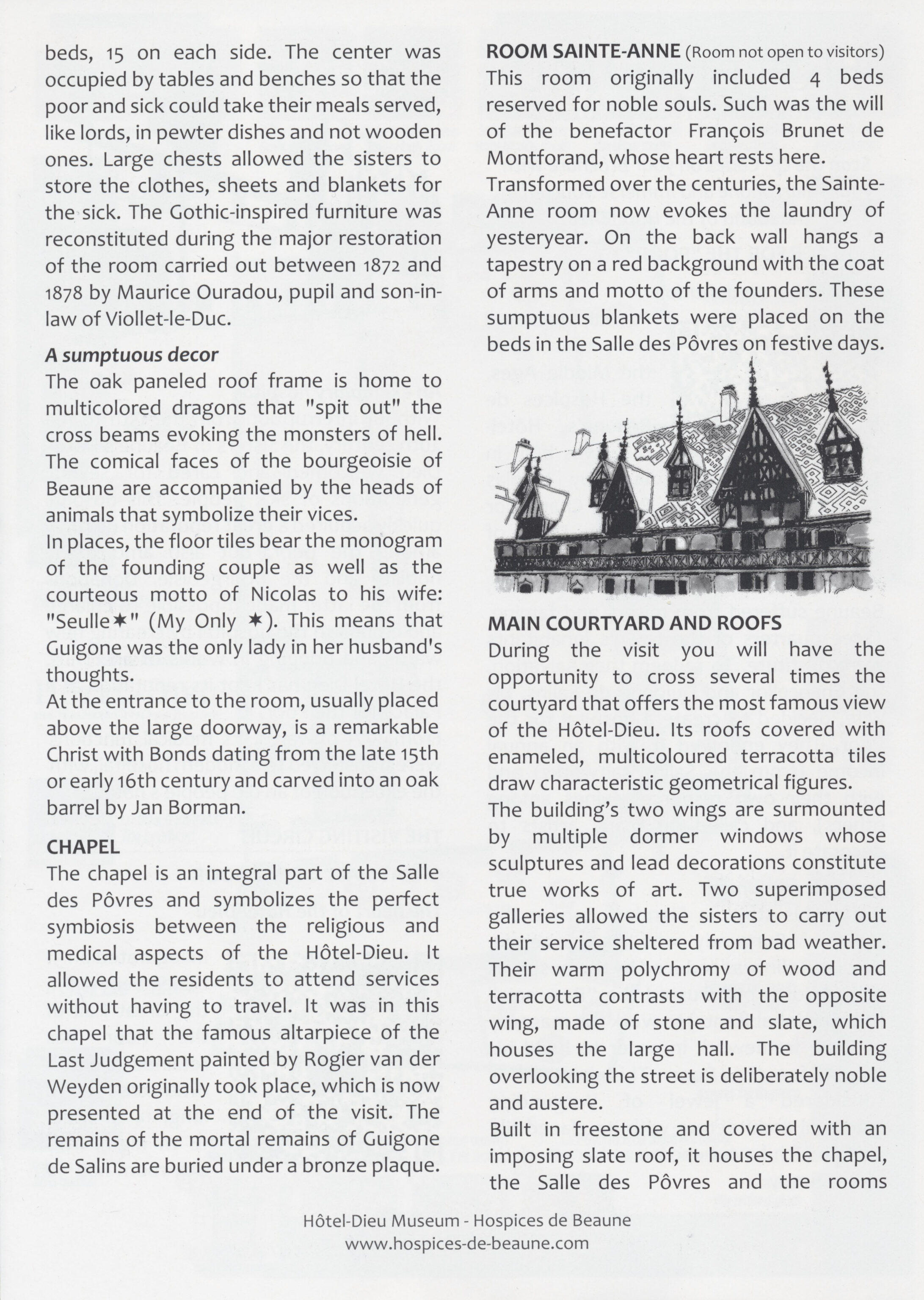
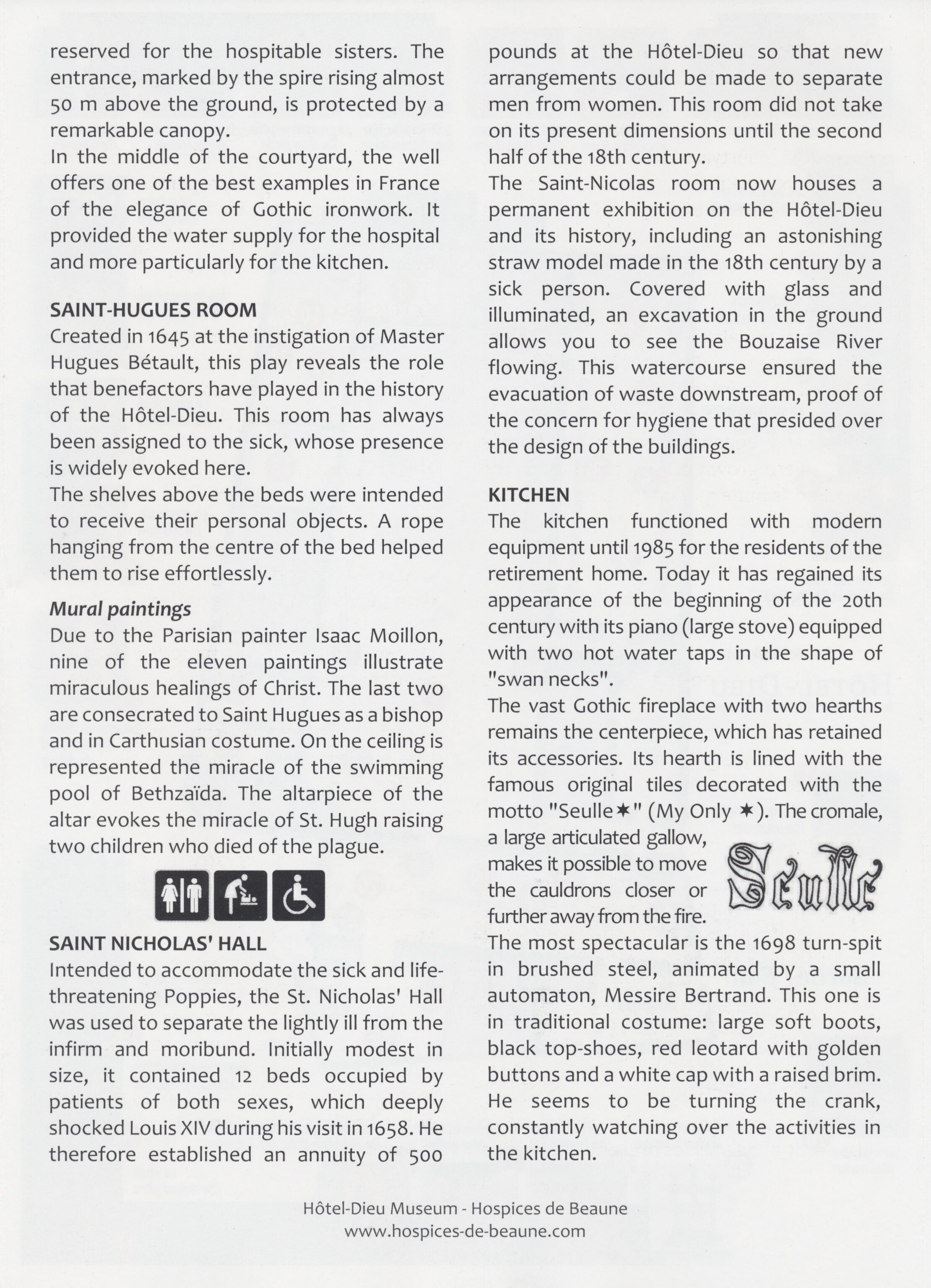
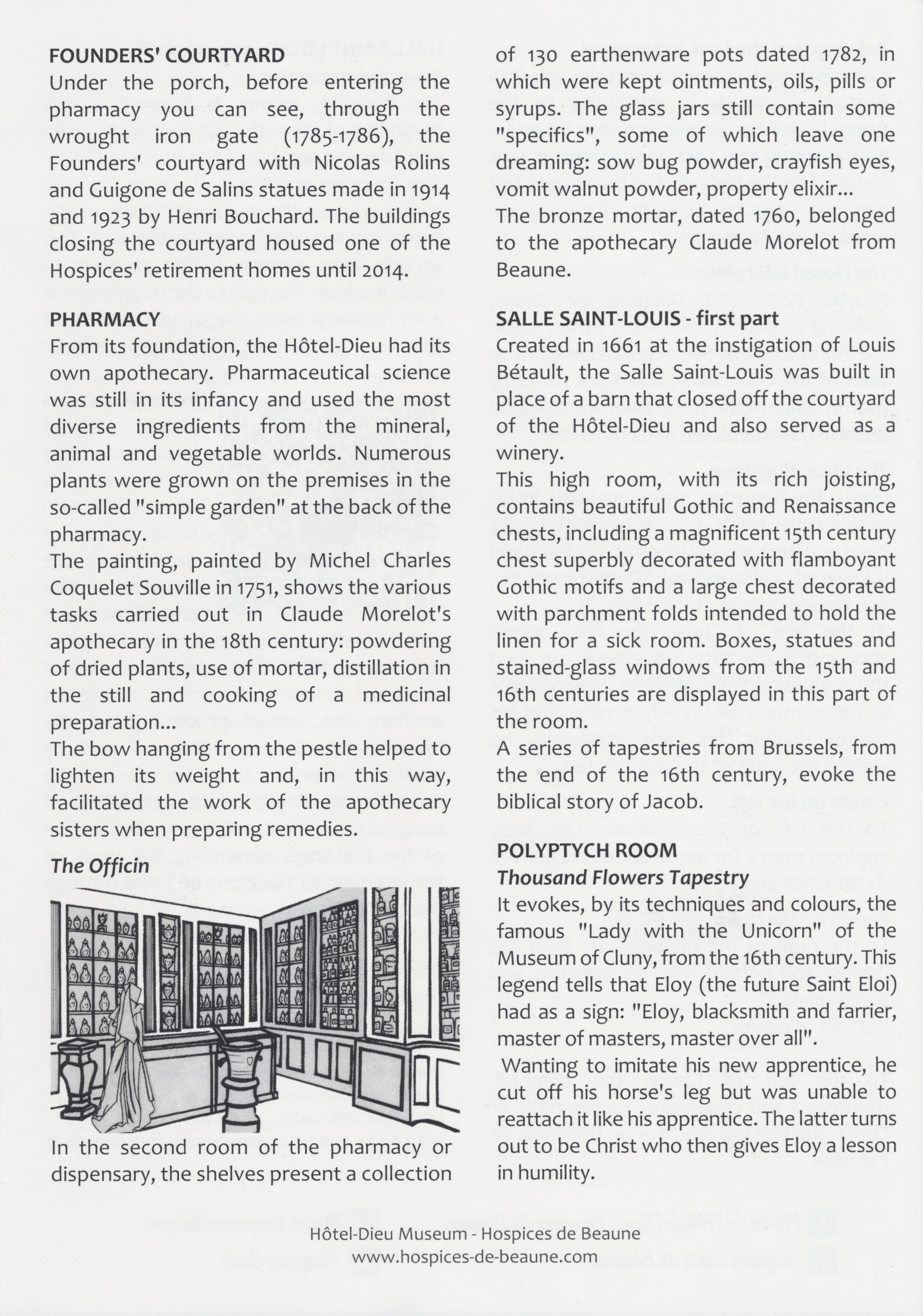
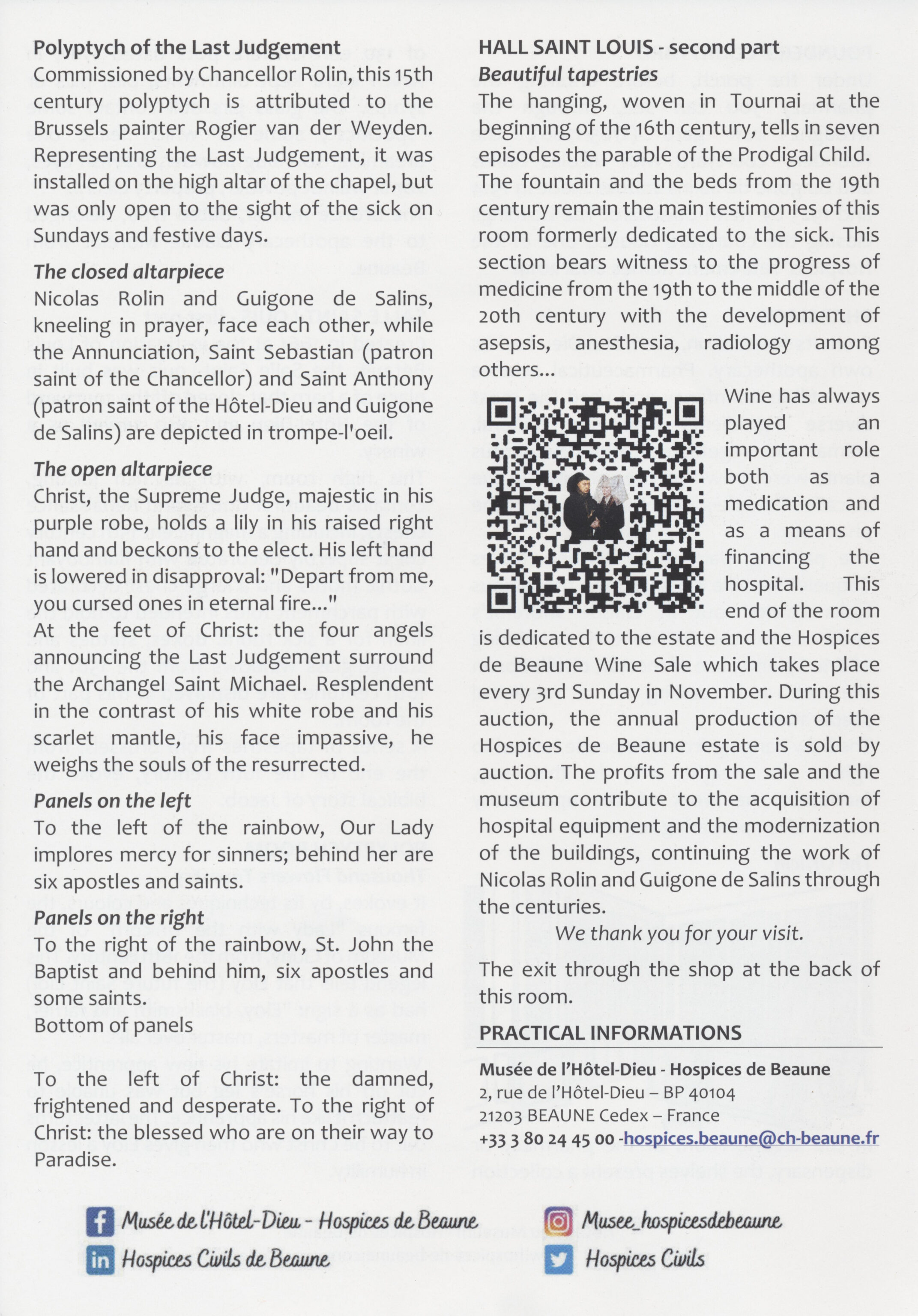
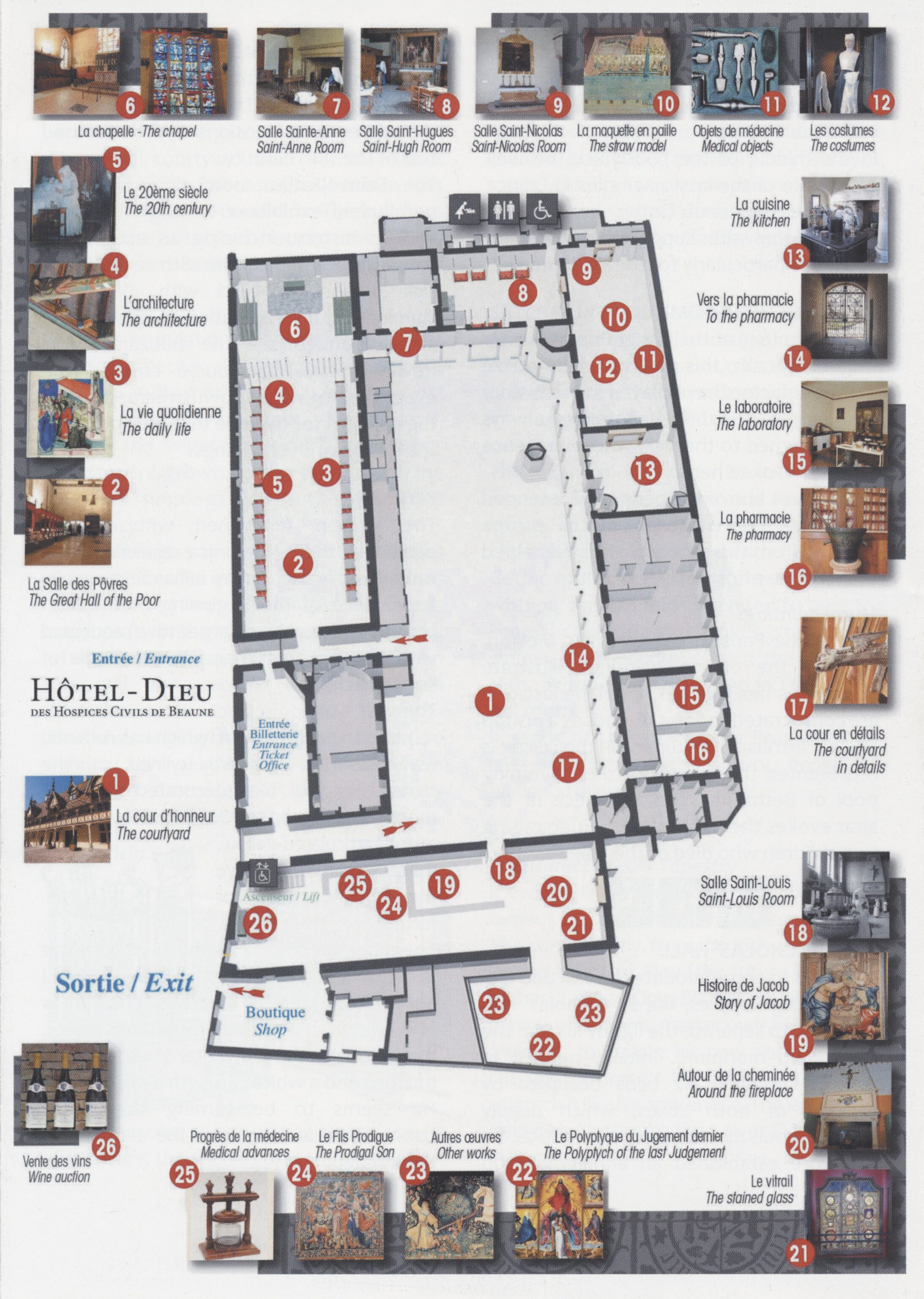
We also got a larger one with the same map but included quite a bit of descriptive text.
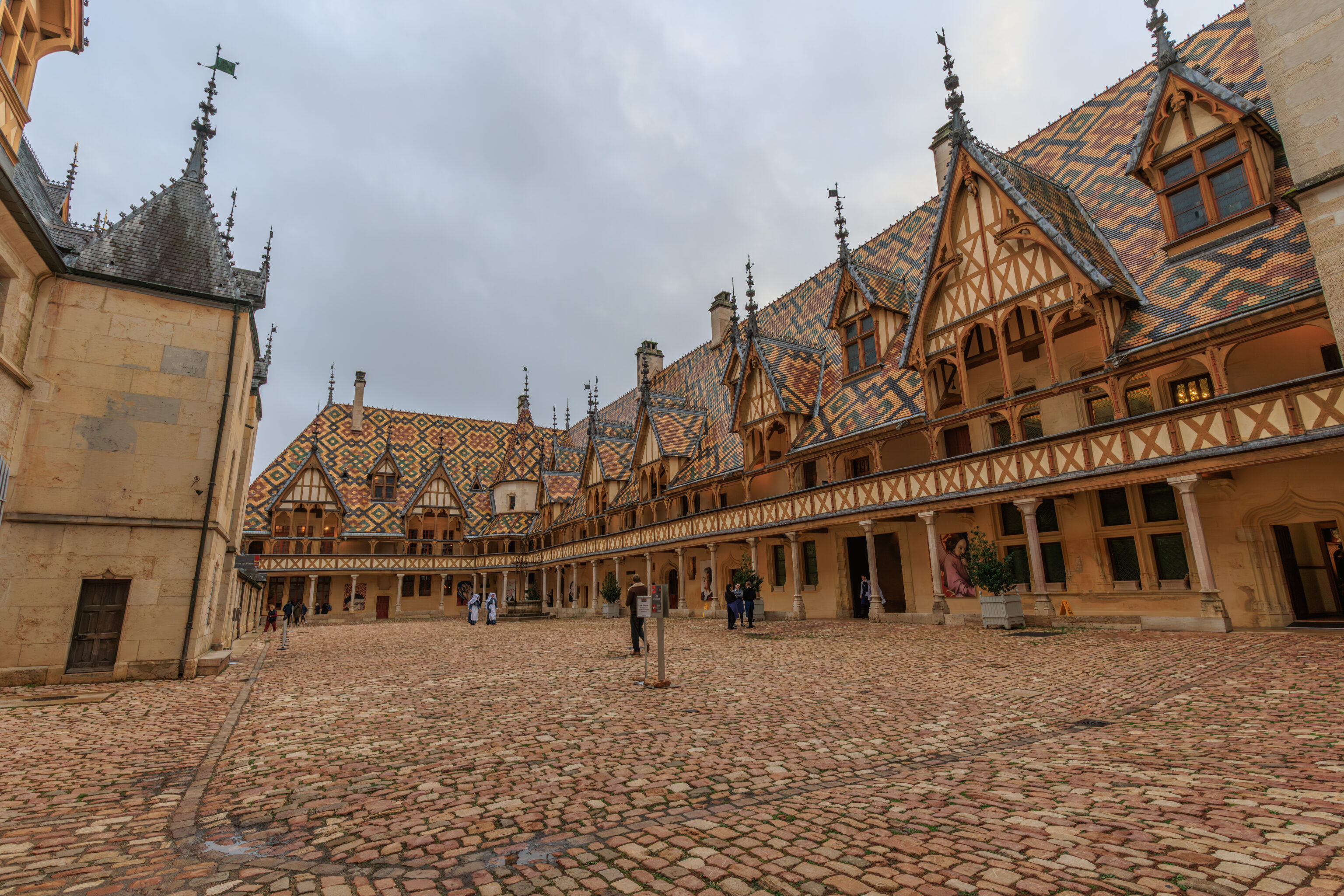
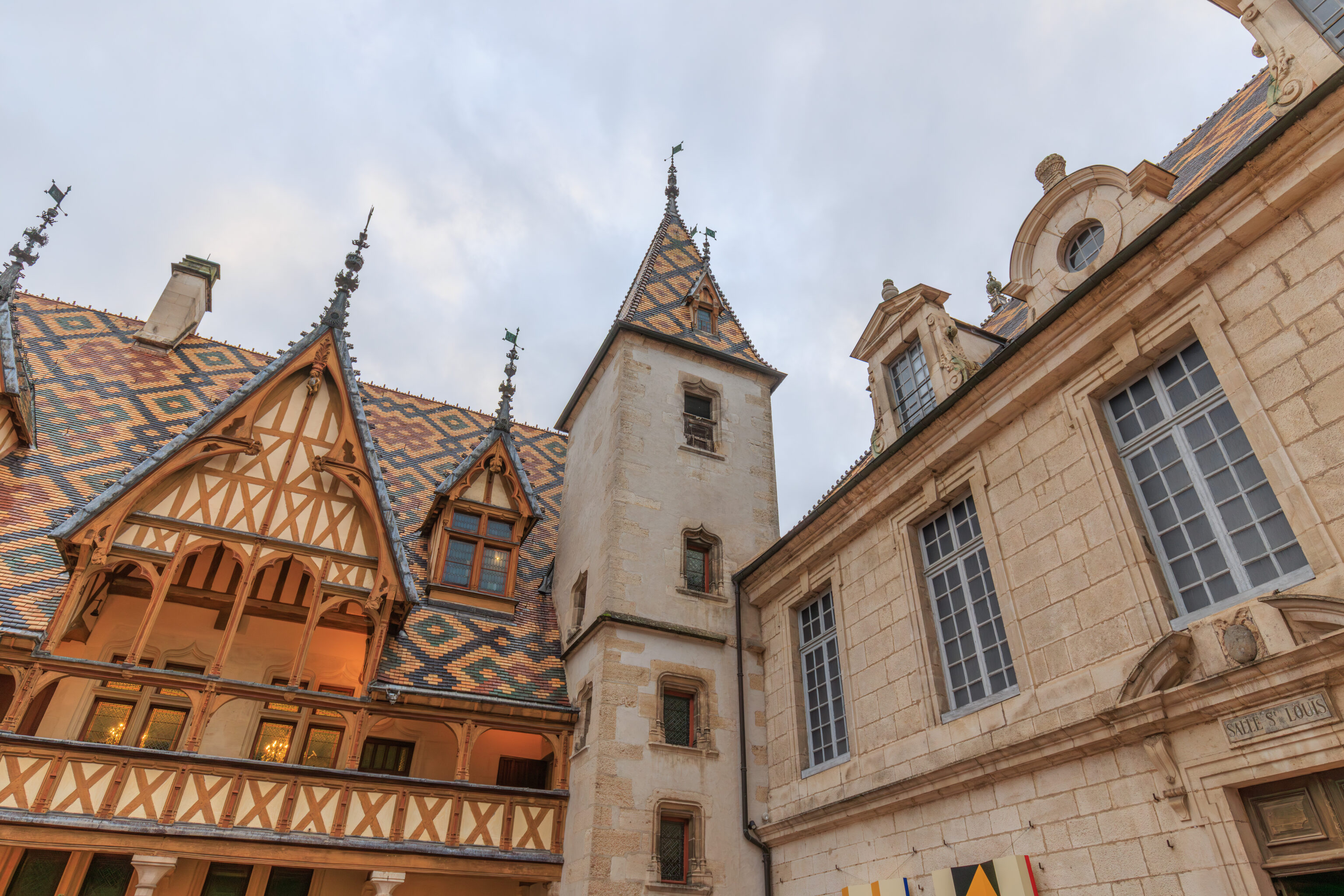
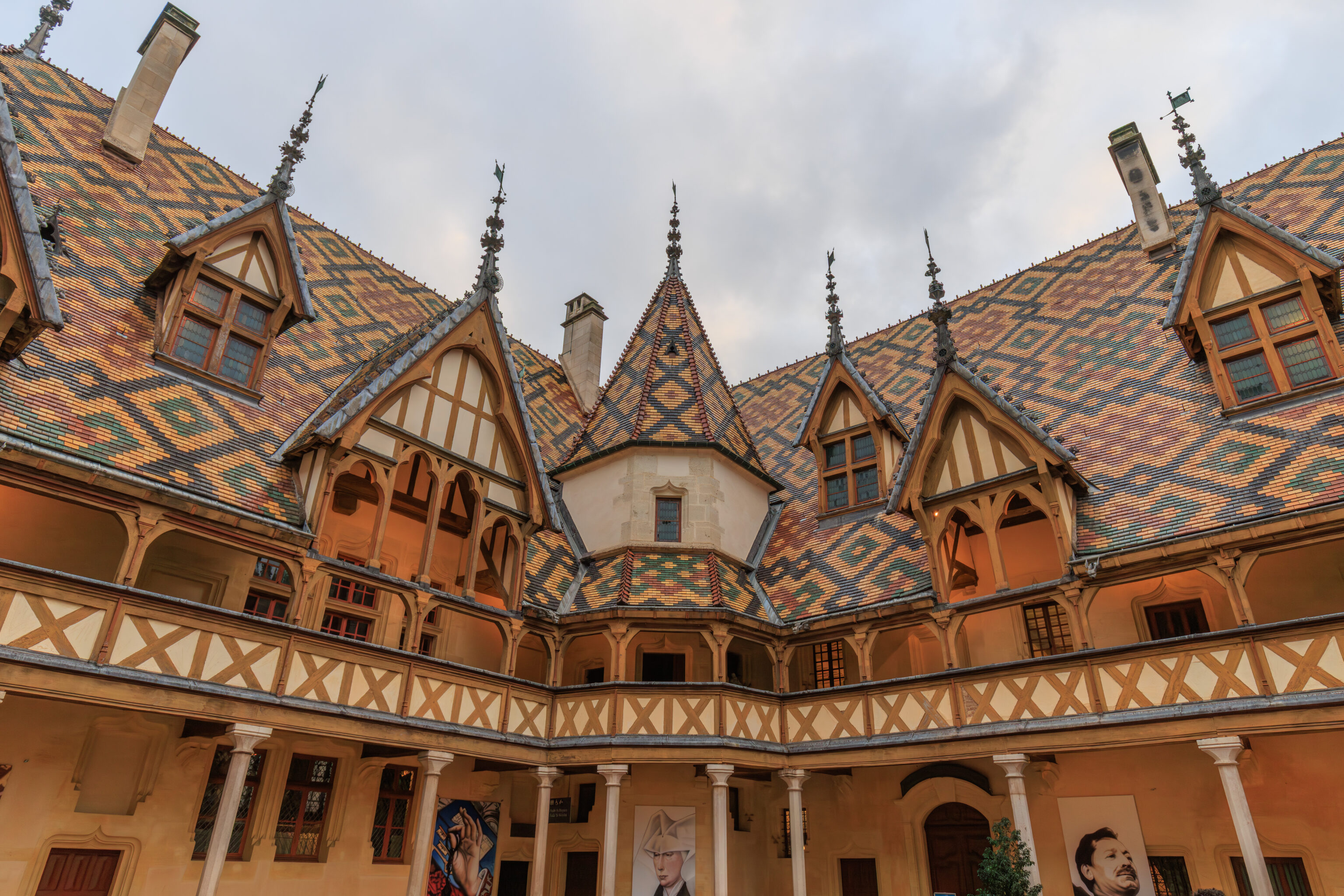
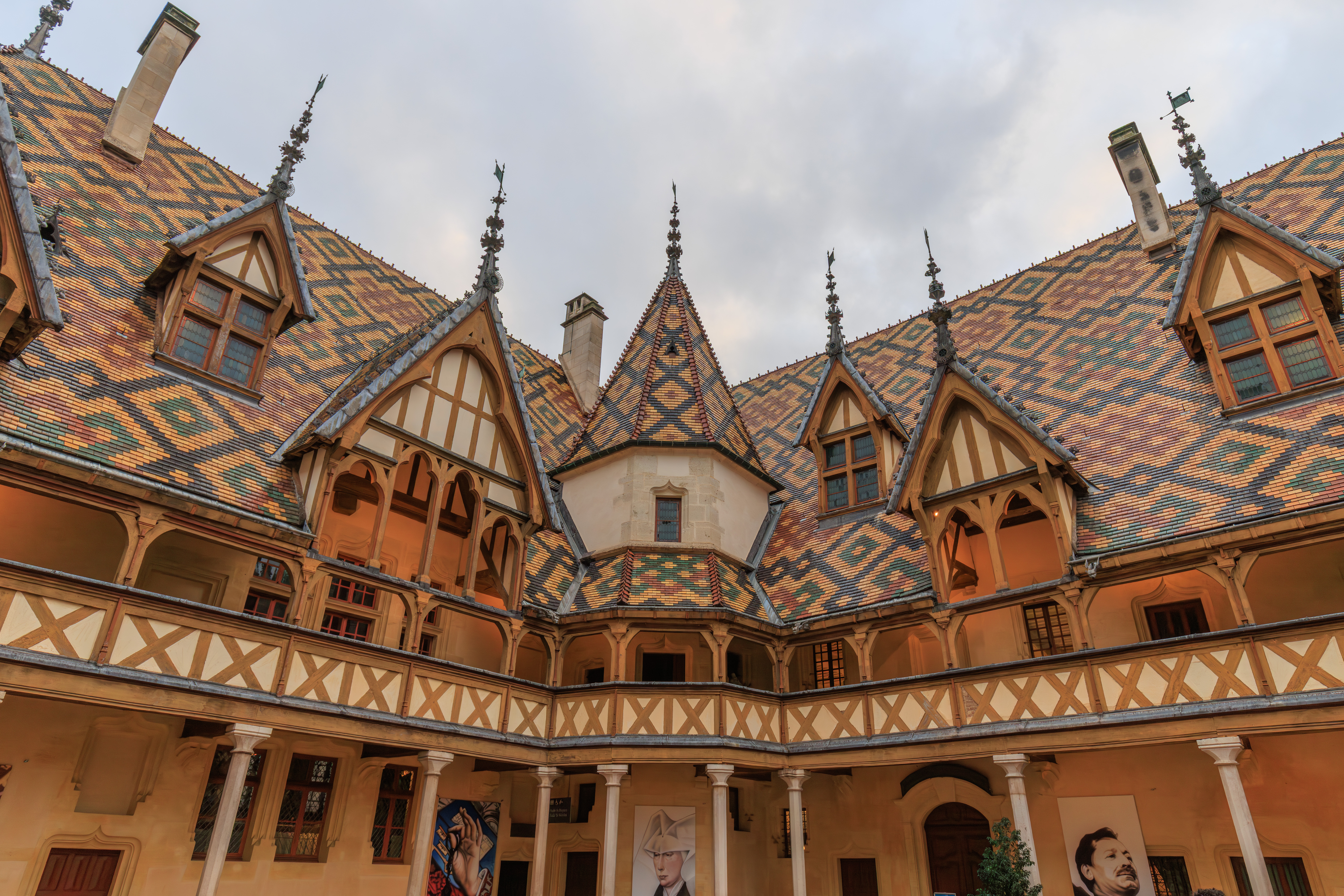
The architecture here is fantastic! We did see a bit of this kind of decorative pattern on some rooftops in Dijon but definitely not like this!
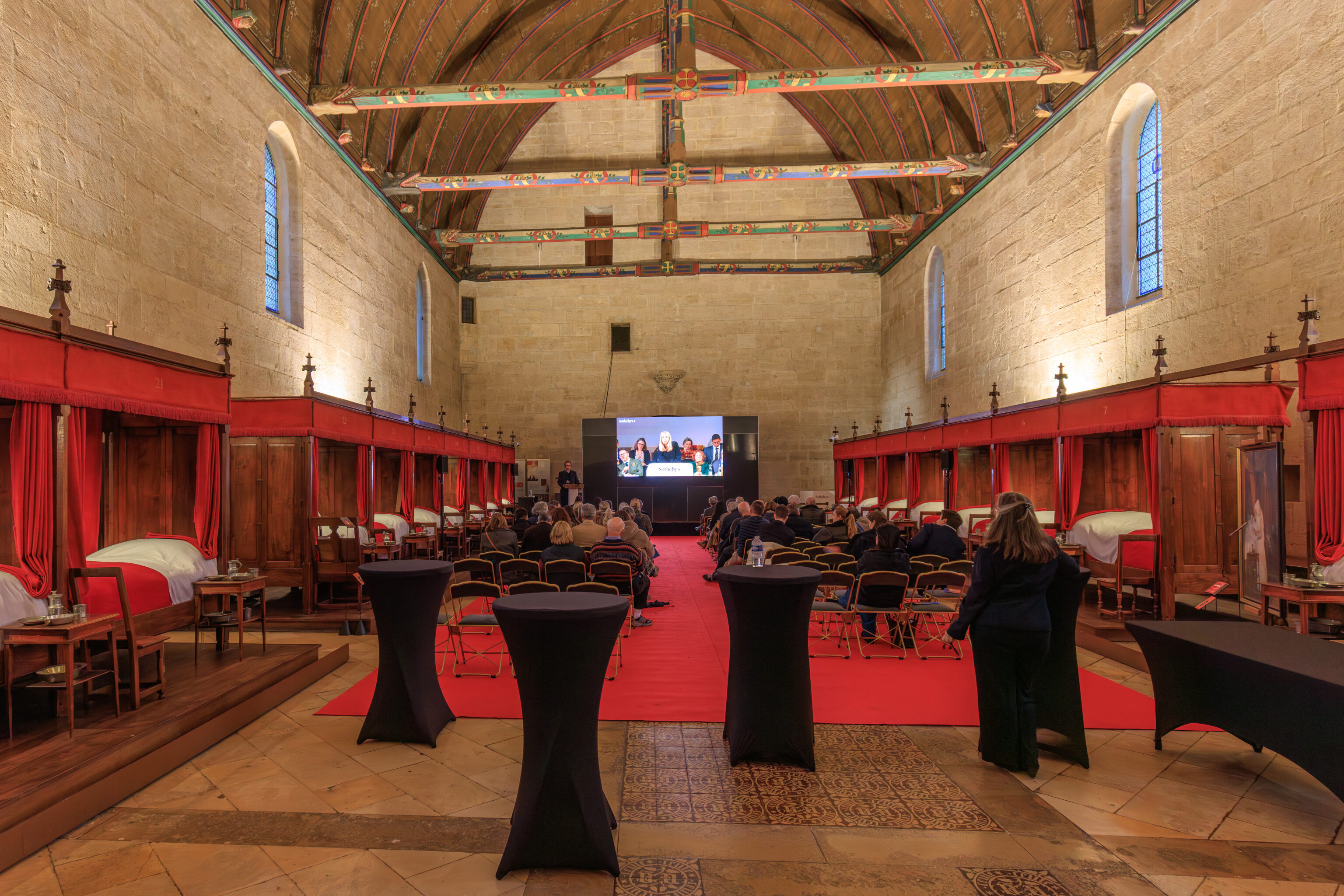
This room, the Great Hall of the Poor, was partially closed because it was being used for the auction. It seemed to be just a viewing area though.
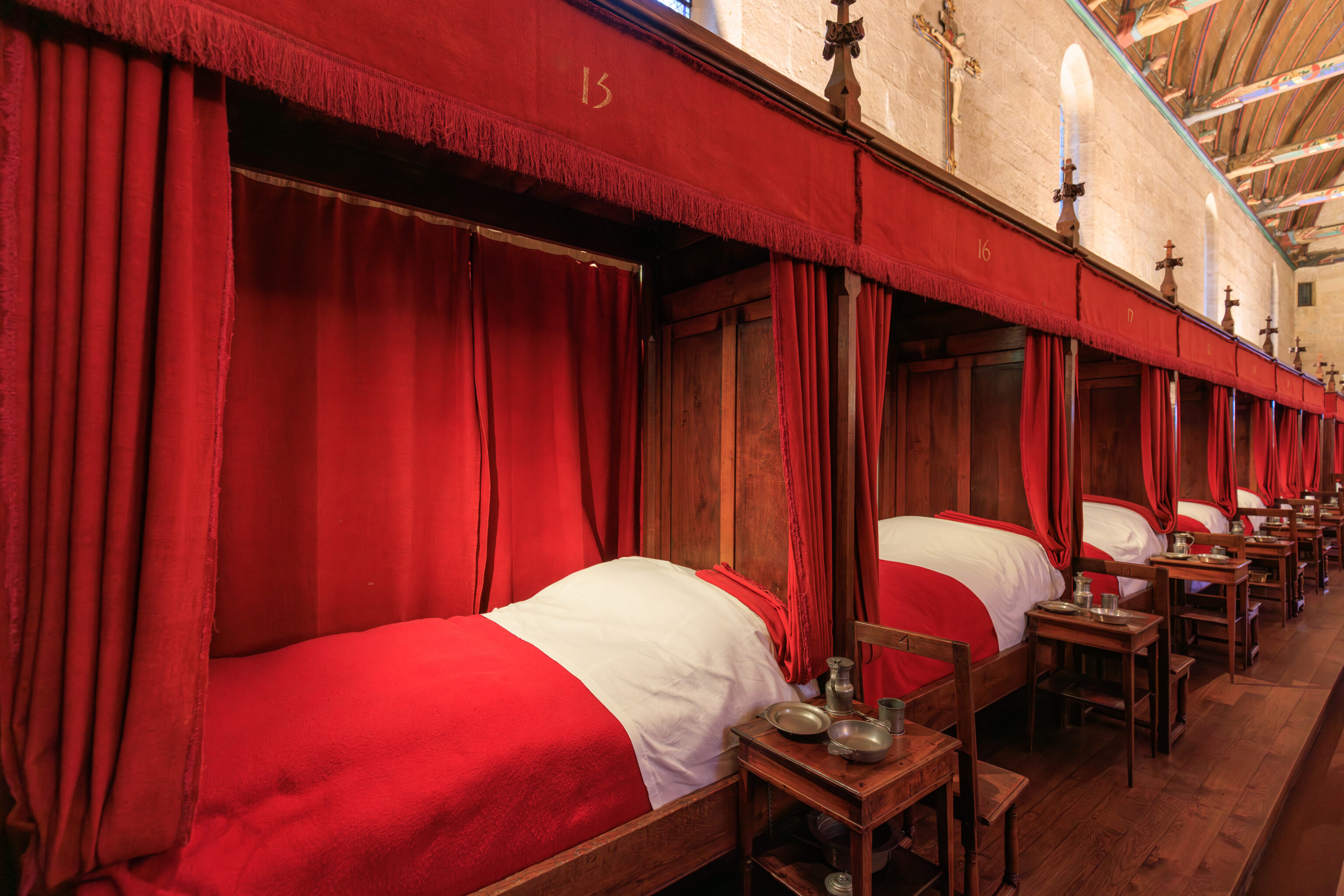
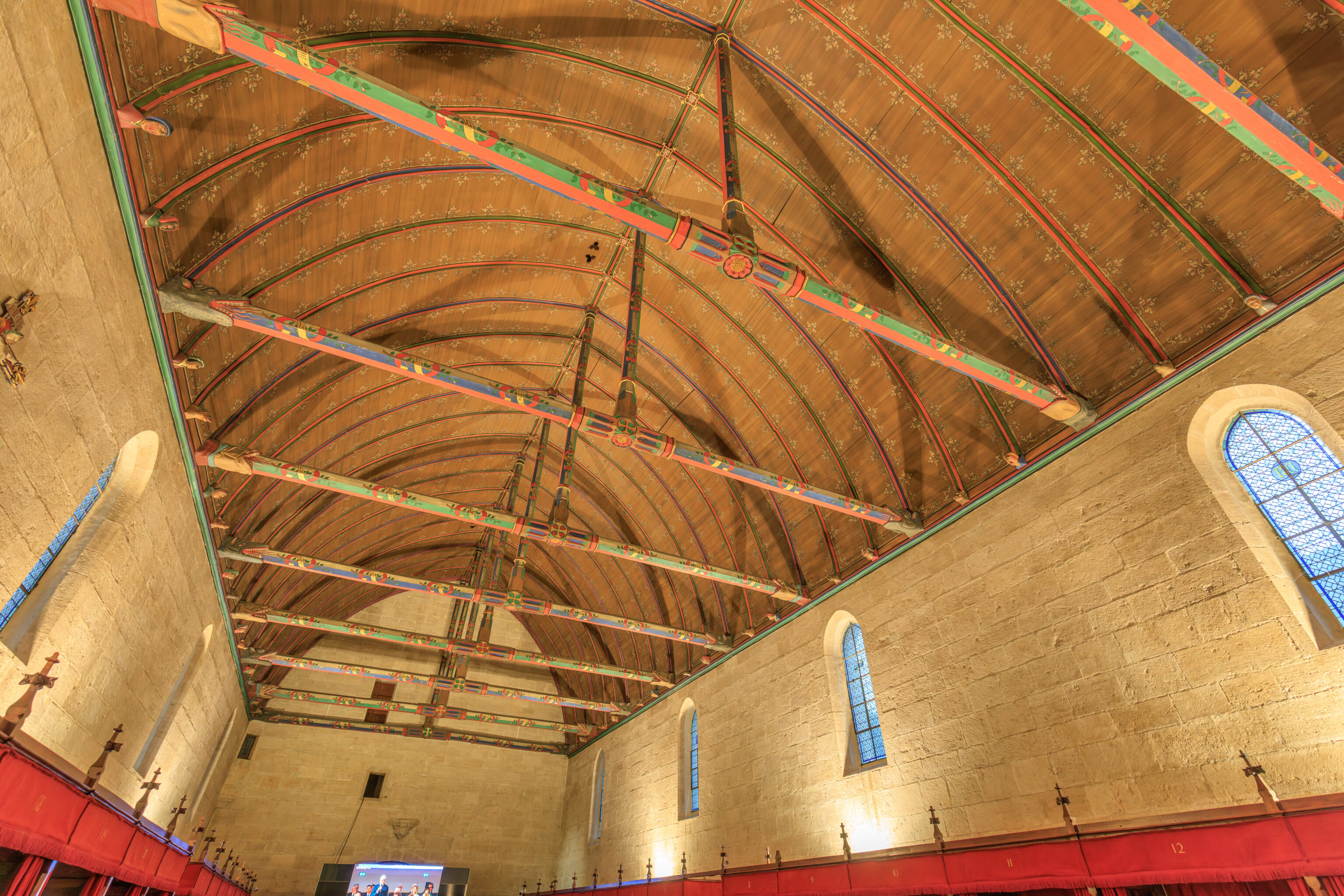
This room had 30 beds for the patients, 15 on each side of the room. The center was used as a dining area.
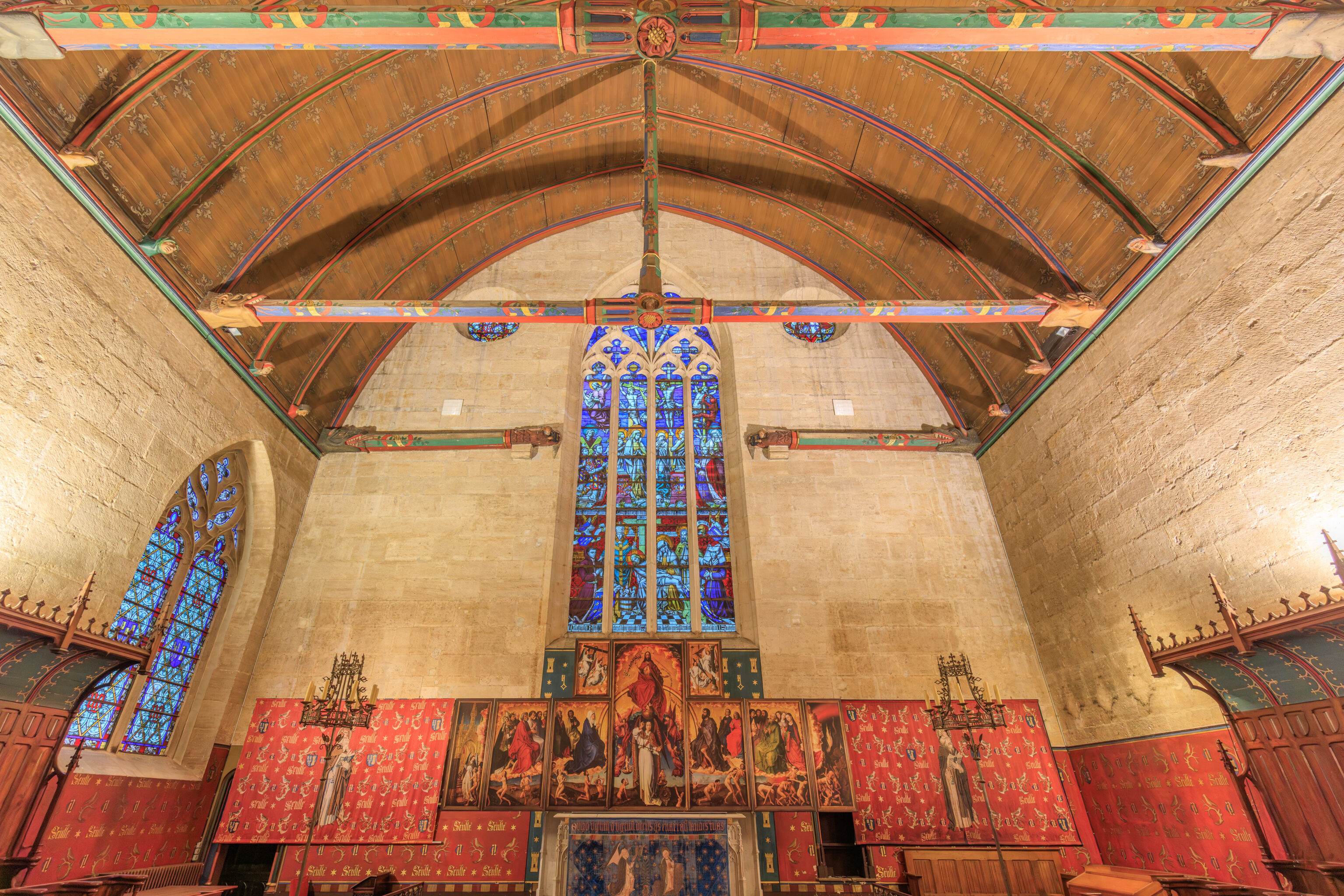
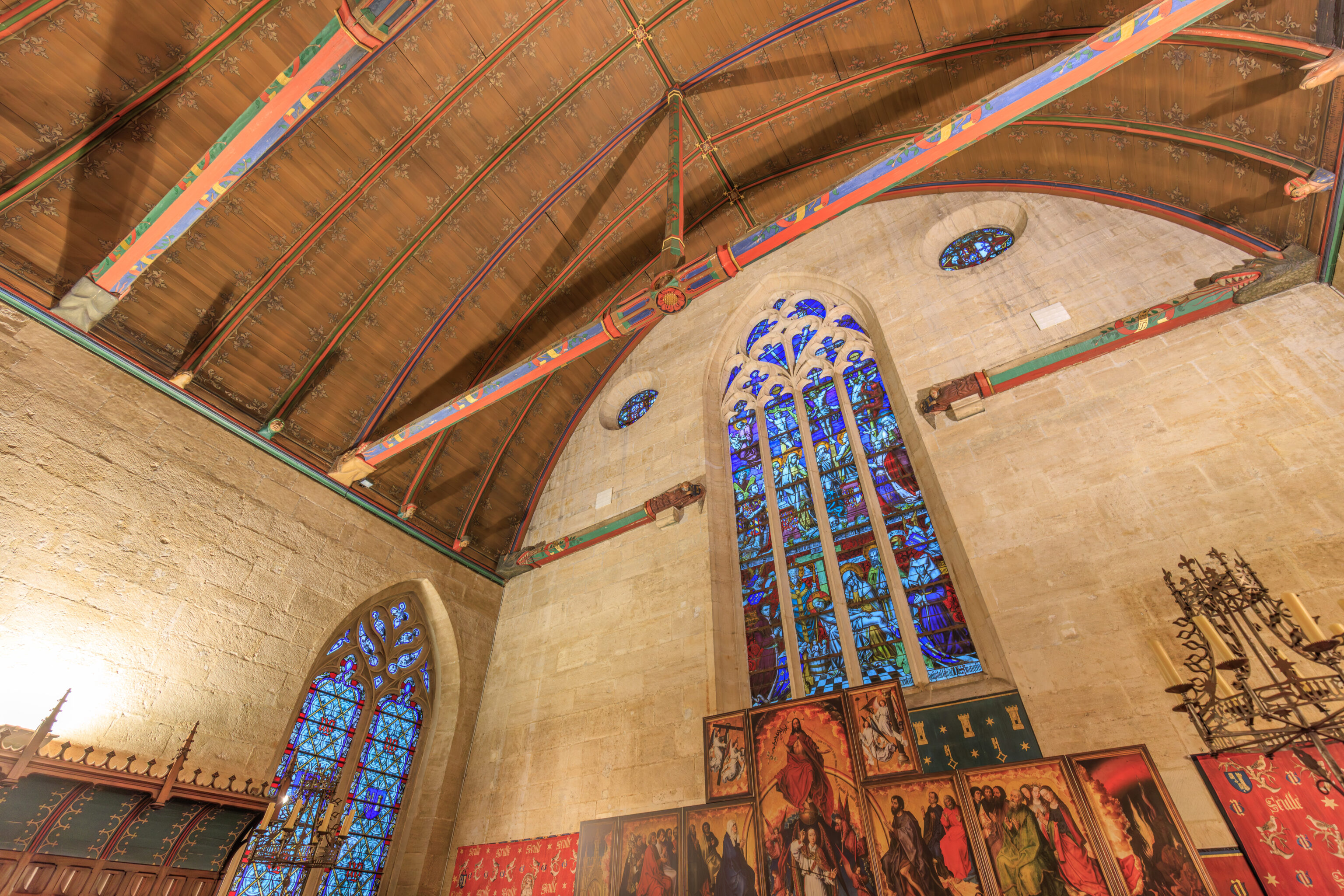
The south end of the hall contained a chapel:
The Chapel

"In the chapel of the said hospital there are three altars, namely: the great high altar of marble stone upon which there is a flat painted panel depicting the Last Judgment, and on the outer panels of the said altarpiece are the images of Saint Sebastian, Saint Anthony, together with the portraits of my said lord the chancellor and of Madame Guigone de Salins."
Inventory of 1501

In the hospital chapel, there are three altars: the large altar made of marble stone on which rests the polyptych of the Last Judgment. On the outer panels are depicted the figures of Saint Sebastian and Saint Anthony, as well as the portraits of the chancellor and Guigone de Salins.

The chapel is intimately linked to the main hall. It was necessary to provide for the well-being of those who were suffering, but also, and above all, to ensure their salvation. The wooden screen separated the two spaces from the very beginning, thus differentiating the sacred space from the secular space.

The 1501 inventory attests to the richness of the decoration of the original chapel: three altars, at least eight stone statues, and numerous paintings depicting saints, a large copper chandelier with seven candles...

From 1820 onwards, the chapel underwent significant renovations. These reflect a desire to preserve and reconstruct the original forms. At that time, the chapel had a neoclassical decor: the walls were painted to resemble marble, and an altarpiece stood in front of the large stained-glass window in the apse.

Restoration was then in its infancy. There was not yet a coherent plan.

Maurice Ouradou worked to restore the chapel to its original appearance. He restored the decor and furnishings: the nuns' stalls, the sanctuary grille, the confessional, the wall paintings...
– A sign, translated using Google.
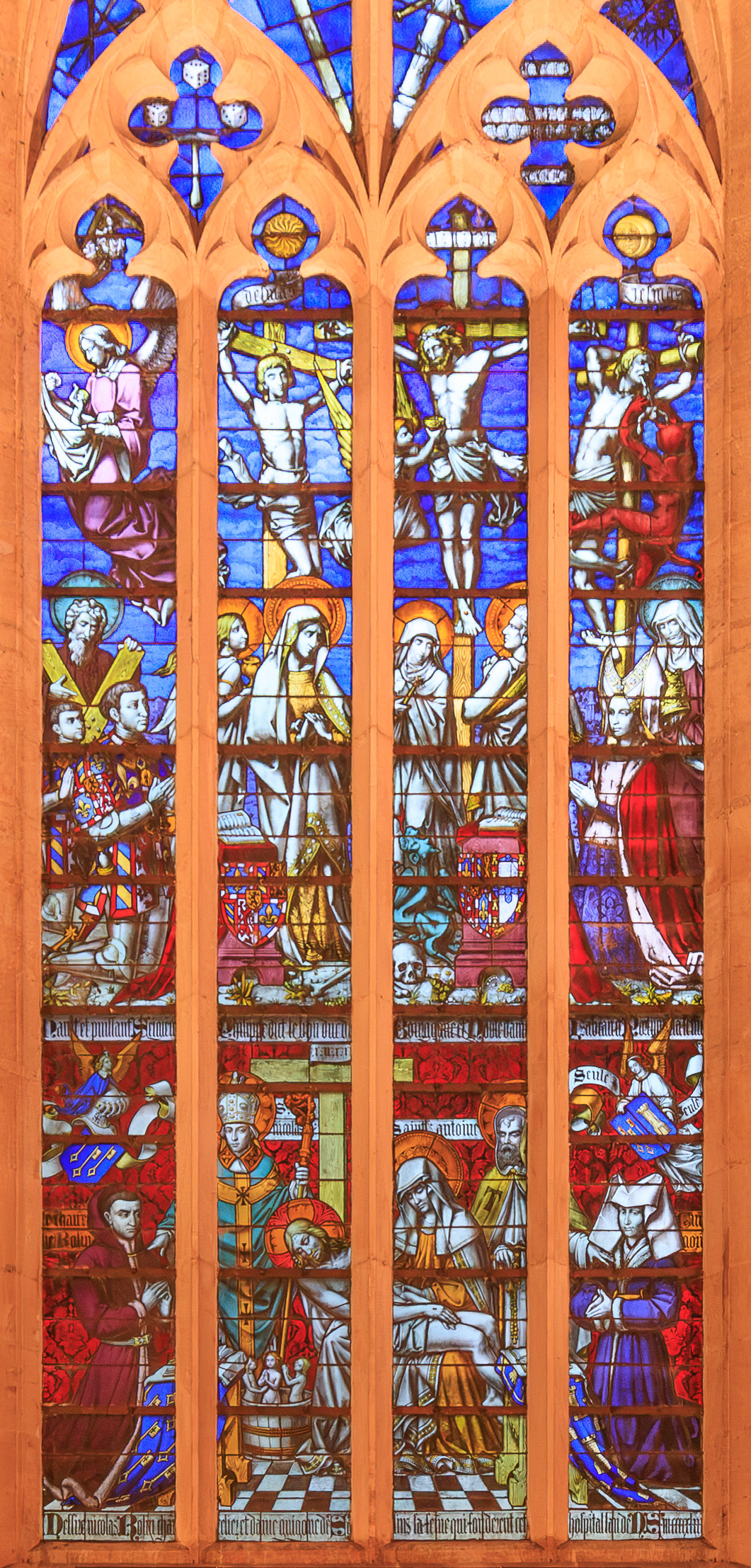
An adjacent sign describes these stained glass windows:
UPPER REGISTER
Scene of the Crucifixion with the souls of the thieves being carried away,
• one by an angel
• the other by a demon.

MIDDLE REGISTER
• Philip the Good, Duke of Burgundy, kneeling as the donor,
behind him: his son, the future
• Charles the Bold,
• presented by Saint Andrew,
opposite:
• Isabella of Portugal, the Duchess of Burgundy, and Saint Elizabeth of Hungary
in the center at the foot of the cross: on Golgotha, represented by Adam's skull, are gathered
• Saint John, the Virgin Mary,
• Saint Martha (patron saint of hospital workers)
• Saint Mary Magdalene (her sister).

LOWER REGISTER FROM LEFT TO RIGHT
• Nicolas Rolin kneeling as the donor
• presented by Saint Nicholas,
• a Virgin of Pity,
• Saint Anthony
• Guigone de Salins

The stained-glass window was restored by the Parisian stained-glass artist Léon-Auguste Ottin in 1877, based on a design by Maurice Ouradou, who was inspired by an old description in a 1653 document. However, the upper part of the window (the lancet heads and the tympanum) has retained elements of the original stained-glass window depicting the instruments of the Passion.
– A sign, translated using Google.
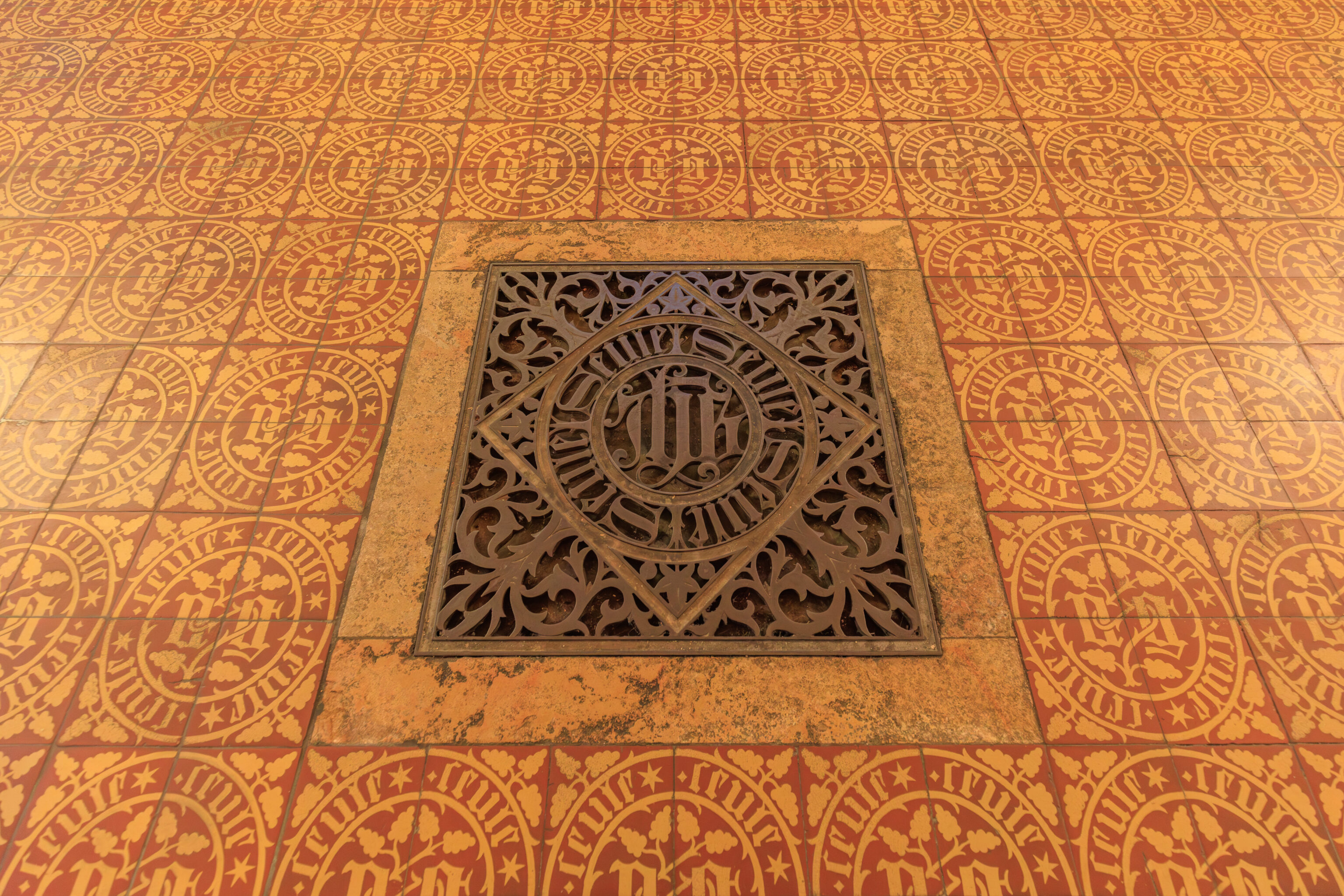
A grate in the floor.
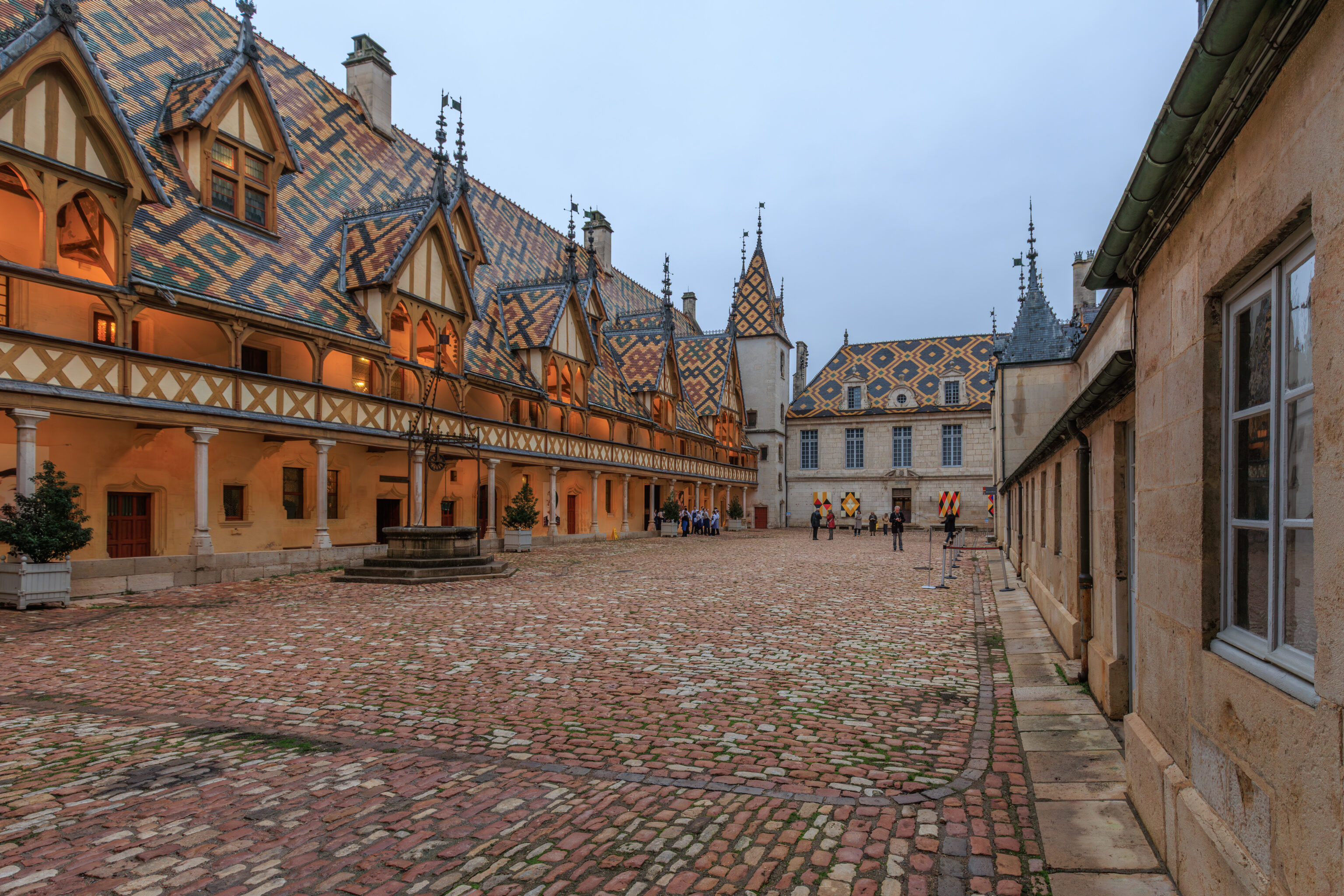
We headed back out into the central courtyard.
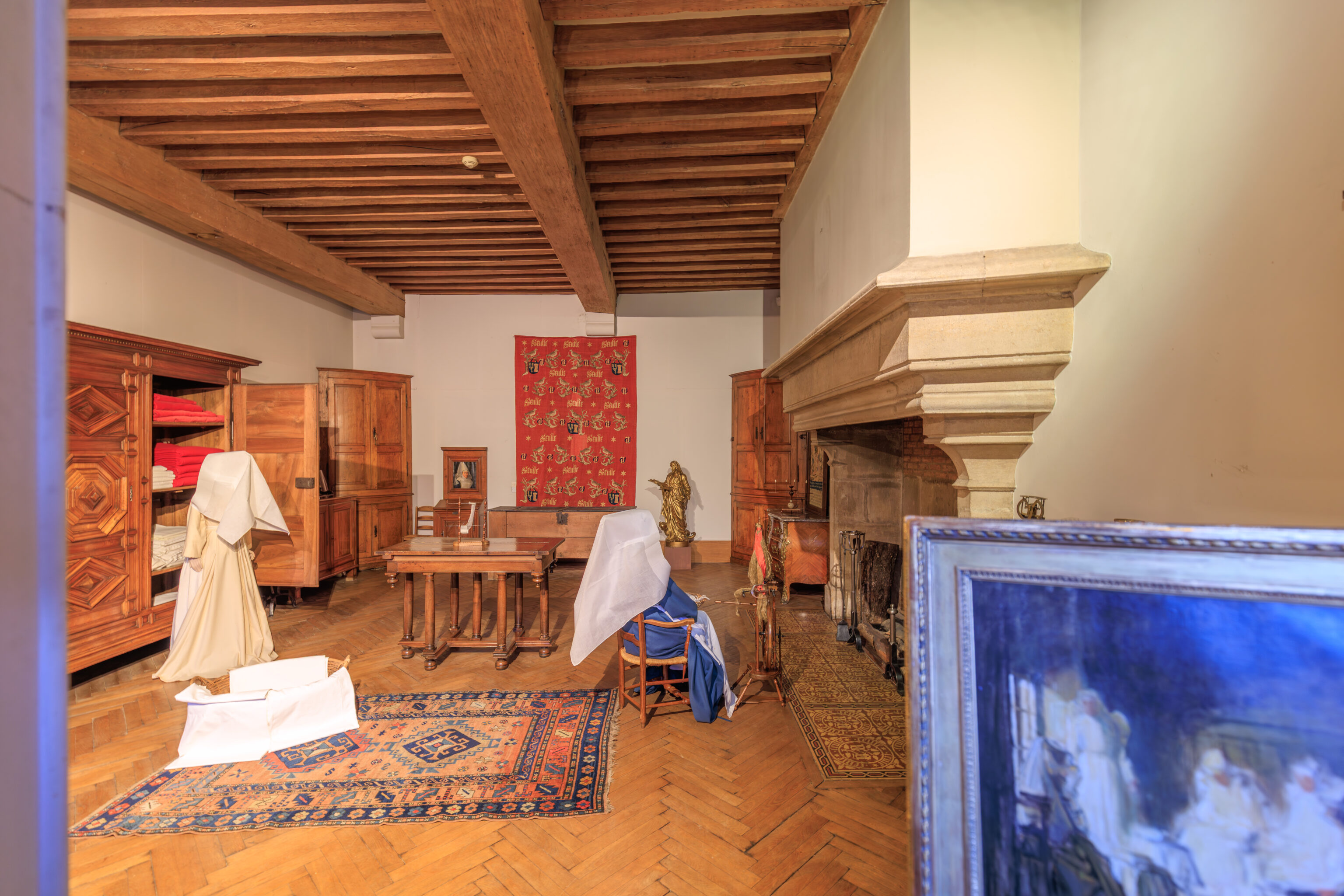
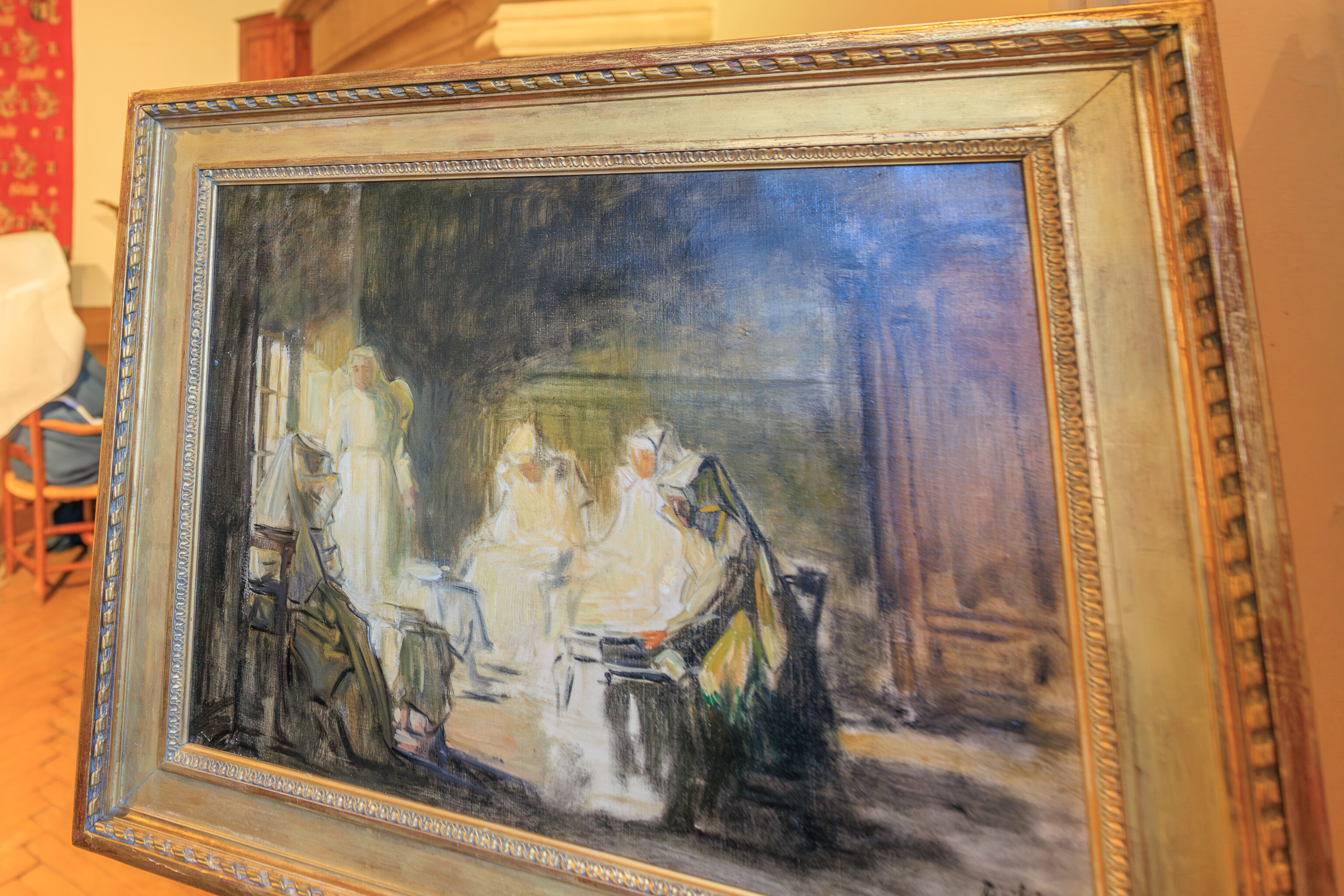
A painting showed what this room would have hisotrically looked like.
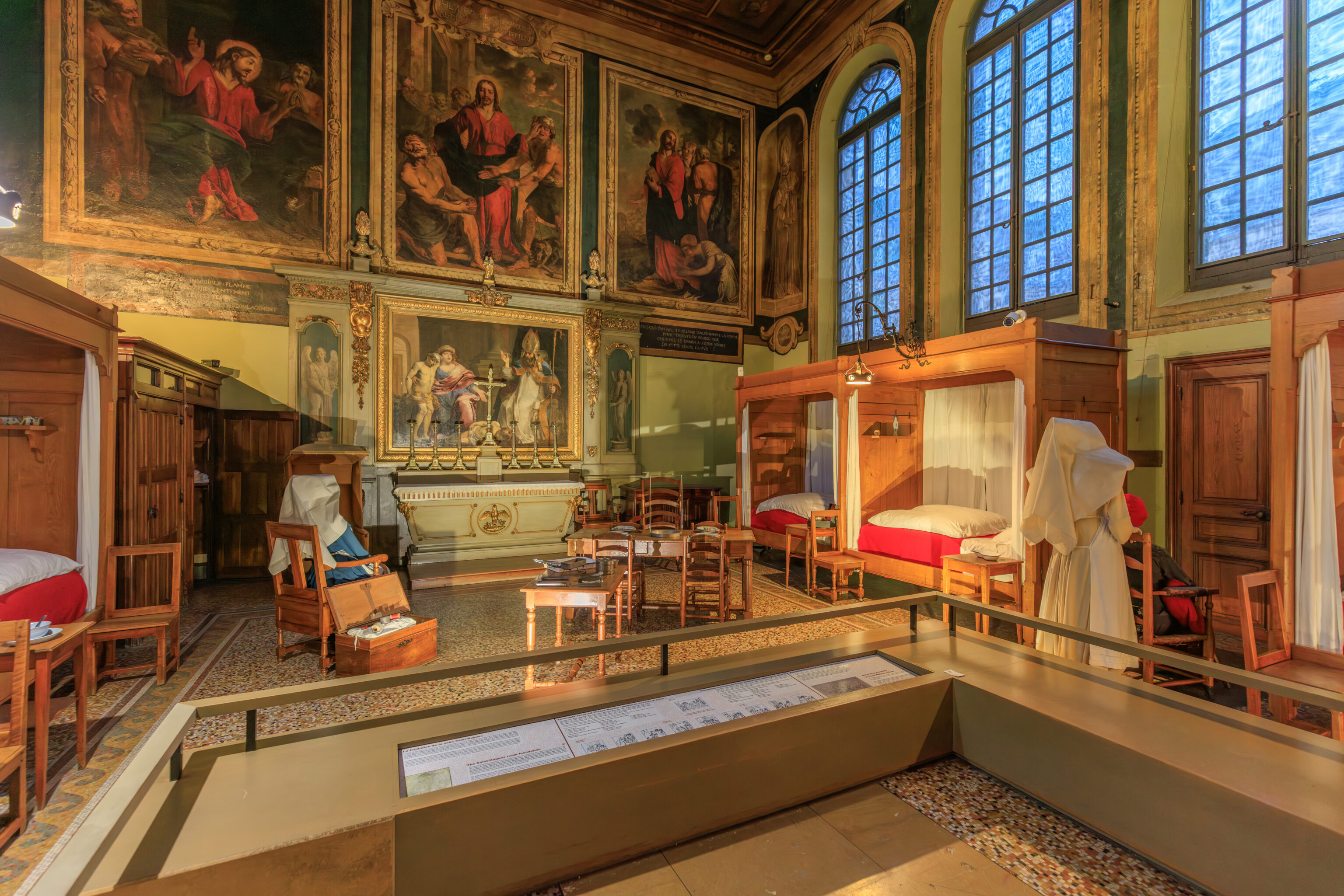
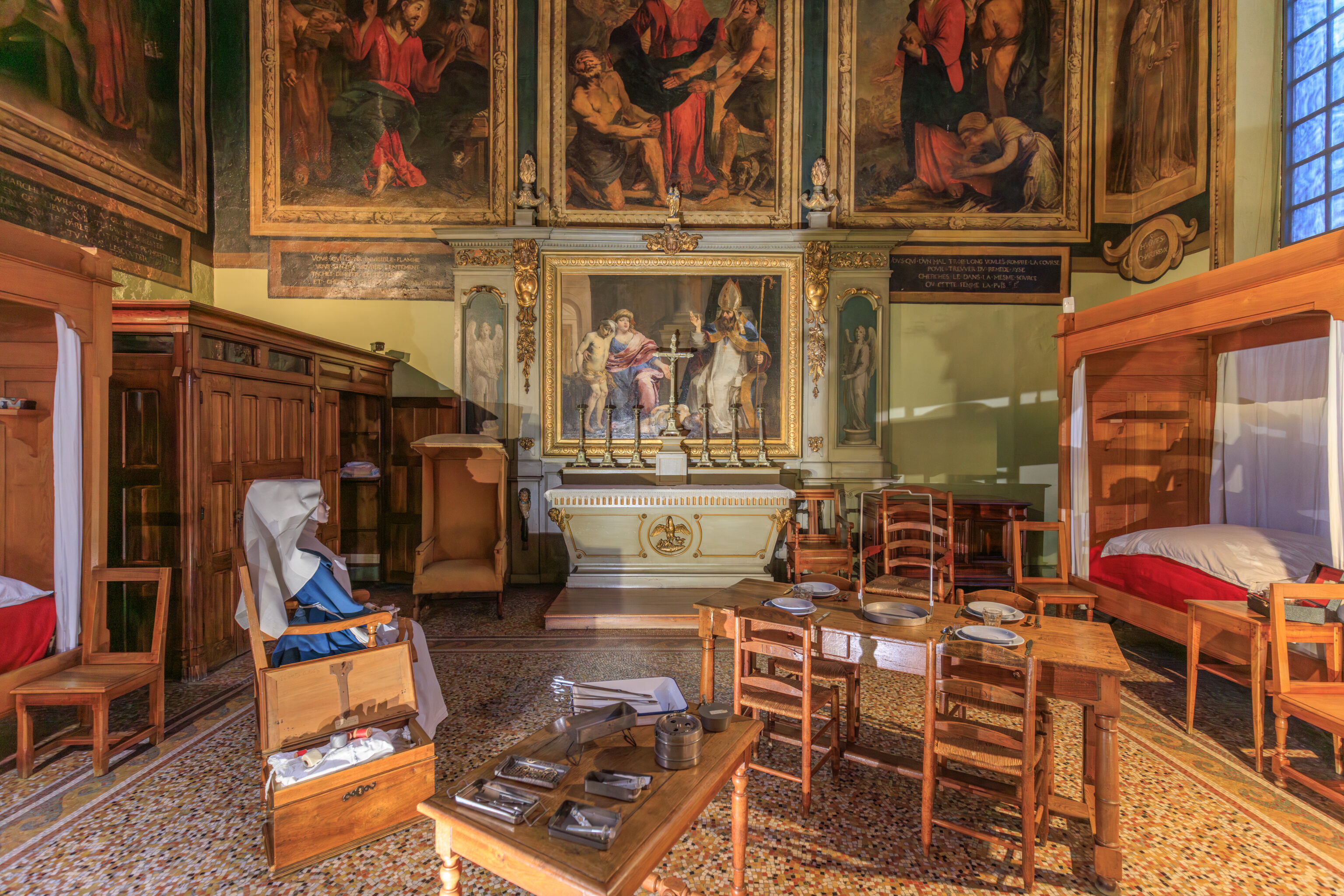
This next room was the Saint Hugh Room:
The Saint Hugh Room
Charity and propriety

The Saint John the Baptist and Our Lady rooms, located one above the other, disappeared in 1645 when the floor separating them was demolished to allow for the creation of a new ward with twelve beds, the Saint Hugh ward.

It was an anonymous donor who offered to furnish this ward at his own expense, and to ensure that it had the necessary air volume, "it was decided to remove the floor."

The Franciscans authorized the opening of five large arched windows on the side facing their convent, on the condition that they be placed high enough.

When the separation of the sexes was considered, after Louis XIV's visit, the men who were then being treated in the large Poor's ward were transferred to this room in 1661: they gained in comfort, as the Saint Hugh ward had a large fireplace.

Above the altar in this ward, one can see the Miracle of Saint Hugh. It seems that the painter combined two scenes into one: the child, depicted drowned in the foreground, is shown resurrected next to his mother, an archaic technique in the middle of the 17th century. The broad brushstrokes and the beautiful harmony of the colors attest to the artistic qualities of the painter. This painting is framed by two angels painted in grisaille on wood.

Generous donors...
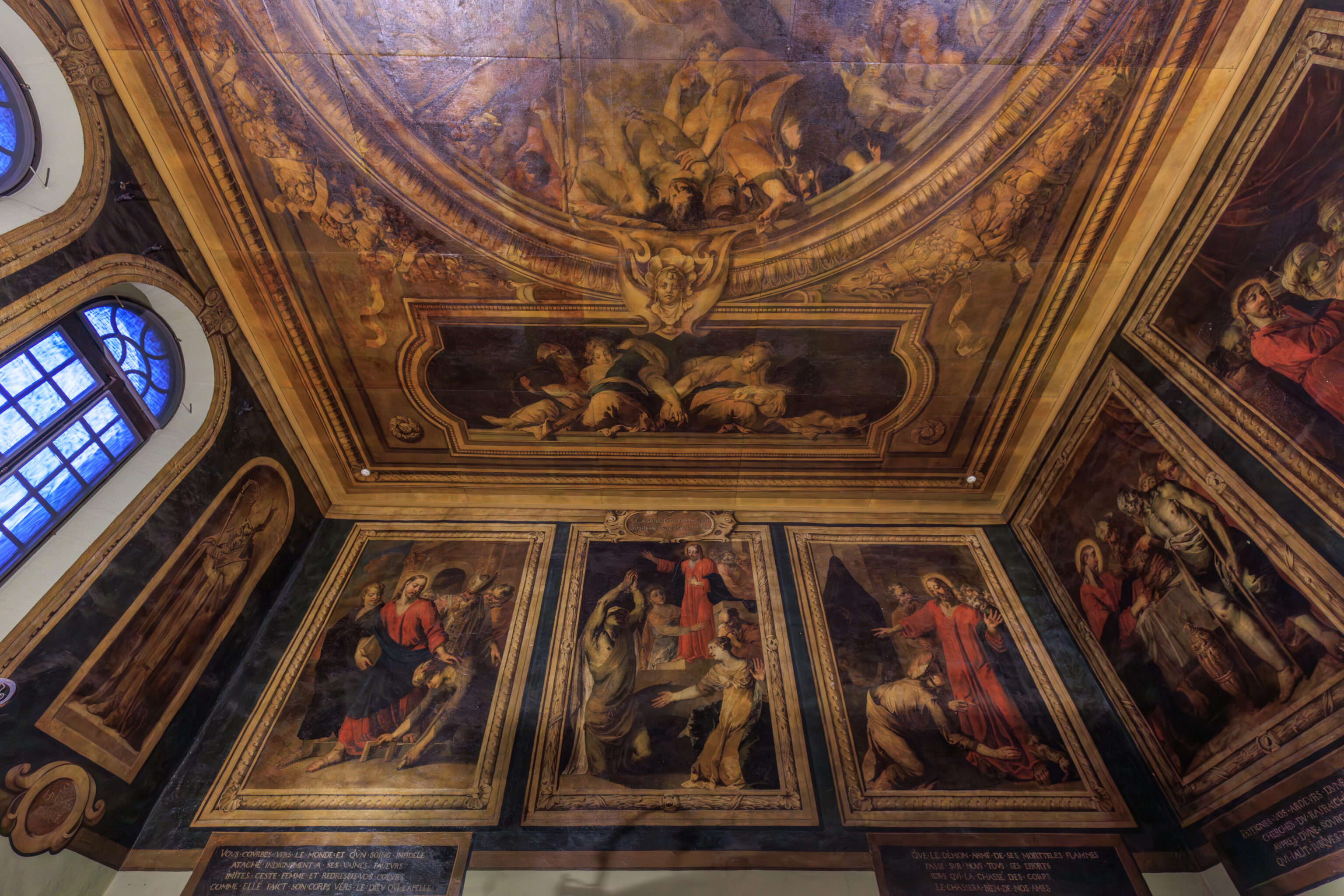
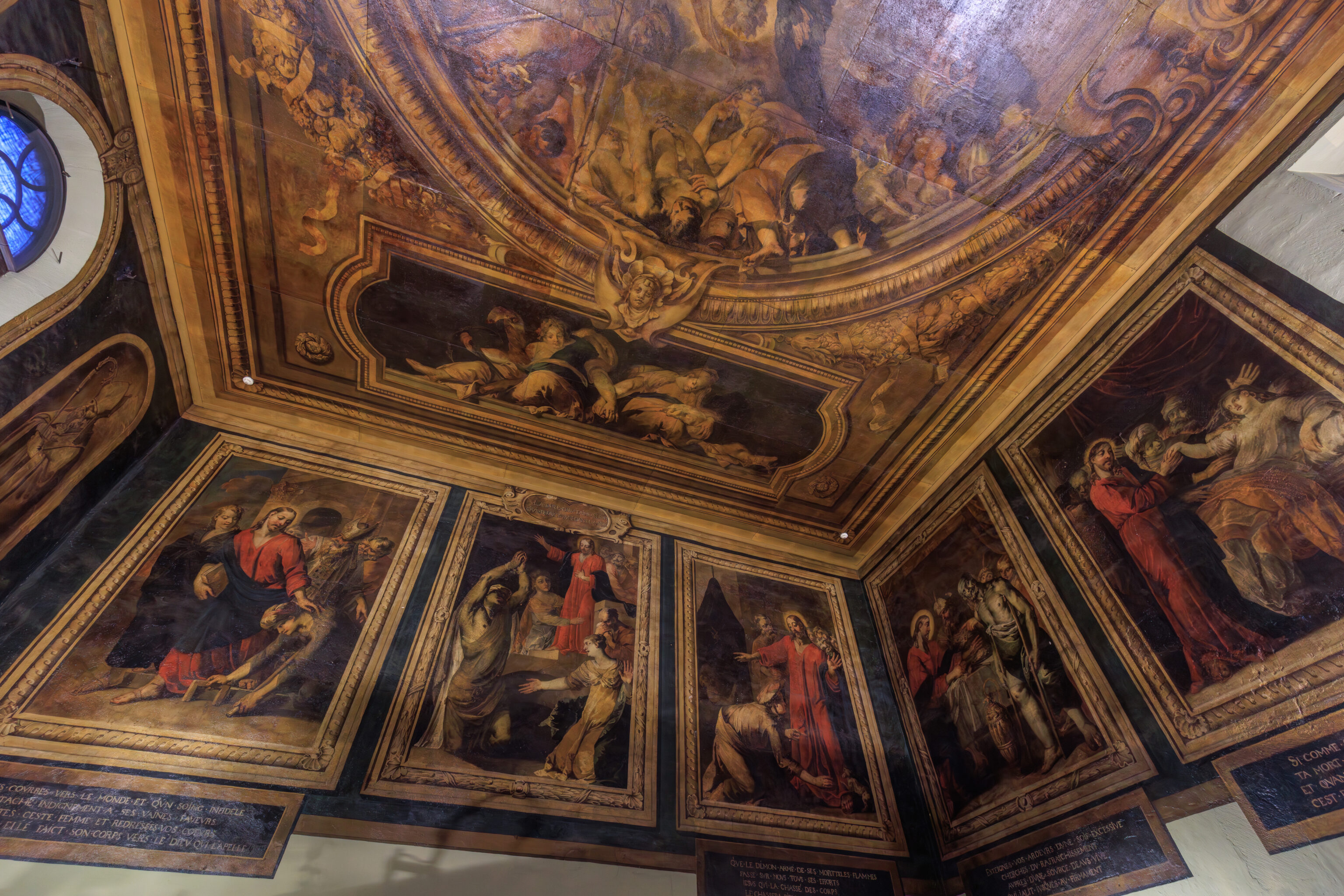
The walls and ceiling are adorned with paintings glorifying Saint Hugh, patron saint of the mysterious donor, who was Hugh Bétauld, receiver of deposits at the Parliament of Paris, a native of Beaune.

The oil paintings on the walls include nine Miracles of Christ in a trompe-l'œil frame, beneath which a text in verse explains the meaning of the scene. These works, with their very pronounced monumental character, foreshadow the broad and heavy style often employed by the painter Isaac Moillon throughout his career. The demonstrative aspect of these healings and resurrections was undoubtedly intended to give hope to the sick.

The ceiling is decorated with a large canvas mounted on the ceiling, in a Mannerist style, signed and dated 1646. It depicts the healing of a cripple at the Pool of Bethesda. The painter does not conform to the customs of the time, which considered it inappropriate to represent "water on ceilings," since the viewer is positioned as if at the bottom of the pool. During its restoration in 1946, the canvas was cut into forty rectangular panels mounted on fiberboard.

Isaac Moillon painted several paintings that adorn the rooms of the Hôtel Dieu, including a Pentecost in the mistress's chamber, in which he unusually places the figure of the Virgin off-center, contrary to the usual compositional rule where she is positioned in the middle of the apostles.

After the death of his brother Hugues, Louis Bétault financed the furnishing of the Saint Louis room and commissioned Isaac Moillon to paint a large painting depicting the Death of Saint Louis, signed and dated 1665.
– A sign, translated using Google.
Additional text discusses the artistic elements within this room:
Decorative ensemble by Isaac Moillon: wall paintings & altar

To adorn the room, Hugues Bétault commissioned the Parisian painter Isaac Moillon (1614-1673) to decorate the walls and ceiling. The paintings illustrate the Scenes of the miraculous healings of Christ, and echo the patron saint of the benefactor, saint Hugues, with two portraits painted in grisaille on the south wall, and one representation on the altar on the east side. By choosing the theme of miraculous healings, Isaac Moillon wanted to convey a message of hope to the sick, the hope of regaining their health.

The decorative ensemble was created between 1645 and 1646: it is the most monumental pictorial cycle attributed to the artist. The paintings have been restored in the 19th century by Balioni, a visiting Piedmontese artist, and in the 20h century under the direction of Beaux-Arts. On the east, north and west walls are the Scenes of the miraculous healings of Christ:

North wall (left)
> Healing of the hydropic
> Resurrection of Jaïrus' daughter
> Healing of the paralytic

Above the altar to the east and on the south wall is the figure of saint Hugues:
South wall (right)
> Saint Hugues as chartreux
> Saint Hugues as bishop

East wall (opposite)
> Healing of Peter's mother-in-law
> Healing of two blind men
> Healing of the haemorrhoid

West wall (behind)
> Healing of the bent woman
> Resurrection of Lazarus
> Healing of the Chananean's daugther

Altar (opposite)
> Saint Hugues resuscitating a drowned child
– A informational panel, translated using Google.
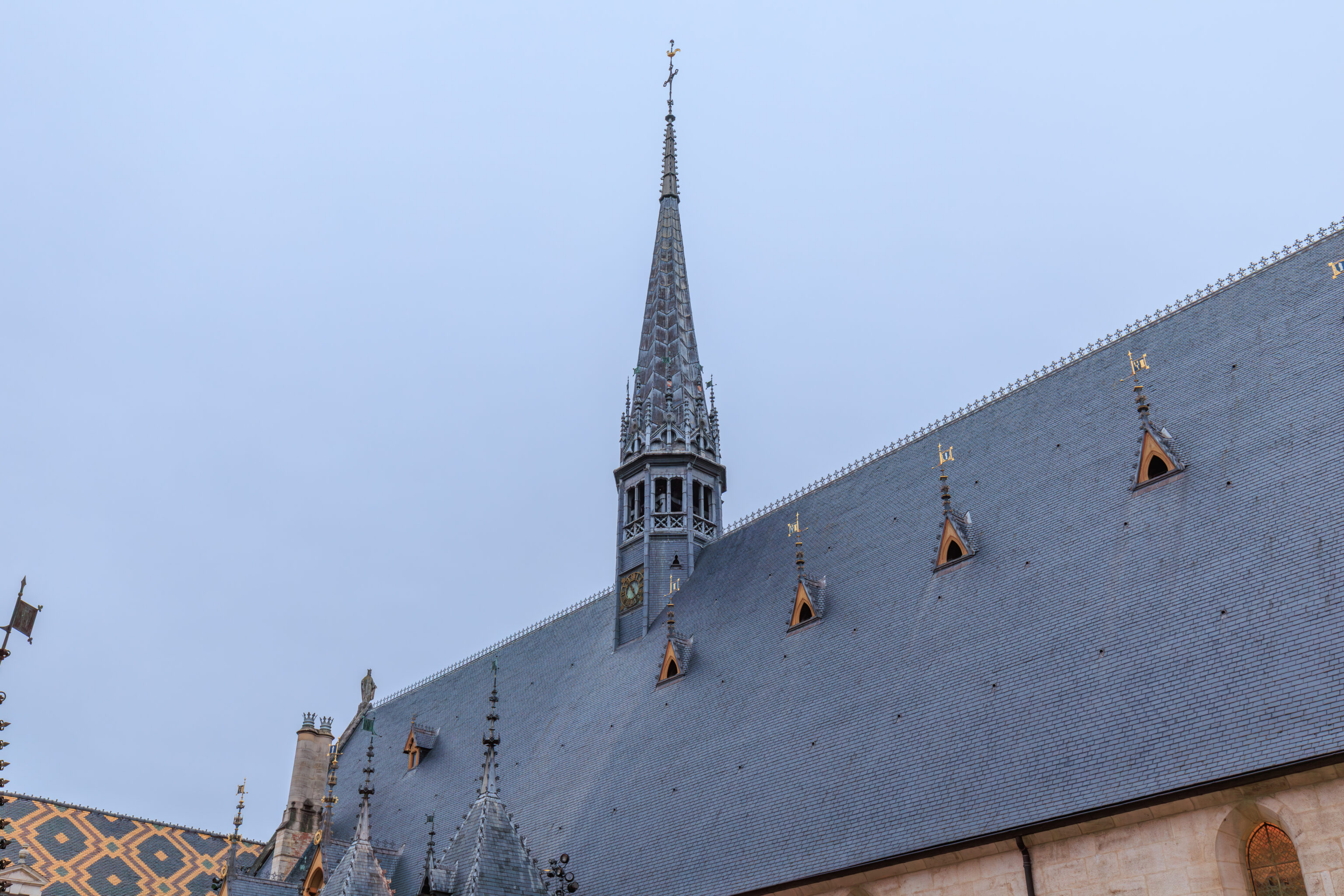
We headed back out side again to visit the next room.
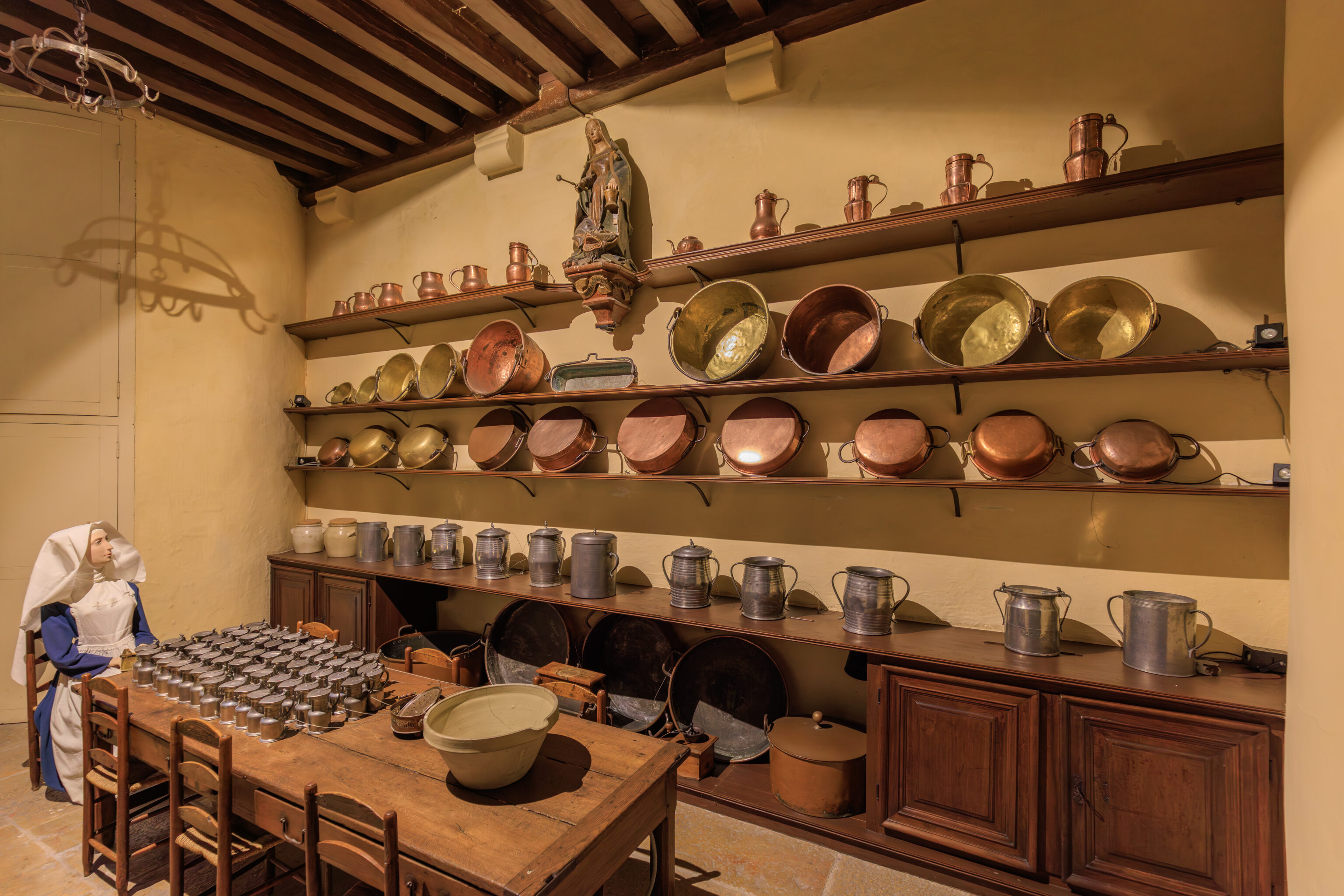
The next room we entered was a kitchen.
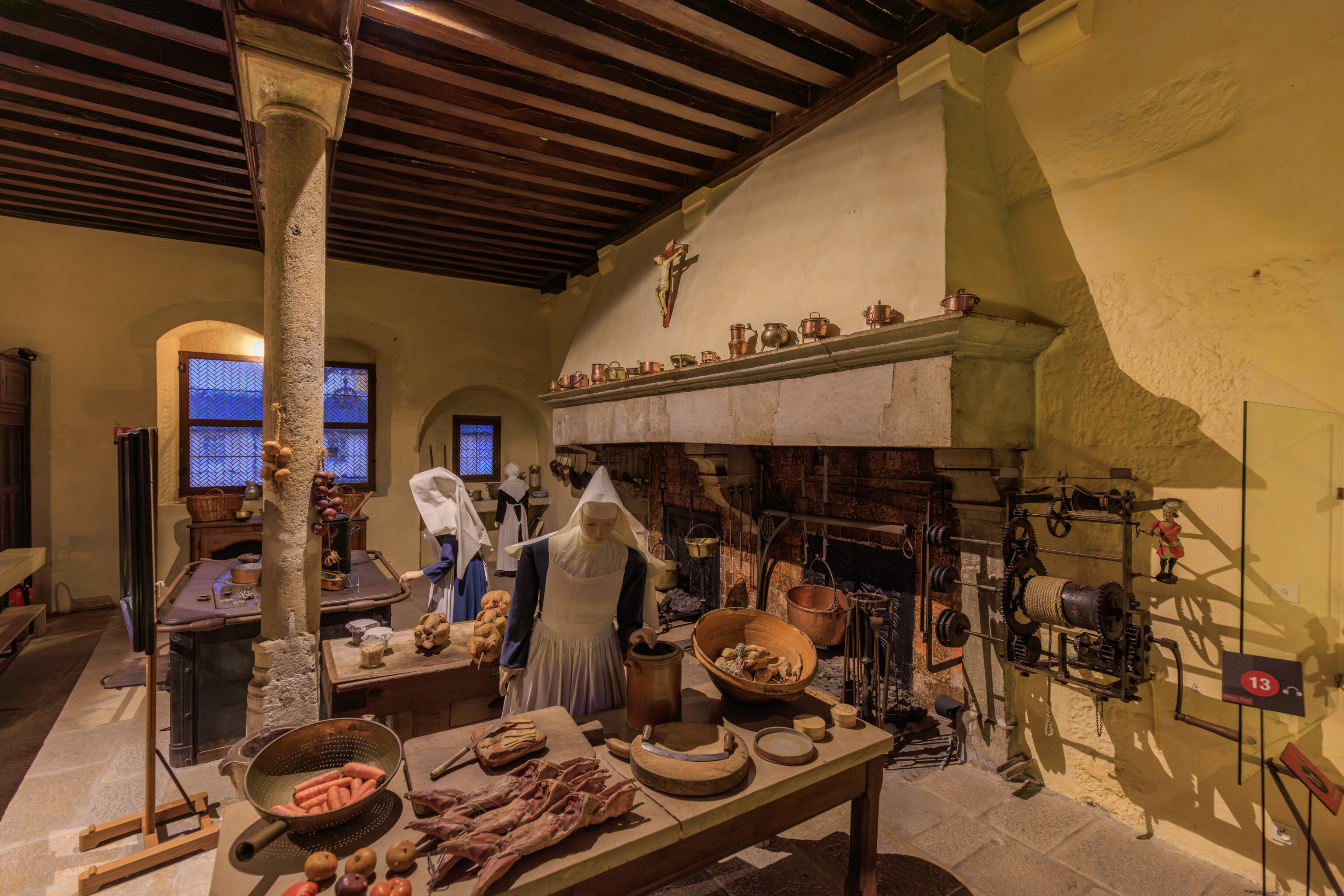
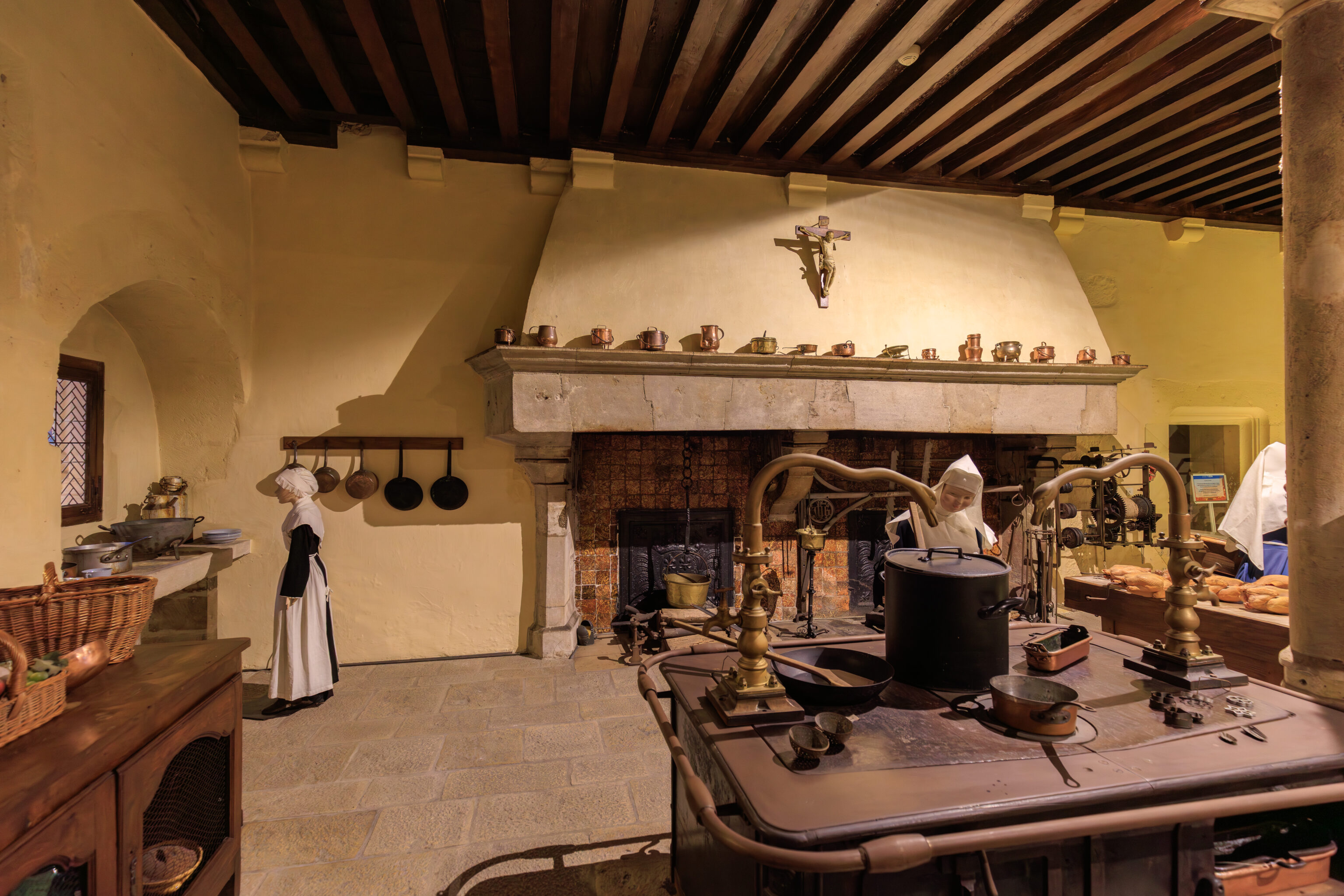
Look closely at what is on the table. The goosenecks described on a sign are quite literal!
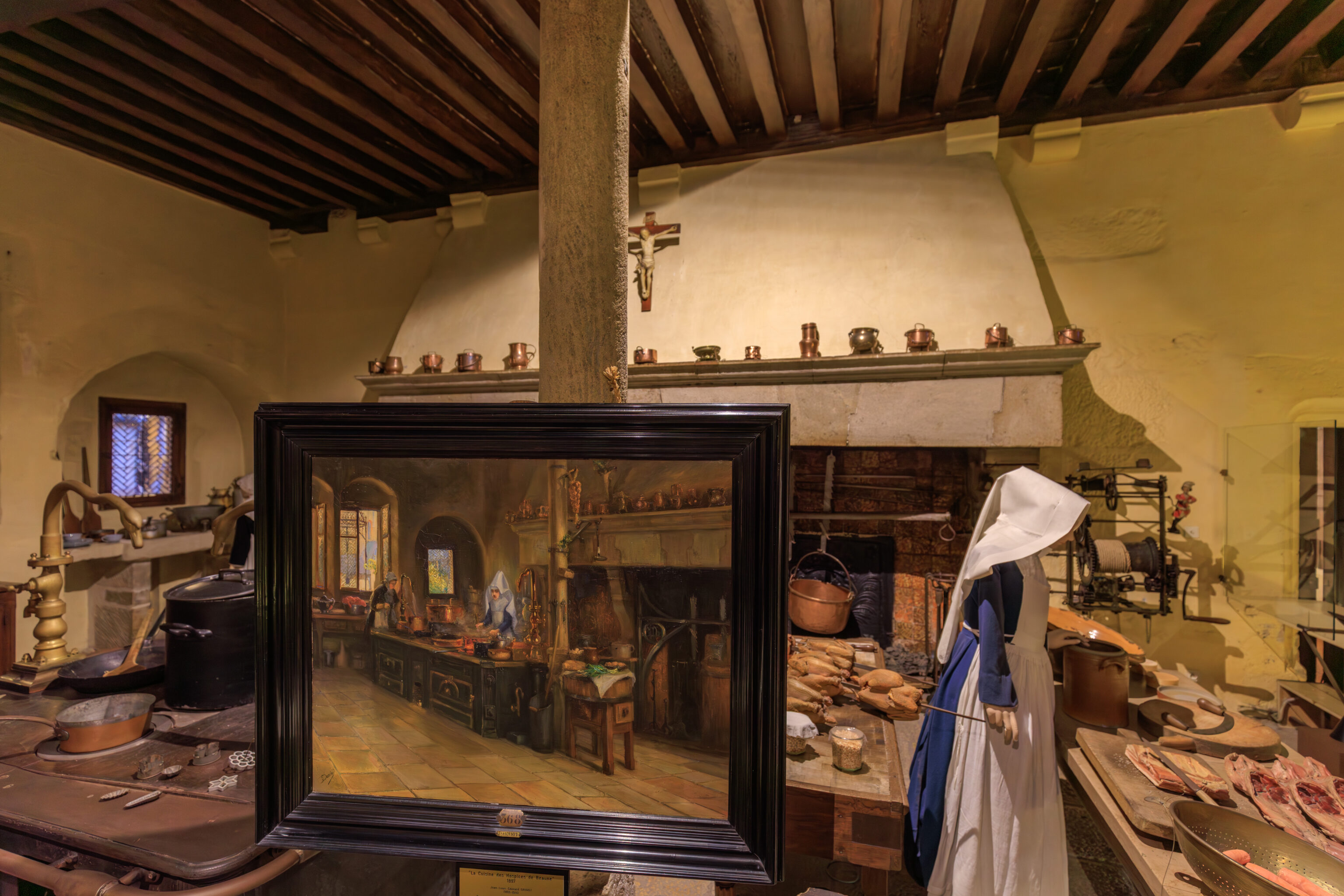
by Édouard DARVIOT
Oil on canvas
Late 19th century or early 20th century
Hôtel-Dieu – Hospices Civils de Beaune Collection
This painting was purchased by Olivier Kooman on October 10, 2021, at the auction of the furniture of the Château de la Rochepot, acquired by the wife of President Sadi Carnot in 1894 for her eldest son; the castle was sold by the Carnot family in 2015 to a group of Ukrainian investors whose legal disputes led to the organization of two public auctions.
A Beaune art collector, Olivier Kooman won the bid and offered the painting to the Hospices Civils de Beaune. The subject depicts the kitchen of the Hôtel-Dieu, whose activity continued until 1984. One can observe the 19th-century swan-necked stove and the large 15th century fireplace.
Édouard Darviot was born on April 19, 1859, in Beaune, where he is buried; he died on August 21, 1921, in Bussy-le-Grand. He studied at the École des Beaux-Arts in Paris and worked with Tony Robert-Fleury, Hector Hanoteau, and William Bouguereau. From 1882, he exhibited at the Salon. Around 1898, he settled in Dijon where he married Louise Marguerite Chevignard on January 24, 1898, daughter of the founder of the Banque Chevignard. In 1903, the City of Beaune commissioned him to paint a portrait of Félix Ziem, also a native of Beaune. He was elected a member of the Société des artistes français in 1906 in the Fine Arts section of the Academy of Dijon. The painter traveled extensively, particularly in England, where he absorbed the aesthetic of British painters. A prolific artist, his work comprises a large number of pieces, including religious paintings, portraits, and also studies inspired by African art. Around forty of his paintings are preserved in the collections of Beaune and Dijon.
(Google Translated)
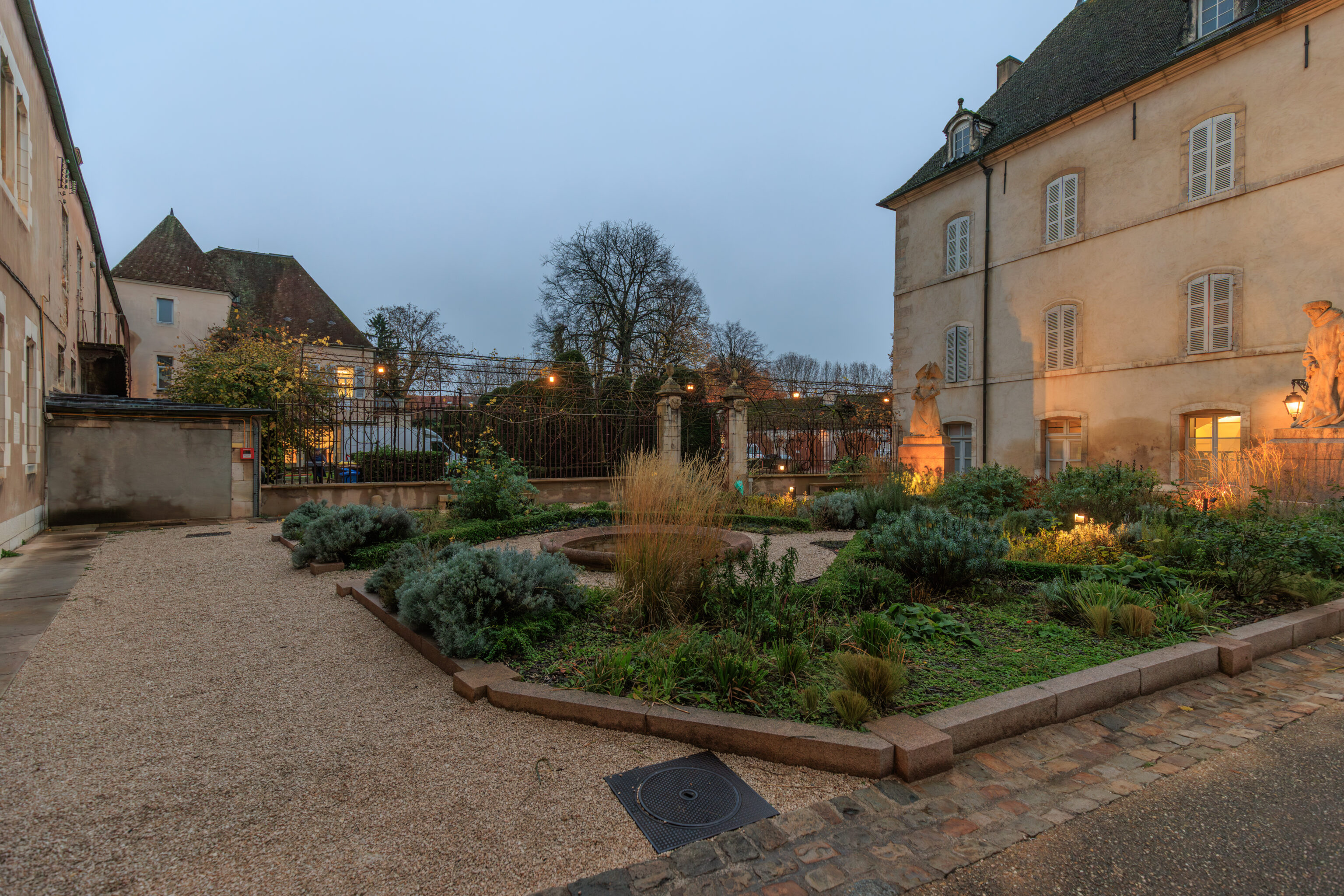
We ended up in a small garden area on the west side of the Hôtel-Dieu. This may be the herb garden for the apothecary, as explained by a sign we will see later:
The Herb Garden

For convenience, the herb garden is located next to the pharmacy, which is indeed the case here, as it was situated along the pharmacy in the secondary courtyard, as shown in this postcard from the early 20th century.
– A sign, translated using Google.
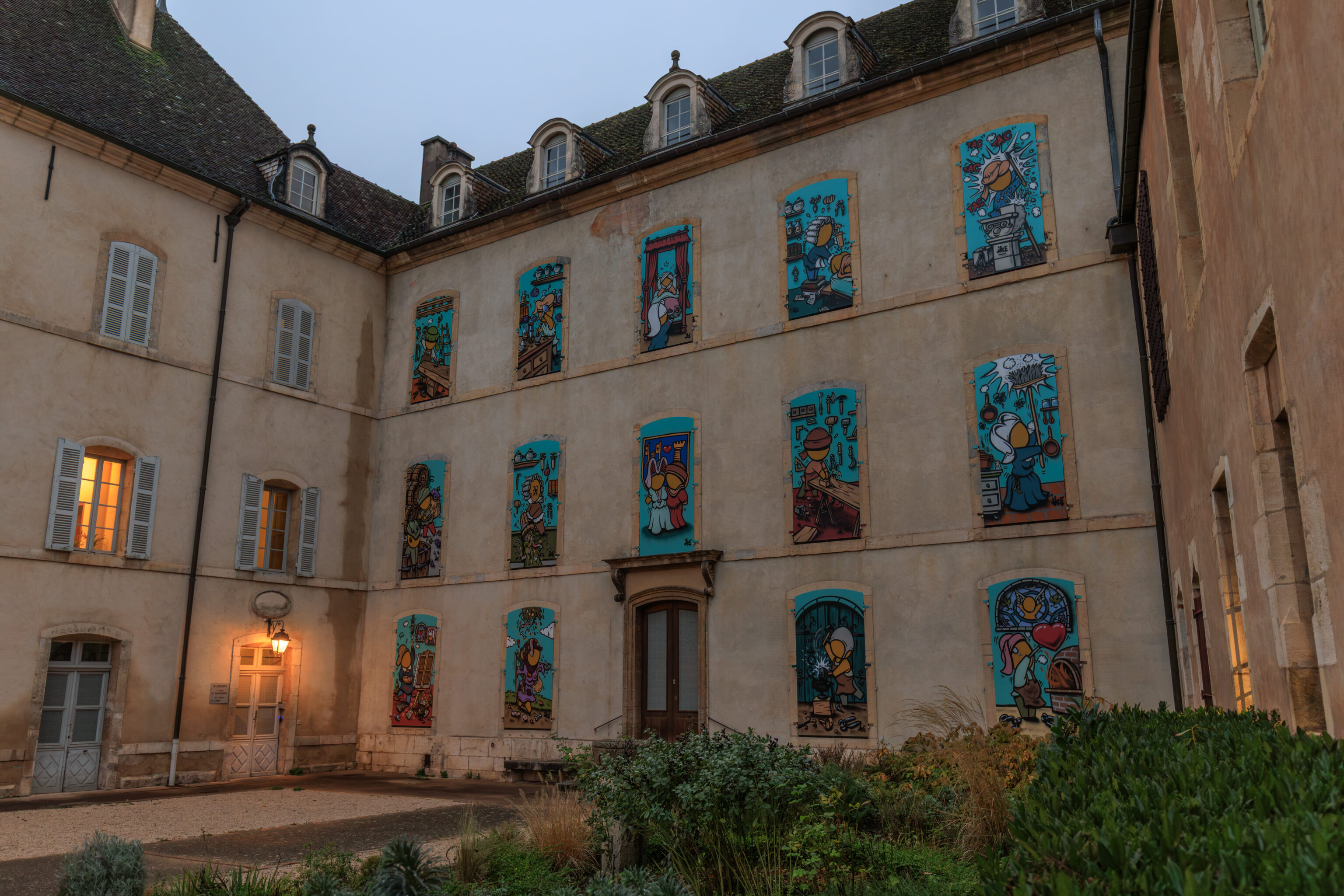
This building by the garden had windows painted with cartoony art depicting scenes related to the Hôtel-Dieu.
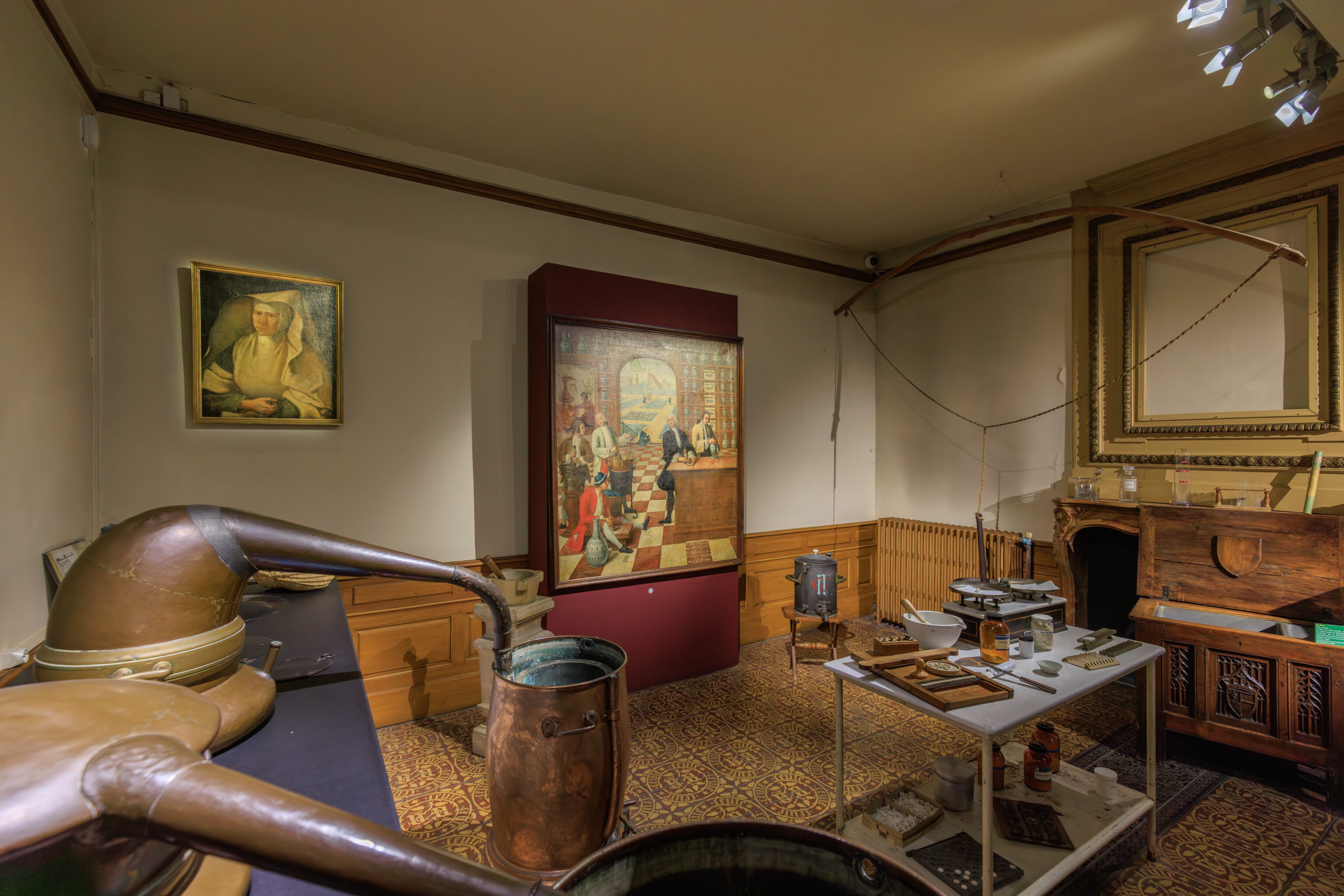
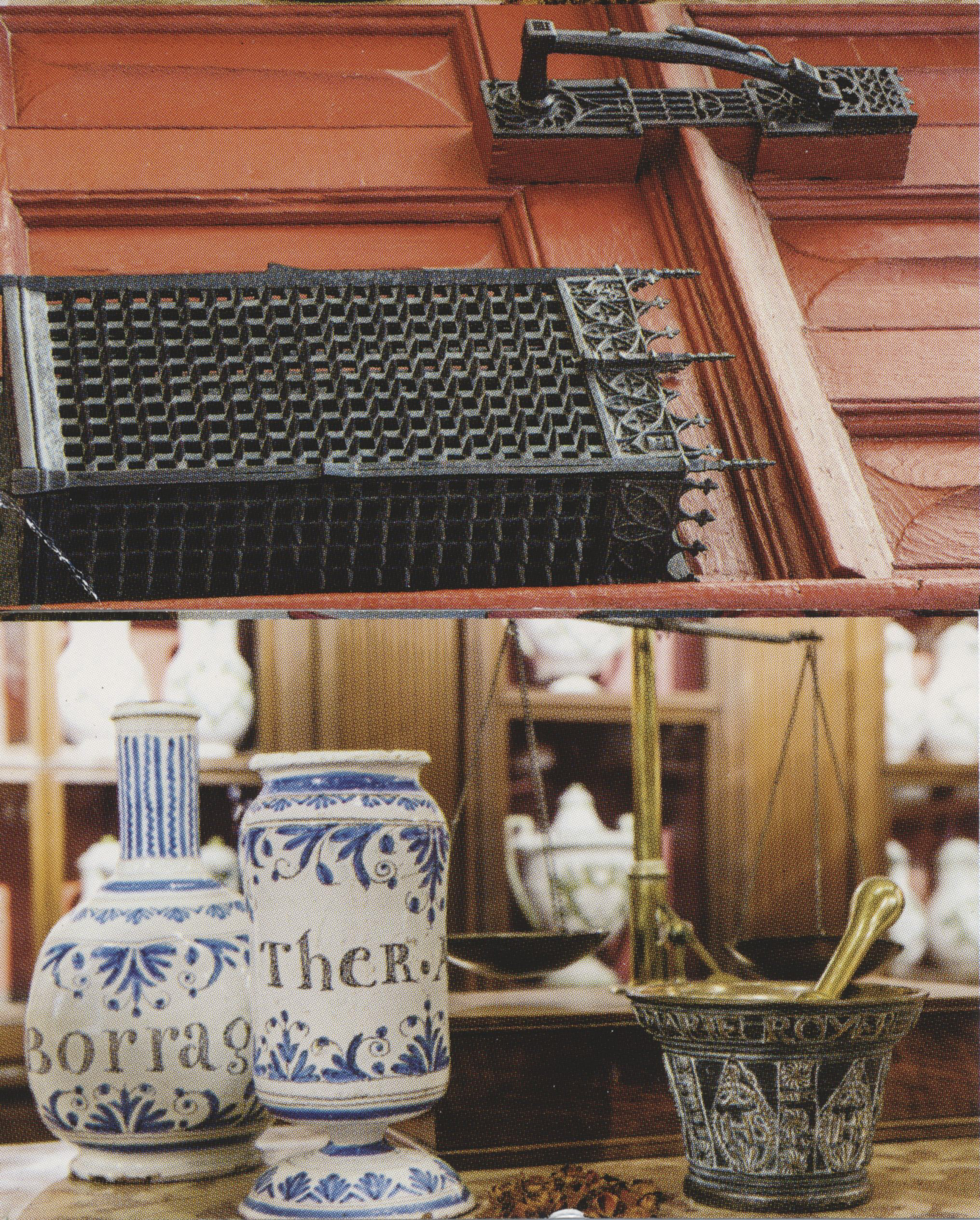
We continued on into the apothecary. The portrait on the left is of Sister Pierrette Monnet:
The Apothecary Sister

In its early days and until the 18th century, the apothecary's staff was probably composed of a head sister, a younger sister in training to assist her, as well as a servant. The Hôtel-Dieu has preserved the portrait of one of these sisters in charge of the apothecary in the 17th century: Sister Pierrette Monnet (1557-1628), depicted with a mortar and pestle in her hand, a symbol of her function.

Since learning the art of healing was delicate, the apothecary sisters were chosen by the mistress and did not change positions every 3 years like the other sisters. During the second half of the 18th century, like many hospital pharmacies and for reasons that are not entirely clear, the Hôtel-Dieu appointed a city apothecary as the person in charge. Was this to avoid irregularities that may have been observed during the preparation of medicines?

In 1788, undoubtedly in order to reduce expenses, it was decided that “the mistress and her companion [will] choose a nun, over the age of forty, who wishes to dedicate herself particularly to the duties of the apothecary; that she will be specially instructed in this area in the manner that the Board deems appropriate, and that when she has truly acquired the necessary knowledge and skills for the office of apothecary, she will be given preference for this position, that she may continue in it for three years as deemed appropriate, and that she will also be responsible for instructing the nun who will be assigned to her as a companion.” The apothecary Grémaud, who had previously been in charge of the pharmacy at the Hôtel-Dieu, sells his equipment to the institution and trains his successor, Sister Etiennette Bourgeois.
– A sign, translated using Google.
The device on the right side of the room appears to be a mortar and pestle with the pestle supported by an arch and rope:
The Pestle Supported by an Arch

The pestles of the mortars, pierced with an eyelet, are connected to an elastic support in the shape of an arch, which facilitates the work. The pestle of the large mortar, weighing nearly 6 kg, was suspended from a beam in the ceiling of the mortar room.

This arch is a unique piece that is only documented in the Book of the Foundation of the Hans Friedrich Eglinder Apothecary (1608-1675), dated 1629-1639, preserved at the Basel Pharmacy Museum.

The first page depicts an apothecary pulverizing ingredients that a woman is pouring into a mortar.
– A sign, translated using Google.
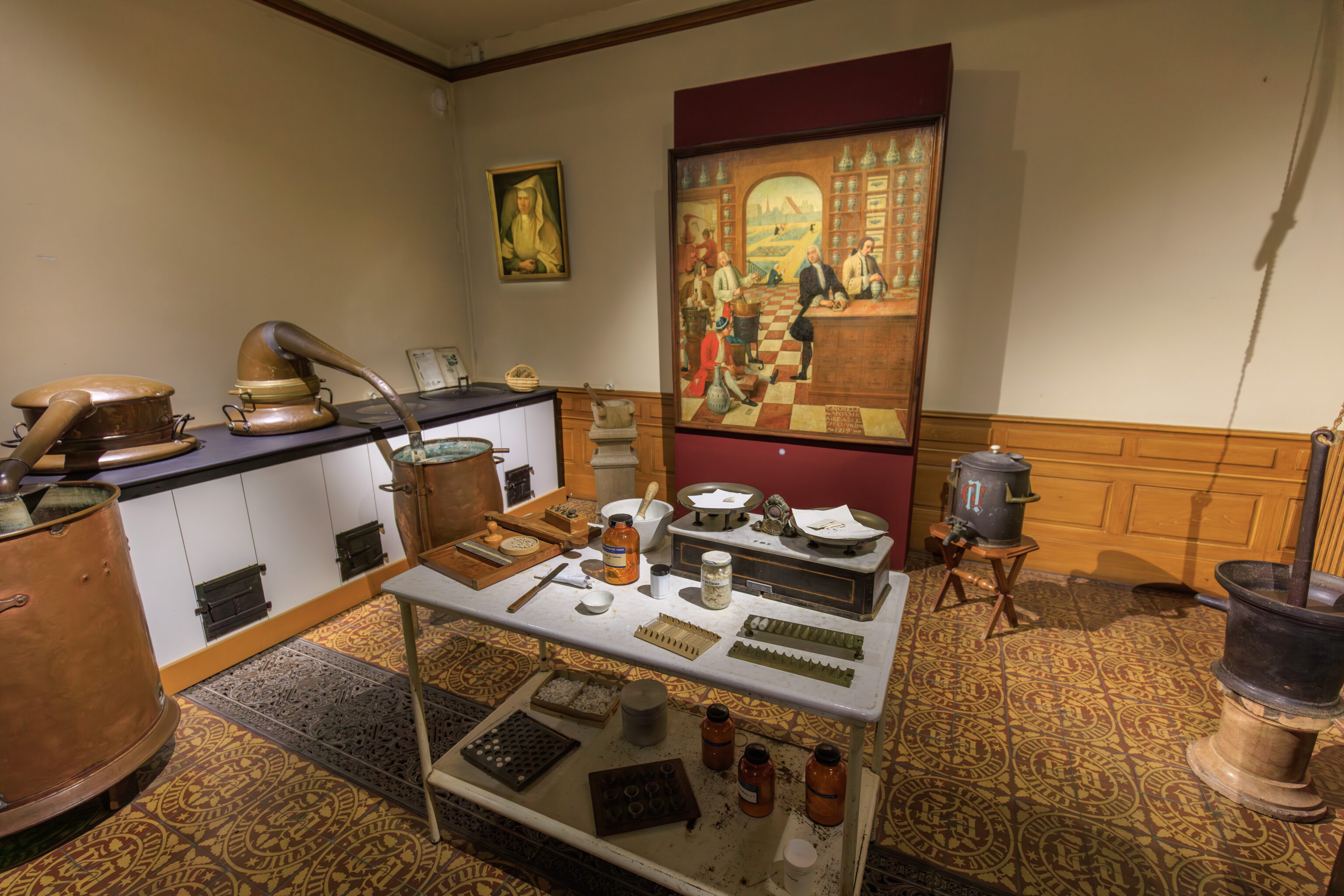
The larger painting depicts apothecary Claude Morelot:
The painting by Michel Charles Coquelet Souville, dated 1751, is exceptional; it depicts the apothecary Claude Morelot at work in his pharmacy. Morelot was also in charge of the pharmacy at the Hôtel-Dieu hospital until his death in 1776. This painting illustrates the main processes involved in the manufacture of medicines, some of which have remained unchanged since the 18th century:

• Grinding of simple drugs using a mortar and pestle.
• Preparation of medicines by heating the mixtures.
• Making pills using a pill-making device.
• Distillation using stills heated by placing them on stoves.
– A sign, translated using Google.
Additional text describes the equipment in the room used to distill liquids:
The Stills

They were located in the laboratory adjacent to the pharmacy, but the one at the Hôtel-Dieu, being very narrow, is not accessible. The stills, which are still complete, have been moved to this room. They operate in the following way: The product to be distilled is heated in the alembic until it boils. The vapor rises through the head and then enters the swan neck to condense in the coil, which is kept in a stream of cold water. The purpose of the operation is to obtain the distillate, either:

• By separating a volatile substance from its impurities, as in the case of distilled water.
• By extracting a volatile substance from a non-volatile complex, such as plant essences, alcoholic extracts, or flower or plant waters (rose or mint).
– A sign, translated using Google.
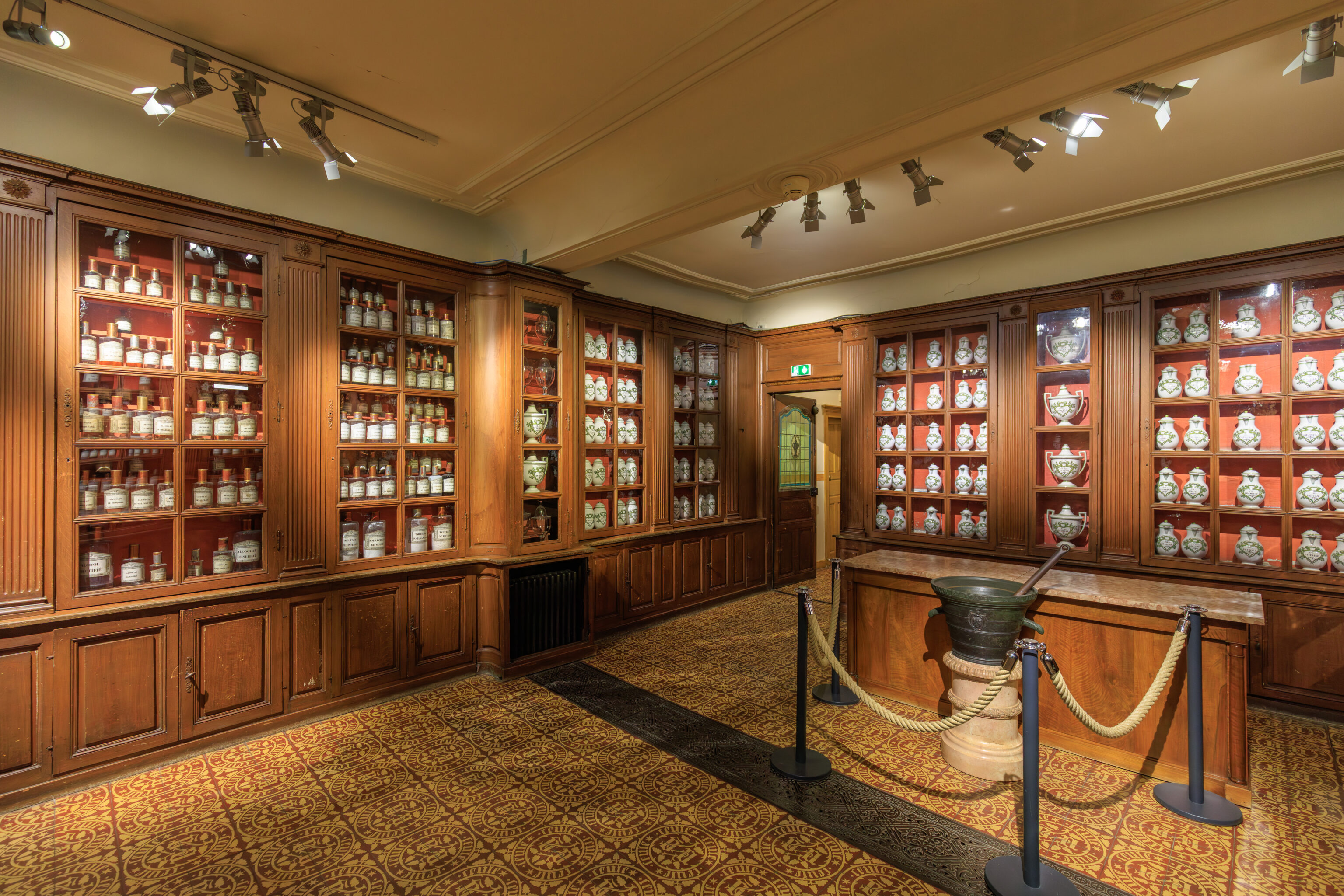
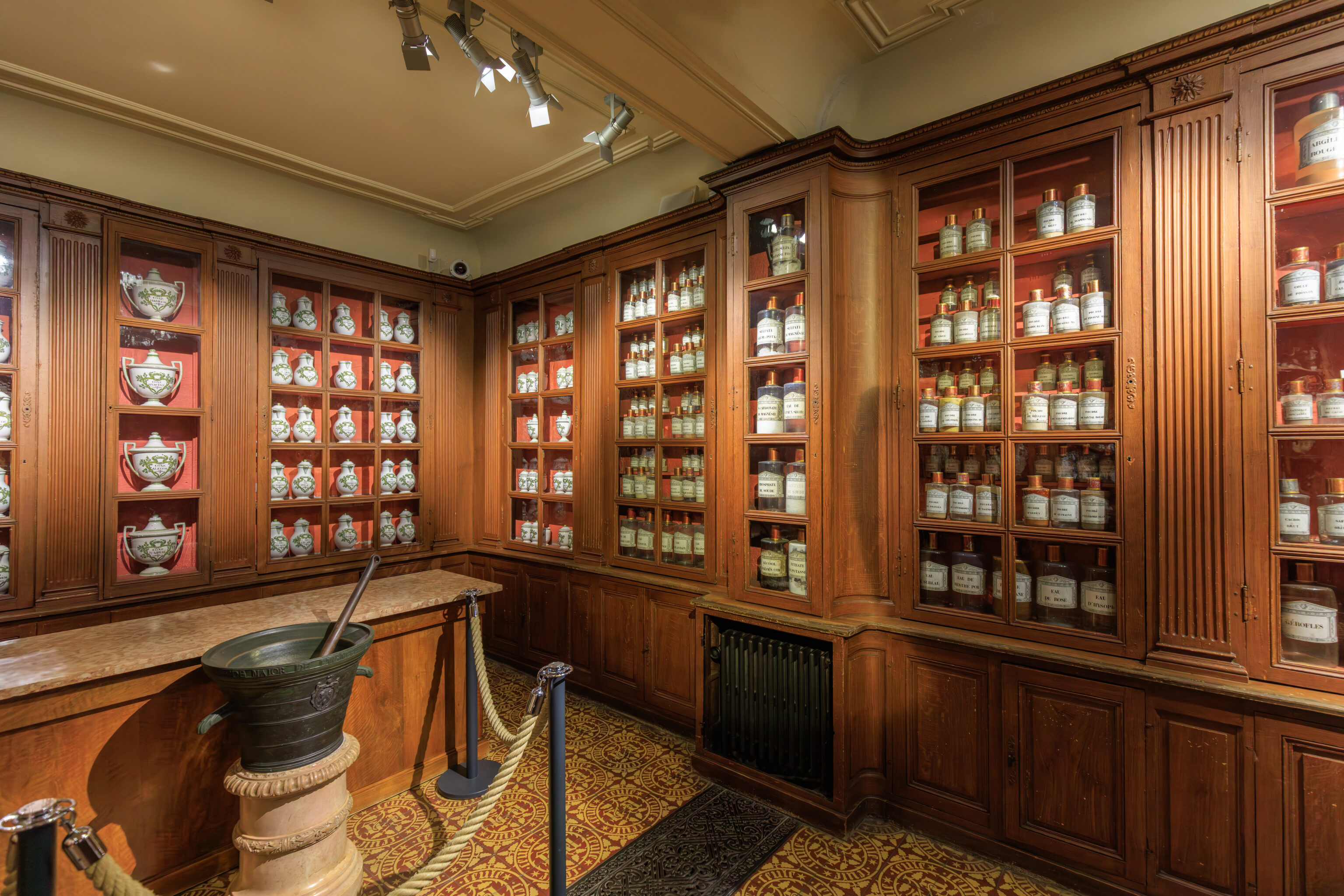
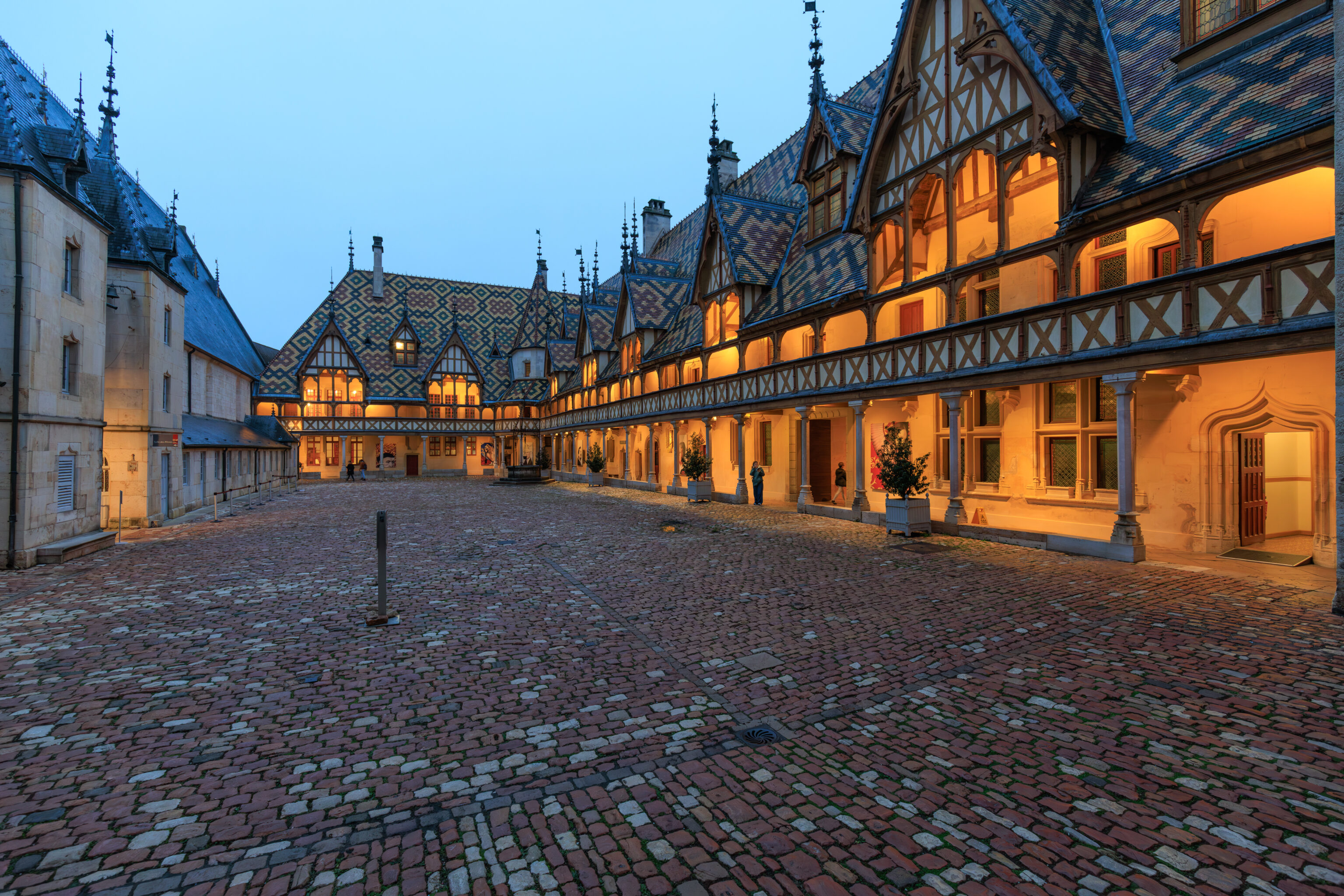
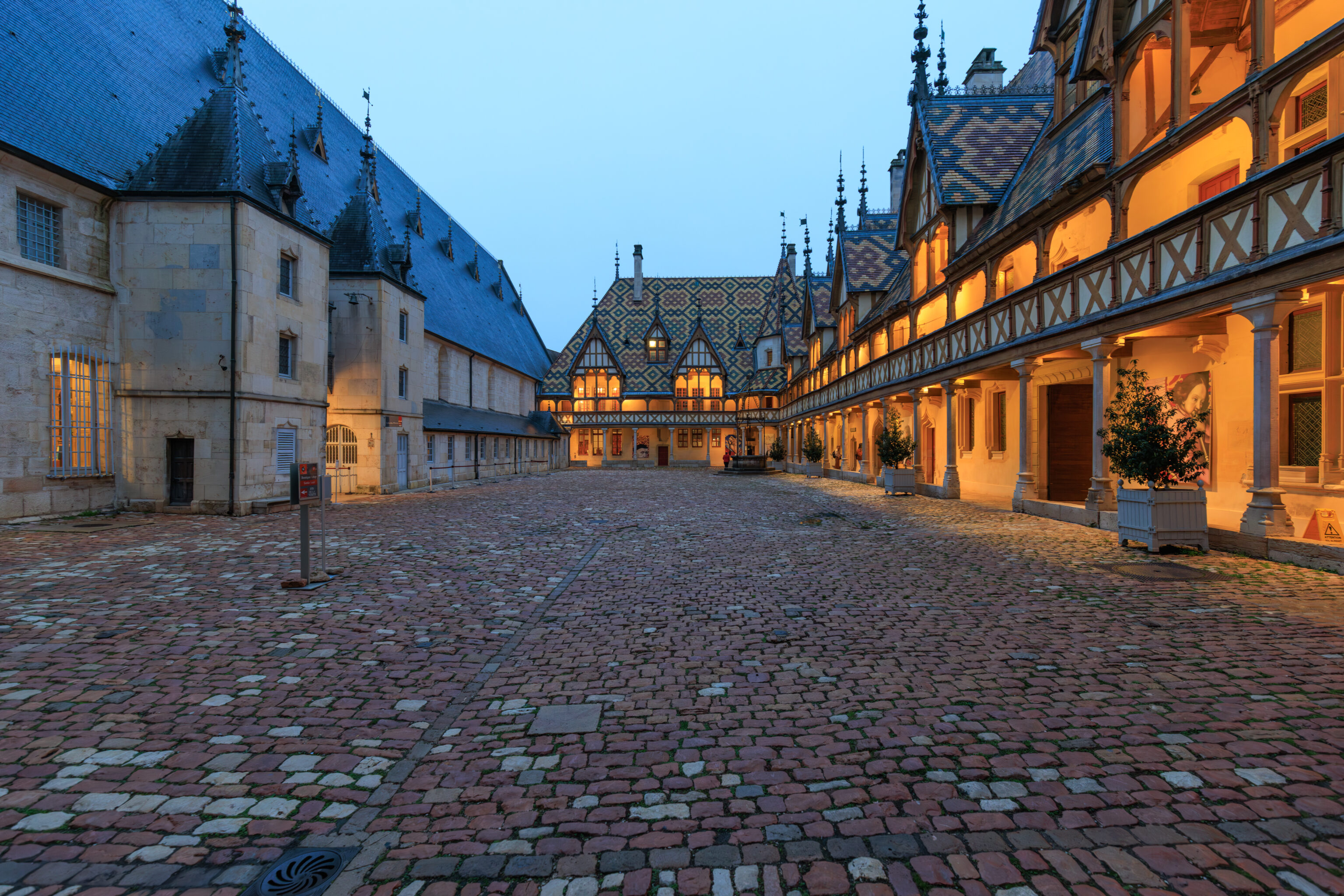
It was starting to get dark outside as we continued touring the Hôtel-Dieu.
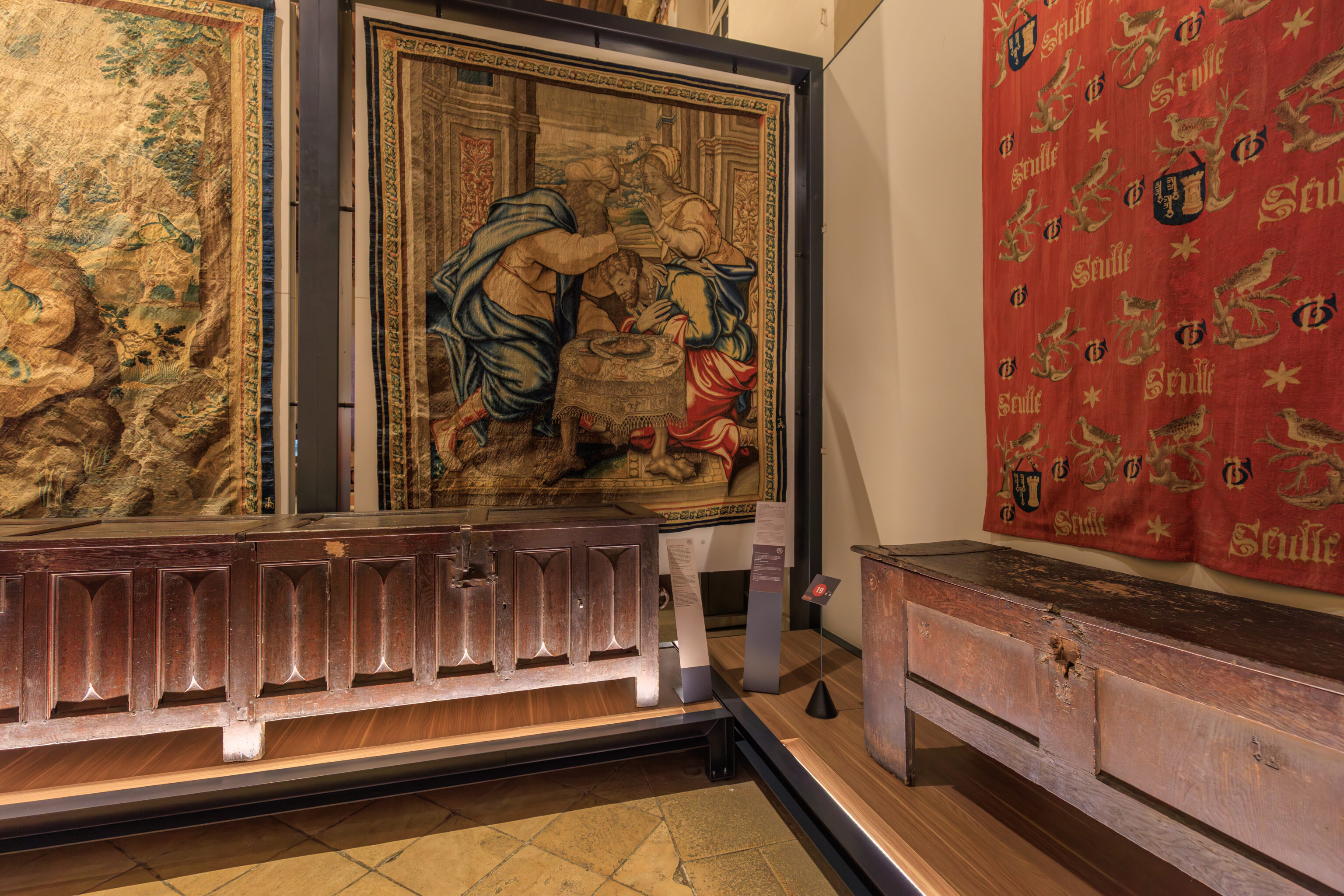
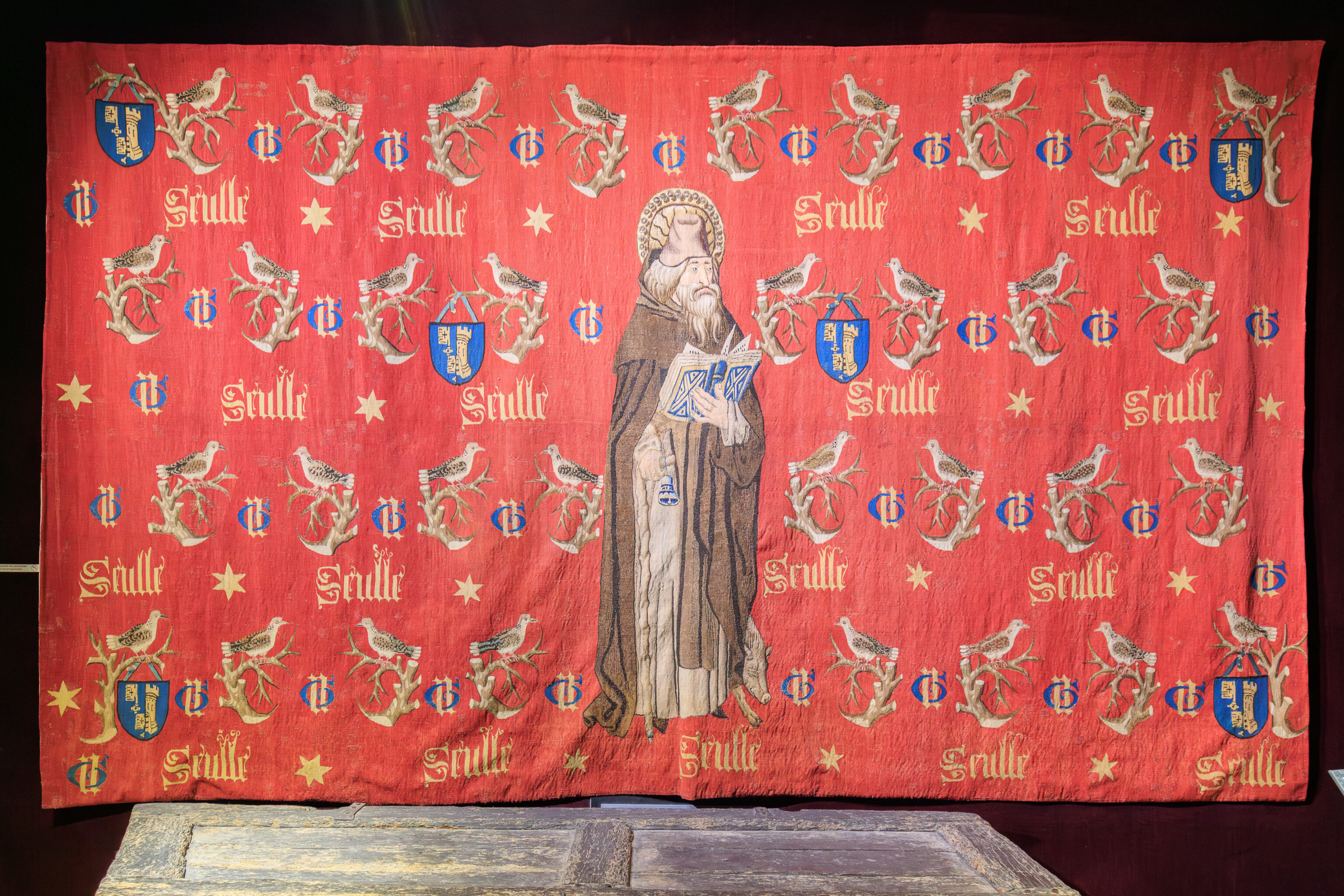
Late 15th century
Used to decorate the seats near the altar in the chapel. On the red background we see the motto of the Chancellor (“Seulle *, Only star) as welt as doves interlaced with branches the two initials N.and G. and in the four corrers are the coat of arms of Guigone de Salins.
Was listed as a historical monument in 1943
Wool with gold and silver threads in the halo”
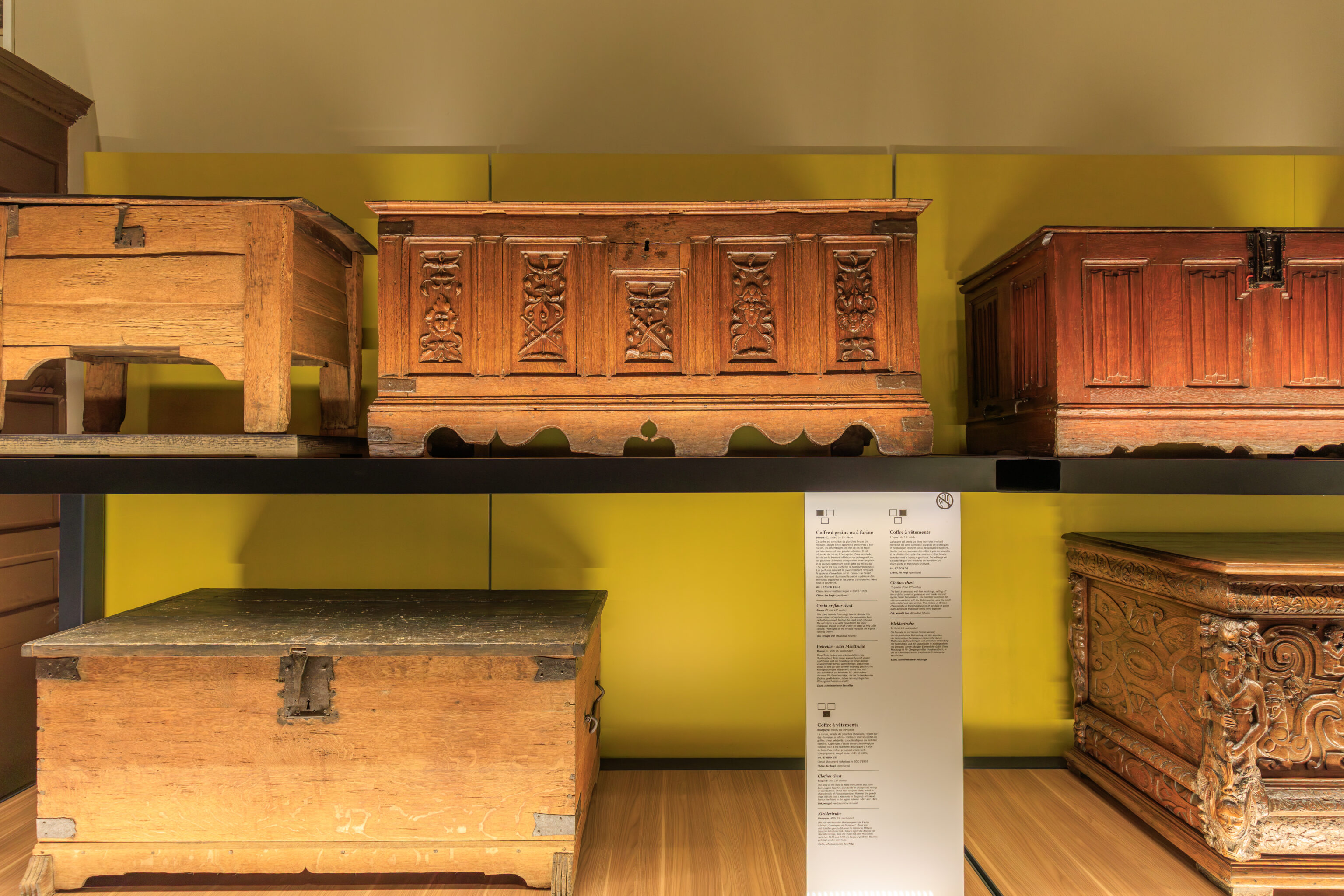
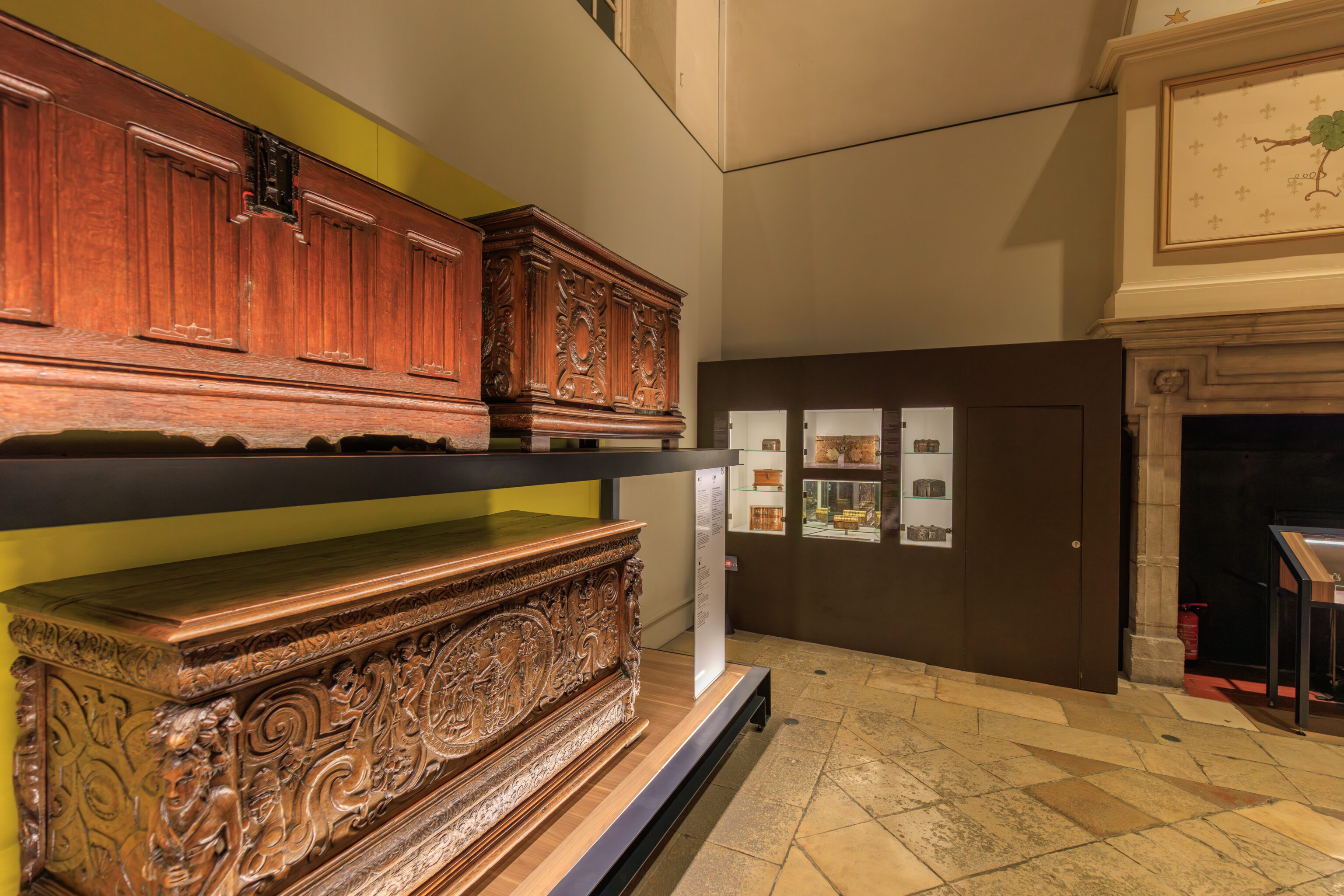
This next room displayed various items which would have been in the Hôtel-Dieu.
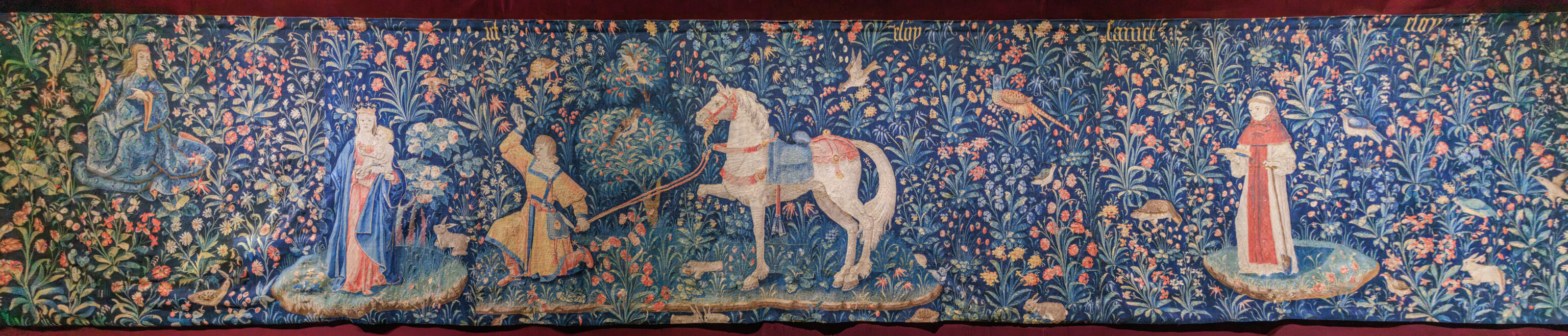
Flanders, early 16th century
Tapestry known as the “thousand flowers” tapestry, composed of four assembled fragments: on the left, a seated woman, a secular figure; in the center, a Virgin and Child, and in front of her a kneeling figure holding a horse with a severed leg, probably representing Saint Eligius in repentance; on the right, Saint Fiacre, patron saint of gardeners. The background, with its multicolored flowers and numerous animals, unifies the whole.
Inv. No. 87 GHD 298
Classified as a Historical Monument on October 7, 1944
Wool, tapestry
woven on a loom; 144.5 x 759 cm
(Google Translated)
Unfortunately, this isn’t a great presentation of this panoramic tapestry!
We next saw the Polyptych of The Last Judgement. These painted wood panels can be opened and closed, revealing different images. The panels on display here were cut in half during a restoration in the Louvre in the 19th century so that both the open and closed images can be displayed simultaneously.
There is quite a bit of text associated with these panels:
Nicolas Rolin created pious foundations that were the fruits of his political career and social advancement. Appointed chancellor in 1422 by Philip the Good, he held the highest-paid position in the ducal administration, which also allowed him to receive gifts, establish contacts with influential people, and become a privileged witness to the new artistic developments taking place in Flanders during his business trips.

Through his numerous foundations, the chancellor adhered to an aspiration characteristic of the Middle Ages: wealth was considered to entail an obligation of ostentation and generosity. Having attained a high level of fortune, Nicolas Rolin felt compelled to display this wealth and to commission the most prestigious artists for his foundations. Added to this social duty was a religious concern, that of ensuring his salvation: all of the chancellor's foundations shared the common themes of charity, the enhancement of the service of God, or the celebration of commemorative masses. By demonstrating his devotion, they aimed to secure the salvation of his soul and that of his family beyond their deaths. To be better heard by God, the chancellor also paid homage to the saints and the Virgin Mary.

This veneration is particularly evident in the painting by Jan van Eyck (1390/1395-1441), The Virgin and Child with Chancellor Rolin, commissioned for the Notre-Dame-du-Châtel church in Autun, and now housed in the Louvre Museum. Nicolas Rolin is depicted praying before the Virgin Mary as a faithful supplicant seeking the salvation of his soul.

The Last Judgment polyptych, for its part, expresses the chancellor's hope that the foundation of the Hôtel-Dieu would be recognized by God as a pious work that would atone for his sins. When he founded the institution with his third wife, Guigone de Salins, he decided to endow it with a monumental altarpiece bearing their likenesses. They commissioned a painter highly esteemed by the Burgundian aristocracy, Rogier van der Weyden (1399-1464), the official painter of the city of Brussels. The founders are depicted on the outer panels of the altarpiece, in niches, kneeling and praying before statues of Saint Sebastian and Saint Anthony. They are formally identified by their coats of arms and by the first known mention of the altarpiece in the inventory of the Hôtel-Dieu's possessions from 1501: "A painted panel depicting the Last Judgment. And on the shutters of the said panel, on the outside, are the images of Saint Sebastian and Saint Anthony, together with the aforementioned portraits of the late Lord Chancellor and Madame Guigone de Salins, his wife."

From March 20 to June 17, as part of the exhibition "Revisiting Van Eyck: The Virgin of Chancellor Rolin" at the Louvre Museum, the panel of the polyptych depicting Nicolas Rolin is displayed alongside Van Eyck's painting. During the loan period, two 3D reproductions, one in black and white and the other in color, created by the Factum Foundation, are presented: they allow for a detailed examination of the paint layer and the motifs.
– A sign, translated using Google.
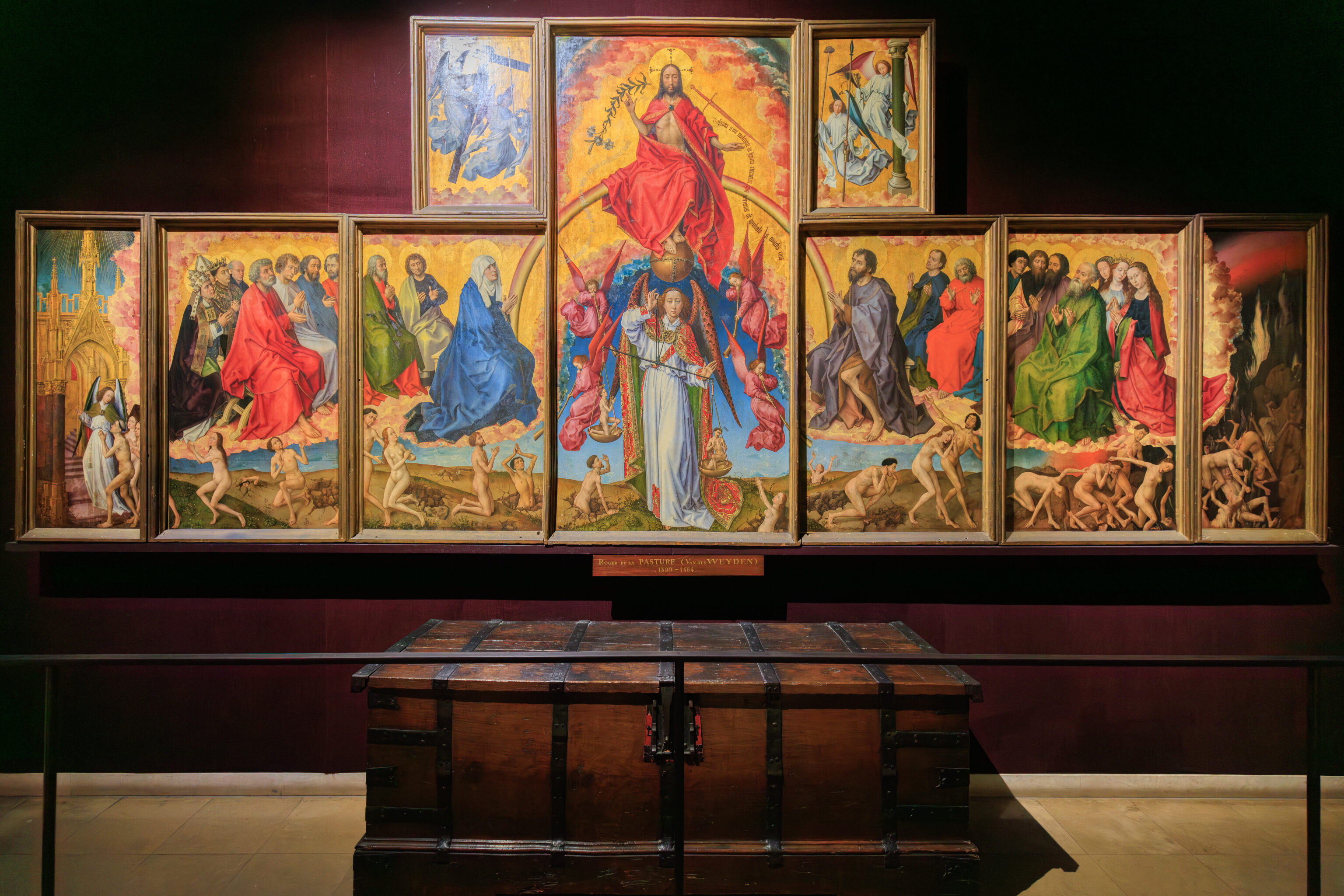
Rogier Van der Weyden (Tournai, 1399 or 1400 / Brussels, 1464)
oil painting on oak panels, created between 1443 and 1451
open polyptych: 220 cm x 548 cm – closed polyptych: 220 cm x 274 cm
Hôtel-Dieu, Hospices Civils de Beaune – inv. 87 GHD 299 – Classified as a historical monument in 1891
The altarpiece of the Last Judgment from the Hôtel-Dieu of the Hospices Civils de Beaune was formerly placed above the white marble altar in the chapel of the Poor’s Ward and is now displayed in a room specially designed for its preservation. This polyptych, composed of nine oak panels, six of which were painted on both sides, is the largest of the altarpieces painted by Rogier van der Weyden and the masterpiece of his mature period; it is also the major donation of Nicolas Rolin to his Beaune foundation. No document concerning the commission of this work has been found, but it is probable that it was installed during the consecration of the chapel on December 31, 1451, which allows us to place its creation between that date and 1443, the year of the foundation. The fact that the chancellor called upon the official painter of the City of Brussels, where he frequently stayed with the ducal court, is not fortuitous. The use of a prestigious Flemish painter also testifies to his desire to affirm the privileged social status conferred upon him by his recent ennoblement. […]
The richness and beauty of the colors animate a clear and hierarchical composition, where the celestial court occupies a predominant place and from which the demons are curiously absent. The scene is organized around the central panel, dominated by the majestic figure of the resurrected Christ, draped in a scarlet cloak and enthroned on a rainbow; his feet rest on the globe of the world, and his wounds resemble rubies. On either side, four angels dressed in white present the instruments of the Passion. Like Christ, the heavenly court stands out against a gold background bordered by purple clouds evoking eternal light. In the foreground, the Virgin and Saint John the Baptist intercede, hands clasped, before the righteous Judge; behind them, the apostles are seated in a semicircle, accompanied by saints. In the lower register of the central panel and along the same vertical axis, the archangel Saint Michael, in alb and brocade cope, reproduces the attitude of Christ in a truly original parallel. Surrounded by four trumpeting angels calling the dead to judgment, he holds a balance with scales laden with two small figures symbolizing virtues, on the ascending side, and sins, which tilt the beam downwards. At the archangel’s feet, the dead rise from the earth: to his left, the damned, bent and grimacing, walk on cracked ground and rush in disarray into the abyss and the flames of hell, while to his right, the elect straighten up and make their way, on a flower-strewn ground, towards the golden gate of paradise.
Well-suited to a hospital, a place where the question of ultimate ends and the afterlife takes on a particular urgency, the theme of the Last Judgment manifests Christ’s triumph over death and the promise of the beatific vision, but also the idea of judgment associated with works of mercy. […]
Excerpts from the text by Élisabeth Réveillon, honorary curator of heritage, in L’Hôtel-Dieu de Beaune, Somogy, 2005, pp. 68 and 72
INSCRIPTIONS
To the right of Christ, towards the fleur-de-lis: Come, you who are blessed by my Father, inherit the kingdom prepared for you from the foundation of the world. Saint Matthew, chapter 25
To the left of Christ, towards the sword of justice: Depart from me, you who are cursed, into the eternal fire prepared for the devil and his angels. Saint Matthew, chapter 25
On the left panel, under the inscription virtutes (the virtues), the figure is kneeling with a radiant face. The path to paradise is strewn with flowers.
On the right panel, under the inscription peccata (the sins), the figure with disheveled hair turns away her face, filled with terror. On the road to hell, the demons are absent; the damned are overwhelmed by the weight of their sins. Under their feet, the ground is arid and cracked: they try to stand up without succeeding and, in their flight, they fall into the flames of hell.
GROUP OF 4 MEN
A pope, a crowned man, and a bishop form the initial group. A fourth bald man was added later. Many historians agree in recognizing in these figures: Pope Eugene IV, who signed the bull authorizing the foundation of the Hôtel-Dieu, Philip the Good, Duke of Burgundy, Bishop Jean Rolin, son of the founder, and in the features of the bald man – perhaps the artist himself.
GROUP OF 3 WOMEN
Their features are young and idealized. If we consider that the group of 4 men represents contemporary figures, the 3 women would be Philipote Rolin, a daughter of the founder, Isabella of Portugal – Duchess of Burgundy, in the guise of the crowned woman, and finally one of Nicolas Rolin’s first wives.
THE ELECT & THE DAMNED
They are naked, without any sign of distinction regarding their past social status. Their confrontation takes place on the scales of Saint Michael.
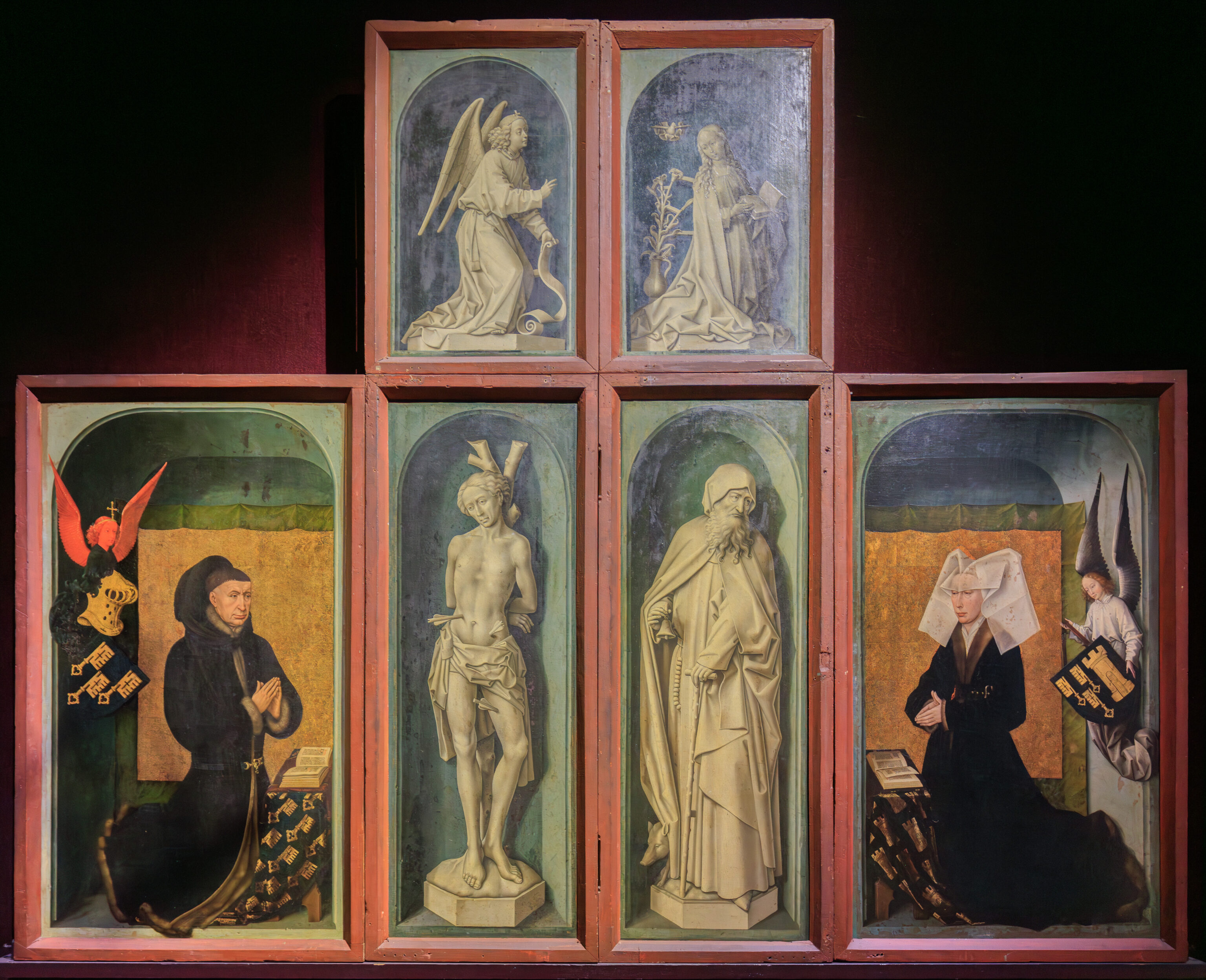
Rogier Van der Weyden (Tournai, 1399 or 1400 / Brussels, 1464)
oil painting on oak panels, created between 1443 and 1451
open polyptych: 220 cm x 548 cm – closed polyptych: 220 cm x 274 cm
Hôtel-Dieu, Hospices Civils de Beaune – inv. 87 GHD 299 – Classified as a historical monument (object) in 1891
The altarpiece of the Last Judgment from the Hôtel-Dieu of the Hospices Civils de Beaune was formerly placed above the white marble altar in the chapel of the Poor’s Ward and is now presented in a room specially designed for its preservation. This polyptych, composed of nine oak panels, six of which were painted on both sides, is the largest of the altarpieces painted by Rogier van der Weyden and the masterpiece of his mature period; it is also the major donation of Nicolas Rolin to his Beaune foundation. No document concerning the commission of this work has been found, but it is probable that it was installed during the consecration of the chapel on December 31, 1451, which allows us to place its creation between this date and 1443, the year of the foundation. The fact that the chancellor called upon the official painter of the City of Brussels, where he frequently stayed with the ducal court, is not fortuitous. The use of a prestigious Flemish painter also testifies to his desire to affirm the privileged social status conferred upon him by his recent ennoblement. […]
Particularly well-suited to a hospital, a place where the question of ultimate ends and the afterlife takes on a special urgency, the theme of the Last Judgment manifests Christ’s triumph over death and the promise of the beatific vision, but also the idea of judgment associated with works of mercy. […]
Excerpts from the text by Elisabeth Réveillon, honorary curator of heritage, in L’Hôtel-Dieu de Beaune, Somogy, 2005, pp. 68 and 72
During the restoration carried out in the Louvre workshops between 1875 and 1878, the panels of the movable shutters were sawn through their thickness to allow both sides of the polyptych to be admired simultaneously. It is the closed polyptych that you can admire here, as the sick patients would have seen it from their beds.
On this side of the altarpiece, the founder of the Hôtel-Dieu and his wife are kneeling in prayer before the saints they each venerate: Saint Sebastian for Nicolas Rolin and Saint Anthony for Guigone de Salins. The chancellor of the Duke of Burgundy also asserts his social status by having his coat of arms and helmet depicted. The two upper panels illustrate the theme of the Annunciation with the Archangel Gabriel announcing to Mary her divine motherhood.
Before painting the subjects or motifs on the wood, a white primer was applied to the panels to obtain a smooth surface. The artist then created a drawing, more or less detailed. The whole was then covered with a layer of transparent oil called an isolation layer. The painter then applied his colors, varying the number of layers depending on whether he wanted a light or dark effect on the different parts of his painting.
THE ANNUNCIATION SCENE
The composition is traditional; it unfolds across two panels. Mary is reading a prophecy from Isaiah when the Archangel Gabriel comes to announce to her: “Do not be afraid, Mary; for you have found favor with God. And behold, you will conceive in your womb and bear a son, and you shall name him Jesus.” Luke 1:30-31 Behind Mary, a branch of lilies symbolizes her virginity, while the dove represents the Holy Spirit. This scene is there to remind the sick people in the Poor Ward of the coming of Christ, the savior of humanity’s ills.
NICOLAS ROLIN (Autun, 1376-1462)
Chancellor to the Duke of Burgundy for 40 years, patron of the arts and builder, he owned numerous lordships. The Virgin and Child with Chancellor Rolin, painted by Jan van Eyck and housed in the Louvre Museum, recalls the composition of the Beaune panel. As for the red seraph bearing his coat of arms, it is a celestial spirit from the first hierarchy of angels, reflecting the high position of Nicolas Rolin in the Duchy of Burgundy.
SAINT SEBASTIAN
An officer of the imperial guard in 3rd-century Rome, Sebastian openly professed his Christian faith. He was arrested and condemned to die, his body pierced by arrows. The patron saint of archers, he was venerated by Nicolas Rolin. According to an ancient belief, he is invoked to ward off the arrows carrying the plague, shot by a deity.
SAINT ANTHONY the Great
Having withdrawn to the Egyptian desert, Anthony was tempted many times by the devil, who notably took the form of a wild boar. Considered the father of Christian monasticism, he was venerated by Guigone de Salins. He is invoked against the plague, leprosy, and ergotism, also known as Saint Anthony’s fire.
GUIGONE DE SALINS (Salins, 1403 – Beaune, 1470)
In 1423, she married Nicolas Rolin. Widowed in 1462, she dedicated herself to the service of the poor, becoming a hospitaler at the Hôtel-Dieu where she is buried in the chapel. Her coat of arms depicts the tower – the arms of her family – and the keys – the arms of the Rolin family.
(Google Translated)
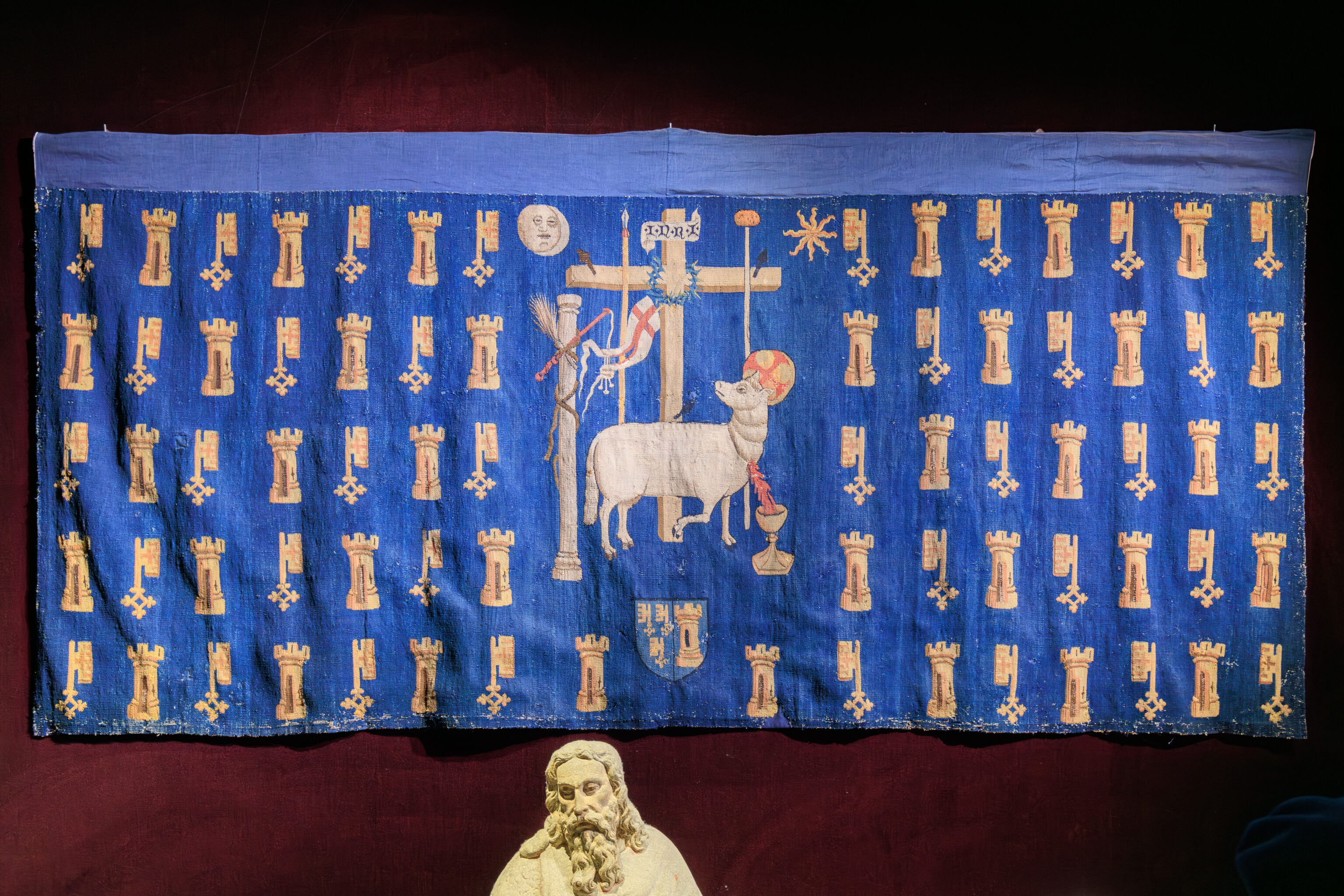
Between 1462 and 1470
This tapestry, depicting a theme very common in the 15th century, is an allusion to the dedication of the Hôtel-Dieu (hospital). The Lamb, attribute of Saint John the Baptist, is placed before the instruments of the Passion. Its blood, collected in a chalice, commemorates the sacrifice of Christ in the sacrament of the Eucharist. The background consists of alternating keys and towers, elements from the coats of arms of the Rolin and Salins families.
Inv. 87 GHD 279
Classified as a historical monument on October 7, 1944
Wool, tapestry woven on a loom
(Google Translated)
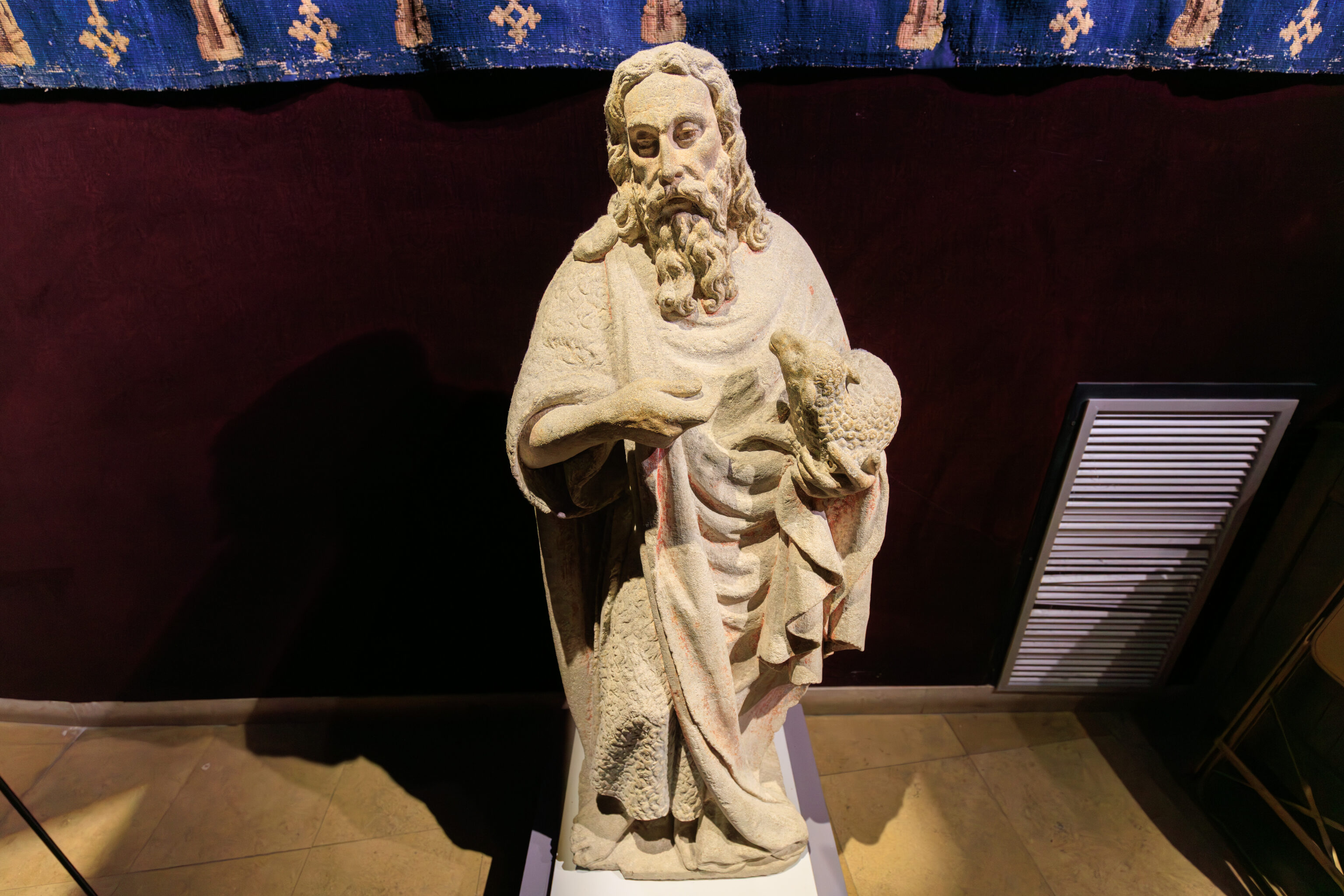
Second half of the 15th century
This saint led an ascetic life and announced the coming of Jesus, whom he designated by the figure of the Lamb. In 1452, at the request of Nicolas Rolin, Pope Nicholas V replaced the dedication to Saint Anthony with that of Saint John the Baptist, in order to protect the Hôtel-Dieu from any potential claims from monasteries dedicated to the same saint.
Inventory No. 87 GHD 277
Polychrome limestone
Listed as a historical monument (object) on September 15, 2014
(Google Translated)
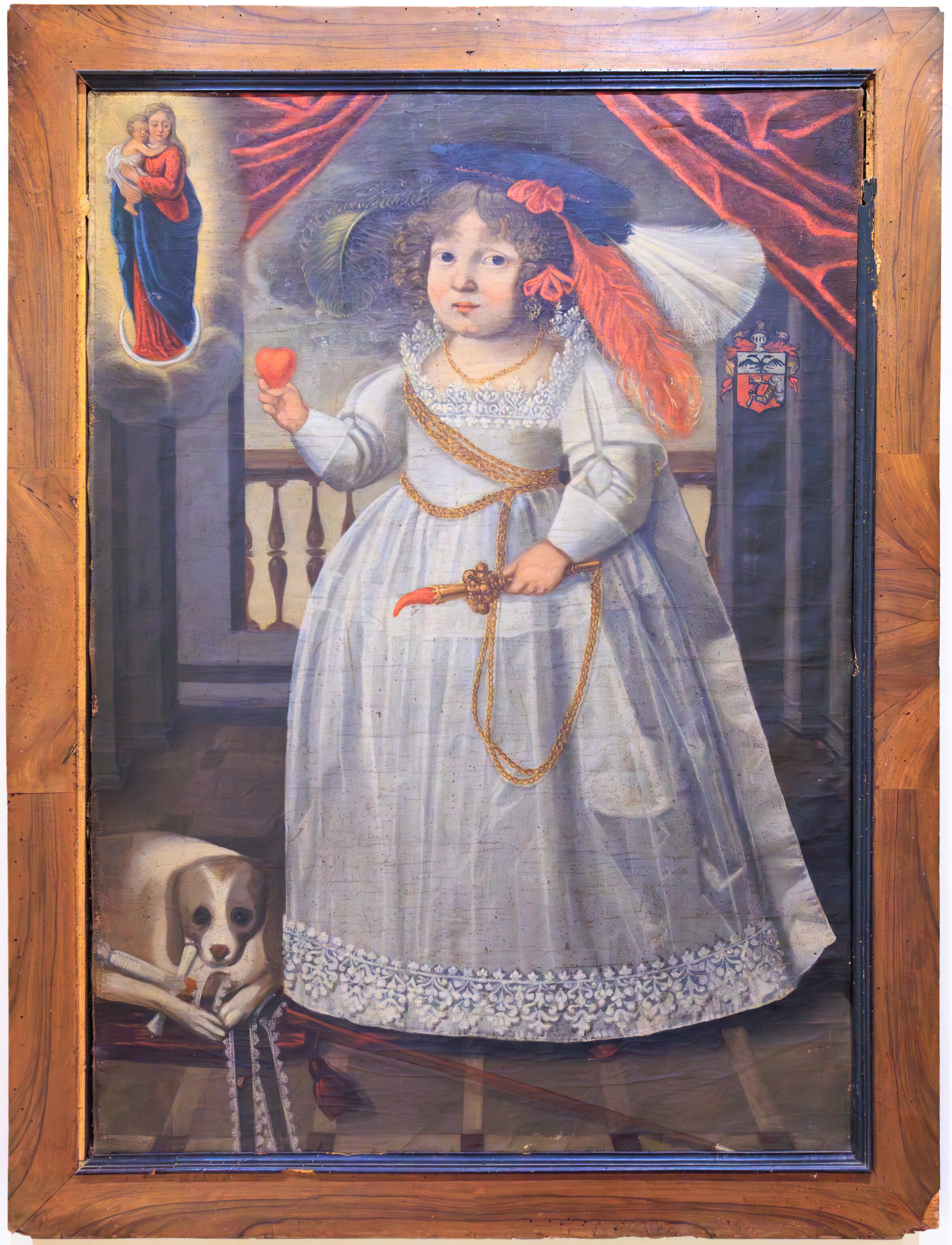
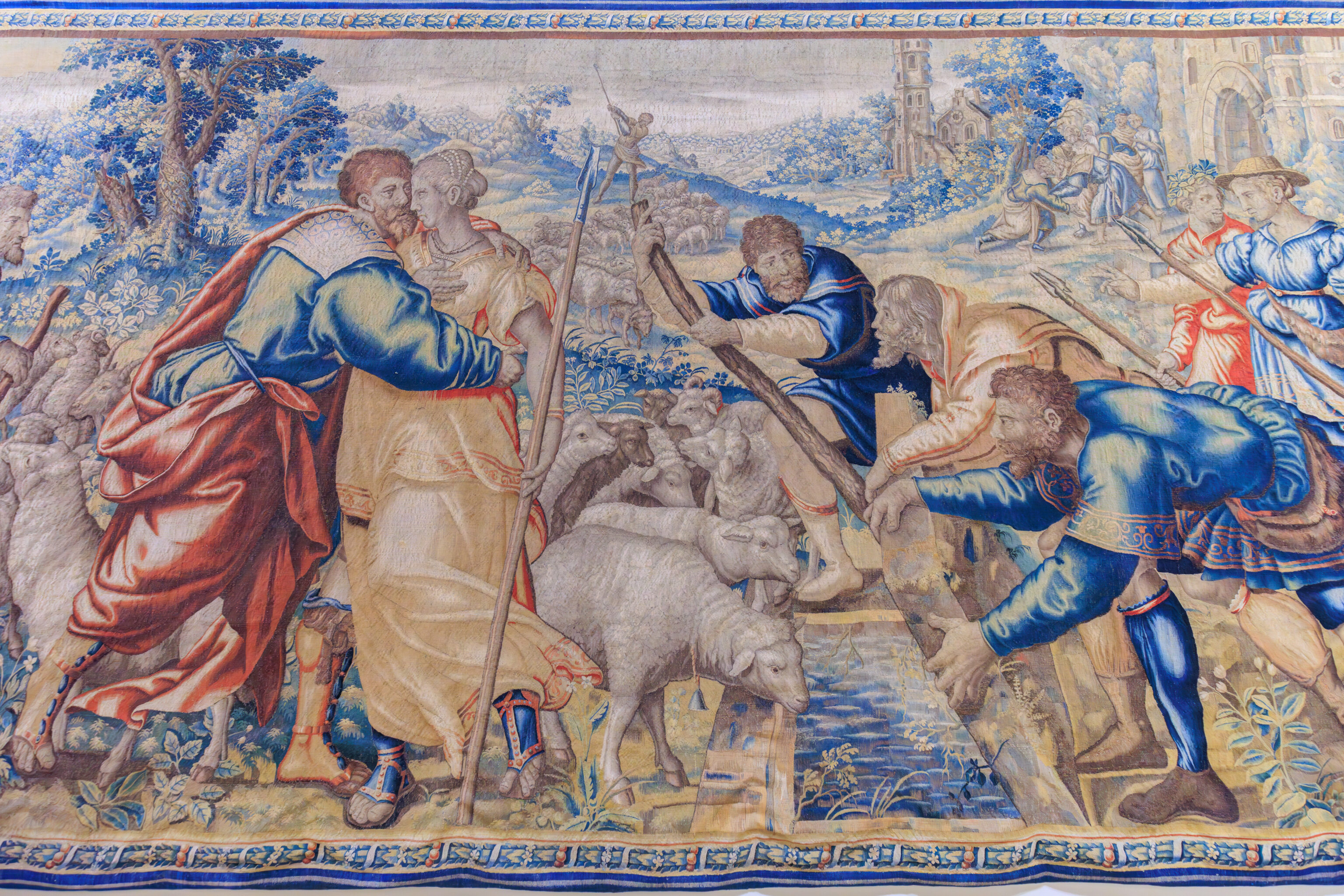
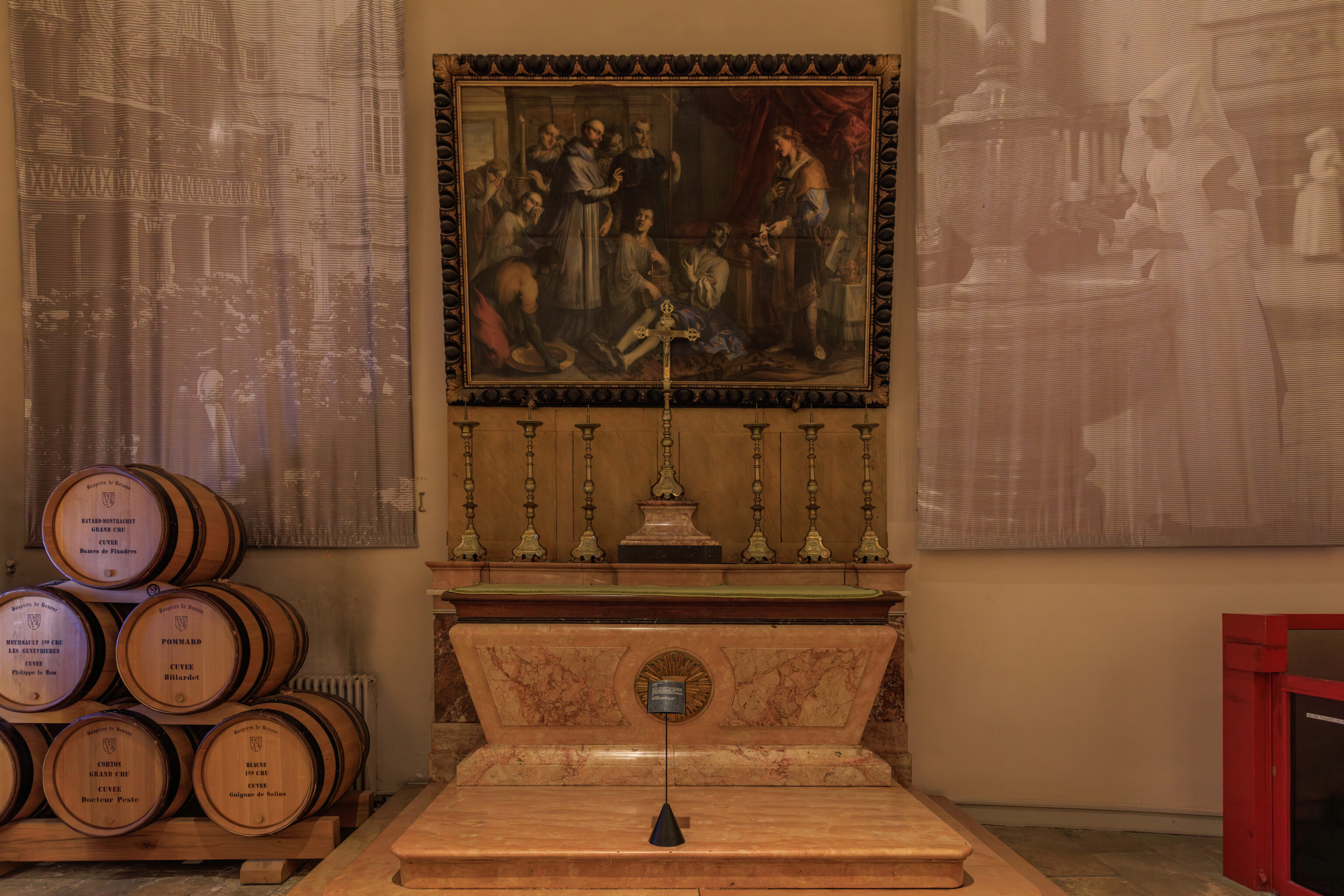
Circa 1665
Isaac Moillon
This painting is signed and dated circa 1665 and is inscribed on the right side of the bed’s plinth: MOILLON IN. F. [illegible] it was certainly commissioned by Louis Bétauld, benefactor of the Hôtel-Dieu, who had this new ward fitted out in 1659.
This is Moillon’s latest dated work. The theme of the death of Saint Louis is clearly linked to the name of this ward.
Inv. 87 GHD 274
Classified as a Historical Monument on September 1, 1978
Oil painting on canvas and carved oak frame.
(Goopgle Translated)
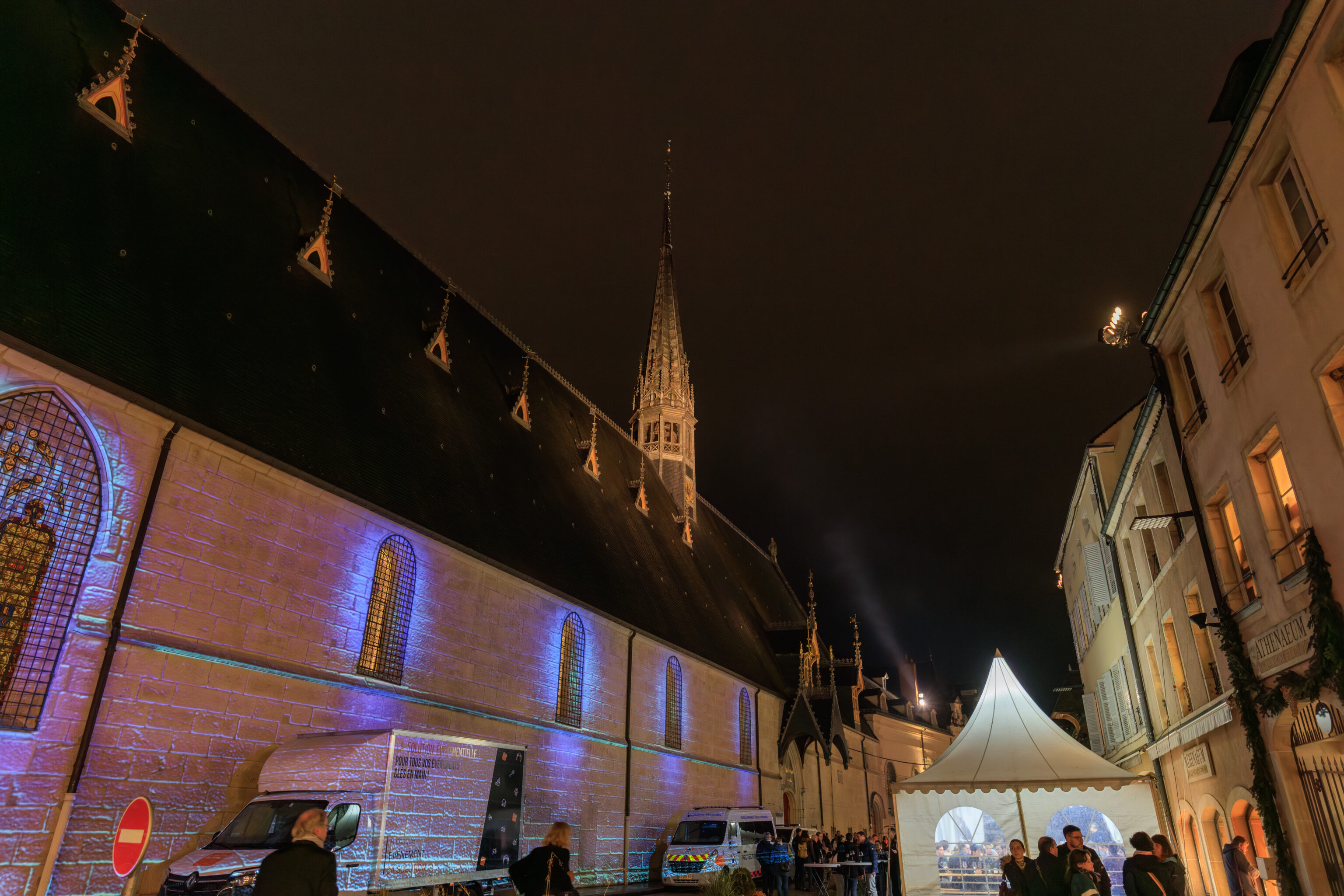
It was completely dark outside after we headed out from the Hôtel-Dieu. There was a large screen that was showing the auction outside. Many people were watching, and we did too for awhile. We should have photographed it!
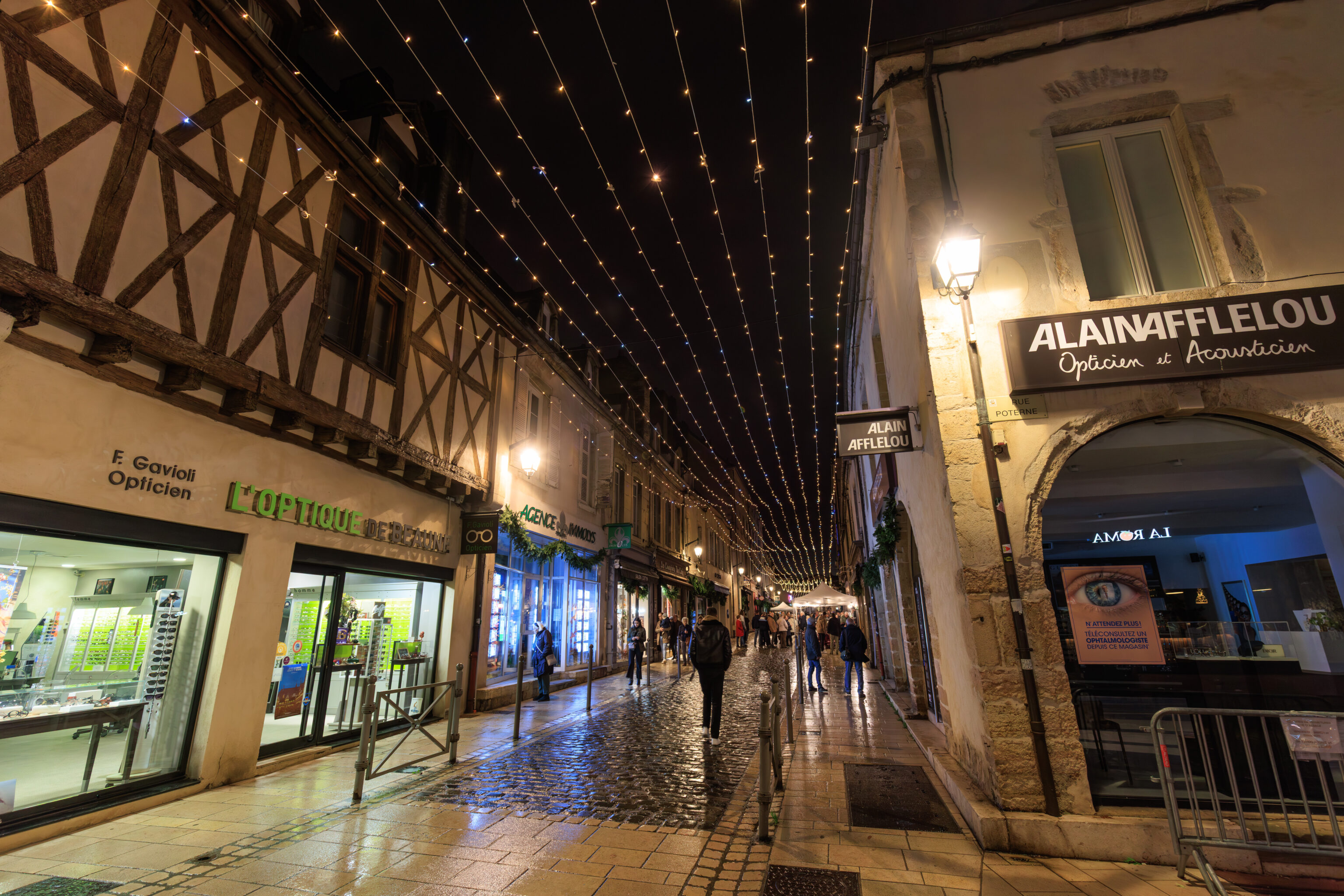
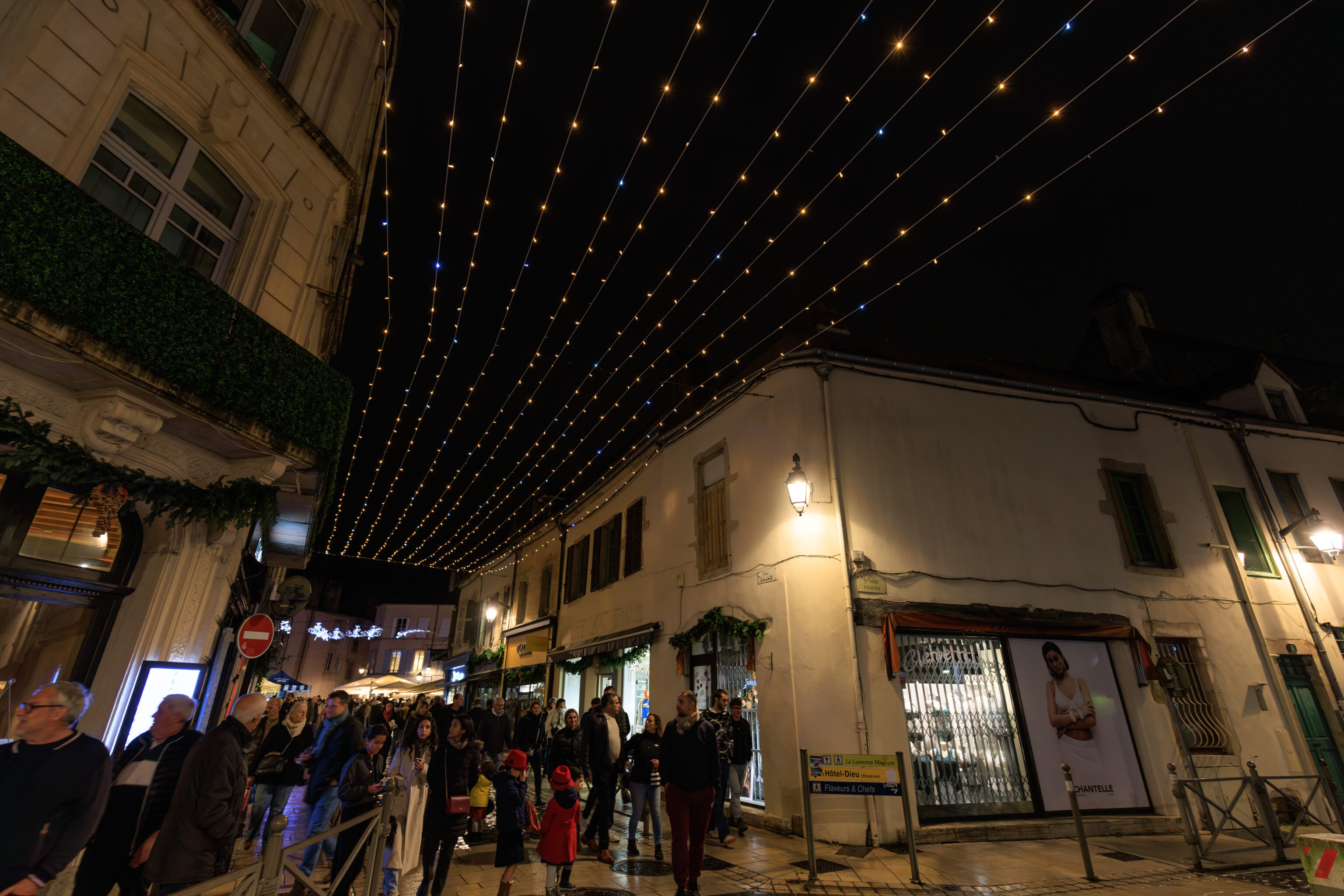
We ended up walking back to the station via a different route.
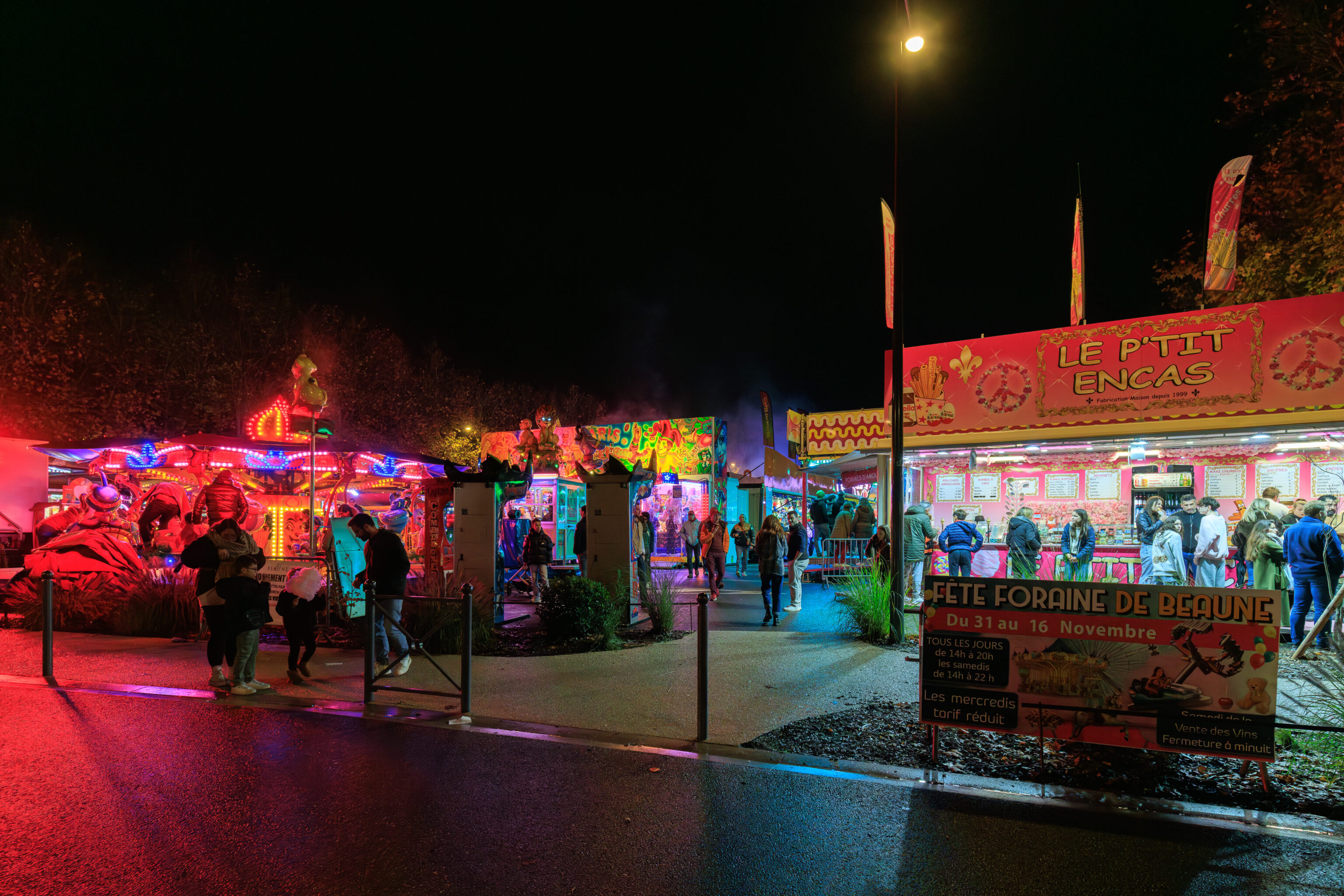
We passed by what could be described as a small carnival or fair in American English. It took place in what seems to normally be a parking lot just outside of where the city walls were in the past.
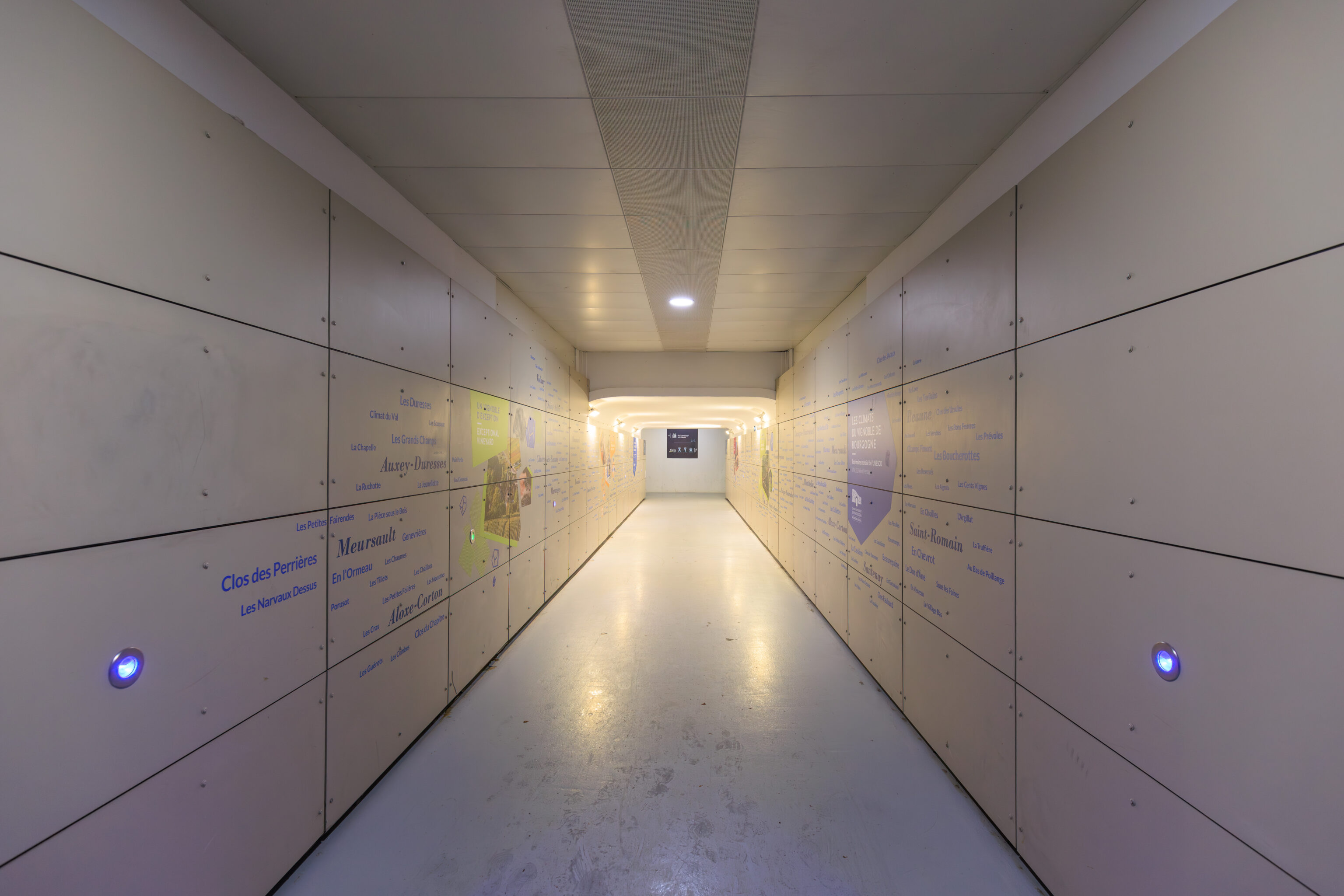
After arriving at the station, we walked through this underground passageway to get to the platform for the next train back to Lyon.
Lyon
After returning to Lyon, we wanted a snack, or maybe just some dessert. Perhaps crepes? After all, this is France! We decided to visit Le Paradis du Fruit, which is on the Rue de la République near the InterContinental.
For whatever reason, we thought this was something like a creperie. It was not. The menu was pretty varied.
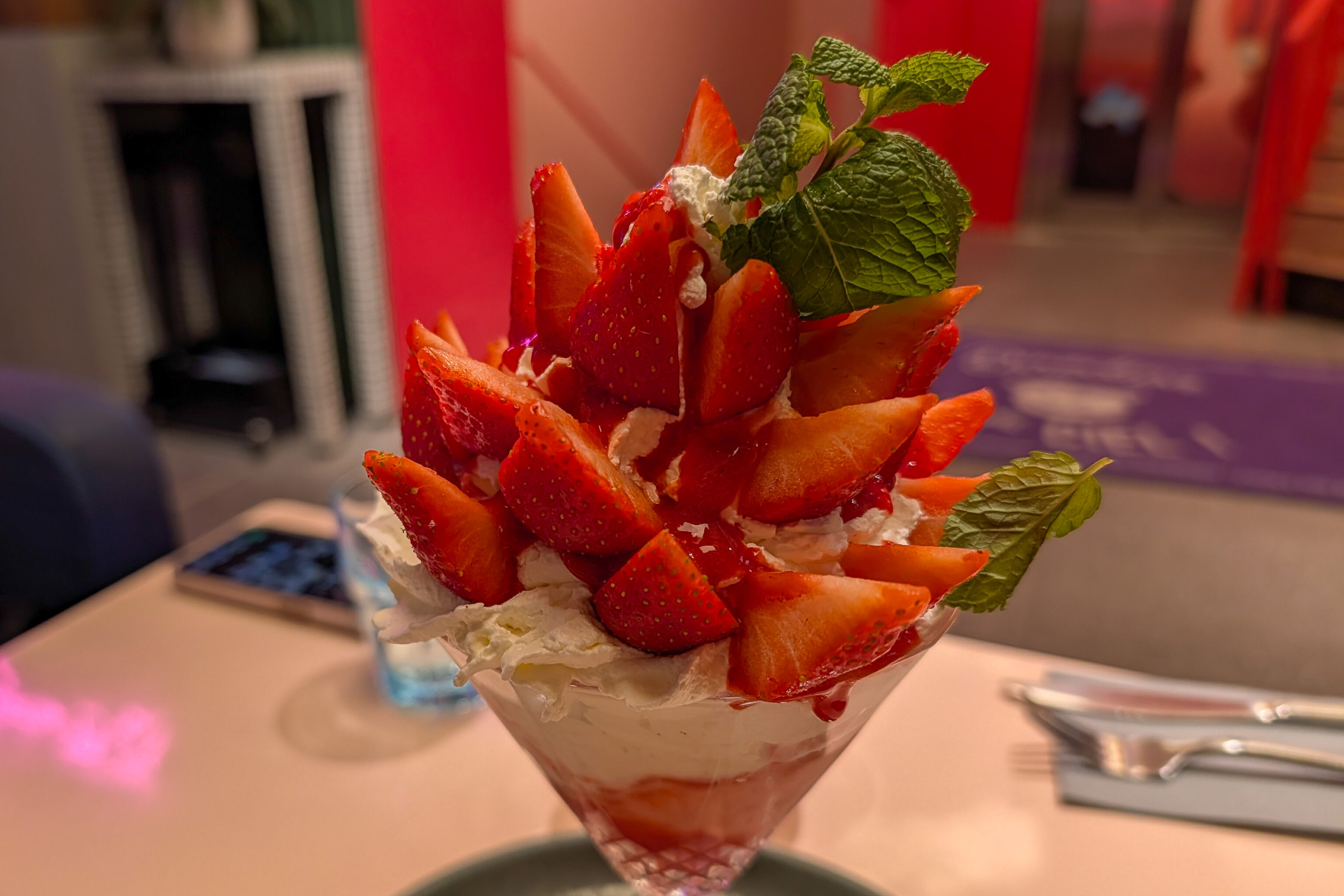
Our dessert came out first. It was very good with excellent strawberries, and not overly sweet.
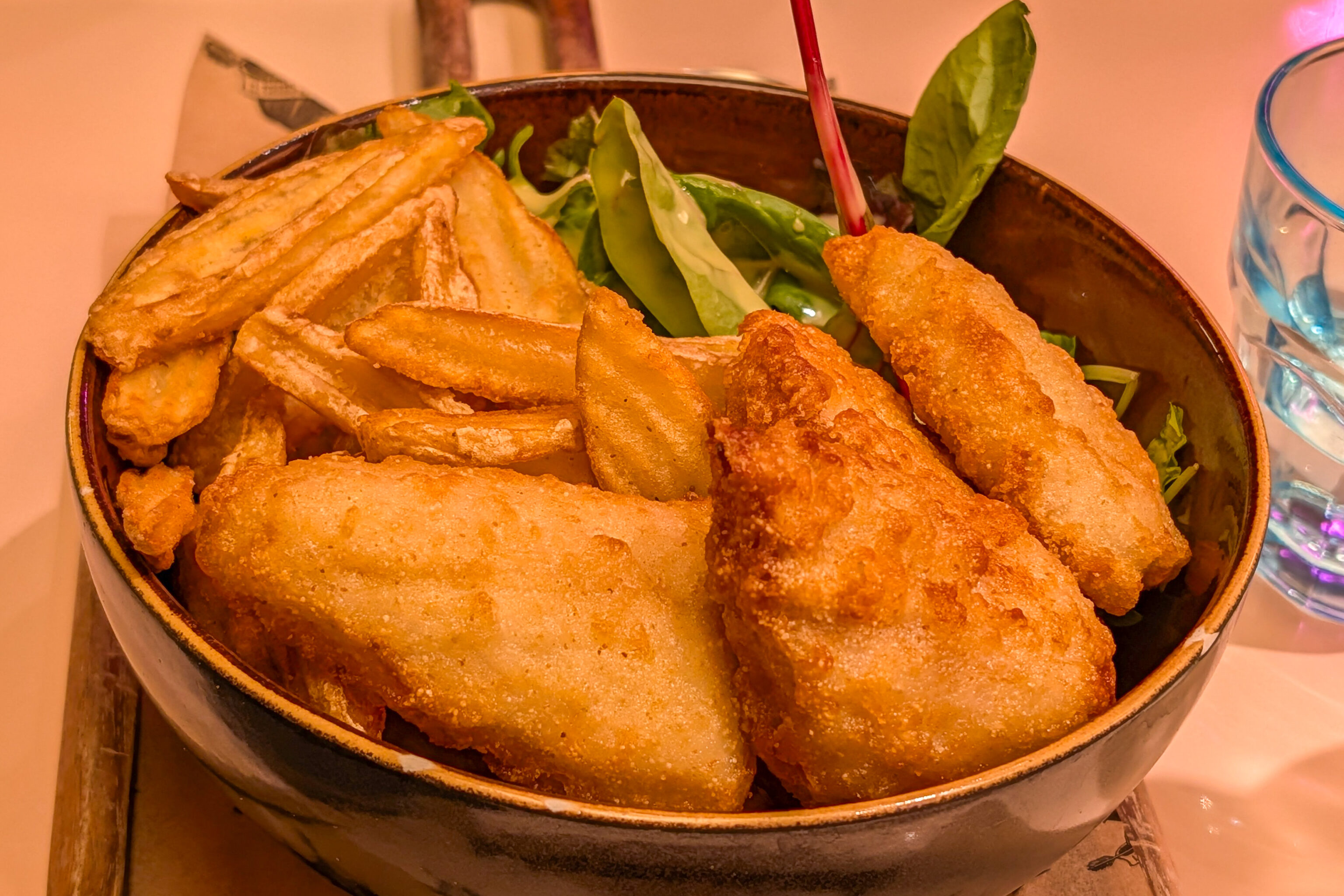
Our main, which wasn’t our first choice, came out soon after.
Perhaps ordering fish and chips in France was a bad idea. We originally wanted the pastrami burger but for whatever reason they couldn’t make burgers. The fish was actually pretty decent but the fries were terrible. They probably would have been good if freshly made but it’s clear they just make a batch and use until it’s gone. They were a bit cool and no longer crispy.